WO2022264706A1 - 合成単結晶ダイヤモンド及びその製造方法 - Google Patents
合成単結晶ダイヤモンド及びその製造方法 Download PDFInfo
- Publication number
- WO2022264706A1 WO2022264706A1 PCT/JP2022/019527 JP2022019527W WO2022264706A1 WO 2022264706 A1 WO2022264706 A1 WO 2022264706A1 JP 2022019527 W JP2022019527 W JP 2022019527W WO 2022264706 A1 WO2022264706 A1 WO 2022264706A1
- Authority
- WO
- WIPO (PCT)
- Prior art keywords
- single crystal
- synthetic single
- crystal diamond
- diamond
- less
- Prior art date
- Legal status (The legal status is an assumption and is not a legal conclusion. Google has not performed a legal analysis and makes no representation as to the accuracy of the status listed.)
- Ceased
Links
Images


Classifications
-
- C—CHEMISTRY; METALLURGY
- C30—CRYSTAL GROWTH
- C30B—SINGLE-CRYSTAL GROWTH; UNIDIRECTIONAL SOLIDIFICATION OF EUTECTIC MATERIAL OR UNIDIRECTIONAL DEMIXING OF EUTECTOID MATERIAL; REFINING BY ZONE-MELTING OF MATERIAL; PRODUCTION OF A HOMOGENEOUS POLYCRYSTALLINE MATERIAL WITH DEFINED STRUCTURE; SINGLE CRYSTALS OR HOMOGENEOUS POLYCRYSTALLINE MATERIAL WITH DEFINED STRUCTURE; AFTER-TREATMENT OF SINGLE CRYSTALS OR A HOMOGENEOUS POLYCRYSTALLINE MATERIAL WITH DEFINED STRUCTURE; APPARATUS THEREFOR
- C30B29/00—Single crystals or homogeneous polycrystalline material with defined structure characterised by the material or by their shape
- C30B29/02—Elements
- C30B29/04—Diamond
-
- C—CHEMISTRY; METALLURGY
- C30—CRYSTAL GROWTH
- C30B—SINGLE-CRYSTAL GROWTH; UNIDIRECTIONAL SOLIDIFICATION OF EUTECTIC MATERIAL OR UNIDIRECTIONAL DEMIXING OF EUTECTOID MATERIAL; REFINING BY ZONE-MELTING OF MATERIAL; PRODUCTION OF A HOMOGENEOUS POLYCRYSTALLINE MATERIAL WITH DEFINED STRUCTURE; SINGLE CRYSTALS OR HOMOGENEOUS POLYCRYSTALLINE MATERIAL WITH DEFINED STRUCTURE; AFTER-TREATMENT OF SINGLE CRYSTALS OR A HOMOGENEOUS POLYCRYSTALLINE MATERIAL WITH DEFINED STRUCTURE; APPARATUS THEREFOR
- C30B33/00—After-treatment of single crystals or homogeneous polycrystalline material with defined structure
- C30B33/02—Heat treatment
-
- C—CHEMISTRY; METALLURGY
- C30—CRYSTAL GROWTH
- C30B—SINGLE-CRYSTAL GROWTH; UNIDIRECTIONAL SOLIDIFICATION OF EUTECTIC MATERIAL OR UNIDIRECTIONAL DEMIXING OF EUTECTOID MATERIAL; REFINING BY ZONE-MELTING OF MATERIAL; PRODUCTION OF A HOMOGENEOUS POLYCRYSTALLINE MATERIAL WITH DEFINED STRUCTURE; SINGLE CRYSTALS OR HOMOGENEOUS POLYCRYSTALLINE MATERIAL WITH DEFINED STRUCTURE; AFTER-TREATMENT OF SINGLE CRYSTALS OR A HOMOGENEOUS POLYCRYSTALLINE MATERIAL WITH DEFINED STRUCTURE; APPARATUS THEREFOR
- C30B33/00—After-treatment of single crystals or homogeneous polycrystalline material with defined structure
- C30B33/04—After-treatment of single crystals or homogeneous polycrystalline material with defined structure using electric or magnetic fields or particle radiation
-
- C—CHEMISTRY; METALLURGY
- C30—CRYSTAL GROWTH
- C30B—SINGLE-CRYSTAL GROWTH; UNIDIRECTIONAL SOLIDIFICATION OF EUTECTIC MATERIAL OR UNIDIRECTIONAL DEMIXING OF EUTECTOID MATERIAL; REFINING BY ZONE-MELTING OF MATERIAL; PRODUCTION OF A HOMOGENEOUS POLYCRYSTALLINE MATERIAL WITH DEFINED STRUCTURE; SINGLE CRYSTALS OR HOMOGENEOUS POLYCRYSTALLINE MATERIAL WITH DEFINED STRUCTURE; AFTER-TREATMENT OF SINGLE CRYSTALS OR A HOMOGENEOUS POLYCRYSTALLINE MATERIAL WITH DEFINED STRUCTURE; APPARATUS THEREFOR
- C30B9/00—Single-crystal growth from melt solutions using molten solvents
- C30B9/04—Single-crystal growth from melt solutions using molten solvents by cooling of the solution
- C30B9/08—Single-crystal growth from melt solutions using molten solvents by cooling of the solution using other solvents
- C30B9/10—Metal solvents
Definitions
- the present disclosure relates to synthetic single crystal diamond and a method for producing the same.
- This application claims priority from Japanese Patent Application No. 2021-099431 filed on June 15, 2021. All the contents described in the Japanese patent application are incorporated herein by reference.
- single crystal diamond is extremely hard, it can be used in cutting tools such as precision cutting tools and woodworking cutters, as well as wear-resistant tools such as dressers for grinding wheels, wire drawing dies, scribing tools, orifices for water jets, and wire guides. It is widely used industrially.
- natural diamonds Many of the naturally produced single crystal diamonds (hereinafter also referred to as “natural diamonds”) contain nitrogen impurities at concentrations of several hundred to several thousand ppm as aggregated impurities (type Ia). Due to the complex thermal history when natural diamond is formed inside the earth, the distribution of impurities in natural diamond is highly uneven and heterogeneous. In addition, many internal strains and various crystal defects are contained inside the crystal due to various fluctuations in stress and heat received during the growth of natural diamond. For this reason, the mechanical properties such as hardness and strength, which are important for tools, vary greatly even within the crystal, and there are large individual differences, resulting in unstable quality and tool performance.
- Some natural diamonds are high-purity products (type IIa) that contain nitrogen impurities at a concentration of several ppm or less. However, the natural diamond has many internal strains and defects, and is not suitable for use as a tool.
- natural diamonds contain a wide variety of internal strains and structural defects, and it is necessary to carefully select crystals for industrial use.
- natural diamonds are subject to significant risks of cost fluctuations and supply instability.
- synthetic single crystal diamond which is artificially produced at high pressure and high temperature, is synthesized under constant pressure and temperature conditions, so it can be stably supplied with the same quality. Therefore, synthetic single-crystal diamond is far superior to natural diamond in terms of small quality variation for industrial applications.
- the nitrogen impurities normally contained in synthetic diamond have a concentration of around 100 ppm, but are contained in an isolated substitution type (dispersion type) (Ib type), which reduces hardness and strength. Therefore, when the synthetic diamond is used as a cutting tool, the tool life tends to be insufficient.
- the synthetic single crystal diamond of the present disclosure is Synthetic single crystal diamond containing nitrogen atoms at a concentration of 50 ppm or more and 1000 ppm or less based on the number of atoms,
- the synthetic single crystal diamond includes an aggregate consisting of one vacancy and two substitutional nitrogen atoms existing adjacent to the vacancy,
- the ratio b/a of the length b of the longer diagonal line of the second Knoop indentation to the length a of the longer diagonal line of the first Knoop indentation of the synthetic single crystal diamond is 0.90 or less
- the first Knoop indentation is made in the ⁇ 110> direction on the ⁇ 110 ⁇ plane of the synthetic single crystal diamond, in accordance with JIS Z 2251: 2009, at a temperature of 23 ° C.
- the second Knoop indentation is a synthetic single crystal diamond, which is a Knoop indentation that remains on the surface of the synthetic single crystal diamond after the test load is released.
- the method for producing synthetic single crystal diamond of the present disclosure comprises: The method for producing the synthetic single crystal diamond, a first step of synthesizing a diamond single crystal containing nitrogen atoms at a concentration of 50 ppm or more and 1000 ppm or less based on the number of atoms by a temperature difference method using a solvent metal; a second step of irradiating the diamond single crystal with one or both of an electron beam and a particle beam giving an energy of 10 MGy or more and 1000 MGy or less; a third step of heat-treating the diamond single crystal after the second step in an inert gas at a pressure of 1 Pa or more and 100 KPa or less to obtain the synthetic single crystal diamond;
- the temperature x in the heat treatment of the third step is 1500° C. or higher and 1800° C. or lower, and the heating time y is 1 minute or longer and 360 minutes or shorter.
- FIG. 1 is a diagram for explaining a Knoop indentation.
- FIG. 2 is a schematic cross-sectional view showing an example of a sample chamber configuration used for manufacturing synthetic single crystal diamond according to an embodiment of the present disclosure.
- an object of the present disclosure is to provide a synthetic single crystal diamond having excellent fracture resistance.
- the synthetic single crystal diamond of the present disclosure has excellent fracture resistance.
- the synthetic single crystal diamond of the present disclosure is Synthetic single crystal diamond containing nitrogen atoms at a concentration of 50 ppm or more and 1000 ppm or less based on the number of atoms,
- the synthetic single crystal diamond includes an aggregate consisting of one vacancy and two substitutional nitrogen atoms existing adjacent to the vacancy,
- the ratio b/a of the length b of the longer diagonal line of the second Knoop indentation to the length a of the longer diagonal line of the first Knoop indentation of the synthetic single crystal diamond is 0.90 or less
- the first Knoop indentation is made in the ⁇ 110> direction on the ⁇ 110 ⁇ plane of the synthetic single crystal diamond, in accordance with JIS Z 2251: 2009, at a temperature of 23 ° C.
- the second Knoop indentation is a synthetic single crystal diamond, which is a Knoop indentation that remains on the surface of the synthetic single crystal diamond after the test load is released.
- the synthetic single crystal diamond of the present disclosure has excellent fracture resistance.
- synthetic single crystal diamond can have excellent fracture resistance.
- the absorption spectrum of the synthetic single-crystal diamond obtained using an ultraviolet-visible spectrophotometer has an absorption peak in one or both of the wavelength range of 503 ⁇ 2 nm and the wavelength range of 470 nm or more and 500 nm or less. preferably present.
- synthetic single crystal diamond can have excellent fracture resistance.
- the wavelength is within the range of 986 ⁇ 2 nm and the wavelength is 1000 nm or more and 1300 nm or less.
- synthetic single crystal diamond can have excellent fracture resistance.
- the absorption spectrum of the synthetic single crystal diamond obtained using an ultraviolet-visible spectrophotometer has an absorption peak in one or both of the wavelength range of 986 ⁇ 2 nm and the wavelength range of 750 nm or more and 950 nm or less. preferably present.
- synthetic single crystal diamond can have excellent fracture resistance.
- the synthetic single-crystal diamond preferably does not contain isolated substitutional nitrogen atoms. According to this, synthetic single crystal diamond can have excellent wear resistance and chipping resistance.
- the method for producing synthetic single crystal diamond of the present disclosure comprises: The method for producing the above synthetic single crystal diamond, a first step of synthesizing a diamond single crystal containing nitrogen atoms at a concentration of 50 ppm or more and 1000 ppm or less based on the number of atoms by a temperature difference method using a solvent metal; a second step of irradiating the diamond single crystal with one or both of an electron beam and a particle beam giving an energy of 10 MGy or more and 1000 MGy or less; a third step of heat-treating the diamond single crystal after the second step in an inert gas at a pressure of 1 Pa or more and 100 KPa or less to obtain the synthetic single crystal diamond;
- the temperature x in the heat treatment of the third step is 1500° C. or higher and 1800° C. or lower, and the heating time y is 1 minute or longer and 360 minutes or shorter.
- the temperature x° C. and the heating time y minutes in the third step preferably satisfy Formula 1 below. -0.097x+175 ⁇ y ⁇ -1.1x+2030 Formula 1
- synthetic single crystal diamond can have excellent fracture resistance.
- any one numerical value described in the lower limit and any one numerical value described in the upper limit shall also be disclosed.
- a1 or more, b1 or more, c1 or more is described as the lower limit, and a2 or less, b2 or less, or c2 or less is described as the upper limit, a1 or more and a2 or less, a1 or more and b2 or less, a1 or more and c2 or less, b1 to a2, b1 to b2, b1 to c2, c1 to a2, c1 to b2, and c1 to c2.
- Nitrogen atoms in diamond crystals can be classified into isolated substitution type nitrogen atoms, aggregated type nitrogen atoms, etc., depending on the form of existence.
- a solitary substitution type nitrogen atom is one in which a nitrogen atom substitutes for one atomic unit at the position of a carbon atom in a diamond crystal.
- Synthetic single-crystal diamond containing lone-substituted nitrogen atoms exhibits an absorption peak near 1130 cm ⁇ 1 wavenumber (ie, 1130 ⁇ 2 cm ⁇ 1 wavenumber) in the infrared absorption spectrum measured by Fourier transform infrared spectroscopy.
- the wave number of 1130 ⁇ 2 cm ⁇ 1 means a wave number of 1128 cm ⁇ 1 or more and 1132 cm ⁇ 1 or less.
- ESR Electron Spin Resonance
- Aggregated nitrogen atoms are those in which two or more nitrogen atoms are aggregated in a diamond crystal.
- Aggregated nitrogen atoms include A center (nitrogen 2 atom pair), H3 center and H2 center (nitrogen 2 atom and vacancy aggregation), N3 center (nitrogen 3 atom aggregation), B center (nitrogen 4 atom condensation), B' It exists in a center or platelet or the like.
- a center is an aggregate consisting of two nitrogen atoms, the two nitrogen atoms are covalently bonded, and each nitrogen atom replaces a carbon atom that constitutes a diamond crystal. ing. Diamonds containing A centers (nitrogen diatomic pairs) are called type IaA.
- a synthetic single-crystal diamond containing an A center has an absorption peak near a wavenumber of 1282 cm ⁇ 1 (for example, a wavenumber of 1282 ⁇ 2 cm ⁇ 1 ) in an infrared absorption spectrum measured by Fourier transform infrared spectroscopy. show.
- the wave number of 1282 ⁇ 2 cm ⁇ 1 means a wave number of 1280 cm ⁇ 1 or more and 1284 cm ⁇ 1 or less.
- H3 center and H2 center are aggregates consisting of one vacancy and two nitrogen atoms existing adjacent to the vacancy, and each nitrogen atom is a diamond crystal is replaced with a carbon atom that constitutes
- the charge of the H3 center is neutral and the H2 center has a negative charge.
- nitrogen atom present adjacent to a vacancy refers to a nitrogen atom having the shortest interatomic distance to the carbon atom, assuming that a carbon atom exists at the position of the vacancy.
- An atom ie, nearest neighbor
- Synthetic single-crystal diamond containing an H3 center has a fluorescence spectrum within the wavelength range of 503 ⁇ 2 nm and within the wavelength range of 510 nm or more and 550 nm or less in the fluorescence spectrum obtained by irradiating excitation light with a wavelength of 457 nm using a fluorescence spectrophotometer.
- the emission peak within the wavelength range of 503 ⁇ 2 nm is the emission peak corresponding to the zero-phonon line of the H3 center.
- the emission peak within the wavelength range of 510 nm or more and 550 nm or less is the emission peak corresponding to the subband (phonon sideband) of the H3 center.
- the emission peak within the wavelength range of 500 nm or more and 550 nm or less may be observed as one or more mountain-shaped peaks within the range.
- the wavelength of 503 ⁇ 2 nm means a wavelength of 501 nm or more and 505 nm or less.
- Synthetic single-crystal diamond containing an H3 center has an absorption peak in one or both of the wavelength range of 503 nm ⁇ 2 nm and the wavelength range of 470 nm to 500 nm in the absorption spectrum obtained using an ultraviolet-visible spectrophotometer. exists.
- the absorption peak within the wavelength range of 503 nm ⁇ 2 nm is the absorption peak corresponding to the zero phonon line of the H3 center
- the absorption peak within the wavelength range of 470 nm or more and 500 nm or less is the H3 center subband (phonon sideband).
- the wavelength of 503 ⁇ 2 nm means a wavelength of 501 nm or more and 505 nm or less.
- Synthetic single crystal diamond containing an H2 center has a fluorescence spectrum obtained by irradiating excitation light with a wavelength of 830 nm using a fluorescence spectrophotometer, within a wavelength range of 986 ⁇ 2 nm and within a wavelength range of 1000 nm or more and 1300 nm or less.
- the emission peak within the wavelength range of 986 ⁇ 2 nm is the emission peak corresponding to the zero phonon line of the H center
- the emission peak within the wavelength range of 1000 nm or more and 1300 nm or less is the H center subband (phonon sideband).
- the emission peak is the emission peak corresponding to The emission peak within the wavelength range of 1000 nm or more and 1300 nm or less may be observed as one or more mountain-shaped peaks within the range.
- the wavelength of 986 ⁇ 2 nm means a wavelength of 984 nm or more and 988 nm or less.
- Synthetic single-crystal diamond containing an H2 center has an absorption peak in one or both of the wavelength range of 986 ⁇ 2 nm and the wavelength range of 750 nm to 950 nm in the absorption spectrum obtained using an ultraviolet-visible spectrophotometer. exists.
- the absorption peak within the wavelength range of 986 ⁇ 2 nm is the absorption peak corresponding to the zero phonon line of the H2 center
- the absorption peak within the wavelength range of 750 nm or more and 950 nm or less is the subband (phonon sideband) of the H2 center. Corresponding absorption peaks.
- Absorption peaks in the wavelength range of 750 nm or more and 950 nm or less may be observed as one or more mountain-shaped peaks within the range.
- the wavelength of 986 ⁇ 2 nm means a wavelength of 984 nm or more and 988 nm or less.
- the optical measurements for obtaining the above fluorescence spectrum and absorption spectrum are performed at room temperature (23°C ⁇ 5°C, that is, 18°C or higher and 28°C or lower). If it is difficult to determine the peak position in the fluorescence spectrum and/or absorption spectrum obtained at room temperature, the optical measurement is performed at a liquid nitrogen temperature of 77K.
- the N3 center (nitrogen 3 atom and vacancy aggregation) is an aggregate consisting of one vacancy and three nitrogen atoms existing adjacent to the vacancy, and each nitrogen atom constitutes a diamond crystal. It is substituted with a carbon atom.
- Synthetic single-crystal diamond containing N3 centers has a fluorescence spectrum around 415 nm (e.g., fluorescence wavelength 415 ⁇ 2 nm) and fluorescence wavelengths of 420 nm or more and 470 nm or less.
- the fluorescence wavelength of 415 ⁇ 2 nm means a fluorescence wavelength of 409 nm or more and 417 nm or less.
- a B center (nitrogen tetraatom and vacancy aggregation) is an aggregate consisting of one vacancy and four nitrogen atoms existing adjacent to the vacancy, and each nitrogen atom constitutes a diamond crystal. It is substituted with a carbon atom.
- Diamonds containing B centers are called type IaB.
- a synthetic single-crystal diamond containing a B center exhibits an absorption peak near a wavenumber of 1175 cm ⁇ 1 (for example, a wavenumber of 1175 ⁇ 2 cm ⁇ 1 ) in an infrared absorption spectrum measured by Fourier transform infrared spectroscopy.
- the wave number of 1175 ⁇ 2 cm ⁇ 1 means a wave number of 1173 cm ⁇ 1 or more and 1177 cm ⁇ 1 or less.
- the B' center (also called platelet) is a plate-like aggregate consisting of five or more nitrogen atoms and interstitial carbon, and is incorporated into the crystal as an inclusion.
- Diamonds containing B' centers are called type IaB'.
- Synthetic single-crystal diamond containing B' centers exhibits an absorption peak at a wavenumber of 1358 cm -1 or more and 1385 cm -1 or less in an infrared absorption spectrum measured by Fourier transform infrared spectroscopy.
- the above aggregates are contained in natural diamonds, and are rarely contained in conventional synthetic single-crystal diamonds.
- H3 centers and/or H2 centers can be easily formed in synthetic single crystal diamond, and synthetic single crystal diamonds containing H3 centers and/or H2 centers have less crystal strain. , was newly found to be structurally stable. By predominantly forming H3 centers and/or H2 centers in the synthetic single crystal diamond, mechanical properties such as hardness, strength, wear resistance, and chipping resistance of the synthetic single crystal diamond are improved at low cost. The inventors have newly found that the present disclosure can be completed.
- the synthetic single crystal diamond of this embodiment is a synthetic single crystal diamond containing nitrogen atoms at a concentration of 50 ppm or more and 1000 ppm or less based on the number of atoms,
- the synthetic single crystal diamond comprises an aggregate consisting of one vacancy and two substituted nitrogen atoms adjacent to the vacancy,
- the ratio b/a of the length b of the longer diagonal line of the second Knoop indentation to the length a of the longer diagonal line of the first Knoop indentation of the synthetic single crystal diamond is 0.90 or less
- the first Knoop indentation is made in the ⁇ 110> direction on the ⁇ 110 ⁇ plane of the synthetic single crystal diamond, in accordance with JIS Z 2251: 2009, at a temperature of 23 ° C.
- the second Knoop indentation is a synthetic single crystal diamond, which is a Knoop indentation that remains on the surface of the synthetic single crystal diamond after the test load is released.
- the synthetic single crystal diamond of this embodiment can have excellent fracture resistance. Furthermore, the synthetic single crystal diamond of the present embodiments can also have excellent wear resistance. The reason for this is not clear, but is presumed to be the following (i) to (iii).
- the synthetic single crystal diamond of the present embodiment contains nitrogen atoms at a concentration of 50 ppm or more and 1000 ppm or less based on the number of atoms. According to this, the nitrogen atoms in the synthetic single-crystal diamond tend to agglomerate. Therefore, aggregates containing nitrogen atoms tend to exist in the synthetic single-crystal diamond, and the wear resistance and chipping resistance of the synthetic single-crystal diamond are improved.
- the synthetic single-crystal diamond of this embodiment includes an aggregate consisting of one vacancy and two substitutional nitrogen atoms adjacent to the vacancy. That is, the synthetic single crystal diamond of this embodiment contains H3 centers and/or H2 centers. The presence of the H3 center and/or the H2 center in the synthetic single crystal diamond improves mechanical properties such as hardness, strength, wear resistance and chipping resistance of the synthetic single crystal diamond.
- the H3 center and/or H2 center suppress the occurrence of cracks and plastic deformation that occur when a load is applied to the synthetic single crystal diamond. Also, even if these cracks or plastic deformations occur locally, their progress is blocked by the H3 centers and/or H2 centers, and the synthetic single crystal diamond does not break.
- synthetic single-crystal diamond containing H3 centers and/or H2 centers has improved fracture strength and elastic deformability, and improved chipping resistance.
- the ratio b/a of the length b of the longer diagonal line of the second Knoop indentation to the length a of the longer diagonal line of the first Knoop indentation is 0.90. It is below.
- the synthetic single crystal diamond has excellent toughness and fracture resistance.
- the synthetic single-crystal diamond of this embodiment contains nitrogen atoms at a concentration of 50 ppm or more and 1000 ppm or less based on the number of atoms (hereinafter, the concentration of nitrogen atoms based on the number of atoms is also referred to as "nitrogen atom concentration").
- nitrogen atom concentration is 50 ppm or more
- the nitrogen atoms in the synthetic single crystal diamond tend to form aggregates containing nitrogen atoms.
- the synthetic single crystal diamond can have excellent wear resistance and chipping resistance.
- the lower limit of the nitrogen atom concentration in synthetic single crystal diamond is preferably 100 ppm or more, preferably 150 ppm or more, preferably 200 ppm or more, preferably 250 ppm or more, and preferably 300 ppm or more.
- the upper limit of the nitrogen atom concentration in synthetic single crystal diamond is preferably 900 ppm or less, preferably 850 ppm or less, and preferably 800 ppm or less.
- the nitrogen atom concentration in the synthetic single crystal diamond is preferably 50 ppm to 900 ppm, preferably 50 ppm to 850 ppm, preferably 100 ppm to 1000 ppm, preferably 100 ppm to 900 ppm, preferably 100 ppm to 850 ppm, and 150 ppm to 1000 ppm. is preferably 150 ppm to 900 ppm, preferably 150 ppm to 850 ppm, preferably 250 ppm to 1000 ppm, preferably 250 ppm to 900 ppm, and preferably 250 ppm to 850 ppm.
- the nitrogen atom concentration in synthetic single crystal diamond can be measured by secondary ion mass spectrometry (SIMS).
- the synthetic single crystal diamond of this embodiment contains aggregates consisting of one vacancy and two substitutional nitrogen atoms adjacent to the vacancy. That is, the synthetic single crystal diamond of this embodiment contains H3 centers and/or H2 centers. The presence of the H3 center and/or the H2 center in the synthetic single crystal diamond improves mechanical properties such as hardness, strength, wear resistance and chipping resistance of the synthetic single crystal diamond.
- the H3 center and/or H2 center suppress the occurrence of cracks and plastic deformation that occur when a load is applied to the synthetic single crystal diamond. Also, even if these cracks or plastic deformations occur locally, their progress is blocked by the H3 centers and/or H2 centers, and the synthetic single crystal diamond does not break.
- the synthetic single-crystal diamond containing H3 centers and/or H2 centers has improved fracture strength and elastic deformability, and improved chipping resistance.
- That the synthetic single crystal diamond contains H3 centers and/or H2 centers can be confirmed by fluorescence spectra obtained using a fluorescence spectrophotometer and/or absorption spectra obtained using an ultraviolet-visible spectrophotometer. can.
- the wavelength of 503 ⁇ 2 nm In the fluorescence spectrum (horizontal axis: wavelength (nm), vertical axis: fluorescence intensity or emission intensity) obtained by irradiating synthetic single crystal diamond with excitation light of wavelength 457 nm using a fluorescence spectrophotometer, the wavelength of 503 ⁇ 2 nm
- the synthetic single crystal diamond is judged to contain an H3 center when there is an emission peak within the range and within the wavelength range of 510 nm or more and 550 nm or less, or both.
- the wavelength of 503 ⁇ 2 nm means a wavelength of 501 nm or more and 505 nm or less.
- Existence of an emission peak within the wavelength range of 503 ⁇ 2 nm means that the maximum value of the peak exists within the range.
- Existence of an emission peak within the wavelength range of 510 nm or more and 550 nm or less means that the maximum value of the peak exists within the above range.
- the wavelength is within the range of 503 nm ⁇ 2 nm, and the wavelength is 470 nm or more and 500 nm.
- a synthetic single crystal diamond is judged to contain an H3 center if absorption peaks are present in one or both of the following ranges:
- the wavelength of 503 ⁇ 2 nm means a wavelength of 501 nm or more and 505 nm or less.
- the existence of an absorption peak within the wavelength range of 503 ⁇ 2 nm means that the maximum value of the peak exists within the range.
- the existence of an absorption peak within the wavelength range of 470 nm or more and 500 nm or less means that the maximum value of the peak exists within the above range.
- the wavelength of 986 ⁇ 2 nm In the fluorescence spectrum (horizontal axis: wavelength (nm), vertical axis: fluorescence intensity or emission intensity) obtained by irradiating synthetic single-crystal diamond with excitation light at a wavelength of 830 nm using a fluorescence spectrophotometer, the wavelength of 986 ⁇ 2 nm
- the synthetic single crystal diamond is judged to contain an H2 center if there is an emission peak within the range and within the wavelength range of 1000 nm or more and 1300 nm or less, or both.
- the wavelength of 986 ⁇ 2 nm means a wavelength of 984 nm or more and 988 nm or less.
- Existence of an emission peak within the wavelength range of 986 ⁇ 2 nm means that the maximum value of the peak exists within the range.
- Existence of an emission peak within the wavelength range of 1000 nm or more and 1300 nm or less means that the maximum value of the peak exists within the above range.
- the wavelength is within the range of 986 ⁇ 2 nm and the wavelength is 750 nm or more and 950 nm.
- a synthetic single crystal diamond is judged to contain an H2 center if absorption peaks are present in one or both of the following ranges:
- the wavelength of 986 ⁇ 2 nm means a wavelength of 984 nm or more and 988 nm or less.
- the existence of an absorption peak within the wavelength range of 986 ⁇ 2 nm means that the maximum value of the peak exists within the range.
- the presence of an absorption peak within the wavelength range of 750 nm or more and 950 nm or less means that the maximum value of the peak exists within the range.
- the synthetic single-crystal diamond of this embodiment preferably does not contain lone substitutional nitrogen atoms.
- the present inventors have found that when diamond crystals contain isolated substitutional nitrogen atoms, local tensile stress is generated in the surrounding crystal lattice, and this becomes the starting point for plastic deformation and fracture, resulting in a decrease in hardness and resistance. It was newly discovered that wear resistance and chipping resistance decreased. Based on this knowledge, the present inventors have found that it is preferable from the viewpoint of improving wear resistance and fracture resistance that diamond crystals do not contain isolated substitutional nitrogen atoms.
- the synthetic single-crystal diamond does not contain an isolated substitution type nitrogen atom. Specifically, if there is no absorption peak in the wavenumber range of 1130 ⁇ 2 cm ⁇ 1 in the infrared absorption spectrum, it is determined that the synthetic single crystal diamond does not contain an isolated substitution type nitrogen atom.
- the wave number of 1130 ⁇ 2 cm ⁇ 1 means a wave number of 1128 cm ⁇ 1 or more and 1132 cm ⁇ 1 or less.
- the ratio b/a of the length b of the longer diagonal line of the second Knoop indentation to the length a of the longer diagonal line of the first Knoop indentation of the synthetic single crystal diamond of the present embodiment is 0.90 or less
- the first Knoop indentation is made in the ⁇ 110> direction on the ⁇ 110 ⁇ plane of the synthetic single crystal diamond, in accordance with JIS Z 2251: 2009, at a temperature of 23 ° C. ⁇ 5 ° C. and a test load of 4.9 N.
- the second Knoop indentation is an indentation formed on the surface of the synthetic single-crystal diamond when the Knoop indenter is pushed in, and is the contact interface between the Knoop indenter and the synthetic single-crystal diamond.
- the second Knoop indentation is the Knoop indentation that remains on the surface of the synthetic single crystal diamond after the test load is released.
- the second Knoop indentation is, for example, as shown in FIG. 1, in the shape of a rhombus with each side curved inward.
- the ratio b/a of the length b of the longer diagonal line of the second Knoop impression to the length a of the longer diagonal line of the first Knoop impression is also referred to as " ⁇ 110 ⁇ 110>b/a".
- a testing device used for measuring the first Knoop indentation and the second Knoop indentation for example, a micro Vickers hardness tester HM (Mitsutoyo HM) manufactured by Mitsutoyo can be used. Since it may be difficult to measure the first Knoop indentation with an optical microscope attached to the test apparatus, it is desirable to measure the first Knoop indentation from an image with a magnification of 3000 to 10000 using a laser microscope or a scanning microscope.
- the Knoop hardness test specified in JIS Z 2251:2009 is known as one of the methods for measuring the hardness of industrial materials.
- the Knoop hardness test determines the hardness of a material to be measured by pressing a Knoop indenter against the material to be measured at a predetermined temperature and a predetermined load (test load).
- the predetermined temperature is 23° C. ⁇ 5° C. (that is, 18° C. or more and 28° C. or less)
- the predetermined load is 4.9N.
- a Knoop indenter is a diamond indenter that has a square pyramid shape with a rhombic base. In the Knoop hardness test, the top side of the Knoop indenter opposite to the bottom surface is pressed into the material to be measured.
- a Knoop indentation is a material to be measured (in this embodiment, a synthetic single The first Knoop indentation (see “First Knoop indentation” in FIG. 1), which is a rhomboidal impression formed on the surface of a crystalline diamond), and immediately after releasing the test load, remained on the surface of the material to be measured It is defined as including a second Knoop impression (see “Second Knoop impression” in FIG. 1) which is a trace of permanent deformation.
- the first Knoop indentation when the Knoop indenter is pushed in and the second Knoop indentation remaining after the Knoop indenter is removed have the same shape.
- the ratio b/a of b to a decreases. That is, the smaller the value of the ratio b/a, the greater the elastic recovery (elastic properties).
- the synthetic single-crystal diamond of the present embodiment has a ratio b/a of b to a of 0.90 or less, and has high elasticity, so crack initiation resistance against tensile stress is improved. Therefore, when synthetic single-crystal diamond is used as a tool material, stress concentration applied to the cutting edge is alleviated, and damage due to chipping of the cutting edge is suppressed.
- the synthetic single-crystal diamond of this embodiment when used for cutting that requires ultra-precision, the cutting edge elastically deforms, resulting in cutting marks that are a problem in mirror-finishing and the like. diffraction phenomenon (so-called iridescent pattern) is less likely to occur.
- the ratio b/a of b to a is 0.90 or less.
- the value of the ratio (b/a) exceeds 0.90, the brittleness increases, and cracks are likely to occur when a local stress is applied.
- the upper limit of the ratio (b/a) is 0.90 or less, preferably 0.888 or less, preferably 0.88 or less, more preferably 0.86 or less, and 0.88 or less. 84 or less is more preferable.
- the lower limit of the ratio b/a is preferably 0.66 or more and 0.70 or more from the viewpoint of suppressing deterioration of workability due to deformation of the cutting edge during processing.
- the ratio b/a is preferably 0.66 or more and 0.90 or less, preferably 0.70 or more and 0.90 or less, more preferably 0.72 or more and 0.88 or less, and still more preferably 0.74 or more and 0.86 or less. .
- the longer diagonal length a of the first Knoop indentation and the longer diagonal length b of the second Knoop indentation are measured by the following method.
- the surface of the synthetic single-crystal diamond after releasing the test load was observed with a high-resolution scanning electron microscope (for example, a field-emission scanning electron microscope (FE-SEM)) or a high-sensitivity differential interference contrast microscope (interference color by polarization interference). Observe precisely with a microscope that visualizes with high contrast).
- a high-resolution scanning electron microscope for example, a field-emission scanning electron microscope (FE-SEM)
- FE-SEM field-emission scanning electron microscope
- a high-sensitivity differential interference contrast microscope interference color by polarization interference
- the length b of the longer diagonal line in the second Knoop indentation, the length b1 of the streak-like indentation continuous with one first end of the longer diagonal line, and the first end on the opposite side of the first end is measured.
- the sum (b+b1+b2) of the length b of the longer diagonal line and the lengths b1 and b2 of the streaky indentations is defined as the length a of the longer diagonal line of the first Knoop indentation.
- Embodiment 2 Method for producing synthetic single crystal diamond
- An example of the method for producing the synthetic single-crystal diamond of Embodiment 1 will be described below.
- the synthetic single crystal diamond manufacturing method of the present embodiment is the synthetic single crystal diamond manufacturing method of the first embodiment, a first step of synthesizing a diamond single crystal containing nitrogen atoms at a concentration of 50 ppm or more and 1000 ppm or less based on the number of atoms by a temperature difference method using a solvent metal; a second step of irradiating the diamond single crystal with one or both of an electron beam and a particle beam giving an energy of 10 MGy or more and 1000 MGy or less; a third step of heat-treating the diamond single crystal after the second step in an inert gas at a pressure of 1 Pa or more and 100 KPa or less to obtain the synthetic single crystal diamond;
- the temperature x in the heat treatment of the third step is 1500° C. or more and 1800° C. or less, and the heating time y is 1 minute or more and 360 minutes or less.
- a diamond single crystal can be produced, for example, by a temperature difference method using a sample chamber having the configuration shown in FIG.
- a sample chamber 10 used for manufacturing a diamond single crystal 1 an insulator 2, a carbon source 3, a solvent metal 4, and a seed crystal 5 are arranged in a space surrounded by a graphite heater 7.
- a pressure medium 6 is arranged outside the graphite heater 7 .
- a vertical temperature gradient is provided inside the sample chamber 10
- the carbon source 3 is placed in the high temperature part (Thigh)
- the diamond seed crystal 5 is placed in the low temperature part (Tlow).
- a single diamond crystal 1 is placed on a seed crystal 5 by disposing a solvent metal 4 between the crystal 5 and maintaining a temperature higher than the temperature at which the solvent metal 4 dissolves and a pressure higher than the pressure at which the diamond becomes thermally stable.
- the pressure in the sample chamber is controlled within the range of 5.0 to 6.0 GPa
- the temperature of the low temperature portion is controlled within the range of 1360° C. to 1380° C.
- the temperature is maintained for 50 to 200 hours to grow a diamond single crystal on the seed crystal.
- the carbon source 3 it is preferable to use diamond powder.
- Graphite (graphite) or pyrolytic carbon can also be used.
- the solvent metal 4 one or more metals selected from iron (Fe), cobalt (Co), nickel (Ni), manganese (Mn), etc., or alloys containing these metals can be used.
- nitrogen sources such as iron nitride (Fe 2 N, Fe 3 N), aluminum nitride (AlN), phosphorus nitride (P 3 N 4 ), silicon nitride (Si 3 N 4 ), etc., and organic nitrogen compounds such as melamine and sodium azide can be added singly or as a mixture.
- nitrogen supply source diamond or graphite containing a large amount of nitrogen may be added.
- the synthesized diamond single crystal contains nitrogen atoms. At this time, the nitrogen atoms in the diamond single crystal exist mainly as isolated substitution type nitrogen atoms.
- the content of the nitrogen supply source in the carbon source 3 or solvent metal 4 is adjusted so that the concentration of nitrogen atoms in the diamond single crystal to be synthesized is 50 ppm or more and 1000 ppm or less.
- the content of nitrogen atoms derived from the nitrogen supply source can be 200 ppm or more and 3000 ppm or less.
- the solvent metal for example, when the solvent metal is an alloy of iron-cobalt-nickel and the nitrogen source is Fe 3 N, the content of the nitrogen source is 0.01% by mass or more and 0.2% by mass. % by mass or less.
- Solvent metals 4 are further titanium (Ti), vanadium (V), chromium (Cr), manganese (Mn), copper (Cu), zirconium (Zr), niobium (Nb), molybdenum (Mo), ruthenium (Ru ), rhodium (Rh), hafnium (Hf), tantalum (Ta), tungsten (W), osmium (Os), iridium (Ir) and platinum (Pt). You can
- the diamond single crystal thus obtained is irradiated with either one or both of an electron beam and a particle beam giving an energy of 10 MGy or more and 1000 MGy or less. This introduces lattice defects into the diamond single crystal and forms vacancies.
- the energy amount is preferably 10 MGy or more and 1000 MGy or less.
- Neutron beams and proton beams can be used as particle beams.
- Irradiation conditions are not particularly limited as long as an energy of 10 MGy or more and 1000 MGy or less can be applied to the diamond single crystal.
- the irradiation energy can be 4.6 MeV or more and 4.8 MeV or less
- the current can be 2 mA or more and 5 mA or less
- the irradiation time can be 30 hours or more and 45 hours or less.
- the diamond single crystal after the second step is heat-treated in an inert gas at a pressure of 1 Pa or more and 100 KPa or less to obtain a synthetic single crystal diamond.
- the temperature x is 1500° C. or higher and 1800° C. or lower, and the heating time y is 1 minute or longer and 360 minutes or shorter.
- the isolated substitutional nitrogen atoms in the diamond single crystal migrate through the vacancies and agglomerate into agglomerated nitrogen atoms.
- in an inert gas means in an atmosphere of an inert gas such as nitrogen or argon gas.
- the temperature x during the heat treatment in the third step is 1500° C. or higher, the movement of nitrogen atoms in the diamond single crystal is promoted, and one vacancy and two substitution types existing adjacent to the vacancy The formation of aggregates (H3 centers or H2 centers) consisting of nitrogen atoms is promoted. If the temperature in the third step is less than 1500°C, it is difficult to form H3 centers or H2 centers.
- the upper limit of the temperature x is 1800° C. or less from the viewpoint of preventing the reduction of these color centers or the graphitization of diamond.
- the heating time y of the heat treatment in the third step is 1 minute or more, the movement of nitrogen atoms in the diamond single crystal is promoted, and one vacancy and two substitution types existing adjacent to the vacancy The formation of aggregates (H3 centers and/or H2 centers) consisting of nitrogen atoms is promoted.
- the upper limit of the heating time y is 360 minutes or less from the viewpoint of preventing the reduction of these color centers or the graphitization of diamond.
- the temperature x° C. and the heating time y minutes in the third step preferably satisfy Formula 1 below. -0.097x+175 ⁇ y ⁇ -1.1x+2030 Equation 1 This promotes the movement of nitrogen atoms in the diamond single crystal, further promoting the formation of H3 centers and/or H2 centers.
- the second step and the third step can also be performed by repeating about two cycles, each of which is performed once. This promotes the aggregation of isolated substitutional nitrogen atoms within the diamond single crystal, and also promotes the formation of H3 centers and/or H2 centers. However, depending on the temperature conditions, excessive repetition may reduce H3 centers and H2 centers.
- the synthetic single crystal diamond of the present disclosure preferably contains 150 ppm or more and 850 ppm or less of nitrogen atoms based on the number of atoms.
- the synthetic single crystal diamond of the present disclosure preferably contains 250 ppm or more and 850 ppm or less of nitrogen atoms based on the number of atoms.
- the synthetic single crystal diamonds of the present disclosure preferably contain one or both H3 and H2 centers.
- the ratio b/a is preferably 0.66 or more and 0.90 or less. In the synthetic single crystal diamond of the present disclosure, the ratio b/a is preferably 0.70 or more and 0.90 or less.
- the solvent metal is an alloy consisting of iron-cobalt-nickel, the solvent metal is Fe3N as a nitrogen source;
- the content of the nitrogen source in the solvent metal is preferably 0.01% by mass or more and 0.2% by mass or less.
- the second step is preferably performed using an electron beam with an irradiation energy of 4.6 MeV or more and 4.8 MeV or less, a current of 2 mA or more and 5 mA or less, and an irradiation time of 30 hours or more and 45 hours or less.
- An alloy of iron-cobalt-nickel is prepared as a solvent metal, and iron nitride (Fe 3 N) powder is added as a nitrogen supply source.
- the concentration of iron nitride in the solvent metal is shown in Table 1, under “Production conditions", in the "Concentration of iron nitride in solvent metal (% by mass)" column. For example, in sample 3, the concentration of iron nitride in the solvent metal is 0.01 mass %. In Samples 1 and 2, no iron nitride was added, and the concentration of iron nitride in the solvent metal was 0% by mass, but the solvent metal itself contained dissolved nitrogen.
- Diamond powder is used as the carbon source, and about 0.5 mg of diamond single crystal is used as the seed crystal.
- the temperature in the sample chamber is adjusted with a heater so that there is a temperature difference of several tens of degrees between the high temperature portion where the carbon source is arranged and the low temperature portion where the seed crystal is arranged. Then, using an ultra-high pressure generator, the pressure of 5.5 GPa and the temperature of the low temperature part were controlled in the range of 1370 ° C. ⁇ 10 ° C. (1360 ° C. to 1380 ° C.) and held for 60 hours, and a single diamond was placed on the seed crystal. Synthesize crystals.
- the nitrogen atomic concentration of the obtained diamond single crystal based on the number of atoms is as shown in Table 1, "First step”, column “Nitrogen atomic concentration of diamond single crystal".
- the nitrogen atom concentration of the diamond single crystal is 50 ppm.
- the irradiation conditions of the electron beam are irradiation energy of 4.6 MeV, current of 2 mA, and irradiation time of 30 hours. This is an irradiation condition that gives an energy of 100 MGy to the diamond single crystal.
- electron beam irradiation is not performed for the samples marked with "-" in the “electron beam irradiation (100 MGy)" column of the "second step” of the "manufacturing conditions".
- An infrared absorption spectrum is prepared using an infrared spectrophotometer for each sample prepared in the above fluorescence spectrophotometric analysis.
- Samples 2, 4, 6 to 9, and 11 to 18 correspond to examples.
- Samples 1, 3, 5, and 10 correspond to comparative examples.
- Samples 2, 4, 6 to 9, and 11 to 18 (Examples) have a value of ⁇ 110 ⁇ 110>b/a of 0.90 or less and have large elasticity, It is confirmed to have excellent chipping resistance.
- the samples of these examples have smaller values of ⁇ 110 ⁇ 110>b/a than samples 1, 3, 5, and 10 (comparative examples), and are excellent in chipping resistance. It is confirmed that Since the samples of these examples contain H2 centers and H3 centers, they have high hardness and strength, and are judged to have excellent wear resistance.
- sample 5 the second and third steps are not performed, but the resulting synthetic single crystal diamond contains H3 centers.
- the reason for this is presumed to be that during the synthesis of the diamond single crystal in the first step, part of the nitrogen impurities were agglomerated to form H3 centers.
- Sample 5 contains an H3 center, but ⁇ 110 ⁇ 110>b/a is greater than 0.90, so its fracture resistance is inferior to that of Examples.
- sample 10 the second step is not performed, but the resulting synthetic single crystal diamond contains H3 centers.
- the reason for this is presumed to be that during the synthesis of the diamond single crystal in the first step, part of the nitrogen impurities were agglomerated to form H3 centers.
- Sample 10 contains an H3 center, but ⁇ 110 ⁇ 110>b/a is greater than 0.90, and thus is inferior in fracture resistance compared to Examples.
Landscapes
- Chemical & Material Sciences (AREA)
- Engineering & Computer Science (AREA)
- Crystallography & Structural Chemistry (AREA)
- Materials Engineering (AREA)
- Metallurgy (AREA)
- Organic Chemistry (AREA)
- Physics & Mathematics (AREA)
- Thermal Sciences (AREA)
- Crystals, And After-Treatments Of Crystals (AREA)
- Carbon And Carbon Compounds (AREA)
Abstract
Description
窒素原子を原子数基準で50ppm以上1000ppm以下の濃度で含む合成単結晶ダイヤモンドであって、
前記合成単結晶ダイヤモンドは、1つの空孔と、前記空孔に隣接して存在する2つの置換型窒素原子とからなる凝集体を含み、
前記合成単結晶ダイヤモンドの第1ヌープ圧痕の長い方の対角線の長さaに対する、第2ヌープ圧痕の長い方の対角線の長さbの比b/aが0.90以下であり、
前記第1ヌープ圧痕は、前記合成単結晶ダイヤモンドの{110}面における<110>方向に、JIS Z 2251:2009に準拠して、温度23℃±5℃、及び、試験荷重4.9Nの条件でヌープ圧子を押し込んだ状態において、前記合成単結晶ダイヤモンドの表面に形成される圧痕であり、
前記第2ヌープ圧痕は、前記試験荷重を解除した後に前記合成単結晶ダイヤモンドの表面に残るヌープ圧痕である、合成単結晶ダイヤモンドである。
上記合成単結晶ダイヤモンドの製造方法であって、
溶媒金属を用いた温度差法により、窒素原子を原子数基準で50ppm以上1000ppm以下の濃度で含むダイヤモンド単結晶を合成する第1工程と、
前記ダイヤモンド単結晶に、10MGy以上1000MGy以下のエネルギーを与える電子線及び粒子線の一方又は両方を照射する第2工程と、
前記第2工程後の前記ダイヤモンド単結晶に対して、圧力1Pa以上100KPa以下の不活性ガス中で加熱処理を行い、前記合成単結晶ダイヤモンドを得る第3工程と、を備え、
前記第3工程の前記加熱処理における温度xは1500℃以上1800℃以下であり、かつ、加熱時間yは1分以上360分以下である、合成単結晶ダイヤモンドの製造方法である。
近年の工具の長寿命化の要求から、優れた耐欠損性を有する合成単結晶ダイヤモンドが求められている。
[本開示の効果]
最初に本開示の実施態様を列記して説明する。
(1)本開示の合成単結晶ダイヤモンドは、
窒素原子を原子数基準で50ppm以上1000ppm以下の濃度で含む合成単結晶ダイヤモンドであって、
前記合成単結晶ダイヤモンドは、1つの空孔と、前記空孔に隣接して存在する2つの置換型窒素原子とからなる凝集体を含み、
前記合成単結晶ダイヤモンドの第1ヌープ圧痕の長い方の対角線の長さaに対する、第2ヌープ圧痕の長い方の対角線の長さbの比b/aが0.90以下であり、
前記第1ヌープ圧痕は、前記合成単結晶ダイヤモンドの{110}面における<110>方向に、JIS Z 2251:2009に準拠して、温度23℃±5℃、及び、試験荷重4.9Nの条件でヌープ圧子を押し込んだ状態において、前記合成単結晶ダイヤモンドの表面に形成される圧痕であり、
前記第2ヌープ圧痕は、前記試験荷重を解除した後に前記合成単結晶ダイヤモンドの表面に残るヌープ圧痕である、合成単結晶ダイヤモンドである。
上記の合成単結晶ダイヤモンドの製造方法であって、
溶媒金属を用いた温度差法により、窒素原子を原子数基準で50ppm以上1000ppm以下の濃度で含むダイヤモンド単結晶を合成する第1工程と、
前記ダイヤモンド単結晶に、10MGy以上1000MGy以下のエネルギーを与える電子線及び粒子線の一方又は両方を照射する第2工程と、
前記第2工程後の前記ダイヤモンド単結晶に対して、圧力1Pa以上100KPa以下の不活性ガス中で加熱処理を行い、前記合成単結晶ダイヤモンドを得る第3工程と、を備え、
前記第3工程の前記加熱処理における温度xは1500℃以上1800℃以下であり、かつ、加熱時間yは1分以上360分以下である、合成単結晶ダイヤモンドの製造方法である。
-0.097x+175≦y≦-1.1x+2030 式1
本開示の合成単結晶ダイヤモンドの具体例を、以下に図面を参照しつつ説明する。本開示の図面において、同一の参照符号は、同一部分または相当部分を表すものである。また、長さ、幅、厚さ、深さなどの寸法関係は図面の明瞭化と簡略化のために適宜変更されており、必ずしも実際の寸法関係を表すものではない。
まず、本実施形態の合成単結晶ダイヤモンドの理解を深めるために、ダイヤモンドの性能を決める主な要因の一つである、結晶中の不純物として存在する窒素原子について説明する。
本実施形態の合成単結晶ダイヤモンドは、窒素原子を原子数基準で50ppm以上1000ppm以下の濃度で含む合成単結晶ダイヤモンドであって、
該合成単結晶ダイヤモンドは、1つの空孔と、該空孔に隣接して存在する2つの置換型窒素原子とからなる凝集体を含み、
該合成単結晶ダイヤモンドの第1ヌープ圧痕の長い方の対角線の長さaに対する、第2ヌープ圧痕の長い方の対角線の長さbの比b/aが0.90以下であり、
該第1ヌープ圧痕は、該合成単結晶ダイヤモンドの{110}面における<110>方向に、JIS Z 2251:2009に準拠して、温度23℃±5℃、及び、試験荷重4.9Nの条件でヌープ圧子を押し込んだ状態において、該合成単結晶ダイヤモンドの表面に形成される圧痕であり、
該第2ヌープ圧痕は、該試験荷重を解除した後に該合成単結晶ダイヤモンドの表面に残るヌープ圧痕である、合成単結晶ダイヤモンドである。
本実施形態の合成単結晶ダイヤモンドは、窒素原子を原子数基準で50ppm以上1000ppm以下の濃度(以下、窒素原子の原子数基準の濃度を「窒素原子濃度」とも記す。)で含む。窒素原子濃度が50ppm以上であると、合成単結晶ダイヤモンド中の窒素原子が、窒素原子を含む凝集体を形成しやすい。窒素原子濃度が1000ppm以下であると、合成単結晶ダイヤモンドは優れた耐摩耗性及び耐欠損性を有することができる。
本実施形態の合成単結晶ダイヤモンドは、1つの空孔と、該空孔に隣接して存在する2つの置換型窒素原子とからなる凝集体を含む。すなわち、本実施形態の合成単結晶ダイヤモンドはH3センター及び/またはH2センターを含む。合成単結晶ダイヤモンド中にH3センター及び/またはH2センターが存在することで、合成単結晶ダイヤモンドの硬さや強度、耐摩耗性、耐欠損性などの機械特性が向上する。
本実施形態の合成単結晶ダイヤモンドは、孤立置換型窒素原子を含まないことが好ましい。本発明者らは、ダイヤモンド結晶中に、孤立置換型窒素原子が含まれると、その周りの結晶格子に局所的な引張応力が生じ、これが塑性変形や破壊の起点となり、硬度が低下し、耐摩耗性や耐欠損性が低下することを新たに知見した。この知見に基づき、本発明者らは、ダイヤモンド結晶中に孤立置換型窒素原子が含まれないことが、耐摩耗性や耐欠損性の向上の観点から好ましいことを見出した。
本実施形態の合成単結晶ダイヤモンドの第1ヌープ圧痕の長い方の対角線の長さaに対する、第2ヌープ圧痕の長い方の対角線の長さbの比b/aは0.90以下であり、該第1ヌープ圧痕は、該合成単結晶ダイヤモンドの{110}面における<110>方向に、JIS Z 2251:2009に準拠して、温度23℃±5℃、及び、試験荷重4.9Nの条件でヌープ圧子を押し込んだ状態において、該合成単結晶ダイヤモンドの表面に形成される圧痕であり、ヌープ圧子と該合成単結晶ダイヤモンドとの接触界面である。該第2ヌープ圧痕は、該試験荷重を解除した後に該合成単結晶ダイヤモンドの表面に残るヌープ圧痕である。第2ヌープ圧痕は、例えば図1に示されるように、菱形の各辺が内側に湾曲した形である。以下、第1ヌープ圧痕の長い方の対角線の長さaに対する、第2ヌープ圧痕の長い方の対角線の長さbの比b/aを「{110}<110>b/a」とも記す。第1ヌープ圧痕及び第2ヌープ圧痕の測定に用いる試験装置としては、例えば、Mitsutoyo製マイクロビッカース硬さ試験機HM(Mitsutoyo HM)を用いることができる。第1ヌープ圧痕は、試験装置付属の光学顕微鏡では計測が難しい場合があるため、レーザー顕微鏡や走査型顕微鏡で3000~10000倍の画像より計測することが望ましい。
実施形態1の合成単結晶ダイヤモンドの製造方法の一例について、以下に説明する。
溶媒金属を用いた温度差法により、窒素原子を原子数基準で50ppm以上1000ppm以下の濃度で含むダイヤモンド単結晶を合成する第1工程と、
該ダイヤモンド単結晶に、10MGy以上1000MGy以下のエネルギーを与える電子線及び粒子線の一方又は両方を照射する第2工程と、
該第2工程後の該ダイヤモンド単結晶に対して、圧力1Pa以上100KPa以下の不活性ガス中で加熱処理を行い、該合成単結晶ダイヤモンドを得る第3工程と、を備え、
該第3工程の該加熱処理における温度xは1500℃以上1800℃以下であり、かつ、加熱時間yは1分以上360分以下である。
ダイヤモンド単結晶は、例えば、図2に示される構成を有する試料室を用いて、温度差法で作製することができる。
次に、得られたダイヤモンド単結晶に、10MGy以上1000MGy以下のエネルギーを与える電子線及び粒子線のいずれか一方又は両方を照射する。これにより、ダイヤモンド単結晶内に格子欠陥が導入され、空孔が形成される。
次に、第2工程後のダイヤモンド単結晶に対して、圧力1Pa以上100KPa以下の不活性ガス中で加熱処理を行い、合成単結晶ダイヤモンドを得る。第3工程の加熱処理における温度xは1500℃以上1800℃以下であり、かつ、加熱時間yは1分以上360分以下である。第3工程の加熱処理により、ダイヤモンド単結晶内の孤立置換型窒素原子が、空孔を介して移動して凝集し、凝集型窒素原子となる。本明細書において、不活性ガス中とは、窒素やアルゴンガスなどの不活性ガス雰囲気中を意味する。
-0.097x+175≦y≦-1.1x+2030 式1
これによると、ダイヤモンド単結晶中の窒素原子の移動が促進され、H3センター及び/又はH2センターの形成が更に促進される。
本開示の合成単結晶ダイヤモンドは、窒素原子を原子数基準で150ppm以上850ppm以下含むことが好ましい。
本開示の合成単結晶ダイヤモンドは、窒素原子を原子数基準で250ppm以上850ppm以下含むことが好ましい。
本開示の合成単結晶ダイヤモンドは、H3センター及びH2センターの一方または両方を含むことが好ましい。
本開示の合成単結晶ダイヤモンドにおいて、比b/aは、0.66以上0.90以下が好ましい。
本開示の合成単結晶ダイヤモンドにおいて、比b/aは、0.70以上0.90以下が好ましい。
本開示の合成単結晶ダイヤモンドの製造方法において、
前記溶媒金属は鉄-コバルト-ニッケルからなる合金であり、
前記溶媒金属は、窒素供給源としてFe3Nであり、
前記溶媒金属の前記窒素供給源の含有量は、0.01質量%以上0.2質量%以下であることが好ましい。
本開示の合成単結晶ダイヤモンドの製造方法において、
前記第2工程は、電子線を用いて、照射エネルギー4.6MeV以上4.8MeV以下、電流2mA以上5mA以下、照射時間30時間以上45時間以下で行われることが好ましい。
(第1工程)
図2に示される構成を有する試料室を用いて、溶媒金属を用いた温度差法により、ダイヤモンド単結晶を合成する。
次に、電子線の照射条件は、照射線エネルギー4.6MeV、電流2mA、照射時間30時間とする。これは、ダイヤモンド単結晶に100MGyのエネルギーを与える照射条件である。表1において、「製造条件」の「第2工程」の「電子線照射(100MGy)」欄に「-」と表記されている試料では、電子線照射を行わない。
次に、第1工程又は第2工程後のダイヤモンド単結晶に対して、窒素ガス中で、表1の「製造条件」の「第3工程」の「圧力(Pa)」及び「熱処理(窒素ガス中)温度/時間」欄に記載の条件で熱処理を行い、合成単結晶ダイヤモンドを得る。例えば、試料4では、ダイヤモンド単結晶に対して、窒素ガス中で、1600℃で180分間加熱処理を行う。試料1、試料3及び試料5では、第3工程の加熱処理を行わない。

試料1~試料18の合成単結晶ダイヤモンドについて、窒素原子濃度の測定、蛍光分光光度法による分析、紫外可視分光法による分析、{110}<110>b/aの測定及び赤外分光法による分析を行う。
各試料の合成単結晶ダイヤモンド中の窒素原子濃度をSIMS分析により求める。結果を表2の「合成単結晶ダイヤモンド」の「窒素原子濃度(ppm)」欄に示す。
各試料の合成単結晶ダイヤモンドを厚み1mm程度の板状に加工し、光を透過させる2面をメタルボンド砥石で表面粗さRaが20nm以下となるように研磨した後、蛍光分光光度計を用いて、レーザ励起波長457nmでの蛍光スペクトル、及び、レーザ励起波長830nmでの蛍光スペクトルを作成する。
上記の蛍光分光光度計による分析で準備した各試料について、紫外可視分光光度計を用いて、吸収スペクトルを作成する。
各試料の合成単結晶ダイヤモンドの{110}<110>b/aを測定する。具体的な測定方法は実施形態1に記載されているためその説明は繰り返さない。結果を表2の「合成単結晶ダイヤモンド」の「{110}<110>b/a」欄に示す。b/aの値が小さいほど、弾性変形性が大きく、靱性が高く、耐欠損性に優れることを示す。
上記の蛍光分光光度法による分析で準備した各試料について、赤外分光光度計を用いて、赤外吸収スペクトルを作成する。
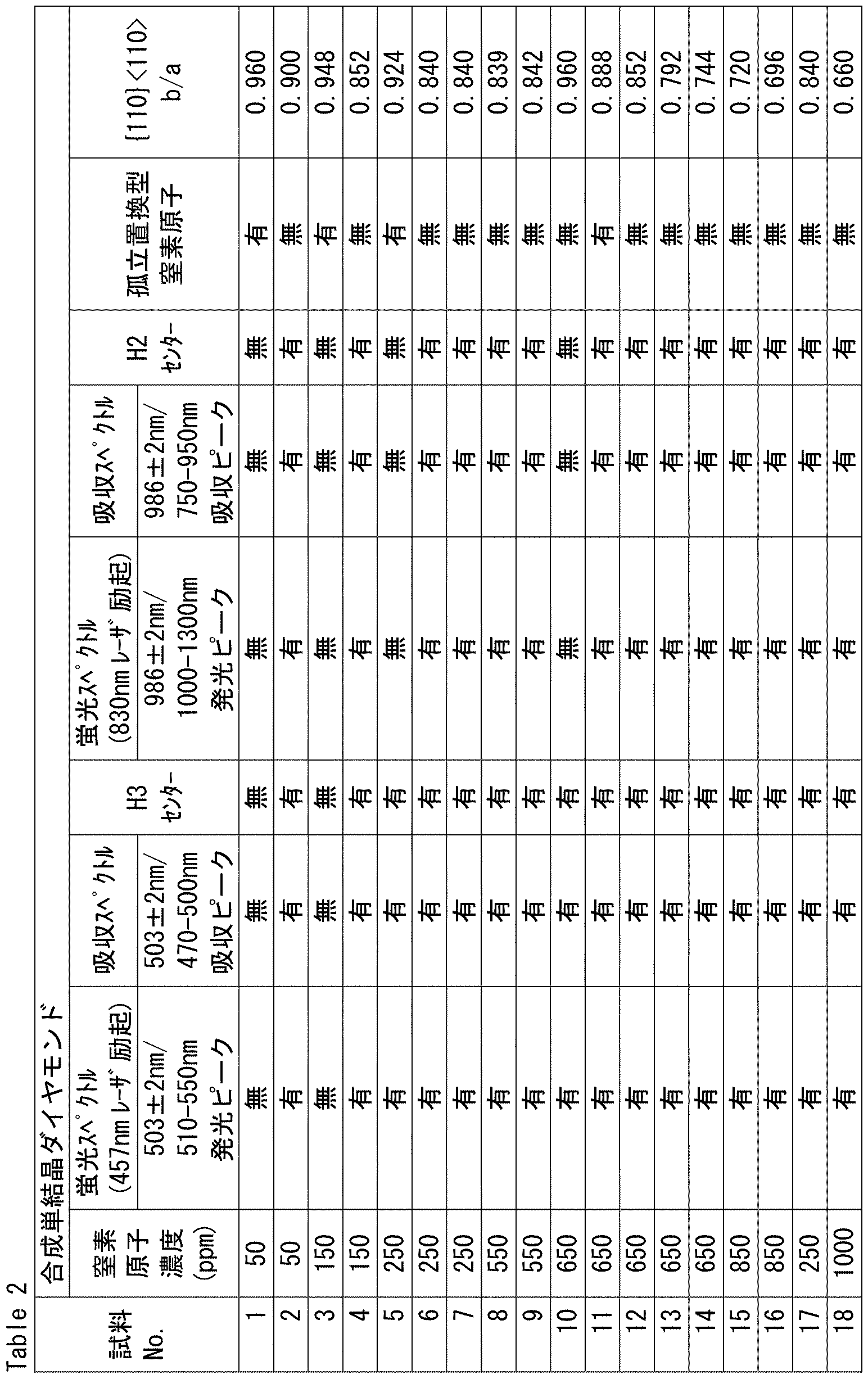
試料2、試料4、試料6~試料9、及び、試料11~試料18は実施例に該当する。試料1、試料3、試料5、及び、試料10は比較例に該当する。試料2、試料4、試料6~試料9、及び、試料11~試料18(実施例)は、{110}<110>b/aの値が0.90以下であり、大きな弾性を有し、優れた耐欠損性を有することが確認される。これらの実施例の試料は、試料1、試料3、試料5、及び、試料10(比較例)に比べて、{110}<110>b/aの値が小さく、耐欠損性に優れていることが確認される。これらの実施例の試料は、H2センター及びH3センターを含むため、高い硬度及び強度を有し、優れた耐摩耗性を有すると判断される。
Claims (8)
- 窒素原子を原子数基準で50ppm以上1000ppm以下の濃度で含む合成単結晶ダイヤモンドであって、
前記合成単結晶ダイヤモンドは、1つの空孔と、前記空孔に隣接して存在する2つの置換型窒素原子とからなる凝集体を含み、
前記合成単結晶ダイヤモンドの第1ヌープ圧痕の長い方の対角線の長さaに対する、第2ヌープ圧痕の長い方の対角線の長さbの比b/aが0.90以下であり、
前記第1ヌープ圧痕は、前記合成単結晶ダイヤモンドの{110}面における<110>方向に、JIS Z 2251:2009に準拠して、温度23℃±5℃、及び、試験荷重4.9Nの条件でヌープ圧子を押し込んだ状態において、前記合成単結晶ダイヤモンドの表面に形成される圧痕であり、
前記第2ヌープ圧痕は、前記試験荷重を解除した後に前記合成単結晶ダイヤモンドの表面に残るヌープ圧痕である、合成単結晶ダイヤモンド。 - 前記合成単結晶ダイヤモンドに対して、蛍光分光光度計を用いて波長457nmの励起光を照射して得られる蛍光スペクトルにおいて、波長503±2nmの範囲内、および、波長510nm以上550nm以下の範囲内の一方、または両方に発光ピークが存在する、請求項1に記載の合成単結晶ダイヤモンド。
- 前記合成単結晶ダイヤモンドの紫外可視分光光度計を用いて得られる吸収スペクトルにおいて、波長503±2nmの範囲内、および、波長470nm以上500nm以下の範囲内の一方、または両方に吸収ピークが存在する、請求項1又は請求項2に記載の合成単結晶ダイヤモンド。
- 前記合成単結晶ダイヤモンドに対して、蛍光分光光度計を用いて波長830nmの励起光を照射して得られる蛍光スペクトルにおいて、波長986±2nmの範囲内、および、波長1000nm以上1300nm以下の範囲内の一方、または両方に発光ピークが存在する、請求項1から請求項3のいずれか1項に記載の合成単結晶ダイヤモンド。
- 前記合成単結晶ダイヤモンドの紫外可視分光光度計を用いて得られる吸収スペクトルにおいて、波長986±2nmの範囲内、および、波長750nm以上950nm以下の範囲内の一方、または両方に吸収ピークが存在する、請求項1から請求項4のいずれか1項に記載の合成単結晶ダイヤモンド。
- 前記合成単結晶ダイヤモンドは、孤立置換型窒素原子を含まない、請求項1から請求項5のいずれか1項に記載の合成単結晶ダイヤモンド。
- 請求項1から請求項6のいずれか1項に記載の合成単結晶ダイヤモンドの製造方法であって、
溶媒金属を用いた温度差法により、窒素原子を原子数基準で50ppm以上1000ppm以下の濃度で含むダイヤモンド単結晶を合成する第1工程と、
前記ダイヤモンド単結晶に、10MGy以上1000MGy以下のエネルギーを与える電子線及び粒子線の一方又は両方を照射する第2工程と、
前記第2工程後の前記ダイヤモンド単結晶に対して、圧力1Pa以上100KPa以下の不活性ガス中で加熱処理を行い、前記合成単結晶ダイヤモンドを得る第3工程と、を備え、
前記第3工程の前記加熱処理における温度xは1500℃以上1800℃以下であり、かつ、加熱時間yは1分以上360分以下である、合成単結晶ダイヤモンドの製造方法。 - 前記第3工程における前記温度x℃と、前記加熱時間y分とは、下記の式1を満たす、
-0.097x+175≦y≦-1.1x+2030 式1
請求項7に記載の合成単結晶ダイヤモンドの製造方法。
Priority Applications (4)
| Application Number | Priority Date | Filing Date | Title |
|---|---|---|---|
| US18/569,005 US20240279843A1 (en) | 2021-06-15 | 2022-05-02 | Synthetic single crystal diamond and method for producing the same |
| JP2023529670A JPWO2022264706A1 (ja) | 2021-06-15 | 2022-05-02 | |
| CN202280042140.8A CN117500961A (zh) | 2021-06-15 | 2022-05-02 | 合成单晶金刚石及其制造方法 |
| EP22824700.3A EP4357491A4 (en) | 2021-06-15 | 2022-05-02 | SYNTHETIC SINGLE CRYSTAL DIAMOND AND METHOD FOR PRODUCING THE SAME |
Applications Claiming Priority (2)
| Application Number | Priority Date | Filing Date | Title |
|---|---|---|---|
| JP2021-099431 | 2021-06-15 | ||
| JP2021099431 | 2021-06-15 |
Publications (1)
| Publication Number | Publication Date |
|---|---|
| WO2022264706A1 true WO2022264706A1 (ja) | 2022-12-22 |
Family
ID=84526142
Family Applications (1)
| Application Number | Title | Priority Date | Filing Date |
|---|---|---|---|
| PCT/JP2022/019527 Ceased WO2022264706A1 (ja) | 2021-06-15 | 2022-05-02 | 合成単結晶ダイヤモンド及びその製造方法 |
Country Status (6)
| Country | Link |
|---|---|
| US (1) | US20240279843A1 (ja) |
| EP (1) | EP4357491A4 (ja) |
| JP (1) | JPWO2022264706A1 (ja) |
| CN (1) | CN117500961A (ja) |
| TW (1) | TW202314069A (ja) |
| WO (1) | WO2022264706A1 (ja) |
Cited By (3)
| Publication number | Priority date | Publication date | Assignee | Title |
|---|---|---|---|---|
| WO2025173237A1 (ja) * | 2024-02-16 | 2025-08-21 | 住友電気工業株式会社 | 単結晶ダイヤモンド素材および工具 |
| JP7755109B1 (ja) * | 2024-02-16 | 2025-10-15 | 住友電気工業株式会社 | 単結晶ダイヤモンドおよびそれを備える工具 |
| JP7764631B1 (ja) * | 2024-02-16 | 2025-11-05 | 住友電気工業株式会社 | 単結晶ダイヤモンドおよび工具 |
Citations (5)
| Publication number | Priority date | Publication date | Assignee | Title |
|---|---|---|---|---|
| JP2018058745A (ja) * | 2016-10-07 | 2018-04-12 | 住友電気工業株式会社 | ダイヤモンド多結晶体の製造方法、ダイヤモンド多結晶体、切削工具、耐摩工具および研削工具 |
| WO2019077888A1 (ja) * | 2017-10-20 | 2019-04-25 | 住友電気工業株式会社 | 合成単結晶ダイヤモンド、工具、及び、合成単結晶ダイヤモンドの製造方法 |
| JP2020011887A (ja) * | 2018-10-02 | 2020-01-23 | 住友電気工業株式会社 | ダイヤモンド多結晶体及びそれを備えた工具 |
| WO2021106283A1 (ja) * | 2019-11-26 | 2021-06-03 | 住友電気工業株式会社 | 合成単結晶ダイヤモンド、それを備える工具、及び、合成単結晶ダイヤモンドの製造方法 |
| JP2021099431A (ja) | 2019-12-23 | 2021-07-01 | セイコーエプソン株式会社 | 表示装置の制御方法及び表示装置 |
Family Cites Families (7)
| Publication number | Priority date | Publication date | Assignee | Title |
|---|---|---|---|---|
| EP0752293B1 (en) * | 1995-07-05 | 1999-10-20 | Ngk Spark Plug Co., Ltd | Diamond coated article and process for its production |
| WO2005035174A1 (ja) * | 2003-10-10 | 2005-04-21 | Sumitomo Electric Industries, Ltd. | ダイヤモンド工具、合成単結晶ダイヤモンドおよび単結晶ダイヤモンドの合成方法ならびにダイヤモンド宝飾品 |
| JP6112177B1 (ja) * | 2015-10-30 | 2017-04-12 | 住友電気工業株式会社 | 複合多結晶体およびその製造方法 |
| EP3699330A4 (en) * | 2017-10-20 | 2021-06-30 | Sumitomo Electric Industries, Ltd. | SYNTHETIC SINGLE CRYSTAL DIAMOND |
| WO2020004373A1 (ja) * | 2018-06-27 | 2020-01-02 | 住友電工ハードメタル株式会社 | 貫通孔付工具、ダイヤモンド部品、及び、ダイヤモンド素材 |
| JP6421905B1 (ja) * | 2018-07-20 | 2018-11-14 | 住友電気工業株式会社 | ダイヤモンド多結晶体及びそれを備えた工具 |
| US12606931B2 (en) * | 2020-06-30 | 2026-04-21 | Sumitomo Electric Industries, Ltd. | Synthetic single crystal diamond and method for manufacturing same |
-
2022
- 2022-05-02 US US18/569,005 patent/US20240279843A1/en active Pending
- 2022-05-02 CN CN202280042140.8A patent/CN117500961A/zh active Pending
- 2022-05-02 JP JP2023529670A patent/JPWO2022264706A1/ja active Pending
- 2022-05-02 WO PCT/JP2022/019527 patent/WO2022264706A1/ja not_active Ceased
- 2022-05-02 EP EP22824700.3A patent/EP4357491A4/en active Pending
- 2022-06-09 TW TW111121462A patent/TW202314069A/zh unknown
Patent Citations (5)
| Publication number | Priority date | Publication date | Assignee | Title |
|---|---|---|---|---|
| JP2018058745A (ja) * | 2016-10-07 | 2018-04-12 | 住友電気工業株式会社 | ダイヤモンド多結晶体の製造方法、ダイヤモンド多結晶体、切削工具、耐摩工具および研削工具 |
| WO2019077888A1 (ja) * | 2017-10-20 | 2019-04-25 | 住友電気工業株式会社 | 合成単結晶ダイヤモンド、工具、及び、合成単結晶ダイヤモンドの製造方法 |
| JP2020011887A (ja) * | 2018-10-02 | 2020-01-23 | 住友電気工業株式会社 | ダイヤモンド多結晶体及びそれを備えた工具 |
| WO2021106283A1 (ja) * | 2019-11-26 | 2021-06-03 | 住友電気工業株式会社 | 合成単結晶ダイヤモンド、それを備える工具、及び、合成単結晶ダイヤモンドの製造方法 |
| JP2021099431A (ja) | 2019-12-23 | 2021-07-01 | セイコーエプソン株式会社 | 表示装置の制御方法及び表示装置 |
Cited By (4)
| Publication number | Priority date | Publication date | Assignee | Title |
|---|---|---|---|---|
| WO2025173237A1 (ja) * | 2024-02-16 | 2025-08-21 | 住友電気工業株式会社 | 単結晶ダイヤモンド素材および工具 |
| JP7755109B1 (ja) * | 2024-02-16 | 2025-10-15 | 住友電気工業株式会社 | 単結晶ダイヤモンドおよびそれを備える工具 |
| JP7760754B1 (ja) * | 2024-02-16 | 2025-10-27 | 住友電気工業株式会社 | 単結晶ダイヤモンド素材および工具 |
| JP7764631B1 (ja) * | 2024-02-16 | 2025-11-05 | 住友電気工業株式会社 | 単結晶ダイヤモンドおよび工具 |
Also Published As
| Publication number | Publication date |
|---|---|
| CN117500961A (zh) | 2024-02-02 |
| EP4357491A4 (en) | 2024-11-20 |
| EP4357491A1 (en) | 2024-04-24 |
| JPWO2022264706A1 (ja) | 2022-12-22 |
| TW202314069A (zh) | 2023-04-01 |
| US20240279843A1 (en) | 2024-08-22 |
Similar Documents
| Publication | Publication Date | Title |
|---|---|---|
| KR102655136B1 (ko) | 합성 단결정 다이아몬드 | |
| EP3312311B1 (en) | Diamond single crystal, tool, and method for manufacturing diamond single crystal | |
| WO2022264706A1 (ja) | 合成単結晶ダイヤモンド及びその製造方法 | |
| CN111247275B (zh) | 合成单晶金刚石、工具以及合成单晶金刚石的制造方法 | |
| JP7658373B2 (ja) | 合成単結晶ダイヤモンド及びその製造方法 | |
| JP7722370B2 (ja) | 合成単結晶ダイヤモンド及びその製造方法 | |
| EP4357490A1 (en) | Synthetic single-crystal diamond and manufacturing method therefor | |
| JP2022139094A (ja) | 合成単結晶ダイヤモンド及びその製造方法 | |
| WO2024150624A1 (ja) | 合成単結晶ダイヤモンド |
Legal Events
| Date | Code | Title | Description |
|---|---|---|---|
| 121 | Ep: the epo has been informed by wipo that ep was designated in this application |
Ref document number: 22824700 Country of ref document: EP Kind code of ref document: A1 |
|
| WWE | Wipo information: entry into national phase |
Ref document number: 2023529670 Country of ref document: JP |
|
| WWE | Wipo information: entry into national phase |
Ref document number: 18569005 Country of ref document: US |
|
| WWE | Wipo information: entry into national phase |
Ref document number: 202280042140.8 Country of ref document: CN |
|
| WWE | Wipo information: entry into national phase |
Ref document number: 2022824700 Country of ref document: EP |
|
| NENP | Non-entry into the national phase |
Ref country code: DE |
|
| ENP | Entry into the national phase |
Ref document number: 2022824700 Country of ref document: EP Effective date: 20240115 |