WO2022269902A1 - Gant - Google Patents
Gant Download PDFInfo
- Publication number
- WO2022269902A1 WO2022269902A1 PCT/JP2021/024130 JP2021024130W WO2022269902A1 WO 2022269902 A1 WO2022269902 A1 WO 2022269902A1 JP 2021024130 W JP2021024130 W JP 2021024130W WO 2022269902 A1 WO2022269902 A1 WO 2022269902A1
- Authority
- WO
- WIPO (PCT)
- Prior art keywords
- finger
- glove
- user
- fingers
- portions
- Prior art date
- Legal status (The legal status is an assumption and is not a legal conclusion. Google has not performed a legal analysis and makes no representation as to the accuracy of the status listed.)
- Ceased
Links
Images


Classifications
-
- A—HUMAN NECESSITIES
- A41—WEARING APPAREL
- A41D—OUTERWEAR; PROTECTIVE GARMENTS; ACCESSORIES
- A41D19/00—Gloves
Definitions
- the present invention relates to gloves.
- Patent Document 1 discloses synthetic resin gloves.
- Gloves made of polyethylene are thin and can be provided at low cost, but they are easy to take off.
- Gloves made of a rubber-based material such as nitrile rubber are difficult to take off, but they cannot be provided at a low price like polyethylene gloves.
- the present invention a finger portion that covers the fingers of the user; a main body covering an area from the base of the finger, which is the root of the finger, to the wrist side of the user,
- the length of the finger portion is shorter than the length of the finger of the user,
- a constricted portion is provided in a region on the finger base side of the finger portion,
- the glove is made of stretchable material.
- gloves that are difficult to come off can be appropriately provided.
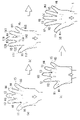
- FIG. 1 is a perspective view of a glove; FIG. It is a figure explaining the correspondence of a glove and a user's hand.
- FIG. 4 is an enlarged view of a main part of the glove; It is a figure explaining the correspondence of a glove and a user's hand. It is a figure explaining the wearing process of a glove with respect to a user's hand.
- FIG. 1 is a diagram for explaining the process of making the glove 1.
- FIG. 2 is a perspective view of the glove 1.
- FIG. 3 is a diagram for explaining the correspondence relationship between the glove 1 and the hand H of the user.
- FIG. 4 is an enlarged view of essential parts of the glove 1.
- FIG. 5 is a diagram illustrating the correspondence relationship between the glove 1 and the hand H of the user.
- the glove 1 is formed in the shape of a bag by laminating two sheets 2, 2 having the same shape and then adhering the peripheral portion 2a of the sheet 2 together.
- the peripheral portion 2a is welded over the entire circumference except for the portion of the opening 2b for inserting the hand.
- the welded regions are shown with cross hatching.
- the glove 1 is formed using a sheet 2 made of a stretchable material.
- Extensible materials are exemplified below.
- chlorinated polyethylene (CPE) (resin) is used as a material forming the sheets 2
- Chlorinated polyethylene is made by reacting chlorine with polyethylene. Chlorinated polyethylene becomes more extensible than polyethylene as the content of chlorine (the amount of substitution with hydrogen) increases.
- Chlorinated polyethylene has the following properties compared to polyethylene. More weather resistant than polyethylene. Better chemical resistance than polyethylene. Better oil resistance than polyethylene. Higher flame retardancy than polyethylene. In addition, chlorinated polyethylene has the properties of both plastic and rubber. Chlorinated polyethylene is inexpensive compared to nitrile rubber.
- the glove 1 may be formed using a sheet 2 made of chlorinated polyethylene into which a pigment (colorant) is kneaded. Also, the surface of the sheet 2 may be embossed.
- the seat 2 has finger areas 21 to 25 and a body area 26 .
- a glove 1 formed from sheets 2, 2 has finger portions 11 to 15 and a body portion 16.
- the thickness of the sheet 2 is thicker than the thickness of existing polyethylene gloves of 0.035 to 0.05 microns so that the glove 1 can be stretched without tearing.
- the lower limit of the thickness of the glove 1 (sheet 2) is set to 0.06 microns, more preferably 0.7 microns.
- the upper limit of the thickness is the thickness that can be used as a glove while ensuring extensibility. It should be noted that the thickness of the glove 1 is appropriately changed according to the characteristics of the material forming the glove 1.
- a finger portion 11 of the glove 1 is a region corresponding to the user's thumb, and is formed from finger regions 21, 21 of the sheets 2, 2.
- the finger part 12 is an area corresponding to the index finger of the user, and is formed from the finger areas 22, 22 of the sheets 2, 2.
- the finger part 13 is an area corresponding to the middle finger of the user, and is formed from the finger areas 23, 23 of the sheets 2, 2. As shown in FIG.
- the finger portion 14 is an area corresponding to the ring finger of the user, and is formed from the finger areas 24, 24 of the sheets 2, 2.
- the finger part 15 is an area corresponding to the little finger of the user, and is formed from the finger areas 25, 25 of the sheets 2, 2.
- thumb, index finger, middle finger, ring finger, and little finger are simply referred to as "fingers.”
- the body portion 16 is formed from body regions 26,26 of the sheets 2,2.
- the body portion 16 is sized to cover from the finger bases 110 to 150, which are the bases of the finger portions 11 to 15, to the user's wrist. It should be noted that there is no need for the body portion 16 to completely cover the wrist. It may be formed in a size that covers a predetermined range from the finger bases 110 to 150, which are the roots of the finger parts 11 to 15, to the user's wrist side, for example, the range to the back of the hand and the palm.
- the main body region 26 of one sheet 2 covers the palm side surface of the user's hand from the finger base to the wrist, and the other sheet 2 A main body region 26 covers the surface on the back side of the hand from the base of the user's fingers to the wrist.
- the lengths L1 to L5 from the finger bases 110 to 150 to the tips 111 to 151 of the finger portions 11 to 15 are the fingers of the assumed user of the glove 1 (thumb H1 to little finger H5) is formed with a shorter length.
- the lengths L1 to L5 of the fingers 12 to 15 are set such that at least the tips 121 to 151 reach the first joints of the corresponding fingers (thumb H1 to little finger H5). Therefore, the tips 121 to 151 of the finger portions 12 to 15 should be positioned between the first joints and the fingertips of the user's fingers (thumb H1 to little finger H5), respectively.
- the finger portions 11 to 15 are provided with constricted portions 112 to 152 on both sides of the region on the finger base side.
- Widths W1 to W5 of constricted portions 112 to 152 are narrower than widths W11 to W15 of finger portions 11 to 15 on the finger base side.
- the widths W1 to W5 of the constricted portions 112 to 152 are narrower than the widths W11 to W15 on the finger base side by 0.5 mm to 2.0 mm, more preferably by 1.0 mm to 1.5 mm. ing.
- the widths W2 to W5 of the constricted portions 122 to 152 are preferably the same as or slightly narrower than the width of the second joints of the fingers (index finger H2 to little finger H5).
- FIG. 6A and 6B are diagrams illustrating the process of wearing the glove 1 on the user's hand H.
- FIG. 6(a) the fingers (thumb H1 to little finger H5) are inserted into the finger portions 11 to 15 of the glove 1 from the fingertip side. Then, since the length of the finger parts 11 to 15 is shorter than the fingers (thumb H1 to little finger H5), the tips 111 to 151 of the finger parts 11 to 15 first reach the fingertips of the fingers (thumb H1 to little finger H5). They come into contact (see (b) of FIG. 6).
- the finger portions 11 to 15 fit perfectly around the outer periphery of the corresponding fingers (thumb H1 to little finger H5), and the constricted portions 112 to 152 are the fingers (thumb H1 to little finger H5). Press it close to the base. As a result, the finger portions 11 to 15 are prevented from falling off from the fingers (thumb H1 to little finger H5) at the constricted portions 112 to 152, and at least the fingertip side portion of the fingers (thumb H1 to little finger H5) , the relative movement of the glove 1 with the fingers 11 to 15 is suppressed more than the polyethylene glove.
- the resin glove 1 includes finger portions 11 to 15 that cover the user's fingers (thumb H1 to little finger H5), The lengths L1 to L5 of the finger portions 11 to 15, which have a body portion 16 that covers the user's wrist side area from the finger bases 110 to 150, which are the bases of the fingers (thumb H1 to little finger H5), are used respectively. shorter than the length of a person's fingers (thumb H1 to little finger H5). Constricted portions 112 to 152 are provided in areas of the finger bases 110 to 150 of the finger portions 11 to 15, respectively.
- the glove 1 is made of stretchable material.
- the finger portions 11 to 15 are stretched to fit snugly around the user's finger (thumb H1 to little finger H5). Furthermore, the constricted portions 112 to 152 are pressed against the finger bases of the fingers (thumb H1 to little finger H5). As a result, the finger portions 11 to 15 are prevented from falling off from the fingers (thumb H1 to little finger H5) at the constricted portions 112 to 152, and at least the fingertip side portion of the fingers (thumb H1 to little finger H5) , relative movement of the glove 1 with the fingers 11 to 15 is suppressed.
- the user's fingers (thumb H1 to little finger H5) and the finger portions 11 to 15 of the glove 1 are relatively movable, the user's workability while wearing the glove 1 is affected.
- the fingers of the glove of the user are made of a stretchable material, relative movement between the fingers (thumb H1 to little finger H5) and the fingers 11 to 15 of the glove 1 can be achieved. is regulated, the workability of the user wearing the glove 1 is not affected.
- At least the finger portions 11 to 15 of the glove 1 are made of a stretchable material.
- the extensible material is at least one selected from polyethylene, chlorinated polyethylene, and polyvinyl chloride.
- resin materials such as polyethylene, chlorinated polyethylene, and polyvinyl chloride are cheaper than rubber-based materials such as nitrile rubber, so gloves that are difficult to take off can be provided at a low price, especially for chlorinated polyethylene.
- chlorinated polyethylene has the properties of both plastic and rubber. Therefore, gloves that are difficult to come off can be provided at a low cost.
- the extensible material is a thermoplastic elastomer.
- the glove 1 is formed by laminating sheets 2, 2 made of a stretchable material.
- gloves that are difficult to come off can be inexpensively supplied in large quantities.
- a plurality of types of gloves of different sizes can be produced in large quantities at low cost.
- a coloring component such as a pigment is kneaded into a stretchable material sheet.
- all the lengths L1 to L5 of the finger parts 11 to 15 are shorter than the corresponding fingers (thumb H1 to little finger H5) of the user.
- the length of some fingers may be shorter than the corresponding fingers of the user.
- the fingers 11 and 12 made of a stretchable material are to be fitted only to the thumb H1 and index finger H2, only the lengths L1 and L2 of the fingers 11 and 12 are adjusted. , should be shortened.
- the glove 1 has a plurality of finger portions 11-15.
- the length of at least one of the fingers 11-15 is shorter than the corresponding finger of the user.
- the glove 1 has a plurality of finger portions 11-15. At least one finger part among the plurality of finger parts 11 to 15 is made of a stretchable material.
- the constricted portions 121-151 are provided on the finger base side of all the finger portions 11-15.
- a configuration in which a constricted portion is provided on the finger base side of some finger portions may be employed. For example, when it is desired to suppress the relative movement of the finger portions 11 and 12 only at the portion of the thumb H1 and the index finger H2, it is sufficient to provide the constricted portions 112 and 122 only on the finger base sides of the finger portions 11 and 12. .
- the glove 1 has a plurality of finger portions 11-15.
- a constricted portion is formed at the finger base of at least one finger portion among the plurality of finger portions 11 to 15 .
- a glove may be used in which finger portions made of a stretchable material and finger portions having a constricted portion are mixed.
- the lengths L1 to L5 of the finger portions 11 to 15 in the glove 1 before use are such that the tips 111 to 151 of the finger portions 11 to 15 are at least the first joints of the user's fingers (thumb H1 to little finger H5). length to reach.
- the fingertips of the fingers are brought into contact with the tips 111 to 151 of the finger portions 11 to 15, and then the glove 1 is further pulled toward the wrist.
- the finger parts 11 to 15 can be perfectly fitted to the outer periphery of the corresponding fingers (thumb H1 to little finger H5).
- relative movement of the fingers (thumb H1 to little finger H5) relative to the fingers 11 to 15 is more restricted than polyethylene gloves at least on the fingertip side. Therefore, the workability of the user while wearing the glove 1 is improved.
- Finger portions 12 to 15 corresponding to fingers (index finger H2 to little finger H5) other than thumb H1 of the user have constricted portions 122 to 152 on the finger base side of glove 1 before use.
- the width of the constricted parts 122 to 152 is equal to or less than the width matching the second joints of the fingers (index finger H2 to little finger H5).
- the finger portion 11 corresponding to the user's thumb H1 has a constricted portion 112 on the finger base side of the glove 1 before use.
- the width of the region of the constricted portion 112 is equal to or less than the width matching the first joint of the thumb H1.
- the glove 1 is formed by laminating the chlorinated polyethylene sheets 2, 2 (film), but the material constituting the sheets 2, 2 is more stretchable than polyethylene. Any material that has high durability and is less expensive than nitrile rubber can be used as appropriate.
- the material (resin) forming the sheets 2, 2 may be at least one selected from polyethylene, chlorinated polyethylene, and polyvinyl chloride. In this case, the material forming the sheets 2, 2 may be a mixture of two or more selected from polyethylene, chlorinated polyethylene, and polyvinyl chloride.
- the glove 1 may be made of a thermoplastic elastomer.
- the glove may be a sheet in which at least one of the front surface and the back surface is embossed, or a sheet in which a partial area such as the fingertip is embossed.
- the sheets 2, 2 may be formed with substantially the same thickness over the entire surface, but the thickness of the regions to be stretched, for example, the regions of the fingers 11 to 15, may be the same as that of other regions such as the main body 16.
- the gloves may be thicker by about 1 mm than the thickness of the .
Landscapes
- Engineering & Computer Science (AREA)
- Textile Engineering (AREA)
- Gloves (AREA)
Abstract
Le problème décrit par la présente invention est de fournir de manière appropriée un gant qui ne se retire pas facilement. À cet effet, le gant (1) en résine a des zones de doigt (21–25) recouvrant les doigts (H1-H5) d'un utilisateur et une zone principale (26) recouvrant la zone allant des bases de doigt (210–250), qui sont les bases des doigts (H1-H5), au poignet de l'utilisateur. Chacune des longueurs (L1–L5) des zones de doigt (21–25) est plus courte que la longueur du doigt respectif (H1–H5) de l'utilisateur. Des parties rétrécies (211-252) sont prévues sur les zones des bases de doigts (210–250) dans les zones de doigts (21–25).
Priority Applications (1)
| Application Number | Priority Date | Filing Date | Title |
|---|---|---|---|
| PCT/JP2021/024130 WO2022269902A1 (fr) | 2021-06-25 | 2021-06-25 | Gant |
Applications Claiming Priority (1)
| Application Number | Priority Date | Filing Date | Title |
|---|---|---|---|
| PCT/JP2021/024130 WO2022269902A1 (fr) | 2021-06-25 | 2021-06-25 | Gant |
Publications (1)
| Publication Number | Publication Date |
|---|---|
| WO2022269902A1 true WO2022269902A1 (fr) | 2022-12-29 |
Family
ID=84544362
Family Applications (1)
| Application Number | Title | Priority Date | Filing Date |
|---|---|---|---|
| PCT/JP2021/024130 Ceased WO2022269902A1 (fr) | 2021-06-25 | 2021-06-25 | Gant |
Country Status (1)
| Country | Link |
|---|---|
| WO (1) | WO2022269902A1 (fr) |
Citations (5)
| Publication number | Priority date | Publication date | Assignee | Title |
|---|---|---|---|---|
| JPH03269104A (ja) * | 1990-03-20 | 1991-11-29 | Okura Ind Co Ltd | 作業用手袋 |
| JPH047616U (fr) * | 1990-05-09 | 1992-01-23 | ||
| JP2005009035A (ja) * | 2003-06-19 | 2005-01-13 | Shin Nihon Chemical Ornament Mfg Co Ltd | 手袋 |
| WO2006022070A1 (fr) * | 2004-08-26 | 2006-03-02 | Yusuke Matsuda | Gant en latex |
| JP2020111839A (ja) * | 2019-01-08 | 2020-07-27 | エステー株式会社 | 感温変色性成型製品およびその製造方法 |
-
2021
- 2021-06-25 WO PCT/JP2021/024130 patent/WO2022269902A1/fr not_active Ceased
Patent Citations (5)
| Publication number | Priority date | Publication date | Assignee | Title |
|---|---|---|---|---|
| JPH03269104A (ja) * | 1990-03-20 | 1991-11-29 | Okura Ind Co Ltd | 作業用手袋 |
| JPH047616U (fr) * | 1990-05-09 | 1992-01-23 | ||
| JP2005009035A (ja) * | 2003-06-19 | 2005-01-13 | Shin Nihon Chemical Ornament Mfg Co Ltd | 手袋 |
| WO2006022070A1 (fr) * | 2004-08-26 | 2006-03-02 | Yusuke Matsuda | Gant en latex |
| JP2020111839A (ja) * | 2019-01-08 | 2020-07-27 | エステー株式会社 | 感温変色性成型製品およびその製造方法 |
Similar Documents
| Publication | Publication Date | Title |
|---|---|---|
| CN104334041B (zh) | 受到柔韧支撑的手套结构 | |
| CN207897954U (zh) | 运动员用的防护手套 | |
| US2913729A (en) | Perforated glove | |
| KR950013425A (ko) | 골프 장갑 | |
| US9656150B2 (en) | Glove | |
| JPH02112402A (ja) | 手袋およびその製造方法 | |
| US20210145093A1 (en) | Goalkeeper glove | |
| WO2022269902A1 (fr) | Gant | |
| US20060005295A1 (en) | Gloves with curved reliefs formed therein | |
| KR20090040500A (ko) | 1회용 비닐장갑 | |
| KR101805778B1 (ko) | 접힘 구조를 지닌 코팅 면장갑 | |
| US20160037838A1 (en) | Expandable and retractable disposable glove | |
| JP3179565U (ja) | 手首サポータ | |
| GB2311714A (en) | Waterproof glove | |
| TWI852892B (zh) | 無痕手套 | |
| KR102931776B1 (ko) | 심리스 장갑 | |
| JP3045040U (ja) | 内外両面に凹凸模様を有する弾性手袋 | |
| RU2829425C1 (ru) | Бесшовная перчатка | |
| CN2528415Y (zh) | 改良式护腕带 | |
| JP7727950B1 (ja) | シームレスグローブ | |
| US20250275592A1 (en) | Seamless glove | |
| JP3138506U (ja) | 作業用手袋 | |
| KR101606575B1 (ko) | 손목 밴딩 위생장갑 및 그 제조방법 | |
| CN217065498U (zh) | 腕口可收紧式一次性手套 | |
| KR101957780B1 (ko) | 일회용 비닐장갑 |
Legal Events
| Date | Code | Title | Description |
|---|---|---|---|
| 121 | Ep: the epo has been informed by wipo that ep was designated in this application |
Ref document number: 21946256 Country of ref document: EP Kind code of ref document: A1 |
|
| NENP | Non-entry into the national phase |
Ref country code: DE |
|
| 122 | Ep: pct application non-entry in european phase |
Ref document number: 21946256 Country of ref document: EP Kind code of ref document: A1 |
|
| NENP | Non-entry into the national phase |
Ref country code: JP |