WO2023007746A1 - Dispositif de commande, système de soudage, et programme - Google Patents
Dispositif de commande, système de soudage, et programme Download PDFInfo
- Publication number
- WO2023007746A1 WO2023007746A1 PCT/JP2021/028486 JP2021028486W WO2023007746A1 WO 2023007746 A1 WO2023007746 A1 WO 2023007746A1 JP 2021028486 W JP2021028486 W JP 2021028486W WO 2023007746 A1 WO2023007746 A1 WO 2023007746A1
- Authority
- WO
- WIPO (PCT)
- Prior art keywords
- input
- welding
- processor
- information
- time
- Prior art date
- Legal status (The legal status is an assumption and is not a legal conclusion. Google has not performed a legal analysis and makes no representation as to the accuracy of the status listed.)
- Ceased
Links
Images

Classifications
-
- B—PERFORMING OPERATIONS; TRANSPORTING
- B23—MACHINE TOOLS; METAL-WORKING NOT OTHERWISE PROVIDED FOR
- B23K—SOLDERING OR UNSOLDERING; WELDING; CLADDING OR PLATING BY SOLDERING OR WELDING; CUTTING BY APPLYING HEAT LOCALLY, e.g. FLAME CUTTING; WORKING BY LASER BEAM
- B23K9/00—Arc welding or cutting
- B23K9/06—Arrangements or circuits for starting the arc, e.g. by generating ignition voltage, or for stabilising the arc
- B23K9/067—Starting the arc
- B23K9/0671—Starting the arc by means of brief contacts between the electrodes
-
- B—PERFORMING OPERATIONS; TRANSPORTING
- B23—MACHINE TOOLS; METAL-WORKING NOT OTHERWISE PROVIDED FOR
- B23K—SOLDERING OR UNSOLDERING; WELDING; CLADDING OR PLATING BY SOLDERING OR WELDING; CUTTING BY APPLYING HEAT LOCALLY, e.g. FLAME CUTTING; WORKING BY LASER BEAM
- B23K9/00—Arc welding or cutting
- B23K9/06—Arrangements or circuits for starting the arc, e.g. by generating ignition voltage, or for stabilising the arc
- B23K9/067—Starting the arc
Definitions
- the present invention relates to a control device, welding system and program.
- start welding with the wire in contact with the work is referred to as “touch start”
- touch start When the arc welder starts welding with the wire in contact with the work (hereafter, “starting welding with the wire in contact with the work” is referred to as “touch start”), poor start or tip welding may occur. This is known to be a factor that degrades welding quality.
- a method is known in which, when a touch start is determined, the wire is reversed at the end of the welding before the welding point to avoid the touch start (Patent Document 1).
- Patent Document 1 a method in which, when a touch start is determined, the wire is reversed at the end of the welding before the welding point to avoid the touch start
- a control device that can improve welding quality more than before is desired.
- a control device of the present disclosure includes an input/output unit, a measurement unit, and a processing unit.
- the input/output unit outputs first information instructing the arc welder to start welding, and receives input of second information indicating arc generation by the arc welder.
- the measurement unit measures the time from the output of the first information to the input of the second information.
- the processing unit performs predetermined processing when the time or the statistic of the time is equal to or less than a first threshold.
- the control device of the present disclosure can improve welding quality more than before.
- FIG. 1 is a block diagram showing an example of a welding system according to an embodiment and an example of a configuration of main parts of components included in the welding system;
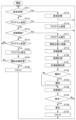
- FIG. 2 is a flowchart showing an example of processing by a processor of the robot control device in FIG. 1;
- FIG. 1 is a block diagram showing an example of a main configuration of a welding system 1 according to an embodiment and components included in the welding system 1.
- the welding system 1 is a system for arc welding using a robot arm.
- the welding system 1 includes, as an example, a robot controller 100, a welding robot 200, an arc welder 300, and a teaching device 400.
- the robot control device 100 is a device that controls the welding robot 200.
- the robot controller 100 includes, as an example, a processor 110, a ROM (read-only memory) 120, a RAM (random-access memory) 130, an auxiliary storage device 140, a communication interface 150, a control interface 160 and a welding interface 170.
- a bus 180 or the like connects these units.
- the processor 110 is a central part of a computer that performs processing such as calculation and control necessary for the operation of the robot control device 100, and performs various types of calculation and processing.
- Processor 110 for example, CPU (central processing unit), MPU (micro processing unit), SoC (system on a chip), DSP (digital signal processor), GPU (graphics processing unit), ASIC (application specific integrated circuit), PLD (programmable logic device) or FPGA (field-programmable gate array).
- processor 110 is a combination of several of these.
- the processor 110 may be a combination of these with a hardware accelerator or the like.
- the processor 110 controls each part to realize various functions of the robot control device 100 based on programs such as firmware, system software, and application software stored in the ROM 120 or the auxiliary storage device 140 . Also, the processor 110 executes processing described below based on the program. Part or all of the program may be incorporated in the circuit of processor 110 .
- the ROM 120 and RAM 130 are the main memory devices of the computer with the processor 110 at its core.
- the ROM 120 is a non-volatile memory exclusively used for reading data.
- the ROM 120 stores, for example, firmware among the above programs.
- the ROM 120 also stores data used when the processor 110 performs various processes.
- the RAM 130 is a memory used for reading and writing data.
- the RAM 130 is used as a work area or the like for storing data temporarily used when the processor 110 performs various processes.
- RAM 130 is typically volatile memory.
- the auxiliary storage device 140 is an auxiliary storage device of a computer with the processor 110 at its core.
- the auxiliary storage device 140 is, for example, an EEPROM (electric erasable programmable read-only memory), a HDD (hard disk drive), or a flash memory.
- the auxiliary storage device 140 stores, for example, system software and application software among the above programs. Further, the auxiliary storage device 140 stores data used by the processor 110 to perform various processes, data generated by the processes performed by the processor 110, various setting values, and the like.
- the auxiliary storage device 140 also stores a program for operating the welding robot 200 (hereinafter referred to as "robot program").
- the robot program determines the starting position of arc welding, the operation of the drive unit 210, and the like.
- the auxiliary storage device 140 also stores settings related to the operation of the robot control device 100 (hereinafter referred to as "operation settings").
- the operation setting includes, for example, a setting indicating whether to execute the notification process, a setting indicating whether to execute the correction process, and a setting indicating the value of each threshold value and the value of the distance D1. Notification processing, correction processing, each threshold value, and distance D1 will be described later.
- the communication interface 150 is an interface for the robot control device 100 to communicate with the teaching device 400 and other devices.
- the communication may be wired or wireless.
- the control interface 160 is an interface for the robot controller 100 to communicate with the welding robot 200.
- the communication may be wired or wireless.
- Robot controller 100 controls welding robot 200 via control interface 160 .
- the welding interface 170 is an interface for the robot controller 100 to communicate with the arc welder 300.
- the communication may be wired or wireless.
- Robot controller 100 controls arc welder 300 via welding interface 170 .
- the bus 180 includes a control bus, an address bus, a data bus, etc., and transmits signals sent and received by each part of the robot control device 100 .
- the welding robot 200 is a device such as a robot that performs arc welding on the object to be welded OB.
- Welding robot 200 uses, for example, a robot arm or the like to move at least one of welding torch 230 and object to be welded OB, thereby changing the relative positions of welding torch 230 and object to be welded OB. Thereby, the welding robot 200 performs welding at a desired position of the object to be welded OB.
- Welding robot 200 includes drive unit 210 , wire feeder 220 and welding torch 230 as an example.
- Welding robot 200 may have some or all of the functions of arc welder 300 .
- the drive unit 210 is a part that drives, for example, a motor such as a servomotor.
- the drive unit 210 includes, for example, a robot arm.
- the wire feeder 220 feeds the welding wire from the wire supply source to the welding torch 230.
- the wire feeder 220 also controls opening and closing of an electromagnetic valve arranged in the supply path of the assist gas from the assist gas supply source to the welding torch 230 .
- the welding torch 230 is a tool at the tip provided for performing arc welding.
- the welding torch 230 is fed welding wire into the cylinder by the wire feeder 220 .
- Welding torch 230 supplies power supplied from arc welder 300 to the welding wire.
- Welding torch 230 also includes, for example, a mechanism for ejecting shield gas.
- the arc welder 300 functions as a power supply that supplies electric power required for arc welding to the welding torch 230 and the like. Also, the arc welder 300 has a function of receiving a signal for detecting energization of the work and notifying it to other devices. Arc welder 300 may have a part of the functions of welding robot 200 .
- the teaching device 400 is a device for creating robot programs.
- the creation of the robot program may be online teaching, offline teaching, direct teaching or any other program creation method.
- Teaching device 400 is, for example, a teaching pendant capable of online teaching.
- the teaching device 400 is, for example, a device such as a PC (personal computer) that executes software for offline teaching.
- the robot control device 100 may have some or all of the functions of the teaching device 400 .
- the welding robot 200 may have some or all of the functions of the teaching device 400 .
- the teaching device 400 includes, as an example, a processor 410, a ROM 420, a RAM 430, an auxiliary storage device 440, a communication interface 450, an input device 460 and a display device 470.
- a bus 480 or the like connects these units.
- the processor 410 is a central part of a computer that performs processing such as calculation and control required for the operation of the teaching device 400, and performs various calculations and processing.
- Processor 410 is, for example, a CPU, MPU, SoC, DSP, GPU, ASIC, PLD, or FPGA.
- processor 410 is a combination of several of these.
- the processor 410 may be a combination of these with a hardware accelerator or the like.
- Processor 410 controls each part to implement various functions of teaching device 400 based on programs such as firmware, system software, and application software stored in ROM 420 or auxiliary storage device 440 .
- the processor 410 executes processing described below based on the program. Part or all of the program may be incorporated in the circuit of processor 410 .
- the ROM 420 and RAM 430 are the main storage devices of the computer with the processor 410 at its core.
- the ROM 420 is a non-volatile memory exclusively used for reading data.
- the ROM 420 stores, for example, firmware among the above programs.
- the ROM 420 also stores data used when the processor 410 performs various processes.
- the RAM 430 is a memory used for reading and writing data.
- the RAM 430 is used as a work area or the like for storing data temporarily used when the processor 410 performs various processes.
- RAM 430 is typically volatile memory.
- the auxiliary storage device 440 is an auxiliary storage device of a computer with the processor 410 at its core.
- Auxiliary storage device 440 is, for example, EEPROM, HDD, or flash memory.
- Auxiliary storage device 440 stores, for example, system software and application software among the programs described above. Further, the auxiliary storage device 440 stores data used by the processor 410 to perform various processes, data generated by the processes performed by the processor 410, various setting values, and the like.
- the communication interface 450 is an interface for the teaching device 400 to communicate with the robot control device 100 and the like.
- the communication may be wired or wireless.
- the input device 460 accepts operations by the operator of the teaching device 400 .
- the input device 460 is, for example, a keyboard, keypad, touchpad, mouse or controller. Also, the input device 460 may be a device for voice input.
- the display device 470 displays a screen for notifying the operator of the teaching device 400 of various information.
- the display device 470 is, for example, a display such as a liquid crystal display or an organic EL (electro-luminescence) display.
- a touch panel can also be used as the input device 460 and the display device 470 . That is, a display panel included in the touch panel can be used as the display device 470 , and a touch pad included in the touch panel can be used as the input device 460 .
- the bus 480 includes a control bus, an address bus, a data bus, etc., and transmits signals exchanged with each part of the teaching device 400 .
- FIG. 2 is a flowchart showing an example of processing by the processor 110 of the robot control device 100.
- Processor 110 executes the processing of FIG. 2 based on a program stored in, for example, ROM 120 or auxiliary storage device 140 .
- the processor 110 starts the processing shown in FIG. 2, for example, when the robot control device 100 is activated.
- the processor 110 determines whether or not to change the operation settings. For example, the processor 110 determines to change the operation settings when there is an input instructing to change the operation settings. The input is based on an operation input by the operator of the teaching device 400, for example. The input is input via the communication interface 150, for example. If the processor 110 does not determine to change the operation setting, it determines No in step ST11, and the process proceeds to step ST12.
- the processor 110 determines whether or not to add a new robot program. For example, the processor 110 determines to add a robot program when there is an input instructing to add a robot program. The input is based on an operation input by the operator of the teaching device 400, for example. The input is input via the communication interface 150, for example. If the processor 110 does not determine to add the robot program, it determines No in step ST12, and the process proceeds to step ST13.
- the processor 110 determines whether or not to start welding. For example, processor 110 determines to initiate operational welding when there is an input instructing welding to begin. The input is based on an operation input by the operator of the teaching device 400, for example. The input is input via the communication interface 150, for example. If processor 110 does not determine to start welding, it determines No in step ST13, and the process proceeds to step ST14.
- the processor 110 determines whether or not to change the stored robot program. For example, the processor 110 determines to initiate motion welding when there is an input instructing the robot program to be changed. The input is based on an operation input by the operator of the teaching device 400, for example. The input is input via the communication interface 150, for example. If the processor 110 does not determine to change the robot program, it determines No in step ST14, and the process returns to step ST11. Thus, the processor 110 enters a standby state in which steps ST11 to ST14 are repeated until it is determined to change the settings, add a robot program, start welding, or change the stored robot program.
- step ST11 the processor 110 changes the operation settings based on the input instructing the contents of change of the operation settings.
- the input is based on an operation input by the operator of the teaching device 400, for example.
- the input is input via the communication interface 150, for example.
- Processor 110 rewrites the operational settings stored in secondary storage device 140, for example, to change the operational settings.
- step ST16 the processor 110 stores the robot program created by various program creation methods using the teaching device 400 in the auxiliary storage device 140.
- FIG. Note that the processor 110 stores the robot program in association with the program ID.
- a program ID (identifier) is identification information unique to each robot program.
- processor 110 determines to start welding in the standby state of steps ST11 to ST14, it determines Yes in step ST13, and the process proceeds to step ST17.
- processor 110 starts executing any robot program stored in auxiliary storage device 140 .
- the robot program that starts execution here is hereinafter referred to as an "execution program”.
- Processor 110 controls welding robot 200 and arc welder 300 based on the execution program. It should be noted that the processor 110 determines which robot program to execute, for example, based on an input that selects the robot program to execute. The input is based on an operation input by the operator of the teaching device 400, for example. The input is input via the communication interface 150, for example.
- the processor 110 moves the welding torch 230 to the arc welding start position based on the execution program.
- the processor 110 outputs from the welding interface 170 a welding start command indicating the start of welding.
- the output welding start command is input to arc welder 300 .
- Arc welder 300 outputs in response to receiving an input of a welding start command.
- An arc is generated between the welding torch 230 and the object to be welded OB.
- Arc welder 300 outputs an occurrence notification indicating that an arc has occurred, if an arc has occurred.
- the occurrence notification is input from the arc welder 300 to the welding interface 170 of the robot controller 100 .
- Processor 110 stores time T1 at which the welding start command is output in RAM 130 or the like so that the elapsed time from the output of the welding start command can be known.
- welding start command is an example of the first information that instructs the start of welding.
- generation notification is an example of second information indicating generation of an arc by the arc welder 300 .
- welding interface 170 is an example of an input/output unit.
- the processor 110 that controls the welding interface 170 is an example of an input/output control unit.
- Arc welder 300 also functions as an example of a generator by generating an arc in response to receiving an input of a welding start command.
- the arc welder 300 functions as an example of an output section by outputting an occurrence notification indicating that an arc has occurred when an arc occurs.
- the processor 110 measures the time ⁇ T from the output of the welding start command to the input of the occurrence notification.
- Processor 110 stores, for example, time T2 at which the occurrence notification was input to welding interface 170 in RAM 130 or the like. Then, the processor 110 obtains the time ⁇ T by subtracting the time T1 from the time T2.
- the time ⁇ T is an example of the time from the output of the welding start command to the input of the occurrence notification. Therefore, the processor 110 functions as an example of a measurement unit that measures the time by performing the process of step ST20.
- the processor 110 stores the measurement result of the time ⁇ T in the auxiliary storage device 140 in association with the program ID of the execution program (hereinafter referred to as "execution ID").
- processor 110 determines whether or not to execute notification processing.
- the notification process is a process for notifying the operator of the teaching device 400 that there is a possibility that a touch start will occur.
- the processor 110 for example, the time ⁇ T stored in the auxiliary storage device in association with the execution ID satisfies a predetermined condition (hereinafter referred to as “warning condition”), and the operation setting is set to perform notification processing. In this case, it is determined that the notification process is to be executed.
- (A1) to (A7) are shown below as examples of warning conditions.
- A1 Among the times ⁇ T associated with the execution ID, the number of times ⁇ T less than or equal to the threshold TH11 is greater than or equal to the threshold TH12.
- the value of the threshold TH12 may be 1.
- A2 The ratio of the number of times ⁇ T that is equal to or less than the threshold TH11 to the number of times ⁇ T associated with the execution ID is equal to or greater than the threshold TH13.
- A3) The average value of the time ⁇ T associated with the execution ID is equal to or less than the threshold TH14.
- A4) The median value of the time ⁇ T associated with the execution ID is equal to or less than the threshold TH15.
- the minimum value of the time ⁇ T associated with the execution ID is equal to or less than the threshold TH16.
- A6) The maximum value of the time ⁇ T associated with the execution ID is equal to or less than the threshold TH17.
- A7) The latest time ⁇ T among the times ⁇ T associated with the execution ID is equal to or less than the threshold TH18.
- the warning condition may be a combination of conditions (A1) to (A7). Also, the warning condition may be a condition using a statistic other than the average value, median value, minimum value and maximum value.
- the processor 110 may extract a predetermined number of time periods ⁇ T associated with the execution ID, starting with the latest time, and determine whether or not the warning condition is satisfied. However, if the number of times ⁇ T associated with the execution ID is less than a predetermined number, the processor 110 determines whether the warning condition is satisfied using all the times ⁇ T associated with the execution ID, for example. judge. Also, the processor 110 may extract only the time ⁇ T measured within a predetermined period from the current time and determine whether or not the warning condition is satisfied. The processor 110 may also filter out outliers to determine whether a warning condition is met. The processor 110 uses, for example, a known method as a method of excluding outliers. Also, the processor 110 may determine whether the warning condition is satisfied only when the number of times ⁇ T associated with the execution ID is equal to or greater than the threshold TH19.
- each of the threshold TH11 and the threshold TH14 to TH18 is an example of the first threshold.
- each of the threshold TH12 and the threshold TH13 is an example of a second threshold.
- processor 110 determines to execute the notification process, it determines Yes in step ST22, and the process proceeds to step ST23.
- the processor 110 executes notification processing.
- the processor 110 instructs the teaching device 400 to display a warning screen on the display device 470, for example.
- the processor 410 of the teaching device 400 generates an image corresponding to the warning screen according to the instruction.
- Processor 410 then directs display device 470 to display this generated image.
- the display device 470 displays a warning screen.
- the warning screen includes, for example, an image indicating that a touch start may occur, that a touch start is likely to occur, or that a touch start may occur.
- a character is also a kind of image.
- the warning screen also includes an image prompting correction of the teaching position, such as moving the welding torch 230 away from the object to be welded OB.
- the warning screen also includes an image showing the execution ID so that it can be seen which robot programming is the target of the notification process.
- the processor 110 may cause the speaker or the like provided in the teaching device 400 to output a sound having the same contents as those included in the warning screen as the notification process. Also, the processor 110 may notify the same content as the content included in the warning screen by other methods.
- the processor 110 functions as an example of a processing unit that performs predetermined processing when the time is equal to or less than the first threshold by performing the processing of steps ST22 and ST23.
- step ST23 After the process of step ST23, the process proceeds to step ST24. If processor 110 determines not to execute the notification process, it determines No in step ST22, and the process proceeds to step ST24.
- the processor 110 controls the welding robot 200 based on the execution program to perform arc welding on the object to be welded.
- processor 110 determines whether or not to execute correction processing.
- Correction processing is processing for correcting the teaching position of the execution program in order to prevent the occurrence of touch start.
- the processor 110 for example, the time ⁇ T stored in the auxiliary storage device in association with the execution ID satisfies a predetermined condition (hereinafter referred to as “correction condition”), and the operation setting is set to perform correction processing. If so, it is determined to execute the correction process.
- (B1) to (B7) are shown below as examples of correction conditions.
- B1 Among the times ⁇ T associated with the execution ID the number of times ⁇ T less than or equal to the threshold TH21 is greater than or equal to the threshold TH22. Note that the value of the threshold TH22 may be 1.
- the ratio of the number of times ⁇ T that is equal to or less than the threshold TH21 to the number of times ⁇ T associated with the execution ID is equal to or greater than the threshold TH23.
- the average value of the time ⁇ T associated with the execution ID is equal to or less than the threshold TH24.
- the median value of the time ⁇ T associated with the execution ID is equal to or less than the threshold TH25.
- the minimum value of the time ⁇ T associated with the execution ID is equal to or less than the threshold TH26.
- the maximum value of the time ⁇ T associated with the execution ID is equal to or less than the threshold TH27.
- the latest time ⁇ T among the times ⁇ T associated with the execution ID is equal to or less than the threshold TH28.
- the correction condition may be a combination of conditions (B1) to (B7). Also, the correction condition may be a condition using a statistic other than the average value, median value, minimum value and maximum value. Note that the warning condition and the correction condition may be the same condition.
- the processor 110 may extract a predetermined number of time periods ⁇ T associated with the execution ID, starting with the latest time, and determine whether or not the correction condition is satisfied. However, if the number of times ⁇ T associated with the execution ID is less than a predetermined number, the processor 110 determines whether or not the correction condition is satisfied using all the times ⁇ T associated with the execution ID, for example. judge. Also, the processor 110 may extract only the time ⁇ T measured within a predetermined period from the current time and determine whether or not the correction condition is satisfied. The processor 110 may also exclude outliers to determine whether the modification condition is met. The processor 110 uses, for example, a known method as a method of excluding outliers. Also, the processor 110 may determine whether or not the correction condition is satisfied only when the number of times ⁇ T associated with the execution ID is equal to or greater than the threshold TH29.
- each of the threshold TH21 and the threshold TH24 to TH28 is an example of the first threshold. Also, each of the threshold TH22 and the threshold TH23 is an example of a second threshold.
- processor 110 determines not to execute the correction process, it determines No in step ST25, and the process returns to step ST11. On the other hand, if processor 110 determines to execute the correction process, it determines Yes in step ST25, and the process proceeds to step ST26.
- the processor 110 executes correction processing. For example, the processor 110 rewrites the execution program stored in the auxiliary storage device 140 so that the starting position of arc welding in the corrected program is separated from the object to be welded OB by a predetermined distance D1.
- the processor 110 functions as an example of a processing unit that performs predetermined processing when the time is equal to or less than the first threshold by performing the processing of steps ST25 and ST26.
- step ST27 the processor 110 performs reset processing for the execution program. That is, the processor 110 prevents the time ⁇ T stored in association with the execution ID from being used in determining the warning condition and the correction condition. For example, processor 110 deletes any time ⁇ T associated with the run ID. After the process of step ST27, the process returns to step ST11.
- the operator of the teaching device 400 receives notification based on the notification process, such as viewing a warning screen, and corrects the robot program.
- the operator or the like operates, for example, the input device 460 to input an instruction to change the robot program.
- the input is input to the robot control device 100 via the communication interface 150, for example.
- step ST28 the processor 110 changes the robot program based on the input instructing the change content of the robot program.
- the input is based on an operation input by the operator of the teaching device 400, for example.
- the input is input via the communication interface 150, for example. Note that the robot program that is changed here is not limited to the robot program that is the target of the notification process.
- step ST29 the processor 110 determines whether or not the arc welding start position has been changed for the robot program changed at step ST28. If the start position has not been changed, processor 110 determines No in step ST29, and the process returns to step ST11. On the other hand, if the start position has been changed, processor 110 determines Yes in step ST29, and the process proceeds to step ST30.
- the processor 110 performs reset processing for the robot program changed at step ST28. That is, the processor 110 prevents the time ⁇ T stored in association with the program ID of the robot program from being used for determining the warning condition and correction condition. For example, processor 110 deletes any time ⁇ T associated with the program ID. After the process of step ST30, the process returns to step ST11.
- the robot control device 100 performs warning processing or correction processing when the time ⁇ T from the output of the welding start command to the input of the occurrence notification or the statistic of the time ⁇ T is equal to or less than a predetermined threshold. and other predetermined processing. As a result, the robot control device 100 can prevent the occurrence of the touch start, and can improve the welding quality more than before.
- the robot control device 100 executes a predetermined process when the number of times ⁇ that are equal to or less than a predetermined threshold is equal to or greater than a predetermined number.
- the welding system 1 of the embodiment can prevent a predetermined process from being performed based on the measurement result of the time ⁇ T only once, for example, when the time ⁇ T is an outlier.
- the robot control device 100 can use, for example, an average value, a median value, a minimum value, or a maximum value as the statistic of the time ⁇ T. Thereby, the robot control device 100 of the embodiment may be able to execute a predetermined process when touch start is likely to occur.
- the robot control device 100 performs warning processing as predetermined processing. Thereby, the robot control device 100 can prompt the operator of the robot control device 100 or the like to correct the program so as to suppress the occurrence of the touch start.
- the robot control device 100 changes the robot program as a predetermined process to move the welding start position away. Thereby, the robot control device 100 can reduce the possibility of occurrence of touch start.
- the robot control device 100 performs reset processing when the start position is changed. As a result, the robot control device 100 does not use the data of the time ⁇ T before the change of the starting position in the warning condition and the correction condition.
- the above embodiment can also be modified as follows.
- the processor 110 may perform reset processing if the robot program has changed even if the starting position has not changed.
- the welding robot 200 may use a filler material other than welding wire.
- the arc welder of the embodiment may be one without a robot arm.
- the processor 110 or processor 410 may implement part or all of the processing implemented by the program in the above embodiments by means of a circuit hardware configuration.
- a program that implements the processing of the embodiment is transferred, for example, in a state stored in a device.
- the device may be transferred without the program stored.
- the program may be transferred separately and written into the device. Transfer of the program at this time can be realized, for example, by recording it on a removable storage medium or downloading it via a network such as the Internet or a LAN (local area network).
- welding system 100 robot controller 110, 410 processor 120, 420 ROM 130, 430 RAM 140, 440 auxiliary storage device 150, 450 communication interface 160 control interface 170 welding interface 180, 480 bus 200 welding robot 210 drive unit 220 wire feeder 230 welding torch 300 arc welder 400 teaching device 460 input device 470 display device OB welding Object
Landscapes
- Engineering & Computer Science (AREA)
- Physics & Mathematics (AREA)
- Plasma & Fusion (AREA)
- Mechanical Engineering (AREA)
- Numerical Control (AREA)
- Manipulator (AREA)
- Arc Welding Control (AREA)
Abstract
Priority Applications (6)
| Application Number | Priority Date | Filing Date | Title |
|---|---|---|---|
| PCT/JP2021/028486 WO2023007746A1 (fr) | 2021-07-30 | 2021-07-30 | Dispositif de commande, système de soudage, et programme |
| JP2023538203A JP7597936B2 (ja) | 2021-07-30 | 2021-07-30 | 制御装置、溶接システム及びプログラム |
| DE112021007547.0T DE112021007547T5 (de) | 2021-07-30 | 2021-07-30 | Steuer- bzw. Regelvorrichtung, Schweißsystem und Programm |
| CN202180098753.9A CN117396293A (zh) | 2021-07-30 | 2021-07-30 | 控制装置、焊接系统以及程序 |
| US18/579,225 US20240316669A1 (en) | 2021-07-30 | 2021-07-30 | Control device, welding system, and program |
| TW111125180A TWI917669B (zh) | 2021-07-30 | 2022-07-05 | 控制裝置、熔接系統及控制程式 |
Applications Claiming Priority (1)
| Application Number | Priority Date | Filing Date | Title |
|---|---|---|---|
| PCT/JP2021/028486 WO2023007746A1 (fr) | 2021-07-30 | 2021-07-30 | Dispositif de commande, système de soudage, et programme |
Publications (1)
| Publication Number | Publication Date |
|---|---|
| WO2023007746A1 true WO2023007746A1 (fr) | 2023-02-02 |
Family
ID=85086505
Family Applications (1)
| Application Number | Title | Priority Date | Filing Date |
|---|---|---|---|
| PCT/JP2021/028486 Ceased WO2023007746A1 (fr) | 2021-07-30 | 2021-07-30 | Dispositif de commande, système de soudage, et programme |
Country Status (5)
| Country | Link |
|---|---|
| US (1) | US20240316669A1 (fr) |
| JP (1) | JP7597936B2 (fr) |
| CN (1) | CN117396293A (fr) |
| DE (1) | DE112021007547T5 (fr) |
| WO (1) | WO2023007746A1 (fr) |
Citations (4)
| Publication number | Priority date | Publication date | Assignee | Title |
|---|---|---|---|---|
| JP2005279687A (ja) * | 2004-03-29 | 2005-10-13 | Yaskawa Electric Corp | 溶接システムの制御方法 |
| JP2012066288A (ja) * | 2010-09-24 | 2012-04-05 | Fanuc Ltd | アークスタート時のスパッタの発生を低減するアーク溶接方法 |
| JP2012206167A (ja) * | 2011-03-14 | 2012-10-25 | Daihen Corp | 消耗電極アーク溶接のアークスタート制御方法 |
| CN106695071A (zh) * | 2016-12-30 | 2017-05-24 | 唐山松下产业机器有限公司 | 引弧控制方法及装置 |
Family Cites Families (5)
| Publication number | Priority date | Publication date | Assignee | Title |
|---|---|---|---|---|
| JP3200825B2 (ja) * | 1993-03-17 | 2001-08-20 | 株式会社安川電機 | アーク溶接ロボットの制御方法及び装置 |
| US6087626A (en) * | 1998-02-17 | 2000-07-11 | Illinois Tool Works Inc. | Method and apparatus for welding |
| JP4428073B2 (ja) | 2004-02-05 | 2010-03-10 | パナソニック株式会社 | 溶接装置 |
| CN102451946B (zh) * | 2010-10-25 | 2013-07-17 | 宝山钢铁股份有限公司 | 一种Si含量大于2%的高硅含量硅钢的氩弧焊稳定焊接方法 |
| CN102151949B (zh) * | 2010-12-29 | 2013-03-20 | 郑州华创机电技术有限公司 | 利用钨极氩弧焊接电弧摆动进行双方向自动跟踪的方法和装置 |
-
2021
- 2021-07-30 WO PCT/JP2021/028486 patent/WO2023007746A1/fr not_active Ceased
- 2021-07-30 DE DE112021007547.0T patent/DE112021007547T5/de active Pending
- 2021-07-30 CN CN202180098753.9A patent/CN117396293A/zh active Pending
- 2021-07-30 JP JP2023538203A patent/JP7597936B2/ja active Active
- 2021-07-30 US US18/579,225 patent/US20240316669A1/en active Pending
Patent Citations (4)
| Publication number | Priority date | Publication date | Assignee | Title |
|---|---|---|---|---|
| JP2005279687A (ja) * | 2004-03-29 | 2005-10-13 | Yaskawa Electric Corp | 溶接システムの制御方法 |
| JP2012066288A (ja) * | 2010-09-24 | 2012-04-05 | Fanuc Ltd | アークスタート時のスパッタの発生を低減するアーク溶接方法 |
| JP2012206167A (ja) * | 2011-03-14 | 2012-10-25 | Daihen Corp | 消耗電極アーク溶接のアークスタート制御方法 |
| CN106695071A (zh) * | 2016-12-30 | 2017-05-24 | 唐山松下产业机器有限公司 | 引弧控制方法及装置 |
Also Published As
| Publication number | Publication date |
|---|---|
| US20240316669A1 (en) | 2024-09-26 |
| CN117396293A (zh) | 2024-01-12 |
| DE112021007547T5 (de) | 2024-03-07 |
| JP7597936B2 (ja) | 2024-12-10 |
| JPWO2023007746A1 (fr) | 2023-02-02 |
| TW202304625A (zh) | 2023-02-01 |
Similar Documents
| Publication | Publication Date | Title |
|---|---|---|
| US11292072B2 (en) | Arc start adjustment device, welding system and arc start adjustment method | |
| US10520912B2 (en) | Robot controller having function that simplifies learning, and robot control method | |
| JP6623389B2 (ja) | オフライン教示装置 | |
| JP6052918B2 (ja) | 設定支援装置、設定支援方法及びプログラム | |
| JPWO2020110251A1 (ja) | 数値制御装置および数値制御方法 | |
| JP4182044B2 (ja) | レーザ加工装置 | |
| US20230264302A1 (en) | Repair welding segment detection method and repair welding segment detection device | |
| JP2018149567A (ja) | 溶接状態判定システム及び溶接状態判定方法 | |
| CN114025904A (zh) | 补焊检查装置和补焊检查方法 | |
| JP2020067863A (ja) | プログラム修正装置 | |
| JP4271159B2 (ja) | 対話形数値制御装置 | |
| JP7597936B2 (ja) | 制御装置、溶接システム及びプログラム | |
| JP6542710B2 (ja) | アラーム解決のためのプログラム修正支援機能を備えた数値制御装置 | |
| CN110893515A (zh) | 加工条件调整装置以及机器学习装置 | |
| TWI917669B (zh) | 控制裝置、熔接系統及控制程式 | |
| JP7079592B2 (ja) | 消費量調整装置、溶接システム、消費量調整方法及びコンピュータプログラム | |
| JP6657597B2 (ja) | 制御プログラムの編集装置 | |
| JP6490118B2 (ja) | 数値制御装置 | |
| JP6172845B2 (ja) | アーク溶接ロボットの制御装置 | |
| JP2001347374A (ja) | アーク溶接条件設定方法およびアーク溶接条件設定装置 | |
| JP2020015075A (ja) | 制御装置 | |
| JP7481479B2 (ja) | アーク溶接ロボットシステム | |
| CN114749757B (zh) | 焊接机器人 | |
| US20250229352A1 (en) | Welding condition management method, non-transitory computer readable medium storing welding condition management program, and welding condition management system | |
| JP5556734B2 (ja) | 溶接システムおよび溶接システム用ロボット制御装置 |
Legal Events
| Date | Code | Title | Description |
|---|---|---|---|
| 121 | Ep: the epo has been informed by wipo that ep was designated in this application |
Ref document number: 21951943 Country of ref document: EP Kind code of ref document: A1 |
|
| WWE | Wipo information: entry into national phase |
Ref document number: 2023538203 Country of ref document: JP |
|
| WWE | Wipo information: entry into national phase |
Ref document number: 202180098753.9 Country of ref document: CN |
|
| WWE | Wipo information: entry into national phase |
Ref document number: 112021007547 Country of ref document: DE |
|
| WWE | Wipo information: entry into national phase |
Ref document number: 18579225 Country of ref document: US |
|
| 122 | Ep: pct application non-entry in european phase |
Ref document number: 21951943 Country of ref document: EP Kind code of ref document: A1 |