WO2023007763A1 - Pants-type absorbent article - Google Patents
Pants-type absorbent article Download PDFInfo
- Publication number
- WO2023007763A1 WO2023007763A1 PCT/JP2021/045859 JP2021045859W WO2023007763A1 WO 2023007763 A1 WO2023007763 A1 WO 2023007763A1 JP 2021045859 W JP2021045859 W JP 2021045859W WO 2023007763 A1 WO2023007763 A1 WO 2023007763A1
- Authority
- WO
- WIPO (PCT)
- Prior art keywords
- pants
- absorbent article
- type absorbent
- joint
- main body
- Prior art date
- Legal status (The legal status is an assumption and is not a legal conclusion. Google has not performed a legal analysis and makes no representation as to the accuracy of the status listed.)
- Ceased
Links
Images







Classifications
-
- A—HUMAN NECESSITIES
- A61—MEDICAL OR VETERINARY SCIENCE; HYGIENE
- A61F—FILTERS IMPLANTABLE INTO BLOOD VESSELS; PROSTHESES; DEVICES PROVIDING PATENCY TO, OR PREVENTING COLLAPSING OF, TUBULAR STRUCTURES OF THE BODY, e.g. STENTS; ORTHOPAEDIC, NURSING OR CONTRACEPTIVE DEVICES; FOMENTATION; TREATMENT OR PROTECTION OF EYES OR EARS; BANDAGES, DRESSINGS OR ABSORBENT PADS; FIRST-AID KITS
- A61F13/00—Bandages or dressings; Absorbent pads
- A61F13/15—Absorbent pads, e.g. sanitary towels, swabs or tampons for external or internal application to the body; Supporting or fastening means therefor; Tampon applicators
- A61F13/45—Absorbent pads, e.g. sanitary towels, swabs or tampons for external or internal application to the body; Supporting or fastening means therefor; Tampon applicators characterised by the shape
- A61F13/49—Absorbent pads, e.g. sanitary towels, swabs or tampons for external or internal application to the body; Supporting or fastening means therefor; Tampon applicators characterised by the shape specially adapted to be worn around the waist, e.g. diapers, nappies
- A61F13/496—Absorbent pads, e.g. sanitary towels, swabs or tampons for external or internal application to the body; Supporting or fastening means therefor; Tampon applicators characterised by the shape specially adapted to be worn around the waist, e.g. diapers, nappies in the form of pants or briefs
-
- A—HUMAN NECESSITIES
- A61—MEDICAL OR VETERINARY SCIENCE; HYGIENE
- A61F—FILTERS IMPLANTABLE INTO BLOOD VESSELS; PROSTHESES; DEVICES PROVIDING PATENCY TO, OR PREVENTING COLLAPSING OF, TUBULAR STRUCTURES OF THE BODY, e.g. STENTS; ORTHOPAEDIC, NURSING OR CONTRACEPTIVE DEVICES; FOMENTATION; TREATMENT OR PROTECTION OF EYES OR EARS; BANDAGES, DRESSINGS OR ABSORBENT PADS; FIRST-AID KITS
- A61F13/00—Bandages or dressings; Absorbent pads
- A61F13/15—Absorbent pads, e.g. sanitary towels, swabs or tampons for external or internal application to the body; Supporting or fastening means therefor; Tampon applicators
- A61F13/56—Supporting or fastening means
- A61F13/64—Straps, belts, ties or endless bands
Definitions
- the present invention relates to pants-type absorbent articles.
- Patent Literature 1 discloses a diaper 10 (pants-type disposable diaper) having an absorbent body 20 (absorbent main body) and an elastic panel 30 (belt portion).
- a panel 30 is joined by a pair of obliquely inclined front attachment lines 21, 21 on the front edge 15 of the body 20, and a pair of obliquely inclined front attachment lines 21, 21 on the rear edge 17 of the body 20.
- Rear attachment lines 22 , 22 join panels 30 to form waist opening 16 and leg opening edges 12 .
- a pants-type diaper such as that disclosed in Patent Document 1
- the belt portion is pulled obliquely upward so that the absorbent main body is pulled up to the crotch portion of the wearer.
- the force concentrates on the lower end of the obliquely inclined joint that joins the absorbent body and the belt, so that the joint becomes easy to tear starting from the lower end, and the belt is broken. and the absorbent main body may separate.
- the present invention has been made in view of the above problems, and an object of the present invention is to provide a pants-type absorbent article in which an absorbent main body and a belt portion are joined by an obliquely inclined joining portion.
- the object is to suppress the breakage of joints when worn.
- the main invention for achieving the above object is a belt that has vertical, horizontal, and front-back directions that intersect each other, and connects an absorbent main body, and a front upper end portion and a rear upper end portion of the absorbent main body. and a waist opening and a pair of leg openings, wherein the belt part extends from the waist opening toward the leg openings from the upper side to the lower side in the vertical direction and the left and right
- the joint portion has a portion that protrudes inward in the horizontal direction from a straight line connecting the upper end and the lower end of the joint portion in the vertical direction. It is a sexual item.
- a pants-type absorbent article in which an absorbent main body and a belt portion are joined by an obliquely inclined joint portion, it is possible to prevent the joint portion from being torn when worn.
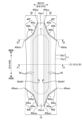
- FIG. 2 is a plan view of the diaper 1 with the absorbent main body 10 and the belt portion 30 stretched in the longitudinal direction;
- FIG. 3A is a schematic cross-sectional view of the diaper 1 in the state of FIG. 2 taken along line AA.
- FIG. 3B is a schematic cross-sectional view of the diaper 1 in the state of FIG. 2 taken along line BB.
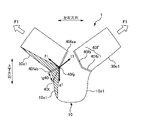
- FIG. 5 is a diagram for explaining the relationship between forces acting on joints 40 when a conventional underpants-type diaper 5 is worn as a comparative example.
- FIG. 5 is a diagram for explaining the relationship between forces acting on joints 40 when a conventional underpants-type diaper 5 is worn as a comparative example.
- FIG. 10 is a perspective view showing the state of the leg openings LH of the diaper 1 when the diaper is put on.
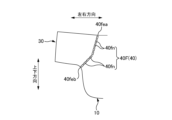
- FIG. 10 is a diagram illustrating the arrangement of convex portions 40fp provided in the joint portion 40; 4 is an enlarged plan view for explaining the structure of a joint portion 40;
- FIG. 3 is a plan view showing a case where a joint portion 40 is provided with a discontinuous portion; 10A and 10B are diagrams showing a modification of the arrangement of the seal portion 41 forming the joint portion 40.
- FIG. FIG. 11 is a schematic plan view showing a modified example of the joint 40;
- FIG. 11 is a schematic plan view showing a modified example of the joint 40;
- FIG. 11 is a schematic plan view showing another modified example of the joint 40; It is the schematic front view which looked at the diaper 2 of 2nd Embodiment from the ventral side.
- 14A and 14B are diagrams illustrating an example of a method for forming the projecting portion 10t and the projecting portion 30t.
- FIG. 11 is a perspective view showing the state of the leg openings LH of the diaper 2 when the diaper is put on.
- the absorbent body has vertical, horizontal, and longitudinal directions that intersect with each other, and has an absorbent body, and a belt part that connects a front upper end portion and a rear upper end portion of the absorbent body, and a waist opening. and a pair of leg openings, wherein the belt portion is inclined from the upper side to the lower side in the vertical direction from the waist opening toward the leg openings and from the inner side to the outer side in the horizontal direction.
- a pants-type absorbent article joined to the absorbent main body wherein when the pants-type absorbent article in a stretched state is viewed along the front-rear direction, the joint portion is the joint portion
- the portion below the portion (convex portion) of the joint portion that protrudes inward in the left-right direction is worn. It floats from the wearer's skin side to the non-skin side, and the lower end of the joint does not come into contact with the wearer's skin. Therefore, it becomes difficult for the force to pull up the belt portion to act on the lower end of the joint portion, and it becomes difficult for the starting point of tearing to be formed at the lower end. As a result, the joint portion becomes difficult to break, and separation of the belt portion and the absorbent main body can be suppressed.
- the joint portion has a portion that protrudes inward in the lateral direction below an intermediate position between the upper end and the lower end of the joint portion in the vertical direction. It is desirable that there be
- the belt portion rises from the wearer's skin when the absorbent article is worn, compared to the case where the convex portion of the joint is provided above the intermediate position in the vertical direction.
- the area of the part becomes smaller. Therefore, deterioration of fit can be suppressed.
- the convex portion is arranged below the middle position in the vertical direction, the contractile force in the vicinity of the upper end portion of the belt portion is less likely to be hindered, and the belt portion can be prevented from slipping down.
- the joint portion is composed of a plurality of discretely arranged seal portions, and at least one of the plurality of seal portions is located from the central position in the vertical direction. It is desirable that the profile is curved on the lower side as well.
- the joining portion has a discontinuous portion between the upper end and the lower end in the vertical direction.
- the joint portion has a lower width in the vertical direction than the portion projecting inward in the left-right direction than the portion projecting inward in the left-right direction. It is desirable that the width of the upper side in the vertical direction is larger than the width of the upper side.
- the joint portion is composed of a plurality of discretely arranged seal portions, and is located on the lower side in the vertical direction than the portion projecting inward in the left-right direction.
- the density of the seal portions per unit area has a portion where the density of the seal portions per unit area on the upper side in the vertical direction is higher than the portion projecting inward in the left-right direction. , is desirable.
- the joint portion has a joined portion and a non-joined portion at the end on the non-skin side.
- At least a part of the upper end portion of the absorbent body has an absorbent body seal portion that joins only the sheet members constituting the absorbent body. is desirable.
- the absorbent main body sealing part is provided at the upper end of the absorbent main body, the sheet members (for example, the top sheet and the back sheet) constituting the absorbent main body ) can be prevented from fraying each other and the opening of the absorbent main body at the upper end portion.
- the joining material is larger in the high basis weight region than in the other regions, so the welding strength is reduced. It can be made easier to raise. Therefore, when the belt portion is pulled up during the wearing operation, the joint portion is less likely to break in the high basis weight region of the belt portion, and separation of the belt portion and the absorbent body can be easily suppressed.
- At least a portion of the lower end portion of the belt portion has a multi-layered region in which the number of laminated sheet members constituting the belt portion is larger than that of other portions. , is desirable.
- the joining material is larger in the multi-layered region than in the other regions, so that the welding strength is increased. can be made easier. Therefore, when the belt portion is pulled up during the wearing operation, the joint portion is less likely to break in the multi-layered region of the belt portion, and separation of the belt portion and the absorbent main body can be easily suppressed.
- the joint portion has a portion that protrudes inward in the left-right direction in the multi-layered region.
- the convex portion in the multi-layered region where the number of laminated layers is large and the rigidity is higher than other regions in the belt portion, the convex portion Even if a large force acts on the joint, the joint can be made difficult to break.
- the belt portion includes a stretchable sheet member that stretches in the left-right direction and a linear elastic member
- the joint portion includes the stretchable sheet member and the stretchable sheet member in the belt portion. It is desirable to have a portion projecting inward in the left-right direction below the portion where the linear elastic member is laminated.
- the portion of the belt portion where the stretchable sheet member and the linear elastic member are laminated becomes the most stressed when the belt portion is pulled up during the wearing operation. area. Therefore, by providing the convex portion below the relevant portion, it becomes difficult for an excessively large force to act on the convex portion, and the belt portion can be made more difficult to break.
- the pants-type absorbent article has a portion where the belt portion and the absorbent main body are continuous in a region below a lower end of the joint portion in the vertical direction. is desirable.
- a part of the base material (nonwoven fabric, etc.) constituting the belt portion and the absorbent main body is present between the lower end of the joint and the leg opening. Therefore, it becomes difficult for the force when the belt portion is pulled up during the wearing operation to act on the lower end of the joint portion. Therefore, formation of a starting point of tearing at the lower end of the joint can be suppressed, and the joint can be made more difficult to tear.
- the absorbent body has vertical, horizontal, and longitudinal directions that intersect with each other, and has an absorbent body and a belt part that connects a front upper end portion and a rear upper end portion of the absorbent body, and has a waist opening. and a pair of leg openings, wherein the belt portion is inclined from the waist opening toward the leg openings from the upper side to the lower side in the vertical direction and from the inner side to the outer side in the horizontal direction.
- the underpants-type absorbent article joined to the absorbent main body by a portion, wherein when the underpants-type absorbent article in a stretched state is viewed along the front-rear direction, the up-down direction of the joints At least one of the absorbent main body and the belt portion has a portion protruding toward the leg opening side at the lower end of the pants-type absorbent article. .
- the protruding portion formed on at least one of the absorbent main body and the belt portion is pulled from the wearer's skin side to the non-skin side. It floats to the side, and the lower end of the joint does not come into contact with the wearer's skin. Therefore, it becomes difficult for the force to pull up the belt portion to act on the lower end of the joint portion, and it becomes difficult for the starting point of tearing to be formed at the lower end. As a result, the joint portion becomes difficult to break, and separation of the belt portion and the absorbent main body can be suppressed.
- the absorbent body has vertical, horizontal, and longitudinal directions that intersect with each other, and has an absorbent body and a belt part that connects a front upper end portion and a rear upper end portion of the absorbent body, and has a waist opening. and a pair of leg openings, wherein the belt portion is inclined from the waist opening toward the leg openings from the upper side to the lower side in the vertical direction and from the inner side to the outer side in the horizontal direction.
- a pants-type absorbent article joined to the absorbent main body by a part, wherein when worn, the lower end part of the joint part rises from the wearer's skin side to the non-skin side, so that the lower end part
- the pants-type absorbent article is characterized in that the joints are arranged so as to create a gap with the wearer's skin.
- the portion below the portion (convex portion) of the joint portion that protrudes inward in the left-right direction is worn. It floats from the wearer's skin side to the non-skin side, and the lower end of the joint does not come into contact with the wearer's skin. Therefore, it becomes difficult for the force to pull up the belt portion to act on the lower end of the joint portion, and it becomes difficult for the starting point of tearing to be formed at the lower end. As a result, the joint portion becomes difficult to break, and separation of the belt portion and the absorbent main body can be suppressed.
- FIG. 1 is a schematic front view of the diaper 1 viewed from the abdomen side, and a schematic cross-sectional view of the waist opening BH viewed from the upper side.
- FIG. 2 is a plan view of the diaper 1 with the absorbent body 10 and the belt portion 30 stretched in the longitudinal direction.
- FIG. 3A is a schematic cross-sectional view of the diaper 1 in the state of FIG. 2 taken along line AA.
- FIG. 3B is a schematic cross-sectional view of the diaper 1 in the state of FIG. 2 taken along line BB.
- the diaper 1 has "vertical direction”, “horizontal direction” and “front-rear direction” that are orthogonal to each other in the pants-type state shown in FIG.
- the upper side in the vertical direction is the wearer's “girth side” and the lower side in the vertical direction is the “crotch side” of the wearer.
- the front side in the front-rear direction is the wearer's “abdominal side”
- the rear side in the front-rear direction is the "back side” of the wearer.
- the diaper 1 is in a flat state elongated in the longitudinal direction as shown in FIG. 2 at the final stage of the manufacturing process.
- the flat diaper 1 has a "longitudinal direction” and a "width direction” that are perpendicular to each other.
- the "longitudinal direction” is a direction along the longitudinal direction of the absorbent main body 10, which corresponds to the up-down direction (FIG. 1) of the absorbent main body 10 in a pants-type state.
- the "width direction” is the direction corresponding to the left-right direction (FIG. 1) of the absorbent body 10 in the underpants-type state.
- FIG. 1 in FIG.
- the state of being "stretched in the longitudinal direction" means that the diaper 1 is stretched against the contractile force of an elastic member (for example, a waist elastic member 36 to be described later) arranged along the longitudinal direction. is elongated in the longitudinal direction to such an extent that wrinkles and gathers are substantially invisible in the portions where the elastic members are arranged. Therefore, the shape of the diaper 1 when it is stretched in the longitudinal direction is the same as the shape of the diaper 1 which extends flat when the elastic members do not exert any contractile force.
- an elastic member for example, a waist elastic member 36 to be described later
- the direction perpendicular to the longitudinal direction and the width direction is defined as the "thickness direction”
- the side in contact with the wearer's skin is defined as the “skin side”
- the opposite side is defined as the "non-skin side”.
- the diaper 1 includes an absorbent main body 10, a pair of belt portions 30, 30 joined to both lateral sides of the absorbent main body 10, a joint portion 40 joining the absorbent main body 10 and the belt portions 30, 30, It has
- the absorbent main body 10 has a substantially V-shaped tapered front end 10eLf and a rear end 10eLb in the longitudinal direction.
- the pair of belt portions 30, 30 mainly arranged around the waist of the wearer are arranged side by side in the width direction while being superimposed on the skin side surface of the absorbent main body 10.
- Each belt portion 30 is joined by joining portions 40 (40F, 40B) provided so as to be inclined along the V-shape of the end portions 10eLf, 10eLb of the absorbent main body 10.
- joining portions 40 40F, 40B
- each belt portion 30 is folded in half at substantially the center position CL30 in the longitudinal direction while the inner ends 30eW1 and 30eW1 in the width direction of the pair of belt portions 30 and 30 are opened to both sides in the width direction.
- the absorbent main body 10 is folded in half at the central position CL10 in the longitudinal direction. Then, the widthwise inner end portions 30eW1, 30eW1 of the belt portions 30, 30 and the longitudinal end portions 10eLf, 10eLb of the absorbent main body 10 form the waist opening BH of the diaper 1. As shown in FIG.
- a pair of leg openings LH, LH are formed by.
- the absorbent main body 10 is a sheet-like member whose longitudinal ends 10eLf and 10eLb are tapered in a substantially V shape in plan view, and covers the absorbent core 11 and the absorbent core 11 from the skin side.
- a top sheet 12, a back film 13 covering the absorbent core 11 from the non-skin side, a back sheet 14 laminated on the non-skin side of the back film 13, and both sides in the width direction (lateral direction) of the absorbent main body 10. has a side sheet 15 provided on the skin side of the back sheet 14, and leg elastic members 16 that extend and contract along the longitudinal direction (see FIG. 3). Each of these members is joined to a member adjacent in the thickness direction with a hot-melt adhesive or the like.
- the application pattern of the adhesive examples include an ⁇ pattern, a spiral pattern, a stripe pattern, and the like.
- the members may be joined using welding means such as thermal welding, ultrasonic welding, or other known joining means.
- the absorbent core 11 is a molded body obtained by molding a predetermined liquid absorbent material into a substantially oval shape as shown in FIG. 2 as an example of a predetermined shape.
- the liquid-absorbent material include liquid-absorbent fibers such as pulp fibers and liquid-absorbent granules such as superabsorbent polymers (so-called SAP).
- SAP superabsorbent polymers
- the shape of the absorbent core 11 is not limited to the elliptical shape as described above, and may be substantially an hourglass shape in plan view or other shape.
- the outer peripheral surface of the absorbent core 11 may be covered with a core wrap sheet (not shown) such as tissue paper.
- the top sheet 12 is, for example, a liquid-permeable sheet member such as an air-through nonwoven fabric, and is arranged so as to cover the absorbent core 11 from the skin side to the non-skin side as shown in FIG. 3A. Since the ends 10eLf and 10eLb of the absorbent main body 10 are formed at the ends 10eLf and 10eLb of the absorbent body 10, the longitudinal ends of the top sheet 12 are formed on the ventral side (front side) or the dorsal side (rear side) in the longitudinal direction. It has the above-mentioned substantially V-shaped tapered shape in which the dimension in the width direction becomes smaller as it progresses to the left.
- the back film 13 is a liquid-impermeable leak-proof sheet such as polyethylene (PE) film or polypropylene (PP) film.
- the backsheet 14 is a sheet member made of a soft, hydrophobic nonwoven fabric or the like, and is a member that constitutes the exterior of the absorbent body 10 .
- the back sheet 14 has a substantially V-shaped tapered shape in which the width dimension decreases toward the ventral side (front side) or the dorsal side (rear side) in the longitudinal direction.
- the side sheets 15 are made of a flexible, hydrophobic non-woven fabric or the like like the back sheet 14, and are joined to the skin side on both sides of the back sheet 14 in the width direction (lateral direction). Between the side sheet 15 and the back sheet 14 in the thickness direction, a plurality of leg elastic members 16 such as rubber threads are stretched in the longitudinal direction at a predetermined ratio, and are spaced apart in the width direction. installed. Based on the contractile force generated by the leg elastic members 16, stretchability along the longitudinal direction is applied to the outer ends 10e1, 10e1 in the width direction of the absorbent main body 10, that is, the leg openings LH, LH. is given, and the fit of the diaper 1 around the legs is improved.
- leg elastic members 16 such as rubber threads
- the member constituting the leg-hole elastic member 16 is not limited to the rubber thread or the like described above, and may be any member capable of exhibiting a contractile force along the longitudinal direction.
- it may be a stretchable sheet member such as a stretchable nonwoven fabric.
- the belt portion 30 connects a front end portion 10eLf (front upper end portion in the pants-shaped state in FIG. 1) and a rear end portion 10eLb (rear upper end portion in the pants-shaped state in FIG. 1) in the longitudinal direction of the absorbent main body 10. It is a belt-shaped member that connects, and has a non-skin side sheet 31, a skin side sheet 32, a waist elastic sheet 33, and a waist elastic member 36. - ⁇
- the non-skin-side sheet 31 and the skin-side sheet 32 are strip-shaped sheet members arranged along the longitudinal direction, and are made of, for example, spunbond nonwoven fabric or SMS nonwoven fabric. Both ends of the non-skin-side sheet 31 and the skin-side sheet 32 in the longitudinal direction are aligned with the shapes of the longitudinal ends 10eLf and 10eLb of the absorbent main body 10, and are placed on the belly side (front side) or the dorsal side (rear side) in the longitudinal direction. side), the dimension in the width direction becomes narrower.
- a portion of the non-skin-side sheet 31 has a folded portion 31f that is folded outward at an inner end portion 30eW1 in the width direction (lateral direction).
- a waist elastic sheet 33 and a plurality of waist elastic members 36 are provided between the non-skin side sheet 31 and the skin side sheet 32 in the thickness direction.
- the waist elastic sheet 33 is a stretchable sheet member having stretchability along the longitudinal direction, and is formed of stretchable nonwoven fabric or stretchable film, for example.
- the waist elastic sheet 33 is provided near the outer end 30e1 in the width direction of the belt portion 30 (near the bottom end of the belt portion 30 in the vertical direction in the pants-type state of FIG. 1).
- the sheet 33 imparts appropriate stretchability to the leg openings LH (outer ends 30e1).
- the waist elastic members 36 are linear elastic members such as thread rubber having elasticity along the longitudinal direction, and are arranged in plurality at intervals in the width direction.
- the waist elastic member 36 is provided near the inner end 30eW1 in the width direction of the belt portion 30 (near the upper end portion of the belt portion 30 in the vertical direction in the pants-type state of FIG. 1), and is provided at the waist opening BH of the diaper 1.
- the waist elastic members 36 are stacked in the thickness direction at the folded portion 31f near the inner end 30eW1, and the density is increased (see FIGS. 3A and 3B). Sufficient stretchability is imparted to the portion BH, making it easier to prevent the diaper 1 from slipping down when worn.
- a portion of the waist elastic member 36 overlaps the waist elastic sheet 33 .
- the joint portion 40 is a portion that joins the absorbent main body 10 and the belt portion 30, and has a pair of front joint portions 40F on the front side in the front-rear direction and a pair of rear joint portions 40B on the rear side.
- a pair of front joint portions 40F for joining the belt portions 30, 30 on both sides in the left-right direction. 40F is provided at the upper end portion 10eLf (the front end portion in the longitudinal direction of FIG. 2) on the front side of the absorbent main body 10.
- a pair of front joint portions 40F for joining the belt portions 30, 30 on both sides in the left-right direction. 40F is provided at the upper end portion 10eLf (the front end portion in the longitudinal direction of FIG. 2) on the front side of the absorbent main body 10.
- a pair of front joint portions 40F for joining the belt portions 30, 30 on both sides in the left-right direction. 40F is provided at the upper end portion 10eLf (the front end portion in the longitudinal direction of FIG. 2) on the front side of the absorbent main body 10.
- the joints 40 (the front joints 40F and the rear joints 40B) provided in the diaper 1 of this embodiment have a partially bent shape, as shown in FIGS. That is, the front joint portion 40F has a shape in which an upper portion 40fa and a lower portion 40fb in the vertical direction are bent at 40fp.
- the joining portion 40 has a portion (hereinafter also referred to as a convex portion 40fp) that protrudes inward in the left-right direction from the straight line connecting the upper end 40fea and the lower end 40feb.
- the rear joint portion 40B has a portion (convex portion 40bp) that protrudes inward in the horizontal direction from a straight line that connects the upper end 40bea and the lower end 40beb in the vertical direction.
- the joint portion 40 is formed by thermal welding or ultrasonic welding, and joins the absorbent main body 10 and the belt portion 30 .
- the bonding method by the bonding portion 40 is not limited to this example, and an adhesive, another bonding method, or a combination thereof may be used.
- the operation when wearing the diaper 1 will be described.
- the wearer's legs are passed through the pair of leg openings LH from the waist opening BH.
- the diaper 1 is pulled up from the wearer's toe side to the crotch portion by grasping both ends of the belt portion 30 in the left-right direction.
- the absorbent main body 10 is fitted to the crotch portion of the wearer, and the belt portion 30 is fitted to the waist portion of the wearer.
- FIG. 4 is a diagram for explaining the relationship between the forces acting on the joints 40 when the conventional pants-type diaper 5 is worn as a comparative example.
- the basic configuration of the pants-type diaper 5 (diaper 5) according to the comparative example is substantially the same as that of the diaper 1 according to the present embodiment, but the shape of the joint portion 40 is different.
- the joint portion 40 of the diaper 5 is formed in a straight line from the upper end 40fea to the lower end 40feb in the vertical direction, and does not have the convex portion 40fp like the diaper 1 between the upper end 40fea and the lower end 40feb. .
- a tensile force acts on the joint portion 40 (40F).
- a pulling force f1 acts on the lower end 40feb of the joint 40 in the same direction as F1.
- a downward drag g1 in the vertical direction acts on the lower end 40feb of the joint portion 40 .
- a force t1 directed upward in the vertical direction and inward in the horizontal direction acts on the lower end 40feb of the joint portion 40 so as to balance these forces f1 and g1.
- the force t1 acting on the lower end 40feb of the joint portion 40 increases and exceeds the joint strength of the joint portion 40.
- the joint portion 40 begins to tear starting from the lower end 40feb, the joint portion 40 begins to tear toward the upper end 40fea. Then, the tear propagates along the joint 40 .
- the belt portion 30 and the absorbent main body 10 may separate, or the diaper 5 may not be worn on the body.
- FIG. 5 is a diagram illustrating the relationship between forces acting on the joints 40 when the pants-type diaper 1 of the first embodiment is worn.
- FIG. 6 is a perspective view showing the state of the leg openings LH of the diaper 1 during the wearing operation.
- the waist opening BH formed by the belt portion 30 is widened outward in the left-right direction and pulled up in the up-down direction, similarly to the diaper 5 .
- the outer end portion of the belt portion 30 in the left-right direction is pulled by the obliquely upward force F1 (see FIG. 5).
- the diaper 1 is provided with the protrusion 40fp that protrudes inward in the left-right direction between the upper end 40fea and the lower end 40feb of the joint portion 40 .
- the circumference of the leg-hole opening LH of the diaper 1 becomes longer than when the convex portion 40fp is not provided.
- the joint portion 40 is formed on a straight line, that is, when the joint portion 40 is formed as a straight line extending from the upper end 40fea through the convex portion 40fp to the temporary lower end 40t, the temporary lower end 40t
- the position is at a distance lg40 from the lower end 40feb.
- the absorptive main body 10 in the leg openings LH is The peripheral length of the outer end (outer edge) 10e1 is increased by lg40.
- the outer end portion 10e1 of the absorbent main body 10 is a portion that abuts against the groin of the wearer when the diaper 1 is worn.
- a surplus of the fabric (non-woven fabric or the like) forming the end portion 10e1 tends to create a gap between it and the wearer's skin (groin). That is, the lower end 40feb of the joint portion 40 tends to rise from the wearer's skin side toward the non-skin side.
- the hatched region in FIG. 6 rolls up toward the non-skin side. It will be in a state where it does not come into contact with the wearer's skin.
- the point where the force F1 pulling up the belt portion 30 acts moves from the lower end 40feb of the joint portion 40 to the convex portion 40fp. Therefore, when the diaper 1 is put on, as shown in FIG. 5, the convex portion 40fp of the joint portion 40 is subjected to a pulling force f1 in the same direction as F1, a vertical downward drag force g1, and a vertical upward force f1. , and a force t1 acting inward in the left-right direction acts.
- the convex portion 40fp of the joint portion 40 is separated from the lower end 40feb by a predetermined distance.
- the cloth (nonwoven fabric, etc.) constituting the absorbent main body 10 and the belt portion 30 exists around the convex portion 40fp, even if the force (t1) is concentrated on the convex portion 40fp, the starting point of the tear is formed. hard to be That is, even if the belt portion 30 is pulled up when the diaper 1 is put on, the joint portion 40 is not easily broken, and the belt portion 30 and the absorbent main body 10 are separated, and the diaper 1 cannot be worn. It is suppressed.
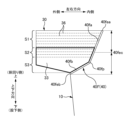
- FIG. 7A and 7B are diagrams for explaining the arrangement of the convex portions 40fp provided on the joint portion 40.
- FIG. 7 shows the planar shape of the belt portion 30 and the joint portion 40 when the pants-type diaper 1 is stretched vertically and horizontally.
- the convex portion 40fp is provided below an intermediate position 40fec between the upper end 40fea and the lower end 40feb of the joint portion 40 in the vertical direction.
- the area between the convex portion 40fp and the lower end 40feb when the diaper 1 is worn is from the wearer's skin side to the non-skin side. It becomes easier to float up. Therefore, if the convex portion 40fp is above the intermediate position 40fec in the vertical direction of the joint portion 40, the area where the belt portion 30 rises from the wearer's skin increases, and the fit around the wearer's legs increases.
- the convex portion 40fp is provided below the intermediate position 40fec of the joint portion 40 in the up-down direction. Therefore, the area where the belt portion 30 rises from the wearer's skin when the diaper 1 is worn is reduced. Therefore, it is possible to suppress deterioration of fit around the leg. Further, when the convex portion 40fp is arranged below the intermediate position 40fec, the contractile force of the waist elastic member 36 acting near the upper end portion of the belt portion 30 is less likely to be inhibited. is easily maintained, and slipping of the belt portion 30 can be suppressed.
- the number of sheet members stacked in the thickness direction at the lower end in the vertical direction is stacked in the thickness direction at other portions (upper end in the vertical direction, etc.). It is greater than the number of sheet members.
- the belt portion 30 has the non-skin-side sheet 31 and the skin-side sheet 32 laminated together, and furthermore, in a part of the region (lower end portion in the vertical direction), the belt portion 30 is formed between the non-skin-side sheet 31 and the skin-side sheet 32.
- a girth elastic sheet 33 is laminated on (see FIG. 3A etc.). In other words, at least a part of the lower end of the belt portion 30 becomes a multi-layered region (the region surrounded by the thick line in FIG.
- the protrusions 40fp of the joints 40 are provided in such multi-layered regions (see FIG. 7).
- the convex portion 40fp of the joint portion 40 is the portion that protrudes most inward in the left-right direction, and is the portion to which the greatest force acts when the belt portion 30 is pulled up. Therefore, by arranging the convex portion 40fp in the multi-laminated region of the belt portion 30, which has a large number of laminated layers and has a higher rigidity than other regions, when a large force acts on the convex portion 40fp. Even so, the joint portion 40 can be made more difficult to break.
- the basis weight of the sheet member forming the belt portion 30 at the lower end portion in the vertical direction is the same as that of the sheet member forming the belt portion 30 at other portions (upper end portion in the vertical direction, etc.). higher than the basis weight. That is, at least a portion of the lower end portion of the belt portion 30 is a high basis weight region having a higher basis weight than the upper end portion due to the presence of the waist elastic sheet 33 . In such a high basis weight region, when the belt portion 30 and the absorbent main body 10 are joined by the joining portion 40, the joining material is greater than in other regions, so that the welding strength can be easily increased. can.
- the joint portion 40 in the high basis weight region (lower end portion) of the belt portion 30 is less likely to break against the force pulling up the belt portion 30 obliquely upward. It becomes easy to suppress that the main body 10 separates. Further, as in the case described above, since the convex portion 40fp of the joint portion 40 is provided in such a high basis weight region, even when a large force acts on the convex portion 40fp, the joint portion 40 can be made more difficult to break.
- a region S1 is a region in which only a waist elastic member 36 (linear elastic member) such as thread rubber is arranged, and a waist elastic sheet 33 (stretchable) such as a stretchable nonwoven fabric is arranged. sheet member) is arranged, and the region where the waist elastic member 36 and the waist elastic sheet 33 are overlapped is S2. It is desirable to be provided on the lower side than (see FIG. 7). In the area S2, since the contractile force of the waist elastic member 36 and the waist elastic sheet 33 acts, this is the area where the stress is the strongest when the belt portion 30 is pulled up when the diaper 1 is put on.
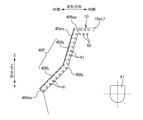
- FIG. 8 is an enlarged plan view explaining the structure of the joint 40.
- the joints 40 are formed by discretely arranging a plurality of seals 41 formed by ultrasonic welding or thermal welding in predetermined regions. By arranging the plurality of fine seal portions 41 at intervals, the force acting on the joint portion 40 (for example, the force t1 in FIG. 5) is dispersed, making it difficult to concentrate on one point. 40 can be made difficult to tear.
- the shape of the seal portion 41 is curved on the lower side in the vertical direction. Specifically, as shown in FIG. 8, it is desirable that the contour of the seal portion 41 is curved below the central position of the seal portion 41 in the vertical direction.
- the seal portion 41 may be easily peeled off.
- a “corner” is formed by curving the contour of the lower side of the seal portion 41, the force (t1) acting on the seal portion 41 is difficult to concentrate at one point.
- the part 41 can be made difficult to peel off. Therefore, the joint 40 becomes more difficult to tear.
- FIG. 9 is a plan view showing a case where the joint 40 is provided with a discontinuous portion.
- a joint portion 40F (40) shown in FIG. 9 is formed in a substantially dotted line shape with a plurality of discontinuous portions formed between an upper end 40fea and a lower end 40feb.
- the joint portion 40F is formed by intermittently arranging a plurality of short band-shaped joint portions 40fn. For example, among the plurality of joints 40fn forming the joint 40F, one is a joint 40fn1, and the other adjacent to the joint 40fn1 with a space therebetween is a joint 40fn2.
- the discontinuous portion provided in the joint portion 40 may be the interval between the two adjacent seal portions 41, 41 in FIG. That is, the plurality of seal portions 41, 41... may be discretely arranged with a certain distance.
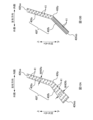
- FIG. 10A and 10B are diagrams showing a modification of the arrangement of the seal portion 41 forming the joint portion 40.
- FIG. 10A and 10B are diagrams showing a modification of the arrangement of the seal portion 41 forming the joint portion 40.
- the width of the joint 40 increases toward the bottom. That is, the width W40fb of the portion 40fb of the joint portion 40 below the protrusion 40fp is larger than the width W40fa of the portion 40fa above the protrusion 40fp (W40fb>W40fa).
- W40fb at the lower side (40fb) of the joint portion 40 has a larger portion than the width W40fa at the upper side (40fa)
- the force (t1) acting from the lower side to the upper side of the joint 40 in the vertical direction can be received by the wider portion of the lower side (40fb) of the joint 40 . Therefore, the force acting on the lower side (40fb) of the joint 40 can be easily dispersed in the width direction, and the breakage of the joint 40 can be easily suppressed.
- the density of the seal portion 41 forming the joint portion 40 increases toward the lower side of the joint portion 40 . That is, the area of the sealing portion 41 provided per unit area in the portion 40fb below the convex portion 40fp of the joint portion 40 is the same as the area of the sealing portion 41 provided per unit area in the portion 40fa above the convex portion 40fp. is larger than the area of In this way, the lower side (40fb) of the joint portion 40 has a portion where the density of the seal portion 41 is higher than the density of the seal portion 41 on the upper side (40fa). 40fb) is higher than that on the upper side (40fa).
- the joint portion 40 has a joined portion and a non-joined portion at the non-skin-side end (edge) in the thickness direction.
- the non-skin-side end (edge) of the joint 40 is the tip of the joints 40F and 40B protruding from the skin side to the non-skin side in the cross-sectional view of the waist opening BH in FIG. To tell.
- at least a portion of the plurality of seal portions 41 forming the joint portion 40 overlaps the non-skin side end of the joint portion 40 (the end 40e Albany indicated by the thick line in FIG. 8). It is That is, at least a part of the end 40 e .
- the seal portion 41 were formed on the entire end 40e on the non-skin side of the joint portion 40, the rigidity of the end 40e would be increased, and when the wearer touches the end 40e when the diaper 1 is worn, There is a possibility that it becomes easy to produce a sense of incongruity.
- the seal portion 41 is not formed on the entire end 40e on the non-skin side, friction between the diaper 1 and the wearer's clothes may cause the absorbent main body 10 and the belt portion 30 to be separated from each other at the end 40e. There is a risk that the bonding of the will be easy to peel off.
- a bonded portion and a non-bonded portion are provided at the non-skin-side end 40 e of the bonded portion 40 , so that the wearer can touch the bonded portion 40 . Even in the case where the joint portion 40 is attached, it is possible to prevent the joint portion 40 from being separated.
- a body seal portion 42 may be provided.
- FIG. 8 at least part of the upper end portion 10eLf on the front side of the absorbent main body 10, a plurality of adhesives for joining the top sheet 12 and the back sheet 14 (back film 13) constituting the absorbent main body 10 in the thickness direction. of absorbent body seal portion 42 is provided.
- the absorbent main body seal portion 42 is provided at the upper end portion 10eLf on the front side of the absorbent main body 10, the sheet members (the top sheet 12 and the back sheet 14) may be frayed, and the upper end portion 10eLf may be frayed. It is possible to suppress the occurrence of opening of the absorbent main body 10 .
- the seal portion 41 forming the joint portion 40 and the absorbent main body seal portion 42 provided at the upper end portion of the absorbent main body 10 can be formed simultaneously in the manufacturing process of the diaper 1 .
- the diaper 1 is stretched as shown in FIG.
- an absorbent main body seal portion 42 for welding the sheet members (12, 14) constituting the absorbent main body 10 in the thickness direction can be formed.
- FIG. 11 is a schematic plan view showing a modified example of the joint 40.
- the upper portion 40fa in the vertical direction and the lower portion 40fb in the vertical direction of the joint portion 40 are both linear, and the convex portion 40fp projects inward in the horizontal direction.
- the joint portion 40 may be partially curved as shown in FIG. 11 .
- the lower portion 40fb of the joint portion 40 in the vertical direction is formed in an arc shape that protrudes inward in the horizontal direction, and is smoothly connected to the upper portion 40fa in the vertical direction at the convex portion 40fp. .
- the force of pulling up the belt portion 30 during the wearing operation of the diaper 1 tends to act on the convex portion 40fp instead of the lower end 40feb.
- the upper portion 40fa and the lower portion 40fb of the joint portion 40 are continuously connected at the convex portion 40fp, and the lower portion 40fb is not formed with an angle, force is concentrated at this portion. it gets harder.
- the joint portion 40 (lower The length of the side portion 40fb) itself is increased. As a result, the force acting on the joint portion 40 is more likely to be dispersed, and breakage of the joint portion 40 can be easily suppressed.
- FIG. 12 is a schematic plan view showing another modification of the joint 40.
- the belt portion 30 and the absorbent body 10 have a continuous portion below the lower end 40 feb of the joint portion 40 . That is, the lower end 40feb of the joint portion 40 does not reach the leg opening LH, and the belt portion 30 and the base material ( Non-woven fabric, etc.) are present. Therefore, even if the belt portion 30 is pulled up when the diaper 1 is put on, formation of a starting point of tearing at the lower end 40feb is likely to be suppressed. Thereby, the joint 40 can be made more difficult to tear.
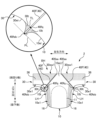
- FIG. 13 is a schematic front view of the diaper 2 of the second embodiment as seen from the ventral side.
- the diaper 2 of the second embodiment has a predetermined region including the lower end 40feb of the front joint portion 40F, and a part of the absorbent main body 10 and the belt portion 30 on the side of the leg opening LH. has a protruding part.
- the absorbent main body 10 has a protruding portion 10t that protrudes toward the leg opening LH side
- the belt portion 30 has a protruding portion 30t that protrudes toward the leg opening LH side. (both of which are hatched in the partial enlarged view of FIG. 13).
- the absorbent main body 10 and the belt portion 30 have a portion protruding toward the leg opening LH (not shown in FIG. 13).
- the projecting portion 10t and the projecting portion 30t can be identified as follows. First, a line passing through the lower end 40feb of the front joint portion 40F and perpendicular to the front joint portion 40F (assumed to be an auxiliary line PL) is drawn. Next, the outer edge 10e1 of the absorbent main body 10 (outline of the leg opening LH formed by the absorbent main body 10) and the outer edge 30e1 of the belt portion 30 (outline of the leg opening LH formed by the belt portion 30). and a common tangent line (common tangent line TL) is drawn.
- a portion where the absorbent main body 10 exists and a portion where the absorbent main body 10 does not exist are formed in the region between the auxiliary line PL and the common tangent line TL.
- a portion where the absorbent main body 10 exists between the auxiliary line PL and the common tangent line TL becomes the projecting portion 10t.
- a portion where the belt portion 30 exists and a portion where it does not exist are formed in the region between the auxiliary line PL and the common tangent line TL. 30 tons.
- the intersection of the common tangent line TL and the front joint portion 40F is defined as an intermediate point 40fq. That is, the intermediate point 40fq is located between the upper end 40fea and the lower end 40feb of the front joint portion 40F.
- the joint portion 40 is formed in a straight line, but the joint portion 40 is bent or curved between the upper end 40fea and the lower end 40feb as in the diaper 1 of the first embodiment. It may be a configuration that Regarding the diaper 2, the basic configuration other than the above (for example, the configuration of the absorbent main body 10 and the belt portion 30, the configuration of the seal portion 41 forming the joint portion 40, etc.) is the diaper described in the first embodiment. 1, detailed description is omitted.
- FIGS. 14A and 14B are diagrams illustrating an example of a method for forming the projecting portion 10t and the projecting portion 30t.
- the projecting portion 10t and the projecting portion 30t are formed by notching (cutting) part of the absorbent main body 10 and the belt portion 30 in a region closer to the front joint portion 40F than the auxiliary line PL in the manufacturing process of the diaper 2.
- FIG. 14A shows a portion of the diaper 2 before the projections 10t and 30t are formed at the lower end 40feb of the front joint 40F.
- the sheet member constituting the absorbent main body 10 and the belt portion 30 is present on the entire side of the front joint portion 40F with respect to the auxiliary line PL passing through the lower end 40feb. In other words, there is no portion where the absorbent main body 10 and the belt portion 30 do not exist on the front joint portion 40F side of the auxiliary line PL.
- only one of the projecting portion 10t and the projecting portion 30t may be formed.
- only one of the protrusion 10t and the protrusion 30t is formed by cutting out only one of the absorbent main body 10 and the protrusion 30t on the front joint portion 40F side of the auxiliary line PL. It may be
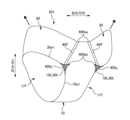
- FIG. 15 is a perspective view showing the state of the leg openings LH of the diaper 2 during the wearing operation.
- the leg openings The circumference of LH is longer. Therefore, the material is left over at the protruding portions 10t and 30t of the leg openings LH, and a gap is likely to occur between the wearer's skin (groin) and the wearer's skin (groin). That is, the protruding portion 10t and the protruding portion 30t are easily lifted from the wearer's skin side to the non-skin side. As a result, starting from the intermediate point 40fq, the shaded areas (protrusions 10t, 30t) in FIG. The lower end 40feb does not come into contact with the wearer's skin.
- the point at which the force pulling up the belt portion 30 acts moves from the lower end 40feb of the joint portion 40 to the intermediate point 40fq. That is, the intermediate point 40fq functions in the same manner as the convex portion 40fp in the diaper 1 of the first embodiment, and the force tends to concentrate on the intermediate point 40fq. Since the projecting portion 10t and the projecting portion 30t are interposed between the intermediate point 40fq and the lower end 40feb of the joint portion 40, even if a force acts on the intermediate point 40fq, the lower end 40feb It is difficult for force to act, and it is difficult to form the starting point of the tear.
- the pants-type diaper 1 was described as an example of the pants-type absorbent article, but the present invention can also be applied to pants-type absorbent articles other than pants-type diapers.
- it may be a pants-type napkin (shorts-type napkin) or a pants-type (shorts-type) absorbent pad for children or adults.
Landscapes
- Health & Medical Sciences (AREA)
- Epidemiology (AREA)
- Engineering & Computer Science (AREA)
- Biomedical Technology (AREA)
- Heart & Thoracic Surgery (AREA)
- Vascular Medicine (AREA)
- Life Sciences & Earth Sciences (AREA)
- Animal Behavior & Ethology (AREA)
- General Health & Medical Sciences (AREA)
- Public Health (AREA)
- Veterinary Medicine (AREA)
- Absorbent Articles And Supports Therefor (AREA)
Abstract
Description
本発明は、パンツ型吸収性物品に関する。 The present invention relates to pants-type absorbent articles.
従来、吸収性本体と一対のベルト部とが、斜めに傾斜する接合部によって接合されたパンツ型吸収性物品が知られている。例えば、特許文献1には、吸収性のある胴体20(吸収性本体)と、伸縮性のあるパネル30(ベルト部)と、を有するおむつ10(パンツ型使い捨ておむつ)が開示されている。このおむつ10では、胴体20の前縁15上にて、斜めに傾斜する一対の前取り付け線21,21によってパネル30が接合され、胴体20の後縁17上にて、斜めに傾斜する一対の後取り付け線22,22によってパネル30が接合されることで、ウエスト開口16と足開口部縁12とが形成されている。
Conventionally, there has been known a pants-type absorbent article in which an absorbent main body and a pair of belt portions are joined by obliquely inclined joining portions. For example, Patent Literature 1 discloses a diaper 10 (pants-type disposable diaper) having an absorbent body 20 (absorbent main body) and an elastic panel 30 (belt portion). In this
特許文献1のようなパンツ型おむつでは、着用時にベルト部を斜め上方に引っ張ることで、吸収性本体を着用者の股間部へと引き上げる動作が行われる。その際、吸収性本体とベルト部とを接合している斜めに傾斜した接合部の下端部に力が集中して作用することによって、当該下端部を起点として接合部が破れやすくなり、ベルト部と吸収性本体とが分離してしまうおそれがあった。 In a pants-type diaper such as that disclosed in Patent Document 1, when the diaper is worn, the belt portion is pulled obliquely upward so that the absorbent main body is pulled up to the crotch portion of the wearer. At that time, the force concentrates on the lower end of the obliquely inclined joint that joins the absorbent body and the belt, so that the joint becomes easy to tear starting from the lower end, and the belt is broken. and the absorbent main body may separate.
本発明は、上記のような問題に鑑みてなされたものであって、その目的とするところは、斜めに傾斜する接合部によって吸収性本体とベルト部とが接合されているパンツ型吸収性物品において、着用時に接合部が破れてしまうことを抑制することにある。 The present invention has been made in view of the above problems, and an object of the present invention is to provide a pants-type absorbent article in which an absorbent main body and a belt portion are joined by an obliquely inclined joining portion. In the above, the object is to suppress the breakage of joints when worn.
上記目的を達成するための主たる発明は、互いに交差する上下方向と左右方向と前後方向とを有し、吸収性本体と、前記吸収性本体の前側上端部と後側上端部とを連結するベルト部と、を有し、胴回り開口部と一対の脚回り開口部とを備え、前記ベルト部が、前記胴回り開口部から前記脚回り開口部に向かって前記上下方向の上側から下側且つ前記左右方向の内側から外側へ傾斜した接合部によって、前記吸収性本体と接合されている、パンツ型吸収性物品であって、伸長状態の前記パンツ型吸収性物品を前記前後方向に沿って見たときに、前記接合部は、前記接合部の前記上下方向における上端と下端とを結んだ直線よりも、前記左右方向の内側に凸となる部分を有している、ことを特徴とするパンツ型吸収性物品である。
本発明の他の特徴については、本明細書及び添付図面の記載により明らかにする。
The main invention for achieving the above object is a belt that has vertical, horizontal, and front-back directions that intersect each other, and connects an absorbent main body, and a front upper end portion and a rear upper end portion of the absorbent main body. and a waist opening and a pair of leg openings, wherein the belt part extends from the waist opening toward the leg openings from the upper side to the lower side in the vertical direction and the left and right A pants-type absorbent article joined to the absorbent main body by a joint portion slanted from the inside to the outside of the direction, when the pants-type absorbent article in a stretched state is viewed along the front-back direction Further, the joint portion has a portion that protrudes inward in the horizontal direction from a straight line connecting the upper end and the lower end of the joint portion in the vertical direction. It is a sexual item.
Other features of the present invention will become apparent from the description of the specification and accompanying drawings.
本発明によれば、斜めに傾斜する接合部によって吸収性本体とベルト部とが接合されているパンツ型吸収性物品において、着用時に接合部が破れてしまうことを抑制することができる。 According to the present invention, in a pants-type absorbent article in which an absorbent main body and a belt portion are joined by an obliquely inclined joint portion, it is possible to prevent the joint portion from being torn when worn.
本明細書及び添付図面の記載により、少なくとも以下の事項が明らかとなる。 At least the following matters become clear from the description of this specification and the attached drawings.
互いに交差する上下方向と左右方向と前後方向とを有し、吸収性本体と、前記吸収性本体の前側上端部と後側上端部とを連結するベルト部と、を有し、胴回り開口部と一対の脚回り開口部とを備え、前記ベルト部が、前記胴回り開口部から前記脚回り開口部に向かって前記上下方向の上側から下側且つ前記左右方向の内側から外側へ傾斜した接合部によって、前記吸収性本体と接合されている、パンツ型吸収性物品であって、伸長状態の前記パンツ型吸収性物品を前記前後方向に沿って見たときに、前記接合部は、前記接合部の前記上下方向における上端と下端とを結んだ直線よりも、前記左右方向の内側に凸となる部分を有している、ことを特徴とするパンツ型吸収性物品。 The absorbent body has vertical, horizontal, and longitudinal directions that intersect with each other, and has an absorbent body, and a belt part that connects a front upper end portion and a rear upper end portion of the absorbent body, and a waist opening. and a pair of leg openings, wherein the belt portion is inclined from the upper side to the lower side in the vertical direction from the waist opening toward the leg openings and from the inner side to the outer side in the horizontal direction. , a pants-type absorbent article joined to the absorbent main body, wherein when the pants-type absorbent article in a stretched state is viewed along the front-rear direction, the joint portion is the joint portion A pants-type absorbent article, comprising: a portion projecting inward in the left-right direction from a straight line connecting the upper end and the lower end in the up-down direction.
このようなパンツ型吸収性物品によれば、着用時にベルト部を引っ張り上げる動作を行う際に、接合部のうち左右方向の内側に凸となる部分(凸部)よりも下側の部分が着用者の肌側から非肌側に浮き上がり、接合部の下端が着用者の肌に当接しない状態となる。したがって、ベルト部を引っ張り上げる力が接合部の下端に作用し難くなり、当該下端において破れの起点が形成され難くなる。これにより、接合部が破れ難くなり、ベルト部と吸収性本体とが分離することを抑制できる。 According to such a pants-type absorbent article, when the belt portion is pulled up when worn, the portion below the portion (convex portion) of the joint portion that protrudes inward in the left-right direction is worn. It floats from the wearer's skin side to the non-skin side, and the lower end of the joint does not come into contact with the wearer's skin. Therefore, it becomes difficult for the force to pull up the belt portion to act on the lower end of the joint portion, and it becomes difficult for the starting point of tearing to be formed at the lower end. As a result, the joint portion becomes difficult to break, and separation of the belt portion and the absorbent main body can be suppressed.
かかるパンツ型吸収性物品であって、前記接合部は、前記上下方向において前記接合部の上端と下端との中間位置よりも下側に、前記左右方向の内側に凸となる部分を有している、ことが望ましい。 In this underpants-type absorbent article, the joint portion has a portion that protrudes inward in the lateral direction below an intermediate position between the upper end and the lower end of the joint portion in the vertical direction. It is desirable that there be
このようなパンツ型吸収性物品によれば、接合部の凸部が上下方向における中間位置よりも上側に設けられる場合と比較して、吸収性物品の着用時にベルト部が着用者の肌から浮き上がる部分の面積が小さくなる。したがって、フィット性の悪化を抑制することができる。また、凸部が上下方向の中間位置よりも下側に配置されているため、ベルト部の上端部付近における収縮力が阻害され難く、ベルト部がずり落ちてしまうことを抑制できる。 According to such a pants-type absorbent article, the belt portion rises from the wearer's skin when the absorbent article is worn, compared to the case where the convex portion of the joint is provided above the intermediate position in the vertical direction. The area of the part becomes smaller. Therefore, deterioration of fit can be suppressed. Further, since the convex portion is arranged below the middle position in the vertical direction, the contractile force in the vicinity of the upper end portion of the belt portion is less likely to be hindered, and the belt portion can be prevented from slipping down.
かかるパンツ型吸収性物品であって、前記接合部のうち前記左右方向の内側に凸となる部分の少なくとも一部が湾曲している、ことが望ましい。 In this underpants-type absorbent article, it is desirable that at least a part of the portion of the joint that projects inward in the left-right direction is curved.
このようなパンツ型吸収性物品によれば、接合部の湾曲部分には角が形成され難いため、着用動作時にベルト部を引っ張り上げた際の力が集中して作用することが抑制される。また、接合部が湾曲している部分では、直線状に形成されている場合と比較して接合部の距離自体が長くなるため、力が分散しやすくなる。これにより、接合部が破れてしまうことを抑制できる According to such a pants-type absorbent article, it is difficult for corners to be formed in the curved portions of the joints, so that the concentrated action of the force when pulling up the belt portion during the wearing operation is suppressed. In addition, in the portion where the joint portion is curved, the distance of the joint portion itself is longer than in the case where the joint portion is formed in a straight line, so the force is easily dispersed. This prevents the joint from breaking.
かかるパンツ型吸収性物品であって、前記接合部は、離散して配置された複数のシール部によって構成されており、複数の前記シール部のうち少なくとも何れかは、前記上下方向における中央位置よりも下側において、輪郭が湾曲している、ことが望ましい。 In this underpants-type absorbent article, the joint portion is composed of a plurality of discretely arranged seal portions, and at least one of the plurality of seal portions is located from the central position in the vertical direction. It is desirable that the profile is curved on the lower side as well.
このようなパンツ型吸収性物品によれば、複数の細かなシール部が間隔を空けて配置されていることにより、接合部に作用する力が分散されやすくなり、接合部を破れ難くすることができる。また、シール部の下側部分の輪郭が湾曲し、角が形成されていないため、接合部に作用する斜め上向きの力が一か所に集中し難くなり、シール部が剥がれ難くなる。これにより、接合部が破れてしまうことを抑制できる。 According to such an underpants-type absorbent article, since a plurality of fine seal portions are arranged at intervals, the force acting on the joints is easily dispersed, making it difficult to tear the joints. can. In addition, since the contour of the lower portion of the seal portion is curved and no corners are formed, it is difficult for the obliquely upward force acting on the joint portion to concentrate at one point, and the seal portion is less likely to peel off. Thereby, it can suppress that a junction part is torn.
かかるパンツ型吸収性物品であって、前記接合部は、前記上下方向における上端と下端との間に、非連続部を有している、ことが望ましい。 In such a pants-type absorbent article, it is desirable that the joining portion has a discontinuous portion between the upper end and the lower end in the vertical direction.
このようなパンツ型吸収性物品によれば、接合部のある個所において破れが発生したとしても、当該破れの影響は非連続部で止められるため、接合部の全体に破れが伝播してしまうことが抑制される。これにより、接合部の全体が破れてしまうことが抑制される。 According to such a pants-type absorbent article, even if a tear occurs at a joint portion, the effect of the tear is stopped at the discontinuous portion, so that the tear does not propagate to the entire joint portion. is suppressed. As a result, it is possible to prevent the entire joint from tearing.
かかるパンツ型吸収性物品であって、前記接合部は、前記左右方向の内側に凸となる部分よりも前記上下方向における下側における幅の方が、前記左右方向の内側に凸となる部分よりも前記上下方向における上側における幅よりも大きくなる部分を有している、ことが望ましい。 In this underpants-type absorbent article, the joint portion has a lower width in the vertical direction than the portion projecting inward in the left-right direction than the portion projecting inward in the left-right direction. It is desirable that the width of the upper side in the vertical direction is larger than the width of the upper side.
このようなパンツ型吸収性物品によれば、着用時にベルト部を引っ張り上げる際に、接合部に対して上下方向の下側から上側に作用する力を接合部の下側の幅広部分で受けることができる。したがって、接合部下側に作用する力が幅方向に分散されやすくなり、接合部が破れてしまうことを抑制し易くすることができる。 According to such a pants-type absorbent article, when the belt portion is pulled up when worn, the force acting on the joint from the lower side to the upper side in the vertical direction is received by the lower wide portion of the joint. can be done. Therefore, the force acting on the lower side of the joint can be easily dispersed in the width direction, making it easier to suppress the breakage of the joint.
かかるパンツ型吸収性物品であって、前記接合部は、離散して配置された複数のシール部によって構成されており、前記左右方向の内側に凸となる部分よりも前記上下方向における下側における単位面積当たりの前記シール部の密度の方が、前記左右方向の内側に凸となる部分よりも前記上下方向における上側における単位面積当たりの前記シール部の密度よりも大きくなる部分を有している、ことが望ましい。 In this underpants-type absorbent article, the joint portion is composed of a plurality of discretely arranged seal portions, and is located on the lower side in the vertical direction than the portion projecting inward in the left-right direction. The density of the seal portions per unit area has a portion where the density of the seal portions per unit area on the upper side in the vertical direction is higher than the portion projecting inward in the left-right direction. , is desirable.
このようなパンツ型吸収性物品によれば、着用時にベルト部を引っ張り上げる際に、接合部に対して上下方向の下側から上側に作用する力を、接合部下側のシール密度が高く溶着強度が高くなっている部分で受けることができる。したがって、接合部下側に作用する力に対抗して、接合部を破れ難くすることができる。 According to such a pants-type absorbent article, when the belt part is pulled up when worn, the force acting on the joint from the lower side to the upper side in the vertical direction is reduced by the welding strength due to the high seal density on the lower side of the joint. It can be received at the part where the is high. Therefore, the joint can be made difficult to tear against the force acting on the lower side of the joint.
かかるパンツ型吸収性物品であって、前記接合部は、非肌側の端において、接合されている部分と接合されていない部分とを有している、ことが望ましい。 In such a pants-type absorbent article, it is desirable that the joint portion has a joined portion and a non-joined portion at the end on the non-skin side.
このようなパンツ型吸収性物品によれば、接合部の非肌側端における剛性が高くなりすぎないため、着用者が接合部に触れた場合であっても違和感を生じ難くすることができる。また、接合部の非肌側端の少なくとも一部で、吸収性本体とベルト部とが接合されているため、両者が剥離してしまうことを抑制しやすい。 According to such a pants-type absorbent article, since the non-skin-side end of the joint does not become too rigid, even when the wearer touches the joint, it is possible to prevent discomfort from occurring. Moreover, since the absorbent main body and the belt portion are joined at least at a part of the non-skin-side end of the joint portion, it is easy to suppress separation of the two.
かかるパンツ型吸収性物品であって、前記吸収性本体の上端部の少なくとも一部において、前記吸収性本体を構成しているシート部材のみを接合する吸収性本体シール部を有している、ことが望ましい。 In such a pants-type absorbent article, at least a part of the upper end portion of the absorbent body has an absorbent body seal portion that joins only the sheet members constituting the absorbent body. is desirable.
このようなパンツ型吸収性物品によれば、吸収性本体の上端部に吸収性本体シール部が設けられていることにより、吸収性本体を構成しているシート部材(例えば、トップシートやバックシート)同士にほつれが生じてしまうことや、上端部において吸収性本体の口開きが生じてしまうことを抑制することができる。 According to such a pants-type absorbent article, since the absorbent main body sealing part is provided at the upper end of the absorbent main body, the sheet members (for example, the top sheet and the back sheet) constituting the absorbent main body ) can be prevented from fraying each other and the opening of the absorbent main body at the upper end portion.
かかるパンツ型吸収性物品であって、前記ベルト部の下端部の少なくとも一部において、他の部分よりも坪量が高い高坪量領域を有している、ことが望ましい。 In such a pants-type absorbent article, it is desirable that at least a portion of the lower end portion of the belt portion has a high basis weight region having a higher basis weight than other portions.
このようなパンツ型吸収性物品によれば、接合部によってベルト部と吸収性本体とを接合する際に、高坪量領域では他の領域と比較して接合材料が多くなるため、溶着強度を高めやすくすることができる。したがって、着用動作時に、ベルト部が引っ張り上げられた際に、ベルト部の高坪量領域において接合部が破れ難くなり、ベルト部と吸収性本体とが分離してしまうことを抑制し易くなる。 According to such a pants-type absorbent article, when the belt portion and the absorbent main body are joined by the joining portion, the joining material is larger in the high basis weight region than in the other regions, so the welding strength is reduced. It can be made easier to raise. Therefore, when the belt portion is pulled up during the wearing operation, the joint portion is less likely to break in the high basis weight region of the belt portion, and separation of the belt portion and the absorbent body can be easily suppressed.
かかるパンツ型吸収性物品であって、前記ベルト部の下端部の少なくとも一部において、他の部分よりも前記ベルト部を構成しているシート部材の積層枚数が多い多積層領域を有している、ことが望ましい。 In such a pants-type absorbent article, at least a portion of the lower end portion of the belt portion has a multi-layered region in which the number of laminated sheet members constituting the belt portion is larger than that of other portions. , is desirable.
このようなパンツ型吸収性物品によれば、接合部によってベルト部と吸収性本体とを接合する際に、多積層領域では他の領域と比較して接合材料が多くなるため、溶着強度を高めやすくすることができる。したがって、着用動作時に、ベルト部が引っ張り上げられた際に、ベルト部の多積層領域において接合部が破れ難くなり、ベルト部と吸収性本体とが分離してしまうことを抑制し易くなる。 According to such a pants-type absorbent article, when the belt portion and the absorbent main body are joined by the joining portion, the joining material is larger in the multi-layered region than in the other regions, so that the welding strength is increased. can be made easier. Therefore, when the belt portion is pulled up during the wearing operation, the joint portion is less likely to break in the multi-layered region of the belt portion, and separation of the belt portion and the absorbent main body can be easily suppressed.
かかるパンツ型吸収性物品であって、前記接合部は、前記多積層領域において、前記左右方向の内側に凸となる部分を有している、ことが望ましい。 In such a pants-type absorbent article, it is desirable that the joint portion has a portion that protrudes inward in the left-right direction in the multi-layered region.
このようなパンツ型吸収性物品によれば、ベルト部のうち、積層枚数が多く、他の領域と比較して剛性が高くなっている多積層領域に凸部を配置することにより、当該凸部に大きな力が作用した場合であっても、接合部を破れ難くすることができる。 According to such a pants-type absorbent article, by arranging the convex portion in the multi-layered region where the number of laminated layers is large and the rigidity is higher than other regions in the belt portion, the convex portion Even if a large force acts on the joint, the joint can be made difficult to break.
かかるパンツ型吸収性物品であって、前記ベルト部は、前記左右方向に伸縮する伸縮性シート部材及び線状弾性部材を有し、前記接合部は、前記ベルト部のうち前記伸縮性シート部材と前記線状弾性部材とが積層されている部分より前記上下方向の下側に、前記左右方向の内側に凸となる部分を有している、ことが望ましい。 In such a pants-type absorbent article, the belt portion includes a stretchable sheet member that stretches in the left-right direction and a linear elastic member, and the joint portion includes the stretchable sheet member and the stretchable sheet member in the belt portion. It is desirable to have a portion projecting inward in the left-right direction below the portion where the linear elastic member is laminated.
このようなパンツ型吸収性物品によれば、ベルト部のうち伸縮性シート部材と線状弾性部材とが積層されている部分は、着用動作時にベルト部を引っ張り上げる際に、最も応力が強くなる領域である。したがって、当該部分よりも下側に凸部が設けられることにより、凸部に対して過度に大きな力が作用し難くなり、ベルト部をより破れ難くすることができる。 According to such a pants-type absorbent article, the portion of the belt portion where the stretchable sheet member and the linear elastic member are laminated becomes the most stressed when the belt portion is pulled up during the wearing operation. area. Therefore, by providing the convex portion below the relevant portion, it becomes difficult for an excessively large force to act on the convex portion, and the belt portion can be made more difficult to break.
かかるパンツ型吸収性物品であって、前記上下方向において、前記接合部の下端よりも下側の領域に、前記ベルト部と前記吸収性本体とが連続している部分を有している、ことが望ましい。 The pants-type absorbent article has a portion where the belt portion and the absorbent main body are continuous in a region below a lower end of the joint portion in the vertical direction. is desirable.
このようなパンツ型吸収性物品によれば、接合部の下端と脚回り開口部との間に、ベルト部及び吸収性本体を構成している基材(不織布等)の一部が存在しているため、着用動作時にベルト部を引っ張り上げたときの力が、接合部の下端に対して作用し難くなる。したがって、接合部の下端に破れの起点が形成されてしまうことが抑制され、接合部をより破れ難くすることができる。 According to such a pants-type absorbent article, a part of the base material (nonwoven fabric, etc.) constituting the belt portion and the absorbent main body is present between the lower end of the joint and the leg opening. Therefore, it becomes difficult for the force when the belt portion is pulled up during the wearing operation to act on the lower end of the joint portion. Therefore, formation of a starting point of tearing at the lower end of the joint can be suppressed, and the joint can be made more difficult to tear.
また、互いに交差する上下方向と左右方向と前後方向とを有し、吸収性本体と、前記吸収性本体の前側上端部と後側上端部とを連結するベルト部と、を有し、胴回り開口部と一対の脚回り開口部とを備え、前記ベルト部が、前記胴回り開口部から前記脚回り開口部に向かって前記上下方向の上側から下側且つ前記左右方向の内側から外側へ傾斜した接合部によって、前記吸収性本体と接合されている、パンツ型吸収性物品であって、伸長状態の前記パンツ型吸収性物品を前記前後方向に沿って見たときに、前記接合部の前記上下方向における下端部において、前記吸収性本体及び前記ベルト部の少なくとも一方が、前記脚回り開口部側に向かって突出した部分を有している、ことを特徴とするパンツ型吸収性物品が明らかとなる。 The absorbent body has vertical, horizontal, and longitudinal directions that intersect with each other, and has an absorbent body and a belt part that connects a front upper end portion and a rear upper end portion of the absorbent body, and has a waist opening. and a pair of leg openings, wherein the belt portion is inclined from the waist opening toward the leg openings from the upper side to the lower side in the vertical direction and from the inner side to the outer side in the horizontal direction. The underpants-type absorbent article joined to the absorbent main body by a portion, wherein when the underpants-type absorbent article in a stretched state is viewed along the front-rear direction, the up-down direction of the joints At least one of the absorbent main body and the belt portion has a portion protruding toward the leg opening side at the lower end of the pants-type absorbent article. .
このようなパンツ型吸収性物品によれば、着用時にベルト部を引っ張り上げる動作を行う際に、吸収性本体やベルト部の少なくとも一方に形成されている突出部が着用者の肌側から非肌側に浮き上がり、接合部の下端が着用者の肌に当接しない状態となる。したがって、ベルト部を引っ張り上げる力が接合部の下端に作用し難くなり、当該下端において破れの起点が形成され難くなる。これにより、接合部が破れ難くなり、ベルト部と吸収性本体とが分離することを抑制できる。 According to such a pants-type absorbent article, when the belt portion is pulled up during wearing, the protruding portion formed on at least one of the absorbent main body and the belt portion is pulled from the wearer's skin side to the non-skin side. It floats to the side, and the lower end of the joint does not come into contact with the wearer's skin. Therefore, it becomes difficult for the force to pull up the belt portion to act on the lower end of the joint portion, and it becomes difficult for the starting point of tearing to be formed at the lower end. As a result, the joint portion becomes difficult to break, and separation of the belt portion and the absorbent main body can be suppressed.
また、互いに交差する上下方向と左右方向と前後方向とを有し、吸収性本体と、前記吸収性本体の前側上端部と後側上端部とを連結するベルト部と、を有し、胴回り開口部と一対の脚回り開口部とを備え、前記ベルト部が、前記胴回り開口部から前記脚回り開口部に向かって前記上下方向の上側から下側且つ前記左右方向の内側から外側へ傾斜した接合部によって、前記吸収性本体と接合されている、パンツ型吸収性物品であって、着用時において、前記接合部の下端部が着用者の肌側から非肌側に浮き上がることによって前記下端部と前記着用者の肌との間に隙間が生じるように、前記接合部が配置されている、ことを特徴とする、パンツ型吸収性物品が明らかとなる。 The absorbent body has vertical, horizontal, and longitudinal directions that intersect with each other, and has an absorbent body and a belt part that connects a front upper end portion and a rear upper end portion of the absorbent body, and has a waist opening. and a pair of leg openings, wherein the belt portion is inclined from the waist opening toward the leg openings from the upper side to the lower side in the vertical direction and from the inner side to the outer side in the horizontal direction. A pants-type absorbent article joined to the absorbent main body by a part, wherein when worn, the lower end part of the joint part rises from the wearer's skin side to the non-skin side, so that the lower end part The pants-type absorbent article is characterized in that the joints are arranged so as to create a gap with the wearer's skin.
このようなパンツ型吸収性物品によれば、着用時にベルト部を引っ張り上げる動作を行う際に、接合部のうち左右方向の内側に凸となる部分(凸部)よりも下側の部分が着用者の肌側から非肌側に浮き上がり、接合部の下端が着用者の肌に当接しない状態となる。したがって、ベルト部を引っ張り上げる力が接合部の下端に作用し難くなり、当該下端において破れの起点が形成され難くなる。これにより、接合部が破れ難くなり、ベルト部と吸収性本体とが分離することを抑制できる。 According to such a pants-type absorbent article, when the belt portion is pulled up when worn, the portion below the portion (convex portion) of the joint portion that protrudes inward in the left-right direction is worn. It floats from the wearer's skin side to the non-skin side, and the lower end of the joint does not come into contact with the wearer's skin. Therefore, it becomes difficult for the force to pull up the belt portion to act on the lower end of the joint portion, and it becomes difficult for the starting point of tearing to be formed at the lower end. As a result, the joint portion becomes difficult to break, and separation of the belt portion and the absorbent main body can be suppressed.
===第1実施形態===
<おむつ1の基本構成>
第1実施形態に係るパンツ型吸収性物品の一例として、パンツ型使い捨ておむつ1(以下、「おむつ1」とも呼ぶ)の基本的な構成について説明する。図1は、おむつ1を腹側から見た概略正面図、及び胴回り開口部BHを上側から見た概略断面図である。図2は、吸収性本体10及びベルト部30を長手方向に伸長させた状態のおむつ1の平面図である。図3Aは、図2の状態のおむつ1のA-A線における概略断面図である。図3Bは、図2の状態のおむつ1のB-B線における概略断面図である。
===First embodiment===
<Basic configuration of diaper 1>
As an example of the pants-type absorbent article according to the first embodiment, a basic configuration of a pants-type disposable diaper 1 (hereinafter also referred to as "diaper 1") will be described. FIG. 1 is a schematic front view of the diaper 1 viewed from the abdomen side, and a schematic cross-sectional view of the waist opening BH viewed from the upper side. FIG. 2 is a plan view of the diaper 1 with the
おむつ1は、図1に示されるパンツ型状態において、互いに直交する「上下方向」と「左右方向」と「前後方向」を有する。おむつ1の着用時において、上下方向の上側が着用者の「胴回り側」となり、上下方向の下側が着用者の「股下側」となる。また、前後方向の前側が着用者の「腹側」となり、着前後方向の後側が着用者の「背側」となる。 The diaper 1 has "vertical direction", "horizontal direction" and "front-rear direction" that are orthogonal to each other in the pants-type state shown in FIG. When the diaper 1 is worn, the upper side in the vertical direction is the wearer's "girth side" and the lower side in the vertical direction is the "crotch side" of the wearer. Also, the front side in the front-rear direction is the wearer's "abdominal side", and the rear side in the front-rear direction is the "back side" of the wearer.
また、おむつ1は、製造過程の最終段階では、図2に示されるように長手方向に伸長した平面状態になっている。平面状態のおむつ1は、互いに直交する「長手方向」と「幅方向」を有している。「長手方向」は、吸収性本体10の長手方向に沿った方向であり、パンツ型状態における吸収性本体10の上下方向(図1)に対応する方向である。「幅方向」はパンツ型状態における吸収性本体10の左右方向(図1)に対応する方向である。なお、図2で「長手方向に伸長」した状態(伸長状態)とは、長手方向に沿って配置された弾性部材(例えば、後述する胴回り弾性部材36等)による収縮力に抗しておむつ1を長手方向に伸長させた場合に、各弾性部材が配置されている部分において実質的に皺やギャザーが視認できなくなる程度まで伸長した状態のことを言う。したがって、長手方向に伸長した状態におけるおむつ1の形状は、各弾性部材による収縮力が発現していない状態において平坦に延びているおむつ1の形状と同じである。
In addition, the diaper 1 is in a flat state elongated in the longitudinal direction as shown in FIG. 2 at the final stage of the manufacturing process. The flat diaper 1 has a "longitudinal direction" and a "width direction" that are perpendicular to each other. The "longitudinal direction" is a direction along the longitudinal direction of the absorbent
また、図3に示すように、長手方向及び幅方向と直交する方向を「厚さ方向」とし、着用者の肌と当接する側を「肌側」とし、その反対側を「非肌側」とする。 Further, as shown in FIG. 3, the direction perpendicular to the longitudinal direction and the width direction is defined as the "thickness direction", the side in contact with the wearer's skin is defined as the "skin side", and the opposite side is defined as the "non-skin side". and
おむつ1は、吸収性本体10と、吸収性本体10の左右方向の両側に接合された一対のベルト部30,30と、吸収性本体10及びベルト部30,30を接合する接合部40と、を備えている。
The diaper 1 includes an absorbent
吸収性本体10は、図2に示される伸長状態において、長手方向の前側端部10eLf及び後側端部10eLbがそれぞれ略V字形の先細り形状となっている。また、着用対象者の主に胴回り部に配される一対のベルト部30,30は、吸収性本体10の肌側面に重ね合わせられつつ、幅方向に並んで配置されている。そして、各々のベルト部30は、吸収性本体10の上記各端部10eLf,10eLbのV字形状に沿って傾斜するように設けられた接合部40(40F,40B)によって接合されている。
In the stretched state shown in FIG. 2, the absorbent
図2の平面状態から、一対のベルト部30,30の幅方向における内側端部30eW1,30eW1同士を幅方向の両側に開きながら、各ベルト部30を長手方向の略中央位置CL30で二つ折りする過程で、吸収性本体10を長手方向における中央位置CL10で二つ折りする。すると、各ベルト部30,30の幅方向における内側端部30eW1,30eW1、及び吸収性本体10の長手方向における両端部10eLf,10eLbによっておむつ1の胴回り開口部BHが形成される。また、各ベルト部30,30の幅方向における外側端部(ベルト部30の外縁)30e1,30e1、及び、吸収性本体10の幅方向における外側端部(吸収性本体10の外縁)10e1,10e1によって一対の脚回り開口部LH,LHが形成される。これにより、図1に示すようなパンツ型のおむつ1として着用可能な状態となる。
2, each
(吸収性本体10)
吸収性本体10は、長手方向における各端部10eLf,10eLbがそれぞれ平面視略V字形に先細った形状のシート状部材であり、吸収性コア11と、同吸収性コア11を肌側から覆うトップシート12と、同吸収性コア11を非肌側から覆うバックフィルム13と、バックフィルム13よりも非肌側に積層されたバックシート14と、吸収性本体10の幅方向(左右方向)両側においてバックシート14の肌側に設けられたサイドシート15と、長手方向に沿って伸縮する脚回り弾性部材16とを有する(図3参照)。これらの各部材は、それぞれ、厚さ方向に隣接する部材と、ホットメルト接着剤等で接合されている。なお、同接着剤の塗布パターンとしては、Ωパターンやスパイラルパターン、ストライプパターン等を例示できる。また、接着剤を用いた接合手段の他に、例えば熱溶着,超音波溶着等の溶着手段や、その他公知の接合手段を用いて各部材が接合されるのであっても良い。
(Absorptive main body 10)
The absorbent
吸収性コア11は、所定の液体吸収性素材を所定形状の一例として図2のような平面視略長円形状に成形した成形体である。液体吸収性素材としては、パルプ繊維等の液体吸収性繊維や、高吸収性ポリマー(所謂SAP)等の液体吸収性粒状物を例示できる。但し、吸収性コア11の形状は、上記のような長円形状には限られず、平面視略砂時計形状や他の形状であっても良い。また、吸収性コア11の外周面が、ティッシュペーパー等のコアラップシート(不図示)によって被覆されていても良い。
The
トップシート12は、例えばエアスルー不織布等の液透過性シート部材であり、図3Aのように吸収性コア11を肌側から非肌側に被覆するように配置されている。トップシート12の長手方向の各端部は、それぞれ吸収性本体10の各端部10eLf,10eLbを構成することから、その形状は、それぞれ長手方向の腹側(前側)又は背側(後側)に進むに従って幅方向の寸法が小さくなった前述の略V字形の先細り形状をなしている。
The
バックフィルム13は、ポリエチレン(PE)フィルムやポリプロピレン(PP)フィルム等の液不透過性の防漏シートである。バックシート14は、柔軟性を有する疎水性の不織布等によって構成されたシート部材であり、吸収性本体10の外装を構成する部材である。バックシート14は、トップシート12と同様に長手方向の腹側(前側)又は背側(後側)に進むに従って幅方向の寸法が小さくなった前述の略V字形の先細り形状をなしている。
The
サイドシート15は、バックシート14と同様に柔軟性を有する疎水性の不織布等によって構成され、バックシート14の幅方向(左右方向)の両側において、肌側に接合されている。そして、サイドシート15とバックシート14との厚さ方向の間には、糸ゴム等の脚回り弾性部材16が長手方向に所定の倍率で伸長された状態で、幅方向に間隔を空けて複数取り付けられている。この脚回り弾性部材16が発現する収縮力に基づいて、吸収性本体10の幅方向における外側端部10e1,10e1、すなわち、脚回り開口部LH,LHに対して、長手方向に沿った伸縮性が付与され、おむつ1の脚回りにおけるフィット性が向上する。なお、脚回り弾性部材16を構成する部材は、上記の糸ゴム等には限られず、長手方向に沿った収縮力を発現可能な部材であれば良い。例えば、伸縮性不織布等の伸縮性シート部材であっても良い。
The
(ベルト部30)
ベルト部30は、吸収性本体10の長手方向における前側端部10eLf(図1のパンツ型状態における前側上端部)と後側端部10eLb(図1のパンツ型状態における後側上端部)とを連結する帯状の部材であり、非肌側シート31と、肌側シート32と、胴回り弾性シート33と、胴回り弾性部材36とを有する。
(Belt portion 30)
The
非肌側シート31及び肌側シート32は、何れも長手方向に沿って配置された帯状のシート部材であり、例えばスパンボンド不織布やSMS不織布等によって構成される。非肌側シート31及び肌側シート32の長手方向の両端部は、吸収性本体10の長手方向の両端部10eLf,10eLbの形状に合わせて、長手方向の腹側(前側)又は背側(後側)に進むに従って幅方向の寸法が狭くなっている。また、非肌側シート31の一部が、幅方向(左右方向)における内側端部30eW1にて外側に折り返された折り返し部31fを有している。
The non-skin-
非肌側シート31と肌側シート32との厚さ方向の間には、胴回り弾性シート33及び複数の胴回り弾性部材36が設けられている。胴回り弾性シート33は、長手方向に沿って伸縮性を有する伸縮性シート部材であり、例えば、伸縮性不織布や伸縮性フィルムによって形成される。本実施形態において胴回り弾性シート33は、ベルト部30の幅方向における外側端部30e1付近(図1のパンツ型状態においては、ベルト部30の上下方向における下端部付近)に設けられ、当該胴回り弾性シート33によって、脚回り開口部LH(外側端部30e1)に適度な伸縮性が付与される。
A waist
胴回り弾性部材36は、長手方向に沿って伸縮性を有する糸ゴム等の線状弾性部材であり、幅方向に間隔を空けて複数配置されている。胴回り弾性部材36は、ベルト部30の幅方向における内側端部30eW1付近(図1のパンツ型状態においては、ベルト部30の上下方向における上端部付近)に設けられ、おむつ1の胴回り開口部BHに沿った伸縮性を付与する。特に、本実施形態では、内側端部30eW1付近の折り返し部31fにて胴回り弾性部材36が厚さ方向に重ねて配置され密度が高くなっていることにより(図3A,図3B参照)、胴回り開口部BHに十分な伸縮力が付与され、おむつ1の着用時におけるずれ落ち等を抑制しやすくなっている。また、胴回り弾性部材36の一部は、胴回り弾性シート33と重複して配置されている。
The waist
(接合部40)
接合部40は、吸収性本体10とベルト部30とを接合する部位であり、前後方向における前側に一対の前側接合部40Fと後側に一対の後側接合部40Bを有している。具体的に、吸収性本体10の前側における上端部10eLf(図2の長手方向における前側端部)には、左右方向の両側にベルト部30,30を接合するための一対の前側接合部40F,40Fが設けられている。同様に、後側における上端部10eLb(図2の長手方向における後側端部)には、左右方向の両側にベルト部30,30を接合するための一対の後側接合部40B,40Bが設けられている。前側接合部40F及び後側接合部40Bは、それぞれ、胴回り開口部BHから脚回り開口部LHに向かって上下方向の上側から下側、且つ、左右方向の内側から外側へ傾斜するように構成されている。
(joint portion 40)
The
本実施形態のおむつ1に設けられる接合部40(前側接合部40F,後側接合部40B)は、図1や図2に示されるように、一部が折れ曲がった形状を有している。すなわち、前側接合部40Fは、上下方向における上側の部位40faと、下側の部位40fbとが、40fpにて折れ曲がった形状を有している。言い換えると、接合部40の上端40feaと下端40febとを結ぶ直線よりも、左右方向の内側に凸となる部分(以下、凸部40fpとも呼ぶ)を有している。同様に、後側接合部40Bは、上下方向における上端40beaと下端40bebとを結ぶ直線よりも、左右方向の内側に凸となる部分(凸部40bp)を有している。
The joints 40 (the
なお、詳細については後述するが、接合部40は、熱溶着や超音波溶着によって形成され、吸収性本体10とベルト部30とを接合している。但し、接合部40による接合方法は、この例には限られず、接着剤や他の接合方法、及びこれらの組み合わせとしても良い。
Although the details will be described later, the
<おむつ1の着用動作について>
次に、おむつ1を着用する際の動作について説明する。通常、おむつ1のようなパンツ型使い捨ておむつを着用する際には、以下のような動作が行われる。先ず、胴回り開口部BHから一対の脚回り開口部LHに着用者の脚をそれぞれ通す。次いで、ベルト部30の左右方向の両端部を掴んで着用者のつま先側から股間部へとおむつ1を引っ張り上げる。そして、吸収性本体10を着用者の股間部へフィットさせると共に、ベルト部30を着用者の胴回り部へフィットさせる。
<Regarding the operation of wearing the diaper 1>
Next, the operation when wearing the diaper 1 will be described. Normally, when wearing a pants-type disposable diaper such as the diaper 1, the following operations are performed. First, the wearer's legs are passed through the pair of leg openings LH from the waist opening BH. Next, the diaper 1 is pulled up from the wearer's toe side to the crotch portion by grasping both ends of the
このような着用動作において、従来のパンツ型おむつでは、吸収性本体とベルト部とを接合している接合部が破れてしまうという問題が生じる場合があった。図4は、比較例として従来型のパンツ型おむつ5の着用時において、接合部40に作用する力の関係を説明する図である。比較例に係るパンツ型おむつ5(おむつ5)の基本的な構成は、本実施形態に係るおむつ1とほぼ同様であるが、接合部40の形状が異なっている。すなわち、おむつ5の接合部40は、上下方向の上端40feaから下端40febへ一直線状に形成されており、上端40feaと下端40febとの間に、おむつ1のような凸部40fpを有していない。
In such a wearing operation, conventional pants-type diapers sometimes have a problem that the joints joining the absorbent main body and the belt part are torn. FIG. 4 is a diagram for explaining the relationship between the forces acting on the
比較例のおむつ5を着用する際には、上述したように、おむつ5に着用者の両脚を通した後、一対のベルト部30,30の上端部を掴んで、上方に引っ張り上げる動作が行われる。すなわち、ベルト部30によって形成される胴回り開口部BHを左右方向の外側に広げつつ、上下方向の上側に引き上げる動作が行われる。このとき、ベルト部30の左右方向における外側端部が、図4に示されるような斜め上方向の力F1によって引っ張られるものとする。
When wearing the
ベルト部30が力F1で斜め上方に引っ張られると、接合部40(40F)に対して引っ張り力が作用するが、特に、F1の力点から距離の遠い接合部40の下端40febにおいて、大きな力が作用する。図4の例では、接合部40の下端40febに対して、F1と同じ方向に引っ張る力f1(F1>f1)が作用する。また、接合部40の下端40febには、上下方向下向きの抗力g1が作用する。そして、これらの力f1及びg1と釣り合うように、上下方向の上側、且つ、左右方向の内側に向かう力t1が接合部40の下端40febに作用する。おむつ5の着用動作において、接合部40の下端40febに作用する力t1が大きくなり、接合部40の接合強度を超えると、下端40febが起点となって接合部40が破れはじめ、上端40feaに向かって接合部40に沿って破れが伝播していく。その結果、ベルト部30と吸収性本体10とが分離したり、おむつ5を身体に装着することができなくなったりするおそれがある。
When the
これに対して、本実施形態のおむつ1では、着用動作時において接合部40に作用する力が、比較例のおむつ5の場合とは異なっている。図5は、第1実施形態のパンツ型おむつ1の着用時において、接合部40に作用する力の関係を説明する図である。図6は、着用動作時におけるおむつ1の脚回り開口部LHの様子について表した斜視図である。
On the other hand, in the diaper 1 of the present embodiment, the forces acting on the
本実施形態のおむつ1を着用する際には、おむつ5と同様に、ベルト部30によって形成される胴回り開口部BHを左右方向の外側に広げつつ、上下方向の上側に引き上げる動作が行われる。このとき、ベルト部30の左右方向における外側端部が、斜め上方向の力F1によって引っ張られるものとする(図5参照)。
When the diaper 1 of the present embodiment is put on, the waist opening BH formed by the
上述したように、おむつ1には、接合部40の上端40feaと下端40febとの間で左右方向の内側に凸となった凸部40fpが設けられている。このような凸部40fpが設けられていることにより、凸部40fpが設けられていない場合と比較して、おむつ1の脚回り開口部LHの周長が長くなる。例えば、図5において、接合部40が一直線上に形成されている場合、すなわち、接合部40が上端40feaから凸部40fpを経て仮下端40tに達する直線として形成されていた場合、仮下端40tの位置は、下端40febから間隔lg40だけ離れた位置となる。つまり、本実施形態のおむつ1では、凸部40fpにて接合部40が曲がっていることにより、接合部40が曲がっていない場合と比較して、脚回り開口部LHのうち吸収性本体10の外側端部(外縁)10e1の周長がlg40だけ長くなっている。
As described above, the diaper 1 is provided with the protrusion 40fp that protrudes inward in the left-right direction between the upper end 40fea and the lower end 40feb of the
吸収性本体10の外側端部10e1は、おむつ1の着用時に、着用者の鼠径部に当接する部位であるが、吸収性本体10の外側端部10e1の周長が長くなることにより、当該外側端部10e1を構成する生地(不織布等)が余って、着用者の肌(鼠径部)との間に隙間が生じやすくなる。すなわち、接合部40の下端40febが着用者の肌側から非肌側に浮き上がりやすくなる。その結果、接合部40の凸部40fpを起点として、図6の斜線部で示される領域が非肌側に捲れ上がり、接合部40の凸部40fpは着用者の肌と当接し、下端40febは着用者の肌に当接しない状態となる。
The outer end portion 10e1 of the absorbent
この場合、ベルト部30を引っ張り上げる力F1が作用する点は、接合部40の下端40febから凸部40fpに移動する。したがって、おむつ1の着用動作時には、図5に示されるように、接合部40の凸部40fpに対して、F1と同じ方向に引っ張る力f1と、上下方向下向きの抗力g1と、上下方向の上側、且つ、左右方向の内側に向かう力t1が作用するようになる。そして、接合部40の凸部40fpは、下端40febと所定の距離だけ離間している。すなわち、凸部40fpの周囲に、吸収性本体10及びベルト部30を構成する生地(不織布等)が存在しているため、凸部40fpに力(t1)が集中したとしても破れの起点は形成され難い。すなわち、おむつ1の着用時にベルト部30を引っ張り上げる動作を行ったとしても、接合部40は破れ難く、ベルト部30と吸収性本体10とが分離したり、おむつ1を着用することができなくなったりすることが抑制される。
In this case, the point where the force F1 pulling up the
図7は、接合部40に設けられる凸部40fpの配置について説明する図である。同図7は、パンツ型状態のおむつ1を上下方向及び左右方向に伸長させた際の、ベルト部30及び接合部40の平面形状を表している。
7A and 7B are diagrams for explaining the arrangement of the convex portions 40fp provided on the
図7に示されるように、凸部40fpは、上下方向において、接合部40の上端40feaと下端40febとの中間位置40fecよりも下側に設けられている。図5及び図6で説明したように、接合部40に凸部40fpが設けられる場合、おむつ1の着用時において凸部40fpと下端40febとの間の領域が着用者の肌側から非肌側に浮き上がりやすくなる。したがって、仮に凸部40fpが接合部40の上下方向における中間位置40fecよりも上側にあった場合、ベルト部30が着用者の肌から浮き上がってしまう面積が大きくなり、着用者の脚回りにおけるフィット性が悪化しやすくなる。これに対して、おむつ1では、図7に示されるように、凸部40fpが接合部40の上下方向における中間位置40fecよりも下側に設けられているため、上側に設けられる場合と比較して、おむつ1の着用時にベルト部30が着用者の肌から浮き上がってしまう面積が小さくなる。したがって、脚回りにおけるフィット性の悪化を抑制することができる。また、凸部40fpが中間位置40fecよりも下側に配置されている場合、ベルト部30の上端部付近に作用する胴回り弾性部材36による収縮力は阻害され難いため、胴回り開口部BHにおけるフィット性は維持されやすく、ベルト部30がずり落ちてしまうことを抑制できる。
As shown in FIG. 7, the convex portion 40fp is provided below an intermediate position 40fec between the upper end 40fea and the lower end 40feb of the
なお、おむつ1のベルト部30は、上下方向の下端部において厚さ方向に積層されているシート部材の枚数が、他の部分(上下方向の上端部等)において厚さ方向に積層されているシート部材の枚数よりも多くなっている。上述したように、ベルト部30は、非肌側シート31と肌側シート32とが積層され、さらに一部の領域(上下方向における下端部)において非肌側シート31と肌側シート32の間に胴回り弾性シート33が積層されている(図3A等参照)。つまり、ベルト部30の下端部の少なくとも一部は、胴回り弾性シート33が積層されている分だけ上端部よりも積層枚数が多い多積層領域(図7において太線で囲まれた領域)となっている。このような多積層領域では、接合部40によってベルト部30と吸収性本体10とを接合する際に、他の領域と比較して接合材料が多くなることから、溶着強度を高めやすくすることができる。したがって、おむつ1の着用動作時に、ベルト部30を斜め上方に引き上げる力に抗して、ベルト部30の多積層領域(下端部)において接合部40が破れ難くなり、ベルト部30と吸収性本体10とが分離してしまうことを抑制し易くなる。
In the
そして、おむつ1では、このような多積層領域に、接合部40の凸部40fpが設けられている(図7参照)。接合部40のうち凸部40fpは、左右方向の内側に最も凸となる部分であり、ベルト部30を引っ張り上げるときに、最も大きな力が作用する部分である。したがって、ベルト部30のうち、積層枚数が多く、他の領域と比較して剛性が高くなっている多積層領域に凸部40fpを配置することにより、当該凸部40fpに大きな力が作用した場合であっても、接合部40をより破れ難くすることができる。
In addition, in the diaper 1, the protrusions 40fp of the
また、上述の場合、上下方向の下端部においてベルト部30を構成しているシート部材の坪量は、他の部分(上下方向の上端部等)においてベルト部30を構成しているシート部材の坪量よりも高くなる。つまり、ベルト部30の下端部の少なくとも一部は、胴回り弾性シート33が存在している分だけ上端部よりも坪量が高い高坪量領域となっている。このような高坪量領域では、接合部40によってベルト部30と吸収性本体10とを接合する際に、他の領域と比較して接合材料が多くなるため、溶着強度を高めやすくすることができる。したがって、おむつ1の着用動作時に、ベルト部30を斜め上方に引き上げる力に抗して、ベルト部30の高坪量領域(下端部)において接合部40が破れ難くなり、ベルト部30と吸収性本体10とが分離してしまうことを抑制し易くなる。また、上述の場合と同様に、このような高坪量領域に、接合部40の凸部40fpが設けられることにより、当該凸部40fpに大きな力が作用した場合であっても、接合部40をより破れ難くすることができる。
In the above-described case, the basis weight of the sheet member forming the
また、ベルト部30に設けられている弾性部材として、糸ゴム等の胴回り弾性部材36(線状弾性部材)のみが配置されている領域を領域S1、伸縮不織布等の胴回り弾性シート33(伸縮性シート部材)のみが配置されている領域をS3、胴回り弾性部材36と胴回り弾性シート33とが重複して配置されている領域をS2としたときに、接合部40の凸部40fpは、領域S2よりも下側に設け有れていることが望ましい(図7参照)。領域S2では、胴回り弾性部材36と胴回り弾性シート33との収縮力が作用することから、おむつ1の着用動作時にベルト部30を引っ張り上げる際に、最も応力が強くなる領域である。したがって仮に、この領域S2に凸部40fpが設けられていた場合、該凸部40fpに対して大きな力が作用して接合部40が破れやすくなるおそれがある。これに対して、領域S2よりも下側の領域S3では、領域S2と比較して過度に大きな応力は作用し難いため、凸部40fpが領域S3に設けられていれば、該凸部40fpに対して大きな力が作用することも抑制される。また、領域S1に設けられた胴回り弾性部材36による伸縮力と凸部40fpとが干渉し難いので、ベルト部30の上端部において胴回り開口部BHのフィット性が悪化し難い。
Also, as the elastic members provided in the
図8は、接合部40の構造について説明する拡大平面図である。本実施形態のおむつ1では、超音波溶着や熱溶着によって形成される複数のシール部41が、所定の領域に離散的に配置されることによって接合部40が形成されている。複数の細かなシール部41が間隔を空けて配置されていることにより、接合部40に作用する力(例えば、図5における力t1)が分散され、1箇所に集中し難くなるため、接合部40を破れ難くすることができる。
FIG. 8 is an enlarged plan view explaining the structure of the joint 40. FIG. In the diaper 1 of the present embodiment, the
また、シール部41の形状は、上下方向の下側が曲線状となっていることが望ましい。具体的には、図8に示されるように、シール部41の上下方向における中央位置よりも下側において、該シール部41の輪郭が湾曲していることが望ましい。おむつ1の着用動作時には、接合部40(シール部41)に対して、図5の力t1で表されるような上下方向の下側から上側、且つ、左右方向の一方側から他方側へ向かう力が作用する。このとき、シール部41の下側の輪郭が直線的で「角」が形成されていると、シール部41に作用する斜め上側向きの力(t1)がそのような「角」に集中して、シール部41が剥がれやすくなるおそれがある。これに対して、シール部41の下側の輪郭が湾曲することによって「角」が形成されていなければ、シール部41に作用する力(t1)が一か所に集中し難くなるため、シール部41を剥がれ難くすることができる。したがって、接合部40がより破れ難くなる。
In addition, it is desirable that the shape of the
また、接合部40に非連続部が設けられていても良い。図9は、接合部40に非連続部が設けられている場合について表す平面図である。図9に示される接合部40F(40)は、上端40feaと下端40febとの間に複数の非連続部が形成された略点線状に形成されている。言い換えると、短い帯状の接合部40fnが断続的に複数並ぶことによって接合部40Fが形成されている。例えば、接合部40Fを構成する複数の接合部40fnのうち、或るものを接合部40fn1とし、当該接合部40fn1と間隔を空けて隣り合うものを接合部40fn2とする。このとき、或る接合部40fn1において破れが発生したとしても、隣り合う接合部40fn2との間には隙間(非連続部)が設けられているため、接合部40fn1から接合部40fn2へ直ちに破れが伝播してしまうことが抑制される。すなわち、破れの影響が或る接合部40fn1のみに留められるため、接合部40の全体が破れてしまうことを抑制しやすくすることができる。
Also, a discontinuous portion may be provided in the
なお、接合部40に設けられる非連続部は、図8において隣り合う2つのシール部41,41の間隔であっても良い。すなわち、複数のシール部41,41…が或る程度の距離を保って離散的に配置されているのであっても良い。
The discontinuous portion provided in the
また、接合部40を構成するシール部41の配置は、以下のように変形することもできる。図10A及び図10Bは、接合部40を構成するシール部41の配置の変形例を表す図である。
Also, the arrangement of the
図10Aでは、接合部40の幅が下側ほど太くなっている。すなわち、接合部40のうち凸部40fpよりも下側の部位40fbの幅W40fbが、凸部40fpよりも上側の部位40faの幅W40faよりも太くなっている(W40fb>W40fa)。このように、接合部40の下側(40fb)における幅W40fbが、上側(40fa)における幅W40faよりも太い部分を有していることにより、おむつ1の着用動作時にベルト部30を引っ張り上げる際に、接合部40に対して上下方向の下側から上側に作用する力(t1)を接合部40の下側(40fb)の幅広部分で受けることができる。したがって、接合部40下側(40fb)に作用する力が幅方向に分散されやすくなり、接合部40が破れてしまうことを抑制し易くすることができる。
In FIG. 10A, the width of the joint 40 increases toward the bottom. That is, the width W40fb of the portion 40fb of the
一方、図10Bでは、接合部40を形成しているシール部41の密度が、接合部40の下側ほど大きくなっている。すなわち、接合部40のうち凸部40fpよりも下側の部位40fbにおいて単位面積あたりに設けられるシール部41の面積が、凸部40fpよりも上側の部位40faにおいて単位面積あたりに設けられるシール部41の面積よりも大きくなっている。このように、接合部40の下側(40fb)におけるシール部41の密度が、上側(40fa)におけるシール部41の密度よりも大きい部分を有していることにより、接合部40の下側(40fb)における溶着強度が、上側(40fa)における溶着強度よりも高くなる。したがって、おむつ1の着用動作時にベルト部30を引っ張り上げる際に、接合部40に対して上下方向の下側から上側に作用する力(t1)に対抗しやすくなる。これにより、接合部40下側(40fb)に力が作用した場合であっても接合部40が破れてしまうことを抑制し易くすることができる。
On the other hand, in FIG. 10B , the density of the
また、接合部40は、厚さ方向の非肌側の端(エッジ)において、接合されている部分と接合されていない部分とを有している。なお、接合部40の非肌側の端(エッジ)とは、図1の胴回り開口部BHの断面図において、肌側から非肌側に突出している接合部40F,40Bの先端部のことを言う。図8では、接合部40を形成している複数のシール部41の少なくとも一部が、接合部40の非肌側の端(図8において太線で表示されている端40eо)と重複して配置されている。すなわち、接合部40の非肌側における端40eоの少なくとも一部がシール部41によって接合されている。仮に、接合部40の非肌側における端40eоの全体にシール部41が形成されていた場合、当該端40eоの剛性が高くなり、おむつ1の着用時に、着用者が端40eоに触れた際に違和感を生じやすくなるおそれがある。一方、非肌側における端40eоの全体にシール部41が形成されていなかった場合、おむつ1と着用者の衣服との摩擦等の影響で、当該端40eоにおける吸収性本体10とベルト部30との接合が剥離しやすくなるおそれがある。これに対して、本実施形態のおむつ1では、接合部40の非肌側における端40eоにおいて、接合されている部分と接合されていない部分とを設けることで、着用者が接合部40に触れた場合であっても違和感を生じ難くすると共に、接合部40が剥離してしまうことを抑制することができる。
In addition, the
また、おむつ1において、吸収性本体10とベルト部30とを接合している接合部40を形成するシール部41の他に、吸収性本体10を構成しているシート部材のみを接合する吸収性本体シール部42が設けられていてもよい。図8では、吸収性本体10の前側における上端部10eLfの少なくとも一部において、吸収性本体10を構成しているトップシート12とバックシート14(バックフィルム13)とを厚さ方向に接合する複数の吸収性本体シール部42が設けられている。吸収性本体10の前側における上端部10eLfに吸収性本体シール部42が設けられていることにより、シート部材(トップシート12,バックシート14)同士にほつれが生じてしまうことや、上端部10eLfにおいて吸収性本体10の口開きが生じてしまうことを抑制することができる。
Further, in the diaper 1, in addition to the
なお、接合部40を形成しているシール部41と、吸収性本体10の上端部に設けられる吸収性本体シール部42とは、おむつ1の製造工程において同時に形成することができる。例えば、おむつ1を図2のような伸長状態として、接合部40を形成する部分にて吸収性本体10とベルト部30とを厚さ方向に溶着するシール部41を形成するのと同時に吸収性本体10の上端部10eLf,10eLbにて吸収性本体10を構成するシート部材(12,14)を厚さ方向に溶着する吸収性本体シール部42を形成することができる。
The
図11は、接合部40の変形例について表す概略平面図である。上述の実施形態では、接合部40の上下方向における上側の部位40faと、上下方向における下側の部位40fbとが何れも直線状であり、凸部40fpにて左右方向の内側に突き出た形状となっていた。しかしながら、接合部40は、図11のように一部が曲線状に形成されていても良い。同図11では、接合部40の上下方向における下側の部位40fbが左右方向の内側に凸となる円弧状に形成され、凸部40fpにて上下方向における上側の部位40faと滑らかに繋がっている。このような構成であっても、図5及び図6で説明したのと同様に、おむつ1の着用動作時にベルト部30を引っ張り上げる力が、下端40febではなく凸部40fpに作用しやすくなるため、従来のパンツ型おむつと比較して接合部40を破れ難くすることができる。また、接合部40の上側の部位40faと下側の部位40fbとが凸部40fpにおいて連続的に繋がり、下側の部位40fbには角が形成されていないため、当該部分において力の集中が生じ難くなる。さらに、接合部40の凸部40fpと下端40febとを結ぶ線が曲線状となるため、凸部40fpと下端40febとが最短距離で直線的に結ばれる場合と比較して、接合部40(下側の部位40fb)自体の長さが長くなる。これらのことにより、接合部40に作用する力がより分散されやすくなり、接合部40が破れてしまうことを抑制し易くすることができる。
FIG. 11 is a schematic plan view showing a modified example of the joint 40. FIG. In the above-described embodiment, the upper portion 40fa in the vertical direction and the lower portion 40fb in the vertical direction of the
図12は、接合部40の他の変形例について表す概略平面図である。図12では、接合部40の下端40febよりも下側において、ベルト部30と吸収性本体10とが連続する部分を有している。すなわち、接合部40の下端40febが脚回り開口部LHまで達しておらず、下端40febと脚回り開口部LHとの間には、ベルト部30及び吸収性本体10を構成している基材(不織布等)の一部が存在している。したがって、おむつ1の着用動作時にベルト部30を引っ張り上げた場合であっても、下端40febに破れの起点が形成されてしまうことが抑制されやすくなる。これにより、接合部40をより破れ難くすることができる。
FIG. 12 is a schematic plan view showing another modification of the joint 40. FIG. In FIG. 12 , the
===第2実施形態===
第2実施形態では、吸収性本体10とベルト部30とを接合する接合部40(40F,40B)の下端部周辺の構造が異なるパンツ型使い捨ておむつ2(以下、「おむつ2」とも呼ぶ)について説明する。図13は、第2実施形態のおむつ2を腹側から見た概略正面図である。
=== Second Embodiment ===
In the second embodiment, a pants-type disposable diaper 2 (hereinafter also referred to as "
図13に示されるように、第2実施形態のおむつ2は、前側接合部40Fの下端40febを含んだ所定の領域に、吸収性本体10及びベルト部30の一部が脚回り開口部LH側に突出した部分を有している。具体的には、吸収性本体10が脚回り開口部LH側に向かって凸となった突出部10tと、ベルト部30が脚回り開口部LH側に向かって凸となった突出部30tとを有している(何れも図13の部分拡大図において斜線でハッチング表示された部分)。同様に、後側接合部40Bについても、下端40bebにおいて、吸収性本体10及びベルト部30の一部が脚回り開口部LH側に突出した部分を有している(図13では不図示)。
As shown in FIG. 13, the
突出部10tや突出部30tは、以下のようにして特定することができる。先ず、前側接合部40Fの下端40febを通り、前側接合部40Fに対して垂直な線(補助線PLとする)を引く。次いで、吸収性本体10の外縁10e1(吸収性本体10によって形成されている脚回り開口LHの輪郭)と、ベルト部30の外縁30e1(ベルト部30によって形成されている脚回り開口LHの輪郭)とに共通する接線(共通接線TLとする)を引く。すると、補助線PLと共通接線TLとの間の領域に、吸収性本体10が存在している部分と吸収性本体10が存在していない部分とが形成される。そして、補助線PLと共通接線TLとの間で吸収性本体10が存在している部分が突出部10tとなる。同様に、補助線PLと共通接線TLとの間の領域には、ベルト部30が存在している部分と存在していない部分とが形成され、ベルト部30が存在している部分が突出部30tとなる。
The projecting
なお、図13において、共通接線TLと前側接合部40Fとの交点を中間点40fqとする。すなわち、中間点40fqは、前側接合部40Fの上端40feaと下端40febとの間に位置している点である。また、図13では、接合部40が直線状に形成されているが、第1実施形態のおむつ1と同様に、接合部40が上端40feaと下端40febとの間で折れ曲がっていたり、湾曲していたりする構成であっても良い。おむつ2に関して、上記以外の基本的な構成(例えば、吸収性本体10やベルト部30の構成、接合部40を形成しているシール部41の構成等)は、第1実施形態で説明したおむつ1と略同様であるため、詳細な説明は省略する。
In addition, in FIG. 13, the intersection of the common tangent line TL and the front
図14A及び図14Bは、突出部10t及び突出部30tの形成方法の一例について説明する図である。突出部10t及び突出部30tは、例えば、おむつ2の製造工程で、補助線PLよりも前側接合部40Fの側の領域において、吸収性本体10やベルト部30の一部を切り欠く(切断する)ことによって形成することができる。
14A and 14B are diagrams illustrating an example of a method for forming the projecting
図14Aは、前側接合部40Fの下端40febにおいて、突出部10t及び突出部30tが形成される前の状態のおむつ2の一部を表している。同図14Aの状態では、下端40febを通る補助線PLよりも前側接合部40Fの側の全体に、吸収性本体10やベルト部30を構成するシート部材が存在している。言い換えると、補助線PLよりも前側接合部40Fの側には、吸収性本体10及びベルト部30が存在していない部分は無い。
FIG. 14A shows a portion of the
この状態から、吸収性本体10及びベルト部30のうち脚回り開口部LHに沿った領域の一部を切り欠く(切断する)。図14Bでは、吸収性本体10及びベルト部30のうち、斜線で示された領域が切り欠かれる。その結果、補助線PLよりも前側接合部40Fの側に、吸収性本体10及びベルト部30が存在していない部分(図14Bの斜線部)が形成され、吸収性本体10及びベルト部30のうち切り欠かれなかった残りの部分が突出部10t及び突出部30tとなる。但し、突出部10t及び突出部30tの形成方法はこの限りではない。
From this state, a portion of the absorbent
なお、おむつ2において、突出部10t及び突出部30tのうち何れか一方のみが形成されているのであっても良い。例えば、補助線PLよりも前側接合部40Fの側において、吸収性本体10及び突出部30tの何れか一方のみが切り欠かれることによって、突出部10t若しく突出部30tの一方のみが形成されるのであっても良い。
Incidentally, in the
おむつ2を着用する際には、おむつ1と同様の動作が行われる。すなわち、脚回り開口部LHに着用者の両脚を通した状態で、ベルト部30の左右方向両側の上端部を掴んで斜め上方に引っ張り上げる動作が行われる。図15は、着用動作時におけるおむつ2の脚回り開口部LHの様子について表した斜視図である。
When the
おむつ2では、吸収性本体10の突出部10t及びベルト部30の突出部30tが設けられていることから、突出部10t及び突出部30tが設けられていない場合と比較して、脚回り開口部LHの周長が長くなっている。したがって、脚回り開口部LHのうち突出部10t及び突出部30tにおいて生地が余り、着用者の肌(鼠径部)との間に隙間が生じやすくなる。すなわち、突出部10t及び突出部30tが着用者の肌側から非肌側に浮き上がりやすくなる。その結果、中間点40fqを起点として、図15の斜線部で示される領域(突出部10t,30t)が非肌側に捲れ上がり、接合部40の中間点40fqは着用者の肌と当接し、下端40febは着用者の肌に当接しない状態となる。
In the
このとき、ベルト部30を引っ張り上げる力が作用する点は、接合部40の下端40febから中間点40fqに移動する。つまり、中間点40fqが、第1実施形態のおむつ1における凸部40fpと同様に機能して、当該中間点40fqに力が集中して作用しやすくなる。そして、接合部40の中間点40fqと下端40febとの間には、突出部10t及び突出部30tが介在しているため、中間点40fqに力が作用した場合であっても、下端40febには力が作用し難く、破れの起点は形成され難い。これにより、おむつ2の着用時にベルト部30を引っ張り上げる動作を行ったとしても、接合部40(40F,40B)は破れ難くなり、ベルト部30と吸収性本体10とが分離したり、おむつ2を着用できなくなったりすることが抑制される。
At this time, the point at which the force pulling up the
===その他の実施の形態===
以上、本発明の実施形態について説明したが、上記の実施形態は、本発明の理解を容易にするためのものであり、本発明を限定して解釈するためのものではない。また、本発明は、その趣旨を逸脱することなく、変更や改良され得るとともに、本発明にはその等価物が含まれるのは言うまでもない。例えば、以下に示すような変形が可能である。
===Other Embodiments===
Although the embodiments of the present invention have been described above, the above-described embodiments are intended to facilitate understanding of the present invention, and are not intended to limit and interpret the present invention. Further, the present invention can be modified and improved without departing from its spirit, and it goes without saying that the present invention includes equivalents thereof. For example, the following modifications are possible.
上述の実施形態では、パンツ型吸収性物品の一例としてパンツ型おむつ1について説明されていたが、本発明は、パンツ型おむつ以外の他のパンツ型吸収性物品にも適用可能である。例えば、子供用や成人用のパンツ型ナプキン(ショーツ型ナプキン)や、パンツ型(ショーツ型)吸収パッド等であっても良い。 In the above-described embodiment, the pants-type diaper 1 was described as an example of the pants-type absorbent article, but the present invention can also be applied to pants-type absorbent articles other than pants-type diapers. For example, it may be a pants-type napkin (shorts-type napkin) or a pants-type (shorts-type) absorbent pad for children or adults.
1 おむつ(パンツ型吸収性物品、第1実施形態)、
2 おむつ(パンツ型吸収性物品、第2実施形態)、
5 おむつ(パンツ型吸収性物品、比較例)、
10 吸収性本体、
10eLf 端部、10eLb 端部、10e1 外側端部、
10t 突出部、
11 吸収性コア、
12 トップシート、13 バックフィルム、14 バックシート、15 サイドシート、16 脚回り弾性部材、
30 ベルト部、
30eW1 内側端部、30e1 外側端部、
30t 突出部、
31 非肌側シート、31f 折り返し部、32 肌側シート、
33 胴回り弾性シート、36 胴回り弾性部材、
40 接合部、
40F 前側接合部、
40fa 部位(上側)、40fea 上端、
40fb 部位(下側)、40feb 下端、
40fp 凸部、40fq 中間点、
40fec 中間位置、
40B 後側接合部、
40ba 部位(上側)、40bea 上端、
40bb 部位(下側)、40beb 下端、
40bp 凸部、
41 シール部、42 吸収性本体シール部、
BH 胴回り開口部、LH 脚回り開口部、
CL10 中央位置(吸収性本体)、CL30 中央位置(ベルト部)
1 diaper (pants-type absorbent article, first embodiment),
2 diaper (pants-type absorbent article, second embodiment),
5 diaper (pants-type absorbent article, comparative example),
10 absorbent body,
10eLf edge, 10eLb edge, 10e1 outer edge,
10t protrusion,
11 absorbent core,
12 top sheet, 13 back film, 14 back sheet, 15 side sheet, 16 leg elastic member,
30 belt part,
30eW1 inner end, 30e1 outer end,
30t protrusion,
31 non-skin side sheet, 31f folded portion, 32 skin side sheet,
33 waist elastic sheet, 36 waist elastic member,
40 junctions,
40F front joint,
40fa site (upper side), 40fea upper end,
40fb site (lower side), 40feb lower end,
40fp convex part, 40fq middle point,
40 fec middle position,
40B rear joint,
40ba portion (upper side), 40bea upper end,
40bb part (lower side), 40beb lower end,
40bp convex part,
41 seal portion, 42 absorbent main body seal portion,
BH waist opening, LH leg opening,
CL10 central position (absorbent body), CL30 central position (belt part)
Claims (16)
吸収性本体と、前記吸収性本体の前側上端部と後側上端部とを連結するベルト部と、を有し、
胴回り開口部と一対の脚回り開口部とを備え、
前記ベルト部が、前記胴回り開口部から前記脚回り開口部に向かって前記上下方向の上側から下側且つ前記左右方向の内側から外側へ傾斜した接合部によって、前記吸収性本体と接合されている、パンツ型吸収性物品であって、
伸長状態の前記パンツ型吸収性物品を前記前後方向に沿って見たときに、
前記接合部は、前記接合部の前記上下方向における上端と下端とを結んだ直線よりも、前記左右方向の内側に凸となる部分を有している、ことを特徴とするパンツ型吸収性物品。 having a vertical direction, a horizontal direction, and a front-back direction that intersect each other;
having an absorbent main body and a belt portion connecting a front upper end portion and a rear upper end portion of the absorbent main body,
Equipped with a waist opening and a pair of leg openings,
The belt portion is joined to the absorbent main body by a joining portion inclined from the upper side to the lower side in the vertical direction and from the inner side to the outer side in the horizontal direction from the waist opening toward the leg openings. , a pants-type absorbent article,
When the pants-type absorbent article in a stretched state is viewed along the front-rear direction,
The underpants-type absorbent article, wherein the joint portion has a portion that protrudes inward in the left-right direction from a straight line connecting an upper end and a lower end of the joint portion in the vertical direction. .
前記接合部は、前記上下方向において前記接合部の上端と下端との中間位置よりも下側に、前記左右方向の内側に凸となる部分を有している、ことを特徴とするパンツ型吸収性物品。 The pants-type absorbent article according to claim 1,
The underpants-type absorbent, wherein the joint has a portion that protrudes inward in the lateral direction below an intermediate position between the upper end and the lower end of the joint in the vertical direction. sexual goods.
前記接合部のうち前記左右方向の内側に凸となる部分の少なくとも一部が湾曲している、ことを特徴とするパンツ型吸収性物品。 The pants-type absorbent article according to claim 1 or 2,
The underpants-type absorbent article, wherein at least a part of a portion of the joint portion that projects inward in the left-right direction is curved.
前記接合部は、離散して配置された複数のシール部によって構成されており、
複数の前記シール部のうち少なくとも何れかは、前記上下方向における中央位置よりも下側において、輪郭が湾曲している、ことを特徴とするパンツ型吸収性物品。 The pants-type absorbent article according to any one of claims 1 to 3,
The joint portion is composed of a plurality of discretely arranged seal portions,
The underpants-type absorbent article, wherein at least one of the plurality of seal portions has a curved contour below the central position in the vertical direction.
前記接合部は、前記上下方向における上端と下端との間に、非連続部を有している、ことを特徴とするパンツ型吸収性物品。 The pants-type absorbent article according to any one of claims 1 to 4,
The underpants-type absorbent article, wherein the joined portion has a discontinuous portion between an upper end and a lower end in the vertical direction.
前記接合部は、前記左右方向の内側に凸となる部分よりも前記上下方向における下側における幅の方が、前記左右方向の内側に凸となる部分よりも前記上下方向における上側における幅よりも大きくなる部分を有している、ことを特徴とするパンツ型吸収性物品。 The pants-type absorbent article according to any one of claims 1 to 5,
The joint portion has a lower width in the vertical direction than the portion projecting inward in the horizontal direction and a width above the portion projecting inward in the horizontal direction in the vertical direction. A pants-type absorbent article characterized by having an enlarged portion.
前記接合部は、離散して配置された複数のシール部によって構成されており、
前記左右方向の内側に凸となる部分よりも前記上下方向における下側における単位面積当たりの前記シール部の密度の方が、前記左右方向の内側に凸となる部分よりも前記上下方向における上側における単位面積当たりの前記シール部の密度よりも大きくなる部分を有している、ことを特徴とするパンツ型吸収性物品。 The pants-type absorbent article according to any one of claims 1 to 6,
The joint portion is composed of a plurality of discretely arranged seal portions,
The density of the seal portion per unit area on the lower side in the vertical direction is higher than the portion that is convex inward in the horizontal direction on the upper side in the vertical direction than the portion that is convex inward in the horizontal direction. A pants-type absorbent article, characterized in that it has a portion where the density per unit area of said sealing portion is higher than that of said sealing portion.
前記接合部は、非肌側の端において、接合されている部分と接合されていない部分とを有している、ことを特徴とするパンツ型吸収性物品。 The pants-type absorbent article according to any one of claims 1 to 7,
The underpants-type absorbent article, wherein the joint portion has a joined portion and a non-joined portion at the end on the non-skin side.
前記吸収性本体の上端部の少なくとも一部において、前記吸収性本体を構成しているシート部材のみを接合する吸収性本体シール部を有している、ことを特徴とするパンツ型吸収性物品。 The pants-type absorbent article according to any one of claims 1 to 8,
A pants-type absorbent article, wherein at least a part of an upper end portion of said absorbent body has an absorbent body sealing portion for joining only sheet members constituting said absorbent body.
前記ベルト部の下端部の少なくとも一部において、他の部分よりも坪量が高い高坪量領域を有している、ことを特徴とするパンツ型吸収性物品。 The pants-type absorbent article according to any one of claims 1 to 9,
A pants-type absorbent article, wherein at least a portion of the lower end portion of the belt portion has a high basis weight region having a higher basis weight than other portions.
前記ベルト部の下端部の少なくとも一部において、他の部分よりも前記ベルト部を構成しているシート部材の積層枚数が多い多積層領域を有している、ことを特徴とするパンツ型吸収性物品。 The pants-type absorbent article according to any one of claims 1 to 9,
At least a part of the lower end of the belt portion has a multi-layered region in which the number of laminated sheet members constituting the belt portion is larger than that of other portions. Goods.
前記接合部は、前記多積層領域において、前記左右方向の内側に凸となる部分を有している、ことを特徴とするパンツ型吸収性物品。 The pants-type absorbent article according to claim 11,
The underpants-type absorbent article, wherein the joint portion has a portion that protrudes inward in the left-right direction in the multi-layered region.
前記ベルト部は、前記左右方向に伸縮する伸縮性シート部材及び線状弾性部材を有し、
前記接合部は、前記ベルト部のうち前記伸縮性シート部材と前記線状弾性部材とが積層されている部分より前記上下方向の下側に、前記左右方向の内側に凸となる部分を有している、ことを特徴とするパンツ型吸収性物品。 The pants-type absorbent article according to any one of claims 1 to 12,
The belt portion has a stretchable sheet member and a linear elastic member that stretch and contract in the left-right direction,
The joint portion has a portion projecting inward in the left-right direction below a portion of the belt portion where the stretchable sheet member and the linear elastic member are laminated. A pants-type absorbent article characterized by:
前記上下方向において、前記接合部の下端よりも下側の領域に、前記ベルト部と前記吸収性本体とが連続している部分を有している、ことを特徴とするパンツ型吸収性物品。 The pants-type absorbent article according to any one of claims 1 to 13,
The underpants-type absorbent article, wherein the belt portion and the absorbent main body have a continuous portion in a region below a lower end of the joint portion in the vertical direction.
吸収性本体と、前記吸収性本体の前側上端部と後側上端部とを連結するベルト部と、を有し、
胴回り開口部と一対の脚回り開口部とを備え、
前記ベルト部が、前記胴回り開口部から前記脚回り開口部に向かって前記上下方向の上側から下側且つ前記左右方向の内側から外側へ傾斜した接合部によって、前記吸収性本体と接合されている、パンツ型吸収性物品であって、
伸長状態の前記パンツ型吸収性物品を前記前後方向に沿って見たときに、
前記接合部の前記上下方向における下端部において、前記吸収性本体及び前記ベルト部の少なくとも一方が、前記脚回り開口部側に向かって突出した部分を有している、ことを特徴とするパンツ型吸収性物品。 having a vertical direction, a horizontal direction, and a front-back direction that intersect each other;
having an absorbent main body and a belt portion connecting a front upper end portion and a rear upper end portion of the absorbent main body,
Equipped with a waist opening and a pair of leg openings,
The belt portion is joined to the absorbent main body by a joining portion inclined from the upper side to the lower side in the vertical direction and from the inner side to the outer side in the horizontal direction from the waist opening toward the leg openings. , a pants-type absorbent article,
When the pants-type absorbent article in a stretched state is viewed along the front-rear direction,
A pants type characterized in that at least one of the absorbent main body and the belt portion has a portion protruding toward the leg opening at the lower end portion of the joint portion in the vertical direction. absorbent article.
吸収性本体と、前記吸収性本体の前側上端部と後側上端部とを連結するベルト部と、を有し、
胴回り開口部と一対の脚回り開口部とを備え、
前記ベルト部が、前記胴回り開口部から前記脚回り開口部に向かって前記上下方向の上側から下側且つ前記左右方向の内側から外側へ傾斜した接合部によって、前記吸収性本体と接合されている、パンツ型吸収性物品であって、
着用時において、前記接合部の下端部が着用者の肌側から非肌側に浮き上がることによって前記下端部と前記着用者の肌との間に隙間が生じるように、前記接合部が配置されている、ことを特徴とする、パンツ型吸収性物品。 having a vertical direction, a horizontal direction, and a front-back direction that intersect each other;
having an absorbent main body and a belt portion connecting a front upper end portion and a rear upper end portion of the absorbent main body,
Equipped with a waist opening and a pair of leg openings,
The belt portion is joined to the absorbent main body by a joining portion inclined from the upper side to the lower side in the vertical direction and from the inner side to the outer side in the horizontal direction from the waist opening toward the leg openings. , a pants-type absorbent article,
The joint portion is arranged so that a gap is formed between the lower end portion and the wearer's skin when the lower end portion of the joint portion rises from the wearer's skin side to the non-skin side when worn. A pants-type absorbent article characterized by:
Priority Applications (2)
| Application Number | Priority Date | Filing Date | Title |
|---|---|---|---|
| EP21951956.8A EP4353210A4 (en) | 2021-07-30 | 2021-12-13 | PANT-TYPE ABSORBENT ARTICLE |
| JP2023538211A JPWO2023007763A1 (en) | 2021-07-30 | 2021-12-13 |
Applications Claiming Priority (2)
| Application Number | Priority Date | Filing Date | Title |
|---|---|---|---|
| CN202110871047.5 | 2021-07-30 | ||
| CN202110871047.5A CN115670799A (en) | 2021-07-30 | 2021-07-30 | Pants-type absorbent article |
Publications (1)
| Publication Number | Publication Date |
|---|---|
| WO2023007763A1 true WO2023007763A1 (en) | 2023-02-02 |
Family
ID=85058745
Family Applications (1)
| Application Number | Title | Priority Date | Filing Date |
|---|---|---|---|
| PCT/JP2021/045859 Ceased WO2023007763A1 (en) | 2021-07-30 | 2021-12-13 | Pants-type absorbent article |
Country Status (4)
| Country | Link |
|---|---|
| EP (1) | EP4353210A4 (en) |
| JP (1) | JPWO2023007763A1 (en) |
| CN (1) | CN115670799A (en) |
| WO (1) | WO2023007763A1 (en) |
Citations (5)
| Publication number | Priority date | Publication date | Assignee | Title |
|---|---|---|---|---|
| JPH10179639A (en) | 1997-11-05 | 1998-07-07 | Procter & Gamble Far East Inc | Disposable diapers with an elastic waist opening |
| JP2016193057A (en) * | 2015-03-31 | 2016-11-17 | ユニ・チャーム株式会社 | Disposable wearing items |
| JP2016220947A (en) * | 2015-05-29 | 2016-12-28 | ユニ・チャーム株式会社 | Absorbent articles |
| JP2017012281A (en) * | 2015-06-29 | 2017-01-19 | ユニ・チャーム株式会社 | Absorbent article |
| JP2017012273A (en) * | 2015-06-29 | 2017-01-19 | ユニ・チャーム株式会社 | Absorbent articles |
-
2021
- 2021-07-30 CN CN202110871047.5A patent/CN115670799A/en active Pending
- 2021-12-13 JP JP2023538211A patent/JPWO2023007763A1/ja active Pending
- 2021-12-13 EP EP21951956.8A patent/EP4353210A4/en not_active Withdrawn
- 2021-12-13 WO PCT/JP2021/045859 patent/WO2023007763A1/en not_active Ceased
Patent Citations (5)
| Publication number | Priority date | Publication date | Assignee | Title |
|---|---|---|---|---|
| JPH10179639A (en) | 1997-11-05 | 1998-07-07 | Procter & Gamble Far East Inc | Disposable diapers with an elastic waist opening |
| JP2016193057A (en) * | 2015-03-31 | 2016-11-17 | ユニ・チャーム株式会社 | Disposable wearing items |
| JP2016220947A (en) * | 2015-05-29 | 2016-12-28 | ユニ・チャーム株式会社 | Absorbent articles |
| JP2017012281A (en) * | 2015-06-29 | 2017-01-19 | ユニ・チャーム株式会社 | Absorbent article |
| JP2017012273A (en) * | 2015-06-29 | 2017-01-19 | ユニ・チャーム株式会社 | Absorbent articles |
Non-Patent Citations (1)
| Title |
|---|
| See also references of EP4353210A4 |
Also Published As
| Publication number | Publication date |
|---|---|
| JPWO2023007763A1 (en) | 2023-02-02 |
| EP4353210A1 (en) | 2024-04-17 |
| EP4353210A4 (en) | 2024-09-04 |
| CN115670799A (en) | 2023-02-03 |
Similar Documents
| Publication | Publication Date | Title |
|---|---|---|
| CN101945629A (en) | Absorbent pad | |
| US20120271266A1 (en) | Disposable wearing article | |
| JP5973226B2 (en) | Pants-type absorbent article | |
| EA032244B1 (en) | WATERPROOF PRODUCT | |
| JP2012125483A (en) | Disposable diaper | |
| KR101509833B1 (en) | Disposable diaper and absorptive article | |
| JP6230351B2 (en) | Disposable wearing items | |
| JP6559940B2 (en) | Pants-type absorbent article | |
| CN111971010B (en) | Underpants-type wearing article | |
| JP6429710B2 (en) | Disposable wearing articles | |
| CN115551452B (en) | Absorbent articles | |
| JP3206405U (en) | Disposable wearing items | |
| WO2023007763A1 (en) | Pants-type absorbent article | |
| JPWO2018123047A1 (en) | Absorbent articles | |
| WO2016199581A1 (en) | Pants-type absorbent article | |
| CN107106377A (en) | Disposable diaper | |
| JP2569768Y2 (en) | Disposable pants-type wearing article | |
| JP6422811B2 (en) | Disposable wearing items | |
| CN107072826B (en) | Absorbent article | |
| WO2023007764A1 (en) | Pants-type absorbent article | |
| CN222341456U (en) | Underpants type absorbent article | |
| JP2004181253A (en) | Disposable urine absorbing pad | |
| JP6422810B2 (en) | Disposable wearing articles | |
| JP7321974B2 (en) | Pants-type absorbent article | |
| JP2607820Y2 (en) | Disposable pants-type wearing article |
Legal Events
| Date | Code | Title | Description |
|---|---|---|---|
| 121 | Ep: the epo has been informed by wipo that ep was designated in this application |
Ref document number: 21951956 Country of ref document: EP Kind code of ref document: A1 |
|
| WWE | Wipo information: entry into national phase |
Ref document number: 2401000120 Country of ref document: TH |
|
| WWE | Wipo information: entry into national phase |
Ref document number: 2021951956 Country of ref document: EP |
|
| WWE | Wipo information: entry into national phase |
Ref document number: 2023538211 Country of ref document: JP |
|
| ENP | Entry into the national phase |
Ref document number: 2021951956 Country of ref document: EP Effective date: 20240111 |
|
| NENP | Non-entry into the national phase |
Ref country code: DE |
|
| WWW | Wipo information: withdrawn in national office |
Ref document number: 2021951956 Country of ref document: EP |