WO2023013335A1 - エラストマーの架橋方法 - Google Patents
エラストマーの架橋方法 Download PDFInfo
- Publication number
- WO2023013335A1 WO2023013335A1 PCT/JP2022/026429 JP2022026429W WO2023013335A1 WO 2023013335 A1 WO2023013335 A1 WO 2023013335A1 JP 2022026429 W JP2022026429 W JP 2022026429W WO 2023013335 A1 WO2023013335 A1 WO 2023013335A1
- Authority
- WO
- WIPO (PCT)
- Prior art keywords
- elastomer
- cal
- group
- solvent
- crosslinked
- Prior art date
- Legal status (The legal status is an assumption and is not a legal conclusion. Google has not performed a legal analysis and makes no representation as to the accuracy of the status listed.)
- Ceased
Links
Classifications
-
- C—CHEMISTRY; METALLURGY
- C08—ORGANIC MACROMOLECULAR COMPOUNDS; THEIR PREPARATION OR CHEMICAL WORKING-UP; COMPOSITIONS BASED THEREON
- C08J—WORKING-UP; GENERAL PROCESSES OF COMPOUNDING; AFTER-TREATMENT NOT COVERED BY SUBCLASSES C08B, C08C, C08F, C08G or C08H
- C08J3/00—Processes of treating or compounding macromolecular substances
- C08J3/24—Crosslinking, e.g. vulcanising, of macromolecules
-
- C—CHEMISTRY; METALLURGY
- C08—ORGANIC MACROMOLECULAR COMPOUNDS; THEIR PREPARATION OR CHEMICAL WORKING-UP; COMPOSITIONS BASED THEREON
- C08C—TREATMENT OR CHEMICAL MODIFICATION OF RUBBERS
- C08C19/00—Chemical modification of rubber
-
- C—CHEMISTRY; METALLURGY
- C08—ORGANIC MACROMOLECULAR COMPOUNDS; THEIR PREPARATION OR CHEMICAL WORKING-UP; COMPOSITIONS BASED THEREON
- C08J—WORKING-UP; GENERAL PROCESSES OF COMPOUNDING; AFTER-TREATMENT NOT COVERED BY SUBCLASSES C08B, C08C, C08F, C08G or C08H
- C08J11/00—Recovery or working-up of waste materials
- C08J11/04—Recovery or working-up of waste materials of polymers
- C08J11/10—Recovery or working-up of waste materials of polymers by chemically breaking down the molecular chains of polymers or breaking of crosslinks, e.g. devulcanisation
- C08J11/18—Recovery or working-up of waste materials of polymers by chemically breaking down the molecular chains of polymers or breaking of crosslinks, e.g. devulcanisation by treatment with organic material
-
- C—CHEMISTRY; METALLURGY
- C08—ORGANIC MACROMOLECULAR COMPOUNDS; THEIR PREPARATION OR CHEMICAL WORKING-UP; COMPOSITIONS BASED THEREON
- C08J—WORKING-UP; GENERAL PROCESSES OF COMPOUNDING; AFTER-TREATMENT NOT COVERED BY SUBCLASSES C08B, C08C, C08F, C08G or C08H
- C08J2309/00—Characterised by the use of homopolymers or copolymers of conjugated diene hydrocarbons
- C08J2309/06—Copolymers with styrene
-
- C—CHEMISTRY; METALLURGY
- C08—ORGANIC MACROMOLECULAR COMPOUNDS; THEIR PREPARATION OR CHEMICAL WORKING-UP; COMPOSITIONS BASED THEREON
- C08K—Use of inorganic or non-macromolecular organic substances as compounding ingredients
- C08K2201/00—Specific properties of additives
- C08K2201/014—Additives containing two or more different additives of the same subgroup in C08K
-
- Y—GENERAL TAGGING OF NEW TECHNOLOGICAL DEVELOPMENTS; GENERAL TAGGING OF CROSS-SECTIONAL TECHNOLOGIES SPANNING OVER SEVERAL SECTIONS OF THE IPC; TECHNICAL SUBJECTS COVERED BY FORMER USPC CROSS-REFERENCE ART COLLECTIONS [XRACs] AND DIGESTS
- Y02—TECHNOLOGIES OR APPLICATIONS FOR MITIGATION OR ADAPTATION AGAINST CLIMATE CHANGE
- Y02W—CLIMATE CHANGE MITIGATION TECHNOLOGIES RELATED TO WASTEWATER TREATMENT OR WASTE MANAGEMENT
- Y02W30/00—Technologies for solid waste management
- Y02W30/50—Reuse, recycling or recovery technologies
- Y02W30/62—Plastics recycling; Rubber recycling
Definitions
- the present invention relates to a method for crosslinking elastomers.
- Patent Document 1 discloses a method for decomposing and recovering vulcanized rubber, in which vulcanized rubber is decomposed by lipid peroxidation reaction, lipids are removed in alcohol to which an alkali is added, and rubber content is recovered. According to this method, it is disclosed that the decomposition reaction temperature is low, the energy efficiency is excellent, the decomposition rate is high, and a decomposition product that can be easily recycled can be obtained.
- Patent Document 1 is intended to widely decompose vulcanized rubber, and rubber (crosslinked elastomer) crosslinked by a method other than vulcanization (sulfur crosslinking) has not been studied at all. do not have.
- crosslinked elastomer In addition, focusing on the crosslinked elastomer itself, it is possible to develop a crosslinked elastomer that can be easily decrosslinked and eventually recrosslinked (having so-called reversible crosslinkability). It is also very useful from a sexual point of view.
- an object of the present invention is to provide a method for crosslinking an elastomer using an elastomer that can be easily crosslinked and uncrosslinked.
- the present inventors have found that if an elastomer having a specific functional group at a site to be crosslinked is used, under predetermined conditions, the site can be used as a starting point for easy cross-linking and subsequent The inventors have found that the decrosslinking can be easily performed, and have completed the present invention. That is, the gist and configuration of the present invention for solving the above problems are as follows.
- the present invention is a method for cross-linking an elastomer, comprising:
- the elastomer has the following general formula (4): [Wherein, X 2 is hydrogen or any monovalent group] having a monoboronic acid ester-containing functional group represented by contacting the elastomer with a diboronic acid compound in the presence of a solvent;
- the solvent has an SP value of 10 (cal/cm 3 ) 1/2 or more and 13 (cal/cm 3 ) 1/2 or less, and an SP value of 8 (cal/cm 3 ) 1/2 or more and 10 (cal /cm 3 ) containing at least a single solvent of 1/2 or less.
- the elastomer crosslinking method of one embodiment of the present invention (hereinafter sometimes referred to as "the crosslinking method of the present embodiment") is represented by the following general formula (4):
- the solvent has an SP value of 10 (cal/cm 3 ) 1/2 or more and 13 (cal/cm 3 ) 1/2 or less, and an SP value of 8 (cal/cm 3 ) 1/2 or more and 10 (cal /cm 3 ) containing at least a single solvent of 1/2 or less.
- diboronic acid compound refers to a compound having two boronic acids (-B(OH) 2 ) in one molecule.
- the elastomer after cross-linking (cross-linked elastomer) is brought into contact with a monoboronic acid compound under predetermined conditions, whereby an exchange reaction occurs at the cross-linking site of the cross-linked elastomer, and cross-linking via the diboronic acid ester skeleton unit becomes monoboronic acid.
- the monoboronic acid compound has only one boronic acid that functions as a bond to the elastomer, the connection between the elastomers is eliminated (in other words, the crosslinks are removed). Therefore, the elastomer used in the crosslinking method of the present embodiment can be easily crosslinked and uncrosslinked.
- the decrosslinking and recrosslinking of the elastomer can be performed by using the crosslinking method of the present embodiment. It can also be expected to be easily repeated.
- the elastomer used in the crosslinking method of the present embodiment has the following general formula (4): It has a monoboronic acid ester-containing functional group represented by [wherein X 2 is hydrogen or any monovalent group].
- the monovalent group that can be X 2 in the general formula (4) includes, for example, a hydrocarbon group, and specific examples include a linear or branched aliphatic group having 1 to 10 carbon atoms.
- alkyl group alkenyl group, alkynyl group
- aromatic-containing group having 6 to 20 carbon atoms
- heteroaromatic group (2-furyl group, etc.
- R 2 represents a hydrogen atom or an alkyl group having 1 to 6 carbon atoms.
- the elastomer used in the crosslinking method of the present embodiment is preferably derived from a diene elastomer.
- the elastomer used in the crosslinking method of the present embodiment is preferably a diene elastomer to which a monoboronic acid ester-containing functional group is added.
- the diene elastomer refers to an elastomer containing at least a diene unit, such as natural rubber (NR), butadiene rubber (BR), styrene-butadiene rubber (SBR), isoprene rubber (IR), chloroprene rubber (CR). etc.
- the diene elastomer may be used singly or in combination of two or more.
- butadiene rubber (BR) and styrene-butadiene rubber (SBR) are preferable as the diene-based elastomer from the viewpoint of sufficiently ensuring the mechanical strength of rubber articles such as tires.
- the diene elastomer preferably has a vinyl bond content of 30% by mass or less and a weight average molecular weight (Mw) of 1000 or more.
- Mw weight average molecular weight
- the elastomer used in the crosslinking method of the present embodiment is preferably derived from a diene elastomer having a vinyl bond content of 30% by mass or less and a weight average molecular weight of 1000 or more. If the amount of vinyl bonds in the diene elastomer is 30% by mass or less, it is possible to effectively suppress the occurrence of gelation during heating and molding of the elastomer.
- the weight average molecular weight (Mw) of the diene elastomer is 1000 or more, sufficient entanglement occurs in the elastomer after cross-linking, and sufficient mechanical strength is exhibited when used in rubber articles such as tires. be able to.
- the vinyl bond content of the diene elastomer is preferably 28% by mass or less, more preferably 26% by mass or less.
- the lower limit of the vinyl bond content of the diene elastomer is preferably 3% by mass or more, more preferably 5% by mass or more, still more preferably 8% by mass or more, and 10% by mass or more.
- the amount of vinyl bonds in the diene elastomer refers to the mass ratio of diene units and vinyl-bonded units in the entire diene elastomer. In other words, the amount of vinyl bonds in the diene elastomer is not the ratio of vinyl-bonded units to the diene units.
- the weight average molecular weight (Mw) can be determined by gel permeation chromatography (GPC) using polystyrene as a standard substance.
- the above-mentioned monoboronic acid ester-containing functional group in the elastomer is attached to the carbon constituting the vinyl group remaining in the vinyl-bonded diene unit in the diene-based elastomer. Bonding is preferred. Further, the bond between the above-mentioned monoboronic acid ester-containing functional group and the diene elastomer may be a direct bond or a bond mediated by an arbitrary group (for example, an alkylene group having 1 to 3 carbon atoms).
- a filler such as carbon black may be dispersed by blending it during production.
- the amount of the filler compounded with respect to 100 parts by mass of the elastomer can be 10 parts by mass or more, and can be 100 parts by mass or less.
- the elastomer used in the crosslinking method of this embodiment is not particularly limited, and can be prepared by various methods.
- the elastomer used in the cross-linking method of the present embodiment is obtained by cross-linking a diene-based elastomer in the following step A to obtain a cross-linked elastomer, and then returning the cross-linked site of the cross-linked elastomer to an uncross-linked state in the following step B. and can be obtained.
- a diene-based elastomer (a diene-based elastomer having no monoboronate-containing functional group) is subjected to the following general formula (2) in the presence of a radical initiator: [Wherein, X 1 is a single bond or any divalent group, and Y 1 and Y 2 are each independently a single bond or a divalent hydrocarbon group]
- a radical initiator [Wherein, X 1 is a single bond or any divalent group, and Y 1 and Y 2 are each independently a single bond or a divalent hydrocarbon group]
- X 1 is a single bond or any divalent group
- Y 1 and Y 2 are each independently a single bond or a divalent hydrocarbon group
- a crosslinked elastomer can be obtained by blending a radical initiator and a diboronic ester compound with the above-described diene elastomer, mixing them with a mixer or the like, and heating the mixture. can. It is preferable that the heating temperature and time are appropriately adjusted in consideration of the amount of vinyl bonds in the diene elastomer used, the type and amount of the radical initiator used, and the like.
- step A in addition to the diene elastomer, the radical initiator, and the diboronic acid ester compound, other components may be blended in appropriate amounts.
- Other components include fillers such as carbon black.
- step B the crosslinked elastomer obtained in step A is subjected to the following general formula (3) in the presence of an organic solvent: [In the formula, X 2 is hydrogen or any monovalent group].
- an exchange reaction occurs at the cross-linking sites of the cross-linked elastomer, and cross-linking via the diboronic ester backbone units replaces the linkage of the monoboronic acid compound.
- the crosslinked sites of the two elastomers to be connected are represented by the following general formula (4): are capped with functional groups represented by and return to an uncrosslinked state.
- the elastomer used in the cross-linking method of the present embodiment can be obtained.
- step B at the same time as capping the functional group, typically, the following formula (9) derived from the diboronic ester skeleton unit of the cross-linking site:
- a diboronic acid compound represented by is produced.
- Such a diboronic acid compound can be used as an essential diboronic acid compound in the crosslinking method of the present embodiment.
- the organic solvent used in step B preferably has an SP value of 7 (cal/cm 3 ) 1/2 or more and 10 (cal/cm 3 ) 1/2 or less. In this case, the compatibility with the crosslinked elastomer is enhanced, and the exchange reaction can be caused more reliably.
- the SP value can be calculated according to the Hansen method.
- the organic solvent may be a single solvent or a mixed solvent.
- the molar abundance ratio of the monoboronic acid compound to the diboronic ester skeleton unit is preferably more than 2 and 5 or less.
- the connection between the elastomers can be effectively eliminated, and the subsequent cross-linking (that is, cross-linking by the cross-linking method of the present embodiment) can be performed more easily.
- the elastomer obtained through the above steps A and B is, in short, a decrosslinked elastomer. Further, when the crosslinking method of the present embodiment is performed using such a decrosslinked elastomer, the resulting crosslinked elastomer has substantially the same structure as the crosslinked elastomer obtained in step A. That is, in this case, de-crosslinking and re-crosslinking can be easily repeated.
- the solvent used in the crosslinking method of the present embodiment has an SP value of 10 (cal/cm 3 ) 1/2 or more and 13 (cal/cm 3 ) 1/2 or less, and an SP value of 8 (cal/cm 3 ) 1/2 or more and 10 (cal/cm 3 ) 1/2 or less.
- the SP value of the solvent as a whole is out of the range of 10 (cal/cm 3 ) 1/2 to 13 (cal/cm 3 ) 1/2 , the compatibility with the elastomer becomes low, and the monoboronic acid ester-containing There is a risk that the exchange reaction at the functional group will not occur sufficiently.
- the single solvent having an SP value of 8 (cal/cm 3 ) 1/2 or more and 10 (cal/cm 3 ) 1/2 or less is not included, the compatibility with the elastomer is lowered, and monoboronic acid A sufficient exchange reaction at the ester-containing functional group may not occur.
- the SP value of the solvent as a whole is preferably 11 (cal/cm 3 ) 1/2 or more from the viewpoint of ensuring the exchange reaction.
- the SP value can be calculated according to the Hansen method.
- Examples of a single solvent having an SP value of 8 (cal/cm 3 ) 1/2 or more and 10 (cal/cm 3 ) 1/2 or less include toluene and tetrahydrofuran (THF). is not limited to
- the diboronic acid compound used in the crosslinking method of the present embodiment has, for example, the following general formula (9): Diboronic acid compounds represented by [wherein X 1 is a single bond or any divalent group] can be mentioned.
- the divalent group that can be X 1 in the general formula (9) includes, for example, a hydrocarbon group, and specific examples include a linear or branched aliphatic group having 1 to 10 carbon atoms.
- alkylene group alkenylene group, alkynylene group
- aromatic-containing group having 6 to 20 carbon atoms (1,2-phenylene group, 1,3-phenylene group, 1,4-phenylene group, 1,4-naphthylene group, 1,5-naphthylene group, 2,6-naphthylene group, 4,4'-biphenylene group, etc.).
- R 2 represents a hydrogen atom or an alkyl group having 1 to 6 carbon atoms.
- the divalent group that may be X 1 in general formula (9) is preferably the same as the monovalent group that may be X 2 in general formula (4) above, with hydrogen removed.
- X 2 in general formula (4) is a phenyl group
- ⁇ Diboronic acid contact step> the elastomer is brought into contact with a diboronic acid compound in the presence of the predetermined solvent. Such contact causes an exchange reaction at the monoboronate-containing functional groups in the elastomer.
- the two elastomers are typically formed by the following general formula (1): It will be crosslinked via a site having a diboronic ester skeleton unit represented by.
- the following general formula (3) typically derived from a monoboronate-containing functional group: A monoboronic acid compound represented by is produced.
- the amount of the diboronic acid compound is preferably 20 parts by mass or less with respect to 100 parts by mass of the elastomer. In this case, the elastomeric properties after cross-linking can be sufficiently retained. From the same point of view, the amount of the diboronic acid compound relative to 100 parts by mass of the elastomer is more preferably 16 parts by mass or less, and even more preferably 11 parts by mass or less. On the other hand, the lower limit of the amount of the diboronic acid compound with respect to 100 parts by mass of the elastomer is not particularly limited as long as it exceeds 0 parts by mass. It is preferably 2 parts by mass or more, more preferably 2 parts by mass or more.
- the concentration of the elastomer (mass ratio of the elastomer to the total of the elastomer and the solvent) is preferably 5% by mass or more and 65% by mass or less. If the concentration of the elastomer is within the above range, more sufficient and effective cross-linking can be achieved. From the same point of view, the elastomer concentration is more preferably 10% by mass or more. In particular, when the filler is dispersed in the elastomer, the concentration of the elastomer is more preferably 20% by mass or more. The lower the elastomer concentration, the more the elastomer is immersed in the solvent, while the higher the elastomer concentration, the more the elastomer swells with the solvent.
- the specific conditions (temperature, time, etc.) of the diboronic acid contact step are not particularly limited. However, in order to increase the frequency of contact with the diboronic acid compound, it is preferable to finely pulverize the elastomer in advance. Moreover, after the diboronic acid contact step, a solid-liquid separation treatment may be performed by a known method.
- steps A and B which are pre-steps for obtaining the elastomer, will also be shown in series.
- Reference Example 2 is an example of sulfur cross-linking (vulcanization) using carbon black as a filler, and Examples 1-5 use the carbon black, and the storage elastic modulus G ' This is an example in which the conditions are appropriately adjusted so as to approximate to .
- the crosslinked elastomers obtained in Examples 1-1 to 1-5 were obtained by the following formula (6) by appropriately using solution NMR. It was confirmed to have a diboronic ester skeleton unit represented by In these crosslinked elastomers, the diboronic ester skeleton unit was directly bonded to the carbon atoms constituting the vinyl groups remaining in the vinyl-bonded butadiene units in the diene elastomer to form crosslinks.
- the concentration of the crosslinked elastomer (mass ratio of the crosslinked elastomer to the total of the crosslinked elastomer and the organic solvent), and the molar abundance ratio of the monoboronic acid compound to the diboronic acid ester skeleton unit in the crosslinked elastomer (BA/BDB skeleton unit) was made to be as shown in Table 2. After standing, it was cast and the solvent was evaporated to obtain a treated elastomer.
- crosslinked elastomers obtained in Examples 1-1 to 1-3 also have the above-described diboronic acid ester skeleton units, they can be easily decrosslinked by the same treatment as described above. it is conceivable that.
- Example 2 Recrosslinking of decrosslinked elastomer
- This decrosslinked elastomer was added to the solvent shown in Table 3 together with the diboronic acid compound generated during the decrosslinking treatment, and then a radical initiator was added according to the formulation shown in Table 3. It was allowed to stand overnight.
- the concentration of the decrosslinked elastomer (mass ratio of the decrosslinked elastomer to the total of the decrosslinked elastomer and the solvent) was adjusted as shown in Table 3. After standing, it was cast and the solvent was evaporated to obtain a treated elastomer.
- the measured storage elastic modulus G' is 50% or more compared to the storage elastic modulus G' of the crosslinked elastomer before adding phenylboronic acid, a sufficient amount of crosslinking is achieved. It was evaluated as ⁇ for the formation of , whereas less than 50% was evaluated as ⁇ . Table 3 shows the results.
- the treated elastomers (recrosslinked elastomers) obtained in Examples 3-1 to 3-7 were analyzed by the following formula (6) by appropriately using solution NMR. It was confirmed to have a diboronic ester skeleton unit represented by That is, the treated elastomers (recrosslinked elastomers) obtained in Examples 3-1 to 3-7 had substantially the same structure as the crosslinked elastomers obtained in Examples 1-1 to 1-5. was
Landscapes
- Chemical & Material Sciences (AREA)
- Health & Medical Sciences (AREA)
- Chemical Kinetics & Catalysis (AREA)
- Medicinal Chemistry (AREA)
- Polymers & Plastics (AREA)
- Organic Chemistry (AREA)
- General Chemical & Material Sciences (AREA)
- Addition Polymer Or Copolymer, Post-Treatments, Or Chemical Modifications (AREA)
Abstract
Description
前記エラストマーは、下記一般式(4):

前記エラストマーを、溶媒の存在下で、ジボロン酸化合物と接触させる工程を含み、
前記溶媒は、SP値10(cal/cm3)1/2以上13(cal/cm3)1/2以下であり、且つ、SP値が8(cal/cm3)1/2以上10(cal/cm3)1/2以下である単一溶媒を少なくとも含む、ことを特徴とする。
本発明の一実施形態のエラストマーの架橋方法(以下、「本実施形態の架橋方法」と称することがある。)は、下記一般式(4):

前記エラストマーを、溶媒の存在下で、ジボロン酸化合物と接触させる工程(ジボロン酸接触工程)を含み、
前記溶媒は、SP値10(cal/cm3)1/2以上13(cal/cm3)1/2以下であり、且つ、SP値が8(cal/cm3)1/2以上10(cal/cm3)1/2以下である単一溶媒を少なくとも含む、ことを特徴とする。
更に、架橋後のエラストマー(架橋エラストマー)は、所定の条件下でモノボロン酸化合物と接触させることで、架橋エラストマーの架橋部位において交換反応が起こり、ジボロン酸エステル骨格単位を介した架橋が、モノボロン酸化合物の結合に取って代わる。この点、モノボロン酸化合物は、エラストマーへの結合手の機能を担うボロン酸の数が1個のみであるため、エラストマー同士の連結が解消される(換言すると、脱架橋する)こととなる。よって、本実施形態の架橋方法で用いるエラストマーは、架橋及び脱架橋を容易に行うことができる。
更に、脱架橋させた後のエラストマーは、本実施形態の架橋方法で用いるエラストマーと実質的に同等の構造を有するので、本実施形態の架橋方法を用いれば、エラストマーの脱架橋と再架橋との繰り返しを容易に行うことも期待できる。
本実施形態の架橋方法で用いるエラストマーは、下記一般式(4):

なお、本明細書において、ジエン系エラストマーのビニル結合量は、ジエン系エラストマー全体のうちの、ジエン単位であり且つビニル結合している単位の質量割合を指す。即ち、ジエン系エラストマーのビニル結合量は、ジエン単位のうちの、ビニル結合している単位の割合ではない。
また、重量平均分子量(Mw)は、ゲルパーミエーションクロマトグラフィー(GPC)により、ポリスチレンを標準物質として求めることができる。
工程Aは、ジエン系エラストマー(モノボロン酸エステル含有官能基を有さないジエン系エラストマー)を、ラジカル開始剤の存在下で、下記一般式(2):


工程Bは、工程Aで得られた架橋エラストマーを、有機溶媒の存在下で、下記一般式(3):



なお、SP値は、Hansen法に従って算出することができる。また、有機溶媒は、単一溶媒であってもよく、混合溶媒であってもよい。
本実施形態の架橋方法で用いる溶媒は、SP値が10(cal/cm3)1/2以上13(cal/cm3)1/2以下であり、且つ、SP値が8(cal/cm3)1/2以上10(cal/cm3)1/2以下である単一溶媒を少なくとも含むことを要する。溶媒全体としてのSP値が10(cal/cm3)1/2以上13(cal/cm3)1/2以下の範囲を外れる場合には、エラストマーとの相溶性が低くなり、モノボロン酸エステル含有官能基における交換反応が十分な生じない虞がある。また、SP値が8(cal/cm3)1/2以上10(cal/cm3)1/2以下である単一溶媒を含まない場合には、エラストマーとの相溶性が低くなり、モノボロン酸エステル含有官能基における交換反応が十分な生じない虞がある。また、エラストマー中に充填剤が分散している場合、溶媒全体としてのSP値は、上記交換反応をより確実に生じさせる観点から、11(cal/cm3)1/2以上が好ましい。
なお、SP値は、Hansen法に従って算出することができる。
本実施形態の架橋方法で用いるジボロン酸化合物は、例えば、下記一般式(9):

ジボロン酸接触工程では、エラストマーを、上記所定の溶媒の存在下で、ジボロン酸化合物と接触させる。かかる接触により、エラストマーにおけるモノボロン酸エステル含有官能基において交換反応が起こる。このとき、例えば上記一般式(9)で表されるジボロン酸化合物を用いた場合には、典型的には、2つのエラストマーが、下記一般式(1):


なお、エラストマーの濃度が低いほど、エラストマーが溶媒に浸漬された状態となり、一方、エラストマーの濃度が高いほど、エラストマーが溶媒で膨潤した状態となる。
表1に示す配合処方で、エラストマー組成物を調製した。次いで、このエラストマー組成物を、ゴム加工性解析装置(アルファテクノロジーズ社製)により、表1に示す条件で加熱し、貯蔵弾性率G’を測定した。結果を表1に示す。いずれの例においても、貯蔵弾性率G’が概ね所望の値になったため、架橋が形成されたものと判断できた。
なお、基準例1は、充填剤であるカーボンブラックを用いない硫黄架橋(加硫)の例であり、一方、実施例1-1~1-4は、当該カーボンブラックを用いず、貯蔵弾性率G’が基準例1に近似するように条件をそれぞれ適宜調整した例である。同様に、基準例2は、充填剤であるカーボンブラックを用いた硫黄架橋(加硫)の例であり、実施例1-5は、当該カーボンブラックを用い、貯蔵弾性率G’が基準例2に近似するように条件を適宜調整した例である。
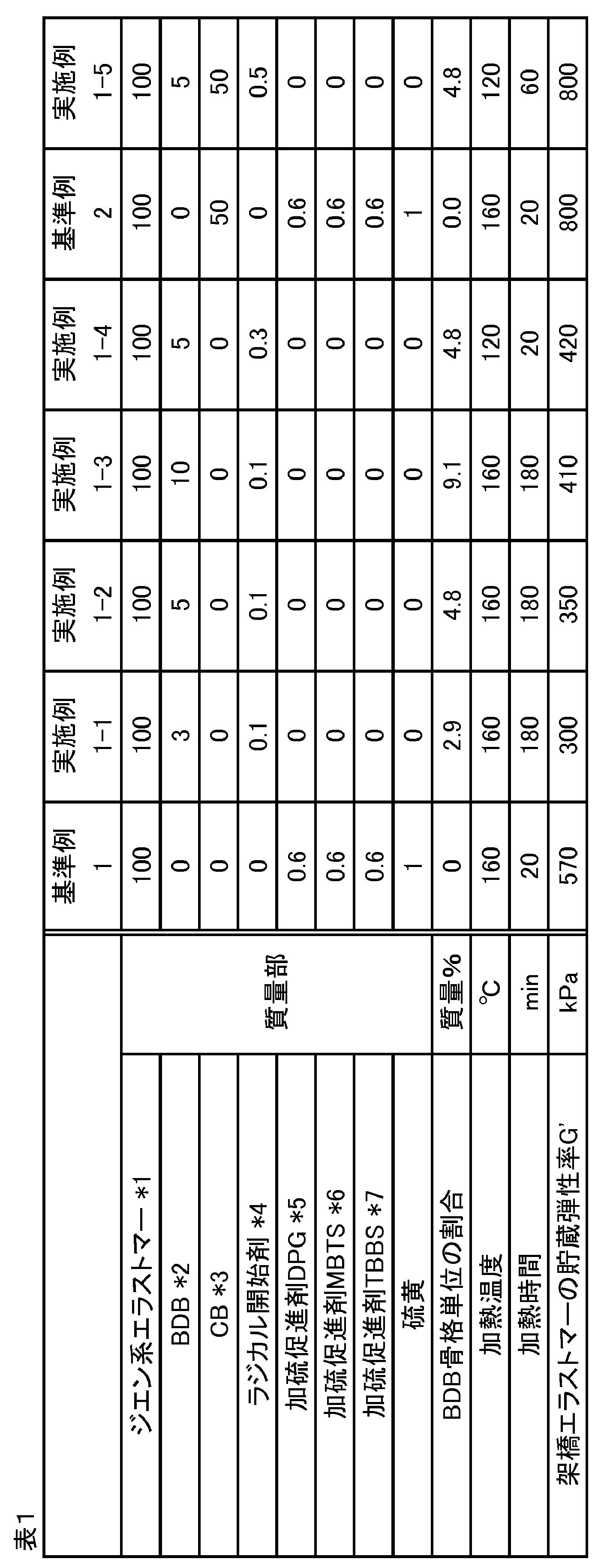
*2 BDB:下式(5)で表されるジボロン酸エステル化合物(合成品)

*4 ラジカル開始剤:アゾビスイソブチロニトリル(AIBN)
*5 加硫促進剤DPG:1,3-ジフェニルグアニジン
*6 加硫促進剤MBTS:ジ-2-ベンゾチアゾリルジスルフィド
*7 加硫促進剤TBBS:N-(tert-ブチル)-2-ベンゾチアゾールスルフェンアミド

ここでは、カーボンブラックが混合されていないものとして実施例1-4で得られた架橋エラストマーを選択し、カーボンブラックが混合されたものとして実施例1-5で得られた架橋エラストマーを選択した。
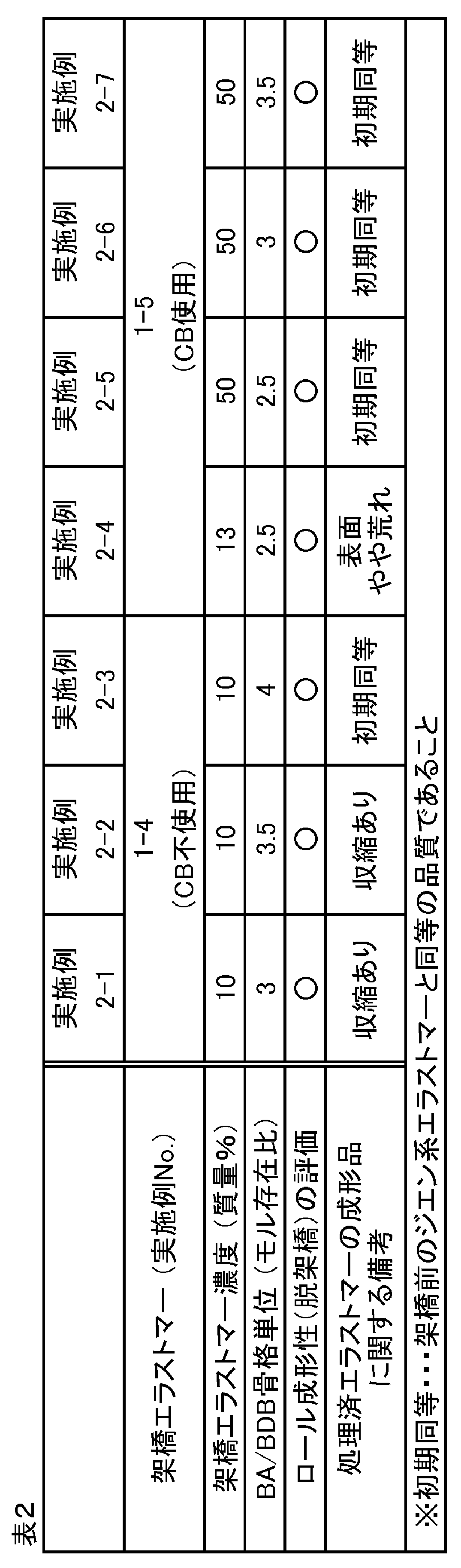
この架橋エラストマーを細かく粉砕したのち、有機溶媒としてのテトラヒドロフラン(THF、SP値:8.95(cal/cm3)1/2)に投入し、更にモノボロン酸化合物(BA)としてのフェニルボロン酸(PhB(OH)2)も投入して十分に混合し、室温(約25℃)で1日静置させた。その際、架橋エラストマーの濃度(架橋エラストマー及び有機溶媒の合計に占める架橋エラストマーの質量割合)、並びに、架橋エラストマー中のジボロン酸エステル骨格単位に対するモノボロン酸化合物のモル存在比(BA/BDB骨格単位)は、表2に示す通りとなるようにした。静置後、キャストして溶媒を蒸発させて、処理済エラストマーを得た。
得られた処理済エラストマーを用い、ロール成形の操作を行った。ロール成形が行えた場合には、脱架橋された(架橋部位が未架橋状態に戻った)ことにより柔らかさが付与されたものと評価した。結果を表2に示す。


ここでは、カーボンブラックが混合されていないものとして実施例2-2又は実施例2-3で得られた脱架橋エラストマー(処理済エラストマー)を選択し、カーボンブラックが混合されたものとして実施例2-5で得られた脱架橋エラストマー(処理済エラストマー)を選択した。
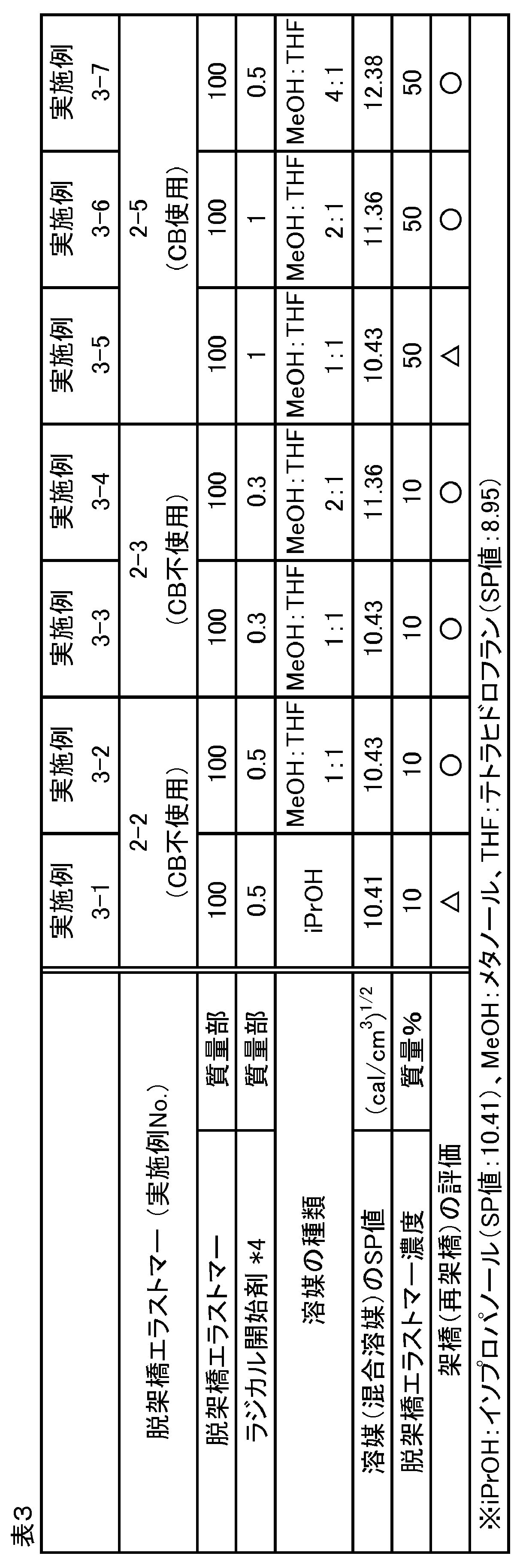
この脱架橋エラストマーを、脱架橋処理時に生成したジボロン酸化合物とともに、表3に示す溶媒に投入し、更に表3に示す配合処方でラジカル開始剤を投入して、室温(約25℃)で一晩静置させた。その際、脱架橋エラストマーの濃度(脱架橋エラストマー及び溶媒の合計に占める脱架橋エラストマーの質量割合)を、表3に示す通りとなるようにした。静置後、キャストして溶媒を蒸発させて、処理済エラストマーを得た。
得られた処理済エラストマーを、ゴム加工性解析装置(アルファテクノロジーズ社製)により、120℃で10~30分間(貯蔵弾性率G’の値が安定するまで)加熱し、貯蔵弾性率G’を測定した。いずれの例においても、測定した貯蔵弾性率G’が、上記のモノボロン酸化合物を投入する前の架橋エラストマーの貯蔵弾性率G’と比較して、20%以上であったので、架橋が形成されたものと判断できた。より具体的に、測定した貯蔵弾性率G’が、上記のフェニルボロン酸を投入する前の架橋エラストマーの貯蔵弾性率G’と比較して、50%以上であれば、より十分な量の架橋が形成されたとして○と評価し、一方、50%未満であれば、△と評価した。結果を表3に示す。

Claims (3)
- エラストマーの架橋方法であって、
前記エラストマーは、下記一般式(4):

前記エラストマーを、溶媒の存在下で、ジボロン酸化合物と接触させる工程を含み、
前記溶媒は、SP値が10(cal/cm3)1/2以上13(cal/cm3)1/2以下であり、且つ、SP値が8(cal/cm3)1/2以上10(cal/cm3)1/2以下である単一溶媒を少なくとも含む、ことを特徴とする、エラストマーの架橋方法。 - 前記接触させる工程における前記ジボロン酸化合物の量が、前記エラストマー100質量部に対して20質量部以下である、請求項1に記載の架橋方法。
- 前記エラストマーは、ビニル結合量が30質量%以下であり、重量平均分子量が1000以上であるジエン系エラストマーに由来する、請求項1又は2に記載の架橋方法。
Priority Applications (3)
| Application Number | Priority Date | Filing Date | Title |
|---|---|---|---|
| US18/576,670 US20240327548A1 (en) | 2021-08-05 | 2022-06-30 | Method of crosslinking elastomer |
| EP22852761.0A EP4382556B1 (en) | 2021-08-05 | 2022-06-30 | Method of crosslinking elastomer |
| CN202280050117.3A CN117715958A (zh) | 2021-08-05 | 2022-06-30 | 弹性体的交联方法 |
Applications Claiming Priority (2)
| Application Number | Priority Date | Filing Date | Title |
|---|---|---|---|
| JP2021-129378 | 2021-08-05 | ||
| JP2021129378A JP7762007B2 (ja) | 2021-08-05 | 2021-08-05 | エラストマーの架橋方法 |
Publications (1)
| Publication Number | Publication Date |
|---|---|
| WO2023013335A1 true WO2023013335A1 (ja) | 2023-02-09 |
Family
ID=85155792
Family Applications (1)
| Application Number | Title | Priority Date | Filing Date |
|---|---|---|---|
| PCT/JP2022/026429 Ceased WO2023013335A1 (ja) | 2021-08-05 | 2022-06-30 | エラストマーの架橋方法 |
Country Status (5)
| Country | Link |
|---|---|
| US (1) | US20240327548A1 (ja) |
| EP (1) | EP4382556B1 (ja) |
| JP (1) | JP7762007B2 (ja) |
| CN (1) | CN117715958A (ja) |
| WO (1) | WO2023013335A1 (ja) |
Families Citing this family (2)
| Publication number | Priority date | Publication date | Assignee | Title |
|---|---|---|---|---|
| JP2026005133A (ja) * | 2024-06-26 | 2026-01-15 | 住友ゴム工業株式会社 | タイヤ |
| JP2026005134A (ja) * | 2024-06-26 | 2026-01-15 | 住友ゴム工業株式会社 | タイヤ |
Citations (4)
| Publication number | Priority date | Publication date | Assignee | Title |
|---|---|---|---|---|
| JPS5529520A (en) * | 1978-08-22 | 1980-03-01 | Yokohama Rubber Co Ltd:The | Rubber composition |
| JP2018525498A (ja) * | 2015-08-20 | 2018-09-06 | エコール・シュペリュール・ドゥ・フィシック・エ・シミー・アンデュストリエル・ドゥ・ラ・ヴィル・ドゥ・パリ | 交換反応を可能にするボロン酸エステル官能基を含む架橋ポリマーを含むポリマー組成物、その調製方法及びその使用 |
| JP2020528956A (ja) * | 2017-07-31 | 2020-10-01 | ダウ シリコーンズ コーポレーション | シリコーンエラストマーベースのための取り扱い添加剤 |
| CN112812331A (zh) * | 2021-01-12 | 2021-05-18 | 华南理工大学 | 多相交联橡胶、制备方法和回收方法 |
Family Cites Families (1)
| Publication number | Priority date | Publication date | Assignee | Title |
|---|---|---|---|---|
| CN108341958A (zh) * | 2017-01-25 | 2018-07-31 | 翁秋梅 | 一种基于杂化动态聚合物的吸能方法 |
-
2021
- 2021-08-05 JP JP2021129378A patent/JP7762007B2/ja active Active
-
2022
- 2022-06-30 EP EP22852761.0A patent/EP4382556B1/en active Active
- 2022-06-30 CN CN202280050117.3A patent/CN117715958A/zh active Pending
- 2022-06-30 WO PCT/JP2022/026429 patent/WO2023013335A1/ja not_active Ceased
- 2022-06-30 US US18/576,670 patent/US20240327548A1/en active Pending
Patent Citations (4)
| Publication number | Priority date | Publication date | Assignee | Title |
|---|---|---|---|---|
| JPS5529520A (en) * | 1978-08-22 | 1980-03-01 | Yokohama Rubber Co Ltd:The | Rubber composition |
| JP2018525498A (ja) * | 2015-08-20 | 2018-09-06 | エコール・シュペリュール・ドゥ・フィシック・エ・シミー・アンデュストリエル・ドゥ・ラ・ヴィル・ドゥ・パリ | 交換反応を可能にするボロン酸エステル官能基を含む架橋ポリマーを含むポリマー組成物、その調製方法及びその使用 |
| JP2020528956A (ja) * | 2017-07-31 | 2020-10-01 | ダウ シリコーンズ コーポレーション | シリコーンエラストマーベースのための取り扱い添加剤 |
| CN112812331A (zh) * | 2021-01-12 | 2021-05-18 | 华南理工大学 | 多相交联橡胶、制备方法和回收方法 |
Non-Patent Citations (1)
| Title |
|---|
| See also references of EP4382556A4 * |
Also Published As
| Publication number | Publication date |
|---|---|
| EP4382556A1 (en) | 2024-06-12 |
| EP4382556A4 (en) | 2025-07-16 |
| CN117715958A (zh) | 2024-03-15 |
| US20240327548A1 (en) | 2024-10-03 |
| JP2023023662A (ja) | 2023-02-16 |
| EP4382556B1 (en) | 2025-12-24 |
| JP7762007B2 (ja) | 2025-10-29 |
Similar Documents
| Publication | Publication Date | Title |
|---|---|---|
| WO2023013333A1 (ja) | 架橋エラストマー及びその製造方法 | |
| EP2963084B1 (en) | Vegetable oil derivatives as extender oils for elastomer compositions | |
| WO2023013335A1 (ja) | エラストマーの架橋方法 | |
| WO2023013334A1 (ja) | 架橋エラストマーの架橋部位を未架橋状態に戻す方法 | |
| JP3175016B2 (ja) | 高硬度ゴム組成物 | |
| JPH08231766A (ja) | ゴム組成物及びその製法 | |
| JP2005248056A (ja) | ゴム組成物およびそれを用いたタイヤ | |
| Mondal et al. | Back to the origin: A spick‐and‐span sustainable approach for the devulcanization of ground tire rubber | |
| JP2018123272A (ja) | タイヤ用ゴム組成物 | |
| KR101884425B1 (ko) | 분산제 및 이를 포함하는 고무 조성물 | |
| JP3341787B2 (ja) | ゴム組成物およびその製造方法 | |
| CN113388119B (zh) | 一种多羟基硅烷改性丁二烯橡胶的制备方法和抗臭氧老化橡胶 | |
| JPS6195048A (ja) | 防振材 | |
| JPH0726066A (ja) | タイヤトレッド用ゴム組成物 | |
| CN109021266B (zh) | 一种滤清器胶片的制备方法 | |
| CN107841006B (zh) | 一种易加工的防老化型丁腈橡胶及其制备方法 | |
| CN107841004B (zh) | 易加工防老化型丁腈橡胶的制备方法 | |
| KR0151128B1 (ko) | 향상된 경화특성을 갖는 비닐 고함량 폴리부타디엔 고무 | |
| JPS62253642A (ja) | 低温特性が改良された高性能タイヤ | |
| CN115594896A (zh) | 一种橡胶组合物及橡胶制品和用途 | |
| JPH08188675A (ja) | ゴム組成物及びその製法 | |
| JPS59199738A (ja) | タイヤトレツド用ゴム組成物 | |
| JPS5844701B2 (ja) | ポリペンテナマ−ソセイブツ | |
| JPS608017B2 (ja) | ポリイソプレンゴム組成物 | |
| JP2006206636A (ja) | 重荷重タイヤ用サイドトレッド組成物 |
Legal Events
| Date | Code | Title | Description |
|---|---|---|---|
| 121 | Ep: the epo has been informed by wipo that ep was designated in this application |
Ref document number: 22852761 Country of ref document: EP Kind code of ref document: A1 |
|
| WWE | Wipo information: entry into national phase |
Ref document number: 18576670 Country of ref document: US |
|
| WWE | Wipo information: entry into national phase |
Ref document number: 202280050117.3 Country of ref document: CN |
|
| NENP | Non-entry into the national phase |
Ref country code: DE |
|
| ENP | Entry into the national phase |
Ref document number: 2022852761 Country of ref document: EP Effective date: 20240305 |
|
| WWG | Wipo information: grant in national office |
Ref document number: 2022852761 Country of ref document: EP |