WO2023013364A1 - 乳酸菌による異味異臭が抑制された容器詰飲料、及びその製造方法 - Google Patents
乳酸菌による異味異臭が抑制された容器詰飲料、及びその製造方法 Download PDFInfo
- Publication number
- WO2023013364A1 WO2023013364A1 PCT/JP2022/027217 JP2022027217W WO2023013364A1 WO 2023013364 A1 WO2023013364 A1 WO 2023013364A1 JP 2022027217 W JP2022027217 W JP 2022027217W WO 2023013364 A1 WO2023013364 A1 WO 2023013364A1
- Authority
- WO
- WIPO (PCT)
- Prior art keywords
- lactic acid
- ppb
- acid bacteria
- beverage
- limonene
- Prior art date
- Legal status (The legal status is an assumption and is not a legal conclusion. Google has not performed a legal analysis and makes no representation as to the accuracy of the status listed.)
- Ceased
Links
Images

Classifications
-
- A—HUMAN NECESSITIES
- A23—FOODS OR FOODSTUFFS; TREATMENT THEREOF, NOT COVERED BY OTHER CLASSES
- A23L—FOODS, FOODSTUFFS OR NON-ALCOHOLIC BEVERAGES, NOT OTHERWISE PROVIDED FOR; PREPARATION OR TREATMENT THEREOF
- A23L2/00—Non-alcoholic beverages; Dry compositions or concentrates therefor; Preparation or treatment thereof
- A23L2/38—Other non-alcoholic beverages
-
- A—HUMAN NECESSITIES
- A23—FOODS OR FOODSTUFFS; TREATMENT THEREOF, NOT COVERED BY OTHER CLASSES
- A23L—FOODS, FOODSTUFFS OR NON-ALCOHOLIC BEVERAGES, NOT OTHERWISE PROVIDED FOR; PREPARATION OR TREATMENT THEREOF
- A23L2/00—Non-alcoholic beverages; Dry compositions or concentrates therefor; Preparation or treatment thereof
- A23L2/52—Adding ingredients
- A23L2/56—Flavouring or bittering agents
-
- A—HUMAN NECESSITIES
- A23—FOODS OR FOODSTUFFS; TREATMENT THEREOF, NOT COVERED BY OTHER CLASSES
- A23L—FOODS, FOODSTUFFS OR NON-ALCOHOLIC BEVERAGES, NOT OTHERWISE PROVIDED FOR; PREPARATION OR TREATMENT THEREOF
- A23L2/00—Non-alcoholic beverages; Dry compositions or concentrates therefor; Preparation or treatment thereof
- A23L2/52—Adding ingredients
- A23L2/60—Sweeteners
-
- A—HUMAN NECESSITIES
- A23—FOODS OR FOODSTUFFS; TREATMENT THEREOF, NOT COVERED BY OTHER CLASSES
- A23L—FOODS, FOODSTUFFS OR NON-ALCOHOLIC BEVERAGES, NOT OTHERWISE PROVIDED FOR; PREPARATION OR TREATMENT THEREOF
- A23L27/00—Spices; Flavouring agents or condiments; Artificial sweetening agents; Table salts; Dietetic salt substitutes; Preparation or treatment thereof
- A23L27/84—Flavour masking or reducing agents
-
- A—HUMAN NECESSITIES
- A23—FOODS OR FOODSTUFFS; TREATMENT THEREOF, NOT COVERED BY OTHER CLASSES
- A23L—FOODS, FOODSTUFFS OR NON-ALCOHOLIC BEVERAGES, NOT OTHERWISE PROVIDED FOR; PREPARATION OR TREATMENT THEREOF
- A23L33/00—Modifying nutritive qualities of foods; Dietetic products; Preparation or treatment thereof
- A23L33/10—Modifying nutritive qualities of foods; Dietetic products; Preparation or treatment thereof using additives
- A23L33/135—Bacteria or derivatives thereof, e.g. probiotics
-
- C—CHEMISTRY; METALLURGY
- C12—BIOCHEMISTRY; BEER; SPIRITS; WINE; VINEGAR; MICROBIOLOGY; ENZYMOLOGY; MUTATION OR GENETIC ENGINEERING
- C12N—MICROORGANISMS OR ENZYMES; COMPOSITIONS THEREOF; PROPAGATING, PRESERVING, OR MAINTAINING MICROORGANISMS; MUTATION OR GENETIC ENGINEERING; CULTURE MEDIA
- C12N1/00—Microorganisms; Compositions thereof; Processes of propagating, maintaining or preserving microorganisms or compositions thereof; Processes of preparing or isolating a composition containing a microorganism; Culture media therefor
- C12N1/20—Bacteria; Culture media therefor
-
- C—CHEMISTRY; METALLURGY
- C12—BIOCHEMISTRY; BEER; SPIRITS; WINE; VINEGAR; MICROBIOLOGY; ENZYMOLOGY; MUTATION OR GENETIC ENGINEERING
- C12R—INDEXING SCHEME ASSOCIATED WITH SUBCLASSES C12C - C12Q, RELATING TO MICROORGANISMS
- C12R2001/00—Microorganisms ; Processes using microorganisms
- C12R2001/01—Bacteria or Actinomycetales ; using bacteria or Actinomycetales
- C12R2001/46—Streptococcus ; Enterococcus; Lactococcus
Definitions
- the present invention relates to a packaged beverage in which off-flavours caused by lactic acid bacteria are suppressed, and a method for producing the same.
- Patent Document 1 JP 2013-94154 A
- the ratio of the number of lactic acid bacteria to the content of non-fat milk solids is set to a constant ratio.
- a certain amount of galactomannans a lactic acid bacterium drink having a refreshing feeling as a thirst-quenching drink, an improved flavor of the lactic acid bacterium drink, and suppressed offensive taste and offensive odor derived from lactic acid bacteria is produced.
- a certain amount of galactomannans a lactic acid bacterium drink having a refreshing feeling as a thirst-quenching drink, an improved flavor of the lactic acid bacterium drink, and suppressed offensive taste and offensive odor derived from lactic acid bacteria is produced.
- the inclusion of galactomannans tends to impair the refreshing feeling, there has been a demand for other solutions capable of solving the above-mentioned problems.
- limonene, citral, ⁇ -terpinene, octanal, linalool, geraniol, and nerol are known as aroma components of citrus fruits such as lemon.
- one or two or more flavor components selected from the group consisting of limonene, citral and octanal are contained at a specific concentration, thereby maintaining the flavor balance of the packaged beverage. It was not known until now that the offensive taste and offensive odor peculiar to lactic acid bacteria can be suppressed.
- An object of the present invention is to provide a packaged beverage in which the offensive taste and offensive odor peculiar to lactic acid bacteria are suppressed, a method for producing the same, and the like.
- An object of the present invention is to provide a packed beverage, a method for producing the same, and the like.
- the present inventors have made intensive studies to solve the problems of the present invention, and as a result, have found the following items (A) to (C) and completed the present invention.
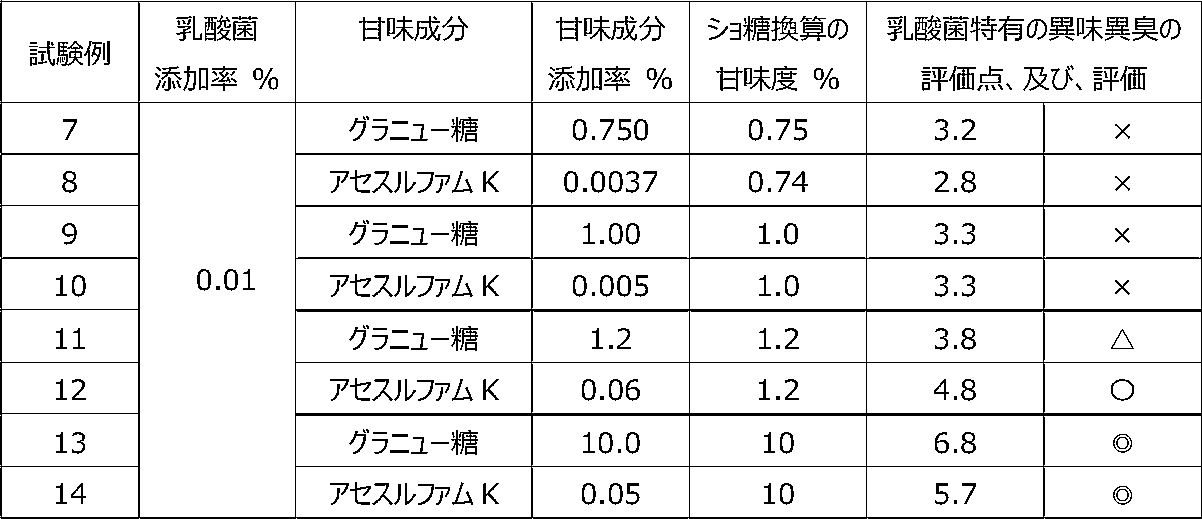
- B In a packaged beverage containing lactic acid bacteria, when the sweetening component has a sweetness of 1.2% by weight or more in terms of sucrose, the sweetness of the sweetening component suppresses the offensive taste and odor (medium odor and roughness) peculiar to lactic acid bacteria.
- the sweetening component has a sweetness of 1.0% by weight or less in terms of sucrose, an off-flavour peculiar to lactic acid bacteria (medium odor and roughness) can be felt.
- one or more aroma components selected from the group consisting of limonene, citral and octanal (hereinafter also referred to as "aroma components in the present invention") are added at a specific concentration. By containing it, it is possible to suppress the offensive taste and offensive odor (medium odor and roughness) peculiar to lactic acid bacteria. what you can do.
- the present invention (1) A packaged beverage containing 0.003% by weight or more of lactic acid bacteria relative to the total amount of the beverage, characterized by containing one or more selected from the group consisting of limonene, citral and octanal.
- the packaged beverage (2) characterized by containing one or more selected from the group consisting of (a) 500 to 15,000 ppb limonene, (b) 300 to 7,000 ppb citral, and (c) 30 to 100 ppb octanal
- the packaged beverage according to (1) or (2) above characterized by containing (4) 500-5000 ppb limonene and 3000-5000 ppb citral; or 500-5000 ppb limonene and 30-100 ppb octanal;
- a method for producing the packaged beverage characterized by; (9) In the production of a packaged beverage containing 0.003% by weight or more of lactic acid bacteria relative to the total amount of the beverage, including a step of containing one or more selected from the group consisting of limonene, citral and octanal. A method for suppressing offensive taste and odor caused by lactic acid bacteria in the container-packed beverage; etc.
- a packaged beverage in which offensive taste and offensive odor peculiar to lactic acid bacteria are suppressed and a method for producing the same, etc., preferably a packaged beverage in which offensive taste and offensive odor peculiar to lactic acid bacteria are suppressed while maintaining flavor balance. , and its manufacturing method, etc. can be provided.
- FIG. 1 is a diagram showing the relationship between the Lactococcus lactis subspecies lactis JCM5805 strain and its equivalent strains (strains derived from and derived from the strain).
- the present invention [1] A packaged beverage containing 0.003% by weight or more of lactic acid bacteria relative to the total amount of the beverage, characterized by containing one or more selected from the group consisting of limonene, citral and octanal.
- the packaged beverage [2] In the production of a packaged beverage containing 0.003% by weight or more of lactic acid bacteria relative to the total amount of the beverage, including a step of containing one or more selected from the group consisting of limonene, citral and octanal.
- a method for producing the packaged beverage characterized by; [3] In the production of a packaged beverage containing 0.003% by weight or more of lactic acid bacteria relative to the total amount of the beverage, including a step of containing one or more selected from the group consisting of limonene, citral and octanal. A method for suppressing offensive taste and odor caused by lactic acid bacteria in the container-packed beverage; and other embodiments.
- the packaged beverage in the present invention is a packaged beverage containing 0.003% by weight or more of lactic acid bacteria relative to the total amount of the beverage, and is one or more selected from the group consisting of limonene, citral and octanal (
- the packaged beverage is characterized by containing the flavor component in the present invention).
- the "beverage" in the present invention contains 0.003% by weight or more of lactic acid bacteria relative to the total amount of the beverage, and contains one or more selected from the group consisting of limonene, citral and octanal.
- functional drinks, non-dairy drinks, sports drinks, near waters, carbonated drinks and the like are preferred.
- a sports drink is a drink that contains a large amount of minerals and is mainly consumed in order to quickly replenish water and minerals that are lost as sweat during exercise or the like. Near water also includes beverages that look like water at first glance, turbidity-enhanced beverages with emulsifiers, and beverages to which sweeteners and flavors are added. Moreover, the beverage in the present invention is preferably a non-alcoholic beverage.
- the aroma component in the present invention includes one or more selected from the group consisting of limonene, citral and octanal, among which (a) 500 to 15000 ppb limonene, (b) 300 to 7000 ppb citral, and (c) one or more selected from the group consisting of 30 to 100 ppb octanal.
- the concentration of limonene in the beverage when limonene is used is 500 to 15000 ppb or 700 to 15000 ppb or 700 to 15000 ppb or 1000 to 15000 ppb, preferably 5000 to 15000 ppb, more preferably 10000 to 15000 ppb.
- citral and/or octanal are used in addition to limonene, in addition to limonene at each limonene concentration described above, citral and/or octanal are preferably used at a concentration within a range that does not significantly impair the flavor balance of the packaged beverage. be able to.
- each of the concentrations of limonene described above is particularly suitable as the concentration of limonene in a beverage when limonene is used alone.
- the concentration of citral in the beverage when citral is used is 300 to 7000 ppb or 500 to 7000 ppb, from the viewpoint of harmony between the degree of suppression of the offensive taste and odor peculiar to lactic acid bacteria and the flavor balance of the packaged beverage. It is preferably 1000 to 7000 ppb or 3000 to 7000 ppb, more preferably 5000 to 7000 ppb.
- limonene and/or octanal are used in addition to citral, in addition to citral at each citral concentration described above, limonene and/or octanal are preferably used at a concentration within a range that does not significantly impair the flavor balance of the packaged beverage. be able to.
- each of the citral concentrations described above is particularly suitable as the concentration of citral in a beverage when citral is used alone.
- the concentration of octanal in the beverage when octanal is used is 30 to 100 ppb, preferably 50 to 100 ppb, from the viewpoint of harmony between the degree of suppression of the offensive taste and odor peculiar to lactic acid bacteria and the flavor balance of the packaged beverage. 100 ppb is preferred.
- limonene and/or citral are used in addition to octanal, in addition to octanal at each octanal concentration described above, limonene and/or citral are preferably used at a concentration within a range that does not significantly impair the flavor balance of the packaged beverage. be able to.
- each octanal concentration described above is particularly suitable as the concentration of octanal in a beverage when octanal is used alone.
- the concentration when using two or more selected from the group consisting of limonene, citral and octanal as the aroma component in the present invention is, for example, 500-15000 ppb limonene and >0 ppb-7000 ppb citral; >0 to 15000 ppb limonene and 300 to 7000 ppb citral; 500-15000 ppb limonene and >0 ppb-100 ppb octanal; >0 to 15000 ppb limonene and 30 to 100 ppb octanal; 300 to 7000 ppb citral and >0 to 100 ppb octanal; or citral from greater than 0 ppb to 7000 ppb and octanal from 30 to 100 ppb;
- the concentration of limonene and citral in the beverage is 500 to 15000 ppb limonene and more than 0 ppb to 7000 ppb. or more than 0 ppb to 15,000 ppb of limonene, and 300 to 7,000 ppb of citral; 500 to 10,000 ppb of limonene and 300 to 5,000 ppb of citral are preferred, and 500 to 5,000 ppb of limonene and 3,000 to 5,000 ppb of citral are particularly preferred because a synergistic effect is obtained.
- octanal in addition to limonene and citral, in addition to limonene at each limonene concentration described above and citral at each citral concentration described above, preferably at a concentration within a range that does not significantly impair the flavor balance of the packaged beverage.
- Octanal can also be used.
- the concentration of limonene and octanal in the beverage is 500 to 15,000 ppb of limonene and more than 0 ppb to 100 ppb.
- Octanal or more than 0 ppb to 15000 ppb of limonene, and 30 to 100 ppb of octanal; 500 to 10,000 ppb of limonene and 30 to 100 ppb of octanal are included, and 500 to 5,000 ppb of limonene and 30 to 100 ppb of octanal are particularly preferred because a synergistic effect is obtained.
- citral in addition to limonene and octanal, when citral is used, in addition to limonene at each limonene concentration described above and octanal at each octanal concentration described above, preferably at a concentration within a range that does not significantly impair the flavor balance of the packaged beverage. Citral can also be used.
- the concentration of citral and octanal in the beverage is 300 to 7000 ppb citral and more than 0 ppb to 100 ppb. of octanal; or greater than 0 ppb to 7000 ppb of citral and 30 to 100 ppb of octanal.
- limonene when used, in addition to citral at each citral concentration described above and octanal at each octanal concentration described above, preferably at a concentration within a range that does not significantly impair the flavor balance of the packaged beverage. Limonene can also be used.
- the concentration of the aromatic component of the present invention in the packaged beverage of the present invention can be adjusted by adjusting the amount of the aromatic component of the present invention contained in (or added to) the packaged beverage.
- the concentration of limonene, citral and octanal in the packaged beverage of the present invention can be measured by gas chromatography-mass spectrometry (GC-MS method).
- the packaged beverage in the present invention contains lactic acid bacteria.
- the lactic acid bacteria used for producing the packaged beverage in the present invention are not particularly limited as long as they are lactic acid bacteria, and may be viable lactic acid bacteria or dead lactic acid bacteria. It is preferably a fungal body.
- Such killed lactic acid bacteria may be dried or non-dried, but from the viewpoint of storage stability, preferably dried lactic acid bacteria, more preferably dry powder of lactic acid bacteria. is mentioned.
- the method of dry powderization is not particularly specified, it can be dry powdered by performing a treatment such as freeze drying, hot air drying or spray drying, and powdering by spray drying is preferable. Even when live lactic acid bacteria are used to produce the packaged beverage of the present invention, most of the lactic acid bacteria basically become dead cells due to the heat sterilization process.
- “Lactic acid bacteria” is a general term for all taxonomically recognized lactic acid bacteria, and is not limited by genus, species, strain, etc. Examples of such "lactic acid bacteria” include bacteria that produce a large amount of lactic acid (preferably 50% or more of the sugar consumed) by lactic acid fermentation of sugar. ) bacteria, Lactococcus bacteria, Leuconostoc bacteria, Pediococcus bacteria, and Enterococcus bacteria.
- lactic acid bacteria used in the present invention are not particularly limited, they are selected from the group consisting of Lactobacillus bacteria, Streptococcus bacteria, Lactococcus bacteria, Leuconostoc bacteria, Pediococcus bacteria, and Enterococcus bacteria.
- One or two or more bacteria are included, preferably one or two or more bacteria selected from the group consisting of bacteria belonging to the genus Lactococcus, and more preferably Lactococcus lactis subspecies lactis. (hereinafter also simply referred to as “Lactococcus lactis”).
- lactic acid bacteria in the present invention include Lactobacillus acidophilus, Lactobacillus delbrueckii subsp. bulgaricus, Lactobacillus delbrueckii subspecies delbrueckii (Lactobacillus delbrueckii subsp. delbrueckii), Lactobacillus delbrueckii subsp.
- lactis Lactobacillus casei, Lactobacillus paracasei, Lactobacillus gasseri Lactobacillus helveticus, Lactobacillus johnsonii, Lactobacillus plantarum, Lactobacillus brevis, Lactobacillus caseisubsp.rhamnosus, Lactobacillus caseisubsp. rhamnosus (Lactobacillus pentosus), Lactobacillus fermentum, Streptococcus salivarius subsp. thermophilus, Lactococcus lactis subsp. lactis ⁇ Biovariant diacetylactis (Lactococcus lactis subsp.
- lactis biovar diacetylactis Lactococcus lactis subsp. cremoris s
- Lactococcus raffinolactis Lactococcus piscium
- Lactococcus plantarum Lactococcus garvieae
- Lactococcus lactis subspecies foldiae Lactococcus lactis subspecies foldiae (Lactococcus lactis subsp. hordniae), Leuconostoc mesenteroides subsp.
- the above bacteria include, preferably, Lactobacillus acidophilus, Lactobacillus delbrueckii subspecies bulgaricus, Lactobacillus delbrueckii subspecies lactis, Lactobacillus delbrueckii subspecies delbrueckii, Lactobacillus casei, Lactobacillus paracasei, Lactobacillus gasseri, Lactobacillus helveticus, Lactobacillus johnsoni, Lactobacillus plantarum, Lactobacillus brevis, Lactobacillus casei subspecies rhamnosus, Lactobacill
- Lactococcus lactis Lactococcus lactis, Lactococcus lactis biovariant diacetylactis, Lactococcus lactis subspecies cremoris, Lactococcus raffinolactis, Lactococcus pythium, Lactococcus plan
- One or more bacteria selected from the group consisting of thallum, Lactococcus garbieae, and Lactococcus lactis subspecies Holdiae more preferably Lactococcus lactis
- one or two or more bacteria selected from the group consisting of Lactococcus lactis JCM5805, Lactococcus lactis JCM20101, Lactococcus lactis NBRC12007, and Lactococcus lactis NRIC1150 are particularly preferred.
- Lactococcus lactis JCM5805 As a preferred embodiment of the Lactococcus lactis JCM5805 strain, preferably killed cells of the JCM5805 strain, more preferably dried cells of the JCM5805 strain, still more preferably dry powder of the killed cells of the JCM5805 strain, and more preferably includes a dry powder obtained by spray-drying dead cells of strain JCM5805.
- the "JCM5805 strain” in the present invention includes strains equivalent to the JCM5805 strain as long as the effects of the present invention can be obtained.
- equivalent strains refer to strains derived from the JCM5805 strain (strain A), strains derived from the JCM5805 strain (strain B), or progeny strains of the aforementioned strain A or strain B. Equivalent strains may be preserved in other strain collection institutions.
- FIG. 1 shows strains derived from the JCM5805 strain and strains derived from the JCM5805 strain. Even strains equivalent to the JCM5805 strain described in FIG. 1 can be used as the "JCM5805 strain" in the present invention as long as the effects of the present invention can be obtained.
- the lactic acid bacteria used in the present invention can be obtained from depository organizations such as the American type culture collection (USA). Moreover, a commercially available starter culture may be used as the lactic acid bacteria used in the present invention.
- the method for preparing lactic acid bacteria used in the present invention is not particularly limited, and examples of methods for preparing viable cells of lactic acid bacteria include a method of collecting cells from a culture medium in which lactic acid bacteria are cultured by filtration, centrifugation, or the like. can be done.
- a method for preparing dead lactic acid bacteria for example, after sterilizing a medium in which lactic acid bacteria are cultured, the cells are collected by filtration, centrifugation, etc., or from a medium in which lactic acid bacteria are cultured, filtration, A method of sterilizing after collecting the cells by centrifugation or the like can be mentioned, and if necessary, drying treatment or crushing treatment can be further performed.
- the means of sterilization is not particularly limited, and not only heating but also conventional means such as ultraviolet rays and ⁇ -ray irradiation can be used.
- the content of lactic acid bacteria in the packaged beverage is not particularly limited as long as the dry weight of lactic acid bacteria is 0.003% by weight or more relative to the total amount of the beverage. From the viewpoint of increasing the significance of the present invention, it is preferably 0.005% by weight or more, 0.0075% by weight or more, 0.01% by weight or more, or more than 0.01% by weight.
- the upper limit of the content of lactic acid bacteria is not particularly limited, but examples thereof include 0.2% by weight, 0.1% by weight, 0.07% by weight, and 0.05% by weight. In addition, these upper limit values and lower limit values can be combined arbitrarily.
- the content rate is the total of all lactic acid bacteria.
- beverage additives that are used in the production of ordinary packaged beverages, such as acidulants, pigments, fruit juices, sweetening ingredients (including high-intensity sweeteners), dairy ingredients, foods Additives (e.g., antioxidants, preservatives, thickeners, emulsifiers, dietary fibers, pH adjusters, etc.) may be added, or may not be added.
- the packaged beverage of the present invention may be made into a carbonated beverage by containing carbon dioxide gas.
- the packaged beverage of the present invention may contain flavoring agents other than one or two or more selected from limonene, citral and octanal. It is preferable not to contain fragrances other than one or two or more selected from octanal.
- the packaged beverage of the present invention may not contain an acidulant, but preferably contains it.
- acidulants include one or more selected from citric acid, phosphoric acid, ascorbic acid, gluconic acid, succinic acid, tartaric acid, lactic acid, fumaric acid, malic acid, phytic acid, and salts thereof.
- salts include, for example, salts with inorganic bases and salts with organic bases. Salts with inorganic bases include, for example, alkali metal salts (eg, sodium salts, potassium salts), ammonium salts and the like.
- salts with organic bases include amine salts (e.g., methylamine salts, diethylamine salts, triethylamine salts, ethylenediamine salts), alkanolamine salts (e.g., monoethanolamine salts, diethanolamine salts, triethanolamine salts), and the like. mentioned.
- alkali metal salts are preferred, and specifically, trisodium citrate, monopotassium citrate, tripotassium citrate, sodium gluconate, potassium gluconate, sodium tartrate, trisodium tartrate, potassium hydrogen tartrate, Examples include sodium lactate, potassium lactate, sodium fumarate and the like.
- the packaged beverage of the present invention may contain dairy ingredients (i.e., ingredients containing milk fat and/or non-fat milk solids). is preferably low or absent.
- dairy ingredients i.e., ingredients containing milk fat and/or non-fat milk solids.
- the milk raw material is low in concentration, for example, the milk fat content is more than 0% by weight and 0.1% by weight or less, more than 0% by weight and 0.05% by weight or less, or 0% by weight with respect to the total amount of the beverage % and not more than 0.02% by weight, and / or the non-fat milk solids content is more than 0% by weight and not more than 0.4% by weight, and more than 0% by weight and 0.2% by weight. or less, or more than 0% by weight and 0.08% by weight or less.
- the packaged beverage of the present invention may contain a sweet component, but from the viewpoint of enjoying more of the significance of the present invention, (x) does not contain sweetening ingredients, or (y) It preferably contains a sweetening component, and the content of the sweetening component is 1% by weight or less in terms of sweetness in terms of sucrose.
- the “sweetening component” in the present invention means a component capable of imparting sweetness to food and drink, and preferably includes, for example, a sweetening component with a relative sweetness of 0.05 or more.
- the "sweetening ingredient” in the present invention includes not only sweetening ingredients normally used as additives for food and drink, but also sweetening ingredients derived from fruit juice (sucrose, glucose, fructose, etc.). Examples of sweetening ingredients that are usually used as additives for food and drink include monosaccharides such as fructose, glucose, tagatose and arabinose, disaccharides such as lactose, trehalose, maltose and sucrose, and crystals such as polysaccharides such as powdered starch syrup.
- oligosaccharides such as malto-oligosaccharides and galacto-oligosaccharides
- non-crystalline saccharides such as starch syrup and isomerized liquid sugar (for example, fructose-glucose liquid sugar).
- Sugar alcohols such as maltitol, lactitol, sorbitol, mannitol, xylitol and erythritol can also be mentioned.
- high-intensity sweetening components such as sucralose, stevia, licorice extract, thaumatin, glycyrrhizin, saccharin, aspartame, and acesulfame K can be used.
- sucrose (% by weight) in the present invention means a numerical value calculated by the following formula.
- Sweetness Sweetness ingredient content (g/100g) x Relative sweetness of the sweetener
- sweetening component content (g/100g) represents the concentration (g/100g) of the sweetening component (g) contained per 100g of the beverage of the present invention, and the above relative sweetness is measured at 20°C. It refers to the relative sweetness intensity of a particular class of sweeteners relative to the sweetness of sucrose at 1. Therefore, the above-mentioned “sweetness” in the present invention represents the concentration (g / 100 g) of the sweetening component in terms of sucrose, and reflects the degree of sweetness as a sensation felt by the person who ingested the beverage of the present invention. is.
- sweetening ingredient content (g / 100 g) x relative sweetness
- each calculated value Let the sum total be the sweetness of the beverage of the present invention.
- the content of sweeteners in the beverage of the present invention can be measured by applying known methods such as HPLC, GC-MS, and LC-MS to the beverage.
- Glucose 0.7
- Fructose 0.6
- Maltose 0.4
- Sorbitol 0.7
- Maltitol 0.8
- Stevia 150
- Glycyrrhizin 170
- Acesulfame K 200
- aspartame 200
- saccharin 300
- sucralose 600
- alitame (2000)
- thaumatin 3000
- the sweetness of the beverage of the present invention containing 0.001 g of glucose (relative sweetness of 0.7) and 0.00001 g of sucralose (relative sweetness of 600) is obtained.
- the sweetness in the present invention is the sum of the numerical value (“0.0007”) calculated by 0.001 ⁇ 0.7 and the numerical value (“0.0006”) calculated by 0.000001 ⁇ 600 and becomes 0.0013% by weight.
- the packaged beverage of the present invention contains one or more selected from the group consisting of limonene, citral and octanal in the production of a packaged beverage containing 0.003% by weight or more of lactic acid bacteria relative to the total amount of the beverage. It can be produced by a method including a step of containing. As the production method of the present invention, except that the content of lactic acid bacteria is 0.003% by weight or more, and one or more selected from the group consisting of limonene, citral and octanal are contained, A general method for producing packaged beverages containing lactic acid bacteria can be used.
- Such general production methods include, for example, a method of producing a packaged beverage through a blending process, a filling process, and a heat sterilization process.
- beverage additives that are used in formulation design of ordinary container-packed beverages may be added, and the timing of addition of these additives is not particularly limited.
- "Revised New Edition Soft Drinks" Korin Co., Ltd.
- the step of adding lactic acid bacteria it is preferable to add lactic acid bacteria so that the beverage contains lactic acid bacteria. It also includes adding lactic acid bacteria to water used for preparation.
- the timing of containing (preferably adding) the lactic acid bacteria may be at any stage of the manufacturing process of the packaged beverage as long as the effects of the present invention can be obtained. is preferably at the stage of Specifically, for example, lactic acid bacteria may be contained in the prepared liquid or water in the preparation step, or may be included in the prepared liquid immediately before or after the filling step into the container.
- the packaged beverage in the present invention is preferably heat sterilized packaged beverage.
- the heat sterilization step may be performed before or after filling the beverage into the container.
- various heat sterilization methods commonly used in the food field can be used.
- hot water spray type, hot water storage type or steam type retort sterilizer, tube type or A method using a plate-type continuous liquid sterilization device can be mentioned.
- Conditions for heat sterilization in the present invention are not particularly limited, and ordinary conditions used for heat sterilization of packaged beverages can be used. Such conditions include, for example, a condition in which the F 0 value is 4 to 40, and the sterilization time is preferably 111 to 150 ° C. and the F 0 value is 4 to 4 because the sterilization time is relatively short. A condition that the time becomes 20 can be mentioned.
- the beverage in the present invention is a packaged beverage.
- a container means a closed container that can cut off contact between the contents and the outside air, such as metal cans, barrel containers, plastic bottles (e.g., PET bottles, cups), paper containers, bottles, pouch containers. etc.
- the packaged beverage of the present invention is a packaged beverage in which the offensive taste and smell peculiar to lactic acid bacteria are suppressed.
- the term “packaged beverage in which offensive taste and offensive odor peculiar to lactic acid bacteria are suppressed” refers to raw materials of the same type except that one or more selected from the group consisting of limonene, citral and octanal are not contained.
- control beverage in the present invention Compared to a packaged beverage (hereinafter also referred to as "control beverage in the present invention") produced by the same production method using means a packaged beverage.
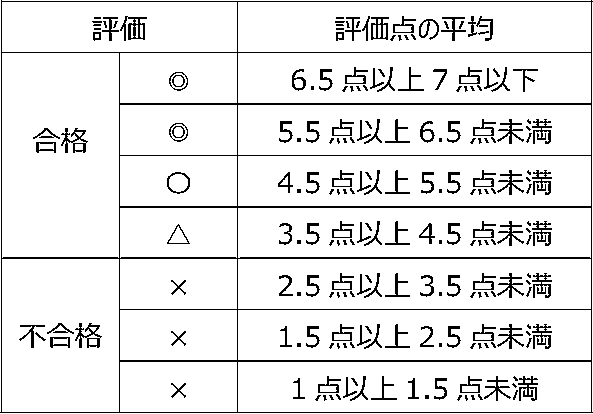
- such a packaged beverage "in which the offensive taste and offensive odor peculiar to lactic acid bacteria are suppressed” has an offensive odor (medium odor and roughness) peculiar to lactic acid bacteria, when evaluated according to the evaluation criteria in Table 1 in the examples described later.
- the average evaluation score (preferably the average score rounded to the second decimal point) is 3.5 to 7 points (that is, ⁇ , ⁇ or ⁇ in the evaluation in Table 2 in the examples described later). is preferably included, and a packaged beverage with a score of 4.5 to 7 ( ⁇ or ⁇ in the evaluation in Table 2) is more preferably included.
- a “flavor-balanced” packaged beverage means that the flavor of one or more selected from the group consisting of limonene, citral, and octanal is not excessively strong, and the discomfort is not excessive. , means that the flavor inconsistencies are acceptable.
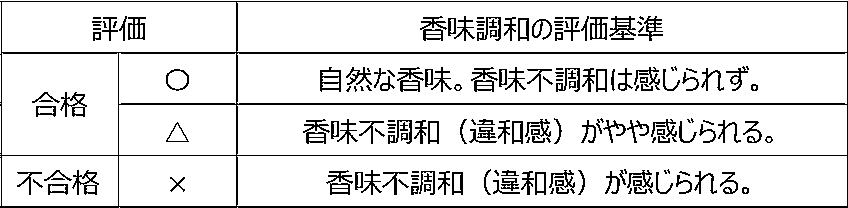
- the flavor harmony of the container-packed beverage is evaluated by the evaluation method in Test 3 in Examples described later (an evaluation method using the evaluation criteria in Table 5).
- a method for suppressing offensive taste and odor caused by lactic acid bacteria in the present invention in the production of a packaged beverage containing 0.003% by weight or more of lactic acid bacteria relative to the total amount of the beverage, selected from the group consisting of limonene, citral and octanal. It is not particularly limited as long as it is a method for suppressing offensive taste and offensive odor caused by lactic acid bacteria in the container-packed beverage, comprising a step of containing one or more of them.
- beverage base As a beverage base, 0.01% by weight of 85% phosphoric acid and trisodium citrate (crystals) were added to water and then mixed to obtain a beverage base.
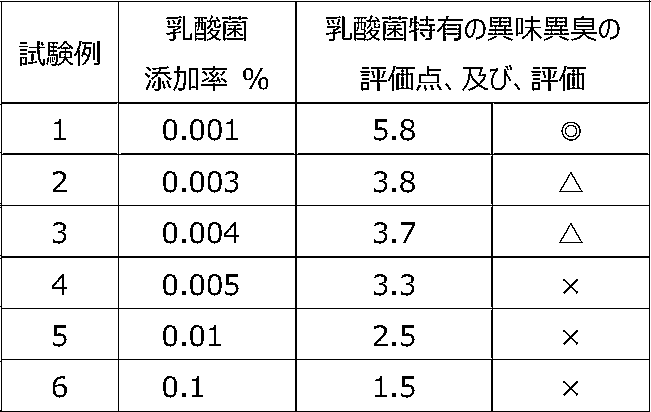
- Table 3 shows the results of this sensory evaluation.
- Test 3 Suppression evaluation 1 of offensive taste and odor peculiar to lactic acid bacteria by containing aroma components The following test was conducted in order to investigate whether the offensive taste and offensive odor peculiar to lactic acid bacteria can be suppressed by adding a specific flavor component to the lactic acid bacteria-containing beverage.
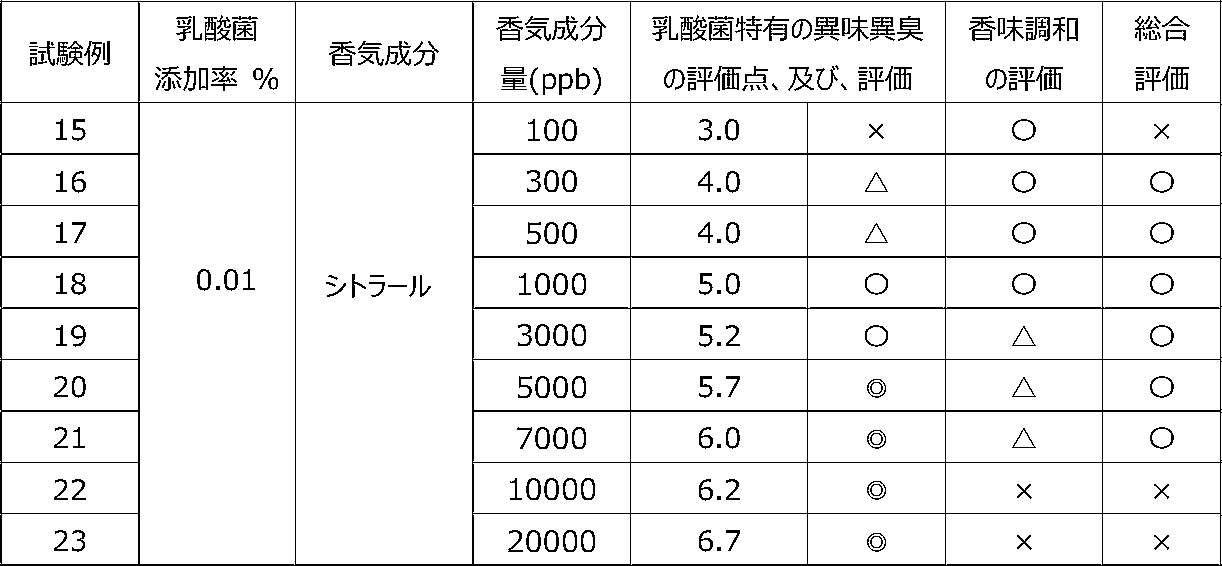
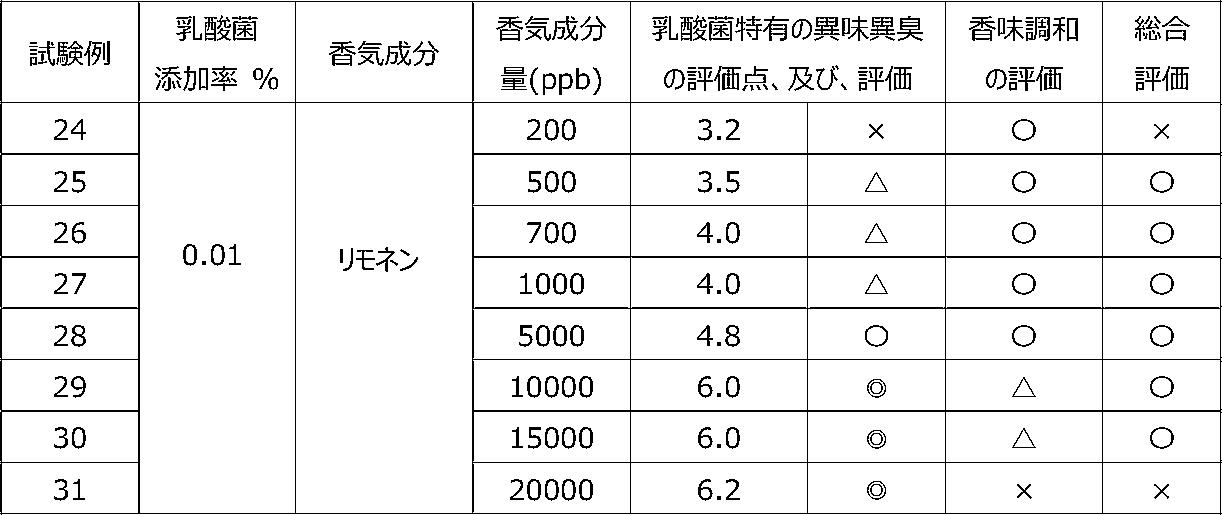
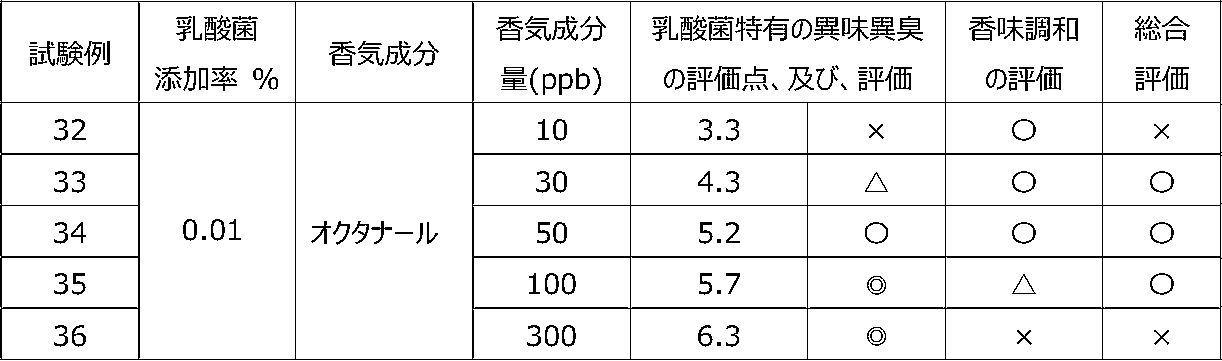
- Tables 7-9 show the sensory evaluation results for each of the sample beverages of Test Examples 15-36.
- the citral content is 300 ppb or more, the offensive taste and odor peculiar to lactic acid bacteria are suppressed, and as the citral concentration increases, the offensive taste and odor peculiar to lactic acid bacteria are suppressed to a greater extent.
- the citral content was 10,000 ppb or more, the citral flavor was too strong, and the flavor harmony was evaluated as x (Table 7).
- the citral content is 300 ppb to 7000 ppb, it was found that the offensive taste and odor peculiar to lactic acid bacteria can be suppressed while maintaining the flavor harmony evaluation ⁇ or ⁇ , and the overall evaluation is ⁇ ( Table 7).
- the citral content is preferably 1000 ppb to 7000 ppb, more preferably 5000 ppb to 7000 ppb.
- Test Examples 37 and 38 in Table 10 are compared with the results of Test Example 6 (lactic acid bacterium addition rate 0.1%, no aroma component added) in Table 3 (evaluation point for lactic acid bacterium-specific offensive taste and odor: 1.5 points: evaluation ⁇ ), in both Test Examples 37 and 38, the evaluation score and evaluation of the offensive odor peculiar to lactic acid bacteria are improved, so the addition rate of lactic acid bacteria to the lactic acid bacteria-containing beverage is 0.1%. Also, it was found that the offensive taste and offensive odor peculiar to lactic acid bacteria can be suppressed by including a specific flavor component in such a lactic acid bacteria-containing beverage.
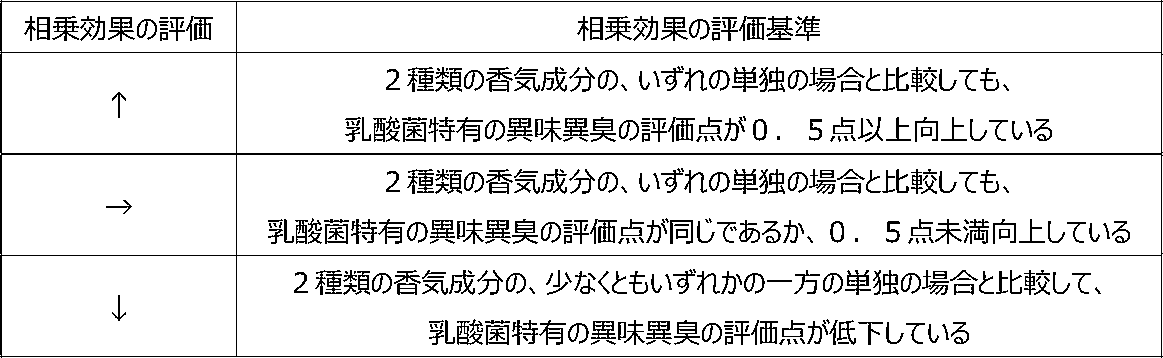
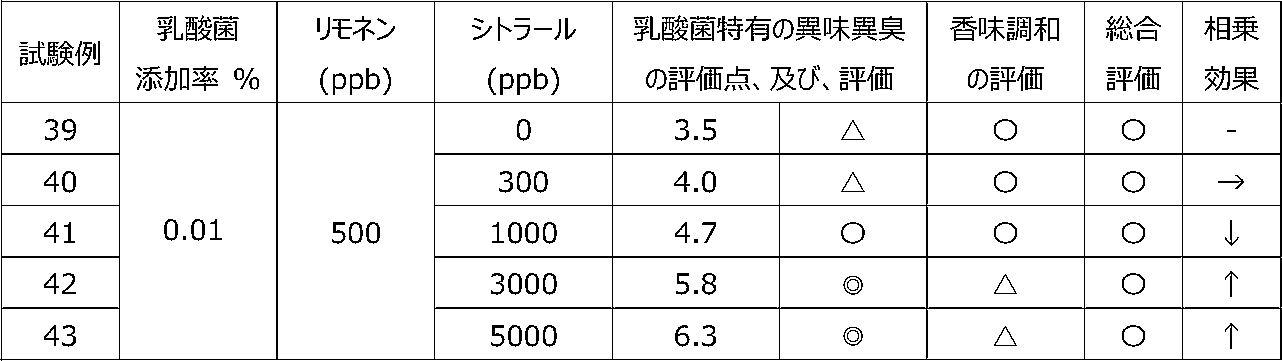
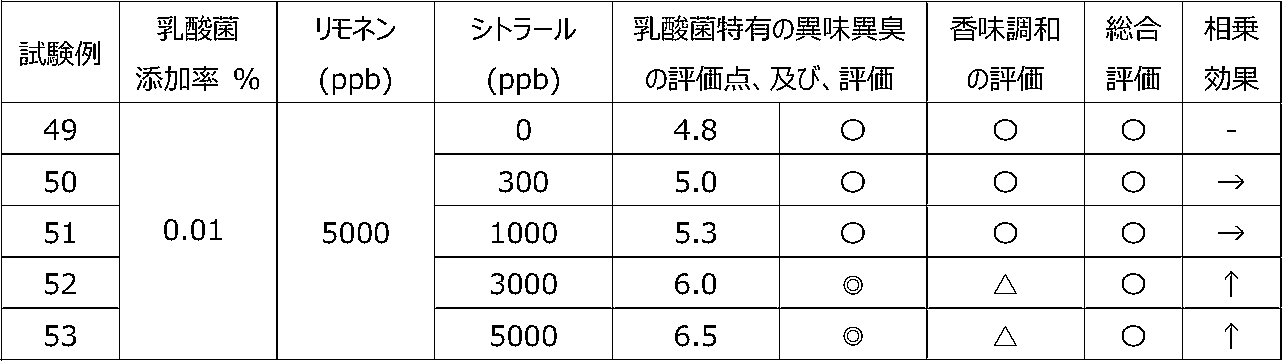
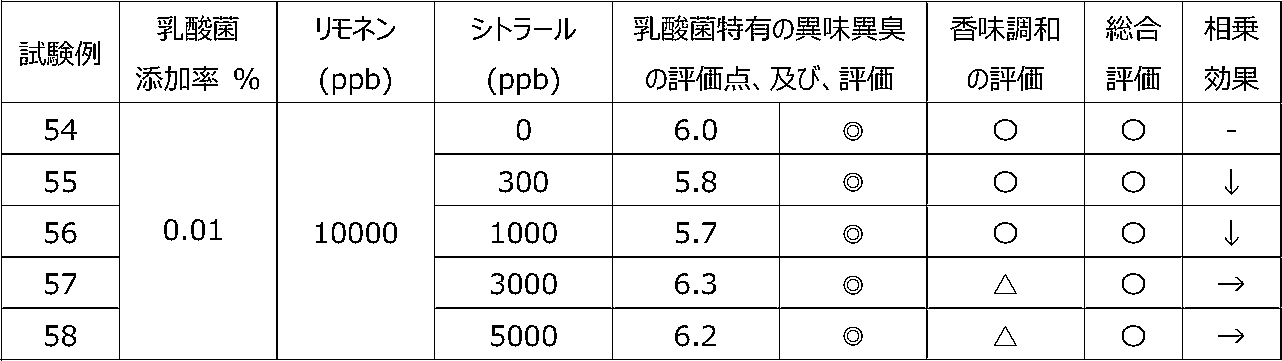
- Tables 12 to 15 show the sensory evaluation results and synergistic effect evaluation results for each of the sample beverages of Test Examples 39 to 58.
- the evaluation results of the synergistic effect were evaluated for the offensive taste and odor peculiar to lactic acid bacteria in the case of limonene alone in each test example (3.5 points at 500 ppb; 4.0 points at 1000 ppb; 4.8 points at 5000 ppb; Or 6.0 points at 10000 ppb), and the evaluation score of the off-flavour characteristic of lactic acid bacteria in the case of citral alone (4.0 points at 300 ppb; 5.0 points at 1000 ppb; 5.2 points at 3000 ppb; or 5000 ppb 5.7 points), and evaluated using the evaluation criteria in Table 11 above.
- the evaluation score of 5.8 points for the offensive odor peculiar to lactic acid bacteria in Test Example 42 is compared with both the evaluation score of 3.5 points for 500 ppb of limonene alone and the evaluation score of 5.2 points for 3000 ppb of citral alone. , was improved by 0.5 points or more, so it was evaluated as having a synergistic effect ( ⁇ ).
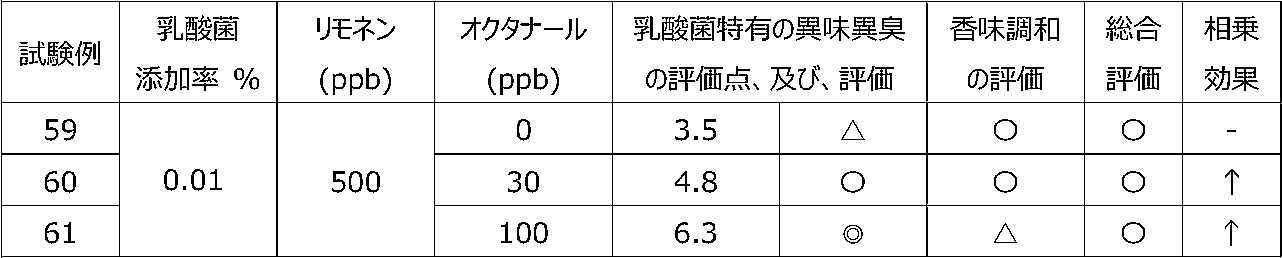
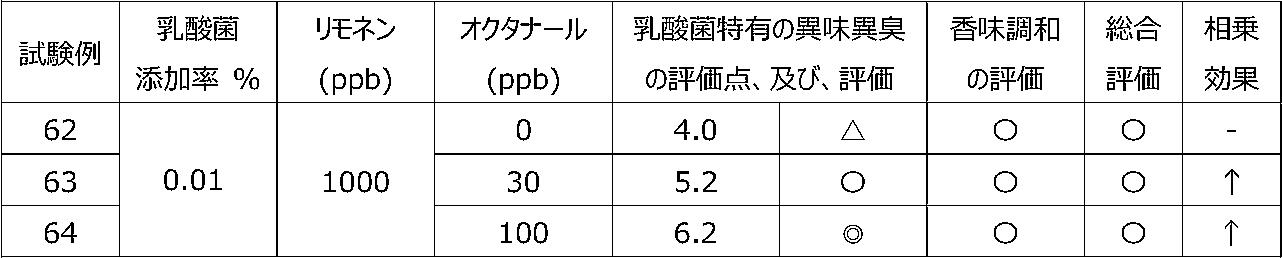
- Tables 16 to 19 show the sensory evaluation results and synergistic effect evaluation results for each of the sample beverages of Test Examples 59 to 69.
- limonene is in the range of 500 to 5000 ppb and octanal is in the range of 30 to 100 ppb, or limonene is 10000 ppb and octanal is 30 ppb.
- the offensive taste and odor peculiar to lactic acid bacteria were suppressed, and the evaluation of flavor harmony was ⁇ , so the overall evaluation was ⁇ .
- limonene is in the range of 500 to 5000 ppb and octanal is in the range of more than 0 ppb to 100 ppb, and limonene is in the range of 500 ppb. It was shown that when the octanal content is within the range of ⁇ 10000 ppb and the octanal is within the range of more than 0 ppb to 30 ppb, a beverage with an overall rating of ⁇ can be obtained.
- the evaluation results of the synergistic effect were evaluated for the offensive taste and odor peculiar to lactic acid bacteria in the case of limonene alone in each test example (3.5 points at 500 ppb; 4.0 points at 1000 ppb; 4.8 points at 5000 ppb; Or, 6.0 points at 10000 ppb), and the evaluation points of the offensive taste and odor peculiar to lactic acid bacteria in the case of octanal alone (4.3 points at 30 ppb; 5.7 points at 100 ppb). This is the result of evaluation using the evaluation criteria.
- the evaluation score of 4.8 for the offensive odor peculiar to lactic acid bacteria in Test Example 60 is compared with both the evaluation score of 3.5 points for 500 ppb of limonene alone and the evaluation score of 4.3 points for 30 ppb of octanal alone. , was improved by 0.5 points or more, so it was evaluated as having a synergistic effect ( ⁇ ).
- sample beverage To carbonated water, 0.01% by weight of dry dead cell powder of lactic acid bacteria strain JCM5805 and 5000 ppb of limonene were added and mixed to prepare a sample beverage of Test Example 71. Also, a sample beverage of Test Example 70 was prepared in the same manner except that limonene was not added.
- Table 20 shows the results of these sensory evaluations of the sample beverages of Test Examples 70 and 71.
Landscapes
- Life Sciences & Earth Sciences (AREA)
- Chemical & Material Sciences (AREA)
- Health & Medical Sciences (AREA)
- Engineering & Computer Science (AREA)
- Food Science & Technology (AREA)
- Nutrition Science (AREA)
- Polymers & Plastics (AREA)
- Mycology (AREA)
- Genetics & Genomics (AREA)
- Biotechnology (AREA)
- Organic Chemistry (AREA)
- Zoology (AREA)
- Bioinformatics & Cheminformatics (AREA)
- Wood Science & Technology (AREA)
- Tropical Medicine & Parasitology (AREA)
- Microbiology (AREA)
- Biomedical Technology (AREA)
- Virology (AREA)
- Biochemistry (AREA)
- General Engineering & Computer Science (AREA)
- General Health & Medical Sciences (AREA)
- Medicinal Chemistry (AREA)
- Non-Alcoholic Beverages (AREA)
Abstract
Description
(A)乳酸菌を含む容器詰飲料において、乳酸菌(乾燥物換算)の添加率が飲料全量に対して0.003重量%以上である場合に、乳酸菌特有の異味異臭(培地臭やざらつき)が感じられること。
(B)乳酸菌を含む容器詰飲料において、甘味成分がショ糖換算の甘味度で1.2重量%以上であると、甘味成分の甘味により乳酸菌特有の異味異臭(培地臭やざらつき)が抑制されるが、甘味成分がショ糖換算の甘味度で1.0重量%以下であると、乳酸菌特有の異味異臭(培地臭やざらつき)が感じられること。
(C)乳酸菌を含む容器詰飲料において、リモネン、シトラール及びオクタナールからなる群から選択される1種又は2種以上の香気成分(以下、「本発明における香気成分」とも表示する。)を特定濃度で含有させることにより、乳酸菌特有の異味異臭(培地臭やざらつき)を抑制することができ、好ましくは、容器詰飲料の香味バランスを保ちつつ、乳酸菌特有の異味異臭(培地臭やざらつき)を抑制することができること。
(1)飲料全量に対して0.003重量%以上の乳酸菌を含有する容器詰飲料であって、リモネン、シトラール及びオクタナールからなる群から選択される1種又は2種以上を含有することを特徴とする、前記容器詰飲料;
(2)(a)500~15000ppbのリモネン、(b)300~7000ppbのシトラール、及び、(c)30~100ppbのオクタナールからなる群から選択される1種又は2種以上を含有することを特徴とする、上記(1)に記載の容器詰飲料;
(3)500~10000ppbのリモネン、及び、300~5000ppbのシトラール;又は、
500~10000ppbのリモネン、及び、30~100ppbのオクタナール;
を含有することを特徴とする上記(1)又は(2)に記載の容器詰飲料;
(4)500~5000ppbのリモネン、及び、3000~5000ppbのシトラール;又は、
500~5000ppbのリモネン、及び、30~100ppbのオクタナール;
を含有することを特徴とする上記(1)又は(2)に記載の容器詰飲料;
(5)乳酸菌がラクトコッカス属細菌であることを特徴とする、上記(1)~(4)のいずれかに記載の容器詰飲料;
(6)乳酸菌がラクトコッカス・ラクティス・サブスピーシズ・ラクティスJCM5805株で
あることを特徴とする、上記(1)~(5)のいずれかに記載の容器詰飲料;
(7)(x)甘味成分を含有しない、又は、
(y)甘味成分を含有し、前記甘味成分の含有量が、ショ糖換算の甘味度で1重量%以下である、上記(1)~(6)のいずれかに記載の容器詰飲料;
(8)飲料全量に対して0.003重量%以上の乳酸菌を含有する容器詰飲料の製造において、リモネン、シトラール及びオクタナールからなる群から選択される1種又は2種以上を含有させる工程を含むことを特徴とする、前記容器詰飲料の製造方法;
(9)飲料全量に対して0.003重量%以上の乳酸菌を含有する容器詰飲料の製造において、リモネン、シトラール及びオクタナールからなる群から選択される1種又は2種以上を含有させる工程を含むことを特徴とする、前記容器詰飲料において乳酸菌により生じる異味異臭を抑制する方法;
等に関する。
[1]飲料全量に対して0.003重量%以上の乳酸菌を含有する容器詰飲料であって、リモネン、シトラール及びオクタナールからなる群から選択される1種又は2種以上を含有することを特徴とする、前記容器詰飲料;
[2]飲料全量に対して0.003重量%以上の乳酸菌を含有する容器詰飲料の製造において、リモネン、シトラール及びオクタナールからなる群から選択される1種又は2種以上を含有させる工程を含むことを特徴とする、前記容器詰飲料の製造方法;
[3]飲料全量に対して0.003重量%以上の乳酸菌を含有する容器詰飲料の製造において、リモネン、シトラール及びオクタナールからなる群から選択される1種又は2種以上を含有させる工程を含むことを特徴とする、前記容器詰飲料において乳酸菌により生じる異味異臭を抑制する方法;
などの実施態様を含んでいる。
本発明における容器詰飲料は、飲料全量に対して0.003重量%以上の乳酸菌を含有する容器詰飲料であって、リモネン、シトラール及びオクタナールからなる群から選択される1種又は2種以上(本発明における香気成分)を含有することを特徴とする、前記容器詰飲料である。
本発明における「飲料」としては、飲料全量に対して0.003重量%以上の乳酸菌を含有し、かつ、リモネン、シトラール及びオクタナールからなる群から選択される1種又は2種以上を含有している限り、特に制限されないが、例えば、機能性飲料、非乳性飲料、スポーツ飲料、ニアウォーター、炭酸飲料などが好ましく挙げられる。なお、スポーツ飲料とは、ミネラル分を多く含み、運動等により汗として失われる水分やミネラルを速やかに補給するために主に喫飲される飲料である。また、ニアウォーターには、一見するとの水のようにみえるもの又は乳化剤で濁度を付した飲料、あるいは、さらに甘味成分や香料を添加した飲料も含まれる。また、本発明における飲料としては、ノンアルコールの飲料であることが好ましい。
本発明における香気成分としては、リモネン、シトラール及びオクタナールからなる群から選択される1種又は2種以上が挙げられ、中でも、(a)500~15000ppbのリモネン、(b)300~7000ppbのシトラール、及び、(c)30~100ppbのオクタナールからなる群から選択される1種又は2種以上が好ましく挙げられる。
500~15000ppbのリモネン、及び、0ppb超~7000ppbのシトラール;
0ppb超~15000ppbのリモネン、及び、300~7000ppbのシトラール;
500~15000ppbのリモネン、及び、0ppb超~100ppbのオクタナール;
0ppb超~15000ppbのリモネン、及び、30~100ppbのオクタナール;300~7000ppbのシトラール、及び、0ppb超~100ppbのオクタナール;又は、
0ppb超~7000ppbのシトラール、及び、30~100ppbのオクタナール;が挙げられる。
なお、リモネン及びシトラールに加えて、オクタナールを用いる場合は、前述の各リモネン濃度のリモネン及び前述の各シトラール濃度のシトラールに加えて、好ましくは容器詰飲料の香味バランスを大きく損なわない範囲の濃度のオクタナールをさらに用いることができる。
なお、リモネン及びオクタナールに加えて、シトラールを用いる場合は、前述の各リモネン濃度のリモネン及び前述の各オクタナール濃度のオクタナールに加えて、好ましくは容器詰飲料の香味バランスを大きく損なわない範囲の濃度のシトラールをさらに用いることができる。
本発明における容器詰飲料は、乳酸菌を含有する。
本発明における容器詰飲料を製造する際に用いる乳酸菌としては、乳酸菌である限り特に制限されず、乳酸菌の生菌体であっても、乳酸菌の死菌体であってもよいが、乳酸菌の死菌体であることが好ましい。かかる乳酸菌の死菌体としては、乾燥物であっても非乾燥物であってもよいが、保存安定性などの観点から、好ましくは乳酸菌の乾燥物が挙げられ、より好ましくは乳酸菌の乾燥粉末が挙げられる。
乾燥粉末化の方法としては特に指定されないが、凍結乾燥、熱風乾燥又は噴霧乾燥などの処理を行い乾燥粉末化することができ、噴霧乾燥による粉末化が好ましい。
なお、本発明における容器詰飲料を製造する際に乳酸菌の生菌体を用いた場合であっても、加熱殺菌工程により、基本的には、乳酸菌の多くは死菌体となる。
なお、殺菌の手段は特に制限されず、加熱のみならず、紫外線やγ線照射など、菌を死滅させる常套手段を用いることができる。
また、乳酸菌の含有量の上限としては特に制限されないが、例えば0.2重量%、0.1重量%、0.07重量%、0.05重量%などが挙げられる。
なお、これらの上限値および下限値は任意に組み合わせることができる。
また、本発明における容器詰飲料が2種類以上の乳酸菌を含有する場合、上記含有率は、全乳酸菌の合計である。
本発明の容器詰飲料では、通常の容器詰飲料の製造に用いられている飲料用添加剤、例えば、酸味料、色素、果汁、甘味成分(高甘味度甘味料を含む)、乳原料、食品添加剤(例えば、酸化防止剤、保存料、増粘安定剤、乳化剤、食物繊維、pH調整剤など)のいずれか1つ又は2つ以上を添加してもよいし、添加しなくてもよい。また、本発明の容器詰飲料は、炭酸ガスを含有させて、炭酸飲料としてもよい。
乳原料が低濃度である場合としては、例えば、乳脂肪分が飲料全量に対して0重量%超で0.1重量%以下、0重量%超で0.05重量%以下、又は、0重量%超で0.02重量%以下である場合、及び/又は、無脂乳固形分が飲料全量に対して0重量%超で0.4重量%以下、0重量%超で0.2重量%以下、又は、0重量%超で0.08重量%以下である場合が挙げられる。
本発明の容器詰飲料は、甘味成分を含有してもよいが、本発明の意義をより多く享受する観点から、
(x)甘味成分を含有しない、又は、
(y)甘味成分を含有し、前記甘味成分の含有量が、ショ糖換算の甘味度で1重量%以下である
ことが好ましく挙げられる。
甘味度=甘味成分含有量(g/100g)×その甘味成分の相対甘味度
ぶどう糖(0.7)、果糖(0.6)、マルトース(0.4)、ソルビトール(0.7)、マルチトール(0.8)、ステビア(150)、グリチルリチン(170)、アセスルファムK(200)、アスパルテーム(200)、サッカリン(300)、スクラロース(600)、アリテーム(2000)、ソーマチン(3000)。
本発明における容器詰飲料は、飲料全量に対して0.003重量%以上の乳酸菌を含有する容器詰飲料の製造において、リモネン、シトラール及びオクタナールからなる群から選択される1種又は2種以上を含有させる工程を含む方法により製造することができる。本発明の製造方法としては、乳酸菌の含有量を0.003重量%以上とすること、及び、リモネン、シトラール及びオクタナールからなる群から選択される1種又は2種以上を含有させること以外は、乳酸菌を含有する容器詰飲料の一般的な製造方法を用いることができる。かかる一般的な製造方法としては、例えば、調合工程、充填工程、加熱殺菌工程を経て容器詰飲料を製造する方法が挙げられる。本発明の容器詰飲料の製造においては、通常の容器詰飲料の処方設計に用いられている飲料用添加剤を添加してもよく、これら添加剤の添加時期は特に制限されない。なお、前述の容器詰飲料の一般的な製造方法としては、より詳細には、例えば、「改訂新版ソフトドリンクス」(株式会社光琳)を参考とすることができる。
本発明において、乳酸菌を含有させる(好ましくは添加する)時期は、本発明の効果が得られる限り、容器詰飲料の製造工程のいずれの段階であってもよいが、加熱殺菌する前のいずれかの段階であることが好ましい。具体的には、例えば、調合工程の調合液又は水に乳酸菌を含有させてもよいし、容器への充填工程の直前又は直後の調合液に乳酸菌を含有させてもよい。
本発明における容器詰飲料は加熱殺菌された容器詰飲料であることが好ましい。加熱殺菌工程は、容器への飲料の充填前であっても充填後であってもよい。
加熱殺菌方法としては、食品分野で一般的に用いられている種々の加熱殺菌方法を用いることができ、例えば、熱水スプレー式、熱水貯湯式若しくは蒸気式のレトルト殺菌装置や、チューブ式若しくはプレート式の液体連続殺菌装置を用いた方法が挙げられる。
本発明における加熱殺菌の条件としては、特に制限されず、容器詰飲料の加熱殺菌に用いられる通常の条件を用いることができる。かかる条件として、例えばF0値が4~40である条件が挙げられ、殺菌時間が比較的短時間で足りる点で、好ましくは、111~150℃であって、かつ、F0値が4~20となる時間である条件が挙げられる。
本発明における飲料は容器詰飲料である。かかる容器とは、内容物と外気との接触を断つことができる密閉容器を意味し、例えば、金属缶、樽容器、プラスチック製ボトル(例えば、PETボトル、カップ)、紙容器、瓶、パウチ容器などが挙げられる。
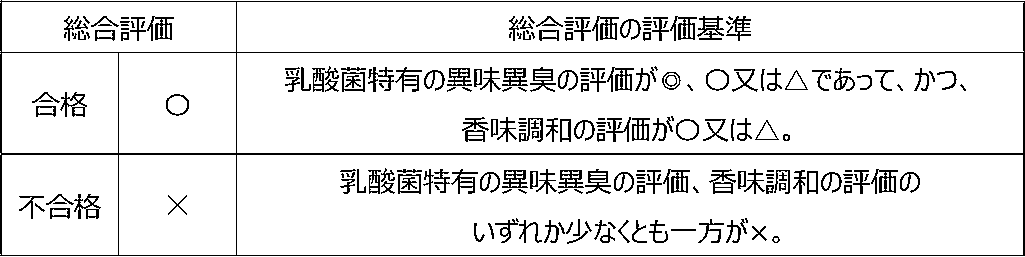
本発明の容器詰飲料は、乳酸菌特有の異味異臭が抑制された容器詰飲料である。本明細書において、「乳酸菌特有の異味異臭が抑制された」容器詰飲料とは、リモネン、シトラール及びオクタナールからなる群から選択される1種又は2種以上を含有させないこと以外は、同種の原材料を用いて同じ製造方法で製造した容器詰飲料(以下、「本発明におけるコントロール飲料とも表示する」)と比較して、乳酸菌特有の異味異臭(すなわち、培地臭及び/又はざらつき)が抑制された容器詰飲料を意味する。本明細書における、かかる「乳酸菌特有の異味異臭が抑制された」容器詰飲料には、乳酸菌特有の異味異臭(培地臭やざらつき)を、後述の実施例における表1の評価基準で評価した場合に、評価の平均点(好ましくは小数点第2を四捨五入した平均点)が3.5点~7点(すなわち、後述の実施例における表2の評価で△、〇又は◎)である容器詰飲料が好適に含まれ、4.5~7点(表2の評価で〇又は◎)である容器詰飲料がより好適に含まれる。
本発明の容器詰飲料は、乳酸菌特有の異味異臭が抑制されている上に、さらに香味バランスが保たれていることが好ましい。本明細書において、「香味バランスが保たれた」容器詰飲料とは、リモネン、シトラール及びオクタナールからなる群から選択される1種又は2種以上による香味が過度に強くなく、違和感が過度でない結果、香味不調和が許容範囲内であることを意味する。本明細書における、かかる「香味バランスが保たれた」容器詰飲料には、容器詰飲料の香味調和を、後述の実施例における試験3における評価法(表5の評価基準を用いる評価法)で評価した場合に、〇又は△である容器詰飲料が好適に含まれ、〇である容器詰飲料がより好適に含まれる。
本発明における乳酸菌により生じる異味異臭を抑制する方法としては、飲料全量に対して0.003重量%以上の乳酸菌を含有する容器詰飲料の製造において、リモネン、シトラール及びオクタナールからなる群から選択される1種又は2種以上を含有させる工程を含むことを特徴とする、前記容器詰飲料において乳酸菌により生じる異味異臭を抑制する方法である限り、特に制限されない。
乳酸菌を飲料に含有させると、飲料の香味に影響を与えるか、また、与える場合は、どの程度の乳酸菌を含有させると飲料の香味にどのような影響を与えるかを調べるために、以下の試験を行った。
飲料ベースとして、水に、85%リン酸を0.01重量%、及び、クエン酸三ナトリウム(結晶)を添加した後、混合して、飲料ベースを得た。
飲料ベースに、乳酸菌Lactococcus lactis subsp. lactis JCM5805株の乾燥死菌体粉末を後述の表3に記載の添加率(重量%)で添加した後、混合して、試験例1~7の各サンプル飲料を調製した。
各サンプル飲料における、乳酸菌特有の異味異臭を、6名の訓練された官能評価者が、表1の評価基準にて官能評価した。また、あるサンプル飲料についての、乳酸菌特有の異味異臭の官能評価の評価点としては、6名の官能評価者による評価点の平均点(少数第2位以下を四捨五入)を用い、その評価点の平均点を表2の基準にあてはめて、そのサンプル飲料の異味異臭の評価を決定した。

乳酸菌含有飲料に甘味成分を含有させることによって、乳酸菌特有の異味異臭にどのような影響を与えるかを調べるために、以下の試験を行った。
試験1の飲料ベースに、乳酸菌JCM5805株の乾燥死菌体粉末を0.01重量%、及び、後述の表4に記載するように甘味成分を所定量添加した後、混合して、試験例7~14の各サンプル飲料を調製した。なお、アセスルファムK(アセスルファムカリウム)はショ糖と比較して200倍の甘味を有している。したがって、試験例8、10、12、14は、それぞれ試験例7、9、11、13と、ショ糖換算の甘味度がほぼ等しい。
各サンプル飲料における、乳酸菌特有の異味異臭を、6名の訓練された官能評価者が、試験1と同じ方法にて官能評価した。かかる官能評価の結果を表4に示す。
乳酸菌含有飲料に特定の香気成分を含有させることによって、乳酸菌特有の異味異臭を抑制することができるかを調べるために、以下の試験を行った。
試験1の飲料ベースに、乳酸菌JCM5805株の乾燥死菌体粉末を0.01重量%、及び、後述の表7~9に記載するように香気成分(シトラール、リモネン又はオクタナール)を所定量添加した後、混合して、試験例15~36の各サンプル飲料を調製した。
各サンプル飲料における、乳酸菌特有の異味異臭を、6名の訓練された官能評価者が、試験1と同じ方法にて官能評価した。
乳酸菌含有飲料への乳酸菌の添加率が0.1%であっても、かかる乳酸菌含有飲料に特定の香気成分を含有させることによって、乳酸菌特有の異味異臭を抑制することができるかを調べるために、以下の試験を行った。
試験1の飲料ベースに、乳酸菌JCM5805株の乾燥死菌体粉末を0.1重量%、及び、後述の表10に記載するように香気成分(リモネン又はオクタナール)を所定量添加した後、混合して、試験例37~38の各サンプル飲料を調製した。
各サンプル飲料における、乳酸菌特有の異味異臭を、6名の訓練された官能評価者が、試験1と同じ方法にて官能評価した。

乳酸菌含有飲料に特定の2種類の香気成分(リモネン及びシトラール)を含有させることによって、乳酸菌特有の異味異臭を抑制することができるか、また、2種類の香気成分を用いることで相乗効果が得られるかを調べるために、以下の試験を行った。
試験1の飲料ベースに、乳酸菌JCM5805株の乾燥死菌体粉末を0.01重量%、及び、後述の表12~15に記載するように2種の香気成分(リモネン及びシトラール)を所定量添加した後、混合して、試験例39~58の各サンプル飲料を調製した。
各サンプル飲料における、乳酸菌特有の異味異臭を、6名の訓練された官能評価者が、試験1と同じ方法にて官能評価した。なお、2種の香気成分を用いたことによる相乗効果を、表11の評価基準にて評価した。

乳酸菌含有飲料に特定の2種類の香気成分(リモネン及びオクタナール)を含有させることによって、乳酸菌特有の異味異臭を抑制することができるか、また、2種類の香気成分を用いることで相乗効果が得られるかを調べるために、以下の試験を行った。
試験1の飲料ベースに、乳酸菌JCM5805株の乾燥死菌体粉末を0.01重量%、及び、後述の表16~19に記載するように2種の香気成分(リモネン及びオクタナール)を所定量添加した後、混合して、試験例59~69の各サンプル飲料を調製した。
各サンプル飲料における、乳酸菌特有の異味異臭を、6名の訓練された官能評価者が、試験1と同じ方法にて官能評価した。なお、2種の香気成分を用いたことによる相乗効果を、試験5と同じ方法にて評価した。


乳酸菌含有飲料が炭酸飲料である場合であっても、特定の香気成分を含有させることによって、乳酸菌特有の異味異臭を抑制することができるかを調べるために、以下の試験を行った。
炭酸水に、乳酸菌JCM5805株の乾燥死菌体粉末を0.01重量%、及び、リモネンを5000ppb添加した後、混合して、試験例71のサンプル飲料を調製した。また、リモネンを添加しないこと以外は同様の方法で、試験例70のサンプル飲料を作製した。
各サンプル飲料における、乳酸菌特有の異味異臭を、6名の訓練された官能評価者が、試験1と同じ方法にて官能評価した。

Claims (9)
- 飲料全量に対して0.003重量%以上の乳酸菌を含有する容器詰飲料であって、リモネン、シトラール及びオクタナールからなる群から選択される1種又は2種以上を含有することを特徴とする、前記容器詰飲料。
- (a)500~15000ppbのリモネン、(b)300~7000ppbのシトラール、及び、(c)30~100ppbのオクタナールからなる群から選択される1種又は2種以上を含有することを特徴とする、請求項1に記載の容器詰飲料。
- 500~10000ppbのリモネン、及び、300~5000ppbのシトラール;又は、
500~10000ppbのリモネン、及び、30~100ppbのオクタナール;
を含有することを特徴とする請求項1又は2に記載の容器詰飲料。 - 500~5000ppbのリモネン、及び、3000~5000ppbのシトラール;又は、
500~5000ppbのリモネン、及び、30~100ppbのオクタナール;
を含有することを特徴とする請求項1又は2に記載の容器詰飲料。 - 乳酸菌がラクトコッカス属細菌であることを特徴とする、請求項1~4のいずれかに記載の容器詰飲料。
- 乳酸菌がラクトコッカス・ラクティス・サブスピーシズ・ラクティスJCM5805株であることを特徴とする、請求項1~5のいずれかに記載の容器詰飲料。
- (x)甘味成分を含有しない、又は、
(y)甘味成分を含有し、前記甘味成分の含有量が、ショ糖換算の甘味度で1重量%以下である、請求項1~6のいずれかに記載の容器詰飲料。 - 飲料全量に対して0.003重量%以上の乳酸菌を含有する容器詰飲料の製造において、リモネン、シトラール及びオクタナールからなる群から選択される1種又は2種以上を含有させる工程を含むことを特徴とする、前記容器詰飲料の製造方法。
- 飲料全量に対して0.003重量%以上の乳酸菌を含有する容器詰飲料の製造において、リモネン、シトラール及びオクタナールからなる群から選択される1種又は2種以上を含有させる工程を含むことを特徴とする、前記容器詰飲料において乳酸菌により生じる異味異臭を抑制する方法。
Priority Applications (5)
| Application Number | Priority Date | Filing Date | Title |
|---|---|---|---|
| JP2023539729A JPWO2023013364A1 (ja) | 2021-08-03 | 2022-07-11 | |
| EP22852790.9A EP4381959A4 (en) | 2021-08-03 | 2022-07-11 | PACKAGED BEVERAGE IN WHICH AN UNPLEASANT TASTE AND ODOR ASSOCIATED WITH LACTIC ACID BACTERIA ARE ELIMINATED, AND PROCESS FOR PRODUCING THE SAME |
| AU2022324851A AU2022324851B2 (en) | 2021-08-03 | 2022-07-11 | Packaged beverage having suppressed offensive taste and odor associated with lactic acid bacteria, and method for producing same |
| US18/294,063 US20240334953A1 (en) | 2021-08-03 | 2022-07-11 | Packaged beverage having suppressed offensive taste and odor associated with lactic acid bacteria, and method for producing same |
| CN202280065698.8A CN118201497A (zh) | 2021-08-03 | 2022-07-11 | 乳酸菌所引起的异味异臭得到了抑制的容器装饮料及其制造方法 |
Applications Claiming Priority (2)
| Application Number | Priority Date | Filing Date | Title |
|---|---|---|---|
| JP2021-127443 | 2021-08-03 | ||
| JP2021127443 | 2021-08-03 |
Publications (1)
| Publication Number | Publication Date |
|---|---|
| WO2023013364A1 true WO2023013364A1 (ja) | 2023-02-09 |
Family
ID=85155926
Family Applications (1)
| Application Number | Title | Priority Date | Filing Date |
|---|---|---|---|
| PCT/JP2022/027217 Ceased WO2023013364A1 (ja) | 2021-08-03 | 2022-07-11 | 乳酸菌による異味異臭が抑制された容器詰飲料、及びその製造方法 |
Country Status (6)
| Country | Link |
|---|---|
| US (1) | US20240334953A1 (ja) |
| EP (1) | EP4381959A4 (ja) |
| JP (1) | JPWO2023013364A1 (ja) |
| CN (1) | CN118201497A (ja) |
| AU (1) | AU2022324851B2 (ja) |
| WO (1) | WO2023013364A1 (ja) |
Cited By (3)
| Publication number | Priority date | Publication date | Assignee | Title |
|---|---|---|---|---|
| WO2025057484A1 (ja) * | 2023-09-11 | 2025-03-20 | アサヒグループホールディングス株式会社 | 乳酸菌含有飲料、当該飲料の製造方法、及び当該飲料の風味改善方法 |
| WO2025142784A1 (ja) * | 2023-12-25 | 2025-07-03 | キリンビバレッジ株式会社 | 飲料及びその製造方法、並びに、飲料のヨーグルト風味向上方法 |
| WO2026009802A1 (ja) * | 2024-07-01 | 2026-01-08 | キリンビバレッジ株式会社 | 果実風味飲料及びその製造方法、並びに、果実風味飲料の風味向上方法 |
Citations (4)
| Publication number | Priority date | Publication date | Assignee | Title |
|---|---|---|---|---|
| JP2005230014A (ja) * | 2005-02-09 | 2005-09-02 | Michiyo Aikawa | 乳酸菌飲料 |
| JP2013094154A (ja) | 2011-11-04 | 2013-05-20 | Ito En Ltd | 乳酸菌含有飲料及びその製造方法 |
| JP2013233097A (ja) * | 2012-05-07 | 2013-11-21 | Koiwai Nyugyo Kk | 風味良好なドリンクタイプヨーグルト |
| JP2017209090A (ja) * | 2016-05-27 | 2017-11-30 | 株式会社 伊藤園 | 異味マスキング剤、乳酸菌含有飲料およびその製造方法 |
Family Cites Families (7)
| Publication number | Priority date | Publication date | Assignee | Title |
|---|---|---|---|---|
| JP2004168936A (ja) * | 2002-11-21 | 2004-06-17 | Kiyomitsu Kawasaki | シトラス様香料組成物 |
| WO2009065723A1 (en) * | 2007-11-23 | 2009-05-28 | Unilever Nv | Fermented soy-based beverage |
| ES2993757T3 (en) * | 2015-02-06 | 2025-01-08 | Genome Pharmaceuticals Inst Co Ltd | Lactic acid bacteria, natural immunoactivator and infection preventative/therapeutic derived from said lactic acid bacteria, and food/beverage |
| CN105394178A (zh) * | 2015-11-16 | 2016-03-16 | 郎溪县南湖莲藕产销专业合作社 | 一种全藕乳酸饮料 |
| CN105647642B (zh) * | 2015-12-28 | 2019-11-22 | 浙江绿晶生物科技股份有限公司 | 乳酸菌香精 |
| CN106858239A (zh) * | 2017-01-18 | 2017-06-20 | 中国农业科学院农产品加工研究所 | 一种柑橘乳酸菌饮料及其制备方法 |
| US20200037636A1 (en) * | 2017-03-15 | 2020-02-06 | Asahi Soft Drinks Co., Ltd. | Beverage containing lactic acid bacterium powder and high-intensity sweetener, method for producing said beverage, method for improving flavor of said beverage, and flavor improving agent for said beverage |
-
2022
- 2022-07-11 EP EP22852790.9A patent/EP4381959A4/en active Pending
- 2022-07-11 US US18/294,063 patent/US20240334953A1/en active Pending
- 2022-07-11 AU AU2022324851A patent/AU2022324851B2/en active Active
- 2022-07-11 CN CN202280065698.8A patent/CN118201497A/zh active Pending
- 2022-07-11 WO PCT/JP2022/027217 patent/WO2023013364A1/ja not_active Ceased
- 2022-07-11 JP JP2023539729A patent/JPWO2023013364A1/ja active Pending
Patent Citations (4)
| Publication number | Priority date | Publication date | Assignee | Title |
|---|---|---|---|---|
| JP2005230014A (ja) * | 2005-02-09 | 2005-09-02 | Michiyo Aikawa | 乳酸菌飲料 |
| JP2013094154A (ja) | 2011-11-04 | 2013-05-20 | Ito En Ltd | 乳酸菌含有飲料及びその製造方法 |
| JP2013233097A (ja) * | 2012-05-07 | 2013-11-21 | Koiwai Nyugyo Kk | 風味良好なドリンクタイプヨーグルト |
| JP2017209090A (ja) * | 2016-05-27 | 2017-11-30 | 株式会社 伊藤園 | 異味マスキング剤、乳酸菌含有飲料およびその製造方法 |
Non-Patent Citations (1)
| Title |
|---|
| See also references of EP4381959A4 |
Cited By (4)
| Publication number | Priority date | Publication date | Assignee | Title |
|---|---|---|---|---|
| WO2025057484A1 (ja) * | 2023-09-11 | 2025-03-20 | アサヒグループホールディングス株式会社 | 乳酸菌含有飲料、当該飲料の製造方法、及び当該飲料の風味改善方法 |
| WO2025142784A1 (ja) * | 2023-12-25 | 2025-07-03 | キリンビバレッジ株式会社 | 飲料及びその製造方法、並びに、飲料のヨーグルト風味向上方法 |
| JP7719328B1 (ja) * | 2023-12-25 | 2025-08-05 | キリンビバレッジ株式会社 | 飲料及びその製造方法、並びに、飲料のヨーグルト風味向上方法 |
| WO2026009802A1 (ja) * | 2024-07-01 | 2026-01-08 | キリンビバレッジ株式会社 | 果実風味飲料及びその製造方法、並びに、果実風味飲料の風味向上方法 |
Also Published As
| Publication number | Publication date |
|---|---|
| US20240334953A1 (en) | 2024-10-10 |
| AU2022324851A1 (en) | 2024-03-07 |
| CN118201497A (zh) | 2024-06-14 |
| EP4381959A4 (en) | 2025-07-30 |
| EP4381959A1 (en) | 2024-06-12 |
| JPWO2023013364A1 (ja) | 2023-02-09 |
| AU2022324851B2 (en) | 2025-09-11 |
Similar Documents
| Publication | Publication Date | Title |
|---|---|---|
| WO2023013364A1 (ja) | 乳酸菌による異味異臭が抑制された容器詰飲料、及びその製造方法 | |
| CN101257805B (zh) | 富集益生菌的和低有机酸的食品 | |
| MX2012005872A (es) | Productos de bebida de alto contenido de acido y metodos para prolongar la estabilidad probiotica. | |
| TW200302701A (en) | Prepared soy milk or soy drink | |
| CN100566595C (zh) | 发酵豆浆的风味改善方法 | |
| EP2104437B1 (fr) | Produit alimentaire comprenant des probiotiques et un monoacide faible protoné | |
| TW201834567A (zh) | 含有乳酸菌粉末與高甜度甜味料之飲料、該飲料之製造方法、改善該飲料之風味之方法、及該飲料用風味改善劑 | |
| JP2022512060A (ja) | ラクトース加水分解生成物と、グルコシル化天然ステビオールグリコシドとを含む、甘味料添加酪農組成物 | |
| JP2024074292A (ja) | 容器詰めナトリウム含有飲料 | |
| JP6749793B2 (ja) | 異味マスキング剤、乳酸菌含有飲料およびその製造方法 | |
| JP2015136302A (ja) | 保存安定性とミネラルウォーター様の香味とを保持した容器詰飲料 | |
| JP5037547B2 (ja) | 発酵乳製品の酸味及び/又は渋味マスキング剤、該マスキング剤を含有する発酵乳製品並びに該マスキング剤を利用する酸味及び/又は渋味のマスキング方法 | |
| CN106550991B (zh) | 维持乳酸菌饮料货架期内组织状态稳定性的方法 | |
| JP2024052620A (ja) | 容器詰加温販売用飲料 | |
| JP2024133408A (ja) | 果汁風味を有する飲料 | |
| TWI853017B (zh) | 飲料 | |
| JP2002065156A (ja) | 低カロリー発酵乳食品 | |
| JP7438696B2 (ja) | 乳酸菌含有無糖飲料およびその製造方法、並びに、乳酸菌含有無糖飲料における異味抑制方法 | |
| JP7512247B2 (ja) | 飲食品、飲食品の雑味マスキング剤、及び飲食品の雑味マスキング方法 | |
| US11779035B2 (en) | Low-caloric beverage | |
| JP2024126910A (ja) | 乳酸菌含有飲料 | |
| TW202539528A (zh) | 乳酸菌之培養基氣味經抑制之飲料 | |
| WO2024117118A1 (ja) | 容器詰め酸性飲料 | |
| JP2025120490A (ja) | 柑橘風味飲料 | |
| JP2020092646A (ja) | 非発酵飲料、及び非発酵飲料の風味改善用組成物 |
Legal Events
| Date | Code | Title | Description |
|---|---|---|---|
| 121 | Ep: the epo has been informed by wipo that ep was designated in this application |
Ref document number: 22852790 Country of ref document: EP Kind code of ref document: A1 |
|
| WWE | Wipo information: entry into national phase |
Ref document number: 2023539729 Country of ref document: JP |
|
| WWE | Wipo information: entry into national phase |
Ref document number: 18294063 Country of ref document: US |
|
| WWE | Wipo information: entry into national phase |
Ref document number: 2022324851 Country of ref document: AU Ref document number: AU2022324851 Country of ref document: AU |
|
| WWE | Wipo information: entry into national phase |
Ref document number: 808431 Country of ref document: NZ |
|
| NENP | Non-entry into the national phase |
Ref country code: DE |
|
| ENP | Entry into the national phase |
Ref document number: 2022324851 Country of ref document: AU Date of ref document: 20220711 Kind code of ref document: A |
|
| ENP | Entry into the national phase |
Ref document number: 2022852790 Country of ref document: EP Effective date: 20240304 |
|
| WWE | Wipo information: entry into national phase |
Ref document number: 202280065698.8 Country of ref document: CN |