WO2023017784A1 - 積層膜 - Google Patents
積層膜 Download PDFInfo
- Publication number
- WO2023017784A1 WO2023017784A1 PCT/JP2022/030002 JP2022030002W WO2023017784A1 WO 2023017784 A1 WO2023017784 A1 WO 2023017784A1 JP 2022030002 W JP2022030002 W JP 2022030002W WO 2023017784 A1 WO2023017784 A1 WO 2023017784A1
- Authority
- WO
- WIPO (PCT)
- Prior art keywords
- microporous membrane
- porous support
- support layer
- polyolefin microporous
- laminated film
- Prior art date
- Legal status (The legal status is an assumption and is not a legal conclusion. Google has not performed a legal analysis and makes no representation as to the accuracy of the status listed.)
- Ceased
Links
Images

Classifications
-
- B—PERFORMING OPERATIONS; TRANSPORTING
- B01—PHYSICAL OR CHEMICAL PROCESSES OR APPARATUS IN GENERAL
- B01D—SEPARATION
- B01D69/00—Semi-permeable membranes for separation processes or apparatus characterised by their form, structure or properties; Manufacturing processes specially adapted therefor
- B01D69/12—Composite membranes; Ultra-thin membranes
- B01D69/1213—Laminated layers
-
- B—PERFORMING OPERATIONS; TRANSPORTING
- B01—PHYSICAL OR CHEMICAL PROCESSES OR APPARATUS IN GENERAL
- B01D—SEPARATION
- B01D71/00—Semi-permeable membranes for separation processes or apparatus characterised by the material; Manufacturing processes specially adapted therefor
- B01D71/06—Organic material
- B01D71/26—Polyalkenes
- B01D71/261—Polyethylene
-
- B—PERFORMING OPERATIONS; TRANSPORTING
- B01—PHYSICAL OR CHEMICAL PROCESSES OR APPARATUS IN GENERAL
- B01D—SEPARATION
- B01D67/00—Processes specially adapted for manufacturing semi-permeable membranes for separation processes or apparatus
- B01D67/0002—Organic membrane manufacture
- B01D67/0023—Organic membrane manufacture by inducing porosity into non porous precursor membranes
- B01D67/0025—Organic membrane manufacture by inducing porosity into non porous precursor membranes by mechanical treatment, e.g. pore-stretching
- B01D67/0027—Organic membrane manufacture by inducing porosity into non porous precursor membranes by mechanical treatment, e.g. pore-stretching by stretching
-
- B—PERFORMING OPERATIONS; TRANSPORTING
- B01—PHYSICAL OR CHEMICAL PROCESSES OR APPARATUS IN GENERAL
- B01D—SEPARATION
- B01D69/00—Semi-permeable membranes for separation processes or apparatus characterised by their form, structure or properties; Manufacturing processes specially adapted therefor
- B01D69/02—Semi-permeable membranes for separation processes or apparatus characterised by their form, structure or properties; Manufacturing processes specially adapted therefor characterised by their properties
-
- B—PERFORMING OPERATIONS; TRANSPORTING
- B01—PHYSICAL OR CHEMICAL PROCESSES OR APPARATUS IN GENERAL
- B01D—SEPARATION
- B01D69/00—Semi-permeable membranes for separation processes or apparatus characterised by their form, structure or properties; Manufacturing processes specially adapted therefor
- B01D69/10—Supported membranes; Membrane supports
- B01D69/107—Organic support material
-
- B—PERFORMING OPERATIONS; TRANSPORTING
- B01—PHYSICAL OR CHEMICAL PROCESSES OR APPARATUS IN GENERAL
- B01D—SEPARATION
- B01D71/00—Semi-permeable membranes for separation processes or apparatus characterised by the material; Manufacturing processes specially adapted therefor
- B01D71/06—Organic material
- B01D71/48—Polyesters
-
- B—PERFORMING OPERATIONS; TRANSPORTING
- B32—LAYERED PRODUCTS
- B32B—LAYERED PRODUCTS, i.e. PRODUCTS BUILT-UP OF STRATA OF FLAT OR NON-FLAT, e.g. CELLULAR OR HONEYCOMB, FORM
- B32B27/00—Layered products comprising a layer of synthetic resin
- B32B27/32—Layered products comprising a layer of synthetic resin comprising polyolefins
-
- B—PERFORMING OPERATIONS; TRANSPORTING
- B32—LAYERED PRODUCTS
- B32B—LAYERED PRODUCTS, i.e. PRODUCTS BUILT-UP OF STRATA OF FLAT OR NON-FLAT, e.g. CELLULAR OR HONEYCOMB, FORM
- B32B5/00—Layered products characterised by the non- homogeneity or physical structure, i.e. comprising a fibrous, filamentary, particulate or foam layer; Layered products characterised by having a layer differing constitutionally or physically in different parts
- B32B5/22—Layered products characterised by the non- homogeneity or physical structure, i.e. comprising a fibrous, filamentary, particulate or foam layer; Layered products characterised by having a layer differing constitutionally or physically in different parts characterised by the presence of two or more layers which are next to each other and are fibrous, filamentary, formed of particles or foamed
- B32B5/32—Layered products characterised by the non- homogeneity or physical structure, i.e. comprising a fibrous, filamentary, particulate or foam layer; Layered products characterised by having a layer differing constitutionally or physically in different parts characterised by the presence of two or more layers which are next to each other and are fibrous, filamentary, formed of particles or foamed at least two layers being foamed and next to each other
-
- B—PERFORMING OPERATIONS; TRANSPORTING
- B01—PHYSICAL OR CHEMICAL PROCESSES OR APPARATUS IN GENERAL
- B01D—SEPARATION
- B01D2257/00—Components to be removed
- B01D2257/91—Bacteria; Microorganisms
-
- B—PERFORMING OPERATIONS; TRANSPORTING
- B01—PHYSICAL OR CHEMICAL PROCESSES OR APPARATUS IN GENERAL
- B01D—SEPARATION
- B01D2313/00—Details relating to membrane modules or apparatus
- B01D2313/04—Specific sealing means
- B01D2313/042—Adhesives or glues
-
- B—PERFORMING OPERATIONS; TRANSPORTING
- B01—PHYSICAL OR CHEMICAL PROCESSES OR APPARATUS IN GENERAL
- B01D—SEPARATION
- B01D2325/00—Details relating to properties of membranes
- B01D2325/02—Details relating to pores or porosity of the membranes
-
- B—PERFORMING OPERATIONS; TRANSPORTING
- B01—PHYSICAL OR CHEMICAL PROCESSES OR APPARATUS IN GENERAL
- B01D—SEPARATION
- B01D2325/00—Details relating to properties of membranes
- B01D2325/02—Details relating to pores or porosity of the membranes
- B01D2325/0283—Pore size
-
- B—PERFORMING OPERATIONS; TRANSPORTING
- B01—PHYSICAL OR CHEMICAL PROCESSES OR APPARATUS IN GENERAL
- B01D—SEPARATION
- B01D2325/00—Details relating to properties of membranes
- B01D2325/04—Characteristic thickness
-
- B—PERFORMING OPERATIONS; TRANSPORTING
- B01—PHYSICAL OR CHEMICAL PROCESSES OR APPARATUS IN GENERAL
- B01D—SEPARATION
- B01D2325/00—Details relating to properties of membranes
- B01D2325/20—Specific permeability or cut-off range
-
- B—PERFORMING OPERATIONS; TRANSPORTING
- B01—PHYSICAL OR CHEMICAL PROCESSES OR APPARATUS IN GENERAL
- B01D—SEPARATION
- B01D2325/00—Details relating to properties of membranes
- B01D2325/48—Antimicrobial properties
-
- Y—GENERAL TAGGING OF NEW TECHNOLOGICAL DEVELOPMENTS; GENERAL TAGGING OF CROSS-SECTIONAL TECHNOLOGIES SPANNING OVER SEVERAL SECTIONS OF THE IPC; TECHNICAL SUBJECTS COVERED BY FORMER USPC CROSS-REFERENCE ART COLLECTIONS [XRACs] AND DIGESTS
- Y02—TECHNOLOGIES OR APPLICATIONS FOR MITIGATION OR ADAPTATION AGAINST CLIMATE CHANGE
- Y02W—CLIMATE CHANGE MITIGATION TECHNOLOGIES RELATED TO WASTEWATER TREATMENT OR WASTE MANAGEMENT
- Y02W10/00—Technologies for wastewater treatment
- Y02W10/10—Biological treatment of water, waste water, or sewage
Definitions
- the present disclosure relates to laminated films.
- Japanese National Publication of International Patent Application No. 2011-512252 discloses a porous polyethylene membrane that can be used for filtration media.
- Japanese Patent Application Laid-Open No. 2015-163465 discloses a porous laminate having a polyolefin-based porous film and a polyolefin-based fiber layer, which is used for medical sterilization packaging materials.
- Japanese Patent Application Laid-Open No. 11-179120 discloses a polyolefin resin laminated filter, which is useful as an industrial liquid filtration filter, in which a polyolefin nonwoven fabric and a polyolefin microporous membrane are integrated by heat calendering.
- Japanese Patent Application Laid-Open No. 2008-114530 discloses a method for producing a composite sheet in which an olefinic porous film and a breathable reinforcing material are bonded together with a hot-melt adhesive.
- An object of the present disclosure is to provide a laminated membrane that is excellent in air permeability and bacteria separation performance.
- a microporous membrane containing a polyolefin and a porous support layer are provided, and the microporous membrane and the porous support layer are bonded to each other by interspersed adhesive portions containing a thermoplastic resin, and bubbles A laminated film with a point of 20 kPa to 900 kPa.
- the laminated film according to ⁇ 2>, wherein the polyethylene contained in the microporous film has a weight average molecular weight of 800,000 to 2,800,000.
- ⁇ 4> The laminated film according to any one of ⁇ 1> to ⁇ 3>, wherein the microporous film has a bubble point of 10 kPa to 800 kPa.
- ⁇ 5> The laminated film according to any one of ⁇ 1> to ⁇ 4>, wherein the microporous film has a porosity of 80% to 90%.
- ⁇ 6> The laminated film according to any one of ⁇ 1> to ⁇ 5>, wherein the microporous film has an average thickness of 10 ⁇ m to 110 ⁇ m.
- ⁇ 7> The laminated film according to any one of ⁇ 1> to ⁇ 6>, wherein the porous support layer is a polyester fiber structure.
- ⁇ 8> The laminated film according to any one of ⁇ 1> to ⁇ 7>, wherein the porous support layer has a basis weight of 50 g/m 2 to 150 g/m 2 .
- ⁇ 9> The laminated film according to any one of ⁇ 1> to ⁇ 8>, wherein the porous support layer has a bulk density of 0.20 g/cm 3 to 0.50 g/cm 3 .
- ⁇ 10> The laminated film according to any one of ⁇ 1> to ⁇ 9>, wherein the laminated film has a Gurley value of 5 seconds/100 mL to 100 seconds/100 mL.
- ⁇ 11> The laminated film according to any one of ⁇ 1> to ⁇ 10>, which is used for separating bacteria.
- a laminated membrane with excellent air permeability and bacteria separation performance is provided.
- FIG. 4 is a cross-sectional view showing an example of an embodiment of a laminated film
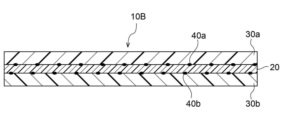
- FIG. 4 is a cross-sectional view showing another example of an embodiment of a laminated film
- a numerical range indicated using “to” indicates a range including the numerical values before and after "to” as the minimum and maximum values, respectively.
- the upper limit or lower limit of one numerical range may be replaced with the upper or lower limit of another numerical range described step by step.
- the upper or lower limits of the numerical ranges may be replaced with the values shown in the examples.
- process includes not only an independent process but also a process that cannot be clearly distinguished from other processes as long as the intended purpose of the process is achieved.
- the amount of each component in the composition in the present disclosure when there are multiple types of substances corresponding to each component in the composition, unless otherwise specified, the multiple types of substances present in the composition It means the total amount of substance.
- MD Machine Direction
- TD transverse direction
- width direction width direction
- upstream the side from which gas or liquid flows in
- downstream the side from which gas or liquid flows out
- a microporous membrane containing polyolefin is referred to as a "polyolefin microporous membrane".
- "porous support layer” does not include “polyolefin microporous membrane”.
- a “porous support layer” is a sheet-like object other than a "microporous polyolefin membrane”.
- the melting points of the polyolefin and thermoplastic resin of the polyolefin microporous membrane that constitutes the laminated membrane may be used as the melting points of the polyolefin and thermoplastic resin of the polyolefin microporous membrane, which is the material used to produce the laminated membrane.
- the laminated membrane of the present disclosure has a polyolefin microporous membrane and a porous support layer, and the polyolefin microporous membrane and the porous support layer are adhered with interspersed adhesive portions containing a thermoplastic resin, and bubble point is 20 kPa to 900 kPa.
- the polyolefin microporous membrane and the porous support layer are bonded together with an adhesive portion containing a thermoplastic resin. Since the thermoplastic resin is melted by the application of heat and adheres the polyolefin microporous membrane and the porous support layer, the heat calendering process is more effective than the direct adhesion of the polyolefin microporous membrane and the porous support layer by heat. It is possible to bond at a low temperature, and the porous structures of the polyolefin microporous membrane and the porous support layer are less likely to be clogged. In the laminated film of the present disclosure, the laminated film has good air permeability because the polyolefin microporous film and the porous support layer are adhered to each other at the interspersed adhesion portions.
- the laminated film of the present disclosure has a bubble point of 900 kPa or less.
- a laminated film having a bubble point of more than 900 kPa may have too small a pore size or may have partially clogged pores, and such a laminated film cannot provide sufficient air permeability.
- the laminated film of the present disclosure has a bubble point of 900 kPa or less, preferably 850 kPa or less, more preferably 800 kPa or less, and even more preferably 700 kPa or less.
- the laminated film of the present disclosure has a bubble point of 20 kPa or more.
- Laminated membranes with a bubble point of less than 20 kPa have too large a pore size, and sufficient bacteria separation performance cannot be obtained.
- the laminated membrane of the present disclosure has a bubble point of 20 kPa or more, preferably 40 kPa or more, more preferably 80 kPa or more, and even more preferably 100 kPa or more, from the viewpoint of excellent bacteria separation performance.
- the bubble point of the laminated film is determined by the bubble point method (ASTM F316-86, JIS K3832: 1990) using a perm porometer (PMI, model: CFP-1200-AEXL). However, Gullwick manufactured by PMI (surface tension: 15.9 dyn/cm) is used as the immersion liquid during the test. The liquid temperature during the test is 24 ⁇ 2°C. If the exposed surface of the laminated membrane is a polyolefin microporous membrane on one side and a porous support layer on the other, the exposed surface of the polyolefin microporous membrane is placed facing the pressurizing part of the perm porometer and measured. I do.
- the Gurley value of the laminated membrane is preferably 5 seconds/100 mL or more, more preferably 6 seconds/100 mL or more, and even more preferably 7 seconds/100 mL or more, from the viewpoint of enhancing the bacteria separation performance.
- the Gurley value of the laminated film is preferably 100 seconds/100 mL or less, more preferably 90 seconds/100 mL or less, and even more preferably 80 seconds/100 mL or less, from the viewpoint of enhancing air permeability.
- the Gurley value of the laminated film is a value measured according to JIS P8117:2009.
- the laminated membrane of the present disclosure is suitable for applications in which gas or liquid is allowed to flow to separate biological particles, and among biological particles, it is particularly suitable for applications in which bacteria are separated.
- Biological particles include particles possessed by organisms, particles released by organisms, particles parasitic on organisms, microscopic organisms, lipid-membrane vesicles, and fragments thereof.
- biological particles include viruses, portions of viruses (e.g., deenveloped particles from enveloped viruses), bacteriophages, bacteria, spores, spores, fungi, molds, yeasts, cysts, protozoa.
- Animals unicellular algae, plant cells, animal cells, cultured cells, hybridomas, tumor cells, red blood cells, white blood cells (e.g. lymphocytes, monocytes, granulocytes), platelets, organelles (e.g. cell nuclei, mitochondria, vesicles) ), exosomes, apoptotic bodies, lipid bilayer particles, lipid monolayer particles, liposomes, enzymes, enzyme aggregates, proteins, protein aggregates, and fragments thereof.
- Biological particles as referred to in this disclosure, also include man-made materials.
- the diameter or major axis length of the biological particle is, for example, 1 nm or more, 5 nm or more, 10 nm or more, 20 nm or more, for example, 100 ⁇ m or less, 50 ⁇ m or less, or 10 ⁇ m or less. , 5 ⁇ m or less.
- Bacteria to be separated by the laminated membrane of the present disclosure are preferably bacteria of nano-order or micro-order.
- the diameter or major axis length of the bacteria is preferably 100 nm or more, more preferably 200 nm or more, even more preferably 300 nm or more, preferably 5 ⁇ m or less, and more preferably 4 ⁇ m or less, 3 ⁇ m or less is more preferable.
- the laminated membrane of the present disclosure is suitable as a filter medium for air filters that prevents bacteria from entering.
- Air filters are, for example, dust masks, medical masks, coarse dust air filters, medium performance air filters, high performance air filters, or ultra high performance air filters.
- Applications of the laminated membranes of the present disclosure are not limited to filter media for air filters.
- Applications of the laminated film of the present disclosure include a bag-shaped body for trapping functional particles.
- Functional particles to be captured include, for example, biological particles, resin particles, metal particles, mineral particles, ceramic particles; pharmaceuticals, foods, enzymes, catalysts, microorganisms, gas absorbents, dehumidifiers, deodorants, exothermic agents ; and the like.
- the bag-shaped body is manufactured, for example, by folding or overlapping laminated films cut into a predetermined shape and size, and then bonding a part or all of the outer peripheral edges of the overlapped laminated films.
- the laminate membrane of the present disclosure has at least one layer of polyolefin microporous membrane and at least one layer of porous support layer.
- the laminated membrane of the present disclosure may have multiple layers of polyolefin microporous membranes, and may have multiple layers of porous support layers.
- the laminated membrane of the present disclosure is preferably a laminated membrane having a layer structure in which at least one porous support layer is laminated on one side of a single polyolefin microporous membrane.
- the laminated membranes of the present disclosure may have other layers different from the polyolefin microporous membrane and the porous support layer.
- the layer configuration of the laminated film of the present disclosure will be described with reference to the drawings. Components shown using the same reference numerals in each drawing mean the same or similar components.
- the sizes of the members in each drawing are conceptual, and the relative relationship between the sizes of the members is not limited to this.
- the configuration of the laminated film of the present disclosure is not limited to the configuration shown in the drawings.
- FIG. 1 is a cross-sectional view showing an example of an embodiment of a laminated film.
- a laminated membrane 10A shown in FIG. 1 has a polyolefin microporous membrane 20 and a porous support layer 30 .
- a porous support layer 30 is disposed on one side of the polyolefin microporous membrane 20 .
- the polyolefin microporous film 20 and the porous support layer 30 are adhered by the adhesion portion 40.
- the adhesive portions 40 are scattered on the interface between the polyolefin microporous membrane 20 and the porous support layer 30 . When the boundary surface is viewed in plan, the adhesive portions 40 are scattered in, for example, a dotted shape, a linear shape, a lattice shape, or a mesh shape.
- the bonding portion 40 contains a thermoplastic resin.
- the adhesive part 40 preferably contains only thermoplastic resin.
- the laminated membrane 10A preferably has the polyolefin microporous membrane 20 on the upstream side and the porous support layer 30 on the downstream side during use.
- the laminated film 10A may have a reinforcing layer, an adhesive layer, a protective layer, etc. on the edges of one or both of the exposed surfaces.
- the laminated film 10A may be one unit, and a plurality of such units may be stacked to form a multi-laminated film, and this multi-laminated film is an example of an embodiment of the laminated film of the present disclosure.
- FIG. 2 is a cross-sectional view showing another example of the embodiment of the laminated film.
- the laminated membrane 10B shown in FIG. 2 has a polyolefin microporous membrane 20, a porous support layer 30a, and a porous support layer 30b.
- a porous support layer 30 a is arranged on one side of the polyolefin microporous membrane 20
- a porous support layer 30 b is arranged on the other side of the polyolefin microporous membrane 20 .
- the porous support layer 30a and the porous support layer 30b may be the same type of porous support layer in terms of material, thickness, porosity, basis weight, etc., or may be different types of porous support layers.
- the polyolefin microporous membrane 20 and the porous support layer 30a are adhered to each other by the adhesion portion 40a, and the polyolefin microporous membrane 20 and the porous support layer 30b are adhered to each other by the adhesion portion 40b.
- the adhesive portions 40a are scattered on the interface between the polyolefin microporous membrane 20 and the porous support layer 30a.
- the adhesive portions 40b are scattered on the interface between the polyolefin microporous membrane 20 and the porous support layer 30b. When the boundary surface is viewed in plan, the adhesive portions 40a and the adhesive portions 40b are scattered in a dotted, linear, grid-like, or net-like manner, respectively.
- the adhesive portion 40a and the adhesive portion 40b contain a thermoplastic resin.
- the adhesive portion 40a and the adhesive portion 40b preferably contain only a thermoplastic resin.
- the adhesive portion 40a and the adhesive portion 40b may be of the same type of thermoplastic resin, or may be of different types.
- the adhesive portion 40a and the adhesive portion 40b may be the same type of adhesive portion or may be different types of adhesive portions in an interspersed manner.
- the laminated film 10B may have a reinforcing layer, an adhesive layer, a protective layer, etc. on the edges of one or both of the exposed surfaces.
- the laminated film 10B may be one unit, and a plurality of such units may be stacked to form a multi-laminated film, and this multi-laminated film is an example of an embodiment of the laminated film of the present disclosure.
- a microporous membrane means a membrane having a structure in which a large number of fine pores are connected inside, and through which gas or liquid can pass from one surface to the other surface. do.
- the polyolefin microporous membrane preferably has a three-dimensional network structure composed of polyolefin fibrils.
- polyolefin contained in the polyolefin microporous membrane examples include polyethylene, polypropylene, polybutylene, polymethylpentene, copolymers of polypropylene and polyethylene, and the like.
- polyethylene is preferable, and high-density polyethylene, a mixture of high-density polyethylene and ultra-high molecular weight polyethylene, and the like are preferable.
- polyolefin microporous membrane is a polyethylene microporous membrane containing only polyethylene as polyolefin.
- An example of an embodiment of a polyolefin microporous membrane is a microporous membrane containing polypropylene from the viewpoint of providing heat resistance that does not easily break when exposed to high temperatures.
- polyolefin microporous membrane is a polyolefin microporous membrane containing a mixture of at least polyethylene and polypropylene.
- polyolefin microporous membrane having a laminated structure of two or more layers, at least one layer containing polyethylene, and at least one layer containing polypropylene.
- the thickness of the polyolefin microporous membrane is preferably 10 ⁇ m or more, more preferably 12 ⁇ m or more, and even more preferably 14 ⁇ m or more, from the viewpoints of increasing the strength of the polyolefin microporous membrane and increasing the separation rate of biological particles.
- the thickness of the polyolefin microporous membrane is preferably 110 ⁇ m or less, more preferably 105 ⁇ m or less, and even more preferably 100 ⁇ m or less, from the viewpoint of air permeability of the laminated film.
- the thickness of the polyolefin microporous film is obtained by measuring 20 points with a contact-type film thickness meter and averaging them.
- the porosity of the polyolefin microporous membrane is preferably 80% or higher, more preferably 81% or higher, even more preferably 82% or higher, and even more preferably 83% or higher, from the viewpoint of air permeability of the laminated membrane. From the viewpoint of increasing the separation rate of biological particles, the porosity of the polyolefin microporous membrane is preferably 90% or less, more preferably 88% or less, and even more preferably 86% or less.
- the porosity of the polyolefin microporous membrane is determined by the following calculation method. That is, with respect to constituent material 1 , constituent material 2 , constituent material 3 , . ) , the true density of each constituent material is d 1 , d 2 , d 3 , . ) is obtained by the following formula.
- the bubble point of the polyolefin microporous membrane is preferably 10 kPa or higher, more preferably 50 kPa or higher, and even more preferably 100 kPa or higher, from the viewpoint of increasing the separation rate of biological particles.
- the bubble point of the polyolefin microporous membrane is preferably 800 kPa or less, more preferably 700 kPa or less, and even more preferably 600 kPa or less.
- the bubble point of the polyolefin microporous membrane is determined by the bubble point method (ASTM F316-86, JIS K3832: 1990) using a perm porometer (PMI, model: CFP-1200-AEXL). However, Gullwick manufactured by PMI (surface tension: 15.9 dyn/cm) is used as the immersion liquid during the test. The liquid temperature during the test is 24 ⁇ 2°C.
- the Gurley value of the polyolefin microporous membrane is preferably 2 seconds/100 mL or more, more preferably 3 seconds/100 mL or more, and even more preferably 5 seconds/100 mL or more, from the viewpoint of increasing the separation rate of biological particles. From the viewpoint of air permeability, the Gurley value of the polyolefin microporous membrane is preferably 100 seconds/100 mL or less, more preferably 90 seconds/100 mL or less, and even more preferably 80 seconds/100 mL or less.
- the Gurley value of the polyolefin microporous membrane is a value measured according to JIS P8117:2009.
- the weight average molecular weight (Mw) of polyolefin contained in the polyolefin microporous membrane is preferably 500,000 to 5,000,000.
- Mw of the polyolefin is 500,000 or more, sufficient mechanical properties can be imparted to the microporous membrane.
- Mw of the polyolefin is 5,000,000 or less, it is easy to form a microporous membrane.
- the weight average molecular weight (Mw) of polyethylene contained in the polyolefin microporous membrane is preferably 800,000 or more, more preferably 1,000,000 or more, and even more preferably 1,100,000 or more, from the viewpoint of densifying the porous structure of the microporous membrane. . From the viewpoint of increasing the porosity of the microporous membrane, the weight average molecular weight (Mw) of polyethylene contained in the polyolefin microporous membrane is preferably 2.8 million or less, more preferably 2.5 million or less, and even more preferably 2.3 million or less.
- the weight-average molecular weight of the polyolefin and polyethylene constituting the polyolefin microporous membrane was obtained by heating and dissolving the polyolefin microporous membrane in o-dichlorobenzene and performing gel permeation chromatography (system: Alliance GPC 2000 type manufactured by Waters, column: GMH6- HT and GMH6-HTL) under the conditions of column temperature of 140° C. and flow rate of 1.0 mL/min. Monodisperse polystyrene (manufactured by Tosoh Corporation) is used for molecular weight calibration.
- a polyolefin composition in the present disclosure, means a mixture of polyolefins containing two or more polyolefins, and when the polyolefin contained is only polyethylene, it is referred to as a polyethylene composition).
- a microporous membrane comprising:
- the polyolefin composition has the effect of forming a network structure with fibrillation during stretching and increasing the porosity of the polyolefin microporous membrane.
- polyolefin composition a polyolefin composition containing 5% to 70% by mass of an ultra-high molecular weight polyethylene having a weight average molecular weight of 9 ⁇ 10 5 or more based on the total amount of polyolefin is preferable, and 10% to 60% by mass. % is more preferable, and a polyolefin composition containing 15% by mass to 50% by mass is even more preferable.
- the polyolefin composition comprises ultra-high molecular weight polyethylene having a weight average molecular weight of 9 ⁇ 10 5 or more and high molecular weight polyethylene having a weight average molecular weight of 2 ⁇ 10 5 to 8 ⁇ 10 5 and a density of 920 kg/m 3 to 960 kg/m 3 . It is preferably a polyolefin composition mixed with density polyethylene at a mass ratio of 5:95 to 70:30 (more preferably 10:90 to 60:40, still more preferably 15:85 to 50:50).
- An example of an embodiment of a polyolefin microporous membrane is a hydrophilized polyolefin microporous membrane.
- the hydrophilized polyolefin microporous membrane includes, for example, a polyolefin microporous membrane whose surface is coated with a hydrophilic compound (e.g., ethylene-vinyl alcohol copolymer); polyolefin microporous membrane; plasma-treated or corona-treated polyolefin microporous membrane; and the like. After the polyolefin microporous membrane and the porous support layer are laminated, the entire laminated membrane may be subjected to hydrophilization treatment.
- a hydrophilic compound e.g., ethylene-vinyl alcohol copolymer
- a polyolefin microporous membrane can be produced, for example, by a production method including the following steps (I) to (IV).
- Step (I) is a step of preparing a solution containing a polyolefin composition and a volatile solvent having a boiling point of less than 210°C at atmospheric pressure.
- the solution is preferably a thermoreversible sol-gel solution, and a thermoreversible sol-gel solution is prepared by heating and dissolving the polyolefin composition in a solvent to form a sol.
- the volatile solvent having a boiling point of less than 210° C. at atmospheric pressure is not particularly limited as long as it can sufficiently dissolve the polyolefin. Examples of the volatile solvent include tetralin (206° C. to 208° C.), ethylene glycol (197.3° C.), decalin (decahydronaphthalene, 187° C.
- the volatile solvents may be used alone or in combination of two or more.
- the polyolefin composition used in step (I) (in the present disclosure, it means a mixture of polyolefins containing two or more polyolefins, and when the polyolefin contained is only polyethylene, it is referred to as a polyethylene composition) contains polyethylene. is preferred, and a polyethylene composition is more preferred.
- the solution prepared in step (I) preferably has a polyolefin composition concentration of 10% to 40% by mass, preferably 15% to 35% by mass. is more preferable.
- concentration of the polyolefin composition is 10% by mass or more, it is possible to suppress the occurrence of cuts in the process of forming the polyolefin microporous membrane, and the mechanical strength of the polyolefin microporous membrane increases to improve handling properties.
- concentration of the polyolefin composition is 40% by mass or less, pores are likely to be formed in the polyolefin microporous membrane.
- Step (II) is a step of melt-kneading the solution prepared in step (I), extruding the obtained melt-kneaded product from a die, and cooling and solidifying to obtain a first gel-like molding.
- step (II) for example, the polyolefin composition is extruded through a die at a temperature range of from the melting point to the melting point +65° C. to obtain an extrudate, and then the extrudate is cooled to obtain a first gel-like molding.
- the first gel-like molding is preferably shaped into a sheet. Cooling may be by immersion in water or an organic solvent, or by contact with a chilled metal roll, generally by immersion in the volatile solvent used in step (I). done.
- Step (III) is a step of stretching the first gel-like molding in at least one direction (primary stretching) and drying the solvent to obtain a second gel-like molding.
- the stretching step (III) is preferably biaxial stretching, and may be sequential biaxial stretching in which longitudinal stretching and lateral stretching are separately performed, or simultaneous biaxial stretching in which longitudinal stretching and lateral stretching are performed simultaneously.
- the draw ratio in the primary drawing (the product of the longitudinal draw ratio and the transverse draw ratio) is preferably 1.1 to 3 times, more preferably 1.1 to 2 times. more preferred.
- the temperature during stretching in the primary stretching is preferably 75° C. or less.
- the drying step of step (III) is carried out without any particular limitation as long as the temperature does not cause deformation of the second gel-like molding, but is preferably carried out at 60°C or less.
- the stretching step and the drying step of step (III) may be performed simultaneously or stepwise.
- primary stretching may be performed while pre-drying, and then main drying may be performed, or primary stretching may be performed between pre-drying and main drying.
- the primary stretching can also be carried out in a state in which drying is controlled and the solvent remains in a suitable state.
- Step (IV) is a step of stretching (secondary stretching) the second gel-like molding in at least one direction.
- the stretching step of step (IV) is preferably biaxial stretching.
- the stretching step of step (IV) includes sequential biaxial stretching in which longitudinal stretching and lateral stretching are performed separately; simultaneous biaxial stretching in which longitudinal stretching and lateral stretching are performed simultaneously; stretching in the machine direction and stretching in the transverse direction several times; and stretching in the machine direction and/or the transverse direction once or more times after successive biaxial stretching.
- the draw ratio in the secondary drawing (the product of the longitudinal draw ratio and the transverse draw ratio) is preferably 5 times to 90 times, more preferably 10 times to 60 times, from the viewpoint of controlling the porous structure of the polyolefin microporous membrane. Double.
- the stretching temperature for the secondary stretching is preferably 90° C. to 135° C., more preferably 90° C. to 130° C., from the viewpoint of controlling the porous structure of the polyolefin microporous membrane.
- a heat setting treatment may be performed after step (IV).
- the heat setting temperature is preferably 110° C. to 160° C., more preferably 120° C. to 150° C., from the viewpoint of controlling the porous structure of the polyolefin microporous membrane.
- extraction treatment of the solvent remaining in the polyolefin microporous membrane and annealing treatment may be performed.
- the residual solvent extraction treatment is performed, for example, by immersing the heat-fixed sheet in a methylene chloride bath to elute the residual solvent in methylene chloride.
- the polyolefin microporous membrane immersed in the methylene chloride bath is preferably removed from the methylene chloride bath by drying after being withdrawn from the methylene chloride bath.
- the annealing treatment is carried out by conveying the polyolefin microporous membrane on rollers heated to, for example, 100°C to 140°C after extraction treatment of the residual solvent.
- the bubble point and porosity of the polyolefin microporous membrane are adjusted by controlling the conditions of steps (I) to (IV).
- the porous support layer is a layer for ensuring the strength of the laminated film.
- a porous support layer is a layer that has pores or voids therein and allows gas or liquid to pass from one surface to the other surface.
- An organic or inorganic fibrous structure is suitable for the porous support layer.
- organic fiber structures include nonwoven fabrics and woven and knitted fabrics mainly composed of thermoplastic fibers.
- inorganic fiber structures include electrospun fiber membranes made of glass fiber nonwoven fabric, steel wool, ceramic fibers, and the like.
- Nonwoven fabrics, woven and knitted fabrics, and fiber membranes may be structures having a laminated structure of two or more layers.
- Non-woven fabrics, woven and knitted fabrics, and fiber membranes may be of one type or two or more types in terms of material type, fiber thickness, cross-sectional shape, or basis weight.
- thermoplastic fibers are suitable for the porous support layer, and a nonwoven fabric is particularly suitable.
- the fiber structure preferably contains 70% by mass or more of thermoplastic fibers.
- thermoplastic fibers include fibers composed of resins such as polyesters, polyolefins, polyamides, polyesteramides, acrylic resins and polyvinyl alcohol, and mixtures of these fibers.
- polyester fiber structures are more preferable.
- polyester examples include polyethylene terephthalate (PET) resin, polybutylene terephthalate (PBT) resin, polytrimethylene terephthalate (PTT) resin, polyethylene naphthalate (PEN) resin, and polytrimethylene naphthalate (PTN). resins, polybutylene naphthalate (PBN) resins, polyethylene isophthalate resins, and wholly aromatic polyester resins.
- PET polyethylene terephthalate
- PBT polybutylene terephthalate
- PBT polytrimethylene terephthalate
- PEN polyethylene naphthalate
- PBN polytrimethylene naphthalate
- polyolefin examples include polypropylene and polyethylene.
- nylon examples include nylon 6, nylon 6,6, and the like.
- acrylic resins include polyacrylate and polymethyl methacrylate.
- Polyvinyl alcohol-based resins include, for example, ethylene-vinyl alcohol copolymers.
- the melting point of the resin constituting the organic fibers is preferably 100° C. or higher, more preferably 150° C. or higher, from the viewpoint of imparting sufficient heat resistance to the porous support layer. Preferably, 200° C. or higher is more preferable.
- the melting point of the resin constituting the organic fiber is preferably 300° C. or lower, more preferably 280° C. or lower, and even more preferably 260° C. or lower, from the viewpoint of ease of processing the resin into an organic fiber structure.
- the basis weight of the porous support layer is preferably 50 g/m 2 or more, more preferably 55 g/m 2 or more, and even more preferably 60 g/m 2 or more, from the viewpoint of high rigidity of the porous support layer.
- the basis weight of the porous support layer is preferably 150 g/m 2 or less, more preferably 120 g/m 2 or less, more preferably 100 g/m 2 or less is more preferable.
- the bulk density of the porous support layer is preferably 0.20 g/cm 3 or more, more preferably 0.25 g/cm 3 or more, and further preferably 0.30 g/cm 3 or more.
- the bulk density of the porous support layer is preferably 0.50 g/cm 3 or less, more preferably 0.48 g/cm 3 or less, from the viewpoint of excellent workability (bending or heat welding) of the porous support layer. It is preferably 0.45 g/cm 3 or less, more preferably 0.45 g/cm 3 or less.
- the thickness of one porous support layer is preferably 100 ⁇ m or more, more preferably 120 ⁇ m or more, and even more preferably 140 ⁇ m or more.
- the thickness of one porous support layer is preferably 240 ⁇ m or less, more preferably 220 ⁇ m or less, and even more preferably 200 ⁇ m or less, from the viewpoint of excellent workability (bending or heat welding) of the porous support layer.
- the thickness of the porous support layer is obtained by measuring 20 points with a film thickness meter and averaging them.
- a nonwoven fabric manufacturing method includes a manufacturing method of forming a fibrous web and bonding fibers in the fibrous web to obtain a nonwoven fabric.
- the method for producing the fibrous web include dry methods such as carding, air laying, spunbonding and melt blowing; wet methods such as wet papermaking; and electrostatic spinning.
- the wet method fibers are dispersed in water to form a uniform papermaking slurry, and this papermaking slurry is used as a material by using a papermaking machine having at least one papermaking method such as a cylinder type, a fourdrinier type, or an inclined type.
- the fibers are bonded by a fiber bonding method selected from the group consisting of bonding, fusing and entangling. It is also preferable to pass the nonwoven fabric between a heated metal roll and an elastic roll to apply heat and pressure treatment (thermal calendering).
- a method for producing a woven or knitted fabric weaving or knitting is performed from filaments or spun yarns by a general method, as is practiced with general thermoplastic fibers.
- Adhesion part The polyolefin microporous membrane and the porous support layer are bonded together with an adhesive portion containing a thermoplastic resin. Adhesives containing a thermoplastic resin are interspersed at the interface between the polyolefin microporous membrane and the porous support layer. The interspersed adhesion portions on the interface between the polyolefin microporous membrane and the porous support layer ensure the air permeability of the laminated membrane. In addition, since the adhesive portions are scattered on the interface between the polyolefin microporous membrane and the porous support layer, clogging of the particles at the interface is suppressed.
- the term “interspersed” means that the thermoplastic resin constituting the adhesive portion is continuously or non-continuously between the polyolefin microporous membrane and the porous support layer without covering the entire surface of the polyolefin microporous membrane. It is a state of being continuously distributed.
- thermoplastic resins exist in the form of dots, lines, fibers, strips, lattices, nets, or three-dimensional networks, and they include forms deformed by heat fusion and/or pressure. It is a thing.
- the adhesive part contains a thermoplastic resin, and preferably contains only a thermoplastic resin. That is, it is preferable that the adhesive portion is made of a thermoplastic resin.
- the melting point of the thermoplastic resin contained in the adhesive part is preferably lower than the melting point of the polyolefin contained in the polyolefin microporous membrane.
- the melting point of the thermoplastic resin contained in the adhesive portion is preferably lower than the melting point of the resin contained in the porous support layer.
- the melting point of the thermoplastic resin contained in the adhesive portion is preferably lower than the melting points of all the polyolefins contained in the polyolefin microporous membrane.
- the adhesive portion contains two or more thermoplastic resins
- the melting points of all these thermoplastic resins are preferably lower than the melting point of the polyolefin contained in the polyolefin microporous membrane.
- the melting point of all the thermoplastic resins contained in the bonding section is included in the polyolefin microporous membrane. It is preferably below the melting point of all polyolefins.
- the melting point of the thermoplastic resin contained in the adhesive part is preferably 50° C. or higher from the viewpoint of suppressing deformation of the adhesive part and elution of components contained in the adhesive part due to the temperature of the gas or liquid to be circulated. , 60° C. or higher, more preferably 70° C. or higher.
- the melting point of the thermoplastic resin contained in the adhesive part is from the viewpoint of suppressing the temperature of the heat applied for bonding the polyolefin microporous membrane and the porous support layer and suppressing deformation of the polyolefin microporous membrane and the porous support layer. Therefore, the temperature is preferably 130° C. or lower, more preferably 125° C. or lower, and even more preferably 120° C. or lower.
- the melting point of a thermoplastic resin is the "melting peak temperature" of the DSC (Differential Scanning Calorimetry) curve obtained according to JIS K7121: 1987 "Method for measuring transition temperature of plastics".
- the thermoplastic resin contained in the adhesive part includes resins such as polyolefin, polyester, acrylic resin, and polyvinyl alcohol. Among them, polyolefin is preferable at least from the viewpoint of forming a good bonding state with the polyolefin microporous membrane.
- Polyolefins include, for example, polyethylene, polypropylene, polybutylene, polymethylpentene, copolymers of polypropylene and polyethylene, and the like.
- the thermoplastic resin contained in the adhesive portion is preferably the same type of polyolefin as the polyolefin contained in the polyolefin microporous membrane.
- the thermoplastic resin contained in the adhesive portion is preferably polyethylene.
- the adhesive portions are scattered in, for example, dots, lines, lattices, or nets.
- the bond may or may not be visually identifiable.
- the number of adhesive portions is preferably 3,000 to 15,000 per 10 cm square.
- the total area of the bonded portions is preferably 5% to 80% of the area of the interface.
- the laminated film of the present disclosure is manufactured, for example, by a manufacturing method including the following steps (a) to (c).
- the first layer is either a polyolefin microporous membrane or a porous support layer.
- the second layer is a porous support layer, and when the first layer is a porous support layer, the second layer is a polyolefin microporous membrane.
- Step (a) and step (b) are performed once or multiple times depending on the number of layers of the laminated film.
- the second layer in the first step (b) is the first layer in the second step (a).
- thermoplastic resin used in step (a) functions as an adhesive that bonds the first layer and the second layer.
- the thermoplastic resin used in step (a) is preferably particulate, linear or fibrous.
- the amount of thermoplastic resin used is preferably 1 g/m 2 to 20 g/m 2 with respect to the surface of the first layer.
- the coverage of the thermoplastic resin on the surface of the first layer is preferably 5% to 80%.
- the heating device in step (c) is, for example, a heating and pressure roll; a heating roll and a pressure roll; and a heating furnace equipped with a pressure roll.
- the temperature of the heating device is preferably higher than -10°C, the melting point of the thermoplastic resin that functions as an adhesive, and lower than +10°C, the melting point of the polyolefin contained in the polyolefin microporous membrane.
- the temperature of the heating device is preferably lower than the melting point of the resin contained in the porous support layer.
- the temperature of the heating device is preferably 50°C to 140°C, more preferably 60°C to 135°C, even more preferably 70°C to 130°C.
- the heat application time by the heating device is set to the time required for the thermoplastic resin functioning as the adhesive to be sufficiently melted.
- the pressure applied by the roll member is set within a range that does not clog the porous structure of the polyolefin microporous membrane.
- the laminated film of the present disclosure will be more specifically described below with reference to examples. Materials, usage amounts, proportions, processing procedures, etc. shown in the following examples can be changed as appropriate without departing from the gist of the present disclosure. Therefore, the scope of the laminated film of the present disclosure should not be construed to be limited by the specific examples shown below.
- the weight-average molecular weight of the polyolefin constituting the polyolefin microporous membrane was obtained by heating and dissolving the polyolefin microporous membrane in o-dichlorobenzene and performing gel permeation chromatography (system: Alliance GPC 2000 model manufactured by Waters, column: GMH6-HT and GMH6-HTL) was measured under conditions of a column temperature of 140° C. and a flow rate of 1.0 mL/min. Monodisperse polystyrene (manufactured by Tosoh Corporation) was used for molecular weight calibration.
- Gurley value of laminated film It was measured using a Gurley densometer (Toyo Seiki Seisakusho Co., Ltd., model number: G-B2C) in accordance with JIS P8117:2009.
- a circle with a diameter of 47 mm was cut from the laminated film and used as a sample. After the sample was immersed in ethanol, the ethanol-wet sample was placed inside the holder with the exposed surface of the polyolefin microporous membrane facing upstream.
- test Bacteria Solution The test bacteria were seeded on a TSA medium and cultured at a temperature of 30° C. for 24 hours. The grown colonies were suspended in 10 mL of TSB medium and cultured at 30° C. for 24 hours. 2 mL of this culture solution was added dropwise to 1000 mL of a salted lactose bouillon medium and cultured at a temperature of 30° C. for 24 hours. This culture solution was diluted 10-fold with physiological saline and mixed well to obtain a test bacterial solution.
- test bacterial solution was serially diluted up to 10 times with physiological saline. 0.1 mL of the test bacterial solution or diluted solution was smeared on SA medium, cultured at 30° C. for 48 hours, and the number of developed colonies was counted. From the counted number of colonies, the number of bacteria per 500 mL of the test bacterial solution was determined.
- Bacteria Separation Operation An air compressor was connected to a pressurized tank containing about 550 mL of the test bacteria solution, and the valve was closed. Compressed air was supplied from an air compressor to pressurize the inside of the pressure tank to 0.21 MPa.
- the entire amount of the test bacterial solution was passed through the holder on which the sample was placed, and collected in the water collection container. After the entire amount of the test bacterial solution passed through the holder, the pressurization by the air compressor was stopped, and the inside of the pressurized tank was returned to the atmospheric pressure.
- the liquid collected in the water sampling container is referred to as "treated liquid”.
- Bacterial Count Measurement in Treated Liquid 50 mL and 450 mL of the treated liquid were each filtered with a membrane filter. Most of the test bacteria remain on the membrane filter because they are too large to pass through the membrane filter. After filtering the treatment solution, the membrane filter was attached to the SA medium, cultured at 30° C.
- LRV log10 (number of bacteria per 500 mL of test bacterial solution / number of bacteria per 500 mL of treatment solution) An LRV of 6 or more was judged to be excellent in bacteria separation performance.
- the laminated membrane was cut out and placed in a holder having an effective opening diameter of 40 mm with the exposed surface of the polyolefin microporous membrane facing upstream. Air was passed through the holder at a flow rate of 5.3 cm/sec, and the pressure difference (Pa) between the upstream and downstream sides of the laminated membrane was measured with a differential pressure gauge. The measured pressure difference (Pa) was classified as follows. A practical allowable range is a pressure difference of less than 40 kPa. A: Less than 10 kPa B: 10 kPa or more and less than 40 kPa C: 40 kPa or more
- Example 1 -Preparation of polyethylene microporous membrane- 12.5 parts by mass of ultra-high molecular weight polyethylene (hereinafter referred to as "UHMWPE") having a weight average molecular weight of 4.6 million and high density polyethylene (hereinafter referred to as "HDPE”) having a weight average molecular weight of 560,000 and a density of 950 kg/m 3 12.
- UHMWPE ultra-high molecular weight polyethylene
- HDPE high density polyethylene
- a polyethylene composition mixed with 5 parts by mass was prepared.
- a polyethylene solution was prepared by mixing a polyethylene composition and decalin such that the polymer concentration was 25% by mass.
- the above polyethylene solution was extruded through a die at a temperature of 153°C into a sheet, and then the extrudate was cooled in a water bath at a water temperature of 20°C to obtain a first gel-like sheet.
- the first gel-like sheet is pre-dried for 10 minutes in an atmosphere at a temperature of 70°C, then first stretched at 1.2 times in the MD direction, and then main-dried for 5 minutes in an atmosphere at a temperature of 57°C. After 1 minute, a second gel-like sheet (base tape) was obtained (the amount of solvent remaining in the second gel-like sheet was less than 1% by mass). Next, as secondary stretching, the second gel-like sheet (base tape) is stretched in the MD direction at a temperature of 90° C. at a magnification of 3 times, then in the TD direction at a temperature of 120° C. at a magnification of 10 times, and then Heat treatment (heat setting) was immediately performed at 140°C.
- polyester nonwoven fabric having the basis weight and bulk density shown in Table 1 was prepared as a porous support layer. 5 g of polyethylene powder having a melting point of 105° C. was sprinkled on one side of the polyester nonwoven fabric per 1 m 2 , and the polyethylene microporous membrane was overlaid on the surface. .
- Examples 2-9, Comparative Examples 1-2 Preparation of polyolefin microporous membrane- By changing the mixing ratio of UHMWPE and HDPE so that the weight average molecular weight of polyethylene measured by the above-mentioned method becomes the value shown in Table 1, and controlling each condition of the manufacturing process, it has the physical properties shown in Table 1.
- a polyethylene microporous membrane was produced.
- Example 8 a polypropylene microporous membrane was produced using polypropylene instead of polyethylene.
Landscapes
- Chemical & Material Sciences (AREA)
- Chemical Kinetics & Catalysis (AREA)
- Engineering & Computer Science (AREA)
- Manufacturing & Machinery (AREA)
- Laminated Bodies (AREA)
- Separation Using Semi-Permeable Membranes (AREA)
Abstract
Description
特開2015-163465号公報には、医療用滅菌包装材料に用いる、ポリオレフィン系多孔フィルムとポリオレフィン系繊維層とを有する多孔性積層体が開示されている。
特開平11-179120号公報には、工業用液体濾過フィルターとして有用な、ポリオレフィン不織布とポリオレフィン微多孔膜とを熱カレンダーにより一体化したポリオレフィン樹脂製積層フィルターが開示されている。
特開2008-114530号公報には、オレフィン系多孔質フィルムと通気性補強材をホットメルト接着剤で接合する複合シートの製造方法が開示されている。
<1> ポリオレフィンを含む微多孔膜と、多孔質支持層と、を有し、前記微多孔膜と前記多孔質支持層とが、熱可塑性樹脂を含む散在する接着部で接着されており、バブルポイントが20kPa~900kPaである、積層膜。
<2> 前記微多孔膜がポリエチレンを含む、<1>に記載の積層膜。
<3> 前記微多孔膜に含まれるポリエチレンの重量平均分子量が80万~280万である、<2>に記載の積層膜。
<4> 前記微多孔膜のバブルポイントが10kPa~800kPaである、<1>~<3>のいずれか1項に記載の積層膜。
<5> 前記微多孔膜の空孔率が80%~90%である、<1>~<4>のいずれか1項に記載の積層膜。
<6> 前記微多孔膜の平均厚さが10μm~110μmである、<1>~<5>のいずれか1項に記載の積層膜。
<7> 前記多孔質支持層がポリエステル繊維構造体である、<1>~<6>のいずれか1項に記載の積層膜。
<8> 前記多孔質支持層の目付が50g/m2~150g/m2である、<1>~<7>のいずれか1項に記載の積層膜。
<9> 前記多孔質支持層の嵩密度が0.20g/cm3~0.50g/cm3である、<1>~<8>のいずれか1項に記載の積層膜。
<10> 前記積層膜のガーレ値が5秒/100mL~100秒/100mLである、<1>~<9>のいずれか1項に記載の積層膜。
<11> バクテリアを分離するために用いる、<1>~<10>のいずれか1項に記載の積層膜。
本開示中に段階的に記載されている数値範囲において、一つの数値範囲で記載された上限値又は下限値は、他の段階的な記載の数値範囲の上限値又は下限値に置き換えてもよい。また、本開示中に記載されている数値範囲において、その数値範囲の上限値又は下限値は、実施例に示されている値に置き換えてもよい。
本開示において「多孔質支持層」は「ポリオレフィン微多孔膜」を含まない。「多孔質支持層」は「ポリオレフィン微多孔膜」以外のシート状の物体である。
本開示の積層膜は、ポリオレフィン微多孔膜と多孔質支持層とを有し、ポリオレフィン微多孔膜と多孔質支持層とが、熱可塑性樹脂を含む散在する接着部で接着されており、バブルポイントが20kPa~900kPaである。
そして、本開示の積層膜は、ポリオレフィン微多孔膜と多孔質支持層とが散在する接着部で接着されていることにより、積層膜の通気性が良好である。
積層膜のガーレ値は、通気性を高める観点から、100秒/100mL以下が好ましく、90秒/100mL以下がより好ましく、80秒/100mL以下が更に好ましい。
積層膜のガーレ値は、JIS P8117:2009に従って測定した値である。
本開示の積層膜は、気体又は液体を流通させて生物学的粒子を分離する用途に好適であり、生物学的粒子の中でも特にバクテリアを分離する用途に好適である。
本開示でいう生物学的粒子(biological particle)には、生物が有する粒子、生物が放出する粒子、生物に寄生する粒子、微小な生物、脂質を膜とする小胞、これらの断片が含まれる。本開示でいう生物学的粒子には、ウイルス、ウイルスの一部(例えば、エンベロープを有するウイルスからエンベロープを除去した粒子)、バクテリオファージ、バクテリア、芽胞、胞子、菌類、カビ、酵母、シスト、原生動物、単細胞性藻類、植物細胞、動物細胞、培養細胞、ハイブリドーマ、腫瘍細胞、赤血球、白血球(例えば、リンパ球、単球、顆粒球)、血小板、細胞小器官(例えば、細胞核、ミトコンドリア、小胞)、エクソソーム、アポトーシス小体、脂質二重層の粒子、脂質一重層の粒子、リポソーム、酵素、酵素の凝集体、タンパク質、タンパク質の凝集体、及びこれらの断片が含まれる。本開示でいう生物学的粒子には、人工物も含まれる。
袋状体は、例えば、所定の形状及び寸法に裁断された積層膜を折り曲げたり重ね合わせたりした後、重なった積層膜の外周縁の一部又は全部を接着して製造する。
本開示の積層膜は、少なくとも1層のポリオレフィン微多孔膜と、少なくとも1層の多孔質支持層とを有している。本開示の積層膜は、ポリオレフィン微多孔膜を複数層有していてもよく、多孔質支持層を複数層有していてもよい。本開示の積層膜は、好ましくは1層のポリオレフィン微多孔膜の片面に多孔質支持層が少なくとも1層積層された層構成を有する積層膜である。本開示の積層膜は、ポリオレフィン微多孔膜及び多孔質支持層とは異なる他の層を有していてもよい。
本開示において微多孔膜とは、内部に多数の微細孔を有し且つ微細孔が連結された構造を有し、一方の面から他方の面へと気体又は液体が通過可能である膜を意味する。
ポリオレフィン微多孔膜の厚さは、積層膜の通気性の観点から、110μm以下が好ましく、105μm以下がより好ましく、100μm以下が更に好ましい。
ポリオレフィン微多孔膜の厚さは、接触式の膜厚計にて20点を測定し、これを平均することで求める。
ポリオレフィン微多孔膜の空孔率は、生物学的粒子の分離率を高める観点から、90%以下が好ましく、88%以下がより好ましく、86%以下が更に好ましい。
即ち、ポリオレフィン微多孔膜の構成材料1、構成材料2、構成材料3、…、構成材料nについて、各構成材料の質量がW1、W2、W3、…、Wn(g/cm2)であり、各構成材料の真密度がd1、d2、d3、…、dn(g/cm3)であり、膜厚をt(cm)としたとき、空孔率ε(%)は下記の数式により求められる。

ポリオレフィン微多孔膜のバブルポイントは、通気性の観点から、800kPa以下が好ましく、700kPa以下がより好ましく、600kPa以下が更に好ましい。
ポリオレフィン微多孔膜のガーレ値は、通気性の観点から、100秒/100mL以下が好ましく、90秒/100mL以下がより好ましく、80秒/100mL以下が更に好ましい。
ポリオレフィン微多孔膜のガーレ値は、JIS P8117:2009に従って測定した値である。
ポリオレフィン微多孔膜に含まれるポリエチレンの重量平均分子量(Mw)は、微多孔膜の空孔率を上げる観点から、280万以下が好ましく、250万以下がより好ましく、230万以下が更に好ましい。
ポリオレフィン微多孔膜は、例えば、下記の工程(I)~(IV)を含む製造方法で製造することができる。
工程(II):前記溶液を溶融混練し、得られた溶融混練物をダイから押し出し、冷却固化して第一のゲル状成形物を得る工程。
工程(III):前記第一のゲル状成形物を少なくとも一方向に延伸(一次延伸)し且つ溶剤の乾燥を行い第二のゲル状成形物を得る工程。
工程(IV):前記第二のゲル状成形物を少なくとも一方向に延伸(二次延伸)する工程。
多孔質支持層は、積層膜の強度を担保するための層である。多孔質支持層は、内部に空孔又は空隙を有し、一方の面から他方の面へと気体又は液体が通過可能な層である。
不織布、織編物、繊維膜は、2層以上の積層構造を備える構造体でもよい。不織布、織編物、繊維膜は、素材の種類、繊維の太さ、断面形状又は目付において、1種でもよく2種以上でもよい。
多孔質支持層の目付は、多孔質支持層の加工性(折り曲げたり、熱で溶着したり)に優れる観点から、150g/m2以下が好ましく、120g/m2以下がより好ましく、100g/m2以下が更に好ましい。
多孔質支持層の嵩密度は、多孔質支持層の加工性(折り曲げたり、熱で溶着したり)に優れる観点から、0.50g/cm3以下が好ましく、0.48g/cm3以下がより好ましく、0.45g/cm3以下が更に好ましい。
多孔質支持層1層の厚さは、多孔質支持層の加工性(折り曲げたり、熱で溶着したり)に優れる観点から、240μm以下が好ましく、220μm以下がより好ましく、200μm以下が更に好ましい。
多孔質支持層の厚さは、膜厚計にて20点を測定し、これを平均することで求める。
織編物の製造方法としては、一般的な熱可塑性繊維で実施されているように、フィラメント又は紡績糸から一般的な手法にて織編を行う。
ポリオレフィン微多孔膜と多孔質支持層とは、熱可塑性樹脂を含む接着部で接着されている。熱可塑性樹脂を含む接着部は、ポリオレフィン微多孔膜と多孔質支持層の境界面に散在している。ポリオレフィン微多孔膜と多孔質支持層の境界面に接着部が散在していることにより、積層膜の通気性が担保される。また、ポリオレフィン微多孔膜と多孔質支持層の境界面に接着部が散在していることにより、境界面において粒子が目詰まりを起こすことが抑制される。
接着部が2種類以上の熱可塑性樹脂を含む場合、これらすべての熱可塑性樹脂の融点は、ポリオレフィン微多孔膜に含まれるポリオレフィンの融点より低いことが好ましい。
ポリオレフィン微多孔膜が2種類以上のポリオレフィンを含み、且つ、接着部が2種類以上の熱可塑性樹脂を含む場合、接着部に含まれるすべての熱可塑性樹脂の融点は、ポリオレフィン微多孔膜に含まれるすべてのポリオレフィンの融点より低いことが好ましい。
接着部に含まれる熱可塑性樹脂の融点は、ポリオレフィン微多孔膜と多孔質支持層とを接着するために印加する熱の温度を抑え、ポリオレフィン微多孔膜及び多孔質支持層の変形を抑制する観点から、130℃以下が好ましく、125℃以下がより好ましく、120℃以下が更に好ましい。
接着部が点状であるとき、接着部の個数は、10cm四方当たり3000個~15000個であることが好ましい。
ポリオレフィン微多孔膜と多孔質支持層の境界面を平面視したとき、接着部の総面積は、境界面の面積に対して5%~80%であることが好ましい。
本開示の積層膜は、例えば、下記の工程(a)~(c)を含む製造方法によって製造される。
工程(b):第一の層の面上に散在した熱可塑性樹脂の上に、積層膜に含まれる第二の層を重ね、積層体を作る工程。
工程(c):加熱装置に積層体を通過させ、熱可塑性樹脂を溶かし、第一の層と第二の層とを接着する工程。
熱可塑性樹脂が第一の層の表面を覆う被覆率は、5%~80%であることが好ましい。
実施例及び比較例に適用した測定方法及び評価方法は、以下のとおりである。
ポリオレフィン微多孔膜を構成するポリオレフィンの重量平均分子量は、ポリオレフィン微多孔膜をo-ジクロロベンゼン中に加熱溶解し、ゲル浸透クロマトグラフィー(システム:Waters社製 Alliance GPC 2000型、カラム:GMH6-HT及びGMH6-HTL)により、カラム温度140℃、流速1.0mL/分の条件にて測定した。分子量の校正には単分散ポリスチレン(東ソー社製)を用いた。
PMI社製のパームポロメータ(型式:CFP-1200-AEXL)及びPMI社製のガルウィック(表面張力15.9dyn/cm)を使用し、バブルポイント法(ASTM F316-86、JIS K3832:1990)に従って測定した。試験時の液温は24±2℃であった。
積層膜のバブルポイントは、ポリオレフィン微多孔膜が露出している面をパームポロメータの加圧部に向けて設置し、測定を行った。
接触式の膜厚計(株式会社ミツトヨ)にて20点測定し、これを平均することで求めた。接触端子は底面が直径0.5cmの円柱状の端子を用いた。測定圧は0.1Nとした。
下記の式から求めた。ここに、ポリオレフィン微多孔膜の構成材料1、構成材料2、構成材料3、…、構成材料nについて、各構成材料の質量がW1、W2、W3、…、Wn(g/cm2)であり、各構成材料の真密度がd1、d2、d3、…、dn(g/cm3)であり、ポリオレフィン微多孔膜の平均厚さがt(cm)である。

積層前の多孔質支持層を10cm×10cmの正方形に切り出した試料の質量を測定し、試料の質量を面積(100cm2)で割ることで求めた。
積層前の多孔質支持層を10cm×10cmの正方形に切り出した試料の質量及び厚さを測定し、試料の質量を厚さ及び面積(100cm2)で割ることで求めた。厚さは、Digimatic Micrometer(株式会社ミツトヨ、型番:MDC-25MJ)にて20点測定し、これを平均することで求めた。
JIS P8117:2009に従い、ガーレ式デンソメータ(株式会社東洋精機製作所、型番:G-B2C)を用いて測定した。
下記の用具を用意した。
・オイルレスエアーコンプレッサー、型番:ACP-10A、株式会社高儀。以下「エアコンプレッサー」という。
・ラボテスト用ベビータンク、型番:BT-700S、アドバンテック。以下「加圧タンク」という。
・ステンレスラインホルダー、型番:KS-47、アドバンテック。以下「ホルダー」という。
・孔径0.22μmのメンブレンフィルター、型番:A020B025A、アドバンテック。以下「メンブレンフィルター」という。
(1)試験菌液の調製
試験菌をTSA培地に播き温度30℃で24時間培養した。発育したコロニーを10mLのTSB培地に懸濁し、温度30℃で24時間培養した。この培養液2mLを1000mLの加塩乳糖ブイヨン培地に滴下し、温度30℃で24時間培養した。この培養液を生理食塩液で10倍希釈し、よく混合して試験菌液とした。
(2)試験菌液の菌数測定
試験菌液を生理食塩液で10倍まで段階希釈した。試験菌液または希釈液それぞれ0.1mLをSA培地に塗抹し、温度30℃で48時間培養し、発育したコロニーの個数を数えた。計測したコロニーの個数から、試験菌液500mLあたりの菌数を求めた。
(3)バクテリアの分離操作
約550mLの試験菌液を入れた加圧タンクにエアコンプレッサーを接続し、弁を閉じた。エアコンプレッサーから圧縮空気を送り、加圧タンク内を0.21MPaに加圧した。弁を開き、試験菌液の全量を、試料を設置したホルダーを通過させ、採水容器に回収した。試験菌液全量がホルダーを通過した後、エアコンプレッサーによる加圧を止めて、加圧タンク内を大気圧に戻した。以下、採水容器に回収した液を「処理液」という。
(4)処理液中の菌数測定
処理液のうち50mL及び450mLをそれぞれメンブレンフィルターで濾過した。試験菌は、メンブレンフィルターを通過困難な大きさであるので、ほとんどがメンブレンフィルター上に残留する。処理液を濾過した後のメンブレンフィルターをSA培地に貼り付け、温度30℃で3日間培養後、発育したコロニーの個数を数えた。計測したコロニーの個数から、処理液500mLあたりの菌数を求めた。
(5)LRVの算出
下記の式からLRVを算出した。
LRV=log10(試験菌液500mLあたりの菌数/処理液500mLあたりの菌数)
LRV6以上をバクテリア分離性能に優れると判断した。
積層膜を切り出し、ポリオレフィン微多孔膜が露出している面を上流に向けて、有効開口直径40mmのホルダーに設置した。空気を流量5.3cm/秒でホルダーに通過させて、積層膜の上流下流の圧力差(Pa)を微差圧計にて測定した。測定した圧力差(Pa)を下記のとおり分類した。実用上の許容範囲は圧力差40kPa未満である。
A:10kPa未満
B:10kPa以上40kPa未満
C:40kPa以上
[実施例1]
-ポリエチレン微多孔膜の作製-
重量平均分子量460万の超高分子量ポリエチレン(以下「UHMWPE」という。)12.5質量部と、重量平均分子量56万且つ密度950kg/m3の高密度ポリエチレン(以下「HDPE」という。)12.5質量部とを混合したポリエチレン組成物を用意した。ポリマー濃度が25質量%となるようにポリエチレン組成物とデカリンとを混合しポリエチレン溶液を調製した。
多孔質支持層として、表1に記載の目付及び嵩密度を有するポリエステル不織布を用意した。ポリエステル不織布の片面に融点105℃のポリエチレンパウダーを1m2当たり5g散布し、ポリエチレン微多孔膜を重ね、加熱加圧ロールにて温度100℃を印加し、ポリエチレン微多孔膜とポリエステル不織布とを接着した。
-ポリオレフィン微多孔膜の作製-
先述の手法により測定するポリエチレンの重量平均分子量が表1に記載の値になるようにUHMWPEとHDPEの混合比を変え、製造工程の各条件を制御することにより、表1に記載の物性を有するポリエチレン微多孔膜を製造した。実施例8においては、ポリエチレンに代えてポリプロピレンを用いてポリプロピレン微多孔膜を製造した。
表1に記載の仕様のとおり、ポリエステル不織布又はポリプロピレン不織布の片面に、ポリエチレン微多孔膜又はポリプロピレン微多孔膜を、ポリエチレンパウダー又はポリエチレンウェブを用いて接着した。ポリエチレンパウダー及びポリエチレンウェブの融点は105℃である。ポリエチレンウェブとして、目付が12g/m2のウェブ状(不織布状)のポリエチレンを用いた。

・Mw:重量平均分子量
・BP:バブルポイント
・LRV:Logarithmic Reduction Value
・PE:ポリエチレン
・PP:ポリプロピレン
・PET:ポリエチレンテレフタレート
本明細書に記載された全ての文献、特許出願、及び技術規格は、個々の文献、特許出願、及び技術規格が参照により取り込まれることが具体的かつ個々に記された場合と同程度に、本明細書中に参照により取り込まれる。
Claims (11)
- ポリオレフィンを含む微多孔膜と、多孔質支持層と、を有し、
前記微多孔膜と前記多孔質支持層とが、熱可塑性樹脂を含む散在する接着部で接着されており、
バブルポイントが20kPa~900kPaである、
積層膜。 - 前記微多孔膜がポリエチレンを含む、請求項1に記載の積層膜。
- 前記微多孔膜に含まれるポリエチレンの重量平均分子量が80万~280万である、請求項2に記載の積層膜。
- 前記微多孔膜のバブルポイントが10kPa~800kPaである、請求項1~請求項3のいずれか1項に記載の積層膜。
- 前記微多孔膜の空孔率が80%~90%である、請求項1~請求項4のいずれか1項に記載の積層膜。
- 前記微多孔膜の平均厚さが10μm~110μmである、請求項1~請求項5のいずれか1項に記載の積層膜。
- 前記多孔質支持層がポリエステル繊維構造体である、請求項1~請求項6のいずれか1項に記載の積層膜。
- 前記多孔質支持層の目付が50g/m2~150g/m2である、請求項1~請求項7のいずれか1項に記載の積層膜。
- 前記多孔質支持層の嵩密度が0.20g/cm3~0.50g/cm3である、請求項1~請求項8のいずれか1項に記載の積層膜。
- 前記積層膜のガーレ値が5秒/100mL~100秒/100mLである、請求項1~請求項9のいずれか1項に記載の積層膜。
- バクテリアを分離するために用いる、請求項1~請求項10のいずれか1項に記載の積層膜。
Priority Applications (4)
| Application Number | Priority Date | Filing Date | Title |
|---|---|---|---|
| CN202280055120.4A CN117881534A (zh) | 2021-08-10 | 2022-08-04 | 层叠膜 |
| EP22855846.6A EP4385723A4 (en) | 2021-08-10 | 2022-08-04 | Laminated film |
| KR1020247004924A KR20240035544A (ko) | 2021-08-10 | 2022-08-04 | 적층막 |
| US18/682,739 US20240342666A1 (en) | 2021-08-10 | 2022-08-04 | Laminated film |
Applications Claiming Priority (2)
| Application Number | Priority Date | Filing Date | Title |
|---|---|---|---|
| JP2021-130801 | 2021-08-10 | ||
| JP2021130801A JP7813106B2 (ja) | 2021-08-10 | 2021-08-10 | 積層膜 |
Publications (1)
| Publication Number | Publication Date |
|---|---|
| WO2023017784A1 true WO2023017784A1 (ja) | 2023-02-16 |
Family
ID=85199957
Family Applications (1)
| Application Number | Title | Priority Date | Filing Date |
|---|---|---|---|
| PCT/JP2022/030002 Ceased WO2023017784A1 (ja) | 2021-08-10 | 2022-08-04 | 積層膜 |
Country Status (6)
| Country | Link |
|---|---|
| US (1) | US20240342666A1 (ja) |
| EP (1) | EP4385723A4 (ja) |
| JP (1) | JP7813106B2 (ja) |
| KR (1) | KR20240035544A (ja) |
| CN (1) | CN117881534A (ja) |
| WO (1) | WO2023017784A1 (ja) |
Families Citing this family (3)
| Publication number | Priority date | Publication date | Assignee | Title |
|---|---|---|---|---|
| JP7797133B2 (ja) * | 2021-08-10 | 2026-01-13 | 帝人株式会社 | 積層膜 |
| JP2025133523A (ja) * | 2024-03-01 | 2025-09-11 | 帝人株式会社 | ポリオレフィン微多孔膜及びエアフィルタ |
| CN121288582A (zh) * | 2025-11-14 | 2026-01-09 | 大连伊科能源科技有限公司 | 一种复合多孔膜及其制备方法 |
Citations (21)
| Publication number | Priority date | Publication date | Assignee | Title |
|---|---|---|---|---|
| US4353945A (en) * | 1978-11-02 | 1982-10-12 | Johnson & Johnson | Flocked, foam-coated, water vapor permeable, bacterial barrier |
| JPH06502814A (ja) * | 1990-10-30 | 1994-03-31 | ミネソタ マイニング アンド マニュファクチャリング カンパニー | 親水性ポリマー外殻を有する製品及びその製造方法 |
| JPH07246322A (ja) * | 1994-03-11 | 1995-09-26 | Mitsubishi Chem Corp | 改質ポリオレフィン多孔膜及びそれを用いた濾過フィルター |
| JPH11179120A (ja) | 1997-12-24 | 1999-07-06 | Tonen Kagaku Kk | ポリオレフィン樹脂製積層フィルター |
| JP2003103147A (ja) * | 2001-09-28 | 2003-04-08 | Fuji Photo Film Co Ltd | 精密ろ過フィルターカートリッジ |
| US20060147698A1 (en) * | 2002-06-13 | 2006-07-06 | Kappler, Inc. | Garments preventing transmission of human body odor |
| JP2008114530A (ja) | 2006-11-07 | 2008-05-22 | Fujipatsuku Kk | 複合シートの製造方法 |
| CN102000513A (zh) * | 2010-12-09 | 2011-04-06 | 苏州汇龙膜技术发展有限公司 | 抗菌聚烯烃微滤膜及其制备方法 |
| JP2011512252A (ja) | 2008-02-22 | 2011-04-21 | リドール ソルテック ビー.ヴイ | ポリエチレン製メンブレンおよびその製造方法 |
| CN102134342A (zh) * | 2010-12-07 | 2011-07-27 | 杭州福膜新材料科技有限公司 | 一种交联型聚烯烃微孔膜及其制备方法 |
| JP2014061505A (ja) * | 2012-09-24 | 2014-04-10 | Teijin Ltd | 透湿防水膜 |
| JP2015163465A (ja) | 2014-01-28 | 2015-09-10 | 東レ株式会社 | 多孔性積層体 |
| WO2016175250A1 (ja) * | 2015-04-28 | 2016-11-03 | 東レ株式会社 | 防水透湿布帛および感染防護衣 |
| JP2017522210A (ja) * | 2014-07-18 | 2017-08-10 | イー・アイ・デュポン・ドウ・ヌムール・アンド・カンパニーE.I.Du Pont De Nemours And Company | 通気性防護衣 |
| JP2018126936A (ja) * | 2017-02-08 | 2018-08-16 | 三菱ケミカル株式会社 | 積層多孔フィルム及びその製造方法 |
| JP2019509890A (ja) * | 2016-03-18 | 2019-04-11 | インテグリス・インコーポレーテッド | ガス抜きプロセス、脱ガスプロセス及び膜蒸留プロセスにおける使用のための疎水性ポリエチレン膜 |
| WO2020028328A1 (en) * | 2018-07-31 | 2020-02-06 | W.L. Gore & Associates, Inc. | Polyethylene film |
| JP2020146653A (ja) * | 2019-03-14 | 2020-09-17 | 帝人株式会社 | 生物学的粒子の濃縮デバイス、濃縮システム及び濃縮方法並びに生物学的粒子の検出方法 |
| JP2020179400A (ja) * | 2018-03-28 | 2020-11-05 | 積水化学工業株式会社 | シート積層体、気体供給体用袋の製造方法、気体供給体、供給体ユニット、及び廃水処理装置 |
| JP2021130801A (ja) | 2019-04-01 | 2021-09-09 | 大和化学工業株式会社 | ポリウレタンフォーム用難燃剤組成物及びこれを配合した難燃性ポリウレタンフォーム |
| JP2022020075A (ja) * | 2020-06-25 | 2022-02-01 | 帝人株式会社 | 生物学的粒子の濃縮デバイス |
Family Cites Families (7)
| Publication number | Priority date | Publication date | Assignee | Title |
|---|---|---|---|---|
| JPS62144931A (ja) * | 1985-12-20 | 1987-06-29 | Tokuyama Soda Co Ltd | 複合シ−トの製造方法 |
| JP2000005576A (ja) * | 1998-06-23 | 2000-01-11 | Daicel Chem Ind Ltd | 水処理用分離膜 |
| JP2004016930A (ja) * | 2002-06-17 | 2004-01-22 | Asahi Kasei Corp | 微多孔膜及びその製造方法 |
| JP4979217B2 (ja) * | 2005-09-29 | 2012-07-18 | 日本バイリーン株式会社 | 非水電解質二次電池用セパレータ、非水電解質二次電池用セパレータの製造方法、及び非水電解質二次電池 |
| US20140231341A1 (en) * | 2013-02-15 | 2014-08-21 | Pall Corporation | Ptfe membrane |
| JP6187650B2 (ja) * | 2015-08-12 | 2017-08-30 | 宇部興産株式会社 | 積層多孔質フィルム、蓄電デバイス用セパレータおよび蓄電デバイス |
| CN107344072B (zh) * | 2016-05-06 | 2023-05-23 | 颜义轩 | 低压损过滤膜 |
-
2021
- 2021-08-10 JP JP2021130801A patent/JP7813106B2/ja active Active
-
2022
- 2022-08-04 EP EP22855846.6A patent/EP4385723A4/en active Pending
- 2022-08-04 US US18/682,739 patent/US20240342666A1/en active Pending
- 2022-08-04 CN CN202280055120.4A patent/CN117881534A/zh active Pending
- 2022-08-04 WO PCT/JP2022/030002 patent/WO2023017784A1/ja not_active Ceased
- 2022-08-04 KR KR1020247004924A patent/KR20240035544A/ko active Pending
Patent Citations (21)
| Publication number | Priority date | Publication date | Assignee | Title |
|---|---|---|---|---|
| US4353945A (en) * | 1978-11-02 | 1982-10-12 | Johnson & Johnson | Flocked, foam-coated, water vapor permeable, bacterial barrier |
| JPH06502814A (ja) * | 1990-10-30 | 1994-03-31 | ミネソタ マイニング アンド マニュファクチャリング カンパニー | 親水性ポリマー外殻を有する製品及びその製造方法 |
| JPH07246322A (ja) * | 1994-03-11 | 1995-09-26 | Mitsubishi Chem Corp | 改質ポリオレフィン多孔膜及びそれを用いた濾過フィルター |
| JPH11179120A (ja) | 1997-12-24 | 1999-07-06 | Tonen Kagaku Kk | ポリオレフィン樹脂製積層フィルター |
| JP2003103147A (ja) * | 2001-09-28 | 2003-04-08 | Fuji Photo Film Co Ltd | 精密ろ過フィルターカートリッジ |
| US20060147698A1 (en) * | 2002-06-13 | 2006-07-06 | Kappler, Inc. | Garments preventing transmission of human body odor |
| JP2008114530A (ja) | 2006-11-07 | 2008-05-22 | Fujipatsuku Kk | 複合シートの製造方法 |
| JP2011512252A (ja) | 2008-02-22 | 2011-04-21 | リドール ソルテック ビー.ヴイ | ポリエチレン製メンブレンおよびその製造方法 |
| CN102134342A (zh) * | 2010-12-07 | 2011-07-27 | 杭州福膜新材料科技有限公司 | 一种交联型聚烯烃微孔膜及其制备方法 |
| CN102000513A (zh) * | 2010-12-09 | 2011-04-06 | 苏州汇龙膜技术发展有限公司 | 抗菌聚烯烃微滤膜及其制备方法 |
| JP2014061505A (ja) * | 2012-09-24 | 2014-04-10 | Teijin Ltd | 透湿防水膜 |
| JP2015163465A (ja) | 2014-01-28 | 2015-09-10 | 東レ株式会社 | 多孔性積層体 |
| JP2017522210A (ja) * | 2014-07-18 | 2017-08-10 | イー・アイ・デュポン・ドウ・ヌムール・アンド・カンパニーE.I.Du Pont De Nemours And Company | 通気性防護衣 |
| WO2016175250A1 (ja) * | 2015-04-28 | 2016-11-03 | 東レ株式会社 | 防水透湿布帛および感染防護衣 |
| JP2019509890A (ja) * | 2016-03-18 | 2019-04-11 | インテグリス・インコーポレーテッド | ガス抜きプロセス、脱ガスプロセス及び膜蒸留プロセスにおける使用のための疎水性ポリエチレン膜 |
| JP2018126936A (ja) * | 2017-02-08 | 2018-08-16 | 三菱ケミカル株式会社 | 積層多孔フィルム及びその製造方法 |
| JP2020179400A (ja) * | 2018-03-28 | 2020-11-05 | 積水化学工業株式会社 | シート積層体、気体供給体用袋の製造方法、気体供給体、供給体ユニット、及び廃水処理装置 |
| WO2020028328A1 (en) * | 2018-07-31 | 2020-02-06 | W.L. Gore & Associates, Inc. | Polyethylene film |
| JP2020146653A (ja) * | 2019-03-14 | 2020-09-17 | 帝人株式会社 | 生物学的粒子の濃縮デバイス、濃縮システム及び濃縮方法並びに生物学的粒子の検出方法 |
| JP2021130801A (ja) | 2019-04-01 | 2021-09-09 | 大和化学工業株式会社 | ポリウレタンフォーム用難燃剤組成物及びこれを配合した難燃性ポリウレタンフォーム |
| JP2022020075A (ja) * | 2020-06-25 | 2022-02-01 | 帝人株式会社 | 生物学的粒子の濃縮デバイス |
Non-Patent Citations (1)
| Title |
|---|
| See also references of EP4385723A4 |
Also Published As
| Publication number | Publication date |
|---|---|
| JP7813106B2 (ja) | 2026-02-12 |
| KR20240035544A (ko) | 2024-03-15 |
| EP4385723A4 (en) | 2024-09-18 |
| EP4385723A1 (en) | 2024-06-19 |
| JP2023025509A (ja) | 2023-02-22 |
| US20240342666A1 (en) | 2024-10-17 |
| CN117881534A (zh) | 2024-04-12 |
Similar Documents
| Publication | Publication Date | Title |
|---|---|---|
| CN113164846B (zh) | 具有细孔径分布的过滤介质 | |
| US20240342666A1 (en) | Laminated film | |
| KR102373866B1 (ko) | 이축배향 다공막, 복합체, 및 제조방법 및 용도 | |
| KR100452179B1 (ko) | 정밀도가높은실린더형필터 | |
| CN108579207A (zh) | 用于去除反转录病毒的方法 | |
| JP5784458B2 (ja) | エアフィルタ濾材 | |
| EP2654920B1 (en) | High porosity filter media | |
| US11944926B2 (en) | Filter media ribbons with nanofibers formed thereon | |
| JP2024110682A (ja) | ポリオレフィン微多孔膜 | |
| WO2023017786A1 (ja) | 積層膜 | |
| WO2023017785A1 (ja) | 積層膜 | |
| WO2023017783A1 (ja) | 積層膜 | |
| JP2020104036A (ja) | 細胞培養液用の濾材及び当該濾材を含んでなるデプスフィルター | |
| CN113544203B (zh) | 亲水性复合多孔质膜 | |
| JP7009281B2 (ja) | 珪藻土を含む複合材、濾材及び当該濾材を有してなるカートリッジフィルター | |
| JP2025133523A (ja) | ポリオレフィン微多孔膜及びエアフィルタ | |
| CN119303380A (zh) | 一种多孔复合介质及其制备方法和应用 | |
| JPH10174824A (ja) | 濾材およびそれを用いたフィルター |
Legal Events
| Date | Code | Title | Description |
|---|---|---|---|
| 121 | Ep: the epo has been informed by wipo that ep was designated in this application |
Ref document number: 22855846 Country of ref document: EP Kind code of ref document: A1 |
|
| WWE | Wipo information: entry into national phase |
Ref document number: 202280055120.4 Country of ref document: CN |
|
| WWE | Wipo information: entry into national phase |
Ref document number: 18682739 Country of ref document: US |
|
| ENP | Entry into the national phase |
Ref document number: 20247004924 Country of ref document: KR Kind code of ref document: A |
|
| WWE | Wipo information: entry into national phase |
Ref document number: 1020247004924 Country of ref document: KR |
|
| NENP | Non-entry into the national phase |
Ref country code: DE |
|
| ENP | Entry into the national phase |
Ref document number: 2022855846 Country of ref document: EP Effective date: 20240311 |