WO2023037935A1 - 光反応による1,3-二置換ビシクロ[1.1.1]ペンタンの製造方法 - Google Patents
光反応による1,3-二置換ビシクロ[1.1.1]ペンタンの製造方法 Download PDFInfo
- Publication number
- WO2023037935A1 WO2023037935A1 PCT/JP2022/032638 JP2022032638W WO2023037935A1 WO 2023037935 A1 WO2023037935 A1 WO 2023037935A1 JP 2022032638 W JP2022032638 W JP 2022032638W WO 2023037935 A1 WO2023037935 A1 WO 2023037935A1
- Authority
- WO
- WIPO (PCT)
- Prior art keywords
- photoreaction
- propellane
- reaction
- compound
- bcp
- Prior art date
- Legal status (The legal status is an assumption and is not a legal conclusion. Google has not performed a legal analysis and makes no representation as to the accuracy of the status listed.)
- Ceased
Links
Images
Classifications
-
- C—CHEMISTRY; METALLURGY
- C07—ORGANIC CHEMISTRY
- C07C—ACYCLIC OR CARBOCYCLIC COMPOUNDS
- C07C45/00—Preparation of compounds having >C = O groups bound only to carbon or hydrogen atoms; Preparation of chelates of such compounds
- C07C45/61—Preparation of compounds having >C = O groups bound only to carbon or hydrogen atoms; Preparation of chelates of such compounds by reactions not involving the formation of >C = O groups
- C07C45/67—Preparation of compounds having >C = O groups bound only to carbon or hydrogen atoms; Preparation of chelates of such compounds by reactions not involving the formation of >C = O groups by isomerisation; by change of size of the carbon skeleton
- C07C45/68—Preparation of compounds having >C = O groups bound only to carbon or hydrogen atoms; Preparation of chelates of such compounds by reactions not involving the formation of >C = O groups by isomerisation; by change of size of the carbon skeleton by increase in the number of carbon atoms
-
- C—CHEMISTRY; METALLURGY
- C07—ORGANIC CHEMISTRY
- C07C—ACYCLIC OR CARBOCYCLIC COMPOUNDS
- C07C45/00—Preparation of compounds having >C = O groups bound only to carbon or hydrogen atoms; Preparation of chelates of such compounds
- C07C45/51—Preparation of compounds having >C = O groups bound only to carbon or hydrogen atoms; Preparation of chelates of such compounds by pyrolysis, rearrangement or decomposition
- C07C45/54—Preparation of compounds having >C = O groups bound only to carbon or hydrogen atoms; Preparation of chelates of such compounds by pyrolysis, rearrangement or decomposition of compounds containing doubly bound oxygen atoms, e.g. esters
-
- C—CHEMISTRY; METALLURGY
- C07—ORGANIC CHEMISTRY
- C07C—ACYCLIC OR CARBOCYCLIC COMPOUNDS
- C07C2602/00—Systems containing two condensed rings
- C07C2602/36—Systems containing two condensed rings the rings having more than two atoms in common
- C07C2602/38—Systems containing two condensed rings the rings having more than two atoms in common the bicyclo ring system containing five carbon atoms
Definitions
- the present invention relates to a method for producing 1,3-disubstituted bicyclo[1.1.1]pentane by photoreaction.
- Bicyclo[1.1.1]pentane (BCP) compounds have attracted attention as biologically active compounds.
- the BCP motif has biofunctionality equivalent to para-substituted phenyl groups, alkynyl groups, tert-butyl groups, etc., but also has high three-dimensionality and high biosafety, so it is expected to be applied to drug delivery. ing.
- the 1,3-disubstituted BCP is actually being introduced as a building block in the synthesis of drug candidate compounds.
- a method is known in which propellerane and a 1,2-diketone compound are subjected to a photoreaction to obtain a 1,3-disubstituted BCP.
- Patent Document 1 describes a method of subjecting [1.1.1]propellane and 2,3-butanedione to a photoreaction.
- Patent Document 2 describes that [1.1.1]propellane and a glyoxylic acid compound were subjected to a photoreaction to obtain a 1,3-disubstituted BCP.
- the present invention is capable of promoting the photoreaction in obtaining a 1,3-disubstituted BCP by subjecting [1.1.1]propellane and a 1,2-diketone compound to a photoreaction, thereby achieving the desired 1,3-
- An object of the present invention is to provide a method for producing 1,3-disubstituted BCP, which can obtain disubstituted BCP with high efficiency.
- [3] The method for producing a 1,3-disubstituted bicyclo[1.1.1]pentane according to [1] or [2], wherein the acyclic ether solvent has 5 or 6 carbon atoms.
- [4] The method for producing a 1,3-disubstituted bicyclo[1.1.1]pentane according to any one of [1] to [3], wherein the 1,2-diketone compound is a diacetyl compound or a glyoxylic acid compound.
- [5] The method for producing 1,3-disubstituted bicyclo[1.1.1]pentane according to any one of [1] to [4], wherein the cyclic ether compound is a tetrahydrofuran compound.
- the numerical range represented using “ ⁇ ” means a range including the numerical values described before and after " ⁇ " as lower and upper limits.
- the photoreaction between [1.1.1]propellane and a 1,2-diketone compound can be promoted to produce the desired 1,3-disubstituted BCP. It can be obtained with high efficiency by photoreaction.
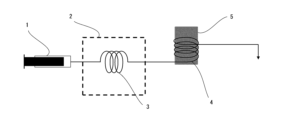
- FIG. 1 is a schematic diagram of the flow reaction system used in the examples.
- the method for producing a 1,3-disubstituted BCP of the present invention in a solvent containing an acyclic ether solvent having 5 or more carbon atoms, [1.1.1]propellane and a 1,2-diketone compound are photoreacted.
- a cyclic ether compound is allowed to coexist in the reaction solution in this photoreaction, whereby the desired 1,3-disubstituted BCP can be obtained with high efficiency.
- the cyclic ether functions as an additive to promote the reaction.
- the non-cyclic ether solvent having 5 or more carbon atoms used in the production method of the present invention preferably has 5 to 10 carbon atoms, more preferably 5 to 8, even more preferably 5 to 7, and further preferably 5 or 6. preferable.
- the addition of the cyclic ether can effectively promote the reaction.
- the acyclic ether solvent having 5 or more carbon atoms is at least one of cyclopentyl methyl ether and methyl tert-butyl ether.
- the solvent used in the production method of the present invention may contain a solvent other than an acyclic ether having 5 or more carbon atoms (solvent other than "acyclic ether having 5 or more carbon atoms”) (excluding cyclic ether compounds).
- Solvents other than acyclic ether solvents having 5 or more carbon atoms are not particularly limited, and can be used as appropriate within a range that does not impair the effects of the present invention.
- Preferred examples of solvents other than acyclic ether solvents having 5 or more carbon atoms include hydrocarbon solvents, among which aliphatic hydrocarbon solvents (eg, hexane, cyclohexane, pentane, heptane, etc.) are preferred.
- the ratio by mass is [acyclic ether solvent having 5 or more carbon atoms]/[non-cyclic ether having 5 or more carbon atoms] solvent] is preferably 1/10 or more, more preferably 1/5 or more, still more preferably 1/2 or more, even more preferably 1/1 or more. That is, the proportion of the non-cyclic ether solvent having 5 or more carbon atoms in the solvent is preferably 50% by mass or more, more preferably 60% by mass or more, and more preferably 65% by mass or more.
- [[1.1.1] propellerane] [1.1.1]propellane can generally be obtained by reacting 1,1-dibromo-2,2-bis(chloromethyl)cyclopropane with an organometallic reagent.
- Alkyllithium, aryllithium, and the like can be widely used as the organometallic compound.
- the reaction itself of reacting 1,1-dibromo-2,2-bis(chloromethyl)cyclopropane with an organometallic reagent to obtain [1.1.1]propellane is already known, and is described, for example, in Chem. Commun. , 2021, Vol. 57, p. 2871-2874 and the like.
- a 1,2-diketone compound is easily cleaved between two carbonyl groups by light energy, and photoreacts with [1.1.1]propellane to produce a 1,3-disubstituted BCP.
- Examples of 1,2-diketone compounds include diacetyl compounds (2,3-butanedione compounds) and glyoxylic acid compounds.
- the term "- compound” means "a compound having a skeleton".
- diacetyl compound is meant to include not only diacetyl itself (2,3-butanedione itself), but also forms in which at least part of the hydrogen atoms of diacetyl are substituted.
- the form in which at least part of the hydrogen atoms of diacetyl are substituted includes forms in which —CH 3 of diacetyl is changed to a structure having an unsaturated bond, such as —CH ⁇ CH 2 and —CN. is.
- the form in which two or three hydrogen atoms of —CH 3 of diacetyl are substituted with substituents also includes a form in which two or three substituents are linked to each other to form a ring.
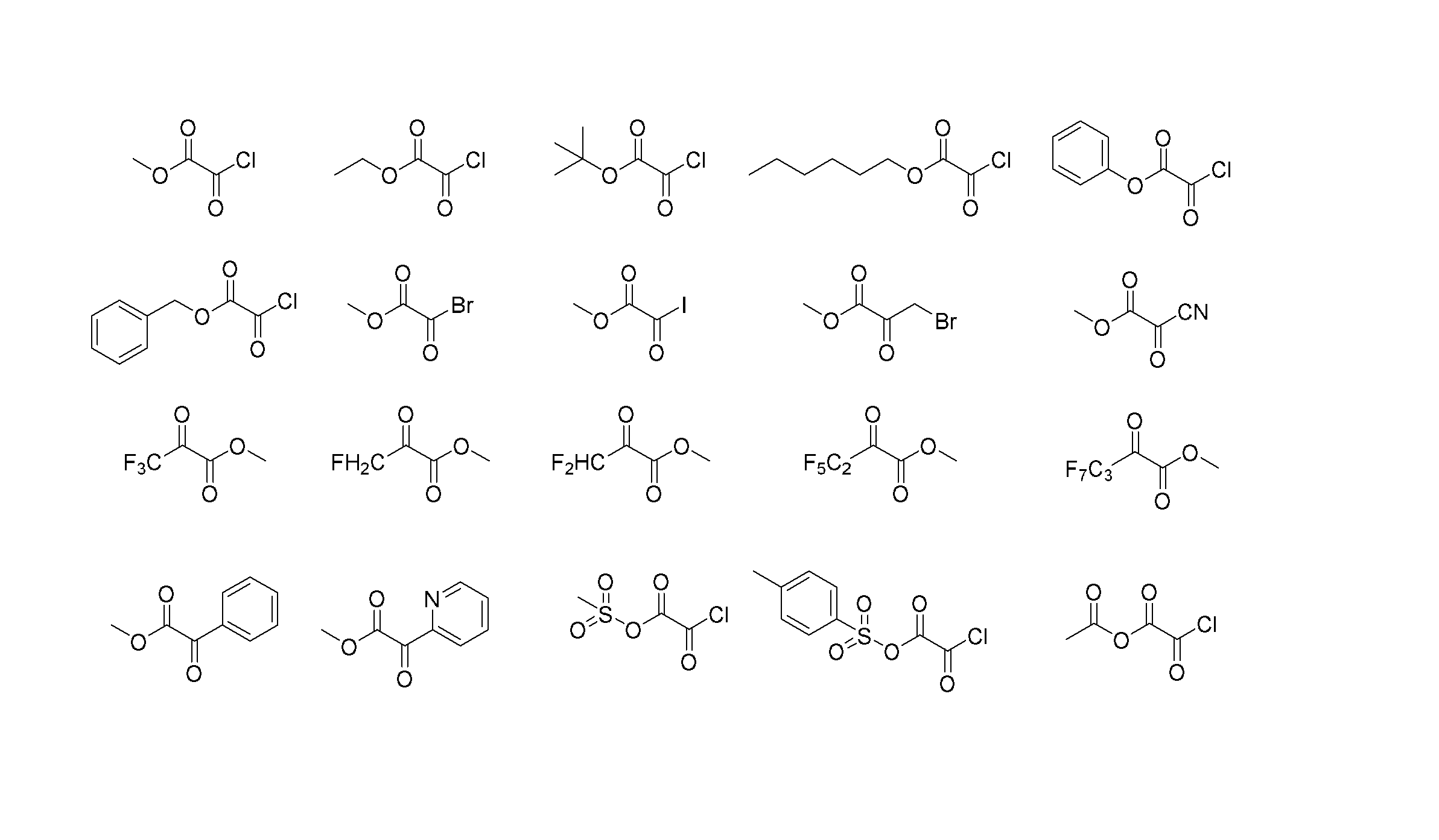
- diacetyl compound Preferred specific examples of the diacetyl compound are shown below.
- D indicates deuterium.
- the cyclic ether compound does not act as a solvent, but functions as a reaction accelerator when added in a small amount. That is, in the production method of the present invention, an acyclic ether solvent having 5 or more carbon atoms is used as the solvent, and the cyclic ether compound is blended as an additive different from the solvent.
- the addition of the cyclic ether compound can markedly accelerate the reaction rate of the photoreaction defined in the present invention, and can effectively increase the yield of the desired 1,3-disubstituted BCP.
- the active species that are cleaved between the two carbonyl groups of the 1,2-diketone compound by light energy are stabilized by the cyclic ether compound, and recombination between the active species is suppressed. is thought to be a factor.
- the addition of various compounds other than the cyclic ether compound does not promote the reaction. That is, in the photoreaction defined in the present invention, the reaction promoting action of the cyclic ether compound is peculiar to the cyclic ether compound, which is not observed in other compounds.
- cyclic ether compounds include tetrahydrofuran (THF) compounds (e.g., tetrahydrofuran (THF), 2-methyltetrahydrofuran (2-methylTHF), 2,5-dihydrofuran, tetrahydrofuran-d8 (deuterated tetrahydrofuran), 3 -methyltetrahydrofuran, 2-hydroxytetrahydrofuran, 2-chlorotetrahydrofuran, etc.), tetrahydropyran, 4-methyltetrahydropyran, furan, 1,4-dioxane, and the like.
- THF compounds are preferred, and at least one of THF and 2-methylTHF is more preferred.
- the content of the cyclic ether compound in the reaction solution is preferably 1 to 50% by mass, more preferably 2 to 40% by mass. More preferably to 35% by mass, more preferably 6 to 30% by mass, more preferably 10 to 25% by mass, even more preferably 12 to 23% by mass, even more preferably 15 to 22% by mass.
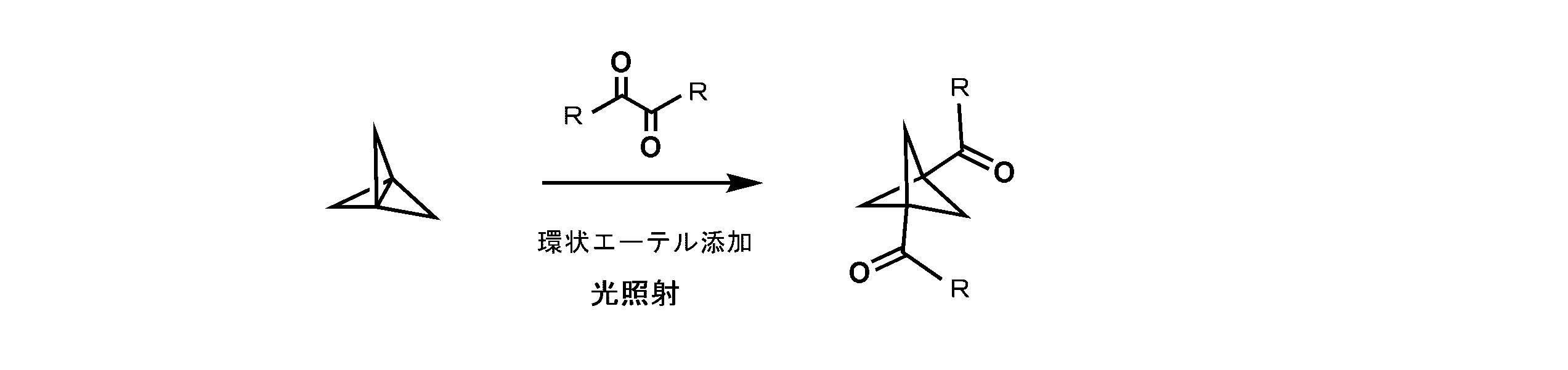
- the photoreaction is a reaction in which [1.1.1]propellane and a 1,2-diketone compound are reacted with light irradiation to produce a 1,3-disubstituted BCP.
- the reaction scheme is as follows.
- R represents a hydrogen atom or a substituent.
- the photoreaction is carried out in a solvent containing an acyclic ether solvent having 5 or more carbon atoms by adding a cyclic ether compound as a reaction accelerator as described above.
- the photoreaction is preferably performed by irradiating light with a wavelength of 300 to 500 nm, more preferably by irradiating light with a wavelength of 320 to 450 nm, and even more preferably by irradiating light with a wavelength of 340 to 430 nm.
- a light source a light emitting diode (LED) lamp, an ultraviolet (UV) lamp, an incandescent lamp (for example, a tungsten lamp), or the like can be used without particular limitation.
- This photoreaction may be carried out as a batch reaction or as a flow reaction. From the viewpoint of light absorption efficiency, a flow reaction is preferred.
- the photoreaction in the flow reaction can be performed using a photoreactor.
- a photoreactor can be constructed, for example, by wrapping a light-transmitting reactor tube around a light source cooling tube.
- a light source is disposed within the light source cooling tube and cooled by water or other solvent.
- the photoreactor is also preferably covered with a reflective material such as aluminum foil to reduce light loss.
- Tetrafluoroethylene-hexafluoropropylene copolymer (FEP) tube, tetrafluoroethylene-perfluoroalkyl vinyl ether copolymer (PFA) tube, and polytetrafluoroethylene (PTFE) tube are used as materials for the light-transmitting reaction tube. etc., but not limited to these, and various materials can be used within a range that does not impair the effects of the present invention.
- [1.1.1]propellane, a 1,2-diketone compound, and a cyclic ether compound are mixed in a solvent containing an acyclic ether solvent having 5 or more carbon atoms to prepare a solution.
- the solution may be pumped into the reaction tube and circulated in the reaction tube.
- a solution of [1.1.1]propellane dissolved in a solvent containing an acyclic ether solvent having 5 or more carbon atoms and a 1,2-diketone compound in a solvent containing an acyclic ether solvent having 5 or more carbon atoms and a solution in which the is dissolved are circulated in different channels, and these are merged, and a photoreaction can be caused by the photoreactor while the combined liquid is flowing downstream.
- a cyclic ether compound as a reaction accelerator is added at the latest before the photoreaction.
- a cyclic ether compound may be included in a [1.1.1]propellane solution, a 1,2-diketone compound solution may be included, or a liquid containing a cyclic ether may be combined before the photoreaction. can be done.
- a reaction mode has been described above, the present invention is not limited to the above forms unless otherwise specified in the present invention. For example, applying a batchwise reaction is also a preferred embodiment of the present invention.
- the reaction temperature of the photoreaction can be, for example, ⁇ 50 to 50° C., preferably ⁇ 30 to 30° C., more preferably ⁇ 20 to 20° C. from the viewpoint of improving the yield. , -10 to 10°C.
- the reaction time of the photoreaction is not particularly limited, and can be appropriately set. For example, it may be 0.001 to 7000 minutes, may be 0.01 to 5000 minutes, or may be 0.1 to 700 minutes.
- reaction molar ratio between [1.1.1]propellane and the 1,2-diketone compound is appropriately adjusted in consideration of stoichiometry and the like.
- [[1.1.1] propellerane]/[1,2-diketone compound] can be 1/0.5 to 1/10, preferably 1/1 to 1/5, and 1/1 ⁇ 1/2 is more preferred.
- the concentrations of [1.1.1]propellane and 1,2-diketone compound in the reaction solution are appropriately set according to the purpose and in consideration of the above reaction molar ratio. be done.
- the [1.1.1]propellane concentration in the reaction solution can be 0.01 to 3 mol/L, preferably 0.1 to 0.5 mol/L.
- Yield in the production method of the present invention Yield of 1,3-disubstituted BCP in the reaction of photoreacting [1.1.1]propellane and 1,2-diketone compound to obtain 1,3-disubstituted BCP
- the ratio that is, [molar amount of 1,3-disubstituted BCP produced]/[molar amount of [1.1.1]propellane as starting material]) is preferably 80% or more, more preferably 85% or more. It is preferably 90% or more, more preferably 92% or more.
- Such high yields can be achieved by adding cyclic ether compounds as reaction accelerators.
- the 1,3-disubstituted BCP produced by the photoreaction can also be separated and purified.
- a general technique can be appropriately applied. For example, column chromatography, recrystallization, reprecipitation, sublimation, etc. can be applied alone or in combination.
- propellerane > 100 mL of cyclopentyl methyl ether (CPME) and 10 g of 1,1-dibromo-2,2-bis(chloromethyl)cyclopropane were placed in a 500 mL three-necked flask and cooled to ⁇ 78° C. under a nitrogen atmosphere. 42 mL of a solution of n-butyllithium dissolved in n-hexane at a concentration of 1.6M was added thereto, and the mixture was stirred for 10 minutes to react. After that, the temperature was raised to 0° C., and the mixture was further stirred for 30 minutes. [1.1.1]propellane was thus obtained in the solvent.
- CPME cyclopentyl methyl ether
- 1,1-dibromo-2,2-bis(chloromethyl)cyclopropane were placed in a 500 mL three-necked flask and cooled to ⁇ 78° C. under a nitrogen atmosphere. 42 mL of
- 1,3-DiacetylBCP was prepared by flow-type reaction.
- the outline of the flow reaction system used is as shown in FIG.
- a stainless steel (SUS316) tube 3 with an inner diameter of 1.0 mm and a length of 1.0 m is arranged in a constant temperature bath 2 set at 0 ° C.
- a PFA tube 4 having a length of 3.0 m was connected.
- the PFA tube 4 was wrapped around the light source cooling pipe 5 .
- An LED (100 W) lamp with a wavelength of 385 nm was arranged in the light source cooling pipe 5 as a light source.
- the temperature of the light source cooling pipe 5 (corresponding to the reaction temperature of the photoreaction) was set at 0.degree.
- a reaction substrate solution 1 is sent by a syringe pump.
- This reaction substrate solution was fed into the channel of the flow reaction system at a flow rate of 1.2 mL/min to produce 1,3-diacetylBCP by photoreaction.
- the reaction time of this photoreaction (circulation time in the PFA tube wound around the light source cooling tube 5) is 5 minutes.
- the yield of 1,3-diacetylBCP by the photoreaction of [1.1.1]propellane and 2,3-butanedione was determined by a nuclear magnetic resonance method (internal standard: biphenyl). rate was calculated. The results are shown in the table below.
- 1,3-diacetylBCP was obtained in the same manner as in Example 1, except that the THF concentration in the reaction substrate solution was changed as shown in the table below. [1.1.1] The yield of 1,3-diacetylBCP by the photoreaction of propellane and 2,3-butanedione is shown in the table below.
- Example 5 ⁇ Preparation of [1.1.1]propellane> in Example 1, except that CPME used in ⁇ Preparation of [1.1.1]propellane> was changed to methyl tert-butyl ether (MTBE). Preparation>, an MTBE/n-hexane solution containing [1.1.1]propellane at a concentration of 0.15 M was obtained.
- MTBE methyl tert-butyl ether
- 1,3-diacetylBCP was obtained in the same manner as in Example 5, except that the THF concentration in the reaction substrate solution was changed as shown in the table below. [1.1.1] The yield of 1,3-diacetylBCP by the photoreaction of propellane and 2,3-butanedione is shown in the table below.
- Example 9 1,3-DiacetylBCP was obtained in the same manner as in Example 1, except that 2-methylTHF was used instead of THF. [1.1.1] The yield of 1,3-diacetylBCP by the photoreaction of propellane and 2,3-butanedione is shown in the table below.
- 1,3-diacetyl BCP was obtained in the same manner as in Example 9, except that the concentration of 2-methylTHF in the reaction substrate solution was changed as shown in the table below. [1.1.1] The yield of 1,3-diacetylBCP by the photoreaction of propellane and 2,3-butanedione is shown in the table below.
- Example 13 In Example 9, instead of the CPME/n-hexane solution containing [1.1.1]propellane at a concentration of 0.15M, [1.1.1]propellane was added at a concentration of 0.15M in the same manner as in Example 5. 1,3-diacetyl BCP was obtained in the same manner as in Example 9, except that the MTBE/n-hexane solution containing in was used. [1.1.1] The yield of 1,3-diacetylBCP by the photoreaction of propellane and 2,3-butanedione is shown in the table below.
- 1,3-diacetyl BCP was obtained in the same manner as in Example 13, except that the concentration of 2-methylTHF in the reaction substrate solution was changed as shown in the table below. [1.1.1] The yield of 1,3-diacetylBCP by the photoreaction of propellane and 2,3-butanedione is shown in the table below.
- Example 17 1 and 3 in the same manner as in Example 1, except that an LED (100 W) lamp with a wavelength of 405 nm was used instead of an LED (100 W) lamp with a wavelength of 385 nm as the light source arranged in the light source cooling tube of the flow reaction system. - gave diacetyl BCP. [1.1.1] The yield of 1,3-diacetylBCP by the photoreaction of propellane and 2,3-butanedione is shown in the table below.
- Example 18 1,3-Diacetyl BCP was obtained in the same manner as in Example 17, except that the THF concentration in the reaction substrate solution was changed as shown in the table below. [1.1.1] The yield of 1,3-diacetylBCP by the photoreaction of propellane and 2,3-butanedione is shown in the table below.
- Example 19 In Example 17, instead of the CPME/hexane solution containing [1.1.1]propellane at a concentration of 0.15M, it contained [1.1.1]propellane at a concentration of 0.15M as in Example 5. 1,3-Diacetyl BCP was obtained in the same manner as in Example 17, except that a MTBE/hexane solution containing 1,3-diacetyl BCP was used. [1.1.1] The yield of 1,3-diacetylBCP by the photoreaction of propellane and 2,3-butanedione is shown in the table below.
- Example 20 In Example 19, 1,3-diacetyl BCP was obtained in the same manner as in Example 19, except that the THF concentration in the reaction substrate solution was changed as shown in the table below. [1.1.1] The yield of 1,3-diacetylBCP by the photoreaction of propellane and 2,3-butanedione is shown in the table below.
- Example 21 1 and 3 in the same manner as in Example 1, except that an LED (100 W) lamp with a wavelength of 385 nm was replaced with an LED (100 W) lamp with a wavelength of 365 nm as the light source arranged in the light source cooling tube of the flow reaction system. - gave diacetyl BCP. [1.1.1] The yield of 1,3-diacetylBCP by the photoreaction of propellane and 2,3-butanedione is shown in the table below.
- 1,3-diacetyl BCP was obtained in the same manner as in Example 21, except that the THF concentration in the reaction substrate solution was changed as shown in the table below. [1.1.1] The yield of 1,3-diacetylBCP by the photoreaction of propellane and 2,3-butanedione is shown in the table below.
- Example 23 In Example 21, instead of the CPME/hexane solution containing [1.1.1]propellane at a concentration of 0.15M, it contained [1.1.1]propellane at a concentration of 0.15M as in Example 5. 1,3-diacetyl BCP was obtained in the same manner as in Example 21, except that an MTBE/hexane solution containing 1,3-diacetyl BCP was used. [1.1.1] The yield of 1,3-diacetylBCP by the photoreaction of propellane and 2,3-butanedione is shown in the table below.
- Example 24 1,3-Diacetyl BCP was obtained in the same manner as in Example 23, except that the THF concentration in the reaction substrate solution was changed as shown in the table below. [1.1.1] The yield of 1,3-diacetylBCP by the photoreaction of propellane and 2,3-butanedione is shown in the table below.
- Comparative Example 11 In Comparative Example 2, the same as Comparative Example 2 except that an LED (100 W) lamp with a wavelength of 405 nm was used instead of an LED (100 W) lamp with a wavelength of 385 nm as the light source arranged in the light source cooling tube of the flow reaction system. to obtain 1,3-diacetyl BCP. [1.1.1] The yield of 1,3-diacetylBCP by the photoreaction of propellane and 2,3-butanedione is shown in the table below.
- Comparative Example 12 In Comparative Example 2, the same as Comparative Example 2 except that an LED (100 W) lamp with a wavelength of 365 nm was used instead of an LED (100 W) lamp with a wavelength of 385 nm as the light source arranged in the light source cooling tube of the flow reaction system. to obtain 1,3-diacetyl BCP. [1.1.1] The yield of 1,3-diacetylBCP by the photoreaction of propellane and 2,3-butanedione is shown in the table below.
- reaction substrate solution (syringe pump) 2 constant temperature bath 3 SUS tube 4 PFA tube 5 light source cooling tube
Landscapes
- Chemical & Material Sciences (AREA)
- Organic Chemistry (AREA)
- Chemical Kinetics & Catalysis (AREA)
- Organic Low-Molecular-Weight Compounds And Preparation Thereof (AREA)
Abstract
Description
[1.1.1]プロペランと1,2-ジケトン化合物とを光反応に付してBCPの1,3-二置換体を得る方法が知られている。例えば1,3-ジアセチルBCPの合成方法として、特許文献1には、[1.1.1]プロペランと2,3-ブタンジオンとを光反応に付す方法が記載されている。また、特許文献2には、[1.1.1]プロペランとグリオキシル酸化合物とを光反応に付して、BCPの1,3-二置換体を得たことが記載されている。
炭素数5以上の非環状エーテル溶媒を含む溶媒中で[1.1.1]プロペランと1,2-ジケトン化合物とを光反応させて1,3-二置換ビシクロ[1.1.1]ペンタンを得るに当たり、反応液に環状エーテル化合物を共存させることを含む、1,3-二置換ビシクロ[1.1.1]ペンタンの製造方法。
〔2〕
上記非環状エーテル溶媒の炭素数が5~10である、〔1〕に記載の1,3-二置換ビシクロ[1.1.1]ペンタンの製造方法。
〔3〕
上記非環状エーテル溶媒の炭素数が5又は6である、〔1〕又は〔2〕に記載の1,3-二置換ビシクロ[1.1.1]ペンタンの製造方法。
〔4〕
上記1,2-ジケトン化合物がジアセチル化合物又はグリオキシル酸化合物である、〔1〕~〔3〕のいずれかに記載の1,3-二置換ビシクロ[1.1.1]ペンタンの製造方法。
〔5〕
上記環状エーテル化合物がテトラヒドロフラン化合物である、〔1〕~〔4〕のいずれかに記載の1,3-二置換ビシクロ[1.1.1]ペンタンの製造方法。
〔6〕
上記光反応を波長200~600nmの光を照射して行う、〔1〕~〔5〕のいずれかに記載の1,3-二置換ビシクロ[1.1.1]ペンタンの製造方法。
〔7〕
上記光反応の反応温度を-50~50℃とする、〔1〕~〔6〕のいずれかに記載の1,3-二置換ビシクロ[1.1.1]ペンタンの製造方法。
本発明の製造方法に用いる炭素数5以上の非環状エーテル溶媒は、その炭素数が5~10であることが好ましく、5~8がより好ましく、5~7がさらに好ましく、5又は6がさらに好ましい。
炭素数5以上の非環状エーテル溶媒を用いることにより、環状エーテルの添加による反応促進作用を効果的に発現させることができる。
炭素数5以上の非環状エーテル溶媒は、シクロペンチルメチルエーテル及びメチルtert-ブチルエーテルの少なくとも1種であることがより好ましい。
[1.1.1]プロペランは、一般的には、1,1-ジブロモ-2,2-ビス(クロロメチル)シクロプロパンと有機金属試薬とを反応させて得ることができる。
有機金属化合物としては、アルキルリチウム、アリールリチウム等を広く用いることができる。
1,1-ジブロモ-2,2-ビス(クロロメチル)シクロプロパンと有機金属試薬とを反応させて[1.1.1]プロペランを得る反応それ自体は、すでに公知であり、例えば、Chem.Commun.,2021年、第57巻、p.2871-2874などを参照することができる。
1,2-ジケトン化合物は、「*-C(=O)-C(=O)-*」構造を有する化合物である。*は連結部位を示す。1,2-ジケトン化合物は、光エネルギーにより2つのカルボニル基の間が切断されやすく、[1.1.1]プロペランと光反応して、1,3-二置換BCPが生成する。
1,2-ジケトン化合物として、ジアセチル化合物(2,3-ブタンジオン化合物)及びグリオキシル酸化合物などが挙げられる。本発明において「~化合物」という場合、「~骨格を有する化合物」を意味する。例えば「ジアセチル化合物」は、ジアセチルそのもの(2,3-ブタンジオンそのもの)に加え、ジアセチルが有する水素原子の少なくとも一部が置換された形態も包含する意味である。ジアセチルが有する水素原子の少なくとも一部が置換された形態には、ジアセチルの-CH3が、-CH=CH2、-CNなどのように、不飽和結合を有する構造に変化した形態を含む意味である。また、ジアセチルの-CH3の2つ又は3つの水素原子が置換基に置き換わった形態には、2つ又は3つの置換基同士が互いに連結して環を形成した形態も含まれる。

本発明において環状エーテル化合物は、溶媒として作用するものではなく、少量で添加されて反応促進剤として機能する。すなわち、本発明の製造方法では溶媒として炭素数5以上の非環状エーテル溶媒が用いられており、環状エーテル化合物は溶媒とは異なる添加剤として配合されるものである。環状エーテル化合物の添加により、本発明で規定する光反応の反応速度を格段に促進することができ、目的の1,3-二置換BCPの収率を効果的に高めることができる。この理由は定かではないが、光エネルギーにより1,2-ジケトン化合物の2つのカルボニル基の間が切断された活性種が環状エーテル化合物により安定化され、活性種同士の再結合が抑制されることが一因と考えられる。後述する実施例に示すように、環状エーテル化合物以外の種々の化合物を添加しても反応促進作用は認められない。すなわち、本発明で規定する光反応において、環状エーテル化合物の反応促進作用は、他の化合物には認められない、環状エーテル化合物に特有のものである。
環状エーテル化合物の好ましい例として、テトラヒドロフラン(THF)化合物(例えば、テトラヒドロフラン(THF)、2-メチルテトラヒドロフラン(2-メチルTHF)、2,5-ジヒドロフラン、テトラヒドロフラン-d8(重水素化テトラヒドロフラン)、3-メチルテトラヒドロフラン、2-ヒドロキシテトラヒドロフラン、2-クロロテトラヒドロフランなど)、テトラヒドロピラン、4-メチルテトラヒドロピラン、フラン、1,4-ジオキサン、などが挙げられる。なかでもTHF化合物が好ましく、THF及び2-メチルTHFの少なくとも1種がより好ましい。
光反応において、反応液(光反応に付される液。反応基質溶液とも称す。)中の環状エーテル化合物の含有量は、1~50質量%が好ましく、2~40質量%がより好ましく、4~35質量%がさらに好ましく、6~30質量%がさらに好ましく、10~25質量%がさらに好ましく、12~23がさらに好ましく、15~22質量%がさらに好ましい。
本発明において光反応は、光照射により、[1.1.1]プロペランと1,2-ジケトン化合物とを反応させて1,3-二置換BCPを生成する反応である。この反応スキームは下記の通りである。Rは水素原子又は置換基を示す。
光反応は、波長300~500nmの光を照射して行うことが好ましく、320~450nmの光を照射して行うことがより好ましく、340~430nmの光を照射して行うことがさらに好ましい。光源として、発光ダイオード(LED)ランプ、紫外線(UV)ランプ、白熱ランプ(例えばタングステンランプ)などを、特に制限なく用いることができる。
この光反応はバッチ式反応で行ってもよく、フロー式反応で行ってもよい。光吸収効率の観点からは、フロー式反応で行うことが好ましい。
また、炭素数5以上の非環状エーテル溶媒を含む溶媒中に[1.1.1]プロペランを溶解した溶液と、炭素数5以上の非環状エーテル溶媒を含む溶媒中に1,2-ジケトン化合物を溶解した溶液とをそれぞれ異なる流路に流通させて、これらを合流し、合流液が下流へと流通中に光反応器により光反応を生じる形態とすることもできる。この反応において、反応促進剤である環状エーテル化合物は遅くとも光反応の前に添加される。例えば、環状エーテル化合物を[1.1.1]プロペラン溶液中に含ませたり、1,2-ジケトン化合物溶液中に含ませたり、光反応の前に環状エーテルを含む液を合流したりすることができる。
上記では反応様式について好ましい形態を説明したが、本発明は、本発明で規定すること以外は、上記の形態に限定されるものではない。例えば、バッチ式反応を適用することも、本発明の好ましい一実施形態である。
光反応の反応温度は、例えば、-50~50℃とすることができ、収率向上の観点からは、-30~30℃とすることが好ましく、-20~20℃とすることがより好ましく、-10~10℃とすることも好ましい。
また、光反応の反応時間は特に制限されず、適宜に設定することができる。例えば、0.001~7000分間とすることができ、0.01~5000分間としてもよく、0.1~700分間としてもよい。
下記スキームに従って1,3-ジアセチルBCPを得た。
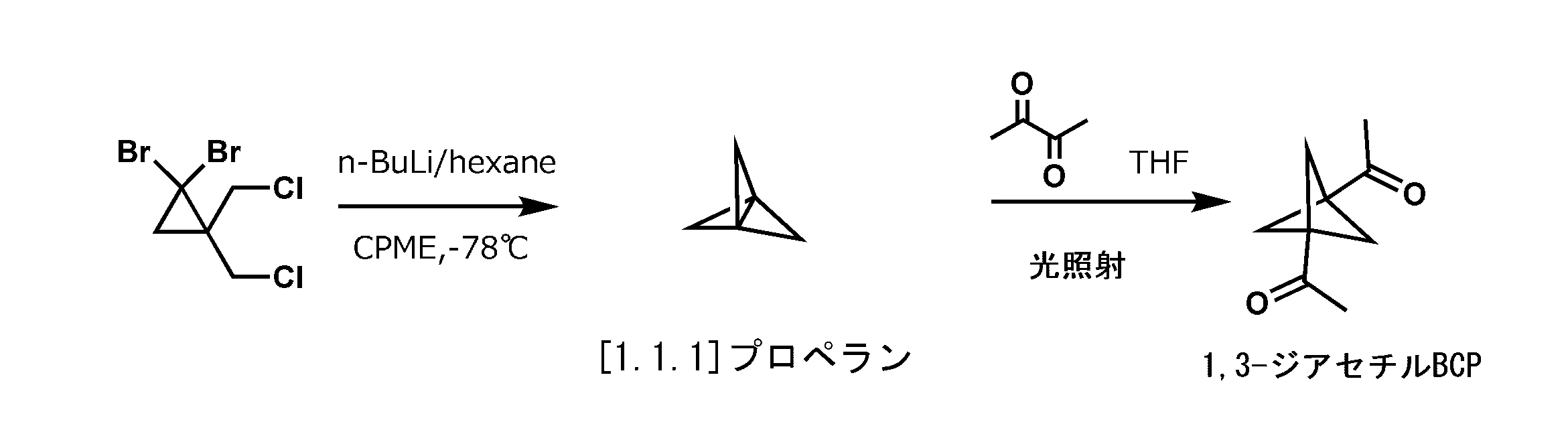
500mLの3つ口フラスコにシクロペンチルメチルエーテル(CPME)を100mL、1,1-ジブロモ-2,2-ビス(クロロメチル)シクロプロパンを10g入れ、窒素雰囲気下で-78℃に冷やした。そこにn-ブチルリチウムを1.6Mの濃度でn-ヘキサンに溶解した溶液を42mL加え、10分攪拌して反応させた。その後0℃に昇温し、更に30分撹拌した。こうして溶媒中に[1.1.1]プロペランを得た。ここに水を30mL添加し、室温(25℃)に昇温後、分液し有機層を得た。有機層を0℃に冷やし、蒸留装置を接続し、受けフラスコを-78℃に冷却して蒸留処理をし、受けフラスコに[1.1.1]プロペランを移行させた。こうして、[1.1.1]プロペランを0.15M濃度で含有するCPME/n-ヘキサン(3.6/1、質量比)溶液を得た。[1.1.1]プロペランの収率は62%であった。[1.1.1]プロペランが得られていることは以下のデータから確認された。
1H-NMR(400MHz、溶媒:DMSO-d6、内部基準物質:テトラメチルシラン(TMS))による化学シフトσ(ppm)=2.04(6H,s)
フロー式反応により1,3-ジアセチルBCPを調製した。使用したフロー式反応システムの概略は図1に示す通りである。このフロー式反応システムは、0℃に設定した恒温槽2内に内径1.0mm、長さ1.0mのステンレス鋼(SUS316)製チューブ3を配し、その下流に、内径1.6mm、長さ3.0mのPFAチューブ4を接続した。このPFAチューブ4は光源冷却管5に巻き付けた状態とした。光源冷却管5内には光源として、波長385nmのLED(100W)ランプを配した。また、光源冷却管5の温度(光反応の反応温度に相当)は0℃とした。反応基質溶液1はシリンジポンプにより送液される。
1H-NMR(400MHz、溶媒:DMSO-d6、内部基準物質:テトラメチルシラン(TMS))による化学シフトσ(ppm)=2.16(6H,s)、2.10(6H,s).
実施例1において、反応基質溶液中のTHF濃度を下表の通りに変更した以外は、実施例1と同様にして1,3-ジアセチルBCPを得た。[1.1.1]プロペランと2,3-ブタンジオンとの光反応による1,3-ジアセチルBCPの収率を下表に示す。
実施例1において、<[1.1.1]プロペランの調製>で用いたCPMEをメチルtert-ブチルエーテル(MTBE)に変えたこと以外は、実施例1における<[1.1.1]プロペランの調製>と同様にして、[1.1.1]プロペランを0.15M濃度で含有するMTBE/n-ヘキサン溶液を得た。
そして、[1.1.1]プロペランを0.15M濃度で含有するCPME/n-ヘキサン溶液に代えて上記の[1.1.1]プロペランを0.15M濃度で含有するMTBE/n-ヘキサン溶液を用いたこと以外は、実施例1における<1,3-ジアセチルBCPの調製>と同様にして1,3-ジアセチルBCPを得た。[1.1.1]プロペランと2,3-ブタンジオンとの光反応による1,3-ジアセチルBCPの収率を下表に示す。
実施例5において、反応基質溶液中のTHF濃度を下表の通りに変更した以外は、実施例5と同様にして1,3-ジアセチルBCPを得た。[1.1.1]プロペランと2,3-ブタンジオンとの光反応による1,3-ジアセチルBCPの収率を下表に示す。
実施例1において、THFに変えて2-メチルTHFを用いたこと以外は、実施例1と同様にして1,3-ジアセチルBCPを得た。[1.1.1]プロペランと2,3-ブタンジオンとの光反応による1,3-ジアセチルBCPの収率を下表に示す。
実施例9において、反応基質溶液中の2-メチルTHF濃度を下表の通りに変更した以外は、実施例9と同様にして1,3-ジアセチルBCPを得た。[1.1.1]プロペランと2,3-ブタンジオンとの光反応による1,3-ジアセチルBCPの収率を下表に示す。
実施例9において、[1.1.1]プロペランを0.15M濃度で含有するCPME/n-ヘキサン溶液に代えて、実施例5と同様に[1.1.1]プロペランを0.15M濃度で含有するMTBE/n-ヘキサン溶液を用いたこと以外は、実施例9と同様にして1,3-ジアセチルBCPを得た。[1.1.1]プロペランと2,3-ブタンジオンとの光反応による1,3-ジアセチルBCPの収率を下表に示す。
実施例13において、反応基質溶液中の2-メチルTHF濃度を下表の通りに変更した以外は、実施例13と同様にして1,3-ジアセチルBCPを得た。[1.1.1]プロペランと2,3-ブタンジオンとの光反応による1,3-ジアセチルBCPの収率を下表に示す。
フロー式反応システムの光源冷却管内に配する光源として、波長385nmのLED(100W)ランプに代えて波長405nmのLED(100W)ランプを配したこと以外は、実施例1と同様にして1,3-ジアセチルBCPを得た。[1.1.1]プロペランと2,3-ブタンジオンとの光反応による1,3-ジアセチルBCPの収率を下表に示す。
実施例17において、反応基質溶液中のTHF濃度を下表の通りに変更した以外は、実施例17と同様にして1,3-ジアセチルBCPを得た。[1.1.1]プロペランと2,3-ブタンジオンとの光反応による1,3-ジアセチルBCPの収率を下表に示す。
実施例17において、[1.1.1]プロペランを0.15M濃度で含有するCPME/ヘキサン溶液に代えて、実施例5と同様に[1.1.1]プロペランを0.15M濃度で含有するMTBE/ヘキサン溶液を用いたこと以外は、実施例17と同様にして1,3-ジアセチルBCPを得た。[1.1.1]プロペランと2,3-ブタンジオンとの光反応による1,3-ジアセチルBCPの収率を下表に示す。
実施例19において、反応基質溶液中のTHF濃度を下表の通りに変更した以外は、実施例19と同様にして1,3-ジアセチルBCPを得た。[1.1.1]プロペランと2,3-ブタンジオンとの光反応による1,3-ジアセチルBCPの収率を下表に示す。
フロー式反応システムの光源冷却管内に配する光源として、波長385nmのLED(100W)ランプに代えて波長365nmのLED(100W)ランプを配したこと以外は、実施例1と同様にして1,3-ジアセチルBCPを得た。[1.1.1]プロペランと2,3-ブタンジオンとの光反応による1,3-ジアセチルBCPの収率を下表に示す。
実施例21において、反応基質溶液中のTHF濃度を下表の通りに変更した以外は、実施例21と同様にして1,3-ジアセチルBCPを得た。[1.1.1]プロペランと2,3-ブタンジオンとの光反応による1,3-ジアセチルBCPの収率を下表に示す。
実施例21において、[1.1.1]プロペランを0.15M濃度で含有するCPME/ヘキサン溶液に代えて、実施例5と同様に[1.1.1]プロペランを0.15M濃度で含有するMTBE/ヘキサン溶液を用いたこと以外は、実施例21と同様にして1,3-ジアセチルBCPを得た。[1.1.1]プロペランと2,3-ブタンジオンとの光反応による1,3-ジアセチルBCPの収率を下表に示す。
実施例23において、反応基質溶液中のTHF濃度を下表の通りに変更した以外は、実施例23と同様にして1,3-ジアセチルBCPを得た。[1.1.1]プロペランと2,3-ブタンジオンとの光反応による1,3-ジアセチルBCPの収率を下表に示す。
実施例1において、反応基質溶液にTHFを配合しなかったこと以外は、実施例1と同様にして1,3-ジアセチルBCPを得た。[1.1.1]プロペランと2,3-ブタンジオンとの光反応による1,3-ジアセチルBCPの収率を下表に示す。
実施例5において、反応基質溶液にTHFを配合しなかったこと以外は、実施例5と同様にして1,3-ジアセチルBCPを得た。[1.1.1]プロペランと2,3-ブタンジオンとの光反応による1,3-ジアセチルBCPの収率を下表に示す。
実施例1において、反応基質溶液にTHFに代えてエチルアセテート(EtOAc)を配合したこと以外は、実施例1と同様にして1,3-ジアセチルBCPを得た。[1.1.1]プロペランと2,3-ブタンジオンとの光反応による1,3-ジアセチルBCPの収率を下表に示す。
比較例3において、反応基質溶液中のエチルアセテート濃度を下表の通りに変更した以外は、比較例3と同様にして1,3-ジアセチルBCPを得た。[1.1.1]プロペランと2,3-ブタンジオンとの光反応による1,3-ジアセチルBCPの収率を下表に示す。
実施例1において、反応基質溶液にTHFに代えてトルエンを配合したこと以外は、実施例1と同様にして1,3-ジアセチルBCPを得た。[1.1.1]プロペランと2,3-ブタンジオンとの光反応による1,3-ジアセチルBCPの収率を下表に示す。
比較例5において、反応基質溶液中のトルエン濃度を下表の通りに変更した以外は、比較例5と同様にして1,3-ジアセチルBCPを得た。[1.1.1]プロペランと2,3-ブタンジオンとの光反応による1,3-ジアセチルBCPの収率を下表に示す。
実施例1において、反応基質溶液にTHFに代えてアセトニトリルを配合したこと以外は、実施例1と同様にして1,3-ジアセチルBCPを得た。[1.1.1]プロペランと2,3-ブタンジオンとの光反応による1,3-ジアセチルBCPの収率を下表に示す。
比較例7において、反応基質溶液中のアセトニトリル濃度を下表の通りに変更した以外は、比較例7と同様にして1,3-ジアセチルBCPを得た。[1.1.1]プロペランと2,3-ブタンジオンとの光反応による1,3-ジアセチルBCPの収率を下表に示す。
実施例1において、反応基質溶液にTHFに代えてアセトンを配合したこと以外は、実施例1と同様にして1,3-ジアセチルBCPを得た。[1.1.1]プロペランと2,3-ブタンジオンとの光反応による1,3-ジアセチルBCPの収率を下表に示す。
比較例9において、反応基質溶液中のアセトン濃度を下表の通りに変更した以外は、比較例9と同様にして1,3-ジアセチルBCPを得た。[1.1.1]プロペランと2,3-ブタンジオンとの光反応による1,3-ジアセチルBCPの収率を下表に示す。
比較例2において、フロー式反応システムの光源冷却管内に配する光源として、波長385nmのLED(100W)ランプに代えて波長405nmのLED(100W)ランプを配したこと以外は、比較例2と同様にして1,3-ジアセチルBCPを得た。[1.1.1]プロペランと2,3-ブタンジオンとの光反応による1,3-ジアセチルBCPの収率を下表に示す。
比較例2において、フロー式反応システムの光源冷却管内に配する光源として、波長385nmのLED(100W)ランプに代えて波長365nmのLED(100W)ランプを配したこと以外は、比較例2と同様にして1,3-ジアセチルBCPを得た。[1.1.1]プロペランと2,3-ブタンジオンとの光反応による1,3-ジアセチルBCPの収率を下表に示す。
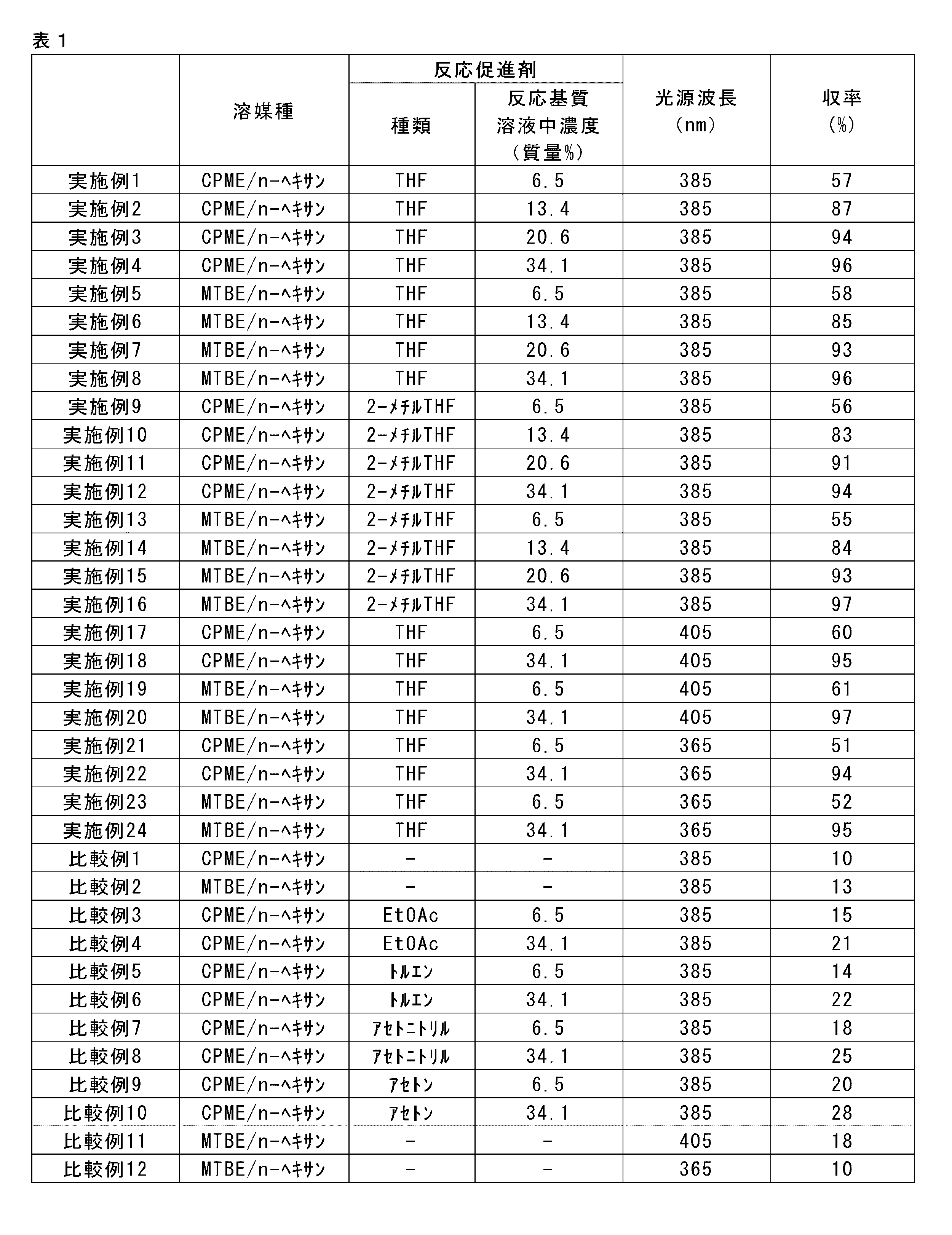
また、反応促進剤として環状エーテル化合物以外の化合物を試した場合、収率の向上作用は認められなかった(比較例3~10)。この結果から、本発明の光反応において、環状エーテル化合物が反応促進剤として突出した作用を示すことがわかる。
2 恒温槽
3 SUSチューブ
4 PFAチューブ
5 光源冷却管
Claims (7)
- 炭素数5以上の非環状エーテル溶媒を含む溶媒中で[1.1.1]プロペランと1,2-ジケトン化合物とを光反応させて1,3-二置換ビシクロ[1.1.1]ペンタンを得るに当たり、反応液に環状エーテル化合物を共存させることを含む、1,3-二置換ビシクロ[1.1.1]ペンタンの製造方法。
- 前記非環状エーテル溶媒の炭素数が5~10である、請求項1に記載の1,3-二置換ビシクロ[1.1.1]ペンタンの製造方法。
- 前記非環状エーテル溶媒の炭素数が5又は6である、請求項1又は2に記載の1,3-二置換ビシクロ[1.1.1]ペンタンの製造方法。
- 前記1,2-ジケトン化合物がジアセチル化合物又はグリオキシル酸化合物である、請求項1~3のいずれか1項に記載の1,3-二置換ビシクロ[1.1.1]ペンタンの製造方法。
- 前記環状エーテル化合物がテトラヒドロフラン化合物である、請求項1~4のいずれか1項に記載の1,3-二置換ビシクロ[1.1.1]ペンタンの製造方法。
- 前記光反応を波長200~600nmの光を照射して行う、請求項1~5のいずれか1項に記載の1,3-二置換ビシクロ[1.1.1]ペンタンの製造方法。
- 前記光反応の反応温度を-50~50℃とする、請求項1~6のいずれか1項に記載の1,3-二置換ビシクロ[1.1.1]ペンタンの製造方法。
Priority Applications (4)
| Application Number | Priority Date | Filing Date | Title |
|---|---|---|---|
| JP2023546896A JP7629106B2 (ja) | 2021-09-13 | 2022-08-30 | 光反応による1,3-二置換ビシクロ[1.1.1]ペンタンの製造方法 |
| EP22867257.2A EP4403546B1 (en) | 2021-09-13 | 2022-08-30 | Method for producing 1,3-disubstituted bicyclo[1.1.1]pentane by photoreaction |
| CN202280057119.5A CN117836263A (zh) | 2021-09-13 | 2022-08-30 | 基于光反应的1,3-二取代双环[1.1.1]戊烷的制造方法 |
| US18/434,869 US20240190800A1 (en) | 2021-09-13 | 2024-02-07 | Method for producing 1,3-disubstituted bicyclo[1.1.1]pentane by photoreaction |
Applications Claiming Priority (2)
| Application Number | Priority Date | Filing Date | Title |
|---|---|---|---|
| JP2021-148842 | 2021-09-13 | ||
| JP2021148842 | 2021-09-13 |
Related Child Applications (1)
| Application Number | Title | Priority Date | Filing Date |
|---|---|---|---|
| US18/434,869 Continuation US20240190800A1 (en) | 2021-09-13 | 2024-02-07 | Method for producing 1,3-disubstituted bicyclo[1.1.1]pentane by photoreaction |
Publications (1)
| Publication Number | Publication Date |
|---|---|
| WO2023037935A1 true WO2023037935A1 (ja) | 2023-03-16 |
Family
ID=85506688
Family Applications (1)
| Application Number | Title | Priority Date | Filing Date |
|---|---|---|---|
| PCT/JP2022/032638 Ceased WO2023037935A1 (ja) | 2021-09-13 | 2022-08-30 | 光反応による1,3-二置換ビシクロ[1.1.1]ペンタンの製造方法 |
Country Status (5)
| Country | Link |
|---|---|
| US (1) | US20240190800A1 (ja) |
| EP (1) | EP4403546B1 (ja) |
| JP (1) | JP7629106B2 (ja) |
| CN (1) | CN117836263A (ja) |
| WO (1) | WO2023037935A1 (ja) |
Citations (6)
| Publication number | Priority date | Publication date | Assignee | Title |
|---|---|---|---|---|
| JP2007022921A (ja) * | 2005-07-12 | 2007-02-01 | Tosoh Finechem Corp | メチルリチウム溶液およびその製造方法 |
| CN105294442A (zh) * | 2014-06-03 | 2016-02-03 | 上海合全药物研发有限公司 | 一种双环[1.1.1]戊烷-1,3-二羧酸二甲酯的制备方法 |
| JP2019510012A (ja) | 2016-03-14 | 2019-04-11 | スピロケム アーゲーSpirochem Ag | 置換ビシクロ[1.1.1]ペンタンを調製する方法 |
| JP2020533330A (ja) | 2017-09-11 | 2020-11-19 | リキュリウム アイピー ホールディングス リミテッド ライアビリティー カンパニー | 二環式化合物を作製するための連続フロープロセス |
| WO2020248126A1 (zh) * | 2019-06-11 | 2020-12-17 | 吉林凯莱英医药化学有限公司 | 1,1'-二环[1.1.1]戊烷-1,3-二乙基酮类有机物的连续化合成方法 |
| JP2021148842A (ja) | 2020-03-16 | 2021-09-27 | キヤノン株式会社 | トナー |
Family Cites Families (2)
| Publication number | Priority date | Publication date | Assignee | Title |
|---|---|---|---|---|
| WO2017115671A1 (ja) * | 2015-12-28 | 2017-07-06 | 日本ゼオン株式会社 | シクロペンチルアルキルエーテル化合物の製造方法 |
| CN110204431A (zh) * | 2019-06-11 | 2019-09-06 | 吉林凯莱英医药化学有限公司 | 1,1’-二环[1.1.1]戊烷-1,3-二乙基酮类有机物的连续化合成方法 |
-
2022
- 2022-08-30 CN CN202280057119.5A patent/CN117836263A/zh active Pending
- 2022-08-30 EP EP22867257.2A patent/EP4403546B1/en active Active
- 2022-08-30 JP JP2023546896A patent/JP7629106B2/ja active Active
- 2022-08-30 WO PCT/JP2022/032638 patent/WO2023037935A1/ja not_active Ceased
-
2024
- 2024-02-07 US US18/434,869 patent/US20240190800A1/en active Pending
Patent Citations (6)
| Publication number | Priority date | Publication date | Assignee | Title |
|---|---|---|---|---|
| JP2007022921A (ja) * | 2005-07-12 | 2007-02-01 | Tosoh Finechem Corp | メチルリチウム溶液およびその製造方法 |
| CN105294442A (zh) * | 2014-06-03 | 2016-02-03 | 上海合全药物研发有限公司 | 一种双环[1.1.1]戊烷-1,3-二羧酸二甲酯的制备方法 |
| JP2019510012A (ja) | 2016-03-14 | 2019-04-11 | スピロケム アーゲーSpirochem Ag | 置換ビシクロ[1.1.1]ペンタンを調製する方法 |
| JP2020533330A (ja) | 2017-09-11 | 2020-11-19 | リキュリウム アイピー ホールディングス リミテッド ライアビリティー カンパニー | 二環式化合物を作製するための連続フロープロセス |
| WO2020248126A1 (zh) * | 2019-06-11 | 2020-12-17 | 吉林凯莱英医药化学有限公司 | 1,1'-二环[1.1.1]戊烷-1,3-二乙基酮类有机物的连续化合成方法 |
| JP2021148842A (ja) | 2020-03-16 | 2021-09-27 | キヤノン株式会社 | トナー |
Non-Patent Citations (2)
| Title |
|---|
| CHEM. COMMUN., vol. 57, 2021, pages 2871 - 2874 |
| See also references of EP4403546A4 |
Also Published As
| Publication number | Publication date |
|---|---|
| EP4403546A1 (en) | 2024-07-24 |
| EP4403546B1 (en) | 2026-03-04 |
| CN117836263A (zh) | 2024-04-05 |
| EP4403546A4 (en) | 2025-01-22 |
| JPWO2023037935A1 (ja) | 2023-03-16 |
| JP7629106B2 (ja) | 2025-02-12 |
| US20240190800A1 (en) | 2024-06-13 |
Similar Documents
| Publication | Publication Date | Title |
|---|---|---|
| JP2018119010A (ja) | エポキシドからアクリレートの生成のためのプロセス | |
| Okamoto | Synthetic Reactions Using Low‐valent Titanium Reagents Derived from Ti (OR) 4 or CpTiX3 (X= O‐i‐Pr or Cl) in the Presence of Me3SiCl and Mg | |
| NO20020650L (no) | Fremgangsmåte til kondensasjon av aldehyder med ketoner ved flerfasereaksjon | |
| Rosales et al. | Ti-catalyzed homolytic opening of ozonides: a sustainable C–C bond-forming reaction | |
| CN111118529A (zh) | 一种无隔膜电化学氧化二卤化炔烃合成α,α-二溴酮类化合物的方法 | |
| Chatani et al. | Conversion of alkyl acetates to (siloxymethylene) alkanes by dicobalt octacarbonyl-catalyzed reaction with a hydrosilane and carbon monoxide | |
| WO2023037935A1 (ja) | 光反応による1,3-二置換ビシクロ[1.1.1]ペンタンの製造方法 | |
| Ando et al. | Reactions of enolates with vinyl selenoxides and vinyl selenones. One-step synthesis of cyclopropylcarbonyl compounds. | |
| JP2000336152A (ja) | 片末端に官能基を有するジシクロペンタジエンの開環重合体及びその製造法 | |
| Maury et al. | A flexible, stereoselective dimethylzinc-mediated radical-anionic cascade: dramatic influence of additional Lewis acids | |
| Shimizu et al. | Aryl vinyl selenoxide as a versatile reagent for transfer of an ethylene unit to enolates. New synthetic method of formation of cyclopropyl ketones | |
| Song et al. | Tungsten Promoted Decarboxylative Oxygenation and Ring-Opening via Ligand-to-Metal Charge Transfer | |
| EP0351336B1 (fr) | Procédé de préparation d'hydroxybenzaldéhydes par hydrocarbonylation | |
| Kim et al. | Visible-light Photoredox Catalyzed Giese Reaction of 1, 3-Dithiane using Silicon as a Radical Precursor | |
| CN112299996B (zh) | 一种手性α-氘代酮的合成方法 | |
| Cohen | I. Experimental studies of gamma-intramolecular hydrogen abstraction in alkylperoxy radicals and decomposition of the resulting 1, 3-hydroperoxyalkyl radicals. II. Dynamic effects in moderately exothermic reactions | |
| JPS597712B2 (ja) | γ−ラクトン誘導体の製造法 | |
| Salamon-Krokosz et al. | Shapiro and Bamford-Stevens reactions--revisited. | |
| CN120271403A (zh) | 一种手性苄胺类化合物的合成方法 | |
| Zimmerman et al. | . sigma.-. pi. Interaction. Cyclopropyl-. pi.-methane rearrangement. Mechanistic and exploratory organic photochemistry | |
| JP6846738B2 (ja) | 環状アルキル基を有する有機ケイ素化合物の製造方法 | |
| JP5692812B2 (ja) | 不斉合成触媒用配位子及びそれを用いたα−アルケニル環状化合物の製造方法 | |
| CN119707988A (zh) | 一种具有抗病毒活性的多环喹唑啉酮衍生物的合成方法 | |
| JP2003183266A (ja) | 新規液状エポキシ化合物およびその製造方法 | |
| CN120040327A (zh) | 一种芳基乙烯的反马氏氢硒化方法 |
Legal Events
| Date | Code | Title | Description |
|---|---|---|---|
| 121 | Ep: the epo has been informed by wipo that ep was designated in this application |
Ref document number: 22867257 Country of ref document: EP Kind code of ref document: A1 |
|
| WWE | Wipo information: entry into national phase |
Ref document number: 2023546896 Country of ref document: JP |
|
| WWE | Wipo information: entry into national phase |
Ref document number: 202280057119.5 Country of ref document: CN |
|
| WWE | Wipo information: entry into national phase |
Ref document number: 2022867257 Country of ref document: EP |
|
| NENP | Non-entry into the national phase |
Ref country code: DE |
|
| ENP | Entry into the national phase |
Ref document number: 2022867257 Country of ref document: EP Effective date: 20240415 |
|
| WWG | Wipo information: grant in national office |
Ref document number: 2022867257 Country of ref document: EP |