WO2023045385A1 - Procédé de traitement de données et dispositif associé - Google Patents
Procédé de traitement de données et dispositif associé Download PDFInfo
- Publication number
- WO2023045385A1 WO2023045385A1 PCT/CN2022/095948 CN2022095948W WO2023045385A1 WO 2023045385 A1 WO2023045385 A1 WO 2023045385A1 CN 2022095948 W CN2022095948 W CN 2022095948W WO 2023045385 A1 WO2023045385 A1 WO 2023045385A1
- Authority
- WO
- WIPO (PCT)
- Prior art keywords
- aggregation
- memory
- storage node
- data
- storage
- Prior art date
- Legal status (The legal status is an assumption and is not a legal conclusion. Google has not performed a legal analysis and makes no representation as to the accuracy of the status listed.)
- Ceased
Links
Images


Classifications
-
- G—PHYSICS
- G06—COMPUTING OR CALCULATING; COUNTING
- G06F—ELECTRIC DIGITAL DATA PROCESSING
- G06F12/00—Accessing, addressing or allocating within memory systems or architectures
- G06F12/02—Addressing or allocation; Relocation
-
- G—PHYSICS
- G06—COMPUTING OR CALCULATING; COUNTING
- G06F—ELECTRIC DIGITAL DATA PROCESSING
- G06F11/00—Error detection; Error correction; Monitoring
- G06F11/07—Responding to the occurrence of a fault, e.g. fault tolerance
- G06F11/16—Error detection or correction of the data by redundancy in hardware
- G06F11/20—Error detection or correction of the data by redundancy in hardware using active fault-masking, e.g. by switching out faulty elements or by switching in spare elements
-
- G—PHYSICS
- G06—COMPUTING OR CALCULATING; COUNTING
- G06F—ELECTRIC DIGITAL DATA PROCESSING
- G06F11/00—Error detection; Error correction; Monitoring
- G06F11/07—Responding to the occurrence of a fault, e.g. fault tolerance
- G06F11/16—Error detection or correction of the data by redundancy in hardware
- G06F11/20—Error detection or correction of the data by redundancy in hardware using active fault-masking, e.g. by switching out faulty elements or by switching in spare elements
- G06F11/2053—Error detection or correction of the data by redundancy in hardware using active fault-masking, e.g. by switching out faulty elements or by switching in spare elements where persistent mass storage functionality or persistent mass storage control functionality is redundant
- G06F11/2094—Redundant storage or storage space
-
- G—PHYSICS
- G06—COMPUTING OR CALCULATING; COUNTING
- G06F—ELECTRIC DIGITAL DATA PROCESSING
- G06F3/00—Input arrangements for transferring data to be processed into a form capable of being handled by the computer; Output arrangements for transferring data from processing unit to output unit, e.g. interface arrangements
- G06F3/06—Digital input from, or digital output to, record carriers, e.g. RAID, emulated record carriers or networked record carriers
- G06F3/0601—Interfaces specially adapted for storage systems
- G06F3/0602—Interfaces specially adapted for storage systems specifically adapted to achieve a particular effect
- G06F3/061—Improving I/O performance
-
- G—PHYSICS
- G06—COMPUTING OR CALCULATING; COUNTING
- G06F—ELECTRIC DIGITAL DATA PROCESSING
- G06F3/00—Input arrangements for transferring data to be processed into a form capable of being handled by the computer; Output arrangements for transferring data from processing unit to output unit, e.g. interface arrangements
- G06F3/06—Digital input from, or digital output to, record carriers, e.g. RAID, emulated record carriers or networked record carriers
- G06F3/0601—Interfaces specially adapted for storage systems
- G06F3/0628—Interfaces specially adapted for storage systems making use of a particular technique
- G06F3/0655—Vertical data movement, i.e. input-output transfer; data movement between one or more hosts and one or more storage devices
-
- G—PHYSICS
- G06—COMPUTING OR CALCULATING; COUNTING
- G06F—ELECTRIC DIGITAL DATA PROCESSING
- G06F3/00—Input arrangements for transferring data to be processed into a form capable of being handled by the computer; Output arrangements for transferring data from processing unit to output unit, e.g. interface arrangements
- G06F3/06—Digital input from, or digital output to, record carriers, e.g. RAID, emulated record carriers or networked record carriers
- G06F3/0601—Interfaces specially adapted for storage systems
- G06F3/0628—Interfaces specially adapted for storage systems making use of a particular technique
- G06F3/0655—Vertical data movement, i.e. input-output transfer; data movement between one or more hosts and one or more storage devices
- G06F3/0659—Command handling arrangements, e.g. command buffers, queues, command scheduling
-
- G—PHYSICS
- G06—COMPUTING OR CALCULATING; COUNTING
- G06F—ELECTRIC DIGITAL DATA PROCESSING
- G06F3/00—Input arrangements for transferring data to be processed into a form capable of being handled by the computer; Output arrangements for transferring data from processing unit to output unit, e.g. interface arrangements
- G06F3/06—Digital input from, or digital output to, record carriers, e.g. RAID, emulated record carriers or networked record carriers
- G06F3/0601—Interfaces specially adapted for storage systems
- G06F3/0668—Interfaces specially adapted for storage systems adopting a particular infrastructure
- G06F3/067—Distributed or networked storage systems, e.g. storage area networks [SAN], network attached storage [NAS]
-
- G—PHYSICS
- G06—COMPUTING OR CALCULATING; COUNTING
- G06F—ELECTRIC DIGITAL DATA PROCESSING
- G06F3/00—Input arrangements for transferring data to be processed into a form capable of being handled by the computer; Output arrangements for transferring data from processing unit to output unit, e.g. interface arrangements
- G06F3/06—Digital input from, or digital output to, record carriers, e.g. RAID, emulated record carriers or networked record carriers
- G06F3/0601—Interfaces specially adapted for storage systems
- G06F3/0668—Interfaces specially adapted for storage systems adopting a particular infrastructure
- G06F3/0671—In-line storage system
- G06F3/0673—Single storage device
- G06F3/0674—Disk device
- G06F3/0676—Magnetic disk device
-
- G—PHYSICS
- G06—COMPUTING OR CALCULATING; COUNTING
- G06F—ELECTRIC DIGITAL DATA PROCESSING
- G06F3/00—Input arrangements for transferring data to be processed into a form capable of being handled by the computer; Output arrangements for transferring data from processing unit to output unit, e.g. interface arrangements
- G06F3/06—Digital input from, or digital output to, record carriers, e.g. RAID, emulated record carriers or networked record carriers
- G06F3/0601—Interfaces specially adapted for storage systems
- G06F3/0628—Interfaces specially adapted for storage systems making use of a particular technique
- G06F3/0629—Configuration or reconfiguration of storage systems
- G06F3/0631—Configuration or reconfiguration of storage systems by allocating resources to storage systems
-
- G—PHYSICS
- G06—COMPUTING OR CALCULATING; COUNTING
- G06F—ELECTRIC DIGITAL DATA PROCESSING
- G06F3/00—Input arrangements for transferring data to be processed into a form capable of being handled by the computer; Output arrangements for transferring data from processing unit to output unit, e.g. interface arrangements
- G06F3/06—Digital input from, or digital output to, record carriers, e.g. RAID, emulated record carriers or networked record carriers
- G06F3/0601—Interfaces specially adapted for storage systems
- G06F3/0628—Interfaces specially adapted for storage systems making use of a particular technique
- G06F3/0655—Vertical data movement, i.e. input-output transfer; data movement between one or more hosts and one or more storage devices
- G06F3/0656—Data buffering arrangements
Definitions
- the present application relates to the field of storage technology, and in particular to a data processing method, device, storage node, computer-readable storage medium, and computer program product.
- the industry also proposed an erasure code (erasure code, EC) algorithm.
- the EC algorithm means that for N pieces of original data, M pieces of verification data are added, and any N pieces of data in the N+M pieces of data can be restored to N pieces of original data.
- N+M copies of data are distributed and stored in different storage nodes or hard disks, failure of M storage nodes or hard disks can be tolerated.
- the EC algorithm only needs to add M copies of verification data for N copies of data, instead of storing multiple backups, which greatly improves the user's available capacity per unit storage space (also known as disk acquisition rate) ).
- the greater the EC ratio the proportion of original data, that is, N/(N+M)
- the EC algorithm has high reliability and disk acquisition rate, its performance is poor when dealing with small random reads and writes (such as small block random reads and writes or small object random reads and writes).
- small random reads and writes such as small block random reads and writes or small object random reads and writes.
- IO input and output
- aggregation policy with fixed parameters to aggregate IO requests. For example, multiple small IO requests are aggregated using a fixed aggregation waiting time (specifically, the longest time for IO requests in memory to wait for aggregation, and the aggregation will be abandoned if the time exceeds this time).
- a fixed aggregation waiting time specifically, the longest time for IO requests in memory to wait for aggregation, and the aggregation will be abandoned if the time exceeds this time.
- performance of the memory of a storage node in a distributed storage system may be affected by at least one factor.
- the input bandwidth of the memory (the bandwidth for writing the received IO request to the memory) is greater than the output bandwidth of the memory (the bandwidth for persistently storing the IO request in the memory), using
- the aggregation strategy with fixed parameters such as the aggregation strategy during the off-peak period, aggregates the IO requests in the memory, which can cause the memory to be filled quickly.
- at least one of the multiple storage nodes used to form the memory pool in the distributed storage system fails, resulting in a reduction in the capacity of the memory pool. If an aggregation strategy with fixed parameters is used, such as the aggregation strategy before the failure occurs, Aggregating multiple small IO requests can cause the memory pool to be easily filled. This affects the overall performance of the distributed storage system.
- the present application provides a data processing method, which adjusts the aggregation strategy adaptively, and aggregates small IO requests into large IO requests according to the adjusted aggregation strategy, thereby avoiding the impact of small IO requests on the performance of the entire distributed storage system Influence, and avoid aggregation according to the aggregation strategy with fixed parameters, which will cause the memory to be filled up quickly, which will affect the overall performance of the distributed storage system.
- the present application also provides devices, devices, computer-readable storage media, and computer program products corresponding to the above methods.
- the present application provides a data processing method, which can be executed by a storage node.
- the storage node acquires parameters related to the performance of the memory of the storage node, adaptively adjusts the aggregation strategy according to the parameters related to the performance of the memory of the storage node, and according to the adjusted strategy, multiple small
- the IO requests (may be referred to as the first IO request) are aggregated into a large IO request (may be referred to as the second IO request), and the data corresponding to the large IO request is stored persistently.
- storage nodes avoid the impact of small IO requests on the performance of the entire distributed storage system by aggregating small IO requests into large IO requests; Threshold (compared with the data volume of the data corresponding to the IO request to determine whether the IO request participates in the aggregation), the aggregated stripe size (the maximum data volume of the data corresponding to the aggregated IO request) and the number of aggregated concurrency (starting the persistent One or more of the aggregation parameters such as the maximum number of IO requests for permanent storage), so as to avoid the aggregation according to the aggregation strategy with fixed parameters causing the memory to be filled quickly, thereby affecting the overall performance of the distributed storage system.
- Threshold compared with the data volume of the data corresponding to the IO request to determine whether the IO request participates in the aggregation
- the aggregated stripe size the maximum data volume of the data corresponding to the aggregated IO request
- the number of aggregated concurrency starting the persistent One or more of the aggregat
- the parameter related to the memory performance of the storage node includes fault information of other storage nodes belonging to a cluster with the storage node.
- the parameters related to the performance of the memory of the storage node may also include the input bandwidth of the memory and the output bandwidth of the memory, wherein the input bandwidth is the bandwidth at which the storage node writes the received IO request into the memory, and the output bandwidth is the bandwidth at which the storage node writes the received IO request into the memory. Bandwidth when IO requests are made to persistent storage.
- the parameters related to the performance of the memory of the storage node may not only include the above fault information, but also include the input bandwidth of the memory and the output bandwidth of the memory.
- the storage node can adaptively adjust the aggregation strategy according to the above information, so as to ensure the performance of the memory of the storage node, and then ensure the overall performance of the distributed storage system. performance.
- the aggregation strategy includes one or more of aggregation threshold, aggregation waiting time, aggregation stripe size, and aggregation concurrency. According to different obtained parameters related to the performance of the storage node, the storage node may perform different adjustment methods.
- the storage node can lower the aggregation threshold, so that more IO requests can be written through to avoid the memory from being quickly filled.
- write-through refers to writing directly to the storage pool without participating in aggregation.
- the storage node can also increase the number of concurrent aggregations to speed up the aggregation progress, so that the data in the memory can be quickly aggregated and stored in the storage pool.
- the storage node may prolong the aggregation waiting time, increase the aggregation stripe size, and/or reduce the aggregation concurrency number. In this way, more duplicate data can be merged to improve aggregation efficiency.
- repeated data refers to data at the same address or in the same range.
- the storage node can increase the aggregation concurrency number, shorten the aggregation waiting time, reduce the aggregation stripe size, and/or increase Larger than the aggregation threshold.
- increasing the number of concurrent aggregations can improve the ability to write to the storage pool from memory; shortening the aggregation waiting time and reducing the size of the aggregation stripes can write data to the storage pool in a timely manner; reducing the aggregation threshold can increase the ability to write to the memory The probability that an IO request is directly written to the storage pool without being aggregated.
- the storage node may also obtain access characteristics of the received IO requests, and classify the IO requests according to the access characteristics. Correspondingly, the storage node aggregates first IO requests of various categories into second IO requests.
- the method classifies IO requests according to access characteristics, and then aggregates different types of IO requests separately, which can significantly reduce the impact of garbage collection caused by aggregation on system performance.
- the access characteristic includes access times of the data requested to be accessed within a statistical period, and/or a latest access time of the data.
- the number of visits and/or the latest visit time may be used to characterize the popularity of the data.
- the storage node may classify the IO requests into multiple categories according to the number of times the data is accessed within a statistical period and/or the latest access time of the data.
- the access times of the data corresponding to the IO requests of the first category in the multiple categories are higher than the access times of the data corresponding to the IO requests of the second category in the multiple categories, or the first category of the multiple categories
- the latest access time of the data corresponding to the IO request of the category is later than the latest access time of the data corresponding to the IO request of the second category among the plurality of categories.
- hot data is accessed more frequently than cold data, and accordingly, the probability of hot data being modified is higher than that of cold data. Based on this, the storage node can also adjust the aggregation strategy based on the access characteristics of the received IO requests.
- the storage node may adjust the aggregation policy to: the aggregate waiting time of the IO requests of the first type is greater than the aggregate waiting time of the IO requests of the second type, and/or, the IO requests of the first type
- the aggregated stripe size of is greater than the aggregated stripe size of the IO requests of the second category.
- the data corresponding to hot IO requests can be cached for a longer period of time, so that redundant data can be effectively merged and aggregation efficiency improved.
- the storage node may use an EC algorithm to persistently store the data corresponding to the second IO request.
- the storage node may split the data corresponding to the second IO request to obtain N pieces of source data, where N is a positive integer greater than 1, and then the storage node determines M pieces of verification data according to the N pieces of source data. data, the M is a positive integer greater than 1, and then the storage node persistently stores one of the N source data and the M verification data locally, and sends the data to the The N+M-1 target storage nodes of a cluster respectively forward the remaining N+M-1 copies of data for persistent storage. Wherein, the storage node sends a copy of data to each target storage node.
- the forwarding paths between the storage node and the N+M-1 target storage nodes satisfy a preset condition. For example, when the storage node and N+M-1 target storage nodes are placed in the same rack or connected to the same router, the forwarding path between the storage node and the N+M-1 target storage nodes is greatly shortened. When the forwarding path is shorter than the preset length, it may be determined that the forwarding path satisfies the preset condition. The storage node forwards according to the forwarding path, which can greatly reduce the network overhead.
- the embodiment of the present application provides a data processing device.
- the devices include:
- a parameter acquisition module configured to acquire parameters related to the performance of the memory of the storage node
- a strategy management module configured to adjust an aggregation strategy according to the parameters, where the aggregation strategy is used to aggregate input and output IO requests in the memory;
- An aggregation module configured to aggregate the first IO request in the memory into a second IO request according to the adjusted aggregation strategy
- a storage module configured to persistently store the data corresponding to the second IO request.
- the parameters related to the memory performance of the storage node include failure information of other storage nodes belonging to a cluster with the storage node and/or the input bandwidth of the memory and the The output bandwidth of the memory, the input bandwidth is the bandwidth at which the storage node writes the received IO request into the memory, and the output bandwidth is when the storage node persistently stores the IO request in the memory bandwidth.
- the aggregation policy includes one or more of aggregation threshold, aggregation waiting time, aggregation stripe size and aggregation concurrency number;
- the policy management module is specifically used for:
- the policy management module is specifically used for:
- the policy management module When obtaining fault information of other storage nodes belonging to a cluster with the storage node, the policy management module is specifically used for:
- the parameter collection module is also used for:
- the device also includes:
- a classification module configured to classify the IO requests according to the access characteristics
- the aggregation module is specifically used for:
- the access characteristic includes the number of access times of the data requested for access within a statistical period, and/or the latest access time of the data;
- the classification module is specifically used for:
- the IO requests are divided into multiple categories, and the IO requests of the first category in the multiple categories correspond to the highest number of accesses
- the number of visits corresponding to the IO request of the second category in the plurality of categories, or the latest access time corresponding to the IO request of the first category in the plurality of categories is later than the IO request of the second category in the plurality of categories The corresponding most recent access time.
- the aggregated waiting time of the IO requests of the first type is greater than the aggregated waiting time of the IO requests of the second type, and/or, the aggregated stripes of the IO requests of the first type The aggregated stripe size of the IO request whose size is larger than the second category.
- the storage module is specifically used for:
- the N+M-1 copies of data are persistently stored, each node sends a copy of the data, and the forwarding path between the storage node and the N+M-1 target storage nodes satisfies a preset condition.
- the present application provides a storage node, where the storage node includes a processor and a memory.
- the processor and the memory communicate with each other.
- the processor is configured to execute the computer-readable instructions stored in the memory, so that the storage node executes the data processing method in the first aspect or any implementation manner of the first aspect.
- the present application provides a computer-readable storage medium, where an instruction is stored in the computer-readable storage medium, and the instruction instructs the storage node to execute the above-mentioned first aspect or any implementation manner of the first aspect. data processing method.
- the present application provides a computer program product containing instructions, which, when running on a storage node, causes the storage node to execute the data processing method described in the first aspect or any implementation manner of the first aspect .
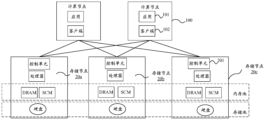
- FIG. 1 is a system architecture diagram of a distributed storage system provided by an embodiment of the present application
- FIG. 2 is a system architecture diagram of a distributed storage system provided by an embodiment of the present application.
- FIG. 3 is a flow chart of a data processing method provided in an embodiment of the present application.
- FIG. 4 is a flowchart of a data processing method provided in an embodiment of the present application.
- FIG. 5 is a schematic structural diagram of a data processing device provided by an embodiment of the present application.
- first and second in the embodiments of the present application are used for description purposes only, and cannot be understood as indicating or implying relative importance or implicitly indicating the quantity of indicated technical features. Thus, a feature defined as “first” and “second” may explicitly or implicitly include one or more of these features.
- a distributed storage system refers to a system that stores data dispersedly on multiple independent storage nodes.
- Traditional network storage systems use centralized storage arrays to store all data.
- the performance of storage arrays is not only the bottleneck of system performance, but also the focus of reliability and security, which cannot meet the needs of large-scale storage applications.
- the distributed storage system adopts a scalable system structure and uses multiple storage nodes to share the storage load. It not only improves the reliability, availability and access efficiency of the system, but is also easy to expand.
- the architecture is specifically a structured storage (memory fabric, MF) architecture.
- the distributed storage system includes computing node clusters and storage node clusters.
- the computing node cluster includes one or more computing nodes 100 (two computing nodes 100 are shown in FIG. 1 , but not limited to two computing nodes 100).
- the computing node 100 is a computing device on the user side, such as a server, a desktop computer, and the like.
- the computing node 100 is provided with a processor and a memory (not shown in FIG. 1 ).
- an application program (application) 101 (application for short) and a client program 102 (client for short) run on the computing node 100 .
- Application 101 is a general term for various application programs presented to the user.
- the client 102 is configured to receive a data access request triggered by the application 101, interact with the storage node 20, and send the data access request, also referred to as an IO request, to the storage node 20.
- the client 102 is also used to receive data from the storage node and forward the data to the application 101 . It can be understood that, when the client 102 is a software program, the functions of the client 102 are implemented by the processor included in the computing node 100 running the program in the memory. Client 102 may also be implemented by hardware components located inside compute node 100 . Any client 102 in the computing node cluster can access any storage node 20 in the storage node cluster.
- the storage node cluster includes one or more storage nodes 20 (three storage nodes 20 are shown in FIG. 1 , but not limited to three storage nodes 20 ), and each storage node 20 may be interconnected.
- Storage nodes are servers, desktop computers, or controllers of storage arrays, hard disk enclosures, and so on. Functionally, the storage node 20 is mainly used for computing or processing data.
- the storage node cluster further includes a management node (not shown in FIG. 1 ). The management node is used to create and manage memory pools.
- Each storage node 20 elects a node from the storage nodes to assume the function of the management node. The management node can communicate with any storage node 20 .
- the storage node 20 includes at least a processor, a memory, and a control unit.
- the processor is a central processing unit (central processing unit, CPU), used for processing data from outside the storage node 20, or data generated inside the storage node 20.
- Storage refers to a device used to store data, which can be a memory or a hard disk.
- the control unit is used for reading data from the memory (such as a hard disk) or writing data into the memory according to the read/write data request. In the process of reading and writing data, the control unit needs to convert the address carried in the read/write data request into an address that can be recognized by the memory.
- Memory refers to the internal memory that directly exchanges data with the processor. It can read and write data at any time, and the speed is very fast. It is used as a temporary data storage for the operating system or other running programs.
- Memory includes at least two kinds of memory, for example, memory can be either random access memory (Random Access Memory, RAM) or read-only memory (Read Only Memory, ROM).
- RAM Random Access Memory
- ROM Read Only Memory
- the random access memory can be Dynamic Random Access Memory (Dynamic Random Access Memory, DRAM), Storage Class Memory (Storage Class Memory, SCM) or Static Random Access Memory (Static Random Access Memory, SRAM), etc.
- the read-only memory can be Programmable Read Only Memory (Programmable Read Only Memory, PROM), Erasable Programmable Read Only Memory (Erasable Programmable Read Only Memory, EPROM), etc.
- the memory can also be a dual in-line memory module or a dual-line memory module (Dual In-line Memory Module, DIMM for short), that is, a module composed of dynamic random access memory (DRAM).
- DIMM Dual In-line Memory Module
- DRAM and SCM are taken as examples for illustration, but it does not mean that the storage node 20 does not include other types of memories.
- hard disks can read and write data slower than memory, and are usually used to store data persistently.
- the storage node 20a as an example, one or more hard disks may be installed inside; or, a hard disk enclosure may be mounted outside the storage node 20a, and multiple hard disks may be installed in the hard disk enclosure. Regardless of the deployment method, these hard disks can be regarded as hard disks included in the storage node 20a.
- the hard disk type is solid state hard disk, mechanical hard disk, or other types of hard disk.
- other storage nodes in the storage node cluster such as the storage node 20b and the storage node 20c, may also include various types of hard disks.
- One storage node 20 may contain one or more storages of the same type.
- the storage node 20 and the computing node 100 may also be integrated into the same physical device.
- the above-mentioned integrated devices are collectively referred to as storage nodes.
- the application is deployed inside the storage node 20, so the application can directly trigger a data write request or a data read request through the client in the storage node 20, which is processed by the storage node 20, or sent to other storage nodes 20 for processing.
- the read and write data request sent by the client to the local storage node 20 specifically means that the client sends a data access request to the processor.
- the components included in the storage node 20 such as an IO controller
- their functions are similar to the components (such as a control unit) included in the storage node 20 in FIG. 1 , and will not be repeated here.
- the storage node 20 adopts a disk-control-integrated structure.
- the control unit 201 or the IO controller receives the IO request, and can temporarily store the data requested by the IO in the memory. When the total amount of data in the memory reaches a certain threshold, the control unit 201 or the IO controller sends the data stored in the memory to Provide persistent storage to the hard disk.
- the storage node 20 may also adopt a structure in which disk control is separated. Specifically, the hard disk is usually placed in the hard disk enclosure, and the control unit 201 or the IO controller can communicate with the hard disk enclosure through the network, so as to store data in the hard disk.
- Each storage node 20 includes different types of storage media, such as DRAM, SCM, and hard disk, and these different types of storage media provide memory interfaces and can be directly accessed by the processor. And the various types of memory included in these storage nodes can form a memory pool. Data in the memory pool can be swapped in and out between different types of storage media according to the frequency of access.
- the memory pool may only include some types of storage, for example, only include high-performance storage, such as DRAM and SCM, and exclude relatively low-performance storage such as hard disks.
- the management node can also construct a storage pool with lower-performance memories (such as hard disks) in the storage cluster. Similar to the memory pool, the storage pool also spans at least two storage nodes, and its storage space is formed by one or more types of hard disks in the at least two storage nodes.
- the storage pool is used for persistently storing data, especially data with low access frequency, while the memory pool is used for temporary storage of data, especially for data with high access frequency data.
- the memory pool can also be called a cache pool. Specifically, when the amount of data stored in the memory pool reaches a set threshold, part of the data in the memory pool will be written into the storage pool for storage.
- the industry proposes an EC algorithm to replace the three-copy storage mode for data storage, so as to improve the disk acquisition rate.
- the EC algorithm has high reliability and a high disk acquisition rate, but its performance is poor when dealing with small random reads and writes (such as small block random reads and writes or small object random reads and writes).
- small random reads and writes such as small block random reads and writes or small object random reads and writes.
- the larger the EC ratio the more large random reads and writes will be split into multiple small random reads and writes, which will have a greater impact on the performance of the entire storage system.
- the data corresponding to the IO requests can be cached, and then the IO requests can be aggregated, and the data corresponding to the aggregated IO requests can be stored persistently.
- the impact on the performance of the storage system can be reduced by aggregating IO requests.
- the write success notification can be returned, thereby reducing the delay.
- the IO requests are usually aggregated using an aggregation policy with fixed parameters. For example, a fixed aggregation waiting time is used to aggregate multiple small IO requests.
- performance of the memory of a storage node in a distributed storage system may be affected by at least one factor. For example, when the business changes from a low-peak period to a peak period, the input bandwidth of the memory (the bandwidth for writing the received IO request to the memory) is greater than the output bandwidth of the memory (the bandwidth for persistently storing the IO request in the memory), using The aggregation strategy with fixed parameters, such as the aggregation strategy during the off-peak period, aggregates the IO requests in the memory, which can cause the memory to be filled quickly.
- At least one of the multiple storage nodes used to form the memory pool in the distributed storage system fails, resulting in a reduction in the capacity of the memory pool. If an aggregation strategy with fixed parameters is used, such as the aggregation strategy before the failure occurs, Aggregating multiple small IO requests can cause the memory pool to be easily filled. This affects the overall performance of the distributed storage system.
- an embodiment of the present application provides a data processing method, and the method may be executed by a storage node (for example, the storage node 20 in FIG. 1 or FIG. 2 ).
- the storage node acquires parameters related to the performance of the memory of the storage node, adaptively adjusts the aggregation strategy according to the parameters related to the performance of the memory of the storage node, and according to the adjusted strategy, multiple small
- the IO requests (may be referred to as the first IO request) are aggregated into a large IO request (may be referred to as the second IO request), and the data corresponding to the large IO request is stored persistently.
- storage nodes avoid the impact of small IO requests on the performance of the entire distributed storage system by aggregating small IO requests into large IO requests; Threshold (compared with the data volume of the data corresponding to the IO request to determine whether the IO request participates in the aggregation), the aggregated stripe size (the maximum data volume of the data corresponding to the aggregated IO request) and the number of aggregated concurrency (starting the persistent One or more of the aggregation parameters such as the maximum number of IO requests for permanent storage), so as to avoid the aggregation according to the aggregation strategy with fixed parameters causing the memory to be filled quickly, thereby affecting the overall performance of the distributed storage system.
- Threshold compared with the data volume of the data corresponding to the IO request to determine whether the IO request participates in the aggregation
- the aggregated stripe size the maximum data volume of the data corresponding to the aggregated IO request
- the number of aggregated concurrency starting the persistent One or more of the aggregat
- the method includes:
- the storage node 20 acquires parameters related to the performance of the memory of the storage node 20 .
- the performance of the memory is related to indicators such as the capacity of the memory and the water level of the memory (the proportion of data written into the memory).
- the input bandwidth of the memory and the output bandwidth of the memory may affect the water level of the memory, based on this, the parameters related to the performance of the memory of the storage node 20 may include the input bandwidth of the memory and the output bandwidth of the memory.
- the memory of the storage node 20 can form a memory pool with the memory of other storage nodes belonging to a cluster.
- the parameters related to the memory performance of the storage node 20 may include failure information of other storage nodes belonging to a cluster with the storage node 20 .
- the fault information may be, for example, the node ID and memory capacity of the faulty node.
- the storage node 20 may acquire fault information of other storage nodes belonging to a cluster with the storage node 20, and/or acquire input bandwidth of memory and output bandwidth of memory. The following describes how the storage node 20 acquires fault information of other storage nodes and acquires the input bandwidth of the memory and the output bandwidth of the memory.
- the storage node 20 may obtain fault information of other storage nodes from the management node of the cluster.
- the management node of the cluster can manage the health status of the storage nodes belonging to the cluster.
- the storage nodes belonging to the cluster can periodically send heartbeat messages to the management node to inform the management node of the health status of the storage node.
- the management node may determine that the storage node is faulty, and record the fault information, which includes, for example, the node identifier and content capacity of the faulty storage node.
- the storage node 20 may obtain the above fault information from the management node.
- the storage node 20 may acquire fault information from the management node at preset time intervals. Wherein, the preset time interval may be equal to the reporting cycle of the above-mentioned heartbeat message, or may be an integer multiple of the above-mentioned reporting cycle.
- the storage node 20 can periodically count the information of the IO requests written into the memory (also referred to as foreground IO) and the IO requests written into the storage by the memory (i.e. the IO requests for persistent storage from the memory, also referred to as the background IO) information. According to different storage formats of the data corresponding to the above-mentioned IO requests, the information collected by the storage node 20 may be different.
- the IO request written to the memory may include a key-value pair formed by the object name and object data.
- the storage node 20 may collect information such as object names, accessed object ranges, and read/write delays according to the IO request.
- the range of the object to be accessed may be represented by an address within the object, for example, the size of the object is 10 megabytes (megabytes, MB), and the range of the object to be accessed may be 6th to 8th MB.
- the storage node 20 can obtain the amount of data written into the memory in the statistical period according to the information of the IO request written into the memory (for example, a memory pool), such as the scope of the access object, and according to the ratio of the amount of data to the statistical cycle, Determines the input bandwidth of the memory.
- the storage node 20 can obtain the amount of data written to the storage within the statistical period according to the information of the IO request written into the storage (for example, a storage pool), and determine the output bandwidth of the memory according to the ratio of the data amount to the statistical period.
- the statistical period can be set according to experience values, for example, it can be set to 10 seconds (second, s).
- the data processing method of the present application is also applicable to data stored in blocks.
- the information of the IO request collected by the storage node 20 may include one or more of access address, access length, read/write time, and access delay.
- the storage node 20 can obtain the amount of data written into the memory within the statistical period according to the access length of the IO requests written into the memory within the statistical period, and determine the input bandwidth of the memory according to the ratio of the data amount to the statistical period.
- the storage node 20 may determine the output bandwidth of the memory in a manner similar to determining the input bandwidth of the memory, which will not be repeated here.
- the storage node 20 adjusts the aggregation strategy according to the parameters related to the memory performance of the storage node 20 .
- the aggregation strategy is used to aggregate the IO requests in the memory.
- the aggregation strategy may include one or more of aggregation parameters such as aggregation waiting time, aggregation threshold, aggregation stripe size, and aggregation concurrent number. The following describes in detail how to adjust the aggregation strategy under different parameter conditions.
- the input bandwidth is greater than the output bandwidth
- the storage node 20 can lower the aggregation threshold, so that more IO requests can be written through, so as to avoid the memory from being quickly filled.
- write-through refers to writing directly to the storage pool without participating in aggregation.
- the storage node 20 can also increase the number of concurrent aggregations to speed up the aggregation progress, so that the data in the memory can be quickly aggregated and stored in the storage pool. It should be noted that, the storage node 20 may perform the above adjustment operation when the water level of the internal memory reaches a preset water level.
- the input bandwidth is smaller than the output bandwidth
- the storage node 20 may extend the aggregation waiting time, increase the aggregation stripe size, and/or reduce the aggregation concurrency number. In this way, more duplicate data can be merged to improve aggregation efficiency.
- repeated data refers to data at the same address or in the same range. For ease of understanding, this embodiment of the present application is described in conjunction with a specific example. Assume that the aggregate waiting time before adjustment is 1s, and the adjusted aggregation waiting time is 2s.
- the 2s When the 1st s includes an IO request in the 6-8MB range of an object A with a size of 10MB, the 2s also includes the above object
- the IO requests in the range of 6 to 8MB, the data corresponding to these two IO requests are duplicate data, and the aggregation efficiency can be improved by merging duplicate data.
- the storage node 20 increases the number of concurrent aggregations, shortens the aggregation waiting time, and reduces the size of the aggregation stripes, and/or increase the aggregation threshold.
- increasing the number of concurrent aggregations can improve the ability to write to the storage pool from memory; shortening the aggregation waiting time and reducing the size of the aggregation stripes can write data to the storage pool in a timely manner; reducing the aggregation threshold can increase the ability to write to the memory The probability that an IO request is directly written to the storage pool without being aggregated.
- the storage node 20 can set a basic adjustment range for each parameter, and then based on the difference between the input bandwidth of the memory and the output bandwidth of the memory and the memory capacity of the failed storage node At least one, to determine the adjustment factor.
- the storage node 20 determines the adjustment range for each aggregation parameter based on the above adjustment coefficient and the basic adjustment range.
- the bandwidth difference and the adjustment coefficient may be positively correlated, and the larger the bandwidth difference is, the larger the adjustment coefficient is, and the larger the adjustment range of the aggregation parameter is.
- the memory capacity of the failed storage node and the adjustment coefficient may also be positively correlated, the greater the memory capacity of the failed storage node, the greater the adjustment range for the aggregation parameter.
- the storage node 20 can maintain the current aggregation strategy.
- S306 The storage node 20 aggregates the first IO request in the memory into a second IO request according to the adjusted aggregation policy.
- the storage node 20 can compare the data volume of the data corresponding to the IO request in the memory with the aggregation threshold, and when the data volume is greater than the aggregation threshold (for example, the adjusted aggregation threshold), it can write through the data in the IO request. Data, when the amount of data is less than or equal to the aggregation threshold, the IO request can be added to the aggregation queue.
- the aggregation threshold for example, the adjusted aggregation threshold
- the storage node 20 can obtain multiple aggregation requests from the aggregation queue according to the number of concurrent aggregations.
- the waiting time of the aggregation request with the earliest arrival time in memory among the multiple aggregation requests reaches the aggregation waiting time (for example, the adjusted aggregation waiting time)
- the sum of the data volumes of the data corresponding to multiple aggregation requests reaches the size of the aggregation stripe (for example, the adjusted size of the aggregation stripe)
- the multiple aggregation requests currently obtained can be aggregated, thereby realizing the first IO
- the requests are aggregated into a second IO request.
- the first IO request may be an IO request in the aggregation queue, usually a small IO request
- the second IO request may be an aggregated IO request, usually a large IO request.
- the storage node 20 may also record metadata of the data corresponding to the second IO request. For example, when the data is stored by an object, the storage node 20 may record the object name of the data corresponding to the second IO request and the range of the accessed object, so that the above-mentioned data can be quickly accessed subsequently according to the metadata. In other embodiments, when the data is stored in blocks, the storage node 20 may record the block identifier and block address of the data corresponding to the second IO request.
- the storage node 20 persistently stores the data corresponding to the second IO request.
- the storage node 20 may use the EC algorithm to persistently store the data corresponding to the second IO request. Specifically, the storage node 20 may split the data corresponding to the second IO request to obtain N pieces of source data, where N is a positive integer greater than 1. Then, the storage node 20 may determine M pieces of verification data according to the N pieces of source data, where M is a positive integer greater than 1. Next, the storage node 20 may locally store persistently one of the N shares of source data and the M shares of verification data, and send the data to the N+M-1 clusters belonging to the same cluster as the storage node. The target storage nodes respectively forward the remaining N+M-1 copies of data for persistent storage. Wherein, the storage node 20 sends a copy of data to each of the N+M-1 target storage nodes, and the data sent to each target storage node is different, so that distributed data storage can be realized.
- the distributed storage system uses a high ratio of EC algorithms for data storage, the distributed storage system will have more network forwarding, which will lead to increased network overhead. For this reason, the storage node 20 can write the remaining N+M-1 copies of data into N+M-1 target storage nodes whose forwarding path between the storage node 20 and the storage node 20 meets the preset conditions for persistent storage. Each target storage node stores one piece of data in the remaining N+M-1 pieces of data.
- the forwarding path with the storage node 20 may be used to characterize the affinity with the storage node 20, and the shorter the forwarding path, the higher the affinity. Based on this, the storage node 20 may also forward the remaining N+M-1 copies of data to the N+M-1 target storage nodes whose affinity with the storage node 20 meets the requirement for persistent storage.
- the N+M-1 target storage nodes whose forwarding path satisfies the preset condition or the affinity meets the requirements may be the N+M-1 target storage nodes located in the same rack as the storage node 20, or connected to the storage node 20 To N+M-1 target storage nodes of the same router. In this way, the length of the forwarding path can be reduced, thereby reducing network overhead.
- the storage node 20 can be a main object storage device OSD (Object-based Storage, device), and the main OSD can divide the aggregated large object into M source objects, and generate N source objects according to the M source objects. Validation object.
- OSD Object-based Storage, device
- the main OSD can generate object IDs for the above-mentioned large objects through the object ID generator, and then can use the above-mentioned object IDs as input, combined with the routing algorithm and the topology (also called view) of the distributed storage system to determine that the source object and the verification object need to be forwarded Nodes, such as OSD1, OSD2, ..., OSD N+M-1, the master OSD can calculate the affinity between the master OSD and OSD1 to OSD N+M-1 that needs to be forwarded.
- the main OSD can regenerate the object ID, and re-determine the source object and the node to be forwarded to the verification object through the routing algorithm and the topology of the distributed storage system, and calculate the main Affinity between OSDs and re-identified OSDs.
- the main OSD can forward the M source objects and N check objects to the above-mentioned nodes whose affinity meets the requirements, so as to reduce network overhead.
- the main OSD can also set the maximum number of retries.
- the number of retries of the main OSD reaches the above-mentioned maximum number of retries, and the affinity still cannot meet the requirements, it can also select an affinity from multiple groups of nodes determined by the main OSD. The node with the best compatibility is forwarded, which can reduce network overhead.
- the object storage format when persistently storing the data corresponding to the second IO request, the object storage format may be used for storage.
- format conversion may also be performed on the data, for example, format conversion is performed based on a storage protocol of object storage to obtain an object. In this way, the storage node 20 can persistently store the above objects based on the EC algorithm.
- the heat of data corresponding to different IO requests may be different.
- the storage node 20 may also classify the IO requests according to the heat of the data requested to be accessed, and separate the data for different types of IO requests. to aggregate. Since the data accessed by IO requests of the same type are quite popular, there is a high probability that garbage collection (garbage collection, GC) will be performed at the same time period. Among them, garbage collection refers to re-aggregating the remaining valid data when some data in the aggregated data written to the storage pool is modified or deleted, resulting in invalid storage space, so as to reclaim the storage space of the original aggregated data. This can significantly improve the efficiency of garbage collection, thereby reducing the impact of garbage collection on system performance caused by aggregation.
- the method includes:
- the storage node 20 acquires parameters related to performance of memory of the storage node.
- the storage node 20 adjusts the aggregation policy according to parameters related to the memory performance of the storage node.
- the storage node 20 acquires the access characteristic of the received IO request.
- the access characteristic of the IO request may include the number of access times of the requested data within a statistical period, and/or the latest access time of the data.
- the storage node 20 may obtain the IO requests received within the statistical period, and determine the access times of the requested data within the statistical period and/or the latest access time of the data according to the information carried in the IO requests.
- the IO request received by the storage node 20 can carry the object name and the range of the accessed object, and the storage node 20 can count the number of visits of the same object in different ranges according to the object name, or count the same object. At least one access time for different scopes of the object, and determining the most recent access time for each scope from the at least one access time for each scope of the same object.
- S408 The storage node 20 classifies the IO requests according to the access characteristics.
- Access characteristics such as the number of visits and/or the latest access time can be used to characterize the popularity of data.
- the heat of data can be characterized by quantitative heat value or qualitative heat level.
- the thermal level may include two levels of hot and cold, or may include three levels of hot, warm, and cold.
- the temperature level can be further subdivided, for example, the temperature level can include five levels: extremely hot, hot, warm, cold, and extremely cold.
- the storage node 20 can obtain the access times of each data within the statistical period, input the times into the popularity function, and obtain the function value, and the function value is the popularity value of the above data.
- the storage node 20 may also determine the heat level based on the above heat value. For example, if the hotness value of the data is less than a preset threshold, it is determined that the data is cold data, and if the hotness value of the data is greater than the preset threshold, then it is determined that the data is hot data.
- the storage node 20 may classify the IO requests according to the popularity of the requested data. For example, the storage node 20 may classify the data into two categories according to the heat degree: cold and hot; and for another example, the storage node 20 may classify the data into three types: cold, warm, and hot according to the heat degree. This embodiment does not limit the number of categories.
- S410 The storage node 20 aggregates first IO requests of each category into second IO requests according to the adjusted aggregation policy.
- the storage node 20 may respectively maintain a corresponding aggregation queue for each type of IO request. Specifically, the storage node can compare the amount of data corresponding to each type of IO request with the aggregation threshold, and when the amount of data is greater than the aggregation threshold (for example, the adjusted aggregation threshold), it can write through the data in the IO request. Data, when the amount of data is less than or equal to the aggregation threshold, the IO request can be added to the aggregation queue corresponding to this category.
- the aggregation threshold for example, the adjusted aggregation threshold
- the storage node 20 may take out IO requests from the aggregation queues corresponding to each category for aggregation, so as to aggregate the first IO requests of each category into second IO requests.
- IO requests For the aggregation process, reference may be made to the relevant content description of the embodiment shown in FIG. 3 , and details are not repeated here.
- the storage node 20 may also adjust the aggregation policy in consideration of the access characteristics of the received IO request.
- the access times of the data corresponding to the IO requests of the first category in the multiple categories are higher than the access times of the data corresponding to the IO requests of the second category in the multiple categories, or the first category of the multiple categories
- the latest access time of the data corresponding to the IO request is later than the latest access time of the data corresponding to the IO request of the second category among the plurality of categories, that is, the data corresponding to the IO request of the first category is more popular than that of the second category
- the heat of the IO request, the storage node 20 can set the aggregate waiting time of the IO request of the first category to be greater than the aggregate waiting time of the IO request of the second category, or set the aggregate stripe size of the IO request of the first category to be greater than the The aggregated stripe size of the second category of IO requests.
- the storage node 20 may also set the aggregate waiting time of the IO requests of the first category to be greater than the aggregate waiting time of the IO requests of the second category, and the aggregated stripe size of the IO requests of the first category is greater than that of the second category The aggregated stripe size of the IO request.
- the storage node 20 can extend the aggregation waiting time for hot IO requests and increase the size of the aggregation stripes, so that the data corresponding to the hot IO requests can be cached for a period of time. Efficiently merge redundant data. For extremely hot data, the storage node 20 can even cache it for a long time without writing it into the storage pool, so as to reduce overhead.
- the device 500 includes: a parameter collection module 502 , a policy management module 504 , an aggregation module 506 and a storage module 508 .
- the parameter acquisition module 502 is used to execute the method steps corresponding to S302 in the embodiment shown in FIG. 3
- the policy management module 504 is used to execute the method steps corresponding to S304 in the embodiment shown in FIG.
- the storage module 508 is configured to execute the method steps corresponding to S308 in the embodiment shown in FIG. 3 .
- the aggregation strategy includes one or more of the aggregation threshold, aggregation waiting time, aggregation stripe size, and aggregation concurrency number.
- the policy management module 504 For the adjustment process of the above aggregation strategy by the policy management module 504, please refer to S304. Content description.
- the apparatus 500 may further include a classification module.
- the parameter acquisition module 502 is also used to execute the method steps corresponding to S406 in the embodiment shown in FIG. 4
- the classification module is used to execute the method steps corresponding to S408 in the embodiment shown in FIG. Execute the method steps corresponding to S410 in the embodiment shown in FIG. 4 .
- the access characteristics include the number of access times of the data requested for access within a statistical period, and/or the latest access time of the data, and the classification module is used to perform the corresponding Method steps for classifying IO requests.
- the apparatus 500 may also adjust the aggregation policy in combination with the access characteristics, for example, it may be adjusted to: the aggregated waiting time of the IO requests of the first category is greater than the aggregated waiting time of the IO requests of the second category , and/or, the aggregated stripe size of the IO requests of the first category is larger than the aggregated stripe size of the IO requests of the second category.
- the storage module 508 is configured to execute the method steps corresponding to S308 in the embodiment shown in FIG. 3 , so as to reduce network overhead generated by using a high-proportion EC algorithm for persistent storage.
- the data processing device 500 may correspond to the implementation of the method described in the embodiment of the present application, and the above-mentioned and other operations and/or functions of the various modules/units of the data processing device 500 are respectively in order to realize Fig. 3 and Fig. 4
- the corresponding processes of the various methods in the illustrated embodiments are not repeated here.
- the embodiment of the present application also provides a storage node 20 .
- the storage node 20 may be a terminal device such as a laptop computer or a desktop computer, or may be a server in a cloud environment or an edge environment.
- the storage node 20 is specifically used to implement the functions of the data processing apparatus 500 in the embodiment shown in FIG. 5 .
- the storage node 20 can include a processor and a memory, and the memory stores computer-readable instructions, the The processor executes the computer-readable instructions, so that the storage node 20 executes the data processing method described in the foregoing embodiments (or implements the functions of the foregoing data processing apparatus 500).
- each module of the data processing device 500 described in FIG. 5 may be stored in the memory.
- the processor executes the program code stored in the memory, so that the storage node 20 executes the aforementioned data processing method.
- the embodiment of the present application also provides a computer-readable storage medium.
- the computer-readable storage medium may be any available medium that a computing device can store, or a data storage device such as a data center that includes one or more available media.
- the available media may be magnetic media (eg, floppy disk, hard disk, magnetic tape), optical media (eg, DVD), or semiconductor media (eg, solid state hard disk), etc.
- the computer-readable storage medium includes instructions, and the instructions instruct a computing device or a cluster of computing devices to execute the above-mentioned data processing method.
- the embodiment of the present application also provides a computer program product.
- the computer program product includes one or more computer instructions. When the computer instructions are loaded and executed on the computing device, the processes or functions according to the embodiments of the present application will be generated in whole or in part.
- the computer instructions may be stored in or transmitted from one computer-readable storage medium to another computer-readable storage medium, for example, from a website, computing device, or data center via Wired (eg, coaxial cable, fiber optic, digital subscriber line (DSL)) or wireless (eg, infrared, wireless, microwave, etc.) transmission to another website site, computing device, or data center.
- Wired eg, coaxial cable, fiber optic, digital subscriber line (DSL)
- wireless eg, infrared, wireless, microwave, etc.
- the computer program product may be a software installation package, which may be downloaded and executed on a computing device or a cluster of computing devices if any of the aforementioned data processing methods is required.
Landscapes
- Engineering & Computer Science (AREA)
- Theoretical Computer Science (AREA)
- Physics & Mathematics (AREA)
- General Engineering & Computer Science (AREA)
- General Physics & Mathematics (AREA)
- Human Computer Interaction (AREA)
- Quality & Reliability (AREA)
- Information Retrieval, Db Structures And Fs Structures Therefor (AREA)
Abstract
Priority Applications (2)
| Application Number | Priority Date | Filing Date | Title |
|---|---|---|---|
| EP22871446.5A EP4394573B1 (fr) | 2021-09-23 | 2022-05-30 | Procédé de traitement de données et dispositif associé |
| US18/614,046 US12530118B2 (en) | 2021-09-23 | 2024-03-22 | Data processing method and related device |
Applications Claiming Priority (2)
| Application Number | Priority Date | Filing Date | Title |
|---|---|---|---|
| CN202111116330.3 | 2021-09-23 | ||
| CN202111116330.3A CN115857792A (zh) | 2021-09-23 | 2021-09-23 | 数据处理方法以及相关设备 |
Related Child Applications (1)
| Application Number | Title | Priority Date | Filing Date |
|---|---|---|---|
| US18/614,046 Continuation US12530118B2 (en) | 2021-09-23 | 2024-03-22 | Data processing method and related device |
Publications (1)
| Publication Number | Publication Date |
|---|---|
| WO2023045385A1 true WO2023045385A1 (fr) | 2023-03-30 |
Family
ID=85652345
Family Applications (1)
| Application Number | Title | Priority Date | Filing Date |
|---|---|---|---|
| PCT/CN2022/095948 Ceased WO2023045385A1 (fr) | 2021-09-23 | 2022-05-30 | Procédé de traitement de données et dispositif associé |
Country Status (4)
| Country | Link |
|---|---|
| US (1) | US12530118B2 (fr) |
| EP (1) | EP4394573B1 (fr) |
| CN (1) | CN115857792A (fr) |
| WO (1) | WO2023045385A1 (fr) |
Families Citing this family (2)
| Publication number | Priority date | Publication date | Assignee | Title |
|---|---|---|---|---|
| CN119739472A (zh) * | 2023-09-29 | 2025-04-01 | 华为技术有限公司 | 一种数据处理方法及装置 |
| CN119376640B (zh) * | 2024-11-18 | 2025-10-14 | 天翼云科技有限公司 | 写请求处理方法、装置、计算机设备和存储介质 |
Citations (7)
| Publication number | Priority date | Publication date | Assignee | Title |
|---|---|---|---|---|
| US5408644A (en) * | 1992-06-05 | 1995-04-18 | Compaq Computer Corporation | Method and apparatus for improving the performance of partial stripe operations in a disk array subsystem |
| CN104571931A (zh) * | 2013-10-10 | 2015-04-29 | 中国科学院声学研究所 | 基于系统资源的i/o请求合并调度系统与方法 |
| CN104636201A (zh) * | 2013-11-15 | 2015-05-20 | 中国电信股份有限公司 | 一种虚拟i/o调度方法和系统 |
| CN106569893A (zh) * | 2015-10-09 | 2017-04-19 | 阿里巴巴集团控股有限公司 | 流量控制方法及设备 |
| CN111371848A (zh) * | 2020-02-21 | 2020-07-03 | 苏州浪潮智能科技有限公司 | 一种请求处理方法、装置、设备及存储介质 |
| CN111381770A (zh) * | 2018-12-30 | 2020-07-07 | 浙江宇视科技有限公司 | 一种数据存储切换方法、装置、设备及存储介质 |
| CN111737212A (zh) * | 2020-06-19 | 2020-10-02 | 苏州浪潮智能科技有限公司 | 一种分布式文件系统提升性能的方法和设备 |
Family Cites Families (6)
| Publication number | Priority date | Publication date | Assignee | Title |
|---|---|---|---|---|
| US7493419B2 (en) * | 2005-12-13 | 2009-02-17 | International Business Machines Corporation | Input/output workload fingerprinting for input/output schedulers |
| CN104346285B (zh) * | 2013-08-06 | 2018-05-11 | 华为技术有限公司 | 内存访问处理方法、装置及系统 |
| US10552058B1 (en) * | 2015-07-17 | 2020-02-04 | Radian Memory Systems, Inc. | Techniques for delegating data processing to a cooperative memory controller |
| US10521118B2 (en) * | 2016-07-13 | 2019-12-31 | Sandisk Technologies Llc | Methods, systems, and computer readable media for write classification and aggregation using host memory buffer (HMB) |
| US10963189B1 (en) * | 2018-11-18 | 2021-03-30 | Pure Storage, Inc. | Coalescing write operations in a cloud-based storage system |
| CN112463730B (zh) * | 2020-12-02 | 2022-07-19 | 苏州浪潮智能科技有限公司 | 一种存储海量小文件分级优化的方法、系统及介质 |
-
2021
- 2021-09-23 CN CN202111116330.3A patent/CN115857792A/zh active Pending
-
2022
- 2022-05-30 EP EP22871446.5A patent/EP4394573B1/fr active Active
- 2022-05-30 WO PCT/CN2022/095948 patent/WO2023045385A1/fr not_active Ceased
-
2024
- 2024-03-22 US US18/614,046 patent/US12530118B2/en active Active
Patent Citations (7)
| Publication number | Priority date | Publication date | Assignee | Title |
|---|---|---|---|---|
| US5408644A (en) * | 1992-06-05 | 1995-04-18 | Compaq Computer Corporation | Method and apparatus for improving the performance of partial stripe operations in a disk array subsystem |
| CN104571931A (zh) * | 2013-10-10 | 2015-04-29 | 中国科学院声学研究所 | 基于系统资源的i/o请求合并调度系统与方法 |
| CN104636201A (zh) * | 2013-11-15 | 2015-05-20 | 中国电信股份有限公司 | 一种虚拟i/o调度方法和系统 |
| CN106569893A (zh) * | 2015-10-09 | 2017-04-19 | 阿里巴巴集团控股有限公司 | 流量控制方法及设备 |
| CN111381770A (zh) * | 2018-12-30 | 2020-07-07 | 浙江宇视科技有限公司 | 一种数据存储切换方法、装置、设备及存储介质 |
| CN111371848A (zh) * | 2020-02-21 | 2020-07-03 | 苏州浪潮智能科技有限公司 | 一种请求处理方法、装置、设备及存储介质 |
| CN111737212A (zh) * | 2020-06-19 | 2020-10-02 | 苏州浪潮智能科技有限公司 | 一种分布式文件系统提升性能的方法和设备 |
Non-Patent Citations (1)
| Title |
|---|
| GAO, YUAN; ZHANG, YAO-XUE; ZHOU, YUE-ZHI: "A Multimedia I/O Access Control Policy for Transparent Computing", HUNAN-DAXUE-XUEBAO / ZIRAN-KEXUE-BAN = JOURNAL OF HUNAN UNIVERSITY / HUNAN DAXUE ZHUBAN, HUNAN DAXUE QIKANSHE, CN, vol. 40, no. 3, 25 March 2013 (2013-03-25), CN , pages 93 - 98, XP009544991, ISSN: 1674-2974 * |
Also Published As
| Publication number | Publication date |
|---|---|
| EP4394573A1 (fr) | 2024-07-03 |
| US12530118B2 (en) | 2026-01-20 |
| CN115857792A (zh) | 2023-03-28 |
| EP4394573B1 (fr) | 2025-10-01 |
| EP4394573A4 (fr) | 2024-11-27 |
| US20240231626A1 (en) | 2024-07-11 |
Similar Documents
| Publication | Publication Date | Title |
|---|---|---|
| US11068182B2 (en) | Asynchronous semi-inline deduplication | |
| CN102523279B (zh) | 一种分布式文件系统及其热点文件存取方法 | |
| CN111427844B (zh) | 一种面向文件分级存储的数据迁移系统及方法 | |
| US9330108B2 (en) | Multi-site heat map management | |
| CN106528451B (zh) | 针对小文件的二级缓存预取的云存储框架及构建方法 | |
| CN104111804A (zh) | 一种分布式文件系统 | |
| CN104811493B (zh) | 一种网络感知的虚拟机镜像存储系统及读写请求处理方法 | |
| US12530118B2 (en) | Data processing method and related device | |
| CN102984280A (zh) | 针对社交类云存储网络应用的数据备份系统和方法 | |
| WO2021057108A1 (fr) | Procédé de lecture de données, procédé d'écriture de données et serveur | |
| CN102279810A (zh) | 一种网络存储服务器及其缓存数据的方法 | |
| CN110276713A (zh) | 一种面向遥感影像数据的高效缓存方法及系统 | |
| CN116795878B (zh) | 数据处理方法及装置、电子设备及介质 | |
| CN114817195A (zh) | 一种分布式存储缓存管理的方法、系统、存储介质及设备 | |
| WO2023093091A1 (fr) | Système de stockage de données, carte réseau intelligente et nœud de calcul | |
| CN118466866A (zh) | 一种分布式系统中的数据处理方法、产品、设备和介质 | |
| CN116560562A (zh) | 一种读、写数据方法及装置 | |
| US9667735B2 (en) | Content centric networking | |
| CN110196881B (zh) | 一种基于区块链的数据读写方法及区块链网络结构 | |
| CN105574008A (zh) | 应用于分布式文件系统的任务调度方法和设备 | |
| CN103491124A (zh) | 一种对彩信数据进行处理的方法及分布式缓存系统 | |
| CN103246716B (zh) | 基于对象集群文件系统的对象副本高效管理方法及系统 | |
| CN118363527B (zh) | 一种基于分布式存储的数据智能管理方法及系统 | |
| CN106469193A (zh) | 多负载元数据i/o服务质量性能保障方法和系统 | |
| CN119148920A (zh) | 一种数据缓存方法及相关系统 |
Legal Events
| Date | Code | Title | Description |
|---|---|---|---|
| 121 | Ep: the epo has been informed by wipo that ep was designated in this application |
Ref document number: 22871446 Country of ref document: EP Kind code of ref document: A1 |
|
| WWE | Wipo information: entry into national phase |
Ref document number: 2022871446 Country of ref document: EP |
|
| ENP | Entry into the national phase |
Ref document number: 2022871446 Country of ref document: EP Effective date: 20240326 |
|
| NENP | Non-entry into the national phase |
Ref country code: DE |
|
| WWG | Wipo information: grant in national office |
Ref document number: 2022871446 Country of ref document: EP |