WO2023063410A1 - 印刷層が脱離可能な印刷フィルム - Google Patents
印刷層が脱離可能な印刷フィルム Download PDFInfo
- Publication number
- WO2023063410A1 WO2023063410A1 PCT/JP2022/038332 JP2022038332W WO2023063410A1 WO 2023063410 A1 WO2023063410 A1 WO 2023063410A1 JP 2022038332 W JP2022038332 W JP 2022038332W WO 2023063410 A1 WO2023063410 A1 WO 2023063410A1
- Authority
- WO
- WIPO (PCT)
- Prior art keywords
- layer
- printed
- film
- curing agent
- alkali
- Prior art date
- Legal status (The legal status is an assumption and is not a legal conclusion. Google has not performed a legal analysis and makes no representation as to the accuracy of the status listed.)
- Ceased
Links
Images


Classifications
-
- C—CHEMISTRY; METALLURGY
- C09—DYES; PAINTS; POLISHES; NATURAL RESINS; ADHESIVES; COMPOSITIONS NOT OTHERWISE PROVIDED FOR; APPLICATIONS OF MATERIALS NOT OTHERWISE PROVIDED FOR
- C09D—COATING COMPOSITIONS, e.g. PAINTS, VARNISHES OR LACQUERS; FILLING PASTES; CHEMICAL PAINT OR INK REMOVERS; INKS; CORRECTING FLUIDS; WOODSTAINS; PASTES OR SOLIDS FOR COLOURING OR PRINTING; USE OF MATERIALS THEREFOR
- C09D11/00—Inks
- C09D11/54—Inks based on two liquids, one liquid being the ink, the other liquid being a reaction solution, a fixer or a treatment solution for the ink
-
- B—PERFORMING OPERATIONS; TRANSPORTING
- B29—WORKING OF PLASTICS; WORKING OF SUBSTANCES IN A PLASTIC STATE IN GENERAL
- B29B—PREPARATION OR PRETREATMENT OF THE MATERIAL TO BE SHAPED; MAKING GRANULES OR PREFORMS; RECOVERY OF PLASTICS OR OTHER CONSTITUENTS OF WASTE MATERIAL CONTAINING PLASTICS
- B29B17/00—Recovery of plastics or other constituents of waste material containing plastics
- B29B17/02—Separating plastics from other materials
-
- B—PERFORMING OPERATIONS; TRANSPORTING
- B32—LAYERED PRODUCTS
- B32B—LAYERED PRODUCTS, i.e. PRODUCTS BUILT-UP OF STRATA OF FLAT OR NON-FLAT, e.g. CELLULAR OR HONEYCOMB, FORM
- B32B27/00—Layered products comprising a layer of synthetic resin
- B32B27/06—Layered products comprising a layer of synthetic resin as the main or only constituent of a layer, which is next to another layer of the same or of a different material
- B32B27/08—Layered products comprising a layer of synthetic resin as the main or only constituent of a layer, which is next to another layer of the same or of a different material of synthetic resin
-
- B—PERFORMING OPERATIONS; TRANSPORTING
- B32—LAYERED PRODUCTS
- B32B—LAYERED PRODUCTS, i.e. PRODUCTS BUILT-UP OF STRATA OF FLAT OR NON-FLAT, e.g. CELLULAR OR HONEYCOMB, FORM
- B32B27/00—Layered products comprising a layer of synthetic resin
- B32B27/06—Layered products comprising a layer of synthetic resin as the main or only constituent of a layer, which is next to another layer of the same or of a different material
- B32B27/10—Layered products comprising a layer of synthetic resin as the main or only constituent of a layer, which is next to another layer of the same or of a different material of paper or cardboard
-
- B—PERFORMING OPERATIONS; TRANSPORTING
- B32—LAYERED PRODUCTS
- B32B—LAYERED PRODUCTS, i.e. PRODUCTS BUILT-UP OF STRATA OF FLAT OR NON-FLAT, e.g. CELLULAR OR HONEYCOMB, FORM
- B32B27/00—Layered products comprising a layer of synthetic resin
- B32B27/16—Layered products comprising a layer of synthetic resin specially treated, e.g. irradiated
-
- B—PERFORMING OPERATIONS; TRANSPORTING
- B32—LAYERED PRODUCTS
- B32B—LAYERED PRODUCTS, i.e. PRODUCTS BUILT-UP OF STRATA OF FLAT OR NON-FLAT, e.g. CELLULAR OR HONEYCOMB, FORM
- B32B27/00—Layered products comprising a layer of synthetic resin
- B32B27/18—Layered products comprising a layer of synthetic resin characterised by the use of special additives
- B32B27/26—Layered products comprising a layer of synthetic resin characterised by the use of special additives using curing agents
-
- B—PERFORMING OPERATIONS; TRANSPORTING
- B32—LAYERED PRODUCTS
- B32B—LAYERED PRODUCTS, i.e. PRODUCTS BUILT-UP OF STRATA OF FLAT OR NON-FLAT, e.g. CELLULAR OR HONEYCOMB, FORM
- B32B27/00—Layered products comprising a layer of synthetic resin
- B32B27/30—Layered products comprising a layer of synthetic resin comprising vinyl (co)polymers; comprising acrylic (co)polymers
- B32B27/304—Layered products comprising a layer of synthetic resin comprising vinyl (co)polymers; comprising acrylic (co)polymers comprising vinyl halide (co)polymers, e.g. PVC, PVDC, PVF, PVDF
-
- B—PERFORMING OPERATIONS; TRANSPORTING
- B32—LAYERED PRODUCTS
- B32B—LAYERED PRODUCTS, i.e. PRODUCTS BUILT-UP OF STRATA OF FLAT OR NON-FLAT, e.g. CELLULAR OR HONEYCOMB, FORM
- B32B27/00—Layered products comprising a layer of synthetic resin
- B32B27/30—Layered products comprising a layer of synthetic resin comprising vinyl (co)polymers; comprising acrylic (co)polymers
- B32B27/308—Layered products comprising a layer of synthetic resin comprising vinyl (co)polymers; comprising acrylic (co)polymers comprising acrylic (co)polymers
-
- B—PERFORMING OPERATIONS; TRANSPORTING
- B32—LAYERED PRODUCTS
- B32B—LAYERED PRODUCTS, i.e. PRODUCTS BUILT-UP OF STRATA OF FLAT OR NON-FLAT, e.g. CELLULAR OR HONEYCOMB, FORM
- B32B27/00—Layered products comprising a layer of synthetic resin
- B32B27/32—Layered products comprising a layer of synthetic resin comprising polyolefins
-
- B—PERFORMING OPERATIONS; TRANSPORTING
- B32—LAYERED PRODUCTS
- B32B—LAYERED PRODUCTS, i.e. PRODUCTS BUILT-UP OF STRATA OF FLAT OR NON-FLAT, e.g. CELLULAR OR HONEYCOMB, FORM
- B32B27/00—Layered products comprising a layer of synthetic resin
- B32B27/34—Layered products comprising a layer of synthetic resin comprising polyamides
-
- B—PERFORMING OPERATIONS; TRANSPORTING
- B32—LAYERED PRODUCTS
- B32B—LAYERED PRODUCTS, i.e. PRODUCTS BUILT-UP OF STRATA OF FLAT OR NON-FLAT, e.g. CELLULAR OR HONEYCOMB, FORM
- B32B27/00—Layered products comprising a layer of synthetic resin
- B32B27/36—Layered products comprising a layer of synthetic resin comprising polyesters
-
- B—PERFORMING OPERATIONS; TRANSPORTING
- B32—LAYERED PRODUCTS
- B32B—LAYERED PRODUCTS, i.e. PRODUCTS BUILT-UP OF STRATA OF FLAT OR NON-FLAT, e.g. CELLULAR OR HONEYCOMB, FORM
- B32B27/00—Layered products comprising a layer of synthetic resin
- B32B27/38—Layered products comprising a layer of synthetic resin comprising epoxy resins
-
- B—PERFORMING OPERATIONS; TRANSPORTING
- B32—LAYERED PRODUCTS
- B32B—LAYERED PRODUCTS, i.e. PRODUCTS BUILT-UP OF STRATA OF FLAT OR NON-FLAT, e.g. CELLULAR OR HONEYCOMB, FORM
- B32B27/00—Layered products comprising a layer of synthetic resin
- B32B27/40—Layered products comprising a layer of synthetic resin comprising polyurethanes
-
- B—PERFORMING OPERATIONS; TRANSPORTING
- B32—LAYERED PRODUCTS
- B32B—LAYERED PRODUCTS, i.e. PRODUCTS BUILT-UP OF STRATA OF FLAT OR NON-FLAT, e.g. CELLULAR OR HONEYCOMB, FORM
- B32B7/00—Layered products characterised by the relation between layers; Layered products characterised by the relative orientation of features between layers, or by the relative values of a measurable parameter between layers, i.e. products comprising layers having different physical, chemical or physicochemical properties; Layered products characterised by the interconnection of layers
- B32B7/04—Interconnection of layers
- B32B7/06—Interconnection of layers permitting easy separation
-
- C—CHEMISTRY; METALLURGY
- C08—ORGANIC MACROMOLECULAR COMPOUNDS; THEIR PREPARATION OR CHEMICAL WORKING-UP; COMPOSITIONS BASED THEREON
- C08J—WORKING-UP; GENERAL PROCESSES OF COMPOUNDING; AFTER-TREATMENT NOT COVERED BY SUBCLASSES C08B, C08C, C08F, C08G or C08H
- C08J5/00—Manufacture of articles or shaped materials containing macromolecular substances
- C08J5/18—Manufacture of films or sheets
-
- C—CHEMISTRY; METALLURGY
- C09—DYES; PAINTS; POLISHES; NATURAL RESINS; ADHESIVES; COMPOSITIONS NOT OTHERWISE PROVIDED FOR; APPLICATIONS OF MATERIALS NOT OTHERWISE PROVIDED FOR
- C09D—COATING COMPOSITIONS, e.g. PAINTS, VARNISHES OR LACQUERS; FILLING PASTES; CHEMICAL PAINT OR INK REMOVERS; INKS; CORRECTING FLUIDS; WOODSTAINS; PASTES OR SOLIDS FOR COLOURING OR PRINTING; USE OF MATERIALS THEREFOR
- C09D11/00—Inks
- C09D11/02—Printing inks
- C09D11/10—Printing inks based on artificial resins
- C09D11/102—Printing inks based on artificial resins containing macromolecular compounds obtained by reactions other than those only involving unsaturated carbon-to-carbon bonds
-
- B—PERFORMING OPERATIONS; TRANSPORTING
- B29—WORKING OF PLASTICS; WORKING OF SUBSTANCES IN A PLASTIC STATE IN GENERAL
- B29B—PREPARATION OR PRETREATMENT OF THE MATERIAL TO BE SHAPED; MAKING GRANULES OR PREFORMS; RECOVERY OF PLASTICS OR OTHER CONSTITUENTS OF WASTE MATERIAL CONTAINING PLASTICS
- B29B17/00—Recovery of plastics or other constituents of waste material containing plastics
- B29B17/02—Separating plastics from other materials
- B29B2017/0213—Specific separating techniques
- B29B2017/0293—Dissolving the materials in gases or liquids
- B29B2017/0296—Dissolving the materials in aqueous alkaline solutions, e.g. NaOH or KOH
-
- B—PERFORMING OPERATIONS; TRANSPORTING
- B29—WORKING OF PLASTICS; WORKING OF SUBSTANCES IN A PLASTIC STATE IN GENERAL
- B29L—INDEXING SCHEME ASSOCIATED WITH SUBCLASS B29C, RELATING TO PARTICULAR ARTICLES
- B29L2007/00—Flat articles, e.g. films or sheets
-
- B—PERFORMING OPERATIONS; TRANSPORTING
- B32—LAYERED PRODUCTS
- B32B—LAYERED PRODUCTS, i.e. PRODUCTS BUILT-UP OF STRATA OF FLAT OR NON-FLAT, e.g. CELLULAR OR HONEYCOMB, FORM
- B32B7/00—Layered products characterised by the relation between layers; Layered products characterised by the relative orientation of features between layers, or by the relative values of a measurable parameter between layers, i.e. products comprising layers having different physical, chemical or physicochemical properties; Layered products characterised by the interconnection of layers
- B32B7/04—Interconnection of layers
- B32B7/12—Interconnection of layers using interposed adhesives or interposed materials with bonding properties
-
- B—PERFORMING OPERATIONS; TRANSPORTING
- B65—CONVEYING; PACKING; STORING; HANDLING THIN OR FILAMENTARY MATERIAL
- B65D—CONTAINERS FOR STORAGE OR TRANSPORT OF ARTICLES OR MATERIALS, e.g. BAGS, BARRELS, BOTTLES, BOXES, CANS, CARTONS, CRATES, DRUMS, JARS, TANKS, HOPPERS, FORWARDING CONTAINERS; ACCESSORIES, CLOSURES, OR FITTINGS THEREFOR; PACKAGING ELEMENTS; PACKAGES
- B65D2565/00—Wrappers or flexible covers; Packaging materials of special type or form
- B65D2565/38—Packaging materials of special type or form
- B65D2565/381—Details of packaging materials of special type or form
- B65D2565/385—Details of packaging materials of special type or form especially suited for or with means facilitating recycling
-
- C—CHEMISTRY; METALLURGY
- C08—ORGANIC MACROMOLECULAR COMPOUNDS; THEIR PREPARATION OR CHEMICAL WORKING-UP; COMPOSITIONS BASED THEREON
- C08J—WORKING-UP; GENERAL PROCESSES OF COMPOUNDING; AFTER-TREATMENT NOT COVERED BY SUBCLASSES C08B, C08C, C08F, C08G or C08H
- C08J2323/00—Characterised by the use of homopolymers or copolymers of unsaturated aliphatic hydrocarbons having only one carbon-to-carbon double bond; Derivatives of such polymers
- C08J2323/02—Characterised by the use of homopolymers or copolymers of unsaturated aliphatic hydrocarbons having only one carbon-to-carbon double bond; Derivatives of such polymers not modified by chemical after treatment
- C08J2323/04—Homopolymers or copolymers of ethene
- C08J2323/06—Polyethene
-
- C—CHEMISTRY; METALLURGY
- C08—ORGANIC MACROMOLECULAR COMPOUNDS; THEIR PREPARATION OR CHEMICAL WORKING-UP; COMPOSITIONS BASED THEREON
- C08J—WORKING-UP; GENERAL PROCESSES OF COMPOUNDING; AFTER-TREATMENT NOT COVERED BY SUBCLASSES C08B, C08C, C08F, C08G or C08H
- C08J2323/00—Characterised by the use of homopolymers or copolymers of unsaturated aliphatic hydrocarbons having only one carbon-to-carbon double bond; Derivatives of such polymers
- C08J2323/02—Characterised by the use of homopolymers or copolymers of unsaturated aliphatic hydrocarbons having only one carbon-to-carbon double bond; Derivatives of such polymers not modified by chemical after treatment
- C08J2323/10—Homopolymers or copolymers of propene
- C08J2323/12—Polypropene
-
- C—CHEMISTRY; METALLURGY
- C08—ORGANIC MACROMOLECULAR COMPOUNDS; THEIR PREPARATION OR CHEMICAL WORKING-UP; COMPOSITIONS BASED THEREON
- C08J—WORKING-UP; GENERAL PROCESSES OF COMPOUNDING; AFTER-TREATMENT NOT COVERED BY SUBCLASSES C08B, C08C, C08F, C08G or C08H
- C08J2375/00—Characterised by the use of polyureas or polyurethanes; Derivatives of such polymers
- C08J2375/04—Polyurethanes
- C08J2375/12—Polyurethanes from compounds containing nitrogen and active hydrogen, the nitrogen atom not being part of an isocyanate group
-
- Y—GENERAL TAGGING OF NEW TECHNOLOGICAL DEVELOPMENTS; GENERAL TAGGING OF CROSS-SECTIONAL TECHNOLOGIES SPANNING OVER SEVERAL SECTIONS OF THE IPC; TECHNICAL SUBJECTS COVERED BY FORMER USPC CROSS-REFERENCE ART COLLECTIONS [XRACs] AND DIGESTS
- Y02—TECHNOLOGIES OR APPLICATIONS FOR MITIGATION OR ADAPTATION AGAINST CLIMATE CHANGE
- Y02W—CLIMATE CHANGE MITIGATION TECHNOLOGIES RELATED TO WASTEWATER TREATMENT OR WASTE MANAGEMENT
- Y02W30/00—Technologies for solid waste management
- Y02W30/50—Reuse, recycling or recovery technologies
- Y02W30/80—Packaging reuse or recycling, e.g. of multilayer packaging
Definitions
- the present invention relates to a printed film having a printed layer using a printing ink that can be removed by alkali treatment. It relates to a printed film from which a printed layer can be reliably removed.
- Patent Document 1 proposes a bag container formed by laminating unstretched PET and stretched PET, and is printed with an ink that can be peeled off with a strong alkaline solution. The provision of a printed layer is described.
- layers made of the same type of plastic are laminated without using an adhesive to facilitate recycling, and a printed layer is provided on the exposed surface opposite to the unstretched PET layer that serves as the sealant layer. allows the printed layer to be easily removed from the unstretched PET layer prior to recycling.
- the printed layer is inferior in scratch resistance and the packaging bag is inferior in slipperiness. Therefore, when packaging bags filled with contents are boxed and transported, the packaging bags may collide with each other due to vibration, and the printed layer may be damaged or peeled off. In addition, there is a possibility that the packaging bags cannot be supplied efficiently when the packaging bags are stacked and stored and then subjected to a content filling process or the like. In order to solve such problems and to give the packaging bag a beautiful gloss, a protective layer is generally formed on the printed layer.
- a protective layer capable of achieving the above purpose is formed using a finishing varnish (top coat) on a printed layer using an ink that can be removed by alkali treatment
- the printed layer can be sufficiently removed even if the alkali treatment is performed.
- a new problem arose in that it was not possible to remove SUMMARY OF THE INVENTION Accordingly, it is an object of the present invention to provide a printed film in which the printed layer can be easily removed by alkali treatment, which has excellent lubricity and gloss, and which also has scratch resistance of the printed layer.
- the finishing varnish layer comprises at least a curable resin and It comprises a curing agent, and the curing agent is blended in an amount of less than 40 parts by mass with respect to 100 parts by mass of the curable resin, and the removable printed layer can be detached from the base film by alkali treatment.
- the coating amount of the removable printed layer is 1.2 g/m 2 or more
- the curing agent In an epoxy isocyanate finishing varnish in which the curable resin is an epoxy resin and the curing agent is an isocyanate curing agent, the curing agent is blended in an amount such that the NCO/OH mol ratio is less than 8.4. that (3) In a urethane isocyanate-based finishing varnish in which the curable resin is a urethane-based resin and the curing agent is an isocyanate-based curing agent, the curing agent is blended in an amount such that the NCO/OH mol ratio is less than 21.3.
- the coating amount of the removable printed layer is 2.6 g/m 2 or more, and the NCO/OH mol ratio in the epoxy isocyanate-based finishing varnish is less than 1.05; (5) The detachable printed layer has a coating weight of 2.6 g/m 2 or more, and the NCO/OH mol ratio in the urethane isocyanate-based finishing varnish is less than 1.07.
- the curable resin is an epoxy resin, the curing agent is an isocyanate curing agent, the coating amount of the removable printed layer is 2.6 g/m 2 or more, and the other printed layer is The coating amount is 2.2 g/m 2 or more, and the curing agent is blended in an amount such that the NCO/OH mol ratio is less than 4.2; (9) The curable resin is a urethane-based resin, the curing agent is an isocyanate-based curing agent, the coating amount of the removable printed layer is 2.6 g/m 2 or more, and the other printed layer is The coating amount is 2.2 g/m 2 or more, and the curing agent is blended in an amount such that the NCO/OH mol ratio is less than 3.2; (10) A sealant layer is formed on the opposite side of the base film to the removable printed layer; (11) The base film is a stretched film made
- the printed film of the present invention has a finishing varnish layer formed on a printing layer made of an alkali-releasing ink (hereinafter sometimes referred to as an "alkali-releasing printing layer"), it can be treated with an alkali. It is possible to easily remove the printed layer by , and it has excellent recyclability. Further, by using the same type of olefin resin or polyester resin for the base film and the sealant layer, separation of different resins becomes unnecessary, and recyclability can be further improved. In addition, since a finishing varnish layer is formed on the surface of the printed film, it is possible to improve the handleability when used as a packaging bag, etc., and effectively prevent the printed layer from being scratched or peeled off.
- the coefficient of dynamic friction of the surface of the finishing varnish layer is less than 0.8, the slipperiness and scratch resistance of the finishing varnish layer are significantly improved, and peeling of the printed layer due to vibration during transportation can be effectively prevented. Further, by forming a finish varnish layer, it is possible to provide a printed film having excellent surface glossiness.
- the printed film of the present invention by forming another layer such as a gravure printed layer between the alkali-releasable printed layer and the finishing varnish layer, migration of the curing agent component to the alkali-releasable printed layer can be prevented. Since it can be suppressed, the printing layer can be efficiently removed by alkali treatment, and the amount of curing agent in the finishing varnish layer can be increased, and the performance required for the finishing varnish layer (protection effect of the printing layer, etc.) can also be improved. Furthermore, there is also the effect that the thickness of the alkali-releasable printed layer can be reduced.
- FIG. 1 is a cross-sectional view showing a laminated structure of an example of the printed film of the present invention
- FIG. FIG. 4 is a cross-sectional view showing a laminated structure of another example of the printed film of the present invention
- FIG. 4 is a cross-sectional view showing a laminated structure of another example of the printed film of the present invention
- the printed film of the present invention comprises a substrate film 1, an alkali-releasable printed layer 2 made of an alkali-releasable ink, and a finishing varnish layer 3 formed at least.
- the finishing varnish layer which is a film and consists of a curable resin and a curing agent, can protect the printed layer and achieve the performance required for the finishing varnish layer, such as scratch resistance and slipperiness, while also being alkali-releasing. It is an important feature that it is formed with a composition that does not impair the removability of the printed layer by alkali treatment.
- the components of the finishing varnish are transferred to the alkali-releasable printed layer.
- the alkali-releasable ink crosslinks through diffusion and permeation, or the infiltrated finish varnish component hardens near the interface between the alkali-releasable printed layer and the base material, and as a result, it can be easily removed even if alkali treatment is performed. presumably gone. Therefore, in the present invention, the composition of the finishing varnish has been found which does not affect the alkali-releasable printed layer and which can maintain the performance required of the finishing varnish layer.
- the finishing varnish layer constituting the printed film of the present invention is composed of a curable resin and a curing agent, and it is important that the curing agent is blended in an amount of less than 40 parts by mass with respect to 100 parts by mass of the curable resin. Yes, especially depending on the combination of curable resin and curing agent, the thickness of the alkali-releasable printed layer, or the presence or absence of other layers between the finishing varnish layer and the alkali-releasable printed layer, and the amounts described later are blended.
- the components of the finishing varnish, particularly the curing agent are suppressed from migrating to the alkali-releasing printing layer, thereby preventing the alkali-releasing printing layer from moving. can be reliably desorbed.
- curable resins conventionally used for finishing varnishes can be used, but it is particularly preferable to use epoxy resins or urethane resins.
- curing agent isocyanate curing agents and amino curing agents known as curing agents for epoxy resins or urethane resins can be used. It is preferable to use an isocyanate-based curing agent capable of forming a finish varnish layer having the properties described above.
- an isocyanate-based curing agent capable of forming a finish varnish layer having the properties described above.
- epoxy resin conventionally known epoxy resins can be used, but not limited thereto, bisphenol A type epoxy resin, bisphenol F type epoxy resin, novolac type epoxy resin, alicyclic epoxy resin, polyethylene glycol glycidyl. Ether, polyethylene glycol diglycidyl ether, polyglycerol polyglycidyl ether and the like can be exemplified.
- Conventionally known urethane resins can be used as the urethane resin, and examples thereof include, but are not limited to, polyether urethane resins, polyester urethane resins, polycarbonate urethane resins, and the like.
- Usable isocyanate curing agents include, for example, trimethylene diisocyanate, tetramethylene diisocyanate, pentamethylene diisocyanate, hexamethylene diisocyanate (HDI), aliphatic isocyanates such as trimethylhexamethylene diisocyanate, 1,3-cyclopentane diisocyanate, 1 Aliphatic cyclic isocyanates such as ,4-cyclohexane diisocyanate and 1,2-cyclohexane diisocyanate; aromatic isocyanates such as xylylene diisocyanate (XDI), 2,4-tolylene diisocyanate (TDI) and 2,6-tolylene diisocyanate , isophorone diisocyanate (IPDI), norbornene diisocyanatomethyl and other alicyclic isocyanates, their burettes, nurates and other polymers and mixtures thereof. These can also be used in combination of two or more.
- an epoxy-isocyanate-based finishing varnish which is a combination of an epoxy-based resin and an isocyanate-based curing agent, as the finishing varnish, the molar ratio of the hydroxyl group (OH) of the epoxy-based resin to the isocyanate group (NCO) of the isocyanate-based curing agent
- an isocyanate curing agent so that the (NCO/OH mol ratio) is less than 8.4.
- the isocyanate-based curing agent when the NCO/OH mol ratio is equal to or higher than the above value, the isocyanate-based curing agent is excessive relative to the epoxy-based resin or urethane-based resin, and the excess curing agent not used for curing the finishing varnish layer is alkaline. It may migrate to the releasable printed layer and not only hinder detachment from the alkali releasable printed layer, but also impair the economy and the performance of the finishing varnish layer.
- the lower limit of the NCO/OH mol ratio may be the minimum required for the finish varnish layer to be sufficiently crosslinked, and may be as close to zero as possible depending on the curing conditions.
- the range of the NCO/OH mol ratio for achieving both the performance required for the finishing varnish layer and the releasability of the alkali-releasable printed layer is determined by the coating amount (thickness) of the alkali-releasable printed layer described later. It also varies depending on the presence or absence of other printed layers and the coating amount (thickness). That is, when the thickness of the alkali-releasable printed layer is large, or when another layer is interposed between the alkali-releasable printed layer and the finishing varnish layer, peeling of the alkali-releasable printed layer occurs.
- the distance from the finish varnish layer to the vicinity of the interface between the material and the alkali-releasable printed layer is long, and the curing agent in the finish varnish is difficult to reach near the interface, so when the alkali-releasable printed layer is thin
- the amount of hardening agent in the finishing varnish can be set higher than when there are no other layers.
- the coating weight of the alkali-releasable print layer is 1.2 g/m 2 or more
- the NCO/OH mol ratio is preferably less than 8.4. It is desirable to be less than 1.05, particularly 0.21 to 0.525.
- the coating amount of the alkali-releasable printed layer is 2.6 g/m2. 2 or more, the coating amount of the other printed layer is 2.2 g/m 2 or more, and the NCO/OH mol ratio is preferably less than 4.2, particularly 0.21 or more and 3.15 or less.
- the coating weight of the alkali-releasing printed layer is 1.2 g/m 2 or more.
- the NCO/OH mol ratio is preferably less than 3.2 . It is desirable to be less than 1.07, particularly 0.27 or more and 0.53 or less.
- the coating amount of the alkali-releasable printed layer is 2.6 g/m2. 2 or more, the coating amount of the other printed layer is 2.2 g/m 2 or more, and the NCO/OH mol ratio is preferably less than 3.2, particularly 0.27 or more and 1.6 or less.
- the finishing varnish may contain lubricants such as paraffin wax and polyethylene wax, and conventionally known additives such as anti-blocking agents as long as they do not impair the transparency of the finishing varnish layer.
- lubricants such as paraffin wax and polyethylene wax
- conventionally known additives such as anti-blocking agents as long as they do not impair the transparency of the finishing varnish layer.
- the wax is contained in an amount of 0.1 to 1.0 parts by mass per 100 parts by mass of the curable resin. This makes it possible to control the coefficient of dynamic friction of the surface of the finish varnish layer to less than 0.8, particularly in the range of 0.1 to 0.3, thereby improving the slipperiness and scratch resistance of the finish varnish layer.
- the value of the coefficient of dynamic friction of the surface of the finishing varnish layer is determined by using a finishing varnish containing epoxy resin as the main material and changing the type and content of the wax contained, and flat pouches having surfaces with different coefficients of dynamic friction. This is the value obtained from the result of the vibration test performed on the manufactured product. Except for the pouch size (1 kg capacity), cardboard size, stacking shape (3 bags of 6 pouches were laid down and stacked vertically in 2 rows), etc., under the same test conditions as in the examples described later, according to JIS standards. gone. As a result, when the dynamic friction coefficient was 0.8 or more, ink peeling of 1 mm or more was observed.
- the slipperiness and scratch resistance of the finishing varnish layer depend on the value of the dynamic friction coefficient of the surface of the finishing varnish layer regardless of the composition of the finishing varnish layer, and it is considered that the above preferred range also applies to the finishing varnish layer of the present invention.
- the amount of finish varnish applied is preferably in the range of 0.5 to 2.5 g/m 2 , particularly 1.4 to 1.7 g/m 2 . If the coating amount is less than the above range, the effect of protecting the printed layer by the finishing varnish layer cannot be sufficiently obtained, while if the coating amount is greater than the above range, it is only economically inferior. However, there is a possibility that the alkali-releasing property may be impaired as compared with the case in which the content is within the above range.
- the alkali-releasable ink constituting the printed film of the present invention may be any conventionally known alkali-releasable ink, as long as the printing layer can be detached from the base film by alkali treatment in a state where the finishing varnish layer is formed on the surface. Ink can be used.
- binder resins for alkali-releasing ink include, but are not limited to, acrylic resins, urethane resins, polyamide resins, polyester resins, amino resins, phenol resins, epoxy resins, ethylene-vinyl acetate copolymer resins, vinyl chloride- It preferably contains at least one selected from the group consisting of vinyl acetate copolymer resins, vinyl acetate resins, cellulose resins, and the like.
- the permeation of the finishing varnish component, particularly the curing agent component, into the alkali-releasing ink layer is suppressed. It is effective when using an alkali-releasing ink containing one or a combination of a base resin (nitrocellulose) and the like.
- a known organic solvent can be used together with the above binder resin.
- examples include, but are not limited to, ketone-based solvents, hydrocarbon-based solvents, ester-based solvents, ether-based solvents, glycol ether-based solvents, and alcohols.
- System solvents and the like can be mentioned, and one of them can be used alone or two or more of them can be used in combination.
- the thickness of the alkali-releasable printed layer is preferably 1.2 g/m 2 or more, particularly in the range of 2.6 g/m 2 to 6.0 g/m 2 in terms of coating weight.
- the finish varnish components from the finish varnish layer do not reach the vicinity of the interface with the base film, and cross-linking in the vicinity of the interface can be suppressed.
- the alkali-releasing ink on the finishing varnish layer side is crosslinked by the curing agent, it is not crosslinked on the base film side, so the hydrophilicity of the resin in the alkali-releasing ink is reduced by the alkali treatment.
- the swelling increases and the printed layer can be easily detached from the surface of the substrate film.
- the printed layer in the printed film of the present invention is not limited to a single layer, and may be multiple layers as long as it has an alkali-releasable printed layer using an alkali-releasable ink. In the case of multiple layers, it is necessary that the layer using the alkali-releasing ink is positioned on the substrate film side. As described above, as the alkali-releasing printed layer is removed from the interface with the base film, the printed layer formed on the layer made of the alkali-releasing ink is also removed at the same time. be done.
- the alkali-releasable printed layer in the multilayer structure may be a solid printed layer formed by roll coating or the like, or a transparent printed layer (medium layer) containing no coloring material.
- a pattern layer may be formed by gravure printing using an alkali-releasing ink, or gravure printing using a normal ink other than an alkali-releasing ink.
- Printing using alkali-releasing ink can also be performed by conventionally known printing methods such as inkjet printing, gravure printing, offset printing, and flexographic printing.
- the coating amount (thickness) of the other printed layer formed between the alkali-releasable printed layer formed on the base film and the finishing varnish layer is not particularly limited, but as described above, the curing agent from the finishing varnish is preferably 2.2 g/m 2 or more, because the effect of suppressing the permeation of the alkali-releasable printed layer is obtained.
- a film-forming thermoplastic resin known per se such as low-density polyethylene, high-density polyethylene, polypropylene, poly-1-butene, poly-4-methyl- Olefin resins such as 1-pentene or random or block copolymers of ⁇ -olefins such as ethylene, propylene, 1-butene, 4-methyl-1-pentene, and cyclic olefin copolymers; Polymer, ethylene-vinyl copolymer resin such as ethylene-vinyl alcohol copolymer, ethylene-vinyl chloride copolymer; polystyrene, acrylonitrile-styrene copolymer, ABS, ⁇ -methylstyrene-styrene copolymer, etc.
- ethylene-vinyl copolymer resin such as ethylene-vinyl alcohol copolymer, ethylene-vinyl chloride copolymer
- polystyrene acrylonitrile-st
- styrene resins vinyl resins such as polyvinyl chloride, polyvinylidene chloride, vinyl chloride/vinylidene chloride copolymer, polymethyl acrylate, and polymethyl methacrylate; nylon 6, nylon 6-6, nylon 6-10, Amide resins such as nylon 11 and nylon 12; polyester resins such as polyethylene terephthalate, polybutylene terephthalate and polyethylene naphthalate; polycarbonate; polyphenylene oxide; biodegradable resins such as polylactic acid; can do.
- olefin resins and polyester resins can be preferably used from the viewpoint of mechanical strength, printability, and the like.
- the base film is preferably a stretched film, particularly preferably a biaxially stretched film.
- the thickness of the base film is not particularly limited, and can be appropriately set in the range of 5.0 to 50.0 ⁇ m, particularly 10.0 to 30.0 ⁇ m, depending on the application.
- conventionally known resin additives such as lubricants, antiblocking agents, antistatic agents, antioxidants, etc. can be blended into the substrate film according to known formulations.
- the printed film of the present invention can have other layers such as other printed layers and sealant layers as long as it has at least the base film, the alkali-releasing printed layer and the finishing varnish layer described above.
- a removable printed layer 2a made of alkali-releasable ink and a printed layer 2b by gravure printing are formed on a base film 1, and a finishing layer is formed on the gravure printed layer 2b.
- a varnish layer 3 is formed, and a sealant layer 4 is formed on the opposite side of the base film layer 1 to the removable printed layer 2a.
- a gas barrier resin layer for example, a gas barrier resin layer, an easily tearable resin layer, an oxygen-absorbing resin layer, a UV barrier resin layer, a visible light barrier resin layer, a rigid resin layer, an impact resistant resin layer, a resistant
- Various functional resin layers such as a chemical layer, a puncture-resistant layer, a heat-resistant layer, etc., or layers made of environmentally friendly resin such as reproduct resin, recycled resin, biomass polyester, etc. may be provided.
- the functional resin layer uses the same type of resin as the base resin as the base resin and uses a reduced amount of other components.
- the sealant layer formed on the opposite side of the base film to the alkali-releasable printed layer is made of an olefin resin when the base film is made of an olefin resin, and is made of polyester.
- a resin it is preferably made of a polyester resin, and an unstretched film by extrusion coating or an amorphous film can be preferably used from the viewpoint of heat sealability.
- the sealant layer is formed by extrusion coating the base film with an olefin resin such as polyethylene or polypropylene.
- an amorphous polyester such as PETG can be suitably used as the sealant layer.
- the thickness of the sealant layer is not particularly limited, it is preferably in the range of 10.0 to 300.0 ⁇ m.
- a functional resin layer 5 may be formed on the other surface of the material film 1, and a sealant layer 4 may be formed on the functional resin layer 5.
- the substrate film and alkali desorption may be formed. It may be formed between the printed layers.
- the printed film of the present invention is produced by forming an alkali-releasable printed layer on a substrate film using an alkali-releasable ink, and then applying a finishing varnish to the alkali-releasable printed layer. be able to.
- the alkali-releasable printed layer formed on the substrate film is generally formed by heating (drying) at a temperature of 50.0 to 100.0° C. for 0.2 to 10.0 seconds. Next, a finish varnish is applied onto the printed layer thus formed using known means such as roller coating, doctor coating, wire coating, and spray coating.
- the content of the curing agent in the finishing varnish used in the present invention is reduced, it is desirable to appropriately adjust the heating temperature and heating time according to the amount of the curing agent.
- heat (dry) at a temperature of 50.0 to 150.0° C. for 0.2 to 10.0 seconds.
- the resin constituting the sealant layer may be extrusion-coated on the base film, and the sealant layer may be laminated directly on the base film, or may be adhered.
- Lamination can also be performed by dry lamination using an agent or non-solvent lamination.
- alkali treatment By subjecting the printed film of the present invention to alkali treatment, the alkali-releasable printed layer is separated from the substrate film, so that only the substrate film can be separated. Moreover, even when a sealant layer is formed on the base film, if the laminated film is composed of the same kind of sealant layer as the base film, there is no need to separate them, and the recyclability is excellent. Alkali treatment can be carried out according to the formulation of the alkali-releasing ink to be used. Layers can be removed.
- Example 5 A film (thickness: 25 ⁇ m) made of low-density polyethylene was used as the base film, and a transparent alkali-releasing ink was applied to the base film at a coating weight of 1.2 g/m 2 . Cured for 10 seconds. Next, on this transparent printed layer, an epoxy isocyanate-based coating composition (finishing varnish) having an NCO/OH mol ratio shown in Table 1 was applied at a coating weight of 1.48 g/m 2 and heated at 70°C for 10 seconds. It was cured to form a finished varnish layer to produce a printed film.
- the alkali-releasing ink commercially available alkali-releasing ink containing polyamide resin and nitrocellulose was used.
- Example 21 A urethane isocyanate-based coating composition (finishing varnish) having an NCO/OH mol ratio shown in Table 5 was prepared in the same manner as in Experimental Example 16, except that the coating amount of the alkali-releasing ink was 2.6 g/m 2 . was used to form a finish varnish layer to produce a printed film.
- Example 26-30 A urethane isocyanate-based coating composition (finishing varnish) having an NCO/OH mol ratio shown in Table 6 was prepared in the same manner as in Experimental Example 16, except that the coating amount of the alkali-releasing ink was 5.1 g/m 2 . was used to form a finish varnish layer to produce a printed film.
- Example 91 to 100 A urethane isocyanate-based coating composition (finishing varnish) having an NCO/OH mol ratio shown in Table 13 was used in the same manner as in Experimental Example 81, except that the coating amount of the gravure-printed layer was 5.9 g/m 2 . A finishing varnish layer was formed to produce a printed film.
- Example 101 A urethane isocyanate-based coating composition (finishing varnish) having an NCO/OH mol ratio shown in Table 14 was used in the same manner as in Experimental Example 81, except that the coating amount of the gravure-printed layer was 11.9 g/m 2 . A finishing varnish layer was formed to produce a printed film.
- Example 132 A film (thickness: 25 ⁇ m) made of low-density polyethylene was used as the base film, and a transparent alkali-releasing ink was applied to the base film at a coating weight of 2.6 g/m 2 . Cured for 10 seconds.
- Type of vibration random vibration (vertical vibration) 23 30 27 Frequency range: 2 to 200Hz (JISZ0232 (2020) compliant) Test time: 90 minutes (JISZ0200 level 2 conditions)
- Verical vibration random vibration
- Test time 90 minutes (JISZ0200 level 2 conditions)
- the printed film of the present invention prevents the printed layer from being scratched or peeled off during use, and at the time of disposal, the printed layer can be reliably removed by alkaline treatment, making it suitable for packaging bags that require recycling. can be used for
- Base film 2. Alkali desorption printing layer, 3. Finishing varnish layer, 4. Sealant layer.
Landscapes
- Chemical & Material Sciences (AREA)
- Engineering & Computer Science (AREA)
- Organic Chemistry (AREA)
- Materials Engineering (AREA)
- Chemical Kinetics & Catalysis (AREA)
- Wood Science & Technology (AREA)
- Life Sciences & Earth Sciences (AREA)
- Manufacturing & Machinery (AREA)
- Health & Medical Sciences (AREA)
- Polymers & Plastics (AREA)
- Medicinal Chemistry (AREA)
- Mechanical Engineering (AREA)
- Environmental & Geological Engineering (AREA)
- Laminated Bodies (AREA)
Abstract
Description
しかしながら、包装袋に使用される多層フィルムには、複数種のプラスチックが混在していることから、マテリアルリサイクルのためにはプラスチックを分離する必要がある。また包装袋には印刷層が形成されていることから、印刷インキを除去しないと黒色の樹脂ペレットしか得られず、その用途が限定されるという問題もある。
上記袋容器においては、同種のプラスチックから成る層を、接着剤を使用することなく積層することによりリサイクルを容易にすると共に、シーラント層となる無延伸PET層と反対側の露出した面に印刷層を形成することにより、印刷層を無延伸PET層からリサイクル前に容易に除去することを可能にする。
しかしながら、アルカリ処理により脱離可能なインキを用いた印刷層上に、仕上げニス(トップコート)を用いて上記目的を達成可能な保護層を形成すると、アルカリ処理を施しても、印刷層を十分に除去できないという新たな問題が生じた。
従って本発明の目的は、印刷層がアルカリ処理により容易に除去可能であると共に、滑り性及び光沢性に優れ、印刷層の耐擦傷性をも備えた印刷フィルムを提供することである。
(1)前記脱離性印刷層の塗工量が1.2g/m2以上であること、
(2)前記硬化性樹脂がエポキシ系樹脂であり、前記硬化剤がイソシアネート系硬化剤である、エポキシイソシアネート系仕上げニスにおいて、前記硬化剤がNCO/OHmol比8.4未満となる量で配合されていること、
(3)前記硬化性樹脂がウレタン系樹脂であり、前記硬化剤がイソシアネート系硬化剤である、ウレタンイソシアネート系仕上げニスにおいて、前記硬化剤がNCO/OHmol比21.3未満となる量で配合されていること、
(4)前記脱離性印刷層の塗工量が2.6g/m2以上であり、前記エポキシイソシアネート系仕上げニスにおける前記NCO/OHmol比が1.05未満であること、
(5)前記脱離性印刷層の塗工量が2.6g/m2以上であり、前記ウレタンイソシアネート系仕上げニスにおける前記NCO/OHmol比が1.07未満であること、
(6)前記仕上げニス層表面の動摩擦係数が0.8未満であること、
(7)前記脱離性印刷層上に、他の印刷層が形成されていること、
(8)前記硬化性樹脂がエポキシ系樹脂であり、前記硬化剤がイソシアネート系硬化剤であり、前記脱離性印刷層の塗工量が2.6g/m2以上且つ前記他の印刷層の塗工量が2.2g/m2以上であり、前記硬化剤がNCO/OHmol比4.2未満となる量で配合されていること、
(9)前記硬化性樹脂がウレタン系樹脂であり、前記硬化剤がイソシアネート系硬化剤であり、前記脱離性印刷層の塗工量が2.6g/m2以上且つ前記他の印刷層の塗工量が2.2g/m2以上であり、前記硬化剤がNCO/OHmol比3.2未満となる量で配合されていること、
(10)前記基材フィルムの前記脱離性印刷層と反対側にシーラント層が形成されていること、
(11)前記基材フィルムが、オレフィン樹脂又はポリエステル樹脂から成る延伸フィルムであり、前記シーラント層が、積層される基材フィルムと同種の未延伸フィルム又は非晶性フィルムであること、
が好適である。
また印刷フィルム表面に仕上げニス層が形成されていることにより、包装袋等にした時の取扱い性が向上し、印刷層に疵が付くことや剥離を有効に防止することができる。特に仕上げニス層表面の動摩擦係数が0.8未満であることにより、仕上げニス層の滑り性及び耐擦傷性が顕著に向上し、輸送時の振動による印刷層の剥離を有効に防止できる。更に仕上げニス層が形成されていることにより、表面光沢性に優れた印刷フィルムを提供できる。
すなわち、本発明者等の研究によれば、アルカリ脱離性印刷層の上に保護層として仕上げニスを塗布すると、仕上げニス成分、特に仕上げニス中の硬化剤が、アルカリ脱離性印刷層に拡散浸透し、アルカリ脱離性インキが架橋したり、或いは浸透した仕上げニス成分がアルカリ脱離性印刷層と基材の界面付近で硬化し、その結果、アルカリ処理を行っても容易に除去できなくなっていると考えられる。そのため、本発明においては、アルカリ脱離性印刷層に影響を与えることがないと共に、仕上げニス層に要求される性能を維持可能な、仕上げニスの組成を見出した。
本発明の印刷フィルムを構成する仕上げニス層は、硬化性樹脂及び硬化剤から成り、硬化剤が前記硬化性樹脂100質量部に対して40質量部未満の量で配合されていることが重要であり、特に硬化性樹脂及び硬化剤の組み合わせや、アルカリ脱離性印刷層の厚み、或いは仕上げニス層とアルカリ脱離性印刷層の間に他の層の有無に応じて、後述する量で配合することが好適である。
前述した通り、硬化性樹脂に対して特定量の硬化剤を配合することにより、アルカリ脱離性印刷層への仕上げニスの成分、特に硬化剤の移行を抑制して、アルカリ脱離性印刷層を確実に脱離することが可能になる。
また硬化剤としては、エポキシ系樹脂又はウレタン系樹脂の硬化剤として公知のイソシアネート系硬化剤やアミノ系硬化剤等を使用することができるが、本発明においては特に、少量で優れた硬化性を発現可能であると共に、前述した性能を有する仕上げニス層を形成可能な、イソシアネート系硬化剤を使用することが好適である。
本発明においては、上記のように硬化剤量が低減された特定の仕上げニスを使用することにより、アルカリ脱離性印刷層への硬化剤の移行を抑制して、アルカリ脱離性インキが架橋してしまうことを抑制でき、上述したアルカリ脱離性印刷層のアルカリ脱離性が損なわれることがない。更に、仕上げニス層表面の動摩擦係数を0.8未満、好適には0.1~0.3の範囲に制御することが可能となり、耐摩擦性が向上し、輸送時等の振動によるインキ剥離を有効に防止できる。
ウレタン系樹脂としては、従来公知のウレタン樹脂を使用することができ、これに限定されないが、ポリエーテル系ウレタン樹脂、ポリエステル系ウレタン樹脂、ポリカーボネート系ウレタン樹脂等を例示することができる。
すなわち、NCO/OHmol比が上記値以上の場合には、エポキシ系樹脂又はウレタン系樹脂に対してイソシアネート系硬化剤が過剰であり、仕上げニス層の硬化に使用されなかった余剰の硬化剤がアルカリ脱離性印刷層に移行して、アルカリ脱離性印刷層の脱離を阻害するだけでなく、経済性や仕上げニス層の性能を損なうおそれがある。一方NCO/OHmol比の下限は、仕上げニス層が十分に架橋し得る必要最小限であればよく、硬化条件によっては可及的にゼロに近い値であってもよい。
また仕上げニス層とアルカリ脱離性印刷層の間に他の層、好適には後述する他の印刷層を介在させる場合には、アルカリ脱離性印刷層の塗工量を2.6g/m2以上且つ他の印刷層の塗工量を2.2g/m2以上とし、前記NCO/OHmol比を4.2未満、特に0.21以上3.15以下とすることが好適である。
また仕上げニス層とアルカリ脱離性印刷層の間に他の層、好適には後述する他の印刷層を介在させる場合には、アルカリ脱離性印刷層の塗工量を2.6g/m2以上且つ他の印刷層の塗工量を2.2g/m2以上とし、前記NCO/OHmol比を3.2未満、特に0.27以上1.6以下とすることが好適である。
本発明においては、ワックスを、硬化性樹脂100質量部当たり0.1~1.0質量部の量で含有していることが好適である。これにより、仕上げニス層表面の動摩擦係数を0.8未満、特に0.1~0.3の範囲に制御することが可能となり、仕上げニス層の滑り性及び耐擦傷性が向上する。
尚、仕上げニス層表面の動摩擦係数の値は、エポキシ系樹脂を主材とし、含有されるワックスの種類及び含有量を変更した仕上げニスを使用して、動摩擦係数が異なる表面を有する平パウチを作製して行った振動試験の結果から得られた値である。パウチサイズ(1kg容量)、段ボールサイズ、積み重ね形状(6袋のパウチを寝かせた状態で縦に3袋ずつ、2列積み重ねた)等以外は、後述する実施例と同様の試験条件で、JIS規格に従って行った。その結果、動摩擦係数が0.8以上では、1mm以上のインキ剥離が見られた。仕上げニス層の滑り性及び耐擦傷性は、仕上げニスの組成によらず仕上げニス層表面の動摩擦係数の値に依存し、前記好適範囲は本発明の仕上げニス層にも該当すると考えられる。
仕上げニスの塗工量は、0.5~2.5g/m2、特に1.4~1.7g/m2の範囲にあることが好適である。上記範囲よりも塗工量が少ない場合には、仕上げニス層による印刷層の保護効果を十分得ることができず、その一方上記範囲よりも塗工量が多い場合は、経済性に劣るだけでなく、上記範囲にある場合に比してアルカリ脱離性が損なわれるおそれがある。
本発明の印刷フィルムを構成するアルカリ脱離性インキは、仕上げニス層が表面に形成された状態で、アルカリ処理により基材フィルムから印刷層が脱離可能である限り、従来公知のアルカリ脱離性インキを使用することができる。
アルカリ脱離性インキのバインダー樹脂としては、これに限定されないが、アクリル樹脂、ウレタン樹脂、ポリアミド樹脂、ポリエステル樹脂、アミノ樹脂、フェノール樹脂、エポキシ樹脂、エチレン-酢酸ビニル共重合体樹脂、塩化ビニル-酢酸ビニル系共重合樹脂、酢酸ビニル樹脂、繊維素系樹脂等からなる群より選択される少なくとも1種を含むことが好ましい。
本発明においては、仕上げニス成分、特に硬化剤成分のアルカリ脱離インキ層への浸透が抑制されているので、これら硬化剤により影響を受けやすいウレタン系樹脂、エポキシ系樹脂、ポリアミド樹脂、繊維素系樹脂(ニトロセルロース)等を1種又は組み合わせで含有するアルカリ脱離性インキを用いた場合に効果的である。
またアルカリ脱離性インキは、上記バインダー樹脂と共に公知の有機溶剤を使用でき、これに限定されないが、例えばケトン系溶剤、炭化水素系溶剤、エステル系溶剤、エーテル系溶剤、グリコールエーテル系溶剤、アルコール系溶剤等を挙げることができ、それらの1種を単独で又は2種以上を組み合わせて用いることができる。
本発明の印刷フィルムにおける印刷層は、アルカリ脱離性インキを用いたアルカリ脱離性印刷層を有する限り、単層に限定されず、多層であってもよい。多層の場合には、アルカリ脱離性インキを用いた層が基材フィルム側に位置することが必要である。これにより前述した通り、アルカリ脱離性印刷層が基材フィルムとの界面から剥離するように除去されることに伴い、アルカリ脱離性インキから成る層の上に形成される印刷層も同時に除去される。
多層構成におけるアルカリ脱離性印刷層は、ロールコート等により形成されるベタ印刷層や色材を含有しない透明印刷層(メジウム層)であってもよく、このベタ印刷層や透明印刷層上に、アルカリ脱離性インキから成るグラビア印刷層や、或いはアルカリ脱離性インキでない通常のインキを用いたグラビア印刷等による絵柄層を形成することもできる。
アルカリ脱離性インキを用いた印刷は、インクジェット印刷、グラビア印刷、オフセット印刷、フレキソ印刷等の従来公知の印刷法により印刷することもできる。
基材フィルムに形成されるアルカリ脱離性印刷層と仕上げニス層の間に形成される他の印刷層の塗工量(厚み)は特に制限されないが、前述した通り、仕上げニスからの硬化剤のアルカリ脱離性印刷層への浸透を抑制する効果が得られることから、2.2g/m2以上であることが好ましい。
本発明の印刷フィルムを構成する基材フィルムとしては、フィルムを形成可能な、それ自体公知の熱可塑性樹脂、例えば、低密度ポリエチレン、高密度ポリエチレン、ポリプロピレン、ポリ1-ブテン、ポリ4-メチル-1-ペンテン或いはエチレン、プロピレン、1-ブテン、4-メチル-1-ペンテン等のα-オレフィン同士のランダム或いはブロック共重合体や、環状オレフィン共重合体などのオレフィン系樹脂;エチレン・酢酸ビニル共重合体、エチレン・ビニルアルコール共重合体、エチレン・塩化ビニル共重合体等のエチレン・ビニル系共重合体樹脂;ポリスチレン、アクリロニトリル・スチレン共重合体、ABS、α-メチルスチレン・スチレン共重合体等のスチレン系樹脂;ポリ塩化ビニル、ポリ塩化ビニリデン、塩化ビニル・塩化ビニリデン共重合体、ポリアクリル酸メチル、ポリメタクリル酸メチル等のビニル系樹脂;ナイロン6、ナイロン6-6、ナイロン6-10、ナイロン11、ナイロン12等のアミド樹脂;ポリエチレンテレフタレート、ポリブチレンテレフタレート、ポリエチレンナフタレート等のポリエステル樹脂;ポリカーボネート;ポリフェニレンオキサイド;ポリ乳酸等の生分解性樹脂;等から用途に応じて適宜選択して形成することができる。
本発明においては上記熱可塑性樹脂の中でも、機械的強度や印刷適性等の観点から、オレフィン系樹脂、ポリエステル樹脂を好適に使用することができる。オレフィン系樹脂又はポリエステル樹脂から成る基材フィルムを使用することにより、後述するように同種の樹脂から成るシーラント層を組み合わせることが可能となり、リサイクルに際しての異樹脂の分別を省略することが可能となる。
基材フィルムの厚みは特に制限されず、用途に応じて、5.0~50.0μm、特に10.0~30.0μmの範囲から適宜設定して使用することができる。
また基材フィルムには、滑剤、アンチブロッキング剤、帯電防止剤、酸化防止剤等の従来公知の樹脂用添加剤を公知の処方に従って配合することもできる。
本発明の印刷フィルムは、上述した基材フィルム、アルカリ脱離性印刷層及び仕上げニス層を少なくとも有する限り、他の印刷層やシーラント層等の他の層を有することもできる。例えば、図2に示すように、基材フィルム1の上に、アルカリ脱離性インキから成る脱離性印刷層2a及びグラビア印刷による印刷層2bが形成され、このグラビア印刷層2bの上に仕上げニス層3が形成されていると共に、基材フィルム層1の脱離性印刷層2aの反対側に、シーラント層4が形成されている。
またシーラント層以外にも、例えば、ガスバリア性樹脂層、易引裂き性樹脂層、酸素吸収性樹脂層、UVバリア性樹脂層、可視光バリア性樹脂層、剛性樹脂層、耐衝撃性樹脂層、耐薬品性層、耐突刺性層、耐熱性層等の各種機能性樹脂層、或いは、リプロダクト樹脂、リサイクル樹脂やバイオマスポリエステル等の環境対応適性に優れた樹脂から成る層を備えていてもよいが、本発明においては、リサイクル性を向上するために、基材フィルムと同種の樹脂をベース樹脂とし、他の成分の使用量が低減された機能性樹脂層であることが好適である。
具体的には、基材フィルムとして、ポリエチレンやポリプロピレン等のオレフィン系樹脂から成るフィルムを使用する場合には、シーラント層は、ポリエチレンやポリプロピレン等のオレフィン系樹脂を基材フィルムに押出コートすることにより形成することができ、基材フィルムとして、ポリエチレンテレフタレートやポリブチレンテレフタレート等のポリエステル樹脂から成るフィルムを使用する場合には、PETG等の非晶性ポリエステルをシーラント層として好適に使用することができる。
シーラント層の厚みは特に限定されないが、10.0~300.0μmの範囲にあることが好適である。
本発明の印刷フィルムは、基材フィルム上に、アルカリ脱離性インキを用いてアルカリ脱離性印刷層を形成した後、このアルカリ脱離性印刷層上に仕上げニスを塗布することにより製造することができる。
基材フィルムに形成されたアルカリ脱離性印刷層は、一般に50.0~100.0℃の温度で0.2~10.0秒間、加熱(乾燥)することにより形成される。次いで、形成された印刷層上に仕上げニスを、ローラコート、ドクターコート、ワイヤコート、スプレー塗布等の公知の手段を用いて塗布する。前述した通り、本発明に用いる仕上げニスは硬化剤の含有量が低減されていることから、硬化剤量に応じて適宜加熱温度及び加熱時間を調整することが望ましく、これに限定されないが、エポキシ系樹脂又はウレタン系樹脂とイソシアネート系硬化剤及び/又はアミノ系硬化剤から成る仕上げニスにおいては、50.0~150.0℃の温度で0.2~10.0秒間、加熱(乾燥)することにより形成する。
また基材フィルムにシーラント層を形成する場合には、例えば、基材フィルムにシーラント層を構成する樹脂を押出コートして、基材フィルム上に直接シーラント層を積層することもできるし、或いは接着剤を用いたドライラミネートや無溶剤ラミネートにより積層することもできる。
本発明の印刷フィルムは、アルカリ処理を行うことにより、アルカリ脱離性印刷層が基材フィルムから剥離するため、基材フィルムのみを分離することができる。また基材フィルムにシーラント層が形成されている場合でも、基材フィルムと同種のシーラント層から成る積層フィルムであれば、これらを分離する必要がなく、リサイクル性に優れている。
アルカリ処理は、用いるアルカリ脱離性インキの処方に従って行うことができ、例えば水酸化ナトリウム、炭酸ナトリウム等のアルカリ水を用い、70~90℃で10~20分間の浸漬処理を行うことにより、印刷層を除去することができる。
基材フィルムとして低密度ポリエチレンから成るフィルム(厚み25μm)を使用し、この基材フィルム上に、透明のアルカリ脱離性インキを、塗工量1.2g/m2で塗布し、70℃で10秒間、硬化させた。次いでこの透明印刷層の上に、表1に示すNCO/OHmol比を有するエポキシイソシアネート系塗料組成物(仕上げニス)を1.48g/m2の塗工量で塗布し、70℃で10秒間、硬化させて仕上げニス層を形成し、印刷フィルムを作成した。
なお、アルカリ脱離性インキとしては、ポリアミド樹脂及びニトロセルロースを含有する市販のアルカリ脱離性インキを使用した。
アルカリ脱離性インキの塗工量を2.6g/m2とした以外は、実験例1と同様にして、表2に示すNCO/OHmol比を有するエポキシイソシアネート系塗料組成物(仕上げニス)を用いて仕上げニス層を形成し、印刷フィルムを作成した。
アルカリ脱離性インキの塗工量を5.1g/m2とした以外は、実験例1と同様にして、表3に示すNCO/OHmol比を有するエポキシイソシアネート系塗料組成物(仕上げニス)を用いて仕上げニス層を形成し、印刷フィルムを作成した。
基材フィルムとして低密度ポリエチレンから成るフィルム(厚み25μm)を使用し、この基材フィルム上に、透明のアルカリ脱離性インキを、塗工量1.2g/m2で塗布し、70℃で10秒間、硬化させた。次いでこの透明印刷層の上に、表4に示すNCO/OHmol比を有するウレタンイソシアネート系塗料組成物(仕上げニス)を1.61g/m2の塗工量で塗布し、70℃で10秒間、硬化させて仕上げニス層を形成し、印刷フィルムを作成した。
アルカリ脱離性インキの塗工量を2.6g/m2とした以外は、実験例16と同様にして、表5に示すNCO/OHmol比を有するウレタンイソシアネート系塗料組成物(仕上げニス)を用いて仕上げニス層を形成し、印刷フィルムを作成した。
アルカリ脱離性インキの塗工量を5.1g/m2とした以外は、実験例16と同様にして、表6に示すNCO/OHmol比を有するウレタンイソシアネート系塗料組成物(仕上げニス)を用いて仕上げニス層を形成し、印刷フィルムを作成した。
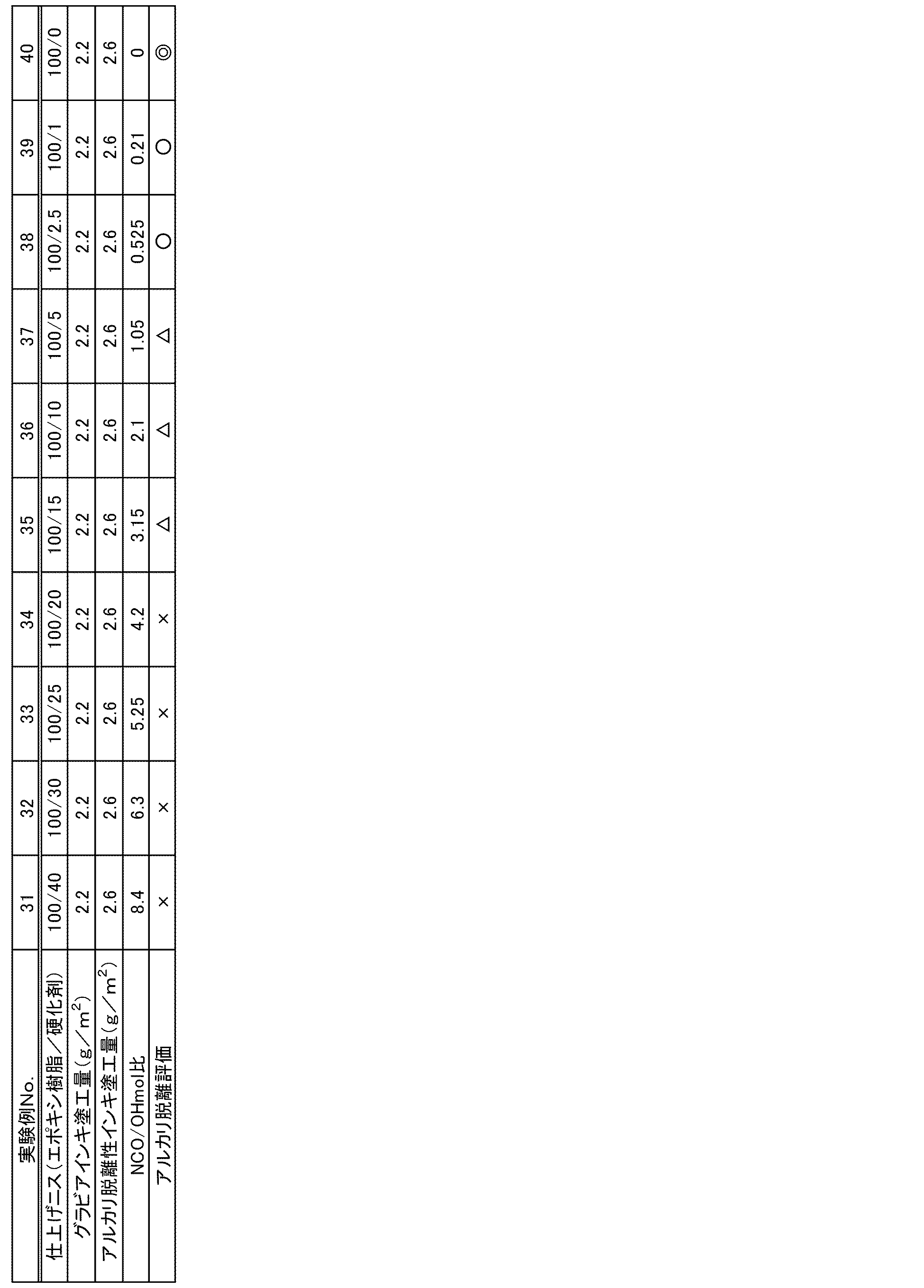
基材フィルムとして低密度ポリエチレンから成るフィルム(厚み25μm)を使用し、この基材フィルム上に、透明のアルカリ脱離性インキを、塗工量2.6g/m2で塗布し、70℃で10秒間、硬化させた。次いでこの透明印刷層の上に塗工量2.2g/m2でグラビア印刷により印刷層を形成した。次いでこのグラビア印刷層の上に、表7に示すNCO/OHmol比を有するエポキシイソシアネート系塗料組成物(仕上げニス)を1.61g/m2の塗工量で塗布し、70℃で10秒間、硬化させて仕上げニス層を形成し、印刷フィルムを作成した。
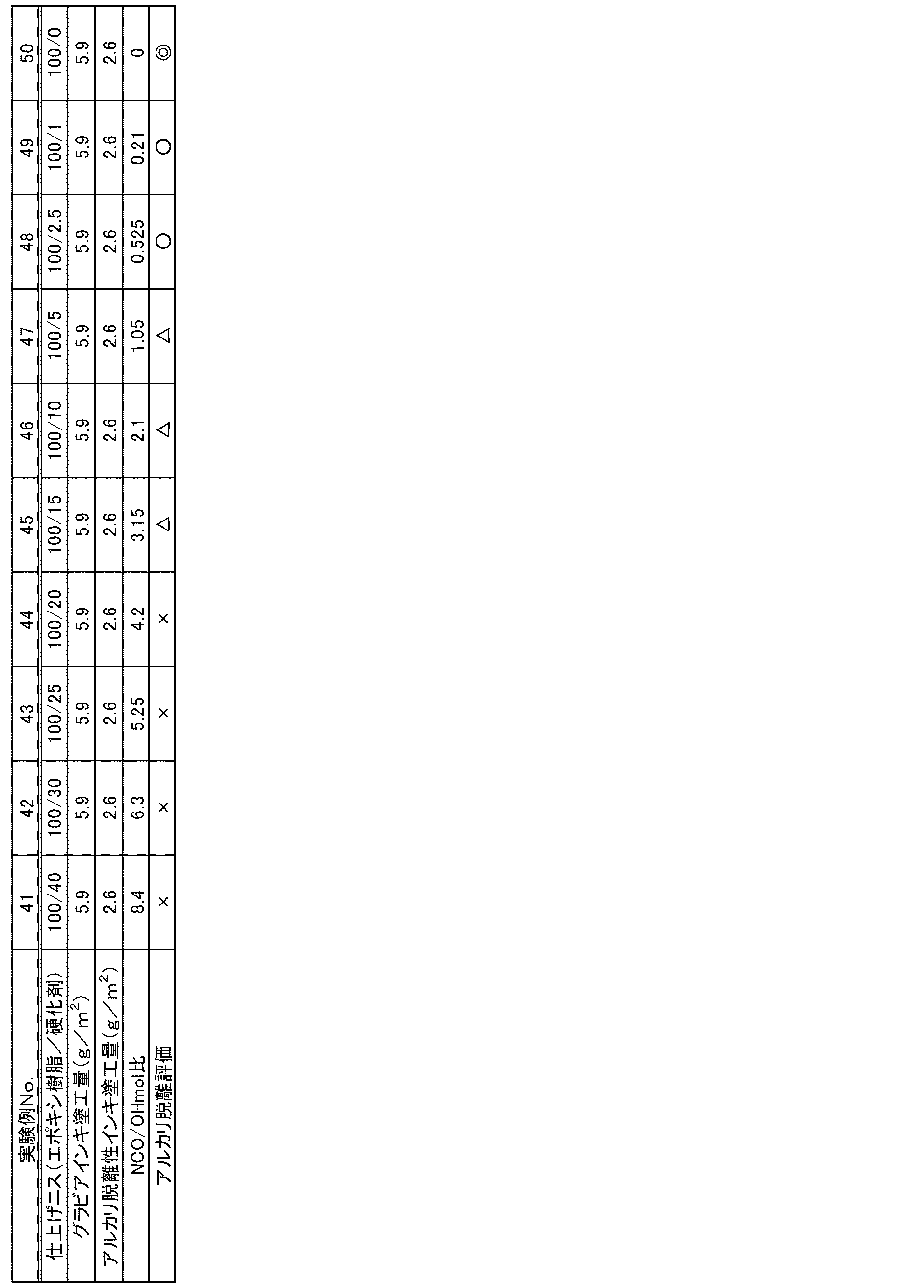
グラビア印刷層の塗工量を5.9g/m2とした以外は、実験例31と同様にして、表8に示すNCO/OHmol比を有するエポキシイソシアネート系塗料組成物(仕上げニス)を用いて仕上げニス層を形成し、印刷フィルムを作成した。
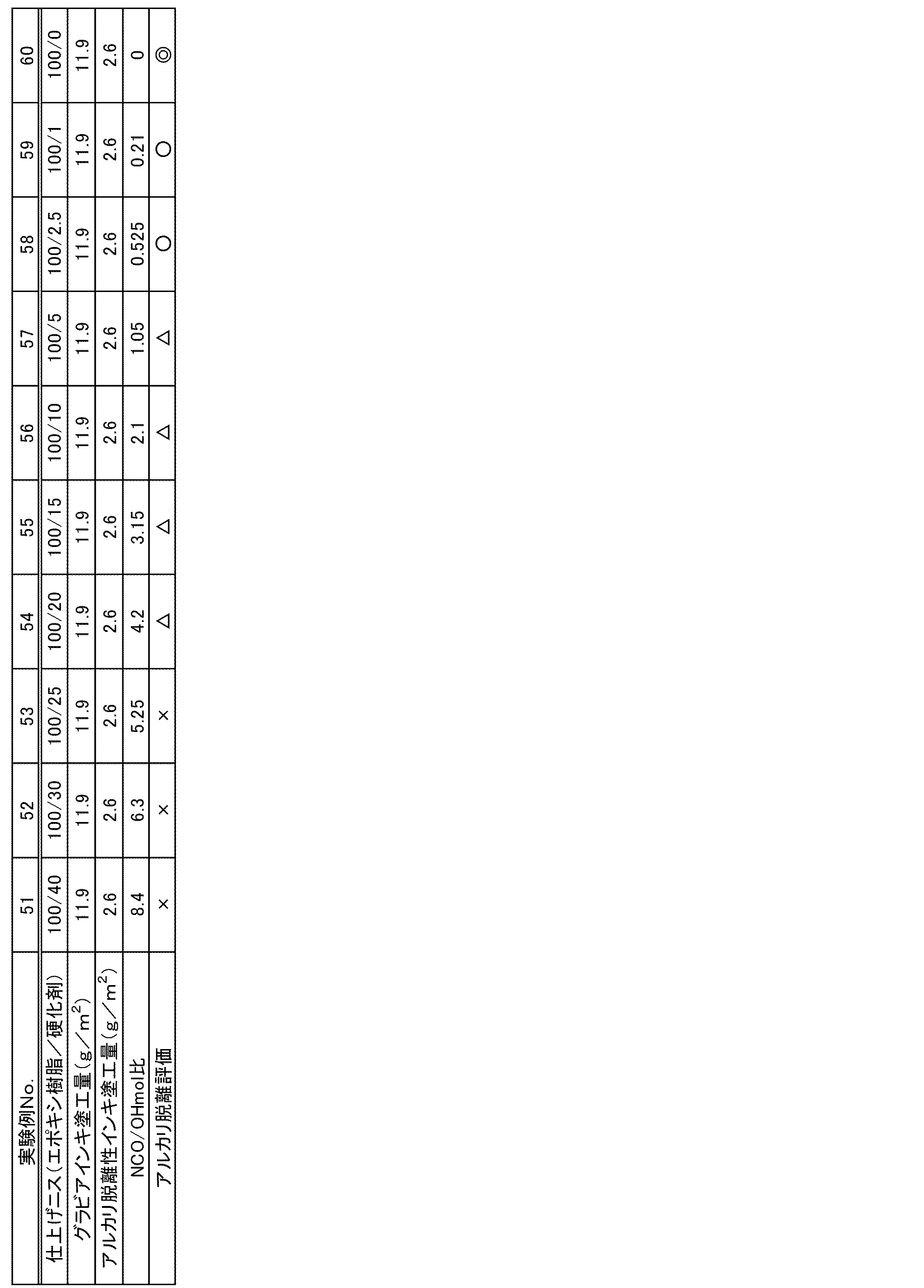
グラビア印刷層の塗工量を11.9g/m2とした以外は、実験例31と同様にして、表9に示すNCO/OHmol比を有するエポキシイソシアネート系塗料組成物(仕上げニス)を用いて仕上げニス層を形成し、印刷フィルムを作成した。
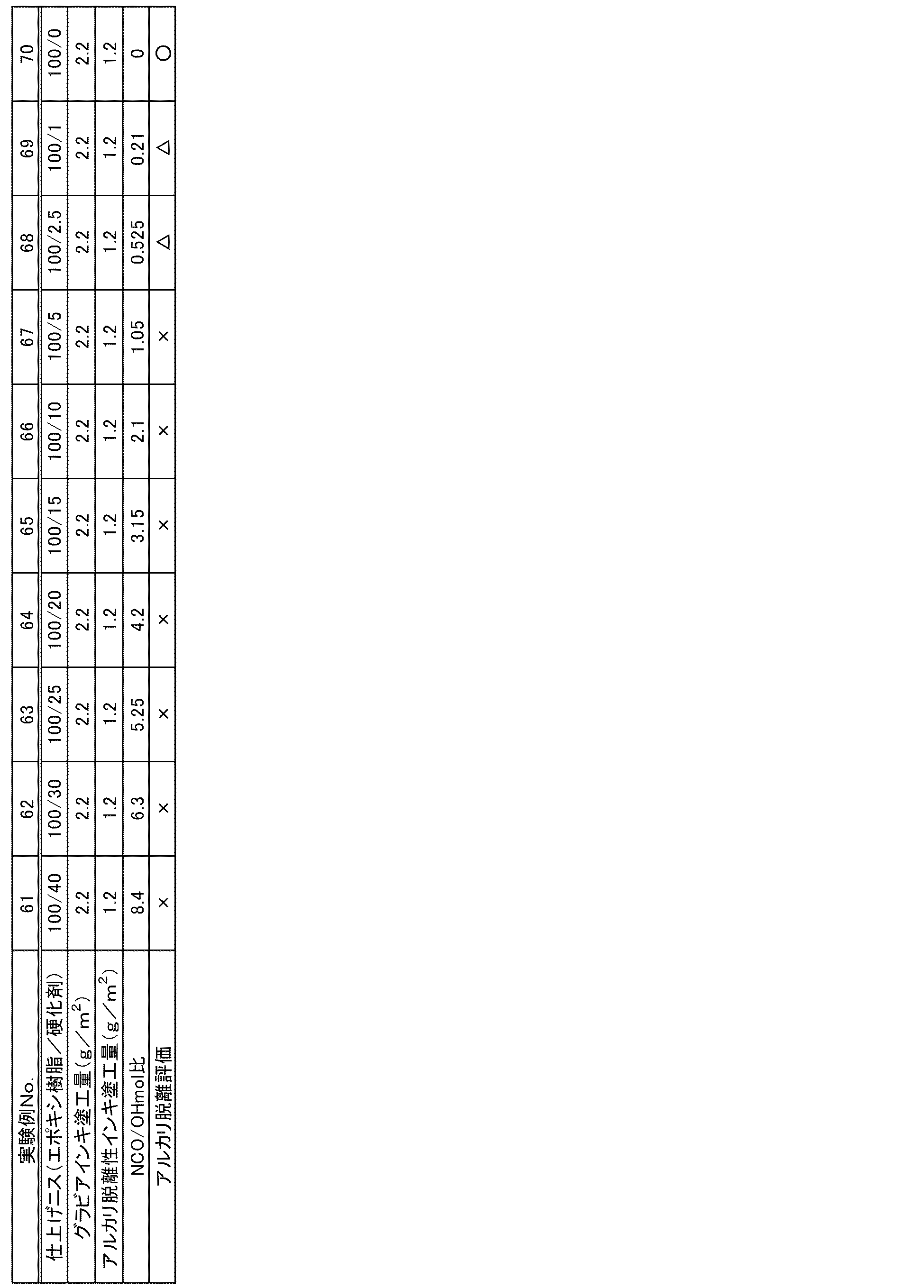
基材フィルムとして低密度ポリエチレンから成るフィルム(厚み25μm)を使用し、この基材フィルム上に、透明のアルカリ脱離性インキを、塗工量1.2g/m2で塗布し、70℃で10秒間、硬化させた。次いでこの透明印刷層の上に塗工量2.2g/m2でグラビア印刷により印刷層を形成した。次いでこのグラビア印刷層の上に、表10に示すNCO/OHmol比を有するエポキシイソシアネート系塗料組成物(仕上げニス)を1.48g/m2の塗工量で塗布し、70℃で10秒間、硬化させて仕上げニス層を形成し、印刷フィルムを作成した。
アルカリ脱離性インキの塗工量を5.1g/m2とした以外は、実験例61と同様にして、表11に示すNCO/OHmol比を有するエポキシイソシアネート系塗料組成物(仕上げニス)を用いて仕上げニス層を形成し、印刷フィルムを作成した。
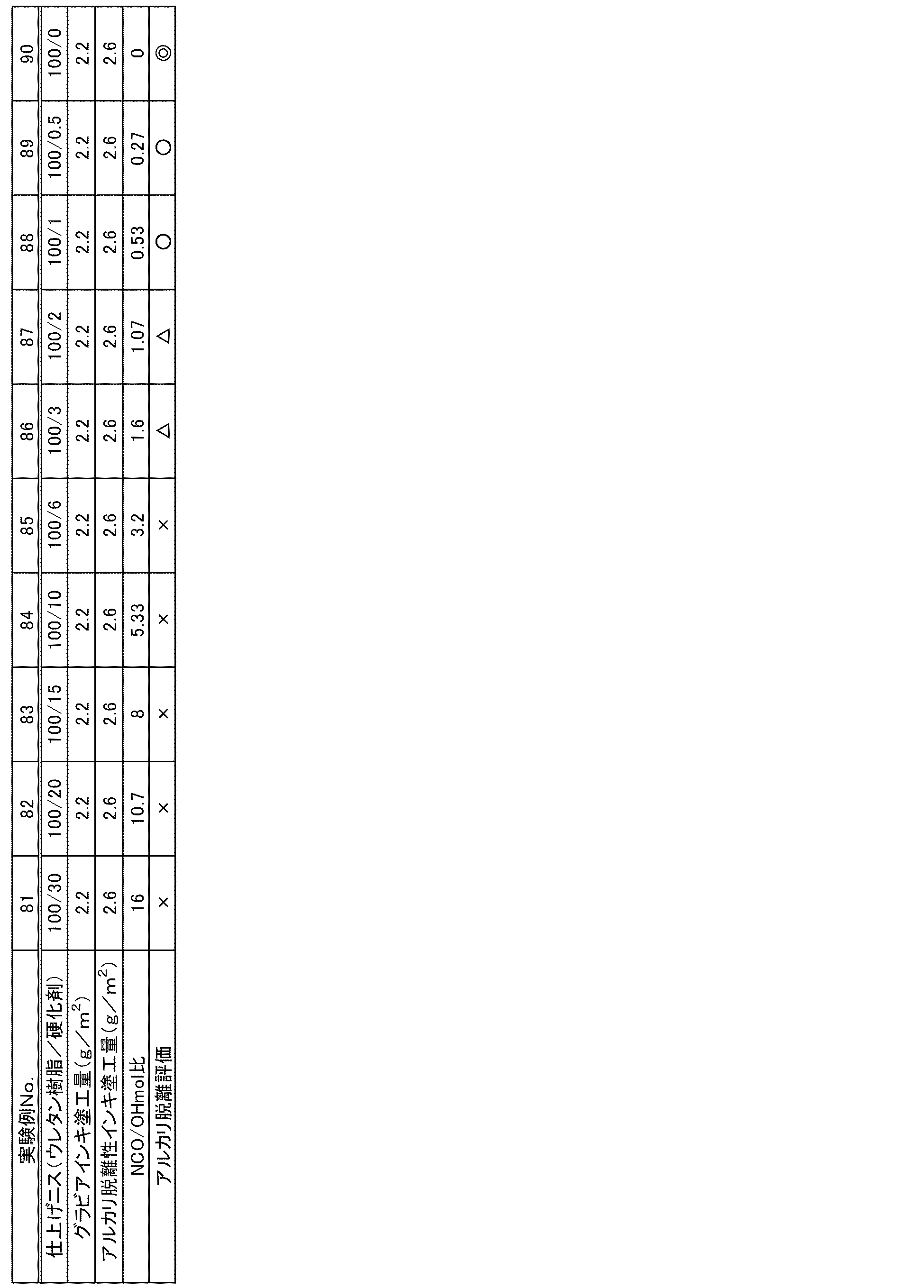
基材フィルムとして低密度ポリエチレンから成るフィルム(厚み25μm)を使用し、この基材フィルム上に、透明のアルカリ脱離性インキを、塗工量2.6g/m2で塗布し、70℃で10秒間、硬化させた。次いでこの透明印刷層の上に塗工量2.2g/m2でグラビア印刷により印刷層を形成した。次いでこのグラビア印刷層の上に、表12に示すNCO/OHmol比を有するウレタンイソシアネート系塗料組成物(仕上げニス)を1.61g/m2の塗工量で塗布し、70℃で10秒間、硬化させて仕上げニス層を形成し、印刷フィルムを作成した。
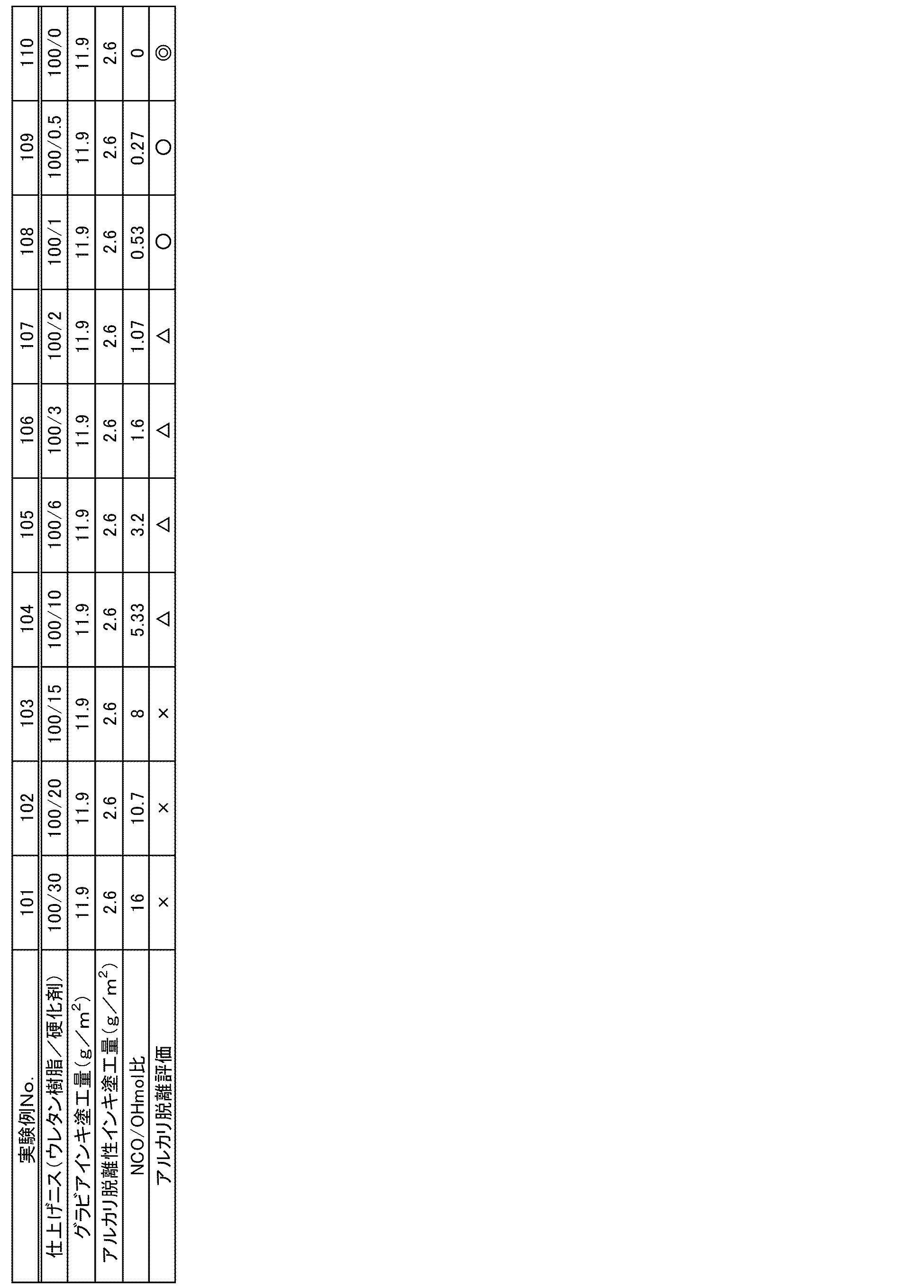
グラビア印刷層の塗工量を5.9g/m2とした以外は、実験例81と同様にして、表13に示すNCO/OHmol比を有するウレタンイソシアネート系塗料組成物(仕上げニス)を用いて仕上げニス層を形成し、印刷フィルムを作成した。
グラビア印刷層の塗工量を11.9g/m2とした以外は、実験例81と同様にして、表14に示すNCO/OHmol比を有するウレタンイソシアネート系塗料組成物(仕上げニス)を用いて仕上げニス層を形成し、印刷フィルムを作成した。
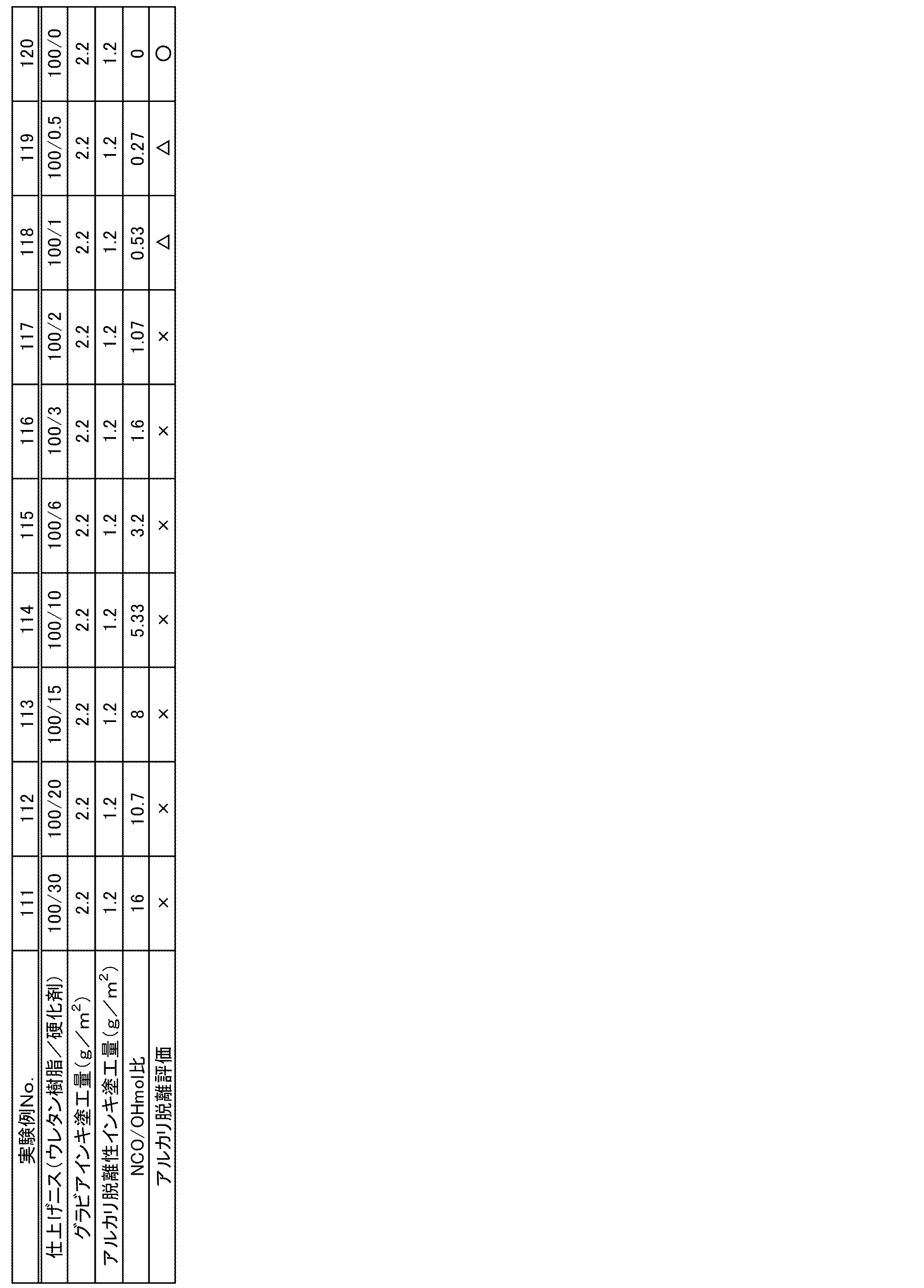
基材フィルムとして低密度ポリエチレンから成るフィルム(厚み25μm)を使用し、この基材フィルム上に、透明のアルカリ脱離性インキを、塗工量1.2g/m2で塗布し、70℃で10秒間、硬化させた。次いでこの透明印刷層の上に塗工量2.2g/m2でグラビア印刷により印刷層を形成した。次いでこのグラビア印刷層の上に、表15に示すNCO/OHmol比を有するウレタンイソシアネート系塗料組成物(仕上げニス)を1.61g/m2の塗工量で塗布し、70℃で10秒間、硬化させて仕上げニス層を形成し、印刷フィルムを作成した。
アルカリ脱離性インキの塗工量を5.1g/m2とした以外は、実験例111と同様にして、表16に示すNCO/OHmol比を有するエポキシイソシアネート系塗料組成物(仕上げニス)を用いて仕上げニス層を形成し、印刷フィルムを作成した。
基材フィルムとして低密度ポリエチレンから成るフィルム(厚み25μm)を使用し、この基材フィルム上に、透明のアルカリ脱離性インキを、塗工量2.6g/m2で塗布し、70℃で10秒間、硬化させた。
実験例1~131により得られた印刷フィルムからサンプル(1.0cm×1.0cm)を切り出し、85℃に加熱された0.5%NaOH水溶液中に20分間浸漬した。結果を各表に示す。なお、評価基準は以下の通りである。
◎:9割以上脱離
○:7割以上9割未満脱離
△:5割以上7割未満脱離
×:5割未満脱離
実験例6、132の印刷フィルムを、内容品400mlが充填された自立式パウチの側面に貼り付け、W30cm×D23cm×H27cmの大きさの段ボールに、印刷フィルムを貼り付けた面が同一方向に向くように16個詰めて、振動試験を行った。振動試験の条件は以下のとおりである。
振動の種類:ランダム振動(垂直振動) 23 30 27
振動数範囲:2~200Hz(JISZ0232(2020)準拠)
試験時間:90分(JISZ0200レベル2条件)
実験例6の印刷フィルムを貼り付けたパウチは、インキ剥離の発生がなかったのに対し、実験例132の印刷フィルムを貼り付けたパウチでは、インキ剥離が生じ、これを詰めた段ボールの内面には、インキが付着し、底には削り落ちたインキがあった。
実験例6、132の印刷フィルムについて、印刷フィルム表面の動摩擦係数を測定した。実験例6の印刷フィルム表面の動摩擦係数は0.16であり、実験例132の印刷フィルム表面の動摩擦係数は0.26であった。実験例6のフィルム表面は仕上げニス層であり、動摩擦係数は好適範囲である0.8未満であるため、インキ剥離は生じなかった。一方、実験例132は、仕上げニス層がなく、アルカリ脱離性インキ層が露出しているため、フィルム表面の動摩擦係数は0.8未満であるが、インキ剥離が見られた。尚、動摩擦係数の測定は、JIS K7125に従って行った。









Claims (12)
- 基材フィルム上に、アルカリ脱離性を有するインキから成る脱離性印刷層及び仕上げニス層が形成されて成る印刷フィルムにおいて、
前記仕上げニス層が、少なくとも硬化性樹脂及び硬化剤から成り、該硬化剤が前記硬化性樹脂100質量部に対して40質量部未満の量で配合されており、前記脱離性印刷層がアルカリ処理により基材フィルムから脱離可能であることを特徴とする印刷フィルム。 - 前記脱離性印刷層の塗工量が1.2g/m2以上である請求項1記載の印刷フィルム。
- 前記硬化性樹脂がエポキシ系樹脂であり、前記硬化剤がイソシアネート系硬化剤であり、該硬化剤がNCO/OHmol比8.4未満となる量で配合される請求項1又は2記載の印刷フィルム。
- 前記硬化性樹脂がウレタン系樹脂であり、前記硬化剤がイソシアネート系硬化剤であり、該硬化剤がNCO/OHmol比21.3未満となる量で配合される請求項1又は2記載の印刷フィルム。
- 前記脱離性印刷層の塗工量が2.6g/m2以上であり、前記NCO/OHmol比が1.05未満である請求項3記載の印刷フィルム。
- 前記脱離性印刷層の塗工量が2.6g/m2以上であり、前記NCO/OHmol比が1.07未満である請求項4記載の印刷フィルム。
- 前記仕上げニス層表面の動摩擦係数が0.8未満である請求項1~6の何れかに記載の印刷フィルム。
- 前記脱離性印刷層上に、他の印刷層が形成されている請求項1~7の何れかに記載の印刷フィルム。
- 前記硬化性樹脂がエポキシ系樹脂であり、前記硬化剤がイソシアネート系硬化剤であり、前記脱離性印刷層の塗工量が2.6g/m2以上且つ前記他の印刷層の塗工量が2.2g/m2以上であり、前記硬化剤がNCO/OHmol比4.2未満となる量で配合される請求項8記載の印刷フィルム。
- 前記硬化性樹脂がウレタン系樹脂であり、前記硬化剤がイソシアネート系硬化剤であり、前記脱離性印刷層の塗工量が2.6g/m2以上且つ前記他の印刷層の塗工量が2.2g/m2以上であり、前記硬化剤がNCO/OHmol比3.2未満となる量で配合される請求項8記載の印刷フィルム。
- 前記基材フィルムの前記脱離性印刷層と反対側にシーラント層が形成されている請求項1~10の何れかに記載の印刷フィルム。
- 前記基材フィルムが、オレフィン樹脂又はポリエステル樹脂から成る延伸フィルムであり、前記シーラント層が、積層される基材フィルムと同種の未延伸フィルム又は非晶性フィルムである請求項11記載の印刷フィルム。
Priority Applications (4)
| Application Number | Priority Date | Filing Date | Title |
|---|---|---|---|
| EP22881105.5A EP4417418A4 (en) | 2021-10-15 | 2022-10-14 | PRINTING FILM FROM WHICH A PRINTED LAYER CAN BE DETACHED |
| CN202280062901.6A CN117957117A (zh) | 2021-10-15 | 2022-10-14 | 印刷层可脱离的印刷膜 |
| JP2023509794A JP7268809B1 (ja) | 2021-10-15 | 2022-10-14 | 印刷層が脱離可能な印刷フィルム |
| US18/627,974 US12359085B2 (en) | 2021-10-15 | 2024-04-05 | Printing film from which printing layer can be detached |
Applications Claiming Priority (2)
| Application Number | Priority Date | Filing Date | Title |
|---|---|---|---|
| JP2021169883 | 2021-10-15 | ||
| JP2021-169883 | 2021-10-15 |
Related Child Applications (1)
| Application Number | Title | Priority Date | Filing Date |
|---|---|---|---|
| US18/627,974 Continuation US12359085B2 (en) | 2021-10-15 | 2024-04-05 | Printing film from which printing layer can be detached |
Publications (1)
| Publication Number | Publication Date |
|---|---|
| WO2023063410A1 true WO2023063410A1 (ja) | 2023-04-20 |
Family
ID=85988332
Family Applications (1)
| Application Number | Title | Priority Date | Filing Date |
|---|---|---|---|
| PCT/JP2022/038332 Ceased WO2023063410A1 (ja) | 2021-10-15 | 2022-10-14 | 印刷層が脱離可能な印刷フィルム |
Country Status (5)
| Country | Link |
|---|---|
| US (1) | US12359085B2 (ja) |
| EP (1) | EP4417418A4 (ja) |
| JP (1) | JP7268809B1 (ja) |
| CN (1) | CN117957117A (ja) |
| WO (1) | WO2023063410A1 (ja) |
Families Citing this family (3)
| Publication number | Priority date | Publication date | Assignee | Title |
|---|---|---|---|---|
| JP7700550B2 (ja) * | 2021-07-20 | 2025-07-01 | artience株式会社 | 積層体の製造方法、及び接着剤塗布方法 |
| JPWO2023074311A1 (ja) * | 2021-10-29 | 2023-05-04 | ||
| WO2026042461A1 (ja) * | 2024-08-23 | 2026-02-26 | 東レ株式会社 | 積層フィルム、その製造方法、包装材料および脱墨方法 |
Citations (6)
| Publication number | Priority date | Publication date | Assignee | Title |
|---|---|---|---|---|
| JP2003084670A (ja) * | 2001-09-10 | 2003-03-19 | Fuji Seal Inc | プラスチックラベル及びプラスチック容器 |
| JP2015148794A (ja) * | 2014-01-08 | 2015-08-20 | 東洋製罐株式会社 | 容器用印刷フィルム及びその製造方法 |
| WO2020116339A1 (ja) * | 2018-12-06 | 2020-06-11 | 東洋インキScホールディングス株式会社 | 脱離能を有する有機溶剤系印刷インキ、印刷物、積層体、およびリサイクル基材製造方法 |
| JP2020183252A (ja) | 2019-04-27 | 2020-11-12 | 進栄化成株式会社 | 袋容器、リサイクル方法、ラミネート方法 |
| JP2021088408A (ja) * | 2019-11-25 | 2021-06-10 | 東洋インキScホールディングス株式会社 | 包装材、包装容器及びリサイクル基材製造方法 |
| JP2021091476A (ja) * | 2019-12-06 | 2021-06-17 | 東洋インキScホールディングス株式会社 | 包装材、及びリサイクル基材製造方法 |
Family Cites Families (10)
| Publication number | Priority date | Publication date | Assignee | Title |
|---|---|---|---|---|
| US5096767A (en) * | 1989-02-03 | 1992-03-17 | Mitsubishi Paper Mills Limited | Alkali-removable label support and label |
| EP0924678B1 (en) * | 1997-12-19 | 2004-09-29 | Toyo Boseki Kabushiki Kaisha | Labels, bottles fitted with these labels, and processes for their recycling |
| JP2002161224A (ja) * | 2000-11-27 | 2002-06-04 | Fuji Seal Inc | プラスチックラベル用水性インキ組成物及びプラスチックラベル |
| DE10307494A1 (de) * | 2003-02-21 | 2004-09-02 | Weipatech Gmbh | Multifunktional einsetzbare Streichfarbendispersion für Druckträger |
| JP2005344054A (ja) * | 2004-06-04 | 2005-12-15 | Toyo Ink Mfg Co Ltd | 活性エネルギー線硬化性脱墨用オーバーコートニス、その印刷物、印刷物の再生方法。 |
| JP6084353B2 (ja) * | 2010-12-28 | 2017-02-22 | 太陽インキ製造株式会社 | 光硬化性樹脂組成物の製造方法、ドライフィルムの製造方法、硬化物の製造方法およびプリント配線板の製造方法 |
| CA2850527A1 (en) * | 2011-10-25 | 2013-05-02 | The Procter & Gamble Company | Sequentially primed printed substrate |
| JP2014024318A (ja) * | 2012-06-20 | 2014-02-06 | Dic Corp | 化粧シート |
| WO2015093405A1 (ja) * | 2013-12-17 | 2015-06-25 | 東洋製罐株式会社 | 容器用印刷フィルム及びその製造方法 |
| JP6545559B2 (ja) * | 2015-07-31 | 2019-07-17 | サカタインクス株式会社 | ラミネート用印刷インキ組成物及び易引き裂き性積層体 |
-
2022
- 2022-10-14 JP JP2023509794A patent/JP7268809B1/ja active Active
- 2022-10-14 EP EP22881105.5A patent/EP4417418A4/en active Pending
- 2022-10-14 WO PCT/JP2022/038332 patent/WO2023063410A1/ja not_active Ceased
- 2022-10-14 CN CN202280062901.6A patent/CN117957117A/zh active Pending
-
2024
- 2024-04-05 US US18/627,974 patent/US12359085B2/en active Active
Patent Citations (6)
| Publication number | Priority date | Publication date | Assignee | Title |
|---|---|---|---|---|
| JP2003084670A (ja) * | 2001-09-10 | 2003-03-19 | Fuji Seal Inc | プラスチックラベル及びプラスチック容器 |
| JP2015148794A (ja) * | 2014-01-08 | 2015-08-20 | 東洋製罐株式会社 | 容器用印刷フィルム及びその製造方法 |
| WO2020116339A1 (ja) * | 2018-12-06 | 2020-06-11 | 東洋インキScホールディングス株式会社 | 脱離能を有する有機溶剤系印刷インキ、印刷物、積層体、およびリサイクル基材製造方法 |
| JP2020183252A (ja) | 2019-04-27 | 2020-11-12 | 進栄化成株式会社 | 袋容器、リサイクル方法、ラミネート方法 |
| JP2021088408A (ja) * | 2019-11-25 | 2021-06-10 | 東洋インキScホールディングス株式会社 | 包装材、包装容器及びリサイクル基材製造方法 |
| JP2021091476A (ja) * | 2019-12-06 | 2021-06-17 | 東洋インキScホールディングス株式会社 | 包装材、及びリサイクル基材製造方法 |
Non-Patent Citations (1)
| Title |
|---|
| See also references of EP4417418A4 |
Also Published As
| Publication number | Publication date |
|---|---|
| US12359085B2 (en) | 2025-07-15 |
| EP4417418A4 (en) | 2025-11-05 |
| JP7268809B1 (ja) | 2023-05-08 |
| JPWO2023063410A1 (ja) | 2023-04-20 |
| EP4417418A1 (en) | 2024-08-21 |
| US20240247164A1 (en) | 2024-07-25 |
| CN117957117A (zh) | 2024-04-30 |
Similar Documents
| Publication | Publication Date | Title |
|---|---|---|
| JP7268809B1 (ja) | 印刷層が脱離可能な印刷フィルム | |
| CA2245219C (fr) | Film apte a etre imprime | |
| TWI438100B (zh) | Gas barrier film | |
| EP2534195B1 (en) | Coated polymeric film | |
| CN105856708A (zh) | 静电吸附片材 | |
| KR102452768B1 (ko) | 점착 시트 및 점착 시트의 제조 방법 | |
| KR20180120237A (ko) | 열전사 시트 | |
| KR20180063037A (ko) | 전사박 | |
| CN116438078A (zh) | 易粘接性聚酯薄膜 | |
| JP2017154459A (ja) | 積層体および包装材料 | |
| WO2022196211A1 (ja) | 包装材、包装袋及び包装体 | |
| EP2368705B1 (en) | Method for producing pouch, and pouch | |
| EP2134550A1 (en) | Printed antifog films | |
| JP2020164554A (ja) | コーティング剤、これを塗工した積層体、包装材及び加工品 | |
| WO2023248610A1 (ja) | ガスバリア性フィルム、積層体、および包装材料 | |
| JP4701831B2 (ja) | ガスバリア性積層フィルム | |
| KR20170052580A (ko) | 적층 필름 | |
| JP7467880B2 (ja) | 積層体及びプレス成形法 | |
| JP7451954B2 (ja) | 積層体及びプレス成形法 | |
| JP2020161259A (ja) | 導電積層体の製造方法 | |
| JP4548073B2 (ja) | ガスバリア性透明積層体 | |
| JP7841664B2 (ja) | ガスバリア性フィルムの製造方法、ガスバリア性フィルム、包装材フィルム、及び包装材料 | |
| JP2012213958A (ja) | インクジェット記録媒体 | |
| JP7434805B2 (ja) | フィルム積層体、フィルム積層体の製造方法、及び光学材料の製造方法 | |
| JP4433540B2 (ja) | 紙容器用複合積層体 |
Legal Events
| Date | Code | Title | Description |
|---|---|---|---|
| WWE | Wipo information: entry into national phase |
Ref document number: 2023509794 Country of ref document: JP |
|
| 121 | Ep: the epo has been informed by wipo that ep was designated in this application |
Ref document number: 22881105 Country of ref document: EP Kind code of ref document: A1 |
|
| WWE | Wipo information: entry into national phase |
Ref document number: 202280062901.6 Country of ref document: CN |
|
| WWE | Wipo information: entry into national phase |
Ref document number: 2401002126 Country of ref document: TH |
|
| WWE | Wipo information: entry into national phase |
Ref document number: 2022881105 Country of ref document: EP |
|
| NENP | Non-entry into the national phase |
Ref country code: DE |
|
| ENP | Entry into the national phase |
Ref document number: 2022881105 Country of ref document: EP Effective date: 20240515 |