WO2023074408A1 - チオフェン化合物、その合成方法および該チオフェン化合物を含有する組成物 - Google Patents
チオフェン化合物、その合成方法および該チオフェン化合物を含有する組成物 Download PDFInfo
- Publication number
- WO2023074408A1 WO2023074408A1 PCT/JP2022/038356 JP2022038356W WO2023074408A1 WO 2023074408 A1 WO2023074408 A1 WO 2023074408A1 JP 2022038356 W JP2022038356 W JP 2022038356W WO 2023074408 A1 WO2023074408 A1 WO 2023074408A1
- Authority
- WO
- WIPO (PCT)
- Prior art keywords
- group
- chemical formula
- thiophene
- thiophene compound
- carbon atoms
- Prior art date
- Legal status (The legal status is an assumption and is not a legal conclusion. Google has not performed a legal analysis and makes no representation as to the accuracy of the status listed.)
- Ceased
Links
Images


Classifications
-
- C—CHEMISTRY; METALLURGY
- C07—ORGANIC CHEMISTRY
- C07D—HETEROCYCLIC COMPOUNDS
- C07D333/00—Heterocyclic compounds containing five-membered rings having one sulfur atom as the only ring hetero atom
- C07D333/02—Heterocyclic compounds containing five-membered rings having one sulfur atom as the only ring hetero atom not condensed with other rings
- C07D333/04—Heterocyclic compounds containing five-membered rings having one sulfur atom as the only ring hetero atom not condensed with other rings not substituted on the ring sulphur atom
- C07D333/26—Heterocyclic compounds containing five-membered rings having one sulfur atom as the only ring hetero atom not condensed with other rings not substituted on the ring sulphur atom with hetero atoms or with carbon atoms having three bonds to hetero atoms with at the most one bond to halogen, e.g. ester or nitrile radicals, directly attached to ring carbon atoms
- C07D333/38—Carbon atoms having three bonds to hetero atoms with at the most one bond to halogen, e.g. ester or nitrile radicals
-
- C—CHEMISTRY; METALLURGY
- C07—ORGANIC CHEMISTRY
- C07D—HETEROCYCLIC COMPOUNDS
- C07D495/00—Heterocyclic compounds containing in the condensed system at least one hetero ring having sulfur atoms as the only ring hetero atoms
- C07D495/02—Heterocyclic compounds containing in the condensed system at least one hetero ring having sulfur atoms as the only ring hetero atoms in which the condensed system contains two hetero rings
- C07D495/04—Ortho-condensed systems
-
- C—CHEMISTRY; METALLURGY
- C08—ORGANIC MACROMOLECULAR COMPOUNDS; THEIR PREPARATION OR CHEMICAL WORKING-UP; COMPOSITIONS BASED THEREON
- C08F—MACROMOLECULAR COMPOUNDS OBTAINED BY REACTIONS ONLY INVOLVING CARBON-TO-CARBON UNSATURATED BONDS
- C08F12/00—Homopolymers and copolymers of compounds having one or more unsaturated aliphatic radicals, each having only one carbon-to-carbon double bond, and at least one being terminated by an aromatic carbocyclic ring
- C08F12/02—Monomers containing only one unsaturated aliphatic radical
- C08F12/04—Monomers containing only one unsaturated aliphatic radical containing one ring
- C08F12/14—Monomers containing only one unsaturated aliphatic radical containing one ring substituted by hetero atoms or groups containing heteroatoms
- C08F12/30—Sulfur
-
- C—CHEMISTRY; METALLURGY
- C08—ORGANIC MACROMOLECULAR COMPOUNDS; THEIR PREPARATION OR CHEMICAL WORKING-UP; COMPOSITIONS BASED THEREON
- C08F—MACROMOLECULAR COMPOUNDS OBTAINED BY REACTIONS ONLY INVOLVING CARBON-TO-CARBON UNSATURATED BONDS
- C08F12/00—Homopolymers and copolymers of compounds having one or more unsaturated aliphatic radicals, each having only one carbon-to-carbon double bond, and at least one being terminated by an aromatic carbocyclic ring
- C08F12/02—Monomers containing only one unsaturated aliphatic radical
- C08F12/32—Monomers containing only one unsaturated aliphatic radical containing two or more rings
Definitions
- the present invention relates to a novel thiophene compound, a method for synthesizing the thiophene compound, and a composition containing the thiophene compound.
- Thiophene compounds which have a ring structure containing a sulfur element in their structure, are being investigated for their application in various applications due to their characteristic structures, and research is progressing as lead compounds for pharmaceuticals such as anticancer agents in particular. (See Patent Document 1, for example).
- various materials are used for optical material resins used as materials for various optical films and optical lenses.
- polymerizable monomers that undergo polymerization by radical species are used for this material, and for the purpose of improving light extraction efficiency, sulfur-containing compounds with polymerizable functional groups, fluorene compounds, naphthalene compounds, etc., which have a high refractive index, are used.
- Higher materials are preferred (eg US Pat.
- many of the high refractive index materials that have been reported so far have high melting points or high viscosities. Therefore, from the viewpoint of improving work efficiency, there is a demand for a high refractive index material having a polymerizable functional group with a lower melting point and lower viscosity.
- An object of the present invention is to provide a novel thiophene compound, a method for synthesizing the thiophene compound, and a composition containing the thiophene compound.
- the composition of the present invention can be applied to coating materials, inks, adhesives, adhesives, gas barrier films, color filters, optical films, optical lenses, touch panels and the like.
- the inventors of the present invention have made intensive studies to solve the above-mentioned problems, and as a result, achieved the desired object with a thiophene compound obtained by reacting a certain thiophene compound with a certain styrene compound.
- the present invention has been completed by recognizing that it is possible. That is, the first invention is a thiophene compound represented by chemical formula (I) or chemical formula (II).
- R 2 may be linked to R 1 or R 3 to form a ring containing a sulfur atom together with the two carbon atoms forming the thiophene ring to which they are attached
- R 4 is are the same or different and represent an alkyl group having 1 to 5 carbon atoms
- Y 1 represents a single bond or an alkylene group having 1 to 10 carbon atoms.
- R 5 may be linked with R 6 to form a ring containing a sulfur atom together with the two carbon atoms forming the thiophene ring to which they are attached
- R 4 being the same or different represents an alkyl group having 1 to 5 carbon atoms
- Y 1 represents a single bond or an alkylene group having 1 to 10 carbon atoms.
- a second invention is a method for synthesizing a thiophene compound according to the first invention, characterized by reacting a thiophene compound represented by the chemical formula (III) or the chemical formula (IV) with a styrene compound represented by the chemical formula (V). is.
- X represents a hydroxyl group, a fluorine atom, a chlorine atom, a bromine atom or an iodine atom.
- R 5 , R 6 and R 7 are the same as defined above.
- X represents a hydroxyl group, a fluorine atom, a chlorine atom, a bromine atom or an iodine atom.
- Y 1 is the same as described above.
- W represents a hydroxyl group, a fluorine atom, a chlorine atom, a bromine atom or an iodine atom.
- a third invention is a composition characterized by containing the thiophene compound of the first invention.
- the thiophene compound of the present invention has a high refractive index and a low viscosity, it is expected to be useful as a material for optical applications.
- the composition containing the thiophene compound of the present invention is expected to have a lower viscosity than conventional compositions and improve workability during formation. Furthermore, it is expected to give a cured product with a high refractive index.
- FIG. 1 is an IR spectrum chart of the pale yellow liquid obtained in Example 1.
- FIG. 4 is an IR spectrum chart of the pale yellow liquid obtained in Example 2.
- FIG. 1 is an IR spectrum chart of the pale yellow liquid obtained in Example 1.
- the present invention relates to a thiophene compound represented by the above chemical formula (I) or chemical formula (II) (hereinafter referred to as "the thiophene compound of the present invention").
- the thiophene compound represented by the chemical formula (I) include thiophene compounds represented by the chemical formulas (I-1) to (I-30).
- examples of the thiophene compound represented by the chemical formula (II) include thiophene compounds represented by the chemical formulas (II-1) to (II-27).
- R 2 may be linked to R 1 or R 3 to form a ring containing a sulfur atom together with the two carbon atoms forming the thiophene ring to which each is attached.
- the divalent group in which R 2 and R 1 are linked is represented by the following formulas (a) to (c). is mentioned.
- R 2 and R 3 are linked to form a ring containing the sulfur atom, the divalent group in which R 2 and R 3 are linked is represented by the following formulas (a) to (c). There are things that can be done.
- Examples of the alkyl group having 1 to 5 carbon atoms represented by R 4 include chain or branched alkyl groups having 1 to 5 carbon atoms, and specifically, methyl group, ethyl group and n-propyl group. , isopropyl group, n-butyl group, t-butyl group, n-pentyl group and the like.
- R 5 may be linked with R 6 to form a ring containing a sulfur atom together with the two carbon atoms forming the thiophene ring to which they are attached.
- R 5 and R 6 are linked to form a ring containing the sulfur atom
- the divalent group in which R 5 and R 6 are linked is represented by the above formulas (a) to (c). is mentioned.
- the alkylene group having 1 to 10 carbon atoms represented by Y 1 includes a chain or branched alkylene group having 1 to 10 carbon atoms (further 1 to 6 carbon atoms, more 1 to 4 carbon atoms, particularly 1 to 3 carbon atoms). ), specifically, methylene group, methylmethylene group, dimethylene group, trimethylene group, ethylmethylene group, dimethylmethylene group, tetramethylene group, pentamethylene group, hexamethylene group, heptamethylene group, octamethylene group, nonamethylene group, decamethylene group and the like.
- R 2 is linked with R 1 or R 3 to form a ring containing a sulfur atom together with two carbon atoms forming a thiophene ring to which they are attached.
- R 4 is preferably an alkyl group having 1 to 3 carbon atoms, more preferably a methyl group.
- Y 1 is preferably a single bond or an alkylene group having 1 to 4 carbon atoms (more preferably 1 to 3 carbon atoms).
- the thiophene compound represented by the chemical formula (I) more preferably chemical formulas (I-1) to (I-3), chemical formula (I-5), chemical formula (I-8), chemical formula (I-9), chemical formula Thiophene compounds represented by formulas (I-22) to (I-24).
- R 5 is linked to R 6 to form a sulfur atom-containing ring together with the two carbon atoms forming the thiophene ring to which they are attached
- R 5 is the divalent group linked to R 6 is represented by formulas (a) to (c)
- R 4 is preferably an alkyl group having 1 to 3 carbon atoms, more preferably a methyl group.
- Y 1 is preferably a single bond or an alkylene group having 1 to 4 carbon atoms (more preferably 1 to 3 carbon atoms).
- the thiophene compound represented by the chemical formula (II) more preferably chemical formulas (II-1) to (II-3), chemical formula (II-3), chemical formula (II-5), chemical formula (II-8), chemical formula (II-9), which are thiophene compounds represented by chemical formulas (II-22) to (II-24).
- the thiophene compound of the present invention can be synthesized by reacting a thiophene compound represented by chemical formula (III) or chemical formula (IV) with a styrene compound represented by chemical formula (V).
- the thiophene compound represented by the chemical formula (III) is a precursor of the thiophene compound represented by the chemical formula (I)
- the thiophene compound represented by the chemical formula (IV) is a precursor of the thiophene compound represented by the chemical formula (II). is the body.
- the thiophene compound represented by the chemical formula (III) is a thiophene compound represented by the chemical formula (III-1) having an acyl halide group (a thiophene compound in which X is a fluorine atom, a chlorine atom, a bromine atom or an iodine atom); Thiophene compounds represented by the chemical formula (III-2) having a carboxy group (thiophene compounds in which X is a hydroxyl group) are included.
- the thiophene compound represented by the chemical formula (IV) is a thiophene compound represented by the chemical formula (IV-1) having an acyl halide group (a thiophene compound in which X is a fluorine atom, a chlorine atom, a bromine atom or an iodine atom); Thiophene compounds represented by the chemical formula (IV-2) having a carboxy group (thiophene compounds in which X is a hydroxyl group) are included.
- X 1 represents a fluorine atom, a chlorine atom, a bromine atom or an iodine atom.
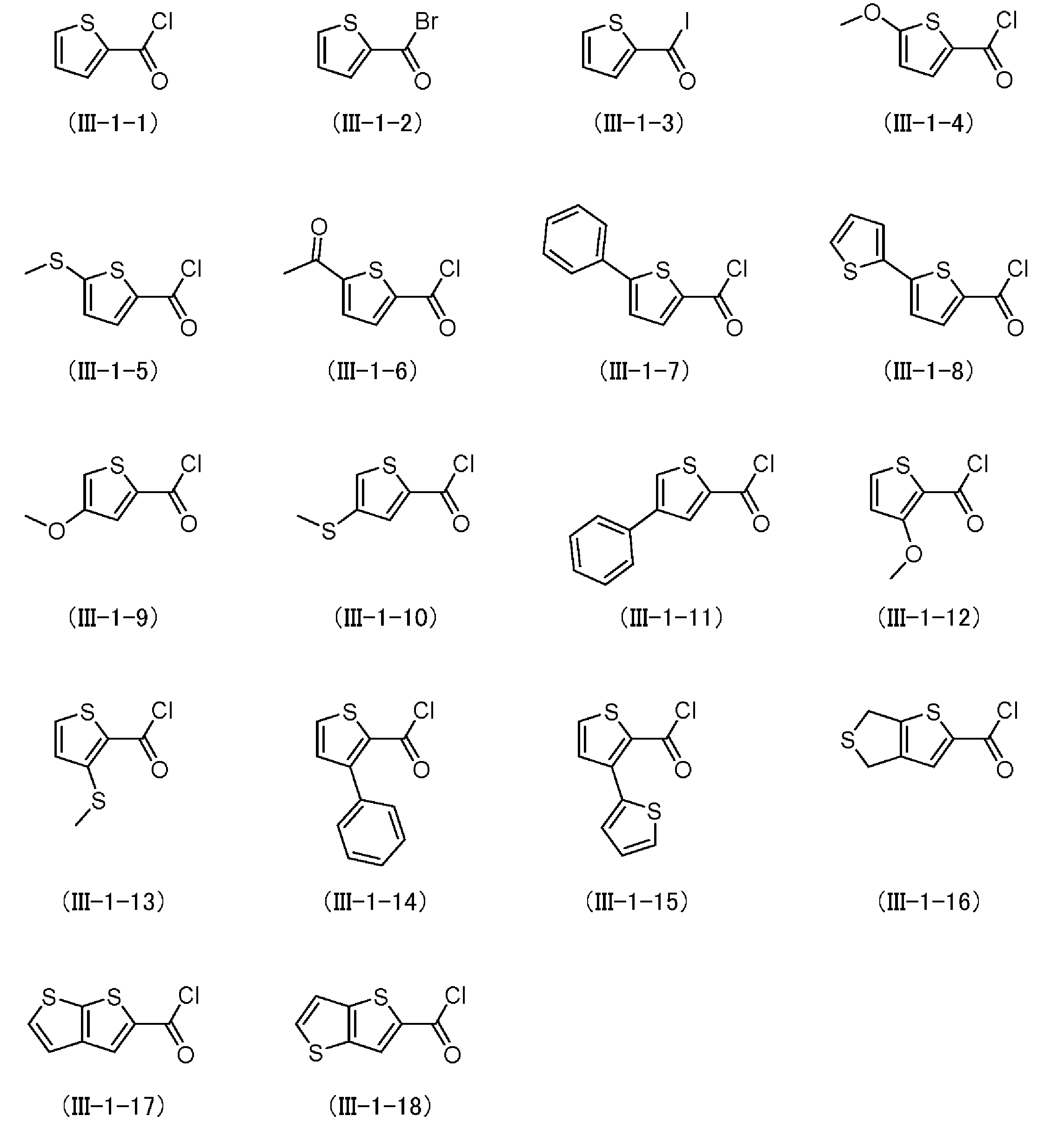
- Examples of the thiophene compound represented by the chemical formula (III-1) include thiophene compounds represented by the chemical formulas (III-1-1) to (III-1-18).
- Examples of the thiophene compound represented by the chemical formula (III-2) include thiophene compounds represented by the chemical formulas (III-2-1) to (III-2-25).
- Examples of the thiophene compound represented by the chemical formula (IV-1) include thiophene compounds represented by the chemical formulas (IV-1-1) to (IV-1-9).
- Examples of the thiophene compound represented by the chemical formula (IV-2) include thiophene compounds represented by the chemical formulas (IV-2-1) to (IV-2-22).
- thiophene compounds can be used by purchasing commercially available reagents. (20), 7385-7396 (2011) and can be synthesized according to the method described in JP-A-2021-100094.
- the styrene compound represented by the chemical formula (V) is a styrene compound represented by the chemical formula (V-1) having a hydroxyl group (a styrene compound in which W is a hydroxyl group) and a chemical formula (V-2) having a halogen atom. It includes styrene compounds (styrene compounds in which W is a fluorine, chlorine, bromine or iodine atom).
- Y 1 is the same as above.
- W 1 represents a fluorine atom, a chlorine atom, a bromine atom or an iodine atom.
- Examples of the styrene compound represented by the chemical formula (V-1) include styrene compounds represented by the chemical formulas (V-1-1) to (V-1-6).
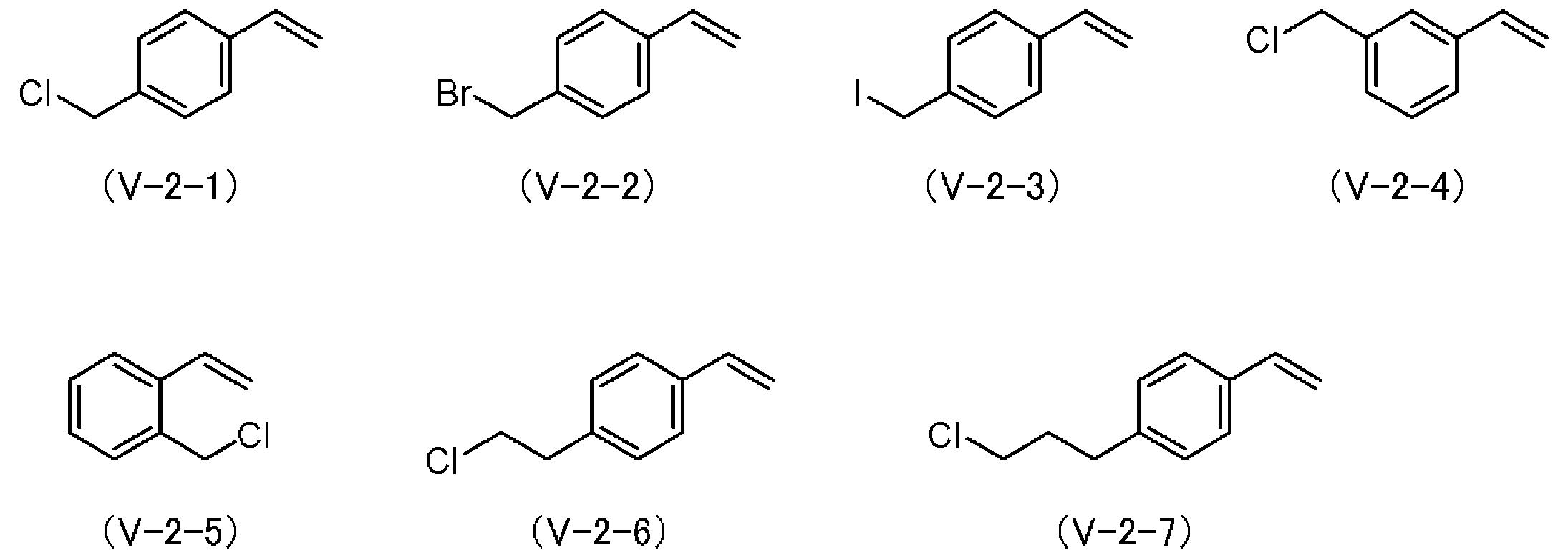
- Examples of the styrene compound represented by the chemical formula (V-2) include styrene compounds represented by the chemical formulas (V-2-1) to (V-2-7).
- styrene compounds can be used by purchasing commercially available reagents. It can be synthesized according to the method described in the book or Japanese Patent Application Laid-Open No. 2009-57565.
- Synthesis methods of the thiophene compound of the present invention include, for example, synthesis methods (1) to (4).
- the thiophene compound of the present invention can be synthesized by reacting the thiophene compound represented by the chemical formula (III-1) or chemical formula (IV-1) with the styrene compound represented by the chemical formula (V-1) (reaction See schemes (A) and (B)).
- the amount (charged amount) of the styrene compound represented by the chemical formula (V-1) is equal to the amount used (charged amount) of the thiophene compound represented by the chemical formula (III-1) or (IV-1).
- reaction solvent (ii) may be used as appropriate.
- Examples of the base (i) include trimethylamine, triethylamine, tributylamine, N,N-diisopropylethylamine, N-methylmorpholine, 1,5-diazabicyclo[4.3.0]non-5-ene (DBN), 1 , 4-diazabicyclo[2.2.2]octane (DABCO), 1,8-diazabicyclo[5.4.0]-7-undecene (DBU), pyridine, 4-(N,N-dimethylamino)pyridine, picoline, N,N-dimethylaniline, N,N-diethylaniline, imidazole, lithium hydride, sodium hydride, potassium hydride, lithium hydroxide, sodium hydroxide, potassium hydroxide, cesium hydroxide, lithium carbonate, carbonic acid sodium, potassium carbonate, cesium carbonate, lithium hydrogen carbonate, sodium hydrogen carbonate, potassium hydrogen carbonate, cesium hydrogen carbonate, trilithium phosphate, tris
- the amount of base (i) used (charged amount) is 0.8 to 2 times the molar amount used (charged amount) of the thiophene compound represented by chemical formula (III-1) or chemical formula (IV-1). An appropriate ratio within the range is preferable.
- the reaction solvent (ii) is not particularly limited as long as it does not inhibit the reaction.
- Solvents such as tetrahydrofuran, dioxane, ethyl acetate, acetonitrile, benzene, toluene, xylene, dichloromethane, chloroform, carbon tetrachloride, dimethylformamide, dimethylacetamide, dimethylsulfoxide, hexamethylphosphoric acid triamide, water, etc., and if necessary, Suitable amounts thereof can be used in combination.
- the reaction temperature is preferably set in the range of 0 to 100°C.
- the reaction time is appropriately set according to the set reaction temperature, but is preferably set within the range of 1 to 48 hours.
- the target thiophene compound of the present invention can be isolated from the obtained reaction solution (reaction mixture) by, for example, concentrating the reaction solution by distilling off the reaction solvent or by solvent extraction. can. Furthermore, if necessary, purification can be carried out using means such as washing with water, etc., treatment with activated carbon, silica gel chromatography, recrystallization, and the like.
- thiophene compound represented by the chemical formula (III-2) or chemical formula (IV-2) is reacted with a halogenating agent (first step), and then a styrene compound represented by the chemical formula (V-1) is reacted. (Second step), the thiophene compound of the present invention can be synthesized (see reaction schemes (C) and (D)).
- any agent that can convert carboxylic acid to carboxylic acid halide can be used, and examples thereof include fluorinating agents, chlorinating agents, and brominating agents. Specific examples include oxalyl chloride, thionyl chloride, phosphoryl chloride and the like. A catalytic amount of dimethylformamide or the like may be added to improve the reactivity of the halogenating agent.
- the amount (charged amount) of the halogenating agent used is 1 to An appropriate ratio within the range of 10-fold molar is preferred.
- reaction solvent (iii) may be used as appropriate.
- the reaction solvent (iii) is not particularly limited as long as it does not inhibit the reaction. These can be combined and used in appropriate amounts.
- the reaction temperature is preferably set within the range of 0 to 120°C.
- the reaction time is appropriately set according to the set reaction temperature, but is preferably set within the range of 1 to 48 hours.
- reaction solution After completion of the reaction in the first step, the obtained reaction solution (reaction mixture) is subjected to, for example, concentration of the reaction solution by distilling off the reaction solvent, solvent extraction, or the like.
- a thiophene compound can be extracted.
- purification can be carried out using means such as washing with water, etc., treatment with activated carbon, silica gel chromatography, recrystallization, and the like.
- the thiophene compound having an acyl halide group may be subjected to the above-described concentration, extraction, purification, etc., and then subjected to the second step. You may use for a 2nd process as it is.
- the reaction in the second step can be carried out in the same manner as in the synthesis method (1) described above. By doing so, the target thiophene compound of the present invention can be obtained.
- the thiophene compound of the present invention can be synthesized by reacting the thiophene compound represented by the chemical formula (III-2) or chemical formula (IV-2) with the styrene compound represented by the chemical formula (V-1) (reaction See schemes (E) and (F)).
- the amount (charged amount) of the styrene compound represented by the chemical formula (V-1) is the amount used (charged amount) of the thiophene compound represented by the chemical formula (III-2) or (IV-2).
- a base (i) and a dehydration condensation agent (iv) may be used to promote the reaction.
- a reaction solvent (v) may be used as appropriate.
- the base (i) those exemplified in the synthesis method (1) can be used.
- the amount of base (i) used (charged amount) is 0.1 to An appropriate ratio within the range of 2-fold molar is preferable.
- Examples of the dehydration condensing agent (iv) include phosphoric acid esters such as diphenylphosphoryl azide, diethylphosphoryl cyanide, and diethyl cyanophosphate; Carbodiimides such as (3-dimethylaminopropyl)carbodiimide and 1-ethyl-3-(3-dimethylaminopropyl)carbodiimide hydrochloride; said carbodiimides and N-hydroxysuccinimide, 1-hydroxybenzotriazole, N-hydroxy-5 -Norbornene-2,3-dicarboximide and other N-hydroxy compounds. These may be used alone or in combination of two or more.
- phosphoric acid esters such as diphenylphosphoryl azide, diethylphosphoryl cyanide, and diethyl cyanophosphate
- Carbodiimides such as (3-dimethylaminopropyl)carbodiimide and 1-ethyl-3-(3-dimethylamin
- the amount of dehydration condensation agent (iv) used (charged amount) is 1 to 2 times the molar amount used (charged amount) of the thiophene compound represented by chemical formula (III-2) or chemical formula (IV-2). An appropriate ratio within the range is preferable.
- the reaction solvent (v) is not particularly limited as long as it does not inhibit the reaction.
- Examples include benzene, toluene, xylene, dichloromethane, chloroform, carbon tetrachloride, dichloroethane, chlorobenzene, dichlorobenzene, ethyl formate, ethyl acetate, and acetic acid.
- the reaction temperature is preferably set in the range of 0 to 80°C.
- the reaction time is appropriately set according to the set reaction temperature, but is preferably set within the range of 1 to 72 hours.
- the target thiophene compound of the present invention can be isolated from the obtained reaction solution (reaction mixture) by, for example, concentrating the reaction solution by distilling off the reaction solvent or by solvent extraction. can. Furthermore, if necessary, purification can be carried out using means such as washing with water, etc., treatment with activated carbon, silica gel chromatography, recrystallization, and the like.
- the thiophene compound of the present invention can be synthesized by reacting the thiophene compound represented by the chemical formula (III-2) or chemical formula (IV-2) with the styrene compound represented by the chemical formula (V-2) (reaction See schemes (G) and (H)).
- the amount (charged amount) of the styrene compound represented by the chemical formula (V-2) is equal to the amount (charged amount) of the thiophene compound represented by the chemical formula (III-2) or (IV-2).
- a base (i) may be used to facilitate the reaction.
- the reaction solvent (ii) may be used as appropriate.
- the base (i) and the reaction solvent (ii) those exemplified in the synthesis method (1) can be used.
- a reaction accelerator (vi) may be used together with the base (i).
- the amount of base (i) used (charged amount) is 0.8 to 2 times the molar amount used (charged amount) of the thiophene compound represented by chemical formula (III-2) or chemical formula (IV-2). An appropriate ratio within the range is preferable.
- reaction accelerator (vi) examples include alkali metal iodides such as lithium iodide, sodium iodide and potassium iodide; ammonium salt type phase transfer catalysts such as de, tetrahexylammonium bromide and tetrahexylammonium iodide; phosphonium salt type phase transfer catalysts such as tetrabutylphosphonium bromide and tetrabutylphosphonium iodide; be done. These may be used alone or in combination of two or more.
- alkali metal iodides such as lithium iodide, sodium iodide and potassium iodide
- ammonium salt type phase transfer catalysts such as de, tetrahexylammonium bromide and tetrahexylammonium iodide
- phosphonium salt type phase transfer catalysts such as tetrabutylphosphonium bromide and tetrabut
- the amount (charged amount) of the reaction accelerator (vi) is appropriately in the range of 0.01 to 5.0 times the molar amount used (charged amount) of the styrene compound represented by the chemical formula (V-2). and more preferably an appropriate ratio in the range of 0.02 to 0.5 moles.
- the reaction temperature is preferably set in the range of 0 to 100°C.
- the reaction time is appropriately set according to the set reaction temperature, but is preferably set within the range of 1 to 48 hours.
- the target thiophene compound of the present invention can be isolated from the obtained reaction solution (reaction mixture) by, for example, concentrating the reaction solution by distilling off the reaction solvent or by solvent extraction. can. Furthermore, if necessary, purification can be carried out using means such as washing with water, etc., treatment with activated carbon, silica gel chromatography, recrystallization, and the like.
- composition of the present invention contains the thiophene compound of the present invention as an essential component, and may contain one or more thiophene compounds of the present invention.
- the content of the thiophene compound of the present invention in the composition of the present invention is preferably 0.001 to 100% by weight.
- a cured product is obtained.
- a curable compound other than the thiophene compound of the present invention (hereinafter sometimes simply referred to as "curable compound") coexists.
- a cured product obtained by copolymerizing the thiophene compound of the present invention and a curable compound can be obtained.
- the curable compound includes both a polymerizable monomer and a polymerizable oligomer (semi-cured product) having a structure in which the polymerizable monomer is partially polymerized.
- Examples of the polymerizable monomer include: Methyl (meth) acrylate, 2-hydroxyethyl (meth) acrylate, butyl (meth) acrylate, 4-hydroxybutyl (meth) acrylate, 2-ethylhexyl (meth) acrylate, ethyl carbitol (meth) acrylate, lauryl (meth) Acrylates, phenoxyethyl (meth)acrylate, nonylphenoxyethyl (meth)acrylate, 2-hydroxy-3-phenoxypropyl (meth)acrylate, dicyclopentenyl (meth)acrylate, isobornyl (meth)acrylate, Nn-butyl- O-(meth)acryloyloxyethyl carbamate, tetrahydrofurfuryl (meth)acrylate, acryloylmorpholine, trifluoroethyl (meth)acrylate, tribromobenzyl (meth
- the composition of the present invention contains the thiophene compound of the present invention as an essential component and, if necessary, the curable compound described above.
- the polymerizable monomer the polymerizable monomers exemplified above may be used in combination (different types of polymerizable monomers may be used in combination). Combinations of different polymerizable oligomers may be used.
- the content ratio of each of the thiophene compound of the present invention and the curable compound in the composition of the present invention the content of the curable compound is 0 to 1000 with respect to the content of the thiophene compound of the present invention. An appropriate ratio within the range of double the amount (weight ratio) is preferable, and an appropriate ratio within the range of 0.01 to 100 times the amount (weight ratio) is more preferable.
- Methods for curing (polymerizing) the composition of the present invention include, for example, radical polymerization and anion polymerization.
- the radical polymerization method include a method of irradiating light (ultraviolet rays, visible rays), radiation, active energy rays such as electromagnetic waves and electron beams, a method of heating, a method of using a radical polymerization initiator, and a combination of these. method.
- the radical polymerization initiator a photoradical polymerization initiator or a thermal radical polymerization initiator may be used, and may be contained in the composition.
- any generally used photoradical polymerization initiator can be used without any particular limitation.
- the photoradical polymerization initiator may be used in combination with known photopolymerization accelerators such as benzoic acids such as 4-dimethylaminobenzoic acid and tertiary amines.
- the content of the radical photopolymerization initiator in the composition of the present invention is preferably 0.001 to 20% by weight, more preferably 0.01 to 10% by weight.
- thermal radical polymerization initiators can be used without particular limitation. diisopropylperoxydicarbonate, benzoyl peroxide, t-butylperoxyisobutyrate, or other peroxides, and azo compounds such as azobisisobutyronitrile (AIBN), which are used in combination. good too.
- the content of the thermal radical polymerization initiator in the composition of the present invention is preferably 0.001 to 20% by weight, more preferably 0.01 to 10% by weight.
- a photoradical polymerization initiator may be used in combination, and after photoradical polymerization (photocuring), thermal radical polymerization (thermal curing) may be performed in order to further increase the reaction rate.
- composition of the present invention further contains, as long as it does not inhibit the effects of the present invention, Pigments (titanium white, cyanine blue, watching red, iron oxide, carbon black, aniline black, manganese blue, iron black, ultramarine blue, hansa red, chrome yellow, chrome green, etc.), Inorganic fillers (calcium carbonate, kaolin, clay, talc, mica, barium sulfate, lithopone, gypsum, zinc stearate, perlite, quartz, quartz glass, fused silica, silica powder such as spherical silica, spherical alumina, crushed alumina , magnesium oxide, beryllium oxide, titanium oxide, zirconium oxide and other oxides, boron nitride, silicon nitride, aluminum nitride and other nitrides, silicon carbide and other carbides, aluminum hydroxide, magnesium hydroxide and other hydroxides materials, metals and alloys such as copper, silver
- Polyamide-based resins vinyl chloride-based resins, nitrocellulose-based resins, vinylidene chloride-based resins, acrylic-based resins (including curable compounds other than the aforementioned polymerizable monomers), acrylamide-based resins, styrene-based resins, vinyl ester-based resins , polyester resins, phenolic resins (phenol compounds), epoxy resins (epoxy compounds), silicone resins, fluorine resins, various elastomer resins such as acrylic rubbers and urethane rubbers, methyl methacrylate-butadiene-styrene graft copolymers , acrylonitrile-butadiene-graft copolymers such as styrene-based graft copolymers, etc.), reinforcing agents (glass fiber, carbon fiber, etc.), Anti-sagging agents (hydrogenated castor oil, fine silica anhydride, etc.), Matting agents (micronized silica, paraffin wax
- thermoplastic resins and thermosetting resins include resins (compounds) having a cardo structure (skeletal structure in which four aromatic rings are bonded to carbon atoms) represented by chemical formula (VI).
- n the degree of polymerization.
- Compounds having a cardo structure include 9,9-bis(4-glycidyloxyphenyl)fluorene, 9,9-bis(4-hydroxyphenyl)fluorene, 9,9-bis(4-hydroxy-3-methylphenyl) fluorene, 9,9-bis[4-(2-(meth)acryloyloxyethoxy)phenyl]fluorene, 9,9-bis[4-(3-(meth)acryloyloxy-2-hydroxypropoxy)phenyl]fluorene, Examples include monomers such as 9,9-bis(cyanomethyl)fluorene and 9,9-bis(3-aminopropyl)fluorene.
- the method for preparing the composition of the present invention is not particularly limited. It can be prepared by mixing a solution in which a thiophene compound is dissolved or dispersed, a curable compound, a radical polymerization initiator and additives. As a mixing means, a known method can be adopted.
- the composition of the present invention can be prepared as a highly fluid, low-viscosity liquid (fluid).
- the dynamic viscosity (25° C.) of the composition can be adjusted to, for example, 20 to 300 mPa ⁇ s, further 30 to 100 mPa ⁇ s.
- the workability in molding the polymer from the composition can be greatly improved.
- the composition of the present invention contains a thiophene compound with a high refractive index, a cured product with a high refractive index can be obtained by polymerizing it. Therefore, the composition of the present invention is suitable as a material used in manufacturing coating materials, inks, adhesives, adhesives, gas barrier films, color filters, optical films, optical lenses, touch panels and the like.
- coating materials include touch panels, plastic containers, plastic sheets, plastic films, film-type liquid crystal elements, polarizing plates used in liquid crystal display devices, optical parts, building interior materials (floor materials, wall materials, artificial marble etc.) and the like (hard coat).
- inks examples include colored inks, printing inks, UV inks, inkjet inks, and the like. These inks are used for offset printing, flexographic printing, gravure printing, screen printing, inkjet printing and the like.
- adhesives include semiconductors, optics, optical components, optical waveguide coupling, optical waveguide peripheral member fixing, and CD/DVD bonding.
- adhesive adhesive (adhesive) tapes, adhesive (adhesive) sheets, and adhesive (adhesive) labels.
- gas barrier film examples include electronic paper, flexible displays, organic EL elements, organic solar cells, and the like.
- color filters include color liquid crystal display devices (color filter on array (COA)), color imaging devices, and organic EL display devices.
- COA color filter on array
- OLED organic EL display devices.
- optical film examples include protective films for polarizing plates, films for liquid crystal display devices such as prism sheet support films and light guide films, hard coat films, functional films such as decorative films and transparent conductive films, and solar cells. weather-resistant (light) films for electronic devices, films for LED lighting or organic EL lighting, transparent heat-resistant films for flexible electronics, and the like.
- optical lens examples include lenses for microscopes, endoscopes, telescopes, cameras, spectacles, etc., lenses for laser beam printers, lenses for sensors, prism lenses, pickup lenses for optical discs, and the like.
- touch panel applications of the above touch panel include personal computers, car navigation systems, mobile phones, electronic dictionaries, OA/FA equipment, and the like.
- composition of the present invention further includes transparent materials, optical materials, dicing tapes, insulating materials (wire coatings, etc.), solder resist inks, printed wiring boards, copper-clad laminates, resin-coated copper foils, prepregs, and high-voltage insulating materials.
- interlayer insulating material passivation film for TFT, gate insulating film for TFT, interlayer insulating film for TFT, transparent flattening film for TFT, insulating packing, insulating coating material, paint, UV powder paint, molding material (sheet, film , FRP, etc.), sealing materials, liquid crystal sealing materials, sealing materials for display devices, highly heat-resistant sealing materials, potting materials, sealing materials (semiconductor sealing materials, electrical material sealing materials, organic EL and LED element sealing materials, sealing materials for various solar cells), resist materials (liquid resist materials, colored resist materials, dry film resist materials, solder resist materials, color filter resist materials), photospacer materials for liquid crystal cells, stereolithography, solar cells materials, fuel cell materials, display materials, recording materials, photosensitive drums for copiers, solid electrolytes for batteries, and other materials in the electric or electronic field, as well as anti-vibration materials, waterproof materials, moisture-proof materials, heat-shrink rubber tubes, Rings, gas separation membranes, concrete protection materials, linings, soil
- Example 3 The thiophene compound synthesized in Example 1 was subjected to evaluation tests (refractive index measurement and viscosity measurement), and the test results obtained are shown in Table 1.
- Example 4 The thiophene compound synthesized in Example 2 was subjected to evaluation tests (measurement of refractive index and measurement of viscosity).
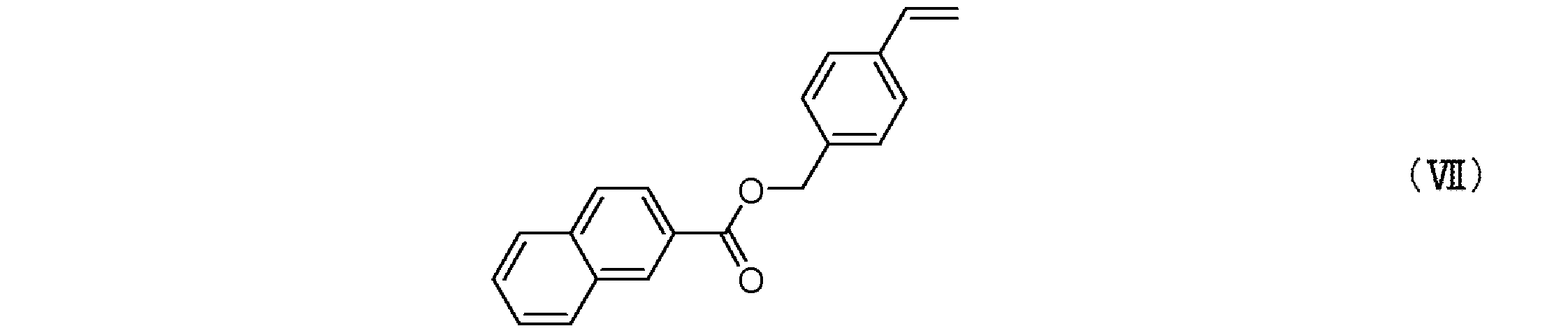
- the thiophene compounds of the present invention (compounds of Examples 1 and 2) have a higher refractive index than conventional high refractive materials (compounds represented by chemical formula (VII)). Also, it can be seen that the compound represented by the chemical formula (VII) is solid at 25° C., whereas the thiophene compound of the present invention is a liquid with low viscosity.
- the thiophene compound of the present invention can give a cured product having a low viscosity and a high refractive index. Therefore, the composition of the present invention is suitable as a material used in manufacturing coating materials, inks, adhesives, adhesives, gas barrier films, color filters, optical films, optical lenses, touch panels and the like.
Landscapes
- Chemical & Material Sciences (AREA)
- Organic Chemistry (AREA)
- Health & Medical Sciences (AREA)
- Chemical Kinetics & Catalysis (AREA)
- Medicinal Chemistry (AREA)
- Polymers & Plastics (AREA)
- Heterocyclic Carbon Compounds Containing A Hetero Ring Having Oxygen Or Sulfur (AREA)
- Plural Heterocyclic Compounds (AREA)
Abstract
Description
しかしながら、これまでに報告されている高屈折率材料は、高融点または高粘度のものが多く、成形プロセスが長時間化してしまい、作業効率が悪くなるという課題があった。そのため、作業効率向上の観点から、より低融点かつ低粘度の重合性官能基を有する高屈折率材料が求められている。
即ち、第1の発明は、化学式(I)または化学式(II)で示されるチオフェン化合物である。




また、本発明のチオフェン化合物を含む組成物は、従来の組成物に比べ、粘度が低く、形成時の作業性が向上することが期待される。さらに、屈折率の高い硬化物を与えることが期待される。
本発明は、前記の化学式(I)または化学式(II)で示されるチオフェン化合物(以下、「本発明のチオフェン化合物」と云う)に関する。
化学式(I)で示されるチオフェン化合物としては、例えば、化学式(I-1)~化学式(I-30)で示されるチオフェン化合物が挙げられる。
また、化学式(II)で示されるチオフェン化合物としては、例えば、化学式(II-1)~化学式(II-27)で示されるチオフェン化合物が挙げられる。



R1、R2およびR3が、同一または異なって、水素原子、-OR4、-SR4、-C(=O)-R4、フェニル基、2-チエニル基または3-チエニル基であることが好ましい。
或いは、R1、R2およびR3が、全て水素原子であるか、または、そのうち2つが水素原子であり、且つ残りの1つが-OR4、-SR4、-C(=O)-R4、フェニル基、2-チエニル基または3-チエニル基であることが好ましい。
或いは、R1、R2およびR3のうち、R2が、R1またはR3と連結して、それぞれが結合するチオフェン環を形成する2つの炭素原子と共に、硫黄原子を含む環を形成し、R2が、R1またはR3と連結した2価の基が、式(a)~(c)で示されるものであり、且つ残りのR3またはR1が、水素原子、-OR4、-SR4、-C(=O)-R4、フェニル基、2-チエニル基または3-チエニル基であることが好ましく、水素原子であることがより好ましい。
R4は、炭素数1~3のアルキル基が好ましく、メチル基がより好ましい。
Y1は、単結合または炭素数1~4(さらに炭素数1~3)のアルキレン基が好ましい。
化学式(I)で示されるチオフェン化合物として、より好ましくは化学式(I-1)~化学式(I-3)、化学式(I-5)、化学式(I-8)、化学式(I-9)、化学式(I-22)~化学式(I-24)で示されるチオフェン化合物である。
R5、R6およびR7が、同一または異なって、水素原子、-OR4、-SR4、-C(=O)-R4、フェニル基、2-チエニル基または3-チエニル基であることが好ましい。
或いは、R5、R6およびR7が、全て水素原子であるか、または、そのうち2つが水素原子であり、且つ残りの1つが-OR4、-SR4、-C(=O)-R4、フェニル基、2-チエニル基または3-チエニル基であることが好ましい。
或いは、R5、R6およびR7のうち、R5が、R6と連結して、それぞれが結合するチオフェン環を形成する2つの炭素原子と共に、硫黄原子を含む環を形成し、R5が、R6と連結した2価の基が、式(a)~(c)で示されるものであり、且つ残りのR7が、水素原子、-OR4、-SR4、-C(=O)-R4、フェニル基、2-チエニル基または3-チエニル基であることが好ましく、水素原子であることがより好ましい。
R4は、炭素数1~3のアルキル基が好ましく、メチル基がより好ましい。
Y1は、単結合または炭素数1~4(さらに炭素数1~3)のアルキレン基が好ましい。
化学式(II)で示されるチオフェン化合物として、より好ましくは化学式(II-1)~化学式(II-3)、化学式(II-3)、化学式(II-5)、化学式(II-8)、化学式(II-9)、化学式(II-22)~化学式(II-24)で示されるチオフェン化合物である。
なお、化学式(III)で示されるチオフェン化合物は、化学式(I)で示されるチオフェン化合物の前駆体であり、化学式(IV)で示されるチオフェン化合物は、化学式(II)で示されるチオフェン化合物の前駆体である。
化学式(IV)で示されるチオフェン化合物は、ハロゲン化アシル基を有する化学式(IV-1)で示されるチオフェン化合物(Xが、フッ素原子、塩素原子、臭素原子またはヨウ素原子であるチオフェン化合物)と、カルボキシ基を有する化学式(IV-2)で示されるチオフェン化合物(Xが、水酸基であるチオフェン化合物)を包含する。

化学式(III-2)で示されるチオフェン化合物としては、例えば、化学式(III-2-1)~化学式(III-2-25)で示されるチオフェン化合物が挙げられる。
化学式(IV-1)で示されるチオフェン化合物としては、例えば、化学式(IV-1-1)~化学式(IV-1-9)で示されるチオフェン化合物が挙げられる。
化学式(IV-2)で示されるチオフェン化合物としては、例えば、化学式(IV-2-1)~化学式(IV-2-22)で示されるチオフェン化合物が挙げられる。



化学式(V-2)で示されるスチレン化合物としては、例えば、化学式(V-2-1)~化学式(V-2-7)で示されるスチレン化合物が挙げられる。

化学式(III-1)または化学式(IV-1)で示されるチオフェン化合物と、化学式(V-1)で示されるスチレン化合物とを反応させることにより本発明のチオフェン化合物を合成することができる(反応スキーム(A)、(B)参照)。


テトラヒドロフラン、ジオキサン、酢酸エチル、アセトニトリル、ベンゼン、トルエン、キシレン、ジクロロメタン、クロロホルム、四塩化炭素、ジメチルホルムアミド、ジメチルアセトアミド、ジメチルスルホキシド、ヘキサメチルリン酸トリアミド、水等の溶剤が挙げられ、必要によりこれらを組み合わせて、その適宜量を使用することができる。
更に、必要により、水等による洗浄や、活性炭処理、シリカゲルクロマトグラフィー、再結晶等の手段を利用して精製することができる。
化学式(III-2)または化学式(IV-2)で示されるチオフェン化合物と、ハロゲン化剤とを反応させ(第1工程)、次いで、化学式(V-1)で示されるスチレン化合物とを反応させる(第2工程)ことにより本発明のチオフェン化合物を合成することができる(反応スキーム(C)、(D)参照)。
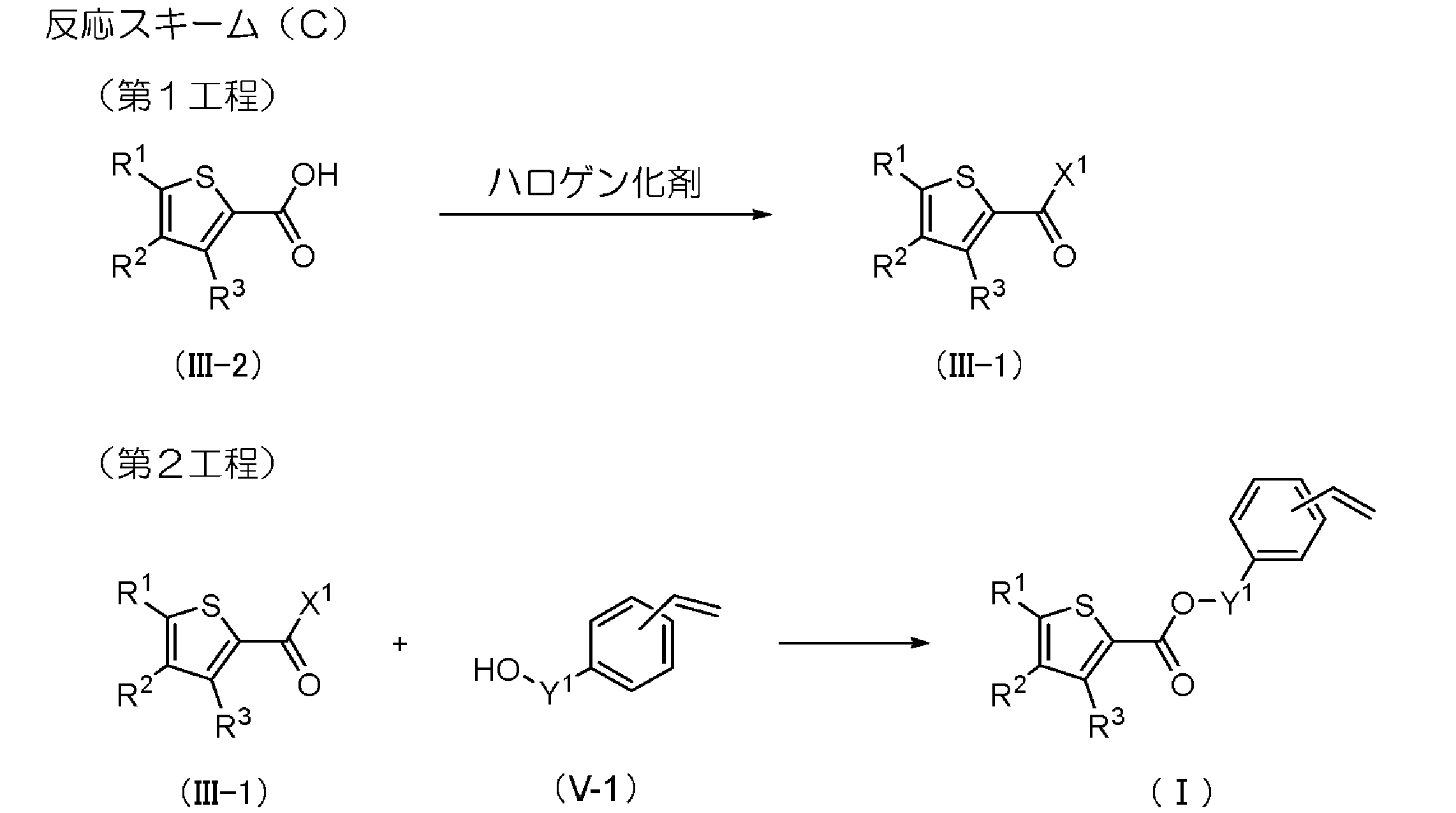

反応溶媒(iii)としては、反応を阻害しない限りにおいては特に限定されず、ベンゼン、トルエン、キシレン、ジクロロメタン、クロロホルム、四塩化炭素、ジメチルホルムアミド、ジメチルアセトアミド、ジメチルスルホキシド等の溶剤が挙げられ、必要によりこれらを組み合わせて、その適宜量を使用することができる。
更に、必要により、水等による洗浄や、活性炭処理、シリカゲルクロマトグラフィー、再結晶等の手段を利用して精製することができる。
なお、ハロゲン化アシル基を有するチオフェン化合物は、前述の濃縮、抽出、精製などを行ったものを第2工程に供してもよく、また、第1工程の反応終了後、得られた反応液のまま、第2工程に供してもよい。
そうすることで、目的物である本発明のチオフェン化合物を得ることができる。
化学式(III-2)または化学式(IV-2)で示されるチオフェン化合物と、化学式(V-1)で示されるスチレン化合物とを反応させることにより本発明のチオフェン化合物を合成することができる(反応スキーム(E)、(F)参照)。
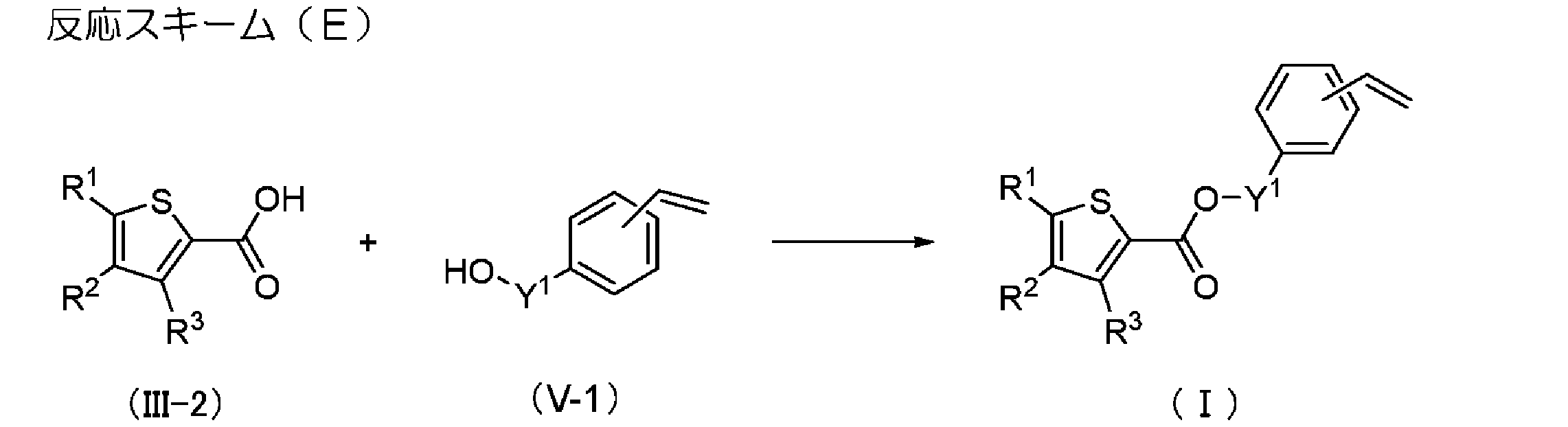

更に、必要により、水等による洗浄や、活性炭処理、シリカゲルクロマトグラフィー、再結晶等の手段を利用して精製することができる。
化学式(III-2)または化学式(IV-2)で示されるチオフェン化合物と、化学式(V-2)で示されるスチレン化合物とを反応させることにより本発明のチオフェン化合物を合成することができる(反応スキーム(G)、(H)参照)。
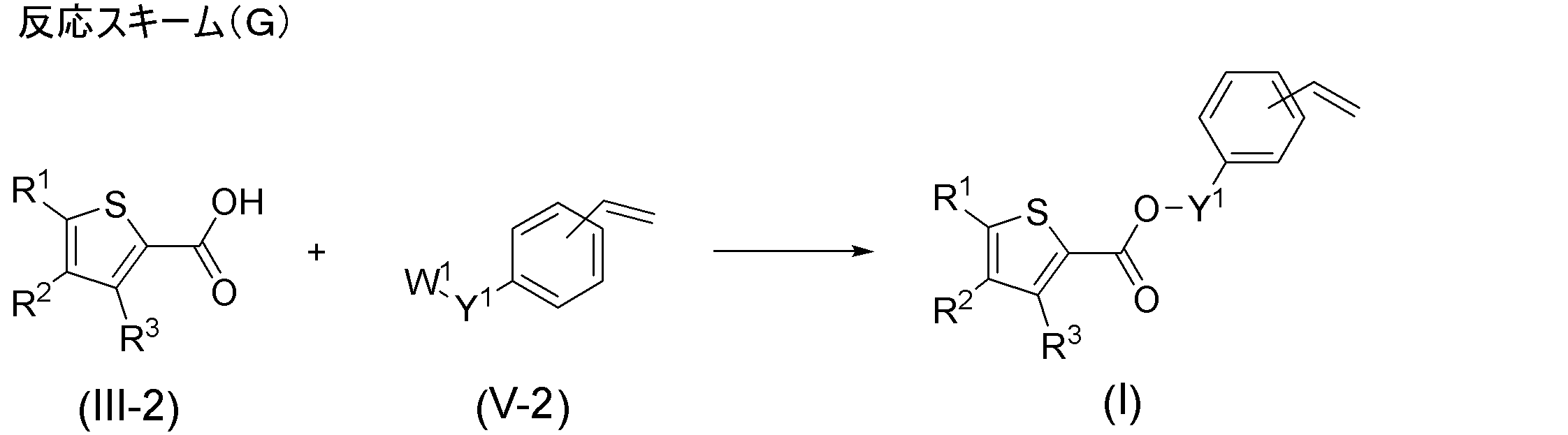

なお、反応性向上のために、塩基(i)とともに反応促進剤(vi)を併用してもよい。
更に、必要により、水等による洗浄や、活性炭処理、シリカゲルクロマトグラフィー、再結晶等の手段を利用して精製することができる。
本発明の組成物中における本発明のチオフェン化合物の含有量は、0.001~100重量%の割合であることが好ましい。
なお、当該硬化性化合物は、重合性モノマーと、重合性モノマーが一部重合した構造を有する重合性オリゴマー(半硬化物)の両者を包含する。
メチル(メタ)アクリレート、2-ヒドロキシエチル(メタ)アクリレート、ブチル(メタ)アクリレート、4-ヒドロキシブチル(メタ)アクリレート、2-エチルヘキシル(メタ)アクリレート、エチルカルビトール(メタ)アクリレート、ラウリル(メタ)アクリレート、フェノキシエチル(メタ)アクリレート、ノニルフェノキシエチル(メタ)アクリレート、2-ヒドロキシ-3-フェノキシプロピル(メタ)アクリレート、ジシクロペンテニル(メタ)アクリレート、イソボルニル(メタ)アクリレート、N-n-ブチル-O-(メタ)アクリロイルオキシエチルカーバメート、テトラヒドロフルフリル(メタ)アクリレート、アクリロイルモルホリン、トリフルオロエチル(メタ)アクリレート、トリブロモベンジル(メタ)アクリレート、パーフルオロオクチルエチル(メタ)アクリレート、イソボルニル(メタ)アクリレート等の一官能(メタ)アクリレート類;
(メタ)アクリロキシプロピルトリス(メトキシ)シラン等のケイ素含有(メタ)アクリレート類;
エチレングリコールジ(メタ)アクリレート、プロピレングリコールジ(メタ)アクリレート、ネオペンチルグリコールジ(メタ)アクリレート、1,6-ヘキサンジオールジ(メタ)アクリレート等のアルキレングリコールジ(メタ)アクリレート類;
トリエチレングリコールジ(メタ)アクリレート、トリプロピレングリコールジ(メタ)アクリレート、ポリエチレングリコールジ(メタ)アクリレート、ポリプロピレングリコールジ(メタ)アクリレート等のポリアルキレングリコールジ(メタ)アクリレート類;
トリメチロールプロパントリ(メタ)アクリレート、ジペンタエリスリトールペンタアクリレート、ペンタエリスリトールトリアクリレート、ペンタエリスリトールテトラアクリレート、ジトリメチロールテトラアクリレート、ジペンタエリスリトールヘキサアクリレート、ポリイソボルニルメタクリレート等の多官能(メタ)アクリレート;
エチレングリコールジグリシジルエーテル-エポキシ(メタ)アクリレート、プロピレングリコールジグリシジルエーテル-エポキシジ(メタ)アクリレート、フェノールグリシジルエーテル-エポキシ(メタ)アクリレート、レゾルシンジグリシジルエーテル-エポキシ(メタ)アクリレート、ビスフェノールAジグリシジルエーテル-エポキシジ(メタ)アクリレート、ビス(4-ヒドロキシフェニル)スルフィドジグリシジルエーテル-エポキシ(メタ)アクリレート等のエポキシ(メタ)アクリレート類;
フェノールノボラック型エポキシ樹脂-(メタ)アクリレート、クレゾールノボラック型エポキシ樹脂-(メタ)アクリレート、ビスフェノール(例えば、ビスフェノールA、ビスフェノールFなど)型エポキシ樹脂-(メタ)アクリレート、ビフェノール(例えば、3,3′,5,5′-テトラメチルビフェノールなど)型エポキシ樹脂-(メタ)アクリレート、1,3,5-トリス(2,3-エポキシプロピル)イソシアヌレート-(メタ)アクリレート等のエポキシ化合物と(メタ)アクリル酸との反応生成物であるエポキシ(メタ)アクリレート類;
スチレン、ジビニルベンゼン、N-ビニルピロリドン、N-ビニルカプロラクタム等のビニル化合物類;
エチレングリコールジアリルカーボネート、トリメリット酸トリアリルエステル、トリアリルイソシアヌレート等のアリル基含有化合物類や、
ウレタン(メタ)アクリレート類、ポリウレタン(メタ)アクリレート類、チオウレタンアクリレート類、ポリチオウレタンアクリレート類、エステルアクリレート類、ポリエステル(メタ)アクリレート類、ポリエーテル(メタ)アクリレート類、含硫黄(メタ)アクリレート類、含硫黄多官能(メタ)アクリレート類が挙げられる。
本発明の組成物中における、本発明のチオフェン化合物と硬化性化合物の各々の含有量の割合については、硬化性化合物の含有量が、本発明のチオフェン化合物の含有量に対して、0~1000倍量(重量比)の範囲における適宜の割合とすることが好ましく、0.01~100倍量(重量比)の範囲における適宜の割合とすることがより好ましい。
前記のラジカル重合させる方法としては、光(紫外線、可視光線)、放射線、電磁波や電子線等の活性エネルギー線を照射する方法、加熱する方法、ラジカル重合開始剤を使用する方法や、これらを組み合わせた方法が挙げられる。
ラジカル重合開始剤としては、光ラジカル重合開始剤や熱ラジカル重合開始剤を使用することができ、組成物中に含有させればよい。
2-ヒドロキシ-2-メチル-1-フェニルプロパン-1-オン、1-ヒドロキシシクロヘキシルフェニルケトン、2-(ジメチルアミノ)-2-[(4-メチルフェニル)メチル]-1-[4-(4-モルホリニル)フェニル]-1-ブタノン、2-メチル-1-[4-(メチルチオ)フェニル)]-2-モルホリノプロパン-1-オン等のアセトフェノン類;
ベンジルジメチルケタール等のベンゾイン類;
ベンゾフェノン、4-フェニルベンゾフェノン、ヒドロキシベンゾフェノン等のベンゾフェノン類;
2,4,6-トリメチルベンゾイル-ジフェニルフォスフィンオキサイド、ビス(2,6-ジメトキシベンゾイル)-2,4,4-トリメチル-ペンチルフォスフィンオキサイド、ビス(2,4,6-トリメチルベンゾイル)-フェニルフォスフィンオキサイド等のアシルフォスフィンオキサイド類;
イソプロピルチオキサントン、2,4-ジエチルチオキサントン等のチオキサントン類や、その他、メチルフェニルグリオキシレート等が挙げられ、これらを組み合わせて使用してもよい。
なお、光ラジカル重合開始剤には、必要により、4-ジメチルアミノ安息香酸等の安息香酸類や3級アミン類等の公知の光重合促進剤を併用することができる。
本発明の組成物中における光ラジカル重合開始剤の含有量は、0.001~20重量%の割合であることが好ましく、0.01~10重量%の割合であることがより好ましい。
ジイソプロピルペルオキシジカーボネート、ベンゾイルペルオキシド、t-ブチルペルオキシイソブチレート、あるいはその他の過酸化物、さらにはアゾビスイソブチロニトリル(AIBN)等のアゾ系化合物が挙げられ、これらを組み合わせて使用してもよい。
本発明の組成物中における熱ラジカル重合開始剤の含有量は、0.001~20重量%の割合であることが好ましく、0.01~10重量%の割合であることがより好ましい。
また、必要により、光ラジカル重合開始剤と併用し、光ラジカル重合(光硬化)させた後、反応率を更に高める為に、熱ラジカル重合(熱硬化)させてもよい。
顔料(チタン白、シアニンブルー、ウォッチングレッド、ベンガラ、カーボンブラック、アニリンブラック、マンガンブルー、鉄黒、ウルトラマリンブルー、ハンザレッド、クロームイエロー、クロームグリーン等)、
無機充填剤(炭酸カルシウム、カオリン、クレー、タルク、マイカ、硫酸バリウム、リトポン、石コウ、ステアリン酸亜鉛、パーライト、石英、石英ガラス、溶融シリカ、球状シリカ等のシリカ粉等、球状アルミナ、破砕アルミナ、酸化マグネシウム、酸化ベリリウム、酸化チタン、酸化ジルコニウム等の酸化物類、窒化ホウ素、窒化ケイ素、窒化アルミニウム等の窒化物類、炭化ケイ素等の炭化物類、水酸化アルミニウム、水酸化マグネシウム等の水酸化物類、銅、銀、鉄、アルミニウム、ニッケル、チタン等の金属類や合金類、ダイヤモンド、カーボン等の炭素系材料等)、
熱可塑性樹脂および熱硬化性樹脂(高密度、中密度、低密度の各種ポリエチレン、ポリプロピレン、ポリブテン、ポリペンテン等の単独重合体、エチレン-プロピレン共重合体、ナイロン-6、ナイロン-6,6等のポリアミド系樹脂、塩化ビニル系樹脂、ニトロセルロース系樹脂、塩化ビニリデン系樹脂、アクリル系樹脂(前述の重合性モノマーを除く硬化性化合物を包含する)、アクリルアミド系樹脂、スチレン系樹脂、ビニルエステル系樹脂、ポリエステル系樹脂、フェノール樹脂(フェノール化合物)、エポキシ樹脂(エポキシ化合物)、シリコーン系樹脂、フッ素系樹脂、アクリルゴム、ウレタンゴムなどの各種エラストマー樹脂、メタクリル酸メチル-ブタジエン-スチレン系グラフト共重合体、アクリロニトリル-ブタジエン-スチレン系グラフト共重合体などのグラフト共重合体等)、
補強剤(ガラス繊維、炭素繊維等)、
垂れ止め剤(水添ヒマシ油、微粒子無水硅酸等)、
艶消し剤(微粉シリカ、パラフィンワックス等)、
研削剤(ステアリン酸亜鉛等)、
内部離型剤(ステアリン酸等の脂肪酸、ステアリン酸カルシウムの脂肪酸金属塩、ステアリン酸アミド等の脂肪酸アミド、脂肪酸エステル、ポリオレフィンワックス、パラフィンワックス等)、
希釈剤(n-ブチルアルコール、メチルエチルケトン(MEK)、プロピレングリコールモノメチルエーテルアセテート(PGMEA)、トルエン等の有機溶剤、水、有機溶剤と水の混合液)、
カップリング剤(N-(2-アミノエチル)-3-アミノプロピルトリメトキシシラン、3-グリシドキシプロピルトリメトキシシラン等のシランカップリング剤等)、
連鎖移動剤(ペンタエリスリトールテトラキス(3-メルカプトプロピオネート)等のチオール化合物等)
界面活性剤、レベリング剤、消泡剤、香料、難燃化剤、染料等の添加剤(改質剤)を含有してもよい。

なお、実施例および比較例において用いた主原料は、以下のとおりである。
・チオフェン-2-カルボニルクロリド(東京化成工業製、化学式(III-1-1)参照。)
・チオフェン-2-カルボン酸(シグマアルドリッチ製、化学式(III-2-1)参照。)
・4-ビニルベンジルアルコール(国際公開第2011/55792号パンフレットの記載の方法に準拠して合成した。化学式(V-1-1)参照。)
・4-クロロメチルスチレンと3-クロロメチルスチレンの混合物(AGCセイミケミカル製、製品名「CMS-P」。化学式(V-2-1)と化学式(V-2-4)の混合物)
・ピリジン(富士フイルム和光純薬製)
・炭酸カリウム(富士フイルム和光純薬製)
・ジクロロメタン(富士フイルム和光純薬製)
・ジメチルホルムアミド(富士フイルム和光純薬製)
・(4-ビニルベンジル)-2-ナフタレンカルボキシレート(特開平01-118802号公報記載の方法に準拠して合成した。化学式(VII)参照。)
実施例および比較例の化合物について、各々の濃度が40重量%となるようにジメチルホルムアミド(DMF)に溶解させ、測定サンプルを調製した(DMF溶液)。
調製したDMF溶液およびDMF単独について、各々、JIS K 0062(「化学製品の屈折率測定方法」)に準拠し、アッベ屈折計(アタゴ製、「NAR-1T SOLID」)を用い、LED光(D線波長)における屈折率(25℃)を測定した。
得られた測定値から、実施例および比較例の化合物の屈折率を、下式により算出した。
屈折率=(DMF溶液(化合物濃度40重量%)の屈折率-DMF単独の屈折率)/0.4+DMF単独の屈折率
化合物について、粘度計(ユービーエム製、「Rheosol-G5000」)を使用し、25℃での動粘度を測定した。なお、動粘度の測定が不可能であった場合(例えば、化合物が25℃で固体である場合等)には、「N.D.」と表記した。
<(4-ビニルベンジル)-2-チオフェンカルボキシレートの合成>
容量300mLの三口フラスコに、4-ビニルベンジルアルコール11.27g(84.0mmol)とジクロロメタン100mLを仕込み、10℃に冷却しながら、ピリジン7.04g(89.0mmol)を滴下した。
続いて、10℃以下にて撹拌しながら、チオフェン-2-カルボニルクロリド11.73g(80.0mmol)を滴下し、室温で12時間撹拌した。
その後、反応液を氷冷下にて冷却し、ピリジン塩酸塩を慮去し、濾液を減圧濃縮した。続いて、濃縮物をトルエン100mLに溶解させ、水50mLにて水洗した後、有機層を減圧濃縮した。
得られた濃縮物をシリカゲルカラムクロマトグラフィー(トルエン/ヘキサン=1/2(容量比))により精製し、淡黄色液体14.50gを得た(収率:74%)。
・1H-NMR (CDCl3) δ: 7.83 (d, 1H), 7.55 (d, 1H), 7.41 (d, 4H), 7.09 (dd, 1H), 6.73 (dd, 1H), 5.76 (d, 1H), 5.33 (s, 2H), 5.26 (d, 1H).
また、この淡黄色液体のIRスペクトルデータは、図1に示したチャートのとおりであった。
これらのスペクトルデータより、得られた淡黄色液体は、化学式(I-1)で示される表題のチオフェン化合物であるものと同定した。
<(4-ビニルベンジル)-2-チオフェンカルボキシレートと(3-ビニルベンジル)-2-チオフェンカルボキシレートとの混合物の合成>
容量300mL三口フラスコに、チオフェン-2-カルボン酸14.10g(110.0mmol)、炭酸カリウム15.20g(110.0mmol)とジメチルホルムアミド100mLを仕込み、50℃に昇温した。50℃で撹拌しながら、4-クロロメチルスチレンと3-クロロメチルスチレンの混合物15.26g(100.00mmol)を滴下し、55℃に昇温し、12時間撹拌した。
その後、反応液を氷冷下にて冷却し、不溶化した塩化カリウムを慮去した。続いて、濾液をトルエン200mLに溶解させ、水100mLにて水洗した後、有機層を減圧濃縮し、淡黄色液体20.77gを得た(収率:85%)。
・1H-NMR (CDCl3) δ: 7.83 (d, 0.5H), 7.82 (d, 0.5H), 7.55 (d, 1H), 7.41 (m, 4H), 7.10 (dd, 0.5H), 7.09 (dd, 0.5H), 6.73 (dd, 0.5H),6.71 (dd, 0.5H), 5.76 (d, 0.5H), 5.75 (d, 0.5H), 5.32 (s, 1H), 5.31 (s, 1H), 5.27 (d, 0.5H), 5.26 (d, 0.5H).
また、この淡黄色液体のIRスペクトルデータは、図2に示したチャートのとおりであった。
これらのスペクトルデータより、得られた淡黄色液体は、化学式(I-1)で示されるチオフェン化合物と、化学式(I-2)で示されるチオフェン化合物の混合物であるものと同定した。
実施例1において合成したチオフェン化合物について、評価試験(屈折率の測定、粘度の測定)を行ったところ、得られた試験結果は表1に示したとおりであった。
実施例2において合成したチオフェン化合物について、評価試験(屈折率の測定、粘度の測定)を行ったところ、得られた試験結果は表1に示したとおりであった。
化学式(VII)で示される化合物(薄橙色固体)について、評価試験(屈折率の測定、粘度の測定)を行ったところ、得られた試験結果は表1に示したとおりであった。なお、この化合物は25℃で固体であったため、粘度の測定が行えず、「N.D.」とした。

また、化学式(VII)で示される化合物は25℃で固体であるのに対し、本発明のチオフェン化合物は粘度が低い液体であることが分かる。
よって、本発明の組成物は、コーティング材、インク、接着剤、粘着剤、ガスバリアフィルム、カラーフィルタ、光学フィルム、光学レンズおよびタッチパネル等を製造する際に使用される材料として好適なものである。
Claims (3)
- 化学式(I)または化学式(II)で示されるチオフェン化合物。


- 化学式(III)または化学式(IV)で示されるチオフェン化合物と、化学式(V)で示されるスチレン化合物を反応させることを特徴とする、請求項1記載のチオフェン化合物の合成方法。



- 請求項1記載のチオフェン化合物を含有することを特徴とする組成物。
Priority Applications (5)
| Application Number | Priority Date | Filing Date | Title |
|---|---|---|---|
| JP2023556317A JP7847152B2 (ja) | 2021-10-28 | 2022-10-14 | チオフェン化合物、その合成方法および該チオフェン化合物を含有する組成物 |
| EP22886737.0A EP4424681A4 (en) | 2021-10-28 | 2022-10-14 | THIOPHENE COMPOUND, METHOD FOR ITS SYNTHESIS AND COMPOSITION CONTAINING SAID THIOPHENE COMPOUND |
| KR1020247006755A KR20240087654A (ko) | 2021-10-28 | 2022-10-14 | 티오펜 화합물, 그 합성 방법 및 해당 티오펜 화합물을 함유하는 조성물 |
| CN202280072705.7A CN118201912A (zh) | 2021-10-28 | 2022-10-14 | 噻吩化合物、其合成方法和包含所述噻吩化合物的组合物 |
| US18/698,246 US20240400535A1 (en) | 2021-10-28 | 2022-10-14 | Thiophene compound, method for synthesizing same, and composition containing said thiophene compound |
Applications Claiming Priority (2)
| Application Number | Priority Date | Filing Date | Title |
|---|---|---|---|
| JP2021-176990 | 2021-10-28 | ||
| JP2021176990 | 2021-10-28 |
Publications (1)
| Publication Number | Publication Date |
|---|---|
| WO2023074408A1 true WO2023074408A1 (ja) | 2023-05-04 |
Family
ID=86157985
Family Applications (1)
| Application Number | Title | Priority Date | Filing Date |
|---|---|---|---|
| PCT/JP2022/038356 Ceased WO2023074408A1 (ja) | 2021-10-28 | 2022-10-14 | チオフェン化合物、その合成方法および該チオフェン化合物を含有する組成物 |
Country Status (6)
| Country | Link |
|---|---|
| US (1) | US20240400535A1 (ja) |
| EP (1) | EP4424681A4 (ja) |
| JP (1) | JP7847152B2 (ja) |
| KR (1) | KR20240087654A (ja) |
| CN (1) | CN118201912A (ja) |
| WO (1) | WO2023074408A1 (ja) |
Families Citing this family (1)
| Publication number | Priority date | Publication date | Assignee | Title |
|---|---|---|---|---|
| CN119119442A (zh) * | 2024-09-09 | 2024-12-13 | 中国科学院大连化学物理研究所 | 一种含有噻吩结构的高折射率聚芳酯、制备方法 |
Citations (10)
| Publication number | Priority date | Publication date | Assignee | Title |
|---|---|---|---|---|
| JPH01118802A (ja) * | 1987-11-02 | 1989-05-11 | Nippon Oil & Fats Co Ltd | 光学用樹脂 |
| JP2008094987A (ja) * | 2006-10-13 | 2008-04-24 | Nippon Kayaku Co Ltd | 光学材料用高屈折率樹脂組成物およびその硬化物 |
| JP2008241869A (ja) * | 2007-03-26 | 2008-10-09 | Fujifilm Corp | レジスト組成物及びこれを用いたパターン形成方法 |
| WO2009017719A2 (en) * | 2007-07-30 | 2009-02-05 | Encysive Pharmaceuticals, Inc. | Modulators of ccr9 receptor and methods of use thereof |
| JP2009057565A (ja) | 2000-05-18 | 2009-03-19 | Natl Starch & Chem Investment Holding Corp | 硬化性電子供与体化合物 |
| CN101747461A (zh) | 2008-12-12 | 2010-06-23 | 北京石油化工学院 | 侧基含有羟基苯乙烯的聚合物、制备方法及其用途 |
| JP2010248358A (ja) * | 2009-04-15 | 2010-11-04 | Kyoeisha Chem Co Ltd | 光学材料用樹脂組成物 |
| WO2011055792A1 (ja) | 2009-11-06 | 2011-05-12 | 国立大学法人九州大学 | エレクトロクロミック材料 |
| JP2016056106A (ja) * | 2014-09-05 | 2016-04-21 | Jnc株式会社 | ピロールまたはチオフェン骨格を有する液晶化合物、液晶組成物およびその重合体 |
| JP2021100094A (ja) | 2019-12-19 | 2021-07-01 | 東レ株式会社 | 有機半導体組成物、光起電力素子、光電変換デバイスおよび光起電力素子の製造方法 |
Family Cites Families (1)
| Publication number | Priority date | Publication date | Assignee | Title |
|---|---|---|---|---|
| JP6849045B2 (ja) | 2019-12-03 | 2021-03-24 | 株式会社三洋物産 | 遊技機 |
-
2022
- 2022-10-14 CN CN202280072705.7A patent/CN118201912A/zh active Pending
- 2022-10-14 JP JP2023556317A patent/JP7847152B2/ja active Active
- 2022-10-14 US US18/698,246 patent/US20240400535A1/en active Pending
- 2022-10-14 WO PCT/JP2022/038356 patent/WO2023074408A1/ja not_active Ceased
- 2022-10-14 KR KR1020247006755A patent/KR20240087654A/ko active Pending
- 2022-10-14 EP EP22886737.0A patent/EP4424681A4/en active Pending
Patent Citations (10)
| Publication number | Priority date | Publication date | Assignee | Title |
|---|---|---|---|---|
| JPH01118802A (ja) * | 1987-11-02 | 1989-05-11 | Nippon Oil & Fats Co Ltd | 光学用樹脂 |
| JP2009057565A (ja) | 2000-05-18 | 2009-03-19 | Natl Starch & Chem Investment Holding Corp | 硬化性電子供与体化合物 |
| JP2008094987A (ja) * | 2006-10-13 | 2008-04-24 | Nippon Kayaku Co Ltd | 光学材料用高屈折率樹脂組成物およびその硬化物 |
| JP2008241869A (ja) * | 2007-03-26 | 2008-10-09 | Fujifilm Corp | レジスト組成物及びこれを用いたパターン形成方法 |
| WO2009017719A2 (en) * | 2007-07-30 | 2009-02-05 | Encysive Pharmaceuticals, Inc. | Modulators of ccr9 receptor and methods of use thereof |
| CN101747461A (zh) | 2008-12-12 | 2010-06-23 | 北京石油化工学院 | 侧基含有羟基苯乙烯的聚合物、制备方法及其用途 |
| JP2010248358A (ja) * | 2009-04-15 | 2010-11-04 | Kyoeisha Chem Co Ltd | 光学材料用樹脂組成物 |
| WO2011055792A1 (ja) | 2009-11-06 | 2011-05-12 | 国立大学法人九州大学 | エレクトロクロミック材料 |
| JP2016056106A (ja) * | 2014-09-05 | 2016-04-21 | Jnc株式会社 | ピロールまたはチオフェン骨格を有する液晶化合物、液晶組成物およびその重合体 |
| JP2021100094A (ja) | 2019-12-19 | 2021-07-01 | 東レ株式会社 | 有機半導体組成物、光起電力素子、光電変換デバイスおよび光起電力素子の製造方法 |
Non-Patent Citations (4)
| Title |
|---|
| JOURNAL OF MEDICINAL CHEMISTRY, vol. 54, no. 20, 2011, pages 7385 - 7396 |
| JOURNAL OF THE AMERICAN CHEMICAL SOCIETY, vol. 120, no. 42, 1998, pages 10990 - 10991 |
| MACROMOLECULES, vol. 49, no. 4, 2016, pages 1135 - 1142 |
| See also references of EP4424681A4 |
Also Published As
| Publication number | Publication date |
|---|---|
| US20240400535A1 (en) | 2024-12-05 |
| JPWO2023074408A1 (ja) | 2023-05-04 |
| EP4424681A4 (en) | 2025-08-27 |
| EP4424681A1 (en) | 2024-09-04 |
| KR20240087654A (ko) | 2024-06-19 |
| JP7847152B2 (ja) | 2026-04-16 |
| CN118201912A (zh) | 2024-06-14 |
Similar Documents
| Publication | Publication Date | Title |
|---|---|---|
| EP4464691A2 (en) | Naphthalene compound, synthesis method therefor, and composition containing said naphthalene compound | |
| TW201540704A (zh) | 聯咔唑化合物、光硬化性組成物、其硬化物、塑料透鏡用硬化性組成物及塑料透鏡 | |
| US20120010315A1 (en) | High refractive acrylate and the method for preparing the same | |
| JP5007942B2 (ja) | 重合性組成物及びその重合物 | |
| JP2546887B2 (ja) | チオカルボン酸エステル化合物及びその製造方法 | |
| TW202528414A (zh) | 硬化性組成物、硬化物、接著劑及密封劑 | |
| JP7847152B2 (ja) | チオフェン化合物、その合成方法および該チオフェン化合物を含有する組成物 | |
| JP5578512B2 (ja) | 新規(メタ)アクリレート化合物及びその製造方法 | |
| KR101611935B1 (ko) | 투명 플라스틱 기판용 수지 조성물 | |
| JP2023036081A (ja) | フェノチアジン化合物、その合成方法および該フェノチアジン化合物を含有する樹脂組成物 | |
| JPWO2019216008A1 (ja) | 光学樹脂組成物及び光学レンズ | |
| TW201518265A (zh) | 新穎肟酯聯苯基化合物、及含彼之光起始劑與光敏樹脂組合物 | |
| JPH0931136A (ja) | プラスチックレンズ成形用組成物及びそれを用いたプラスチックレンズ | |
| JP2024175249A (ja) | チオフェン化合物、その合成方法および該チオフェン化合物を含有する組成物 | |
| JP6187847B1 (ja) | 活性エネルギー線硬化型組成物及びプラスチックレンズ | |
| WO2019116798A1 (ja) | フルオレン骨格を有する(メタ)アクリレート化合物 | |
| JP5392502B2 (ja) | 4−(置換カルボニルオキシ)−1−ナフチル(メタ)アクリレート化合物、その製造方法及びそれらを重合してなる重合物 | |
| JP3821601B2 (ja) | アクリル酸エステル誘導体およびその用途 | |
| JP2008081682A (ja) | (メタ)アクリロイルオキシナフタレン化合物を含有する光硬化性組成物およびその硬化方法 | |
| JP5213100B2 (ja) | 新規含硫黄エチレン性不飽和基含有化合物、及びその重合体 | |
| JP7454176B2 (ja) | フルオレン化合物の製造方法並びにフルオレン化合物の用途 | |
| JP5370892B2 (ja) | 硫黄を含有する(メタ)アクリレート化合物 | |
| JP3820183B2 (ja) | アクリル酸エステル化合物及びその用途 | |
| JPH1053632A (ja) | 樹脂組成物、注型用組成物及びその硬化物 | |
| JP5531545B2 (ja) | 10−[1,4−ジ(メタ)アクリロイルオキシ−2−ナフチル]アントラセン−9(10h)−オン化合物、その製造法及びその重合物 |
Legal Events
| Date | Code | Title | Description |
|---|---|---|---|
| 121 | Ep: the epo has been informed by wipo that ep was designated in this application |
Ref document number: 22886737 Country of ref document: EP Kind code of ref document: A1 |
|
| WWE | Wipo information: entry into national phase |
Ref document number: 2023556317 Country of ref document: JP |
|
| WWE | Wipo information: entry into national phase |
Ref document number: 18698246 Country of ref document: US |
|
| WWE | Wipo information: entry into national phase |
Ref document number: 202280072705.7 Country of ref document: CN |
|
| WWE | Wipo information: entry into national phase |
Ref document number: 2022886737 Country of ref document: EP |
|
| NENP | Non-entry into the national phase |
Ref country code: DE |
|
| ENP | Entry into the national phase |
Ref document number: 2022886737 Country of ref document: EP Effective date: 20240528 |