WO2023079657A1 - Dispositif de traitement d'informations, procédé d'association pour structure d'organe présentant une structure arborescente, et programme d'association pour structure d'organe présentant une structure arborescente - Google Patents
Dispositif de traitement d'informations, procédé d'association pour structure d'organe présentant une structure arborescente, et programme d'association pour structure d'organe présentant une structure arborescente Download PDFInfo
- Publication number
- WO2023079657A1 WO2023079657A1 PCT/JP2021/040673 JP2021040673W WO2023079657A1 WO 2023079657 A1 WO2023079657 A1 WO 2023079657A1 JP 2021040673 W JP2021040673 W JP 2021040673W WO 2023079657 A1 WO2023079657 A1 WO 2023079657A1
- Authority
- WO
- WIPO (PCT)
- Prior art keywords
- branch
- information
- organ
- unit
- time
- Prior art date
- Legal status (The legal status is an assumption and is not a legal conclusion. Google has not performed a legal analysis and makes no representation as to the accuracy of the status listed.)
- Ceased
Links
Images




Classifications
-
- A—HUMAN NECESSITIES
- A61—MEDICAL OR VETERINARY SCIENCE; HYGIENE
- A61B—DIAGNOSIS; SURGERY; IDENTIFICATION
- A61B5/00—Measuring for diagnostic purposes; Identification of persons
Definitions
- the present invention relates to an information processing apparatus, a method for associating organ structures representing tree structures, and a program for associating organ structures representing tree structures.
- Organs of vertebrates such as humans contain tubular structures with tree structures that repeatedly branch toward the periphery, for example, bronchi and blood vessels in specific organs. There are various techniques for discovering changes in these tree-like organs.
- the method of evaluating images by human visual inspection is most commonly used. Taking bronchiectasis as an example, it is a method of visually and subjectively evaluating whether individual bronchi are simply dilated or not dilated. Such qualitative evaluation is the most convenient method for judging abnormalities in respiratory diseases.
- a semi-quantitative evaluation the whole lung is divided into multiple regions, and the bronchial changes in each region are scored and evaluated according to predetermined criteria (e.g., differences in abnormal shadows indicating specific findings). There is a method of adding weights and calculating the total value. This includes scoring the level of bronchial branching with dilation and scoring the degree of bronchodilation with reference to a reference image.
- Patent Literature 1 describes a method of calculating the image similarity of a target region before and after a specific time using a template matching algorithm in a micrograph of a capillary region including a target region to be continuously observed. .
- the image similarity is 70% or more, it is determined that the target region before and after the lapse of a specific time is the same, and changes in the number, spacing, thickness, and abnormal shape of capillaries in the target region are measured. Identify.
- the method of evaluating measured values is objective and quantitative. On the other hand, when evaluating changes over time, it is necessary to identify the same site for comparison from the bronchi at different times. need.
- Patent Literature 1 requires a narrow range of target regions, and is applicable to blood vessel structures that can be specified by template matching in the first place. is not suitable.
- the object of the present invention is to accurately associate tree-structured organ structures of the same object at different times so that information for quantitatively evaluating changes in the organ can be presented to an output device.
- the information processing device has an acquisition unit, a comparison unit, a processing unit, and a presentation unit.
- the obtaining unit obtains first branch information about the coordinate data of the center line of the organ representing the tree structure at a first time and second branch information about the coordinate data of the center line of the organ at a second time. to get A comparison unit compares the first branch information and the second branch information acquired by the acquisition unit. If there is a mismatch between the first branching information and the second branching information as a result of the comparison by the comparing unit, the processing unit compares the first branching information or the second branching information A process of changing the definition of each branch included in the organ in the branch information is performed.
- the presenting unit presents the first branch information and the second branch information to the output device after execution of the process of changing the definition of each branch by the processing unit.
- the present invention is capable of presenting on an output device information that accurately associates structures of tree-structured organs of the same target at different times, and is highly useful for quantitatively evaluating changes in organs that exhibit tree structures. contribute.
- FIG. 2 is a block diagram schematically showing a software functional configuration example of an information processing apparatus according to an embodiment
- FIG. FIG. 2A is a diagram showing an example of a three-dimensional shape of bronchi
- FIG. 2B is a diagram for explaining an example of centerline extraction.
- FIG. 10 is a diagram for explaining a process of acquiring a connection relationship between branches
- FIG. FIG. 11 is a diagram for explaining an example of branch integration processing
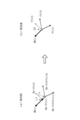
- FIG. 11 is a diagram for explaining an example of branch replacement processing
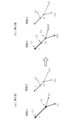
- FIG. 11 is a diagram for explaining an example of branch insertion processing
- FIG. 7A is a diagram showing an example of bronchi graph-structured information
- FIG. 7B is a diagram showing an example of simple graph-structured information.
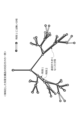
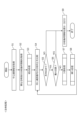
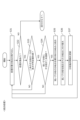
- FIG. 4 is a diagram showing an example of simplified association of bronchial structures at different times; 6 is a flowchart for explaining an example of overall processing of association processing of bronchus structures according to the embodiment;
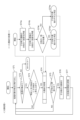
- FIG. 10 is a flowchart illustrating an example of branch integration processing in FIG. 9 ;
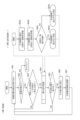
- FIG. 10 is a flowchart illustrating an example of branch replacement processing in FIG. 9 ;
- FIG. 10 is a flowchart illustrating an example of branch insertion processing in FIG. 9 ;
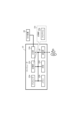
- FIG. It is a block diagram which shows the hardware structural example of a computer typically.
- vertebral animals such as humans have tree-structured organs.
- the bronchi of a human will be used to describe association of organ structures.
- the directions used in the explanation are defined as follows. "Upstream” refers to the direction toward the trachea, and “downstream” refers to the direction away from the trachea.
- a section from a bifurcation point to the next bifurcation point or end point on the bronchi is called a branch.
- FIG. 1 is a block diagram schematically showing a software functional configuration example of the information processing device 1 according to the embodiment.
- the information processing device 1 includes a control section 2 and a memory section 3 .
- the control unit 2 and the memory unit 3 may be connected so as to be able to communicate with each other.
- the control unit 2 performs various controls related to the association of bronchial structures.
- the control unit 2 functions as an acquisition unit 21 , an integration processing unit 22 , a comparison unit 23 , a replacement processing unit 24 , an insertion processing unit 25 and a presentation unit 26 .
- the memory unit 3 stores various data used by the information processing device 1 .
- the memory unit 3 stores center line information 31 , branch geometric information 32 , branch difference information 33 and graph structuring information 34 .
- center line information 31, the branch geometric information 32, and the branch difference information 33 will be described as data in table format, and the graph structuring information 34 will be described as data in graph format. It is not limited to this, and may be in various data formats.
- the acquiring unit 21 extracts the center line information 31 from the medical image in which the organ of the subject to be analyzed is captured.
- a medical image may be input to the acquisition unit 21 via a communication unit (not shown), or may be stored in the memory unit 3 in advance.
- the acquisition unit 21 acquires coordinate data of the center line of bronchi included in a computed tomography (CT) image as the center line information 31 .
- CT computed tomography
- the acquisition unit 21 extracts the three-dimensional shape of the bronchi included in the CT image, and further extracts the center line of the extracted bronchi.
- FIG. 2A is a diagram of a three-dimensional shape of bronchi constructed from a CT image
- FIG. 2B is a diagram of extracted centerlines of the bronchi.
- the center line is a line connecting the centers of cross sections perpendicular to the axial direction of the tubular structure.
- the centerline of the trachea and the centerline of the two bronchi branching off from the end of the trachea are drawn for the sake of explanation, but the centerline of the entire bronchi is actually extracted.
- a point at which a branch diverges from a branch is referred to as a branch point.
- Each branch can be represented by the coordinates of the start point and end point of the center line of the branch.
- the acquiring unit 21 acquires, as the center line information 31, a set of xyz coordinates (coordinate data of each point) representing the positions of the start and end points of the center line of the branch.
- the centerline information 31 may include the xyz coordinates of the start and end points of the centerline, the distance from the startpoint to any point on each centerline, the cross-sectional area at any point, and the like.
- the center line information 31 may include, for example, numbers assigned to the center lines of branches in a predetermined order, and information such as xyz coordinates and cross-sectional areas of points at 0.5 mm intervals from the starting point of each center line.
- the above CT image may be captured by an existing CT device.
- imaging was performed using thin-section CT.
- the extraction of the three-dimensional shape and the extraction of the center line from the CT image described above can be realized using commercial free software.
- Synopsys' Simpleware was used for three-dimensional construction and centerline extraction from CT images.
- the acquisition unit 21 acquires bronchi branch geometric information 32 based on the center line information 31 .
- the branch geometric information 32 is an example of branch information related to the coordinate data of the centerline of the bronchi.
- the acquisition unit 21 creates a set of points representing each branch from the coordinate data of each point of the center line information 31, and defines each branch. Specifically, the acquisition unit 21 creates a set of the start point and the end point of each branch, and extracts a set of branches in which the end point of one branch and the start point of another branch are shared. , search the branch group (take out the branch points in order), and obtain the connection relations of the branches.
- the bronchi are characterized by their hierarchical tree structure, which starts from the trachea and repeats branching, but never merges again.
- a branch connected upstream from a branch point is called a "parent”, and a branch connected downstream is called a "child”. If a branch has no branches downstream (no "children"), it is the end of the bronchi. Since all branch points are bifurcated or trifurcated, it is assumed that the number of children is 2 or 3 at all branch points.
- the acquisition unit 21 attaches a label indicating the connection relationship to each branch.
- Labels may be made up of, for example, numbers, letters, symbols, or combinations thereof.
- an identification number that is a combination of numbers is added as a label.
- the child's identification number is a number obtained by adding 1, 2, or 3 to the end of the parent's identification number.
- 1, 2, and 3 are assigned in descending order of the angle formed by the half line extending from the end of the parent branch and the child branch (hereinafter referred to as the connection angle). As a result, the children's identification numbers do not overlap.
- the identification number of the trachea which is the root of the bronchi, is 1. If the trachea is the first generation, the identification numbers of the second generation branches branching from the trachea are 11 and 12, and the third generation following the second generation is 111, 112, 121, 122, and so on. Although the identification number is expressed only by numbers, it may be hereinafter referred to as parent (1) for the sake of convenience.
- the process of assigning an identification number indicating the connection relationship to each branch is an example of defining each branch.
- FIG. 3 is a diagram for explaining the process of acquiring branch connection relationships.
- FIG. 3(a) is an example showing the connection relationship at the branch point J1. Since the branch upstream of the branch point J1 shares its end point with the start points of the two downstream branches, the relationship between these branches is classified as parent-child. Therefore, the acquisition unit 21 assigns an identification number 1 to the parent branch on the upstream side. Furthermore, since the connection angle between the parent (1) and the left child branch is smaller than the connection angle between the parent (1) and the right child branch, the acquisition unit 21 Assign identification number 11, and assign identification number 12 to the right child branch.
- FIG. 3(b) is an example showing the connection relationship at the branch points J2 and J3.
- the acquisition unit 21 obtains the children (grandchildren) connected to the end points of the children (11) and (12) based on the connection angles with the children (11) and (12). Label with identification numbers 111, 112, 121, 122, 123.
- the branch geometric information 32 may include the connection angle in addition to the identification number of each branch, and may also include information indicating the characteristics of each branch.
- Features of each branch include, for example, the cross-sectional area, curvature, opening angle, direction change, and length of each branch.
- the opening angle is the largest angle among the angles formed by two child branches in the case of bifurcation, and the angles formed by any two of the three child branches in the case of trifurcation.
- the opening angle is obtained by calculating the inner product from the directions of the centerlines of the parent-child branches.
- the direction change is the angle formed by the average direction of child branches and a half line extending from the end of the parent branch.
- the acquisition unit 21 acquires a plurality of pieces of branch geometric information 32 at different times.
- the acquisition unit 21 acquires the branching geometric information 32a at time 1 and the branching geometric information 32b at time 2 different from time 1 .
- Branching geometric information 32a at time 1 is an example of first branching information at a first time
- branching geometric information 32b at time 2 is an example of second branching information at a second time. be.
- the first time and the second time may be arbitrary times, for example, they are not limited to two times in different disease stages, and may be arbitrary times in the period before, during, and after illness.
- the interval between the first time and the second time may be short or long.
- the time 2 may be a time after an arbitrary period of time has passed from the time 1 or an arbitrary period of time before the time 1 . If the state of the organ changes physiologically, the first time may be a time in the first state and the second time may be a time in a second state different from the first state.
- the first time may be the time the lungs are inspiratory and the second time may be the time the lungs are in the expiratory state, or the first time may be the time the lungs are in the expiratory state.
- a second time may be a time when the lungs are inspiratory.
- the acquisition unit 21 stores the acquired center line information 31 and branch geometric information 32 (32a, 32b) in the memory unit 3. In addition, the acquisition unit 21 changes the branch geometric information 32 (“correction” or (which may be referred to as “update”). At the time of the access, the acquisition unit 21 may perform processing of changing the identification number assigned to each branch based on the connection angle according to the processing result. Thereby, the latest branch geometric information 32 can be acquired after each process.
- the integration processing unit 22, the comparison unit 23, the replacement processing unit 24, and the insertion processing unit 25 search for a branch group for the branch geometric information 32 (take out branch points in order) and perform each process.
- the integration processing unit 22 performs processing for integrating continuous two branches and changing them into three branches. Specifically, when the length of the branch between two consecutive branch points is less than a predetermined length, the integration processing unit 22 integrates the two branch points.
- FIG. 4 is a diagram for explaining an example of branch integration processing.
- parent (1) has a bifurcation into child (11) and child (12), and child (11) is branched into child (111) and child (112). ).
- the length of child (11) between branch point J4 (fourth branch point) and branch point J5 (fifth branch point) is less than a predetermined length. Therefore, the integration processing unit 22 integrates the branch point J4 and the branch point J5. Furthermore, the child (12) different from the integrated child (11) is replaced with the integrated branch point J6.
- the integration processing unit 22 may further change the identification number of the branch based on the connection angle along with the branch point integration processing and the branch replacement processing.
- the parent (1) and the child (11) become one branch, and the generation after the child (11) moves forward by one generation. Therefore, the identification numbers of children (111) and (112) are changed to children (11) and (12). Furthermore, the identification number of child (12) is changed to child (13) by the replacement process.
- the acquisition unit 21 updates the branch geometric information 32 according to the processing of the integration processing unit 22.
- the comparison unit 23 compares branch geometric information 32 at different times acquired or updated by the acquisition unit 21 .
- the comparison unit 23 compares the branching geometric information 32a at time 1 and the branching geometric information 32b at time 2 .
- the comparison unit 23 extracts branches having the same identification number from the branch geometric information 32a and the branch geometric information 32b, and evaluates the difference between the positions and directions of the pairs of branches. Specifically, if the difference in position and direction between branches with the same identification number is equal to or less than a preset limit value, these branches are evaluated as being associated.
- the distance between the two end points after translating one of the two branches to be compared so that the starting points of the two branches are the same is called the "positional difference”
- the angle formed by the two branches is called It's called “direction difference”.
- the direction here means the direction of the vector on the three-dimensional space connecting the start point and the end point of each branch.
- mismatch means that the difference in position or direction between branches with the same identification number exceeds a preset limit value, so that these branches cannot be matched. In other words, a branch that cannot be matched is an unmatched branch.
- the process of changing the definition is performed by the replacement processing unit 24 and the insertion processing unit 25 .
- the replacement processing unit 24 and the insertion processing unit 25 are examples of processing units.
- the comparison unit 23 evaluates all the branch pairs, and terminates the processing when there are no uncorresponding branch pairs or when the preset maximum number of processing times is reached.
- the replacement processing unit 24 replaces the identification numbers assigned based on the connection angle with respect to one branch point for each of a plurality of branches connected to the terminal side of the bronchi at one branch point on the bronchi. Specifically, when there are two or more child branches at the branch point to be processed at time 1 and time 2, the replacement processing unit 24 performs trial replacement, and based on the results of the trial, replaces the child branch at time 2. exchange the identification numbers of Swap processing is often required, especially when the connection angles are close between multiple child branches.
- the replacement processing unit 24 replaces the identification number of the child branch at time 2 .
- the replacement processing unit 24 repeats a series of replacement processing until there are no branch points to be processed. Replacement processing is an example of processing for changing the definition of each branch.
- FIG. 5 is a diagram for explaining an example of branch replacement processing.
- two or more child branches exist in parent branch (1) at time 1 and time 2 at both times.
- the identification numbers of the child branches at time 1 are (11) and (12) from the left
- the identification numbers of the child branches at time 2 are (12) and (11) from the left.
- the replacement trial it is determined that after switching the identification numbers (11) and (12) of the child branch at time 2, the degree of matching between the child branches at time 1 and time 2 is higher than before the replacement. Then, as shown in FIG. 5(b), the identification number of the child branch at time 2 is replaced.
- the acquisition unit 21 updates the branch geometric information 32 according to the processing of the replacement processing unit 24.
- the insertion processing unit 25 (Insertion processing unit 25) Next, the insertion processing unit 25 will be described. Especially in diseases in which the bronchi dilates as the disease progresses, the bronchi, which were below the limit of what can be imaged with a CT device before onset, dilates and becomes visible on CT. discrepancies are more likely to occur. Conversely, at a certain time, the bronchial tubes, which were visible on the CT, may become blocked with mucus, for example, and the air cannot enter, and the branches may not be visible. If this condition occurs in one part of the bronchi, it becomes impossible to associate all the branches downstream of the point of occurrence. The insertion process is a process necessary for the bronchi in such a state.
- the insertion processing unit 25 inserts a new branch point between two consecutive branch points on the bronchi. Specifically, when the branch point to be processed has two or more child branches at either time 1 or time 2, the insertion processing unit 25 performs an insertion trial, and based on the result of the trial, inserts at time 1 or A new branch point is inserted between the start point and the end point of the other parent branch at time 2 .
- the insertion process is a process of dividing the parent branch at either time 1 or time 2 into two branches to add one generation between the original parent branch and the elementary branch. be.
- FIG. 6 is a diagram for explaining an example of branch insertion processing.
- FIG. 6 shows an example in which a part of the bronchi expands after the onset of bronchiectasis and becomes visible on CT.
- parent (1) has children (11) and (12) at time 1
- parent (1) has children (11) and (12) at time 2.
- child (11) has children (111) and (112).
- a branch point J3 third branch When it is determined that the degree of coincidence between the child branches at time 1 and time 2 is greater after the insertion of the point) than before the insertion, as shown in FIG. Insert a branch point in the parent branch.
- the acquisition unit 21 updates the branch geometric information 32 according to the processing of the insertion processing unit 25.
- the comparison unit 23 evaluates all branch sets of the updated branch geometric information 32 each time the processing of the replacement processing unit 24 and the insertion processing unit 25 is executed.
- the same identification number is assigned to the anatomically identical branches in the branch geometric information 32a and the branch geometric information 32b. That is, the correspondence between the bronchial structures at time 1 and time 2 is completed.
- the acquisition unit 21 may integrate the branch geometric information 32a and the branch geometric information 32b for which the association processing has been completed, and acquire one branch geometric information 32.
- the acquisition unit 21 may acquire the branch difference information 33 based on the integrated branch geometric information 32.
- the branch difference information 33 includes information on changes in each branch between two times.
- the change information indicates the rate of change with reference to time 1 for items such as cross-sectional area, opening angle, direction change, and length.
- the rate of change of each item may be normalized.
- the change rate values may be color-coded according to the magnitude of the change amount.
- the bronchus structure may be expressed as a graph structure.
- the acquisition unit 21 acquires the graph structured information 34 of the bronchi having each branch as a side.
- the graph-structured information 34 is a kind of infographics that visualizes data, and in this embodiment, is a diagram (three-dimensional image) that visually expresses the branch geometric information 32 in a graph format.
- the graph structured information 34 may be created based on the branch difference information 33 in addition to the branch geometric information 32 .
- Fig. 7A represents the bronchi as a graph structure. Due to the complexity of FIG. 7A, simple graph structured information is shown in FIG. 7B.
- the graph structured information 34 for example, branches are represented by bars and branch points are represented by spheres.
- the graph-structured information 34 makes it possible to intuitively grasp the complex bronchus structure.
- the graph structuring described above can be realized using commercial free software.
- the free software Python package NetworkX is used for graph structuring.
- each branch may be color-coded. For example, for each generation, branches with identification number suffixed with 1 are classified in dark blue, branches with 2 in light blue, and branches with 3 in green. may be
- branches with the same identification number may be colored in red. Also, branches that exist at only one of the two times may be colored yellow when the matching is complete.
- the acquisition unit 21 may acquire the graph structured information 34 before completing the association of the bronchial structures. As a result, it is possible to intuitively confirm the intermediate process of the process of associating the bronchial structures.
- the presentation unit 26 presents the branch geometric information 32a and the branch geometric information 32b after execution of the process of changing the definition of each branch by the processing unit to the output device 40 (see FIG. 13). Furthermore, the presentation unit 26 may present at least one of the center line information 31, the branch difference information 33, and the graph structuring information 34 acquired by the acquisition unit 21 to the output device 40. FIG. In addition, the presentation unit 26 may present the determination result and the processing result in the process described above to the output device 40 .
- the following changes may occur, and such changes are reflected in the branch geometric information 32 updated each time the process is performed.
- Information for quantitative evaluation of changes in organs is prepared in the branch geometric information 32 at the time when the association is completed. 1. 2. Branches became thinner or thicker than at time 1; A branch that was not visible at time 1 (not visualized in the CT image) became visible (if this branch is not terminal, 4 or 6 will also occur at the same time) 3. The branch that was visible at time 1 (depicted in the CT image) became invisible (if this branch is not the terminal, 5 or 6 also occurs at the same time) 4. 5.
- FIG. 8 shows an example of simplified association of bronchial structures at different times.
- FIG. 8 shows the bronchi graph structuring information 34 at two times when the correspondence between the bronchi structures has been completed by the processing in the control unit 2 and displayed in an overlapping manner.
- Light gray is time 1
- dark gray and white are time 2 bronchial structures.
- the branches that are absent at time 1 are shown in white, and the regions with large branch diameters are shown in bold.
- bronchodilation progresses in part of the bronchi.
- FIG. 9 is a flowchart illustrating an example of overall processing of the bronchial structure association processing according to the embodiment.
- the acquisition unit 21 extracts the centerline information 31 from the CT image (step S ⁇ b>1 ) and stores it in the memory unit 3 . Furthermore, the acquisition unit 21 acquires branch geometric information 32a and 32b at time 1 and time 2 based on the center line information 31 (step S2).
- the integration processing unit 22 performs integration processing for integrating two consecutive branch points according to the length of the child branch (step S3).
- the integration processing will be described later.
- the comparison unit 23 compares the branches with the same identification number in the branch geometric information 32a and the branch geometric information 32b (step S4). Specifically, the comparison unit 23 evaluates whether or not the differences in the positions and directions of branches with the same identification number exceed a preset limit value.
- the comparison unit 23 determines whether or not there is an unsupported branch (step S5). Specifically, the comparison unit 23 determines each branch of the set of branches that cannot be associated because the distance and angle deviation between the branches with the same identification number exceeds a preset limit value. Evaluate as a branch. On the other hand, if there is no unsupported branch (No in step S5), the presentation unit 26 presents the branch geometric information 32a and the branch geometric information 32b to the output device 40 (step S9), and ends. The presentation unit 26 may further present the branch difference information 33 and the graph structuring information 34 to the output device 40 in step S9.
- step S6 determines whether the number of times of processing has reached the preset maximum number of times. If the number of times of processing reaches the maximum number of times (Yes in step S6), the process proceeds to step S9. On the other hand, if the number of times of processing has not reached the maximum number of times (No in step S6), processing for changing the definition of each branch is performed by the replacement processing unit 24 and insertion processing unit 25 (steps S7 and S8). Replacement processing and insertion processing will be described later.
- the control unit 2 repeats the processing of steps S4 to S8 until there are no more unsupported branches (No in step S5) or the number of processing reaches the maximum number of times (Yes in step S6).
- FIG. 10 is a flowchart for explaining an example of the branch integrating process in FIG.
- the integration process is a process of integrating continuous two branches and changing them into three branches.
- the integration processing unit 22 extracts branch points in a predetermined order from the branch geometric information 32a and the branch geometric information 32b (step S31), and determines whether or not the extracted branch points are to be processed (step S32). ). If there is no branch point to be processed (No in step S32), the process proceeds to step S4 in FIG.
- step S32 the integration processing unit 22 determines whether or not the length of one of the two child branches of the branch point is less than a predetermined value (step S33). . If the length is greater than or equal to the predetermined value (No in step S33), the process returns to step S31 and the next branch point is processed.
- the integration processing unit 22 determines whether or not the short child branch whose length was determined to be less than the predetermined value in step S33 is further connected to two child branches (step S34). If two child branches are not connected (No in step S34), the process returns to step S31 and the next branch point is processed. On the other hand, if two child branches are connected (Yes in step S34), the branch point of the short child branch is integrated with the branch point of the parent branch (step S35). Further, the long child branch sharing the starting point with the short branch is replaced with the branch point integrated in step S35 (step S36). As described above, after step S36, the integration processing unit 22 may further change the branch identification number based on the connection angle (not shown).
- the acquisition unit 21 updates the branch geometric information 32a and the branch geometric information 32b (step S37).
- FIG. 11 is a flowchart for explaining an example of branch replacement processing in FIG.
- the replacement process is a process of replacing the identification numbers given to each of a plurality of branches connected to the terminal side of the bronchi at one branch point on the bronchi based on the connection angle with respect to one branch point. Assignment of the identification number is as described in the description of the function of the acquisition unit 21 .
- the replacement processing unit 24 extracts branch points in a predetermined order from the branch geometric information 32 (step S71), and determines whether or not the extracted branch points are to be processed (step S72). If there is no branch point to be processed (No in step S72), the process proceeds to step S8 in FIG.
- step S73 the replacement processing unit 24 determines whether the branch points at time 1 and time 2 have two or more child branches (step S73). If there are not two or more child branches (No in step S73), the process returns to step S71 and the next branch point is processed.
- the replacement processing unit 24 performs replacement trial processing for determining whether or not to execute the replacement of the branch at time 2 (step S74).
- the replacement processing unit 24 evaluates the degree of matching between the branches at time 1 and time 2 before switching the child branches (step S74a), and further evaluates the branches at time 1 and time 2 after switching the child branches. are evaluated (step S74b). Specifically, the replacement processing unit 24 compares the position and direction of the branch at time 1 with the position and direction of the branch at time 2 for the branch with the same identification number. Steps S74a and S74b may be performed in parallel.
- the replacement processing unit 24 determines whether or not the replacement of child branches improves the matching degree of branches (step S74c). Specifically, the replacement processing unit 24 determines whether the difference in the position and direction of the branch with the same identification number at time 1 and time 2 is small before and after the replacement. If the matching degree of the branch is improved (Yes in step S74c), it is determined that the child branch can be replaced (step S74d), and the process proceeds to step S75. On the other hand, if the matching degree of the branch is not improved (No in step S74c), it is determined that the sub-branch cannot be replaced (step S74e), and the process proceeds to step S75.
- step S75 If the replacement trial result is "exchange executable" (Yes in step S75), the replacement processing unit 24 replaces child branches (step S76). On the other hand, if the replacement trial result is "not executable" (No in step S75), the process returns to step S71 and the next branch point is processed.
- the acquisition unit 21 updates the branch geometric information 32a and the branch geometric information 32b (step S77).
- FIG. 12 is a flowchart illustrating an example of branch insertion processing in FIG.
- the insertion process is a process of inserting a new branch point between two consecutive branch points on the bronchi.
- the insertion processing unit 25 extracts branch points in a predetermined order from the branch geometric information 32 (step S81), and determines whether or not the extracted branch points are to be processed (step S82). If there is no branch point to be processed (No in step S82), the process proceeds to step S4 in FIG.
- step S83 the insertion processing unit 25 determines whether the branch point at time 2 has two or more child branches (step S83). If there are not two or more child branches (No in step S83), the process returns to step S81 and the next branch point is processed.
- the insertion processing unit 25 performs an insertion trial process for determining whether or not to execute the insertion of the child branch (step S84).
- the insertion processing unit 25 evaluates the matching degree of the branch before inserting the child branch (step S84a), and further evaluates the matching degree of the branch after inserting the child branch (step S84b). Specifically, the insertion processing unit 25 compares the position and direction of the branch at time 1 with the position and direction of the branch at time 2 for the branch with the same identification number. Steps S84a and S84b may be performed in parallel.
- the insertion processing unit 25 determines whether or not the insertion of the child branch improves the matching degree of the branch (step S84c). Specifically, the insertion processing unit 25 compares the difference in the position and direction of the branch with the same identification number at time 1 and time 2 before insertion and time 2 after insertion, and determines whether the difference is reduced. If the matching degree of the branch is improved (Yes in step S84c), it is determined that the child branch can be "inserted" (step S84d), and the process proceeds to step S85. On the other hand, if the matching degree of the branch is not improved (No in step S84c), it is determined that the child branch cannot be inserted (step S84e), and the process proceeds to step S85.
- step S85 If the insertion trial result is "insertion executable" (Yes in step S85), the insertion processing unit 25 inserts a child branch (step S86). On the other hand, if the result of the trial insertion is "insertion not executable" (No at step S85), the process returns to step S81 to perform processing for the next branch point.
- the acquisition unit 21 updates the branch geometric information 32a and the branch geometric information 32b (step S87).
- FIG. 13 is a block diagram schematically showing a hardware (HW) configuration example of the computer 10 that implements the functions of the information processing apparatus 1 .
- the computer 10 illustratively includes a processor 10a, a memory 10b, a storage section 10c, an IF (Interface) section 10d, an I/O (Input/Output) section 10e, and a reading section 10f.
- the processor 10a is an example of an arithmetic processing unit that performs various controls and operations.
- the processor 10a is communicably connected to each block in the computer 10 via a bus 10i.
- Examples of the processor 10a include integrated circuits (ICs) such as CPUs, MPUs, GPUs, APUs, DSPs, ASICs, and FPGAs.
- the memory 10b is an example of HW that stores information such as various data and programs.
- Examples of the memory 10b include one or both of a volatile memory such as a DRAM (Dynamic Random Access Memory) and a nonvolatile memory such as a PM (Persistent Memory).
- a volatile memory such as a DRAM (Dynamic Random Access Memory)
- a nonvolatile memory such as a PM (Persistent Memory).
- the storage unit 10c is an example of HW that stores information such as various data and programs.
- Examples of the storage unit 10c include magnetic disk devices such as HDDs (Hard Disk Drives), semiconductor drive devices such as SSDs (Solid State Drives), and various storage devices such as nonvolatile memories.
- Examples of nonvolatile memory include flash memory, SCM (Storage Class Memory), ROM (Read Only Memory), and the like.
- the storage unit 10c may store a program 10g (a program for associating organ structures representing tree structures) that implements all or part of the various functions of the computer 10 .
- Various functions of the computer 10 include the functions of the above-described control unit 2 (acquisition unit 21, integration processing unit 22, comparison unit 23, replacement processing unit 24, insertion processing unit 25, presentation unit 26).
- the processor 10a of the information processing apparatus 1 expands the program 10g (a program for associating an organ structure representing a tree structure) stored in the storage unit 10c in the memory 10b and executes the program 10g, as illustrated in FIG. A function as the information processing device 1 (control unit 2) can be realized. That is, the program for associating the structure of the organ showing the tree structure is an acquisition process for acquiring the center line information 31, the branch geometric information 32, the branch difference information 33, and the graph structuring information 34 as the process to be executed by the processor 10a.
- a presentation process for presenting geometric information 32 (32a, 32b), branch difference information 33, and graph structuring information 34 is defined.
- the presentation processing may include presentation of processing results (comparison results and determination results) in the process.
- the memory unit 3 illustrated in FIG. 1 may be realized by a storage area of at least one of the memory 10b and the storage unit 10c. Furthermore, the acquisition unit 21 illustrated in FIG. 1 stores information (center line information 31, branch geometric information 32 (32a, 32b), branch Branch difference information 33 and graph structuring information 34) may be stored.
- the IF unit 10d is an example of a communication IF that controls connection and communication with a network.
- the IF unit 10d may include an adapter conforming to LAN (Local Area Network) such as Ethernet (registered trademark), or optical communication such as FC (Fiber Channel).
- the information processing device 1 may be communicably connected to an imaging device (CT device) (not shown) via the IF unit 10d.
- CT device imaging device
- the program 10g may be downloaded from the network to the computer 10 via the communication IF and stored in the storage unit 10c.
- the I/O unit 10e may be connected to one or both of the input device and the output device 40.
- Input devices include, for example, a keyboard, a mouse, and a touch panel.
- Examples of the output device 40 include a monitor, a projector, and a printer.
- the presentation unit 26 illustrated in FIG. 33, graph structured information 34) and the processing results (comparison results and judgment results) in the above-described processing steps may be presented.
- the reading unit 10f is an example of a reader that reads information (data) and program information recorded on the recording medium 10h.
- the reading unit 10f may include a connection terminal or device to which the recording medium 10h can be connected or inserted.
- Examples of the reading unit 10f include an adapter conforming to USB (Universal Serial Bus), a drive device for accessing a recording disk, and a card reader for accessing flash memory such as an SD card.
- the recording medium 10h may store the program 10g, or the reading unit 10f may read the program 10g from the recording medium 10h and store it in the storage unit 10c.
- Examples of the recording medium 10h include non-temporary computer-readable recording media such as magnetic/optical disks and flash memory.
- Examples of magnetic/optical discs include flexible discs, CDs (Compact Discs), DVDs (Digital Versatile Discs), Blu-ray discs, HVDs (Holographic Versatile Discs), and the like.
- Examples of flash memories include semiconductor memories such as USB memories and SD cards.
- HW in the computer 10 may be increased or decreased (for example, addition or deletion of arbitrary blocks), division, integration in arbitrary combinations, addition or deletion of buses, or the like may be performed as appropriate.
- HW in the information processing device 1 at least one of the I/O unit 10e and the reading unit 10f may be omitted.
- the acquisition unit 21 acquires branch geometric information 32a regarding the coordinate data of the bronchus centerline, which is an example of the tree-structured organ at time 1, and branching geometric information 32b regarding the coordinate data of the bronchus centerline at time 2. do.
- the comparison unit 23 compares the branch geometric information 32 a and the branch geometric information 32 b acquired by the acquisition unit 21 . If there is a mismatch between the branch geometric information 32a and the branch geometric information 32b as a result of the comparison by the comparison unit 23, the processing units 24 and 25 select the bronchi in the branch geometric information 32a or the branch geometric information 32b. Change the definition of each branch contained in .
- the presenting unit 26 presents the branch geometric information 32a and the branch geometric information 32b after execution of processing for changing the definition of each branch by the processing units 24 and 25.
- the branch geometric information 32a, 32b that correctly defines the relationship between each branch of the bronchus, which is an example of a tree-structured organ. can be associated. Furthermore, by presenting the branch geometric information 32 to the output device 40, the output device 40 visually shows information including the connection relationship of each branch and the characteristics of each branch. It is possible to quantitatively evaluate how the subject's bronchi progressed at different times, for example, how the bronchial dilatation changed at which site.
- the replacement processing unit 24 replaces the identification numbers assigned to each of the plurality of branches connected to the terminal side of the bronchi at one branch point on the bronchi based on the connection angle with respect to one branch point.
- the relationship between multiple child branches can be accurately obtained, so even if there is a morphological change in which the size relationship between the connection angles is reversed between the child branches, the bronchial structure can be handled with high accuracy. It is possible to realize the attachment and contribute to the quantitative evaluation of the bronchi.
- the insertion processing unit 25 inserts the branch point J3 between the consecutive branch points J1 and J2 on the bronchi.
- the integration processing unit 22 determines if the length of the branch between the continuous branch point J4 and the branch point J5 on the bronchi is less than a predetermined length. Integrate J4 and branch point J5.
- control unit 2 and the memory unit 3 in the information processing apparatus 1 shown in FIG. 1 may be merged or separated.
- the present invention can be applied to any tree-structured organ other than the bronchi without changing the above-described processing (branch geometric information acquisition processing, integration processing, comparison processing, replacement processing, insertion processing).
- Other organs that exhibit tree structures are blood vessels (vasculature; arteries and veins) within certain organs.
- the present invention is applied to the pulmonary artery, it is possible to evaluate the course of diseases such as pulmonary hypertension and pulmonary thromboembolism that change the vascular diameter.
- the application is expanded, it can be expected not only to the lungs but also to the follow-up observation of arterial diseases such as arteriosclerosis.
- Vascular structures exhibiting a tree structure may exhibit various branching forms, including tri-branching, tetra-branching, and a greater number of branches. is impossible. Therefore, by applying the trifurcation processing of the present embodiment, the above processing can be applied to vessels.
- information processing device 10 computer 10a processor 10b memory 10c storage unit 10d IF unit 10e I/O unit 10f reading unit 10g program (organ structure correspondence program showing tree structure) 10h recording medium 2 control unit 21 acquisition unit 22 integration processing unit 23 comparison unit 24 replacement processing unit (processing unit) 25 insertion processing unit (processing unit) 26 presentation unit 3 memory unit 31 center line information 32, 32a, 32b branch geometric information (branch information) 33 branch difference information 34 graph structured information 40 output device J branch point
Landscapes
- Life Sciences & Earth Sciences (AREA)
- Health & Medical Sciences (AREA)
- Medical Informatics (AREA)
- Biophysics (AREA)
- Pathology (AREA)
- Engineering & Computer Science (AREA)
- Biomedical Technology (AREA)
- Heart & Thoracic Surgery (AREA)
- Physics & Mathematics (AREA)
- Molecular Biology (AREA)
- Surgery (AREA)
- Animal Behavior & Ethology (AREA)
- General Health & Medical Sciences (AREA)
- Public Health (AREA)
- Veterinary Medicine (AREA)
- Image Processing (AREA)
Abstract
L'invention concerne un dispositif de traitement d'informations (1) pourvu d'une unité d'acquisition (21) qui acquiert de premières informations de bifurcation (32a) liées à des données de coordonnées de la ligne centrale d'un organe présentant une structure arborescente à un premier point dans le temps et de secondes informations de bifurcation (32b) liées à des données de coordonnées de la ligne centrale de l'organe présentant la structure arborescente à un second point dans le temps ; une unité de comparaison (23) qui compare les premières informations de bifurcation et les secondes informations de bifurcation acquises par l'unité d'acquisition ; une unité de traitement (24, 25) qui, lorsque les premières informations de bifurcation ne correspondent pas aux secondes informations de bifurcation en résultat de la comparaison par l'unité de comparaison, change les définitions, en les premières informations de bifurcation ou les secondes informations de bifurcation, pour des bifurcations comprises dans l'organe présentant la structure arborescente ; et une unité de présentation (26) qui présente à un dispositif de sortie les premières informations de bifurcation et les secondes informations de bifurcation ayant subi le processus de changement des définitions correspondant aux bifurcations exécutées par l'unité de traitement.
Priority Applications (1)
| Application Number | Priority Date | Filing Date | Title |
|---|---|---|---|
| PCT/JP2021/040673 WO2023079657A1 (fr) | 2021-11-04 | 2021-11-04 | Dispositif de traitement d'informations, procédé d'association pour structure d'organe présentant une structure arborescente, et programme d'association pour structure d'organe présentant une structure arborescente |
Applications Claiming Priority (1)
| Application Number | Priority Date | Filing Date | Title |
|---|---|---|---|
| PCT/JP2021/040673 WO2023079657A1 (fr) | 2021-11-04 | 2021-11-04 | Dispositif de traitement d'informations, procédé d'association pour structure d'organe présentant une structure arborescente, et programme d'association pour structure d'organe présentant une structure arborescente |
Publications (1)
| Publication Number | Publication Date |
|---|---|
| WO2023079657A1 true WO2023079657A1 (fr) | 2023-05-11 |
Family
ID=86240831
Family Applications (1)
| Application Number | Title | Priority Date | Filing Date |
|---|---|---|---|
| PCT/JP2021/040673 Ceased WO2023079657A1 (fr) | 2021-11-04 | 2021-11-04 | Dispositif de traitement d'informations, procédé d'association pour structure d'organe présentant une structure arborescente, et programme d'association pour structure d'organe présentant une structure arborescente |
Country Status (1)
| Country | Link |
|---|---|
| WO (1) | WO2023079657A1 (fr) |
Citations (5)
| Publication number | Priority date | Publication date | Assignee | Title |
|---|---|---|---|---|
| US20040066958A1 (en) * | 2002-10-08 | 2004-04-08 | Chen Shiuh-Yung James | Methods and systems for display and analysis of moving arterial tree structures |
| JP2007044488A (ja) * | 2005-06-22 | 2007-02-22 | Siemens Corporate Res Inc | パスベースのツリーマッチングのためのシステムおよび方法 |
| JP2011212314A (ja) * | 2010-03-31 | 2011-10-27 | Fujifilm Corp | 血管表示制御装置および方法、並びにプログラム |
| JP2016087433A (ja) * | 2014-10-31 | 2016-05-23 | 株式会社東芝 | 医用画像処理装置および医用画像処理方法 |
| US20210174500A1 (en) * | 2018-05-03 | 2021-06-10 | Koninklijke Philips N.V. | Interactive coronary labeling using interventional x-ray images and deep learning |
-
2021
- 2021-11-04 WO PCT/JP2021/040673 patent/WO2023079657A1/fr not_active Ceased
Patent Citations (5)
| Publication number | Priority date | Publication date | Assignee | Title |
|---|---|---|---|---|
| US20040066958A1 (en) * | 2002-10-08 | 2004-04-08 | Chen Shiuh-Yung James | Methods and systems for display and analysis of moving arterial tree structures |
| JP2007044488A (ja) * | 2005-06-22 | 2007-02-22 | Siemens Corporate Res Inc | パスベースのツリーマッチングのためのシステムおよび方法 |
| JP2011212314A (ja) * | 2010-03-31 | 2011-10-27 | Fujifilm Corp | 血管表示制御装置および方法、並びにプログラム |
| JP2016087433A (ja) * | 2014-10-31 | 2016-05-23 | 株式会社東芝 | 医用画像処理装置および医用画像処理方法 |
| US20210174500A1 (en) * | 2018-05-03 | 2021-06-10 | Koninklijke Philips N.V. | Interactive coronary labeling using interventional x-ray images and deep learning |
Similar Documents
| Publication | Publication Date | Title |
|---|---|---|
| Mascagni et al. | Artificial intelligence for surgical safety: automatic assessment of the critical view of safety in laparoscopic cholecystectomy using deep learning | |
| González et al. | Disease staging and prognosis in smokers using deep learning in chest computed tomography | |
| Shi et al. | A deep learning system for fully automated retinal vessel measurement in high throughput image analysis | |
| US12475993B2 (en) | Apparatus and method for medical image reading assistant providing representative image based on medical use artificial neural network | |
| CN110223781B (zh) | 一种多维度斑块破裂风险预警系统 | |
| Postiglione et al. | Multicentric clinical evaluation of a computed tomography-based fully automated deep neural network for aortic maximum diameter and volumetric measurements | |
| CN113177945A (zh) | 用于将分割图链接到体数据的系统和方法 | |
| Yao et al. | TaG-Net: topology-aware graph network for centerline-based vessel labeling | |
| de Carvalho Macruz et al. | Quantification of the thoracic aorta and detection of aneurysm at CT: development and validation of a fully automatic methodology | |
| US20070177785A1 (en) | Method for segmenting arteries and veins | |
| Huang et al. | Deep learning techniques for imaging diagnosis and treatment of aortic aneurysm | |
| CN114830244A (zh) | 使用多模态数据的时间疾病状态比较 | |
| van Veldhuizen et al. | Machine learning based prediction of post-operative infrarenal endograft apposition for abdominal aortic aneurysms | |
| US20070049839A1 (en) | System and method for automated airway evaluation for multi-slice computed tomography (msct) image data using airway lumen diameter, airway wall thickness and broncho-arterial ratio | |
| Zhang et al. | Robust and smooth couinaud segmentation via anatomical structure-guided point-voxel network | |
| Meuschke et al. | Management of cerebral aneurysm descriptors based on an automatic ostium extraction | |
| CN114119645B (zh) | 一种图像分割质量的确定方法、系统、设备及介质 | |
| WO2023079657A1 (fr) | Dispositif de traitement d'informations, procédé d'association pour structure d'organe présentant une structure arborescente, et programme d'association pour structure d'organe présentant une structure arborescente | |
| CN114947916A (zh) | 一种冠状动脉病变syntax评分的计算方法及装置 | |
| Garg et al. | Role of deep learning in computed tomography | |
| Zhao et al. | Deep feature regression (DFR) for 3D vessel segmentation | |
| Engberg et al. | Automated quantification of retinal microvasculature from OCT angiography using dictionary-based vessel segmentation | |
| Chapman et al. | Automated generation of directed graphs from vascular segmentations | |
| Riffaud et al. | Automatic branch detection of the arterial system from abdominal aortic segmentation | |
| Diedrich et al. | Comparing performance of centerline algorithms for quantitative assessment of brain vascular anatomy |
Legal Events
| Date | Code | Title | Description |
|---|---|---|---|
| 121 | Ep: the epo has been informed by wipo that ep was designated in this application |
Ref document number: 21963253 Country of ref document: EP Kind code of ref document: A1 |
|
| NENP | Non-entry into the national phase |
Ref country code: DE |
|
| 122 | Ep: pct application non-entry in european phase |
Ref document number: 21963253 Country of ref document: EP Kind code of ref document: A1 |
|
| NENP | Non-entry into the national phase |
Ref country code: JP |