WO2023080253A1 - Procédé de production de cristaux mixtes de 5'-disodium guanylate/5'-disodium inosinate - Google Patents
Procédé de production de cristaux mixtes de 5'-disodium guanylate/5'-disodium inosinate Download PDFInfo
- Publication number
- WO2023080253A1 WO2023080253A1 PCT/JP2022/041526 JP2022041526W WO2023080253A1 WO 2023080253 A1 WO2023080253 A1 WO 2023080253A1 JP 2022041526 W JP2022041526 W JP 2022041526W WO 2023080253 A1 WO2023080253 A1 WO 2023080253A1
- Authority
- WO
- WIPO (PCT)
- Prior art keywords
- disodium
- crystallization
- concentration
- guanylate
- aqueous solution
- Prior art date
- Legal status (The legal status is an assumption and is not a legal conclusion. Google has not performed a legal analysis and makes no representation as to the accuracy of the status listed.)
- Ceased
Links
Images


Classifications
-
- C—CHEMISTRY; METALLURGY
- C07—ORGANIC CHEMISTRY
- C07H—SUGARS; DERIVATIVES THEREOF; NUCLEOSIDES; NUCLEOTIDES; NUCLEIC ACIDS
- C07H1/00—Processes for the preparation of sugar derivatives
- C07H1/06—Separation; Purification
-
- C—CHEMISTRY; METALLURGY
- C07—ORGANIC CHEMISTRY
- C07H—SUGARS; DERIVATIVES THEREOF; NUCLEOSIDES; NUCLEOTIDES; NUCLEIC ACIDS
- C07H19/00—Compounds containing a hetero ring sharing one ring hetero atom with a saccharide radical; Nucleosides; Mononucleotides; Anhydro-derivatives thereof
- C07H19/02—Compounds containing a hetero ring sharing one ring hetero atom with a saccharide radical; Nucleosides; Mononucleotides; Anhydro-derivatives thereof sharing nitrogen
- C07H19/04—Heterocyclic radicals containing only nitrogen atoms as ring hetero atom
- C07H19/16—Purine radicals
- C07H19/20—Purine radicals with the saccharide radical esterified by phosphoric or polyphosphoric acids
-
- C—CHEMISTRY; METALLURGY
- C07—ORGANIC CHEMISTRY
- C07B—GENERAL METHODS OF ORGANIC CHEMISTRY; APPARATUS THEREFOR
- C07B2200/00—Indexing scheme relating to specific properties of organic compounds
- C07B2200/13—Crystalline forms, e.g. polymorphs
Definitions
- the present invention provides a mixed crystal ("5'-guanyl
- the present invention relates to a method for producing disodium acid 5′-disodium inosinate mixed crystal” or “I+G crystal”).
- Patent Document 2 a method of dissolving 5′-GMP2Na and 5′-IMP2Na in an aqueous solution containing a hydrophilic organic solvent such as methanol to obtain a mixed crystal of 5′-GMP2Na and 5′-IMP2Na (that is, an I+G mixed crystal); A crystallization method in which an organic solvent is added to a mixed aqueous solution of 5′-IMP2Na and 5′-GMP2Na (Patent Document 2) (3) A method characterized by gradually adding an aqueous solution containing 5'-IMP2Na to a slurry solution containing 5'-GMP2Na as a liquid bottom to form an I+G mixed crystal (Patent Document 3).
- the method (3) and the method (4) are aqueous crystallization, but the number of facilities increases because GMP and IMP are separately prepared. Furthermore, in the methods (3) and (4) of adding an IMP solution to a GMP slurry, it is difficult to increase the recovery rate and purity of crystals due to the presence of GMP amorphous.
- the object is to obtain by crystallization in an aqueous system without using a poor solvent such as.
- the above problem can be solved by performing semi-batch crystallization or continuous crystallization in an aqueous system using an aqueous solution containing G and I at predetermined concentrations and NaCl at a predetermined concentration. It turned out to be solvable. That is, the present application provides the following inventions.
- the concentration of the NaCl aqueous solution is 5% by mass or more and the saturated concentration or less
- the aqueous solution containing disodium 5′-guanylate and disodium 5′-inosinate contains 5 to 25% by weight of disodium 5′-guanylate and 5 to 20% by weight of disodium 5′-inosinate.
- Disodium 5'-guanylate and disodium 5'-guanylate and 5'-disodium guanylate and 5 A method for producing the mixed crystal, comprising a first crystallization step of forming a mixed crystal with disodium '-inosinate,
- concentration of the NaCl aqueous solution is 13 to 17% by mass
- the aqueous solution containing disodium 5′-guanylate and disodium 5′-inosinate contains 15 to 25% by weight of disodium 5′-guanylate and 15 to 20% by weight of disodium 5′-inosinate.
- the GMP concentration is 1.1 times the IMP concentration
- the crystallization temperature is maintained at 15°C
- Does not include a further crystallization step such as cooling crystallization
- the proportion of GMP crystals incorporated into the IMP crystals can be controlled. Therefore, according to the present invention, an I+G mixed crystal with an I/G ratio of approximately 1 can be obtained by incorporating many GMP crystals.
- the desired mixed crystal can also be obtained without substantially forming a GMP amorphous. Since the mixed crystal obtained by the present invention does not substantially contain GMP amorphous, it is possible to ensure the same separability as the mixed crystal obtained by the prior art.
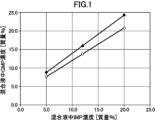
- FIG. 1 shows the relationship between the IMP concentration and the GMP concentration in a mixed aqueous solution of IMP and GMP.
- FIG. 2 shows the relationship between the NaCl concentration of the NaCl aqueous solution initially charged and the effective partition coefficient.
- 3 shows the crystal shape of the mixed crystal obtained by crystallization in Example 1.
- FIG. 4 shows the crystal shape of the mixed crystal obtained by crystallization in Example 2.
- FIG. 5A shows the crystal shape of the mixed crystal obtained in Example 3.
- FIG. The upper row shows crystals before cooling crystallization, and the lower row shows crystals after cooling crystallization.
- 5B is the crystal shape of the mixed crystal obtained by batch crystallization of Reference Example 1.
- FIG. 5C shows the mixed crystal morphology of Reference Example 2 obtained by methanol crystallization.
- the method of the present invention comprises a first crystallization step of forming an I+G mixed crystal by semi-batch crystallization or continuous crystallization using an aqueous solution containing GMP and IMP and an aqueous NaCl solution.
- the mixed aqueous solution of IMP and GMP used in the present invention is, of course, from each product crystal of both, for example, an I+G mixed crystal having an I/G ratio outside the predetermined range, or an It can also be prepared from a coarse crystal level during the manufacturing process.
- the content of impurities is limited to such an extent that it does not affect the solubility or crystal growth rate of the I+G mixed crystal.
- Semi- or fed-batch crystallization in the present invention refers to crystallization in which an aqueous solution containing at least GMP and IMP, optionally also an aqueous NaCl solution, is added continuously or sequentially to the crystallization tank. .
- an aqueous solution containing at least GMP and IMP, and optionally an aqueous NaCl solution is continuously or sequentially added to the crystallization tank, and the I+G mixed crystal is continuously recovered.
- the mixed aqueous solution of IMP and GMP may be added to the crystallization tank filled with the aqueous NaCl solution, or the aqueous NaCl solution and the mixed aqueous solution of IMP and GMP may be added to an empty crystallization tank at the same time. or into a crystallizer filled with water.
- GMP was incorporated into the IMP crystal lattice. A mixed crystal precipitates.
- the amount of NaCl aqueous solution or water charged in advance is preferably such that the content in the crystallization tank can be stirred even after the entire amount is added. Stirring must be maintained in a good condition so that the NaCl aqueous solution and the mixed aqueous solution of IMP and GMP are rapidly and uniformly dispersed. Further, in order to keep the crystal shape of the I+G mixed crystal in good condition, it is desirable to perform the stirring at a low speed as much as possible, preferably at a space velocity of 0.05 to 1.0. It is more preferably 0.1 to 0.5. Furthermore, 0.1 to 0.3 is desirable.
- the concentration of the NaCl aqueous solution affects the size of the GMP crystal and the I+G mixed crystal incorporated into the IMP crystal.
- the higher the NaCl concentration the more GMP crystals incorporated into the IMP crystals.
- the concentration of the NaCl aqueous solution is not less than 5% by mass and not more than the saturated concentration, preferably 15 to 27% by mass.
- the starting concentration can be determined by calculation by experimentally determining the effective partition coefficient depending on the NaCl concentration and the saturated solubility of IMP at a given temperature. Although the calculation method is not limited, it can be determined by repeating calculations while successively changing the concentration of IMP and GMP in the charged mixed aqueous solution until the desired I/G ratio is obtained. At this time, for example, referring to the material balance formula (12.1) in "Crystalization Engineering” by Noriaki Kubota (Tokyo Denki University Press, 2016, pp. 189-191), the effectiveness of the material balance formula and the above formula 1 It can be calculated by simultaneous distribution coefficient equations. Specifically, it is as follows.
- the ratio of IMP and GMP in the mixed crystal is
- CS IMP and CS GMP .
- Other variables determined by calculation are Y IMP , Y GMP and CM GMP , formula weight ratios R IMP and R GMP are constants, and W is a matter of design.
- the I / G ratio approximately 1 may be in the range of 47/53 to 53/47, so the lower and upper limits of the I / G ratio are P By substituting and calculating, the lower limit and upper limit of the charged concentration can be set respectively.
- the concentration of IMP and GMP in the mixed aqueous solution is such that GMP has a higher concentration than IMP, and the ratio of GMP concentration to IMP concentration is 1 to 1.8, preferably 1.8. 04 to 1.76, more preferably 1.04 to 1.52, even more preferably 1.04 to 1.15.
- the IMP and GMP concentrations in the mixed aqueous solution to be charged for example, when the NaCl concentration is 15% by mass, the IMP concentration in the mixed aqueous solution is 5 to 20 according to the I / G ratio (mass ratio) of the desired I + G mixed crystal.
- the unit "%" is % by mass.
- the concentrations of IMP and GMP are concentrations in terms of IMP2Na7.5H 2 O or GMP2Na7H 2 O unless otherwise specified.
- the crystallization temperature affects the crystal size. If the crystallization temperature is increased, the crystals become larger. Therefore, if the first crystallization step is preferably performed within the range of 5 to 40° C., the separability of the I+G mixed crystal can also be controlled through the control of the crystal size. can be done.
- the crystallization temperature in the first crystallization step can be controlled by controlling the temperature of the crystallization tank.
- the crystallization temperature can be set between 5 and 40°C. In the system of the present invention, the crystal growth is so fast that the aging time at the same temperature for waiting crystal growth is almost unnecessary. Sometimes the first crystallization step is completed.
- the crystallization temperature may be changed to a higher or lower temperature by the completion of the first crystallization step, it is preferably maintained at 10 to 25°C, more preferably 12 to 17°C, to obtain an I+G mixed crystal with good separability. is obtained, which is preferable.
- the maintenance (aging) time varies depending on the crystallization temperature and equipment, but from the viewpoint of equipment productivity, it is preferably 1 to 24 hours, more preferably 3 to 12 hours. In particular, aging at a temperature of 10 to 25° C. for 3 to 12 hours is preferred.
- a crystal with good separability means that the crystal does not substantially contain amorphous material, and when the crystal is photographed and the length of the crystal in the photograph is measured by image analysis, the major axis is 30 ⁇ m or more and the minor axis is 20 ⁇ m or more. refers to the crystal of
- Solid-liquid separation can be carried out immediately after the completion of the addition, but it is also possible to carry out a cooling operation in order to improve the yield. That is, the present invention may further include a second crystallization step of performing crystallization at a temperature lower than the crystallization temperature in the first crystallization step.
- the second crystallization temperature can be set to, for example, 5 to 40°C, but it is preferably performed at a temperature about 10 to 35°C lower than the first crystallization temperature, for example, within the range of 5 to 15°C. It can be carried out. At this time, if the cooling rate is 1 to 5° C./hour, crystals with good separability can be obtained. 1 to 3°C/hour is more preferred.
- the second crystallization temperature can also be kept constant or can be varied to higher or lower temperatures within the above temperature range.
- the maintenance (ripening) time in the second crystallization step also varies depending on the crystallization temperature and equipment, but from the viewpoint of equipment productivity, it is preferably 1 to 24 hours, and preferably 3 to 12 hours. more preferred. In particular, aging at a temperature of 10 to 25° C. for 3 to 12 hours is preferred. Crystals with good separability are obtained by the second crystallization step. However, from the viewpoint of avoiding amorphous precipitation, it is preferable not to include a further crystallization step such as cooling crystallization.
- pH for the crystallization operation is in the region where the disodium salt of 5'-guanylic acid and the disodium salt of 5'-inosinic acid exist, that is, within the range of pH 6 to 10, an I+G mixed crystal can be obtained. , preferably about pH 7-8.
- pH in this specification is a value in 25 degreeC.
- the desired mixed crystal can be obtained without seed crystals, so the number of facilities can be reduced.
- the desired mixed crystal can be obtained without substantially forming a GMP amorphous.
- the GMP amorphous is formed in the manufacturing process, the separation performance will be extremely deteriorated, and it will not be possible to substantially separate it. It remains on the solid side and deteriorates in quality.
- the term "substantially free of GMP amorphous" means that stirring is not hindered, for example, if the power load of stirring is increased or the crystals do not rise while sinking, GMP It means to allow the existence of amorphous.
- disodium 5'-guanylate is prepared by semi-batch crystallization or continuous crystallization using an aqueous solution containing disodium 5'-guanylate and disodium 5'-inosinate and an aqueous NaCl solution. and disodium 5'-inosinate to form a mixed crystal, comprising a first crystallization step of forming a mixed crystal,
- concentration of the NaCl aqueous solution is 13 to 17% by mass
- the aqueous solution containing disodium 5′-guanylate and disodium 5′-inosinate contains 15 to 25% by weight of disodium 5′-guanylate and 15 to 20% by weight of disodium 5′-inosinate.
- the GMP concentration is 1.1 times the IMP concentration
- the crystallization temperature is maintained at 15°C
- Example 1 140 g of NaCl aqueous solution was put into a beaker controlled at 5°C. As shown in Table 1, the NaCl concentration was adjusted from 0% to the saturated salt concentration. While each NaCl aqueous solution was stirred, 350 g of an aqueous solution adjusted to have IMP and GMP of 17.5% and 18.5%, respectively, was added dropwise. The dropping speed was a space velocity of 0.2. An I+G mixed crystal was obtained by dropping an aqueous solution containing IMP and GMP while stirring an aqueous NaCl solution. In order to control the pH at 7.5 during crystallization, the pH in the crystallization slurry was monitored and 1N NaOH aqueous solution was added as appropriate.
- the temperature was maintained at 5° C. and aged for 12 hours. It was found that increasing the NaCl concentration of the initial charging aqueous NaCl solution increased the effective partition coefficient (EDC) of GMP (Fig. 2).
- EDC effective partition coefficient
- the effective partition coefficient is the ratio of the GMP concentration to the IMP concentration in the crystal and the GMP concentration to the IMP concentration in the mother liquor, and is defined by Equation 1. It was found that the higher the salt concentration, the larger the effective partition coefficient, and the more GMP crystals are incorporated into the IMP crystals.
- the crystal shape of the mixed crystal obtained by crystallization was as shown in FIG.
- the supersaturation under each condition is shown in Table 1, and it was found that the higher the degree of supersaturation, the finer the I+G crystals.
- Example 2 In a beaker controlled at a temperature of 5°C, 15°C, or 25°C, 140 g of a 15% NaCl aqueous solution and 350 g of an aqueous solution adjusted to have IMP and GMP of 17.5% and 18.5%, respectively, were added simultaneously. Dripped. Dropping was performed while stirring the contents in the beaker. The total dropping rate of the two liquids was set to 0.2 in terms of space velocity. An I+G mixed crystal was obtained in a beaker. In order to control the pH at 7.5 during crystallization, the pH in the crystallization slurry was monitored and 1N NaOH aqueous solution was added as appropriate.
- Reference example 1 (batch crystal analysis) A 50% NaOH solution was added to the aqueous solution adjusted so that IMP and GMP were adjusted to 17.7% and 18.9%, respectively, to prepare an aqueous solution adjusted to pH 7.5. To this aqueous solution was added NaCl to 27.6%. After that, the temperature was raised to 45° C. to dissolve IMP and GMP, and then cooled to 20° C. at a rate of 5° C./hour.
- Reference example 2 (methanol crystallization) 175 mL of an aqueous methanol solution having a concentration of 45 vol % was charged into a beaker and kept at 45° C., and 6.3 g of an I+G mixed crystal was added as a seed crystal. To the obtained slurry, 763.0 g of an aqueous solution containing 78.3 g of IMP and 79.2 g of GMP and 95 vol % aqueous methanol solution were simultaneously added over 3 hours. During simultaneous addition, the concentration of methanol in the liquid phase in the beaker was controlled to 45 vol %. It was then cooled to 20°C at a rate of 5°C/hour.
- Example 3 A 50% NaOH solution was added to an aqueous solution adjusted to 17.3% and 18.5% IMP and GMP, respectively, to prepare a feed solution adjusted to pH 7.5. Subsequently, 31 g of water was poured into a beaker, and while stirring, 426 g of the feed liquid prepared above and 167 g of a 27.6% NaCl aqueous solution were simultaneously added at space velocities of 0.14 and 0.06, respectively, to obtain an I+G mixed crystal. was crystallized. The total space velocity was 0.2, and feeding was completed in 5 hours. The temperature was kept constant during this crystallization, and the crystallization was carried out at two levels of 25° C. (condition 1) and 40° C. (condition 2).
Landscapes
- Chemical & Material Sciences (AREA)
- Organic Chemistry (AREA)
- Health & Medical Sciences (AREA)
- Life Sciences & Earth Sciences (AREA)
- Engineering & Computer Science (AREA)
- Biochemistry (AREA)
- Biotechnology (AREA)
- General Health & Medical Sciences (AREA)
- Genetics & Genomics (AREA)
- Molecular Biology (AREA)
- Saccharide Compounds (AREA)
- Organic Low-Molecular-Weight Compounds And Preparation Thereof (AREA)
Abstract
Priority Applications (3)
| Application Number | Priority Date | Filing Date | Title |
|---|---|---|---|
| CN202280074240.9A CN118215670A (zh) | 2021-11-08 | 2022-11-08 | 5’-鸟苷酸二钠·5’-肌苷酸二钠混晶的制造方法 |
| JP2023558102A JPWO2023080253A1 (fr) | 2021-11-08 | 2022-11-08 | |
| KR1020247019215A KR20240101941A (ko) | 2021-11-08 | 2022-11-08 | 5'-구아닐산디나트륨·5'-이노신산디나트륨 혼정의 제조방법 |
Applications Claiming Priority (2)
| Application Number | Priority Date | Filing Date | Title |
|---|---|---|---|
| JP2021-181884 | 2021-11-08 | ||
| JP2021181884 | 2021-11-08 |
Publications (1)
| Publication Number | Publication Date |
|---|---|
| WO2023080253A1 true WO2023080253A1 (fr) | 2023-05-11 |
Family
ID=86241626
Family Applications (1)
| Application Number | Title | Priority Date | Filing Date |
|---|---|---|---|
| PCT/JP2022/041526 Ceased WO2023080253A1 (fr) | 2021-11-08 | 2022-11-08 | Procédé de production de cristaux mixtes de 5'-disodium guanylate/5'-disodium inosinate |
Country Status (4)
| Country | Link |
|---|---|
| JP (1) | JPWO2023080253A1 (fr) |
| KR (1) | KR20240101941A (fr) |
| CN (1) | CN118215670A (fr) |
| WO (1) | WO2023080253A1 (fr) |
Cited By (1)
| Publication number | Priority date | Publication date | Assignee | Title |
|---|---|---|---|---|
| WO2025165121A1 (fr) * | 2024-01-29 | 2025-08-07 | 씨제이제일제당 (주) | Procédé de production de cristaux de disodium 5'-guanylate |
Citations (4)
| Publication number | Priority date | Publication date | Assignee | Title |
|---|---|---|---|---|
| JPS5978665A (ja) * | 1982-10-28 | 1984-05-07 | Ajinomoto Co Inc | 5′−イノシン酸カルシウム及び5′−グアニル酸カルシウムの製造法 |
| JP2002284794A (ja) * | 2001-03-26 | 2002-10-03 | Ajinomoto Co Inc | 5’−グアニル酸ジナトリウム・5’−イノシン酸ジナトリウム混晶の製造法 |
| WO2003011886A1 (fr) * | 2001-07-26 | 2003-02-13 | Ajinomoto Co., Inc. | Procede de production de cristal mixte de 5'-guanylate disodique et de 5'-inosinate disodique |
| JP2004175669A (ja) * | 2002-11-22 | 2004-06-24 | Ajinomoto Co Inc | プリン誘導体ヌクレオチドジナトリウム結晶の製造方法およびメタノール除去方法 |
Family Cites Families (2)
| Publication number | Priority date | Publication date | Assignee | Title |
|---|---|---|---|---|
| JP2940044B2 (ja) | 1990-01-27 | 1999-08-25 | 味の素株式会社 | 5’―グアニル酸ジナトリウム・5’―イノシン酸ジナトリウム混晶の製造方法 |
| JP2770470B2 (ja) | 1989-09-04 | 1998-07-02 | 味の素株式会社 | 5′―グアニル酸ジナトリウム・5′―イノシン酸ジナトリウム混晶の製造方法 |
-
2022
- 2022-11-08 KR KR1020247019215A patent/KR20240101941A/ko active Pending
- 2022-11-08 JP JP2023558102A patent/JPWO2023080253A1/ja active Pending
- 2022-11-08 WO PCT/JP2022/041526 patent/WO2023080253A1/fr not_active Ceased
- 2022-11-08 CN CN202280074240.9A patent/CN118215670A/zh active Pending
Patent Citations (4)
| Publication number | Priority date | Publication date | Assignee | Title |
|---|---|---|---|---|
| JPS5978665A (ja) * | 1982-10-28 | 1984-05-07 | Ajinomoto Co Inc | 5′−イノシン酸カルシウム及び5′−グアニル酸カルシウムの製造法 |
| JP2002284794A (ja) * | 2001-03-26 | 2002-10-03 | Ajinomoto Co Inc | 5’−グアニル酸ジナトリウム・5’−イノシン酸ジナトリウム混晶の製造法 |
| WO2003011886A1 (fr) * | 2001-07-26 | 2003-02-13 | Ajinomoto Co., Inc. | Procede de production de cristal mixte de 5'-guanylate disodique et de 5'-inosinate disodique |
| JP2004175669A (ja) * | 2002-11-22 | 2004-06-24 | Ajinomoto Co Inc | プリン誘導体ヌクレオチドジナトリウム結晶の製造方法およびメタノール除去方法 |
Cited By (1)
| Publication number | Priority date | Publication date | Assignee | Title |
|---|---|---|---|---|
| WO2025165121A1 (fr) * | 2024-01-29 | 2025-08-07 | 씨제이제일제당 (주) | Procédé de production de cristaux de disodium 5'-guanylate |
Also Published As
| Publication number | Publication date |
|---|---|
| JPWO2023080253A1 (fr) | 2023-05-11 |
| CN118215670A (zh) | 2024-06-18 |
| KR20240101941A (ko) | 2024-07-02 |
Similar Documents
| Publication | Publication Date | Title |
|---|---|---|
| JPH0553480B2 (fr) | ||
| WO2023080253A1 (fr) | Procédé de production de cristaux mixtes de 5'-disodium guanylate/5'-disodium inosinate | |
| Wang et al. | Membrane-cooling coupled crystallization with zero solvent discharge for spherical HMX: Process design, growth kinetics and mechanism | |
| US6376709B1 (en) | Process for the crystallization of dicarboxylic acids | |
| JP4453070B2 (ja) | 5’−グアニル酸ジナトリウム・5’−イノシン酸ジナトリウム混晶の製造法 | |
| EP0654291B1 (fr) | Procédé de cristallisation de produits chimiques organiques | |
| Tsushima et al. | Industrial crystallization of potassium sulfate using a suspension crystallizer: inclusion of mother liquor and an impurity distribution model | |
| KR100810452B1 (ko) | 5'-구아닐산디나트륨·5'-이노신산디나트륨 혼합 결정의 제조방법 | |
| JP2940044B2 (ja) | 5’―グアニル酸ジナトリウム・5’―イノシン酸ジナトリウム混晶の製造方法 | |
| US3498759A (en) | Production of rounded ammonium perchlorate crystals | |
| JPS5838160B2 (ja) | pH調整によりフルクト−ス結晶収率を向上させる方法 | |
| KR100342148B1 (ko) | 6-클로로-α-메틸-카르바졸-2-아세트산의 카르바졸 에스테르 전구체의 정제 방법 | |
| JPH0967322A (ja) | γ型グリシンの連続製造法 | |
| JPS62100409A (ja) | 高純度苛性カリの製造法 | |
| CN117263875B (zh) | 一种戊唑醇晶体及其连续结晶方法和应用 | |
| JP2025041197A (ja) | 結晶の製造方法 | |
| CA1335489C (fr) | Procede de cristallisation a froid a partir de solutions salines telles des solutions de sel de potassium | |
| EP2895426B1 (fr) | Procédé et dispositif permettant de lancer un processus de cristallisation de sulfate d'ammonium | |
| KR100275791B1 (ko) | EDTA·4Na 결정화 방법 | |
| Svanoe | Crystallization of organic compounds from solution | |
| SU829567A1 (ru) | Способ получени сульфата кали | |
| JP4293949B2 (ja) | マルチトール含蜜結晶の連続的製造方法 | |
| Cherginets et al. | On the features of crystallization methods used for the purification of aqueous solutions of cesium iodide | |
| JPH05184805A (ja) | 循環式晶析方法 | |
| SU1726570A1 (ru) | Способ получени монокристаллов хлорида свинца |
Legal Events
| Date | Code | Title | Description |
|---|---|---|---|
| 121 | Ep: the epo has been informed by wipo that ep was designated in this application |
Ref document number: 22890073 Country of ref document: EP Kind code of ref document: A1 |
|
| ENP | Entry into the national phase |
Ref document number: 2023558102 Country of ref document: JP Kind code of ref document: A |
|
| WWE | Wipo information: entry into national phase |
Ref document number: 202280074240.9 Country of ref document: CN |
|
| WWE | Wipo information: entry into national phase |
Ref document number: 1020247019215 Country of ref document: KR |
|
| 122 | Ep: pct application non-entry in european phase |
Ref document number: 22890073 Country of ref document: EP Kind code of ref document: A1 |