WO2023090664A1 - Nouvel additif pour électrolyte non aqueux, et batterie secondaire au lithium le comprenant - Google Patents
Nouvel additif pour électrolyte non aqueux, et batterie secondaire au lithium le comprenant Download PDFInfo
- Publication number
- WO2023090664A1 WO2023090664A1 PCT/KR2022/016109 KR2022016109W WO2023090664A1 WO 2023090664 A1 WO2023090664 A1 WO 2023090664A1 KR 2022016109 W KR2022016109 W KR 2022016109W WO 2023090664 A1 WO2023090664 A1 WO 2023090664A1
- Authority
- WO
- WIPO (PCT)
- Prior art keywords
- group
- carbon atoms
- formula
- secondary battery
- lithium
- Prior art date
- Legal status (The legal status is an assumption and is not a legal conclusion. Google has not performed a legal analysis and makes no representation as to the accuracy of the status listed.)
- Ceased
Links
Images
Classifications
-
- H—ELECTRICITY
- H01—ELECTRIC ELEMENTS
- H01M—PROCESSES OR MEANS, e.g. BATTERIES, FOR THE DIRECT CONVERSION OF CHEMICAL ENERGY INTO ELECTRICAL ENERGY
- H01M10/00—Secondary cells; Manufacture thereof
- H01M10/05—Accumulators with non-aqueous electrolyte
- H01M10/056—Accumulators with non-aqueous electrolyte characterised by the materials used as electrolytes, e.g. mixed inorganic/organic electrolytes
- H01M10/0564—Accumulators with non-aqueous electrolyte characterised by the materials used as electrolytes, e.g. mixed inorganic/organic electrolytes the electrolyte being constituted of organic materials only
- H01M10/0566—Liquid materials
- H01M10/0567—Liquid materials characterised by the additives
-
- C—CHEMISTRY; METALLURGY
- C07—ORGANIC CHEMISTRY
- C07C—ACYCLIC OR CARBOCYCLIC COMPOUNDS
- C07C311/00—Amides of sulfonic acids, i.e. compounds having singly-bound oxygen atoms of sulfo groups replaced by nitrogen atoms, not being part of nitro or nitroso groups
- C07C311/48—Amides of sulfonic acids, i.e. compounds having singly-bound oxygen atoms of sulfo groups replaced by nitrogen atoms, not being part of nitro or nitroso groups having nitrogen atoms of sulfonamide groups further bound to another hetero atom
-
- H—ELECTRICITY
- H01—ELECTRIC ELEMENTS
- H01M—PROCESSES OR MEANS, e.g. BATTERIES, FOR THE DIRECT CONVERSION OF CHEMICAL ENERGY INTO ELECTRICAL ENERGY
- H01M10/00—Secondary cells; Manufacture thereof
- H01M10/05—Accumulators with non-aqueous electrolyte
- H01M10/052—Li-accumulators
- H01M10/0525—Rocking-chair batteries, i.e. batteries with lithium insertion or intercalation in both electrodes; Lithium-ion batteries
-
- H—ELECTRICITY
- H01—ELECTRIC ELEMENTS
- H01M—PROCESSES OR MEANS, e.g. BATTERIES, FOR THE DIRECT CONVERSION OF CHEMICAL ENERGY INTO ELECTRICAL ENERGY
- H01M10/00—Secondary cells; Manufacture thereof
- H01M10/05—Accumulators with non-aqueous electrolyte
- H01M10/056—Accumulators with non-aqueous electrolyte characterised by the materials used as electrolytes, e.g. mixed inorganic/organic electrolytes
- H01M10/0564—Accumulators with non-aqueous electrolyte characterised by the materials used as electrolytes, e.g. mixed inorganic/organic electrolytes the electrolyte being constituted of organic materials only
- H01M10/0566—Liquid materials
- H01M10/0568—Liquid materials characterised by the solutes
-
- H—ELECTRICITY
- H01—ELECTRIC ELEMENTS
- H01M—PROCESSES OR MEANS, e.g. BATTERIES, FOR THE DIRECT CONVERSION OF CHEMICAL ENERGY INTO ELECTRICAL ENERGY
- H01M10/00—Secondary cells; Manufacture thereof
- H01M10/05—Accumulators with non-aqueous electrolyte
- H01M10/056—Accumulators with non-aqueous electrolyte characterised by the materials used as electrolytes, e.g. mixed inorganic/organic electrolytes
- H01M10/0564—Accumulators with non-aqueous electrolyte characterised by the materials used as electrolytes, e.g. mixed inorganic/organic electrolytes the electrolyte being constituted of organic materials only
- H01M10/0566—Liquid materials
- H01M10/0569—Liquid materials characterised by the solvents
-
- H—ELECTRICITY
- H01—ELECTRIC ELEMENTS
- H01M—PROCESSES OR MEANS, e.g. BATTERIES, FOR THE DIRECT CONVERSION OF CHEMICAL ENERGY INTO ELECTRICAL ENERGY
- H01M4/00—Electrodes
- H01M4/02—Electrodes composed of, or comprising, active material
- H01M4/36—Selection of substances as active materials, active masses, active liquids
- H01M4/38—Selection of substances as active materials, active masses, active liquids of elements or alloys
- H01M4/386—Silicon or alloys based on silicon
-
- H—ELECTRICITY
- H01—ELECTRIC ELEMENTS
- H01M—PROCESSES OR MEANS, e.g. BATTERIES, FOR THE DIRECT CONVERSION OF CHEMICAL ENERGY INTO ELECTRICAL ENERGY
- H01M4/00—Electrodes
- H01M4/02—Electrodes composed of, or comprising, active material
- H01M4/36—Selection of substances as active materials, active masses, active liquids
- H01M4/48—Selection of substances as active materials, active masses, active liquids of inorganic oxides or hydroxides
- H01M4/483—Selection of substances as active materials, active masses, active liquids of inorganic oxides or hydroxides for non-aqueous cells
-
- H—ELECTRICITY
- H01—ELECTRIC ELEMENTS
- H01M—PROCESSES OR MEANS, e.g. BATTERIES, FOR THE DIRECT CONVERSION OF CHEMICAL ENERGY INTO ELECTRICAL ENERGY
- H01M4/00—Electrodes
- H01M4/02—Electrodes composed of, or comprising, active material
- H01M4/36—Selection of substances as active materials, active masses, active liquids
- H01M4/48—Selection of substances as active materials, active masses, active liquids of inorganic oxides or hydroxides
- H01M4/485—Selection of substances as active materials, active masses, active liquids of inorganic oxides or hydroxides of mixed oxides or hydroxides for inserting or intercalating light metals, e.g. LiTi2O4 or LiTi2OxFy
-
- H—ELECTRICITY
- H01—ELECTRIC ELEMENTS
- H01M—PROCESSES OR MEANS, e.g. BATTERIES, FOR THE DIRECT CONVERSION OF CHEMICAL ENERGY INTO ELECTRICAL ENERGY
- H01M4/00—Electrodes
- H01M4/02—Electrodes composed of, or comprising, active material
- H01M4/36—Selection of substances as active materials, active masses, active liquids
- H01M4/48—Selection of substances as active materials, active masses, active liquids of inorganic oxides or hydroxides
- H01M4/50—Selection of substances as active materials, active masses, active liquids of inorganic oxides or hydroxides of manganese
- H01M4/505—Selection of substances as active materials, active masses, active liquids of inorganic oxides or hydroxides of manganese of mixed oxides or hydroxides containing manganese for inserting or intercalating light metals, e.g. LiMn2O4 or LiMn2OxFy
-
- H—ELECTRICITY
- H01—ELECTRIC ELEMENTS
- H01M—PROCESSES OR MEANS, e.g. BATTERIES, FOR THE DIRECT CONVERSION OF CHEMICAL ENERGY INTO ELECTRICAL ENERGY
- H01M4/00—Electrodes
- H01M4/02—Electrodes composed of, or comprising, active material
- H01M4/36—Selection of substances as active materials, active masses, active liquids
- H01M4/48—Selection of substances as active materials, active masses, active liquids of inorganic oxides or hydroxides
- H01M4/52—Selection of substances as active materials, active masses, active liquids of inorganic oxides or hydroxides of nickel, cobalt or iron
- H01M4/525—Selection of substances as active materials, active masses, active liquids of inorganic oxides or hydroxides of nickel, cobalt or iron of mixed oxides or hydroxides containing iron, cobalt or nickel for inserting or intercalating light metals, e.g. LiNiO2, LiCoO2 or LiCoOxFy
-
- H—ELECTRICITY
- H01—ELECTRIC ELEMENTS
- H01M—PROCESSES OR MEANS, e.g. BATTERIES, FOR THE DIRECT CONVERSION OF CHEMICAL ENERGY INTO ELECTRICAL ENERGY
- H01M4/00—Electrodes
- H01M4/02—Electrodes composed of, or comprising, active material
- H01M4/36—Selection of substances as active materials, active masses, active liquids
- H01M4/58—Selection of substances as active materials, active masses, active liquids of inorganic compounds other than oxides or hydroxides, e.g. sulfides, selenides, tellurides, halogenides or LiCoFy; of polyanionic structures, e.g. phosphates, silicates or borates
- H01M4/583—Carbonaceous material, e.g. graphite-intercalation compounds or CFx
-
- H—ELECTRICITY
- H01—ELECTRIC ELEMENTS
- H01M—PROCESSES OR MEANS, e.g. BATTERIES, FOR THE DIRECT CONVERSION OF CHEMICAL ENERGY INTO ELECTRICAL ENERGY
- H01M4/00—Electrodes
- H01M4/02—Electrodes composed of, or comprising, active material
- H01M4/36—Selection of substances as active materials, active masses, active liquids
- H01M4/58—Selection of substances as active materials, active masses, active liquids of inorganic compounds other than oxides or hydroxides, e.g. sulfides, selenides, tellurides, halogenides or LiCoFy; of polyanionic structures, e.g. phosphates, silicates or borates
- H01M4/583—Carbonaceous material, e.g. graphite-intercalation compounds or CFx
- H01M4/587—Carbonaceous material, e.g. graphite-intercalation compounds or CFx for inserting or intercalating light metals
-
- H—ELECTRICITY
- H01—ELECTRIC ELEMENTS
- H01M—PROCESSES OR MEANS, e.g. BATTERIES, FOR THE DIRECT CONVERSION OF CHEMICAL ENERGY INTO ELECTRICAL ENERGY
- H01M50/00—Constructional details or processes of manufacture of the non-active parts of electrochemical cells other than fuel cells, e.g. hybrid cells
- H01M50/40—Separators; Membranes; Diaphragms; Spacing elements inside cells
- H01M50/46—Separators, membranes or diaphragms characterised by their combination with electrodes
-
- C—CHEMISTRY; METALLURGY
- C07—ORGANIC CHEMISTRY
- C07C—ACYCLIC OR CARBOCYCLIC COMPOUNDS
- C07C2601/00—Systems containing only non-condensed rings
- C07C2601/12—Systems containing only non-condensed rings with a six-membered ring
- C07C2601/14—The ring being saturated
-
- H—ELECTRICITY
- H01—ELECTRIC ELEMENTS
- H01M—PROCESSES OR MEANS, e.g. BATTERIES, FOR THE DIRECT CONVERSION OF CHEMICAL ENERGY INTO ELECTRICAL ENERGY
- H01M4/00—Electrodes
- H01M4/02—Electrodes composed of, or comprising, active material
- H01M2004/026—Electrodes composed of, or comprising, active material characterised by the polarity
- H01M2004/027—Negative electrodes
-
- H—ELECTRICITY
- H01—ELECTRIC ELEMENTS
- H01M—PROCESSES OR MEANS, e.g. BATTERIES, FOR THE DIRECT CONVERSION OF CHEMICAL ENERGY INTO ELECTRICAL ENERGY
- H01M4/00—Electrodes
- H01M4/02—Electrodes composed of, or comprising, active material
- H01M2004/026—Electrodes composed of, or comprising, active material characterised by the polarity
- H01M2004/028—Positive electrodes
-
- H—ELECTRICITY
- H01—ELECTRIC ELEMENTS
- H01M—PROCESSES OR MEANS, e.g. BATTERIES, FOR THE DIRECT CONVERSION OF CHEMICAL ENERGY INTO ELECTRICAL ENERGY
- H01M2300/00—Electrolytes
- H01M2300/0017—Non-aqueous electrolytes
- H01M2300/0025—Organic electrolyte
-
- H—ELECTRICITY
- H01—ELECTRIC ELEMENTS
- H01M—PROCESSES OR MEANS, e.g. BATTERIES, FOR THE DIRECT CONVERSION OF CHEMICAL ENERGY INTO ELECTRICAL ENERGY
- H01M2300/00—Electrolytes
- H01M2300/0017—Non-aqueous electrolytes
- H01M2300/0025—Organic electrolyte
- H01M2300/0028—Organic electrolyte characterised by the solvent
-
- Y—GENERAL TAGGING OF NEW TECHNOLOGICAL DEVELOPMENTS; GENERAL TAGGING OF CROSS-SECTIONAL TECHNOLOGIES SPANNING OVER SEVERAL SECTIONS OF THE IPC; TECHNICAL SUBJECTS COVERED BY FORMER USPC CROSS-REFERENCE ART COLLECTIONS [XRACs] AND DIGESTS
- Y02—TECHNOLOGIES OR APPLICATIONS FOR MITIGATION OR ADAPTATION AGAINST CLIMATE CHANGE
- Y02E—REDUCTION OF GREENHOUSE GAS [GHG] EMISSIONS, RELATED TO ENERGY GENERATION, TRANSMISSION OR DISTRIBUTION
- Y02E60/00—Enabling technologies; Technologies with a potential or indirect contribution to GHG emissions mitigation
- Y02E60/10—Energy storage using batteries
Definitions
- the present invention relates to a novel additive for a non-aqueous electrolyte solution and a lithium secondary battery including the same.
- secondary batteries have been widely applied not only to small devices such as portable electronic devices, but also to medium and large devices such as battery packs or power storage devices of hybrid vehicles and electric vehicles.
- secondary batteries include non-aqueous electrolyte batteries such as lithium ion batteries, lithium batteries, lithium ion capacitors, and sodium ion batteries.
- lithium ion batteries include a positive electrode including a positive electrode active material capable of intercalating and deintercalating lithium, and a negative electrode capable of intercalating and deintercalating lithium. It is used by injecting an electrolyte solution into a battery cell including an anode containing an active material.
- an organic solvent in which lithium salt is dissolved is used as an electrolyte solution, and it is important in determining the stability and performance of a lithium secondary battery.
- LiPF 6 which is commonly used as a lithium salt of an electrolyte, reacts with an electrolyte solvent to promote solvent depletion and generate HF.
- the HF generated in this way not only generates a large amount of gas under high temperature conditions, but also can elute metal ions. Therefore, there is a problem of deteriorating the performance of the battery as well as the lifespan and high temperature safety.
- an object of the present invention is to form a film on the surface of the electrode to prevent direct contact between the anode and the electrolyte, and to prevent direct contact between the anode and HF, PF 5 , etc., while reducing oxidative decomposition of the electrolyte to suppress gas generation. It is to improve the metal ion precipitation from the positive electrode to improve the capacity retention rate, while providing the development of a technology capable of preventing the OCV decrease of the battery.
- the present invention in one embodiment, the present invention
- an electrolyte solution additive for a secondary battery comprising a compound represented by Formula 1 below:
- R 1 is hydrogen or an alkyl group having 1 to 4 carbon atoms
- R 2 is an alkylene group having 1 to 10 carbon atoms, an oxyalkylene group having 1 to 10 carbon atoms, a cycloalkylene group having 5 to 10 carbon atoms, and Including one or more of
- R 3 is a fluoro group, an alkyl group having 1 to 10 carbon atoms, an alkoxy group having 1 to 10 carbon atoms, or Become
- the alkyl group, alkylene group, alkoxy group, oxyalkylene group, cycloalkylene group, and At least one of the hydrogens contained in may be substituted with a fluorine atom,
- X is an oxygen atom (O) or -NR 4
- R 4 is hydrogen or an alkyl group having 1 to 4 carbon atoms
- M contains at least one member selected from the group consisting of lithium, sodium, potassium, tetraalkylammonium having 1 to 4 carbon atoms and tetraalkylphosphonium having 1 to 4 carbon atoms,
- l is an integer from 1 to 6;
- n are each an integer from 2 to 20;
- the R 1 is hydrogen or a methyl group
- R 2 is a methylene group, an ethylene group, a propylene group, an oxymethylene group, an oxyethylene group, an oxypropylene group, a cyclophenylene group, a cyclohexylene group, a cycloheptylene group, and Including one or more of
- R 3 is a fluoro group, a methyl group, an ethyl group, a propyl group, a methoxy group, an ethoxy group, or is,
- X is an oxygen atom (O), -NH or -NCH 3 , M is lithium, l is an integer of 1 or 2, and m and n may be an integer of 2 to 10, respectively.
- the compound represented by Formula 1 may be any one or more compounds of the following ⁇ Formula 1> to ⁇ Formula 120>:
- R 1 is hydrogen or an alkyl group having 1 to 4 carbon atoms
- R 2 is an alkylene group having 1 to 10 carbon atoms, an oxyalkylene group having 1 to 10 carbon atoms, a cycloalkylene group having 5 to 10 carbon atoms, and Including one or more of
- R 3 is a fluoro group, an alkyl group having 1 to 10 carbon atoms, an alkoxy group having 1 to 10 carbon atoms, or Become
- the alkyl group, alkylene group, alkoxy group, oxyalkylene group, cycloalkylene group, and At least one of the hydrogens contained in may be substituted with a fluorine atom,
- X is an oxygen atom (O) or -NR 4
- R 4 is hydrogen or an alkyl group having 1 to 4 carbon atoms
- M contains at least one member selected from the group consisting of lithium, sodium, potassium, tetraalkylammonium having 1 to 4 carbon atoms and tetraalkylphosphonium having 1 to 4 carbon atoms,
- l is an integer from 1 to 6;
- n are each an integer from 2 to 20;
- the compound represented by Formula 1 may be included in an amount of 0.01 to 3% by weight based on the total weight of the electrolyte composition.
- the lithium salt is LiCl, LiBr, LiI, LiClO 4 , LiBF 4 , LiB10Cl 10 , LiPF 6 , LiCF 3 SO 3 , LiCF 3 CO 2 , LiAsF 6 , LiSbF 6 , LiAlCl 4 , CH 3 SO 3 Li, ( At least one selected from the group consisting of CF 3 SO 2 ) 2 NLi and (FSO 2 ) 2 NLi.
- the non-aqueous organic solvent is N-methyl-2-pyrrolidinone, ethylene carbonate, propylene carbonate, butylene carbonate, dimethyl carbonate, diethyl carbonate, gamma-butyrolactone, 1,2-dimethoxy ethane, tetra Hydroxy franc, 2-methyl tetrahydrofuran, dimethylsulfoxide, 1,3-dioxorane, formamide, dimethylformamide, dioxorane, acetonitrile, nitromethane, methyl formate, methyl acetate, phosphoric acid Triesters, trimethoxy methane, dioxolane derivatives, sulfolane, methyl sulfolane, 1,3-dimethyl-2-imidazolidinone, propylene carbonate derivatives, tetrahydrofuran derivatives, ethers, methyl propionate and propionic acid may contain ethyl.
- a positive electrode including at least one positive electrode active material selected from among lithium metal oxides represented by Formula 2 and Formula 3 below; cathode;
- An electrode assembly including a separator interposed between the positive electrode and the negative electrode, and
- a lithium secondary battery comprising the electrolyte composition according to the present invention is provided:
- M 1 is W, Cu, Fe, V, Cr, Ti, Zr, Zn, Al, In, Ta, Y, La, Sr, Ga, Sc, Gd, Sm, Ca, Ce, Nb, Mg, B, and At least one element selected from the group consisting of Mo,
- M 2 is Ni, Co or Fe
- p 0.05 ⁇ p ⁇ 0.6.
- the cathode active material is LiNi 0.8 Co 0.1 Mn 0.1 O 2 , LiNi 0.6 Co 0.2 Mn 0.2 O 2 , LiNi 0.9 Co 0.05 Mn 0.05 O 2 , LiNi 0.6 Co 0.2 Mn 0.1 Al 0.1 O 2 , LiNi 0.6 Co 0.2 Mn 0 .15 Al 0.05 O 2 , LiNi 0.7 Co 0.1 Mn 0.1 Al 0.1 O 2 , LiNi 0.7 Mn 1.3 O 4 , LiNi 0.5 Mn 1.5 O 4 and LiNi 0.3 Mn 1.7 O 4 may include at least one selected from the group consisting of .
- the anode active material is composed of a carbon material and a silicon material
- the silicon material includes at least one of silicon (Si), silicon carbide (SiC), and silicon oxide (SiO q , where 0.8 ⁇ q ⁇ 2.5). can do.
- the silicon material may be included in an amount of 1 to 20% by weight based on the total weight of the negative electrode active material.
- the electrolyte solution additive according to the present invention forms a film on the surface of the electrode during activation of the secondary battery, thereby preventing the generation of a large amount of gas under high temperature conditions, and reducing the OCV and capacity retention rate of the cell by eluting metal ions from the electrode. Since it can be effectively prevented, durability, performance, and high-temperature safety of the battery can be effectively improved.
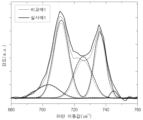
- Example 1 is a graph showing the results of Raman spectroscopy analysis of electrolyte compositions prepared in Example 1 and Comparative Example 1 according to the present invention, respectively.
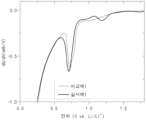
- Example 2 is a graph showing the results of differential capacity curve analysis for half-cells including electrolyte compositions prepared in Example 1 and Comparative Example 1 according to the present invention, respectively.
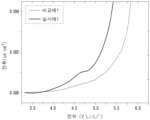
- Example 3 is a graph showing the results of linear scanning potential method analysis for three-electrode cells including electrolyte compositions prepared in Example 1 and Comparative Example 1, respectively, according to the present invention.
- the term "comprises” or “has” is intended to designate that there is a feature, number, step, operation, component, part, or combination thereof described in the specification, but one or more other features It should be understood that the presence or addition of numbers, steps, operations, components, parts, or combinations thereof is not precluded.
- a part such as a layer, film, region, plate, etc. when a part such as a layer, film, region, plate, etc. is described as being “on” another part, this includes not only the case where it is “directly on” the other part, but also the case where another part is present in the middle thereof. . Conversely, when a part such as a layer, film, region, plate, or the like is described as being “under” another part, this includes not only being “directly under” the other part, but also the case where there is another part in the middle. In addition, in the present application, being disposed “on” may include the case of being disposed not only on the upper part but also on the lower part.
- 50% by weight or more, 60% by weight or more, 70% by weight or more, 80% by weight or more, 90% by weight or more, or 95% by weight or more of the components defined with respect to the total weight of "including as a main component” can mean including
- “comprising graphite as a main component as a negative electrode active material” means that 50% by weight or more, 60% by weight or more, 70% by weight or more, 80% by weight or more, 90% by weight or more, or 95% by weight or more of graphite with respect to the total weight of the negative electrode active material It may mean that it contains more than weight%, and in some cases, it may mean that the entire negative electrode active material is composed of graphite and includes 100% by weight of graphite.
- Electrolyte additives for secondary batteries are Electrolyte additives for secondary batteries
- the present invention in one embodiment, the present invention
- an electrolyte solution additive for a secondary battery comprising a compound represented by Formula 1 below:
- R 1 is hydrogen or an alkyl group having 1 to 4 carbon atoms
- R 2 is an alkylene group having 1 to 10 carbon atoms, an oxyalkylene group having 1 to 10 carbon atoms, a cycloalkylene group having 5 to 10 carbon atoms, and Including one or more of
- R 3 is a fluoro group, an alkyl group having 1 to 10 carbon atoms, an alkoxy group having 1 to 10 carbon atoms, or Become
- the alkyl group, alkylene group, alkoxy group, oxyalkylene group, cycloalkylene group, and At least one of the hydrogens contained in may be substituted with a fluorine atom,
- X is an oxygen atom (O) or -NR 4
- R 4 is hydrogen or an alkyl group having 1 to 4 carbon atoms
- M contains at least one member selected from the group consisting of lithium, sodium, potassium, tetraalkylammonium having 1 to 4 carbon atoms and tetraalkylphosphonium having 1 to 4 carbon atoms,
- l is an integer from 1 to 6;
- n are each an integer from 2 to 20;
- the electrolyte additive for a secondary battery according to the present invention includes a saturated hydrocarbon chain on one side centered on a sulfonylimide group as shown in Chemical Formula 1 or a functional group having a structure in which an oxygen atom is introduced into the saturated hydrocarbon chain (meth)acrylic acid. It includes an ionic compound having a mother nucleus to which a (meth)acrylate group or an acrylamide group is bonded. The compound is (meth)acrylate by using a functional group having an ether structure by introducing an alkylene structure of a saturated hydrocarbon chain or an oxygen atom into a saturated hydrocarbon chain at one side of sulfonylimide as a linker.
- an organic and/or inorganic film can be uniformly formed on the surface of the positive electrode and/or the negative electrode when a secondary battery including the same is activated. That is, the electrolyte additive may be directly included in the form of a single molecule in an organic and/or inorganic film formed on the surface of the positive electrode and/or the negative electrode when the secondary battery is activated, and through this, the electrolyte is decomposed when the battery is exposed to a high temperature. It is possible to suppress the generation of gas while improving the decrease in OCV and capacity retention rate of the battery generated from the positive electrode.
- R 1 is hydrogen, a methyl group, an ethyl group or a propyl group
- R 2 is a methylene group, an ethylene group, a propylene group, a butylene group, an oxymethylene group, an oxyethylene group, an oxypropylene group, an oxybutylene group, a cyclobutylene group, a cyclopentylene group, a cyclohexylene group, a cycloheptylene group, and Including one or more of
- R 3 is a fluoro group, a methyl group, an ethyl group, a propyl group, a butyl group, a methoxy group, an ethoxy group, a propoxy group, or is,
- X is an oxygen atom (O), -NH, -NCH 3 or -NCH 2 CH 3 ;
- M contains at least one selected from the group consisting of lithium, sodium, tetramethylammonium having 1 to 4 carbon atoms and tetraalkylphosphonium having 1 to 4 carbon atoms, l is an integer of 1 to 6, and m and n are Each is an integer from 2 to 20.
- R 1 is hydrogen or a methyl group
- R 2 is a methylene group, an ethylene group, a propylene group, an oxymethylene group, an oxyethylene group, an oxypropylene group, a cyclophenylene group, a cyclohexylene group, a cycloheptylene group, and Including one or more of
- R 3 is a fluoro group, a methyl group, an ethyl group, a propyl group, a methoxy group, an ethoxy group, or is,
- X is an oxygen atom (O), -NH or -NCH 3 ;
- M is lithium, l is an integer of 1 or 2, and m and n may be an integer of 2 to 10, respectively.
- the compound represented by Formula 1 may be any one or more compounds of the following ⁇ Formula 1> to ⁇ Formula 120>:
- a and b are each an integer of 1 to 5.
- the electrolyte additive according to the present invention has an alkylene structure having a saturated hydrocarbon chain on one side centered on a sulfonylimide group or an oxygen atom is introduced into a saturated hydrocarbon chain to form a functional group of an ether structure.
- (meth)acrylate group or acrylamide group is bonded through, but it has a structure with an electric charge inside these molecules, so that when the battery is activated, even at a low potential, it is in the solvation shell of lithium ions It directly participates to uniformly form a negatively charged and/or inorganic film through a reduction reaction on the surface of the anode, and at the same time, it is possible to uniformly form an inorganic film through an oxidation reaction on the surface of the anode.
- the electrolyte solution additive suppresses the generation of gas due to decomposition of the electrolyte when the battery is exposed to high temperatures, while improving the OCV reduction phenomenon and capacity reduction of the battery generated at the cathode, thereby preventing deterioration of the secondary battery On the other hand, high-temperature safety can be further improved.
- R 1 is hydrogen or an alkyl group having 1 to 4 carbon atoms
- R 2 is an alkylene group having 1 to 10 carbon atoms, an oxyalkylene group having 1 to 10 carbon atoms, a cycloalkylene group having 5 to 10 carbon atoms, and Including one or more of
- R 3 is a fluoro group, an alkyl group having 1 to 10 carbon atoms, an alkoxy group having 1 to 10 carbon atoms, or Become
- the alkyl group, alkylene group, alkoxy group, oxyalkylene group, cycloalkylene group, and At least one of the hydrogens contained in may be substituted with a fluorine atom,
- X is an oxygen atom (O) or -NR 4
- R 4 is hydrogen or an alkyl group having 1 to 4 carbon atoms
- M contains at least one member selected from the group consisting of lithium, sodium, potassium, tetraalkylammonium having 1 to 4 carbon atoms and tetraalkylphosphonium having 1 to 4 carbon atoms,
- l is an integer from 1 to 6;
- n are each an integer from 2 to 20;
- the electrolyte composition for a lithium secondary battery according to the present invention is a non-aqueous electrolyte composition, and may be a liquid electrolyte having a configuration including a lithium salt and an electrolyte solution additive in a non-aqueous organic solvent.
- the electrolyte solution composition includes the above-described electrolyte solution additive of the present invention, which includes the compound represented by Formula 1 as an electrolyte solution additive, and directly participates in the solvation shell of lithium ions on the surface of the negative electrode when a battery including the same is activated.
- a negatively charged and/or inorganic film may be uniformly formed through a reduction reaction.
- R 1 is hydrogen, a methyl group, an ethyl group or a propyl group
- R 2 is a methylene group, an ethylene group, a propylene group, a butylene group, an oxymethylene group, an oxyethylene group, an oxypropylene group, an oxybutylene group, a cyclobutylene group, a cyclopentylene group, a cyclohexylene group, a cycloheptylene group, and Including one or more of
- R 3 is a fluoro group, a methyl group, an ethyl group, a propyl group, a butyl group, a methoxy group, an ethoxy group, a propoxy group, or is,
- X is an oxygen atom (O), -NH, -NCH 3 or -NCH 2 CH 3 ;
- M contains at least one selected from the group consisting of lithium, sodium, tetramethylammonium having 1 to 4 carbon atoms and tetraalkylphosphonium having 1 to 4 carbon atoms, l is an integer of 1 to 6, and m and n are Each is an integer from 2 to 20.
- R 1 is hydrogen or a methyl group
- R 2 is a methylene group, an ethylene group, a propylene group, an oxymethylene group, an oxyethylene group, an oxypropylene group, a cyclophenylene group, a cyclohexylene group, a cycloheptylene group, and Including one or more of
- R 3 is a fluoro group, a methyl group, an ethyl group, a propyl group, a methoxy group, an ethoxy group, or is,
- X is an oxygen atom (O), -NH or -NCH 3 ;
- M is lithium, l is an integer of 1 or 2, and m and n may be an integer of 2 to 10, respectively.
- the compound represented by Formula 1 may be included in a specific amount in the electrolyte solution composition. Specifically, the compound represented by Formula 1 may be included in 0.01 to 5% by weight based on the total weight of the electrolyte composition, and more specifically, 0.05 to 3% by weight or 1.0 to 2.5% by weight based on the total weight of the electrolyte composition. there is.
- the content of the electrolyte additive is used in an excess amount outside the above range to increase the viscosity of the electrolyte composition to prevent deterioration of wettability to the electrode and separator, while polymerizing through self-polymerization in the electrolyte composition upon activation is induced and the ion conductivity of the electrolyte composition is reduced, thereby preventing battery performance from deteriorating.
- the present invention can prevent the effect of the additive from being implemented insignificantly due to the use of a small amount of the electrolyte solution additive outside the above range.
- the lithium salt used in the electrolyte composition may be applied without particular limitation as long as it is used in a non-aqueous electrolyte in the art.
- the lithium salt is LiCl, LiBr, LiI, LiClO 4 , LiBF 4 , LiB10Cl 10 , LiPF 6 , LiCF 3 SO 3 , LiCF 3 CO 2 , LiAsF 6 , LiSbF 6 , LiAlCl 4 , CH 3 SO 3 Li, (CF 3 SO 2 ) 2 NLi and (FSO 2 ) 2 NLi.
- the concentration of these lithium salts is not particularly limited, but the lower limit of the appropriate concentration range is 0.5 mol/L or more, specifically 0.7 mol/L or more, more specifically 0.9 mol/L or more, and the upper limit is 2.5 mol/L or more. It is the range of L or less, specifically, 2.0 mol/L or less, and more specifically, 1.5 mol/L or less.
- concentration of the lithium salt is less than 0.5 mol/L, there is a possibility that the cycle characteristics and output characteristics of the non-aqueous electrolyte battery may decrease due to a decrease in ionic conductivity.
- the concentration of the lithium salt exceeds 2.5 mol / L, the viscosity of the electrolyte for non-aqueous electrolyte battery increases, so there is a possibility that the ion conductivity is also reduced, and the cycle characteristics and output characteristics of the non-aqueous electrolyte battery may be reduced.
- the liquid temperature may rise due to the heat of dissolution of the lithium salt.
- the temperature of the non-aqueous organic solvent is significantly increased due to the heat of dissolution of the lithium salt, in the case of the lithium salt containing fluorine, decomposition is accelerated and hydrogen fluoride (HF) may be generated.
- Hydrogen fluoride (HF) is undesirable because it causes deterioration in battery performance.
- the temperature at which the lithium salt is dissolved in the non-aqueous organic solvent is not particularly limited, but may be adjusted to -20 to 80 °C, specifically 0 to 60 °C.
- non-aqueous organic solvent used in the electrolyte composition may be applied without particular limitation as long as it is used in a non-aqueous electrolyte in the art.
- the non-aqueous organic solvent for example, N-methyl-2-pyrrolidinone, ethylene carbonate (EC), propylene carbonate, butylene carbonate, dimethyl carbonate (DMC), diethyl carbonate (DEC) , gamma-butyrolactone, 1,2-dimethoxyethane (DME), tetrahydroxy franc, 2-methyl tetrahydrofuran, dimethylsulfoxide, 1,3-dioxorane, formamide, dimethylform Amides, dioxolane, acetonitrile, nitromethane, methyl formate, methyl acetate, phosphoric acid triesters, trimethoxy methane, dioxorane derivatives, sulfolane, methyl sulfolane,
- non-aqueous organic solvent used for this invention may be used individually by 1 type, and may mix and use two or more types in arbitrary combinations and ratios according to a use.
- propylene carbonate, ethylene carbonate, fluoroethylene carbonate, diethyl carbonate, dimethyl carbonate, and ethylmethyl carbonate are particularly preferred. desirable.
- the electrolyte composition may further include additives in addition to the basic components described above.
- additives generally used in the non-aqueous electrolyte solution of the present invention may be added in any proportion.
- Compounds having a negative electrode film-forming effect and a positive electrode protective effect are exemplified.
- non-aqueous electrolyte battery called a lithium polymer battery
- a positive electrode including at least one positive electrode active material selected from among lithium metal oxides represented by Formula 2 and Formula 3 below; cathode;
- An electrode assembly including a separator interposed between the positive electrode and the negative electrode, and
- a lithium secondary battery comprising the electrolyte composition according to the present invention is provided:
- M 1 is W, Cu, Fe, V, Cr, Ti, Zr, Zn, Al, In, Ta, Y, La, Sr, Ga, Sc, Gd, Sm, Ca, Ce, Nb, Mg, B, and At least one element selected from the group consisting of Mo,
- M 2 is Ni, Co or Fe
- p 0.05 ⁇ p ⁇ 0.6.
- the lithium secondary battery according to the present invention includes a positive electrode including a positive electrode active material, a negative electrode including a negative electrode active material, a separator interposed between the positive electrode and the negative electrode, and the lithium salt-containing non-aqueous electrolyte composition of the present invention described above.
- the positive electrode includes a positive electrode composite material layer prepared by applying, drying, and pressing a positive electrode active material on a positive electrode current collector, and may optionally further include a conductive material, a binder, and other additives as needed.
- the positive electrode active material is a material that can cause an electrochemical reaction on the positive electrode current collector, and is one of lithium metal oxides represented by Chemical Formulas 2 and 3 capable of reversibly intercalating and deintercalating lithium ions. may contain more than
- Lithium metal oxides represented by Chemical Formulas 2 and 3 are materials containing high amounts of nickel (Ni) and manganese (Mn), respectively, and can stably supply high-capacity and/or high-voltage electricity when used as a cathode active material.
- a high charging potential of about 4.0V or more is required to form a film on the surface of the positive electrode and/or the negative electrode during activation of the secondary battery.
- the lithium metal oxide Since they have a high charging potential of about 4.0 V or more, it may be easy to form a film on the electrode.
- the lithium metal oxide represented by Formula 2 is LiNi 0.8 Co 0.1 Mn 0.1 O 2 , LiNi 0.6 Co 0.2 Mn 0.2 O 2 , LiNi 0.9 Co 0.05 Mn 0.05 O 2 , LiNi 0.6 Co 0.2 Mn 0.1 Al 0.1 O 2 , LiNi 0.6 Co 0.2 Mn 0.15 Al 0.05 O 2 , LiNi 0.7 Co 0.1 Mn 0.1 Al 0.1 O 2 , and the like
- the lithium metal oxide represented by Chemical Formula 3 is LiNi 0.7 Mn 1.3 O 4 ; LiNi 0.5 Mn 1.5 O 4 ; LiNi 0.3 Mn 1.7 O 4 and the like may be included, and these may be used alone or in combination.
- the positive electrode current collector one having high conductivity without causing chemical change in the battery may be used.
- stainless steel, aluminum, nickel, titanium, calcined carbon, etc. may be used, and aluminum or stainless steel may be surface-treated with carbon, nickel, titanium, silver, or the like.
- the average thickness of the current collector may be appropriately applied in the range of 3 to 500 ⁇ m in consideration of the conductivity and total thickness of the anode to be manufactured.
- the negative electrode like the positive electrode, includes a negative electrode mixture layer prepared by applying, drying, and pressing a negative electrode active material on a negative electrode current collector, and may optionally further include a conductive material, a binder, and other additives as needed. there is.
- the anode active material may include a carbon material and a silicon material.
- the carbon material refers to a material containing carbon atoms as a main component, and the carbon material is selected from the group consisting of natural graphite, artificial graphite, expanded graphite, non-graphitizable carbon, carbon black, acetylene black, and ketjen black It may include one or more species that are.
- the silicon material refers to a material containing silicon atoms as a main component, and the silicon material includes silicon (Si), silicon carbide (SiC), silicon monoxide (SiO) or silicon dioxide (SiO 2 ) alone or or can be used in combination.
- silicon monoxide (SiO) and silicon dioxide (SiO 2 ) as the silicon (Si)-containing material are uniformly mixed or compounded and included in the negative electrode composite material layer, they are formed as silicon oxide (SiO q , provided that 0.8 ⁇ q ⁇ 2.5).
- the silicon material may be included in 1 to 20% by weight based on the total weight of the negative electrode active material, specifically 3 to 10% by weight; 8 to 15% by weight; 13 to 18% by weight; or 2 to 8% by weight.
- the present invention can maximize the energy density of the battery by adjusting the content of the silicon material in the above content range.
- the anode current collector is not particularly limited as long as it does not cause chemical change in the battery and has high conductivity.
- copper, stainless steel, nickel, titanium, fired carbon, etc. may be used, and copper
- surface treatment with carbon, nickel, titanium, silver, etc. may be used.
- the average thickness of the anode current collector may be appropriately applied in the range of 1 to 500 ⁇ m in consideration of the conductivity and total thickness of the anode to be manufactured.
- the separator interposed between the anode and cathode of each unit cell is an insulating thin film having high ion permeability and mechanical strength, and is not particularly limited as long as it is commonly used in the art, but is specifically chemical-resistant and hydrophobic polypropylene. ; polyethylene; Polyethylene-propylene copolymers containing at least one polymer may be used.
- the separator may have the form of a porous polymer substrate such as a sheet or nonwoven fabric containing the above-described polymer, and in some cases may have the form of a composite separator coated with organic or inorganic particles on the porous polymer substrate with an organic binder. may be In addition, the separator may have an average pore diameter of 0.01 to 10 ⁇ m and an average thickness of 5 to 300 ⁇ m.
- the secondary battery includes, as an electrolyte, the above-described non-aqueous electrolyte composition according to the present invention.
- the electrolyte composition is an electrolyte solution additive, on one side centered on a sulfonylimide group, through an alkylene structure of a saturated hydrocarbon chain or a functional group having an ether structure by introducing an oxygen atom into a saturated hydrocarbon chain (meta )
- R 1 is hydrogen or an alkyl group having 1 to 4 carbon atoms
- R 2 is an alkylene group having 1 to 10 carbon atoms, an oxyalkylene group having 1 to 10 carbon atoms, a cycloalkylene group having 5 to 10 carbon atoms, and Including one or more of
- R 3 is a fluoro group, an alkyl group having 1 to 10 carbon atoms, an alkoxy group having 1 to 10 carbon atoms, or Become
- the alkyl group, alkylene group, alkoxy group, oxyalkylene group, cycloalkylene group, and At least one of the hydrogens contained in may be substituted with a fluorine atom,
- X is an oxygen atom (O) or -NR 4
- R 4 is hydrogen or an alkyl group having 1 to 4 carbon atoms
- M contains at least one member selected from the group consisting of lithium, sodium, potassium, tetraalkylammonium having 1 to 4 carbon atoms and tetraalkylphosphonium having 1 to 4 carbon atoms,
- l is an integer from 1 to 6;
- n are each an integer from 2 to 20;
- the compound has the structure represented by Formula 1, organic and/or inorganic films can be uniformly formed on the surface of the positive electrode and/or negative electrode when a secondary battery including the same is activated.
- the electrolyte additive can suppress the generation of gas due to decomposition of the electrolyte when the battery is exposed to high temperature and can improve the OCV decrease and capacity decrease of the battery generated from the positive electrode, thereby improving the performance of the battery and the high temperature Safety can be further improved.
- R 1 is hydrogen, a methyl group, an ethyl group or a propyl group
- R 2 is a methylene group, an ethylene group, a propylene group, a butylene group, an oxymethylene group, an oxyethylene group, an oxypropylene group, an oxybutylene group, a cyclobutylene group, a cyclopentylene group, a cyclohexylene group, a cycloheptylene group, and Including one or more of
- R 3 is a fluoro group, a methyl group, an ethyl group, a propyl group, a butyl group, a methoxy group, an ethoxy group, a propoxy group, or is,
- X is an oxygen atom (O), -NH, -NCH 3 or -NCH 2 CH 3 ;
- M contains at least one selected from the group consisting of lithium, sodium, tetramethylammonium having 1 to 4 carbon atoms and tetraalkylphosphonium having 1 to 4 carbon atoms, l is an integer of 1 to 6, and m and n are Each is an integer from 2 to 20.
- R 1 is hydrogen or a methyl group
- R 2 is a methylene group, an ethylene group, a propylene group, an oxymethylene group, an oxymethylene group, an oxypropylene group, a cyclophenylene group, a cyclohexylene group, a cycloheptylene group, and Including one or more of
- R 3 is a fluoro group, a methyl group, an ethyl group, a propyl group, a methoxy group, an ethoxy group, or is,
- X is an oxygen atom (O), -NH or -NCH 3 ;
- M is lithium, l is an integer of 1 or 2, and m and n may be an integer of 2 to 10, respectively.
- the compound represented by Formula 1 may be any one or more compounds of the following ⁇ Formula 1> to ⁇ Formula 120>:
- a and b are each an integer of 1 to 5.
- LiPF 6 as a lithium salt was dissolved at a concentration of 1M in a solvent in which ethylene carbonate (EC) and ethylmethyl carbonate (EMC) were mixed in a 3:7 volume ratio, and as shown in Table 1 below, the additive was added in an amount of 2 weights based on the total weight of the electrolyte % was dissolved to prepare a non-aqueous electrolyte composition.
- EC ethylene carbonate
- EMC ethylmethyl carbonate
- a non-aqueous electrolyte for a lithium secondary battery was performed in the same manner as in Example 1, except that an oligomer (weight average molecular weight: 2,500 to 5,000) obtained by polymerizing a compound represented by the following structural formula 61 instead of the compound represented by structural formula 61 was used as an electrolyte additive.
- a composition was prepared.
- LiNi 0.5 Mn 1.5 O 4 having a particle size of 5 ⁇ m was prepared as a cathode active material, and N-methyl pyrrolidone (NMP) was mixed with polyvinylidene fluoride as a carbon-based conductive agent and binder in a weight ratio of 94:3:3.
- NMP N-methyl pyrrolidone
- a slurry was formed by mixing, cast on an aluminum thin plate, dried in a vacuum oven at 120° C., and then rolled to prepare a positive electrode.
- a negative electrode active material in which artificial graphite and silicon oxide (SiO 2 ) are mixed in a weight ratio of 9:1 is prepared, and 97 parts by weight of the negative electrode active material and 3 parts by weight of styrene butadiene rubber (SBR) are mixed with water to form a slurry. Then, it was cast on a thin copper plate, dried in a vacuum oven at 130° C., and then rolled to prepare a negative electrode.
- SBR styrene butadiene rubber
- a separator made of 18 ⁇ m polypropylene was interposed between the obtained positive and negative electrodes, inserted into a case, and then, as shown in Table 2 below, the electrolyte composition prepared in Examples 1 to 6 and Comparative Examples 1 to 5 was injected A lithium secondary battery was manufactured.
- Electrolyte composition type Example 7 Electrolyte composition of Example 1 Example 8 Electrolyte composition of Example 2 Example 9 Electrolyte composition of Example 3 Example 10 Electrolyte composition of Example 4 Example 11 Electrolyte composition of Example 5 Example 12 Electrolyte composition of Example 6 Comparative Example 7 Electrolyte composition of Comparative Example 1 Comparative Example 8 Electrolyte composition of Comparative Example 2 Comparative Example 9 Electrolyte composition of Comparative Example 3 Comparative Example 10 Electrolyte composition of Comparative Example 4 Comparative Example 11 Electrolyte composition of Comparative Example 5 Comparative Example 12 Electrolyte composition of Comparative Example 6
- the electrolyte composition of Example including the electrolyte solution additive represented by Chemical Formula 1 according to the present invention has Raman at around 743 ⁇ 1 cm -1 as compared to the electrolyte composition prepared in Comparative Example 1 not including the electrolyte solution additive. It was confirmed that the intensity of the bands in the spectrum increased. This is a phenomenon caused by the formation of a coordination bond between the negatively charged nitrogen atom and the positively charged lithium ion (Li + ) included in the sulfonylimide of the electrolyte additive represented by Formula 1, and the electrolyte composition of Example 1 It means that the ionic compound is contained in. In addition, the increase in band intensity as described above indicates that the ionic compound can cause a reduction reaction on the surface of the anode.
- the electrolyte composition of Example including the electrolyte solution additive represented by Chemical Formula 1 according to the present invention exhibits a falling peak at a voltage around 1.32V compared to lithium, unlike the electrolyte composition of Comparative Example that does not contain the electrolyte solution additive. It became.
- the falling peak means that a reduction reaction has occurred on the surface of the graphite electrode, which is the negative electrode, and indicates that the electrolyte additive represented by Chemical Formula 1 included in the electrolyte composition is converted into a film material through a reduction reaction on the surface of the negative electrode at around 1.32V compared to lithium. .
- a three-electrode battery was prepared by injecting the electrolyte composition prepared in Example 1 and Comparative Example 1 into a battery including a platinum electrode, a platinum electrode, and a lithium metal electrode as a three-electrode, respectively, and a linear scanning potential method for each battery was prepared. (LSV) analysis was performed. At this time, the linear scanning potential method (LSV) was performed under conditions of an observation range of 3.0 to 6.0V (lithium standard), a step voltage of 50mV and a measurement speed of 50mV/s, and the results are shown in FIG. 3 .
- the electrolyte composition of the embodiment including the electrolyte solution additive represented by Formula 1 increases the current at around 4.2V compared to lithium.
- the oxidation reaction is induced at a lower potential than the surface of the platinum electrode due to the catalytic properties of the carbon or transition metal.
- the electrolyte solution additive according to the present invention is an ionic material and performs oxidation and reduction reactions at the positive electrode and the negative electrode, respectively, during charging and discharging of the battery, thereby forming a film on the surface of each electrode.
- the target lithium secondary batteries were Example 13 manufactured by performing the same method as Examples 7 to 12 and Comparative Examples 7 to 12, except that each LiNi 0.6 Co 0.2 Mn 0.2 O 2 and artificial graphite were included.
- the secondary batteries of ⁇ 18 and Comparative Examples 13-18 were used.
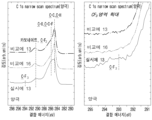
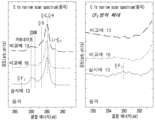
- the secondary battery (Example 13) including the electrolyte composition of Example 1 shows the binding energy of both the positive and negative electrodes, carbon and fluorine in X-ray photoelectron spectroscopy (XPS) on the electrode surface. It was found to have a peak in the range of 280 to 300 eV. Specifically, the positive electrode and the negative electrode of the secondary battery exhibited a peak representing the binding energy of the CF 3 group at 293 ⁇ 0.2 eV, which is a film formed on the surface of the positive electrode and the negative electrode by the electrolyte additive represented by Formula 1 contained in the electrolyte composition. It means participating in the formation.
- XPS X-ray photoelectron spectroscopy
- the electrolyte additive according to the present invention has an alkylene structure having a saturated hydrocarbon chain on one side centered on a sulfonylimide group or an oxygen atom is introduced into a saturated hydrocarbon chain to form a functional group of an ether structure.
- the ionic compound in the form of a single molecule represented by Formula 1 having a mother nucleus to which a (meth)acrylate group or an acrylamide group is bonded through, including it on the electrode surface during activation of a secondary battery It can be seen that a film can be formed.
- charge/discharge current density is 0.33C/0.33C
- charge end voltage is 4.2V (NMC/graphite)
- discharge end voltage is 2.5V (NMC/graphite).
- the battery capacity was measured by performing several times, and the battery was fully charged in the CC/CV mode at 0.33C and the charging end voltage of 4.2V, and then high-temperature storage was started. At this time, the high-temperature storage was stored in a constant temperature chamber at 60 ° C for a total of 56 days. After 56 days, the OCV deviation before and after storage (ie, degree of OCV decrease) and capacity retention were measured, and the volume of gas generated after high-temperature storage in the secondary battery was measured using Archimedes' principle. The results are shown in Table 3 below.
- the secondary batteries of the examples including the compound represented by Formula 1 according to the present invention as an electrolyte additive are exposed to high temperature conditions, resulting in reduced electrolyte decomposition due to the film formed on the surface of the positive electrode and the negative electrode It can be seen that the gas amount is significantly reduced and the OCV drop phenomenon generated at the anode is reduced.
Landscapes
- Chemical & Material Sciences (AREA)
- Chemical Kinetics & Catalysis (AREA)
- Electrochemistry (AREA)
- General Chemical & Material Sciences (AREA)
- Inorganic Chemistry (AREA)
- Engineering & Computer Science (AREA)
- Manufacturing & Machinery (AREA)
- General Physics & Mathematics (AREA)
- Condensed Matter Physics & Semiconductors (AREA)
- Physics & Mathematics (AREA)
- Organic Chemistry (AREA)
- Materials Engineering (AREA)
- Secondary Cells (AREA)
- Battery Electrode And Active Subsutance (AREA)
Abstract
Priority Applications (4)
| Application Number | Priority Date | Filing Date | Title |
|---|---|---|---|
| EP22895872.4A EP4243149B1 (fr) | 2021-11-16 | 2022-10-21 | Nouvel additif pour électrolyte non aqueux, et batterie secondaire au lithium le comprenant |
| CA3204818A CA3204818A1 (fr) | 2021-11-16 | 2022-10-21 | Nouvel additif pour electrolyte non aqueux, et batterie secondaire au lithium le comprenant |
| JP2023534404A JP7527718B2 (ja) | 2021-11-16 | 2022-10-21 | 新規な非水系電解液用添加剤およびそれを含むリチウム二次電池 |
| CN202280007926.6A CN116711116A (zh) | 2021-11-16 | 2022-10-21 | 新型非水电解质用添加剂及包含其的锂二次电池 |
Applications Claiming Priority (4)
| Application Number | Priority Date | Filing Date | Title |
|---|---|---|---|
| KR20210157225 | 2021-11-16 | ||
| KR10-2021-0157225 | 2021-11-16 | ||
| KR10-2022-0131377 | 2022-10-13 | ||
| KR1020220131377A KR102676187B1 (ko) | 2021-11-16 | 2022-10-13 | 신규한 비수계 전해액용 첨가제 및 이를 포함하는 리튬 이차전지 |
Publications (1)
| Publication Number | Publication Date |
|---|---|
| WO2023090664A1 true WO2023090664A1 (fr) | 2023-05-25 |
Family
ID=86322980
Family Applications (1)
| Application Number | Title | Priority Date | Filing Date |
|---|---|---|---|
| PCT/KR2022/016109 Ceased WO2023090664A1 (fr) | 2021-11-16 | 2022-10-21 | Nouvel additif pour électrolyte non aqueux, et batterie secondaire au lithium le comprenant |
Country Status (5)
| Country | Link |
|---|---|
| US (1) | US20230155176A1 (fr) |
| EP (1) | EP4243149B1 (fr) |
| JP (1) | JP7527718B2 (fr) |
| CA (1) | CA3204818A1 (fr) |
| WO (1) | WO2023090664A1 (fr) |
Cited By (1)
| Publication number | Priority date | Publication date | Assignee | Title |
|---|---|---|---|---|
| JP2025525619A (ja) * | 2023-06-22 | 2025-08-05 | エルジー エナジー ソリューション リミテッド | 安全性が向上したリチウム二次電池 |
Families Citing this family (1)
| Publication number | Priority date | Publication date | Assignee | Title |
|---|---|---|---|---|
| KR20240029301A (ko) * | 2022-08-26 | 2024-03-05 | 주식회사 엘지에너지솔루션 | 비수계 전해질 조성물 및 이를 포함하는 리튬 이차전지 |
Citations (7)
| Publication number | Priority date | Publication date | Assignee | Title |
|---|---|---|---|---|
| JP2000082494A (ja) * | 1998-09-03 | 2000-03-21 | Sanyo Chem Ind Ltd | 難燃性非水電解液およびそれを用いた二次電池 |
| JP2010225510A (ja) * | 2009-03-25 | 2010-10-07 | Konica Minolta Holdings Inc | 電解質組成物、および二次電池 |
| WO2012042005A1 (fr) * | 2010-09-30 | 2012-04-05 | Basf Se | Additif pour électrolytes |
| US20140272600A1 (en) * | 2011-09-05 | 2014-09-18 | Universite D'aix-Marseille | Block copolymer including a polyanion based on a tfsili anion monomer as a battery electrolyte |
| KR20170021335A (ko) * | 2014-07-02 | 2017-02-27 | 샌트랄 글래스 컴퍼니 리미티드 | 이온성 착체, 비수전해액 전지용 전해액, 비수전해액 전지 및 이온성 착체의 합성법 |
| KR20210157225A (ko) | 2020-06-19 | 2021-12-28 | 강기현 | 식물 관찰 카메라 |
| KR20220131377A (ko) | 2021-03-19 | 2022-09-27 | 베이앙 에어 테크 리미티드 | 교류 모터의 기어 제어 회로와 시스템, 스위치 컨트롤러 및 전자설비 |
Family Cites Families (8)
| Publication number | Priority date | Publication date | Assignee | Title |
|---|---|---|---|---|
| JPH11260407A (ja) * | 1998-03-16 | 1999-09-24 | Mitsubishi Paper Mills Ltd | リチウム2次電池用高分子電解質 |
| JP4790105B2 (ja) * | 2000-08-29 | 2011-10-12 | 富士フイルム株式会社 | 電解質組成物及びそれを用いた電気化学電池 |
| DE102012209313A1 (de) * | 2012-06-01 | 2013-12-05 | Robert Bosch Gmbh | Lithium-Luft-Zelle |
| JP6319632B2 (ja) * | 2014-07-23 | 2018-05-09 | 株式会社豊田自動織機 | リチウムイオン二次電池用正極とその製造方法及びリチウムイオン二次電池 |
| JP6366550B2 (ja) * | 2015-08-24 | 2018-08-01 | 信越化学工業株式会社 | 導電性ポリマー用高分子化合物及びその製造方法 |
| CN109065951A (zh) * | 2018-07-31 | 2018-12-21 | 东莞市杉杉电池材料有限公司 | 一种锂离子电池电解液及锂离子电池 |
| KR102427345B1 (ko) * | 2018-09-21 | 2022-08-01 | 주식회사 엘지에너지솔루션 | 겔 폴리머 전해질용 조성물 및 이로부터 형성된 겔 폴리머 전해질을 포함하는 리튬 이차전지 |
| CN113646262B (zh) | 2019-03-28 | 2024-03-01 | 松下知识产权经营株式会社 | 非水电解质二次电池 |
-
2022
- 2022-10-21 WO PCT/KR2022/016109 patent/WO2023090664A1/fr not_active Ceased
- 2022-10-21 JP JP2023534404A patent/JP7527718B2/ja active Active
- 2022-10-21 CA CA3204818A patent/CA3204818A1/fr active Pending
- 2022-10-21 EP EP22895872.4A patent/EP4243149B1/fr active Active
- 2022-11-09 US US17/983,896 patent/US20230155176A1/en active Pending
Patent Citations (7)
| Publication number | Priority date | Publication date | Assignee | Title |
|---|---|---|---|---|
| JP2000082494A (ja) * | 1998-09-03 | 2000-03-21 | Sanyo Chem Ind Ltd | 難燃性非水電解液およびそれを用いた二次電池 |
| JP2010225510A (ja) * | 2009-03-25 | 2010-10-07 | Konica Minolta Holdings Inc | 電解質組成物、および二次電池 |
| WO2012042005A1 (fr) * | 2010-09-30 | 2012-04-05 | Basf Se | Additif pour électrolytes |
| US20140272600A1 (en) * | 2011-09-05 | 2014-09-18 | Universite D'aix-Marseille | Block copolymer including a polyanion based on a tfsili anion monomer as a battery electrolyte |
| KR20170021335A (ko) * | 2014-07-02 | 2017-02-27 | 샌트랄 글래스 컴퍼니 리미티드 | 이온성 착체, 비수전해액 전지용 전해액, 비수전해액 전지 및 이온성 착체의 합성법 |
| KR20210157225A (ko) | 2020-06-19 | 2021-12-28 | 강기현 | 식물 관찰 카메라 |
| KR20220131377A (ko) | 2021-03-19 | 2022-09-27 | 베이앙 에어 테크 리미티드 | 교류 모터의 기어 제어 회로와 시스템, 스위치 컨트롤러 및 전자설비 |
Non-Patent Citations (1)
| Title |
|---|
| See also references of EP4243149A4 |
Cited By (1)
| Publication number | Priority date | Publication date | Assignee | Title |
|---|---|---|---|---|
| JP2025525619A (ja) * | 2023-06-22 | 2025-08-05 | エルジー エナジー ソリューション リミテッド | 安全性が向上したリチウム二次電池 |
Also Published As
| Publication number | Publication date |
|---|---|
| EP4243149A1 (fr) | 2023-09-13 |
| EP4243149B1 (fr) | 2026-01-28 |
| JP2024500661A (ja) | 2024-01-10 |
| JP7527718B2 (ja) | 2024-08-05 |
| CA3204818A1 (fr) | 2023-05-25 |
| US20230155176A1 (en) | 2023-05-18 |
| EP4243149A4 (fr) | 2024-08-14 |
Similar Documents
| Publication | Publication Date | Title |
|---|---|---|
| WO2021034141A1 (fr) | Électrolyte non aqueux pour batterie rechargeable au lithium et batterie rechargeable au lithium comprenant celui-ci | |
| WO2023090665A1 (fr) | Nouvel additif pour solution électrolytique non aqueuse et batterie secondaire au lithium le comprenant | |
| WO2012169843A2 (fr) | Électrolyte non-aqueux et batterie secondaire au lithium l'utilisant | |
| WO2019013501A1 (fr) | Additif de solution d'électrolyte non aqueux, solution d'électrolyte non aqueux destiné à une batterie secondaire au lithium, et batterie secondaire au lithium comprenant un additif de solution d'électrolyte non aqueux | |
| WO2019164164A1 (fr) | Solution électrolytique pour batterie secondaire au lithium et batterie secondaire au lithium la comprenant | |
| WO2020036336A1 (fr) | Électrolyte pour batterie secondaire au lithium | |
| WO2021015535A1 (fr) | Batterie secondaire au lithium | |
| WO2023090664A1 (fr) | Nouvel additif pour électrolyte non aqueux, et batterie secondaire au lithium le comprenant | |
| WO2023177074A1 (fr) | Nouvel additif pour solution électrolytique non aqueuse et batterie secondaire au lithium le comprenant | |
| WO2020036337A1 (fr) | Électrolyte pour batterie secondaire au lithium | |
| WO2022050740A1 (fr) | Additif pour électrolyte destiné à une batterie secondaire au lithium, et batterie secondaire au lithium le comprenant | |
| WO2020149705A1 (fr) | Électrolyte pour acumulateur au lithium et acumulateur au lithium comprenant ledit électrolyte | |
| WO2020190076A1 (fr) | Électrolyte non aqueux pour batterie secondaire au lithium et batterie secondaire au lithium le comprenant | |
| WO2022260373A1 (fr) | Solution électrolytique non aqueuse pour batterie secondaire au lithium, et batterie secondaire au lithium la comprenant | |
| WO2019039903A2 (fr) | Électrolyte non aqueux pour batterie rechargeable au lithium et batterie rechargeable au lithium le comprenant | |
| WO2019009594A1 (fr) | Électrolyte polymère pour batterie secondaire et batterie secondaire au lithium le comprenant | |
| WO2021125478A1 (fr) | Additif de solution électrolytique pour batterie secondaire et solution électrolytique pour batterie secondaire la comprenant | |
| WO2023177078A1 (fr) | Batterie secondaire au lithium | |
| WO2020071850A1 (fr) | Composition d'électrolyte polymère, et batterie rechargeable au lithium comprenant un électrolyte polymère produit à partir de celle-ci | |
| WO2020036444A1 (fr) | Procédé de préparation d'électrode négative pour batterie secondaire au lithium et électrode négative pour batterie secondaire au lithium ainsi préparée | |
| WO2023085639A1 (fr) | Batterie secondaire au lithium à sécurité élevée à haute température | |
| WO2020085726A1 (fr) | Procédé de fabrication d'électrode pour batterie secondaire au lithium et électrode pour batterie secondaire au lithium ainsi fabriquée | |
| WO2024043482A1 (fr) | Composition d'électrolyte non aqueux et batterie secondaire au lithium la comprenant | |
| WO2023167431A1 (fr) | Composition de solution électrolytique non aqueuse et batterie secondaire au lithium la comprenant | |
| WO2022158920A1 (fr) | Électrolyte et batterie secondaire le comprenant |
Legal Events
| Date | Code | Title | Description |
|---|---|---|---|
| WWE | Wipo information: entry into national phase |
Ref document number: 202317038494 Country of ref document: IN Ref document number: 202280007926.6 Country of ref document: CN |
|
| WWE | Wipo information: entry into national phase |
Ref document number: 2023534404 Country of ref document: JP |
|
| ENP | Entry into the national phase |
Ref document number: 3204818 Country of ref document: CA |
|
| ENP | Entry into the national phase |
Ref document number: 2022895872 Country of ref document: EP Effective date: 20230606 |
|
| 121 | Ep: the epo has been informed by wipo that ep was designated in this application |
Ref document number: 22895872 Country of ref document: EP Kind code of ref document: A1 |
|
| WWG | Wipo information: grant in national office |
Ref document number: 2022895872 Country of ref document: EP |