WO2023094275A1 - Amphoterically-modified trialkylene tetramine ethoxylates for improved stain removal of laundry detergents - Google Patents
Amphoterically-modified trialkylene tetramine ethoxylates for improved stain removal of laundry detergents Download PDFInfo
- Publication number
- WO2023094275A1 WO2023094275A1 PCT/EP2022/082405 EP2022082405W WO2023094275A1 WO 2023094275 A1 WO2023094275 A1 WO 2023094275A1 EP 2022082405 W EP2022082405 W EP 2022082405W WO 2023094275 A1 WO2023094275 A1 WO 2023094275A1
- Authority
- WO
- WIPO (PCT)
- Prior art keywords
- trialkylene
- modified
- amphoterically
- ethoxylates
- tetramine
- Prior art date
- Legal status (The legal status is an assumption and is not a legal conclusion. Google has not performed a legal analysis and makes no representation as to the accuracy of the status listed.)
- Ceased
Links
Classifications
-
- C—CHEMISTRY; METALLURGY
- C11—ANIMAL OR VEGETABLE OILS, FATS, FATTY SUBSTANCES OR WAXES; FATTY ACIDS THEREFROM; DETERGENTS; CANDLES
- C11D—DETERGENT COMPOSITIONS; USE OF SINGLE SUBSTANCES AS DETERGENTS; SOAP OR SOAP-MAKING; RESIN SOAPS; RECOVERY OF GLYCEROL
- C11D3/00—Other compounding ingredients of detergent compositions covered in group C11D1/00
- C11D3/16—Organic compounds
- C11D3/37—Polymers
- C11D3/3703—Macromolecular compounds obtained otherwise than by reactions only involving carbon-to-carbon unsaturated bonds
- C11D3/3723—Polyamines or polyalkyleneimines
-
- C—CHEMISTRY; METALLURGY
- C08—ORGANIC MACROMOLECULAR COMPOUNDS; THEIR PREPARATION OR CHEMICAL WORKING-UP; COMPOSITIONS BASED THEREON
- C08G—MACROMOLECULAR COMPOUNDS OBTAINED OTHERWISE THAN BY REACTIONS ONLY INVOLVING UNSATURATED CARBON-TO-CARBON BONDS
- C08G65/00—Macromolecular compounds obtained by reactions forming an ether link in the main chain of the macromolecule
- C08G65/02—Macromolecular compounds obtained by reactions forming an ether link in the main chain of the macromolecule from cyclic ethers by opening of the heterocyclic ring
- C08G65/26—Macromolecular compounds obtained by reactions forming an ether link in the main chain of the macromolecule from cyclic ethers by opening of the heterocyclic ring from cyclic ethers and other compounds
- C08G65/2618—Macromolecular compounds obtained by reactions forming an ether link in the main chain of the macromolecule from cyclic ethers by opening of the heterocyclic ring from cyclic ethers and other compounds the other compounds containing nitrogen
- C08G65/2621—Macromolecular compounds obtained by reactions forming an ether link in the main chain of the macromolecule from cyclic ethers by opening of the heterocyclic ring from cyclic ethers and other compounds the other compounds containing nitrogen containing amine groups
- C08G65/2624—Macromolecular compounds obtained by reactions forming an ether link in the main chain of the macromolecule from cyclic ethers by opening of the heterocyclic ring from cyclic ethers and other compounds the other compounds containing nitrogen containing amine groups containing aliphatic amine groups
-
- C—CHEMISTRY; METALLURGY
- C11—ANIMAL OR VEGETABLE OILS, FATS, FATTY SUBSTANCES OR WAXES; FATTY ACIDS THEREFROM; DETERGENTS; CANDLES
- C11D—DETERGENT COMPOSITIONS; USE OF SINGLE SUBSTANCES AS DETERGENTS; SOAP OR SOAP-MAKING; RESIN SOAPS; RECOVERY OF GLYCEROL
- C11D3/00—Other compounding ingredients of detergent compositions covered in group C11D1/00
- C11D3/16—Organic compounds
- C11D3/37—Polymers
- C11D3/3796—Amphoteric polymers or zwitterionic polymers
Definitions
- the present invention relates to certain amphoterically-modified ethoxylated oligoamines, their manufacture and use.
- oligo-/polypropyleneimine is also abbreviated “PPI”
- oligo-/polyethyleneimine is also abbreviated “PEI”.
- ethylene oxide is sometimes referred to as “EO”
- propylene oxide is sometimes referred to as “PO”.
- Alkoxylated oligo- and polyalkyleneimines are well known as additives for various applications, such as laundry detergents (e.g., EP3301154, EP3167034 and EP112593), additives for cementitious binder systems (WO2016187085), or hard surface cleaners (EP2961819).
- laundry detergents e.g., EP3301154, EP3167034 and EP112593
- additives for cementitious binder systems WO2016187085
- hard surface cleaners EP2961819
- modified oligo- and polyalkyleneimine alkoxylates are less common.
- EP2662436 describes cationic alkoxylated polyethyleneimines in combination with bleach boosters for automatic dish wash applications. Both hydrophobically- and amphoterically-modified polyalkyleneimines for detergent compositions are described in W02004020563.
- Laundry compositions containing alkoxylated and optionally further cationically- or amphoterically-modified polyalkyleneimines bearing at least 6 N-atoms per molecule are described in EP2961821 for example. More specifically oligo- and polypropyleneimines exhibiting at least 6 N-atoms per molecule, modified and unmodified, are disclosed which led to benefits in soil removal and contribute to improved whiteness. Any impact on the rheology of the detergents has not been mentioned.
- EP3039109 and EP3039057 describe predominantly ethoxylated and optionally further amphoterically-modified oligo- and polyalkyleneimines with low melting points. Due to the incorporation of at least one mol of a C3 to 05 alkylene oxide into the polyalkoxylate chains, mainly based on ethylene oxide, polymers with low melting points can be obtained being favorable for their preparation process. Any benefits in terms of application performance in comparison to identical polymers based solely on ethylene oxide and thus higher melting points have not been mentioned.
- EP1198492 describes zwitterionic (i.e., amphoterically-modified) alkoxylated polyamines with improved thermal stability, used as additives for laundry detergents.
- amphoteric modification of the materials has been obtained by a combination of independent quaternization and sulfation steps, wherein the sulfation has been carried out with a sulfation agent such as chlorosulfonic acid.
- chlorosulfonic acid has the disadvantage that salt is obtained which may lead to corrosion; furthermore, methanol is a by-product, which is classified as toxic.
- the described zwitterionic polyamines have a net anionic charge, i.e., the number of anionic groups exceeds the number of cationic groups by at least 20%, preferably by at least 50%.
- experimental example no. 4 of said document may be cited.
- W02001029112 describes a process for the sulfation of alkoxylated quarternized polyamines using sulfur trioxide as sulfation agent, allowing high sulfation degrees.
- the described structures also possess a net anionic charge.
- a process based on a combination of alkoxylation, quaternization and transsulfation starting from tertiary aminoalcohols has been described in EP1309546.
- the process includes the reaction of a tertiary amine with a sulfation precursor (e.g., dialkyl sulfate) forming an admixture comprising a quarternized amine and a sulfating species.
- the hydroxyl species has then been sulfated under acidic conditions.
- a sulfation precursor e.g., dialkyl sulfate
- the hydroxyl species has then been sulfated under acidic conditions.
- the preparation of alkoxylated, quaternized and fully sulfated oligo- and polyalkyleneimines has been disclosed, by using auxiliary amines.
- the obtained polymers did not contain any free hydroxyl groups anymore, i.e., all groups have been converted into sulfate groups. Therefore, the net charge of the described polymers has been anionic.
- Another process based on a combination of alkoxylation, quaternization and transsulfation without the use of auxiliary amines has been described in WO200424858.
- the process includes the reaction of a tertiary amine in the backbone of an alkoxylated oligo- or polyamine with a sulfation precursor (e.g., dialkyl sulfate) forming an admixture comprising a quarternized polyamine alkoxylate and a sulfating species.
- a sulfation precursor e.g., dialkyl sulfate
- the hydroxyl species has then been sulfated under acidic conditions.
- polymers exhibiting either a neutral or a slightly net cationic charge could have been obtained.
- the polyalkylene oxide blocks contain free terminal hydroxyl groups besides anionic sulfate groups.
- EP2961821 , EP3039109 and EP3039057 The same process has also been described for specific polyamine backbones and for specific polyalkylene oxide side chains in the above-mentioned patents EP2961821 , EP3039109 and EP3039057.
- amphoterically-modified trialkylene tetramine ethoxylates can contribute to significantly improved stain removal of laundry detergents.
- the improved performance of the inventive materials vs. the prior art polymers is especially visible at very low inclusion levels, which is an important prerequisite for an application in top loader machines. Their higher weight-efficiency favors their usage in highly concentrated product forms, e.g., in single mono doses.
- the inventive amphoterically- modified trialkylene tetramine ethoxylates lead to minimized negative impact on the viscosity of the formulations.
- inventive materials can be easily obtained starting from the respective trialkylene tetramine by a combination of ethoxylation, quaternization and transsulfation, whereas the quaternization and the transsulfation are carried out using dialkyl sulfate as single modification agent, i.e., a usage of more than one modification agent and/or the usage of auxiliary materials are not needed.
- inventive amphoterically-modified trialkylene tetramine ethoxylates have a neutral or slightly net cationic charge, depending on the degree of conversion during the transsulfation step.
- amphoterically-modified trialkylene tetramine ethoxylates (A) of general formula (I) wherein
- R 1 are same or different and selected from Ci-C4-alkyl, H and a free electron pair, wherein at least 50%, preferably at least 80%, more preferably at least 90%, of all R 1 are CrC4-alkyl,
- EO means -CH 2 -CH 2 -O
- amphoterically-modified trialkylene tetramine ethoxylates are internal zwitterions (with a net charge of around zero).
- the counterions of the quaternized nitrogen atoms are SO3 ions or alkyl sulfate ions (Ci to C4 monoalkyl sulfates).
- R 1 In a preferred embodiment, from 93% to 97% of all R 1 are CrC4-alkyl.
- n is 1 , and/or at least 90% of all R 1 are methyl.
- n is 1 , and/or at least 90% of all R 1 are methyl, and/or x is in the range of 15 to 30.
- n 1 , 2 or 3
- a mixture of compounds comprising at least one inventive amphoterically-modified trialkylene tetramine ethoxylate (A) as described above and at least one isomeric compound according to formula (II)
- R 1 are same or different and selected from Ci-C4-alkyl, H and a free electron pair, wherein at least 50%, preferably at least 80%, more preferably at least 90%, of all R 1 are Ci-C4-alkyl,
- Y are same or different and selected from SOs" and H, wherein at least 30%, preferably at least 50% of all Y are SOs", x are same or different and selected from 5 to 50, preferably 10 to 40, and n is selected from 1 , 2 and 3, preferably 1 .
- a preferred mixture of compounds comprises an amphoterically-modified trialkylene tetramine ethoxylate (A) according to formula (I) and compounds according to formula (II) in a total molar ratio in the range of from 10:1 or higher.
- the inventive amphoterically-modified trialkylene tetramine ethoxylates (A) are obtained in a mixture additionally comprising the sulfate of an alkali metal and /or an amine.
- the mixture additionally comprises the sulfate salt of an amine, preferably the sulfate salt of an alkanolamine.
- the inventive amphoterically-modified trialkylene tetramine ethoxylates (A) and mixtures containing the same are mixed with water in any ratio.
- the mixture contains from 1 to 80 wt% water, more preferably 1 to 60 wt% water, even more preferably 5 to 50 wt% water and most preferably 10 to 40 wt% water.
- aqueous solutions of the inventive amphoterically-modified trialkylene tetramine ethoxylates (A) and mixtures containing the same may be added also at least one antimicrobial agent.
- at least one antimicrobial agent Preferably, 2-phenoxyethanol (CAS-no. 122-99-6, for example Protectol® PE available from BASF) or 4,4’-dichloro-2-hydroxydiphenylether (CAS: 3380-30-1), and combinations thereof, are being used.
- the 4,4’-dichloro-2-hydroxydiphenylether may be used as a solution, for example a solution of 30 wt% of 4,4’-dichloro-2-hydroxydiphenylether in 1 ,2-propyleneglycol, e. g. Tinosan® HP 100 available from BASF.
- a further aspect of the present invention is also a process for making inventive amphoterically- modified trialkylene tetramine ethoxylates (A), said process comprising the steps of
- step (c) optionally purification of the trialkylene tetramines from step (b)
- the term “repeating unit” stands for ethylene units and not for any alkylene imine or more specifically ethylene imine units.
- the purification step (c) is performed to obtain trialkylene tetramines with 1 , 2 and 3 repeating units, or mixtures thereof, with a purity of at least 50 wt%, preferably of at least 75 wt%, most preferably of at least 90 wt%.
- step (e) is performed with dimethyl sulfate.
- the transsulfation in step (e) is performed with sulfuric acid or methane sulfonic acid (MSA) as a catalyst.
- MSA methane sulfonic acid
- the process additionally includes a subsequent step of neutralization of the sulfuric acid with a base selected from alkali metal hydroxides and amines.
- a base selected from amines, more preferably alkanolamines, or aqueous solutions thereof may be used.
- the inventive process avoids the use of problematic reagents like chlorosulfonic acid; thus, improvements can be achieved, e. g., less corrosivity and reduced dangers for human health.
- the ethoxylation in step (d) is performed in two sub-steps, viz. (i) conversion with up to one mole of EO per N-H function, followed by (ii) conversion with more ethylene oxide under alkaline catalysis.
- a further aspect of the present invention are also amphoterically-modified trialkylene tetramine ethoxylates (A) as defined above, obtainable by the inventive process described above (and described below in more detail).
- Steps (a) to (c) of the inventive process mentioned above may be performed as follows.
- Acrylonitrile (1 .0 to 2.5 equivalents) may be added dropwise to one equivalent of either 1 ,2-eth- ylene diamine, 1 ,4-butylene diamine, 1 ,6-hexamethylene diamine, or mixtures thereof, optionally dissolved in a solvent, in a reaction vessel at a temperature between 5 °C and 80 °C, as previously described in CN102941 160 and/or WO9214709. Upon complete addition reaction, the reaction may be stirred at the indicated temperature until the starting materials were fully consumed and then cooled to room temperature.
- the crude mixture may be subjected to a hydrogenation in a pressure reactor catalyzed by a [Cu], [Co], [Ni], [Pd], [Pt] or [Ru] catalyst with or without solvent at elevated hydrogen and optionally ammonia pressures, as described previously in DD238043 and/or JP08333308 and/or WO 2018046393.
- the temperature may be between 70 °C and 200 °C, preferably between 70 °C and 150 °C, and the hydrogen pressure between 1 and 250 bar, preferably between 50 and 250 bar.
- the catalyst may be removed, for example by filtration, and volatiles may be removed under reduced pressure.
- the obtained mixture of the desired oligoamine compounds may be then separated in the next step via distillation under reduced pressure ( ⁇ 1 bar) to yield the purified target trialkylene tetramines with 1 , 2 and 3 repeating units, i.e., N1 ,N1'-(ethane-1 ,2-diyl)bis(propane-1 ,3-diamine) (N4-Amine), N1 ,N1 '-(butane- 1 ,4-diyl)bis(propane-1 ,3-diamine) (Spermine) or N1 ,N1 '-(hexane- 1 ,6-diyl)bis(propane-1 ,3- diamine), or mixtures thereof.
- N1 ,N1'-(ethane-1 ,2-diyl)bis(propane-1 ,3-diamine) N4-Amine
- the crude mixture obtained according to the description above contains predominantly (at least 50 wt%) of the target (linear) tetramines, preferably at least 75 wt% of the target (linear) tetramines, more preferably at least 90 wt% of the target (linear) tetramines.
- the crude mixture according to the description above is purified by distillation, to remove any impurities, such as monomers, other oligomers or branched structures and branched isomers, respectively, to obtain the linear target compounds, N1 ,N1 '-(ethane-1 ,2-diyl)bis(propane-1 ,3-diamine) (N4- Amine), N1 ,N1'-(butane-1 ,4-diyl)bis(pro- pane-1 ,3-diamine) (Spermine) or N1 ,N1'-(hexane-1 ,6-diyl)bis(propane-1 ,3-diamine), or mixtures thereof, with a purity of at least 50 wt%, preferably at least 75 wt%, more preferably at least 90 wt%.
- the purified N1 ,N1 '-(ethane-1 , 2-diyl)bis(propane-1 ,3-dia- mine) (N4-Amine), N1 ,N1 '-(butane-1 ,4-diyl)bis(propane-1 ,3-diamine) (Spermine) or N1 ,N1'- (hexane-1 ,6-diyl)bis(propane-1 ,3-diamine), or mixtures containing the same, may contain isomeric compounds (structure after alkoxylation/modification according to formula (II)) in a ratio of 10:1 mol% or higher.
- R 1 are same or different and selected from Ci-C4-alkyl, H and a free electron pair, wherein at least 50%, preferably at least 80%, more preferably at least 90%, of all R 1 are
- Step (d) of the above manufacturing process may be performed as follows.
- the inventive process step (d) is characterized by using only ethylene oxide as alkoxylation agent.
- Other alkylene oxides like propylene oxide are not useful for the inventive process and do not lead to the inventive product and its properties in laundry application.
- step (d) of the inventive manufacturing process ethoxylation is performed in two steps.
- the ethylene oxide is added in a first step (i) of process step (d) in an amount of 0.2 to 1 .0 ethylene oxide units per NH-group of the trialkylene tetramines with 1 , 2 and 3 repeating units, or mixtures thereof, preferably 0.5 to 0.99, more preferably 0.6 to 0.95 ethylene oxide units per NH-group of the trialkylene tetramines, even more preferably 0.70 to 0.95 ethylene oxide units per NH-group of the trialkylene tetramines (under-hydroxyethylation).
- the minimum amount of ethylene oxide units per NH-group added in step (i) is at least identical to the amount of basic catalyst C added later in step (ii), or higher, in order to prevent formation of polyethylene glycol via direct reaction of catalyst C with ethylene oxide during step (ii).
- the sum of the amounts of ethylene oxide EO added in steps (i) and (ii) lies in the range of 5 to 50 ethylene oxide units per NH-group of the trialkylene tetramines with 1 , 2 and 3 repeating units, or mixtures thereof, more preferably 10 to 40 ethylene oxide units per NH-group of the trialkylene tetramines, further preferably 15 to 30 ethylene oxide units per NH-group of the trialkylene tetramines.
- the first step (i) of process step (d) is carried out in the absence of a basic catalyst.
- Water may be added in the first step (i) of process step (d).
- the second step (ii) of step (d) of the inventive process is carried out in the presence of a basic catalyst.
- bases are such as LiOH, NaOH, KOH, CsOH and mixtures thereof, sodium or potassium alkoxides such as potassium methylate (KOCH 3 ), potassium tert-butoxide, sodium methylate (NaOCH 3 ), sodium n-hexanolate and sodium ethoxide.
- Further examples of catalysts are alkali metal hydrides and alkaline earth metal hydrides such as sodium hydride and calcium hydride, and alkali metal carbonates such as sodium carbonate and potassium carbonate.
- alkali metal hydroxides preference being given to potassium hydroxide and sodium hydroxide
- alkali metal alkoxides preference being given to potassium methylate (KOCH 3 ) and sodium methylate (NaOCH 3 ).
- potassium hydroxide and to potassium methylate preference is given to potassium hydroxide and to potassium methylate (KOCH 3 ).
- Typical use amounts for the base, for example KOH are from 0.02 to 10% by weight, in particular from 0.05 to 1% by weight, relative to the trialkylene tetramine ethoxylates.
- the basic catalyst C is only used in the second step (ii) and is selected from the group consisting of alkaline earth metal containing basic catalysts.
- a specifically preferred embodiment of a basic catalyst in the inventive process is KOH; KOH may be used in the inventive process as a solution in water.
- the basic catalyst C is added in an amount of 0.05 to 0.3 % by weight, preferably 0.15 to 0.25 % by weight, relative to the trialkylene tetramine ethoxylates.
- the temperature during the first step (i) of step (d) of the inventive process is in the range of 90 °C to 160 °C, preferably 100 °C to 150 °C, more preferably 1 10 °C to 140 °C.
- the temperature during the second step (ii) of step (d) of the inventive process is in the range of 100 °C to 180 °C, preferably 120 °C to 160 °C, more preferably 120 °C to 145 °C.
- the reaction during the first step (i) of step (d) of the inventive process may be carried out at a total pressure of up to 15 bar, preferably up to 10 bar, for example 1 to 6 bar.
- Preferred vessels for carrying out the reaction are autoclaves and tubular reactors.
- the reaction during the second step (ii) of step (d) of the inventive process may be carried out at a total pressure of up to 15 bar, preferably up to 10 bar, for example 2 to 10 bar.
- Preferred vessels for carrying out the reaction are autoclaves and tubular reactors.
- the reaction during the second step (ii) of step (d) of the inventive process can be interrupted at different intermediates (i.e., alkoxylation degrees) and can be continued with or without additional catalyst addition.
- the product obtained after step (ii) of step (d) of the inventive process may be treated with a bleaching agent.
- the bleaching agent is preferably selected from the group consisting of borates, hypochlorites, borohydrates and hydrogen peroxide.
- Step (e) of the inventive process mentioned above (At least partial) Quaternization and transsulfation with a di-Ci-C4-alkyl sulfate.
- the quaternization and transsulfation step (e) is a process based on a combination of quaternization of the amino groups in the backbone of the trialkylene tetramine ethoxylates and sulfation of the terminal hydroxyl moieties of the polyethylene oxide side chains.
- the first required sub-step (e1 ) of the process is conducted under basic or close to pH-neutral conditions.
- the second sub-step (e2) of the process is conducted under acidic conditions.
- Sub-step (e) In a preferred embodiment of the present invention, from 0.5 to
- a sulfating agent preferably from 0.8 to 0.99 equivalents and most preferably from 0.9 to 0.99 equivalents are reacted with one tertiary amino group of the trialkylene tetramine ethoxylates, to form quaternary ammonium ions in the tetramine backbone and an equal number of sulfating species.
- the process may be conducted in the presence of a solvent, preferably non-reactive solvents like toluene, glyme or diglyme may be used.
- the preferred sulfating agent according to the present invention are dialkyl sulfates, preferably di-Ci-C4- alkyl sulfate, more preferably di-Ci-Cs-alkyl sulfate and most preferably dimethyl sulfate.
- Substep (e1) of the process of the present invention is conducted under basic or close to pH-neutral conditions, at a temperature of 0 °C to 180 °C, preferably 40 °C to 100 °C and even more preferably 50 °C to 90 °C.
- the reaction when exothermic can be controlled by any suitable means, e.g., by cooling of the reaction vessel or by providing a reflux condenser.
- a typical side reaction which can occur under these conditions is the alkylation of the terminal hydroxyl groups of the polyethylene oxide side chains.
- at least 90%, preferably at least 95% of the employed di-Ci -C4-alkyl sulfate react with the tertiary amino groups of the trialkylene tetramine ethoxylates and not with the terminal hydroxyl groups of the polyethylene oxide side chains.
- step (e) of the inventive process To avoid any further alkylation of the terminal hydroxyl groups of the polyethylene oxide side chains, not more than 1 .0 equivalents of a sulfating agent per tertiary amino group of the trialkylene tetramine ethoxylates are being used within step (e) of the inventive process.
- Sub- The formation of a sulfated hydroxyl species is the second required step of the process of the present invention.
- One equivalent of a sulfating species is required per hydroxyl moiety which is to be sulfated.
- the number of sulfating species in the inventive process is identical to the number of quaternary ammonium ions in the oligoamine backbone.
- the for- mulator can remove the alcohol, preferably the Ci-C4-alcohol, most preferably methanol (depending on the type of di-Ci-C4-alkyl sulfate employed in step (e1)), which is formed as by-product.
- the relative amount of alcohol by-product which is removed can be used as a tool to control the degree of conversion of the transsulfation step.
- Any process which is convenient to the formulator e.g., distillation, absorption into a molecular sieve, crystallization or precipitation, may be used, preferably distillation. In many instances, removal of the by-product alcohol already during the reaction will be preferred, preferably by distillation.
- the degree of conversion during the transsulfation step according to the present invention is at least 50%, preferably at least 80%.
- the final product after sub-step (e2) is obtained as an internal zwitterion with potentially additional cationic charge in case of incomplete conversion ( ⁇ 100%) of the sulfating species during the transsulfation step.
- the counterions of the quaternized nitrogen atoms are SO ⁇ ions leading to the formation of the internal zwitterions, and potentially additional alkyl sulfate ions (Ci to C4 monoalkyl sulfates), preferably methyl sulfate ions, in case of incomplete conversion during the transsulfation step.
- Sub-step (e2) must be conducted under acidic conditions.
- Suitable acids are, inter alia, sulfuric acid, hydrochloric acid, methane sulfonic acid or Lewis acids (e.g. boron trifluoride).
- sulfuric acid is employed.
- the acid may be added in any amount sufficient to form the desired product, however, the process of the present invention is conducted at a pH less than about 6, preferably less than about 4, more preferably less than about 3 and most preferably at a pH around 2. In fact, acid levels from about 0.01 to 1 molar ratio relative to the trialkylene tetramine ethoxylates are preferred.
- the catalyst can be introduced by any manner which is convenient to the formulator, however, good mixing should be utilized.
- the acid may be generated in situ by adding excess sulfating agent and allowing this excess agent to react with a limited source of proton, inter alia, water.
- Sub-step (e2) of the process of the present invention is conducted at a temperature of 0 °C to 200 °C, preferably 40 °C to 150 °C and even more preferably 70 °C to 120 °C.
- the reaction when exothermic can be controlled by any suitable means, e.g., by cooling the reaction vessel or by providing a reflux condenser.
- sulfuric acid in the preferred embodiment of the present invention may lead to additional sulfation of hydroxyl groups of the trialkylene tetramine ethoxylates as a side-reaction to a minor extent, besides the conversion of hydroxyl groups to sulfate groups from the transsulfation process (i.e. , via the employed di-Ci-C4-alkyl sulfate).
- the final product after sub-step (e2) may be further purified to remove volatile by-products and/or the acidic catalyst, preferably the sulfuric acid, or may be isolated as mixture. Volatile byproducts, e.g., 1 ,4-dioxane, may be removed, e.g., via distillation or stripping under vacuum.
- the acidic catalyst is not removed from the final product after sub-step (e2), the mixture may be isolated as such or the acidic catalyst may be neutralized. In a preferred embodiment of the present invention, the acidic catalyst is not removed, but neutralized.
- Any suitable base may be used to neutralize the acidic, inter alia, ammonium hydroxide, lithium hydroxide, sodium hydroxide, potassium hydroxide, magnesium hydroxide, calcium hydroxide, barium hydroxide or amines.
- lithium hydroxide, sodium hydroxide, potassium hydroxide or amines are being used, even more preferably sodium hydroxide, alkanolamines, or aqueous solutions thereof.
- alkanolamines are being used for the neutralization of the acidic catalyst.
- the sulfate salt of an alkanolamine is being formed and the inventive amphoterically-modified trialkylene tetramine ethoxylates (A) are finally obtained in a mixture additionally comprising the sulfate salt of an alkanolamine and water, if aqueous solutions of the bases are being used.
- the final product after sub-step (e2) may be mixed with water in any ratio.
- the final product after sub-step (e2) is mixed with 1 to 80 wt% water, more preferably 1 to 60 wt% water, even more preferably 5 to 50 wt% water and most preferably 10 to 40 wt% water, in order to lower the viscosity and to improve the handling.
- An optional step of work-up may also include the adjustment of the pH of the final product, especially if the product is obtained as aqueous solution.
- Any suitable base or acid may be used to adjust the pH.
- sodium hydroxide, potassium hydroxide or amines are being used as base; Sulfuric acid, hydrochloric acid or methane sulfonic acid as acid.
- alkanolamines are being used to adjust the pH.
- a neutral to slightly alkaline pH of the aqueous solution of the inventive polymer is preferred to protect the sulfate groups from being hydrolyzed and cleaved to free hydroxyl groups. Therefore, the pH of the final product in water is preferably adjusted to pH 6 to 14, more preferably to pH 6 to 11 and even more preferably to pH 7 to 10.
- antimicrobial agents may be added to improve the preservation of the aqueous solution of the final product.
- the alkoxylate product obtained from step (d) of the inventive process described above may be heated to an elevated temperature, usually between 50° and 90° C, and filled into the reactor under protective atmosphere (e. g. nitrogen atmosphere).
- An equimolar or understoichiometric molar amount of a di-Ci -C4-alkyl sulfate, for example dimethyl sulfate (DMS), relative to the tertiary amino groups of the trialkylene tetramine ethoxylates may be dosed into the reactor, preferably within a time span between 1 hour and 5 hours, in a way that the temperature in the reactor does not exceed 90 °C.
- DMS dimethyl sulfate
- the reaction may then be stirred for a while to complete the reaction, for example between one hour and five hours, at a temperature not exceeding 90 °C. Less than one equivalent sulfuric acid relative to the tertiary amino groups of trialkylene tetramine ethoxylates may then be added, and the temperature may be set to a value between 70° and 120° C.
- the reactor may be set under vacuum (for example 5 to 30 mbar) for one to six hours, optionally under inert gas stripping.
- sodium hydroxide or triethanolamine preferably in aqueous solution
- demineralized water may be added, and the pH may be adjusted to pH 7 to 10. Then the liquid product may be removed from the reactor.
- step of transsulfation (second part of step (e) of inventive process) may also be performed in analogy to the process described in WO200424858A1 (Example 4).
- the finally obtained polymers according to this invention have a weight-average molecular weight (determined by GPC) of 1000 to 20000 g/mol, preferably 1500 to 15000 g/mol and even more preferably 2000 to 10000 g/mol.
- the ampho- terically-modified trialkylene tetramine ethoxylates(A) have a weight-average molecular weight of 2500 to 8000 g/mol.
- Another aspect of the present invention is also a laundry formulation, comprising at least one of the inventive amphoterically-modified trialkylene tetramine ethoxylates (A) and/or an inventive mixture of compounds as described above.
- an aspect of the present invention is also the use of the inventive amphoterically-modified trialkylene tetramine ethoxylates (A) and/or an inventive mixture of compounds, as described above, in laundry applications.
- the laundry formulations according to the invention can be liquid, gels, or solid compositions, solid embodiments encompassing, for example, powders and tablets.
- Liquid compositions may be packaged as unit doses.
- the amphoterically-modified trialkylene tetramine ethoxylate (A) is a component of a laundry formulation (also called laundry care composition in this specification) that additionally comprises at least one anionic surfactant (B).
- Suitable anionic surfactants (B) are alkali metal and ammonium salts of C8-C12- alkyl sulfates, of Ci2-Ci8-fatty alcohol ether sulfates, of Ci2-Ci8-fatty alcohol polyether sulfates, of sulfuric acid half-esters of ethoxylated C4-Ci2-alkylphenols (ethoxylation: 3 to 50 mol of ethylene oxide/mol), of Ci2-Ci8-alkylsulfonic acids, of C12-C18 sulfo fatty acid alkyl esters, for example of C12-C18 sulfo fatty acid methyl esters, of C -Cis-alkylarylsulfonic acids, preferably of n-Cio-Cis-alkylbenzene sulfonic acids, of C10-C18 alkyl alkoxy carboxylates and of soaps such as for example Cs-C24-carboxylic acids.
- anionic surfactants (B) are selected from n-Cio-C - alkylbenzene sulfonic acids and from fatty alcohol polyether sulfates, which, within the context of the present invention, are in particular sulfuric acid half-esters of ethoxylated Ci2-Cis-alkanols (ethoxylation: 1 to 50 mol of ethylene oxide/mol), preferably of n-Ci2-Cis-alkanols.
- compositions according to the invention may comprise at least one builder (C).
- builder C
- examples of builders (C) are complexing agents, hereinafter also referred to as complexing agents (C), ion exchange compounds, and precipitating agents (C).
- Builders are selected from citrate, phosphates, silicates, carbonates, phosphonates, amino carboxylates and polycarboxylates.
- citrate includes the mono- and the dialkali metal salts and in particular the mono- and preferably the trisodium salt of citric acid, ammonium or substituted ammonium salts of citric acid as well as citric acid.
- Citrate can be used as the anhydrous compound or as the hydrate, for example as sodium citrate dihydrate. Quantities of citrate are calculated referring to anhydrous trisodium citrate.
- phosphate includes sodium metaphosphate, sodium orthophosphate, sodium hydrogenphosphate, sodium pyrophosphate and polyphosphates such as sodium tripolyphosphate.
- the composition according to the invention is free from phosphates and polyphosphates, with hydrogenphosphates being subsumed, for example free from trisodium phosphate, pentasodium tripolyphosphate and hexasodium metaphosphate (“phosphate- free”).
- “free from” should be understood within the context of the present invention as meaning that the content of phosphate and polyphosphate is in total in the range from 10 ppm to 0.2% by weight of the respective composition, determined by gravimetry.
- carbonates includes alkali metal carbonates and alkali metal hydrogen carbonates, preferred are the sodium salts. Particularly preferred is Na2CO3.
- phosphonates are hydroxyalkanephosphonates and aminoalkanephosphonates.
- the hydroxyalkanephosphonates the 1 -hydroxyethane- 1 ,1 -diphosphonate (HEDP) is of particular importance as builder. It is preferably used as sodium salt, the disodium salt being neutral and the tetrasodium salt being alkaline (pH 9).
- Suitable aminoalkanephosphonates are preferably ethylenediaminetetramethylenephosphonate (EDTMP), diethylenetriamine- pentamethylenphosphonate (DTPMP), and also their higher homologues. They are preferably used in the form of the neutrally reacting sodium salts, e.g., as hexasodium salt of EDTMP or as hepta- and octa-sodium salts of DTPMP.
- amino carboxylates and polycarboxylates are nitrilotriacetates, ethylene diamine tetraacetate, diethylene triamine pentaacetate, triethylene tetramine hexaacetate, propylene diamines tetraacetic acid, ethanol-diglycines, methylglycine diacetate, and glutamine diacetate.
- amino carboxylates and polycarboxylates also include their respective non-substituted or substituted ammonium salts and the alkali metal salts such as the sodium salts, in particular of the respective fully neutralized compound.
- Silicates in the context of the present invention include in particular sodium disilicate and sodium metasilicate, alumosilicates such as for example zeolites and sheet silicates, in particular those of the formula a-Na2Si20s, p-Na2Si20s, and ⁇ 5-Na2Si2C>5.
- compositions according to the invention may contain one or more builder selected from materials not being mentioned above.
- builders are a-hydroxypropionic acid and oxidized starch.
- builder (C) is selected from polycarboxylates.
- polycarboxylates includes non-polymeric polycarboxylates such as succinic acid, C2-C16- alkyl disuccinates, C2-Ci6-alkenyl disuccinates, ethylene diamine N,N’-disuccinic acid, tartaric acid diacetate, alkali metal malonates, tartaric acid monoacetate, propanetricarboxylic acid, butanetetracarboxylic acid and cyclopentanetetracarboxylic acid.
- Oligomeric or polymeric polycarboxylates are for example polyaspartic acid or in particular alkali metal salts of (meth)acrylic acid homopolymers or (meth)acrylic acid copolymers.
- Suitable comonomers are monoethylenically unsaturated dicarboxylic acids such as maleic acid, fumaric acid, maleic anhydride, itaconic acid and citraconic acid.
- a suitable polymer is in particular polyacrylic acid, which preferably has an average molecular weight M w in the range from 2000 to 40 000 g/mol, preferably 2000 to 10 000 g/mol, in particular 3000 to 8000 g/mol.
- Further suitable copolymeric polycarboxylates are in particular those of acrylic acid with methacrylic acid and of acrylic acid or methacrylic acid with maleic acid and/or fumaric acid.
- Suitable hydrophobic comonomers are, for example, isobutene, diisobutene, butene, pentene, hexene and styrene, olefins with ten or more carbon atoms or mixtures thereof, such as, for example, 1 -decene, 1 -dodecene, 1 -tetradecene, 1 -hexadecene, 1 -octadecene, 1-eicosene, 1 -do- cosene, 1 -tetracosene and 1 -hexacosene, C22-a-olefin, a mixture of C20-C24-o-olefins and polyisobutene having on average 12 to 100 carbon atoms per molecule.
- Suitable hydrophilic comonomers are monomers with sulfonate or phosphonate groups, and also nonionic monomers with hydroxyl function or alkylene oxide groups.
- allyl alcohol isoprenol, methoxypolyethylene glycol (meth)acrylate, methoxypolypropylene glycol (meth)acrylate, methoxypolybutylene glycol (meth)acrylate, meth- oxypoly(propylene oxide-co-ethylene oxide) (meth)acrylate, ethoxypolyethylene glycol (meth)acrylate, ethoxypolypropylene glycol (meth)acrylate, ethoxypolybutylene glycol (meth)acrylate and ethoxypoly(propylene oxide-co-ethylene oxide) (meth)acrylate.
- Polyalkylene glycols here can comprise 3 to 50, in particular 5 to 40 and especially 10 to 30 alkylene oxide units per molecule.
- Particularly preferred sulfonic-acid-group-containing monomers here are 1 -acrylamido-1 -propanesulfonic acid, 2-acrylamido-2-propanesulfonic acid, 2-acrylamido-2-methylpropanesulfonic acid, 2-methacrylamido-2-methylpropanesulfonic acid, 3-methacrylamido-2-hydroxypropanesul- fonic acid, allylsulfonic acid, methallylsulfonic acid, allyloxybenzenesulfonic acid, methallyloxybenzenesulfonic acid, 2-hydroxy-3-(2-propenyloxy)propanesulfonic acid, 2-methyl-2-pro- pene-1 -sulfonic acid, styrenesulfonic acid, vinylsulfonic acid, 3-sulfopropyl acrylate, 2-sulfoethyl methacrylate, 3-sulfopropyl methacrylate, sulfomethacrylamide
- Particularly preferred phosphonate-group-containing monomers are vinylphosphonic acid and its salts.
- amphoteric polymers can also be used as builders.
- compositions according to the invention can comprise, for example, in the range from in total 0.1 to 70 % by weight, preferably 10 to 50% by weight, preferably up to 20% by weight, of builder(s) (C), especially in the case of solid formulations.
- Liquid formulations according to the invention preferably comprise in the range of from 0.1 to 8 % by weight of builder (C).
- Formulations according to the invention can comprise one or more alkali carriers.
- Alkali carriers ensure, for example, a pH of at least 9 if an alkaline pH is desired.
- a preferred alkali metal is in each case potassium, particular preference being given to sodium.
- the laundry formulation according to the invention comprises additionally at least one enzyme (D).
- Useful enzymes are, for example, one or more lipases, hydrolases, amylases, mannanases, proteases, cellulases, hemicellulases, phospholipases, esterases, pectinases, lactases and peroxidases, and combinations of at least two of the foregoing types.
- Enzyme (D) can be incorporated at levels sufficient to provide an effective amount for cleaning.
- the preferred amount is in the range from 0.001% to 5 % of active enzyme by weight in the detergent composition according to the invention.
- enzyme stabilizing systems may be used such as for example calcium ions, boric acid, boronic acid, propylene glycol and short chain carboxylic acids.
- short chain carboxylic acids are selected from monocarboxylic acids with 1 to 3 carbon atoms per molecule and from dicarboxylic acids with 2 to 6 carbon atoms per molecule.
- compositions according to the invention may comprise one or more bleaching agent (E) (bleaches).
- E bleaching agent
- Preferred bleaches (E) are selected from sodium perborate, anhydrous or, for example, as the monohydrate or as the tetrahydrate or so-called dihydrate, sodium percarbonate, anhydrous or, for example, as the monohydrate, and sodium persulfate, where the term “persulfate” in each case includes the salt of the peracid H2SO5 and also the peroxodisulfate.
- the alkali metal salts can in each case also be alkali metal hydrogen carbonate, alkali metal hydrogen perborate and alkali metal hydrogen persulfate.
- the dialkali metal salts are preferred in each case.
- Formulations according to the invention can comprise one or more bleach catalysts.
- Bleach catalysts can be selected from oxaziridinium-based bleach catalysts, bleach-boosting transition metal salts or transition metal complexes such as, for example, manganese-, iron-, cobalt-, ruthenium- or molybdenum-salen complexes or carbonyl complexes.
- Manganese, iron, cobalt, ruthenium, molybdenum, titanium, vanadium and copper complexes with nitrogen-containing tripod ligands and also cobalt-, iron-, copper- and ruthenium-amine complexes can also be used as bleach catalysts.
- Formulations according to the invention can comprise one or more bleach activators, for example tetraacetyl ethylene diamine, tetraacetylmethylenediamine, tetraacetylglycoluril, tetraacetylhexylenediamine, acylated phenolsulfonates such as for example n-nonanoyl- or isonona- noyloxybenzene sulfonates, N-methylmorpholinium-acetonitrile salts (“MMA salts”), trimethylammonium acetonitrile salts, N-acylimides such as, for example, N-nonanoylsuccinimide, 1 ,5-diacetyl-2,2-dioxohexahydro-1 ,3,5-triazine (“DADHT”) or nitrile quats (trimethylammonium acetonitrile salts).
- bleach activators for example tetraacetyl
- Formulations according to the invention can comprise one or more corrosion inhibitors (F).
- corrosion inhibitors include triazoles, in particular benzotriazoles, bisbenzotriazoles, aminotriazoles, alkylaminotriazoles, also phenol derivatives such as, for example, hydroquinone, pyrocatechol, hydroxyhydroquinone, gallic acid, phloroglucinol or pyrogallol.
- formulations according to the invention comprise in total in the range from 0.1 to 1 .5% by weight of corrosion inhibitor.
- Formulations according to the invention may also comprise further cleaning polymers (G) or soil release polymers (H).
- the additional cleaning polymers (G) may include, without limitation, multifunctional polyethyleneimines (for example BASF’s Sokalan® HP20) and/or multifunctional diamines (for example BASF’s Sokalan® HP96).
- Laundry formulations comprising the inventive amphoterically-modified trialkylene tetramine ethoxylates (A) may also comprise at least one antimicrobial agent (I).
- the antimicrobial agent may be selected from the list consisting of 2-phenoxyethanol (CAS-no. 122-99-6, for example Protectol® PE available from BASF) and 4,4’-dichloro-2-hydroxydiphe- nylether (CAS: 3380-30-1 ), and combinations thereof.
- the 4,4’-dichloro-2-hydroxydiphenylether may be used as a solution, for example a solution of 30 wt% of 4,4’-dichloro-2-hydroxydiphenylether in 1 ,2-propyleneglycol, e. g. Tinosan® HP 100 available from BASF.
- the inventive laundry formulation may comprise at least one antimicrobial agent from the above list and/or a combination thereof, and/or a combination with at least one further antimicrobial agent not listed here.
- the antimicrobial agent may be added to the inventive laundry formulation in a concentration of 0.0001 to 10% relative to the total weight of the polymer.
- the formulation contains 2-Phenoxyethanol in a concentration of 0.01% to 5%, more preferably 0.1% to 2% and/or 4, 4’-dichloro 2-hydroxydiphenyl ether in a concentration of 0.001 % to 1%, more preferably 0.002% to 0.6% (in all cases relative to the total weight of the polymer).
- Formulations according to the invention may comprise at least one additional surfactant, selected from non-ionic surfactants and amphoteric surfactants.
- additional surfactant selected from non-ionic surfactants and amphoteric surfactants.
- nonionic surfactants examples include alkoxylated alcohols and alkoxylated fatty alcohols, di- and multiblock copolymers of ethylene oxide and propylene oxide and reaction products of sorbitan with ethylene oxide or propylene oxide, furthermore alkylphenol ethoxylates, alkyl glycosides, polyhydroxy fatty acid amides (glucamides) and so-called amine oxides.
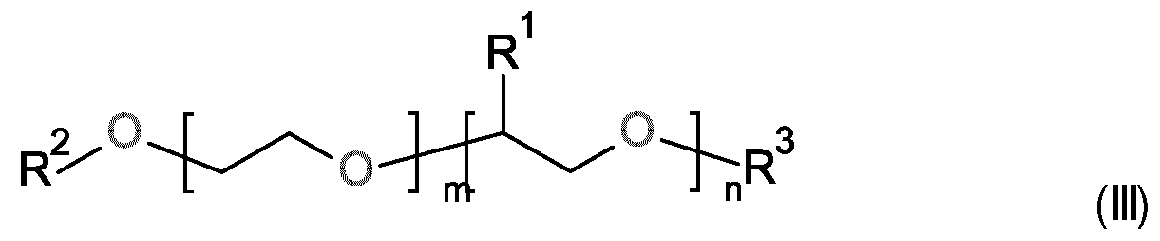
- alkoxylated alcohols and alkoxylated fatty alcohols are, for example, compounds of the general formula (III) in which the variables are defined as follows:
- R 1 is selected from linear Ci -Ci o-alkyl , preferably ethyl and particularly preferably methyl,
- R 2 is selected from C 3 -C 22 -alkyl, for example n-C 8 Hi 7 , n-CioH 2 i, n-Ci2H 2 5, n-Ci4H 29 , n-Ci 8 H 33 or n-Ci 8 H 3 7,
- R 3 is selected from Ci-Cio-alkyl, methyl, ethyl, n-propyl, isopropyl, n-butyl, isobutyl, sec-butyl, tert-butyl, n-pentyl, isopentyl, sec-pentyl, neopentyl, 1 ,2-dimethylpropyl, isoamyl, n-hexyl, isohexyl, sec-hexyl, n-heptyl, n-octyl, 2-ethylhexyl, n-nonyl, n-decyl or isodecyl, m and n are in the range from zero to 300, where the sum of n and m is at least one.
- m is in the range from 1 to 100 and n is in the range from 0 to 30.
- compounds of the general formula (III) may be block copolymers or random copolymers, preference being given to block copolymers.
- alkoxylated alcohols and alkoxylated fatty alcohols are, for example, compounds of the general formula (IV) in which the variables are defined as follows:
- R 1 is identical or different and selected from linear Ci -C4-alkyl, preferably identical in each case and ethyl and particularly preferably methyl,
- R 4 is selected from Ce-Cao-alkyl, in particular n-CsHi?, n-CioH 2 i, n-Ci2H 25 , n-Ci4H 29 , n-CieH 33 , n-Ci 3 H 3 7, a is a number in the range from zero to 6, preferably 1 to 6, b is a number in the range from zero to 20, preferably 4 to 20, d is a number in the range from 4 to 25.
- At least one of a and b is greater than zero.
- compounds of the general formula (IV) may be block copolymers or random copolymers, preference being given to block copolymers.
- nonionic surfactants are selected from di- and multiblock copolymers, composed of ethylene oxide and propylene oxide. Further suitable nonionic surfactants are selected from ethoxylated or propoxylated sorbitan esters. Amine oxides such as lauryl dimethyl amine oxide (“lauramine oxide”) or alkylphenol ethoxylates or alkyl polyglycosides or polyhydroxy fatty acid amides (glucamides) are likewise suitable. An overview of suitable further nonionic surfactants can be found in EP-A 0 851 023 and in DE-A 198 19 187.
- Nonionic surfactants may also be present.
- amphoteric surfactants are Ci2-Ci8-alkylbetaines and sulfobetaines.
- Formulations according to the invention may also comprise water and additional organic solvents, e.g., ethanol or propylene glycol.
- additional organic solvents e.g., ethanol or propylene glycol.
- Further optional ingredients may be but are not limited to viscosity modifiers, cationic surfactants, foam boosting or foam reducing agents, perfumes, dyes, optical brighteners, and dye transfer inhibiting agents.
- N4- Amine was purchased with a purity of ca. 97% from BASF SE, Ludwigshafen, Germany, and directly used without further purification.
- HMDA 364 g 1 ,6-hexamethylene diamine
- 36.4 g water 364 g 1 ,6-hexamethylene diamine (HMDA, 3.13 mol, 1 eq.) and 36.4 g water are charged to a steel pressure reactor.
- the reactor is purged with nitrogen to remove air and a nitrogen pressure of 2.0 bar is set.
- the reactor is heated to 100 °C and 442 g of ethylene oxide (10.0 mol, 3.19 eq.) are dosed into the reactor within six hours. After that, the reaction mixture is kept at 100 °C for six hours for post reaction. Volatile compounds are removed under vacuum and 795.2 g of a clear and highly viscous product is removed from the reactor.
- 364 g of the obtained ethoxylate are heated to 60 °C and filled into a glass reactor under nitrogen atmosphere.
- 24.8 g dimethyl sulfate (DMS) are dosed into the reactor in such a manner that 1 ml of DMS is added per minute.
- the temperature increases to 70 °C.
- the mixture is allowed to post-react at 70 °C for two hours.
- 3.4 g of sulfuric acid are added to the reactor and the temperature is increased to 90 °C and the reactor is set under vacuum (15 mbar) for three hours.
- 3.27 g of sodium hydroxide (50% aqueous solution) and 384 g of demineralized water are added, and the liquid product (84 % solid content) is removed from the reactor.
- PEI600 + 20 EO/NH synthesized as described in WO9532272 or US9738754.
- Molecular weights of the polyamine starting material were determined by gel permeation chromatography (GPC). The measurement was carried out on a column combination of three following columns: HFIP-LG Guard, PL HFIPGEL and PL HFIPGel. Elution was performed at a constant flow rate of 1 mL/min with Hexafluoroisopropanol and 0.05 wt% Potassium trifluroroacetate. The injected sample was prefiltered over a Millipore Millex FG (0.2 pm), 50 pL were injected with a concentration of 1 .5 mg/mL (diluted in eluent).
- the calibration was carried out using PMMA standards (PSS, Mainz, Germany) with a molecular weight from 800 to 2 200 000 g/mol. Values outside of the calibration range were extrapolated.
- Molecular weights of the inventive and comparative polymers were obtained by theoretical calculations, using the known molecular weights of the tetramines/diamines (or determined weightaverage molecular weight of the polyamine starting material, respectively) and assuming complete conversion both during the alkoxylation step (d) and the quaternization/transsulfation step (e). The calculations were performed as follows:
- the total number of NH-functional groups of the amine starting materials has been obtained accordingly, which represent the sum of the NH-functional groups of all primary and secondary amino groups in the backbone of the starting materials.
- the average theoretical molecular weight of one polyethoxylate chain has been calculated, using the employed molar amount of EO per NH-functional group and assuming complete conversion during the alkoxylation step (d).
- the overall molecular weight of the amine ethoxylates has been calculated, by (i) multiplication of the number of NH-functional groups of the backbone of the starting materials and the average molecular weight of one polyethoxylate chain - assuming that on average each polyethoxylate chain has been attached to one available NH- functional group of the backbone - and (ii) adding the molecular weight of the polymer backbone (see above) itself.
- the final molecular weight of the inventive amphoterically- modified trialkylene tetramine ethoxylates/of the comparative non-modified trialkylene tetramine ethoxylates & amphoterically-modified monoalkylene diamine ethoxylates (and of the comparative amphoterically-modified polyamine ethoxylate, respectively) has been calculated by adding the molecular weight of one methyl group and one sulfate group per nitrogen atom present in the amine backbone, multiplied by the degree of conversion applied in this modification step, to the previously obtained molecular weight of the amine ethoxylates, assuming complete conversion during the quaternization/transsulfation step (e) of the present invention.
- composition and analytical data of the inventive and comparative polymers are summarized in Table 1 .
- Aziridine) Mw 600 g/mol CP.1 Polymer based on the same diamine starting material from step (a) like the inventive polymer P.1 , but not modified via step (b) (and optionally step (c)) to obtain an inventive tetramine starting material
- CP.2 Polymer based on the same diamine starting material from step (a) like the inventive polymer P.2, but not modified via step (b) (and optionally step (c)) to obtain an inventive tetramine starting material
- CP.3 Polymer based on the same diamine starting material from step (a) like the inventive polymer P.3, but not modified via step (b) (and optionally step (c)) to obtain an inventive tetramine starting material
- CP.4 Polymer similar to the inventive polymer P.1 (i.e., based on N4-Amine), but not amphoter- ically-modified CP.5: PEI ethoxylate, as described in EP112593 (application), WO9532272 or US9738754 (synthesis)
- the cleaning performance on 4 different circular particulate stains on a polyester fabric was measured by determining the color difference (delta E) between the stains after wash and the unsoiled white fabric using a reflectometer (Datacolor SF600 plus).
- delta E the color difference between the stains after wash and the unsoiled white fabric using a reflectometer
- delta E the so-called “standardized cleaning performance”
- the “standardized cleaning performance” (delta delta E) is the difference of the performance of the laundry detergent including the respective amphoterically-modified trialkylene tetramine ethoxylate or comparative polymer, respectively, vs. the laundry detergent w/o any amphoterically-modified trialkylene tetramine ethoxylate or comparative polymer, respectively.
- Table 2 shows the composition of the laundry detergents
- Table 3 shows the washing test conditions
- Table 4 summarizes the obtained standardized cleaning performance.
- the standardized cleaning performance shown in Table 4 is the sum of the standardized cleaning performance of all 4 stains.
- the bigger the sum of the delta delta E value the bigger the positive contribution of the respective amphoterically-modified trialkylene tetramine ethoxylate or comparative polymer, respectively, on the cleaning performance.
- Ballast fabric 2.5 g SBL 2004 Soil Ballast Fabric ’Formula 2004’ that simulates sebum grease stains; WFK Testgewebe GmbH, Brueggen, Germany); + additional white polyester and cotton ballast, to yield a 1 :1 ratio of polyester/cotton fabric per experiment
- test fabrics were rinsed with 14 °dH water (2 times), followed by drying at ambient room temperature overnight, prior to the measurement with the reflectometer.
- step (b), optionally step (c) of the inventive process leads to polymers exhibiting significantly improved performance, after identical modification of the respective amines to the final amphoterically-modified oligoamine ethoxylates (according to step (d) and (e) of the inventive process).
- inventive polymer P.1 and comparative polymer CP.1 or inventive polymer P.2 and comparative polymer CP.2, or inventive polymer P.3 and comparative polymer CP.3, that polymers based on an analogue diamine backbone but with two additional aminopropyl groups show significantly improved removal of particulate stains when applied in liquid laundry detergents. It can be also seen that the amphoteric modification is crucial for a good performance profile (P.1 vs. CP.4).
Landscapes
- Chemical & Material Sciences (AREA)
- Chemical Kinetics & Catalysis (AREA)
- Organic Chemistry (AREA)
- Life Sciences & Earth Sciences (AREA)
- Engineering & Computer Science (AREA)
- Oil, Petroleum & Natural Gas (AREA)
- Wood Science & Technology (AREA)
- Health & Medical Sciences (AREA)
- Medicinal Chemistry (AREA)
- Polymers & Plastics (AREA)
- Organic Low-Molecular-Weight Compounds And Preparation Thereof (AREA)
Abstract
Description




Claims


Priority Applications (3)
| Application Number | Priority Date | Filing Date | Title |
|---|---|---|---|
| CN202280078778.7A CN118318027A (en) | 2021-11-29 | 2022-11-18 | Amphoteric modified trialkylenetetramine ethoxylates for improved stain removal in laundry detergents |
| US18/703,815 US20260125620A1 (en) | 2021-11-29 | 2022-11-18 | Amphoterically-modified trialkylene tetramine ethoxylates for improved stain removal of laundry detergents |
| EP22818704.3A EP4441188B1 (en) | 2021-11-29 | 2022-11-18 | Amphoterically-modified trialkylene tetramine ethoxylates for improved stain removal of laundry detergents |
Applications Claiming Priority (2)
| Application Number | Priority Date | Filing Date | Title |
|---|---|---|---|
| EP21210972.2 | 2021-11-29 | ||
| EP21210972 | 2021-11-29 |
Publications (1)
| Publication Number | Publication Date |
|---|---|
| WO2023094275A1 true WO2023094275A1 (en) | 2023-06-01 |
Family
ID=78819324
Family Applications (1)
| Application Number | Title | Priority Date | Filing Date |
|---|---|---|---|
| PCT/EP2022/082405 Ceased WO2023094275A1 (en) | 2021-11-29 | 2022-11-18 | Amphoterically-modified trialkylene tetramine ethoxylates for improved stain removal of laundry detergents |
Country Status (4)
| Country | Link |
|---|---|
| US (1) | US20260125620A1 (en) |
| EP (1) | EP4441188B1 (en) |
| CN (1) | CN118318027A (en) |
| WO (1) | WO2023094275A1 (en) |
Cited By (13)
| Publication number | Priority date | Publication date | Assignee | Title |
|---|---|---|---|---|
| WO2025011886A1 (en) | 2023-07-11 | 2025-01-16 | Unilever Ip Holdings B.V. | Method for treating fabric |
| WO2025011808A1 (en) | 2023-07-11 | 2025-01-16 | Unilever Ip Holdings B.V. | Method for treating fabric |
| EP4570890A1 (en) | 2023-12-14 | 2025-06-18 | Unilever IP Holdings B.V. | Composition |
| WO2025124811A1 (en) | 2023-12-14 | 2025-06-19 | Unilever Ip Holdings B.V. | Composition |
| EP4663728A1 (en) | 2024-06-13 | 2025-12-17 | Unilever IP Holdings B.V. | Method for treating fabrics |
| EP4663729A1 (en) | 2024-06-13 | 2025-12-17 | Unilever IP Holdings B.V. | Method for treating fabrics |
| WO2026092993A1 (en) | 2024-10-29 | 2026-05-07 | Unilever Ip Holdings B.V. | Laundry detergent product |
| WO2026099024A1 (en) | 2024-11-11 | 2026-05-15 | Unilever Ip Holdings B.V. | Liquid laundry composition |
| WO2026099022A1 (en) | 2024-11-11 | 2026-05-15 | Unilever Ip Holdings B.V. | Liquid laundry composition |
| WO2026099025A1 (en) | 2024-11-11 | 2026-05-15 | Unilever Ip Holdings B.V. | Liquid laundry composition |
| WO2026099020A1 (en) | 2024-11-11 | 2026-05-15 | Unilever Ip Holdings B.V. | Liquid laundry composition |
| WO2026099023A1 (en) | 2024-11-11 | 2026-05-15 | Unilever Ip Holdings B.V. | Liquid laundry composition |
| WO2026099021A1 (en) | 2024-11-11 | 2026-05-15 | Unilever Ip Holdings B.V. | Method for treating fabrics |
Citations (22)
| Publication number | Priority date | Publication date | Assignee | Title |
|---|---|---|---|---|
| EP0112593A2 (en) | 1982-12-23 | 1984-07-04 | THE PROCTER & GAMBLE COMPANY | Detergent compositions containing ethoxylated amines having clay soil removal/anti-redeposition properties |
| DD238043A1 (en) | 1985-06-05 | 1986-08-06 | Leuna Werke Veb | PROCESS FOR THE PREPARATION OF DIPROPYLENEDRIAMINE |
| WO1992014709A2 (en) | 1991-02-11 | 1992-09-03 | Cambridge Neuroscience, Inc. | Calcium channel antagonists and methodology for their identification |
| WO1995032272A1 (en) | 1994-05-25 | 1995-11-30 | The Procter & Gamble Company | Compositions comprising ethoxylated/propoxylated polyalkyleneamine polymers as soil dispersing agents |
| JPH08333308A (en) | 1995-06-07 | 1996-12-17 | Koei Chem Co Ltd | Production of n,n'-bis(3-aminopropyl diaminoalkane |
| EP0851023A2 (en) | 1996-12-23 | 1998-07-01 | Unilever N.V. | Machine dishwashing tablets containing a peracid |
| DE19819187A1 (en) | 1998-04-30 | 1999-11-11 | Henkel Kgaa | Solid dishwasher detergent with phosphate and crystalline layered silicates |
| WO2001029112A1 (en) | 1999-10-19 | 2001-04-26 | Basf Aktiengesellschaft | Process for the production of zwitterionic polyamines |
| EP1198492A1 (en) | 1999-07-16 | 2002-04-24 | Basf Aktiengesellschaft | Zwitterionic polyamines and a process for their production |
| EP1309546A1 (en) | 2000-08-07 | 2003-05-14 | The Procter & Gamble Company | Sulfation process |
| WO2004020563A1 (en) | 2002-08-30 | 2004-03-11 | The Procter & Gamble Company | Detergent compositions comprising hydrophobically modified polyamines |
| WO2004024858A1 (en) | 2002-09-12 | 2004-03-25 | The Procter & Gamble Company | Polymer systems and cleaning compositions comprising same |
| CN102941160A (en) | 2012-12-13 | 2013-02-27 | 贵州大学 | Flotation collector for silicate minerals |
| EP2662436A1 (en) | 2012-05-11 | 2013-11-13 | The Procter & Gamble Company | Detergent composition |
| EP2961819A2 (en) | 2013-02-28 | 2016-01-06 | Basf Se | Aqueous formulations, their manufacture, and their use in hard surface cleaning |
| EP2961821A1 (en) | 2013-02-28 | 2016-01-06 | Basf Se | Use of alkoxylated polypropylenimine for laundry care and compositions therefore |
| EP3039109A1 (en) | 2013-08-26 | 2016-07-06 | The Procter & Gamble Company | Compositions comprising alkoxylated polyamines having low melting points |
| EP3039057A1 (en) | 2013-08-26 | 2016-07-06 | Basf Se | Alkoxylated polyethyleneimine with a low melting point |
| WO2016187085A1 (en) | 2015-05-19 | 2016-11-24 | Gcp Applied Technologies Inc. | Polyalkoxylated polyamine oxide defoaming compositions |
| EP3167034A1 (en) | 2014-07-09 | 2017-05-17 | Henkel AG & Co. KGaA | Polyalkoxylated polyamines in novel laundry methods |
| WO2018046393A1 (en) | 2016-09-08 | 2018-03-15 | Basf Se | Method for hydrating nitriles in the presence of a ruthenium catalyst carried on zro2 |
| EP3301154A1 (en) | 2016-10-03 | 2018-04-04 | The Procter & Gamble Company | Laundry detergent composition |
-
2022
- 2022-11-18 EP EP22818704.3A patent/EP4441188B1/en active Active
- 2022-11-18 CN CN202280078778.7A patent/CN118318027A/en active Pending
- 2022-11-18 WO PCT/EP2022/082405 patent/WO2023094275A1/en not_active Ceased
- 2022-11-18 US US18/703,815 patent/US20260125620A1/en active Pending
Patent Citations (23)
| Publication number | Priority date | Publication date | Assignee | Title |
|---|---|---|---|---|
| EP0112593A2 (en) | 1982-12-23 | 1984-07-04 | THE PROCTER & GAMBLE COMPANY | Detergent compositions containing ethoxylated amines having clay soil removal/anti-redeposition properties |
| DD238043A1 (en) | 1985-06-05 | 1986-08-06 | Leuna Werke Veb | PROCESS FOR THE PREPARATION OF DIPROPYLENEDRIAMINE |
| WO1992014709A2 (en) | 1991-02-11 | 1992-09-03 | Cambridge Neuroscience, Inc. | Calcium channel antagonists and methodology for their identification |
| WO1995032272A1 (en) | 1994-05-25 | 1995-11-30 | The Procter & Gamble Company | Compositions comprising ethoxylated/propoxylated polyalkyleneamine polymers as soil dispersing agents |
| JPH08333308A (en) | 1995-06-07 | 1996-12-17 | Koei Chem Co Ltd | Production of n,n'-bis(3-aminopropyl diaminoalkane |
| EP0851023A2 (en) | 1996-12-23 | 1998-07-01 | Unilever N.V. | Machine dishwashing tablets containing a peracid |
| DE19819187A1 (en) | 1998-04-30 | 1999-11-11 | Henkel Kgaa | Solid dishwasher detergent with phosphate and crystalline layered silicates |
| EP1198492A1 (en) | 1999-07-16 | 2002-04-24 | Basf Aktiengesellschaft | Zwitterionic polyamines and a process for their production |
| WO2001029112A1 (en) | 1999-10-19 | 2001-04-26 | Basf Aktiengesellschaft | Process for the production of zwitterionic polyamines |
| EP1309546A1 (en) | 2000-08-07 | 2003-05-14 | The Procter & Gamble Company | Sulfation process |
| WO2004020563A1 (en) | 2002-08-30 | 2004-03-11 | The Procter & Gamble Company | Detergent compositions comprising hydrophobically modified polyamines |
| WO2004024858A1 (en) | 2002-09-12 | 2004-03-25 | The Procter & Gamble Company | Polymer systems and cleaning compositions comprising same |
| EP2662436A1 (en) | 2012-05-11 | 2013-11-13 | The Procter & Gamble Company | Detergent composition |
| CN102941160A (en) | 2012-12-13 | 2013-02-27 | 贵州大学 | Flotation collector for silicate minerals |
| EP2961819A2 (en) | 2013-02-28 | 2016-01-06 | Basf Se | Aqueous formulations, their manufacture, and their use in hard surface cleaning |
| EP2961821A1 (en) | 2013-02-28 | 2016-01-06 | Basf Se | Use of alkoxylated polypropylenimine for laundry care and compositions therefore |
| EP3039109A1 (en) | 2013-08-26 | 2016-07-06 | The Procter & Gamble Company | Compositions comprising alkoxylated polyamines having low melting points |
| EP3039057A1 (en) | 2013-08-26 | 2016-07-06 | Basf Se | Alkoxylated polyethyleneimine with a low melting point |
| US9738754B2 (en) | 2013-08-26 | 2017-08-22 | Basf Se | Alkoxylated polyethyeneimine with a low melting point |
| EP3167034A1 (en) | 2014-07-09 | 2017-05-17 | Henkel AG & Co. KGaA | Polyalkoxylated polyamines in novel laundry methods |
| WO2016187085A1 (en) | 2015-05-19 | 2016-11-24 | Gcp Applied Technologies Inc. | Polyalkoxylated polyamine oxide defoaming compositions |
| WO2018046393A1 (en) | 2016-09-08 | 2018-03-15 | Basf Se | Method for hydrating nitriles in the presence of a ruthenium catalyst carried on zro2 |
| EP3301154A1 (en) | 2016-10-03 | 2018-04-04 | The Procter & Gamble Company | Laundry detergent composition |
Non-Patent Citations (1)
| Title |
|---|
| MERVYN ISRAEL ET AL: "Analogs of Spermine and Spermidine. I. Synthesis of Polymethylenepolyamines by Reduction of Cyanoethylated α,ι-Alkylenediamines 1,2", JOURNAL OF MEDICINAL CHEMISTRY, vol. 7, no. 6, 1 November 1964 (1964-11-01), US, pages 710 - 716, XP055354696, ISSN: 0022-2623, DOI: 10.1021/jm00336a006 * |
Cited By (17)
| Publication number | Priority date | Publication date | Assignee | Title |
|---|---|---|---|---|
| WO2025011886A1 (en) | 2023-07-11 | 2025-01-16 | Unilever Ip Holdings B.V. | Method for treating fabric |
| WO2025011808A1 (en) | 2023-07-11 | 2025-01-16 | Unilever Ip Holdings B.V. | Method for treating fabric |
| EP4570890A1 (en) | 2023-12-14 | 2025-06-18 | Unilever IP Holdings B.V. | Composition |
| WO2025124811A1 (en) | 2023-12-14 | 2025-06-19 | Unilever Ip Holdings B.V. | Composition |
| EP4663728A1 (en) | 2024-06-13 | 2025-12-17 | Unilever IP Holdings B.V. | Method for treating fabrics |
| EP4663729A1 (en) | 2024-06-13 | 2025-12-17 | Unilever IP Holdings B.V. | Method for treating fabrics |
| WO2026092993A1 (en) | 2024-10-29 | 2026-05-07 | Unilever Ip Holdings B.V. | Laundry detergent product |
| WO2026092990A1 (en) | 2024-10-29 | 2026-05-07 | Unilever Ip Holdings B.V. | Laundry detergent product |
| WO2026092991A1 (en) | 2024-10-29 | 2026-05-07 | Unilever Ip Holdings B.V. | Laundry detergent product |
| WO2026092994A1 (en) | 2024-10-29 | 2026-05-07 | Unilever Ip Holdings B.V. | Laundry detergent product |
| WO2026092992A1 (en) | 2024-10-29 | 2026-05-07 | Unilever Ip Holdings B.V. | Laundry detergent product |
| WO2026099024A1 (en) | 2024-11-11 | 2026-05-15 | Unilever Ip Holdings B.V. | Liquid laundry composition |
| WO2026099022A1 (en) | 2024-11-11 | 2026-05-15 | Unilever Ip Holdings B.V. | Liquid laundry composition |
| WO2026099025A1 (en) | 2024-11-11 | 2026-05-15 | Unilever Ip Holdings B.V. | Liquid laundry composition |
| WO2026099020A1 (en) | 2024-11-11 | 2026-05-15 | Unilever Ip Holdings B.V. | Liquid laundry composition |
| WO2026099023A1 (en) | 2024-11-11 | 2026-05-15 | Unilever Ip Holdings B.V. | Liquid laundry composition |
| WO2026099021A1 (en) | 2024-11-11 | 2026-05-15 | Unilever Ip Holdings B.V. | Method for treating fabrics |
Also Published As
| Publication number | Publication date |
|---|---|
| US20260125620A1 (en) | 2026-05-07 |
| CN118318027A (en) | 2024-07-09 |
| EP4441188A1 (en) | 2024-10-09 |
| EP4441188B1 (en) | 2026-07-22 |
Similar Documents
| Publication | Publication Date | Title |
|---|---|---|
| EP4157918B1 (en) | Amphoterically-modified oligopropyleneimine ethoxylates for improved stain removal of laundry detergents | |
| EP4441188A1 (en) | Amphoterically-modified trialkylene tetramine ethoxylates for improved stain removal of laundry detergents | |
| EP4168472B1 (en) | Amphiphilic alkoxylated polyethylene/-propylene imine copolymers for multi-benefit detergent formulations | |
| FI83431C (en) | Builder composition for use in detergent compositions | |
| EP3122786B1 (en) | Carboxylate ester of polysaccharide | |
| EP3262212B1 (en) | Process for cleaning soiled metal surfaces and substances useful for such process | |
| US20160002572A1 (en) | Use of alkoxylated polypropylenimine for laundry care and compositions therefore | |
| AU2021280970B2 (en) | A liquid laundry composition | |
| CN107001624B (en) | Process for preparing polyaspartic acid by means of precondensates | |
| US20160222163A1 (en) | Modified polyaspartic acids, the production thereof and their use as dispersants and encrustation inhibitors in laundry detergents, dishwashing detergents and cleaning product compositions, and in water treatmentcleaning product compositions, and in water treatment | |
| KR20180051588A (en) | Process for producing polyaspartic acid under reflux cooling | |
| CA2293056C (en) | Polyether hydroxycarboxylate copolymers | |
| BR112022024051B1 (en) | AMPHOTERICALLY MODIFIED OLIGOPROPYLENEIMINE ETHOXYLATES, MIXTURE OF COMPOUNDS, MIXTURE, PROCESS FOR MAKING AMPHOTERICALLY MODIFIED OLIGOPROPYLENEIMINE ETHOXYLATES, USE OF AMPHOTERICALLY MODIFIED OLIGOPROPYLENEIMINE ETHOXYLATES, AND, FORMULATION FOR LAUNDRY | |
| BR112022025543B1 (en) | AMPHIPHILIC ALKOXYLATED POLYETHYLENE/PROPYLENE IMINE COPOLYMERS, AMPHIPHILIC ALKOXYLATED POLYETHYLENE/PROPYLENE IMINE COPOLYMERS BEFORE ALKOXYLATION, PROCESS FOR MANUFACTURING AMPHIPHILIC ALKOXYLATED POLYETHYLENE/PROPYLENE IMINE COPOLYMERS, DETERGENT COMPOSITION, AND, USE OF AMPHIPHILIC ALKOXYLATED POLYETHYLENE/PROPYLENE IMINE COPOLYMERS | |
| CN120916999A (en) | Process for preparing amino acid esters as organic ether sulphates from alkoxylated alcohols |
Legal Events
| Date | Code | Title | Description |
|---|---|---|---|
| 121 | Ep: the epo has been informed by wipo that ep was designated in this application |
Ref document number: 22818704 Country of ref document: EP Kind code of ref document: A1 |
|
| WWE | Wipo information: entry into national phase |
Ref document number: 18703815 Country of ref document: US |
|
| WWE | Wipo information: entry into national phase |
Ref document number: 202417039004 Country of ref document: IN |
|
| WWE | Wipo information: entry into national phase |
Ref document number: 202280078778.7 Country of ref document: CN |
|
| REG | Reference to national code |
Ref country code: BR Ref legal event code: B01A Ref document number: 112024010558 Country of ref document: BR |
|
| NENP | Non-entry into the national phase |
Ref country code: DE |
|
| ENP | Entry into the national phase |
Ref document number: 2022818704 Country of ref document: EP Effective date: 20240701 |
|
| ENP | Entry into the national phase |
Ref document number: 112024010558 Country of ref document: BR Kind code of ref document: A2 Effective date: 20240527 |
|
| WWG | Wipo information: grant in national office |
Ref document number: 2022818704 Country of ref document: EP |