WO2023120201A1 - ガスバリア性積層体、および包装体 - Google Patents
ガスバリア性積層体、および包装体 Download PDFInfo
- Publication number
- WO2023120201A1 WO2023120201A1 PCT/JP2022/045217 JP2022045217W WO2023120201A1 WO 2023120201 A1 WO2023120201 A1 WO 2023120201A1 JP 2022045217 W JP2022045217 W JP 2022045217W WO 2023120201 A1 WO2023120201 A1 WO 2023120201A1
- Authority
- WO
- WIPO (PCT)
- Prior art keywords
- layer
- gas barrier
- resins
- barrier laminate
- resin
- Prior art date
- Legal status (The legal status is an assumption and is not a legal conclusion. Google has not performed a legal analysis and makes no representation as to the accuracy of the status listed.)
- Ceased
Links
Classifications
-
- B—PERFORMING OPERATIONS; TRANSPORTING
- B65—CONVEYING; PACKING; STORING; HANDLING THIN OR FILAMENTARY MATERIAL
- B65D—CONTAINERS FOR STORAGE OR TRANSPORT OF ARTICLES OR MATERIALS, e.g. BAGS, BARRELS, BOTTLES, BOXES, CANS, CARTONS, CRATES, DRUMS, JARS, TANKS, HOPPERS, FORWARDING CONTAINERS; ACCESSORIES, CLOSURES, OR FITTINGS THEREFOR; PACKAGING ELEMENTS; PACKAGES
- B65D65/00—Wrappers or flexible covers; Packaging materials of special type or form
- B65D65/38—Packaging materials of special type or form
- B65D65/40—Applications of laminates for particular packaging purposes
-
- B—PERFORMING OPERATIONS; TRANSPORTING
- B32—LAYERED PRODUCTS
- B32B—LAYERED PRODUCTS, i.e. PRODUCTS BUILT-UP OF STRATA OF FLAT OR NON-FLAT, e.g. CELLULAR OR HONEYCOMB, FORM
- B32B27/00—Layered products comprising a layer of synthetic resin
-
- B—PERFORMING OPERATIONS; TRANSPORTING
- B32—LAYERED PRODUCTS
- B32B—LAYERED PRODUCTS, i.e. PRODUCTS BUILT-UP OF STRATA OF FLAT OR NON-FLAT, e.g. CELLULAR OR HONEYCOMB, FORM
- B32B27/00—Layered products comprising a layer of synthetic resin
- B32B27/06—Layered products comprising a layer of synthetic resin as the main or only constituent of a layer, which is next to another layer of the same or of a different material
- B32B27/08—Layered products comprising a layer of synthetic resin as the main or only constituent of a layer, which is next to another layer of the same or of a different material of synthetic resin
-
- B—PERFORMING OPERATIONS; TRANSPORTING
- B32—LAYERED PRODUCTS
- B32B—LAYERED PRODUCTS, i.e. PRODUCTS BUILT-UP OF STRATA OF FLAT OR NON-FLAT, e.g. CELLULAR OR HONEYCOMB, FORM
- B32B27/00—Layered products comprising a layer of synthetic resin
- B32B27/32—Layered products comprising a layer of synthetic resin comprising polyolefins
-
- B—PERFORMING OPERATIONS; TRANSPORTING
- B32—LAYERED PRODUCTS
- B32B—LAYERED PRODUCTS, i.e. PRODUCTS BUILT-UP OF STRATA OF FLAT OR NON-FLAT, e.g. CELLULAR OR HONEYCOMB, FORM
- B32B7/00—Layered products characterised by the relation between layers; Layered products characterised by the relative orientation of features between layers, or by the relative values of a measurable parameter between layers, i.e. products comprising layers having different physical, chemical or physicochemical properties; Layered products characterised by the interconnection of layers
- B32B7/02—Physical, chemical or physicochemical properties
-
- B—PERFORMING OPERATIONS; TRANSPORTING
- B32—LAYERED PRODUCTS
- B32B—LAYERED PRODUCTS, i.e. PRODUCTS BUILT-UP OF STRATA OF FLAT OR NON-FLAT, e.g. CELLULAR OR HONEYCOMB, FORM
- B32B9/00—Layered products comprising a layer of a particular substance not covered by groups B32B11/00 - B32B29/00
-
- C—CHEMISTRY; METALLURGY
- C08—ORGANIC MACROMOLECULAR COMPOUNDS; THEIR PREPARATION OR CHEMICAL WORKING-UP; COMPOSITIONS BASED THEREON
- C08J—WORKING-UP; GENERAL PROCESSES OF COMPOUNDING; AFTER-TREATMENT NOT COVERED BY SUBCLASSES C08B, C08C, C08F, C08G or C08H
- C08J7/00—Chemical treatment or coating of shaped articles made of macromolecular substances
- C08J7/04—Coating
- C08J7/042—Coating with two or more layers, where at least one layer of a composition contains a polymer binder
- C08J7/0423—Coating with two or more layers, where at least one layer of a composition contains a polymer binder with at least one layer of inorganic material and at least one layer of a composition containing a polymer binder
-
- C—CHEMISTRY; METALLURGY
- C08—ORGANIC MACROMOLECULAR COMPOUNDS; THEIR PREPARATION OR CHEMICAL WORKING-UP; COMPOSITIONS BASED THEREON
- C08J—WORKING-UP; GENERAL PROCESSES OF COMPOUNDING; AFTER-TREATMENT NOT COVERED BY SUBCLASSES C08B, C08C, C08F, C08G or C08H
- C08J7/00—Chemical treatment or coating of shaped articles made of macromolecular substances
- C08J7/04—Coating
- C08J7/043—Improving the adhesiveness of the coatings per se, e.g. forming primers
-
- C—CHEMISTRY; METALLURGY
- C08—ORGANIC MACROMOLECULAR COMPOUNDS; THEIR PREPARATION OR CHEMICAL WORKING-UP; COMPOSITIONS BASED THEREON
- C08J—WORKING-UP; GENERAL PROCESSES OF COMPOUNDING; AFTER-TREATMENT NOT COVERED BY SUBCLASSES C08B, C08C, C08F, C08G or C08H
- C08J7/00—Chemical treatment or coating of shaped articles made of macromolecular substances
- C08J7/04—Coating
- C08J7/048—Forming gas barrier coatings
-
- B—PERFORMING OPERATIONS; TRANSPORTING
- B32—LAYERED PRODUCTS
- B32B—LAYERED PRODUCTS, i.e. PRODUCTS BUILT-UP OF STRATA OF FLAT OR NON-FLAT, e.g. CELLULAR OR HONEYCOMB, FORM
- B32B2255/00—Coating on the layer surface
- B32B2255/10—Coating on the layer surface on synthetic resin layer or on natural or synthetic rubber layer
-
- B—PERFORMING OPERATIONS; TRANSPORTING
- B32—LAYERED PRODUCTS
- B32B—LAYERED PRODUCTS, i.e. PRODUCTS BUILT-UP OF STRATA OF FLAT OR NON-FLAT, e.g. CELLULAR OR HONEYCOMB, FORM
- B32B2255/00—Coating on the layer surface
- B32B2255/20—Inorganic coating
-
- B—PERFORMING OPERATIONS; TRANSPORTING
- B32—LAYERED PRODUCTS
- B32B—LAYERED PRODUCTS, i.e. PRODUCTS BUILT-UP OF STRATA OF FLAT OR NON-FLAT, e.g. CELLULAR OR HONEYCOMB, FORM
- B32B2255/00—Coating on the layer surface
- B32B2255/26—Polymeric coating
-
- B—PERFORMING OPERATIONS; TRANSPORTING
- B32—LAYERED PRODUCTS
- B32B—LAYERED PRODUCTS, i.e. PRODUCTS BUILT-UP OF STRATA OF FLAT OR NON-FLAT, e.g. CELLULAR OR HONEYCOMB, FORM
- B32B2255/00—Coating on the layer surface
- B32B2255/28—Multiple coating on one surface
-
- B—PERFORMING OPERATIONS; TRANSPORTING
- B32—LAYERED PRODUCTS
- B32B—LAYERED PRODUCTS, i.e. PRODUCTS BUILT-UP OF STRATA OF FLAT OR NON-FLAT, e.g. CELLULAR OR HONEYCOMB, FORM
- B32B2307/00—Properties of the layers or laminate
- B32B2307/70—Other properties
- B32B2307/724—Permeability to gases, adsorption
- B32B2307/7242—Non-permeable
- B32B2307/7244—Oxygen barrier
-
- B—PERFORMING OPERATIONS; TRANSPORTING
- B32—LAYERED PRODUCTS
- B32B—LAYERED PRODUCTS, i.e. PRODUCTS BUILT-UP OF STRATA OF FLAT OR NON-FLAT, e.g. CELLULAR OR HONEYCOMB, FORM
- B32B2307/00—Properties of the layers or laminate
- B32B2307/70—Other properties
- B32B2307/748—Releasability
-
- B—PERFORMING OPERATIONS; TRANSPORTING
- B32—LAYERED PRODUCTS
- B32B—LAYERED PRODUCTS, i.e. PRODUCTS BUILT-UP OF STRATA OF FLAT OR NON-FLAT, e.g. CELLULAR OR HONEYCOMB, FORM
- B32B2439/00—Containers; Receptacles
-
- B—PERFORMING OPERATIONS; TRANSPORTING
- B65—CONVEYING; PACKING; STORING; HANDLING THIN OR FILAMENTARY MATERIAL
- B65D—CONTAINERS FOR STORAGE OR TRANSPORT OF ARTICLES OR MATERIALS, e.g. BAGS, BARRELS, BOTTLES, BOXES, CANS, CARTONS, CRATES, DRUMS, JARS, TANKS, HOPPERS, FORWARDING CONTAINERS; ACCESSORIES, CLOSURES, OR FITTINGS THEREFOR; PACKAGING ELEMENTS; PACKAGES
- B65D2565/00—Wrappers or flexible covers; Packaging materials of special type or form
- B65D2565/38—Packaging materials of special type or form
- B65D2565/381—Details of packaging materials of special type or form
- B65D2565/387—Materials used as gas barriers
-
- C—CHEMISTRY; METALLURGY
- C08—ORGANIC MACROMOLECULAR COMPOUNDS; THEIR PREPARATION OR CHEMICAL WORKING-UP; COMPOSITIONS BASED THEREON
- C08J—WORKING-UP; GENERAL PROCESSES OF COMPOUNDING; AFTER-TREATMENT NOT COVERED BY SUBCLASSES C08B, C08C, C08F, C08G or C08H
- C08J2323/00—Characterised by the use of homopolymers or copolymers of unsaturated aliphatic hydrocarbons having only one carbon-to-carbon double bond; Derivatives of such polymers
- C08J2323/02—Characterised by the use of homopolymers or copolymers of unsaturated aliphatic hydrocarbons having only one carbon-to-carbon double bond; Derivatives of such polymers not modified by chemical after treatment
- C08J2323/10—Homopolymers or copolymers of propene
- C08J2323/12—Polypropene
-
- C—CHEMISTRY; METALLURGY
- C08—ORGANIC MACROMOLECULAR COMPOUNDS; THEIR PREPARATION OR CHEMICAL WORKING-UP; COMPOSITIONS BASED THEREON
- C08J—WORKING-UP; GENERAL PROCESSES OF COMPOUNDING; AFTER-TREATMENT NOT COVERED BY SUBCLASSES C08B, C08C, C08F, C08G or C08H
- C08J2429/00—Characterised by the use of homopolymers or copolymers of compounds having one or more unsaturated aliphatic radicals, each having only one carbon-to-carbon double bond, and at least one being terminated by an alcohol, ether, aldehydo, ketonic, acetal, or ketal radical; Hydrolysed polymers of esters of unsaturated alcohols with saturated carboxylic acids; Derivatives of such polymer
- C08J2429/02—Homopolymers or copolymers of unsaturated alcohols
- C08J2429/04—Polyvinyl alcohol; Partially hydrolysed homopolymers or copolymers of esters of unsaturated alcohols with saturated carboxylic acids
-
- C—CHEMISTRY; METALLURGY
- C08—ORGANIC MACROMOLECULAR COMPOUNDS; THEIR PREPARATION OR CHEMICAL WORKING-UP; COMPOSITIONS BASED THEREON
- C08J—WORKING-UP; GENERAL PROCESSES OF COMPOUNDING; AFTER-TREATMENT NOT COVERED BY SUBCLASSES C08B, C08C, C08F, C08G or C08H
- C08J2467/00—Characterised by the use of polyesters obtained by reactions forming a carboxylic ester link in the main chain; Derivatives of such polymers
-
- C—CHEMISTRY; METALLURGY
- C08—ORGANIC MACROMOLECULAR COMPOUNDS; THEIR PREPARATION OR CHEMICAL WORKING-UP; COMPOSITIONS BASED THEREON
- C08J—WORKING-UP; GENERAL PROCESSES OF COMPOUNDING; AFTER-TREATMENT NOT COVERED BY SUBCLASSES C08B, C08C, C08F, C08G or C08H
- C08J2475/00—Characterised by the use of polyureas or polyurethanes; Derivatives of such polymers
- C08J2475/04—Polyurethanes
Definitions
- the present invention provides a laminate and package having gas barrier properties. Further, the gas barrier laminate and package of the present invention are excellent in adhesion between the layers of the laminate and have improved adhesion strength.
- Packaging materials used for packaging foods, pharmaceuticals, etc. are required to prevent deterioration of contents, especially oxidation by oxygen.
- conventional barrier films composed of polymers with relatively high oxygen barrier properties (oxygen barrier polymers) and laminates using such barrier films as film substrates film) is used.
- oxygen barrier polymers oxygen barrier polymers
- a vapor deposition layer made of an inorganic compound is used as the first layer, and a water-soluble polymer, (a) one or more alkoxides or / and a hydrolyzate thereof or (b) )
- a coating agent containing at least one of tin chloride or a water/alcohol mixed solution as a main component is applied, and a gas barrier coating is laminated as a second layer by heating and drying.
- a gas barrier laminated film and a packaging material using the gas barrier laminated film have been proposed.
- Patent Document 2 includes a resin substrate and a coating layer on the resin substrate, and the coating layer includes at least one of a water-soluble polymer, a silane coupling agent and a hydrolyzate thereof, a metal alkoxide and A laminate film containing at least one of its hydrolyzate and an inorganic stratiform compound is disclosed, and a gas barrier laminate film is proposed in combination with a polypropylene-based substrate, a silicon oxide deposition layer, and a gas barrier coating layer.
- the gas barrier coating agent exhibits high gas barrier properties, there is a problem in that it is difficult to obtain adhesion to a laminated substrate in which a film substrate is coated with an aluminum oxide deposition layer as the first layer.
- An object of the present invention is to provide a gas-barrier laminate that exhibits excellent interlayer adhesion strength and good gas-barrier properties even when a vapor-deposited layer of aluminum oxide or the like is provided.
- a gas barrier laminate comprising (A) a base material layer having an inorganic layer formed on at least one surface thereof, and (B) contacting the surface of the base material having the inorganic layer formed thereon.
- a resin layer containing a resin having a glass transition temperature of 40 ° C. or less provided so as to The present inventors have found that the above problems can be solved by a gas barrier laminate characterized by laminating a layer containing a hydrolyzate thereof.
- the present invention provides a gas barrier laminate comprising: (A) a layer comprising a substrate having an inorganic layer formed on at least one surface; A resin layer containing a resin having a glass transition temperature of 40° C. or less provided as above, (C) a water-soluble polymer provided so as to be in contact with the resin layer (B), a metal alkoxide and / or
- the present invention provides a gas barrier laminate characterized by laminating a layer containing the hydrolyzate.
- the present invention further provides the gas barrier laminate according to [1], wherein the inorganic layer in layer (A) is formed by either vapor deposition or sputtering. is.
- the present invention is characterized in that the inorganic layer in layer (A) is formed from one or more inorganic substances selected from the group consisting of aluminum oxide, silicon oxide, aluminum, zinc oxide, and magnesium oxide.
- the gas barrier laminate according to any one of [1] or [2] is provided.
- the present invention is characterized in that the resin having a glass transition temperature of 40°C or less is one or more resins selected from ester resins, urethane resins, vinyl resins, acrylic resins, and acrylate resins [ 1] to provide the gas barrier laminate according to any one of [3].
- the present invention is characterized in that the water-soluble polymer is one or more water-soluble polymers selected from vinyl alcohol polymers, ethylene vinyl alcohol polymers, vinylpyrrolidone polymers, and acrylamide polymers.
- a gas barrier laminate according to any one of [1] to [4] is provided.
- the present invention is any one of [1] to [5], wherein the metal alkoxide and/or its hydrolyzate is a compound containing one or more metal species selected from silicon and aluminum.
- the gas barrier laminate described above is any one of [1] to [5], wherein the metal alkoxide and/or its hydrolyzate is a compound containing one or more metal species selected from silicon and aluminum.
- the present invention provides a package using the gas barrier laminate according to any one of [1] to [6].
- the gas barrier laminate of the present invention has (A) a layer (hereinafter sometimes referred to as "(A) layer”) made of a substrate having an inorganic layer formed on at least one surface thereof.
- the base material used in the layer (A) is not particularly limited in material, production method, or shape as long as the effects of the present invention can be obtained.
- Materials for these substrates include, for example, polyethylene (PE), polypropylene (PP), cyclic olefin polymer (COP), olefin resins such as cyclic olefin copolymer (COC), polyester, acrylic, polycarbonate, cellulose ester, polyethylene terephthalate ( PET), polybutylene terephthalate (PBT), nylon (NY), biomass film, etc. can be used, and it is preferable to use PE and PP because the effects of the present invention can be obtained remarkably.
- PE polyethylene
- PP polypropylene
- COP cyclic olefin polymer
- COC o
- the substrate used in the layer (A) may be a film having a thickness of less than 250 ⁇ m, a sheet having a thickness of 250 ⁇ m or more and less than 1 mm, or a plate-like substrate having a thickness of 1 mm or more.
- a sheet or film having a thickness of 500 ⁇ m or less is particularly preferable because it can be preferably obtained.
- the method for producing these substrates is not particularly limited, and they can be produced using various film forming methods such as melt extrusion molding, solution casting molding, and calendar molding. A uniaxially stretched material may also be used. Moreover, you may use the film which performed various surface treatments as needed.
- the (A) layer of the present invention has a base material layer with an inorganic layer formed on at least one side thereof, and the inorganic layer is formed on at least one side of the base material partially or entirely.
- the inorganic material forming these inorganic layers is not particularly limited as long as the effects of the present invention can be obtained, but metals such as aluminum oxide, silicon oxide, aluminum, zinc oxide, magnesium oxide, calcium oxide, and zirconium oxide It is preferable to use one or more selected from metal oxides, and it is particularly preferable to use one or more selected from aluminum oxide, silicon oxide, aluminum, zinc oxide, and magnesium oxide because the barrier properties are exhibited satisfactorily. .
- the method for forming the inorganic layer is not particularly limited as long as the effects of the present invention can be obtained.
- Vapor deposition treatment and sputtering treatment are particularly preferred because the inorganic layer can be uniformly formed.
- the gas barrier laminate of the present invention includes (B) a resin layer containing a resin having a glass transition temperature of 40° C. or less provided so as to be in contact with the surface of the base material on which the inorganic layer is formed (hereinafter referred to as ( B) It may be called a layer.).
- the (B) layer may be laminated so that at least a portion thereof is in direct contact with the inorganic layer provided on the (A) layer.
- the resin having a glass transition temperature of 40° C. or less which is used in the gas barrier laminate of the present invention, is a test piece with a length of 0.5 mm on each side according to the plastic transition temperature measurement method specified in JIS K7121-1987.
- Any resin having a glass transition temperature of 40° C. or less when measured using as these resins having a glass transition temperature of 40° C. or less one or more resins selected from ester resins, urethane resins, vinyl resins, acrylic resins, acrylate resins, amine resins, ether resins, and acetal resins can be used. Ester resins, urethane resins, and acrylic resins are preferable because the adhesion strength of the laminate is good, and ester resins and urethane resins are particularly preferable because they improve gas barrier properties.
- the method for applying the resin having a glass transition temperature of 40°C or less in the layer (B) of the present invention is not particularly limited, and known and commonly used coating methods can be used. Examples include a spray method, a spin coating method, a dip method, a roll coating method, a blade coating method, a doctor roll method, a doctor blade method, a curtain coating method, a slit coating method, a screen printing method, an inkjet method, a dispensing method, and the like. Coating by a roll coating method using a gravure coater is preferable because a good coating film is formed.
- the coating amount of the resin having a glass transition temperature of 40° C. or less is not particularly limited as long as the effects of the present invention can be obtained, but the coating amount is 0.05 to 0.5 g/m 2 . 0.1 to 0.3 g/m 2 is particularly preferable because a good coating film is formed.
- the drying step may be normal temperature drying, or forced drying such as heating using an oven, pressure reduction, or air blowing may be performed.
- the (B) layer in the present invention contains a resin having a glass transition temperature of 40° C. or less as described above, but other resins, plasticizers, dispersants, surfactants, Additives such as stabilizers, thickeners, antifoaming agents, wetting agents, curing agents, antiblocking agents, lubricants, preservatives, inorganic fillers and coupling agents may be added.
- the gas barrier laminate of the present invention includes (C) a layer (hereinafter referred to as (C) Layer).
- the layer (C) may be laminated so that at least a portion of the layer (B) is in direct contact with the layer (B).
- the water-soluble polymer used in the gas-barrier laminate of the present invention is not particularly limited as long as the effect of the present invention can be obtained.
- One or more water-soluble polymers selected from polymers, acrylic acid polymers, starch, methyl cellulose, carboxymethyl cellulose, sodium alginate, etc. can be used, and suitable gas barrier properties can be obtained, so vinyl alcohol polymers, It is preferable to use one or more selected from ethylene vinyl alcohol polymer, vinylpyrrolidone polymer and acrylic acid polymer.
- the metal alkoxide and/or hydrolyzate thereof used in the gas barrier laminate of the present invention are not particularly limited as long as the effects of the present invention can be obtained.
- a metal alkoxide containing one or more selected metal species and/or a hydrolyzate thereof is preferable, and more preferably one or more selected from silicon and aluminum as a metal species because gas barrier properties are improved.
- the hydroxyl group of the hydroxide of the metal species is represented by -OCH 3 , -OC 2 H 5 , -OC 3 H 7 , -OC n H 2n+1 , etc.
- metal alkoxides substituted with alkoxyl groups and hydrolysates thereof may be used.
- alkoxysilanes such as tetraethoxysilane (TEOS), tetramethoxysilane, tetraproxysilane, tetrabutoxysilane, etc. can be used, and those having good gas barrier properties can be used. Therefore, one or more metal alkoxides selected from tetraethoxysilane and tetramethoxysilane and/or hydrolysates thereof are particularly preferable.
- 1 selected from the group consisting of water-soluble polymers, metal alkoxides and/or hydrolysates thereof, water, and water-soluble organic solvents such as methanol, ethanol, isopropanol, and 1-propanol
- the sol is prepared by mixing at least one kind of organic solvent, the obtained sol is coated on the layer (B), and dried to gel and solidify, and the water-soluble polymer and metal alkoxide and / or It is preferable to form a (C) layer containing a hydrolyzate.
- the method of applying the mixed sol is not particularly limited, and known and commonly used coating methods can be used. Examples include a spray method, a spin coating method, a dip method, a roll coating method, a blade coating method, a doctor roll method, a doctor blade method, a curtain coating method, a slit coating method, a screen printing method, an inkjet method, a dispensing method, and the like. Coating by a roll coating method using a gravure coater is preferable because a good coating film is formed.
- the amount of the mixed sol to be applied is not particularly limited as long as the effects of the present invention can be obtained, but it is preferably applied in an amount of 0.1 to 0.5 g/m 2 , It is particularly preferred that the coating amount is 0.2 to 0.4 g/m 2 because it forms a good coating film.
- the drying step may be normal temperature drying, or forced drying such as heating using an oven, pressure reduction, or air blowing may be performed.
- the (C) layer in the present invention may contain a wetting agent such as a silane coupling agent or a surfactant within the range in which the effects of the present invention can be obtained.
- a wetting agent such as a silane coupling agent or a surfactant
- the layer (B) and the layer (C) may be a combination that forms a strong film by a polycondensation reaction by a sol-gel method, and various catalysts and solvents may be added as necessary. etc.
- the gas barrier laminate of the present invention may be combined with other base materials, coating materials such as ink, coating agents, additives, and the like.
- the material of the base material to be used is not particularly limited, and may be appropriately selected according to the application. It may be a substrate obtained by The shape of the substrate is not particularly limited, and may be any shape according to the purpose, such as a flat plate, a sheet, or a three-dimensional shape having curvature over its entire surface or part thereof. Moreover, there are no restrictions on the hardness, thickness, etc. of the base material. Moreover, when using the laminated body which concerns on this invention as a packaging material, you may use paper, a plastic, a metal, a metal oxide, etc. as a base material.
- the coating method of the coating agent is not particularly limited, and a known and commonly used coating method can be used.
- spray method, spin coating method, dip method, roll coating method, blade coating method, doctor roll method, doctor blade method, curtain coating method, slit coating method, screen printing method, inkjet method, dispensing method and the like can be used.
- the coating layer obtained by applying the coating agent becomes denser in the ionic bonds in the coating layer by drying after coating. Therefore, it is preferable to provide a drying process after coating.
- the drying step may be normal temperature drying, or forced drying such as heating, pressure reduction, or air blowing may be performed.
- composition of the present invention may contain various additives as long as the effects of the present invention are not impaired.
- Additives include, for example, modifiers, coupling agents, silane compounds, phosphoric compounds, organic fillers, inorganic fillers, stabilizers (antioxidants, heat stabilizers, ultraviolet absorbers, etc.), plasticizers, antistatic agents, lubricants, antiblocking agents, coloring agents, crystal nucleating agents, oxygen scavengers (compounds having oxygen scavenger function), tackifiers and the like.
- additives include, for example, modifiers, coupling agents, silane compounds, phosphoric compounds, organic fillers, inorganic fillers, stabilizers (antioxidants, heat stabilizers, ultraviolet absorbers, etc.), plasticizers, antistatic agents, lubricants, antiblocking agents, coloring agents, crystal nucleating agents, oxygen scavengers (compounds having oxygen scavenger function), tackifiers and the like.
- Modifiers include known and commonly used ones. For example, various compounds such as diols, amine compounds, carbodiimides and isocyanates may be added and used.
- Coupling agents include known and commonly used ones, such as silane coupling agents, titanium coupling agents, zirconium coupling agents, and aluminum coupling agents.
- silane coupling agents may be used, for example, 3-glycidoxypropyltrimethoxysilane, 3-glycidoxypropyltriethoxysilane, 3-glycidoxypropylmethyldiethoxysilane, 2-( Epoxy group-containing silane coupling agents such as 3,4 epoxycyclohexyl)ethyltrimethoxysilane; 3-aminopropyltrimethoxysilane, N-2-(aminoethyl)-3-aminopropylmethyldimethoxysilane, 3-triethoxysilyl -N-(1,3-dimethylbutylidene)propylamine, amino group-containing silane coupling agents such as N-phenyl- ⁇ -aminopropyltrimethoxysilane; 3-acryloxypropyltrimethoxysilane, 3-methacryloxypropyl (meth)acryloyl group-containing silane coupling agents such as triethoxysilane
- Titanium coupling agents include, for example, isopropyl triisostearoyl titanate, isopropyl trioctanoyl titanate, isopropyl dimethacryl isostearoyl titanate, isopropyl isostearoyl diacryl titanate, isopropyl tris(dioctylpyrophosphate) titanate, tetraoctylbis(ditridecyl phosphite) titanate, tetra(2,2-diallyloxymethyl-1-butyl)bis(ditridecyl)phosphite titanate, bis(dioctylpyrophosphate)oxyacetate titanate, bis(dioctylpyrophosphate)ethylene titanate and the like.
- zirconium coupling agents examples include zirconium acetate, ammonium zirconium carbonate, and zirconium fluoride.
- aluminum coupling agents include acetoalkoxyaluminum diisopropylate, aluminum diisopropoxymonoethylacetoacetate, aluminum trisethylacetoacetate, and aluminum trisacetylacetonate.
- silane compounds include alkoxysilanes, silazanes, and siloxanes.
- Alkoxysilanes include methyltrimethoxysilane, dimethyldimethoxysilane, phenyltrimethoxysilane, methyltriethoxysilane, dimethyldiethoxysilane, phenyltriethoxysilane, n-propyltrimethoxysilane, n-propyltriethoxysilane and hexyltrisilane.
- silane methoxysilane, hexyltriethoxysilane, octyltriethoxysilane, decyltrimethoxysilane, 1,6-bis(trimethoxysilyl)hexane, trifluoropropyltrimethoxysilane and the like.
- Silazanes include hexamethyldisilazane and the like. Examples of siloxanes include hydrolyzable group-containing siloxanes.
- inorganic fillers include inorganic substances such as metals, metal oxides, resins, minerals, and composites thereof.
- specific examples of inorganic fillers include silica, alumina, titanium, zirconia, copper, iron, silver, mica, talc, aluminum flakes, glass flakes and clay minerals.
- Examples of compounds having an oxygen-scavenging function include low-molecular-weight organic compounds that react with oxygen, such as hindered phenol compounds, vitamin C, vitamin E, organophosphorus compounds, gallic acid, pyrogallol, cobalt, manganese, nickel, and iron. , transition metal compounds such as copper, and the like.
- Tackifiers include xylene resins, terpene resins, phenol resins, rosin resins, and the like. By adding a tackifier, the adhesiveness to various substrates immediately after application can be improved.
- the amount of the tackifier to be added is preferably 0.01 to 5 parts by mass with respect to 100 parts by mass of the total amount of the resin composition.
- the laminate according to the present invention may be a multilayer laminate in which an upper layer is further laminated on the substrate and the coat layer. At this time, the layers may be laminated before drying the coating agent, or may be laminated after drying.
- the upper layer is not particularly limited, and wood, metal, metal oxide, plastic, paper, silicon, modified silicon, or the like may be laminated. Alternatively, an uncured resin solution may be applied over the coating layer and cured or dried to form the upper layer.
- Gases that can be blocked by the gas barrier laminate of the present invention include, in addition to oxygen, inert gases such as carbon dioxide, nitrogen and argon; alcohol components such as methanol, ethanol and propanol; phenols such as phenol and cresol; Fragrance components composed of low-molecular-weight compounds, such as soy sauce, sauce, miso, limonene, menthol, methyl salicylate, coffee, and cocoa, can be exemplified.
- inert gases such as carbon dioxide, nitrogen and argon
- alcohol components such as methanol, ethanol and propanol
- phenols such as phenol and cresol
- Fragrance components composed of low-molecular-weight compounds such as soy sauce, sauce, miso, limonene, menthol, methyl salicylate, coffee, and cocoa
- the gas-barrier laminate of the present invention has good gas-barrier properties and is robust, it can be suitably used as a packaging material, particularly packaging materials for foods, daily necessities, electronic materials, medical supplies, etc. that require barrier properties. is.
- the aluminum oxide deposited OPP film is made by applying an acrylic coating agent (GAC-013S, manufactured by DIC) and a polyisocyanate curing agent (KR-90, (manufactured by DIC) at a mixing ratio of 5:1 was applied and dried by a gravure coating method so as to give a dry film thickness of about 0.05 ⁇ m. After that, metal aluminum was vapor-deposited in a vacuum vapor deposition apparatus using an electron beam heating system, and oxygen gas was introduced to form a vapor-deposited thin film layer of aluminum oxide having a thickness of 20 nm on the anchor coat layer.
- GAC-013S acrylic coating agent
- KR-90 polyisocyanate curing agent
- coating agent b-2 To 70 parts of ethyl acetate, 30 parts of a polyester resin (Vylon 670, manufactured by Toyobo Co., Ltd., Tg: 7° C.) was added and dissolved, and then 200 parts of MEK (methyl ethyl ketone) was added to prepare a coating agent (b-2) (solid concentration of 10%) was prepared.
- a polyester resin Vinyl 670, manufactured by Toyobo Co., Ltd., Tg: 7° C.
- MEK methyl ethyl ketone
- coating agent b-3 (Preparation of coating agent b-3) To 70 parts of ethyl acetate, 30 parts of a polyester resin (Vylon GK330, manufactured by Toyobo Co., Ltd., Tg: 16° C.) was added and dissolved, and then 200 parts of MEK (methyl ethyl ketone) was added to prepare a coating agent (b-3) (solid concentration of 10%) was prepared.
- a polyester resin Vylon GK330, manufactured by Toyobo Co., Ltd., Tg: 16° C.
- MEK methyl ethyl ketone
- coating agent b-4 To 70 parts of ethyl acetate, 30 parts of a polyester resin (Vylon GK780, manufactured by Toyobo Co., Ltd., Tg: 36 ° C.) was added and dissolved, and then 200 parts of MEK (methyl ethyl ketone) was added to prepare a coating agent (b-4) (solid concentration of 10%) was prepared.
- a polyester resin Vylon GK780, manufactured by Toyobo Co., Ltd., Tg: 36 ° C.
- MEK methyl ethyl ketone
- coating agent b-5 200 parts of MEK (methyl ethyl ketone) was added to 100 parts of polyurethane resin (Vylon UR3210, manufactured by Toyobo Co., Ltd., solid content concentration 30% (MEK solution), Tg: -3 ° C.) to prepare a coating agent (b-5) (solid content concentration 10%) was prepared.
- MEK methyl ethyl ketone
- coating agent b-6 To 70 parts of ethyl acetate, 30 parts of a polyester resin (Vylon 600, manufactured by Toyobo Co., Ltd., Tg: 47° C.) was added and dissolved, and then 200 parts of MEK (methyl ethyl ketone) was added to prepare a coating agent (b-6) (solid concentration of 10%) was prepared.
- a polyester resin Vylon 600, manufactured by Toyobo Co., Ltd., Tg: 47° C.
- MEK methyl ethyl ketone
- coating agent b-7 To 70 parts of ethyl acetate, 30 parts of a polyester resin (Vylon 226, manufactured by Toyobo Co., Ltd., Tg: 65 ° C.) was added and dissolved, and then 200 parts of MEK (methyl ethyl ketone) was added to prepare a coating agent (b-7) (solid concentration of 10%) was prepared.
- a polyester resin Vinyl 226, manufactured by Toyobo Co., Ltd., Tg: 65 ° C.
- MEK methyl ethyl ketone
- coating agent b-8 To 70 parts of ethyl acetate, 30 parts of a polyester resin (Vylon GK880, manufactured by Toyobo Co., Ltd., Tg: 84 ° C.) was added and dissolved, and then 200 parts of MEK (methyl ethyl ketone) was added to prepare a coating agent (b-8) (solid concentration of 10%) was prepared.
- a polyester resin Vylon GK880, manufactured by Toyobo Co., Ltd., Tg: 84 ° C.
- MEK methyl ethyl ketone
- coating agent b-9) 350 parts of MEK (methyl ethyl ketone) is added to 100 parts of polyurethane resin (Vylon UR8210, manufactured by Toyobo Co., Ltd., solid content concentration 45% (MEK solution), Tg: 73 ° C.) to prepare a coating agent (b-9) (solid content concentration 10 %) were prepared.
- MEK methyl ethyl ketone
- a coating liquid (c) % (as SiO2 ) TEOS hydrolysis solution was prepared.
- the PVA solution and the TEOS hydrolyzed solution were mixed so that the solid content mass ratio of PVA/TEOS (in terms of SiO 2 ) was 30/70 to prepare a coating liquid (c).
- Coating agent b-1 was applied with a bar coater onto the vapor deposited layer of the aluminum oxide vapor deposited OPP film produced in Production Example 1, dried for 1 minute in a hot air dryer set at 70° C., and the dry film coating film was 0.00%. A resin layer B-1 of 2 ⁇ m was formed. After that, the coating liquid (c) was applied and dried for 1 minute in a hot air dryer set at 80° C. to form a metal alkoxide-containing layer C with a dry film thickness of about 0.3 ⁇ m to obtain an OPP film laminate.
- the OPP film laminate and the CPP film were laminated in the following procedure for the purpose of producing a laminate for measuring the lamination strength when the OPP film laminate and another film were laminated.
- the adhesive obtained by blending Dick Dry LX-830 and KW-75 (both manufactured by DIC) at a blending ratio of 10/1.5 and blending ethyl acetate so that the non-volatile content is 25%, is dried. After coating in a direction parallel to the long axis direction of the OPP film laminate on the metal compound-containing layer C so that the film thickness is 2.5 ⁇ m, and volatilizing the diluted solvent with a dryer set to a temperature of 50 ° C.
- Example 1 [OPP/vapor-deposited aluminum oxide layer A/resin layer B-1/metal alkoxide-containing layer C/adhesive/CPP].
- Examples 2-5) Laminates of Examples 2 to 5 were produced in the same manner as in the production method of Example 1 except that the raw materials listed in Table 1 were combined.
- Oxygen permeability is measured according to JIS-K7126-2:2006 "Plastics - Film and sheet - Gas permeability test method - Part 2: Isobaric method", using an oxygen permeability measuring device OX-TRAN2/21 manufactured by Mocon. was used, the temperature was 23° C. and the humidity was 0% RH, and the temperature was 23° C. and the humidity was 90% RH. RH stands for relative humidity.
- the unit of oxygen permeability is cc/day ⁇ atm ⁇ m 2 .
- the gas barrier laminate of the present invention has good gas barrier properties and lamination strength, and can be suitably used as a packaging material, particularly as a packaging material for foods, daily necessities, electronic materials, medical applications, etc. that require barrier properties. is.
Landscapes
- Chemical & Material Sciences (AREA)
- Health & Medical Sciences (AREA)
- Chemical Kinetics & Catalysis (AREA)
- Medicinal Chemistry (AREA)
- Polymers & Plastics (AREA)
- Organic Chemistry (AREA)
- Engineering & Computer Science (AREA)
- Mechanical Engineering (AREA)
- Inorganic Chemistry (AREA)
- Laminated Bodies (AREA)
- Wrappers (AREA)
Abstract
Description
また近年、オレフィン系フィルム等の単一素材で構成されリサイクル性が向上されたサステナブルパッケージが注目されており、ガスバリア性に乏しいオレフィン系フィルムに対し更なるガスバリア性付与の要望が益々高まっている。
従来技術としては特許文献1に記載されるように、無機化合物からなる蒸着層を第1層とし、水溶性高分子と、(a)1種以上のアルコキシドまたは/およびその加水分解物または(b)塩化錫の少なくともいずれか1つを含む水溶液、或いは水/アルコール混合溶液を主剤とするコーティング剤を塗布し、加熱乾燥してなるガスバリア被膜を第2層として積層してなることを特徴とするガスバリア性積層フィルム、及び該ガスバリア性積層フィルムを用いた包装材料が提案されている。
さらに特許文献2には、樹脂基材と前記樹脂基材の上に被覆層とを備え、前記被覆層は、水溶性高分子、シランカップリング剤及びその加水分解物の少なくとも一方、金属アルコキシド及びその加水分解物の少なくとも一方、並びに無機層状化合物を含む、積層フィルムが開示され、ポリプロピレン系基材、酸化ケイ素蒸着層、ガスバリアコーティング層との組み合わせたガスバリア性積層フィルムが提案されている。
しかし前記ガスバリア用コーティング剤は、高いガスバリア性を示すが、フィルム基材に酸化アルミ蒸着層が第一層に被覆された積層基材に対して密着性が得られにくい課題があり、基材を問わず塗工適性、密着性が得られる材料組成が望まれている。
その他用いられる基材の材質は特に限定はなく、用途に応じて適宜選択すればよく、例えば木材、金属、金属酸化物、プラスチック、紙、シリコン又は変性シリコン等が挙げられ、異なる素材を接合して得られた基材であってもよい。基材の形状は特に制限はなく、平板、シート状、又は3次元形状全面に、若しくは一部に、曲率を有するもの等目的に応じた任意の形状であってよい。また、基材の硬度、厚み等にも制限はない。また、本発明に係る積層体を包装材料として用いる場合、紙、プラスチック、金属、金属酸化物等を基材として用いてもよい。
本発明の組成物は、本発明の効果を損なわない範囲で、各種の添加剤を含有してもよい。添加剤としては、例えば、改質剤、カップリング剤、シラン化合物、リン酸化合物、有機フィラー、無機フィラー、安定剤(酸化防止剤、熱安定剤、紫外線吸収剤等)、可塑剤、帯電防止剤、滑剤、ブロッキング防止剤、着色剤、結晶核剤、酸素捕捉剤(酸素捕捉機能を有する化合物)、粘着付与剤等が例示できる。これらの各種添加剤は、単独で又は二種以上組み合わせて使用される。
本発明のガスバリア性積層体が遮断できるガスとしては、酸素の他、二酸化炭素、窒素、アルゴン等の不活性ガス、メタノール、エタノール、プロパノール等のアルコール成分、フェノール、クレゾール等のフェノール類の他、低分子化合物からなる香気成分類、例えば、醤油、ソース、味噌、リモネン、メントール、サリチル酸メチル、コーヒー、ココア等の臭いを例示することができる。
酸化アルミ蒸着OPPフィルムは、二軸延伸ポリプロピレンフィルム(FOR、フタムラ化学製、厚さ20μm)の上に、アクリル系コート剤(GAC-013S、DIC製)とポリイソシアネート系硬化剤(KR-90、DIC製)を混合比が5:1になるように配合し得たアンカーコーティング液を、乾燥膜厚が約0.05μmになるようにグラビアコート法によって塗布乾燥した。その後、電子線加熱方式による真空蒸着装置において、金属アルミニウムを蒸着させると共に酸素ガスを導入し、アンカーコート層の上に厚さ20nmの酸化アルミニウムからなる蒸着薄膜層を形成した。
(コーティング剤b-1の調製)
酢酸エチル70部に、ポリエステル樹脂(バイロン500、東洋紡株式会社製、Tg:4℃)を30部加えて溶解させた後、MEK(メチルエチルケトン)200部を加えてコーティング剤(b-1)(固形分濃度10%)を調製した。
酢酸エチル70部に、ポリエステル樹脂(バイロン670、東洋紡株式会社製、Tg:7℃)を30部加えて溶解させた後、MEK(メチルエチルケトン)200部を加えてコーティング剤(b-2)(固形分濃度10%)を調製した。
酢酸エチル70部に、ポリエステル樹脂(バイロンGK330、東洋紡株式会社製、Tg:16℃)を30部加えて溶解させた後、MEK(メチルエチルケトン)200部を加えてコーティング剤(b-3)(固形分濃度10%)を調製した。
酢酸エチル70部に、ポリエステル樹脂(バイロンGK780、東洋紡株式会社製、Tg:36℃)を30部加えて溶解させた後、MEK(メチルエチルケトン)200部を加えてコーティング剤(b-4)(固形分濃度10%)を調製した。
ポリウレタン樹脂(バイロンUR3210、東洋紡株式会社製、固形分濃度30%(MEK溶液)、Tg:-3℃)100部へMEK(メチルエチルケトン)200部を加えてコーティング剤(b-5)(固形分濃度10%)を調製した。
酢酸エチル70部に、ポリエステル樹脂(バイロン600、東洋紡株式会社製、Tg:47℃)を30部加えて溶解させた後、MEK(メチルエチルケトン)200部を加えてコーティング剤(b-6)(固形分濃度10%)を調製した。
酢酸エチル70部に、ポリエステル樹脂(バイロン226、東洋紡株式会社製、Tg:65℃)を30部加えて溶解させた後、MEK(メチルエチルケトン)200部を加えてコーティング剤(b-7)(固形分濃度10%)を調製した。
酢酸エチル70部に、ポリエステル樹脂(バイロンGK880、東洋紡株式会社製、Tg:84℃)を30部加えて溶解させた後、MEK(メチルエチルケトン)200部を加えてコーティング剤(b-8)(固形分濃度10%)を調製した。
ポリウレタン樹脂(バイロンUR8210、東洋紡株式会社製、固形分濃度45%(MEK溶液)、Tg:73℃)100部へMEK(メチルエチルケトン)350部を加えてコーティング剤(b-9)(固形分濃度10%)を調製した。
重合度2400のポリビニルアルコール(PVA)(PVA60-98、クラレ製、完全ケン化PVA)を固形分濃度が5%となるように水/IPA(イソプロピルアルコール)=98/2(質量比)の混合溶媒にて溶解し、PVA溶液を調製した。 次に、テトラエトキシシラン(Si(OC2H5)4、以下「TEOS」と称す。KBE-04、信越化学製)に0.1N塩酸を加え、30分間攪拌し加水分解させて固形分3%(SiO2換算)のTEOS加水分解溶液を調製した。PVA溶液とTEOS加水分解溶液とを、固形分質量比でPVA/TEOS(SiO2換算)が30/70となるように混合し、コーティング液(c)を調製した。
製造例1で製造した酸化アルミ蒸着OPPフィルムの蒸着層の上にバーコーターでコーティング剤b-1を塗工し、70℃にセットした熱風乾燥機中で1分間乾燥させ乾燥膜塗膜0.2μmの樹脂層B-1を形成した。その後、コーティング液(c)を塗工し、80℃にセットした熱風乾燥機中で1分間乾燥させ乾燥膜厚約0.3μmの金属アルコキシド含有層Cを形成し、OPPフィルム積層体とした。
続いて前記OPPフィルム積層体と他のフィルムを積層した際のラミネート強度測定を行う積層体を製造することを目的として、以下の手順で前記OPPフィルム積層体とCPPフィルムとを貼り合わせた。ディックドライLX-830とKW-75(いずれもDIC製)を10/1.5の配合比で配合し、不揮発分が25%となるように酢酸エチルを配合して得た接着剤を、乾燥膜厚が2.5μmになるように金属化合物含有層Cの上にOPPフィルム積層体の長軸方向と平行な方向で塗工し、温度50℃に設定したドライヤーで希釈溶剤を揮発させた後、CPPフィルム(P1128、東洋紡製)と貼り合わせた。40℃で3日間エージングを行い、実施例1の積層体[OPP/酸化アルミ蒸着層A/樹脂層B-1/金属アルコキシド含有層C/接着剤/CPP]を得た。
表1に記載の原材料を組み合わせた以外は前記実施例1の製造方法と同様の処理を行い、実施例2~5の積層体を製造した。
表1に記載の原材料を組み合わせた以外は前記実施例1の製造方法と同様の処理を行い、比較例1~5の積層体を製造した。

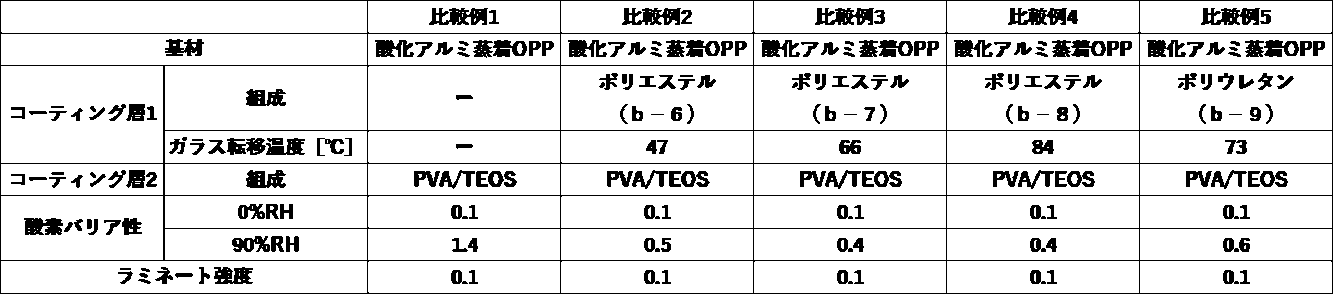
実施例および比較例で得られた各積層体について、下記の要領で酸素透過性(ガスバリア性)を評価した。酸素透過率の測定は、JIS-K7126-2:2006「プラスチックーフィルム及びシート-ガス透過度試験方法―第2部:等圧法」に準じ、モコン社製酸素透過率測定装置OX-TRAN2/21を用いて、温度23℃、湿度0%RHの雰囲気下、及び、温度23℃、湿度90%RHの雰囲気下で実施した。RHとは相対湿度を表す。尚、酸素透過率の単位は、cc/day・atm・m2である。
実施例および比較例で得られた各積層体を、接着剤を塗工した方向と平行な方向で15mm幅毎に切断した。次いで各実施例の積層体を長軸の末端(15mm幅に切断した端)をOPPフィルム積層体とCPPフィルムの間で剥離させた。剥離させた2層をそれぞれ(株)島津製作所社製「オートグラフAGS-X」に固定し、雰囲気温度25℃、剥離速度300mm/分の設定で、T型剥離法により剥離を行い引っ張り強度を測定した。ここで測定された引っ張り強度を各実施例、比較例の積層体のラミネート強度とした。接着強度の単位はN/15mmである。
以上の結果より、本発明の構成を有するガスバリア性積層体は、良好なガスバリア性及びラミネート強度を有するものであることが確認された。
Claims (7)
- ガスバリア性積層体であって、
(A)少なくとも一面に無機層が形成された基材からなる層、
(B)前記基材の無機層が形成された面に接触するように設けられたガラス転移温度が40℃以下の樹脂を含んでなる樹脂層、
(C)前記樹脂層(B)に接触するように設けられた、水溶性高分子と、金属アルコキシド及び/又はその加水分解物を含んでなる層、
を積層してなることを特徴とするガスバリア性積層体。 - 前記(A)層における無機層が、蒸着処理又はスパッタリング処理のいずれかにより形成されていることを特徴とする請求項1に記載のガスバリア性積層体。
- 前記(A)層における無機層が、酸化アルミニウム、酸化ケイ素、アルミニウム、酸化亜鉛、酸化マグネシウムからなる群から選択される1種以上の無機物から形成されることを特徴とする請求項1に記載のガスバリア性積層体。
- 前記ガラス転移温度が40℃以下の樹脂が、エステル樹脂、ウレタン樹脂、ビニル樹脂、アクリル樹脂、アクリレート樹脂から選択される1種以上の樹脂であることを特徴とする請求項1に記載のガスバリア性積層体。
- 前記水溶性高分子が、ビニルアルコール重合体、エチレンビニルアルコール重合体、ビニルピロリドン重合体、アクリルアミド重合体から選択される1種以上の水溶性高分子であることを特徴とする請求項1に記載のガスバリア性積層体。
- 前記金属アルコキシド及び/又はその加水分解物が、金属種としてケイ素、アルミニウムから選択される一種以上を有する化合物であることを特徴とする請求項1に記載のガスバリア性積層体。
- 請求項1~6のいずれか一項に記載のガスバリア性積層体を用いてなる包装体。
Priority Applications (4)
| Application Number | Priority Date | Filing Date | Title |
|---|---|---|---|
| JP2023515800A JP7355273B1 (ja) | 2021-12-23 | 2022-12-08 | ガスバリア性積層体、および包装体 |
| EP22910912.9A EP4454879A4 (en) | 2021-12-23 | 2022-12-08 | MULTI-LAYER BODY, GAS BARRIER AND PACKAGING |
| US18/709,969 US20250011058A1 (en) | 2021-12-23 | 2022-12-08 | Gas barrier multilayer body and package |
| CN202280081159.3A CN118369205A (zh) | 2021-12-23 | 2022-12-08 | 气体阻隔性层叠体及包装体 |
Applications Claiming Priority (2)
| Application Number | Priority Date | Filing Date | Title |
|---|---|---|---|
| JP2021209183 | 2021-12-23 | ||
| JP2021-209183 | 2021-12-23 |
Publications (1)
| Publication Number | Publication Date |
|---|---|
| WO2023120201A1 true WO2023120201A1 (ja) | 2023-06-29 |
Family
ID=86902281
Family Applications (1)
| Application Number | Title | Priority Date | Filing Date |
|---|---|---|---|
| PCT/JP2022/045217 Ceased WO2023120201A1 (ja) | 2021-12-23 | 2022-12-08 | ガスバリア性積層体、および包装体 |
Country Status (6)
| Country | Link |
|---|---|
| US (1) | US20250011058A1 (ja) |
| EP (1) | EP4454879A4 (ja) |
| JP (1) | JP7355273B1 (ja) |
| CN (1) | CN118369205A (ja) |
| TW (1) | TW202339957A (ja) |
| WO (1) | WO2023120201A1 (ja) |
Families Citing this family (1)
| Publication number | Priority date | Publication date | Assignee | Title |
|---|---|---|---|---|
| US20250010592A1 (en) * | 2021-12-07 | 2025-01-09 | Dic Corporation | Gas barrier film and packaging material |
Citations (7)
| Publication number | Priority date | Publication date | Assignee | Title |
|---|---|---|---|---|
| JPH11147276A (ja) * | 1997-11-17 | 1999-06-02 | Toppan Printing Co Ltd | ガスバリア性透明積層体 |
| JP2009049252A (ja) * | 2007-08-22 | 2009-03-05 | Toppan Printing Co Ltd | 太陽電池用部材 |
| JP2012076290A (ja) * | 2010-09-30 | 2012-04-19 | Dainippon Printing Co Ltd | ガスバリア性フィルム積層体、及び包装袋 |
| JP2012076291A (ja) * | 2010-09-30 | 2012-04-19 | Dainippon Printing Co Ltd | ガスバリア性フィルム積層体、及び包装袋 |
| JP2015006757A (ja) * | 2013-06-25 | 2015-01-15 | 凸版印刷株式会社 | ガスバリア積層体 |
| JP2021020391A (ja) * | 2019-07-29 | 2021-02-18 | 凸版印刷株式会社 | 積層体及び包装袋 |
| JP2021151791A (ja) * | 2019-09-30 | 2021-09-30 | 大日本印刷株式会社 | バリア性積層体、該バリア性積層体を備えるヒートシール性積層体および該ヒートシール性積層体を備える包装容器 |
Family Cites Families (4)
| Publication number | Priority date | Publication date | Assignee | Title |
|---|---|---|---|---|
| EP1728622A4 (en) * | 2004-03-25 | 2011-06-29 | Mitsubishi Plastics Inc | LAMINATES WITH GASPER PROPERTIES |
| CN107531381B (zh) * | 2015-05-28 | 2020-07-03 | 凸版印刷株式会社 | 层叠膜及包装袋 |
| WO2018181900A1 (ja) * | 2017-03-31 | 2018-10-04 | 大日本印刷株式会社 | ガスバリア積層体、及び該積層体からなるガスバリア包装材料とピロー包装袋 |
| JP7019958B2 (ja) * | 2017-03-31 | 2022-02-16 | 大日本印刷株式会社 | 無溶剤型接着剤を用いたガスバリア積層体、及び該積層体からなるガスバリア包装材料とピロー包装袋 |
-
2022
- 2022-12-08 JP JP2023515800A patent/JP7355273B1/ja active Active
- 2022-12-08 CN CN202280081159.3A patent/CN118369205A/zh active Pending
- 2022-12-08 EP EP22910912.9A patent/EP4454879A4/en active Pending
- 2022-12-08 WO PCT/JP2022/045217 patent/WO2023120201A1/ja not_active Ceased
- 2022-12-08 US US18/709,969 patent/US20250011058A1/en active Pending
- 2022-12-09 TW TW111147303A patent/TW202339957A/zh unknown
Patent Citations (7)
| Publication number | Priority date | Publication date | Assignee | Title |
|---|---|---|---|---|
| JPH11147276A (ja) * | 1997-11-17 | 1999-06-02 | Toppan Printing Co Ltd | ガスバリア性透明積層体 |
| JP2009049252A (ja) * | 2007-08-22 | 2009-03-05 | Toppan Printing Co Ltd | 太陽電池用部材 |
| JP2012076290A (ja) * | 2010-09-30 | 2012-04-19 | Dainippon Printing Co Ltd | ガスバリア性フィルム積層体、及び包装袋 |
| JP2012076291A (ja) * | 2010-09-30 | 2012-04-19 | Dainippon Printing Co Ltd | ガスバリア性フィルム積層体、及び包装袋 |
| JP2015006757A (ja) * | 2013-06-25 | 2015-01-15 | 凸版印刷株式会社 | ガスバリア積層体 |
| JP2021020391A (ja) * | 2019-07-29 | 2021-02-18 | 凸版印刷株式会社 | 積層体及び包装袋 |
| JP2021151791A (ja) * | 2019-09-30 | 2021-09-30 | 大日本印刷株式会社 | バリア性積層体、該バリア性積層体を備えるヒートシール性積層体および該ヒートシール性積層体を備える包装容器 |
Non-Patent Citations (1)
| Title |
|---|
| See also references of EP4454879A4 * |
Also Published As
| Publication number | Publication date |
|---|---|
| JPWO2023120201A1 (ja) | 2023-06-29 |
| EP4454879A1 (en) | 2024-10-30 |
| CN118369205A (zh) | 2024-07-19 |
| TW202339957A (zh) | 2023-10-16 |
| US20250011058A1 (en) | 2025-01-09 |
| JP7355273B1 (ja) | 2023-10-03 |
| EP4454879A4 (en) | 2025-11-26 |
Similar Documents
| Publication | Publication Date | Title |
|---|---|---|
| CN1918002B (zh) | 具有多层结构的塑料基板及其制备方法 | |
| EP3305682B1 (en) | Layered film and packing bag | |
| TWI510365B (zh) | 多層塑膠基板及製造其之方法 | |
| CN114126974A (zh) | 层叠体及包装袋 | |
| EP3437856A1 (en) | Gas barrier film | |
| TW201002527A (en) | Gas barrier laminated film for organic devices | |
| WO2013147119A1 (ja) | ガスバリア性フィルム及びその製造方法、並びにガスバリア性積層体 | |
| JP5966821B2 (ja) | ガスバリア積層フィルム | |
| KR20030078011A (ko) | 가스 배리어 코팅 조성물 및 그의 제조 방법 | |
| CN111601711A (zh) | 阻气层叠体以及具备该阻气层叠体的包装材料 | |
| CN116348386A (zh) | 包装材料、包装袋以及包装体 | |
| CN118119509A (zh) | 阻气膜以及包装材料 | |
| JP2020131676A (ja) | 高層間密着性ガスバリア蒸着フィルム | |
| JP7476479B2 (ja) | ガスバリア性蒸着フィルム | |
| JP5116410B2 (ja) | ガスバリア層形成用塗剤、ガスバリア性フィルム及びその製造方法 | |
| JP7355273B1 (ja) | ガスバリア性積層体、および包装体 | |
| JP7040038B2 (ja) | ガスバリア積層体の製造方法 | |
| JP2010018302A (ja) | 透明ガスバリアフィルム、透明包装材料 | |
| JP2020131675A (ja) | 高層間密着性ガスバリア蒸着フィルム | |
| JP2009137092A (ja) | インクカートリッジ用部材 | |
| JP7123336B2 (ja) | 樹脂組成物、成形体、積層体、コーティング材及び接着剤 | |
| JP6816568B2 (ja) | ガスバリア積層体、及びガスバリア積層体の製造方法 | |
| CN119013139A (zh) | 阻气性层叠体、包装膜、包装容器以及包装制品 | |
| JP2023132672A (ja) | ガスバリアフィルム | |
| JP7163684B2 (ja) | ポリエチレンテレフタレートフィルム、及び該ポリエチレンテレフタレートフィルムを用いたガスバリア性蒸着フィルム、包装材料、包装体 |
Legal Events
| Date | Code | Title | Description |
|---|---|---|---|
| WWE | Wipo information: entry into national phase |
Ref document number: 2023515800 Country of ref document: JP |
|
| 121 | Ep: the epo has been informed by wipo that ep was designated in this application |
Ref document number: 22910912 Country of ref document: EP Kind code of ref document: A1 |
|
| WWE | Wipo information: entry into national phase |
Ref document number: 18709969 Country of ref document: US |
|
| WWE | Wipo information: entry into national phase |
Ref document number: 202280081159.3 Country of ref document: CN |
|
| NENP | Non-entry into the national phase |
Ref country code: DE |
|
| ENP | Entry into the national phase |
Ref document number: 2022910912 Country of ref document: EP Effective date: 20240723 |