WO2023120463A1 - ポリアミド組成物及び成形品 - Google Patents
ポリアミド組成物及び成形品 Download PDFInfo
- Publication number
- WO2023120463A1 WO2023120463A1 PCT/JP2022/046623 JP2022046623W WO2023120463A1 WO 2023120463 A1 WO2023120463 A1 WO 2023120463A1 JP 2022046623 W JP2022046623 W JP 2022046623W WO 2023120463 A1 WO2023120463 A1 WO 2023120463A1
- Authority
- WO
- WIPO (PCT)
- Prior art keywords
- polyamide
- diamine
- acid
- polyamide composition
- unit
- Prior art date
- Legal status (The legal status is an assumption and is not a legal conclusion. Google has not performed a legal analysis and makes no representation as to the accuracy of the status listed.)
- Ceased
Links
Classifications
-
- C—CHEMISTRY; METALLURGY
- C08—ORGANIC MACROMOLECULAR COMPOUNDS; THEIR PREPARATION OR CHEMICAL WORKING-UP; COMPOSITIONS BASED THEREON
- C08G—MACROMOLECULAR COMPOUNDS OBTAINED OTHERWISE THAN BY REACTIONS ONLY INVOLVING UNSATURATED CARBON-TO-CARBON BONDS
- C08G69/00—Macromolecular compounds obtained by reactions forming a carboxylic amide link in the main chain of the macromolecule
- C08G69/02—Polyamides derived from amino-carboxylic acids or from polyamines and polycarboxylic acids
- C08G69/26—Polyamides derived from amino-carboxylic acids or from polyamines and polycarboxylic acids derived from polyamines and polycarboxylic acids
- C08G69/265—Polyamides derived from amino-carboxylic acids or from polyamines and polycarboxylic acids derived from polyamines and polycarboxylic acids from at least two different diamines or at least two different dicarboxylic acids
-
- C—CHEMISTRY; METALLURGY
- C08—ORGANIC MACROMOLECULAR COMPOUNDS; THEIR PREPARATION OR CHEMICAL WORKING-UP; COMPOSITIONS BASED THEREON
- C08L—COMPOSITIONS OF MACROMOLECULAR COMPOUNDS
- C08L77/00—Compositions of polyamides obtained by reactions forming a carboxylic amide link in the main chain; Compositions of derivatives of such polymers
- C08L77/06—Polyamides derived from polyamines and polycarboxylic acids
Definitions
- the present invention relates to a polyamide composition and a molded article, and in particular, a polyamide composition containing a specific diamine unit having a branched chain and a dicarboxylic acid unit, a polyamide composition containing a polyolefin, and a molded article made of the polyamide composition Regarding.
- Crystalline polyamides such as nylon 6 and nylon 66 are widely used for industrial parts because of their excellent heat resistance, mechanical properties, moldability, and the like.
- metal parts are being made of resin, and crystalline polyamides, which are excellent in the above properties, are often used.
- the performance required of plastic materials is becoming stricter, and materials with better performance in terms of heat resistance, toughness, etc. are required.
- a material that takes a short time to cool and solidify from a molten state in other words, a material that has a high crystallization rate. Having a high crystallization rate improves moldability, can shorten the time required for molding one part, and can improve production efficiency. Therefore, it is required to have good other properties such as heat resistance while having high moldability.
- Patent Document 1 discloses a polyamide obtained by polymerizing a diamine containing at least 50 mol% of a diamine having a branched structure and a dicarboxylic acid containing at least 50 mol% of an aliphatic dicarboxylic acid, and a polyamide composition containing titanium oxide particles. things are disclosed. Patent Document 1 describes that the above polyamide composition is excellent in fluidity, toughness, resistance to heat discoloration, and processability. Further, Patent Document 2 discloses a method for producing a polyamide composition containing constitutional units derived from diamines having methyl or ethyl branches. Furthermore, in Patent Document 3, 60 mol% or more and 100 mol% or less of the diamine units are branched aliphatic diamine units and linear aliphatic diamine units as optional structural units, a polyamide composition containing a polyamide. disclosed.
- JP 2011-80055 A Japanese Patent Publication No. 2017-517594 WO2020/040282
- Patent Documents 1 to 3 mention a methyl group, an ethyl group, an n-propyl group, and the like as substituents branched from the main chain of the structural unit derived from the diamine that forms the polyamide.
- diamines with methyl groups as branched chains are specifically exemplified.
- None of the documents has a specific disclosure of a polyamide containing a structural unit derived from a branched diamine, which has a substituent longer than a methyl group as a branched chain, in other words, a substituent having more carbon atoms than a methyl group.
- an object of the present invention is to provide a polyamide composition having high moldability, excellent heat resistance and toughness, and a molded article made of the polyamide composition.
- the present invention is as follows.
- the polyamide (A) contains diamine units (X) and dicarboxylic acid units (Y),
- the diamine unit (X) contains 0.1 mol% or more and less than 36 mol% of the diamine unit (X1),
- the diamine unit (X1) has 6 to 10 carbon atoms, and when the carbon atom to which any one amino group is bonded is the 1st position, the carbon atom at the 2nd position has 2 carbon atoms or A structural unit derived from an aliphatic diamine to which 3 alkyl groups are bonded,
- a polyamide composition, wherein the content of the polyolefin (B) in the polyamide composition is 2% by mass or more and less than 40% by mass.
- the diamine unit (X1) is a structural unit derived from at least one selected from the group consisting of 2-ethyl-1,7-heptanediamine and 2-propyl-1,6-hexanediamine.
- the diamine unit (X) further includes a diamine unit (X2) which is a diamine unit other than the diamine unit (X1), and the diamine unit (X2) is a linear aliphatic diamine, the diamine unit A structural unit derived from at least one selected from the group consisting of branched aliphatic diamines other than the aliphatic diamines constituting (X1), alicyclic diamines, and aromatic diamines, above [1] to The polyamide composition according to any one of [4]. [6] The above [ 5], the polyamide composition.
- the diamine unit (X2) is 1,6-hexanediamine, 1,9-nonanediamine, 1,10-decanediamine, 2-methyl-1,5-pentanediamine, and 2-methyl-1,8 -
- the dicarboxylic acid unit (Y) comprises a structural unit derived from at least one selected from the group consisting of terephthalic acid, cyclohexanedicarboxylic acid, and naphthalenedicarboxylic acid.
- the polyolefin (B) is a polymer modified with an unsaturated compound having at least one selected from the group consisting of a carboxyl group and an acid anhydride group.
- Polyamide composition according to. [13] A molded article made of the polyamide composition according to any one of [1] to [12] above.
- the present invention it is possible to provide a polyamide composition having high moldability, excellent heat resistance and toughness, and a molded article made of the polyamide composition.
- this embodiment an embodiment of the present invention (hereinafter sometimes referred to as "this embodiment") will be described based on an example.
- the embodiments shown below are examples for embodying the technical idea of the present invention, and the present invention is not limited to the following description.
- preferred forms of embodiments are indicated herein, and combinations of two or more of the individual preferred forms are also preferred forms.
- the lower and upper limits thereof can be selectively combined to form a preferred form.
- a numerical range is described as "XX to YY"
- unit means "a structural unit derived from”
- dicarboxylic acid unit means "to a dicarboxylic acid.
- a "structural unit derived from a diamine” means a “structural unit derived from a diamine”.
- the polyamide composition of the present embodiment contains a polyamide (A) containing diamine units (X) and dicarboxylic acid units (Y). Then, the diamine unit (X) has 6 to 10 carbon atoms, and when the carbon atom to which any one amino group is bonded is the 1st position, the carbon atom at the 2nd position has 2 carbon atoms. or 0.1 mol % or more and less than 36 mol % of the diamine unit (X1), which is a structural unit derived from an aliphatic diamine to which 3 alkyl groups are bonded.
- the polyamide composition has high moldability, excellent heat resistance, and toughness.
- a component such as a branched chain having a large excluded volume is contained in the polymer skeleton, it becomes difficult for the molecular chains to arrange regularly, so the polymer tends to exhibit a low crystallization rate.
- a polyamide (A) containing a specific amount of structural units derived from a diamine having an alkyl group having 2 or 3 carbon atoms as a branched chain such as an ethyl group or a propyl group is used. Therefore, it unexpectedly exhibits a high crystallization rate.
- the polyamide (A) contained in the polyamide composition has a relatively bulky substituent having 2 or 3 carbon atoms such as an ethyl group or a propyl group as a branched chain. , the lowering of the melting point is small, and excellent heat resistance can be expressed.
- the glass transition temperature is a property that becomes higher as the molecular mobility of the amorphous portion becomes lower. Therefore, when a component with high molecular mobility such as a branched chain is contained, the glass transition temperature generally tends to be low.
- the polyamide (A) contained in the polyamide composition of the present embodiment unexpectedly shows little decrease in glass transition temperature.
- One of the reasons why the polyamide (A) expresses the above properties is that the number of carbon atoms in the branched chain, the position of the branched chain, and the amount of the branched chain in the diamine unit (X) contained in the polyamide (A) are , it is thought that it affects the improvement of the crystallization speed while suppressing the heat resistance from greatly decreasing.
- the detailed reason is unknown.
- the polyamide composition of the present embodiment contains a polyolefin (B), thereby maintaining the excellent physical properties of the polyamide (A) while maintaining high moldability and excellent It has toughness.
- polyamide (A) The polyamide (A) contained in the polyamide composition contains diamine units (X) and dicarboxylic acid units (Y). The configuration of the polyamide (A) will be described below.
- the diamine unit (X) has 6 to 10 carbon atoms, and when the carbon atom to which any one of the amino groups is bonded is the 1st position, the carbon atom at the 2nd position has 2 or 3 carbon atoms. contains a diamine unit (X1) which is a structural unit derived from an aliphatic diamine to which an alkyl group of is bonded.
- the diamine unit (X1) is assumed to be a linear aliphatic chain with the carbon atoms to which two amino groups are respectively bonded as the carbon atoms at both ends, and any one amino group is bonded to 1 It is a structural unit derived from an aliphatic diamine having a structure in which one of the hydrogen atoms on the 2-position carbon atom adjacent to the 2-position carbon atom is substituted with an alkyl group having 2 or 3 carbon atoms.
- branched aliphatic diamine unit a structural unit derived from an aliphatic diamine having a structure in which one of the hydrogen atoms on the carbon atom at the 2-position is substituted with an alkyl group having 2 or 3 carbon atoms.
- the branched aliphatic diamine unit constituting the diamine unit (X1) preferably has 8 to 10 carbon atoms, more preferably 9 carbon atoms.
- the number of carbon atoms is within the above range, the polymerization reaction between the dicarboxylic acid and the diamine proceeds favorably, and the physical properties of the polyamide composition are likely to be improved.
- the alkyl group having 2 or 3 carbon atoms bonded to the carbon atom at the 2-position is selected from the group consisting of an ethyl group, a propyl group, and an isopropyl group. It is preferably at least one selected, more preferably at least one selected from the group consisting of ethyl groups and propyl groups. If the number of carbon atoms in the alkyl group bonded to the carbon atom at the 2-position is 1 or 4 or more, the crystallization speed will not be improved and the heat resistance may be lowered.
- branched aliphatic diamine used to form the diamine unit (X1)
- a branched chain such as a methyl group
- the number of other branched chains is preferably one or less, and more preferably the diamine unit (X1) does not contain other branched chains.
- diamine unit (X1) examples include 2-ethyl-1,4-butanediamine, 2-ethyl-1,5-pentanediamine, 2-ethyl-1,6-hexanediamine, 2-ethyl-1,7 -heptanediamine, 2-ethyl-1,8-octanediamine, 2-propyl-1,5-pentanediamine, 2-propyl-1,6-hexanediamine, 2-propyl-1,7-heptanediamine, and 2 ,4-diethyl-1,6-hexanediamine. Only one type of these structural units may be contained, or two or more types may be contained. Among them, the diamine unit (X) is 2-ethyl-1,7- A structural unit derived from at least one selected from the group consisting of heptanediamine and 2-propyl-1,6-hexanediamine is preferred.
- the diamine unit (X1) is contained in the diamine unit (X) in an amount of 0.1 mol% or more and less than 36 mol%.
- the diamine unit (X1) in the diamine unit (X) is preferably 0.5 mol% or more, more preferably 1 mol% or more, More preferably 3 mol % or more, still more preferably 5 mol % or more.
- the diamine unit (X1) in the diamine unit is preferably 35 mol% or less, more preferably 30 mol% or less, still more preferably 25 mol% or less, still more preferably 20 mol% or less, and even more preferably 20 mol% or less. It is preferably 18 mol % or less, more preferably 15 mol % or less, and even more preferably 10 mol % or less.
- the diamine unit (X) is preferably 0.5 to 35 mol%, more preferably 0.5 to 30 mol%, still more preferably 1 to 30 mol%, more preferably 0.5 to 30 mol%, more preferably More preferably 1 to 25 mol %, still more preferably 1 to 20 mol %, still more preferably 1 to 18 mol %, still more preferably 1 to 15 mol %, particularly preferably 1 to 10 mol %.
- the diamine unit (X1) is at least one selected from the group consisting of 2-ethyl-1,7-heptanediamine and 2-propyl-1,6-hexanediamine.
- a structural unit derived from diamine is included, an example of the content of each structural unit is as follows.
- the content of structural units derived from 2-ethyl-1,7-heptanediamine in the diamine unit (X) is preferably 0.5 mol % or more, more preferably 2 mol % or more.
- the content is preferably 20 mol% or less, more preferably 16 mol% or less, even more preferably 15 mol% or less, and even more preferably 12 mol% or less. , 10 mol % or less.
- the content of structural units derived from 2-ethyl-1,7-heptanediamine in diamine units (X) is preferably 0.5 to 20 mol %.
- the content of structural units derived from 2-propyl-1,6-hexanediamine in the diamine unit (X) is preferably 0.1 mol% or more, more preferably 0.5 mol% or more. preferable.
- the content is preferably 5 mol% or less, more preferably 3 mol% or less, even more preferably 2 mol% or less, and more preferably 1.5 mol% or less. More preferred.
- the content of structural units derived from 2-propyl-1,6-hexanediamine in diamine units (X) is preferably 0.1 to 5 mol %.
- the polyamide (A) contains diamine units other than the diamine unit (X1) (hereinafter also referred to as "diamine unit (X2)") as the diamine unit (X).
- the diamine unit (X2) is contained in more than 64 mol% and 99.9 mol% or less in the diamine unit (X). When the content of the diamine unit (X2) is more than 64 mol%, deterioration of heat resistance can be suppressed, and when it is 99.9 mol% or less, the crystallization rate can be improved.
- the diamine unit (X2) in the diamine unit (X) is preferably 99.5 mol% or less, more preferably 99 mol% or less, More preferably 97 mol % or less, still more preferably 95 mol % or less.
- the diamine unit (X2) in the diamine unit is preferably 65 mol% or more, more preferably 70 mol% or more, still more preferably 75 mol% or more, still more preferably 80 mol% or more, and still more It is preferably 82 mol % or more, still more preferably 85 mol % or more, and even more preferably 90 mol % or more.
- the diamine unit (X) is preferably 65 to 99.5 mol%, more preferably 75 to 99 mol%, even more preferably 80 to 99 mol%, more preferably 80 to 99 mol%, more preferably More preferably 82 to 99 mol %, still more preferably 85 to 99 mol %, particularly preferably 90 to 99 mol %.
- the diamine unit (X2) is preferably derived from a diamine having 6 to 10 carbon atoms, more preferably 8 to 10 carbon atoms, and still more preferably 9 carbon atoms, from the viewpoint of facilitating the polymerization reaction between the dicarboxylic acid and the diamine.
- the diamine unit (X2) is selected from the group consisting of linear aliphatic diamines, branched aliphatic diamines other than the aliphatic diamines constituting the diamine unit (X1), alicyclic diamines, and aromatic diamines. Structural units derived from at least one species are included.
- Linear aliphatic diamines such as ethylenediamine, 1,3-propanediamine, 1,4-butanediamine, 1,5-pentanediamine, 1,6-hexanediamine, 1,7-heptanediamine, 1,8 - octanediamine, 1,9-nonanediamine, 1,10-decanediamine, 1,11-undecanediamine, 1,12-dodecanediamine, 1,13-tridecanediamine, 1,14-tetradecanediamine, 1,15- pentadecanediamine, 1,16-hexadecanediamine, 1,17-heptadecanediamine, 1,18-octadecanediamine.
- Branched aliphatic diamines such as 1,2-propanediamine, 1-butyl-1,2-ethanediamine, 1,1-dimethyl-1,4-butanediamine, 1-ethyl-1,4-butanediamine , 1,2-dimethyl-1,4-butanediamine, 1,3-dimethyl-1,4-butanediamine, 1,4-dimethyl-1,4-butanediamine, 2-methyl-1,3-propanediamine , 2-methyl-1,4-butanediamine, 2,3-dimethyl-1,4-butanediamine, 2-methyl-1,5-pentanediamine, 3-methyl-1,5-pentanediamine, 2-butyl -2-ethyl-1,5-pentanediamine, 2,5-dimethyl-1,6-hexanediamine, 2,4-dimethyl-1,6-hexanediamine, 3,3-dimethyl-1,6-hexanediamine , 2,2-dimethyl-1,6-hexanediamine, 2,2,
- Alicyclic diamines such as cyclohexanediamine, methylcyclohexanediamine, norbornanedimethylamine, tricyclodecanedimethyldiamine, bis(4-amino-3-ethylcyclohexyl)methane, bis(4-amino-3-ethyl-5- methylcyclohexyl)methane.
- aromatic diamines examples include p-phenylenediamine, m-phenylenediamine, p-xylylenediamine, m-xylylenediamine, 4,4'-diaminodiphenylmethane, 4,4'-diaminodiphenylsulfone, 4,4' -diaminodiphenyl ether, 4,4'-methylenedi-2,6-diethylaniline. Only one type of structural unit derived from the diamine may be used, or two or more types thereof may be used.
- the diamine units (X2) structural units derived from at least one diamine selected from the group consisting of linear aliphatic diamines and branched aliphatic diamines having a methyl group are more preferred. From the viewpoint that the effects of the present invention are likely to be exhibited more remarkably, the diamine unit (X2) is 1,6-hexanediamine, 1,9-nonanediamine, 1,10-decanediamine, 2-methyl-1,5- Structural units derived from at least one diamine selected from the group consisting of pentanediamine and 2-methyl-1,8-octanediamine are more preferred.
- the dicarboxylic acid unit (Y) can contain a structural unit derived from, for example, at least one selected from the group consisting of aliphatic dicarboxylic acids, aromatic dicarboxylic acids, and alicyclic dicarboxylic acids.
- aliphatic dicarboxylic acids include oxalic acid, malonic acid, succinic acid, glutaric acid, adipic acid, pimelic acid, suberic acid, azelaic acid, sebacic acid, undecanedicarboxylic acid, dodecanedicarboxylic acid, dimethylmalonic acid, 2, 2-diethylsuccinic acid, 2,2-dimethylglutaric acid, 2-methyladipic acid, trimethyladipic acid.
- aromatic dicarboxylic acids include terephthalic acid, isophthalic acid, diphenic acid, 4,4′-biphenyldicarboxylic acid, diphenylmethane-4,4′-dicarboxylic acid, diphenylsulfone-4,4′-dicarboxylic acid, 1, 2-naphthalenedicarboxylic acid, 1,3-naphthalenedicarboxylic acid, 1,4-naphthalenedicarboxylic acid, 1,5-naphthalenedicarboxylic acid, 1,6-naphthalenedicarboxylic acid, 1,7-naphthalenedicarboxylic acid, 1,8- Naphthalenedicarboxylic acid, 2,3-naphthalenedicarboxylic acid, 2,6-naphthalenedicarboxylic acid, 2,7-naphthalenedicarboxylic acid, 2,3-furandicarboxylic acid, 2,4-furandicarboxylic acid, 2,5-furandicarboxylic acid
- alicyclic dicarboxylic acids examples include 1,3-cyclopentanedicarboxylic acid, 1,3-cyclohexanedicarboxylic acid, 1,4-cyclohexanedicarboxylic acid, cycloheptanedicarboxylic acid, cyclooctanedicarboxylic acid, and cyclodecanedicarboxylic acid. mentioned. Only one kind of structural unit (Y) derived from the above dicarboxylic acid may be contained, or two or more kinds thereof may be contained.
- the dicarboxylic acid unit (Y) is a structural unit derived from at least one dicarboxylic acid selected from the group consisting of aromatic dicarboxylic acids and alicyclic dicarboxylic acids. and more preferably contains a structural unit derived from at least one dicarboxylic acid selected from the group consisting of terephthalic acid, cyclohexanedicarboxylic acid, and naphthalenedicarboxylic acid.
- the dicarboxylic acid unit more preferably contains a structural unit derived from terephthalic acid, from the viewpoint of further improving the crystallization rate and heat resistance and being excellent in hydrolysis resistance.
- the total content of structural units derived from an aliphatic dicarboxylic acid, an aromatic dicarboxylic acid, and an alicyclic dicarboxylic acid in the dicarboxylic acid unit (Y) is from the viewpoint of making it easier to exhibit the effects of the present invention more remarkably. , preferably 80 mol % or more, more preferably 90 mol %, still more preferably 95 mol % or more, and may be 100 mol %. In other words, the total content of structural units derived from an aliphatic dicarboxylic acid, an aromatic dicarboxylic acid, and an alicyclic dicarboxylic acid in the dicarboxylic acid unit (Y) is preferably 80 to 100 mol%.
- the total content of structural units derived from terephthalic acid, cyclohexanedicarboxylic acid, and naphthalenedicarboxylic acid in the dicarboxylic acid unit (Y) is preferably 80 mol% or more, more preferably 90 mol. %, more preferably 95 mol % or more, and may be 100 mol %.
- the total content of structural units derived from terephthalic acid, cyclohexanedicarboxylic acid and naphthalenedicarboxylic acid in the dicarboxylic acid unit (Y) is preferably 80 to 100 mol%.
- the molar ratio [diamine unit (X)/dicarboxylic acid unit (Y)] of the diamine unit (X) and the dicarboxylic acid unit (Y) in the polyamide (A) is preferably 45/55 to 55/45.
- the molar ratio between the diamine units (X) and the dicarboxylic acid units (Y) can be adjusted according to the compounding ratio (molar ratio) between the raw material diamine and the raw material dicarboxylic acid.
- Total ratio of diamine units (X) and dicarboxylic acid units (Y) in polyamide (A) is preferably 70 mol% or more, more preferably 80 mol% or more, still more preferably 90 mol% or more, and even more preferably 95 mol% or more. , or even 100 mol %.
- the polyamide (A) can have more excellent physical properties than desired. In other words, the total proportion of diamine units (X) and dicarboxylic acid units (Y) in polyamide (A) is preferably 70-100 mol %.
- the polyamide (A) may further contain other structural units in addition to the diamine units (X) and the dicarboxylic acid units (Y). For example, it may further contain an aminocarboxylic acid unit, a polyvalent carboxylic acid unit, and a terminal blocker unit.
- aminocarboxylic acid unit examples include structural units derived from lactams such as caprolactam and lauryllactam; aminocarboxylic acids such as 11-aminoundecanoic acid and 12-aminododecanoic acid;
- the content of the aminocarboxylic acid unit in the polyamide (A) is 40 mol% or less with respect to the total 100 mol% of the diamine unit (X) and the dicarboxylic acid unit (Y) constituting the polyamide (A). Preferably, it is 20 mol % or less.
- Polyvalent carboxylic acid unit Polyamide (A) is a range that does not impair the effects of the present invention, trimellitic acid, trimesic acid, pyromellitic acid, etc. Polyvalent carboxylic acid with a valence of 3 or more, a structural unit derived from, melt molding is possible can also contain
- the polyamide (A) may contain structural units derived from a terminal blocker (terminal blocker units).
- the terminal blocker unit is preferably 1.0 mol% or more, more preferably 2.0 mol% or more, and 10 mol% or less with respect to 100 mol% of the diamine unit (X). preferably 5.0 mol % or less.
- the terminal blocker unit is preferably 1.0 to 10 mol% with respect to 100 mol% of the diamine unit (X).
- the content of the terminal blocking agent unit can be set within the above desired range by appropriately adjusting the amount of the terminal blocking agent when charging the polymerization raw material. Considering volatilization of the monomer components during polymerization, the charging amount of the terminal blocker should be finely adjusted so that the desired amount of terminal blocker units are introduced into the resulting polyamide (A). is desirable.
- a method for determining the content of the terminal blocker unit in the polyamide (A) for example, as shown in JP-A-7-228690, the inherent viscosity is measured, and the number average molecular weight is calculated.
- a monofunctional compound having reactivity with a terminal amino group or a terminal carboxyl group can be used as the terminal blocking agent.
- Specific examples include monocarboxylic acids, acid anhydrides, monoisocyanates, monoacid halides, monoesters, monoalcohols, and monoamines. From the viewpoint of reactivity and stability of the terminal to be blocked, monocarboxylic acid is preferable as the terminal blocking agent for the terminal amino group, and monoamine is preferable as the terminal blocking agent for the terminal carboxyl group. From the standpoint of ease of handling, etc., monocarboxylic acids are more preferable as terminal blocking agents.
- the monocarboxylic acid used as a terminal blocking agent is not particularly limited as long as it is reactive with amino groups, and examples thereof include acetic acid, propionic acid, butyric acid, valeric acid, caproic acid, caprylic acid, and laurin.
- acids tridecanoic acid, myristic acid, palmitic acid, stearic acid, pivalic acid, aliphatic monocarboxylic acids such as isobutyric acid; alicyclic monocarboxylic acids such as cyclopentanecarboxylic acid and cyclohexanecarboxylic acid; benzoic acid, toluic acid, aromatic monocarboxylic acids such as ⁇ -naphthalenecarboxylic acid, ⁇ -naphthalenecarboxylic acid, methylnaphthalenecarboxylic acid, phenylacetic acid; and any mixture thereof.
- acetic acid, propionic acid, butyric acid, valeric acid, caproic acid, caprylic acid, lauric acid, tridecanoic acid, myristic acid, palmitic acid, and stearic acid are preferred in terms of reactivity, stability of blocked ends, and price.
- benzoic acid are preferred.
- the monoamine used as the terminal blocking agent is not particularly limited as long as it has reactivity with carboxyl groups. Examples include methylamine, ethylamine, propylamine, butylamine, hexylamine, octylamine, decylamine, and stearyl. Aliphatic monoamines such as amine, dimethylamine, diethylamine, dipropylamine and dibutylamine; Alicyclic monoamines such as cyclohexylamine and dicyclohexylamine; Aromatic monoamines such as aniline, toluidine, diphenylamine and naphthylamine; are mentioned.
- the content of the polyamide (A) contained in the total amount of the polyamide composition of the present embodiment is preferably more than 60% by mass and 98% by mass or less from the viewpoint of easily ensuring good moldability, heat resistance, and toughness. Yes, more preferably 65 to 97% by mass, still more preferably 70 to 96% by mass, still more preferably 75 to 95% by mass.
- the polyamide (A) preferably has an inherent viscosity of 0.5 dl/g or more, more preferably 0.7 dl/g or more. Also, it is preferably 2.0 dl/g or less, more preferably 1.5 dl/g or less. In other words, the inherent viscosity of polyamide (A) is preferably between 0.5 and 2.0 dl/g. When the inherent viscosity is within the above range, it becomes easier to obtain a polyamide (A) having more excellent physical properties than desired.
- the inherent viscosity of the polyamide (A) can be determined by measuring the flowing time of a solution using concentrated sulfuric acid at a concentration of 0.2 g / dl and a temperature of 30 ° C. as a solvent, and more specifically described in the Examples. method.
- Polyamide (A) preferably has a terminal amino group content ([NH 2 ]) in its molecular chain of 5 to 100 ⁇ mol/g. If the amount of terminal amino groups is 5 ⁇ mol/g or more, a much more excellent crystallization rate can be exhibited, and good hydrolysis resistance can be exhibited. If the amount of terminal amino groups is 100 ⁇ mol/g or less, even better heat resistance is exhibited. From the viewpoint of crystallization rate and hydrolysis resistance, the terminal amino group content is more preferably 8 ⁇ mol/g or more, still more preferably 10 ⁇ mol/g or more, still more preferably 12 ⁇ mol/g or more, and even more preferably 15 ⁇ mol/g. g or more.
- the terminal amino group content is more preferably 80 ⁇ mol/g or less, still more preferably 70 ⁇ mol/g or less, even more preferably 50 ⁇ mol/g or less, and even more preferably 35 ⁇ mol/g or less.
- the amount of terminal amino groups in polyamide (A) refers to the amount (unit: ⁇ mol) of terminal amino groups contained in 1 g of polyamide (A).
- the amount of terminal amino groups of polyamide (A) can be obtained by a neutralization titration method using an indicator. More specifically, it can be determined by the method described in Examples.
- Polyamide (A) preferably has a terminal carboxyl group content ([COOH]) of 10 to 100 ⁇ mol/g.
- a terminal carboxyl group content [COOH]
- the amount of terminal carboxyl groups is 10 ⁇ mol/g or more, a much more excellent crystallization rate is exhibited, and excellent heat resistance is likely to be exhibited. If the amount of terminal carboxyl groups is 100 ⁇ mol/g or less, good hydrolysis resistance can be exhibited.
- the terminal carboxyl group content is more preferably 15 ⁇ mol/g or more, still more preferably 20 ⁇ mol/g or more, and still more preferably 25 ⁇ mol/g or more.
- the terminal carboxyl group content is more preferably 70 ⁇ mol/g or less, and still more preferably 50 ⁇ mol/g or less.
- the amount of terminal carboxyl groups in polyamide (A) refers to the amount (unit: ⁇ mol) of terminal carboxyl groups contained in 1 g of polyamide (A).
- the terminal carboxyl group content of the polyamide (A) can be determined by a neutralization titration method using an indicator. More specifically, it can be determined by the method described in Examples.
- the ratio [NH 2 ]/[COOH] of the terminal amino group amount [NH 2 ] to the terminal carboxyl group amount [COOH] in the polyamide (A) is preferably 0.1 to 30, preferably 0.1 to 20 is more preferable, and 0.3 to 10 is even more preferable. If [NH 2 ]/[COOH] is 0.1 or more, a much more excellent crystallization rate can be exhibited, and good hydrolysis resistance can be exhibited. When [NH 2 ]/[COOH] is 30 or less, even better heat resistance is likely to be exhibited.
- the polyamide (A) preferably has a melting point of 250° C. or higher, more preferably 280° C. or higher. When the melting point is within the above range, the polyamide composition can be made more excellent in heat resistance.
- the upper limit of the melting point of the polyamide (A) is not particularly limited, it is preferably 330° C. or less in consideration of moldability. In other words, the melting point of polyamide (A) is preferably 280-330°C.
- the melting point of the polyamide (A) can be obtained as the peak temperature of the endothermic peak that appears when the temperature is raised at a rate of 10 ° C./min using a differential scanning calorimetry (DSC) device. It can be obtained by the method described.
- the polyamide (A) preferably has a glass transition temperature of 110° C. or higher, more preferably 120° C. or higher. When the glass transition temperature is within the above range, the polyamide composition can have even better heat resistance.
- the upper limit of the glass transition temperature of the polyamide (A) is not particularly limited, it is preferably 180° C. or less, more preferably 160° C. or less from the viewpoint of handleability, and even if it is 150° C. or less. good. In other words, the glass transition temperature of polyamide (A) is preferably 110-180°C.
- the glass transition temperature of the polyamide (A) can be obtained as the temperature of the inflection point that appears when the temperature is raised at a rate of 20 ° C./min using a differential scanning calorimetry (DSC) device. It can be obtained by the method described in the example.
- DSC differential scanning calorimetry
- Polyamide (A) preferably has a crystallization rate of 0.020° C. ⁇ 1 or more, more preferably 0.040° C. ⁇ 1 or more.
- the crystallization temperature of the polyamide (A) is preferably 200° C. or higher, more preferably 210° C. or higher, still more preferably 220° C. or higher, and preferably 310° C. or lower. It is preferably 300° C. or lower, more preferably 290° C. or lower. In other words, the crystallization temperature of polyamide (A) is preferably between 200 and 310°C.
- the crystallization temperature of the polyamide (A) can be obtained as the peak temperature of the exothermic peak that appears when the temperature is raised to a predetermined temperature at a rate of 10 ° C./min using a differential scanning calorimetry (DSC) device, and the temperature is lowered. More specifically, it can be determined by the method described in the Examples.
- Polyamide (A) can be produced using any known method for producing polyamides. For example, it can be produced by a method such as a melt polymerization method, a solid phase polymerization method, or a melt extrusion polymerization method using a dicarboxylic acid and a diamine as raw materials. Among these, the solid-phase polymerization method is preferable from the viewpoint of being able to better suppress thermal deterioration during polymerization.
- a nylon salt is produced by first adding a diamine, a dicarboxylic acid, and optionally a catalyst and a terminal blocking agent all at once. At this time, the amount of terminal amino groups and the amount of terminal carboxyl groups can be easily controlled by adjusting the number of moles of all carboxyl groups and the number of moles of all amino groups contained in the reaction raw materials. After the nylon salt is produced, it can be produced by thermally polymerizing at a temperature of 200 to 250° C. to form a prepolymer, and further solid-phase polymerizing it or polymerizing it using a melt extruder.
- the final stage of polymerization is carried out by solid phase polymerization, it is preferably carried out under reduced pressure or under inert gas flow. Coloring and gelation can be effectively suppressed.
- the polymerization temperature is preferably 370° C. or lower. Polymerization under such conditions yields a polyamide (A) with little degradation and little decomposition.
- Examples of catalysts that can be used when producing polyamide (A) include phosphoric acid, phosphorous acid, hypophosphorous acid, or salts or esters thereof.
- Examples of the above salts or esters include phosphoric acid, phosphorous acid, or hypophosphorous acid and potassium, sodium, magnesium, vanadium, calcium, zinc, cobalt, manganese, tin, tungsten, germanium, titanium, antimony, and the like.
- Salt with metal Ammonium salt of phosphoric acid, phosphorous acid or hypophosphite; Ethyl ester, isopropyl ester, butyl ester, hexyl ester, isodecyl ester, octadecyl ester of phosphoric acid, phosphorous acid or hypophosphorous acid , decyl ester, stearyl ester, phenyl ester, and the like.
- the amount of the catalyst used is preferably 0.01% by mass or more, more preferably 0.05% by mass or more, and 1.0% by mass or less with respect to 100% by mass of the total mass of the raw materials. and more preferably 0.5% by mass or less. In other words, the amount of the catalyst used is preferably 0.01 to 1.0% by mass with respect to 100% by mass of the total mass of the raw materials. If the amount of the catalyst used is at least the above lower limit, the polymerization proceeds satisfactorily. If the content is not more than the above upper limit, catalyst-derived impurities are less likely to occur, and for example, when the polyamide composition is made into a film, problems caused by the above impurities can be prevented.
- the polyamide composition of the present embodiment further contains polyolefin (B). Further containing a polyolefin in the polyamide composition can improve the toughness of the polyamide composition.
- the above polyolefin (B) is not particularly limited as long as the effects of the present invention can be suitably obtained, but it is preferably at least one selected from the group consisting of the following (1) to (5).
- ⁇ -olefin copolymer (2) at least one selected from the group consisting of ethylene, propylene and ⁇ -olefins having 4 or more carbon atoms, ⁇ , ⁇ -unsaturated carboxylic acid, ⁇ , ⁇ -unsaturated A copolymer with at least one selected from the group consisting of saturated carboxylic acid esters and ⁇ , ⁇ -unsaturated carboxylic acid anhydrides (3) the ionomer of (2) above (4) an aromatic vinyl compound and a conjugated diene compound A copolymer (5) wherein at least one selected from the group consisting of the above (1) to (4) is modified with an unsaturated compound having at least one selected from the group consisting of a carboxyl group and an acid anhydride group polymer
- ⁇ -olefin copolymers include copolymers of ethylene and ⁇ -olefins having 3 or more carbon atoms, and propylene and ⁇ -olefins having 4 or more carbon atoms. and copolymers with.
- ⁇ -olefins having 3 or more carbon atoms include propylene, 1-butene, 1-pentene, 1-hexene, 1-heptene, 1-octene, 1-nonene, 1-decene, 1-undecene, and 1-dodecene.
- ⁇ -olefin copolymers include 1,4-pentadiene, 1,4-hexadiene, 1,5-hexadiene, 1,4-octadiene, 1,5-octadiene, 1,6-octadiene, 1,7-octadiene, 2-methyl-1,5-hexadiene, 6-methyl-1,5-heptadiene, 7-methyl-1,6-octadiene, 4-ethylidene-8-methyl-1,7-nonadiene, 4,8-dimethyl-1,4,8-decatriene (DMDT), dicyclopentadiene, cyclohexadiene, cyclooctadiene, 5-vinylnorbornene, 5-ethylidene-2-norbornene, 5-methylene-2-norbornene, 5 -isopropylidene-2-norbornene, 6-chloromethyl-5-isopropenyl-2-norbornen
- the copolymer comprises at least one selected from the group consisting of ethylene, propylene and ⁇ -olefins having 4 or more carbon atoms, ⁇ , ⁇ -unsaturated carboxylic acid, ⁇ , ⁇ - It is a copolymer with at least one selected from the group consisting of unsaturated carboxylic acid esters and ⁇ , ⁇ -unsaturated carboxylic acid anhydrides.
- ⁇ -olefin having 4 or more carbon atoms those having 4 or more carbon atoms among those described in (1) ⁇ -olefin copolymer can be used.
- One of these ethylene, propylene and ⁇ -olefins having 4 or more carbon atoms may be used alone, or two or more thereof may be used in combination.
- Examples of the ⁇ , ⁇ -unsaturated carboxylic acid include acrylic acid, methacrylic acid, maleic acid, fumaric acid, itaconic acid, etc.
- One of these ⁇ , ⁇ -unsaturated carboxylic acids may be used alone. You may use 2 or more types together.
- Examples of ⁇ , ⁇ -unsaturated carboxylic acid esters include methyl esters, ethyl esters, propyl esters, butyl esters, pentyl esters, hexyl esters, heptyl esters, octyl esters, nonyl esters and decyl esters of the above ⁇ , ⁇ -unsaturated carboxylic acids. These ⁇ , ⁇ -unsaturated carboxylic acid esters may be used singly or in combination of two or more.
- Examples of ⁇ , ⁇ -unsaturated carboxylic anhydrides include maleic anhydride and itaconic anhydride.
- ⁇ , ⁇ -unsaturated carboxylic anhydrides may be used singly or in combination of two or more. may be used together. At least one selected from the group consisting of the above ⁇ , ⁇ -unsaturated carboxylic acids, ⁇ , ⁇ -unsaturated carboxylic acid esters and ⁇ , ⁇ -unsaturated carboxylic acid anhydrides is an ⁇ , ⁇ -unsaturated carboxylic acid Anhydrides are preferred, and maleic anhydride is more preferred.
- Ionomers (3) Ionomers include those in which at least part of the carboxyl groups of the copolymer (2) are ionized by neutralization with metal ions.
- metal ions include alkali metals and alkaline earth metals such as Li, Na, K, Mg, Ca, Sr, and Ba, as well as Al, Sn, Sb, Ti, Mn, Fe, Ni, Cu, Zn, Cd etc. are mentioned.
- metal ions may be used alone, or two or more thereof may be used in combination.
- the copolymer is a copolymer of an aromatic vinyl compound and a conjugated diene compound, preferably a block copolymer.
- the block copolymer include block copolymers (aromatic vinyl compound/conjugated diene compound block copolymers) composed of an aromatic vinyl compound polymer block and a conjugated diene compound polymer block.
- a block copolymer having at least one polymer block and at least one conjugated diene compound polymer block is preferred. Further, in the above block copolymer, some or all of the unsaturated bonds in the conjugated diene compound polymer block may be hydrogenated.
- the aromatic vinyl compound polymer block is a polymer block mainly composed of constitutional units derived from an aromatic vinyl compound.
- the aromatic vinyl compound include styrene, ⁇ -methylstyrene, o-methylstyrene, m-methylstyrene, p-methylstyrene, 2,4-dimethylstyrene, vinylnaphthalene, vinylanthracene, 4-propylstyrene, 4-cyclohexylstyrene, 4-dodecylstyrene, 2-ethyl-4-benzylstyrene, 4-(phenylbutyl)styrene and the like, and these may be used singly or in combination of two or more.
- a conjugated diene compound polymer block is a polymer block mainly composed of structural units derived from a conjugated diene compound.
- the conjugated diene compound include 1,3-butadiene, chloroprene, isoprene, 2,3-dimethyl-1,3-butadiene, 1,3-pentadiene, 4-methyl-1,3-pentadiene, 1,3 -hexadiene, etc., and these may be used singly or in combination of two or more.
- the hydrogenated aromatic vinyl compound/conjugated diene compound block copolymer typically, part or all of the unsaturated bond portions in the conjugated diene compound polymer block are hydrogenated to single bonds. .
- the molecular structure of the aromatic vinyl compound/conjugated diene compound block copolymer may be linear, branched, radial, or any combination thereof.
- the aromatic vinyl compound/conjugated diene compound block copolymer which may be a hydrogenated product
- one aromatic vinyl compound polymer block and one conjugated diene compound polymer block are A linearly bonded diblock copolymer, in which three polymer blocks are linearly bonded in the order of aromatic vinyl compound polymer block - conjugated diene compound polymer block - aromatic vinyl compound polymer block.
- One or more triblock copolymers are preferably used.
- aromatic vinyl compound/conjugated diene compound block copolymers (which may be hydrogenated products) include unhydrogenated or hydrogenated styrene/butadiene block copolymers, and unhydrogenated or hydrogenated styrene/isoprene block copolymers.
- Copolymer, unhydrogenated or hydrogenated styrene/isoprene/styrene block copolymer, unhydrogenated or hydrogenated styrene/butadiene/styrene block copolymer, unhydrogenated or hydrogenated styrene/isoprene/butadiene/styrene block A copolymer etc. are mentioned.
- Modified polymer (5) contains at least one selected from the group consisting of (1) to (4) above, and at least one selected from the group consisting of carboxyl groups and acid anhydride groups. It is a polymer modified with an unsaturated compound having
- Examples of unsaturated compounds having a carboxyl group include ⁇ , ⁇ -unsaturated carboxylic acids such as acrylic acid, methacrylic acid, maleic acid, fumaric acid and itaconic acid.
- Examples of the unsaturated compound having an acid anhydride group include dicarboxylic acid anhydrides having an ⁇ , ⁇ -unsaturated bond such as maleic anhydride and itaconic anhydride.
- the unsaturated compound having at least one selected from the group consisting of a carboxyl group and an acid anhydride group is preferably a dicarboxylic acid anhydride having an ⁇ , ⁇ -unsaturated bond, more preferably maleic anhydride.
- the total content of carboxyl groups and acid anhydride groups in the modified polymer (5) is preferably in the range of 25 to 200 ⁇ mol/g, more preferably in the range of 50 to 100 ⁇ mol/g. preferable. When the content is 25 ⁇ mol/g or more, the effect of improving the mechanical properties is sufficient, and when it is 200 ⁇ mol/g or less, the moldability of the resin composition is improved.
- base resin As a modification method with an unsaturated compound, at least one selected from the group consisting of the above (1) to (4) (hereinafter also referred to as "base resin") is produced by addition polymerization.
- a method of polymerizing and a method of grafting the unsaturated compound to the base resin can be exemplified, and the latter is preferred.
- Polyolefin (B) may be used alone or in combination of two or more.
- the polyolefin (B) is preferably (5) a modified polymer, and at least one ⁇ -olefin copolymer selected from the group consisting of a carboxyl group and an acid anhydride group. It is more preferably a polymer modified with an unsaturated compound having seeds, and more preferably a maleic anhydride-modified ethylene-propylene copolymer.
- the modified polymer (5) When the modified polymer (5) is used as the polyolefin (B), the terminal amino groups of the polyamide (A) react with the carboxyl groups and/or acid anhydride groups of the modified polymer (5), The interface affinity between the polyamide (A) and the polyolefin (B) is strengthened, and mechanical properties such as impact resistance and elongation are further improved.
- the modified polymer commercially available products can be used.
- the content of the polyolefin (B) contained in the total amount of the polyamide composition of the present embodiment is 2% by mass or more and less than 40% by mass, and good moldability, heat resistance, and toughness. It is preferably 3 to 35% by mass, more preferably 4 to 30% by mass, and even more preferably 5 to 25% by mass.
- the resin composition preferably contains 2 parts by mass or more and 67 parts by mass or less of polyolefin (B) with respect to 100 parts by mass of polyamide (A).
- the content of the polyolefin (B) is more preferably 3 parts by mass or more, still more preferably 5 parts by mass or more, relative to 100 parts by mass of the polyamide (A).
- the content of the polyolefin (B) is more preferably 45 parts by mass or less, still more preferably 35 parts by mass or less, relative to 100 parts by mass of the polyamide (A).
- the resin composition tends to exhibit better toughness, and defects such as cracks are less likely to occur in molded articles molded from the resin composition. Further, when the content of the polyolefin (B) is 67 parts by mass or less, the toughness and the melt viscosity are low, so that the resin composition has good fillability into a mold when the resin composition is injection molded. can do.
- the polyamide composition may optionally contain other additives in addition to the above polyamide (A) and polyolefin (B).
- additives include, for example, antioxidant; colorant; ultraviolet absorber; light stabilizer; antistatic agent; flame retardant; oxygen absorber; hydrogen sulfide adsorbent; crystallization retardant;
- the content of the other additives is not particularly limited as long as it does not impair the effects of the present invention, but is preferably 0.02 to 100 parts by mass, preferably 0.1 to 50 parts by mass, relative to 100 parts by mass of the polyamide (A). Parts by mass are more preferred.
- the method for producing the polyamide composition is not particularly limited, and a method capable of uniformly mixing the polyamide (A) and the polyolefin (B) can be preferably employed.
- a method of melt-kneading using a single-screw extruder, twin-screw extruder, kneader, Banbury mixer, or the like is preferably adopted.
- the melt-kneading conditions are not particularly limited, for example, a method of melt-kneading for about 1 to 30 minutes at a temperature range about 10 to 50° C. higher than the melting point of the polyamide (A) can be mentioned.
- the polyamide composition preferably has a notched Charpy impact strength in bending of 8 KJ/m 2 or more, more preferably 10 KJ/m 2 or more.
- the notched Charpy impact strength of the polyamide composition can be determined by performing an impact test after injection molding the polyamide composition into a test piece having a thickness of 4 mm, and more specifically, it can be determined by the method described in the Examples. can be done.
- a molded article made of the polyamide composition can be used.
- the method for producing the molded article is not particularly limited, and known methods can be used. Additives such as a chain extender may be added during molding, and further, treatment such as heat treatment or electron beam cross-linking may be performed after molding.
- the molded article of this embodiment can be used as electrical and electronic parts, automobile parts, industrial parts, faucet parts, fibers, films, sheets, household goods, leisure goods, and various other molded articles of any shape and purpose. can.
- Examples of electrical and electronic components include connectors such as FPC connectors, BtoB connectors, card connectors, SMT connectors (coaxial connectors, etc.), memory card connectors; SMT relays; SMT bobbins; sockets such as memory sockets and CPU sockets; , switches such as SMT switches; optical components such as optical fiber components and optical sensors; LED application components such as LED reflectors; .
- connectors such as FPC connectors, BtoB connectors, card connectors, SMT connectors (coaxial connectors, etc.), memory card connectors; SMT relays; SMT bobbins; sockets such as memory sockets and CPU sockets; , switches such as SMT switches; optical components such as optical fiber components and optical sensors; LED application components such as LED reflectors; .
- Automotive parts include cooling parts such as thermostat housings, coolant control valve housings, thermal management module housings, radiator tanks, radiator hoses, water outlets, water inlets, water pump housings, rear joints; intercooler tanks, intercooler cases, Intake and exhaust system parts such as turbo duct pipes, EGR cooler cases, resonators, throttle bodies, intake manifolds, tail pipes; fuel delivery pipes, gasoline tanks, quick connectors, canisters, pump modules, fuel pipes, oil strainers, lock nuts, seals Fuel system parts such as lumber; Structural parts such as mount brackets, torque rods, and cylinder head covers; Drive system parts such as bearing retainers, gear tensioners, headlamp actuator gears, throttle valve gears, slide door rollers, and clutch peripheral parts; Air brake tubes Brake system parts such as; wire harness connectors in the engine room, motor parts, sensors, ABS bobbins, combination switches, automotive electrical parts such as in-vehicle switches; sliding door dampers, door mirror stays, door mirror brackets, inner mirror stays, roof rails, Engine mount
- Examples of industrial parts include gas pipes, oil field mining pipes, hoses, anti-termite cables (communication cables, pass cables, etc.), powder coating parts (inner coating of water pipes, etc.), submarine oil field pipes, pressure hoses, Hydraulic tubes, paint tubes, fuel pump housings and impellers, separators, supercharge ducts, butterfly valves, conveyor roller bearings, railway sleeper spring holders, outboard engine covers, generator engine covers, wind power generators blades, irrigation valves, and large switches.
- faucet parts include housings for transporting tap water, housings for storing tap water, housings for filter casings, housings for faucets, housings for pipes, bathroom faucets (hot water switching valve, water volume switching valve etc.) housings, sanitary parts housings, kitchen faucet housings, water heater housings, valve parts (shut-off balls, slides, cylinders) and valve part housings, toilet faucet housings, housings in shower heads, Valve housings for water heaters, joints for residential plumbing (underfloor piping, etc.), joints for bathroom faucets, joints for water pipes, pipe joints, water meter housings, water meter parts (bearings, propellers, pins) and water meters, Gas meter housings, distributor housings, valve/pump housings for household equipment, steam-resistant parts of steam irons, inner containers of electric kettles, parts of dishwashers (washing tanks, washing nozzles, baskets), housings of pumps, pumps Components (e.g.
- turbine wheels, impellers housings for water supply systems (hot water tanks, etc.), housings for heating systems, housings for cooling systems, water control valves, pressure reducing valves, relief valves, solenoid valves, three-way valves, thermo valves, Hot water temperature sensor, water volume sensor, bathtub adapter, etc.
- fibers include airbag base fabrics, heat-resistant filters, reinforcing fibers, bristles for brushes, fishing lines, fishing nets, tire cords, artificial grass, carpets, and fibers for seat sheets.
- Films and sheets include, for example, heat-resistant masking tapes, heat-resistant adhesive tapes such as industrial tapes; cassette tapes, magnetic tapes for data storage for digital data storage, materials for magnetic tapes such as video tapes; food packaging materials such as individual packaging and packaging of processed meat products; and electronic component packaging materials such as packaging for semiconductor packages.
- Household goods include valve/pump housings for tea and coffee makers, valve/pump housings for cooking appliances (rice cookers, steamers, etc.), steam-resistant parts for cooking appliances (rice cookers, steamers, etc.) (top lids for rice cookers, etc.) ), sliding parts (gears, etc.) of cooking appliances (rice cookers, steamers, etc.), sliding parts (gears for gear pumps, etc.) of commercial cooking utensils, steam-resistant parts of commercial cooking utensils (pipes of commercial rice cookers etc.).
- Portable goods include inner soles and outsoles of sports shoes, racket frames and grommets, golf club heads and sleeves, fishing reels and rods, boat screws, bicycle suspensions, gears, saddles, and bottle cages. are mentioned.
- the inherent viscosity (dl/g) at a concentration of 0.2 g/dl and a temperature of 30° C. using concentrated sulfuric acid as a solvent was obtained from the following formula.
- ⁇ [ln(t 1 /t 0 )]/c
- ⁇ represents the inherent viscosity (dl / g)
- t 0 represents the flow time (seconds) of the solvent (concentrated sulfuric acid)
- t 1 represents the flow time (seconds) of the sample solution
- c is the sample Represents the concentration (g/dl) of the sample in solution (ie 0.2 g/dl).
- ⁇ Melting point (heat resistance), crystallization temperature, glass transition temperature The melting point, crystallization temperature, and glass transition temperature of the polyamides obtained in Examples and Comparative Examples were obtained using a differential scanning calorimeter "DSC7020" manufactured by Hitachi High-Tech Science Co., Ltd. ” was used to measure. The melting point and crystallization temperature were measured according to ISO 11357-3 (2nd edition, 2011). Specifically, in a nitrogen atmosphere, the sample (polyamide) was heated from 30 ° C. to 340 ° C. at a rate of 10 ° C./min, held at 340 ° C. for 5 minutes to completely melt the sample, and then heated to 10 ° C. After cooling to 50° C.
- the peak temperature of the exothermic peak that appeared when the temperature was lowered was defined as the crystallization temperature
- the peak temperature of the endothermic peak that appeared when the temperature was increased again was defined as the melting point (°C).
- the glass transition temperature (° C.) was measured according to ISO 11357-2 (2nd edition, 2013). Specifically, in a nitrogen atmosphere, the sample (polyamide) was heated from 30 ° C. to 340 ° C. at a rate of 20 ° C./min, held at 340 ° C.
- Amount of terminal amino group ([NH 2 ]) The amount of terminal amino groups of the polyamides obtained in Examples and Comparative Examples was obtained by adding thymol blue as an indicator to a solution of 1 g of polyamide dissolved in 30 mL of phenol, and titrating with a 0.01 mol/L hydrochloric acid aqueous solution. Calculated. In Tables 1 to 3, the terminal amino group content of polyamide is represented by [NH 2 ].
- Terminal carboxy group amount ([COOH])
- the amount of terminal carboxyl groups of the polyamides obtained in Examples and Comparative Examples was obtained by dissolving a solution of 0.5 g of polyamide in 40 mL of cresol with a potentiometric titrator manufactured by Kyoto Electronics Industry Co., Ltd., and adding 0.01 mol/L hydroxylation. Calculated by titration with a potassium solution.
- the amount of terminal carboxyl groups of polyamide is represented by [COOH].
- ⁇ Polyamide composition> ⁇ Preparation of test piece>> Using an injection molding machine manufactured by Sumitomo Heavy Industries, Ltd. (clamping force: 100 tons, screw diameter: ⁇ 32 mm), using the polyamide compositions obtained in Examples and Comparative Examples, the melting point of the polyamide was 20 The cylinder temperature was set to 30 ° C. higher, and the polyamide compositions of Examples 1 to 13, 15, 16 and Comparative Examples 1 to 5, 7, 8 were molded at a mold temperature of 140 ° C.
- the polyamide composition was molded using a T-runner mold under conditions of a mold temperature of 170 ° C., and a multi-purpose test piece type A1 (dumbbell-shaped test piece described in JIS K7139; 4 mm thick, full length 170 mm, parallel portion length 80 mm, parallel portion width 10 mm).
- Molecular weight change rate (%) ((Molecular weight after heat treatment - Molecular weight before heat treatment) / (Molecular weight before heat treatment)) ⁇ 100 (Formula 2) ⁇ Evaluation criteria> ⁇ A: Molecular weight change rate is within ⁇ 10% ⁇ B: Molecular weight change rate is more than ⁇ 10% and within ⁇ 20% ⁇ C: Molecular weight change rate is more than ⁇ 20%
- the multi-purpose test piece type A1 prepared by the above method is immersed in an antifreeze solution (an aqueous solution obtained by diluting twice the "super long life coolant" (pink) manufactured by Toyota Motor Corporation) in a pressure container, The pressure-resistant container was placed in a constant temperature bath set at 130° C. for 100 hours. The molecular weights of the removed test piece and the test piece not subjected to the immersion treatment were measured, and the molecular weight change rate was calculated from the following formula (Formula 3). Based on the calculated molecular weight change rate, hydrolysis resistance was evaluated according to the following criteria. "A” and "B” were rated as passing, and "C” was rated as failing.
- Molecular weight change rate (%) ((molecular weight after immersion treatment - molecular weight before immersion treatment) / (molecular weight before immersion treatment)) ⁇ 100 (Formula 3) ⁇ Evaluation criteria> ⁇ A: Molecular weight change rate is within ⁇ 10% ⁇ B: Molecular weight change rate is more than ⁇ 10% and within ⁇ 20% ⁇ C: Molecular weight change rate is more than ⁇ 20%
- the molecular weight of the multi-purpose test piece type A1 was obtained as a standard polymethyl methacrylate equivalent molecular weight by gel permeation chromatography (GPC). Specifically, 1,1,1,3,3,3-hexafluoroisopropanol (HFIP) was dissolved at a rate of 0.85 g with respect to 1 kg of HFIP solution, and the sample was 1.5 mg (in terms of resin) of (the multipurpose test piece type A1) was weighed and dissolved in 3 mL of the eluent. The solution was passed through a 0.2 ⁇ m membrane filter to prepare a measurement sample, and measurement was performed under the following conditions.
- GPC gel permeation chromatography
- ⁇ Other additives Components used to prepare polyamide compositions in Examples and Comparative Examples are shown. ⁇ Antioxidant "KG HS01-P” (manufactured by PolyAd Services) ⁇ Lubricant “LICOWAX OP” (manufactured by Clariant Chemicals) ⁇ Crystal nucleating agent “TALC ML112” (manufactured by Fuji Talc Industry Co., Ltd.) ⁇ Colorant carbon black “#980B” (manufactured by Mitsubishi Chemical Corporation)
- Example 1 5,400 g of terephthalic acid, a mixture of 2-ethyl-1,7-heptanediamine, 2-propyl-1,6-hexanediamine and 2-methyl-1,8-octanediamine [4/1/95 (molar ratio) ] 5,260 g, 121 g of benzoic acid, 10 g of sodium hypophosphite monohydrate (0.1% by mass based on the total mass of the raw materials) and 4.8 liters of distilled water are placed in an autoclave having an internal volume of 40 liters, Nitrogen was substituted. After stirring at 150°C for 30 minutes, the temperature inside the autoclave was raised to 220°C over 2 hours.
- the pressure inside the autoclave increased to 2 MPa. Heating was continued for 5 hours while maintaining the pressure at 2 MPa, and water vapor was gradually removed to allow the reaction to proceed. Next, the pressure was lowered to 1.3 MPa over 30 minutes, and the reaction was further continued for 1 hour to obtain a prepolymer.
- the resulting prepolymer was dried at 100° C. under reduced pressure for 12 hours and pulverized to a particle size of 2 mm or less. This was subjected to solid state polymerization at 230°C and 13 Pa (0.1 mmHg) for 10 hours to obtain polyamide (A) having a melting point of 282°C.
- polyamide (A) and polyolefin (B) (polyolefin B-1, Tafmer (registered trademark) MH7020, manufactured by Mitsui Chemicals, Inc.) and other additives in the proportions shown in Table 1 were extruded by a twin-screw extruder (Toshiba Machinery Co., Ltd.).
- a pellet-shaped polyamide composition was obtained by feeding from an upstream hopper of "TEM-26SS" manufactured by Co., Ltd., melt-kneading, extruding, cooling and cutting.
- Example 2 The diamine unit is a mixture of 2-ethyl-1,7-heptanediamine, 2-propyl-1,6-hexanediamine and 2-methyl-1,8-octanediamine [5.6/0.4/94 (molar ratio )], a polyamide (A) was prepared in the same manner as in Example 1, and a polyamide composition was obtained in the same manner as in Example 1 except that the polyamide (A) thus obtained was used.
- Example 3 diamine units as a mixture of 2-ethyl-1,7-heptanediamine, 2-propyl-1,6-hexanediamine and 2-methyl-1,8-octanediamine [12/3/85 (molar ratio)]
- a polyamide (A) was produced in the same manner as in Example 1 except that the above was performed, and a polyamide composition was obtained in the same manner as in Example 1 except that the polyamide (A) thus obtained was used.
- the diamine unit is a mixture of 2-ethyl-1,7-heptanediamine, 2-propyl-1,6-hexanediamine and 2-methyl-1,8-octanediamine [16/4/80 (molar ratio)]
- a polyamide (A) was produced in the same manner as in Example 1 except that the above was performed, and a polyamide composition was obtained in the same manner as in Example 1 except that the polyamide (A) thus obtained was used.
- the diamine unit is a mixture of 2-ethyl-1,7-heptanediamine, 2-propyl-1,6-hexanediamine, 2-methyl-1,8-octanediamine and 1,9-nonanediamine [4/1/20 / 75 (molar ratio)] was prepared in the same manner as in Example 1, and the polyamide composition was prepared in the same manner as in Example 1 except that the polyamide (A) thus obtained was used. got stuff
- Example 6 to 8, 11, Comparative Examples 2 and 3 Polyamide (A) was produced in the same manner as in Example 5, except that the blending amounts of polyolefin and other additives were set to the ratios shown in Tables 1 and 2, and the polyamide (A) thus obtained was used. A polyamide composition was obtained in the same manner as in Example 5 except for the above.
- Example 9 A polyamide (A) was prepared in the same manner as in Example 8 except that polyolefin B-1 was polyolefin B-2 (Tafmer (registered trademark) MH7010, manufactured by Mitsui Chemicals, Inc.), and the polyamide (A ) was used in the same manner as in Example 8 to obtain a polyamide composition.
- Example 10 A polyamide (A) was produced in the same manner as in Example 8 except that polyolefin B-1 was polyolefin B-3 (Tafmer (registered trademark) MP0620, manufactured by Mitsui Chemicals, Inc.), and the polyamide (A ) was used in the same manner as in Example 8 to obtain a polyamide composition.
- polyolefin B-1 was polyolefin B-3 (Tafmer (registered trademark) MP0620, manufactured by Mitsui Chemicals, Inc.)
- MP0620 Tefmer (registered trademark) MP0620, manufactured by Mitsui Chemicals, Inc.
- Example 12 As diamine units, a mixture of 2-ethyl-1,7-heptanediamine, 2-propyl-1,6-hexanediamine, 2-methyl-1,8-octanediamine and 1,9-nonanediamine [4/1/20 /75 (molar ratio)]
- Polyamide (A) was produced in the same manner as in Example 5 except that the terminal amino group content and the terminal carboxyl group content were set to the contents shown in Table 2 by using 5,400 g.
- a polyamide composition was obtained in the same manner as in Example 5, except that the polyamide (A) thus obtained was used.
- Example 13 By blending the polyamide used in Example 5 and the polyamide used in Example 12 at 7: 3, the terminal amino group content and the terminal carboxyl group content were set to the contents shown in Table 2.
- Example 5 A polyamide composition was obtained in the same manner as in Example 5 except that a polyamide (A) was prepared in the same manner as in Example 5 and the polyamide (A) thus obtained was used.
- Example 14 The diamine unit was a mixture of 2-ethyl-1,7-heptanediamine, 2-methyl-1,8-octanediamine and 1,9-nonanediamine [0.5/14.5/85 (molar ratio)].
- a polyamide (A) was produced in the same manner as in Example 1, except that the polyamide (A) thus obtained was used, and a polyamide composition was obtained in the same manner as in Example 1.
- Example 1 A polyamide (A) was produced in the same manner as in Example 5 except that no polyolefin was blended, and a polyamide composition was obtained in the same manner as in Example 5 except that the polyamide (A) thus obtained was used. rice field.
- Polyamide (A) was prepared in the same manner as in Example 1 except that the diamine unit was only 2-methyl-1,8-octanediamine unit, and the polyamide (A) thus obtained was used.
- a polyamide composition was obtained in the same manner as in Example 1.
- Polyamide (A) was prepared in the same manner as in Example 1 except that the diamine unit was a mixture of 2-methyl-1,8-octanediamine and 1,9-nonanediamine [15/85 (molar ratio)].
- a polyamide composition was obtained in the same manner as in Example 1, except that the polyamide (A) thus obtained was used.
- Example 15 A polyamide (A) was prepared in the same manner as in Example 5 except that the dicarboxylic acid unit was 7,027 g of 2,6-naphthalene dicarboxylic acid, and the polyamide (A) thus obtained was used. A polyamide composition was obtained in the same manner as in Example 5.
- Polyamide (A) was prepared in the same manner as in Example 15 except that the diamine unit was a mixture of 2-methyl-1,8-octanediamine and 1,9-nonanediamine [15/85 (molar ratio)].
- a polyamide composition was obtained in the same manner as in Example 15, except that the polyamide (A) thus obtained was used.
- Polyamide (A) was produced in the same manner as in Example 16 except that the diamine unit was a mixture of 2-methyl-1,8-octanediamine and 1,9-nonanediamine [15/85 (molar ratio)].
- a polyamide composition was obtained in the same manner as in Example 16, except that the polyamide (A) thus obtained was used.
- the diamine unit is a mixture of 2-ethyl-1,7-heptanediamine, 2-propyl-1,6-hexanediamine, 2-methyl-1,8-octanediamine and 1,10-decanediamine [4/1/ Polyamide (A) was prepared in the same manner as in Example 5 except that the polyamide (A) was used in the same manner as in Example 5 except that the polyamide (A) thus obtained was used. A composition was obtained.
- Polyamide (A) was produced in the same manner as in Example 17 except that the diamine unit was a mixture of 2-methyl-1,8-octanediamine and 1,10-decanediamine [20/80 (molar ratio)].
- a polyamide composition was obtained in the same manner as in Example 17, except that the polyamide (A) thus obtained was used.
- the Example has 2-ethyl-1,7- Even when heptanediamine and 2-propyl-1,6-hexanediamine are contained, the melting point and glass transition temperature are less lowered, indicating excellent heat resistance. Therefore, from Tables 1 to 3, it can be seen that the polyamide compositions of Examples have an improved crystallization rate while maintaining excellent heat resistance, and are excellent in both moldability and heat resistance. Furthermore, the toughness is also excellent due to the inclusion of polyolefin. Further, from Tables 1 to 3, by optimizing the terminal amino group amount and dicarboxylic acid unit of the polyamide, it is possible to express excellent heat aging resistance and hydrolysis resistance by the polyamide composition. I understand.
- the polyamide composition of the present invention has high moldability, excellent heat resistance, and toughness. Therefore, the polyamide of the present invention is very useful because it can be used as various molded articles that require heat resistance and toughness, and can improve the productivity in manufacturing molded articles.
Landscapes
- Chemical & Material Sciences (AREA)
- Health & Medical Sciences (AREA)
- Chemical Kinetics & Catalysis (AREA)
- Medicinal Chemistry (AREA)
- Polymers & Plastics (AREA)
- Organic Chemistry (AREA)
- Polyamides (AREA)
Abstract
高い成形性を有し、耐熱性に優れ、靭性を備えるポリアミド組成物、並びに、該ポリアミド組成物からなる成形品を提供する。ポリアミド(A)とポリオレフィン(B)とを含むポリアミド組成物であって、前記ポリアミド(A)が、ジアミン単位(X)及びジカルボン酸単位(Y)を含み、前記ジアミン単位(X)は、ジアミン単位(X1)を0.1モル%以上36モル%未満含み、前記ジアミン単位(X1)が、炭素数が6~10であって、かつ、任意の一方のアミノ基が結合した炭素原子を1位とした際に、2位の炭素原子に炭素数が2又は3のアルキル基が結合した脂肪族ジアミンに由来する構成単位であり、前記ポリアミド組成物中における前記ポリオレフィン(B)の含有量が2質量%以上40質量%未満である、ポリアミド組成物。
Description
本発明は、ポリアミド組成物及び成形品に関し、特に、分岐鎖を有する特定のジアミン単位と、ジカルボン酸単位とを含むポリアミド、及びポリオレフィンを含むポリアミド組成物、並びに、該ポリアミド組成物からなる成形品に関する。
ナイロン6、ナイロン66などに代表される結晶性ポリアミドは、耐熱性、機械特性及び成形性等に優れることから工業用部品に幅広く使用されている。例えば、自動車用途では、軽量化や設計自由度の観点から金属部品の樹脂化が進められており、上記特性に優れる結晶性ポリアミドが多く使用されている。しかしながら、燃費向上や環境規制への対応という観点からプラスチック材料に求められる性能は厳しくなってきており、耐熱性、靭性などの観点でより性能の優れた材料が求められている。
また、部品の製造コストを下げる観点から、材料が溶融状態から冷えて固化するまでの時間が短い材料、換言すると、高い結晶化速度を有する材料が求められている。高い結晶化速度を有することで成形性が向上し、一つの部品成形にかかる時間を短縮することができ、生産効率を向上させることができる。したがって、高い成形性を有しつつ、耐熱性等の他の特性も良好なものとすることが求められている。
また、部品の製造コストを下げる観点から、材料が溶融状態から冷えて固化するまでの時間が短い材料、換言すると、高い結晶化速度を有する材料が求められている。高い結晶化速度を有することで成形性が向上し、一つの部品成形にかかる時間を短縮することができ、生産効率を向上させることができる。したがって、高い成形性を有しつつ、耐熱性等の他の特性も良好なものとすることが求められている。
特許文献1には、主鎖が分岐構造のジアミンを少なくとも50モル%含むジアミンと、脂肪族ジカルボン酸を少なくとも50モル%含むジカルボン酸とを重合させたポリアミド、及び、酸化チタン粒子を含むポリアミド組成物が開示されている。特許文献1には、上記ポリアミド組成物は、流動性、靭性、耐熱変色性、及び加工性に優れると記載されている。
また、特許文献2には、メチルもしくはエチル分岐を有するジアミンに由来する構成単位を含む、ポリアミド組成物を製造する方法が開示されている。
更に、特許文献3には、ジアミン単位の60モル%以上100モル%以下が、分岐状脂肪族ジアミン単位及び任意構成単位の直鎖状脂肪族ジアミン単位である、ポリアミドを含有するポリアミド組成物が開示されている。
また、特許文献2には、メチルもしくはエチル分岐を有するジアミンに由来する構成単位を含む、ポリアミド組成物を製造する方法が開示されている。
更に、特許文献3には、ジアミン単位の60モル%以上100モル%以下が、分岐状脂肪族ジアミン単位及び任意構成単位の直鎖状脂肪族ジアミン単位である、ポリアミドを含有するポリアミド組成物が開示されている。
特許文献1~3には、ポリアミドを形成するジアミンに由来する構成単位の主鎖から分岐した置換基として、メチル基、エチル基、n-プロピル基等が挙げられている。しかしながら、具体的に例示されているのは、分岐鎖としてメチル基を有するジアミンのみである。いずれの文献にも分岐鎖としてメチル基よりも長い置換基、換言すればメチル基より炭素数が多い置換基を有する、分岐ジアミンに由来する構成単位を含むポリアミドについての具体的な開示はなく、当該構造を有するポリアミドを用いることによって、ポリアミド組成物の成形性と他の特性との両立を図ることについての開示もない。
そこで本発明は、高い成形性を有し、耐熱性に優れ、靭性を備えるポリアミド組成物、並びに、該ポリアミド組成物からなる成形品を提供することを課題とする。
上記課題を解決すべく鋭意検討した結果、本発明者は下記本発明を想到し、当該課題を解決できることを見出した。
すなわち、本発明は下記のとおりである。
すなわち、本発明は下記のとおりである。
[1]ポリアミド(A)とポリオレフィン(B)とを含むポリアミド組成物であって、
前記ポリアミド(A)が、ジアミン単位(X)及びジカルボン酸単位(Y)を含み、
前記ジアミン単位(X)は、ジアミン単位(X1)を0.1モル%以上36モル%未満含み、
前記ジアミン単位(X1)が、炭素数が6~10であって、かつ、任意の一方のアミノ基が結合した炭素原子を1位とした際に、2位の炭素原子に炭素数が2又は3のアルキル基が結合した脂肪族ジアミンに由来する構成単位であり、
前記ポリアミド組成物中における前記ポリオレフィン(B)の含有量が2質量%以上40質量%未満である、ポリアミド組成物。
[2]前記ジアミン単位(X1)が、炭素数が9である前記脂肪族ジアミンに由来する構成単位である、上記[1]に記載のポリアミド組成物。
[3]前記ジアミン単位(X1)が、2-エチル-1,7-ヘプタンジアミン及び2-プロピル-1,6-ヘキサンジアミンからなる群より選ばれる、少なくとも1種に由来する構成単位である、上記[1]又は[2]に記載のポリアミド組成物。
[4]前記ジアミン単位(X)は、前記ジアミン単位(X1)を1~10モル%含む、上記[1]~[3]のいずれかに記載のポリアミド組成物。
[5]前記ジアミン単位(X)は、前記ジアミン単位(X1)以外のジアミン単位であるジアミン単位(X2)を更に含み、前記ジアミン単位(X2)が、直鎖状脂肪族ジアミン、前記ジアミン単位(X1)を構成する前記脂肪族ジアミン以外の分岐状脂肪族ジアミン、脂環式ジアミン、及び芳香族ジアミンからなる群より選ばれる、少なくとも1種に由来する構成単位である、上記[1]~[4]のいずれかに記載のポリアミド組成物。
[6]前記ジアミン単位(X2)が、直鎖状脂肪族ジアミン及び分岐鎖がメチル基である分岐状脂肪族ジアミンからなる群より選ばれる、少なくとも1種に由来する構成単位である、上記[5]に記載のポリアミド組成物。
[7]前記ジアミン単位(X2)が、炭素数6~10のジアミンに由来するジアミン単位である、上記[5]又は[6]に記載のポリアミド組成物。
[8]前記ジアミン単位(X2)が、1,6-ヘキサンジアミン、1,9-ノナンジアミン、1,10-デカンジアミン、2-メチル-1,5-ペンタンジアミン、及び2-メチル-1,8-オクタンジアミンからなる群より選ばれる、少なくとも1種に由来する構成単位である、上記[5]~[7]のいずれかに記載のポリアミド組成物。
[9]前記ポリアミド(A)における末端カルボキシル基量[COOH]に対する末端アミノ基量[NH]の比[NH2]/[COOH]が、0.1~30である、上記[1]~[8]のいずれかに記載のポリアミド組成物。
[10]前記ジカルボン酸単位(Y)が、脂肪族ジカルボン酸、芳香族ジカルボン酸、及び脂環式ジカルボン酸からなる群より選ばれる、少なくとも1種に由来する構成単位を含む、上記[1]~[9]のいずれかに記載のポリアミド組成物。
[11]前記ジカルボン酸単位(Y)が、テレフタル酸、シクロヘキサンジカルボン酸、及びナフタレンジカルボン酸からなる群より選ばれる、少なくとも1種に由来する構成単位を含む、上記[1]~[10]のいずれかに記載のポリアミド組成物。
[12]前記ポリオレフィン(B)が、カルボキシル基及び酸無水物基からなる群より選ばれる少なくとも1種を有する不飽和化合物で変性した重合体である、上記[1]~[11]のいずれかに記載のポリアミド組成物。
[13]上記[1]~[12]のいずれかに記載のポリアミド組成物からなる、成形品。
前記ポリアミド(A)が、ジアミン単位(X)及びジカルボン酸単位(Y)を含み、
前記ジアミン単位(X)は、ジアミン単位(X1)を0.1モル%以上36モル%未満含み、
前記ジアミン単位(X1)が、炭素数が6~10であって、かつ、任意の一方のアミノ基が結合した炭素原子を1位とした際に、2位の炭素原子に炭素数が2又は3のアルキル基が結合した脂肪族ジアミンに由来する構成単位であり、
前記ポリアミド組成物中における前記ポリオレフィン(B)の含有量が2質量%以上40質量%未満である、ポリアミド組成物。
[2]前記ジアミン単位(X1)が、炭素数が9である前記脂肪族ジアミンに由来する構成単位である、上記[1]に記載のポリアミド組成物。
[3]前記ジアミン単位(X1)が、2-エチル-1,7-ヘプタンジアミン及び2-プロピル-1,6-ヘキサンジアミンからなる群より選ばれる、少なくとも1種に由来する構成単位である、上記[1]又は[2]に記載のポリアミド組成物。
[4]前記ジアミン単位(X)は、前記ジアミン単位(X1)を1~10モル%含む、上記[1]~[3]のいずれかに記載のポリアミド組成物。
[5]前記ジアミン単位(X)は、前記ジアミン単位(X1)以外のジアミン単位であるジアミン単位(X2)を更に含み、前記ジアミン単位(X2)が、直鎖状脂肪族ジアミン、前記ジアミン単位(X1)を構成する前記脂肪族ジアミン以外の分岐状脂肪族ジアミン、脂環式ジアミン、及び芳香族ジアミンからなる群より選ばれる、少なくとも1種に由来する構成単位である、上記[1]~[4]のいずれかに記載のポリアミド組成物。
[6]前記ジアミン単位(X2)が、直鎖状脂肪族ジアミン及び分岐鎖がメチル基である分岐状脂肪族ジアミンからなる群より選ばれる、少なくとも1種に由来する構成単位である、上記[5]に記載のポリアミド組成物。
[7]前記ジアミン単位(X2)が、炭素数6~10のジアミンに由来するジアミン単位である、上記[5]又は[6]に記載のポリアミド組成物。
[8]前記ジアミン単位(X2)が、1,6-ヘキサンジアミン、1,9-ノナンジアミン、1,10-デカンジアミン、2-メチル-1,5-ペンタンジアミン、及び2-メチル-1,8-オクタンジアミンからなる群より選ばれる、少なくとも1種に由来する構成単位である、上記[5]~[7]のいずれかに記載のポリアミド組成物。
[9]前記ポリアミド(A)における末端カルボキシル基量[COOH]に対する末端アミノ基量[NH]の比[NH2]/[COOH]が、0.1~30である、上記[1]~[8]のいずれかに記載のポリアミド組成物。
[10]前記ジカルボン酸単位(Y)が、脂肪族ジカルボン酸、芳香族ジカルボン酸、及び脂環式ジカルボン酸からなる群より選ばれる、少なくとも1種に由来する構成単位を含む、上記[1]~[9]のいずれかに記載のポリアミド組成物。
[11]前記ジカルボン酸単位(Y)が、テレフタル酸、シクロヘキサンジカルボン酸、及びナフタレンジカルボン酸からなる群より選ばれる、少なくとも1種に由来する構成単位を含む、上記[1]~[10]のいずれかに記載のポリアミド組成物。
[12]前記ポリオレフィン(B)が、カルボキシル基及び酸無水物基からなる群より選ばれる少なくとも1種を有する不飽和化合物で変性した重合体である、上記[1]~[11]のいずれかに記載のポリアミド組成物。
[13]上記[1]~[12]のいずれかに記載のポリアミド組成物からなる、成形品。
本発明によれば、高い成形性を有し、耐熱性に優れ、靭性を備えるポリアミド組成物、並びに、該ポリアミド組成物からなる成形品を提供することができる。
以下、本発明の実施態様(以下、「本実施態様」と称すことがある。)の一例に基づいて説明する。ただし、以下に示す実施態様は、本発明の技術思想を具体化するための例示であって、本発明は以下の記載に限定されない。
また本明細書において、実施態様の好ましい形態を示すが、個々の好ましい形態を2つ以上組み合わせたものもまた、好ましい形態である。数値範囲で示した事項について、いくつかの数値範囲がある場合、それらの下限値と上限値とを選択的に組み合わせて好ましい形態とすることができる。
本明細書において、「XX~YY」との数値範囲の記載がある場合、「XX以上YY以下」を意味する。
また、本明細書において、「~単位」(ここで「~」は単量体を示す)とは「~に由来する構成単位」を意味し、例えば「ジカルボン酸単位」とは「ジカルボン酸に由来する構成単位」を意味し、「ジアミン単位」とは「ジアミンに由来する構成単位」を意味する。
また本明細書において、実施態様の好ましい形態を示すが、個々の好ましい形態を2つ以上組み合わせたものもまた、好ましい形態である。数値範囲で示した事項について、いくつかの数値範囲がある場合、それらの下限値と上限値とを選択的に組み合わせて好ましい形態とすることができる。
本明細書において、「XX~YY」との数値範囲の記載がある場合、「XX以上YY以下」を意味する。
また、本明細書において、「~単位」(ここで「~」は単量体を示す)とは「~に由来する構成単位」を意味し、例えば「ジカルボン酸単位」とは「ジカルボン酸に由来する構成単位」を意味し、「ジアミン単位」とは「ジアミンに由来する構成単位」を意味する。
[1]ポリアミド組成物
本実施形態のポリアミド組成物は、ジアミン単位(X)及びジカルボン酸単位(Y)を含むポリアミド(A)を含有する。そして、ジアミン単位(X)は、炭素数が6~10であって、かつ、任意の一方のアミノ基が結合した炭素原子を1位とした際に、2位の炭素原子に炭素数が2又は3のアルキル基が結合した脂肪族ジアミンに由来する構成単位であるジアミン単位(X1)を0.1モル%以上36モル%未満含む。
上記ポリアミド組成物は、高い成形性を有し、耐熱性に優れ、靭性を備える。
本実施形態のポリアミド組成物は、ジアミン単位(X)及びジカルボン酸単位(Y)を含むポリアミド(A)を含有する。そして、ジアミン単位(X)は、炭素数が6~10であって、かつ、任意の一方のアミノ基が結合した炭素原子を1位とした際に、2位の炭素原子に炭素数が2又は3のアルキル基が結合した脂肪族ジアミンに由来する構成単位であるジアミン単位(X1)を0.1モル%以上36モル%未満含む。
上記ポリアミド組成物は、高い成形性を有し、耐熱性に優れ、靭性を備える。
一般に、高分子骨格中に、分岐鎖のような排除体積の大きい成分が含まれると、分子鎖が規則的に配列しにくくなるため、当該高分子は低い結晶化速度を示す傾向にある。しかし、本実施形態のポリアミド組成物においては、エチル基やプロピル基のような炭素数が2又は3のアルキル基を分岐鎖として有するジアミンに由来する構成単位を特定量含むポリアミド(A)を用いることで、意外にも、高い結晶化速度を示す。
また、一般に、ポリアミドは、分岐鎖のような嵩高い置換基を有すると、結晶構造をとりにくくなり、融点が低下する傾向にある。しかし、本実施態様において、上記ポリアミド組成物に含まれるポリアミド(A)は、エチル基やプロピル基のような炭素数が2又は3の比較的嵩高い置換基を分岐鎖として有していても、融点の低下が少なく、優れた耐熱性を発現することができる。
更に、ガラス転移温度は、非晶部分の分子運動性が低いほど、高くなる性質である。そのため、分岐鎖のような分子運動性の高い成分が含まれると、一般に、ガラス転移温度は低くなる傾向にある。しかし、本実施態様のポリアミド組成物に含まれるポリアミド(A)は、意外にも、ガラス転移温度の低下が少ない。
ポリアミド(A)が上記の特性を発現する理由の一つとして、上記ポリアミド(A)に含まれるジアミン単位(X)が有する、分岐鎖の炭素数、分岐鎖の位置、及び分岐鎖の量が、耐熱性が大きく低下することを抑制しつつ結晶化速度の向上に影響していると考えられる。しかし、詳細な理由は不明である。
本実施態様のポリアミド組成物は、上記ポリアミド(A)を含むことに加えて、ポリオレフィン(B)を含むことにより、上記ポリアミド(A)の優れた物性を維持しつつ、高い成形性、優れた靭性を有するものである。
また、一般に、ポリアミドは、分岐鎖のような嵩高い置換基を有すると、結晶構造をとりにくくなり、融点が低下する傾向にある。しかし、本実施態様において、上記ポリアミド組成物に含まれるポリアミド(A)は、エチル基やプロピル基のような炭素数が2又は3の比較的嵩高い置換基を分岐鎖として有していても、融点の低下が少なく、優れた耐熱性を発現することができる。
更に、ガラス転移温度は、非晶部分の分子運動性が低いほど、高くなる性質である。そのため、分岐鎖のような分子運動性の高い成分が含まれると、一般に、ガラス転移温度は低くなる傾向にある。しかし、本実施態様のポリアミド組成物に含まれるポリアミド(A)は、意外にも、ガラス転移温度の低下が少ない。
ポリアミド(A)が上記の特性を発現する理由の一つとして、上記ポリアミド(A)に含まれるジアミン単位(X)が有する、分岐鎖の炭素数、分岐鎖の位置、及び分岐鎖の量が、耐熱性が大きく低下することを抑制しつつ結晶化速度の向上に影響していると考えられる。しかし、詳細な理由は不明である。
本実施態様のポリアミド組成物は、上記ポリアミド(A)を含むことに加えて、ポリオレフィン(B)を含むことにより、上記ポリアミド(A)の優れた物性を維持しつつ、高い成形性、優れた靭性を有するものである。
[ポリアミド(A)]
上記ポリアミド組成物に含まれるポリアミド(A)は、ジアミン単位(X)及びジカルボン酸単位(Y)を含む。以下、ポリアミド(A)の構成について説明する。
上記ポリアミド組成物に含まれるポリアミド(A)は、ジアミン単位(X)及びジカルボン酸単位(Y)を含む。以下、ポリアミド(A)の構成について説明する。
<ジアミン単位(X)>
ジアミン単位(X)は、炭素数が6~10であって、かつ、任意の一方のアミノ基が結合した炭素原子を1位とした際に、2位の炭素原子に炭素数が2又は3のアルキル基が結合した脂肪族ジアミンに由来する構成単位であるジアミン単位(X1)を含む。
(ジアミン単位(X1))
ジアミン単位(X1)は、2つのアミノ基がそれぞれ結合している炭素原子を、両端の炭素原子とする直鎖状の脂肪族鎖を想定した際に、任意の一方のアミノ基が結合した1位の炭素原子に隣接する、2位の炭素原子上の水素原子の1つが、炭素数2又は3のアルキル基によって置換された構造を有する脂肪族ジアミンに由来する構成単位である。以下、上記2位の炭素原子上の水素原子の1つが炭素数2又は3のアルキル基で置換された構造を有する脂肪族ジアミンに由来する構成単位を「分岐状脂肪族ジアミン単位」とも称する。
ジアミン単位(X)は、炭素数が6~10であって、かつ、任意の一方のアミノ基が結合した炭素原子を1位とした際に、2位の炭素原子に炭素数が2又は3のアルキル基が結合した脂肪族ジアミンに由来する構成単位であるジアミン単位(X1)を含む。
(ジアミン単位(X1))
ジアミン単位(X1)は、2つのアミノ基がそれぞれ結合している炭素原子を、両端の炭素原子とする直鎖状の脂肪族鎖を想定した際に、任意の一方のアミノ基が結合した1位の炭素原子に隣接する、2位の炭素原子上の水素原子の1つが、炭素数2又は3のアルキル基によって置換された構造を有する脂肪族ジアミンに由来する構成単位である。以下、上記2位の炭素原子上の水素原子の1つが炭素数2又は3のアルキル基で置換された構造を有する脂肪族ジアミンに由来する構成単位を「分岐状脂肪族ジアミン単位」とも称する。
ジアミン単位(X1)を構成する分岐状脂肪族ジアミン単位の炭素数は、8~10であることが好ましく、9であることが更に好ましい。炭素数が上記範囲内であれば、ジカルボン酸とジアミンとの重合反応が良好に進行し、ポリアミド組成物の物性がより向上しやすい。
ジアミン単位(X1)を構成する分岐状脂肪族ジアミン単位において、上記2位の炭素原子に結合している炭素数2又は3のアルキル基は、エチル基、プロピル基、及びイソプロピル基からなる群より選ばれる少なくとも1種であることが好ましく、エチル基及びプロピル基からなる群より選ばれる少なくとも1種であることがより好ましい。上記2位の炭素原子に結合しているアルキル基の炭素数が1又は4以上であると、結晶化速度が向上せず、また耐熱性が低下するおそれが生じる。
ジアミン単位(X1)を形成するために用いる分岐状脂肪族ジアミンは、本発明の効果が損なわれない限りにおいて、上記2位以外の炭素原子に、メチル基等の分岐鎖(「他の分岐鎖」と称す)を有していてもよい。他の分岐鎖数は、1つ以下であることが好ましく、ジアミン単位(X1)は他の分岐鎖を含まないことが更に好ましい。
ジアミン単位(X1)を形成するために用いる分岐状脂肪族ジアミンは、本発明の効果が損なわれない限りにおいて、上記2位以外の炭素原子に、メチル基等の分岐鎖(「他の分岐鎖」と称す)を有していてもよい。他の分岐鎖数は、1つ以下であることが好ましく、ジアミン単位(X1)は他の分岐鎖を含まないことが更に好ましい。
ジアミン単位(X1)としては、例えば、2-エチル-1,4-ブタンジアミン、2-エチル-1,5-ペンタンジアミン、2-エチル-1,6-ヘキサンジアミン、2-エチル-1,7-ヘプタンジアミン、2-エチル-1,8-オクタンジアミン、2-プロピル-1,5-ペンタンジアミン、2-プロピル-1,6-ヘキサンジアミン、2-プロピル-1,7-ヘプタンジアミン、及び2,4-ジエチル-1,6-ヘキサンジアミンに由来する構成単位が挙げられる。これらの構成単位は1種のみ含まれていてもよいし、2種以上含まれていてもよい。
中でも、より一層優れた結晶化速度の向上が期待でき、また、得られる成形品の耐加水分解性を優れたものとする観点から、ジアミン単位(X)が、2-エチル-1,7-ヘプタンジアミン及び2-プロピル-1,6-ヘキサンジアミンからなる群より選ばれる、少なくとも1種に由来する構成単位であることが好ましい。
中でも、より一層優れた結晶化速度の向上が期待でき、また、得られる成形品の耐加水分解性を優れたものとする観点から、ジアミン単位(X)が、2-エチル-1,7-ヘプタンジアミン及び2-プロピル-1,6-ヘキサンジアミンからなる群より選ばれる、少なくとも1種に由来する構成単位であることが好ましい。
ジアミン単位(X)中、ジアミン単位(X1)は、0.1モル%以上36モル%未満含まれる。ジアミン単位(X1)の含有量が0.1モル%未満だと結晶化速度を向上させることが難しく、36モル%以上では耐熱性が低下するおそれがある。
耐熱性と結晶化速度のバランスにより優れたポリアミド組成物とする観点から、ジアミン単位(X)中、ジアミン単位(X1)は、好ましくは0.5モル%以上、より好ましくは1モル%以上、更に好ましくは3モル%以上、より更に好ましくは5モル%以上である。また上記観点から、ジアミン単位中、ジアミン単位(X1)は、好ましくは35モル%以下、より好ましくは30モル%以下、更に好ましくは25モル%以下、より更に好ましくは20モル%以下、より更に好ましくは18モル%以下、より更に好ましくは15モル%以下、より更に好ましくは10モル%以下である。
換言すれば、上記ジアミン単位(X)は、ジアミン単位(X1)を、好ましくは0.5~35モル%、より好ましくは0.5~30モル%、更に好ましくは1~30モル%、より更に好ましくは1~25モル%、より更に好ましくは1~20モル%、より更に好ましくは1~18モル%、より更に好ましくは1~15モル%、特に好ましくは1~10モル%含む。
耐熱性と結晶化速度のバランスにより優れたポリアミド組成物とする観点から、ジアミン単位(X)中、ジアミン単位(X1)は、好ましくは0.5モル%以上、より好ましくは1モル%以上、更に好ましくは3モル%以上、より更に好ましくは5モル%以上である。また上記観点から、ジアミン単位中、ジアミン単位(X1)は、好ましくは35モル%以下、より好ましくは30モル%以下、更に好ましくは25モル%以下、より更に好ましくは20モル%以下、より更に好ましくは18モル%以下、より更に好ましくは15モル%以下、より更に好ましくは10モル%以下である。
換言すれば、上記ジアミン単位(X)は、ジアミン単位(X1)を、好ましくは0.5~35モル%、より好ましくは0.5~30モル%、更に好ましくは1~30モル%、より更に好ましくは1~25モル%、より更に好ましくは1~20モル%、より更に好ましくは1~18モル%、より更に好ましくは1~15モル%、特に好ましくは1~10モル%含む。
また、好ましい本実施態様の一つとして、ジアミン単位(X1)が、2-エチル-1,7-ヘプタンジアミン及び2-プロピル-1,6-ヘキサンジアミンからなる群より選ばれる、少なくとも1種のジアミンに由来する構成単位を含む場合、各構成単位の含有量の一例は次のとおりである。
ジアミン単位(X)中の2-エチル-1,7-ヘプタンジアミンに由来する構成単位の含有量は、0.5モル%以上であることが好ましく、2モル%以上であることがより好ましい。また、上記含有量は、20モル%以下であることが好ましく、16モル%以下であることがより好ましく、15モル%以下であることが更に好ましく、12モル%以下であることがより更に好ましく、10モル%以下であることがより更に好ましい。換言すれば、ジアミン単位(X)中の2-エチル-1,7-ヘプタンジアミンに由来する構成単位の含有量は、好ましくは0.5~20モル%である。
ジアミン単位(X)中の2-プロピル-1,6-ヘキサンジアミンに由来する構成単位の含有量は、0.1モル%以上であることが好ましく、0.5モル%以上であることがより好ましい。また、上記含有量は、5モル%以下であることが好ましく、3モル%以下であることがより好ましく、2モル%以下であることが更に好ましく、1.5モル%以下であることがより更に好ましい。換言すれば、ジアミン単位(X)中の2-プロピル-1,6-ヘキサンジアミンに由来する構成単位の含有量は、好ましくは0.1~5モル%である。
ジアミン単位(X)中の2-エチル-1,7-ヘプタンジアミンに由来する構成単位の含有量は、0.5モル%以上であることが好ましく、2モル%以上であることがより好ましい。また、上記含有量は、20モル%以下であることが好ましく、16モル%以下であることがより好ましく、15モル%以下であることが更に好ましく、12モル%以下であることがより更に好ましく、10モル%以下であることがより更に好ましい。換言すれば、ジアミン単位(X)中の2-エチル-1,7-ヘプタンジアミンに由来する構成単位の含有量は、好ましくは0.5~20モル%である。
ジアミン単位(X)中の2-プロピル-1,6-ヘキサンジアミンに由来する構成単位の含有量は、0.1モル%以上であることが好ましく、0.5モル%以上であることがより好ましい。また、上記含有量は、5モル%以下であることが好ましく、3モル%以下であることがより好ましく、2モル%以下であることが更に好ましく、1.5モル%以下であることがより更に好ましい。換言すれば、ジアミン単位(X)中の2-プロピル-1,6-ヘキサンジアミンに由来する構成単位の含有量は、好ましくは0.1~5モル%である。
(ジアミン単位(X2))
ポリアミド(A)は、ジアミン単位(X)として、ジアミン単位(X1)以外のジアミン単位(以下、「ジアミン単位(X2)」ともいう。)を含む。
ジアミン単位(X)中、ジアミン単位(X2)は、64モル%超99.9モル%以下含まれる。ジアミン単位(X2)の含有量が、64モル%超であることにより、耐熱性が低下するのを抑制し、99.9モル%以下であることにより、結晶化速度を向上させることできる。
耐熱性と結晶化速度のバランスにより優れたポリアミド組成物とする観点から、ジアミン単位(X)中、ジアミン単位(X2)は、好ましくは99.5モル%以下、より好ましくは99モル%以下、更に好ましくは97モル%以下、より更に好ましくは95モル%以下である。また上記観点から、ジアミン単位中、ジアミン単位(X2)は、好ましくは65モル%以上、より好ましくは70モル%以上、更に好ましくは75モル%以上、より更に好ましくは80モル%以上、より更に好ましくは82モル%以上、より更に好ましくは85モル%以上、より更に好ましくは90モル%以上である。
換言すれば、上記ジアミン単位(X)は、ジアミン単位(X2)を、好ましくは65~99.5モル%、より更に好ましくは75~99モル%、より更に好ましくは80~99モル%、より更に好ましくは82~99モル%、より更に好ましくは85~99モル%、特に好ましくは90~99モル%含む。
ジアミン単位(X2)は、ジカルボン酸とジアミンとの重合反応を良好に進行させやすくする観点から、好ましくは炭素数6~10、より好ましくは8~10、更に好ましくは炭素数9のジアミンに由来する構成単位である。
ジアミン単位(X2)としては、直鎖状脂肪族ジアミン、ジアミン単位(X1)を構成する脂肪族ジアミン以外の分岐状脂肪族ジアミン、脂環式ジアミン、及び芳香族ジアミンからなる群より選ばれる、少なくとも1種に由来する構成単位が挙げられる。
ポリアミド(A)は、ジアミン単位(X)として、ジアミン単位(X1)以外のジアミン単位(以下、「ジアミン単位(X2)」ともいう。)を含む。
ジアミン単位(X)中、ジアミン単位(X2)は、64モル%超99.9モル%以下含まれる。ジアミン単位(X2)の含有量が、64モル%超であることにより、耐熱性が低下するのを抑制し、99.9モル%以下であることにより、結晶化速度を向上させることできる。
耐熱性と結晶化速度のバランスにより優れたポリアミド組成物とする観点から、ジアミン単位(X)中、ジアミン単位(X2)は、好ましくは99.5モル%以下、より好ましくは99モル%以下、更に好ましくは97モル%以下、より更に好ましくは95モル%以下である。また上記観点から、ジアミン単位中、ジアミン単位(X2)は、好ましくは65モル%以上、より好ましくは70モル%以上、更に好ましくは75モル%以上、より更に好ましくは80モル%以上、より更に好ましくは82モル%以上、より更に好ましくは85モル%以上、より更に好ましくは90モル%以上である。
換言すれば、上記ジアミン単位(X)は、ジアミン単位(X2)を、好ましくは65~99.5モル%、より更に好ましくは75~99モル%、より更に好ましくは80~99モル%、より更に好ましくは82~99モル%、より更に好ましくは85~99モル%、特に好ましくは90~99モル%含む。
ジアミン単位(X2)は、ジカルボン酸とジアミンとの重合反応を良好に進行させやすくする観点から、好ましくは炭素数6~10、より好ましくは8~10、更に好ましくは炭素数9のジアミンに由来する構成単位である。
ジアミン単位(X2)としては、直鎖状脂肪族ジアミン、ジアミン単位(X1)を構成する脂肪族ジアミン以外の分岐状脂肪族ジアミン、脂環式ジアミン、及び芳香族ジアミンからなる群より選ばれる、少なくとも1種に由来する構成単位が挙げられる。
直鎖状脂肪族ジアミンとして、例えば、エチレンジアミン、1,3-プロパンジアミン、1,4-ブタンジアミン、1,5-ペンタンジアミン、1,6-ヘキサンジアミン、1,7-ヘプタンジアミン、1,8-オクタンジアミン、1,9-ノナンジアミン、1,10-デカンジアミン、1,11-ウンデカンジアミン、1,12-ドデカンジアミン、1,13-トリデカンジアミン、1,14-テトラデカンジアミン、1,15-ペンタデカンジアミン、1,16-ヘキサデカンジアミン、1,17-ヘプタデカンジアミン、1,18-オクタデカンジアミンが挙げられる。
分岐状脂肪族ジアミンとして、例えば、1,2―プロパンジアミン、1-ブチル-1,2-エタンジアミン、1,1-ジメチル-1,4-ブタンジアミン、1-エチル-1,4-ブタンジアミン、1,2-ジメチル-1,4-ブタンジアミン、1,3-ジメチル-1,4-ブタンジアミン、1,4-ジメチル-1,4-ブタンジアミン、2-メチル-1,3-プロパンジアミン、2-メチル-1,4-ブタンジアミン、2,3-ジメチル-1,4-ブタンジアミン、2-メチル-1,5-ペンタンジアミン、3-メチル-1,5-ペンタンジアミン、2-ブチル-2-エチル-1,5-ペンタンジアミン、2,5-ジメチル-1,6-ヘキサンジアミン、2,4-ジメチル-1,6-ヘキサンジアミン、3,3-ジメチル-1,6-ヘキサンジアミン、2,2-ジメチル-1,6-ヘキサンジアミン、2,2,4-トリメチル-1,6-ヘキサンジアミン、2,4,4-トリメチル-1,6-ヘキサンジアミン、2-メチル-1,8-オクタンジアミン、3-メチル-1,8-オクタンジアミン、1,3-ジメチル-1,8-オクタンジアミン、1,4-ジメチル-1,8-オクタンジアミン、2,4-ジメチル-1,8-オクタンジアミン、3,4-ジメチル-1,8-オクタンジアミン、4,5-ジメチル-1,8-オクタンジアミン、2,2-ジメチル-1,8-オクタンジアミン、3,3-ジメチル-1,8-オクタンジアミン、4,4-ジメチル-1,8-オクタンジアミン、2-メチル-1,9-ノナンジアミン、5-メチル-1,9-ノナンジアミンが挙げられる。
脂環式ジアミンとして、例えば、シクロヘキサンジアミン、メチルシクロヘキサンジアミン、ノルボルナンジメチルアミン、トリシクロデカンジメチルジアミン、ビス(4-アミノ-3-エチルシクロヘキシル)メタン、ビス(4-アミノ-3-エチル-5-メチルシクロヘキシル)メタンが挙げられる。
芳香族ジアミンとして、例えば、p-フェニレンジアミン、m-フェニレンジアミン、p-キシリレンジアミン、m-キシリレンジアミン、4,4’-ジアミノジフェニルメタン、4,4’-ジアミノジフェニルスルホン、4,4’-ジアミノジフェニルエーテル、4,4'-メチレンジ-2,6-ジエチルアニリンが挙げられる。
上記ジアミンに由来する構成単位は、1種のみでもよいし、2種以上でもよい。
上記ジアミンに由来する構成単位は、1種のみでもよいし、2種以上でもよい。
上記ジアミン単位(X2)の中でも、直鎖状脂肪族ジアミン及び分岐鎖がメチル基である分岐状脂肪族ジアミンからなる群より選ばれる、少なくとも1種のジアミンに由来する構成単位がより好ましい。
本発明の効果をより顕著に発揮しやすい観点から、上記ジアミン単位(X2)は、1,6-ヘキサンジアミン、1,9-ノナンジアミン、1,10-デカンジアミン、2-メチル-1,5-ペンタンジアミン、及び2-メチル-1,8-オクタンジアミンからなる群より選ばれる、少なくとも1種のジアミンに由来する構成単位が更に好ましい。
本発明の効果をより顕著に発揮しやすい観点から、上記ジアミン単位(X2)は、1,6-ヘキサンジアミン、1,9-ノナンジアミン、1,10-デカンジアミン、2-メチル-1,5-ペンタンジアミン、及び2-メチル-1,8-オクタンジアミンからなる群より選ばれる、少なくとも1種のジアミンに由来する構成単位が更に好ましい。
<ジカルボン酸単位(Y)>
ジカルボン酸単位(Y)としては、任意のジカルボン酸単位を含むことができる。
ジカルボン酸単位(Y)は、例えば、脂肪族ジカルボン酸、芳香族ジカルボン酸、及び脂環式ジカルボン酸からなる群より選ばれる、少なくとも1種に由来する構成単位を含むことができる。
ジカルボン酸単位(Y)としては、任意のジカルボン酸単位を含むことができる。
ジカルボン酸単位(Y)は、例えば、脂肪族ジカルボン酸、芳香族ジカルボン酸、及び脂環式ジカルボン酸からなる群より選ばれる、少なくとも1種に由来する構成単位を含むことができる。
脂肪族ジカルボン酸としては、例えば、シュウ酸、マロン酸、コハク酸、グルタル酸、アジピン酸、ピメリン酸、スベリン酸、アゼライン酸、セバシン酸、ウンデカンジカルボン酸、ドデカンジカルボン酸、ジメチルマロン酸、2,2-ジエチルコハク酸、2,2-ジメチルグルタル酸、2-メチルアジピン酸、トリメチルアジピン酸が挙げられる。
芳香族ジカルボン酸としては、例えば、テレフタル酸、イソフタル酸、ジフェン酸、4,4’-ビフェニルジカルボン酸、ジフェニルメタン-4,4’-ジカルボン酸、ジフェニルスルホン-4,4’-ジカルボン酸、1,2-ナフタレンジカルボン酸、1,3-ナフタレンジカルボン酸、1,4-ナフタレンジカルボン酸、1,5-ナフタレンジカルボン酸、1,6-ナフタレンジカルボン酸、1,7-ナフタレンジカルボン酸、1,8-ナフタレンジカルボン酸、2,3-ナフタレンジカルボン酸、2,6-ナフタレンジカルボン酸、2,7-ナフタレンジカルボン酸、2,3-フランジカルボン酸、2,4-フランジカルボン酸、2,5-フランジカルボン酸、3,4-フランジカルボン酸が挙げられる。
脂環式ジカルボン酸としては、例えば、1,3-シクロペンタンジカルボン酸、1,3-シクロヘキサンジカルボン酸、1,4-シクロヘキサンジカルボン酸、シクロヘプタンジカルボン酸、シクロオクタンジカルボン酸、シクロデカンジカルボン酸が挙げられる。
上記ジカルボン酸に由来する構成単位(Y)は、1種のみ含まれていてもよいし、2種以上含まれていてもよい。
上記ジカルボン酸に由来する構成単位(Y)は、1種のみ含まれていてもよいし、2種以上含まれていてもよい。
本発明の効果をより顕著に発揮させやすくする観点から、ジカルボン酸単位(Y)は、芳香族ジカルボン酸及び脂環式ジカルボン酸からなる群より選ばれる少なくとも1種のジカルボン酸に由来する構成単位を含むことが好ましく、テレフタル酸、シクロヘキサンジカルボン酸、及びナフタレンジカルボン酸からなる群より選ばれる、少なくとも1種のジカルボン酸に由来する構成単位を含むことがより好ましい。中でも、結晶化速度及び耐熱性がより一層向上し、耐加水分解性に優れる観点から、ジカルボン酸単位は、テレフタル酸に由来する構成単位を含むことが更に好ましい。
ジカルボン酸単位(Y)中の、脂肪族ジカルボン酸、芳香族ジカルボン酸、及び脂環式ジカルボン酸に由来する構成単位の合計含有量は、本発明の効果を更に顕著に発揮させやすくする観点から、好ましくは80モル%以上、より好ましくは90モル%、更に好ましくは95モル%以上であり、100モル%であってもよい。換言すれば、ジカルボン酸単位(Y)中の、脂肪族ジカルボン酸、芳香族ジカルボン酸、及び脂環式ジカルボン酸に由来する構成単位の合計含有量は、好ましくは80~100モル%である。
また、同様の観点から、ジカルボン酸単位(Y)中の、テレフタル酸、シクロヘキサンジカルボン酸、及びナフタレンジカルボン酸に由来する構成単位の合計含有量は、好ましくは80モル%以上、より好ましくは90モル%、更に好ましくは95モル%以上であり、100モル%であってもよい。換言すれば、ジカルボン酸単位(Y)中の、テレフタル酸、シクロヘキサンジカルボン酸、及びナフタレンジカルボン酸に由来する構成単位の合計含有量は、好ましくは80~100モル%である。
また、同様の観点から、ジカルボン酸単位(Y)中の、テレフタル酸、シクロヘキサンジカルボン酸、及びナフタレンジカルボン酸に由来する構成単位の合計含有量は、好ましくは80モル%以上、より好ましくは90モル%、更に好ましくは95モル%以上であり、100モル%であってもよい。換言すれば、ジカルボン酸単位(Y)中の、テレフタル酸、シクロヘキサンジカルボン酸、及びナフタレンジカルボン酸に由来する構成単位の合計含有量は、好ましくは80~100モル%である。
ポリアミド(A)におけるジアミン単位(X)とジカルボン酸単位(Y)とのモル比[ジアミン単位(X)/ジカルボン酸単位(Y)]は、45/55~55/45であることが好ましい。ジアミン単位(X)とジカルボン酸単位(Y)とのモル比が上記範囲であれば、重合反応が良好に進行し、所望する物性に優れたポリアミド組成物が得られやすい。
なお、ジアミン単位(X)とジカルボン酸単位(Y)とのモル比は、原料のジアミンと原料のジカルボン酸との配合比(モル比)に応じて調整することができる。
なお、ジアミン単位(X)とジカルボン酸単位(Y)とのモル比は、原料のジアミンと原料のジカルボン酸との配合比(モル比)に応じて調整することができる。
ポリアミド(A)におけるジアミン単位(X)及びジカルボン酸単位(Y)の合計割合(ポリアミド(A)を構成する全構成単位のモル数に対するジカルボン酸単位(Y)及びジアミン単位(X)の合計モル数の占める割合)は、70モル%以上であることが好ましく、80モル%以上であることがより好ましく、90モル%以上であることが更に好ましく、95モル%以上であることがより更に好ましく、更には100モル%であってもよい。ジアミン単位(X)及びジカルボン酸単位(Y)の合計割合が上記範囲にあることにより、所望する物性により優れたポリアミド(A)とすることができる。換言すれば、ポリアミド(A)におけるジアミン単位(X)及びジカルボン酸単位(Y)の合計割合は、好ましくは70~100モル%である。
<他の構成単位>
ポリアミド(A)は、ジアミン単位(X)及びジカルボン酸単位(Y)の他に他の構成単位を更に含んでいてもよい。例えば、アミノカルボン酸単位、多価カルボン酸単位、末端封止剤単位を更に含んでもよい。
ポリアミド(A)は、ジアミン単位(X)及びジカルボン酸単位(Y)の他に他の構成単位を更に含んでいてもよい。例えば、アミノカルボン酸単位、多価カルボン酸単位、末端封止剤単位を更に含んでもよい。
(アミノカルボン酸単位)
上記アミノカルボン酸単位としては、例えば、カプロラクタム、ラウリルラクタム等のラクタム;11-アミノウンデカン酸、12-アミノドデカン酸等のアミノカルボン酸などから誘導される構成単位が挙げられる。ポリアミド(A)におけるアミノカルボン酸単位の含有量は、ポリアミド(A)を構成するジアミン単位(X)とジカルボン酸単位(Y)の合計100モル%に対して、40モル%以下であることが好ましく、20モル%以下であることがより好ましい。
上記アミノカルボン酸単位としては、例えば、カプロラクタム、ラウリルラクタム等のラクタム;11-アミノウンデカン酸、12-アミノドデカン酸等のアミノカルボン酸などから誘導される構成単位が挙げられる。ポリアミド(A)におけるアミノカルボン酸単位の含有量は、ポリアミド(A)を構成するジアミン単位(X)とジカルボン酸単位(Y)の合計100モル%に対して、40モル%以下であることが好ましく、20モル%以下であることがより好ましい。
(多価カルボン酸単位)
ポリアミド(A)は、本発明の効果を損なわない範囲で、トリメリット酸、トリメシン酸、ピロメリット酸などの3価以上の多価カルボン酸に由来する構成単位を、溶融成形が可能な範囲で含むこともできる。
ポリアミド(A)は、本発明の効果を損なわない範囲で、トリメリット酸、トリメシン酸、ピロメリット酸などの3価以上の多価カルボン酸に由来する構成単位を、溶融成形が可能な範囲で含むこともできる。
(末端封止剤単位)
ポリアミド(A)は、末端封止剤に由来する構成単位(末端封止剤単位)を含んでもよい。
末端封止剤単位は、ジアミン単位(X)100モル%に対して、1.0モル%以上であることが好ましく、2.0モル%以上であることがより好ましく、また10モル%以下であることが好ましく、5.0モル%以下であることがより好ましい。換言すれば、末端封止剤単位は、ジアミン単位(X)100モル%に対して、好ましくは1.0~10モル%である。
末端封止剤単位の含有量が上記範囲にあると、所望する物性に優れたポリアミド(A)が得られやすい。末端封止剤単位の含有量は、重合原料を仕込む際に末端封止剤の量を適宜調整することにより上記所望の範囲内とすることができる。なお、重合時に単量体成分が揮発することを考慮して、得られるポリアミド(A)に所望量の末端封止剤単位が導入されるように末端封止剤の仕込み量を微調整することが望ましい。
ポリアミド(A)中の末端封止剤単位の含有量を求める方法としては、例えば、特開平7-228690号公報に示されているように、インヘレント粘度を測定し、これと数平均分子量との関係式から全末端基量を算出し、ここから滴定によって求めたアミノ基量とカルボキシル基量を減じる方法や、1H-NMRを用い、ジアミン単位と末端封止剤単位のそれぞれに対応するシグナルの積分値に基づいて求める方法などが挙げられ、後者が好ましい。
ポリアミド(A)は、末端封止剤に由来する構成単位(末端封止剤単位)を含んでもよい。
末端封止剤単位は、ジアミン単位(X)100モル%に対して、1.0モル%以上であることが好ましく、2.0モル%以上であることがより好ましく、また10モル%以下であることが好ましく、5.0モル%以下であることがより好ましい。換言すれば、末端封止剤単位は、ジアミン単位(X)100モル%に対して、好ましくは1.0~10モル%である。
末端封止剤単位の含有量が上記範囲にあると、所望する物性に優れたポリアミド(A)が得られやすい。末端封止剤単位の含有量は、重合原料を仕込む際に末端封止剤の量を適宜調整することにより上記所望の範囲内とすることができる。なお、重合時に単量体成分が揮発することを考慮して、得られるポリアミド(A)に所望量の末端封止剤単位が導入されるように末端封止剤の仕込み量を微調整することが望ましい。
ポリアミド(A)中の末端封止剤単位の含有量を求める方法としては、例えば、特開平7-228690号公報に示されているように、インヘレント粘度を測定し、これと数平均分子量との関係式から全末端基量を算出し、ここから滴定によって求めたアミノ基量とカルボキシル基量を減じる方法や、1H-NMRを用い、ジアミン単位と末端封止剤単位のそれぞれに対応するシグナルの積分値に基づいて求める方法などが挙げられ、後者が好ましい。
末端封止剤としては、末端アミノ基又は末端カルボキシル基との反応性を有する単官能性の化合物を用いることができる。具体的には、モノカルボン酸、酸無水物、モノイソシアネート、モノ酸ハロゲン化物、モノエステル類、モノアルコール類、モノアミン等が挙げられる。反応性及び封止末端の安定性などの観点から、末端アミノ基に対する末端封止剤としては、モノカルボン酸が好ましく、末端カルボキシル基に対する末端封止剤としては、モノアミンが好ましい。取り扱いの容易さなどの観点からは、末端封止剤としてはモノカルボン酸がより好ましい。
末端封止剤として使用されるモノカルボン酸としては、アミノ基との反応性を有するものであれば特に制限はなく、例えば、酢酸、プロピオン酸、酪酸、吉草酸、カプロン酸、カプリル酸、ラウリン酸、トリデカン酸、ミリスチン酸、パルミチン酸、ステアリン酸、ピバリン酸、イソ酪酸等の脂肪族モノカルボン酸;シクロペンタンカルボン酸、シクロヘキサンカルボン酸等の脂環式モノカルボン酸;安息香酸、トルイル酸、α-ナフタレンカルボン酸、β-ナフタレンカルボン酸、メチルナフタレンカルボン酸、フェニル酢酸等の芳香族モノカルボン酸;これらの任意の混合物等が挙げられる。これらの中でも、反応性、封止末端の安定性、価格などの点から、酢酸、プロピオン酸、酪酸、吉草酸、カプロン酸、カプリル酸、ラウリン酸、トリデカン酸、ミリスチン酸、パルミチン酸、ステアリン酸、及び安息香酸からなる群より選ばれる少なくとも1種が好ましい。
末端封止剤として使用されるモノアミンとしては、カルボキシル基との反応性を有するものであれば特に制限はなく、例えば、メチルアミン、エチルアミン、プロピルアミン、ブチルアミン、ヘキシルアミン、オクチルアミン、デシルアミン、ステアリルアミン、ジメチルアミン、ジエチルアミン、ジプロピルアミン、ジブチルアミン等の脂肪族モノアミン;シクロヘキシルアミン、ジシクロヘキシルアミン等の脂環式モノアミン;アニリン、トルイジン、ジフェニルアミン、ナフチルアミン等の芳香族モノアミン;これらの任意の混合物等が挙げられる。これらの中でも、反応性、高沸点、封止末端の安定性及び価格などの点から、ブチルアミン、ヘキシルアミン、オクチルアミン、デシルアミン、ステアリルアミン、シクロヘキシルアミン、及びアニリンからなる群より選ばれる少なくとも1種が好ましい。
<ポリアミド(A)の含有量>
本実施態様のポリアミド組成物全量中に含まれるポリアミド(A)の含有量は、良好な成形性、耐熱性、及び靭性を確保しやすくする観点から、好ましくは60質量%超98質量%以下であり、より好ましくは65~97質量%であり、更に好ましくは70~96質量%、より更に好ましくは75~95質量%である。
本実施態様のポリアミド組成物全量中に含まれるポリアミド(A)の含有量は、良好な成形性、耐熱性、及び靭性を確保しやすくする観点から、好ましくは60質量%超98質量%以下であり、より好ましくは65~97質量%であり、更に好ましくは70~96質量%、より更に好ましくは75~95質量%である。
<ポリアミド(A)の物性>
ポリアミド(A)は、インヘレント粘度が0.5dl/g以上であることが好ましく、0.7dl/g以上であることがより好ましい。また、2.0dl/g以下であることが好ましく、1.5dl/g以下であることがより好ましい。換言すれば、ポリアミド(A)のインヘレント粘度は、好ましくは0.5~2.0dl/gである。インヘレント粘度が上記範囲にあることで、所望する物性により優れたポリアミド(A)としやすくなる。
ポリアミド(A)のインヘレント粘度は、濃度0.2g/dl、温度30℃の濃硫酸を溶媒とした溶液の流下時間を測定することで求めることができ、より具体的には実施例に記載した方法により求めることができる。
ポリアミド(A)は、インヘレント粘度が0.5dl/g以上であることが好ましく、0.7dl/g以上であることがより好ましい。また、2.0dl/g以下であることが好ましく、1.5dl/g以下であることがより好ましい。換言すれば、ポリアミド(A)のインヘレント粘度は、好ましくは0.5~2.0dl/gである。インヘレント粘度が上記範囲にあることで、所望する物性により優れたポリアミド(A)としやすくなる。
ポリアミド(A)のインヘレント粘度は、濃度0.2g/dl、温度30℃の濃硫酸を溶媒とした溶液の流下時間を測定することで求めることができ、より具体的には実施例に記載した方法により求めることができる。
ポリアミド(A)は、その分子鎖の末端アミノ基量([NH2])が、5~100μmol/gであることが好ましい。末端アミノ基量が5μmol/g以上であれば、より一層優れた結晶化速度が発現され、良好な耐加水分解性を発現し得る。末端アミノ基量が100μmol/g以下であれば、より一層優れた耐熱性が発現される。結晶化速度及び耐加水分解性の観点から、末端アミノ基量は、より好ましくは8μmol/g以上、更に好ましくは10μmol/g以上、より更に好ましくは12μmol/g以上、より更にさらに好ましくは15μmol/g以上である。耐熱性の観点から、末端アミノ基量は、より好ましくは80μmol/g以下、更に好ましくは70μmol/g以下、より更に好ましくは50μmol/g以下、より更に好ましくは35μmol/g以下である。
ポリアミド(A)の末端アミノ基量は、ポリアミド(A)が1g中に含有する末端アミノ基の量(単位:μmol)を指す。ポリアミド(A)の末端アミノ基量は、指示薬を用いた中和滴定法より求めることができる。より詳細には、実施例に記載の方法により求めることができる。
ポリアミド(A)の末端アミノ基量は、ポリアミド(A)が1g中に含有する末端アミノ基の量(単位:μmol)を指す。ポリアミド(A)の末端アミノ基量は、指示薬を用いた中和滴定法より求めることができる。より詳細には、実施例に記載の方法により求めることができる。
ポリアミド(A)は、末端カルボキシル基量([COOH])が、10~100μmol/gであることが好ましい。末端カルボキシル基量が10μmol/g以上であれば、より一層優れた結晶化速度が発現され、優れた耐熱性が発現しやすくなる。末端カルボキシル基量が100μmol/g以下であれば、良好な耐加水分解性が発現し得る。結晶化速度及び耐熱性の観点から、末端カルボキシル基量は、より好ましくは15μmol/g以上、更に好ましくは20μmol/g以上、より更に好ましくは25μmol/g以上である。耐加水分解性の観点から、末端カルボキシル基量は、より好ましくは70μmol/g以下、更に好ましくは50μmol/g以下である。
ポリアミド(A)の末端カルボキシル基量は、ポリアミド(A)が1g中に含有する末端カルボキシル基の量(単位:μmol)を指す。ポリアミド(A)の末端カルボキシル基量は、指示薬を用いた中和滴定法より求めることができる。より詳細には、実施例に記載の方法により求めることができる。
ポリアミド(A)の末端カルボキシル基量は、ポリアミド(A)が1g中に含有する末端カルボキシル基の量(単位:μmol)を指す。ポリアミド(A)の末端カルボキシル基量は、指示薬を用いた中和滴定法より求めることができる。より詳細には、実施例に記載の方法により求めることができる。
ポリアミド(A)における上記末端カルボキシル基量[COOH]に対する上記末端アミノ基量[NH2]の比[NH2]/[COOH]が、0.1~30であることが好ましく、0.1~20であることがより好ましく、0.3~10であることが更に好ましい。[NH2]/[COOH]が0.1以上であれば、より一層優れた結晶化速度が発現され、良好な耐加水分解性を発現し得る。[NH2]/[COOH]が30以下であれば、より一層優れた耐熱性が発現されやすくなる。
ポリアミド(A)は、融点が250℃以上であることが好ましく、280℃以上であることがより好ましい。融点が上記範囲にあることで、耐熱性により一層優れたポリアミド組成物とすることができる。ポリアミド(A)の融点の上限に特に制限はないが、成形性なども考慮すると、330℃以下であることが好ましい。換言すれば、ポリアミド(A)の融点は、好ましくは280~330℃である。
ポリアミド(A)の融点は、示差走査熱量分析(DSC)装置を用い、10℃/分の速度で昇温した時に現れる吸熱ピークのピーク温度として求めることができ、より具体的には実施例に記載した方法により求めることができる。
ポリアミド(A)の融点は、示差走査熱量分析(DSC)装置を用い、10℃/分の速度で昇温した時に現れる吸熱ピークのピーク温度として求めることができ、より具体的には実施例に記載した方法により求めることができる。
ポリアミド(A)は、ガラス転移温度が110℃以上であることが好ましく、120℃以上であることがより好ましい。ガラス転移温度が上記範囲にあることで、耐熱性により一層優れたポリアミド組成物とすることができる。ポリアミド(A)のガラス転移温度の上限に特に制限はないが、取り扱い性などの観点から、180℃以下であることが好ましく、160℃以下であることがより好ましく、150℃以下であってもよい。換言すれば、ポリアミド(A)のガラス転移温度は、好ましくは110~180℃である。
ポリアミド(A)のガラス転移温度は、示差走査熱量分析(DSC)装置を用い、20℃/分の速度で昇温した時に現れる変曲点の温度として求めることができ、より具体的には実施例に記載した方法により求めることができる。
ポリアミド(A)のガラス転移温度は、示差走査熱量分析(DSC)装置を用い、20℃/分の速度で昇温した時に現れる変曲点の温度として求めることができ、より具体的には実施例に記載した方法により求めることができる。
ポリアミド(A)は、結晶化速度が0.020℃-1以上であることが好ましく、0.040℃-1以上であることがより好ましい。結晶化速度が上記範囲にあることで、生産性に優れたポリアミド組成物とすることができる。
結晶化速度は、下式(式1)により求めることができる。
結晶化速度(℃-1)=1/(融点(℃)-結晶化温度(℃)) (式1)
結晶化速度は、下式(式1)により求めることができる。
結晶化速度(℃-1)=1/(融点(℃)-結晶化温度(℃)) (式1)
ポリアミド(A)の結晶化温度は、耐熱性及び生産性の観点から、好ましくは200℃以上、より好ましくは210℃以上、更に好ましくは220℃以上であり、また、好ましくは310℃以下、より好ましくは300℃以下、更に好ましくは290℃以下である。換言すれば、ポリアミド(A)の結晶化温度は、好ましくは200~310℃である。
ポリアミド(A)の結晶化温度は、示差走査熱量分析(DSC)装置を用い、10℃/分の速度で所定温度まで昇温し、降温した時に現れる発熱ピークのピーク温度として求めることができ、より具体的には実施例に記載した方法により求めることができる。
ポリアミド(A)の結晶化温度は、示差走査熱量分析(DSC)装置を用い、10℃/分の速度で所定温度まで昇温し、降温した時に現れる発熱ピークのピーク温度として求めることができ、より具体的には実施例に記載した方法により求めることができる。
(ポリアミド(A)の製造方法)
ポリアミド(A)は、ポリアミドを製造する方法として知られている任意の方法を用いて製造することができる。例えば、ジカルボン酸とジアミンとを原料とする溶融重合法、固相重合法、溶融押出重合法等の方法により製造することができる。これらの中でも、重合中の熱劣化をより良好に抑制することができるなどの観点から、固相重合法であることが好ましい。
ポリアミド(A)は、ポリアミドを製造する方法として知られている任意の方法を用いて製造することができる。例えば、ジカルボン酸とジアミンとを原料とする溶融重合法、固相重合法、溶融押出重合法等の方法により製造することができる。これらの中でも、重合中の熱劣化をより良好に抑制することができるなどの観点から、固相重合法であることが好ましい。
ポリアミド(A)は、例えば、最初にジアミン、ジカルボン酸、及び必要に応じて触媒や末端封止剤を一括して添加してナイロン塩を製造する。この際、反応原料に含まれる全てのカルボキシル基のモル数と全てのアミノ基のモル数とを調製することにより、末端アミノ基量及び末端カルボキシル基量を制御しやすくなる。ナイロン塩を製造後、200~250℃の温度において加熱重合してプレポリマーとし、更に固相重合するか、あるいは溶融押出機を用いて重合することにより製造することができる。重合の最終段階を固相重合により行う場合、減圧下又は不活性ガス流動下に行うのが好ましく、重合温度が200~280℃の範囲内であれば、重合速度が大きく、生産性に優れ、着色やゲル化を有効に抑制することができる。重合の最終段階を溶融押出機により行う場合の重合温度としては、370℃以下であることが好ましく、係る条件で重合すると、分解がほとんどなく、劣化の少ないポリアミド(A)が得られる。
ポリアミド(A)を製造する際に使用することができる触媒としては、例えば、リン酸、亜リン酸、次亜リン酸、又はこれらの塩もしくはエステルなどが挙げられる。上記の塩又はエステルとしては、例えば、リン酸、亜リン酸又は次亜リン酸と、カリウム、ナトリウム、マグネシウム、バナジウム、カルシウム、亜鉛、コバルト、マンガン、錫、タングステン、ゲルマニウム、チタン、アンチモン等の金属との塩;リン酸、亜リン酸又は次亜リン酸のアンモニウム塩;リン酸、亜リン酸又は次亜リン酸のエチルエステル、イソプロピルエステル、ブチルエステル、ヘキシルエステル、イソデシルエステル、オクタデシルエステル、デシルエステル、ステアリルエステル、フェニルエステルなどを挙げることができる。
上記触媒の使用量は、原料の総質量100質量%に対して、0.01質量%以上であることが好ましく、0.05質量%以上であることがより好ましく、また1.0質量%以下であることが好ましく、0.5質量%以下であることがより好ましい。換言すれば、上記触媒の使用量は、原料の総質量100質量%に対して、好ましくは0.01~1.0質量%である。
触媒の使用量が上記下限以上であれば良好に重合が進行する。上記上限以下であれば触媒由来の不純物が生じにくくなり、例えばポリアミド組成物をフィルムにした場合に上記不純物による不具合を防ぐことができる。
触媒の使用量が上記下限以上であれば良好に重合が進行する。上記上限以下であれば触媒由来の不純物が生じにくくなり、例えばポリアミド組成物をフィルムにした場合に上記不純物による不具合を防ぐことができる。
[ポリオレフィン(B)]
本実施形態のポリアミド組成物は、ポリオレフィン(B)を更に含有する。ポリアミド組成物がポリオレフィンを更に含有することにより、ポリアミド組成物の靭性を向上させることができる。
上記ポリオレフィン(B)は、本発明の効果が好適に得られるものであれば特に制限されないが、下記(1)~(5)からなる群より選ばれる少なくとも1種であることが好ましい。
(1)α-オレフィン系共重合体
(2)エチレン、プロピレン及び炭素数4以上のα-オレフィンからなる群より選ばれる少なくとも1種と、α,β-不飽和カルボン酸、α,β-不飽和カルボン酸エステル及びα,β-不飽和カルボン酸無水物からなる群より選ばれる少なくとも1種との共重合体
(3)上記(2)のアイオノマー
(4)芳香族ビニル化合物と共役ジエン化合物との共重合体
(5)上記(1)~(4)からなる群より選ばれる少なくとも1種を、カルボキシル基及び酸無水物基からなる群より選ばれる少なくとも1種を有する不飽和化合物で変性した重合体
本実施形態のポリアミド組成物は、ポリオレフィン(B)を更に含有する。ポリアミド組成物がポリオレフィンを更に含有することにより、ポリアミド組成物の靭性を向上させることができる。
上記ポリオレフィン(B)は、本発明の効果が好適に得られるものであれば特に制限されないが、下記(1)~(5)からなる群より選ばれる少なくとも1種であることが好ましい。
(1)α-オレフィン系共重合体
(2)エチレン、プロピレン及び炭素数4以上のα-オレフィンからなる群より選ばれる少なくとも1種と、α,β-不飽和カルボン酸、α,β-不飽和カルボン酸エステル及びα,β-不飽和カルボン酸無水物からなる群より選ばれる少なくとも1種との共重合体
(3)上記(2)のアイオノマー
(4)芳香族ビニル化合物と共役ジエン化合物との共重合体
(5)上記(1)~(4)からなる群より選ばれる少なくとも1種を、カルボキシル基及び酸無水物基からなる群より選ばれる少なくとも1種を有する不飽和化合物で変性した重合体
(1)α-オレフィン系共重合体
(1)α-オレフィン系共重合体としては、エチレンと炭素数3以上のα-オレフィンとの共重合体や、プロピレンと炭素数4以上のα-オレフィンとの共重合体などが挙げられる。
炭素数3以上のα-オレフィンとしては、例えば、プロピレン、1-ブテン、1-ペンテン、1-ヘキセン、1-ヘプテン、1-オクテン、1-ノネン、1-デセン、1-ウンデセン、1-ドデセン、1-トリデセン、1-テトラデセン、1-ペンタデセン、1-ヘキサデセン、1-ヘプタデセン、1-オクタデセン、1-ノナデセン、1-エイコセン、3-メチル-1-ブテン、3-メチル-1-ペンテン、3-エチル-1-ペンテン、4-メチル-1-ペンテン、4-メチル-1-ヘキセン、4,4-ジメチル-1-ヘキセン、4,4-ジメチル-1-ペンテン、4-エチル-1-ヘキセン、3-エチル-1-ヘキセン、9-メチル-1-デセン、11-メチル-1-ドデセン、12-エチル-1-テトラデセンなどが挙げられる。これらのα-オレフィンは1種を単独で用いてもよく、2種以上を併用してもよい。
(1)α-オレフィン系共重合体としては、エチレンと炭素数3以上のα-オレフィンとの共重合体や、プロピレンと炭素数4以上のα-オレフィンとの共重合体などが挙げられる。
炭素数3以上のα-オレフィンとしては、例えば、プロピレン、1-ブテン、1-ペンテン、1-ヘキセン、1-ヘプテン、1-オクテン、1-ノネン、1-デセン、1-ウンデセン、1-ドデセン、1-トリデセン、1-テトラデセン、1-ペンタデセン、1-ヘキサデセン、1-ヘプタデセン、1-オクタデセン、1-ノナデセン、1-エイコセン、3-メチル-1-ブテン、3-メチル-1-ペンテン、3-エチル-1-ペンテン、4-メチル-1-ペンテン、4-メチル-1-ヘキセン、4,4-ジメチル-1-ヘキセン、4,4-ジメチル-1-ペンテン、4-エチル-1-ヘキセン、3-エチル-1-ヘキセン、9-メチル-1-デセン、11-メチル-1-ドデセン、12-エチル-1-テトラデセンなどが挙げられる。これらのα-オレフィンは1種を単独で用いてもよく、2種以上を併用してもよい。
また、(1)α-オレフィン系共重合体は、1,4-ペンタジエン、1,4-ヘキサジエン、1,5-ヘキサジエン、1,4-オクタジエン、1,5-オクタジエン、1,6-オクタジエン、1,7-オクタジエン、2-メチル-1,5-ヘキサジエン、6-メチル-1,5-ヘプタジエン、7-メチル-1,6-オクタジエン、4-エチリデン-8-メチル-1,7-ノナジエン、4,8-ジメチル-1,4,8-デカトリエン(DMDT)、ジシクロペンタジエン、シクロヘキサジエン、シクロオクタジエン、5-ビニルノルボルネン、5-エチリデン-2-ノルボルネン、5-メチレン-2-ノルボルネン、5-イソプロピリデン-2-ノルボルネン、6-クロロメチル-5-イソプロペニル-2-ノルボルネン、2,3-ジイソプロピリデン-5-ノルボルネン、2-エチリデン-3-イソプロピリデン-5-ノルボルネン、2-プロペニル-2,5-ノルボルナジエン等の非共役ポリエンが共重合されたものであってもよい。これらの非共役ポリエンは1種を単独で用いてもよく、2種以上を併用してもよい。
(2)共重合体
(2)共重合体は、エチレン、プロピレン及び炭素数4以上のα-オレフィンからなる群より選ばれる少なくとも1種と、α,β-不飽和カルボン酸、α,β-不飽和カルボン酸エステル及びα,β-不飽和カルボン酸無水物からなる群より選ばれる少なくとも1種との共重合体である。
上記炭素数4以上のα-オレフィンとしては、(1)α-オレフィン系共重合体の説明において記載したもののうち炭素数が4以上のものとすることができる。これらエチレン、プロピレン及び炭素数4以上のα-オレフィンからなるのα-オレフィンからは1種を単独で用いてもよく、2種以上を併用してもよい。
α,β-不飽和カルボン酸としては、アクリル酸、メタクリル酸、マレイン酸、フマル酸、イタコン酸などが挙げられ、これらα,β-不飽和カルボン酸は1種を単独で用いてもよく、2種以上を併用してもよい。
α,β-不飽和カルボン酸エステルとしては、上記α,β-不飽和カルボン酸のメチルエステル、エチルエステル、プロピルエステル、ブチルエステル、ペンチルエステル、ヘキシルエステル、ヘプチルエステル、オクチルエステル、ノニルエステル、デシルエステルなどが挙げられ、これらα,β-不飽和カルボン酸エステルは1種を単独で用いてもよく、2種以上を併用してもよい。
α,β-不飽和カルボン酸無水物としては、無水マレイン酸、無水イタコン酸などが挙げられ、これらα,β-不飽和カルボン酸無水物は1種を単独で用いてもよく、2種以上を併用してもよい。
上記α,β-不飽和カルボン酸、α,β-不飽和カルボン酸エステル及びα,β-不飽和カルボン酸無水物からなる群より選ばれる少なくとも1種としては、α,β-不飽和カルボン酸無水物が好ましく、無水マレイン酸がより好ましい。
(2)共重合体は、エチレン、プロピレン及び炭素数4以上のα-オレフィンからなる群より選ばれる少なくとも1種と、α,β-不飽和カルボン酸、α,β-不飽和カルボン酸エステル及びα,β-不飽和カルボン酸無水物からなる群より選ばれる少なくとも1種との共重合体である。
上記炭素数4以上のα-オレフィンとしては、(1)α-オレフィン系共重合体の説明において記載したもののうち炭素数が4以上のものとすることができる。これらエチレン、プロピレン及び炭素数4以上のα-オレフィンからなるのα-オレフィンからは1種を単独で用いてもよく、2種以上を併用してもよい。
α,β-不飽和カルボン酸としては、アクリル酸、メタクリル酸、マレイン酸、フマル酸、イタコン酸などが挙げられ、これらα,β-不飽和カルボン酸は1種を単独で用いてもよく、2種以上を併用してもよい。
α,β-不飽和カルボン酸エステルとしては、上記α,β-不飽和カルボン酸のメチルエステル、エチルエステル、プロピルエステル、ブチルエステル、ペンチルエステル、ヘキシルエステル、ヘプチルエステル、オクチルエステル、ノニルエステル、デシルエステルなどが挙げられ、これらα,β-不飽和カルボン酸エステルは1種を単独で用いてもよく、2種以上を併用してもよい。
α,β-不飽和カルボン酸無水物としては、無水マレイン酸、無水イタコン酸などが挙げられ、これらα,β-不飽和カルボン酸無水物は1種を単独で用いてもよく、2種以上を併用してもよい。
上記α,β-不飽和カルボン酸、α,β-不飽和カルボン酸エステル及びα,β-不飽和カルボン酸無水物からなる群より選ばれる少なくとも1種としては、α,β-不飽和カルボン酸無水物が好ましく、無水マレイン酸がより好ましい。
(3)アイオノマー
(3)アイオノマーとしては、上記(2)共重合体のカルボキシル基の少なくとも一部が金属イオンの中和によりイオン化されたものを挙げることができる。金属イオンとしては、例えば、Li、Na、K、Mg、Ca、Sr、Ba等のアルカリ金属、アルカリ土類金属の他、Al、Sn、Sb、Ti、Mn、Fe、Ni、Cu、Zn、Cdなどが挙げられる。これらの金属イオンは1種を単独で用いてもよく、2種以上を併用してもよい。
(3)アイオノマーとしては、上記(2)共重合体のカルボキシル基の少なくとも一部が金属イオンの中和によりイオン化されたものを挙げることができる。金属イオンとしては、例えば、Li、Na、K、Mg、Ca、Sr、Ba等のアルカリ金属、アルカリ土類金属の他、Al、Sn、Sb、Ti、Mn、Fe、Ni、Cu、Zn、Cdなどが挙げられる。これらの金属イオンは1種を単独で用いてもよく、2種以上を併用してもよい。
(4)共重合体
(4)共重合体は、芳香族ビニル化合物と共役ジエン化合物との共重合体であり、好ましくはブロック共重合体である。上記ブロック共重合体としては、芳香族ビニル化合物重合体ブロックと共役ジエン化合物重合体ブロックからなるブロック共重合体(芳香族ビニル化合物/共役ジエン化合物ブロック共重合体)が挙げられ、芳香族ビニル化合物重合体ブロックを少なくとも1個と、共役ジエン化合物重合体ブロックを少なくとも1個有するブロック共重合体が好ましい。また、上記のブロック共重合体では、共役ジエン化合物重合体ブロックにおける不飽和結合の一部又は全部が水素添加されていてもよい。
(4)共重合体は、芳香族ビニル化合物と共役ジエン化合物との共重合体であり、好ましくはブロック共重合体である。上記ブロック共重合体としては、芳香族ビニル化合物重合体ブロックと共役ジエン化合物重合体ブロックからなるブロック共重合体(芳香族ビニル化合物/共役ジエン化合物ブロック共重合体)が挙げられ、芳香族ビニル化合物重合体ブロックを少なくとも1個と、共役ジエン化合物重合体ブロックを少なくとも1個有するブロック共重合体が好ましい。また、上記のブロック共重合体では、共役ジエン化合物重合体ブロックにおける不飽和結合の一部又は全部が水素添加されていてもよい。
芳香族ビニル化合物重合体ブロックは、芳香族ビニル化合物に由来する構成単位から主としてなる重合体ブロックである。当該芳香族ビニル化合物としては、例えば、スチレン、α-メチルスチレン、o-メチルスチレン、m-メチルスチレン、p-メチルスチレン、2,4-ジメチルスチレン、ビニルナフタレン、ビニルアントラセン、4-プロピルスチレン、4-シクロヘキシルスチレン、4-ドデシルスチレン、2-エチル-4-ベンジルスチレン、4-(フェニルブチル)スチレンなどが挙げられ、これらは1種を単独で用いてもよく、2種以上を併用してもよい。
また、芳香族ビニル化合物重合体ブロックは、場合により少量の他の不飽和単量体に由来する構成単位を有していてもよい。
共役ジエン化合物重合体ブロックは、共役ジエン化合物に由来する構成単位から主としてなる重合体ブロックである。上記共役ジエン化合物としては、例えば、1,3-ブタジエン、クロロプレン、イソプレン、2,3-ジメチル-1,3-ブタジエン、1,3-ペンタジエン、4-メチル-1,3-ペンタジエン、1,3-ヘキサジエンなどが挙げられ、これらは1種を単独で用いてもよく、2種以上を併用してもよい。
水素添加された芳香族ビニル化合物/共役ジエン化合物ブロック共重合体では、典型的には、その共役ジエン化合物重合体ブロックにおける不飽和結合部分の一部又は全部が水素添加により単結合になっている。
また、芳香族ビニル化合物重合体ブロックは、場合により少量の他の不飽和単量体に由来する構成単位を有していてもよい。
共役ジエン化合物重合体ブロックは、共役ジエン化合物に由来する構成単位から主としてなる重合体ブロックである。上記共役ジエン化合物としては、例えば、1,3-ブタジエン、クロロプレン、イソプレン、2,3-ジメチル-1,3-ブタジエン、1,3-ペンタジエン、4-メチル-1,3-ペンタジエン、1,3-ヘキサジエンなどが挙げられ、これらは1種を単独で用いてもよく、2種以上を併用してもよい。
水素添加された芳香族ビニル化合物/共役ジエン化合物ブロック共重合体では、典型的には、その共役ジエン化合物重合体ブロックにおける不飽和結合部分の一部又は全部が水素添加により単結合になっている。
芳香族ビニル化合物/共役ジエン化合物ブロック共重合体(水素添加物であってもよい)の分子構造は、直鎖状、分岐状、放射状、これらの任意の組み合わせのいずれであってもよい。これらの中でも、芳香族ビニル化合物/共役ジエン化合物ブロック共重合体(水素添加物であってもよい)として、1個の芳香族ビニル化合物重合体ブロックと1個の共役ジエン化合物重合体ブロックとが直鎖状に結合したジブロック共重合体、芳香族ビニル化合物重合体ブロック-共役ジエン化合物重合体ブロック-芳香族ビニル化合物重合体ブロックの順に3つの重合体ブロックが直鎖状に結合しているトリブロック共重合体(いずれも水素添加物であってもよい)のうちの1種又は2種以上が好ましく用いられる。
芳香族ビニル化合物/共役ジエン化合物ブロック共重合体(水素添加物であってもよい)として、例えば、未水添又は水添スチレン/ブタジエンブロック共重合体、未水添又は水添スチレン/イソプレンブロック共重合体、未水添又は水添スチレン/イソプレン/スチレンブロック共重合体、未水添又は水添スチレン/ブタジエン/スチレンブロック共重合体、未水添又は水添スチレン/イソプレン/ブタジエン/スチレンブロック共重合体などが挙げられる。
芳香族ビニル化合物/共役ジエン化合物ブロック共重合体(水素添加物であってもよい)として、例えば、未水添又は水添スチレン/ブタジエンブロック共重合体、未水添又は水添スチレン/イソプレンブロック共重合体、未水添又は水添スチレン/イソプレン/スチレンブロック共重合体、未水添又は水添スチレン/ブタジエン/スチレンブロック共重合体、未水添又は水添スチレン/イソプレン/ブタジエン/スチレンブロック共重合体などが挙げられる。
(5)変性重合体
(5)変性重合体は、上記(1)~(4)からなる群より選ばれる少なくとも1種を、カルボキシル基及び酸無水物基からなる群より選ばれる少なくとも1種を有する不飽和化合物で変性した重合体である。
(5)変性重合体は、上記(1)~(4)からなる群より選ばれる少なくとも1種を、カルボキシル基及び酸無水物基からなる群より選ばれる少なくとも1種を有する不飽和化合物で変性した重合体である。
上記カルボキシル基を有する不飽和化合物としては、例えば、アクリル酸、メタクリル酸、マレイン酸、フマル酸、イタコン酸等のα,β-不飽和カルボン酸などが挙げられる。また、酸無水物基を有する不飽和化合物としては、例えば、無水マレイン酸、無水イタコン酸等のα,β-不飽和結合を有するジカルボン酸無水物などが挙げられる。上記カルボキシル基及び酸無水物基からなる群より選ばれる少なくとも1種を有する不飽和化合物としては、α,β-不飽和結合を有するジカルボン酸無水物が好ましく、無水マレイン酸がより好ましい。
上記(5)変性重合体における、カルボキシル基及び酸無水物基の合計の含有量は、25~200μmol/gの範囲内にあることが好ましく、50~100μmol/gの範囲内にあることがより好ましい。上記含有量が25μmol/g以上であれば、機械的特性の改良効果が充分であり、一方200μmol/g以下であれば、樹脂組成物の成形性が向上する。
不飽和化合物による変性方法としては、上記(1)~(4)からなる群より選ばれる少なくとも1種(以下「ベース樹脂」ともいう)を付加重合によって製造する際に、上記不飽和化合物と共重合させる方法や、ベース樹脂に上記不飽和化合物をグラフト化反応させる方法が挙げられ、後者が好ましい。
ポリオレフィン(B)は、1種を単独で用いてもよく、2種以上を併用してもよい。本発明の効果を得る観点からは、ポリオレフィン(B)は、(5)変性重合体であることが好ましく、α-オレフィン共重合体をカルボキシル基及び酸無水物基からなる群より選ばれる少なくとも1種を有する不飽和化合物で変性した重合体であることがより好ましく、エチレン-プロピレン共重合体の無水マレイン酸変性体であることが更に好ましい。
ポリオレフィン(B)として(5)変性重合体を用いると、ポリアミド(A)が有する末端アミノ基と、(5)変性重合体が有するカルボキシル基及び/又は酸無水物基とが反応することによって、ポリアミド(A)とポリオレフィン(B)との界面の親和性が強くなり、耐衝撃性や伸び特性等の機械的物性がより向上する。
(5)変性重合体としては市販品を用いることができ、例えば三井化学株式会社製「タフマー(登録商標)Mシリーズ」、旭化成株式会社「タフテック(登録商標)Mシリーズ」などが挙げられる。
ポリオレフィン(B)として(5)変性重合体を用いると、ポリアミド(A)が有する末端アミノ基と、(5)変性重合体が有するカルボキシル基及び/又は酸無水物基とが反応することによって、ポリアミド(A)とポリオレフィン(B)との界面の親和性が強くなり、耐衝撃性や伸び特性等の機械的物性がより向上する。
(5)変性重合体としては市販品を用いることができ、例えば三井化学株式会社製「タフマー(登録商標)Mシリーズ」、旭化成株式会社「タフテック(登録商標)Mシリーズ」などが挙げられる。
<ポリオレフィン(B)の含有量>
本実施態様のポリアミド組成物全量中に含まれるポリオレフィン(B)の含有量は、2質量%以上40質量%未満であり、良好な成形性、耐熱性、及び靭性を確保しやすくする観点から、好ましくは3~35質量%であり、更に好ましくは4~30質量%、より更に好ましくは5~25質量%である。
本実施態様のポリアミド組成物全量中に含まれるポリオレフィン(B)の含有量は、2質量%以上40質量%未満であり、良好な成形性、耐熱性、及び靭性を確保しやすくする観点から、好ましくは3~35質量%であり、更に好ましくは4~30質量%、より更に好ましくは5~25質量%である。
樹脂組成物は、ポリアミド(A)100質量部に対して、ポリオレフィン(B)を2質量部以上67質量部以下含有することが好ましい。ポリオレフィン(B)の含有量は、ポリアミド(A)100質量部に対し、3質量部以上がより好ましく、5質量部以上が更に好ましい。また、ポリオレフィン(B)の含有量は、ポリアミド(A)100質量部に対し、45質量部以下がより好ましく、35質量部以下が更に好ましい。
ポリオレフィン(B)の上記含有量が2質量部以上であれば、より優れた靭性を樹脂組成物に発現させやすくなり、樹脂組成物を成形した成形品に割れ等の不具合が生じにくい。また、ポリオレフィン(B)の上記含有量が67質量部以下であれば、靭性、及び溶融粘度が低いため、樹脂組成物を射出成形した際に金型への充填性が良好な樹脂組成物とすることができる。
ポリオレフィン(B)の上記含有量が2質量部以上であれば、より優れた靭性を樹脂組成物に発現させやすくなり、樹脂組成物を成形した成形品に割れ等の不具合が生じにくい。また、ポリオレフィン(B)の上記含有量が67質量部以下であれば、靭性、及び溶融粘度が低いため、樹脂組成物を射出成形した際に金型への充填性が良好な樹脂組成物とすることができる。
[その他の添加剤]
ポリアミド組成物には、上記ポリアミド(A)及びポリオレフィン(B)以外に、その他の添加剤を必要に応じて含んでもよい。
その他の添加剤としては、例えば、酸化防止剤;着色剤;紫外線吸収剤;光安定化剤;帯電防止剤;難燃剤;難燃助剤;結晶核剤;可塑剤;潤滑剤;滑剤;分散剤;酸素吸収剤;硫化水素吸着剤;結晶化遅延剤;充填剤などが挙げられる。
ポリアミド組成物には、上記ポリアミド(A)及びポリオレフィン(B)以外に、その他の添加剤を必要に応じて含んでもよい。
その他の添加剤としては、例えば、酸化防止剤;着色剤;紫外線吸収剤;光安定化剤;帯電防止剤;難燃剤;難燃助剤;結晶核剤;可塑剤;潤滑剤;滑剤;分散剤;酸素吸収剤;硫化水素吸着剤;結晶化遅延剤;充填剤などが挙げられる。
上記その他の添加剤の含有量は、本発明の効果を損なわない限りにおいて特に限定されないが、ポリアミド(A)100質量部に対して、0.02~100質量部が好ましく、0.1~50質量部がより好ましい。
[2]ポリアミド組成物の製造方法
ポリアミド組成物の製造方法に特に制限はなく、ポリアミド(A)及びポリオレフィン(B)を均一に混合することのできる方法を好ましく採用することができる。
混合は、通常、単軸押出機、二軸押出機、ニーダー、バンバリーミキサーなどを使用して溶融混練する方法が好ましく採用される。溶融混練条件は特に限定されないが、例えば、ポリアミド(A)の融点よりも10~50℃程度高い温度範囲で、約1~30分間溶融混練する方法が挙げられる。
ポリアミド組成物の製造方法に特に制限はなく、ポリアミド(A)及びポリオレフィン(B)を均一に混合することのできる方法を好ましく採用することができる。
混合は、通常、単軸押出機、二軸押出機、ニーダー、バンバリーミキサーなどを使用して溶融混練する方法が好ましく採用される。溶融混練条件は特に限定されないが、例えば、ポリアミド(A)の融点よりも10~50℃程度高い温度範囲で、約1~30分間溶融混練する方法が挙げられる。
[3]ポリアミド組成物の物性
ポリアミド組成物は、ノッチ付きシャルピー衝撃強度が曲げ8KJ/m2以上であることが好ましく、10KJ/m2以上であることがより好ましい。ノッチ付きシャルピー衝撃強度が上記範囲にあることで、靭性に優れたポリアミド組成物とすることができる。
ポリアミド組成物のノッチ付きシャルピー衝撃強度は、ポリアミド組成物を4mm厚の試験片に射出成形した後に衝撃試験を行うことによって求めることができ、より具体的には実施例に記載した方法により求めることができる。
ポリアミド組成物は、ノッチ付きシャルピー衝撃強度が曲げ8KJ/m2以上であることが好ましく、10KJ/m2以上であることがより好ましい。ノッチ付きシャルピー衝撃強度が上記範囲にあることで、靭性に優れたポリアミド組成物とすることができる。
ポリアミド組成物のノッチ付きシャルピー衝撃強度は、ポリアミド組成物を4mm厚の試験片に射出成形した後に衝撃試験を行うことによって求めることができ、より具体的には実施例に記載した方法により求めることができる。
[4]成形品
本実施態様の一つとして、上記ポリアミド組成物からなる成形品とすることができる。成形品の製造方法としては、特に制限はなく、公知な方法を用いることができる。また、成形時には、鎖延長剤などの添加剤を加えてもよく、更には、成形後に加熱処理や電子線架橋などの処理を施してもよい。
本実施態様の成形品は、電気電子部品、自動車部品、産業部品、水栓部品、繊維、フィルム、シート、家庭用品、レジャー用品、その他の任意の形状及び用途の各種成形品として使用することができる。
本実施態様の一つとして、上記ポリアミド組成物からなる成形品とすることができる。成形品の製造方法としては、特に制限はなく、公知な方法を用いることができる。また、成形時には、鎖延長剤などの添加剤を加えてもよく、更には、成形後に加熱処理や電子線架橋などの処理を施してもよい。
本実施態様の成形品は、電気電子部品、自動車部品、産業部品、水栓部品、繊維、フィルム、シート、家庭用品、レジャー用品、その他の任意の形状及び用途の各種成形品として使用することができる。
電気部品及び電子部品としては、例えばFPCコネクタ、BtoBコネクタ、カードコネクタ、SMTコネクタ(同軸コネクタ等)、メモリーカードコネクタ等のコネクタ;SMTリレー;SMTボビン;メモリーソケット、CPUソケット等のソケット;コマンドスイッチ、SMTスイッチ等のスイッチ;光ファイバー部品、光センサー等の光学部品;LEDリフレクタ等のLED用途部品;太陽電池基板、LED実装基板、フレキシブルプリント配線板、樹脂成形回路基板等の電子基板などが挙げられる。
自動車部品としては、例えばサーモスタットハウジング、クーラントコントロールバルブのハウジング、サーマルマネジメントモジュールのハウジング、ラジエータータンク、ラジエーターホース、ウォーターアウトレット、ウォーターインレット、ウォーターポンプハウジング、リアジョイント等の冷却部品;インタークーラータンク、インタークーラーケース、ターボダクトパイプ、EGRクーラーケース、レゾネーター、スロットルボディ、インテークマニホールド、テールパイプ等の吸排気系部品;燃料デリバリーパイプ、ガソリンタンク、クイックコネクタ、キャニスター、ポンプモジュール、燃料配管、オイルストレーナー、ロックナット、シール材等の燃料系部品;マウントブラケット、トルクロッド、シリンダヘッドカバー等の構造部品;ベアリングリテイナー、ギアテンショナー、ヘッドランプアクチュエータギア、スロットルバルブギア、スライドドアローラー、クラッチ周辺部品等の駆動系部品;エアブレーキチューブなどのブレーキ系統部品;エンジンルーム内のワイヤーハーネスコネクタ、モーター部品、センサー、ABSボビン、コンビネーションスイッチ、車載スイッチ等の車載電装部品;スライドドアダンパー、ドラミラーステイ、ドアミラーブラケット、インナーミラーステイ、ルーフレール、エンジンマウントブラケット、エアクリーナーのインレートパイプ、ドアチェッカー、プラチェーン、エンブレム、クリップ、ブレーカーカバー、カップホルダー、エアバック、フェンダー、スポイラー、ラジエーターサポート、ラジエーターグリル、ルーバー、エアスクープ、フードバルジ、バックドア、フューエルセンダーモジュール等の内外装部品などが挙げられる。
産業部品としては、例えばガスパイプ、油田採掘用パイプ、ホース、防蟻ケーブル(通信ケーブル、パスケーブルなど)、粉体塗装品の塗料部(水道管の内側コーティングなど)、海底油田パイプ、耐圧ホース、油圧チューブ、ペイント用チューブ、燃料ポンプのハウジングやインペラ、セパレーター、スーパーチャージ用ダクト、バタフライバルブ、搬送機ローラー軸受、鉄道の枕木バネ受け、船外機エンジンカバー、発電機用エンジンカバー、風力発電機のブレード、灌漑用バルブ、大型開閉器(スイッチ)などが挙げられる。
水栓部品としては、例えば水道水の運搬用部品のハウジング、水道水の貯蔵用部品のハウジング、フィルターケーシングのハウジング、蛇口のハウジング、パイプのハウジング、浴室水栓(湯水の切換え弁、水量切り替えバルブ等)のハウジング、衛生部品のハウジング、キッチン水栓のハウジング、温水器のハウジング、弁部品(シャットオフボール、スライド、シリンダー)及び弁部品ハウジング、トイレ止水栓のハウジング、シャワーヘッド内のハウジング、給湯器のバルブハウジング、住設配管(床下配管等)の継手、浴室水栓の継手、水道配管の継手、パイプジョイント、水道メーターのハウジング、水道メーター部品(軸受、プロペラ、ピン)及び水道メーター、ガスメーターのハウジング、分配器のハウジング、家庭用装置のバルブ/ポンプハウジング、スチームアイロンの耐スチーム部品、電気ケトルの内部容器、食器洗い器の部品(洗浄槽、洗浄ノズル、カゴ)、ポンプのハウジング、ポンプ部品(例えばタービン・ホイール、インペラ)、水供給システム(温水タンク等)のハウジング、加熱システムのハウジング、冷却システムのハウジング、水量調節弁、減圧弁、逃がし弁、電磁弁、三方弁、サーモバルブ、湯温センサー、水量センサー、浴槽用アダプタなどが挙げられる。
繊維としては、例えばエアバック基布、耐熱フィルター、補強繊維、ブラシ用ブリッスル、釣糸、漁網、タイヤコード、人工芝、絨毯、座席シート用繊維などが挙げられる。
フィルムやシートとしては、例えば耐熱マスキング用テープ、工業用テープ等の耐熱粘着テープ;カセットテープ、デジタルデータストレージ向けデータ保存用磁気テープ、ビデオテープ等の磁気テープ用材料;レトルト食品のパウチ、菓子の個包装、食肉加工品の包装等の食品包装材料;半導体パッケージ用の包装等の電子部品包装材料などが挙げられる。
家庭用品としては、例えば紅茶及びコーヒーメーカーのバルブ/ポンプハウジング、調理家電(炊飯器、蒸し器等)のバルブ/ポンプハウジング、調理家電(炊飯器、蒸し器等)の耐スチーム部品(炊飯器の上蓋等)、調理家電(炊飯器、蒸し器等)の摺動部品(ギア等)、業務用調理器具の摺動部品(ギアポンプ用ギア等)、業務用調理器具の耐スチーム部品(業務用炊飯器のパイプ等)などが挙げられる。
レジャー用品としては、例えばスポーツシューズのインナーソールやアウトソール、ラケットのフレームやグロメット、ゴルフクラブのヘッドやスリーブ、釣り具のリールやロッド、ボートのスクリュー、自転車のサスペンション、ギア、サドル、ボトルケージなどが挙げられる。
以下、本発明を実施例及び比較例により具体的に説明するが、本発明はこれらに限定されるものではない。
実施例及び比較例における各評価は、以下に示す方法に従って行った。
〈ポリアミド〉
・インヘレント粘度
実施例及び比較例で得られたポリアミドについて、濃硫酸を溶媒とし、濃度0.2g/dl、温度30℃でのインヘレント粘度(dl/g)を下式より求めた。
η=[ln(t1/t0)]/c
上式中、ηはインヘレント粘度(dl/g)を表し、t0は溶媒(濃硫酸)の流下時間(秒)を表し、t1は試料溶液の流下時間(秒)を表し、cは試料溶液中の試料の濃度(g/dl)(すなわち、0.2g/dl)を表す。
・インヘレント粘度
実施例及び比較例で得られたポリアミドについて、濃硫酸を溶媒とし、濃度0.2g/dl、温度30℃でのインヘレント粘度(dl/g)を下式より求めた。
η=[ln(t1/t0)]/c
上式中、ηはインヘレント粘度(dl/g)を表し、t0は溶媒(濃硫酸)の流下時間(秒)を表し、t1は試料溶液の流下時間(秒)を表し、cは試料溶液中の試料の濃度(g/dl)(すなわち、0.2g/dl)を表す。
・融点(耐熱性)、結晶化温度、ガラス転移温度
実施例及び比較例で得られたポリアミドの融点、結晶化温度、ガラス転移温度は、株式会社日立ハイテクサイエンス製の示差走査熱量分析装置「DSC7020」を使用して測定した。
融点及び結晶化温度は、ISO11357-3(2011年第2版)に準拠して測定を行った。具体的には、窒素雰囲気下で、30℃から340℃へ10℃/分の速度で試料(ポリアミド)を加熱し、340℃で5分間保持して試料を完全に融解させた後、10℃/分の速度で50℃まで冷却し、50℃で5分間保持した後、再び10℃/分の速度で340℃まで昇温した。降温した時に現れる発熱ピークのピーク温度を結晶化温度とし、再昇温した時に現れる吸熱ピークのピーク温度を融点(℃)とした。
ガラス転移温度(℃)は、ISO11357-2(2013年第2版)に準拠して測定を行った。具体的には、窒素雰囲気下で、30℃から340℃へ20℃/分の速度で試料(ポリアミド)を加熱し、340℃で5分間保持して試料を完全に融解させた後、20℃/分の速度で50℃まで冷却し50℃で5分間保持した。再び20℃/分の速度で200℃まで昇温した時に現れる変曲点の温度をガラス転移温度(℃)とした。
実施例及び比較例で得られたポリアミドの融点、結晶化温度、ガラス転移温度は、株式会社日立ハイテクサイエンス製の示差走査熱量分析装置「DSC7020」を使用して測定した。
融点及び結晶化温度は、ISO11357-3(2011年第2版)に準拠して測定を行った。具体的には、窒素雰囲気下で、30℃から340℃へ10℃/分の速度で試料(ポリアミド)を加熱し、340℃で5分間保持して試料を完全に融解させた後、10℃/分の速度で50℃まで冷却し、50℃で5分間保持した後、再び10℃/分の速度で340℃まで昇温した。降温した時に現れる発熱ピークのピーク温度を結晶化温度とし、再昇温した時に現れる吸熱ピークのピーク温度を融点(℃)とした。
ガラス転移温度(℃)は、ISO11357-2(2013年第2版)に準拠して測定を行った。具体的には、窒素雰囲気下で、30℃から340℃へ20℃/分の速度で試料(ポリアミド)を加熱し、340℃で5分間保持して試料を完全に融解させた後、20℃/分の速度で50℃まで冷却し50℃で5分間保持した。再び20℃/分の速度で200℃まで昇温した時に現れる変曲点の温度をガラス転移温度(℃)とした。
・結晶化速度
実施例及び比較例で得られたポリアミドの結晶化速度を、下式(式1)により求めた。
結晶化速度(℃-1)=1/(融点(℃)-結晶化温度(℃)) (式1)
なお、(式1)中、「融点(℃)」及び「結晶化温度(℃)」は、上記方法による測定値である。また、表1~3中、結晶化速度の単位を、「℃-1」と同義である「1/℃」と表記する。
実施例及び比較例で得られたポリアミドの結晶化速度を、下式(式1)により求めた。
結晶化速度(℃-1)=1/(融点(℃)-結晶化温度(℃)) (式1)
なお、(式1)中、「融点(℃)」及び「結晶化温度(℃)」は、上記方法による測定値である。また、表1~3中、結晶化速度の単位を、「℃-1」と同義である「1/℃」と表記する。
・末端アミノ基量([NH2])
実施例及び比較例で得られたポリアミドの末端アミノ基量は、ポリアミド1gをフェノール30mLに溶解させた溶液に指示薬であるチモールブルーを加え、0.01mol/L塩酸水溶液を用いて滴定することで算出した。表1~3においては、ポリアミドの末端アミノ基量を[NH2]で表す。
実施例及び比較例で得られたポリアミドの末端アミノ基量は、ポリアミド1gをフェノール30mLに溶解させた溶液に指示薬であるチモールブルーを加え、0.01mol/L塩酸水溶液を用いて滴定することで算出した。表1~3においては、ポリアミドの末端アミノ基量を[NH2]で表す。
・末端カルボキシ基量([COOH])
実施例及び比較例で得られたポリアミドの末端カルボキシ基量は、ポリアミド0.5gをクレゾール40mLに溶解させた溶液を、京都電子工業株式会社製の電位差滴定装置により、0.01mol/L水酸化カリウム溶液を用いて滴定することで算出した。表1~3においては、ポリアミドの末端カルボキシ基量を[COOH]で表す。
実施例及び比較例で得られたポリアミドの末端カルボキシ基量は、ポリアミド0.5gをクレゾール40mLに溶解させた溶液を、京都電子工業株式会社製の電位差滴定装置により、0.01mol/L水酸化カリウム溶液を用いて滴定することで算出した。表1~3においては、ポリアミドの末端カルボキシ基量を[COOH]で表す。
〈ポリアミド組成物〉
《試験片の作製》
住友重機械工業株式会社製の射出成形機(型締力:100トン、スクリュー径:φ32mm)を使用し、実施例及び比較例で得られたポリアミド組成物を用いて、ポリアミドの融点よりも20~30℃高いシリンダー温度とし、実施例1~13、15、16及び比較例1~5、7、8のポリアミド組成物は金型温度140℃の条件下で、実施例14及び比較例6のポリアミド組成物は金型温度170℃の条件下で、Tランナー金型を用いてポリアミド組成物を成形し、多目的試験片タイプA1(JIS K7139に記載されたダンベル型の試験片;4mm厚、全長170mm、平行部長さ80mm、平行部幅10mm)を作製した。
《試験片の作製》
住友重機械工業株式会社製の射出成形機(型締力:100トン、スクリュー径:φ32mm)を使用し、実施例及び比較例で得られたポリアミド組成物を用いて、ポリアミドの融点よりも20~30℃高いシリンダー温度とし、実施例1~13、15、16及び比較例1~5、7、8のポリアミド組成物は金型温度140℃の条件下で、実施例14及び比較例6のポリアミド組成物は金型温度170℃の条件下で、Tランナー金型を用いてポリアミド組成物を成形し、多目的試験片タイプA1(JIS K7139に記載されたダンベル型の試験片;4mm厚、全長170mm、平行部長さ80mm、平行部幅10mm)を作製した。
・ノッチ付きシャルピー衝撃強さ(靭性)
上記の方法で作製した多目的試験片タイプA1(4mm厚)を用い、ISO179/1eAに準拠して、ノッチ付きシャルピー衝撃試験機(東洋精機製作所製)を使用して、ノッチ付きシャルピー衝撃強さを測定した。
上記の方法で作製した多目的試験片タイプA1(4mm厚)を用い、ISO179/1eAに準拠して、ノッチ付きシャルピー衝撃試験機(東洋精機製作所製)を使用して、ノッチ付きシャルピー衝撃強さを測定した。
・溶融粘度(成形性)
実施例及び比較例得られたポリアミド組成物の溶融粘度は、東洋精機製作所株式会社製のキャピログラフで径が1mm、長さが10mmのキャピラリーを用い、ポリアミドの融点よりも20℃高い温度、せん断速度が1216sec-1で得られる値とした。
実施例及び比較例得られたポリアミド組成物の溶融粘度は、東洋精機製作所株式会社製のキャピログラフで径が1mm、長さが10mmのキャピラリーを用い、ポリアミドの融点よりも20℃高い温度、せん断速度が1216sec-1で得られる値とした。
・色相安定性(耐熱性)
上記の方法で作製した多目的試験片タイプA1を、150℃の熱風乾燥機内に50時間静置した。取り出した試験片の色相変化を目視で確認し、熱処理前の試験片と比較して、下記基準で評価した。
〈評価基準〉
・A:変化なし
・B:わずかに着色
・C:明らかに着色
上記の方法で作製した多目的試験片タイプA1を、150℃の熱風乾燥機内に50時間静置した。取り出した試験片の色相変化を目視で確認し、熱処理前の試験片と比較して、下記基準で評価した。
〈評価基準〉
・A:変化なし
・B:わずかに着色
・C:明らかに着色
・耐熱老化性
上記の方法で作製した多目的試験片タイプA1を、150℃の熱風乾燥機内に50時間静置した。取り出した試験片及び熱処理を施していない試験片の分子量を測定し、下式(式2)より分子量変化率を算出した。算出した分子量変化率から、下記基準で耐熱老化性を評価した。「A」及び「B」を合格とし、「C」を不合格とした。なお、試験片の分子量は、後述の分子量測定のとおり測定した。
分子量変化率(%)=((熱処理後の分子量-熱処理前の分子量)/(熱処理前の分子量))×100 (式2)
〈評価基準〉
・A:分子量変化率が±10%以内
・B:分子量変化率が±10%超±20%以内
・C:分子量変化率が±20%超
上記の方法で作製した多目的試験片タイプA1を、150℃の熱風乾燥機内に50時間静置した。取り出した試験片及び熱処理を施していない試験片の分子量を測定し、下式(式2)より分子量変化率を算出した。算出した分子量変化率から、下記基準で耐熱老化性を評価した。「A」及び「B」を合格とし、「C」を不合格とした。なお、試験片の分子量は、後述の分子量測定のとおり測定した。
分子量変化率(%)=((熱処理後の分子量-熱処理前の分子量)/(熱処理前の分子量))×100 (式2)
〈評価基準〉
・A:分子量変化率が±10%以内
・B:分子量変化率が±10%超±20%以内
・C:分子量変化率が±20%超
・耐加水分解性
上記の方法で作製した多目的試験片タイプA1を、耐圧容器中で不凍液(トヨタ自動車株式会社製「スーパーロングライフクーラント」(ピンク)を2倍希釈した水溶液)中に浸漬し、その耐圧容器を130℃に設定した恒温槽中に100時間静置した。取り出した試験片及び浸漬処理を施していない試験片の分子量を測定し、下式(式3)より分子量変化率を算出した。算出した分子量変化率から、下記基準で耐加水分解性を評価した。「A」及び「B」を合格とし、「C」を不合格とした。なお、試験片の分子量は、後述の分子量測定のとおり測定した。
分子量変化率(%)=((浸漬処理後の分子量-浸漬処理前の分子量)/(浸漬処理前の分子量))×100 (式3)
〈評価基準〉
・A:分子量変化率が±10%以内
・B:分子量変化率が±10%超±20%以内
・C:分子量変化率が±20%超
上記の方法で作製した多目的試験片タイプA1を、耐圧容器中で不凍液(トヨタ自動車株式会社製「スーパーロングライフクーラント」(ピンク)を2倍希釈した水溶液)中に浸漬し、その耐圧容器を130℃に設定した恒温槽中に100時間静置した。取り出した試験片及び浸漬処理を施していない試験片の分子量を測定し、下式(式3)より分子量変化率を算出した。算出した分子量変化率から、下記基準で耐加水分解性を評価した。「A」及び「B」を合格とし、「C」を不合格とした。なお、試験片の分子量は、後述の分子量測定のとおり測定した。
分子量変化率(%)=((浸漬処理後の分子量-浸漬処理前の分子量)/(浸漬処理前の分子量))×100 (式3)
〈評価基準〉
・A:分子量変化率が±10%以内
・B:分子量変化率が±10%超±20%以内
・C:分子量変化率が±20%超
・分子量測定
上記多目的試験片タイプA1の分子量は、ゲル浸透クロマトグラフィー(GPC)により標準ポリメチルメタクリレート換算分子量として求めた。具体的には、1,1,1,3,3,3-ヘキサフルオロイソプロパノール(HFIP)1kgに対して0.85gの割合でトリフルオロ酢酸ナトリウムを溶解させたHFIP溶液を溶離液として用い、試料(上記多目的試験片タイプA1)を樹脂換算で1.5mg計量し、3mLの上記溶離液に溶解させた。該溶液を0.2μmのメンブランフィルターを通して測定サンプルを作製し、以下の条件において測定を行った。
(測定条件)
装置:HLC-8320GPC(東ソー株式会社製)
カラム:TSKgel SuperHM-H(東ソー株式会社製)2本を直列に連結した。
溶離液:10mmol/Lトリフルオロ酢酸ナトリウム/HFIP溶液
流速:0.5mL/分(リファレンスカラム:0.25mL/分)
サンプル注入量:30μL
カラム温度:40℃
標準ポリメチルメタクリレート:昭和電工株式会社Shodex Standard M-75,アジレント・テクノロジー株式会社Polymethlmethacrylate分子量1010、535 ポリメチルメタクリレート
検出器:UV(254nm)検出器
上記多目的試験片タイプA1の分子量は、ゲル浸透クロマトグラフィー(GPC)により標準ポリメチルメタクリレート換算分子量として求めた。具体的には、1,1,1,3,3,3-ヘキサフルオロイソプロパノール(HFIP)1kgに対して0.85gの割合でトリフルオロ酢酸ナトリウムを溶解させたHFIP溶液を溶離液として用い、試料(上記多目的試験片タイプA1)を樹脂換算で1.5mg計量し、3mLの上記溶離液に溶解させた。該溶液を0.2μmのメンブランフィルターを通して測定サンプルを作製し、以下の条件において測定を行った。
(測定条件)
装置:HLC-8320GPC(東ソー株式会社製)
カラム:TSKgel SuperHM-H(東ソー株式会社製)2本を直列に連結した。
溶離液:10mmol/Lトリフルオロ酢酸ナトリウム/HFIP溶液
流速:0.5mL/分(リファレンスカラム:0.25mL/分)
サンプル注入量:30μL
カラム温度:40℃
標準ポリメチルメタクリレート:昭和電工株式会社Shodex Standard M-75,アジレント・テクノロジー株式会社Polymethlmethacrylate分子量1010、535 ポリメチルメタクリレート
検出器:UV(254nm)検出器
・成形速度
上記《試験片の作製》で多目的試験タイプA1を作製した際に、試験片にヒケやボイドが見られなくなり、かつ金型からの離型がスムーズになされる最短の冷却時間を設定した。冷却時間から、下記基準で成形速度を評価した。「A」及び「B」を合格とし、「C」を不合格とした。
〈評価基準〉
・A:冷却時間が10秒以内
・B:冷却時間が10秒超15秒以内
・C:冷却時間が15秒超
上記《試験片の作製》で多目的試験タイプA1を作製した際に、試験片にヒケやボイドが見られなくなり、かつ金型からの離型がスムーズになされる最短の冷却時間を設定した。冷却時間から、下記基準で成形速度を評価した。「A」及び「B」を合格とし、「C」を不合格とした。
〈評価基準〉
・A:冷却時間が10秒以内
・B:冷却時間が10秒超15秒以内
・C:冷却時間が15秒超
<その他の添加剤>
実施例及び比較例におけるポリアミド組成物を調製するために用いた各成分を示す。
・酸化防止剤
「KG HS01-P」(PolyAd Services社製)
・滑剤
「LICOWAX OP」(クラリアントケミカルズ社製)
・結晶核剤
「TALC ML112」(富士タルク工業株式会社製)
・着色剤
カーボンブラック「#980B」(三菱ケミカル株式会社製)
実施例及び比較例におけるポリアミド組成物を調製するために用いた各成分を示す。
・酸化防止剤
「KG HS01-P」(PolyAd Services社製)
・滑剤
「LICOWAX OP」(クラリアントケミカルズ社製)
・結晶核剤
「TALC ML112」(富士タルク工業株式会社製)
・着色剤
カーボンブラック「#980B」(三菱ケミカル株式会社製)
[実施例1]
テレフタル酸5,400g、2-エチル-1,7-ヘプタンジアミン、2-プロピル-1,6-ヘキサンジアミン及び2-メチル-1,8-オクタンジアミンの混合物[4/1/95(モル比)]5,260g、安息香酸121g、次亜リン酸ナトリウム一水和物10g(原料の総質量に対して0.1質量%)及び蒸留水4.8リットルを内容積40リットルのオートクレーブに入れ、窒素置換した。150℃で30分間撹拌した後、2時間かけてオートクレーブ内部の温度を220℃に昇温した。この時、オートクレーブ内部の圧力は2MPaまで昇圧した。そのまま5時間、圧力を2MPaに保ちながら加熱を続け、水蒸気を徐々に抜いて反応させた。次に、30分かけて圧力を1.3MPaまで下げ、更に1時間反応させて、プレポリマーを得た。得られたプレポリマーを、100℃、減圧下で12時間乾燥し、2mm以下の粒径まで粉砕した。これを230℃、13Pa(0.1mmHg)にて10時間固相重合し、融点が282℃のポリアミド(A)を得た。
得られたポリアミド(A)とポリオレフィン(B)(ポリオレフィンB-1、タフマー(商標登録)MH7020、三井化学株式会社製)とその他の添加剤を表1に示す割合で二軸押出機(東芝機械株式会社製「TEM-26SS」)の上流部ホッパーからフィードし、溶融混練して押出し、冷却及び切断することで、ペレット状のポリアミド組成物を得た。
テレフタル酸5,400g、2-エチル-1,7-ヘプタンジアミン、2-プロピル-1,6-ヘキサンジアミン及び2-メチル-1,8-オクタンジアミンの混合物[4/1/95(モル比)]5,260g、安息香酸121g、次亜リン酸ナトリウム一水和物10g(原料の総質量に対して0.1質量%)及び蒸留水4.8リットルを内容積40リットルのオートクレーブに入れ、窒素置換した。150℃で30分間撹拌した後、2時間かけてオートクレーブ内部の温度を220℃に昇温した。この時、オートクレーブ内部の圧力は2MPaまで昇圧した。そのまま5時間、圧力を2MPaに保ちながら加熱を続け、水蒸気を徐々に抜いて反応させた。次に、30分かけて圧力を1.3MPaまで下げ、更に1時間反応させて、プレポリマーを得た。得られたプレポリマーを、100℃、減圧下で12時間乾燥し、2mm以下の粒径まで粉砕した。これを230℃、13Pa(0.1mmHg)にて10時間固相重合し、融点が282℃のポリアミド(A)を得た。
得られたポリアミド(A)とポリオレフィン(B)(ポリオレフィンB-1、タフマー(商標登録)MH7020、三井化学株式会社製)とその他の添加剤を表1に示す割合で二軸押出機(東芝機械株式会社製「TEM-26SS」)の上流部ホッパーからフィードし、溶融混練して押出し、冷却及び切断することで、ペレット状のポリアミド組成物を得た。
[実施例2]
ジアミン単位を2-エチル-1,7-ヘプタンジアミン、2-プロピル-1,6-ヘキサンジアミン及び2-メチル-1,8-オクタンジアミンの混合物[5.6/0.4/94(モル比)]としたこと以外は実施例1と同様にしてポリアミド(A)を作製し、こうして得られたポリアミド(A)を用いたこと以外は実施例1と同様にしてポリアミド組成物を得た。
ジアミン単位を2-エチル-1,7-ヘプタンジアミン、2-プロピル-1,6-ヘキサンジアミン及び2-メチル-1,8-オクタンジアミンの混合物[5.6/0.4/94(モル比)]としたこと以外は実施例1と同様にしてポリアミド(A)を作製し、こうして得られたポリアミド(A)を用いたこと以外は実施例1と同様にしてポリアミド組成物を得た。
[実施例3]
ジアミン単位を、2-エチル-1,7-ヘプタンジアミン、2-プロピル-1,6-ヘキサンジアミン及び2-メチル-1,8-オクタンジアミンの混合物[12/3/85(モル比)]としたこと以外は実施例1と同様にしてポリアミド(A)を作製し、こうして得られたポリアミド(A)を用いたこと以外は実施例1と同様にしてポリアミド組成物を得た。
ジアミン単位を、2-エチル-1,7-ヘプタンジアミン、2-プロピル-1,6-ヘキサンジアミン及び2-メチル-1,8-オクタンジアミンの混合物[12/3/85(モル比)]としたこと以外は実施例1と同様にしてポリアミド(A)を作製し、こうして得られたポリアミド(A)を用いたこと以外は実施例1と同様にしてポリアミド組成物を得た。
[実施例4]
ジアミン単位を、2-エチル-1,7-ヘプタンジアミン、2-プロピル-1,6-ヘキサンジアミン及び2-メチル-1,8-オクタンジアミンの混合物[16/4/80(モル比)]としたこと以外は実施例1と同様にしてポリアミド(A)を作製し、こうして得られたポリアミド(A)を用いたこと以外は実施例1と同様にしてポリアミド組成物を得た。
ジアミン単位を、2-エチル-1,7-ヘプタンジアミン、2-プロピル-1,6-ヘキサンジアミン及び2-メチル-1,8-オクタンジアミンの混合物[16/4/80(モル比)]としたこと以外は実施例1と同様にしてポリアミド(A)を作製し、こうして得られたポリアミド(A)を用いたこと以外は実施例1と同様にしてポリアミド組成物を得た。
[実施例5]
ジアミン単位を、2-エチル-1,7-ヘプタンジアミン、2-プロピル-1,6-ヘキサンジアミン、2-メチル-1,8-オクタンジアミン及び1,9-ノナンジアミンの混合物[4/1/20/75(モル比)]としたこと以外は実施例1と同様にしてポリアミド(A)を作製し、こうして得られたポリアミド(A)を用いたこと以外は実施例1と同様にしてポリアミド組成物を得た。
ジアミン単位を、2-エチル-1,7-ヘプタンジアミン、2-プロピル-1,6-ヘキサンジアミン、2-メチル-1,8-オクタンジアミン及び1,9-ノナンジアミンの混合物[4/1/20/75(モル比)]としたこと以外は実施例1と同様にしてポリアミド(A)を作製し、こうして得られたポリアミド(A)を用いたこと以外は実施例1と同様にしてポリアミド組成物を得た。
[実施例6~8、11、比較例2及び3]
ポリオレフィンとその他の添加剤の配合量を表1~2に示す割合としたこと以外は、実施例5と同様にしてポリアミド(A)を作製し、こうして得られたポリアミド(A)を用いたこと以外は実施例5と同様にしてポリアミド組成物を得た。
ポリオレフィンとその他の添加剤の配合量を表1~2に示す割合としたこと以外は、実施例5と同様にしてポリアミド(A)を作製し、こうして得られたポリアミド(A)を用いたこと以外は実施例5と同様にしてポリアミド組成物を得た。
[実施例9]
ポリオレフィンB-1をポリオレフィンB-2(タフマー(商標登録)MH7010、三井化学株式会社製)としたこと以外は実施例8と同様にしてポリアミド(A)を作製し、こうして得られたポリアミド(A)を用いたこと以外は実施例8と同様にしてポリアミド組成物を得た。
ポリオレフィンB-1をポリオレフィンB-2(タフマー(商標登録)MH7010、三井化学株式会社製)としたこと以外は実施例8と同様にしてポリアミド(A)を作製し、こうして得られたポリアミド(A)を用いたこと以外は実施例8と同様にしてポリアミド組成物を得た。
[実施例10]
ポリオレフィンB-1をポリオレフィンB-3(タフマー(商標登録)MP0620、三井化学株式会社製)としたこと以外は実施例8と同様にしてポリアミド(A)を作製し、こうして得られたポリアミド(A)を用いたこと以外は実施例8と同様にしてポリアミド組成物を得た。
ポリオレフィンB-1をポリオレフィンB-3(タフマー(商標登録)MP0620、三井化学株式会社製)としたこと以外は実施例8と同様にしてポリアミド(A)を作製し、こうして得られたポリアミド(A)を用いたこと以外は実施例8と同様にしてポリアミド組成物を得た。
[実施例12]
ジアミン単位として、2-エチル-1,7-ヘプタンジアミン、2-プロピル-1,6-ヘキサンジアミン、2-メチル-1,8-オクタンジアミン及び1,9-ノナンジアミンの混合物[4/1/20/75(モル比)]5,400gを用いることにより、末端アミノ基量及び末端カルボキシル基量を表2に示す含有量としたこと以外は、実施例5と同様にしてポリアミド(A)を作製し、こうして得られたポリアミド(A)を用いたこと以外は実施例5と同様にしてポリアミド組成物を得た。
ジアミン単位として、2-エチル-1,7-ヘプタンジアミン、2-プロピル-1,6-ヘキサンジアミン、2-メチル-1,8-オクタンジアミン及び1,9-ノナンジアミンの混合物[4/1/20/75(モル比)]5,400gを用いることにより、末端アミノ基量及び末端カルボキシル基量を表2に示す含有量としたこと以外は、実施例5と同様にしてポリアミド(A)を作製し、こうして得られたポリアミド(A)を用いたこと以外は実施例5と同様にしてポリアミド組成物を得た。
[実施例13]
実施例5で使用したポリアミドと実施例12で使用したポリアミドを7:3でブレンドすることにより、末端アミノ基量及び末端カルボキシル基量を表2に示す含有量としたこと以外は、実施例5と同様にしてポリアミド(A)を作製し、こうして得られたポリアミド(A)を用いたこと以外は実施例5と同様にしてポリアミド組成物を得た。
実施例5で使用したポリアミドと実施例12で使用したポリアミドを7:3でブレンドすることにより、末端アミノ基量及び末端カルボキシル基量を表2に示す含有量としたこと以外は、実施例5と同様にしてポリアミド(A)を作製し、こうして得られたポリアミド(A)を用いたこと以外は実施例5と同様にしてポリアミド組成物を得た。
[実施例14]
ジアミン単位を、2-エチル-1,7-ヘプタンジアミン、2-メチル-1,8-オクタンジアミン及び1,9-ノナンジアミンの混合物[0.5/14.5/85(モル比)]としたこと以外は実施例1と同様にしてポリアミド(A)を作製し、こうして得られたポリアミド(A)を用いたこと以外は実施例1と同様にしてポリアミド組成物を得た。
ジアミン単位を、2-エチル-1,7-ヘプタンジアミン、2-メチル-1,8-オクタンジアミン及び1,9-ノナンジアミンの混合物[0.5/14.5/85(モル比)]としたこと以外は実施例1と同様にしてポリアミド(A)を作製し、こうして得られたポリアミド(A)を用いたこと以外は実施例1と同様にしてポリアミド組成物を得た。
[比較例1]
ポリオレフィンを配合しなかったこと以外は実施例5と同様にしてポリアミド(A)を作製し、こうして得られたポリアミド(A)を用いたこと以外は実施例5と同様にしてポリアミド組成物を得た。
ポリオレフィンを配合しなかったこと以外は実施例5と同様にしてポリアミド(A)を作製し、こうして得られたポリアミド(A)を用いたこと以外は実施例5と同様にしてポリアミド組成物を得た。
[比較例4]
ジアミン単位を、2-メチル-1,8-オクタンジアミン単位のみとしたこと以外は実施例1と同様にしてポリアミド(A)を作製し、こうして得られたポリアミド(A)を用いたこと以外は実施例1と同様にしてポリアミド組成物を得た。
ジアミン単位を、2-メチル-1,8-オクタンジアミン単位のみとしたこと以外は実施例1と同様にしてポリアミド(A)を作製し、こうして得られたポリアミド(A)を用いたこと以外は実施例1と同様にしてポリアミド組成物を得た。
[比較例5]
ジアミン単位を、2-メチル-1,8-オクタンジアミン及び1,9-ノナンジアミンの混合物[15/85(モル比)]としたこと以外は実施例1と同様にしてポリアミド(A)を作製し、こうして得られたポリアミド(A)を用いたこと以外は実施例1と同様にしてポリアミド組成物を得た。
ジアミン単位を、2-メチル-1,8-オクタンジアミン及び1,9-ノナンジアミンの混合物[15/85(モル比)]としたこと以外は実施例1と同様にしてポリアミド(A)を作製し、こうして得られたポリアミド(A)を用いたこと以外は実施例1と同様にしてポリアミド組成物を得た。
[実施例15]
ジカルボン酸単位を、2,6-ナフタレンジカルボン酸7,027gとしたこと以外は実施例5と同様にしてポリアミド(A)を作製し、こうして得られたポリアミド(A)を用いたこと以外は実施例5と同様にしてポリアミド組成物を得た。
ジカルボン酸単位を、2,6-ナフタレンジカルボン酸7,027gとしたこと以外は実施例5と同様にしてポリアミド(A)を作製し、こうして得られたポリアミド(A)を用いたこと以外は実施例5と同様にしてポリアミド組成物を得た。
[比較例6]
ジアミン単位を、2-メチル-1,8-オクタンジアミン及び1,9-ノナンジアミンの混合物[15/85(モル比)]としたこと以外は実施例15と同様にしてポリアミド(A)を作製し、こうして得られたポリアミド(A)を用いたこと以外は実施例15と同様にしてポリアミド組成物を得た。
ジアミン単位を、2-メチル-1,8-オクタンジアミン及び1,9-ノナンジアミンの混合物[15/85(モル比)]としたこと以外は実施例15と同様にしてポリアミド(A)を作製し、こうして得られたポリアミド(A)を用いたこと以外は実施例15と同様にしてポリアミド組成物を得た。
[実施例16]
ジカルボン酸単位を、1,4-シクロヘキサンジカルボン酸(シス/トランス=79.9/20.1)5600gとしたこと以外は実施例5と同様にしてポリアミド(A)を作製し、こうして得られたポリアミド(A)を用いたこと以外は実施例5と同様にしてポリアミド組成物を得た。
ジカルボン酸単位を、1,4-シクロヘキサンジカルボン酸(シス/トランス=79.9/20.1)5600gとしたこと以外は実施例5と同様にしてポリアミド(A)を作製し、こうして得られたポリアミド(A)を用いたこと以外は実施例5と同様にしてポリアミド組成物を得た。
[比較例7]
ジアミン単位を、2-メチル-1,8-オクタンジアミン及び1,9-ノナンジアミンの混合物[15/85(モル比)]としたこと以外は実施例16と同様にしてポリアミド(A)を作製し、こうして得られたポリアミド(A)を用いたこと以外は実施例16と同様にしてポリアミド組成物を得た。
ジアミン単位を、2-メチル-1,8-オクタンジアミン及び1,9-ノナンジアミンの混合物[15/85(モル比)]としたこと以外は実施例16と同様にしてポリアミド(A)を作製し、こうして得られたポリアミド(A)を用いたこと以外は実施例16と同様にしてポリアミド組成物を得た。
[実施例17]
ジアミン単位を、2-エチル-1,7-ヘプタンジアミン、2-プロピル-1,6-ヘキサンジアミン、2-メチル-1,8-オクタンジアミン及び1,10-デカンジアミンの混合物[4/1/20/75(モル比)]としたこと以外は実施例5と同様にしてポリアミド(A)を作製し、こうして得られたポリアミド(A)を用いたこと以外は実施例5と同様にしてポリアミド組成物を得た。
ジアミン単位を、2-エチル-1,7-ヘプタンジアミン、2-プロピル-1,6-ヘキサンジアミン、2-メチル-1,8-オクタンジアミン及び1,10-デカンジアミンの混合物[4/1/20/75(モル比)]としたこと以外は実施例5と同様にしてポリアミド(A)を作製し、こうして得られたポリアミド(A)を用いたこと以外は実施例5と同様にしてポリアミド組成物を得た。
[比較例8]
ジアミン単位を、2-メチル-1,8-オクタンジアミン及び1,10-デカンジアミンの混合物[20/80(モル比)]としたこと以外は実施例17と同様にしてポリアミド(A)を作製し、こうして得られたポリアミド(A)を用いたこと以外は実施例17と同様にしてポリアミド組成物を得た。
ジアミン単位を、2-メチル-1,8-オクタンジアミン及び1,10-デカンジアミンの混合物[20/80(モル比)]としたこと以外は実施例17と同様にしてポリアミド(A)を作製し、こうして得られたポリアミド(A)を用いたこと以外は実施例17と同様にしてポリアミド組成物を得た。
実施例及び比較例の組成とそれらの測定結果を表1~3に示す。

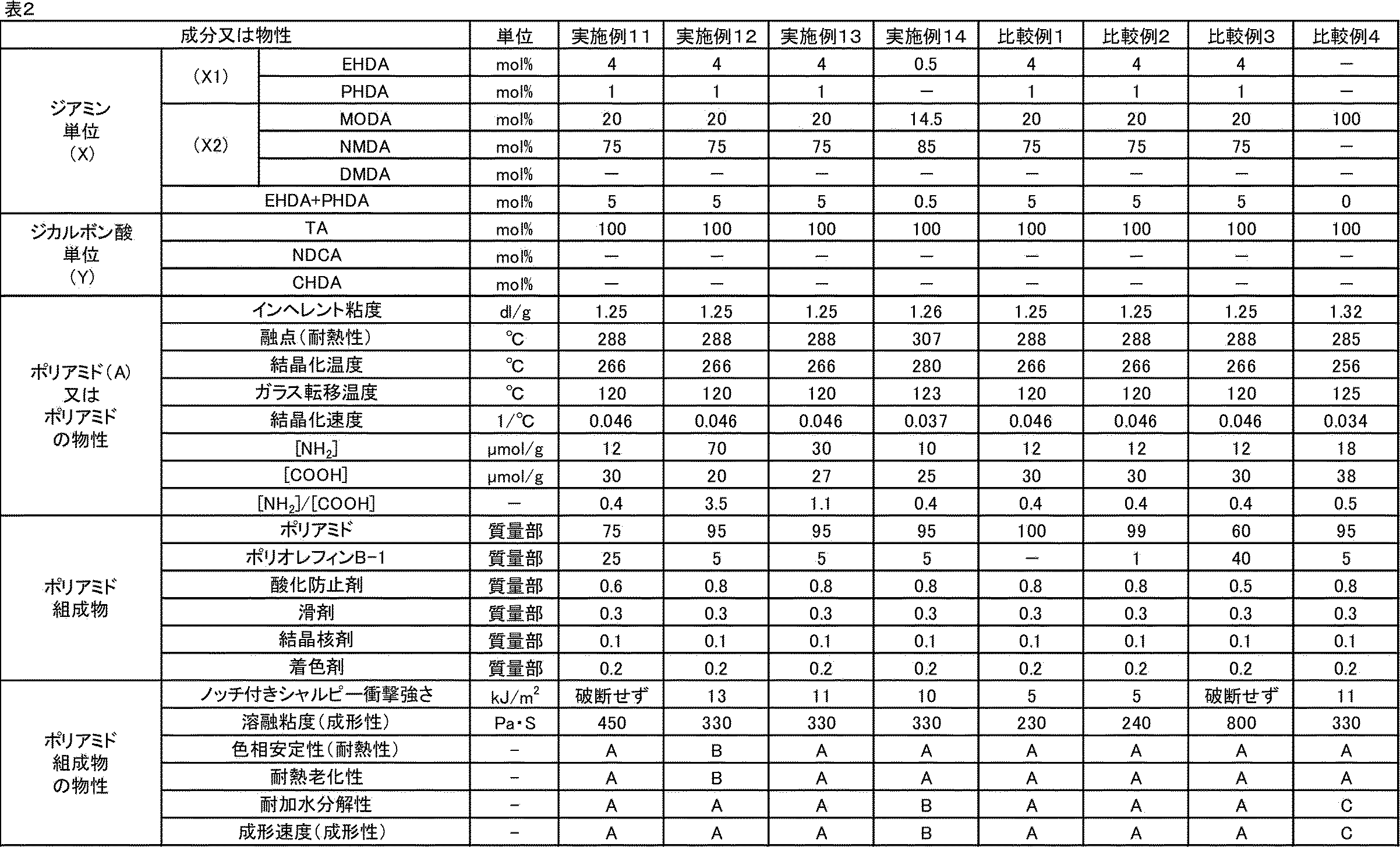
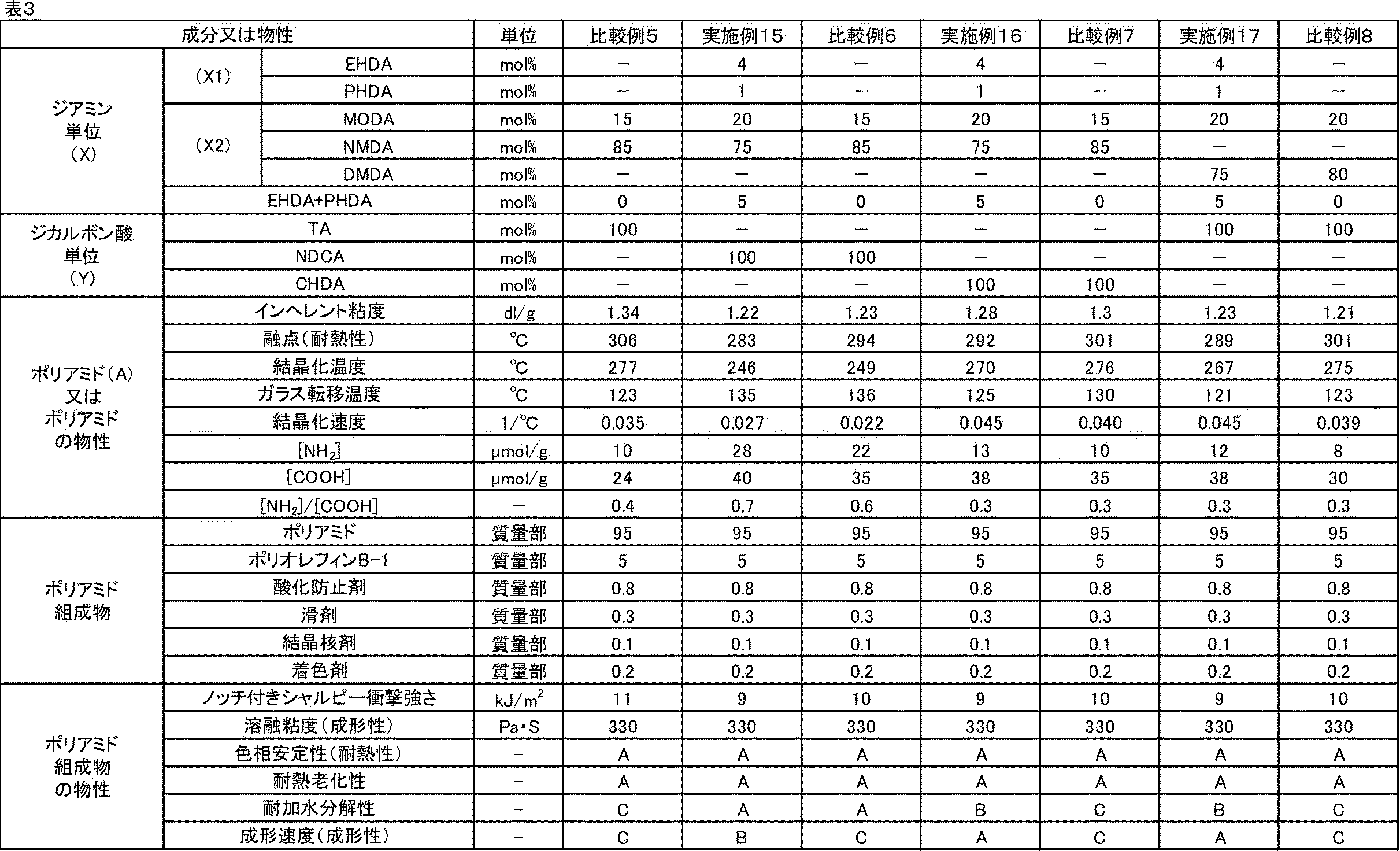
上記の表1~3で用いた化合物に関する略号とその化合物内容は、次の表4に示すとおりである。また、表1~3中の「(EHDA+PHDA)」は、ジアミン単位中のEHDA及びPHDAの配合量(モル%)の合計を表す。

表1~3から、実施例1~14と比較例4及び5、実施例15と比較例6、実施例16と比較例7、実施例17と比較例8を比べると、実施例は高い成形速度である(成形時間が短い)ことが判る。すなわち、同じジカルボン酸単位を含むポリアミド組成物において、ジアミン単位として2-エチル-1,7-ヘプタンジアミン及び2-プロピル-1,6-ヘキサンジアミンを含んでいると、ポリアミドの結晶化速度が高くなる。高い結晶化速度を有するポリアミド(A)を含む実施例は、成形速度(成形性)に優れ、生産性に優れるポリアミド組成物となる。
また、分岐状脂肪族ジアミンとして、分岐構造がメチル基である2-メチル-1,8-オクタンジアミンのみを含む比較例4及び5と比較して、実施例は2-エチル-1,7-ヘプタンジアミン及び2-プロピル-1,6-ヘキサンジアミンを含んでいても、融点やガラス転移温度の低下は少なく、耐熱性に優れていることが判る。
したがって、表1~3から、実施例のポリアミド組成物は、優れた耐熱性を保ったまま結晶化速度が向上しており、成形性と耐熱性の両方に優れることが判る。更には、ポリオレフィンを含むことで靭性にも優れている。
また、表1~3から、ポリアミドの末端アミノ基量やジカルボン酸単位を最適化することにより、ポリアミド組成物により優れた耐熱老化性、耐加水分解性をも発現させることも可能であることが判る。
また、分岐状脂肪族ジアミンとして、分岐構造がメチル基である2-メチル-1,8-オクタンジアミンのみを含む比較例4及び5と比較して、実施例は2-エチル-1,7-ヘプタンジアミン及び2-プロピル-1,6-ヘキサンジアミンを含んでいても、融点やガラス転移温度の低下は少なく、耐熱性に優れていることが判る。
したがって、表1~3から、実施例のポリアミド組成物は、優れた耐熱性を保ったまま結晶化速度が向上しており、成形性と耐熱性の両方に優れることが判る。更には、ポリオレフィンを含むことで靭性にも優れている。
また、表1~3から、ポリアミドの末端アミノ基量やジカルボン酸単位を最適化することにより、ポリアミド組成物により優れた耐熱老化性、耐加水分解性をも発現させることも可能であることが判る。
本発明のポリアミド組成物は、高い成形性と優れた耐熱性を有し、更には靭性を備えている。したがって、本発明のポリアミドは、耐熱性及び靭性が必要とされる各種成形品として用いることができ、かつ成形品を製造する際の生産性を向上させることが可能となり、非常に有用である。
なお、本出願は、2021年12月20日付けで出願された日本特許出願(特願2021-206215)に基づいており、その全体が引用により援用される。
Claims (13)
- ポリアミド(A)とポリオレフィン(B)とを含むポリアミド組成物であって、
前記ポリアミド(A)が、ジアミン単位(X)及びジカルボン酸単位(Y)を含み、
前記ジアミン単位(X)は、ジアミン単位(X1)を0.1モル%以上36モル%未満含み、
前記ジアミン単位(X1)が、炭素数が6~10であって、かつ、任意の一方のアミノ基が結合した炭素原子を1位とした際に、2位の炭素原子に炭素数が2又は3のアルキル基が結合した脂肪族ジアミンに由来する構成単位であり、
前記ポリアミド組成物中における前記ポリオレフィン(B)の含有量が2質量%以上40質量%未満である、ポリアミド組成物。 - 前記ジアミン単位(X1)が、炭素数が9である前記脂肪族ジアミンに由来する構成単位である、請求項1に記載のポリアミド組成物。
- 前記ジアミン単位(X1)が、2-エチル-1,7-ヘプタンジアミン及び2-プロピル-1,6-ヘキサンジアミンからなる群より選ばれる、少なくとも1種に由来する構成単位である、請求項1又は2に記載のポリアミド組成物。
- 前記ジアミン単位(X)は、前記ジアミン単位(X1)を1~10モル%含む、請求項1~3のいずれか1項に記載のポリアミド組成物。
- 前記ジアミン単位(X)は、前記ジアミン単位(X1)以外のジアミン単位であるジアミン単位(X2)を更に含み、前記ジアミン単位(X2)が、直鎖状脂肪族ジアミン、前記ジアミン単位(X1)を構成する前記脂肪族ジアミン以外の分岐状脂肪族ジアミン、脂環式ジアミン、及び芳香族ジアミンからなる群より選ばれる、少なくとも1種に由来する構成単位である、請求項1~4のいずれか1項に記載のポリアミド組成物。
- 前記ジアミン単位(X2)が、直鎖状脂肪族ジアミン及び分岐鎖がメチル基である分岐状脂肪族ジアミンからなる群より選ばれる、少なくとも1種に由来する構成単位である、請求項5に記載のポリアミド組成物。
- 前記ジアミン単位(X2)が、炭素数6~10のジアミンに由来するジアミン単位である、請求項5又は6に記載のポリアミド組成物。
- 前記ジアミン単位(X2)が、1,6-ヘキサンジアミン、1,9-ノナンジアミン、1,10-デカンジアミン、2-メチル-1,5-ペンタンジアミン、及び2-メチル-1,8-オクタンジアミンからなる群より選ばれる、少なくとも1種に由来する構成単位である、請求項5~7のいずれか1項に記載のポリアミド組成物。
- 前記ポリアミド(A)における末端カルボキシル基量[COOH]に対する末端アミノ基量[NH]の比[NH2]/[COOH]が、0.1~30である、請求項1~8のいずれか1項に記載のポリアミド組成物。
- 前記ジカルボン酸単位(Y)が、脂肪族ジカルボン酸、芳香族ジカルボン酸、及び脂環式ジカルボン酸からなる群より選ばれる、少なくとも1種に由来する構成単位を含む、請求項1~9のいずれか1項に記載のポリアミド組成物。
- 前記ジカルボン酸単位(Y)が、テレフタル酸、シクロヘキサンジカルボン酸、及びナフタレンジカルボン酸からなる群より選ばれる、少なくとも1種に由来する構成単位を含む、請求項1~10のいずれか1項に記載のポリアミド組成物。
- 前記ポリオレフィン(B)が、カルボキシル基及び酸無水物基からなる群より選ばれる少なくとも1種を有する不飽和化合物で変性した重合体である、請求項1~11のいずれか1項に記載のポリアミド組成物。
- 請求項1~12のいずれか1項に記載のポリアミド組成物からなる、成形品。
Priority Applications (2)
| Application Number | Priority Date | Filing Date | Title |
|---|---|---|---|
| EP22911165.3A EP4455220A4 (en) | 2021-12-20 | 2022-12-19 | POLYAMIDE COMPOSITION AND MOLDED ITEM |
| JP2023569424A JPWO2023120463A1 (ja) | 2021-12-20 | 2022-12-19 |
Applications Claiming Priority (2)
| Application Number | Priority Date | Filing Date | Title |
|---|---|---|---|
| JP2021-206215 | 2021-12-20 | ||
| JP2021206215 | 2021-12-20 |
Publications (1)
| Publication Number | Publication Date |
|---|---|
| WO2023120463A1 true WO2023120463A1 (ja) | 2023-06-29 |
Family
ID=86902660
Family Applications (1)
| Application Number | Title | Priority Date | Filing Date |
|---|---|---|---|
| PCT/JP2022/046623 Ceased WO2023120463A1 (ja) | 2021-12-20 | 2022-12-19 | ポリアミド組成物及び成形品 |
Country Status (3)
| Country | Link |
|---|---|
| EP (1) | EP4455220A4 (ja) |
| JP (1) | JPWO2023120463A1 (ja) |
| WO (1) | WO2023120463A1 (ja) |
Citations (6)
| Publication number | Priority date | Publication date | Assignee | Title |
|---|---|---|---|---|
| JPS5241692A (en) * | 1975-09-26 | 1977-03-31 | Dynamit Nobel Ag | Clear polyamide |
| JPH03140327A (ja) * | 1989-10-20 | 1991-06-14 | Huels Ag | アルコールおよび煮沸水に対し安定な成形材料 |
| WO1993000386A1 (en) * | 1991-06-21 | 1993-01-07 | E.I. Du Pont De Nemours And Company | Copolyadipamide containing ethyltetramethyleneadipamide units and products prepared therefrom |
| WO2020040282A1 (ja) * | 2018-08-24 | 2020-02-27 | 株式会社クラレ | ポリアミド及びポリアミド組成物 |
| WO2021037850A1 (en) * | 2019-08-27 | 2021-03-04 | Solvay Specialty Polymers Usa, Llc | Polyamides and corresponding polymer compositions, articles and methods for making and using |
| WO2022091987A1 (ja) * | 2020-10-27 | 2022-05-05 | 株式会社クラレ | ポリアミド |
Family Cites Families (3)
| Publication number | Priority date | Publication date | Assignee | Title |
|---|---|---|---|---|
| DE3248776A1 (de) * | 1982-12-31 | 1984-07-12 | Chemische Werke Hüls AG, 4370 Marl | Verwendung von copolyamiden zum heisssiegeln von textilien |
| CN101307218B (zh) * | 2008-06-20 | 2011-06-22 | 上海天洋热熔胶有限公司 | 服装用耐高温水洗聚酰胺热熔胶及其制备方法 |
| TW201600538A (zh) * | 2014-05-14 | 2016-01-01 | 英威達技術有限公司 | 非晶形高性能聚醯胺 |
-
2022
- 2022-12-19 EP EP22911165.3A patent/EP4455220A4/en active Pending
- 2022-12-19 JP JP2023569424A patent/JPWO2023120463A1/ja active Pending
- 2022-12-19 WO PCT/JP2022/046623 patent/WO2023120463A1/ja not_active Ceased
Patent Citations (6)
| Publication number | Priority date | Publication date | Assignee | Title |
|---|---|---|---|---|
| JPS5241692A (en) * | 1975-09-26 | 1977-03-31 | Dynamit Nobel Ag | Clear polyamide |
| JPH03140327A (ja) * | 1989-10-20 | 1991-06-14 | Huels Ag | アルコールおよび煮沸水に対し安定な成形材料 |
| WO1993000386A1 (en) * | 1991-06-21 | 1993-01-07 | E.I. Du Pont De Nemours And Company | Copolyadipamide containing ethyltetramethyleneadipamide units and products prepared therefrom |
| WO2020040282A1 (ja) * | 2018-08-24 | 2020-02-27 | 株式会社クラレ | ポリアミド及びポリアミド組成物 |
| WO2021037850A1 (en) * | 2019-08-27 | 2021-03-04 | Solvay Specialty Polymers Usa, Llc | Polyamides and corresponding polymer compositions, articles and methods for making and using |
| WO2022091987A1 (ja) * | 2020-10-27 | 2022-05-05 | 株式会社クラレ | ポリアミド |
Non-Patent Citations (1)
| Title |
|---|
| See also references of EP4455220A4 |
Also Published As
| Publication number | Publication date |
|---|---|
| EP4455220A4 (en) | 2025-11-26 |
| EP4455220A1 (en) | 2024-10-30 |
| JPWO2023120463A1 (ja) | 2023-06-29 |
Similar Documents
| Publication | Publication Date | Title |
|---|---|---|
| US8420221B2 (en) | Semiaromatic moulding compositions and uses of these | |
| JP6234175B2 (ja) | ポリアミド樹脂組成物 | |
| WO2014042098A1 (ja) | ポリアミド樹脂 | |
| JP6243706B2 (ja) | ポリアミド樹脂 | |
| CN107325548A (zh) | 耐高温聚酰胺模制组合物及其特别在汽车行业中的用途 | |
| KR20150063045A (ko) | 폴리아미드 수지 조성물 | |
| CN102712810A (zh) | 具有改善的耐盐性和热稳定性的聚酰胺组合物 | |
| JP2015155543A (ja) | プラスチック容器および導管 | |
| WO2023120456A1 (ja) | ポリアミド組成物 | |
| WO2023120460A1 (ja) | ポリアミド組成物 | |
| EP4455217A1 (en) | Polyamide composition | |
| WO2023120463A1 (ja) | ポリアミド組成物及び成形品 | |
| WO2023120461A1 (ja) | ポリアミド組成物 | |
| JP6220640B2 (ja) | ポリアミド樹脂 | |
| WO2023120458A1 (ja) | ポリアミド組成物 | |
| WO2024242024A1 (ja) | ポリアミド組成物 | |
| WO2023120457A1 (ja) | ポリアミド組成物 | |
| WO2024242025A1 (ja) | ポリアミド組成物 | |
| JP6324745B2 (ja) | ポリアミド樹脂 | |
| JP6097204B2 (ja) | ポリアミド樹脂 | |
| JP2024095449A (ja) | ポリアミド成形体 | |
| WO2025033525A1 (ja) | ポリアミド樹脂組成物 | |
| WO2025033526A1 (ja) | ポリアミド樹脂組成物 |
Legal Events
| Date | Code | Title | Description |
|---|---|---|---|
| 121 | Ep: the epo has been informed by wipo that ep was designated in this application |
Ref document number: 22911165 Country of ref document: EP Kind code of ref document: A1 |
|
| WWE | Wipo information: entry into national phase |
Ref document number: 2023569424 Country of ref document: JP |
|
| NENP | Non-entry into the national phase |
Ref country code: DE |
|
| ENP | Entry into the national phase |
Ref document number: 2022911165 Country of ref document: EP Effective date: 20240722 |