WO2023149153A1 - 白金族金属回収剤及び白金族金属回収方法 - Google Patents
白金族金属回収剤及び白金族金属回収方法 Download PDFInfo
- Publication number
- WO2023149153A1 WO2023149153A1 PCT/JP2023/000098 JP2023000098W WO2023149153A1 WO 2023149153 A1 WO2023149153 A1 WO 2023149153A1 JP 2023000098 W JP2023000098 W JP 2023000098W WO 2023149153 A1 WO2023149153 A1 WO 2023149153A1
- Authority
- WO
- WIPO (PCT)
- Prior art keywords
- platinum
- group metal
- metal recovery
- platinum group
- hydrochloric acid
- Prior art date
- Legal status (The legal status is an assumption and is not a legal conclusion. Google has not performed a legal analysis and makes no representation as to the accuracy of the status listed.)
- Ceased
Links
Classifications
-
- C—CHEMISTRY; METALLURGY
- C07—ORGANIC CHEMISTRY
- C07D—HETEROCYCLIC COMPOUNDS
- C07D307/00—Heterocyclic compounds containing five-membered rings having one oxygen atom as the only ring hetero atom
- C07D307/02—Heterocyclic compounds containing five-membered rings having one oxygen atom as the only ring hetero atom not condensed with other rings
- C07D307/04—Heterocyclic compounds containing five-membered rings having one oxygen atom as the only ring hetero atom not condensed with other rings having no double bonds between ring members or between ring members and non-ring members
- C07D307/10—Heterocyclic compounds containing five-membered rings having one oxygen atom as the only ring hetero atom not condensed with other rings having no double bonds between ring members or between ring members and non-ring members with substituted hydrocarbon radicals attached to ring carbon atoms
- C07D307/14—Radicals substituted by nitrogen atoms not forming part of a nitro radical
-
- C—CHEMISTRY; METALLURGY
- C07—ORGANIC CHEMISTRY
- C07C—ACYCLIC OR CARBOCYCLIC COMPOUNDS
- C07C211/00—Compounds containing amino groups bound to a carbon skeleton
- C07C211/01—Compounds containing amino groups bound to a carbon skeleton having amino groups bound to acyclic carbon atoms
- C07C211/16—Compounds containing amino groups bound to a carbon skeleton having amino groups bound to acyclic carbon atoms of a saturated carbon skeleton containing rings other than six-membered aromatic rings
- C07C211/18—Compounds containing amino groups bound to a carbon skeleton having amino groups bound to acyclic carbon atoms of a saturated carbon skeleton containing rings other than six-membered aromatic rings containing at least two amino groups bound to the carbon skeleton
-
- C—CHEMISTRY; METALLURGY
- C22—METALLURGY; FERROUS OR NON-FERROUS ALLOYS; TREATMENT OF ALLOYS OR NON-FERROUS METALS
- C22B—PRODUCTION AND REFINING OF METALS; PRETREATMENT OF RAW MATERIALS
- C22B11/00—Obtaining noble metals
- C22B11/04—Obtaining noble metals by wet processes
-
- C—CHEMISTRY; METALLURGY
- C22—METALLURGY; FERROUS OR NON-FERROUS ALLOYS; TREATMENT OF ALLOYS OR NON-FERROUS METALS
- C22B—PRODUCTION AND REFINING OF METALS; PRETREATMENT OF RAW MATERIALS
- C22B3/00—Extraction of metal compounds from ores or concentrates by wet processes
- C22B3/04—Extraction of metal compounds from ores or concentrates by wet processes by leaching
- C22B3/06—Extraction of metal compounds from ores or concentrates by wet processes by leaching in inorganic acid solutions, e.g. with acids generated in situ; in inorganic salt solutions other than ammonium salt solutions
- C22B3/10—Hydrochloric acid, other halogenated acids or salts thereof
-
- C—CHEMISTRY; METALLURGY
- C22—METALLURGY; FERROUS OR NON-FERROUS ALLOYS; TREATMENT OF ALLOYS OR NON-FERROUS METALS
- C22B—PRODUCTION AND REFINING OF METALS; PRETREATMENT OF RAW MATERIALS
- C22B3/00—Extraction of metal compounds from ores or concentrates by wet processes
- C22B3/20—Treatment or purification of solutions, e.g. obtained by leaching
- C22B3/26—Treatment or purification of solutions, e.g. obtained by leaching by liquid-liquid extraction using organic compounds
- C22B3/28—Amines
- C22B3/282—Aliphatic amines
-
- C—CHEMISTRY; METALLURGY
- C22—METALLURGY; FERROUS OR NON-FERROUS ALLOYS; TREATMENT OF ALLOYS OR NON-FERROUS METALS
- C22B—PRODUCTION AND REFINING OF METALS; PRETREATMENT OF RAW MATERIALS
- C22B3/00—Extraction of metal compounds from ores or concentrates by wet processes
- C22B3/20—Treatment or purification of solutions, e.g. obtained by leaching
- C22B3/44—Treatment or purification of solutions, e.g. obtained by leaching by chemical processes
-
- C—CHEMISTRY; METALLURGY
- C07—ORGANIC CHEMISTRY
- C07C—ACYCLIC OR CARBOCYCLIC COMPOUNDS
- C07C2601/00—Systems containing only non-condensed rings
- C07C2601/12—Systems containing only non-condensed rings with a six-membered ring
- C07C2601/14—The ring being saturated
-
- Y—GENERAL TAGGING OF NEW TECHNOLOGICAL DEVELOPMENTS; GENERAL TAGGING OF CROSS-SECTIONAL TECHNOLOGIES SPANNING OVER SEVERAL SECTIONS OF THE IPC; TECHNICAL SUBJECTS COVERED BY FORMER USPC CROSS-REFERENCE ART COLLECTIONS [XRACs] AND DIGESTS
- Y02—TECHNOLOGIES OR APPLICATIONS FOR MITIGATION OR ADAPTATION AGAINST CLIMATE CHANGE
- Y02P—CLIMATE CHANGE MITIGATION TECHNOLOGIES IN THE PRODUCTION OR PROCESSING OF GOODS
- Y02P10/00—Technologies related to metal processing
- Y02P10/20—Recycling
Definitions
- Platinum group metals are industrially very important metals. Among them, platinum, palladium, and rhodium are mainly used as automobile exhaust gas purification catalysts. Therefore, selective separation and recovery of platinum group metals from spent catalysts is important. In general, methods such as electrolytic deposition, cementation, ion exchange, precipitation, and solvent extraction are used to recover precious metals. Among these methods, the precipitation method and the solvent extraction method are widely used because of their excellent economic efficiency and operability. A method using amines has been studied as a method for selectively recovering platinum group metals by a precipitation method.
- Patent Document 1 discloses a rhodium recovery agent that has an amide bond and a phenylenediamine structure and is an insoluble solid in hydrochloric acid at a specific concentration for the purpose of efficiently recovering rhodium at low cost.
- Patent Document 2 discloses that the platinum group metal can be precipitated and recovered by adding a compound having a diaminodiphenyl structure to a hydrochloric acid solution containing the platinum group metal for the purpose of efficiently separating rhodium. .
- an object of the present invention is to provide a platinum group metal recovery agent and a platinum group metal recovery method capable of selectively recovering platinum at a high recovery rate.
- the present inventors have found that a specific aliphatic diamine is excellent as a platinum group metal recovery agent. In addition, the inventors have found a method capable of selectively recovering platinum at a high recovery rate by using the platinum group metal recovery agent. Furthermore, the present inventors have found a method capable of preferentially and selectively recovering platinum even in the presence of palladium and rhodium, which has been difficult in the past, and have completed the present invention.
- the present invention is a platinum group metal recovery agent represented by the following general formula (1), and a platinum group metal recovery method for recovering platinum from a platinum-containing hydrochloric acid solution using the platinum group metal recovery agent.
- X is a methylene group, an oxygen atom or an ethylene group
- n is 3 when X is a methylene group
- n is 2 when X is an oxygen atom or an ethylene group.
- Platinum group metal recovery agent The platinum group metal recovery agent of the present invention is represented by the following general formula (1).
- X is a methylene group, an oxygen atom or an ethylene group
- n is 3 when X is a methylene group
- n is 2 when X is an oxygen atom or an ethylene group.
- the compound represented by the general formula (1) can be used as a platinum group metal recovery agent.
- the platinum group metal recovery agent of the present invention includes 1,4-bis(aminomethyl)cyclohexane (1,4-BAC), 1,3-bis(aminomethyl)cyclohexane (1,3-BAC) and 2, It is at least one selected from the group consisting of 5-bis(aminomethyl)tetrahydrofuran (H-AMF). Specifically, they are compounds represented by the following formulas.
- the platinum group metal recovery agent of the present invention is preferably selected from the group consisting of 1,4-bis(aminomethyl)cyclohexane and 2,5-bis(aminomethyl)tetrahydrofuran among the compounds represented by the formula (1). At least one selected, more preferably 1,4-bis(aminomethyl)cyclohexane.
- platinum group metal recovery agent platinum can be selectively recovered at a high rate.
- platinum can be preferentially and selectively recovered even in the presence of palladium and rhodium, which has been difficult in the past.
- the reason why platinum can be selectively recovered by using the platinum group metal recovery agent of the present invention is not clear, but when mixed with a hydrochloric acid solution of platinum group metals, the platinum group metal recovery agent of the present invention This is probably because a specific aliphatic diamine easily forms crystals with platinum and can be selectively precipitated.
- the platinum group metal recovery agent represented by the formula (1) may be used alone or in combination of two or more.
- 1,4-bis(aminomethyl)cyclohexane has a trans isomer and a cis isomer, and the ratio of the trans isomer is preferably high. That is, the platinum group metal recovery agent of the present invention is more preferably 1,4-bis(aminomethyl)cyclohexane with a trans isomer of more than 50%, and still more preferably 1,4-bis(aminomethyl)cyclohexane with a trans isomer of 60% or more. -bis(aminomethyl)cyclohexane, more preferably 1,4-bis(aminomethyl)cyclohexane having a trans isomer of 70% or more.
- 1,4-bis(aminomethyl)cyclohexane having a high trans-isomer ratio (approximately 60% or more trans-isomer) is sometimes referred to as 1,4-BACT.
- the platinum group metal recovery agent of the present invention is a compound represented by the above formula (1), which is a specific aliphatic diamine, but also includes a hydrohalide salt form of the diamine. Hydrochloride is preferred as the hydrohalide. Since the platinum group metal recovery agent of the present invention is a hydrochloride, it is possible to prevent heat generation and changes in the concentration of hydrochloric acid due to a neutralization reaction when mixing with a hydrochloric acid solution containing a platinum group metal.
- the hydrochloric acid concentration of the hydrochloric acid solution used in the method for recovering platinum group metals in this specification is the concentration of hydrochloric acid after mixing with the platinum group metal recovery agent of the present invention.
- the hydrochloride of the compound represented by the formula (1) when used as the platinum group metal recovery agent of the present invention, there is no change in the concentration of hydrochloric acid, so before mixing the platinum group metal recovery agent of the present invention. may have a hydrochloric acid concentration of
- Platinum group metal recovery method (recovery of platinum)
- the platinum group metal recovery method of the present invention selectively recovers platinum, and can preferentially recover platinum.
- the platinum group metal recovery method of the present invention is a method for recovering platinum from a hydrochloric acid solution containing platinum using the platinum group metal recovery agent.
- the platinum group metal recovery method of the present invention is preferably a method of mixing the platinum group metal recovery agent and the hydrochloric acid solution to precipitate platinum.
- platinum group metal recovery method of the present invention not only can platinum be recovered from a hydrochloric acid solution containing only platinum as a platinum group metal, but the hydrochloric acid solution contains at least one selected from the group consisting of palladium and rhodium. Platinum can also be selectively recovered when it contains palladium, and platinum can be selectively recovered when the hydrochloric acid solution contains palladium. Furthermore, platinum can be selectively recovered even when the hydrochloric acid solution contains both palladium and rhodium. A specific method is shown below.
- the platinum group metal recovery agent is added to a hydrochloric acid solution containing at least platinum.
- platinum can be selectively recovered from hydrochloric acid solutions of any hydrochloric acid concentration, but the hydrochloric acid concentration of the hydrochloric acid solution containing platinum is preferably 1 to 12 mol / L. , more preferably 4 to 10 mol/L, still more preferably 5 to 9 mol/L.
- the molar ratio [platinum group metal recovery agent/platinum (mol/mol)] between the platinum group metal recovery agent and the platinum contained in the hydrochloric acid solution is preferably 1 or more. , more preferably 2 or more, and still more preferably 5 or more. Further, the molar ratio [platinum group metal recovery agent/platinum (mol/mol)] between the platinum group metal recovery agent and the platinum contained in the hydrochloric acid solution is preferably 200 or less, more preferably 150 or less, and further It is preferably 100 or less, more preferably 20 or less.
- the molar ratio between the platinum group metal recovery agent and the platinum contained in the hydrochloric acid solution [platinum group metal recovery agent/platinum (mol/mol)] is 1 or more” means " The amount of the platinum group metal recovery agent is added to the amount of platinum so that the molar ratio [platinum group metal recovery agent/platinum (mol/mol)] is 1 or more.
- 1,4-bis(aminomethyl)cyclohexane (1,4-BAC) is used as a platinum group metal recovery agent, platinum is selectively recovered at a high recovery rate even with a small amount added to platinum.
- the molar ratio [platinum group metal recovery agent/platinum (mol/mol)] between the platinum group metal recovery agent and the platinum contained in the hydrochloric acid solution is preferably 1 to 100, more preferably 2 to 50, more preferably 5-20, even more preferably 5-10. Furthermore, when using 1,4-bis (aminomethyl) cyclohexane (1,4-BACT) with a trans isomer ratio of 60% or more, platinum is selectively obtained with a high recovery even with a small amount added to platinum.
- the molar ratio between the platinum group metal recovery agent and the platinum contained in the hydrochloric acid solution is preferably 1 to 100, more preferably is 1-30, more preferably 1-10, still more preferably 2-8.
- the recovery rate of platinum is increased, rhodium and palladium are less likely to be contained in the precipitation, and platinum can be recovered with high purity.
- the method of mixing the platinum group metal recovery agent and the hydrochloric acid solution is not limited, but platinum is precipitated by adding the platinum group metal recovery agent to the hydrochloric acid solution and stirring or shaking for a predetermined time.
- the stirring or shaking time is preferably 1 minute or more. and more preferably 5 minutes or longer.
- the stirring or shaking time is preferably 10 hours or less, more preferably 5 hours or less, from the viewpoint of efficiency.
- the stirring or shaking time may be appropriately adjusted depending on the concentration and temperature of each component.
- the temperature during stirring or shaking may be 0 to 100°C, and according to the present invention, platinum can be selectively recovered from hydrochloric acid solutions at any temperature. From the viewpoint of recovery rate, the temperature during stirring or shaking is preferably 10 to 70°C, more preferably 10 to 50°C, and still more preferably 10 to 35°C.
- the precipitate containing platinum thus obtained can be recovered by solid-liquid separation such as filtration and centrifugation. Since the precipitate contains platinum and a platinum group metal recovery agent that is an aliphatic diamine, platinum can be obtained as a metal or an oxide by firing in air.
- the firing temperature is preferably 400-1000°C, more preferably 500-700°C.
- the baking time is preferably 5 to 100 minutes, more preferably 10 to 80 minutes. By adjusting these firing conditions, platinum can be obtained as a metal, preferably as a simple metal.
- the platinum group metal recovery agent can also be used to purify platinum.
- the method for purifying platinum group metals of the present invention is a method for purifying platinum by removing metal impurities from a hydrochloric acid solution containing platinum as a main component, using the platinum group metal recovery agent.
- the "hydrochloric acid solution containing platinum as the main component" used in the platinum group metal refining method of the present invention means that the hydrochloric acid solution contains platinum and metals other than platinum (impurities), and among the metals contained in the hydrochloric acid solution, Refers to the hydrochloric acid solution with the highest molar content of platinum.
- the hydrochloric acid solution containing platinum as a main component may be obtained by dissolving a platinum-containing solid in hydrochloric acid, or by adding hydrochloric acid to an aqueous solution containing platinum. Preferably, it is obtained by dissolving the precipitate obtained by the platinum group metal recovery method described in the above section [Platinum group metal recovery method (recovery of platinum)] in hydrochloric acid.
- the platinum group metal refining method of the present invention it is preferable to perform refining under the same conditions as the platinum group metal recovery method described in the section [Platinum group metal recovery method (recovery of platinum)] above. That is, the platinum group metal refining method of the present invention is preferably a method of mixing the platinum group metal recovery agent and the hydrochloric acid solution to precipitate platinum. Details will be described below.
- the platinum group metal recovery agent is added to a hydrochloric acid solution containing platinum as a main component.
- platinum can be purified even using a hydrochloric acid solution of any hydrochloric acid concentration, but the hydrochloric acid concentration of the hydrochloric acid solution containing platinum as the main component is preferably 1 to 12 mol. /L, more preferably 4 to 10 mol/L, still more preferably 5 to 9 mol/L.
- the molar ratio [platinum group metal recovery agent/platinum (mol/mol)] between the platinum group metal recovery agent and the platinum contained in the hydrochloric acid solution is preferably 1 or more. , more preferably 2 or more, and still more preferably 5 or more. Further, the molar ratio [platinum group metal recovery agent/platinum (mol/mol)] between the platinum group metal recovery agent and the platinum contained in the hydrochloric acid solution is preferably 200 or less, more preferably 150 or less, and further It is preferably 100 or less, more preferably 20 or less.
- the molar ratio of the platinum group metal recovery agent and the platinum contained in the hydrochloric acid solution is preferably 1 to 100, more preferably 2 to 50, and further It is preferably 5-20, more preferably 5-10.
- platinum can be efficiently purified even with a smaller amount added to platinum.
- the molar ratio [platinum group metal recovery agent/platinum (mol/mol)] between the platinum group metal recovery agent and the platinum contained in the hydrochloric acid solution is preferably 1 to 100, more preferably 1 to 30. , more preferably 1 to 10, and even more preferably 2 to 8. If the molar ratio is within the above range, even if rhodium or palladium is contained in metals as impurities, rhodium or palladium is less likely to be contained in the resulting precipitate, and high-purity platinum can be obtained.
- the method of mixing the platinum group metal recovery agent and the hydrochloric acid solution is not limited, but platinum is precipitated by adding the platinum group metal recovery agent to the hydrochloric acid solution and stirring or shaking for a predetermined time.
- the stirring or shaking time is preferably 1 minute or more. , more preferably 5 minutes or longer.
- the stirring or shaking time is preferably 10 hours or less, more preferably 5 hours or less, from the viewpoint of efficiency.
- the stirring or shaking time may be appropriately adjusted depending on the concentration and temperature of each component.
- the temperature during stirring or shaking may be 0 to 100 ° C.
- platinum can be purified using a hydrochloric acid solution at any temperature, but from the viewpoint of recovery rate, the temperature during stirring or shaking is preferably 10 to 70°C, more preferably 10 to 50°C, still more preferably 10 to 35°C.
- the precipitate containing platinum thus obtained can be recovered by solid-liquid separation such as filtration and centrifugation. Since the precipitate contains platinum and a platinum group metal recovery agent that is an aliphatic diamine, platinum can be obtained as a metal or an oxide by firing in air.
- the firing temperature is preferably 400-1000°C, more preferably 500-700°C.
- the baking time is preferably 5 to 100 minutes, more preferably 10 to 80 minutes. By adjusting these firing conditions, platinum can be obtained as a metal, preferably as a simple metal.
- Example 1 Effect of hydrochloric acid concentration> 1,4-bis(aminomethyl)cyclohexane (1 , 4-BAC, trans-isomer 33%, cis-isomer 67%) was added in an amount 15 times the amount of platinum (mol/mol).
- the 1,4-bis(aminomethyl)cyclohexane used here is hydrochloride. Then, the mixture was shaken at 25°C for 30 minutes to obtain a precipitate. The resulting precipitate and solution were subjected to solid-liquid separation by centrifugation.
- Table 1 shows the relationship between hydrochloric acid concentration and metal recovery rate.
- 1,4-bis (aminomethyl) cyclohexane (1,4-BAC) as a platinum group metal recovery agent, platinum is selective in a wide hydrochloric acid concentration range of 1 mol / L or more. It can be seen that it can be recovered as a precipitate at The metal recovery rate is the percentage obtained by dividing the amount of each metal contained in the recovered precipitate by the amount of each metal before adding the platinum group metal recovery agent. In the following examples, the metal recovery rate was obtained in the same manner.
- Example 2 Effect of temperature> A precipitate and a solution were obtained in the same manner as in Example 1, except that the hydrochloric acid concentration of the hydrochloric acid solution was 8 mol / L and the temperature of the hydrochloric acid solution was changed as shown in Table 2, and the platinum group metal contained in the precipitate was calculated. Table 2 shows the relationship between temperature and metal recovery rate. As is clear from Table 2, by using 1,4-bis(aminomethyl)cyclohexane (1,4-BAC) as a platinum group metal recovery agent, platinum can be selectively recovered as a precipitate over a wide temperature range. I understand.
- Example 3 Effect of molar ratio between platinum group metal recovery agent and platinum>
- the hydrochloric acid concentration of the hydrochloric acid solution was 8 mol / L, and the addition amount of the platinum group metal recovery agent (1,4-bis (aminomethyl) cyclohexane (1,4-BAC)) was changed as shown in Table 3.
- a precipitate and a solution were obtained in the same manner as in Example 1, and the amount of platinum group metal contained in the precipitate was calculated.
- the amount of 1,4-BAC to be added is expressed in terms of mol times the amount of platinum.
- Table 3 shows the relationship between the amount of 1,4-BAC added and the metal recovery rate. As is clear from Table 3, platinum can be selectively recovered regardless of the amount of 1,4-BAC added.
- the amount of 1,4-BAC added is at least 5 times the amount of platinum (mol / mol)
- 85% or more of platinum can be recovered as a precipitate, with a very high platinum recovery rate and platinum can be selectively collected.
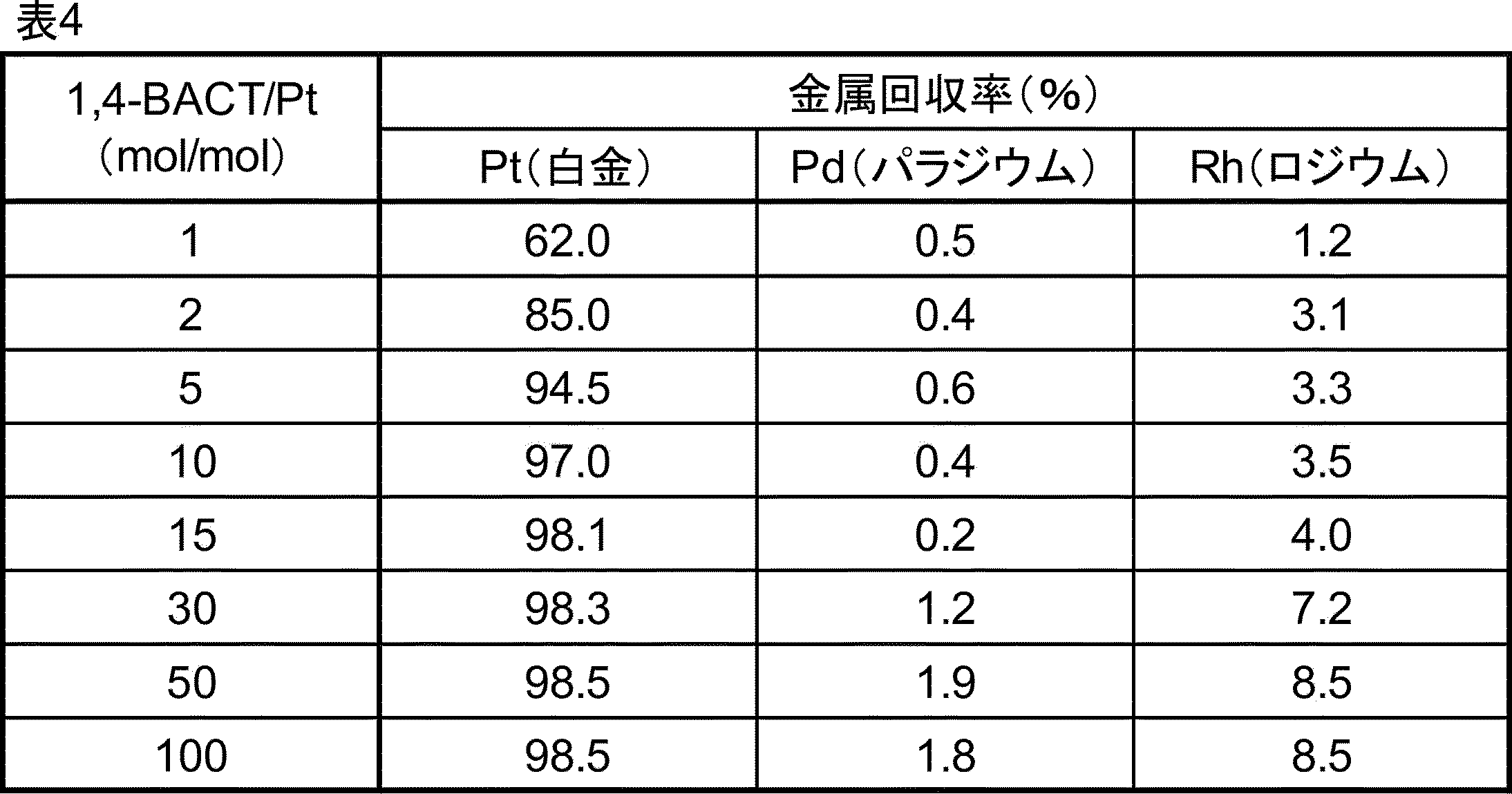
- Example 4 Influence of trans form ratio> 1,4-bis (aminomethyl) cyclohexane (1,4-BAC, trans-isomer 33%, cis-isomer 67%) is converted to 1,4-bis (aminomethyl) cyclohexane (1,4-BACT, A precipitate and a solution were obtained in the same manner as in Example 3, except that the trans form was changed to 93% and the cis form was changed to 7%), and the amount of platinum group metal contained in the precipitate was calculated. Table 4 shows the relationship between the amount of 1,4-BACT added and the metal recovery rate.
- Example 5 Effect of shaking time>
- 1,4-bis(aminomethyl)cyclohexane (1,4-BACT, trans isomer 93%, cis isomer 7%) was added in an amount 15 times the amount of platinum (mol/mol) and shaken.
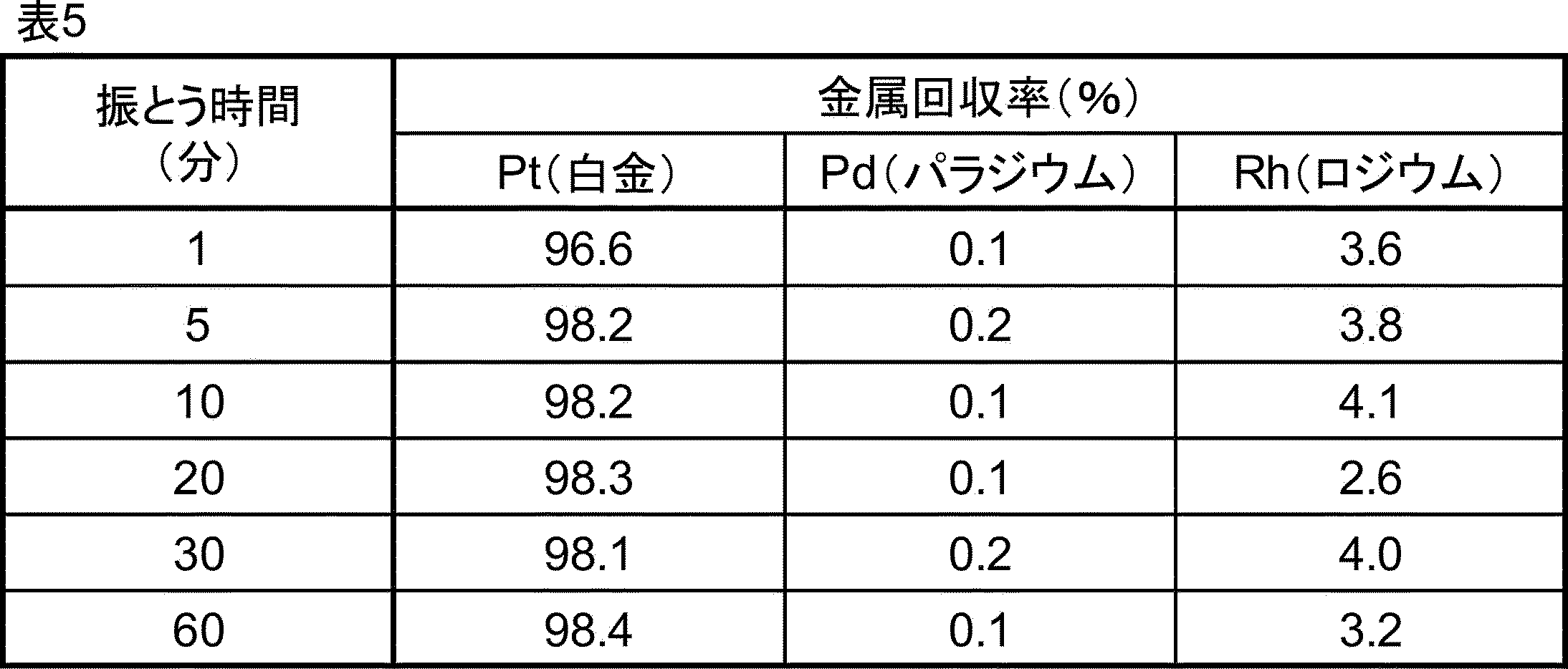
- a precipitate and a solution were obtained in the same manner as in Example 4, except that the soaking time was changed as shown in Table 5, and the amount of platinum group metal contained in the precipitate was calculated.
- Table 5 shows the relationship between shaking time and metal recovery rate. As is clear from Table 5, 95% or more of platinum can be recovered as a precipitate by shaking for 1 minute or longer, and platinum can be selectively recovered with a high platinum recovery rate.
- Example 7 Purification of platinum> Next, the platinum recovered from the catalyst leachate was purified by the method described above. The precipitate collected by the above method was dissolved in 5 mol/L hydrochloric acid (platinum concentration 500 mg/L). To the resulting hydrochloric acid solution, 1,4-bis(aminomethyl)cyclohexane (1,4-BACT, 93% trans isomer, 7% cis isomer) as a platinum group metal recovery agent was added in an amount 15 times the amount of platinum (mol /mol) was added. The 1,4-bis(aminomethyl)cyclohexane used here is hydrochloride. Then, the mixture was shaken at 25°C for 10 minutes to obtain a precipitate.
- platinum is purified by removing metal impurities from a hydrochloric acid solution containing platinum as a main component. be able to.
- the resulting precipitate and solution were subjected to solid-liquid separation by centrifugation.
- the solution obtained after solid-liquid separation was analyzed by ICP, and the amount of platinum group metal contained in the precipitate was calculated. As a result, 56% of platinum could be recovered as a precipitate. On the other hand, 7.2% of palladium was recovered as a precipitate, indicating that platinum can be selectively recovered as a precipitate.
Landscapes
- Chemical & Material Sciences (AREA)
- Organic Chemistry (AREA)
- Engineering & Computer Science (AREA)
- Manufacturing & Machinery (AREA)
- Materials Engineering (AREA)
- Mechanical Engineering (AREA)
- Metallurgy (AREA)
- Life Sciences & Earth Sciences (AREA)
- Environmental & Geological Engineering (AREA)
- General Life Sciences & Earth Sciences (AREA)
- Geochemistry & Mineralogy (AREA)
- Geology (AREA)
- Inorganic Chemistry (AREA)
- Chemical Kinetics & Catalysis (AREA)
- General Chemical & Material Sciences (AREA)
- Manufacture And Refinement Of Metals (AREA)
- Removal Of Specific Substances (AREA)
- Organic Low-Molecular-Weight Compounds And Preparation Thereof (AREA)
Abstract
Description
一般に貴金属の回収には、電解析出法やセメンテーション法、イオン交換法、沈殿法、溶媒抽出法等の方法が用いられる。これらの方法のなかでは、経済性や操作性に優れた、沈殿法や溶媒抽出法が、広く用いられている。
沈殿法による選択的な白金族金属の回収方法として、アミンを用いる方法が検討されている。
また、特許文献2には、特にロジウムを効率よく分離することを目的として、白金族金属を含む塩酸溶液にジアミノジフェニル構造を有する化合物を加えることで白金族金属を沈殿回収できることが開示されている。
そこで、本発明は、白金を選択的かつ高回収率で回収することができる白金族金属回収剤及び白金族金属回収方法を提供することを課題とする。
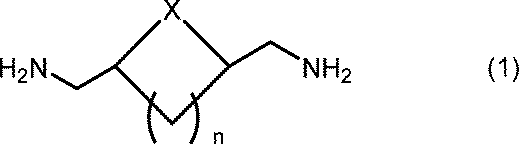
(式(1)中、Xはメチレン基、酸素原子又はエチレン基であり、Xがメチレン基のとき、nは3、Xが酸素原子又はエチレン基のとき、nは2である。)
本発明の白金族金属回収剤は、下記一般式(1)で示される。

(式(1)中、Xはメチレン基、酸素原子又はエチレン基であり、Xがメチレン基のとき、nは3、Xが酸素原子又はエチレン基のとき、nは2である。)
上記一般式(1)で示される化合物は白金族金属回収剤として使用することができる。
具体的にはそれぞれ下記式で示す化合物である。

式(1)で示される化合物、特に1,4-ビス(アミノメチル)シクロヘキサン又は2,5-ビス(アミノメチル)テトラヒドロフランを白金族金属回収剤として用いることで、白金を選択的かつ高回収率で回収することができる。更には、従来困難であったパラジウム、ロジウムの存在下においても白金を優先的かつ選択的に回収できる。
本発明の白金族金属回収剤を用いることで、白金を選択的に回収することができる理由は定かではないが、白金族金属の塩酸溶液と混合した際に、本発明の白金族金属回収剤である特定の脂肪族ジアミンが白金と結晶を生成しやすく、選択的に沈殿させることができるためと考えられる。
前記式(1)で示される白金族金属回収剤は、1種を単独で用いても2種以上を混合して用いてもよい。
なお、本明細書において、トランス体比率が高い(概ねトランス体60%以上)1,4-ビス(アミノメチル)シクロヘキサンを1,4-BACTと示すことがある。
なお、本明細書における白金族金属回収方法に用いられる塩酸溶液の塩酸濃度は、本発明の白金族金属回収剤を混合した後の塩酸濃度である。ただし、本発明の白金族金属回収剤として前記式(1)で示される化合物の塩酸塩を用いた場合には、塩酸濃度の変化がないため、本発明の白金族金属回収剤を混合する前の塩酸濃度であってもよい。
本発明の白金族金属回収方法は、白金を選択的に回収するものであり、白金を優先的に回収することができる。
本発明の白金族金属回収方法は、前記白金族金属回収剤を用いて、白金を含む塩酸溶液から白金を回収する方法である。本発明の白金族金属回収方法は、好ましくは、前記白金族金属回収剤と前記塩酸溶液を混合し、白金を沈殿させる方法である。
具体的な方法を以下に示す。
本発明の白金族金属回収剤を用いることで、あらゆる塩酸濃度の塩酸溶液からも白金を選択的に回収することができるが、白金を含む塩酸溶液の塩酸濃度は、好ましくは1~12mol/Lであり、より好ましくは4~10mol/Lであり、更に好ましくは5~9mol/Lである。
「前記白金族金属回収剤と前記塩酸溶液に含まれる白金とのモル比[白金族金属回収剤/白金(モル/モル)]を、1以上とする」とは、「前記塩酸溶液に含まれる白金の量に対して、前記白金族金属回収剤の量を、モル比[白金族金属回収剤/白金(モル/モル)]で1以上となるように添加する」ことを意味する。
特に白金族金属回収剤として1,4-ビス(アミノメチル)シクロヘキサン(1,4-BAC)を用いた場合には、白金に対して少ない添加量でも高い回収率で白金を選択的に回収することができるため、白金族金属回収剤と前記塩酸溶液に含まれる白金とのモル比[白金族金属回収剤/白金(モル/モル)]を、好ましくは1~100とし、より好ましくは2~50とし、更に好ましくは5~20とし、より更に好ましくは5~10とする。
更にトランス体比率が60%以上の1,4-ビス(アミノメチル)シクロヘキサン(1,4-BACT)を用いた場合には、白金に対してより少ない添加量でも高い回収率で白金を選択的に回収することができるため、白金族金属回収剤と前記塩酸溶液に含まれる白金とのモル比[白金族金属回収剤/白金(モル/モル)]を、好ましくは1~100とし、より好ましくは1~30とし、更に好ましくは1~10とし、より更に好ましくは2~8とする。
前記のモル比の範囲であれば、白金の回収率が高まり、沈殿中にロジウムやパラジウムが含まれにくく、白金を高純度で回収できる。
本発明の白金族金属回収剤を用いると塩酸溶液との混合後、迅速に沈殿が生じるため、短時間で白金を回収することができるが、撹拌又は振とうする時間は、好ましくは1分間以上であり、より好ましくは5分間以上である。上限には制限はないが、効率性の観点から、撹拌又は振とうする時間は、10時間以下が好ましく、5時間以下がより好ましい。撹拌又は振とうする時間は、各成分の濃度や温度によって適宜調整すればよい。
前記沈殿物は白金を含み、脂肪族ジアミンである白金族金属回収剤等を含むことから、空気中で焼成することにより、白金を金属又は酸化物として得ることができる。焼成温度は、好ましくは400~1000℃であり、より好ましくは500~700℃である。焼成時間は、好ましくは5~100分間であり、より好ましくは10~80分間である。これら焼成条件を調整することにより、白金を金属、好ましくは金属単体で得ることができる。
前記白金族金属回収剤は、白金の精製に用いることもできる。
本発明の白金族金属精製方法は、前記白金族金属回収剤を用いて、白金を主成分とする塩酸溶液から不純物である金属を除去して白金を精製する方法である。
白金を主成分とする塩酸溶液は、白金を含む固体を塩酸に溶解させて得てもよく、白金を含む水溶液に塩酸を加えて得てもよい。好ましくは、上述の[白金族金属回収方法(白金の回収)]の項で説明した白金族金属回収方法で得られた沈殿物を塩酸に溶解させて得る。
本発明の白金族金属回収剤を用いることで、あらゆる塩酸濃度の塩酸溶液を用いても白金を精製することができるが、白金を主成分とする塩酸溶液の塩酸濃度は、好ましくは1~12mol/Lであり、より好ましくは4~10mol/Lであり、更に好ましくは5~9mol/Lである。
特に白金族金属回収剤として1,4-ビス(アミノメチル)シクロヘキサン(1,4-BAC)を用いた場合には、白金に対して少ない添加量でも効率的に白金を精製することができるため、白金族金属回収剤と前記塩酸溶液に含まれる白金とのモル比[白金族金属回収剤/白金(モル/モル)]を、好ましくは1~100とし、より好ましくは2~50とし、更に好ましくは5~20とし、より更に好ましくは5~10とする。
更にトランス体比率が60%以上の1,4-ビス(アミノメチル)シクロヘキサン(1,4-BACT)を用いた場合には、白金に対してより少ない添加量でも効率的に白金を精製することができるため、白金族金属回収剤と前記塩酸溶液に含まれる白金とのモル比[白金族金属回収剤/白金(モル/モル)]を、好ましくは1~100とし、より好ましくは1~30とし、更に好ましくは1~10とし、より更に好ましくは2~8とする。
前記のモル比の範囲であれば、不純物としての金属にロジウムやパラジウムが含まれていたとしても、得られる沈殿中にロジウムやパラジウムが含まれにくく、高純度の白金を得ることができる。
前記白金族金属回収剤を用いると塩酸溶液との混合後、迅速に沈殿が生じるため、短時間で白金を精製することができるが、撹拌又は振とうする時間は、好ましくは1分間以上であり、より好ましくは5分間以上である。上限には制限はないが、効率性の観点から、撹拌又は振とうする時間は、10時間以下が好ましく、5時間以下がより好ましい。撹拌又は振とうする時間は、各成分の濃度や温度によって適宜調整すればよい。
前記沈殿物は白金を含み、脂肪族ジアミンである白金族金属回収剤等を含むことから、空気中で焼成することにより、白金を金属又は酸化物として得ることができる。焼成温度は、好ましくは400~1000℃であり、より好ましくは500~700℃である。焼成時間は、好ましくは5~100分間であり、より好ましくは10~80分間である。これら焼成条件を調整することにより、白金を金属、好ましくは金属単体で得ることができる。
<実施例1:塩酸濃度の影響>
パラジウムを5mmol/L、白金を5mmol/L、ロジウムを5mmol/L含み、表1に示す塩酸濃度である各塩酸溶液に、白金族金属回収剤として1,4-ビス(アミノメチル)シクロヘキサン(1,4-BAC、トランス体33%、シス体67%)を白金に対して15倍量(mol/mol)添加した。なお、ここで用いた1,4-ビス(アミノメチル)シクロヘキサンは塩酸塩である。その後、25℃で30分間振とうして沈殿物を得た。得られた沈殿物と溶液を遠心分離により固液分離した。固液分離後に得られた溶液をICPにて分析し、沈殿物に含まれる白金族金属の量を算出した。
表1に塩酸濃度と金属回収率の関係を示す。表1から明らかなように、白金族金属回収剤として1,4-ビス(アミノメチル)シクロヘキサン(1,4-BAC)を用いることで、1mol/L以上の広い塩酸濃度範囲で白金が選択的に沈殿物として回収できることがわかる。なお、金属回収率は、回収された沈殿物中に含まれる各金属の量を、白金族金属回収剤を添加する前の各金属の量で除した値を百分率で示したものである。以下の実施例においても同様にして金属回収率を求めた。

塩酸溶液の塩酸濃度を8mol/Lとし、塩酸溶液の温度を表2に示すように変更した以外は、実施例1と同様にして、沈殿物と溶液を得、沈殿物に含まれる白金族金属の量を算出した。
表2に温度と金属回収率の関係を示す。表2から明らかなように、白金族金属回収剤として1,4-ビス(アミノメチル)シクロヘキサン(1,4-BAC)を用いることで、広い温度範囲で白金が選択的に沈殿物として回収できることがわかる。

塩酸溶液の塩酸濃度を8mol/Lとし、白金族金属回収剤(1,4-ビス(アミノメチル)シクロヘキサン(1,4-BAC))の添加量を表3に示すように変更した以外は、実施例1と同様にして、沈殿物と溶液を得、沈殿物に含まれる白金族金属の量を算出した。なお、1,4-BACの添加量は、白金に対するモル倍で示す。
表3に1,4-BACの添加量と金属回収率の関係を示す。表3から明らかなように、1,4-BACの添加量によらず、白金が選択的に回収できることがわかる。更に1,4-BACの添加量が白金に対して5倍量(mol/mol)以上となる条件では、白金を85%以上、沈殿物として回収でき、非常に高い白金回収率で、かつ白金が選択的に回収できることがわかる。

1,4-ビス(アミノメチル)シクロヘキサン(1,4-BAC、トランス体33%、シス体67%)をトランス体比率の高い1,4-ビス(アミノメチル)シクロヘキサン(1,4-BACT、トランス体93%、シス体7%)に変更した以外は、実施例3と同様にして、沈殿物と溶液を得、沈殿物に含まれる白金族金属の量を算出した。
表4に1,4-BACTの添加量と金属回収率の関係を示す。表4から明らかなように、トランス体比率の高い1,4-BACTを白金族金属回収剤として用いることで、添加量が白金に対して2倍量(mol/mol)という条件でも、白金を85%以上、沈殿物として回収でき、少量の添加でも非常に高い白金回収率で、かつ白金が選択的に回収できることがわかる。
白金族金属回収剤として1,4-ビス(アミノメチル)シクロヘキサン(1,4-BACT、トランス体93%、シス体7%)を白金に対して15倍量(mol/mol)添加し、振とう時間を表5に示すように変更した以外は、実施例4と同様にして、沈殿物と溶液を得、沈殿物に含まれる白金族金属の量を算出した。
表5に振とう時間と金属回収率の関係を示す。表5から明らかなように、1分間以上の振とうで白金を95%以上沈殿物として回収でき、高い白金回収率で、かつ白金が選択的に回収できることがわかる。
<実施例6:触媒浸出液からの白金の回収>
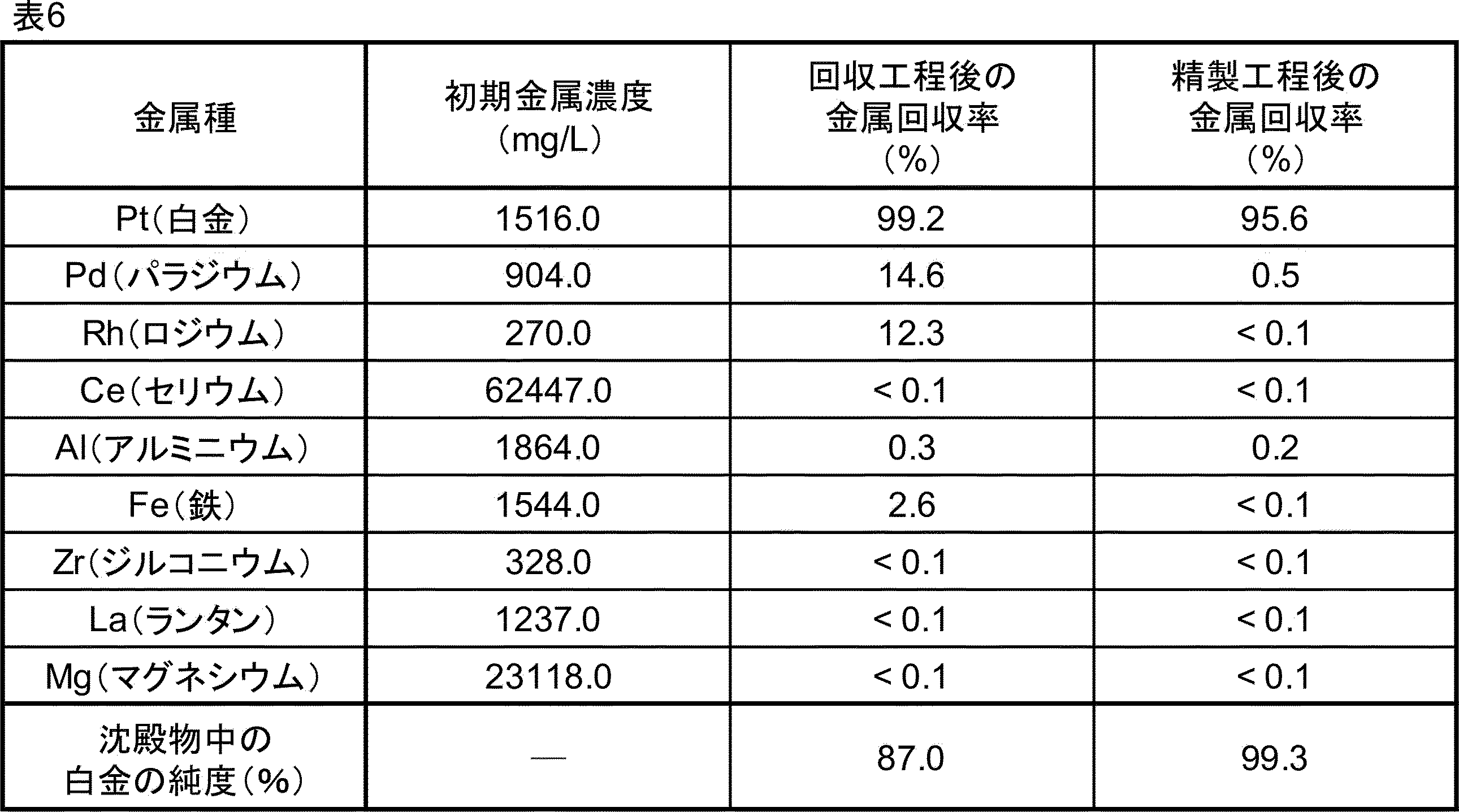
使用済み自動車排ガス浄化触媒からの白金族金属の回収を想定し、表6に示す種々の金属を含む触媒浸出液を用いて、白金の回収を行った。
前記触媒浸出液(塩酸を含み、塩酸濃度は8mol/Lである。)に、白金族金属回収剤として1,4-ビス(アミノメチル)シクロヘキサン(1,4-BACT、トランス体93%、シス体7%)を白金に対して15倍量(mol/mol)添加した。なお、ここで用いた1,4-ビス(アミノメチル)シクロヘキサンは塩酸塩である。その後、25℃で10分間振とうして沈殿物を得た。得られた沈殿物をろ過にて回収後、1mol/Lの塩酸に溶解させてICPにて分析し、沈殿物に含まれる金属の量を算出した。
本回収工程後の各金属の回収率を表6に示す。表6から明らかなように、白金族金属回収剤として1,4-ビス(アミノメチル)シクロヘキサンを用いることで、触媒浸出液から、白金が選択的に沈殿物として回収できることがわかる。沈殿物中に含まれる白金の純度は全金属重量を100%としたときに、87.0%であった。
なお、表6中、「<0.1」は「0.1未満」を意味する。
次に前記の方法で触媒浸出液から回収された白金の精製を行った。
前記の方法で回収された沈殿物を5mol/Lの塩酸に溶解した(白金濃度500mg/L)。得られた塩酸溶液に、白金族金属回収剤として1,4-ビス(アミノメチル)シクロヘキサン(1,4-BACT、トランス体93%、シス体7%)を白金に対して15倍量(mol/mol)添加した。なお、ここで用いた1,4-ビス(アミノメチル)シクロヘキサンは塩酸塩である。その後、25℃で10分間振とうして沈殿物を得た。得られた沈殿物をろ過にて回収後、1mol/Lの塩酸に溶解させてICPにて分析し、沈殿物に含まれる金属の量を算出した。
本精製工程後の各金属の回収率を表6に示す。表6から明らかなように、精製工程後では、沈殿物に含まれるパラジウムとロジウムの量が大きく低下している。沈殿物中に含まれる白金の純度は全金属重量を100%としたときに、回収工程後では87.0%であったのに対し、精製工程後では99.3%であった。この結果から明らかなように、白金族金属回収剤として1,4-ビス(アミノメチル)シクロヘキサンを用いることで、白金を主成分とする塩酸溶液から不純物である金属を除去して白金を精製することができる。
<実施例8:白金族金属の回収>
パラジウムを5mmol/L、白金を5mmol/L含む8mol/Lの塩酸溶液に、白金族金属回収剤として2,5-ビス(アミノメチル)テトラヒドロフラン(H-AMF)を白金に対して100倍量(mol/mol)添加した。なお、ここで用いた2,5-ビス(アミノメチル)テトラヒドロフランは塩酸塩である。その後、25℃で30分間振とうして沈殿物を得た。得られた沈殿物と溶液を遠心分離により固液分離した。固液分離後に得られた溶液をICPにて分析し、沈殿物に含まれる白金族金属の量を算出した。
その結果、白金を56%沈殿物として回収することができた。これに対し、パラジウムは7.2%沈殿物として回収され、沈殿物として選択的に白金を回収できることがわかる。
Claims (11)
- 下記一般式(1)で示される白金族金属回収剤。

(式(1)中、Xはメチレン基、酸素原子又はエチレン基であり、Xがメチレン基のとき、nは3、Xが酸素原子又はエチレン基のとき、nは2である。) - 1,4-ビス(アミノメチル)シクロヘキサン及び2,5-ビス(アミノメチル)テトラヒドロフランからなる群より選ばれる少なくとも1種である、請求項1に記載の白金族金属回収剤。
- 1,4-ビス(アミノメチル)シクロヘキサンである、請求項1又は2に記載の白金族金属回収剤。
- トランス体が60%以上である、請求項3に記載の白金族金属回収剤。
- 請求項1~4のいずれか1つに記載の白金族金属回収剤を用いて、白金を含む塩酸溶液から白金を回収する、白金族金属回収方法。
- 前記白金族金属回収剤と前記塩酸溶液を混合し、白金を沈殿させる、請求項5に記載の白金族金属回収方法。
- 前記白金を含む塩酸溶液が、パラジウム及びロジウムからなる群より選ばれる少なくとも一種を含む、請求項5又は6に記載の白金族金属回収方法。
- 前記白金を含む塩酸溶液が、パラジウムを含む、請求項5~7のいずれか1つに記載の白金族金属回収方法。
- 前記白金族金属回収剤と前記白金を含む塩酸溶液に含まれる白金とのモル比[白金族金属回収剤/白金]を2以上とする、請求項5~8のいずれか1つに記載の白金族金属回収方法。
- 請求項1~4のいずれか1つに記載の白金族金属回収剤を用いて、白金を主成分とする塩酸溶液から不純物である金属を除去して白金を精製する、白金族金属精製方法。
- 下記一般式(1)で示される化合物の白金族金属回収剤としての使用。
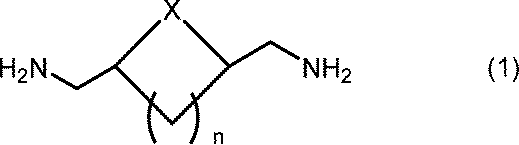
(式(1)中、Xはメチレン基、酸素原子又はエチレン基であり、Xがメチレン基のとき、nは3、Xが酸素原子又はエチレン基のとき、nは2である。)
Priority Applications (3)
| Application Number | Priority Date | Filing Date | Title |
|---|---|---|---|
| CN202380018374.3A CN118591645A (zh) | 2022-02-01 | 2023-01-05 | 铂族金属回收剂及铂族金属回收方法 |
| EP23749470.3A EP4474500A4 (en) | 2022-02-01 | 2023-01-05 | PLATINUM GROUP METAL RECOVERY AGENT AND METHOD FOR RECOVERING PLATINUM GROUP METAL |
| US18/832,701 US20250162976A1 (en) | 2022-02-01 | 2023-01-05 | Platinum-group metal recovery agent and platinum-group metal recovery method |
Applications Claiming Priority (2)
| Application Number | Priority Date | Filing Date | Title |
|---|---|---|---|
| JP2022014362A JP2023112519A (ja) | 2022-02-01 | 2022-02-01 | 白金族金属回収剤及び白金族金属回収方法 |
| JP2022-014362 | 2022-02-01 |
Publications (1)
| Publication Number | Publication Date |
|---|---|
| WO2023149153A1 true WO2023149153A1 (ja) | 2023-08-10 |
Family
ID=87552301
Family Applications (1)
| Application Number | Title | Priority Date | Filing Date |
|---|---|---|---|
| PCT/JP2023/000098 Ceased WO2023149153A1 (ja) | 2022-02-01 | 2023-01-05 | 白金族金属回収剤及び白金族金属回収方法 |
Country Status (5)
| Country | Link |
|---|---|
| US (1) | US20250162976A1 (ja) |
| EP (1) | EP4474500A4 (ja) |
| JP (1) | JP2023112519A (ja) |
| CN (1) | CN118591645A (ja) |
| WO (1) | WO2023149153A1 (ja) |
Families Citing this family (1)
| Publication number | Priority date | Publication date | Assignee | Title |
|---|---|---|---|---|
| WO2025254056A1 (ja) * | 2024-06-03 | 2025-12-11 | 三菱瓦斯化学株式会社 | 金属-炭素触媒の製造方法 |
Citations (5)
| Publication number | Priority date | Publication date | Assignee | Title |
|---|---|---|---|---|
| JPH11335335A (ja) * | 1998-05-27 | 1999-12-07 | Mitsubishi Gas Chem Co Inc | トランス型1,4−ビス (アミノメチル) シクロヘキサンの製造方法 |
| JP2004131745A (ja) * | 2002-10-08 | 2004-04-30 | Sumitomo Metal Mining Co Ltd | 白金族元素の分離回収方法 |
| WO2015016103A1 (ja) * | 2013-08-01 | 2015-02-05 | 株式会社クラレ | 吸着材及びその製造方法 |
| JP2017179409A (ja) | 2016-03-28 | 2017-10-05 | 国立大学法人秋田大学 | ロジウム回収剤及びロジウム回収方法 |
| JP2019206747A (ja) | 2018-05-30 | 2019-12-05 | 国立研究開発法人産業技術総合研究所 | 白金族金属の沈殿分離法 |
Family Cites Families (3)
| Publication number | Priority date | Publication date | Assignee | Title |
|---|---|---|---|---|
| MX9709471A (es) * | 1995-06-07 | 1998-02-28 | Univ Washington | Complejos metalicos multidentados y metodos para preparar y usar los mismos. |
| EP0866053B1 (en) * | 1997-03-17 | 2001-06-13 | Mitsubishi Gas Chemical Company, Inc. | Process for producing trans 1,4-bis(aminomethyl)cyclohexane |
| EP3696172B1 (en) * | 2017-10-11 | 2023-05-31 | Mitsubishi Gas Chemical Company, Inc. | Method for producing 2,5-bis (aminomethyl) tetrahydrofuran |
-
2022
- 2022-02-01 JP JP2022014362A patent/JP2023112519A/ja active Pending
-
2023
- 2023-01-05 EP EP23749470.3A patent/EP4474500A4/en active Pending
- 2023-01-05 CN CN202380018374.3A patent/CN118591645A/zh active Pending
- 2023-01-05 WO PCT/JP2023/000098 patent/WO2023149153A1/ja not_active Ceased
- 2023-01-05 US US18/832,701 patent/US20250162976A1/en active Pending
Patent Citations (5)
| Publication number | Priority date | Publication date | Assignee | Title |
|---|---|---|---|---|
| JPH11335335A (ja) * | 1998-05-27 | 1999-12-07 | Mitsubishi Gas Chem Co Inc | トランス型1,4−ビス (アミノメチル) シクロヘキサンの製造方法 |
| JP2004131745A (ja) * | 2002-10-08 | 2004-04-30 | Sumitomo Metal Mining Co Ltd | 白金族元素の分離回収方法 |
| WO2015016103A1 (ja) * | 2013-08-01 | 2015-02-05 | 株式会社クラレ | 吸着材及びその製造方法 |
| JP2017179409A (ja) | 2016-03-28 | 2017-10-05 | 国立大学法人秋田大学 | ロジウム回収剤及びロジウム回収方法 |
| JP2019206747A (ja) | 2018-05-30 | 2019-12-05 | 国立研究開発法人産業技術総合研究所 | 白金族金属の沈殿分離法 |
Non-Patent Citations (1)
| Title |
|---|
| See also references of EP4474500A4 |
Also Published As
| Publication number | Publication date |
|---|---|
| CN118591645A (zh) | 2024-09-03 |
| JP2023112519A (ja) | 2023-08-14 |
| US20250162976A1 (en) | 2025-05-22 |
| EP4474500A1 (en) | 2024-12-11 |
| EP4474500A4 (en) | 2025-10-08 |
Similar Documents
| Publication | Publication Date | Title |
|---|---|---|
| JP2013508566A (ja) | 貴金属の回収法 | |
| CN101045962A (zh) | 使用肼的含硒废液中的铂的回收方法 | |
| JP2016507637A (ja) | スカンジウム高含有のスカンジウム含有固体材料の生産方法 | |
| WO2023149153A1 (ja) | 白金族金属回収剤及び白金族金属回収方法 | |
| CA2618929C (en) | Method for recovering rhodium | |
| JP5339068B2 (ja) | ルテニウムの精製回収方法 | |
| TWI391495B (zh) | Rhodium recovery method | |
| JP5447824B2 (ja) | 亜硝酸ロジウム錯イオン溶液の精製方法と、そのアンモニウム塩の製造方法。 | |
| JP4259165B2 (ja) | コバルトとカルシウムを含む硫酸ニッケル水溶液の精製方法 | |
| JP7017780B2 (ja) | ロジウム回収方法 | |
| JP7737104B2 (ja) | 白金族金属回収剤及び白金族金属回収方法 | |
| JP4100696B2 (ja) | Rh溶液からのTe分離方法 | |
| CN116888287B (zh) | 铂族金属回收剂及铂族金属回收方法 | |
| JP2009097024A (ja) | ロジウムの精製方法 | |
| JP2004143527A (ja) | 液中の白金とパラジウムの除去方法 | |
| JP3666337B2 (ja) | パラジウムの回収方法 | |
| CN108754162A (zh) | 一种回收湿法废水中贵金属的绿色回收方法 | |
| JP4422835B2 (ja) | ルテニウムの精製法 | |
| JP2007154252A (ja) | ロジウムの回収方法 | |
| JP5413564B2 (ja) | ロジウムと銅を含む水溶液からの銅の分離方法 | |
| JP7808516B2 (ja) | セレンの回収方法 | |
| JP5772628B2 (ja) | ロジウム精製廃液からのロジウム回収方法 | |
| CN108640390B (zh) | 一种含锑废水的处理方法 | |
| JP2025109399A (ja) | ロジウムの回収方法 | |
| JP4872097B2 (ja) | ガリウム含有溶液の精製方法 |
Legal Events
| Date | Code | Title | Description |
|---|---|---|---|
| 121 | Ep: the epo has been informed by wipo that ep was designated in this application |
Ref document number: 23749470 Country of ref document: EP Kind code of ref document: A1 |
|
| WWE | Wipo information: entry into national phase |
Ref document number: 202380018374.3 Country of ref document: CN |
|
| WWE | Wipo information: entry into national phase |
Ref document number: 18832701 Country of ref document: US |
|
| WWE | Wipo information: entry into national phase |
Ref document number: 2023749470 Country of ref document: EP |
|
| NENP | Non-entry into the national phase |
Ref country code: DE |
|
| ENP | Entry into the national phase |
Ref document number: 2023749470 Country of ref document: EP Effective date: 20240902 |
|
| WWP | Wipo information: published in national office |
Ref document number: 18832701 Country of ref document: US |