WO2023163232A1 - ゴム組成物及びゴム製品 - Google Patents
ゴム組成物及びゴム製品 Download PDFInfo
- Publication number
- WO2023163232A1 WO2023163232A1 PCT/JP2023/007429 JP2023007429W WO2023163232A1 WO 2023163232 A1 WO2023163232 A1 WO 2023163232A1 JP 2023007429 W JP2023007429 W JP 2023007429W WO 2023163232 A1 WO2023163232 A1 WO 2023163232A1
- Authority
- WO
- WIPO (PCT)
- Prior art keywords
- rubber
- rubber composition
- metal salt
- heterocyclic compound
- composition according
- Prior art date
- Legal status (The legal status is an assumption and is not a legal conclusion. Google has not performed a legal analysis and makes no representation as to the accuracy of the status listed.)
- Ceased
Links
Classifications
-
- C—CHEMISTRY; METALLURGY
- C08—ORGANIC MACROMOLECULAR COMPOUNDS; THEIR PREPARATION OR CHEMICAL WORKING-UP; COMPOSITIONS BASED THEREON
- C08K—Use of inorganic or non-macromolecular organic substances as compounding ingredients
- C08K5/00—Use of organic ingredients
- C08K5/16—Nitrogen-containing compounds
- C08K5/34—Heterocyclic compounds having nitrogen in the ring
- C08K5/3467—Heterocyclic compounds having nitrogen in the ring having more than two nitrogen atoms in the ring
- C08K5/3477—Six-membered rings
-
- B—PERFORMING OPERATIONS; TRANSPORTING
- B60—VEHICLES IN GENERAL
- B60C—VEHICLE TYRES; TYRE INFLATION; TYRE CHANGING; CONNECTING VALVES TO INFLATABLE ELASTIC BODIES IN GENERAL; DEVICES OR ARRANGEMENTS RELATED TO TYRES
- B60C1/00—Tyres characterised by the chemical composition or the physical arrangement or mixture of the composition
-
- C—CHEMISTRY; METALLURGY
- C08—ORGANIC MACROMOLECULAR COMPOUNDS; THEIR PREPARATION OR CHEMICAL WORKING-UP; COMPOSITIONS BASED THEREON
- C08K—Use of inorganic or non-macromolecular organic substances as compounding ingredients
- C08K3/00—Use of inorganic substances as compounding ingredients
- C08K3/16—Halogen-containing compounds
-
- C—CHEMISTRY; METALLURGY
- C08—ORGANIC MACROMOLECULAR COMPOUNDS; THEIR PREPARATION OR CHEMICAL WORKING-UP; COMPOSITIONS BASED THEREON
- C08K—Use of inorganic or non-macromolecular organic substances as compounding ingredients
- C08K3/00—Use of inorganic substances as compounding ingredients
- C08K3/30—Sulfur-, selenium- or tellurium-containing compounds
-
- C—CHEMISTRY; METALLURGY
- C08—ORGANIC MACROMOLECULAR COMPOUNDS; THEIR PREPARATION OR CHEMICAL WORKING-UP; COMPOSITIONS BASED THEREON
- C08K—Use of inorganic or non-macromolecular organic substances as compounding ingredients
- C08K5/00—Use of organic ingredients
- C08K5/04—Oxygen-containing compounds
- C08K5/09—Carboxylic acids; Metal salts thereof; Anhydrides thereof
- C08K5/098—Metal salts of carboxylic acids
-
- C—CHEMISTRY; METALLURGY
- C08—ORGANIC MACROMOLECULAR COMPOUNDS; THEIR PREPARATION OR CHEMICAL WORKING-UP; COMPOSITIONS BASED THEREON
- C08L—COMPOSITIONS OF MACROMOLECULAR COMPOUNDS
- C08L23/00—Compositions of homopolymers or copolymers of unsaturated aliphatic hydrocarbons having only one carbon-to-carbon double bond; Compositions of derivatives of such polymers
- C08L23/02—Compositions of homopolymers or copolymers of unsaturated aliphatic hydrocarbons having only one carbon-to-carbon double bond; Compositions of derivatives of such polymers not modified by chemical after-treatment
- C08L23/16—Ethylene-propylene or ethylene-propylene-diene copolymers
-
- C—CHEMISTRY; METALLURGY
- C08—ORGANIC MACROMOLECULAR COMPOUNDS; THEIR PREPARATION OR CHEMICAL WORKING-UP; COMPOSITIONS BASED THEREON
- C08L—COMPOSITIONS OF MACROMOLECULAR COMPOUNDS
- C08L7/00—Compositions of natural rubber
-
- C—CHEMISTRY; METALLURGY
- C08—ORGANIC MACROMOLECULAR COMPOUNDS; THEIR PREPARATION OR CHEMICAL WORKING-UP; COMPOSITIONS BASED THEREON
- C08L—COMPOSITIONS OF MACROMOLECULAR COMPOUNDS
- C08L9/00—Compositions of homopolymers or copolymers of conjugated diene hydrocarbons
- C08L9/06—Copolymers with styrene
-
- C—CHEMISTRY; METALLURGY
- C08—ORGANIC MACROMOLECULAR COMPOUNDS; THEIR PREPARATION OR CHEMICAL WORKING-UP; COMPOSITIONS BASED THEREON
- C08K—Use of inorganic or non-macromolecular organic substances as compounding ingredients
- C08K3/00—Use of inorganic substances as compounding ingredients
- C08K3/18—Oxygen-containing compounds, e.g. metal carbonyls
- C08K3/20—Oxides; Hydroxides
- C08K3/22—Oxides; Hydroxides of metals
- C08K2003/2296—Oxides; Hydroxides of metals of zinc
-
- C—CHEMISTRY; METALLURGY
- C08—ORGANIC MACROMOLECULAR COMPOUNDS; THEIR PREPARATION OR CHEMICAL WORKING-UP; COMPOSITIONS BASED THEREON
- C08K—Use of inorganic or non-macromolecular organic substances as compounding ingredients
- C08K2201/00—Specific properties of additives
- C08K2201/014—Additives containing two or more different additives of the same subgroup in C08K
Definitions
- the present invention relates to rubber compositions and rubber products.
- Patent Documents 1 and 2 below disclose a rubber composition containing a diene rubber, a filler such as carbon black or silica, and a tetrazine compound. Introduced into the rubber composition to improve the dispersibility of the filler, thereby improving the fuel efficiency of the rubber composition.
- an object of the present invention is to solve the above-described problems of the prior art and to provide a rubber composition that achieves both low fuel consumption and durability.
- Another object of the present invention is to provide a rubber product that achieves both low fuel consumption and durability.
- the gist configuration of the rubber composition and rubber product of the present invention for solving the above problems is as follows.
- a diene rubber A
- a heterocyclic compound (B) having at least one heterocyclic ring selected from the group consisting of a pyrimidine ring, a pyridazine ring, a pyrazine ring, a triazine ring, and a tetrazine ring
- a metal salt (C) A rubber composition, wherein the bond dissociation energy between the metal salt (C) and the heterocyclic compound (B) is 200 kJ/mol or more.
- the heterocyclic compound (B) has the following general formula (1): [In the formula, X 1 and X 2 are each independently a pyridyl group or a pyrimidinyl group, and Y 1 and Y 2 are each independently a single bond or a divalent hydrocarbon group. ], The rubber composition according to [4].
- the metal salt (C) is a metal salt other than zinc oxide;
- a rubber product selected from the group consisting of tires, rubber crawlers, and seismic isolation rubbers A rubber product comprising the rubber composition according to any one of [1] to [13].
- the rubber composition of the present invention comprises a diene rubber (A) and a heterocyclic compound ( B) and a metal salt (C).
- the rubber composition of the present invention is characterized in that the bond dissociation energy between the metal salt (C) and the heterocyclic compound (B) is 200 kJ/mol or more.
- the heterocyclic compound (B) is added to the main chain of the diene rubber (A).
- the metal salt (C) coordinates with the heterocyclic compound (B) portion added to the main chain of the diene rubber (A) to form a complex. Then, the metal salt (C) forms a plurality of coordinate bonds, thereby cross-linking the plurality of diene rubbers (A).
- cross-linking by coordination bonds is reversible cross-linking in which bonding (cross-linking) and dissociation (cleavage) are reversible, and is a weaker bond than sulfur cross-linking in general cross-linked rubber, but the present invention
- the bond dissociation energy between the metal salt (C) and the heterocyclic compound (B) is 200 kJ / mol or more, so even if the rubber composition is strained, in the low strain region has sufficient strength.
- the rubber composition of the present invention can reduce hysteresis loss and improve fuel economy by maintaining a high network density through cross-linking by coordination bonds.
- the rubber composition of the present invention in the high strain region, the crosslinks due to the coordinate bonds are cleaved, resulting in a high hysteresis loss, and the energy due to the cleavage of the crosslinks (that is, the sacrificial destruction of the crosslinks due to the coordinate bonds) Dissipation can improve durability such as crack growth resistance. Therefore, the rubber composition of the present invention can achieve both high fuel efficiency and durability, which cannot be achieved by conventional cross-linking using only sulfur.
- the rubber composition of the present invention contains a diene rubber (A).
- A diene rubber
- the diene rubber (A) in the rubber composition, it is possible to form a crosslinked structure together with the heterocyclic compound (B) and the metal salt (C).
- the diene-based rubber (A) is a rubber containing units derived from a diene-based monomer (diene-based units), and may further include units derived from a copolymerizable comonomer.
- the unit derived from the diene-based monomer enables cross-linking (vulcanization) of the diene-based rubber, and can exhibit rubber-like elongation and strength.
- the diene rubber usually exists in a crosslinked state, but a part of the diene rubber may not be crosslinked.
- diene-based monomers include 1,3-butadiene, isoprene, 1,3-pentadiene, 2,3-dimethyl-1,3-butadiene, and the like.
- examples of the copolymerizable comonomer include aromatic vinyl compounds.
- aromatic vinyl compound include styrene, o-methylstyrene, m-methylstyrene, p-methylstyrene, o,p-dimethylstyrene, o-ethylstyrene, m-ethylstyrene and p-ethylstyrene. etc.
- diene rubber (A) examples include natural rubber (NR), synthetic isoprene rubber (IR), styrene-butadiene rubber (SBR), butadiene rubber (BR), chloroprene rubber (CR), and the like. These diene rubbers (A) may be used singly or as a blend of two or more.
- the diene rubber (A) preferably has a weight average molecular weight (Mw) of 10,000 to 3,000,000.
- Mw weight average molecular weight
- the fuel efficiency of the rubber composition is improved, and when it is 3,000,000 or less, the rubber composition is kneaded. Workability in is improved.
- the weight average molecular weight (Mw) of the diene rubber (A) is more preferably 100,000 or more, and even more preferably 120,000 or more. From the viewpoint of workability in kneading the rubber composition, it is more preferably 2,000,000 or less, and even more preferably 1,800,000 or less.
- the rubber composition of the present invention contains a heterocyclic compound (B) having at least one heterocyclic ring selected from the group consisting of pyrimidine ring, pyridazine ring, pyrazine ring, triazine ring and tetrazine ring.
- the pyrimidine ring, pyridazine ring, pyrazine ring, triazine ring, and tetrazine ring have multiple nitrogen atoms in the ring and can coordinate with multiple metal salts (C).
- the heterocyclic compound (B) can crosslink a plurality of diene rubbers (A) together with the metal salt (C).
- the heterocyclic compound (B) is used not as a filler dispersant but as a coordination field for the metal salt (C) to form crosslinks by coordination bonds.
- the metal salt (C) to form crosslinks by coordination bonds.
- cross-linking by coordinate bonds keeps the network density high, thereby improving fuel efficiency.
- energy dissipation due to cleavage of crosslinks by coordinate bonds can improve durability such as crack growth resistance.
- the heterocyclic compound (B) preferably has a triazine ring or a tetrazine ring.
- a compound having a triazine ring or a tetrazine ring has high reactivity with the main chain of the diene rubber (A), and easily forms crosslinks by coordination bonds in combination with the metal salt (C).
- the compound having a triazine ring or a tetrazine ring preferably has a pyridyl group or a pyrimidinyl group bonded to the triazine ring or the tetrazine ring, and more preferably has two pyridyl groups or pyrimidinyl groups bonded. preferable.
- the heterocyclic compound (B) and the metal salt (C) are more easily complexed, the bond dissociation energy is likely to be higher, and the strength can form a crosslinked structure with a high
- the heterocyclic compound (B) and the metal salt (C) are more easily complexed, and the bond dissociation energy is further increased. It tends to be high, and a crosslinked structure with even higher strength can be formed.
- the pyridyl group may be a 2-pyridyl group, a 3-pyridyl group, or a 4-pyridyl group, but is preferably a 2-pyridyl group.
- the pyrimidinyl group may be a 2-pyrimidinyl group, a 4-pyrimidinyl group, or a 5-pyrimidinyl group.
- the heterocyclic compound (B) has the following general formula (1): [In the formula, X 1 and X 2 are each independently a pyridyl group or a pyrimidinyl group, and Y 1 and Y 2 are each independently a single bond or a divalent hydrocarbon group. ] is preferably represented.
- the compound represented by the general formula (1) readily undergoes a Diels-Alder reaction with the main chain of the diene rubber (A), and in combination with the metal salt (C), further forms crosslinks through coordination bonds. easy to do
- the compound represented by the general formula (1) and the metal salt (C) are particularly easy to form a complex, the bond dissociation energy is particularly easy to become high, and a crosslinked structure with even higher strength can be formed.
- X 1 and X 2 are each independently a pyridyl group or a pyrimidinyl group. From the viewpoint of ease of synthesis, X 1 and X 2 are preferably pyridyl groups.
- the pyridyl group may be a 2-pyridyl group, a 3-pyridyl group, or a 4-pyridyl group, but is preferably a 2-pyridyl group.
- the pyrimidinyl group may be a 2-pyrimidinyl group, a 4-pyrimidinyl group, or a 5-pyrimidinyl group.
- Y 1 and Y 2 are each independently a single bond or a divalent hydrocarbon group.
- the divalent hydrocarbon group includes an alkylene group, an alkenylene group, an arylene group, and the like. More specifically, the alkylene group includes methylene group, ethylene group, trimethylene group, tetramethylene group and the like, the alkenylene group includes vinylene group, propenylene group, butenylene group and the like, and the arylene group includes , a phenylene group, a tolylene group, a naphthylene group, and the like. From the viewpoint of ease of synthesis, Y 1 and Y 2 are preferably single bonds (that is, X 1 and X 2 are preferably directly bonded to the tetrazine ring).
- X 1 and X 2 in the general formula (1) are preferably pyridyl groups, and Y 1 and Y 2 are preferably single bonds.
- the compound of the formula (1) is readily available, is particularly easy to complex with the metal salt (C), is particularly likely to have high bond dissociation energy, and can form a stronger crosslinked structure.
- Examples of the compound represented by the general formula (1) include 3,6-di(2-pyridyl)-1,2,4,5-tetrazine, 3,6-di(3-pyridyl)-1,2, 4,5-tetrazine, 3,6-di(4-pyridyl)-1,2,4,5-tetrazine, 3,6-di(2-pyridylmethyl)-1,2,4,5-tetrazine, 3 ,6-di(2-pyridylethyl)-1,2,4,5-tetrazine, 3-(2-pyridylmethyl)-6-(2-pyridylethyl)-1,2,4,5-tetrazine, 3 ,6-di(2-pyrimidinyl)-1,2,4,5-tetrazine, 3,6-di(4-pyrimidinyl)-1,2,4,5-tetrazine, 3,6-di(5-pyrimidinyl) )-1,2,4,5-tetrazine and the like
- the content of the heterocyclic compound (B) in the rubber composition is preferably 0.1 parts by mass or more, more preferably 0.2 parts by mass or more based on 100 parts by mass of the diene rubber (A). , and preferably 10 parts by mass or less, more preferably 5.0 parts by mass or less.
- the content of the heterocyclic compound (B) is 0.1 parts by mass or more with respect to 100 parts by mass of the diene rubber (A)
- the network density of coordinate bond cross-linking increases, resulting in a low strain region.
- the hysteresis loss in is further reduced, and the fuel efficiency of the rubber composition is improved.
- the content of the heterocyclic compound (B) is 10 parts by mass or less with respect to 100 parts by mass of the diene rubber (A)
- the diene rubber (A) is preferably modified with the heterocyclic compound (B).
- the diene rubber (A) is modified with the heterocyclic compound (B)
- multiple heterocyclic compound (B) moieties simply form a coordination bond by complexing with the metal salt (C) described later.
- the modification of the diene rubber (A) with the heterocyclic compound (B) may be performed at the stage of compounding the rubber composition.
- the diene rubber (A) is previously modified with the heterocyclic compound (B), and the diene rubber (A) modified with the heterocyclic compound (B) is used.
- it may be compounded with a metal salt (C) or the like to crosslink between main chains of a plurality of diene rubbers (A).
- the heterocyclic compound (B) is added to the monomer units in the main chain of the diene rubber (A). It is preferably bound in an amount of 0.01 to 10 mol%, more preferably 0.02 to 8 mol%, even more preferably 0.03 to 5 mol%, even more preferably 0.03 to 3 mol%. is particularly preferred.
- the heterocyclic compound (B) is bonded in an amount of 0.01 mol% or more with respect to the monomer units in the main chain of the diene rubber (A)
- the network density of coordinate bond cross-linking increases, The hysteresis loss in the low strain region is further reduced, and the fuel efficiency of the rubber composition is improved.
- the heterocyclic compound (B) is bonded in an amount of 10 mol % or less to the monomer units in the main chain of the diene rubber (A), a crosslinked rubber having sufficient elastomeric properties can be obtained. easy.
- the rubber composition of the present invention contains metal salt (C).
- the plurality of diene rubbers (A) are crosslinked by the formation of coordinate bonds between the metal salt (C) and the plurality of heterocyclic compounds (B).
- the cross-linking by coordination bond is a reversible cross-linking in which bonding (cross-linking) and dissociation (cleavage) are reversible, is a cross-linking with relatively low bond dissociation energy, and can be reversibly regenerated even if broken by an external stimulus. is.
- the metal salt (C) preferably contains a transition metal.
- a metal salt containing a transition metal is easily complexed with the heterocyclic compound (B).
- transition metals include elements of groups 7 to 11 of the periodic table. Specifically, manganese, rhenium, etc. are mentioned as elements of Group 7 of the periodic table. Moreover, iron, ruthenium, osmium, etc. are mentioned as an element of periodic table 8 group. In addition, cobalt, rhodium, iridium, and the like are listed as elements of Group 9 of the periodic table. Moreover, nickel, palladium, platinum, etc. are mentioned as an element of periodic table 10 group. Moreover, copper etc. are mentioned as an element of periodic table 11 group.
- the metal salt (C) contains an element of Group 8 of the periodic table, the bond with the heterocyclic compound (B) is likely to become even stronger.
- the metal ion in the metal salt (C) is not particularly limited, and can be any valence that each element can have, but preferably has a valence of 2 or higher.
- the metal salt (C) contains iron and/or nickel. Iron ions and nickel ions tend to bond particularly strongly with the heterocyclic compound (B), and can form a stronger crosslinked structure.
- the valence of iron ions is preferably bivalent (Fe 2+ ) or trivalent (Fe 3+ ).
- metal salt (C) examples include metal halides, metal sulfates, metal nitrates, and metal acetates. Among these, metal halides and metal acetates are preferred. Halide metal salts and metal acetate salts are easy to handle and easily form a bond with the heterocyclic compound (B).
- the form of the metal salt (C) is not particularly limited, and may be, for example, a hydrate.
- metal halide salts examples include metal fluoride salts, metal chloride salts, metal bromide salts, and metal iodide salts. Among these, metal chloride salts are preferred.
- a metal chloride salt is easy to handle, and more likely to form a bond with the heterocyclic compound (B).
- the metal salt (C) include FeCl 2 , FeCl 2.4H 2 O, FeCl 3 , FeCl 3.6H 2 O, Ni(CH 3 COO) 2.4H 2 O, and the like. Also, the metal salt (C) may be used alone or in combination of two or more.
- the metal salt (C) is preferably other than metal oxides, metal carbonates, and metal salts of fatty acids having 10 or more carbon atoms.
- the metal salt (C) other than metal oxides, metal carbonates, and metal salts of fatty acids having 10 or more carbon atoms further forms a coordinate bond with the heterocyclic compound (B) portion added to the diene rubber (A) chain. (Furthermore, it is easy to complex). Therefore, by using a metal salt (C) other than these, it becomes easier to form crosslinks by coordination bonds.
- the content of the metal salt (C) is preferably in the range of 0.1 to 30 parts by mass, more preferably in the range of 0.1 to 15 parts by mass, with respect to 100 parts by mass of the diene rubber (A).
- a range of 0.1 to 10 parts by mass is more preferable, and a range of 0.1 to 5 parts by mass is particularly preferable.
- the content of the metal salt (C) is 0.1 parts by mass or more with respect to 100 parts by mass of the diene rubber (A)
- the network density of coordination bond crosslinks increases, and hysteresis in the low strain region The loss is further reduced, and the fuel efficiency of the rubber composition is improved.
- the content of the metal salt (C) is 30 parts by mass or less with respect to 100 parts by mass of the diene rubber (A)
- the bond dissociation energy between the metal salt (C) and the heterocyclic compound (B) is 200 kJ/mol or more, preferably 240 kJ/mol or more, Moreover, it is preferably 500 kJ/mol or less.
- the bond dissociation energy is 200 kJ/mol or more, the rubber composition has sufficient strength in the low strain region, and the fuel efficiency of the rubber composition can be sufficiently improved.
- the bond dissociation energy is 500 kJ/mol or less
- the cross-linking due to the coordination bond between the metal salt (C) and the heterocyclic compound (B) is easily cleaved in the high strain region, and the cross-linking
- the energy dissipation due to the cleavage of the rubber composition can further improve durability such as crack propagation resistance.
- the bond dissociation energy between the metal salt (C) and the heterocyclic compound (B) is M06/6-31G(d, p)//B3PW91-D3/6-31G(d , p) level or M06/6-31G(d, p) level, which is a value calculated in a vacuum and is a calculated value in a structure in which the heterocyclic compound (B) is bonded to the diene rubber (A) . It is considered that the metal salt (C) and the heterocyclic compound (B) form an ionic aggregate. Gaussian09 and GRRM14 can be used to calculate the bond dissociation energy.
- cross-linking can be formed by coordinate bonding.
- conditions such as temperature and time can be appropriately selected according to the type and reactivity of the diene rubber (A), heterocyclic compound (B), and metal salt (C) used. preferable.
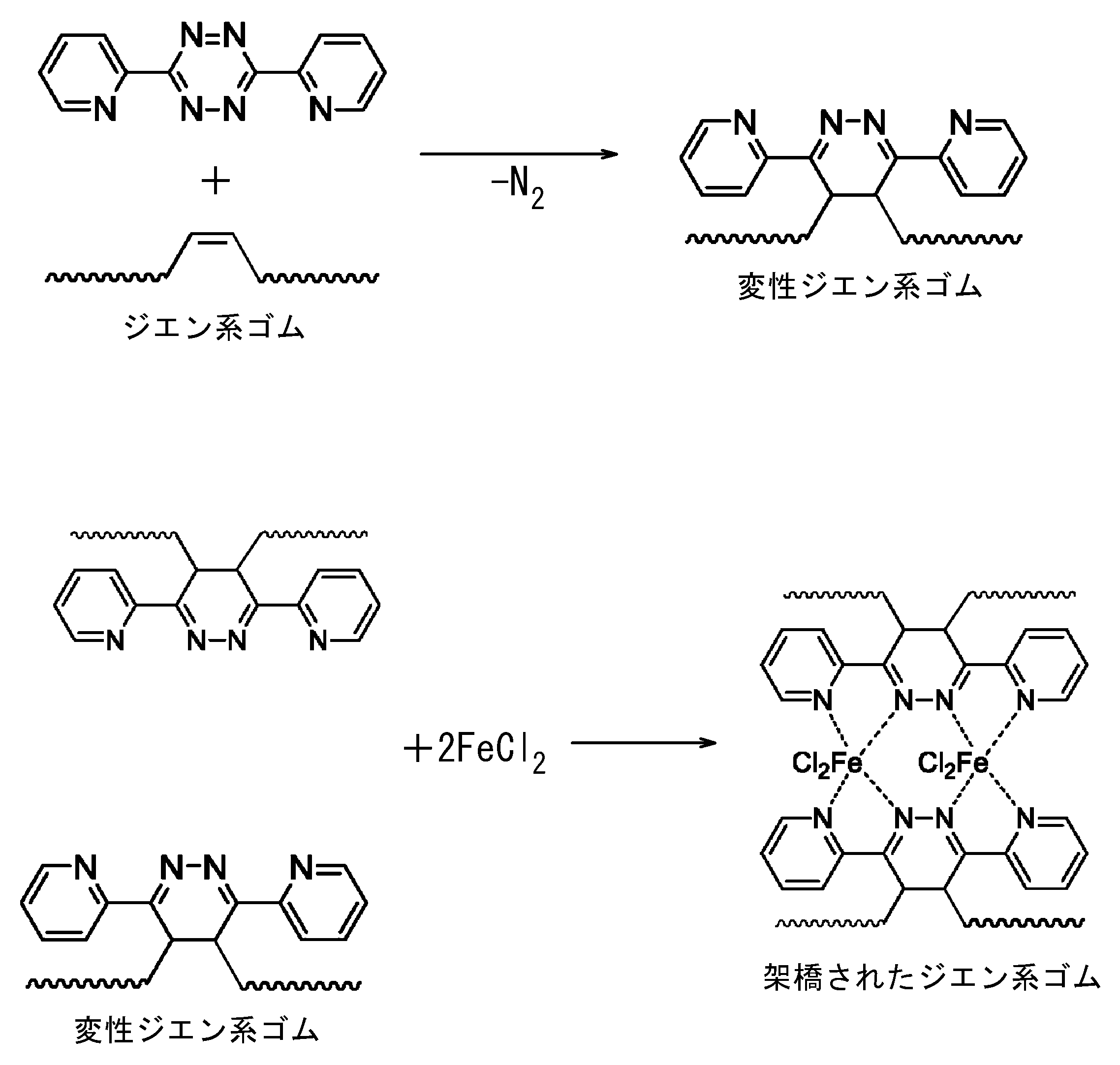
- heterocyclic compound (B) 3,6-di(2-pyridyl)-1,2,4,5-tetrazine is used as the heterocyclic compound (B), and iron chloride (FeCl 2 ) is used as the metal salt (C).
- a reaction scheme of modification of the diene rubber (A) and coordination bond cross-linking (complexation) of the modified diene rubber when used is shown below. Note that the structure of the modified diene-based rubber shown here is only one possible example, and is not limited to this, and may be, for example, tautomeric isomers or oxidized forms.
- the main chain of the diene rubber (A) and the heterocyclic compound (B) undergo a Diels-Alder reaction to form a modified diene system. produce rubber.
- nitrogen is eliminated during the Diels-Alder reaction, but any other reaction may be used for the modification reaction.
- the modified diene-based rubber and the metal salt (C) are complexed to form a diene crosslinked by coordination bonds.
- system rubber complexed diene-based rubber
- the nitrogen atom in the tetrazine residue, the nitrogen atom of the pyridyl group that binds to the tetrazine residue, and the iron ion are complexed.
- the diene rubber can take various forms of cross-linking.
- the rubber composition of the present invention preferably further contains sulfur (D). Since the rubber composition contains sulfur (D) together with the metal salt (C), cross-linking due to coordination bonds by the metal salt (C) and sulfur cross-linking are present in the rubber composition after cross-linking. (Dual Cross Link: DCL). In the low-strain region, the mesh density is kept higher by both cross-linking by coordination bonds and sulfur cross-linking, thereby further reducing hysteresis loss and further improving fuel efficiency.
- DCL Direct Cross Link
- the content of the sulfur (D) in the rubber composition is preferably 0.1 parts by mass or more, more preferably 0.3 parts by mass or more, relative to 100 parts by mass of the diene rubber (A). 30 parts by mass or less is preferable, and 10 parts by mass or less is more preferable.
- the sulfur improves the network density, further improving fuel efficiency.
- the content of sulfur (D) is 30 parts by mass or less with respect to 100 parts by mass of the diene rubber (A)
- a crosslinked rubber having sufficient elastomeric properties can be easily obtained.
- the mass ratio (D/C) of the sulfur (D) and the metal salt (C) is preferably 0.1-10.
- the mass ratio (D/C) of sulfur (D) and metal salt (C) is within the range of 0.1 to 10, the rubber composition has a better balance between fuel efficiency and durability.
- the mass ratio (D/C) of sulfur (D) and metal salt (C) is more preferably in the range of 0.1 to 8. A range of 0.1 to 6 is even more preferred.
- the mass ratio (D/C') of the sulfur (D) and the metal salt (C') other than zinc oxide is preferably 0.1-10.
- the rubber composition of the present invention when the metal salt (C) is a metal salt other than zinc oxide, the rubber composition preferably further contains zinc oxide (E).
- the rubber composition contains zinc oxide (E) together with a metal salt other than zinc oxide, the fuel efficiency and durability of the rubber composition are further improved.
- the content of the zinc oxide (E) in the rubber composition is preferably 0.1 parts by mass or more, more preferably 0.5 parts by mass or more, relative to 100 parts by mass of the diene rubber (A). , is preferably 30 parts by mass or less, more preferably 10 parts by mass or less.
- the mass ratio (E/C') between zinc oxide (E) and metal salt (C') other than zinc oxide is preferably in the range of 0.1-50, more preferably in the range of 1-20.
- the rubber composition of the present invention preferably further contains carbon black (F).
- carbon black (F) By including carbon black (F) in the rubber composition, the reinforcing property of the rubber composition is improved, and the durability is further improved.
- Examples of the carbon black (F) include GPF, FEF, HAF, ISAF, and SAF grade carbon black. These carbon blacks (F) may be used singly or in combination of two or more.
- the content of the carbon black (F) in the rubber composition is preferably 2 parts by mass or more, more preferably 5 parts by mass or more, and 100 parts by mass with respect to 100 parts by mass of the diene rubber (A). Parts or less is preferable, and 90 parts by mass or less is more preferable.
- the content of carbon black (F) is 2 parts by mass or more with respect to 100 parts by mass of the diene rubber (A)
- the reinforcing property of the rubber composition is further improved, and the durability is further improved. do.
- the content of carbon black (F) is 100 parts by mass or less with respect to 100 parts by mass of the diene rubber (A)
- the fuel efficiency of the rubber composition is further improved.
- the rubber composition of the present invention preferably further contains silica (G).
- silica (G) By including silica (G) in the rubber composition, the reinforcing property of the rubber composition is improved, and the durability is further improved.
- silica (G) examples include wet silica (hydrous silicic acid), dry silica (anhydrous silicic acid), calcium silicate, and aluminum silicate. These silicas (G) may be used individually by 1 type, and may be used in combination of 2 or more type.
- the content of the silica (G) in the rubber composition is preferably 2 parts by mass or more, more preferably 5 parts by mass or more, and 100 parts by mass with respect to 100 parts by mass of the diene rubber (A). The following is preferable, and 90 parts by mass or less is more preferable.
- the content of silica (G) is 2 parts by mass or more with respect to 100 parts by mass of the diene rubber (A)
- the reinforcing property of the rubber composition is further improved, and the durability is further improved.
- the content of silica (G) is 100 parts by mass or less with respect to 100 parts by mass of the diene rubber (A)
- the mass ratio (F/G) of carbon black (F) and silica (G) is preferably in the range of 0.02-50, more preferably in the range of 0.05-20.
- the rubber composition of the present invention preferably further contains an organic peroxide (H). Since the rubber composition contains the organic peroxide (H) together with the metal salt (C), cross-linking due to the coordination bond of the metal salt (C) and the organic peroxide ( H) causes a cross-linked structure (CC bond, etc.) to exist (Dual Cross Link: DCL). In the low strain region, the network density is kept higher by both the cross-linking due to the coordination bond and the cross-linking structure caused by the organic peroxide (H), thereby further reducing the hysteresis loss and improving fuel efficiency. can be improved.
- DCL Cross Link
- organic peroxide (H) examples include, but are not limited to, tert-butyl hydroperoxide, 1,1,3,3-tetramethylbutyl hydroperoxide, cumene hydroperoxide, p-menthane hydroperoxide, Diisopropylbenzene hydroperoxide, dicumyl peroxide, di-tert-butyl peroxide, di-tert-hexyl peroxide, diisopropylbenzene hydroperoxide, tert-butylcumyl peroxide, di(2-tert-butylperoxyisopropyl)benzene, 2,5 -dimethyl-2,5-di(tert-butylperoxy)hexane, perbenzoic acid, benzoyl peroxide, 1,1-bis(1,1-dimethylethylperoxy)cyclohexane, 1,1-bis(tert-butylperoxy) ) cyclohexane, 1,1
- the content of the organic peroxide (H) in the rubber composition is preferably 0.1 parts by mass or more, more preferably 0.5 parts by mass or more based on 100 parts by mass of the diene rubber (A). , and preferably 30 parts by mass or less, more preferably 20 parts by mass or less.
- the content of the organic peroxide (H) is 0.1 parts by mass or more with respect to 100 parts by mass of the diene rubber (A)
- the network of the crosslinked structure resulting from the organic peroxide (H) Density is improved, and fuel efficiency is further improved.
- the content of the organic peroxide (H) is 30 parts by mass or less with respect to 100 parts by mass of the diene rubber (A), it is easy to obtain a crosslinked rubber having sufficient elastomeric properties.
- the mass ratio (D/H) of organic peroxide (H) to sulfur (D) is preferably in the range of 0.003-300, more preferably in the range of 0.01-100.
- the rubber composition of the present invention includes the above-described diene rubber (A), heterocyclic compound (B), metal salt (C), sulfur (D), zinc oxide (E), carbon black (F), silica (G), organic peroxides (H), compounding agents commonly used in the rubber industry, such as softeners, stearic acid, waxes, anti-aging agents, silane coupling agents, anti-adhesion agents (fatty acid metal salts), vulcanization accelerators, etc. may be appropriately selected and blended within a range that does not impair the object of the present invention. Commercially available products can be suitably used as these compounding agents.
- the vulcanization accelerator examples include sulfenamide-based vulcanization accelerators, guanidine-based vulcanization accelerators, thiazole-based vulcanization accelerators, thiuram-based vulcanization accelerators, dithiocarbamate-based vulcanization accelerators, and the like. .
- sulfenamide-based vulcanization accelerators are preferred.
- These vulcanization accelerators may be used singly or in combination of two or more.
- the content of the vulcanization accelerator is not particularly limited, and is preferably in the range of 0.1 to 5 parts by mass, and in the range of 0.3 to 3 parts by mass, relative to 100 parts by mass of the diene rubber (A). is more preferred.
- the method for producing the rubber composition is not particularly limited. It can be produced by blending various selected components, kneading, heating, extrusion, or the like.
- the kneading conditions are not particularly limited, and various conditions such as the input volume of the kneading device, the rotation speed of the rotor, the ram pressure, the kneading temperature, the kneading time, the type of the kneading device, etc. It can be selected as appropriate.
- the kneading device include Banbury mixers, intermixes, kneaders, rolls, etc., which are usually used for kneading rubber compositions.
- heating conditions there are no particular restrictions on the heating conditions, and various conditions such as the heating temperature, heating time, and heating device can be appropriately selected according to the purpose.
- the heating device include a heating roll machine or the like which is usually used for heating the rubber composition.
- the extrusion conditions are also not particularly limited, and various conditions such as extrusion time, extrusion speed, extrusion equipment, and extrusion temperature can be appropriately selected according to the purpose.
- the extrusion device include an extruder or the like that is usually used for extrusion of a rubber composition.
- the extrusion temperature can be determined appropriately.
- the diene rubber (A), the heterocyclic compound (B), and various components appropriately selected as necessary are blended and kneaded to form the diene rubber (A ) to form a mixture containing a modified diene rubber in which the heterocyclic compound (B) is bonded to the main chain of
- the diene rubber (A) modified with the heterocyclic compound (B) can be complexed to form a crosslinked structure due to coordination bonds.
- Such a method for producing a rubber composition is excellent in productivity because a crosslinked structure can be formed by coordination bonds during production of the rubber composition (kneading of the rubber composition).
- a modified diene rubber in which the heterocyclic compound (B) is bonded to the main chain of the diene rubber (A) is prepared in advance, and in the first stage of kneading, the modified diene rubber prepared in advance is The rubber and an optional compounding agent are kneaded, and in the second and subsequent kneading stages, the metal salt (C) and various components appropriately selected as necessary are blended and kneaded to form a heterocyclic
- the diene rubber (A) modified with the compound (B) may be complexed to form a crosslinked structure by coordinate bonding.
- Such a method for producing a rubber composition can also easily form a crosslinked structure by coordination bonds, and is excellent in productivity.
- cross-links by a compound containing a polar group has been reported several times.
- a compound containing a polar group is introduced as a monomer during polymer synthesis, and during kneading of the rubber composition. Strict kneading conditions are required when forming crosslinks.
- the rubber composition of the present invention has the advantage that crosslinks can be easily formed during kneading of the rubber composition and no special kneading conditions are required.
- the rubber product of the present invention is a rubber product selected from the group consisting of tires, rubber crawlers, and seismic isolation rubbers, and is characterized by containing the rubber composition described above. Since the rubber product of the present invention contains the rubber composition described above, it is excellent in fuel efficiency and durability.
- the application site of the rubber composition of the present invention in the tire is not particularly limited and can be appropriately selected depending on the purpose. , side reinforcing rubbers and bead fillers.
- a conventional method can be used as a method for manufacturing the tire. For example, a carcass layer, a belt layer, a tread layer, and the like composed of an unvulcanized rubber composition and/or cords are sequentially pasted on a tire molding drum, and the drum is pulled out to form a green tire. do. Then, the green tire is heat-vulcanized according to a conventional method to produce a desired tire (for example, a pneumatic tire).
- the rubber crawler comprises a steel cord, an intermediate rubber layer covering the steel cord, a metal core disposed on the intermediate rubber layer, It has a main rubber layer surrounding the intermediate rubber layer and the core metal, and further has a plurality of lugs on the contact surface side of the main rubber layer.
- the rubber composition of the present invention may be used in any part of the rubber crawler, but it is preferably used in the main rubber layer, particularly in the lug, because of its excellent durability.
- the seismic isolation rubber comprises a laminate in which soft layers and hard layers are alternately laminated, and a hollow core formed in the center of the laminate. It has a plug that is press fit into the part.
- the rubber composition of the present invention described above can be used for at least one of the soft layer and the plug.
- GPC gel permeation chromatography
- column Tosoh Corporation TSKgel G4000HXL ⁇ 2 (column temperature 40 ° C.)
- mobile phase tetrahydrofuran (flow rate: 1 ml / min)
- detector differential refractometer (in addition, multi-wavelength detection A device (detection wavelength: 254 nm) was further connected.)
- standard material TSK standard polystyrene manufactured by Tosoh Corporation.
- Rubber compositions were produced according to the compounding recipes shown in Tables 1 to 9 using a conventional Banbury mixer. The obtained rubber composition was evaluated for fuel efficiency and durability by the following methods. Moreover, the bond dissociation energy between the compounded metal salt (C) and the heterocyclic compound (B) was measured by the following method.
- Fuel efficiency evaluation method A test piece was prepared from the rubber composition, and using "ARES-G2" manufactured by TA Instruments, the viscoelasticity was measured under the conditions of a frequency of 15 Hz, a shear strain of 3%, and a temperature of 30 ° C. A test was performed to measure the loss tangent (tan ⁇ ) of the rubber composition.
- Table 1 the evaluation results are normalized by the reciprocal of the composition data of each example, with the composition data of Comparative Example 1 as a control (index value of 100).
- the composition data of Comparative Example 7 is normalized by the reciprocal of the composition data of each example as a control (index value 100), and in Table 4 is the composition data of Comparative Example 8 as a control (index value 100), normalized by the reciprocal of the composition data of each example.
- the composition data of Comparative Example 16 is normalized by the reciprocal of the composition data of each example as a control (index value 100)
- the composition of Comparative Example 17 The data is normalized by the reciprocal of the composition data of each example as a control (index value of 100).
- the compounding data of Comparative Example 22 was used as a control (index value of 100), and normalized by the reciprocal of the compounding data of each example. The larger the index value, the smaller the tan ⁇ and the better the fuel efficiency.
- the compounding data of Comparative Example 6 was used as a control (index value of 100) and standardized with the compounding data of each example.
- the blending data of Comparative Example 7 is used as a control (index value of 100) and normalized by the blending data of each example.
- the blending data of Comparative Example 8 is used as a control (index value of 100) and Normalized with example formulation data.
- the larger the index value the larger the area of the loop drawn by the strain-stress curve and the better the durability (resistance to crack growth).
- the case where the total value of the indices of fuel efficiency and durability is 205 or more is regarded as an improvement in performance.
- the compounding data of Comparative Example 11 is used as a control (index value of 100) and standardized by the compounding data of each example.
- the composition data of Comparative Example 17 is normalized with the composition data of each example as a control (index value of 100)
- the composition data of Comparative Example 20 is normalized as a control.
- index value 100 normalized with the compounding data of each example
- the compounding data of Comparative Example 22 was normalized with the compounding data of each example as a control (index value 100).
- the larger the index value the larger the area of the loop drawn by the strain-stress curve and the better the durability (resistance to crack growth).
- performance is considered improved when the total value of the indexes of fuel economy and durability is 205 or more.
- metal salt (C) [FeCl 2 .4H 2 O] and heterocyclic compound (B) [3,6-di (2-pyridyl)-1,2,4,5-tetrazine] is 412.6 kJ/mol.
- metal salt (C) [Ni(CH 3 COO) 2.4H 2 O] and the heterocyclic compound (B) [3,6- di(2-pyridyl)-1,2,4,5-tetrazine] is 244.1 kJ/mol.
- SBR Styrene-butadiene rubber with a bound styrene content of 10%, a 1,2-vinyl bond content of 42%, and a weight average molecular weight (Mw) of 386,982 *2 Carbon black-1: ISAF grade, manufactured by Asahi Carbon Co., Ltd. , Product name "Asahi #78" *3 Heterocyclic compound: 3,6-di(2-pyridyl)-1,2,4,5-tetrazine, manufactured by Tokyo Chemical Industry Co., Ltd.
- Adhesion prevention agent Fatty acid metal salt *5 Sulfur-1: Hosoi Chemical Manufactured by Kogyosha, trade name "HK200-5" *6 Vulcanization accelerator-1: Total amount of thiazole-based and sulfenamide-based vulcanization accelerators, comparative examples in Tables 1, 2, 5, 6 and 7, In the examples, all ingredients are blended in the same mass ratio for each table.
- *7 Zinc oxide *8 Iron chloride FeCl 2 4H 2 O, manufactured by Fujifilm Wako Pure Chemical Industries, Ltd.
- IR Isoprene rubber, manufactured by ENEOS Materials, trade name “IR2200” *12 EPDM: Ethylene-propylene-diene rubber, manufactured by Mitsui Chemicals, Inc., trade name “PX-006M” *13 Carbon Black-2: Manufactured by Tokai Carbon Co., Ltd., trade name “SEAST 300” * 14 Sulfur-2: Sanshin Chemical Industry Co., Ltd., trade name “Sunfel EX” *15 Vulcanization accelerator-2: The total amount of thiuram-based and sulfenamide-based vulcanization accelerators.
- NR Natural rubber *21 BR-1: Butadiene rubber, manufactured by Ube Industries, Ltd., trade name “UBEPOL BR150L” *22 Carbon black-3: SAF grade *23 Resin: DCPD resin, manufactured by Nippon Petrochemicals Co., Ltd., trade name “Nisseki Neoresin B-100” *24 Others-4: Total amount of stearic acid, wax, anti-aging agent and retarder.
- BR-2 Prepared modified butadiene rubber (HMI-BR), preparation method is shown below.
- HMI-BR-2 Preparation of modified butadiene rubber (HMI-BR)> 283 g of cyclohexane, 50 g of 1,3-butadiene, 0.0057 mmol of 2,2-ditetrahydrofurylpropane, and 0.513 mmol of hexamethyleneimine (HMI-BR) were added to an approximately 900 mL pressure-resistant glass container that was dried and purged with nitrogen. After adding 0.57 mmol of n-butyllithium (BuLi), polymerization was carried out for 4.5 hours in a hot water bath at 50° C. equipped with a stirring device. The polymerization conversion rate at this time was approximately 100%.
- HMI-BR modified butadiene rubber
- BuLi n-butyllithium
- tin tetrachloride as a modifier (coupling agent) was quickly added to this polymerization reaction system, and the mixture was further stirred at 50° C. for 30 minutes for modification reaction. Thereafter, 0.5 mL of an isopropanol solution of 2,6-di-t-butyl-p-cresol (BHT) (BHT concentration: 5% by mass) is added to the polymerization reaction system to stop the reaction, and further according to a conventional method. After drying, a modified butadiene rubber (HMI-BR) having tin atoms was obtained.
- BHT 2,6-di-t-butyl-p-cresol
- the amount of vinyl bond in the butadiene portion was measured from the integration ratio of the 1 H-NMR spectrum and found to be 14%, and the glass transition temperature (Tg) was obtained from the inflection point of the DSC curve. , ⁇ 95° C., and the coupling ratio was 65% as determined from the ratio of the peak area on the highest molecular weight side to the total area of the molecular weight distribution curve by gel permeation chromatography (GPC).
- *28 Silane coupling agent Shin-Etsu Chemical Co., Ltd., trade name “ABC-856” *29 Other-5: The total amount of stearic acid, wax and anti-aging agent.
- Vulcanization accelerator-4 Total amount of thiazole-based and sulfenamide-based vulcanization accelerators.
- the rubber composition of the present invention can be used for rubber products such as tires, rubber crawlers, and seismic isolation rubber.
Landscapes
- Chemical & Material Sciences (AREA)
- Health & Medical Sciences (AREA)
- Chemical Kinetics & Catalysis (AREA)
- Medicinal Chemistry (AREA)
- Polymers & Plastics (AREA)
- Organic Chemistry (AREA)
- Engineering & Computer Science (AREA)
- Mechanical Engineering (AREA)
- Compositions Of Macromolecular Compounds (AREA)
Abstract
Description
例えば、下記特許文献1及び2には、ジエン系ゴムと、カーボンブラックやシリカ等の充填剤と、テトラジン化合物と、を含むゴム組成物が開示されており、テトラジン化合物をジエン系ゴムの主鎖に導入して、充填剤の分散性を向上させることで、ゴム組成物の低燃費性を向上させている。
また、本発明は、低燃費性と耐久性とを両立したゴム製品を提供することを更なる課題とする。
ピリミジン環、ピリダジン環、ピラジン環、トリアジン環、及びテトラジン環からなる群から選択される少なくとも一つの複素環を有する複素環式化合物(B)と、
金属塩(C)と、を含み、
前記金属塩(C)と前記複素環式化合物(B)との間の結合解離エネルギーが、200kJ/mol以上であることを特徴とする、ゴム組成物。

更に、酸化亜鉛(E)を含む、[1]~[7]のいずれか一つに記載のゴム組成物。
[1]~[13]のいずれか一つに記載のゴム組成物を含むことを特徴とする、ゴム製品。
また、本発明によれば、低燃費性と耐久性とを両立したゴム製品を提供することができる。
本発明のゴム組成物は、ジエン系ゴム(A)と、ピリミジン環、ピリダジン環、ピラジン環、トリアジン環、及びテトラジン環からなる群から選択される少なくとも一つの複素環を有する複素環式化合物(B)と、金属塩(C)と、を含む。そして、本発明のゴム組成物においては、前記金属塩(C)と前記複素環式化合物(B)との間の結合解離エネルギーが、200kJ/mol以上であることを特徴とする。
そして、本発明のゴム組成物は、低歪み領域においては、配位結合による架橋により網目密度を高く保つことで、ヒステリシスロスを低減して、低燃費性を向上させることができる。一方、本発明のゴム組成物は、高歪み領域においては、配位結合による架橋が開裂して、高ヒステリシスロス化し、また、架橋の開裂(即ち、配位結合による架橋の犠牲破壊)によるエネルギー散逸により、耐亀裂進展性等の耐久性を向上させることができる。
従って、本発明のゴム組成物は、従来の硫黄のみの架橋では成し得ない、低燃費性と耐久性とを高度に両立することが可能となる。
本発明のゴム組成物は、ジエン系ゴム(A)を含む。ゴム組成物が、ジエン系ゴム(A)を含むことで、複素環式化合物(B)及び金属塩(C)と共に、架橋構造を形成することが可能となる。
前記ジエン系モノマー由来の単位は、ジエン系ゴムの架橋(加硫)を可能とし、また、ゴムの様な伸びや強度を発現することができる。なお、架橋ゴム中においてジエン系ゴムは、通常は架橋された状態で存在するが、一部が架橋されていなくてもよい。ジエン系モノマー(ジエン系化合物)として、具体的には、1,3-ブタジエン、イソプレン、1,3-ペンタジエン、2,3-ジメチル-1,3-ブタジエン等が挙げられる。
一方、前記共重合可能なコモノマーとしては、芳香族ビニル化合物等が挙げられる。該芳香族ビニル化合物として、具体的には、スチレン、o-メチルスチレン、m-メチルスチレン、p-メチルスチレン、o,p-ジメチルスチレン、o-エチルスチレン、m-エチルスチレン、p-エチルスチレン等が挙げられる。
また、前記ジエン系ゴム(A)としては、天然ゴム(NR)、合成イソプレンゴム(IR)、スチレン-ブタジエンゴム(SBR)、ブタジエンゴム(BR)、クロロプレンゴム(CR)等が挙げられる。これらジエン系ゴム(A)は、一種単独で使用してもよいし、二種以上のブレンドとして使用してもよい。
本発明のゴム組成物は、ピリミジン環、ピリダジン環、ピラジン環、トリアジン環、及びテトラジン環からなる群から選択される少なくとも一つの複素環を有する複素環式化合物(B)を含む。ピリミジン環、ピリダジン環、ピラジン環、トリアジン環、及びテトラジン環は、環中に窒素原子を複数有し、複数の金属塩(C)と配位結合できる。また、複素環式化合物(B)は、金属塩(C)と共に、複数のジエン系ゴム(A)を架橋することができる。
本発明においては、複素環式化合物(B)を充填剤の分散剤として用いるのではなく、金属塩(C)の配位場として利用することで、配位結合による架橋を形成する。これにより、低歪み領域においては、配位結合による架橋により網目密度を高く保つことで、低燃費性を向上させることができる。一方、高歪み領域においては、配位結合による架橋の開裂によるエネルギー散逸により、耐亀裂進展性等の耐久性を向上させることができる。
なお、前記ピリジル基は、2-ピリジル基でも、3-ピリジル基でも、4-ピリジル基でもよいが、2-ピリジル基が好ましい。また、前記ピリミジニル基は、2-ピリミジニル基でも、4-ピリミジニル基でも、5-ピリミジニル基でもよい。

本発明のゴム組成物は、金属塩(C)を含む。金属塩(C)が、複数の複素環式化合物(B)と配位結合を形成することで、複数のジエン系ゴム(A)が架橋されることとなる。ここで、配位結合による架橋は、結合(架橋)と解離(開裂)が可逆的な可逆架橋であり、結合解離エネルギーが比較的低い架橋であり、外部刺激により切れても可逆的に再生可能である。
遷移金属としては、例えば、周期表7~11族の元素が挙げられる。
具体的には、周期表7族の元素としては、マンガン、レニウム等が挙げられる。
また、周期表8族の元素としては、鉄、ルテニルム、オスミウム等が挙げられる。
また、周期表9族の元素としては、コバルト、ロジウム、イリジウム等が挙げられる。
また、周期表10族の元素としては、ニッケル、パラジウム、白金等が挙げられる。
また、周期表11族の元素としては、銅等が挙げられる。
周期表7~11族の元素は、複素環式化合物(B)との結合が強くなり易い。また、金属塩(C)が、周期表8族の元素を含む場合、複素環式化合物(B)との結合が更に強くなり易い。
なお、金属塩(C)中の金属イオンに関して、イオンの価数は特に限定されず、各元素の取り得る任意の価数をとることができるが、好ましくは2価以上である。
本発明のゴム組成物は、更に、硫黄(D)を含むことが好ましい。ゴム組成物が前記金属塩(C)と共に硫黄(D)を含むことで、架橋後のゴム組成物中に、金属塩(C)による配位結合による架橋と、硫黄架橋とが存在することとなる(Dual Cross Link :DCL)。そして、低歪み領域においては、配位結合による架橋と硫黄架橋との両方により網目密度をより高く保つことで、ヒステリシスロスをより低減して、低燃費性を更に向上させることができる。一方、高歪み領域においては、配位結合による架橋の開裂によるエネルギー散逸に加えて、硫黄架橋が存在することにより、ゴム組成物(「架橋されたゴム組成物」、「架橋ゴム」とも呼ぶ。)の強度が向上して、耐亀裂進展性等の耐久性が更に向上する。
なお、本発明のゴム組成物は、前記硫黄(D)と酸化亜鉛以外の金属塩(C’)との質量比(D/C’)が、0.1~10であることが好ましい。
本発明のゴム組成物において、前記金属塩(C)が、酸化亜鉛以外の金属塩である場合、該ゴム組成物は、更に、酸化亜鉛(E)を含むことが好ましい。ゴム組成物が酸化亜鉛以外の金属塩と共に酸化亜鉛(E)を含むことで、ゴム組成物の低燃費性と耐久性とが更に向上する。
なお、酸化亜鉛(E)と酸化亜鉛以外の金属塩(C’)との質量比(E/C’)は、0.1~50の範囲が好ましく、1~20の範囲が更に好ましい。
本発明のゴム組成物は、更に、カーボンブラック(F)を含むことが好ましい。ゴム組成物がカーボンブラック(F)を含むことで、ゴム組成物の補強性が向上して、耐久性が更に向上する。
本発明のゴム組成物は、更に、シリカ(G)を含むことが好ましい。ゴム組成物がシリカ(G)を含むことで、ゴム組成物の補強性が向上して、耐久性が更に向上する。
なお、カーボンブラック(F)とシリカ(G)との質量比(F/G)は、0.02~50の範囲が好ましく、0.05~20の範囲が更に好ましい。
本発明のゴム組成物は、更に、有機過酸化物(H)を含むことが好ましい。ゴム組成物が前記金属塩(C)と共に有機過酸化物(H)を含むことで、架橋後のゴム組成物中に、金属塩(C)による配位結合による架橋と、有機過酸化物(H)に起因する架橋構造(C-C結合等)とが存在することとなる(Dual Cross Link :DCL)。そして、低歪み領域においては、配位結合による架橋と有機過酸化物(H)に起因する架橋構造との両方により網目密度をより高く保つことで、ヒステリシスロスをより低減して、低燃費性を向上させることができる。一方、高歪み領域においては、配位結合による架橋の開裂によるエネルギー散逸に加えて、有機過酸化物(H)に起因する架橋構造が存在することにより、耐亀裂進展性等の耐久性が更に向上する。
なお、有機過酸化物(H)と硫黄(D)との質量比(D/H)は、0.003~300の範囲が好ましく、0.01~100の範囲が更に好ましい。
本発明のゴム組成物には、上述したジエン系ゴム(A)、複素環式化合物(B)、金属塩(C)、硫黄(D)、酸化亜鉛(E)、カーボンブラック(F)、シリカ(G)、有機過酸化物(H)の他、ゴム工業界で通常使用される配合剤、例えば、軟化剤、ステアリン酸、ワックス、老化防止剤、シランカップリング剤、密着防止剤(脂肪酸金属塩)、加硫促進剤等を、本発明の目的を害しない範囲内で適宜選択して配合してもよい。これら配合剤としては、市販品を好適に使用することができる。
前記ゴム組成物の製造方法は、特に限定されるものではないが、例えば、既述のジエン系ゴム(A)、複素環式化合物(B)及び金属塩(C)に、必要に応じて適宜選択した各種成分を配合して、混練り、熱入れ、押出等することにより製造することができる。
本発明のゴム製品は、タイヤ、ゴムクローラ、及び免震ゴムからなる群から選択されるゴム製品であって、上記のゴム組成物を含むことを特徴とする。
本発明のゴム製品は、上述のゴム組成物を含むため、低燃費性と耐久性とに優れる。
本発明のゴム製品がタイヤである場合、タイヤにおける本発明のゴム組成物の適用部位としては、特に制限はなく、目的に応じて適宜選択することができ、例えば、トレッド、ベーストレッド、サイドウォール、サイド補強ゴム及びビードフィラー等が挙げられる。
前記タイヤを製造する方法としては、慣用の方法を用いることができる。例えば、タイヤ成形用ドラム上に未加硫ゴム組成物及び/又はコードからなるカーカス層、ベルト層、トレッド層等の通常タイヤ製造に用いられる部材を順次貼り重ね、ドラムを抜き去ってグリーンタイヤとする。次いで、このグリーンタイヤを常法に従って加熱加硫することにより、所望のタイヤ(例えば、空気入りタイヤ)を製造することができる。
本発明ゴム製品がゴムクローラである場合、一実施形態において、該ゴムクローラは、スチールコードと、該スチールコードを被覆する中間ゴム層と、該中間ゴム層の上に配置された芯金と、前記中間ゴム層と芯金とを囲む本体ゴム層とを具え、更に、本体ゴム層の接地面側に複数のラグを有している。ここで、本発明のゴム組成物は、該ゴムクローラのどの部位に用いてもよいが、耐久性に優れるため、本体ゴム層、特には、ラグに用いることが好ましい。
本発明ゴム製品が免震ゴムである場合、一実施形態において、該免震ゴムは、軟質層と硬質層とが交互に積層された積層体、及び、当該積層体の中心に形成された中空部に圧入されるプラグを具える。そして、一実施形態においては、上述した本発明のゴム組成物を、軟質層及びプラグの少なくともいずれかに用いることができる。
重量平均分子量は、以下の条件でゲル浸透クロマトグラフィー(GPC)測定を行い、標準ポリスチレン換算の値として求めた。
GPC:東ソー社製HLC-8320GPC、カラム:東ソー社製TSKgel G4000HXL×2本(カラム温度40℃)、移動相:テトラヒドロフラン(流速:1ml/min)、検出器:示差屈折計(なお、多波長検出器(検出波長:254nm)をさらに連結させた。)、標準物質:東ソー社製TSK標準ポリスチレン。
表1~表9に示す配合処方で、通常のバンバリーミキサーを用いて、ゴム組成物を製造した。得られたゴム組成物に対し、下記の方法で低燃費性と耐久性を評価した。
また、配合した金属塩(C)と複素環式化合物(B)との間の結合解離エネルギーは、下記の方法で測定した。
ゴム組成物から試験片を作製し、TA Instruments社製「ARES-G2」を使用して、周波数15Hz、せん断歪み3%、温度30℃の条件で、粘弾性試験を行い、ゴム組成物の損失正接(tanδ)を測定した。評価結果は、表1においては、比較例1の配合データをコントロール(指数値100)として、各例の配合データの逆数で規格化し、表2においては、比較例6の配合データをコントロール(指数値100)として、各例の配合データの逆数で規格化し、表3においては、比較例7の配合データをコントロール(指数値100)として、各例の配合データの逆数で規格化し、表4においては、比較例8の配合データをコントロール(指数値100)として、各例の配合データの逆数で規格化し、表5においては、比較例11の配合データをコントロール(指数値100)として、各例の配合データの逆数で規格化し、表6においては、比較例16の配合データをコントロール(指数値100)として、各例の配合データの逆数で規格化し、表7においては、比較例17の配合データをコントロール(指数値100)として、各例の配合データの逆数で規格化し、表8においては、比較例20の配合データをコントロール(指数値100)として、各例の配合データの逆数で規格化し、表9においては、比較例22の配合データをコントロール(指数値100)として、各例の配合データの逆数で規格化した。指数値が大きい程、tanδが小さく、低燃費性に優れることを示す。
表1に示すゴム組成物については、以下の方法で、耐久性を評価した。
ゴム組成物から、中央に穴をあけた短冊形試験片を作製し、該試験片を用いたdc/dn試験(島津社製「サーボパルサ」を使用して、周波数5Hz、40℃において、定応力試験により、各配合において応力2水準以上で測定)において、繰り返し回数1950回時の引き裂きエネルギー[J/m2]の常用対数を取った値が3.9となるときの亀裂進展速度を算出した。上記処理で得られる亀裂進展速度において、比較例1の配合データをコントロール(指数値100)として、各例の配合データの逆数で規格化した。指数値が大きい程、亀裂進展速度が低く、耐久性(耐亀裂進展性)に優れることを示す。
表2に示すゴム組成物については、以下の方法で、耐久性を評価した。
ゴム組成物から、内径8mm、外形12mmのリング試験片を作製し、インストロン社製の引張試験機を用いて100mm/分の速度で100%伸長し、その後同じ速度で初期長まで戻した。その時の歪-応力曲線で描かれるループの面積を100%伸長時のヒステリシスロスとした。この値が大きいほどエネルギーを散逸でき、亀裂が進展し難くなることから、耐久性(耐亀裂進展性)の指標とした。比較例6の配合データをコントロール(指数値100)として、各例の配合データで規格化した。指数値が大きい程、歪-応力曲線で描かれるループの面積が大きく、耐久性(耐亀裂進展性)に優れることを示す。
表3、表4に示すゴム組成物については、以下の方法で、耐久性を評価した。
ゴム組成物から、内径8mm、外形12mmのリング試験片を作製し、インストロン社製の引張試験機を用いて100mm/分の速度で100%伸長し、その後同じ速度で初期長まで戻した。本測定を2回連続で実施し、2回目に得られる歪-応力曲線で描かれるループの面積を100%伸長時のヒステリシスロスとした。この値が大きいほどエネルギーを散逸でき、亀裂が進展し難くなることから、耐久性(耐亀裂進展性)の指標とした。表3においては、比較例7の配合データをコントロール(指数値100)として、各例の配合データで規格化し、表4においては、比較例8の配合データをコントロール(指数値100)として、各例の配合データで規格化した。指数値が大きい程、歪-応力曲線で描かれるループの面積が大きく、耐久性(耐亀裂進展性)に優れることを示す。
なお、表3、表4については、低燃費性と耐久性の指数の合計値が205以上の場合を性能向上とみなす。
表5~表9に示すゴム組成物については、以下の方法で、耐久性を評価した。
ゴム組成物から、内径8mm、外形12mmのリング試験片を作製し、インストロン社製の引張試験機を用いて100mm/分の速度でひずみエネルギーが1MPaになるように伸長し、その後同じ速度で初期長まで戻した。その時の歪-応力曲線で描かれるループの面積をひずみエネルギー1MPa伸長時のヒステリシスロスとした。この値が大きいほどエネルギーを散逸でき、亀裂が進展し難くなることから、耐久性(耐亀裂進展性)の指標とした。表5においては、比較例11の配合データをコントロール(指数値100)として、各例の配合データで規格化し、表6においては、比較例16の配合データをコントロール(指数値100)として、各例の配合データで規格化し、表7においては、比較例17の配合データをコントロール(指数値100)として、各例の配合データで規格化し、表8においては、比較例20の配合データをコントロール(指数値100)として、各例の配合データで規格化し、表9においては、比較例22の配合データをコントロール(指数値100)として、各例の配合データで規格化した。指数値が大きい程、歪-応力曲線で描かれるループの面積が大きく、耐久性(耐亀裂進展性)に優れることを示す。
なお、表5~表9については、低燃費性と耐久性の指数の合計値が205以上の場合を性能向上とみなす。
金属塩(C)(具体的には、金属塩(C)の金属イオン)と複素環式化合物(B)(具体的には、複素環式化合物(B)の官能基)との結合解離エネルギーは、M06/6-31G(d,p)//B3PW91-D3/6-31G(d,p)レベルまたはM06/6-31G(d,p)レベル,真空中で計算された値であり、複素環式化合物(B)がジエン系ゴム(A)と結合した構造における計算値である。なお、金属イオンと官能基とは、イオン性の凝集体を形成しているものと考えられる。該結合解離エネルギーの計算には、Gaussian09やGRRM14を使用できる。ここでは、M06/6-31G(d,p) level of theory, gas phase条件のもと、中心金属とテトラジン誘導体との配位結合の解離エネルギーを求めた。
また、実施例10~12、34、35で製造したゴム組成物に関して、金属塩(C)[Ni(CH3COO)2・4H2O]と複素環式化合物(B)[3,6-ジ(2-ピリジル)-1,2,4,5-テトラジン]との間の結合解離エネルギーは、244.1kJ/molである。
また、実施例13~16、21、22、26、27、29~33、36~40で製造したゴム組成物に関して、金属塩(C)[ジメタクリル酸亜鉛]と複素環式化合物(B)[3,6-ジ(2-ピリジル)-1,2,4,5-テトラジン]との間の結合解離エネルギーは、111.9kJ/molである。


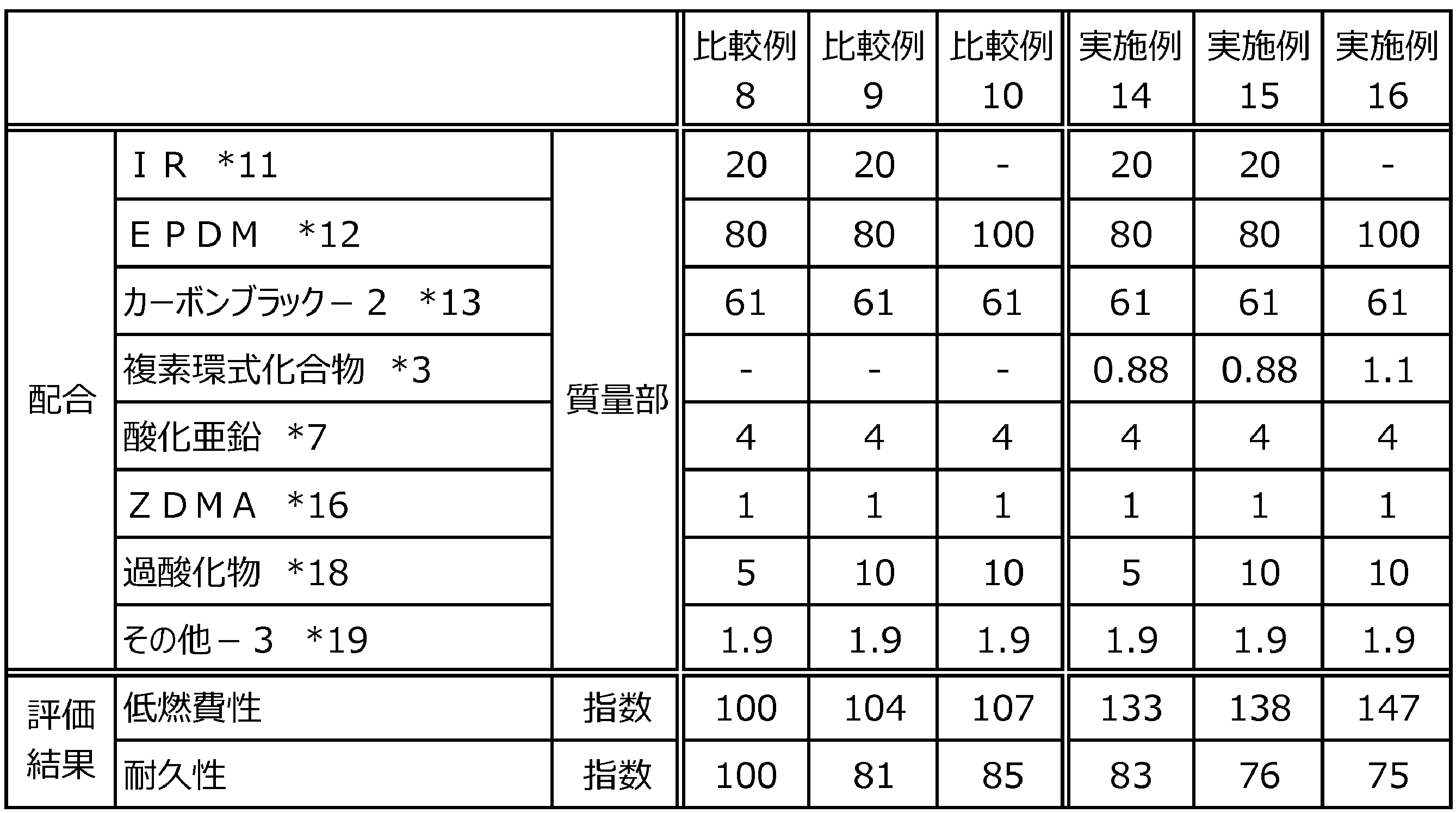


*2 カーボンブラック-1: ISAF級、旭カーボン社製、商品名「旭#78」
*3 複素環式化合物: 3,6-ジ(2-ピリジル)-1,2,4,5-テトラジン、東京化成工業社製
*4 密着防止剤: 脂肪酸金属塩
*5 硫黄-1: 細井化学工業社製、商品名「HK200-5」
*6 加硫促進剤-1: チアゾール系とスルフェンアミド系の加硫促進剤の合計量であり、表1中、表2中、表5中、表6中、表7中の比較例、実施例では、表別にそれぞれすべて同質量比率で配合。
*7 酸化亜鉛
*8 塩化鉄: FeCl2・4H2O、富士フイルム和光純薬社製
*9 その他-1: ステアリン酸とワックスと老化防止剤との合計量であり、比較例1~6、実施例1~12で各成分は同量配合
*10 酢酸ニッケル・4水和物: 富士フイルム和光純薬社製
*12 EPDM: エチレン-プロピレン-ジエンゴム、三井化学社製、商品名「PX-006M」
*13 カーボンブラック-2: 東海カーボン社製、商品名「シースト300」
*14 硫黄-2: 三新化学工業株式会社製、商品名「サンフェル EX」
*15 加硫促進剤-2: チウラム系とスルフェンアミド系の加硫促進剤の合計量であり、比較例7と実施例13は同比率で配合。
*16 ZDMA: ジメタクリル酸亜鉛、CRAY VALLEY社製、商品名「DYMALINK 708」
*17 その他-2: 老化防止剤3種とリターダーの合計量であり、比較例7と実施例13は各成分を同比率で配合。
*18 過酸化物: 日油社製、商品名「パークミルD-40」
*19 その他-3: 老化防止剤3種の合計量であり、比較例8~10と実施例14~16は各成分を同比率で配合。
*21 BR-1: ブタジエンゴム、宇部興産株式会社製、商品名「UBEPOL BR150L」
*22 カーボンブラック-3: SAF級
*23 樹脂: DCPD樹脂、新日本石油化学株式会社製、商品名「日石ネオレジン B-100」
*24 その他-4: ステアリン酸とワックスと老化防止剤とリターダーの合計量であり、比較例11~19と実施例17~35は各成分を同比率で配合。
*25 BR-2: 調製した変性ブタジエンゴム(HMI-BR)、調製方法を以下に示す。
乾燥し、窒素置換した約900mLの耐圧ガラス容器に、シクロヘキサン283g、1,3-ブタジエン50g、2,2-ジテトラヒドロフリルプロパン0.0057mmol、及びヘキサメチレンイミン(HMI-BR)0.513mmolを加え、更にn-ブチルリチウム(BuLi)0.57mmolを加えた後、撹拌装置を具えた50℃の温水浴中で4.5時間重合を行った。この際の重合転化率は、ほぼ100%であった。次に、この重合反応系に、変性剤(カップリング剤)として四塩化スズ0.100mmolを速やかに加え、更に50℃で30分間撹拌して変性反応を行った。その後、重合反応系に、2,6-ジ-t-ブチル-p-クレゾール(BHT)のイソプロパノール溶液(BHT濃度:5質量%)0.5mLを加えて、反応を停止させ、更に常法に従って乾燥して、スズ原子を有する変性ブタジエンゴム(HMI-BR)を得た。得られたHMI-BRについて、1H-NMRスペクトルの積分比からブタジエン部分のビニル結合量を測定したところ、14%であり、DSC曲線の変曲点からガラス転移温度(Tg)を求めたところ、-95℃であり、ゲルパーミエーションクロマトグラフィー(GPC)による分子量分布曲線の全体の面積に対する最も高分子量側のピーク面積の割合からカップリング率を求めたところ、65%であった。
*27 加硫促進剤-3: グアニジン系とチアゾール系とスルフェンアミド系の加硫促進剤の合計量であり、比較例20及び21がグアニジン/チアゾール/スルフェンアミド=1/1.43/0.5、実施例36及び37がグアニジン/チアゾール/スルフェンアミド=1/1.21/0.43、実施例38及び39がグアニジン/チアゾール/スルフェンアミド=1/1/0.35の質量比率で配合。
*28 シランカップリング剤: 信越化学工業株式会社製、商品名「ABC-856」
*29 その他-5: ステアリン酸とワックスと老化防止剤の合計量であり、比較例20~22、実施例36~40は各成分を同比率で配合。
*30 加硫促進剤-4: チアゾール系とスルフェンアミド系の加硫促進剤の合計量であり、比較例22と実施例40は同比率で配合。
Claims (14)
- ジエン系ゴム(A)と、
ピリミジン環、ピリダジン環、ピラジン環、トリアジン環、及びテトラジン環からなる群から選択される少なくとも一つの複素環を有する複素環式化合物(B)と、
金属塩(C)と、を含み、
前記金属塩(C)と前記複素環式化合物(B)との間の結合解離エネルギーが、200kJ/mol以上であることを特徴とする、ゴム組成物。 - 更に、硫黄(D)を含む、請求項1に記載のゴム組成物。
- 前記硫黄(D)と前記金属塩(C)との質量比(D/C)が、0.1~10である、請求項2に記載のゴム組成物。
- 前記複素環式化合物(B)が、トリアジン環又はテトラジン環を有する、請求項1に記載のゴム組成物。
- 前記複素環式化合物(B)が、下記一般式(1):

- 前記金属塩(C)が、遷移金属を含む、請求項1に記載のゴム組成物。
- 前記金属塩(C)が、ハロゲン化金属塩及び/又は酢酸金属塩である、請求項1に記載のゴム組成物。
- 前記金属塩(C)が、酸化亜鉛以外の金属塩であり、
更に、酸化亜鉛(E)を含む、請求項1に記載のゴム組成物。 - 更に、カーボンブラック(F)を含む、請求項1に記載のゴム組成物。
- 更に、シリカ(G)を含む、請求項1に記載のゴム組成物。
- 更に、有機過酸化物(H)を含む、請求項1に記載のゴム組成物。
- 前記ジエン系ゴム(A)が、前記複素環式化合物(B)で変性されている、請求項1に記載のゴム組成物。
- 前記ジエン系ゴム(A)は、重量平均分子量(Mw)が10,000~3,000,000である、請求項1に記載のゴム組成物。
- タイヤ、ゴムクローラ、及び免震ゴムからなる群から選択されるゴム製品であって、
請求項1に記載のゴム組成物を含むことを特徴とする、ゴム製品。
Priority Applications (3)
| Application Number | Priority Date | Filing Date | Title |
|---|---|---|---|
| US18/836,869 US20250145798A1 (en) | 2022-02-28 | 2023-02-28 | Rubber composition and rubber product |
| EP23760230.5A EP4488323A4 (en) | 2022-02-28 | 2023-02-28 | Rubber composition and rubber product |
| JP2024503327A JPWO2023163232A1 (ja) | 2022-02-28 | 2023-02-28 |
Applications Claiming Priority (4)
| Application Number | Priority Date | Filing Date | Title |
|---|---|---|---|
| JP2022030485 | 2022-02-28 | ||
| JP2022-030485 | 2022-02-28 | ||
| JP2022-141028 | 2022-09-05 | ||
| JP2022141028 | 2022-09-05 |
Publications (1)
| Publication Number | Publication Date |
|---|---|
| WO2023163232A1 true WO2023163232A1 (ja) | 2023-08-31 |
Family
ID=87766268
Family Applications (1)
| Application Number | Title | Priority Date | Filing Date |
|---|---|---|---|
| PCT/JP2023/007429 Ceased WO2023163232A1 (ja) | 2022-02-28 | 2023-02-28 | ゴム組成物及びゴム製品 |
Country Status (4)
| Country | Link |
|---|---|
| US (1) | US20250145798A1 (ja) |
| EP (1) | EP4488323A4 (ja) |
| JP (1) | JPWO2023163232A1 (ja) |
| WO (1) | WO2023163232A1 (ja) |
Cited By (1)
| Publication number | Priority date | Publication date | Assignee | Title |
|---|---|---|---|---|
| JP2023126042A (ja) * | 2022-02-28 | 2023-09-07 | 株式会社ブリヂストン | ゴム組成物及びゴム製品 |
Citations (4)
| Publication number | Priority date | Publication date | Assignee | Title |
|---|---|---|---|---|
| JP2019108450A (ja) * | 2017-12-18 | 2019-07-04 | 住友ゴム工業株式会社 | タイヤ用ゴム組成物及び空気入りタイヤ |
| JP2020122081A (ja) * | 2019-01-30 | 2020-08-13 | Jsr株式会社 | 重合体組成物及びタイヤ |
| JP2020176229A (ja) * | 2019-04-22 | 2020-10-29 | 横浜ゴム株式会社 | タイヤ用ゴム組成物およびそれを用いた空気入りタイヤ |
| JP2021107506A (ja) * | 2019-12-27 | 2021-07-29 | Toyo Tire株式会社 | ゴム組成物の製造方法 |
Family Cites Families (2)
| Publication number | Priority date | Publication date | Assignee | Title |
|---|---|---|---|---|
| JP7812789B2 (ja) * | 2020-09-04 | 2026-02-10 | 株式会社ブリヂストン | 錯化ポリマー、ゴム組成物、ゴム組成物の製造方法、及びゴム製品 |
| JP7802004B2 (ja) * | 2020-09-04 | 2026-01-19 | 株式会社ブリヂストン | 錯化ポリマーの配位結合を解く方法 |
-
2023
- 2023-02-28 JP JP2024503327A patent/JPWO2023163232A1/ja active Pending
- 2023-02-28 EP EP23760230.5A patent/EP4488323A4/en active Pending
- 2023-02-28 US US18/836,869 patent/US20250145798A1/en active Pending
- 2023-02-28 WO PCT/JP2023/007429 patent/WO2023163232A1/ja not_active Ceased
Patent Citations (4)
| Publication number | Priority date | Publication date | Assignee | Title |
|---|---|---|---|---|
| JP2019108450A (ja) * | 2017-12-18 | 2019-07-04 | 住友ゴム工業株式会社 | タイヤ用ゴム組成物及び空気入りタイヤ |
| JP2020122081A (ja) * | 2019-01-30 | 2020-08-13 | Jsr株式会社 | 重合体組成物及びタイヤ |
| JP2020176229A (ja) * | 2019-04-22 | 2020-10-29 | 横浜ゴム株式会社 | タイヤ用ゴム組成物およびそれを用いた空気入りタイヤ |
| JP2021107506A (ja) * | 2019-12-27 | 2021-07-29 | Toyo Tire株式会社 | ゴム組成物の製造方法 |
Non-Patent Citations (1)
| Title |
|---|
| See also references of EP4488323A4 * |
Cited By (2)
| Publication number | Priority date | Publication date | Assignee | Title |
|---|---|---|---|---|
| JP2023126042A (ja) * | 2022-02-28 | 2023-09-07 | 株式会社ブリヂストン | ゴム組成物及びゴム製品 |
| JP7813608B2 (ja) | 2022-02-28 | 2026-02-13 | 株式会社ブリヂストン | ゴム組成物及びゴム製品 |
Also Published As
| Publication number | Publication date |
|---|---|
| US20250145798A1 (en) | 2025-05-08 |
| EP4488323A1 (en) | 2025-01-08 |
| JPWO2023163232A1 (ja) | 2023-08-31 |
| EP4488323A4 (en) | 2025-06-11 |
Similar Documents
| Publication | Publication Date | Title |
|---|---|---|
| US9365656B2 (en) | Process for producing modified polymer, diene polymer, rubber composition and pneumatic tire | |
| JP7135392B2 (ja) | ゴム組成物及び空気入りタイヤ | |
| JP5282531B2 (ja) | 水添共役ジエン系重合ゴムの製造方法、水添共役ジエン系重合ゴム、及びその組成物、並びにゴム成形品 | |
| JPWO2018110414A1 (ja) | タイヤ用ゴム組成物、及びそれを用いた空気入りタイヤ | |
| JP4895576B2 (ja) | ゴム組成物およびそれを用いた高性能タイヤ | |
| CN105189565B (zh) | 改性聚合物的制造方法及橡胶组合物 | |
| WO2023163233A1 (ja) | ゴム組成物及びゴム製品 | |
| WO1995023185A1 (fr) | Composition de caoutchouc et son procede de production | |
| WO2023163232A1 (ja) | ゴム組成物及びゴム製品 | |
| JPWO2020059367A1 (ja) | ゴム組成物およびタイヤ | |
| JP2017031240A (ja) | タイヤスチールコード被覆用ゴム組成物 | |
| WO2023163231A1 (ja) | ゴム組成物及びゴム製品 | |
| JP7813608B2 (ja) | ゴム組成物及びゴム製品 | |
| JP2004075882A (ja) | ウエットグリップ性の改良されたゴム組成物 | |
| JP7803744B2 (ja) | ゴム組成物及びゴム製品 | |
| JP2023126089A (ja) | ゴム組成物及びゴム製品 | |
| JP6026320B2 (ja) | ゴム組成物及び空気入りタイヤ | |
| JP2023126090A (ja) | ゴム組成物及びゴム製品 | |
| JPWO2020066480A1 (ja) | 多元共重合体、ゴム組成物、樹脂組成物、タイヤ及び樹脂製品 | |
| JP2024082095A (ja) | 積層体及びタイヤ | |
| US12606642B2 (en) | Terminally modified diene-based polymer and method for producing the same | |
| WO2026029016A1 (ja) | ゴム組成物及びゴム製品 | |
| JP6026269B2 (ja) | ゴム組成物及び空気入りタイヤ | |
| JP6081194B2 (ja) | 変性ポリマーの製造方法及びジエン系ポリマー | |
| JP2023138148A (ja) | ゴム組成物 |
Legal Events
| Date | Code | Title | Description |
|---|---|---|---|
| 121 | Ep: the epo has been informed by wipo that ep was designated in this application |
Ref document number: 23760230 Country of ref document: EP Kind code of ref document: A1 |
|
| ENP | Entry into the national phase |
Ref document number: 2024503327 Country of ref document: JP Kind code of ref document: A |
|
| WWE | Wipo information: entry into national phase |
Ref document number: 18836869 Country of ref document: US |
|
| WWE | Wipo information: entry into national phase |
Ref document number: 2023760230 Country of ref document: EP |
|
| NENP | Non-entry into the national phase |
Ref country code: DE |
|
| ENP | Entry into the national phase |
Ref document number: 2023760230 Country of ref document: EP Effective date: 20240930 |
|
| WWP | Wipo information: published in national office |
Ref document number: 18836869 Country of ref document: US |