WO2023182394A1 - 樹脂組成物及び樹脂成形体 - Google Patents
樹脂組成物及び樹脂成形体 Download PDFInfo
- Publication number
- WO2023182394A1 WO2023182394A1 PCT/JP2023/011367 JP2023011367W WO2023182394A1 WO 2023182394 A1 WO2023182394 A1 WO 2023182394A1 JP 2023011367 W JP2023011367 W JP 2023011367W WO 2023182394 A1 WO2023182394 A1 WO 2023182394A1
- Authority
- WO
- WIPO (PCT)
- Prior art keywords
- resin
- resin composition
- weight
- parts
- resin molded
- Prior art date
- Legal status (The legal status is an assumption and is not a legal conclusion. Google has not performed a legal analysis and makes no representation as to the accuracy of the status listed.)
- Ceased
Links
Images


Classifications
-
- C—CHEMISTRY; METALLURGY
- C08—ORGANIC MACROMOLECULAR COMPOUNDS; THEIR PREPARATION OR CHEMICAL WORKING-UP; COMPOSITIONS BASED THEREON
- C08K—Use of inorganic or non-macromolecular organic substances as compounding ingredients
- C08K3/00—Use of inorganic substances as compounding ingredients
- C08K3/02—Elements
- C08K3/04—Carbon
-
- C—CHEMISTRY; METALLURGY
- C08—ORGANIC MACROMOLECULAR COMPOUNDS; THEIR PREPARATION OR CHEMICAL WORKING-UP; COMPOSITIONS BASED THEREON
- C08J—WORKING-UP; GENERAL PROCESSES OF COMPOUNDING; AFTER-TREATMENT NOT COVERED BY SUBCLASSES C08B, C08C, C08F, C08G or C08H
- C08J5/00—Manufacture of articles or shaped materials containing macromolecular substances
- C08J5/04—Reinforcing macromolecular compounds with loose or coherent fibrous material
- C08J5/0405—Reinforcing macromolecular compounds with loose or coherent fibrous material with inorganic fibres
- C08J5/042—Reinforcing macromolecular compounds with loose or coherent fibrous material with inorganic fibres with carbon fibres
-
- C—CHEMISTRY; METALLURGY
- C08—ORGANIC MACROMOLECULAR COMPOUNDS; THEIR PREPARATION OR CHEMICAL WORKING-UP; COMPOSITIONS BASED THEREON
- C08K—Use of inorganic or non-macromolecular organic substances as compounding ingredients
- C08K7/00—Use of ingredients characterised by shape
- C08K7/02—Fibres or whiskers
- C08K7/04—Fibres or whiskers inorganic
- C08K7/06—Elements
-
- H—ELECTRICITY
- H05—ELECTRIC TECHNIQUES NOT OTHERWISE PROVIDED FOR
- H05K—PRINTED CIRCUITS; CASINGS OR CONSTRUCTIONAL DETAILS OF ELECTRIC APPARATUS; MANUFACTURE OF ASSEMBLAGES OF ELECTRICAL COMPONENTS
- H05K9/00—Screening of apparatus or components against electric or magnetic fields
- H05K9/0007—Casings
- H05K9/0047—Casings being rigid plastic containers having conductive particles, fibres or mesh embedded therein
-
- C—CHEMISTRY; METALLURGY
- C08—ORGANIC MACROMOLECULAR COMPOUNDS; THEIR PREPARATION OR CHEMICAL WORKING-UP; COMPOSITIONS BASED THEREON
- C08K—Use of inorganic or non-macromolecular organic substances as compounding ingredients
- C08K2201/00—Specific properties of additives
- C08K2201/001—Conductive additives
-
- C—CHEMISTRY; METALLURGY
- C08—ORGANIC MACROMOLECULAR COMPOUNDS; THEIR PREPARATION OR CHEMICAL WORKING-UP; COMPOSITIONS BASED THEREON
- C08K—Use of inorganic or non-macromolecular organic substances as compounding ingredients
- C08K2201/00—Specific properties of additives
- C08K2201/002—Physical properties
- C08K2201/004—Additives being defined by their length
-
- C—CHEMISTRY; METALLURGY
- C08—ORGANIC MACROMOLECULAR COMPOUNDS; THEIR PREPARATION OR CHEMICAL WORKING-UP; COMPOSITIONS BASED THEREON
- C08K—Use of inorganic or non-macromolecular organic substances as compounding ingredients
- C08K2201/00—Specific properties of additives
- C08K2201/002—Physical properties
- C08K2201/006—Additives being defined by their surface area
-
- C—CHEMISTRY; METALLURGY
- C08—ORGANIC MACROMOLECULAR COMPOUNDS; THEIR PREPARATION OR CHEMICAL WORKING-UP; COMPOSITIONS BASED THEREON
- C08K—Use of inorganic or non-macromolecular organic substances as compounding ingredients
- C08K2201/00—Specific properties of additives
- C08K2201/014—Additives containing two or more different additives of the same subgroup in C08K
Definitions
- the present invention relates to a resin composition and a resin molded article using the resin composition.
- Patent Document 1 listed below discloses a molded body made of resin pellets containing a thermoplastic resin and carbon fibers.
- the thermoplastic resin is a crystalline resin.
- the carbon fibers include PAN-based carbon fibers and pitch-based carbon fibers.
- the mass average fiber length of the carbon fibers in the resin pellets is 0.1 mm to 0.9 mm.
- the bending strength of the molded body is 280 MPa or more.
- Patent Document 1 has a problem in that it is difficult to achieve both mechanical strength such as bending strength and electromagnetic shielding performance at a high level when formed into a molded product.
- An object of the present invention is to provide a resin composition and a resin molded article using the resin composition, which can achieve both high levels of mechanical strength such as bending strength and electromagnetic shielding properties.
- the resin composition according to the present invention includes a thermoplastic resin (A), carbon black (B), carbon fiber (C), and graphite (D), and the content of the carbon black (B) is The amount is 10 parts by weight or more and 100 parts by weight or less based on 100 parts by weight of the thermoplastic resin (A).
- the content of the carbon fiber (C) is 10 parts by weight or more and 100 parts by weight or less based on 100 parts by weight of the thermoplastic resin (A).
- the carbon black (B) has a BET specific surface area of 600 m 2 /g or less.
- the weight average fiber length of the carbon fibers (C) is 0.5 mm or more and 15 mm or less.
- the carbon black (B) is oil furnace black.
- the content of the graphite (D) is 10 parts by weight or more and 200 parts by weight or less based on 100 parts by weight of the thermoplastic resin (A). .
- the resin composition in a molten state is filled into a mold from a direction perpendicular to the thickness direction of the resin molded body obtained, and the resin composition is molded into a size of 100 mm in length ⁇
- the electromagnetic wave shielding effect of the resin molded body at a frequency of 100 MHz is 20 dB or more
- the resin composition is molded in accordance with ISO 294-1 to form a rectangular shape.
- the bending strength of the rectangular resin molded body measured in accordance with ISO178 is 40 MPa or more.
- the resin composition in a molten state is filled into a mold from a direction perpendicular to the thickness direction of the resin molded body obtained, and the resin composition is molded into a size of 100 mm in length ⁇
- the thermal conductivity in the in-plane direction on the main surface of the resin molded body is 1.0 W/(m ⁇ K) or more.
- the resin molded article according to the present invention is a molded article of a resin composition constructed according to the present invention.
- the resin molded body has a shape of a heat dissipation chassis, a heat dissipation case, or a heat sink.
- the present invention it is possible to provide a resin composition that can achieve both mechanical strength such as bending strength and electromagnetic shielding properties at a high level, and a resin molded article using the resin composition.
- FIG. 1 is a schematic perspective view showing a heat dissipation chassis.
- FIG. 2 is a schematic perspective view showing the heat dissipation case.
- FIG. 3 is a schematic perspective view showing the shape of the heat sink.
- the resin composition of the present invention includes a thermoplastic resin (A), carbon black (B), carbon fiber (C), and graphite (D).
- the content of the carbon black (B) is 10 parts by weight or more and 100 parts by weight or less based on 100 parts by weight of the thermoplastic resin (A).
- the resin composition of the present invention contains a thermoplastic resin (A), carbon black (B), carbon fiber (C), and graphite (D), and particularly contains carbon black (B) in the above specific content. Therefore, it is possible to achieve both mechanical strength such as bending strength and electromagnetic shielding performance at a high level.
- the bending strength of the rectangular resin molded object is preferably 40 MPa or more, more preferably 50 MPa or more, More preferably, it is 60 MPa or more, particularly preferably 90 MPa or more. Further, the upper limit of the bending strength of the resin molded body is not particularly limited, but may be, for example, 250 MPa.
- Bending strength can be measured in accordance with ISO178.
- a Tensilon universal testing machine manufactured by Orientec, model number "RTC-1210A" can be used.
- the electromagnetic shielding effect at a frequency of 100 MHz of the resin molded product obtained under the following molding conditions is preferably 20 dB or more, more preferably 30 dB or more, and still more preferably 40 dB or more.
- the upper limit of the electromagnetic shielding effect of the resin molded body at a frequency of 100 MHz is, for example, 100 dB, although it is not particularly limited.
- the resin composition in a molten state is filled into a mold from a direction perpendicular to the thickness direction of the resulting resin molded body and molded to obtain a resin molded body measuring 100 mm long x 100 mm wide x 2 mm thick.
- the electromagnetic shielding effect (electromagnetic shielding property) at a frequency of 100 MHz can be measured, for example, by the KEC (KEC: abbreviation for "Kansai Electronic Industry Promotion Center”) method.
- the in-plane thermal conductivity of the main surface of the resin molded body obtained under the above-mentioned molding conditions is preferably 1.0 W/(m ⁇ K) or more, more preferably 1.5 W/(m ⁇ K) or more, more preferably 2.0 W/(m ⁇ K) or more, particularly preferably 3.5 W/(m ⁇ K) or more.
- the thermal conductivity in the in-plane direction on the main surface of the resin molded body is greater than or equal to the above lower limit, the thermal conductivity of the resulting resin molded body can be further improved.
- the upper limit of the thermal conductivity in the in-plane direction on the main surface of the resin molded body can be, for example, 50 W/(m ⁇ K).
- the main surface of the resin molded article refers to the surface with the largest area among the plurality of surfaces on the outer surface of the resin molded article.
- the thermal conductivity in the in-plane direction on the main surface of the resin molded body can be calculated using the following formula (1).
- the thermal diffusivity can be measured using, for example, "Xenon Flash Laser Analyzer LFA467 HyperFlash” manufactured by Netsch Japan.
- thermoplastic resin (A) The thermoplastic resin (A) is not particularly limited, and any known thermoplastic resin can be used. Specific examples of the thermoplastic resin (A) include polyolefin, polystyrene, polyacrylate, polymethacrylate, polyacrylonitrile, polyester, polyamide, polyurethane, polyethersulfone, polyetherketone, polyimide, polydimethylsiloxane, polycarbonate, or these. Examples include copolymers containing at least two of these. These thermoplastic resins may be used alone or in combination. Note that the thermoplastic resin (A) is preferably a resin with a high elastic modulus. Polyolefins (olefin resins) and polyamides (nylon resins) are more preferred, and polyolefins are even more preferred, since they are inexpensive and easy to mold under heating.
- the polyolefin is not particularly limited, and known polyolefins can be used.
- Specific examples of polyolefins include polyethylene which is an ethylene homopolymer, ethylene- ⁇ -olefin copolymer, ethylene-(meth)acrylic acid copolymer, ethylene-(meth)acrylic acid ester copolymer, and ethylene-acetic acid.
- Examples include polyethylene resins such as vinyl copolymers.
- Polyolefins include polypropylene which is a propylene homopolymer, polypropylene resins such as propylene- ⁇ -olefin copolymers, polybutene which is a butene homopolymer, and homopolymers or copolymers of conjugated dienes such as butadiene and isoprene. etc. These polyolefins may be used alone or in combination. From the viewpoint of further increasing heat resistance and elastic modulus, the polyolefin is preferably polypropylene.
- the polyolefin (olefin resin) contains an ethylene component.
- the content of the ethylene component is preferably 5% by mass to 40% by mass. When the content of the ethylene component is within the above range, it is possible to further improve the impact resistance and heat resistance of the resin molded article.
- the MFR of the thermoplastic resin (A) measured in accordance with JIS K7210 is preferably 10 g/10 minutes or more, more preferably 20 g/10 minutes or more, preferably 200 g/10 minutes or less, and more preferably 150 g/10 minutes. minutes, more preferably 100 g/10 minutes or less, particularly preferably 50 g/10 minutes or less.
- MFR is within the above range, the fluidity of the thermoplastic resin (A) can be further improved.
- the content of the thermoplastic resin (A) in the resin composition is preferably 25% by weight or more, more preferably 30% by weight or more, preferably 70% by weight or less, and more preferably 60% by weight or less.
- the content of the thermoplastic resin (A) is within the above range, the moldability of the resin composition can be further improved.
- Carbon black (B) As the carbon black (B), for example, Ketjen black, oil furnace black, acetylene black, channel black, thermal black, etc. can be used. Among these, oil furnace black is preferred from the viewpoint of further increasing the conductivity of the resulting resin molded product. Note that the ash content of carbon black (B) is preferably 1% or less. Further, carbon black (B) may contain metal impurities such as Fe and Ni.
- the BET specific surface area of carbon black (B) is preferably 10 m 2 /g or more, more preferably 30 m 2 /g or more, preferably 1100 m 2 /g or less, more preferably 600 m 2 /g or less, even more preferably 400 m 2 /g or less, particularly preferably 300 m 2 /g or less.
- the BET specific surface area of carbon black (B) is equal to or greater than the above lower limit, the conductivity of the resulting resin molded article can be further improved, and the electromagnetic shielding properties can be further improved.
- the BET specific surface area of carbon black (B) is below the above upper limit value, the fluidity of the resin composition during molding can be further improved, and the moldability of the resin composition can be further improved. I can do it.
- the BET specific surface area can be measured from the nitrogen adsorption isotherm according to the BET method.
- the measuring device for example, one manufactured by Anton Paar, product number "NOVA touch LX2" can be used.
- the DBP oil absorption amount of carbon black (B) is not particularly limited, but is preferably 30 ml/100 g or more, more preferably 50 ml/100 g or more, preferably 450 ml/100 g or less, more preferably 400 ml/100 g or less, and even more preferably 300 ml. /100g or less.
- the DBP oil absorption amount of carbon black (B) is within the above range, the conductivity of the resulting resin molded article can be further improved, and the electromagnetic wave shielding property can be further improved.
- the DBP oil absorption amount of carbon black (B) can be obtained by calculating the DBP dripping amount at 70% of the maximum torque in accordance with JIS K 6217-4.
- DBP oil absorption can be measured, for example, using an absorption measuring device (manufactured by Asahi Research Institute, product number "S-500").
- the primary particle diameter of carbon black (B) is not particularly limited, but is preferably 5 nm or more, more preferably 10 nm or more, preferably 70 nm or less, and more preferably 60 nm or less. When the primary particle diameter of carbon black (B) is within the above range, even higher conductivity can be obtained with an even lower concentration of carbon black.
- the primary particle diameter of carbon black (B) is, for example, the average primary particle diameter determined using image data of carbon black (B) obtained by a transmission electron microscope.
- the transmission electron microscope for example, one manufactured by JEOL Ltd. under the product name "JEM-2200FS" can be used.
- the content of carbon black (B) is 10 parts by weight or more, preferably 15 parts by weight or more, more preferably 20 parts by weight or more, even more preferably 30 parts by weight or more, based on 100 parts by weight of the thermoplastic resin (A).
- the amount is 100 parts by weight or less, preferably 95 parts by weight or less, more preferably 90 parts by weight or less.
- carbon black (B) two or more types may be used as the carbon black (B).
- carbon black with a BET specific surface area of 600 m 2 /g or less and carbon black with a BET specific surface area of more than 600 m 2 /g may be used together.
- the moldability of the resin composition can be further improved, and the electromagnetic wave shielding properties of the resulting resin molded article can be further improved.
- the content of carbon black having a BET specific surface area of more than 600 m 2 /g is preferably 1 part by weight or more and 30 parts by weight or less based on 100 parts by weight of the thermoplastic resin (A).
- Carbon fiber (C) The carbon fiber (C) is not particularly limited, but PAN-based carbon fibers or pitch-based carbon fibers can be used. By using carbon fiber (C), mechanical strength such as bending strength of the resulting resin molded product is improved compared to cases where other conductive fibers, metal fibers, non-conductive fibers, or resin fibers are used. and electromagnetic wave shielding properties can be efficiently improved.
- the weight average fiber length of the carbon fiber (C) is preferably 0.5 mm or more, more preferably 2 mm or more, even more preferably 5 mm or more, preferably 15 mm or less, more preferably 12 mm or less, and still more preferably 9 mm or less.
- the weight average fiber length of the carbon fibers (C) is equal to or greater than the above lower limit, it is possible to achieve both mechanical strength such as bending strength and electromagnetic wave shielding properties of the resulting resin molded article at an even higher level.
- the weight average fiber length of carbon fiber (C) is below the said upper limit, the moldability of a resin composition can be improved further.
- the weight average fiber length of the carbon fibers (C) can be, for example, the average value of 100 fibers measured using a transmission electron microscope (TEM) or a scanning electron microscope (SEM).
- TEM transmission electron microscope
- SEM scanning electron microscope
- the fiber diameter of the carbon fiber (C) is preferably 3 ⁇ m or more, more preferably 5 ⁇ m or more, preferably 30 ⁇ m or less, more preferably 25 ⁇ m or less, and still more preferably 20 ⁇ m or less.
- the resulting resin molded product can achieve both mechanical strength such as bending strength and electromagnetic shielding properties at a higher level.
- the fiber diameter of the carbon fibers (C) can be, for example, the average value of 100 fibers measured using a transmission electron microscope (TEM) or a scanning electron microscope (SEM). From the viewpoint of making observation even easier, a test piece cut out from a resin composition or resin molding is heated at 600°C to remove the resin and observed with a transmission electron microscope (TEM) or scanning electron microscope (SEM). It is desirable to do so.
- TEM transmission electron microscope
- SEM scanning electron microscope
- the content of carbon fiber (C) is preferably 10 parts by weight or more, more preferably 15 parts by weight or more, even more preferably 20 parts by weight or more, particularly preferably 35 parts by weight, based on 100 parts by weight of the thermoplastic resin (A). parts or more, preferably 100 parts by weight or less, more preferably 80 parts by weight or less, still more preferably 70 parts by weight or less.
- the content of carbon fiber (C) is equal to or higher than the above lower limit, it is possible to achieve both mechanical strength such as bending strength and electromagnetic wave shielding properties of the resulting resin molded article at an even higher level.
- the content of carbon fiber (C) is below the above-mentioned upper limit, the moldability of the resin composition can be further improved.
- Graphite (D) is not particularly limited, but plate graphite is preferable.
- the plate-shaped graphite is not particularly limited as long as it is a plate-shaped graphite, and for example, graphite, exfoliated graphite, graphene, or the like can be used. From the viewpoint of further increasing thermal conductivity and electrical conductivity, graphite or exfoliated graphite is preferable. These may be used alone or in combination.
- Graphite is a laminate of multiple graphene sheets.
- the number of laminated graphene sheets of graphite is usually about 100,000 to 1,000,000 layers.
- scaly graphite can be used.
- expanded graphite may be used.
- Exfoliated graphite is obtained by exfoliating original graphite, and refers to a stack of graphene sheets that is thinner than the original graphite.
- the exfoliation treatment to obtain exfoliated graphite is not particularly limited, and either a mechanical exfoliation method using a supercritical fluid or the like or a chemical exfoliation method using an acid may be used.
- the number of laminated graphene sheets in exfoliated graphite may be less than that in the original graphite, but is preferably 50 or more layers, more preferably 100 or more layers, preferably 1000 layers or less, more preferably 500 layers or less, and even more preferably is less than 200 layers. When the number of stacked graphene sheets is within the above range, the thermal conductivity and electrical conductivity of the resulting resin molded article can be further improved.
- the volume average particle diameter of the plate graphite is preferably 5 ⁇ m or more, more preferably 30 ⁇ m or more, even more preferably 60 ⁇ m or more, preferably 1000 ⁇ m or less, more preferably 500 ⁇ m or less, even more preferably 350 ⁇ m or less, particularly preferably 300 ⁇ m or less. be.
- the volume average particle diameter of the plate-shaped graphite is within the above range, the thermal conductivity and electrical conductivity of the resulting resin molded article can be further improved.
- the volume average particle diameter of plate-like graphite is below the said upper limit, the bending strength of the resin molded object obtained can be further improved.
- graphite particles may be used for the plate graphite, or graphite particles of different particle sizes may be used as long as the volume average particle size of the plate graphite contained in the resin composition is within the above range. Two or more types may be used in combination.
- volume average particle diameter refers to a value calculated based on a volume-based distribution by a laser diffraction method using a laser diffraction/scattering particle size distribution measuring device in accordance with JIS Z 8825:2013.
- volume average particle diameter for example, plate graphite is placed in a soap solution (containing 0.01% neutral detergent) so that the concentration is 2% by weight, and heated at 300W using an ultrasonic homogenizer. Apply ultrasound at power for 1 minute to obtain a suspension.
- the volume particle size distribution of the plate-like graphite is measured for the suspension using a laser diffraction/scattering particle size distribution measuring device (manufactured by Nikkiso Co., Ltd., product name "Microtrac MT3300").
- the cumulative 50% value of this volume particle size distribution can be calculated as the volume average particle size of the plate-like graphite.
- the thickness of the plate graphite is preferably greater than 1 ⁇ m, more preferably 5 ⁇ m or more, preferably 50 ⁇ m or less, and even more preferably 40 ⁇ m or less. When the thickness of the plate graphite is within the above range, the thermal conductivity and electrical conductivity of the resulting resin molded article can be further improved.
- the aspect ratio of the plate graphite is preferably 5 or more, more preferably 21 or more, preferably less than 2000, more preferably less than 1000, and even more preferably less than 100.
- the aspect ratio of the plate-like graphite is within the above range, the thermal conductivity and electrical conductivity of the resulting resin molded article can be further improved.
- the aspect ratio refers to the ratio of the maximum dimension of the plate-shaped graphite in the direction of the laminated surface to the thickness of the plate-shaped graphite.
- the thickness of the plate graphite can be measured using, for example, a transmission electron microscope (TEM) or a scanning electron microscope (SEM). From the viewpoint of making observation even easier, a test piece cut out from a resin composition or resin molding is heated at 600°C to remove the resin and observed with a transmission electron microscope (TEM) or scanning electron microscope (SEM). It is desirable to do so. Note that the test piece may be cut along the main surface of the resin molding, or along the direction perpendicular to the main surface of the resin molding, as long as the thickness of the plate graphite can be measured by blowing off the resin. You can cut it out.
- TEM transmission electron microscope
- SEM scanning electron microscope
- the content of graphite (D) is preferably 10 parts by weight or more, more preferably 15 parts by weight or more, preferably 200 parts by weight or less, and more preferably 150 parts by weight or less, based on 100 parts by weight of the thermoplastic resin (A). It is.
- the content of graphite (D) is at least the above lower limit, thermal conductivity and electrical conductivity can be further improved.
- content of graphite (D) is below the said upper limit, impact resistance can be improved further.
- the resin composition of the present invention may contain various other additives as optional components within a range that does not impede the effects of the present invention.
- additives include phenol-based, phosphorus-based, amine-based, sulfur-based antioxidants; ultraviolet absorbers such as benzotriazole-based and hydroxyphenyltriazine-based; metal damage inhibitors; various fillers; and antistatic agents. ; stabilizers; pigments, etc.
- the resin composition of the present invention may further contain other conductive fibers, metal fibers, non-conductive fibers, etc., within a range that does not impair mechanical strength such as bending strength or electromagnetic shielding properties of the resin molded product obtained. Alternatively, it may contain resin fibers and the like. These may be used alone or in combination.
- the resin composition of the present invention can be produced by melt-kneading a thermoplastic resin (A), carbon black (B), carbon fiber (C), graphite (D), and other additives as necessary. Obtainable.
- the melt-kneading method is not particularly limited, but for example, a kneading device such as a twin-screw kneader such as a plastomill, a single-screw extruder, a twin-screw extruder, a Banbury mixer, a roll, a pressure kneader, etc.
- a kneading device such as a twin-screw kneader such as a plastomill, a single-screw extruder, a twin-screw extruder, a Banbury mixer, a roll, a pressure kneader, etc.
- a method of kneading at the bottom Among these, a method of melt-kneading using an extruder is preferred.
- the form of the resin composition is not particularly limited, but may be in the form of pellets, for example.
- the shape is not particularly limited, but examples include spherical, cylindrical, and prismatic shapes. Among these, a cylindrical shape is preferable from the viewpoint of stability of the pellet shape.
- the diameter thereof is preferably 0.5 mm or more, more preferably 1 mm or more, and preferably 5 mm or less, more preferably 3 mm or less.
- the length is preferably 1 mm or more, more preferably 3 mm or more, and preferably 10 mm or less, more preferably 7 mm or less.
- the size of the pellets can be measured by randomly sampling 100 pellets from a sample and using calipers.
- the diameter (pellet diameter) of the pellets of the resin composition other than the cylindrical shape is preferably 1 mm or more, more preferably 5 mm or more, preferably 15 mm or less, and more preferably 10 mm or less.
- the pellet diameter can be determined by randomly sampling 100 pellets from a sample and measuring the diameter at the longest point using calipers.
- the resin molded article of the present invention is a molded article of the resin composition of the present invention described above. Therefore, the resin molded article of the present invention can be obtained by molding the resin composition described above.
- the resin molded article of the present invention uses the resin composition of the present invention, it is possible to achieve both mechanical strength such as bending strength and electromagnetic shielding performance at a high level.
- the method for molding the resin composition is not particularly limited, but examples include methods such as press processing, extrusion processing, extrusion lamination, and injection molding. Among these, it is preferable to mold the mixture by injection molding.
- the bending strength of the resin molded body is preferably 40 MPa or more, more preferably 50 MPa or more, even more preferably 60 MPa or more, and particularly preferably 90 MPa or more. Further, the upper limit of the bending strength of the resin molded body is not particularly limited, but may be, for example, 250 MPa.
- the electromagnetic shielding effect of the resin molded body at a frequency of 100 MHz is preferably 20 dB or more, more preferably 30 dB or more, and still more preferably 40 dB or more.
- the upper limit of the electromagnetic shielding effect of the resin molded body at a frequency of 100 MHz is, for example, 100 dB, although it is not particularly limited.
- the in-plane thermal conductivity of the main surface of the resin molded body is preferably 1.0 W/(m ⁇ K) or more, more preferably 1.5 W/(m ⁇ K) or more, and even more preferably It is 2.0 W/(m ⁇ K) or more, particularly preferably 3.5 W/(m ⁇ K) or more.
- the upper limit of the thermal conductivity in the in-plane direction on the main surface of the resin molded body can be, for example, 50 W/(m ⁇ K).
- the resin molded article of the present invention when measuring the bending strength, electromagnetic shielding effect, thermal conductivity, and volume resistivity of the resin molded article of the present invention, the resin molded article is melted and then remolded under the following molding conditions. shall be.
- the resin composition in a molten state is filled into a mold from a direction perpendicular to the thickness direction of the resulting resin molded body and molded to obtain a resin molded body measuring 100 mm long x 100 mm wide x 2 mm thick.
- the resin molded article of the present invention has excellent electromagnetic shielding properties, it can be suitably used for the housings of communication devices that require electromagnetic shielding properties, and electronic devices such as smart meters and in-vehicle ECUs.
- the resin molded article of the present invention also has excellent heat dissipation properties. Therefore, the resin molded body of the present invention may be, for example, a heat dissipation chassis 10 as shown in FIG. 1, a heat dissipation case 20 as shown in FIG. 2, or a heat sink 30 as shown in FIG.
- a circuit may be formed on the surface of such a resin molded body.
- Example 1 100 parts by weight of polypropylene (PP) as a thermoplastic resin (A), 30 parts by weight of oil furnace black as carbon black (B), 40 parts by weight of PAN-based carbon fiber as carbon fiber (C), and graphite (
- a resin composition was obtained by melt-kneading 120 parts by weight of flaky graphite as D) at 180° C. using a Laboplast Mill (manufactured by Toyo Seiki Co., Ltd., product number “R100”). Note that the obtained resin composition was in the form of pellets, and the pellet diameter was 3 mm. The pellet diameter was determined by randomly sampling 100 pellets from the sample and measuring the diameter at the longest point using a caliper.
- polypropylene a product manufactured by Nippon Polypro Co., Ltd. under the trade name "BC03B” (MFR: 30 g/10 min (230° C.)) was used.
- oil furnace black "Vulcan As the PAN-based carbon fiber, a product manufactured by Mitsubishi Chemical Corporation under the trade name “TR06U” (weight average fiber length: 6 mm, fiber diameter: 7 ⁇ m) was used.
- flaky graphite Chuetsu Graphite Industries Co., Ltd., trade name "CPB-300” (volume average particle diameter: 300 ⁇ m) was used.
- Example 2 As carbon black (B), oil furnace black (manufactured by Asahi Carbon Co., Ltd., trade name “F-200GS”, BET specific surface area: 55 m 2 / g, DBP oil absorption: 180 ml / 100 g, primary particle size: 38 nm) was used. Specifically, as graphite (D), flaky graphite (manufactured by Chuetsu Graphite Industries, trade name "CPB-100B", volume average particle diameter: 80 ⁇ m) was used, and carbon black (B) and carbon fiber (C) A resin composition was obtained in the same manner as in Example 1, except that the contents of , and graphite (D) were changed as shown in Table 1 below.
- Example 3 As the carbon fiber (C), pitch-based carbon fiber (manufactured by Mitsubishi Chemical Corporation, product name "K237SE”, weight average fiber length: 6 mm, fiber diameter: 11 ⁇ m) was used, and carbon black (B), carbon fiber ( A resin composition was obtained in the same manner as in Example 2, except that the contents of C) and graphite (D) were changed as shown in Table 1 below.
- Example 4 The resin composition was prepared in the same manner as in Example 1, except that oil furnace black (manufactured by Lion Specialty Chemicals, trade name “Lionite CB", BET specific surface area: 1052 m 2 /g) was used as carbon black (B). I got something.
- oil furnace black manufactured by Lion Specialty Chemicals, trade name "Lionite CB", BET specific surface area: 1052 m 2 /g
- Example 5 A resin composition was obtained in the same manner as in Example 1, except that the content of carbon fiber (C) was changed to 20 parts by weight as shown in Table 1 below.
- Example 6 A resin composition was obtained in the same manner as in Example 1, except that the content of graphite (D) was changed to 200 parts by weight as shown in Table 1 below.
- Example 7 The procedure was carried out except that flaky graphite (manufactured by Nippon Graphite Industries Co., Ltd., trade name "FB-150", volume average particle diameter: 45 ⁇ m) was used as graphite (D) instead of the flaky graphite of Example 1.
- a resin composition was obtained in the same manner as in Example 1.
- Example 8 The procedure was carried out except that expanded graphite (manufactured by Fuji Graphite Industries Co., Ltd., trade name "AED-02", volume average particle diameter: 1000 ⁇ m) was used as graphite (D) instead of the flaky graphite of Example 1.
- a resin composition was obtained in the same manner as in Example 1.
- Example 1 A resin composition was prepared in the same manner as in Example 1, except that carbon fiber (C) and graphite (D) were not used, and the content of carbon black (B) was changed as shown in Table 1 below. Obtained.
- Example 3 A resin composition was prepared in the same manner as in Example 2, except that carbon black (B) and carbon fiber (C) were not used, and the content of graphite (D) was changed as shown in Table 1 below. Obtained.
- Example 5 A resin composition was prepared in the same manner as in Example 1, except that graphite (D) was not used and the contents of carbon black (B) and carbon fiber (C) were changed as shown in Table 1 below. Obtained.
- the bending strength of the obtained measurement sample was measured in accordance with ISO178.
- the bending strength was measured using a Tensilon universal testing machine (manufactured by Orientec, model number "RTC-1210A").
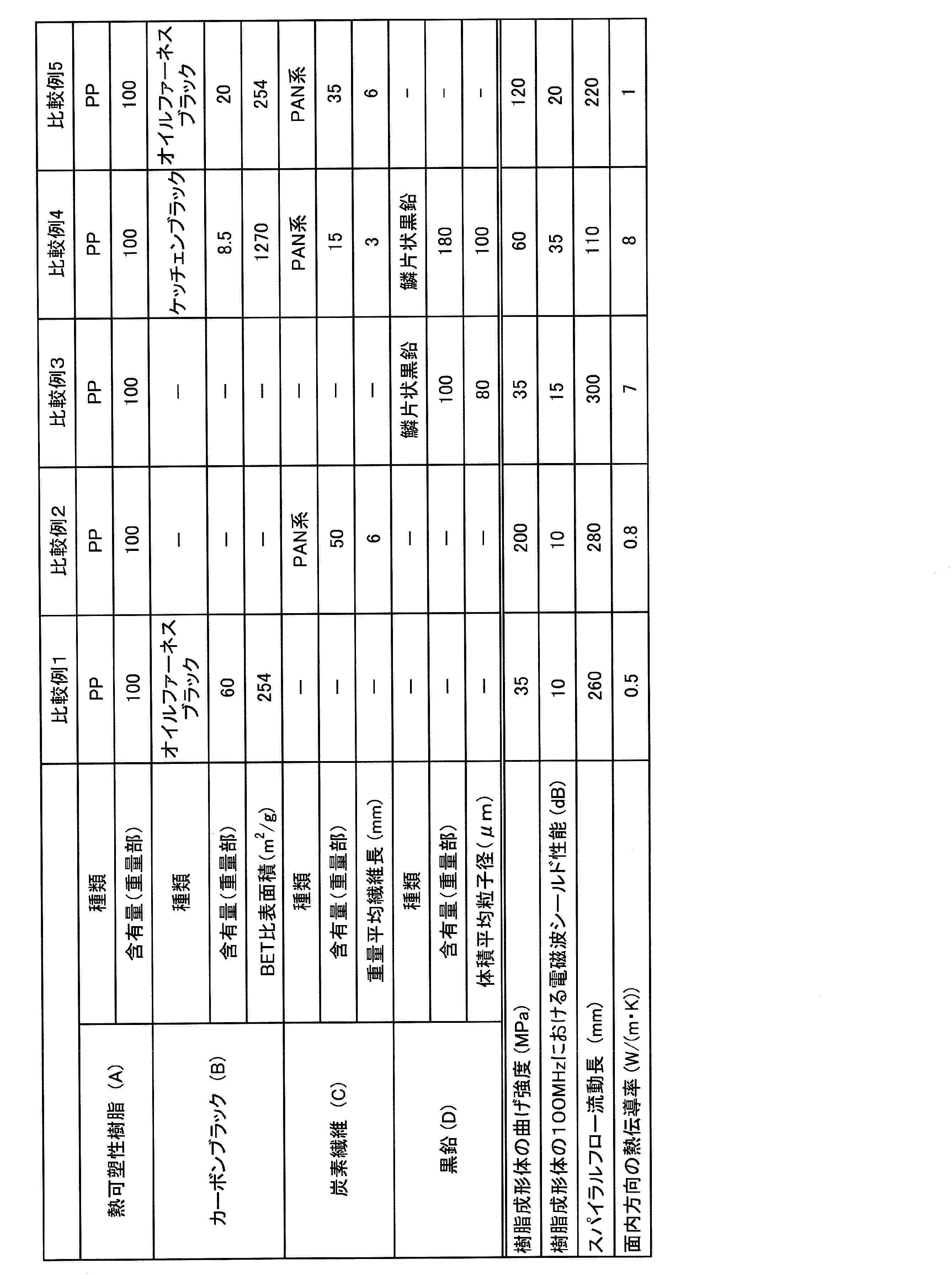
- the resin compositions obtained in Examples 1 to 8 and Comparative Examples 1 to 5 were injection molded to obtain resin molded bodies measuring 100 mm long x 100 mm wide x 2 mm thick, which were used as measurement samples.
- the injection molding was performed under the conditions of a resin temperature of 230° C., a mold temperature of 50° C., and an injection speed of 30 mm/s.
- the electromagnetic shielding effect (electromagnetic shielding performance, unit: dB) of the obtained measurement sample at a frequency of 100 MHz was measured using a KEC method electric field shielding characteristic measurement jig (manufactured by Nippon Shield Enclosure Co., Ltd.). Specifically, electromagnetic waves were emitted from the focal point on the transmitting side, and the intensity of the electromagnetic waves converged on the focal point on the receiving side was measured as the received voltage. The received voltage V 0 when no sample was inserted and the received voltage V when the sample was inserted were measured, and the electromagnetic shielding effect was calculated according to the following equation (2).
- Electromagnetic shielding effect 20 x log 10 (V 0 /V)...Formula (2)
- spiral flow flow length The fluidity of the resin compositions obtained in Examples 1 to 8 and Comparative Examples 1 to 5 was evaluated as spiral flow flow length. Specifically, injection molding was performed at a cylinder temperature of 230°C, a mold temperature of 40°C, and an injection pressure of 150 MPa using a mold for measuring resin flow length having an Archimedean spiral flow path with a width of 20 mm and a thickness of 2 mm. The flow length was measured when this was carried out.
- the resin compositions obtained in Examples 1 to 8 and Comparative Examples 1 to 5 were injection molded to obtain resin molded bodies measuring 100 mm long x 100 mm wide x 2 mm thick. The center part of the obtained resin molded body was punched out into a size of 10 mm long x 2 mm wide x 2 mm thick to prepare a measurement sample. The injection molding was performed under the conditions of a resin temperature of 230° C., a mold temperature of 50° C., and an injection speed of 30 mm/s.
- the thermal conductivity (in-plane direction) of the obtained measurement sample was measured using a product number "Xenon Flash Laser Analyzer LFA467 HyperFlash” manufactured by Netsch Japan Co., Ltd. Specifically, the measurement sample was fitted into a holder in a direction in which the thermal conductivity could be measured, the thermal diffusivity at 30° C. was measured, and the thermal conductivity was calculated according to the following equation (1).
- the molded bodies of the resin compositions of Examples 1 to 8 had a bending strength of 90 MPa or more and an electromagnetic shielding performance of 45 dB or more. Further, as is clear from Table 2, the molded bodies of the resin compositions of Comparative Examples 1, 3, and 4 have a bending strength of 60 MPa or less, and the molded bodies of the resin compositions of Comparative Examples 1 to 5 have electromagnetic shielding. The performance was 35 dB or less. Therefore, it was confirmed that the resin compositions of Examples 1 to 8 were able to achieve both mechanical strength and electromagnetic shielding properties at a higher level than the resin compositions of Comparative Examples 1 to 5. Furthermore, it was confirmed that the resin compositions of Examples 1 to 3, 5, and 7 were able to improve the fluidity of the resin composition during molding, and had excellent moldability.
Landscapes
- Chemical & Material Sciences (AREA)
- Health & Medical Sciences (AREA)
- Chemical Kinetics & Catalysis (AREA)
- Medicinal Chemistry (AREA)
- Polymers & Plastics (AREA)
- Organic Chemistry (AREA)
- Engineering & Computer Science (AREA)
- Microelectronics & Electronic Packaging (AREA)
- Inorganic Chemistry (AREA)
- Manufacturing & Machinery (AREA)
- Materials Engineering (AREA)
- Compositions Of Macromolecular Compounds (AREA)
Abstract
Description
本発明の樹脂組成物は、熱可塑性樹脂(A)と、カーボンブラック(B)と、炭素繊維(C)と、黒鉛(D)とを含む。上記カーボンブラック(B)の含有量は、前記熱可塑性樹脂(A)100重量部に対し、10重量部以上、100重量部以下である。
金型内に溶融状態の樹脂組成物を得られる樹脂成形体の厚み方向に直交する方向から充填させて成形し、縦100mm×横100mm×厚み2mmの樹脂成形体を得る。
熱可塑性樹脂(A)としては、特に限定されず、公知の熱可塑性樹脂を用いることができる。熱可塑性樹脂(A)の具体例としては、ポリオレフィン、ポリスチレン、ポリアクリレート、ポリメタクリレート、ポリアクリロニトリル、ポリエステル、ポリアミド、ポリウレタン、ポリエーテルスルホン、ポリエーテルケトン、ポリイミド、ポリジメチルシロキサン、ポリカーボネート、又はこれらのうち少なくとも2種を含む共重合体などが挙げられる。これらの熱可塑性樹脂は、単独で用いてもよく、複数を併用してもよい。なお、熱可塑性樹脂(A)としては、弾性率の高い樹脂であることが好ましい。安価であり、加熱下での成形が容易であることから、ポリオレフィン(オレフィン系樹脂)及びポリアミド(ナイロン系樹脂)がより好ましく、ポリオレフィンがさらに好ましい。
カーボンブラック(B)としては、例えば、ケッチェンブラック、オイルファーネスブラック、アセチレンブラック、チャンネルブラック、サーマルブラックなどを用いることができる。なかでも、得られる樹脂成形体の導電性をより一層高める観点から、オイルファーネスブラックであることが好ましい。なお、カーボンブラック(B)の灰分は、1%以下であることが好ましい。また、カーボンブラック(B)は、Fe、Niなどの金属不純物を含有していてもよい。
炭素繊維(C)としては、特に限定されないが、PAN系炭素繊維又はピッチ系炭素繊維などを用いることができる。炭素繊維(C)を用いることにより、他の導電性繊維や、金属繊維、非導電性繊維、あるいは樹脂繊維を用いた場合と比較して、得られる樹脂成形体の曲げ強度などの機械的強度と電磁波シールド性とを効率よく高めることができる。
黒鉛(D)としては、特に限定されないが、板状黒鉛であることが好ましい。板状黒鉛としては、板状の黒鉛である限りにおいて特に限定されず、例えば、黒鉛、薄片化黒鉛、又はグラフェンなどを用いることができる。熱伝導性及び導電性をより一層高める観点から、好ましくは黒鉛又は薄片化黒鉛である。これらは、単独で用いてもよく、複数を併用してもよい。
本発明の樹脂組成物は、本発明の効果を阻害しない範囲において、任意成分として様々なその他添加剤を含んでいてもよい。添加剤としては、例えば、フェノール系、リン系、アミン系、イオウ系などの酸化防止剤;ベンゾトリアゾール系、ヒドロキシフェニルトリアジン系などの紫外線吸収剤;金属害防止剤;各種充填剤;帯電防止剤;安定剤;顔料などが挙げられる。また、本発明の樹脂組成物は、得られる樹脂成形体の曲げ強度などの機械的強度や電磁波シールド性等を損なわない範囲で、さらに他の導電性繊維や、金属繊維、非導電性繊維、あるいは樹脂繊維などを含んでいてもよい。これらは、1種を単独で用いてもよく、複数種を併用してもよい。
本発明の樹脂組成物は、熱可塑性樹脂(A)と、カーボンブラック(B)と、炭素繊維(C)と、黒鉛(D)と、必要に応じてその他添加剤とを溶融混練することにより得ることができる。
本発明の樹脂成形体は、上述した本発明の樹脂組成物の成形体である。従って、本発明の樹脂成形体は、上述した樹脂組成物を成形することにより得ることができる。
金型内に溶融状態の樹脂組成物を得られる樹脂成形体の厚み方向に直交する方向から充填させて成形し、縦100mm×横100mm×厚み2mmの樹脂成形体を得る。
熱可塑性樹脂(A)としてのポリプロピレン(PP)100重量部と、カーボンブラック(B)としてのオイルファーネスブラック30重量部と、炭素繊維(C)としてのPAN系炭素繊維40重量部と、黒鉛(D)としての鱗片状黒鉛120重量部とを、ラボプラストミル(東洋精機社製、品番「R100」)を用いて、180℃で溶融混練することにより樹脂組成物を得た。なお、得られた樹脂組成物は、ペレット状であり、ペレット径は、3mmであった。ペレット径は、試料からペレット100粒をランダムに採取し、ノギスを用いて最長箇所での直径を測定することで求めた。また、ポリプロピレンとしては、日本ポリプロ社製、商品名「BC03B」(MFR:30g/10min(230℃))を用いた。オイルファーネスブラックとしては、キャボット社製、商品名「VulcanXC72」(BET比表面積:254m2/g、DBP吸油量:174ml/100g、一次粒子径:30nm)を用いた。PAN系炭素繊維としては、三菱ケミカル社製、商品名「TR06U」(重量平均繊維長:6mm、繊維径:7μm)を用いた。鱗片状黒鉛としては、中越黒鉛工業所製、商品名「CPB-300」(体積平均粒子径:300μm)を用いた。
カーボンブラック(B)として、オイルファーネスブラック(旭カーボン社製、商品名「F-200GS」、BET比表面積:55m2/g、DBP吸油量:180ml/100g、一次粒子径:38nm)を用いたこと、黒鉛(D)として、鱗片状黒鉛(中越黒鉛工業所製、商品名「CPB-100B」、体積平均粒子径:80μm)を用いたこと、並びにカーボンブラック(B)、炭素繊維(C)、及び黒鉛(D)の含有量を下記の表1のように変更したこと以外は、実施例1と同様にして樹脂組成物を得た。
炭素繊維(C)として、ピッチ系炭素繊維(三菱ケミカル社製、商品名「K237SE」、重量平均繊維長:6mm、繊維径:11μm)を用いたこと、並びにカーボンブラック(B)、炭素繊維(C)、及び黒鉛(D)の含有量を下記の表1のように変更したこと以外は、実施例2と同様にして樹脂組成物を得た。
カーボンブラック(B)として、オイルファーネスブラック(ライオンスペシャリティケミカルズ社製、商品名「ライオナイトCB」、BET比表面積:1052m2/g)を用いたこと以外は、実施例1と同様にして樹脂組成物を得た。
炭素繊維(C)の含有量を下記の表1のように、20重量部に変更したこと以外は、実施例1と同様にして樹脂組成物を得た。
黒鉛(D)の含有量を下記の表1のように、200重量部に変更したこと以外は、実施例1と同様にして樹脂組成物を得た。
黒鉛(D)として、実施例1の鱗片状黒鉛の代わりに、鱗片状黒鉛(日本黒鉛工業社製、商品名「FB-150」、体積平均粒子径:45μm)を用いたこと以外は、実施例1と同様にして樹脂組成物を得た。
黒鉛(D)として、実施例1の鱗片状黒鉛の代わりに、膨張化黒鉛(富士黒鉛工業社製、商品名「AED-02」、体積平均粒子径:1000μm)を用いたこと以外は、実施例1と同様にして樹脂組成物を得た。
炭素繊維(C)及び黒鉛(D)を用いなかったこと、並びにカーボンブラック(B)の含有量を下記の表1のように変更したこと以外は、実施例1と同様にして樹脂組成物を得た。
カーボンブラック(B)及び黒鉛(D)を用いなかったこと以外は、実施例2と同様にして樹脂組成物を得た。
カーボンブラック(B)及び炭素繊維(C)を用いなかったこと、並びに黒鉛(D)の含有量を下記の表1のように変更したこと以外は、実施例2と同様にして樹脂組成物を得た。
カーボンブラック(B)として、ケッチェンブラック(ライオンスペシャリティケミカルズ社製、商品名「EC600J」、BET比表面積:1270m2/g)、炭素繊維(C)として、PAN系炭素繊維(東レ社製、商品名「トレカチョップド炭素繊維」、重量平均繊維長:3mm、繊維径:7μm)、黒鉛(D)として、鱗片状黒鉛(日本黒鉛工業社製、商品名「CB-100」、体積平均粒子径:100μm)を用いたこと、並びにカーボンブラック(B)、炭素繊維(C)、及び黒鉛(D)の含有量を下記の表1のように変更したこと以外は、実施例1と同様にして樹脂組成物を得た。
黒鉛(D)を用いなかったこと、並びにカーボンブラック(B)及び炭素繊維(C)の含有量を下記の表1のように変更したこと以外は、実施例1と同様にして樹脂組成物を得た。
(曲げ強度)
実施例1~8及び比較例1~5で得られた樹脂組成物を射出成形し、ISO294-1に準拠した短冊形試験片である縦80mm×横10mm×厚み4mmの樹脂成形体を得て、これを測定サンプルとした。なお、射出成形は、樹脂温度230℃、金型温度50℃、射出速度30mm/sの条件で行った。
実施例1~8及び比較例1~5で得られた樹脂組成物を射出成形し、縦100mm×横100mm×厚み2mmの樹脂成形体を得て、これを測定サンプルとした。なお、射出成形は、樹脂温度230℃、金型温度50℃、射出速度30mm/sの条件で行った。
実施例1~8及び比較例1~5で得られた樹脂組成物の流動性はスパイラルフロー流動長として評価した。具体的には、幅20mm×厚さ2mmのアルキメデス螺旋スパイラル状の流路を持つ樹脂流動長測定用金型を用いて、シリンダー温度230℃、金型温度40℃、射出圧力150MPaにて射出成形を行ったときの流動長を測定した。
実施例1~8及び比較例1~5で得られた樹脂組成物を射出成形し、縦100mm×横100mm×厚み2mmの樹脂成形体を得た。得られた樹脂成形体の中心部を縦10mm×横2mm×厚み2mmに打ち抜き、測定サンプルとした。なお、射出成形は、樹脂温度230℃、金型温度50℃、射出速度30mm/sの条件で行った。

20…放熱筐体
30…ヒートシンク
Claims (10)
- 熱可塑性樹脂(A)と、カーボンブラック(B)と、炭素繊維(C)と、黒鉛(D)とを含み、
前記カーボンブラック(B)の含有量が、前記熱可塑性樹脂(A)100重量部に対し、10重量部以上、100重量部以下である、樹脂組成物。 - 前記炭素繊維(C)の含有量が、前記熱可塑性樹脂(A)100重量部に対し、10重量部以上、100重量部以下である、請求項1に記載の樹脂組成物。
- 前記カーボンブラック(B)のBET比表面積が、600m2/g以下である、請求項1又は2に記載の樹脂組成物。
- 前記炭素繊維(C)の重量平均繊維長が、0.5mm以上、15mm以下である、請求項1~3のいずれか1項に記載の樹脂組成物。
- 前記カーボンブラック(B)が、オイルファーネスブラックである、請求項1~4のいずれか1項に記載の樹脂組成物。
- 前記黒鉛(D)の含有量が、前記熱可塑性樹脂(A)100重量部に対し、10重量部以上、200重量部以下である、請求項1~5のいずれか1項に記載の樹脂組成物。
- 金型内に溶融状態の前記樹脂組成物を得られる樹脂成形体の厚み方向に直交する方向から充填させて成形し、縦100mm×横100mm×厚み2mmの樹脂成形体を得たときに、前記樹脂成形体の周波数100MHzにおける電磁波シールド効果が、20dB以上であり、
前記樹脂組成物をISO294-1に準拠して成形し、短冊形樹脂成形体を得たときに、前記短冊形樹脂成形体のISO178に準拠して測定された曲げ強度が40MPa以上である、請求項1~6のいずれか1項に記載の樹脂組成物。 - 金型内に溶融状態の前記樹脂組成物を得られる樹脂成形体の厚み方向に直交する方向から充填させて成形し、縦100mm×横100mm×厚み2mmの樹脂成形体を得たときに、前記樹脂成形体の主面における面内方向の熱伝導率が、1.0W/(m・K)以上である、請求項1~7のいずれか1項に記載の樹脂組成物。
- 請求項1~8のいずれか1項に記載の樹脂組成物の成形体である、樹脂成形体。
- 放熱シャーシ、放熱筐体、又はヒートシンク形状である、請求項9に記載の樹脂成形体。
Priority Applications (3)
| Application Number | Priority Date | Filing Date | Title |
|---|---|---|---|
| EP23774989.0A EP4502072A4 (en) | 2022-03-25 | 2023-03-23 | RESIN COMPOSITION AND RESIN-MOLDED BODY |
| JP2024509186A JPWO2023182394A1 (ja) | 2022-03-25 | 2023-03-23 | |
| CN202380029578.7A CN118871533A (zh) | 2022-03-25 | 2023-03-23 | 树脂组合物和树脂成型体 |
Applications Claiming Priority (2)
| Application Number | Priority Date | Filing Date | Title |
|---|---|---|---|
| JP2022-050161 | 2022-03-25 | ||
| JP2022050161 | 2022-03-25 |
Publications (1)
| Publication Number | Publication Date |
|---|---|
| WO2023182394A1 true WO2023182394A1 (ja) | 2023-09-28 |
Family
ID=88101590
Family Applications (1)
| Application Number | Title | Priority Date | Filing Date |
|---|---|---|---|
| PCT/JP2023/011367 Ceased WO2023182394A1 (ja) | 2022-03-25 | 2023-03-23 | 樹脂組成物及び樹脂成形体 |
Country Status (4)
| Country | Link |
|---|---|
| EP (1) | EP4502072A4 (ja) |
| JP (1) | JPWO2023182394A1 (ja) |
| CN (1) | CN118871533A (ja) |
| WO (1) | WO2023182394A1 (ja) |
Citations (12)
| Publication number | Priority date | Publication date | Assignee | Title |
|---|---|---|---|---|
| JPS63298909A (ja) * | 1987-05-28 | 1988-12-06 | Nippon Steel Chem Co Ltd | 導電性熱可塑性樹脂板 |
| JP2001351644A (ja) * | 2000-06-07 | 2001-12-21 | Kawasaki Steel Corp | 燃料電池用セパレータおよび燃料電池 |
| JP2003096317A (ja) * | 2001-07-18 | 2003-04-03 | Mitsubishi Engineering Plastics Corp | 熱可塑性樹脂組成物 |
| JP2004221071A (ja) * | 2002-12-26 | 2004-08-05 | Showa Denko Kk | 導電性組成物用炭素質材料及びその用途 |
| JP2004277637A (ja) * | 2003-03-18 | 2004-10-07 | Nichias Corp | 導電性樹脂組成物、燃料電池セパレータ及び燃料電池セパレータの製造方法 |
| JP2005272591A (ja) * | 2004-03-24 | 2005-10-06 | Mitsubishi Plastics Ind Ltd | 導電性熱可塑性樹脂フィルム |
| JP2006206780A (ja) * | 2005-01-28 | 2006-08-10 | Mitsubishi Chemicals Corp | 導電性熱可塑性樹脂組成物 |
| JP2009144000A (ja) * | 2007-12-12 | 2009-07-02 | Starlite Co Ltd | 樹脂炭素複合材料 |
| JP2013204009A (ja) * | 2012-03-29 | 2013-10-07 | Toyo Tire & Rubber Co Ltd | タイヤ用ゴム組成物及びその製造方法 |
| WO2018199008A1 (ja) * | 2017-04-26 | 2018-11-01 | 積水テクノ成型株式会社 | 樹脂成形体 |
| JP2020079412A (ja) | 2015-03-31 | 2020-05-28 | 三菱ケミカル株式会社 | 樹脂ペレット、樹脂ペレットの製造方法、成形体及び成形体の製造方法 |
| JP2021048346A (ja) * | 2019-09-20 | 2021-03-25 | 積水テクノ成型株式会社 | 電磁波シールド材 |
Family Cites Families (2)
| Publication number | Priority date | Publication date | Assignee | Title |
|---|---|---|---|---|
| JP2003258491A (ja) * | 2001-12-28 | 2003-09-12 | Nitta Ind Corp | 電磁波シールド材料 |
| EP4267668B1 (en) * | 2020-12-28 | 2025-01-01 | Basf Se | Polybutylene terephthalate composition and article |
-
2023
- 2023-03-23 CN CN202380029578.7A patent/CN118871533A/zh active Pending
- 2023-03-23 JP JP2024509186A patent/JPWO2023182394A1/ja active Pending
- 2023-03-23 EP EP23774989.0A patent/EP4502072A4/en active Pending
- 2023-03-23 WO PCT/JP2023/011367 patent/WO2023182394A1/ja not_active Ceased
Patent Citations (12)
| Publication number | Priority date | Publication date | Assignee | Title |
|---|---|---|---|---|
| JPS63298909A (ja) * | 1987-05-28 | 1988-12-06 | Nippon Steel Chem Co Ltd | 導電性熱可塑性樹脂板 |
| JP2001351644A (ja) * | 2000-06-07 | 2001-12-21 | Kawasaki Steel Corp | 燃料電池用セパレータおよび燃料電池 |
| JP2003096317A (ja) * | 2001-07-18 | 2003-04-03 | Mitsubishi Engineering Plastics Corp | 熱可塑性樹脂組成物 |
| JP2004221071A (ja) * | 2002-12-26 | 2004-08-05 | Showa Denko Kk | 導電性組成物用炭素質材料及びその用途 |
| JP2004277637A (ja) * | 2003-03-18 | 2004-10-07 | Nichias Corp | 導電性樹脂組成物、燃料電池セパレータ及び燃料電池セパレータの製造方法 |
| JP2005272591A (ja) * | 2004-03-24 | 2005-10-06 | Mitsubishi Plastics Ind Ltd | 導電性熱可塑性樹脂フィルム |
| JP2006206780A (ja) * | 2005-01-28 | 2006-08-10 | Mitsubishi Chemicals Corp | 導電性熱可塑性樹脂組成物 |
| JP2009144000A (ja) * | 2007-12-12 | 2009-07-02 | Starlite Co Ltd | 樹脂炭素複合材料 |
| JP2013204009A (ja) * | 2012-03-29 | 2013-10-07 | Toyo Tire & Rubber Co Ltd | タイヤ用ゴム組成物及びその製造方法 |
| JP2020079412A (ja) | 2015-03-31 | 2020-05-28 | 三菱ケミカル株式会社 | 樹脂ペレット、樹脂ペレットの製造方法、成形体及び成形体の製造方法 |
| WO2018199008A1 (ja) * | 2017-04-26 | 2018-11-01 | 積水テクノ成型株式会社 | 樹脂成形体 |
| JP2021048346A (ja) * | 2019-09-20 | 2021-03-25 | 積水テクノ成型株式会社 | 電磁波シールド材 |
Non-Patent Citations (1)
| Title |
|---|
| See also references of EP4502072A4 |
Also Published As
| Publication number | Publication date |
|---|---|
| CN118871533A (zh) | 2024-10-29 |
| EP4502072A1 (en) | 2025-02-05 |
| EP4502072A4 (en) | 2026-04-01 |
| JPWO2023182394A1 (ja) | 2023-09-28 |
Similar Documents
| Publication | Publication Date | Title |
|---|---|---|
| CN110198989B (zh) | 树脂成形体 | |
| JP7255944B2 (ja) | 樹脂成形体 | |
| JP5205947B2 (ja) | 樹脂炭素複合材料 | |
| JP5919004B2 (ja) | ポリフェニレンスルフィド系樹脂組成物並びに該樹脂組成物を基本素材とする成形品類 | |
| KR101154502B1 (ko) | 차단성과 전기전도성이 우수한 수지 복합체 및 이를 이용한 성형품 | |
| JP6310618B2 (ja) | 樹脂成形体 | |
| JP2014133842A (ja) | 導電性樹脂組成物 | |
| dos Anjos et al. | Synergistic effect of adding graphene nanoplates and carbon nanotubes in polycarbonate/acrylonitrile‐styrene‐butadiene copolymer blend | |
| JP2016041806A (ja) | 樹脂組成物、樹脂組成物の製造方法、粉状混合物、レドックスフロー電池用双極板、及び燃料電池用セパレータ | |
| JPWO2020166584A1 (ja) | 放熱体、放熱構造体及び電子機器 | |
| KR101805949B1 (ko) | 폴리올레핀계 수지 조성물 및 그의 제조 방법 | |
| JP7495181B2 (ja) | 樹脂成形体 | |
| JP7127234B1 (ja) | 樹脂組成物、樹脂成形体及びその製造方法 | |
| JP2024541271A (ja) | カーボンブラック及び膨張黒鉛を含む組成物、並びにそれを含む成形物品及び基材コーティング、体積抵抗率を低下させ、熱伝導性に加えて電磁障害遮蔽を提供するためのそれらの使用及び方法 | |
| WO2023182394A1 (ja) | 樹脂組成物及び樹脂成形体 | |
| WO2023182395A1 (ja) | 樹脂組成物及び樹脂成形体 | |
| CN116761853A (zh) | 树脂组合物、树脂成型体及其制造方法 | |
| KR20230046157A (ko) | 전기 및 열 전도성이 우수한 폴리아미드 수지 조성물 및 이로 이루어진 성형품 | |
| WO2022158601A1 (ja) | 樹脂成形体の製造方法及び樹脂成形体形成用キット | |
| WO2025197878A1 (ja) | 樹脂組成物及び樹脂成形体 | |
| JP6804846B2 (ja) | 樹脂成形体 | |
| JPS58206646A (ja) | 導電性射出成形体 | |
| JP2011032481A (ja) | 導電性樹脂組成物 |
Legal Events
| Date | Code | Title | Description |
|---|---|---|---|
| 121 | Ep: the epo has been informed by wipo that ep was designated in this application |
Ref document number: 23774989 Country of ref document: EP Kind code of ref document: A1 |
|
| WWE | Wipo information: entry into national phase |
Ref document number: 2024509186 Country of ref document: JP |
|
| WWE | Wipo information: entry into national phase |
Ref document number: 202447069832 Country of ref document: IN |
|
| WWE | Wipo information: entry into national phase |
Ref document number: 202380029578.7 Country of ref document: CN |
|
| WWE | Wipo information: entry into national phase |
Ref document number: 2023774989 Country of ref document: EP |
|
| NENP | Non-entry into the national phase |
Ref country code: DE |
|
| ENP | Entry into the national phase |
Ref document number: 2023774989 Country of ref document: EP Effective date: 20241025 |