WO2023189585A1 - 環状シール材および製造方法 - Google Patents
環状シール材および製造方法 Download PDFInfo
- Publication number
- WO2023189585A1 WO2023189585A1 PCT/JP2023/010022 JP2023010022W WO2023189585A1 WO 2023189585 A1 WO2023189585 A1 WO 2023189585A1 JP 2023010022 W JP2023010022 W JP 2023010022W WO 2023189585 A1 WO2023189585 A1 WO 2023189585A1
- Authority
- WO
- WIPO (PCT)
- Prior art keywords
- outer layer
- core
- sealing material
- annular sealing
- rubber composition
- Prior art date
- Legal status (The legal status is an assumption and is not a legal conclusion. Google has not performed a legal analysis and makes no representation as to the accuracy of the status listed.)
- Ceased
Links
Images

Classifications
-
- F—MECHANICAL ENGINEERING; LIGHTING; HEATING; WEAPONS; BLASTING
- F16—ENGINEERING ELEMENTS AND UNITS; GENERAL MEASURES FOR PRODUCING AND MAINTAINING EFFECTIVE FUNCTIONING OF MACHINES OR INSTALLATIONS; THERMAL INSULATION IN GENERAL
- F16J—PISTONS; CYLINDERS; SEALINGS
- F16J15/00—Sealings
- F16J15/16—Sealings between relatively-moving surfaces
- F16J15/32—Sealings between relatively-moving surfaces with elastic sealings, e.g. O-rings
- F16J15/3284—Sealings between relatively-moving surfaces with elastic sealings, e.g. O-rings characterised by their structure; Selection of materials
-
- B—PERFORMING OPERATIONS; TRANSPORTING
- B29—WORKING OF PLASTICS; WORKING OF SUBSTANCES IN A PLASTIC STATE IN GENERAL
- B29C—SHAPING OR JOINING OF PLASTICS; SHAPING OF MATERIAL IN A PLASTIC STATE, NOT OTHERWISE PROVIDED FOR; AFTER-TREATMENT OF THE SHAPED PRODUCTS, e.g. REPAIRING
- B29C43/00—Compression moulding, i.e. applying external pressure to flow the moulding material; Apparatus therefor
- B29C43/003—Compression moulding, i.e. applying external pressure to flow the moulding material; Apparatus therefor characterised by the choice of material
-
- B—PERFORMING OPERATIONS; TRANSPORTING
- B29—WORKING OF PLASTICS; WORKING OF SUBSTANCES IN A PLASTIC STATE IN GENERAL
- B29C—SHAPING OR JOINING OF PLASTICS; SHAPING OF MATERIAL IN A PLASTIC STATE, NOT OTHERWISE PROVIDED FOR; AFTER-TREATMENT OF THE SHAPED PRODUCTS, e.g. REPAIRING
- B29C43/00—Compression moulding, i.e. applying external pressure to flow the moulding material; Apparatus therefor
- B29C43/02—Compression moulding, i.e. applying external pressure to flow the moulding material; Apparatus therefor of articles of definite length, i.e. discrete articles
- B29C43/20—Making multilayered or multicoloured articles
-
- B—PERFORMING OPERATIONS; TRANSPORTING
- B29—WORKING OF PLASTICS; WORKING OF SUBSTANCES IN A PLASTIC STATE IN GENERAL
- B29C—SHAPING OR JOINING OF PLASTICS; SHAPING OF MATERIAL IN A PLASTIC STATE, NOT OTHERWISE PROVIDED FOR; AFTER-TREATMENT OF THE SHAPED PRODUCTS, e.g. REPAIRING
- B29C69/00—Combinations of shaping techniques not provided for in a single one of main groups B29C39/00 - B29C67/00, e.g. associations of moulding and joining techniques; Apparatus therefore
- B29C69/02—Combinations of shaping techniques not provided for in a single one of main groups B29C39/00 - B29C67/00, e.g. associations of moulding and joining techniques; Apparatus therefore of moulding techniques only
-
- F—MECHANICAL ENGINEERING; LIGHTING; HEATING; WEAPONS; BLASTING
- F16—ENGINEERING ELEMENTS AND UNITS; GENERAL MEASURES FOR PRODUCING AND MAINTAINING EFFECTIVE FUNCTIONING OF MACHINES OR INSTALLATIONS; THERMAL INSULATION IN GENERAL
- F16J—PISTONS; CYLINDERS; SEALINGS
- F16J15/00—Sealings
- F16J15/02—Sealings between relatively-stationary surfaces
- F16J15/06—Sealings between relatively-stationary surfaces with solid packing compressed between sealing surfaces
- F16J15/10—Sealings between relatively-stationary surfaces with solid packing compressed between sealing surfaces with non-metallic packing
-
- F—MECHANICAL ENGINEERING; LIGHTING; HEATING; WEAPONS; BLASTING
- F16—ENGINEERING ELEMENTS AND UNITS; GENERAL MEASURES FOR PRODUCING AND MAINTAINING EFFECTIVE FUNCTIONING OF MACHINES OR INSTALLATIONS; THERMAL INSULATION IN GENERAL
- F16J—PISTONS; CYLINDERS; SEALINGS
- F16J15/00—Sealings
- F16J15/16—Sealings between relatively-moving surfaces
- F16J15/32—Sealings between relatively-moving surfaces with elastic sealings, e.g. O-rings
- F16J15/328—Manufacturing methods specially adapted for elastic sealings
-
- B—PERFORMING OPERATIONS; TRANSPORTING
- B29—WORKING OF PLASTICS; WORKING OF SUBSTANCES IN A PLASTIC STATE IN GENERAL
- B29C—SHAPING OR JOINING OF PLASTICS; SHAPING OF MATERIAL IN A PLASTIC STATE, NOT OTHERWISE PROVIDED FOR; AFTER-TREATMENT OF THE SHAPED PRODUCTS, e.g. REPAIRING
- B29C43/00—Compression moulding, i.e. applying external pressure to flow the moulding material; Apparatus therefor
- B29C43/02—Compression moulding, i.e. applying external pressure to flow the moulding material; Apparatus therefor of articles of definite length, i.e. discrete articles
- B29C43/14—Compression moulding, i.e. applying external pressure to flow the moulding material; Apparatus therefor of articles of definite length, i.e. discrete articles in several steps
- B29C43/146—Compression moulding, i.e. applying external pressure to flow the moulding material; Apparatus therefor of articles of definite length, i.e. discrete articles in several steps for making multilayered articles
- B29C2043/148—Compression moulding, i.e. applying external pressure to flow the moulding material; Apparatus therefor of articles of definite length, i.e. discrete articles in several steps for making multilayered articles using different moulds
-
- B—PERFORMING OPERATIONS; TRANSPORTING
- B29—WORKING OF PLASTICS; WORKING OF SUBSTANCES IN A PLASTIC STATE IN GENERAL
- B29C—SHAPING OR JOINING OF PLASTICS; SHAPING OF MATERIAL IN A PLASTIC STATE, NOT OTHERWISE PROVIDED FOR; AFTER-TREATMENT OF THE SHAPED PRODUCTS, e.g. REPAIRING
- B29C43/00—Compression moulding, i.e. applying external pressure to flow the moulding material; Apparatus therefor
- B29C43/02—Compression moulding, i.e. applying external pressure to flow the moulding material; Apparatus therefor of articles of definite length, i.e. discrete articles
- B29C43/027—Compression moulding, i.e. applying external pressure to flow the moulding material; Apparatus therefor of articles of definite length, i.e. discrete articles having an axis of symmetry
-
- B—PERFORMING OPERATIONS; TRANSPORTING
- B29—WORKING OF PLASTICS; WORKING OF SUBSTANCES IN A PLASTIC STATE IN GENERAL
- B29C—SHAPING OR JOINING OF PLASTICS; SHAPING OF MATERIAL IN A PLASTIC STATE, NOT OTHERWISE PROVIDED FOR; AFTER-TREATMENT OF THE SHAPED PRODUCTS, e.g. REPAIRING
- B29C43/00—Compression moulding, i.e. applying external pressure to flow the moulding material; Apparatus therefor
- B29C43/02—Compression moulding, i.e. applying external pressure to flow the moulding material; Apparatus therefor of articles of definite length, i.e. discrete articles
- B29C43/18—Compression moulding, i.e. applying external pressure to flow the moulding material; Apparatus therefor of articles of definite length, i.e. discrete articles incorporating preformed parts or layers, e.g. compression moulding around inserts or for coating articles
-
- B—PERFORMING OPERATIONS; TRANSPORTING
- B29—WORKING OF PLASTICS; WORKING OF SUBSTANCES IN A PLASTIC STATE IN GENERAL
- B29C—SHAPING OR JOINING OF PLASTICS; SHAPING OF MATERIAL IN A PLASTIC STATE, NOT OTHERWISE PROVIDED FOR; AFTER-TREATMENT OF THE SHAPED PRODUCTS, e.g. REPAIRING
- B29C43/00—Compression moulding, i.e. applying external pressure to flow the moulding material; Apparatus therefor
- B29C43/32—Component parts, details or accessories; Auxiliary operations
- B29C43/52—Heating or cooling
-
- B—PERFORMING OPERATIONS; TRANSPORTING
- B29—WORKING OF PLASTICS; WORKING OF SUBSTANCES IN A PLASTIC STATE IN GENERAL
- B29C—SHAPING OR JOINING OF PLASTICS; SHAPING OF MATERIAL IN A PLASTIC STATE, NOT OTHERWISE PROVIDED FOR; AFTER-TREATMENT OF THE SHAPED PRODUCTS, e.g. REPAIRING
- B29C48/00—Extrusion moulding, i.e. expressing the moulding material through a die or nozzle which imparts the desired form; Apparatus therefor
- B29C48/001—Combinations of extrusion moulding with other shaping operations
- B29C48/0022—Combinations of extrusion moulding with other shaping operations combined with cutting
-
- B—PERFORMING OPERATIONS; TRANSPORTING
- B29—WORKING OF PLASTICS; WORKING OF SUBSTANCES IN A PLASTIC STATE IN GENERAL
- B29C—SHAPING OR JOINING OF PLASTICS; SHAPING OF MATERIAL IN A PLASTIC STATE, NOT OTHERWISE PROVIDED FOR; AFTER-TREATMENT OF THE SHAPED PRODUCTS, e.g. REPAIRING
- B29C48/00—Extrusion moulding, i.e. expressing the moulding material through a die or nozzle which imparts the desired form; Apparatus therefor
- B29C48/03—Extrusion moulding, i.e. expressing the moulding material through a die or nozzle which imparts the desired form; Apparatus therefor characterised by the shape of the extruded material at extrusion
- B29C48/06—Rod-shaped
-
- B—PERFORMING OPERATIONS; TRANSPORTING
- B29—WORKING OF PLASTICS; WORKING OF SUBSTANCES IN A PLASTIC STATE IN GENERAL
- B29C—SHAPING OR JOINING OF PLASTICS; SHAPING OF MATERIAL IN A PLASTIC STATE, NOT OTHERWISE PROVIDED FOR; AFTER-TREATMENT OF THE SHAPED PRODUCTS, e.g. REPAIRING
- B29C48/00—Extrusion moulding, i.e. expressing the moulding material through a die or nozzle which imparts the desired form; Apparatus therefor
- B29C48/16—Articles comprising two or more components, e.g. co-extruded layers
- B29C48/18—Articles comprising two or more components, e.g. co-extruded layers the components being layers
- B29C48/21—Articles comprising two or more components, e.g. co-extruded layers the components being layers the layers being joined at their surfaces
-
- B—PERFORMING OPERATIONS; TRANSPORTING
- B29—WORKING OF PLASTICS; WORKING OF SUBSTANCES IN A PLASTIC STATE IN GENERAL
- B29L—INDEXING SCHEME ASSOCIATED WITH SUBCLASS B29C, RELATING TO PARTICULAR ARTICLES
- B29L2031/00—Other particular articles
- B29L2031/26—Sealing devices, e.g. packaging for pistons or pipe joints
-
- B—PERFORMING OPERATIONS; TRANSPORTING
- B29—WORKING OF PLASTICS; WORKING OF SUBSTANCES IN A PLASTIC STATE IN GENERAL
- B29L—INDEXING SCHEME ASSOCIATED WITH SUBCLASS B29C, RELATING TO PARTICULAR ARTICLES
- B29L2031/00—Other particular articles
- B29L2031/26—Sealing devices, e.g. packaging for pistons or pipe joints
- B29L2031/265—Packings, Gaskets
-
- B—PERFORMING OPERATIONS; TRANSPORTING
- B29—WORKING OF PLASTICS; WORKING OF SUBSTANCES IN A PLASTIC STATE IN GENERAL
- B29L—INDEXING SCHEME ASSOCIATED WITH SUBCLASS B29C, RELATING TO PARTICULAR ARTICLES
- B29L2031/00—Other particular articles
- B29L2031/709—Articles shaped in a closed loop, e.g. conveyor belts
- B29L2031/7096—Rings or ring-like articles
Definitions
- the present invention relates to an annular sealing material, and further relates to a method for manufacturing the same.
- Patent Document 2 JP-A-10-323847 discloses that two covering materials are preformed using a core having approximately the same shape as the core material, and after the core is removed, supercritical A method of manufacturing a composite O-ring is described in which an extracted O-ring-shaped rubber core is inserted and integrally molded with a covering material.
- the outer layer material may break when inflating the outer layer. Furthermore, since the connecting member made of the outer layer material is disposed at the joint, the layer structure at the joint does not have a two-layer structure. Furthermore, the process is complicated and costly.
- the core material may protrude from the gap between the upper and lower outer layers during integral molding in the mold.
- Patent Document 4 In the manufacturing method described in JP-A No. 10-329271 (Patent Document 4), it is difficult to insert the material simply by winding it into a ribbon because wrinkles occur in the curved part of the inner diameter of the O-ring when the mold is inserted. In addition, there is a high possibility that the core material will protrude from the gaps between the ribbons, and it is difficult to take measures against this problem. Furthermore, when the outer layer material is freeze-pulverized to form particles and then adhered to the core material, it is difficult to completely cover the core material because the particle size alone does not adhere to the core material.
- the inner core may protrude from the outer layer at the joints and parting lines, but the inner core and outer layer are the same. Or, in many cases, it is difficult or impossible to confirm the above-mentioned protrusion because of similar colors.
- An object of the present invention is to make it easy to recognize the protrusion of the core from the outer layer at joints and parting lines when manufacturing an annular sealing material having a two-layer structure using different materials for the core and the outer layer.
- An object of the present invention is to provide an annular sealing material and a method for manufacturing the same.
- the present invention provides the following annular sealing material and its manufacturing method.
- An annular sealing material including a core and an outer layer surrounding the core, wherein the core and the outer layer are different from each other after hot press molding and after secondary crosslinking or both.
- An annular sealing material comprising a crosslinked product of a crosslinkable rubber composition having a bright color.
- the annular sealing material according to [1] wherein the annular sealing material has an average ratio of the thickness of the outer layer to the entire thickness in the cross section of 1/35 to 1/4.
- the outer layer contains at least one crosslinked material selected from the group consisting of perfluoroelastomer and fluororubber, and the core contains at least one crosslinked material selected from the group consisting of perfluoroelastomer, fluororubber, silicone rubber, and fluorosilicone rubber.
- annular sealing material having a two-layer structure using different materials for the core and the outer layer, it is easy to recognize the protrusion of the core from the outer layer at the joints and parting lines.
- An annular sealing material and a method for manufacturing the same can be provided.
- 1 is a schematic cross-sectional view of an annular sealing material according to one embodiment of the present invention.
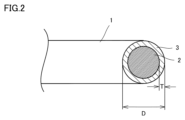
- 1 is a schematic cross-sectional view of an annular sealing material according to one embodiment of the present invention.
- An annular sealing material according to one embodiment of the present invention includes a core and an outer layer surrounding the core, and the core and the outer layer are different from each other in either or both after hot press molding and after secondary crosslinking. Contains a crosslinked product of a crosslinkable rubber composition that has a different color. The annular sealing material will be explained with reference to the drawings.
- the annular sealing material 1 preferably has an average ratio (hereinafter also referred to as average ratio) of the thickness of the outer layer 3 to the entire thickness in the cross section of 1/50 to 1/3, more preferably 1/35 to 1/4. be.
- the average ratio is the average of the ratios measured at two or more randomly selected cross sections of the annular sealing material other than the joint.
- the ratio is, for example, the ratio T/D of the maximum thickness T of the outer layer 3 in the cross section of the annular sealing material 1 in FIG. 2 and the diameter (diameter) D of the cross section of the annular sealing material 1 including that thickness.
- the thickness T of the outer layer 3 may be, for example, 0.1 to 10 mm, preferably 0.2 to 3 mm.
- the cross-sectional diameter D of the sealing material 1 may be, for example, 3 to 50 mm, preferably 3 to 15 mm.
- a crosslinkable rubber composition for forming the core 2 (hereinafter also referred to as a crosslinkable rubber composition for core) and a crosslinkable rubber composition for forming the outer layer 3 (hereinafter referred to as a crosslinkable rubber composition for outer layer) ) has different colors after hot press molding and/or after secondary crosslinking, so that the joints and parts are different after hot press molding and/or after secondary crosslinking.
- the protrusion of the core 2 from the outer layer 3 at the cutting line becomes easier to see, and productivity tends to improve.
- the core 2 and the outer layer 3 are formed by selecting, for example, the types of raw materials contained in the crosslinkable rubber composition for the core and the crosslinkable rubber composition for the outer layer (hereinafter referred to as the crosslinkable rubber composition when both are referred to). By adjusting the blending ratio of raw materials, it is possible to have different colors either or both after hot press molding and after secondary crosslinking.
- At least one of the crosslinkable rubber compositions may contain a colorant.
- at least one of the crosslinkable rubber compositions contains a colorant, it is preferable that the core 2 contains the colorant and the outer layer 3 does not contain the colorant.
- both the core 2 and the outer layer 3 contain colorants, it is preferred that the core 2 and the outer layer 3 contain different types of colorants. It is also possible to make the core 2 and the outer layer 3 exhibit different colors after hot press molding or secondary crosslinking without incorporating a pigment into the crosslinkable rubber composition.
- the crosslinkable rubber composition for the core and the crosslinkable rubber composition for the outer layer may have the same color or different colors before hot press molding or secondary crosslinking. Furthermore, the colors of the crosslinkable rubber composition for the core and the crosslinkable rubber composition for the outer layer are the same after hot press molding or secondary crosslinking compared to before hot press molding or before secondary crosslinking. Well, it can be different.
- the colorant may be a colorant conventionally used in sealants.
- the colorant include at least one selected from the group consisting of inorganic pigments and organic pigments.
- inorganic pigments include white pigments (e.g., silica, zinc white, lead white, lithopone, titanium dioxide, precipitated barium sulfate, barite powder, etc.), red pigments (e.g., red lead, iron oxide red, etc.), yellow pigments (e.g., Examples include yellow pigments, zinc yellow, etc.), blue pigments (for example, ultramarine blue, Prussian blue, YInMn blue, etc.), and black pigments (for example, carbon black, etc.).
- white pigments e.g., silica, zinc white, lead white, lithopone, titanium dioxide, precipitated barium sulfate, barite powder, etc.
- red pigments e.g., red lead, iron oxide red, etc.
- yellow pigments e.g., Examples include yellow
- organic pigments examples include azo pigments (azo lake pigments, insoluble azo pigments, condensed azo pigments, etc.); anthraquinone pigments, thioindigo pigments, perinone pigments, perylene pigments, quinacridone pigments, isoindolinone pigments, isoindoline pigments. , polycyclic pigments such as dioxazine pigments, quinophthalone pigments, and diketopyrrolopyrrole pigments, and phthalocyanine pigments.
- organic pigments classified as pigments in the color index can be used.
- Preferably used pigments are organic pigments that do not contain metal elements. Organic pigments that do not contain metal elements do not have the risk of scattering substances derived from metal elements even if the sealing material is used in a harsh ozone environment such as in semiconductor applications and the annular sealing material is etched.
- the content of the colorant in the crosslinkable rubber composition may be, for example, 0.01 parts by mass or more and less than 2 parts by mass with respect to 100 parts by mass of the crosslinkable rubber component described below, and the content of the colorant in the joints and parting lines may be 0.01 parts by mass or more and less than 2 parts by mass.
- the amount is preferably 0.05 parts by mass or more and 1.5 parts by mass or less, and more preferably 0.1 parts by mass or more and 1 part by mass or less.
- the crosslinkable rubber composition can contain a crosslinkable rubber component.
- the crosslinkable rubber component is capable of forming an elastomer (crosslinked rubber) having the above-mentioned crosslinked structure through a crosslinking reaction.
- the crosslinkable rubber component can have crosslinkable sites such as carbon-carbon unsaturated groups, nitrile groups, hydroxyl groups, amino groups, carbonyl groups, and halogen groups.
- crosslinkable rubber components include perfluoroelastomer (FFKM), fluororubber (FKM), silicone rubber, fluorosilicone rubber, ethylene-propylene rubber (EPM), ethylene-propylene-diene rubber (EPDM), and nitrile rubber (NBR). ; acrylonitrile butadiene rubber), hydrogenated nitrile rubber (HNBR; hydrogenated acrylonitrile butadiene rubber), butyl rubber (IIR), and acrylic rubber.
- perfluoroelastomers, fluororubbers, silicone rubbers and fluorosilicone rubbers are preferably used.
- one of the above crosslinkable rubber components may be used alone, or a polymer blend containing two or more of the above crosslinkable rubber components may be used.
- the outer layer 3 includes at least one crosslinked material selected from the group consisting of perfluoroelastomer and fluororubber, and the core 2 is selected from the group consisting of perfluoroelastomer, fluororubber, silicone rubber, and fluorosilicone rubber. It is preferable that at least one type of crosslinked product is included. Therefore, the crosslinkable rubber component in the crosslinkable rubber composition for the outer layer is preferably at least one selected from the group consisting of perfluoroelastomers and fluororubbers, and more preferably perfluoroelastomers.
- the crosslinkable rubber component in the crosslinkable rubber composition for core is preferably at least one selected from the group consisting of perfluoroelastomer, fluororubber, silicone rubber, and fluorosilicone rubber.
- the outer layer 3 advantageously contains a crosslinked perfluoroelastomer from the viewpoint of radical resistance.
- the core 2 preferably contains at least one crosslinked material selected from the group consisting of fluororubber, silicone rubber, and fluorosilicone rubber from the viewpoint of material cost.
- the perfluoroelastomer is not particularly limited, and examples thereof include tetrafluoroethylene (TFE)-perfluoro(alkyl vinyl ether) copolymers, TFE-perfluoro(alkoxyalkyl vinyl ether) copolymers, and the like. . These copolymers may further contain structural units derived from other perfluoromonomers. According to a perfluoroelastomer composition containing a perfluoroelastomer, ozone resistance can be improved more than a crosslinkable rubber composition containing a hydrogen atom-containing fluoroelastomer.
- the crosslinkable rubber composition may contain only one type of perfluoroelastomer, or may contain two or more types.
- the perfluoro(alkyl vinyl ether) forming the tetrafluoroethylene (TFE)-perfluoro(alkyl vinyl ether) copolymer may have an alkyl group having 1 to 5 carbon atoms, such as perfluoro(methyl vinyl ether). , perfluoro(ethyl vinyl ether), perfluoro(propyl vinyl ether), and the like. Preferably it is perfluoro(methyl vinyl ether).
- CF 2 CFOCF 2 CF(CF 3 )OC n F 2n+1
- CF2 CFO( CF2 ) 3OCnF2n + 1
- CF 2 CFOCF 2 CF(CF 3 )O(CF 2 O) m C n F 2n+1
- n is, for example, 1 to 5
- m is, for example, 1 to 3.
- the perfluoroelastomer preferably has crosslinking properties, and more specifically, it is preferably one obtained by further copolymerizing a crosslinking site monomer (further containing a structural unit derived from the crosslinking site monomer).
- a crosslinking site means a site capable of a crosslinking reaction. Examples of the crosslinking site include a nitrile group, a halogen group (eg, an I group, a Br group, etc.), a perfluorophenyl group, and the like.
- a crosslinking site monomer having a nitrile group as a crosslinking site is a nitrile group-containing perfluorovinyl ether.
- a crosslinking site monomer having a halogen group as a crosslinking site is a halogen group-containing perfluorovinyl ether.
- the halogen group-containing perfluorovinyl ether include those in which the nitrile group is replaced with a halogen group in the above-mentioned specific example of the nitrile group-containing perfluorovinyl ether.
- the crosslinkable perfluoroelastomer may have a crosslinked structure that crosslinks two main chains.
- the ratio of TFE-derived structural units/perfluoro(alkyl vinyl ether) or perfluoro(alkoxyalkyl vinyl ether)-derived structural units/crosslinking site monomer-derived structural units in the perfluoroelastomer is usually 50 to 79.6 in terms of molar ratio. %/20-49.8%/0.2-5%, preferably 60-74.8%/25-39.5%/0.5-2%.
- the crosslinkable rubber composition can also contain two or more types of perfluoroelastomers having different ratios of the above-mentioned structural units.
- Fluororubbers include binary vinylidene fluoride rubber such as vinylidene fluoride/hexafluoropropylene copolymer, vinylidene fluoride/tetrafluoroethylene/hexafluoropropylene copolymer, and vinylidene fluoride/tetrafluoroethylene/peroxide.
- Fluoroalkyl vinyl ether copolymer ternary vinylidene fluoride rubber such as vinylidene fluoride/tetrafluoroethylene/propylene copolymer, tetrafluoroethylene/propylene copolymer, ethylene/tetrafluoroethylene/perfluoromethyl vinyl ether
- examples include copolymers, thermoplastic fluororubbers, and liquid fluororubbers with a perfluoropolyether skeleton (for example, "SIFEL (registered trademark)" manufactured by Shin-Etsu Chemical Co., Ltd.).
- One type of fluororubber may be used alone, or two or more types may be used in combination.
- the fluororubber may contain a functional group.
- the functional group can be introduced, for example, by copolymerizing a crosslinking site monomer having the functional group.
- the crosslinking site monomer can be a halogen group-containing monomer.
- the crosslinkable rubber composition can optionally contain a crosslinking agent depending on the crosslinking system of the crosslinkable rubber component together with a co-crosslinking agent (crosslinking aid).
- crosslinking systems for perfluoroelastomers include peroxide crosslinking systems, triazine crosslinking systems, oxazole crosslinking systems, imidazole crosslinking systems, thiazole crosslinking systems, and bisphenol crosslinking systems.
- Examples of crosslinking systems for vinylidene fluoride rubber and tetrafluoroethylene-propylene rubber include peroxide crosslinking systems, polyamine crosslinking systems, and polyol crosslinking systems.
- the crosslinkable rubber composition may be crosslinked with any one type of crosslinking system, or may be crosslinked with two or more types of crosslinking systems.
- Peroxide crosslinking agents include, for example, 2,5-dimethyl-2,5-di(t-butylperoxy)hexane (commercially available products: “Perhexa 25B” and “Perhexa 25B-40” manufactured by NOF Corporation); Milperoxide (commercially available example: “Percumil D” manufactured by NOF Corporation); 2,4-dichlorobenzoyl peroxide; di-t-butyl peroxide; t-butyl dicumyl peroxide; benzoyl peroxide (commercially available Example: “Niper B” manufactured by NOF Corporation); 2,5-dimethyl-2,5-(t-butylperoxy)hexine-3 (Example of commercial product: "Perhexin 25B” manufactured by NOF Corporation); 2 ,5-dimethyl-2,5-di(benzoylperoxy)hexane; ⁇ , ⁇ '-bis(t-butylperoxy-m-isopropyl)benzene (
- Co-crosslinking agents used in the peroxide crosslinking system include triallyl isocyanurate (commercial product example: "TAIC” manufactured by Mitsubishi Chemical Corporation); triallyl cyanurate; triallyl formal; triallyl trimellitate; N,N Compounds capable of co-crosslinking with radicals (unsaturated polyfunctional compounds) such as '-m-phenylene bismaleimide; dipropargyl terephthalate; diallyl phthalate; and tetraallyl terephthalamide can be mentioned. Only one type of co-crosslinking agent may be used, or two or more types may be used in combination. Among the above, from the viewpoint of reactivity and heat resistance (compression set characteristics), it is preferable that the co-crosslinking agent contains triallyl isocyanurate.
- crosslinking catalysts such as organotin compounds, onium salts such as quaternary phosphonium salts and quaternary ammonium salts, urea, and silicon nitride are used.
- crosslinking agents used in the oxazole crosslinking system include 2,2-bis(3-amino-4-hydroxyphenyl)hexafluoropropane (BOAP), 4,4'-sulfonylbis(2-aminophenol), 9, Contains 9-bis(3-amino-4-hydroxyphenyl)fluorene.
- BOAP 2,2-bis(3-amino-4-hydroxyphenyl)hexafluoropropane
- 4,4'-sulfonylbis(2-aminophenol) 9 Contains 9-bis(3-amino-4-hydroxyphenyl)fluorene.
- BOAP 2,2-bis(3-amino-4-hydroxyphenyl)hexafluoropropane
- crosslinking agent used in the imidazole crosslinking system and the thiazole crosslinking system conventionally known ones can be used.
- examples of the crosslinking agent used in the imidazole crosslinking system include 3,3',4,4'-tetraaminobenzophenone and 3,3'-diaminobenzidine.
- the content of the crosslinking agent (if two or more types are used, the total amount thereof) in the crosslinkable rubber composition is, for example, 0.1 to 10 parts by mass, and preferably is 0.2 to 5 parts by weight, more preferably 0.3 to 3 parts by weight.
- the content of the co-crosslinking agent (the total amount when two or more types are used) in the crosslinkable rubber composition is, for example, 0.5 to 10 parts by mass with respect to 100 parts by mass of the total amount of the crosslinkable rubber component, From the viewpoint of improving heat resistance, the amount is preferably 1 to 8 parts by mass.
- the crosslinkable rubber composition may be added with anti-aging agents, antioxidants, vulcanization accelerators, processing aids (stearic acid, etc.), stabilizers, and tackifiers as necessary for the purpose of improving processability and adjusting physical properties. It may contain additives such as a silane coupling agent, a plasticizer, a flame retardant, a mold release agent, a wax, a lubricant, and the like. Other examples of additives are tack reducing (inhibiting) agents such as fluorinated oils (eg, perfluoroethers, etc.). Only one type of additive may be used, or two or more types may be used in combination.
- the amount of additives be as small as possible (for example, if the total amount of crosslinkable rubber components is 100% 10 parts by weight or less, preferably 5 parts by weight or less, more preferably 2 parts by weight or less, still more preferably 1 part by weight or less).
- the crosslinkable rubber composition may also contain fillers (for example, fluororesin, silica, alumina, zinc oxide, titanium oxide, clay, talc, diatomaceous earth, barium sulfate, calcium carbonate, magnesium carbonate, calcium oxide, mica, graphite) as necessary. , aluminum hydroxide, aluminum silicate, hydrotalcite, metal powder, glass powder, ceramic powder, etc.). Only one type of filler may be used, or two or more types may be used in combination. The content of the filler in the crosslinkable rubber composition (if two or more types are used, the total amount) is, for example, 0.1 part by mass or more and 40 parts by mass or less, based on 100 parts by mass of the total amount of the crosslinkable rubber component.
- fillers for example, fluororesin, silica, alumina, zinc oxide, titanium oxide, clay, talc, diatomaceous earth, barium sulfate, calcium carbonate, magnesium carbonate, calcium oxide, mica, graphite
- fillers for
- the content is preferably 1 part by mass or more and 30 parts by mass or less, more preferably more than 1 part by mass and 30 parts by mass or less.
- the filler is distinguished from the organic pigments and inorganic pigments as the above-mentioned colorants, and different types of fillers from the organic pigments and inorganic pigments can be used.
- the crosslinkable rubber composition contains a fluororesin filler
- the ozone resistance and mechanical strength of the crosslinked product can be further improved.
- the fluororesin can be contained in the crosslinkable rubber composition, for example, as fluororesin particles.
- the fluororesin used as a filler is a resin having a fluorine atom in its molecule, and examples include polytetrafluoroethylene (PTFE), tetrafluoroethylene-perfluoroalkyl vinyl ether copolymer (PFA), and tetrafluoroethylene-hexafluoropropylene.
- PTFE polytetrafluoroethylene
- PFA tetrafluoroethylene-perfluoroalkyl vinyl ether copolymer
- tetrafluoroethylene-hexafluoropropylene tetrafluoroethylene-hexafluoropropylene.
- FEP tetrafluoroethylene-ethylene copolymer
- PCTFE polychlorotrifluoroethylene
- ECTFE chlorotrifluoroethylene-ethylene copolymer
- PVDF polyvinylidene fluoride
- PVDF-HFP copolymer vinylidene fluoride-hexafluoropropylene copolymer
- VDF-HFP-TFE copolymer vinylidene fluoride-hexafluoropropylene-tetrafluoroethylene copolymer
- VDF-HFP-TFE copolymer etc. Something can happen.
- One type of fluororesin may be used alone, or two or more types may be used in combination.
- a fluororesin with a relatively high melting point such as PFA or PTFE, from the viewpoint of preventing the resin from melting in a high-temperature environment and damaging properties such as compression set.
- the fluororesin used as a filler may contain a functional group.
- the functional group can be introduced, for example, by copolymerizing a monomer having the functional group.
- crosslinking between the fluororesin and the perfluoroelastomer also proceeds with the crosslinking agent, which further improves the mechanical strength etc. of the crosslinked product of the perfluoroelastomer composition. It can be increased.
- a fluororesin containing a functional group nitrile group-containing polytetrafluoroethylene described in JP-A-2013-177631 can be mentioned.
- the fluororesin can also be a modified fluororesin, such as "TFM modified PTFE" (manufactured by Dyneon).
- the crosslinkable rubber composition contains a perfluoroelastomer and a fluororesin filler, for example, 1) a method of kneading perfluoroelastomer powder and fluororesin powder using a mixing roll, 2) a method of kneading perfluoroelastomer powder or fluororesin powder, and 2) perfluoroelastomer powder or pellets.
- a perfluoroelastomer and a fluororesin filler for example, 1) a method of kneading perfluoroelastomer powder and fluororesin powder using a mixing roll, 2) a method of kneading perfluoroelastomer powder or fluororesin powder, and 2) perfluoroelastomer powder or pellets.
- 3) perfluoroelastomer containing fluororesin manufactured by adding fluororesin at the perfluoroelastomer preparation stage. can be used.
- the crosslinkable rubber composition can be prepared by uniformly kneading a crosslinkable rubber component, a colorant, a crosslinking agent, a co-crosslinking agent added as necessary, a filler, and additives.
- a kneading machine conventionally known kneading machines such as mixing rolls, pressure kneaders, internal mixers (Banbury mixers) can be used.
- Each component may be mixed and kneaded at the same time, or the components other than those that contribute to the crosslinking reaction (crosslinking accelerator, crosslinking retarder, crosslinking agent, etc.) may be uniformly kneaded first.
- the kneading may be carried out in multiple stages, such as by kneading the components that contribute to the crosslinking reaction.
- the method for manufacturing an annular sealing material can include, for example, the following steps. 1) A step of preparing a preformed body comprising an uncrosslinked core made of a crosslinkable rubber composition for a core and an uncrosslinked outer layer made of a crosslinkable rubber composition for an outer layer that covers the periphery of the uncrosslinked core [hereinafter , also referred to as step 1)]. 2) Step of placing the preform in a mold and performing hot press molding [hereinafter also referred to as step 2].
- Step 1) can include a step of extrusion molding using the crosslinkable rubber composition for the core and the crosslinkable rubber composition for the outer layer.
- the preform prepared in step 1) can be rope-shaped.
- the rope-shaped preform can be produced, for example, as follows. First, a crosslinkable rubber composition for the core and a crosslinkable rubber composition for the outer layer are formed into a sheet using a roll to produce a sheet-like molded product. The thickness of the sheet-like molded product may be, for example, 1 mm or more and 5 mm or less. Next, the sheet-like molded product is cut into ribbon-like molded products with a width of 5 mm or more and 30 mm or less, for example, using a cutting machine.
- hot press molding involves producing a linear or arcuate molded object from a rope-shaped preformed object using a mold having a linear or arcuate cavity.
- the annular sealing material may be produced by feeding press molding by connecting the two to form an annular sealing material, or by placing a rope-shaped preform in a mold having an annular cavity and performing heat pressing to produce an annular sealing material.
- the heating temperature in hot press molding may be, for example, about 110 to 220°C.
- the method for producing an annular sealing material can include a secondary crosslinking step for further crosslinking the crosslinkable rubber composition after step 2).
- the heating temperature in the secondary crosslinking step may be, for example, about 150 to 310°C.
- a crosslinkable rubber composition for an outer layer was prepared by blending the perfluoroelastomer, Perhexa 25B as a crosslinking agent, and TAIC as a crosslinking aid and kneading the mixture using a kneader.
- fluororubber 0.1 part by mass of a colorant (Crophtal Violet D5700) per 100 parts by mass of fluororubber, Perhexa 25B as a crosslinking agent, and TAIC as a crosslinking aid were mixed and kneaded using a kneader.
- a crosslinkable rubber composition for core was prepared.
- annular sealing material was produced by press-molding the five rope-shaped preforms at a temperature of 170°C.
- the obtained annular sealing material was subjected to secondary crosslinking at a temperature of 200°C. It was confirmed that the obtained annular sealing material did not protrude from the outer layer of the core.
- the average ratio of the thickness of the outer layer to the cross-sectional diameter of the annular sealing material was 1/7.
Landscapes
- Engineering & Computer Science (AREA)
- General Engineering & Computer Science (AREA)
- Mechanical Engineering (AREA)
- Manufacturing & Machinery (AREA)
- Compositions Of Macromolecular Compounds (AREA)
- Gasket Seals (AREA)
- Sealing Devices (AREA)
- Heating, Cooling, Or Curing Plastics Or The Like In General (AREA)
- Casting Or Compression Moulding Of Plastics Or The Like (AREA)
Abstract
Description
[1] 中芯と、前記中芯の周囲を覆う外層とを含む環状シール材であって、前記中芯および前記外層は熱プレス成形後および二次架橋後のいずれか一方または両方において互いに異なった色を有する架橋性ゴム組成物の架橋物を含む、環状シール材。
[2] 前記環状シール材は、断面における厚み全体に対する前記外層の厚みの平均比率が1/35~1/4である、[1]に記載の環状シール材。
[3] 前記中芯および前記外層の少なくともいずれか一方が着色剤を含む、[1]または[2]に記載の環状シール材。
[4] 前記中芯は着色剤を含み、前記外層は着色剤を含まない、[3]に記載の環状シール材。
[5] 前記着色剤は、無機顔料および有機顔料からなる群から選択される少なくとも1種である、[3]または[4]に記載の環状シール材。
[6] 前記外層はパーフロロエラストマーおよびフッ素ゴムからなる群から選択される少なくとも1種の架橋物を含み、前記中芯は、パーフロロエラストマー、フッ素ゴム、シリコーンゴムおよびフロロシリコーンゴムからなる群から選択される少なくとも1種の架橋物を含む、[1]~[5]のいずれかに記載の環状シール材。
[7] [1]に記載の環状シール材の製造方法であって、
中芯用架橋性ゴム組成物からなる未架橋中芯と、前記未架橋中芯の周囲を覆う外層用架橋性ゴム組成物からなる未架橋外層とを含む予備成形体を準備する工程と、
前記予備成形体を金型内に設置して熱プレス成形を行う工程と
を含み、
前記中芯用架橋性ゴム組成物および前記外層用架橋性ゴム組成物は熱プレス成形後および二次架橋後のいずれか一方または両方において異なった色を有する、環状シール材の製造方法。
[8] 前記予備成形体を準備する工程は、前記中芯用架橋性ゴム組成物および前記外層用架橋性ゴム組成物を用いて押出成形する工程を含む、[7]に記載の環状シール材の製造方法。
[9] 前記予備成形体はロープ状である、[7]または[8]に記載の製造方法。
本発明の一態様にかかる環状シール材は、中芯と、中芯の周囲を覆う外層とを含み、中芯および外層は熱プレス成形後および二次架橋後のいずれか一方または両方において互いに異なった色を有する架橋性ゴム組成物の架橋物を含む。環状シール材について図面を参照しながら説明する。
無機顔料としては、例えば白色顔料(例えばシリカ、亜鉛華、鉛白、リトポン、二酸化チタン、沈降性硫酸バリウムおよびバライト粉等)、赤色顔料(例えば鉛丹、酸化鉄赤等)、黄色顔料(例えば黄鉛、亜鉛黄等)、青色顔料(例えばウルトラマリン青、プロシア青、YInMnブルー等)、黒色顔料(例えばカーボンブラック等)等が挙げられる。
有機顔料としては、例えばアゾ顔料(アゾレーキ顔料、不溶性アゾ顔料、縮合アゾ顔料等);アントラキノン系顔料、チオインジゴ系顔料、ペリノン系顔料、ペリレン系顔料、キナクリドン系顔料、イソインドリノン顔料、イソインドリン顔料、ジオキサジン顔料、キノフタロン顔料、ジケトピロロピロール顔料等の多環式顔料、フタロシアニン系顔料等が挙げられる。有機顔料としてカラーインデックスにおいてピグメントに分類されている有機顔料を使用することができる。好ましく用いられる顔料は、金属元素を含有しない有機顔料である。金属元素を含有しない有機顔料は、シール材が半導体用途など過酷なオゾン環境下で用いられ、環状シール材がエッチングされることがあっても、金属元素由来の物質が飛散させるおそれがない。
CF2=CFOCF2CF(CF3)OCnF2n+1、
CF2=CFO(CF2)3OCnF2n+1、
CF2=CFOCF2CF(CF3)O(CF2O)mCnF2n+1、または
CF2=CFO(CF2)2OCnF2n+1
であることができる。上記式中、nは例えば1~5であり、mは例えば1~3である。
CF2=CFO(CF2)nOCF(CF3)CN(nは例えば2~4)、
CF2=CFO(CF2)nCN(nは例えば2~12)、
CF2=CFO[CF2CF(CF3)O]m(CF2)nCN(nは例えば2、mは例えば1~5)、
CF2=CFO[CF2CF(CF3)O]m(CF2)nCN(nは例えば1~4、mは例えば1~2)、
CF2=CFO[CF2CF(CF3)O]nCF2CF(CF3)CN(nは例えば0~4)
等を挙げることができる。
環状シール材の製造方法は、例えば以下の工程を含むことができる。
1)中芯用架橋性ゴム組成物からなる未架橋中芯と、未架橋中芯の周囲を覆う外層用架橋性ゴム組成物からなる未架橋外層とを含む予備成形体を準備する工程[以下、工程1)ともいう]。
2)予備成形体を金型内に設置して熱プレス成形を行う工程[以下、工程2)ともいう]。
パーフロロエラストマーと、架橋剤としてパーヘキサ25Bと架橋助剤としてTAICとを配合してニーダーを用いて混練りすることにより外層用架橋性ゴム組成物を作製した。次にフッ素ゴムと、フッ素ゴム100質量部に対し0.1質量部の着色剤(Cromphtal Violet D5700)と、架橋剤としてパーヘキサ25Bと架橋助剤としてTAICとを配合してニーダーを用いて混練りすることにより中芯用架橋性ゴム組成物を作製した。次に外層用架橋性ゴム組成物および中芯用架橋性ゴム組成物をそれぞれ厚みが約3mmとなるようにロールを用いてシート状に成形し、裁断機で幅が約15mmのリボン状に裁断した。クロスヘッドが備わったスクリュー式押出機にリボン状に成形した外層用架橋性ゴム組成物と中芯用架橋性ゴム組成物を投入し、外層が外層用架橋性ゴム組成物、中芯が中芯用架橋性ゴム組成物からなる2層構造を有するロープ状の予備成形体を5本作製した。ロープ状の予備成形体の断面の径は約7mm、外層厚みは約1mm、長さは800mmであった。
Claims (9)
- 中芯と、前記中芯の周囲を覆う外層とを含む環状シール材であって、前記中芯および前記外層は熱プレス成形後および二次架橋後のいずれか一方または両方において互いに異なった色を有する架橋性ゴム組成物の架橋物を含む、環状シール材。
- 前記環状シール材は、断面における厚み全体に対する前記外層の厚みの平均比率が1/50~1/3である、請求項1に記載の環状シール材。
- 前記中芯および前記外層の少なくともいずれか一方が着色剤を含む、請求項1または2に記載の環状シール材。
- 前記中芯は着色剤を含み、前記外層は着色剤を含まない、請求項3に記載の環状シール材。
- 前記着色剤は、無機顔料および有機顔料からなる群から選択される少なくとも1種である、請求項3または4に記載の環状シール材。
- 前記外層はパーフロロエラストマーおよびフッ素ゴムからなる群から選択される少なくとも1種の架橋物を含み、前記中芯は、パーフロロエラストマー、フッ素ゴム、シリコーンゴムおよびフロロシリコーンゴムからなる群から選択される少なくとも1種の架橋物を含む、請求項1~5のいずれか1項に記載の環状シール材。
- 請求項1に記載の環状シール材の製造方法であって、
中芯用架橋性ゴム組成物からなる未架橋中芯と、前記未架橋中芯の周囲を覆う外層用架橋性ゴム組成物からなる未架橋外層とを含む予備成形体を準備する工程と、
前記予備成形体を金型内に設置して熱プレス成形を行う工程と
を含み、
前記中芯用架橋性ゴム組成物および前記外層用架橋性ゴム組成物は熱プレス成形後および二次架橋後のいずれか一方または両方において互いに異なった色を有する、環状シール材の製造方法。 - 前記予備成形体を準備する工程は、前記中芯用架橋性ゴム組成物および前記外層用架橋性ゴム組成物を用いて押出成形する工程を含む、請求項7に記載の環状シール材の製造方法。
- 前記予備成形体はロープ状である、請求項7または8に記載の製造方法。
Priority Applications (4)
| Application Number | Priority Date | Filing Date | Title |
|---|---|---|---|
| CN202380031823.8A CN119053805A (zh) | 2022-03-30 | 2023-03-15 | 环状密封件和制造方法 |
| US18/847,053 US20250198517A1 (en) | 2022-03-30 | 2023-03-15 | Annular seal material and manufacturing method |
| KR1020247035328A KR20240169652A (ko) | 2022-03-30 | 2023-03-15 | 환상 시일재 및 제조 방법 |
| EP23779603.2A EP4501602A4 (en) | 2022-03-30 | 2023-03-15 | RING SEALANT AND PRODUCTION PROCESS |
Applications Claiming Priority (2)
| Application Number | Priority Date | Filing Date | Title |
|---|---|---|---|
| JP2022056235A JP7841924B2 (ja) | 2022-03-30 | 2022-03-30 | 環状シール材および製造方法 |
| JP2022-056235 | 2022-03-30 |
Publications (1)
| Publication Number | Publication Date |
|---|---|
| WO2023189585A1 true WO2023189585A1 (ja) | 2023-10-05 |
Family
ID=88201521
Family Applications (1)
| Application Number | Title | Priority Date | Filing Date |
|---|---|---|---|
| PCT/JP2023/010022 Ceased WO2023189585A1 (ja) | 2022-03-30 | 2023-03-15 | 環状シール材および製造方法 |
Country Status (7)
| Country | Link |
|---|---|
| US (1) | US20250198517A1 (ja) |
| EP (1) | EP4501602A4 (ja) |
| JP (1) | JP7841924B2 (ja) |
| KR (1) | KR20240169652A (ja) |
| CN (1) | CN119053805A (ja) |
| TW (1) | TW202346738A (ja) |
| WO (1) | WO2023189585A1 (ja) |
Families Citing this family (1)
| Publication number | Priority date | Publication date | Assignee | Title |
|---|---|---|---|---|
| US20260036205A1 (en) * | 2024-07-31 | 2026-02-05 | John Crane Inc. | Sealing rings |
Citations (8)
| Publication number | Priority date | Publication date | Assignee | Title |
|---|---|---|---|---|
| JPH0483976A (ja) * | 1990-07-26 | 1992-03-17 | Taiho Kogyo Co Ltd | ガスケット |
| JPH1052885A (ja) | 1996-08-09 | 1998-02-24 | Mitsuboshi:Kk | 2層構造のゴム成形品及びその製造方法 |
| JPH10323847A (ja) | 1997-05-23 | 1998-12-08 | Nok Corp | 複合構造oリングの製造法 |
| JPH10329271A (ja) | 1997-06-03 | 1998-12-15 | Nok Corp | 積層構造体 |
| JP2005282820A (ja) * | 2004-03-30 | 2005-10-13 | Tokai Rubber Ind Ltd | 低透過性弾性シールリング |
| JP4148493B2 (ja) | 2001-09-27 | 2008-09-10 | 等 渡辺 | 複合構造oリングの製造方法 |
| JP2011208204A (ja) * | 2010-03-29 | 2011-10-20 | Tdk Corp | めっき装置、めっき方法およびチップ型電子部品の製造方法 |
| JP2013177631A (ja) | 2005-05-25 | 2013-09-09 | Gore Enterprise Holdings Inc | 高純度パーフルオロエラストマー複合材およびその製造方法 |
Family Cites Families (5)
| Publication number | Priority date | Publication date | Assignee | Title |
|---|---|---|---|---|
| US2961713A (en) * | 1957-05-09 | 1960-11-29 | Parker Hannifin Corp | Molding of o-rings and the like |
| JP2001208204A (ja) * | 2000-01-31 | 2001-08-03 | Tokai Kogyo Co Ltd | 環状パッキン及びその製造方法 |
| JP3979925B2 (ja) * | 2002-11-14 | 2007-09-19 | 株式会社三ツ星 | フッ素ゴムチューブ及びその製造方法 |
| JP6618507B2 (ja) * | 2016-05-30 | 2019-12-11 | 株式会社バルカー | パーフルオロエラストマー組成物及びシール材 |
| JP2019108913A (ja) * | 2017-12-15 | 2019-07-04 | 日立グローバルライフソリューションズ株式会社 | パッキン材及びそれを備える断熱容器 |
-
2022
- 2022-03-30 JP JP2022056235A patent/JP7841924B2/ja active Active
-
2023
- 2023-03-15 WO PCT/JP2023/010022 patent/WO2023189585A1/ja not_active Ceased
- 2023-03-15 US US18/847,053 patent/US20250198517A1/en active Pending
- 2023-03-15 KR KR1020247035328A patent/KR20240169652A/ko active Pending
- 2023-03-15 CN CN202380031823.8A patent/CN119053805A/zh active Pending
- 2023-03-15 EP EP23779603.2A patent/EP4501602A4/en active Pending
- 2023-03-28 TW TW112111699A patent/TW202346738A/zh unknown
Patent Citations (8)
| Publication number | Priority date | Publication date | Assignee | Title |
|---|---|---|---|---|
| JPH0483976A (ja) * | 1990-07-26 | 1992-03-17 | Taiho Kogyo Co Ltd | ガスケット |
| JPH1052885A (ja) | 1996-08-09 | 1998-02-24 | Mitsuboshi:Kk | 2層構造のゴム成形品及びその製造方法 |
| JPH10323847A (ja) | 1997-05-23 | 1998-12-08 | Nok Corp | 複合構造oリングの製造法 |
| JPH10329271A (ja) | 1997-06-03 | 1998-12-15 | Nok Corp | 積層構造体 |
| JP4148493B2 (ja) | 2001-09-27 | 2008-09-10 | 等 渡辺 | 複合構造oリングの製造方法 |
| JP2005282820A (ja) * | 2004-03-30 | 2005-10-13 | Tokai Rubber Ind Ltd | 低透過性弾性シールリング |
| JP2013177631A (ja) | 2005-05-25 | 2013-09-09 | Gore Enterprise Holdings Inc | 高純度パーフルオロエラストマー複合材およびその製造方法 |
| JP2011208204A (ja) * | 2010-03-29 | 2011-10-20 | Tdk Corp | めっき装置、めっき方法およびチップ型電子部品の製造方法 |
Non-Patent Citations (1)
| Title |
|---|
| See also references of EP4501602A4 |
Also Published As
| Publication number | Publication date |
|---|---|
| CN119053805A (zh) | 2024-11-29 |
| KR20240169652A (ko) | 2024-12-03 |
| JP7841924B2 (ja) | 2026-04-07 |
| JP2023148297A (ja) | 2023-10-13 |
| US20250198517A1 (en) | 2025-06-19 |
| EP4501602A1 (en) | 2025-02-05 |
| EP4501602A4 (en) | 2026-03-18 |
| TW202346738A (zh) | 2023-12-01 |
Similar Documents
| Publication | Publication Date | Title |
|---|---|---|
| JP7792845B2 (ja) | 環状シール材および製造方法 | |
| EP3467026B1 (en) | Perfluoroelastomer composition and sealing material | |
| EP4501604A1 (en) | Annular sealing material and production method | |
| EP4501602A1 (en) | Annular sealant and producing method | |
| EP4692604A1 (en) | Annular seal material, preform, and manufacturing method | |
| EP4502431A1 (en) | Annular seal material and manufacturing method |
Legal Events
| Date | Code | Title | Description |
|---|---|---|---|
| 121 | Ep: the epo has been informed by wipo that ep was designated in this application |
Ref document number: 23779603 Country of ref document: EP Kind code of ref document: A1 |
|
| WWE | Wipo information: entry into national phase |
Ref document number: 18847053 Country of ref document: US |
|
| WWE | Wipo information: entry into national phase |
Ref document number: 202380031823.8 Country of ref document: CN |
|
| ENP | Entry into the national phase |
Ref document number: 20247035328 Country of ref document: KR Kind code of ref document: A |
|
| WWE | Wipo information: entry into national phase |
Ref document number: 1020247035328 Country of ref document: KR |
|
| WWE | Wipo information: entry into national phase |
Ref document number: 11202406431S Country of ref document: SG Ref document number: 2023779603 Country of ref document: EP |
|
| NENP | Non-entry into the national phase |
Ref country code: DE |
|
| ENP | Entry into the national phase |
Ref document number: 2023779603 Country of ref document: EP Effective date: 20241030 |
|
| WWP | Wipo information: published in national office |
Ref document number: 18847053 Country of ref document: US |