WO2023190767A1 - ポリエーテルエーテルケトン分解方法およびこの分解方法によって得られた分解生成物を原料とした新規物質 - Google Patents
ポリエーテルエーテルケトン分解方法およびこの分解方法によって得られた分解生成物を原料とした新規物質 Download PDFInfo
- Publication number
- WO2023190767A1 WO2023190767A1 PCT/JP2023/012993 JP2023012993W WO2023190767A1 WO 2023190767 A1 WO2023190767 A1 WO 2023190767A1 JP 2023012993 W JP2023012993 W JP 2023012993W WO 2023190767 A1 WO2023190767 A1 WO 2023190767A1
- Authority
- WO
- WIPO (PCT)
- Prior art keywords
- polyetheretherketone
- decomposition method
- decomposition
- tert
- reaction mixture
- Prior art date
- Legal status (The legal status is an assumption and is not a legal conclusion. Google has not performed a legal analysis and makes no representation as to the accuracy of the status listed.)
- Ceased
Links
Images
Classifications
-
- C—CHEMISTRY; METALLURGY
- C08—ORGANIC MACROMOLECULAR COMPOUNDS; THEIR PREPARATION OR CHEMICAL WORKING-UP; COMPOSITIONS BASED THEREON
- C08J—WORKING-UP; GENERAL PROCESSES OF COMPOUNDING; AFTER-TREATMENT NOT COVERED BY SUBCLASSES C08B, C08C, C08F, C08G or C08H
- C08J11/00—Recovery or working-up of waste materials
- C08J11/04—Recovery or working-up of waste materials of polymers
- C08J11/10—Recovery or working-up of waste materials of polymers by chemically breaking down the molecular chains of polymers or breaking of crosslinks, e.g. devulcanisation
- C08J11/18—Recovery or working-up of waste materials of polymers by chemically breaking down the molecular chains of polymers or breaking of crosslinks, e.g. devulcanisation by treatment with organic material
- C08J11/28—Recovery or working-up of waste materials of polymers by chemically breaking down the molecular chains of polymers or breaking of crosslinks, e.g. devulcanisation by treatment with organic material by treatment with organic compounds containing nitrogen, sulfur or phosphorus
-
- C—CHEMISTRY; METALLURGY
- C07—ORGANIC CHEMISTRY
- C07C—ACYCLIC OR CARBOCYCLIC COMPOUNDS
- C07C319/00—Preparation of thiols, sulfides, hydropolysulfides or polysulfides
- C07C319/14—Preparation of thiols, sulfides, hydropolysulfides or polysulfides of sulfides
-
- C—CHEMISTRY; METALLURGY
- C07—ORGANIC CHEMISTRY
- C07C—ACYCLIC OR CARBOCYCLIC COMPOUNDS
- C07C323/00—Thiols, sulfides, hydropolysulfides or polysulfides substituted by halogen, oxygen or nitrogen atoms, or by sulfur atoms not being part of thio groups
- C07C323/22—Thiols, sulfides, hydropolysulfides or polysulfides substituted by halogen, oxygen or nitrogen atoms, or by sulfur atoms not being part of thio groups containing thio groups and doubly-bound oxygen atoms bound to the same carbon skeleton
-
- C—CHEMISTRY; METALLURGY
- C07—ORGANIC CHEMISTRY
- C07C—ACYCLIC OR CARBOCYCLIC COMPOUNDS
- C07C323/00—Thiols, sulfides, hydropolysulfides or polysulfides substituted by halogen, oxygen or nitrogen atoms, or by sulfur atoms not being part of thio groups
- C07C323/50—Thiols, sulfides, hydropolysulfides or polysulfides substituted by halogen, oxygen or nitrogen atoms, or by sulfur atoms not being part of thio groups containing thio groups and carboxyl groups bound to the same carbon skeleton
- C07C323/51—Thiols, sulfides, hydropolysulfides or polysulfides substituted by halogen, oxygen or nitrogen atoms, or by sulfur atoms not being part of thio groups containing thio groups and carboxyl groups bound to the same carbon skeleton having the sulfur atoms of the thio groups bound to acyclic carbon atoms of the carbon skeleton
- C07C323/52—Thiols, sulfides, hydropolysulfides or polysulfides substituted by halogen, oxygen or nitrogen atoms, or by sulfur atoms not being part of thio groups containing thio groups and carboxyl groups bound to the same carbon skeleton having the sulfur atoms of the thio groups bound to acyclic carbon atoms of the carbon skeleton the carbon skeleton being acyclic and saturated
-
- C—CHEMISTRY; METALLURGY
- C07—ORGANIC CHEMISTRY
- C07C—ACYCLIC OR CARBOCYCLIC COMPOUNDS
- C07C327/00—Thiocarboxylic acids
- C07C327/36—Esters of dithiocarboxylic acids
-
- C—CHEMISTRY; METALLURGY
- C07—ORGANIC CHEMISTRY
- C07D—HETEROCYCLIC COMPOUNDS
- C07D303/00—Compounds containing three-membered rings having one oxygen atom as the only ring hetero atom
- C07D303/02—Compounds containing oxirane rings
- C07D303/34—Compounds containing oxirane rings with hydrocarbon radicals, substituted by sulphur, selenium or tellurium atoms
-
- C—CHEMISTRY; METALLURGY
- C08—ORGANIC MACROMOLECULAR COMPOUNDS; THEIR PREPARATION OR CHEMICAL WORKING-UP; COMPOSITIONS BASED THEREON
- C08G—MACROMOLECULAR COMPOUNDS OBTAINED OTHERWISE THAN BY REACTIONS ONLY INVOLVING UNSATURATED CARBON-TO-CARBON BONDS
- C08G65/00—Macromolecular compounds obtained by reactions forming an ether link in the main chain of the macromolecule
- C08G65/34—Macromolecular compounds obtained by reactions forming an ether link in the main chain of the macromolecule from hydroxy compounds or their metallic derivatives
- C08G65/46—Post-polymerisation treatment, e.g. recovery, purification, drying
-
- C—CHEMISTRY; METALLURGY
- C08—ORGANIC MACROMOLECULAR COMPOUNDS; THEIR PREPARATION OR CHEMICAL WORKING-UP; COMPOSITIONS BASED THEREON
- C08G—MACROMOLECULAR COMPOUNDS OBTAINED OTHERWISE THAN BY REACTIONS ONLY INVOLVING UNSATURATED CARBON-TO-CARBON BONDS
- C08G65/00—Macromolecular compounds obtained by reactions forming an ether link in the main chain of the macromolecule
- C08G65/34—Macromolecular compounds obtained by reactions forming an ether link in the main chain of the macromolecule from hydroxy compounds or their metallic derivatives
- C08G65/48—Polymers modified by chemical after-treatment
-
- C—CHEMISTRY; METALLURGY
- C08—ORGANIC MACROMOLECULAR COMPOUNDS; THEIR PREPARATION OR CHEMICAL WORKING-UP; COMPOSITIONS BASED THEREON
- C08J—WORKING-UP; GENERAL PROCESSES OF COMPOUNDING; AFTER-TREATMENT NOT COVERED BY SUBCLASSES C08B, C08C, C08F, C08G or C08H
- C08J11/00—Recovery or working-up of waste materials
- C08J11/04—Recovery or working-up of waste materials of polymers
- C08J11/10—Recovery or working-up of waste materials of polymers by chemically breaking down the molecular chains of polymers or breaking of crosslinks, e.g. devulcanisation
- C08J11/18—Recovery or working-up of waste materials of polymers by chemically breaking down the molecular chains of polymers or breaking of crosslinks, e.g. devulcanisation by treatment with organic material
- C08J11/22—Recovery or working-up of waste materials of polymers by chemically breaking down the molecular chains of polymers or breaking of crosslinks, e.g. devulcanisation by treatment with organic material by treatment with organic oxygen-containing compounds
-
- C—CHEMISTRY; METALLURGY
- C07—ORGANIC CHEMISTRY
- C07C—ACYCLIC OR CARBOCYCLIC COMPOUNDS
- C07C2601/00—Systems containing only non-condensed rings
- C07C2601/02—Systems containing only non-condensed rings with a three-membered ring
-
- C—CHEMISTRY; METALLURGY
- C07—ORGANIC CHEMISTRY
- C07C—ACYCLIC OR CARBOCYCLIC COMPOUNDS
- C07C2601/00—Systems containing only non-condensed rings
- C07C2601/12—Systems containing only non-condensed rings with a six-membered ring
- C07C2601/16—Systems containing only non-condensed rings with a six-membered ring the ring being unsaturated
-
- C—CHEMISTRY; METALLURGY
- C08—ORGANIC MACROMOLECULAR COMPOUNDS; THEIR PREPARATION OR CHEMICAL WORKING-UP; COMPOSITIONS BASED THEREON
- C08G—MACROMOLECULAR COMPOUNDS OBTAINED OTHERWISE THAN BY REACTIONS ONLY INVOLVING UNSATURATED CARBON-TO-CARBON BONDS
- C08G2650/00—Macromolecular compounds obtained by reactions forming an ether link in the main chain of the macromolecule
- C08G2650/28—Macromolecular compounds obtained by reactions forming an ether link in the main chain of the macromolecule characterised by the polymer type
- C08G2650/38—Macromolecular compounds obtained by reactions forming an ether link in the main chain of the macromolecule characterised by the polymer type containing oxygen in addition to the ether group
- C08G2650/40—Macromolecular compounds obtained by reactions forming an ether link in the main chain of the macromolecule characterised by the polymer type containing oxygen in addition to the ether group containing ketone groups, e.g. polyarylethylketones, PEEK or PEK
-
- C—CHEMISTRY; METALLURGY
- C08—ORGANIC MACROMOLECULAR COMPOUNDS; THEIR PREPARATION OR CHEMICAL WORKING-UP; COMPOSITIONS BASED THEREON
- C08J—WORKING-UP; GENERAL PROCESSES OF COMPOUNDING; AFTER-TREATMENT NOT COVERED BY SUBCLASSES C08B, C08C, C08F, C08G or C08H
- C08J2371/00—Characterised by the use of polyethers obtained by reactions forming an ether link in the main chain; Derivatives of such polymers
- C08J2371/08—Polyethers derived from hydroxy compounds or from their metallic derivatives
- C08J2371/10—Polyethers derived from hydroxy compounds or from their metallic derivatives from phenols
-
- Y—GENERAL TAGGING OF NEW TECHNOLOGICAL DEVELOPMENTS; GENERAL TAGGING OF CROSS-SECTIONAL TECHNOLOGIES SPANNING OVER SEVERAL SECTIONS OF THE IPC; TECHNICAL SUBJECTS COVERED BY FORMER USPC CROSS-REFERENCE ART COLLECTIONS [XRACs] AND DIGESTS
- Y02—TECHNOLOGIES OR APPLICATIONS FOR MITIGATION OR ADAPTATION AGAINST CLIMATE CHANGE
- Y02W—CLIMATE CHANGE MITIGATION TECHNOLOGIES RELATED TO WASTEWATER TREATMENT OR WASTE MANAGEMENT
- Y02W30/00—Technologies for solid waste management
- Y02W30/50—Reuse, recycling or recovery technologies
- Y02W30/62—Plastics recycling; Rubber recycling
Definitions
- the present invention relates to a method for decomposing polyetheretherketone and a new substance using the decomposition product obtained by this decomposition method as a raw material.
- Polyetheretherketone (OC 6 H 4 OC 6 H 4 COC 6 H 4 ) n ), a super engineering plastic, not only has excellent heat resistance, high temperature properties, chemical resistance, and electrical insulation properties, but also has high mechanical properties. It is a thermoplastic resin with ideal properties such as strength, dimensional stability, nonflammability, and low smoke emission. Due to these characteristics, it is used in semiconductor-related fields such as retainer rings, wafer chuckers, and transport containers, in the high-end space field that contributes to weight reduction, fuel efficiency, and improved maintainability, in the automotive field such as actuators, gears, and bearings, in energy production, and in the chemical industry. It has a wide range of uses, including general industrial fields such as compressors and pumps, and parts for food processing equipment. Currently, production volume is low at around 100,000 tons worldwide as of 2018, but it is predicted to grow at an average annual growth rate of 4.54% from 2020 to 2026, making it an indispensable material in the future in industrial society. be.
- Patent Document 1 PPS and polyethersulfone (PESU)
- PPS and PES polyethersulfone
- Patent Documents 1, 2, 3, 4, and 5 PPS and polyethersulfone
- An object of the present invention is to provide a polyetheretherketone decomposition method that efficiently decomposes polyetheretherketone, and a new compound etc. synthesized from the decomposition products obtained by the polyetheretherketone decomposition method. .
- polyetheretherketone by reacting polyetheretherketone with 2-phenylethylthiol in the presence of sodium tert-butoxy, polyetheretherketone can be efficiently decomposed and disodium benzophenone-4,4'-dithiolate and hydroquinone can be decomposed efficiently. We found that it can be produced efficiently.
- a first aspect of the present invention is a polyetheretherketone decomposition method for decomposing polyetheretherketone, which comprises: polyetheretherketone, a base, an alkanethiol, an aromatic mercaptan, and sodium sulfide in an organic solvent. and a first reaction step of reacting with at least one of elemental sulfur.
- elemental sulfur refers to eight sulfurs (S 8 ).
- polyetheretherketone can be efficiently decomposed into monomers.
- a second aspect of the present invention is a first method characterized in that at least one of alkanethiol, aromatic mercaptan, sodium sulfide, and elemental sulfur is reacted in an amount of 0.1 to 6 equivalents with respect to polyetheretherketone.
- the method for decomposing polyether ether ketone according to the embodiment is a first method characterized in that at least one of alkanethiol, aromatic mercaptan, sodium sulfide, and elemental sulfur is reacted in an amount of 0.1 to 6 equivalents with respect to polyetheretherketone.
- polyetheretherketone can be decomposed more efficiently.
- a third aspect of the present invention resides in the method for decomposing polyetheretherketone according to the first aspect, characterized in that the base is reacted in an amount of 2 to 6 equivalents with respect to polyetheretherketone.
- polyetheretherketone can be decomposed more efficiently.
- a fourth aspect of the present invention is the polyetheretherketone decomposition method according to any one of the first to third aspects, wherein the first reaction step is carried out at 100 to 200°C. It is in.
- polyetheretherketone can be more efficiently decomposed into monomers without destroying the functional groups of the main chain of polyetheretherketone.
- the base is sodium hydroxide, potassium hydroxide, potassium carbonate, potassium phosphate, cesium carbonate, sodium tert-butoxy, lithium tert-butoxy, potassium tert-butoxy, lithium bistrimethylsilylamide.
- polyetheretherketone can be decomposed more reliably.
- the organic solvent is 1,3-dimethyl-2-imidazolidinone, N,N-dimethylacetamide, N,N-dimethylformamide, N-methyl-2-pyrrolidone, benzonitrile. , 1,4-dioxane, and 1,4-dioxane.
- polyetheretherketone can be decomposed more reliably.
- At least one of an alkyl halide, an acid halide, and hydrogen chloride is added to the first reaction product (first decomposition product) obtained by the first reaction step according to the first aspect.
- a method for decomposing polyether ether ketone is characterized in that it has a second reaction step of reacting one polyether ether ketone.
- useful compounds can be produced.
- the alkyl halide is methyl iodide, 1-bromohexane, benzyl bromide, 2-phenylethyl bromide, 11-bromomethyltricosane, 1-bromo-3,7-dimethyloctane. , 1,4-dichlorobenzene, 4-bromo-1-butene, 3-bromobutanoic acid ethyl ester, bromomethylcyclopropane, 2-bromoethanol, and 3-bromo-1-propene oxide.
- the acid halide is at least one selected from the group consisting of acetyl chloride, benzoyl chloride, and ⁇ -ethylhexanoyl chloride, the polyether ether ketone according to the seventh aspect. It's in the disassembly method.
- benzophenone having a desired structure can be produced from the first decomposition product obtained in the first reaction step.
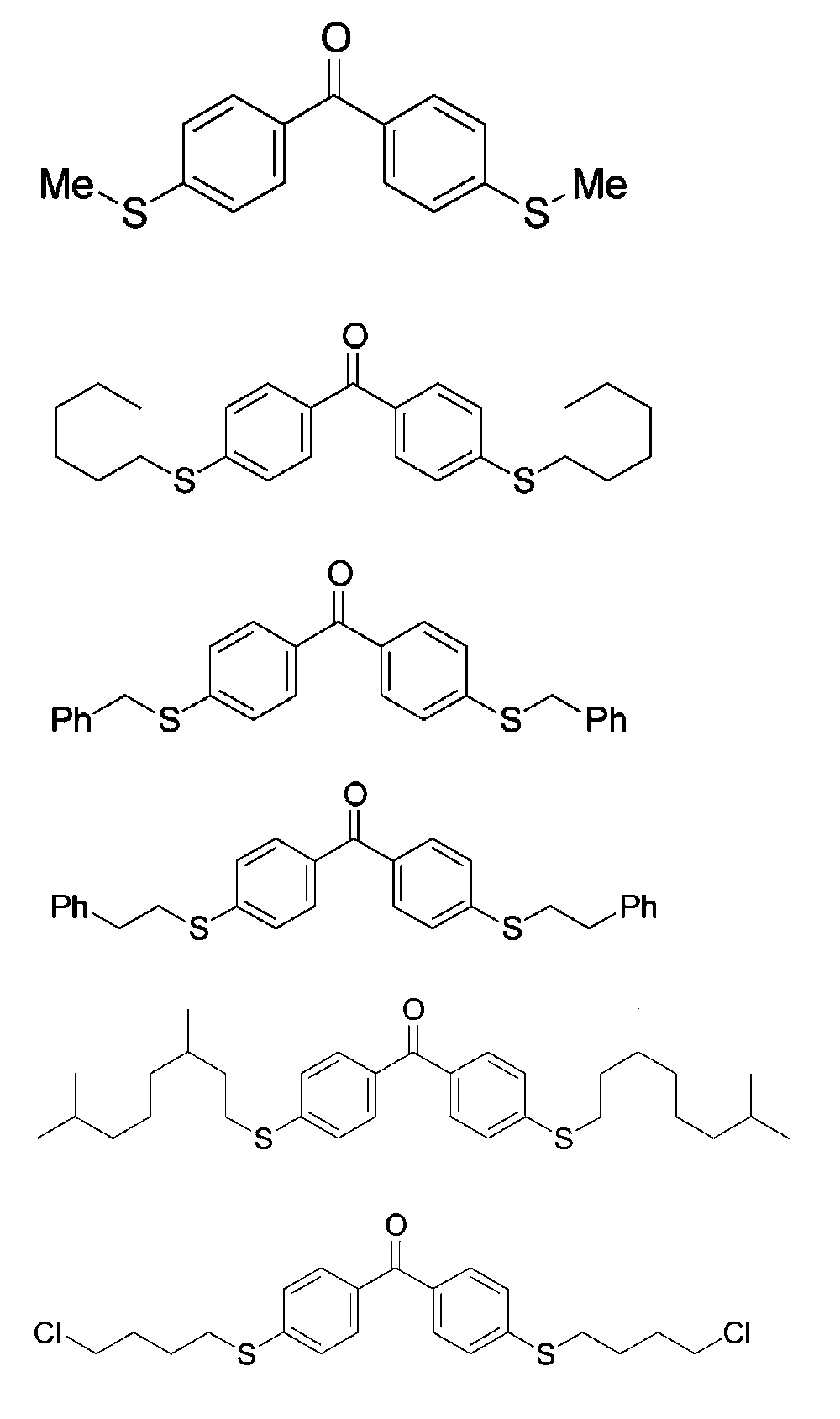
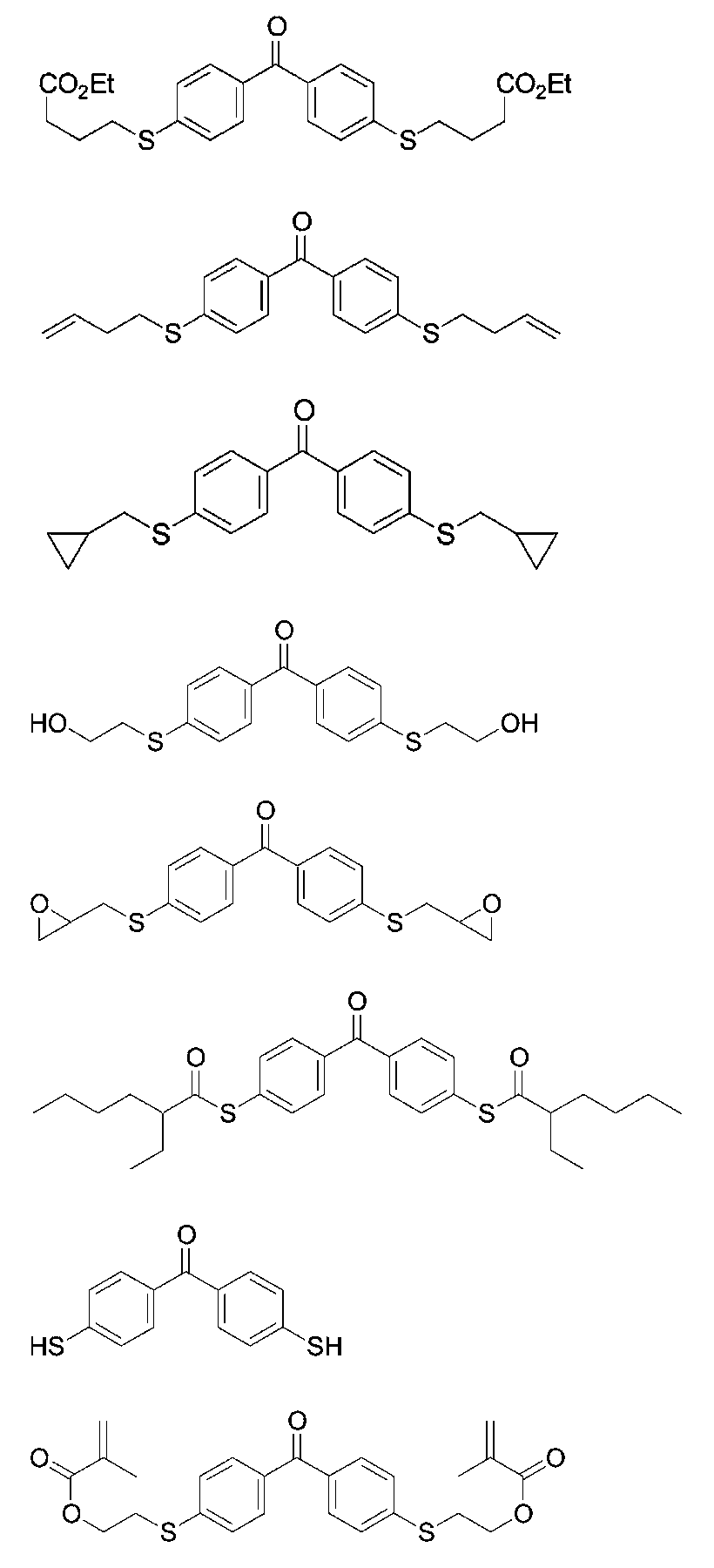
- a ninth aspect of the present invention is a compound represented by any one of formulas (1) to (11), which is a product obtained by the polyetheretherketone decomposition method according to the first aspect.
- the "product” in this aspect includes the first decomposition product, but is a concept that includes other products.
- novel compounds of formulas (1) to (9) and formula (11) and a compound of formula (10) can be produced from polyetheretherketone. These compounds serve as raw materials for functional polymers, functional plastics, and the like, and are extremely useful compounds.
- polyetheretherketone can be efficiently decomposed. Furthermore, according to the present invention, sulfur-functionalized benzophenone and/or hydroquinone, including new compounds, can be produced with high yield and high selectivity from polyetheretherketone. Furthermore, according to the present invention, useful new substances can be produced (synthesized).
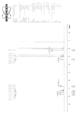
- FIG. 1 is a diagram showing the results of 1 H NMR analysis of the first decomposition product obtained in Example 9.
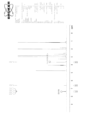
- FIG. 2 is a diagram showing the results of 1 H NMR analysis of the first decomposition product obtained in Example 10.
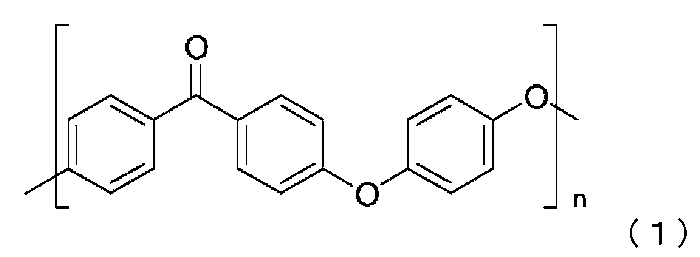
- Polyetheretherketone is a compound having a structure in which a benzene ring is connected to a ketone via an ether bond at the para position, and can be represented by the following formula (1).
- the shape of the polyetheretherketone is not particularly limited, and may be powder, pellet, film, or lump.
- the molecular weight is not particularly limited, the weight average molecular weight is preferably 5,000 to 50,000, more preferably 10,000 to 30,000, and most preferably 20,800.
- the number average molecular weight is preferably 1,000 to 50,000, more preferably 5,000 to 30,000, and most preferably 9,000 to 11,000.
- the polyetheretherketone decomposition method according to the present embodiment is comprised of two reaction steps: the first reaction step (a) and the second reaction step (b).
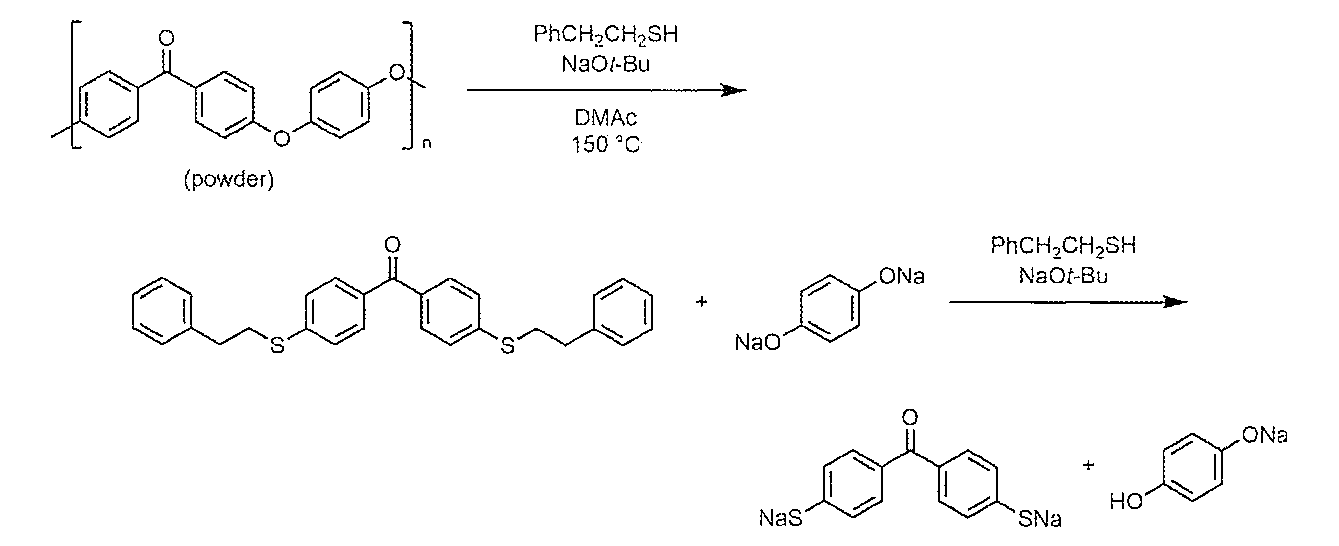
- the first reaction step (a) is considered to be, for example, a chemical reaction as shown in the following chemical reaction formula. That is, first polyetheretherketone is decomposed into 4,4'-di(2-phenylethylthio)benzophenone, and then the 4,4'-di(2-phenylethylthio)benzophenone is converted into disodium benzophenone-4,4' -This is a reaction in which it is further decomposed into dithiolate.
- the substances (sulfur reactant) to be reacted with polyetheretherketone include sodium hydroxide, sodium carbonate, potassium hydroxide, potassium carbonate, potassium phosphate, cesium carbonate, tert-butoxylithium , tert-butoxysodium tert-butoxypotassium, lithium bis(trimethylsilyl)amide, sodium bis(trimethylsilyl)amide, potassium bis(trimethylsilyl)amide, alkanethiols, which can convert thiols to thiolates by reacting with bases, aromatic mercaptans, Sodium sulfide or elemental sulfur can be used. Note that those skilled in the art will readily understand that thiols can be converted to thiolates using the following compounds and bases.
- alkanethiol examples include ethanethiol, propanethiol, butanethiol, pentanethiol, hexanethiol, heptanethiol, octanethiol, decanethiol, dodecanethiol, tetradecanethiol, pentadecanethiol, octadecanethiol, icosanethiol, and docosanthiol.
- aromatic mercaptans examples include thiophenol, 4-methylbenzenethiol, 4-methoxybenzenethiol, 4-(t-butyl)benzenethiol, etc., and polyetheretherketones can be added to at least di(carbothio)benzophenone. It can be decomposed.
- ethanethiol propanethiol, butanethiol, pentanethiol, hexanethiol, heptanethiol, octanethiol, decanethiol, dodecanethiol, tetradecanethiol, pentadecanethiol, octadecanethiol, icosanthiol, docosanthiol , 2-methylbutanethiol, 2-ethylhexanethiol, benzylthiol, p-methylbenzylthiol, o-methylbenzylthiol, ⁇ -methylbenzylthiol, phenoxyphenylmethanethiol, (4-chlorophenyl)methanethiol, (4- fluorophenyl)methanethiol, (4-methoxyphenyl)methanethiol, 4-tert-butyl
- the polyetheretherketone can be decomposed to a first decomposition product.
- the salt sulfur reactant is preferably reacted in an amount of 2 to 6 equivalents, particularly preferably 3.5 to 4.5 equivalents, relative to polyetheretherketone.
- the amount of the base is not particularly limited, and, for example, it is preferably 0.1 to 6 equivalents, more preferably 1 to 4 equivalents, and particularly preferably 2.5 to 3.5 equivalents relative to polyetheretherketone.
- the organic solvent that can be used in the first reaction step (a) is one that has a boiling point higher than the temperature at which it acts in the first reaction step described below, and that dissolves the thiolate by solvation without reacting with the thiolate.
- the solvent can be used.
- examples of such organic solvents include 1,3-dimethyl-2-imidazolidinone, N,N-dimethylacetamide, N,N-dimethylformamide, N-methyl-2-pyrrolidone, benzonitrile, 1,4 - Dioxane, etc. can be mentioned.
- the reaction in the first reaction step (a) can be carried out under an inert gas (eg, argon gas, nitrogen, etc.) or air atmosphere.
- an inert gas eg, argon gas, nitrogen, etc.
- reaction in the first reaction step (a) can be carried out at room temperature (25) to 200°C, preferably carried out at 100 to 200°C, and more preferably carried out at 140 to 160°C. If the reaction temperature is lower than 25°C, the decomposition reaction will not proceed, and if it exceeds 200°C, benzophenone cannot be obtained as the first decomposition product.
- the reaction in the first reaction step (a) is preferably carried out for 1 to 40 hours, more preferably 20 to 24 hours.
- the first decomposition product obtained after the reaction in the first reaction step (a) is preferably returned to room temperature (20 to 30°C) before being used in the next second reaction step (b). .
- the benzophenone-4,4'-dithiolate contained in the first decomposition product obtained in the first reaction step (a) can be reacted without any additives, and the carbon - reacting at least one of alkyl halides, acid halides and hydrogen chloride capable of forming sulfur bonds;
- alkyl halides that can be used in the second reaction step (b) include methyl iodide, 1-bromohexane, benzyl bromide, 2-phenylethyl bromide, 11-bromomethyltricosane, 1-bromo-3,7 -dimethyloctane, 1,4-dichlorobenzene, 4-bromo-1-butene, 3-bromobutanoic acid ethyl ester, bromomethylcyclopropane, 2-bromoethanol, 3-bromo-1-propene oxide, etc. .
- the alkyl halide that can be used in the second reaction step (b) of the present invention includes analogs of alkyl halide.
- Examples of analogs of alkyl halides include oxygen functional groups that undergo nucleophilic reactions (e.g., alkanes having triflate groups and tosylate groups), such as methyl trifluoromethanesulfonate and ethyl trifluoromethanesulfonate. .
- oxygen functional groups e.g., alkanes having triflate groups and tosylate groups
- methyl trifluoromethanesulfonate and ethyl trifluoromethanesulfonate such as methyl trifluoromethanesulfonate and ethyl trifluoromethanesulfonate.
- examples of the acid halide that can be used in the second reaction step (b) include acetyl chloride, benzoyl chloride, ⁇ -ethylhexanoyl chloride, and the like.
- the alkyl halide is preferably reacted in an amount of 2 to 6 equivalents, more preferably 2 to 4 equivalents, and more preferably 2.7 to 3.3 equivalents, relative to polyetheretherketone. It is particularly preferred to react in equivalent amounts.
- the reaction in the second reaction step (b) can be carried out in air.
- the reaction in the second reaction step (b) is preferably carried out at room temperature (25) to 200°C, more preferably at 80 to 100°C.
- reaction in the second reaction step (b) is preferably carried out for 1 to 24 hours, more preferably 1 to 2 hours.
- the second reaction product obtained after the reaction in the second reaction step (b) is separated as an organic layer of the second reaction product by adding, for example, hydrochloric acid and ethyl acetate, and then mixed with water and a saturated aqueous sodium chloride solution. Wash with Thereafter, sulfur-functionalized benzophenone and hydroquinone can be obtained as crude products by drying over anhydrous sodium sulfate or anhydrous magnesium sulfate and evaporation under reduced pressure.
- the sulfur-functionalized benzophenone obtained by the polyetheretherketone decomposition method according to the present embodiment can be modified to have the desired sulfur-functionalized benzophenone by selecting the alkyl halide or acid halide used in the second reaction step (b). It can be obtained as benzophenone.
- the sulfur-functionalized benzophenone obtained by the polyetheretherketone decomposition method according to the present embodiment is, for example, a compound represented by the following formula (2).
- R represents a carbon group having 1 to 20 carbon atoms or a hydrogen atom. Specifically, an alkyl group having 1 to 20 carbon atoms, an alicyclic alkyl group having 3 to 20 carbon atoms, Alkenyl group having 2 to 20 carbon atoms, alkynyl group having 2 to 20 carbon atoms, aryl group having 5 to 20 carbon atoms, aralkyl group having 6 to 20 carbon atoms, hydroxyalkyl group having 1 to 20 carbon atoms, 1 to 20 carbon atoms 20 carbonyl alkyl groups, hydroxyalkyl groups having 1 to 20 carbon atoms, aliphatic carbonyl groups having 2 to 20 carbon atoms, aromatic carbonyl groups having 2 to 20 carbon atoms, etc.).
- sulfur-functionalized benzophenone obtained by the polyetheretherketone decomposition method according to the present embodiment examples include, but are not limited to, compounds represented by the following chemical formula.
- sulfur-functionalized benzophenones include methyl bromide, methyl iodide, 1-chlorohexane, 1-bromohexane, 1-iodohexane, benzyl chloride, benzyl bromide, benzyl iodide, 2 -Phenylethyl chloride, 2-phenylethyl bromide, 2-phenylethyl iodide, 1-chloro-3,7-dimethyloctane, 1-bromo-3,7-dimethyloctane, 1-iodo-3,7-dimethyloctane , 1,4-dichlorobenzene, ethyl 4-chlorobutyrate, ethyl 4-bromobutyrate, ethyl 4-iodobutyrate, 4-chloro-1-butene, 4-bromo-1-butene, 4-iodo-1-butene, Using
- the reactions in the first reaction step (a) and the second reaction step (b) can also be carried out in the presence of glass fibers or various polymers.
- the polymer include polyethylene, polypropylene, polystyrene, and polyamide.
- fiber-reinforced composite forms such as carbon fiber-reinforced polyetheretherketone and glass fiber-reinforced polyetheretherketone can be decomposed by the polyetheretherketone decomposition method according to the present embodiment.
- the polyetheretherketone decomposition method according to the present embodiment it is possible to produce hydroquinone in addition to sulfur-functionalized benzophenone.
- the polyetheretherketone decomposition method according to the present invention is also a method for producing (synthesizing) sulfur-functionalized benzophenone and hydroquinone.
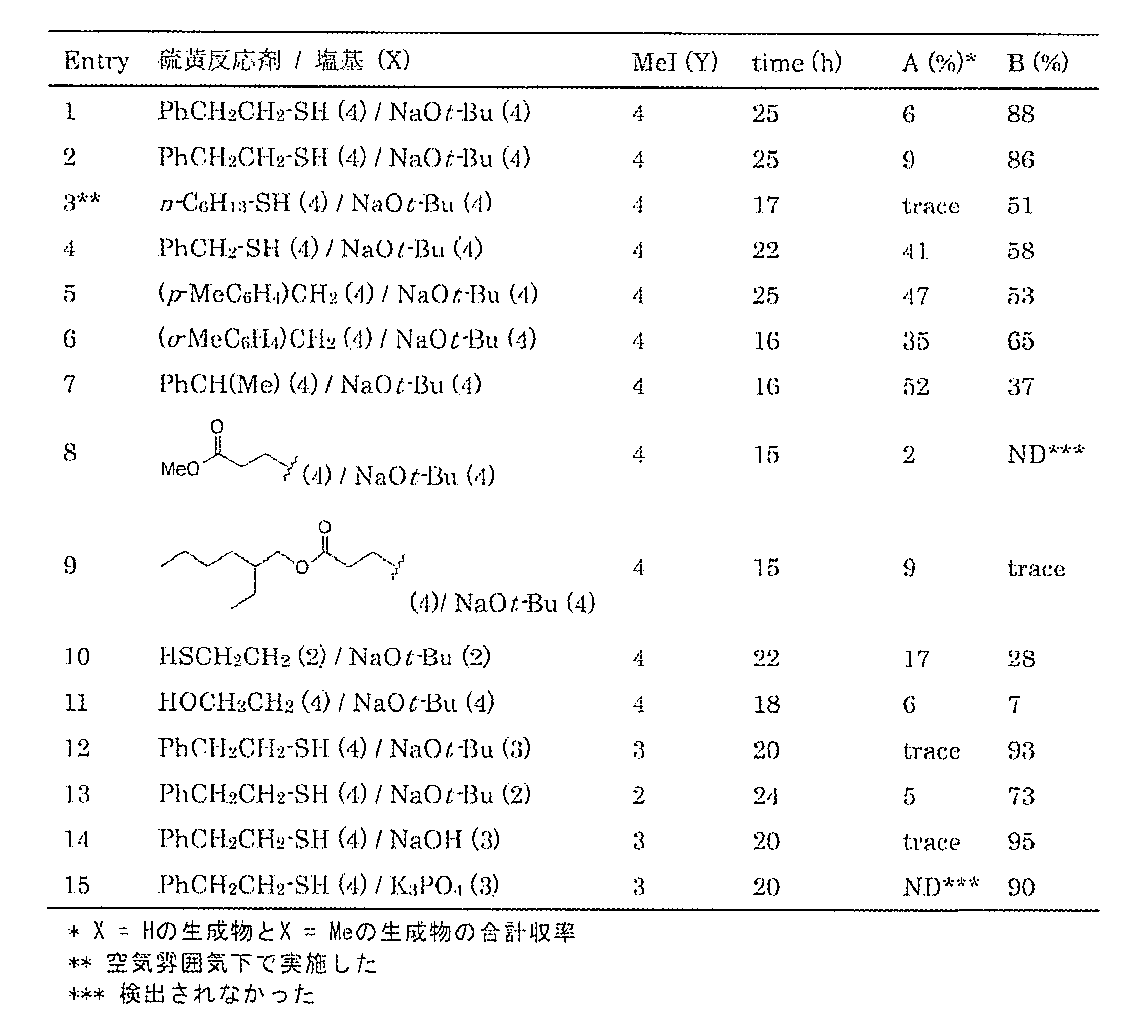
- Example 1 In an argon atmosphere, 28.8 mg of powdered polyetheretherketone (0.10 mmol, calculated based on the molar weight of the monomer, average M w ⁇ 20,800, average M n ⁇ 10,300, Cat. No. 456640, Sigma-Aldrich base (purchased from (using the equivalent amount shown in Table 1 for polyether ether ketone) and a base (using the equivalent amount shown in Table 1 for polyether ether ketone), the reaction mixture was stirred at 150°C.
- reaction mixture (first reaction product) was returned to room temperature (25°C), and methyl iodide (using the equivalent amount shown in Table 1 relative to polyetheretherketone) was added to give 100% The mixture was stirred at °C for 1 hour.
- Example 2 In this example, depolymerization was performed based on the depolymerization conditions of Entry 12 of Example 1, replacing the solvent with N,N-dimethylacetamide.
- reaction mixture was returned to room temperature (25°C), 128 mg (0.900 mmol) of methyl iodide was added, and the mixture was stirred at 100°C for 1 hour.
- Hydrochloric acid (2 M, 1.0 mL) and 1.5 mL of ethyl acetate were added to the resulting reaction mixture, and the organic layer of the reaction mixture was washed with water and a saturated aqueous sodium chloride solution.
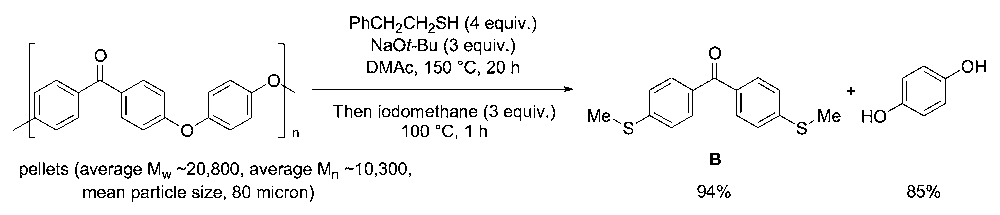
- Example 3 In this example, pelletized polyetheretherketone was depolymerized (decomposition reaction).
- reaction mixture was returned to room temperature (25°C), 128 mg (0.900 mmol) of methyl iodide was added, and the mixture was stirred at 100°C for 1 hour.
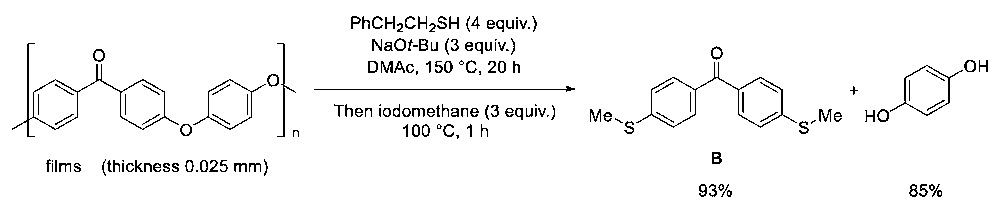
- Example 4 In this example, a film-like polyetheretherketone was depolymerized.
- Polyether ether ketone in the form of a thin amber transparent film 86.4 mg (0.30 mmol, calculated based on the molar weight of monomer, Cat. No. GF55060231-1EA, thickness 0.025 mm, purchased from Sigma-Aldrich) in an argon atmosphere.
- 86.5 mg (0.900 mmol) of tert-butoxysodium, 0.6 mL of N,N-dimethylacetamide (DMAc), and 167 mg (1.21 mmol) of phenylethylthiol were sequentially added to the reaction mixture. was stirred at 150°C.
- reaction mixture was returned to room temperature (25°C), 128 mg (0.900 mmol) of methyl iodide was added, and the mixture was stirred at 100°C for 1 hour.
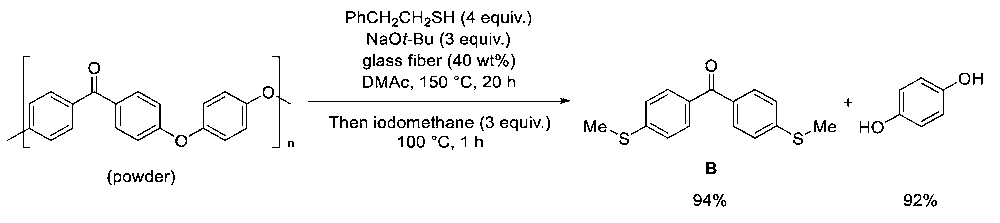
- Example 5 glass fiber was added to powdered polyetheretherketone to perform depolymerization.
- reaction mixture was returned to room temperature (25°C), 128 mg (0.900 mmol) of methyl iodide was added, and the mixture was stirred at 100°C for 1 hour.
- Example 5 based on the depolymerization conditions shown in Example 2, glass fiber was added and depolymerization was performed. As a result, 4,4'-dimethylthiobenzophenone and hydroquinone were obtained in high yields comparable to those of polyetheretherketone in the form of pellets or films.
- polypropylene pelleted, isotactic, M w ⁇ 250,000, Cat. No. 182389, purchased from Sigma-Aldrich
- polystyrene pelleted, isotactic, purchased from Sigma-Aldrich
- Example 6 In this example, depolymerization was performed using powdered carbon fiber-containing polyetheretherketone.
- reaction mixture was returned to room temperature (25°C), 43.3 mg (0.30 mmol) of methyl iodide was added, and the mixture was stirred at 100°C for 1 hour.
- Example 7 In this example, depolymerization was performed using powdered glass fiber-containing polyetheretherketone.
- reaction mixture was returned to room temperature (25°C), 43.3 mg (0.30 mmol) of methyl iodide was added, and the mixture was stirred at 100°C for 1 hour.
- Embodiment 2 In Embodiment 1, the second reaction step was performed successively after the first reaction step, but the present invention is not limited to this.
- polyetheretherketone can be decomposed by performing only the first reaction step. That is, the first reaction step itself is a polyetheretherketone decomposition method.
- the polyether ether ketone decomposition method according to the present embodiment will be described specifically and in detail, but the method is not limited to the following examples.
- Example 8 In this example, depolymerization was carried out using tert-butylbenzenethiol as a sulfur reactant.
- reaction mixture was returned to room temperature (25°C), hydrochloric acid (2 M, 1.0 mL) and 1.5 mL of ethyl acetate were added, and the organic layer of the reaction mixture was dissolved in water and saturated sodium chloride. Washed with aqueous solution. After extracting the organic layer, it was dried over anhydrous magnesium sulfate and evaporated under reduced pressure to obtain a crude product. From the crude product, 30.8 mg (yield 60%) of 4,4-di(tert-butylphenylthio)benzophenone was obtained by silica gel column chromatography (developing solvent: hexane/ethyl acetate 96:4 ⁇ 7:3).
- thiols such as tert-butylbenzenethiol, in which the carbon functional group on sulfur is difficult to leave in the reaction system, alkanethiols such as tert-butylthiol, thiophenol, tert-butyl group, methyl
- alkanethiols such as tert-butylthiol, thiophenol, tert-butyl group, methyl
- benzophenone which is the first decomposition product having a thiol-derived carbon group, can be obtained.
- polyetheretherketone can be decomposed only in the first reaction step.
- Example 9 In an argon atmosphere, 29.3 mg of powdered polyetheretherketone (0.10 mmol, calculated based on the molar weight of monomer, average M w ⁇ 20,800, average M n ⁇ 10,300, Cat. No. 456640, Sigma-Aldrich 29.7 mg (0.30 mmol) of sodium tert-butoxy, 0.2 mL of N,N-dimethylacetamide (DMAc), and 55.6 mg (0.40 mmol) of 2-phenylethylthiol. ) and 8.7 mg (0.72 mmol) of mesitylene as an internal standard were added in sequence, and the reaction mixture was stirred at 100°C.
- DMAc N,N-dimethylacetamide
- the thiol has a carbon group that is easily eliminated, such as phenylethylthiol, benzophenone, which is the first decomposition product with a thiol-derived carbon group, can be obtained by modifying the reaction conditions. It will be done.
- Example 10 ⁇ Example 10> In this example, it was confirmed that the first decomposition product, disodium benzophenone-4,4'-dithiolate, was produced by the polyetheretherketone decomposition method according to the present embodiment.
- reaction mixture was returned to room temperature (25° C.), and 0.5 mL each of ethyl acetate and heavy water were added to separate the reaction mixture into an organic layer and an aqueous layer.
- Example 11 In an argon atmosphere, powdered polyetheretherketone 28.9 mg (0.10 mmol, calculated based on the molar weight of monomer, average M w ⁇ 20,800, average M n ⁇ 10,300, Cat. No. 456640, Sigma-Aldrich After sequentially adding 15.7 mg (0.20 mmol) of sodium sulfide and 0.2 mL of 1,3-dimethyl-2-imidazolidinone (DMI) to (purchased from) the reaction mixture was stirred at 150 °C. .
- DMI 1,3-dimethyl-2-imidazolidinone
- reaction mixture was returned to room temperature (25°C) to obtain a first decomposition product. Thereafter, 59.3 mg (0.42 mmol) of methyl iodide was added to this first decomposition product, and the mixture was stirred at 100° C. for 1 hour. Hydrochloric acid (2 M, 0.5 mL) and 1 mL of ethyl acetate were added to the resulting reaction mixture, and the organic layer of the reaction mixture was washed with water and a saturated aqueous sodium chloride solution.
- the present invention can also decompose polyetheretherketone using elemental sulfur (S 8 ) as a sulfur reactant.
- elemental sulfur when using elemental sulfur as a sulfur reactant, it is necessary to also use a strong inorganic base such as NaOH or sodium tert-butoxy.
- Example 12 In an argon atmosphere, powdered polyetheretherketone 86.4 mg (0.30 mmol, calculated based on the molar weight of monomer, average M w ⁇ 20,800, average M n ⁇ 10,300, Cat. No. 456640, Sigma-Aldrich ), 19.4 mg (0.20 mmol, calculated based on the molar weight per sulfur atom) of elemental sulfur, 115 mg (1.2 mmol) of sodium tert-butoxy, and 1,3-dimethyl After sequentially adding 0.6 mL of -2-imidazolidinone (DMI), the reaction mixture was stirred at 150°C.
- DMI -2-imidazolidinone
- reaction mixture was returned to room temperature (25°C) to obtain a first decomposition product. Thereafter, 171 mg (1.2 mmol) of methyl iodide was added to this first decomposition product, and the mixture was stirred at 100° C. for 1 hour. To the obtained reaction mixture were added hydrochloric acid (2 M, 1 mL), 2 mL of ethyl acetate, and 5.0 ⁇ L (0.024 mmol) of an internal standard undecane, and the reaction mixture was separated into an organic layer and a water tank.
- alkyl halide (R-X) examples include 1-bromohexane, benzyl bromide, 2-phenylethyl bromide, 2-n-decyl-n-tetradecyl bromide, 1-bromo-3,7-dimethyloctane, 1,4-dichlorobenzene, 4-bromo-1-butene, 3-bromobutanoic acid ethyl ester, bromomethylcyclopropane, 2-bromoethanol, 3-bromo-1-propene oxide, ⁇ -ethylhexanoic acid chloride, hydrogen chloride, etc. can be used.
- Example 13 Synthesis of 4,4'-di(2-phenylethylthio)benzophenone> In an argon atmosphere, powdered polyetheretherketone 86.4 mg (0.30 mmol, calculated based on the molar weight of monomer, average M w ⁇ 20,800, average M n ⁇ 10,300, Cat. No. 456640, Sigma-Aldrich To the solution (purchased from Afterwards, the reaction mixture was stirred at 150°C.
- reaction mixture (first decomposition product) was returned to room temperature (25°C), 167 mg (0.90 mmol) of phenylethyl bromide was added, and the mixture was stirred at room temperature (25°C) for 4 hours.
- Example 14 Synthesis of 4,4'-di(2-norm-decyl-norm-tetradecylthio)benzophenone>
- powdered polyetheretherketone 86.9 mg (0.30 mmol, calculated based on the molar weight of monomer, average M w ⁇ 20,800, average M n ⁇ 10,300, Cat. No. 456640, Sigma-Aldrich
- the reaction mixture was stirred at 150°C.
- reaction mixture (first decomposition product) was returned to room temperature (25°C), 376 mg (0.90 mmol) of 2-n-decyl-n-tetradecyl bromide was added, and the mixture was heated at 80°C. Stirred for 2 hours.
- Example 15 Synthesis of 4,4'-di(4-chlorobutylthio)benzophenone>
- powdered polyetheretherketone 86.4 mg (0.30 mmol, calculated based on the molar weight of monomer, average M w ⁇ 20,800, average M n ⁇ 10,300, Cat. No. 456640, Sigma-Aldrich
- the reaction mixture was stirred at 150°C.
- reaction mixture (first decomposition product) was returned to room temperature (25°C), 383 mg (3.0 mmol) of 1,4-dichlorobutane was added, and the mixture was stirred at 80°C for 23 hours.
- Example 14 Synthesis of 4,4'-di(4-butenylthio)benzophenone>
- powdered polyetheretherketone 86.5 mg (0.30 mmol, calculated based on the molar weight of monomer, average M w ⁇ 20,800, average M n ⁇ 10,300, Cat. No. 456640, Sigma-Aldrich
- the reaction mixture was stirred at 150°C.
- reaction mixture (first decomposition product) was returned to room temperature (25°C), 122 mg (0.9 mmol) of 4-bromo-1-butene was added, and the mixture was stirred at 100°C for 2 hours.
- Example 17 Synthesis of 4,4'-di(3-ethoxycarbonylpropylthio)benzophenone>
- powdered polyetheretherketone 86.4 mg (0.30 mmol, calculated based on the molar weight of monomer, average M w ⁇ 20,800, average M n ⁇ 10,300, Cat. No. 456640, Sigma-Aldrich
- the reaction mixture was stirred at 150°C.
- reaction mixture (first decomposition product) was returned to room temperature (25°C), 177 mg (0.9 mmol) of ethyl 4-bromobutyrate was added, and the mixture was stirred at 100°C for 2 hours.
- Example 18 Synthesis of 4,4'-di(cyclopropylmethylthio)benzophenone>
- powdered polyetheretherketone 86.4 mg (0.30 mmol, calculated based on the molar weight of monomer, average M w ⁇ 20,800, average M n ⁇ 10,300, Cat. No. 456640, Sigma-Aldrich
- the reaction mixture was stirred at 150°C.
- reaction mixture (first decomposition product) was returned to room temperature (25°C), and 122 mg (0.9 mmol) of bromomethylcyclopropane was added thereto for 3.5 hours at room temperature (25°C). Stirred.
- Example 19 Synthesis of 4,4'-di(4-oxiranylmethylthio)benzophenone>
- powdered polyetheretherketone 86.4 mg (0.30 mmol, calculated based on the molar weight of monomer, average M w ⁇ 20,800, average M n ⁇ 10,300, Cat. No. 456640, Sigma-Aldrich
- the reaction mixture was stirred at 150°C.
- reaction mixture (first decomposition product) was returned to room temperature (25°C), and while cooling to 0°C in an ice bath, 411 mg (3.0 mmol) of 3-bromo-1-propene oxide was added. ) and stirred at room temperature (25°C) for 20 hours.
- Example 20 Synthesis of 4,4'-bis(3,7-dimethyloctylthio)benzophenone>
- 1.15 g of powdered polyetheretherketone (3.99 mmol, calculated based on the molar weight of the monomer, average M w ⁇ 20,800, average M n ⁇ 10,300, Cat. No. 456640, Sigma -purchased from Aldrich)
- 1.15 g (12.0 mmol) of sodium tert-butoxy 8.0 mL of N,N-dimethylacetamide (DMAc)
- 2.21 g (16.0 mmol) of phenylethylthiol. ) were added sequentially, and the reaction mixture was stirred at 150°C.
- reaction mixture (first decomposition product) was returned to room temperature (25°C), 2.65 mg (12.0 mmol) of 1-bromo-3,7-dimethyloctane was added, and 100 Stirred at °C for 17 hours.
- Example 21 Synthesis of 4,4'-di(1-ethyl-n-pentylcarbonylthio)benzophenone>
- powdered polyetheretherketone 86.1 mg (0.30 mmol, calculated based on the molar weight of monomer, average M w ⁇ 20,800, average M n ⁇ 10,300, Cat. No. 456640, Sigma-Aldrich
- the reaction mixture was stirred at 150°C.
- reaction mixture (first decomposition product) was returned to room temperature (25°C), and 147 mg (0.91 mmol) of 2-ethylhexanoyl chloride and 0.6 mL of tetrahydrofuran were added to room temperature (25°C). ) for 5 hours.
- organic solvent of the embodiment described above does not contain water
- present invention is not limited thereto.
- the organic solvent may contain water.
- the base was reacted with one substance selected from alkanethiol, aromatic mercaptan, sodium sulfide, and elemental sulfur in the first reaction step, but the present invention is not limited thereto.
- the polyetheretherketone may be reacted with a base and a plurality of alkanethiols, aromatic mercaptans, sodium sulfide, and elemental sulfur.
- one of the alkyl halides, acid halides, and hydrogen chloride was reacted in the second reaction step, but the present invention is not limited thereto.
- a plurality of alkyl halides, acid halides, and hydrogen chloride may be reacted with the first reaction product.
Landscapes
- Chemical & Material Sciences (AREA)
- Organic Chemistry (AREA)
- Health & Medical Sciences (AREA)
- Chemical Kinetics & Catalysis (AREA)
- Medicinal Chemistry (AREA)
- Polymers & Plastics (AREA)
- Life Sciences & Earth Sciences (AREA)
- Sustainable Development (AREA)
- General Chemical & Material Sciences (AREA)
- Organic Low-Molecular-Weight Compounds And Preparation Thereof (AREA)
Abstract
Description

本実施形態に係るポリエーテルエーテルケトン分解方法は、

アルゴン雰囲気にて、粉末状のポリエーテルエーテルケトン 28.8mg(0.10mmol、モノマーのモル重量に対して算出、average Mw ~20,800, average Mn ~10,300, Cat. No. 456640,Sigma-Aldrichより購入)に塩基(ポリエーテルエーテルケトンに対して、表1に示す当量分を使用)、1,3-ジメチル-2-イミダゾリジノン(DMI、0.2 mL)、チオール(ポリエーテルエーテルケトンに対して、表1に示す当量分を使用)、塩基(ポリエーテルエーテルケトンに対して、表1に示す当量分を使用)を順次加えた後、反応混合物を150℃で撹拌した。
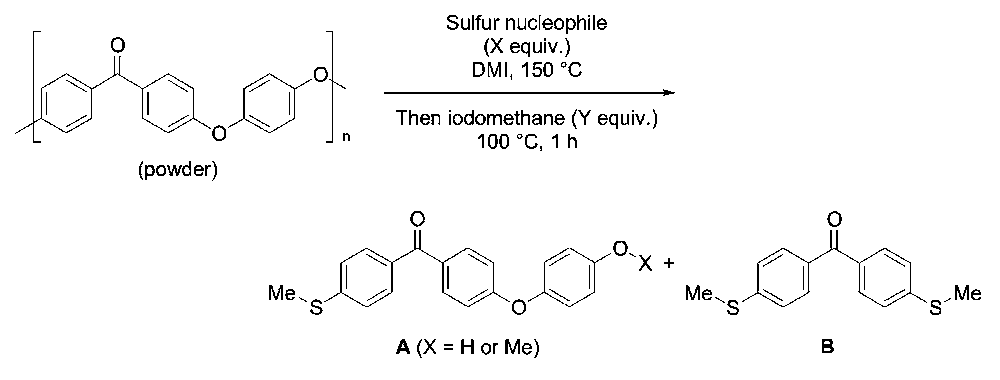
本実施例では、実施例1のEntry 12の解重合条件を基に、溶媒をN,N-ジメチルアセトアミドに置き換えて解重合を行った。
1H NMR (600 MHz, CDCl3) δ 2.54 (s, 6H, SCH3), 7.28 (d, J = 8.0 Hz, 4H, aromatic), 7.71 (d, J = 8.0 Hz, 4H, aromatic). 13C NMR (151 MHz, CDCl3) δ 14.9, 124.8, 130.5, 133.7, 145.0, 195.0.

本実施例では、ペレット状のポリエーテルエーテルケトンの解重合(分解反応)を行った。
本実施例では、フィルム状のポリエーテルエーテルケトンの解重合を行った。
本実施例では、粉末状のポリエーテルエーテルケトンに対し、ガラス繊維を加えて解重合を行った。
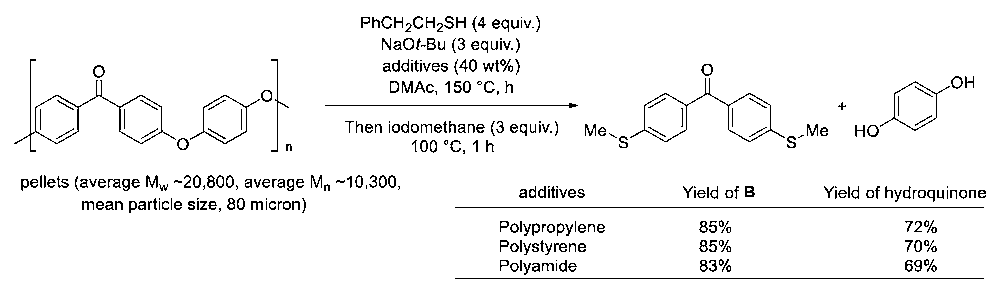
本実施例では、粉末状の炭素繊維含有ポリエーテルエーテルケトンを用いて解重合を行った。

本実施例では、粉末状のガラス繊維含有ポリエーテルエーテルケトンを用いて解重合を行った。

実施形態1では、第1反応工程の後、続けて第2反応工程を行ったが、本発明はこれに限定されない。例えば、第1反応工程のみを行っても、ポリエーテルエーテルケトンを分解することができる。すなわち、第1反応工程自体が、ポリエーテルエーテルケトン分解方法である。次に本実施形態に係るポリエーテルエーテルケトン分解法の実施例を挙げて具体的に、かつ詳細に説明するが、以下の実施例に限定されるものではない。
本実施例では、硫黄反応剤としてtert-ブチルベンゼンチオールを用いて解重合を行った。
4,4-ジ(tert-ブチルフェニルチオ)ベンゾフェノンのNMR測定結果:1H NMR (600 MHz, CDCl3) δ 1.34 (s, 18H, tBu), 7.19 (AA’BB’, 4H, aromatic), 7.42-7.46 (m, 8H, aromatic), 7.64 (AA’BB’, 4H, aromatic). 13C NMR (151 MHz, CDCl3) δ 31.3, 34.8, 126.7, 126.8, 128.1, 130.6, 134.0, 134.5, 144.9, 152.4, 194.9.
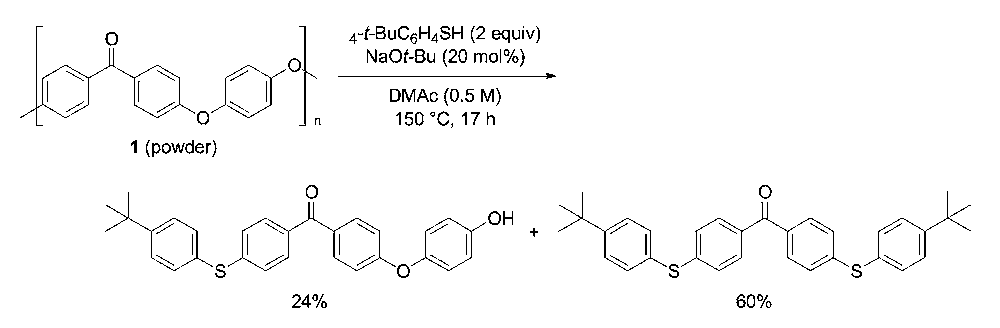
アルゴン雰囲気にて、粉末状のポリエーテルエーテルケトン 29.3mg(0.10mmol、モノマーのモル重量に対して算出、average Mw ~20,800, average Mn ~10,300, Cat. No. 456640,Sigma-Aldrichより購入)に、tert-ブトキシナトリウムを29.7 mg(0.30 mmol)、N,N-ジメチルアセトアミド(DMAc)を0.2mL、2-フェニルエチルチオールを55.6 mg(0.40 mmol)、内部標準物質としてメシチレンを8.7mg(0.72 mmol)を順次加えた後、反応混合物を100℃で撹拌した。

本実施例では、本実施形態に係るポリエーテルエーテルケトン分解法により、第1分解生成物であるジソディウム ベンゾフェノン-4,4’-ジチオラートが生成することを確認した。

上述した実施形態では、硫黄反応剤としてアルカンチオールや芳香族メルカプタンを用いたが、本発明はこれに限定されない。硫黄反応剤として硫化ナトリウムを用いてもポリエーテルエーテルケトンを分解することができる。次に本実施形態に係るポリエーテルエーテルケトン分解法の実施例を挙げて具体的に、かつ詳細に説明するが、以下の実施例に限定されるものではない。
アルゴン雰囲気にて、粉末状のポリエーテルエーテルケトン 28.9mg(0.10mmol、モノマーのモル重量に対して算出、average Mw ~20,800, average Mn ~10,300, Cat. No. 456640,Sigma-Aldrichより購入)に、硫化ナトリウムを15.7 mg(0.20 mmol)、1,3-ジメチル-2-イミダゾリジノン(DMI)を0.2mL順次加えた後、反応混合物を150℃で撹拌した。

本発明は、硫黄反応剤として単体硫黄(S8)を用いてもポリエーテルエーテルケトンを分解することができる。なお、硫黄反応剤として単体硫黄を使用する場合には、併せてNaOHまたはtert-ブトキシナトリウムなどの無機強塩基を使用する必要がある。次に本実施形態に係るポリエーテルエーテルケトン分解法の実施例を挙げて具体的に、かつ詳細に説明するが、以下の実施例に限定されるものではない。
アルゴン雰囲気にて、粉末状のポリエーテルエーテルケトン 86.4mg(0.30mmol、モノマーのモル重量に対して算出、average Mw ~20,800, average Mn ~10,300, Cat. No. 456640,Sigma-Aldrichより購入)に、単体硫黄を19.4 mg(0.20 mmol,硫黄1原子あたりのモル重量に対して算出)、tert-ブトキシナトリウムを115 mg(1.2 mmol)、1,3-ジメチル-2-イミダゾリジノン(DMI)を0.6mL順次加えた後、反応混合物を150℃で撹拌した。

実施形態1に係るポリエーテルエーテルケトン分解方法において、ポリエーテルエーテルケトンから硫黄官能基化ベンゾフェノンを製造(合成)する方法は、ヨウ化メチル以外にもいろいろな有機ハロゲン化物を使用できる。
アルゴン雰囲気にて、粉末状のポリエーテルエーテルケトン 86.4mg(0.30mmol、モノマーのモル重量に対して算出、average Mw ~20,800, average Mn ~10,300, Cat. No. 456640,Sigma-Aldrichより購入)にtert-ブトキシナトリウムを86.7 mg(0.90 mmol)、N,N-ジメチルアセトアミド(DMAc)を0.6mL、フェニルエチルチオールを167 mg(1.2 mmol)を順次加えた後、反応混合物を150℃で撹拌した。
1H NMR (600 MHz, CDCl3) δ 3.00 (t, J = 7.5 Hz, 4H, CH2), 3.27 (t, J = 8.1 Hz, 4H, CH2), 7.23-7.27 (m, 6H, aromatic), 7.33 (AA’BB’C, 4H, aromatic), 7.36 (AA’BB’, 4H, aromatic), 7.72 (AA’BB’, 4H, aromatic). 13C NMR (151 MHz, CDCl3) δ 33.6, 35.2, 126.5, 126.7, 128.6, 128.7, 130.6, 134.3, 139.8, 143.4, 195.0.

アルゴン雰囲気にて、粉末状のポリエーテルエーテルケトン 86.9mg(0.30mmol、モノマーのモル重量に対して算出、average Mw ~20,800, average Mn ~10,300, Cat. No. 456640,Sigma-Aldrichより購入)にtert-ブトキシナトリウムを86.7 mg(0.90 mmol)、N,N-ジメチルアセトアミド(DMAc)を0.6mL、フェニルエチルチオールを167 mg(1.2 mmol)を順次加えた後、反応混合物を150℃で撹拌した。
1H NMR (600 MHz, CDCl3) δ 0.87 (t, J = 6.9 Hz, 12H, methyl), 1.22-1.33 (m, 72H, methylene), 1.36-1.45 (m, 8H, methylene), 1.66-1.71 (m, 2H, methylene), 2.97 (d, J = 6.4 Hz, 4H, SCH2), 7.32 (AA’BB’, 4H, aromatic), 7.69 (AA’BB’, 4H, aromatic). 13C NMR (151 MHz, CDCl3) δ 14.1, 22.7, 26.6, 29.36, 29.38, 29.62, 29.65, 29.68, 29.69, 29.7, 29.9, 31.93, 31.94, 33.3, 37.0, 37.4, 126.3, 130.4, 134.1, 144.7, 194.9 (Several signals derived from alkyl carbons are overlapping with other signals.).
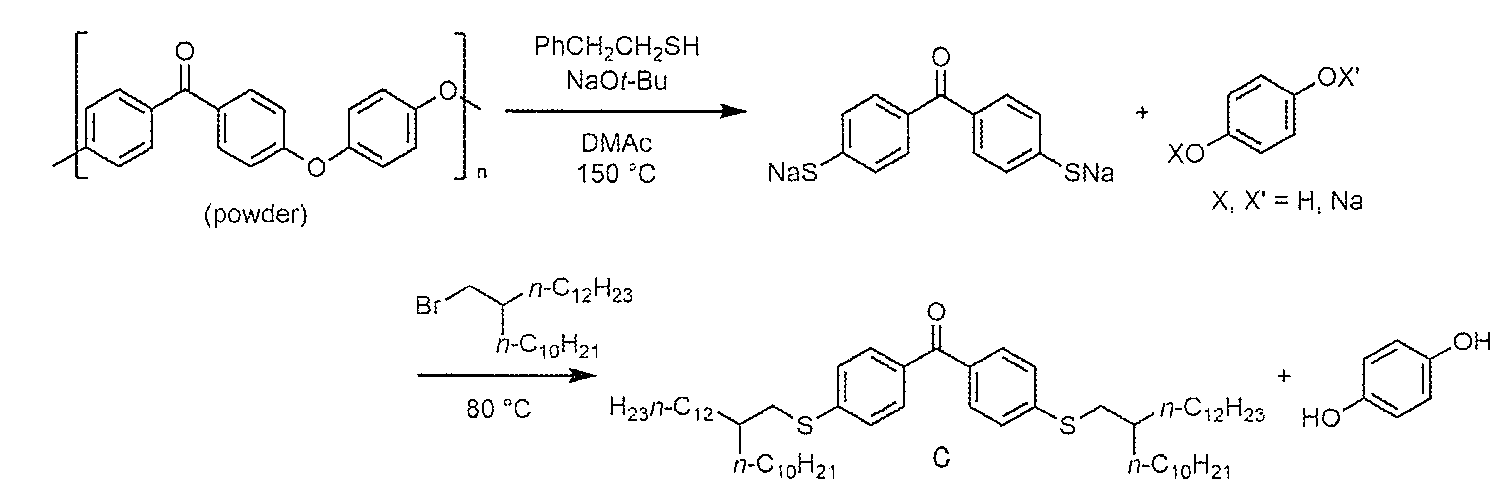
アルゴン雰囲気にて、粉末状のポリエーテルエーテルケトン 86.4mg(0.30mmol、モノマーのモル重量に対して算出、average Mw ~20,800, average Mn ~10,300, Cat. No. 456640,Sigma-Aldrichより購入)にtert-ブトキシナトリウムを86.9 mg(0.90 mmol)、N,N-ジメチルアセトアミド(DMAc)を0.6mL、フェニルエチルチオールを167 mg(1.2 mmol)を順次加えた後、反応混合物を150℃で撹拌した。
1H NMR (600 MHz, CDCl3) δ 1.86-1.91 (m, 4H, methylene), 1.93-1.98 (m, 4H, methylene), 3.04 (t, J = 7.1 Hz, 4H, SCH2), 3.57 (d, J = 6.4 Hz, 4H, ClCH2), 7.33 (AA’BB’, 4H, aromatic), 7.71 (AA’BB’, 4H, aromatic). 13C NMR (151 MHz, CDCl3) δ 26.1, 31.4, 31.5, 44.3, 126.6, 130.5, 134.4, 143.3, 194.8.
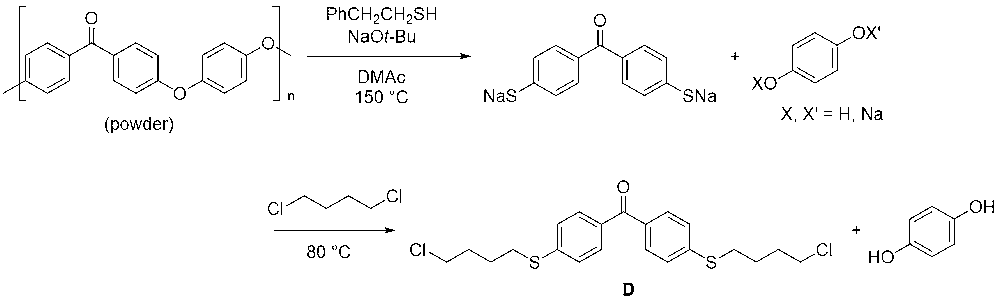
アルゴン雰囲気にて、粉末状のポリエーテルエーテルケトン 86.5mg(0.30mmol、モノマーのモル重量に対して算出、average Mw ~20,800, average Mn ~10,300, Cat. No. 456640,Sigma-Aldrichより購入)にtert-ブトキシナトリウムを86.5 mg(0.90 mmol)、N,N-ジメチルアセトアミド(DMAc)を0.6mL、フェニルエチルチオールを167 mg(1.2 mmol)を順次加えた後、反応混合物を150℃で撹拌した。
1H NMR (600 MHz, CDCl3) δ 2.44-2.48 (m, 4H, CH2), 3.07 (t, J = 7.6 Hz, 4H, SCH2), 5.09 (dq, J = 1.4, 10.1 Hz, 2H, ethenyl), 5.13 (dq, J = 1.6, 17.1 Hz, 2H, ethenyl), 5.13 (ddt, J = 6.7, 10.4, 17.1 Hz, 2H, ethenyl), 7.33 (AA’BB’C, 4H, aromatic), 7.71 (AA’BB’, 4H, aromatic). 13C NMR (151 MHz, CDCl3) δ 31.4, 33.0, 116.8, 126.4, 130.6, 134.3, 135.9, 143.5, 195.0.
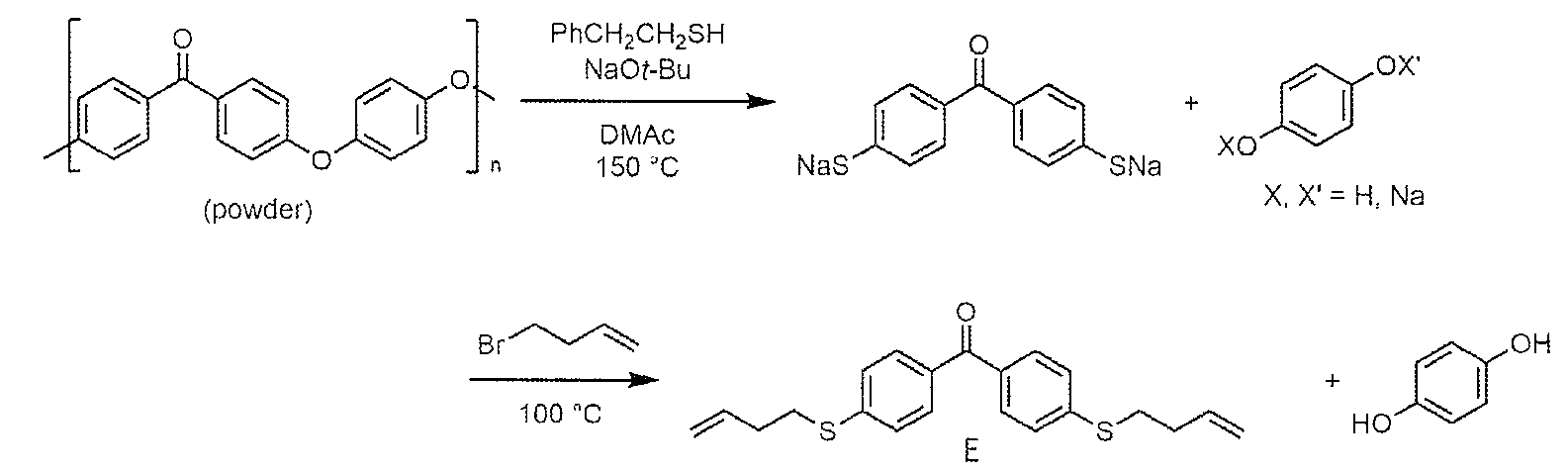
アルゴン雰囲気にて、粉末状のポリエーテルエーテルケトン 86.4mg(0.30mmol、モノマーのモル重量に対して算出、average Mw ~20,800, average Mn ~10,300, Cat. No. 456640,Sigma-Aldrichより購入)にtert-ブトキシナトリウムを86.5 mg(0.90 mmol)、N,N-ジメチルアセトアミド(DMAc)を0.6mL、フェニルエチルチオールを167 mg(1.2 mmol)を順次加えた後、反応混合物を150℃で撹拌した。
1H NMR (600 MHz, CDCl3) δ 1.26 (t, J = 7.2 Hz, 6H, CH3), 2.03 (quint, J = 7.2 Hz, 4H, CH2), 2.49 (t, J = 7.4 Hz, 4H, CH2), 3.06 (t, J = 7.0 Hz, 4H, SCH2), 4.14 (q, J = 7.2 Hz, 4H, OCH2), 7.35 (AA’BB’, 4H, aromatic), 7.70 (AA’BB’, 4H, aromatic). 13C NMR (151 MHz, CDCl3) δ 14.3, 24.1, 31.4, 32.9, 60.6, 126.6, 130.6, 134.4, 143.1, 172.8, 194.9.
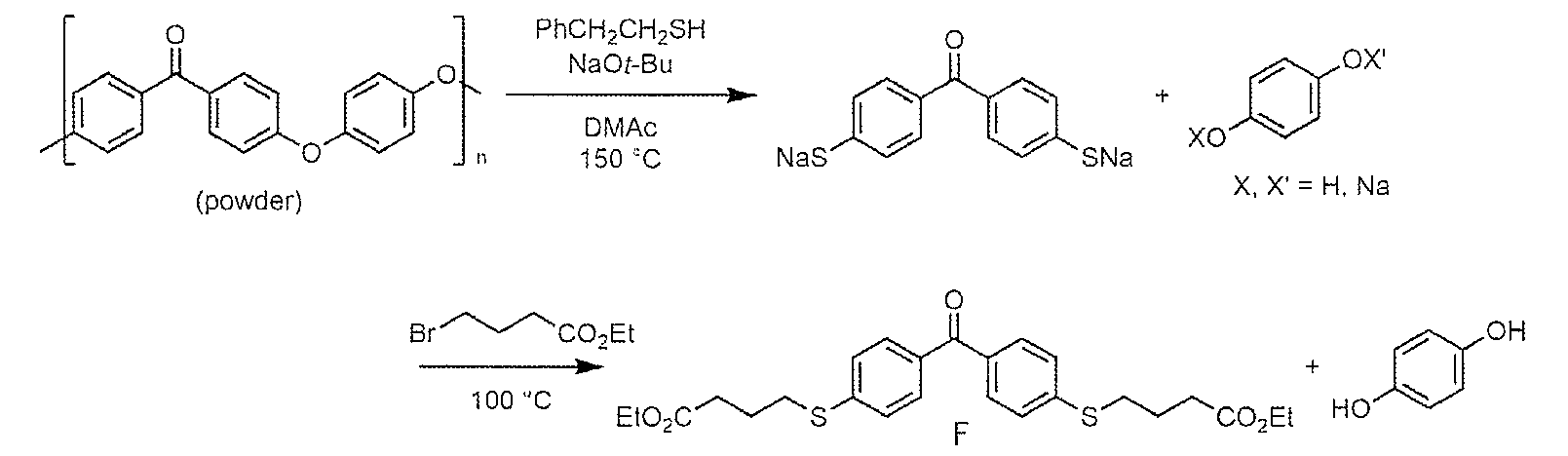
アルゴン雰囲気にて、粉末状のポリエーテルエーテルケトン 86.4mg(0.30mmol、モノマーのモル重量に対して算出、average Mw ~20,800, average Mn ~10,300, Cat. No. 456640,Sigma-Aldrichより購入)にtert-ブトキシナトリウムを86.5 mg(0.90 mmol)、N,N-ジメチルアセトアミド(DMAc)を0.6mL、フェニルエチルチオールを167 mg(1.2 mmol)を順次加えた後、反応混合物を150℃で撹拌した。
1H NMR (600 MHz, CDCl3) δ 0.30-0.33 (m, 4H, cCH2), 0.62-0.65 (m, 4H, cCH2), 1.08-1.14 (m, 2H, cCH), 2.96 (d, J = 7.0 Hz, 4H, SCH2), 7.34 (AA’BB’, 4H, aromatic), 7.69 (AA’BB’, 4H, aromatic). 13C NMR (151 MHz, CDCl3) δ 5.83, 10.1, 38.0, 126.4, 130.5, 134.2, 144.2, 195.0.
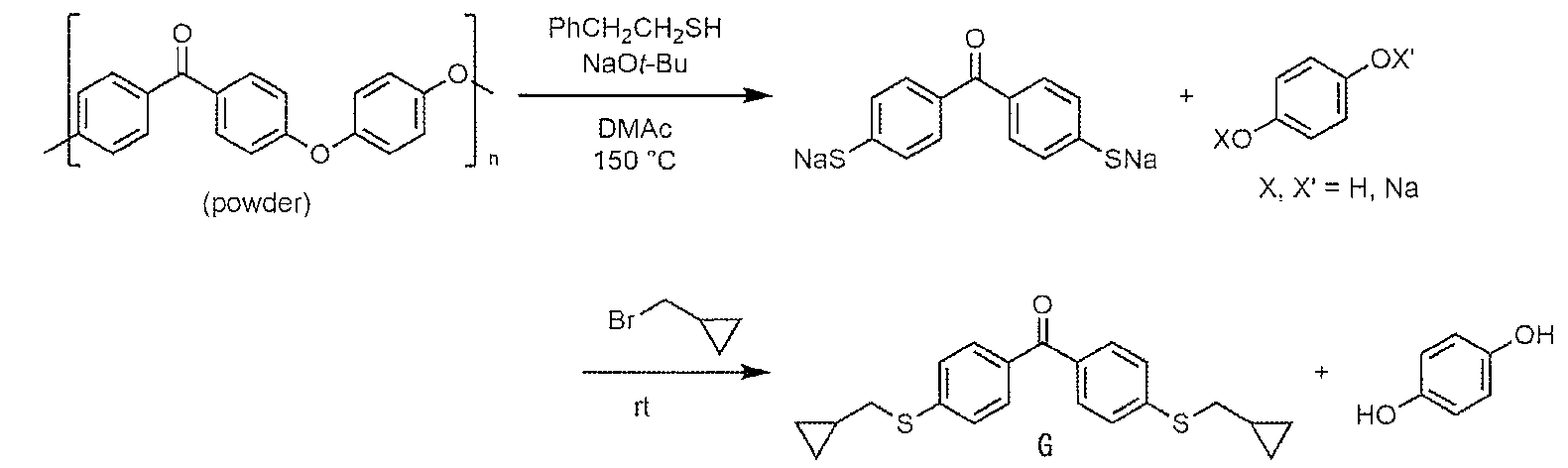
アルゴン雰囲気にて、粉末状のポリエーテルエーテルケトン 86.4mg(0.30mmol、モノマーのモル重量に対して算出、average Mw ~20,800, average Mn ~10,300, Cat. No. 456640,Sigma-Aldrichより購入)にtert-ブトキシナトリウムを87.4 mg(0.91 mmol)、N,N-ジメチルアセトアミド(DMAc)を0.6mL、フェニルエチルチオールを167 mg(1.2 mmol)を順次加えた後、反応混合物を150℃で撹拌した。
1H NMR (600 MHz, CDCl3) 2.65 (dd, J = 2.6, 4.8 Hz, 2H, methylene), 2.83-2.85 (m, 2H, methylene), 3.14 (dd, J = 6.8, 15.8 Hz, 2H, methylene), 3.22-3.25 (m, 4H), 7.43 (AA’BB’, 4H, aromatic), 7.71 (AA’BB’, 4H, aromatic). 13C NMR (151 MHz, CDCl3) 35.0, 47.3, 50.7, 127.4, 130.6, 134.9, 142.3, 194.8.
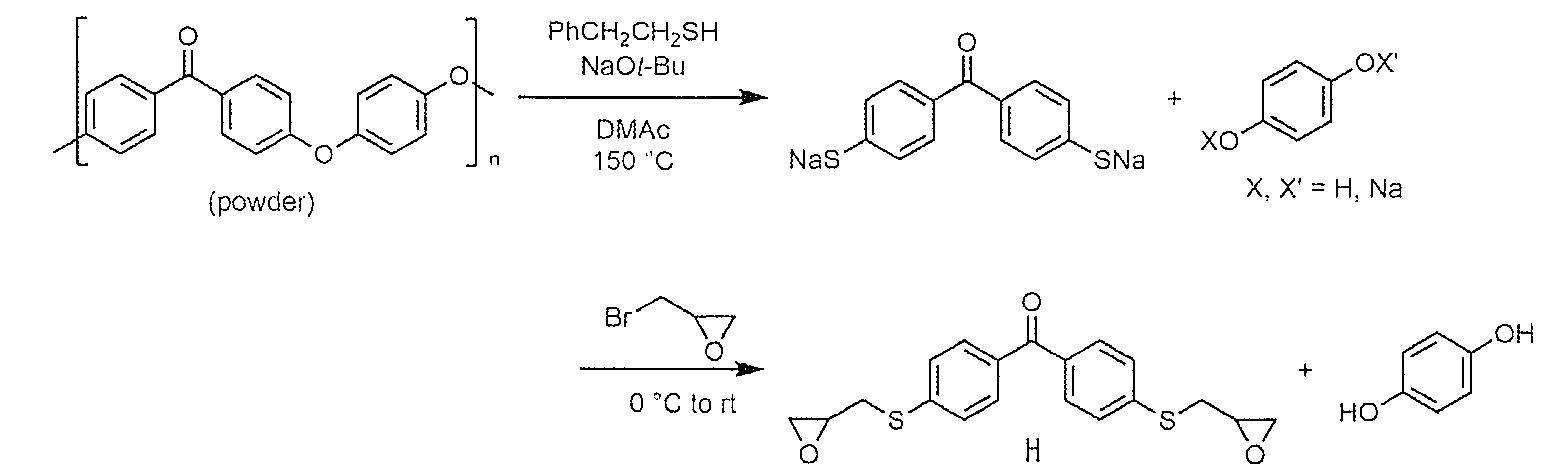
アルゴン雰囲気にて、粉末状のポリエーテルエーテルケトン 1.15 g(3.99 mmol、モノマーのモル重量に対して算出、average Mw ~20,800, average Mn ~10,300, Cat. No. 456640,Sigma-Aldrichより購入)に、tert-ブトキシナトリウムを1.15 g(12.0 mmol)、N,N-ジメチルアセトアミド(DMAc)を8.0mL、フェニルエチルチオールを2.21 g(16.0 mmol)を順次加えた後、反応混合物を150℃で撹拌した。
1H NMR (600 MHz, CDCl3) δ 0.86 (d, J = 6.6 Hz, 12H, methyl), 0.94 (d, J = 6.6 Hz, 6H, methyl), 1.12-1.16 (m, 6H, methylene), 1.22-1.34 (m, 6H, methylene), 1.50-1.56 (m, 4H, methylene), 1.58-1.63 (m, 2H, methylene), 1.69-1.75 (m, 2H, methylene), 2.97 (ddd, J = 6.3, 9.6, 12.5 Hz, 2H, SCH2), 3.05 (ddd, J = 6.3, 9.6, 12.5 Hz, 2H, SCH2), 7.32 (AA’BB’, 4H, aromatic), 7.70 (AA’BB’, 4H, aromatic). 13C NMR (151 MHz, CDCl3) δ 19.4, 22.6, 22.7, 24.7, 28.0, 30.0, 32.4, 35.9, 36.9, 39.2, 126.2, 130.5, 134.2, 144.1, 194.9.

アルゴン雰囲気にて、粉末状のポリエーテルエーテルケトン 86.1mg(0.30mmol、モノマーのモル重量に対して算出、average Mw ~20,800, average Mn ~10,300, Cat. No. 456640,Sigma-Aldrichより購入)にtert-ブトキシナトリウムを87.0 mg(0.91 mmol)、N,N-ジメチルアセトアミド(DMAc)を0.6mL、フェニルエチルチオールを167 mg(1.2 mmol)を順次加えた後、反応混合物を150℃で撹拌した。

上述した実施形態の有機溶媒には水分が含まれていないが、本発明はこれに限定されない。有機溶媒に水分が含まれていてもよい。
Claims (9)
- ポリエーテルエーテルケトンを分解させるポリエーテルエーテルケトン分解方法であって、
有機溶媒中において、前記ポリエーテルエーテルケトンと、塩基と、アルカンチオール、芳香族メルカプタン、硫化ナトリウムおよび単体硫黄の少なくとも1つと反応させる第1反応工程を有する、
ことを特徴とするポリエーテルエーテルケトン分解方法。 - 前記アルカンチオール、芳香族メルカプタン、硫化ナトリウムおよび単体硫黄の少なくとも1つを、前記ポリエーテルエーテルケトンに対し0.1~6当量で反応させることを特徴とする請求項1に記載のポリエーテルエーテルケトン分解方法。
- 前記塩基を、前記ポリエーテルエーテルケトンに対し2~6当量で反応させることを特徴とする請求項1に記載のポリエーテルエーテルケトン分解方法。
- 前記第1反応工程は、100~200℃で行われることを特徴とする請求項1~3の何れか1項に記載のポリエーテルエーテルケトン分解方法。
- 前記塩基が、水酸化ナトリウム、水酸化カリウム、炭酸カリウム、リン酸カリウム、炭酸セシウム、tert-ブトキシナトリウム、tert-ブトキシリチウム、tert-ブトキシカリウム、リチウムビストリメチルシリルアミド、ナトリウムビストリメチルシリルアミド、カリウムビストリメチルシリルアミド、フォスファゼン塩基、t-Bu-P4(1-tert-ブチル-4,4,4-トリス(ジメチルアミノ)-2,2-ビス[トリス(ジメチルアミノ)-ホスフォラニリデンアミノ]-2λ5,4λ5-カテナジ(ホスファゼン))、t-Oct-P4(1-tert-オクチル-4,4,4-トリス(ジメチルアミノ)-2,2-ビス[トリス(ジメチルアミノ)-ホスフォラニリデンアミノ]-2λ5,4λ5-カテナジ(ホスファゼン))、および、t-Bu-P2(1-tert-ブチル-2,2,4,4,4-ペンタキス(ジメチルアミノ)-2λ5,4λ5-カテナジ(ホスファゼン))からなる群より選択される少なくとも1つである、
ことを特徴とする請求項1に記載のポリエーテルエーテルケトン分解方法。 - 前記有機溶媒が、1,3-ジメチル-2-イミダゾリジノン、N,N-ジメチルアセトアミド、N,N-ジメチルホルムアミド、N-メチル-2-ピロリドン、ベンゾニトリル、1,4-ジオキサンからなる群より選択される少なくとも1つである、
ことを特徴とする、請求項1に記載のポリエーテルエーテルケトン分解方法。 - 請求項1に記載の前記第1反応工程によって得られた第1反応生成物に、ハロゲン化アルキル、酸ハライドおよび塩化水素の少なくとも1つを反応させる第2反応工程を有する、
ことを特徴とするポリエーテルエーテルケトン分解方法。 - 前記ハロゲン化アルキルが、ヨウ化メチル、1-ブロモヘキサン、ベンジルブロミド、2-フェニルエチルブロミド、11-ブロモメチルトリコサン、1-ブロモ-3,7-ジメチルオクタン、1,4-ジクロロベンゼン、4-ブロモ-1-ブテン、3-ブロモブタン酸エチルエステル、ブロモメチルシクロプロパン、2-ブロモエタノール、3-ブロモ-1-プロペンオキシドからなる群より選択される少なくとも1つであり、
前記酸ハライドが、アセチルクロリド、ベンゾイルクロリド、α-エチルヘキサン酸クロリドからなる群より選択される少なくとも1つである、
ことを特徴とする、請求項7に記載のポリエーテルエーテルケトン分解方法。 - [規則26に基づく補充 27.04.2023]
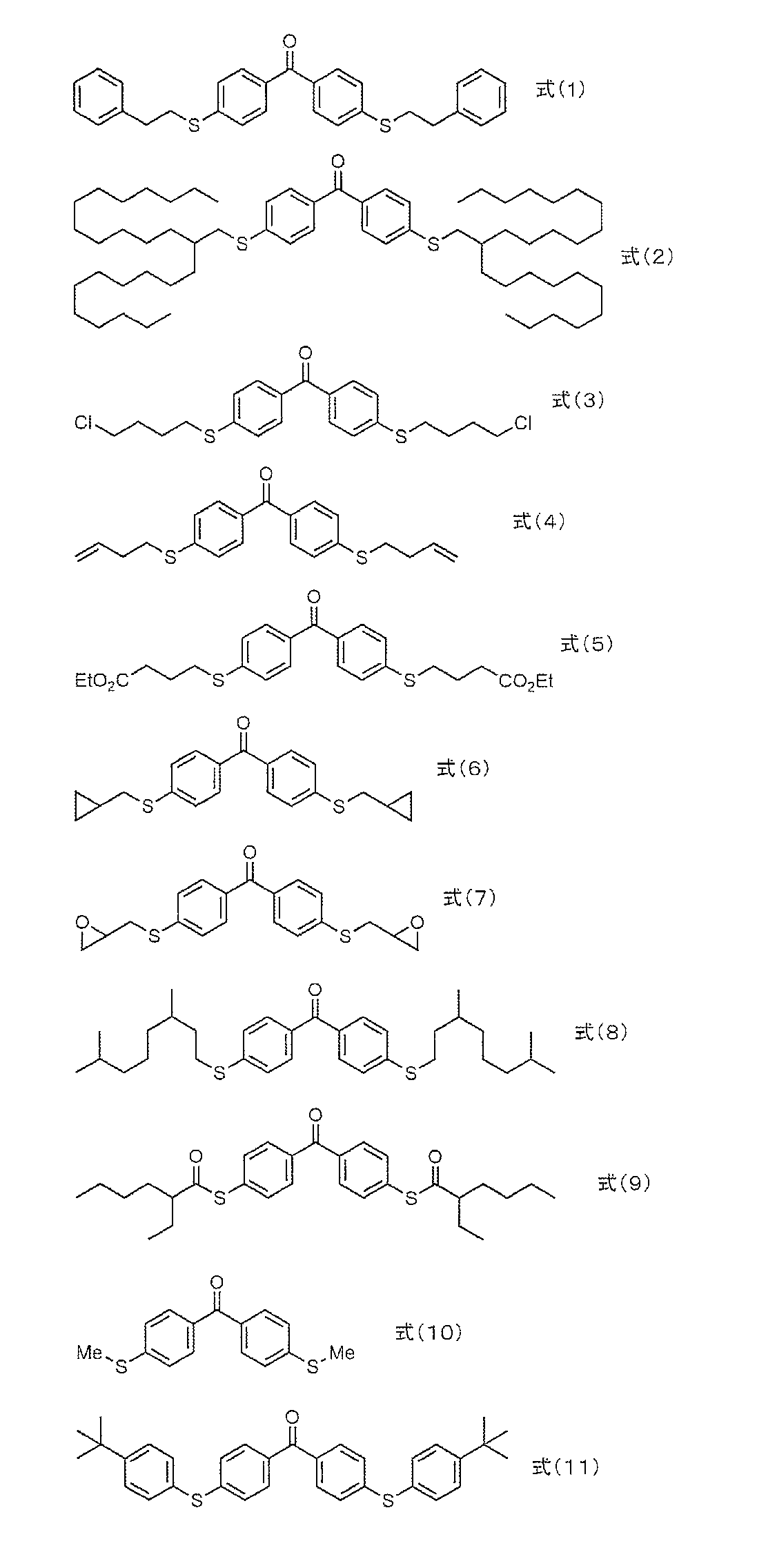
式(1)~(11)の何れか1つで示される化合物であって、
請求項1に記載のポリエーテルエーテルケトン分解方法によって得られた生成物を用いて合成される、
ことを特徴とする化合物。
Priority Applications (5)
| Application Number | Priority Date | Filing Date | Title |
|---|---|---|---|
| JP2024512730A JP7712720B2 (ja) | 2022-03-29 | 2023-03-29 | ポリエーテルエーテルケトン分解方法およびこの分解方法によって得られた分解生成物を原料とした新規物質 |
| US18/851,625 US20250197594A1 (en) | 2022-03-29 | 2023-03-29 | Polyether ether ketone decomposition method and novel substance made by using decomposition product obtained by this decomposition method as raw material |
| CN202380030573.6A CN118974010A (zh) | 2022-03-29 | 2023-03-29 | 聚醚醚酮的分解方法及以通过该分解方法获得的分解产物作为原料的新物质 |
| EP23780775.5A EP4501908A4 (en) | 2022-03-29 | 2023-03-29 | PROCESS FOR THE DECOMPOSITION OF POLYETHER ETHER KETONE AND A NEW SUBSTANCE USING A STARTING MATERIAL THAT IS A DECOMPOSITION PRODUCT OBTAINED BY THIS DECOMPOSITION PROCESS |
| JP2025106406A JP7814073B2 (ja) | 2022-03-29 | 2025-06-24 | ポリエーテルエーテルケトン分解方法およびこの分解方法によって得られた分解生成物を原料とした新規物質 |
Applications Claiming Priority (2)
| Application Number | Priority Date | Filing Date | Title |
|---|---|---|---|
| JP2022053618 | 2022-03-29 | ||
| JP2022-053618 | 2022-03-29 |
Publications (1)
| Publication Number | Publication Date |
|---|---|
| WO2023190767A1 true WO2023190767A1 (ja) | 2023-10-05 |
Family
ID=88202689
Family Applications (1)
| Application Number | Title | Priority Date | Filing Date |
|---|---|---|---|
| PCT/JP2023/012993 Ceased WO2023190767A1 (ja) | 2022-03-29 | 2023-03-29 | ポリエーテルエーテルケトン分解方法およびこの分解方法によって得られた分解生成物を原料とした新規物質 |
Country Status (5)
| Country | Link |
|---|---|
| US (1) | US20250197594A1 (ja) |
| EP (1) | EP4501908A4 (ja) |
| JP (2) | JP7712720B2 (ja) |
| CN (1) | CN118974010A (ja) |
| WO (1) | WO2023190767A1 (ja) |
Citations (4)
| Publication number | Priority date | Publication date | Assignee | Title |
|---|---|---|---|---|
| JPS52104592A (en) * | 1976-01-23 | 1977-09-02 | Basf Ag | Photopolymerizable material |
| JPS6172748A (ja) * | 1984-09-19 | 1986-04-14 | Mitsubishi Petrochem Co Ltd | イオウ含有アクリル系化合物 |
| JP2013249324A (ja) | 2012-05-30 | 2013-12-12 | Sumitomo Chemical Co Ltd | ポリエーテルサルフォン原料モノマーの製造方法 |
| CN113024591A (zh) * | 2021-03-17 | 2021-06-25 | 浙江师范大学 | 一种聚集诱导发光分子化合物、制备方法及应用 |
Family Cites Families (1)
| Publication number | Priority date | Publication date | Assignee | Title |
|---|---|---|---|---|
| CN102958946B (zh) * | 2011-07-29 | 2014-03-26 | 北京英力科技发展有限公司 | 巯基二苯甲酮类化合物及其组合物以及制备方法 |
-
2023
- 2023-03-29 JP JP2024512730A patent/JP7712720B2/ja active Active
- 2023-03-29 CN CN202380030573.6A patent/CN118974010A/zh active Pending
- 2023-03-29 US US18/851,625 patent/US20250197594A1/en active Pending
- 2023-03-29 EP EP23780775.5A patent/EP4501908A4/en active Pending
- 2023-03-29 WO PCT/JP2023/012993 patent/WO2023190767A1/ja not_active Ceased
-
2025
- 2025-06-24 JP JP2025106406A patent/JP7814073B2/ja active Active
Patent Citations (4)
| Publication number | Priority date | Publication date | Assignee | Title |
|---|---|---|---|---|
| JPS52104592A (en) * | 1976-01-23 | 1977-09-02 | Basf Ag | Photopolymerizable material |
| JPS6172748A (ja) * | 1984-09-19 | 1986-04-14 | Mitsubishi Petrochem Co Ltd | イオウ含有アクリル系化合物 |
| JP2013249324A (ja) | 2012-05-30 | 2013-12-12 | Sumitomo Chemical Co Ltd | ポリエーテルサルフォン原料モノマーの製造方法 |
| CN113024591A (zh) * | 2021-03-17 | 2021-06-25 | 浙江师范大学 | 一种聚集诱导发光分子化合物、制备方法及应用 |
Non-Patent Citations (10)
| Title |
|---|
| DANDY L.O.; OLIVEUX G.; WOOD J.; JENKINS M.J.; LEEKE G.A.: "Accelerated degradation of Polyetheretherketone (PEEK) composite materials for recycling applications", POLYMER DEGRADATION AND STABILITY, BARKING, GB, vol. 112, 1 January 1900 (1900-01-01), GB , pages 52 - 62, XP029164317, ISSN: 0141-3910, DOI: 10.1016/j.polymdegradstab.2014.12.012 * |
| DELCAILLAU, TWOENCKHAUS-ALVAREZ, A.MORANDI, B., ORG. LETT., vol. 23, 2021, pages 7018 |
| LIAN, Z.BHAWAL, B. N.MORANDI, B., SCIENCE, vol. 356, 2017, pages 1059 |
| MINAMI YASUNORI, MATSUYAMA NAO, TAKEICHI YASUO, WATANABE RYOTA, MATHEW SIBY, NAKAJIMA YUMIKO: "Depolymerization of robust polyetheretherketone to regenerate monomer units using sulfur reagents", COMMUNICATIONS CHEMISTRY, vol. 6, no. 1, XP093097565, DOI: 10.1038/s42004-023-00814-8 * |
| MINAMI, YMATSUYAMA, N.MATSUO, YTAMURA, M.SATO, K.NAKAJIMA, Y, SYNTHESIS, vol. 53, 2021, pages 3351 |
| See also references of EP4501908A4 |
| SHIBASAKI, Y. KAMIMORI, T. KADOKAWA, J.-I. HATANO, B. TAGAYA, H.: "Decomposition reactions of plastic model compounds in sub- and supercritical water", POLYMER DEGRADATION AND STABILITY, BARKING, GB, vol. 83, no. 3, 1 March 2004 (2004-03-01), GB , pages 481 - 485, XP004490474, ISSN: 0141-3910, DOI: 10.1016/j.polymdegradstab.2003.09.010 * |
| SHIGENO, M.HAYASHI, K.NOZAWA-KUMADA, K.KONDO, Y, ORG. LETT., vol. 21, 2019, pages 5505 |
| WANG, S. J.BIAN, S. G.YAN, H.XIAO, M.;MENG, Y Z., J. APP. POLY. SCI., vol. 110, 2008, pages 4049 |
| YU, Z. L.MIAO, G. X.CHEN, Y. R., MACROMOL CHEM PHYS, vol. 197, 1996, pages 4061 |
Also Published As
| Publication number | Publication date |
|---|---|
| JP7814073B2 (ja) | 2026-02-16 |
| EP4501908A4 (en) | 2026-07-22 |
| JPWO2023190767A1 (ja) | 2023-10-05 |
| EP4501908A1 (en) | 2025-02-05 |
| JP7712720B2 (ja) | 2025-07-24 |
| CN118974010A (zh) | 2024-11-15 |
| US20250197594A1 (en) | 2025-06-19 |
| JP2025138737A (ja) | 2025-09-25 |
Similar Documents
| Publication | Publication Date | Title |
|---|---|---|
| JP4431539B2 (ja) | スルフィド含有ポリチオール | |
| JP2009167212A (ja) | スルフィド含有ポリチオール | |
| TWI864235B (zh) | 二磺酸亞甲酯化合物之製造方法 | |
| CN1303403A (zh) | 多硫醇与降冰片烯衍生物加成的含硫产物,自由基交联产物的制备方法及应用 | |
| US2510893A (en) | Production of organo-thiyl compounds | |
| KR101798258B1 (ko) | 에피술파이드 화합물의 제조 방법 | |
| JP7814073B2 (ja) | ポリエーテルエーテルケトン分解方法およびこの分解方法によって得られた分解生成物を原料とした新規物質 | |
| US5464931A (en) | Oxidation of dimercaptans to organic disulfide polymers | |
| Borguet et al. | Controlled radical polymerization of a styrenic sulfonium monomer and post-polymerization modifications | |
| FR2748750A1 (fr) | Procede de production d'un copolymere de sulfure d'ethylene/soufre et copolymere de sulfure d'ethylene/soufre | |
| Harpp et al. | Studies toward cyclic trisulfides. Trisulfide polymers and sulfur extrusion | |
| WO2024200981A1 (fr) | Compositions de polythiols et leur procede de preparation | |
| JP7627257B2 (ja) | アルカンジスルホン酸化合物の製造方法 | |
| CN110256351B (zh) | 一种氟虫腈及其类似物的合成方法 | |
| WO2023244535A1 (en) | Dithiol-based polymers and cyclic compounds and methods for making and using the same | |
| CN113121395B (zh) | 单官能秋兰姆促进剂的合成 | |
| EP0094821A1 (en) | Process for the nucleophilic substitution of unactivated aromatic and heteroaromatic substrates | |
| CN111848476B (zh) | 一种硫代甲苯二异(硫)氰酸酯的制备方法 | |
| JPH0925264A (ja) | チオ(メタ)アクリレート化合物の製造法 | |
| Janout et al. | A polymeric analog of dimethyl sulfoxide: Synthesis of crosslinked polymers with bound sulfoxide groups | |
| JPH0578308A (ja) | 4−フエニルチオベンゼンチオールの製造方法 | |
| US3361808A (en) | Preparation of alpha, omega-substituted-bis-n-alkylthiopropane-1, 3 compounds | |
| JPH1149714A (ja) | 4,4’−(1−フェニルエチリデン)ビスフェノールの製造方法 | |
| 박혜인 | Synthesis of Biodegradable Sulfur-Based Polymers with Narrow Molecular Weight Distribution | |
| CN87107367A (zh) | 巯基苯甲酸酯的制备方法 |
Legal Events
| Date | Code | Title | Description |
|---|---|---|---|
| 121 | Ep: the epo has been informed by wipo that ep was designated in this application |
Ref document number: 23780775 Country of ref document: EP Kind code of ref document: A1 |
|
| ENP | Entry into the national phase |
Ref document number: 2024512730 Country of ref document: JP Kind code of ref document: A |
|
| WWE | Wipo information: entry into national phase |
Ref document number: 18851625 Country of ref document: US |
|
| WWE | Wipo information: entry into national phase |
Ref document number: 202380030573.6 Country of ref document: CN |
|
| WWE | Wipo information: entry into national phase |
Ref document number: 2023780775 Country of ref document: EP |
|
| NENP | Non-entry into the national phase |
Ref country code: DE |
|
| ENP | Entry into the national phase |
Ref document number: 2023780775 Country of ref document: EP Effective date: 20241029 |
|
| WWP | Wipo information: published in national office |
Ref document number: 18851625 Country of ref document: US |