WO2023190875A1 - 吸水性樹脂の製造方法 - Google Patents
吸水性樹脂の製造方法 Download PDFInfo
- Publication number
- WO2023190875A1 WO2023190875A1 PCT/JP2023/013188 JP2023013188W WO2023190875A1 WO 2023190875 A1 WO2023190875 A1 WO 2023190875A1 JP 2023013188 W JP2023013188 W JP 2023013188W WO 2023190875 A1 WO2023190875 A1 WO 2023190875A1
- Authority
- WO
- WIPO (PCT)
- Prior art keywords
- water
- starch
- soluble polymer
- group
- molecular weight
- Prior art date
- Legal status (The legal status is an assumption and is not a legal conclusion. Google has not performed a legal analysis and makes no representation as to the accuracy of the status listed.)
- Ceased
Links
Images
Classifications
-
- B—PERFORMING OPERATIONS; TRANSPORTING
- B01—PHYSICAL OR CHEMICAL PROCESSES OR APPARATUS IN GENERAL
- B01J—CHEMICAL OR PHYSICAL PROCESSES, e.g. CATALYSIS OR COLLOID CHEMISTRY; THEIR RELEVANT APPARATUS
- B01J20/00—Solid sorbent compositions or filter aid compositions; Sorbents for chromatography; Processes for preparing, regenerating or reactivating thereof
- B01J20/22—Solid sorbent compositions or filter aid compositions; Sorbents for chromatography; Processes for preparing, regenerating or reactivating thereof comprising organic material
- B01J20/24—Naturally occurring macromolecular compounds, e.g. humic acids or their derivatives
-
- B—PERFORMING OPERATIONS; TRANSPORTING
- B01—PHYSICAL OR CHEMICAL PROCESSES OR APPARATUS IN GENERAL
- B01J—CHEMICAL OR PHYSICAL PROCESSES, e.g. CATALYSIS OR COLLOID CHEMISTRY; THEIR RELEVANT APPARATUS
- B01J20/00—Solid sorbent compositions or filter aid compositions; Sorbents for chromatography; Processes for preparing, regenerating or reactivating thereof
- B01J20/30—Processes for preparing, regenerating, or reactivating
- B01J20/3085—Chemical treatments not covered by groups B01J20/3007 - B01J20/3078
-
- C—CHEMISTRY; METALLURGY
- C08—ORGANIC MACROMOLECULAR COMPOUNDS; THEIR PREPARATION OR CHEMICAL WORKING-UP; COMPOSITIONS BASED THEREON
- C08B—POLYSACCHARIDES; DERIVATIVES THEREOF
- C08B30/00—Preparation of starch, degraded or non-chemically modified starch, amylose, or amylopectin
- C08B30/12—Degraded, destructured or non-chemically modified starch, e.g. mechanically, enzymatically or by irradiation; Bleaching of starch
-
- C—CHEMISTRY; METALLURGY
- C08—ORGANIC MACROMOLECULAR COMPOUNDS; THEIR PREPARATION OR CHEMICAL WORKING-UP; COMPOSITIONS BASED THEREON
- C08B—POLYSACCHARIDES; DERIVATIVES THEREOF
- C08B31/00—Preparation of derivatives of starch
- C08B31/003—Crosslinking of starch
- C08B31/006—Crosslinking of derivatives of starch
-
- C—CHEMISTRY; METALLURGY
- C08—ORGANIC MACROMOLECULAR COMPOUNDS; THEIR PREPARATION OR CHEMICAL WORKING-UP; COMPOSITIONS BASED THEREON
- C08B—POLYSACCHARIDES; DERIVATIVES THEREOF
- C08B31/00—Preparation of derivatives of starch
- C08B31/02—Esters
- C08B31/04—Esters of organic acids, e.g. alkenyl-succinated starch
-
- C—CHEMISTRY; METALLURGY
- C08—ORGANIC MACROMOLECULAR COMPOUNDS; THEIR PREPARATION OR CHEMICAL WORKING-UP; COMPOSITIONS BASED THEREON
- C08B—POLYSACCHARIDES; DERIVATIVES THEREOF
- C08B31/00—Preparation of derivatives of starch
- C08B31/08—Ethers
- C08B31/12—Ethers having alkyl or cycloalkyl radicals substituted by heteroatoms, e.g. hydroxyalkyl or carboxyalkyl starch
-
- A—HUMAN NECESSITIES
- A61—MEDICAL OR VETERINARY SCIENCE; HYGIENE
- A61F—FILTERS IMPLANTABLE INTO BLOOD VESSELS; PROSTHESES; DEVICES PROVIDING PATENCY TO, OR PREVENTING COLLAPSING OF, TUBULAR STRUCTURES OF THE BODY, e.g. STENTS; ORTHOPAEDIC, NURSING OR CONTRACEPTIVE DEVICES; FOMENTATION; TREATMENT OR PROTECTION OF EYES OR EARS; BANDAGES, DRESSINGS OR ABSORBENT PADS; FIRST-AID KITS
- A61F13/00—Bandages or dressings; Absorbent pads
- A61F13/15—Absorbent pads, e.g. sanitary towels, swabs or tampons for external or internal application to the body; Supporting or fastening means therefor; Tampon applicators
- A61F13/53—Absorbent pads, e.g. sanitary towels, swabs or tampons for external or internal application to the body; Supporting or fastening means therefor; Tampon applicators characterised by the absorbing medium
- A61F2013/530481—Absorbent pads, e.g. sanitary towels, swabs or tampons for external or internal application to the body; Supporting or fastening means therefor; Tampon applicators characterised by the absorbing medium having superabsorbent materials, i.e. highly absorbent polymer gel materials
Definitions
- the reaction time is preferably the time until the haloalkyl compound serving as a raw material is consumed, and is more preferably 1 to 12 hours in order to stabilize the haloalkyl compound and improve the efficiency of the process.
- the reaction may be carried out in water, but it may also be carried out in a mixed solvent of water and alcohols such as methanol, ethanol, isopropanol, butanol, glycol ethers such as ethylene glycol dimethyl ether, or in a mixed solvent such as methanol, ethanol, isopropanol, etc.
- the total acid value is detected by introducing carboxyalkyl groups, and if the starch partial decomposition product used as the raw material does not contain acidic groups such as carboxyalkyl groups, it can be detected by measuring the total acid value.
- the acidic groups introduced are considered to be equivalent to those introduced by the etherification reaction. Therefore, when there is no acidic group in the raw material starch or starch partial decomposition product, the degree of etherification may be simply calculated from the above-mentioned total acid value. For example, when the carboxyalkyl group is a carboxymethyl group and all of them are neutralized as sodium salts, the degree of etherification can be calculated as follows: (162 x total acid value) ⁇ (56100 - 80 x total acid value). Note that the unit of the total acid value at this time is mgKOH/g.
- a water-soluble polymer is dissolved in water to form an aqueous solution, which is dropped into a hydrophilic solvent such as methanol, ethanol, isopropanol, acetone, or acetonitrile, and the water-soluble polymer is reprecipitated.
- a hydrophilic solvent such as methanol, ethanol, isopropanol, acetone, or acetonitrile
- the water-soluble polymer is reprecipitated.
- the water-soluble polymer particles are collected by filtration, and then the water-soluble polymer particles collected by filtration are dispersed again in water-containing methanol (water content of about 70 to 90%), stirred, and then washed by a process in which the water-soluble polymer particles are collected by filtration.
- water-containing methanol water content of about 70 to 90%
- Step (ab) of partially neutralizing the water-soluble polymer In the step (a2), or after the step (a2) and before the drying step (a3), the method may include a step (ab) of partially neutralizing the acidic groups of the water-soluble polymer.
- salts may be formed between halogens derived from acidic group-containing compounds and metals or ammonia derived from alkaline agents. be. This salt can be removed by the desalting step (aa) described above.
- the liquid component contained in the water-soluble polymer includes water and a mixed solvent of water and a hydrophilic solvent.
- Hydrophilic solvents include lower aliphatic alcohols such as methanol, ethanol, n-propanol, and isopropanol; ketones such as acetone; ethers such as dioxane, tetrahydrofuran, and methoxy(poly)ethylene glycol; ⁇ -caprolactam, N, Amides such as N-dimethylformamide are included. Two or more of these hydrophilic solvents may be used in combination.
- the proportion of the hydrophilic solvent in the mixed solvent is preferably adjusted by the boiling point of the hydrophilic solvent, and is 70% by volume or more when the boiling point of the hydrophilic solvent is 100°C or lower, and 30% by volume when it is higher than 100°C. It is preferable that it is below.
- polyisocyanate compound examples include 2,4-tolylene diisocyanate and hexamethylene diisocyanate
- polyvalent oxazoline compound examples include 1,2-ethylenebisoxazoline
- crosslinking agents include water-based carbodiimide compounds (e.g., Carbodilite manufactured by Nisshinbo Chemical Co., Ltd.), silane coupling agents such as ⁇ -glycidoxypropyltrimethoxysilane, ⁇ -aminopropyltriethoxysilane, and zinc , polyvalent metal compounds such as hydroxides and chlorides of calcium, magnesium, aluminum, iron, zirconium, etc., can also be used.
- water-based carbodiimide compounds e.g., Carbodilite manufactured by Nisshinbo Chemical Co., Ltd.
- silane coupling agents such as ⁇ -glycidoxypropyltrimethoxysilane, ⁇ -aminopropyltriethoxysilane, and zinc
- polyvalent metal compounds such as hydroxides and chlorides of calcium, magnesium, aluminum, iron, zirconium, etc.
- the conditions for the reaction between starch and the acidic group-containing compound are not particularly limited, but when using a haloalkyl compound having a carboxyl group as the acidic group-containing compound, an alkali agent of 1 to 1.5 equivalents to the acidic group-containing compound is used. It is preferable to use In order to stabilize starch, the pH is preferably 10.5 to 12.5, more preferably 11 to 12. Examples of alkaline agents used for pH adjustment include sodium hydroxide, potassium hydroxide, lithium hydroxide, ammonia, sodium carbonate, potassium carbonate, and the like.
- the amount of the acidic group-containing compound used can be arbitrarily set depending on the desired total acid value (degree of etherification) of the water-soluble polymer. Usually, the amount is preferably 0.5 to 5.0 equivalents, more preferably 0.5 to 2.0 equivalents, per mole of hydroxyl groups in starch.
- a haloalkyl compound such as monochloroacetic acid
- the amount of haloalkyl compound used in the aqueous reaction is preferably set at 5 equivalents or less based on the theoretical value.
- chloroacetic acid or a salt thereof when chloroacetic acid or a salt thereof is used as the haloalkyl compound, it is preferably carried out at 25 to 60°C to prevent hydrolysis by water in the reaction solution.
- the reaction time is preferably the time until the haloalkyl compound serving as a raw material is consumed, and is more preferably 1 to 6 hours in order to stabilize the haloalkyl compound and improve the efficiency of the process.
- the reaction may be carried out in water, but it may also be carried out in a mixed solvent of water and alcohols such as methanol, ethanol, isopropanol, butanol, glycol ethers such as ethylene glycol dimethyl ether, or in a mixed solvent such as methanol, ethanol, isopropanol, etc.
- a hydrophilic solvent such as an alcohol such as butanol or a glycol ether such as ethylene glycol dimethyl ether.
- the proportion of the solvent other than water is preferably 50% by volume or less in the mixed solvent.
- a reaction pot, an extruder, etc. can be used as the reaction device.
- the water-soluble polymer may be desalted in the same manner as in step (aa) described above. Further, the acidic groups of the water-soluble polymer may be partially neutralized in the same manner as in step (ab) described above.
- water-absorbing resins containing polyacrylic acid as a main constituent unit have a network structure formed by covalent bonds, and form a chemical gel by absorbing water.
- the water-absorbing resins obtained by the water-absorbing resin manufacturing method 1 and the water-absorbing resin manufacturing method 2 of the present invention are characterized by forming a physical gel by water absorption.
- crosslinking points disappear relatively easily due to thermal movement of molecular chains, changes in pH and ionic strength, and it can be converted into a fluid sol. This makes it easier to decompose, leading to a reduction in the environmental burden upon disposal.
- 30 mesh pass residue (%) (Wm2-Wm1)/0.5 x 100
- the 30 mesh pass residue is preferably less than 2% by weight, more preferably less than 1.5% by weight, even more preferably less than 1.0% by weight, and even more preferably less than 0.5% by weight.
- Agriculture such as sanitary and medical supplies such as lumber, humectants, soil water retention agents, seedling growth sheets, seed coatings, sustained release agents for fertilizers, disintegration aids for agricultural chemicals and fertilizers, desert greening materials, agricultural films, and freshness preservation agents.
- civil engineering materials such as gardening supplies, soil conditioners, sludge solidifying agents, and water-stopping materials, cold packs, thickeners, deodorants, drip absorbers for food, pet wipes, disposable body warmers, and gel for batteries.
- Products such as dew softening agents, anti-condensation sheets, packing agents, and artificial snow are included.
- An example of sanitary products is a laminate in which a backsheet, an absorbent body, and a topsheet are laminated in this order.
- the absorbent body contains the water-absorbing resin of the present invention, and may further contain water-absorbing paper or pulp, if necessary.
- the specific manufacturing method of the article is not particularly limited, and each article can be manufactured by a well-known method.
- amylomaltase was determined by the following method. Reaction solution 1 containing 10 w/v% maltotriose, 50 mM sodium acetate buffer (pH 6.0), and enzyme was incubated at 60° C. for 20 minutes. Thereafter, the reaction was stopped by heating at 100° C. for 10 minutes. The amount of glucose in the reaction solution was measured by the glucose oxidase method. The unit amount of amylomaltase was defined as 1 unit of amylomaltase activity that produces 1 ⁇ mol of glucose per minute.
- a starch partial decomposition product was produced by the following method.
- the weight average molecular weight of the obtained starch partial decomposition product was determined based on a calibration curve of molecular weight and elution time prepared using pullulan of known molecular weight in aqueous size exclusion chromatography.
- Table 1 shows the weight average molecular weight and dispersity of the starch partial decomposition product.
- the recovered water-soluble polymer was redispersed in 0.9 L of water-containing methanol with a methanol/water ratio of 80/20 (volume ratio), and the mixture was stirred at room temperature for 30 minutes. After stirring for several minutes and washing, solid-liquid separation was performed by vacuum filtration, and the water-soluble polymer was recovered again.
- the chlorine content of the recovered water-soluble polymer was determined by potentiometric titration using a 0.01N silver nitrate solution, and the washing process was repeated until the chlorine content was less than 1%.
- the total acid value of the obtained water-soluble polymer was 166 mgKOH/g, and the degree of etherification calculated from the total acid value was 0.63.
- the recovered water-soluble polymer was redispersed in 500 mL of acetone and stirred at room temperature for 30 minutes. After washing, solid-liquid separation was performed by vacuum filtration, and the water-soluble polymer was recovered again. The total acid value of the obtained water-soluble polymer was 90 mgKOH/g. The weight average molecular weight of the obtained water-soluble polymer was 3.1 ⁇ 10 6 and the degree of dispersion was 39.6.
- Examples 2 to 9, 13 and Comparative Examples 2 to 3 A water-absorbing resin was obtained by carrying out the same operation as in Example 1, except that the raw materials and charging amounts were changed to those listed in Table 4.
- Free acid value (mgKOH/g) (Vc x N x fb x 56.11) ⁇ (Sb - Vc x N x fb x 22) (Formula 2)
- Vc is the volume (ml) of the acid aqueous solution used in the acid treatment
- N is the normality of the acid aqueous solution
- fb is the titer of the acid aqueous solution
- Sb is the weight (purity) of the water-soluble polymer charged in the acid treatment. ).
- an aqueous solution of 18.9 g (0.2 mol, 0.2 equivalent to the hydroxyl group of the starch partial decomposition product) of monochloroacetic acid dissolved in 25 g of ion-exchanged water was heated at 50 to 60°C. The mixture was added dropwise over 30 minutes. After charging the monochloroacetic acid aqueous solution, the temperature was adjusted to 45 to 50°C and stirred for 10 hours. At the end point of the reaction, sample the reaction solution, measure the chlorine ion content in the reaction solution by potentiometric titration using 0.01N silver nitrate solution, and calculate the chlorine ion content when all monochloroacetic acid has reacted. The condition was that it reached 98% or more of the value 4.0%. In this production example, the chlorine content was 4.0%.
- reaction solution was diluted with 400 g of ion-exchanged water.
- the diluted reaction solution was cooled to room temperature and added to 5 L of methanol over about 30 minutes to precipitate and reprecipitate the water-soluble polymer. After all the reaction liquids were added, stirring was performed for 30 minutes, and the water-soluble polymer dispersed in methanol was separated into solid and liquid by vacuum filtration.
- the recovered water-soluble polymer was redispersed in 1 L of water-containing methanol with a methanol/water ratio of 80/20 (volume ratio), and stirred for 30 minutes at room temperature. After washing, solid-liquid separation was performed by vacuum filtration, and the water-soluble polymer was recovered again.
- the chlorine content of the recovered water-soluble polymer was determined by potentiometric titration using a 0.01N silver nitrate solution, and the washing process was repeated until the chlorine content was less than 1%.
- the total acid value of the obtained water-soluble polymer was 146 mgKOH/g, and the degree of etherification calculated from the total acid value was 0.53. Moreover, the weight average molecular weight was 18.6 ⁇ 10 6 and the degree of dispersion was 19.7.
- Example 18-25 A water-absorbing resin was obtained by carrying out the same operation as in Example 17, except that the raw materials, charging amounts, and reaction conditions listed in Table 7 were changed. Table 7 shows the free acid value, water absorption performance, gel properties, and alkali decomposition properties of each water absorbent resin.
- water-insoluble water-absorbent resins were obtained by setting the solid content of the water-soluble polymer at the time of drying to 90% or more, and sufficient water-absorbing performance could be achieved. Ta.
- an aqueous solution of 19.8 g (0.21 mol, 0.3 molar equivalent per 1 mole of hydroxyl group of the starch partial decomposition product) of monochloroacetic acid dissolved in 50 g of ion-exchanged water was mixed with 50 g of ion-exchanged water. The mixture was added dropwise at 60° C. over 30 minutes. After charging the monochloroacetic acid aqueous solution, the temperature was adjusted to 45 to 50°C and stirred for 12 hours.
- reaction solution was diluted with 900 g of ion-exchanged water.
- the diluted reaction solution was cooled to room temperature and added to 6000 ml of methanol over about 30 minutes to precipitate and reprecipitate the water-soluble polymer. After all the reaction liquids were added, stirring was performed for 30 minutes, and the water-soluble polymer dispersed in methanol was separated into solid and liquid by vacuum filtration.
- reaction solution was diluted with 900 g of ion-exchanged water.
- the diluted reaction solution was cooled to room temperature and added to 6000 ml of methanol over about 30 minutes to precipitate and reprecipitate the water-soluble polymer. After all the reaction liquids were added, stirring was performed for 30 minutes, and the water-soluble polymer dispersed in methanol was separated into solid and liquid by vacuum filtration.
- the recovered water-soluble polymer was redispersed in 1000 ml of water-containing methanol with a methanol/water ratio of 80/20 (volume ratio), and stirred for 30 minutes at room temperature. After washing, solid-liquid separation was performed by vacuum filtration, and the water-soluble polymer was recovered again. The chlorine content of the recovered water-soluble polymer was determined by potentiometric titration using a 0.01N aqueous silver nitrate solution, and the washing process was repeated until the chlorine content was less than 1%.
- the total acid value of the obtained water-soluble polymer was 132 mgKOH/g, the degree of etherification calculated from the total acid value was 0.47, the weight average molecular weight was 8,050,000, the degree of dispersion was 14.7, and the degree of biomass was 81%.
- Ta The total acid value of the obtained water-soluble polymer was 132 mgKOH/g, the degree of etherification calculated from the total acid value was 0.47, the weight average molecular weight was 8,050,000, the degree of dispersion was 14.7, and the degree of biomass was 81%.
- an aqueous solution of 32.7 g (0.35 mol, 0.4 molar equivalent per 1 mole of hydroxyl group of starch partial decomposition product) of monochloroacetic acid dissolved in 80 g of ion-exchanged water was mixed with 50 g of ion-exchanged water. The mixture was added dropwise at 60° C. over 30 minutes. After charging the monochloroacetic acid aqueous solution, the temperature was adjusted to 45 to 50°C and stirred for 12 hours.
- reaction solution was diluted with 1000 g of ion-exchanged water.
- the diluted reaction solution was cooled to room temperature and added to 7000 ml of methanol over about 30 minutes to precipitate and reprecipitate the water-soluble polymer.
- stirring was performed for 30 minutes, and the water-soluble polymer dispersed in methanol was separated into solid and liquid by vacuum filtration.
- the recovered water-soluble polymer was redispersed in 1000 ml of water-containing methanol with a methanol/water ratio of 80/20 (volume ratio), and stirred for 30 minutes at room temperature. After washing, solid-liquid separation was performed by vacuum filtration, and the water-soluble polymer was recovered again. The chlorine content of the recovered water-soluble polymer was determined by potentiometric titration using a 0.01N aqueous silver nitrate solution, and the washing process was repeated until the chlorine content was less than 1%.
- the total acid value of the obtained water-soluble polymer was 179 mgKOH/g, the degree of etherification calculated from the total acid value was 0.69, the weight average molecular weight was 9.6 million, the degree of dispersion was 36.7, and the degree of biomass was 74%. Ta.
- the recovered water-soluble polymer was a wet crystal containing hydrous alcohol.
- the wet crystals were transferred to a Petri dish, placed in a blow dryer set at 70°C, and dried for 20 hours to perform crosslinking treatment.
- the solid obtained after the treatment was crushed in a mortar and sieved using sieves with openings of 150 ⁇ m and 850 ⁇ m to collect liquid-absorbent resin particles with a particle size of 150 to 850 ⁇ m.
- Example 29 Production of liquid-absorbing resin
- the water-soluble polymer was changed to 20 g of the water-soluble polymer obtained in Production Example 32 (wet product of water-containing methanol, wet ratio 69%), and the 1N hydrochloric acid aqueous solution was changed to 0.7 ml.
- the same operation as in Example 26 was performed, except that the water-absorbing resin particles were collected in the same manner as in Example 26, except that the mixture was placed in a blow dryer set at 85° C., dried for 10 hours, and crosslinked.
- Example 28 a starch partial decomposition product derived from tapioca starch (Production Example 28) was mixed with undecomposed tapioca starch, and then acidic groups were introduced to produce a water-soluble polymer (Production Example 30). As a result, the water absorbent resin exhibited a high non-pressure water absorption capacity (FSC) of ion-exchanged water.
- FSC non-pressure water absorption capacity
Landscapes
- Chemical & Material Sciences (AREA)
- Organic Chemistry (AREA)
- Chemical Kinetics & Catalysis (AREA)
- Engineering & Computer Science (AREA)
- Biochemistry (AREA)
- Materials Engineering (AREA)
- Health & Medical Sciences (AREA)
- Medicinal Chemistry (AREA)
- Polymers & Plastics (AREA)
- Life Sciences & Earth Sciences (AREA)
- Analytical Chemistry (AREA)
- Crystallography & Structural Chemistry (AREA)
- Polysaccharides And Polysaccharide Derivatives (AREA)
- Processes Of Treating Macromolecular Substances (AREA)
Abstract
Description
(a)イオン交換水の無加圧下吸水倍率が100~500g/g、
(b)イオン交換水の保水率が80~300g/g、
(c)生理食塩水の無加圧下吸水倍率が10~70g/g、および/または
(d)生理食塩水の保水率が5~65g/g。
を有することが好ましい。
本発明の吸水性樹脂の製造方法は、澱粉を低分子量化して澱粉の部分分解物を得る工程(a1)、工程(a1)で得られた澱粉の部分分解物に酸性基を導入して水溶性ポリマーを得る工程(a2)、および水溶性ポリマーを水の存在下、70~180℃で固形分90%以上となるまで乾燥させる工程(a3)を含み、吸水により物理ゲルを形成する吸水性樹脂を製造することを特徴とする。
本工程では、澱粉を低分子量化させ、粘度を低下させる。原料の澱粉種は特に限定されず、ワキシーコーン澱粉、タピオカ澱粉、馬鈴薯澱粉、コーンスターチ(ワキシーコーンスターチおよびハイアミローススターチを含む)、小麦澱粉、米澱粉、甘藷澱粉などが挙げられる。
本工程では、工程(a1)で得られた澱粉の部分分解物に、酸性基を導入して水溶性ポリマーを得る。水溶性ポリマーは、澱粉の部分分解物に酸性基が導入されたものである。導入された酸性基は、遊離酸の状態、塩を形成した状態、電離した状態の、どの状態であってもよく、それらが共存していてもよい。




工程(a2)で製造される水溶性ポリマーの分子量は特に限定されないが、水系サイズ排除クロマトグラフィー分析によるプルラン換算の重量平均分子量が50万~4,000万であることが好ましく、70万~3,500万であることがより好ましい。前記重量平均分子量が50万未満では吸水性樹脂の保水性が低下する傾向があり、4,000万を超えると吸水性樹脂の吸水性能が低下する傾向がある。なお、水系サイズ排除クロマトグラフィー分析によるプルラン換算の重量平均分子量は、水系サイズ排除クロマトグラフィーにおいて分子量が既知のプルランにより作成した分子量と溶出時間の較正曲線に基づいて求めることができる。
前記工程(a2)の後には、水溶性ポリマーを脱塩する工程(aa)を含んでいてもよい。脱塩により、工程(a2)で副生するハロゲン化アルカリ金属塩、工程(a2)で使用した、未反応のハロアルキル化合物の塩や、後述する、部分中和する工程(ab)で生じる塩を除去できる。脱塩方法としては、溶媒による脱塩法、限外ろ過膜による脱塩法が挙げられる。溶媒による脱塩法としては、例えば、水溶性ポリマーを水に溶解させ水溶液としたものをメタノール、エタノール、イソプロパノール、アセトン、アセトニトリル等の親水性溶媒中へ滴下し、水溶性ポリマーを再沈殿させ、ろ過して回収し、その後、ろ過回収した水溶性ポリマーを含水メタノール(含水率70~90%程度)中に再度分散させ、攪拌後、水溶性ポリマーの粒子をろ過回収するプロセスにより洗浄する方法が挙げられる。限外ろ過膜を用いる方法としては、親水性ポリマーの水溶液を限外ろ過膜を有する濾過器で処理する方法が挙げられる。脱塩時の洗浄液としては、水や、水とメタノール、エタノール、プロパノール、アセトン、アセトニトリル等の親水性有機溶媒との混合液を使用してもよい。脱塩は、水溶性ポリマー中の塩濃度が、1%以下となるまで実施することが好ましい。
前記工程(a2)において、または、前記工程(a2)の後かつ乾燥工程(a3)の前に、水溶性ポリマーの酸性基を部分中和する工程(ab)を含んでいてもよい。
中和度(%)=((水溶性ポリマーのフリー酸価)÷(水溶性ポリマーの全酸価))×100
水溶性ポリマーの全酸価と、水溶性ポリマーのフリー酸価は、水溶性ポリマーの物性に関して上述した通りである。
本工程では、水溶性ポリマーを水の存在下、70~180℃で固形分90%以上となるまで乾燥させる。工程(a3)の開始時点での水溶性ポリマーは、水溶液であってもよいし、水を含むウェット粉末であってもよい。
本発明の製造方法は、澱粉に酸性基を導入する工程(b1)、酸性基を有する澱粉を低分子量化して水溶性ポリマーを得る工程(b2)、および水溶性ポリマーを水の存在下、70~180℃で固形分90%以上となるまで乾燥させる工程(b3)を含むことを特徴とする。
本工程では、澱粉と、酸性基含有化合物とを反応させる。使用する澱粉、酸性基、酸性基含有化合物は、澱粉の部分分解物に酸性基を導入する工程(a2)に関して前述した通りである。
本工程では、工程(b1)で得られた酸性基を有する澱粉を低分子量化させ、粘度を低下させる。低分子量化する方法は特に限定されず、例えば、澱粉に酵素処理、酸処理、物理的破砕等を行う方法が挙げられる。これらの方法については、澱粉を低分子量化して澱粉の部分分解物を得る工程(a1)に関して前述した通りである。
本工程では、水溶性ポリマーを水の存在下、70~180℃で固形分90%以上となるまで乾燥させる。工程(b3)の開始時点での水溶性ポリマーは、水溶液であってもよいし、水を含むウェット粉末であってもよい。使用する水溶性ポリマーに含まれる液体成分とその含有量、乾燥条件、固形分率、水溶性ポリマー間で形成される架橋構造は、乾燥工程(a3)に関して前述した通りである。
一般的に、ポリアクリル酸を主要な構成単位とする吸水性樹脂は共有結合によるネットワーク構造を有しており、吸水により化学ゲルを形成する。これに対し、本発明の吸水性樹脂の製造方法1、および吸水性樹脂の製造方法2で得られる吸水性樹脂は、吸水により物理ゲルを形成することを特徴とする。物理ゲルは、分子鎖の熱運動や、pHやイオン強度の変化などにより架橋点が比較的容易に消失し、流動性を有するゾルに転換できるため、アルカリや酸の添加、加熱、振とうなどにより分解しやすく、廃棄時の環境負荷の低減につながる。
30メッシュパス残渣(%)=(Wm2-Wm1)/0.5×100
30メッシュパス残渣は2重量%未満が好ましく、1.5重量%未満がより好ましく、1.0重量%未満がさらに好ましく、0.5重量%未満がさらにより好ましい。
本発明の吸水性樹脂の製造方法1、および吸水性樹脂の製造方法2で得られる吸水性樹脂の無加圧下の吸水倍率は、吸水性樹脂に荷重をかけないときの生理食塩水またはイオン交換水の吸収性を、実施例に記載の方法で測定して求められる。吸水性樹脂は、固形物の状態で、イオン交換水の無加圧下吸水倍率が100~500g/gであることが好ましく、120~460g/gであることがより好ましい。また、生理食塩水の無加圧下吸水倍率が10~70g/gであることが好ましく、20~70g/gであることがより好ましく、30~65g/gであることがさらに好ましい。
本発明の吸水性樹脂の製造方法1、および吸水性樹脂の製造方法2で得られる吸水性樹脂は、アルカリ処理することにより分解できる。アルカリ処理する際には、吸水性樹脂を、好ましくはpH9以上、より好ましくはpH10以上の条件に置く。アルカリ処理により、吸水性樹脂の架橋構造やグルコシド結合が開裂して水溶性ポリマーに分解され、廃棄時の環境負荷を低減できる。
本発明の吸水性樹脂の製造方法1、および吸水性樹脂の製造方法2で得られる吸水性樹脂により、様々な物品を製造することができる。物品としては、紙おむつ、生理用品、失禁用パッド、携帯用トイレ、汚物処理袋、動物用屎尿処理剤、医療用手当材、手術用シート、歯科用廃液処理剤、医療廃血液凝固剤、創傷被覆材、保湿剤などの衛生用品や医療用品、土壌保水剤、育苗シート、種子コーティング、肥料の徐放剤、農薬・肥料の崩壊助剤、砂漠緑化資材、農業用フィルム、鮮度保持剤などの農業・園芸用品、土壌改質剤、汚泥固化剤、止水材などの土木用材料のほか、保冷剤、増粘剤、消臭剤、食品用ドリップ吸収剤、ペットシート、使い捨てカイロ、電池用ゲル化剤、結露防止シート、パッキング剤、人工雪などの物品が挙げられる。衛生用品の例として、バックシート、吸収体、及びトップシートがこの順に積層された積層体が挙げられる。前記吸収体は本発明の吸水性樹脂を含み、必要に応じて、さらに吸水紙やパルプを含んでいてもよい。物品の具体的な製造方法は特に限定されず、各物品について周知の方法により製造できる。
(1-1)澱粉原料
コーンスターチ
タピオカ澱粉
酢酸タピオカ澱粉
酸化アセチル化タピオカ澱粉
アセチル化タピオカ澱粉
ヒドロキシプロピル化澱粉
ヒドロキシプロピル化リン酸架橋澱粉
α-アミラーゼ(ナガセケムテックス(株)製スピターゼ(登録商標)HK/R)、12,200単位/g
アミロマルターゼ:Thermus thermophilusを好気的に培養し、回収した菌体の破砕抽出液を遠心分離し、その上清を粗酵素液として用いた。粗酵素液を常法通りカラムクロマトグラフィーに供して、電気泳動的に単一にまで精製した標品を精製酵素液として用いた。
以下の方法で、澱粉部分分解物を製造した。なお、得られた澱粉部分分解物の重量平均分子量は、水系サイズ排除クロマトグラフィーにおいて、分子量が既知のプルランにより作成した分子量と溶出時間の較正曲線に基づいて求めた。澱粉部分分解物の重量平均分子量と分散度を表1に示す。
コーンスターチを濃度15%(w/w)となるように市水に懸濁後、1N水酸化ナトリウムを添加することでpH6.0に調整し澱粉乳を得た。この澱粉乳に、アミロマルターゼ粗酵素液を澱粉固形物1グラム当たり0.4単位になるように添加し、室温で30分間攪拌した後、攪拌下80℃で6時間反応させ、液化澱粉を調製した。得られた澱粉部分分解物の重量平均分子量は193万、分散度は9.6であった。
コーンスターチを濃度30%(w/w)となるように市水に懸濁後、1N水酸化ナトリウムを添加することでpH6.0に調整し澱粉乳を得た。この澱粉乳にアミロマルターゼ粗酵素液を澱粉固形物1グラム当たり0.15単位、およびα-アミラーゼを澱粉固形物1グラム当たり0.04単位になるように添加し、室温で30分間攪拌した後、攪拌下80℃で6時間反応させ、液化澱粉を調製した。得られた澱粉部分分解物の重量平均分子量は134万、分散度は10.6であった。
コーンスターチを濃度30%(w/w)とし、アミロマルターゼ粗酵素液を澱粉固形物1グラム当たり0.2単位とした以外は、製造例1と同じ操作により、液化澱粉を調製した。得られた澱粉部分分解物の重量平均分子量は197万、分散度は10.5であった。
異なるロットのコーンスターチを用いた以外は製造例3と同じ操作により、液化澱粉を調製した。得られた澱粉部分分解物の重量平均分子量は191万、分散度は10.1であった。
製造例3におけるコーンスターチおよび酵素の濃度を維持しつつ14倍にスケールアップした以外は、同じ操作により、液化澱粉を調製した。得られた澱粉部分分解物の重量平均分子量は516万、分散度は26.3であった。スケールアップにより反応効率が変化し、製造例3と比較して分子量と分散度が上昇したと推測された。
製造例2で得られた澱粉部分分解物の水溶液を80℃で、真空乾燥させ、得られた乾燥物を粉砕し、1mmパスの乾燥粉末品を回収した。乾燥粉末品の水分は2.7%であった。なお、得られた澱粉部分分解物の分子量および分散度は製造例2に準じる。
コーンスターチを濃度15%(w/w)となるように市水に懸濁後、1N水酸化ナトリウムを添加することでpH6.0に調整し澱粉乳を得た。この澱粉乳に、α-アミラーゼを澱粉固形物1グラム当たり0.5単位になるように添加し、室温で30分間攪拌した後、攪拌下100℃で20分間反応させ、液化澱粉を調製した。得られた澱粉部分分解物の重量平均分子量は137万、分散度は65.6であった。コーンスターチの濃度は製造例1と同じであるが、スケールアップしたこと、および使用酵素の違いにより、反応効率が変化し、製造例1と比較して分散度が上昇したと推測された。

(製造例8)
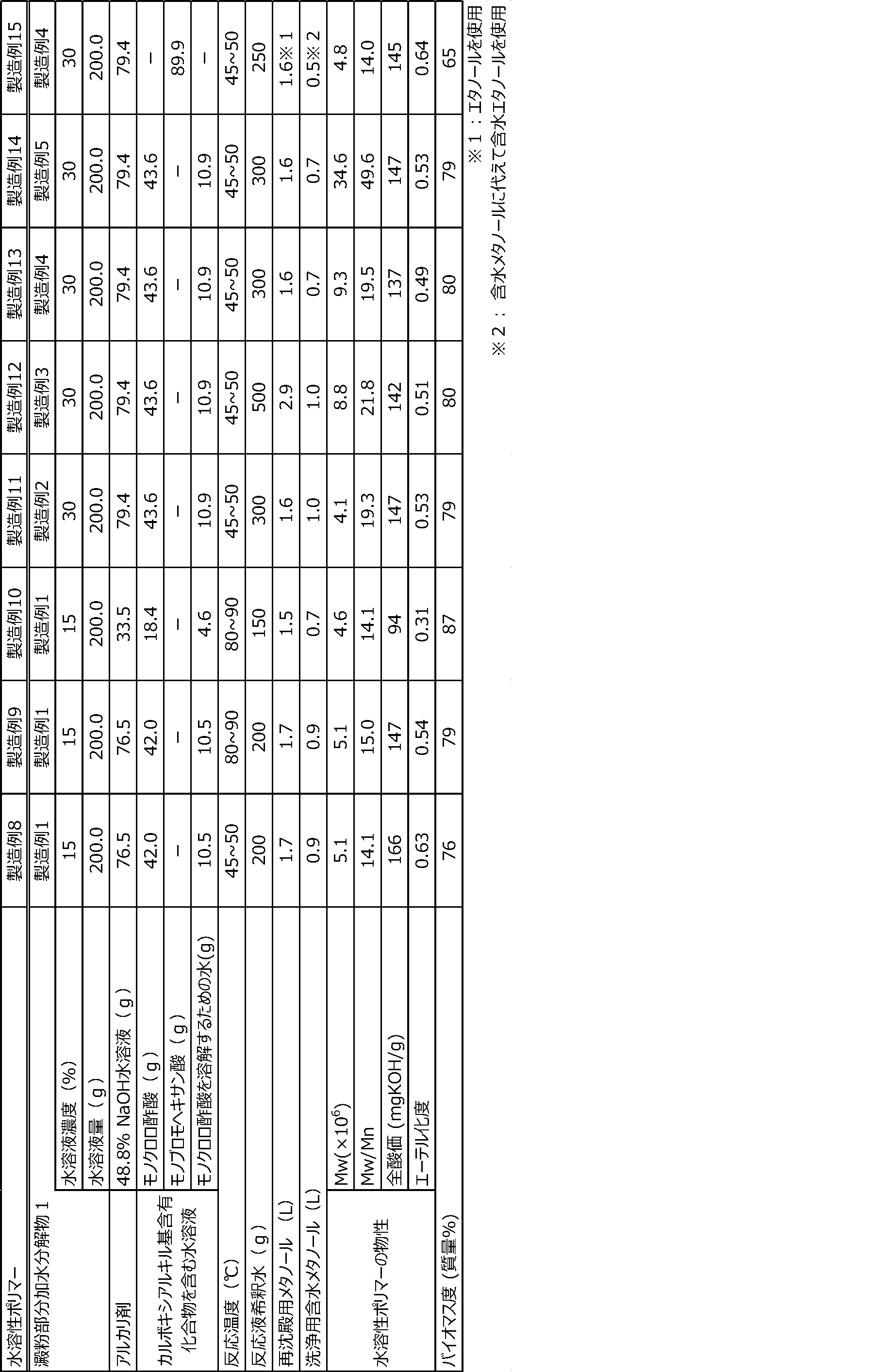
製造例1で製造した澱粉部分分解物の15重量%水溶液200g(澱粉部分分解物の水酸基0.56mol)を、撹拌機、温度計、冷却管を備えた500mlのセパラブルフラスコに仕込んだ。次に、48.8%の水酸化ナトリウム水溶液76.5g(0.93mol、澱粉部分分解物の水酸基に対して1.68当量)を仕込み、60℃以下で溶液が完全に均一となるまで攪拌した。溶液が均一となったことを確認後、モノクロロ酢酸42.0g(0.44mol、澱粉部分分解物の水酸基に対して0.8当量)をイオン交換水10.5gに溶解した水溶液を50~60℃で30分かけて滴下仕込みした。モノクロロ酢酸水溶液を仕込み後、温度を45~50℃に調節し、10時間攪拌した。反応の終点は、反応液をサンプリングし、0.01N硝酸銀溶液を用いて、反応液中の塩素イオン含量を、電位差滴定にて測定し、すべてのモノクロロ酢酸が反応した際の塩素イオン含量の計算値4.8%の98%以上に到達していることを条件とした。本製造例では塩素含有量は4.8%であった。
表2に記載した原料と仕込み量、反応温度に変更した以外は、製造例8と同様に反応を行い、水溶性ポリマーを得た。
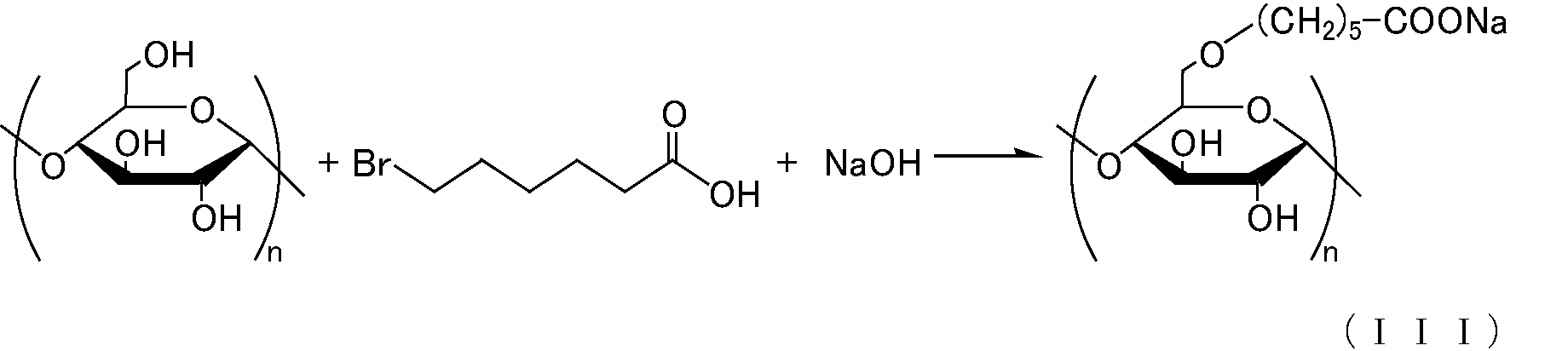
製造例4で製造した澱粉部分分解物の30重量%水溶液200g(澱粉部分分解物の水酸基1.11mol)を、撹拌機、温度計、冷却管を備えた500mlのセパラブルフラスコに仕込んだ。次に、48.8%の水酸化ナトリウム水溶液79.4g(0.96mol、澱粉部分分解物の水酸基に対して0.86当量)を仕込み、60℃以下で溶液が完全に均一となるまで攪拌した。溶液が均一となったことを確認後、6-ブロモヘキサン酸89.9g(0.46mol、澱粉部分分解物の水酸基に対して0.4当量)の結晶を50~60℃で30分かけて少しずつ仕込んだ。6-ブロモヘキサン酸の仕込み後、温度を45~50℃に調節し、10時間攪拌した。反応の終点は、反応液をサンプリングし、0.01N硝酸銀溶液を用いて、反応液中の臭化物イオン含量を、電位差滴定にて測定し、すべての6-ブロモヘキサン酸が反応した際の臭化物イオン含量の計算値9.8%の98%以上に到達していることを条件とした。本製造例では臭素含有量は10.1%であった。
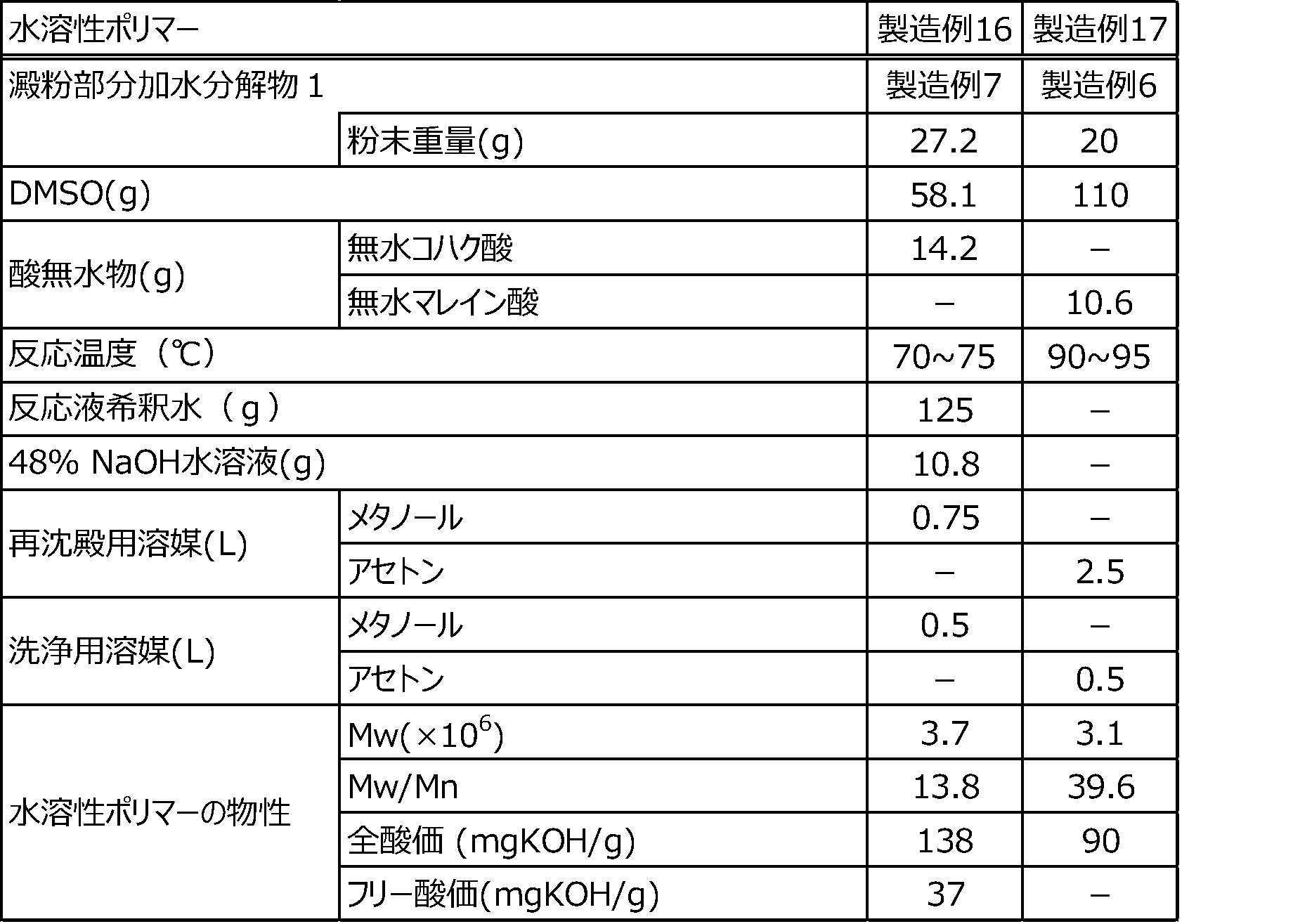
製造例7で製造した澱粉部分加水分解物の粉末27.2g(澱粉部分分解物の水酸基0.47mol)とジメチルスルホキシド(DMSO)58.1gを、撹拌機、温度計、冷却管を備えた300mlのセパラブルフラスコに仕込み、溶解させた。次に、無水コハク酸14.2g(0.14mol、澱粉部分分解物の水酸基に対して0.30当量)を仕込み、70~75℃で1時間攪拌、反応させた。攪拌終了後の反応液をサンプリングし、0.1N NaOHにて中和滴定を行ったところ、反応液の酸価は85mgKOH/gであった(理論終点酸価80.1mgKOH/g)。
製造例6で製造した澱粉部分加水分解物の粉末20.0g(澱粉部分分解物の水酸基0.36mol)とジメチルスルホキシド(DMSO)110gを、撹拌機、温度計、冷却管を備えた300mlのセパラブルフラスコに仕込み、溶解させた。次に、無水マレイン酸10.6g(0.11mol、澱粉部分分解物の水酸基に対して0.30当量)を仕込み、90~95℃で3時間攪拌、反応させた。攪拌終了後の反応液をサンプリングし、0.1N NaOHにて中和滴定を行ったところ、反応液の酸価は70mgKOH/gであった(理論終点酸価43mgKOH/g)。
(4-1)部分中和を行わない方法
(実施例1)
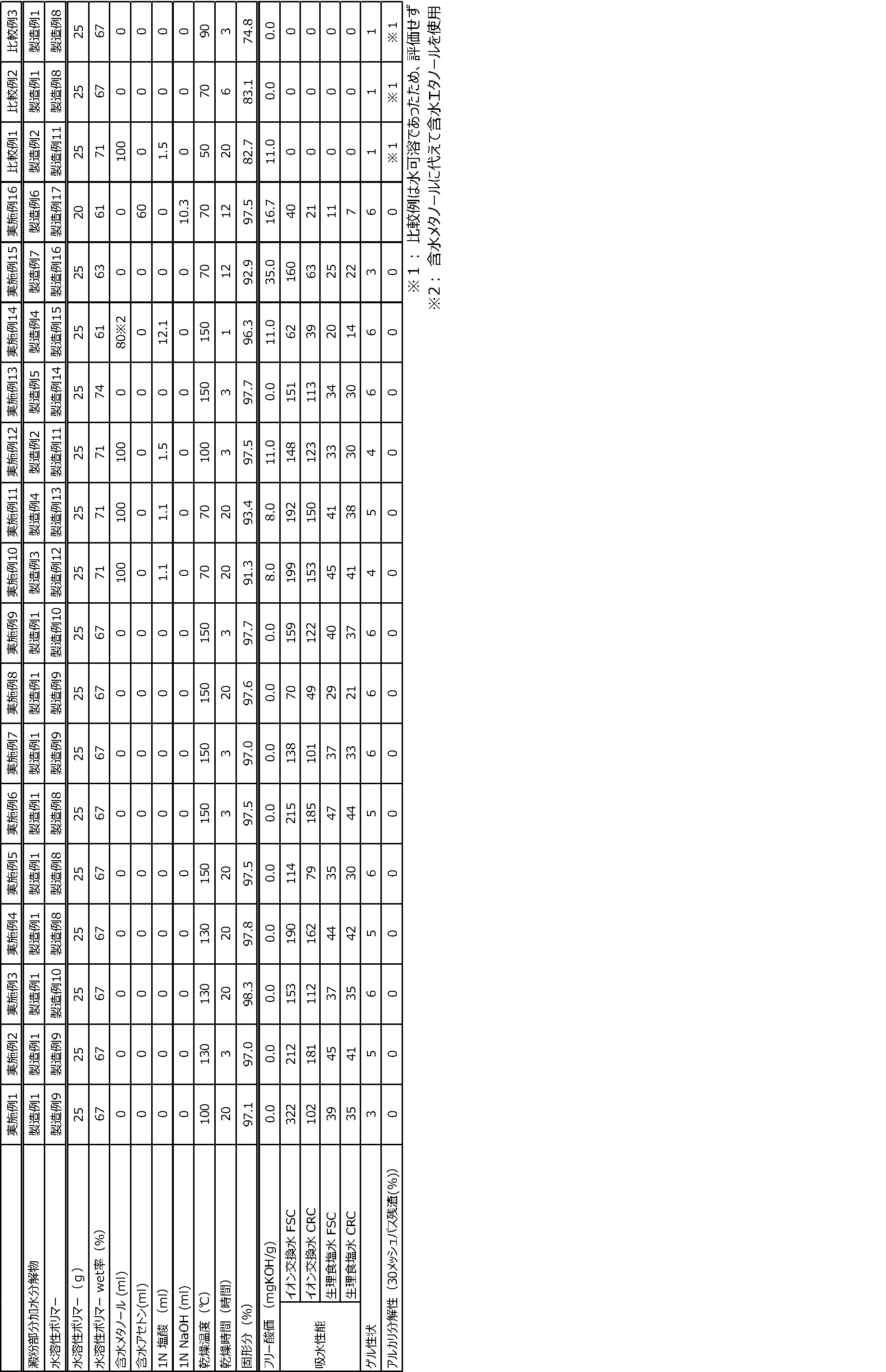
製造例9で得られた水溶性ポリマー(含水メタノールのウェット品、ウェット率67%)25g(ウェット結晶)をシャーレに移し、100℃に設定した送風乾燥機に投入し、20時間乾燥して、架橋処理を行った。処理後、得られた固体を乳鉢で粉砕し、目開き150μmと850μmの篩を使用して篩掛けを行い、粒径150~850μmの粒子を回収した。
表4に記載した原料と仕込み量に変更した以外は、実施例1と同等の操作を行い、吸水性樹脂を得た。
(実施例10)
製造例12で得られた水溶性ポリマー(含水メタノールのウェット品、ウェット率71%)25gを300mlのビーカーに投入し、更にメタノール/水=80/20(体積比)の含水メタノール100mlを加え、水溶性ポリマーを分散させた。これに、マグネティックスターラーで攪拌しながら、1N塩酸1.1mlをメスピペットで徐々に添加した。塩酸を添加した後、15分間攪拌し、減圧吸引ろ過を行い、部分的にフリー酸に中和された水溶性ポリマーを回収した。回収した水溶性ポリマーは、含水アルコールを含んだウェット結晶であった。当該ウェット結晶をシャーレに移し、70℃に設定した送風乾燥機に投入し、20時間乾燥して、架橋処理を行った。処理後得られた固体を乳鉢で粉砕し、目開き150μmと850μmの篩を使用して篩掛けを行い、粒径150~850μmの粒子を回収した。
表4に記載した原料と仕込み量に変更した以外は、実施例10と同等の操作を行い、吸水性樹脂を得た。
製造例15で得られた水溶性ポリマー(含水エタノールのウェット品、ウェット率61%)25gを300mlのビーカーに投入し、更にエタノール/水=90/10(体積比)の含水エタノール80mlを加え、水溶性ポリマーを分散させた。これに、マグネティックスターラーで攪拌しながら、1N塩酸12.1mlをメスピペットで徐々に添加した。塩酸を添加した後、15分間攪拌し、減圧吸引ろ過を行い、部分的にフリー酸に中和された水溶性ポリマーを回収した。回収した水溶性ポリマーは、含水アルコールを含んだウェット結晶であった。当該ウェット結晶をシャーレに移し、150℃に設定した送風乾燥機に投入し、1時間乾燥して、架橋処理を行った。処理後得られた固体を乳鉢で粉砕し、目開き150μmと850μmの篩を使用して篩掛けを行い、粒径150~850μmの粒子を回収した。
製造例17で得られた水溶性ポリマー(含水アセトンのウェット品、ウェット率61%)20gを300mlのビーカーに投入し、更にアセトン/水=90/10(体積比)の含水アセトン60mlを加え、水溶性ポリマーを分散させた。これに、マグネティックスターラーで攪拌しながら、1N NaOH19.3mlをメスピペットで徐々に添加した。NaOH水溶液を添加した後、15分間攪拌し、減圧吸引ろ過を行い、無水マレイン酸により導入されたカルボン酸の一部がナトリウム塩に中和された水溶性ポリマーを回収した。回収した水溶性ポリマーは、含水アセトンを含んだウェット結晶であった。当該ウェット結晶をシャーレに移し、70℃に設定した送風乾燥機に投入し、12時間乾燥して、架橋処理を行った。処理後得られた固体を乳鉢で粉砕し、目開き150μmと850μmの篩を使用して篩掛けを行い、粒径150~850μmの粒子を回収した。
(実施例15)
製造例16で得られた水溶性ポリマー(含水メタノールのウェット品、ウェット率63%)25g(ウェット結晶)をシャーレに移し、70℃に設定した送風乾燥機に投入し、12時間乾燥して、架橋処理を行った。処理後、得られた固体を乳鉢で粉砕し、目開き150μmと850μmの篩を使用して篩掛けを行い、粒径150~850μmの粒子を回収した。
(5-1)水溶性ポリマーの全酸価
100mlビーカーに、水溶性ポリマー約0.3gを精秤し、40mlのイオン交換水で溶解させた。この水溶液を、ガラス電極(京都電子工業株式会社製C-171)を備えた電位差滴定装置(京都電子工業株式会社製AT-610)にセットした。試料が全てナトリウム塩の場合は、この段階で、電位は概ね30mV以下を示すので、電位が320mV以上となるまで、1N塩酸を添加し、水溶性ポリマー中のカルボン酸基を全てフリー酸の状態とする(塩酸過剰の状態となる)。電位が320mV以上になっていることを確認し、0.1N NaOH水溶液で中和滴定を行った。本滴定では、変曲点が2つ検出され、第一の変曲点が220mV付近に、第二の変曲点が0~-30mV付近に検出される。前者は試料中の過剰の塩酸の中和点であり、後者は水溶性ポリマー中のカルボン酸の中和点である。従って、全酸価は下記式1により算出される。
全酸価(mgKOH/g)=[{(Vb-Va)×0.1×fa×56.11}÷Sa]/(1-wr) (式1)
ここで、Vaは第一変曲点までに消費された0.1N NaOHの容量(ml)、Vbは第二変曲点までに消費された0.1N NaOHの容量(ml)、faは、0.1N NaOHの力価、Saは試料採取量である。wrは、後述する方法で測定した水溶性ポリマーのウェット率である。
酸処理またはアルカリ処理後に引き続いて架橋ポリマーを製造しているため、滴定による直接的な定量は困難であるため、次の計算で算出される値をフリー酸価として定義する。
フリー酸価(mgKOH/g)=(Vc×N×fb×56.11)÷(Sb-Vc×N×fb×22) (式2)
ここで、Vcは酸処理に使用した酸水溶液の容量(ml)、Nは酸水溶液の規定度、fbは酸水溶液の力価、Sbは、酸処理に仕込んだ水溶性ポリマーの重量(純分)である。
フリー酸価(mgKOH/g)={(Tav÷56.11)×Sc-Vd×N×fc)÷(Sc+Vd×N×fc×22)}×56.11 (式3)
ここで、Tavは、水溶性ポリマーの全酸価(mgKOH/g)、Vdはアルカリ処理に使用した水酸化ナトリウム水溶液の容量(ml)、Nは水酸化ナトリウム水溶液の規定度、fcは水酸化ナトリウム水溶液の力価、Scは、アルカリ処理に仕込んだ水溶性ポリマーの重量(純分)である。
上記(5-1)水溶性ポリマーの全酸価に記載の方法において、滴定前に1N塩酸を添加せずに中和滴定を行う。この場合、変曲点は1つ検出され、下記式4により算出する。
フリー酸価(mgKOH/g)=[Va×0.1×fa×56.11÷Sa]/(1-wr) (式4)
ここで、Vaは変曲点までに消費された0.1N NaOHの容量(ml)、faは、0.1N NaOHの力価、Saは試料採取量である。wrは水溶性ポリマーのウェット率である。
ウェット率とは、ハロゲン水分計を用いて、乾燥温度130℃で試料を乾燥させた時の試料初期重量に対する、重量減少の割合(%)のことを言う。本実施例においては、水溶性ポリマー0.5~1.0gをメトラー・トレド株式会社製ハロゲン水分計 HC103にセットし、乾燥温度130℃、スイッチオフ基準 1mg/50秒、%MCモード(MC値=(試料初期重量-乾燥重量)÷試料初期重量×100が表示されるモード)にて測定した。表示されたMC値をウェット率とした。
エーテル化度=(162×TAV)÷(56100-80×TAV)
ここで、TAVは水溶性ポリマーの全酸価(単位 mgKOH/g)である。
バイオマス度は、水溶性ポリマーを構成する元素のうち、天然資源由来の元素の割合(質量%)である。バイオマス度は、エーテル化度を利用して下記式により求めた。なお、水溶性ポリマーを部分中和させた後乾燥させて得られる吸水性樹脂では、部分中和により酸性基からナトリウム塩が外れるため、バイオマス度が若干高くなる。
((グルコース単位の分子量)-エーテル化度×1)/((グルコース単位の分子量)+(エーテル化度×(酸性基の分子量-1)))×100
前記式の分子において、澱粉単量体(グルコース単位)の分子量は162である。酸性基の導入時に水素原子が外れるため、エーテル化度×1を減算する。
前記式の分母において、酸性基がカルボキシメチル基(ナトリウム塩)の場合、分子量は81である。酸性基がカルボキシヘキシル基の分子量の場合、分子量は137である。酸性基の導入時に水素原子が外れるため、分子量から1を減算した数値を用いる。
(6-1)無加圧下吸水倍率(生理食塩水)
目開き63μm(JIS Z8801-1:2006)のナイロン網で作製したティーバッグ(縦20cm、横10cm)に測定試料1.0gを入れ、生理食塩水(食塩濃度0.9重量%)1,000ml中に無撹拌下で、3時間浸漬した後、10分間吊るして水切りした。ティーバッグを含めた重量(h1)を測定し次式から保水量を求めた。なお、使用した生理食塩水、及び測定雰囲気の温度は25℃±2℃であった。
FSC(g/g)=(h1)-(h2)
なお、(h2)は、測定試料の無い場合について上記と同様の操作により計測したティーバッグの重量である。ここで、FSCとは、Free Swell Capacityの略称であり、自由膨潤倍率を意味するもので、無加圧下吸水倍率を指す。
ティーバッグに測定試料0.2gを入れ、生理食塩水に代えてイオン交換水を用いた以外は、無加圧下吸水倍率(生理食塩水)と同様にして浸漬後のティーバッグを含めた重量(h1´)を測定し次式から保水量を求めた。なお、(h2´)は、測定試料の無い場合について上記と同様の操作により計測したティーバッグの重量である。
FSC(g/g)={(h1´)-(h2´)}/0.2
上述した無加圧下吸水倍率の測定後、ティーバッグごと、遠心分離器に設置し、150Gで90秒間遠心脱水して余剰の液体成分を取り除き、ティーバックを含めた重量(h3)を測定し次式から保水量を求めた。
CRC(g/g)=(h3)-(h4)
なお、(h4)は、測定試料のない場合について上記と同様の操作により計測したティーバッグの重量である。ここでCRCとは、Centrifuge Retention Capacityの略称であり、遠心分離保持容量を意味し、保水率を指す。
上述した無加圧下吸水倍率の測定後、ティーバッグごと、遠心分離器に設置し、150Gで90秒間遠心脱水して余剰の液体成分を取り除き、ティーバックを含めた重量(h3´)を測定し次式から保水量を求めた。
CRC(g/g)={(h3´)-(h4´)}/0.2
なお、(h4´)は、測定試料のない場合について上記と同様の操作により計測したティーバッグの重量である。
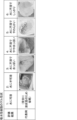
(6-3)に記載した生理食塩水に対する保水率の試験を行った後、ティーバッグよりゲルを取り出し、目視によりゲルの外観を下記の6段階で評価した。ゲル状態の写真を図1に示す。
1:水に可溶
2:水に半可溶
3:水に不溶で水っぽい
4:水に不溶でやや水っぽい
5:水に不溶でやわらかい
6:水に不溶でしっかり
吸水性樹脂0.5g、1%NaOH水溶液9.5gを、容量13.5mlのスクリュー管瓶に量り取り、ミックスローターを用いて60分間撹拌して溶解させた。次に、約50mm×50mm角の30メッシュ金網(目開き500μm)を用意し、金網の重量(Wm1)を計量した。重量を計量した金網を用いて、上記混合液を自然濾過し、ろ過後、メッシュ上をイオン交換水約5mlで洗浄した。洗浄後、金網を120℃の送風乾燥機にて2時間乾燥させ、乾燥後の金網重量(Wm2)を測定し、下記式で30メッシュパス残渣を計算した。吸水性樹脂が全て溶解している場合は、30メッシュパス残渣は0%となり、溶解せずゲルが残っている場合は、30メッシュパスは0%を超過する。
30メッシュパス残渣(%)=(Wm2-Wm1)/0.5×100
実施例1~16、比較例1~3で得られた各吸水性樹脂について、吸水性能、ゲル性状を評価した。その結果を表4に示す。
以下の方法で、加工澱粉の部分分解物を製造した。部分分解物の重量平均分子量と分散度を表5に示す。
酢酸タピオカ澱粉を濃度45%(w/w)となるように市水に懸濁後、1N水酸化ナトリウムを添加することでpH6.0に調整し澱粉乳を得た。この澱粉乳に、アミロマルターゼ粗酵素液を澱粉固形物1グラム当たり3単位になるように添加し、室温で30分間攪拌した後、攪拌下90℃で5時間反応させた。
酸化アセチル化タピオカ澱粉を濃度45%(w/w)となるように市水に懸濁後、1N水酸化ナトリウムを添加することでpH6.0に調整し澱粉乳を得た。この澱粉乳に、アミロマルターゼ粗酵素液を澱粉固形物1グラム当たり3単位になるように添加し、室温で30分間攪拌した後、攪拌下90℃で5時間反応させた。
酸化アセチル化タピオカ澱粉を濃度45%(w/w)となるように市水に懸濁後、1N水酸化ナトリウムを添加することでpH6.0に調整し澱粉乳を得た。この澱粉乳に、アミロマルターゼ粗酵素液を澱粉固形物1グラム当たり5単位になるように添加し、室温で30分間攪拌した後、攪拌下90℃で5時間反応させた。
ヒドロキシプロピル化澱粉を濃度45%(w/w)となるように市水に懸濁後、1N水酸化ナトリウムを添加することでpH6.0に調整し澱粉乳を得た。この澱粉乳に、アミロマルターゼ粗酵素液を澱粉固形物1グラム当たり3単位になるように添加し、室温で30分間攪拌した後、攪拌下90℃で5時間反応させた。
ヒドロキシプロピル化リン酸架橋澱粉を濃度30%(w/w)となるように市水に懸濁後、1N水酸化ナトリウムを添加することでpH6.0に調整し澱粉乳を得た。この澱粉乳に、アミロマルターゼ粗酵素液を澱粉固形物1グラム当たり3単位になるように添加し、室温で30分間攪拌した後、攪拌下90℃で5時間反応させた。

(製造例23)
製造例18で製造した澱粉部分加水分解物の45重量%水溶液100g(澱粉部分分解物の水酸基0.83mol)を、撹拌機、温度計、冷却管を備えた500mlのセパラブルフラスコに仕込んだ。次に、48.8%の水酸化ナトリウム水溶液34.4g(0.42mol、澱粉部分分解物の水酸基に対して0.5当量)を仕込み、60℃以下で溶液が完全に均一となるまで攪拌した。溶液が均一となったことを確認後、モノクロロ酢酸18.9g(0.2mol、澱粉部分分解物の水酸基に対して0.2当量)をイオン交換水25gに溶解した水溶液を50~60℃で30分かけて滴下仕込みした。モノクロロ酢酸水溶液を仕込み後、温度を45~50℃に調節し、10時間攪拌した。反応の終点は、反応液をサンプリングし、0.01N硝酸銀溶液を用いて、反応液中の塩素イオン含量を、電位差滴定にて測定し、すべてのモノクロロ酢酸が反応した際の塩素イオン含量の計算値4.0%の98%以上に到達していることを条件とした。本製造例では塩素含有量は4.0%であった。
表6に記載した原料、仕込み量、反応条件に変更した以外は、製造例23と同等の操作を行い、水溶性ポリマーを製造した。得られた水溶性ポリマーの全酸価、エーテル化度、重量平均分子量、分散度を表6に示す。

(実施例17)
製造例23で得られた水溶性ポリマー(含水メタノールのウェット品、ウェット率65%)25gを300mlのビーカーに投入し、更にメタノール/水=80/20(体積比)の含水メタノール120mlを加え、水溶性ポリマーを分散させた。これに、マグネティックスターラーで攪拌しながら、1N塩酸0.8mlをメスピペットで徐々に添加した。塩酸を添加した後、15分間攪拌し、減圧吸引ろ過を行い、部分的にフリー酸に中和された水溶性ポリマーを回収した。回収した水溶性ポリマーは、含水アルコールを含んだウェット結晶であった。当該ウェット結晶をシャーレに移し、70℃に設定した送風乾燥機に投入し、12時間乾燥して、架橋処理を行った。処理後得られた固体を乳鉢で粉砕し、目開き150μmと850μmの篩を使用して篩掛けを行い、粒径150~850μmの粒子を回収した。
表7に記載した原料、仕込み量、反応条件に変更した以外は、実施例17と同等の操作を行い、吸水性樹脂を得た。各吸水性樹脂のフリー酸価、吸水性能、ゲル性状、アルカリ分解性を表7に示す。

タピオカ澱粉を濃度45%(w/w)となるように市水に懸濁後、1N水酸化ナトリウムを添加することでpH6.0に調整し澱粉乳を得た。この澱粉乳に、アミロマルターゼ粗酵素液を澱粉固形物1グラム当たり8.0単位になるように添加し、室温で30分間攪拌した後、攪拌下95℃で6時間反応させ、液化澱粉を調製した。得られた澱粉部分分解物の重量平均分子量は261万、分散度は7.9であった。
製造例28で得られたタピオカ澱粉由来の澱粉部分分解物の45重量%水溶液100g(澱粉部分分解物の水酸基0.83mol)を、撹拌機、温度計、冷却管を備えた500mlのセパラブルフラスコに仕込んだ。次に、48.8%の水酸化ナトリウム水溶液34.0g(0.42mol、澱粉部分分解物の水酸基1モルに対して0.50モル当量)を仕込み、60℃以下で溶液が完全に均一となるまで攪拌した。溶液が均一となったことを確認後、モノクロロ酢酸19.8g(0.21mol、澱粉部分分解物の水酸基1モルに対して0.3モル当量)をイオン交換水50gに溶解した水溶液を50~60℃で30分かけて滴下仕込みした。モノクロロ酢酸水溶液を仕込み後、温度を45~50℃に調節し、12時間攪拌した。反応の終点は、反応液をサンプリングし、0.01N硝酸銀水溶液を用いて、反応液中の塩素イオン含量を、電位差滴定にて測定し、すべてのモノクロロ酢酸が反応した際の塩素イオン含量の計算値3.7%の98%以上に到達していることを条件とした。本製造例では塩素含有量は3.7%であった。
製造例28で得られたタピオカ澱粉由来の澱粉部分分解物の45重量%水溶液95g(澱粉部分分解物の水酸基0.79mol)とタピオカ澱粉2.5g(タピオカ澱粉の純分2.2g、タピオカ澱粉の水酸基0.04mol)とを、撹拌機、温度計、冷却管を備えた500mlのセパラブルフラスコに仕込んだ。次に、48.8%の水酸化ナトリウム水溶液34.0g(0.42mol、澱粉部分分解物の水酸基1モルに対して0.50モル当量)を仕込み、60℃以下で溶液が完全に均一となるまで攪拌した。溶液が均一となったことを確認後、モノクロロ酢酸19.8g(0.21mol、澱粉部分分解物の水酸基1モルに対して0.3モル当量)をイオン交換水50gに溶解した水溶液を50~60℃で30分かけて滴下仕込みした。モノクロロ酢酸水溶液を仕込み後、温度を45~50℃に調節し、12時間攪拌した。反応の終点は、反応液をサンプリングし、0.01N硝酸銀水溶液を用いて、反応液中の塩素イオン含量を、電位差滴定にて測定し、すべてのモノクロロ酢酸が反応した際の塩素イオン含量の計算値3.7%の98%以上に到達していることを条件とした。本製造例では塩素含有量は3.7%であった。
タピオカ澱粉を濃度45%(w/w)となるように市水に懸濁後、1N水酸化ナトリウムを添加することでpH6.0に調整し澱粉乳を得た。この澱粉乳に、アミロマルターゼ粗酵素液を澱粉固形物1グラム当たり4.0単位になるように添加し、室温で30分間攪拌した後、攪拌下85℃で5時間反応させ、液化澱粉を調製した。得られた澱粉部分分解物の重量平均分子量は401万、分散度は14.1であった。
製造例31で得られたタピオカ澱粉由来の澱粉部分分解物の45重量%水溶液100g(澱粉部分分解物の水酸基0.83mol)を、撹拌機、温度計、冷却管を備えた500mlのセパラブルフラスコに仕込んだ。次に、48.8%の水酸化ナトリウム水溶液59.5g(0.73mol、澱粉部分分解物の水酸基1モルに対して0.87モル当量)を仕込み、60℃以下で溶液が完全に均一となるまで攪拌した。溶液が均一となったことを確認後、モノクロロ酢酸32.7g(0.35mol、澱粉部分分解物の水酸基1モルに対して0.4モル当量)をイオン交換水80gに溶解した水溶液を50~60℃で30分かけて滴下仕込みした。モノクロロ酢酸水溶液を仕込み後、温度を45~50℃に調節し、12時間攪拌した。反応の終点は、反応液をサンプリングし、0.01N硝酸銀水溶液を用いて、反応液中の塩素イオン含量を、電位差滴定にて測定し、すべてのモノクロロ酢酸が反応した際の塩素イオン含量の計算値4.6%の98%以上に到達していることを条件とした。本製造例では塩素含有量は4.6%であった。
製造例29で得られた水溶性ポリマー(含水メタノールのウェット品、ウェット率65%)25gを500mlのビーカーに投入し、更にメタノール/水=80/20(体積比)の含水メタノール200mlを加え、水溶性ポリマーを分散させた。これに、マグネティックスターラーで攪拌しながら、1N塩酸水溶液1.7mlをメスピペットを用いて徐々に添加した。塩酸を添加した後、1時間攪拌し、減圧吸引ろ過を行い、部分的にフリー酸に中和された水溶性ポリマーを回収した。回収した水溶性ポリマーは、含水アルコールを含んだウェット結晶であった。当該ウェット結晶をシャーレに移し、70℃に設定した送風乾燥機に投入し、20時間乾燥して、架橋処理を行った。処理後得られた固体を乳鉢で粉砕し、目開き150μmと850μmの篩を使用して篩掛けを行い、粒径150~850μmの、吸液性樹脂の粒子を回収した。
1N塩酸水溶液をDL-リンゴ酸0.23gに変更した以外は実施例26と同様の操作を行い、吸水性樹脂粒子を回収した。
水溶性ポリマーを製造例30で得られた水溶性ポリマー(含水メタノールのウェット品、ウェット率66%)25gに変更した以外は実施例26と同様の操作を行い、吸水性樹脂粒子を回収した。
水溶性ポリマーを製造例32で得られた水溶性ポリマー(含水メタノールのウェット品、ウェット率69%)20gに変更し、1N塩酸水溶液を0.7mlに変更し、85℃に設定した送風乾燥機に投入し、10時間乾燥して、架橋処理を行った以外は、実施例26と同様の操作を行い、吸水性樹脂粒子を回収した。

Claims (11)
- 澱粉を低分子量化して澱粉の部分分解物を得る工程(a1)、
工程(a1)で得られた澱粉の部分分解物に酸性基を導入して水溶性ポリマーを得る工程(a2)、および
水溶性ポリマーを水の存在下、70~180℃で固形分90%以上となるまで乾燥させる工程(a3)
を含む、吸水により物理ゲルを形成する吸水性樹脂の製造方法。 - 前記工程(a2)の後に水溶性ポリマーを脱塩する工程(aa)を含む、
請求項1に記載の吸水性樹脂の製造方法。 - 前記工程(a2)において、または、
前記工程(a2)の後かつ前記工程(a3)の前に、
水溶性ポリマーの酸性基を部分中和する工程(ab)を含む、
請求項1または2に記載の吸水性樹脂の製造方法。 - 前記工程(a2)の後、かつ前記工程(a3)の前に、
水溶性ポリマーの酸性基を部分中和する工程を含まない、
請求項1又は2に記載の吸水性樹脂の製造方法。 - 前記工程(a3)において、固形分90%以上99%以下となるまで乾燥させる、
請求項1~4のいずれかに記載の吸水性樹脂の製造方法。 - 酸性基がカルボキシアルキル基、カルボキシアルケニル基、またはスルホアルキル基である、
請求項1~5のいずれかに記載の吸水性樹脂の製造方法。 - 前記工程(a1)において重量平均分子量(Mw)が750万以下、及び/又は分散度(重量平均分子量(Mw)/数平均分子量(Mn))が5以上の澱粉の部分分解物を得る、
請求項1~6のいずれかに記載の吸水性樹脂の製造方法。 - 前記工程(a1)において澱粉の低分子量化を酵素処理により行う、
請求項1~7のいずれかに記載の吸水性樹脂の製造方法。 - 前記工程(a2)において、工程(a1)で得られた澱粉の部分分解物と、低分子量化されていない澱粉との混合物に酸性基を導入する、
請求項1~8のいずれかに記載の吸水性樹脂の製造方法。 - 前記工程(a2)で得られる水溶性ポリマーの、水系サイズ排除クロマトグラフィー分析によるプルラン換算の重量平均分子量(Mw)が50万~4,000万である、
請求項1~9のいずれかに記載の吸水性樹脂の製造方法。 - 得られる吸水性樹脂が以下の特徴を有する、請求項1~10のいずれかに記載の吸水性樹脂の製造方法:
(a)イオン交換水の無加圧下吸水倍率が100~500g/g、
(b)イオン交換水の保水率が80~300g/g、
(c)生理食塩水の無加圧下吸水倍率が10~70g/g、および/または
(d)生理食塩水の保水率が5~65g/g。
Priority Applications (4)
| Application Number | Priority Date | Filing Date | Title |
|---|---|---|---|
| JP2024512800A JPWO2023190875A1 (ja) | 2022-03-31 | 2023-03-30 | |
| EP23780883.7A EP4506369A4 (en) | 2022-03-31 | 2023-03-30 | PROCESS FOR PRODUCING A WATER-ABSORBENT RESIN |
| US18/850,929 US20250214059A1 (en) | 2022-03-31 | 2023-03-30 | Method for producing water absorbent resin |
| CN202380028631.1A CN118900850A (zh) | 2022-03-31 | 2023-03-30 | 吸水性树脂的制造方法 |
Applications Claiming Priority (2)
| Application Number | Priority Date | Filing Date | Title |
|---|---|---|---|
| JP2022058598 | 2022-03-31 | ||
| JP2022-058598 | 2022-03-31 |
Publications (1)
| Publication Number | Publication Date |
|---|---|
| WO2023190875A1 true WO2023190875A1 (ja) | 2023-10-05 |
Family
ID=88202814
Family Applications (1)
| Application Number | Title | Priority Date | Filing Date |
|---|---|---|---|
| PCT/JP2023/013188 Ceased WO2023190875A1 (ja) | 2022-03-31 | 2023-03-30 | 吸水性樹脂の製造方法 |
Country Status (6)
| Country | Link |
|---|---|
| US (1) | US20250214059A1 (ja) |
| EP (1) | EP4506369A4 (ja) |
| JP (1) | JPWO2023190875A1 (ja) |
| CN (1) | CN118900850A (ja) |
| TW (1) | TW202405026A (ja) |
| WO (1) | WO2023190875A1 (ja) |
Citations (11)
| Publication number | Priority date | Publication date | Assignee | Title |
|---|---|---|---|---|
| US5079354A (en) | 1989-10-27 | 1992-01-07 | Kimberly-Clark Corporation | Method for making absorbent starch |
| JPH0889796A (ja) * | 1994-07-26 | 1996-04-09 | Nippon Shokubai Co Ltd | 吸水性樹脂およびその製造方法並びに吸水性物品 |
| JPH08208703A (ja) * | 1994-11-30 | 1996-08-13 | Degussa Ag | 膨潤性デンプンエステル、その製法及びそれを含有する吸収材料 |
| JPH09504331A (ja) * | 1993-10-29 | 1997-04-28 | キンバリー クラーク コーポレイション | 改善された吸収特性をもつ改質ポリサッカライドおよびその製法 |
| US6703496B1 (en) * | 1998-12-21 | 2004-03-09 | Helmut Körber | Starch phosphates, method for the production thereof and their use |
| JP2007222704A (ja) | 2006-02-21 | 2007-09-06 | Mitsubishi Rayon Co Ltd | 澱粉系吸水性材料の製造方法 |
| JP2010504414A (ja) | 2006-09-25 | 2010-02-12 | アーチャー・ダニエルズ・ミッドランド カンパニー | 超吸収性表面処理カルボキシアルキル化多糖類及びその製造方法 |
| JP2012012549A (ja) * | 2010-07-05 | 2012-01-19 | Toshio Hara | 植物系複合吸水性ポリマー及びその製造方法 |
| WO2022211005A1 (ja) * | 2021-03-31 | 2022-10-06 | 長瀬産業株式会社 | 吸水性樹脂 |
| WO2022211002A1 (ja) * | 2021-03-31 | 2022-10-06 | 長瀬産業株式会社 | 吸水性樹脂 |
| WO2022211000A1 (ja) * | 2021-03-31 | 2022-10-06 | 長瀬産業株式会社 | 水溶性ポリマーの製造方法、および吸水性樹脂の製造方法 |
Family Cites Families (1)
| Publication number | Priority date | Publication date | Assignee | Title |
|---|---|---|---|---|
| CN108299669B (zh) * | 2018-01-27 | 2020-08-21 | 华南理工大学 | 疏水多孔淀粉以及其在吸附油类中的用途 |
-
2023
- 2023-03-30 US US18/850,929 patent/US20250214059A1/en active Pending
- 2023-03-30 WO PCT/JP2023/013188 patent/WO2023190875A1/ja not_active Ceased
- 2023-03-30 CN CN202380028631.1A patent/CN118900850A/zh active Pending
- 2023-03-30 EP EP23780883.7A patent/EP4506369A4/en active Pending
- 2023-03-30 JP JP2024512800A patent/JPWO2023190875A1/ja active Pending
- 2023-03-31 TW TW112112480A patent/TW202405026A/zh unknown
Patent Citations (11)
| Publication number | Priority date | Publication date | Assignee | Title |
|---|---|---|---|---|
| US5079354A (en) | 1989-10-27 | 1992-01-07 | Kimberly-Clark Corporation | Method for making absorbent starch |
| JPH09504331A (ja) * | 1993-10-29 | 1997-04-28 | キンバリー クラーク コーポレイション | 改善された吸収特性をもつ改質ポリサッカライドおよびその製法 |
| JPH0889796A (ja) * | 1994-07-26 | 1996-04-09 | Nippon Shokubai Co Ltd | 吸水性樹脂およびその製造方法並びに吸水性物品 |
| JPH08208703A (ja) * | 1994-11-30 | 1996-08-13 | Degussa Ag | 膨潤性デンプンエステル、その製法及びそれを含有する吸収材料 |
| US6703496B1 (en) * | 1998-12-21 | 2004-03-09 | Helmut Körber | Starch phosphates, method for the production thereof and their use |
| JP2007222704A (ja) | 2006-02-21 | 2007-09-06 | Mitsubishi Rayon Co Ltd | 澱粉系吸水性材料の製造方法 |
| JP2010504414A (ja) | 2006-09-25 | 2010-02-12 | アーチャー・ダニエルズ・ミッドランド カンパニー | 超吸収性表面処理カルボキシアルキル化多糖類及びその製造方法 |
| JP2012012549A (ja) * | 2010-07-05 | 2012-01-19 | Toshio Hara | 植物系複合吸水性ポリマー及びその製造方法 |
| WO2022211005A1 (ja) * | 2021-03-31 | 2022-10-06 | 長瀬産業株式会社 | 吸水性樹脂 |
| WO2022211002A1 (ja) * | 2021-03-31 | 2022-10-06 | 長瀬産業株式会社 | 吸水性樹脂 |
| WO2022211000A1 (ja) * | 2021-03-31 | 2022-10-06 | 長瀬産業株式会社 | 水溶性ポリマーの製造方法、および吸水性樹脂の製造方法 |
Non-Patent Citations (1)
| Title |
|---|
| See also references of EP4506369A4 |
Also Published As
| Publication number | Publication date |
|---|---|
| JPWO2023190875A1 (ja) | 2023-10-05 |
| TW202405026A (zh) | 2024-02-01 |
| CN118900850A (zh) | 2024-11-05 |
| EP4506369A4 (en) | 2026-03-11 |
| US20250214059A1 (en) | 2025-07-03 |
| EP4506369A1 (en) | 2025-02-12 |
Similar Documents
| Publication | Publication Date | Title |
|---|---|---|
| JP7348412B2 (ja) | 水溶性ポリマーの製造方法、および吸水性樹脂の製造方法 | |
| US5496933A (en) | Super-absorbents and a process for their preparation | |
| WO2022211002A1 (ja) | 吸水性樹脂 | |
| JP4819984B2 (ja) | 自己架橋型アルキルセルロース誘導体、及びそれらの製造方法 | |
| US20240199821A1 (en) | Water-absorbing resin | |
| TWI229008B (en) | Water absorbent material | |
| JPH06154596A (ja) | 耐塩安定性吸収剤及びその製法 | |
| JP2901368B2 (ja) | 耐塩性吸水性樹脂の製造方法 | |
| EP4567049A1 (en) | Absorbent article | |
| JP3598141B2 (ja) | 吸水材およびその製造方法 | |
| WO2023190875A1 (ja) | 吸水性樹脂の製造方法 | |
| JP7125216B1 (ja) | 水溶性ポリマーの製造方法、および吸水性樹脂の製造方法 | |
| JP2006328346A (ja) | 生分解性吸水性材料とその製造方法および該生分解性吸水性材料からなる堆肥化助剤 | |
| JP7732713B2 (ja) | 生分解性高吸水性樹脂およびその製造方法 | |
| JP2025184036A (ja) | 吸収性組成物 | |
| JP2025071795A (ja) | 樹脂組成物 | |
| WO2026054106A1 (ja) | 多塩基酸塩修飾でん粉の製造方法および多塩基酸塩修飾でん粉組成物 | |
| JPS6055522B2 (ja) | 澱粉を幹ポリマ−とする高吸水性グラフト共重合体の製法 | |
| US20020103160A1 (en) | Self-cross-linking alkyl cellulose derivative, production process therefor, and use thereof | |
| WO2026054097A1 (ja) | 多塩基酸塩修飾セルロースの製造方法および多塩基酸塩修飾セルロース組成物 | |
| JP2025150353A (ja) | 天然由来ポリマーからなる吸水性ポリマー | |
| JP2010150558A (ja) | 自己架橋型アルキルセルロース誘導体、及びそれらの製造方法 | |
| JP2005305236A (ja) | 吸水材及びその製造方法並びに吸水性物品 |
Legal Events
| Date | Code | Title | Description |
|---|---|---|---|
| 121 | Ep: the epo has been informed by wipo that ep was designated in this application |
Ref document number: 23780883 Country of ref document: EP Kind code of ref document: A1 |
|
| WWE | Wipo information: entry into national phase |
Ref document number: 202380028631.1 Country of ref document: CN |
|
| ENP | Entry into the national phase |
Ref document number: 2024512800 Country of ref document: JP Kind code of ref document: A |
|
| WWE | Wipo information: entry into national phase |
Ref document number: 18850929 Country of ref document: US |
|
| WWE | Wipo information: entry into national phase |
Ref document number: 2023780883 Country of ref document: EP |
|
| ENP | Entry into the national phase |
Ref document number: 2023780883 Country of ref document: EP Effective date: 20241031 |
|
| NENP | Non-entry into the national phase |
Ref country code: DE |
|
| WWP | Wipo information: published in national office |
Ref document number: 18850929 Country of ref document: US |