WO2023204276A1 - 表面処理剤 - Google Patents
表面処理剤 Download PDFInfo
- Publication number
- WO2023204276A1 WO2023204276A1 PCT/JP2023/015817 JP2023015817W WO2023204276A1 WO 2023204276 A1 WO2023204276 A1 WO 2023204276A1 JP 2023015817 W JP2023015817 W JP 2023015817W WO 2023204276 A1 WO2023204276 A1 WO 2023204276A1
- Authority
- WO
- WIPO (PCT)
- Prior art keywords
- independently
- group
- integer
- formula
- single bond
- Prior art date
- Legal status (The legal status is an assumption and is not a legal conclusion. Google has not performed a legal analysis and makes no representation as to the accuracy of the status listed.)
- Ceased
Links
Classifications
-
- G—PHYSICS
- G02—OPTICS
- G02B—OPTICAL ELEMENTS, SYSTEMS OR APPARATUS
- G02B1/00—Optical elements characterised by the material of which they are made; Optical coatings for optical elements
- G02B1/10—Optical coatings produced by application to, or surface treatment of, optical elements
- G02B1/18—Coatings for keeping optical surfaces clean, e.g. hydrophobic or photo-catalytic films
-
- C—CHEMISTRY; METALLURGY
- C08—ORGANIC MACROMOLECULAR COMPOUNDS; THEIR PREPARATION OR CHEMICAL WORKING-UP; COMPOSITIONS BASED THEREON
- C08G—MACROMOLECULAR COMPOUNDS OBTAINED OTHERWISE THAN BY REACTIONS ONLY INVOLVING UNSATURATED CARBON-TO-CARBON BONDS
- C08G77/00—Macromolecular compounds obtained by reactions forming a linkage containing silicon with or without sulfur, nitrogen, oxygen or carbon in the main chain of the macromolecule
- C08G77/04—Polysiloxanes
- C08G77/20—Polysiloxanes containing silicon bound to unsaturated aliphatic groups
-
- C—CHEMISTRY; METALLURGY
- C08—ORGANIC MACROMOLECULAR COMPOUNDS; THEIR PREPARATION OR CHEMICAL WORKING-UP; COMPOSITIONS BASED THEREON
- C08G—MACROMOLECULAR COMPOUNDS OBTAINED OTHERWISE THAN BY REACTIONS ONLY INVOLVING UNSATURATED CARBON-TO-CARBON BONDS
- C08G77/00—Macromolecular compounds obtained by reactions forming a linkage containing silicon with or without sulfur, nitrogen, oxygen or carbon in the main chain of the macromolecule
- C08G77/48—Macromolecular compounds obtained by reactions forming a linkage containing silicon with or without sulfur, nitrogen, oxygen or carbon in the main chain of the macromolecule in which at least two but not all the silicon atoms are connected by linkages other than oxygen atoms
- C08G77/50—Macromolecular compounds obtained by reactions forming a linkage containing silicon with or without sulfur, nitrogen, oxygen or carbon in the main chain of the macromolecule in which at least two but not all the silicon atoms are connected by linkages other than oxygen atoms by carbon linkages
-
- C—CHEMISTRY; METALLURGY
- C09—DYES; PAINTS; POLISHES; NATURAL RESINS; ADHESIVES; COMPOSITIONS NOT OTHERWISE PROVIDED FOR; APPLICATIONS OF MATERIALS NOT OTHERWISE PROVIDED FOR
- C09D—COATING COMPOSITIONS, e.g. PAINTS, VARNISHES OR LACQUERS; FILLING PASTES; CHEMICAL PAINT OR INK REMOVERS; INKS; CORRECTING FLUIDS; WOODSTAINS; PASTES OR SOLIDS FOR COLOURING OR PRINTING; USE OF MATERIALS THEREFOR
- C09D183/00—Coating compositions based on macromolecular compounds obtained by reactions forming in the main chain of the macromolecule a linkage containing silicon, with or without sulfur, nitrogen, oxygen, or carbon only; Coating compositions based on derivatives of such polymers
- C09D183/14—Coating compositions based on macromolecular compounds obtained by reactions forming in the main chain of the macromolecule a linkage containing silicon, with or without sulfur, nitrogen, oxygen, or carbon only; Coating compositions based on derivatives of such polymers in which at least two but not all the silicon atoms are connected by linkages other than oxygen atoms
-
- C—CHEMISTRY; METALLURGY
- C08—ORGANIC MACROMOLECULAR COMPOUNDS; THEIR PREPARATION OR CHEMICAL WORKING-UP; COMPOSITIONS BASED THEREON
- C08G—MACROMOLECULAR COMPOUNDS OBTAINED OTHERWISE THAN BY REACTIONS ONLY INVOLVING UNSATURATED CARBON-TO-CARBON BONDS
- C08G77/00—Macromolecular compounds obtained by reactions forming a linkage containing silicon with or without sulfur, nitrogen, oxygen or carbon in the main chain of the macromolecule
- C08G77/60—Macromolecular compounds obtained by reactions forming a linkage containing silicon with or without sulfur, nitrogen, oxygen or carbon in the main chain of the macromolecule in which all the silicon atoms are connected by linkages other than oxygen atoms
Definitions
- the present disclosure relates to a surface treatment agent.
- Patent Document 1 It is known that certain silane compounds can provide excellent water and oil repellency when used for surface treatment of substrates.
- the silane compound described in Patent Document 1 can provide a surface treated layer with excellent water and oil repellency, but there is a need for a compound that can provide a surface treated layer with higher friction durability.
- An object of the present disclosure is to provide a silane compound that can form a surface treatment layer with excellent friction durability.
- R S1 is independently R 1 -R S -SiR 2 2 -
- R S2 is -R S -SiR 2 2 -
- R S is each independently represented by the following formula:
- R 3 is each independently a C 1-12 alkylene group, -R 6 -O-R 6 -, -R 8 -R 7 -R 8 -, -R 8 -R 7 -R 9 -R 7 - R 8 -, -R 8 -R 7 -R 9 -R 7 -R 8 -, -R 8 -R 7 -R 9 -R 6 -R 9 -R 7 -R 8 -, or -R 9 -R 6 -R 9 -R 7 -R 9 -R 6 -R 9 - and R 4 is each independently a C 1-12 alkylene group, -R 6 -O-R 6 -, -R 8 -R 7 -R 8 -, -R 8
- R 1 is a hydrocarbon group
- R 2 is each independently a hydrocarbon group
- R H is each independently a hydroxyl group or a monovalent group containing a Si atom to which a hydrolyzable group is bonded
- XA is each independently a divalent to decavalent organic group
- ⁇ is an integer from 1 to 9
- ⁇ is an integer from 1 to 9
- ⁇ is each independently an integer from 1 to 9.
- a silane compound represented by [2] is each independently a C 1-18 alkyl group or an aryl group, which may be substituted with a halogen atom
- R 5 is each independently a C 1-18 alkyl group or an aryl group, which may be substituted with a halogen atom
- R 2 is each independently a methyl group or a phenyl group
- R 5 is each independently a methyl group or a phenyl group
- R 4 is each independently -R 8 -R 7 -R 8 -, -R 8 -R 7 -R 9 -R 7 -R 8 -, -R 8 -R 7 -R 9 - Any of the above [1] to [4], which is R 6 -R 9 -R 7 -R 8 - or -R 9 -R 6 -R 9 -R 7 -R 9 -R 6 -R 9 - The silane compound according to item 1.
- R H is the following formula (S1), (S2), (S3), (S4), or (S5): [In the formula: R 11 is each independently a hydroxyl group or a hydrolyzable group, R 12 is each independently a monovalent organic group, n1 is an integer from 0 to 3, each independently for each (SiR 11 n1 R 12 3-n1 ) unit; X 11 is each independently a single bond or a divalent organic group, R 13 is each independently a hydrogen atom or a monovalent organic group, t is each independently an integer of 2 or more, R 14 is each independently a hydrogen atom, a halogen atom, or -X 11 -SiR 11 n1 R 12 3-n1 , R 15 is each independently a single bond, an oxygen atom, an alkylene group having 1 to 6 carbon atoms, or an alkyleneoxy group having 1 to 6 carbon atoms, R a1 are each independently -Z 1 -SiR 21 p1 R 22
- R g1 and R h1 are each independently -Z 4 -SiR 11 n1 R 12 3-n1 , -Z 4 -SiR a1 k1 R b1 l1 R c1 m1 , or -Z 4 -CR d1 k2 R e1 l2 R f1 m2 , Z 4 is each independently a single bond, an oxygen atom or a divalent organic group,
- formula (S5) there are at least two Si atoms to which hydroxyl groups or hydrolyzable groups are bonded.
- the silane compound according to any one of [1] to [6] above which is a group represented by: [8] The silane compound according to [7] above, wherein R H is each independently a group represented by formula (S1), formula (S3), (S4), or (S5). [9] The silane compound according to [7] above, wherein R H is each independently a group represented by formula (S3), (S4), or (S5). [10] The silane compound according to any one of [1] to [9] above, wherein ⁇ , ⁇ , and ⁇ are 1.
- X A is the following formula: -(R 51 ) p5 -(X 51 ) q5 - [In the formula: R 51 is -(CH 2 ) s5 - or o-, m- or p-phenylene group, s5 is an integer from 1 to 20, X 51 is -(X 52 ) l5 -, X 52 is each independently -O-, -S-, o-, m- or p-phenylene group, -CO-, -C(O)O-, -CONR 54 -, -O-CONR 54 -, -NR 54 - and -(CH 2 ) n5 -, R 54 is each independently a hydrogen atom or a monovalent organic group, n5 is each independently an integer from 1 to 20, l5 is an integer from 1 to 10, p5 is 0 or 1, q5 is 0 or 1, Here, at least one of p5 and q5 is 1, and the repeat
- silane compound according to any one of [1] to [10] above which is a divalent organic group represented by: [12]
- X A is each independently a C 1-20 alkylene group, or -(CH 2 ) s5 -CONH-(CH 2 ) t5 - (wherein s5 is an integer from 1 to 20, t5 is an integer of 1 to 20), the silane compound according to any one of [1] to [11] above.
- [14] Contains at least one of the siloxane-containing silane compound according to any one of [1] to [12] above, and a compound consisting of a condensate in which at least a portion of the siloxane-containing silane compound is condensed.
- Surface treatment agent [15] The surface treatment agent according to [13] or [14] above, which is used for vacuum deposition. [16] The surface treatment agent according to [13] or [14] above, which is for wet coating. [17] A pellet containing the surface treatment agent according to any one of [13] to [16] above.
- R S1 is each independently R 1 -R S -SiR 2 2 -
- R S2 is -R S -SiR 2 2 -
- R S is each independently represented by the following formula:
- R 3 is each independently a C 1-12 alkylene group, -R 6 -O-R 6 -, -R 8 -R 7 -R 8 -, -R 8 -R 7 -R 9 -R 7 - R 8 -, -R 8 -R 7 -R 9 -R 6 -R 9 -R 7 -R 8 -, or
- R 1 is a hydrocarbon group
- R 2 is each independently a hydrocarbon group
- R 62 is a single bond or a C 1-12 alkylene group
- R 61' is a divalent organic group.
- R S1 is each independently R 1 -R S -SiR 2 2 -
- R S2 is -R S -SiR 2 2 -
- R S is each independently represented by the following formula: (In the formula: R 3 is each independently a C 1-12 alkylene group, -R 6 -O-R 6 -, -R 8 -R 7 -R 8 -, -R 8 -R 7 -R 9 -R 7 - R 8 -, -R 8
- R 1 is a hydrocarbon group
- R 2 is each independently a hydrocarbon group
- R 61 is a single bond or a divalent organic group
- R 65 is a hydrogen atom or a C 1-6 alkyl group.
- R 1 is a hydrocarbon group
- R 2 is each independently a hydrocarbon group
- R 61 is a single bond or a C 1-12 alkylene group
- R 62 is a single bond or a C 1-12 alkylene group
- R 66 is a single bond or a C 1-12 alkylene group
- R 67 is a hydrogen atom, a C 1-18 alkyl group, an aryl group, or a polyether group.
- R S1 is each independently R 1 -R S -SiR 2 2 -
- R S2 is -R S -SiR 2 2 -
- R S is each independently represented by the following formula:
- R 3 is each independently a C 1-12 alkylene group, -R 6 -O-R 6 -, -R 8 -R 7 -R 8 -, -R 8 -R 7 -R 9 -R 7 - R 8 -, -R 8 -R 7 -R 9 -R 6 -R 9 -R 7 -R 8 -,
- R 1 is a hydrocarbon group
- R 2 is each independently a hydrocarbon group
- R 61 is a single bond or a C 1-12 alkylene group
- R 62 is a single bond or a C 1-12 alkylene group.
- R S1 is each independently R 1 -R S -SiR 2 2 -
- R S2 is -R S -SiR 2 2 -
- R S is each independently represented by the following formula:
- R 3 is each independently a C 1-12 alkylene group, -R 6 -O-R 6 -, -R 8 -R 7 -R 8 -, -R 8 -R 7 -R 9 -R 7 - R 8 -, -R 8 -R 7 -R 9 -R 6 -R 9 -R
- R 1 is a hydrocarbon group
- R 2 is each independently a hydrocarbon group
- R 61 is a single bond or a C 1-12 alkylene group
- R 62 is a single bond or a C 1-12 alkylene group.
- R 74 Si(R 71 ) 2 -R 72 -COOR 73 [In the formula: R 71 is each independently a C 1-12 alkyl group which may be substituted with a halogen atom, R 72 is a C 3-5 alkylene group optionally substituted with a halogen atom, R 73 is a hydrogen atom or a C 1-3 alkyl group optionally substituted with a halogen atom, R 74 is a halogen atom, a hydroxyl group, or a hydrolyzable group.
- R 71 is a methyl group
- R 72 is a linear C 3-5 alkylene group
- R 73 is a methyl group or an ethyl group
- R 74 is a chlorine atom or a hydroxyl group
- a silane compound that can form a surface treatment layer with excellent friction durability is provided.
- monovalent organic group means a monovalent group containing carbon.
- the monovalent organic group is not particularly limited, but may be a hydrocarbon group or a derivative thereof.
- a derivative of a hydrocarbon group is a group having one or more N, O, S, Si, amide, sulfonyl, siloxane, carbonyl, carbonyloxy, etc. at the end of the hydrocarbon group or in the molecular chain. means.
- organic group when simply indicating an "organic group”, it means a monovalent organic group.
- divalent organic group means a divalent group containing carbon. Examples of such divalent organic groups include divalent groups obtained by removing one hydrogen atom from an organic group.
- a trivalent or higher-valent organic group means a group obtained by removing a predetermined number of hydrogen atoms from an organic group.
- hydrocarbon group refers to a group containing carbon and hydrogen, which is obtained by removing a hydrogen atom from a hydrocarbon.
- hydrocarbon groups include, but are not particularly limited to, C 1-20 hydrocarbon groups, such as aliphatic hydrocarbon groups and aromatic hydrocarbon groups.
- aliphatic hydrocarbon group may be linear, branched, or cyclic, and may be saturated or unsaturated.
- the hydrocarbon group may also contain one or more ring structures. Hydrocarbon groups may be substituted with one or more substituents.
- the substituent of the "hydrocarbon group” is not particularly limited, but includes, for example, a halogen atom, and a C 1-6 alkyl which may be substituted with one or more halogen atoms.
- group C 2-6 alkenyl group, C 2-6 alkynyl group, C 3-10 cycloalkyl group, C 3-10 unsaturated cycloalkyl group, 5- to 10-membered heterocyclyl group, 5- to 10-membered unsaturated ring
- One or more groups selected from a saturated heterocyclyl group, a C 6-10 aryl group, and a 5- to 10-membered heteroaryl group are mentioned.
- hydrolyzable group means a group that can undergo a hydrolysis reaction, that is, a group that can be detached from the main skeleton of a compound by a hydrolysis reaction.
- R h examples include unsubstituted alkyl groups such as methyl, ethyl, propyl, isopropyl, n-butyl, and isobutyl; substituted alkyl groups such as chloromethyl.
- alkyl groups, particularly unsubstituted alkyl groups, are preferred, and methyl groups or ethyl groups are more preferred.
- an "arylene group” is a divalent aromatic group.
- the arylene group may be a monocyclic aromatic group or a polycyclic aromatic group.
- the arylene group is, for example, a divalent 1-3 ring aromatic group, and specifically, it is a divalent group obtained by removing two hydrogen atoms from benzene, naphthalene, anthracene, fluorene, or phenanthrene as shown below. Examples include valence groups.
- the above arylene group may be substituted with one or more substituents. Note that the bonding position is arbitrary.
- R S1 is each independently R 1 -R S -SiR 2 2 -
- R S2 is -R S -SiR 2 2 -
- R S is each independently represented by the following formula:
- R 3 is each independently a C 1-12 alkylene group, -R 6 -O-R 6 -, -R 8 -R 7 -R 8 -, -R 8 -R 7 -R 9 -R 7 - R 8 -, -R 8 -R 7 -R 9 -R 7 -R 8 -, -R 8 -R 7 -R 9 -R 6 -R 9 -R 7 -R 8 -, or -R 9 -R 6 -R 9 -R 7 -R 9 -R 6 -R 9 - and R 4 is each independently a C 1-12 alkylene group, -R 6 -O-R 6 -, -R 8 -R 7 -R 8 -, -R 8
- R 1 is a hydrocarbon group
- R 2 is each independently a hydrocarbon group
- R H is each independently a hydroxyl group or a monovalent group containing a Si atom to which a hydrolyzable group is bonded
- XA is each independently a divalent to decavalent organic group
- ⁇ is an integer from 1 to 9
- ⁇ is an integer from 1 to 9
- ⁇ is each independently an integer from 1 to 9.
- Si—O bonds have high ionic bonding properties and generally have low chemical stability.
- the silane compound of the present disclosure can reduce ionic bonding properties and improve chemical stability by replacing Si--O bonds with Si--C bonds or CC bonds.
- R S is each independently represented by the following formula: [In the formula: R 3 is each independently a C 1-12 alkylene group, -R 6 -O-R 6 -, -R 8 -R 7 -R 8 -, -R 8 -R 7 -R 9 -R 7 - R 8 -, -R 8 -R 7 -R 9 -R 6 -R 9 -R 7 -R 8 -, or -R 9 -R 6 -R 9 -R 7 -R 9 -R 6 -R 9 - and R 4 is each independently a C 1-12 alkylene group, -R 6 -O-R 6 -, -R 8 -R 7 -R 8 -, -R 8 -R 7 -R 9 -R 7 - R 8 -, -R 8 -R 7 -R 9 -R 6 -R 9 -R 7 -R 8 -, or -R 9 -R 6 -R
- R 3 is each independently a C 1-12 alkylene group, -R 6 -O-R 6 -, -R 8 -R 7 -R 8 -, -R 8 -R 7 -R 9 -R 7 - R 8 -, -R 8 -R 7 -R 9 -R 6 -R 9 -R 7 -R 8 -, or -R 9 -R 6 -R 9 -R 7 -R 9 -R 6 -R 9 - and is preferably a C 1-12 alkylene group or -R 6 -O-R 6 -.
- R 4 is each independently a C 1-12 alkylene group, -R 6 -O-R 6 -, -R 8 -R 7 -R 8 -, -R 8 -R 7 -R 9 -R 7 - R 8 -, -R 8 -R 7 -R 9 -R 6 -R 9 -R 7 -R 8 -, or -R 9 -R 6 -R 9 -R 7 -R 9 -R 6 -R 9 - It is.
- each R 4 is independently a C 1-12 alkylene group or -R 6 -O-R 6 -.
- R 4 is each independently -R 8 -R 7 -R 8 -, -R 8 -R 7 -R 9 -R 7 -R 8 -, -R 8 -R 7 -R 9 -R 6 -R 9 -R 7 -R 8 -, or -R 9 -R 6 -R 9 -R 7 -R 9 -R 6 -R 9 -.
- R 3 is each independently a C 1-12 alkylene group or -R 6 -O-R 6 -
- R 4 is each independently a C 1-12 alkylene group, or -R 6 -O-R 6 -.
- each R 3 is independently a C 1-12 alkylene group, or -R 6 -O-R 6 -
- each R 4 is independently -R 8 -R 7 - R 8 -, -R 8 -R 7 -R 9 -R 7 -R 8 -, -R 8 -R 7 -R 9 -R 6 -R 9 -R 7 -R 8 -, or -R 9 -R 6 -R 9 -R 7 -R 9 -R 6 -R 9 -.
- the above C 1-12 alkylene group may be linear or branched.
- the C 1-12 alkylene group is preferably straight chain.
- the C 1-12 alkylene group is preferably a C 2-8 alkylene group, more preferably a C 2-6 alkylene group.
- Each R 6 is independently a C 1-6 alkylene group.
- the above C 1-6 alkylene group may be linear or branched.
- the C 1-6 alkylene group is preferably straight chain.
- the C 1-6 alkylene group is preferably a C 2-4 alkylene group, more preferably a C 2-3 alkylene group.
- all R 6 are the same group.
- R 7 is each independently an optionally substituted arylene group.
- each R 7 is independently: It is.
- R 7 is a phenylene group.
- R 7 is a naphthylene group.
- the above arylene group may have a substituent.
- the number of substituents is not particularly limited, and is, for example, 1 to 4, preferably 1 or 2.
- the phenylene group and naphthylene group may have a substituent.
- the number of substituents is not particularly limited, and is, for example, 1 to 4, preferably 1 or 2.
- the substituted phenylene group is preferably 2,5-substituted phenylene.
- the substituents for the above arylene group are each independently -R 41 -R 42 .
- R 41 is a single bond, an oxygen atom, or a sulfur atom, preferably a single bond or an oxygen atom, and more preferably an oxygen atom.
- R 42 is a C 1-12 alkyl group optionally substituted with halogen, -(O-R 43 ) p , -R 44 -R 45 , -R 44 -OR 46 .
- the above halogen is fluorine, chlorine, bromine, or iodine, and preferably fluorine.
- the C 1-12 alkyl group in R 42 may be a straight chain or a branched chain.
- R 43 is a C 1-6 alkylene group, preferably a C 2-4 alkylene group. Such alkylene groups may be linear or branched.
- R 44 is a C 1-12 alkylene group, preferably a C 1-6 alkylene group. Such alkylene groups may be linear or branched.
- R 46 is a hydrogen atom or a C 1-6 alkyl group. Such alkyl groups may be linear or branched.
- the C 1-6 alkyl group is preferably a C 1-3 alkyl group, more preferably a C 1-2 alkyl group, and even more preferably a methyl group.
- Each R 8 is independently a single bond or a C 1-6 alkylene group.
- Such C 1-6 alkylene group may be linear or branched.
- R 8 is a single bond.
- R 8 is a C 1-6 alkylene group.
- Each R 9 is independently a single bond or an oxygen atom.
- R 9 is a single bond.
- R 9 is an oxygen atom.
- Each R 5 is independently a hydrocarbon group. Such hydrocarbon groups may be substituted.
- R 5 is each independently preferably an unsubstituted hydrocarbon group or a hydrocarbon group substituted with a halogen atom.
- a halogen atom is preferably a fluorine atom.
- R 5 is each independently preferably a C 1-18 alkyl group or an aryl group which may be substituted with a halogen atom, more preferably a C 1-18 alkyl group or an aryl group.
- the C 1-18 alkyl group may be a straight chain or a branched chain, but is preferably a straight chain.
- the C 1-18 alkyl group is preferably a C 1-10 alkyl group, more preferably a C 1-6 alkyl group, even more preferably a C 1-4 alkyl group, and even more preferably a methyl group.
- the above aryl group is preferably a phenyl group.
- each R 5 is independently a C 1-6 alkyl group, preferably a C 1-4 alkyl group, more preferably a methyl group.
- R 5 is a phenyl group.
- R 5 is each independently a methyl group or a phenyl group, preferably a methyl group.
- x is an integer of 0 to 200, preferably an integer of 0 to 100, more preferably an integer of 1 to 100, still more preferably an integer of 5 to 50, even more preferably an integer of 10 to 30.
- x is 0.
- x is an integer from 1 to 200, preferably from 1 to 100, more preferably from 5 to 50, even more preferably from 10 to 30.
- y is an integer of 0 to 200, preferably an integer of 0 to 100, more preferably an integer of 1 to 100, still more preferably an integer of 5 to 50, even more preferably an integer of 10 to 30.
- y is 0.
- y is an integer from 1 to 200, preferably from 1 to 100, more preferably from 5 to 50, even more preferably from 10 to 30.
- z is an integer of 0 to 200, preferably an integer of 0 to 100, more preferably an integer of 1 to 100, still more preferably an integer of 5 to 50, even more preferably an integer of 10 to 30.
- z is 0.
- z is an integer from 1 to 200, preferably from 1 to 100, more preferably from 5 to 50, even more preferably from 10 to 30.
- R S may be a random polymer or a block polymer.
- R 1 is a hydrocarbon group.
- Each R 2 is independently a hydrocarbon group.
- the hydrocarbon groups in R 1 and R 2 may be substituted.
- R 1 and R 2 are each independently preferably an unsubstituted hydrocarbon group or a hydrocarbon group substituted with a halogen atom.
- a halogen atom is preferably a fluorine atom.
- R 1 and R 2 are each independently preferably a C 1-18 alkyl group or an aryl group which may be substituted with a halogen atom, more preferably a C 1-18 alkyl group or an aryl group.
- the C 1-18 alkyl group may be a straight chain or a branched chain, but is preferably a straight chain.
- the C 1-18 alkyl group is preferably a C 1-10 alkyl group, more preferably a C 1-6 alkyl group, even more preferably a C 1-4 alkyl group, and even more preferably a methyl group.
- the above aryl group is preferably a phenyl group.
- R 1 and R 2 are each independently a C 1-6 alkyl group, preferably a C 1-4 alkyl group, more preferably a methyl group.
- R 1 and R 2 are phenyl groups.
- R 1 and R 2 are each independently a methyl group or a phenyl group, preferably a methyl group.
- R H is each independently a hydroxyl group, a hydrolyzable group, or a monovalent group containing a Si atom to which a monovalent organic group is bonded; One or more Si atoms are present.
- R H has the following formula (S1), (S2), (S3), (S4) or (S5): [In the formula: R 11 is each independently a hydroxyl group or a hydrolyzable group, R 12 is each independently a monovalent organic group, n1 is an integer from 0 to 3, each independently for each (SiR 11 n1 R 12 3-n1 ) unit; X 11 is each independently a single bond or a divalent organic group, R 13 is each independently a hydrogen atom or a monovalent organic group, t is each independently an integer of 2 or more, R 14 is each independently a hydrogen atom, a halogen atom, or -X 11 -SiR 11 n1 R 12 3-n1 , R 15 is each independently a single bond, an oxygen atom, an alkylene group having 1 to 6 carbon atoms, or an alkyleneoxy group having 1 to 6 carbon atoms, R a1 are each independently -Z 1 -SiR 21 p1 R
- R g1 and R h1 are each independently -Z 4 -SiR 11 n1 R 12 3-n1 , -Z 4 -SiR a1 k1 R b1 l1 R c1 m1 , or -Z 4 -CR d1 k2 R e1 l2 R f1 m2 , Z 4 is each independently a single bond, an oxygen atom or a divalent organic group,
- formula (S5) there are at least two Si atoms to which hydroxyl groups or hydrolyzable groups are bonded. ] It is a group represented by
- R 11 is each independently a hydroxyl group or a hydrolyzable group.
- R 11 is preferably each independently a hydrolyzable group.
- R h include unsubstituted alkyl groups such as methyl group, ethyl group, propyl group, isopropyl group, n-butyl group, and isobutyl group; and substituted alkyl groups such as chloromethyl group.
- alkyl groups particularly unsubstituted alkyl groups, are preferred, and methyl groups or ethyl groups are more preferred.
- R h is a methyl group, and in another embodiment, R h is an ethyl group.
- each R 12 is independently a monovalent organic group.
- a monovalent organic group is a monovalent organic group other than the above-mentioned hydrolyzable group.
- the monovalent organic group is preferably a C 1-20 alkyl group, more preferably a C 1-6 alkyl group, and still more preferably a methyl group.
- n1 is an integer of 0 to 3, each independently for each (SiR 11 n1 R 12 3-n1 ) unit.
- formula (S1) there are at least two units in which n1 is 1 to 3 (SiR 11 n1 R 12 3-n1 ).
- SiR 11 n1 R 12 3-n1 there are at least two Si atoms to which a hydroxyl group or a hydrolyzable group is bonded.
- n1 is preferably an integer of 1 to 3, more preferably 2 to 3, and even more preferably 3, independently for each (SiR 11 n1 R 12 3-n1 ) unit.
- each X 11 is independently a single bond or a divalent organic group.
- a divalent organic group is preferably -R 28 -O x -R 29 - (wherein R 28 and R 29 are each independently a single bond or a C 1-20 alkylene group, and x is 0 or 1).
- Such a C 1-20 alkylene group may be a straight chain or a branched chain, but is preferably a straight chain.
- the C 1-20 alkylene group is preferably a C 1-10 alkylene group, more preferably a C 1-6 alkylene group, and even more preferably a C 1-3 alkylene group.
- each X 11 is independently -C 1-6 alkylene-O-C 1-6 alkylene- or -O-C 1-6 alkylene-.
- each X 11 is independently a single bond or a straight chain C 1-6 alkylene group, preferably a single bond or a straight chain C 1-3 alkylene group, more preferably a single bond or a straight chain C 1-3 alkylene group. It is a chain C 1-2 alkylene group, more preferably a straight chain C 1-2 alkylene group.
- R 13 is each independently a hydrogen atom or a monovalent organic group.
- Such monovalent organic group is preferably a C 1-20 alkyl group.
- R 13 is each independently a hydrogen atom or a linear C 1-6 alkyl group, preferably a hydrogen atom or a linear C 1-3 alkyl group, preferably a hydrogen atom or a methyl group. It is.
- R 15 is each independently a single bond, an oxygen atom, an alkylene group having 1 to 6 carbon atoms, or an alkyleneoxy group having 1 to 6 carbon atoms.
- each R 15 is independently an oxygen atom, an alkylene group having 1 to 6 carbon atoms, or an alkyleneoxy group having 1 to 6 carbon atoms.
- R 15 is a single bond.
- each t is independently an integer of 2 or more.
- t is each independently an integer of 2 to 10, preferably an integer of 2 to 6.
- R 14 is each independently a hydrogen atom, a halogen atom, or -X 11 -SiR 11 n1 R 12 3-n1 .
- a halogen atom is preferably an iodine atom, a chlorine atom or a fluorine atom, more preferably a fluorine atom.
- R 14 is a hydrogen atom.
- formula (S1) is the following formula (S1-a).
- R 11 , R 12 , R 13 , X 11 , and n1 have the same meanings as described in formula (S1) above
- t1 and t2 are each independently an integer of 1 or more, preferably an integer of 1 to 10, more preferably an integer of 2 to 10, for example an integer of 1 to 5 or an integer of 2 to 5,
- the repeating units enclosed in parentheses with t1 and t2 may be present in any order in the formula.
- formula (S1) is the following formula (S1-b). [In the formula, R 11 , R 12 , R 13 , X 11 , n1 and t have the same meanings as described in the above formula (S1)]
- each R a1 is independently -Z 1 -SiR 21 p1 R 22 q1 R 23 r1 .
- Z 1 are each independently an oxygen atom or a divalent organic group.
- the right side is bonded to (SiR 21 p1 R 22 q1 R 23 r1 ).
- Z 1 is a divalent organic group.
- Z 1 does not include anything that forms a siloxane bond with the Si atom to which Z 1 is bonded.
- (Si-Z 1 -Si) does not contain a siloxane bond.
- the above Z 1 is preferably a C 1-6 alkylene group, -(CH 2 ) z1 -O-(CH 2 ) z2 - (wherein z1 is an integer of 0 to 6, for example, an integer of 1 to 6) z2 is an integer of 0 to 6, for example, 1 to 6) or -(CH 2 ) z3 -phenylene-(CH 2 ) z4 - (wherein z3 is an integer of 0 to 6, For example, it is an integer from 1 to 6, and z4 is an integer from 0 to 6, for example, an integer from 1 to 6).
- Such C 1-6 alkylene group may be a straight chain or a branched chain, but is preferably a straight chain.
- These groups may be substituted with one or more substituents selected from, for example, a fluorine atom, a C 1-6 alkyl group, a C 2-6 alkenyl group, and a C 2-6 alkynyl group. is preferably unsubstituted.
- Z 1 is a C 1-6 alkylene group or -(CH 2 ) z3 -phenylene-(CH 2 ) z4 -, preferably -phenylene-(CH 2 ) z4 -.
- Z 1 is a C 1-3 alkylene group. In one embodiment, Z 1 can be -CH 2 CH 2 CH 2 -. In another embodiment, Z 1 can be -CH 2 CH 2 -.
- R 21 are each independently -Z 1' -SiR 21' p1' R 22' q1' R 23' r1' .
- Z 1' are each independently an oxygen atom or a divalent organic group.
- the right side is bonded to (SiR 21' p1' R 22' q1' R 23' r1' ).
- Z 1' is a divalent organic group.
- Z 1' does not include anything that forms a siloxane bond with the Si atom to which Z 1' is bonded.
- (Si-Z 1' -Si) does not contain a siloxane bond.
- the above Z 1' is preferably a C 1-6 alkylene group, -(CH 2 ) z1' -O-(CH 2 ) z2' - (wherein z1' is an integer of 0 to 6, for example 1 to 6, and z2' is an integer of 0 to 6, for example, 1 to 6) or -(CH 2 ) z3' -phenylene-(CH 2 ) z4' - (wherein z3' is an integer from 0 to 6, for example an integer from 1 to 6, and z4' is an integer from 0 to 6, for example an integer from 1 to 6).
- Such C 1-6 alkylene group may be a straight chain or a branched chain, but is preferably a straight chain.
- These groups may be substituted with one or more substituents selected from, for example, a fluorine atom, a C 1-6 alkyl group, a C 2-6 alkenyl group, and a C 2-6 alkynyl group. is preferably unsubstituted.
- Z 1' is a C 1-6 alkylene group or -(CH 2 ) z3' -phenylene-(CH 2 ) z4' -, preferably -phenylene-(CH 2 ) z4' -.
- Z 1' is a C 1-3 alkylene group. In one embodiment, Z 1' can be -CH 2 CH 2 CH 2 -. In another embodiment, Z 1' can be -CH 2 CH 2 -.
- R 21' are each independently -Z 1'' -SiR 22'' q1'' R 23'' r1'' .
- Z 1" is each independently an oxygen atom or a divalent organic group.
- the right side is bonded to (SiR 22" q1" R 23" r1" ) do.
- Z 1'' is a divalent organic group.
- Z 1'' does not include anything that forms a siloxane bond with the Si atom to which Z 1'' is bonded.
- Si-Z 1'' -Si does not contain a siloxane bond.
- Z 1" is preferably a C 1-6 alkylene group, -(CH 2 ) z1" -O-(CH 2 ) z2" - (wherein z1" is an integer of 0 to 6, for example 1 to or -(CH 2 ) z3" -phenylene-(CH 2 ) z4" - (wherein z3" is an integer of 0 to 6, for example an integer of 1 to 6, and z4'' is an integer of 0 to 6, for example an integer of 1 to 6).
- Such a C 1-6 alkylene group is a linear although it may be a branched chain, it is preferably a straight chain.
- These groups are, for example, a fluorine atom, a C 1-6 alkyl group, a C 2-6 alkenyl group, and a C 2- Although it may be substituted with one or more substituents selected from 6- alkynyl groups, it is preferably unsubstituted.
- Z 1" is a C 1-6 alkylene group or -(CH 2 ) z3" -phenylene-(CH 2 ) z4" -, preferably -phenylene-(CH 2 ) z4" -. If Z 1'' is such a group, the light resistance, especially UV resistance, may be higher.
- Z 1'' is a C 1-3 alkylene group. In one embodiment, Z 1'' can be -CH 2 CH 2 CH 2 -. In another embodiment, Z 1'' can be -CH 2 CH 2 -.
- R 22'' are each independently a hydroxyl group or a hydrolyzable group.
- R 22'' are preferably each independently a hydrolyzable group.
- R h represents a methyl group, an ethyl group, a propyl group, Examples include unsubstituted alkyl groups such as isopropyl group, n-butyl group, and isobutyl group; substituted alkyl groups such as chloromethyl group.
- alkyl groups, particularly unsubstituted alkyl groups are preferred, and methyl or ethyl groups are preferred. More preferred.
- R h is a methyl group
- R h is an ethyl group
- the above R 23'' are each independently a monovalent organic group.
- the monovalent organic group is a monovalent organic group excluding the above hydrolyzable group.
- the monovalent organic group is preferably a C 1-20 alkyl group, more preferably a C 1-6 alkyl group, and still more preferably a methyl group.
- q1'' are each independently an integer of 0 to 3
- r1'' are each independently an integer of 0 to 3. Note that the sum of q1'' and r1'' is 3 in the unit of (SiR 22'' q1'' R 23'' r1'' ).
- q1'' is preferably an integer of 1 to 3, more preferably 2 to 3, and still more preferably 3, independently for each (SiR 22'' q1'' R 23'' r1'' ) unit.
- Each of the above R 22's independently represents a hydroxyl group or a hydrolyzable group.
- R 22' are preferably each independently a hydrolyzable group.
- R h include unsubstituted alkyl groups such as methyl group, ethyl group, propyl group, isopropyl group, n-butyl group, and isobutyl group; and substituted alkyl groups such as chloromethyl group.
- alkyl groups particularly unsubstituted alkyl groups, are preferred, and methyl groups or ethyl groups are more preferred.
- R h is a methyl group, and in another embodiment, R h is an ethyl group.
- Each of the above R 23's independently represents a monovalent organic group.
- a monovalent organic group is a monovalent organic group other than the above-mentioned hydrolyzable group.
- the monovalent organic group is preferably a C 1-20 alkyl group, more preferably a C 1-6 alkyl group, and still more preferably a methyl group.
- p1' are each independently an integer of 0 to 3
- q1' are each independently an integer of 0 to 3
- r1' are each independently an integer of 0 to 3. be. Note that the sum of p', q1', and r1' is 3 in the unit of (SiR 21' p1' R 22' q1' R 23' r1' ).
- p1' is 0.
- p1' is an integer of 1 to 3, an integer of 2 to 3, or 3, independently for each (SiR 21' p1' R 22' q1' R 23' r1' ) unit. It's okay. In a preferred embodiment, p1' is 3.
- q1' is an integer of 1 to 3, preferably an integer of 2 to 3, independently for each (SiR 21' p1' R 22' q1' R 23' r1' ) unit, More preferably it is 3.
- p1' is 0, and q1' is an integer of 1 to 3 independently for each (SiR 21' p1' R 22' q1' R 23' r1' ) unit, preferably is an integer of 2 to 3, more preferably 3.
- R 22 are each independently a hydroxyl group or a hydrolyzable group.
- R 22 is preferably each independently a hydrolyzable group.
- R h include unsubstituted alkyl groups such as methyl group, ethyl group, propyl group, isopropyl group, n-butyl group, and isobutyl group; and substituted alkyl groups such as chloromethyl group.
- alkyl groups particularly unsubstituted alkyl groups, are preferred, and methyl groups or ethyl groups are more preferred.
- R h is a methyl group, and in another embodiment, R h is an ethyl group.
- the above R 23 are each independently a monovalent organic group.
- a monovalent organic group is a monovalent organic group other than the above-mentioned hydrolyzable group.
- the monovalent organic group is preferably a C 1-20 alkyl group, more preferably a C 1-6 alkyl group, and still more preferably a methyl group.
- p1 are each independently an integer of 0 to 3
- q1 are each independently an integer of 0 to 3
- r1 are each independently an integer of 0 to 3. Note that the sum of p1, q1, and r1 is 3 in the unit of (SiR 21 p1 R 22 q1 R 23 r1 ).
- p1 is 0.
- p1 may be an integer of 1 to 3, an integer of 2 to 3, or 3, each independently for each (SiR 21 p1 R 22 q1 R 23 r1 ) unit. In a preferred embodiment, p1 is 3.
- q1 is an integer of 1 to 3, preferably an integer of 2 to 3, more preferably 3, for each (SiR 21 p1 R 22 q1 R 23 r1 ) unit independently.
- p1 is 0, and q1 is an integer of 1 to 3, preferably an integer of 2 to 3, independently for each (SiR 21 p1 R 22 q1 R 23 r1 ) unit, and Preferably it is 3.
- R b1 is each independently a hydroxyl group or a hydrolyzable group.
- R b1 are preferably each independently a hydrolyzable group.
- R h include unsubstituted alkyl groups such as methyl group, ethyl group, propyl group, isopropyl group, n-butyl group, and isobutyl group; and substituted alkyl groups such as chloromethyl group.
- alkyl groups particularly unsubstituted alkyl groups, are preferred, and methyl groups or ethyl groups are more preferred.
- R h is a methyl group, and in another embodiment, R h is an ethyl group.
- each R c1 is independently a monovalent organic group.
- a monovalent organic group is a monovalent organic group other than the above-mentioned hydrolyzable group.
- the monovalent organic group is preferably a C 1-20 alkyl group, more preferably a C 1-6 alkyl group, and still more preferably a methyl group.
- k1 are each independently an integer of 0 to 3
- l1 are each independently an integer of 0 to 3
- m1 are each independently an integer of 0 to 3. Note that the sum of k1, l1, and m1 is 3 in the unit of (SiR a1 k1 R b1 l1 R c1 m1 ).
- k1 is an integer of 1 to 3, preferably 2 or 3, more preferably 3, each independently for each (SiR a1 k1 R b1 l1 R c1 m1 ) unit. In a preferred embodiment, k1 is 3.
- At least two Si atoms to which hydroxyl groups or hydrolyzable groups are bonded are present in the terminal portion of formula (S2).
- the group represented by formula (S2) is -Z 1 -SiR 22 q1 R 23 r1 (wherein q1 is an integer of 1 to 3, preferably 2 or 3, more preferably 3 ), -Z 1' -SiR 22' q1' R 23' r1' (wherein q1' is an integer of 1 to 3, preferably 2 or 3, more preferably 3, and r1' is an integer of 0 to 2), or -Z 1" -SiR 22" q1" R 23" r1" (wherein q1" is 1 to 3, preferably 2 or 3, more preferably 3, and r1'' is an integer of 0 to 2.)
- Z 1 , Z 1' , Z 1'' , R 22 , R 23 , R 22' , R 23' , R 22' ' and R 23'' have the same meanings as above.
- q1'' is an integer from 1 to 3, preferably 2 or 3, more Preferably it is 3.
- R 21 when R 21 is present, in at least one, preferably all R 21 , p1' is 0 and q1' is an integer from 1 to 3, preferably is 2 or 3, more preferably 3.
- R a1 when R a1 is present, p1 is 0 in at least one, preferably all R a1 , and q1 is an integer from 1 to 3, preferably 2 or 3, more preferably 3.
- k1 is 2 or 3, preferably 3, p1 is 0, and q1 is 2 or 3, preferably 3.
- Each R d1 is independently -Z 2 -CR 31 p2 R 32 q2 R 33 r2 .
- Z 2 is each independently a single bond, an oxygen atom, or a divalent organic group.
- the right side is bonded to (CR 31 p2 R 32 q2 R 33 r2 ).
- Z 2 is a divalent organic group.
- Z 2 does not contain a siloxane bond.
- the above Z 2 is preferably a C 1-6 alkylene group, -(CH 2 ) z5 -O-(CH 2 ) z6 - (wherein z5 is an integer of 0 to 6, for example, an integer of 1 to 6) z6 is an integer of 0 to 6, for example, 1 to 6) or -(CH 2 ) z7 -phenylene-(CH 2 ) z8 - (wherein z7 is an integer of 0 to 6, For example, it is an integer from 1 to 6, and z8 is an integer from 0 to 6, for example, an integer from 1 to 6).
- Such C 1-6 alkylene group may be a straight chain or a branched chain, but is preferably a straight chain.
- These groups may be substituted with one or more substituents selected from, for example, a fluorine atom, a C 1-6 alkyl group, a C 2-6 alkenyl group, and a C 2-6 alkynyl group. is preferably unsubstituted.
- Z 2 is a C 1-6 alkylene group or -(CH 2 ) z7 -phenylene-(CH 2 ) z8 -, preferably -phenylene-(CH 2 ) z8 -. If Z 2 is such a group, the light resistance, especially the UV resistance, may be higher.
- Z 2 is a C 1-3 alkylene group. In one embodiment, Z 2 can be -CH 2 CH 2 CH 2 -. In another embodiment, Z 2 can be -CH 2 CH 2 -.
- Each R 31 is independently -Z 2' -CR 32' q2' R 33' r2' .
- Z 2' is each independently a single bond, an oxygen atom, or a divalent organic group.
- the right side is bonded to (CR 32' q2' R 33' r2' ).
- Z 2' does not contain a siloxane bond.
- the above Z 2' is preferably a C 1-6 alkylene group, -(CH 2 ) z5' -O-(CH 2 ) z6' - (wherein z5' is an integer of 0 to 6, for example 1 to 6, and z6' is an integer of 0 to 6, for example, 1 to 6) or -(CH 2 ) z7' -phenylene-(CH 2 ) z8' - (wherein z7' is an integer from 0 to 6, for example an integer from 1 to 6, and z8' is an integer from 0 to 6, for example an integer from 1 to 6).
- Such C 1-6 alkylene group may be a straight chain or a branched chain, but is preferably a straight chain.
- These groups may be substituted with one or more substituents selected from, for example, a fluorine atom, a C 1-6 alkyl group, a C 2-6 alkenyl group, and a C 2-6 alkynyl group. is preferably unsubstituted.
- Z 2' is a C 1-6 alkylene group or -(CH 2 ) z7' -phenylene-(CH 2 ) z8' -, preferably -phenylene-(CH 2 ) z8' -. If Z 2' is such a group, the light resistance, especially UV resistance, may be higher.
- Z 2' is a C 1-3 alkylene group. In one embodiment, Z 2' can be -CH 2 CH 2 CH 2 -. In another embodiment, Z 2' can be -CH 2 CH 2 -.
- R 32' are each independently -Z 3 -SiR 34 n2 R 35 3-n2 .
- Z 3 is each independently a single bond, an oxygen atom, or a divalent organic group.
- the right side is bonded to (SiR 34 n2 R 35 3-n2 ).
- Z 3 is an oxygen atom.
- Z 3 is a divalent organic group.
- Z 3 does not contain a siloxane bond.
- the above Z 3 is preferably a C 1-6 alkylene group, -(CH 2 ) z5" -O-(CH 2 ) z6" - (wherein z5" is an integer of 0 to 6, for example 1 to 6 and z6" is an integer of 0 to 6, for example, 1 to 6) or -(CH 2 ) z7" -phenylene-(CH 2 ) z8" - (wherein z7" is , z8'' is an integer from 0 to 6, for example an integer from 1 to 6, and z8'' is an integer from 0 to 6, for example an integer from 1 to 6).
- Such C 1-6 alkylene group may be a straight chain or a branched chain, but is preferably a straight chain. These groups may be substituted with one or more substituents selected from, for example, a fluorine atom, a C 1-6 alkyl group, a C 2-6 alkenyl group, and a C 2-6 alkynyl group. is preferably unsubstituted.
- Z 3 is a C 1-6 alkylene group or -(CH 2 ) z7" -phenylene-(CH 2 ) z8" -, preferably -phenylene-(CH 2 ) z8" -.
- Z 3 When is such a group, the light resistance, especially UV resistance, may be higher.
- Z 3 is a C 1-3 alkylene group. In one embodiment, Z 3 can be -CH 2 CH 2 CH 2 -. In another embodiment, Z 3 can be -CH 2 CH 2 -.
- R 34 are each independently a hydroxyl group or a hydrolyzable group.
- R 34 are preferably each independently a hydrolyzable group.
- R h include unsubstituted alkyl groups such as methyl group, ethyl group, propyl group, isopropyl group, n-butyl group, and isobutyl group; and substituted alkyl groups such as chloromethyl group.
- alkyl groups particularly unsubstituted alkyl groups, are preferred, and methyl groups or ethyl groups are more preferred.
- R h is a methyl group, and in another embodiment, R h is an ethyl group.
- the above R 35 are each independently a monovalent organic group.
- a monovalent organic group is a monovalent organic group other than the above-mentioned hydrolyzable group.
- the monovalent organic group is preferably a C 1-20 alkyl group, more preferably a C 1-6 alkyl group, and even more preferably a methyl group.
- n2 is an integer of 0 to 3, each independently for each (SiR 34 n2 R 35 3-n2 ) unit.
- n2 is 1 to 3 (SiR 34 n2 R 35 3-n2 ).
- SiR 34 n2 R 35 3-n2 there are at least two Si atoms to which a hydroxyl group or a hydrolyzable group is bonded.
- n2 is preferably an integer of 1 to 3, more preferably 2 to 3, and still more preferably 3, independently for each (SiR 34 n2 R 35 3-n2 ) unit.
- Each of the above R 33's independently represents a hydrogen atom, a hydroxyl group, or a monovalent organic group.
- a monovalent organic group is a monovalent organic group other than the above-mentioned hydrolyzable group.
- the monovalent organic group is preferably a C 1-20 alkyl group or -(C s H 2s ) t1 -(O-C s H 2s ) t2 (wherein s is 1 to 6 , preferably an integer of 2 to 4, t1 is 1 or 0, preferably 0, and t2 is an integer of 1 to 20, preferably an integer of 2 to 10, more preferably an integer of 2 to 6. ), more preferably a C 1-20 alkyl group, still more preferably a C 1-6 alkyl group, particularly preferably a methyl group.
- R 33' is a hydroxyl group.
- R 33' is a monovalent organic group, preferably a C 1-20 alkyl group, more preferably a C 1-6 alkyl group.
- q2' are each independently an integer of 0 to 3
- r2' are each independently an integer of 0 to 3. Note that the sum of q2' and r2' is 3 in the unit of (CR 32' q2' R 33' r2' ).
- q2' is preferably an integer of 1 to 3, more preferably 2 to 3, and even more preferably 3, independently for each (CR 32' q2' R 33' r2' ) unit.
- Each R 32 is independently -Z 3 -SiR 34 n2 R 35 3-n2 .
- Such -Z 3 -SiR 34 n2 R 35 3-n2 has the same meaning as described in R 32' above.
- the above R 33 are each independently a hydrogen atom, a hydroxyl group, or a monovalent organic group.
- a monovalent organic group is a monovalent organic group other than the above-mentioned hydrolyzable group.
- the monovalent organic group is preferably a C 1-20 alkyl group or -(C s H 2s ) t1 -(O-C s H 2s ) t2 (wherein s is a group of 1 to 6 an integer, preferably an integer from 2 to 4, t1 is 1 or 0, preferably 0, and t2 is an integer from 1 to 20, preferably an integer from 2 to 10, more preferably an integer from 2 to 6. ), more preferably a C 1-20 alkyl group, still more preferably a C 1-6 alkyl group, particularly preferably a methyl group.
- R 33 is a hydroxyl group.
- R 33 is a monovalent organic group, preferably a C 1-20 alkyl group, more preferably a C 1-6 alkyl group.
- p2 are each independently an integer of 0 to 3
- q2 are each independently an integer of 0 to 3
- r2 are each independently an integer of 0 to 3. Note that the sum of p2, q2, and r2 is 3 in the unit of (CR 31 p2 R 32 q2 R 33 r2 ).
- p2 is 0.
- p2 may be an integer of 1 to 3, an integer of 2 to 3, or 3, each independently for each (CR 31 p2 R 32 q2 R 33 r2 ) unit. In a preferred embodiment, p2 is 3.
- q2 is an integer of 1 to 3, preferably an integer of 2 to 3, more preferably 3, for each (CR 31 p2 R 32 q2 R 33 r2 ) unit independently.
- p2 is 0, and q2 is an integer of 1 to 3, preferably an integer of 2 to 3, independently for each (CR 31 p2 R 32 q2 R 33 r2 ) unit, and Preferably it is 3.
- R e1 are each independently -Z 3 -SiR 34 n2 R 35 3-n2 .
- Such -Z 3 -SiR 34 n2 R 35 3-n2 has the same meaning as described in R 32' above.
- R f1 are each independently a hydrogen atom, a hydroxyl group, or a monovalent organic group.
- a monovalent organic group is a monovalent organic group other than the above-mentioned hydrolyzable group.
- the monovalent organic group is preferably a C 1-20 alkyl group or -(C s H 2s ) t1 -(O-C s H 2s ) t2 (wherein s is a group of 1 to 6 an integer, preferably an integer from 2 to 4, t1 is 1 or 0, preferably 0, and t2 is an integer from 1 to 20, preferably an integer from 2 to 10, more preferably an integer from 2 to 6. ), more preferably a C 1-20 alkyl group, still more preferably a C 1-6 alkyl group, particularly preferably a methyl group.
- R f1 is a hydroxyl group.
- R f1 is a monovalent organic group, preferably a C 1-20 alkyl group, more preferably a C 1-6 alkyl group.
- k2 are each independently an integer of 0 to 3
- l2 are each independently an integer of 0 to 3
- m2 are each independently an integer of 0 to 3. Note that the sum of k2, l2, and m2 is 3 in the unit of (CR d1 k2 R e1 l2 R f1 m2 ).
- two or more (SiR 34 n2 R 35 3-n2 ) units in which n2 is 1 to 3, preferably 2 or 3, more preferably 3 are present in each terminal portion of formula (S3),
- n2 is 1 to 3, preferably 2 or 3, more preferably 3
- n2 is an integer from 1 to 3, preferably 2 or 3, more preferably is 3.
- n2 is an integer from 1 to 3, preferably 2 or 3, more preferably 3 It is.
- R e1 when R e1 is present, in at least one, preferably all R a1 , n2 is an integer from 1 to 3, preferably 2 or 3, more preferably 3 It is.
- k2 is 0, l2 is 2 or 3, preferably 3, and n2 is 2 or 3, preferably 3.
- R g1 and R h1 are each independently -Z 4 -SiR 11 n1 R 12 3-n1 , -Z 4 -SiR a1 k1 R b1 l1 R c1 m1 , -Z 4 -CR d1 k2 R e1 l2 R f1 m2 .
- R 11 , R 12 , R a1 , R b2 , R c1 , R d1 , R e1 , R f1 , n1, k1, l1, m1, k2, l2, and m2 have the same meanings as above.
- R g1 and R h1 are each independently -Z 4 -SiR 11 n1 R 12 3-n1 .
- Z 4 are each independently a single bond, an oxygen atom, or a divalent organic group.
- the right side is bonded to (SiR 11 n1 R 12 3-n1 ).
- Z 4 is an oxygen atom.
- Z 4 is a divalent organic group.
- Z 4 does not contain a siloxane bond.
- the above Z 4 is preferably a C 1-6 alkylene group, -(CH 2 ) z5" -O-(CH 2 ) z6" - (wherein z5" is an integer of 0 to 6, for example 1 to 6 and z6" is an integer of 0 to 6, for example, 1 to 6) or -(CH 2 ) z7" -phenylene-(CH 2 ) z8" - (wherein z7" is , z8'' is an integer from 0 to 6, for example an integer from 1 to 6, and z8'' is an integer from 0 to 6, for example an integer from 1 to 6).
- Such C 1-6 alkylene group may be a straight chain or a branched chain, but is preferably a straight chain. These groups may be substituted with one or more substituents selected from, for example, a fluorine atom, a C 1-6 alkyl group, a C 2-6 alkenyl group, and a C 2-6 alkynyl group. is preferably unsubstituted.
- Z 4 is a C 1-6 alkylene group or -(CH 2 ) z7" -phenylene-(CH 2 ) z8" -, preferably -phenylene-(CH 2 ) z8" -.
- Z 3 When is such a group, the light resistance, especially UV resistance, may be higher.
- Z 4 is a C 1-3 alkylene group. In one embodiment, Z 4 can be -CH 2 CH 2 CH 2 -. In another embodiment, Z 4 can be -CH 2 CH 2 -.
- formulas (S1), (S2), (S3), (S4) and (S5) do not contain a siloxane bond.
- R H is a group represented by formula (S1), (S3), (S4) or (S5).
- R H is a group represented by formula (S3), (S4) or (S5).
- R H is a group represented by formula (S3) or (S4).
- R H is a group represented by formula (S5).
- R H is a group represented by formula (S1).
- formula (S1) is a group represented by formula (S1-b).
- R 13 is a hydrogen atom
- X 11 is a single bond, or -R 28 -O x -R 29 - (wherein R 28 and R 29 are each independently, a single bond or a C 1-20 alkylene group, and x is 0 or 1)
- n1 is 1 to 3, preferably 2 to 3, and more preferably 3.
- R H is a group represented by formula (S2).
- n1 is 1-3, preferably 2-3, more preferably 3.
- R H is a group represented by formula (S3).
- formula (S3) is -SiR a1 2 R c1 or -SiR a1 3
- R a1 is -Z 1 -SiR 22 q1 R 23 r1
- Z 1 is C 1-6 Alkylene group, -(CH 2 ) z1 -O-(CH 2 ) z2 - (wherein z1 is an integer of 0 to 6, for example, 1 to 6, and z2 is an integer of 0 to 6, for example ), or -(CH 2 ) z3 -phenylene-(CH 2 ) z4 - (wherein z3 is an integer of 0 to 6, for example, 1 to 6, and z4 is , an integer of 0 to 6, for example an integer of 1 to 6), preferably a C 1-6 alkylene group, and q1 is 1 to 3, preferably 2 to 3, more preferably 3.
- R H is a group represented by formula (S4).
- formula (S4) is -CR e1 2 R f1 or -CR e1 3
- R e1 is -Z 3 -SiR 34 n2 R 35 3-n2
- Z 3 is C 1 -6 alkylene group, -(CH 2 ) z5" -O-(CH 2 ) z6" - (wherein z5" is an integer from 0 to 6, for example, from 1 to 6, and z6" is 0 -(CH 2 ) z7" -phenylene-(CH 2 ) z8" - (where z7" is an integer from 0 to 6, e.g.
- z8'' is an integer from 0 to 6, such as an integer from 1 to 6), preferably a C 1-6 alkylene group, and n2 is from 1 to 3, preferably from 2 to 3, and Preferably it is 3.
- R H is a group represented by formula (S5).
- R g1 and R h1 are -Z 4 -SiR 11 n1 R 12 3-n1
- Z 4 is a C 1-6 alkylene group, -(CH 2 ) z5" -O-(CH 2 ) z6'' - (wherein z5'' is an integer from 0 to 6, for example an integer from 1 to 6, and z6'' is an integer from 0 to 6, for example an integer from 1 to 6) or -( CH 2 ) z7" -phenylene-(CH 2 ) z8" - (wherein z7" is an integer from 0 to 6, for example from 1 to 6, and z8" is an integer from 0 to 6, for example 1 n1 is an integer of 1 to 6), preferably a C 1-6 alkylene group, and n1 is 1 to 3, preferably 2 to 3, and more preferably 3.
- X A is understood to be a linker that connects the silalkylene moiety (R S1 or R S2 ) that mainly provides functions such as water repellency and the silane moiety (R H ) that provides the ability to bond to the base material. Therefore, the X A may be any group as long as the compounds represented by formulas (1) and (2) can exist stably.
- ⁇ is an integer from 1 to 9
- ⁇ is an integer from 1 to 9.
- ⁇ and ⁇ may vary depending on the valence of XA .
- the sum of ⁇ and ⁇ is the same as the valence of XA .
- X A is a decavalent organic group
- the sum of ⁇ and ⁇ is 10, for example, ⁇ is 9 and ⁇ is 1, ⁇ is 5 and ⁇ is 5, or ⁇ is 1 and ⁇ is 9. obtain.
- ⁇ and ⁇ are 1.
- ⁇ is an integer from 1 to 9. ⁇ may vary depending on the valence of XA . That is, ⁇ is the value obtained by subtracting 1 from the valence of X A.
- X A is each independently a single bond or a divalent to decavalent organic group.
- the divalent to decavalent organic group in X A is preferably a divalent to octavalent organic group.
- the divalent to decavalent organic group is preferably a divalent to tetravalent organic group, more preferably a divalent organic group.
- the divalent to decavalent organic group is preferably a trivalent to octavalent organic group, more preferably a trivalent to hexavalent organic group.
- X A is a single bond or a divalent organic group, and ⁇ , ⁇ , and ⁇ are 1.
- X A is a trivalent to hexavalent organic group, ⁇ is 1, ⁇ is 2-5, and ⁇ is 2-5.
- X A is a trivalent organic group, ⁇ is 1, and ⁇ is 2.
- formulas (1) and (2) are represented by the following formulas (1') and (2').
- X A is a divalent organic group.
- X A is, for example, the following formula: -(R 51 ) p5 -(X 51 ) q5 - [In the formula: R 51 is a single bond, -(CH 2 ) s5 - or an o-, m- or p-phenylene group, preferably -(CH 2 ) s5 -, s5 is an integer of 1 to 20, preferably an integer of 1 to 15, more preferably an integer of 1 to 10, even more preferably an integer of 1 to 6, such as an integer of 1 to 3; an integer of , preferably an integer of 4 to 15, more preferably an integer of 7 to 13,
- X 51 is -(X 52 ) l5 -, X 52 is each independently -O-, -S-, o-, m- or p-phenylene group, -CO-, -C(O)O-, -CONR 54 -, -O-CONR 54 -, -NR 54 - and -(
- n5 is each independently an integer of 1 to 20, preferably an integer of 1 to 15, more preferably an integer of 1 to 10, even more preferably an integer of 1 to 6, for example an integer of 1 to 3
- l5 is an integer of 1 to 10, preferably an integer of 1 to 5, more preferably an integer of 1 to 3
- p5 is 0 or 1
- q5 is 0 or 1
- at least one of p5 and q5 is 1, and the order of existence of each repeating unit enclosed in parentheses with p5 or q5 is arbitrary]
- Examples include divalent organic groups represented by:
- X A (typically the hydrogen atom of X A ) is substituted with one or more substituents selected from a fluorine atom, a C 1-3 alkyl group, and a C 1-3 fluoroalkyl group. You can leave it there. In preferred embodiments, X A is unsubstituted by these groups.
- the above oxyalkylene-containing group having 1 to 10 carbon atoms is a group containing -O-C 1-10 alkylene-, for example, -R 55 -(-O-C 1-10 alkylene) n -R 56 (formula Among them, R 55 is a single bond or a divalent organic group, preferably a C 1-6 alkylene group, n is any integer, preferably an integer from 2 to 10, and R 56 is a hydrogen atom or 1 a C 1-6 alkyl group).
- the above alkylene group may be linear or branched.
- each X A is independently -(R 51 ) p5 -(X 51 ) q5 -R 52 -.
- R 52 is a single bond, -(CH 2 ) t5 - or an o-, m- or p-phenylene group, preferably -(CH 2 ) t5 -.
- t5 is an integer of 1 to 20, preferably an integer of 2 to 6, more preferably an integer of 2 to 3.
- R 52 (typically the hydrogen atom of R 52 ) is substituted with one or more substituents selected from a fluorine atom, a C 1-3 alkyl group, and a C 1-3 fluoroalkyl group. You can leave it there.
- R 56 is unsubstituted by these groups.
- each X A is independently: C 1-20 alkylene group, -R 51 -X 53 -R 52 -, or [wherein R 51 and R 52 have the same meanings as above, X53 is -O-, -S-, -CO-, -C(O)O-, -CONR 54- , -O-CONR 54 -, -O-(CH 2 ) u5 -CONR 54 -, -O-(CH 2 ) u5 -CO-, or -CONR 54 -(CH 2 ) u5 -N(R 54 )-, (In the formula, R 54 has the same meaning as above, u5 is an integer of 1 to 20, preferably an integer of 2 to 6, more preferably an integer of 2 to 3. ). ] It can be.
- each X A is independently C 1-20 alkylene group, -(CH 2 ) s5 -X 53 -, -X 53 -(CH 2 ) t5 -, or -(CH 2 ) s5 -X 53 -(CH 2 ) t5 - [Wherein, X 53 , s5 and t5 have the same meanings as above. ] It is.
- each X A is independently: C 1-20 alkylene group, -(CH 2 ) s5 -X 53 -, -X 53 -(CH 2 ) t5 - or -(CH 2 ) s5 -X 53 -(CH 2 ) t5 -
- X 53 is -O-, -CO-, -CONR 54 -, -O-CONR 54 -, -O-(CH 2 ) u5 -CONR 54 -, or -O-(CH 2 ) u5 -CO-
- R 54 is each independently a hydrogen atom, a phenyl group, a C 1-6 alkyl group (preferably a methyl group), or an oxyalkylene-containing group having 1 to 10 carbon atoms, s5, t5, and u5 have the same meanings as above. ] It can be.
- each X A is independently: -(CH 2 ) s5 -O-(CH 2 ) t5 -, -(CH 2 ) s5 -CONR 54 -(CH 2 ) t5 -, -(CH 2 ) s5 -O-(CH 2 ) u5 -CO-, or -(CH 2 ) s5 -O-(CH 2 ) u5 -CONR 54 -(CH 2 ) t5 -
- R 54 is each independently a hydrogen atom, a phenyl group, a C 1-6 alkyl group (preferably a methyl group), or an oxyalkylene-containing group having 1 to 10 carbon atoms, s5, t5, and u5 have the same meanings as above. ] It can be.
- X A is a C 1-20 alkylene group or -(CH 2 ) s5 -CONH-(CH 2 ) t5 -.
- X A is a C 1-20 alkylene group.
- X A is -(CH 2 ) s5 -CONH-(CH 2 ) t5 -.
- X A is each independently one or more substituents selected from a fluorine atom, a C 1-3 alkyl group, and a C 1-3 fluoroalkyl group (preferably a C 1-3 perfluoroalkyl group) It may be substituted with a group. In one embodiment, X A is unsubstituted.
- the silane compound of the present disclosure is a silane compound represented by formula (1).
- the silane compound of the present disclosure is a silane compound represented by formula (2).
- the silane compound represented by the above formula (1) or (2) may have a number average molecular weight of 5 ⁇ 10 2 to 1 ⁇ 10 5 , although it is not particularly limited.
- the silane compound represented by the above formula (1) or (2) preferably has a number average molecular weight of 1,000 to 30,000, more preferably 1,500 to 10,000, in order to improve wear durability. Preferable from this point of view.
- the "number average molecular weight" is a value measured by 1 H-NMR.
- the above-mentioned silane compound can be obtained, for example, by reacting a compound having a silalkylene structure with a compound having a hydrolyzable silane group.
- silacycloalkane (cyclic sylalkylene) can be used.
- Examples include cyclobutane, 1-methyl-1-propylsilacyclobutane, 1-butyl-1-methylsilacyclobutane, 1-hexyl-1-methylsilacyclobutane, and 1-methyl-1-octylsilacyclobutane.
- Polysylalkylenesiloxane can be synthesized by, for example, polycondensation of 1,2-bis(chlorodimethylsilyl)ethane or 2,2,5,5-tetramethyl-2,5-disila-1-oxacyclopentane.
- a method using ring-opening polymerization is known (Org. Lett., Vol. 8, No. 21, 2006, 4683).
- a dichlorosilane compound or a dialkoxysilane compound can be used as the monomer used in the above polycondensation.
- a dichlorosilane compound or a dialkoxysilane compound can be used.
- 1,2-bis(chlorodimethylsilyl)ethane, 1,3-bis(chlorodimethylsilyl)propane, 1,6-bis(chlorodimethylsilyl)hexane, 1,8-bis(chlorodimethylsilyl)octane examples include 1,2-bis(methoxydimethylsilyl)ethane, 1,3-bis(methoxydimethylsilyl)propane, 1,6-bis(methoxydimethylsilyl)hexane, 1,8-bis(methoxydimethylsilyl)octane, etc. It will be done.
- a cyclic silalkylene siloxane compound can be used as the monomer used in the above ring-opening polymerization.
- the resulting polysylalkylene or polysylalkylene siloxane is reacted with a compound having a reactive silane group, thereby introducing an olefin into the terminal of the compound having a silalkylene structure.
- a compound having a reactive silane group a monochlorosilane compound can be used.
- Examples of the above monochlorosilane compound include monochlorosilane compounds having an olefin structure at the end as shown below.
- R S1 -R 61 -CH CH 2 (1a-1)
- R 61 is a single bond or a divalent organic group.
- Hal-J-R 62 -CH CH 2 (5)
- Hal is a halogen atom (for example, I, Br, Cl, F, etc.)
- J is Mg, Cu, Pd or Zn
- R 62 is a bond or a C 1-12 alkylene group.
- R 61' is a divalent organic group, Other symbols have the same meanings as above.
- a compound represented by is obtained.
- Another method is to introduce a carbonyl group into the terminal of a compound having a silalkylene structure by reacting the polysylalkylene or polysylalkylene siloxane obtained above with a compound having a reactive silane group. can.
- a compound having a reactive silane group has, for example, the formula: R 74 Si(R 71 ) 2 -R 72 -COOR 73 [In the formula: R 71 is each independently a C 1-12 alkyl group, preferably a C 1-6 alkyl group, more preferably a C 1-3 alkyl group, and even more preferably a methyl group, which may be substituted with a halogen atom.
- R 72 is a C 2-12 alkylene group, preferably a C 3-5 alkylene group, which may be substituted with a halogen atom
- R 73 is a hydrogen atom or a C 1-3 alkyl group optionally substituted with a halogen atom, preferably a methyl group or an ethyl group, more preferably a methyl group
- R 74 is a halogen atom, a hydroxyl group, or a hydrolyzable group, preferably a halogen atom or a hydroxyl group, more preferably a chlorine atom or a hydroxyl group.
- It is a compound represented by The alkyl group mentioned above may be linear or branched.
- the alkyl group is preferably unsubstituted.
- the alkylene group may be a straight chain or a branched chain, but is preferably a straight chain.
- the alkylene group is preferably unsubstituted.
- the halogen atom is, for example, a fluorine atom, a chlorine atom, a bromine atom, or an iodine atom, and preferably a chlorine atom.
- examples of the compound having the above-mentioned reactive silane group include compounds having a monochlorosilane having an ester structure at its terminal, as shown below.
- R S1 -R 61 -COOR 65 (1b-1)
- R 65 OCO-R 61 -R S2 -R 61 -COOR 65 (2b-1)
- R S1 and R S2 have the same meaning as R S1 and R S2 in formulas (1) and (2)
- R 61 is a single bond or a divalent organic group
- R 65 is a hydrogen atom or a C 1-6 alkyl group.
- R 62 is a single bond or a C 1-12 alkylene group
- R 66 is a single bond or a C 1-12 alkylene group.
- R S1 -R 61 -COOR 65 (1b-1)
- R 65 OCO-R 61 -R S2 -R 61 -COOR 65 (2b-1)
- R S1 and R S2 have the same meaning as R S1 and R S2 in formulas (1) and (2)
- R 61 is a C 1-12 alkylene group
- R 65 is a hydrogen atom or a C 1-6 alkyl group.
- a compound represented by and formula (8): HN(R 62 -CH CH 2 ) 2 (8) [In the formula, R 62 is a C 1-12 alkylene group.
- R 62' is a C 2-14 alkylene group, Other symbols have the same meanings as above.
- a silane compound represented by can be obtained.
- R S1 -R 61 -COOR 65 (1b-1)
- R 65 OCO-R 61 -R S2 -R 61 -COOR 65 (2b-1)
- R S1 and R S2 have the same meaning as R S1 and R S2 in formulas (1) and (2)
- R 61 is a C 1-12 alkylene group
- R 65 is a hydrogen atom or a C 1-6 alkyl group.
- the compound represented by MR 62 -CH CH 2
- M is a metal-containing group, such as Li, halogen-Mg, or Zn
- R 62 is a C 1-12 alkylene group.
- R 62' is a C 2-14 alkylene group, Other symbols have the same meanings as above.
- a silane compound represented by can be obtained.
- R 69 -R 68 -CH CH 2
- R 68 is a C 1-12 alkylene group
- R 69 is a halogen atom, such as a fluorine atom, a chlorine atom, a bromine atom, or an iodine atom, preferably a bromine atom.
- R 75 is a C 1-6 alkylene group
- R 76 is a C 1-6 alkylene group
- R 77 is a hydrogen atom, a hydroxyl group, or a C 1-6 alkyl group
- R 78 is a halogen atom, such as a fluorine atom, a chlorine atom, a bromine atom, or an iodine atom, preferably a chlorine atom
- x is an integer from 0 to 20.
- R 62′ is each independently a C 2-14 alkylene group, Other symbols have the same meanings as above.
- a silane compound represented by can be obtained.
- the present disclosure provides the following as a production intermediate for at least one silane compound represented by formula (1) or (2).
- the same symbols as in formulas (1) and (2) indicate the same thing as in formulas (1) and (2), and have the same aspects.
- R S1 is each independently R 1 -R S -SiR 2 2 -
- R S2 is -R S -SiR 2 2 -
- R S is each independently represented by the following formula:
- R 3 is each independently a C 1-12 alkylene group, -R 6 -O-R 6 -, -R 8 -R 7 -R 8 -, -R 8 -R 7 -R 9 -R 7 - R 8 -, -R 8 -R 7 -R 9 -R 6 -R 9 -R 7 -R 8 -, or -R 9
- R 1 is a hydrocarbon group
- R 2 is each independently a hydrocarbon group
- R 62 is a single bond or a C 1-12 alkylene group
- R 61' is a divalent organic group.
- R S1 -R 61 -COOR 65 (1b-1) R 65 OCO-R 61 -R S2 -R 61 -COOR 65 (2b-1)
- R S1 is each independently R 1 -R S -SiR 2 2 -
- R S2 is -R S -SiR 2 2 -
- R S is each independently represented by the following formula:
- R 3 is each independently a C 1-12 alkylene group, -R 6 -O-R 6 -, -R 8 -R 7 -R 8 -, -R 8 -R 7 -R 9 -R 7 - R 8 -, -R 8 -R 7 -R 9 -R 6 -R 9 -R 7 -R 8 -, or -R 9 -R 6 -R 9 -R 7 -R 9 -R 6 -R 9 - and R 4 is each independently a C 1-12
- R 1 is a hydrocarbon group
- R 2 is each independently a hydrocarbon group
- R 61 is a single bond or a divalent organic group
- R 65 is a hydrogen atom or a C 1-6 alkyl group.
- R S1 is each independently R 1 -R S -SiR 2 2 -
- R S2 is -R S -SiR 2 2 -
- R S is each independently represented by the following formula: (In the formula:
- R 3 is each independently a C 1-12 alkylene group, -R 6 -O-R 6 -, -R 8 -R 7 -R 8 -, -R 8 -R 7 -R 9 -R 7 - R 8 -, -R 8 -R 7
- R 1 is a hydrocarbon group
- R 2 is each independently a hydrocarbon group
- R 61 is a single bond or a divalent organic group (preferably a C 1-12 alkylene group)
- R 62 is a single bond or a C 1-12 alkylene group
- R 66 is a single bond or a C 1-12 alkylene group
- R 67 is a hydrogen atom, a C 1-18 alkyl group, an aryl group, or a polyether group.
- R S1 is each independently R 1 -R S -SiR 2 2 -
- R S2 is -R S -SiR 2 2 -
- R S is each independently represented by the following formula:
- R 3 is each independently a C 1-12 alkylene group, -R 6 -O-R 6 -, -R 8 -R 7 -R 8 -, -R 8 -R 7 -R 9 -R 7 - R 8 -, -R 8 -R 7 -R 9 -R 6 -R 9 -R 7 -R 8 -, or -R 9 -R 6
- R 1 is a hydrocarbon group
- R 2 is each independently a hydrocarbon group
- R 61 is a single bond or a divalent organic group (preferably a C 1-12 alkylene group)
- R 62 is a single bond or a C 1-12 alkylene group.
- R S1 is each independently R 1 -R S -SiR 2 2 -
- R S2 is -R S -SiR 2 2 -
- R S is each independently represented by the following formula:
- R 3 is each independently a C 1-12 alkylene group, -R 6 -O-R 6 -, -R 8 -R 7 -R 8 -, -R 8 -R 7 -R 9 -R 7 - R 8 -, -R 8 -R 7 -R 9 -R 6 -R 9 -R 7 -R 8 -, or
- R 1 is a hydrocarbon group
- R 2 is each independently a hydrocarbon group
- R 61 is a single bond or a divalent organic group (preferably a C 1-12 alkylene group)
- R 62 is a single bond or a C 1-12 alkylene group.
- R 61 is a divalent organic group. In one embodiment, R 61 is a single bond. In another embodiment, R 61 is a divalent organic group.
- the divalent organic group is preferably a C 0-12 alkylene group -CONH-C 0-12 alkylene group or a C 1-12 alkylene group.
- R 61' is a divalent organic group.
- R 61' is a C 0-12 alkylene group -CONH-C 2-14 alkylene group, or a C 2-14 alkylene group.
- R 62 is a single bond or a C 1-12 alkylene group.
- R 65 is a hydrogen atom or a C 1-6 alkyl group.
- R 66 is a hydrogen atom or a C 1-6 alkyl group.
- R 67 is a hydrogen atom, a C 1-18 alkyl group, an aryl group, or a polyether group.
- the surface treatment agent of the present disclosure contains at least one silane compound represented by formula (1) or (2).
- the silane compound in the surface treatment agent of the present disclosure is a compound represented by formula (1).
- the silane compound in the surface treatment agent of the present disclosure is a compound represented by formula (2).
- the silane compound in the surface treatment agent of the present disclosure is a compound represented by formula (1) and a compound represented by formula (2).
- the compound represented by formula (2) is preferably 0.1% of the total of the compound represented by formula (1) and the compound represented by formula (2). It is mol% or more and 35 mol% or less.
- the lower limit of the content of the compound represented by formula (2) relative to the total of the compound represented by formula (1) and the compound represented by formula (2) is preferably 0.1 mol%, more preferably It may be 0.2 mol%, more preferably 0.5 mol%, even more preferably 1 mol%, particularly preferably 2 mol%, especially 5 mol%.
- the upper limit of the content of the compound represented by formula (2) relative to the total of the compound represented by formula (1) and the compound represented by formula (2) is preferably 35 mol%, more preferably 30 mol%.
- the compound represented by formula (2) relative to the total of the compound represented by formula (1) and the compound represented by formula (2) is preferably 0.1 mol% or more and 30 mol% or less, more preferably 0.1 mol% to 20 mol%, more preferably 0.2 mol% to 10 mol%, even more preferably 0.5 mol% to 10 mol%, particularly preferably 1 mol% to 10 mol%.
- the content is 2 mol% or more and 10 mol% or less, or 5 mol% or more and 10 mol% or less.
- the content of the compound represented by the above formula (1) or (2) is preferably 0.1 to 50.0% by mass, more preferably 1.0% by mass, based on the entire surface treatment agent. It may be 0 to 30.0% by weight, more preferably 5.0 to 25.0% by weight, particularly preferably 10.0 to 20.0% by weight.
- the content of the compound represented by formula (1) or (2) above is preferably 0.001 to 30% by mass, more preferably 0.01 to 30% by mass, based on the entire surface treatment agent. It may be 10% by weight, more preferably 0.05-5% by weight, particularly preferably 0.05-2% by weight.
- the surface treatment agent of the present disclosure contains at least one of the silane compound of the present disclosure and a condensate obtained by condensing at least a portion of the silane compound of the present disclosure.
- the surface treatment agent of the present disclosure includes a solvent, a (non-reactive) silicone compound that can be understood as silicone oil (hereinafter referred to as "silicone oil”), an amine compound, alcohols, a catalyst, a surfactant, and a polymerization inhibitor. , a sensitizer, and the like.
- solvent examples include aliphatic hydrocarbons such as hexane, cyclohexane, heptane, octane, nonane, decane, undecane, dodecane, and mineral spirit; aromatic hydrocarbons such as benzene, toluene, xylene, naphthalene, and solvent naphtha.
- aliphatic hydrocarbons such as hexane, cyclohexane, heptane, octane, nonane, decane, undecane, dodecane, and mineral spirit
- aromatic hydrocarbons such as benzene, toluene, xylene, naphthalene, and solvent naphtha.
- silicone oil is not particularly limited, for example, the following general formula (3a): R 1a -(SiR 3a 2 -O) a1 -SiR 3a 2 -R 1a ...(3a) [In the formula: R 1a is each independently a hydrogen atom or a hydrocarbon group, R 3a is each independently a hydrogen atom or a hydrocarbon group, a1 is 2 to 3000. ] Examples include compounds represented by:
- R 3a are each independently a hydrogen atom or a hydrocarbon group. Such hydrocarbon groups may be substituted.
- R 3a are each independently preferably an unsubstituted hydrocarbon group or a hydrocarbon group substituted with a halogen atom.
- a halogen atom is preferably a fluorine atom.
- R 3a is each independently preferably a C 1-6 alkyl group or an aryl group which may be substituted with a halogen atom, more preferably a C 1-6 alkyl group or an aryl group.
- the C 1-6 alkyl group may be a straight chain or a branched chain, but is preferably a straight chain.
- the C 1-6 alkyl group is preferably a C 1-3 alkyl group, more preferably a methyl group.
- the above aryl group is preferably a phenyl group.
- each R 3a is independently a C 1-6 alkyl group, preferably a C 1-3 alkyl group, more preferably a methyl group.
- R 3a is a phenyl group.
- R 3a is a methyl group or a phenyl group, preferably a methyl group.
- R 1a each independently represents a hydrogen atom or a hydrocarbon group, and has the same meaning as the above R 3a .
- R 1a is each independently preferably a C 1-6 alkyl group or an aryl group which may be substituted with a halogen atom, more preferably a C 1-6 alkyl group or an aryl group.
- each R 1a is independently a C 1-6 alkyl group, preferably a C 1-3 alkyl group, more preferably a methyl group.
- R 1a is a phenyl group.
- R 1a is a methyl group or a phenyl group, preferably a methyl group.
- a1 is 2 to 1500.
- a1 is preferably 5 or more, more preferably 10 or more, even more preferably 15 or more, for example 30 or more, or may be 50 or more.
- a1 may be preferably 1000 or less, more preferably 500 or less, even more preferably 200 or less, even more preferably 150 or less, such as 100 or less, or 80 or less.
- a1 is preferably 5 to 1000, more preferably 10 to 500, even more preferably 15 to 200, even more preferably 15 to 150.
- silicone oils include the following (3b): R 1a -R S2 -R 3a ...(3b) [In the formula: R 1a is each independently a hydrocarbon group, R 3a is each independently a hydrocarbon group, R S2 has the same meaning as described in formula (2). ] Examples include compounds represented by:
- the above silicone oil may have an average molecular weight of 500 to 1,000,000, preferably 1,000 to 100,000.
- the molecular weight of silicone oil can be measured using GPC.
- the silicone oil for example, a linear or cyclic silicone oil in which a1 of -(SiR 3a 2 -O) a1 - is 30 or less can be used.
- the linear silicone oil may be a so-called straight silicone oil or a modified silicone oil.
- Straight silicone oils include dimethyl silicone oil, methylphenyl silicone oil, and methyl hydrogen silicone oil.
- the modified silicone oil include straight silicone oils modified with alkyl, aralkyl, polyether, higher fatty acid ester, fluoroalkyl, amino, epoxy, carboxyl, alcohol, and the like.
- Examples of the cyclic silicone oil include cyclic dimethylsiloxane oil.
- the silicone oil may be contained in an amount of, for example, 0 to 50% by mass, preferably 0.001 to 30% by mass, and more preferably 0.1 to 5% by mass, based on the surface treatment agent of the present disclosure.
- such silicone oil may be present in an amount of, for example, 0 to 300 parts by mass based on a total of 100 parts by mass of the silane compounds of the present disclosure (in the case of two or more types, the total of these, the same applies hereinafter). , preferably 0 to 100 parts by weight, more preferably 0 to 50 parts by weight, even more preferably 0 to 10 parts by weight.
- Silicone oil contributes to improving the surface slipperiness of the surface treatment layer.
- Examples of the alcohols include alcohols having 1 to 6 carbon atoms which may be substituted with one or more fluorine atoms, such as methanol, ethanol, iso-propanol, tert-butanol, CF 3 CH 2 OH, Examples include CF 3 CF 2 CH 2 OH and (CF 3 ) 2 CHOH.
- the above-mentioned catalysts include acids (for example, acetic acid, hydrochloric acid, nitric acid, sulfuric acid, phosphoric acid, sulfonic acid, p-toluenesulfonic acid, trifluoroacetic acid, etc.), bases (for example, sodium hydroxide, potassium hydroxide, ammonia, triethylamine, diethylamine, etc.). ), transition metals (e.g.
- Examples of the aliphatic amine compound include diethylamine, triethylamine, and the like.
- Examples of the aromatic amine compound include aniline, pyridine, and the like.
- the transition metal is included as a transition metal compound represented by MR (wherein M is a transition metal atom and R is a hydrolyzable group).
- M is a transition metal atom and R is a hydrolyzable group.
- the above-mentioned hydrolyzable group means a group that can undergo a hydrolysis reaction, like the hydrolysable group related to the above-mentioned silane compound, that is, it means a group that can be detached from a transition metal atom by a hydrolysis reaction.
- the hydrolyzable group is -OR m , preferably methoxy or ethoxy.
- an alkoxy group as a hydrolyzable group, transition metal atoms can be contained in the surface treatment layer more efficiently, and the friction durability and chemical resistance of the surface treatment layer can be further improved.
- the hydrolyzable group may be the same as the hydrolyzable group contained in the silane compound described above.
- the hydrolyzable group may be different from the hydrolyzable group contained in the silane compound described above.
- the reactivity of hydrolysis can be controlled.
- the hydrolyzable group and the hydrolyzable group contained in the silane compound may be exchanged with each other in the surface treatment agent.
- the transition metal compound may be Ta(OR m ) 5 , preferably Ta(OCH 2 CH 3 ) 5 .
- the above catalyst may be contained in an amount of, for example, 0.0002% by mass or more based on the entire surface treatment agent.
- the above-mentioned catalyst is preferably contained in an amount of 0.02% by mass or more, more preferably 0.04% by mass or more, based on the entire surface treatment agent.
- the above catalyst may be contained in an amount of, for example, 10% by mass or less, particularly 1% by mass or less, based on the entire surface treatment agent.
- the surface treatment agent of the present disclosure can contribute to the formation of a more durable surface treatment layer by containing the catalyst at the concentration described above.
- the content of the catalyst is preferably 0 to 10% by mass, more preferably 0 to 5% by mass, and particularly preferably 0 to 1% by mass based on the silane compound of the present disclosure.
- the catalyst promotes hydrolysis and dehydration condensation of the silane compound of the present disclosure, and promotes the formation of a layer formed by the surface treatment agent of the present disclosure.
- other components include, for example, tetraethoxysilane, methyltrimethoxysilane, 3-aminopropyltrimethoxysilane, 3-glycidoxypropyltrimethoxysilane, methyltriacetoxysilane, and the like.
- the surface treatment agent of the present disclosure contains small amounts of impurities such as Pt, Rh, Ru, 1,3-divinyltetramethyldisiloxane, triphenylphosphine, NaCl, KCl, and a condensate of silane. obtain.
- the surface treatment agent of the present disclosure is suitable for dry coating, preferably vacuum deposition.
- the surface treatment agents of the present disclosure are for wet coating methods, preferably dip coating.
- the surface treatment agent of the present disclosure can be made into pellets by impregnating a porous substance, such as a porous ceramic material, or a metal fiber, such as steel wool, solidified into cotton.
- a porous substance such as a porous ceramic material, or a metal fiber, such as steel wool, solidified into cotton.
- the pellets can be used, for example, in vacuum deposition.
- the article of the present disclosure includes a base material and a layer (surface treatment layer) formed on the surface of the base material from the surface treatment agent of the present disclosure.
- Substrates that can be used in the present disclosure include, for example, glass, resins (which may be natural or synthetic resins, such as common plastic materials), metals, ceramics, semiconductors (silicon, germanium, etc.), fibers (woven fabrics, non-woven fabrics, etc.), etc.), fur, leather, wood, ceramics, stone, etc., construction materials, sanitary products, etc., and may be constructed of any suitable material.
- resins which may be natural or synthetic resins, such as common plastic materials
- metals ceramics, semiconductors (silicon, germanium, etc.), fibers (woven fabrics, non-woven fabrics, etc.), etc.), fur, leather, wood, ceramics, stone, etc., construction materials, sanitary products, etc., and may be constructed of any suitable material.
- the material making up the surface of the substrate may be a material for optical members, such as glass or transparent plastic.
- some layer (or film), such as a hard coat layer or an antireflection layer may be formed on the surface (outermost layer) of the base material.
- the antireflection layer may be either a single layer antireflection layer or a multilayer antireflection layer.
- the article to be manufactured is an optical glass component for a touch panel
- a transparent electrode such as a thin film using indium tin oxide (ITO) or indium zinc oxide
- the base material may include an insulating layer, an adhesive layer, a protective layer, a decorative frame layer (I-CON), an atomized film layer, a hard coating film layer, a polarizing film, a retardation film, It may also include a liquid crystal display module and the like.
- the shape of the base material is not particularly limited, and may be, for example, a plate shape, a film, or other shapes. Further, the surface area of the base material on which the surface treatment layer is to be formed may be at least a portion of the surface of the base material, and may be determined as appropriate depending on the intended use and specific specifications of the article to be manufactured.
- At least the surface of such a base material may be made of a material that inherently has hydroxyl groups.
- materials include glass, metals (especially base metals), ceramics, semiconductors, and the like on which a natural oxide film or a thermal oxide film is formed.
- hydroxyl groups may be introduced onto the surface of the substrate by subjecting the substrate to some kind of pretreatment. or increase it. Examples of such pretreatments include plasma treatment (eg, corona discharge) and ion beam irradiation.
- Plasma treatment can introduce or increase hydroxyl groups on the surface of the base material, and can also be suitably used to clean the surface of the base material (remove foreign substances, etc.).
- Another example of such pretreatment is to form a monomolecular film of an interfacial adsorbent having a carbon-carbon unsaturated bond group on the surface of the substrate by the LB method (Langmuir-Blodgett method) or chemical adsorption method.
- Examples include a method in which the unsaturated bonds are formed in the form of a carbon dioxide, and then the unsaturated bonds are cleaved in an atmosphere containing oxygen, nitrogen, or the like.
- such a substrate may be made of a material containing an alkoxysilane or a silicone compound having one or more other reactive groups, such as Si--H groups, at least in its surface portion. .
- the base material is glass.
- Such glasses are preferably sapphire glass, soda lime glass, alkali aluminosilicate glass, borosilicate glass, alkali-free glass, crystal glass, or quartz glass, including chemically strengthened soda lime glass, chemically strengthened alkali aluminosilicate glass, and chemically bonded borosilicate glass are particularly preferred.
- the article of the present disclosure includes forming a layer of the surface treatment agent of the present disclosure on the surface of the base material, post-treating this layer as necessary, and thereby removing the layer from the surface treatment agent of the present disclosure. It can be manufactured by forming.
- Formation of a layer of the surface treatment agent of the present disclosure can be carried out by applying the surface treatment agent to the surface of the base material so as to cover the surface.
- the coating method is not particularly limited. For example, wet coating methods and dry coating methods can be used.
- wet coating methods include dip coating, spin coating, flow coating, spray coating, roll coating, gravure coating, wipe coating, squeegee coating, die coating, inkjet, casting, Langmuir-Blodgett and similar methods. Can be mentioned.
- Examples of dry coating methods include vapor deposition (usually vacuum deposition), sputtering, CVD and similar methods.
- vapor deposition methods usually vacuum vapor deposition methods
- Specific examples of vapor deposition methods include resistance heating, electron beam, high frequency heating using microwaves, etc., ion beam, and similar methods.
- Examples of CVD methods include plasma-CVD, optical CVD, thermal CVD, and similar methods.
- the surface treatment agents of the present disclosure can be diluted with a solvent before being applied to the substrate surface.
- a solvent preferably used: aliphatic hydrocarbons such as hexane, cyclohexane, heptane, octane, nonane, decane, undecane, dodecane, mineral spirits, etc.
- Aromatic hydrocarbons such as benzene, toluene, xylene, naphthalene, and solvent naphtha; methyl acetate, ethyl acetate, propyl acetate, n-butyl acetate, isopropyl acetate, isobutyl acetate, cellosolve acetate, propylene glycol methyl ether acetate, Carbitol acetate, diethyl oxalate, ethyl pyruvate, ethyl-2-hydroxybutyrate, ethyl acetoacetate, amyl acetate, methyl lactate, ethyl lactate, methyl 3-methoxypropionate, ethyl 3-methoxypropionate, 2-hydroxy Esters such as methyl isobutyrate and ethyl 2-hydroxyisobutyrate; ketones such as acetone, methyl ethyl ketone, methyl isobut
- HFE hydrofluoroether
- C 3 F 7 OCH 3 perfluoropropyl methyl ether
- solvents can be used alone or as a mixture of two or more.
- hydrofluoroether is preferred, and perfluorobutyl methyl ether (C 4 F 9 OCH 3 ) and/or perfluorobutyl ethyl ether (C 4 F 9 OC 2 H 5 ) are particularly preferred.
- the surface treatment agent of the present disclosure may be subjected to the dry coating method as is, or may be diluted with the above-mentioned solvent and then subjected to the dry coating method.
- the layer formation of the surface treatment agent is preferably performed such that the surface treatment agent of the present disclosure is present in the layer together with a catalyst for hydrolysis and dehydration condensation.
- the catalyst may be added to the diluted solution of the surface treatment agent of the present disclosure, after diluting the surface treatment agent of the present disclosure with a solvent, immediately before application to the substrate surface.
- the surface treatment agent of the present disclosure with a catalyst added thereto is directly vapor-deposited (usually by vacuum deposition), or the surface treatment agent of the present disclosure with a catalyst added is applied to a porous metal body such as iron or copper.
- a vapor deposition (usually vacuum vapor deposition) treatment may be performed using a pellet-like material impregnated with.
- the catalyst may include any suitable acid or base, transition metal (e.g. Ti, Ni, Sn, Zr, Al, B, etc.), sulfur-containing compound having a lone pair of electrons in its molecular structure, or nitrogen-containing compound (e.g. Sulfoxide compounds, aliphatic amine compounds, aromatic amine compounds, phosphoric acid amide compounds, amide compounds, urea compounds), etc. can be used.
- transition metal e.g. Ti, Ni, Sn, Zr, Al, B, etc.
- nitrogen-containing compound e.g. Sulfoxide compounds, aliphatic amine compounds, aromatic amine compounds, phosphoric acid amide compounds, amide compounds, urea compounds
- the acid catalyst for example, acetic acid, formic acid, trifluoroacetic acid, hydrochloric acid, nitric acid, sulfuric acid, phosphoric acid, sulfonic acid, methanesulfonic acid, p-toluenesulfonic acid,
- the base catalyst for example, ammonia, sodium hydroxide, potassium hydroxide, organic amines such as triethylamine, diethylamine, etc. can be used.
- organic amines such as triethylamine, diethylamine, etc.
- transition metal, aliphatic amine compound, and aromatic amine compound include those mentioned above.
- the surface treatment layer included in the article of the present disclosure has both high abrasion durability.
- the surface treatment layer also has water repellency, oil repellency, stain resistance (for example, prevents the adhesion of dirt such as fingerprints), depending on the composition of the surface treatment agent used, It can have waterproof properties (preventing water from entering electronic components, etc.), surface slip properties (or lubrication properties, such as ease of wiping off stains such as fingerprints, and excellent tactility against fingers), chemical resistance, etc. It can be suitably used as a functional thin film.
- the present disclosure further relates to an optical material having the above-mentioned surface treatment layer as the outermost layer.
- optical materials in addition to optical materials related to displays as exemplified below, a wide variety of optical materials are preferably mentioned: for example, cathode ray tubes (CRTs; e.g., computer monitors), liquid crystal displays, plasma displays, organic EL Displays such as displays, inorganic thin film EL dot matrix displays, rear projection displays, fluorescent display tubes (VFDs), and field emission displays (FEDs), or protective plates for these displays, or antireflection coatings on their surfaces. processed.
- CTRs cathode ray tubes
- LCDs organic EL Displays such as displays, inorganic thin film EL dot matrix displays, rear projection displays, fluorescent display tubes (VFDs), and field emission displays (FEDs), or protective plates for these displays, or antireflection coatings on their surfaces.
- VFDs fluorescent display tubes
- FEDs field emission displays
- the article of the present disclosure may be, but is not particularly limited to, an optical member.
- optical members include the following: Lenses such as eyeglasses; Front protection plates, anti-reflection plates, polarizing plates, anti-glare plates of displays such as PDP and LCD; Equipment such as mobile phones and personal digital assistants. Touch panel sheets; disc surfaces of optical discs such as Blu-ray (registered trademark) discs, DVD discs, CD-Rs, MOs; optical fibers; display surfaces of watches, etc.
- the article of the present disclosure may be a medical device or a medical material.
- an article having a layer obtained according to the present disclosure may be an interior/exterior member of an automobile.
- exterior materials include: windows, light covers, aftermarket camera covers.
- interior materials include: instrument panel covers, navigation system touch panels, decorative interior materials.
- the thickness of the above layer is not particularly limited.
- the thickness of the layer is preferably in the range of 1 to 50 nm, 1 to 30 nm, and preferably 1 to 15 nm from the viewpoint of optical performance, abrasion durability, and stain resistance.
- Polysylalkylenesiloxane group-containing compound (D) (n ⁇ 25)
- the following polysylalkylene siloxane group-containing compound (F) having a trimethoxysilyl group at the terminal ((CH 3 O) 3 SiCH 2 CH 2 CH 2 ) 3 SiCH 2 CH 2 CH 2 ( CH3 ) 2SiO ( Si( CH3 ) 2CH2CH2Si ( CH3 ) 2O ) nSi ( CH3 ) 2CH2CH2CH2Si ( CH2CH2CH2Si ( OCH3 ) 3 ) 2.02g of 3 was obtained.
- compound (L) (CH 3 CH 2 ) 3 SiO(Si(CH 3 ) 2 CH 2 CH 2 Si(CH 3 ) 2 O) n Si(CH 3 ) 2 CH 2 CH 2 CH 2 CH 2 COOCH 3 (3.35 g) was obtained.
- the average value of the number of repeating units n is 20.
- the temperature of the obtained reaction solution was raised to room temperature, water and toluene were added thereto, liquid separation and extraction were performed, and then the organic layer was dried over sodium sulfate. After filtration, the filtrate was concentrated and dried, and purified using a silica gel column using hexane as a developing solvent to obtain the following polysylalkylene group-containing compound (P) CH 3 CH 2 CH 2 CH 2 (Si( CH3 )2CH2CH2CH2)nSi(CH3)2CH2CH2CH2CH2COOCH3 ( 2.60 g , Mw : 5652 , Mw / Mn : 1.31) was obtained .
- P polysylalkylene group-containing compound
- Comparative example 1 The following compound (O) was prepared as a comparison compound.
- ⁇ Formation of surface treatment layer> Compounds (C), (F), (I), (N) and (R) obtained above and comparative compound (O) are mixed into a 20 wt% 1,3-bis(trifluoromethyl)benzene solution. The mixture was diluted to obtain surface treatment agents 1 to 6.
- Surface treatment agents 1 to 6 prepared above were vacuum-deposited onto chemically strengthened glass (Corning Corporation, Gorilla Glass, thickness 0.7 mm). Specifically, a molybdenum boat in the vacuum evaporation apparatus was filled with 0.1 g of the surface treatment agent, and the inside of the vacuum evaporation apparatus was evacuated to a pressure of 3.0 ⁇ 10 ⁇ 3 Pa or less. Thereafter, silicon dioxide was deposited to a thickness of 7 nm using an electron beam evaporation method to form a silicon dioxide film, and then a surface treatment layer was formed by heating the boat using a resistance heating method.
- the surface treatment agent of the present disclosure can be suitably used for a variety of uses.
Landscapes
- Chemical & Material Sciences (AREA)
- Chemical Kinetics & Catalysis (AREA)
- Organic Chemistry (AREA)
- Health & Medical Sciences (AREA)
- Physics & Mathematics (AREA)
- Polymers & Plastics (AREA)
- Medicinal Chemistry (AREA)
- Materials Engineering (AREA)
- Wood Science & Technology (AREA)
- Engineering & Computer Science (AREA)
- Life Sciences & Earth Sciences (AREA)
- General Physics & Mathematics (AREA)
- Optics & Photonics (AREA)
- Materials Applied To Surfaces To Minimize Adherence Of Mist Or Water (AREA)
- Silicon Polymers (AREA)
- Surface Treatment Of Optical Elements (AREA)
Abstract
Description
[1] 下記式(1)又は(2):
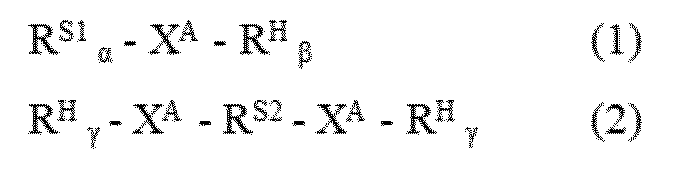
RS1はそれぞれ独立して、R1-RS-SiR2 2-であり、
RS2は、-RS-SiR2 2-であり、
RSは、それぞれ独立して、下記式:
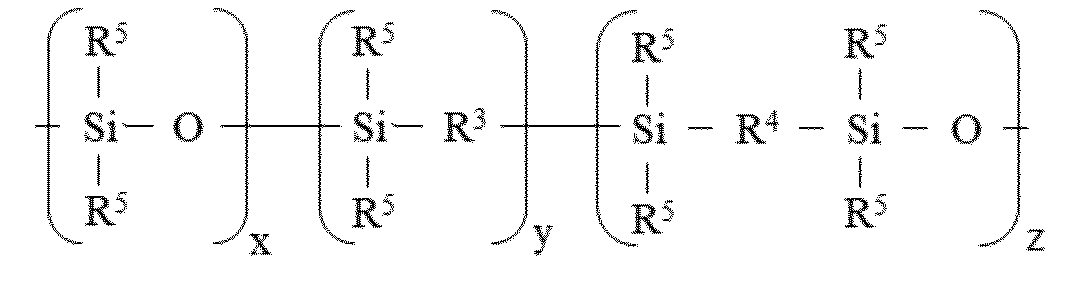
R3は、それぞれ独立して、C1-12アルキレン基、-R6-O-R6-、-R8-R7-R8-、-R8-R7-R9-R7-R8-、-R8-R7-R9-R6-R9-R7-R8-、又は-R9-R6-R9-R7-R9-R6-R9-であり、
R4は、それぞれ独立して、C1-12アルキレン基、-R6-O-R6-、-R8-R7-R8-、-R8-R7-R9-R7-R8-、-R8-R7-R9-R6-R9-R7-R8-、又は-R9-R6-R9-R7-R9-R6-R9-であり、
R6は、それぞれ独立して、C1-6アルキレン基であり、
R7は、それぞれ独立して、置換されていてもよいアリーレン基であり、
R8は、それぞれ独立して、単結合、又はC1-6アルキレン基であり、
R9は、それぞれ独立して、単結合、又は酸素原子であり、
R5は、それぞれ独立して、炭化水素基であり、
xは、0~200の整数であり、
yは、0~200の整数であり、
zは、0~200の整数であり、
y+zは、1以上であり、
x、y、又はzを付して括弧でくくられた各繰り返し単位の存在順序は式中において任意である。)
で表される基であり、
R1は、炭化水素基であり、
R2は、それぞれ独立して、炭化水素基であり、
RHは、それぞれ独立して、水酸基、又は加水分解性基が結合したSi原子を含む1価の基であり、
XAは、それぞれ独立して、2~10価の有機基であり、
αは、1~9の整数であり、
βは、1~9の整数であり、
γは、それぞれ独立して、1~9の整数である。]
で表されるシラン化合物。
[2] R2は、それぞれ独立して、ハロゲン原子により置換されていてもよい、C1-18アルキル基、又はアリール基であり、
R5は、それぞれ独立して、ハロゲン原子により置換されていてもよい、C1-18アルキル基、又はアリール基である、
上記[1]に記載の化合物。
[3] R2は、それぞれ独立して、メチル基又はフェニル基であり、
R5は、それぞれ独立して、メチル基又はフェニル基である、
上記[1]又は[2]に記載のシラン化合物。
[4] R3は、それぞれ独立して、C1-12アルキレン基、又は-R6-O-R6-である、上記[1]~[3]のいずれか1項に記載のシラン化合物。
[5] R4は、それぞれ独立して、C1-12アルキレン基、又は-R6-O-R6-である、上記[1]~[4]のいずれか1項に記載のシラン化合物。
[6] R4は、それぞれ独立して、-R8-R7-R8-、-R8-R7-R9-R7-R8-、-R8-R7-R9-R6-R9-R7-R8-、又は-R9-R6-R9-R7-R9-R6-R9-である、上記[1]~[4]のいずれか1項に記載のシラン化合物。
[7] RHは、下記式(S1)、(S2)、(S3)、(S4)、又は(S5):

R11は、それぞれ独立して、水酸基又は加水分解性基であり、
R12は、それぞれ独立して、1価の有機基であり、
n1は、(SiR11 n1R12 3-n1)単位毎にそれぞれ独立して、0~3の整数であり、
X11は、それぞれ独立して、単結合又は2価の有機基であり、
R13は、それぞれ独立して、水素原子又は1価の有機基であり、
tは、それぞれ独立して、2以上の整数であり、
R14は、それぞれ独立して、水素原子、ハロゲン原子又は-X11-SiR11 n1R12 3-n1であり、
R15は、それぞれ独立して、単結合、酸素原子、炭素数1~6のアルキレン基又は炭素数1~6のアルキレンオキシ基であり、
Ra1は、それぞれ独立して、-Z1-SiR21 p1R22 q1R23 r1であり;
Z1は、それぞれ独立して、2価の有機基であり、
R21は、それぞれ独立して、-Z1’-SiR21’ p1’R22’ q1’R23’ r1’であり;
R22は、それぞれ独立して、水酸基又は加水分解性基であり、
R23は、それぞれ独立して、1価の有機基であり、
p1は、それぞれ独立して、0~3の整数であり、
q1は、それぞれ独立して、0~3の整数であり、
r1は、それぞれ独立して、0~3の整数であり、
Z1’は、それぞれ独立して、2価の有機基であり、
R21’は、それぞれ独立して、-Z1”-SiR22” q1”R23” r1”であり;
R22’は、それぞれ独立して、水酸基又は加水分解性基であり、
R23’は、それぞれ独立して、1価の有機基であり、
p1’は、それぞれ独立して、0~3の整数であり、
q1’は、それぞれ独立して、0~3の整数であり、
r1’は、それぞれ独立して、0~3の整数であり、
Z1”は、それぞれ独立して、2価の有機基であり、
R22”は、それぞれ独立して、水酸基又は加水分解性基であり、
R23”は、それぞれ独立して、1価の有機基であり、
q1”は、それぞれ独立して、0~3の整数であり、
r1”は、それぞれ独立して、0~3の整数であり、
Rb1は、それぞれ独立して、水酸基又は加水分解性基であり、
Rc1は、それぞれ独立して、1価の有機基であり、
k1は、それぞれ独立して、0~3の整数であり、
l1は、それぞれ独立して、0~3の整数であり、
m1は、それぞれ独立して、0~3の整数であり、
ただし、式(S3)中、水酸基又は加水分解性基が結合したSi原子が少なくとも2つ存在し、
Rd1は、それぞれ独立して、-Z2-CR31 p2R32 q2R33 r2であり、
Z2は、それぞれ独立して、単結合、酸素原子又は2価の有機基であり、
R31は、それぞれ独立して、-Z2’-CR32’ q2’R33’ r2’であり、
R32は、それぞれ独立して、-Z3-SiR34 n2R35 3-n2であり、
R33は、それぞれ独立して、水素原子、水酸基又は1価の有機基であり、
p2は、それぞれ独立して、0~3の整数であり、
q2は、それぞれ独立して、0~3の整数であり、
r2は、それぞれ独立して、0~3の整数であり、
Z2’は、それぞれ独立して、単結合、酸素原子又は2価の有機基であり、
R32’は、それぞれ独立して、-Z3-SiR34 n2R35 3-n2であり、
R33’は、それぞれ独立して、水素原子、水酸基又は1価の有機基であり、
q2’は、それぞれ独立して、0~3の整数であり、
r2’は、それぞれ独立して、0~3の整数であり、
Z3は、それぞれ独立して、単結合、酸素原子又は2価の有機基であり;
R34は、それぞれ独立して、水酸基又は加水分解性基であり、
R35は、それぞれ独立して、1価の有機基であり、
n2は、それぞれ独立して、0~3の整数であり、
Re1は、それぞれ独立して、-Z3-SiR34 n2R35 3-n2であり、
Rf1は、それぞれ独立して、水素原子、水酸基又は1価の有機基であり、
k2は、それぞれ独立して、0~3の整数であり、
l2は、それぞれ独立して、0~3の整数であり、
m2は、それぞれ独立して、0~3の整数である。
ただし、式(S4)中、水酸基又は加水分解性基が結合したSi原子が少なくとも2つ存在し、
Rg1及びRh1は、それぞれ独立して、-Z4-SiR11 n1R12 3-n1、-Z4-SiRa1 k1Rb1 l1Rc1 m1、又は-Z4-CRd1 k2Re1 l2Rf1 m2であり、
Z4は、それぞれ独立して、単結合、酸素原子又は2価の有機基であり、
ただし、式(S5)中、水酸基又は加水分解性基が結合したSi原子が少なくとも2つ存在する。]
で表される基である、上記[1]~[6]のいずれか1項に記載のシラン化合物。
[8] RHは、それぞれ独立して、式(S1)、式(S3)、(S4)、又は(S5)で表される基である、上記[7]に記載のシラン化合物。
[9] RHは、それぞれ独立して、式(S3)、(S4)、又は(S5)で表される基である、上記[7]に記載のシラン化合物。
[10] α、β、及びγは、1である、上記[1]~[9]のいずれか1項に記載のシラン化合物。
[11] XAは、下記式:
-(R51)p5-(X51)q5-
[式中:
R51は、-(CH2)s5-又はo-、m-もしくはp-フェニレン基であり、
s5は、1~20の整数であり、
X51は、-(X52)l5-であり、
X52は、それぞれ独立して、-O-、-S-、o-、m-もしくはp-フェニレン基、-CO-、-C(O)O-、-CONR54-、-O-CONR54-、-NR54-及び-(CH2)n5-からなる群から選択される基であり、
R54は、それぞれ独立して、水素原子、又は1価の有機基であり、
n5は、それぞれ独立して、1~20の整数であり、
l5は、1~10の整数であり、
p5は、0又は1であり、
q5は、0又は1であり、
ここに、p5及びq5の少なくとも一方は1であり、p5又はq5を付して括弧でくくられた各繰り返し単位の存在順序は任意である。]
で表される2価の有機基である、上記[1]~[10]のいずれか1項に記載のシラン化合物。
[12] XAは、それぞれ独立して、C1-20アルキレン基、又は-(CH2)s5-CONH-(CH2)t5-(式中、s5は、1~20の整数であり、t5は、1~20の整数である)である、上記[1]~[11]のいずれか1項に記載のシラン化合物。
[13] 上記[1]~[12]のいずれか1項に記載のシラン化合物を含有する、表面処理剤。
[14] 上記[1]~[12]のいずれか1項に記載のシロキサン含有シラン化合物、および該シロキサン含有シラン化合物の少なくとも一部が縮合した縮合体からなる化合物の少なくとも一つを含有する、表面処理剤。
[15] 真空蒸着用である、上記[13]又は[14]に記載の表面処理剤。
[16] 湿潤被覆用である、上記[13]又は[14]に記載の表面処理剤。
[17] 上記[13]~[16]のいずれか1項に記載の表面処理剤を含有するペレット。
[18] 基材と、該基材上に、上記[1]~[12]のいずれか1項に記載のシラン化合物、又は上記[13]~[16]のいずれか1項に記載の表面処理剤から形成された層とを含む物品。
[19] 光学部材である、上記[18]に記載の物品。
[20] ディスプレイである、上記[19]に記載の物品。
[21] 式(1a-3)又は(2a-3):
RS1-R61’-Si(R62-CH=CH2)3 (1a-3)
(CH=CH2-R62)3Si-R61’-RS2-R61’-Si(R62-CH=CH2)3 (2a-3)
[式中、
RS1は、それぞれ独立して、R1-RS-SiR2 2-であり、
RS2は、-RS-SiR2 2-であり、
RSは、それぞれ独立して、下記式:

R3は、それぞれ独立して、C1-12アルキレン基、-R6-O-R6-、-R8-R7-R8-、-R8-R7-R9-R7-R8-、-R8-R7-R9-R6-R9-R7-R8-、又は-R9-R6-R9-R7-R9-R6-R9-であり、
R4は、それぞれ独立して、C1-12アルキレン基、-R6-O-R6-、-R8-R7-R8-、-R8-R7-R9-R7-R8-、-R8-R7-R9-R6-R9-R7-R8-、又は-R9-R6-R9-R7-R9-R6-R9-であり、
R6は、それぞれ独立して、C1-6アルキレン基であり、
R7は、それぞれ独立して、置換されていてもよい、フェニレン基、又はナフチレン基であり、
R8は、それぞれ独立して、単結合、又はC1-6アルキレン基であり、
R9は、それぞれ独立して、単結合、又は酸素原子であり、
R5は、それぞれ独立して、炭化水素基であり、
xは、0~200の整数であり、
yは、0~200の整数であり、
zは、0~200の整数であり、
y+zは、1以上であり、
x、y、又はzを付して括弧でくくられた各繰り返し単位の存在順序は式中において任意である。)
で表される基であり、
R1は、炭化水素基であり、
R2は、それぞれ独立して、炭化水素基であり、
R62は、単結合、又はC1-12アルキレン基であり、
R61’は、二価の有機基である。]
で表される化合物。
[22] 式(1b-1)又は(2b-1):
RS1-R61-COOR65 (1b-1)
R65OCO-R61-RS2-R61-COOR65 (2b-1)
[式中、
RS1は、それぞれ独立して、R1-RS-SiR2 2-であり、
RS2は、-RS-SiR2 2-であり、
RSは、それぞれ独立して、下記式:
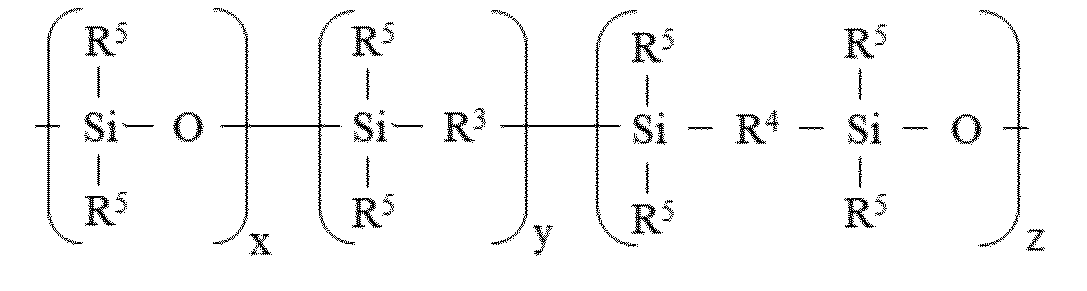
R3は、それぞれ独立して、C1-12アルキレン基、-R6-O-R6-、-R8-R7-R8-、-R8-R7-R9-R7-R8-、-R8-R7-R9-R6-R9-R7-R8-、又は-R9-R6-R9-R7-R9-R6-R9-であり、
R4は、それぞれ独立して、C1-12アルキレン基、-R6-O-R6-、-R8-R7-R8-、-R8-R7-R9-R7-R8-、-R8-R7-R9-R6-R9-R7-R8-、又は-R9-R6-R9-R7-R9-R6-R9-であり、
R6は、それぞれ独立して、C1-6アルキレン基であり、
R7は、それぞれ独立して、置換されていてもよい、フェニレン基、又はナフチレン基であり、
R8は、それぞれ独立して、単結合、又はC1-6アルキレン基であり、
R9は、それぞれ独立して、単結合、又は酸素原子であり、
R5は、それぞれ独立して、炭化水素基であり、
xは、0~200の整数であり、
yは、0~200の整数であり、
zは、0~200の整数であり、
y+zは、1以上であり、
x、y、又はzを付して括弧でくくられた各繰り返し単位の存在順序は式中において任意である。)
で表される基であり、
R1は、炭化水素基であり、
R2は、それぞれ独立して、炭化水素基であり、
R61は、単結合、又は二価の有機基であり、
R65は、水素原子、又はC1-6アルキル基である。]
で表される化合物。
[23] 式(1b-2)又は(2b-2):
RS1-R61-CONR67-R66-C(R62-CH=CH2)3 (1b-2)
(CH=CH2-R62)3C-R66-NR67CO-R61-RS2-R61-CONR67-R66-C(R62-CH=CH2)3 (2b-2)
[式中、
RS1は、それぞれ独立して、R1-RS-SiR2 2-であり、
RS2は、-RS-SiR2 2-であり、
RSは、それぞれ独立して、下記式:
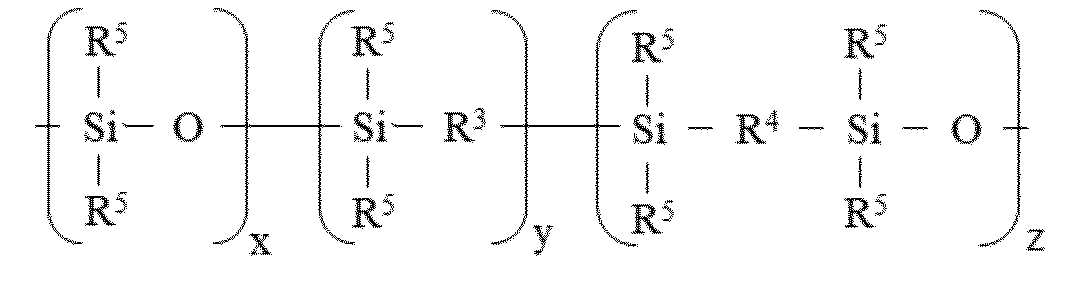
R3は、それぞれ独立して、C1-12アルキレン基、-R6-O-R6-、-R8-R7-R8-、-R8-R7-R9-R7-R8-、-R8-R7-R9-R6-R9-R7-R8-、又は-R9-R6-R9-R7-R9-R6-R9-であり、
R4は、それぞれ独立して、C1-12アルキレン基、-R6-O-R6-、-R8-R7-R8-、-R8-R7-R9-R7-R8-、-R8-R7-R9-R6-R9-R7-R8-、又は-R9-R6-R9-R7-R9-R6-R9-であり、
R6は、それぞれ独立して、C1-6アルキレン基であり、
R7は、それぞれ独立して、置換されていてもよいアリーレン基であり、
R8は、それぞれ独立して、単結合、又はC1-6アルキレン基であり、
R9は、それぞれ独立して、単結合、又は酸素原子であり、
R5は、それぞれ独立して、炭化水素基であり、
xは、0~200の整数であり、
yは、0~200の整数であり、
zは、0~200の整数であり、
y+zは、1以上であり、
x、y、又はzを付して括弧でくくられた各繰り返し単位の存在順序は式中において任意である。)
で表される基であり、
R1は、炭化水素基であり、
R2は、それぞれ独立して、炭化水素基であり、
R61は、単結合、又はC1-12アルキレン基であり、
R62は、単結合、又はC1-12アルキレン基であり、
R66は、単結合、又はC1-12アルキレン基であり、
R67は、水素原子、C1-18アルキル基、アリール基、又はポリエーテル基である。]
で表される化合物。
[24] 式(1c-2)又は(2c-2):
RS1-R61-CON(R62-CH=CH2)2 (1c-2)
(CH=CH2-R62)2NCO-R61-RS2-R61-CON(R62-CH=CH2)2 (2c-2)
[式中、
RS1は、それぞれ独立して、R1-RS-SiR2 2-であり、
RS2は、-RS-SiR2 2-であり、
RSは、それぞれ独立して、下記式:

R3は、それぞれ独立して、C1-12アルキレン基、-R6-O-R6-、-R8-R7-R8-、-R8-R7-R9-R7-R8-、-R8-R7-R9-R6-R9-R7-R8-、又は-R9-R6-R9-R7-R9-R6-R9-であり、
R4は、それぞれ独立して、C1-12アルキレン基、-R6-O-R6-、-R8-R7-R8-、-R8-R7-R9-R7-R8-、-R8-R7-R9-R6-R9-R7-R8-、又は-R9-R6-R9-R7-R9-R6-R9-であり、
R6は、それぞれ独立して、C1-6アルキレン基であり、
R7は、それぞれ独立して、置換されていてもよいアリーレン基であり、
R8は、それぞれ独立して、単結合、又はC1-6アルキレン基であり、
R9は、それぞれ独立して、単結合、又は酸素原子であり、
R5は、それぞれ独立して、炭化水素基であり、
xは、0~200の整数であり、
yは、0~200の整数であり、
zは、0~200の整数であり、
y+zは、1以上であり、
x、y、又はzを付して括弧でくくられた各繰り返し単位の存在順序は式中において任意である。)
で表される基であり、
R1は、炭化水素基であり、
R2は、それぞれ独立して、炭化水素基であり、
R61は、単結合、又はC1-12アルキレン基であり、
R62は、単結合、又はC1-12アルキレン基である。]
で表される化合物。
[25] 式(1d-2)又は(2d-2):
RS1-R61-C(OH)(R62-CH=CH2)2 (1d-2)
(CH=CH2-R62)2(OH)C-R61-RS2-R61-C(OH)(R62-CH=CH2)2 (2d-2)
[式中、
RS1は、それぞれ独立して、R1-RS-SiR2 2-であり、
RS2は、-RS-SiR2 2-であり、
RSは、それぞれ独立して、下記式:

R3は、それぞれ独立して、C1-12アルキレン基、-R6-O-R6-、-R8-R7-R8-、-R8-R7-R9-R7-R8-、-R8-R7-R9-R6-R9-R7-R8-、又は-R9-R6-R9-R7-R9-R6-R9-であり、
R4は、それぞれ独立して、C1-12アルキレン基、-R6-O-R6-、-R8-R7-R8-、-R8-R7-R9-R7-R8-、-R8-R7-R9-R6-R9-R7-R8-、又は-R9-R6-R9-R7-R9-R6-R9-であり、
R6は、それぞれ独立して、C1-6アルキレン基であり、
R7は、それぞれ独立して、置換されていてもよいアリーレン基であり、
R8は、それぞれ独立して、単結合、又はC1-6アルキレン基であり、
R9は、それぞれ独立して、単結合、又は酸素原子であり、
R5は、それぞれ独立して、炭化水素基であり、
xは、0~200の整数であり、
yは、0~200の整数であり、
zは、0~200の整数であり、
y+zは、1以上であり、
x、y、又はzを付して括弧でくくられた各繰り返し単位の存在順序は式中において任意である。)
で表される基であり、
R1は、炭化水素基であり、
R2は、それぞれ独立して、炭化水素基であり、
R61は、単結合、又はC1-12アルキレン基であり、
R62は、単結合、又はC1-12アルキレン基である。]
で表される化合物。
[26] 式:
R74Si(R71)2-R72-COOR73
[式中:
R71は、それぞれ独立して、ハロゲン原子に置換されていてもよいC1-12アルキル基であり、
R72は、ハロゲン原子に置換されていてもよいC3-5アルキレン基であり、
R73は、水素原子、又はハロゲン原子に置換されていてもよいC1-3アルキル基であり、
R74は、ハロゲン原子、水酸基、又は加水分解性基である。]
で表される化合物。
[27] R71は、メチル基であり、
R72は、直鎖のC3-5アルキレン基であり、
R73は、メチル基、又はエチル基であり、
R74は、塩素原子、又は水酸基である、
上記[26]に記載の化合物。
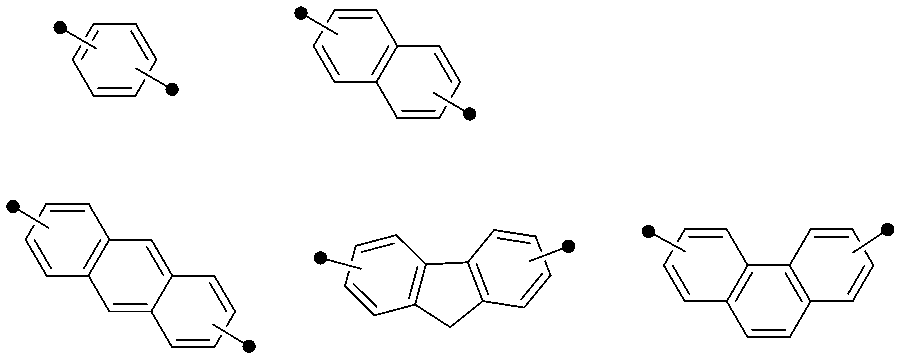
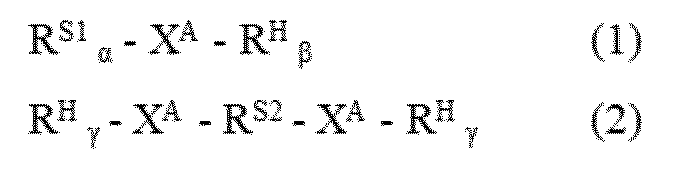
RS1は、それぞれ独立して、R1-RS-SiR2 2-であり、
RS2は、-RS-SiR2 2-であり、
RSは、それぞれ独立して、下記式:
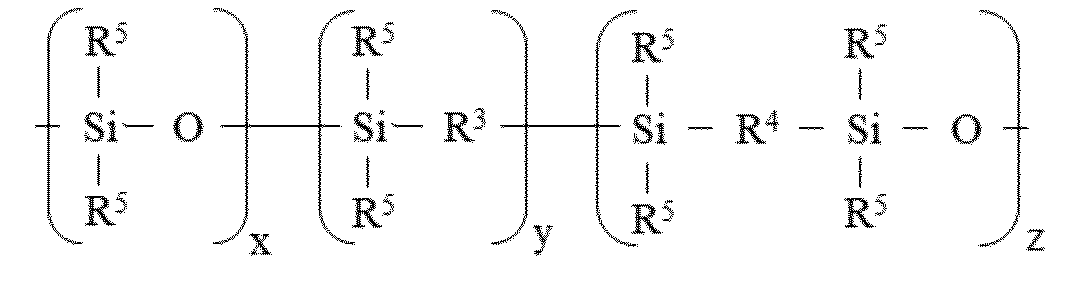
R3は、それぞれ独立して、C1-12アルキレン基、-R6-O-R6-、-R8-R7-R8-、-R8-R7-R9-R7-R8-、-R8-R7-R9-R6-R9-R7-R8-、又は-R9-R6-R9-R7-R9-R6-R9-であり、
R4は、それぞれ独立して、C1-12アルキレン基、-R6-O-R6-、-R8-R7-R8-、-R8-R7-R9-R7-R8-、-R8-R7-R9-R6-R9-R7-R8-、又は-R9-R6-R9-R7-R9-R6-R9-であり、
R6は、それぞれ独立して、C1-6アルキレン基であり、
R7は、それぞれ独立して、置換されていてもよいアリーレン基であり、
R8は、それぞれ独立して、単結合、又はC1-6アルキレン基であり、
R9は、それぞれ独立して、単結合、又は酸素原子であり、
R5は、それぞれ独立して、炭化水素基であり、
xは、0~200の整数であり、
yは、0~200の整数であり、
zは、0~200の整数であり、
y+zは、1以上であり、
x、y、又はzを付して括弧でくくられた各繰り返し単位の存在順序は式中において任意である。)
で表される基であり、
R1は、炭化水素基であり、
R2は、それぞれ独立して、炭化水素基であり、
RHは、それぞれ独立して、水酸基、又は加水分解性基が結合したSi原子を含む1価の基であり、
XAは、それぞれ独立して、2~10価の有機基であり、
αは、1~9の整数であり、
βは、1~9の整数であり、
γは、それぞれ独立して、1~9の整数である。]
で表されるシラン化合物である。

R3は、それぞれ独立して、C1-12アルキレン基、-R6-O-R6-、-R8-R7-R8-、-R8-R7-R9-R7-R8-、-R8-R7-R9-R6-R9-R7-R8-、又は-R9-R6-R9-R7-R9-R6-R9-であり、
R4は、それぞれ独立して、C1-12アルキレン基、-R6-O-R6-、-R8-R7-R8-、-R8-R7-R9-R7-R8-、-R8-R7-R9-R6-R9-R7-R8-、又は-R9-R6-R9-R7-R9-R6-R9-であり、
R6は、それぞれ独立して、C1-6アルキレン基であり、
R7は、それぞれ独立して、置換されていてもよい、フェニレン基、又はナフチレン基であり、
R8は、それぞれ独立して、単結合、又はC1-6アルキレン基であり、
R9は、それぞれ独立して、単結合、又は酸素原子であり、
R5は、それぞれ独立して、炭化水素基であり、
xは、0~200の整数であり、
yは、0~200の整数であり、
zは、0~200の整数であり、
y+zは、1以上であり、
x、y、又はzを付して括弧でくくられた各繰り返し単位の存在順序は式中において任意である。]
で表される基である。


R11は、それぞれ独立して、水酸基又は加水分解性基であり、
R12は、それぞれ独立して、1価の有機基であり、
n1は、(SiR11 n1R12 3-n1)単位毎にそれぞれ独立して、0~3の整数であり、
X11は、それぞれ独立して、単結合又は2価の有機基であり、
R13は、それぞれ独立して、水素原子又は1価の有機基であり、
tは、それぞれ独立して、2以上の整数であり、
R14は、それぞれ独立して、水素原子、ハロゲン原子又は-X11-SiR11 n1R12 3-n1であり、
R15は、それぞれ独立して、単結合、酸素原子、炭素数1~6のアルキレン基又は炭素数1~6のアルキレンオキシ基であり、
Ra1は、それぞれ独立して、-Z1-SiR21 p1R22 q1R23 r1であり;
Z1は、それぞれ独立して、2価の有機基であり、
R21は、それぞれ独立して、-Z1’-SiR21’ p1’R22’ q1’R23’ r1’であり;
R22は、それぞれ独立して、水酸基又は加水分解性基であり、
R23は、それぞれ独立して、1価の有機基であり、
p1は、それぞれ独立して、0~3の整数であり、
q1は、それぞれ独立して、0~3の整数であり、
r1は、それぞれ独立して、0~3の整数であり、
Z1’は、それぞれ独立して、2価の有機基であり、
R21’は、それぞれ独立して、-Z1”-SiR22” q1”R23” r1”であり;
R22’は、それぞれ独立して、水酸基又は加水分解性基であり、
R23’は、それぞれ独立して、1価の有機基であり、
p1’は、それぞれ独立して、0~3の整数であり、
q1’は、それぞれ独立して、0~3の整数であり、
r1’は、それぞれ独立して、0~3の整数であり、
Z1”は、それぞれ独立して、2価の有機基であり、
R22”は、それぞれ独立して、水酸基又は加水分解性基であり、
R23”は、それぞれ独立して、1価の有機基であり、
q1”は、それぞれ独立して、0~3の整数であり、
r1”は、それぞれ独立して、0~3の整数であり、
Rb1は、それぞれ独立して、水酸基又は加水分解性基であり、
Rc1は、それぞれ独立して、1価の有機基であり、
k1は、それぞれ独立して、0~3の整数であり、
l1は、それぞれ独立して、0~3の整数であり、
m1は、それぞれ独立して、0~3の整数であり、
ただし、式(S3)中、水酸基又は加水分解性基が結合したSi原子が少なくとも2つ存在し、
Rd1は、それぞれ独立して、-Z2-CR31 p2R32 q2R33 r2であり、
Z2は、それぞれ独立して、単結合、酸素原子又は2価の有機基であり、
R31は、それぞれ独立して、-Z2’-CR32’ q2’R33’ r2’であり、
R32は、それぞれ独立して、-Z3-SiR34 n2R35 3-n2であり、
R33は、それぞれ独立して、水素原子、水酸基又は1価の有機基であり、
p2は、それぞれ独立して、0~3の整数であり、
q2は、それぞれ独立して、0~3の整数であり、
r2は、それぞれ独立して、0~3の整数であり、
Z2’は、それぞれ独立して、単結合、酸素原子又は2価の有機基であり、
R32’は、それぞれ独立して、-Z3-SiR34 n2R35 3-n2であり、
R33’は、それぞれ独立して、水素原子、水酸基又は1価の有機基であり、
q2’は、それぞれ独立して、0~3の整数であり、
r2’は、それぞれ独立して、0~3の整数であり、
Z3は、それぞれ独立して、単結合、酸素原子又は2価の有機基であり;
R34は、それぞれ独立して、水酸基又は加水分解性基であり、
R35は、それぞれ独立して、1価の有機基であり、
n2は、それぞれ独立して、0~3の整数であり、
Re1は、それぞれ独立して、-Z3-SiR34 n2R35 3-n2であり、
Rf1は、それぞれ独立して、水素原子、水酸基又は1価の有機基であり、
k2は、それぞれ独立して、0~3の整数であり、
l2は、それぞれ独立して、0~3の整数であり、
m2は、それぞれ独立して、0~3の整数である。
ただし、式(S4)中、水酸基又は加水分解性基が結合したSi原子が少なくとも2つ存在し、
Rg1及びRh1は、それぞれ独立して、-Z4-SiR11 n1R12 3-n1、-Z4-SiRa1 k1Rb1 l1Rc1 m1、又は-Z4-CRd1 k2Re1 l2Rf1 m2であり、
Z4は、それぞれ独立して、単結合、酸素原子又は2価の有機基であり、
ただし、式(S5)中、水酸基又は加水分解性基が結合したSi原子が少なくとも2つ存在する。]
で表される基である。

R11、R12、R13、X11、及びn1は、上記式(S1)の記載と同意義であり、
t1及びt2は、それぞれ独立して、1以上の整数、好ましくは1~10の整数、より好ましくは2~10の整数、例えば1~5の整数又は2~5の整数であり、
t1及びt2を付して括弧でくくられた各繰り返し単位の存在順序は式中において任意である。]
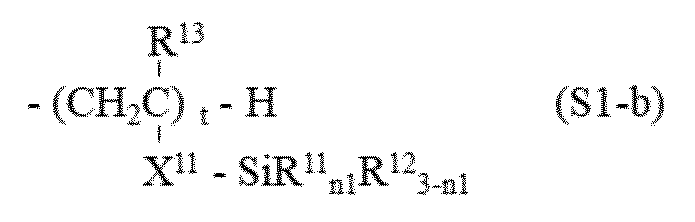

-(R51)p5-(X51)q5-
[式中:
R51は、単結合、-(CH2)s5-又はo-、m-もしくはp-フェニレン基であり、好ましくは-(CH2)s5-であり、
s5は、1~20の整数、好ましくは1~15の整数、より好ましくは1~10の整数、さらにより好ましくは1~6の整数、例えば1~3の整数であり、あるいは、1~20の整数、好ましくは4~15の整数、より好ましくは7~13の整数であり、
X51は、-(X52)l5-であり、
X52は、それぞれ独立して、-O-、-S-、o-、m-もしくはp-フェニレン基、-CO-、-C(O)O-、-CONR54-、-O-CONR54-、-NR54-及び-(CH2)n5-からなる群から選択される基であり、
R54は、それぞれ独立して、水素原子、又は1価の有機基であり、好ましくは水素原子、フェニル基、C1-6アルキル基(好ましくはメチル基)又は炭素数1~10のオキシアルキレン含有基であり、
n5は、それぞれ独立して、1~20の整数、好ましくは1~15の整数、より好ましくは1~10の整数、さらにより好ましくは1~6の整数、例えば1~3の整数であり、
l5は、1~10の整数、好ましくは1~5の整数、より好ましくは1~3の整数であり、
p5は、0又は1であり、
q5は、0又は1であり、
ここに、p5及びq5の少なくとも一方は1であり、p5又はq5を付して括弧でくくられた各繰り返し単位の存在順序は任意である]
で表される2価の有機基が挙げられる。ここに、XA(典型的にはXAの水素原子)は、フッ素原子、C1-3アルキル基及びC1-3フルオロアルキル基から選択される1個又はそれ以上の置換基により置換されていてもよい。好ましい態様において、XAは、これらの基により置換されていない。
C1-20アルキレン基、
-R51-X53-R52-、又は
[式中、R51及びR52は、上記と同意義であり、
X53は、
-O-、
-S-、
-CO-、
-C(O)O-、
-CONR54-、
-O-CONR54-、
-O-(CH2)u5-CONR54-、
-O-(CH2)u5-CO-、又は
-CONR54-(CH2)u5-N(R54)-、
(式中、R54は、上記と同意義であり、
u5は1~20の整数、好ましくは2~6の整数、より好ましくは2~3の整数である。)である。]
であり得る。
C1-20アルキレン基、
-(CH2)s5-X53-、
-X53-(CH2)t5-、又は
-(CH2)s5-X53-(CH2)t5-
[式中、X53、s5及びt5は、上記と同意義である。]
である。
C1-20アルキレン基、
-(CH2)s5-X53-、
-X53-(CH2)t5-又は
-(CH2)s5-X53-(CH2)t5-
[式中、
X53は、-O-、-CO-、-CONR54-、-O-CONR54-、-O-(CH2)u5-CONR54-、又は-O-(CH2)u5-CO-であり、
R54は、それぞれ独立して、水素原子、フェニル基、C1-6アルキル基(好ましくはメチル基)又は炭素数1~10のオキシアルキレン含有基であり、
s5、t5、及びu5は、上記と同意義である。]
であり得る。
-(CH2)s5-O-(CH2)t5-、
-(CH2)s5-CONR54-(CH2)t5-、
-(CH2)s5-O-(CH2)u5-CO-、又は
-(CH2)s5-O-(CH2)u5-CONR54-(CH2)t5-
[式中、
R54は、それぞれ独立して、水素原子、フェニル基、C1-6アルキル基(好ましくはメチル基)又は炭素数1~10のオキシアルキレン含有基であり、
s5、t5、及びu5は、上記と同意義である。]
であり得る。

RS1-R61-CH=CH2 (1a-1)
CH2=CH-R61-RS2-R61-CH=CH2 (2a-1)
[式中、
RS1及びRS2は、式(1)及び(2)におけるRS1及びRS2と同意義であり、
R61は、単結合、又は二価の有機基である。]
で表される化合物と、式(4):
HSiR60 3 (4)
[式中、R60は、それぞれ独立して、ハロゲン原子(例えば、I、Br、Cl、F等)またはC1-6アルコキシ基である。]
で表される化合物と反応させて、下記式(1a-2)又は(2a-2):
RS1-R61-CH2CH2-SiR60 3 (1a-2)
R60 3Si-CH2CH2-R61-RS2-R61-CH2CH2-SiR60 3 (2a-2)
[式中、各記号は、上記と同意義である。]
で表される化合物を得る。次いで、式(1a-2)又は(2a-2)で表される化合物と、下記式(5):
Hal-J-R62-CH=CH2 (5)
[式中:
Halは、ハロゲン原子(例えば、I、Br、Cl、F等)であり、
Jは、Mg、Cu、PdまたはZnであり、
R62は、結合、又はC1-12アルキレン基である。]
で表される化合物と反応させることにより、下記式(1a-3)又は(2a-3):
RS1-R61’-Si(R62-CH=CH2)3 (1a-3)
(CH=CH2-R62)3Si-R61’-RS2-R61’-Si(R62-CH=CH2)3 (2a-3)
[式中、
R61’は、二価の有機基であり、
他の記号は、上記と同意義である。]
で表される化合物を得る。次いで、式(1a-3)又は(2a-3)で表される化合物と、下記式(6):
HSiR63 mR64 3-m (6)
[式中、
R63は、それぞれ独立して、水酸基又は加水分解性基であり、
R64は、それぞれ独立して、1価の有機基であり、
mは、1~3である。]
で表される化合物と反応させることにより、式(1-1)又は(2-1):
RS1-R61’-Si(R62’-SiR63 mR64 3-m)3 (1-1)
(R63 mR64 3-mSi-R62’)3Si-R61’-RS2-R61’-Si(R62’-SiR63 mR64 3-m)3 (2-2)
[式中、
R62’は、C2-14アルキレン基であり、
他の記号は、上記と同意義である。]
で表されるシラン化合物を得ることができる。
R74Si(R71)2-R72-COOR73
[式中:
R71は、それぞれ独立して、ハロゲン原子に置換されていてもよい、C1-12アルキル基、好ましくはC1-6アルキル基、より好ましくはC1-3アルキル基、さらに好ましくはメチル基であり、
R72は、ハロゲン原子に置換されていてもよい、C2-12アルキレン基、好ましくはC3-5アルキレン基であり、
R73は、水素原子、又はハロゲン原子に置換されていてもよい、C1-3アルキル基、好ましくはメチル基、又はエチル基であり、より好ましくはメチル基であり、
R74は、ハロゲン原子、水酸基、又は加水分解性基、好ましくはハロゲン原子、又は水酸基、より好ましくは塩素原子、又は水酸基である。]
で表される化合物である。上記アルキル基は、直鎖であっても分岐鎖であってもよい。上記アルキル基は、好ましくは非置換である。上記アルキレン基は、直鎖であっても分岐鎖であってもよいが、好ましくは直鎖である。上記アルキレン基は、好ましくは非置換である。上記ハロゲン原子は、例えばフッ素原子、塩素原子、臭素原子、又はヨウ素原子であり、好ましくは塩素原子である。
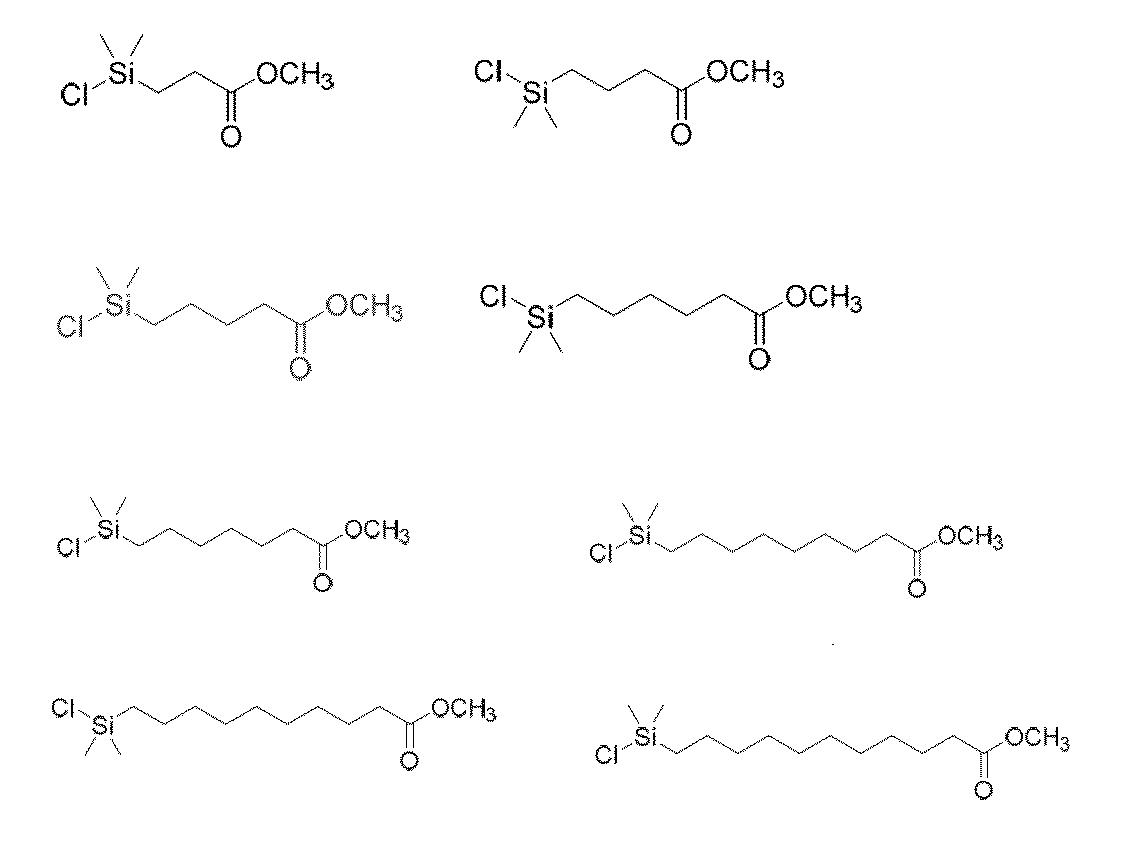
RS1-R61-COOR65 (1b-1)
R65OCO-R61-RS2-R61-COOR65 (2b-1)
[式中、
RS1及びRS2は、式(1)及び(2)におけるRS1及びRS2と同意義であり、
R61は、単結合、又は二価の有機基であり、
R65は、水素原子、又はC1-6アルキル基である。]
で表される化合物と、式(7):
NH2-R66-C(R62-CH=CH2)3 (7)
[式中、
R62は、単結合、又はC1-12アルキレン基であり、
R66は、単結合、又はC1-12アルキレン基である。]
で表される化合物と反応させて、下記式(1b-2)又は(2b-2):
RS1-R61-CONH-R66-C(R62-CH=CH2)3 (1b-2)
(CH=CH2-R62)3C-R66-NHCO-R61-RS2-R61-CONH-R66-C(R62-CH=CH2)3 (2b-2)
[式中、各記号は、上記と同意義である。]
で表される化合物を得る。次いで、式(1b-2)又は(2b-2)で表される化合物と、下記式(6):
HSiR63 mR64 3-m (6)
[式中、
R63は、それぞれ独立して、水酸基又は加水分解性基であり、
R64は、それぞれ独立して、1価の有機基であり、
mは、1~3である。]
で表される化合物と反応させることにより、式(1-2)又は(2-2):
RS1-R61-CONH-R66-C(R62’-SiR63 mR64 3-m)3 (1-2)
(R63 mR64 3-mSi-R62’)3C-R66-NHCO-R61-RS2-R61-CONH-R66-C(R62’-SiR63 mR64 3-m)3 (2-2)
[式中、
R62’は、C2-14アルキレン基であり、
他の記号は、上記と同意義である。]
で表されるシラン化合物を得ることができる。
RS1-R61-COOR65 (1b-1)
R65OCO-R61-RS2-R61-COOR65 (2b-1)
[式中、
RS1及びRS2は、式(1)及び(2)におけるRS1及びRS2と同意義であり、
R61は、C1-12アルキレン基であり、
R65は、水素原子、又はC1-6アルキル基である。]
で表される化合物と、式(8):
HN(R62-CH=CH2)2 (8)
[式中、
R62は、C1-12アルキレン基である。]
で表される化合物と反応させて、下記式(1c-2)又は(2c-2):
RS1-R61-CON(R62-CH=CH2)2 (1c-2)
(CH=CH2-R62)2NCO-R61-RS2-R61-CON(R62-CH=CH2)2 (2c-2)
[式中、各記号は、上記と同意義である。]
で表される化合物を得る。次いで、式(1c-2)又は(2c-2)で表される化合物と、下記式(6):
HSiR63 mR64 3-m (6)
[式中、
R63は、それぞれ独立して、水酸基又は加水分解性基であり、
R64は、それぞれ独立して、1価の有機基であり、
mは、1~3である。]
で表される化合物と反応させることにより、式(1-3)又は(2-3):
RS1-R61-CON(R62’-SiR63 mR64 3-m)2 (1-3)
(R63 mR64 3-mSi-R62’)2NCO-R61-RS2-R61-CON(R62’-SiR63 mR64 3-m)2 (2-3)
[式中、
R62’は、C2-14アルキレン基であり、
他の記号は、上記と同意義である。]
で表されるシラン化合物を得ることができる。
RS1-R61-COOR65 (1b-1)
R65OCO-R61-RS2-R61-COOR65 (2b-1)
[式中、
RS1及びRS2は、式(1)及び(2)におけるRS1及びRS2と同意義であり、
R61は、C1-12アルキレン基であり、
R65は、水素原子、又はC1-6アルキル基である。]
で表される化合物を、
M-R62-CH=CH2
[式中:
Mは、金属含有基、例えばLi、ハロゲン-Mg、又はZnであり、
R62は、C1-12アルキレン基である。]
で表される化合物と反応させて、下記式(1d-2)又は(2d-2):
RS1-R61-C(OH)(R62-CH=CH2)2 (1d-2)
(CH=CH2-R62)2(OH)C-R61-RS2-R61-C(OH)(R62-CH=CH2)2 (2d-2)
[式中、各記号は、上記と同意義である。]
で表される化合物を得る。次いで、式(1d-2)又は(2d-2)で表される化合物と、下記式(6):
HSiR63 mR64 3-m (6)
[式中、
R63は、それぞれ独立して、水酸基又は加水分解性基であり、
R64は、それぞれ独立して、1価の有機基であり、
mは、1~3である。]
で表される化合物と反応させることにより、式(1-4)又は(2-4):
RS1-R61-C(OH)(R62’-SiR63 mR64 3-m)2 (1-4)
(R63 mR64 3-mSi-R62’)2(OH)C-R61-RS2-R61-C(OH)(R62’-SiR63 mR64 3-m)2 (2-4)
[式中、
R62’は、C2-14アルキレン基であり、
他の各記号は、上記と同意義である。]
で表されるシラン化合物を得ることができる。
RS1-R61-C(OH)(R62-CH=CH2)2 (1d-2)
(CH=CH2-R62)2(OH)C-R61-RS2-R61-C(OH)(R62-CH=CH2)2 (2d-2)
[式中、各記号は、上記と同意義である。]
で表される化合物を、オレフィン化材、例えば、
R69-R68-CH=CH2
[式中、
R68は、C1-12アルキレン基であり、
R69は、ハロゲン原子、例えばフッ素原子、塩素原子、臭素原子、又はヨウ素原子であり、好ましくは臭素原子である。]
で表される化合物と反応させて、下記式(1e-1)又は(2e-1):
RS1-R61-C(OR68-CH=CH2)(R62-CH=CH2)2 (1e-1)
(CH=CH2-R62)2(CH=CH2-R68O)C-R61-RS2-R61-C(OR68-CH=CH2)(R62-CH=CH2)2 (2e-1)
[式中、各記号は、上記と同意義である。]
で表される化合物を得る。次いで、式(1e-1)又は(2e-1)で表される化合物と、下記式(6):
HSiR63 mR64 3-m (6)
[式中、
R63は、それぞれ独立して、水酸基又は加水分解性基であり、
R64は、それぞれ独立して、1価の有機基であり、
mは、1~3である。]
で表される化合物と反応させることにより、式(1-5)又は(2-5):
RS1-R61-C(OR62’-SiR63 mR64 3-m)(R62’-SiR63 mR64 3-m)2 (1-5)
(R63 mR64 3-mSi-R62’)2(SiR63 mR64 3-m-R62’O)C-R61-RS2-R61-C(OR62’-SiR63 mR64 3-m)(R62’-SiR63 mR64 3-m)2 (2-5)
[式中、
R62’は、それぞれ独立して、C2-14アルキレン基であり、
他の各記号は、上記と同意義である。]
で表されるシラン化合物を得ることができる。
RS1-R61-C(OH)(R62-CH=CH2)2 (1d-2)
(CH=CH2-R62)2(OH)C-R61-RS2-R61-C(OH)(R62-CH=CH2)2 (2d-2)
[式中、各記号は、上記と同意義である。]
で表される化合物を、ポリエーテル基導入剤、例えば
R78-R75-(OR76)x-R77
[式中、
R75は、C1-6アルキレン基であり、
R76は、C1-6アルキレン基であり、
R77は、水素原子、水酸基、又はC1-6アルキル基であり、
R78は、ハロゲン原子、例えばフッ素原子、塩素原子、臭素原子、又はヨウ素原子であり、好ましくは塩素原子であり、
xは、0~20の整数である。]
で表される化合物と反応させて、下記式(1f-1)又は(2f-1):
RS1-R61-C(OR79)(R62-CH=CH2)2 (1d-2)
(CH=CH2-R62)2(R79O)C-R61-RS2-R61-C(OR79)(R62-CH=CH2)2 (2d-2)
[式中:
R79は、-R75-(OR76)x-R77であり、
他の各記号は、上記と同意義である。]
で表される化合物を得る。次いで、式(1f-1)又は(2f-1)で表される化合物と、下記式(6):
HSiR63 mR64 3-m (6)
[式中、
R63は、それぞれ独立して、水酸基又は加水分解性基であり、
R64は、それぞれ独立して、1価の有機基であり、
mは、1~3である。]
で表される化合物と反応させることにより、式(1-6)又は(2-6):
RS1-R61-C(OR79)(R62’-SiR63 mR64 3-m)2 (1-6)
(R63 mR64 3-mSi-R62’)2(R79O)C-R61-RS2-R61-C(OR79)(R62’-SiR63 mR64 3-m)2 (2-6)
[式中、
R62’は、それぞれ独立して、C2-14アルキレン基であり、
他の各記号は、上記と同意義である。]
で表されるシラン化合物を得ることができる。
RS1-R61’-Si(R62-CH=CH2)3 (1a-3)
(CH=CH2-R62)3Si-R61’-RS2-R61’-Si(R62-CH=CH2)3 (2a-3)
[式中、
RS1は、それぞれ独立して、R1-RS-SiR2 2-であり、
RS2は、-RS-SiR2 2-であり、
RSは、それぞれ独立して、下記式:

R3は、それぞれ独立して、C1-12アルキレン基、-R6-O-R6-、-R8-R7-R8-、-R8-R7-R9-R7-R8-、-R8-R7-R9-R6-R9-R7-R8-、又は-R9-R6-R9-R7-R9-R6-R9-であり、
R4は、それぞれ独立して、C1-12アルキレン基、-R6-O-R6-、-R8-R7-R8-、-R8-R7-R9-R7-R8-、-R8-R7-R9-R6-R9-R7-R8-、又は-R9-R6-R9-R7-R9-R6-R9-であり、
R6は、それぞれ独立して、C1-6アルキレン基であり、
R7は、それぞれ独立して、置換されていてもよい、フェニレン基、又はナフチレン基であり、
R8は、それぞれ独立して、単結合、又はC1-6アルキレン基であり、
R9は、それぞれ独立して、単結合、又は酸素原子であり、
R5は、それぞれ独立して、炭化水素基であり、
xは、0~200の整数であり、
yは、0~200の整数であり、
zは、0~200の整数であり、
y+zは、1以上であり、
x、y、又はzを付して括弧でくくられた各繰り返し単位の存在順序は式中において任意である。)
で表される基であり、
R1は、炭化水素基であり、
R2は、それぞれ独立して、炭化水素基であり、
R62は、単結合、又はC1-12アルキレン基であり、
R61’は、二価の有機基である。]
で表される化合物。
RS1-R61-COOR65 (1b-1)
R65OCO-R61-RS2-R61-COOR65 (2b-1)
[式中、
RS1は、それぞれ独立して、R1-RS-SiR2 2-であり、
RS2は、-RS-SiR2 2-であり、
RSは、それぞれ独立して、下記式:

R3は、それぞれ独立して、C1-12アルキレン基、-R6-O-R6-、-R8-R7-R8-、-R8-R7-R9-R7-R8-、-R8-R7-R9-R6-R9-R7-R8-、又は-R9-R6-R9-R7-R9-R6-R9-であり、
R4は、それぞれ独立して、C1-12アルキレン基、-R6-O-R6-、-R8-R7-R8-、-R8-R7-R9-R7-R8-、-R8-R7-R9-R6-R9-R7-R8-、又は-R9-R6-R9-R7-R9-R6-R9-であり、
R6は、それぞれ独立して、C1-6アルキレン基であり、
R7は、それぞれ独立して、置換されていてもよい、フェニレン基、又はナフチレン基であり、
R8は、それぞれ独立して、単結合、又はC1-6アルキレン基であり、
R9は、それぞれ独立して、単結合、又は酸素原子であり、
R5は、それぞれ独立して、炭化水素基であり、
xは、0~200の整数であり、
yは、0~200の整数であり、
zは、0~200の整数であり、
y+zは、1以上であり、
x、y、又はzを付して括弧でくくられた各繰り返し単位の存在順序は式中において任意である。)
で表される基であり、
R1は、炭化水素基であり、
R2は、それぞれ独立して、炭化水素基であり、
R61は、単結合、又は二価の有機基であり、
R65は、水素原子、又はC1-6アルキル基である。]
で表される化合物。
RS1-R61-CONR67-R66-C(R62-CH=CH2)3 (1b-2)
(CH=CH2-R62)3C-R66-NR67CO-R61-RS2-R61-CONR67-R66-C(R62-CH=CH2)3 (2b-2)
[式中、
RS1は、それぞれ独立して、R1-RS-SiR2 2-であり、
RS2は、-RS-SiR2 2-であり、
RSは、それぞれ独立して、下記式:

R3は、それぞれ独立して、C1-12アルキレン基、-R6-O-R6-、-R8-R7-R8-、-R8-R7-R9-R7-R8-、-R8-R7-R9-R6-R9-R7-R8-、又は-R9-R6-R9-R7-R9-R6-R9-であり、
R4は、それぞれ独立して、C1-12アルキレン基、-R6-O-R6-、-R8-R7-R8-、-R8-R7-R9-R7-R8-、-R8-R7-R9-R6-R9-R7-R8-、又は-R9-R6-R9-R7-R9-R6-R9-であり、
R6は、それぞれ独立して、C1-6アルキレン基であり、
R7は、それぞれ独立して、置換されていてもよいアリーレン基であり、
R8は、それぞれ独立して、単結合、又はC1-6アルキレン基であり、
R9は、それぞれ独立して、単結合、又は酸素原子であり、
R5は、それぞれ独立して、炭化水素基であり、
xは、0~200の整数であり、
yは、0~200の整数であり、
zは、0~200の整数であり、
y+zは、1以上であり、
x、y、又はzを付して括弧でくくられた各繰り返し単位の存在順序は式中において任意である。)
で表される基であり、
R1は、炭化水素基であり、
R2は、それぞれ独立して、炭化水素基であり、
R61は、単結合、又は二価の有機基(好ましくは、C1-12アルキレン基)であり、
R62は、単結合、又はC1-12アルキレン基であり、
R66は、単結合、又はC1-12アルキレン基であり、
R67は、水素原子、C1-18アルキル基、アリール基、又はポリエーテル基である。]
で表される化合物。
RS1-R61-CON(R62-CH=CH2)2 (1c-2)
(CH=CH2-R62)2NCO-R61-RS2-R61-CON(R62-CH=CH2)2 (2c-2)
[式中、
RS1は、それぞれ独立して、R1-RS-SiR2 2-であり、
RS2は、-RS-SiR2 2-であり、
RSは、それぞれ独立して、下記式:

R3は、それぞれ独立して、C1-12アルキレン基、-R6-O-R6-、-R8-R7-R8-、-R8-R7-R9-R7-R8-、-R8-R7-R9-R6-R9-R7-R8-、又は-R9-R6-R9-R7-R9-R6-R9-であり、
R4は、それぞれ独立して、C1-12アルキレン基、-R6-O-R6-、-R8-R7-R8-、-R8-R7-R9-R7-R8-、-R8-R7-R9-R6-R9-R7-R8-、又は-R9-R6-R9-R7-R9-R6-R9-であり、
R6は、それぞれ独立して、C1-6アルキレン基であり、
R7は、それぞれ独立して、置換されていてもよいアリーレン基であり、
R8は、それぞれ独立して、単結合、又はC1-6アルキレン基であり、
R9は、それぞれ独立して、単結合、又は酸素原子であり、
R5は、それぞれ独立して、炭化水素基であり、
xは、0~200の整数であり、
yは、0~200の整数であり、
zは、0~200の整数であり、
y+zは、1以上であり、
x、y、又はzを付して括弧でくくられた各繰り返し単位の存在順序は式中において任意である。)
で表される基であり、
R1は、炭化水素基であり、
R2は、それぞれ独立して、炭化水素基であり、
R61は、単結合、又は二価の有機基(好ましくは、C1-12アルキレン基)であり、
R62は、単結合、又はC1-12アルキレン基である。]
で表される化合物。
RS1-R61-C(OH)(R62-CH=CH2)2 (1d-2)
(CH=CH2-R62)2(OH)C-R61-RS2-R61-C(OH)(R62-CH=CH2)2 (2d-2)
[式中、
RS1は、それぞれ独立して、R1-RS-SiR2 2-であり、
RS2は、-RS-SiR2 2-であり、
RSは、それぞれ独立して、下記式:

R3は、それぞれ独立して、C1-12アルキレン基、-R6-O-R6-、-R8-R7-R8-、-R8-R7-R9-R7-R8-、-R8-R7-R9-R6-R9-R7-R8-、又は-R9-R6-R9-R7-R9-R6-R9-であり、
R4は、それぞれ独立して、C1-12アルキレン基、-R6-O-R6-、-R8-R7-R8-、-R8-R7-R9-R7-R8-、-R8-R7-R9-R6-R9-R7-R8-、又は-R9-R6-R9-R7-R9-R6-R9-であり、
R6は、それぞれ独立して、C1-6アルキレン基であり、
R7は、それぞれ独立して、置換されていてもよいアリーレン基であり、
R8は、それぞれ独立して、単結合、又はC1-6アルキレン基であり、
R9は、それぞれ独立して、単結合、又は酸素原子であり、
R5は、それぞれ独立して、炭化水素基であり、
xは、0~200の整数であり、
yは、0~200の整数であり、
zは、0~200の整数であり、
y+zは、1以上であり、
x、y、又はzを付して括弧でくくられた各繰り返し単位の存在順序は式中において任意である。)
で表される基であり、
R1は、炭化水素基であり、
R2は、それぞれ独立して、炭化水素基であり、
R61は、単結合、又は二価の有機基(好ましくは、C1-12アルキレン基)であり、
R62は、単結合、又はC1-12アルキレン基である。]
で表される化合物。
R1a-(SiR3a 2-O)a1-SiR3a 2-R1a ・・・(3a)
[式中:
R1aは、それぞれ独立して、水素原子又は炭化水素基であり、
R3aは、それぞれ独立して、水素原子又は炭化水素基であり、
a1は、2~3000である。]
で表される化合物が挙げられる。
である。C1-6アルキル基は、好ましくはC1-3アルキル基、より好ましくはメチル基である。
R1a-RS2-R3a ・・・(3b)
[式中:
R1aは、それぞれ独立して、炭化水素基であり、
R3aは、それぞれ独立して、炭化水素基であり、
RS2は、式(2)の記載と同意義である。]
で表される化合物が挙げられる。
ガラス製容器に、1,1-ジメチルシラシクロブタン(3.75g)、THF(3.75g)、n-ヘキサン(3.75g)を添加した。この反応液を、-50℃まで冷却し、n-ブチルリチウム/ヘキサン溶液(1.82mL)を添加し、1時間攪拌して重合反応を行った。その後、アリルクロロジメチルシラン(0.52g)を加え、同温にて30分攪拌した。得られた反応液を室温まで昇温し、水、トルエンを加え、分液抽出した後、有機層を硫酸ナトリウムで乾燥させた。ろ過後、ろ液を濃縮、乾燥させ、下記のポリシルアルキレン基含有化合物(A)CH3CH2CH2CH2(Si(CH3)2CH2CH2CH2)nSi(CH3)2CH2CH=CH2(3.84g、Mw:4468、Mw/Mn:1.43)を得た。

(合成例1)
合成例0で得られた化合物(A)CH3CH2CH2CH2(Si(CH3)2CH2CH2CH2)nSi(CH3)2CH2CH=CH2を1.51g、トルエンを1.5mL、トリアセトキシメチルシランを0.023g、1,3-ジビニル-1,1,3,3-テトラメチルジシロキサンのPt錯体を2%含むキシレン溶液を0.1mL、それぞれ加えた後、トリクロロシランを0.4mL仕込み、60℃に加熱し3時間撹拌した。その後、減圧下で揮発分を留去した後、トルエン1.2mLを加え、氷浴で5℃以下まで冷却し、アリルマグネシウムクロリド (テトラヒドロフラン溶液, 約1.0mol/L)を4mL加えて、室温で一昼夜撹拌した。その後、精製を行うことにより、下記のポリシルアルキレン基含有化合物(B)CH3CH2CH2CH2(Si(CH3)2CH2CH2CH2)nSi(CH3)2CH2CH2CH2Si(CH2CH=CH2)3 1.25gを得た。

合成例1で得られたポリシルアルキレン基含有化合物(B)CH3CH2CH2CH2(Si(CH3)2CH2CH2CH2)nSi(CH3)2CH2CH2CH2Si(CH2CH=CH2)3を1.22g、トルエンを1.2ml、トリアセトキシメチルシランを0.015g、1,3-ジビニル-1,1,3,3-テトラメチルジシロキサンのPt錯体を2%含むキシレン溶液を0.084g、それぞれ加えた後、トリクロロシランを0.4mL仕込み、60℃に加熱し3時間撹拌した。その後、減圧下で揮発分を留去した後、トルエン1.2mLを加え、メタノール0.06g、オルトギ酸トリメチル1.24gの混合溶液を加えた後、50℃に加熱し3時間撹拌した。その後、精製を行うことにより、末端にトリメトキシシリル基を有する下記のポリシルアルキレン基含有化合物(C)CH3CH2CH2CH2(Si(CH3)2CH2CH2CH2)nSi(CH3)2CH2CH2CH2Si(CH2CH2CH2Si(OCH3)3)3 1.19gを得た。
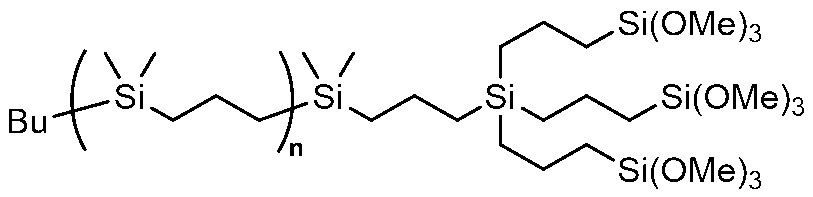
1,2-ビス(クロロジメチルシリル)エタンを5g、トルエンを1.5mL、水を0.84mL、それぞれ加えた後、100℃に加熱し8時間撹拌して重縮合反応を行った。精製を行った後、アリルクロロジメチルシラン3.13gおよびピリジン2.76gを加え、室温にて30分攪拌した。得られた反応液を減圧濃縮し、アセトニトリルで洗浄することにより下記のポリシルアルキレンシロキサン基含有化合物(D)CH2=CHCH2(CH3)2SiO(Si(CH3)2CH2CH2Si(CH3)2O)nSi(CH3)2CH2CH=CH2 3.5gを得た。

合成例3で得られたポリシルアルキレンシロキサン基含有化合物(D)CH2=CHCH2(CH3)2SiO(Si(CH3)2CH2CH2Si(CH3)2O)nSi(CH3)2CH2CH=CH2を2.0g、トルエンを2.0mL、トリアセトキシメチルシランを0.013g、1,3-ジビニル-1,1,3,3-テトラメチルジシロキサンのPt錯体を2%含むキシレン溶液を0.1mL、それぞれ加えた後、トリクロロシランを0.4mL仕込み、60℃に加熱し3時間撹拌した。その後、減圧下で揮発分を留去した後、トルエン2.0mLを加え、氷浴で5℃以下まで冷却し、アリルマグネシウムクロリド (テトラヒドロフラン溶液, 約1.0mol/L)を8.0mL加えて、室温で一昼夜撹拌した。その後、精製を行うことにより、下記のポリシルアルキレンシロキサン基含有化合物(E)(CH2=CHCH2)3SiCH2CH2CH2(CH3)2SiO(Si(CH3)2CH2CH2Si(CH3)2O)nSi(CH3)2CH2CH2CH2Si(CH2CH=CH2)3 2.00gを得た。

合成例4で得られたポリシルアルキレンシロキサン基含有化合物(E)(CH2=CHCH2)3SiCH2CH2CH2(CH3)2SiO(Si(CH3)2CH2CH2Si(CH3)2O)nSi(CH3)2CH2CH2CH2Si(CH2CH=CH2)3を1.97g、トルエンを1.2ml、トリアセトキシメチルシランを0.017g、1,3-ジビニル-1,1,3,3-テトラメチルジシロキサンのPt錯体を2%含むキシレン溶液を0.084g、それぞれ加えた後、トリクロロシランを0.4mL仕込み、60℃に加熱し3時間撹拌した。その後、減圧下で揮発分を留去した後、トルエン1.2mLを加え、メタノール0.11g、オルトギ酸トリメチル1.50gの混合溶液を加えた後、50℃に加熱し3時間撹拌した。その後、精製を行うことにより、末端にトリメトキシシリル基を有する下記のポリシルアルキレンシロキサン基含有化合物(F)((CH3O)3SiCH2CH2CH2)3SiCH2CH2CH2(CH3)2SiO(Si(CH3)2CH2CH2Si(CH3)2O)nSi(CH3)2CH2CH2CH2Si(CH2CH2CH2Si(OCH3)3)3 2.02gを得た。

トリエチルシラノールを0.085g、1、5、7-トリアザビシクロ[4.4.0]デカ-5-エンを0.049g、テトラヒドロフランを15.6mL、それぞれ加えた後、2、2、5、5-テトラメチル-1、2、5-オキサジシロラン5.02gを仕込み、30℃で3時間攪拌した。安息香酸を0.11g加え、精製を行った後、THF5mLを加え、アリルクロロジメチルシラン0.94mLおよびピリジン0.81mLを加え、30℃で15分攪拌した。得られた反応液を減圧濃縮し、アセトニトリルで洗浄することにより下記のポリシルアルキレンシロキサン基含有化合物(G)(CH3CH2)3SiO(Si(CH3)2CH2CH2Si(CH3)2O)nSi(CH3)2CH2CH=CH2 3.84gを得た。

合成例6で得られたポリシルアルキレンシロキサン基含有化合物(G)(CH3CH2)3SiO(Si(CH3)2CH2CH2Si(CH3)2O)nSi(CH3)2CH2CH=CH2を2.01g、トルエンを2.0mL、トリアセトキシメチルシランを0.013g、1,3-ジビニル-1,1,3,3-テトラメチルジシロキサンのPt錯体を2%含むキシレン溶液を0.075g、それぞれ加えた後、トリクロロシランを0.5mL仕込み、60℃に加熱し3時間撹拌した。その後、減圧下で揮発分を留去した後、トルエン2.0mLを加え、氷浴で5℃以下まで冷却し、アリルマグネシウムクロリド (テトラヒドロフラン溶液, 約1.0mol/L)を8.0mL加えて、室温で一昼夜撹拌した。その後、精製を行うことにより、下記のポリシルアルキレンシロキサン基含有化合物(H)(CH3CH2)3SiO(Si(CH3)2CH2CH2Si(CH3)2O)nSi(CH3)2CH2CH2CH2Si(CH2CH=CH2)3 1.95gを得た。
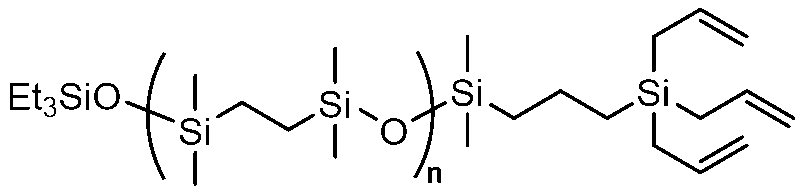
合成例7で得られたポリシルアルキレンシロキサン基含有化合物(H)(CH3CH2)3SiO(Si(CH3)2CH2CH2Si(CH3)2O)nSi(CH3)2CH2CH2CH2Si(CH2CH=CH2)3を1.91g、トルエンを2.0ml、トリアセトキシメチルシランを0.0098g、1,3-ジビニル-1,1,3,3-テトラメチルジシロキサンのPt錯体を2%含むキシレン溶液を0.17g、それぞれ加えた後、トリクロロシランを0.5mL仕込み、60℃に加熱し3時間撹拌した。その後、減圧下で揮発分を留去した後、トルエン2.0mLを加え、メタノール0.11g、オルトギ酸トリメチル2.37gの混合溶液を加えた後、50℃に加熱し3時間撹拌した。その後、精製を行うことにより、末端にトリメトキシシリル基を有する下記のポリシルアルキレンシロキサン基含有化合物(I)(CH3CH2)3SiO(Si(CH3)2CH2CH2Si(CH3)2O)nSi(CH3)2CH2CH2CH2Si(CH2CH2CH2Si(OCH3)3)3 2.06gを得た。

ガラス製密閉反応容器に、カルステッド(Karstedt’s)触媒(44.9mg)、4-ペンテン酸メチル(9.93g)、クロロジメチルシラン(10.09g)を加え、50℃で5分撹拌した。得られた反応液を700Pa~800Paに減圧下で蒸留し、下記の化合物(J)5-(クロロジメチルシリル)ペンタン酸メチル10.5gを得た。

トリエチルシラノールを0.84g、1、5、7-トリアザビシクロ[4.4.0]デカ-5-エンを0.22g、テトラヒドロフランを50mL、それぞれ加えた後、2、2、5、5-テトラメチル-1、2、5-オキサジシロラン23.5mLを仕込み、30℃で3時間攪拌した。ピリジンを2.96gと合成例9で得られた5-(クロロジメチルシリル)ペンタン酸メチルを5.21g加え、室温で12時間攪拌した後、飽和炭酸水素ナトリウム水溶液で洗浄し、シリカゲルカラムにより精製を行うことにより化合物(L)(CH3CH2)3SiO(Si(CH3)2CH2CH2Si(CH3)2O)nSi(CH3)2CH2CH2CH2CH2COOCH3(3.35g)を得た。繰り返し単位数nの平均値は、20である。

合成例10で得られた化合物(L)(CH3CH2)3SiO(Si(CH3)2CH2CH2Si(CH3)2O)nSi(CH3)2CH2CH2CH2CH2COOCH3を3.0g、テトラヒドロフランを6g、水を25g、水酸化リチウムを混合し、50℃で終夜撹拌した。その後、塩酸で洗浄し、減圧濃縮することで、(CH3CH2)3SiO(Si(CH3)2CH2CH2Si(CH3)2O)nSi(CH3)2CH2CH2CH2CH2COOHを得た。続いて4-[2,2-ジ(2-プロピレニル)]ペンテニルアミンを1.28g、1-(3-ジメチルアミノプロピル)-3-エチルカルボジイミド塩酸塩を1.49g、ジクロロメタンを6.5g、それぞれ混合し、室温で終夜攪拌した。その後、精製を行うことにより、化合物(M)(CH3CH2)3SiO(Si(CH3)2CH2CH2Si(CH3)2O)nSi(CH3)2CH2CH2CH2CH2CONHCH2C(CH2CH=CH2)3(3.23g)を得た。繰り返し単位数nの平均値は60である。

合成例11で得られた化合物(M)(CH3CH2)3SiO(Si(CH3)2CH2CH2Si(CH3)2O)nSi(CH3)2CH2CH2CH2CH2CONHCH2C(CH2CH=CH2)3を1.01g、トルエンを1、74g、ピリジンを0.05mL、カールシュテッド触媒のキシレン溶液を0.10g、それぞれ加えた後、トリメトキシシランを0.4mL仕込み、室温で終夜撹拌した。その後、精製を行うことにより、末端にトリメトキシシリル基を有する化合物(N)(CH3CH2)3SiO(Si(CH3)2CH2CH2Si(CH3)2O)nSi(CH3)2CH2CH2CH2CH2CONHCH2C(CH2CH2CH2Si(OCH3)3)3(1.08g)を得た。

ガラス製容器に、1,1-ジメチルシラシクロブタン7.60g)、THF(7.60g)、n-ヘキサン(7.60g)を添加した。この反応液を、-50℃まで冷却し、n-ブチルリチウム/ヘキサン溶液(3.69mL)を添加し、1時間攪拌して重合反応を行った。その後、5-(クロロジメチルシリル)ペンタン酸メチル(1.64g)を加え、同温にて30分攪拌した。得られた反応液を室温まで昇温し、水、トルエンを加え、分液抽出した後、有機層を硫酸ナトリウムで乾燥させた。ろ過後、ろ液を濃縮、乾燥させたのち、ヘキサンを展開溶媒としてシリカゲルカラムにて精製を行うことにより、下記のポリシルアルキレン基含有化合物(P)CH3CH2CH2CH2(Si(CH3)2CH2CH2CH2)nSi(CH3)2CH2CH2CH2CH2COOCH3(2.60g、Mw:5652、Mw/Mn:1.31)を得た。

合成例13で得られた化合物(P)CH3CH2CH2CH2(Si(CH3)2CH2CH2CH2)nSi(CH3)2CH2CH2CH2CH2COOCH3を2.0g、テトラヒドロフランを2.5g、水を11g、水酸化リチウムを混合し、50℃で終夜撹拌した。その後、塩酸で洗浄し、減圧濃縮することで、CH3CH2CH2CH2(Si(CH3)2CH2CH2CH2)nSi(CH3)2CH2CH2CH2CH2COOHを得た。続いて4-[2,2-ジ(2-プロピレニル)]ペンテニルアミンを0.53g、1-(3-ジメチルアミノプロピル)-3-エチルカルボジイミド塩酸塩を0.62g、ジクロロメタンを2.7g、それぞれ混合し、室温で終夜攪拌した。その後、精製を行うことにより、化合物(Q)CH3CH2CH2CH2(Si(CH3)2CH2CH2CH2)nSi(CH3)2CH2CH2CH2CH2CONHCH2C(CH2CH=CH2)3(2.15g、Mw:6769、Mw/Mn:1.37)を得た。

合成例14で得られた化合物(Q)CH3CH2CH2CH2(Si(CH3)2CH2CH2CH2)nSi(CH3)2CH2CH2CH2CH2CONHCH2C(CH2CH=CH2)3を2.00g、トルエンを2.0g、ピリジンを0.05mL、カールシュテッド触媒のキシレン溶液を0.11g、それぞれ加えた後、トリメトキシシランを0.4mL仕込み、室温で終夜撹拌した。その後、精製を行うことにより、末端にトリメトキシシリル基を有する化合物(R)CH3CH2CH2CH2(Si(CH3)2CH2CH2CH2)nSi(CH3)2CH2CH2CH2CH2CONHCH2C(CH2CH2CH2Si(OCH3)3)3(1.08g、Mw:7586、Mw/Mn:1.35)を得た。

比較化合物として、下記化合物(O)を準備した。

上記で得られた化合物(C)、(F)、(I)、(N)及び(R)、ならびに比較化合物(O)を20wt%の1,3-ビス(トリフルオロメチル)ベンゼン溶液となるよう希釈し、表面処理剤1~6を得た。上記で調製した表面処理剤1~6を、化学強化ガラス(コーニング社製、ゴリラガラス、厚さ0.7mm)上に真空蒸着した。
具体的には、真空蒸着装置内のモリブデン製ボートに表面処理剤0.1gを充填し、真空蒸着装置内を圧力3.0×10⁻³Pa以下に排気した。その後、電子線蒸着方式により二酸化ケイ素を7nmの厚さで蒸着させて二酸化ケイ素膜を形成し、続いて抵抗加熱方式によりボートを加熱することで表面処理層を形成した。
[耐摩耗性評価]
耐摩耗試験後の水の静的接触角が高いほど、摩擦による性能の低下が小さく、耐摩耗性に優れる。
(初期評価)
初期評価(摩擦回数0回)として、表面処理層の形成後、表面上の余剰分を拭き上げたのちに、水の静的接触角を測定した。
(耐摩耗性試験後の評価)
形成された表面処理層に対して、ラビングテスター(井元製作所社製)を用いて、下記条件で摩擦子を往復させた。所定の摩擦回数において、水の静的接触角を測定した。結果は下記表に示す。
摩擦子:ベンコット M-3II(製品名、旭化成社製)
移動距離(片道):60mm
移動速度:8,400mm/分
荷重:100g/3cm2

Claims (27)
- 下記式(1)又は(2):

RS1はそれぞれ独立して、R1-RS-SiR2 2-であり、
RS2は、-RS-SiR2 2-であり、
RSは、それぞれ独立して、下記式:

R3は、それぞれ独立して、C1-12アルキレン基、-R6-O-R6-、-R8-R7-R8-、-R8-R7-R9-R7-R8-、-R8-R7-R9-R6-R9-R7-R8-、又は-R9-R6-R9-R7-R9-R6-R9-であり、
R4は、それぞれ独立して、C1-12アルキレン基、-R6-O-R6-、-R8-R7-R8-、-R8-R7-R9-R7-R8-、-R8-R7-R9-R6-R9-R7-R8-、又は-R9-R6-R9-R7-R9-R6-R9-であり、
R6は、それぞれ独立して、C1-6アルキレン基であり、
R7は、それぞれ独立して、置換されていてもよいアリーレン基であり、
R8は、それぞれ独立して、単結合、又はC1-6アルキレン基であり、
R9は、それぞれ独立して、単結合、又は酸素原子であり、
R5は、それぞれ独立して、炭化水素基であり、
xは、0~200の整数であり、
yは、0~200の整数であり、
zは、0~200の整数であり、
y+zは、1以上であり、
x、y、又はzを付して括弧でくくられた各繰り返し単位の存在順序は式中において任意である。)
で表される基であり、
R1は、炭化水素基であり、
R2は、それぞれ独立して、炭化水素基であり、
RHは、それぞれ独立して、水酸基、又は加水分解性基が結合したSi原子を含む1価の基であり、
XAは、それぞれ独立して、2~10価の有機基であり、
αは、1~9の整数であり、
βは、1~9の整数であり、
γは、それぞれ独立して、1~9の整数である。]
で表されるシラン化合物。 - R2は、それぞれ独立して、ハロゲン原子により置換されていてもよい、C1-18アルキル基、又はアリール基であり、
R5は、それぞれ独立して、ハロゲン原子により置換されていてもよい、C1-18アルキル基、又はアリール基である、
請求項1に記載の化合物。 - R2は、それぞれ独立して、メチル基又はフェニル基であり、
R5は、それぞれ独立して、メチル基又はフェニル基である、
請求項1に記載のシラン化合物。 - R3は、それぞれ独立して、C1-12アルキレン基、又は-R6-O-R6-である、請求項1に記載のシラン化合物。
- R4は、それぞれ独立して、C1-12アルキレン基、又は-R6-O-R6-である、請求項1に記載のシラン化合物。
- R4は、それぞれ独立して、-R8-R7-R8-、-R8-R7-R9-R7-R8-、-R8-R7-R9-R6-R9-R7-R8-、又は-R9-R6-R9-R7-R9-R6-R9-である、請求項1に記載のシラン化合物。
- RHは、下記式(S1)、(S2)、(S3)、(S4)、又は(S5):

R11は、それぞれ独立して、水酸基又は加水分解性基であり、
R12は、それぞれ独立して、1価の有機基であり、
n1は、(SiR11 n1R12 3-n1)単位毎にそれぞれ独立して、0~3の整数であり、
X11は、それぞれ独立して、単結合又は2価の有機基であり、
R13は、それぞれ独立して、水素原子又は1価の有機基であり、
tは、それぞれ独立して、2以上の整数であり、
R14は、それぞれ独立して、水素原子、ハロゲン原子又は-X11-SiR11 n1R12 3-n1であり、
R15は、それぞれ独立して、単結合、酸素原子、炭素数1~6のアルキレン基又は炭素数1~6のアルキレンオキシ基であり、
Ra1は、それぞれ独立して、-Z1-SiR21 p1R22 q1R23 r1であり;
Z1は、それぞれ独立して、2価の有機基であり、
R21は、それぞれ独立して、-Z1’-SiR21’ p1’R22’ q1’R23’ r1’であり;
R22は、それぞれ独立して、水酸基又は加水分解性基であり、
R23は、それぞれ独立して、1価の有機基であり、
p1は、それぞれ独立して、0~3の整数であり、
q1は、それぞれ独立して、0~3の整数であり、
r1は、それぞれ独立して、0~3の整数であり、
Z1’は、それぞれ独立して、2価の有機基であり、
R21’は、それぞれ独立して、-Z1”-SiR22” q1”R23” r1”であり;
R22’は、それぞれ独立して、水酸基又は加水分解性基であり、
R23’は、それぞれ独立して、1価の有機基であり、
p1’は、それぞれ独立して、0~3の整数であり、
q1’は、それぞれ独立して、0~3の整数であり、
r1’は、それぞれ独立して、0~3の整数であり、
Z1”は、それぞれ独立して、2価の有機基であり、
R22”は、それぞれ独立して、水酸基又は加水分解性基であり、
R23”は、それぞれ独立して、1価の有機基であり、
q1”は、それぞれ独立して、0~3の整数であり、
r1”は、それぞれ独立して、0~3の整数であり、
Rb1は、それぞれ独立して、水酸基又は加水分解性基であり、
Rc1は、それぞれ独立して、1価の有機基であり、
k1は、それぞれ独立して、0~3の整数であり、
l1は、それぞれ独立して、0~3の整数であり、
m1は、それぞれ独立して、0~3の整数であり、
ただし、式(S3)中、水酸基又は加水分解性基が結合したSi原子が少なくとも2つ存在し、
Rd1は、それぞれ独立して、-Z2-CR31 p2R32 q2R33 r2であり、
Z2は、それぞれ独立して、単結合、酸素原子又は2価の有機基であり、
R31は、それぞれ独立して、-Z2’-CR32’ q2’R33’ r2’であり、
R32は、それぞれ独立して、-Z3-SiR34 n2R35 3-n2であり、
R33は、それぞれ独立して、水素原子、水酸基又は1価の有機基であり、
p2は、それぞれ独立して、0~3の整数であり、
q2は、それぞれ独立して、0~3の整数であり、
r2は、それぞれ独立して、0~3の整数であり、
Z2’は、それぞれ独立して、単結合、酸素原子又は2価の有機基であり、
R32’は、それぞれ独立して、-Z3-SiR34 n2R35 3-n2であり、
R33’は、それぞれ独立して、水素原子、水酸基又は1価の有機基であり、
q2’は、それぞれ独立して、0~3の整数であり、
r2’は、それぞれ独立して、0~3の整数であり、
Z3は、それぞれ独立して、単結合、酸素原子又は2価の有機基であり;
R34は、それぞれ独立して、水酸基又は加水分解性基であり、
R35は、それぞれ独立して、1価の有機基であり、
n2は、それぞれ独立して、0~3の整数であり、
Re1は、それぞれ独立して、-Z3-SiR34 n2R35 3-n2であり、
Rf1は、それぞれ独立して、水素原子、水酸基又は1価の有機基であり、
k2は、それぞれ独立して、0~3の整数であり、
l2は、それぞれ独立して、0~3の整数であり、
m2は、それぞれ独立して、0~3の整数である。
ただし、式(S4)中、水酸基又は加水分解性基が結合したSi原子が少なくとも2つ存在し、
Rg1及びRh1は、それぞれ独立して、-Z4-SiR11 n1R12 3-n1、-Z4-SiRa1 k1Rb1 l1Rc1 m1、又は-Z4-CRd1 k2Re1 l2Rf1 m2であり、
Z4は、それぞれ独立して、単結合、酸素原子又は2価の有機基であり、
ただし、式(S5)中、水酸基又は加水分解性基が結合したSi原子が少なくとも2つ存在する。]
で表される基である、請求項1に記載のシラン化合物。 - RHは、それぞれ独立して、式(S1)、式(S3)、(S4)、又は(S5)で表される基である、請求項7に記載のシラン化合物。
- RHは、それぞれ独立して、式(S3)、(S4)、又は(S5)で表される基である、請求項7に記載のシラン化合物。
- α、β、及びγは、1である、請求項1に記載のシラン化合物。
- XAは、下記式:
-(R51)p5-(X51)q5-
[式中:
R51は、-(CH2)s5-又はo-、m-もしくはp-フェニレン基であり、
s5は、1~20の整数であり、
X51は、-(X52)l5-であり、
X52は、それぞれ独立して、-O-、-S-、o-、m-もしくはp-フェニレン基、-CO-、-C(O)O-、-CONR54-、-O-CONR54-、-NR54-及び-(CH2)n5-からなる群から選択される基であり、
R54は、それぞれ独立して、水素原子、又は1価の有機基であり、
n5は、それぞれ独立して、1~20の整数であり、
l5は、1~10の整数であり、
p5は、0又は1であり、
q5は、0又は1であり、
ここに、p5及びq5の少なくとも一方は1であり、p5又はq5を付して括弧でくくられた各繰り返し単位の存在順序は任意である。]
で表される2価の有機基である、請求項1に記載のシラン化合物。 - XAは、それぞれ独立して、C1-20アルキレン基、又は-(CH2)s5-CONH-(CH2)t5-(式中、s5は、1~20の整数であり、t5は、1~20の整数である)である、請求項1に記載のシラン化合物。
- 請求項1に記載のシラン化合物を含有する、表面処理剤。
- 請求項1に記載のシラン化合物、および該シラン化合物の少なくとも一部が縮合した縮合体からなる化合物の少なくとも一つを含有する、表面処理剤。
- 真空蒸着用である、請求項13又は14に記載の表面処理剤。
- 湿潤被覆用である、請求項13又は14に記載の表面処理剤。
- 請求項13又は14に記載の表面処理剤を含有するペレット。
- 基材と、該基材上に、請求項1~12のいずれか1項に記載のシラン化合物、又は請求項13~14のいずれか1項に記載の表面処理剤から形成された層とを含む物品。
- 光学部材である、請求項18に記載の物品。
- ディスプレイである、請求項19に記載の物品。
- 式(1a-3)又は(2a-3):
RS1-R61’-Si(R62-CH=CH2)3 (1a-3)
(CH=CH2-R62)3Si-R61’-RS2-R61’-Si(R62-CH=CH2)3 (2a-3)
[式中、
RS1は、それぞれ独立して、R1-RS-SiR2 2-であり、
RS2は、-RS-SiR2 2-であり、
RSは、それぞれ独立して、下記式:
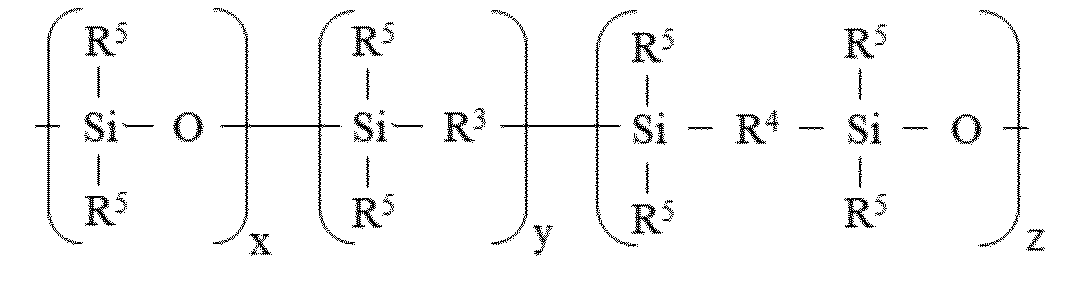
R3は、それぞれ独立して、C1-12アルキレン基、-R6-O-R6-、-R8-R7-R8-、-R8-R7-R9-R7-R8-、-R8-R7-R9-R6-R9-R7-R8-、又は-R9-R6-R9-R7-R9-R6-R9-であり、
R4は、それぞれ独立して、C1-12アルキレン基、-R6-O-R6-、-R8-R7-R8-、-R8-R7-R9-R7-R8-、-R8-R7-R9-R6-R9-R7-R8-、又は-R9-R6-R9-R7-R9-R6-R9-であり、
R6は、それぞれ独立して、C1-6アルキレン基であり、
R7は、それぞれ独立して、置換されていてもよい、フェニレン基、又はナフチレン基であり、
R8は、それぞれ独立して、単結合、又はC1-6アルキレン基であり、
R9は、それぞれ独立して、単結合、又は酸素原子であり、
R5は、それぞれ独立して、炭化水素基であり、
xは、0~200の整数であり、
yは、0~200の整数であり、
zは、0~200の整数であり、
y+zは、1以上であり、
x、y、又はzを付して括弧でくくられた各繰り返し単位の存在順序は式中において任意である。)
で表される基であり、
R1は、炭化水素基であり、
R2は、それぞれ独立して、炭化水素基であり、
R62は、単結合、又はC1-12アルキレン基であり、
R61’は、二価の有機基である。]
で表される化合物。 - 式(1b-1)又は(2b-1):
RS1-R61-COOR65 (1b-1)
R65OCO-R61-RS2-R61-COOR65 (2b-1)
[式中、
RS1は、それぞれ独立して、R1-RS-SiR2 2-であり、
RS2は、-RS-SiR2 2-であり、
RSは、それぞれ独立して、下記式:

R3は、それぞれ独立して、C1-12アルキレン基、-R6-O-R6-、-R8-R7-R8-、-R8-R7-R9-R7-R8-、-R8-R7-R9-R6-R9-R7-R8-、又は-R9-R6-R9-R7-R9-R6-R9-であり、
R4は、それぞれ独立して、C1-12アルキレン基、-R6-O-R6-、-R8-R7-R8-、-R8-R7-R9-R7-R8-、-R8-R7-R9-R6-R9-R7-R8-、又は-R9-R6-R9-R7-R9-R6-R9-であり、
R6は、それぞれ独立して、C1-6アルキレン基であり、
R7は、それぞれ独立して、置換されていてもよい、フェニレン基、又はナフチレン基であり、
R8は、それぞれ独立して、単結合、又はC1-6アルキレン基であり、
R9は、それぞれ独立して、単結合、又は酸素原子であり、
R5は、それぞれ独立して、炭化水素基であり、
xは、0~200の整数であり、
yは、0~200の整数であり、
zは、0~200の整数であり、
y+zは、1以上であり、
x、y、又はzを付して括弧でくくられた各繰り返し単位の存在順序は式中において任意である。)
で表される基であり、
R1は、炭化水素基であり、
R2は、それぞれ独立して、炭化水素基であり、
R61は、単結合、又は二価の有機基であり、
R65は、水素原子、又はC1-6アルキル基である。]
で表される化合物。 - 式(1b-2)又は(2b-2):
RS1-R61-CONR67-R66-C(R62-CH=CH2)3 (1b-2)
(CH=CH2-R62)3C-R66-NR67CO-R61-RS2-R61-CONR67-R66-C(R62-CH=CH2)3 (2b-2)
[式中、
RS1は、それぞれ独立して、R1-RS-SiR2 2-であり、
RS2は、-RS-SiR2 2-であり、
RSは、それぞれ独立して、下記式:

R3は、それぞれ独立して、C1-12アルキレン基、-R6-O-R6-、-R8-R7-R8-、-R8-R7-R9-R7-R8-、-R8-R7-R9-R6-R9-R7-R8-、又は-R9-R6-R9-R7-R9-R6-R9-であり、
R4は、それぞれ独立して、C1-12アルキレン基、-R6-O-R6-、-R8-R7-R8-、-R8-R7-R9-R7-R8-、-R8-R7-R9-R6-R9-R7-R8-、又は-R9-R6-R9-R7-R9-R6-R9-であり、
R6は、それぞれ独立して、C1-6アルキレン基であり、
R7は、それぞれ独立して、置換されていてもよいアリーレン基であり、
R8は、それぞれ独立して、単結合、又はC1-6アルキレン基であり、
R9は、それぞれ独立して、単結合、又は酸素原子であり、
R5は、それぞれ独立して、炭化水素基であり、
xは、0~200の整数であり、
yは、0~200の整数であり、
zは、0~200の整数であり、
y+zは、1以上であり、
x、y、又はzを付して括弧でくくられた各繰り返し単位の存在順序は式中において任意である。)
で表される基であり、
R1は、炭化水素基であり、
R2は、それぞれ独立して、炭化水素基であり、
R61は、単結合、又はC1-12アルキレン基であり、
R62は、単結合、又はC1-12アルキレン基であり、
R66は、単結合、又はC1-12アルキレン基であり、
R67は、水素原子、C1-18アルキル基、アリール基、又はポリエーテル基である。]
で表される化合物。 - 式(1c-2)又は(2c-2):
RS1-R61-CON(R62-CH=CH2)2 (1c-2)
(CH=CH2-R62)2NCO-R61-RS2-R61-CON(R62-CH=CH2)2 (2c-2)
[式中、
RS1は、それぞれ独立して、R1-RS-SiR2 2-であり、
RS2は、-RS-SiR2 2-であり、
RSは、それぞれ独立して、下記式:

R3は、それぞれ独立して、C1-12アルキレン基、-R6-O-R6-、-R8-R7-R8-、-R8-R7-R9-R7-R8-、-R8-R7-R9-R6-R9-R7-R8-、又は-R9-R6-R9-R7-R9-R6-R9-であり、
R4は、それぞれ独立して、C1-12アルキレン基、-R6-O-R6-、-R8-R7-R8-、-R8-R7-R9-R7-R8-、-R8-R7-R9-R6-R9-R7-R8-、又は-R9-R6-R9-R7-R9-R6-R9-であり、
R6は、それぞれ独立して、C1-6アルキレン基であり、
R7は、それぞれ独立して、置換されていてもよいアリーレン基であり、
R8は、それぞれ独立して、単結合、又はC1-6アルキレン基であり、
R9は、それぞれ独立して、単結合、又は酸素原子であり、
R5は、それぞれ独立して、炭化水素基であり、
xは、0~200の整数であり、
yは、0~200の整数であり、
zは、0~200の整数であり、
y+zは、1以上であり、
x、y、又はzを付して括弧でくくられた各繰り返し単位の存在順序は式中において任意である。)
で表される基であり、
R1は、炭化水素基であり、
R2は、それぞれ独立して、炭化水素基であり、
R61は、単結合、又はC1-12アルキレン基であり、
R62は、単結合、又はC1-12アルキレン基である。]
で表される化合物。 - 式(1d-2)又は(2d-2):
RS1-R61-C(OH)(R62-CH=CH2)2 (1d-2)
(CH=CH2-R62)2(OH)C-R61-RS2-R61-C(OH)(R62-CH=CH2)2 (2d-2)
[式中、
RS1は、それぞれ独立して、R1-RS-SiR2 2-であり、
RS2は、-RS-SiR2 2-であり、
RSは、それぞれ独立して、下記式:

R3は、それぞれ独立して、C1-12アルキレン基、-R6-O-R6-、-R8-R7-R8-、-R8-R7-R9-R7-R8-、-R8-R7-R9-R6-R9-R7-R8-、又は-R9-R6-R9-R7-R9-R6-R9-であり、
R4は、それぞれ独立して、C1-12アルキレン基、-R6-O-R6-、-R8-R7-R8-、-R8-R7-R9-R7-R8-、-R8-R7-R9-R6-R9-R7-R8-、又は-R9-R6-R9-R7-R9-R6-R9-であり、
R6は、それぞれ独立して、C1-6アルキレン基であり、
R7は、それぞれ独立して、置換されていてもよいアリーレン基であり、
R8は、それぞれ独立して、単結合、又はC1-6アルキレン基であり、
R9は、それぞれ独立して、単結合、又は酸素原子であり、
R5は、それぞれ独立して、炭化水素基であり、
xは、0~200の整数であり、
yは、0~200の整数であり、
zは、0~200の整数であり、
y+zは、1以上であり、
x、y、又はzを付して括弧でくくられた各繰り返し単位の存在順序は式中において任意である。)
で表される基であり、
R1は、炭化水素基であり、
R2は、それぞれ独立して、炭化水素基であり、
R61は、単結合、又はC1-12アルキレン基であり、
R62は、単結合、又はC1-12アルキレン基である。]
で表される化合物。 - 式:
R74Si(R71)2-R72-COOR73
[式中:
R71は、それぞれ独立して、ハロゲン原子に置換されていてもよいC1-12アルキル基であり、
R72は、ハロゲン原子に置換されていてもよいC3-5アルキレン基であり、
R73は、水素原子、又はハロゲン原子に置換されていてもよいC1-3アルキル基であり、
R74は、ハロゲン原子、水酸基、又は加水分解性基である。]
で表される化合物。 - R71は、メチル基であり、
R72は、直鎖のC3-5アルキレン基であり、
R73は、メチル基、又はエチル基であり、
R74は、塩素原子、又は水酸基である、
請求項26に記載の化合物。
Priority Applications (2)
| Application Number | Priority Date | Filing Date | Title |
|---|---|---|---|
| CN202380035054.9A CN119053645A (zh) | 2022-04-20 | 2023-04-20 | 表面处理剂 |
| EP23791924.6A EP4509551A4 (en) | 2022-04-20 | 2023-04-20 | SURFACE TREATMENT AGENT |
Applications Claiming Priority (2)
| Application Number | Priority Date | Filing Date | Title |
|---|---|---|---|
| JP2022069569 | 2022-04-20 | ||
| JP2022-069569 | 2022-04-20 |
Publications (1)
| Publication Number | Publication Date |
|---|---|
| WO2023204276A1 true WO2023204276A1 (ja) | 2023-10-26 |
Family
ID=88419976
Family Applications (1)
| Application Number | Title | Priority Date | Filing Date |
|---|---|---|---|
| PCT/JP2023/015817 Ceased WO2023204276A1 (ja) | 2022-04-20 | 2023-04-20 | 表面処理剤 |
Country Status (4)
| Country | Link |
|---|---|
| EP (1) | EP4509551A4 (ja) |
| JP (2) | JP7397389B2 (ja) |
| CN (1) | CN119053645A (ja) |
| WO (1) | WO2023204276A1 (ja) |
Cited By (7)
| Publication number | Priority date | Publication date | Assignee | Title |
|---|---|---|---|---|
| WO2024171970A1 (ja) * | 2023-02-15 | 2024-08-22 | ダイキン工業株式会社 | シラン化合物 |
| WO2025170046A1 (ja) * | 2024-02-09 | 2025-08-14 | ダイキン工業株式会社 | シラン化合物を含む組成物 |
| WO2025170062A1 (ja) * | 2024-02-09 | 2025-08-14 | ダイキン工業株式会社 | シラン化合物を含む組成物 |
| WO2025170045A1 (ja) * | 2024-02-09 | 2025-08-14 | ダイキン工業株式会社 | シラン化合物を含む組成物 |
| WO2025170061A1 (ja) * | 2024-02-09 | 2025-08-14 | ダイキン工業株式会社 | シラン化合物を含む組成物 |
| WO2025170047A1 (ja) * | 2024-02-09 | 2025-08-14 | ダイキン工業株式会社 | シラン化合物を含む組成物 |
| WO2025170050A1 (ja) * | 2024-02-09 | 2025-08-14 | ダイキン工業株式会社 | シラン化合物を含む組成物 |
Families Citing this family (2)
| Publication number | Priority date | Publication date | Assignee | Title |
|---|---|---|---|---|
| WO2025110181A1 (ja) * | 2023-11-24 | 2025-05-30 | Agc株式会社 | 化合物、組成物、表面処理剤、物品、及び物品の製造方法 |
| JP2025123198A (ja) * | 2024-02-09 | 2025-08-22 | ダイキン工業株式会社 | 組成物 |
Citations (10)
| Publication number | Priority date | Publication date | Assignee | Title |
|---|---|---|---|---|
| JP2002097192A (ja) | 2000-09-19 | 2002-04-02 | Asahi Glass Co Ltd | 表面処理剤用化合物、表面処理剤、機能性ガラス及びその製造方法 |
| JP2003505557A (ja) * | 1999-07-22 | 2003-02-12 | スリーエム エスペ アクチェンゲゼルシャフト | 低粘度を有する加水分解可能で、しかも重合可能なシラン及びその使用 |
| JP2014148657A (ja) * | 2013-01-30 | 2014-08-21 | Dow Corning Corp | 表面処理用組成物、表面処理された物品の調製方法及び表面処理された物品 |
| JP2015014776A (ja) * | 2013-06-04 | 2015-01-22 | セイコーエプソン株式会社 | 電気泳動粒子、電気泳動粒子の製造方法、電気泳動分散液、表示装置および電子機器 |
| JP2015054945A (ja) | 2013-09-13 | 2015-03-23 | 信越化学工業株式会社 | 末端変性されたシラシクロブタン開環重合物及びその製造方法 |
| WO2015142562A1 (en) * | 2014-03-17 | 2015-09-24 | Dow Corning Corporation | Method of preparing non-aqueous emulsion, non-aqueous emulsion prepared thereby, and methods of preparing surface-treated articles |
| JP2016166298A (ja) * | 2015-03-10 | 2016-09-15 | 信越化学工業株式会社 | 両末端変性されたシラシクロブタン開環重合物及びその製造方法 |
| JP2017031303A (ja) * | 2015-07-31 | 2017-02-09 | 信越化学工業株式会社 | オルガノポリシルメチレンシロキサン組成物 |
| WO2019159476A1 (ja) * | 2018-02-13 | 2019-08-22 | 信越化学工業株式会社 | オルガノシロキサン化合物及び表面処理剤 |
| JP2021515066A (ja) * | 2018-02-22 | 2021-06-17 | ヘンケル アイピー アンド ホールディング ゲゼルシャフト ミット ベシュレンクテル ハフツング | 湿気硬化性シリコーンポリマー、及びその使用 |
Family Cites Families (1)
| Publication number | Priority date | Publication date | Assignee | Title |
|---|---|---|---|---|
| JP2014077117A (ja) * | 2012-09-21 | 2014-05-01 | Dow Corning Toray Co Ltd | 高屈折性表面処理剤、それを用いて表面処理された微細部材および光学材料 |
-
2023
- 2023-04-20 WO PCT/JP2023/015817 patent/WO2023204276A1/ja not_active Ceased
- 2023-04-20 CN CN202380035054.9A patent/CN119053645A/zh active Pending
- 2023-04-20 EP EP23791924.6A patent/EP4509551A4/en active Pending
- 2023-04-20 JP JP2023069186A patent/JP7397389B2/ja active Active
- 2023-11-24 JP JP2023198979A patent/JP2024028747A/ja active Pending
Patent Citations (10)
| Publication number | Priority date | Publication date | Assignee | Title |
|---|---|---|---|---|
| JP2003505557A (ja) * | 1999-07-22 | 2003-02-12 | スリーエム エスペ アクチェンゲゼルシャフト | 低粘度を有する加水分解可能で、しかも重合可能なシラン及びその使用 |
| JP2002097192A (ja) | 2000-09-19 | 2002-04-02 | Asahi Glass Co Ltd | 表面処理剤用化合物、表面処理剤、機能性ガラス及びその製造方法 |
| JP2014148657A (ja) * | 2013-01-30 | 2014-08-21 | Dow Corning Corp | 表面処理用組成物、表面処理された物品の調製方法及び表面処理された物品 |
| JP2015014776A (ja) * | 2013-06-04 | 2015-01-22 | セイコーエプソン株式会社 | 電気泳動粒子、電気泳動粒子の製造方法、電気泳動分散液、表示装置および電子機器 |
| JP2015054945A (ja) | 2013-09-13 | 2015-03-23 | 信越化学工業株式会社 | 末端変性されたシラシクロブタン開環重合物及びその製造方法 |
| WO2015142562A1 (en) * | 2014-03-17 | 2015-09-24 | Dow Corning Corporation | Method of preparing non-aqueous emulsion, non-aqueous emulsion prepared thereby, and methods of preparing surface-treated articles |
| JP2016166298A (ja) * | 2015-03-10 | 2016-09-15 | 信越化学工業株式会社 | 両末端変性されたシラシクロブタン開環重合物及びその製造方法 |
| JP2017031303A (ja) * | 2015-07-31 | 2017-02-09 | 信越化学工業株式会社 | オルガノポリシルメチレンシロキサン組成物 |
| WO2019159476A1 (ja) * | 2018-02-13 | 2019-08-22 | 信越化学工業株式会社 | オルガノシロキサン化合物及び表面処理剤 |
| JP2021515066A (ja) * | 2018-02-22 | 2021-06-17 | ヘンケル アイピー アンド ホールディング ゲゼルシャフト ミット ベシュレンクテル ハフツング | 湿気硬化性シリコーンポリマー、及びその使用 |
Non-Patent Citations (3)
| Title |
|---|
| FEDOTOV, N. S ET AL. : "Chemical transformations of ω-chlorosilyl-substituted carboxylic acid chlorides", ZHURNAL OBSHCHEI KHIMII [RUSSIAN JOURNAL OF ORGANIC CHEMISTRY], NAUKA, RU, vol. 39, no. 9, 1 January 1969 (1969-01-01), RU , pages 2011 - 2016, XP009550126, ISSN: 0044-460X * |
| ORG. LETT., vol. 8, no. 21, 2006, pages 4683 |
| See also references of EP4509551A4 |
Cited By (16)
| Publication number | Priority date | Publication date | Assignee | Title |
|---|---|---|---|---|
| WO2024171970A1 (ja) * | 2023-02-15 | 2024-08-22 | ダイキン工業株式会社 | シラン化合物 |
| WO2025170046A1 (ja) * | 2024-02-09 | 2025-08-14 | ダイキン工業株式会社 | シラン化合物を含む組成物 |
| WO2025170062A1 (ja) * | 2024-02-09 | 2025-08-14 | ダイキン工業株式会社 | シラン化合物を含む組成物 |
| WO2025170045A1 (ja) * | 2024-02-09 | 2025-08-14 | ダイキン工業株式会社 | シラン化合物を含む組成物 |
| WO2025170061A1 (ja) * | 2024-02-09 | 2025-08-14 | ダイキン工業株式会社 | シラン化合物を含む組成物 |
| WO2025170047A1 (ja) * | 2024-02-09 | 2025-08-14 | ダイキン工業株式会社 | シラン化合物を含む組成物 |
| WO2025170050A1 (ja) * | 2024-02-09 | 2025-08-14 | ダイキン工業株式会社 | シラン化合物を含む組成物 |
| JP7727252B1 (ja) | 2024-02-09 | 2025-08-21 | ダイキン工業株式会社 | シラン化合物を含む組成物 |
| JP2025123193A (ja) * | 2024-02-09 | 2025-08-22 | ダイキン工業株式会社 | シラン化合物を含む組成物 |
| JP2025123191A (ja) * | 2024-02-09 | 2025-08-22 | ダイキン工業株式会社 | シラン化合物を含む組成物 |
| JP2025123197A (ja) * | 2024-02-09 | 2025-08-22 | ダイキン工業株式会社 | シラン化合物を含む組成物 |
| JP2025123195A (ja) * | 2024-02-09 | 2025-08-22 | ダイキン工業株式会社 | シラン化合物を含む組成物 |
| JP2025123192A (ja) * | 2024-02-09 | 2025-08-22 | ダイキン工業株式会社 | シラン化合物を含む組成物 |
| JP2025126899A (ja) * | 2024-02-09 | 2025-08-29 | ダイキン工業株式会社 | シラン化合物を含む組成物 |
| JP7751246B2 (ja) | 2024-02-09 | 2025-10-08 | ダイキン工業株式会社 | シラン化合物を含む組成物 |
| JP7817641B2 (ja) | 2024-02-09 | 2026-02-19 | ダイキン工業株式会社 | シラン化合物を含む組成物 |
Also Published As
| Publication number | Publication date |
|---|---|
| JP2023159887A (ja) | 2023-11-01 |
| JP2024028747A (ja) | 2024-03-05 |
| EP4509551A1 (en) | 2025-02-19 |
| CN119053645A (zh) | 2024-11-29 |
| JP7397389B2 (ja) | 2023-12-13 |
| EP4509551A4 (en) | 2025-09-03 |
Similar Documents
| Publication | Publication Date | Title |
|---|---|---|
| JP7397389B2 (ja) | 表面処理剤 | |
| JP7518451B2 (ja) | 表面処理剤 | |
| JP6828841B2 (ja) | 表面処理剤 | |
| JP6844728B2 (ja) | フルオロポリエーテル基含有化合物 | |
| JP6801804B2 (ja) | フルオロポリエーテル基含有化合物 | |
| TW202336025A (zh) | 表面處理劑 | |
| TW202336023A (zh) | 表面處理劑 | |
| EP4663644A1 (en) | Silane compound | |
| JP6911963B2 (ja) | フルオロポリエーテル基含有化合物 | |
| WO2025170043A1 (ja) | 積層体 | |
| TWI811586B (zh) | 含有氟聚醚基之矽烷化合物 | |
| JP7260811B2 (ja) | 表面処理剤 | |
| JP6838671B2 (ja) | フルオロポリエーテル基含有化合物 | |
| JP7148833B1 (ja) | フルオロポリエーテル基含有シラン化合物 | |
| WO2023210654A1 (ja) | フルオロポリエーテル基含有オキシアルキレンアミド化合物 | |
| WO2021075569A1 (ja) | 表面処理剤 | |
| WO2026048892A1 (ja) | 組成物 | |
| WO2023210653A1 (ja) | 表面処理剤 | |
| WO2026048891A1 (ja) | 物品及び物品の製造方法 |
Legal Events
| Date | Code | Title | Description |
|---|---|---|---|
| 121 | Ep: the epo has been informed by wipo that ep was designated in this application |
Ref document number: 23791924 Country of ref document: EP Kind code of ref document: A1 |
|
| WWE | Wipo information: entry into national phase |
Ref document number: 202380035054.9 Country of ref document: CN |
|
| WWE | Wipo information: entry into national phase |
Ref document number: 2023791924 Country of ref document: EP |
|
| NENP | Non-entry into the national phase |
Ref country code: DE |
|
| ENP | Entry into the national phase |
Ref document number: 2023791924 Country of ref document: EP Effective date: 20241115 |