WO2023218678A1 - ゴム物品、及びこれを用いたタイヤ - Google Patents
ゴム物品、及びこれを用いたタイヤ Download PDFInfo
- Publication number
- WO2023218678A1 WO2023218678A1 PCT/JP2022/037631 JP2022037631W WO2023218678A1 WO 2023218678 A1 WO2023218678 A1 WO 2023218678A1 JP 2022037631 W JP2022037631 W JP 2022037631W WO 2023218678 A1 WO2023218678 A1 WO 2023218678A1
- Authority
- WO
- WIPO (PCT)
- Prior art keywords
- rubber
- mass
- polybutadiene
- syndiotactic
- parts
- Prior art date
- Legal status (The legal status is an assumption and is not a legal conclusion. Google has not performed a legal analysis and makes no representation as to the accuracy of the status listed.)
- Ceased
Links
Images
Classifications
-
- C—CHEMISTRY; METALLURGY
- C08—ORGANIC MACROMOLECULAR COMPOUNDS; THEIR PREPARATION OR CHEMICAL WORKING-UP; COMPOSITIONS BASED THEREON
- C08L—COMPOSITIONS OF MACROMOLECULAR COMPOUNDS
- C08L7/00—Compositions of natural rubber
-
- B—PERFORMING OPERATIONS; TRANSPORTING
- B60—VEHICLES IN GENERAL
- B60C—VEHICLE TYRES; TYRE INFLATION; TYRE CHANGING; CONNECTING VALVES TO INFLATABLE ELASTIC BODIES IN GENERAL; DEVICES OR ARRANGEMENTS RELATED TO TYRES
- B60C1/00—Tyres characterised by the chemical composition or the physical arrangement or mixture of the composition
- B60C1/0025—Compositions of the sidewalls
-
- C—CHEMISTRY; METALLURGY
- C08—ORGANIC MACROMOLECULAR COMPOUNDS; THEIR PREPARATION OR CHEMICAL WORKING-UP; COMPOSITIONS BASED THEREON
- C08L—COMPOSITIONS OF MACROMOLECULAR COMPOUNDS
- C08L9/00—Compositions of homopolymers or copolymers of conjugated diene hydrocarbons
-
- B—PERFORMING OPERATIONS; TRANSPORTING
- B60—VEHICLES IN GENERAL
- B60C—VEHICLE TYRES; TYRE INFLATION; TYRE CHANGING; CONNECTING VALVES TO INFLATABLE ELASTIC BODIES IN GENERAL; DEVICES OR ARRANGEMENTS RELATED TO TYRES
- B60C13/00—Tyre sidewalls; Protecting, decorating, marking, or the like, thereof
- B60C2013/005—Physical properties of the sidewall rubber
- B60C2013/007—Thickness
Definitions
- the present invention relates to a rubber article and a tire using the same, and particularly to a rubber article that can be applied to side rubber of tires used for construction vehicles, mining vehicles, etc.
- the present invention was made in view of the above problems, and an object of the present invention is to provide a rubber article that can have both excellent low heat generation property and cut resistance, and a tire using the rubber article.
- the present invention provides the following [1] to [5].
- [1] A vulcanized product of a rubber composition containing a rubber component and syndiotactic-1,2-polybutadiene, in which the rubber component contains natural rubber of 30% by mass or more and 70% by mass or less, and 30% by mass and 70% by mass or less of butadiene rubber, the proportion of the syndiotactic-1,2-polybutadiene is 5 parts by mass or more and 40 parts by mass or less based on 100 parts by mass of the rubber component, and the thickness is 3 mm or more. , rubber articles.
- the present invention it is possible to obtain a rubber article that can have both excellent low heat generation properties and cut resistance. Further, by applying the rubber article of the present invention, a tire exhibiting excellent low heat generation property and cut resistance can be obtained.
- the rubber article of the present invention is a vulcanized product of a rubber composition containing a rubber component and syndiotactic-1,2-polybutadiene, wherein the rubber component is 30% by mass or more and 70% by mass or less of natural rubber. , 30% by mass or more and 70% by mass or less of butadiene rubber, and the proportion of the syndiotactic-1,2-polybutadiene is 5 parts by mass or more and 40 parts by mass or less based on 100 parts by mass of the rubber component, The thickness is 3 mm or more.
- the rubber article of the present invention exhibits excellent low heat generation properties because it is a vulcanized product of a rubber composition containing the above-mentioned rubber component.
- a rubber article increases, its cut resistance tends to improve.
- syndiotactic-1,2-polybutadiene is blended into a rubber composition, the cut resistance of the resulting rubber article tends to improve.
- the thickness increased more than the rubber composition obtained from a rubber composition not containing syndiotactic-1,2-polybutadiene. It was found that the cut resistance was significantly improved.
- the present invention provides a rubber article that is made of a vulcanized product of the above-mentioned rubber composition and has a thickness of 3 mm or more, thereby obtaining excellent cut resistance that exceeds the range that can be predicted from the knowledge obtained so far. It is.
- the rubber composition includes a rubber component and syndiotactic-1,2-polybutadiene.
- the rubber component contains natural rubber of 30% by mass or more and 70% by mass or less, and butadiene rubber of 30% by mass or more and 70% by mass or less.
- the polybutadiene rubber may be a modified butadiene rubber or an unmodified butadiene rubber.
- the cut resistance and crack growth resistance of the rubber article can be improved.
- the amount of natural rubber blended is preferably 35% by mass or more, and more preferably 40% by mass or more.
- the amount of natural rubber blended is preferably 65% by mass or less, more preferably 60% by mass or less.
- the ozone resistance of the rubber article can be improved.
- the content of butadiene rubber is preferably 35% by mass or more, more preferably 40% by mass or more.
- the amount of butadiene rubber is preferably 70% by mass or less in the rubber component, the cut resistance and crack growth resistance of the rubber article can be improved.
- the amount of butadiene rubber blended is preferably 65% by mass or less, more preferably 60% by mass or less.
- diene rubbers other than natural rubber and butadiene rubber may be included as long as they do not impede the performance (low heat build-up and cut resistance) required of the rubber article of the present invention.
- Other diene rubbers include polyisoprene rubber (IR), styrene-butadiene copolymer rubber (SBR), butyl rubber (IIR), ethylene-propylene-diene copolymer (EPDM), acrylonitrile-butadiene copolymer ( NBR), etc.
- the amount of other diene rubbers in the rubber component is preferably 40% by mass or less, more preferably 30% by mass or less, and even more preferably 20% by mass or less.
- the rubber composition contains syndiotactic-1,2-polybutadiene in an amount of 5 parts by mass or more and 40 parts by mass or less based on 100 parts by mass of the rubber component. If the amount of syndiotactic-1,2-polybutadiene is less than 5 parts by mass, sufficient bonds will not be formed in the vulcanized rubber, making it impossible to obtain sufficient cut resistance and low heat build-up. On the other hand, if the blending amount of syndiotactic-1,2-polybutadiene exceeds 40 parts by mass, the flexibility of the rubber decreases, which not only makes it impossible to obtain sufficient cut resistance and low heat generation properties, but also This is not preferable because it also reduces crack propagation.
- the blending amount of syndiotactic-1,2-polybutadiene is preferably 22 parts by mass or more and 30 parts by mass or less, and 24 parts by mass or more and 28 parts by mass or less. It is more preferable that
- the melting point of the syndiotactic-1,2-polybutadiene is lower than the vulcanization temperature, the syndiotactic-1,2-polybutadiene is more likely to be uniformly dispersed in the rubber component during vulcanization. As a result, the physical properties of the rubber product after vulcanization, particularly the crack resistance, can be improved.
- the melting point of syndiotactic-1,2-polybutadiene is preferably 123°C or lower, more preferably 120°C or lower.
- the melting point of syndiotactic-1,2-polybutadiene is preferably 95°C or higher, more preferably 100°C or higher.
- a sample of syndiotactic 1,2-polybutadiene is placed in a differential scanning calorimetry (DSC) device, heated at a rate of 10°C/min to obtain a DSC curve, and The melting peak temperature of the DSC curve is defined as the "melting point.”
- the syndiotactic-1,2-polybutadiene preferably has a weight average molecular weight (Mw) of 100,000 to 750,000, more preferably 120,000 to 750,000, and more preferably 140,000 to 750. ,000 is more preferable.
- Mw weight average molecular weight
- the weight average molecular weight (Mw) is within the above range, a rubber product with excellent cut resistance and low heat build-up can be obtained, and the workability is also good.
- the weight average molecular weight (Mw) is determined by gel permeation chromatography (GPC) using polystyrene as a standard substance.
- the crystallinity of syndiotactic-1,2-polybutadiene is preferably from 25 to 80%, more preferably from 25 to 70%, even more preferably from 25 to 50%.
- syndiotactic-1,2-polybutadiene having the above crystallinity it is possible to achieve both excellent cut resistance and low heat build-up.
- the crystallinity is determined by assuming that the density of 1,2-polybutadiene with a crystallinity of 0% is 0.889 g/cm 3 and the density of 1,2-polybutadiene with a crystallinity of 100% is 0.963 g/cm 3 . Calculated by converting the density measured by the underwater displacement method.
- the syndiotactic-1,2-polybutadiene has a 1,2-bond content of preferably 60% by mass or more, more preferably 70% by mass or more, and even more preferably 80% by mass or more. preferable. Note that the 1,2-bond content is determined by 1 H and 13 C nuclear magnetic resonance (NMR) analysis of syndiotactic-1,2-polybutadiene.
- Syndiotactic-1,2-polybutadiene applicable to the present invention is manufactured by JSR Corporation under the trade name "RB840" (melting point: 126°C, crystallinity: 36%, 1,2 bond content: 94% by mass). ), trade name “RB830” (melting point: 105°C, crystallinity: 29%, 1,2 bond content: 93% by mass). Among them, it is preferable to use the product name "RB830".
- the rubber composition used in the present invention contains a filler that reinforces the rubber composition.
- the rubber composition preferably contains carbon black as a filler.
- the rubber composition of the present invention may contain silica and an inorganic filler in addition to carbon black. Examples of inorganic fillers include clay, talc, calcium carbonate, aluminum hydroxide, and the like.
- Carbon black is not particularly limited, and includes, for example, GPF, FEF, HAF, ISAF, and SAF grade carbon black. These carbon blacks may be used alone or in combination of two or more.
- the nitrogen adsorption specific surface area (N 2 SA, measured according to JIS K 6217-2:2001) of carbon black is preferably 120 m 2 /g or less, and 100 m 2 /g or less from the viewpoint of low heat generation. It is more preferable that Further, from the viewpoint of durability, the nitrogen adsorption specific surface area of carbon black is preferably 40 m 2 /g or more, more preferably 50 m 2 /g or more.
- the content of carbon black is preferably 20 parts by mass or more, more preferably 25 parts by mass or more, and preferably 30 parts by mass or more, based on 100 parts by mass of the rubber component. More preferred. Further, from the viewpoint of exothermic properties, the content of carbon black is preferably 70 parts by mass or less, more preferably 60 parts by mass or less, and even more preferably 55 parts by mass or less.
- the rubber composition used in the present invention may contain an inorganic filler, if necessary.
- the inorganic filler include silica and at least one metal, metal oxide, or metal hydroxide selected from aluminum, magnesium, titanium, calcium, and zirconium. Among them, silica with high reinforcing properties is preferred.
- the type of silica is not particularly limited, and examples thereof include wet silica (hydrated silicic acid), dry silica (anhydrous silicic acid), calcium silicate, aluminum silicate, etc. Among these, wet silica is preferred. These silicas may be used alone or in combination of two or more.
- a silane coupling agent may be blended in order to further improve the reinforcing properties and fuel efficiency of the rubber composition.
- the content of the inorganic filler is preferably 80 parts by mass or less, more preferably 75 parts by mass or less, and 70 parts by mass or less with respect to 100 parts by mass of the rubber component. More preferably.
- the rubber composition used in the present invention may optionally contain various ingredients commonly used in the rubber industry, such as stearic acid, anti-aging agents, zinc oxide, and additives, as long as the effects of the present invention are not impaired. It may contain a sulfur accelerator, a vulcanizing agent, a resin, an oil, etc. As these various components, commercially available products can be suitably used.
- the rubber article of the present invention has excellent low heat build-up and cut resistance.
- the rubber article of the present invention can be applied to tires, conveyor belts, etc.
- the rubber article of the present invention is preferably applied to tires, and more preferably applied to side rubber of tires.
- Examples of tires to which the rubber article of the present invention is applied include tires for large vehicles such as ORR (off-road radial) tires and truck tires. Among these, it is preferable to apply it to ORR tires.
- the rubber article of the present invention needs to have a thickness of 3 mm or more. By having a thickness of 3 mm or more, excellent cut resistance can be ensured, and by using the above-mentioned rubber composition, it is possible to obtain a greater effect of improving cut resistance than expected.
- the thickness of the rubber article is preferably 4 mm or more, more preferably 5 mm or more.
- the thickness of the thinnest part of the total gauge in the tire side portion is preferably 3 mm or more, more preferably 4 mm or more, and 5 mm or more. It is even more preferable that there be.
- the thickness of the side rubber is preferably 30 mm or less.
- the rubber article of the present invention can be manufactured by the following method. First, each component of the rubber composition described above is blended and kneaded to prepare a rubber composition. For kneading, a kneading machine such as a Banbury mixer, a roll mixer, an internal mixer, etc. can be used. The kneading of each component may be carried out in one step or may be carried out in two or more stages. Thereafter, the rubber composition is vulcanized to obtain a rubber article. In this case, an unvulcanized rubber composition may be molded and then vulcanized, or a semi-vulcanized rubber that has gone through a preliminary vulcanization process etc.
- the vulcanization temperature is preferably 100 to 145°C.
- Examples 1 to 4 Comparative Example 1
- Each component was kneaded according to the composition shown in Table 1 below to prepare a rubber composition.
- the units of numerical values in the formulations in Table 1 are parts by mass.
- the prepared rubber compositions were vulcanized at 145°C or 110°C to obtain rubber articles of Examples and Comparative Examples.
- the details of the components in the table are as follows.
- NR Natural rubber, TSR#20 BR: Butadiene rubber, UBE Elastomer Co., Ltd., VCR450 sPB1: Syndiotactic-1,2-polybutadiene, manufactured by JSR Corporation, trade name "RB830", melting point: 105°C sPB2: syndiotactic-1,2-polybutadiene, manufactured by JSR Corporation, trade name "RB840", melting point: 126°C Carbon black: manufactured by Asahi Carbon Co., Ltd., HAF Sulfur (vulcanizing agent): Hosoi Chemical Industry Co., Ltd., HK-200-5 TBBS (vulcanization accelerator): N-(t-butyl)-2-benzothiazolesulfenamide, manufactured by Sanshin Kagaku Kogyo Co., Ltd., trade name "Suncellar NS-G"
- Cut Resistance The following cut resistance was evaluated using rubber articles vulcanized at 145°C. Samples with a thickness of 5 cm, a length of 15 cm, and a width of 10 cm were cut out from the rubber articles of Examples and Comparative Examples and placed on a horizontal stand. A knife with a weight (26 kg) attached was placed 40 cm above the sample so that its tip faced the sample. The sample was then scratched by free-falling the knife. After cutting the sample in a direction parallel to the scratch, the depth of the scratch was measured. The reciprocal of the depth of the scratches on the rubber article of Comparative Example 1 was set as 100, and the index was expressed as a cut resistance index. The results are shown in Table 1. The larger the value, the better the cut resistance.
- Example 1 As shown in Table 1, by adding syndiotactic-1,2-polybutadiene, a rubber article with low heat build-up and excellent cut resistance was obtained. In particular, Examples 2 and 3 showed superior low heat build-up and cut resistance to Examples 1 and 4. When the vulcanization temperature was 110°C, sufficient crack growth resistance was not obtained in Example 4 (melting point of syndiotactic-1,2-polybutadiene was 126°C). On the other hand, in Example 2 (melting point of syndiotactic-1,2-polybutadiene was 105°C), the crack growth resistance was improved compared to Comparative Example 1.
- Example 2 and Example 4 had improved crack growth resistance compared to Comparative Example 1.
- the vulcanization temperature was higher than the melting point of syndiotactic-1,2-polybutadiene, better crack growth resistance was obtained.
- NR Natural rubber
- RSS#1 sPB2 Syndiotactic-1,2-polybutadiene, manufactured by JSR Corporation, trade name "RB840" Melting point: 126°C Carbon black: HAF grade, N 2 SA: 66 m 2 /g, DBP: 103 ml/100 g
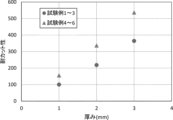
- the cut resistance was evaluated as follows. A sample with a length of 7 cm and a width of 6 cm was cut out from the rubber article of each test example and placed on a horizontal table. A weighted knife (15 kg) was placed above the sample so that the tip faced the rubber article. Thereafter, the knife was allowed to fall freely to scratch the sample. Tests were conducted while changing the height at which the knife fell, and the height at which the sample broke was determined. Using the obtained height value, the energy at which the rubber article breaks was calculated. The energy at which the rubber article of Test Example 1 broke was indexed as 100 and expressed as a cut resistance index. The results are shown in Table 2. The larger the value, the better the cut resistance. Further, the relationship between the thickness of the rubber article and the numerical value of cut resistance is shown in FIG. In FIG. 1, the horizontal axis is the thickness, and the vertical axis is the cut resistance index.
- Test Examples 4 to 6 in which syndiotactic-1,2-polybutadiene was added had better cut resistance than Test Examples 1 to 3 in which it was not added. This result is the same as the example described above. As shown in FIG. 1, in all of Test Examples 1 to 3 and 4 to 6, the cut resistance increases as the thickness increases. However, in Test Examples 4 to 6, there is a tendency for the difference in cut resistance index from Test Examples 1 to 3 to increase as the thickness increases. This indicates that when using a rubber composition containing syndiotactic-1,2-polybutadiene, the increase in cut resistance is due to contributions other than the effect of thickness, that is, the components of the rubber composition themselves. It shows.
Landscapes
- Chemical & Material Sciences (AREA)
- Health & Medical Sciences (AREA)
- Chemical Kinetics & Catalysis (AREA)
- Medicinal Chemistry (AREA)
- Polymers & Plastics (AREA)
- Organic Chemistry (AREA)
- Engineering & Computer Science (AREA)
- Mechanical Engineering (AREA)
- Compositions Of Macromolecular Compounds (AREA)
- Tires In General (AREA)
Abstract
Description
また、近年、低燃費化及び軽量化のため、ORRタイヤにおいて薄ゲージ化が進められている。しかしながら、サイドゴムが薄くなるほど、耐カット性が低下する傾向がある。
耐カット性を向上させるために、シンジオタクチック-1,2-ポリブタジエンを配合したゴム組成物を用いることが知られている(特許文献1等)。
本発明は上記課題に鑑みなされたものであり、優れた低発熱性と耐カット性とを両立することができるゴム物品、及び、該ゴム物品を用いたタイヤを提供することを目的とする。
[1]ゴム成分と、シンジオタクチック-1,2-ポリブタジエンとを含むゴム組成物の加硫物であり、前記ゴム成分が、30質量%以上70質量%以下の天然ゴムと、30質量%以上70質量%以下のブタジエンゴムとを含み、前記シンジオタクチック-1,2-ポリブタジエンの割合が、前記ゴム成分100質量部に対して5質量部以上40質量部以下であり、厚みが3mm以上である、ゴム物品。
[2]前記シンジオタクチック-1,2-ポリブタジエンの割合が、前記ゴム成分100質量部に対して22質量部以上30質量部以下である、[1]に記載のゴム物品。
[3]前記シンジオタクチック-1,2-ポリブタジエンの融点が、123℃以下である、[1]または[2]に記載のゴム物品。
[5]前記ゴム物品をサイドゴムに用いた[4]に記載のタイヤ。
また、質量部及び質量%は、それぞれ、重量部及び重量%と同義である。
本明細書に記載されている化合物は、部分的に、又は全てが 化石資源由来であってもよく、植物資源等の生物資源由来であってもよく、使用済タイヤ等の再生資源由来であってもよい。また、化石資源、生物資源、再生資源のいずれか2つ以上の混合物由来であってもよい。
本発明のゴム物品は、ゴム成分と、シンジオタクチック-1,2-ポリブタジエンとを含むゴム組成物の加硫物であり、前記ゴム成分が、30質量%以上70質量%以下の天然ゴムと、30質量%以上70質量%以下のブタジエンゴムとを含み、前記シンジオタクチック-1,2-ポリブタジエンの割合が、前記ゴム成分100質量部に対して5質量部以上40質量部以下であり、厚みが3mm以上である。
通常、ゴム物品の厚みが増すに従い耐カット性が向上する傾向がある。また、シンジオタクチック-1,2-ポリブタジエンをゴム組成物に配合する場合、得られるゴム物品の耐カット性が向上する傾向がある。しかし、本発明者の検討の結果、上述したゴム組成物から得たゴム物品の場合、シンジオタクチック-1,2-ポリブタジエンを含まないゴム組成物から得たゴム組成物よりも、厚みの増加による耐カット性の向上が顕著であることが判明した。すなわち、上述したゴム組成物から得たゴム物品の場合は、シンジオタクチック-1,2-ポリブタジエンによる耐カット性向上効果と、ゴム物品の厚さによる耐カット性向上効果とが重畳されることを判明した。この理由は定かではないが、ゴム成分と、ゴム成分に対するシンジオタクチック-1,2-ポリブタジエンとの配合量のバランスによる相乗効果と考えられる。すなわち、本発明は、上述のゴム組成物の加硫物からなり、厚みが3mm以上であるゴム物品とすることにより、今までの知見から予測できる範疇を超えた優れた耐カット性を得るものである。
以下、本発明のゴム物品に用いられるゴム組成物について詳細に説明する。
<ゴム成分>
ゴム組成物は、ゴム成分と、シンジオタクチック-1,2-ポリブタジエンとを含む。ゴム成分は、30質量%以上70質量%以下の天然ゴムと、30質量%以上70質量%以下のブタジエンゴムとを含む。ポリブタジエンゴムの種類としては特に制限はない。例えば、ポリブタジエンゴムは、変性ブタジエンゴムであっても良く、未変性のブタジエンゴムであっても良い。
また、天然ゴムの配合量をゴム成分中70質量%以下とすることにより、低発熱性に優れるゴム物品を得ることができるとともに、ゴム物品の耐オゾン性を向上させることができる。低発熱性と耐オゾン性の観点から、天然ゴムの配合量は、65質量%以下であることが好ましく、60質量%以下であることがより好ましい。
また、ブタジエンゴムの配合量をゴム成分中70質量%以下とすることにより、ゴム物品の耐カット性及び耐亀裂進展性を向上させることができる。耐カット性及び耐亀裂進展性の観点から、ブタジエンゴムの配合量は、65質量%以下であることが好ましく、60質量%以下であることがより好ましい。
なお、本発明においては、示差走査熱量測定(DSC)装置内にシンジオタクチック1,2-ポリブタジエンのサンプルを入れ、10℃/分の昇温速度で昇温してDSC曲線を取得し、該DSC曲線の融解ピーク温度を、「融点」とする。
なお、重量平均分子量(Mw)は、ゲルパーミエーションクロマトグラフィー(GPC)により、ポリスチレンを標準物質として求める。
なお、結晶化度は、結晶化度0%の1,2-ポリブタジエンの密度を0.889g/cm3、結晶化度100%の1,2-ポリブタジエンの密度を0.963g/cm3として、水中置換法により測定した密度から換算して算出する。
なお、1,2-結合含有量は、シンジオタクチック-1,2-ポリブタジエンの1H及び13C核磁気共鳴(NMR)分析により求める。
本発明に用いられるゴム組成物は、ゴム組成物を補強する充填剤を含有する。ゴム組成物が充填剤を含有することで、ゴム製品の耐破壊特性など、強度を上げることができる。
ゴム組成物は、充填剤としてカーボンブラックを含有することが好ましい。また、本発明のゴム組成物は、カーボンブラック以外に、シリカ、及び、無機充填剤を含んでいてもよい。無機充填剤としては、クレー、タルク、炭酸カルシウム、水酸化アルミニウム等が挙げられる。
カーボンブラックとしては、特に限定されるものではなく、例えば、GPF、FEF、HAF、ISAF、SAFグレードのカーボンブラックが挙げられる。これらカーボンブラックは、一種単独で使用してもよいし、二種以上を併用してもよい。
カーボンブラックの窒素吸着比表面積(N2SA、JIS K 6217-2:2001に準拠して測定する)は、低発熱性の観点から120m2/g以下であることが好ましく、100m2/g以下であることがより好ましい。また、耐久性の観点から、カーボンブラックの窒素吸着比表面積は、40m2/g以上であることが好ましく、50m2/g以上であることがより好ましい。カーボンブラックは、上述したものから1種を単独で用いてもよく、2種以上を組み合わせて用いてもよい。
カーボンブラックの含有量は、ゴム成分100質量部に対して、耐久性の観点から20質量部以上であることが好ましく、25質量部以上であることがより好ましく、30質量部以上であることが更に好ましい。また、発熱性の観点から、カーボンブラックの含有量は、70質量部以下であることが好ましく、60質量部以下であることがより好ましく、55質量部以下であることが更に好ましい。
本発明に用いられるゴム組成物は、必要に応じて、無機充填材が含まれていてもよい。無機充填材として、シリカ、及び、アルミニウム、マグネシウム、チタン、カルシウム及びジルコニウムから選ばれる少なくとも1つの金属、金属酸化物又は金属水酸化物が挙げられる。中でも、補強性の高いシリカが好ましい。シリカの種類は特に制限はなく、例えば、湿式シリカ(含水ケイ酸)、乾式シリカ(無水ケイ酸)、ケイ酸カルシウム、ケイ酸アルミニウム等が挙げられ、これらの中でも、湿式シリカが好ましい。これらシリカは、一種単独で使用してもよいし、二種以上を併用してもよい。
本発明に係るゴム組成物は、シリカを含む無機充填材が配合される場合には、ゴム組成物の補強性及び低燃費性を更に向上させる目的で、シランカップリッグ剤を配合してもよい。
無機充填材の含有量は、発熱性の観点から、ゴム成分100質量部に対して、80質量部以下であることが好ましく、75質量部以下であることがより好ましく、70質量部以下であることが更に好ましい。
本発明に用いられるゴム組成物は、本発明の効果が損なわれない範囲で、必要に応じて、ゴム工業界で通常使用される各種成分、例えば、ステアリン酸、老化防止剤、酸化亜鉛、加硫促進剤、加硫剤、樹脂、オイル等を含有していてもよい。これら各種成分としては、市販品を好適に使用することができる。
本発明のゴム物品は、低発熱性及び耐カット性に優れるものである。本発明のゴム物品は、タイヤ、コンベアベルトなどに適用することができる。
中でも、本発明のゴム物品は、タイヤに適用されることが好ましく、タイヤのサイドゴムに適用されることがより好ましい。本発明のゴム物品が適用されるタイヤとしては、ORR(オフロードラジアル)タイヤ、トラック用タイヤなどの大型車両用のタイヤが挙げられる。中でも、ORRタイヤに適用されることが好ましい。
本発明のゴム物品がタイヤのサイドゴムに適用される場合、タイヤサイド部において、トータルゲージの一番薄い箇所の厚みが3mm以上であることが好ましく、4mm以上であることがより好ましく、5mm以上であることが更に好ましい。なお、サイドゴムの厚みが厚くなるほど、重量が増し燃費が悪くなる虞があり、また、使用するゴムの量も増大する。軽量化及びゴムの使用量低減のため、サイドゴムの厚みは30mm以下であることが好ましい。
本発明のゴム物品は、以下の方法により製造することができる。
まず、上述したゴム組成物の各成分を配合し、混練して、ゴム組成物を調製する。混練には、バンバリーミキサー、ロール、インターナルミキサー等の混練機を使用することができる。各成分の混練は、全一段階で行ってもよく、二段階以上に分けて行ってもよい。
その後、ゴム組成物を加硫してゴム物品を得る。この場合、未加硫のゴム組成物を成形した後に加硫してもよく、予備加硫工程等を経た半加硫ゴムを成形後に本加硫してもよい。
本発明のゴム物品がタイヤに適用される場合、本発明のゴム物品を他のゴム部材とともに積層して生タイヤを成形し、当該生タイヤを加硫することで、タイヤを製造する。加硫温度は、100~145℃で行うことが好ましい。
下記表1に示す配合組成で各成分を混練し、ゴム組成物を調製した。表1中の配合処方の数値の単位は質量部である。調製したゴム組成物を、145℃または110℃で加硫して、実施例及び比較例のゴム物品を得た。
なお、表中の成分の詳細は以下のとおりである。
NR:天然ゴム、TSR#20
BR:ブタジエンゴム、UBEエラストマー(株)、VCR450
sPB1:シンジオタクチック-1,2-ポリブタジエン、JSR(株)製、商品名「RB830」、融点:105℃
sPB2:シンジオタクチック-1,2-ポリブタジエン、JSR(株)製、商品名「RB840」、融点:126℃
カーボンブラック:旭カーボン(株)製、HAF
硫黄(加硫剤):細井化学工業(株)製、HK-200-5
TBBS(加硫促進剤):N-(t-ブチル)-2-ベンゾチアゾールスルフェンアミド、三新化学工業(株)製、商品名「サンセラーNS-G」
145℃で加硫したゴム物品を用いて、発熱性の評価を行った。株式会社上島製作所製スペクトロメーターを用いて、初期荷重1600mN、歪2%、周波数52Hzの条件下で、25℃における各ゴム物品のtanδ(損失正接)を測定した。比較例1のゴム物品のtanδを100として指数化し、発熱性指数として表した。結果を表1に示す。数値が小さい程、低発熱性であることを示す。
145℃で加硫したゴム物品を用いて、下記の耐カット性の評価を行った。
実施例及び比較例のゴム物品から、厚さ5cm、長さ15cm、幅10cmのサンプルを切り出し、水平の台に載置した。サンプルの40cm上方に、重り(26kg)を付けた刃物を先端がサンプルに向くように配置した。その後、刃物を自由落下させて、サンプルに傷をつけた。傷に平行となる向きにサンプルをカットした後、傷の深さを測定した。比較例1のゴム物品についた傷の深さの逆数を100として指数化し、耐カット性指数として表した。結果を表1に示す。数値が大きい程、耐カット性に優れることを示す。
比較例1、実施例2及び4について、110℃で加硫したゴム物品と145℃で加硫したゴム物品の2種類を用意した。各ゴム物品からJIS3号試験片を作製した。試験片中心部に、試験片の長さ方向に0.5mmの亀裂を入れた。引張試験装置(島津製作所社製)を用い、雰囲気温度80℃の条件で、試験片の長さ方向に0%から70%の歪み範囲で繰り返し応力を与え、試験片が切断するまでの回数を測定した。比較例1のゴム組成物を145℃で加硫したゴム物品から作製した試験片での結果を100として、それぞれの結果を指数表示した。結果を表1に示す。数値が大きい程、耐亀裂進展性が良好であることを示す。

加硫温度を110℃とした場合、実施例4(シンジオタクチック-1,2-ポリブタジエンの融点が126℃)は十分な耐亀裂進展性が得られなかった。これに対し、実施例2(シンジオタクチック-1,2-ポリブタジエンの融点が105℃)では、比較例1に対して耐亀裂進展性が向上した。また、加硫温度を145℃とした場合、実施例2及び実施例4のいずれも、比較例1に対して耐亀裂進展性が向上した。このように、加硫温度がシンジオタクチック-1,2-ポリブタジエンの融点より高い場合、より優れた耐亀裂進展性が得られた。
下記表2に示す配合組成で各成分を混練し、ゴム組成物を調製した。表中の配合処方の数値の単位は質量部である。調製したゴム組成物を、145℃で加硫して、試験例1~6のゴム物品を得た。各試験例のゴム物品の厚みを表2に示す。
なお、表中の成分の詳細は以下のとおりである。
NR:天然ゴム、RSS#1
sPB2:シンジオタクチック-1,2-ポリブタジエン、JSR(株)製、商品名「RB840」融点:126℃
カーボンブラック:HAFグレード、N2SA:66m2/g、DBP:103ml/100g
硫黄(加硫剤):細井化学工業(株)製、HK-200-5
CZ(加硫促進剤):N-シクロヘキシル-2-ベンゾチアゾリルスルフェンアミド、大内新興化学工業(株)製、商品名「ノクセラーCZ」
各試験例のゴム物品から、長さ7cm、幅6cmのサンプルを切り出し、水平の台に載置した。サンプル上方に、重り(15kg)を付けた刃物を先端がゴム物品に向くように配置した。その後、刃物を自由落下させ、サンプルに傷をつけた。刃物が落下する高さを変えながら試験を行い、サンプルが破断したときの高さを得た。得られた高さの値を用い、ゴム物品が破断するエネルギーを算出した。試験例1のゴム物品が破断したエネルギーを100として指数化し、耐カット性指数として表した。結果を表2に示す。数値が大きい程、耐カット性に優れることを示す。
また、ゴム物品の厚みと耐カット性の数値の関係を、図1に示した。図1において、横軸は厚み、縦軸は耐カット性の耐カット性指数である。

図1に示すように、試験例1~3、4~6のいずれも、厚みが増大するに従い耐カット性が上昇する。しかし、試験例4~6は、厚みが増すに従い、試験例1~3との耐カット性指数の差が開く傾向が見られる。これは、シンジオタクチック-1,2-ポリブタジエンを含むゴム組成物を用いた場合、耐カット性の上昇が、厚みによる効果以外の寄与、すなわち、ゴム組成物の成分自体による寄与もあることを示している。ゴム物品の厚みが3mm以上であることにより、ゴム組成物の成分の寄与による耐カット性上昇効果を得ることができると言える。
表2及び図1に示した傾向は、ゴム成分にポリブタジエンを更に含み、本願の配合比率を満たすゴム組成物を用いる場合にも同様に表れると予想される。また、表2及び図1に示した傾向は、加硫ゴム中のシンジオタクチック-1,2-ポリブタジエンの結合量に影響される。このため、表2に記載のシンジオタクチック-1,2-ポリブタジエンとは異なる種類のシンジオタクチック-1,2-ポリブタジエンを用いた場合でも、同じ傾向を示すと言える。
Claims (7)
- ゴム成分と、シンジオタクチック-1,2-ポリブタジエンとを含むゴム組成物の加硫物であり、
前記ゴム成分が、30質量%以上70質量%以下の天然ゴムと、30質量%以上70質量%以下のブタジエンゴムとを含み、
前記シンジオタクチック-1,2-ポリブタジエンの割合が、前記ゴム成分100質量部に対して5質量部以上40質量部以下であり、
厚みが3mm以上である、ゴム物品。 - 前記シンジオタクチック-1,2-ポリブタジエンの割合が、前記ゴム成分100質量部に対して22質量部以上30質量部以下である、請求項1に記載のゴム物品。
- 前記シンジオタクチック-1,2-ポリブタジエンの融点が、123℃以下である、請求項1または請求項2に記載のゴム物品。
- 請求項1または請求項2に記載の前記ゴム物品を用いたタイヤ。
- 請求項3に記載の前記ゴム物品を用いたタイヤ。
- 前記ゴム物品をサイドゴムに用いた請求項4に記載のタイヤ。
- 前記ゴム物品をサイドゴムに用いた請求項5に記載のタイヤ。
Priority Applications (3)
| Application Number | Priority Date | Filing Date | Title |
|---|---|---|---|
| EP22941754.8A EP4524191A4 (en) | 2022-05-12 | 2022-10-07 | RUBBER ARTICLE AND TIRE COMPRISING IT |
| US18/857,177 US20250270391A1 (en) | 2022-05-12 | 2022-10-07 | Rubber article and tire including same |
| AU2022458043A AU2022458043A1 (en) | 2022-05-12 | 2022-10-07 | Rubber article and tire including same |
Applications Claiming Priority (2)
| Application Number | Priority Date | Filing Date | Title |
|---|---|---|---|
| JP2022-078662 | 2022-05-12 | ||
| JP2022078662A JP2023167464A (ja) | 2022-05-12 | 2022-05-12 | ゴム物品、及びこれを用いたタイヤ |
Publications (1)
| Publication Number | Publication Date |
|---|---|
| WO2023218678A1 true WO2023218678A1 (ja) | 2023-11-16 |
Family
ID=88729941
Family Applications (1)
| Application Number | Title | Priority Date | Filing Date |
|---|---|---|---|
| PCT/JP2022/037631 Ceased WO2023218678A1 (ja) | 2022-05-12 | 2022-10-07 | ゴム物品、及びこれを用いたタイヤ |
Country Status (5)
| Country | Link |
|---|---|
| US (1) | US20250270391A1 (ja) |
| EP (1) | EP4524191A4 (ja) |
| JP (1) | JP2023167464A (ja) |
| AU (1) | AU2022458043A1 (ja) |
| WO (1) | WO2023218678A1 (ja) |
Families Citing this family (1)
| Publication number | Priority date | Publication date | Assignee | Title |
|---|---|---|---|---|
| WO2025178032A1 (ja) * | 2024-02-20 | 2025-08-28 | 株式会社ブリヂストン | ゴム組成物、タイヤ及びゴム製品 |
Citations (5)
| Publication number | Priority date | Publication date | Assignee | Title |
|---|---|---|---|---|
| JPH08333483A (ja) * | 1995-06-08 | 1996-12-17 | Yokohama Rubber Co Ltd:The | タイヤ用ゴム組成物 |
| JP2005075952A (ja) * | 2003-09-01 | 2005-03-24 | Sumitomo Rubber Ind Ltd | タイヤサイド部補強用ゴム組成物およびそれを用いたランフラットタイヤ |
| JP2005133017A (ja) * | 2003-10-31 | 2005-05-26 | Yokohama Rubber Co Ltd:The | サイドウォール用ゴム組成物 |
| JP2007186550A (ja) * | 2006-01-11 | 2007-07-26 | Sumitomo Rubber Ind Ltd | タイヤサイド部補強用ゴム組成物およびランフラットタイヤ |
| WO2014003052A1 (ja) * | 2012-06-29 | 2014-01-03 | Jsr株式会社 | ゴム組成物、サイドウォールおよびタイヤ |
Family Cites Families (6)
| Publication number | Priority date | Publication date | Assignee | Title |
|---|---|---|---|---|
| JP4081182B2 (ja) * | 1998-07-08 | 2008-04-23 | 住友ゴム工業株式会社 | ビード部補強用ゴム組成物 |
| JP4561046B2 (ja) * | 2003-05-23 | 2010-10-13 | 横浜ゴム株式会社 | コンベヤベルト用ゴム組成物およびコンベヤベルト |
| JP5101830B2 (ja) * | 2006-04-03 | 2012-12-19 | 住友ゴム工業株式会社 | ブレーカートッピング用ゴム組成物 |
| JP2009127001A (ja) * | 2007-11-27 | 2009-06-11 | Sumitomo Rubber Ind Ltd | ベーストレッド用ゴム組成物 |
| JP6069044B2 (ja) * | 2013-03-12 | 2017-01-25 | 住友ゴム工業株式会社 | ベーストレッド用ゴム組成物及び空気入りタイヤ |
| CN104311908A (zh) * | 2014-11-20 | 2015-01-28 | 三角轮胎股份有限公司 | 含1,2-间规聚丁二烯的胎侧橡胶组合物 |
-
2022
- 2022-05-12 JP JP2022078662A patent/JP2023167464A/ja active Pending
- 2022-10-07 US US18/857,177 patent/US20250270391A1/en active Pending
- 2022-10-07 WO PCT/JP2022/037631 patent/WO2023218678A1/ja not_active Ceased
- 2022-10-07 EP EP22941754.8A patent/EP4524191A4/en active Pending
- 2022-10-07 AU AU2022458043A patent/AU2022458043A1/en active Pending
Patent Citations (5)
| Publication number | Priority date | Publication date | Assignee | Title |
|---|---|---|---|---|
| JPH08333483A (ja) * | 1995-06-08 | 1996-12-17 | Yokohama Rubber Co Ltd:The | タイヤ用ゴム組成物 |
| JP2005075952A (ja) * | 2003-09-01 | 2005-03-24 | Sumitomo Rubber Ind Ltd | タイヤサイド部補強用ゴム組成物およびそれを用いたランフラットタイヤ |
| JP2005133017A (ja) * | 2003-10-31 | 2005-05-26 | Yokohama Rubber Co Ltd:The | サイドウォール用ゴム組成物 |
| JP2007186550A (ja) * | 2006-01-11 | 2007-07-26 | Sumitomo Rubber Ind Ltd | タイヤサイド部補強用ゴム組成物およびランフラットタイヤ |
| WO2014003052A1 (ja) * | 2012-06-29 | 2014-01-03 | Jsr株式会社 | ゴム組成物、サイドウォールおよびタイヤ |
Non-Patent Citations (1)
| Title |
|---|
| See also references of EP4524191A4 * |
Also Published As
| Publication number | Publication date |
|---|---|
| JP2023167464A (ja) | 2023-11-24 |
| EP4524191A1 (en) | 2025-03-19 |
| EP4524191A4 (en) | 2025-10-08 |
| AU2022458043A1 (en) | 2024-11-07 |
| US20250270391A1 (en) | 2025-08-28 |
Similar Documents
| Publication | Publication Date | Title |
|---|---|---|
| US8637599B2 (en) | Rubber composition for inner liner and tire having inner liner including thereof | |
| JP5478816B2 (ja) | タイヤ用ゴム組成物 | |
| EP2019125B1 (en) | Rubber composition and run flat tire using the same | |
| EP4005820A1 (en) | Rubber composition for tire and tire | |
| EP3385091A1 (en) | Rubber composition and tire | |
| JP4540435B2 (ja) | サイドウォール用ゴム組成物およびそれからなるサイドウォールを有する空気入りタイヤ | |
| JP5286642B2 (ja) | タイヤ用ゴム組成物及びそれを用いた空気入りタイヤ | |
| WO2023218678A1 (ja) | ゴム物品、及びこれを用いたタイヤ | |
| JP7040159B2 (ja) | タイヤ用ゴム組成物 | |
| EP1466943A2 (en) | Rubber composition for sidewall and pneumatic tire using the same | |
| EP3381713B1 (en) | Rubber composition and tire | |
| JP2008156446A (ja) | 特定のタイヤ部材用ゴム組成物およびそれを用いたタイヤ | |
| JP5313743B2 (ja) | インナーライナー用ゴム組成物及びタイヤ | |
| JP2009242577A (ja) | ジエン系ゴム組成物 | |
| JP7040160B2 (ja) | タイヤ用ゴム組成物 | |
| JP7040157B2 (ja) | タイヤ用ゴム組成物 | |
| CN101104710B (zh) | 包覆胎体帘线用橡胶组合物及胎体使用该组合物的轮胎 | |
| JP2013155308A (ja) | キャップトレッド、ベーストレッド、サイドウォール、カーカス、クリンチ又はビードエイペックス用ゴム組成物及び空気入りタイヤ | |
| JP4755051B2 (ja) | ゴム組成物 | |
| JP7040158B2 (ja) | タイヤ用ゴム組成物 | |
| JP2007302715A (ja) | ゴム組成物および空気入りタイヤ | |
| JP7040161B2 (ja) | タイヤ用ゴム組成物 | |
| JP2009256514A (ja) | ゴム組成物及び空気バネ | |
| JP2007269872A (ja) | サイドウォール用ゴム組成物およびそれを用いたタイヤ、ならびにクリンチ用ゴム組成物およびそれを用いたタイヤ | |
| JP2009155485A (ja) | ジエン系ゴム組成物 |
Legal Events
| Date | Code | Title | Description |
|---|---|---|---|
| 121 | Ep: the epo has been informed by wipo that ep was designated in this application |
Ref document number: 22941754 Country of ref document: EP Kind code of ref document: A1 |
|
| WWE | Wipo information: entry into national phase |
Ref document number: AU2022458043 Country of ref document: AU |
|
| ENP | Entry into the national phase |
Ref document number: 2022458043 Country of ref document: AU Date of ref document: 20221007 Kind code of ref document: A |
|
| WWE | Wipo information: entry into national phase |
Ref document number: 2022941754 Country of ref document: EP |
|
| NENP | Non-entry into the national phase |
Ref country code: DE |
|
| ENP | Entry into the national phase |
Ref document number: 2022941754 Country of ref document: EP Effective date: 20241212 |
|
| WWP | Wipo information: published in national office |
Ref document number: 18857177 Country of ref document: US |