WO2023218678A1 - Article en caoutchouc et pneu le comprenant - Google Patents
Article en caoutchouc et pneu le comprenant Download PDFInfo
- Publication number
- WO2023218678A1 WO2023218678A1 PCT/JP2022/037631 JP2022037631W WO2023218678A1 WO 2023218678 A1 WO2023218678 A1 WO 2023218678A1 JP 2022037631 W JP2022037631 W JP 2022037631W WO 2023218678 A1 WO2023218678 A1 WO 2023218678A1
- Authority
- WO
- WIPO (PCT)
- Prior art keywords
- rubber
- mass
- polybutadiene
- syndiotactic
- parts
- Prior art date
- Legal status (The legal status is an assumption and is not a legal conclusion. Google has not performed a legal analysis and makes no representation as to the accuracy of the status listed.)
- Ceased
Links
Images
Classifications
-
- C—CHEMISTRY; METALLURGY
- C08—ORGANIC MACROMOLECULAR COMPOUNDS; THEIR PREPARATION OR CHEMICAL WORKING-UP; COMPOSITIONS BASED THEREON
- C08L—COMPOSITIONS OF MACROMOLECULAR COMPOUNDS
- C08L7/00—Compositions of natural rubber
-
- B—PERFORMING OPERATIONS; TRANSPORTING
- B60—VEHICLES IN GENERAL
- B60C—VEHICLE TYRES; TYRE INFLATION; TYRE CHANGING; CONNECTING VALVES TO INFLATABLE ELASTIC BODIES IN GENERAL; DEVICES OR ARRANGEMENTS RELATED TO TYRES
- B60C1/00—Tyres characterised by the chemical composition or the physical arrangement or mixture of the composition
- B60C1/0025—Compositions of the sidewalls
-
- C—CHEMISTRY; METALLURGY
- C08—ORGANIC MACROMOLECULAR COMPOUNDS; THEIR PREPARATION OR CHEMICAL WORKING-UP; COMPOSITIONS BASED THEREON
- C08L—COMPOSITIONS OF MACROMOLECULAR COMPOUNDS
- C08L9/00—Compositions of homopolymers or copolymers of conjugated diene hydrocarbons
-
- B—PERFORMING OPERATIONS; TRANSPORTING
- B60—VEHICLES IN GENERAL
- B60C—VEHICLE TYRES; TYRE INFLATION; TYRE CHANGING; CONNECTING VALVES TO INFLATABLE ELASTIC BODIES IN GENERAL; DEVICES OR ARRANGEMENTS RELATED TO TYRES
- B60C13/00—Tyre sidewalls; Protecting, decorating, marking, or the like, thereof
- B60C2013/005—Physical properties of the sidewall rubber
- B60C2013/007—Thickness
Definitions
- the present invention relates to a rubber article and a tire using the same, and particularly to a rubber article that can be applied to side rubber of tires used for construction vehicles, mining vehicles, etc.
- the present invention was made in view of the above problems, and an object of the present invention is to provide a rubber article that can have both excellent low heat generation property and cut resistance, and a tire using the rubber article.
- the present invention provides the following [1] to [5].
- [1] A vulcanized product of a rubber composition containing a rubber component and syndiotactic-1,2-polybutadiene, in which the rubber component contains natural rubber of 30% by mass or more and 70% by mass or less, and 30% by mass and 70% by mass or less of butadiene rubber, the proportion of the syndiotactic-1,2-polybutadiene is 5 parts by mass or more and 40 parts by mass or less based on 100 parts by mass of the rubber component, and the thickness is 3 mm or more. , rubber articles.
- the present invention it is possible to obtain a rubber article that can have both excellent low heat generation properties and cut resistance. Further, by applying the rubber article of the present invention, a tire exhibiting excellent low heat generation property and cut resistance can be obtained.
- the rubber article of the present invention is a vulcanized product of a rubber composition containing a rubber component and syndiotactic-1,2-polybutadiene, wherein the rubber component is 30% by mass or more and 70% by mass or less of natural rubber. , 30% by mass or more and 70% by mass or less of butadiene rubber, and the proportion of the syndiotactic-1,2-polybutadiene is 5 parts by mass or more and 40 parts by mass or less based on 100 parts by mass of the rubber component, The thickness is 3 mm or more.
- the rubber article of the present invention exhibits excellent low heat generation properties because it is a vulcanized product of a rubber composition containing the above-mentioned rubber component.
- a rubber article increases, its cut resistance tends to improve.
- syndiotactic-1,2-polybutadiene is blended into a rubber composition, the cut resistance of the resulting rubber article tends to improve.
- the thickness increased more than the rubber composition obtained from a rubber composition not containing syndiotactic-1,2-polybutadiene. It was found that the cut resistance was significantly improved.
- the present invention provides a rubber article that is made of a vulcanized product of the above-mentioned rubber composition and has a thickness of 3 mm or more, thereby obtaining excellent cut resistance that exceeds the range that can be predicted from the knowledge obtained so far. It is.
- the rubber composition includes a rubber component and syndiotactic-1,2-polybutadiene.
- the rubber component contains natural rubber of 30% by mass or more and 70% by mass or less, and butadiene rubber of 30% by mass or more and 70% by mass or less.
- the polybutadiene rubber may be a modified butadiene rubber or an unmodified butadiene rubber.
- the cut resistance and crack growth resistance of the rubber article can be improved.
- the amount of natural rubber blended is preferably 35% by mass or more, and more preferably 40% by mass or more.
- the amount of natural rubber blended is preferably 65% by mass or less, more preferably 60% by mass or less.
- the ozone resistance of the rubber article can be improved.
- the content of butadiene rubber is preferably 35% by mass or more, more preferably 40% by mass or more.
- the amount of butadiene rubber is preferably 70% by mass or less in the rubber component, the cut resistance and crack growth resistance of the rubber article can be improved.
- the amount of butadiene rubber blended is preferably 65% by mass or less, more preferably 60% by mass or less.
- diene rubbers other than natural rubber and butadiene rubber may be included as long as they do not impede the performance (low heat build-up and cut resistance) required of the rubber article of the present invention.
- Other diene rubbers include polyisoprene rubber (IR), styrene-butadiene copolymer rubber (SBR), butyl rubber (IIR), ethylene-propylene-diene copolymer (EPDM), acrylonitrile-butadiene copolymer ( NBR), etc.
- the amount of other diene rubbers in the rubber component is preferably 40% by mass or less, more preferably 30% by mass or less, and even more preferably 20% by mass or less.
- the rubber composition contains syndiotactic-1,2-polybutadiene in an amount of 5 parts by mass or more and 40 parts by mass or less based on 100 parts by mass of the rubber component. If the amount of syndiotactic-1,2-polybutadiene is less than 5 parts by mass, sufficient bonds will not be formed in the vulcanized rubber, making it impossible to obtain sufficient cut resistance and low heat build-up. On the other hand, if the blending amount of syndiotactic-1,2-polybutadiene exceeds 40 parts by mass, the flexibility of the rubber decreases, which not only makes it impossible to obtain sufficient cut resistance and low heat generation properties, but also This is not preferable because it also reduces crack propagation.
- the blending amount of syndiotactic-1,2-polybutadiene is preferably 22 parts by mass or more and 30 parts by mass or less, and 24 parts by mass or more and 28 parts by mass or less. It is more preferable that
- the melting point of the syndiotactic-1,2-polybutadiene is lower than the vulcanization temperature, the syndiotactic-1,2-polybutadiene is more likely to be uniformly dispersed in the rubber component during vulcanization. As a result, the physical properties of the rubber product after vulcanization, particularly the crack resistance, can be improved.
- the melting point of syndiotactic-1,2-polybutadiene is preferably 123°C or lower, more preferably 120°C or lower.
- the melting point of syndiotactic-1,2-polybutadiene is preferably 95°C or higher, more preferably 100°C or higher.
- a sample of syndiotactic 1,2-polybutadiene is placed in a differential scanning calorimetry (DSC) device, heated at a rate of 10°C/min to obtain a DSC curve, and The melting peak temperature of the DSC curve is defined as the "melting point.”
- the syndiotactic-1,2-polybutadiene preferably has a weight average molecular weight (Mw) of 100,000 to 750,000, more preferably 120,000 to 750,000, and more preferably 140,000 to 750. ,000 is more preferable.
- Mw weight average molecular weight
- the weight average molecular weight (Mw) is within the above range, a rubber product with excellent cut resistance and low heat build-up can be obtained, and the workability is also good.
- the weight average molecular weight (Mw) is determined by gel permeation chromatography (GPC) using polystyrene as a standard substance.
- the crystallinity of syndiotactic-1,2-polybutadiene is preferably from 25 to 80%, more preferably from 25 to 70%, even more preferably from 25 to 50%.
- syndiotactic-1,2-polybutadiene having the above crystallinity it is possible to achieve both excellent cut resistance and low heat build-up.
- the crystallinity is determined by assuming that the density of 1,2-polybutadiene with a crystallinity of 0% is 0.889 g/cm 3 and the density of 1,2-polybutadiene with a crystallinity of 100% is 0.963 g/cm 3 . Calculated by converting the density measured by the underwater displacement method.
- the syndiotactic-1,2-polybutadiene has a 1,2-bond content of preferably 60% by mass or more, more preferably 70% by mass or more, and even more preferably 80% by mass or more. preferable. Note that the 1,2-bond content is determined by 1 H and 13 C nuclear magnetic resonance (NMR) analysis of syndiotactic-1,2-polybutadiene.
- Syndiotactic-1,2-polybutadiene applicable to the present invention is manufactured by JSR Corporation under the trade name "RB840" (melting point: 126°C, crystallinity: 36%, 1,2 bond content: 94% by mass). ), trade name “RB830” (melting point: 105°C, crystallinity: 29%, 1,2 bond content: 93% by mass). Among them, it is preferable to use the product name "RB830".
- the rubber composition used in the present invention contains a filler that reinforces the rubber composition.
- the rubber composition preferably contains carbon black as a filler.
- the rubber composition of the present invention may contain silica and an inorganic filler in addition to carbon black. Examples of inorganic fillers include clay, talc, calcium carbonate, aluminum hydroxide, and the like.
- Carbon black is not particularly limited, and includes, for example, GPF, FEF, HAF, ISAF, and SAF grade carbon black. These carbon blacks may be used alone or in combination of two or more.
- the nitrogen adsorption specific surface area (N 2 SA, measured according to JIS K 6217-2:2001) of carbon black is preferably 120 m 2 /g or less, and 100 m 2 /g or less from the viewpoint of low heat generation. It is more preferable that Further, from the viewpoint of durability, the nitrogen adsorption specific surface area of carbon black is preferably 40 m 2 /g or more, more preferably 50 m 2 /g or more.
- the content of carbon black is preferably 20 parts by mass or more, more preferably 25 parts by mass or more, and preferably 30 parts by mass or more, based on 100 parts by mass of the rubber component. More preferred. Further, from the viewpoint of exothermic properties, the content of carbon black is preferably 70 parts by mass or less, more preferably 60 parts by mass or less, and even more preferably 55 parts by mass or less.
- the rubber composition used in the present invention may contain an inorganic filler, if necessary.
- the inorganic filler include silica and at least one metal, metal oxide, or metal hydroxide selected from aluminum, magnesium, titanium, calcium, and zirconium. Among them, silica with high reinforcing properties is preferred.
- the type of silica is not particularly limited, and examples thereof include wet silica (hydrated silicic acid), dry silica (anhydrous silicic acid), calcium silicate, aluminum silicate, etc. Among these, wet silica is preferred. These silicas may be used alone or in combination of two or more.
- a silane coupling agent may be blended in order to further improve the reinforcing properties and fuel efficiency of the rubber composition.
- the content of the inorganic filler is preferably 80 parts by mass or less, more preferably 75 parts by mass or less, and 70 parts by mass or less with respect to 100 parts by mass of the rubber component. More preferably.
- the rubber composition used in the present invention may optionally contain various ingredients commonly used in the rubber industry, such as stearic acid, anti-aging agents, zinc oxide, and additives, as long as the effects of the present invention are not impaired. It may contain a sulfur accelerator, a vulcanizing agent, a resin, an oil, etc. As these various components, commercially available products can be suitably used.
- the rubber article of the present invention has excellent low heat build-up and cut resistance.
- the rubber article of the present invention can be applied to tires, conveyor belts, etc.
- the rubber article of the present invention is preferably applied to tires, and more preferably applied to side rubber of tires.
- Examples of tires to which the rubber article of the present invention is applied include tires for large vehicles such as ORR (off-road radial) tires and truck tires. Among these, it is preferable to apply it to ORR tires.
- the rubber article of the present invention needs to have a thickness of 3 mm or more. By having a thickness of 3 mm or more, excellent cut resistance can be ensured, and by using the above-mentioned rubber composition, it is possible to obtain a greater effect of improving cut resistance than expected.
- the thickness of the rubber article is preferably 4 mm or more, more preferably 5 mm or more.
- the thickness of the thinnest part of the total gauge in the tire side portion is preferably 3 mm or more, more preferably 4 mm or more, and 5 mm or more. It is even more preferable that there be.
- the thickness of the side rubber is preferably 30 mm or less.
- the rubber article of the present invention can be manufactured by the following method. First, each component of the rubber composition described above is blended and kneaded to prepare a rubber composition. For kneading, a kneading machine such as a Banbury mixer, a roll mixer, an internal mixer, etc. can be used. The kneading of each component may be carried out in one step or may be carried out in two or more stages. Thereafter, the rubber composition is vulcanized to obtain a rubber article. In this case, an unvulcanized rubber composition may be molded and then vulcanized, or a semi-vulcanized rubber that has gone through a preliminary vulcanization process etc.
- the vulcanization temperature is preferably 100 to 145°C.
- Examples 1 to 4 Comparative Example 1
- Each component was kneaded according to the composition shown in Table 1 below to prepare a rubber composition.
- the units of numerical values in the formulations in Table 1 are parts by mass.
- the prepared rubber compositions were vulcanized at 145°C or 110°C to obtain rubber articles of Examples and Comparative Examples.
- the details of the components in the table are as follows.
- NR Natural rubber, TSR#20 BR: Butadiene rubber, UBE Elastomer Co., Ltd., VCR450 sPB1: Syndiotactic-1,2-polybutadiene, manufactured by JSR Corporation, trade name "RB830", melting point: 105°C sPB2: syndiotactic-1,2-polybutadiene, manufactured by JSR Corporation, trade name "RB840", melting point: 126°C Carbon black: manufactured by Asahi Carbon Co., Ltd., HAF Sulfur (vulcanizing agent): Hosoi Chemical Industry Co., Ltd., HK-200-5 TBBS (vulcanization accelerator): N-(t-butyl)-2-benzothiazolesulfenamide, manufactured by Sanshin Kagaku Kogyo Co., Ltd., trade name "Suncellar NS-G"
- Cut Resistance The following cut resistance was evaluated using rubber articles vulcanized at 145°C. Samples with a thickness of 5 cm, a length of 15 cm, and a width of 10 cm were cut out from the rubber articles of Examples and Comparative Examples and placed on a horizontal stand. A knife with a weight (26 kg) attached was placed 40 cm above the sample so that its tip faced the sample. The sample was then scratched by free-falling the knife. After cutting the sample in a direction parallel to the scratch, the depth of the scratch was measured. The reciprocal of the depth of the scratches on the rubber article of Comparative Example 1 was set as 100, and the index was expressed as a cut resistance index. The results are shown in Table 1. The larger the value, the better the cut resistance.
- Example 1 As shown in Table 1, by adding syndiotactic-1,2-polybutadiene, a rubber article with low heat build-up and excellent cut resistance was obtained. In particular, Examples 2 and 3 showed superior low heat build-up and cut resistance to Examples 1 and 4. When the vulcanization temperature was 110°C, sufficient crack growth resistance was not obtained in Example 4 (melting point of syndiotactic-1,2-polybutadiene was 126°C). On the other hand, in Example 2 (melting point of syndiotactic-1,2-polybutadiene was 105°C), the crack growth resistance was improved compared to Comparative Example 1.
- Example 2 and Example 4 had improved crack growth resistance compared to Comparative Example 1.
- the vulcanization temperature was higher than the melting point of syndiotactic-1,2-polybutadiene, better crack growth resistance was obtained.
- NR Natural rubber
- RSS#1 sPB2 Syndiotactic-1,2-polybutadiene, manufactured by JSR Corporation, trade name "RB840" Melting point: 126°C Carbon black: HAF grade, N 2 SA: 66 m 2 /g, DBP: 103 ml/100 g
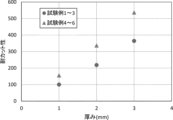
- the cut resistance was evaluated as follows. A sample with a length of 7 cm and a width of 6 cm was cut out from the rubber article of each test example and placed on a horizontal table. A weighted knife (15 kg) was placed above the sample so that the tip faced the rubber article. Thereafter, the knife was allowed to fall freely to scratch the sample. Tests were conducted while changing the height at which the knife fell, and the height at which the sample broke was determined. Using the obtained height value, the energy at which the rubber article breaks was calculated. The energy at which the rubber article of Test Example 1 broke was indexed as 100 and expressed as a cut resistance index. The results are shown in Table 2. The larger the value, the better the cut resistance. Further, the relationship between the thickness of the rubber article and the numerical value of cut resistance is shown in FIG. In FIG. 1, the horizontal axis is the thickness, and the vertical axis is the cut resistance index.
- Test Examples 4 to 6 in which syndiotactic-1,2-polybutadiene was added had better cut resistance than Test Examples 1 to 3 in which it was not added. This result is the same as the example described above. As shown in FIG. 1, in all of Test Examples 1 to 3 and 4 to 6, the cut resistance increases as the thickness increases. However, in Test Examples 4 to 6, there is a tendency for the difference in cut resistance index from Test Examples 1 to 3 to increase as the thickness increases. This indicates that when using a rubber composition containing syndiotactic-1,2-polybutadiene, the increase in cut resistance is due to contributions other than the effect of thickness, that is, the components of the rubber composition themselves. It shows.
Landscapes
- Chemical & Material Sciences (AREA)
- Health & Medical Sciences (AREA)
- Chemical Kinetics & Catalysis (AREA)
- Medicinal Chemistry (AREA)
- Polymers & Plastics (AREA)
- Organic Chemistry (AREA)
- Engineering & Computer Science (AREA)
- Mechanical Engineering (AREA)
- Compositions Of Macromolecular Compounds (AREA)
- Tires In General (AREA)
Abstract
Priority Applications (3)
| Application Number | Priority Date | Filing Date | Title |
|---|---|---|---|
| EP22941754.8A EP4524191A4 (fr) | 2022-05-12 | 2022-10-07 | Article en caoutchouc et pneu le comprenant |
| US18/857,177 US20250270391A1 (en) | 2022-05-12 | 2022-10-07 | Rubber article and tire including same |
| AU2022458043A AU2022458043A1 (en) | 2022-05-12 | 2022-10-07 | Rubber article and tire including same |
Applications Claiming Priority (2)
| Application Number | Priority Date | Filing Date | Title |
|---|---|---|---|
| JP2022-078662 | 2022-05-12 | ||
| JP2022078662A JP2023167464A (ja) | 2022-05-12 | 2022-05-12 | ゴム物品、及びこれを用いたタイヤ |
Publications (1)
| Publication Number | Publication Date |
|---|---|
| WO2023218678A1 true WO2023218678A1 (fr) | 2023-11-16 |
Family
ID=88729941
Family Applications (1)
| Application Number | Title | Priority Date | Filing Date |
|---|---|---|---|
| PCT/JP2022/037631 Ceased WO2023218678A1 (fr) | 2022-05-12 | 2022-10-07 | Article en caoutchouc et pneu le comprenant |
Country Status (5)
| Country | Link |
|---|---|
| US (1) | US20250270391A1 (fr) |
| EP (1) | EP4524191A4 (fr) |
| JP (1) | JP2023167464A (fr) |
| AU (1) | AU2022458043A1 (fr) |
| WO (1) | WO2023218678A1 (fr) |
Families Citing this family (1)
| Publication number | Priority date | Publication date | Assignee | Title |
|---|---|---|---|---|
| WO2025178032A1 (fr) * | 2024-02-20 | 2025-08-28 | 株式会社ブリヂストン | Composition de caoutchouc, pneumatique, et article en caoutchouc |
Citations (5)
| Publication number | Priority date | Publication date | Assignee | Title |
|---|---|---|---|---|
| JPH08333483A (ja) * | 1995-06-08 | 1996-12-17 | Yokohama Rubber Co Ltd:The | タイヤ用ゴム組成物 |
| JP2005075952A (ja) * | 2003-09-01 | 2005-03-24 | Sumitomo Rubber Ind Ltd | タイヤサイド部補強用ゴム組成物およびそれを用いたランフラットタイヤ |
| JP2005133017A (ja) * | 2003-10-31 | 2005-05-26 | Yokohama Rubber Co Ltd:The | サイドウォール用ゴム組成物 |
| JP2007186550A (ja) * | 2006-01-11 | 2007-07-26 | Sumitomo Rubber Ind Ltd | タイヤサイド部補強用ゴム組成物およびランフラットタイヤ |
| WO2014003052A1 (fr) * | 2012-06-29 | 2014-01-03 | Jsr株式会社 | Composition de caoutchouc, flanc et pneu |
Family Cites Families (6)
| Publication number | Priority date | Publication date | Assignee | Title |
|---|---|---|---|---|
| JP4081182B2 (ja) * | 1998-07-08 | 2008-04-23 | 住友ゴム工業株式会社 | ビード部補強用ゴム組成物 |
| JP4561046B2 (ja) * | 2003-05-23 | 2010-10-13 | 横浜ゴム株式会社 | コンベヤベルト用ゴム組成物およびコンベヤベルト |
| JP5101830B2 (ja) * | 2006-04-03 | 2012-12-19 | 住友ゴム工業株式会社 | ブレーカートッピング用ゴム組成物 |
| JP2009127001A (ja) * | 2007-11-27 | 2009-06-11 | Sumitomo Rubber Ind Ltd | ベーストレッド用ゴム組成物 |
| JP6069044B2 (ja) * | 2013-03-12 | 2017-01-25 | 住友ゴム工業株式会社 | ベーストレッド用ゴム組成物及び空気入りタイヤ |
| CN104311908A (zh) * | 2014-11-20 | 2015-01-28 | 三角轮胎股份有限公司 | 含1,2-间规聚丁二烯的胎侧橡胶组合物 |
-
2022
- 2022-05-12 JP JP2022078662A patent/JP2023167464A/ja active Pending
- 2022-10-07 US US18/857,177 patent/US20250270391A1/en active Pending
- 2022-10-07 WO PCT/JP2022/037631 patent/WO2023218678A1/fr not_active Ceased
- 2022-10-07 EP EP22941754.8A patent/EP4524191A4/fr active Pending
- 2022-10-07 AU AU2022458043A patent/AU2022458043A1/en active Pending
Patent Citations (5)
| Publication number | Priority date | Publication date | Assignee | Title |
|---|---|---|---|---|
| JPH08333483A (ja) * | 1995-06-08 | 1996-12-17 | Yokohama Rubber Co Ltd:The | タイヤ用ゴム組成物 |
| JP2005075952A (ja) * | 2003-09-01 | 2005-03-24 | Sumitomo Rubber Ind Ltd | タイヤサイド部補強用ゴム組成物およびそれを用いたランフラットタイヤ |
| JP2005133017A (ja) * | 2003-10-31 | 2005-05-26 | Yokohama Rubber Co Ltd:The | サイドウォール用ゴム組成物 |
| JP2007186550A (ja) * | 2006-01-11 | 2007-07-26 | Sumitomo Rubber Ind Ltd | タイヤサイド部補強用ゴム組成物およびランフラットタイヤ |
| WO2014003052A1 (fr) * | 2012-06-29 | 2014-01-03 | Jsr株式会社 | Composition de caoutchouc, flanc et pneu |
Non-Patent Citations (1)
| Title |
|---|
| See also references of EP4524191A4 * |
Also Published As
| Publication number | Publication date |
|---|---|
| JP2023167464A (ja) | 2023-11-24 |
| EP4524191A1 (fr) | 2025-03-19 |
| EP4524191A4 (fr) | 2025-10-08 |
| AU2022458043A1 (en) | 2024-11-07 |
| US20250270391A1 (en) | 2025-08-28 |
Similar Documents
| Publication | Publication Date | Title |
|---|---|---|
| US8637599B2 (en) | Rubber composition for inner liner and tire having inner liner including thereof | |
| JP5478816B2 (ja) | タイヤ用ゴム組成物 | |
| EP2019125B1 (fr) | Composition en caoutchouc et pneu de roulage à plat l'utilisant | |
| EP4005820A1 (fr) | Composition de caoutchouc pour pneumatique et pneumatique | |
| EP3385091A1 (fr) | Composition de caoutchouc et pneumatique | |
| JP4540435B2 (ja) | サイドウォール用ゴム組成物およびそれからなるサイドウォールを有する空気入りタイヤ | |
| JP5286642B2 (ja) | タイヤ用ゴム組成物及びそれを用いた空気入りタイヤ | |
| WO2023218678A1 (fr) | Article en caoutchouc et pneu le comprenant | |
| JP7040159B2 (ja) | タイヤ用ゴム組成物 | |
| EP1466943A2 (fr) | Composition de caoutchouc pour flancs de pneu et pneu avec flancs à base de cette composition | |
| EP3381713B1 (fr) | Composition de caoutchouc et pneumatique | |
| JP2008156446A (ja) | 特定のタイヤ部材用ゴム組成物およびそれを用いたタイヤ | |
| JP5313743B2 (ja) | インナーライナー用ゴム組成物及びタイヤ | |
| JP2009242577A (ja) | ジエン系ゴム組成物 | |
| JP7040160B2 (ja) | タイヤ用ゴム組成物 | |
| JP7040157B2 (ja) | タイヤ用ゴム組成物 | |
| CN101104710B (zh) | 包覆胎体帘线用橡胶组合物及胎体使用该组合物的轮胎 | |
| JP2013155308A (ja) | キャップトレッド、ベーストレッド、サイドウォール、カーカス、クリンチ又はビードエイペックス用ゴム組成物及び空気入りタイヤ | |
| JP4755051B2 (ja) | ゴム組成物 | |
| JP7040158B2 (ja) | タイヤ用ゴム組成物 | |
| JP2007302715A (ja) | ゴム組成物および空気入りタイヤ | |
| JP7040161B2 (ja) | タイヤ用ゴム組成物 | |
| JP2009256514A (ja) | ゴム組成物及び空気バネ | |
| JP2007269872A (ja) | サイドウォール用ゴム組成物およびそれを用いたタイヤ、ならびにクリンチ用ゴム組成物およびそれを用いたタイヤ | |
| JP2009155485A (ja) | ジエン系ゴム組成物 |
Legal Events
| Date | Code | Title | Description |
|---|---|---|---|
| 121 | Ep: the epo has been informed by wipo that ep was designated in this application |
Ref document number: 22941754 Country of ref document: EP Kind code of ref document: A1 |
|
| WWE | Wipo information: entry into national phase |
Ref document number: AU2022458043 Country of ref document: AU |
|
| ENP | Entry into the national phase |
Ref document number: 2022458043 Country of ref document: AU Date of ref document: 20221007 Kind code of ref document: A |
|
| WWE | Wipo information: entry into national phase |
Ref document number: 2022941754 Country of ref document: EP |
|
| NENP | Non-entry into the national phase |
Ref country code: DE |
|
| ENP | Entry into the national phase |
Ref document number: 2022941754 Country of ref document: EP Effective date: 20241212 |
|
| WWP | Wipo information: published in national office |
Ref document number: 18857177 Country of ref document: US |