WO2023287191A1 - Composition antibactérienne - Google Patents
Composition antibactérienne Download PDFInfo
- Publication number
- WO2023287191A1 WO2023287191A1 PCT/KR2022/010196 KR2022010196W WO2023287191A1 WO 2023287191 A1 WO2023287191 A1 WO 2023287191A1 KR 2022010196 W KR2022010196 W KR 2022010196W WO 2023287191 A1 WO2023287191 A1 WO 2023287191A1
- Authority
- WO
- WIPO (PCT)
- Prior art keywords
- antimicrobial composition
- composition according
- measured
- antibacterial activity
- antibacterial
- Prior art date
- Legal status (The legal status is an assumption and is not a legal conclusion. Google has not performed a legal analysis and makes no representation as to the accuracy of the status listed.)
- Ceased
Links
Images



Classifications
-
- A—HUMAN NECESSITIES
- A01—AGRICULTURE; FORESTRY; ANIMAL HUSBANDRY; HUNTING; TRAPPING; FISHING
- A01N—PRESERVATION OF BODIES OF HUMANS OR ANIMALS OR PLANTS OR PARTS THEREOF; BIOCIDES, e.g. AS DISINFECTANTS, AS PESTICIDES OR AS HERBICIDES; PEST REPELLANTS OR ATTRACTANTS; PLANT GROWTH REGULATORS
- A01N37/00—Biocides, pest repellants or attractants, or plant growth regulators containing organic compounds containing a carbon atom having three bonds to hetero atoms with at the most two bonds to halogen, e.g. carboxylic acids
- A01N37/44—Biocides, pest repellants or attractants, or plant growth regulators containing organic compounds containing a carbon atom having three bonds to hetero atoms with at the most two bonds to halogen, e.g. carboxylic acids containing at least one carboxylic group or a thio analogue, or a derivative thereof, and a nitrogen atom attached to the same carbon skeleton by a single or double bond, this nitrogen atom not being a member of a derivative or of a thio analogue of a carboxylic group, e.g. amino-carboxylic acids
-
- A—HUMAN NECESSITIES
- A01—AGRICULTURE; FORESTRY; ANIMAL HUSBANDRY; HUNTING; TRAPPING; FISHING
- A01P—BIOCIDAL, PEST REPELLANT, PEST ATTRACTANT OR PLANT GROWTH REGULATORY ACTIVITY OF CHEMICAL COMPOUNDS OR PREPARATIONS
- A01P1/00—Disinfectants; Antimicrobial compounds or mixtures thereof
-
- A—HUMAN NECESSITIES
- A01—AGRICULTURE; FORESTRY; ANIMAL HUSBANDRY; HUNTING; TRAPPING; FISHING
- A01N—PRESERVATION OF BODIES OF HUMANS OR ANIMALS OR PLANTS OR PARTS THEREOF; BIOCIDES, e.g. AS DISINFECTANTS, AS PESTICIDES OR AS HERBICIDES; PEST REPELLANTS OR ATTRACTANTS; PLANT GROWTH REGULATORS
- A01N33/00—Biocides, pest repellants or attractants, or plant growth regulators containing organic nitrogen compounds
- A01N33/02—Amines; Quaternary ammonium compounds
- A01N33/12—Quaternary ammonium compounds
-
- A—HUMAN NECESSITIES
- A01—AGRICULTURE; FORESTRY; ANIMAL HUSBANDRY; HUNTING; TRAPPING; FISHING
- A01N—PRESERVATION OF BODIES OF HUMANS OR ANIMALS OR PLANTS OR PARTS THEREOF; BIOCIDES, e.g. AS DISINFECTANTS, AS PESTICIDES OR AS HERBICIDES; PEST REPELLANTS OR ATTRACTANTS; PLANT GROWTH REGULATORS
- A01N25/00—Biocides, pest repellants or attractants, or plant growth regulators, characterised by their forms, or by their non-active ingredients or by their methods of application, e.g. seed treatment or sequential application; Substances for reducing the noxious effect of the active ingredients to organisms other than pests
- A01N25/02—Biocides, pest repellants or attractants, or plant growth regulators, characterised by their forms, or by their non-active ingredients or by their methods of application, e.g. seed treatment or sequential application; Substances for reducing the noxious effect of the active ingredients to organisms other than pests containing liquids as carriers, diluents or solvents
- A01N25/04—Dispersions, emulsions, suspoemulsions, suspension concentrates or gels
-
- A—HUMAN NECESSITIES
- A01—AGRICULTURE; FORESTRY; ANIMAL HUSBANDRY; HUNTING; TRAPPING; FISHING
- A01N—PRESERVATION OF BODIES OF HUMANS OR ANIMALS OR PLANTS OR PARTS THEREOF; BIOCIDES, e.g. AS DISINFECTANTS, AS PESTICIDES OR AS HERBICIDES; PEST REPELLANTS OR ATTRACTANTS; PLANT GROWTH REGULATORS
- A01N43/00—Biocides, pest repellants or attractants, or plant growth regulators containing heterocyclic compounds
- A01N43/64—Biocides, pest repellants or attractants, or plant growth regulators containing heterocyclic compounds having rings with three nitrogen atoms as the only ring hetero atoms
- A01N43/647—Triazoles; Hydrogenated triazoles
- A01N43/653—1,2,4-Triazoles; Hydrogenated 1,2,4-triazoles
-
- C—CHEMISTRY; METALLURGY
- C08—ORGANIC MACROMOLECULAR COMPOUNDS; THEIR PREPARATION OR CHEMICAL WORKING-UP; COMPOSITIONS BASED THEREON
- C08F—MACROMOLECULAR COMPOUNDS OBTAINED BY REACTIONS ONLY INVOLVING CARBON-TO-CARBON UNSATURATED BONDS
- C08F120/00—Homopolymers of compounds having one or more unsaturated aliphatic radicals, each having only one carbon-to-carbon double bond, and only one being terminated by only one carboxyl radical or a salt, anhydride, ester, amide, imide or nitrile thereof
- C08F120/02—Monocarboxylic acids having less than ten carbon atoms; Derivatives thereof
- C08F120/10—Esters
- C08F120/34—Esters containing nitrogen, e.g. N,N-dimethylaminoethyl (meth)acrylate
-
- C—CHEMISTRY; METALLURGY
- C09—DYES; PAINTS; POLISHES; NATURAL RESINS; ADHESIVES; COMPOSITIONS NOT OTHERWISE PROVIDED FOR; APPLICATIONS OF MATERIALS NOT OTHERWISE PROVIDED FOR
- C09D—COATING COMPOSITIONS, e.g. PAINTS, VARNISHES OR LACQUERS; FILLING PASTES; CHEMICAL PAINT OR INK REMOVERS; INKS; CORRECTING FLUIDS; WOODSTAINS; PASTES OR SOLIDS FOR COLOURING OR PRINTING; USE OF MATERIALS THEREFOR
- C09D5/00—Coating compositions, e.g. paints, varnishes or lacquers, characterised by their physical nature or the effects produced; Filling pastes
- C09D5/14—Paints containing biocides, e.g. fungicides, insecticides or pesticides
-
- C—CHEMISTRY; METALLURGY
- C12—BIOCHEMISTRY; BEER; SPIRITS; WINE; VINEGAR; MICROBIOLOGY; ENZYMOLOGY; MUTATION OR GENETIC ENGINEERING
- C12Q—MEASURING OR TESTING PROCESSES INVOLVING ENZYMES, NUCLEIC ACIDS OR MICROORGANISMS; COMPOSITIONS OR TEST PAPERS THEREFOR; PROCESSES OF PREPARING SUCH COMPOSITIONS; CONDITION-RESPONSIVE CONTROL IN MICROBIOLOGICAL OR ENZYMOLOGICAL PROCESSES
- C12Q1/00—Measuring or testing processes involving enzymes, nucleic acids or microorganisms; Compositions therefor; Processes of preparing such compositions
- C12Q1/02—Measuring or testing processes involving enzymes, nucleic acids or microorganisms; Compositions therefor; Processes of preparing such compositions involving viable microorganisms
- C12Q1/18—Testing for antimicrobial activity of a material
-
- Y—GENERAL TAGGING OF NEW TECHNOLOGICAL DEVELOPMENTS; GENERAL TAGGING OF CROSS-SECTIONAL TECHNOLOGIES SPANNING OVER SEVERAL SECTIONS OF THE IPC; TECHNICAL SUBJECTS COVERED BY FORMER USPC CROSS-REFERENCE ART COLLECTIONS [XRACs] AND DIGESTS
- Y02—TECHNOLOGIES OR APPLICATIONS FOR MITIGATION OR ADAPTATION AGAINST CLIMATE CHANGE
- Y02A—TECHNOLOGIES FOR ADAPTATION TO CLIMATE CHANGE
- Y02A50/00—TECHNOLOGIES FOR ADAPTATION TO CLIMATE CHANGE in human health protection, e.g. against extreme weather
- Y02A50/30—Against vector-borne diseases, e.g. mosquito-borne, fly-borne, tick-borne or waterborne diseases whose impact is exacerbated by climate change
Definitions
- the present invention relates to antimicrobial compositions.
- the degree of antimicrobial property required or the requirements of the material for imparting antimicrobial property are different. For example, depending on the amount of antibacterial material applied to the product or the material used together, the nature of the material for imparting antibacterial property or the degree of antibacterial property is different.
- the present invention has hydrophilicity and hydrophobicity, which is advantageous for imparting antibacterial properties, and can impart antibacterial properties by forming a copolymer with an acrylic resin, etc., as well as an antibacterial composition comprising an antibacterial material capable of solving safety problems caused by leakage of antimicrobial substances. want to provide
- the present invention is to provide an antibacterial composition capable of controlling surface tension, that is, increasing solubility in a solvent by controlling the number of carbon atoms included in the antimicrobial monomer.
- the critical micelle concentration of the compound containing the quaternary ammonium structure provides an antimicrobial composition of 0.1% by weight to 3% by weight.
- another embodiment of the present invention provides a product comprising the antimicrobial composition or manufactured therefrom.
- the antibacterial composition according to some embodiments of the present invention is advantageous in imparting antibacterial properties because of its hydrophilicity and hydrophobicity, and can impart antibacterial properties by forming a copolymer with an acrylic resin, etc., as well as solve safety problems caused by leakage of antimicrobial substances.
- an antibacterial composition comprising an antimicrobial material having antibacterial activity and acute oral toxicity concentration controlled within a characteristic range, it is useful as a material capable of imparting excellent antibacterial properties safely.
- Antimicrobial compositions according to some embodiments of the present invention can exhibit antibacterial properties within a short period of time.
- the antibacterial composition according to some embodiments of the present invention has a small change in antibacterial activity according to the amount of antimicrobial material used, it can exhibit antimicrobial activity within the expected range even when non-uniformity of concentration occurs unintentionally when applied to a product.
- Antimicrobial compositions according to some embodiments of the present invention have the advantage of high solubility in solvents.
- Antimicrobial compositions according to some embodiments of the present invention have low toxicity properties.
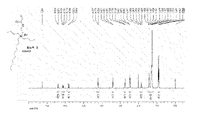
- 1 is a diagram showing a 1 H-NMR spectrum ((CD 3 ) 2 SO) of synthesized monomer 1 as an exemplary embodiment of the present invention.
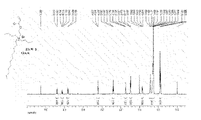
- FIG. 2 is a diagram showing a 1 H-NMR spectrum ((CD 3 ) 2 SO) of synthesized monomer 2 as an exemplary embodiment of the present invention.
- FIG. 3 is a diagram showing a 1 H-NMR spectrum ((CD 3 ) 2 SO) of synthesized monomer 3 as an exemplary embodiment of the present invention.
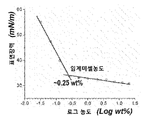
- FIG. 4 is a diagram showing surface tension for each concentration of monomer 2 as an embodiment of the present invention.
- 5 is a diagram showing surface tension for each concentration of monomer 3 as an embodiment of the present invention.
- An exemplary embodiment of the present invention includes at least one compound containing a quaternary ammonium structure having an acrylate group or a methacrylate group, and the critical micelle concentration of the compound containing a quaternary ammonium structure is 0.1% by weight to It provides an antimicrobial composition that is 3% by weight.
- the antibacterial composition has an antibacterial activity A of 90% or more, measured by method 1 below, against at least one strain of gram-positive bacteria and gram-negative bacteria, and an acute oral toxicity concentration LD50 of 300 mg It is more than /Kg.
- Broth type medium inoculated with 3,000 CFU/ml bacteria (Nutrient broth, BD DIFCO., 8 g/L) After putting 25 ml in a 50 mL conical tube, 0.015 g of the antimicrobial composition is added and suspended (vortexing), and the sufficiently mixed solution is incubated for 16 hours in a shaking water bath maintained at 35 ° C.
- the antimicrobial activity which is the bacteriostatic reduction rate, is calculated by the following formula.
- the cation of the quaternary ammonium-based ammonium molecule is electrostatically adsorbed to the anion site on the cell surface of bacteria or microorganisms, and
- the substituent bonded to the quaternary ammonium structure is hydrophobic, the cell surface structure may be physicochemically destroyed and killed by hydrophobic interaction.
- an antibacterial function may be introduced through copolymerization with an acrylic resin or the like by the acrylate group or the methacrylate group, and in this case, safety may be improved by preventing leakage of the antibacterial substance.
- the compounds having a quaternary ammonium structure as described above while including the compounds having a quaternary ammonium structure as described above, it is possible to safely impart high antibacterial properties by limiting the antibacterial activity and acute oral toxicity concentration of the antimicrobial composition within a specific range. Furthermore, according to the above embodiment of the invention, surface tension can be adjusted by adjusting the carbon number of the compound having a quaternary ammonium structure as described above. Specifically, there is an advantage in that the critical micelle concentration can be obtained within a target range. The range of the target critical micelle concentration is the same as the aforementioned 0.1% by weight to 3% by weight.
- the antibacterial activity mentioned in the present invention may be measured against at least one strain of Proteus mirabilis, E.coli, S.aureus, E.Cloaceae and E.faecalis .
- the antibacterial activity mentioned in the present invention can be measured for each of Proteus mirabilis, E. coli, S. aureus, E. Cloaceae and E. faecalis .
- Antibacterial compositions according to embodiments of the present invention may have a certain or more antibacterial activity against gram-positive bacteria and gram-negative bacteria. ATCC29906, CCUG4637 for Proteus mirabilis , ATCC13047, ATCC13048, CCUG71839 for E. Cloaceae, ATCC29212, CCUG9997 for E. faecalis may be used.
- the time for the antibacterial activity A of the antimicrobial composition to be expressed is within 1 hour. Accordingly, the desired antibacterial activity can be exhibited right after the antimicrobial composition is applied to the intended use or product.
- the ratio (C / B) of the antibacterial activity C measured by Method 3 to the antibacterial activity B measured by Method 2 below of the antimicrobial composition is 1 or more and less than 2:
- the antibacterial composition When the antibacterial composition is applied to the intended use or product, an area where the concentration of the antimicrobial material is unintentionally high and an area where the concentration is low may occur, and desired antibacterial properties may not be exhibited in the area where the concentration is low.
- desired antibacterial properties may not be exhibited in the area where the concentration is low.
- the change in antibacterial activity according to the amount of antibacterial material is small, even when non-uniformity of concentration occurs unintentionally when applied to a desired use or product, antibacterial activity within the expected range can be exhibited.
- the antimicrobial activity A is 99% or more, preferably 99.3% or more, more preferably 99.5% or more, still more preferably 99.7% or more, still more preferably 99.9% or more. to be.
- the antibacterial activity D measured by Method 4 is 65% or more:
- the antimicrobial activity D may be 65% or more, 68% or more, 68.2% or more, 70% or more.
- the antimicrobial activity D may be 99% or more, preferably 99.3% or more, more preferably 99.5% or more, more preferably 99.7% or more, and more preferably 99.9% or more.
- the antibacterial activity B measured by Method 2 is 55% or more:
- the antimicrobial activity B may be 55% or more, 59% or more, 59.3% or more, 60% or more, 61.2% or more.
- the antibacterial activity B may be 99% or more, preferably 99.3% or more, more preferably 99.5% or more, more preferably 99.7% or more, and more preferably 99.9% or more.
- the acute oral toxicity concentration LD50 of the antimicrobial composition according to the above-described embodiments is greater than 300 mg / Kg, 500 mg / Kg or more, preferably 800 mg / Kg or more, more preferably It is preferably 1,000 mg/Kg or more.
- the acute oral toxicity concentration LD50 of the antimicrobial composition according to the above-described embodiments is 800 mg / Kg or more, 843 mg / Kg or more, 869 mg / Kg or more, 900 mg / Kg or more, or 998 mg / Kg may be ideal
- Acute oral toxicity concentration LD50 of the antimicrobial composition according to the above-described embodiments is 1,000 mg / Kg or more, 1,050 mg / Kg or more, 1,078 mg / Kg or more, 1,100 mg / Kg or more, 1,111 mg / Kg or more, 1,200 mg / Kg 1,242 mg/Kg or more, 1,300 mg/Kg or more, 1,369 mg/Kg or more, 1,400 mg/Kg or more, 1,442 mg/Kg or more, 1,498 mg/Kg or more, 1,500 mg/Kg or more, 1,600 mg/Kg or more, It may be 1,700 mg/Kg or more, or 1,708
- the acute oral toxicity concentration LD50 of the antimicrobial composition according to the above-described embodiments is 843 mg / Kg, 869 mg / Kg, 998 mg / Kg, 1,078 mg / Kg, 1,111 mg / Kg, 1,242 mg / Kg , 1,369 mg/Kg, 1,442 mg/Kg, 1,498 mg/Kg, or 1,708 mg/Kg.
- the acute oral toxicity concentration LD50 of the antimicrobial composition according to the above-described embodiments may be 50,000 mg / Kg or less, for example, 10,000 mg / Kg or less, 5,000 mg / Kg or less, or 2,000 mg / Kg or less.
- the acute oral toxicity concentration LD50 of the antimicrobial composition according to the above-described embodiments may be 1,708 mg / Kg or less.
- the compound containing a quaternary ammonium structure having an acrylate group or a methacrylate group is among the compounds represented by Formula 1 below, which can exhibit the above-mentioned antibacterial activity and acute oral toxicity concentration LD50 You can choose:
- L1 is an alkylene having 2 to 4 carbon atoms
- R1, R2 and R3 are the same as or different from each other, and each is an alkyl group having 1 to 20 carbon atoms,
- R4 is hydrogen or a methyl group.
- At least one of R1, R2 and R3 in Formula 1 is an alkyl group having 8 or more carbon atoms, preferably an alkyl group having 8 to 14 carbon atoms, and more preferably an alkyl group having 8 to 12 carbon atoms.
- the sum of carbon atoms of the alkyl groups included in R1, R2 and R3 of Formula 1 is 12 to 24.
- the sum of two carbon atoms having a large number of carbon atoms among R1, R2, and R3 in Formula 1 is 2 to 24, preferably 8 to 20, and more preferably 8 to 16. According to one example, the sum of two carbon atoms having a large number of carbon atoms among R1, R2, and R3 in Formula 1 may be 9 to 15.
- the carbon number of the one having the greatest number of carbon atoms among R1, R2 and R3 in Formula 1 is 12 or less, preferably 11 or less.
- any one of the two highest carbon atoms among R1, R2, and R3 in Formula 1 has 10 or more carbon atoms, the other has less than 8 carbon atoms.
- Acute oral toxicity can be controlled in the case of having a carbon number according to the above embodiments. If the acute oral toxicity is too high, its use is limited, especially in baby products such as diapers.
- the antimicrobial composition has excellent properties against acute dermal toxicity.
- acute dermal toxicity decreases its toxicity even with prolonged exposure. Based on this, there is an advantage in that acute dermal toxicity can be controlled by adjusting the carbon number of the alkyl chain of the compound included in the above-described antimicrobial composition. If the acute dermal toxicity is too high, there are restrictions on use, especially in baby products such as diapers.
- L1 in Chemical Formula 1 is ethylene or butylene.
- R4 in Chemical Formula 1 is hydrogen.
- R4 in Chemical Formula 1 is methyl.
- the antibacterial composition may be composed only of a compound having a quaternary ammonium structure having an acrylate group or a methacrylate group, and additives or solvents may be additionally added as necessary.
- the compound having a quaternary ammonium structure having an acrylate group or a methacrylate group has a water solubility of 50% or more, preferably 60% or more.
- the solubility can be measured at room temperature.
- the compound having a quaternary ammonium structure having an acrylate group or a methacrylate group has a solubility in ethanol of 50% or more, preferably 60% or more.
- the solubility can be measured at room temperature.
- the compound containing a quaternary ammonium structure having an acrylate group or a methacrylate group is at least one of methanol, acetone, dichloromethane, DMSO, THF, and chloroform, preferably It can be dissolved in all of them.
- the critical micelle concentration of the compound containing the quaternary ammonium structure is 0.1% by weight to 3% by weight.
- the critical micelle concentration of the compound can be measured by Method 5 below.
- a solution containing the compound containing the quaternary ammonium structure is prepared, and the surface tension of the solution is measured for each concentration.
- the critical micelle concentration of the compound containing the quaternary ammonium structure is obtained from a calibration curve of the surface tension for each concentration.
- the surface tension for each concentration can be measured using a surface tension meter (Force tensiometer) and the Du Nouy ring method.
- the solution may use a solvent such as distilled water, but is not limited thereto.
- the critical micelle concentration of the compound containing the quaternary ammonium structure is 0.1% by weight to 3% by weight; 0.15% to 2.5% by weight; or 0.18% to 2.2% by weight.
- the length of the alkyl chain introduced into the compound containing the quaternary ammonium structure is changed by controlling the number of carbon atoms, and thus the surface tension and solubility of the compound containing the quaternary ammonium structure can be adjusted. there is.
- the compound containing a quaternary ammonium structure having an acrylate group or a methacrylate group may be selected from the following monomers 1 to 10:
- the antimicrobial composition according to the above-described embodiments or a compound containing a quaternary ammonium structure having an acrylate group or a methacrylate group included therein may be present in a powder form or an oil form.
- the compound having a quaternary ammonium structure having an acrylate group or a methacrylate group exhibits cationic properties, it may exist in the form of a salt with an anionic group.
- the group exhibiting anionic property is not particularly limited, and materials known in the art may be used as long as the purpose of the antimicrobial composition is not impaired.
- the anionic group may be a halogen anion, specifically Br - .
- the antibacterial composition is a copolymer of a copolymer such as a copolymer with (meth)acrylic resin, a copolymer with polyvinyl chloride, a copolymer with polylactic acid (PLA), and a copolymer with urethane. It may be used in a state, or may be a product containing at least one of the above copolymers, such as sanitary products, antibacterial films, diapers, and the like.
- the copolymer is preferably a copolymer with an acrylate or methacrylate series.
- the copolymerization method a known copolymerization method may be applied.
- MTBE methyl t-butyl ether
- reaction solution 15:1
- the ratio of MTBE to the reaction solution may be other than 15:1, such as 12:1 and 26:1.
- the 1 H-NMR spectrum of the synthesized monomer 1 is shown in FIG. 1
- the 1 H-NMR spectrum of the synthesized monomer 2 is shown in FIG. 2
- the 1 H-NMR spectrum of the synthesized monomer 3 is shown in FIG. It is shown in Figure 3 below.
- Comparative Monomer 1 was confirmed by 1 H-NMR spectrum ((CD 3 ) 2 SO) similarly to the aforementioned monomers 1 to 3.
- the antibacterial activity of the monomers 1 to 10 and comparative monomers 1 and 2 according to Methods 1 to 4 was measured and shown in Table 1 below. At this time, P. mirabilis ( ATCC29906 ) was used.
- the acute oral toxicity concentration LD50 of the monomers 1 to 10 and comparative monomers 1 and 2 is shown in Table 3 below.
- monomers 1 to 10 all had an acute oral toxicity concentration LD50 of 300 mg/Kg or more, particularly 800 mg/Kg or more.
- the acute oral toxicity concentration LD50 was 1,000 mg/Kg or more.
- the acute oral toxicity concentration LD50 was measured according to the 3T3 Neutral Red Uptake (NRU) assay (OECD Guidance Document No 129). Specifically, LD50 can be calculated in the following way.
- the critical micelle concentrations of the monomers 2 and 3 and comparative monomer 2 according to Method 5 were measured and are shown in Table 4 and FIGS. 4 to 6 below. More specifically, aqueous solutions of different concentrations were prepared for the monomers 2 and 3 and comparative monomer 2 (30 mL), and the surface tension was measured using the Du Nouyring method of a force tensiometer. Each measurement was repeated three times. A diluted solution was prepared and measured until the surface tension became similar to that of deionized water. Through the change in surface tension according to the concentration, it was confirmed that each aqueous solution forms micelles, and the critical micelle concentration (CMC) was confirmed.
- CMC critical micelle concentration
- FIG. 4 is a diagram showing the surface tension of monomer 2 by concentration
- FIG. 5 is a diagram showing the surface tension of monomer 3 by concentration
- FIG. 6 is a diagram showing the surface tension of comparative monomer 2 by concentration.
Landscapes
- Life Sciences & Earth Sciences (AREA)
- Chemical & Material Sciences (AREA)
- Health & Medical Sciences (AREA)
- Engineering & Computer Science (AREA)
- Wood Science & Technology (AREA)
- Zoology (AREA)
- Organic Chemistry (AREA)
- General Health & Medical Sciences (AREA)
- Plant Pathology (AREA)
- Environmental Sciences (AREA)
- Pest Control & Pesticides (AREA)
- Proteomics, Peptides & Aminoacids (AREA)
- Agronomy & Crop Science (AREA)
- Dentistry (AREA)
- Toxicology (AREA)
- Analytical Chemistry (AREA)
- Biochemistry (AREA)
- Biophysics (AREA)
- Genetics & Genomics (AREA)
- Biotechnology (AREA)
- Immunology (AREA)
- Microbiology (AREA)
- Molecular Biology (AREA)
- Chemical Kinetics & Catalysis (AREA)
- Physics & Mathematics (AREA)
- Bioinformatics & Cheminformatics (AREA)
- General Engineering & Computer Science (AREA)
- General Chemical & Material Sciences (AREA)
- Dispersion Chemistry (AREA)
- Materials Engineering (AREA)
- Medicinal Chemistry (AREA)
- Polymers & Plastics (AREA)
- Agricultural Chemicals And Associated Chemicals (AREA)
Abstract
Priority Applications (4)
| Application Number | Priority Date | Filing Date | Title |
|---|---|---|---|
| JP2023544140A JP2024505838A (ja) | 2021-07-16 | 2022-07-13 | 抗菌組成物 |
| EP22842453.7A EP4256960A4 (fr) | 2021-07-16 | 2022-07-13 | Composition antibactérienne |
| CN202280010940.1A CN116828983A (zh) | 2021-07-16 | 2022-07-13 | 抗菌组合物 |
| US18/274,356 US20240108001A1 (en) | 2021-07-16 | 2022-07-13 | Antibacterial Composition |
Applications Claiming Priority (2)
| Application Number | Priority Date | Filing Date | Title |
|---|---|---|---|
| KR10-2021-0093569 | 2021-07-16 | ||
| KR20210093569 | 2021-07-16 |
Publications (1)
| Publication Number | Publication Date |
|---|---|
| WO2023287191A1 true WO2023287191A1 (fr) | 2023-01-19 |
Family
ID=84919539
Family Applications (2)
| Application Number | Title | Priority Date | Filing Date |
|---|---|---|---|
| PCT/KR2022/009358 Ceased WO2023287071A1 (fr) | 2021-07-16 | 2022-06-29 | Composition antibactérienne |
| PCT/KR2022/010196 Ceased WO2023287191A1 (fr) | 2021-07-16 | 2022-07-13 | Composition antibactérienne |
Family Applications Before (1)
| Application Number | Title | Priority Date | Filing Date |
|---|---|---|---|
| PCT/KR2022/009358 Ceased WO2023287071A1 (fr) | 2021-07-16 | 2022-06-29 | Composition antibactérienne |
Country Status (6)
| Country | Link |
|---|---|
| US (2) | US20240107999A1 (fr) |
| EP (2) | EP4371410A4 (fr) |
| JP (2) | JP2024502922A (fr) |
| KR (2) | KR102903866B1 (fr) |
| CN (2) | CN116249448B (fr) |
| WO (2) | WO2023287071A1 (fr) |
Families Citing this family (1)
| Publication number | Priority date | Publication date | Assignee | Title |
|---|---|---|---|---|
| EP4371410A4 (fr) * | 2021-07-16 | 2024-10-23 | Lg Chem, Ltd. | Composition antibactérienne |
Citations (3)
| Publication number | Priority date | Publication date | Assignee | Title |
|---|---|---|---|---|
| JP2000154105A (ja) * | 1998-11-18 | 2000-06-06 | Daicel Chem Ind Ltd | 抗菌性組成物 |
| JP2012208169A (ja) * | 2011-03-29 | 2012-10-25 | Konica Minolta Holdings Inc | ハードコートフィルムと、それを用いた熱線遮断フィルム及び有機素子デバイス |
| KR20210093569A (ko) | 2020-01-20 | 2021-07-28 | 주식회사 이브이첨단소재 | Led 투명 전광판용 연성회로기판 |
Family Cites Families (26)
| Publication number | Priority date | Publication date | Assignee | Title |
|---|---|---|---|---|
| US5473057A (en) * | 1994-11-09 | 1995-12-05 | The Regents Of The University Of California | Eleutherobin and analogs thereof |
| GB9500856D0 (en) * | 1995-01-17 | 1995-03-08 | Zeneca Ltd | Composition and use |
| JP2000045179A (ja) * | 1998-07-23 | 2000-02-15 | Toyobo Co Ltd | 抗菌性繊維および繊維構造体 |
| US7459167B1 (en) * | 2000-07-27 | 2008-12-02 | 3M Innovative Properties Company | Biocidal polyurethane compositions and methods of use |
| US20050164903A1 (en) * | 2001-08-03 | 2005-07-28 | Ki-Hwan Ko | Complexed surfactant system |
| KR100421508B1 (ko) * | 2001-08-07 | 2004-03-09 | 김정한 | 항균 및 항진균 활성을 갖는 신규한 펜에틸아민 유도체와이의 염 |
| DE10203342A1 (de) * | 2002-01-29 | 2003-08-07 | Clariant Gmbh | Polymere mit biozider Wirkung, Verfahren zu ihrer Herstellung und ihre Verwendung |
| FR2846970B1 (fr) * | 2002-11-08 | 2006-08-11 | Desarrollo Del Grafting S L | Procede de traitement de surface par photopolymerisation pour obtenir des proprietes biocides |
| JP4320755B2 (ja) * | 2003-05-20 | 2009-08-26 | パイオトレック株式会社 | 抗菌・抗カビ剤およびそれを含有する抗菌・抗カビ性樹脂組成物 |
| KR100752150B1 (ko) | 2006-05-11 | 2007-08-29 | 한국과학기술연구원 | 이미다졸륨 염을 갖는 광경화성 단량체, 상기 이미다졸륨염을 함유하는 항균성 광경화형 조성물 및 상기조성물로부터 제조되는 항균성 고분자 재료 |
| CN101677536A (zh) * | 2007-04-25 | 2010-03-24 | 巴斯夫欧洲公司 | 带有杀生物涂层的基底 |
| MY157613A (en) * | 2008-05-09 | 2016-06-30 | Univ Hiroshima | Method of fixing antibacterial agent and article obtained by the method |
| US20110076387A1 (en) * | 2009-09-29 | 2011-03-31 | Lonza, Inc. | Method for imparting antibiotic activity to the surface of a solid substrate |
| KR101227761B1 (ko) * | 2010-09-16 | 2013-01-29 | 영남대학교 산학협력단 | 4급 암모늄염 화합물을 유효성분으로 포함하는 정전기 방지 및 항균용 표면처리제 및 이를 이용한 고분자 섬유의 정전기 방지방법 |
| EP2646487B1 (fr) * | 2010-11-30 | 2020-05-27 | Merck Patent GmbH | Particule pour afficheurs et électrophorétiques |
| KR102093832B1 (ko) * | 2012-02-08 | 2020-03-26 | 메르크 파텐트 게엠베하 | 전도성 첨가제를 포함하는 반응성 메소겐 제제 |
| WO2015133455A1 (fr) * | 2014-03-05 | 2015-09-11 | 株式会社カネカ | Procédé de réduction de la concentration critique en micelles, et composition de tensioactif |
| WO2016182444A1 (fr) * | 2015-05-12 | 2016-11-17 | Rijksuniversiteit Groningen | Résines composites antimicrobiennes pouvant être imprimées en 3d et procédés de fabrication associés |
| US11618777B2 (en) * | 2015-07-31 | 2023-04-04 | Shigeyuki Yokoyama | Method of manufacturing membrane protein and utilization thereof |
| WO2017057571A1 (fr) * | 2015-09-30 | 2017-04-06 | 株式会社日本触媒 | Agent antibactérien |
| JP2017202982A (ja) * | 2016-05-09 | 2017-11-16 | ライオン株式会社 | 抗菌性ポリマー |
| CN109135232B (zh) * | 2017-06-27 | 2021-01-29 | 江南大学 | 一种抗菌高分子复合材料及制备方法 |
| CN113498116A (zh) * | 2020-03-18 | 2021-10-12 | 华为技术有限公司 | 一种上行协调的通信方法和装置 |
| EP4217396A4 (fr) * | 2020-09-28 | 2025-06-18 | Elpiscience (Suzhou) Biopharma, Ltd. | Nouveaux anticorps anti-claudin18 |
| US20230120607A1 (en) * | 2020-10-07 | 2023-04-20 | Lg Chem, Ltd. | Antibacterial Polymer Composition |
| EP4371410A4 (fr) * | 2021-07-16 | 2024-10-23 | Lg Chem, Ltd. | Composition antibactérienne |
-
2022
- 2022-06-29 EP EP22842333.1A patent/EP4371410A4/fr active Pending
- 2022-06-29 US US18/027,430 patent/US20240107999A1/en active Pending
- 2022-06-29 KR KR1020220079920A patent/KR102903866B1/ko active Active
- 2022-06-29 CN CN202280006602.0A patent/CN116249448B/zh active Active
- 2022-06-29 WO PCT/KR2022/009358 patent/WO2023287071A1/fr not_active Ceased
- 2022-06-29 JP JP2023518277A patent/JP2024502922A/ja active Pending
- 2022-07-13 CN CN202280010940.1A patent/CN116828983A/zh active Pending
- 2022-07-13 EP EP22842453.7A patent/EP4256960A4/fr active Pending
- 2022-07-13 JP JP2023544140A patent/JP2024505838A/ja active Pending
- 2022-07-13 US US18/274,356 patent/US20240108001A1/en active Pending
- 2022-07-13 KR KR1020220086215A patent/KR20230012989A/ko active Pending
- 2022-07-13 WO PCT/KR2022/010196 patent/WO2023287191A1/fr not_active Ceased
Patent Citations (3)
| Publication number | Priority date | Publication date | Assignee | Title |
|---|---|---|---|---|
| JP2000154105A (ja) * | 1998-11-18 | 2000-06-06 | Daicel Chem Ind Ltd | 抗菌性組成物 |
| JP2012208169A (ja) * | 2011-03-29 | 2012-10-25 | Konica Minolta Holdings Inc | ハードコートフィルムと、それを用いた熱線遮断フィルム及び有機素子デバイス |
| KR20210093569A (ko) | 2020-01-20 | 2021-07-28 | 주식회사 이브이첨단소재 | Led 투명 전광판용 연성회로기판 |
Non-Patent Citations (4)
| Title |
|---|
| DAOUDI SOFIANE, OTHMAN ADIL A, BENAISSA TAHAR, KADA ZAHRA OULD: "Synthesis, Characterizationand Antibacterial Activity of Quaternary Ammonium Compounds Bearing Mixed N-Substituted Groups", CHEMICAL SCIENCE TRANSACTIONS, vol. 378, no. 3, 1 January 2014 (2014-01-01), pages 281 - 291, XP093024522, ISSN: 2278-3458, DOI: 10.7598/cst2014.378 * |
| MANCUSO RAFFAELLA, ROBERTA AMUSO, BIAGIO ARMENTANO, GIUSEPPE GRASSO, VITTORIA RAGO, ANNA RITA CAPPELLO, FRANCESCO GALIANO, ALBERTO: "Synthesis and antibacterial activity of polymerizable acryloyloxyalkyltriethyl ammonium salts", CHEMPLUSCHEM, vol. 82, no. 10, 9 June 2017 (2017-06-09), pages 1235 - 1244, XP093024525, DOI: 10.1002/cplu.201700194 * |
| MOHAMMED MAKHLOUFIA, TAHAR BENAÏSSA, AÏCHA DERDOUR, EDDINE HENNI DJAMEL: "Antibacterial Activity of Quaternary Ammonium Salt from Diethylaminoethyl Methacrylate", E-JOURNAL OF CHEMISTRY, W W W PUBLICATIONS (P) INDIA, IN, vol. 7, no. s1, 1 January 2010 (2010-01-01), IN , pages S61 - S66, XP093024519, ISSN: 0973-4945, DOI: 10.1155/2010/637549 * |
| See also references of EP4256960A4 |
Also Published As
| Publication number | Publication date |
|---|---|
| JP2024502922A (ja) | 2024-01-24 |
| CN116249448A (zh) | 2023-06-09 |
| CN116828983A (zh) | 2023-09-29 |
| KR20230012975A (ko) | 2023-01-26 |
| US20240107999A1 (en) | 2024-04-04 |
| KR102903866B1 (ko) | 2025-12-24 |
| EP4371410A4 (fr) | 2024-10-23 |
| EP4371410A1 (fr) | 2024-05-22 |
| EP4256960A4 (fr) | 2024-06-12 |
| WO2023287071A1 (fr) | 2023-01-19 |
| EP4256960A1 (fr) | 2023-10-11 |
| CN116249448B (zh) | 2026-02-27 |
| JP2024505838A (ja) | 2024-02-08 |
| US20240108001A1 (en) | 2024-04-04 |
| KR20230012989A (ko) | 2023-01-26 |
Similar Documents
| Publication | Publication Date | Title |
|---|---|---|
| WO2023287191A1 (fr) | Composition antibactérienne | |
| WO2022075763A1 (fr) | Composition polymère antibactérienne | |
| WO2009107987A2 (fr) | Copolymère d'oxyde de polyéthylène sensible au ph et procédé de synthèse de ce dernier | |
| WO2016163741A1 (fr) | Polymère contenant de l'aziridine et son procédé de production | |
| WO2018190493A1 (fr) | Procédé de synthèse de sucralfate et sucralfate ainsi obtenu | |
| WO2014069742A1 (fr) | Dérivé de glycol-chitosane ayant un substituant hydrophobe, procédé pour préparer celui-ci et utilisation de celui-ci | |
| WO2023287062A1 (fr) | Copolymère antibactérien | |
| WO2022231317A1 (fr) | Composition de résine thermoplastique | |
| WO2022060091A1 (fr) | Polymère antibactérien | |
| WO2024005572A1 (fr) | Tensioactif non ionique réactif contenant un groupe vinyle et un groupe oxyde de propylène, et composition adhésive le comprenant | |
| WO2023068585A1 (fr) | Composition antibactérienne | |
| WO2024080821A1 (fr) | Composé et corps moulé le comprenant | |
| WO2024147395A1 (fr) | Caoutchouc de silicone à propriétés de mémoire de forme et son procédé de fabrication | |
| WO2023277590A1 (fr) | Procédé de préparation d'alkyl-d-alaninate, alkyl-d-alaninate, dérivé d'alkyl-d-alaninate et produit pharmaceutique ou agricole le comprenant | |
| WO2023080405A1 (fr) | Composé de photo-alignement, son procédé de fabrication, agent de photo-alignement de cristaux liquides l'utilisant, et film de retard le comprenant | |
| WO2009134042A2 (fr) | Cyclotriphospazène contenant un oligopeptide arborescent, procédé de préparation de ce composé et système d'apport de médicament contenant ce composé | |
| WO2022177078A1 (fr) | Agent antibactérien comprenant de l'hydroquinone trifluorométhylée | |
| WO2022010089A1 (fr) | Composition de réactif pour la détection de drogues illicites et kit de feuilles pour la détection de drogues illicites comprenant celle-ci | |
| WO2024128515A1 (fr) | Composition antibactérienne | |
| WO2023042964A1 (fr) | Composition antibactérienne dirigée contre les bactéries multirésistantes aux médicaments et son procédé de préparation | |
| WO2020242233A1 (fr) | Feuille de lessive soluble comprenant du polyol ou du chlorure d'ions métalliques | |
| WO2024080823A1 (fr) | Résine antibactérienne, composition pour sa préparation et corps moulé la comprenant | |
| WO2022060116A1 (fr) | Composé, composition désodorisante antimicrobienne le comprenant et procédé de production associé | |
| WO2024080815A1 (fr) | Copolymère, composition désodorisante antimicrobienne le comprenant, et son procédé de production | |
| WO2018088775A1 (fr) | Polymère en brosse imitant une membrane cellulaire et son procédé de préparation |
Legal Events
| Date | Code | Title | Description |
|---|---|---|---|
| 121 | Ep: the epo has been informed by wipo that ep was designated in this application |
Ref document number: 22842453 Country of ref document: EP Kind code of ref document: A1 |
|
| WWE | Wipo information: entry into national phase |
Ref document number: 2023544140 Country of ref document: JP Ref document number: 202280010940.1 Country of ref document: CN |
|
| ENP | Entry into the national phase |
Ref document number: 2022842453 Country of ref document: EP Effective date: 20230707 |
|
| WWE | Wipo information: entry into national phase |
Ref document number: 18274356 Country of ref document: US |
|
| NENP | Non-entry into the national phase |
Ref country code: DE |