WO2024003230A1 - Composition de caoutchouc comprenant un plastifiant biosourcé - Google Patents
Composition de caoutchouc comprenant un plastifiant biosourcé Download PDFInfo
- Publication number
- WO2024003230A1 WO2024003230A1 PCT/EP2023/067792 EP2023067792W WO2024003230A1 WO 2024003230 A1 WO2024003230 A1 WO 2024003230A1 EP 2023067792 W EP2023067792 W EP 2023067792W WO 2024003230 A1 WO2024003230 A1 WO 2024003230A1
- Authority
- WO
- WIPO (PCT)
- Prior art keywords
- phr
- composition according
- alcohol
- ester
- fatty acid
- Prior art date
- Legal status (The legal status is an assumption and is not a legal conclusion. Google has not performed a legal analysis and makes no representation as to the accuracy of the status listed.)
- Ceased
Links
Classifications
-
- B—PERFORMING OPERATIONS; TRANSPORTING
- B60—VEHICLES IN GENERAL
- B60C—VEHICLE TYRES; TYRE INFLATION; TYRE CHANGING; CONNECTING VALVES TO INFLATABLE ELASTIC BODIES IN GENERAL; DEVICES OR ARRANGEMENTS RELATED TO TYRES
- B60C1/00—Tyres characterised by the chemical composition or the physical arrangement or mixture of the composition
- B60C1/0025—Compositions of the sidewalls
-
- B—PERFORMING OPERATIONS; TRANSPORTING
- B60—VEHICLES IN GENERAL
- B60C—VEHICLE TYRES; TYRE INFLATION; TYRE CHANGING; CONNECTING VALVES TO INFLATABLE ELASTIC BODIES IN GENERAL; DEVICES OR ARRANGEMENTS RELATED TO TYRES
- B60C1/00—Tyres characterised by the chemical composition or the physical arrangement or mixture of the composition
-
- C—CHEMISTRY; METALLURGY
- C08—ORGANIC MACROMOLECULAR COMPOUNDS; THEIR PREPARATION OR CHEMICAL WORKING-UP; COMPOSITIONS BASED THEREON
- C08L—COMPOSITIONS OF MACROMOLECULAR COMPOUNDS
- C08L9/00—Compositions of homopolymers or copolymers of conjugated diene hydrocarbons
- C08L9/06—Copolymers with styrene
Definitions
- the present invention relates to a rubber composition for the tire, in particular usable as a sidewall, comprising a fully or partially biosourced plasticizing system.
- the external sidewalls must in particular have good resistance to external attacks such as shocks and deformation.
- the outer sidewalls are the radially outer areas of the tire, which connect the top of the tire to the two beads. It is therefore important that the rubber compositions constituting the sidewalls of the tires have good mechanical properties, in particular good breaking properties.
- the technical problem that now arises is to provide a rubber composition for the tire which contributes to reducing its environmental footprint while maintaining its performance, particularly for use on the sidewall. More particularly, an objective of the present invention is to reduce the environmental footprint of a rubber composition for the tire while ensuring that the mechanical properties of the composition are maintained.
- the subject of the invention is therefore a rubber composition based on at least one elastomeric matrix comprising an isoprene elastomer and a butadiene elastomer, a reinforcing filler comprising carbon black as the majority filler, a crosslinking system and a system plasticizer comprising a biosourced plasticizer chosen from esters of a fatty acid and an alcohol chosen from fatty alcohols and diol dimers, according to one of the following embodiments.
- Rubber composition based on at least:
- a plasticizing system comprising an ester of a fatty acid and an alcohol chosen from fatty alcohols and dimer dimers, with a weight average molar mass (Mw) of less than 5000g/mol determined by chromatography size exclusion (SEC), the method being described in the description.
- Mw weight average molar mass
- composition according to the previous embodiment in which the level of isoprene elastomer is included in a range ranging from 10 to 60 phr, preferably from 15 to 50 phr.
- composition according to any one of the preceding embodiments in which the level of ester of a fatty acid with an alcohol chosen from fatty alcohols and diol(s) dimers is included in a range ranging from 5 to 50 phr, preferably from 10 to 30 pce.
- composition according to any one of the preceding embodiments in which the plasticizing system comprises from 10 to 100% by weight of at least one ester of a fatty acid and of an alcohol chosen from fatty alcohols and dimer dimers, preferably 40% to 100% by weight, relative to the total weight of the plasticizer system.
- the plasticizer system essentially consists of at least one ester of a fatty acid and of an alcohol chosen from fatty alcohols and diol dimers.
- composition according to any one of the preceding embodiments in which the fatty acid is a Cx to C34 fatty acid, in particular C12 to C22 and more particularly C22.
- composition according to the previous embodiment in which the fatty acid is erucic acid.
- composition according to the previous embodiment in which the alcohol is isostearyl alcohol.
- the invention also relates to a tire of which one of the constituent elements comprises a rubber composition according to any of the preceding embodiments. More particularly, the invention then relates to a tire provided with an external sidewall, said external sidewall comprising at least one rubber composition according to any of the preceding embodiments.
- part by weight per hundred parts by weight of elastomer (or pce) is meant for the purposes of the present invention, the part, by mass per hundred parts by mass of elastomer or rubber.
- percentages (%) shown are percentages (%) by mass.
- any interval of values designated by the expression "between a and b" represents the range of values going from more than a to less than b (that is to say limits a and b excluded) while any interval of values designated by the expression “from a to b” means the range of values going from a to b (that is to say including the strict limits a and b).
- any interval of values designated by the expression “from a to b” means the range of values going from a to b (that is to say including the strict limits a and b).
- composition based on
- a composition based on an elastomeric matrix and sulfur comprises the elastomeric matrix and the sulfur before cooking, whereas after cooking the sulfur is no longer detectable because the latter has reacted with the elastomeric matrix in forming sulfur bridges (polysulphides, disulphides, mono-sulphides).
- a majority compound we mean in the sense of the present invention, that this compound is the majority among the compounds of the same type in the composition, that is to say that it is the one which represents the greatest quantity by mass among compounds of the same type.
- this is the compound which represents for example more than 50%, 60%, 70%, 80%, 90%, or even 100% by weight relative to the total weight of the type of compound.
- a majority reinforcing filler is the reinforcing filler representing the greatest mass relative to the total mass of the reinforcing fillers in the composition.
- a “minority” compound is a compound that does not represent the largest mass fraction among compounds of the same type.
- the compounds mentioned in the description may be of fossil or biosourced origin. In the latter case, they can be, partially or totally, derived from biomass or obtained from renewable raw materials derived from biomass. In the same way, the compounds mentioned can also come from the recycling of materials already used, that is to say they can be, partially or totally, from a recycling process, or even obtained from materials raw materials themselves resulting from a recycling process. This concerns in particular polymers, plasticizers, fillers, etc.
- the rubber composition according to the invention comprises an elastomeric matrix comprising an isoprene elastomer and a butadiene elastomer.
- isoprene elastomer and butadiene elastomer capable of being used in the compositions according to the invention are more particularly understood to mean: a) any homopolymer obtained by polymerization of an isoprene monomer respectively of a butadiene monomer; b) any copolymer obtained by copolymerization of an isoprene monomer or a butadiene monomer with one or more other monomers.
- monomers we can cite ethylene, an olefin and a diene, conjugated or not, different from isoprene or butadiene.
- isoprene elastomer or “polyisoprene” is meant in a known manner a homopolymer or a copolymer of isoprene, in other words a diene elastomer chosen from the group consisting of natural rubber (NR) which can be plasticized or peptized , synthetic polyisoprenes (IR), the different isoprene copolymers and mixtures of these elastomers.
- NR natural rubber
- IR synthetic polyisoprenes
- the polyisoprene is chosen from the group consisting of natural rubber, a synthetic polyisoprene and one of their mixtures, more preferably, the polyisoprene comprises mainly, or even exclusively, natural rubber.
- the polyisoprene has a mass ratio of cis 1,4 bonds of at least 90%, more preferably at least 98% relative to the mass of the polyisoprene.
- the level of polyisoprene preferably natural rubber, is 10 to 60 phr, more preferably 15 to 50 phr, even more preferably 20 to 50 phr and very preferably 25 to 45 phr.
- butadiene elastomer in a known manner a homopolymer or a copolymer of butadiene, in other words a diene elastomer chosen from the group consisting of polybutadienes (BR), butadiene copolymers such as butadiene-copolymers.
- BR polybutadienes
- SBR styrene
- B IR isoprene-butadiene copolymers
- SBIR isoprene-butadiene-styrene copolymers
- NBR butadiene-acrylonitrile copolymers
- NSBR butadiene-styrene-acrylonitrile copolymers
- the butadiene elastomer is chosen from the group consisting of polybutadienes (BR) and mixtures thereof.
- the polybutadienes (BR) has a mass ratio of cis 1,4 bonds of at least 90% relative to the mass of the polybutadiene.
- the level of butadiene elastomer is 40 to 90 phr, more preferably 50 to 85 phr, even more preferably 50 to 80 phr and very preferably 55 to 75 phr.
- Isoprene elastomer is different from butadiene elastomer.
- the elastomer matrix of the rubber composition according to the invention may comprise one or more other diene elastomers different from the butadiene elastomer and isoprene elastomer.
- the diene elastomer(s) may be chosen, for example, from the group consisting of natural rubber (NR), synthetic polyisoprenes (IR), polybutadienes (BR), butadiene copolymers, isoprene copolymers and mixtures of these elastomers.
- Such copolymers are more preferably chosen from the group consisting of butadiene-styrene copolymers (SBR), isoprene-butadiene copolymers (B IR), isoprene-styrene copolymers (SIR), isoprene copolymers -butadiene-styrene (SBIR), butadiene-acrylonitrile copolymers (NBR), butadiene-styrene-acrylonitrile copolymers (NSBR), ethylene-butadiene copolymers (EBR) and terpolymers of ethylene, butadiene and another conjugated diene monomer, including isoprene, myrcene or famesene, or a mixture of two or more of these compounds.
- SBR butadiene-styrene copolymers
- B IR isoprene-styrene copolymers
- SIR isoprene
- the elastomeric matrix of the rubber composition according to the invention mainly comprises a mixture of an isoprene elastomer, preferably natural rubber, and a butadiene elastomer, preferably a polybutadiene. More preferably, the elastomeric matrix of the rubber composition according to the invention essentially consists of a mixture of an isoprene elastomer, preferably natural rubber, and a butadiene elastomer, preferably a polybutadiene.
- the rubber composition according to the invention has the other essential characteristic of comprising a reinforcing filler comprising carbon black as the majority filler.
- All carbon blacks are suitable as carbon blacks, in particular blacks conventionally used in tires or their treads.
- the reinforcing carbon blacks of the 100, 200, 300 series, or the 500, 600 or 700 series blacks (ASTM D-1765-2017 grades), such as for example the blacks NI 15, N134. , N234, N326, N330, N339, N347, N375, N550, N683, N772).
- These carbon blacks can be used in the isolated state, as commercially available, or in any other form, for example as a support for some of the rubber additives used.
- the carbon blacks could for example already be incorporated into the diene elastomer, in particular isoprene in the form of a “masterbatch” (see for example applications WO97/36724-A2 or W099/16600-A1).
- the reinforcing filler may include another reinforcing filler.
- reinforcing inorganic fillers suitable in particular are mineral fillers of the siliceous type, preferably silica (SiO2) or of the aluminous type, in particular alumina (Al2O3).
- the silica used may be any reinforcing silica known to those skilled in the art, in particular any precipitated or pyrogenic silica having a specific BET surface area. as well as a CTAB specific surface area both less than 450 m 2 /g, preferably included in a range ranging from 30 to 400 m 2 /g, in particular from 60 to 300 m 2 /g.
- any type of precipitated silica can be used, in particular highly dispersible precipitated silicas (called “HDS” for “highly dispersible” or “highly dispersible silica”).
- HDS highly dispersible precipitated silicas
- These precipitated silicas, whether highly dispersible or not, are well known to those skilled in the art.
- the silicas “Ultrasil ® 5000GR”, “Ultrasil ® 7000GR” from the company Evonik the silicas “Zeosil ® 1085GR”, “Zeosil® 1115 MP”, “Zeosil® 1165MP”, “ Zeosil® Premium 200MP”, “Zeosil® HRS 1200 MP” from the Solvay Company.
- Non-HDS silica the following commercial silicas can be used: “Ultrasil ® VN2GR” silicas, “Ultrasil ® VN3GR” silicas from the company Evonik, “Zeosil® 175GR” silica from the company Solvay, “Hi -Sil EZ120G(-D)”, “Hi-Sil EZ160G(-D)”, “Hi-Sil EZ200G(-D)”, “Hi-Sil 243LD”, “Hi-Sil 210”, “Hi-Sil HDP 320G” from PPG.
- inorganic fillers capable of being used in the rubber compositions of the invention
- mineral fillers of the aluminous type in particular alumina (AI2O3), aluminum oxides, aluminum hydroxides, aluminosilicates, titanium oxides, silicon carbides or nitrides, all of the reinforcing type as described for example in applications WO99/28376-A2, WOOO/73372-A1, WO02/053634-A1 , W02004/003067-A1, W02004/056915-A2, US6610261-B1 and US6747087-B2.
- aluminous type in particular alumina (AI2O3)
- aluminum oxides aluminum hydroxides, aluminosilicates, titanium oxides, silicon carbides or nitrides
- all of the reinforcing type as described for example in applications WO99/28376-A2, WOOO/73372-A1, WO02/053634-A1 , W02004/003067-A1,
- reinforcing inorganic filler is presented in the form of powder, microbeads, granules, or even beads or any other suitable densified form.
- reinforcing inorganic filler also means mixtures of different reinforcing inorganic fillers, in particular silicas as described above.
- a reinforcing filler of another nature could be used, since this reinforcing filler of another nature would be covered with an inorganic layer.
- an inorganic layer such as silica
- carbon blacks partially or entirely covered with silica or carbon blacks modified by silica, such as, without limitation, the “Ecoblack®” type fillers of the series “CRX2000” or “CRX4000” series from Cabot Corporation.
- the reinforcing filler mainly comprises carbon black.
- the reinforcing filler consists essentially of carbon black.
- the level of carbon black is in the range ranging from 20 phr to 100 phr, preferably ranging from 20 to 80 phr, more preferably ranging from 25 to 60 phr.
- the total rate of reinforcing filler is 30 to 80 phr, preferably 35 to 70 phr.
- the BET specific surface area is determined by gas adsorption using the Brunauer-Emmett-Teller method described in "The Journal of the American Chemical Society” (Vol. 60, page 309, February 1938) , and more precisely according to a method adapted from standard NF ISO 5794-1, appendix E of June 2010 [multi-point volumetric method (5 points) - gas: nitrogen - vacuum degassing: one hour at 160°C - relative pressure range p/in: 0.05 to 0.17],
- CTAB inorganic fillers such as silica
- CTAB specific surface values were determined according to standard NF ISO 5794-1, appendix G of June 2010. The process is based on the adsorption of CTAB (N-bromide). hexadecyl-N,N,N-trimethylammonium) on the “external” surface of the reinforcing filler.
- an at least bifunctional coupling agent intended to ensure sufficient interaction, of a chemical and/or physical nature, between the filler. inorganic (surface of its particles) and diene elastomer.
- at least bifunctional organosilanes or polyorganosiloxanes are used.
- bifunctional we mean a compound having a first functional group capable of interacting with the inorganic filler and a second functional group capable of interacting with the diene elastomer.
- such a bifunctional compound may comprise a first functional group comprising a silicon atom, said first functional group being capable of interacting with the hydroxyl groups of an inorganic charge and a second functional group comprising a sulfur atom, said second functional group being capable of interacting with the diene elastomer.
- the organosilanes are chosen from the group consisting of polysulfurized organosilanes (symmetric or asymmetric) such as bis(3-triethoxysilylpropyl) tetrasulfide, abbreviated TESPT marketed under the name “Si69” by the company Evonik or bis(3-triethoxysilylpropyl) disulfide, bis-(triethoxysilylpropyl), abbreviated TESPD marketed under the name “Si75” by the company Evonik, polyorganosiloxanes, mercaptosilanes, blocked mercaptosilanes, such as S-(3-(triethoxysilyl)propyl) octanethioate marketed by the Momentive company under the name “NXT Silane”. More preferably, the organosilane is a polysulfurized organosilane.
- TESPT bis(3-triethoxysily
- the content of coupling agent in the composition of the invention is advantageously less than or equal to 30 phr, it being understood that it is generally desirable to use as little as possible.
- the level of coupling agent represents 0.5% to 15% by weight relative to the quantity of reinforcing inorganic filler. This rate is easily adjusted by those skilled in the art according to the level of reinforcing inorganic filler used in the composition of the invention.
- the rubber composition according to the invention comprises 5 to 120 phr of a plasticizing system and preferably 10 to 80 phr.
- the plasticizer system of a rubber composition for the tire may include one or more plasticizers.
- the plasticizer system comprises at least one ester of a fatty acid and of an alcohol chosen from fatty alcohols and diol dimers, as a biosourced plasticizer.
- the weight average molar mass (Mw) of the ester according to the invention is less than 5000 g/mol and preferably included in a range varying from 700 to 5000 g/mol, more preferably in a range varying from 700 to 5000 g/mol. 3500 g/mol.
- the weight average molar mass (Mw) of the ester is measured by SEC (Size Exclusion Chromatography) according to the method described below.
- Esters of fatty acids and alcohols chosen from fatty alcohols and dimer dimers are a class of esters which can be 100% biosourced when the fatty acids and alcohols are of natural origin.
- the plasticizing system comprises from 10 to 100% by weight of at least one ester of a fatty acid with an alcohol chosen from fatty alcohols and diol dimers, preferably 40% to 100% by weight, relative to the total weight of the plasticizer system.
- the plasticizer system comprises 100% by weight of at least one ester of a fatty acid with an alcohol chosen from fatty alcohols and diol dimers, that is to say that the plasticizer system essentially consists of at least one ester of a fatty acid with an alcohol chosen from fatty alcohols and diol dimers.
- the rubber composition preferably comprises from 5 to 50 phr, more preferably from 10 to 30 phr of at least one ester of a fatty acid and of an alcohol chosen from fatty alcohols and diol dimers. .
- the ester of a fatty acid and an alcohol chosen from fatty alcohols and dimer dimers is a compound obtained from a fatty acid, saturated or unsaturated, linear or branched, in Cx to C34, in particular in C12 to C30, in particular in C12 to C22, and more particularly in C22.
- branched fatty acid is meant according to the invention a fatty acid having a methyl group fixed on the penultimate or antepenultimate carbon atom or several methyl groups distributed along the chain.
- fatty acid is very preferably meant a fatty acid of natural origin, obtained by hydrolysis of vegetable oils, such as, for to cite just a few examples, fatty acids from orange oil, avocado oil, macadamia oil, olive oil, hydrogenated soybean oil, rapeseed oil , jojoba oil, palm oil, castor oil, wheat germ oil, saffron oil, linseed oil, safflower oil, corn oil, pine oil, sunflower oil, coconut oil, peanut oil, grapeseed oil, cottonseed oil, macadamia oil and mixtures thereof.
- - saturated linear fatty acids such as caprylic acid, capric acid, lauric acid, myristic acid, palmitic acid, stearic acid, arachic acid, behenic acid, lignoceric acid, cerotic acid,
- branched fatty acids saturated or unsaturated, such as for example isostearic acid, isopalmic acid,
- linear unsaturated fatty acids such as linderic acid, myristoleic acid, palmitoleic acid, oleic acid, linoleic acid, elaidic acid, gadolenoic acid, eicosapentaenoic acid, docosahexaenoic acid, erucic acid, brassidic acid, arachidonic acid,
- hydroxylated fatty acids such as ricinoleic acid, hydroxystearic acids.
- the fatty acid is erucic acid.
- Erucic acid can in particular be extracted from erucic rapeseed oil.
- the ester obtained can be a diester, a monoester or one of their mixtures.
- the ester may be a mixture of two or more types of ester formed with different fatty acids and/or different alcohols.
- the at least one ester of a fatty acid and an alcohol is an ester of a fatty acid and a fatty alcohol.
- Esters of fatty acids and fatty alcohols, or long-chain alcohols are compounds used in a known manner in particular as constituents of the fatty phases in cosmetic compositions such as lotions, ointments, creams, blushes.
- fatty alcohol is more particularly intended to designate an alcohol obtained by catalytic hydrogenation of a fatty acid, saturated or unsaturated, linear or branched, in Cs to C34, in particular in Cs to C26, in particular in C12 to C22, in particular in Ci6 to C20 and more particularly in Cis.
- the fatty acid from which the fatty alcohol is derived is of natural origin as described above.
- the fatty alcohol can be a linear fatty alcohol, saturated or unsaturated, in Cs to C34, preferably a linear fatty alcohol in Cs to C26, in particular in C12 to C22 and more particularly in Cis like for example the stearyl alcohol, oleyl alcohol and linoleyl alcohol.
- the fatty alcohol may be a branched fatty alcohol.
- the term "branched fatty alcohol” is intended to designate an alcohol derived from a fatty acid having a methyl group fixed on the penultimate or antepenultimate carbon atom or several methyl groups distributed along the chain. .
- These branched fatty alcohols are preferably Cx to C26, in particular C12 to C22 and more particularly Cis like isostearyl alcohol.
- the fatty alcohol is preferably isostearyl alcohol.
- the at least one ester of a fatty acid with an alcohol is an ester of a fatty acid with a dimer diol.
- Such compounds are known and described in applications in the field of cosmetics. We can thus cite EPI 604638 A2 or EP1683513A1 describing esters of dimer diols and fatty acids used to help provide shine and hold to the cosmetic compositions which contain them.
- the term "dimer diol” means more particularly the diol produced by catalytic hydrogenation of the acid functions of a carboxylic diacid dimer, itself obtained by dimerization of a fatty acid, preferably unsaturated. . in particular in Cs to C34, in particular in C12 to C22, in particular in Ci6 to C20, and more particularly in Cis like for example oleic acid and linoleic acid.
- the fatty acid from which the fatty alcohol is derived is of natural origin as described above.
- the dimer dimers which can be used in the context of the invention may be hydrogenated or not. They can be synthesized conventionally from dimerized fatty acids. Dimerized fatty acids are available commercially, for example under the name “Pripol” (“Pripol 1013”, “Pripol 1009”, “Pripol 1017”, etc.) by the company Croda.
- Dimer diols which can be used in the context of the invention are also commercially available. We can cite, by way of example, the C36 dimer dimers marketed under the name “Pripol 2033”, “Pripol 2043”, “Pripol 2013” by the company Croda.
- the dimer diol derived from a dimerized fatty acid is aliphatic, cyclic or acyclic, saturated or unsaturated.
- cyclic we mean a monocyclic or polycyclic diol dimer, that is to say comprising one or more aliphatic rings in its structure.
- the dimer diol is alicyclic (aliphatic and cyclic), saturated or unsaturated, preferably at C36.
- An example of such a dimer diol is “Pripol 2033” from the company Croda.
- the specific fatty acid ester useful for the invention is a diester of a Cl 8 or C22 fatty acid, preferably respectively a diester of ricinoleic acid or a diester of erucic acid, having undergone esterification with a diol dimer, preferably alicyclic, saturated or unsaturated, at C36, preferably saturated such as for example “Pripol 2033” from the company Croda.
- the ester of a fatty acid and an alcohol is preferably a compound obtained from a C22 fatty acid, preferably the acid erucic, having undergone esterification with an alcohol such as a C12 to C22 and more particularly C18 branched fatty alcohol, preferably isostearyl alcohol, or a C36 alicyclic diol dimer, preferably saturated.
- the ester of a fatty acid and an alcohol is the ester of erucic acid and isostearyl alcohol or the ester of erucic acid and a diol dimer alicyclic saturated at C36.
- the erucic acid of this ester is obtained from erucic rapeseed oil.
- the plasticizer system essentially consists of at least one ester of a fatty acid with an alcohol chosen from fatty alcohols and diol dimers.
- the plasticizer system may comprise one or more other plasticizer compounds usually used in rubber compositions for tires.
- These other plasticizing compounds can be chosen from plasticizing hydrocarbon resins and liquid plasticizers at room temperature (around 23°C).
- any liquid plasticizing agent known for its plasticizing properties with respect to diene elastomers can be used in addition to the fatty acid ester such as liquid plasticizer.
- liquid plasticizers which can be used in the context of the invention, mention may be made of those chosen from liquid diene polymers, polyolefin oils, naphthenic oils, paraffinic oils, DAE oils, MES (Medium Extracted) oils.
- TDAE Teated Distillate Aromatic Extracts
- RAE Residual Aromatic Extract oils
- TRAE Teated Residual Aromatic Extract
- SRAE Safety Residual Aromatic Extract oils
- mineral oils oils plant, ether plasticizers, ester plasticizers, phosphate plasticizers, sulfonate plasticizers and mixtures of these compounds.
- the crosslinking system can be any type of system known to those skilled in the art in the field of rubber compositions for tires. It may in particular be based on sulfur, and/or peroxide and/or bismaleimides.
- the crosslinking system is based on sulfur, we then speak of a vulcanization system.
- the sulfur can be provided in any form, in particular in the form of molecular sulfur, or of a sulfur-donating agent.
- At least one vulcanization accelerator is also preferably present, and, optionally, also preferentially, various known vulcanization activators can be used such as zinc oxide, stearic acid or equivalent compound such as stearic acid salts and transition metal salts, guanidic derivatives (in particular diphenylguanidine), or even retarders known vulcanization processes.
- Sulfur is used at a preferential rate of between 0.2 pce and 10 pce.
- the primary vulcanization accelerator is used at a preferential rate of between 0.5 and 10 phr, more preferably between 0.5 and 5 phr.
- Any compound capable of acting as an accelerator for the vulcanization of diene elastomers in the presence of sulfur can be used as an accelerator, in particular accelerators of the thiazole type as well as their derivatives, accelerators of the sulfenamide, thiuram, dithiocarbamate, dithiophosphate, thiourea and xanthate types.
- MBTS 2-mercaptobenzothiazyl disulfide
- CBS N-cyclohexyl-2-benzothiazyl sulfenamide
- DCBS N,N-dicyclohexyl- 2-benzothiazyl sulfenamide
- TBBS N-ter-butyl-2-benzothiazyl sulfenamide
- TZTD tetrabenzylthiuram disulfide
- ZBEC zinc dibenzyldithiocarbamate
- the rubber compositions according to the invention may optionally also comprise all or part of the usual additives usually used in elastomer compositions for tires, such as for example, pigments, protective agents such as anti-ozone waxes, anti-ozonants. chemicals, antioxidants other than the phenolic antioxidant of general formula (I), anti-fatigue agents, adhesion promoters on metal reinforcements, in particular based on cobalt salts (such as cobalt acetylacetonate, resinate cobalt, cobalt 2-ethylhexanoate or even cobalt hydroxide), or even reinforcing resins (as described for example in application WO 02/10269).
- cobalt salts such as cobalt acetylacetonate, resinate cobalt, cobalt 2-ethylhexanoate or even cobalt hydroxide
- reinforcing resins as described for example in application WO 02/10269.
- compositions in accordance with the invention can be manufactured in appropriate mixers, using two successive preparation phases well known to those skilled in the art:
- thermomechanical mixing (so-called “nonproductive” phase), which can be carried out in a single or several thermomechanical steps during which we introduce, into a suitable mixer such as a usual internal mixer (for example type 'Banbury'), all the necessary constituents, in particular the elastomeric matrix, the reinforcing filler, the ester of a fatty acid with an alcohol chosen from fatty alcohols and dimer dimers and any other various additives, exception of the reticulation system.
- a suitable mixer such as a usual internal mixer (for example type 'Banbury')
- all the necessary constituents in particular the elastomeric matrix, the reinforcing filler, the ester of a fatty acid with an alcohol chosen from fatty alcohols and dimer dimers and any other various additives, exception of the reticulation system.
- the incorporation of the possible filler into the elastomer can be carried out in one or more times by thermomechanical kneading.
- the filler is already incorporated in whole or in part into the elastomer in the form of a masterbatch as described for example in applications WO 97/36724 or WO 99 /16600, it is the masterbatch which is directly kneaded and if necessary the other elastomers or fillers present in the composition which are not in the form of masterbatch are incorporated, as well as the ester of an acid fatty with an alcohol chosen from fatty alcohols and dimer dimers and any other various additives other than the crosslinking system.
- the non-productive phase can be carried out at high temperature, up to a maximum temperature of between 110°C and 200°C, preferably between 130°C and 185°C, for a duration generally between 2 and 10 minutes.
- a second phase of mechanical work (called “productive” phase), which is carried out in an external mixer such as a roller mixer, after cooling the mixture obtained during the first non-productive phase to a lower temperature, typically below 120°C, for example between 40°C and 100°C.
- the crosslinking system is then incorporated, and everything is then mixed for a few minutes, for example between 5 and 15 min.
- the final composition thus obtained is then calendered for example in the form of a sheet or a plate, in particular for characterization in the laboratory, or even extradited (or co-extradited with another rubber composition) in the form of a semi-finished (or profile) of rubber usable for example as a tire sidewall.
- These products can then be used for the manufacture of tires, according to techniques known to those skilled in the art.
- the composition can be either in the raw state (before crosslinking or vulcanization), or in the cooked state (after crosslinking or vulcanization), and can be a semi-finished product which can be used in a tire.
- the crosslinking (or cooking), where appropriate the vulcanization, is carried out in a known manner at a temperature generally between 130°C and 200°C, for a sufficient time which can vary for example between 5 and 90 min depending in particular on the cooking temperature, the crosslinking system adopted and the crosslinking kinetics of the composition considered.
- the invention also relates to a tire comprising in one of these components a rubber composition as described above.
- the radially interior zone in contact with the inflation gas this zone generally consisting of the layer impervious to inflation gas, sometimes called rubber inner liner.
- the internal zone of the tire that is to say that between the exterior and interior zones. This zone includes layers or layers which are called internal layers of the tire.
- the rubber composition as described above is particularly suitable for use in the outer sidewall of a tire.
- the SEC (Size Exclusion Chromatography) technique makes it possible to separate macromolecules in solution according to their size through columns filled with a porous gel.
- the macromolecules are separated according to their hydrodynamic volume, the largest being eluted first.
- the number average molar mass (Mn), the weight average molar mass (Mw) of the constituents usable in the compositions according to the invention are determined in a known manner, by conventional size exclusion chromatography (SEC: Size Exclusion Chromatography). ) with RI detection and PS (Polystyrene) calibration.
- SEC Size Exclusion Chromatography
- PS Polystyrene
- the equipment used is a “WATERS alliance e2695” chromatographic chain with a “Waters RI 410” detector.
- the elution solvent is tetrahydrofuran
- the flow rate is 1 mL.min-1
- the system temperature is 35°C
- the analysis time is 50 min.
- Four AGILENT columns are used (2 PLGEL 5 pm MIXED-D and 2 PLGEL 3 pm MIXED-E”.
- the injected volume of the sample solution is 100 pL.
- the chromatographic data processing software is the “Empower from WATERS” system.
- the glass transition temperatures (Tg) of the elastomers are determined using a differential scanning calorimeter, according to standard ASTM D3418 (1999).
- the stiffness is represented by the value of the module G* returning to 10% during strain scanning measurements at 60°C from 0.01 to 100% peak-peak.
- the dynamic properties G* are measured on a viscoanalyzer (Metravib VA4000), according to the ASTM D 5992-96 standard.
- the response of a sample of vulcanized composition (cylindrical test piece 2 mm thick and 79 mm 2 in section) is recorded, subjected to sinusoidal stress in alternating simple shear, at a frequency of 10 Hz, under normal operating conditions. temperature (60°C) according to standard ASTM D 1349-99.
- a deformation amplitude sweep is carried out from 0.1% to 100% peak-peak (forward cycle), then from 100% to 0.1% peak-peak (return cycle).
- the result used is the rigidity modulus G* return to 10% deformation. The higher this number, the greater the stiffness at low deformation.
- High strain stiffness is represented by the elongation and tensile stress values measured during tensile tests.
- biosourced plasticizers based on erucic acid ester were obtained according to the following protocols:
- the reaction was carried out in two stages, the first consisted of an esterification between erucic acid and a large excess of isostearyl alcohol (3 Molar eq.). The second step consisted of distilling off the excess unreacted alcohol.
- Step 2 Molecular distillation known as “short-path”
- the reaction was carried out in two stages, the first consisted of an esterification between erucic acid (3 molar eq) and a branched diol “Pripol 2033”. The second step consisted of distilling the excess unreacted erucic acid.
- Step 1 Esterification Procedure: Stirred batch reactor
- the table below gives the weight average molar mass (Mw) and glass transition temperature (Tg) characteristics of the two biosourced plasticizers in accordance with the invention in comparison with the non-biosourced oil (MES oil).
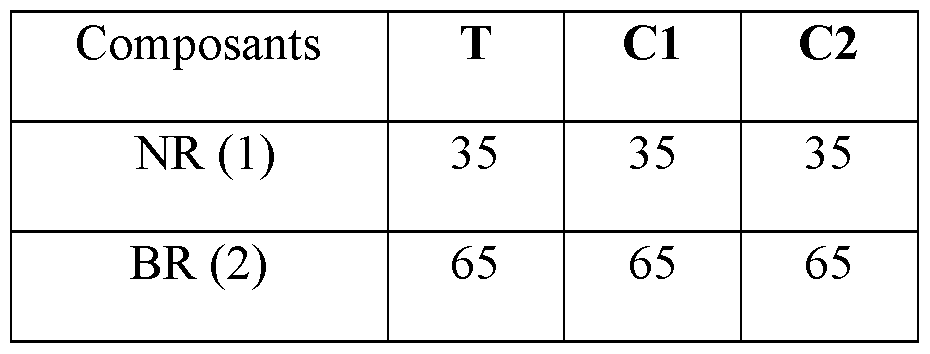
- the so-called reference composition T is presented in the table below and it includes a MES oil which is of fossil origin.
- compositions Cl and C2 in accordance with the present invention, are formulated so as to be at the same volume dilution in oil (%v) as the control composition T.
- compositions are as follows (in pce).
- the elastomer matrix is introduced into an internal mixer (final filling rate: approximately 70% by volume and paddle speed 50 rpm), whose initial tank temperature is approximately 90°C. When the temperature reaches 100°C, the carbon black and the plasticizer are introduced. Thermomechanical work is then carried out (non-productive phase) in one step, which lasts in total around 3 to 4 min, until reaching a maximum “fall” temperature of 160°C. The mixture thus obtained is recovered, cooled then the sulfur and the vulcanization accelerators are incorporated on a mixer (homo-finisher) at 30 ° C, mixing everything (productive phase) for an appropriate time (for example around ten of minutes).
- compositions thus obtained are then calendered either in the form of plates (thickness 2 to 3mm) or thin sheets of rubber and vulcanized to their optimum at a temperature of 160°C for measurements of their physical and mechanical properties which are exposed in Table 3.
- the rigidity criterion G* 10% in deformation remains unchanged.
- the mechanical properties of the rubber compositions comprising a biosourced plasticizer according to the invention are maintained at low deformation compared to the mechanical properties of a standard rubber composition comprising a conventional plasticizer of fossil origin.
- the two compositions in accordance with the invention comprising a biosourced plasticizer make it possible to improve the breaking resistance by improving the rigidity at high deformation, because the elongation and the breaking stress are significantly improved.
- the standard rubber composition comprising a conventional plasticizer of fossil origin.
Landscapes
- Engineering & Computer Science (AREA)
- Mechanical Engineering (AREA)
- Chemical & Material Sciences (AREA)
- Health & Medical Sciences (AREA)
- Chemical Kinetics & Catalysis (AREA)
- Medicinal Chemistry (AREA)
- Polymers & Plastics (AREA)
- Organic Chemistry (AREA)
- Compositions Of Macromolecular Compounds (AREA)
Abstract
Description




Claims
Priority Applications (1)
| Application Number | Priority Date | Filing Date | Title |
|---|---|---|---|
| EP23736109.2A EP4547499B1 (fr) | 2022-06-30 | 2023-06-29 | Composition de caoutchouc comprenant un plastifiant biosourcé |
Applications Claiming Priority (2)
| Application Number | Priority Date | Filing Date | Title |
|---|---|---|---|
| FR2206655A FR3137390B1 (fr) | 2022-06-30 | 2022-06-30 | Composition de caoutchouc comprenant un plastifiant biosourcé |
| FRFR2206655 | 2022-06-30 |
Publications (1)
| Publication Number | Publication Date |
|---|---|
| WO2024003230A1 true WO2024003230A1 (fr) | 2024-01-04 |
Family
ID=83189049
Family Applications (1)
| Application Number | Title | Priority Date | Filing Date |
|---|---|---|---|
| PCT/EP2023/067792 Ceased WO2024003230A1 (fr) | 2022-06-30 | 2023-06-29 | Composition de caoutchouc comprenant un plastifiant biosourcé |
Country Status (3)
| Country | Link |
|---|---|
| EP (1) | EP4547499B1 (fr) |
| FR (1) | FR3137390B1 (fr) |
| WO (1) | WO2024003230A1 (fr) |
Citations (15)
| Publication number | Priority date | Publication date | Assignee | Title |
|---|---|---|---|---|
| WO1997036724A2 (fr) | 1996-04-01 | 1997-10-09 | Cabot Corporation | Nouveaux materiaux composites elastomeres, et procede et appareil s'y rapportant |
| WO1999016600A1 (fr) | 1997-09-30 | 1999-04-08 | Cabot Corporation | Melanges composites a base d'elastomere et procedes d'elaboration |
| WO1999028376A2 (fr) | 1997-11-28 | 1999-06-10 | Compagnie Generale Des Etablissements Michelin - Michelin & Cie | Charge alumineuse renforcante et composition de caoutchouc comportant une telle charge |
| WO2000073372A1 (fr) | 1999-05-28 | 2000-12-07 | Societe De Technologie Michelin | Composition de caoutchouc pour pneumatique, a base d'elastomere dienique et d'un oxyde de titane renforçant |
| WO2002010269A2 (fr) | 2000-07-31 | 2002-02-07 | Societe De Technologie Michelin | Bande de roulement pour pneumatique |
| WO2002053634A1 (fr) | 2001-01-02 | 2002-07-11 | Societe De Technologie Michelin | Composition de caoutchouc a base d'élastomère dienique et d'un carbure de silicium renforçant |
| WO2003016387A1 (fr) | 2001-08-13 | 2003-02-27 | Societe De Technologie Michelin | Composition de caoutchouc dienique pour pneumatique comprenant une silice specifique comme charge renforcante |
| WO2003016215A1 (fr) | 2001-08-13 | 2003-02-27 | Rhodia Chimie | Procede de preparation de silices, silices a distribution granulometrique et/ou repartition poreuse particulieres et leurs utilisations, notamment pour le renforcement de polymeres |
| WO2004003067A1 (fr) | 2002-07-01 | 2004-01-08 | Societe De Technologie Michelin | Composition de caoutchouc a base d' elastomere dienique et d' un nitrure de silicium renforcant |
| WO2004056915A1 (fr) | 2002-12-19 | 2004-07-08 | Societe De Technologie Michelin | Composition de caoutchouc pour pneumatique a base d'un aluminosilicate renforcant |
| EP1604638A2 (fr) | 2004-06-08 | 2005-12-14 | L'oreal | Composition cosmétique comprenant un polymére semi-cristallin et un ester de dimère diol |
| EP1683513A1 (fr) | 2004-12-30 | 2006-07-26 | L'oreal | Composition cosmétique contenant un ester d'alcool alcoxylé et une huile ester hydrocarbonée |
| US20150315358A1 (en) * | 2012-12-19 | 2015-11-05 | Makiko Yonemoto | Rubber composition and tire produced by using the same |
| JP2018039912A (ja) * | 2016-09-07 | 2018-03-15 | 横浜ゴム株式会社 | タイヤ用ゴム組成物 |
| US20190367706A1 (en) * | 2018-05-29 | 2019-12-05 | Sumitomo Rubber Industries, Ltd. | Rubber composition for tires and pneumatic tire |
-
2022
- 2022-06-30 FR FR2206655A patent/FR3137390B1/fr active Active
-
2023
- 2023-06-29 EP EP23736109.2A patent/EP4547499B1/fr active Active
- 2023-06-29 WO PCT/EP2023/067792 patent/WO2024003230A1/fr not_active Ceased
Patent Citations (17)
| Publication number | Priority date | Publication date | Assignee | Title |
|---|---|---|---|---|
| WO1997036724A2 (fr) | 1996-04-01 | 1997-10-09 | Cabot Corporation | Nouveaux materiaux composites elastomeres, et procede et appareil s'y rapportant |
| WO1999016600A1 (fr) | 1997-09-30 | 1999-04-08 | Cabot Corporation | Melanges composites a base d'elastomere et procedes d'elaboration |
| US6610261B1 (en) | 1997-11-28 | 2003-08-26 | COMPAGNIE GéNéRALE DES ETABLISSEMENTS MICHELIN - MICHELIN & CIE | Reinforcing aluminum-based filler and rubber composition comprising such a filter |
| WO1999028376A2 (fr) | 1997-11-28 | 1999-06-10 | Compagnie Generale Des Etablissements Michelin - Michelin & Cie | Charge alumineuse renforcante et composition de caoutchouc comportant une telle charge |
| WO2000073372A1 (fr) | 1999-05-28 | 2000-12-07 | Societe De Technologie Michelin | Composition de caoutchouc pour pneumatique, a base d'elastomere dienique et d'un oxyde de titane renforçant |
| US6747087B2 (en) | 1999-05-28 | 2004-06-08 | Michelin Recherche Et Technique S.A. | Rubber composition for a tire, based on diene elastomer and a reinforcing titanium oxide |
| WO2002010269A2 (fr) | 2000-07-31 | 2002-02-07 | Societe De Technologie Michelin | Bande de roulement pour pneumatique |
| WO2002053634A1 (fr) | 2001-01-02 | 2002-07-11 | Societe De Technologie Michelin | Composition de caoutchouc a base d'élastomère dienique et d'un carbure de silicium renforçant |
| WO2003016215A1 (fr) | 2001-08-13 | 2003-02-27 | Rhodia Chimie | Procede de preparation de silices, silices a distribution granulometrique et/ou repartition poreuse particulieres et leurs utilisations, notamment pour le renforcement de polymeres |
| WO2003016387A1 (fr) | 2001-08-13 | 2003-02-27 | Societe De Technologie Michelin | Composition de caoutchouc dienique pour pneumatique comprenant une silice specifique comme charge renforcante |
| WO2004003067A1 (fr) | 2002-07-01 | 2004-01-08 | Societe De Technologie Michelin | Composition de caoutchouc a base d' elastomere dienique et d' un nitrure de silicium renforcant |
| WO2004056915A1 (fr) | 2002-12-19 | 2004-07-08 | Societe De Technologie Michelin | Composition de caoutchouc pour pneumatique a base d'un aluminosilicate renforcant |
| EP1604638A2 (fr) | 2004-06-08 | 2005-12-14 | L'oreal | Composition cosmétique comprenant un polymére semi-cristallin et un ester de dimère diol |
| EP1683513A1 (fr) | 2004-12-30 | 2006-07-26 | L'oreal | Composition cosmétique contenant un ester d'alcool alcoxylé et une huile ester hydrocarbonée |
| US20150315358A1 (en) * | 2012-12-19 | 2015-11-05 | Makiko Yonemoto | Rubber composition and tire produced by using the same |
| JP2018039912A (ja) * | 2016-09-07 | 2018-03-15 | 横浜ゴム株式会社 | タイヤ用ゴム組成物 |
| US20190367706A1 (en) * | 2018-05-29 | 2019-12-05 | Sumitomo Rubber Industries, Ltd. | Rubber composition for tires and pneumatic tire |
Non-Patent Citations (1)
| Title |
|---|
| THE JOURNAL OF THE AMERICAN CHEMICAL SOCIETY, vol. 60, February 1938 (1938-02-01), pages 309 |
Also Published As
| Publication number | Publication date |
|---|---|
| FR3137390B1 (fr) | 2024-06-21 |
| FR3137390A1 (fr) | 2024-01-05 |
| EP4547499A1 (fr) | 2025-05-07 |
| EP4547499B1 (fr) | 2026-02-18 |
Similar Documents
| Publication | Publication Date | Title |
|---|---|---|
| EP2794748B1 (fr) | Pneumatique comprenant une composition essentiellement depourvue de derive guanidique et comprenant une amine primaire | |
| EP4076982B1 (fr) | Composition de caoutchouc | |
| EP3840962B1 (fr) | Pneumatique muni d'une composition comprénant un élastomère riche en éthylène, un peroxyde et un dérivé d'acrylate spécifique | |
| EP3840960B1 (fr) | Pneumatique muni d'une composition comprenant un elastomere riche en ethylene, un peroxyde et un derive d'acrylate specifique | |
| FR2984898A1 (fr) | Pneumatique comprenant une composition essentiellement depourvue de derive guanidique et comprenant un aminoetheralcool | |
| FR3012147A1 (fr) | Pneumatique comprenant une composition comprenant un derive du diacrylate de zinc et un peroxyde | |
| EP3840961B1 (fr) | Pneumatique muni d'une composition comprénant un élastomère riche en éthylène, un peroxyde et un dérivé d'acrylate spécifique | |
| EP2566915A1 (fr) | Composition de caoutchouc, utilisable pour la fabrication d'un pneumatique dont la composition comporte un amidon et un plastifiant aqueux ou hydrosoluble | |
| EP3728453B1 (fr) | Bande de roulement de pneumatique dont le systeme de reticulation est a base de peroxyde organique | |
| CA2875626C (fr) | Composition elastomerique presentant une conductivite thermique amelioree | |
| EP3642050B1 (fr) | Pneumatique pour vehicule portant des lourdes charges comprenant une nouvelle bande de roulement | |
| EP4547499B1 (fr) | Composition de caoutchouc comprenant un plastifiant biosourcé | |
| CA3005288A1 (fr) | Bande de roulement renforcee d'une silice de basse surface specifique et un elastomere dienique de faible temperature de transition vitreuse | |
| EP4547498B1 (fr) | Composition de caoutchouc comprenant un plastifiant biosourcé de la famille des estolides | |
| WO2019110922A1 (fr) | Pneumatique pourvu d'une couche interne | |
| FR3144145A1 (fr) | Compositions elastomeriques comprenant un noir de carbone de pyrolyse | |
| FR3137389A1 (fr) | Composition de caoutchouc comprenant un ester d'acide gras comme plastifiant | |
| FR3137391A1 (fr) | Composition de caoutchouc comprenant un estolide comme plastifiant biosourcé | |
| CA3213296A1 (fr) | Composition de caoutchouc | |
| FR3079841A1 (fr) | Pneumatique comportant une composition de caoutchouc comprenant un nouvel agent de couplage polysulfure porteur de groupes associatifs azotes | |
| FR3135723A1 (fr) | Composition de caoutchouc a base d’un elastomere fortement sature et d’un plastifiant liquide polaire | |
| WO2024200449A1 (fr) | Composition de caoutchouc comprenant un système plastifiant spécifique | |
| WO2015052131A1 (fr) | Composition de caoutchouc pour bande de roulement comprenant une polynitrone | |
| FR3135722A1 (fr) | Composition de caoutchouc a base d’un elastomere fortement sature et d’un plastifiant liquide | |
| FR2999584A1 (fr) | Pneumatique comprenant une composition essentiellement depourvue de derive guanidique et comprenant un compose thiazole et un hydroxyde de metal alcalin ou alcalino-terreux |
Legal Events
| Date | Code | Title | Description |
|---|---|---|---|
| 121 | Ep: the epo has been informed by wipo that ep was designated in this application |
Ref document number: 23736109 Country of ref document: EP Kind code of ref document: A1 |
|
| WWE | Wipo information: entry into national phase |
Ref document number: 2023736109 Country of ref document: EP |
|
| NENP | Non-entry into the national phase |
Ref country code: DE |
|
| ENP | Entry into the national phase |
Ref document number: 2023736109 Country of ref document: EP Effective date: 20250130 |
|
| WWP | Wipo information: published in national office |
Ref document number: 2023736109 Country of ref document: EP |
|
| WWG | Wipo information: grant in national office |
Ref document number: 2023736109 Country of ref document: EP |