WO2024005142A1 - Procédé de criblage de plantes de stévia - Google Patents
Procédé de criblage de plantes de stévia Download PDFInfo
- Publication number
- WO2024005142A1 WO2024005142A1 PCT/JP2023/024180 JP2023024180W WO2024005142A1 WO 2024005142 A1 WO2024005142 A1 WO 2024005142A1 JP 2023024180 W JP2023024180 W JP 2023024180W WO 2024005142 A1 WO2024005142 A1 WO 2024005142A1
- Authority
- WO
- WIPO (PCT)
- Prior art keywords
- weight
- less
- approximately
- plant
- content
- Prior art date
- Legal status (The legal status is an assumption and is not a legal conclusion. Google has not performed a legal analysis and makes no representation as to the accuracy of the status listed.)
- Ceased
Links
Images


Classifications
-
- C—CHEMISTRY; METALLURGY
- C12—BIOCHEMISTRY; BEER; SPIRITS; WINE; VINEGAR; MICROBIOLOGY; ENZYMOLOGY; MUTATION OR GENETIC ENGINEERING
- C12P—FERMENTATION OR ENZYME-USING PROCESSES TO SYNTHESISE A DESIRED CHEMICAL COMPOUND OR COMPOSITION OR TO SEPARATE OPTICAL ISOMERS FROM A RACEMIC MIXTURE
- C12P19/00—Preparation of compounds containing saccharide radicals
- C12P19/44—Preparation of O-glycosides, e.g. glucosides
- C12P19/56—Preparation of O-glycosides, e.g. glucosides having an oxygen atom of the saccharide radical directly bound to a condensed ring system having three or more carbocyclic rings, e.g. daunomycin, adriamycin
-
- C—CHEMISTRY; METALLURGY
- C12—BIOCHEMISTRY; BEER; SPIRITS; WINE; VINEGAR; MICROBIOLOGY; ENZYMOLOGY; MUTATION OR GENETIC ENGINEERING
- C12Q—MEASURING OR TESTING PROCESSES INVOLVING ENZYMES, NUCLEIC ACIDS OR MICROORGANISMS; COMPOSITIONS OR TEST PAPERS THEREFOR; PROCESSES OF PREPARING SUCH COMPOSITIONS; CONDITION-RESPONSIVE CONTROL IN MICROBIOLOGICAL OR ENZYMOLOGICAL PROCESSES
- C12Q1/00—Measuring or testing processes involving enzymes, nucleic acids or microorganisms; Compositions therefor; Processes of preparing such compositions
- C12Q1/68—Measuring or testing processes involving enzymes, nucleic acids or microorganisms; Compositions therefor; Processes of preparing such compositions involving nucleic acids
- C12Q1/6876—Nucleic acid products used in the analysis of nucleic acids, e.g. primers or probes
- C12Q1/6888—Nucleic acid products used in the analysis of nucleic acids, e.g. primers or probes for detection or identification of organisms
- C12Q1/6895—Nucleic acid products used in the analysis of nucleic acids, e.g. primers or probes for detection or identification of organisms for plants, fungi or algae
-
- A—HUMAN NECESSITIES
- A01—AGRICULTURE; FORESTRY; ANIMAL HUSBANDRY; HUNTING; TRAPPING; FISHING
- A01H—NEW PLANTS OR NON-TRANSGENIC PROCESSES FOR OBTAINING THEM; PLANT REPRODUCTION BY TISSUE CULTURE TECHNIQUES
- A01H1/00—Processes for modifying genotypes ; Plants characterised by associated natural traits
- A01H1/04—Processes of selection involving genotypic or phenotypic markers; Methods of using phenotypic markers for selection
- A01H1/045—Processes of selection involving genotypic or phenotypic markers; Methods of using phenotypic markers for selection using molecular markers
-
- A—HUMAN NECESSITIES
- A01—AGRICULTURE; FORESTRY; ANIMAL HUSBANDRY; HUNTING; TRAPPING; FISHING
- A01H—NEW PLANTS OR NON-TRANSGENIC PROCESSES FOR OBTAINING THEM; PLANT REPRODUCTION BY TISSUE CULTURE TECHNIQUES
- A01H1/00—Processes for modifying genotypes ; Plants characterised by associated natural traits
- A01H1/10—Processes for modifying non-agronomic quality output traits, e.g. for industrial processing; Value added, non-agronomic traits
- A01H1/101—Processes for modifying non-agronomic quality output traits, e.g. for industrial processing; Value added, non-agronomic traits involving biosynthetic or metabolic pathways, i.e. metabolic engineering, e.g. nicotine or caffeine
-
- A—HUMAN NECESSITIES
- A01—AGRICULTURE; FORESTRY; ANIMAL HUSBANDRY; HUNTING; TRAPPING; FISHING
- A01H—NEW PLANTS OR NON-TRANSGENIC PROCESSES FOR OBTAINING THEM; PLANT REPRODUCTION BY TISSUE CULTURE TECHNIQUES
- A01H5/00—Angiosperms, i.e. flowering plants, characterised by their plant parts; Angiosperms characterised otherwise than by their botanic taxonomy
- A01H5/12—Leaves
-
- A—HUMAN NECESSITIES
- A01—AGRICULTURE; FORESTRY; ANIMAL HUSBANDRY; HUNTING; TRAPPING; FISHING
- A01H—NEW PLANTS OR NON-TRANSGENIC PROCESSES FOR OBTAINING THEM; PLANT REPRODUCTION BY TISSUE CULTURE TECHNIQUES
- A01H6/00—Angiosperms, i.e. flowering plants, characterised by their botanic taxonomy
- A01H6/14—Asteraceae or Compositae, e.g. safflower, sunflower, artichoke or lettuce
- A01H6/1488—Stevia
-
- A—HUMAN NECESSITIES
- A23—FOODS OR FOODSTUFFS; TREATMENT THEREOF, NOT COVERED BY OTHER CLASSES
- A23L—FOODS, FOODSTUFFS OR NON-ALCOHOLIC BEVERAGES, NOT OTHERWISE PROVIDED FOR; PREPARATION OR TREATMENT THEREOF
- A23L27/00—Spices; Flavouring agents or condiments; Artificial sweetening agents; Table salts; Dietetic salt substitutes; Preparation or treatment thereof
- A23L27/30—Artificial sweetening agents
- A23L27/33—Artificial sweetening agents containing sugars or derivatives
- A23L27/36—Terpene glycosides
-
- A—HUMAN NECESSITIES
- A23—FOODS OR FOODSTUFFS; TREATMENT THEREOF, NOT COVERED BY OTHER CLASSES
- A23L—FOODS, FOODSTUFFS OR NON-ALCOHOLIC BEVERAGES, NOT OTHERWISE PROVIDED FOR; PREPARATION OR TREATMENT THEREOF
- A23L33/00—Modifying nutritive qualities of foods; Dietetic products; Preparation or treatment thereof
- A23L33/10—Modifying nutritive qualities of foods; Dietetic products; Preparation or treatment thereof using additives
- A23L33/105—Plant extracts, their artificial duplicates or their derivatives
-
- C—CHEMISTRY; METALLURGY
- C12—BIOCHEMISTRY; BEER; SPIRITS; WINE; VINEGAR; MICROBIOLOGY; ENZYMOLOGY; MUTATION OR GENETIC ENGINEERING
- C12Q—MEASURING OR TESTING PROCESSES INVOLVING ENZYMES, NUCLEIC ACIDS OR MICROORGANISMS; COMPOSITIONS OR TEST PAPERS THEREFOR; PROCESSES OF PREPARING SUCH COMPOSITIONS; CONDITION-RESPONSIVE CONTROL IN MICROBIOLOGICAL OR ENZYMOLOGICAL PROCESSES
- C12Q2600/00—Oligonucleotides characterized by their use
- C12Q2600/13—Plant traits
-
- C—CHEMISTRY; METALLURGY
- C12—BIOCHEMISTRY; BEER; SPIRITS; WINE; VINEGAR; MICROBIOLOGY; ENZYMOLOGY; MUTATION OR GENETIC ENGINEERING
- C12Q—MEASURING OR TESTING PROCESSES INVOLVING ENZYMES, NUCLEIC ACIDS OR MICROORGANISMS; COMPOSITIONS OR TEST PAPERS THEREFOR; PROCESSES OF PREPARING SUCH COMPOSITIONS; CONDITION-RESPONSIVE CONTROL IN MICROBIOLOGICAL OR ENZYMOLOGICAL PROCESSES
- C12Q2600/00—Oligonucleotides characterized by their use
- C12Q2600/156—Polymorphic or mutational markers
Definitions
- the present invention relates to a screening method for Stevia plants, etc.
- Patent Document 1 discloses a functional sweetener composition containing a vitamin, a high-intensity sweetener, and a sweet taste improving composition.
- Steviol glycosides are known as sweet components contained in Stevia extract.
- Stevia extract is mainly extracted and purified from stevia leaves.
- Stevia is a perennial plant of the Chrysanthemum family that is native to Paraguay in South America, and its scientific name is Stevia Rebaudiana Bertoni.
- Stevia contains a component that is approximately 300 times sweeter than sugar, so it is cultivated to extract this sweet component and use it as a natural sweetener.
- Rebaudioside A hereinafter “Rebaudioside” may be abbreviated as "Reb”
- RebB RebC
- RebD RebE
- RebM RebM
- Patent Document 2 Among various steviol glycosides, RebA, for example, has been evaluated as a sweetener with high sweetness and good quality sweetness, and is widely used. Other steviol glycosides are also being found to have their own sweetness and associated taste.
- Patent Documents 3 to 6 Methods for screening Stevia plants characterized by steviol glycoside content etc. based on genetic information.
- the invention provides: [1] The following chemical characteristics (a) to (r ) A method for screening Stevia plants having at least one of the following. (1) Heterozygous or homozygous for the allele in which the base corresponding to position 184 of SEQ ID NO: 1 is G. (2) Heterozygous or homozygous for the allele in which the base corresponding to position 170 of SEQ ID NO: 2 is C. (3) Heterozygous or homozygous for the allele in which the base corresponding to position 92 of SEQ ID NO: 3 is C. (a) Compared to Stevia plants that do not have any of the genetic characteristics (1) to (3), the content ratio of RebM to rebaudioside (Reb)D is high.
- (g) Contains more RebF than Stevia plants that do not have any of the genetic characteristics (1) to (3).
- (h) It has a higher RebG content than a Stevia plant that does not have any of the genetic characteristics (1) to (3).
- the content of RebM is higher than that of a stevia plant that does not have any of the genetic characteristics (1) to (3).
- (j) The content of steviol glycosides having ⁇ -1,3-glucoside bonds is higher than that of Stevia plants that do not have any of the genetic characteristics (1) to (3).
- the content of RebD is lower than that of a Stevia plant that does not have any of the genetic characteristics (1) to (3).
- (l) The content of RebE is lower than that of Stevia plants that do not have any of the genetic characteristics (1) to (3).
- the content of RebN is lower than that of a Stevia plant that does not have any of the genetic characteristics (1) to (3).
- the content of stevioside is lower than that of a stevia plant that does not have any of the genetic characteristics (1) to (3).
- the content of steviol glycosides that do not have ⁇ -1,3-glucoside bonds is lower.
- the chemical characteristic (p) includes, for example, an embodiment in which the content ratio of RebA to RebD is high and the content ratio of RebB to RebE is high.
- (q) Compared to Stevia plants that do not have any of the genetic characteristics (1) to (3), they have ⁇ -1,3-glucoside bonds to steviol glycosides that do not have ⁇ -1,3-glucoside bonds. High steviol glycoside content.
- (r) Compared to Stevia plants that do not have any of the genetic characteristics (1) to (3), the steviol glycoside produced by UGT76G1 from the substrate steviol glycoside of UGT76G1 is High content ratio.
- [2] Further comprising the step of measuring the content of RebA, RebB, RebD, RebE, RebF, RebG, RebM, RebN and/or stevioside in the test Stevia plant tissue in which the presence and/or absence of the genetic characteristic has been detected. , the method described in [1]. [3] The method according to [1] or [2], wherein the step of detecting the presence and/or absence of the genetic characteristic is performed using a CAPS method, a dCAPS method, or a TaqMan PCR method. [4] A chemical characteristic as defined in [1] (a A screening kit for a Stevia plant having at least one of ) to (r).
- the plant according to [6] which has at least one of the chemical characteristics (a) to (r) defined in [1].
- RebN The content of RebN is lower than that of extracts from Stevia plants that do not have any of the genetic characteristics (1) to (3) defined in [1].
- n' The content of stevioside is lower than that of an extract of a stevia plant that does not have any of the genetic characteristics (1) to (3) defined in [1].
- o' A steviol glycoside that does not have ⁇ -1,3-glucosidic bonds compared to an extract of a Stevia plant that does not have any of the genetic characteristics (1) to (3) defined in [1]. content is low.
- [16-2] The extract of dead tissue or dead cells according to [10-2] or [11-2], which has at least one of the following chemical characteristics (a') to (r').
- (a') Contains RebM for rebaudioside (Reb)D compared to extracts of dead tissues or cells of Stevia plants that do not have any of the genetic characteristics (1) to (3) defined in [1]. The ratio is high.
- (b') The content ratio of RebB to RebE is higher than the extract of dead tissue or dead cells of a Stevia plant that does not have any of the genetic characteristics (1) to (3) defined in [1].
- (c') The content ratio of RebG to RebE is higher than the extract of dead tissue or dead cells of a Stevia plant that does not have any of the genetic characteristics (1) to (3) defined in [1].
- (d') The content ratio of RebG to stevioside is higher than the extract of dead tissue or dead cells of a Stevia plant that does not have any of the genetic characteristics (1) to (3) defined in [1].
- (e') Contains more RebA than extracts of dead tissues or cells of Stevia plants that do not have any of the genetic characteristics (1) to (3) defined in [1].
- (f') Contains more RebB than extracts of dead tissues or cells of Stevia plants that do not have any of the genetic characteristics (1) to (3) defined in [1].
- (g') Contains more RebF than extracts of dead tissues or cells of Stevia plants that do not have any of the genetic characteristics (1) to (3) defined in [1].
- ADVANTAGE OF THE INVENTION it is possible to obtain a Stevia plant having various characteristics described herein, such as a higher content ratio of RebM to RebD, a means for producing such a plant, and a method for producing a Stevia plant from such a plant. It becomes possible to provide the leaves obtained and beverages containing steviol glycosides obtained from the leaves.
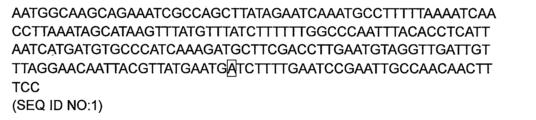
- FIG. 1 is a diagram showing the positions of bases related to genetic characteristic (1) in the base sequence of SEQ ID NO: 1.
- the bases surrounded by frames are the bases related to genetic characteristic (1).
- FIG. 2 is a diagram showing the positions of bases related to genetic characteristic (2) in the base sequence of SEQ ID NO: 2.
- the bases surrounded by frames are the bases related to genetic characteristic (2).
- FIG. 3 is a diagram showing the positions of bases related to genetic characteristic (3) in the base sequence of SEQ ID NO: 3.
- the bases surrounded by frames are the bases related to genetic characteristic (3).
- Stevia plant having at least one of the following genetic characteristics (1) to (3) (hereinafter collectively referred to as "the plant of the present invention” or “the Stevia plant of the present invention”). ).
- the plant of the present invention or “the Stevia plant of the present invention”).
- the plant of the present invention is derived from a wild Stevia plant and has at least one of the above genetic characteristics (1) to (3) (hereinafter referred to as genetic characteristics (1)). At least one of (3) to (3) may be collectively referred to as "genetic characteristics of the present invention").
- the plant of the present invention may have at least one of the following chemical characteristics.
- (b) The content ratio of RebB to RebE is higher than that of a Stevia plant that does not have the genetic characteristics of the present invention.
- (c) The content ratio of RebG to RebE is higher than that of a Stevia plant that does not have the genetic characteristics of the present invention.
- the content ratio of RebG to stevioside is higher than that of a stevia plant that does not have the genetic characteristics of the present invention.
- the content of RebE is lower than that of Stevia plants that do not have the genetic characteristics of the present invention.
- the content of RebN is lower than that of a Stevia plant that does not have the genetic characteristics of the present invention.
- the content of stevioside is lower than that of a stevia plant that does not have the genetic characteristics of the present invention.
- the content of steviol glycosides that do not have ⁇ -1,3-glucoside bonds is lower than that of Stevia plants that do not have the genetic characteristics of the present invention.
- “Position (or part) corresponding to” means, if a sequence identical to a reference sequence (e.g. SEQ ID NOs: 1 to 3) exists in the genome, the position in that sequence in the genome or If there is no sequence identical to the reference sequence in the genome, the position in the reference sequence in the sequence corresponding to the reference sequence in the genome. or a position or part corresponding to a part.
- a sequence identical to or equivalent to the reference sequence for example, amplify the genomic DNA of the target Stevia plant using primers that can amplify the reference sequence by PCR, and then sequence the amplified product. This can be determined by performing alignment analysis between the obtained sequence and the reference sequence.
- Non-limiting examples of sequences equivalent to the standard sequence include, for example, 60% or more, 70% or more, 75% or more, 80% or more, 81% or more, 82% or more, 83% or more, 84% or more of the standard sequence. , 85% or more, 86% or more, 87% or more, 88% or more, 89% or more, 90% or more, 91% or more, 92% or more, 93% or more, 94% or more, 95% or more, 96% or more, 97 Sequence identity of % or more, 98% or more, 98.1% or more, 98.4% or more, 98.7% or more, 99% or more, 99.2% or more, 99.5% or more, or 99.8% or more Examples include base sequences having the following.
- the position or portion in the sequence corresponding to the reference sequence in the genome that corresponds to the position or portion in the reference sequence can be determined by considering the base sequences before and after the position or portion in the reference sequence. For example, by alignment analysis between a reference sequence and a sequence corresponding to the reference sequence in the genome, it is possible to determine the position or part of the sequence corresponding to the reference sequence in the genome that corresponds to the position or part in the reference sequence. can.
- the genome of a Stevia plant has a portion consisting of the same base sequence as SEQ ID NO: 1.
- the "position corresponding to position 184 of SEQ ID NO: 1" is the 184th position from the 5' side of the part of the genome that has the same base sequence as SEQ ID NO: 1.
- the genome of the Stevia plant has a part consisting of a base sequence that is not identical to SEQ ID NO: 1 but corresponds to it, the genome does not have a part consisting of a base sequence identical to SEQ ID NO: 1, so "Position corresponding to position 184 of SEQ ID NO: 1" does not necessarily correspond to the 184th position from the 5' side of the part corresponding to SEQ ID NO: 1, but refers to the base sequence before and after position 184 of SEQ ID NO: 1. Taking this into account, it is possible to specify "the position corresponding to position 184 of SEQ ID NO: 1" in the genome of such a Stevia plant.
- the ⁇ position corresponding to position 184 of SEQ ID NO: 1'' in the genome of the Stevia plant was identified. can do.
- a portion consisting of a base sequence corresponding to SEQ ID NO: 1 is, for example, 60% or more, 70% or more, 75% or more, 80% or more, 81% or more, 82% or more, 83% or more, 84% or more, 85% or more, 86% or more, 87% or more, 88% or more, 89% or more, 90% or more, 91% or more, 92% or more, 93% or more, 94% or more, 95% 96% or more, 97% or more, 98% or more, 98.1% or more, 98.4% or more, 98.7% or more, 99% or more, 99.2% or more, 99.5% or more, or 99. It means a portion consisting of a base sequence having 8% or more sequence identity.
- the "portion consisting of a nucleotide sequence corresponding to SEQ ID NO: 1" includes positions 1 to 183 from the 5' end of SEQ ID NO: 1 (i.e., positions 1 to 183 from the 5' end of SEQ ID NO: 1), genetic characteristics ( A forward primer (for example, one having the sequence of SEQ ID NO: 4) that hybridizes to the complementary sequence of the 1 base at position 184, which is the position related to 1) (up to the base on the 5' end side), and 3 of SEQ ID NO: 1.
- a portion of the Stevia plant genome that can be amplified by PCR using a reverse primer (eg, one having the sequence SEQ ID NO: 5).
- the "portion consisting of a nucleotide sequence corresponding to SEQ ID NO: 2" includes positions 1 to 169 from the 5' end of SEQ ID NO: 2 (i.e., positions 1 to 169 from the 5' end of SEQ ID NO: 2), genetic characteristics ( A forward primer (for example, one having the sequence of SEQ ID NO: 6) that hybridizes to the complementary sequence of the 1 base at position 170, which is the position related to 2) (up to the base on the 5' end side), and 3 of SEQ ID NO: 2.
- Included is a portion of the genome of a Stevia plant that can be amplified by PCR using a reverse primer (eg, one having the sequence SEQ ID NO: 7).
- the "portion consisting of a base sequence corresponding to SEQ ID NO: 3" includes positions 1 to 91 from the 5' end of SEQ ID NO: 3 (i.e., from the 5' end of SEQ ID NO: 3 to the genetic characteristic ( A forward primer (for example, one having the sequence of SEQ ID NO: 8) that hybridizes to the complementary sequence of the part of the 92nd base (up to the 5' end base), which is the position related to 3), and 3 of SEQ ID NO: 3.
- a forward primer for example, one having the sequence of SEQ ID NO: 8 that hybridizes to the complementary sequence of the part of the 92nd base (up to the 5' end base), which is the position related to 3
- a portion of the Stevia plant genome that can be amplified by PCR using a reverse primer (eg, one having the sequence SEQ ID NO: 9).
- the "portion consisting of the base sequence corresponding to SEQ ID NO: 1" includes, for example, PCR using a forward primer containing the base sequence of SEQ ID NO: 4 and a reverse primer containing the base sequence of SEQ ID NO: 5. This includes the portion of the Stevia plant genome that can be amplified by.
- the "portion consisting of the base sequence corresponding to SEQ ID NO: 2" includes, for example, PCR using a forward primer containing the base sequence of SEQ ID NO: 6 and a reverse primer containing the base sequence of SEQ ID NO: 7. This includes the portion of the Stevia plant genome that can be amplified by.
- the "portion consisting of the base sequence corresponding to SEQ ID NO: 3" includes, for example, PCR using a forward primer containing the base sequence of SEQ ID NO: 8 and a reverse primer containing the base sequence of SEQ ID NO: 9. This includes the portion of the Stevia plant genome that can be amplified by.
- the allele in which the base corresponding to position 184 of SEQ ID NO: 1 is G is SEQ ID NO: 10 to Contains at least one base sequence of 13.
- the allele in which the base corresponding to position 170 of SEQ ID NO: 2 is C is SEQ ID NO: 14 to Contains at least one base sequence of 17.
- the allele in which the base corresponding to position 92 of SEQ ID NO: 3 is C is SEQ ID NO: 18 to Contains at least one base sequence of 21.
- (1) the position corresponding to position 184 of SEQ ID NO: 1, (2) the position corresponding to position 170 of SEQ ID NO: 2, and (3) the position corresponding to position 92 of SEQ ID NO: 3 are may be collectively referred to as "polymorphic site” or "site related to the genetic characteristics of the present invention.”
- PCR method TaqMan PCR method
- sequencing method microarray method
- invader method TILLING method
- RAD random amplified polymorphic DNA
- RFLP restriction enzyme fragment length polymorphism
- AFLP amplified fragment length polymorphism
- SSLP simple sequence length polymorphism
- CAPS cleaved amplified polymorphic sequence
- dCAPS derived cleaved amplified polymorphic sequence
- ASO allele-specific oligonucleotide
- ARMS denaturing gradient gel electrophoresis
- CCM chemical cleavage of mismatch
- DOL DOL method
- MALDI-TOF/MS method MALDI-TOF/MS method
- TDI method padlock probe method
- molecular beacon method DASH (dynamic allele specific hybridization) method
- UCAN method ECA method
- PINPOINT method PROBE (primer oligo base extension) method
- VSET very short extension
- the genetic characteristics of the present invention can be detected by the dCAPS method using the following combination of primer sets and restriction enzymes. If the candidate plant has the genetic characteristic (1) (heterozygosity) of the preferred embodiment, for example, a forward primer having the nucleotide sequence shown in SEQ ID NO: 22 and a forward primer having the nucleotide sequence shown in SEQ ID NO: 23 is applied to the genomic DNA of the candidate plant.
- a forward primer having the nucleotide sequence shown in SEQ ID NO: 22 and a forward primer having the nucleotide sequence shown in SEQ ID NO: 23 is applied to the genomic DNA of the candidate plant.
- PCR amplification is performed using a reverse primer having the nucleotide sequence shown, and the obtained PCR product (approximately 248 bp long, e.g.
- SEQ ID NO: 24 or 25 is treated with the restriction enzyme EcoRV, an approximately 248 bp long band ( For example, SEQ ID NO: 25), a band about 213 bp long (eg SEQ ID NO: 26) and a band about 35 bp long (eg SEQ ID NO: 27) occur.
- SEQ ID NO: 25 a band about 213 bp long
- SEQ ID NO: 27 a band about 35 bp long
- restriction enzyme treatment is performed, A band of approximately 213 bp long (eg, SEQ ID NO: 26) and a band of approximately 35 bp long (eg, SEQ ID NO: 27) result.
- a forward primer having the nucleotide sequence shown in SEQ ID NO: 28 and a forward primer having the nucleotide sequence shown in SEQ ID NO: 29 is applied to the genomic DNA of the candidate plant.
- PCR amplification is performed using a reverse primer having the nucleotide sequence shown, and the resulting PCR product (approximately 242 bp long, e.g.
- SEQ ID NO: 30 or 31 is treated with the restriction enzyme PvuII, an approximately 242 bp long band ( For example, SEQ ID NO: 30), a band about 207 bp long (eg SEQ ID NO: 32) and a band about 35 bp long (eg SEQ ID NO: 33) occur.
- PvuII restriction enzyme
- a forward primer having the base sequence shown in SEQ ID NO: 34 and a forward primer having the base sequence shown in SEQ ID NO: 35 is applied to the genomic DNA of the candidate plant.
- PCR amplification is performed using a reverse primer having the nucleotide sequence shown in FIG. No. 37) and a band approximately 35 bp long (eg SEQ ID No. 38).
- PCR amplification in the same manner as above will generate a PCR product with a length of about 284 bp (for example, SEQ ID NO: 39), which is then treated with the restriction enzyme PvuII.
- the plant of the present invention has any one of genetic characteristics (1) to (3). In some embodiments, the plants of the present invention have a combination of genetic characteristics (1) and (2). In some embodiments, the plants of the invention have a combination of genetic characteristics (1) and (3). In some embodiments, the plants of the invention have a combination of genetic characteristics (2) and (3). In some embodiments, the plants of the present invention have all of the genetic characteristics (1) to (3).
- the stevia plant of the present invention is derived from a wild type stevia plant and has the above-mentioned genetic characteristics resulting in at least one of the chemical characteristics (a) to (r).
- the genetic characteristics may be generated by genetic recombination techniques or non-genetic recombination techniques. Therefore, even if the plants of the present invention are obtained by genetically recombinant techniques or their descendants (hereinafter sometimes referred to as "genetically modified plants”), they can be obtained by non-genetically recombinant techniques. or its descendants (hereinafter sometimes referred to as "non-genetically modified plants").
- non-genetically recombinant methods include methods of inducing mutations in genes of host cells (or host plants) without introducing foreign genes. Such a method includes a method of causing a mutagenic agent to act on plant cells.
- mutagens include ethyl methanesulfonic acid (EMS), sodium azide, and the like.
- EMS ethyl methanesulfonic acid
- sodium azide ethyl methanesulfonic acid
- Plant cells can be treated at a concentration such as 1.0%.
- Processing time is approximately 1 hour to approximately 48 hours, approximately 2 hours to approximately 36 hours, approximately 3 hours to approximately 30 hours, approximately 4 hours to approximately 28 hours, approximately 5 hours to approximately 26 hours, approximately 6 hours to approximately 24 hours. It is.
- the treatment procedure itself is known, it can be carried out by immersing water-absorbing seeds that have undergone a water-absorption process in a treatment solution containing a mutagenic agent at the above-mentioned concentration for the above-mentioned treatment time.
- Non-genetically recombinant method is a method of irradiating plant cells with radiation or light such as X-rays, gamma rays, and ultraviolet rays.
- ultraviolet rays use an appropriate amount of ultraviolet rays (ultraviolet lamp intensity, distance, time) to culture the irradiated cells on a selective medium, etc., and then culture the cells, callus, and plants that have the desired traits. You can choose.
- the irradiation intensity at that time is 0.01-100Gr, 0.03-75Gr, 0.05-50Gr, 0.07-25Gr, 0.09-20Gr, 0.1-15Gr, 0.1-10Gr, 0.
- the irradiation distance may be 1cm-200m, 5cm-100m, 7cm-75m, 9cm-50m, 10cm-30m, 10cm-20m, 10cm-10m, and the irradiation time is It may be 1 minute to 2 years, 2 minutes to 1 year, 3 minutes to 0.5 years, 4 minutes to 1 month, 5 minutes to 2 weeks, or 10 minutes to 1 week.
- the intensity, distance, and time of irradiation vary depending on the type of radiation or light beam and the state to be irradiated (cell, callus, plant body), but can be adjusted as appropriate by those skilled in the art.
- plant cells may undergo mutations during cultivation, so it is preferable to return them to individual plants in order to maintain more stable traits.
- a plant obtained by performing genetic recombination (for example, by genome editing, etc.) using a non-genetically modified Stevia plant as a host for example, by performing genetic recombination using the plant of the present invention as a host, and further Plants with additional traits) are not excluded from the scope of the present invention.
- the plant of the present invention may have at least one of the above chemical characteristics (a) to (r).
- a Stevia plant that does not have the genetic characteristics of the present invention refers to, for example, a Stevia plant that has at least one of the genetic characteristics (1) to (3) of the present invention.
- Stevia plants that is, mean stevia plants that do not have genetic characteristics (1), and for stevia plants that have genetic characteristics (1) and (2), genetic characteristics (1) and ( Stevia plants other than stevia plants having 2), that is, (i) stevia plants having neither genetic characteristic (1) nor (2), (ii) having genetic characteristic (1) but , Stevia plants that do not have genetic characteristic (2), and (iii) Stevia plants that have genetic characteristic (2) but do not have genetic characteristic (1).
- the content ratio of one steviol glycoside to another steviol glycoside is the ratio of the content of the latter steviol glycoside (e.g., RebM) to the content of the former steviol glycoside (e.g., RebD) (e.g., , RebM content/RebD content).
- the content may be, for example, the mass of the target glycoside contained in a unit mass of dried Stevia leaves or the concentration of the target glycoside in the dried Stevia leaves.
- Dried leaves are fresh leaves that are dried to reduce the water content to 10% by weight or less, 7% by weight or less, 5% by weight or less, 4% by weight or less, 3% by weight or less, 2% by weight or less, or 1% by weight or less. It refers to something that has been reduced to.
- the moisture content of the dry leaves of the plants of the invention is 3 to 4% by weight.
- the content ratio of RebM to RebD in the plant of the present invention is about 1.2 times or more of the ratio in the Stevia plant that does not have the genetic characteristic of the present invention, Approximately 1.6 times or more, approximately 2 times or more, approximately 2.4 times or more, approximately 2.8 times or more, approximately 3.2 times or more, approximately 3.6 times or more, approximately 4 times or more, approximately 4.4 times or more, approximately 4.8 times or more, approximately 5.2 times or more, Approximately 5.6 times or more, approximately 6 times or more, approximately 6.4 times or more, approximately 6.8 times or more, approximately 7.2 times or more, approximately 7.6 times or more, approximately 8 times or more, approximately 8.4 times or more, approximately 8.8 times or more, approximately 9.2 times or more, About 9.6 times or more, about 10 times or more, about 10.5 times or more, about 11 times or more, about 11.5 times or more, or about 12 times or more.
- the content ratio of RebB to RebE in the plant of the present invention is about 1.5 times or more of the ratio in the Stevia plant that does not have the genetic characteristic of the present invention, Approximately 2 times or more, approximately 2.5 times or more, approximately 3 times or more, approximately 3.5 times or more, approximately 4 times or more, approximately 4.5 times or more, approximately 5 times or more, approximately 10 times or more, approximately 15 times or more, approximately 20 times or more, About 30 times or more, about 40 times or more, about 50 times or more, about 60 times or more, about 70 times or more, about 80 times or more, about 90 times or more, about 100 times or more, about 150 times or more, about 200 times or more, About 250 times or more, about 300 times or more, about 400 times or more, about 500 times or more, about 600 times or more, or about 700 times or more.
- the content ratio of RebG to RebE in the plant of the present invention is about twice or more of the ratio in the Stevia plant that does not have the genetic characteristic of the present invention, Approximately 2.5 times or more, approximately 3 times or more, approximately 3.5 times or more, approximately 4 times or more, approximately 4.5 times or more, approximately 5 times or more, approximately 10 times or more, approximately 15 times or more, approximately 20 times or more, approximately 25 times or more, About 30 times or more, about 40 times or more, about 50 times or more, about 60 times or more, about 70 times or more, about 80 times or more, about 90 times or more, about 100 times or more, about 150 times or more, about 200 times or more, About 250 times or more, about 300 times or more, about 400 times or more, about 500 times or more, about 600 times or more, or about 700 times or more.
- the content ratio of RebG to stevioside in the plant of the present invention is about 1.5 times or more of the ratio in the stevia plant that does not have the genetic characteristic of the present invention, Approximately 2 times or more, approximately 2.5 times or more, approximately 3 times or more, approximately 3.5 times or more, approximately 4 times or more, approximately 4.5 times or more, approximately 5 times or more, approximately 10 times or more, approximately 15 times or more, approximately 20 times or more, About 30 times or more, about 40 times or more, about 50 times or more, about 60 times or more, about 70 times or more, about 80 times or more, about 90 times or more, about 100 times or more, about 150 times or more, about 200 times or more, About 250 times or more, about 300 times or more, about 400 times or more, about 500 times or more, about 600 times or more, or about 700 times or more.
- the content of RebA in the plant of the present invention is about 1.05 times or more the content of RebA in the Stevia plant that does not have the genetic characteristic of the present invention, Approximately 1.1 times or more, approximately 1.15 times or more, approximately 1.2 times or more, approximately 1.25 times or more, approximately 1.3 times or more, approximately 1.35 times or more, approximately 1.5 times or more, approximately 1.65 times or more, approximately 1.8 times or more, approximately 1.95 times or more, Approximately 2.1 times or more, approximately 2.25 times or more, approximately 2.4 times or more, approximately 2.55 times or more, approximately 2.7 times or more, approximately 2.85 times or more, approximately 3 times or more, approximately 3.15 times or more, approximately 3.3 times or more, approximately 3.5 times or more, About 3.7 times or more, about 3.9 times or more, about 4.1 times or more, about 4.3 times or more, about 4.5 times or more, or about 4.7 times or more.
- the content of RebB in the plant of the present invention is about 1.05 times or more the content of RebB in the Stevia plant that does not have the genetic characteristic of the present invention, Approximately 1.15 times or more, approximately 1.25 times or more, approximately 1.35 times or more, approximately 1.5 times or more, approximately 1.65 times or more, approximately 1.8 times or more, approximately 2 times or more, approximately 2.25 times or more, approximately 2.5 times or more, approximately 3 times or more, Approximately 3.5 times or more, approximately 4 times or more, approximately 4.5 times or more, approximately 5 times or more, approximately 5.5 times or more, approximately 6 times or more, approximately 7 times or more, approximately 8 times or more, approximately 9 times or more, approximately 10 times or more, About 11 times or more, about 12 times or more, about 13 times or more, about 14 times or more, about 15 times or more, or about 16 times or more.
- the content of RebF in the plant of the present invention is about 1.02 times or more the content of RebF in the Stevia plant that does not have the genetic characteristic of the present invention, Approximately 1.03 times or more, approximately 1.04 times or more, approximately 1.05 times or more, approximately 1.1 times or more, approximately 1.15 times or more, approximately 1.2 times or more, approximately 1.25 times or more, approximately 1.3 times or more, approximately 1.35 times or more, approximately 1.4 times or more, Approximately 1.45 times or more, approximately 1.5 times or more, approximately 1.6 times or more, approximately 1.8 times or more, approximately 2 times or more, approximately 2.2 times or more, approximately 2.4 times or more, approximately 2.6 times or more, approximately 2.8 times or more, approximately 3 times or more, About 3.2 times or more, about 3.4 times or more, about 3.6 times or more, about 3.8 times or more, about 4 times or more, or about 4.2 times or more.
- the content of RebG in the plant of the present invention is about 1.2 times or more the content of RebG in the Stevia plant that does not have the genetic characteristic of the present invention, Approximately 1.3 times or more, approximately 1.4 times or more, approximately 1.5 times or more, approximately 2 times or more, approximately 2.5 times or more, approximately 3 times or more, approximately 3.5 times or more, approximately 4 times or more, approximately 4.5 times or more, approximately 5 times or more, About 6 times or more, about 7 times or more, about 8 times or more, about 9 times or more, about 10 times or more, about 12.5 times or more, about 15 times or more, about 17.5 times or more, about 20 times or more, about 22.5 times or more, About 25 times or more, about 30 times or more, about 35 times or more, about 40 times or more, about 45 times or more, or about 50 times or more.
- the content of RebM in the plant of the present invention is about 1.05 times or more the content of RebM in the Stevia plant that does not have the genetic characteristic of the present invention, Approximately 1.1 times or more, approximately 1.15 times or more, approximately 1.2 times or more, approximately 1.3 times or more, approximately 1.4 times or more, approximately 1.5 times or more, approximately 1.7 times or more, approximately 2 times or more, approximately 2.5 times or more, approximately 3 times or more, Approximately 3.5 times or more, approximately 4 times or more, approximately 4.5 times or more, approximately 5 times or more, approximately 6 times or more, approximately 7 times or more, approximately 8 times or more, approximately 9 times or more, approximately 10 times or more, approximately 12 times or more, About 14 times or more, about 16 times or more, about 18 times or more, about 20 times or more, about 22 times or more, or about 24 times or more.
- the content of steviol glycosides having a ⁇ -1,3-glucoside bond in the plant of the present invention is lower than that of the stevia plant not having the genetic characteristic of the present invention.
- About 1.02 times or more, about 1.03 times or more, about 1.04 times or more, about 1.05 times or more, about 1.1 times or more, about 1.15 times or more the content of steviol glycosides having ⁇ -1,3-glucoside bonds in the body approximately 1.2 times or more, approximately 1.3 times or more, approximately 1.4 times or more, approximately 1.5 times or more, approximately 2 times or more, approximately 2.5 times or more, approximately 3 times or more, approximately 3.5 times or more, approximately 4 times or more, approximately 4.5 times or more , approximately 5 times or more, approximately 6 times or more, approximately 7 times or more, approximately 8 times or more, approximately 9 times or more, approximately 10 times or more, approximately 12.5 times or more, approximately 15 times or more, approximately 17.5 times or more, approximately 20 times or more
- the content of RebD in the plant of the present invention is about 0.8 times or less than the content of RebD in the Stevia plant that does not have the genetic characteristic of the present invention, About 0.76 times or less, about 0.72 times or less, about 0.68 times or less, about 0.64 times or less, about 0.6 times or less, about 0.56 times or less, about 0.52 times or less, about 0.5 times or less, about 0.48 times or less, about 0.46 times or less, About 0.44 times or less, about 0.42 times or less, about 0.4 times or less, about 0.38 times or less, about 0.36 times or less, about 0.34 times or less, about 0.32 times or less, about 0.3 times or less, about 0.28 times or less, about 0.26 times or less, It is about 0.24 times or less, about 0.22 times or less, about 0.2 times or less, about 0.18 times or less, about 0.16 times or less, or about 0.14 times or less.
- the content of RebE in the plant of the present invention is about 0.6 times or less than the content of RebE in a Stevia plant that does not have the genetic characteristic of the present invention, About 0.56 times or less, about 0.52 times or less, about 0.48 times or less, about 0.44 times or less, about 0.4 times or less, about 0.38 times or less, about 0.36 times or less, about 0.34 times or less, about 0.32 times or less, about 0.3 times or less, About 0.28 times or less, about 0.26 times or less, about 0.24 times or less, about 0.22 times or less, about 0.2 times or less, about 0.18 times or less, about 0.16 times or less, about 0.14 times or less, about 0.12 times or less, about 0.1 times or less, It is about 0.08 times or less, about 0.06 times or less, about 0.04 times or less, about 0.03 times or less, about 0.02 times or less, or about 0.01 times or less.
- the content of RebN in the plant of the present invention is about 0.9 times or less than the content of RebN in a Stevia plant that does not have the genetic characteristic of the present invention, About 0.86 times or less, about 0.82 times or less, about 0.78 times or less, about 0.74 times or less, about 0.7 times or less, about 0.66 times or less, about 0.62 times or less, about 0.58 times or less, about 0.54 times or less, about 0.5 times or less, About 0.48 times or less, about 0.46 times or less, about 0.44 times or less, about 0.42 times or less, about 0.4 times or less, about 0.38 times or less, about 0.36 times or less, about 0.34 times or less, about 0.32 times or less, about 0.3 times or less, It is about 0.28 times or less, about 0.26 times or less, about 0.24 times or less, about 0.22 times or less, about 0.2 times or less, or about 0.18 times or less.
- the content of stevioside in the plant of the present invention is about 0.8 times or less than the content of stevioside in a stevia plant that does not have the genetic characteristic of the present invention, About 0.75 times or less, about 0.7 times or less, about 0.65 times or less, about 0.6 times or less, about 0.55 times or less, about 0.5 times or less, about 0.45 times or less, about 0.4 times or less, about 0.35 times or less, about 0.3 times or less, About 0.28 times or less, about 0.26 times or less, about 0.24 times or less, about 0.22 times or less, about 0.2 times or less, about 0.18 times or less, about 0.16 times or less, about 0.14 times or less, about 0.12 times or less, about 0.1 times or less, It is about 0.08 times or less, about 0.06 times or less, about 0.05 times or less, about 0.04 times or less, about 0.03 times or less, or about 0.02 times or less.
- the content of steviol glycosides that do not have ⁇ -1,3-glucosidic bonds in the plant of the present invention is higher than that of steviol glycosides that do not have the genetic characteristic of the present invention.
- 0.66 times or less 0.62 times or less, 0.6 times or less, 0.56 times or less, 0.52 times or less, 0.48 times or less, 0.44 times or less, 0.4 times or less, 0.38 times or less, approximately 0.36 0.34 times or less, 0.32 times or less, 0.3 times or less, 0.28 times or less, 0.26 times or less, 0.24 times or less, 0.22 times or less, 0.2 times or less, 0.18 times or less, approximately 0.16 less than about 0.14 times, less than about 0.12 times, less than about 0.1 times, less than about 0.08 times, less than about 0.06 times, less than about 0.04 times, less than about 0.03 times, less than about 0.02 times, less than about 0.01 times.
- the content ratio of any one of RebA, RebB, RebF, RebG, and RebM to any one of RebD, RebE, RebN, and stevioside in the plant of the present invention. is about 1.2 times or more, about 1.5 times or more, about 2 times or more, about 2.5 times or more, about 3 times or more, about 3.5 times or more, about 4 times or more, approximately 4.5 times or more, approximately 5 times or more, approximately 10 times or more, approximately 15 times or more, approximately 20 times or more, approximately 30 times or more, approximately 40 times or more, approximately 50 times or more, approximately 60 times or more, approximately 70 times or more, approximately 80 times or more, approximately 90 times or more, approximately 100 times or more, approximately 150 times or more, approximately 200 times or more, approximately 250 times or more, approximately 300 times or more, approximately 400 times or more, approximately 500 times or more, approximately 600 times or more or approximately 700 times or more.
- the steviol glycoside having a ⁇ -1,3-glucoside bond versus the steviol glycoside having no ⁇ -1,3-glucoside bond in the plant of the present invention is about 1.2 times or more, about 1.5 times or more, about 2 times or more, about 2.5 times or more, about 3 times or more, about 3.5 times the above ratio in a Stevia plant that does not have the genetic characteristics of the present invention.
- the content ratio of steviol glycoside produced by UGT76G1 from the substrate steviol glycoside to the substrate steviol glycoside of UGT76G1 in the plant of the present invention is: About 1.2 times or more, about 1.5 times or more, about 2 times or more, about 3 times or more, about 4 times or more, about 5 times or more, about 6 times the above ratio in a Stevia plant that does not have the genetic characteristics of the present invention or more, approximately 8 times or more, approximately 10 times or more, approximately 15 times or more, approximately 20 times or more, approximately 25 times or more, approximately 30 times or more, approximately 35 times or more, approximately 40 times or more, approximately 45 times or more, approximately 50 times or more, approximately 55 times or more, approximately 60 times or more, approximately 65 times or more, approximately 70 times or more, approximately 75 times or more, approximately 80 times or more, approximately 85 times or more, approximately 90 times or more, approximately 95 times or more, or approximately 100 times That's all.
- the content ratio of RebM to RebD in the plant of the present invention is about 0.12 or more, about 0.16 or more, about 0.2 or more, about 0.24 or more, about 0.28 or more, about 0.32. or more, about 0.36 or more, about 0.4 or more, about 0.44 or more, about 0.48 or more, about 0.5 or more, about 0.525 or more, about 0.55 or more, about 0.575 or more, about 0.6 or more, about 0.625 or more, about 0.65 or more, about 0.675 or more, about 0.7 or more, about 0.725 or more, about 0.75 or more, about 0.775 or more, about 0.8 or more, about 0.825 or more, about 0.85 or more, about 0.875 or more, about 0.9 or more, about 0.925 or more, about 0.95 or more, about 0.975 or more, or about 1 That's all.
- the content ratio of RebB to RebE in the plant of the present invention is about 0.17 or more, about 0.5 or more, about 1 or more, about 1.5 or more, about 2 or more, about 2.5. or more, about 3 or more, about 3.5 or more, about 4 or more, about 4.5 or more, about 5 or more, about 5.5 or more, about 6 or more, about 6.5 or more, about 7 or more, about 7.5 or more, about 8 or more, about 8.5 or more, About 9 or more, about 9.5 or more, about 10.1 or more, about 10.5 or more, about 11 or more, about 11.5 or more, about 12 or more, about 12.5 or more, about 13 or more, about 13.5 or more, about 14 or more, about 14.5 or more, or about 15 That's all.
- the content ratio of RebG to RebE in the plant of the present invention is about 0.004 or more, about 0.05 or more, about 0.1 or more, about 0.2 or more, about 0.3 or more, about 0.4.
- the content ratio of RebG to stevioside in the plant of the present invention is about 0.0007 or more, about 0.004 or more, about 0.006 or more, about 0.008 or more, about 0.01 or more, about 0.012.
- the content of RebA in the plant of the present invention is about 2% by weight or more, about 2.15% by weight or more, about 2.3% by weight or more as a concentration in dry leaves. , about 2.45% by weight or more, about 2.6% by weight or more, about 2.75% by weight or more, about 2.9% by weight or more, about 3.05% by weight or more, about 3.2% by weight or more, about 3.35% by weight or more, about 3.5% by weight or more, about 3.65 weight% or more, about 3.8 weight% or more, about 4 weight% or more, about 4.2 weight% or more, about 4.4 weight% or more, about 4.6 weight% or more, about 4.8 weight% or more, about 5 weight% or more, about 5.25 weight% % or more, about 5.5% by weight or more, about 5.75% by weight or more, about 6% by weight or more, about 6.25% by weight or more, about 6.5% by weight or more, about 6.75% by weight or more, about 7% by weight or
- the content of RebB in the plant of the present invention is about 0.04% by weight or more, about 0.044% by weight or more, about 0.048% by weight or more as a concentration in dry leaves. , about 0.052 weight% or more, about 0.056 weight% or more, about 0.06 weight% or more, about 0.064 weight% or more, about 0.068 weight% or more, about 0.072 weight% or more, about 0.076 weight% or more, about 0.08 weight% or more, about 0.084 weight% or more, about 0.088 weight% or more, about 0.092 weight% or more, about 0.096 weight% or more, about 0.1 weight% or more, about 0.105 weight% or more, about 0.11 weight% or more, about 0.115 weight% or more, about 0.12 weight% % or greater, about 0.125% or greater, about 0.13% or greater, about 0.135% or greater, about 0.14% or greater, about 0.145% or greater, about 0.15% or greater, or about 0.15% or greater, or about 0.1
- the content of RebF in the plant of the present invention is about 0.06% by weight or more, about 0.064% by weight or more, about 0.068% by weight or more as a concentration in dry leaves. , about 0.072 weight% or more, about 0.076 weight% or more, about 0.08 weight% or more, about 0.084 weight% or more, about 0.088 weight% or more, about 0.092 weight% or more, about 0.096 weight% or more, about 0.1 weight% or more, about 0.105 weight% or more, about 0.11 weight% or more, about 0.115 weight% or more, about 0.12 weight% or more, about 0.125 weight% or more, about 0.13 weight% or more, about 0.135 weight% or more, about 0.14 weight% or more, about 0.145 weight% % or more, about 0.15% by weight or more, about 0.155% by weight or more, about 0.16% by weight or more, about 0.17% by weight or more, about 0.18% by weight or more, about 0.19%
- the content of RebG in the plant of the present invention is about 0.001% by weight or more, about 0.002% by weight or more, about 0.003% by weight or more as a concentration in dry leaves. , about 0.004% by weight or more, about 0.005% by weight or more, about 0.006% by weight or more, about 0.007% by weight or more, about 0.008% by weight or more, about 0.009% by weight or more, about 0.01% by weight or more, about 0.011% by weight or more, about 0.012 weight% or more, about 0.013 weight% or more, about 0.014 weight% or more, about 0.016 weight% or more, about 0.018 weight% or more, about 0.02 weight% or more, about 0.022 weight% or more, about 0.024 weight% or more, about 0.026 weight% % or more, about 0.028 weight % or more, about 0.03 weight % or more, about 0.032 weight % or more, about 0.034 weight % or more,
- the content of RebM in the plant of the present invention is about 0.15% by weight or more, about 0.17% by weight or more, about 0.19% by weight or more as a concentration in dry leaves. , about 0.21 weight% or more, about 0.23 weight% or more, about 0.25 weight% or more, about 0.27 weight% or more, about 0.29 weight% or more, about 0.31 weight% or more, about 0.33 weight% or more, about 0.35 weight% or more, about 0.37 weight% or more, about 0.39 weight% or more, about 0.41 weight% or more, about 0.43 weight% or more, about 0.45 weight% or more, about 0.47 weight% or more, about 0.49 weight% or more, about 0.51 weight% or more, about 0.54 weight% % or more, about 0.57% by weight or more, about 0.6% by weight or more, about 0.63% by weight or more, about 0.66% by weight or more, about 0.69% by weight or more, about 0.72% by weight or more, or about 0.57% by weight or more, about 0.6% by
- the content of steviol glycosides having a ⁇ -1,3-glucoside bond in the plant of the present invention is about 0.001% by weight as a concentration in dry leaves. or more, about 0.002 weight% or more, about 0.005 weight% or more, about 0.01 weight% or more, about 0.02 weight% or more, about 0.04 weight% or more, about 0.06 weight% or more, about 0.08 weight% or more, about 0.1 weight% or more, About 0.15% by weight or more, about 0.2% by weight or more, about 0.3% by weight or more, about 0.4% by weight or more, about 0.5% by weight or more, about 0.6% by weight or more, about 0.7% by weight or more, about 0.8% by weight or more, about 1 weight% or more, about 1.5 weight% or more, about 2 weight% or more, about 2.5 weight% or more, about 3 weight% or more, about 3.5 weight% or more, about 4 weight% or more, about 5 weight% or more, about 6 weight% or about 7%
- the content of RebD in the plant of the present invention is about 1.65% by weight or less, about 1.6% by weight or less, about 1.55% by weight or less as a concentration in dry leaves. , about 1.5% by weight or less, about 1.45% by weight or less, about 1.4% by weight or less, about 1.35% by weight or less, about 1.3% by weight or less, about 1.25% by weight or less, about 1.2% by weight or less, about 1.15% by weight or less, about 1.1% by weight or less, about 1.05% by weight or less, about 1% by weight or less, about 0.95% by weight or less, about 0.9% by weight or less, about 0.85% by weight or less, about 0.8% by weight or less, about 0.75% by weight or less, about 0.7% by weight % or less, about 0.65% by weight or less, about 0.6% by weight or less, about 0.55% by weight or less, about 0.5% by weight or less, about 0.45% by weight or less, about 0.4% by weight or less, or about
- the content of RebE in the plant of the present invention is about 0.34% by weight or less, about 0.32% by weight or less, about 0.3% by weight or less as a concentration in dry leaves. , about 0.28% by weight or less, about 0.26% by weight or less, about 0.24% by weight or less, about 0.22% by weight or less, about 0.2% by weight or less, about 0.18% by weight or less, about 0.16% by weight or less, about 0.14% by weight or less, about 0.12 weight% or less, about 0.1 weight% or less, about 0.08 weight% or less, about 0.06 weight% or less, about 0.05 weight% or less, about 0.04 weight% or less, about 0.03 weight% or less, about 0.02 weight% or less, about 0.015 weight% % or less, about 0.01% by weight or less, about 0.009% by weight or less, about 0.008% by weight or less, about 0.007% by weight or less, about 0.006% by weight or less, about 0.005%
- the content of RebN in the plant of the present invention is about 0.35% by weight or less, about 0.33% by weight or less, about 0.31% by weight or less as a concentration in dry leaves. , about 0.29% by weight or less, about 0.27% by weight or less, about 0.25% by weight or less, about 0.24% by weight or less, about 0.23% by weight or less, about 0.22% by weight or less, about 0.21% by weight or less, about 0.2% by weight or less, about 0.19 weight% or less, about 0.18 weight% or less, about 0.17 weight% or less, about 0.16 weight% or less, about 0.15 weight% or less, about 0.14 weight% or less, about 0.13 weight% or less, about 0.12 weight% or less, about 0.11 weight% % or less, about 0.1% by weight or less, about 0.09% by weight or less, about 0.08% by weight or less, about 0.07% by weight or less, about 0.06% by weight or less, about 0.055%
- the content of stevioside in the plant of the present invention is about 2.5% by weight or less, about 2.4% by weight or less, about 2.3% by weight or less as a concentration in dry leaves. , about 2.2% by weight or less, about 2.1% by weight or less, about 2% by weight or less, about 1.9% by weight or less, about 1.8% by weight or less, about 1.7% by weight or less, about 1.6% by weight or less, about 1.5% by weight or less, about 1.4 weight% or less, about 1.3 weight% or less, about 1.2 weight% or less, about 1.1 weight% or less, about 1 weight% or less, about 0.9 weight% or less, about 0.8 weight% or less, about 0.7 weight% or less, about 0.6 weight% % or less, about 0.5% by weight or less, about 0.45% by weight or less, about 0.4% by weight or less, about 0.35% by weight or less, about 0.3% by weight or less, about 0.25% by weight or less, or about 0.2% by weight or
- the content of steviol glycosides without ⁇ -1,3-glucosidic bonds in the plants of the present invention is about 2.5% by weight as a concentration in dry leaves. % or less, about 2.2% by weight or less, about 2% by weight or less, about 1.8% by weight or less, about 1.6% by weight or less, about 1.4% by weight or less, about 1.2% by weight or less, about 1% by weight or less, about 0.9% by weight or less , about 0.8% by weight or less, about 0.7% by weight or less, about 0.6% by weight or less, about 0.5% by weight or less, about 0.4% by weight or less, about 0.3% by weight or less, about 0.2% by weight or less, about 0.1% by weight or less, about 0.08 weight% or less, about 0.06 weight% or less, about 0.04 weight% or less, about 0.02 weight% or less, about 0.015 weight% or less, about 0.01 weight% or less, about 0.008 weight% or less, about 0.006 weight% or less
- the content ratio of any one of RebA, RebB, RebF, RebG, and RebM to any one of RebD, RebE, RebN, and stevioside in the plant of the present invention. is about 0.0007 or more, about 0.004 or more, about 0.01 or more, about 0.02 or more, about 0.03 or more, about 0.05 or more, about 0.08 or more, about 0.091 or more, about 0.095 or more, about 0.1 or more, about 0.2 or more, about 0.3 or more, About 0.5 or more, about 0.8 or more, about 1 or more, about 1.05 or more, about 1.07 or more, about 1.1 or more, about 1.2 or more, about 1.5 or more, about 2 or more, about 3 or more, about 4 or more, about 5 or more, about 8 or more, about 10 or more, about 10.5 or more, about 11 or more, about 11.5 or more, about 12 or more, about 12.5 or more, about 13 or more, about 13.5 or more, about 14
- the steviol glycoside having a ⁇ -1,3-glucoside bond versus the steviol glycoside having no ⁇ -1,3-glucoside bond in the plant of the present invention is about 0.0007 or more, about 0.004 or more, about 0.01 or more, about 0.02 or more, about 0.03 or more, about 0.05 or more, about 0.08 or more, about 0.091 or more, about 0.095 or more, about 0.1 or more, about 0.2 or more, about 0.3 or more, about 0.5 or more, about 0.8 or more, about 1 or more, about 1.05 or more, about 1.07 or more, about 1.1 or more, about 1.2 or more, about 1.5 or more, about 2 or more, about 3 or more, about 4 or more, about 5 or more , about 8 or more, about 10 or more, about 10.5 or more, about 11 or more, about 11.5 or more, about 12 or more, about 12.5 or more, about 13 or more, about 13.5 or more
- the content ratio of steviol glycoside produced by UGT76G1 from the substrate steviol glycoside to the substrate steviol glycoside of UGT76G1 in the plant of the present invention is: About 0.15 or more, about 0.3 or more, about 0.5 or more, about 0.7 or more, about 0.9 or more, about 1 or more, about 1.5 or more, about 2 or more, about 3 or more, about 5 or more, about 7 or more, about 10 or more, about 15 or more, about 16 or more, about 17 or more, about 20 or more, about 25 or more, about 30 or more, about 35 or more, about 40 or more, about 45 or more, about 50 or more, about 51 or more, about 55 or more, about 60 or more, about 65 or more, about 66 or more, about 70 or more, about 75 or more, or about 80 or more.
- the steviol glycoside having a ⁇ -1,3-glucosidic bond does not include RebD and RebN. In some embodiments, the steviol glycoside with ⁇ -1,3-glucosidic bonds has two ⁇ -1,3-glucosidic bonds. In another embodiment, the steviol glycoside having a ⁇ -1,3-glucosidic bond has one ⁇ -1,3-glucosidic bond. In a preferred embodiment, the steviol glycoside having a ⁇ -1,3-glucosidic linkage is selected from the group consisting of RebA, RebB, RebF, RebH, RebG, RebI, RebJ, RebM, RebO, RebQ and dulcoside B. In certain embodiments, the steviol glycoside having a ⁇ -1,3-glucosidic bond is selected from the group consisting of RebA, RebB, RebF, RebG and RebM.
- the steviol glycoside without ⁇ -1,3-glucosidic linkages is selected from the group consisting of steviol monoside, steviolbioside, rubusoside, stevioside, RebE, and dulcoside A. In certain embodiments, the steviol glycoside without ⁇ -1,3-glucosidic linkages is selected from the group consisting of stevioside and RebE.
- the substrate steviol glycoside of UGT76G1 is selected from steviol monoside, rubusoside, steviolbioside, stevioside, RebA, RebD, RebE, and RebG.
- "steviol glycoside produced by UGT76G1 from the substrate steviol glycoside” is steviol-1,3-bioside for steviol monoside, RebG for rubusoside, and steviol-1,3-bioside for steviol bioside.
- Steviol glycosides are extracted in the form of an extract by reacting fresh or dried leaves of the plant of the present invention with an appropriate solvent (an aqueous solvent such as water or an organic solvent such as alcohol, ether, and acetone).
- an appropriate solvent an aqueous solvent such as water or an organic solvent such as alcohol, ether, and acetone.
- For extraction conditions, etc. refer to the method described in Ohta et al., J. Appl. Glycosci., Vol. 57, No. 3, 199-209 (2010) or WO2010/038911, or the method described in Examples below. can do.
- the extract obtained in this way was subjected to ethyl acetate and other organic solvent:water gradients, high performance liquid chromatography (HPLC), gas chromatography, time-of-flight mass spectrometry (TOF-MS), ultrahigh-speed
- HPLC high performance liquid chromatography
- TOF-MS time-of-flight mass spectrometry
- UPLC liquid chromatography
- individual steviol glycosides such as steviol glycosides having ⁇ -1,3-glucoside bonds, RebA, RebB, RebF, RebG, RebM, etc. Can be purified.
- the content of steviol glycosides can be measured by the method described in Ohta et al. or WO2010/038911, or the method described in Examples below. Specifically, it can be measured, for example, by sampling fresh leaves from the Stevia plant of the present invention and performing LC-MS/MS.
- the plant of the present invention includes not only the whole plant, but also plant organs (e.g., leaves, petals, stems, roots, seeds, etc.), plant tissues (e.g., epidermis, phloem, parenchyma, xylem, vascular bundles, palisade, etc.). tissue, spongy tissue, etc.) or various forms of plant cells (eg, suspension cultured cells), protoplasts, leaf sections, callus, and the like. Further, the leaves may be the dried leaves mentioned above.
- plant organs e.g., leaves, petals, stems, roots, seeds, etc.
- plant tissues e.g., epidermis, phloem, parenchyma, xylem, vascular bundles, palisade, etc.
- tissue e.g., spongy tissue, etc.
- various forms of plant cells eg, suspension cultured cells
- protoplasts e.g, suspension cultured cells
- the plant of the present invention may also include tissue culture or plant cultured cells. This is because a plant body can be regenerated by culturing such tissue culture or plant cultured cells.
- tissue culture or plant cultured cells examples include, but are not limited to, embryos, meristematic cells, pollen, leaves, roots, root tips, petals, protoplasts, leaf sections, and callus. It's not a thing.
- the present invention provides a method for producing a plant having chemical characteristics (a) to (r), which comprises a step of crossing the Stevia plant of the present invention with a second Stevia plant.
- a method for producing a Stevia plant having at least one of the following hereinafter sometimes referred to as "the production method of the present invention”
- Stevia plants produced by this method can have the same phenotypic and genetic characteristics as the plants of the present invention. Details of the individual chemical characteristics of the plant obtained by the production method of the present invention are as described above for the plant of the present invention.
- crossing refers to crossbreeding a plant of the present invention (first generation (S1)) and a second plant (S1) of the offspring (of the present invention). It means obtaining a plant body (second generation (S2)) produced by the production method of. As a hybridization method, backcrossing is preferable.
- Backcrossing means to obtain a plant body of the present invention and a second generation The seedlings (S2) born between the plant and the plant are further crossed with the plant of the present invention (that is, the plant having the genetic characteristics of the present invention) (S1) to obtain the genetic characteristics of the present invention.
- the plants of the present invention can also be produced by self-fertilization. Self-fertilization can be carried out by self-pollinating the pistils of the plant of the present invention with pollen from the stamens of the plant of the present invention.
- the plant produced by the production method of the present invention is further treated as a third Stevia plant.
- crossing it is also possible to produce a Stevia plant having the same phenotype as the plant of the present invention.
- the plant of the present invention can also be produced by regenerating the plant by culturing the tissue culture or plant cultured cells described above.
- the culture conditions are the same as those for culturing tissue culture of wild-type stevia plants or cultured plant cells, and are known (Protocols for In Vitro cultures and secondary metabolite analysis of aromatic and medicinal plants, Methods in molecular biology, vol. 1391, pp113-123).
- the plant of the present invention can be produced by modifying the genome of a Stevia plant to acquire the genetic characteristics of the present invention.
- the genetic characteristics of the present invention may be acquired by genetic recombinant techniques (eg, genome editing, etc.) or by non-genetic recombinant techniques such as those described above.
- Non-genetically recombinant methods include mutagenic treatments such as treatment with a mutagenic agent and treatment with radiation or light irradiation, as described in the plant section of the present invention.
- Screening method for plants of the present invention Plants of the present invention and plants having the same phenotypic and/or genetic characteristics as the plants of the present invention are used to detect genetic characteristics of the present invention from tissues of the plants. Screening can be done by Here, “screening” means distinguishing between plants of the present invention and other plants, and selecting plants of the present invention. Therefore, in another aspect, the present invention provides chemical characteristics (a) to ( Provided is a method for screening Stevia plants having at least one of r) (hereinafter sometimes referred to as the "screening method of the present invention").
- the genetic characteristic to be detected is any one of genetic characteristics (1) to (3). In some embodiments, the genetic characteristics to be detected are genetic characteristics (1) and (2). In some embodiments, the genetic characteristics to be detected are genetic characteristics (1) and (3). In some embodiments, the genetic characteristics to be detected are genetic characteristics (2) and (3). In some embodiments, the genetic characteristics to be detected are all of genetic characteristics (1) to (3).
- the screening method of the present invention may further include the step of selecting plants in which the presence of at least one genetic characteristic described above has been detected from among the test plants.
- the presence of the genetic characteristics of the invention can be determined by, for example: (I) An allele in which the base at the position corresponding to position 184 of SEQ ID NO: 1 is G (for example, an allele containing the base sequence of SEQ ID NO: 10, 11, 12, or 13), (II) an allele in which the base at the position corresponding to position 170 of SEQ ID NO: 2 is C (for example, an allele containing the base sequence of SEQ ID NO: 14, 15, 16, or 17), and (III) An allele in which the base corresponding to position 92 of SEQ ID NO: 3 is C (for example, an allele containing the base sequence of SEQ ID NO: 18, 19, 20, or 21) Detecting the presence of an allele selected from the group consisting of; and/or (i) It can be determined by detecting the absence of an allele in which the base corresponding to position 92 of SEQ ID NO: 3 is T (for example, an allele containing the base sequence of SEQ ID NO: 3, 46, 47, or 48).
- the absence of a genetic feature of the invention may be due to, for example: (I) An allele in which the base at the position corresponding to position 184 of SEQ ID NO: 1 is G (for example, an allele containing the base sequence of SEQ ID NO: 10, 11, 12, or 13), (II) an allele in which the base at the position corresponding to position 170 of SEQ ID NO: 2 is C (for example, an allele containing the base sequence of SEQ ID NO: 14, 15, 16, or 17), and (III) Absence of an allele selected from the group consisting of alleles in which the base at the position corresponding to position 92 of SEQ ID NO: 3 is C (for example, an allele containing the base sequence of SEQ ID NO: 18, 19, 20, or 21) detection and/or (i) It can be determined by detecting the presence of an allele in which the base corresponding to position 92 of SEQ ID NO: 3 is T (for example, an allele containing the base sequence of SEQ ID NO: 3, 46, 47, or 48).
- Specific examples of the method for detecting genetic characteristics of the present invention include PCR method, TaqMan PCR method, sequencing method, microarray method, invader method, TILLING method, RAD method, RFLP method, PCR-SSCP method, AFLP method, SSLP method.
- CAPS method CAPS method, dCAPS method, ASO method, ARMS method, DGGE method, CCM method, DOL method, MALDI-TOF/MS method, TDI method, padlock probe method, molecular beacon method, DASH method, UCAN method, ECA method, PINPOINT method, PROBE method, VSET method, Survivor assay, Sniper assay, Luminex assay, GOOD method, LCx method, SNaPshot method, Mass ARRAY method, pyrosequence method, SNP-IT method, melting curve analysis method, etc. It is not limited to.
- the genetic feature (1) of the present invention can be detected, for example, by the dCAPS method using the following primer set and restriction enzymes.
- Primer set A forward primer containing any continuous sequence of 15 or more bases located at positions 1 to 211 of SEQ ID NO: 49 or 50 (for example, SEQ ID NO: 22) and a continuous sequence of 15 to 36 bases from the 3' end of SEQ ID NO: 23.
- ⁇ Restriction enzyme EcoRV.
- the genetic feature (2) of the present invention can be detected, for example, by the dCAPS method using the following primer set and restriction enzymes.
- Primer set A forward primer containing any continuous sequence of 15 or more bases located at positions 1 to 204 of SEQ ID NO: 51 or 52 (for example, SEQ ID NO: 28) and a continuous sequence of 15 to 36 bases from the 3' end of SEQ ID NO: 29.
- the genetic feature (3) of the present invention can be detected, for example, by the dCAPS method using the following primer set and restriction enzymes.
- Primer set A forward primer containing any continuous sequence of 15 or more bases located at positions 1 to 246 of SEQ ID NO: 53 or 54 (e.g., SEQ ID NO: 34) and a continuous sequence of 15 to 36 bases from the 3' end of SEQ ID NO: 35.
- the primer sequence can be optimized within the range that satisfies the above conditions.
- optimization of primer design see, for example, Sambrook and Russell, “Molecular Cloning: A Laboratory Manual” 3rd Edition (2001), Cold Spring Harbor Laboratory Press, etc.
- Each of the above primers may have a length of 15 to 50 bases, 18 to 48 bases, 20 to 45 bases, 30 to 40 bases, etc.
- Restriction enzymes corresponding to each primer set also include other enzymes that recognize the same sequence and cleave the same site as the above-mentioned enzymes, or isoschizomers of the above-mentioned enzymes.
- the genetic characteristics (1) to (3) of the present invention can be detected, for example, by the dCAPS method using a primer set having the following sequence and a restriction enzyme.
- the screening method of the present invention determines the steviol glycoside content (e.g., RebA, RebB, RebD, RebE, RebF, RebG, RebM , RebN and/or stevioside content). Measurement of steviol glycoside content is as follows: 1. It is as described in the section of the Stevia plant. Furthermore, in this embodiment, among the test Stevia plants in which the genetic characteristics of the present invention have been detected, an individual having a high degree of at least one of the chemical characteristics (a) to (r) is selected, and this is combined with other plants.
- the screening method of the present invention may be applied to the seedlings obtained by crossing with Stevia plants. Therefore, the screening method of the present invention may include one or more of the following steps.
- individuals with a high degree of chemical characteristics include individuals with a high content ratio of target steviol glycosides, and chemical characteristics (e). ) to (j) mean individuals with a high content of the target steviol glycoside, and chemical characteristics (k) to (o) mean individuals with a low content of the target steviol glycoside. .
- the individuals with a high degree of chemical characteristics to be selected are, for example, the top 50%, the top 40% of the test Stevia plants in which the genetic characteristics of the present invention have been detected in terms of the degree of the chemical characteristics, It may be the top 30%, top 20%, top 10%, top 5%, top 4%, top 3%, top 2%, top 1%, etc. Also, other stevia plants to be crossed may or may not contain the genetic characteristics of the present invention. In the above embodiments, steps (iv) to (vii) can be repeated multiple times. In this way, Stevia plants with a higher degree of chemical characteristics can be screened.
- the test Stevia plant may be a natural plant or a non-genetically modified plant.
- For non-genetically modified plants 1. It is as described in the section of the Stevia plant.
- the test stevia plants may include mutagenic stevia plants and their progeny plants.
- mutagenesis treatment 1. This is as described in the section on Stevia plants, and includes treatment with mutagenic agents, treatment with radiation or light irradiation, etc.
- the present invention also provides the primer sets and combinations thereof described above, for example, the primer sets and combinations thereof described in Table 1 above.
- the present invention further provides a primer set capable of amplifying a region having a base sequence selected from the group consisting of SEQ ID NO: 1 to 3, 10, 14, and 18 by PCR, for example, a forward primer containing the base sequence of SEQ ID NO: 4. and a reverse primer containing the nucleotide sequence of SEQ ID NO: 5, a primer set of a forward primer containing the nucleotide sequence of SEQ ID NO: 6, and a reverse primer containing the nucleotide sequence of SEQ ID NO: 7, a nucleotide sequence of SEQ ID NO: 8. and a reverse primer containing the base sequence of SEQ ID NO: 9, as well as combinations of these primer sets.
- the present invention provides probes (hereinafter sometimes referred to as "probes of the present invention") that can detect the presence and/or absence of the genetic characteristics of the present invention.
- the probes of the invention may have structures suitable for various methods of detecting the presence and/or absence of the genetic characteristics of the invention (eg, real-time PCR methods such as TaqMan PCR).
- the probe of the present invention may contain a base sequence that is complementary to a portion of the genome that includes a site related to the genetic characteristic of the present invention.
- Non-limiting examples of such probes include those containing sequences complementary to base sequences selected from SEQ ID NOs: 11-13, 15-17, 19-21 and 40-48.
- SEQ ID NOs: 11 to 13, 15 to 17, and 19 to 21 are specific to the alleles related to the genetic features of the present invention
- SEQ ID NOs: 40 to 48 are specific to the alleles related to the genetic features of the present invention. Specific to an allele that is not an allele.
- SEQ ID NOS: 11 to 13 are specific to the allele according to the genetic feature (1) of the present invention
- SEQ ID NOs: 15 to 17 are specific to the allele related to the genetic feature (2) of the present invention
- SEQ ID NOS: 19 to 21 are specific to the allele related to genetic feature (3) of the present invention.
- SEQ ID NOs: 40 to 42 are specific to alleles that are not alleles according to the genetic feature (1) of the present invention
- SEQ ID NOs: 43 to 45 are specific to alleles that are not alleles according to the genetic feature (2) of the present invention
- SEQ ID NOs: 46 to 48 are specific to alleles that are not alleles according to genetic feature (3) of the present invention.
- the presence of the genetic feature of the present invention can be detected by detection of an allele related to the genetic feature of the present invention, and the absence of the genetic feature of the present invention can be detected by the non-detection of an allele related to the genetic feature of the present invention. It can be detected by Furthermore, the presence of the genetic feature (3) of the present invention can also be detected by non-detection of an allele that is not an allele related to the genetic feature (3) of the present invention. The absence of can also be detected by detecting an allele that is not the allele according to genetic feature (3) of the present invention.
- the probe of the present invention preferably has a label.
- labels include fluorescent labels, luminescent labels, radioactive labels, dyes, enzymes, quenchers, moieties for binding detectable labels, and the like.
- the probe of the present invention has a polynucleotide comprising a base sequence complementary to a sequence selected from SEQ ID NOs: 11-13, 15-17, 19-21, and 40-48, and a label.
- the present invention also provides a kit containing the above primer set and the corresponding restriction enzyme.
- the kit of the present invention includes a primer set including the combination of forward primer and reverse primer listed in Table 1 above, and a corresponding restriction enzyme.
- the present invention also includes a primer set capable of amplifying a region having a base sequence selected from the group consisting of SEQ ID NOs: 1 to 3, 10, 14, and 18 by PCR, and the corresponding probe of the present invention.
- a kit capable of amplifying a region having a base sequence selected from the group consisting of SEQ ID NOs: 1 to 3, 10, 14, and 18 by PCR, and the corresponding probe of the present invention.
- primer sets, probes, and kits can be used to detect the genetic characteristics of the present invention, and can be used in the screening method of the present invention.
- These primer sets and kits also include instructions including instructions regarding the detection of the genetic characteristics of the present invention and the screening methods of the present invention, such as instructions for use, and site information containing information regarding how to use them (e.g. , URL, two-dimensional code), a medium (for example, a flexible disk, CD, DVD, Blu-ray disc, memory card, USB memory), etc., on which information related to usage is recorded.
- the invention provides at least one of the chemical characteristics (a) to (r), including a reagent for detecting the presence and/or absence of at least one of the genetic characteristics (1) to (3).
- a Stevia plant screening kit having one of the following.
- Reagents may include primers and/or probes for use in the CAPS method, dCAPS method, or TaqMan PCR method.
- the reagent for detecting the presence and/or absence of at least one of genetic characteristics (1) to (3) is a reagent for detecting the presence and/or absence of at least one of genetic characteristics (1) to (3) described above.
- a primer set that amplifies a site related to at least one of ⁇ (3) for example, a site containing a sequence selected from SEQ ID NOs: 10 to 21
- genetic characteristics (1) to (3) This includes a combination with a probe having a complementary base sequence to such a site (for example, a site containing a sequence selected from SEQ ID NOs: 11-13, 15-17, and 19-21).
- a method for producing an extract derived from a plant and a product using the extract in a further embodiment of the present invention, a plant of the present invention, a Stevia plant selected by the screening method of the present invention, or a product produced by the production method of the present invention the following chemical characteristics (a') to ( r') (hereinafter sometimes referred to as "the method for producing an extract of the present invention") is provided.
- a' The content ratio of RebM to RebD is higher than that of an extract of a Stevia plant that does not have the genetic characteristics of the present invention.
- the content ratio of RebB to RebE is higher than that of an extract of a Stevia plant that does not have the genetic characteristics of the present invention.
- the content ratio of RebG to RebE is higher than that of an extract of a Stevia plant that does not have the genetic characteristics of the present invention.
- the content ratio of RebG to stevioside is higher than that of an extract of a stevia plant that does not have the genetic characteristics of the present invention.
- the content of RebA is higher than that of an extract of a Stevia plant that does not have the genetic characteristics of the present invention.
- the content of RebB is higher than that of an extract of a Stevia plant that does not have the genetic characteristics of the present invention.
- the content of RebF is higher than that of an extract of a Stevia plant that does not have the genetic characteristics of the present invention.
- the content of RebG is higher than that of an extract of a Stevia plant that does not have the genetic characteristics of the present invention.
- the content of RebM is higher than that of an extract of a Stevia plant that does not have the genetic characteristics of the present invention.
- the content of steviol glycosides having ⁇ -1,3-glucoside bonds is higher than that of extracts of Stevia plants that do not have the genetic characteristics of the present invention.
- the content of RebD is lower than that of an extract of a Stevia plant that does not have the genetic characteristics of the present invention.
- the content of RebE is lower than that of an extract of a Stevia plant that does not have the genetic characteristics of the present invention.
- the plant of the present invention the Stevia plant selected by the screening method of the present invention, or the Stevia plant produced by the production method of the present invention, or the seeds and leaves of the plant (for example, dried leaves or fresh leaves) ), a tissue, a tissue culture or a cell, an extract having at least one of the chemical characteristics (a') to (r') (hereinafter sometimes referred to as "extract of the present invention") is provided.
- extract of the present invention is preferably produced by the method for producing an extract of the present invention.
- the extract of the present invention may be unpurified (unpurified extract or crude extract) or purified (purified extract).
- the steviol glycosides produced by the method for producing steviol glycosides of the present invention are not particularly limited, and include, for example, RebA, RebB, RebC, RebD, RebE, RebF, RebG, RebI, RebJ, RebM, RebN, RebO, Examples include RebQ, stevioside, steviolbioside, steviol monoside, dulcoside A, dulcoside B, rubusoside, and the like.
- the steviol glycoside is a steviol glycoside having a ⁇ -1,3-glucoside bond.
- the steviol glycoside is present in a higher content or content ratio in the plant of the present invention than in a Stevia plant that does not have the genetic characteristics of the present invention.
- said steviol glycosides are selected from RebA, RebB, RebF, RebG, RebM and combinations thereof.
- the content ratio of RebG to RebE in the extract of the present invention is about 2 times or more, about 2.5 times or more, about 3 times the ratio in the control extract. or more, approximately 3.5 times or more, approximately 4 times or more, approximately 4.5 times or more, approximately 5 times or more, approximately 10 times or more, approximately 15 times or more, approximately 20 times or more, approximately 25 times or more, approximately 30 times or more, approximately 40 times or more, approximately 50 times or more, approximately 60 times or more, approximately 70 times or more, approximately 80 times or more, approximately 90 times or more, approximately 100 times or more, approximately 150 times or more, approximately 200 times or more, approximately 250 times or more, approximately 300 times or more, about 400 times or more, about 500 times or more, about 600 times or more, or about 700 times or more.
- the content ratio of RebG to stevioside in the extract of the present invention is about 1.5 times or more, about 2 times or more, about 2.5 times the ratio in the control extract. or more, approximately 3 times or more, approximately 3.5 times or more, approximately 4 times or more, approximately 4.5 times or more, approximately 5 times or more, approximately 10 times or more, approximately 15 times or more, approximately 20 times or more, approximately 30 times or more, approximately 40 times or more, approximately 50 times or more, approximately 60 times or more, approximately 70 times or more, approximately 80 times or more, approximately 90 times or more, approximately 100 times or more, approximately 150 times or more, approximately 200 times or more, approximately 250 times or more, approximately 300 times or more, about 400 times or more, about 500 times or more, about 600 times or more, or about 700 times or more.
- the content of RebA in the extract of the present invention is about 1.05 times or more, about 1.1 times or more, about 1.15 times the content of RebA in the control extract. or more, approximately 1.2 times or more, approximately 1.25 times or more, approximately 1.3 times or more, approximately 1.35 times or more, approximately 1.5 times or more, approximately 1.65 times or more, approximately 1.8 times or more, approximately 1.95 times or more, approximately 2.1 times or more, approximately 2.25 times or more, approximately 2.4 times or more, approximately 2.55 times or more, approximately 2.7 times or more, approximately 2.85 times or more, approximately 3 times or more, approximately 3.15 times or more, approximately 3.3 times or more, approximately 3.5 times or more, approximately 3.7 times or more, approximately 3.9 times or more, approximately 4.1 times or more, approximately 4.3 times or more, approximately 4.5 times or more, or approximately 4.7 times or more.
- the content of RebB in the extract of the present invention is about 1.05 times or more, about 1.15 times or more, about 1.25 times the content of RebB in the control extract. or more, approximately 1.35 times or more, approximately 1.5 times or more, approximately 1.65 times or more, approximately 1.8 times or more, approximately 2 times or more, approximately 2.25 times or more, approximately 2.5 times or more, approximately 3 times or more, approximately 3.5 times or more, approximately 4 times or more, approximately 4.5 times or more, approximately 5 times or more, approximately 5.5 times or more, approximately 6 times or more, approximately 7 times or more, approximately 8 times or more, approximately 9 times or more, approximately 10 times or more, approximately 11 times or more, approximately 12 times or more, about 13 times or more, about 14 times or more, about 15 times or more, or about 16 times or more.
- the content of steviol glycosides with ⁇ -1,3-glucosidic linkages in the extract of the invention is lower than the ⁇ -1,3- About 1.02 times or more, about 1.03 times or more, about 1.04 times or more, about 1.05 times or more, about 1.1 times or more, about 1.15 times or more, about 1.2 times or more, about 1.3 times the content of steviol glycosides having glucoside bonds.
- the content of RebD in the extract of the invention is about 0.8 times or less, about 0.76 times or less, about 0.72 times the content of RebD in the control extract. Less than or equal to approximately 0.68 times, approximately 0.64 times or less, approximately 0.6 times or less, approximately 0.56 times or less, approximately 0.52 times or less, approximately 0.5 times or less, approximately 0.48 times or less, approximately 0.46 times or less, approximately 0.44 times or less, approximately 0.42 times Less than about 0.4 times, less than about 0.38 times, less than about 0.36 times, less than about 0.34 times, less than about 0.32 times, less than about 0.3 times, less than about 0.28 times, less than about 0.26 times, less than about 0.24 times, less than about 0.22 times or less, about 0.2 times or less, about 0.18 times or less, about 0.16 times or less, or about 0.14 times or less.
- the content of RebN in the extract of the invention is about 0.9 times or less, about 0.86 times or less, about 0.82 times the content of RebN in the control extract. Less than or equal to approximately 0.78 times, less than or equal to approximately 0.74 times, less than or equal to approximately 0.7 times, less than or equal to approximately 0.66 times, less than or equal to approximately 0.62 times, less than or equal to approximately 0.58 times, less than or equal to approximately 0.54 times, less than or equal to approximately 0.5 times, less than or equal to approximately 0.48 times, approximately 0.46 times Below, about 0.44 times or less, about 0.42 times or less, about 0.4 times or less, about 0.38 times or less, about 0.36 times or less, about 0.34 times or less, about 0.32 times or less, about 0.3 times or less, about 0.28 times or less, about 0.26 times or less, about 0.24 times or less, about 0.22 times or less, about 0.2 times or less, or about 0.18 times or less.
- the content of stevioside in the extract of the invention is about 0.8 times or less, about 0.75 times or less, about 0.7 times the content of stevioside in the control extract.
- the content of any one of RebA, RebB, RebF, RebG, RebM for any one of RebD, RebE, RebN, stevioside in the extract of the present invention is about 1.2 times or more, about 1.5 times or more, about 2 times or more, about 2.5 times or more, about 3 times or more, about 3.5 times or more, about 4 times or more, about 4.5 times or more of the ratio in the control extract.
- the content ratio of RebB to RebE in the extract of the present invention is about 0.17 or more, about 0.5 or more, about 1 or more, about 1.5 or more, about 2 or more, about 2.5 or more, about 3 or more, about 3.5 or more, about 4 or more, about 4.5 or more, about 5 or more, about 5.5 or more, about 6 or more, about 6.5 or more, about 7 or more, about 7.5 or more, about 8 or more, about 8.5 or more , about 9 or more, about 9.5 or more, about 10 or more, about 10.5 or more, about 11 or more, about 11.5 or more, about 12 or more, about 12.5 or more, about 13 or more, about 13.5 or more, about 14 or more, about 14.5 or more, or about 15 or more.
- the content ratio of RebG to RebE in the extract of the present invention is about 0.004 or more, about 0.05 or more, about 0.1 or more, about 0.2 or more, about 0.3 or more, about 0.4 or more, about 0.5 or more, about 0.6 or more, about 0.7 or more, about 0.8 or more, about 0.9 or more, about 1 or more, about 1.05 or more, about 1.07 or more, about 1.1 or more, about 1.12 or more, about 1.13 or more, about 1.17 or more , about 1.2 or more, about 1.25 or more, about 1.3 or more, about 1.35 or more, about 1.37 or more, about 1.38 or more, about 1.4 or more, about 1.5 or more, about 1.6 or more, about 1.7 or more, about 1.72 or more, about 1.75 or more, about 1.8 or more, about 1.85 or more, about 1.9 or more, about 1.95 or more, or about 2 or more.
- the content ratio of RebG to stevioside in the extract of the present invention is about 0.0007 or more, about 0.004 or more, about 0.006 or more, about 0.008 or more, about 0.01 or more, about 0.012 or more, about 0.014 or more, about 0.016 or more, about 0.018 or more, about 0.02 or more, about 0.025 or more, about 0.03 or more, about 0.035 or more, about 0.04 or more, about 0.045 or more, about 0.05 or more, about 0.055 or more, about 0.06 or more , about 0.065 or more, about 0.07 or more, about 0.075 or more, about 0.08 or more, about 0.085 or more, about 0.09 or more, about 0.091 or more, about 0.092 or more, about 0.093 or more, about 0.094 or more, about 0.095 or more, about 0.096 or more, about 0.097 or more, about 0.098 or more, about 0.099 or
- the content of RebB in the extract of the present invention is about 0.04% by weight or more, about 0.044% by weight or more, about 0.048% by weight or more, about 0.052% by weight or more , about 0.056 weight% or more, about 0.06 weight% or more, about 0.064 weight% or more, about 0.068 weight% or more, about 0.072 weight% or more, about 0.076 weight% or more, about 0.08 weight% or more, about 0.084 weight% or more, about 0.088 weight% or more, about 0.092 weight% or more, about 0.096 weight% or more, about 0.1 weight% or more, about 0.105 weight% or more, about 0.11 weight% or more, about 0.115 weight% or more, about 0.12 weight% or more, about 0.125 weight% % or more, about 0.13% by weight or more, about 0.135% by weight or more, about 0.14% by weight or more, about 0.145% by weight or more, about 0.15% by weight or more,
- the content of RebF in the extract of the present invention is about 0.06% by weight or more, about 0.064% by weight or more, about 0.068% by weight or more, about 0.072% by weight or more , about 0.076 weight% or more, about 0.08 weight% or more, about 0.084 weight% or more, about 0.088 weight% or more, about 0.092 weight% or more, about 0.096 weight% or more, about 0.1 weight% or more, about 0.105 weight% or more, about 0.11 weight% or more, about 0.115 weight% or more, about 0.12 weight% or more, about 0.125 weight% or more, about 0.13 weight% or more, about 0.135 weight% or more, about 0.14 weight% or more, about 0.145 weight% or more, about 0.15 weight% % or greater, about 0.155% or greater, about 0.16% or greater, about 0.17% or greater, about 0.18% or greater, about 0.19% or greater, or about 0.2% or greater.
- the content of RebG in the extract of the present invention is about 0.001% by weight or more, about 0.002% by weight or more, about 0.003% by weight or more, about 0.004% by weight or more , about 0.005% by weight or more, about 0.006% by weight or more, about 0.007% by weight or more, about 0.008% by weight or more, about 0.009% by weight or more, about 0.01% by weight or more, about 0.011% by weight or more, about 0.012% by weight or more, about 0.013 weight% or more, about 0.014 weight% or more, about 0.016 weight% or more, about 0.018 weight% or more, about 0.02 weight% or more, about 0.022 weight% or more, about 0.024 weight% or more, about 0.026 weight% or more, about 0.028 weight% % or more, about 0.03% by weight or more, about 0.032% by weight or more, about 0.034% by weight or more, about 0.036% by weight or more, about 0.036% by weight or more, about 0.
- the content of RebM in the extract of the present invention is about 0.15% by weight or more, about 0.17% by weight or more, about 0.19% by weight or more, about 0.21% by weight or more , about 0.23% by weight or more, about 0.25% by weight or more, about 0.27% by weight or more, about 0.29% by weight or more, about 0.31% by weight or more, about 0.33% by weight or more, about 0.35% by weight or more, about 0.37% by weight or more, about 0.39 weight% or more, about 0.41 weight% or more, about 0.43 weight% or more, about 0.45 weight% or more, about 0.47 weight% or more, about 0.49 weight% or more, about 0.51 weight% or more, about 0.54 weight% or more, about 0.57 weight% % or more, about 0.6% by weight or more, about 0.63% by weight or more, about 0.66% by weight or more, about 0.69% by weight or more, about 0.72% by weight or more, or about
- the content of steviol glycosides having ⁇ -1,3-glucosidic bonds in the extract of the present invention is about 0.001% by weight or more, about 0.002% by weight or more, about 0.005% by weight or more, about 0.01% by weight or more, about 0.02% by weight or more, about 0.04% by weight or more, about 0.06% by weight or more, about 0.08% by weight or more, about 0.1% by weight or more, about 0.15% by weight or more, About 0.2% by weight or more, about 0.3% by weight or more, about 0.4% by weight or more, about 0.5% by weight or more, about 0.6% by weight or more, about 0.7% by weight or more, about 0.8% by weight or more, about 1% by weight or more, about 1.5 % by weight or more, 2% by weight or more, 2.5% by weight or more, 3% by weight or more, 3.5% by weight or more, 4% by weight or more, 5% by weight or more, 6% by weight or more, or
- the content of RebD in the extracts of the present invention is about 1.65% by weight or less, about 1.6% by weight or less, about 1.55% by weight or less, about 1.5% by weight or less , about 1.45% by weight or less, about 1.4% by weight or less, about 1.35% by weight or less, about 1.3% by weight or less, about 1.25% by weight or less, about 1.2% by weight or less, about 1.15% by weight or less, about 1.1% by weight or less, about 1.05 weight% or less, about 1 weight% or less, about 0.95 weight% or less, about 0.9 weight% or less, about 0.85 weight% or less, about 0.8 weight% or less, about 0.75 weight% or less, about 0.7 weight% or less, about 0.65 weight% % or less, about 0.6% by weight or less, about 0.55% by weight or less, about 0.5% by weight or less, about 0.45% by weight or less, about 0.4% by weight or less, or about 0.35% by weight or less.
- the content of RebE in the extracts of the present invention is about 0.34% by weight or less, about 0.32% by weight or less, about 0.3% by weight or less, about 0.28% by weight or less , about 0.26% by weight or less, about 0.24% by weight or less, about 0.22% by weight or less, about 0.2% by weight or less, about 0.18% by weight or less, about 0.16% by weight or less, about 0.14% by weight or less, about 0.12% by weight or less, about 0.1% by weight or less, 0.08% by weight or less, 0.06% by weight or less, 0.05% by weight or less, 0.04% by weight or less, 0.03% by weight or less, 0.02% by weight or less, 0.015% by weight or less, 0.01% by weight % or less, about 0.009% by weight or less, about 0.008% by weight or less, about 0.007% by weight or less, about 0.006% by weight or less, about 0.005% by weight or less, or about
- the content of RebN in the extract of the present invention is about 0.35% by weight or less, about 0.33% by weight or less, about 0.31% by weight or less, about 0.29% by weight or less , about 0.27% by weight or less, about 0.25% by weight or less, about 0.24% by weight or less, about 0.23% by weight or less, about 0.22% by weight or less, about 0.21% by weight or less, about 0.2% by weight or less, about 0.19% by weight or less, about 0.18 weight% or less, about 0.17 weight% or less, about 0.16 weight% or less, about 0.15 weight% or less, about 0.14 weight% or less, about 0.13 weight% or less, about 0.12 weight% or less, about 0.11 weight% or less, about 0.1 weight% % or less, about 0.09% by weight or less, about 0.08% by weight or less, about 0.07% by weight or less, about 0.06% by weight or less, about 0.055% by weight or less, or about
- the content of stevioside in the extracts of the present invention is less than or equal to about 2.5%, less than or equal to about 2.4%, less than or equal to about 2.3%, or less than or equal to about 2.2% by weight.
- the content of steviol glycosides without ⁇ -1,3-glucosidic bonds in the extract of the present invention is about 2.5% by weight or less, about 2.2% by weight % or less, about 2% by weight or less, about 1.8% by weight or less, about 1.6% by weight or less, about 1.4% by weight or less, about 1.2% by weight or less, about 1% by weight or less, about 0.9% by weight or less, about 0.8% by weight or less , about 0.7% by weight or less, about 0.6% by weight or less, about 0.5% by weight or less, about 0.4% by weight or less, about 0.3% by weight or less, about 0.2% by weight or less, about 0.1% by weight or less, about 0.08% by weight or less, about 0.06 weight% or less, about 0.04 weight% or less, about 0.02 weight% or less, about 0.015 weight% or less, about 0.01 weight% or less, about 0.008 weight% or less, about 0.006 weight% or less, about 0.005 weight
- the content of any one of RebA, RebB, RebF, RebG, RebM for any one of RebD, RebE, RebN, stevioside in the extract of the present invention The ratio is about 0.0007 or more, about 0.004 or more, about 0.01 or more, about 0.02 or more, about 0.03 or more, about 0.05 or more, about 0.08 or more, about 0.091 or more, about 0.095 or more, about 0.1 or more, about 0.2 or more, about 0.3 or more , about 0.5 or more, about 0.8 or more, about 1 or more, about 1.05 or more, about 1.07 or more, about 1.1 or more, about 1.2 or more, about 1.5 or more, about 2 or more, about 3 or more, about 4 or more, about 5 or more, about 8 or more, about 10 or more, about 10.5 or more, about 11 or more, about 11.5 or more, about 12 or more, about 12.5 or more, about 13 or more, about 13.5 or more, about
- steviol glycosides with ⁇ -1,3-glucosidic bonds versus steviol glycosides without ⁇ -1,3-glucosidic bonds in the extract of the invention
- the content ratio of the body is about 0.0007 or more, about 0.004 or more, about 0.01 or more, about 0.02 or more, about 0.03 or more, about 0.05 or more, about 0.08 or more, about 0.091 or more, about 0.095 or more, about 0.1 or more, about 0.2 or more, About 0.3 or more, about 0.5 or more, about 0.8 or more, about 1 or more, about 1.05 or more, about 1.07 or more, about 1.1 or more, about 1.2 or more, about 1.5 or more, about 2 or more, about 3 or more, about 4 or more, about 5 or more, about 8 or more, about 10 or more, about 10.5 or more, about 11 or more, about 11.5 or more, about 12 or more, about 12.5 or more, about 13 or more, about 13.5 or
- the content ratio of steviol glycosides produced by UGT76G1 from the substrate steviol glycosides to the substrate steviol glycosides of UGT76G1 in the extract of the present invention is , about 0.15 or more, about 0.3 or more, about 0.5 or more, about 0.7 or more, about 0.9 or more, about 1 or more, about 1.5 or more, about 2 or more, about 3 or more, about 5 or more, about 7 or more, about 10 or more, about 15 or more, about 16 or more, about 17 or more, about 20 or more, about 25 or more, about 30 or more, about 35 or more, about 40 or more, about 45 or more, about 50 or more, about 51 or more, about 55 or more, about 60 or more , about 65 or more, about 66 or more, about 70 or more, about 75 or more, or about 80 or more.
- sweetener compositions, fragrances, or pharmaceuticals hereinafter sometimes referred to collectively as foods, etc.
- the present invention further provides a method for producing foods, etc., which includes a step of mixing the extract of the present invention and/or steviol glycosides obtained by the method for producing steviol glycosides of the present invention with other components.
- the present invention provides foods and the like obtained by the above manufacturing method.
- food includes beverages.
- the food etc. contains steviol glycosides other than steviol glycosides contained in the extract of the present invention and/or steviol glycosides obtained by the method for producing steviol glycosides of the present invention. Not included.
- the food, etc. When the food, etc. contains the extract of the present invention, it may have similar chemical characteristics to the extract of the present invention.
- the food, etc. has the same steviol glycoside content ratio as at least one of the chemical characteristics (a') to (d'), (p'), and (r').
- foods having the same content ratio of steviol glycosides as chemical characteristic (a') may contain an extract of a stevia plant that does not have the genetic characteristics of the present invention instead of the extract of the present invention.
- the present invention provides a base sequence related to the Stevia plant of the present invention.
- a specific embodiment of the nucleotide sequence related to the Stevia plant having the genetic characteristic (1) of the present invention includes or consists of a nucleotide sequence selected from SEQ ID NOs: 10 to 13 and 50.
- a specific embodiment of the base sequence related to the Stevia plant having the genetic characteristic (2) of the present invention includes or consists of a base sequence selected from SEQ ID NOs: 14 to 17 and 52.
- a specific embodiment of the nucleotide sequence related to a Stevia plant having genetic characteristic (3) of the present invention includes or consists of a nucleotide sequence selected from SEQ ID NOs: 18 to 21 and 54.
- Dead tissue or dead cell of the present invention In a further aspect of the present invention, the stevia plant of the present invention, the tissue of a stevia plant selected by the screening method of the present invention, or the tissue of a stevia plant produced by the production method of the present invention, or Dead cells (hereinafter sometimes referred to as “dead tissue or dead cells of the present invention") are provided.
- “Death” means a state in which the person does not have the ability to reproduce, proliferate, regenerate, or grow.It also means a state in which the person dies naturally without any artificial manipulation, such as by cutting, crushing, heating (via gas such as air).
- Dead tissue means a tissue in which all the cells contained therein have died, and includes a dead plant body.
- Specific examples of dead tissue or dead cells of the present invention include dead tissues or cells other than seeds. More specifically, examples include dead embryos, meristem cells, pollen, leaves, roots, root tips, petals, protoplasts, leaf sections, or callus. Dried leaves are preferred.
- the dead tissue or dead cells of the present invention can be used as raw materials for the above-mentioned extracts, steviol glycoside purified products, pharmaceuticals, fragrances, food and drink products, and the like.
- a method for producing an extract of a dead tissue or a dead cell in which the extract is obtained from the dead tissue or dead cell of the present invention by a method similar to the method for producing an extract of the present invention. Furthermore, there is provided a method for producing steviol glycosides having ⁇ -1,3-glucosidic bonds, which includes a step of purifying steviol glycosides having ⁇ -1,3-glucosidic bonds from the obtained extract. Ru. Further, a step of providing an extract of dead tissue or dead cells, or an extract obtained by the method for producing a dead tissue or dead cell extract of the present invention, and a step of using the extract in foods, sweetener compositions, etc. A method for producing a food, a sweetener composition, a flavor, or a drug is provided, which includes the step of adding the sweetener composition to a raw material for the flavor or drug.
Landscapes
- Life Sciences & Earth Sciences (AREA)
- Chemical & Material Sciences (AREA)
- Health & Medical Sciences (AREA)
- Organic Chemistry (AREA)
- Engineering & Computer Science (AREA)
- Botany (AREA)
- Proteomics, Peptides & Aminoacids (AREA)
- Analytical Chemistry (AREA)
- Biotechnology (AREA)
- Developmental Biology & Embryology (AREA)
- Zoology (AREA)
- Wood Science & Technology (AREA)
- Environmental Sciences (AREA)
- Genetics & Genomics (AREA)
- General Health & Medical Sciences (AREA)
- Physiology (AREA)
- Biochemistry (AREA)
- Physics & Mathematics (AREA)
- General Engineering & Computer Science (AREA)
- Microbiology (AREA)
- Bioinformatics & Cheminformatics (AREA)
- Molecular Biology (AREA)
- Mycology (AREA)
- Natural Medicines & Medicinal Plants (AREA)
- Biophysics (AREA)
- Immunology (AREA)
- Spectroscopy & Molecular Physics (AREA)
- Chemical Kinetics & Catalysis (AREA)
- General Chemical & Material Sciences (AREA)
- Breeding Of Plants And Reproduction By Means Of Culturing (AREA)
- Measuring Or Testing Involving Enzymes Or Micro-Organisms (AREA)
- Investigating Or Analysing Biological Materials (AREA)
Abstract
Priority Applications (5)
| Application Number | Priority Date | Filing Date | Title |
|---|---|---|---|
| CN202380047016.5A CN119384516A (zh) | 2022-06-30 | 2023-06-29 | 甜菊植物的筛选方法 |
| US18/875,621 US20250333804A1 (en) | 2022-06-30 | 2023-06-29 | Method of screening for stevia plant |
| JP2024530964A JPWO2024005142A1 (fr) | 2022-06-30 | 2023-06-29 | |
| EP23831581.6A EP4549589A4 (fr) | 2022-06-30 | 2023-06-29 | Procédé de criblage de plantes de stévia |
| AU2023298977A AU2023298977A1 (en) | 2022-06-30 | 2023-06-29 | Method for screening stevia plant |
Applications Claiming Priority (2)
| Application Number | Priority Date | Filing Date | Title |
|---|---|---|---|
| JP2022106616 | 2022-06-30 | ||
| JP2022-106616 | 2022-06-30 |
Publications (1)
| Publication Number | Publication Date |
|---|---|
| WO2024005142A1 true WO2024005142A1 (fr) | 2024-01-04 |
Family
ID=89382503
Family Applications (1)
| Application Number | Title | Priority Date | Filing Date |
|---|---|---|---|
| PCT/JP2023/024180 Ceased WO2024005142A1 (fr) | 2022-06-30 | 2023-06-29 | Procédé de criblage de plantes de stévia |
Country Status (8)
| Country | Link |
|---|---|
| US (1) | US20250333804A1 (fr) |
| EP (1) | EP4549589A4 (fr) |
| JP (1) | JPWO2024005142A1 (fr) |
| CN (1) | CN119384516A (fr) |
| AR (1) | AR129756A1 (fr) |
| AU (1) | AU2023298977A1 (fr) |
| PY (1) | PY2350690A (fr) |
| WO (1) | WO2024005142A1 (fr) |
Citations (8)
| Publication number | Priority date | Publication date | Assignee | Title |
|---|---|---|---|---|
| WO2007070224A2 (fr) | 2005-11-23 | 2007-06-21 | The Coca-Cola Company | Composition d'edulcorants tres puissants avec de la vitamine et compositions adoucies avec cette composition |
| WO2010038911A1 (fr) | 2008-10-03 | 2010-04-08 | Morita Kagaku Kogyo Co., Ltd. | Nouveau glycoside de stéviol |
| JP2014502505A (ja) * | 2010-12-31 | 2014-02-03 | ジー エル ジー ライフ テック コーポレーション | 高いレバウディオシドa植物ならびにその生産方法および使用 |
| WO2016049531A1 (fr) | 2014-09-26 | 2016-03-31 | Purecircle Usa Inc. | Marqueurs de polymorphisme mononucléotidique (snp) pour le stévia |
| WO2018124142A1 (fr) * | 2016-12-27 | 2018-07-05 | サントリーホールディングス株式会社 | Plante stévia à teneur élevée en rébaudioside c |
| WO2019074089A1 (fr) | 2017-10-12 | 2019-04-18 | サントリーホールディングス株式会社 | Plante stévia riche en rébaudioside m |
| WO2021230256A1 (fr) | 2020-05-12 | 2021-11-18 | サントリーホールディングス株式会社 | Plante stevia riche en rébaudioside d |
| WO2021230257A1 (fr) | 2020-05-12 | 2021-11-18 | サントリーホールディングス株式会社 | Plante de stévia a forte teneur en rébaudoside m et son procédé de criblage |
Family Cites Families (3)
| Publication number | Priority date | Publication date | Assignee | Title |
|---|---|---|---|---|
| CN105850727B (zh) * | 2015-01-23 | 2018-12-07 | 谱赛科美国公司 | 甜叶菊新品种及高rd、rm含量甜菊糖苷的制备 |
| CN109006460B (zh) * | 2015-01-23 | 2022-03-22 | 谱赛科美国公司 | 甜叶菊新品种817096谱星5号及高rd含量甜菊糖苷的制备 |
| MY209464A (en) * | 2019-04-11 | 2025-07-10 | Suntory Holdings Ltd | Stevia plant having less ability to form pollens |
-
2023
- 2023-06-28 AR ARP230101674A patent/AR129756A1/es unknown
- 2023-06-29 EP EP23831581.6A patent/EP4549589A4/fr active Pending
- 2023-06-29 CN CN202380047016.5A patent/CN119384516A/zh active Pending
- 2023-06-29 WO PCT/JP2023/024180 patent/WO2024005142A1/fr not_active Ceased
- 2023-06-29 JP JP2024530964A patent/JPWO2024005142A1/ja active Pending
- 2023-06-29 US US18/875,621 patent/US20250333804A1/en active Pending
- 2023-06-29 PY PY202302350690A patent/PY2350690A/es unknown
- 2023-06-29 AU AU2023298977A patent/AU2023298977A1/en active Pending
Patent Citations (8)
| Publication number | Priority date | Publication date | Assignee | Title |
|---|---|---|---|---|
| WO2007070224A2 (fr) | 2005-11-23 | 2007-06-21 | The Coca-Cola Company | Composition d'edulcorants tres puissants avec de la vitamine et compositions adoucies avec cette composition |
| WO2010038911A1 (fr) | 2008-10-03 | 2010-04-08 | Morita Kagaku Kogyo Co., Ltd. | Nouveau glycoside de stéviol |
| JP2014502505A (ja) * | 2010-12-31 | 2014-02-03 | ジー エル ジー ライフ テック コーポレーション | 高いレバウディオシドa植物ならびにその生産方法および使用 |
| WO2016049531A1 (fr) | 2014-09-26 | 2016-03-31 | Purecircle Usa Inc. | Marqueurs de polymorphisme mononucléotidique (snp) pour le stévia |
| WO2018124142A1 (fr) * | 2016-12-27 | 2018-07-05 | サントリーホールディングス株式会社 | Plante stévia à teneur élevée en rébaudioside c |
| WO2019074089A1 (fr) | 2017-10-12 | 2019-04-18 | サントリーホールディングス株式会社 | Plante stévia riche en rébaudioside m |
| WO2021230256A1 (fr) | 2020-05-12 | 2021-11-18 | サントリーホールディングス株式会社 | Plante stevia riche en rébaudioside d |
| WO2021230257A1 (fr) | 2020-05-12 | 2021-11-18 | サントリーホールディングス株式会社 | Plante de stévia a forte teneur en rébaudoside m et son procédé de criblage |
Non-Patent Citations (4)
| Title |
|---|
| METHOD IN MOLECULAR BIOLOGY, vol. 1391, pages 113 - 123 |
| OHTA ET AL., J. APPL. GLYCOSCI, vol. 57, no. 3, 2010, pages 199 - 209 |
| SAMBROOKRUSSELL: "Molecular Cloning: A Laboratory Manual", 2001, COLD SPRING HARBOR LABORATORY PRESS |
| See also references of EP4549589A4 |
Also Published As
| Publication number | Publication date |
|---|---|
| CN119384516A (zh) | 2025-01-28 |
| US20250333804A1 (en) | 2025-10-30 |
| AR129756A1 (es) | 2024-09-25 |
| PY2350690A (es) | 2024-01-29 |
| EP4549589A1 (fr) | 2025-05-07 |
| JPWO2024005142A1 (fr) | 2024-01-04 |
| AU2023298977A1 (en) | 2024-12-19 |
| EP4549589A4 (fr) | 2026-04-29 |
Similar Documents
| Publication | Publication Date | Title |
|---|---|---|
| JP7756123B2 (ja) | 高レバウジオシドm含有ステビア植物 | |
| JP7520722B2 (ja) | 高レバウジオシドd含有ステビア植物 | |
| EP4166153A1 (fr) | Plante stevia riche en rébaudioside d | |
| JP7337068B2 (ja) | 甘味成分高含有型ステビア植物及びそのスクリーニング方法 | |
| US12389848B2 (en) | Stevia plant having high rebaudioside M content ratio and screening method for same | |
| JP7564803B2 (ja) | 花粉形成能の低いステビア植物 | |
| JP7739174B2 (ja) | 花芽形成能の低いステビア植物 | |
| JP2024012453A (ja) | チラミン低含有ステビア植物 | |
| US20250333804A1 (en) | Method of screening for stevia plant | |
| JP7737366B2 (ja) | 高ステビオール配糖体含有ステビア植物及びそのスクリーニング方法 | |
| WO2025115990A1 (fr) | Plante de stévia ayant une teneur élevée en rébaudioside m | |
| WO2025005216A1 (fr) | Plante de stévia ayant une teneur élevée en rébaudioside n | |
| EP4151083A1 (fr) | Plante stévia à haute teneur en rébaudioside e |
Legal Events
| Date | Code | Title | Description |
|---|---|---|---|
| 121 | Ep: the epo has been informed by wipo that ep was designated in this application |
Ref document number: 23831581 Country of ref document: EP Kind code of ref document: A1 |
|
| ENP | Entry into the national phase |
Ref document number: 2024530964 Country of ref document: JP Kind code of ref document: A |
|
| WWE | Wipo information: entry into national phase |
Ref document number: 816689 Country of ref document: NZ Ref document number: AU2023298977 Country of ref document: AU |
|
| WWE | Wipo information: entry into national phase |
Ref document number: 202380047016.5 Country of ref document: CN |
|
| ENP | Entry into the national phase |
Ref document number: 2023298977 Country of ref document: AU Date of ref document: 20230629 Kind code of ref document: A |
|
| WWP | Wipo information: published in national office |
Ref document number: 202380047016.5 Country of ref document: CN |
|
| WWE | Wipo information: entry into national phase |
Ref document number: 2023831581 Country of ref document: EP |
|
| NENP | Non-entry into the national phase |
Ref country code: DE |
|
| ENP | Entry into the national phase |
Ref document number: 2023831581 Country of ref document: EP Effective date: 20250130 |
|
| REG | Reference to national code |
Ref country code: BR Ref legal event code: B01A Ref document number: 112024025864 Country of ref document: BR |
|
| ENP | Entry into the national phase |
Ref document number: 112024025864 Country of ref document: BR Kind code of ref document: A2 Effective date: 20241211 |
|
| WWP | Wipo information: published in national office |
Ref document number: 2023831581 Country of ref document: EP |
|
| WWP | Wipo information: published in national office |
Ref document number: 18875621 Country of ref document: US |