WO2024021020A1 - 电解液、二次电池、电池模块、电池包和用电装置 - Google Patents
电解液、二次电池、电池模块、电池包和用电装置 Download PDFInfo
- Publication number
- WO2024021020A1 WO2024021020A1 PCT/CN2022/108958 CN2022108958W WO2024021020A1 WO 2024021020 A1 WO2024021020 A1 WO 2024021020A1 CN 2022108958 W CN2022108958 W CN 2022108958W WO 2024021020 A1 WO2024021020 A1 WO 2024021020A1
- Authority
- WO
- WIPO (PCT)
- Prior art keywords
- lithium
- electrolyte
- optionally
- battery
- solvent
- Prior art date
- Legal status (The legal status is an assumption and is not a legal conclusion. Google has not performed a legal analysis and makes no representation as to the accuracy of the status listed.)
- Ceased
Links
Images



Classifications
-
- H—ELECTRICITY
- H01—ELECTRIC ELEMENTS
- H01M—PROCESSES OR MEANS, e.g. BATTERIES, FOR THE DIRECT CONVERSION OF CHEMICAL ENERGY INTO ELECTRICAL ENERGY
- H01M10/00—Secondary cells; Manufacture thereof
- H01M10/05—Accumulators with non-aqueous electrolyte
- H01M10/056—Accumulators with non-aqueous electrolyte characterised by the materials used as electrolytes, e.g. mixed inorganic/organic electrolytes
- H01M10/0564—Accumulators with non-aqueous electrolyte characterised by the materials used as electrolytes, e.g. mixed inorganic/organic electrolytes the electrolyte being constituted of organic materials only
- H01M10/0566—Liquid materials
- H01M10/0567—Liquid materials characterised by the additives
-
- H—ELECTRICITY
- H01—ELECTRIC ELEMENTS
- H01M—PROCESSES OR MEANS, e.g. BATTERIES, FOR THE DIRECT CONVERSION OF CHEMICAL ENERGY INTO ELECTRICAL ENERGY
- H01M10/00—Secondary cells; Manufacture thereof
- H01M10/05—Accumulators with non-aqueous electrolyte
- H01M10/052—Li-accumulators
-
- H—ELECTRICITY
- H01—ELECTRIC ELEMENTS
- H01M—PROCESSES OR MEANS, e.g. BATTERIES, FOR THE DIRECT CONVERSION OF CHEMICAL ENERGY INTO ELECTRICAL ENERGY
- H01M10/00—Secondary cells; Manufacture thereof
- H01M10/05—Accumulators with non-aqueous electrolyte
- H01M10/052—Li-accumulators
- H01M10/0525—Rocking-chair batteries, i.e. batteries with lithium insertion or intercalation in both electrodes; Lithium-ion batteries
-
- H—ELECTRICITY
- H01—ELECTRIC ELEMENTS
- H01M—PROCESSES OR MEANS, e.g. BATTERIES, FOR THE DIRECT CONVERSION OF CHEMICAL ENERGY INTO ELECTRICAL ENERGY
- H01M10/00—Secondary cells; Manufacture thereof
- H01M10/05—Accumulators with non-aqueous electrolyte
- H01M10/056—Accumulators with non-aqueous electrolyte characterised by the materials used as electrolytes, e.g. mixed inorganic/organic electrolytes
- H01M10/0564—Accumulators with non-aqueous electrolyte characterised by the materials used as electrolytes, e.g. mixed inorganic/organic electrolytes the electrolyte being constituted of organic materials only
- H01M10/0566—Liquid materials
- H01M10/0568—Liquid materials characterised by the solutes
-
- H—ELECTRICITY
- H01—ELECTRIC ELEMENTS
- H01M—PROCESSES OR MEANS, e.g. BATTERIES, FOR THE DIRECT CONVERSION OF CHEMICAL ENERGY INTO ELECTRICAL ENERGY
- H01M10/00—Secondary cells; Manufacture thereof
- H01M10/05—Accumulators with non-aqueous electrolyte
- H01M10/056—Accumulators with non-aqueous electrolyte characterised by the materials used as electrolytes, e.g. mixed inorganic/organic electrolytes
- H01M10/0564—Accumulators with non-aqueous electrolyte characterised by the materials used as electrolytes, e.g. mixed inorganic/organic electrolytes the electrolyte being constituted of organic materials only
- H01M10/0566—Liquid materials
- H01M10/0569—Liquid materials characterised by the solvents
-
- H—ELECTRICITY
- H01—ELECTRIC ELEMENTS
- H01M—PROCESSES OR MEANS, e.g. BATTERIES, FOR THE DIRECT CONVERSION OF CHEMICAL ENERGY INTO ELECTRICAL ENERGY
- H01M10/00—Secondary cells; Manufacture thereof
- H01M10/42—Methods or arrangements for servicing or maintenance of secondary cells or secondary half-cells
- H01M10/4235—Safety or regulating additives or arrangements in electrodes, separators or electrolyte
-
- H—ELECTRICITY
- H01—ELECTRIC ELEMENTS
- H01M—PROCESSES OR MEANS, e.g. BATTERIES, FOR THE DIRECT CONVERSION OF CHEMICAL ENERGY INTO ELECTRICAL ENERGY
- H01M2300/00—Electrolytes
- H01M2300/0017—Non-aqueous electrolytes
- H01M2300/0025—Organic electrolyte
- H01M2300/0028—Organic electrolyte characterised by the solvent
- H01M2300/0034—Fluorinated solvents
-
- H—ELECTRICITY
- H01—ELECTRIC ELEMENTS
- H01M—PROCESSES OR MEANS, e.g. BATTERIES, FOR THE DIRECT CONVERSION OF CHEMICAL ENERGY INTO ELECTRICAL ENERGY
- H01M2300/00—Electrolytes
- H01M2300/0017—Non-aqueous electrolytes
- H01M2300/0025—Organic electrolyte
- H01M2300/0028—Organic electrolyte characterised by the solvent
- H01M2300/0037—Mixture of solvents
-
- Y—GENERAL TAGGING OF NEW TECHNOLOGICAL DEVELOPMENTS; GENERAL TAGGING OF CROSS-SECTIONAL TECHNOLOGIES SPANNING OVER SEVERAL SECTIONS OF THE IPC; TECHNICAL SUBJECTS COVERED BY FORMER USPC CROSS-REFERENCE ART COLLECTIONS [XRACs] AND DIGESTS
- Y02—TECHNOLOGIES OR APPLICATIONS FOR MITIGATION OR ADAPTATION AGAINST CLIMATE CHANGE
- Y02E—REDUCTION OF GREENHOUSE GAS [GHG] EMISSIONS, RELATED TO ENERGY GENERATION, TRANSMISSION OR DISTRIBUTION
- Y02E60/00—Enabling technologies; Technologies with a potential or indirect contribution to GHG emissions mitigation
- Y02E60/10—Energy storage using batteries
Definitions
- the present application relates to the technical field of lithium batteries, and in particular to an electrolyte, a secondary battery, a battery module, a battery pack and an electrical device.
- Secondary batteries have been widely used in many fields such as consumer electronics, electric vehicles, and energy storage. For common lithium-ion secondary batteries, improvements in energy density have come close to reaching the theoretical limit. In order to meet future scenarios with higher energy density requirements, including high-endurance electric vehicles, electric aircraft, etc., it is necessary to develop secondary batteries with greater energy density potential, such as metallic lithium secondary batteries that match lithium metal anodes with high-voltage cathodes such as ternary. Battery.
- metallic lithium anode has high reactivity and easily reacts spontaneously with the electrolyte to form a solid electrolyte interface layer (SEI) with poor mechanical strength and chemical stability, causing dendrite-like growth morphology, so the cycle ability is poor. Good, but there are safety risks, and lifespan failure caused by rapid lithium source consumption.
- SEI solid electrolyte interface layer
- the design and optimization of electrolyte is crucial.
- the electrolyte in the prior art has a systemic "transient" overcharge problem in metallic lithium anode secondary batteries, which may bring about difficult battery management difficulties and safety risks.
- This application was made in view of the above-mentioned problems, and its purpose is to provide an electrolyte that can avoid overcharging, thereby improving the cycle stability and safety of lithium-ion secondary batteries and extending the cycle life.
- the present application provides an electrolyte and a secondary battery, a battery module, a battery pack and an electrical device including the electrolyte.
- a first aspect of the application provides an electrolyte solution including:
- the first solvent as shown in Formula I;
- R 1 is selected from C1-C6 fluorinated alkyl
- R 2 is selected from a hydrogen atom, a C1-C6 alkyl group and a C1-C6 fluorinated alkyl group;
- n 1 or 2;
- the second solvent is one or more compounds selected from Formula II and Formula III;
- R 3 to R 10 are each independently selected from a hydrogen atom, a fluorine atom, a C1-C6 alkyl group and a C1-C6 fluorinated alkyl group.
- the electrolyte of the present application can avoid the "transient" overcharge problem of secondary batteries in long cycles and improve cycle stability and safety.
- the electrolyte of the present application has high oxidation stability and can improve the cycle life of metal or alloy negative electrode secondary batteries.
- R 1 is selected from C1-C3 fluorinated alkyl group, optionally fluoromethyl; and/or, R 2 is selected from hydrogen atom, C1-C3 Alkyl and C1-C3 fluorinated alkyl are optionally selected from hydrogen atoms, methyl, fluoromethyl, ethyl and fluoroethyl.
- R 3 to R 8 are each independently selected from a hydrogen atom, a fluorine atom and a C1-C6 fluorinated alkyl group, optionally selected from a hydrogen atom, a fluorine atom and a C1 -C3 fluorinated alkyl group; and/or in the formula III, R 9 to R 10 are each independently selected from a hydrogen atom, a fluorine atom, a C1-C6 alkyl group and a C1-C6 fluorinated alkyl group.
- R 9 to R 10 are each independently selected from hydrogen atoms and fluorine atom.
- first and second solvents can make the electrolyte have higher oxidation stability, avoid overcharging, and improve cycle life.
- the weight ratio of the first solvent to the second solvent is 0.5 to 3, optionally 0.7 to 1.5, more optionally 0.9 to 1.1. Keeping the weight ratio of the two solvents within the above range can avoid overcharging, ensure good dissolution of the electrolyte salt in the electrolyte, and make the electrolyte have better antioxidant capacity and longer cycle life.
- the electrolyte further includes an antioxidant; optionally, the antioxidant is selected from at least one of lithium nitrate and lithium perchlorate. Adding antioxidants helps further improve cycle life.
- the concentration of the antioxidant is 0.5% to 3% by weight, optionally 0.7% to 1.5% by weight, more optionally 0.9% to 1.1% by weight, based on the total electrolyte solution. Weight scale.
- the addition of antioxidants can further increase the critical voltage value of oxidation stability and further improve the cycle life.
- the content of antioxidants within the above range can fully exert the above effects while avoiding excessive impact on the normal transmission of lithium ions, resulting in reduced cycle life.
- the electrolyte further includes a fluorine-containing electrolyte salt
- the fluorine-containing electrolyte salt is selected from the group consisting of lithium bisfluorosulfonyl imide, lithium hexafluorophosphate, lithium tetrafluoroborate, lithium hexafluoroarsenate, At least one of lithium bistriflate, lithium trifluoromethanesulfonate, lithium difluorophosphate, lithium difluoroborate, lithium difluorodioxalate and lithium tetrafluoroxalate, more optionally , the fluorine-containing electrolyte salt is lithium bisfluorosulfonimide.
- the use of the above electrolyte salts can help improve the stability of the negative electrode interface and improve cycle performance.
- the concentration of the fluoroelectrolyte salt is 0.5M to 3M, optionally 1M. This concentration of electrolyte salts helps further improve cycle performance.
- a second aspect of the application provides a secondary battery, including the electrolyte of the first aspect of the application.
- a third aspect of the present application provides a battery module including the secondary battery of the second aspect of the present application.
- a fourth aspect of the application provides a battery pack, including the battery module of the third aspect of the application.
- a fifth aspect of the present application provides an electrical device, including at least one selected from the secondary battery of the second aspect of the present application, the battery module of the third aspect, or the battery pack of the fourth aspect of the present application.
- the electrolyte of the present application can improve the cycle stability of lithium-ion secondary batteries, increase cycle life, avoid overcharging, and improve battery safety performance.
- Figure 1 is a cycle life diagram of a secondary battery containing a prior art electrolyte.
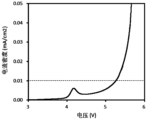
- Figure 2 shows the oxidation stability test results of the electrolyte in the prior art.
- Figure 3 shows the oxidation stability test results of conventional ether electrolytes and fluorine-containing electrolytes.
- FIG. 4 is a cycle life diagram of a secondary battery including an electrolyte solution according to an embodiment of the present application.
- Figure 5 is a cycle voltage-capacity curve of the secondary battery of Comparative Example 1.
- FIG. 11 is a schematic diagram of a secondary battery according to an embodiment of the present application.
- FIG. 12 is an exploded view of the secondary battery according to the embodiment of the present invention shown in FIG. 11 .
- Figure 13 is a schematic diagram of a battery module according to an embodiment of the present application.
- Figure 14 is a schematic diagram of a battery pack according to an embodiment of the present application.
- FIG. 15 is an exploded view of the battery pack according to one embodiment of the present application shown in FIG. 14 .
- FIG. 16 is a schematic diagram of a power consumption device using a secondary battery as a power source according to an embodiment of the present application.
- Ranges disclosed herein are defined in terms of lower and upper limits. A given range is defined by selecting a lower limit and an upper limit that define the boundaries of the particular range. Ranges defined in this manner may be inclusive or exclusive of the endpoints, and may be arbitrarily combined, that is, any lower limit may be combined with any upper limit to form a range. For example, if ranges of 60-120 and 80-110 are listed for a particular parameter, understand that ranges of 60-110 and 80-120 are also expected. Furthermore, if the minimum range values 1 and 2 are listed, and if the maximum range values 3, 4, and 5 are listed, then the following ranges are all expected: 1-3, 1-4, 1-5, 2- 3, 2-4 and 2-5.
- the numerical range “a-b” represents an abbreviated representation of any combination of real numbers between a and b, where a and b are both real numbers.
- the numerical range “0-5" means that all real numbers between "0-5" have been listed in this article, and "0-5" is just an abbreviation of these numerical combinations.
- a certain parameter is an integer ⁇ 2
- the method includes steps (a) and (b), which means that the method may include steps (a) and (b) performed sequentially, or may include steps (b) and (a) performed sequentially.
- step (c) means that step (c) may be added to the method in any order.
- the method may include steps (a), (b) and (c). , may also include steps (a), (c) and (b), may also include steps (c), (a) and (b), etc.
- condition "A or B” is satisfied by any of the following conditions: A is true (or exists) and B is false (or does not exist); A is false (or does not exist) and B is true (or exists) ; Or both A and B are true (or exist).
- Secondary batteries have been widely used in many fields such as consumer electronics, electric vehicles, and energy storage. For common lithium-ion secondary batteries, improvements in energy density have come close to reaching the theoretical limit. In order to meet future application scenarios that require higher energy density, including high-endurance electric vehicles and electric aircraft, secondary batteries with greater energy density potential have been developed, such as metal or alloy anode ion secondary batteries.
- a secondary battery containing an electrolyte of the prior art performs well within a certain cycle number range (as shown in Figure 1) during a long cycle.
- an electrolyte of the prior art e.g., LiFSI-DME-TTE system
- the overcharge phenomenon occurs when the charging capacity exceeds the rated capacity, but the discharge capacity remains normal or only slightly decreases (around 40-65 cycles). If the cycle continues after this number of cycles, the above-mentioned overcharge phenomenon will gradually weaken until it disappears. Restore normal circulation.
- this application provides an electrolyte that can avoid the above-mentioned "transient" overcharge problem, improve the safety of metal or alloy negative electrode secondary batteries, and improve cycle performance.
- an electrolyte solution including:
- the first solvent as shown in Formula I:
- R 1 is selected from C1-C6 fluorinated alkyl
- R 2 is selected from a hydrogen atom, a C1-C6 alkyl group and a C1-C6 fluorinated alkyl group;
- n 1 or 2;
- the second solvent is one or more compounds selected from Formula II and Formula III;
- R 3 to R 10 are each independently selected from a hydrogen atom, a fluorine atom, a C1-C6 alkyl group and a C1-C6 fluorinated alkyl group.
- the electrolyte of the present application can effectively avoid the above-mentioned "transient" overcharge problem in long-term cycles of secondary batteries, especially lithium-ion secondary batteries with metal or alloy negative electrodes, thereby improving the cycle stability and safety of the battery; at the same time , the electrolyte of the present application also has high oxidation stability, and can improve the cycle life of metal or alloy negative electrode secondary batteries.
- the inventor found that the intrinsic antioxidant capacity of ether electrolytes in the prior art is not too bad, for example, in the scanning voltammogram (LSV) test of Li-Al batteries, the The oxidation stability window of the methyl ether (DME)-1,1,2,2-difluoroethyl-2,2,3,3-difluoropropyl ether (TTE) electrolyte system can reach 5.3V (see Figure 2 ); however, when this electrolyte is applied to, for example, Li-NMC811 cells for long cycles, the aforementioned "transient" overcharge problem will occur without exception (see, for example, Comparative Example 3 and Figure 7 below).
- the electrolyte of the present application has good oxidation resistance and can effectively avoid the occurrence of the "transient" overcharge phenomenon.
- R 1 is selected from C1-C3 fluorinated alkyl, optionally fluoromethyl. In some embodiments, R 1 is more optionally monofluoromethyl or difluoromethyl.
- R 2 is selected from a hydrogen atom, a C1-C3 alkyl group and a C1-C3 fluorinated alkyl group, optionally selected from a hydrogen atom, a methyl group, a fluorinated alkyl group, Methyl, ethyl and fluoroethyl.
- R2 is more optionally selected from a hydrogen atom, methyl, monofluoromethyl, difluoromethyl, ethyl, monofluoroethyl, and difluoroethyl.
- the first solvent of Formula I is selected from the following compounds:
- the first solvent of formula I is selected from at least one of formulas I-1 to I-16, and formulas I-60 to I-71; more optionally, formulas I-2 and I - at least one of 65.
- an ether with a smaller carbon chain length for example, a C1-3 alkyl group
- an ether with an alkyl group with a longer carbon chain and/or a higher fluorine content for example, ethers with a not too high fluorine content (for example, monofluoro or difluoro).
- the first solvent gives the electrolyte a higher boiling point and higher oxidation stability, which can improve its positive electrode side oxidation stability; at the same time, the first solvent has good dissolving ability for electrolyte salts (for example, bisfluorosulfonimide
- the dissolved concentration of lithium (LiFSI) in the first solvent can reach 2M or even higher).
- the electrolyte oxidation stability of the Li-Al half-cell LSV test reached at least about 5.3V (see Figure 3).
- the second solvent represented by formula II and formula III does not dissolve or slightly dissolves the electrolyte lithium salt, and can be miscible with the first solvent in any ratio without phase separation.
- R 3 to R 8 are each independently selected from a hydrogen atom, a fluorine atom and a C1-C6 fluorinated alkyl group.
- R 3 to R 8 are each independently selected from a hydrogen atom, a fluorine atom and a C1-C3 fluorinated alkyl group.
- R 3 to R 8 are each independently selected from a hydrogen atom, a fluorine atom and a fluoromethyl group.
- the solvent of Formula II is selected from the following compounds:
- the second solvent of Formula II is selected from at least one of difluorobenzene and fluoromethylbenzene, optionally selected from difluorobenzene and trifluoromethylbenzene. At least one, more optionally at least one selected from the compounds of formulas II-7, II-8, II-9 and II-12.
- R 9 to R 10 are each independently selected from a hydrogen atom, a fluorine atom, a C1-C6 alkyl group and a C1-C6 fluorinated alkyl group. In some embodiments, optionally, R 9 to R 10 are each independently selected from a hydrogen atom, a fluorine atom, a C1-C3 alkyl group and a C1-C3 fluorinated alkyl group. In some embodiments, more optionally, each of R 9 to R 10 is independently selected from a hydrogen atom or a fluorine atom.
- one or more hydrogen atoms of the alkyl group are each independently substituted with a fluorine atom.
- the solvent of Formula III is selected from the following compounds:
- the second solvent of Formula III is selected from fluoromethoxybenzene, optionally selected from at least one of the compounds of Formula III-1, III-2 and III-3. In some embodiments, the second solvent of Formula III is a compound of Formula III-3.
- the second solvent is a compound of Formula III.
- the first solvent and the second solvent are combined to avoid overcharging.
- the second solvent has a benzene ring structure, and its large conjugated ⁇ bond helps to inhibit the solvent molecules from losing electrons during the electrochemical process, thereby helping to improve the antioxidant capacity of the electrolyte; the benzene ring is directly connected to the oxygen atom , the electron cloud of the oxygen atom will also be attracted and added to the conjugated bond of the benzene ring, and its oxidation resistance will be further improved.
- the weight ratio of the first solvent to the second solvent is 0.5 to 3, optionally 0.7-1.5, more optionally 0.9-1.1. In some embodiments, the weight ratio of the first solvent to the second solvent is 1. Keeping the weight ratio of the two solvents within the above range can avoid the occurrence of transient overcharge and ensure good dissolution of the electrolyte salt in the electrolyte. At the same time, the electrolyte has better antioxidant capacity and a longer life. cycle life.
- the electrolyte solution of the present application also includes an antioxidant; optionally, the antioxidant is selected from at least one of lithium nitrate and lithium perchlorate. In some embodiments, the antioxidant is lithium nitrate.
- antioxidant additives can change the local solvation structure at the interface between the positive electrode and the electrolyte: its anionic part (such as nitrate and perchlorate) can During the charging process, it is attracted to the electric double layer on the surface of the ternary positive electrode and combines more closely with the active ions (for example, in the case of lithium-ion batteries, lithium ions), reducing the solvent molecules around the active ions in the double electric layer.
- the degree of participation thereby reduces the contact between solvent molecules and the ternary positive electrode, reduces the catalytic oxidation of solvent molecules by transition metals, further protects the positive electrode, and improves cycle life.
- the concentration of the antioxidant is 0.5% to 3% by weight, optionally 0.7% to 1.5% by weight, more optionally 0.9% to 1.1% by weight, based on the electrolyte Total weight.
- the addition of antioxidants can further increase the critical voltage value of oxidation stability and further improve the cycle life.
- the content of antioxidants within the above range can fully exert the above effects while avoiding excessive impact on the normal transmission of lithium ions, resulting in reduced cycle life.
- the electrolyte of the present application also includes a fluorine-containing electrolyte salt.
- the fluorine-containing electrolyte salt is selected from the group consisting of lithium bisfluorosulfonyl imide, lithium hexafluorophosphate, lithium tetrafluoroborate, and lithium hexafluoroarsenate. , at least one of lithium bistriflate, lithium triflate, lithium difluorophosphate, lithium difluoroborate, lithium difluorodioxalate and lithium tetrafluoroxalate.
- the fluorine-containing electrolyte salt is lithium bisfluorosulfonimide.
- the above-mentioned fluorine-containing electrolyte salt has good solubility in the electrolyte of the present invention (especially in the first solvent), and can be decomposed on the surface of a metal or alloy negative electrode (for example, a lithium metal negative electrode) to form an SEI group rich in inorganic fluorine points, improving the stability of the negative electrode interface is conducive to further improving the cycle life of metal or alloy negative electrode secondary batteries.
- a metal or alloy negative electrode for example, a lithium metal negative electrode
- the concentration of the fluoroelectrolyte salt is 0.5M to 3M, optionally 1M.
- the cycle life of the secondary battery can be improved by using the above concentration.
- the electrolyte optionally further includes additives.
- additives may include negative electrode film-forming additives, positive electrode film-forming additives, and may also include additives that can improve certain properties of the battery, such as additives that improve battery overcharge performance, additives that improve battery high-temperature or low-temperature performance, etc.
- a secondary battery including the above-mentioned electrolyte.
- the secondary battery is a lithium ion secondary battery.
- the secondary battery is a secondary battery with a metal or alloy negative electrode.
- the secondary battery is a metallic lithium anode secondary battery, which may be a metallic lithium anode-lithium transition metal oxide cathode secondary battery.
- the secondary battery provided by the present invention includes the electrolyte of the present application, the cycle is more stable, there is no overcharge phenomenon, and a longer cycle life can be achieved at the same time.
- a secondary battery typically includes a positive electrode plate, a negative electrode plate, an electrolyte and a separator.
- active ions are inserted and detached back and forth between the positive and negative electrodes.
- the electrolyte plays a role in conducting ions between the positive and negative electrodes.
- the isolation film is placed between the positive electrode piece and the negative electrode piece. It mainly prevents the positive and negative electrodes from short-circuiting and allows ions to pass through.
- the positive electrode sheet includes a positive electrode current collector and a positive electrode film layer disposed on at least one surface of the positive electrode current collector.
- the positive electrode film layer includes a positive electrode active material selected from lithium transition metal oxides and/or lithium-containing phosphates with an olivine structure.
- the cathode active material is selected from lithium transition metal oxides.
- the lithium transition metal oxide is selected from lithium cobalt oxide, lithium nickel oxide, lithium manganese oxide, lithium nickel manganese oxide, lithium nickel cobalt manganese oxide, lithium nickel cobalt aluminum oxide, or its combination.
- lithium transition metal oxides may include, but are not limited to, lithium cobalt oxides (such as LiCoO 2 ), lithium nickel oxides (such as LiNiO 2 ), lithium manganese oxides (such as LiMnO 2 , LiMn 2 O 4 ), lithium nickel cobalt Oxide, lithium manganese cobalt oxide, lithium nickel manganese oxide, lithium nickel cobalt manganese oxide (such as LiNi 1/3 Co 1/3 Mn 1/3 O 2 (also referred to as NCM 333 ), LiNi 0.5 Co 0.2 Mn 0.3 O 2 (can also be abbreviated to NCM 523 ), LiNi 0.5 Co 0.25 Mn 0.25 O 2 (can also be abbreviated to NCM 211 ), LiNi 0.6 Co 0.2 Mn 0.2 O 2 (can also be abbreviated to NCM 622 ), LiNi 0.8 Co 0.1 Mn 0.1 O 2 (can also be abbreviated to NCM 811 ), LiNi 0.96 Co 0.02 Mn 0.
- lithium-containing phosphates with an olivine structure may include, but are not limited to, lithium iron phosphate (such as LiFePO 4 (also referred to as LFP)), composites of lithium iron phosphate and carbon, lithium manganese phosphate (such as LiMnPO 4 ), phosphoric acid At least one of a composite material of lithium manganese and carbon, a composite material of lithium manganese iron phosphate, or a composite material of lithium manganese iron phosphate and carbon.
- lithium iron phosphate such as LiFePO 4 (also referred to as LFP)
- composites of lithium iron phosphate and carbon such as LiMnPO 4
- LiMnPO 4 lithium manganese phosphate
- phosphoric acid At least one of a composite material of lithium manganese and carbon, a composite material of lithium manganese iron phosphate, or a composite material of lithium manganese iron phosphate and carbon.
- the positive electrode current collector has two surfaces facing each other in its own thickness direction, and the positive electrode film layer is disposed on any one or both of the two opposite surfaces of the positive electrode current collector.
- positive electrode film layers are provided on both sides of the positive electrode current collector.
- the positive electrode current collector may be a metal foil or a composite current collector.
- the metal foil aluminum foil can be used.
- the composite current collector may include a polymer material base layer and a metal layer formed on at least one surface of the polymer material base layer.
- the composite current collector can be formed by forming metal materials (aluminum, aluminum alloys, nickel, nickel alloys, titanium, titanium alloys, silver and silver alloys, etc.) on polymer material substrates (such as polypropylene (PP), polyterephthalate It is formed on substrates such as ethylene glycol ester (PET), polybutylene terephthalate (PBT), polystyrene (PS), polyethylene (PE), etc.).
- PP polypropylene
- PBT polybutylene terephthalate
- PS polystyrene
- PE polyethylene
- the cathode active material may be a cathode active material known in the art for batteries.
- the cathode active material may include at least one of the following materials: an olivine-structured lithium-containing phosphate, a lithium transition metal oxide, and their respective modified compounds.
- the present application is not limited to these materials, and other traditional materials that can be used as positive electrode active materials of batteries can also be used. Only one type of these positive electrode active materials may be used alone, or two or more types may be used in combination.
- the positive electrode film layer optionally further includes a binder.
- the binder may include polyvinylidene fluoride (PVDF), polytetrafluoroethylene (PTFE), vinylidene fluoride-tetrafluoroethylene-propylene terpolymer, vinylidene fluoride-hexafluoropropylene-tetrafluoroethylene At least one of ethylene terpolymer, tetrafluoroethylene-hexafluoropropylene copolymer and fluorine-containing acrylate resin.
- the positive electrode film layer optionally further includes a conductive agent.
- the conductive agent may include at least one of superconducting carbon, acetylene black, carbon black, Ketjen black, carbon dots, carbon nanotubes, graphene and carbon nanofibers.
- the positive electrode sheet can be prepared by dispersing the above-mentioned components for preparing the positive electrode sheet, such as positive active material, conductive agent, binder and any other components in a solvent (such as N -methylpyrrolidone) to form a positive electrode slurry; the positive electrode slurry is coated on the positive electrode current collector, and after drying, cold pressing and other processes, the positive electrode piece can be obtained.
- a solvent such as N -methylpyrrolidone
- the negative electrode sheet includes a negative electrode current collector and a negative electrode film layer disposed on at least one surface of the negative electrode current collector.
- the negative electrode film layer includes a negative electrode active material selected from the group consisting of pure metals, intermetallic alloys, or metal-nonmetal alloys.
- the metal is selected from lithium (Li), tin (Sn), zinc (Zn), aluminum (Al), magnesium (Mg), silver (Ag), gold (Au), gallium (Ga) , indium (In), foil (Pt) or combinations thereof.
- the non-metal is selected from boron (B), carbon (C), silicon (Si), or combinations thereof.
- the negative electrode current collector has two opposite surfaces in its own thickness direction, and the negative electrode film layer is disposed on any one or both of the two opposite surfaces of the negative electrode current collector.
- the negative electrode current collector may be a metal foil or a composite current collector.
- the composite current collector may include a polymer material base layer and a metal layer formed on at least one surface of the polymer material base material.
- the composite current collector can be formed by forming metal materials (copper, copper alloy, nickel, nickel alloy, titanium, titanium alloy, silver and silver alloy, etc.) on a polymer material substrate (such as polypropylene (PP), polyterephthalate It is formed on substrates such as ethylene glycol ester (PET), polybutylene terephthalate (PBT), polystyrene (PS), polyethylene (PE), etc.).
- PP polypropylene
- PBT polybutylene terephthalate
- PS polystyrene
- PE polyethylene
- the negative electrode film layer optionally further includes a binder.
- the binder can be selected from styrene-butadiene rubber (SBR), polyacrylic acid (PAA), polysodium acrylate (PAAS), polyacrylamide (PAM), polyvinyl alcohol (PVA), sodium alginate (SA), poly At least one of methacrylic acid (PMAA) and carboxymethyl chitosan (CMCS).
- the negative electrode film layer optionally further includes a conductive agent.
- the conductive agent may be selected from at least one of superconducting carbon, acetylene black, carbon black, Ketjen black, carbon dots, carbon nanotubes, graphene and carbon nanofibers.
- the negative electrode film layer optionally includes other auxiliaries, such as thickeners (such as sodium carboxymethylcellulose (CMC-Na)) and the like.
- thickeners such as sodium carboxymethylcellulose (CMC-Na)
- the negative electrode sheet can be prepared by dispersing the above-mentioned components for preparing the negative electrode sheet, such as negative active materials, conductive agents, binders and any other components in a solvent (such as deionized water) to form a negative electrode slurry; the negative electrode slurry is coated on the negative electrode current collector, and after drying, cold pressing and other processes, the negative electrode piece can be obtained.
- a solvent such as deionized water
- the secondary battery further includes a separator film.
- a separator film There is no particular restriction on the type of isolation membrane in this application. Any well-known porous structure isolation membrane with good chemical stability and mechanical stability can be used.
- the isolation membrane can use, but is not limited to, polyethylene porous membranes, polypropylene porous membranes, polyimide porous membranes, and porous membranes formed by composites of multiple polymers.
- the isolation film can be a single-layer film or a multi-layer composite film, with no special restrictions.
- the materials of each layer can be the same or different, and there is no particular limitation.
- the positive electrode piece, the negative electrode piece and the separator film can be made into an electrode assembly through a winding process or a lamination process.
- the secondary battery may include an outer packaging.
- the outer packaging can be used to package the above-mentioned electrode assembly and electrolyte.
- the outer packaging of the secondary battery may be a hard shell, such as a hard plastic shell, an aluminum shell, a steel shell, etc.
- the outer packaging of the secondary battery may also be a soft bag, such as a bag-type soft bag.
- the material of the soft bag may be plastic, and examples of the plastic include polypropylene, polybutylene terephthalate, polybutylene succinate, and the like.
- This application has no particular limitation on the shape of the secondary battery, which can be cylindrical, square or any other shape.
- a battery module including the above-mentioned secondary battery.
- a battery pack including the battery module described above.
- an electrical device including at least one selected from the above-mentioned secondary battery, battery module or battery pack.
- FIG. 11 shows a square-structured secondary battery 5 as an example.
- the outer package may include a housing 51 and a cover 53 .
- the housing 51 may include a bottom plate and side plates connected to the bottom plate, and the bottom plate and the side plates enclose a receiving cavity.
- the housing 51 has an opening communicating with the accommodation cavity, and the cover plate 53 can cover the opening to close the accommodation cavity.
- the positive electrode piece, the negative electrode piece and the isolation film can be formed into the electrode assembly 52 through a winding process or a lamination process.
- the electrode assembly 52 is packaged in the containing cavity.
- the electrolyte soaks into the electrode assembly 52 .
- the number of electrode assemblies 52 contained in the secondary battery 5 can be one or more, and those skilled in the art can select according to specific actual needs.
- secondary batteries can be assembled into battery modules, and the number of secondary batteries contained in the battery module can be one or more. The specific number can be selected by those skilled in the art according to the application and capacity of the battery module.
- FIG. 13 is a battery module 4 as an example.
- a plurality of secondary batteries 5 may be arranged in sequence along the length direction of the battery module 4 .
- the plurality of secondary batteries 5 can be fixed by fasteners.
- the battery module 4 may further include a housing having a receiving space in which a plurality of secondary batteries 5 are received.
- the above-mentioned battery modules can also be assembled into a battery pack.
- the number of battery modules contained in the battery pack can be one or more. Those skilled in the art can select the specific number according to the application and capacity of the battery pack.
- the battery pack 1 may include a battery box and a plurality of battery modules 4 disposed in the battery box.
- the battery box includes an upper box 2 and a lower box 3 .
- the upper box 2 can be covered with the lower box 3 and form a closed space for accommodating the battery module 4 .
- Multiple battery modules 4 can be arranged in the battery box in any manner.
- the present application also provides an electrical device, which includes at least one of the secondary battery, battery module, or battery pack provided by the present application.
- the secondary battery, battery module, or battery pack may be used as a power source for the electrical device, or may be used as an energy storage unit for the electrical device.
- the electric device may include mobile devices (such as mobile phones, laptops, etc.), electric vehicles (such as pure electric vehicles, hybrid electric vehicles, plug-in hybrid electric vehicles, electric bicycles, electric scooters, and electric golf carts). , electric trucks, etc.), electric trains, ships and satellites, energy storage systems, etc., but are not limited to these.
- a secondary battery, a battery module or a battery pack can be selected according to its usage requirements.
- Figure 16 is an electrical device as an example.
- the electric device is a pure electric vehicle, a hybrid electric vehicle, a plug-in hybrid electric vehicle, etc.
- a battery pack or battery module can be used.
- the device may be a mobile phone, a tablet, a laptop, etc.
- the device is usually required to be thin and light, and a secondary battery can be used as a power source.
- Equal masses of the first solvent of formula I-2 and the second solvent of formula III-3 are mixed and stirred to obtain a colorless, transparent and homogeneous mixed solvent.
- the cathode active material LiNi 0.8 Co 0.1 Mn 0.1 O 2 (NCM 811 ), conductive agent acetylene black, and binder PVDF in a mass ratio of 98:1:1.
- NMP solvent N-methylpyrrolidone
- the positive electrode slurry solid content is 70% by weight
- the positive electrode surface capacity is 3.5mAh/cm 2 .
- the 50 ⁇ m lithium foil was rolled onto one surface of the 12 ⁇ m copper foil, and then cut into a 41mm*51mm rectangle as a negative electrode piece.
- the secondary battery prepared in this way has a rated capacity of 140mAh.
- the ambient temperature of the cell cycle is set to 25°C, and the secondary battery obtained in 1.5 above is charged and discharged using a Xinwei cycle tester at a rate of 0.5C (i.e. 70mA).
- the cut-off voltages of charge and discharge are set to 4.3V and 2.8V respectively.
- the aluminum foil is the positive electrode, cut it into a disc with a diameter of 1cm2 , and the polyethylene porous film of the same size is the isolation film, inject 20 ⁇ l of the electrolyte prepared in the previous item 1, and assemble it into a test piece.
- Button Battery
- Example 1 to prepare electrolytes and secondary batteries, and conduct corresponding tests; the difference lies in that the first and second solvents in these examples are different.
- Example 1 to prepare electrolytes and secondary batteries, and perform corresponding tests; the difference lies in that the mass ratios of the first and second solvents in these examples are different.
- a conventional ether electrolyte solution in the prior art was prepared as follows, and tested with reference to Example 1.
- the oxidation stability of the electrolyte is 4V.
- the oxidation stability of the electrolyte is 4V.
- serious overcharging begins in the first cycle of the cycle.
- the battery cell with a rated capacity of 140mAh only reaches the cut-off voltage after charging 450mAh, indicating that the electrolyte has undergone obvious oxidation and decomposition.
- the fluorine-containing ether electrolyte in the prior art was prepared as follows, and tested with reference to Example 1.
- the oxidation stability of the electrolyte is 5.4V.
- a slight overcharge phenomenon occurs in the range of about 50-70 cycles during the cycle, but the discharge capacity is less affected in this range and can recover on its own. Life span is 146 cycles.
- a prior art local highly concentrated electrolyte solution was prepared as follows and tested with reference to Example 1.
- a prior art local highly concentrated electrolyte solution was prepared as follows and tested with reference to Example 1.
- the oxidation stability of the electrolyte is 5.3V.
- overcharging occurs in the range of about 45-55 cycles during the cycle.
- the discharge capacity is less affected in this range and can recover on its own.
- the cycle life is 135 laps.
- Table 1 shows the electrolyte solutions and performance test results in the above-mentioned Examples 1-16 and Comparative Examples 1-4.
- solvent mass ratio here means the mass ratio of the first solvent to the second solvent.
- the electrolyte of the present application can effectively avoid the above-mentioned "one-time” overcharge problem of secondary batteries in long cycles, and also has a relatively high oxidation stability critical voltage (that is, high oxidation stability) , and can improve cycle life.
- the conventional ether electrolyte of Comparative Example 1 is difficult to cycle normally in the metallic lithium negative electrode-ternary positive electrode secondary battery; as can be seen from Comparative Example 2, when using a fluorine-containing solvent alone, although the oxidation stability can be improved, it cannot solve the long cycle problem. overcharging problem.
- Example 17 The difference between Example 17 and Example 1 is that after preparing a colorless and transparent solution with a concentration of 1M, lithium nitrate powder is added thereto so that the weight ratio of the solution to lithium nitrate is 99:1, and is added to the solution to fully Stir to form a colorless and transparent electrolyte, which is the required electrolyte.
- Example 18 The difference between Examples 18-25 and Example 17 lies in the weight ratio of the first and/or second solvent.
- Example 26 and Example 17 The difference between Example 26 and Example 17 is that the first and second solvents are different respectively.
- the difference between Examples 27-32 and Example 26 is that the weight ratio of the first and second solvents is different.
- the difference between Example 33 and Example 17 is that the first and second solvents are different respectively.
- the difference between Examples 34-39 and Example 33 is that the weight ratio of the first and second solvents is different.
- a conventional ether electrolyte containing antioxidant additives was prepared as follows and tested with reference to Example 1.
- the electrolyte's oxidation stability critical voltage is 5.1V.
- a relatively obvious overcharge phenomenon occurred in the range of approximately 35-60 cycles during the cycle, and the discharge capacity was significantly affected in this range, with a cycle life of 92 cycles. .
- a fluoroether electrolyte containing antioxidant additives was prepared as follows and tested with reference to Example 1.
- the oxidation stability of the electrolyte is 5.4V.
- a slight overcharge phenomenon occurs in the range of 100-170 cycles during the cycle, but the discharge capacity is less affected in this range and can recover on its own.
- Table 2 below shows the electrolyte solutions and their performance test data in Examples 17-46 and Comparative Examples 5-6.
- the electrolyte with added antioxidants in addition to preventing overcharge, also improves the oxidation stability of the electrolyte and increases the cycle life. It can be seen from Comparative Examples 3-4 that the use of a combination of conventional ether solvents and antioxidants cannot prevent overcharging, while the combination of fluorine-containing ether solvents and antioxidants can improve the antioxidant properties and cycle life. There is also no way to avoid overcharging.
- Example 53-58 and Example 26 lies in the different antioxidant concentrations.
- the difference between Examples 59-64 and Example 33 lies in the concentration of antioxidants.
- Example 65-70 The difference between Examples 65-70 and Example 17 lies in the addition of antioxidants and their concentrations.
- Example 71-72 and Example 17 lies in the different electrolyte salt concentrations.
- the difference between Examples 73-74 and Example 26 lies in the different electrolyte salt concentrations.
- the difference between Examples 75-76 and Example 33 lies in the different electrolyte salt concentrations.
- the difference between Examples 77-78 and Examples 71-72 is that the antioxidants are different.
- Table 3 below shows the electrolytes of Examples 47-78 and their performance test results.
- the best performance can be achieved when the weight ratio of the first solvent to the second solvent is 1, the antioxidant additive content is 1%, and the electrolyte salt concentration is 1M.
Landscapes
- Chemical & Material Sciences (AREA)
- Engineering & Computer Science (AREA)
- Manufacturing & Machinery (AREA)
- Chemical Kinetics & Catalysis (AREA)
- Electrochemistry (AREA)
- General Chemical & Material Sciences (AREA)
- Physics & Mathematics (AREA)
- Condensed Matter Physics & Semiconductors (AREA)
- General Physics & Mathematics (AREA)
- Inorganic Chemistry (AREA)
- Materials Engineering (AREA)
- Secondary Cells (AREA)
Abstract
Description


Claims (12)
- 一种电解液,包括:第一溶剂,如式I所示:
 其中,R 1选自C1-C6的氟代链烷基;R 2选自氢原子、C1-C6的链烷基和C1-C6的氟代链烷基;n表示1或2;和第二溶剂,选自式II和式III化合物中的一种或几种;
 其中,R 3至R 10各自独立地选自氢原子、氟原子、C1-C6的链烷基和C1-C6的氟代链烷基。
 - 根据权利要求1所述的电解液,其中所述式I中,R 1选自C1-C3的氟代链烷基,可选地为氟代甲基;和/或,R 2选自氢原子、C1-C3的链烷基和C1-C3的氟代链烷基,可选地选自氢原子、甲基、氟代甲基、乙基和氟代乙基。
- 根据权利要求1或2所述的电解液,其中所述式II中,R 3至R 8各自独立地选自氢原子、氟原子和C1-C6的氟代链烷基,可选地选自氢原子、氟原子和C1-C3的氟代链烷基;和/或式III中,R 9至R 10各自独立地选自氢原子、氟原子和C1-C6的链烷基,可选地选自氢原子、氟原子、C1-C3的链烷基和C1-C3的氟代链烷基;更可选地,R 9至R 10各自独立地选自氢原子或氟原子。
- 根据权利要求1至3中任一项所述的电解液,其中所述第一 溶剂与第二溶剂的重量比值为0.5至3,可选地为0.7至1.5,更可选地为0.9至1.1。
- 根据权利要求1至4中任一项所述的电解液,还包括抗氧化剂;可选地,所述抗氧化剂选自硝酸锂、高氯酸锂中的至少一种。
- 根据权利要求5所述的电解液,所述抗氧化剂的浓度是0.5重量%至3重量%,可选地为0.7重量%至1.5重量%,更可选地为0.9重量%至1.1重量%,基于电解液总重量计。
- 根据权利要求1至6中任一项所述的电解液,还包括含氟电解质盐,可选地,所述含氟电解质盐选自双氟磺酰亚胺锂、六氟磷酸锂、四氟硼酸锂、六氟砷酸锂、双三氟甲磺酰亚胺锂、三氟甲磺酸锂、二氟磷酸锂、二氟草酸硼酸锂、二氟二草酸磷酸锂和四氟草酸磷酸锂中的至少一种,更可选地,所述含氟电解质盐是双氟磺酰亚胺锂。
- 根据权利要求7所述的电解液,所述含氟电解质盐的浓度是0.5M至3M,可选地为1M。
- 一种二次电池,包括权利要求1至8中任一项所述的电解液。
- 一种电池模块,包括权利要求9所述的二次电池。
- 一种电池包,包括权利要求10所述的电池模块。
- 一种用电装置,包括选自权利要求9所述的二次电池、权利要求10所述的电池模块或权利要求11所述的电池包中的至少一种。
Priority Applications (6)
| Application Number | Priority Date | Filing Date | Title |
|---|---|---|---|
| JP2024539867A JP7815453B2 (ja) | 2022-07-29 | 2022-07-29 | 電解液、二次電池、電池モジュール、電池パック及び電力消費装置 |
| EP22952468.1A EP4481875A4 (en) | 2022-07-29 | 2022-07-29 | ELECTROLYTE SOLUTION, SECONDARY BATTERY, BATTERY MODULE, BATTERY BLOCK AND ELECTRICAL APPLIANCE |
| PCT/CN2022/108958 WO2024021020A1 (zh) | 2022-07-29 | 2022-07-29 | 电解液、二次电池、电池模块、电池包和用电装置 |
| KR1020247022461A KR20240116813A (ko) | 2022-07-29 | 2022-07-29 | 전해액, 이차 전지, 전지 모듈, 전지 팩 및 전기 사용 장치 |
| CN202280085677.2A CN118489173A (zh) | 2022-07-29 | 2022-07-29 | 电解液、二次电池、电池模块、电池包和用电装置 |
| US18/755,332 US20240347776A1 (en) | 2022-07-29 | 2024-06-26 | Electrolyte, secondary battery, battery module, battery pack, and electrical device |
Applications Claiming Priority (1)
| Application Number | Priority Date | Filing Date | Title |
|---|---|---|---|
| PCT/CN2022/108958 WO2024021020A1 (zh) | 2022-07-29 | 2022-07-29 | 电解液、二次电池、电池模块、电池包和用电装置 |
Related Child Applications (1)
| Application Number | Title | Priority Date | Filing Date |
|---|---|---|---|
| US18/755,332 Continuation US20240347776A1 (en) | 2022-07-29 | 2024-06-26 | Electrolyte, secondary battery, battery module, battery pack, and electrical device |
Publications (1)
| Publication Number | Publication Date |
|---|---|
| WO2024021020A1 true WO2024021020A1 (zh) | 2024-02-01 |
Family
ID=89705030
Family Applications (1)
| Application Number | Title | Priority Date | Filing Date |
|---|---|---|---|
| PCT/CN2022/108958 Ceased WO2024021020A1 (zh) | 2022-07-29 | 2022-07-29 | 电解液、二次电池、电池模块、电池包和用电装置 |
Country Status (6)
| Country | Link |
|---|---|
| US (1) | US20240347776A1 (zh) |
| EP (1) | EP4481875A4 (zh) |
| JP (1) | JP7815453B2 (zh) |
| KR (1) | KR20240116813A (zh) |
| CN (1) | CN118489173A (zh) |
| WO (1) | WO2024021020A1 (zh) |
Cited By (2)
| Publication number | Priority date | Publication date | Assignee | Title |
|---|---|---|---|---|
| WO2026023670A1 (ja) * | 2024-07-24 | 2026-01-29 | Enpower Japan株式会社 | 電池 |
| WO2026042425A1 (ja) * | 2024-08-19 | 2026-02-26 | ダイキン工業株式会社 | 電解液用組成物、電気化学デバイス、二次電池及びリチウムイオン二次電池 |
Citations (4)
| Publication number | Priority date | Publication date | Assignee | Title |
|---|---|---|---|---|
| US20100099031A1 (en) * | 2007-04-20 | 2010-04-22 | Mitsubishi Chemical Corporation | Nonaqueous electrolytes and nonaqueous-electrolyte secondary batteries employing the same |
| US20190089001A1 (en) * | 2017-09-20 | 2019-03-21 | Soulbrain Co., Ltd. | Electrolyte additive and lithium secondary battery comprising the same |
| CN110416597A (zh) * | 2018-04-27 | 2019-11-05 | 宁德时代新能源科技股份有限公司 | 一种醚类电解液以及锂硫二次电池 |
| JP2021057330A (ja) * | 2019-09-30 | 2021-04-08 | Tdk株式会社 | 二次電池用電解液および二次電池 |
Family Cites Families (8)
| Publication number | Priority date | Publication date | Assignee | Title |
|---|---|---|---|---|
| US20110195317A1 (en) * | 2008-07-30 | 2011-08-11 | Daikin Industries, Ltd. | Solvent for dissolving electrolyte salt of lithium secondary cell |
| KR102069836B1 (ko) * | 2016-03-03 | 2020-01-23 | 주식회사 엘지화학 | 리튬-설퍼 전지용 전해액 및 이를 포함하는 리튬-설퍼 전지 |
| JP7067385B2 (ja) * | 2018-09-21 | 2022-05-16 | Tdk株式会社 | リチウム二次電池 |
| KR102679568B1 (ko) * | 2018-10-01 | 2024-07-01 | 에스케이온 주식회사 | 리튬 이차전지 |
| EP3944394B1 (en) * | 2019-03-21 | 2025-12-17 | LG Energy Solution, Ltd. | Non-aqueous electrolyte solution for lithium secondary battery and lithium secondary battery including the same |
| CN112436189B (zh) * | 2020-11-30 | 2022-02-11 | 广州天赐高新材料股份有限公司 | 组合物、包含该组合物的电解液及锂离子电池 |
| JP7830476B2 (ja) * | 2020-12-16 | 2026-03-16 | サイエンスコ エスアー | リチウム金属電池用電解質組成物 |
| JP7753637B2 (ja) * | 2021-01-13 | 2025-10-15 | 株式会社Gsユアサ | 非水電解質蓄電素子及びその製造方法 |
-
2022
- 2022-07-29 JP JP2024539867A patent/JP7815453B2/ja active Active
- 2022-07-29 WO PCT/CN2022/108958 patent/WO2024021020A1/zh not_active Ceased
- 2022-07-29 EP EP22952468.1A patent/EP4481875A4/en active Pending
- 2022-07-29 CN CN202280085677.2A patent/CN118489173A/zh active Pending
- 2022-07-29 KR KR1020247022461A patent/KR20240116813A/ko active Pending
-
2024
- 2024-06-26 US US18/755,332 patent/US20240347776A1/en active Pending
Patent Citations (4)
| Publication number | Priority date | Publication date | Assignee | Title |
|---|---|---|---|---|
| US20100099031A1 (en) * | 2007-04-20 | 2010-04-22 | Mitsubishi Chemical Corporation | Nonaqueous electrolytes and nonaqueous-electrolyte secondary batteries employing the same |
| US20190089001A1 (en) * | 2017-09-20 | 2019-03-21 | Soulbrain Co., Ltd. | Electrolyte additive and lithium secondary battery comprising the same |
| CN110416597A (zh) * | 2018-04-27 | 2019-11-05 | 宁德时代新能源科技股份有限公司 | 一种醚类电解液以及锂硫二次电池 |
| JP2021057330A (ja) * | 2019-09-30 | 2021-04-08 | Tdk株式会社 | 二次電池用電解液および二次電池 |
Non-Patent Citations (1)
| Title |
|---|
| See also references of EP4481875A4 * |
Cited By (3)
| Publication number | Priority date | Publication date | Assignee | Title |
|---|---|---|---|---|
| WO2026023670A1 (ja) * | 2024-07-24 | 2026-01-29 | Enpower Japan株式会社 | 電池 |
| WO2026042425A1 (ja) * | 2024-08-19 | 2026-02-26 | ダイキン工業株式会社 | 電解液用組成物、電気化学デバイス、二次電池及びリチウムイオン二次電池 |
| JP2026035532A (ja) * | 2024-08-19 | 2026-03-04 | ダイキン工業株式会社 | 電解液用組成物、電気化学デバイス、二次電池及びリチウムイオン二次電池 |
Also Published As
| Publication number | Publication date |
|---|---|
| KR20240116813A (ko) | 2024-07-30 |
| JP7815453B2 (ja) | 2026-02-17 |
| US20240347776A1 (en) | 2024-10-17 |
| JP2025501295A (ja) | 2025-01-17 |
| EP4481875A1 (en) | 2024-12-25 |
| EP4481875A4 (en) | 2025-11-12 |
| CN118489173A (zh) | 2024-08-13 |
Similar Documents
| Publication | Publication Date | Title |
|---|---|---|
| WO2025015923A1 (zh) | 锂二次电池和用电装置 | |
| WO2023130910A1 (zh) | 电池极片的制备方法、电池极片和二次电池 | |
| WO2025194656A1 (zh) | 锂离子电池及用电装置 | |
| US20240347776A1 (en) | Electrolyte, secondary battery, battery module, battery pack, and electrical device | |
| WO2023082918A1 (zh) | 锂离子电池、电池模块、电池包及用电装置 | |
| WO2023060554A1 (zh) | 电解液、二次电池和用电装置 | |
| WO2023044934A1 (zh) | 二次电池、电池模块、电池包以及用电装置 | |
| WO2023130310A1 (zh) | 电解液、二次电池和用电装置 | |
| WO2026065870A1 (zh) | 电池、正极极片及其制备方法和用电装置 | |
| WO2025200884A1 (zh) | 二次电池及用电装置 | |
| WO2025055370A1 (zh) | 电池和用电设备 | |
| CN117480654A (zh) | 二次电池、电池模块、电池包以及用电装置 | |
| WO2024077544A1 (zh) | 电解液及包含其的电池单体、电池和用电装置 | |
| WO2024040504A1 (zh) | 二次电池、其制备方法及包含其的用电装置 | |
| WO2023082924A1 (zh) | 极片、锂离子电池、电池模块、电池包及用电装置 | |
| WO2023236007A1 (zh) | 电解液及包含其的锂二次电池、电池模块、电池包、用电装置 | |
| WO2023065128A1 (zh) | 负极极片、二次电池、电池模块、电池包和用电装置 | |
| WO2025152733A1 (zh) | 二次电池和用电装置 | |
| CN116581243B (zh) | 电极极片、其制备方法、二次电池和用电装置 | |
| WO2025000741A1 (zh) | 电解液、钠二次电池和用电装置 | |
| WO2023206216A1 (zh) | 非水电解液、二次电池、电池模块、电池包和用电装置 | |
| WO2023216130A1 (zh) | 一种电解液、二次电池、电池模块、电池包和用电装置 | |
| WO2023130212A1 (zh) | 一种锂离子二次电池、电池模块、电池包和用电装置 | |
| CN115810707A (zh) | 负极极片、二次电池、电池模块、电池包和用电装置 | |
| CN116964804A (zh) | 一种二次电池、电池模块、电池包和用电装置 |
Legal Events
| Date | Code | Title | Description |
|---|---|---|---|
| 121 | Ep: the epo has been informed by wipo that ep was designated in this application |
Ref document number: 22952468 Country of ref document: EP Kind code of ref document: A1 |
|
| WWE | Wipo information: entry into national phase |
Ref document number: 202280085677.2 Country of ref document: CN |
|
| WWE | Wipo information: entry into national phase |
Ref document number: 2024539867 Country of ref document: JP |
|
| ENP | Entry into the national phase |
Ref document number: 20247022461 Country of ref document: KR Kind code of ref document: A |
|
| WWE | Wipo information: entry into national phase |
Ref document number: 2022952468 Country of ref document: EP |
|
| ENP | Entry into the national phase |
Ref document number: 2022952468 Country of ref document: EP Effective date: 20240915 |
|
| NENP | Non-entry into the national phase |
Ref country code: DE |