WO2024062201A1 - Composition comprenant au moins un peroxyde de dialkyle ou de peroxycétal et au moins un peroxyde organique insaturé - Google Patents
Composition comprenant au moins un peroxyde de dialkyle ou de peroxycétal et au moins un peroxyde organique insaturé Download PDFInfo
- Publication number
- WO2024062201A1 WO2024062201A1 PCT/FR2023/051448 FR2023051448W WO2024062201A1 WO 2024062201 A1 WO2024062201 A1 WO 2024062201A1 FR 2023051448 W FR2023051448 W FR 2023051448W WO 2024062201 A1 WO2024062201 A1 WO 2024062201A1
- Authority
- WO
- WIPO (PCT)
- Prior art keywords
- organic peroxide
- group
- chosen
- composition
- branched
- Prior art date
- Legal status (The legal status is an assumption and is not a legal conclusion. Google has not performed a legal analysis and makes no representation as to the accuracy of the status listed.)
- Ceased
Links
Classifications
-
- C—CHEMISTRY; METALLURGY
- C08—ORGANIC MACROMOLECULAR COMPOUNDS; THEIR PREPARATION OR CHEMICAL WORKING-UP; COMPOSITIONS BASED THEREON
- C08L—COMPOSITIONS OF MACROMOLECULAR COMPOUNDS
- C08L23/00—Compositions of homopolymers or copolymers of unsaturated aliphatic hydrocarbons having only one carbon-to-carbon double bond; Compositions of derivatives of such polymers
- C08L23/02—Compositions of homopolymers or copolymers of unsaturated aliphatic hydrocarbons having only one carbon-to-carbon double bond; Compositions of derivatives of such polymers not modified by chemical after-treatment
- C08L23/16—Ethylene-propylene or ethylene-propylene-diene copolymers
-
- C—CHEMISTRY; METALLURGY
- C08—ORGANIC MACROMOLECULAR COMPOUNDS; THEIR PREPARATION OR CHEMICAL WORKING-UP; COMPOSITIONS BASED THEREON
- C08K—Use of inorganic or non-macromolecular organic substances as compounding ingredients
- C08K5/00—Use of organic ingredients
- C08K5/04—Oxygen-containing compounds
- C08K5/14—Peroxides
-
- C—CHEMISTRY; METALLURGY
- C08—ORGANIC MACROMOLECULAR COMPOUNDS; THEIR PREPARATION OR CHEMICAL WORKING-UP; COMPOSITIONS BASED THEREON
- C08J—WORKING-UP; GENERAL PROCESSES OF COMPOUNDING; AFTER-TREATMENT NOT COVERED BY SUBCLASSES C08B, C08C, C08F, C08G or C08H
- C08J3/00—Processes of treating or compounding macromolecular substances
- C08J3/005—Processes for mixing polymers
-
- C—CHEMISTRY; METALLURGY
- C08—ORGANIC MACROMOLECULAR COMPOUNDS; THEIR PREPARATION OR CHEMICAL WORKING-UP; COMPOSITIONS BASED THEREON
- C08J—WORKING-UP; GENERAL PROCESSES OF COMPOUNDING; AFTER-TREATMENT NOT COVERED BY SUBCLASSES C08B, C08C, C08F, C08G or C08H
- C08J3/00—Processes of treating or compounding macromolecular substances
- C08J3/20—Compounding polymers with additives, e.g. colouring
- C08J3/22—Compounding polymers with additives, e.g. colouring using masterbatch techniques
-
- C—CHEMISTRY; METALLURGY
- C08—ORGANIC MACROMOLECULAR COMPOUNDS; THEIR PREPARATION OR CHEMICAL WORKING-UP; COMPOSITIONS BASED THEREON
- C08J—WORKING-UP; GENERAL PROCESSES OF COMPOUNDING; AFTER-TREATMENT NOT COVERED BY SUBCLASSES C08B, C08C, C08F, C08G or C08H
- C08J3/00—Processes of treating or compounding macromolecular substances
- C08J3/24—Crosslinking, e.g. vulcanising, of macromolecules
-
- C—CHEMISTRY; METALLURGY
- C08—ORGANIC MACROMOLECULAR COMPOUNDS; THEIR PREPARATION OR CHEMICAL WORKING-UP; COMPOSITIONS BASED THEREON
- C08K—Use of inorganic or non-macromolecular organic substances as compounding ingredients
- C08K3/00—Use of inorganic substances as compounding ingredients
- C08K3/02—Elements
- C08K3/04—Carbon
-
- C—CHEMISTRY; METALLURGY
- C08—ORGANIC MACROMOLECULAR COMPOUNDS; THEIR PREPARATION OR CHEMICAL WORKING-UP; COMPOSITIONS BASED THEREON
- C08K—Use of inorganic or non-macromolecular organic substances as compounding ingredients
- C08K5/00—Use of organic ingredients
- C08K5/16—Nitrogen-containing compounds
- C08K5/34—Heterocyclic compounds having nitrogen in the ring
- C08K5/3412—Heterocyclic compounds having nitrogen in the ring having one nitrogen atom in the ring
- C08K5/3432—Six-membered rings
- C08K5/3435—Piperidines
-
- C—CHEMISTRY; METALLURGY
- C08—ORGANIC MACROMOLECULAR COMPOUNDS; THEIR PREPARATION OR CHEMICAL WORKING-UP; COMPOSITIONS BASED THEREON
- C08J—WORKING-UP; GENERAL PROCESSES OF COMPOUNDING; AFTER-TREATMENT NOT COVERED BY SUBCLASSES C08B, C08C, C08F, C08G or C08H
- C08J2323/00—Characterised by the use of homopolymers or copolymers of unsaturated aliphatic hydrocarbons having only one carbon-to-carbon double bond; Derivatives of such polymers
- C08J2323/02—Characterised by the use of homopolymers or copolymers of unsaturated aliphatic hydrocarbons having only one carbon-to-carbon double bond; Derivatives of such polymers not modified by chemical after treatment
- C08J2323/16—Ethene-propene or ethene-propene-diene copolymers
-
- C—CHEMISTRY; METALLURGY
- C08—ORGANIC MACROMOLECULAR COMPOUNDS; THEIR PREPARATION OR CHEMICAL WORKING-UP; COMPOSITIONS BASED THEREON
- C08K—Use of inorganic or non-macromolecular organic substances as compounding ingredients
- C08K2201/00—Specific properties of additives
- C08K2201/014—Additives containing two or more different additives of the same subgroup in C08K
-
- C—CHEMISTRY; METALLURGY
- C08—ORGANIC MACROMOLECULAR COMPOUNDS; THEIR PREPARATION OR CHEMICAL WORKING-UP; COMPOSITIONS BASED THEREON
- C08K—Use of inorganic or non-macromolecular organic substances as compounding ingredients
- C08K5/00—Use of organic ingredients
- C08K5/0008—Organic ingredients according to more than one of the "one dot" groups of C08K5/01 - C08K5/59
- C08K5/0025—Crosslinking or vulcanising agents; including accelerators
Definitions
- Composition comprising at least one dialkyl or peroxyketal peroxide and at least one unsaturated organic peroxide
- the present invention relates to a composition
- a composition comprising at least one organic peroxide chosen from the group consisting of dialkyl peroxides, peroxyketals and a mixture thereof and at least one unsaturated organic peroxide.
- the invention also relates to the use of such a composition to prevent the scorching of at least one crosslinkable composition
- at least one crosslinkable composition comprising at least one crosslinkable polymer, preferably chosen from the group consisting of thermoplastic polymers, elastomeric polymers and their mixtures, even more preferably in the group consisting of elastomeric polymers.
- the invention further relates to a process for crosslinking at least one crosslinkable composition
- at least one crosslinkable polymer preferably chosen from the group consisting of thermoplastic polymers, elastomeric polymers and mixtures thereof, in the presence of said composition.
- the invention aims to provide an article, in particular a molded article or an extruded article, which can be obtained from the process detailed below.
- Polymers and copolymers namely thermoplastic polymers, elastomers and mixtures thereof, crosslinked with organic peroxides and/or azo compounds generally have better mechanical and physical properties than non-crosslinked polymers or polymers crosslinked by curing. with sulfur. These properties may include, for example, high resistance to thermal aging, low percentage of compression set, reduced metal coloration, and easy production of colored products with improved color stability.
- the preparatory phase generally consists of mixing or composing the constituents and possibly extruding them at often high temperatures.
- the operating conditions of this preparatory phase very often lead to the partial decomposition of the peroxide or the azo initiator, thus inducing the premature crosslinking reaction with the formation of gel particles in the mass of the polymer mixture.
- the presence of these gel particles is responsible for transmitting defects, such as inhomogeneity and surface roughness, to the final product.
- the mesh can reduce the plastic properties of the targeted polymer material, so that it can no longer be transformed, which can lead to the loss of the entire batch.
- excessive roasting can lead in certain cases to the complete cessation of the extrusion operation.
- the crosslinking density corresponds to an indication of the properties, particularly mechanical, of the final product.
- a reduction in the crosslinking density is often a guarantee of the attenuation of the mechanical properties of the final product.
- one of the aims of the present invention is to provide compositions which are capable of effectively crosslinking (or hardening) polymer compositions and at the same time conferring good properties, in terms of physical and/or mechanical properties, to the targeted product.
- one of the aims of the present invention is to delay scorching during the crosslinking of polymer compositions without inducing a significant loss of crosslinking efficiency.
- the present invention results in particular from the unexpected discovery, by the inventors, that the mixture of two classes of organic peroxides in a specific ratio is capable of overcoming the aforementioned drawbacks.
- the present invention therefore relates to a composition
- a composition comprising: a) at least one organic peroxide (a) chosen from the group consisting of dialkyl peroxides, peroxyketals and mixtures thereof, b) at least one organic peroxide (b) comprising in its structure at least one unsaturated side chain, said organic peroxide (b) being different from the organic peroxide (a), c) at least one nitroxide, in which the weight ratio between the at least one organic peroxide (b) and l at least one organic peroxide (a) is between 0.003 and 0.04.
- composition of the present invention makes it possible to delay scorching during the crosslinking of polymeric compositions, in particular thermoplastics and/or elastomers, without hindering the curing time and/or the crosslinking density.
- composition according to the present invention makes it possible to extend the scorching resistance of a polymer composition during crosslinking and to ensure the durability of the curing time and/or the crosslinking density.
- composition of the present invention can be used effectively to crosslink a polymeric composition while conferring good properties, in particular good physical and/or mechanical properties, to the targeted product with satisfactory productivity.
- composition of the present invention confers improved mechanical properties to the final product, and more particularly increased resistance to aging.
- the invention also relates to a process for manufacturing the aforementioned composition
- a process for manufacturing the aforementioned composition comprising the mixture of: a) at least one organic peroxide (a) chosen from the group consisting of dialkyl peroxides, peroxyketals and their mixtures, and b) the at least one organic peroxide (b) comprising in its structure at least one unsaturated side chain, said organic peroxide (b) being different from the organic peroxide (a), c) optionally at least one nitroxide, in which the weight ratio between the at least one organic peroxide (b) and the at least one organic peroxide (a) is between 0.003 and 0.04.
- the present invention also relates to a process for crosslinking at least one crosslinkable composition comprising at least one crosslinkable polymer, in particular chosen from the group consisting of thermoplastic polymers, elastomeric polymers and mixtures thereof, comprising: i) the mixture optionally of said crosslinkable composition in the presence of a composition comprising: a) at least one organic peroxide (a) chosen from the group consisting of dialkyl peroxides, peroxyketals and their mixtures, b) at least one organic peroxide (b) comprising in its structure at least one unsaturated side chain, said organic peroxide (b) being different from the organic peroxide (a), in which the weight ratio between said organic peroxide (b) and said organic peroxide (a) is between 0.003 and 0.04, preferably between 0.005 and 0.03, more preferably between 0.01 and 0.025; ii) hardening of the mixture obtained.
- a composition comprising: a) at least one organic peroxide (a) chosen
- the method of the present invention makes it possible to delay the scorching of said crosslinkable composition without significantly hindering the crosslinking density. In other words, it was observed that the crosslinking density does not collapse during the aforementioned process.
- the method according to the invention can make it possible to manufacture an article having good properties, in particular good physical and/or mechanical properties, while ensuring satisfactory productivity.
- another aspect of the present invention relates to an article, in particular a molded article or an extruded article, capable of being obtained from the process detailed above.
- Another object of the invention is the use of the aforementioned composition to harden at least one crosslinkable composition comprising at least one crosslinkable polymer, in particular chosen from the group consisting of thermoplastic polymers, elastomeric polymers and their mixtures, preferably elastomeric polymers.
- the use of the composition makes it possible to limit the risks of scorching of a crosslinkable composition and makes it possible to control its hardening.
- the aforementioned composition is used to prevent the scorching of at least one crosslinkable composition comprising at least one crosslinkable polymer as defined above.
- polymer includes “homopolymers” and “copolymers”, the term “copolymers” designating a polymer composed of at least two different monomers in polymerized form.
- a copolymer according to the present disclosure may be a polymer comprising two different monomers, a terpolymer is a polymer comprising three or more different monomers.
- composition of the present invention contains in particular at least one organic peroxide (a) chosen from the group consisting of dialkyl peroxides, peroxyketals and their mixtures.
- dialkyl peroxides can be chosen from the group consisting of di-t-butyl peroxide; t-butyl-cumyl peroxide; 2,5-di(cumylperoxy)-2,5-dimethyl hexane; 4-methyl-4-(t-butylperoxy)-2-pentanol; 4-methyl-4-(t-amylperoxy)-2-pentanol; 4-methyl-4-(cumylperoxy)-2-pentanol; 4-methyl-4-(t-butylperoxy)-2-pentanone; 4-methyl-4-(t-amylperoxy)-2-pentanone; 4-methyl-4-(cumylperoxy)-2-pentanone; 2,5-dimethyl-2,5-di(t-butylperoxy)hexane; 2,5-dimethyl-2,5-di(t-amylperoxy)hexane; 2,5-dimethyl-2-t-butylperoxy-5-
- dialkyl peroxides which can be used alone or in combination with the other free radical initiators envisaged by the present disclosure are those chosen from the group represented by the following formula (I): in which FU and Rs can be independently in the meta or para position and are identical or different and are chosen from hydrogen or straight or branched chain alkyls of 1 to 6 carbon atoms. Dicumyl peroxide and isopropylcumyl peroxide are illustrative.
- dialkyl peroxides are chosen from the compounds having the following formula (II): in which :
- - Ri and R’i independently of each other, represent a linear or branched, preferably branched, C3-C10 alkyl radical,
- R - 2 and R'2 independently of each other, represent a linear or branched, preferably branched, C3-C10 alkyl radical.
- - Ri and R'i are identical and represent a linear or branched, in particular branched, C3-C10 alkyl radical, and
- R2 and R'2 are identical and represent a C3-C10 alkyl radical, linear or branched, preferably branched.
- - Ri and R'i represent a branched C3-C10 alkyl radical, in particular a branched C3-C6 alkyl radical,
- R2 and R’2 are identical and represent a branched C3-C10 alkyl radical, in particular a branched C3-C6 alkyl radical.
- the R'2-O-O-R'I group can be in the meta or para position on the benzene ring defined in formula (II).
- dialkyl peroxides corresponding to formula (II) are preferably chosen from the group consisting of 1,3-bis(tert-butylperoxyisopropyl)-benzene, 1,4-bis(tert-butylperoxyisopropyl)-benzene , and their mixture.
- dialkyl peroxides are preferably chosen from the group consisting of 2,5-dimethyl-2,5-di(t-butylperoxy)hexane, the dialkyl peroxides represented by formula (I), the peroxides of dialkyl represented by formula (II) and mixtures thereof.
- dialkyl peroxides are preferably chosen from the group consisting of 2,5-dimethyl-2,5-di(t-butylperoxy)hexane, dicumyl peroxide, 1,3-bis(tert-butylperoxyisopropyl )-benzene, 1,4-bis(tert-butylperoxyisopropyl)-benzene and mixtures thereof.
- dialkyl peroxides are even more preferably chosen from the group consisting of 1,3-bis(tert-butylperoxyisopropyl)-benzene, 1,4-bis(tert-butylperoxyisopropyl)-benzene and their mixture.
- the peroxyketals can be chosen from the group consisting of 1,1-di(t-butylperoxy)-3,3,5-trimethylcyclohexane; 1,1-di(t-butylperoxy)cyclohexane; n-butyl 4,4-di(t-amylperoxy)valerate; ethyl 3,3-di(t-butylperoxy)butyrate; 2,2- Di(t-amylperoxy)propane; 3,6,6,9,9-pentamethyl-3-ethoxycabonylmethyl-1,2,4,5-tetraoxacyclononane; n-butyl-4,4-bis(t-butylperoxy)valerate; ethyl-3,3-di(t-amylperoxy)butyrate and mixtures thereof.
- the peroxyketals are preferably chosen from the group consisting of n-butyl-4,4-bis(t-butylperoxy)valerate, 1,1-di(t-butylperoxy)-3,3,5-trimethylcyclohexane and their mixtures.
- the percetal is n-butyl-4,4-bis(t-butylperoxy)valerate.
- the organic peroxide (a) is preferably chosen from the group consisting of dialkyl peroxides as defined above, in particular those chosen from the group consisting of 2,5-dimethyl-2,5-di(t- butylperoxy)hexane, dialkyl peroxides represented by formula (I), dialkyl peroxides represented by formula (II) and mixtures thereof.
- the organic peroxide (a) is preferably chosen from the group consisting of dialkyl peroxides, in particular those chosen from the group consisting of 2,5-dimethyl-2,5-di(t-butylperoxy)hexane , dicumyl peroxide, 1,3-bis(tert-butylperoxyisopropyl)-benzene, 1,4-bis(tert-butylperoxyisopropyl)-benzene, and mixtures thereof, more preferably those chosen from the group consisting of 1,3 -bis(tert-butylperoxyisopropyl)-benzene, 1,4-bis(tert-butylperoxyisopropyl)-benzene and their mixture.
- dialkyl peroxides in particular those chosen from the group consisting of 2,5-dimethyl-2,5-di(t-butylperoxy)hexane , dicumyl peroxide, 1,3-bis(tert-butylperoxy
- composition according to the present invention further contains at least one organic peroxide (b) comprising in its structure at least one unsaturated side chain.
- the organic peroxide (b) comprises in its structure at least one side chain comprising one or more ethylenic unsaturations, more preferably one ethylenic unsaturation.
- the side chain is an unsaturated hydrocarbon group in C2-C10, more preferably in C2-C4, linear or branched.
- the side chain may be a linear or branched unsaturated hydrocarbon fragment in C2-C10, more preferably in C2-C4, containing one or more double or triple bonds, preferably at least one double bond.
- the side chain is a linear or branched C2-C10 alkylene group, more preferably C2-C4, containing one or more ethylenic unsaturations, preferably one ethylenic unsaturation.
- the side chain is an ethylene group.
- the organic peroxide (b) may comprise in its structure a skeleton substituted by at least one unsaturated C2-C10 hydrocarbon fragment, linear or branched, containing at least one double bond, preferably a group linear or branched C2-C10 alkylene, more preferably C2-C4.
- the organic peroxide (b) can be chosen from the compounds having the following formula (III) or (IV):
- Re represents a linear or branched C3-C10 alkyl group, preferably branched, preferably a C3-C6 alkyl group;
- R e represents a C2-C12 alkyl group, linear or branched: substituted by at least one aromatic nucleus, in particular at least one benzene nucleus, substituted by at least one side chain, preferably an unsaturated C2-C10 hydrocarbon group, of preferably in C2-C4, linear or branched, comprising one or more ethylenic unsaturations or substituted by at least one side chain, preferably an unsaturated hydrocarbon fragment in C2-C10, more preferably in C2-C4, linear or branched, containing one or several ethylenic unsaturations, preferably, R'e represents a C2-C12 alkyl group, linear or branched, substituted by at least one aromatic nucleus, in particular at least one benzene nucleus, substituted by at least one side chain, preferably a group unsaturated hydrocarbon in C2-C10, more preferably in C2-C4, linear or branched, comprising one or more ethylenic unsaturations.
- Re represents a C3-C10 branched alkyl group, even more preferably a C3-C7 branched alkyl group, even more preferably a C4 group, even more preferably a tert-butyl group.
- the alkyl group of Re' is a linear or branched C3-C5 group, even more preferably a linear or branched C3 group.
- the side chain of e' is an isopropenyl, vinyl or allyl group, more preferably an isopropenyl group.
- the aromatic ring of Re' may be a C6-C12 ring, preferably a benzene ring.
- the organic peroxide (b) is preferably 1 - (2-tert-butylperoxyisopropyl)-3-isopropenyl benzene.
- the weight ratio between the organic peroxide (b) and the organic peroxide (a) is between 0.003 and 0.04, preferably between 0.005 and 0.3, even more preferably between 0.01 and 0.025.
- composition according to the present invention further comprises at least one nitroxide.
- the nitroxide can be chosen from the group consisting of 2,2,6,6-tetramethyl-l-piperidinyloxy, 4-hydroxy-2,2,6,6-tetramethyl-piperidinyloxy, 4-methoxy- 2,2,6,6-tetramethyl-l-piperidinyloxy, 4-oxo-2,2,6,6-tetramethyl-l-piperidinyloxy, 2,2,5,5-tetramethyl-l-pyrrolidinyloxy, sebacate bis(1 -oxy1 -2,2,6,6-tetramethyl-piperldin-4-yl), 1 -piperldinyloxy-4,4'-(1,10-dioxo-l,10-decanediyl)bis-(oxy) )bis(2,2,6,6- tetramethyl-), 2,2,6,6-tetramethyl -4-hydroxy-piperidine-1 -oxylmonophosphonate, 3-carboxy-2,2,5,5-tetramethyl-pipe
- the nitroxide is preferably chosen from the group consisting of 2,2,6,6-tetramethyl-l-piperidinyloxy (generally marketed under the name TEMPO), 4-hydroxy-2,2,6,6 -tetramethyl-piperidinyloxy (generally marketed under the name 4-hydroxy-TEMPO), 1-piperldinyloxy-4,4'-(1, 10-dioxo-l, 10-decanediyl)bis-(oxy))bis(2, 2,6,6-tetramethyl-) (commonly known as di-TEMPO sebacate) and their mixture.
- TEMPO 2,2,6,6-tetramethyl-l-piperidinyloxy
- 4-hydroxy-2,2,6,6 -tetramethyl-piperidinyloxy generally marketed under the name 4-hydroxy-TEMPO
- the nitroxide is preferably 4-hydroxy-2, 2, 6, 6-tetramethyl-piperidinyloxy.
- the weight ratio between said nitroxide and said organic peroxide (a) is preferably between 0.008 and 0.50, more preferably between 0.02 and 0.2 and even more preferably between 0.03 and 0.12.
- the composition may comprise at least one organic peroxide chosen from the group consisting of 1,3-bis(tert-butylperoxyisopropyl)-benzene, 1,4-bis(tert-butylperoxyisopropyl)-benzene and their mixture and least one nitroxide chosen from the group consisting of 2, 2,6,6-tetramethyl-l-piperidinyloxy, 4-hydroxy-2,2,6,6-tetramethyl-piperidinyloxy and their mixture in a weight ratio of between 0.008 and 0.50, more preferably between 0.02 and 0.2 and even more preferably between 0.03 and 0.12.
- the weight between said nitroxide and said organic peroxide (b) preferably varies from 0.05 to 50, more preferably from 0.15 to 16 and even more preferably from 0.5 to 6.
- the composition may comprise 1 -(2-tert-butylperoxyisopropyl)-3-isopropenylbenzene and at least one nitroxide chosen from the group consisting of 2,2,6,6-tetramethyl-l-piperidinyloxy, 4- hydroxy-2,2,6,6-tetramethyl-piperidinyloxy and their mixture in a weight ratio ranging from 0.05 to 50, more preferably from 0.15 to 16 and even more preferably from 0.5 to 6.
- the composition may also contain at least one crosslinking promoter, in particular chosen from the group consisting of compounds containing at least one double bond which may be bifunctional or polyfunctional, such as for example bifunctional vinyl monomers, bifunctional allylic monomers. , polyfunctional vinyl monomers or polyfunctional allylic monomers. These compounds are described in international application WO 02/28946 and make it possible to accelerate the crosslinking speed without negative impact on the resistance to scorching or on the crosslinking density.
- at least one crosslinking promoter in particular chosen from the group consisting of compounds containing at least one double bond which may be bifunctional or polyfunctional, such as for example bifunctional vinyl monomers, bifunctional allylic monomers. , polyfunctional vinyl monomers or polyfunctional allylic monomers.
- composition according to the present invention may further comprise at least one crosslinkable polymer, preferably chosen from the group consisting of thermoplastic polymers, elastomeric polymers and mixtures thereof, more preferably chosen from the group consisting of elastomeric polymers.
- thermoplastic and/or elastomeric polymers of the present invention can be defined as natural or synthetic polymers which have a thermoplastic and/or elastomeric character and which can be crosslinked (hardened) under the action of a crosslinking agent.
- Crosslinking action and crosslinking polymers are described in Rubber World, “Elastomer Crosslinking with Diperoxyketals,” October 1983, pages 26-32, and in Rubber and Plastic News, “Organic Peroxides for Rubber Crosslinking,” Sept. 29, 1980, pages 46-50.
- Polyolefins which are suitable for the present invention are described in Modem Plastics Encyclopedia 89, pages 63-67, 74-75.
- the crosslinkable polymer can be chosen from the group consisting of linear low density polyethylene, low density polyethylene, high density polyethylene, chlorinated polyethylene, ethylene-propylene-diene terpolymers (EPDM), ethylene-copolymers.
- EBA ethylene-methylacrylate copolymers
- EBA ethylene-copolymers ethylacrylate
- silicone rubber natural rubber (NR), polyisoprene (IR), polybutadiene (BR) acrylonitrile-butadiene copolymers (NBR), styrene-butadiene copolymers (SBR), neoprene rubber (CR), acrylonitrile -butadiene-styrene (ABS), styrene-butadiene-styrene block copolymers (SBS), chlorosulfonated polyethylene, fluoroelastomers, copolymers of ethylene and methyl (meth)acrylate and copolymers of ethylene and methacrylate g
- the polymer is preferably an elastomeric polymer, more preferably chosen from ethylene-propylene-diene terpolymers (EPDM).
- EPDM ethylene-propylene-diene terpolymers
- the organic peroxide (a) preferably represents between 1.6 to 4.8 parts, and advantageously between 2 to 4 parts per 100 parts by weight of the crosslinkable polymer.
- the organic peroxide (b) preferably represents between 0.015 to 0.8 parts, and advantageously between 0.05 to 0.3 parts per 100 parts by weight of the crosslinkable polymer.
- the total content of the organic peroxide (a) and the organic peroxide (b) can represent between 1.62 to 5.6 parts, preferably between 2.05 to 4.3 parts per 100 parts by weight of the crosslinkable polymer. .
- the nitroxide preferably represents between 0.04 to 0.8 parts, and advantageously between 0.15 to 0.3 parts per 100 parts by weight of the crosslinkable polymer.
- the composition may comprise: a) at least one organic peroxide (a) chosen from the group consisting of dialkyl peroxides, in particular those of the group consisting of 2,5-dimethyl-2,5-di(t-butylperoxy)hexane, dialkyl peroxides represented by formula (I), the dialkyl peroxides represented by formula (II) and their mixtures, b) at least one organic peroxide (b) comprising in its structure at least one unsaturated side chain, in particular those chosen from the compounds of formula (III) in which R'6 preferably represents a C2-C12 alkyl group, linear or branched, substituted by at least one aromatic ring, in particular at least one benzene ring, substituted by at least one side chain, preferably an unsaturated hydrocarbon group in C2-C10, more preferably in C2-C4, linear or branched, containing one or more ethylenic unsaturations, said organic peroxide (b) chosen from the group consisting
- the weight ratio between the organic peroxide (b) and the organic peroxide (a) ranges from 0.003 to 0.04, preferably from 0.005 to 0.03, even more preferably from 0.01 to 0.025 .
- the composition may comprise: a) at least one organic peroxide (a) chosen from the group consisting of 2,5-dimethyl-2,5-di(t-butylperoxy)hexane, dicumyl peroxide , 1,3-bis(tert-butylperoxyisopropyl)-benzene, 1,4-bis(tert-butylperoxyisopropyl)-benzene, and mixtures thereof, more preferably still those chosen from the group consisting of 1,3-bis( tert-butylperoxyisopropyl)-benzene, 1,4-bis(tert-butylperoxyisopropyl)-benzene and their mixture, b) at least one organic peroxide (b) comprising in its structure at least one unsaturated side chain, in particular 1 -( 2-tert-butylperoxyisopropyl)-3- isopropenylbenzene, said organic peroxide (b) being different
- the weight ratio between the organic peroxide (b) and the organic peroxide (a) ranges from 0.003 to 0.04, preferably from 0.005 to 0.03, even more preferably from 0.01 to 0.025 .
- Another object of the present invention is a process for manufacturing a composition as defined above comprising a step of mixing: a) at least one organic peroxide (a) chosen from the group consisting of peroxides of dialkyl, peroxyketals and their mixtures, b) at least one organic peroxide (b) comprising in its structure at least one unsaturated side chain, said organic peroxide (b) being different from the organic peroxide (a), c) optionally at least one nitroxide, in which the weight ratio between said organic peroxide (b) and said organic peroxide (a) is between 0.003 and 0.04, preferably between 0.005 and 0.03, even more preferably between 0.01 and 0.025.
- Another aspect of the present invention relates to a process for crosslinking at least one crosslinkable composition comprising at least one crosslinkable polymer, in particular chosen from the group consisting of thermoplastic polymers, elastomeric polymers and mixtures thereof, comprising : i) optionally, a step of mixing at least one crosslinkable composition comprising at least one crosslinkable polymer in the presence of: - at least one organic peroxide (a) chosen from the group consisting of dialkyl peroxides, peroxyketals and their mixtures and
- organic peroxide (b) comprising in its structure at least one unsaturated side chain; said organic peroxide (b) being different from the organic peroxide (a),
- the present invention also relates to a process for crosslinking at least one crosslinkable composition comprising at least one crosslinkable polymer, in particular chosen from the group consisting of thermoplastic polymers, elastomeric polymers and mixtures thereof, comprising: i) optionally, a step of mixing at least one crosslinkable composition comprising at least one crosslinkable polymer in the presence of:
- organic peroxide chosen from the group consisting of dialkyl peroxides, peroxyketals and their mixtures and
- organic peroxide (b) comprising in its structure at least one unsaturated side chain; said organic peroxide (b) being different from the organic peroxide (a),
- the present invention relates to a process for crosslinking at least one crosslinkable composition comprising at least one crosslinkable polymer, in particular chosen from the group consisting of thermoplastic polymers, elastomeric polymers and mixtures thereof. , comprising: i') a step of crosslinking said at least one crosslinkable composition in the presence of: - at least one organic peroxide (a) chosen from the group consisting of dialkyl peroxides, peroxyketals and their mixtures and
- organic peroxide (b) comprising in its structure at least one unsaturated side chain; said organic peroxide (b) being different from the organic peroxide (a),
- the weight ratio between the at least one organic peroxide (b) and the at least one organic peroxide (a) is between 0.003 and 0.04.
- the invention relates to a process for crosslinking at least one crosslinkable composition, comprising at least one crosslinkable polymer as defined below, comprising: i') a step of crosslinking said crosslinkable composition in the presence of a composition as defined above.
- Said crosslinking step can be preceded by a mixing step of: -
- organic peroxide chosen from the group consisting of dialkyl peroxides, peroxyketals and their mixtures and
- organic peroxide (b) comprising in its structure at least one unsaturated side chain; said organic peroxide (b) being different from the organic peroxide (a),
- the weight ratio between the at least one organic peroxide (b) and the at least one organic peroxide (a) is between 0.003 and 0.04.
- composition obtained comprises said at least one crosslinkable polymer, as defined above, said at least one organic peroxide (a) chosen from the group consisting of dialkyl peroxides, peroxyketals and their mixtures, and said at least one organic peroxide (b) comprising in its structure at least one unsaturated side chain, said organic peroxide (b) being different organic peroxide (a), in which the weight ratio is as defined above.
- composition obtained is the mixture obtained in mixing step i) of the process.
- the process comprises a step of crosslinking the mixture obtained in step i) of mixing.
- the crosslinkable composition preferably comprises at least one crosslinkable elastomeric polymer, more preferably chosen from the group consisting of ethylene-propylene-diene terpolymers (EPDM).
- EPDM ethylene-propylene-diene terpolymers
- the crosslinkable composition may also contain at least one additive such as a carbon black filler, processing oils, mold release agents, antioxidants and/or thermal stabilizers.
- at least one additive such as a carbon black filler, processing oils, mold release agents, antioxidants and/or thermal stabilizers.
- the crosslinkable composition may be a polymer masterbatch, preferably an elastomer masterbatch, which may comprise one or more of the aforementioned additives.
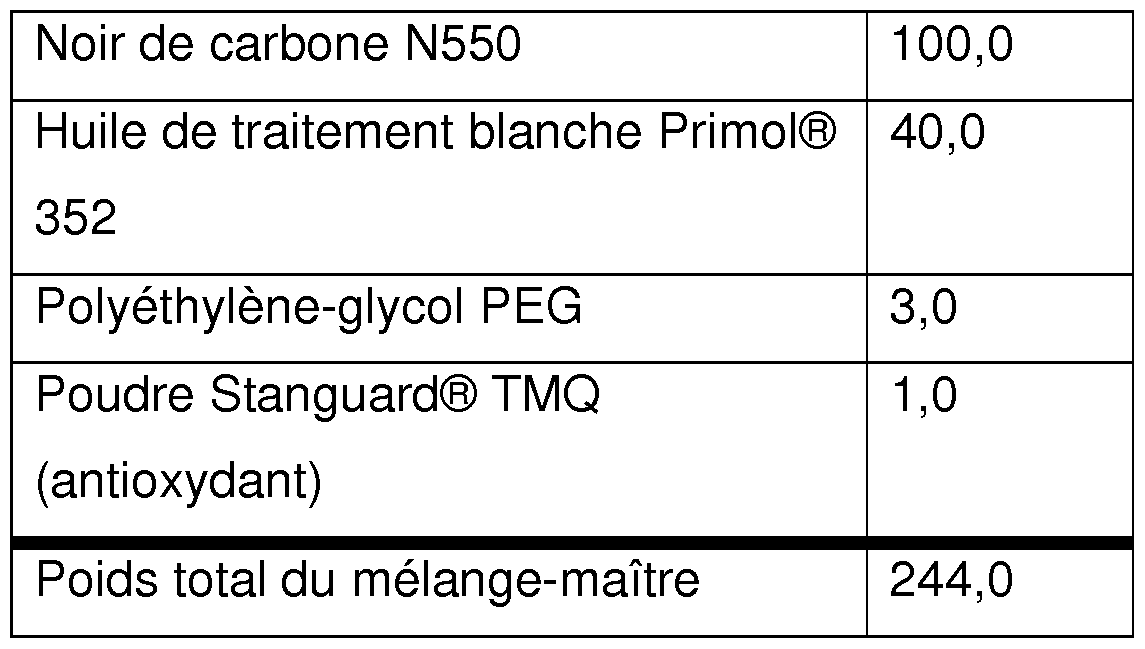
- the polymer masterbatch may comprise at least one elastomer and one or more additives chosen from the group consisting of carbon black, polyethylene glycol, at least one processing oil (for example, saturated hydrocarbons liquids, such as Primol® 352), at least one antioxidant (for example, 2,2,4-trimethyl-1,2,-dihydroquinoline, also called TMQ), at least one release agent, at least one thermal stabilizer , and a combination of these.
- processing oil for example, saturated hydrocarbons liquids, such as Primol® 352
- at least one antioxidant for example, 2,2,4-trimethyl-1,2,-dihydroquinoline, also called TMQ
- release agent for example, 2,2,4-trimethyl-1,2,-dihydroquinoline, also called TMQ
- the mixing step can be carried out in any conventional manner.
- the hardening (or crosslinking) step can be carried out at a temperature between 140°C and 250°C and more preferably between 160°C and 220°C.
- the process may further comprise the transformation of the composition obtained (or of the mixture obtained in step (i)) into a molded or extruded article, carried out before, during or after the crosslinking step, preferably before or after the crosslinking step.
- the process preferably comprises extruding the composition obtained to form an uncured preformed article and hardening the uncured preformed article.
- Another object of the invention is the use of the aforementioned composition
- the aforementioned composition comprising a) at least one organic peroxide (a) chosen from the group consisting of dialkyl peroxides, peroxyketals and their mixtures and b) at least an organic peroxide (b) comprising in its structure at least one unsaturated side chain, said organic peroxide (b) being different from the organic peroxide (a); in which the weight ratio between the at least one organic peroxide (b) and the at least one organic peroxide (a) is between 0.003 and 0.04, to harden at least one crosslinkable composition, as described here, comprising at least one crosslinkable polymer.
- the crosslinkable polymer is preferably chosen from the group consisting of thermoplastic polymers, elastomeric polymers and mixtures thereof, more preferably from elastomeric polymers, even more preferably chosen from the group consisting of ethylene-propylene-diene terpolymers (EPDM).
- EPDM ethylene-propylene-diene terpolymers
- the crosslinkable composition is a masterbatch of elastomers.
- the aforementioned composition is used to control the hardening of at least one crosslinkable composition comprising at least one crosslinkable polymer, in particular those chosen from the group consisting of thermoplastic polymers, elastomeric polymers and their mixtures, more preferably from elastomeric polymers, even more preferably chosen from the group consisting of ethylene-propylene-diene terpolymers (EPDM).
- at least one crosslinkable composition comprising at least one crosslinkable polymer, in particular those chosen from the group consisting of thermoplastic polymers, elastomeric polymers and their mixtures, more preferably from elastomeric polymers, even more preferably chosen from the group consisting of ethylene-propylene-diene terpolymers (EPDM).
- EPDM ethylene-propylene-diene terpolymers
- the aforementioned composition is used to avoid scorching of the at least one crosslinkable composition as defined above.
- the invention also relates to an article, in particular a molded article or an extruded article, which can be obtained from the method defined above. [01 15] More preferably, the invention relates to an extruded article obtainable from the aforementioned process.
- the article is preferably an elastomeric article.
- the article can be obtained from the process, as defined above, of crosslinking at least one crosslinkable composition comprising at least one crosslinkable elastomer.
- the article is preferably chosen from the group consisting of cables or electrical wires.
- the purification operation is carried out in a beaker placed in a water bath.
- Residual ethanol is evaporated from the purified peroxide by leaving the sample at room temperature under a ventilated hood for 24 hours.
- the purified peroxide was analyzed by the gas chromatography method and had a 1,3-bis(tert-butylperoxyisopropyl)-benzene (CAS 2212-81-9) content of 99.8%.
- the purification operation is carried out in a beaker placed in a water bath.
- the purified peroxide was analyzed by the gas chromatography method and had a 1,3-bis(tert-butylperoxyisopropyl)-benzene (CAS 2212-81-9) content of 63.0% and a content of 1,4-bis(tert-butylperoxyisopropyl)-benzene (CAS 2781 -00-2) of 36.4% for a total quantity of mixture of isomers 1,3 and 1,4-bis(tert-butylperoxyisopropyl) -benzene (CAS: 25155-25-3) of 99.4%.
- the diol (sumitomo meta isomer) was dehydrated from an alcohol group using adipic acid (2:1 ratio) at 150°C for 300 minutes under a vacuum of 40 mbar to extract water .
- This intermediate unsaturated alcohol was reacted with a 45% solution of TBHP in n-heptane (produced by extraction of commercial grade Luperox® TBH70X with n-heptane) in the presence of p-toluene acid. -sulfonic to produce a mixture containing monounsaturated dialkyl peroxide.
- n-heptane was removed by evaporation in a laboratory evaporator at 50° C. for 2 hours under a vacuum of 40 mbar.
- the final product was then purified on a silica column using acetonitrile as elution solvent.
- the eluted fraction containing the desired product was treated on a rotary laboratory evaporator at 50° C. for 2 hours under a vacuum of 40 mbar until the solvent was eliminated.
- the rotation speed was then increased to 25 rpm for three minutes. After this period, the mixer speed was lowered to 10 rpm and the mixer head was unbolted and removed. Once the blades were no longer spinning, the rubber around the blades was safely removed and placed on a sheet of polyester Mylar®. A small amount of rubber was located at the head of the mixer blades, in the inner hollow part of the mixing chamber, and was removed last. The mixer head was reassembled with the bolts and the mixer motor was restarted at 20 rpm. The rubber removed last, which was stuck in the mixing chamber, was added to the rotating blades first, followed by the rubber that was removed from the blades. This allowed for more uniform mixing of the elastomer.
- the rotation speed was then increased to 25 rpm and maintained at this level for 3 minutes. After this period, the mixer speed was adjusted to 10 rpm and the mixer head was unbolted and removed. Once removed, the movement of the blender blades stopped and it was again possible to safely remove all rubber from the bowl and blender blades.
- the hot rubber was then formed into a tight ball and placed between two sheets of Mylar® polyester.
- This sandwich was placed in a heated hydraulic Carver press, the temperature of which can be adjusted between room temperature and 60°C, depending on the elastomer and peroxide vulcanizers used.
- the rubber ball was pressed flat between the two heavy Mylar® polyester sheets. Wearing nitrile gloves, the press is opened and the sandwich of polyester Mylar® sheets containing the flattened rubber is removed. The top sheet is removed and the rubber is rolled into a tube. The whole thing was re-sandwiched and flattened again. The sheet was rolled again, but at 90 degrees to the direction of the initial roll, and flattened again.
- This operation was repeated a third time, taking care to flatten it to an approximate thickness of 1/8 inch.
- the sandwich was placed on the bench and covered with a metal sheet where the rubber was allowed to cool. It was then removed and stored in a tightly sealed polyethylene bag. These sheets were then cut with scissors or a sharp metal punch to obtain small, flat circle-shaped sheets of unvulcanized rubber for rheometer vulcanization and Mooney Scorch evaluations.
- the measured value indicated as MH-ML is the difference between the maximum value of the torque obtained from the curve recorded by the rheometer expressed in dN m. It indicates the level of crosslinking density.
- the toasting time (TS05) was measured at 135° C. using a Mooney MV 2000 viscometer (Alpha Technologies) according to the test method ISO 289-2:2020 “Rubber, unvulcanized - Determinations using a shearing-disc viscometer - Part 2: Determination of pre-vulcanization characteristics »
- the elastomer formulation of the EDPM masterbatch in Table 1 was mixed with different vulcanization systems and these mixtures were then tested using a rheometer and a Mooney Scorch viscometer.
- Table 2 provides a summary of three curing systems in EPDM masterbatch formulation.
- composition according to the present invention makes it possible to delay scorching during crosslinking of the EPDM composition without detrimental effect on the final crosslinking density.
- Example 1 The protocol described in Example 1 was repeated, except that a mixture of isomers of 1,3 and 1,4-bis(tert-butylperoxyisopropyl)-benzene was used as component A.
- Example 2 shows an improvement in the value of the roasting time without significant change in the rheometric crosslinking density also when the organic peroxide A is 1,3 and 1,4-bis(tert-butylperoxyisopropyl)-benzene (CAS: 25155-25-3) and when the mixture includes component B.
- Example 3 shows an improvement in the value of the roasting time without significant change in the rheometric crosslinking density also when the organic peroxide A is 1,3 and 1,4-bis(tert-butylperoxyisopropyl)-benzene (CAS: 25155-25-3) and when the mixture includes component B.
- Example 3 shows an improvement in the value of the roasting time without significant change in the rheometric crosslinking density also when the organic peroxide A is 1,1-di-(tert-butylperoxy)-3,3, 5- trimethylcyclohexane (CAS: 6731 -36-8) and when the mixture includes component B.
- composition according to the present invention makes it possible to delay scorching during crosslinking of the EPDM composition without detrimental effect on the final crosslinking density.
Landscapes
- Chemical & Material Sciences (AREA)
- Health & Medical Sciences (AREA)
- Chemical Kinetics & Catalysis (AREA)
- Medicinal Chemistry (AREA)
- Polymers & Plastics (AREA)
- Organic Chemistry (AREA)
- Compositions Of Macromolecular Compounds (AREA)
- Processes Of Treating Macromolecular Substances (AREA)
Abstract
Description




Claims

Priority Applications (4)
| Application Number | Priority Date | Filing Date | Title |
|---|---|---|---|
| US19/113,473 US20250257190A1 (en) | 2022-09-21 | 2023-09-21 | Composition comprising at least one dialkyl or peroxyketal peroxide and at least one unsaturated organic peroxide |
| EP23790053.5A EP4426781A1 (fr) | 2022-09-21 | 2023-09-21 | Composition comprenant au moins un peroxyde de dialkyle ou de peroxycétal et au moins un peroxyde organique insaturé |
| CN202380067572.9A CN119894976A (zh) | 2022-09-21 | 2023-09-21 | 包含至少一种二烷基过氧化物或过氧缩酮过氧化物和至少一种不饱和有机过氧化物的组合物 |
| MX2025002966A MX2025002966A (es) | 2022-09-21 | 2025-03-13 | Composicion que comprende al menos un peroxido de dialquilo o peroxicetal y al menos un peroxido organico insaturado |
Applications Claiming Priority (2)
| Application Number | Priority Date | Filing Date | Title |
|---|---|---|---|
| FR2209542A FR3139825A1 (fr) | 2022-09-21 | 2022-09-21 | Composition comprenant au moins un peroxyde de dialkyle ou de peroxycétal et au moins un peroxyde organique insaturé |
| FRFR2209542 | 2022-09-21 |
Publications (1)
| Publication Number | Publication Date |
|---|---|
| WO2024062201A1 true WO2024062201A1 (fr) | 2024-03-28 |
Family
ID=84370174
Family Applications (1)
| Application Number | Title | Priority Date | Filing Date |
|---|---|---|---|
| PCT/FR2023/051448 Ceased WO2024062201A1 (fr) | 2022-09-21 | 2023-09-21 | Composition comprenant au moins un peroxyde de dialkyle ou de peroxycétal et au moins un peroxyde organique insaturé |
Country Status (7)
| Country | Link |
|---|---|
| US (1) | US20250257190A1 (fr) |
| EP (1) | EP4426781A1 (fr) |
| CN (1) | CN119894976A (fr) |
| FR (1) | FR3139825A1 (fr) |
| MX (1) | MX2025002966A (fr) |
| TW (1) | TW202424090A (fr) |
| WO (1) | WO2024062201A1 (fr) |
Cited By (1)
| Publication number | Priority date | Publication date | Assignee | Title |
|---|---|---|---|---|
| CN119613848A (zh) * | 2025-02-14 | 2025-03-14 | 北京怀柔实验室 | 绝缘材料组合物、高压电缆、制备方法和应用 |
Citations (3)
| Publication number | Priority date | Publication date | Assignee | Title |
|---|---|---|---|---|
| WO2018118641A1 (fr) * | 2016-12-20 | 2018-06-28 | Arkema Inc. | Agent de durcissement efficace pour polymères réticulables par voie radicalaire |
| US20190292352A1 (en) * | 2014-12-09 | 2019-09-26 | Arkema Inc. | Liquid and meltable solid grades of scorch protected peroxides |
| WO2020021205A1 (fr) | 2018-07-25 | 2020-01-30 | Arkema France | Composition comprenant un mélange de peroxydes organiques dont le 1,3-1,4-bis (tert-butylperoxy isopropyl)benzène pour la réticulation de polymères réticulables |
Family Cites Families (2)
| Publication number | Priority date | Publication date | Assignee | Title |
|---|---|---|---|---|
| FR2819517B1 (fr) | 2000-10-03 | 2003-03-21 | Atofina | Composition comprenant un nitroxyde, un promoteur et eventuellement un initiateur de radicaux libres |
| CN103975013B (zh) * | 2011-10-10 | 2016-06-01 | 陶氏环球技术有限责任公司 | 在机械和热应力下具有改进的保留性能的聚合物组合物 |
-
2022
- 2022-09-21 FR FR2209542A patent/FR3139825A1/fr active Pending
-
2023
- 2023-09-20 TW TW112135861A patent/TW202424090A/zh unknown
- 2023-09-21 EP EP23790053.5A patent/EP4426781A1/fr active Pending
- 2023-09-21 CN CN202380067572.9A patent/CN119894976A/zh active Pending
- 2023-09-21 US US19/113,473 patent/US20250257190A1/en active Pending
- 2023-09-21 WO PCT/FR2023/051448 patent/WO2024062201A1/fr not_active Ceased
-
2025
- 2025-03-13 MX MX2025002966A patent/MX2025002966A/es unknown
Patent Citations (3)
| Publication number | Priority date | Publication date | Assignee | Title |
|---|---|---|---|---|
| US20190292352A1 (en) * | 2014-12-09 | 2019-09-26 | Arkema Inc. | Liquid and meltable solid grades of scorch protected peroxides |
| WO2018118641A1 (fr) * | 2016-12-20 | 2018-06-28 | Arkema Inc. | Agent de durcissement efficace pour polymères réticulables par voie radicalaire |
| WO2020021205A1 (fr) | 2018-07-25 | 2020-01-30 | Arkema France | Composition comprenant un mélange de peroxydes organiques dont le 1,3-1,4-bis (tert-butylperoxy isopropyl)benzène pour la réticulation de polymères réticulables |
Non-Patent Citations (6)
| Title |
|---|
| "Organic Peroxides for Rubber Crosslinking", RUBBER AND PLASTIC NEWS, 29 September 1980 (1980-09-29), pages 46 - 50 |
| ANONYMOUS: " LUPEROX® AIR™ XL SAFETY DATA SHEET", ARKEMA, 8 March 2018 (2018-03-08), pages 1 - 20, XP093209137 |
| ANONYMOUS: "LUPEROX® F40P-SP2 B SAFETY DATA SHEET", ARKEMA INC., 1 November 2018 (2018-11-01), pages 1 - 20, XP093209129 |
| CAS, vol. 89, no. 96319-55-0, pages 63 - 67,74-75 |
| DATABASE REGISTRY 12 May 1985 (1985-05-12), ANONYMOUS: "Peroxide, 1,1-dimethylethyl 1-methyl-1-[3-(1-methylethenyl)phenyl]ethyl (CA INDEX NAME) OTHER CA INDEX NAMES:", XP093209118, retrieved from STN Database accession no. 96319-55-0 |
| RUBBER WORLD, ELASTOMER CROSSLINKING WITH DIPEROXYKETALS, October 1983 (1983-10-01), pages 26 - 32 |
Cited By (2)
| Publication number | Priority date | Publication date | Assignee | Title |
|---|---|---|---|---|
| CN119613848A (zh) * | 2025-02-14 | 2025-03-14 | 北京怀柔实验室 | 绝缘材料组合物、高压电缆、制备方法和应用 |
| CN119613848B (zh) * | 2025-02-14 | 2025-11-04 | 北京怀柔实验室 | 绝缘材料组合物、高压电缆、制备方法和应用 |
Also Published As
| Publication number | Publication date |
|---|---|
| CN119894976A (zh) | 2025-04-25 |
| MX2025002966A (es) | 2025-04-02 |
| US20250257190A1 (en) | 2025-08-14 |
| EP4426781A1 (fr) | 2024-09-11 |
| TW202424090A (zh) | 2024-06-16 |
| FR3139825A1 (fr) | 2024-03-22 |
Similar Documents
| Publication | Publication Date | Title |
|---|---|---|
| JP6970233B2 (ja) | 大気酸素の存在下でポリマーを架橋させるための組成物および方法 | |
| EP2895536B1 (fr) | Melange primaire d'initiateur et de promoteur de reticulation | |
| EP4426781A1 (fr) | Composition comprenant au moins un peroxyde de dialkyle ou de peroxycétal et au moins un peroxyde organique insaturé | |
| EP3559153B1 (fr) | Agent de durcissement efficace pour polymères réticulables par voie radicalaire | |
| WO2002028950A2 (fr) | Composition retardant le grillage | |
| EP3781623B1 (fr) | Composition comprenant un mélange de peroxydes organiques dont le 1,3-1,4-bis (tert-butylperoxy isopropyl)benzène pour la réticulation de polymères réticulables | |
| FR2822472A1 (fr) | Compostion de reticulation et composition reticulable | |
| FR3132102A1 (fr) | Procédé pour le durcissement d’une composition durcissable | |
| US10752764B2 (en) | Compositions and methods for crosslinking polymers in the presence of atmospheric oxygen | |
| EP4444556B1 (fr) | Article antivibratoire comprenant une composition de caoutchouc | |
| FR3115041A1 (fr) | Composition comprising at least one organic peroxide and at least one sulfur-containing compound for crosslinking polymers in the presence of oxygen | |
| BE549696A (fr) |
Legal Events
| Date | Code | Title | Description |
|---|---|---|---|
| 121 | Ep: the epo has been informed by wipo that ep was designated in this application |
Ref document number: 23790053 Country of ref document: EP Kind code of ref document: A1 |
|
| WWE | Wipo information: entry into national phase |
Ref document number: 2023790053 Country of ref document: EP |
|
| ENP | Entry into the national phase |
Ref document number: 2023790053 Country of ref document: EP Effective date: 20240603 |
|
| WWE | Wipo information: entry into national phase |
Ref document number: 202517022443 Country of ref document: IN |
|
| WWE | Wipo information: entry into national phase |
Ref document number: 202380067572.9 Country of ref document: CN |
|
| WWP | Wipo information: published in national office |
Ref document number: 202517022443 Country of ref document: IN |
|
| NENP | Non-entry into the national phase |
Ref country code: DE |
|
| WWP | Wipo information: published in national office |
Ref document number: 202380067572.9 Country of ref document: CN |