WO2024063155A1 - 吸水性樹脂組成物、止水材及びケーブル - Google Patents
吸水性樹脂組成物、止水材及びケーブル Download PDFInfo
- Publication number
- WO2024063155A1 WO2024063155A1 PCT/JP2023/034413 JP2023034413W WO2024063155A1 WO 2024063155 A1 WO2024063155 A1 WO 2024063155A1 JP 2023034413 W JP2023034413 W JP 2023034413W WO 2024063155 A1 WO2024063155 A1 WO 2024063155A1
- Authority
- WO
- WIPO (PCT)
- Prior art keywords
- water
- absorbing resin
- resin composition
- resin particles
- absorbent resin
- Prior art date
- Legal status (The legal status is an assumption and is not a legal conclusion. Google has not performed a legal analysis and makes no representation as to the accuracy of the status listed.)
- Ceased
Links
Images

Classifications
-
- C—CHEMISTRY; METALLURGY
- C08—ORGANIC MACROMOLECULAR COMPOUNDS; THEIR PREPARATION OR CHEMICAL WORKING-UP; COMPOSITIONS BASED THEREON
- C08K—Use of inorganic or non-macromolecular organic substances as compounding ingredients
- C08K5/00—Use of organic ingredients
- C08K5/49—Phosphorus-containing compounds
- C08K5/51—Phosphorus bound to oxygen
- C08K5/53—Phosphorus bound to oxygen bound to oxygen and to carbon only
- C08K5/5317—Phosphonic compounds, e.g. R—P(:O)(OR')2
-
- C—CHEMISTRY; METALLURGY
- C08—ORGANIC MACROMOLECULAR COMPOUNDS; THEIR PREPARATION OR CHEMICAL WORKING-UP; COMPOSITIONS BASED THEREON
- C08L—COMPOSITIONS OF MACROMOLECULAR COMPOUNDS
- C08L101/00—Compositions of unspecified macromolecular compounds
- C08L101/12—Compositions of unspecified macromolecular compounds characterised by physical features, e.g. anisotropy, viscosity or electrical conductivity
- C08L101/14—Compositions of unspecified macromolecular compounds characterised by physical features, e.g. anisotropy, viscosity or electrical conductivity the macromolecular compounds being water soluble or water swellable, e.g. aqueous gels
-
- C—CHEMISTRY; METALLURGY
- C08—ORGANIC MACROMOLECULAR COMPOUNDS; THEIR PREPARATION OR CHEMICAL WORKING-UP; COMPOSITIONS BASED THEREON
- C08F—MACROMOLECULAR COMPOUNDS OBTAINED BY REACTIONS ONLY INVOLVING CARBON-TO-CARBON UNSATURATED BONDS
- C08F6/00—Post-polymerisation treatments
- C08F6/008—Treatment of solid polymer wetted by water or organic solvents, e.g. coagulum, filter cakes
-
- C—CHEMISTRY; METALLURGY
- C08—ORGANIC MACROMOLECULAR COMPOUNDS; THEIR PREPARATION OR CHEMICAL WORKING-UP; COMPOSITIONS BASED THEREON
- C08J—WORKING-UP; GENERAL PROCESSES OF COMPOUNDING; AFTER-TREATMENT NOT COVERED BY SUBCLASSES C08B, C08C, C08F, C08G or C08H
- C08J3/00—Processes of treating or compounding macromolecular substances
- C08J3/02—Making solutions, dispersions, lattices or gels by other methods than by solution, emulsion or suspension polymerisation techniques
- C08J3/03—Making solutions, dispersions, lattices or gels by other methods than by solution, emulsion or suspension polymerisation techniques in aqueous media
- C08J3/075—Macromolecular gels
-
- C—CHEMISTRY; METALLURGY
- C08—ORGANIC MACROMOLECULAR COMPOUNDS; THEIR PREPARATION OR CHEMICAL WORKING-UP; COMPOSITIONS BASED THEREON
- C08J—WORKING-UP; GENERAL PROCESSES OF COMPOUNDING; AFTER-TREATMENT NOT COVERED BY SUBCLASSES C08B, C08C, C08F, C08G or C08H
- C08J3/00—Processes of treating or compounding macromolecular substances
- C08J3/12—Powdering or granulating
-
- C—CHEMISTRY; METALLURGY
- C08—ORGANIC MACROMOLECULAR COMPOUNDS; THEIR PREPARATION OR CHEMICAL WORKING-UP; COMPOSITIONS BASED THEREON
- C08J—WORKING-UP; GENERAL PROCESSES OF COMPOUNDING; AFTER-TREATMENT NOT COVERED BY SUBCLASSES C08B, C08C, C08F, C08G or C08H
- C08J3/00—Processes of treating or compounding macromolecular substances
- C08J3/24—Crosslinking, e.g. vulcanising, of macromolecules
- C08J3/245—Differential crosslinking of one polymer with one crosslinking type, e.g. surface crosslinking
-
- C—CHEMISTRY; METALLURGY
- C08—ORGANIC MACROMOLECULAR COMPOUNDS; THEIR PREPARATION OR CHEMICAL WORKING-UP; COMPOSITIONS BASED THEREON
- C08L—COMPOSITIONS OF MACROMOLECULAR COMPOUNDS
- C08L33/00—Compositions of homopolymers or copolymers of compounds having one or more unsaturated aliphatic radicals, each having only one carbon-to-carbon double bond, and only one being terminated by only one carboxyl radical, or of salts, anhydrides, esters, amides, imides or nitriles thereof; Compositions of derivatives of such polymers
- C08L33/02—Homopolymers or copolymers of acids; Metal or ammonium salts thereof
-
- H—ELECTRICITY
- H01—ELECTRIC ELEMENTS
- H01B—CABLES; CONDUCTORS; INSULATORS; SELECTION OF MATERIALS FOR THEIR CONDUCTIVE, INSULATING OR DIELECTRIC PROPERTIES
- H01B7/00—Insulated conductors or cables characterised by their form
- H01B7/17—Protection against damage caused by external factors, e.g. sheaths or armouring
- H01B7/28—Protection against damage caused by moisture, corrosion, chemical attack or weather
- H01B7/282—Preventing penetration of fluid, e.g. water or humidity, into conductor or cable
- H01B7/285—Preventing penetration of fluid, e.g. water or humidity, into conductor or cable by completely or partially filling interstices in the cable
- H01B7/288—Preventing penetration of fluid, e.g. water or humidity, into conductor or cable by completely or partially filling interstices in the cable using hygroscopic material or material swelling in the presence of liquid
-
- C—CHEMISTRY; METALLURGY
- C08—ORGANIC MACROMOLECULAR COMPOUNDS; THEIR PREPARATION OR CHEMICAL WORKING-UP; COMPOSITIONS BASED THEREON
- C08J—WORKING-UP; GENERAL PROCESSES OF COMPOUNDING; AFTER-TREATMENT NOT COVERED BY SUBCLASSES C08B, C08C, C08F, C08G or C08H
- C08J2300/00—Characterised by the use of unspecified polymers
- C08J2300/14—Water soluble or water swellable polymers, e.g. aqueous gels
-
- C—CHEMISTRY; METALLURGY
- C08—ORGANIC MACROMOLECULAR COMPOUNDS; THEIR PREPARATION OR CHEMICAL WORKING-UP; COMPOSITIONS BASED THEREON
- C08J—WORKING-UP; GENERAL PROCESSES OF COMPOUNDING; AFTER-TREATMENT NOT COVERED BY SUBCLASSES C08B, C08C, C08F, C08G or C08H
- C08J2333/00—Characterised by the use of homopolymers or copolymers of compounds having one or more unsaturated aliphatic radicals, each having only one carbon-to-carbon double bond, and only one being terminated by only one carboxyl radical, or of salts, anhydrides, esters, amides, imides, or nitriles thereof; Derivatives of such polymers
- C08J2333/04—Characterised by the use of homopolymers or copolymers of compounds having one or more unsaturated aliphatic radicals, each having only one carbon-to-carbon double bond, and only one being terminated by only one carboxyl radical, or of salts, anhydrides, esters, amides, imides, or nitriles thereof; Derivatives of such polymers esters
- C08J2333/06—Characterised by the use of homopolymers or copolymers of compounds having one or more unsaturated aliphatic radicals, each having only one carbon-to-carbon double bond, and only one being terminated by only one carboxyl radical, or of salts, anhydrides, esters, amides, imides, or nitriles thereof; Derivatives of such polymers esters of esters containing only carbon, hydrogen, and oxygen, the oxygen atom being present only as part of the carboxyl radical
- C08J2333/08—Homopolymers or copolymers of acrylic acid esters
-
- C—CHEMISTRY; METALLURGY
- C08—ORGANIC MACROMOLECULAR COMPOUNDS; THEIR PREPARATION OR CHEMICAL WORKING-UP; COMPOSITIONS BASED THEREON
- C08L—COMPOSITIONS OF MACROMOLECULAR COMPOUNDS
- C08L2203/00—Applications
- C08L2203/20—Applications use in electrical or conductive gadgets
- C08L2203/202—Applications use in electrical or conductive gadgets use in electrical wires or wirecoating
Definitions
- the present invention relates to a water-absorbing resin composition, a water-stopping material, and a cable.
- water-absorbing resins have excellent water-absorbing ability and can exhibit a water-stopping effect, so that they can be applied to various uses that require water-stopping properties.
- water-absorbing resins are used as water-stopping materials for communication cables such as optical cables, power cables, and the like.
- Patent Document 1 discloses a technique for making it difficult for gel of a water-absorbing resin that swells after water absorption to seep out using a water-stopping material formed by enclosing a water-absorbing sheet containing a water-absorbing resin in an exterior material.
- the water-absorbing resin used in the above-mentioned water-stopping materials e.g., water-stopping tape
- the present invention has been made in consideration of the above, and aims to provide a water-absorbing resin composition that has excellent heat resistance after swelling, and a water-stopping material and cable that contain the composition.
- the present inventors discovered that the above object could be achieved by combining water-absorbing resin particles and a phosphonic acid chelating agent in a predetermined ratio, and completed the present invention. I ended up doing it.
- Item 1 Contains water-absorbing resin particles and a phosphonic acid-based chelating agent, The water-absorbing resin composition contains the phosphonic acid-based chelating agent in an amount of 0.01 to 40 ⁇ mol per 1 g of the water-absorbing resin particles.
- Section 2 Item 2. The water-absorbing resin composition according to item 1, which has a swelling height of 6.0 mm or more after 30 seconds.
- Section 3 Item 3. A water-stopping material containing the water-absorbing resin composition according to item 1 or 2.
- Section 4 A cable containing the water-stopping material according to item 3.
- the water absorbent resin composition of the present invention has excellent heat resistance after swelling.
- FIG. 2 is a schematic diagram of a measuring device used to measure the swelling height of a water-absorbing resin composition.
- the upper limit or lower limit of the numerical range of one step can be arbitrarily combined with the upper limit or lower limit of the numerical range of another step.
- the upper limit or lower limit of the numerical range may be replaced with a value shown in the Examples or a value that can be uniquely derived from the Examples.
- numerical values connected by " ⁇ " mean a numerical range that includes the numerical values before and after the " ⁇ " as lower and upper limits.
- the water absorbent resin composition of the present invention has excellent heat resistance after swelling. That is, the water-absorbing resin composition of the present invention swells inside the cable due to water entering from the outside when the cable is damaged, but in its swollen state (gel state), gel deterioration occurs even in a high-temperature environment. It is difficult. For example, in a swollen state of a water-absorbing resin composition, even in a high-temperature environment, the gel formed by swelling has a gel viscosity that is more inhibited from decreasing than that of conventional water-absorbing resins. Therefore, the water-absorbing resin composition of the present invention can be suitably used for various water-stopping materials, and such water-stopping materials are particularly suitable for cable applications.
- the heat resistance of a water-absorbing resin composition is determined by storing a gel of a water-absorbing resin composition swollen 50 times in an environment of 90°C for a specified period of time, and determining the degree of decrease in gel viscosity during this storage period. This can be determined by examining. For details, the heat resistance of the water-absorbing resin composition can be determined more efficiently according to the measurement conditions described in "Measurement of Gel Viscosity Retention.”
- the water-absorbing resin particles contained in the water-absorbing resin composition of the present invention are resins that can swell with water, and are materials that can be a main component of the water-absorbing resin composition.
- the water-absorbing resin particles contained in the water-absorbing resin composition of the present invention have a structure in which the surface is crosslinked.
- the water-absorbing resin composition has particularly high heat resistance and also tends to have improved water-stopping properties.
- Water-absorbing resin particles having a cross-linked surface can be formed by treating water-absorbing resin particles with a post-crosslinking agent described later (that is, water-absorbing resin particles are produced through a post-crosslinking step described later). (preferably). Further, the water-absorbing resin particles may have a structure in which the inside is crosslinked with an internal crosslinking agent described later.
- the water-absorbing resin particles as described above can be formed, for example, from a polymer (especially a crosslinked product) of a water-soluble ethylenically unsaturated monomer.
- the water-absorbing resin composition not only can provide excellent water-stopping performance when used as a water-stopping material, but also tends to have improved heat resistance.
- water-soluble ethylenically unsaturated monomer for example, known monomers that can be used in general water-absorbing resins can be widely applied.
- Water-soluble ethylenically unsaturated monomers include, for example, (meth)acrylic acid (in this specification, "acrylic” and “methacrylic” are collectively referred to as “(meth)acrylic”. The same applies hereinafter) and salts thereof.
- water-soluble ethylenically unsaturated monomers may be used alone or in combination (copolymerized) of two or more.
- (meth)acrylic acid and its salts (meth)acrylamide, and N,N-dimethylacrylamide are preferred, and (meth)acrylic acid and its salts are more preferred, since the effects of the present invention are more easily exhibited.
- acrylic acid and its salts are used as these water-soluble ethylenically unsaturated monomers
- acrylic acid and its salts are used as the main water-soluble ethylenically unsaturated monomers; It is preferably used in an amount of 70 to 100 mol% based on the total number of moles of saturated monomers.
- the above-mentioned water-soluble ethylenically unsaturated monomer may be used in the form of an aqueous solution in order to increase the dispersion efficiency in a hydrocarbon dispersion medium when performing reverse-phase suspension polymerization to be described later.
- concentration of the above-mentioned monomers in such an aqueous solution is not particularly limited, but it may generally be 20% by mass or more and below the saturated concentration, preferably 25 to 90% by mass, and more preferably 30 to 85% by mass.
- the acid group may be prepared in an alkaline solution as necessary.
- an alkaline neutralizer include, for example, alkali metal salts such as sodium hydroxide, sodium carbonate, sodium bicarbonate, potassium hydroxide, and potassium carbonate; ammonia, and the like.
- these alkaline neutralizing agents may be used in the form of an aqueous solution in order to simplify the neutralization operation.
- the above-mentioned alkaline neutralizing agents may be used alone or in combination of two or more.
- the degree of neutralization of the water-soluble ethylenically unsaturated monomer by the alkaline neutralizer is not particularly limited.
- water-soluble ethylenically unsaturated The degree of neutralization of all acid groups possessed by the monomer is usually preferably 10 to 100 mol%, more preferably 30 to 80 mol%.
- the water-absorbing resin particles can be produced, for example, by a production method including a step of performing a polymerization reaction using a raw material containing the water-soluble ethylenically unsaturated monomer (hereinafter referred to as "polymerization step"). .
- Examples of the polymerization reaction carried out in the polymerization step include reverse phase suspension polymerization, aqueous solution polymerization, and emulsion polymerization. It is preferable to employ a reversed-phase suspension polymerization method in the polymerization step, since it is easy to adjust the 30-second swelling height of the water-absorbent resin composition within a predetermined range.
- Reverse-phase suspension polymerization is, for example, a method in which a poorly soluble monomer is suspended in a dispersion medium in the presence of a dispersion stabilizer and then polymerized.
- the reversed-phase suspension polymerization method may be a multi-stage polymerization in which monomers are polymerized in multiple stages, for example, a two-stage polymerization. In multi-stage polymerization, the first polymerization reaction is referred to as the first stage, and monomers added stepwise after the first stage polymerization are hereinafter referred to as the second stage, third stage, etc.
- a hydrocarbon dispersion medium can be used as the dispersion medium used in reverse-phase suspension polymerization.
- Hydrocarbon dispersion media include aliphatic hydrocarbons such as n-hexane, n-heptane, n-octane, and ligroin; alicyclic hydrocarbons such as cyclopentane, methylcyclopentane, cyclohexane, and methylcyclohexane; and benzene and toluene. , aromatic hydrocarbons such as xylene, and the like.
- n-hexane, n-heptane, and cyclohexane are preferably used because they are industrially easily available, stable in quality, and inexpensive.
- These dispersion media may be used alone or in combination of two or more.
- a dispersion medium for example, Exxsol Heptane (manufactured by ExxonMobil Corporation: hydrocarbons of heptane and its isomers) and Nappar 6 (manufactured by ExxonMobil Corporation: hydrocarbons of cyclohexane and its isomers), etc., which are known as mixed solvents, can be used. .
- Water-soluble ethylenically unsaturated monomers that can be used in reverse-phase suspension polymerization are the same as the water-soluble ethylenically unsaturated monomers mentioned above, and in terms of their excellent reactivity, (meth)acrylic acid and its Salt, (meth)acrylamide, and N,N-dimethylacrylamide are preferred, and (meth)acrylic acid and its salts are more preferred. Further, the water-soluble ethylenically unsaturated monomer may be neutralized so that the degree of neutralization falls within the above range.
- a thickener In the polymerization reaction in the polymerization process, especially in reverse-phase suspension polymerization, a thickener can be used as necessary.
- thickeners include hydroxyethylcellulose, hydroxypropylcellulose, methylcellulose, carboxymethylcellulose, polyacrylic acid, (partially) neutralized polyacrylic acid, polyethylene glycol, polyacrylamide, polyethyleneimine, dextrin, sodium alginate, and polyvinyl alcohol. , polyvinylpyrrolidone, polyethylene oxide, etc. can be used.
- a surfactant may be used, such as sucrose fatty acid ester, polyglycerin fatty acid ester, sorbitan fatty acid ester, polyoxyethylene sorbitan fatty acid ester, polyoxyethylene glycerin fatty acid ester, etc.
- sorbitan fatty acid ester polyglycerin fatty acid ester, sucrose fatty acid ester, etc. are preferred from the viewpoint of monomer dispersion stability.
- These surfactants may be used alone or in combination of two or more.
- the amount of surfactant to be used is determined in order to maintain a good dispersion state of the water-soluble ethylenically unsaturated monomer in the hydrocarbon dispersion medium and to obtain a dispersion effect commensurate with the amount used.
- the amount is preferably 0.1 to 30 parts by weight, more preferably 0.3 to 20 parts by weight, per 100 parts by weight of the ethylenically unsaturated monomer.
- a polymeric dispersant may be used in combination with or in place of the surfactant.
- polymeric dispersants that can be used include maleic anhydride modified polyethylene, maleic anhydride modified polypropylene, maleic anhydride modified ethylene-propylene copolymer, maleic anhydride modified EPDM (ethylene-propylene-diene terpolymer), maleic anhydride modified polybutadiene, maleic anhydride-ethylene copolymer, maleic anhydride-propylene copolymer, maleic anhydride-ethylene-propylene copolymer, maleic anhydride-butadiene copolymer, polyethylene, polypropylene, ethylene-propylene copolymer, oxidized polyethylene, oxidized polypropylene, oxidized ethylene-propylene copolymer, ethylene-acrylic acid copolymer, ethyl cellulose, ethylhydroxyethyl cellulose, etc.
- maleic anhydride-modified polyethylene maleic anhydride-modified polypropylene, maleic anhydride-modified ethylene-propylene copolymer, maleic anhydride-ethylene copolymer, maleic anhydride-propylene copolymer, maleic anhydride-ethylene-propylene copolymer, polyethylene, polypropylene, ethylene-propylene copolymer, oxidized polyethylene, oxidized polypropylene, oxidized ethylene-propylene copolymer, etc. are preferred. These polymeric dispersants may be used alone or in combination of two or more.
- the amount of polymeric dispersant used is determined in order to maintain a good dispersion state of the water-soluble ethylenically unsaturated monomer in the hydrocarbon dispersion medium and to obtain a dispersion effect commensurate with the amount used.
- the amount is preferably 0.1 to 30 parts by weight, more preferably 0.3 to 20 parts by weight, per 100 parts by weight of the water-soluble ethylenically unsaturated monomer.
- radical polymerization initiator examples include persulfates such as potassium persulfate, ammonium persulfate, and sodium persulfate; methyl ethyl ketone peroxide, methyl isobutyl ketone peroxide, di-t-butyl peroxide, t-butyl cumyl peroxide, Peroxides such as hydrogen peroxide; and 2,2'-azobis(2-methylpropionamidine) dihydrochloride, 2,2'-azobis[2-(N-phenylamidino)propane] dihydrochloride, Examples include azo compounds such as 2,2'-azobis[2-(N-allylamidino)propane] dihydrochloride and 4,4'-azobis(4-cyanovaleric acid).
- the radical polymerization initiator can also be used as a redox polymerization initiator in combination with a
- the lower limit of the amount of the radical polymerization initiator used in the polymerization step is preferably 0.01 mmol per 1 mole of the water-soluble ethylenically unsaturated monomer used. , 0.05 mmol is more preferable.
- the upper limit of the radical polymerization initiator is preferably 20 mmol, more preferably 10 mmol, per mole of the water-soluble ethylenically unsaturated monomer used. preferable.
- chain transfer agent in the polymerization step, a chain transfer agent can also be used if necessary.
- chain transfer agents include hypophosphites, thiols, thiol acids, secondary alcohols, and amines.
- an internal crosslinking agent can be used as necessary. This allows the polymer obtained in the polymerization step to have a structure in which the inside is crosslinked by the internal crosslinking agent. Therefore, when the water-absorbent resin particles have a crosslinked structure inside the polymer, this internal crosslinked structure is formed when the water-soluble ethylenically unsaturated monomer is polymerized.
- the crosslinking agent used for crosslinking inside the polymer is called an internal crosslinking agent to distinguish it from the post-crosslinking agent described below.
- Examples of the internal crosslinking agent include compounds having two or more polymerizable unsaturated groups.
- (poly)ethylene glycol As a specific example of the internal crosslinking agent, (poly)ethylene glycol [In this specification, for example, "polyethylene glycol” and “ethylene glycol” are collectively referred to as "(poly)ethylene glycol.”
- Di- or tri(meth)acrylic acid esters of polyols such as (poly)propylene glycol, trimethylolpropane, glycerin, polyoxyethylene glycol, polyoxypropylene glycol, and (poly)glycerin; Unsaturated polyesters obtained by reacting unsaturated acids such as maleic acid and fumaric acid; bisacrylamides such as N,N'-methylenebis(meth)acrylamide; obtained by reacting polyepoxide with (meth)acrylic acid.
- Obtained di- or tri(meth)acrylic acid esters di(meth)acrylic acid carbamyl esters obtained by reacting polyisocyanates such as tolylene diisocyanate and hexamethylene diisocyanate with hydroxyethyl (meth)acrylate;
- polyisocyanates such as tolylene diisocyanate and hexamethylene diisocyanate with hydroxyethyl (meth)acrylate
- Examples include allylated starch; allylated cellulose; diallyl phthalate; N,N',N''-triallylisocyanurate; divinylbenzene and the like.
- glycidyl groups such as (poly)ethylene glycol diglycidyl ether, (poly)propylene glycol diglycidyl ether, and (poly)glycerin diglycidyl ether can be used as internal crosslinking agents.
- Containing compounds include (poly)ethylene glycol, (poly)propylene glycol, (poly)glycerin, pentaerythritol, ethylenediamine, polyethyleneimine, glycidyl (meth)acrylate, and the like. Two or more types of these internal crosslinking agents may be used in combination.
- the lower limit of the amount of the internal crosslinking agent used is preferably 0.0001 millimoles, more preferably 0.0005 millimoles, even more preferably 0.001 millimoles, and particularly preferably 0.01 millimoles, per mole of the water-soluble ethylenically unsaturated monomer used, from the viewpoint of ease of production of the water-absorbent resin.
- the upper limit of the amount of the internal crosslinking agent used is preferably 5 millimoles, more preferably 0.5 millimoles, even more preferably 0.1 millimoles, and particularly preferably 0.05 millimoles, per mole of the water-soluble ethylenically unsaturated monomer used.
- One or more types of internal crosslinking agents may be used.
- the temperature of the polymerization reaction can be appropriately set depending on the type and amount of radical polymerization initiator used, and may be, for example, 20 to 110°C, preferably 40 to 90°C. Can be done.
- the reaction time can be set, for example, from 0.1 hour to 4 hours.
- a neutralized water-soluble ethylenically unsaturated monomer, a thickener, a radical polymerization initiator, and an internal crosslinking agent are added to a dispersion medium in which a polymeric dispersion stabilizer is dissolved.
- a dispersion medium in which a polymeric dispersion stabilizer is dissolved.
- This can be done by creating a suspended state by adding an aqueous solution containing the oxidation agent and then adding a surfactant. Note that the order in which the raw materials are added is not limited to this.
- the water-soluble ethylenically unsaturated monomer is polymerized to produce a polymer.
- a slurry in which a polymer of water-soluble ethylenically unsaturated monomers is dispersed is obtained.
- an internal crosslinking agent is used, the polymer obtained in the polymerization step has a structure crosslinked by the internal crosslinking agent.
- a water-soluble ethylenic compound is added to the reaction mixture obtained in the first stage polymerization process.
- the unsaturated monomer may be added and mixed, and the second and subsequent stages of reverse phase suspension polymerization may be carried out in the same manner as the first stage.
- a radical polymerization initiator and an internal crosslinking agent to be added as necessary are added in the second stage and onward.
- the polymerization initiation rate is It is preferable that the total amount of the agent and the total amount of the internal crosslinking agent used if necessary be within the above-mentioned ranges.
- the method for producing water-absorbing resin particles can also include a drying step for drying the polymer obtained by the polymerization step.
- the drying step is a step in which water is removed from the polymer obtained in the polymerization step or the polymer crosslinked with an internal crosslinking agent by externally applying energy such as heat to the polymer.
- energy such as heat
- in the drying step water, Hydrocarbon dispersion medium etc. can be removed.
- the drying step the water content of the polymer or the polymer crosslinked with an internal crosslinking agent can be adjusted. Note that the drying step may be carried out simultaneously with the post-crosslinking step described below.
- the drying step may be performed under normal pressure or reduced pressure, and may be performed under a stream of nitrogen or the like to increase drying efficiency.
- the drying temperature is preferably 70 to 250°C, more preferably 80 to 180°C, even more preferably 80 to 140°C, and particularly preferably 90 to 130°C.
- the drying temperature is preferably 40 to 160°C, more preferably 50 to 120°C.
- the polymer obtained in the polymerization step (including a polymer crosslinked with an internal crosslinking agent) or the polymer obtained in the drying step (including a polymer crosslinked with an internal crosslinking agent) with a post-crosslinking agent. can be processed.
- the polymer can have a structure crosslinked with the post-crosslinking agent, and the crosslink density near the surface of the water absorbent resin increases.
- a method for treating the polymer with a post-crosslinking agent a wide variety of known methods can be employed.
- the process of treating the polymer with a post-crosslinking agent is referred to as a "post-crosslinking process.”
- the treatment with the post-crosslinking agent can be carried out, for example, in the dispersion medium.
- post-crosslinking agents include, for example, a wide range of post-crosslinking agents that can be used in conventional water-absorbing resins.
- a compound having two or more reactive functional groups can be used as the post-crosslinking agent.
- Specific examples of post-crosslinking agents include polyols such as ethylene glycol, propylene glycol, 1,4-butanediol, trimethylolpropane, glycerin, polyoxyethylene glycol, polyoxypropylene glycol, and polyglycerin; (poly)ethylene glycol Polyglycidyl compounds such as diglycidyl ether, (poly)glycerin diglycidyl ether, (poly)glycerin triglycidyl ether, trimethylolpropane triglycidyl ether (poly)propylene glycol polyglycidyl ether, (poly)glycerol polyglycidyl ether; epichlorohydrin, Haloepoxy
- polyethylene glycol diglycidyl ether (poly)ethylene glycol triglycidyl ether, (poly)glycerin diglycidyl ether, (poly)glycerin triglycidyl ether, (poly)propylene glycol polyglycidyl ether, (poly) More preferred are polyglycidyl compounds such as glycerol polyglycidyl ether.
- the post-crosslinking agents may be used alone or in combination of two or more types.
- the lower limit of the amount of post-crosslinking agent to be used is set to 1 mole of water-soluble ethylenically unsaturated monomer constituting the polymer to be post-crosslinked.
- the amount is preferably 0.01 mmol, more preferably 0.05 mmol, and even more preferably 0.1 mmol.
- the upper limit thereof is preferably 10 mmol, more preferably 5 mmol, and even more preferably 2 mmol per mol of the water-soluble ethylenically unsaturated monomer.
- the reaction temperature in the post-crosslinking step (that is, the temperature at which the polymer is treated with a post-crosslinking agent) is preferably 50 to 250°C, more preferably 60 to 180°C, and even more preferably 60 to 140°C.
- the reaction time for the post-crosslinking (that is, the time for treating the polymer with the post-crosslinking agent at the reaction temperature) varies depending on the reaction temperature, the type and amount of the post-crosslinking agent, and so cannot be determined in general. However, it is usually 1 to 300 minutes, preferably 5 to 200 minutes.
- the present invention can also include a step of adding a phosphonic acid-based chelating agent, which will be described later, before the post-crosslinking step, during the post-crosslinking step, or after the post-crosslinking step.
- a chelating agent addition step the phosphonic acid-based chelating agent is added during the production process of the water-absorbing resin particles, so the resulting water-absorbing resin particles can contain the phosphonic acid-based chelating agent.
- a phosphonic acid-based chelating agent may be placed near the surface of the water-absorbing resin particles.
- the phosphonic acid-based chelating agent and the polymer before post-crosslinking can be mixed, or the chelating agent and the polymer after post-crosslinking can be mixed. (that is, the polymer after the post-crosslinking agent has been added), or a combination thereof may be used.
- post-crosslinking treatment of the polymer may be performed after mixing the phosphonic acid-based chelating agent and the polymer before post-crosslinking, or phosphonic acid
- the chelating agent and its polymer may be mixed.
- a phosphonic acid-based chelating agent and a polymer before post-crosslinking are mixed, a post-crosslinking treatment is performed on the polymer, and then a phosphonic acid-based chelating agent and a post-crosslinking process are performed.
- a step of mixing the treated polymer with the treated polymer may also be performed.
- the amount of the phosphonic acid-based chelating agent used can be adjusted as appropriate so that it is contained in an amount of 0.01 to 40 ⁇ mol per gram of the obtained water-absorbing resin particles.
- the phosphonic acid-based chelating agent does not necessarily need to be added during the production of the water-absorbing resin particles, and as described later, the water-absorbing resin particles produced in advance and the phosphonic acid-based chelating agent can also be mixed.
- additives depending on the purpose may be blended after the polymerization step in order to impart various performances to the obtained water-absorbing resin particles.
- additives include various additives conventionally added to water-absorbing resin particles, such as inorganic powders, surfactants, oxidizing agents, reducing agents, radical chain inhibitors, antioxidants, Examples include antibacterial agents and deodorants.
- the water content of the water-absorbing resin particles may be, for example, 20.0% by mass or less, 15.0% by mass or less, or 10.0% by mass or less, based on the total mass of the water-absorbing resin particles.
- the water content based on the total mass of the water-absorbing resin particles is measured by the method described in "Measurement of water content" below.
- the type of phosphonic acid chelating agent contained in the water absorbent resin composition of the present invention can be, for example, a wide variety of known phosphonic acid chelating agents.
- the phosphonic acid chelating agent is a compound having at least two phosphonic acid moieties in the molecule.
- the phosphonic acid chelating agent may be in the form of a salt, that is, the phosphonic acid moiety may form a salt.
- Examples of phosphonic acid-based chelating agents include ethylenediaminetetramethylenephosphonic acid, diethylenetriaminepentamethylenephosphonic acid, nitrotrismethylenephosphonic acid, 1-hydroxyethylidene-1,1-diphosphonic acid, diethylenetriaminepenta(methylenephosphonic acid), and these. salt.
- the salt include alkali metal salts such as sodium and potassium, alkaline earth metal salts such as magnesium and calcium, organic amine salts, and ammonium salts. Can be done.
- alkali metal salts such as sodium and potassium
- alkaline earth metal salts such as magnesium and calcium
- organic amine salts such as magnesium and calcium
- ammonium salts can be done.
- all or part of the ligand can form a salt.
- examples thereof include ethylenediaminetetramethylenephosphonic acid pentasodium salt and diethylenetriaminepentamethylenephosphonic acid heptasodium salt.
- the chelating agent contained in the water absorbent resin composition of the present invention can be used alone or in combination of two or more.
- the number of ligands can be, for example, a lower limit of 2, 3, or 4, and an upper limit of 12, 11, or 10.
- the phosphonic acid chelating agent is contained in an amount of 0.01 to 40 ⁇ mol (0.01 ⁇ mol or more and 40 ⁇ mol or less) per 1 g of the water absorbent resin particles. be.
- the heat resistance of the water-absorbing resin composition decreases, making it difficult to apply it as a water-stopping material. . That is, in the present invention, the heat resistance of the water-absorbing resin composition is improved only when the content ratio of the phosphonic acid-based chelating agent is within a specific range.
- the water-absorbing resin particles which serve as the basis for the content of the phosphonic acid-based chelating agent, are composed of a polymer of a water-soluble ethylenically unsaturated monomer, an initiator, a crosslinking agent, and water contained in the water-absorbing resin particles. It's something you get.
- the water-absorbing resin particles contain a thickener, a surfactant, and a polymeric dispersant used in the polymerization process.
- the water-absorbing resin particles contain various additives added after the polymerization process. Examples of additives include inorganic powders, surfactants, oxidizing agents, reducing agents, radical chain inhibitors, antioxidants, antibacterial agents, and deodorants.
- the content of the phosphonic acid-based chelating agent is preferably 0.1 ⁇ mol or more, more preferably 0.5 ⁇ mol or more, and still more preferably 1.5 ⁇ mol or more per 1 g of the water-absorbing resin particles. preferable. Further, the content of the phosphonic acid-based chelating agent is preferably 30 ⁇ mol or less, more preferably 25 ⁇ mol or less, even more preferably 18 ⁇ mol or less, and even more preferably 13 ⁇ mol or less per 1 g of the water-absorbing resin particles. It is more preferable that it is, and it is especially preferable that it is 10 ⁇ mol or less.
- the content of phosphonic acid in the phosphonic acid-based chelating agent is preferably 0.4 ⁇ mol or more per 1 g of the water-absorbing resin particles, from the viewpoint of improving the heat resistance of the water-absorbing resin composition. It is more preferably 0 ⁇ mol or more, and even more preferably 6.0 ⁇ mol or more. Further, the content of phosphonic acid in the phosphonic acid-based chelating agent is preferably 150 ⁇ mol or less, more preferably 100 ⁇ mol or less, and even more preferably 80 ⁇ mol or less per 1 g of the water-absorbing resin particles. The amount is preferably 65 ⁇ mol or less, more preferably 50 ⁇ mol or less, and particularly preferably 50 ⁇ mol or less.
- a method for preparing the water-absorbing resin composition of the present invention is, for example, by mixing water-absorbing resin particles and a phosphonic acid-based chelating agent in a predetermined ratio.
- the phosphonic acid-based chelating agent can be mixed with the water-absorbing resin particles in a solid state such as powder (so-called dry blending method), or it can be mixed with the water-absorbing resin particles in the form of a solution dissolved in a solvent such as water. Can be mixed with particles.
- Another method for preparing the water absorbent resin composition of the present invention is to use the water absorbent resin particles obtained through the above-mentioned chelating agent addition step. That is, the water absorbent resin particles obtained through such a chelating agent addition step contain water absorbent resin particles and a phosphonic acid-based chelating agent, so the water absorbent resin composition of the present invention can be prepared by using the water absorbent resin particles obtained through the chelating agent addition step. For example, the water absorbent resin particles obtained through the chelating agent addition step themselves can be used as the water absorbent resin composition of the present invention.
- the water-absorbent resin composition of the present invention may contain other components in addition to the water-absorbent resin particles and the phosphonic acid chelating agent.
- examples of other components include silica.
- the content ratio is, for example, 0.01 to 5 parts by mass, preferably 0.02 to 3 parts by mass, and more preferably 0.05 to 1 part by mass per 100 parts by mass of the water-absorbent resin particles.
- the water-absorbent resin composition of the present invention may contain other components in addition to silica, and examples of such components include various components contained in known water-stopping materials.
- the water-absorbing resin composition of the present invention preferably contains water-absorbing resin particles and a phosphonic acid chelating agent in an amount of 50% by mass or more, more preferably 80% by mass or more, and even more preferably 90% by mass or more, It is particularly preferable to contain 95% by mass or more.
- the water-absorbing resin composition of the present invention may consist only of water-absorbing resin particles and a phosphonic acid-based chelating agent, or may consist only of water-absorbing resin particles, a phosphonic acid-based chelating agent, and silica. good.
- the median particle diameter of the water absorbent resin composition of the present invention is, for example, 10 to 500 ⁇ m, and is preferably 30 to 300 ⁇ m, more preferably It is 50 to 250 ⁇ m, more preferably 100 to 200 ⁇ m.
- the shape of the water-absorbing resin of the present invention may be various shapes such as, for example, spherical, pulverized, granular, oval spherical, scaly, rod-like, and lump-like.
- the water absorbent resin composition of the present invention preferably has a 30 second swelling height of 6.0 mm or more.
- the water-absorbing resin composition of the present invention can have excellent swelling performance as a water-stopping material and can improve water-stopping properties.
- the 30-second swelling height tends to be 6.0 mm or more. Note that the 30-second swelling height of the water-absorbing resin composition of the present invention can be measured according to the measuring method described in "Measurement of 30-second swelling height".
- the water absorbent resin composition of the present invention preferably has a 30 second swelling height of 8.0 mm or more, further preferably 10.0 mm or more, and particularly preferably 12.0 mm or more. Further, the upper limit of the 30 second swelling height may be 26.0 mm or 18.0 mm.
- the 30-second swelling height of the water-absorbing resin composition can be adjusted by appropriately selecting the type of water-absorbing resin particles, the median particle diameter, and the type of chelating agent.
- the water absorbent resin composition of the present invention preferably has a gel viscosity retention S value of 20% or more after being maintained at 90°C for 4 days. In this case, it can be said that the water absorbent resin composition has better heat resistance.
- the water-absorbing resin composition of the present invention preferably has a gel viscosity retention S value of 40% or more after being maintained at 90° C. for 4 days, and even more preferably 60% or more.
- the gel viscosity retention rate S of the water absorbent resin composition of the present invention after being maintained at 90° C. for 4 days can be calculated according to the measuring method described in "Measurement of gel viscosity retention rate".
- the water absorbent resin composition of the present invention preferably has a gel viscosity value of 5000 mPa ⁇ s or more after being maintained at 90°C for 4 days. In this case, it can be said that the water absorbent resin composition has better heat resistance.
- the water absorbent resin composition of the present invention preferably has a gel viscosity value of 10,000 mPa ⁇ s or more, more preferably 15,000 mPa ⁇ s or more, and even more preferably 20,000 mPa ⁇ s or more after being maintained at 90°C for 4 days. It is particularly preferable that Moreover, the value of gel viscosity after being held at 90° C. for 4 days may be 80,000 mPa ⁇ s or less, or may be 60,000 mPa ⁇ s or less.
- the water-absorbing resin composition of the present invention has excellent heat resistance and is therefore suitable for various uses, such as industrial materials such as water-stopping materials and anti-condensation agents, water-retaining agents, soil conditioners, etc. It can be widely applied to various fields such as agricultural and horticultural materials, sanitary materials such as disposable diapers and sanitary products.
- the water-absorbing resin of the present invention is suitable for use in water-stopping materials because it can maintain a water-stopping effect for a long period of time.
- a particle diameter corresponding to an integrated mass percentage of 50% by mass is determined, and this is defined as the median particle diameter of the water-absorbing resin composition.
- the swelling height of the water absorbent resin composition is measured by the swelling height measuring device X shown in FIG.
- the swelling height measuring device X shown in Fig. 1 includes a moving distance measuring device 1, a concave circular cup 2 (height 45 mm, outer diameter 90 mm, concave depth 40 mm, concave inner diameter 80 mm), and a convex circular cylinder made of plastic. 3 (outer diameter 79 mm, 60 through holes 7 with a diameter of 2 mm are evenly arranged on the contact surface with the water-absorbing resin composition) and a nonwoven fabric 4 (liquid permeable nonwoven fabric with a basis weight of 11 g/m 2 ).
- the displacement of the distance traveled by the convex circular cylinder 3 can be measured in units of 0.01 mm using the laser beam 6.
- the concave circular cup 2 can uniformly spray a predetermined amount of the water absorbent resin composition.
- the convex circular cylinder 3 can uniformly apply a load of 90 g to the sample water absorbent resin composition 5.
- 0.2 g of the sample (water-absorbent resin composition 5) is evenly spread in the concave circular cup 2, and the nonwoven fabric 4 is laid on top of it.
- the convex circular cylinder 3 is then gently placed on the nonwoven fabric 4, and the movement distance measuring device 1 is set so that the laser light 6 of the sensor is at the center of the cylinder 3.
- Ion-exchange water previously adjusted to 20°C is poured into the concave circular cup 2 through the through hole 7 of the convex circular cylinder 3 to swell the water-absorbent resin composition 5.
- the point in time when the laser detects that the water-absorbent resin composition 5 has swelled and pushed up the convex circular cylinder 3 is set as the start of water absorption (0 seconds) (automatic measurement begins when the cylinder is displaced 0.5 mm), and the distance by which the water-absorbent resin composition 5 has swelled and pushed up the convex circular cylinder 3 (the difference in displacement of the convex circular cylinder 3 in the direction perpendicular to the bottom surface of the concave portion of the concave circular cup 2) is measured.
- the water level of the ion-exchanged water is checked every 3 seconds from the start of the introduction of the ion-exchanged water, and the ion-exchanged water is intermittently poured in so as to maintain the water level at approximately the height of the flat surface of the flat part of the convex circular cylinder 3.
- the gel viscosity of the water-absorbing resin composition was measured by adjusting the temperature of the swollen gel to 25 ⁇ 0.5°C and using a Brookfield rotational viscometer (A type, spindle rotor No. 5, rotation speed 10 rpm). conduct. This gel viscosity measurement is performed with the gel placed in a 200 mL glass beaker with an inner diameter of 64 mm to a height of 65 mm.
- the water-stopping material of the present invention can have the same structure as, for example, a known water-stopping material, as long as it includes the above-described water-absorbing resin composition of the present invention.
- the water stop material can be formed from the water absorbent resin composition alone.
- the water-stopping material can be formed by molding a mixture of a water-absorbing resin composition and rubber and/or thermoplastic resin. Examples of the water-stop material include water-stop tape, water-stop yarn, and the like.
- the water-stop tape can be obtained, for example, by holding a water-absorbing resin composition on a liquid-permeable sheet.
- a water stop tape can be obtained by sandwiching a water absorbent resin composition between two or more liquid permeable sheets.
- a water-stopping tape can be obtained by fixing a water-absorbing resin composition and a liquid-impermeable sheet using an adhesive to form a sheet.
- the liquid permeable sheet for example, nonwoven fabric, woven fabric, film, etc. made of synthetic resin such as polyolefin, polyester, polyamide, nylon, acrylic, etc. are used.
- the water-stopping yarn can be obtained, for example, by coating or impregnating a base material with the water-absorbing resin composition of the present invention.
- base materials include long fibers of synthetic fibers or plastic threads (base material threads), and specifically, long fibers of synthetic resins such as polyolefin, polyester, polyamide, nylon, acrylic, etc. and plastic threads are used. .
- the method of applying or impregnating a water-absorbing resin composition onto a base material is not particularly limited.
- the water-absorbing resin composition can be fixed to the base material by coating or impregnating it. If the adhesion of the water-absorbing resin composition to the base material is weak, an adhesive may be used in combination to improve the adhesion.
- the adhesive is, for example, a rubber adhesive such as natural rubber, butyl rubber, or polyisoprene; or a styrene elastomer adhesive such as styrene-isoprene block copolymer (SIS) or styrene-butadiene block copolymer (SBS).
- a rubber adhesive such as natural rubber, butyl rubber, or polyisoprene
- SIS styrene-isoprene block copolymer
- SBS styrene-butadiene block copolymer
- EVA ethylene-vinyl acetate copolymer
- EAA ethylene-acrylic acid derivative copolymer adhesive
- EAA ethylene-ethyl acrylate copolymer
- EAA ethylene-acrylic acid copolymer
- polyamide adhesives such as copolymerized nylon
- polyolefin adhesives such as polyethylene and polypropylene
- polyester adhesives such as polyethylene terephthalate (PET) and copolyester
- acrylic adhesives ethylene-vinyl acetate copolymer
- EAA ethylene-acrylic acid derivative copolymer adhesive
- EAA ethylene-ethyl acrylate copolymer
- EAA ethylene-acrylic acid copolymer
- polyamide adhesives such as copolymerized nylon
- polyolefin adhesives such as polyethylene and polypropylene
- polyester adhesives such as polyethylene terephthalate (PET) and copolyester
- acrylic adhesives such as polyethylene terephthal
- the water-stopping material of the present invention contains the water-absorbing resin composition of the present invention, and therefore has excellent heat resistance. In particular, even if the water-stopping material absorbs water and becomes a gel and is placed in a high-temperature environment, the gel is less likely to deteriorate and its water-stopping performance is less likely to deteriorate.
- the water-stopping material of the present invention can be applied to various uses, for example, it can be employed in various cables such as communication cables such as optical cables and power cables. Can be suitably used for cables.
- the above-mentioned water-stop tapes, water-stop yarns, and the like are particularly suitable as water-stop materials for power cables.
- the configuration of the power cable is not particularly limited as long as it includes the above-mentioned water-stopping material, and for example, it can have a similar configuration to known power cables.
- a general power cable it can have a structure in which an inner semiconducting layer, an insulating layer, an outer semiconducting layer, and a covering layer are sequentially provided around the outer periphery of a center conductor.
- a water stop tape is placed between the external semiconductive layer and the coating layer.
- the water stop tape may be placed between the internal semiconductive layer and the insulating layer.
- a water stop yarn may be housed in the center conductor.
- each configuration (property, structure, function, etc.) described in each embodiment of the present disclosure may be combined in any manner. That is, the present disclosure includes all subject matter consisting of all combinations of the combinable structures described in this specification.
- n-heptane 292 g was taken as a hydrocarbon dispersion medium in this flask, and 0.782 g of maleic anhydride-modified ethylene-propylene copolymer (Mitsui Chemicals, Inc., Hiwax 1105A) was added as a polymeric dispersant, and the temperature was raised to 80 ° C. while stirring to dissolve the dispersant, and then cooled to 56 ° C.
- aqueous liquid was added to a separable flask and stirred for 10 minutes, and then a surfactant solution prepared by heating and dissolving 0.782 g of sucrose stearate with HLB3 (Ryoto Sugar Ester S-370, Mitsubishi Chemical Foods Corporation) in 7.04 g of n-heptane in a 20 mL vial was further added, and the inside of the system was thoroughly replaced with nitrogen while stirring at a stirrer speed of 450 rpm, after which the flask was immersed in a 70° C. water bath to raise the temperature, and polymerization was carried out for 60 minutes to obtain a first-stage polymerization slurry liquid.
- HLB3 Hydrophilic acid
- the entire amount of the second stage aqueous liquid was added to the first stage polymerization slurry liquid.
- the flask was again immersed in a 70° C. water bath to raise the temperature, and the polymerization reaction was carried out for 60 minutes to obtain a slurry containing hydrogel polymer 1.
- the flask containing the slurry containing hydrogel polymer 1 was immersed in an oil bath set at 125°C, and 243.2 g of n-heptane was refluxed by azeotropic distillation of n-heptane and water.
- the water was drained out of the system. Thereafter, 7.15 g (0.821 mmol) of a 2% by mass aqueous ethylene glycol diglycidyl ether solution was added to the flask as a post-crosslinking agent, and the flask was maintained at 83° C. for 2 hours. Next, n-heptane was heated in an oil bath at 125° C. to evaporate and dry, and the mixture was further passed through a sieve with an opening of 850 ⁇ m to obtain 196.5 g of water-absorbing resin particles (1). The water content of the water absorbent resin particles (1) was 4.6% by mass.
- a 2 L round bottom cylindrical separable flask was prepared. To this flask, 471 g of n-heptane was added as a hydrocarbon dispersion medium, 1.10 g of HLB8.6 sorbitan monolaurate (manufactured by NOF Corporation, trade name: Nonion LP-20R) was added as a surfactant, and the temperature was heated to 46°C. The temperature rose.
- the aqueous liquid was added to a separable flask, and the inside of the flask was purged with nitrogen for 30 minutes while stirring with a stirrer at 700 rpm. Thereafter, the flask was immersed in a 70° C. water bath to raise the temperature, and polymerization was performed for 60 minutes to obtain a slurry containing the hydrogel polymer 2.
- n-heptane was heated in a 125° C. oil bath to evaporate and dry, and was further passed through a sieve with an opening of 850 ⁇ m to obtain 68.0 g of water-absorbing resin particles (2).
- the water content of the water absorbent resin particles (2) was 3.5% by mass.
- Example 1 Manufacture of water absorbent resin composition
- amorphous silica Oriental Silicas Corporation, Tokusil NP-S
- EDTMP ⁇ 8H ethylenediaminetetramethylenephosphonic acid
- a water absorbent resin composition (1) was obtained by adding 0.023 ⁇ mol) as a powder and mixing well.
- the water-absorbing resin composition (1) had a median particle size of 179 ⁇ m and a 30-second swelling height of 8.3 mm.
- Example 2 A water absorbent resin composition ( 2) was obtained.
- the water-absorbing resin composition (2) had a median particle size of 179 ⁇ m and a 30-second swelling height of 8.8 mm.
- Example 3 A water-absorbing resin composition ( 3) was obtained.
- the water-absorbing resin composition (3) had a median particle size of 179 ⁇ m and a 30-second swelling height of 7.9 mm.
- Example 4 A water absorbent resin composition ( 4) was obtained.
- the water-absorbing resin composition (4) had a median particle size of 179 ⁇ m and a 30-second swelling height of 8.5 mm.
- Example 5 A slurry containing hydrogel polymer 1 was prepared in the same manner as in Production Example 1.
- the flask containing the slurry containing hydrogel polymer 1 was immersed in an oil bath set at 125 ° C., and 243.7 g of water was extracted from the system by azeotropic distillation of n-heptane and water while refluxing n-heptane, and 0.72 g of a 32 mass% ethylenediaminetetramethylenephosphonic acid pentasodium salt (hereinafter abbreviated as EDTMP.5Na) aqueous solution (EDTMP.5Na is 2.1 ⁇ mol when converted per 1 g of water-absorbent resin particles) was added as a phosphonic acid-based chelating agent.
- EDTMP.5Na a 32 mass% ethylenediaminetetramethylenephosphonic acid pentasodium salt
- the water-absorbent resin composition (5) had a median particle size of 166 ⁇ m and a 30-second swelling height of 8.3 mm.
- Example 6 A slurry containing Hydrogel Polymer 1 was prepared in the same manner as in Production Example 1. The flask containing the slurry containing this hydrogel polymer 1 was immersed in an oil bath set at 125°C, and by azeotropic distillation of n-heptane and water, 243.9 g of water was added while refluxing the n-heptane. is extracted from the system, and 0.99 g of a 31% by mass aqueous solution of diethylenetriaminepentamethylenephosphonic acid, heptasodium salt (hereinafter abbreviated as DTPMP. 2.1 ⁇ mol of 7Na was added.
- DTPMP diethylenetriaminepentamethylenephosphonic acid, heptasodium salt
- a water-absorbing resin composition (6) was obtained by mixing 0.1 part by mass of amorphous silica (Oriental Silicas Corporation, Tokusil NP-S) with 100 parts by mass of the water-absorbing resin particles. .
- the water-absorbing resin composition (6) had a median particle diameter of 167 ⁇ m and a 30-second swelling height of 8.1 mm.
- Example 7 For 100 parts by mass of the water-absorbing resin particles (2) obtained in Production Example 2, 0.1 parts by mass of EDTMP/8H (converted per 1 g of water-absorbing resin particles) was added as a phosphonic acid-based chelating agent. (2.3 ⁇ mol) was added as a powder and mixed thoroughly to obtain a water absorbent resin composition (7).
- the water-absorbing resin composition (7) had a median particle diameter of 166 ⁇ m and a 30-second swelling height of 15.3 mm.
- Example 8 A slurry containing hydrogel polymer 2 was prepared in the same manner as in Production Example 2. The flask containing the slurry containing this hydrogel polymer 2 was immersed in an oil bath set at 125°C, and 103.5 g of n-heptane was refluxed by azeotropic distillation of n-heptane and water. Water was extracted from the system, and 0.32 g of a 32% by mass EDTMP/5Na aqueous solution (2.0 ⁇ mol of EDTMP/5Na per 1 g of water-absorbing resin particles) was added as a phosphonic acid-based chelating agent.
- Example 9 A slurry containing hydrogel polymer 2 was prepared in the same manner as in Production Example 2. The flask containing the slurry containing this hydrogel polymer 2 was immersed in an oil bath set at 125°C, and 103.6 g of n-heptane was refluxed by azeotropic distillation of n-heptane and water. Water was extracted from the system, and 0.49 g of a 31% by mass DTPMP/7Na aqueous solution (2.2 ⁇ mol of DTPMP/7Na per 1 g of water-absorbing resin particles) was added.
- Example 10 A water-absorbing resin composition (10) was prepared in the same manner as in Example 1, except that the amount of EDTMP-8H used was changed to 0.9 parts by mass (EDTMP-8H is 21 ⁇ mol when converted to 1 g of water-absorbing resin particles). I got it.
- the water absorbent resin composition (10) had a median particle size of 179 ⁇ m and a 30 second swelling height of 8.6 mm.
- Example 11 A slurry containing Hydrogel Polymer 1 was prepared in the same manner as in Production Example 1. The flask containing the slurry containing the hydrogel polymer 1 was immersed in an oil bath set at 125°C, and by azeotropic distillation of n-heptane and water, 245.0 g of water was added while refluxing the n-heptane.
- EDTMP ⁇ 5Na ethylenediaminetetramethylenephosphonic acid pentasodium salt
- EDTMP ⁇ 5Na ethylenediaminetetramethylenephosphonic acid pentasodium salt
- EDTMP ⁇ 5Na phosphonic acid-based chelating agent
- a water-absorbing resin composition (11) was obtained by mixing 0.1 part by mass of amorphous silica (Tokusil NP-S, Oriental Silicas Corporation) with 100 parts by mass of water-absorbing resin particles.
- the water-absorbing resin composition (11) had a median particle size of 176 ⁇ m and a 30-second swelling height of 6.8 mm.
- Example 12 A slurry containing hydrogel polymer 1 was prepared in the same manner as in Production Example 1.
- the flask containing the slurry containing hydrogel polymer 1 was immersed in an oil bath set at 125 ° C., and 246.8 g of water was extracted from the system by azeotropic distillation of n-heptane and water while refluxing n-heptane, and 5.13 g of a 32 mass% aqueous solution of ethylenediaminetetramethylenephosphonic acid-pentasodium salt (abbreviated as EDTMP-5Na) was added as a phosphonic acid chelating agent (EDTMP-5Na is 15 ⁇ mol per 1 g of water-absorbent resin particles).
- EDTMP-5Na ethylenediaminetetramethylenephosphonic acid-pentasodium salt
- the water-absorbent resin composition (12) had a median particle size of 185 ⁇ m and a 30-second swelling height of 6.4 mm.
- a water-absorbing resin composition ( 13) was obtained.
- the water-absorbing resin composition (13) had a median particle diameter of 179 ⁇ m and a 30-second swelling height of 8.8 mm.
- Example 2 A water absorbent resin composition (14) was obtained in the same manner as in Example 1, except that the amount of EDTMP-8H used was changed to 4.4 parts by mass (EDTMP-8H was 101 ⁇ mol per 1 g of water absorbent resin particles).
- the water absorbent resin composition (14) had a median particle size of 178 ⁇ m and a 30-second swelling height of 7.0 mm.
- the mass percentage of particles remaining on each sieve was integrated in descending order of particle size, and the relationship between the sieve opening and the integrated value of the mass percentage of particles remaining on the sieve was plotted on log probability paper. . By connecting the plots on the probability paper with a straight line, a particle diameter corresponding to an integrated mass percentage of 50% by mass was determined, and this was defined as the median particle diameter of the water-absorbing resin composition.
- the swelling height of the water absorbent resin composition was measured using the swelling height measuring device X shown in FIG.
- the swelling height measuring device X shown in Fig. 1 includes a moving distance measuring device 1, a concave circular cup 2 (height 45 mm, outer diameter 90 mm, concave depth 40 mm, concave inner diameter 80 mm), and a convex circular cylinder made of plastic. 3 (outer diameter 79 mm, 60 through holes 7 with a diameter of 2 mm are evenly arranged on the contact surface with the water-absorbing resin composition) and a nonwoven fabric 4 (liquid permeable nonwoven fabric with a basis weight of 11 g/m 2 ).
- the displacement of the distance traveled by the convex circular cylinder 3 can be measured in units of 0.01 mm using the laser beam 6.
- the concave circular cup 2 can uniformly spray a predetermined amount of the water absorbent resin composition.
- the convex circular cylinder 3 can uniformly apply a load of 90 g to the sample water absorbent resin composition 5.
- 0.2 g of the sample (water-absorbing resin composition 5) is uniformly spread on a concave circular cup 2, and a nonwoven fabric 4 is spread on top of it, and then a convex circular cylinder 3 is gently placed on this nonwoven fabric 4.
- the cylinder 3 was installed so that the laser beam 6 of the sensor of the moving distance measuring device 1 was located at the center of the cylinder 3.
- Ion-exchanged water which had been adjusted to 20° C. in advance, was poured into the concave circular cup 2 through the through hole 7 of the convex circular cylinder 3 to swell the water absorbent resin composition 5.
- the time when the laser detects that the water-absorbing resin composition 5 swells and pushes up the convex circular cylinder 3 is defined as the start of water absorption (0 seconds) (automatic measurement starts when the water-absorbing resin composition 5 is displaced by 0.5 mm).
- the distance that the convex circular cylinder 3 was pushed up by swelling of the composition 5 was measured.
- the gel viscosity of the water-absorbent resin composition was determined by adjusting the temperature of the swollen gel to 25 ⁇ 0.5°C and measuring it using a Brookfield rotational viscometer (Shibaura System Co., Ltd. Vismetron viscometer VDH2 type, spindle rotor No. 5, rotation speed). 10 rpm). This gel viscosity measurement was carried out with the gel placed in a 200 mL glass beaker with an inner diameter of 64 mm to a height of 65 mm.
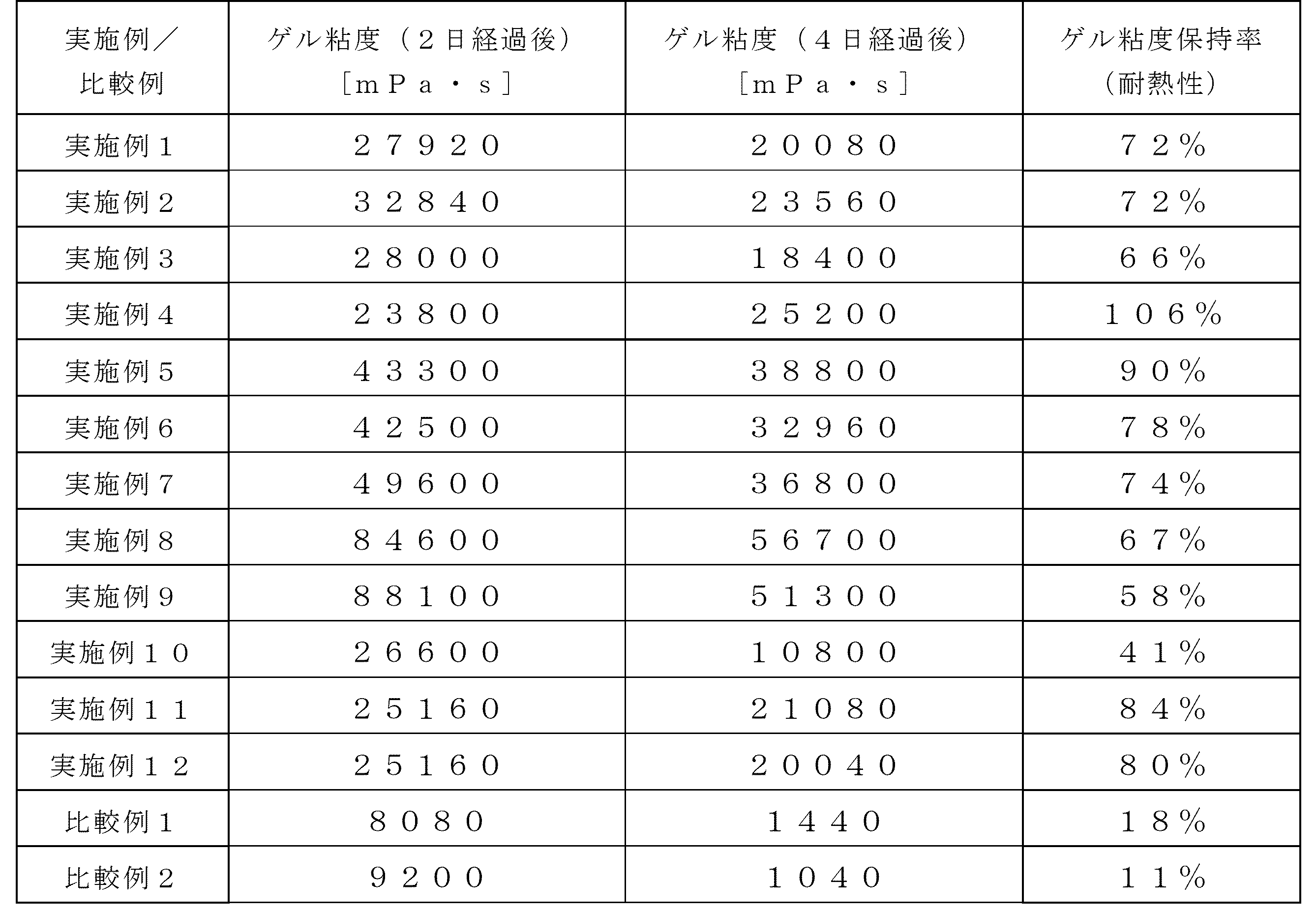
- Gel viscosity retention S B/A (I) (In formula (I), A indicates the gel viscosity (mPa ⁇ s) after 2 days, and B indicates the gel viscosity (mPa ⁇ s) after 4 days.) The gel viscosity retention rate S was calculated, and this value was used as an index of heat resistance.
- Table 1 shows the evaluation results of the water absorbent resin compositions obtained in each Example and Comparative Example. It was confirmed that the water absorbent resin compositions obtained in each example were able to maintain a good gel state under heating conditions of 90°C. This result shows that the water absorbent resin compositions obtained in each example have excellent heat resistance in the swollen state, and can be used for long periods of time even in environments where power cables are used or similar environments. This can be said to support the fact that it is possible to maintain a gel state over a long period of time.
- the water-absorbing resin compositions obtained in Examples have excellent heat resistance in the swollen state and can be suitably used for water-stopping materials.
Landscapes
- Chemical & Material Sciences (AREA)
- Health & Medical Sciences (AREA)
- Chemical Kinetics & Catalysis (AREA)
- Medicinal Chemistry (AREA)
- Polymers & Plastics (AREA)
- Organic Chemistry (AREA)
- Dispersion Chemistry (AREA)
- Compositions Of Macromolecular Compounds (AREA)
Abstract
Description
項1
吸水性樹脂粒子と、ホスホン酸系キレート剤とを含み、
前記ホスホン酸系キレート剤は、前記吸水性樹脂粒子1gに対して0.01~40μmol含まれる、吸水性樹脂組成物。
項2
30秒膨潤高さが6.0mm以上である、項1に記載の吸水性樹脂組成物。
項3
項1又は2に記載の吸水性樹脂組成物を含有する、止水材。
項4
項3に記載の止水材を含有する、ケーブル。
本発明の吸水性樹脂組成物は、吸水性樹脂粒子と、ホスホン酸系キレート剤とを含み、前記ホスホン酸系キレート剤は、前記吸水性樹脂粒子1g(=1グラム)に対して0.01~40μmol含まれるものである。
本発明の吸水性樹脂組成物に含まれる吸水性樹脂粒子は、水に対して膨潤可能な樹脂であって、吸水性樹脂組成物の主たる成分になり得る材料である。
本発明の吸水性樹脂組成物に含まれるホスホン酸系キレート剤の種類は、例えば、公知のホスホン酸系キレート剤を広く採用することができる。ホスホン酸系キレート剤とは、分子内に少なくとも2個ホスホン酸部位を有する化合物である。ホスホン酸系キレート剤は、塩の形態であってもよく、すなわち、ホスホン酸部位が塩を形成してもよい。
本発明の吸水性樹脂組成物は、前述のように、前記ホスホン酸系キレート剤は、前記吸水性樹脂粒子1gに対して0.01~40μmol(0.01μmol以上、40μmol以下)含まれるものである。ホスホン酸系キレート剤の含有量が吸水性樹脂粒子1gに対して0.01μmol未満、または40μmolを超えると、吸水性樹脂組成物の耐熱性が低下し、止水材として適用することが難しくなる。すなわち、本発明では、前記ホスホン酸系キレート剤の含有割合が特定の範囲である場合に限って、吸水性樹脂組成物の耐熱性が向上するものである。
特に断りのない場合、測定は温度25±2℃、湿度50±10%の環境下で実施する。
(含水率の測定)
吸水性樹脂粒子2.0gを、予め恒量(W1(g))としたアルミホイルケースに入れ、アルミホイルケースの口を軽く閉じ、この試料入りアルミホイルケースの合計質量W2(g)を精秤する。上述した試料入りアルミホイルケースを、内温を200℃に設定した熱風乾燥機で2時間乾燥させる。乾燥後の試料入りアルミホイルケースをデシケーター中で室温まで放冷する。放冷後の試料入りアルミホイルケースの合計質量W3(g)を測定する。以下の式から、試料の含水率を算出する。
含水率[質量%]={(W2-W3)/(W2-W1)}×100
特に断りのない場合、測定は温度25±2℃、湿度50±10%の環境下で実施する。
(中位粒子径(粒度分布)の測定)
吸水性樹脂組成物5gを、音波振動式ふるい分け測定器(ロボットシフター)と、JIS規格の目開き850μm、500μm、250μm、180μm、150μm、106μm及び75μmの篩と、受け皿とを用いて篩分けする。各篩上に残った粒子の質量を全量に対する質量百分率として算出する。各篩上に残存した粒子の質量百分率を、粒子径の大きいものから順に積算し、篩の目開きと、篩上に残った粒子の質量百分率の積算値との関係を対数確率紙にプロットする。確率紙上のプロットを直線で結ぶことにより、積算質量百分率50質量%に相当する粒子径を求め、これを吸水性樹脂組成物の中位粒子径とする。
図1に示す膨潤高さ測定装置Xによって、吸水性樹脂組成物の膨潤高さを測定する。図1に示す膨潤高さ測定装置Xは、移動距離測定装置1、凹型円形カップ2(高さ45mm、外径90mm。凹部の深さ40mm、凹部の内径80mm)、プラスチック製の凸型円形シリンダー3(外径79mm、吸水性樹脂組成物との接触面に直径2mmの貫通孔7が均等に60個配設)及び不織布4(目付量11g/m2の液体透過性不織布)を備える。膨潤高さ測定装置Xでは、レーザー光6により、凸型円形シリンダー3が移動した距離の変位を0.01mm単位で測定することができる。凹型円形カップ2は、所定量の吸水性樹脂組成物を均一に散布することができる。凸型円形シリンダー3は、サンプルである吸水性樹脂組成物5に対して90gの荷重を均一に加えることができる。
吸水性樹脂組成物のゲル粘度は、膨潤ゲルの温度を25±0.5℃に調整し、ブルックフィールド形回転粘度計(A形、スピンドルローターNo,5、回転数10rpm)を用いて測定を行う。このゲル粘度測定では、内径64mmΦの200mLガラスビーカーにゲルを65mmの高さまで入れた状態で行う。
ゲル粘度保持率S=B/A (I)
(式(I)中、Aは2日経過後のゲル粘度(mPa・s)、Bは4日経過後のゲル粘度(mPa・s)を示す。)
により、ゲル粘度保持率Sを算出し、この値を耐熱性の指標とする。
本発明の止水材は、前述の本発明の吸水性樹脂組成物を備える限り、その構成は例えば、公知の止水材と同様の構成とすることができる。止水材は吸水性樹脂組成物単独で形成することができる。あるいは、吸水性樹脂組成物と、ゴム及び/又は熱可塑性樹脂等との混合物を成形して止水材を形成することができる。止水材としては、止水テープ、止水ヤーン等が例示される。
(製造例1)
還流冷却器、滴下ロート、窒素ガス導入管、並びに、攪拌機として、翼径5cmの4枚傾斜パドル翼を2段で有する攪拌翼を備えた内径11cm、2L容の丸底円筒型セパラブルフラスコを準備した。このフラスコに、炭化水素分散媒としてn-ヘプタン292gをとり、高分子系分散剤として無水マレイン酸変性エチレン・プロピレン共重合体(三井化学株式会社、ハイワックス1105A)0.782gを添加し、攪拌しつつ80℃まで昇温して分散剤を溶解した後、56℃まで冷却した。一方、内容積300mLのビーカーに、水溶性エチレン性不飽和単量体として80.5質量%のアクリル酸水溶液92.0g(1.03モル)をとり、氷水で冷却しつつ、30質量%の水酸化ナトリウム水溶液102.8gを滴下してアクリル酸の75モル%中和物を調製した。さらに、水44.7gと、水溶性ラジカル重合剤として過硫酸カリウム0.0644g(0.238ミリモル)、内部架橋剤としてエチレングリコールジグリシジルエーテル0.0102g(0.059ミリモル)を加えて溶解し、第1段目の水性液を調製した。該水性液をセパラブルフラスコに添加して、10分間攪拌した後、20mL-バイアル瓶中において、n-ヘプタン7.04gに界面活性剤としてHLB3のショ糖ステアリン酸エステル(三菱化学フーズ株式会社、リョートーシュガーエステルS-370)0.782gを加熱溶解した界面活性剤溶液を、さらに添加して、撹拌機の回転数を450rpmとして攪拌しながら系内を窒素で十分に置換した後、フラスコを70℃の水浴に浸漬して昇温し、重合を60分間行うことにより、第1段目の重合スラリー液を得た。
還流冷却器、滴下ロート、窒素ガス導入管、並びに、攪拌機として、翼径5cmの4枚傾斜パドル翼を2段で有する攪拌翼(フッ素樹脂を表面にコートされている)を備えた内径11cm、2L容の丸底円筒型セパラブルフラスコを準備した。このフラスコに、炭化水素分散媒としてn-ヘプタン471gを加え、界面活性剤としてHLB8.6ソルビタンモノラウレート(日油社製、商品名ノニオンLP―20R)1.10gを添加し、46℃まで昇温した。一方、内容積300mLのビーカーに、水溶性エチレン性不飽和単量体として80.5質量%のアクリル酸水溶液92.0g(1.03モル)をとり、氷水で冷却しつつ、30質量%の水酸化ナトリウム水溶液102.8gを滴下してアクリル酸の75モル%中和物を調製した。さらに、水44.6g、水溶性ラジカル重合剤として過硫酸カリウム0.1012g(0.374ミリモル)を加えて溶解し、水性液を調製した。該水性液をセパラブルフラスコに添加し、撹拌機の回転数を700rpmとして攪拌させつつ、フラスコ内を窒素で30分間置換した。この後、フラスコを70℃の水浴に浸漬して昇温し、重合を60分間行って、含水ゲル重合体2を含むスラリーを得た。
(実施例1)
製造例1で得られた吸水性樹脂粒子(1)100質量部に対して、0.1質量部の非晶質シリカ(オリエンタルシリカズコーポレーション、トクシールNP-S)を混合した。この混合により得られた混合物に、ホスホン酸系キレート剤として、エチレンジアミンテトラメチレンホスホン酸(以下、EDTMP・8Hと略記する)0.001質量部(吸水性樹脂粒子1gあたりに換算するとEDTMP・8Hは0.023μmol)を粉体のまま添加し、よく混合することによって吸水性樹脂組成物(1)を得た。吸水性樹脂組成物(1)の中位粒子径は179μmであり、30秒膨潤高さは8.3mmであった。
EDTMP・8Hの使用量を0.01質量部(吸水性樹脂粒子1gあたりに換算するとEDTMP・8Hは0.23μmol)に変更したこと以外は実施例1と同様の方法で吸水性樹脂組成物(2)を得た。吸水性樹脂組成物(2)の中位粒子径は179μmであり、30秒膨潤高さは8.8mmであった。
EDTMP・8Hの使用量を0.1質量部(吸水性樹脂粒子1gあたりに換算するとEDTMP・8Hは2.3μmol)に変更したこと以外は実施例1と同様の方法で吸水性樹脂組成物(3)を得た。吸水性樹脂組成物(3)の中位粒子径は179μmであり、30秒膨潤高さは7.9mmであった。
EDTMP・8Hの使用量を0.2質量部(吸水性樹脂粒子1gあたりに換算するとEDTMP・8Hは4.6μmol)に変更したこと以外は実施例1と同様の方法で吸水性樹脂組成物(4)を得た。吸水性樹脂組成物(4)の中位粒子径は179μmであり、30秒膨潤高さは8.5mmであった。
製造例1と同様の方法で含水ゲル重合体1を含むスラリーを調製した。この含水ゲル重合体1を含むスラリーが収容されたフラスコを125℃に設定した油浴に浸漬し、n-ヘプタンと水との共沸蒸留により、n-ヘプタンを還流しながら243.7gの水を系外へ抜き出し、ホスホン酸系キレート剤として32質量%エチレンジアミンテトラメチレンホスホン酸・五ナトリウム塩(以下、EDTMP・5Naと略記する)水溶液0.72g(吸水性樹脂粒子1gあたりに換算するとEDTMP・5Naは2.1μmol)を添加した。その後、フラスコに後架橋剤として2質量%のエチレングリコールジグリシジルエーテル水溶液7.15g(0.821ミリモル)を添加し、83℃で2時間保持した。次いで、n-ヘプタンを125℃の油浴で加熱して蒸発させて乾燥させ、吸水性樹脂粒子198.4gを得た。さらに目開き850μmの篩に通過させることで、吸水性樹脂粒子(3)195.3gを得た。吸水性樹脂粒子(3)の含水率は3.6質量%であった。この吸水性樹脂粒子100質量部に対して、0.1質量部の非晶質シリカ(オリエンタルシリカズコーポレーション、トクシールNP-S)を混合することによって、吸水性樹脂組成物(5)を得た。吸水性樹脂組成物(5)の中位粒子径は166μmであり、30秒膨潤高さは8.3mmであった。
製造例1と同様の方法で含水ゲル重合体1を含むスラリーを調製した。この含水ゲル重合体1を含むスラリーが収容されたフラスコを125℃に設定した油浴に浸漬し、n-ヘプタンと水との共沸蒸留により、n-ヘプタンを還流しながら243.9gの水を系外へ抜き出し、ホスホン酸系キレート剤として31質量%ジエチレントリアミンペンタメチレンホスホン酸・七ナトリウム塩(以下、DTPMP・7Naと略記する)水溶液0.99g(吸水性樹脂粒子1gあたりに換算するとDTPMP・7Naは2.1μmol)を添加した。その後、フラスコに後架橋剤として2質量%のエチレングリコールジグリシジルエーテル水溶液7.15g(0.821ミリモル)を添加し、83℃で2時間保持した。次いで、n-ヘプタンを125℃の油浴で加熱して蒸発させて乾燥させ、吸水性樹脂粒子197.8gを得た。さらに目開き850μmの篩に通過させることで、吸水性樹脂粒子(4)196.4gを得た。吸水性樹脂粒子(4)の含水率は3.3質量%であった。この吸水性樹脂粒子100質量部に対して、0.1質量部の非晶質シリカ(オリエンタルシリカズコーポレーション、トクシールNP-S)を混合することによって、吸水性樹脂組成物(6)を得た。吸水性樹脂組成物(6)の中位粒子径は167μmであり、30秒膨潤高さは8.1mmであった。
製造例2で得られた吸水性樹脂粒子(2)100質量部に対して、ホスホン酸系キレート剤として、0.1質量部のEDTMP・8H(吸水性樹脂粒子1gあたりに換算するとEDTMP・8Hは2.3μmol)を粉体のまま添加し、よく混合することによって吸水性樹脂組成物(7)を得た。吸水性樹脂組成物(7)の中位粒子径は166μmであり、30秒膨潤高さは15.3mmであった。
製造例2と同様の方法で含水ゲル重合体2を含むスラリーを調製した。この含水ゲル重合体2を含むスラリーが収容されたフラスコを125℃に設定した油浴に浸漬し、n-ヘプタンと水との共沸蒸留により、n-ヘプタンを還流しながら、103.5gの水を系外へ抜き出し、ホスホン酸系キレート剤として32質量%EDTMP・5Na水溶液0.32g(吸水性樹脂粒子1gあたりに換算するとEDTMP・5Naは2.0μmol)を添加した。その後、フラスコに後架橋剤として2質量%のエチレングリコールジグリシジルエーテル水溶液2.76g(0.317ミリモル)を添加し、83℃で2時間保持した。その後、n-ヘプタンを125℃の油浴で加熱して蒸発させて乾燥させ、吸水性樹脂粒子95.3gを得た。さらに目開き850μmの篩に通過させることで、吸水性樹脂組成物(8)69.3gを得た。吸水性樹脂組成物(8)の含水率は3.2質量%であり、中位粒子径は226μmであり、30秒膨潤高さは15.2mmであった。
製造例2と同様の方法で含水ゲル重合体2を含むスラリーを調製した。この含水ゲル重合体2を含むスラリーが収容されたフラスコを125℃に設定した油浴に浸漬し、n-ヘプタンと水との共沸蒸留により、n-ヘプタンを還流しながら、103.6gの水を系外へ抜き出し、31質量%DTPMP・7Na水溶液0.49g(吸水性樹脂粒子1gあたりに換算するとDTPMP・7Naは2.2μmol)を添加した。その後、フラスコに後架橋剤として2質量%のエチレングリコールジグリシジルエーテル水溶液2.76g(0.317ミリモル)を添加し、83℃で2時間保持した。その後、n-ヘプタンを125℃の油浴で加熱して蒸発させて乾燥させ、吸水性樹脂粒子95.4gを得た。さらに目開き850μmの篩に通過させることで、吸水性樹脂組成物(9)71.3gを得た。吸水性樹脂組成物(9)の含水率は3.3質量%であり、中位粒子径は211μmであり、30秒膨潤高さは13.0mmであった。
EDTMP・8Hの使用量を0.9質量部(吸水性樹脂粒子1gあたりに換算するとEDTMP・8Hは21μmol)に変更したこと以外は実施例1と同様の方法で吸水性樹脂組成物(10)を得た。吸水性樹脂組成物(10)の中位粒子径は179μmであり、30秒膨潤高さは8.6mmであった。
製造例1と同様の方法で含水ゲル重合体1を含むスラリーを調製した。この含水ゲル重合体1を含むスラリーが収容されたフラスコを125℃に設定した油浴に浸漬し、n-ヘプタンと水との共沸蒸留により、n-ヘプタンを還流しながら245.0gの水を系外へ抜き出し、ホスホン酸系キレート剤として32質量%エチレンジアミンテトラメチレンホスホン酸・五ナトリウム塩(EDTMP・5Naと略記する)水溶液2.57g(吸水性樹脂粒子1gあたりに換算するとEDTMP・5Naは7.5μmol)を添加した。その後、フラスコに後架橋剤として2質量%のエチレングリコールジグリシジルエーテル水溶液7.15g(0.821ミリモル)を添加し、83℃で2時間保持した。次いで、n-ヘプタンを125℃の油浴で加熱して蒸発させて乾燥させ、吸水性樹脂粒子200.7gを得た。さらに目開き850μmの篩に通過させることで吸水性樹脂粒子(5)197.3gを得た。吸水性樹脂粒子(5)の含水率は4.7質量%であった。吸水性樹脂粒子100質量部に対して、0.1質量部の非晶質シリカ(オリエンタルシリカズコーポレーション、トクシールNP-S)を混合することによって、吸水性樹脂組成物(11)を得た。吸水性樹脂組成物(11)の中位粒子径は176μmであり、30秒膨潤高さは6.8mmであった。
製造例1と同様の方法で含水ゲル重合体1を含むスラリーを調製した。この含水ゲル重合体1を含むスラリーが収容されたフラスコを125℃に設定した油浴に浸漬し、n-ヘプタンと水との共沸蒸留により、n-ヘプタンを還流しながら246.8gの水を系外へ抜き出し、ホスホン酸系キレート剤として32質量%エチレンジアミンテトラメチレンホスホン酸・五ナトリウム塩(EDTMP・5Naと略記する)水溶液5.13g(吸水性樹脂粒子1gあたりに換算するとEDTMP・5Naは15μmol)を添加した。その後、フラスコに後架橋剤として2質量%のエチレングリコールジグリシジルエーテル水溶液7.15g(0.821ミリモル)を添加し、83℃で2時間保持した。次いで、n-ヘプタンを125℃の油浴で加熱して蒸発させて乾燥させ、吸水性樹脂粒子200.3gを得た。さらに目開き850μmの篩に通過させることで、吸水性樹脂粒子(6)194.6gを得た。吸水性樹脂粒子(6)の含水率は4.5質量%であった。目開き850μmの篩を通過させた吸水性樹脂粒子100質量部に対して、0.1質量部の非晶質シリカ(オリエンタルシリカズコーポレーション、トクシールNP-S)を混合することによって、吸水性樹脂組成物(12)を得た。吸水性樹脂組成物(12)の中位粒子径は185μmであり、30秒膨潤高さは6.4mmであった。
EDTMP・8Hの使用量を0.0001質量部(吸水性樹脂粒子1gあたりに換算するとEDTMP・8Hは0.0023μmol)に変更したこと以外は実施例1と同様の方法で吸水性樹脂組成物(13)を得た。吸水性樹脂組成物(13)の中位粒子径は179μmであり、30秒膨潤高さは8.8mmであった。
EDTMP・8Hの使用量を4.4質量部(吸水性樹脂粒子1gあたりに換算するとEDTMP・8Hは101μmol)に変更したこと以外は実施例1と同様の方法で吸水性樹脂組成物(14)を得た。吸水性樹脂組成物(14)の中位粒子径は178μmであり、30秒膨潤高さは7.0mmであった。
(含水率の測定)
吸水性樹脂粒子2.0gを、予め恒量(W1(g))としたアルミホイルケース(8号)に入れ、アルミホイルケースの口を軽く閉じ、この試料入りアルミホイルケースの合計質量W2(g)を精秤した。上述した試料入りアルミホイルケースを、内温を200℃に設定した熱風乾燥機(ADVANTEC社製、型式:FV-320)で2時間乾燥させた。乾燥後の試料入りアルミホイルケースをデシケーター中で室温まで放冷した。放冷後の試料入りアルミホイルケースの合計質量W3(g)を測定した。以下の式から、試料の含水率を算出した。
含水率[質量%]={(W2-W3)/(W2-W1)}×100
(中位粒子径(粒度分布)の測定)
各製造例で得られた吸水性樹脂組成物5gを、音波振動式ふるい分け測定器(ロボットシフター RPS-01、株式会社セイシン企業製)と、JIS規格の目開き850μm、500μm、250μm、180μm、150μm、106μm及び75μmの篩と、受け皿とを用いて篩分けした。各篩上に残った粒子の質量を全量に対する質量百分率として算出した。各篩上に残存した粒子の質量百分率を、粒子径の大きいものから順に積算し、篩の目開きと、篩上に残った粒子の質量百分率の積算値との関係を対数確率紙にプロットした。確率紙上のプロットを直線で結ぶことにより、積算質量百分率50質量%に相当する粒子径を求め、これを吸水性樹脂組成物の中位粒子径とした。
図1に示す膨潤高さ測定装置Xによって、吸水性樹脂組成物の膨潤高さを測定した。図1に示す膨潤高さ測定装置Xは、移動距離測定装置1、凹型円形カップ2(高さ45mm、外径90mm。凹部の深さ40mm、凹部の内径80mm)、プラスチック製の凸型円形シリンダー3(外径79mm、吸水性樹脂組成物との接触面に直径2mmの貫通孔7が均等に60個配設)及び不織布4(目付量11g/m2の液体透過性不織布)を備える。膨潤高さ測定装置Xでは、レーザー光6により、凸型円形シリンダー3が移動した距離の変位を0.01mm単位で測定することができる。凹型円形カップ2は、所定量の吸水性樹脂組成物を均一に散布することができる。凸型円形シリンダー3は、サンプルである吸水性樹脂組成物5に対して90gの荷重を均一に加えることができる。
吸水性樹脂組成物のゲル粘度は、膨潤ゲルの温度を25±0.5℃に調整し、ブルックフィールド形回転粘度計(芝浦システム社製ビスメトロン粘度計VDH2型、スピンドルローターNo,5、回転数10rpm)を用いて測定を行った。このゲル粘度測定では、内径64mmΦの200mLガラスビーカーにゲルを65mmの高さまで入れた状態で行った。
ゲル粘度保持率S=B/A (I)
(式(I)中、Aは2日経過後のゲル粘度(mPa・s)、Bは4日経過後のゲル粘度(mPa・s)を示す。)
により、ゲル粘度保持率Sを算出し、この値を耐熱性の指標とした。
Claims (4)
- 吸水性樹脂粒子と、ホスホン酸系キレート剤とを含み、
前記ホスホン酸系キレート剤は、前記吸水性樹脂粒子1gに対して0.01~40μmol含まれる、吸水性樹脂組成物。 - 30秒膨潤高さが6.0mm以上である、請求項1に記載の吸水性樹脂組成物。
- 請求項1又は2に記載の吸水性樹脂組成物を含有する、止水材。
- 請求項3に記載の止水材を含有する、ケーブル。
Priority Applications (4)
| Application Number | Priority Date | Filing Date | Title |
|---|---|---|---|
| JP2024548328A JPWO2024063155A1 (ja) | 2022-09-22 | 2023-09-22 | |
| KR1020257007938A KR20250073100A (ko) | 2022-09-22 | 2023-09-22 | 흡수성 수지 조성물, 지수재 및 케이블 |
| CN202380066830.1A CN119894989A (zh) | 2022-09-22 | 2023-09-22 | 吸水性树脂组合物、止水材料和电缆 |
| EP23868276.9A EP4592362A4 (en) | 2022-09-22 | 2023-09-22 | Composition of absorbent resin, sealing material, and cable |
Applications Claiming Priority (2)
| Application Number | Priority Date | Filing Date | Title |
|---|---|---|---|
| JP2022-151858 | 2022-09-22 | ||
| JP2022151858 | 2022-09-22 |
Publications (1)
| Publication Number | Publication Date |
|---|---|
| WO2024063155A1 true WO2024063155A1 (ja) | 2024-03-28 |
Family
ID=90454726
Family Applications (1)
| Application Number | Title | Priority Date | Filing Date |
|---|---|---|---|
| PCT/JP2023/034413 Ceased WO2024063155A1 (ja) | 2022-09-22 | 2023-09-22 | 吸水性樹脂組成物、止水材及びケーブル |
Country Status (5)
| Country | Link |
|---|---|
| EP (1) | EP4592362A4 (ja) |
| JP (1) | JPWO2024063155A1 (ja) |
| KR (1) | KR20250073100A (ja) |
| CN (1) | CN119894989A (ja) |
| WO (1) | WO2024063155A1 (ja) |
Citations (5)
| Publication number | Priority date | Publication date | Assignee | Title |
|---|---|---|---|---|
| JPH01275661A (ja) * | 1988-04-28 | 1989-11-06 | Kao Corp | 吸水性樹脂組成物 |
| WO2012133734A1 (ja) * | 2011-03-31 | 2012-10-04 | 株式会社日本触媒 | 粒子状吸水剤およびその製造方法 |
| WO2013073682A1 (ja) * | 2011-11-16 | 2013-05-23 | 株式会社日本触媒 | ポリアクリル酸(塩)系吸水性樹脂の製造方法 |
| JP2014073448A (ja) * | 2012-10-03 | 2014-04-24 | Nippon Shokubai Co Ltd | 粒子状吸水剤及びその製造方法 |
| JP2015083693A (ja) * | 2010-04-07 | 2015-04-30 | 株式会社日本触媒 | ポリアクリル酸(塩)系吸水性樹脂粉末の製造方法及びポリアクリル酸(塩)系吸水性樹脂粉末 |
Family Cites Families (6)
| Publication number | Priority date | Publication date | Assignee | Title |
|---|---|---|---|---|
| JP6354062B2 (ja) | 2013-01-07 | 2018-07-11 | 株式会社アイ・イー・ジェー | 保護管付地下埋設ケーブル用止水材および止水方法 |
| EP2952537B1 (en) * | 2013-01-29 | 2021-10-27 | Nippon Shokubai Co., Ltd. | Water-absorbable resin material and method for producing same |
| US10961358B2 (en) * | 2016-09-30 | 2021-03-30 | Nippon Shokubai Co., Ltd. | Water-absorbing resin composition |
| CN110325273B (zh) * | 2017-02-22 | 2022-09-06 | 株式会社日本触媒 | 吸水性片、长条状吸水性片及吸收性物品 |
| JP7064614B2 (ja) * | 2018-09-21 | 2022-05-10 | 株式会社日本触媒 | キレート剤を含む吸水性樹脂の製造方法 |
| KR102942638B1 (ko) * | 2021-02-26 | 2026-03-24 | 가부시키가이샤 닛폰 쇼쿠바이 | 입자상 흡수제, 해당 흡수제를 포함하는 흡수체, 및 해당 흡수체를 사용한 흡수성 물품 |
-
2023
- 2023-09-22 EP EP23868276.9A patent/EP4592362A4/en active Pending
- 2023-09-22 WO PCT/JP2023/034413 patent/WO2024063155A1/ja not_active Ceased
- 2023-09-22 JP JP2024548328A patent/JPWO2024063155A1/ja active Pending
- 2023-09-22 KR KR1020257007938A patent/KR20250073100A/ko active Pending
- 2023-09-22 CN CN202380066830.1A patent/CN119894989A/zh active Pending
Patent Citations (5)
| Publication number | Priority date | Publication date | Assignee | Title |
|---|---|---|---|---|
| JPH01275661A (ja) * | 1988-04-28 | 1989-11-06 | Kao Corp | 吸水性樹脂組成物 |
| JP2015083693A (ja) * | 2010-04-07 | 2015-04-30 | 株式会社日本触媒 | ポリアクリル酸(塩)系吸水性樹脂粉末の製造方法及びポリアクリル酸(塩)系吸水性樹脂粉末 |
| WO2012133734A1 (ja) * | 2011-03-31 | 2012-10-04 | 株式会社日本触媒 | 粒子状吸水剤およびその製造方法 |
| WO2013073682A1 (ja) * | 2011-11-16 | 2013-05-23 | 株式会社日本触媒 | ポリアクリル酸(塩)系吸水性樹脂の製造方法 |
| JP2014073448A (ja) * | 2012-10-03 | 2014-04-24 | Nippon Shokubai Co Ltd | 粒子状吸水剤及びその製造方法 |
Non-Patent Citations (1)
| Title |
|---|
| See also references of EP4592362A4 * |
Also Published As
| Publication number | Publication date |
|---|---|
| EP4592362A1 (en) | 2025-07-30 |
| CN119894989A (zh) | 2025-04-25 |
| KR20250073100A (ko) | 2025-05-27 |
| JPWO2024063155A1 (ja) | 2024-03-28 |
| EP4592362A4 (en) | 2026-01-14 |
Similar Documents
| Publication | Publication Date | Title |
|---|---|---|
| JP6126655B2 (ja) | 吸水性樹脂粒子の製造方法 | |
| WO1997019968A1 (en) | Process for preparing water-absorbent resin | |
| JP7633929B2 (ja) | 吸水性樹脂及び止水材 | |
| WO2012144564A1 (ja) | 吸水性樹脂、吸収体及び吸収性物品 | |
| WO2016148153A1 (ja) | 吸水性樹脂および吸水剤 | |
| WO2024063154A1 (ja) | 吸水性樹脂組成物、止水材及びケーブル | |
| CN104024281B (zh) | 吸水性树脂颗粒的制造方法 | |
| WO2013031654A1 (ja) | 吸水性樹脂の製造方法、及びそれにより得られる吸水性樹脂 | |
| WO2019074099A1 (ja) | 吸水性樹脂及び吸収性物品 | |
| WO2024143315A1 (ja) | 吸水性樹脂組成物及び止水材並びにケーブル | |
| JPH04120176A (ja) | 吸水剤及びその製造方法 | |
| JP7625513B2 (ja) | 吸水性樹脂及び止水材 | |
| CN108948258A (zh) | 吸水性树脂及其制造方法 | |
| WO2024063155A1 (ja) | 吸水性樹脂組成物、止水材及びケーブル | |
| US20250222433A1 (en) | Method for producing water-absorbing resin composition | |
| WO2025205166A1 (ja) | 吸水性樹脂粒子、止水材およびケーブル | |
| TWI807852B (zh) | 吸水性樹脂及其製造方法 | |
| JP7642729B2 (ja) | 吸水性樹脂の製造方法 | |
| WO2026028880A1 (ja) | 吸水性樹脂粒子の製造方法 | |
| EP4186930A1 (en) | Water-absorbing resin composition, absorbent, and absorptive article | |
| JPH0487638A (ja) | 吸水剤及びその製造方法 | |
| KR20230042281A (ko) | 흡수성 수지 조성물, 흡수성 수지 조성물의 제조 방법 및 흡수성 수지 입자의 흡수 속도 저속화 방법 |
Legal Events
| Date | Code | Title | Description |
|---|---|---|---|
| 121 | Ep: the epo has been informed by wipo that ep was designated in this application |
Ref document number: 23868276 Country of ref document: EP Kind code of ref document: A1 |
|
| WWE | Wipo information: entry into national phase |
Ref document number: 2024548328 Country of ref document: JP |
|
| WWE | Wipo information: entry into national phase |
Ref document number: 202380066830.1 Country of ref document: CN |
|
| WWE | Wipo information: entry into national phase |
Ref document number: 202517033007 Country of ref document: IN |
|
| WWE | Wipo information: entry into national phase |
Ref document number: 2023868276 Country of ref document: EP |
|
| NENP | Non-entry into the national phase |
Ref country code: DE |
|
| WWP | Wipo information: published in national office |
Ref document number: 202517033007 Country of ref document: IN Ref document number: 202380066830.1 Country of ref document: CN |
|
| ENP | Entry into the national phase |
Ref document number: 2023868276 Country of ref document: EP Effective date: 20250422 |
|
| WWP | Wipo information: published in national office |
Ref document number: 2023868276 Country of ref document: EP |