WO2024071090A1 - プリプレグ、及び該プリプレグを用いる繊維強化複合材料の製造方法 - Google Patents
プリプレグ、及び該プリプレグを用いる繊維強化複合材料の製造方法 Download PDFInfo
- Publication number
- WO2024071090A1 WO2024071090A1 PCT/JP2023/034860 JP2023034860W WO2024071090A1 WO 2024071090 A1 WO2024071090 A1 WO 2024071090A1 JP 2023034860 W JP2023034860 W JP 2023034860W WO 2024071090 A1 WO2024071090 A1 WO 2024071090A1
- Authority
- WO
- WIPO (PCT)
- Prior art keywords
- epoxy resin
- resin composition
- prepreg
- mass
- fiber
- Prior art date
- Legal status (The legal status is an assumption and is not a legal conclusion. Google has not performed a legal analysis and makes no representation as to the accuracy of the status listed.)
- Ceased
Links
Classifications
-
- C—CHEMISTRY; METALLURGY
- C08—ORGANIC MACROMOLECULAR COMPOUNDS; THEIR PREPARATION OR CHEMICAL WORKING-UP; COMPOSITIONS BASED THEREON
- C08J—WORKING-UP; GENERAL PROCESSES OF COMPOUNDING; AFTER-TREATMENT NOT COVERED BY SUBCLASSES C08B, C08C, C08F, C08G or C08H
- C08J5/00—Manufacture of articles or shaped materials containing macromolecular substances
- C08J5/24—Impregnating materials with prepolymers which can be polymerised in situ, e.g. manufacture of prepregs
- C08J5/241—Impregnating materials with prepolymers which can be polymerised in situ, e.g. manufacture of prepregs using inorganic fibres
- C08J5/243—Impregnating materials with prepolymers which can be polymerised in situ, e.g. manufacture of prepregs using inorganic fibres using carbon fibres
-
- C—CHEMISTRY; METALLURGY
- C08—ORGANIC MACROMOLECULAR COMPOUNDS; THEIR PREPARATION OR CHEMICAL WORKING-UP; COMPOSITIONS BASED THEREON
- C08G—MACROMOLECULAR COMPOUNDS OBTAINED OTHERWISE THAN BY REACTIONS ONLY INVOLVING UNSATURATED CARBON-TO-CARBON BONDS
- C08G59/00—Polycondensates containing more than one epoxy group per molecule; Macromolecules obtained by polymerising compounds containing more than one epoxy group per molecule using curing agents or catalysts which react with the epoxy groups
- C08G59/18—Macromolecules obtained by polymerising compounds containing more than one epoxy group per molecule using curing agents or catalysts which react with the epoxy groups ; e.g. general methods of curing
- C08G59/20—Macromolecules obtained by polymerising compounds containing more than one epoxy group per molecule using curing agents or catalysts which react with the epoxy groups ; e.g. general methods of curing characterised by the epoxy compounds used
- C08G59/32—Epoxy compounds containing three or more epoxy groups
- C08G59/3227—Compounds containing acyclic nitrogen atoms
-
- C—CHEMISTRY; METALLURGY
- C08—ORGANIC MACROMOLECULAR COMPOUNDS; THEIR PREPARATION OR CHEMICAL WORKING-UP; COMPOSITIONS BASED THEREON
- C08G—MACROMOLECULAR COMPOUNDS OBTAINED OTHERWISE THAN BY REACTIONS ONLY INVOLVING UNSATURATED CARBON-TO-CARBON BONDS
- C08G59/00—Polycondensates containing more than one epoxy group per molecule; Macromolecules obtained by polymerising compounds containing more than one epoxy group per molecule using curing agents or catalysts which react with the epoxy groups
- C08G59/18—Macromolecules obtained by polymerising compounds containing more than one epoxy group per molecule using curing agents or catalysts which react with the epoxy groups ; e.g. general methods of curing
- C08G59/40—Macromolecules obtained by polymerising compounds containing more than one epoxy group per molecule using curing agents or catalysts which react with the epoxy groups ; e.g. general methods of curing characterised by the curing agents used
- C08G59/4007—Curing agents not provided for by the groups C08G59/42 - C08G59/66
- C08G59/4014—Nitrogen containing compounds
- C08G59/4021—Ureas; Thioureas; Guanidines; Dicyandiamides
-
- C—CHEMISTRY; METALLURGY
- C08—ORGANIC MACROMOLECULAR COMPOUNDS; THEIR PREPARATION OR CHEMICAL WORKING-UP; COMPOSITIONS BASED THEREON
- C08G—MACROMOLECULAR COMPOUNDS OBTAINED OTHERWISE THAN BY REACTIONS ONLY INVOLVING UNSATURATED CARBON-TO-CARBON BONDS
- C08G59/00—Polycondensates containing more than one epoxy group per molecule; Macromolecules obtained by polymerising compounds containing more than one epoxy group per molecule using curing agents or catalysts which react with the epoxy groups
- C08G59/18—Macromolecules obtained by polymerising compounds containing more than one epoxy group per molecule using curing agents or catalysts which react with the epoxy groups ; e.g. general methods of curing
- C08G59/40—Macromolecules obtained by polymerising compounds containing more than one epoxy group per molecule using curing agents or catalysts which react with the epoxy groups ; e.g. general methods of curing characterised by the curing agents used
- C08G59/44—Amides
- C08G59/46—Amides together with other curing agents
-
- C—CHEMISTRY; METALLURGY
- C08—ORGANIC MACROMOLECULAR COMPOUNDS; THEIR PREPARATION OR CHEMICAL WORKING-UP; COMPOSITIONS BASED THEREON
- C08G—MACROMOLECULAR COMPOUNDS OBTAINED OTHERWISE THAN BY REACTIONS ONLY INVOLVING UNSATURATED CARBON-TO-CARBON BONDS
- C08G59/00—Polycondensates containing more than one epoxy group per molecule; Macromolecules obtained by polymerising compounds containing more than one epoxy group per molecule using curing agents or catalysts which react with the epoxy groups
- C08G59/18—Macromolecules obtained by polymerising compounds containing more than one epoxy group per molecule using curing agents or catalysts which react with the epoxy groups ; e.g. general methods of curing
- C08G59/40—Macromolecules obtained by polymerising compounds containing more than one epoxy group per molecule using curing agents or catalysts which react with the epoxy groups ; e.g. general methods of curing characterised by the curing agents used
- C08G59/50—Amines
- C08G59/5033—Amines aromatic
-
- C—CHEMISTRY; METALLURGY
- C08—ORGANIC MACROMOLECULAR COMPOUNDS; THEIR PREPARATION OR CHEMICAL WORKING-UP; COMPOSITIONS BASED THEREON
- C08G—MACROMOLECULAR COMPOUNDS OBTAINED OTHERWISE THAN BY REACTIONS ONLY INVOLVING UNSATURATED CARBON-TO-CARBON BONDS
- C08G59/00—Polycondensates containing more than one epoxy group per molecule; Macromolecules obtained by polymerising compounds containing more than one epoxy group per molecule using curing agents or catalysts which react with the epoxy groups
- C08G59/18—Macromolecules obtained by polymerising compounds containing more than one epoxy group per molecule using curing agents or catalysts which react with the epoxy groups ; e.g. general methods of curing
- C08G59/40—Macromolecules obtained by polymerising compounds containing more than one epoxy group per molecule using curing agents or catalysts which react with the epoxy groups ; e.g. general methods of curing characterised by the curing agents used
- C08G59/50—Amines
- C08G59/56—Amines together with other curing agents
- C08G59/60—Amines together with other curing agents with amides
-
- C—CHEMISTRY; METALLURGY
- C08—ORGANIC MACROMOLECULAR COMPOUNDS; THEIR PREPARATION OR CHEMICAL WORKING-UP; COMPOSITIONS BASED THEREON
- C08G—MACROMOLECULAR COMPOUNDS OBTAINED OTHERWISE THAN BY REACTIONS ONLY INVOLVING UNSATURATED CARBON-TO-CARBON BONDS
- C08G59/00—Polycondensates containing more than one epoxy group per molecule; Macromolecules obtained by polymerising compounds containing more than one epoxy group per molecule using curing agents or catalysts which react with the epoxy groups
- C08G59/18—Macromolecules obtained by polymerising compounds containing more than one epoxy group per molecule using curing agents or catalysts which react with the epoxy groups ; e.g. general methods of curing
- C08G59/68—Macromolecules obtained by polymerising compounds containing more than one epoxy group per molecule using curing agents or catalysts which react with the epoxy groups ; e.g. general methods of curing characterised by the catalysts used
- C08G59/686—Macromolecules obtained by polymerising compounds containing more than one epoxy group per molecule using curing agents or catalysts which react with the epoxy groups ; e.g. general methods of curing characterised by the catalysts used containing nitrogen
-
- C—CHEMISTRY; METALLURGY
- C08—ORGANIC MACROMOLECULAR COMPOUNDS; THEIR PREPARATION OR CHEMICAL WORKING-UP; COMPOSITIONS BASED THEREON
- C08J—WORKING-UP; GENERAL PROCESSES OF COMPOUNDING; AFTER-TREATMENT NOT COVERED BY SUBCLASSES C08B, C08C, C08F, C08G or C08H
- C08J5/00—Manufacture of articles or shaped materials containing macromolecular substances
- C08J5/24—Impregnating materials with prepolymers which can be polymerised in situ, e.g. manufacture of prepregs
- C08J5/249—Impregnating materials with prepolymers which can be polymerised in situ, e.g. manufacture of prepregs characterised by the additives used in the prepolymer mixture
-
- C—CHEMISTRY; METALLURGY
- C08—ORGANIC MACROMOLECULAR COMPOUNDS; THEIR PREPARATION OR CHEMICAL WORKING-UP; COMPOSITIONS BASED THEREON
- C08L—COMPOSITIONS OF MACROMOLECULAR COMPOUNDS
- C08L63/00—Compositions of epoxy resins; Compositions of derivatives of epoxy resins
-
- B—PERFORMING OPERATIONS; TRANSPORTING
- B29—WORKING OF PLASTICS; WORKING OF SUBSTANCES IN A PLASTIC STATE IN GENERAL
- B29C—SHAPING OR JOINING OF PLASTICS; SHAPING OF MATERIAL IN A PLASTIC STATE, NOT OTHERWISE PROVIDED FOR; AFTER-TREATMENT OF THE SHAPED PRODUCTS, e.g. REPAIRING
- B29C70/00—Shaping composites, i.e. plastics material comprising reinforcements, fillers or preformed parts, e.g. inserts
- B29C70/003—Shaping composites, i.e. plastics material comprising reinforcements, fillers or preformed parts, e.g. inserts characterised by the matrix material, e.g. material composition or physical properties
-
- B—PERFORMING OPERATIONS; TRANSPORTING
- B29—WORKING OF PLASTICS; WORKING OF SUBSTANCES IN A PLASTIC STATE IN GENERAL
- B29C—SHAPING OR JOINING OF PLASTICS; SHAPING OF MATERIAL IN A PLASTIC STATE, NOT OTHERWISE PROVIDED FOR; AFTER-TREATMENT OF THE SHAPED PRODUCTS, e.g. REPAIRING
- B29C70/00—Shaping composites, i.e. plastics material comprising reinforcements, fillers or preformed parts, e.g. inserts
- B29C70/02—Shaping composites, i.e. plastics material comprising reinforcements, fillers or preformed parts, e.g. inserts comprising combinations of reinforcements, e.g. non-specified reinforcements, fibrous reinforcing inserts and fillers, e.g. particulate fillers, incorporated in matrix material, forming one or more layers and with or without non-reinforced or non-filled layers
- B29C70/021—Combinations of fibrous reinforcement and non-fibrous material
- B29C70/025—Combinations of fibrous reinforcement and non-fibrous material with particular filler
-
- C—CHEMISTRY; METALLURGY
- C08—ORGANIC MACROMOLECULAR COMPOUNDS; THEIR PREPARATION OR CHEMICAL WORKING-UP; COMPOSITIONS BASED THEREON
- C08J—WORKING-UP; GENERAL PROCESSES OF COMPOUNDING; AFTER-TREATMENT NOT COVERED BY SUBCLASSES C08B, C08C, C08F, C08G or C08H
- C08J2363/00—Characterised by the use of epoxy resins; Derivatives of epoxy resins
-
- C—CHEMISTRY; METALLURGY
- C08—ORGANIC MACROMOLECULAR COMPOUNDS; THEIR PREPARATION OR CHEMICAL WORKING-UP; COMPOSITIONS BASED THEREON
- C08J—WORKING-UP; GENERAL PROCESSES OF COMPOUNDING; AFTER-TREATMENT NOT COVERED BY SUBCLASSES C08B, C08C, C08F, C08G or C08H
- C08J2477/00—Characterised by the use of polyamides obtained by reactions forming a carboxylic amide link in the main chain; Derivatives of such polymers
- C08J2477/02—Polyamides derived from omega-amino carboxylic acids or from lactams thereof
-
- C—CHEMISTRY; METALLURGY
- C08—ORGANIC MACROMOLECULAR COMPOUNDS; THEIR PREPARATION OR CHEMICAL WORKING-UP; COMPOSITIONS BASED THEREON
- C08J—WORKING-UP; GENERAL PROCESSES OF COMPOUNDING; AFTER-TREATMENT NOT COVERED BY SUBCLASSES C08B, C08C, C08F, C08G or C08H
- C08J2477/00—Characterised by the use of polyamides obtained by reactions forming a carboxylic amide link in the main chain; Derivatives of such polymers
- C08J2477/10—Polyamides derived from aromatically bound amino and carboxyl groups of amino carboxylic acids or of polyamines and polycarboxylic acids
-
- C—CHEMISTRY; METALLURGY
- C08—ORGANIC MACROMOLECULAR COMPOUNDS; THEIR PREPARATION OR CHEMICAL WORKING-UP; COMPOSITIONS BASED THEREON
- C08J—WORKING-UP; GENERAL PROCESSES OF COMPOUNDING; AFTER-TREATMENT NOT COVERED BY SUBCLASSES C08B, C08C, C08F, C08G or C08H
- C08J2481/00—Characterised by the use of macromolecular compounds obtained by reactions forming in the main chain of the macromolecule a linkage containing sulfur with or without nitrogen, oxygen, or carbon only; Polysulfones; Derivatives of such polymers
- C08J2481/06—Polysulfones; Polyethersulfones
Definitions
- the present invention relates to a prepreg and a method for producing a fiber-reinforced composite material using the prepreg. More specifically, the present invention relates to a prepreg containing polyamide particles that function as interlayer particles, and a method for producing a fiber-reinforced composite material using the prepreg.
- Fiber-reinforced composite materials which consist of reinforcing fibers and resin, are characterized by their light weight, high strength, and high elasticity, and are widely used in aircraft, sports and leisure, and general industry. These fiber-reinforced composite materials are often manufactured via prepregs, in which reinforcing fibers and a resin called a matrix resin are already integrated.
- Thermosetting resins are widely used as the resins that make up prepregs, due to their high degree of molding freedom resulting from their tackiness and drapeability.
- Fiber-reinforced composite materials are often used as laminates in which multiple prepregs are stacked together with their fiber axis orientation changed, but because the reinforcing fibers are not oriented in the plate thickness direction, there are issues with low interlayer strength and susceptibility to delamination.
- Patent Document 1 discloses a prepreg comprising a fiber-reinforced substrate made of carbon fiber and an epoxy resin composition partially or entirely impregnated into the fiber-reinforced substrate, the epoxy resin composition comprising an epoxy resin, dicyandiamide, a specific aromatic amine, and polyamide particles.
- the polyamide particles function as interlaminar particles, but there is no mention of the shape or surface state of the polyamide particles, or the relationship between the curing temperature of the epoxy resin composition and the melting point of the polyamide particles.
- An object of the present invention is to solve the above-mentioned problems of the conventional art and to provide a prepreg with which a fiber-reinforced composite material having high impact resistance and toughness can be produced, and a method for producing a fiber-reinforced composite material using the prepreg.
- the inventors discovered that by using polyamide particles of a specific shape as interlayer particles and by establishing a specific relationship between the melting point of the polyamide particles and the curing temperature of the epoxy resin composition, it is possible to improve the interfacial adhesion of the polyamide particles in the epoxy resin composition, thereby improving the impact resistance and toughness of the resulting fiber-reinforced composite material, and thus completing the present invention.
- a fiber reinforced base material an epoxy resin composition impregnated in part or in whole into the fiber-reinforced substrate;
- a prepreg comprising:
- the epoxy resin composition comprises an epoxy resin, dicyandiamide, a urea-based curing accelerator, an aromatic amine, and polyamide particles, the epoxy resin contains N,N,N',N'-tetraglycidyldiaminodiphenylmethane in an amount of more than 60 parts by mass per 100 parts by mass of the epoxy resin,
- the aromatic amine is represented by the following formula (1):
- R 1 to R 8 are each independently any one of a hydrogen atom, an aliphatic substituent having 1 to 6 carbon atoms, an aromatic substituent, and a halogen atom, and at least one substituent is an aliphatic substituent having 1 to 6 carbon atoms.
- X is any one of -CH 2 -, -CH(CH 3 )-, -C(CH 3 ) 2 -, -S-, -O-, -CO-, -CONH-, and -C( ⁇ O)-.) is an aromatic amine represented by the formula: the polyamide particles have a shape with an average aspect ratio of less than 1.30; The melting point (Tm) of the polyamide particles and the exothermic peak temperature (Tp) of the epoxy resin composition measured using a differential scanning calorimeter are expressed by the following formula (1): Tp ⁇ Tm ⁇ Tp + 50 ... Formula (1) A prepreg characterized by satisfying the above.
- a method for producing a fiber-reinforced composite material comprising laminating the prepreg according to any one of [1] to [5] and hot molding the laminate, wherein the heating temperature during molding is equal to or higher than the exothermic peak temperature (Tp) of the epoxy resin composition measured using a differential scanning calorimeter and lower than the melting point (Tm) of the polyamide particles.
- Tp exothermic peak temperature
- Tm melting point
- the melting point (Tm) of the polyamide particles functioning as interlaminar particles and the exothermic peak temperature (Tp) of the epoxy resin composition measured using a differential scanning calorimeter have a specific relationship, and therefore, the interfacial adhesion of the polyamide particles in the epoxy resin composition is increased by heating during molding, and the compressive strength after damage (CAI) and mode II interlaminar toughness (GIIc) of the obtained fiber reinforced composite material can be improved.
- the polyamide particles functioning as interlayer particles have a shape close to a perfect sphere, which results in high interfacial adhesion of the polyamide particles in the epoxy resin composition, improving the toughness of the resulting fiber-reinforced composite material and improving the compressive strength after damage (CAI).
- the prepreg of the present invention comprises a fiber-reinforced base material and an epoxy resin composition impregnated into the fiber-reinforced base material.
- Fiber-reinforced substrate used in the present invention is not particularly limited, and examples thereof include substrates formed from carbon fibers, glass fibers, aramid fibers, silicon carbide fibers, polyester fibers, ceramic fibers, alumina fibers, boron fibers, metal fibers, mineral fibers, rock fibers, and slag fibers.
- Fiber-reinforced substrates those made of carbon fiber, glass fiber, and aramid fiber are preferred.
- Fiber-reinforced substrates made of carbon fiber are more preferred because they have good specific strength and specific elastic modulus, and can produce lightweight, high-strength fiber-reinforced composite materials.
- Fiber-reinforced substrates made of polyacrylonitrile (PAN)-based carbon fibers are particularly preferred because they have excellent tensile strength.
- the tensile modulus is preferably 100 to 600 GPa, more preferably 200 to 500 GPa, and particularly preferably 230 to 450 GPa.
- the tensile strength is preferably 2000 to 10000 MPa, and more preferably 3000 to 8000 MPa.
- the single fiber diameter of the carbon fiber is preferably 4 to 20 ⁇ m, and more preferably 5 to 10 ⁇ m.
- the reinforcing fibers are preferably formed into a sheet before use.
- sheet-like fiber-reinforced substrates include sheets in which a large number of reinforcing fibers are aligned in one direction, bidirectional fabrics such as plain weave and twill weave, multiaxial fabrics, nonwoven fabrics, mats, knits, braids, and paper made from reinforcing fibers.
- the thickness of the sheet-like fiber-reinforced substrate is preferably 0.01 to 3 mm, and more preferably 0.1 to 1.5 mm.
- the prepreg of the present invention is a prepreg in which a fiber-reinforced substrate is partially or entirely impregnated with an epoxy resin composition.
- the content of the epoxy resin composition in the entire prepreg is preferably 15 to 60 mass% based on the total mass of the prepreg. If the resin content is less than 15 mass%, voids may occur in the obtained fiber-reinforced composite material, which may reduce mechanical properties. If the resin content exceeds 60 mass%, the reinforcing effect of the reinforcing fibers may be insufficient, and the mechanical properties may be substantially low relative to the mass.
- the resin content is more preferably 20 to 55 mass%, and even more preferably 25 to 50 mass%.
- Epoxy resin composition contains at least an epoxy resin, dicyandiamide, a urea-based curing accelerator, an aromatic amine, and polyamide particles.
- the epoxy resin composition used in the present invention may contain a thermoplastic resin and other additives in addition to these.
- the epoxy resin composition releases thermal energy during its curing reaction.
- the exothermic peak temperature (Tp) of the epoxy resin composition used in the present invention is preferably 110 to 200°C, and more preferably 120 to 190°C.
- Epoxy Resin The epoxy resin composition of the present invention is a resin represented by the following formula (2):
- the epoxy resin contains N,N,N',N'-tetraglycidyldiaminodiphenylmethane represented by the formula:
- the amount of the epoxy resin is more than 60 parts by mass out of 100 parts by mass of the total epoxy resin.
- the amount of the epoxy resin is preferably 65 parts by mass or more out of 100 parts by mass of the total epoxy resin, and more preferably 70 parts by mass or more.
- the amount of the epoxy resin is preferably 95 parts by mass or less out of 100 parts by mass of the total epoxy resin, and more preferably 90 parts by mass or less. If it is 60 parts by mass or less, the mechanical properties of the cured body obtained by curing the epoxy resin composition may not be sufficiently high.
- the epoxy resin composition of the present invention may contain an epoxy resin other than the above-mentioned N,N,N',N'-tetraglycidyldiaminodiphenylmethane.
- an epoxy resin other than the above-mentioned N,N,N',N'-tetraglycidyldiaminodiphenylmethane.
- bifunctional epoxy resins such as bisphenol-type epoxy resins, alcohol-type epoxy resins, biphenyl-type epoxy resins, hydrophthalic acid-type epoxy resins, dimer acid-type epoxy resins, and alicyclic epoxy resins; glycidyl ether-type epoxy resins such as tetrakis(glycidyloxyphenyl)ethane and tris(glycidyloxyphenyl)methane; glycidylamine-type epoxy resins such as tetraglycidyldiaminodiphenylmethane; naphthalene-type
- polyfunctional epoxy resins such as phenolic epoxy resins.
- modified epoxy resins such as urethane modified epoxy resins and rubber modified epoxy resins can also be used.
- Epoxy resins having aromatic groups in the molecule are particularly preferred, and epoxy resins having either a glycidyl amine structure or a glycidyl ether structure are even more preferred. Alicyclic epoxy resins can also be suitably used.
- epoxy resins having a glycidyl amine structure examples include N,N,O-triglycidyl-p-aminophenol, N,N,O-triglycidyl-m-aminophenol, N,N,O-triglycidyl-3-methyl-4-aminophenol, triglycidyl aminocresol, and various isomers thereof.
- epoxy resins having a glycidyl ether structure examples include bisphenol A type epoxy resins, bisphenol F type epoxy resins, bisphenol S type epoxy resins, phenol novolac type epoxy resins, and cresol novolac type epoxy resins.
- These epoxy resins may have non-reactive substituents in the aromatic ring structure, etc., as necessary.
- non-reactive substituents include alkyl groups such as methyl, ethyl, and isopropyl groups; aromatic groups such as phenyl groups; alkoxyl groups; aralkyl groups; and halogen groups such as chlorine and bromine.
- Bisphenol-type epoxy resins include bisphenol A type resin, bisphenol F type resin, bisphenol AD type resin, bisphenol S type resin, etc. Specific examples include jER815, jER828, jER834, jER1001, jER807 (product names) manufactured by Mitsubishi Chemical Corporation; and EXA1514 (product name) manufactured by DIC Corporation.
- alicyclic epoxy resins examples include Araldite CY-179, CY-178, CY-182, and CY-183 (product names) manufactured by Huntsman Corporation.
- phenol novolac type epoxy resins examples include jER152 and jER154 (trade names) manufactured by Mitsubishi Chemical Corporation; DEN431, DEN485, and DEN438 (trade names) manufactured by Dow Chemical Co., Ltd.; and Epicron N740 (trade name) manufactured by DIC Corporation.
- cresol novolac type epoxy resins examples include Araldite ECN1235, ECN1273, and ECN1280 (trade names) manufactured by Huntsman Corporation; EOCN102, EOCN103, and EOCN104 (trade names) manufactured by Nippon Kayaku Co., Ltd.; Epototo YDCN-700-10 and Epototo YDCN-704 (trade names) manufactured by Nippon Steel Chemical Co., Ltd.; and Epicron N680 and Epicron N695 (trade names) manufactured by DIC Corporation.
- Epoxy resins having a glycidylamine structure include Sumiepoxy ELM434, Sumiepoxy ELM120, and Sumiepoxy ELM100 (trade names) manufactured by Sumitomo Chemical Co., Ltd.; Araldite MY0500, Araldite MY0510, Araldite MY0600, Araldite MY720, Araldite MY721, and Araldite MY951 manufactured by Huntsman Corporation.
- Araldite MY9612, Araldite MY9634, Araldite MY9663 (trade names); jER604, jER630 (trade names) manufactured by Mitsubishi Chemical Corporation; Bakelite EPR494, Bakelite EPR495, Bakelite EPR496, Bakelite EPR497 (trade names) manufactured by Bakelite AG, etc.
- modified epoxy resins examples include urethane-modified bisphenol A epoxy resins such as Adeka Resin EPU-6 and EPU-4 (product names) manufactured by ADEKA Corporation.
- epoxy resins epoxy resins other than N,N,N',N'-tetraglycidyldiaminodiphenylmethane
- the amount of these epoxy resins blended is less than 40 parts by mass out of 100 parts by mass of the total epoxy resins, preferably 5 to 35 parts by mass, and more preferably 10 to 30 parts by mass.
- the content of the epoxy resin (all epoxy resins including N,N,N',N'-tetraglycidyldiaminodiphenylmethane) in the epoxy resin composition is preferably 50 mass% or more, more preferably 55 mass% or more, and particularly preferably 60 mass% or more.
- Dicyandiamide is used as a curing agent for the epoxy resin in the present invention because it provides excellent storage stability and curing properties of the prepreg, and excellent physical properties of the cured fiber reinforced composite material.
- Specific examples of dicyandiamide (DICY) include jER Cure DICY7 and DICY15 (trade names) manufactured by Mitsubishi Chemical Corporation.
- the amount of dicyandiamide blended with respect to the epoxy resin is preferably 1 to 10 parts by mass, more preferably 2 to 10 parts by mass, and particularly preferably 2 to 8 parts by mass, per 100 parts by mass of the epoxy resin.
- the amount of dicyandiamide blended is 1 part by mass or more, the crosslinking density becomes sufficient, and a sufficient curing speed is obtained.
- the amount of dicyandiamide blended is 10 parts by mass or less, problems such as a decrease in the mechanical properties of the cured body and turbidity of the cured body due to the presence of an excessive amount of curing agent can be suppressed.
- the dissolution temperature of the above-mentioned dicyandiamide can be lowered by using it in combination with a urea-based curing accelerator, such as phenyl dimethyl urea (PDMU) or toluene bis dimethyl urea (TBDMU).
- a urea-based curing accelerator such as phenyl dimethyl urea (PDMU) or toluene bis dimethyl urea (TBDMU).
- the amount of the urea-based curing accelerator to be blended is preferably more than 0 and not more than 7 parts by mass, more preferably 0.05 to 7 parts by mass, and particularly preferably 0.1 to 5 parts by mass, per 100 parts by mass of the epoxy resin.
- the total amount of dicyandiamide and urea-based curing accelerator is preferably 2 to 12 parts by mass, more preferably 3 to 11 parts by mass, and particularly preferably 4 to 10 parts by mass, relative to 100 parts by mass of epoxy resin. If the total amount of dicyandiamide and urea-based curing accelerator is 2 parts by mass or more, the crosslinking density is high and a sufficient curing speed can be achieved.
- the total amount of dicyandiamide and urea-based curing accelerator is 12 parts by mass or less, problems such as a decrease in the mechanical properties of the cured body and turbidity of the cured body due to the presence of an excess of curing agent can be suppressed.
- R 1 to R 8 are each independently any one of a hydrogen atom, an aliphatic substituent having 1 to 6 carbon atoms, an aromatic substituent, and a halogen atom, and at least one substituent is an aliphatic substituent having 1 to 6 carbon atoms.
- X is any one of -CH 2 -, -CH(CH 3 )-, -C(CH 3 ) 2 -, -S-, -O-, -CO-, -CONH-, and -C( ⁇ O)-.
- the amount of aromatic amine is preferably 3 to 20 parts by mass, more preferably 5 to 16 parts by mass, and particularly preferably 7 to 12 parts by mass, relative to 100 parts by mass of epoxy resin.
- the amount of aromatic amine is 3 parts by mass or more, the crosslink density is increased, and the water absorption resistance of the cured body obtained by curing the epoxy resin composition can be increased.
- the amount of aromatic amine is 20 parts by mass or less, the water absorption resistance of the cured body obtained by curing the epoxy resin composition can be increased without inhibiting the rapid curing property of the resin.
- the prepreg of the present invention contains specific polyamide particles.
- the polyamide particles are dispersed between adjacent reinforcing fiber substrates (hereinafter, the dispersed particles are also referred to as "interlayer particles"), and the interlayer particles improve the toughness of the fiber-reinforced composite material. It is believed that at least one of the epoxy resin, the amine-based curing agent, and the epoxy resin-soluble thermoplastic resin penetrates into the surface of the polyamide particles, and the surface of the polyamide particles has high affinity with the epoxy resin, etc.
- the interfacial adhesion of the polyamide particles in the epoxy resin composition constituting the matrix resin in the obtained fiber-reinforced composite material is high, and as a result, the compressive strength after damage (CAI) and mode II interlaminar toughness (GIIc) of the obtained fiber-reinforced composite material can be improved.
- polyamide particles examples include polyamide particles made of crystalline polyamides such as Nylon 6 (registered trademark) (PA6, a polyamide obtained by ring-opening polymerization of ⁇ -caprolactam), Nylon 12 (PA12, a polyamide obtained by ring-opening polymerization of lauryllactam or polycondensation of 12-aminododecanoic acid), Nylon 1010 (PA1010, a polyamide obtained by polycondensation of sebacic acid and decamethylenediamine), and Nylon 11 (PA11, a polyamide obtained by ring-opening polymerization of undecanelactam or polycondensation of 11-aminoundecanoic acid).
- PA6 a polyamide obtained by ring-opening polymerization of ⁇ -caprolactam
- PA12 a polyamide obtained by ring-opening polymerization of lauryllactam or polycondensation of 12-aminododecanoic acid
- the degree of crystallinity of the polyamide particles as measured by X-ray diffraction is preferably 42% or less, and more preferably 25 to 42%.
- the content of polyamide particles in the epoxy resin composition is adjusted appropriately depending on the viscosity of the epoxy resin composition. From the viewpoint of processability of the prepreg, it is preferably 1 to 50 parts by mass, more preferably 5 to 40 parts by mass, and particularly preferably 10 to 30 parts by mass, per 100 parts by mass of epoxy resin contained in the epoxy resin composition. If it is less than 1 part by mass, the impact resistance and toughness of the resulting fiber-reinforced composite material may be insufficient. If it exceeds 50 parts by mass, the impregnation of the epoxy resin composition and the drapeability of the resulting prepreg may be reduced.
- the melting point (Tm) of the polyamide particles is preferably 150 to 250°C, and more preferably 170 to 220°C.
- the melting point (Tm) of the polyamide particles must be higher than the exothermic peak temperature (Tp) of the epoxy resin composition measured using a differential scanning calorimeter, i.e., Tp ⁇ Tm.
- Tp exothermic peak temperature
- the polyamide particles melt at the temperature during heating and molding and then recrystallize, causing a large fluctuation in the crystallinity of the polyamide particles, which reduces the adhesiveness of the polyamide particles in the epoxy resin composition or makes it more likely that the adhesiveness will vary. As a result, the impact resistance and toughness of the resulting fiber-reinforced composite material may be reduced.
- the melting point (Tm) of the polyamide particles and the exothermic peak temperature (Tp) of the epoxy resin composition as described above, measured using a differential scanning calorimeter satisfy the relationship Tm ⁇ Tp + 50. In other words, Tm - Tp is 50°C or less. By satisfying this condition, the surface of the polyamide particles can be sufficiently swollen by the epoxy resin, etc., at the temperature during hot molding.
- the melting point (Tm) of the polyamide particles and the exothermic peak temperature (Tp) of the epoxy resin composition measured using a differential scanning calorimeter satisfy the following mathematical formula (1).
- polyamide particles having a melting point (Tm) in the range of Tp (°C) to Tp + 50 (°C) at least one of an epoxy resin, an amine-based curing agent, and an epoxy resin-soluble thermoplastic resin can be permeated into the surface of the polyamide particles by heating during molding, thereby improving the interfacial adhesion of the polyamide particles in the epoxy resin composition.
- the epoxy resin composition may be kneaded in advance under heating conditions of Tp (°C) to Tp+50 (°C). By kneading, the epoxy resin and the like can more easily penetrate into the gaps in the polyamide particles and between and/or within the polyamide molecules.
- the kneading time is preferably 20 to 300 minutes, more preferably 30 to 150 minutes.
- the polyamide particles have an average aspect ratio (ratio of the major axis to the minor axis of the polyamide particles) of less than 1.30.
- the average aspect ratio is preferably 1.20 or less, more preferably 1.10 or less.
- Such polyamide particles can be uniformly blended in the resin composition.
- the interlayer particles are spherical, they can isotropically absorb crack propagation energy compared to general amorphous particles, and can stably improve toughness.
- the method for obtaining such polyamide particles examples include a method in which a polyamide solution in which polyamide is dissolved in a solvent is precipitated in a poor solvent by adjusting the concentration of the solution or solvent, and a method in which non-spherical polyamide particles are subjected to heat treatment in a gas phase.
- the heat treatment temperature can be appropriately adjusted depending on the polyamide particles used, and is preferably a temperature equal to or higher than the melting point (Tm) of the polyamide particles and lower than the decomposition temperature, more preferably 100 to 800°C, and even more preferably 250 to 600°C.
- Tm melting point
- commercially available polyamide particles that have been treated to have a spherical shape can also be used.
- the average particle size of the polyamide particles is preferably 1 to 50 ⁇ m, and particularly preferably 3 to 30 ⁇ m. If it is less than 1 ⁇ m, the viscosity of the epoxy resin composition to which the polyamide particles have been added increases significantly. Therefore, it may be difficult to add a sufficient amount of polyamide particles to the epoxy resin composition. If it exceeds 50 ⁇ m, it may be difficult to obtain a sheet of uniform thickness when the epoxy resin composition to which the polyamide particles have been added is processed into a sheet.
- Thermoplastic Resin may contain a thermoplastic resin in addition to the polyamide particles.
- thermoplastic resin include epoxy resin-soluble thermoplastic resins and epoxy resin-insoluble thermoplastic resins.
- Epoxy resin-soluble thermoplastic resin The epoxy resin composition may also contain an epoxy resin-soluble thermoplastic resin. This epoxy resin-soluble thermoplastic resin adjusts the viscosity of the epoxy resin composition and improves the impact resistance of the resulting fiber-reinforced composite material.
- An epoxy resin-soluble thermoplastic resin is a thermoplastic resin that can be partially or completely dissolved in an epoxy resin at or below the temperature at which a fiber-reinforced composite material is molded.
- "partially soluble in an epoxy resin” means that when 10 parts by mass of a thermoplastic resin having an average particle size of 10 to 50 ⁇ m is mixed with 100 parts by mass of an epoxy resin and stirred at 190° C. for 1 hour, the particles disappear or the average particle size changes by 10% or more.
- the epoxy resin-insoluble thermoplastic resin refers to a thermoplastic resin that is not substantially soluble in epoxy resin at or below the temperature at which the fiber-reinforced composite material is molded.
- the particle size does not change by 10% or more.
- the temperature at which fiber-reinforced composite materials are molded is 100 to 190° C.
- the particle size is measured visually using a microscope, and the average particle size refers to the average particle size of 100 randomly selected particles.
- the epoxy resin-soluble thermoplastic resin If the epoxy resin-soluble thermoplastic resin is not completely dissolved, it will dissolve in the epoxy resin when heated during the epoxy resin curing process, increasing the viscosity of the epoxy resin composition. This makes it possible to prevent the flow of the epoxy resin composition (the phenomenon in which the resin composition flows out from within the prepreg) caused by a decrease in viscosity during the curing process.
- the epoxy resin-soluble thermoplastic resin is preferably a resin that dissolves in epoxy resin at 80% by mass or more at 190°C.
- epoxy resin-soluble thermoplastic resins include polyethersulfone, polysulfone, polyetherimide, polycarbonate, etc. These may be used alone or in combination of two or more.
- the epoxy resin-soluble thermoplastic resin contained in the epoxy resin composition is particularly preferably polyethersulfone or polysulfone having a weight average molecular weight (Mw) in the range of 8,000 to 60,000. If the weight average molecular weight (Mw) is less than 8,000, the impact resistance of the resulting fiber-reinforced composite material may be insufficient, and if it is more than 60,000, the viscosity may be significantly increased and handling may be significantly deteriorated. It is preferable that the molecular weight distribution of the epoxy resin-soluble thermoplastic resin is uniform.
- the polydispersity (Mw/Mn), which is the ratio of the weight average molecular weight (Mw) to the number average molecular weight (Mn), is preferably in the range of 1 to 10, and more preferably in the range of 1.1 to 5.
- the weight average molecular weight means the molecular weight measured by gel permeation chromatography.
- the epoxy resin-soluble thermoplastic resin may have a reactive group that is reactive with the epoxy resin or a functional group that forms a hydrogen bond.
- Such an epoxy resin-soluble thermoplastic resin can improve the solubility stability during the curing process of the epoxy resin. It can also impart toughness, chemical resistance, heat resistance, and moist heat resistance to the fiber-reinforced composite material obtained after curing.
- Preferred reactive groups that are reactive with epoxy resins include hydroxyl groups, carboxylic acid groups, imino groups, and amino groups.
- the use of polyethersulfones terminated with hydroxyl groups is more preferable because the resulting fiber-reinforced composite material has particularly excellent impact resistance, fracture toughness, and solvent resistance.
- the content of the epoxy resin-soluble thermoplastic resin contained in the epoxy resin composition is adjusted appropriately depending on the viscosity, and from the viewpoint of the processability of the prepreg, it is preferably 5 to 90 parts by mass, more preferably 5 to 40 parts by mass, and even more preferably 10 to 35 parts by mass, per 100 parts by mass of the epoxy resin contained in the epoxy resin composition. If it is less than 5 parts by mass, the impact resistance of the obtained fiber-reinforced composite material may be insufficient. If the content of the epoxy resin-soluble thermoplastic resin is high, the viscosity increases significantly, and the handleability of the prepreg may be significantly deteriorated.
- the form of the epoxy resin-soluble thermoplastic resin is not particularly limited, but it is preferably particulate. Particulate epoxy resin-soluble thermoplastic resin can be uniformly blended into the resin composition. In addition, the resulting prepreg has high moldability.
- the average particle size of the epoxy resin-soluble thermoplastic resin is preferably 1 to 50 ⁇ m, and particularly preferably 3 to 30 ⁇ m. If it is less than 1 ⁇ m, the viscosity of the epoxy resin composition increases significantly. As a result, it may be difficult to add a sufficient amount of epoxy resin-soluble thermoplastic resin to the epoxy resin composition. If it exceeds 50 ⁇ m, it may be difficult to obtain a sheet of uniform thickness when processing the epoxy resin composition into a sheet. In addition, the dissolution rate in the epoxy resin becomes slow, and the obtained fiber-reinforced composite material becomes non-uniform, which is undesirable.
- Epoxy resin-insoluble thermoplastic resin may contain an epoxy resin-insoluble thermoplastic resin in addition to the polyamide particles.
- the epoxy resin-insoluble thermoplastic resin include amorphous polyamide particles, polyacetal, polyphenylene oxide, polyphenylene sulfide, polyester, polyamideimide, polyimide, polyether ketone, polyether ether ketone, polyethylene naphthalate, polyether nitrile, and polybenzimidazole.
- the content of the epoxy resin-insoluble thermoplastic resin in the epoxy resin composition is appropriately adjusted depending on the viscosity of the epoxy resin composition.
- the content thereof, together with the polyamide particles explained in (2-5) above is preferably 5 to 50 parts by mass, more preferably 7 to 45 parts by mass, and even more preferably 10 to 40 parts by mass, per 100 parts by mass of the epoxy resin contained in the epoxy resin composition.
- the preferred average particle size and morphology of the epoxy resin-insoluble thermoplastic resin are the same as those of the epoxy resin-soluble thermoplastic resin.
- thickening particles obtained by copolymerizing one or more unsaturated compounds with a crosslinkable monomer may be used in order to obtain the appropriate viscosity during molding.
- thickening particles made of a polymer having one or more polymerization units of an acrylic acid ester compound, a methacrylic acid ester compound, or a vinyl compound may be included in order to obtain the appropriate viscosity during molding.
- the acrylic acid ester-based compound used in the thickening particles refers to a compound having an acrylic acid ester structure and a derivative thereof, and examples thereof include methyl acrylate, ethyl acrylate, n-propyl acrylate, isopropyl acrylate, n-butyl acrylate, isobutyl acrylate, sec-butyl acrylate, t-butyl acrylate, n-hexyl acrylate, and cyclohexyl acrylate.
- the methacrylic acid ester compound used in the thickening particles refers to a compound having a methacrylic acid ester structure and its derivatives, and examples thereof include methyl methacrylate, ethyl methacrylate, n-propyl methacrylate, isopropyl methacrylate, n-butyl methacrylate, n-hexyl methacrylate, and cyclohexyl methacrylate.
- the vinyl compound used in the thickening particles refers to a compound having a polymerizable vinyl structure, and examples thereof include styrene, ⁇ -methylstyrene, divinylbenzene, and compounds in which the aromatic rings of these compounds are substituted with various functional groups such as alkyl groups and halogen atoms.
- the thickening particles may be a polymer consisting of one or more polymerized units of a methacrylic acid ester compound, an acrylic acid ester compound, or a vinyl compound, or may be a resin consisting of a mixture of two or more resins having different structures.
- the thickening particles are preferably polymers consisting of one or more types of polymerization units selected from the group consisting of methacrylic acid ester compounds, acrylic acid ester compounds, and vinyl compounds, and more preferably alkyl methacrylate polymers.
- the average degree of polymerization of the thickening particles is preferably 4,000 to 40,000.
- the average particle size of the thickening particles is preferably 0.3 to 10 ⁇ m, and more preferably 0.5 to 8 ⁇ m.
- the content is preferably 1 to 15 parts by mass, more preferably 2 to 12 parts by mass, and particularly preferably 3 to 10 parts by mass, per 100 parts by mass of epoxy resin.
- the epoxy resin has a low viscosity before the thickening particles swell, and therefore has excellent impregnation into the fiber-reinforced substrate layer.
- the thickening particles dispersed in the epoxy resin swell in the epoxy resin when heated.
- the swelling of the thickening particles progresses with temperature and time, and the viscosity of the epoxy resin increases rapidly as the thickening particles swell.
- the thickening particles swell and the viscosity of the epoxy resin increases in the fiber-reinforced substrate layer, the resin flow during molding is suppressed. As a result, both resin impregnation and suppression of resin flow can be achieved at a high level.
- the epoxy resin composition of the present invention may contain conductive particles, a flame retardant, an inorganic filler, and an internal mold release agent.
- conductive particles include conductive polymer particles such as polyacetylene particles, polyaniline particles, polypyrrole particles, polythiophene particles, polyisothianaphthene particles, and polyethylenedioxythiophene particles; carbon particles; carbon fiber particles; metal particles; and particles in which a core material made of an inorganic or organic material is coated with a conductive substance.
- conductive polymer particles such as polyacetylene particles, polyaniline particles, polypyrrole particles, polythiophene particles, polyisothianaphthene particles, and polyethylenedioxythiophene particles
- carbon particles carbon fiber particles
- metal particles and particles in which a core material made of an inorganic or organic material is coated with a conductive substance.
- a flame retardant is a phosphorus-based flame retardant.
- the phosphorus-based flame retardant contains a phosphorus atom in the molecule, and examples include organic phosphorus compounds such as phosphate esters, condensed phosphate esters, phosphazene compounds, and polyphosphates, as well as red phosphorus.
- inorganic fillers examples include aluminum borate, calcium carbonate, silicon carbonate, silicon nitride, potassium titanate, basic magnesium sulfate, zinc oxide, graphite, calcium sulfate, magnesium borate, magnesium oxide, and silicate minerals.
- silicate minerals An example of a commercially available silicate mineral is THIXOTROPIC AGENT DT 5039 (manufactured by Huntsman Co., Ltd.).
- Internal release agents include, for example, metal soaps, vegetable waxes such as polyethylene wax and carnauba wax, fatty acid ester release agents, silicone oil, animal wax, and fluorine-based nonionic surfactants.
- the amount of these internal release agents to be blended is preferably 0.1 to 5 parts by mass, and more preferably 0.2 to 2 parts by mass, per 100 parts by mass of the epoxy resin. Within this range, the release effect from the mold is optimally exhibited.
- the epoxy resin composition used in the present invention can be produced by mixing an epoxy resin, dicyandiamide, a urea-based curing accelerator, an aromatic amine, polyamide particles, and, if necessary, a thermoplastic resin and other additives.
- the epoxy resin and the like permeates into the voids in the polyamide particles.
- the kneading temperature is more preferably 90 to 140°C, and particularly preferably 115 to 130°C.
- the kneading time is more preferably 20 to 300 minutes, and particularly preferably 30 to 150 minutes.
- the epoxy resin and the polyamide particles are kneaded at a temperature of 70 to 150° C. for 10 minutes or longer, the dicyandiamide and the urea-based curing accelerator are preferably added after the kneading.
- the mixing temperature after adding the curing agent can be in the range of 10 to Tp (°C). If it exceeds Tp (°C), the curing reaction may proceed partially, reducing the impregnation into the reinforcing fiber substrate layer, and the storage stability of the resulting epoxy resin composition and the prepreg produced using it may decrease. If it is less than 10°C, the viscosity of the epoxy resin composition may be high, making mixing difficult.
- the temperature is preferably in the range of 20 to 130°C, and more preferably in the range of 30 to 100°C.
- the mixing machine a conventionally known one can be used. Specific examples include a roll mill, a planetary mixer, a kneader, an extruder, a Banbury mixer, a mixing vessel equipped with stirring blades, a horizontal mixing tank, and the like.
- the components can be mixed in the air, in an inert gas atmosphere, or under reduced pressure.
- an atmosphere in which the temperature and humidity are controlled is preferable.
- Method for Producing Prepreg There is no particular limitation on the method for producing the prepreg of the present invention, and any conventionally known method can be used. Specifically, the hot melt method and the solvent method can be suitably used.
- the hot melt method involves applying a resin composition in the form of a thin film onto release paper to form a resin composition film, laminating the resin composition film onto a reinforced fiber substrate, and heating the laminate under pressure to impregnate the resin composition into the reinforced fiber substrate layer.
- the method for making the resin composition into a resin composition film is not particularly limited, and any conventionally known method can be used.
- a resin composition film can be obtained by casting the resin composition onto a support such as release paper or film using die extrusion, an applicator, a reverse roll coater, a comma coater, or the like.
- the resin temperature when producing the film is appropriately determined depending on the composition and viscosity of the resin composition. Specifically, the same temperature conditions as the mixing temperature in the above-mentioned method for producing an epoxy resin composition are preferably used.
- the resin composition can be impregnated into the reinforcing fiber substrate layer in one step, or in multiple steps.
- the solvent method involves turning the epoxy resin composition into a varnish using a suitable solvent, and then impregnating the reinforcing fiber substrate layer with this varnish.
- the prepreg of the present invention can be preferably manufactured by the hot melt method, which does not use a solvent, among these conventional methods.
- the impregnation temperature is preferably in the range of 50 to Tp (°C). If the impregnation temperature is less than 50°C, the viscosity of the epoxy resin is high and it may not be sufficiently impregnated into the reinforcing fiber substrate layer. If the impregnation temperature exceeds Tp (°C), the curing reaction of the epoxy resin composition may proceed, and the storage stability or drapeability of the obtained prepreg may decrease. Specific examples of impregnation temperatures include 60 to 145°C, more preferably 70 to 140°C.
- the impregnation pressure when the epoxy resin composition film is impregnated into the reinforcing fiber substrate layer by the hot melt method is appropriately determined taking into consideration the viscosity and resin flow of the resin composition. Specifically, the impregnation pressure is 1 to 50 (kN/cm), and more preferably 2 to 40 (kN/cm).
- a fiber-reinforced composite material can be obtained by curing the prepreg of the present invention by applying heat and pressure under specific conditions.
- Methods for producing a fiber-reinforced composite material using the prepreg of the present invention include known molding methods such as autoclave molding and press molding.
- the autoclave molding method is a molding method in which a prepreg and a film bag are laid in the lower mold of a mold in order, the prepreg is sealed between the lower mold and the film bag, the space formed by the lower mold and the film bag is evacuated, and heating and pressurization are performed in an autoclave molding device.
- the molding conditions are preferably a temperature rise rate of 1 to 50°C/min, a pressure of 0.2 to 0.7 MPa, and heating and pressurization at a temperature of Tp (°C) or more and less than Tm (°C) for 10 to 150 minutes.
- the molding temperature is Tp (°C) or more, a sufficient curing reaction can be caused, and a fiber reinforced composite material can be obtained with high productivity.
- the molding temperature means the maximum holding temperature.
- Tm (°C) problems due to melting of polyamide particles do not occur.
- a more preferable temperature is Tp (°C) or more and Tp + 30 (°C) or less.
- the fiber reinforced composite material is produced by press molding by heating and pressurizing the prepreg of the present invention or a preform formed by laminating the prepreg of the present invention using a mold. It is preferable to heat the mold to a curing temperature in advance.
- the temperature of the mold during press molding is preferably at least Tp (°C) but less than Tm (°C). If the molding temperature is at least Tp (°C), the curing reaction can be sufficiently initiated, and fiber-reinforced composite materials can be obtained with high productivity. Furthermore, if the molding temperature is less than Tm (°C), problems caused by melting of the polyamide particles do not occur. A more preferable temperature is at least Tp (°C) but less than Tp + 30 (°C).
- the pressure during molding is 0.2 to 2 MPa. If the pressure is 0.2 MPa or more, appropriate flow of the resin is obtained, and it is possible to prevent poor appearance and the occurrence of voids. In addition, since the prepreg adheres sufficiently to the mold, a fiber-reinforced composite material with good appearance can be produced. If the pressure is 2 MPa or less, the resin is not made to flow more than necessary, and the resulting fiber-reinforced composite material is less likely to have poor appearance. In addition, since no more than necessary load is applied to the mold, deformation of the mold, etc. is less likely to occur.
- the molding time is from 1 to 60 minutes, preferably from 3 to 40 minutes, and more preferably from 5 to 30 minutes.
- the resulting fiber-reinforced composite material preferably has a compressive strength after damage (CAI) measured by the method in the Examples of 260 (MPa) or more, more preferably 270 MPa or more, even more preferably 280 MPa or more, and most preferably 290 MPa or more.
- CAI compressive strength after damage
- the resulting fiber reinforced composite material preferably has a mode II interlaminar toughness (GIIc) measured by the method in the Examples of 9 (in-lbs/in 2 ) or more, more preferably 10 (in-lbs/in 2 ) or more, even more preferably 10.5 (in-lbs/in 2 ) or more, and most preferably 11.0 (in-lbs/in 2 ) or more.
- GTIc mode II interlaminar toughness
- PA12 (true sphere) Polyamide 12 resin particles (MSP-ZL9010 (product name), average particle size 20 ⁇ m, aspect ratio 1.06, manufactured by Polypla Evonik Co., Ltd.)
- PA1010 (true sphere) Polyamide 1010 resin particles (MSP-A7723 (product name), average particle size 20 ⁇ m, aspect ratio 1.04, manufactured by Polypla Evonik Co., Ltd.)
- PA1010 (irregular shape) polyamide 1010 resin particles (VESTSINT9158 (product name), average particle size 20 ⁇ m, aspect ratio 1.37, manufactured by Polypla Evonik Co., Ltd.)
- PA11 (irregular shape) polyamide 11 resin particles (RILSAN PA11 D30 NAT (product name), average particle size 20 ⁇
- the raw material mixing ratios for the epoxy resin compositions in each example were as shown in Table 1, and the compositions were prepared by mixing according to the following mixing procedure.
- epoxy resin, polyamide particles, and epoxy resin-soluble thermoplastic resin 1 were added to a planetary mixer, and the temperature was raised to 120°C while stirring. After reaching 120°C, the mixture was stirred for 1 hour to dissolve the epoxy resin-soluble thermoplastic resin. The temperature was then lowered to 60°C while stirring, and the dissolved material was taken out. The above dissolved material, the curing agent, the curing accelerator, the aromatic amine, and the epoxy resin-soluble thermoplastic resin 2 were kneaded until homogeneous in a three-roll mill heated to 70°C, to obtain an epoxy resin composition.
- the unidirectional prepreg was prepared as follows. Using a reverse roll coater, the epoxy resin composition obtained by the above mixing procedure was applied onto release paper to prepare a resin film with a basis weight of 50 g/ m2 . Next, the carbon fibers were aligned in one direction so that the fiber mass per unit area was 190 g/ m2 to prepare a sheet-like fiber-reinforced base material layer. The above resin films were stacked on both sides of this fiber-reinforced base material layer, and heated and pressed at a temperature of 100°C and a pressure of 0.2 MPa to prepare a unidirectional prepreg with a carbon fiber content of 65% by mass.
- the obtained molded product was cut to a size of 12.7 mm wide x 330.2 mm long to obtain a test piece for interlaminar fracture toughness mode II (GIIc).
- GIIc interlaminar fracture toughness mode II
- ENF End Notched Flexure
- a test specimen was placed so that the tip of a sheet made of a 25 ⁇ m thick PTFE sheet was 38.1 mm from the support, and a bending load was applied to the test specimen at a speed of 2.54 mm/min to form an initial crack.
- test piece was placed so that the tip of the crack was located 25.4 mm from the fulcrum, and a bending load was applied at a speed of 2.54 mm/min to perform the test.
- a bending load was applied at a speed of 2.54 mm/min to perform the test.
- three tests were performed, and the GIIc for each test was calculated from the load-stroke of each bending test, and the average value was then calculated.
- the major and minor diameters of polyamide particles dispersed on a slide glass were measured at 200x magnification using a microscope (VHX-5000) manufactured by Keyence Corporation, and the aspect ratio (major diameter/minor diameter) was calculated from the ratio of the major diameter to the minor diameter.
- the aspect ratio of a particle means the average value calculated from 100 particles randomly selected.
- Exothermic peak temperature (Tp) of the epoxy resin composition was measured using a differential scanning calorimeter (DSC) manufactured by Shimadzu Corporation. Tp means the peak temperature of the exothermic peak obtained at a heating rate of 2° C./min in a nitrogen atmosphere. The measurement was performed in accordance with the ASTM-D3418 test method.
- Tm Melting point of polyamide particles
- DSC differential scanning calorimeter
- Tm endothermic peak temperature
- the prepregs of Examples 1 to 8 had an aspect ratio of the polyamide particles of less than 1.30 and a Tm-Tp of 50° C. or less, and therefore showed excellent CAI and GIIc.
- spherical polyamide particles were used in Comparative Example 1, Tp ⁇ Tm was not satisfied, and therefore it is believed that the polyamide particles were at least partially melted during curing of the prepreg, resulting in decreased CAI and GIIc.
- Comparative Example 2 used spherical polyamide particles, but did not satisfy Tm ⁇ Tp+50, and therefore it is believed that the epoxy resin and the like did not penetrate into the polyamide particles, resulting in decreased CAI and GIIc.
- Comparative Examples 3 and 4 it is believed that the aspect ratio of the polyamide particles was large, so that it was not possible to cause the crack to grow isotropically, and GIIc in particular was greatly reduced.
- Comparative Example 5 the aspect ratio of the polyamide particles was large and Tm ⁇ Tp+50 was not satisfied. It is considered that the epoxy resin did not penetrate the polyamide particles and the crack could not be propagated isotropically, resulting in a decrease in CAI and GIIc.
Landscapes
- Chemical & Material Sciences (AREA)
- Health & Medical Sciences (AREA)
- Chemical Kinetics & Catalysis (AREA)
- Medicinal Chemistry (AREA)
- Polymers & Plastics (AREA)
- Organic Chemistry (AREA)
- Engineering & Computer Science (AREA)
- Materials Engineering (AREA)
- Manufacturing & Machinery (AREA)
- Inorganic Chemistry (AREA)
- Reinforced Plastic Materials (AREA)
- Compositions Of Macromolecular Compounds (AREA)
Abstract
Description
前記繊維強化基材内に一部又は全部が含浸したエポキシ樹脂組成物と、
を含んで成るプリプレグであって、
前記エポキシ樹脂組成物が、エポキシ樹脂と、ジシアンジアミドと、ウレア系硬化促進剤と、芳香族アミンと、ポリアミド粒子と、を含み、
前記エポキシ樹脂が、前記エポキシ樹脂100質量部の内、60質量部を超える量のN,N,N’,N’-テトラグリシジルジアミノジフェニルメタンを含むエポキシ樹脂であり、
前記芳香族アミンが下記式(1)
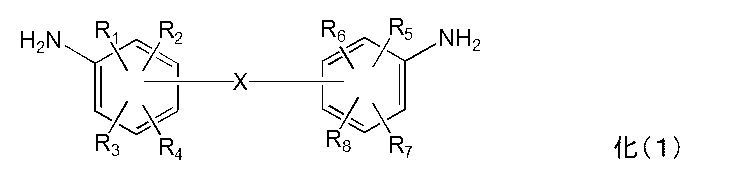
で表される芳香族アミンであり、
前記ポリアミド粒子が平均アスペクト比1.30未満の形状であり、
前記ポリアミド粒子の融点(Tm)と、示差走査熱量計を用いて測定される前記エポキシ樹脂組成物の発熱ピーク温度(Tp)とが下記数式(1)
Tp < Tm ≦ Tp+50 ・・・数式(1)
を満たすことを特徴とするプリプレグ。
また、本発明のプリプレグは、層間粒子として機能するポリアミド粒子が、真球に近い形状を有する。そのため、エポキシ樹脂組成物内におけるポリアミド粒子の界面接着性が高い状態となり、得られる繊維強化複合材料の靱性が向上し、損傷後圧縮強度(CAI)を向上できる。
本発明のプリプレグは、繊維強化基材と、前記繊維強化基材内に含浸されたエポキシ樹脂組成物と、から成る。
本発明で用いる繊維強化基材としては、特に制限はなく、例えば、炭素繊維、ガラス繊維、アラミド繊維、炭化ケイ素繊維、ポリエステル繊維、セラミック繊維、アルミナ繊維、ボロン繊維、金属繊維、鉱物繊維、岩石繊維及びスラッグ繊維などで形成された基材が挙げられる。
本発明で用いるエポキシ樹脂組成物は、少なくともエポキシ樹脂と、ジシアンジアミドと、ウレア系硬化促進剤と、芳香族アミンと、ポリアミド粒子と、を含んで成る。本発明で用いるエポキシ樹脂組成物は、これらの他に、熱可塑性樹脂やその他の添加剤を含んでいても良い。
本発明のエポキシ樹脂組成物は、下記式(2)
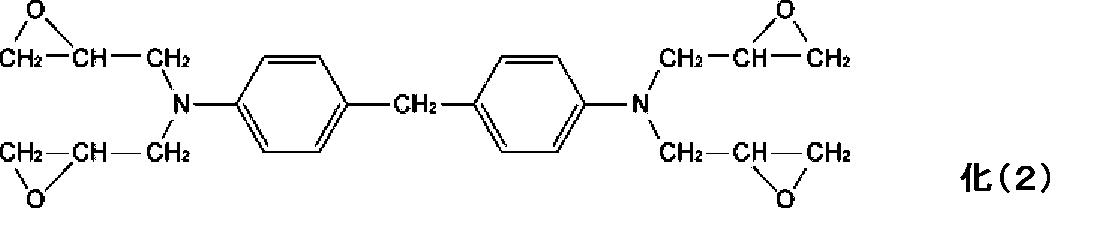
プリプレグの保存安定性や硬化性、及び硬化後の繊維強化複合材料の物性が優れる点から、本発明では上記エポキシ樹脂の硬化剤としてジシアンジアミドを用いる。
ジシアンジアミド(DICY)の具体例としては、三菱化学(株)社製のjERキュアーDICY7、DICY15(商品名)等が挙げられる。
前述のジシアンジアミドは、ウレア系硬化促進剤と併用することにより溶解温度を下げることができる。ウレア系硬化促進剤としては、例えば、フェニルジメチルウレア(PDMU)、トルエンビスジメチルウレア(TBDMU)等が挙げられる。
ジシアンジアミドとウレア系硬化促進剤との合計量は、エポキシ樹脂100質量部に対して2~12質量部であることが好ましく、3~11質量部であることがより好ましく、4~10質量部であることが特に好ましい。ジシアンジアミドとウレア系硬化促進剤との合計量が2質量部以上であれば、架橋密度が高く、且つ十分な硬化速度とすることができる。ジシアンジアミドとウレア系硬化促進剤の合計量が12質量部以下であれば、硬化剤が過剰に存在することによる硬化体の機械物性の低下や硬化体の濁り等の不具合を抑制することができる。
本発明に用いる芳香族アミンは、下記式(1)

で表される化合物である。
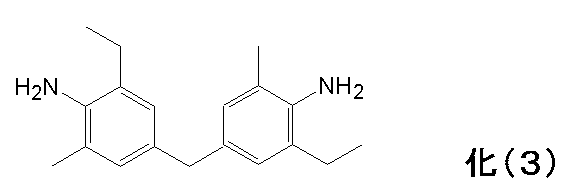


本発明のプリプレグは、所定のポリアミド粒子を含む。
ポリアミド粒子は、複数のプリプレグが積層されて作製される繊維強化複合材料において、強化繊維基材と隣接する強化繊維基材との間に分散する状態となる(以下、この分散している粒子を「層間粒子」ともいう)。この層間粒子は、繊維強化複合材料の靱性を向上させる。
このポリアミド粒子は、エポキシ樹脂、アミン系硬化剤、及びエポキシ樹脂可溶性熱可塑性樹脂の少なくとも何れか1種の一部がその表面に浸透し、ポリアミド粒子の表面においてエポキシ樹脂等との親和性が高い状態になると考えられる。したがって、得られる繊維強化複合材料においてマトリクス樹脂を構成するエポキシ樹脂組成物内におけるポリアミド粒子の界面接着性が高くなり、その結果、得られる繊維強化複合材料の損傷後圧縮強度(CAI)やモードII層間靱性(GIIc)を向上できると考えられる。
Tp < Tm ≦ Tp+50 ・・・数式(1)
Tp(℃)からTp+50(℃)の加熱条件下で、エポキシ樹脂組成物を予め混練しておいても良い。混練することで、ポリアミド粒子中の空隙や、ポリアミドの分子間及び/又は分子内にエポキシ樹脂などがより浸透し易くなる。混練時は、エポキシ樹脂組成物が硬化しないように温度を調整するか、硬化剤を入れない状態で混練することが好ましい。混練時間は、20~300分が好ましく、30~150分であることがより好ましい。
また、真球形状に処理された市販のポリアミド粒子を用いることもできる。
本発明のプリプレグは、上記のポリアミド粒子の他に、熱可塑性樹脂を含んでいても良い。熱可塑性樹脂としては、エポキシ樹脂可溶性熱可塑性樹脂とエポキシ樹脂不溶性熱可塑性樹脂とが挙げられる。
エポキシ樹脂組成物は、エポキシ樹脂可溶性熱可塑性樹脂を含有することもできる。このエポキシ樹脂可溶性熱可塑性樹脂は、エポキシ樹脂組成物の粘度を調整するとともに、得られる繊維強化複合材料の耐衝撃性を向上させる。
一方、エポキシ樹脂不溶性熱可塑性樹脂とは、繊維強化複合材料を成形する温度又はそれ以下の温度において、エポキシ樹脂に実質的に溶解しない熱可塑性樹脂をいう。即ち、エポキシ樹脂100質量部に対して、平均粒子径が10~50μmの熱可塑性樹脂10質量部を混合して190℃で1時間撹拌した際に、粒子の大きさが10%以上変化しない熱可塑性樹脂をいう。なお、一般的に、繊維強化複合材料を成形する温度は100~190℃である。また、粒子径は、顕微鏡によって目視で測定され、平均粒子径とは、無作為に選択した100個の粒子の粒子径の平均値を意味する。
エポキシ樹脂組成物には、上記のポリアミド粒子以外にエポキシ樹脂不溶性熱可塑性樹脂を含有しても良い。エポキシ樹脂不溶性熱可塑性樹脂としては、非晶性のポリアミド粒子、ポリアセタール、ポリフェニレンオキシド、ポリフェニレンスルフィド、ポリエステル、ポリアミドイミド、ポリイミド、ポリエーテルケトン、ポリエーテルエーテルケトン、ポリエチレンナフタレート、ポリエーテルニトリル、ポリベンズイミダゾールが例示される。
エポキシ樹脂組成物中のエポキシ樹脂不溶性熱可塑性樹脂の含有量は、エポキシ樹脂組成物の粘度に応じて適宜調整され、プリプレグの加工性の観点から、エポキシ樹脂組成物に含有されるエポキシ樹脂100質量部に対して、上記の(2-5)で説明したポリアミド粒子と合計で5~50質量部であることが好ましく、7~45質量部であることがより好ましく、10~40質量部であることがさらに好ましい。
増粘粒子に用いるメタクリル酸エステル化合物とは、メタクリル酸エステル構造を有する化合物とその誘導体をいい、例えば、メチルメタクリレート、エチルメタクリレート、n-プロピルメタクリレート、イソプロピルメタクリレート、n-ブチルメタクリレート、n-ヘキシルメタクリレート、シクロヘキシルメタクリレートが挙げられる。
増粘粒子に用いるビニル化合物とは、重合可能なビニル構造を有する化合物をいい、例えば、スチレン、α-メチルスチレン、ジビニルベンゼン及びこれらの芳香環がアルキル基やハロゲン原子等の種々の官能基で置換された化合物が挙げられる。
また、増粘粒子は、メタクリル酸エステル系化合物、アクリル酸エステル系化合物、ビニル系化合物の1種又は2種以上の重合単位からなる重合体であってもよく、構造の異なる2種以上の樹脂を混合した樹脂であってもよい。さらに、
(i)アクリル酸エステル系化合物又はメタクリル酸エステル系化合物、ジエン系化合物の少なくとも1種からなる重合体と、
(ii)アクリル酸エステル系化合物又はメタクリル酸エステル系化合物とラジカル重合性不飽和カルボン酸とからなる重合体と、に、
(iii)金属イオンを添加することでイオン架橋させた複合樹脂であってもよい。
本発明のエポキシ樹脂組成物には、導電性粒子や難燃剤、無機系充填剤、内部離型剤が配合されてもよい。
本発明に用いるエポキシ樹脂組成物は、エポキシ樹脂と、ジシアンジアミドと、ウレア系硬化促進剤と、芳香族アミンと、ポリアミド粒子と、必要に応じて熱可塑性樹脂やその他の添加剤と、を混合することにより製造できる。
本発明において、エポキシ樹脂と、ポリアミド粒子と、を温度70~150℃で10分間以上混練することが好ましい。エポキシ樹脂とポリアミド粒子を加熱条件下で一定時間以上混練することで、ポリアミド粒子にエポキシ樹脂を浸透させることができる。加熱条件下で長時間混練することで、ポリアミド粒子中の空隙にエポキシ樹脂などが浸透する。混練温度は、90~140℃がより好ましく、115~130℃が特に好ましい。混練時間は、20~300分がより好ましく、30~150分であることが特に好ましい。
エポキシ樹脂とポリアミド粒子を温度70~150℃で10分間以上混練する場合、ジシアンジアミドと、ウレア系硬化促進剤とは混練後に添加することが好ましい。
本発明のプリプレグの製造方法は、特に制限がなく、従来公知のいかなる方法も採用できる。具体的には、ホットメルト法や溶剤法が好適に採用できる。
具体的な含浸圧力は、1~50(kN/cm)であり、2~40(kN/cm)であることがより好ましい。
本発明のプリプレグを特定の条件で加熱加圧して硬化させることにより、繊維強化複合材料を得ることができる。
本発明のプリプレグを用いて、繊維強化複合材料を製造する方法としては、オートクレーブ成形やプレス成形等の公知の成形法が挙げられる。
本発明の繊維強化複合材料の製造方法としては、オートクレーブ成形法が好ましく用いられる。オートクレーブ成形法は、金型の下型にプリプレグ及びフィルムバッグを順次敷設し、該プリプレグを下型とフィルムバッグとの間に密封し、下型とフィルムバッグとにより形成される空間を真空にするとともに、オートクレーブ成形装置で、加熱と加圧をする成形方法である。成形時の条件は、昇温速度を1~50℃/分とし、圧力0.2~0.7MPa、温度Tp(℃)以上Tm(℃)未満で10~150分間、加熱及び加圧することが好ましい。成形温度がTp(℃)以上であれば、十分に硬化反応を起こすことができ、高い生産性で繊維強化複合材料を得ることができる。ここで成形温度は最高保持温度を意味する。また、成形温度がTm(℃)未満であれば、ポリアミド粒子が溶融に起因する不具合を生じない。より好ましい温度は、Tp(℃)以上Tp+30(℃)以下である。
本発明の繊維強化複合材料の製造方法としては、プレス成形法が好ましく用いられる。プレス成形法による繊維強化複合材料の製造は、本発明のプリプレグ又は本発明のプリプレグを積層して形成したプリフォームを、金型を用いて加熱加圧することにより行う。金型は、予め硬化温度に加熱しておくことが好ましい。
成形時間は1~60分、好ましくは3~40分、さらに好ましくは5~30分である。
また、得られる繊維強化複合材料は、実施例の方法で測定されるモードII層間靱性(GIIc)が9(in-lbs/in2)以上であることが好ましく、より好ましくは10(in-lbs/in2)以上で、さらに好ましくは10.5(in-lbs/in2)以上、最も好ましくは11.0(in-lbs/in2)以上である。
(エポキシ樹脂)
・“jER(登録商標)”604:(テトラグリシジルジアミノジフェニルメタン型エポキシ樹脂、三菱化学(株)社製)
・“jER(登録商標)”828:(液状ビスフェニールA型エポキシ樹脂、三菱化学(株)社製)
(硬化剤、硬化促進剤)
・Dicy7:(ジシアンジアミド、三菱化学(株)社製)
・“オミキュア(登録商標)”24:(2,4’-トルエンビス(3,3-ジメチルウレア)、ハンツマン(株)社製)
(芳香族アミン)
・キュアハードMED:上記化学式(1)の構造を有する(クミアイ化学工業(株)社製)。
(ポリアミド粒子)
・PA12(真球):ポリアミド12樹脂粒子(MSP-ZL9010(商品名)、平均粒子径20μm、アスペクト比1.06、ポリプラエボニック(株)社製)
・PA1010(真球):ポリアミド1010樹脂粒子(MSP-A7723(商品名)、平均粒子径20μm、アスペクト比1.04、ポリプラエボニック(株)社製)
・PA12(不定形):ポリアミド12樹脂粒子(VESTSINT2158(商品名)、平均粒子径20μm、アスペクト比1.35、ポリプラエボニック(株)社製)
・PA1010(不定形):ポリアミド1010樹脂粒子(VESTSINT9158(商品名)、平均粒子径20μm、アスペクト比1.37、ポリプラエボニック(株)社製)
・PA11(不定形):ポリアミド11樹脂粒子(RILSAN PA11 D30 NAT(商品名)、平均粒子径20μm、アスペクト比1.46、アルケマ(株)社製)
(エポキシ樹脂可溶性熱可塑性樹脂1)
・ポリエーテルスルホン:スミカエクセル5003P(商品名)(平均粒子径20μm、住友化学(株)社製)
(エポキシ樹脂可溶性熱可塑性樹脂2)
・“ゼフィアック(登録商標)”F320:(メタクリル酸アルキル重合体)、平均重合度30,000、アイカ工業(株)社製)
(炭素繊維)
・テナックス(登録商標) IMS65:炭素繊維ストランド、引張強度6000MPa、引張弾性率290GPa、帝人(株)社製
プラネタリーミキサー中にエポキシ樹脂、ポリアミド粒子、エポキシ樹脂可溶性熱可塑性樹脂1を所定量加え、攪拌しながら120℃まで昇温した。120℃に到達後1時間攪拌し、エポキシ樹脂可溶性熱可塑性樹脂を溶解した。その後、攪拌しながら60℃まで降温し、溶解物を取り出した。上記溶解物と硬化剤、硬化促進剤、芳香族アミン、エポキシ樹脂可溶性熱可塑性樹脂2を70℃に加温した3本ロールミルで均一になるまで混練し、エポキシ樹脂組成物を得た。
(1) 一方向プリプレグの作製
一方向プリプレグは、次のように作製した。リバースロールコーターを用いて、離型紙上に、上記混合手順で得られたエポキシ樹脂組成物を塗布して50g/m2目付の樹脂フィルムを作製した。次に、単位面積当たりの繊維質量が190g/m2となるように炭素繊維を一方向に整列させてシート状の繊維強化基材層を作製した。この繊維強化基材層の両面に上記樹脂フィルムを積重し、温度100℃、圧力0.2MPaの条件で加熱加圧して、炭素繊維含有率が65質量%の一方向プリプレグを作製した。
上記(1)で得られた一方向プリプレグを一辺が360mmの正方形にカットし、[+45°/0°/-45°/90°]3sの構成で24枚積層した積層体をバッグ内に入れ、これをオートクレーブ内で2℃/分で昇温し、所定の硬化温度で30分加熱し、硬化させて成形板(炭素繊維強化複合材料)を作製した。この間オートクレーブ内を0.50MPaに加圧し、バッグ内を真空に保った。
ASTM-D7136及びASTM-D7137試験法に準拠して測定した。
上記(1)で得られたプリプレグを所定の寸法にカットした後、積層し、0°方向に10層積層した積層体を2つ作製した。初期クラックを形成させるために、離型シートを2つの積層体の間に挟み、両者を組み合わせ、積層構成[0]20のプリプレグ積層体を得た。通常の真空オートクレーブ成形法を用い、0.50MPaの圧力下、昇温速度2℃/分、硬化温度160℃ないし180℃で20分成形した。得られた成形物を幅 12.7 mm × 長さ 330.2 mmの寸法に切断し、層間破壊靭性モードII(GIIc)の試験片を得た。この試験片を用いて、GIIc試験を行った。
GIIc試験方法として、3点曲げ荷重を負荷するENF(End Notched Flexure)試験を行った。支点間距離は101.6mmとした。厚さ25μmのPTFEシートにより作製したシートの先端が、支点から38.1mmとなるように試験片を配置し、この試験片に2.54mm/分の速度で曲げの負荷を与えて初期クラックを形成させた。
その後、クラックの先端が、支点から25.4mmの位置になるように試験片を配置し、2.54mm/分の速度で曲げの負荷を与えて試験を行った。同様に、3回の試験を実施し、それぞれの曲げ試験の荷重-ストロークから各回のGIIcを算出した後、それらの平均値を算出した。
クラックの先端は顕微鏡を用いて、試験片の両端面から測定を行った。GIIc試験の測定は、n=5の試験片で測定を行った。
スライドガラス上に散布したポリアミド粒子の長径および短径をキーエンス(株)社製顕微鏡(VHX―5000)により200倍で測定し、長径と短径との比率からアスペクト比(長径/短径)を算出した。粒子のアスペクト比は、無作為に抽出された100個の粒子から算出された値の平均値を意味する。
エポキシ樹脂組成物の発熱ピーク温度(Tp)は島津製作所社製示差走査熱量測定計(DSC)を用いて測定した。Tpは、窒素雰囲気下において昇温速度2℃/分で得られる発熱ピークのピーク温度を意味する。
ASTM-D3418試験法に準拠して測定した。
ポリアミド粒子の融点は島津製作所社製示差走査熱量測定計(DSC)を用いて測定した。吸熱ピーク温度(Tm)は、窒素雰囲気下において昇温速度10℃/分で得られる発熱ピークのピーク温度を意味する。
ASTM-D3418試験法に準拠して測定した。
表1に記載する成分を攪拌機を用いて混合してエポキシ樹脂組成物を得た。得られたエポキシ樹脂組成物の各種物性を表1に示した。
また、上記(1)の方法により一方向プリプレグを作製し、これを用いて複合材料を製造し、その物性を評価した。結果は表1に示した。
比較例1は真球状のポリアミド粒子を用いているものの、Tp<Tmを満たさないため、プリプレグの硬化時にポリアミド粒子が少なくとも部分的に溶融したと考えられ、CAI及びGIIcが低下した。
比較例2は真球状のポリアミド粒子を用いているものの、Tm≦Tp+50を満たさないため、ポリアミド粒子にエポキシ樹脂等が浸透しなかったと考えられ、CAI及びGIIcが低下した。
比較例3~4はポリアミド粒子のアスペクト比が大きいため、等方的にき裂進展させることができなかったと考えられ、特にGIIcが大きく低下した。
比較例5はポリアミド粒子のアスペクト比が大きく、Tm≦Tp+50を満たさないため、ポリアミド粒子にエポキシ樹脂が浸透せず、且つ等方的にき裂進展させることができなかったと考えられ、CAI及びGIIcが低下した。


Claims (6)
- 繊維強化基材と、
前記繊維強化基材内に一部又は全部が含浸したエポキシ樹脂組成物と、
を含んで成るプリプレグであって、
前記エポキシ樹脂組成物が、エポキシ樹脂と、ジシアンジアミドと、ウレア系硬化促進剤と、芳香族アミンと、ポリアミド粒子と、を含み、
前記エポキシ樹脂が、前記エポキシ樹脂100質量部の内、60質量部を超える量のN,N,N’,N’-テトラグリシジルジアミノジフェニルメタンを含むエポキシ樹脂であり、
前記芳香族アミンが下記式(1)

で表される芳香族アミンであり、
前記ポリアミド粒子が平均アスペクト比1.30未満の形状であり、
前記ポリアミド粒子の融点(Tm)と、示差走査熱量計を用いて測定される前記エポキシ樹脂組成物の発熱ピーク温度(Tp)とが下記数式(1)
Tp < Tm ≦ Tp+50 ・・・数式(1)
を満たすことを特徴とするプリプレグ。 - 前記エポキシ樹脂100質量部に対する前記ジシアンジアミドと前記ウレア系促進剤との合計含有量が、2~12質量部である請求項1に記載のプリプレグ。
- 前記エポキシ樹脂組成物が、エポキシ樹脂可溶性熱可塑性樹脂をさらに含む請求項1に記載のプリプレグ。
- 前記エポキシ樹脂組成物が、メタクリル酸エステル系化合物、アクリル酸エステル系化合物及びビニル系化合物から成る群から選択される1種又は2種以上の重合単位を有する重合体から成る増粘粒子をさらに含む請求項1に記載のプリプレグ。
- 前記ポリアミド粒子の配合量が、前記エポキシ樹脂100質量部に対して1~50質量部である請求項1に記載のプリプレグ。
- 請求項1に記載のプリプレグを積層して加熱成形する繊維強化複合材料の製造方法であって、成形時の加熱温度が前記エポキシ樹脂組成物の示差走査熱量計を用いて測定される発熱ピーク温度(Tp)以上、前記ポリアミド粒子の融点(Tm)未満であることを特徴とする繊維強化複合材料の製造方法。
Priority Applications (2)
| Application Number | Priority Date | Filing Date | Title |
|---|---|---|---|
| EP23872313.4A EP4596612A4 (en) | 2022-09-30 | 2023-09-26 | PREIMPREGNATED AND METHOD FOR PRODUCING A FIBER-REINFORCED COMPOSITE MATERIAL USING SAID PREIMPREGNATED |
| JP2024522544A JP7538983B1 (ja) | 2022-09-30 | 2023-09-26 | プリプレグ、及び該プリプレグを用いる繊維強化複合材料の製造方法 |
Applications Claiming Priority (2)
| Application Number | Priority Date | Filing Date | Title |
|---|---|---|---|
| JP2022-158121 | 2022-09-30 | ||
| JP2022158121 | 2022-09-30 |
Publications (1)
| Publication Number | Publication Date |
|---|---|
| WO2024071090A1 true WO2024071090A1 (ja) | 2024-04-04 |
Family
ID=90477966
Family Applications (1)
| Application Number | Title | Priority Date | Filing Date |
|---|---|---|---|
| PCT/JP2023/034860 Ceased WO2024071090A1 (ja) | 2022-09-30 | 2023-09-26 | プリプレグ、及び該プリプレグを用いる繊維強化複合材料の製造方法 |
Country Status (3)
| Country | Link |
|---|---|
| EP (1) | EP4596612A4 (ja) |
| JP (1) | JP7538983B1 (ja) |
| WO (1) | WO2024071090A1 (ja) |
Citations (4)
| Publication number | Priority date | Publication date | Assignee | Title |
|---|---|---|---|---|
| WO2014001537A1 (en) * | 2012-06-29 | 2014-01-03 | Gurit (Uk) Ltd | Prepregs for manufacturing composite materials |
| WO2018016138A1 (ja) * | 2016-07-19 | 2018-01-25 | ダイセル・エボニック株式会社 | ポリアミド粒子及びその製造方法、樹脂組成物並びに成形品 |
| JP2018528103A (ja) * | 2015-08-24 | 2018-09-27 | サイテック インダストリーズ インコーポレイテッド | 準安定粒子を含有する複合材料及び樹脂組成物 |
| JP2019156982A (ja) | 2018-03-13 | 2019-09-19 | 帝人株式会社 | プリプレグ及び炭素繊維強化複合材料 |
Family Cites Families (3)
| Publication number | Priority date | Publication date | Assignee | Title |
|---|---|---|---|---|
| JP2014145003A (ja) * | 2013-01-28 | 2014-08-14 | Toray Ind Inc | プリプレグおよび繊維強化複合材料 |
| JP2016147925A (ja) * | 2015-02-10 | 2016-08-18 | 東レ株式会社 | プリプレグおよび繊維強化複合材料 |
| US11820858B2 (en) * | 2017-12-01 | 2023-11-21 | Teijin Limited | Prepreg, method for producing same, and method for producing fiber-reinforced composite material |
-
2023
- 2023-09-26 JP JP2024522544A patent/JP7538983B1/ja active Active
- 2023-09-26 EP EP23872313.4A patent/EP4596612A4/en active Pending
- 2023-09-26 WO PCT/JP2023/034860 patent/WO2024071090A1/ja not_active Ceased
Patent Citations (4)
| Publication number | Priority date | Publication date | Assignee | Title |
|---|---|---|---|---|
| WO2014001537A1 (en) * | 2012-06-29 | 2014-01-03 | Gurit (Uk) Ltd | Prepregs for manufacturing composite materials |
| JP2018528103A (ja) * | 2015-08-24 | 2018-09-27 | サイテック インダストリーズ インコーポレイテッド | 準安定粒子を含有する複合材料及び樹脂組成物 |
| WO2018016138A1 (ja) * | 2016-07-19 | 2018-01-25 | ダイセル・エボニック株式会社 | ポリアミド粒子及びその製造方法、樹脂組成物並びに成形品 |
| JP2019156982A (ja) | 2018-03-13 | 2019-09-19 | 帝人株式会社 | プリプレグ及び炭素繊維強化複合材料 |
Non-Patent Citations (1)
| Title |
|---|
| See also references of EP4596612A4 |
Also Published As
| Publication number | Publication date |
|---|---|
| JPWO2024071090A1 (ja) | 2024-04-04 |
| JP7538983B1 (ja) | 2024-08-22 |
| EP4596612A4 (en) | 2025-12-31 |
| EP4596612A1 (en) | 2025-08-06 |
Similar Documents
| Publication | Publication Date | Title |
|---|---|---|
| JP6007914B2 (ja) | 真空成形用プリプレグ、繊維強化複合材料およびその製造方法 | |
| JP7213620B2 (ja) | エポキシ樹脂組成物、プリプレグ、炭素繊維強化複合材料及びこれらの製造方法 | |
| JP5723505B2 (ja) | 樹脂組成物、硬化物、プリプレグ、および繊維強化複合材料 | |
| JP5469086B2 (ja) | 熱硬化性樹脂組成物とそれを用いたプリプレグ | |
| JP7209470B2 (ja) | プリプレグ及び炭素繊維強化複合材料 | |
| CN110577723A (zh) | 环氧树脂组合物及使用该环氧树脂组合物的膜、预浸料、纤维增强塑料 | |
| WO2013122033A1 (ja) | 繊維強化複合材料 | |
| CN104583310A (zh) | 环氧树脂组合物以及使用该环氧树脂组合物的膜、预浸料、纤维增强塑料 | |
| JP7239401B2 (ja) | 炭素繊維束、プリプレグ、繊維強化複合材料 | |
| JP7448409B2 (ja) | プリプレグ | |
| CN104220497A (zh) | 纤维强化复合材料 | |
| US20230331906A1 (en) | Prepreg, method for producing same, and method for producing fiber-reinforced composite material | |
| JP7278132B2 (ja) | プリプレグ、及び繊維強化複合材料の製造方法 | |
| JP2019157095A (ja) | エポキシ樹脂組成物、プリプレグ、及び繊維強化複合材料 | |
| JP2020176249A (ja) | エポキシ樹脂組成物、プリプレグ、プリプレグの製造方法、及び繊維強化複合材料の製造方法 | |
| JP7538983B1 (ja) | プリプレグ、及び該プリプレグを用いる繊維強化複合材料の製造方法 | |
| JP2021130822A (ja) | プリプレグ及びその製造方法、並びに繊維強化複合材料 | |
| JP7315304B2 (ja) | エポキシ樹脂組成物、プリプレグ、及び繊維強化複合材料 | |
| JP2019156981A (ja) | プリプレグ、繊維強化複合材料、及びそれらの製造方法 | |
| JP2017190380A (ja) | プリプレグの製造方法 | |
| JP2016199682A (ja) | 繊維強化複合材料 | |
| JP7481160B2 (ja) | プリプレグ | |
| JP2021195473A (ja) | プリプレグ | |
| WO2020110599A1 (ja) | シートモールディングコンパウンドおよび繊維強化複合材料 | |
| JP2025153828A (ja) | エポキシ樹脂組成物、プリプレグ、及び繊維強化複合材料 |
Legal Events
| Date | Code | Title | Description |
|---|---|---|---|
| ENP | Entry into the national phase |
Ref document number: 2024522544 Country of ref document: JP Kind code of ref document: A |
|
| 121 | Ep: the epo has been informed by wipo that ep was designated in this application |
Ref document number: 23872313 Country of ref document: EP Kind code of ref document: A1 |
|
| WWE | Wipo information: entry into national phase |
Ref document number: 2023872313 Country of ref document: EP |
|
| NENP | Non-entry into the national phase |
Ref country code: DE |
|
| ENP | Entry into the national phase |
Ref document number: 2023872313 Country of ref document: EP Effective date: 20250430 |
|
| WWP | Wipo information: published in national office |
Ref document number: 2023872313 Country of ref document: EP |