WO2024096106A1 - 電着塗料組成物、皮膜、被覆物品、被覆電線およびプリント基板 - Google Patents
電着塗料組成物、皮膜、被覆物品、被覆電線およびプリント基板 Download PDFInfo
- Publication number
- WO2024096106A1 WO2024096106A1 PCT/JP2023/039665 JP2023039665W WO2024096106A1 WO 2024096106 A1 WO2024096106 A1 WO 2024096106A1 JP 2023039665 W JP2023039665 W JP 2023039665W WO 2024096106 A1 WO2024096106 A1 WO 2024096106A1
- Authority
- WO
- WIPO (PCT)
- Prior art keywords
- coating composition
- polymer compound
- fluorine
- electrodeposition coating
- group
- Prior art date
- Legal status (The legal status is an assumption and is not a legal conclusion. Google has not performed a legal analysis and makes no representation as to the accuracy of the status listed.)
- Ceased
Links
Images


Classifications
-
- C—CHEMISTRY; METALLURGY
- C09—DYES; PAINTS; POLISHES; NATURAL RESINS; ADHESIVES; COMPOSITIONS NOT OTHERWISE PROVIDED FOR; APPLICATIONS OF MATERIALS NOT OTHERWISE PROVIDED FOR
- C09D—COATING COMPOSITIONS, e.g. PAINTS, VARNISHES OR LACQUERS; FILLING PASTES; CHEMICAL PAINT OR INK REMOVERS; INKS; CORRECTING FLUIDS; WOODSTAINS; PASTES OR SOLIDS FOR COLOURING OR PRINTING; USE OF MATERIALS THEREFOR
- C09D5/00—Coating compositions, e.g. paints, varnishes or lacquers, characterised by their physical nature or the effects produced; Filling pastes
- C09D5/44—Coating compositions, e.g. paints, varnishes or lacquers, characterised by their physical nature or the effects produced; Filling pastes for electrophoretic applications
- C09D5/4473—Mixture of polymers
-
- C—CHEMISTRY; METALLURGY
- C09—DYES; PAINTS; POLISHES; NATURAL RESINS; ADHESIVES; COMPOSITIONS NOT OTHERWISE PROVIDED FOR; APPLICATIONS OF MATERIALS NOT OTHERWISE PROVIDED FOR
- C09D—COATING COMPOSITIONS, e.g. PAINTS, VARNISHES OR LACQUERS; FILLING PASTES; CHEMICAL PAINT OR INK REMOVERS; INKS; CORRECTING FLUIDS; WOODSTAINS; PASTES OR SOLIDS FOR COLOURING OR PRINTING; USE OF MATERIALS THEREFOR
- C09D127/00—Coating compositions based on homopolymers or copolymers of compounds having one or more unsaturated aliphatic radicals, each having only one carbon-to-carbon double bond, and at least one being terminated by a halogen; Coating compositions based on derivatives of such polymers
- C09D127/02—Coating compositions based on homopolymers or copolymers of compounds having one or more unsaturated aliphatic radicals, each having only one carbon-to-carbon double bond, and at least one being terminated by a halogen; Coating compositions based on derivatives of such polymers not modified by chemical after-treatment
- C09D127/12—Coating compositions based on homopolymers or copolymers of compounds having one or more unsaturated aliphatic radicals, each having only one carbon-to-carbon double bond, and at least one being terminated by a halogen; Coating compositions based on derivatives of such polymers not modified by chemical after-treatment containing fluorine atoms
- C09D127/18—Homopolymers or copolymers of tetrafluoroethene
-
- C—CHEMISTRY; METALLURGY
- C09—DYES; PAINTS; POLISHES; NATURAL RESINS; ADHESIVES; COMPOSITIONS NOT OTHERWISE PROVIDED FOR; APPLICATIONS OF MATERIALS NOT OTHERWISE PROVIDED FOR
- C09D—COATING COMPOSITIONS, e.g. PAINTS, VARNISHES OR LACQUERS; FILLING PASTES; CHEMICAL PAINT OR INK REMOVERS; INKS; CORRECTING FLUIDS; WOODSTAINS; PASTES OR SOLIDS FOR COLOURING OR PRINTING; USE OF MATERIALS THEREFOR
- C09D133/00—Coating compositions based on homopolymers or copolymers of compounds having one or more unsaturated aliphatic radicals, each having only one carbon-to-carbon double bond, and at least one being terminated by only one carboxyl radical, or of salts, anhydrides, esters, amides, imides, or nitriles thereof; Coating compositions based on derivatives of such polymers
- C09D133/04—Homopolymers or copolymers of esters
- C09D133/06—Homopolymers or copolymers of esters of esters containing only carbon, hydrogen and oxygen, the oxygen atom being present only as part of the carboxyl radical
- C09D133/10—Homopolymers or copolymers of methacrylic acid esters
-
- C—CHEMISTRY; METALLURGY
- C09—DYES; PAINTS; POLISHES; NATURAL RESINS; ADHESIVES; COMPOSITIONS NOT OTHERWISE PROVIDED FOR; APPLICATIONS OF MATERIALS NOT OTHERWISE PROVIDED FOR
- C09D—COATING COMPOSITIONS, e.g. PAINTS, VARNISHES OR LACQUERS; FILLING PASTES; CHEMICAL PAINT OR INK REMOVERS; INKS; CORRECTING FLUIDS; WOODSTAINS; PASTES OR SOLIDS FOR COLOURING OR PRINTING; USE OF MATERIALS THEREFOR
- C09D133/00—Coating compositions based on homopolymers or copolymers of compounds having one or more unsaturated aliphatic radicals, each having only one carbon-to-carbon double bond, and at least one being terminated by only one carboxyl radical, or of salts, anhydrides, esters, amides, imides, or nitriles thereof; Coating compositions based on derivatives of such polymers
- C09D133/04—Homopolymers or copolymers of esters
- C09D133/06—Homopolymers or copolymers of esters of esters containing only carbon, hydrogen and oxygen, the oxygen atom being present only as part of the carboxyl radical
- C09D133/10—Homopolymers or copolymers of methacrylic acid esters
- C09D133/12—Homopolymers or copolymers of methyl methacrylate
-
- H—ELECTRICITY
- H05—ELECTRIC TECHNIQUES NOT OTHERWISE PROVIDED FOR
- H05K—PRINTED CIRCUITS; CASINGS OR CONSTRUCTIONAL DETAILS OF ELECTRIC APPARATUS; MANUFACTURE OF ASSEMBLAGES OF ELECTRICAL COMPONENTS
- H05K1/00—Printed circuits
- H05K1/02—Details
- H05K1/03—Use of materials for the substrate
- H05K1/05—Insulated conductive substrates, e.g. insulated metal substrate
- H05K1/056—Insulated conductive substrates, e.g. insulated metal substrate the metal substrate being covered by an organic insulating layer
-
- C—CHEMISTRY; METALLURGY
- C08—ORGANIC MACROMOLECULAR COMPOUNDS; THEIR PREPARATION OR CHEMICAL WORKING-UP; COMPOSITIONS BASED THEREON
- C08F—MACROMOLECULAR COMPOUNDS OBTAINED BY REACTIONS ONLY INVOLVING CARBON-TO-CARBON UNSATURATED BONDS
- C08F214/00—Copolymers of compounds having one or more unsaturated aliphatic radicals, each having only one carbon-to-carbon double bond, and at least one being terminated by a halogen
- C08F214/18—Monomers containing fluorine
- C08F214/26—Tetrafluoroethene
- C08F214/262—Tetrafluoroethene with fluorinated vinyl ethers
-
- C—CHEMISTRY; METALLURGY
- C08—ORGANIC MACROMOLECULAR COMPOUNDS; THEIR PREPARATION OR CHEMICAL WORKING-UP; COMPOSITIONS BASED THEREON
- C08F—MACROMOLECULAR COMPOUNDS OBTAINED BY REACTIONS ONLY INVOLVING CARBON-TO-CARBON UNSATURATED BONDS
- C08F220/00—Copolymers of compounds having one or more unsaturated aliphatic radicals, each having only one carbon-to-carbon double bond, and only one being terminated by only one carboxyl radical or a salt, anhydride ester, amide, imide or nitrile thereof
- C08F220/02—Monocarboxylic acids having less than ten carbon atoms; Derivatives thereof
- C08F220/10—Esters
- C08F220/12—Esters of monohydric alcohols or phenols
- C08F220/16—Esters of monohydric alcohols or phenols of phenols or of alcohols containing two or more carbon atoms
- C08F220/18—Esters of monohydric alcohols or phenols of phenols or of alcohols containing two or more carbon atoms with acrylic or methacrylic acids
- C08F220/1804—C4-(meth)acrylate, e.g. butyl (meth)acrylate, isobutyl (meth)acrylate or tert-butyl (meth)acrylate
-
- H—ELECTRICITY
- H05—ELECTRIC TECHNIQUES NOT OTHERWISE PROVIDED FOR
- H05K—PRINTED CIRCUITS; CASINGS OR CONSTRUCTIONAL DETAILS OF ELECTRIC APPARATUS; MANUFACTURE OF ASSEMBLAGES OF ELECTRICAL COMPONENTS
- H05K2201/00—Indexing scheme relating to printed circuits covered by H05K1/00
- H05K2201/01—Dielectrics
- H05K2201/0137—Materials
- H05K2201/015—Fluoropolymer, e.g. polytetrafluoroethylene [PTFE]
Definitions
- This disclosure relates to electrocoating compositions, coatings, coated articles, coated electric wires, and printed circuit boards.
- Patent Document 1 describes a method for manufacturing an insulated electric wire, which is characterized by electrochemically depositing an aqueous resin emulsion, which is made by dispersing polyimide resin, fluororesin, and a charge-imparting agent in water, onto a conductor, and then drying and baking the resulting material to form an insulating layer.
- Patent Document 2 describes a method for producing a low-dielectric constant copper-clad insulating film, which is characterized by forming an electrodeposition deposit layer by electrodeposition coating on copper foil made by polymerizing a fibrous base material, using a liquid obtained by emulsion polymerization of a vinyl monomer with good thermal decomposition properties in an aqueous dispersion of a fluororesin as an electrodeposition coating, and then decomposing and volatilizing the vinyl polymer by heating to form an insulating film.
- JP 2002-298674 A Japanese Patent Application Laid-Open No. 61-042822
- the objective of this disclosure is to provide an electrodeposition coating composition that can be prepared without using materials containing metal components and that can produce a crack-free coating.
- an electrodeposition coating composition containing a perfluoro-based polymer compound X and a neutralized product of a methacrylate resin, in which the relative dielectric constant of the perfluoro-based polymer compound X is 2.0 to 2.2, the acid value of the methacrylate resin is 10 mg KOH/g or more, and the solids concentration of the electrodeposition coating composition is 10 to 70 mass%.
- an electrodeposition coating composition that can be prepared without using materials containing metal components and that can produce a crack-free coating.
- FIG. 1 is a front view and a top view of a covered electric wire having a bent portion according to one embodiment.
- FIG. 2 is a cross-sectional view of a covered electric wire having a bent portion according to one embodiment.
- the first electrodeposition coating composition of the present disclosure is an electrodeposition coating composition containing a perfluoro-based polymer compound X and a neutralized product of a methacrylate resin.
- the dielectric constant of the perfluoro-based polymer compound X is 2.0 to 2.2
- the acid value of the methacrylate resin is 10 mg KOH/g or more
- the solids concentration of the electrodeposition coating composition is 10 to 70 mass%.
- Patent Document 1 water-dispersed resin emulsions made by dispersing polyimide resin, fluororesin, and charge-imparting agents in water have been known as electrodeposition coating compositions.
- Patent Document 1 describes that the use of such water-dispersed resin emulsions makes it possible to realize flat insulated electric wires that have sufficient insulating performance, are as thin as possible on the long side, and are equipped with insulating layers that also have excellent heat resistance.
- Patent Document 2 does not describe an electrodeposition coating composition used to form a coating for coated electric wires, but describes a technology for making an electrodeposition coating from a liquid obtained by emulsion polymerization of a vinyl monomer with good thermal decomposition properties in an aqueous dispersion of a fluororesin.
- a nonionic, anionic, cationic, or other surfactant is used.
- An example of the surfactant is sodium lauryl sulfate.
- the first electrodeposition coating composition of the present disclosure contains a perfluoro-based polymer compound having a low dielectric constant, and a neutralized product of a methacrylate resin obtained by neutralizing a methacrylate resin having a high acid value. It has been found that such an electrodeposition coating composition can be prepared without using a material containing a metal component, and that a crack-free coating can be obtained on a substrate by electrodeposition coating such an electrodeposition coating composition on the substrate. Furthermore, the resulting coating has a low surface roughness, is firmly adhered to the substrate, and has a low dielectric constant.
- the second electrodeposition coating composition of the present disclosure is an electrodeposition coating composition containing a perfluoro-based polymer compound X and a neutralized product of a methacrylate resin.
- the perfluoro-based polymer compound X is a tetrafluoroethylene/fluoroalkyl vinyl ether copolymer
- the acid value of the methacrylate resin is 10 mg KOH/g or more
- the solids concentration of the electrodeposition coating composition is 10 to 70 mass%.
- the second electrodeposition coating composition of the present disclosure contains a tetrafluoroethylene/fluoroalkyl vinyl ether copolymer as a perfluoro polymer compound, and contains a neutralized product of a methacrylate resin obtained by neutralizing a methacrylate resin having a high acid value.
- Such an electrodeposition coating composition can be prepared without using a material containing a metal component, and it has been found that a crack-free coating can be obtained on a substrate by electrodeposition coating such an electrodeposition coating composition on the substrate. Furthermore, the obtained coating has a low surface roughness, is firmly adhered to the substrate, and has a low dielectric constant.
- the electrodeposition coating composition of the present disclosure contains a perfluoro-based polymer compound X.
- a perfluoro-based polymer compound is a polymer compound in which the content of perfluoromonomer units relative to all polymerization units constituting the polymer compound is 90 mol % or more.
- a perfluoromonomer is a monomer that does not contain a carbon atom-hydrogen atom bond in the molecule.
- a perfluoromonomer may be a monomer in which some of the fluorine atoms bonded to the carbon atoms are replaced with chlorine atoms, and may have nitrogen atoms, oxygen atoms, sulfur atoms, phosphorus atoms, boron atoms, or silicon atoms in addition to carbon atoms.
- a perfluoromonomer is preferably a monomer in which all hydrogen atoms are replaced with fluorine atoms.
- the relative dielectric constant of the perfluoro-based polymer compound X is preferably 2.0 to 2.2, since a coating exhibiting an even lower relative dielectric constant can be obtained.
- the relative dielectric constant of the perfluoro-based polymer compound X can be measured in accordance with JIS-C-2138 at 23°C ⁇ 2°C, relative humidity of 50%, and a frequency of 1 kHz.
- the perfluoro-based polymer compound X is preferably a perfluoro-based fluororesin.
- a fluororesin is a partially crystalline fluoropolymer, or a fluoroplastic.
- a fluororesin has a melting point and is thermoplastic, but may be melt-processable or non-melt-processable.
- the perfluoro-based polymer compound X is preferably at least one selected from the group consisting of polytetrafluoroethylene, tetrafluoroethylene (TFE)/fluoroalkyl vinyl ether (FAVE) copolymer, tetrafluoroethylene (TFE)/hexafluoropropylene (HFP) copolymer, and TFE/FAVE/HFP copolymer.
- Polytetrafluoroethylene may be non-melt-processable PTFE or melt-processable PTFE, but non-melt-processable PTFE is preferred.
- PTFE with a relative dielectric constant of 2.0 to 2.2 can be used as the perfluoro-based polymer compound X.
- Non-melt processable PTFE usually has extensibility, fibrillation properties, and non-melt secondary processability.
- Non-melt secondary processability means that the melt flow rate cannot be measured at a temperature higher than the crystallization melting point according to ASTM D 1238 and D 2116, i.e., the material does not flow easily even in the melting temperature range.
- PTFE may be a tetrafluoroethylene (TFE) homopolymer, or a modified PTFE containing TFE units and modified monomer units.
- modified PTFE means a copolymer of TFE and a small amount of comonomer that does not impart melt processability to the resulting copolymer.
- the comonomer is not particularly limited, and examples thereof include hexafluoropropylene [HFP], chlorotrifluoroethylene [CTFE], and perfluoro(alkyl vinyl ether) [PAVE].
- the proportion of the comonomer added to the modified PTFE varies depending on the type, but is preferably 0.001 to 1 mass% based on the total mass of TFE and the small amount of comonomer.
- the content of each monomer unit constituting PTFE can be calculated by appropriately combining NMR, FT-IR, elemental analysis, and X-ray fluorescence analysis depending on the type of monomer.
- the standard specific gravity (SSG) of PTFE is preferably 2.280 or less, more preferably 2.210 or less, even more preferably 2.200 or less, and preferably 2.130 or more. SSG can be measured by the water displacement method according to ASTM D 792 using samples molded in accordance with ASTM D 4895-89.
- the peak temperature of PTFE is preferably in the range of 333 to 347°C. More preferably, it is 335°C or higher and 345°C or lower.
- the peak temperature is the temperature that corresponds to the maximum value on the heat of fusion curve when PTFE that has not been heated to a temperature of 300°C or higher is heated at a rate of 10°C/min using a differential scanning calorimeter (DSC).
- DSC differential scanning calorimeter
- melt-processable perfluoro-based polymer compound As the perfluoro-based polymer compound X, a melt-processable perfluoro-based polymer compound can also be used.
- melt-processable means that the polymer can be melted and processed using conventional processing equipment such as an extruder and an injection molding machine. Therefore, a melt-processable perfluoro-based polymer compound typically has a melt flow rate of 0.01 to 500 g/10 min.
- a melt-processable perfluoro-based polymer compound having a relative dielectric constant of 2.0 to 2.2 can be used as the perfluoro-based polymer compound X.
- the melt flow rate of the perfluoro polymer compound X is preferably 0.1 to 100 g/10 min, more preferably 80 g/10 min or less, even more preferably 70 g/10 min or less, preferably 5 g/10 min or more, more preferably 10 g/10 min or more.
- the melt flow rate of perfluoropolymer compound X is the mass of polymer (g/10 min) flowing out of a nozzle with an inner diameter of 2.1 mm and a length of 8 mm at 372°C under a load of 5 kg using a melt indexer (manufactured by Yasuda Seiki Seisakusho) per 10 min in accordance with ASTM D1238.
- the melting point of the perfluoropolymer compound X is preferably 200 to 322°C, more preferably 230°C or higher, even more preferably 250°C or higher, and more preferably 320°C or lower.
- the melting point can be measured using a differential scanning calorimeter (DSC).
- DSC differential scanning calorimeter
- melt-processable perfluoro-based polymer compound X at least one selected from the group consisting of TFE/FAVE copolymer, TFE/HFP copolymer, and TFE/FAVE/HFP copolymer is preferred.
- the TFE/FAVE copolymer is a copolymer containing tetrafluoroethylene (TFE) units and fluoroalkyl vinyl ether (FAVE) units.
- TFE tetrafluoroethylene
- FAVE fluoroalkyl vinyl ether
- a TFE/FAVE copolymer having a relative dielectric constant of 2.0 to 2.2 can be used as the perfluoro-based polymer compound X.
- a monomer represented by the general formula (1) is preferable, and at least one selected from the group consisting of perfluoro(methyl vinyl ether), perfluoro(ethyl vinyl ether) (PEVE) and perfluoro(propyl vinyl ether) (PPVE) is more preferable, and at least one selected from the group consisting of PEVE and PPVE is even more preferable, with PPVE being particularly preferable.
- the content of FAVE units in the TFE/FAVE copolymer is preferably 1.0 to 30.0 mol% relative to the total monomer units, more preferably 1.2 mol% or more, even more preferably 1.4 mol% or more, even more preferably 1.6 mol% or more, particularly preferably 1.8 mol% or more, more preferably 3.5 mol% or less, even more preferably 3.2 mol% or less, even more preferably 2.9 mol% or less, and particularly preferably 2.6 mol% or less.
- the content of TFE units in the TFE/FAVE copolymer is preferably 99.0 to 70.0 mol% relative to the total monomer units, more preferably 96.5 mol% or more, even more preferably 96.8 mol% or more, even more preferably 97.1 mol% or more, particularly preferably 97.4 mol% or more, more preferably 98.8 mol% or less, even more preferably 98.6 mol% or less, even more preferably 98.4 mol% or less, and especially preferably 98.2 mol% or less.
- the content of each monomer unit in the copolymer is measured by 19 F-NMR spectroscopy.
- the TFE/FAVE copolymer may also contain monomer units derived from monomers copolymerizable with TFE and FAVE.
- the content of the monomers copolymerizable with TFE and FAVE is preferably 0 to 29.0 mol%, more preferably 0.1 to 5.0 mol%, and even more preferably 0.1 to 1.0 mol%, based on the total monomer units of the TFE/FAVE copolymer.
- Examples of monomers copolymerizable with TFE and FAVE include HFP, vinyl monomers represented by CZ 1 Z 2 ⁇ CZ 3 (CF 2 ) n Z 4 (wherein Z 1 , Z 2 and Z 3 are the same or different and represent H or F, Z 4 represents H, F or Cl, and n represents an integer of 2 to 10), alkyl perfluorovinyl ether derivatives represented by CF 2 ⁇ CF-OCH 2 -Rf 1 (wherein Rf 1 represents a perfluoroalkyl group having 1 to 5 carbon atoms), and monomers having functional groups. Of these, HFP is preferred.
- the TFE/FAVE copolymer is preferably at least one selected from the group consisting of copolymers consisting of only TFE units and FAVE units, and the above-mentioned TFE/HFP/FAVE copolymers, and more preferably a copolymer consisting of only TFE units and FAVE units.
- the melting point of the TFE/FAVE copolymer is preferably 280 to 322°C, more preferably 285°C or higher, more preferably 320°C or lower, and even more preferably 315°C or lower.
- the melting point can be measured using a differential scanning calorimeter (DSC).
- the glass transition temperature (Tg) of the TFE/FAVE copolymer is preferably 70 to 110°C, more preferably 80°C or higher, and more preferably 100°C or lower.
- the glass transition temperature can be measured by dynamic viscoelasticity measurement.
- TFE/HFP copolymer is a copolymer containing tetrafluoroethylene (TFE) units and hexafluoropropylene (HFP) units.
- the content of HFP units in the TFE/HFP copolymer is preferably 0.1 to 30.0 mol % relative to the total monomer units, more preferably 0.7 mol % or more, even more preferably 1.4 mol % or more, and more preferably 10.0 mol % or less.
- the content of TFE units in the TFE/HFP copolymer is preferably 70.0 to 99.9 mol%, more preferably 90.0 mol% or more, more preferably 99.3 mol% or less, and even more preferably 98.6 mol% based on the total monomer units.
- the TFE/HFP copolymer may also contain monomer units derived from monomers copolymerizable with TFE and HFP.
- the content of the monomers copolymerizable with TFE and HFP is preferably 0 to 29.9 mol%, more preferably 0.1 to 5.0 mol%, and even more preferably 0.1 to 1.0 mol%, based on the total monomer units of the TFE/HFP copolymer.
- Examples of monomers copolymerizable with TFE and HFP include FAVE, vinyl monomers represented by CZ 1 Z 2 ⁇ CZ 3 (CF 2 ) n Z 4 (wherein Z 1 , Z 2 and Z 3 are the same or different and represent H or F, Z 4 represents H, F or Cl, and n represents an integer of 2 to 10), alkyl perfluorovinyl ether derivatives represented by CF 2 ⁇ CF-OCH 2 -Rf 1 (wherein Rf 1 represents a perfluoroalkyl group having 1 to 5 carbon atoms), and monomers having functional groups. Of these, FAVE is preferred.
- the melting point of the TFE/HFP copolymer is preferably 200 to 322°C, more preferably 210°C or higher, even more preferably 220°C or higher, particularly preferably 240°C or higher, more preferably 320°C or lower, even more preferably less than 300°C, and particularly preferably 280°C or lower.
- the glass transition temperature (Tg) of the TFE/HFP copolymer is preferably 60 to 110°C, more preferably 65°C or higher, and more preferably 100°C or lower.
- the fluorine-containing polymer compound may have a functional group.
- the functional group is preferably at least one selected from the group consisting of a carbonyl group-containing group, an amino group, a hydroxy group, a -CF2H group, an olefin group, an epoxy group, and an isocyanate group.
- R3 examples include a methyl group, an ethyl group, a propyl group, an isopropyl group, and a butyl group.
- R4 include a methylene group, a -CF2- group, and a -C6H4- group
- R5 examples include a methyl group, an ethyl group, a propyl group, an isopropyl group, and a butyl group.
- R7 examples include a methyl group, an ethyl group, a propyl group, an isopropyl group, and a butyl group.
- R8 and R9 include a hydrogen atom, a methyl group, an ethyl group, a propyl group, an isopropyl group, a butyl group, and a phenyl group.
- a hydroxy group is a group represented by -OH or a group containing a group represented by -OH.
- -OH constituting a carboxyl group is not included in the hydroxy group.
- Examples of hydroxy groups include -OH, methylol groups, and ethylol groups.
- An olefin group is a group having a carbon-carbon double bond.
- Functional groups can also include non-fluorinated or partially fluorinated alkyl groups, such as -CH3 groups, -CFH2 groups, and the like.
- the number of functional groups of the perfluoro polymer compound X is preferably 5 to 2000 per 106 carbon atoms, since this allows the formation of a coating that adheres more firmly to the substrate.
- the number of functional groups per 106 carbon atoms is more preferably 50 or more, even more preferably 100 or more, particularly preferably 200 or more, more preferably 1000 or less, even more preferably 800 or less, particularly preferably 700 or less, and most preferably 500 or less.
- the number of functional groups of the perfluoro polymer compound X may be less than 5, or may be 0 to 4, per 10 6 carbon atoms, since this allows the formation of a coating having excellent electrical properties.
- the functional group is a functional group present at the main chain end or side chain end of the perfluoro polymer compound X, and a functional group present in the main chain or side chain, preferably at the main chain end.
- -COOH includes a dicarboxylic anhydride group (-CO-O-CO-) formed by bonding two -COOH.
- Infrared spectroscopy can be used to identify the types of functional groups and measure the number of functional groups.
- the absorption frequencies, molar absorption coefficients, and correction coefficients for the functional groups in this disclosure are shown in Table 1.
- the molar absorption coefficients were determined from FT-IR measurement data of low molecular weight model compounds.
- the absorption frequencies of -CH 2 CF 2 H, -CH 2 COF, -CH 2 COOH, -CH 2 COOCH 3 and -CH 2 CONH 2 are several tens of Kaiser (cm -1 ) lower than the absorption frequencies of -CF 2 H, -COF, -COOH free and -COOH bonded, -COOCH 3 and -CONH 2 shown in the table, respectively. Therefore, for example, the number of functional groups of --COF is the sum of the number of functional groups determined from the absorption peak at 1883 cm.sup. -1 due to --CF.sub.2 COF and the number of functional groups determined from the absorption peak at 1840 cm.sup. -1 due to --CH.sub.2 COF.
- the functional group is introduced into the perfluoro polymer compound X by, for example, a chain transfer agent or a polymerization initiator used in producing the perfluoro polymer compound X.
- a chain transfer agent or a polymerization initiator used in producing the perfluoro polymer compound X.
- -CH 2 OH is introduced into the main chain end of the perfluoro polymer compound X.
- the functional group is introduced into the side chain end of the perfluoro polymer compound X by polymerizing a monomer having a functional group.
- the perfluoro polymer compound X may contain a unit derived from a monomer having a functional group.
- Examples of monomers having functional groups include cyclic hydrocarbon monomers having a dicarboxylic anhydride group (-CO-O-CO-) and a polymerizable unsaturated group in the ring, as described in JP 2006-152234 A, and monomers having functional group (f) as described in WO 2017/122743 A.
- monomers having functional groups include monomers having a carboxy group (maleic acid, itaconic acid, citraconic acid, undecylenic acid, etc.); monomers having an acid anhydride group (itaconic anhydride, citraconic anhydride, 5-norbornene-2,3-dicarboxylic anhydride, maleic anhydride, etc.); and monomers having a hydroxyl group or an epoxy group (hydroxybutyl vinyl ether, glycidyl vinyl ether, etc.).
- the perfluoropolymer compound X can be produced by a conventional method such as emulsion polymerization or suspension polymerization by appropriately mixing the monomers that form its constituent units and additives such as a polymerization initiator.
- the electrodeposition coating composition of the present disclosure contains a neutralized product of a methacrylate resin.
- a depolymerizable methacrylate resin is preferable.
- depolymerization means that the polymer forming the resin is decomposed into monomers by heating.
- the neutralized methacrylate resin in the electrodeposition coating composition exhibits emulsifying ability by forming ions in water, and can form emulsified particles together with the perfluoro-based polymer compound X and disperse stably in water without the use of a surfactant, thereby preparing the electrodeposition coating composition.
- the neutralized methacrylate resin also imparts anionic properties to the perfluoro-based polymer compound X, facilitating the electrodeposition of the perfluoro-based polymer compound X.
- the neutralized depolymerizable methacrylate resin gradually depolymerizes due to heating when forming the film, helping to form a crack-free film.
- the neutralized depolymerizable methacrylate resin is less likely to remain in the film than the neutralized non-depolymerizable methacrylate resin, making it easier to form a crack-free film and not significantly reducing the relative dielectric constant of the film. If a neutralized product of a non-depolymerizable methacrylate resin is used, it may be difficult to obtain a crack-free coating.
- a methacrylate resin having an acid value of 10 mgKOH/g or more is used.
- the acid value of the methacrylate resin is preferably 15 mgKOH/g or more, more preferably 20 mgKOH/g or more, even more preferably 25 mgKOH/g or more, and particularly preferably 30 mgKOH/g or more.
- the upper limit of the acid value of the methacrylate resin is, for example, 150 mgKOH/g or less.
- the acid value of a methacrylate resin is the acid value of the methacrylate resin before it is neutralized.
- the acid value of a methacrylate resin can be measured using potentiometric titration in accordance with JIS K5601. For example, after dissolving the methacrylate resin in a mixed solvent of xylene and isopropyl alcohol, it can be titrated with a 0.1 mol/L potassium hydroxide-ethanol solution by potentiometric titration, with the inflection point on the titration curve as the end point, and calculated from the titration amount up to the end point of the potassium hydroxide solution.
- the acid value of a methacrylate resin can also be calculated from the monomer composition of the methacrylate resin.
- the methacrylate resin has a number of acid groups sufficient to give the above-mentioned acid value, and the acid groups are neutralized with an alkaline compound.
- the acid groups are, for example, carboxyl groups, and the alkaline compound is, for example, an amine compound.
- Methacrylate resins can contain, for example, (meth)acrylic acid ester units, hydroxyl group-containing (meth)acrylic acid ester units, unsaturated carboxylic acid units, etc.
- (meth)acrylic acid means acrylic acid or methacrylic acid.
- the methacrylate resin contains (meth)acrylic acid ester units and unsaturated carboxylic acid units. In another embodiment of the methacrylate resin, it contains (meth)acrylic acid ester units, hydroxyl group-containing (meth)acrylic acid ester units, and unsaturated carboxylic acid units.
- Examples of (meth)acrylic acid esters include (meth)acrylic acid alkyl esters such as methyl acrylate, ethyl acrylate, n-propyl acrylate, isopropyl acrylate, n-butyl acrylate, methyl methacrylate, n-propyl methacrylate, ethyl methacrylate, n-butyl methacrylate, isopropyl methacrylate, 2-ethylhexyl acrylate, 2-ethylhexyl methacrylate, cyclohexyl acrylate, and cyclohexyl methacrylate. Of these, at least one selected from the group consisting of methyl methacrylate, n-butyl methacrylate, and n-butyl acrylate is preferred as the (meth)acrylic acid ester.
- Hydroxyl group-containing (meth)acrylic acid esters include 2-hydroxyethyl methacrylate, 2-hydroxyethyl acrylate, 3-hydroxypropyl methacrylate, 3-hydroxypropyl acrylate, 2-hydroxypropyl methacrylate, 2-hydroxypropyl acrylate, 4-hydroxybutyl acrylate, 4-hydroxybutyl methacrylate, 2-hydroxybutyl acrylate, 2-hydroxybutyl methacrylate, 6-hydroxyhexyl acrylate, 6-hydroxyhexyl methacrylate, etc.
- the hydroxyl group-containing (meth)acrylic acid ester is preferably at least one selected from the group consisting of 2-hydroxyethyl methacrylate and 2-hydroxyethyl acrylate.
- the (meth)acrylic acid ester units and hydroxyl group-containing (meth)acrylic acid ester units adjust the glass transition temperature of the neutralized methacrylate resin and provide the electrodeposition coating composition with suitable film-forming properties.
- the content of the (meth)acrylic acid ester units and hydroxyl group-containing (meth)acrylic acid ester units is adjusted, for example, so as to provide the electrodeposition coating composition with the suitable film-forming properties required.
- unsaturated carboxylic acids include acrylic acid, methacrylic acid, vinyl acetic acid, crotonic acid, cinnamic acid, 3-allyloxypropionic acid, 3-(2-allyloxyethoxycarbonyl)propionic acid, itaconic acid, itaconic acid monoester, maleic acid, maleic acid monoester, maleic anhydride, fumaric acid, fumaric acid monoester, vinyl phthalate, vinyl pyromellitic acid, undecylenic acid, etc.
- at least one type selected from the group consisting of acrylic acid and methacrylic acid is preferable as the unsaturated carboxylic acid.
- the unsaturated carboxylic acid units impart an appropriate acid value to the methacrylate resin.
- the content of the unsaturated carboxylic acid units is adjusted, for example, to give the methacrylate resin an acid value within the above range.
- the methacrylate resin has a carboxyl group and preferably contains an unsaturated carboxylic acid unit.
- the neutralized product of the methacrylate resin is preferably a neutralized product obtained by neutralizing a methacrylate resin having a carboxyl group with an amine compound.
- the electrodeposition coating composition can be prepared more easily without using a material such as a surfactant containing a metal component, and a film without cracks can be obtained more easily.
- the perfluoro-based polymer compound X can be dispersed extremely stably in the aqueous dispersion, and the electrodeposition coating composition can be prepared more easily without using a material such as a surfactant containing a metal component.
- the amine compound used to neutralize the methacrylate resin having a carboxy group may be any of primary amines, secondary amines, and tertiary amines, with tertiary amines being preferred.
- the amine compound is preferably an aliphatic amine, and is preferably at least one selected from the group consisting of ethylamine, diethylamine, diethylpropylamine, triethylamine, propylamine, dipropylamine, tripropylamine, butylamine, dibutylamine, tributylamine, monoethanolamine, diethanolamine, triethanolamine, dimethylethanolamine, and diethylethanolamine. Of these, triethylamine is preferred as the amine compound.
- the amount of the amine compound used is determined by the desired degree of neutralization of the neutralized methacrylate resin.
- the degree of neutralization of the neutralized methacrylate resin is preferably 50% or more, more preferably 60% or more, even more preferably 70% or more, and preferably 95% or less, more preferably 90% or less.
- the electrodeposition coating composition can be prepared more easily without using materials such as surfactants containing metal components, and a film without cracks can be obtained more easily.
- the perfluoro-based polymer compound X can be dispersed extremely stably in the aqueous dispersion, and the electrodeposition coating composition can be prepared more easily without using materials such as surfactants containing metal components.
- the degree of neutralization of a neutralized methacrylate resin can be measured by dividing the amine value measured by potentiometric titration by the acid value. For example, tetrahydrofuran is added to the methacrylate resin, and then it is titrated to the equivalent point by potentiometric titration with 0.1 mol/L hydrochloric acid solution. The inflection point on the titration curve is taken as the amine value, and the degree of neutralization can be calculated by dividing the amine value by the acid value.
- the degree of neutralization of a neutralized methacrylate resin can also be calculated from the monomer composition of the methacrylate resin and the amount of the amine compound or other compound used for neutralization.
- the neutralized methacrylate resin is preferably obtained, for example, by neutralizing a methacrylate resin containing unsaturated carboxylic acid units in a content that gives an acid value within the above-mentioned range, with an amine compound in an amount that gives a degree of neutralization within the above-mentioned range.
- the electrodeposition coating composition of the present disclosure can be produced by a production method in which an aqueous dispersion composition containing a perfluoro-based polymer compound X and water is added to a solution containing a neutralized product of a methacrylate resin and an organic solvent, followed by phase inversion emulsification.
- a crack-free coating can be obtained more easily.
- the organic solvent for the solution containing the neutralized methacrylate resin is preferably an organic solvent capable of dissolving the neutralized methacrylate resin.
- the organic solvent include alcohols such as methanol, ethanol, isopropyl alcohol, and n-butanol; ketones such as acetone, methyl ethyl ketone, methyl isobutyl ketone, and diethyl ketone; ethers such as dibutyl ether, tetrahydrofuran, and dioxane; and acetates such as ethyl acetate and isopropyl acetate.
- Phase inversion emulsification can be carried out, for example, by adding the water-dispersed composition to the solution while stirring the solution.
- the temperature of the solution and the water-dispersed composition may be room temperature (for example, 10 to 40°C).
- the electrodeposition coating composition contains a perfluoro-based polymer compound X and a neutralized product of a methacrylate resin, and preferably further contains water.
- the electrodeposition coating composition contains a perfluoro-based polymer compound X and a neutralized product of a methacrylate resin, and preferably further contains an organic solvent.
- organic solvent include those described above as the organic solvent for the solution containing a neutralized product of a methacrylate resin.
- the solids concentration of the electrodeposition coating composition is preferably 10 to 70% by mass, more preferably 50% by mass or less, and even more preferably 30% by mass or less, from the viewpoint of efficiently forming a coating by electrodeposition coating.
- the mass ratio of the perfluoro-based polymer compound X to the neutralized methacrylate resin in the electrodeposition coating composition is preferably 10/90 to 90/10, more preferably 20/80 or more, even more preferably 25/75 or more, more preferably 80/20 or less, even more preferably 75/25 or less.
- the alkali metal content in the electrodeposition coating composition is preferably less than 1 ppm by mass.
- the electrodeposition coating composition of the present disclosure can be prepared without using materials containing metal components, and therefore the alkali metal content can be reduced compared to conventional electrodeposition coating compositions.
- the alkali metal content in an electrodeposition coating composition can be measured by inductively coupled plasma mass spectrometry.
- the electrodeposition coating composition disclosed herein may contain additives for the purpose of improving the paintability and properties of the resulting coating.
- the electrodeposition coating composition disclosed herein can be suitably used as an anionic electrodeposition coating composition.
- an electrodeposition coating composition with a reduced content of fluorine-containing compounds having hydrophilic groups can be used. By reducing the content of fluorine-containing compounds having hydrophilic groups in the electrodeposition coating composition, a film with a large contact angle and a small friction coefficient can be obtained.
- Fluorine-containing compounds with hydrophilic groups include fluorine-containing surfactants added during polymerization and fluorine-containing compounds with hydrophilic groups produced by polymerization of fluoromonomers.
- the hydrophilic group contained in the fluorine-containing compound is preferably an anionic group such as an acid group, for example, -NH2 , -PO3M , -OPO3M , -SO3M , -OSO3M , -COOM (in each formula, M represents a cation).
- an anionic group such as an acid group, for example, -NH2 , -PO3M , -OPO3M , -SO3M , -OSO3M , -COOM (in each formula, M represents a cation).
- -SO3M or -COOM is preferred as the hydrophilic group, and -COOM is more preferred.
- the content of the fluorine-containing compound having a hydrophilic group in the electrodeposition coating composition is preferably 50 ppb by mass or less, more preferably 45 ppb by mass or less, and preferably more than 0 ppb by mass, relative to the perfluoro-based polymer compound X.
- the content of the fluorine-containing compound having a hydrophilic group in the electrodeposition coating composition can be quantified by a known method, for example, by LC/MS analysis.
- methanol is added to the electrodeposition coating composition to perform extraction, and the resulting extract is analyzed by LC/MS.
- Soxhlet extraction, ultrasonic treatment, etc. may be performed.
- the resulting extract is appropriately concentrated with nitrogen purging, and the fluorine-containing compounds in the concentrated extract are measured by LC/MS.
- Molecular weight information is extracted from the obtained LC/MS spectrum, and its agreement with the structural formula of a candidate fluorine-containing compound having a hydrophilic group is confirmed.
- aqueous solutions having five or more levels of the content of the confirmed fluorine-containing compound having a hydrophilic group are prepared, and the aqueous solutions having the respective contents are subjected to LC/MS analysis.
- the relationship between the content and the area for each content is plotted to draw a calibration curve.
- the area of the LC/MS chromatogram of the fluorine-containing compound having a hydrophilic group in the extract can be converted into the content of the fluorine-containing compound having a hydrophilic group.
- the obtained extract can be concentrated by purging with nitrogen, which makes it possible to lower the lower limit of quantification of the measurement method.
- the fluorine-containing compound having a hydrophilic group contains at least a fluorine-containing surfactant.
- the fluorine-containing surfactant may be a fluorine-containing surfactant that is commonly used in the polymerization of fluoromonomers.
- a typical compound of the fluorine-containing surfactant is a fluorine-containing surfactant having a molecular weight of 1000 g/mol or less, preferably 800 g/mol or less.
- the fluorine-containing surfactant is not particularly limited as long as it is a surfactant containing at least one fluorine atom, and any conventionally known fluorine-containing surfactant can be used.
- fluorine-containing surfactants examples include anionic fluorine-containing surfactants.
- Anionic fluorine-containing surfactants may be, for example, surfactants containing fluorine atoms with a total carbon number of 20 or less excluding the anionic group.
- the fluorine-containing surfactant may also be a surfactant containing fluorine in the anionic moiety having a molecular weight of 1,000 or less.
- anionic portion refers to the portion of the above fluorine-containing surfactant excluding the cation.
- F(CF 2 ) n1 COOM represented by formula (I) described below, it is the portion "F(CF 2 ) n1 COO”.
- the above-mentioned fluorosurfactant also includes a fluorosurfactant having a LogPOW of 3.5 or less.
- the LogPOW is a partition coefficient between 1-octanol and water, and is expressed as LogP [wherein P represents the ratio of the fluorosurfactant concentration in octanol to the fluorosurfactant concentration in water when a 1:1 octanol/water mixture containing the fluorosurfactant undergoes phase separation].
- a standard substance heptanoic acid, octanoic acid, nonanoic acid, and decanoic acid
- fluorine-containing surfactants include those described in U.S. Patent Application Publication No. 2007/0015864, U.S. Patent Application Publication No. 2007/0015865, U.S. Patent Application Publication No. 2007/0015866, U.S. Patent Application Publication No. 2007/0276103, U.S. Patent Application Publication No. 2007/0117914, U.S. Patent Application Publication No. 2007/142541, U.S. Patent Application Publication No. 2008/0015319, and U.S. Patent No. 3,250,808. Examples of such compounds include those described in U.S. Pat. No.
- the anionic fluorine-containing surfactant may be a compound represented by the following general formula (N 0 ): X n0 -Rf n0 -Y 0 (N 0 ) (In the formula, X n0 is H, Cl or F. Rf n0 is a linear, branched or cyclic alkylene group having 3 to 20 carbon atoms in which some or all of the H's are substituted with F, and the alkylene group may contain one or more ether bonds, and some of the H's may be substituted with Cl. Y 0 is an anionic group.
- the anionic group of Y 0 may be -COOM, -SO 2 M or -SO 3 M, and may be -COOM or -SO 3 M.
- M is H, a metal atom, NR 7 4 , an imidazolium which may have a substituent, a pyridinium which may have a substituent, or a phosphonium which may have a substituent
- R 7 is H or an organic group.
- the metal atom includes alkali metals (Group 1) and alkaline earth metals (Group 2), such as Na, K, or Li.
- R 7 may be H or a C 1-10 organic group, may be H or a C 1-4 organic group, or may be H or a C 1-4 alkyl group.
- M may be H, a metal atom or NR 7 4 , which may be H, an alkali metal (group 1), an alkaline earth metal (group 2) or NR 7 4 , which may be H, Na, K, Li or NH 4 .
- Rf n0 may be one in which 50% or more of H is substituted with fluorine.
- the compound represented by the above general formula (N 0 ) includes perfluorocarboxylic acid (I) represented by the following general formula (I), ⁇ -H perfluorocarboxylic acid (II) represented by the following general formula (II), perfluoroether carboxylic acid (III) represented by the following general formula (III), perfluoroalkyl alkylene carboxylic acid (IV) represented by the following general formula (IV), perfluoroalkoxy fluorocarboxylic acid (V) represented by the following general formula (V), perfluoroalkyl sulfonic acid (VI) represented by the following general formula (VII), ⁇ -H perfluoro sulfonic acid (VII) represented by the following general formula (VII), perfluoroalkyl alkylene sulfonic acid (VIII) represented by the following general formula (VIII), alkyl alkylene carboxylic acid (IX) represented by the following general formula (IX), fluorocarboxylic acid (
- the perfluorocarboxylic acid (I) is represented by the following general formula (I): F( CF2 ) n1COOM (I) (wherein n1 is an integer of 3 to 13, M is H, a metal atom, NR 7 4 , an imidazolium which may have a substituent, a pyridinium which may have a substituent, or a phosphonium which may have a substituent, and R 7 is H or an organic group.)
- the ⁇ -H perfluorocarboxylic acid (II) is represented by the following general formula (II): H( CF2 ) n2COOM (II) (wherein n2 is an integer from 4 to 15, and M is as defined above).
- the perfluoroether carboxylic acid (III) is represented by the following general formula (III): Rf 1 -O-(CF(CF 3 )CF 2 O) n3 CF(CF 3 )COOM (III) (wherein Rf1 is a perfluoroalkyl group having 1 to 5 carbon atoms, n3 is an integer of 0 to 3, and M is as defined above).
- the perfluoroalkyl alkylene carboxylic acid (IV) is represented by the following general formula (IV): Rf2 ( CH2 ) n4Rf3COOM (IV ) (In the formula, Rf 2 is a perfluoroalkyl group having 1 to 5 carbon atoms, Rf 3 is a linear or branched perfluoroalkylene group having 1 to 3 carbon atoms, n4 is an integer of 1 to 3, and M is as defined above.)
- the alkoxyfluorocarboxylic acid (V) is represented by the following general formula (V): Rf 4 -O-CY 1 Y 2 CF 2 -COOM (V) (wherein Rf 4 is a linear or branched partially or completely fluorinated alkyl group having 1 to 12 carbon atoms which may contain an ether bond and/or a chlorine atom, Y 1 and Y 2 are the same or different and are H or F, and M is as defined above).
- the perfluoroalkylsulfonic acid (VI) is represented by the following general formula (VI): F( CF2 ) n5SO3M ( VI ) (wherein n5 is an integer from 3 to 14, and M is as defined above).
- the ⁇ -H perfluorosulfonic acid (VII) is represented by the following general formula (VII): H( CF2 ) n6SO3M ( VII ) (wherein n6 is an integer from 4 to 14, and M is as defined above).
- the perfluoroalkyl alkylene sulfonic acid (VIII) is represented by the following general formula (VIII): Rf5 ( CH2 ) n7SO3M (VIII ) (wherein Rf5 is a perfluoroalkyl group having 1 to 13 carbon atoms, n7 is an integer of 1 to 3, and M is as defined above).
- the alkyl alkylene carboxylic acid (IX) is represented by the following general formula (IX): Rf6 ( CH2 ) n8COOM (IX) (wherein Rf6 is a linear or branched partially or fully fluorinated alkyl group having 1 to 13 carbon atoms which may contain an ether bond, n8 is an integer from 1 to 3, and M is as defined above).
- the fluorocarboxylic acid (X) is represented by the following general formula (X): Rf 7 -O-Rf 8 -O-CF 2 -COOM (X) (wherein Rf 7 is a linear or branched, partially or fully fluorinated alkyl group having 1 to 6 carbon atoms which may contain an ether linkage and/or a chlorine atom; Rf 8 is a linear or branched, partially or fully fluorinated alkyl group having 1 to 6 carbon atoms; and M is as defined above).
- the alkoxyfluorosulfonic acid (XI) is represented by the following general formula (XI): Rf 9 -O-CY 1 Y 2 CF 2 -SO 3 M (XI) (In the formula, Rf 9 is a linear or branched alkyl group having 1 to 12 carbon atoms which may contain an ether bond and which is partially or completely fluorinated and may contain chlorine; Y 1 and Y 2 are the same or different and are H or F; and M is as defined above.)
- the compound (XII) is represented by the following general formula (XII): (wherein X 1 , X 2 and X 3 may be the same or different and are H, F and a linear or branched partially or completely fluorinated alkyl group having 1 to 6 carbon atoms which may contain an ether bond, Rf 10 is a perfluoroalkylene group having 1 to 3 carbon atoms, L is a linking group, and Y 0 is an anionic group). Y 0 may be -COOM, -SO 2 M or -SO 3 M, and may be -SO 3 M or COOM, where M is as defined above. Examples of L include a single bond and a partially or fully fluorinated alkylene group having 1 to 10 carbon atoms which may contain an ether bond.
- the compound (XIII) is represented by the following general formula (XIII): Rf 11 -O-(CF 2 CF(CF 3 )O) n9 (CF 2 O) n10 CF 2 COOM (XIII) (wherein Rf 11 is a fluoroalkyl group containing chlorine and having 1 to 5 carbon atoms, n9 is an integer from 0 to 3, n10 is an integer from 0 to 3, and M is as defined above).
- Compound (XIII) is represented by CF 2 ClO(CF 2 CF(CF 3 )O) n9 (CF 2 O) n10 CF 2 COONH 4 (a mixture having an average molecular weight of 750, wherein n9 and n10 are as defined above).
- anionic fluorine-containing surfactant examples include carboxylic acid surfactants and sulfonic acid surfactants.
- the fluorine-containing surfactant may be one type of fluorine-containing surfactant or a mixture containing two or more types of fluorine-containing surfactants.
- the fluorine-containing surfactant preferably has no methylene group (--CH 2 -), and more preferably has no C--H bond.
- the number of H atoms in the hydrophobic group of the fluorine-containing surfactant is preferably 0 or 1, more preferably 0.
- the number of carbon atoms in the hydrophobic group of the fluorine-containing surfactant having a hydrophobic group and a hydrophilic group is preferably 1 to 50, more preferably 3 to 20, and even more preferably 6 to 12.
- the hydrophobic group usually constitutes the above-mentioned "part excluding the anionic group" in the molecular structure of the fluorine-containing surfactant.
- Examples of the hydrophilic group include the groups exemplified as the anionic group of Y0 .
- the fluorine-containing surfactant may be a saturated fluorinated surfactant in which all carbon atoms bonded to the hydrophobic group are substituted with fluorine atoms.
- fluorine-containing surfactant examples include, among the above-mentioned anionic fluorine-containing surfactants, perfluorocarboxylic acid (I) represented by general formula (I), ⁇ -H perfluorocarboxylic acid (II) represented by general formula (II), perfluoroether carboxylic acid (III) represented by general formula (III), perfluoroalkyl alkylene carboxylic acid (IV) represented by general formula (IV), perfluoroalkoxy fluorocarboxylic acid (V) represented by general formula (V), perfluoroalkyl sulfonic acid (VI) represented by general formula (VII), ⁇ -H perfluoro sulfonic acid (VII) represented by general formula (VII), perfluoroalkyl alkylene sulfonic acid (VIII) represented by general formula (VIII), and perfluoroalkyl alkylene sulfonic acid (VIII) represented by general formula (X): Rf 7
- the content of the fluorine-containing surfactant in the electrodeposition coating composition is preferably 50 ppb by mass or less, more preferably 45 ppb by mass or less, and preferably more than 0 ppb by mass, relative to the perfluoro-based polymer compound X.
- the fluorine-containing compound having a hydrophilic group contains a perfluoroether carboxylic acid.
- the perfluoroether carboxylic acid is preferably a compound (III) represented by the following general formula (III).
- Rf 1 is a perfluoroalkyl group having 1 to 5 carbon atoms
- n3 is an integer from 0 to 3
- M is H, a metal atom, NR 7 4 , an imidazolium which may have a substituent, a pyridinium which may have a substituent, or a phosphonium which may have a substituent
- R 7 is H or an organic group.
- the electrodeposition coating composition contains at least a perfluoroether carboxylic acid as a fluorine-containing compound having a hydrophilic group
- the content of the perfluoroether carboxylic acid in the electrodeposition coating composition is preferably 50 ppb by mass or less, more preferably 45 ppb by mass or less, and preferably more than 0 ppb by mass, relative to the perfluoro-based polymer compound X.
- the composition contains a compound represented by the following general formula (H1) as a fluorine-containing compound having a hydrophilic group.
- the compound represented by the following general formula (H2) is contained as the fluorine-containing compound having a hydrophilic group.
- the compound represented by the general formula (H2) (perfluoroalkanoic acid) is known to be formed during polymerization when perfluoroalkyl vinyl ether or the like is used as a modified monomer (see WO 2019/161153).
- the electrodeposition coating composition contains at least a compound represented by general formula (H2) as a fluorine-containing compound having a hydrophilic group
- the content of the compound represented by general formula (H2) in the electrodeposition coating composition is preferably 50 ppb by mass or less, more preferably 45 ppb by mass or less, and preferably more than 0 ppb by mass, relative to the perfluoro-based polymer compound X.
- the compound represented by the following general formula (H3) is contained as the fluorine-containing compound having a hydrophilic group.
- the electrodeposition coating composition contains at least a compound represented by general formula (H3) as a fluorine-containing compound having a hydrophilic group
- the content of the compound represented by general formula (H3) in the electrodeposition coating composition is preferably 50 ppb by mass or less, more preferably 45 ppb by mass or less, and preferably more than 0 ppb by mass, relative to the perfluoro-based polymer compound X.
- the compound represented by general formula (H4) is contained as the fluorine-containing compound having a hydrophilic group.
- Y 0 is an anionic group.
- Examples of the compound represented by general formula (H4) include compounds represented by any of the following general formulas.
- the electrodeposition coating composition contains at least a compound represented by general formula (H4) as a fluorine-containing compound having a hydrophilic group
- the content of the compound represented by general formula (H4) in the electrodeposition coating composition is preferably 50 ppb by mass or less, more preferably 45 ppb by mass or less, and preferably more than 0 ppb by mass, relative to the perfluoro-based polymer compound X.
- the electrodeposition coating composition with a reduced content of fluorine-containing compounds having hydrophilic groups is an aqueous dispersion composition containing perfluoro-based polymer compound X and water, and can be prepared by producing an aqueous dispersion composition with a reduced content of fluorine-containing compounds having hydrophilic groups and using it as a raw material for the electrodeposition coating composition.
- the content of the fluorine-containing compound having a hydrophilic group in the aqueous dispersion composition can be adjusted, for example, by polymerizing a fluoromonomer in the presence of a fluorine-containing surfactant, a polymerization initiator, and an aqueous medium to produce an aqueous dispersion containing a perfluoro polymer compound X and water, and then adding a relatively large amount of a radical generator to the aqueous dispersion and subjecting it to a heat treatment.
- the aqueous dispersion composition having a reduced content of a fluorine-containing compound having a hydrophilic group is, for example, A fluoromonomer is polymerized in a reactor in the presence of a fluorine-containing surfactant, a polymerization initiator and an aqueous medium to prepare an aqueous dispersion containing a perfluoro-based polymer compound X; After preparing the aqueous dispersion, at least one of the following operations is carried out: removing the fluoromonomer remaining in the reactor from the reactor; and recovering the aqueous dispersion in the reactor and storing it in a container different from the reactor; a radical generator is added to the aqueous dispersion in an amount equivalent to 5 molar times or more the molar amount of the fluorine-containing surfactant used in the polymerization;
- the composition can be produced by a production method in which the aqueous dispersion containing the radical generator is subjected to a
- a fluoromonomer is polymerized in a reactor in the presence of a fluorine-containing surfactant, a polymerization initiator and an aqueous medium to prepare an aqueous dispersion containing a perfluoro polymer compound X.
- the polymerization of fluoromonomers can be carried out by charging a reactor with fluoromonomers, a fluorine-containing surfactant, a polymerization initiator, an aqueous medium, and other additives as necessary, stirring the contents of the reactor, and maintaining the reactor at a predetermined polymerization temperature, and then adding a predetermined amount of polymerization initiator to initiate the polymerization reaction. After the polymerization reaction has begun, additional fluoromonomers, polymerization initiators, fluorine-containing surfactants, chain transfer agents, etc. may be added depending on the purpose.
- the method for polymerizing fluoromonomers is not particularly limited, but emulsion polymerization is preferred.
- Fluorine-containing surfactant As the fluorine-containing surfactant used in the polymerization of the fluoromonomer, the fluorine-containing surfactant which may be contained in the electrodeposition coating composition of the present disclosure can be mentioned, and the same ones are preferably used.
- the amount of the fluorine-containing surfactant added is preferably 10 ppm by mass to 10% by mass, more preferably 100 ppm by mass or more, even more preferably 300 ppm by mass or more, more preferably 5% by mass or less, and even more preferably 1% by mass or less, relative to the aqueous medium.
- the polymerization initiator used for the polymerization of the fluoromonomer is not particularly limited as long as it can generate radicals within the polymerization temperature range, and known oil-soluble and/or water-soluble polymerization initiators can be used. Furthermore, it can also be combined with a reducing agent or the like to initiate polymerization as a redox.
- concentration of the polymerization initiator is appropriately determined depending on the type of monomer, the molecular weight of the desired perfluoro-based polymer compound X, and the reaction rate.
- an oil-soluble radical polymerization initiator or a water-soluble radical polymerization initiator can be used as the polymerization initiator.
- the oil-soluble radical polymerization initiator may be a known oil-soluble peroxide, and representative examples include dialkyl peroxycarbonates such as diisopropyl peroxydicarbonate and disec-butyl peroxydicarbonate, peroxyesters such as t-butyl peroxyisobutyrate and t-butyl peroxypivalate, and dialkyl peroxides such as di-t-butyl peroxide.
- dialkyl peroxycarbonates such as diisopropyl peroxydicarbonate and disec-butyl peroxydicarbonate
- peroxyesters such as t-butyl peroxyisobutyrate and t-butyl peroxypivalate
- dialkyl peroxides such as di-t-butyl peroxide.
- the water-soluble radical polymerization initiator may be a known water-soluble peroxide, such as ammonium, potassium, or sodium salts of persulfuric acid, perboric acid, perchloric acid, perphosphoric acid, or percarbonic acid; organic peroxides such as disuccinic acid peroxide or diglutaric acid peroxide; t-butyl permaleate; or t-butyl hydroperoxide.
- a reducing agent such as sulfites may also be included, and the amount used may be 0.1 to 20 times the amount of the peroxide.
- the aqueous medium used for the polymerization of the fluoromonomer means a liquid containing water, which is a reaction medium for carrying out the polymerization.
- the aqueous medium is not particularly limited as long as it contains water, and may contain water and, for example, a fluorine-free organic solvent such as ether or ketone, and/or a fluorine-containing organic solvent having a boiling point of 40° C. or less.
- an aqueous medium containing only water or an aqueous medium containing only water and a non-fluorine-containing organic solvent is preferred, since it allows the polymerization of the fluoromonomer to proceed smoothly and also suppresses a decrease in the efficiency of removing fluorine-containing compounds having hydrophilic groups, and an aqueous medium containing only water is more preferred.
- the water content in the aqueous medium is preferably 90% or more, more preferably 95% or more, even more preferably 99.0% or more, still more preferably 99.5% or more, particularly preferably 99.9% or more, and may be 100%, based on the mass of the aqueous medium, since this allows the polymerization of the fluoromonomer to proceed smoothly and also prevents a decrease in the efficiency of removing fluorine-containing compounds having hydrophilic groups.
- the fluoromonomer can be polymerized in the presence of a chain transfer agent.
- the polymerization rate and molecular weight can be adjusted by using the chain transfer agent.
- the chain transfer agent include esters such as dimethyl malonate, diethyl malonate, methyl acetate, ethyl acetate, butyl acetate, and dimethyl succinate, as well as isopentane, methane, ethane, propane, methanol, isopropanol, acetone, various mercaptans, various halogenated hydrocarbons such as carbon tetrachloride, and cyclohexane.
- the amount of chain transfer agent used is usually 1 to 50,000 ppm by mass, preferably 1 to 20,000 ppm by mass, based on the total amount of fluoromonomer supplied.
- the amount of chain transfer agent used is preferably an amount that is completely consumed during polymerization of the fluoromonomer and does not remain in the aqueous dispersion containing the perfluoro-based polymer compound X, so as not to reduce the efficiency of removing the fluorine-containing compound having a hydrophilic group as much as possible.
- the amount of chain transfer agent used is more preferably 10,000 ppm by mass or less, even more preferably 5,000 ppm by mass or less, still more preferably 1,000 ppm by mass or less, particularly preferably 500 ppm by mass or less, and most preferably 200 ppm by mass or less, based on the total amount of fluoromonomer supplied.
- the chain transfer agent may be added to the reaction vessel all at once before the start of polymerization, may be added all at once after the start of polymerization, may be added in multiple divided doses during polymerization, or may be added continuously during polymerization.
- additives such as buffers, pH adjusters, stabilizing aids, and dispersion stabilizers can be used.
- radical scavengers and decomposers can be added to adjust the polymerization rate and molecular weight.
- fluorine-free anionic surfactants, fluorine-free nonionic surfactants, fluorine-free cationic surfactants, and the like can be used.
- the stabilizing aid is preferably paraffin wax, fluorine-based oil, fluorine-based solvent, silicone oil, etc.
- the stabilizing aid may be used alone or in combination of two or more.
- the stabilizing aid is more preferably paraffin wax.
- Paraffin wax may be liquid, semi-solid, or solid at room temperature, but is preferably a saturated hydrocarbon having 12 or more carbon atoms.
- the melting point of paraffin wax is usually preferably 40 to 65°C, more preferably 50 to 65°C.
- the amount of the stabilizing aid used is preferably 0.1 to 12 mass % based on the mass of the aqueous medium used, and more preferably 0.1 to 8 mass %. It is desirable that the stabilizing aid is sufficiently hydrophobic and completely separates from the aqueous dispersion after polymerization so as not to become a contaminating component.
- the polymerization of the fluoromonomer can be carried out under normal pressure and temperature.
- the polymerization temperature is 5 to 120° C.
- the polymerization pressure is 0.05 to 10 MPaG.
- the polymerization temperature and polymerization pressure are appropriately determined depending on the type of monomer, the molecular weight of the desired perfluoro-based polymer compound X, the reaction rate, etc.
- aqueous Dispersion Obtained by Polymerization Polymerization of the fluoromonomer produces an aqueous dispersion containing a perfluoro polymer compound X.
- the content of the perfluoro polymer compound X in the aqueous dispersion after polymerization is usually 8 to 50% by mass relative to the aqueous dispersion.
- the aqueous dispersion obtained by polymerizing a fluoromonomer usually contains, in addition to the perfluoro polymer compound X, a fluorine-containing surfactant used when polymerizing the fluoromonomer as a fluorine-containing compound having a hydrophilic group.
- the aqueous dispersion obtained by polymerizing a fluoromonomer may contain, in addition to the perfluoro polymer compound X, a fluorine-containing compound having a hydrophilic group that is generated by polymerization of the fluoromonomer.
- a typical example of the fluorine-containing compound having a hydrophilic group in the aqueous dispersion obtained by polymerization is a fluorine-containing compound having a hydrophilic group with a molecular weight of 1000 g/mol or less. According to the above manufacturing method, it is possible to finally manufacture an aqueous dispersion composition in which the content of the fluorine-containing compound having a hydrophilic group with a molecular weight of 1000 g/mol or less is reduced.
- the fluorine-containing compound having a hydrophilic group contains a fluorine-containing surfactant added during polymerization.
- the fluorine-containing surfactant added during polymerization is as described above for the fluorine-containing surfactant used in the polymerization of the fluoromonomer.
- the content of the fluorine-containing compound having a hydrophilic group in the aqueous dispersion obtained by polymerization may be 200 ppb by mass or more, 300 ppb by mass or more, or 400 ppb by mass or more, or 10% by mass or less, 1% by mass or less, or 0.5% by mass or less, based on the aqueous dispersion.
- the content of the fluorine-containing surfactant used when polymerizing the fluoromonomer in the aqueous dispersion obtained by polymerization may be 200 ppb by mass or more, 300 ppb by mass or more, or 400 ppb by mass or more, or 10% by mass or less, 1% by mass or less, or 0.5% by mass or less, based on the aqueous dispersion.
- the fluorine-containing compound having a hydrophilic group contains a perfluoroether carboxylic acid.
- a perfluoroether carboxylic acid a compound (III) represented by the following general formula (III) is preferable.
- Rf 1 is a perfluoroalkyl group having 1 to 5 carbon atoms
- n3 is an integer from 0 to 3
- M is H, a metal atom, NR 7 4 , an imidazolium which may have a substituent, a pyridinium which may have a substituent, or a phosphonium which may have a substituent
- R 7 is H or an organic group.
- the content of the perfluoroether carboxylic acid in the aqueous dispersion obtained by polymerization may be 200 ppb by mass or more, 300 ppb by mass or more, or 400 ppb by mass or more, or 10% by mass or less, 1% by mass or less, or 0.5% by mass or less, relative to the aqueous dispersion.
- the aqueous dispersion contains a compound represented by the following general formula (H1) as a fluorine-containing compound having a hydrophilic group.
- the aqueous dispersion contains a compound represented by the following general formula (H2) as a fluorine-containing compound having a hydrophilic group.
- General formula (H2) [C n-1 F 2n-1 COO ⁇ ]M + (In the formula, n is an integer of 4 to 14, and M + represents a cation.)
- the compound represented by the general formula (2) (perfluoroalkanoic acid) is known to be formed during polymerization when perfluoro(alkyl vinyl ether) or the like is used as a fluoromonomer (see WO 2019/161153).
- the aqueous dispersion contains a compound represented by the following general formula (H3) as a fluorine-containing compound having a hydrophilic group.
- the aqueous dispersion contains a compound represented by general formula (H4) as the fluorine-containing compound having a hydrophilic group.
- General formula (H4) H-Rf n0 -Y 0 (In the formula, Rf n0 is a linear, branched or cyclic alkylene group having 3 to 20 carbon atoms, in which some or all of H are substituted with F, and the alkylene group may contain one or more ether bonds, and some of H may be substituted with Cl.
- Y 0 is an anionic group.
- Examples of the compound represented by general formula (H4) include compounds represented by any of the following general formulas.
- the method of removing the fluoromonomer from the reactor is not particularly limited. After preparing the aqueous dispersion, the stirring of the contents of the reactor may be stopped as desired, and the fluoromonomer may be removed from the reactor by venting the reactor until the pressure in the reactor becomes normal pressure, or the pressure in the reactor may be reduced to less than 0.0 MPaG, or the fluoromonomer in the reactor may be replaced with an inert gas such as nitrogen gas by supplying an inert gas into the reactor. In addition, the entire amount of the fluoromonomer in the reactor may be reacted and converted into a perfluoro-based polymer compound X, thereby removing the fluoromonomer from the reactor.
- the removal of the fluoromonomer remaining in the reactor from the reactor may be performed to an extent that the polymerization reaction of the fluoromonomer is sufficiently stopped, and a small amount of the fluoromonomer may remain in the reactor.
- the removed fluoromonomer may be recovered by a known means.
- the recovered fluoromonomer may be reused to produce a fluoropolymer.
- aqueous dispersion As a method for removing the fluoromonomer from inside the reactor, it is also preferable to prepare an aqueous dispersion, and then stop stirring the contents of the reactor if desired, reduce the pressure inside the reactor to less than 0.0 MPaG, and then supply an inert gas into the reactor. The reduction in pressure inside the reactor and the supply of the inert gas may be repeated multiple times.
- the reactor When polymerization of fluoromonomer is carried out at a temperature above room temperature, the reactor may be cooled before or after removing the fluoromonomer from the reactor.
- removing the fluoromonomer from the reactor by means of evacuation or nitrogen replacement there is a possibility that unreacted fluoromonomer, particularly in liquid form, may remain in the reactor, but by cooling the reactor, the progress of the reaction of the unreacted fluoromonomer can be sufficiently suppressed.
- the method for recovering the aqueous dispersion in the reactor and storing it in a container other than the reactor used for polymerization For example, after preparing the aqueous dispersion, if desired, stirring of the contents of the reactor may be stopped, the reactor may be opened, and the aqueous dispersion in the reactor may be poured into another container, or, after preparing the aqueous dispersion, if desired, stirring of the contents of the reactor may be stopped, and the aqueous dispersion may be supplied from the reactor to the other container via a pipe connecting the reactor to the other container.
- a polymerization terminator (radical scavenger) may be added to stop the polymerization reaction of the fluoromonomer.
- a compound that does not have the ability to restart after addition or chain transfer to the free radical in the polymerization system is used.
- a compound that easily undergoes a chain transfer reaction with a primary radical or a growing radical, and then generates a stable radical that does not react with a monomer, or a compound that easily undergoes an addition reaction with a primary radical or a growing radical to generate a stable radical is used.
- the activity of a chain transfer agent is generally characterized by a chain transfer constant and a restart efficiency, and among chain transfer agents, a chain transfer agent with a restart efficiency of almost 0% is called a polymerization terminator.
- the polymerization terminator for example, at least one selected from the group consisting of aromatic hydroxy compounds, aromatic amines, N,N-diethylhydroxylamine, quinone compounds, terpenes, thiocyanates, and cupric chloride (CuCl 2 ) is preferable.
- aromatic hydroxy compound unsubstituted phenol, polyhydric phenol, salicylic acid, m- or p-salicylic acid, gallic acid, naphthol, etc. can be mentioned.
- the unsubstituted phenol include o-, m-, or p-nitrophenol, o-, m-, or p-aminophenol, and p-nitrosophenol.
- polyhydric phenol examples include catechol, resorcin, hydroquinone, pyrogallol, phloroglucin, and naphthresorcinol.
- aromatic amine examples include o-, m-, or p-phenylenediamine, and benzidine.
- quinone compound examples include hydroquinone, o-, m-, or p-benzoquinone, 1,4-naphthoquinone, and alizarin.
- thiocyanate examples include ammonium thiocyanate (NH 4 SCN), potassium thiocyanate (KSCN), and sodium thiocyanate (NaSCN).
- the polymerization terminator is preferably a quinone compound, and more preferably hydroquinone.
- a radical generator is added to the aqueous dispersion in an amount equivalent to 5 or more times the molar amount of the fluorine-containing surfactant used in the polymerization.
- the aqueous dispersion to which the radical generator is added may be the aqueous dispersion remaining in the reactor, or it may be the aqueous dispersion recovered from the reactor and stored in a separate container.
- the radical generator is not particularly limited as long as it is a compound that can decompose at the temperature during heat treatment to generate radicals.
- a water-soluble radical generator is preferable because it can easily diffuse radicals in the aqueous dispersion.
- the radical generator may be an organic peroxide, an inorganic peroxide, an organic azo compound, or a combination of an oxidizing agent and a reducing agent. At least one selected from the group consisting of an inorganic peroxide, an organic peroxide, or a combination of an oxidizing agent and a reducing agent is preferred.
- the inorganic peroxide a water-soluble inorganic peroxide is preferable.
- the inorganic peroxide include hydrogen peroxide, perchlorates, perborates, perphosphates, percarbonates, and persulfates, and persulfates are preferable.
- the persulfate at least one selected from the group consisting of ammonium persulfate, sodium persulfate, and potassium persulfate is preferable, and ammonium persulfate is more preferable.
- the organic peroxide is preferably a water-soluble organic peroxide.
- examples of the organic peroxide include peroxydicarbonates such as disuccinic acid peroxide and diglutaric acid peroxide.
- a combination of an oxidizing agent and a reducing agent can be used as a radical generator.
- radicals can be generated from the radical generator through a redox reaction between the oxidizing agent and the reducing agent, making it possible to lower the temperature during heat treatment.
- Oxidizing agents include persulfates, organic peroxides, potassium permanganate, manganese triacetate, and cerium ammonium nitrate.
- Reducing agents include sulfites, bisulfites, bromates, diimines, and oxalic acid.
- Persulfates include ammonium persulfate and potassium persulfate.
- Sulfites include sodium sulfite and ammonium sulfite. It is also preferable to add copper salts and iron salts to increase the decomposition rate of the oxidizing agent. Copper salts include copper (II) sulfate, and iron salts include iron (II) sulfate.
- Combinations of oxidizing agents and reducing agents include, for example, potassium permanganate/oxalic acid, ammonium persulfate/bisulfite/ferrous sulfate, manganese triacetate/oxalic acid, cerium ammonium nitrate/oxalic acid, bromate/bisulfite, etc., with potassium permanganate/oxalic acid being preferred.
- potassium permanganate/oxalic acid is preferred.
- either the oxidizing agent or the reducing agent may be added to the aqueous dispersion in advance, and then the other may be added continuously or intermittently.
- the amount of radical generator added is preferably 5 molar times or more, more preferably 10 molar times or more, preferably 1000 molar times or less, more preferably 500 molar times or less, and even more preferably 100 molar times or less, relative to the molar amount of the fluorine-containing surfactant used in the polymerization, since this can further improve the efficiency of removing fluorine-containing compounds having hydrophilic groups.
- the method of adding the radical generator is not particularly limited.
- the radical generator may be added directly to the aqueous dispersion, or a solution containing the radical generator may be prepared and added to the aqueous dispersion.
- the radical generator may be added while stirring the aqueous dispersion, or the aqueous dispersion may be stirred after adding the radical generator.
- the temperature of the aqueous dispersion to which the radical generator is added is not particularly limited, and may be the temperature of the aqueous dispersion after the fluoromonomer is polymerized, the temperature reached by cooling the aqueous dispersion after the fluoromonomer is polymerized, or the temperature of the heat treatment. That is, the aqueous dispersion may be heated for the heat treatment after the radical generator is added to the aqueous dispersion, or the aqueous dispersion may be heated to a temperature for the heat treatment and then the radical generator is added to the aqueous dispersion.
- the aqueous dispersion to which the radical generator has been added (aqueous dispersion containing the radical generator) is subjected to a heat treatment.
- aqueous dispersion containing the radical generator is subjected to a heat treatment.
- the content of perfluoro-based polymer compound X in the aqueous dispersion may be adjusted.
- the content of perfluoro-based polymer compound X can be adjusted by a known method such as concentration or dilution.
- the content of perfluoro-based polymer compound X in the aqueous dispersion to be subjected to heat treatment is preferably 1% by mass or more, more preferably 5% by mass or more, and even more preferably 10% by mass or more, based on the mass of the aqueous dispersion, since an aqueous dispersion containing perfluoro-based polymer compound X can be produced with high productivity without impairing the efficiency of removing fluorine-containing compounds having hydrophilic groups.
- the upper limit of the content of perfluoro-based polymer compound X is preferably 60% by mass or less, more preferably 55% by mass or less, and even more preferably 50% by mass or less.
- the content of the fluorine-containing surfactant added during polymerization in the aqueous dispersion to be subjected to heat treatment is preferably 500 ppm by mass or more, more preferably 1000 ppm by mass or more, and preferably 10% by mass or less, more preferably 5% by mass or less, and even more preferably 1% by mass or less, relative to the mass of the perfluoro-based polymer compound X in the aqueous dispersion.
- the content of the fluorine-containing compound having a hydrophilic group produced by polymerization of the fluoromonomer in the aqueous dispersion to be subjected to the heat treatment is preferably 500 ppb by mass or more, more preferably 1000 ppb by mass or more, and preferably 1.0% by mass or less, more preferably 0.1% by mass or less, and even more preferably 0.01% by mass or less, relative to the mass of the perfluoro-based polymer compound X in the aqueous dispersion.
- the content of the fluorine-containing compound having a hydrophilic group in the aqueous dispersion to be subjected to the heat treatment is preferably 500 ppm by mass or more, more preferably 1000 ppm by mass or more, and preferably 10% by mass or less, more preferably 5% by mass or less, and even more preferably 1% by mass or less, relative to the perfluoro-based polymer compound X in the aqueous dispersion.
- the temperature of the heat treatment is preferably 35°C or higher, more preferably 40°C or higher, even more preferably 45°C or higher, particularly preferably 50°C or higher, preferably 120°C or lower, more preferably 110°C or lower, even more preferably 100°C or lower, and particularly preferably 90°C or lower, since this can further improve the efficiency of removing fluorine-containing compounds having hydrophilic groups.
- the heat treatment temperature is preferably equal to or higher than the temperature at which the radical generator decomposes to generate radicals (decomposition temperature).
- the aqueous dispersion In the heat treatment of the aqueous dispersion, if the aqueous dispersion can be maintained at a desired temperature or higher, it is not necessary to heat the aqueous dispersion. For example, if the temperature at which the fluoromonomer is polymerized is sufficiently high and the temperature of the resulting aqueous dispersion is also sufficiently high, the heat treatment can be started before the resulting aqueous dispersion is cooled.
- the temperature of the aqueous dispersion to be subjected to the heat treatment may be, for example, 30°C or lower.
- the heating means is not particularly limited.
- a container containing the aqueous dispersion may be placed in a thermostatic bath and heated, or the aqueous dispersion may be contained in a container equipped with a heater and heated by the heater.
- the pressure of the heat treatment is not particularly limited and may be normal pressure.
- the pressure of the heat treatment may be a pressure exceeding normal pressure.
- the heat treatment time is preferably 15 minutes or more, more preferably 30 minutes or more, even more preferably 60 minutes or more, and is preferably 1200 minutes or less, more preferably 900 minutes or less, even more preferably 600 minutes or less, since this can further improve the efficiency of removing fluorine-containing compounds having hydrophilic groups.
- the heat treatment may be carried out while stirring the aqueous dispersion.
- a coating can be formed using the electrodeposition coating composition of the present disclosure.
- the coating formed from the electrodeposition coating composition of the present disclosure is free of cracks, has low surface roughness, and has a low dielectric constant.
- a coating formed from the electrodeposition coating composition can be formed, for example, on a substrate.
- the coating is free of cracks, has low surface roughness, and has a low dielectric constant, and further, the substrate and coating are firmly bonded.
- Materials for forming the substrate include metals such as iron, aluminum, copper, and alloys thereof. Examples of the alloys include stainless steel.
- the substrate may contain other materials in addition to the metal material.
- the substrate can be made of materials such as copper, copper alloy, aluminum, aluminum alloy, iron, silver, and nickel, and is preferably made of copper, copper alloy, aluminum, or aluminum alloy.
- the thickness of the coating is preferably 2 to 100 ⁇ m, more preferably 5 ⁇ m or more, more preferably 70 ⁇ m or less, and even more preferably 30 ⁇ m or less.
- the dielectric constant of the coating is preferably 2.0 to 2.4, and more preferably 2.3 or less.
- coated articles include cooking utensils such as frying pans, pressure cookers, pots, grill pans, rice cookers, ovens, hot plates, bread molds, knives, and gas stoves; kitchen supplies such as electric kettles, ice trays, molds, and range hoods; food industry parts such as kneading rolls, rolling rolls, conveyers, and hoppers; industrial products such as office automation (OA) rolls, OA belts, OA separation claws, papermaking rolls, and film manufacturing calendar rolls; molds and casting dies for polystyrene foam molding; mold release devices such as release plates for manufacturing plywood and decorative panels; industrial containers (especially for the semiconductor industry); tools such as saws and files; household items such as irons, scissors, and knives; metal foils; coated electric wires; printed circuit boards; sliding bearings for food processing machines, packaging machines, and textile machines; sliding parts for cameras and watches; automotive parts such as pipes, valves, and bearings; snow shovels, plows, and chutes.
- kitchen supplies such as
- coated articles coated electric wires and printed circuit boards are preferred.
- the electrodeposition coating composition of the present disclosure can be used to form a coating for coating a coated electric wire.
- the coated electric wire includes, for example, an electric wire substrate and a coating formed on the outer periphery of a rectangular electric wire substrate.
- the coating is free of cracks, has a low surface roughness, has a low dielectric constant, and is firmly bonded to the substrate.
- the wire comprises a rectangular electric wire substrate and a coating formed on the outer periphery of the rectangular electric wire substrate and made of an electrodeposition coating composition.
- the shape of the rectangular electric wire substrate is not particularly limited as long as it is the shape of a rectangular wire whose cross section is approximately rectangular.
- the corners of the cross section of the rectangular electric wire substrate may be right angles, or the corners of the cross section of the rectangular electric wire substrate may be rounded.
- the rectangular electric wire substrate may be a solid wire, a stranded wire, a twisted wire, or the like, so long as the overall cross section is approximately rectangular, but a solid wire is preferable.
- the rectangular electric wire substrate is not particularly limited as long as it is made of a conductive material, but it can be made of materials such as copper, copper alloy, aluminum, aluminum alloy, iron, silver, nickel, etc., and is preferably made of copper, copper alloy, aluminum or aluminum alloy. It is also possible to use rectangular electric wire substrates that are plated with silver plating, nickel plating, etc. As for copper, oxygen-free copper, low-oxygen copper, copper alloy, etc. can be used.
- the cross-sectional width of the rectangular electric wire substrate may be 1 to 75 mm, and the cross-sectional thickness of the rectangular electric wire substrate may be 0.1 to 30 mm.
- the outer circumferential diameter of the rectangular electric wire substrate may be 6.5 mm or more and 200 mm or less.
- the ratio of width to thickness may be greater than 1 and less than 30.
- the surface roughness Sz of the rectangular electric wire substrate is preferably 0.2 to 12 ⁇ m, more preferably 1 ⁇ m or more, even more preferably 5 ⁇ m or more, and more preferably 10 ⁇ m or less, in order to further strengthen the adhesion between the rectangular electric wire substrate and the coating.
- the surface roughness of the rectangular electric wire substrate can be adjusted by subjecting the rectangular electric wire substrate to a surface treatment such as etching, blasting, or laser treatment.
- the surface of the rectangular electric wire substrate may be provided with irregularities by surface treatment. The smaller the distance between the irregularities from one convex portion to the other convex portion, the more preferable, for example, 5 ⁇ m or less.
- the size of the irregularities is, for example, 1 ⁇ m2 or less per concave portion when the convex portion is cut from the unprocessed surface.
- the irregularity shape may be a single crater-type irregularity shape, or may be branched in an ant nest shape.
- a coating on a substrate such as a rectangular electric wire substrate can be formed by electrocoating the substrate with an electrocoating paint composition. Electrocoating can be performed, for example, by immersing the substrate in the electrocoating paint composition and passing an electric current through the substrate as the anode.
- the conditions for electrocoating are appropriately selected depending on the type of substrate, etc. For example, the temperature of the electrocoating paint composition can be set to 10 to 40°C, the voltage can be set to 50 to 500V, and the current can be passed for 1 to 10 minutes.
- the film deposited on the substrate may be washed with water. After electrocoating, the film deposited on the substrate is baked and dried. Drying may be performed once or multiple times. For example, pre-drying may be performed at a low temperature, followed by baking and drying at a high temperature.
- the electrodeposition coating composition disclosed herein contains a neutralized methacrylate resin. Therefore, it is preferable to select drying conditions that allow the coating to be baked onto the substrate, and that allow only a portion of the neutralized methacrylate resin in the electrodeposition coating composition to remain in the coating. By selecting such conditions, a coating that is free of cracks, has low surface roughness, is firmly bonded to the substrate, and has a low dielectric constant can be obtained.
- the drying temperature is preferably 300°C or higher, and more preferably 350°C or higher.
- the upper limit of the drying temperature may be 400°C or lower, from the viewpoint of suppressing oxidation of the substrate and deterioration of the coating.
- the drying time is preferably 5 minutes or longer, and more preferably 10 minutes or longer.
- the upper limit of the drying time may be 60 minutes or lower, from the viewpoint of suppressing oxidation of the substrate and deterioration of the coating.
- Drying can be performed in an inert gas that contains, for example, at most 1% by mass of oxygen gas. Nitrogen gas, for example, can be used as the inert gas.
- the coated electric wire of the present disclosure may further include a coating layer formed on the outer periphery of the coating.
- the coating layer may be a coating film formed from a coating composition or an extrusion formed from a composition for extrusion molding.
- the coating layer may be one layer or two or more layers.
- the coating composition may be a liquid coating composition or a powder coating composition, but a powder coating composition is preferred because it is easy to form a relatively thick coating layer.
- a powder coating composition containing a powder of fluorine-containing polymer compound Y can be used.
- the term "powder coating composition” is used even when the powder coating composition contains only a powder of fluorine-containing polymer compound Y, i.e., even when the powder coating composition does not contain multiple components.
- the layer formed from the coating composition can be formed by applying the coating composition to the outer periphery of the coating.
- the method for forming a layer by applying the powder coating composition is not particularly limited, and examples include electrostatic coating and fluidized bed coating.
- the resulting coating film may be baked to form a layer.
- Baking may be performed by a conventional method, but is preferably performed for 5 to 60 minutes at a temperature equal to or higher than the melting point or curing temperature of the fluorine-containing polymer compound Y. Baking may be performed each time the coating composition is applied, or may be performed after applying the coating composition multiple times to form multiple layers (coating films).
- composition for extrusion molding a composition containing a fluorine-containing polymer compound Z can be used.
- composition for extrusion molding even if the composition for extrusion molding contains only a fluorine-containing polymer compound Z, that is, even if the composition for extrusion molding does not contain multiple components, the term "composition for extrusion molding" is used.
- the extrusion molding method is used as a method for forming a layer by extruding the fluorine-containing polymer compound Z (composition for extrusion molding).
- the fluorine-containing polymer compound can be heated and melted using an extruder, and the molten fluorine-containing polymer compound can be extruded onto a film to form a layer.
- the type of extruder is not particularly limited, and the shape of the screw equipped in the extruder is also not particularly limited.
- the extruder barrel is 30 mm ⁇ , L/D 24, the screw is full flight, the compression ratio is 2.8, and the temperature conditions of the extrusion are C1 under the hopper, C2, C3, C4 in order, and the temperature of the cylinder is adjusted, and the temperature of the head, die, and each part of the die is adjusted.
- the die shape is a crosshead, and the wire is inserted perpendicular to the extrusion and coated with the fluorine-containing polymer compound.
- the die/tip is adjusted according to the desired shape of the rectangular wire substrate and the coating thickness. It is also possible to use a tubing die, a pressure die, etc. for different purposes.
- the cooling of the resin after extrusion coating can be controlled by air cooling, water cooling, or heat retention cooling, taking into consideration the physical properties of the desired fluorine-containing polymer compound and the physical properties of the wire.
- the coated electric wire may be subjected to a heat treatment.
- the heat treatment may be performed before or after cooling, provided that the coating layer has been formed.
- the heat treatment temperature is usually equal to or higher than the glass transition point of the fluorine-containing polymer compound, and is preferably 10 to 15°C lower than the melting point of the fluorine-containing polymer compound.
- the coating layer is an extrudate formed from the extrusion composition by extrusion molding.
- the extrudate can easily form a layer that is thicker than the coating film formed from the paint composition.
- the thickness of the extrudate may be 90 ⁇ m or more, and the thickness of the coating film (thickness of the layer formed from the paint composition) may be less than 90 ⁇ m.
- the thickness of the coating film formed from the coating composition containing the fluorine-containing polymer compound Y is preferably 5 to 100 ⁇ m, more preferably 50 ⁇ m or more, even more preferably 75 ⁇ m or more, and more preferably less than 90 ⁇ m.
- the thickness of the layer formed by extrusion molding of the composition for extrusion molding containing the fluorine-containing polymer compound Z is preferably 25 to 400 ⁇ m, more preferably 50 ⁇ m or more, even more preferably 75 ⁇ m or more, still more preferably 90 ⁇ m or more, more preferably 290 ⁇ m or less, and even more preferably 240 ⁇ m or less.
- the dielectric constant of the coating layer is preferably 2.0 to 2.4, and more preferably 2.3 or less.
- the fluorine-containing polymer compound Y contained in the powder coating composition may be polytetrafluoroethylene, TFE/FAVE copolymer, TFE/HFP copolymer, TFE/FAVE/HFP copolymer, TFE/ethylene copolymer [ETFE], TFE/ethylene/HFP copolymer, ethylene/chlorotrifluoroethylene (CTFE) copolymer [ECTFE], polychlorotrifluoroethylene [PCTFE], CTFE/TFE copolymer, polyvinylidene fluoride [PVdF], TFE/vinylidene fluoride (VdF) copolymer [VT], polyvinyl fluoride [PVF], TFE/VdF/CTFE copolymer [VTC], TFE/HFP/VdF copolymer, etc.
- a perfluoro-based polymer compound is particularly preferred.
- the perfluoro-based polymer compound the polymers explained as the perfluoro-based polymer compound X can be used.
- a melt-processable perfluoro-based polymer compound is preferred, and at least one selected from the group consisting of TFE/FAVE copolymer, TFE/HFP copolymer, and TFE/FAVE/HFP copolymer is more preferred.
- the fluorine-containing polymer compound Z contained in the extrusion molding composition includes polytetrafluoroethylene, TFE/FAVE copolymer, TFE/HFP copolymer, TFE/FAVE/HFP copolymer, TFE/ethylene copolymer [ETFE], TFE/ethylene/HFP copolymer, ethylene/chlorotrifluoroethylene (CTFE) copolymer [ECTFE], polychlorotrifluoroethylene [PCTFE], CTFE/TFE copolymer, polyvinylidene fluoride [PVdF], TFE/vinylidene fluoride (VdF) copolymer [VT], polyvinyl fluoride [PVF], TFE/VdF/CTFE copolymer [VTC], TFE/HFP/VdF copolymer, etc.
- CTFE chlorotrifluoroethylene
- ECTFE polychlorotrifluoroethylene
- PCTFE polychlorotrifluoroethylene
- a perfluoro-based polymer compound is particularly preferred.
- the perfluoro-based polymer compound the polymers explained as the perfluoro-based polymer compound X can be used.
- a melt-processable perfluoro-based polymer compound is preferred, and at least one selected from the group consisting of TFE/FAVE copolymer, TFE/HFP copolymer, and TFE/FAVE/HFP copolymer is more preferred.
- the coating composition, extrusion molding composition, and coating layer may contain other components as necessary.
- other components include additives such as crosslinking agents, antistatic agents, heat stabilizers, foaming agents, foam nucleating agents, antioxidants, surfactants, photopolymerization initiators, anti-wear agents, surface modifiers, various organic and inorganic pigments, copper damage inhibitors, anti-foam agents, adhesion promoters, lubricants, processing aids, colorants, phosphorus-based stabilizers, lubricants, release agents, sliding materials, UV absorbers, dyes and pigments, reinforcing materials, anti-drip agents, fillers, curing agents, UV curing agents, and flame retardants.
- additives such as crosslinking agents, antistatic agents, heat stabilizers, foaming agents, foam nucleating agents, antioxidants, surfactants, photopolymerization initiators, anti-wear agents, surface modifiers, various organic and inorganic pigments, copper damage inhibitors, anti-foam agents, adhesion
- the coated electric wire of the present disclosure can be suitably used for, for example, LAN cables, USB cables, Lightning cables, HDMI cables, QSFP cables, aerospace wires, underground power transmission cables, undersea power cables, high voltage cables, superconducting cables, wrapped electric wires, automotive wires, wire harnesses and electrical equipment, robot and factory automation wires, office equipment wires, information equipment wires (optical fiber cables, LAN cables, HDMI cables, Lightning cables, audio cables, etc.), internal wiring for communication base stations, high current internal wiring (inverters, power conditioners, storage battery systems, etc.), electronic equipment internal wiring, small electronic equipment and mobile wiring, moving part wiring, electrical equipment internal wiring, measuring equipment internal wiring, power cables (construction, wind/solar power generation, etc.), control and instrumentation wiring cables, motor cables, etc.
- the coated electric wire of the present disclosure can be wound and used as a coil.
- the coated electric wire and coil of the present disclosure can be suitably used in electric or electronic devices such as motors, generators, and inductors.
- the coated electric wire and coil of the present disclosure can also be suitably used in on-vehicle electric or electronic devices such as on-vehicle motors, on-vehicle generators, and on-vehicle inductors.
- the coated electric wire may be a long electric wire, a short electric wire, or a coated electric wire having a bent portion as shown in Figure 1.
- a coated electric wire having bent portions includes a rectangular electric wire substrate having one or more bent portions bent in an edgewise direction, and a coating formed on the outer periphery of the rectangular electric wire substrate.
- the coated electric wire having bent portions can be suitably used, for example, as a segment coil to be inserted into a slot formed in a stator core or rotor core.
- a coil can be formed as a segment coil by inserting coated electric wires having bent portions into slots and joining the ends of each coated electric wire.
- FIG. 1 is a front view and a top view of a coated electric wire body having a bent portion according to one embodiment.
- FIG. 2 is a cross-sectional view of a coated electric wire having a bent portion according to one embodiment.
- the coated electric wire 100 having a bent portion shown in FIG. 1 is a resin coated conductor (segment coil) for forming a coil by being inserted into each slot of a core of a rotating electric machine.
- the resin coated conductor 100 is formed by bending a resin coated conductor of a predetermined length into a U-shape in the flatwise direction.
- the resin coated conductor 100 comprises a rectangular electric wire substrate 21 and a coating 22 formed on the outer periphery of the rectangular electric wire substrate 21.
- the resin-coated conductor 100 has a generally U-shape and is composed of a curved portion 11 and slot insertion portions 12 extending from both ends of the curved portion 11.
- shoulder portions 13a and 13b are formed by bending the rectangular electric wire substrate in the edgewise direction.
- the curved portion 11 is formed with a convex portion 14 formed by bending the rectangular electric wire substrate in the edgewise direction, and a crank-shaped portion 15 formed by bending the rectangular electric wire substrate in the flatwise direction.
- An electrodeposition coating composition comprising a perfluoro-based polymer compound X and a neutralized product of a methacrylate resin,
- the relative dielectric constant of the perfluoro-based polymer compound X is 2.0 to 2.2,
- the acid value of the methacrylate resin is 10 mgKOH/g or more;
- the electrodeposition coating composition has a solids concentration of 10 to 70 mass %.
- An electrodeposition coating composition comprising a perfluoro-based polymer compound X and a neutralized product of a methacrylate resin, the perfluoro-based polymer compound X is a tetrafluoroethylene/fluoroalkyl vinyl ether copolymer, The acid value of the methacrylate resin is 10 mgKOH/g or more; The electrodeposition coating composition has a solids concentration of 10 to 70 mass %.
- an electrodeposition coating composition having a content of a fluorine-containing compound having a hydrophilic group of 50 ppb or less by mass relative to the perfluoro polymer compound X.
- an electrodeposition coating composition according to any one of the first to third aspects, further comprising water.
- an electrodeposition coating composition according to any one of the first to fourth aspects, which is obtained by a production method in which an aqueous dispersion composition containing the perfluoro-based polymer compound X and water is added to a solution containing a neutralized product of the methacrylate resin and an organic solvent, and phase inversion emulsification is performed.
- an electrodeposition coating composition according to any one of the first to fifth aspects, wherein the methacrylate resin has a carboxyl group, and the neutralized product of the methacrylate resin is a neutralized product obtained by neutralizing the methacrylate resin having a carboxyl group with an amine compound.
- the neutralized product of the methacrylate resin has a degree of neutralization of 50% or more.
- an electrodeposition coating composition according to any one of the first to seventh aspects, wherein the perfluoro-based polymer compound X has functional groups, and the number of functional groups of the perfluoro-based polymer compound X is 5 to 2000 per 10 carbon atoms.
- the alkali metal content is less than 1 ppm by mass.
- an electrodeposition coating composition according to any one of the first to ninth aspects, wherein the mass ratio of the perfluoro-based polymer compound X to the neutralized product of the methacrylate resin is from 10/90 to 90/10.
- the present invention includes a substrate and a coating that covers the substrate, There is provided a coated article, wherein the coating is formed from the electrodeposition coating composition according to any one of the first to tenth aspects.
- a coated article wherein the material forming the substrate is at least one selected from the group consisting of copper, a copper alloy, aluminum and an aluminum alloy.
- the wire includes a rectangular electric wire substrate and a coating formed on the outer periphery of the rectangular electric wire substrate, There is provided a coated electric wire, wherein the coating is formed from the electrodeposition coating composition according to any one of the first to tenth aspects.
- a covered electric wire wherein the material forming the rectangular electric wire substrate is at least one selected from the group consisting of copper, a copper alloy, aluminum and an aluminum alloy.
- the material forming the rectangular electric wire substrate is at least one selected from the group consisting of copper, a copper alloy, aluminum and an aluminum alloy.
- a covered electric wire having a bent portion.
- a covered electric wire which is a long electric wire.
- the coating further includes a coating layer formed on an outer periphery of the coating, According to any one of the fourteenth to seventeenth aspects, there is provided a covered electric wire, wherein the covering layer is a layer formed from a powder coating composition containing a fluorine-containing polymer compound Y. ⁇ 19> According to a nineteenth aspect of the present disclosure, The coating further includes a coating layer formed on an outer periphery of the coating, According to any one of the fourteenth to seventeenth aspects, there is provided a covered electric wire, wherein the covering layer is a layer formed by extrusion molding of a fluorine-containing polymer compound Z.
- the fluorine-containing polymer compound Y is a perfluorinated polymer compound,
- the relative dielectric constant of the fluorine-containing polymer compound Y is 2.0 to 2.2;
- a covered electric wire in which the melting point of the fluorine-containing polymer compound Y is 250 to 320° C.
- the melt flow rate of the fluorine-containing polymer compound Y is 0.1 to 100 g/10 min.
- a covered electric wire in which the fluorine-containing polymer compound Y has functional groups, and the number of functional groups is 5 to 1000 per 10 6 carbon atoms.
- a covered electric wire in which the fluorine-containing polymer compound Y has functional groups, the number of which is 0 to 4 per 10 6 carbon atoms.
- the present invention includes a substrate and a coating that covers the substrate, There is provided a printed circuit board, wherein the coating is formed from the electrodeposition coating composition according to any one of the first to tenth aspects.
- a printed circuit board wherein the material forming the base material is at least one selected from the group consisting of copper, a copper alloy, aluminum, and an aluminum alloy.
- N I x K / t (A)
- K correction coefficient
- t film thickness (mm)
- the absorption frequency, molar absorption coefficient, and correction coefficient for the functional groups in this disclosure are shown in the table.
- the molar absorption coefficient was determined from the FT-IR measurement data of a low molecular weight model compound.
- the depolymerizable methacrylate resin was dissolved in a mixed solvent of xylene and isopropyl alcohol, and then titrated with a 0.1 mol/L potassium hydroxide-ethanol solution by potentiometric titration. The inflection point on the titration curve was taken as the end point, and the titration amount was calculated from the amount of potassium hydroxide solution up to the end point.
- melt Flow Rate (Melt Flow Rate (MFR)) According to ASTM D1238, the mass (g/10 min) of the copolymer flowing out per 10 min from a nozzle having an inner diameter of 2.1 mm and a length of 8 mm at 372° C. under a load of 5 kg was determined using a melt indexer (manufactured by Yasuda Seiki Seisakusho).
- Alkali metal content in electrodeposition coating composition The alkali metal content in the electrodeposition coating composition was measured by inductively coupled plasma mass spectrometry.
- the thickness of the coating was measured using a coating thickness meter LZ-373 manufactured by Kett Electric Laboratory Co., Ltd. If cracks were found in the coating by visual inspection, the thickness was not measured and the coating was recorded as "cracks present.”
- the surface roughness Ra of the coating was measured using a surface roughness measuring instrument, Surtronic DUOII, manufactured by Taylor Hobson Co., Ltd. For coatings in which cracks were visually observed, the thickness was not measured and the coating was recorded as "cracks present.”
- Adhesion strength between film and substrate The adhesion strength between the film and the substrate was measured using an AGS-J autograph (50N) (manufactured by Shimadzu Corporation). Two strips were cut into the film approximately parallel to the long axis direction at 50 mm, and both ends were cut perpendicular to the film in the short axis direction, and the ends were peeled off by 10 cm and clamped in the upper chuck. The conductor was fixed at the bottom so that the long side direction was horizontal. When the device was moved in the pulling direction, a jig that moved in conjunction with the horizontal direction according to the vertical movement distance was used, and the angle was adjusted so that the peeled film was always perpendicular to the conductor in the long side direction.
- C Ca+Cb
- C the capacitance per unit length of the coating (pf/m), which is the combination of the capacitance of the flat portion Ca and the capacitance of the corner portion Cb.
- Ca ( ⁇ / ⁇ 0 ) ⁇ 2 ⁇ (L 1 + L 2 ) / T
- Cb ( ⁇ / ⁇ 0 ) ⁇ 2 ⁇ 0 / Log ⁇ (r + T)/r ⁇ /r (In the formula, ⁇ 0 is the dielectric constant of a vacuum, L 1 is the long side of the copper plate, L 2 is the short side, and T is the thickness of the coating.)
- depolymerizable methacrylate resin A Methyl methacrylate (1.44 g), n-butyl methacrylate (123.13 g), 2-hydroxyethyl methacrylate (13.92 g), methacrylic acid (11.51 g), and azobisisobutyronitrile (1.5 g) as a polymerization initiator were added dropwise to isopropyl alcohol (335 g) under stirring while maintaining the liquid temperature at 70° C. under a nitrogen atmosphere over a period of 3 hours. After the completion of the dropwise addition, the liquid temperature was kept at 70° C. and stirring was continued for 2 hours. In this manner, a solution of depolymerizable methacrylate resin A having a resin acid value of 50 mgKOH/g and a solid content of 30% by mass was obtained.
- Depolymerizable Methacrylate Resin B Methyl methacrylate (7.03 g), n-butyl methacrylate (122.15 g), 2-hydroxyethyl methacrylate (13.92 g), methacrylic acid (6.9 g), and azobisisobutyronitrile (1.5 g) as a polymerization initiator were added dropwise to isopropyl alcohol (335 g) under stirring while maintaining the liquid temperature at 70° C. under a nitrogen atmosphere over a period of 3 hours. After the completion of the dropwise addition, the liquid temperature was kept at 70° C. and stirring was continued for 2 hours. In this manner, a solution of depolymerizable methacrylate resin B was obtained, which had a resin acid value of 30 mgKOH/g and a solid content of 30% by mass.
- depolymerizable methacrylate resin C Methyl methacrylate (13.67 g), n-butyl methacrylate (104 g), 2-hydroxyethyl methacrylate (13.92 g), methacrylic acid (18.41 g), and azobisisobutyronitrile (1.5 g) as a polymerization initiator were added dropwise to isopropyl alcohol (335 g) under stirring while maintaining the liquid temperature at 70° C. under a nitrogen atmosphere over a period of 3 hours. After the completion of the dropwise addition, the liquid temperature was kept at 70° C. and stirring was continued for 2 hours. In this manner, a solution of depolymerizable methacrylate resin C having a resin acid value of 80 mgKOH/g and a solid content of 30% by mass was obtained.
- Triethylamine was added to the solution of depolymerizable methacrylate resin A so that the degree of neutralization was 80%, to obtain a solution of neutralized depolymerizable methacrylate resin A.
- PTFE relative dielectric constant: 2.2, number of functional groups: 18 per 106 carbon atoms
- Electrodeposition coating composition B Triethylamine was added to the solution of depolymerizable methacrylate resin A so that the degree of neutralization was 80%, to obtain a solution of neutralized depolymerizable methacrylate resin A.
- Electrodeposition coating composition C Triethylamine was added to the solution of depolymerizable methacrylate resin A so that the degree of neutralization was 80%, to obtain a solution of neutralized depolymerizable methacrylate resin A.
- Electrodeposition coating composition D Triethylamine was added to the solution of depolymerizable methacrylate resin A so that the degree of neutralization was 80%, to obtain a solution of neutralized depolymerizable methacrylate resin A.
- Electrodeposition coating composition E Triethylamine was added to the solution of depolymerizable methacrylate resin A so that the degree of neutralization was 80%, to obtain a solution of neutralized depolymerizable methacrylate resin A.
- Electrodeposition coating composition F Triethylamine was added to the solution of depolymerizable methacrylate resin B so that the degree of neutralization was 80%, to obtain a solution of neutralized depolymerizable methacrylate resin B.
- Electrodeposition coating composition G Triethylamine was added to the solution of depolymerizable methacrylate resin C so that the degree of neutralization was 80%, to obtain a solution of neutralized depolymerizable methacrylate resin C.
- Electrodeposition coating composition H A solution of non-depolymerizable acrylic resin (Mitsui Chemicals, Inc., Almatex WA911, resin acid value 48 mgKOH/g) was added with triethylamine to obtain a neutralization degree of 80%, and a solution of neutralized non-depolymerizable acrylic resin was obtained.
- non-depolymerizable acrylic resin Mitsubishi Chemicals, Inc., Almatex WA911, resin acid value 48 mgKOH/g
- Electrodeposition coating composition J An aqueous dispersion composition of depolymerizable methacrylate resin particles (Acryset TF-300 manufactured by Nippon Shokubai Co., Ltd., solid content: 40 mass%, resin acid value: 0.5 mgKOH/g) was mixed with an aqueous dispersion composition of PTFE (relative dielectric constant: 2.2, number of functional groups: 18 per 106 carbon atoms) particles (solid content: 60 mass%) and pure water so that the ratio of perfluoro-based polymer compound/methacrylate resin was 50/50 (mass%), to obtain an electrodeposition coating composition J with a solid content of 15 mass%.
- PTFE relative dielectric constant
- PTFE relative dielectric constant
- number of functional groups 18 per 106 carbon atoms
- electrodeposition coating composition K 20 kg of an aqueous dispersion composition (solid content: 60% by mass) of PTFE particles (dielectric constant: 2.2, number of functional groups: 18 per 106 carbon atoms), 10 kg of ion-exchanged water, and 6 g of sodium lauryl sulfate were added under a nitrogen atmosphere, stirred for 30 minutes, heated to 70°C, and a solution of 6 g of ammonium persulfate and 2 g of sodium hydrogen sulfite dissolved in 20 g of pure water was added, and 600 g of methyl methacrylate was immediately dropped over 30 minutes.
- the liquid temperature was kept at 70°C and stirring was continued for 2 hours to obtain an aqueous dispersion composition of particles of depolymerizable methacrylate resin D (resin acid value: 0.4 mgKOH/g).
- pure water was added to obtain an electrodeposition coating composition K having a solid content of 20% by mass, in which PTFE particles and particles of depolymerizable methacrylate resin D were mixed.
- Electrodeposition coating was carried out on a copper plate using electrodeposition coating compositions A to H, J, and K under conditions of a liquid temperature of 25°C, an applied voltage of 150 V, and 120 seconds. This was pre-dried at 100°C for 20 minutes, and then heated at 380°C for 20 minutes in a drying furnace in an oxygen-free atmosphere replaced with nitrogen to obtain a coating. The properties of this coating were evaluated.
- Example 8 On the coating obtained in Example 2, a coating layer consisting of a powder coating composition containing PFA (dielectric constant: 2.2, number of functional groups: 220 per 106 carbon atoms, MFR: 27 g/10 min) as the fluorine-containing polymer compound Y was formed, and the properties of the coating and the coating layer (the coating and the coating layer are collectively referred to as "coating" in Table 3) were evaluated.
- PFA dielectric constant: 2.2, number of functional groups: 220 per 106 carbon atoms, MFR: 27 g/10 min
- Example 9 On the coating obtained in Example 2, a coating layer was formed from a powder coating composition containing PFA (dielectric constant: 2.2, number of functional groups: 2 per 106 carbon atoms, MFR: 28 g/10 min) as the fluorine-containing polymer compound Y, and the properties of the coating and the coating layer (the coating and the coating layer are collectively referred to as "coating" in Table 3) were evaluated.
- PFA dielectric constant: 2.2, number of functional groups: 2 per 106 carbon atoms, MFR: 28 g/10 min
- Example 10 A coating layer was formed by extruding PFA (dielectric constant: 2.2, number of functional groups: 55 per 10 carbon atoms, MFR: 12 g/10 min) as the fluorine-containing polymer compound Z onto the coating obtained in Example 2, and the properties of the coating and the coating layer (the coating and the coating layer are collectively referred to as "coating" in Table 3) were evaluated.
- PFA dielectric constant: 2.2, number of functional groups: 55 per 10 carbon atoms, MFR: 12 g/10 min
- Electrodeposition coating composition B electrodeposition coating was carried out on a copper plate under the conditions of a liquid temperature of 25°C, an applied voltage of 150V, and 120 seconds. After preliminary drying at 100°C for 20 minutes, the plate was heated at 380°C for 20 minutes in a drying furnace in the presence of oxygen with outside air introduced, to obtain a coating. However, oxidation of the copper plate had progressed, and cracks were observed on the copper plate.
- silictaneous emulsification particles refers to particles of a perfluoro-based polymer compound and particles of a methacrylate resin (acrylic resin) in an electrodeposition coating composition obtained by a manufacturing method in which an aqueous dispersion composition containing a perfluoro-based polymer compound X and water is added to a solution containing a methacrylate resin (acrylic resin) and an organic solvent, and phase inversion emulsification is carried out.
- mixed particles refers to particles of perfluoro-based polymer compound and particles of methacrylate resin (acrylic resin) in an electrodeposition coating composition obtained by mixing an aqueous dispersion composition containing methacrylate resin (acrylic resin) and water with an aqueous dispersion composition containing perfluoro-based polymer compound X and water.
- Methacrylate resin (acrylic resin) Methacrylate resin A: depolymerizable methacrylate resin, resin acid value: 50 mg KOH/g Methacrylate resin B: depolymerizable methacrylate resin, resin acid value: 30 mg KOH/g Methacrylate resin C: depolymerizable methacrylate resin, resin acid value: 80 mg KOH/g Acrylic resin E: non-depolymerizable acrylic resin, Almatex WA911 manufactured by Mitsui Chemicals, Inc., resin acid value: 48 mg KOH/g Methacrylate resin F: depolymerizable methacrylate resin, Acryset TF-300 manufactured by Nippon Shokubai Co., Ltd., resin acid value: 0.5 mg KOH/g Methacrylate resin D: depolymerizable methacrylate resin, resin acid value: 0.4 mg KOH/g
- Fluorine-containing polymer compound Z PFA (5) Tetrafluoroethylene/perfluoro(propyl vinyl ether) copolymer, relative dielectric constant: 2.2, number of functional groups: 55 per 106 carbon atoms, MFR: 12 g/10 min
- ⁇ Measurement of fluorine-containing compounds having hydrophilic groups 0. Extraction of a fluorine-containing compound having a hydrophilic group from an aqueous dispersion or aqueous dispersion composition 5.0 g of the aqueous dispersion was weighed out, 10 g of methanol was added, and the mixture was poured into a cylindrical filter paper. Soxhlet extraction was performed so that the total amount of methanol used as the extraction solvent became 150 g, and the resulting extract was made up to volume with methanol to 250 ml, thereby obtaining an extract containing a fluorine-containing compound having a hydrophilic group.
- Calibration curve of perfluoroether carboxylic acid A Five levels of methanol standard solutions of perfluoroether carboxylic acid A with known concentrations were prepared and measured using a liquid chromatograph mass spectrometer (Agilent, Ultivo Triple Quadrupole LC-MS). A calibration curve was created using a first-order approximation from the methanol standard solution concentration and the peak integral value in each concentration range.
- Perfluoroether carboxylic acid A was measured using a liquid chromatograph mass spectrometer. The extract was appropriately diluted with methanol to prepare a measurement solution so that the amount of perfluoroether carboxylic acid A in the measurement solution was within the calibration curve. The peak area of perfluoroether carboxylic acid A was obtained using the MRM method for the measurement solution, and the content of perfluoroether carboxylic acid A was obtained from the calibration curve.
- Calibration curve of perfluorocarboxylic acid Five levels of methanol standard solutions of perfluorobutanoic acid, perfluoropentanoic acid, perfluorohexanoic acid, perfluoroheptanoic acid, perfluorooctanoic acid, perfluorononanoic acid, perfluorodecanoic acid, perfluoroundecanoic acid, perfluorododecanoic acid, perfluorotridecanoic acid, and perfluorotetradecanoic acid with known concentrations were prepared, and measurements were performed using a liquid chromatograph mass spectrometer (Agilent, Ultivo Triple Quadrupole LC-MS). A calibration curve was created using a first-order approximation from the methanol standard solution concentration and the peak integral value in each concentration range.
- Synthesis Example 1 By the method described in Synthesis Example 1 of WO 2021/045228, a white solid A of perfluoroether carboxylic acid A having a molecular weight of 1000 or less was obtained.
- TFE was added to the reactor to keep the pressure constant at 1.3 MPaG.
- 4g of PPVE was added continuously to 100g of TFE.
- the amount of TFE consumed in the reaction reached about 1600 g, the supply of TFE was stopped, stirring was stopped, and the reaction was terminated. After that, the pressure in the reactor was vented to normal pressure, and an aqueous dispersion of tetrafluoroethylene/perfluoro(propyl vinyl ether) copolymer (PFA) was obtained.
- Preparation Example 1 The PFA aqueous dispersion obtained in Production Example 1 was placed in another reactor, the reactor contents were heated to 80° C., and 30.3 g of ammonium persulfate (10 times the molar amount of the fluorine-containing surfactant used in polymerization) was added as a radical generator. After that, the temperature was kept at 80° C. for 3 hours to obtain an aqueous dispersion composition containing heat-treated PFA.
- Electrodeposition coating composition B Triethylamine was added to the solution of depolymerizable methacrylate resin A so that the degree of neutralization was 80%, to obtain a solution of neutralized depolymerizable methacrylate resin A.
- Electrodeposition coating composition L Triethylamine was added to the solution of depolymerizable methacrylate resin A so that the degree of neutralization was 80%, to obtain a solution of neutralized depolymerizable methacrylate resin A.
Landscapes
- Chemical & Material Sciences (AREA)
- Engineering & Computer Science (AREA)
- Life Sciences & Earth Sciences (AREA)
- Materials Engineering (AREA)
- Organic Chemistry (AREA)
- Wood Science & Technology (AREA)
- Microelectronics & Electronic Packaging (AREA)
- Molecular Biology (AREA)
- Health & Medical Sciences (AREA)
- Addition Polymer Or Copolymer, Post-Treatments, Or Chemical Modifications (AREA)
- Paints Or Removers (AREA)
- Insulated Metal Substrates For Printed Circuits (AREA)
- Insulated Conductors (AREA)
- Physics & Mathematics (AREA)
- Spectroscopy & Molecular Physics (AREA)
- Chemical Kinetics & Catalysis (AREA)
- Electrochemistry (AREA)
- Metallurgy (AREA)
Abstract
Description
本開示の電着塗料組成物は、パーフルオロ系高分子化合物Xを含有する。本開示において、パーフルオロ系高分子化合物とは、高分子化合物を構成する全ての重合単位に対するパーフルオロモノマー単位の含有量が90モル%以上である高分子化合物である。
CF2=CFO(CF2CFY1O)p-(CF2CF2CF2O)q-Rf (1)
(式中、Y1はFまたはCF3を表し、Rfは炭素数1~5のパーフルオロアルキル基を表す。pは0~5の整数を表し、qは0~5の整数を表す。)で表される単量体、および、一般式(2):
CFX=CXOCF2OR1 (2)
(式中、Xは、同一または異なり、H、FまたはCF3を表し、R1は、直鎖または分岐した、H、Cl、BrおよびIからなる群より選択される少なくとも1種の原子を1~2個含んでいてもよい炭素数が1~6のフルオロアルキル基、若しくは、H、Cl、BrおよびIからなる群より選択される少なくとも1種の原子を1~2個含んでいてもよい炭素数が5または6の環状フルオロアルキル基を表す。)で表される単量体からなる群より選択される少なくとも1種を挙げることができる。
カーボネート基[-O-C(=O)-OR3(式中、R3は炭素原子数1~20のアルキル基またはエーテル結合性酸素原子を含む炭素原子数2~20のアルキル基である)]、
アシル基[-C(=O)-R3(式中、R3は炭素原子数1~20のアルキル基またはエーテル結合性酸素原子を含む炭素原子数2~20のアルキル基である)]
ハロホルミル基[-C(=O)X5、X5はハロゲン原子]、
ホルミル基[-C(=O)H]、
式:-R4-C(=O)-R5(式中、R4は、炭素原子数1~20の2価の有機基であり、R5は、炭素原子数1~20の1価の有機基である)で示される基、
式:-O-C(=O)-R6(式中、R6は、炭素原子数1~20のアルキル基またはエーテル結合性酸素原子を含む炭素原子数2~20のアルキル基である)で示される基、
カルボキシル基[-C(=O)OH]、
アルコキシカルボニル基[-C(=O)OR7(式中、R7は、炭素原子数1~20の1価の有機基である)]、
カルバモイル基[-C(=O)NR8R9(式中、R8およびR9は、同じであっても異なっていてもよく、水素原子または炭素原子数1~20の1価の有機基である)]、
酸無水物結合[-C(=O)-O-C(=O)-]、
などをあげることができる。
-CR10=CR11R12
(式中、R10、R11およびR12は、同じであっても異なっていてもよく、水素原子、フッ素原子または炭素原子数1~20の1価の有機基である。)で表される官能基が挙げられ、-CF=CF2、-CH=CF2、-CF=CHF、-CF=CH2および-CH=CH2からなる群より選択される少なくとも1種が好ましい。
N=I×K/t (A)
I:吸光度
K:補正係数
t:フィルムの厚さ(mm)

従って、たとえば、-COFの官能基数とは、-CF2COFに起因する吸収周波数1883cm-1の吸収ピークから求めた官能基数と、-CH2COFに起因する吸収周波数1840cm-1の吸収ピークから求めた官能基数との合計である。
本開示の電着塗料組成物は、メタクリレート樹脂の中和物を含有する。メタクリレート樹脂としては、解重合性メタクリレート樹脂が好ましい。本開示において、解重合とは、樹脂を形成するポリマーが、加熱によりモノマーに分解することを意味する。
本開示の電着塗料組成物は、メタクリレート樹脂の中和物および有機溶媒を含有する溶液に、パーフルオロ系高分子化合物Xおよび水を含有する水分散組成物を添加して、転相乳化させる製造方法により製造することができる。このような製造方法により得られる電着塗料組成物を用いることにより、割れの無い皮膜を一層容易に得ることができる。
一実施形態において、親水基を有する含フッ素化合物の含有量が低減された電着塗料組成物を用いることができる。電着塗料組成物中の親水基を有する含フッ素化合物の含有量を低減することによって、接触角が大きく、摩擦係数が小さい皮膜を得ることができる。この理由は明確ではないが、電着塗料組成物中の親水基を有する含フッ素化合物の含有量が低減されていると、電着塗料組成物中でのパーフルオロ系高分子化合物Xの分散安定性が適度に低く、したがって、皮膜の形成の際に、パーフルオロ系高分子化合物Xが他の成分よりも皮膜の表面に浮き上がりやすく、結果として、皮膜表面のパーフルオロ系高分子化合物Xの含有割合が高くなるためと推測される。
まず、電着塗料組成物にメタノールを加え、抽出を行ない、得られた抽出液をLC/MS分析する。さらに抽出効率を高めるために、ソックスレー抽出、超音波処理等による処理を行ってもよい。得られた抽出液を適宜窒素パージで濃縮し、濃縮後の抽出液中の含フッ素化合物をLC/MS測定する。
得られたLC/MSスペクトルから、分子量情報を抜出し、候補となる親水基を有する含フッ素化合物の構造式との一致を確認する。
その後、確認された親水基を有する含フッ素化合物の5水準以上の含有量の水溶液を作製し、それぞれの含有量の水溶液のLC/MS分析を行ない、含有量と、その含有量に対するエリア面積と関係をプロットし、検量線を描く。
そして、検量線を用いて、抽出液中の親水基を有する含フッ素化合物のLC/MSクロマトグラムのエリア面積を、親水基を有する含フッ素化合物の含有量に換算することができる。
なお、得られた抽出液を窒素パージすることで濃縮できることから、測定方法の定量下限を下げることが出来る。
なお、上記「アニオン性部分」は、上記含フッ素界面活性剤のカチオンを除く部分を意味する。たとえば、後述する式(I)で表されるF(CF2)n1COOMの場合には、「F(CF2)n1COO」の部分である。
上記LogPOWは、カラム;TOSOH ODS-120Tカラム(φ4.6mm×250mm、東ソー(株)製)、溶離液;アセトニトリル/0.6質量%HClO4水=1/1(vol/vol%)、流速;1.0ml/分、サンプル量;300μL、カラム温度;40℃、検出光;UV210nmの条件で、既知のオクタノール/水分配係数を有する標準物質(ヘプタン酸、オクタン酸、ノナン酸及びデカン酸)についてHPLCを行い、各溶出時間と既知のオクタノール/水分配係数との検量線を作成し、この検量線に基づき、試料液におけるHPLCの溶出時間から算出する。
Xn0-Rfn0-Y0 (N0)
(式中、Xn0は、H、Cl又は及びFである。Rfn0は、炭素数3~20で、直鎖状、分枝鎖状または環状で、一部または全てのHがFにより置換されたアルキレン基であり、該アルキレン基は1つ以上のエーテル結合を含んでもよく、一部のHがClにより置換されていてもよい。Y0はアニオン性基である。)で表される化合物が挙げられる。
Y0のアニオン性基は、-COOM、-SO2M、又は、-SO3Mであってよく、-COOM、又は、-SO3Mであってよい。
Mは、H、金属原子、NR7 4、置換基を有していてもよいイミダゾリウム、置換基を有していてもよいピリジニウム又は置換基を有していてもよいホスホニウムであり、R7は、H又は有機基である。
上記金属原子としては、アルカリ金属(1族)、アルカリ土類金属(2族)等が挙げられ、たとえば、Na、K又はLiである。
R7としては、H又はC1-10の有機基であってよく、H又はC1-4の有機基であってよく、H又はC1-4のアルキル基であってよい。
Mは、H、金属原子又はNR7 4であってよく、H、アルカリ金属(1族)、アルカリ土類金属(2族)又はNR7 4であってよく、H、Na、K、Li又はNH4であってよい。
上記Rfn0は、Hの50%以上がフッ素に置換されているものであってよい。
F(CF2)n1COOM (I)
(式中、n1は、3~13の整数であり、Mは、H、金属原子、NR7 4、置換基を有していてもよいイミダゾリウム、置換基を有していてもよいピリジニウム又は置換基を有していてもよいホスホニウムであり、R7は、H又は有機基である。)で表されるものである。
H(CF2)n2COOM (II)
(式中、n2は、4~15の整数であり、Mは、上記定義したものである。)で表されるものである。
Rf1-O-(CF(CF3)CF2O)n3CF(CF3)COOM (III)
(式中、Rf1は、炭素数1~5のパーフルオロアルキル基であり、n3は、0~3の整数であり、Mは、上記定義したものである。)で表されるものである。
Rf2(CH2)n4Rf3COOM (IV)
(式中、Rf2は、炭素数1~5のパーフルオロアルキル基であり、Rf3は、直鎖状又は分岐状の炭素数1~3のパーフルオロアルキレン基、n4は、1~3の整数であり、Mは、上記定義したものである。)で表されるものである。
Rf4-O-CY1Y2CF2-COOM (V)
(式中、Rf4は、炭素数1~12のエーテル結合及び/又は塩素原子を含み得る直鎖状または分枝鎖状の部分または完全フッ素化されたアルキル基であり、Y1及びY2は、同一若しくは異なって、H又はFであり、Mは、上記定義したものである。)で表されるものである。
F(CF2)n5SO3M (VI)
(式中、n5は、3~14の整数であり、Mは、上記定義したものである。)で表されるものである。
H(CF2)n6SO3M (VII)
(式中、n6は、4~14の整数であり、Mは、上記定義したものである。)で表されるものである。
Rf5(CH2)n7SO3M (VIII)
(式中、Rf5は、炭素数1~13のパーフルオロアルキル基であり、n7は、1~3の整数であり、Mは、上記定義したものである。)で表されるものである。
Rf6(CH2)n8COOM (IX)
(式中、Rf6は、炭素数1~13のエーテル結合を含み得る直鎖状または分岐鎖状の部分または完全フッ素化されたアルキル基であり、n8は、1~3の整数であり、Mは、上記定義したものである。)で表されるものである。
Rf7-O-Rf8-O-CF2-COOM (X)
(式中、Rf7は、炭素数1~6のエーテル結合及び/又は塩素原子を含み得る直鎖状または分枝鎖状の部分または完全フッ素化されたアルキル基であり、Rf8は、炭素数1~6の直鎖状または分枝鎖状の部分または完全フッ素化されたアルキル基であり、Mは、上記定義したものである。)で表されるものである。
Rf9-O-CY1Y2CF2-SO3M (XI)
(式中、Rf9は、炭素数1~12のエーテル結合を含み得る直鎖状または分枝鎖状であって、塩素を含んでもよい、部分または完全フッ素化されたアルキル基であり、Y1及びY2は、同一若しくは異なって、H又はFであり、Mは、上記定義したものである。)で表されるものである。

Y0は、-COOM、-SO2M、又は、-SO3Mであってよく、-SO3M、又は、COOMであってよい(式中、Mは上記定義したものである。)。
Lとしては、たとえば、単結合、炭素数1~10のエーテル結合を含みうる部分又は完全フッ素化されたアルキレン基が挙げられる。
Rf11-O-(CF2CF(CF3)O)n9(CF2O)n10CF2COOM (XIII)
(式中、Rf11は、塩素を含む炭素数1~5のフルオロアルキル基であり、n9は、0~3の整数であり、n10は、0~3の整数であり、Mは、上記定義したものである。)で表されるものである。化合物(XIII)としては、CF2ClO(CF2CF(CF3)O)n9(CF2O)n10CF2COONH4(平均分子量750の混合物、式中、n9およびn10は上記定義したものである。)が挙げられる。
Rfn4-O-(CYn1F)pCF2-Y0 (N4)
(式中、Rfn4は、炭素数1~12のエーテル結合を含み得る直鎖状または分枝鎖状の部分または完全フッ素化されたアルキル基(ただし、-CH2-を有するものを除く)であり、Yn1は、H又はFであり、pは0又は1であり、Y0は、上記定義したものである。)で表される化合物、及び、一般式(N5):

(式中、Rf7は、炭素数1~6のエーテル結合及び/又は塩素原子を含み得る直鎖状または分枝鎖状の部分または完全フッ素化されたアルキル基(ただし、-CH2-を有するものを除く)であり、Rf8は、炭素数1~6の直鎖状または分枝鎖状の部分または完全フッ素化されたアルキル基(ただし、-CH2-を有するものを除く)であり、Mは、上記定義したものである。)で表されるフルオロカルボン酸(X)、一般式(XI):Rf9-O-CY1FCF2-SO3M
(式中、Rf9は、炭素数1~12のエーテル結合を含み得る直鎖状または分枝鎖状であって、塩素を含んでもよい、部分または完全フッ素化されたアルキル基(ただし、-CH2-を有するものを除く)であり、Y1は、H又はFであり、Mは、上記定義したものである。)で表されるアルコキシフルオロスルホン酸(XI)、一般式(XII):

で表される化合物(XII)、および、一般式(XIII):Rf11-O-(CF2CF(CF3)O)n9(CF2O)n10CF2COOM
(式中、Rf11は、塩素を含む炭素数1~5のフルオロアルキル基(ただし、-CH2-を有するものを除く)であり、n9は、0~3の整数であり、n10は、0~3の整数であり、Mは、上記定義したものである。)で表される化合物(XIII)からなる群より選択される少なくとも1種がより好ましい。
一般式(III):Rf1-O-(CF(CF3)CF2O)n3CF(CF3)COOM
(式中、Rf1は、炭素数1~5のパーフルオロアルキル基であり、n3は、0~3の整数であり、Mは、H、金属原子、NR7 4、置換基を有していてもよいイミダゾリウム、置換基を有していてもよいピリジニウム又は置換基を有していてもよいホスホニウムであり、R7は、H又は有機基である。)
一般式(H1):[X-Rf-A-]iMi+
(式中、Xは、H、Cl、Br、FまたはI、Rfは、直鎖若しくは分枝鎖の部分フッ素化若しくは完全フッ素化脂肪族基、または、少なくとも1個の酸素原子により中断された直鎖若しくは分枝鎖の部分フッ素化若しくは完全フッ素化脂肪族基、A-は酸基、Mi+は価数iを有するカチオン、iは1~3の整数を表す)
一般式(H2):[Cn-1F2n-1COO-]M+
(式中、nは4~14の整数、M+はカチオンを表す。)
一般式(H3):[R1-O-L-CO2 -]M+
(式中、R1は、直鎖若しくは分枝鎖の部分フッ素化若しくは完全フッ素化脂肪族基、または、少なくとも1個の酸素原子により中断された直鎖若しくは分枝鎖の部分フッ素化若しくは完全フッ素化脂肪族基、Lは、直鎖若しくは分枝鎖の非フッ素化、部分フッ素化または完全フッ素化アルキレン基、M+はカチオンを表す。)
一般式(H4):H-Rfn0-Y0
(式中、Rfn0は、炭素数3~20で、直鎖状、分枝鎖状または環状で、一部または全てのHがFにより置換されたアルキレン基であり、該アルキレン基は1つ以上のエーテル結合を含んでもよく、一部のHがClにより置換されていてもよい。Y0はアニオン性基である。)
一般式:[H-(CF2)mCO2 -]M+
(式中、mは3~19の整数、M+はカチオンを表す。)
一般式:[H-(CF2)m2-(CF(CF3))m3-CO2 -]M+
(式中、m2は1~17の整数、m3は1~9の整数、M+はカチオンを表す。ただし、m2およびm3は3≦(m2+2×m3)≦19を満たすように選択され、各繰り返し単位の存在順序は、式中において任意である。)
反応器内で、含フッ素界面活性剤、重合開始剤および水性媒体の存在下に、フルオロモノマーを重合することにより、パーフルオロ系高分子化合物Xを含有する水性分散液を作製し、
前記水性分散液を作製した後、前記反応器内に残留する前記フルオロモノマーを前記反応器内から除去するか、および、前記反応器内の前記水性分散液を回収して前記反応器とは異なる容器に収容するかの少なくともいずれか一方の操作を実施し、
前記水性分散液に、重合に用いた含フッ素界面活性剤のモル量に対して、5モル倍以上の量に相当するラジカル発生剤を添加し、
前記ラジカル発生剤を含有する前記水性分散液に対して熱処理をする
製造方法により、製造することができる。
上記の製造方法においては、まず、反応器内で、含フッ素界面活性剤、重合開始剤および水性媒体の存在下に、フルオロモノマーを重合することにより、パーフルオロ系高分子化合物Xを含有する水性分散液を調製する。
フルオロモノマーの重合に用いる含フッ素界面活性剤としては、本開示の電着塗料組成物が含有し得る含フッ素界面活性剤が挙げられ、同様のものが好ましく用いられる。
フルオロモノマーの重合に用いる重合開始剤としては、重合温度範囲でラジカルを発生しうるものであれば特に限定されず、公知の油溶性及び/又は水溶性の重合開始剤を使用することができる。更に、還元剤等と組み合わせてレドックスとして重合を開始することもできる。上記重合開始剤の濃度は、モノマーの種類、目的とするパーフルオロ系高分子化合物Xの分子量、反応速度によって適宜決定される。
フルオロモノマーの重合に用いる水性媒体は、重合を行わせる反応媒体であって、水を含む液体を意味する。上記水性媒体は、水を含むものであれば特に限定されず、水と、たとえば、エーテル、ケトン等のフッ素非含有有機溶媒、及び/又は、沸点が40℃以下であるフッ素含有有機溶媒とを含むものであってもよい。
上記の製造方法において、さらに、連鎖移動剤の存在下に、フルオロモノマーを重合することができる。連鎖移動剤を用いることによって、重合速度、分子量を調整することができる。連鎖移動剤としては、たとえばマロン酸ジメチル、マロン酸ジエチル、酢酸メチル、酢酸エチル、酢酸ブチル、コハク酸ジメチルなどのエステル類のほか、イソペンタン、メタン、エタン、プロパン、メタノール、イソプロパノール、アセトン、各種メルカプタン、四塩化炭素などの各種ハロゲン化炭化水素、シクロヘキサンなどがあげられる。
フルオロモノマーの重合において、緩衝剤、pH調整剤、安定化助剤、分散安定剤などの添加剤を用いることができる。また、フルオロモノマーの重合において、ラジカル捕捉剤、分解剤を添加し、重合速度、分子量の調整を行うこともできる。また、フルオロモノマーの重合において、フッ素非含有アニオン性界面活性剤、フッ素非含有非イオン性界面活性剤、フッ素非含有カチオン性界面活性剤などを用いてもよい。
フルオロモノマーの重合は、通常の圧力および温度で行うことができる。通常、重合温度は、5~120℃であり、重合圧力は、0.05~10MPaGである。重合温度、重合圧力は、モノマーの種類、目的とするパーフルオロ系高分子化合物Xの分子量、反応速度などによって適宜決定される。
フルオロモノマーの重合により、パーフルオロ系高分子化合物Xを含有する水性分散液が得られる。重合上りの水性分散液中のパーフルオロ系高分子化合物Xの含有量は、通常、水性分散液に対して、8~50質量%である。
一般式(III):Rf1-O-(CF(CF3)CF2O)n3CF(CF3)COOM
(式中、Rf1は、炭素数1~5のパーフルオロアルキル基であり、n3は、0~3の整数であり、Mは、H、金属原子、NR7 4、置換基を有していてもよいイミダゾリウム、置換基を有していてもよいピリジニウム又は置換基を有していてもよいホスホニウムであり、R7は、H又は有機基である。)
一般式(H1):[X-Rf-A-]iMi+
(式中、Xは、H、Cl、Br、FまたはI、Rfは、直鎖若しくは分枝鎖の部分フッ素化若しくは完全フッ素化脂肪族基、または、少なくとも1個の酸素原子により中断された直鎖若しくは分枝鎖の部分フッ素化若しくは完全フッ素化脂肪族基、A-は酸基、Mi+は価数iを有するカチオン、iは1~3の整数を表す)
一般式(H2):[Cn-1F2n-1COO-]M+
(式中、nは4~14の整数、M+はカチオンを表す。)
一般式(H3):[R1-O-L-CO2 -]M+
(式中、R1は、直鎖若しくは分枝鎖の部分フッ素化若しくは完全フッ素化脂肪族基、または、少なくとも1個の酸素原子により中断された直鎖若しくは分枝鎖の部分フッ素化若しくは完全フッ素化脂肪族基、Lは、直鎖若しくは分枝鎖の非フッ素化、部分フッ素化または完全フッ素化アルキレン基、M+はカチオンを表す。)
一般式(H4):H-Rfn0-Y0
(式中、Rfn0は、炭素数3~20で、直鎖状、分枝鎖状または環状で、一部または全てのHがFにより置換されたアルキレン基であり、該アルキレン基は1つ以上のエーテル結合を含んでもよく、一部のHがClにより置換されていてもよい。Y0はアニオン性基である。)
一般式:[H-(CF2)mCO2 -]M+
(式中、mは3~19の整数、M+はカチオンを表す。)
一般式:[H-(CF2)m2-(CF(CF3))m3-CO2 -]M+
(式中、m2は1~17の整数、m3は1~9の整数、M+はカチオンを表す。ただし、m2およびm3は3≦(m2+2×m3)≦19を満たすように選択され、各繰り返し単位の存在順序は、式中において任意である。)
上記の製造方法においては、重合により水性分散液を作製した後、水性分散液に対してラジカル発生剤を添加する前に、(a)反応器内に残留するフルオロモノマーを反応器内から除去するか、および、(b)反応器内の水性分散液を回収して反応器とは異なる容器に収容するかの少なくとも一方の操作を実施することができる。特に、反応器内のフルオロモノマーを除去する方法を用いると、重合で用いた同一の反応器内でその後の工程を行うことができ、水分散組成物の生産性が向上することから好ましい。
上記の製造方法においては、(a)および(b)の少なくとも一方の操作を実施した後、水性分散液に対して熱処理をする前に、水性分散液に対して、重合に用いた含フッ素界面活性剤のモル量に対して、5モル倍以上の量に相当するラジカル発生剤を添加する。比較的多量のラジカル発生剤を添加することによって、親水基を有する含フッ素化合物の含有量を十分に低減することができる。
上記の製造方法においては、ラジカル発生剤を添加した水性分散液(ラジカル発生剤を含有する水性分散液)に対して、熱処理をする。比較的多量のラジカル発生剤を含有する水性分散液に対して熱処理をすることによって、水性分散液中の親水基を有する含フッ素化合物の含有量を驚くほど低減することができる。
本開示の電着塗料組成物を用いて、皮膜を形成することができる。本開示の電着塗料組成物から形成される皮膜は、割れが無く、表面粗度が低く、比誘電率も低い。
本開示の電着塗料組成物を用いて、被覆電線を被覆する皮膜を形成することができる。被覆電線は、たとえば、電線基材と、平角電線基材の外周に形成された皮膜とを備えている。本開示の電着塗料組成物から形成される皮膜を備える被覆電線においては、皮膜に割れが無く、皮膜の表面粗度が低く、皮膜の比誘電率も低く、さらには、基材と皮膜とが強固に接着している。
本開示の被覆電線は、皮膜の外周に形成された被覆層をさらに備えることができる。被覆層は、塗料組成物から形成される塗膜、または、押出成形用組成物から形成される押出物であってよい。被覆層は、1層であってもよいし、2層以上であってもよい。
パーフルオロ系高分子化合物Xおよびメタクリレート樹脂の中和物を含有する電着塗料組成物であって、
前記パーフルオロ系高分子化合物Xの比誘電率が、2.0~2.2であり、
前記メタクリレート樹脂の酸価が、10mgKOH/g以上であり、
前記電着塗料組成物の固形分濃度が、10~70質量%である
電着塗料組成物が提供される。
<2> 本開示の第2の観点によれば、
パーフルオロ系高分子化合物Xおよびメタクリレート樹脂の中和物を含有する電着塗料組成物であって、
前記パーフルオロ系高分子化合物Xが、テトラフルオロエチレン/フルオロアルキルビニルエーテル共重合体であり、
前記メタクリレート樹脂の酸価が、10mgKOH/g以上であり、
前記電着塗料組成物の固形分濃度が、10~70質量%である
電着塗料組成物が提供される。
<3> 本開示の第3の観点によれば、
親水基を有する含フッ素化合物の含有量が、前記パーフルオロ系高分子化合物Xに対して、50質量ppb以下である第1または第2の観点による電着塗料組成物が提供される。
<4> 本開示の第4の観点によれば、
水をさらに含有する第1~第3のいずれかの観点による電着塗料組成物が提供される。
<5> 本開示の第5の観点によれば、
前記メタクリレート樹脂の中和物および有機溶媒を含有する溶液に、前記パーフルオロ系高分子化合物Xおよび水を含有する水分散組成物を添加して、転相乳化させる製造方法により得られる第1~第4のいずれかの観点による電着塗料組成物が提供される。
<6> 本開示の第6の観点によれば、
前記メタクリレート樹脂が、カルボキシル基を有しており、前記メタクリレート樹脂の中和物が、カルボキシ基を有する前記メタクリレート樹脂を、アミン化合物により中和することにより得られる中和物である第1~第5のいずれかの観点による電着塗料組成物が提供される。
<7> 本開示の第7の観点によれば、
前記メタクリレート樹脂の中和物の中和度が、50%以上である第1~第6のいずれかの観点による電着塗料組成物が提供される。
<8> 本開示の第8の観点によれば、
前記パーフルオロ系高分子化合物Xが、官能基を有しており、前記パーフルオロ系高分子化合物Xの官能基数が、炭素原子106個あたり、5~2000個である第1~第7のいずれかの観点による電着塗料組成物が提供される。
<9> 本開示の第9の観点によれば、
アルカリ金属含有量が、1質量ppm未満である第1~第8のいずれかの観点による電着塗料組成物が提供される。
<10> 本開示の第10の観点によれば、
前記パーフルオロ系高分子化合物Xと前記メタクリレート樹脂の中和物との質量比が、10/90~90/10である第1~第9のいずれかの観点による電着塗料組成物が提供される。
<11> 本開示の第11の観点によれば、
第1~第10のいずれかの観点による電着塗料組成物から形成される皮膜が提供される。
<12> 本開示の第12の観点によれば、
基材と、前記基材を被覆する皮膜とを備えており、
前記皮膜が、第1~第10のいずれかの観点による電着塗料組成物から形成される皮膜である
被覆物品が提供される。
<13> 本開示の第13の観点によれば、
前記基材の形成材料が、銅、銅合金、アルミニウムおよびアルミニウム合金からなる群より選択される少なくとも1種である第12の観点による被覆物品が提供される。
<14> 本開示の第14の観点によれば、
平角電線基材と、前記平角電線基材の外周に形成された皮膜とを備えており、
前記皮膜が、第1~第10のいずれかの観点による電着塗料組成物から形成される皮膜である
被覆電線が提供される。
<15> 本開示の第15の観点によれば、
前記平角電線基材の形成材料が、銅、銅合金、アルミニウムおよびアルミニウム合金からなる群より選択される少なくとも1種である第14の観点による被覆電線が提供される。
<16> 本開示の第16の観点によれば、
曲げ部を有する第14または第15の観点による被覆電線が提供される。
<17> 本開示の第17の観点によれば、
長尺電線である第14または第15の観点による被覆電線が提供される。
<18> 本開示の第18の観点によれば、
前記皮膜の外周に形成された被覆層をさらに備えており、
前記被覆層が、含フッ素高分子化合物Yを含む粉体塗料組成物から形成される層である
第14~第17のいずれかの観点による被覆電線が提供される。
<19> 本開示の第19の観点によれば、
前記皮膜の外周に形成された被覆層をさらに備えており、
前記被覆層が、含フッ素高分子化合物Zの押出成形により形成される層である
第14~第17のいずれかの観点による被覆電線が提供される。
<20> 本開示の第20の観点によれば、
含フッ素高分子化合物Yが、パーフルオロ系高分子化合物であり、
含フッ素高分子化合物Yの比誘電率が、2.0~2.2であり、
含フッ素高分子化合物Yの融点が、250~320℃である
第18の観点による被覆電線が提供される。
<21> 本開示の第21の観点によれば、
含フッ素高分子化合物Yのメルトフローレートが、0.1~100g/10分である第18の観点による被覆電線が提供される。
<22> 本開示の第22の観点によれば、
含フッ素高分子化合物Yが、官能基を有しており、官能基数が、炭素原子106個あたり、5~1000個である第18の観点による被覆電線が提供される。
<23> 本開示の第23の観点によれば、
含フッ素高分子化合物Yが、官能基を有しており、官能基数が、炭素原子106個あたり、0~4個である第18の観点による被覆電線が提供される。
<24> 本開示の第24の観点によれば、
基材と、前記基材を被覆する皮膜とを備えており、
前記皮膜が、第1~第10のいずれかの観点による電着塗料組成物から形成される皮膜である
プリント基板が提供される。
<25> 本開示の第25の観点によれば、
前記基材の形成材料が、銅、銅合金、アルミニウムおよびアルミニウム合金からなる群より選択される少なくとも1種である第24の観点によるプリント基板が提供される。
高分子化合物を330~340℃にて30分間溶融し、圧縮成形して、厚さ0.20~0.25mmのフィルムを作製した。このフィルムをフーリエ変換赤外分光分析装置FT-IR(商品名:1760X型、パーキンエルマー社製)により40回スキャンし、分析して赤外吸収スペクトルを得、完全にフッ素化されて官能基が存在しないベーススペクトルとの差スペクトルを得た。この差スペクトルに現れる特定の官能基の吸収ピークから、下記式(A)に従って、高分子化合物における炭素原子106個あたりの官能基数Nを算出した。
N=I×K/t (A)
I:吸光度
K:補正係数
t:フィルムの厚さ(mm)

解重合性メタクリレート樹脂をキシレンとイソプロピルアルコールの混合溶剤に溶かした後、電位差滴定法により0.1mol/L水酸化カリウム・エタノール溶液で滴定して滴定曲線上の変曲点を終点とし、水酸化カリウム溶液の終点までの滴定量から算出した。
解重合性メタクリレート樹脂にテトラヒドロフランを加えた後、電位差滴定法により0.1mol/L塩酸溶液で当量点まで滴定し、滴定曲線上の変曲点をアミン価とした。このアミン価を酸価で除することにより、中和度を算出した。
JIS-C-2138に準拠し、23℃±2℃、相対湿度50%、周波数1KHzにて測定した。
ASTM D1238に従って、メルトインデクサー(安田精機製作所社製)を用いて、372℃、5kg荷重下で、内径2.1mm、長さ8mmのノズルから10分間あたりに流出する共重合体の質量(g/10分)を求めた。
誘導結合プラズマ質量分析法により、電着塗料組成物に含まれるアルカリ金属含有量を測定した。
ケット科学研究所社製膜厚計LZ-373により、皮膜の膜厚を測定した。目視で皮膜に割れが認められたものについては膜厚を測定せず、「割れあり」と表記した。
テーラーホブソン社製表面粗さ測定機サートロニックDUOIIにより、皮膜の表面粗度Raを測定した。目視で皮膜に割れが認められたものについては膜厚を測定せず、「割れあり」と表記した。
AGS-Jオートグラフ(50N)(島津製作所社製)を用いて、皮膜と基材との密着強度を測定した。長軸方向に50mm略平行に2本、その両端を短軸方向に皮膜に直角に切り込み、端を10cm剥離させ、上部チャックに挟んだ。導体は長面方向が水平になるよう下部に固定した。引張方向に装置を動かしたとき、その縦方向の移動距離に応じて横方向に連動して動く治具を用い、剥離した皮膜が常に長面方向の導体と垂直になるよう角度を調整した。30mm剥離させるまでに100mm/minで引っ張った時の引張応力を測定し、その最大点応力を密着強度とした。目視で皮膜に割れが認められたものについては密着強度を評価せず、「割れあり」と表記した。
HIOKI社製LCRハイテスタ3522-50を用い、静電容量を得て下記の式より比誘電率を算出した。目視で皮膜に割れが認められたものについては比誘電率を評価せず、「割れあり」と表記した。
C=Ca+Cb
(式中、Cは皮膜の単位長さ当たりの静電容量(pf/m)で、平坦部の静電容量Caと角曲部の静電容量Cbの合成である。)
Ca=(ε/ε0)×2×(L1+L2)/T
Cb=(ε/ε0)×2πε0/Log{(r+T)/r}/r
(式中、ε0は真空の誘電率、銅板の長辺L1、短辺L2、Tは皮膜の厚みである。)
窒素雰囲気下で液温70℃を保ちながら撹拌中のイソプロピルアルコール(335g)中に、モノマーとしてメタクリル酸メチル(1.44g)、n-メタクリル酸ブチル(123.13g)、メタクリル酸2-ヒドロキシエチル(13.92g)、メタクリル酸(11.51g)、重合開始剤としてアゾビスイソブチロニトリル(1.5g)を3時間かけて滴下した。さらに、滴下終了後は液温70℃を保って撹拌を2時間継続した。こうして、樹脂酸価:50mgKOH/g、固形分:30質量%である、解重合性メタクリレート樹脂Aの溶液を得た。
窒素雰囲気下で液温70℃を保ちながら撹拌中のイソプロピルアルコール(335g)中に、モノマーとしてメタクリル酸メチル(7.03g)、n-メタクリル酸ブチル(122.15g)、メタクリル酸2-ヒドロキシエチル(13.92g)、メタクリル酸(6.9g)、重合開始剤としてアゾビスイソブチロニトリル(1.5g)を3時間かけて滴下した。さらに、滴下終了後は液温70℃を保って撹拌を2時間継続した。こうして、樹脂酸価:30mgKOH/g、固形分:30質量%である、解重合性メタクリレート樹脂Bの溶液を得た。
窒素雰囲気下で液温70℃を保ちながら撹拌中のイソプロピルアルコール(335g)中に、モノマーとしてメタクリル酸メチル(13.67g)、n-メタクリル酸ブチル(104g)、メタクリル酸2-ヒドロキシエチル(13.92g)、メタクリル酸(18.41g)、重合開始剤としてアゾビスイソブチロニトリル(1.5g)を3時間かけて滴下した。さらに、滴下終了後は液温70℃を保って撹拌を2時間継続した。こうして、樹脂酸価:80mgKOH/g、固形分:30質量%である、解重合性メタクリレート樹脂Cの溶液を得た。
解重合性メタクリレート樹脂Aの溶液に、中和度80%となるようにトリエチルアミンを添加して、中和された解重合性メタクリレート樹脂Aの溶液を得た。さらに撹拌しながら、パーフルオロ系高分子化合物/メタクリレート樹脂=50/50(質量%)となるようにPTFE(比誘電率:2.2、官能基数:炭素原子106個あたり18個)粒子の水分散組成物(固形分:30質量%)と純水を添加することにより転相乳化を実施し、PTFE粒子と解重合性メタクリレート樹脂Aの中和物粒子とが乳化された、固形分15質量%である電着塗料組成物Aを得た。
解重合性メタクリレート樹脂Aの溶液に、中和度80%となるようにトリエチルアミンを添加して、中和された解重合性メタクリレート樹脂Aの溶液を得た。さらに撹拌しながら、パーフルオロ系高分子化合物/メタクリレート樹脂=50/50(質量%)となるようにPFA(比誘電率:2.2、官能基数:炭素原子106個あたり220個)粒子の水分散組成物(固形分:30質量%)と純水を添加することにより転相乳化を実施し、PFA粒子と解重合性メタクリレート樹脂Aの中和物粒子とが乳化された、固形分15質量%である電着塗料組成物Bを得た。
解重合性メタクリレート樹脂Aの溶液に、中和度80%となるようにトリエチルアミンを添加して、中和された解重合性メタクリレート樹脂Aの溶液を得た。さらに撹拌しながら、パーフルオロ系高分子化合物/メタクリレート樹脂=50/50(質量%)となるようにFEP(比誘電率:2.2、官能基数:炭素原子106個あたり625個)粒子の水分散組成物(固形分:20質量%)と純水を添加することにより転相乳化を実施し、FEP粒子と解重合性メタクリレート樹脂Aの中和物粒子とが乳化された、固形分15質量%である電着塗料組成物Cを得た。
解重合性メタクリレート樹脂Aの溶液に、中和度80%となるようにトリエチルアミンを添加して、中和された解重合性メタクリレート樹脂Aの溶液を得た。さらに撹拌しながら、パーフルオロ系高分子化合物/メタクリレート樹脂=30/70(質量%)となるようにPFA(比誘電率:2.2、官能基数:炭素原子106個あたり220個)粒子の水分散組成物(固形分:30質量%)と純水を添加することにより転相乳化を実施し、PFA粒子と解重合性メタクリレート樹脂Aの中和物粒子とが乳化された、固形分15質量%である電着塗料組成物Dを得た。
解重合性メタクリレート樹脂Aの溶液に、中和度80%となるようにトリエチルアミンを添加して、中和された解重合性メタクリレート樹脂Aの溶液を得た。さらに撹拌しながら、パーフルオロ系高分子化合物/メタクリレート樹脂=70/30(質量%)となるようにPFA(比誘電率:2.2、官能基数:炭素原子106個あたり220個)粒子の水分散組成物(固形分:30質量%)と純水を添加することにより転相乳化を実施し、PFA粒子と解重合性メタクリレート樹脂Aの中和物粒子とが乳化された、固形分15質量%である電着塗料組成物Eを得た。
解重合性メタクリレート樹脂Bの溶液に、中和度80%となるようにトリエチルアミンを添加して、中和された解重合性メタクリレート樹脂Bの溶液を得た。さらに撹拌しながら、パーフルオロ系高分子化合物/メタクリレート樹脂=50/50(質量%)となるようにPFA(比誘電率:2.2、官能基数:炭素原子106個あたり220個)粒子の水分散組成物(固形分:30質量%)と純水を添加することにより転相乳化を実施し、PFA粒子と解重合性メタクリレート樹脂Bの中和物粒子とが乳化された、固形分15質量%である電着塗料組成物Fを得た。
解重合性メタクリレート樹脂Cの溶液に、中和度80%となるようにトリエチルアミンを添加して、中和された解重合性メタクリレート樹脂Cの溶液を得た。さらに撹拌しながら、パーフルオロ系高分子化合物/メタクリレート樹脂=50/50(質量%)となるようにPFA(比誘電率:2.2、官能基数:炭素原子106個あたり220個)粒子の水分散組成物(固形分:30質量%)と純水を添加することにより転相乳化を実施し、PFA粒子と解重合性メタクリレート樹脂Cの中和物粒子とが乳化された、固形分15質量%である電着塗料組成物Fを得た。
非解重合性アクリル樹脂の溶液(三井化学社製アルマテックスWA911、樹脂酸価48mgKOH/g)に、中和度80%となるようにトリエチルアミンを添加して、中和された非解重合性アクリル樹脂の溶液を得た。さらに撹拌しながら、パーフルオロ系高分子化合物/アクリル樹脂=50/50(質量%)となるようにPFA(比誘電率:2.2、官能基数:炭素原子106個あたり220個)粒子の水分散組成物(固形分:30質量%)と純水を添加することにより転相乳化を実施し、PFA粒子と非解重合性アクリル樹脂の中和物粒子とが乳化された、固形分15質量%である電着塗料組成物Hを得た。
解重合性メタクリレート樹脂粒子の水分散組成物(日本触媒社製アクリセットTF-300、固形分:40質量%、樹脂酸価0.5mgKOH/g)に、パーフルオロ系高分子化合物/メタクリレート樹脂=50/50(質量%)となるようにPTFE(比誘電率:2.2、官能基数:炭素原子106個あたり18個)粒子の水分散組成物(固形分:60質量%)と純水を混合して、固形分15質量%である電着塗料組成物Jを得た。
PTFE(比誘電率:2.2、官能基数:炭素原子106個あたり18個)粒子の水分散組成物(固形分:60質量%)20kg、イオン交換水10kg、ラウリル硫酸ナトリウム6gを加え、窒素雰囲気下で30分間撹拌し、70℃に昇温し、過硫酸アンモニウム6g、亜硫酸水素ナトリウム2gを純水20gに溶解させた液を加え、直ちにメチルメタクリレート600gを30分かけて滴下した。さらに、滴下終了後は液温70℃を保って撹拌を2時間継続し、解重合性メタクリレート樹脂D(樹脂酸価:0.4mgKOH/g)の粒子の水分散組成物を得た。次に純水を添加し、PTFE粒子と解重合性メタクリレート樹脂Dの粒子が混合された、固形分20質量%である電着塗料組成物Kを得た。
電着塗料組成物A~H、J、Kを用い、液温25℃、印加電圧150V、120秒間の条件で銅板上に電着塗装を実施した。これを100℃で20分間予備乾燥を行った後に、窒素置換された無酸素雰囲気下の乾燥炉内において380℃で20分間加熱して、皮膜を得た。この皮膜の性状を評価した。
実施例2で得られた皮膜の上に、含フッ素高分子化合物YとしてPFA(比誘電率:2.2、官能基数:炭素原子106個あたり220個、MFR:27g/10min)の粉体塗料組成物からなる被覆層を形成し、皮膜および被覆層(表3において皮膜および被覆層を合わせて「皮膜」と表記する)の性状を評価した。
実施例2で得られた皮膜の上に、含フッ素高分子化合物YとしてPFA(比誘電率:2.2、官能基数:炭素原子106個あたり2個,MFR:28g/10min)の粉体塗料組成物からなる被覆層を形成し、皮膜および被覆層(表3において皮膜および被覆層を合わせて「皮膜」と表記する)の性状を評価した。
実施例2で得られた皮膜の上に、含フッ素高分子化合物ZとしてPFA(比誘電率:2.2、官能基数:炭素原子106個あたり55個,MFR:12g/10min)を押し出すことにより、被覆層を形成し、皮膜および被覆層(表3において皮膜および被覆層を合わせて「皮膜」と表記する)の性状を評価した。
電着塗料組成物Bを用い、液温25℃、印加電圧150V、120秒間の条件で銅板上に電着塗装を実施した。これを100℃で20分間予備乾燥を行った後に、外気が導入された酸素存在下の乾燥炉内において380℃で20分間加熱して、皮膜を得た。ところが、銅板の酸化が進行しており、銅板に割れが認められた。
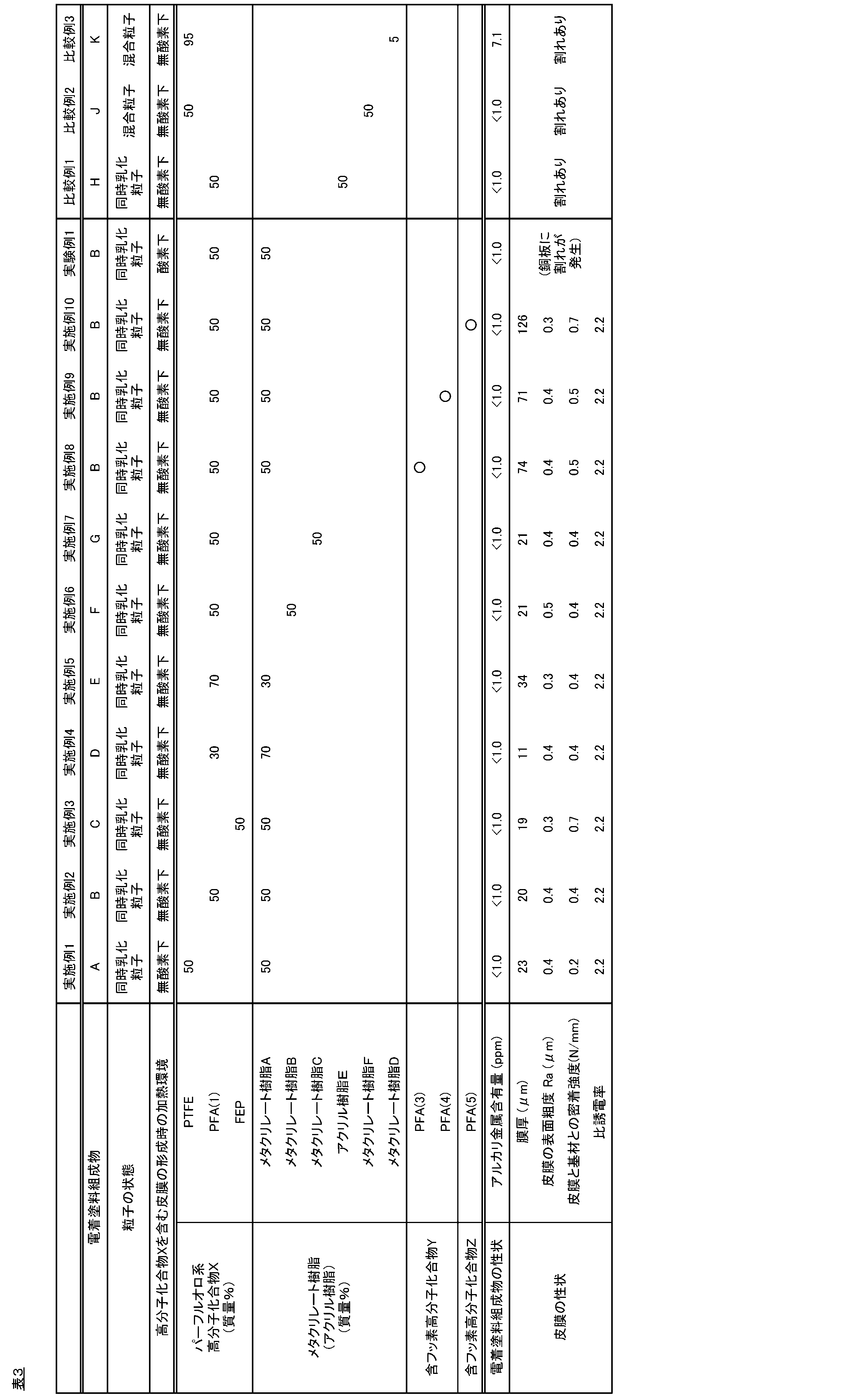
パーフルオロ系高分子化合物X
PTFE:ポリテトラフルオロエチレン、比誘電率:2.2、官能基数:18個/C106個
PFA(1):テトラフルオロエチレン/パーフルオロ(プロピルビニルエーテル)共重合体、比誘電率:2.2、官能基数:220個/C106個
FEP:テトラフルオロエチレン/ヘキサフルオロプロピレン共重合体、比誘電率:2.2、官能基数:625個/C106個
メタクリレート樹脂A:解重合性メタクリレート樹脂、樹脂酸価:50mgKOH/g
メタクリレート樹脂B:解重合性メタクリレート樹脂、樹脂酸価:30mgKOH/g
メタクリレート樹脂C:解重合性メタクリレート樹脂、樹脂酸価:80mgKOH/g
アクリル樹脂E:非解重合性アクリル樹脂、三井化学社製アルマテックスWA911、樹脂酸価:48mgKOH/g
メタクリレート樹脂F:解重合性メタクリレート樹脂、日本触媒社製アクリセットTF-300、樹脂酸価:0.5mgKOH/g
メタクリレート樹脂D:解重合性メタクリレート樹脂、樹脂酸価:0.4mgKOH/g
PFA(3):テトラフルオロエチレン/パーフルオロ(プロピルビニルエーテル)共重合体、比誘電率:2.2、官能基数:炭素原子106個あたり220個、MFR:27g/10min
PFA(4):テトラフルオロエチレン/パーフルオロ(プロピルビニルエーテル)共重合体、比誘電率:2.2、官能基数:炭素原子106個あたり2個,MFR:28g/10min
PFA(5):テトラフルオロエチレン/パーフルオロ(プロピルビニルエーテル)共重合体、比誘電率:2.2、官能基数:炭素原子106個あたり55個,MFR:12g/10min
0.水性分散液または水分散組成物からの親水基を有する含フッ素化合物の抽出
水性分散液5.0gを秤量し、メタノールを10g加え、円筒ろ紙に流しいれ、抽出溶媒としてメタノールが全量で150gになるようソックスレー抽出を行い、得られた抽出液を250mlになるようにメタノールで定容し、親水基を有する含フッ素化合物を含む抽出液を得た。
1.パーフルオロエーテルカルボン酸Aの検量線
濃度既知のパーフルオロエーテルカルボン酸Aのメタノール標準溶液を5水準調製し、液体クロマトグラフ質量分析計(Agilent,Ultivo トリプル四重極LC-MS)を用いて測定を行った。それぞれの濃度範囲において、メタノール標準溶液濃度とピークの積分値から一次近似を用い、検量線を作成した。


液体クロマトグラフ質量分析計を用い、パーフルオロエーテルカルボン酸Aを測定した。測定溶液中のパーフルオロエーテルカルボン酸A量が検量線内に収まるように、抽出液をメタノールで適宜希釈し、測定溶液を調製した。測定溶液についてMRM法を用いてパーフルオロエーテルカルボン酸Aのピーク面積を求め検量線よりパーフルオロエーテルカルボン酸Aの含有量を求めた。
一般式(H2)で表される化合物の含有量は同じ炭素数の直鎖パーフルオロカルボン酸の検量線により求めた。
濃度既知のパーフルオロブタン酸、パーフルオロペンタン酸、パーフルオロヘキサン酸、パーフルオロヘプタン酸、パーフルオロオクタン酸、パーフルオロノナン酸、パーフルオロデカン酸、パーフルオロウンデカン酸、パーフルオロドデカン酸、パーフルオロトリデカン酸、パーフルオロテトラデカン酸のメタノール標準溶液を5水準調製し、液体クロマトグラフ質量分析計(Agilent,Ultivo トリプル四重極LC-MS)を用いて測定を行った。それぞれの濃度範囲において、メタノール標準溶液濃度とピークの積分値から一次近似を用い、検量線を作成した。
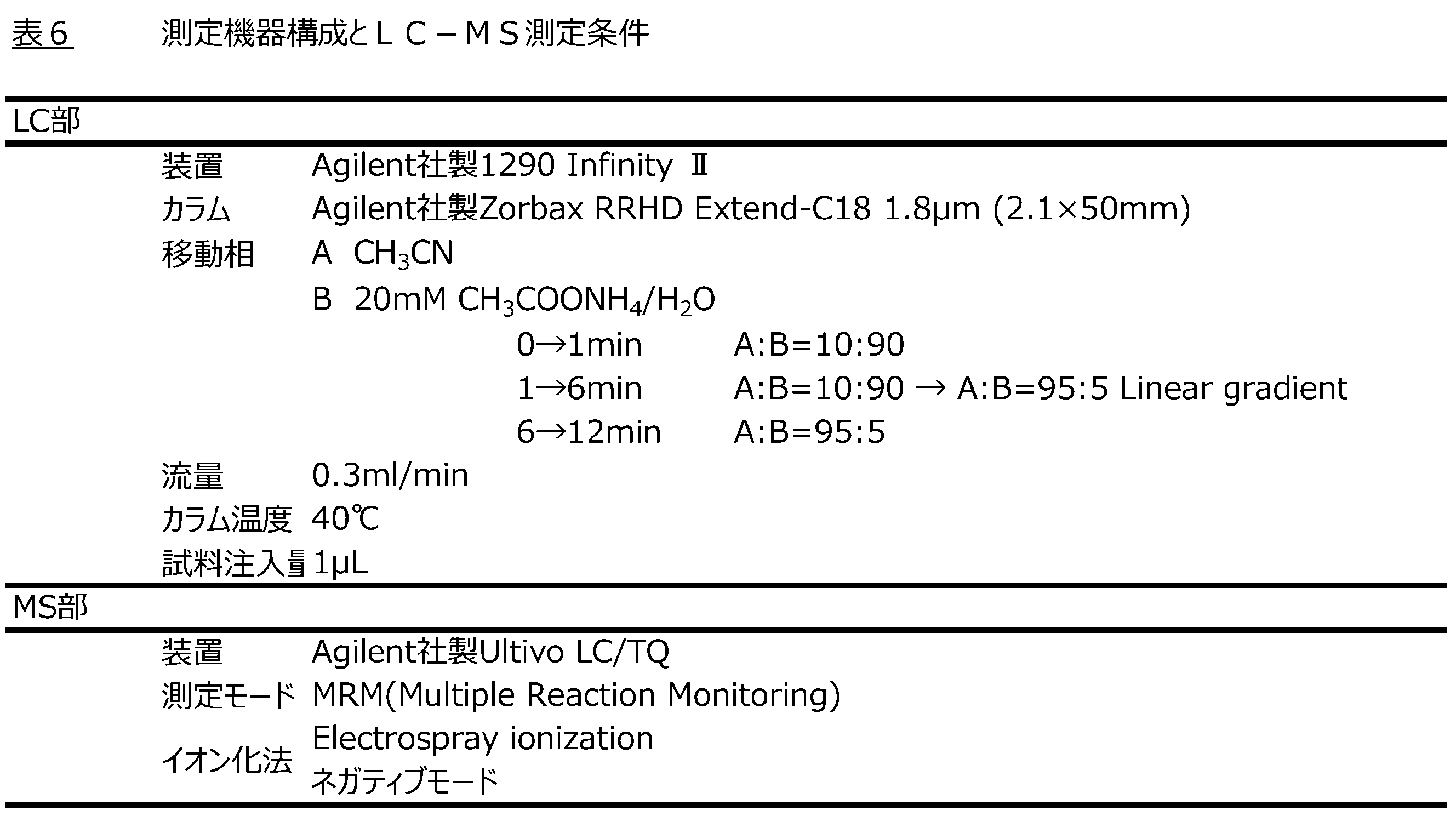

液体クロマトグラフ質量分析計を用い、検量線から、抽出液に含まれる炭素数nの一般式(H2)で表される化合物の含有量を測定した。抽出液について、MRM法により一般式(H2)で表される親水基を有する含フッ素化合物のピーク面積を求め、水性分散液または水分散組成物に含まれる一般式(H2)で表される親水基を有する含フッ素化合物の含有量を求めた。

国際公開第2021/045228号の合成例1に記載された方法により、分子量1000以下であるパーフルオロエーテルカルボン酸Aの白色固体Aを得た。
内容量6Lの撹拌機付きSUS製反応器に、3750gの脱イオン水及び含フッ素界面活性剤として5.49gの合成例1で得られた白色固体Aを入れた。次いで、反応器の内容物を60℃まで加熱しながら、吸引すると同時にTFEでパージして反応器内の酸素を除き、内容物を攪拌した。反応器中に6.9gの塩化メチレン及び27gのパーフルオロ(プロピルビニルエーテル)(PPVE)を加えた後、1.3MPaGの圧力となるまでTFEを加えた。20gの脱イオン水に溶解した990mgの過硫酸アンモニウム(APS)開始剤を反応器に注入した。開始剤の注入後に圧力の低下が起こり、重合の開始が観測された。反応器にTFEを加えて、圧力を1.3MPaG一定となるように保った。重合開始後、100gのTFEに対して4gのPPVEとなるように連続的に加えた。反応で消費したTFEが約1600gに達した時点でTFEの供給を止め、撹拌を停止して反応を終了した。その後、反応器内の圧力が常圧になるまで排気し、テトラフルオロエチレン/パーフルオロ(プロピルビニルエーテル)共重合体(PFA)水性分散液を得た。
製造例1で得られたPFA水性分散液を別の反応器内に入れ、反応器の内容物を80℃まで加熱し、ラジカル発生剤として、30.3gの過硫酸アンモニウム(重合に用いた含フッ素界面活性剤のモル量に対して、10モル倍の量)を添加した。その後、80℃のまま3時間保持し、熱処理されたPFAを含有する水分散組成物を得た。
解重合性メタクリレート樹脂Aの溶液に、中和度80%となるようにトリエチルアミンを添加して、中和された解重合性メタクリレート樹脂Aの溶液を得た。さらに攪拌しながら、パーフルオロ系高分子化合物/メタクリレート樹脂=50/50(質量%)となるように、調製例1で得られた水性分散液(PFAの比誘電率:2.2、PFAの官能基数:炭素原子106個あたり220個、PFAに対する親水基を有する含フッ素化合物の含有量:42質量ppb、固形分:30質量%)と純水を添加することにより転相乳化を実施し、PFA粒子と解重合性メタクリレート樹脂Aの中和物粒子とが乳化された、固形分15質量%である電着塗料組成物Bを得た。
解重合性メタクリレート樹脂Aの溶液に、中和度80%となるようにトリエチルアミンを添加して、中和された解重合性メタクリレート樹脂Aの溶液を得た。さらに攪拌しながら、パーフルオロ系高分子化合物/メタクリレート樹脂=50/50(質量%)となるように製造例1で得られた水性分散液(PFAの比誘電率:2.2、PFAの官能基数:炭素原子106個あたり220個、PFAに対する親水基を有する含フッ素化合物の含有量:551質量ppb、固形分:30質量%)と純水を添加することにより転相乳化を実施し、PFA粒子と解重合性メタクリレート樹脂Aの中和物粒子とが乳化された、固形分15質量%である電着塗料組成物Lを得た。
電着塗料組成物B(実施例11)、電着塗料組成物L(実験例2)を用い、液温25℃、印加電圧150V、120秒間の条件で銅板上に電着塗装を実施した。これを100℃で20分間予備乾燥を行った後に、窒素置換された無酸素雰囲気下の乾燥炉内において380℃で20分間加熱して、皮膜を得た。この皮膜について、以下の要領で接触角と摩擦係数を測定した。
協和界面科学社製接触角計CA-DT型を用い、水、および、n-セタンに対する接触角を測定した。
新東科学社製表面性試験機HEIDON Type38を用い、(ボール圧子)を荷重(1kg)で押し当て、600mm/分の速度で移動させた際の静摩擦係数と動摩擦係数を測定した。

Claims (25)
- パーフルオロ系高分子化合物Xおよびメタクリレート樹脂の中和物を含有する電着塗料組成物であって、
前記パーフルオロ系高分子化合物Xの比誘電率が、2.0~2.2であり、
前記メタクリレート樹脂の酸価が、10mgKOH/g以上であり、
前記電着塗料組成物の固形分濃度が、10~70質量%である
電着塗料組成物。 - パーフルオロ系高分子化合物Xおよびメタクリレート樹脂の中和物を含有する電着塗料組成物であって、
前記パーフルオロ系高分子化合物Xが、テトラフルオロエチレン/フルオロアルキルビニルエーテル共重合体であり、
前記メタクリレート樹脂の酸価が、10mgKOH/g以上であり、
前記電着塗料組成物の固形分濃度が、10~70質量%である
電着塗料組成物。 - 親水基を有する含フッ素化合物の含有量が、前記パーフルオロ系高分子化合物Xに対して、50質量ppb以下である請求項1または2に記載の電着塗料組成物。
- 水をさらに含有する請求項1~3のいずれかに記載の電着塗料組成物。
- 前記メタクリレート樹脂の中和物および有機溶媒を含有する溶液に、前記パーフルオロ系高分子化合物Xおよび水を含有する水分散組成物を添加して、転相乳化させる製造方法により得られる請求項1~4のいずれかに記載の電着塗料組成物。
- 前記メタクリレート樹脂が、カルボキシル基を有しており、前記メタクリレート樹脂の中和物が、カルボキシ基を有する前記メタクリレート樹脂を、アミン化合物により中和することにより得られる中和物である請求項1~5のいずれかに記載の電着塗料組成物。
- 前記メタクリレート樹脂の中和物の中和度が、50%以上である請求項1~6のいずれかに記載の電着塗料組成物。
- 前記パーフルオロ系高分子化合物Xが、官能基を有しており、前記パーフルオロ系高分子化合物Xの官能基数が、炭素原子106個あたり、5~2000個である請求項1~7のいずれかに記載の電着塗料組成物。
- アルカリ金属含有量が、1質量ppm未満である請求項1~8のいずれかに記載の電着塗料組成物。
- 前記パーフルオロ系高分子化合物Xと前記メタクリレート樹脂の中和物との質量比が、10/90~90/10である請求項1~9のいずれかに記載の電着塗料組成物。
- 請求項1~10のいずれかに記載の電着塗料組成物から形成される皮膜。
- 基材と、前記基材を被覆する皮膜とを備えており、
前記皮膜が、請求項1~10のいずれかに記載の電着塗料組成物から形成される皮膜である
被覆物品。 - 前記基材の形成材料が、銅、銅合金、アルミニウムおよびアルミニウム合金からなる群より選択される少なくとも1種である請求項12に記載の被覆物品。
- 平角電線基材と、前記平角電線基材の外周に形成された皮膜とを備えており、
前記皮膜が、請求項1~10のいずれかに記載の電着塗料組成物から形成される皮膜である
被覆電線。 - 前記平角電線基材の形成材料が、銅、銅合金、アルミニウムおよびアルミニウム合金からなる群より選択される少なくとも1種である請求項14に記載の被覆電線。
- 曲げ部を有する請求項14または15に記載の被覆電線。
- 長尺電線である請求項14または15に記載の被覆電線。
- 前記皮膜の外周に形成された被覆層をさらに備えており、
前記被覆層が、含フッ素高分子化合物Yを含む粉体塗料組成物から形成される層である
請求項14~17のいずれかに記載の被覆電線。 - 前記皮膜の外周に形成された被覆層をさらに備えており、
前記被覆層が、含フッ素高分子化合物Zの押出成形により形成される層である
請求項14~17のいずれかに記載の被覆電線。 - 含フッ素高分子化合物Yが、パーフルオロ系高分子化合物であり、
含フッ素高分子化合物Yの比誘電率が、2.0~2.2であり、
含フッ素高分子化合物Yの融点が、250~320℃である
請求項18に記載の被覆電線。 - 含フッ素高分子化合物Yのメルトフローレートが、0.1~100g/10分である請求項18に記載の被覆電線。
- 含フッ素高分子化合物Yが、官能基を有しており、官能基数が、炭素原子106個あたり、5~1000個である請求項18に記載の被覆電線。
- 含フッ素高分子化合物Yが、官能基を有しており、官能基数が、炭素原子106個あたり、0~4個である請求項18に記載の被覆電線。
- 基材と、前記基材を被覆する皮膜とを備えており、
前記皮膜が、請求項1~10のいずれかに記載の電着塗料組成物から形成される皮膜である
プリント基板。 - 前記基材の形成材料が、銅、銅合金、アルミニウムおよびアルミニウム合金からなる群より選択される少なくとも1種である請求項24に記載のプリント基板。
Priority Applications (3)
| Application Number | Priority Date | Filing Date | Title |
|---|---|---|---|
| CN202380089887.3A CN120457176A (zh) | 2022-11-02 | 2023-11-02 | 电沉积涂料组合物、被膜、被覆制品、被覆电线和印刷基板 |
| EP23885860.9A EP4600318A4 (en) | 2022-11-02 | 2023-11-02 | Electrodeposition coating composition, film, coated article, coated wire and printed circuit board |
| US19/194,687 US20250270727A1 (en) | 2022-11-02 | 2025-04-30 | Electrodeposition coating composition, coating, coated article, coated electric wire and printed board |
Applications Claiming Priority (2)
| Application Number | Priority Date | Filing Date | Title |
|---|---|---|---|
| JP2022-176619 | 2022-11-02 | ||
| JP2022176619 | 2022-11-02 |
Related Child Applications (1)
| Application Number | Title | Priority Date | Filing Date |
|---|---|---|---|
| US19/194,687 Continuation US20250270727A1 (en) | 2022-11-02 | 2025-04-30 | Electrodeposition coating composition, coating, coated article, coated electric wire and printed board |
Publications (1)
| Publication Number | Publication Date |
|---|---|
| WO2024096106A1 true WO2024096106A1 (ja) | 2024-05-10 |
Family
ID=90930660
Family Applications (1)
| Application Number | Title | Priority Date | Filing Date |
|---|---|---|---|
| PCT/JP2023/039665 Ceased WO2024096106A1 (ja) | 2022-11-02 | 2023-11-02 | 電着塗料組成物、皮膜、被覆物品、被覆電線およびプリント基板 |
Country Status (6)
| Country | Link |
|---|---|
| US (1) | US20250270727A1 (ja) |
| EP (1) | EP4600318A4 (ja) |
| JP (1) | JP7495652B2 (ja) |
| CN (1) | CN120457176A (ja) |
| TW (1) | TW202432741A (ja) |
| WO (1) | WO2024096106A1 (ja) |
Citations (28)
| Publication number | Priority date | Publication date | Assignee | Title |
|---|---|---|---|---|
| US3250808A (en) | 1963-10-31 | 1966-05-10 | Du Pont | Fluorocarbon ethers derived from hexafluoropropylene epoxide |
| US3271341A (en) | 1961-08-07 | 1966-09-06 | Du Pont | Aqueous colloidal dispersions of polymer |
| JPS6142822A (ja) | 1984-08-06 | 1986-03-01 | 三菱電機株式会社 | 低誘電率銅張り絶縁皮膜の製造方法 |
| JP2002298674A (ja) | 2001-03-29 | 2002-10-11 | Mitsubishi Cable Ind Ltd | 絶縁電線の製造方法および絶縁電線 |
| JP2003119204A (ja) | 2001-10-05 | 2003-04-23 | Daikin Ind Ltd | 含フッ素重合体ラテックスの製造方法 |
| WO2005042593A1 (ja) | 2003-10-31 | 2005-05-12 | Daikin Industries, Ltd. | 含フッ素重合体水性分散体の製造方法及び含フッ素重合体水性分散体 |
| JP2006152234A (ja) | 2004-10-28 | 2006-06-15 | Asahi Glass Co Ltd | 含フッ素共重合体及びその用途 |
| US20070015864A1 (en) | 2005-07-15 | 2007-01-18 | 3M Innovative Properties Company | Method of making fluoropolymer dispersion |
| US20070015866A1 (en) | 2005-07-15 | 2007-01-18 | 3M Innovative Properties Company | Aqueous emulsion polymerization of fluorinated monomers using a fluorinated surfactant |
| US20070015865A1 (en) | 2005-07-15 | 2007-01-18 | 3M Innovative Properties Company | Aqueous emulsion polymerization of fluorinated monomers using a perfluoropolyether surfactant |
| WO2007046377A1 (ja) | 2005-10-20 | 2007-04-26 | Asahi Glass Company, Limited | 溶融成形可能なフッ素樹脂の製造方法 |
| WO2007046482A1 (ja) | 2005-10-20 | 2007-04-26 | Asahi Glass Company, Limited | ポリテトラフルオロエチレン水性分散液およびその製品 |
| WO2007046345A1 (ja) | 2005-10-17 | 2007-04-26 | Asahi Glass Company, Limited | ポリテトラフルオロエチレン水性乳化液、それから得られるポリテトラフルオロエチレンファインパウダーおよび多孔体 |
| JP2007119526A (ja) | 2005-10-25 | 2007-05-17 | Asahi Glass Co Ltd | 含フッ素重合体の製造方法 |
| US20070117914A1 (en) | 2005-11-24 | 2007-05-24 | 3M Innovative Properties Company | Fluorinated surfactants for use in making a fluoropolymer |
| US20070142541A1 (en) | 2005-12-21 | 2007-06-21 | 3M Innovative Properties Company | Fluorinated surfactants for making fluoropolymers |
| US20070276103A1 (en) | 2006-05-25 | 2007-11-29 | 3M Innovative Properties Company | Fluorinated Surfactants |
| US20080015319A1 (en) | 2006-07-13 | 2008-01-17 | Klaus Hintzer | Explosion taming surfactants for the production of perfluoropolymers |
| WO2008060461A1 (en) | 2006-11-09 | 2008-05-22 | E. I. Du Pont De Nemours And Company | Aqueous polymerization of fluorinated monomer using polymerization agent comprising fluoropolyether acid or salt and short chain fluorosurfactant |
| WO2013189826A1 (en) | 2012-06-20 | 2013-12-27 | Solvay Specialty Polymers Italy S.P.A. | Tetrafluoroethylene copolymers |
| WO2013189824A1 (en) | 2012-06-20 | 2013-12-27 | Solvay Specialty Polymers Italy S.P.A. | Tetrafluoroethylene copolymers |
| US20140228531A1 (en) | 2008-07-08 | 2014-08-14 | Solvay Solexis S.P.A. | Method for manufacturing fluoropolymers |
| WO2017122743A1 (ja) | 2016-01-14 | 2017-07-20 | 旭硝子株式会社 | 硬化性組成物、硬化物、プリプレグおよび繊維強化成形品 |
| JP2017179209A (ja) * | 2016-03-31 | 2017-10-05 | 株式会社Lixil | フッ素樹脂含有電着塗料 |
| WO2019161153A1 (en) | 2018-02-15 | 2019-08-22 | 3M Innovative Properties Company | Fluoropolymers, fluoropolymer compositions and fluoropolymer dispersions |
| WO2021045228A1 (ja) | 2019-09-05 | 2021-03-11 | ダイキン工業株式会社 | ポリテトラフルオロエチレン水性分散液 |
| WO2022050430A1 (ja) * | 2020-09-07 | 2022-03-10 | ダイキン工業株式会社 | 変性ポリテトラフルオロエチレン水性分散液 |
| JP2022108653A (ja) * | 2021-01-13 | 2022-07-26 | 三菱マテリアル株式会社 | 電着液、絶縁皮膜の製造方法 |
Family Cites Families (2)
| Publication number | Priority date | Publication date | Assignee | Title |
|---|---|---|---|---|
| US3902981A (en) * | 1971-05-11 | 1975-09-02 | Du Pont | Process for electrophoretic deposition |
| JPS6187765A (ja) * | 1984-10-06 | 1986-05-06 | Kansai Paint Co Ltd | 高耐候性電着塗料組成物 |
-
2023
- 2023-11-02 EP EP23885860.9A patent/EP4600318A4/en active Pending
- 2023-11-02 WO PCT/JP2023/039665 patent/WO2024096106A1/ja not_active Ceased
- 2023-11-02 TW TW112142280A patent/TW202432741A/zh unknown
- 2023-11-02 CN CN202380089887.3A patent/CN120457176A/zh active Pending
- 2023-11-02 JP JP2023188345A patent/JP7495652B2/ja active Active
-
2025
- 2025-04-30 US US19/194,687 patent/US20250270727A1/en active Pending
Patent Citations (28)
| Publication number | Priority date | Publication date | Assignee | Title |
|---|---|---|---|---|
| US3271341A (en) | 1961-08-07 | 1966-09-06 | Du Pont | Aqueous colloidal dispersions of polymer |
| US3250808A (en) | 1963-10-31 | 1966-05-10 | Du Pont | Fluorocarbon ethers derived from hexafluoropropylene epoxide |
| JPS6142822A (ja) | 1984-08-06 | 1986-03-01 | 三菱電機株式会社 | 低誘電率銅張り絶縁皮膜の製造方法 |
| JP2002298674A (ja) | 2001-03-29 | 2002-10-11 | Mitsubishi Cable Ind Ltd | 絶縁電線の製造方法および絶縁電線 |
| JP2003119204A (ja) | 2001-10-05 | 2003-04-23 | Daikin Ind Ltd | 含フッ素重合体ラテックスの製造方法 |
| WO2005042593A1 (ja) | 2003-10-31 | 2005-05-12 | Daikin Industries, Ltd. | 含フッ素重合体水性分散体の製造方法及び含フッ素重合体水性分散体 |
| JP2006152234A (ja) | 2004-10-28 | 2006-06-15 | Asahi Glass Co Ltd | 含フッ素共重合体及びその用途 |
| US20070015864A1 (en) | 2005-07-15 | 2007-01-18 | 3M Innovative Properties Company | Method of making fluoropolymer dispersion |
| US20070015866A1 (en) | 2005-07-15 | 2007-01-18 | 3M Innovative Properties Company | Aqueous emulsion polymerization of fluorinated monomers using a fluorinated surfactant |
| US20070015865A1 (en) | 2005-07-15 | 2007-01-18 | 3M Innovative Properties Company | Aqueous emulsion polymerization of fluorinated monomers using a perfluoropolyether surfactant |
| WO2007046345A1 (ja) | 2005-10-17 | 2007-04-26 | Asahi Glass Company, Limited | ポリテトラフルオロエチレン水性乳化液、それから得られるポリテトラフルオロエチレンファインパウダーおよび多孔体 |
| WO2007046377A1 (ja) | 2005-10-20 | 2007-04-26 | Asahi Glass Company, Limited | 溶融成形可能なフッ素樹脂の製造方法 |
| WO2007046482A1 (ja) | 2005-10-20 | 2007-04-26 | Asahi Glass Company, Limited | ポリテトラフルオロエチレン水性分散液およびその製品 |
| JP2007119526A (ja) | 2005-10-25 | 2007-05-17 | Asahi Glass Co Ltd | 含フッ素重合体の製造方法 |
| US20070117914A1 (en) | 2005-11-24 | 2007-05-24 | 3M Innovative Properties Company | Fluorinated surfactants for use in making a fluoropolymer |
| US20070142541A1 (en) | 2005-12-21 | 2007-06-21 | 3M Innovative Properties Company | Fluorinated surfactants for making fluoropolymers |
| US20070276103A1 (en) | 2006-05-25 | 2007-11-29 | 3M Innovative Properties Company | Fluorinated Surfactants |
| US20080015319A1 (en) | 2006-07-13 | 2008-01-17 | Klaus Hintzer | Explosion taming surfactants for the production of perfluoropolymers |
| WO2008060461A1 (en) | 2006-11-09 | 2008-05-22 | E. I. Du Pont De Nemours And Company | Aqueous polymerization of fluorinated monomer using polymerization agent comprising fluoropolyether acid or salt and short chain fluorosurfactant |
| US20140228531A1 (en) | 2008-07-08 | 2014-08-14 | Solvay Solexis S.P.A. | Method for manufacturing fluoropolymers |
| WO2013189824A1 (en) | 2012-06-20 | 2013-12-27 | Solvay Specialty Polymers Italy S.P.A. | Tetrafluoroethylene copolymers |
| WO2013189826A1 (en) | 2012-06-20 | 2013-12-27 | Solvay Specialty Polymers Italy S.P.A. | Tetrafluoroethylene copolymers |
| WO2017122743A1 (ja) | 2016-01-14 | 2017-07-20 | 旭硝子株式会社 | 硬化性組成物、硬化物、プリプレグおよび繊維強化成形品 |
| JP2017179209A (ja) * | 2016-03-31 | 2017-10-05 | 株式会社Lixil | フッ素樹脂含有電着塗料 |
| WO2019161153A1 (en) | 2018-02-15 | 2019-08-22 | 3M Innovative Properties Company | Fluoropolymers, fluoropolymer compositions and fluoropolymer dispersions |
| WO2021045228A1 (ja) | 2019-09-05 | 2021-03-11 | ダイキン工業株式会社 | ポリテトラフルオロエチレン水性分散液 |
| WO2022050430A1 (ja) * | 2020-09-07 | 2022-03-10 | ダイキン工業株式会社 | 変性ポリテトラフルオロエチレン水性分散液 |
| JP2022108653A (ja) * | 2021-01-13 | 2022-07-26 | 三菱マテリアル株式会社 | 電着液、絶縁皮膜の製造方法 |
Non-Patent Citations (1)
| Title |
|---|
| See also references of EP4600318A4 |
Also Published As
| Publication number | Publication date |
|---|---|
| JP2024067024A (ja) | 2024-05-16 |
| EP4600318A4 (en) | 2026-03-11 |
| EP4600318A1 (en) | 2025-08-13 |
| CN120457176A (zh) | 2025-08-08 |
| TW202432741A (zh) | 2024-08-16 |
| US20250270727A1 (en) | 2025-08-28 |
| JP7495652B2 (ja) | 2024-06-05 |
Similar Documents
| Publication | Publication Date | Title |
|---|---|---|
| JP7177377B2 (ja) | 含フッ素共重合体 | |
| JP5757862B2 (ja) | フルオロポリエーテル酸またはその塩の混合物を使用するフッ素化モノマーの水性重合 | |
| JP5217090B2 (ja) | テトラフルオロエチレン重合体水性分散液、その製造方法、テトラフルオロエチレン重合体粉末及びテトラフルオロエチレン重合体成形体 | |
| JP5397424B2 (ja) | 含フッ素重合体水性分散体の製造方法及び含フッ素重合体水性分散体 | |
| EP2927247B1 (en) | Polytetrafluoroethylene aqueous dispersion, and polytetrafluoroethylene fine powder | |
| US8796370B2 (en) | Coating composition | |
| JP5958467B2 (ja) | 含フッ素共重合体組成物 | |
| JP5445583B2 (ja) | エチレン/テトラフルオロエチレン共重合体、電線及び回転成形用フッ素樹脂粉末 | |
| JP2010235667A (ja) | 含フッ素ポリマーの製造方法 | |
| WO2004094491A1 (en) | Melt-processible thermoplastic fluoropolymers having improved processing characteristics and method of producing same | |
| JP7265210B2 (ja) | 含フッ素共重合体 | |
| JP2023103270A (ja) | 含フッ素共重合体 | |
| JP2022132229A (ja) | 含フッ素共重合体 | |
| JP7495652B2 (ja) | 電着塗料組成物、皮膜、被覆物品、被覆電線およびプリント基板 | |
| JP7397390B1 (ja) | 組成物、射出成形体、粉体塗料および被覆電線 | |
| JP7121326B1 (ja) | 含フッ素共重合体 | |
| JP2012513474A (ja) | エチレン−テトラフルオロエチレンカルボン酸および塩 | |
| JP7074998B2 (ja) | エチレン/テトラフルオロエチレン共重合体 | |
| JP7381981B1 (ja) | 含フッ素共重合体 | |
| WO2024024914A1 (ja) | フルオロポリマーの粒子を含有する粉体およびその製造方法、粉体塗料並びに液状塗料組成物 | |
| WO2023171777A1 (ja) | 塗料組成物、皮膜、積層皮膜、及び、塗装物品 | |
| JP2026050216A (ja) | 被覆金属線 | |
| JP2024102463A (ja) | フッ素樹脂組成物、塗料組成物、塗装物品およびシート状組成物 |
Legal Events
| Date | Code | Title | Description |
|---|---|---|---|
| 121 | Ep: the epo has been informed by wipo that ep was designated in this application |
Ref document number: 23885860 Country of ref document: EP Kind code of ref document: A1 |
|
| WWE | Wipo information: entry into national phase |
Ref document number: 2023885860 Country of ref document: EP |
|
| ENP | Entry into the national phase |
Ref document number: 2023885860 Country of ref document: EP Effective date: 20250509 |
|
| NENP | Non-entry into the national phase |
Ref country code: DE |
|
| WWE | Wipo information: entry into national phase |
Ref document number: 202380089887.3 Country of ref document: CN |
|
| WWP | Wipo information: published in national office |
Ref document number: 202380089887.3 Country of ref document: CN |
|
| WWP | Wipo information: published in national office |
Ref document number: 2023885860 Country of ref document: EP |