WO2024135437A1 - 非水系二次電池用バインダー組成物および非水系二次電池電極 - Google Patents
非水系二次電池用バインダー組成物および非水系二次電池電極 Download PDFInfo
- Publication number
- WO2024135437A1 WO2024135437A1 PCT/JP2023/044228 JP2023044228W WO2024135437A1 WO 2024135437 A1 WO2024135437 A1 WO 2024135437A1 JP 2023044228 W JP2023044228 W JP 2023044228W WO 2024135437 A1 WO2024135437 A1 WO 2024135437A1
- Authority
- WO
- WIPO (PCT)
- Prior art keywords
- secondary battery
- binder composition
- aqueous secondary
- copolymer
- mass
- Prior art date
- Legal status (The legal status is an assumption and is not a legal conclusion. Google has not performed a legal analysis and makes no representation as to the accuracy of the status listed.)
- Ceased
Links
Images

Classifications
-
- H—ELECTRICITY
- H01—ELECTRIC ELEMENTS
- H01M—PROCESSES OR MEANS, e.g. BATTERIES, FOR THE DIRECT CONVERSION OF CHEMICAL ENERGY INTO ELECTRICAL ENERGY
- H01M10/00—Secondary cells; Manufacture thereof
- H01M10/05—Accumulators with non-aqueous electrolyte
- H01M10/052—Li-accumulators
-
- C—CHEMISTRY; METALLURGY
- C08—ORGANIC MACROMOLECULAR COMPOUNDS; THEIR PREPARATION OR CHEMICAL WORKING-UP; COMPOSITIONS BASED THEREON
- C08F—MACROMOLECULAR COMPOUNDS OBTAINED BY REACTIONS ONLY INVOLVING CARBON-TO-CARBON UNSATURATED BONDS
- C08F220/00—Copolymers of compounds having one or more unsaturated aliphatic radicals, each having only one carbon-to-carbon double bond, and only one being terminated by only one carboxyl radical or a salt, anhydride ester, amide, imide or nitrile thereof
- C08F220/02—Monocarboxylic acids having less than ten carbon atoms; Derivatives thereof
- C08F220/10—Esters
- C08F220/26—Esters containing oxygen in addition to the carboxy oxygen
-
- C—CHEMISTRY; METALLURGY
- C08—ORGANIC MACROMOLECULAR COMPOUNDS; THEIR PREPARATION OR CHEMICAL WORKING-UP; COMPOSITIONS BASED THEREON
- C08F—MACROMOLECULAR COMPOUNDS OBTAINED BY REACTIONS ONLY INVOLVING CARBON-TO-CARBON UNSATURATED BONDS
- C08F251/00—Macromolecular compounds obtained by polymerising monomers on to polysaccharides or derivatives thereof
-
- C—CHEMISTRY; METALLURGY
- C08—ORGANIC MACROMOLECULAR COMPOUNDS; THEIR PREPARATION OR CHEMICAL WORKING-UP; COMPOSITIONS BASED THEREON
- C08F—MACROMOLECULAR COMPOUNDS OBTAINED BY REACTIONS ONLY INVOLVING CARBON-TO-CARBON UNSATURATED BONDS
- C08F283/00—Macromolecular compounds obtained by polymerising monomers on to polymers provided for in subclass C08G
-
- C—CHEMISTRY; METALLURGY
- C08—ORGANIC MACROMOLECULAR COMPOUNDS; THEIR PREPARATION OR CHEMICAL WORKING-UP; COMPOSITIONS BASED THEREON
- C08F—MACROMOLECULAR COMPOUNDS OBTAINED BY REACTIONS ONLY INVOLVING CARBON-TO-CARBON UNSATURATED BONDS
- C08F283/00—Macromolecular compounds obtained by polymerising monomers on to polymers provided for in subclass C08G
- C08F283/06—Macromolecular compounds obtained by polymerising monomers on to polymers provided for in subclass C08G on to polyethers, polyoxymethylenes or polyacetals
-
- C—CHEMISTRY; METALLURGY
- C08—ORGANIC MACROMOLECULAR COMPOUNDS; THEIR PREPARATION OR CHEMICAL WORKING-UP; COMPOSITIONS BASED THEREON
- C08G—MACROMOLECULAR COMPOUNDS OBTAINED OTHERWISE THAN BY REACTIONS ONLY INVOLVING UNSATURATED CARBON-TO-CARBON BONDS
- C08G65/00—Macromolecular compounds obtained by reactions forming an ether link in the main chain of the macromolecule
- C08G65/02—Macromolecular compounds obtained by reactions forming an ether link in the main chain of the macromolecule from cyclic ethers by opening of the heterocyclic ring
- C08G65/32—Polymers modified by chemical after-treatment
- C08G65/329—Polymers modified by chemical after-treatment with organic compounds
-
- C—CHEMISTRY; METALLURGY
- C08—ORGANIC MACROMOLECULAR COMPOUNDS; THEIR PREPARATION OR CHEMICAL WORKING-UP; COMPOSITIONS BASED THEREON
- C08L—COMPOSITIONS OF MACROMOLECULAR COMPOUNDS
- C08L25/00—Compositions of, homopolymers or copolymers of compounds having one or more unsaturated aliphatic radicals, each having only one carbon-to-carbon double bond, and at least one being terminated by an aromatic carbocyclic ring; Compositions of derivatives of such polymers
- C08L25/02—Homopolymers or copolymers of hydrocarbons
- C08L25/04—Homopolymers or copolymers of styrene
- C08L25/08—Copolymers of styrene
- C08L25/14—Copolymers of styrene with unsaturated esters
-
- C—CHEMISTRY; METALLURGY
- C08—ORGANIC MACROMOLECULAR COMPOUNDS; THEIR PREPARATION OR CHEMICAL WORKING-UP; COMPOSITIONS BASED THEREON
- C08L—COMPOSITIONS OF MACROMOLECULAR COMPOUNDS
- C08L33/00—Compositions of homopolymers or copolymers of compounds having one or more unsaturated aliphatic radicals, each having only one carbon-to-carbon double bond, and only one being terminated by only one carboxyl radical, or of salts, anhydrides, esters, amides, imides or nitriles thereof; Compositions of derivatives of such polymers
-
- H—ELECTRICITY
- H01—ELECTRIC ELEMENTS
- H01M—PROCESSES OR MEANS, e.g. BATTERIES, FOR THE DIRECT CONVERSION OF CHEMICAL ENERGY INTO ELECTRICAL ENERGY
- H01M4/00—Electrodes
- H01M4/02—Electrodes composed of, or comprising, active material
- H01M4/13—Electrodes for accumulators with non-aqueous electrolyte, e.g. for lithium-accumulators; Processes of manufacture thereof
-
- H—ELECTRICITY
- H01—ELECTRIC ELEMENTS
- H01M—PROCESSES OR MEANS, e.g. BATTERIES, FOR THE DIRECT CONVERSION OF CHEMICAL ENERGY INTO ELECTRICAL ENERGY
- H01M4/00—Electrodes
- H01M4/02—Electrodes composed of, or comprising, active material
- H01M4/13—Electrodes for accumulators with non-aqueous electrolyte, e.g. for lithium-accumulators; Processes of manufacture thereof
- H01M4/139—Processes of manufacture
-
- H—ELECTRICITY
- H01—ELECTRIC ELEMENTS
- H01M—PROCESSES OR MEANS, e.g. BATTERIES, FOR THE DIRECT CONVERSION OF CHEMICAL ENERGY INTO ELECTRICAL ENERGY
- H01M4/00—Electrodes
- H01M4/02—Electrodes composed of, or comprising, active material
- H01M4/62—Selection of inactive substances as ingredients for active masses, e.g. binders, fillers
-
- H—ELECTRICITY
- H01—ELECTRIC ELEMENTS
- H01M—PROCESSES OR MEANS, e.g. BATTERIES, FOR THE DIRECT CONVERSION OF CHEMICAL ENERGY INTO ELECTRICAL ENERGY
- H01M4/00—Electrodes
- H01M4/02—Electrodes composed of, or comprising, active material
- H01M4/62—Selection of inactive substances as ingredients for active masses, e.g. binders, fillers
- H01M4/621—Binders
- H01M4/622—Binders being polymers
-
- Y—GENERAL TAGGING OF NEW TECHNOLOGICAL DEVELOPMENTS; GENERAL TAGGING OF CROSS-SECTIONAL TECHNOLOGIES SPANNING OVER SEVERAL SECTIONS OF THE IPC; TECHNICAL SUBJECTS COVERED BY FORMER USPC CROSS-REFERENCE ART COLLECTIONS [XRACs] AND DIGESTS
- Y02—TECHNOLOGIES OR APPLICATIONS FOR MITIGATION OR ADAPTATION AGAINST CLIMATE CHANGE
- Y02E—REDUCTION OF GREENHOUSE GAS [GHG] EMISSIONS, RELATED TO ENERGY GENERATION, TRANSMISSION OR DISTRIBUTION
- Y02E60/00—Enabling technologies; Technologies with a potential or indirect contribution to GHG emissions mitigation
- Y02E60/10—Energy storage using batteries
Definitions
- the present invention relates to a binder composition for a non-aqueous secondary battery, a slurry for a non-aqueous secondary battery electrode, a non-aqueous secondary battery electrode, and a non-aqueous secondary battery.
- Non-aqueous secondary batteries can be made small and lightweight, so they are widely used as power sources for notebook computers, mobile phones, power tools, electronic and communication devices, and other devices. In recent years, non-aqueous secondary batteries have also been used as power sources for electric vehicles and hybrid vehicles.
- a representative example of a non-aqueous secondary battery is the lithium-ion secondary battery.
- a non-aqueous secondary battery includes a positive electrode using a metal oxide or the like as an active material, a negative electrode using a carbon material such as graphite as an active material, and an electrolyte.
- the positive electrode and the negative electrode each include a current collector and an electrode active material layer formed on the current collector.
- the electrode active material layer usually includes a binder that bonds the active materials together and between the active materials and the current collector, thereby fixing the electrode active material layer on the current collector.
- binders used in non-aqueous secondary batteries are known from Patent Documents 1 and 2.
- Patent Document 1 describes a binder composition for secondary battery electrodes that contains 100 parts by mass of at least one polymer water dispersion selected from the group consisting of styrene-butadiene copolymer latex and acrylic emulsion, and 1 to 20 parts by mass of a nonionic surfactant.
- Patent Document 2 describes a binder for lithium ion secondary battery electrodes with a glass transition temperature of 30°C or less, which is obtained by emulsion polymerization of ethylenically unsaturated monomers in the presence of a surfactant, the essential components of which are styrene in an amount of 15 to 70% by mass relative to the total amount of ethylenically unsaturated monomers, an ethylenically unsaturated carboxylic acid ester, an ethylenically unsaturated carboxylic acid, and an internal crosslinking agent.
- a surfactant the essential components of which are styrene in an amount of 15 to 70% by mass relative to the total amount of ethylenically unsaturated monomers, an ethylenically unsaturated carboxylic acid ester, an ethylenically unsaturated carboxylic acid, and an internal crosslinking agent.
- Patent Document 3 also describes a resin emulsion for paints that can be suitably used for architectural exterior paints and the like.
- Patent Document 3 discloses a resin emulsion for paints in which the resin constituting the resin emulsion for paints has a glass transition temperature of 0°C or higher and contains 0.01 to 4 mass% of structural units derived from modified polyrotaxane, and the modified polyrotaxane has a structure in which a functional group having a radical polymerizable group is bonded to a cyclic molecule of polyrotaxane having a cyclic molecule and a chain molecule that penetrates the opening of the cyclic molecule and has stopper groups at both ends.
- Japanese Patent Application Publication No. 2014-239070 A) Japanese Patent Application Publication No. 2011-243464 (A) Japanese Patent Application Publication No. 2019-116594 (A)
- Binders used in non-aqueous secondary batteries are required to be able to improve the cycle characteristics of non-aqueous secondary batteries that have electrodes using the binders.
- the present invention has been made in consideration of the above circumstances, and aims to provide a binder composition for non-aqueous secondary batteries capable of forming electrodes that result in non-aqueous secondary batteries with excellent cycle characteristics, a method for producing the same, a slurry for non-aqueous secondary battery electrodes, a non-aqueous secondary battery electrode that results in a non-aqueous secondary battery with excellent cycle characteristics, and a non-aqueous secondary battery including the same.
- a binder composition for a non-aqueous secondary battery comprising a copolymer and a polyrotaxane
- the copolymer is A first structural unit derived from monomer (a1); and a second structural unit derived from monomer (a2)
- the monomer (a1) is a nonionic compound having only one ethylenically unsaturated bond
- the monomer (a2) is a compound having a carboxy group and only one ethylenically unsaturated bond
- the polyrotaxane has a cyclic molecule having a cyclic skeleton, and a chain molecule passing through an opening of the cyclic molecule and having stopper groups at both ends.
- a group containing an ethylenically unsaturated bond is bonded to the cyclic skeleton
- the binder composition for a nonaqueous secondary battery according to [9] wherein at least one of the groups containing an ethylenically unsaturated bond bonded to the cyclic skeleton is a (meth)acryloyl group, a vinyl group, an allyl group, or a propenyl group.
- the copolymer has a third structural unit derived from a monomer (a3), The binder composition for a nonaqueous secondary battery according to any one of [1] to [14], wherein the monomer (a3) is a compound having a plurality of independent ethylenically unsaturated bonds. [16] The binder composition for a nonaqueous secondary battery according to [15], wherein a content of the third structural unit in all structural units of the copolymer is 0.010 mass % or more and 10 mass % or less.
- a slurry for a non-aqueous secondary battery electrode comprising the binder composition for a non-aqueous secondary battery described in [17] and an electrode active material.
- a non-aqueous secondary battery electrode comprising the non-volatile component of the binder composition for non-aqueous secondary batteries according to any one of [1] to [18].
- a non-aqueous secondary battery comprising the non-aqueous secondary battery electrode according to [20].
- a binder composition for a non-aqueous secondary battery which can form an electrode from which a non-aqueous secondary battery having excellent cycle characteristics can be obtained, and a method for producing the same. Furthermore, according to the present invention, there can be provided a slurry for a non-aqueous secondary battery electrode, which can form an electrode from which a non-aqueous secondary battery having excellent cycle characteristics can be obtained. Furthermore, according to the present invention, it is possible to provide a nonaqueous secondary battery electrode from which a nonaqueous secondary battery having excellent cycle characteristics can be obtained, and a nonaqueous secondary battery having excellent cycle characteristics including the same.
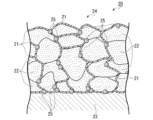
- FIG. 1 is a schematic cross-sectional view showing an example of a nonaqueous secondary battery electrode produced using the binder composition for a nonaqueous secondary battery of the present invention.
- FIG. 1 is a schematic diagram for explaining a polyrotaxane used as a raw material of the binder composition for a non-aqueous secondary battery of the present invention.
- the inventors conducted extensive research to solve the above problems and realize a binder capable of forming a nonaqueous secondary battery electrode that can provide a nonaqueous secondary battery with excellent cycle characteristics, as described below.
- FIG. 1 is a schematic cross-sectional view showing an example of a nonaqueous secondary battery electrode produced using the binder composition for nonaqueous secondary batteries of the present invention.
- 1 includes a current collector 23 made of copper foil or the like, and an electrode active material layer 24 formed on the current collector 23.
- the electrode active material layer 24 includes an electrode active material 22, a thickener 21, and a binder 25.
- the binder 25 is composed of a non-volatile component of the binder composition for a non-aqueous secondary battery of the present invention.
- the discharge capacity of a nonaqueous secondary battery including electrode 20 decreases when the electrode active material layer 24 of electrode 20 expands and contracts due to expansion and contraction of electrode active material 22 accompanying use of the nonaqueous secondary battery, i.e., charging and discharging, and peels off from current collector 23. Even if electrode active material layer 24 does not peel off from current collector 23, the discharge capacity of the nonaqueous secondary battery decreases when the adhesion between electrode active materials 22 and between electrode active material 22 and current collector 23 becomes insufficient due to expansion and contraction of electrode active material 22.
- the binder 25 is one that can maintain the binding between the electrode active materials 22 and between the electrode active material 22 and the current collector 23 for a long period of time, and can form an electrode 20 in which the electrode active material layer 24 is not easily peeled off from the current collector 23.
- the toughness of the binder is insufficient, and the binder cannot follow the expansion and contraction of the electrode active material 22 that accompanies charging and discharging.
- the multiple electrode active materials 22 contained in the electrode active material layer 24 expand and contract in random directions.
- most of the binder 25 contained in the electrode active material layer 24 is disposed between the electrode active materials 22 that expand and contract in different directions, and between the electrode active materials 22 and the current collector 23 that expand and contract in different directions. Therefore, unless the binder 25 has sufficient conformity to each of the multiple materials that expand and contract in different directions and are in contact with each other via the binder 25, good binding properties cannot be obtained.
- the binder in the coating film only needs to follow the direction of expansion and contraction of the substrate. For this reason, even if a binder can be used as a material for a coating film that is difficult to peel off from the substrate, it does not necessarily have a followability sufficient to obtain sufficient binding between the electrode active materials 22 and between the electrode active material 22 and the current collector 23, and it does not necessarily mean that the electrode active material layer 24 containing this binder and the electrode active material 22 is difficult to peel off from the current collector 23. For this reason, with conventional technology, it has been difficult to realize a binder that has good binding properties between the electrode active materials 22 and between the electrode active material 22 and the current collector 23, and that prevents the electrode active material layer 24 from peeling off from the current collector 23.
- copolymer (P) obtained by copolymerizing monomer (a1) made of a nonionic compound having only one ethylenically unsaturated bond with monomer (a2) made of a compound having a carboxy group and only one ethylenically unsaturated bond, as a polymer that can easily produce an electrode active material layer 24 that is not easily peeled off from a current collector 23 made of copper foil or the like, and conducted extensive research into a binder composition for nonaqueous secondary batteries that contains this.
- FIG. 2 is a schematic diagram for explaining the polyrotaxane used as a raw material of the binder composition for a non-aqueous secondary battery of the present invention.
- cyclic molecule 51 having a cyclic skeleton
- chain molecule 53 which passes through an opening 55 of the cyclic molecule 51 and has stopper groups 52 at both ends.
- reference numeral 54 denotes a modifying group.
- the polyrotaxane 2 may not have the modifying group 54.
- the cyclic molecules 51 contained in the polyrotaxane 2 can move relative to the chain molecules 53.
- the cyclic molecules 51 of the polyrotaxane 2 contained in the binder 25 move relative to the chain molecules 53 (pulley effect), and the stress is dispersed.
- the binder 25 exerts an air spring effect that tries to maintain the distance between the cyclic molecules 51 on the chain molecules 53, and restores the original position.
- the binder 25 has the ability to follow the expansion and contraction of the electrode active material 22 that accompanies the use of a non-aqueous secondary battery, due to the polyrotaxane 2. As a result, it is presumed that the electrode active material layer 24 containing this binder 25 has the functions ⁇ 1> and ⁇ 2> shown below.
- the inventors produced an electrode 20 using a binder composition for a non-aqueous secondary battery containing the above-mentioned copolymer (P) and polyrotaxane 2, and confirmed that the cycle characteristics of a non-aqueous secondary battery having this electrode 20 were excellent, leading to the invention.
- the following provides a detailed description of the binder composition for aqueous secondary batteries, the slurry for non-aqueous secondary battery electrodes, the non-aqueous secondary battery electrodes, the non-aqueous secondary batteries, and the method for producing the binder composition for non-aqueous secondary batteries of the present invention. Note that the present invention is not limited to the embodiments shown below.
- (Meth)acrylic is a general term for acrylic and methacrylic.
- (Meth)acrylate is a general term for acrylate and methacrylate.
- ethylenically unsaturated bond refers to an ethylenically unsaturated bond having radical polymerizability, unless otherwise specified.
- a structural unit derived from the compound having an ethylenically unsaturated bond means a structural unit in which the chemical structure of the portion other than the ethylenically unsaturated bond in the compound having an ethylenically unsaturated bond is the same as the chemical structure of the portion in the polymer other than the portion corresponding to the ethylenically unsaturated bond of the structural unit.
- the ethylenically unsaturated bond of the compound is converted into a single bond when forming a polymer.
- the structural unit derived from methyl methacrylate is represented by -CH 2 -C(CH 3 )(COOCH 3 )-.
- a structural unit having an ionic functional group such as a carboxyl group is considered to be a structural unit derived from the same ionic compound, regardless of whether a part of the functional group has been ion-exchanged or not.
- a structural unit represented by -CH 2 -C(CH 3 )(COONa)- may also be considered to be a structural unit derived from methacrylic acid.
- one or more ethylenically unsaturated bonds may remain within the structural unit as a structural unit of the polymer of the compound.
- the structural unit derived from divinylbenzene may be a structure having no ethylenically unsaturated bond (a form in which both parts corresponding to the two ethylenically unsaturated bonds of divinylbenzene are incorporated into the polymer chain), or a structure having one ethylenically unsaturated bond (a form in which only a part corresponding to one of the ethylenically unsaturated bonds is incorporated into the polymer chain).
- multiple independent ethylenically unsaturated bonds refer to multiple ethylenically unsaturated bonds that do not form conjugated dienes with each other.
- the structural unit of the polymer is made to be a structural unit derived from the compound having an ethylenically unsaturated bond in the polymer.
- the structural unit of the polymer is made to be a structural unit derived from vinyl alcohol, not a structural unit derived from vinyl acetate, based on the chemical structure of the polymer.
- class attached to the compound name refers to a group of compounds that contain the compound structure, including compounds that have a substituent.
- Binder composition for non-aqueous secondary battery contains a copolymer (P) having a first structural unit and a second structural unit described below, and a polyrotaxane 2 shown in FIG. 2.
- the binder composition of this embodiment may contain an aqueous medium, and it is preferable that the copolymer (P) and the polyrotaxane 2 are each dispersed in an aqueous medium described below.
- the binder composition of this embodiment may not contain an aqueous medium, and may be composed of a non-volatile component containing the copolymer (P) having the first structural unit and the second structural unit, and the polyrotaxane 2.
- the binder composition of this embodiment may contain other components in addition to the copolymer (P) having the first structural unit and the second structural unit and the polyrotaxane 2.
- the binder composition of this embodiment may contain, as other components, for example, a polymer not having the first structural unit and/or the second structural unit, a surfactant, components used in the synthesis of the copolymer (P), etc.
- the copolymer (P) contained in the binder composition of the present embodiment has at least a first structural unit derived from the monomer (a1) shown below and a second structural unit derived from the monomer (a2) shown below.
- the copolymer (P) contained in the binder composition of the present embodiment may contain, in addition to the first structural unit and the second structural unit, a third structural unit derived from a monomer (a3) composed of a compound having a plurality of independent ethylenically unsaturated bonds, which does not fall under the monomer (a1) or the monomer (a2), and/or a fourth structural unit derived from another monomer (a4) which does not fall under any of the monomers (a1) to (a3).
- the first structural unit in the copolymer (P) contained in the binder composition of the present embodiment is derived from the monomer (a1).
- Monomer (a1) is a nonionic compound having only one ethylenically unsaturated bond. That is, monomer (a1) is a compound having neither an anionic functional group nor a cationic functional group. However, silane compounds are not included in monomer (a1).
- Monomer (a1) may be only one type of compound, or may be a combination of two or more types of compounds.
- the monomer (a1) it is preferable to use at least one of a (meth)acrylic acid ester and an aromatic compound having an ethylenically unsaturated bond, and it is more preferable to use a combination of both compounds.
- the (meth)acrylic acid ester is more preferably a (meth)acrylic acid alkyl ester.
- the number of carbon atoms in the alkyl group in the (meth)acrylic acid alkyl ester is preferably 1 to 20.
- a monomer (a1) other than the (meth)acrylic acid alkyl ester and the aromatic compound having an ethylenically unsaturated bond described below may be used in combination.
- Examples of the (meth)acrylic acid alkyl ester contained in the (meth)acrylic acid ester used in monomer (a1) include methyl (meth)acrylate, ethyl (meth)acrylate, n-propyl (meth)acrylate, isopropyl (meth)acrylate, n-butyl (meth)acrylate, tert-butyl (meth)acrylate, cyclohexyl (meth)acrylate, 2-ethylhexyl (meth)acrylate, isobornyl (meth)acrylate, lauryl (meth)acrylate, and stearyl (meth)acrylate.
- it is preferable to include 2-ethylhexyl acrylate since this results in a binder composition capable of forming an electrode active material layer 24 with excellent electrolyte resistance.
- aromatic compounds having an ethylenically unsaturated bond used in monomer (a1) include styrene, t-butylstyrene, ⁇ -methylstyrene, p-methylstyrene, and 1,1-diphenylethylene.
- monomer (a1) contains an aromatic vinyl compound, it is more preferable that it contains at least one of styrene and ⁇ -methylstyrene, and it is even more preferable that it contains styrene, since this has excellent dispersibility in aqueous media and a nonaqueous secondary battery having an electrode 20 manufactured using the binder composition of this embodiment has better cycle characteristics.
- Examples of monomers (a1) other than (meth)acrylic acid esters and aromatic compounds having an ethylenically unsaturated bond include compounds having an ethylenically unsaturated bond and a nonionic polar functional group, aliphatic hydrocarbon compounds having an ethylenically unsaturated bond, and alicyclic hydrocarbon compounds having an ethylenically unsaturated bond.
- the polar functional group in the compound having an ethylenically unsaturated bond and a polar functional group used in the monomer (a1) preferably contains at least one of a hydroxy group and a cyano group, and more preferably contains a hydroxy group.
- the second structural unit in the copolymer (P) contained in the binder composition of the present embodiment is derived from the monomer (a2).
- the monomer (a2) is a compound having only one ethylenically unsaturated bond and a carboxy group.
- the monomer (a2) may be a single type of compound or a combination of two or more types of compounds.
- As the monomer (a2) a compound having a plurality of carboxy groups in one molecule may be used, that is, the copolymer (P) may contain a plurality of carboxy groups in one structural unit.
- Monomers (a2) having a carboxy group include unsaturated monocarboxylic acids such as methacrylic acid, acrylic acid, and crotonic acid; and unsaturated dicarboxylic acids such as itaconic acid and fumaric acid.
- unsaturated monocarboxylic acids such as methacrylic acid, acrylic acid, and crotonic acid
- unsaturated dicarboxylic acids such as itaconic acid and fumaric acid.
- At least a portion of the structural units derived from monomer (a2) may form a salt with a basic substance.
- monomer (a2) that forms a salt include metal salts and ammonium salts of monomer (a2).
- metals in metal salts include alkali metals such as lithium, sodium, and potassium. Specific compounds include lithium (meth)acrylate, lithium itaconate, dilithium itaconate, sodium (meth)acrylate, sodium itaconate, disodium itaconate, ammonium (meth)acrylate, ammonium itaconate, and diammonium itaconate.
- the copolymer (P) contained in the binder composition of this embodiment may have a third structural unit as an optional structural unit.
- the third structural unit is derived from the monomer (a3).
- the monomer (a3) is a compound having a plurality of independent ethylenically unsaturated bonds. "Independent” means that it is not a conjugated double bond such as that of 1,3-butadiene. Therefore, the monomer (a3) is a compound capable of forming a crosslinked structure in radical polymerization with the monomer (a1) and the monomer (a2). The monomer (a3) does not fall under either the monomer (a1) or the monomer (a2). As the monomer (a3), only one type of compound may be used, or two or more different types of compounds may be used.
- Examples of the monomer (a3) include compounds having two ethylenically unsaturated bonds, such as divinylbenzene, ethylene glycol di(meth)acrylate, 1,6-hexanediol di(meth)acrylate, and 2-hydroxy-3-acryloyloxypropyl methacrylate, and compounds having three or more ethylenically unsaturated bonds, such as trimethylolpropane tri(meth)acrylate.
- a3 it is preferable to use at least one of divinylbenzene and trimethylolpropane triacrylate as the monomer (a3), because this provides good polymerization stability when producing the copolymer (P), and a nonaqueous secondary battery having an electrode 20 produced using a binder composition containing the copolymer (P) has lower internal resistance and excellent cycle characteristics.
- the other monomer (a4) is a monomer that does not fall under any of the monomers (a1) to (a3).
- Examples of the other monomer (a4) include, but are not limited to, a compound having only one ethylenically unsaturated bond and having an anionic functional group other than a carboxyl group, such as a sulfo group or a phosphate group, a surfactant having an ethylenically unsaturated bond (hereinafter, sometimes referred to as a "polymerizable surfactant”), a compound having an ethylenically unsaturated bond and functioning as a silane coupling agent, and the like.
- Examples of compounds having only one ethylenically unsaturated bond and a sulfo group include aromatic vinyl compounds having a sulfo group and aromatic vinyl compounds having a sulfo group that forms a salt.
- aromatic vinyl compounds having a sulfo group and aromatic vinyl compounds having a sulfo group that forms a salt.
- polymerizable surfactant which is an example of the other monomer (a4)
- a compound having an ethylenically unsaturated bond and functioning as a surfactant can be used.
- examples of the polymerizable surfactant include compounds represented by the following chemical formulas (1) to (4).
- R 1 is an alkyl group.
- p is an integer of 10 to 40.
- R 1 is preferably an alkyl group having 10 to 40 carbon atoms, and more preferably a linear unsubstituted alkyl group having 10 to 40 carbon atoms.
- R2 is an alkyl group. q is an integer of 10 to 12. R2 is preferably an alkyl group having 10 to 40 carbon atoms, and more preferably a linear unsubstituted alkyl group having 10 to 40 carbon atoms. Examples of the compound represented by formula (2) include polyoxyethylene alkyl ether sulfate (Aqualon KH-10, manufactured by Dai-ichi Kogyo Seiyaku Co., Ltd.).
- R3 is an alkyl group.
- M1 is NH4 or Na.
- R3 is preferably an alkyl group having 10 to 40 carbon atoms, and more preferably a linear unsubstituted alkyl group having 10 to 40 carbon atoms.
- R4 is an alkyl group.
- M2 is NH4 or Na.
- R4 is preferably an alkyl group having 10 to 40 carbon atoms, and more preferably a linear unsubstituted alkyl group having 10 to 40 carbon atoms.
- Examples of other monomers (a4) that have an ethylenically unsaturated bond and function as a silane coupling agent include vinyltrimethoxysilane, ⁇ -methacryloxypropyltrimethoxysilane, vinyltriethoxysilane, ⁇ -methacryloxypropyltriethoxysilane, etc.
- composition of each structural unit in copolymer (P) The content of each structural unit in the copolymer (P) contained in the binder composition of this embodiment is considered to be the same as the content of each monomer in the total amount of the monomer components used in the production of the copolymer (P).
- the content of the first structural unit in all structural units of the copolymer (P) is preferably 60% by mass or more, more preferably 70% by mass or more, even more preferably 75% by mass or more, and particularly preferably 80% by mass or more. This is because better polymerization stability can be obtained when producing the copolymer (P).
- the content of the first structural unit in all structural units is preferably 97% by mass or less, more preferably 95% by mass or less, and even more preferably 94% by mass or less. This is because the binder composition can form an electrode 20 with good binding properties between the electrode active materials 22 and between the electrode active material 22 and the current collector 23.
- the composition of the monomer (a1) it is preferable to appropriately adjust the type and amount of the compound in order to adjust the glass transition point of the copolymer (P) or to adjust the polymerization rate according to the molecular design.
- the content of the structural unit derived from the aromatic compound having an ethylenically unsaturated bond in all structural units is preferably 36% by mass or more, more preferably 41% by mass or more, and even more preferably 43% by mass or more, because when a binder composition in which the copolymer (P) is dispersed in an aqueous medium is produced, the copolymer (P) has excellent dispersibility.
- the content of the second structural unit in the total structural units of the copolymer (P) is preferably 0.10% by mass or more, more preferably 1.0% by mass or more, even more preferably 3.0% by mass or more, and particularly preferably 4.0% by mass or more. This is because the binder composition can form an electrode 20 with better binding properties between the electrode active materials 22 and between the electrode active material 22 and the current collector 23.
- the content of the second structural unit in the total structural units is preferably 20% by mass or less, more preferably 15% by mass or less, and even more preferably 10% by mass or less. This is because better polymerization stability can be obtained when producing the copolymer (P).
- the content of the third structural unit in the total structural units of the copolymer (P) is preferably 0.010% by mass or more, more preferably 0.020% by mass or more, and more preferably 0.030% by mass or more.
- the content of the third structural unit in the total structural units of the copolymer (P) is preferably 10% by mass or less, more preferably 5.0% by mass or less, even more preferably 1.0% by mass or less, and particularly preferably 0.1% by mass or less. This is because gelation of the copolymer (P) can be suppressed.
- the copolymer (P) contained in the binder composition of this embodiment contains a fourth structural unit derived from another monomer (a4), and the other monomer (a4) is a compound having only one ethylenically unsaturated bond and having a sulfo group
- the content of the fourth structural unit in the total structural units of the copolymer (P) is preferably 0.10 mass% or more, more preferably 0.20 mass% or more, and even more preferably 0.30 mass% or more.
- the content of the fourth structural unit in the total structural units of the copolymer (P) is preferably 5.0 mass% or less, more preferably 3.0 mass% or less, and even more preferably 1.0 mass% or less. This is because the particle size, viscosity, etc. of the copolymer (P) can be appropriately adjusted.
- the content of the fourth structural unit in all structural units of the copolymer (P) is preferably 0.01 mass% or more, more preferably 0.05 mass% or more, and even more preferably 0.08 mass% or more. This is because the effect of including the polymerizable surfactant becomes significant, and good polymerization stability is obtained when producing the copolymer (P).
- the content of the fourth structural unit in all structural units of the copolymer (P) is preferably 5.0 mass% or less, more preferably 3.0 mass% or less, even more preferably 1.0 mass% or less, and particularly preferably 0.5 mass%. This is because the particle size, viscosity, etc. of the copolymer (P) can be appropriately adjusted.
- the glass transition temperature (Tg) of the copolymer (P) contained in the binder composition of the present embodiment is the peak top temperature of a differential scanning calorimetry (DDSC) chart obtained as the temperature derivative of DSC measured using a DSC device (EXSTAR DSC/SS7020 manufactured by Hitachi High-Tech Science Corporation) at a heating rate of 10° C./min under a nitrogen gas atmosphere.
- DDSC differential scanning calorimetry
- the glass transition temperature (Tg) of the copolymer (P) is preferably ⁇ 30° C. or higher, and more preferably ⁇ 10° C. or higher, because a nonaqueous secondary battery including an electrode 20 produced using a binder composition containing the copolymer (P) has excellent cycle characteristics.
- the glass transition temperature (Tg) of the copolymer (P) is preferably 100° C. or lower, more preferably 50° C. or lower, and even more preferably 40° C. or lower. This is because the film-forming property of the binder composition is improved, and a nonaqueous secondary battery including an electrode 20 produced using the binder composition has better cycle characteristics.
- the copolymer (P) contained in the binder composition is preferably in the form of emulsion particles (dispersed particles) containing the copolymer (P).
- the average particle diameter d50 of the emulsion particles containing the copolymer (P) contained in the binder composition of the present embodiment is preferably 0.18 ⁇ m or more, more preferably 0.20 ⁇ m or more.
- the electrode 20 can be formed in which the electrode active material layer 24 is even less likely to peel off from the current collector 23.
- the average particle diameter d50 of the emulsion particles containing copolymer (P) is preferably 1.0 ⁇ m or less, more preferably 0.80 ⁇ m or less, even more preferably 0.60 ⁇ m or less, and particularly preferably 0.50 ⁇ m or less.
- the average particle diameter d50 of the emulsion particles containing copolymer (P) is 1.0 ⁇ m or less, when an electrode sheet in which an electrode active material layer 24 is formed on a current collector 23 is pressed to manufacture an electrode 20 using the binder composition, the electrode sheet can be pressed under suitable pressing conditions. As a result, the electrode active material layer 24 can be more firmly bound to the current collector 23.
- the average particle size d50 of the emulsion particles containing copolymer (P) can be adjusted by known methods. For example, it can be adjusted by the amount of surfactant added when producing copolymer (P) by emulsion polymerization, the selection of raw material monomers, etc. By using the emulsion polymerization method, a binder composition containing emulsion particles containing copolymer (P) can be easily produced.
- the copolymer (P) contained in the binder composition of the present embodiment can be produced, for example, by the method described below. It can be produced by copolymerizing raw material monomers including monomer (a1) and monomer (a2), and, if necessary, monomer (a3) consisting of a compound having a plurality of independent ethylenically unsaturated bonds, and/or other monomer (a4) (polymerization step).
- the monomers (components (a1) to (a4)) used to synthesize copolymer (P) may be collectively referred to as raw material monomer (a).
- a method for copolymerizing the raw material monomer (a) for example, there is an emulsion polymerization method in which the raw material monomer (a) is emulsion-polymerized in an aqueous medium (b).
- a non-polymerizable surfactant (c) for example, in addition to the raw material monomer (a) and the aqueous medium (b), components such as a non-polymerizable surfactant (c), a basic substance (d), a radical polymerization initiator (e), and a chain transfer agent (f) can be used.
- the aqueous medium (b) is one selected from the group consisting of water, a hydrophilic solvent, and a mixture containing water and a hydrophilic solvent.
- the hydrophilic solvent include methanol, ethanol, isopropyl alcohol, and N-methylpyrrolidone.
- the aqueous medium (b) is preferably water.
- a mixture of water and a hydrophilic solvent may be used as long as the polymerization stability is not impaired.
- Non-polymerizable surfactant (c) When the copolymer (P) is produced by emulsion polymerization, a solution containing an aqueous medium (b) and a raw material monomer (a) may contain a non-polymerizable surfactant (c) for emulsion polymerization.
- the non-polymerizable surfactant (c) is a surfactant (c) that does not have a polymerizable unsaturated bond in its chemical structure.
- the surfactant (c) improves the dispersion stability of the solution during emulsion polymerization and/or the dispersion (emulsion) obtained after polymerization.
- the surfactant (c) it is preferable to use an anionic surfactant or a nonionic surfactant.
- anionic surfactant examples include alkylbenzenesulfonates, alkyl sulfates, polyoxyethylene alkyl ether sulfates, and fatty acid salts.
- nonionic surfactant examples include polyoxyethylene alkyl ethers, polyoxyethylene alkyl phenyl ethers, polyoxyethylene polycyclic phenyl ethers, polyoxyalkylene alkyl ethers, sorbitan fatty acid esters, and polyoxyethylene sorbitan fatty acid esters.
- the above surfactants (c) may be used alone or in combination of two or more.
- a basic substance (d) may be added to the solution to be emulsion-polymerized containing the aqueous medium (b) and the raw material monomer (a) and/or the dispersion after emulsion polymerization.
- the acidic components contained in the raw material monomer (a) are neutralized.
- the pH of the solution during emulsion polymerization and/or the dispersion after emulsion polymerization is in an appropriate range, and the stability of the solution during emulsion polymerization and/or the dispersion after emulsion polymerization is improved.
- Basic substances (d) to be added to the solution to be emulsion polymerized and/or the dispersion liquid after emulsion polymerization include ammonia, triethylamine, sodium hydroxide, lithium hydroxide, etc. These basic substances (d) may be used alone or in combination of two or more.
- radical polymerization initiator (e) used in producing the copolymer (P) by emulsion polymerization is not particularly limited, and any known initiator may be used.
- examples of the radical polymerization initiator (e) include persulfates such as ammonium persulfate and potassium persulfate, hydrogen peroxide, azo compounds, and organic peroxides such as tert-butyl hydroperoxide, tert-butyl peroxybenzoate, and cumene hydroperoxide.
- redox polymerization may be performed by using a reducing agent such as sodium bisulfite, Rongalite, or ascorbic acid together with the radical polymerization initiator (e).
- a reducing agent such as sodium bisulfite, Rongalite, or ascorbic acid
- the amount of radical polymerization initiator (e) added is preferably 0.001 parts by mass or more, and more preferably 0.002 parts by mass or more, relative to 100 parts by mass of raw material monomer (a). This is because it is possible to increase the conversion rate of raw material monomer (a) to copolymer (P) when copolymer (P) is produced by emulsion polymerization.
- the amount of radical polymerization initiator (e) added is preferably 10 parts by mass or less, and more preferably 5 parts by mass or less, relative to 100 parts by mass of raw material monomer (a). This is because it is possible to increase the molecular weight of copolymer (P) and to reduce the swelling rate of electrode 20 produced using the binder composition of this embodiment in the electrolyte.
- Chain transfer agent (f) used in producing the copolymer (P) by emulsion polymerization is used to adjust the molecular weight of the copolymer (P) obtained by emulsion polymerization.
- Examples of the chain transfer agent (f) include n-dodecyl mercaptan, tert-dodecyl mercaptan, n-butyl mercaptan, 2-ethylhexyl thioglycolate, 2-mercaptoethanol, ⁇ -mercaptopropionic acid, methyl alcohol, n-propyl alcohol, isopropyl alcohol, t-butyl alcohol, and benzyl alcohol.
- Examples of the emulsion polymerization method used in producing the copolymer (P) include a method of emulsion polymerization while continuously feeding each component used in the emulsion polymerization into a reaction vessel.
- the temperature of the emulsion polymerization is not particularly limited, but is, for example, 30 to 90°C, preferably 50 to 85°C, and more preferably 55 to 80°C. It is preferable to carry out the emulsion polymerization with stirring.
- the polyrotaxane 2 contained in the binder composition of the present embodiment includes a cyclic molecule 51 having a cyclic skeleton and a chain molecule 53 penetrating an opening 55 of the cyclic molecule 51.
- the chain molecule 53 has a stopper group 52 at both ends.
- the polyrotaxane 2 may contain an ethylenically unsaturated bond or may not contain an ethylenically unsaturated bond. In other words, the polyrotaxane 2 may be polymerizable or may not be polymerizable.
- the polyrotaxane 2 may be used alone or in combination of two or more types. Even if the polyrotaxane 2 contains an ethylenically unsaturated bond, the polyrotaxanes 2 do not polymerize with each other in the binder composition to form a polymer.
- the binder composition of this embodiment is one in which the copolymer (P) and polyrotaxane 2 are dispersed in the aqueous medium (B) described below, it can be produced more easily than, for example, a binder composition containing particles having structural units derived from polyrotaxane in the copolymer, or particles in which polyrotaxane is copolymerized with a raw material monomer, and an aqueous medium, and since there is a high degree of freedom in the content of polyrotaxane 2 in the binder composition, the content of polyrotaxane 2 can be appropriately changed depending on the application, etc.
- the cyclic molecules 51 of the polyrotaxane 2 have openings 55 through which the chain molecules 53 can pass, as shown in FIG. 2.
- the cyclic molecules 51 can move along the chain molecules 53 while being passed through by the chain molecules 53.
- the number of cyclic molecules 51 of one molecule of the polyrotaxane 2 is not particularly limited, and may be, for example, 1 to 500, 5 to 300, or 10 to 200.
- the cyclic molecules 51 of the polyrotaxane 2 may be of only one type, or of two or more types.
- the cyclic skeleton of the cyclic molecule 51 may have a modification group 54 bonded thereto, as shown in FIG. 2.
- the modification group 54 may be bonded to all the cyclic molecules 51 as shown in FIG. 2, or may be bonded to only some of the cyclic molecules 51.
- At least one of the cyclic skeletons of the cyclic molecule 51 is preferably a crown ether skeleton, a cyclic siloxane skeleton, or a cyclic oligosaccharide skeleton.
- the cyclic skeleton is a cyclic oligosaccharide skeleton.
- the modifying group 54 can be easily introduced to the cyclic skeleton by reacting a hydroxyl group of the cyclic skeleton with a specific compound having an epoxy group.
- the ⁇ -cyclodextrin skeleton is particularly preferable because the modifying group 54 can be introduced even more easily.
- Examples of the modifying group 54 bonded to the cyclic skeleton of the cyclic molecule 51 include various organic groups.
- Examples of the organic group include a hydrocarbon group having one or more carbon atoms, which may have one or more substituents. Specific examples include an acetyl group, a butyl ester group, a hexyl ester group, an octadecyl ester group, a hydroxyl group, an amino group, an amide group, a carboxyl group, and a mercapto group.
- the polyrotaxane 2 has an ethylenically unsaturated bond
- At least one of the groups containing an ethylenically unsaturated bond is preferably a (meth)acryloyl group, a vinyl group, an allyl group, or a propenyl group, and is more preferably a (meth)acryloyl group, and more preferably an acryloyl group, since this results in a binder composition capable of forming an electrode 20 with better binding properties between the electrode active materials 22 and between the electrode active material 22 and the current collector 23.
- the group containing an ethylenically unsaturated bond bonded to the cyclic skeleton may be bonded directly to the cyclic skeleton, or the group containing an ethylenically unsaturated bond bonded to the cyclic skeleton may be bonded to the cyclic skeleton via any linking group.
- the polyrotaxane 2 may have no ethylenically unsaturated bond.
- the chain molecule 53 of the polyrotaxane 2 may be a straight chain or a branched chain.
- the chain molecule 53 is preferably at least one selected from, for example, polyethylene glycol, polypropylene glycol, polyisoprene, polyisobutylene, polybutadiene, polytetrahydrofuran, polyacrylic acid ester, polydimethylsiloxane, polyethylene, polypropylene, and polycaprolactone, and is more preferably polyethylene glycol because the chain molecule 53 has good function of encapsulating the cyclic molecule 51 of the polyrotaxane 2.
- the weight average molecular weight of the chain molecule 53 is preferably 5,000 to 50,000, and more preferably 7,500 to 40,000.
- the weight average molecular weight of the chain molecule 53 is 5,000 or more, the length of the chain molecule 53 can be sufficiently ensured. Therefore, the distance over which the cyclic molecule 51 can move relative to the chain molecule 53 in the binder composition becomes sufficiently long. As a result, the binder composition has better compliance with the expansion and contraction of the electrode active material 22.
- the weight average molecular weight of the chain molecule 53 is 50,000 or less, the compatibility between the copolymer (P) contained in the binder composition and the polyrotaxane 2 is good, which is preferable.
- the stopper group 52 of the polyrotaxane 2 has a function of preventing the cyclic molecule 51 from coming off the chain molecule 53 due to its bulkiness and ionicity.
- the stopper groups 52 arranged at both ends of the chain molecule 53 may be the same or different.
- the stopper group 52 which prevents the cyclic molecule 51 from coming off the chain molecule 53 due to its bulkiness, may be a group having a ring structure. At least one of the stopper groups 52 is preferably a dinitrophenyl group, an adamantyl group, a trityl group, or a derivative group of any of these groups, and is more preferably an adamantyl group (either a 1-adamantyl group or a 2-adamantyl group) because this results in a polyrotaxane 2 that can be easily produced.
- the stopper group 52 may have one or more types of substituents.
- Examples of the substituents that the stopper group 52 may have include an alkyl group, an alkyloxy group, a hydroxy group, a halogen group, a cyano group, a sulfonyl group, a carboxy group, an amino group, and a phenyl group.
- the weight-average molecular weight of polyrotaxane 2 is preferably 100,000 to 1,000,000, and more preferably 150,000 to 900,000. If the weight-average molecular weight of polyrotaxane 2 is 100,000 or more, the elasticity of the composite particle (P) is favorable, which is preferable. If the weight-average molecular weight of polyrotaxane 2 is 1,000,000 or less, the compatibility between the copolymer contained in the composite particle (P) and polyrotaxane 2 is favorable, which is preferable.
- the polyrotaxane 2 can be produced by a known method. Commercially available products may be used as the polyrotaxane 2. Examples of commercially available polyrotaxane 2 include "Cellm (registered trademark) Super Polymer SH2400P", “Cellm (registered trademark) Super Polymer SH3400P", “Cellm (registered trademark) Super Polymer SH1300P", “Cellm (registered trademark) Super Polymer SM3403P", “Cellm (registered trademark) Super Polymer SM1313P", “Cellm (registered trademark) Super Polymer SA3403P", “Cellm (registered trademark) Super Polymer SA2403P”, and “Cellm (registered trademark) Super Polymer SA1313P", all of which are commercially available from Advanced Soft Materials Co., Ltd.
- suitable polymers include "Selm® Super Polymer SA 1313P,””Selm® Super Polymer SM 3405P,””Selm® Key Mixture SM 3400C,””Selm® Super Polymer SA 3405P,””Selm® Super Polymer SA 2405P,””Selm® Key Mixture SA 3400C,””Selm® Key Mixture SA 2400C,””Selm® Super Polymer SA 3405P,” and “Selm® Super Polymer SA 2405P.”
- This polyrotaxane 2 contains a cyclic molecule 51 having a cyclic skeleton made of an ⁇ -cyclodextrin skeleton, and a chain molecule 53 made of polyethylene glycol with a weight-average molecular weight of 20,000 and adamantyl groups as stopper groups 52 at both ends, and does not have an ethylenically unsaturated bond.
- This polyrotaxane 2 contains a cyclic molecule 51 having a cyclic skeleton made of an ⁇ -cyclodextrin skeleton, and a chain molecule 53 made of polyethylene glycol with a weight-average molecular weight of 20,000 and adamantyl groups as stopper groups 52 at both ends, and has an acryloyl group bonded to the cyclic skeleton of the cyclic molecule 51.
- the content of polyrotaxane 2 relative to the amount of copolymer (P) in the binder composition of this embodiment is considered to be the same as the mass of polyrotaxane 2 relative to the total mass of the monomer components used in producing the copolymer (P).
- the content of polyrotaxane 2 is shown based on 100 parts by mass of the copolymer (P) (in other words, the monomer components used in producing the copolymer (P)) contained in the binder composition of this embodiment.
- the binder composition is capable of forming an electrode 20 with better binding properties between the electrode active materials 22 and between the electrode active material 22 and the current collector 23, and is therefore preferable.
- the content of polyrotaxane 2 is more preferably 0.20 parts by mass or more, more preferably 0.30 parts by mass or more, and particularly preferably 1.0 part by mass or more.
- the content of polyrotaxane 2 may also be 3.0 parts by mass or more, or 5.0 parts by mass or more.
- the content of polyrotaxane 2 per 100 parts by mass of copolymer (P) is 50 parts by mass or less, the content of copolymer (P) in the binder composition can be sufficiently ensured, and a nonaqueous secondary battery equipped with an electrode 20 containing the binder composition has a lower internal resistance, which is preferable.
- the content of polyrotaxane 2 is more preferably 30 parts by mass or less, even more preferably 15 parts by mass or less, and particularly preferably 10 parts by mass or less.
- the content of polyrotaxane 2 is preferably 0.10 parts by mass or more and 50 parts by mass or less, more preferably 0.20 parts by mass or more and 30 parts by mass or less, and even more preferably 0.30 parts by mass or more and 15 parts by mass or less, relative to 100 parts by mass of copolymer (P) (in other words, the monomer component used in producing copolymer (P)) contained in the binder composition of this embodiment.
- the binder composition of this embodiment may be, in one form, a composition containing copolymer (P), polyrotaxane 2, and aqueous medium (B). It may also be a composition in which copolymer (P) and polyrotaxane 2 are each dispersed in aqueous medium (B), i.e., a dispersion.
- the aqueous medium (B) is the same as that described above as the aqueous medium (b).
- the aqueous medium (B) may be the same as or different from the aqueous medium (b) used in the synthesis of the copolymer (P).
- the aqueous medium (B) may be the aqueous medium (b) used in the synthesis of the copolymer (P).
- the aqueous medium (B) may be the aqueous medium (b) used in the synthesis of the copolymer (P) to which a new aqueous medium has been added.
- the aqueous medium (B) may be the aqueous medium obtained by replacing part or all of the aqueous medium (b) contained in the dispersion obtained by producing the copolymer (P) by the emulsion polymerization method with a new aqueous solvent.
- the new aqueous medium used in this case may have the same composition as the aqueous medium (b) used in the synthesis of the copolymer (P), or may have a different composition.
- the binder composition of this embodiment may contain known additives as appropriate, provided that the effects of the present invention are not impaired.
- the binder 25 contained in the electrode 20 produced using the binder composition of this embodiment is composed of components (non-volatile components) that do not volatilize and remain even when a heating step is performed in a manufacturing method for a non-aqueous secondary battery described later.
- the components constituting the binder 25 are components that remain after weighing out 1 g of the binder composition, placing it on an aluminum dish with a diameter of 5 cm, placing it in a dryer, and drying it at 1 atmosphere (1013 hPa) and a temperature of 105° C. for 1 hour while circulating air in the dryer.
- the non-volatile content of the binder composition of the present embodiment is preferably 20% by mass or more, more preferably 25% by mass or more, and even more preferably 30% by mass or more. This is to ensure that the amount of the active ingredient contained in the binder composition is sufficiently large.
- the non-volatile content of the binder composition can be adjusted by the content of the aqueous medium (B) contained in the binder composition.
- the non-volatile content of the binder composition is preferably 80% by mass or less, more preferably 70% by mass or less, and even more preferably 60% by mass or less, because this suppresses an increase in the viscosity of the binder composition and makes it easier to prepare a slurry for a non-aqueous secondary battery electrode.
- the total content of copolymer (P) and polyrotaxane 2 contained in the non-volatile matter of the binder composition of this embodiment is preferably 80% by mass or more, more preferably 90% by mass or more, even more preferably 95% by mass or more, and even more preferably 98% by mass or more. This is because the effect of the binder composition containing copolymer (P) and polyrotaxane 2 becomes significant.
- the method for producing the binder composition of this embodiment includes a synthesis step of synthesizing the above-mentioned copolymer (P) and a mixing step of mixing the obtained copolymer (P) with the above-mentioned polyrotaxane 2.
- the method for producing the binder composition of this embodiment includes a mixing step of preparing the above-mentioned copolymer (P) and mixing the copolymer (P) with the above-mentioned polyrotaxane 2.
- the method of mixing the copolymer (P) and the polyrotaxane 2 can be a known method and is not particularly limited.
- the method of mixing the copolymer (P) and the polyrotaxane 2 can be a method using a mixing device such as a stirring type, a rotating type, or a shaking type.
- the binder composition of this embodiment in which the copolymer (P) and the polyrotaxane 2 are each dispersed in the aqueous medium (B), for example, a method of mixing a dispersion obtained by producing the copolymer (P) by emulsion polymerization with the polyrotaxane 2 and the aqueous medium (B) which may be added as necessary, or a method of mixing the copolymer (P) obtained by a method other than the emulsion polymerization with the polyrotaxane 2 and the aqueous medium (B) can be used.
- a known method such as a method using a surfactant can be used to disperse the copolymer (P) in the aqueous medium (B).
- the surfactant include the same surfactants as those exemplified as the non-polymerizable surfactant (c) that can be used when producing the copolymer (P) by emulsion polymerization.
- a known method can be used to disperse polyrotaxane 2 in the aqueous medium (B).
- polyrotaxane 2 that is difficult to disperse in aqueous medium (B), such as polyrotaxane 2 containing cyclic molecules 51 in which modifying groups 54 having (meth)acryloyl groups are bonded to the cyclic skeleton
- polyrotaxane 2 can be dispersed in aqueous medium (B) using a known method such as a method using a surfactant.
- surfactants include the same surfactants as those exemplified as non-polymerizable surfactants (c) that can be used when producing copolymer (P) by emulsion polymerization.
- the non-aqueous secondary battery electrode slurry contains a binder composition containing the copolymer (P), polyrotaxane 2 aqueous medium (B), and an electrode active material.
- the electrode active material contained in the non-aqueous secondary battery electrode slurry is preferably dispersed in an aqueous medium.
- the non-aqueous secondary battery electrode slurry may contain additives such as a thickener and a conductive assistant, the above-mentioned components used in the production of the binder composition, in addition to the copolymer (P), polyrotaxane 2, the electrode active material, and the aqueous medium.
- additives such as a thickener and a conductive assistant, the above-mentioned components used in the production of the binder composition, in addition to the copolymer (P), polyrotaxane 2, the electrode active material, and the aqueous medium.
- the total content of the copolymer (P) and the polyrotaxane 2 contained in the slurry for a non-aqueous secondary battery electrode is preferably 0.50 parts by mass or more, and more preferably 1.0 part by mass or more, relative to 100 parts by mass of the electrode active material, in order to fully exhibit the effect of including the binder composition of the present embodiment.
- the total content of the copolymer (P) and the polyrotaxane 2 contained in the slurry for a non-aqueous secondary battery electrode is preferably 5.0 parts by mass or less, more preferably 4.0 parts by mass or less, and even more preferably 3.0 parts by mass or less, relative to 100 parts by mass of the electrode active material, because this allows the content of the electrode active material contained in the slurry for a non-aqueous secondary battery electrode to be increased.
- the electrode active material contained in the slurry for a non-aqueous secondary battery electrode is a material capable of intercalating/deintercalating ions that serve as charge carriers, such as lithium ions.
- the ions that serve as charge carriers are preferably alkali metal ions, more preferably lithium ions, sodium ions, or potassium ions, and even more preferably lithium ions.
- the electrode active material is a negative electrode active material.
- the negative electrode active material preferably contains at least one of a carbon material, a material containing silicon, and a material containing titanium.
- carbon materials used as the negative electrode active material include cokes such as petroleum coke, pitch coke, and coal coke, carbonized organic polymers, and graphites such as artificial graphite and natural graphite.
- silicon-containing materials used as the negative electrode active material include silicon alone and silicon compounds such as silicon oxide.
- titanium-containing materials used as the negative electrode active material include lithium titanate. These materials used as the negative electrode active material may be used alone or in a mixture or composite.
- the negative electrode active material preferably contains at least one of a carbon material and a material containing silicon, and more preferably contains a carbon material. This is because it is highly effective in improving the adhesion between the negative electrode active material (electrode active material) 22 and between the negative electrode active material 22 and the current collector 23 due to the copolymer (P) and polyrotaxane 2 contained in the non-aqueous secondary battery electrode slurry.
- the electrode active material is a positive electrode active material.
- the positive electrode active material a material having a more noble standard electrode potential than the negative electrode active material is used.
- lithium composite oxides containing nickel such as Ni-Co-Mn-based lithium composite oxides, Ni-Mn-Al-based lithium composite oxides, and Ni-Co-Al-based lithium composite oxides, lithium cobalt oxide (LiCoO 2 ), spinel-type lithium manganate (LiMn 2 O 4 ), olivine-type lithium iron phosphate, and chalcogen compounds such as TiS 2 , MnO 2 , MoO 3 , and V 2 O 5 can be mentioned. These materials used as the positive electrode active material may be used alone or in combination of two or more kinds.
- the aqueous medium contained in the slurry for a non-aqueous secondary battery electrode of this embodiment is the same as that described as the aqueous medium (b).
- the aqueous medium may be the same as or different from the aqueous medium (b) used in the synthesis of the copolymer (P).
- the aqueous medium contained in the slurry for non-aqueous secondary battery electrodes of this embodiment may be only the aqueous medium (B) contained in the binder composition. Alternatively, a new aqueous medium may be added to the aqueous medium (B) contained in the binder composition. Alternatively, a part or all of the aqueous medium (B) contained in the binder composition may be replaced with a new aqueous solvent.
- the slurry for non-aqueous secondary battery electrodes of this embodiment may contain additives as appropriate. For example, the following materials may be mentioned.
- thickeners examples include celluloses such as carboxymethyl cellulose (CMC), hydroxyethyl cellulose, and hydroxypropyl cellulose, ammonium salts of celluloses, alkali metal salts of celluloses, polyvinyl alcohol, polyvinylpyrrolidone, etc.
- the thickener preferably contains at least one of carboxymethyl cellulose, ammonium salts of carboxymethyl cellulose, and alkali metal salts of carboxymethyl cellulose. This is because the electrode active material in the slurry for non-aqueous secondary battery electrodes becomes more easily dispersed.
- the content of the thickener in the non-aqueous secondary battery electrode slurry is preferably 3.0 parts by mass or less, more preferably 2.0 parts by mass or less, and even more preferably 1.5 parts by mass or less, relative to 100 parts by mass of the electrode active material, because this improves the coatability of the non-aqueous secondary battery electrode slurry.
- Examples of the conductive assistant that may be included in the slurry for a non-aqueous secondary battery electrode of this embodiment include carbon black and carbon fiber.
- Examples of carbon black include furnace black, acetylene black, Denka Black (registered trademark) (manufactured by Denka Co., Ltd.), Ketjen Black (registered trademark) (manufactured by Ketjen Black International Co., Ltd.), and the like.
- Examples of carbon fiber include carbon nanotubes and carbon nanofibers. A preferred example of carbon nanotubes is VGCF (registered trademark, manufactured by Showa Denko K.K.), which is a vapor grown carbon fiber.
- the electrode 20 of this embodiment contains the non-volatile content of the binder composition of this embodiment.
- the electrode 20 of this embodiment is shown in FIG.
- the electrode 20 includes a current collector 23 and an electrode active material layer 24 formed on the current collector 23.
- the shape of the electrode 20 of this embodiment may be, for example, a laminate, a wound body, etc. These include, but are not limited to,
- the area where the electrode active material layer 24 is formed on the current collector 23 is not particularly limited.
- the electrode active material layer 24 may be formed on the entire surface of the current collector 23, or on only a part of the current collector 23. In the case where the current collector 23 is in the form of a plate, foil, or the like, the electrode active material layer 24 may be formed on only the surface of the current collector 23. Alternatively, it may be formed on only one side.
- the current collector 23 is preferably a metal sheet having a thickness of 0.001 mm to 0.5 mm. Examples of metals forming the metal sheet include iron, copper, aluminum, nickel, stainless steel, etc. When the electrode 20 of the present embodiment is a negative electrode of a lithium ion secondary battery, the current collector 23 is preferably a copper foil.
- the method for applying the non-aqueous secondary battery electrode slurry onto the current collector 23 is not particularly limited, but examples include the reverse roll method, direct roll method, doctor blade method, knife method, extrusion method, curtain method, gravure method, bar method, dip method, squeeze method, etc.
- these application methods taking into consideration the physical properties such as viscosity of the non-aqueous secondary battery electrode slurry and its drying property, it is preferable to use any method selected from the direct roll method, doctor blade method, knife method, and extrusion method. This is because an electrode active material layer 24 with a smooth surface and small variation in thickness can be obtained.
- the slurry When the non-aqueous secondary battery electrode slurry is applied to both sides of the current collector 23, the slurry may be applied to each side sequentially or simultaneously.
- the non-aqueous secondary battery electrode slurry may be applied to the current collector 23 continuously or intermittently.
- the amount of the non-aqueous secondary battery electrode slurry to be applied can be appropriately determined depending on the design capacity of the battery and the composition of the non-aqueous secondary battery electrode slurry, etc.
- the method for drying the nonaqueous secondary battery electrode slurry applied onto the current collector 23 is not particularly limited, and for example, a method selected from hot air, reduced pressure or vacuum environment, (far) infrared rays, and low temperature air can be used alone or in combination.
- the drying temperature and drying time when drying the non-aqueous secondary battery electrode slurry can be appropriately adjusted depending on the non-volatile content concentration in the non-aqueous secondary battery electrode slurry, the coating amount on the current collector 23, etc.
- the drying temperature is preferably 40° C. or more and 350° C. or less, and from the viewpoint of productivity, more preferably 60° C. or more and 100° C. or less.
- the drying time is preferably 1 minute or more and 30 minutes or less.
- the electrode sheet in which the electrode active material layer 24 is formed on the current collector 23 may be cut to an appropriate size and shape for the electrode 20.
- the method for cutting the electrode sheet is not particularly limited, and for example, slitting, laser, wire cutting, cutter, Thomson, etc. can be used.
- the electrode sheet may be pressed as necessary before or after cutting the electrode sheet, which allows the electrode active material 22 to be more firmly bound to the current collector 23 and reduces the thickness of the electrode 20, thereby enabling the nonaqueous secondary battery to be made smaller.
- the electrode sheet can be pressed by a general method, and it is particularly preferable to use a mold pressing method or a roll pressing method.
- the pressing pressure is not particularly limited, but is preferably 0.5 t/cm 2 or more and 5 t/cm 2 or less.
- Non-aqueous secondary battery a lithium ion secondary battery will be described as a preferred example of the nonaqueous secondary battery according to the present embodiment.
- the configuration of the nonaqueous secondary battery of the present invention is not limited to the following example. isn't it.
- the lithium ion secondary battery of this embodiment has a positive electrode, a negative electrode, an electrolyte, and known components such as a separator that are provided as necessary, all of which are housed in an exterior body.
- the shape of the lithium ion secondary battery may be any shape, such as a coin type, a button type, a sheet type, a cylindrical type, a rectangular type, or a flat type.
- one or both of the positive electrode and the negative electrode include an electrode active material layer 24 containing a binder 25 that is a non-volatile component of the binder composition of this embodiment.
- at least the negative electrode preferably includes an electrode active material layer 24 that contains a binder 25 that is a non-volatile component of the binder composition.
- the electrode that does not contain the non-volatile content of the binder composition of this embodiment is manufactured using a known binder such as polyvinylidene fluoride instead of the binder composition of this embodiment.
- an alkali metal salt can be used, and can be appropriately selected according to the type of electrode active material, etc.
- the electrolyte include LiClO4 , LiBF6 , LiPF6 , LiCF3SO3 , LiCF3CO2 , LiAsF6 , LiSbF6, LiB10Cl10 , LiAlCl4 , LiCl , LiBr , LiB (C2H5 ) 4 , CF3SO3Li , CH3SO3Li , LiCF3SO3 , LiC4F9SO3 , Li( CF3SO2 ) 2N , and aliphatic lithium carboxylate.
- Other alkali metal salts can also be used as the electrolyte.
- the exterior body may be made of an aluminum laminate material made of aluminum foil and a resin film, but is not limited to this.
- a negative electrode of a lithium ion secondary battery was prepared as an example of a nonaqueous secondary battery electrode of the present invention, and a lithium ion secondary battery was prepared as an example of a nonaqueous secondary battery.
- the effects of the present invention were confirmed by comparing with a negative electrode of a lithium ion secondary battery and a lithium ion secondary battery according to comparative examples.
- the water used in the following examples and comparative examples is ion-exchanged water unless otherwise specified.
- binder composition for non-aqueous secondary battery> (Examples 1 to 5) A monomer emulsion was prepared by mixing and emulsifying raw material monomers (a) shown in Tables 1 and 2 with 200 parts by mass of water as an aqueous medium (b) in the mass ratios shown in Tables 1 and 2. Next, aqueous solutions were prepared by dissolving radical polymerization initiators (e) shown in Tables 1 and 2 in the amounts shown in Tables 1 and 2 in 50 parts by mass of water.
- aqueous solutions were prepared by dissolving radical polymerization initiators (e) shown in Tables 1 and 2 in the amounts shown in Tables 1 and 2 in 50 parts by mass of water.
- the obtained emulsion was cooled to room temperature. After that, 133 parts by mass of water and 25% by mass of ammonia water (17 parts by mass of ammonia, 51 parts by mass of water) in the amount shown in Tables 1 and 2 were added to the emulsion. This resulted in the production of emulsions in which emulsified particles containing the copolymer (P) of Examples 1 to 5 were dispersed in water.
- Comparative Example 1 An emulsion in which only emulsified particles containing the copolymer (P) produced in Example 1 were dispersed in water was used as a non-aqueous secondary battery binder composition of Comparative Example 1.
- the polyoxyethylene alkyl ether sulfate salt of monomer (a4) shown in Tables 1 and 2 is a polymerizable surfactant.
- Rongalite SFS in the polymerization initiator (e) is a trade name of Rongalite manufactured by Sumitomo Seika Chemicals Co., Ltd.
- the polyrotaxane SH2400P shown in Tables 1 and 2 is CELME (registered trademark) Super Polymer SH2400P (manufactured by Advanced Soft Materials Co., Ltd.).
- the polyrotaxane SA2400C shown in Tables 1 and 2 is Selm (registered trademark) Key Mixture SA2400C (manufactured by Advanced Softmaterials Co., Ltd.).
- the amount of ammonia as the basic substance (d) shown in Tables 1 and 2 is the amount (parts by mass) of ammonia contained in the ammonia water.
- the amount of water as the aqueous medium (b) shown in Tables 1 and 2 is the total amount (parts by mass) of water contained in the non-aqueous secondary battery binder composition.
- the test piece was sealed in an aluminum pan, and a differential scanning calorimeter (EXSTAR DSC/SS7020 manufactured by Hitachi High-Tech Science Corporation) was used to perform differential scanning calorimetry (DSC) measurement of the test piece at a heating rate of 10°C/min under a nitrogen gas atmosphere.
- the temperature range of the DSC measurement was -40°C to 200°C.
- the peak top temperature of the DDSC chart obtained as the temperature derivative of the DSC was then measured, and this temperature was taken as the glass transition temperature Tg (°C) of the copolymer (P).
- a mixture was obtained by mixing 94 parts by mass of LiNi0.6Mn0.2Co0.2O2 as a positive electrode active material , 3 parts by mass of acetylene black as a conductive assistant, and 3 parts by mass of polyvinylidene fluoride as a binder. 50 parts by mass of N-methylpyrrolidone was added to the mixture and further mixed to obtain a positive electrode slurry.
- a copper foil having a thickness of 10 ⁇ m was prepared as a negative electrode current collector.
- the negative electrode slurry was applied to both sides of the negative electrode current collector by a direct roll method.
- the amount of the negative electrode slurry applied to the negative electrode current collector was adjusted so that the thickness of the negative electrode active material layer after the roll press treatment described below was 170 ⁇ m per side.
- the negative electrode slurry applied to the negative electrode current collector was dried at 90° C. for 10 minutes, and pressed by a roll press method using a roll press (manufactured by Thank Metals, press load 8 t/cm, roll width 7 cm). This resulted in a negative electrode sheet having a negative electrode active material layer on both sides of the negative electrode current collector.
- the obtained negative electrode sheet was cut into a rectangle of 52 mm in length and 42 mm in width, and a conductive tab was attached to form a negative electrode.
- a separator made of polyethylene, thickness 25 ⁇ m
- the positive electrode active material layer and the negative electrode active material layer were laminated so as to face each other, and the laminate was housed in an exterior body (battery pack) made of an aluminum laminate material.
- an electrolyte was poured into the exterior body, vacuum impregnation was performed, and the battery was packed with a vacuum heat sealer to obtain a lithium ion secondary battery.
- EC ethylene carbonate
- EMC ethyl methyl carbonate
- DEC diethyl carbonate
- the present invention provides a binder composition for non-aqueous secondary batteries capable of forming electrodes for obtaining non-aqueous secondary batteries having excellent cycle characteristics, and a method for producing the same. It is possible to provide a slurry for a non-aqueous secondary battery electrode, which can form an electrode that can provide a non-aqueous secondary battery having excellent cycle characteristics. It is possible to provide a nonaqueous secondary battery electrode which can provide a nonaqueous secondary battery having excellent cycle characteristics, and a nonaqueous secondary battery having the same and having excellent cycle characteristics.
Landscapes
- Chemical & Material Sciences (AREA)
- Chemical Kinetics & Catalysis (AREA)
- General Chemical & Material Sciences (AREA)
- Medicinal Chemistry (AREA)
- Polymers & Plastics (AREA)
- Organic Chemistry (AREA)
- Health & Medical Sciences (AREA)
- Electrochemistry (AREA)
- Engineering & Computer Science (AREA)
- Manufacturing & Machinery (AREA)
- Materials Engineering (AREA)
- Battery Electrode And Active Subsutance (AREA)
- Addition Polymer Or Copolymer, Post-Treatments, Or Chemical Modifications (AREA)
Abstract
Description
本願は、2022年12月19日に、日本に出願された特願2022-202379号に基づき優先権を主張し、その内容をここに援用する。
従来、非水系二次電池に用いられるバインダーとしては、特許文献1および特許文献2に記載のものが知られている。
[1] 共重合体と、ポリロタキサンと、を含む非水系二次電池用バインダー組成物であって、
前記共重合体は、
単量体(a1)に由来する第1構造単位と、
単量体(a2)に由来する第2構造単位と、を有し、
前記単量体(a1)は、エチレン性不飽和結合を1個のみ有するノニオン性化合物であり、
前記単量体(a2)は、カルボキシ基を有し、エチレン性不飽和結合を1個のみ有する化合物であり、
前記ポリロタキサンは、環状骨格を有する環状分子と、前記環状分子の開口部を貫通し、両末端にストッパー基をもつ鎖状分子とを有する、非水系二次電池用バインダー組成物。
[3] 前記環状分子における環状骨格の少なくとも一種が、α-シクロデキストリン骨格である、[1]または[2]に記載の非水系二次電池用バインダー組成物。
[5] 前記ストッパー基の少なくとも一種が、アダマンチル基である、[1]~[4]のいずれかに記載の非水系二次電池用バインダー組成物。
[7] 前記鎖状分子の少なくとも一種が、ポリエチレングリコールである、[1]~[6]のいずれかに記載の非水系二次電池用バインダー組成物。
[8] 前記鎖状分子の重量平均分子量が5,000~50,000である、[1]~[7]のいずれかに記載の非水系二次電池用バインダー組成物。
[10] 前記環状骨格にエチレン性不飽和結合を含む基が結合し、
前記環状骨格に結合したエチレン性不飽和結合を含む基の少なくとも一種が、(メタ)アクリロイル基、ビニル基、アリル基、又はプロペニル基である、[9]に記載の非水系二次電池用バインダー組成物。
[11] 前記環状骨格に結合したエチレン性不飽和結合を含む基の少なくとも一種が、(メタ)アクリロイル基である、[10]に記載の非水系二次電池用バインダー組成物。[12] 前記ポリロタキサンがエチレン性不飽和結合を有さない、[1]~[8]のいずれかに記載の非水系二次電池用バインダー組成物。
[14] 前記共重合体の全構造単位中における前記第2構造単位の含有率は、0.10質量%以上20質量%以下である、[1]~[13]のいずれかに記載の非水系二次電池用バインダー組成物。
前記単量体(a3)は、独立した複数のエチレン性不飽和結合を有する化合物である、[1]~[14]のいずれかに記載の非水系二次電池用バインダー組成物。
[16] 前記共重合体の全構造単位中における前記第3構造単位の含有率は、0.010質量%以上10質量%以下である、[15]に記載の非水系二次電池用バインダー組成物。
[18] 前記共重合体を含む乳化粒子と、前記ポリロタキサンとが、前記水性媒体中に分散してなる、[17]に記載の非水系二次電池用バインダー組成物。
[21] [20]に記載の非水系二次電池電極を備える、非水系二次電池。
さらに、本発明によれば、サイクル特性に優れる非水系二次電池が得られる電極を形成できる非水系二次電池電極用スラリーを提供できる。
また、本発明によれば、サイクル特性に優れる非水系二次電池が得られる非水系二次電池電極、およびこれを備えるサイクル特性に優れる非水系二次電池を提供できる。
図1に示す非水系二次電池電極(以下、「電極」ということがある。)20は、銅箔などからなる集電体23と、集電体23上に形成された電極活物質層24とを含む。電極活物質層24は、一実施形態として電極活物質22と、増粘剤21と、バインダー25とを含む。バインダー25は、本発明の非水系二次電池用バインダー組成物の不揮発分からなる。
このため、バインダー25としては、電極活物質22間、および電極活物質22と集電体23との間の結着性を長期に亘って保持でき、かつ電極活物質層24が集電体23から剥離しにくい電極20を形成できるものであることが好ましい。
電極活物質層24に含まれる複数の電極活物質22は、膨張収縮する方向がランダムである。このため、電極活物質層24に含まれるバインダー25の多くは、異なる方向に膨張収縮する電極活物質22間、および異なる方向に膨張収縮する電極活物質22と集電体23との間に配置される。したがって、バインダー25が、バインダー25を介して接している、異なる方向に膨張収縮する複数の材料それぞれに対して、十分な追従性を有するものでなければ、良好な結着性は得られない。
このため、従来の技術では、電極活物質22間、および電極活物質22と集電体23との間の結着性が良好であり、かつ電極活物質層24が集電体23から剥離しにくいバインダーを実現することは困難であった。
図2は、本発明の非水系二次電池用バインダー組成物の原料として使用されるポリロタキサンを説明するための模式図である。
図2に示すポリロタキサン2は、環状骨格を有する環状分子51と、環状分子51の開口部55を貫通し、両末端にストッパー基52をもつ鎖状分子53とを含む。図2において、符号54は修飾基を示す。ポリロタキサン2は、修飾基54を有していなくてもよい。
<2>電極活物質22の膨張収縮などに伴って電極活物質層24が膨張収縮しても、ポリロタキサン2に起因する追従性によって、共重合体(P)中の単量体(a1)および単量体(a2)に由来する構造単位に起因する集電体23に対する密着性が効果的に発揮され、電極活物質層24が集電体23から剥離しにくいものになる。
「(メタ)アクリル」とは、アクリルおよびメタクリルの総称である。「(メタ)アクリレート」とは、アクリレートおよびメタクリレートの総称である。
「エチレン性不飽和結合」とは、特に断りがない限り、ラジカル重合性を有するエチレン性不飽和結合を指す。
本実施形態の非水系二次電池用バインダー組成物(以下、「バインダー組成物」ということがある。)は、後述する第1構造単位および第2構造単位を有する共重合体(P)と、図2に示すポリロタキサン2と、を含む。本実施形態のバインダー組成物は、水性媒体を含むものであってもよく、共重合体(P)およびポリロタキサン2が、それぞれ後述する水性媒体中に分散されているものであることが好ましい。本実施形態のバインダー組成物は、水性媒体を含まず、第1構造単位および第2構造単位を有する共重合体(P)と、ポリロタキサン2とを含む不揮発分からなるものであってもよい。
本実施形態のバインダー組成物に含まれる共重合体(P)は、以下に示す単量体(a1)に由来する第1構造単位と、以下に示す単量体(a2)に由来する第2構造単位とを、少なくとも有する。
本実施形態のバインダー組成物に含まれる共重合体(P)は、第1構造単位および第2構造単位の他に、単量体(a1)または単量体(a2)に該当しない、独立した複数のエチレン性不飽和結合を有する化合物からなる単量体(a3)に由来する第3構造単位、および/または、単量体(a1)~単量体(a3)のいずれにも該当しない、その他の単量体(a4)に由来する第4構造単位を含んでいてもよい。
本実施形態のバインダー組成物に含まれる共重合体(P)における第1構造単位は、単量体(a1)に由来する。
単量体(a1)は、エチレン性不飽和結合を1個のみ有するノニオン性化合物である。すなわち、単量体(a1)は、アニオン性官能基およびカチオン性官能基のいずれも有さない化合物である。ただし、シラン化合物は、単量体(a1)には含まれないものとする。単量体(a1)は、1種類の化合物のみであってもよく、2種類以上の化合物の組み合わせであってもよい。
単量体(a1)に用いられるエチレン性不飽和結合および極性官能基を有する化合物としては、例えば、(メタ)アクリル酸2-ヒドロキシエチル、(メタ)アクリル酸2-ヒドロキシプロピル、(メタ)アクリロニトリルなどが挙げられ、共重合体(P)を製造する際に良好な重合安定性が得られるため、メタクリル酸2-ヒドロキシエチルを含むことが好ましい。
本実施形態のバインダー組成物に含まれる共重合体(P)における第2構造単位は、単量体(a2)に由来する。
単量体(a2)は、エチレン性不飽和結合を1個のみ有し、かつカルボキシ基を有する化合物である。単量体(a2)は、1種類の化合物のみであってもよく、2種類以上の化合物の組み合わせであってもよい。
単量体(a2)としては、1分子中に、カルボキシ基を複数有する化合物を用いてもよい。すなわち、共重合体(P)は、1つの構造単位中にカルボキシ基を複数含んでいてもよい。
本実施形態のバインダー組成物に含まれる共重合体(P)は、任意構造単位として第3構造単位を有してもよい。当該第3構造単位は、単量体(a3)に由来する。単量体(a3)は、独立した複数のエチレン性不飽和結合を有する化合物である。「独立した」とは1,3-ブタジエンの有するような共役二重結合ではないことを意味する。したがって、単量体(a3)は、単量体(a1)および単量体(a2)とのラジカル重合において、架橋構造を形成可能な化合物である。単量体(a3)は、単量体(a1)、単量体(a2)のいずれにも該当しない。単量体(a3)としては、一種の化合物のみを用いてもよいし、異なる二種類以上の化合物を用いてもよい。
その他の単量体(a4)は、単量体(a1)~単量体(a3)のいずれにも該当しない単量体である。その他の単量体(a4)としては、エチレン性不飽和結合を1個のみ有し、かつスルホ基、リン酸基等のカルボキシ基以外のアニオン性官能基を有する化合物、エチレン性不飽和結合を有する界面活性剤(以下、「重合性界面活性剤」ということがある。)、エチレン性不飽和結合を有しシランカップリング剤としての機能を有する化合物等が挙げられるがこれらに限られない。
重合性界面活性剤としては、例えば、以下の化学式(1)~(4)で表される化合物等が挙げられる。




本実施形態のバインダー組成物に含まれる共重合体(P)中の各構造単位の含有率は、共重合体(P)の製造に使用した単量体成分の全量中における各単量体の含有率と同じであるとみなす。
共重合体(P)の全構造単位中における第1構造単位の含有率(言い換えると、共重合体(P)の製造に使用した単量体成分の全量中における単量体(a1)の含有率)は、60質量%以上であることが好ましく、70質量%以上であることがより好ましく、75質量%以上であることがさらに好ましく、80質量%以上であることが特に好ましい。共重合体(P)を製造する際により良好な重合安定性が得られるためである。全構造単位中における第1構造単位の含有率は、97質量%以下であることが好ましく、95質量%以下であることがより好ましく、94質量%以下であることがさらに好ましい。電極活物質22間、および電極活物質22と集電体23との間の結着性が良好な電極20を形成できるバインダー組成物となるためである。
具体的には、単量体(a1)が、エチレン性不飽和結合を有する芳香族化合物を含む場合、全構造単位中におけるエチレン性不飽和結合を有する芳香族化合物に由来する構造単位の含有率は、36質量%以上であることが好ましく、41質量%以上であることがより好ましく、43質量%以上であることがさらに好ましい。共重合体(P)が水性媒体中に分散されたバインダー組成物を製造する場合に、分散性に優れる共重合体(P)となるためである。
共重合体(P)の全構造単位中における第2構造単位の含有率(言い換えると、共重合体(P)の製造に使用した単量体成分の全量中における単量体(a2)の含有率)は、0.10質量%以上であることが好ましく、1.0質量%以上であることがより好ましく、3.0質量%であることがさらに好ましく、4.0質量%以上であることが特に好ましい。電極活物質22間、および電極活物質22と集電体23との間の結着性が、より良好な電極20を形成できるバインダー組成物となるためである。全構造単位中における第2構造単位の含有率は20質量%以下であることが好ましく、15質量%以下であることがより好ましく、10質量%以下であることがさらに好ましい。共重合体(P)を製造する際により良好な重合安定性が得られるためである。
本実施形態のバインダー組成物に含まれる共重合体(P)が第3構造単位を含む場合、共重合体(P)の全構造単位中における第3構造単位の含有率(言い換えると、共重合体(P)の製造に使用した単量体成分の全量中における単量体(a3)の含有率)は、0.010質量%以上であることが好ましく、0.020質量%以上であることがより好ましく、0.030質量%以上であることがより好ましい。単量体(a3)の内部架橋剤としての効果が顕著に得られ、共重合体(P)の劣化が抑制され、よりサイクル特性に優れる非水系二次電池が得られるバインダー組成物の材料として使用できる共重合体(P)となるためである。共重合体(P)の全構造単位中における第3構造単位の含有率は10質量%以下であることが好ましく、5.0質量%以下であることがより好ましく、1.0質量%以下であることがさらに好ましく、0.1質量%以下であることが特に好ましい。共重合体(P)のゲル化を抑制できるためである。
本実施形態のバインダー組成物に含まれる共重合体(P)がその他の単量体(a4)に由来する第4構造単位を含み、その他の単量体(a4)がエチレン性不飽和結合を1個のみ有し、かつスルホ基を有する化合物である場合、共重合体(P)の全構造単位中における第4構造単位の含有率(言い換えると、共重合体(P)の製造に使用した単量体成分の全量中における単量体(a4)の含有率)は、0.10質量%以上であることが好ましく、0.20質量%以上であることがより好ましく、0.30質量%以上であることがさらに好ましい。共重合体(P)を製造する際に良好な重合安定性が得られるためである。共重合体(P)の全構造単位中における第4構造単位の含有率は5.0質量%以下であることが好ましく、3.0質量%以下であることがより好ましく、1.0質量%以下であることがさらに好ましい。共重合体(P)の粒子径、粘度などを適切に調整できるためである。
本実施形態のバインダー組成物に含まれる共重合体(P)のガラス転移温度(Tg)は、示差走査熱量(DSC;Differential Scanning Calorimetry)装置(日立ハイテクサイエンス社製 EXSTAR DSC/SS7020)を用いて、昇温速度10℃/分、窒素ガス雰囲気下でDSC測定を行い、DSCの温度微分として得られるDDSCチャートのピークトップ温度である。
共重合体(P)のガラス転移温度(Tg)は、100℃以下であることが好ましく、50℃以下であることがより好ましく、40℃以下であることがさらに好ましい。バインダー組成物の成膜性が向上し、バインダー組成物を用いて製造した電極20を備える非水系二次電池が、より優れたサイクル特性を有するものとなるためである。
本実施形態のバインダー組成物に含まれる共重合体(P)は、バインダー組成物が後述する水性媒体を含有する場合、共重合体(P)を含む乳化粒子(分散粒子)の状態であることが好ましい。本実施形態のバインダー組成物に含まれる共重合体(P)を含む乳化粒子の平均粒子径d50は、0.18μm以上であることが好ましく、0.20μm以上であることがより好ましい。平均粒子径d50が0.18μm以上であると、集電体23から電極活物質層24がより一層剥離しにくい電極20を形成できるからである。
本実施形態のバインダー組成物に含まれる共重合体(P)は、例えば、以下に示す方法により製造できる。
単量体(a1)と、単量体(a2)とを含み、必要に応じて、独立した複数のエチレン性不飽和結合を有する化合物からなる単量体(a3)、および/または、その他の単量体(a4)を含む原料単量体を共重合する(重合工程)ことにより製造できる。以下、共重合体(P)を合成するために用いられる単量体((a1)~(a4)の成分)を、総称して原料単量体(a)と呼ぶことがある。
水性媒体(b)は、水、親水性の溶媒、および水と親水性の溶媒とを含む混合物からなる群から選択される1つである。親水性の溶媒としては、メタノール、エタノール、イソプロピルアルコール、およびN-メチルピロリドン等が挙げられる。水性媒体(b)は、重合安定性の観点から、水であることが好ましい。水性媒体(b)として、重合安定性を損なわない限り、水に親水性の溶媒を添加した混合物を用いてもよい。
乳化重合法によって共重合体(P)を製造する場合、水性媒体(b)と原料単量体(a)とを含む溶液中に、重合性を有さない界面活性剤(c)を含有させて乳化重合してもよい。重合性を有さない界面活性剤(c)とは、すなわち化学構造中に重合性不飽和結合を有さない界面活性剤(c)である。界面活性剤(c)は、乳化重合中の溶液および/または重合後に得られる分散液(エマルジョン)の分散安定性を向上させる。界面活性剤(c)としては、アニオン性界面活性剤、ノニオン性界面活性剤を用いることが好ましい。
ノニオン性界面活性剤としては、ポリオキシエチレンアルキルエーテル、ポリオキシエチレンアルキルフェニルエーテル、ポリオキシエチレン多環フェニルエーテル、ポリオキシアルキレンアルキルエーテル、ソルビタン脂肪酸エステル、ポリオキシエチレンソルビタン脂肪酸エステルが挙げられる。
上記の界面活性剤(c)は、1種単独で使用してもよいし、2種以上を組み合わせて使用してもよい。
乳化重合法によって共重合体(P)を製造する場合、水性媒体(b)および原料単量体(a)を含む乳化重合させる溶液、および/または乳化重合後の分散液に、塩基性物質(d)を加えてもよい。塩基性物質(d)を加えることにより、原料単量体(a)に含まれる酸性成分が中和される。その結果、乳化重合中の溶液および/または乳化重合後の分散液のpHが適正な範囲となり、乳化重合中の溶液および/または乳化重合後の分散液の安定性が良好となる。
乳化重合法によって共重合体(P)を製造する際に用いられるラジカル重合開始剤(e)としては、特に限定されるものではなく、公知のものを用いることができる。ラジカル重合開始剤(e)としては、例えば、過硫酸アンモニウム、過硫酸カリウム等の過硫酸塩;過酸化水素;アゾ化合物;tert-ブチルハイドロパーオキサイド、tert-ブチルパーオキシベンゾエート、クメンハイドロパーオキサイド等の有機過酸化物などが挙げられる。
乳化重合法によって共重合体(P)を製造する際に用いられる連鎖移動剤(f)は、乳化重合によって得られる共重合体(P)の分子量を調整するために用いられる。連鎖移動剤(f)としては、n-ドデシルメルカプタン、tert-ドデシルメルカプタン、n-ブチルメルカプタン、2-エチルヘキシルチオグリコレート、2-メルカプトエタノール、β-メルカプトプロピオン酸、メチルアルコール、n-プロピルアルコール、イソプロピルアルコール、t-ブチルアルコール、ベンジルアルコール等が挙げられる。
共重合体(P)を製造する際に用いられる乳化重合法としては、例えば、乳化重合に使用する各成分を反応容器内に連続供給しながら乳化重合する方法等が挙げられる。乳化重合の温度は、特に限定はされないが、例えば、30~90℃であり、50~85℃であることが好ましく、55~80℃であることがさらに好ましい。乳化重合は攪拌しながら行うことが好ましい。また、乳化重合中の溶液中における原料単量体(a)およびラジカル重合開始剤(e)の濃度が均一となるように、原料単量体(a)およびラジカル重合開始剤(e)を乳化重合中の溶液に連続供給することが好ましい。
本実施形態のバインダー組成物に含まれるポリロタキサン2は、図2に示すように、環状骨格を有する環状分子51と、環状分子51の開口部55を貫通する鎖状分子53とを含む。鎖状分子53は、両末端にストッパー基52をもつ。ポリロタキサン2は、エチレン性不飽和結合を含むものであってもよいし、エチレン性不飽和結合を含まないものであってもよい。言い換えると、ポリロタキサン2は、重合性を有するものであってもよいし、重合性を有さないものであってもよい。ポリロタキサン2は、1種のみ単独で使用してもよいし、2種以上組み合せて用いてもよい。ポリロタキサン2がエチレン性不飽和結合を含むものであっても、バインダー組成物中でポリロタキサン2同士が重合して重合体を形成することはない。
環状骨格に結合したエチレン性不飽和結合を含む基は、環状骨格に直接結合していてもよい。また、環状骨格に結合したエチレン性不飽和結合を含む基は、環状骨格に任意の連結基を介して結合していてもよい。
ポリロタキサン2はエチレン性不飽和結合を有さないものであってもよい。
鎖状分子53は、例えば、ポリエチレングリコール、ポリプロピレングリコール、ポリイソプレン、ポリイソブチレン、ポリブタジエン、ポリテトラヒドロフラン、ポリアクリル酸エステル、ポリジメチルシロキサン、ポリエチレン、ポリプロピレン、ポリカプロラクトンから選ばれる少なくとも一種であることが好ましく、ポリロタキサン2の環状分子51を包摂する機能が良好な鎖状分子53となるため、ポリエチレングリコールであることがより好ましい。
ポリロタキサン2としては、市販されているものを用いてもよい。市販されているポリロタキサン2としては、例えば、アドバンスト・ソフトマテリアルズ株式会社から市販されている、「セルム(登録商標)スーパーポリマーSH2400P」、「セルム(登録商標)スーパーポリマーSH3400P」、「セルム(登録商標)スーパーポリマーSH1300P」、「セルム(登録商標)スーパーポリマーSM3403P」、「セルム(登録商標)スーパーポリマーSM1313P」、「セルム(登録商標)スーパーポリマーSA3403P」、「セルム(登録商標)スーパーポリマーSA2403P」、「セルム(登録商標)スーパーポリマーSA1313P」、「セルム(登録商標)スーパーポリマーSM3405P」、「セルム(登録商標)キー・ミクスチャーSM3400C」、「セルム(登録商標)スーパーポリマーSA3405P」、「セルム(登録商標)スーパーポリマーSA2405P」、「セルム(登録商標)キー・ミクスチャーSA3400C」、「セルム(登録商標)キー・ミクスチャーSA2400C」、「セルム(登録商標)スーパーポリマーSA3405P」、および「セルム(登録商標)スーパーポリマーSA2405P」等が挙げられる。
本実施形態のバインダー組成物中の共重合体(P)量に対するポリロタキサン2の含有量は、共重合体(P)の製造に使用した単量体成分の全質量に対するポリロタキサン2の質量と同じであるとみなす。本実施形態では、ポリロタキサン2の含有量は、本実施形態のバインダー組成物に含まれる共重合体(P)(言い換えると、共重合体(P)の製造に使用した単量体成分)100質量部を基準として示す。
水性媒体(B)は、水性媒体(b)として説明したものと同様である。水性媒体(B)は、共重合体(P)の合成に用いた水性媒体(b)と同じであってもよいし、異なっていてもよい。
本実施形態のバインダー組成物を用いて製造した電極20に含まれるバインダー25は、後述する非水系二次電池の製造方法において、加熱を伴う工程を行っても揮発せずに残る成分(不揮発分)からなる。具体的には、バインダー25を構成する成分は、バインダー組成物を1g秤量し、直径5cmのアルミニウム皿上に載置して乾燥機内に入れ、乾燥機内の空気を循環させながら、1気圧(1013hPa)、温度105℃で1時間乾燥させた後に残る成分である。
バインダー組成物の不揮発分濃度は、80質量%以下であることが好ましく、70質量%以下であることがより好ましく、60質量%以下であることがさらに好ましい。バインダー組成物の粘度の上昇が抑制されて、非水系二次電池電極用スラリーが作製しやすくなるためである。
次に、本実施形態のバインダー組成物の製造方法について説明する。本実施形態のバインダー組成物の製造方法は、一形態として、上述した共重合体(P)を合成する合成工程と、得られた共重合体(P)と、上述したポリロタキサン2とを混合する混合工程とを含む。本実施形態のバインダー組成物の製造方法は、別の一形態として、上述した共重合体(P)を用意し、共重合体(P)と、上述したポリロタキサン2とを混合する混合工程とを含む。
次に、本実施形態の非水系二次電池電極用スラリーについて詳述する。非水系二次電池電極用スラリーは、共重合体(P)、ポリロタキサン2水性媒体(B)を含有するバインダー組成物と、電極活物質と、を含む。非水系二次電池電極用スラリーに含まれる電極活物質は、水性媒体中に分散していることが好ましい。非水系二次電池電極用スラリーは、共重合体(P)と、ポリロタキサン2と、電極活物質と、水性媒体の他に、増粘剤、導電助剤などの添加剤、バインダー組成物の製造に使用した上記の成分等を含んでいてもよい。
非水系二次電池電極用スラリーに含まれる共重合体(P)と、ポリロタキサン2の合計の含有量は、電極活物質100質量部に対して、0.50質量部以上であることが好ましく、1.0質量部以上であることがより好ましい。本実施形態のバインダー組成物を含むことによる効果を十分に発現させるためである。
非水系二次電池電極用スラリーに含まれる共重合体(P)と、ポリロタキサン2の合計の含有量は、電極活物質100質量部に対して、5.0質量部以下であることが好ましく、4.0質量部以下であることがより好ましく、3.0質量部以下であることがさらに好ましい。非水系二次電池電極用スラリーに含まれる電極活物質の含有量を多くできるためである。
非水系二次電池電極用スラリーに含まれる電極活物質は、リチウムイオン等の電荷キャリアとなるイオンを、挿入(Intercaration)/脱離(Deintercalation)可能な材料である。電荷キャリアとなるイオンは、アルカリ金属イオンであることが好ましく、リチウムイオン、ナトリウムイオン、カリウムイオンであることがより好ましく、リチウムイオンであることがさらに好ましい。
本実施形態の非水系二次電池電極用スラリーに含まれる水性媒体は、水性媒体(b)として説明したものと同様である。水性媒体は、共重合体(P)の合成に用いた水性媒体(b)と同じであってもよいし、異なっていてもよい。
非水系二次電池電極用スラリーに含まれてもよい増粘剤としては、カルボキシメチルセルロース(CMC)、ヒドロキシエチルセルロース、ヒドロキシプロピルセルロース等のセルロース類、セルロース類のアンモニウム塩、セルロース類のアルカリ金属塩、ポリビニルアルコ-ル、ポリビニルピロリドン等が挙げられる。増粘剤は、カルボキシメチルセルロース、カルボキシメチルセルロースのアンモニウム塩、カルボキシメチルセルロースのアルカリ金属塩のうち少なくとも一種を含むことが好ましい。非水系二次電池電極用スラリー中の電極活物質が分散しやすくなるためである。
非水系二次電池電極用スラリーに含まれる増粘剤の含有量は、電極活物質100質量部に対して3.0質量部以下であることが好ましく、2.0質量部以下であることがより好ましく、1.5質量部以下であることがさらに好ましい。非水系二次電池電極用スラリーの塗工性が良好となるためである。
本実施形態の非水系二次電池電極用スラリーに含まれてもよい導電助剤としては、カーボンブラック、炭素繊維等が挙げられる。カーボンブラックとしては、ファーネスブラック、アセチレンブラック、デンカブラック(登録商標)(デンカ株式会社製)、ケッチェンブラック(登録商標)(ケッチェンブラックインターナショナル株式会社製)等が挙げられる。炭素繊維としては、カーボンナノチューブ、カーボンナノファイバー等が挙げられる。カーボンナノチューブとしては、気相法炭素繊維であるVGCF(登録商標、昭和電工株式会社製)が好ましい例として挙げられる。
本実施形態の非水系二次電池電極用スラリーを製造する方法としては、例えば、共重合体(P)およびポリロタキサン2が、それぞれ水性媒体(B)中に分散されているバインダー組成物と、電極活物質と、必要に応じて含有される増粘剤と、必要に応じて含有される導電助剤と、必要に応じて含有されるその他の成分とを混合する方法が挙げられる。非水系二次電池電極用スラリーの原料である各成分の混合順序は、特に限定されるものではなく、適宜決定できる。各成分を混合する方法としては、攪拌式、回転式、振とう式等の混合装置を使用する方法が挙げられる。
次に、本実施形態の非水系二次電池電極について詳述する。本実施形態の電極20は、本実施形態のバインダー組成物の不揮発分を含む。本実施形態の電極20は、図1に示すように、集電体23と、集電体23上に形成された電極活物質層24と、を備える。本実施形態の電極20の形状としては、例えば、積層体、捲回体などが挙げられ、特に限定されない。
集電体23上における電極活物質層24の形成範囲は、特に限定されず、集電体23上の全面に電極活物質層24が形成されていてもよいし、集電体23上の一部の面にのみ電極活物質層24が形成されていてもよい。集電体23が板、箔等の形状である場合、電極活物質層24は、集電体23の両面に形成されていてもよいし、片面のみに形成されていてもよい。
集電体23は、厚さ0.001mm以上0.5mm以下の金属シートであることが好ましい。金属シートを形成している金属としては、鉄、銅、アルミニウム、ニッケル、ステンレス等が挙げられる。本実施形態の電極20が、リチウムイオン二次電池の負極である場合、集電体23は、銅箔であることが好ましい。
電極活物質層24は、本実施形態のバインダー組成物の不揮発分であるバインダー25および電極活物質22を含む。電極活物質層24は、導電助剤、増粘剤21等を含んでいてもよい。電極活物質22、導電助剤、増粘剤21は、いずれも、非水系二次電池電極用スラリーの成分として例示したものと同じものを使用できる。
本実施形態の電極20は、例えば、以下に示す方法により製造できる。まず、集電体23上に、本実施形態の非水系二次電池電極用スラリーを塗布する。続いて、非水系二次電池電極用スラリーを乾燥させる。このことにより、集電体23上に、本実施形態のバインダー組成物の不揮発分であるバインダー25を含む電極活物質層24を形成し、電極シートとする。その後、必要に応じて、電極シートを適当な大きさに切断する。以上の工程を行うことにより、本実施形態の電極20が得られる。
非水系二次電池電極用スラリーの塗布量は、電池の設計容量、および非水系二次電池電極用スラリーの組成などに応じて適宜決定できる。
非水系二次電池電極用スラリーを乾燥させる際の乾燥温度および乾燥時間は、非水系二次電池電極用スラリー中の不揮発分濃度、集電体23への塗布量等によって適宜調整できる。乾燥温度は、40℃以上350℃以下であることが好ましく、生産性の観点から、60℃以上100℃以下であることがより好ましい。乾燥時間は、1分以上30分以下であることが好ましい。
電極シートのプレス方法としては、一般的な方法を用いることができる。プレス方法としては、特に、金型プレス法またはロールプレス法を用いることが好ましい。
金型プレス法を用いる場合、プレス圧は、特に限定されないが、0.5t/cm2以上5t/cm2以下とすることが好ましい。
ロールプレス法を用いる場合、プレス荷重は、特に限定されないが、0.5t/cm以上8t/cm以下とすることが好ましい。プレスによる上記効果を得つつ、電極活物質22へのリチウムイオン等の電荷キャリアの挿入および脱離容量の低下を抑制できるためである。
次に、本実施形態にかかる非水系二次電池の好ましい一例として、リチウムイオン二次電池について説明する。なお、本発明の非水系二次電池の構成は、以下に示す例に限定されるものではない。
本実施形態のリチウムイオン二次電池は、正極と、負極と、電解液と、必要に応じて備えられるセパレータ等の公知の部品とが、外装体に収容されたものである。
リチウムイオン二次電池の形状は、コイン型、ボタン型、シート型、円筒型、角型、扁平型等、いずれの形状であってもよい。
本実施形態のリチウムイオン二次電池は、正極および負極のうちの一方または両方が、本実施形態のバインダー組成物の不揮発分であるバインダー25を含む電極活物質層24を備える。本実施形態のリチウムイオン二次電池は、正極および負極のうち、少なくとも負極が、バインダー組成物の不揮発分であるバインダー25を含む電極活物質層24を備えることが好ましい。
電解液としては、イオン伝導性を有する非水系の液体を使用する。電解液としては、電解質を有機溶媒に溶解させた溶液、イオン液体等が挙げられ、前者が好ましい。製造コストが低く、内部抵抗の低いリチウムイオン二次電池が得られるためである。
外装体としては、例えば、アルミニウム箔と樹脂フィルムとからなるアルミラミネート材で形成されたものなどを適宜使用でき、これに限られない。
以下の実施例では、本発明の非水系二次電池電極の一例としてリチウムイオン二次電池の負極を作製し、非水系二次電池の一例としてリチウムイオン二次電池を作製し、比較例にかかるリチウムイオン二次電池の負極、およびリチウムイオン二次電池と比較して、本発明の効果を確認した。
また、以下の実施例および比較例で用いられる水は、特に断りがなければ、イオン交換水である。
(実施例1~実施例5)
表1および表2示す原料単量体(a)を、表1および表2に示す質量比で水性媒体(b)としての水200質量部と混合し、乳化させることにより、単量体乳化液を作製した。次いで、表1および表2に示すラジカル重合開始剤(e)を表1および表2に示す量で、それぞれ水50質量部に溶解した水溶液を作製した。
実施例1~実施例5の非水系二次電池用バインダー組成物では、組成物中の共重合体(P)を含む乳化粒子およびポリロタキサンが凝集するなどの分散異常は観察されず、分散が維持された。
実施例1において製造した共重合体(P)を含む乳化粒子のみが水中に分散しているエマルジョンを、比較例1の非水系二次電池用バインダー組成物として用いた。

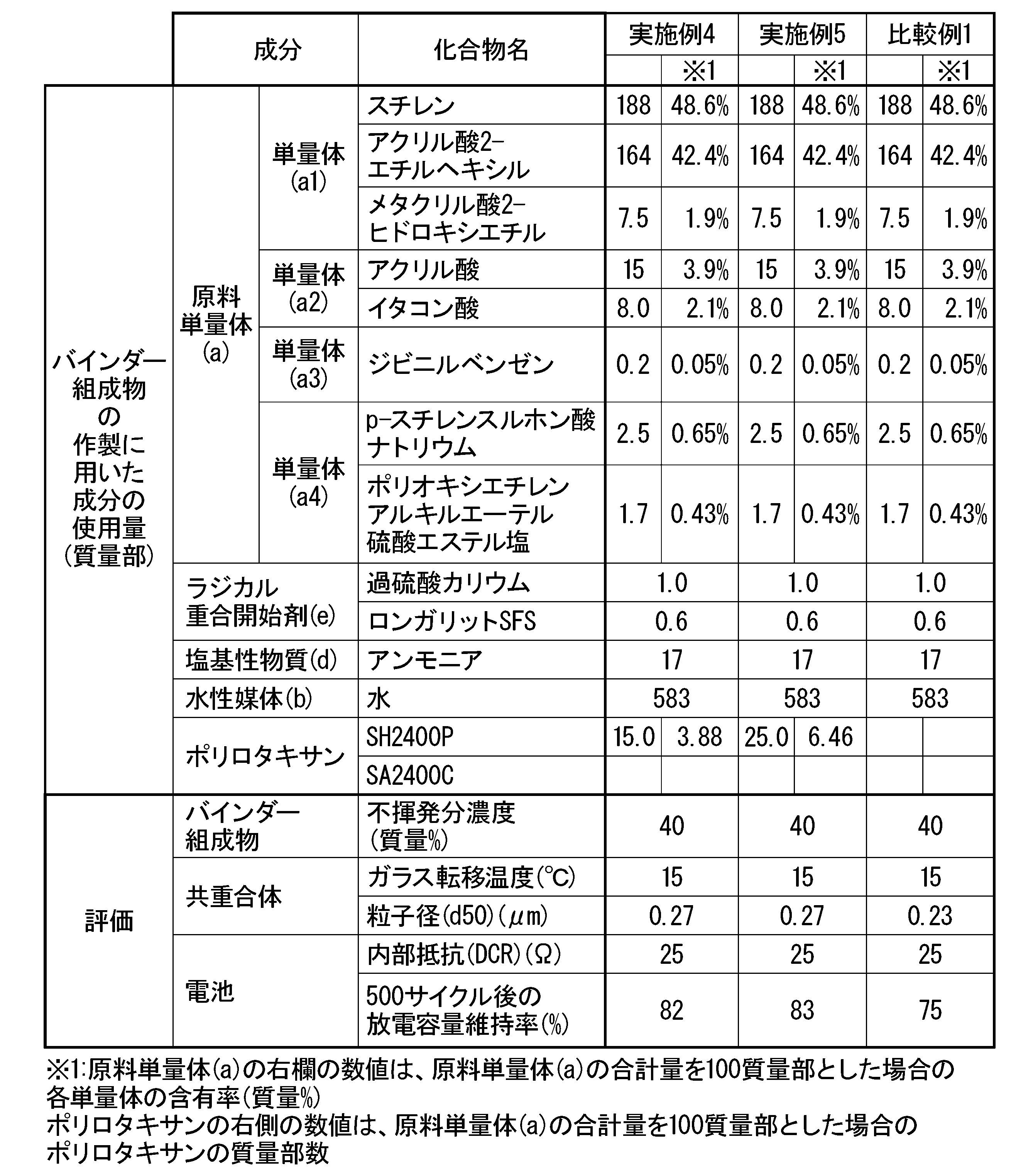
重合開始剤(e)におけるロンガリットSFSは、住友精化株式会社製のロンガリットの商品名である。
表1および表2に示すポリロタキサンのSA2400Cは、セルム(登録商標)キー・ミクスチャーSA2400C(アドバンスト・ソフトマテリアルズ株式会社製)である。
表1および表2に示す水性媒体(b)としての水の量は、非水系二次電池用バインダー組成物に含まれる水の全量(質量部)である。
実施例1~実施例5、比較例1の共重合体(P)を含む乳化粒子が水中に分散しているエマルジョン中の共重合体(P)について、それぞれ以下に示す方法により、ガラス転移温度(Tg)および粒子径(d50)を測定した。その結果を表1および表2に示す。
また、実施例1~実施例5、比較例1の非水系二次電池用バインダー組成物について、それぞれ以下に示す方法により、不揮発分濃度を測定した。その結果を表1および表2に示す。
共重合体(P)を含む乳化粒子が水中に分散しているエマルジョンを、離型PET(ポリエチレンテレフタレート)フィルム上に塗布し、50℃で5時間乾燥させる方法により、共重合体(P)からなる厚み2mmのフィルムを得た。
得られたフィルムから縦2mm、横2mmの正方形の試験片を切り出した。試験片をアルミパンに密封し、示差走査熱量計(日立ハイテクサイエンス社製 EXSTAR DSC/SS7020)を用いて、窒素ガス雰囲気下、昇温速度10℃/分で、上記試験片の示差走査熱量(DSC)測定を行った。DSC測定の温度範囲は-40℃~200℃とした。そして、DSCの温度微分として得られるDDSCチャートのピークトップ温度を測定し、この温度を共重合体(P)のガラス転移温度Tg(℃)とした。
共重合体(P)を含む乳化粒子が水中に分散しているエマルジョンを、室温にてNANOTORAC WAVE II(マイクロトラック・ベル株式会社製)を用いて、動的光散乱法(DLS)により測定することにより、共重合体(P)を含む乳化粒子の粒子径(d50)を、粒子屈折率を使用した体積基準で測定した。
共重合体(P)、ポリロタキサン及び水を含有する非水系二次電池用バインダー組成物を1g秤量し、直径5cmのアルミニウム皿上に載置し、乾燥機内に入れた。乾燥機内の空気を循環させながら、1気圧(1013hPa)、温度105℃で1時間乾燥させ、残った成分の質量を測定した。乾燥前の非水系二次電池用バインダー組成物の質量(1g)に対する、乾燥後に残った上記成分の質量割合(質量%)を算出し、不揮発分濃度(質量%)とした。
実施例1~実施例5、比較例1の非水系二次電池用バインダー組成物をそれぞれ用いて、以下に示す方法により、負極を作製し、それを用いて実施例1~実施例5、比較例1の非水系二次電池であるリチウムイオン二次電池を作製した。
正極活物質としてのLiNi0.6Mn0.2Co0.2O294質量部と、導電助剤としてのアセチレンブラック3質量部と、バインダーとしてのポリフッ化ビニリデン3質量部とを混合し、混合物を得た。得られた混合物に、N-メチルピロリドンを50質量部加えてさらに混合し、正極スラリーを得た。
正極集電体上に塗布された正極スラリーを、120℃で5分間乾燥し、ロールプレス(サンクメタル社製、プレス荷重5t/cm、ロール幅7cm)を用いてロールプレス法によりプレスを行うことにより、正極集電体の両面に正極活物質層を有する正極シートを得た。得られた正極シートを縦50mm、横40mmの長方形に切り出し、導電タブをつけて正極とした。
負極活物質としての人造黒鉛(G49、江西紫宸科技有限公司製)96.9質量部と、実施例1~実施例5、比較例1において製造したいずれかの非水系二次電池用バインダー組成物3.6質量部(不揮発分1.4質量部)と、CMC(カルボキシメチルセルロース-ナトリウム塩、日本製紙ケミカル株式会社製、サンローズ(登録商標)MAC500LC)の2質量%水溶液60質量部とを混合し、さらに水16質量部を添加し、自転公転ミキサー(ARE-310、株式会社シンキー製)を用いて混合し、負極スラリー(非水系二次電池電極用スラリー)を得た。
負極集電体上に塗布された負極スラリーを、90℃で10分間乾燥させ、ロールプレス(サンクメタル社製、プレス荷重8t/cm、ロール幅7cm)を用いて、ロールプレス法によりプレスを行った。このことにより、負極集電体の両面に負極活物質層を有する負極シートを得た。得られた負極シートを縦52mm、横42mmの長方形に切り出し、導電タブをつけて負極とした。
正極と負極との間にポリオレフィン系の多孔性フィルムからなるセパレータ(ポリエチレン製、厚み25μm)を介在させて、正極活物質層と負極活物質層とが互いに対向するように積層し、アルミラミネート材からなる外装体(電池パック)の中に収納した。その後、外装体中に電解液を注液し、真空含浸を行い、真空ヒートシーラーでパッキングすることにより、リチウムイオン二次電池を得た。
電解液としては、エチレンカーボネート(EC)とエチルメチルカーボネート(EMC)とジエチルカーボネート(DEC)とを体積比でEC:EMC:DEC=30:50:20の割合で含有する混合溶媒に、1.0mol/Lの濃度でLiPF6を溶解させた溶液99質量部と、ビニレンカーボネート(VC)1質量部とを混合したものを用いた。
実施例1~実施例5、比較例1のリチウムイオン二次電池について、それぞれ以下に示す方法により、内部抵抗および500サイクル後の放電容量維持率を評価した。その結果を表1および表2に示す。
25℃の条件下で、以下に示す手順で、リチウムイオン二次電池の内部抵抗(DCR(Ω))を測定した。すなわち、レストポテンシャルから電圧3.6Vになるまで0.2Cで定電流充電し、充電状態を初期容量の50%(SOC50%)にした。その後、0.2C、0.5C、1Cおよび2Cの各電流値で60秒間放電を行った。これらの4種の電流値(1秒間での値)と電圧の関係からSOC50%での内部抵抗DCR(Ω)を決定した。
45℃の条件下で、以下に示す工程(i)~(iv)の一連の操作1回分を1サイクルとして、充放電を行った。工程(i)および(ii)における、電流の時間積分値を充電容量とし、工程(iv)における、電流の時間積分値を放電容量とした。そして、1サイクル目の放電容量、および500サイクル目の放電容量を測定し、下記の式により、500サイクル後の放電容量維持率を算出した。
放電容量維持率(%)=100×(500サイクル目の放電容量/1サイクル目の放電容量)
(ii)電圧4.2Vで、電流0.05Cになるまで充電する(定電圧(CV)充電)。(iii)30分静置する。
(iv)電圧2.75Vになるまで電流1Cで放電する(定電流(CC)放電)。
表1および表2に示すように、実施例1~実施例5のリチウムイオン二次電池は、比較例1のリチウムイオン二次電池と比較して、いずれも容量維持率が高いことが確認できた。これは、実施例1~実施例5のリチウムイオン二次電池の負極に含まれる非水系二次電池用バインダー組成物の不揮発分が、表1および表2に示す単量体(a1)、単量体(a2)に由来する構造単位を含む共重合体(P)と、表1および表2に示すポリロタキサンとを含むことによるものと推定される。
サイクル特性に優れる非水系二次電池が得られる電極を形成できる非水系二次電池電極用スラリーを提供できる。
サイクル特性に優れる非水系二次電池が得られる非水系二次電池電極、およびこれを備えるサイクル特性に優れる非水系二次電池を提供できる。
20 電極
21 増粘剤
22 電極活物質
23 集電体
24 電極活物質層
25 バインダー
51 環状分子
52 ストッパー基
53 鎖状分子
54 修飾基
55 開口部
Claims (21)
- 共重合体と、ポリロタキサンと、を含む非水系二次電池用バインダー組成物であって、
前記共重合体は、
単量体(a1)に由来する第1構造単位と、
単量体(a2)に由来する第2構造単位と、を有し、
前記単量体(a1)は、エチレン性不飽和結合を1個のみ有するノニオン性化合物であり、
前記単量体(a2)は、カルボキシ基を有し、エチレン性不飽和結合を1個のみ有する化合物であり、
前記ポリロタキサンは、環状骨格を有する環状分子と、前記環状分子の開口部を貫通し、両末端にストッパー基をもつ鎖状分子とを有する、非水系二次電池用バインダー組成物。 - 前記環状分子における環状骨格の少なくとも一種が、クラウンエーテル骨格、環状シロキサン骨格、又は環状オリゴ糖骨格である、請求項1に記載の非水系二次電池用バインダー組成物。
- 前記環状分子における環状骨格の少なくとも一種が、α-シクロデキストリン骨格である、請求項1に記載の非水系二次電池用バインダー組成物。
- 前記ストッパー基の少なくとも一種が、ジニトロフェニル基、アダマンチル基、トリチル基、又はこれらのいずれかの基の誘導体基である、請求項1に記載の非水系二次電池用バインダー組成物。
- 前記ストッパー基の少なくとも一種が、アダマンチル基である、請求項1に記載の非水系二次電池用バインダー組成物。
- 前記鎖状分子が、ポリエチレングリコール、ポリプロピレングリコール、ポリイソプレン、ポリイソブチレン、ポリブタジエン、ポリテトラヒドロフラン、ポリアクリル酸エステル、ポリジメチルシロキサン、ポリエチレン、ポリプロピレンから選ばれる少なくとも一種である、請求項1に記載の非水系二次電池用バインダー組成物。
- 前記鎖状分子の少なくとも一種が、ポリエチレングリコールである、請求項1に記載の非水系二次電池用バインダー組成物。
- 前記鎖状分子の重量平均分子量が5,000~50,000である、請求項1に記載の非水系二次電池用バインダー組成物。
- 前記ポリロタキサンがエチレン性不飽和結合を有する、請求項1に記載の非水系二次電池用バインダー組成物。
- 前記環状骨格にエチレン性不飽和結合を含む基が結合し、
前記環状骨格に結合したエチレン性不飽和結合を含む基の少なくとも一種が、(メタ)アクリロイル基、ビニル基、アリル基、又はプロペニル基である、請求項9に記載の非水系二次電池用バインダー組成物。 - 前記環状骨格に結合したエチレン性不飽和結合を含む基の少なくとも一種が、(メタ)アクリロイル基である、請求項10に記載の非水系二次電池用バインダー組成物。
- 前記ポリロタキサンがエチレン性不飽和結合を有さない、請求項1に記載の非水系二次電池用バインダー組成物。
- 前記共重合体100質量部に対する前記ポリロタキサンの含有量が、0.10質量部以上50質量部以下である、請求項1に記載の非水系二次電池用バインダー組成物。
- 前記共重合体の全構造単位中における前記第2構造単位の含有率は、0.10質量%以上20質量%以下である、請求項1に記載の非水系二次電池用バインダー組成物。
- 前記共重合体が、単量体(a3)に由来する第3構造単位を有し、
前記単量体(a3)は、独立した複数のエチレン性不飽和結合を有する化合物である、請求項1に記載の非水系二次電池用バインダー組成物。 - 前記共重合体の全構造単位中における前記第3構造単位の含有率は、0.010質量%以上10質量%以下である、請求項15に記載の非水系二次電池用バインダー組成物。
- さらに水性媒体を含有する、
請求項1に記載の非水系二次電池用バインダー組成物。 - 前記共重合体を含む乳化粒子と、前記ポリロタキサンとが、前記水性媒体中に分散してなる、請求項17に記載の非水系二次電池用バインダー組成物。
- 請求項17に記載の非水系二次電池用バインダー組成物と、電極活物質と、を含む、非水系二次電池電極用スラリー。
- 請求項1~請求項18のいずれか一項に記載の非水系二次電池用バインダー組成物の不揮発分を含む、非水系二次電池電極。
- 請求項20に記載の非水系二次電池電極を備える、非水系二次電池。
Priority Applications (4)
| Application Number | Priority Date | Filing Date | Title |
|---|---|---|---|
| KR1020257020116A KR20250103775A (ko) | 2022-12-19 | 2023-12-11 | 비수계 이차 전지용 바인더 조성물 및 비수계 이차 전지 전극 |
| CN202380086776.7A CN120457562A (zh) | 2022-12-19 | 2023-12-11 | 非水系二次电池用粘合剂组合物和非水系二次电池电极 |
| JP2024565820A JPWO2024135437A1 (ja) | 2022-12-19 | 2023-12-11 | |
| EP23906802.6A EP4641698A1 (en) | 2022-12-19 | 2023-12-11 | Binder composition for nonaqueous secondary batteries and nonaqueous secondary battery electrode |
Applications Claiming Priority (2)
| Application Number | Priority Date | Filing Date | Title |
|---|---|---|---|
| JP2022202379 | 2022-12-19 | ||
| JP2022-202379 | 2022-12-19 |
Publications (1)
| Publication Number | Publication Date |
|---|---|
| WO2024135437A1 true WO2024135437A1 (ja) | 2024-06-27 |
Family
ID=91588482
Family Applications (1)
| Application Number | Title | Priority Date | Filing Date |
|---|---|---|---|
| PCT/JP2023/044228 Ceased WO2024135437A1 (ja) | 2022-12-19 | 2023-12-11 | 非水系二次電池用バインダー組成物および非水系二次電池電極 |
Country Status (5)
| Country | Link |
|---|---|
| EP (1) | EP4641698A1 (ja) |
| JP (1) | JPWO2024135437A1 (ja) |
| KR (1) | KR20250103775A (ja) |
| CN (1) | CN120457562A (ja) |
| WO (1) | WO2024135437A1 (ja) |
Citations (8)
| Publication number | Priority date | Publication date | Assignee | Title |
|---|---|---|---|---|
| WO1998014519A1 (fr) * | 1996-10-01 | 1998-04-09 | Nippon Zeon Co., Ltd. | Composition polymere dispersee |
| JP2000195521A (ja) * | 1998-12-28 | 2000-07-14 | Nippon Zeon Co Ltd | リチウムイオン二次電池電極用バインダ―組成物およびその利用 |
| JP2011243464A (ja) | 2010-05-19 | 2011-12-01 | Showa Denko Kk | リチウムイオン二次電池電極用バインダー、これら電極用バインダーを用いて得られるスラリー、これらスラリーを用いて得られる電極およびこれら電極を用いて得られるリチウムイオン二次電池 |
| JP2012185947A (ja) * | 2011-03-04 | 2012-09-27 | Toyo Ink Sc Holdings Co Ltd | 非水系二次電池電極用バインダー組成物 |
| JP2014239070A (ja) | 2014-08-20 | 2014-12-18 | Jsr株式会社 | リチウムイオン二次電池 |
| WO2015147282A1 (ja) * | 2014-03-28 | 2015-10-01 | 富士フイルム株式会社 | 全固体二次電池、これに用いる固体電解質組成物および電池用電極シート、ならびに電池用電極シートの製造方法および全固体二次電池の製造方法 |
| KR101816048B1 (ko) * | 2016-12-28 | 2018-02-21 | 한국과학기술원 | 리튬이차전지용 로텍세인 고분자 바인더, 이를 포함하는 전극 및 이를 포함하는 이차전지 |
| JP2019116594A (ja) | 2017-12-27 | 2019-07-18 | 株式会社日本触媒 | 塗料用樹脂エマルション及びその製造方法 |
-
2023
- 2023-12-11 KR KR1020257020116A patent/KR20250103775A/ko active Pending
- 2023-12-11 JP JP2024565820A patent/JPWO2024135437A1/ja active Pending
- 2023-12-11 WO PCT/JP2023/044228 patent/WO2024135437A1/ja not_active Ceased
- 2023-12-11 CN CN202380086776.7A patent/CN120457562A/zh active Pending
- 2023-12-11 EP EP23906802.6A patent/EP4641698A1/en active Pending
Patent Citations (8)
| Publication number | Priority date | Publication date | Assignee | Title |
|---|---|---|---|---|
| WO1998014519A1 (fr) * | 1996-10-01 | 1998-04-09 | Nippon Zeon Co., Ltd. | Composition polymere dispersee |
| JP2000195521A (ja) * | 1998-12-28 | 2000-07-14 | Nippon Zeon Co Ltd | リチウムイオン二次電池電極用バインダ―組成物およびその利用 |
| JP2011243464A (ja) | 2010-05-19 | 2011-12-01 | Showa Denko Kk | リチウムイオン二次電池電極用バインダー、これら電極用バインダーを用いて得られるスラリー、これらスラリーを用いて得られる電極およびこれら電極を用いて得られるリチウムイオン二次電池 |
| JP2012185947A (ja) * | 2011-03-04 | 2012-09-27 | Toyo Ink Sc Holdings Co Ltd | 非水系二次電池電極用バインダー組成物 |
| WO2015147282A1 (ja) * | 2014-03-28 | 2015-10-01 | 富士フイルム株式会社 | 全固体二次電池、これに用いる固体電解質組成物および電池用電極シート、ならびに電池用電極シートの製造方法および全固体二次電池の製造方法 |
| JP2014239070A (ja) | 2014-08-20 | 2014-12-18 | Jsr株式会社 | リチウムイオン二次電池 |
| KR101816048B1 (ko) * | 2016-12-28 | 2018-02-21 | 한국과학기술원 | 리튬이차전지용 로텍세인 고분자 바인더, 이를 포함하는 전극 및 이를 포함하는 이차전지 |
| JP2019116594A (ja) | 2017-12-27 | 2019-07-18 | 株式会社日本触媒 | 塗料用樹脂エマルション及びその製造方法 |
Non-Patent Citations (1)
| Title |
|---|
| See also references of EP4641698A1 |
Also Published As
| Publication number | Publication date |
|---|---|
| JPWO2024135437A1 (ja) | 2024-06-27 |
| EP4641698A1 (en) | 2025-10-29 |
| CN120457562A (zh) | 2025-08-08 |
| KR20250103775A (ko) | 2025-07-07 |
Similar Documents
| Publication | Publication Date | Title |
|---|---|---|
| JP6888656B2 (ja) | リチウムイオン電池用バインダー水溶液、リチウムイオン電池電極用スラリー及びその製造方法、リチウムイオン電池電極、並びにリチウムイオン電池 | |
| JP7323003B2 (ja) | 二次電池電極用水系バインダー組成物、二次電池電極用スラリー、バインダー、二次電池電極、および二次電池 | |
| JP7156449B2 (ja) | リチウムイオン電池負極用バインダー水溶液 | |
| JP7581782B2 (ja) | リチウムイオン電池用導電性炭素材料分散剤、リチウムイオン電池電極用スラリー、リチウムイオン電池用電極、及び、リチウムイオン電池 | |
| JP2011243464A (ja) | リチウムイオン二次電池電極用バインダー、これら電極用バインダーを用いて得られるスラリー、これらスラリーを用いて得られる電極およびこれら電極を用いて得られるリチウムイオン二次電池 | |
| JP7215348B2 (ja) | リチウムイオン電池用熱架橋性バインダー水溶液、リチウムイオン電池用電極熱架橋性スラリー、リチウムイオン電池用電極、及びリチウムイオン電池 | |
| US10249879B2 (en) | Binder composition for secondary battery electrode-use, slurry composition for secondary battery electrode-use, electrode for secondary battery-use and production method therefor, and secondary battery | |
| JP7243968B2 (ja) | 非水系電池電極用バインダー、非水系電池電極用スラリー、非水系電池電極、及び非水系電池 | |
| US8802289B2 (en) | Composition for electrode comprising an iron compound with carbon and a (meth)acrylate-nitrile copolymer | |
| JP7746853B2 (ja) | 二次電池用バインダー組成物、二次電池用スラリー組成物、二次電池用機能層および二次電池 | |
| JP2019110002A (ja) | リチウムイオン電池用バインダー水溶液、リチウムイオン電池用電極スラリー及びその製造方法、リチウムイオン電池用電極、並びにリチウムイオン電池 | |
| WO2023120066A1 (ja) | 非水系二次電池用電極バインダー共重合体、非水系二次電池用電極バインダー樹脂組成物、及び非水系二次電池電極 | |
| JP6679142B2 (ja) | リチウムイオン二次電池電極形成用組成物、リチウムイオン二次電池用電極及びリチウムイオン二次電池、並びにリチウムイオン二次電池電極形成用組成物の製造方法 | |
| US20260038836A1 (en) | Non-aqueous secondary battery binder polymer, non-aqueous secondary battery binder composition, and non-aqueous secondary battery electrode | |
| JP7758215B2 (ja) | 複合粒子、非水系二次電池用バインダー組成物および非水系二次電池電極 | |
| CN107534152B (zh) | 非水系电池电极用粘合剂用组合物、非水系电池电极用粘合剂、非水系电池电极用组合物、非水系电池电极以及非水系电池 | |
| KR20250111211A (ko) | 비수계 이차 전지 부극용 바인더 조성물 및 비수계 이차 전지 부극 | |
| JP7800446B2 (ja) | 非水系二次電池電極バインダー、非水系二次電池電極バインダー組成物、及び非水系二次電池電極 | |
| WO2024135437A1 (ja) | 非水系二次電池用バインダー組成物および非水系二次電池電極 | |
| WO2024135454A1 (ja) | 複合粒子、非水系二次電池用バインダー組成物および非水系二次電池電極 | |
| WO2024135838A1 (ja) | 非水系二次電池用バインダー組成物、非水系二次電池電極用スラリー、非水系二次電池電極、及び非水系二次電池 | |
| WO2023127300A1 (ja) | 非水系二次電池用バインダー重合体、非水系二次電池用バインダー組成物および非水系二次電池電極 | |
| WO2025134844A1 (ja) | 非水系二次電池用バインダー重合体、非水系二次電池用バインダー、非水系二次電池用バインダー組成物、非水系二次電池用電極スラリー、非水系二次電池用電極、非水系二次電池、非水系二次電池用バインダー重合体の製造方法、非水系二次電池用バインダーの製造方法、非水系二次電池用バインダー組成物の製造方法、非水系二次電池用電極スラリーの製造方法、及び非水系二次電池用電極の製造方法 | |
| WO2023127311A1 (ja) | 非水系二次電池用バインダー重合体、非水系二次電池用バインダー組成物および非水系二次電池電極 |
Legal Events
| Date | Code | Title | Description |
|---|---|---|---|
| 121 | Ep: the epo has been informed by wipo that ep was designated in this application |
Ref document number: 23906802 Country of ref document: EP Kind code of ref document: A1 |
|
| WWE | Wipo information: entry into national phase |
Ref document number: 2024565820 Country of ref document: JP |
|
| WWE | Wipo information: entry into national phase |
Ref document number: 1020257020116 Country of ref document: KR Ref document number: 202380086776.7 Country of ref document: CN |
|
| WWP | Wipo information: published in national office |
Ref document number: 1020257020116 Country of ref document: KR |
|
| WWE | Wipo information: entry into national phase |
Ref document number: 2023906802 Country of ref document: EP |
|
| NENP | Non-entry into the national phase |
Ref country code: DE |
|
| ENP | Entry into the national phase |
Ref document number: 2023906802 Country of ref document: EP Effective date: 20250721 |
|
| ENP | Entry into the national phase |
Ref document number: 2023906802 Country of ref document: EP Effective date: 20250721 |
|
| WWP | Wipo information: published in national office |
Ref document number: 202380086776.7 Country of ref document: CN |
|
| ENP | Entry into the national phase |
Ref document number: 2023906802 Country of ref document: EP Effective date: 20250721 |
|
| WWP | Wipo information: published in national office |
Ref document number: 2023906802 Country of ref document: EP |