WO2024143010A1 - 非水電解質二次電池およびこれを用いる正極 - Google Patents
非水電解質二次電池およびこれを用いる正極 Download PDFInfo
- Publication number
- WO2024143010A1 WO2024143010A1 PCT/JP2023/045142 JP2023045142W WO2024143010A1 WO 2024143010 A1 WO2024143010 A1 WO 2024143010A1 JP 2023045142 W JP2023045142 W JP 2023045142W WO 2024143010 A1 WO2024143010 A1 WO 2024143010A1
- Authority
- WO
- WIPO (PCT)
- Prior art keywords
- positive electrode
- active material
- electrode active
- polymer material
- secondary battery
- Prior art date
- Legal status (The legal status is an assumption and is not a legal conclusion. Google has not performed a legal analysis and makes no representation as to the accuracy of the status listed.)
- Ceased
Links
Images

Classifications
-
- H—ELECTRICITY
- H01—ELECTRIC ELEMENTS
- H01M—PROCESSES OR MEANS, e.g. BATTERIES, FOR THE DIRECT CONVERSION OF CHEMICAL ENERGY INTO ELECTRICAL ENERGY
- H01M10/00—Secondary cells; Manufacture thereof
- H01M10/05—Accumulators with non-aqueous electrolyte
- H01M10/052—Li-accumulators
-
- H—ELECTRICITY
- H01—ELECTRIC ELEMENTS
- H01M—PROCESSES OR MEANS, e.g. BATTERIES, FOR THE DIRECT CONVERSION OF CHEMICAL ENERGY INTO ELECTRICAL ENERGY
- H01M10/00—Secondary cells; Manufacture thereof
- H01M10/05—Accumulators with non-aqueous electrolyte
- H01M10/052—Li-accumulators
- H01M10/0525—Rocking-chair batteries, i.e. batteries with lithium insertion or intercalation in both electrodes; Lithium-ion batteries
-
- H—ELECTRICITY
- H01—ELECTRIC ELEMENTS
- H01M—PROCESSES OR MEANS, e.g. BATTERIES, FOR THE DIRECT CONVERSION OF CHEMICAL ENERGY INTO ELECTRICAL ENERGY
- H01M4/00—Electrodes
- H01M4/02—Electrodes composed of, or comprising, active material
- H01M4/13—Electrodes for accumulators with non-aqueous electrolyte, e.g. for lithium-accumulators; Processes of manufacture thereof
- H01M4/131—Electrodes based on mixed oxides or hydroxides, or on mixtures of oxides or hydroxides, e.g. LiCoOx
-
- H—ELECTRICITY
- H01—ELECTRIC ELEMENTS
- H01M—PROCESSES OR MEANS, e.g. BATTERIES, FOR THE DIRECT CONVERSION OF CHEMICAL ENERGY INTO ELECTRICAL ENERGY
- H01M4/00—Electrodes
- H01M4/02—Electrodes composed of, or comprising, active material
- H01M4/13—Electrodes for accumulators with non-aqueous electrolyte, e.g. for lithium-accumulators; Processes of manufacture thereof
- H01M4/139—Processes of manufacture
- H01M4/1391—Processes of manufacture of electrodes based on mixed oxides or hydroxides, or on mixtures of oxides or hydroxides, e.g. LiCoOx
-
- H—ELECTRICITY
- H01—ELECTRIC ELEMENTS
- H01M—PROCESSES OR MEANS, e.g. BATTERIES, FOR THE DIRECT CONVERSION OF CHEMICAL ENERGY INTO ELECTRICAL ENERGY
- H01M4/00—Electrodes
- H01M4/02—Electrodes composed of, or comprising, active material
- H01M4/36—Selection of substances as active materials, active masses, active liquids
- H01M4/48—Selection of substances as active materials, active masses, active liquids of inorganic oxides or hydroxides
- H01M4/50—Selection of substances as active materials, active masses, active liquids of inorganic oxides or hydroxides of manganese
- H01M4/505—Selection of substances as active materials, active masses, active liquids of inorganic oxides or hydroxides of manganese of mixed oxides or hydroxides containing manganese for inserting or intercalating light metals, e.g. LiMn2O4 or LiMn2OxFy
-
- H—ELECTRICITY
- H01—ELECTRIC ELEMENTS
- H01M—PROCESSES OR MEANS, e.g. BATTERIES, FOR THE DIRECT CONVERSION OF CHEMICAL ENERGY INTO ELECTRICAL ENERGY
- H01M4/00—Electrodes
- H01M4/02—Electrodes composed of, or comprising, active material
- H01M4/36—Selection of substances as active materials, active masses, active liquids
- H01M4/48—Selection of substances as active materials, active masses, active liquids of inorganic oxides or hydroxides
- H01M4/52—Selection of substances as active materials, active masses, active liquids of inorganic oxides or hydroxides of nickel, cobalt or iron
- H01M4/525—Selection of substances as active materials, active masses, active liquids of inorganic oxides or hydroxides of nickel, cobalt or iron of mixed oxides or hydroxides containing iron, cobalt or nickel for inserting or intercalating light metals, e.g. LiNiO2, LiCoO2 or LiCoOxFy
-
- H—ELECTRICITY
- H01—ELECTRIC ELEMENTS
- H01M—PROCESSES OR MEANS, e.g. BATTERIES, FOR THE DIRECT CONVERSION OF CHEMICAL ENERGY INTO ELECTRICAL ENERGY
- H01M4/00—Electrodes
- H01M4/02—Electrodes composed of, or comprising, active material
- H01M4/62—Selection of inactive substances as ingredients for active masses, e.g. binders, fillers
-
- H—ELECTRICITY
- H01—ELECTRIC ELEMENTS
- H01M—PROCESSES OR MEANS, e.g. BATTERIES, FOR THE DIRECT CONVERSION OF CHEMICAL ENERGY INTO ELECTRICAL ENERGY
- H01M4/00—Electrodes
- H01M4/02—Electrodes composed of, or comprising, active material
- H01M4/62—Selection of inactive substances as ingredients for active masses, e.g. binders, fillers
- H01M4/621—Binders
- H01M4/622—Binders being polymers
-
- H—ELECTRICITY
- H01—ELECTRIC ELEMENTS
- H01M—PROCESSES OR MEANS, e.g. BATTERIES, FOR THE DIRECT CONVERSION OF CHEMICAL ENERGY INTO ELECTRICAL ENERGY
- H01M4/00—Electrodes
- H01M4/02—Electrodes composed of, or comprising, active material
- H01M4/62—Selection of inactive substances as ingredients for active masses, e.g. binders, fillers
- H01M4/621—Binders
- H01M4/622—Binders being polymers
- H01M4/623—Binders being polymers fluorinated polymers
-
- H—ELECTRICITY
- H01—ELECTRIC ELEMENTS
- H01M—PROCESSES OR MEANS, e.g. BATTERIES, FOR THE DIRECT CONVERSION OF CHEMICAL ENERGY INTO ELECTRICAL ENERGY
- H01M50/00—Constructional details or processes of manufacture of the non-active parts of electrochemical cells other than fuel cells, e.g. hybrid cells
- H01M50/40—Separators; Membranes; Diaphragms; Spacing elements inside cells
- H01M50/409—Separators, membranes or diaphragms characterised by the material
- H01M50/411—Organic material
- H01M50/414—Synthetic resins, e.g. thermoplastics or thermosetting resins
-
- H—ELECTRICITY
- H01—ELECTRIC ELEMENTS
- H01M—PROCESSES OR MEANS, e.g. BATTERIES, FOR THE DIRECT CONVERSION OF CHEMICAL ENERGY INTO ELECTRICAL ENERGY
- H01M50/00—Constructional details or processes of manufacture of the non-active parts of electrochemical cells other than fuel cells, e.g. hybrid cells
- H01M50/40—Separators; Membranes; Diaphragms; Spacing elements inside cells
- H01M50/409—Separators, membranes or diaphragms characterised by the material
- H01M50/449—Separators, membranes or diaphragms characterised by the material having a layered structure
-
- H—ELECTRICITY
- H01—ELECTRIC ELEMENTS
- H01M—PROCESSES OR MEANS, e.g. BATTERIES, FOR THE DIRECT CONVERSION OF CHEMICAL ENERGY INTO ELECTRICAL ENERGY
- H01M50/00—Constructional details or processes of manufacture of the non-active parts of electrochemical cells other than fuel cells, e.g. hybrid cells
- H01M50/40—Separators; Membranes; Diaphragms; Spacing elements inside cells
- H01M50/46—Separators, membranes or diaphragms characterised by their combination with electrodes
-
- Y—GENERAL TAGGING OF NEW TECHNOLOGICAL DEVELOPMENTS; GENERAL TAGGING OF CROSS-SECTIONAL TECHNOLOGIES SPANNING OVER SEVERAL SECTIONS OF THE IPC; TECHNICAL SUBJECTS COVERED BY FORMER USPC CROSS-REFERENCE ART COLLECTIONS [XRACs] AND DIGESTS
- Y02—TECHNOLOGIES OR APPLICATIONS FOR MITIGATION OR ADAPTATION AGAINST CLIMATE CHANGE
- Y02E—REDUCTION OF GREENHOUSE GAS [GHG] EMISSIONS, RELATED TO ENERGY GENERATION, TRANSMISSION OR DISTRIBUTION
- Y02E60/00—Enabling technologies; Technologies with a potential or indirect contribution to GHG emissions mitigation
- Y02E60/10—Energy storage using batteries
Definitions
- the polymer material being dispersed to form a plurality of island regions in a cross section of the positive electrode active material layer, and the variance value of a Voronoi diagram obtained by Voronoi tessellating a cross section of the positive electrode active material layer for the island regions is 2 ⁇ 10 ⁇ m4 or less .
- the polymer material (P) has the effect of suppressing an increase in the positive electrode resistance at room temperature, while increasing the positive electrode resistance at high temperatures when an internal short circuit occurs in the battery. This makes it possible to achieve both high safety and good battery performance.
- the polymer material (P) has the function of cutting off part of the conductive path when an internal short circuit occurs, the short circuit current increases, and the battery temperature rises.
- the polymer material (P) maintains an island shape at room temperature and causes almost no increase in the positive electrode resistance.
- the polymer material (P) melts before the battery temperature rises excessively.
- the molten polymer material (P) diffuses within the positive electrode active material layer.
- the polymer material (P) that has diffused within the positive electrode active material layer penetrates between particles of the positive electrode active material, between particles of the positive electrode active material and the conductive additive, and between particles of the conductive additive, partially cutting off the conductive path.
- the average area (hereinafter also referred to as "aggregated particle area") of the top three island regions from the maximum area is desirably 900 ⁇ m 2 or less.
- the aggregated particle area of the island region is 900 ⁇ m 2 or less, it can be said that the dispersibility of the polymer material (P) is sufficiently large. Therefore, at high temperatures due to the occurrence of an internal short circuit, the polymer material (P) can be diffused over a wide area in the positive electrode active material layer, and the resistance can be greatly increased.
- the aggregated particle area of the island region may be 800 ⁇ m 2 or less, 700 ⁇ m 2 or less, or 400 ⁇ m 2 or less.
- the agglomerated particle area of an island region is defined as the total area of the largest, second largest, and third largest island regions among the multiple island regions included in the observation region of the cross section of the positive electrode active material layer, divided by 3.
- the size of the observation region is the same as when determining the average area of the island regions.
- the maximum area of the island region is determined as the average value of three or more agglomerated particle areas determined in at least three different observation regions (cross sections) that are parallel to each other.
- the average area, average perimeter, variance value of the Voronoi diagram, and aggregate particle area of the island regions can be measured as follows.
- Elemental analysis An elemental analysis is performed by EDX (energy dispersive X-ray spectroscopy) or EPMA (electron probe microanalyzer) using an SEM image of a cross-sectional sample.
- a mapping image of the polymer material (P) is obtained by extracting components (e.g., sulfur element) derived from the polymer material (P) from the cross-sectional analysis data.
- the average area, average perimeter, variance value of the Voronoi diagram, aggregate particle area, etc. of the island regions can be calculated by analyzing the mapping image using image analysis software.
- the mapping image can be obtained by binarizing the cross-sectional analysis data by EDX or EPMA so that the polymer material (P) is black and the other areas are white.
- a mapping image can be obtained by binarizing so that the components (e.g., sulfur element) derived from the polymer material (P) are black and the other areas are white.
- the components e.g., sulfur element
- the length of the outline surrounding the set is the perimeter of the island-like area
- the length of the outline surrounding the single black area is the perimeter of the island-like area
- the area enclosed by each outline is the area of the island-like area.
- the measurement equipment used may be a JSM-7900F (field emission scanning electron microscope) manufactured by JEOL Ltd. and an XM-86030 (EPMA detector) manufactured by JEOL Ltd.
- the accelerating voltage during analysis is 8 kV, and the SEM accelerating voltage is 2 kV.
- the electron beam current is 5 ⁇ 10 ⁇ 8 A, and the observation magnification is 300 times.
- the measurement time is 30 ms.
- regions where the X-ray intensity of the component (e.g., elemental sulfur) derived from the polymer material (P) detected under the above conditions is 50 or more may be binarized as black, and regions where the X-ray intensity is less than 50 may be binarized as white.
- Regions where the X-ray detection count is 50 cps or more and the signal/noise intensity ratio is 1.5 or more may be binarized as black, and other regions may be binarized as white.
- the melting point or thermal decomposition temperature (diffusion temperature) of the polymer material (P) is 200°C or higher and 500°C or lower.
- the positive electrode active material layer usually contains a polymer material that functions as a binder in addition to the polymer material (P). However, the binder has higher binding properties than the polymer material (P). The binder does not need to form an island region. In other words, the positive electrode active material layer may contain a polymer material that forms an island region and a polymer material that does not form an island region.
- the binder may be a polymer that does not melt or thermally decompose at a diffusion temperature of 200°C or higher and 500°C or lower.
- the diffusion temperature of the polymer material (P) is lower than 200°C, the polymer material (P) may melt or decompose during normal battery use or during the manufacturing process, leading to deterioration of battery performance. If the diffusion temperature of the polymer material (P) exceeds 500°C, the diffusion speed of the polymer material (P) decreases when the temperature increases, and therefore a sufficient resistance increase effect cannot be obtained.
- the polymer material (P) is preferably a linear polymer that does not have a cross-linked structure.
- a linear polymer that does not have a cross-linked structure has a large degree of freedom, so it is likely to diffuse within the positive electrode active material layer at high temperatures and is likely to decompose. Therefore, the polymer material (P) is likely to penetrate between particles of the positive electrode active material, between particles of the positive electrode active material and the conductive additive, and between particles of the conductive additive, and the conductive path is likely to be partially blocked.
- the polymer material (P) is a powder before being mixed into the positive electrode mixture.
- the average particle diameter (D50) of the particles of the polymer material (P) constituting the powder is desirably 50 ⁇ m or less. By having the average particle diameter (D50) of 50 ⁇ m or less, it becomes easier to control the average area, average perimeter, maximum area, Voronoi variance value, etc., described above, within the desired numerical range.
- the average particle diameter (D50) is more desirably 40 ⁇ m or less, and even more desirably 30 ⁇ m or less.
- the lower limit of the average particle diameter (D50) is not particularly limited, but may be, for example, 1 ⁇ m or more.
- the average particle diameter (D50) of the polymer material (P) refers to the median diameter when the cumulative volume is 50% in the volume-based particle size distribution of the polymer material (P).
- the volume-based particle size distribution of the polymer material (P) can be measured, for example, by a laser diffraction scattering type particle size distribution measuring device.
- the sample of the polymer material (P) to be measured may be prepared by separating it from the positive electrode active material layer, or, if the raw material polymer material (P) before being mixed with the positive electrode active material layer is available, the raw material polymer material (P) may be used.
- the BET specific surface area of the polymer material (P) is preferably 10 m 2 /g or less.
- the BET specific surface area is influenced by the particle size of the polymer material (P), but is also greatly influenced by the state of the particles themselves. For example, when the particle surface has many irregularities or when the particles themselves are porous, the BET specific surface area is large even if the average particle size (D50) is small.
- the BET specific surface area is 10 m 2 /g or less, it is considered that the particle surface of the polymer material (P) has few irregularities or the particles themselves do not contain many voids.
- the BET specific surface area may be 5 m 2 /g or less, 2 m 2 /g or less, or 1.8 m 2 /g or less.
- the weight average molecular weight (Mw) of the polymeric material (P) can be measured, for example, by ultra-high temperature gel permeation chromatography (GPC), where Mw is the weight average molecular weight based on polystyrene.
- GPC ultra-high temperature gel permeation chromatography
- the acquired data (peak) may overlap with the blank derived from the GPC eluent on the low molecular weight side of the polymer material (P), but the entire peak, including this overlap, is analyzed to calculate the weight average molecular weight.
- the polymer includes a repeating structure represented by the formula (n is any integer). In the case of a polymer, n is usually 20 or more, or 30 or more. Such a simple structure has high chemical stability and hardly causes side reactions in the positive electrode active material layer.
- the polymer material (PS) having the structure represented by the above formula is usually a linear polymer without a crosslinked structure, has a large degree of freedom when melted, and has high diffusibility in the positive electrode active material layer after melting.
- the polymer material (PS) having such a structure is highly insulating, and is considered to have a large effect of blocking the conductive path when it penetrates between particles of the positive electrode active material, between particles of the positive electrode active material and the conductive assistant, and between particles of the conductive assistant.
- PS polymer material
- PPS polyphenylene sulfide
- the polymer material (P) may be unevenly distributed on the outermost surface side (i.e., the separator side) of the positive electrode active material layer, rather than on the positive electrode current collector side.
- An internal short circuit in a battery often begins to expand on the separator side of the positive electrode active material layer.
- An internal short circuit occurs, for example, when a conductive foreign object penetrates the separator.
- the region of the positive electrode active material layer from the surface of the positive electrode current collector to 0.5 T is referred to as the "lower layer region,” and the region of the positive electrode active material layer from the position 0.5 T from the surface of the positive electrode current collector to the outermost surface is also referred to as the "upper layer region.”
- the "observation region” should be set as close to the center as possible, including the center in the thickness direction of the "upper layer region.” On the other hand, if 1 ⁇ Pb/Pt is satisfied, the “observation region” should be set as close to the center as possible, including the center in the thickness direction of the "lower layer region.” Furthermore, if the distribution of the polymer material (P) is substantially free of the above-mentioned uneven distribution, the "observation region” should be set as close to the center as possible, including the center of the overall thickness T of the positive electrode active material layer (a point 0.5T from the surface of the positive electrode current collector).
- the content of the polymer material (P) contained in the other region can be made very small.
- a small amount of polymer material (P) can efficiently increase the resistance of the positive electrode active material layer when heated, and can suppress the expansion of short-circuited areas and increases in short-circuit current.
- This type of configuration is desirable in that it makes it easier to maintain a high capacity of the positive electrode.
- Pb and Pt can be measured by analyzing a cross-sectional sample of the positive electrode obtained by the above-mentioned method with SEM and EDX (or EPMA). Specifically, a mapping image of the polymer material (P) obtained from the EDX analysis data of the cross-sectional sample is prepared. In the mapping images of the lower layer region and the upper layer region, the area occupied by the component derived from the polymer material (P) (e.g., elemental sulfur) is measured as the area of the polymer material (P). The ratio of the area of the polymer material (P) to the area of the lower layer region and the upper layer region is regarded as Pb and Pt, respectively.
- SEM and EDX or EPMA
- the polymer material (P) may be unevenly distributed by overcoating it on the outermost surface side (i.e., the separator side) of the positive electrode active material layer.
- the existence probability Pb(q) of the polymer material (P) existing in the region from the surface of the positive electrode current collector to 0.25T in the positive electrode active material layer and the existence probability Pt(q) of the polymer material (P) existing in the region from a position 0.75T from the surface of the positive electrode current collector to the outermost surface (i.e., the separator side surface of the positive electrode active material layer) in the positive electrode active material layer may satisfy 5 ⁇ Pt(q)/Pb(q) ⁇ 250.
- the positive electrode slurry is prepared by mixing a positive electrode mixture containing a positive electrode active material, a binder, a conductive assistant, and a polymer material (P) with a liquid dispersion medium and dispersing it in the dispersion medium.
- the positive electrode mixture may further contain other components.
- As the liquid dispersion medium an organic solvent having excellent affinity with the binder is used.
- the nonaqueous electrolyte secondary battery includes the positive electrode, the negative electrode, the nonaqueous electrolyte, and a separator interposed between the positive electrode and the negative electrode.
- the nonaqueous electrolyte secondary battery may be a liquid secondary battery containing an electrolytic solution as an electrolyte, or may be an all-solid-state secondary battery containing a solid electrolyte as an electrolyte.
- the configuration of the secondary battery will be specifically described below using a lithium ion secondary battery as an example.
- the positive electrode has the above-mentioned characteristics.
- the positive electrode active material layer is composed of a positive electrode mixture.
- the positive electrode mixture contains a positive electrode active material, a binder, and a polymer material (P) as essential components, and may contain optional components.
- the optional components may include a conductive assistant, a thickener, etc.
- the proportion of Co among the metal elements other than Li contained in the composite oxide N is preferably 0 atomic % or more and 20 atomic % or less, and more preferably 0 atomic % or more and 15 atomic % or less.
- the proportion of Al in the metal elements other than Li may be 10 atomic % or less, or 5 atomic % or less.
- the proportion of Al in the metal elements other than Li may be 1 atomic % or more, or 3 atomic % or more, or 5 atomic % or more.
- v representing the atomic ratio of Ni is, for example, 0.8 or more, or may be 0.85 or more, or 0.90 or more, or 0.95 or more. Also, v representing the atomic ratio of Ni may be 0.98 or less, or may be 0.95 or less.
- Anode active materials include materials that electrochemically absorb and release lithium ions, lithium metal, lithium alloys, etc.
- Carbon materials, alloy-based materials, etc. are used as materials that electrochemically absorb and release lithium ions.
- Examples of carbon materials include graphite, graphitizable carbon (soft carbon), and non-graphitizable carbon (hard carbon). Among them, graphite is preferred because of its excellent charge/discharge stability and low irreversible capacity.
- Alloy-based materials include those that contain at least one metal that can form an alloy with lithium, and specific examples include silicon, tin, silicon alloys, tin alloys, and silicon compounds. Silicon oxide, tin oxide, etc. may also be used, and other silicon-containing materials may also be used.
- a non-porous conductive substrate such as metal foil
- a porous conductive substrate such as mesh, net, or punched sheet
- materials for the negative electrode current collector include stainless steel, nickel, nickel alloys, copper, and copper alloys.
- Conductive additives include carbon nanotubes (CNTs), carbon fibers other than CNTs, and conductive particles (e.g., carbon black and graphite).
- CNTs carbon nanotubes
- conductive particles e.g., carbon black and graphite
- the separator is interposed between the positive electrode and the negative electrode.
- the separator has high ion permeability and has appropriate mechanical strength and insulation properties.
- Examples of the separator include a microporous thin film, a woven fabric, and a nonwoven fabric.
- the separator is made of a polyolefin such as polypropylene or polyethylene.
- the melting point or thermal decomposition temperature (diffusion temperature) of the polymer material (P) is equal to or higher than the melting point of the substrate layer.
- Thermoplastic resins having a melting point are usually used as the material for the substrate layer. Among them, polyolefins such as polypropylene and polyethylene are preferably used.
- Substrate layers made of thermoplastic resins are generally provided with a shutdown function that closes the voids in the substrate layer when the temperature exceeds a certain temperature. In other words, until the shutdown function is activated, current is allowed to flow through the battery, and it is required to have sufficient performance as a power source. If the diffusion temperature of the polymer material (P) is lower than the melting point of the substrate layer, the resistance of the positive electrode active material layer due to the polymer material (P) will increase, and there is a risk that sufficient performance as a power source cannot be secured.
- the thickness of the substrate layer may be, for example, 0% to 100% of the thickness of the separator, for example, 5 ⁇ m to 20 ⁇ m.
- a separator composed only of a heat-resistant layer may be used.
- the thickness of the heat-resistant layer may be, for example, 0% to 100% of the thickness of the separator, for example, 0 ⁇ m to 15 ⁇ m.
- Non-aqueous electrolyte The non-aqueous electrolyte of the lithium ion secondary battery has lithium ion conductivity and may be a liquid electrolyte (electrolytic solution) or a solid electrolyte.
- FIG. 1 is a vertical cross-sectional view of a cylindrical nonaqueous secondary battery 10, which is an example of this embodiment.
- the present disclosure is not limited to the following configuration.
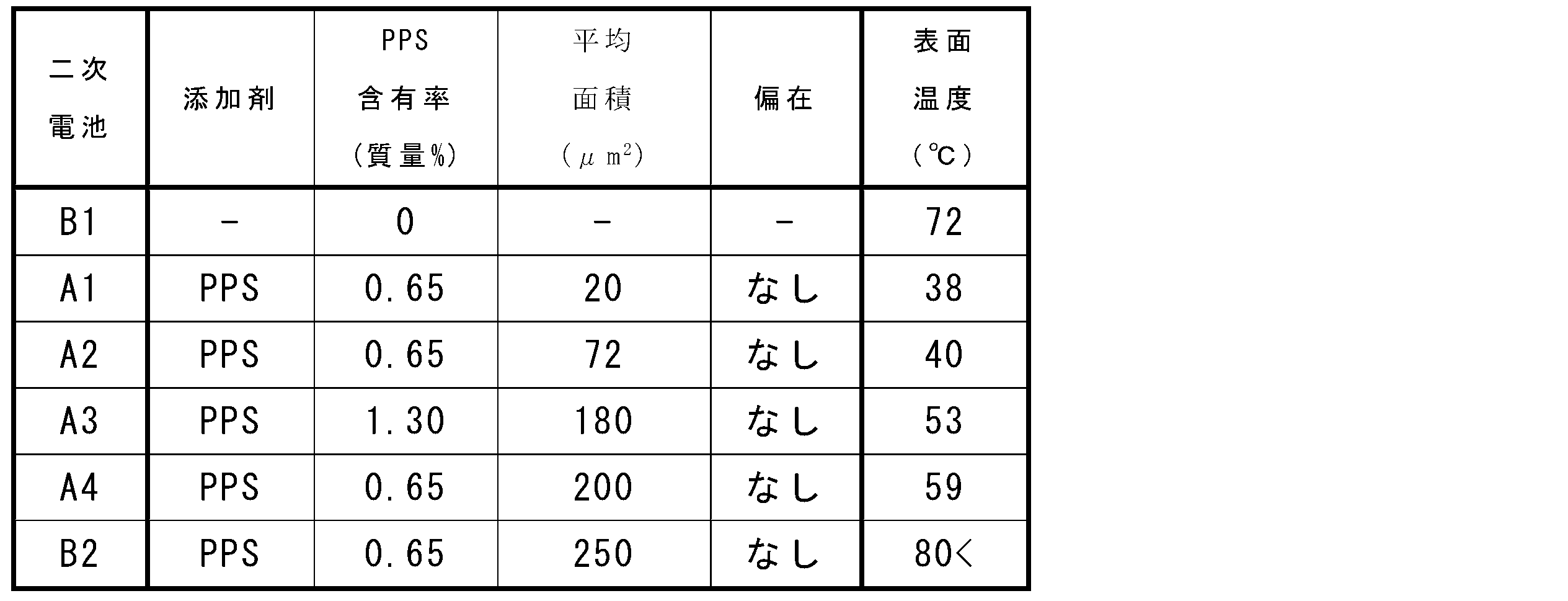
- samples R1b to R4b have significantly lower surface temperatures than samples B1 and B2, and it can be seen that this has further improved safety in the event of an internal short circuit occurring in the battery, with almost no effect on the battery capacity.
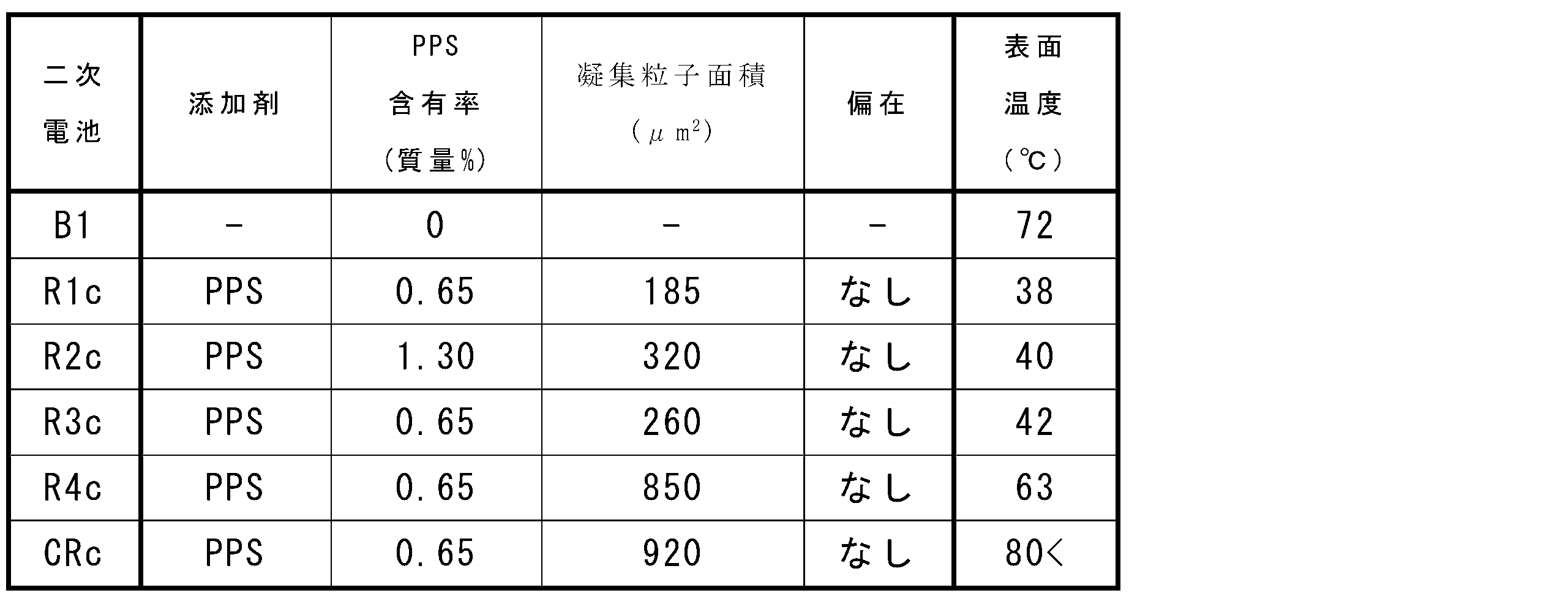
- samples R1c to R4c have significantly lower surface temperatures than samples B1 and B2, which indicates that safety can be further improved in the event of an internal short circuit in the battery.
- samples R1e to R4e have significantly lower surface temperatures than samples B1 and CRe. It can also be seen that reducing the BET specific surface area can improve safety in the event of an internal short circuit in the battery.
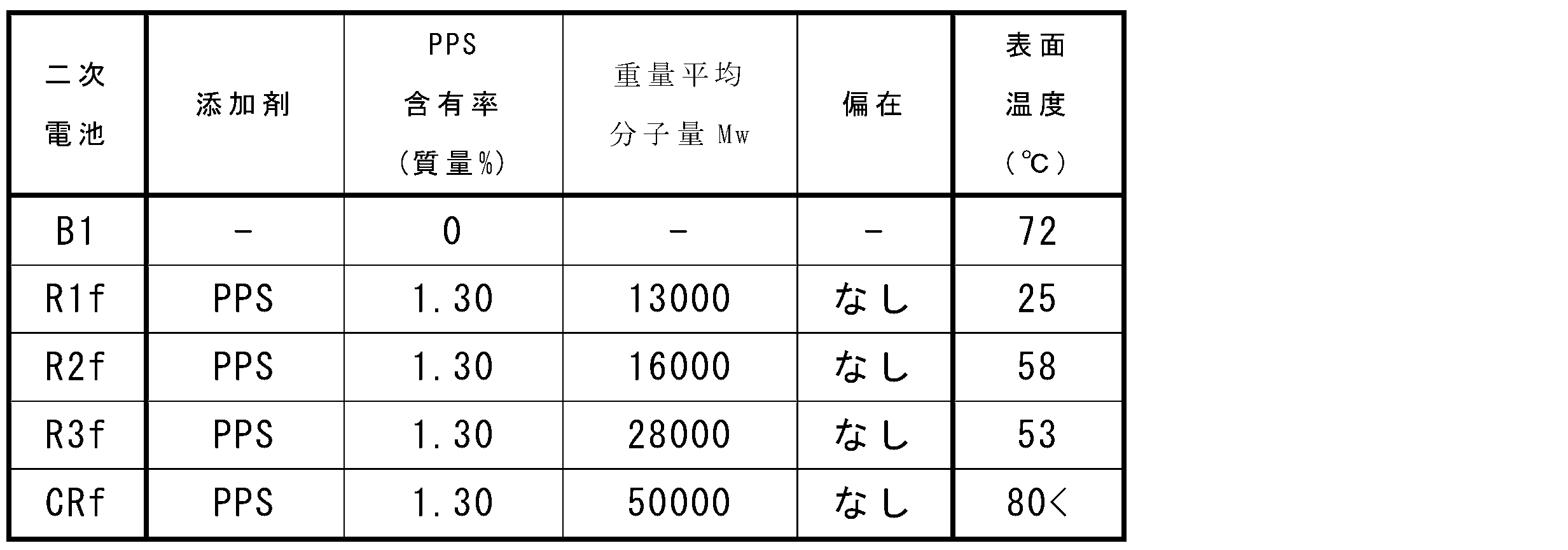
- samples R1f to R3f have significantly lower surface temperatures than samples B1 and CRf. It can also be seen that reducing the weight-average molecular weight Mw can improve safety in the event of an internal short circuit in the battery.
- Example R1g>> A secondary battery sample R1g was produced in the same manner as sample A1, except that the separator was changed to a separator having a substrate layer of a 10 ⁇ m-thick microporous thin film made of polyethylene and a heat-resistant layer laminated on one side (positive electrode side) of the substrate layer, and was evaluated in the same manner.
- the melting point of the microporous thin film was 150°C, and that of the PPS was 280°C.
- the heat-resistant layer contained 20% by mass of inorganic oxide filler (alumina), with the remainder being aromatic polyamide (aramid), and had a thickness of 4 ⁇ m.
- Example CR 1g, 2g>> Secondary battery samples CR1g and CR2g were prepared in the same manner as samples R1g and R2g, except that the separator was changed to a 13 ⁇ m-thick microporous thin polyethylene film without a heat-resistant layer, and were evaluated in the same manner.
- Example CR3g>> A secondary battery sample CR3g was prepared in the same manner as sample CR1g, except that the positive electrode mixture did not contain the polymer material (P).
- the nonaqueous electrolyte secondary battery according to the present disclosure is useful as a main power source for mobile communication devices, portable electronic devices, electric vehicles, and the like.
Landscapes
- Chemical & Material Sciences (AREA)
- Chemical Kinetics & Catalysis (AREA)
- Electrochemistry (AREA)
- General Chemical & Material Sciences (AREA)
- Engineering & Computer Science (AREA)
- Manufacturing & Machinery (AREA)
- Materials Engineering (AREA)
- Inorganic Chemistry (AREA)
- Battery Electrode And Active Subsutance (AREA)
- Secondary Cells (AREA)
Abstract
Description
本発明の新規な特徴を添付の請求の範囲に記述するが、本発明は、構成および内容の両方に関し、本発明の他の目的および特徴と併せ、図面を照合した以下の詳細な説明によりさらによく理解されるであろう。
正極は、正極集電体と、正極集電体に担持された正極活物質層とを備える。正極活物質層は、正極集電体の表面に形成される。正極活物質層は、正極合剤で構成されるため正極合剤層と称してもよい。
正極集電体は、シート状の導電性材料で構成される。正極集電体としては、無孔の導電性基板(金属箔など)、多孔性の導電性基板(メッシュ、ネット、パンチングシートなど)が使用される。
正極活物質層は、正極集電体の一方または両方の表面に担持されている。正極活物質層は、正極活物質と、結着剤と、添加剤とを含み、更に導電助剤を含んでもよい。添加剤は、200℃以上500℃以下の融点または熱分解温度(以下、「融点または熱分解温度」を「拡散温度」と総称することがある。)を有するポリマー材料である。
島状領域の平均面積は、200μm2以下であってもよい。島状領域の平均面積が200μm2以下である場合、ポリマー材料(P)の分散性が高く、高温時に正極活物質層内の広い領域に十分に拡散でき、抵抗を大きく上昇させることができる。島状領域の平均面積は、120μm2以下でもよく、60μm2以下でもよく、50μm2以下でもよく、30μm2以下でもよい。島状領域の平均面積の下限は、特に限定されないが、例えば、10μm2以上でもよい。
次に、島状領域の平均周囲長は、60μm以下であることが望ましい。島状領域の平均周囲長が60μm以下である場合、複数の島状領域の大きさは十分に小さいと考えられる。平均周囲長が十分に小さいとき、ポリマー材料(P)の分散性は十分に大きく、内部短絡の発生による高温時に正極活物質層内の広い領域にわたってポリマー材料(P)が拡散できる。よって、正極抵抗を大きく上昇させることができる。島状領域の平均周囲長は、60μm以下でもよく、40μm以下でもよく、30μm以下でもよく、20μm以下でもよい。島状領域の平均周囲長の下限は、特に限定されないが、例えば、1μm以上でもよい。
次に、観察領域を島状領域についてボロノイ分割したときのボロノイ図の分散値(以下、「ボロノイ分散値」とも称する。)は、2×107μm4以下である。ボロノイ分散値が小さいほど、分散性が良好であるといえる。ボロノイ分散値が2×107μm4以下である場合には、内部短絡の発生による高温時に正極活物質層内の広い領域にわたってポリマー材料(P)が拡散できる。よって、正極抵抗を大きく上昇させることができる。ボロノイ分散値は、2×106μm4以下でもよく、2×105μm4以下でもよく、1×105μm4以下でもよく、5×104μm4以下でもよい。ボロノイ分散値の下限は、特に限定されないが、例えば、1×104μm4以上でもよい。
次に、正極活物質層における各島状領域のうち、面積最大から上位3つの島状領域の平均面積(以下、「凝集粒子面積」とも称する。)は、900μm2以下であることが望ましい。島状領域の凝集粒子面積が900μm2以下である場合、ポリマー材料(P)の分散性は十分に大きいといえる。よって、内部短絡の発生による高温時に正極活物質層内の広い領域にわたってポリマー材料(P)が拡散でき、抵抗を大きく上昇させることができる。島状領域の凝集粒子面積は、800μm2以下でもよく、700μm2以下でもよく、400μm2以下でもよい。島状領域の凝集粒子面積の下限は、特に限定されないが、例えば、100μm2以上でもよい。最大面積から上位3つの島状領域は、ポリマー材料(P)の凝集領域もしくはポリマー材料(P)と正極活物質や導電助剤との凝集領域であると考えられる。そのような凝集領域の面積を十分に小さくすることで、ポリマー材料(P)の分散性が顕著に高められる。
まず、測定対象の正極を準備する。次に、正極活物質層と正極集電体とを同時に正極の厚さ方向に沿って切断して断面を形成する。その際、正極活物質層に熱硬化性樹脂を充填して硬化させてもよい。例えば、CP(クロスセクションポリッシャ)法、FIB(集束イオンビーム)法等により正極活物質層の断面試料を得る。
次に、正極活物質層の断面試料をSEMで観察する。SEMによる観察は、例えば、倍率100倍~500倍で行う。SEM像は、正極活物質層の面方向における長さ200μm以上(望ましくは300μm以上)の領域が観測されるように撮影する。
断面試料のSEM像を用いてEDX(エネルギー分散型X線分光分析)またはEPMA(電子プローブマイクロアナライザー)による元素分析を行う。断面の分析データからポリマー材料(P)に由来する成分(例えば硫黄元素)を抽出することで、ポリマー材料(P)のマッピング画像が得られる。画像解析ソフトを用いてマッピング画像を解析することで、島状領域の平均面積、平均周囲長、ボロノイ図の分散値、凝集粒子面積等を算出できる。マッピング画像は、EDXまたはEPMAによる断面の分析データをポリマー材料(P)が黒色、ポリマー材料(P)以外が白色になるように2値化処理すれば得ることができる。例えば、観測エリアを256×256分割した各領域においてEDXによる分析を行った際に、ポリマー材料(P)に由来する成分(例えば硫黄元素)が黒色、それ以外の領域が白色になるように2値化することで、マッピング画像を得ることができる。縦、横または斜めに隣接する2つ以上の黒色領域からなる集合を1つの島状領域と設定した場合には、その集合を囲う輪郭の長さが島状領域の周囲長であり、1つの単独の黒色領域を1つの島状領域と設定した場合には、その1つ黒色領域を囲う輪郭の長さが島状領域の周囲長であり、各輪郭で囲まれた面積が島状領域の面積である。
まず、2値化された画像のボロノイ分割処理を画像解析ソフトで行う。ボロノイ分割処理では、独立した各島状領域の各中心を抽出し、複数個の中心に対して、同一距離空間上の他の点がどの中心に近いかによって複数領域(以下、「ボロノイ領域」とも称する。)に分割する。ボロノイ領域の境界は、各中心同士の二等分線の軌跡に相当する。その後、各ボロノイ領域の面積を抽出し、それらの分散値をボロノイ分散値とする。分散値Vは、各ボロノイ領域の面積をXi(i=1,2,・・・n)、平均をXaveとしたとき、下記式から求められる。
V=1/nΣ(Xi-Xave)2
以下に、正極活物質層の断面試料の分析の望ましいSEM-EPMA測定条件を示す。
加工装置として日本電子社製、IB-19520CCP(クロスセクションポリッシャ)を用い得る。加工条件は加速電圧6kVである。電流値は150~180μAである。真空度を5×10⁻⁴~2×10⁻³Paとする。
以下、望ましいポリマー材料(P)について例示的に説明する。
ポリマー材料(P)は、正極合剤に混合される前の状態では粉体である。粉体を構成するポリマー材料(P)の粒子の平均粒子径(D50)は50μm以下であることが望ましい。平均粒子径(D50)が50μm以下であることで、既述の平均面積、平均周囲長、最大面積、ボロノイ分散値などを所望の数値範囲内に制御しやすくなる。平均粒子径(D50)は、40μm以下がより望ましく、30μm以下が更に望ましい。平均粒子径(D50)の下限は、特に限定されないが、例えば、1μm以上でもよい。
ポリマー材料(P)のBET比表面積は10m2/g以下であることが望ましい。BET比表面積は、ポリマー材料(P)の粒子径の影響を受けるが、粒子自体の状態が大きく影響する。例えば、粒子表面に多くの凹凸を有する場合や、粒子自体が多孔質である場合には、平均粒径(D50)が小さくても、BET比表面積は大きくなる。BET比表面積が10m2/g以下である場合には、ポリマー材料(P)の粒子表面の凹凸が少なく、もしくは粒子自体が多くの空隙を内包していないと考えられる。その場合、加熱時のポリマー材料(P)に膨張応力が強く作用し、加熱時の拡散性が高められるものと推測される。BET比表面積は、5m2/g以下でもよく、2m2/g以下でもよく、1.8m2/g以下でもよい。
ポリマー材料(P)の重量平均分子量(Mw)は、Mw<50000を満たすことが望ましく、5000≦Mw<50000を満たすことがより望ましい。重量平均分子量(Mw)がMw<50000(更には5000≦Mw<50000)を満たすことで、加熱時のポリマー材料(P)の溶融速度が速くなり、分散性が高められるとともに、熱分解が進行しやすくなるため、正極活物質層の抵抗を高める作用が大きくなる。Mwは、30000以下がより望ましく、20000以下が更に望ましく、15000以下でもよい。
以下、ポリマー材料(P)の好ましい例について説明する。
ポリマー材料(P)の中でも、フェニレン基とスルフィド基を含む主鎖を有するポリマー材料(P)(以下、「ポリマー材料(PS)」とも称する。)は、化学的安定性が高く、他材料との結合を生じにくいため、正極活物質層内では正極活物質の粒子を過度に被覆せず、島状領域を形成しやすい。また、ポリマー材料(PS)は、融点以上で融解するときの状態変化が大きく、正極活物質層内での高い拡散性を発現し得る。ポリマー材料(PS)を用いる場合、SEM-EDX、SEM-EPMA等の元素分析では、ポリマー材料(P)に由来する成分として硫黄原子を用い得る。

次に、本開示の実施形態に係る正極の製造方法の一例について説明する。
当該製造方法は、正極活物質と、結着剤と、導電助剤と、ポリマー材料(P)と、分散媒と、を含む正極スラリーを調製する工程(I)と、正極集電体を準備する工程(II)と、前記正極集電体の表面に前記正極スラリーを塗布して塗膜を形成する工程(III)と、前記塗膜を乾燥して、未圧延層を形成する工程(IV)と、前記未圧延層を圧延して、正極活物質層を形成する工程(V)と、を具備する。
正極スラリーは、正極活物質、結着剤、導電助剤およびポリマー材料(P)を含む正極合剤を、液状の分散媒と混合して分散媒に分散させることにより調製される。正極合剤は、更に、別の成分を含んでもよい。液状の分散媒としては、結着剤との親和性に優れる有機溶媒を用いる。
正極集電体としては、シート状の導電性材料(金属箔、メッシュ、ネット、パンチングシートなど)が使用される。中でも金属箔が好ましい。正極集電体の材質としては、例えば、ステンレス鋼、アルミニウム、アルミニウム合金、チタンなどが例示できる。正極集電体の厚さは、特に限定されないが、例えば、1~50μmであり、5~30μmであってもよい。
正極スラリーを、正極集電体の表面に塗布することにより塗膜が形成される。正極スラリーの塗布装置としては、例えば、バーコータ、グラビアコータ、ブレードコータ、ロールコータ、コンマコータ、ダイコータ、リップコータ等が用いられる。正極活物質層の下層領域又は上層領域にポリマー材料(P)を偏在させる場合には、ポリマー材料(P)の含有率の異なる複数の正極スラリーを調製し、これらスラリーを二層以上塗り重ねて、厚さ方向においてポリマー材料(P)の濃度を変化させてもよい。
次に、塗膜を乾燥させ、分散媒を揮散させて、未圧延塗膜を形成する。例えば150℃以上、更には180℃以上の温度で塗膜を乾燥させる場合、ポリマー材料(P)が正極活物質層の正極集電体側よりもセパレータ側に偏在した状態になりやすい。
次に、未圧延層を圧延して、正極活物質層を形成する。圧延の条件は、特に限定されないが、正極活物質層における正極活物質の密度は、例えば3.3g/cm3以上4.0g/cm3以下であり、3.5g/cm3以上4.0g/cm3以下でもよい。
本開示の実施形態に係る非水電解質二次電池は、上記正極、負極、非水電解質、および、正極と負極との間に介在するセパレータを備える。非水電解質二次電池は、電解質として電解液を含む液式二次電池でもよく、電解質として固体電解質を含む全固体二次電池でもよい。以下では、リチウムイオン二次電池を例に挙げて、二次電池の構成を具体的に説明する。
正極としては、既述の特徴を有する正極を用いる。正極活物質層は、正極合剤で構成される。正極合剤は、必須成分として、正極活物質、結着剤およびポリマー材料(P)を含み、任意成分を含んでもよい。任意成分としては、導電助剤、増粘剤等を含み得る。
負極は、少なくとも負極集電体を含み、例えば、負極集電体と負極活物質層とを含む。負極活物質層は、負極集電体の一方または両方の表面に担持されている。
セパレータは、正極と負極との間に介在する。セパレータは、イオン透過度が高くて適度な機械的強度および絶縁性を備えている。セパレータとしては、微多孔薄膜、織布、不織布などが挙げられる。セパレータの材質には、例えばポリプロピレン、ポリエチレンなどのポリオレフィンが用いられる。
リチウムイオン二次電池の非水電解質は、リチウムイオン伝導性を有する。非水電解質は、液状の電解質(電解液)であってもよく、固体電解質であってもよい。
上記記載によって以下の技術が開示される。
(技術1)
正極、負極、非水電解質、および、前記正極と前記負極との間に介在するセパレータを備え、
前記正極は、正極集電体と、前記正極集電体に担持された正極活物質層と、を備え、
前記正極活物質層は、正極活物質と、結着剤と、添加剤と、を含み、
前記添加剤は、200℃以上500℃以下の融点または熱分解温度を有するポリマー材料であり、
前記正極活物質層の断面において前記ポリマー材料が複数の島状領域を形成して分散しており、
前記正極活物質層の断面を、前記島状領域についてボロノイ分割したときのボロノイ図の分散値が、2×107μm4以下である、非水電解質二次電池。
(技術2)
前記島状領域の平均周囲長が、60μm以下である、技術1に記載の非水電解質二次電池。
(技術3)
前記島状領域の平均面積が、200μm2以下である、技術1または2に記載の非水電解質二次電池。
(技術4)
面積が最大から上位3つの前記各島状領域の平均面積が900μm2以下である、技術1~3のいずれか1つに記載の非水電解質二次電池。
(技術5)
前記ポリマー材料の平均粒子径が、50μm以下である、技術1~4のいずれか1つに記載の非水電解質二次電池。
(技術6)
前記ポリマー材料のBET比表面積が、10m2/g以下である、技術1~5のいずれか1つに記載の非水電解質二次電池。
(技術7)
前記ポリマー材料の重量平均分子量(Mw)が、Mw≦50000を満たす、技術1~6のいずれか1つに記載の非水電解質二次電池。
(技術8)
前記ポリマー材料は、フェニレン基とスルフィド基を含む主鎖を有する、技術1~7のいずれか1つに記載の非水電解質二次電池。
(技術9)
前記主鎖は、式:

(技術10)
前記ポリマー材料は、ポリフェニレンスルファイド(Polyphenylene sulfide)を含む、技術1~9のいずれか1つに記載の非水電解質二次電池。
(技術11)
前記ポリマー材料は、質量割合で10ppm以上1000ppm以下の塩化物イオンを含む、技術1~10のいずれか1つに記載の非水電解質二次電池。
(技術12)
前記正極活物質層に含まれる前記ポリマー材料の含有率が、0.01質量%以上5質量%以下である、技術1~11のいずれか1つに記載の非水電解質二次電池。
(技術13)
前記正極活物質層の厚さをTとするとき、
前記正極活物質層の前記正極集電体の表面から0.5Tまでの領域に存在する前記ポリマー材料の存在確率Pbと、
前記正極活物質層の前記正極集電体の表面から0.5Tの位置から前記最表面までの領域に存在する前記ポリマー材料の存在確率Ptとは、1<Pt/Pbを満たす、技術1~12のいずれか1つに記載の非水電解質二次電池。
(技術14)
前記正極活物質層の厚さをTとするとき、
前記正極活物質層の前記正極集電体の表面から0.5Tまでの領域に存在する前記ポリマー材料の存在確率Pbと、
前記正極活物質層の前記正極集電体の表面から0.5Tの位置から前記最表面までの領域に存在する前記ポリマー材料の存在確率Ptとは、1<Pb/Ptを満たす、技術1~13のいずれか1つに記載の非水電解質二次電池。
(技術15)
前記セパレータは、基材層と、前記基材層に積層された耐熱層と、を有し、
前記ポリマー材料の融点または熱分解温度は、前記基材層の融点以上である、技術1~14のいずれか1つに記載の非水電解質二次電池。
(技術16)
前記正極活物質は、リチウム含有遷移金属酸化物を含み、
前記リチウム含有遷移金属酸化物は、リチウムとNiとを含み、層状岩塩型の結晶構造を有するリチウムニッケル酸化物を含み、
前記リチウムニッケル酸化物に含まれるLi以外の金属元素に占めるNiの割合は50原子%以上である、技術1~15のいずれか1つに記載の非水電解質二次電池。
(技術17)
前記リチウムニッケル酸化物は、
式:LiαNix1M1x2M2(1-x1-x2)O2+βで表され、
元素M1は、V、CoおよびMnからなる群より選択される少なくとも1種であり、
元素M2は、Mg、Al、Ca、Ti、Cu、ZnおよびNbからなる群より選択される少なくとも1種であり、
0.95≦α≦1.05、
-0.05≦β≦0.05、
0.5≦x1<1、
0≦x2≦0.5、
0<1-x1-x2≦0.5
を満たす、技術1~16のいずれか1つに記載の非水電解質二次電池。
(技術18)
前記結着剤は、フッ素樹脂および水素化ニトリルブタジエンゴムからなる群より選択される少なくとも1種を含む、技術1~17のいずれか1つに記載の非水電解質二次電池。
(技術19)
正極活物質層は、正極活物質と、結着剤と、添加剤と、を含み、
前記添加剤は、200℃以上500℃以下の融点または熱分解温度を有するポリマー材料であり、
前記正極活物質層の断面において前記ポリマー材料が複数の島状領域を形成して分散しており、
前記正極活物質層の断面を、前記島状領域についてボロノイ分割したときのボロノイ図の分散値が、2×107μm4以下である、二次電池用正極。
[正極の作製]
正極活物質には、平均粒子径が13μmの複合酸化物N(LiNi0.85Co0.10Al0.05O2)を用いた。また、正極集電体として、厚さ15μmのアルミニウム箔を準備した。
負極活物質である黒鉛と、カルボキシメチルセルロースナトリウム(CMC-Na)と、スチレン-ブタジエンゴム(SBR)とを、96:2:2の質量比で含む負極合剤に水を添加して攪拌し、負極スラリーを調製した。次に、負極集電体である銅箔の表面に負極スラリーを塗布し、塗膜を乾燥させた後、圧延して、銅箔の両面に負極活物質層を形成した。負極活物質層の負極活物質の密度は1.6g/cm3となるように調整した。負極全体の厚みは170μmであった。
エチレンカーボネート(EC)とジエチルカーボネート(DEC)とを3:7の体積比で含む混合溶媒にLiPF6を1.0mol/L濃度で溶解して非水電解質を調製した。
各電極にタブをそれぞれ取り付け、タブが最外周部に位置するようにセパレータ(厚さ14μm)を介して正極および負極を渦巻き状に巻回することにより電極群を作製した。セパレータは、ポリエチレン製の厚さ10μmの微多孔薄膜の基材層と、基材層の片面(正極側)に積層された厚さ4μmの耐熱層とを有する。微多孔薄膜の融点は150℃である。耐熱層は、無機酸化物フィラー(アルミナ)を20質量%含み、残部が芳香族ポリアミド(アラミド)で構成される。電極群をアルミニウムラミネートフィルム製の外装体内に挿入し、105℃で2時間真空乾燥した後、電解液を注入し、外装体の開口部を封止して、二次電池のサンプルA1を得た。
正極合剤にポリマー材料(P)を含有させなかったこと以外、サンプルA1と同様に、二次電池のサンプルB1を作製した。
正極合剤に含まれるポリマー材料(P)の含有率と、正極スラリーを調製する際の撹拌条件を変更することにより、島状領域の平均面積を表1に示すように変化させたこと以外、サンプルA1と同様に、二次電池のサンプルA2~A4、B2を作製した。
得られたサンプルについて、下記の評価を行った。
(a)25℃の環境下で、電池のサンプルを0.3Itの定電で電圧が4.2Vになるまで定電流充電し、その後、4.2Vの定電圧で電流が0.05Itになるまで定電圧充電した。
(b)25℃の環境下で、(a)で充電した電池のサンプルの中央部に、丸釘(直径2.7mm)の先端を接触させ、1mm/秒の速度で突き刺し、内部短絡による電池電圧降下(Δ50mV)を検出した直後に、丸釘の突き刺しを停止した。電池のサンプルが短絡して1分後の電池の表面温度を測定した。サンプルA1~A4およびサンプルB1、B2の表面温度を表1に示す。
正極合剤に含まれるポリマー材料(P)の含有率と、正極スラリーを調製する際の撹拌条件を適宜変更することにより、島状領域の平均周囲長を表2に示すように変化させたこと以外、サンプルA1と同様に、二次電池のサンプルR1a~R4a、CRaを作製し、同様に評価した。

正極合剤に含まれるポリマー材料(P)の含有率と、正極スラリーを調製する際の撹拌条件を適宜変更することにより、島状領域のボロノイ分散値を表3に示すように変化させたこと以外、サンプルA1と同様に、二次電池のサンプルR1b~R4b、CRbを作製し、同様に評価した。

正極合剤に含まれるポリマー材料(P)の含有率と、正極スラリーを調製する際の撹拌条件を適宜変更することにより、島状領域の凝集粒子面積を表4に示すように変化させたこと以外、サンプルA1と同様に、二次電池のサンプルR1c~R4c、CRcを作製し、同様に評価した。
正極合剤に含まれるポリマー材料(P)の含有率と平均粒径(D50)を表5に示すように変化させたこと以外、サンプルA1と同様に、二次電池のサンプルR1d~R4d、CRdを作製し、同様に評価した。

正極合剤に含まれるポリマー材料(P)の含有率とBET比表面積を表6に示すように変化させたこと以外、サンプルA1と同様に、二次電池のサンプルR1e~R4e、CReを作製し、同様に評価した。

正極合剤に含まれるポリマー材料(P)の含有率と重量平均分子量Mwを表7に示すように変化させたこと以外、サンプルA1と同様に、二次電池のサンプルR1f~R3f、CRfを作製し、同様に評価した。
セパレータを、ポリエチレン製の厚さ10μmの微多孔薄膜の基材層と、基材層の片面(正極側)に積層された耐熱層とを有するセパレータに変更したこと以外、サンプルA1と同様に、二次電池のサンプルR1gを作製し、同様に評価した。
正極合剤に含まれるポリマー材料(P)の含有率を表8に変更したこと以外、サンプルR1gと同様に、二次電池のサンプルR2gを作製し、同様に評価した。
セパレータを、耐熱層を有さないポリエチレンの厚さ13μmの微多孔薄膜に変更したこと以外、サンプルR1g、2gと同様に、二次電池のサンプルCR1g、CR2gを作製し、同様に評価した。
正極合剤にポリマー材料(P)を含有させなかったこと以外、サンプルCR1gと同様に、二次電池のサンプルCR3gを作製した。

本発明を現時点での好ましい実施態様に関して説明したが、そのような開示を限定的に解釈してはならない。種々の変形および改変は、上記開示を読むことによって本発明に属する技術分野における当業者には間違いなく明らかになるであろう。したがって、添付の請求の範囲は、本発明の真の精神および範囲から逸脱することなく、すべての変形および改変を包含する、と解釈されるべきものである。
Claims (19)
- 正極、負極、非水電解質、および、前記正極と前記負極との間に介在するセパレータを備え、
前記正極は、正極集電体と、前記正極集電体に担持された正極活物質層と、を備え、
前記正極活物質層は、正極活物質と、結着剤と、添加剤と、を含み、
前記添加剤は、200℃以上500℃以下の融点または熱分解温度を有するポリマー材料であり、
前記正極活物質層の断面において前記ポリマー材料が複数の島状領域を形成して分散しており、
前記正極活物質層の断面を、前記島状領域についてボロノイ分割したときのボロノイ図の分散値が、2×107μm4以下である、非水電解質二次電池。 - 前記島状領域の平均周囲長が、60μm以下である、請求項1に記載の非水電解質二次電池。
- 前記島状領域の平均面積が、200μm2以下である、請求項1に記載の非水電解質二次電池。
- 面積が最大から上位3つの前記島状領域の平均面積が、900μm2以下である、請求項1に記載の非水電解質二次電池。
- 前記ポリマー材料の平均粒子径が、50μm以下である、請求項1に記載の非水電解質二次電池。
- 前記ポリマー材料のBET比表面積が、10m2/g以下である、請求項1に記載の非水電解質二次電池。
- 前記ポリマー材料の重量平均分子量(Mw)が、Mw<50000を満たす、請求項1に記載の非水電解質二次電池。
- 前記ポリマー材料は、フェニレン基とスルフィド基を含む主鎖を有する、請求項1に記載の非水電解質二次電池。
- 前記主鎖は、式:

- 前記ポリマー材料は、ポリフェニレンスルファイド(Polyphenylene sulfide)を含む、請求項9に記載の非水電解質二次電池。
- 前記ポリマー材料は、質量割合で10ppm以上1000ppm以下の塩化物イオンを含む、請求項1に記載の非水電解質二次電池。
- 前記正極活物質層に含まれる前記ポリマー材料の含有率が、0.01質量%以上5質量%以下である、請求項1に記載の非水電解質二次電池。
- 前記正極活物質層の厚さをTとするとき、
前記正極活物質層の前記正極集電体の表面から0.5Tまでの領域に存在する前記ポリマー材料の存在確率Pbと、
前記正極活物質層の前記正極集電体の表面から0.5Tの位置から前記最表面までの領域に存在する前記ポリマー材料の存在確率Ptとは、1<Pt/Pbを満たす、請求項1に記載の非水電解質二次電池。 - 前記正極活物質層の厚さをTとするとき、
前記正極活物質層の前記正極集電体の表面から0.5Tまでの領域に存在する前記ポリマー材料の存在確率Pbと、
前記正極活物質層の前記正極集電体の表面から0.5Tの位置から前記最表面までの領域に存在する前記ポリマー材料の存在確率Ptとは、1<Pb/Ptを満たす、請求項1に記載の非水電解質二次電池。 - 前記セパレータは、基材層と、前記基材層に積層された耐熱層と、を有し、
前記ポリマー材料の融点または熱分解温度は、前記基材層の融点以上である、請求項1に記載の非水電解質二次電池。 - 前記正極活物質は、リチウム含有遷移金属酸化物を含み、
前記リチウム含有遷移金属酸化物は、リチウムとNiとを含み、層状岩塩型の結晶構造を有するリチウムニッケル酸化物を含み、
前記リチウムニッケル酸化物に含まれるLi以外の金属元素に占めるNiの割合は50原子%以上である、請求項1に記載の非水電解質二次電池。 - 前記リチウムニッケル酸化物は、
式:LiαNix1M1x2M2(1-x1-x2)O2+βで表され、
元素M1は、V、CoおよびMnからなる群より選択される少なくとも1種であり、
元素M2は、Mg、Al、Ca、Ti、Cu、ZnおよびNbからなる群より選択される少なくとも1種であり、
0.95≦α≦1.05、
-0.05≦β≦0.05、
0.5≦x1<1、
0≦x2≦0.5、
0<1-x1-x2≦0.5
を満たす、請求項16に記載の非水電解質二次電池。 - 前記結着剤は、フッ素樹脂および水素化ニトリルブタジエンゴムからなる群より選択される少なくとも1種を含む、請求項1に記載の非水電解質二次電池。
- 正極活物質層は、正極活物質と、結着剤と、添加剤と、を含み、
前記添加剤は、200℃以上500℃以下の融点または熱分解温度を有するポリマー材料であり、
前記正極活物質層の断面において前記ポリマー材料が複数の島状領域を形成して分散しており、
前記正極活物質層の断面を、前記島状領域についてボロノイ分割したときのボロノイ図の分散値が、2×107μm4以下である、二次電池用正極。
Priority Applications (3)
| Application Number | Priority Date | Filing Date | Title |
|---|---|---|---|
| EP23911791.4A EP4645411A4 (en) | 2022-12-28 | 2023-12-15 | SECONDARY BATTERY WITH NON-AQUEOUS ELECTROLYTE AND POSITIVE ELECTRODE USING THIS |
| CN202380087938.9A CN120418969A (zh) | 2022-12-28 | 2023-12-15 | 非水电解质二次电池和使用其的正极 |
| JP2024567500A JPWO2024143010A1 (ja) | 2022-12-28 | 2023-12-15 |
Applications Claiming Priority (2)
| Application Number | Priority Date | Filing Date | Title |
|---|---|---|---|
| JP2022211731 | 2022-12-28 | ||
| JP2022-211731 | 2022-12-28 |
Publications (1)
| Publication Number | Publication Date |
|---|---|
| WO2024143010A1 true WO2024143010A1 (ja) | 2024-07-04 |
Family
ID=91717304
Family Applications (1)
| Application Number | Title | Priority Date | Filing Date |
|---|---|---|---|
| PCT/JP2023/045142 Ceased WO2024143010A1 (ja) | 2022-12-28 | 2023-12-15 | 非水電解質二次電池およびこれを用いる正極 |
Country Status (4)
| Country | Link |
|---|---|
| EP (1) | EP4645411A4 (ja) |
| JP (1) | JPWO2024143010A1 (ja) |
| CN (1) | CN120418969A (ja) |
| WO (1) | WO2024143010A1 (ja) |
Cited By (1)
| Publication number | Priority date | Publication date | Assignee | Title |
|---|---|---|---|---|
| WO2025063251A1 (ja) * | 2023-09-20 | 2025-03-27 | パナソニックIpマネジメント株式会社 | 非水電解質二次電池およびこれに用いる負極 |
Citations (4)
| Publication number | Priority date | Publication date | Assignee | Title |
|---|---|---|---|---|
| JP2000315502A (ja) | 1999-04-30 | 2000-11-14 | Dowa Mining Co Ltd | 正極活物質と該正極活物質を用いたリチウム二次電池 |
| KR20170094720A (ko) * | 2016-02-11 | 2017-08-21 | 주식회사 엘지화학 | 안전성이 향상된 전극 및 그의 제조방법 |
| CN114824260A (zh) * | 2021-01-27 | 2022-07-29 | 郑州宇通集团有限公司 | 一种安全锂离子电池 |
| CN114824259A (zh) * | 2021-01-27 | 2022-07-29 | 郑州宇通集团有限公司 | 一种锂离子电池复合正极片及其制备方法、锂离子电池 |
Family Cites Families (5)
| Publication number | Priority date | Publication date | Assignee | Title |
|---|---|---|---|---|
| KR102235277B1 (ko) * | 2018-03-15 | 2021-04-01 | 삼성에스디아이 주식회사 | 전극 조립체 및 이를 포함하는 이차 전지 |
| KR102774902B1 (ko) * | 2019-05-08 | 2025-03-04 | 주식회사 엘지에너지솔루션 | 전고체전지의 전극 제조방법 및 이를 이용하여 제조된 전고체전지 전극 |
| WO2025079708A1 (ja) * | 2023-10-13 | 2025-04-17 | パナソニックIpマネジメント株式会社 | 非水電解質二次電池およびこれに用いる電極 |
| WO2025079706A1 (ja) * | 2023-10-13 | 2025-04-17 | パナソニックIpマネジメント株式会社 | 非水電解質二次電池およびこれを用いる電極 |
| WO2025079707A1 (ja) * | 2023-10-13 | 2025-04-17 | パナソニックIpマネジメント株式会社 | 非水電解質二次電池およびこれを用いる電極 |
-
2023
- 2023-12-15 CN CN202380087938.9A patent/CN120418969A/zh active Pending
- 2023-12-15 EP EP23911791.4A patent/EP4645411A4/en active Pending
- 2023-12-15 JP JP2024567500A patent/JPWO2024143010A1/ja active Pending
- 2023-12-15 WO PCT/JP2023/045142 patent/WO2024143010A1/ja not_active Ceased
Patent Citations (4)
| Publication number | Priority date | Publication date | Assignee | Title |
|---|---|---|---|---|
| JP2000315502A (ja) | 1999-04-30 | 2000-11-14 | Dowa Mining Co Ltd | 正極活物質と該正極活物質を用いたリチウム二次電池 |
| KR20170094720A (ko) * | 2016-02-11 | 2017-08-21 | 주식회사 엘지화학 | 안전성이 향상된 전극 및 그의 제조방법 |
| CN114824260A (zh) * | 2021-01-27 | 2022-07-29 | 郑州宇通集团有限公司 | 一种安全锂离子电池 |
| CN114824259A (zh) * | 2021-01-27 | 2022-07-29 | 郑州宇通集团有限公司 | 一种锂离子电池复合正极片及其制备方法、锂离子电池 |
Non-Patent Citations (1)
| Title |
|---|
| See also references of EP4645411A1 |
Cited By (1)
| Publication number | Priority date | Publication date | Assignee | Title |
|---|---|---|---|---|
| WO2025063251A1 (ja) * | 2023-09-20 | 2025-03-27 | パナソニックIpマネジメント株式会社 | 非水電解質二次電池およびこれに用いる負極 |
Also Published As
| Publication number | Publication date |
|---|---|
| EP4645411A4 (en) | 2026-04-22 |
| JPWO2024143010A1 (ja) | 2024-07-04 |
| CN120418969A (zh) | 2025-08-01 |
| EP4645411A1 (en) | 2025-11-05 |
Similar Documents
| Publication | Publication Date | Title |
|---|---|---|
| EP3588613A1 (en) | Electrochemical device | |
| EP4456201A1 (en) | Secondary battery positive electrode, production method therefor, and secondary battery | |
| WO2024143010A1 (ja) | 非水電解質二次電池およびこれを用いる正極 | |
| WO2024143017A1 (ja) | 非水電解質二次電池およびこれを用いる正極 | |
| WO2025079708A1 (ja) | 非水電解質二次電池およびこれに用いる電極 | |
| WO2025079706A1 (ja) | 非水電解質二次電池およびこれを用いる電極 | |
| WO2025079707A1 (ja) | 非水電解質二次電池およびこれを用いる電極 | |
| EP4456200B1 (en) | Secondary battery positive electrode, production method therefor, and secondary battery | |
| WO2024143011A1 (ja) | 非水電解質二次電池およびこれを用いる正極 | |
| WO2024143008A1 (ja) | 非水電解質二次電池およびこれを用いる正極 | |
| WO2024143009A1 (ja) | 非水電解質二次電池およびこれを用いる正極 | |
| WO2024143014A1 (ja) | 非水電解質二次電池およびこれを用いる正極 | |
| WO2024143012A1 (ja) | 非水電解質二次電池およびこれを用いる正極 | |
| WO2024143013A1 (ja) | 非水電解質二次電池およびこれを用いる正極 | |
| WO2024143015A1 (ja) | 非水電解質二次電池およびこれを用いる正極 | |
| WO2024143016A1 (ja) | 非水電解質二次電池およびこれを用いる正極 | |
| WO2025063251A1 (ja) | 非水電解質二次電池およびこれに用いる負極 | |
| WO2025079709A1 (ja) | 非水電解質二次電池およびこれを用いる負極 | |
| WO2025079710A1 (ja) | 非水電解質二次電池およびこれに用いる負極 | |
| WO2025084254A1 (ja) | 非水電解質二次電池および非水電解質 | |
| CN122003743A (zh) | 非水电解质二次电池和使用该二次电池的电极 | |
| CN122003742A (zh) | 非水电解质二次电池和使用该二次电池的电极 |
Legal Events
| Date | Code | Title | Description |
|---|---|---|---|
| 121 | Ep: the epo has been informed by wipo that ep was designated in this application |
Ref document number: 23911791 Country of ref document: EP Kind code of ref document: A1 |
|
| WWE | Wipo information: entry into national phase |
Ref document number: 202380087938.9 Country of ref document: CN |
|
| WWE | Wipo information: entry into national phase |
Ref document number: 2024567500 Country of ref document: JP |
|
| WWE | Wipo information: entry into national phase |
Ref document number: 2023911791 Country of ref document: EP |
|
| NENP | Non-entry into the national phase |
Ref country code: DE |
|
| WWP | Wipo information: published in national office |
Ref document number: 202380087938.9 Country of ref document: CN |
|
| ENP | Entry into the national phase |
Ref document number: 2023911791 Country of ref document: EP Effective date: 20250728 |
|
| ENP | Entry into the national phase |
Ref document number: 2023911791 Country of ref document: EP Effective date: 20250728 |
|
| WWP | Wipo information: published in national office |
Ref document number: 2023911791 Country of ref document: EP |