WO2024143457A1 - Composition adhésive, feuille adhésive, corps multicouche et affichage pourvu dudit corps multicouche - Google Patents
Composition adhésive, feuille adhésive, corps multicouche et affichage pourvu dudit corps multicouche Download PDFInfo
- Publication number
- WO2024143457A1 WO2024143457A1 PCT/JP2023/046887 JP2023046887W WO2024143457A1 WO 2024143457 A1 WO2024143457 A1 WO 2024143457A1 JP 2023046887 W JP2023046887 W JP 2023046887W WO 2024143457 A1 WO2024143457 A1 WO 2024143457A1
- Authority
- WO
- WIPO (PCT)
- Prior art keywords
- meth
- mass
- resistance
- pressure
- adhesive composition
- Prior art date
- Legal status (The legal status is an assumption and is not a legal conclusion. Google has not performed a legal analysis and makes no representation as to the accuracy of the status listed.)
- Ceased
Links
Images


Classifications
-
- C—CHEMISTRY; METALLURGY
- C09—DYES; PAINTS; POLISHES; NATURAL RESINS; ADHESIVES; COMPOSITIONS NOT OTHERWISE PROVIDED FOR; APPLICATIONS OF MATERIALS NOT OTHERWISE PROVIDED FOR
- C09J—ADHESIVES; NON-MECHANICAL ASPECTS OF ADHESIVE PROCESSES IN GENERAL; ADHESIVE PROCESSES NOT PROVIDED FOR ELSEWHERE; USE OF MATERIALS AS ADHESIVES
- C09J133/00—Adhesives based on homopolymers or copolymers of compounds having one or more unsaturated aliphatic radicals, each having only one carbon-to-carbon double bond, and at least one being terminated by only one carboxyl radical, or of salts, anhydrides, esters, amides, imides, or nitriles thereof; Adhesives based on derivatives of such polymers
- C09J133/04—Homopolymers or copolymers of esters
- C09J133/06—Homopolymers or copolymers of esters of esters containing only carbon, hydrogen and oxygen, the oxygen atom being present only as part of the carboxyl radical
- C09J133/062—Copolymers with monomers not covered by C09J133/06
- C09J133/066—Copolymers with monomers not covered by C09J133/06 containing -OH groups
-
- C—CHEMISTRY; METALLURGY
- C09—DYES; PAINTS; POLISHES; NATURAL RESINS; ADHESIVES; COMPOSITIONS NOT OTHERWISE PROVIDED FOR; APPLICATIONS OF MATERIALS NOT OTHERWISE PROVIDED FOR
- C09J—ADHESIVES; NON-MECHANICAL ASPECTS OF ADHESIVE PROCESSES IN GENERAL; ADHESIVE PROCESSES NOT PROVIDED FOR ELSEWHERE; USE OF MATERIALS AS ADHESIVES
- C09J11/00—Features of adhesives not provided for in group C09J9/00, e.g. additives
- C09J11/02—Non-macromolecular additives
- C09J11/06—Non-macromolecular additives organic
-
- C—CHEMISTRY; METALLURGY
- C09—DYES; PAINTS; POLISHES; NATURAL RESINS; ADHESIVES; COMPOSITIONS NOT OTHERWISE PROVIDED FOR; APPLICATIONS OF MATERIALS NOT OTHERWISE PROVIDED FOR
- C09J—ADHESIVES; NON-MECHANICAL ASPECTS OF ADHESIVE PROCESSES IN GENERAL; ADHESIVE PROCESSES NOT PROVIDED FOR ELSEWHERE; USE OF MATERIALS AS ADHESIVES
- C09J133/00—Adhesives based on homopolymers or copolymers of compounds having one or more unsaturated aliphatic radicals, each having only one carbon-to-carbon double bond, and at least one being terminated by only one carboxyl radical, or of salts, anhydrides, esters, amides, imides, or nitriles thereof; Adhesives based on derivatives of such polymers
- C09J133/04—Homopolymers or copolymers of esters
- C09J133/06—Homopolymers or copolymers of esters of esters containing only carbon, hydrogen and oxygen, the oxygen atom being present only as part of the carboxyl radical
-
- C—CHEMISTRY; METALLURGY
- C09—DYES; PAINTS; POLISHES; NATURAL RESINS; ADHESIVES; COMPOSITIONS NOT OTHERWISE PROVIDED FOR; APPLICATIONS OF MATERIALS NOT OTHERWISE PROVIDED FOR
- C09J—ADHESIVES; NON-MECHANICAL ASPECTS OF ADHESIVE PROCESSES IN GENERAL; ADHESIVE PROCESSES NOT PROVIDED FOR ELSEWHERE; USE OF MATERIALS AS ADHESIVES
- C09J133/00—Adhesives based on homopolymers or copolymers of compounds having one or more unsaturated aliphatic radicals, each having only one carbon-to-carbon double bond, and at least one being terminated by only one carboxyl radical, or of salts, anhydrides, esters, amides, imides, or nitriles thereof; Adhesives based on derivatives of such polymers
- C09J133/04—Homopolymers or copolymers of esters
- C09J133/14—Homopolymers or copolymers of esters of esters containing halogen, nitrogen, sulfur or oxygen atoms in addition to the carboxy oxygen
-
- C—CHEMISTRY; METALLURGY
- C09—DYES; PAINTS; POLISHES; NATURAL RESINS; ADHESIVES; COMPOSITIONS NOT OTHERWISE PROVIDED FOR; APPLICATIONS OF MATERIALS NOT OTHERWISE PROVIDED FOR
- C09J—ADHESIVES; NON-MECHANICAL ASPECTS OF ADHESIVE PROCESSES IN GENERAL; ADHESIVE PROCESSES NOT PROVIDED FOR ELSEWHERE; USE OF MATERIALS AS ADHESIVES
- C09J175/00—Adhesives based on polyureas or polyurethanes; Adhesives based on derivatives of such polymers
- C09J175/04—Polyurethanes
-
- C—CHEMISTRY; METALLURGY
- C09—DYES; PAINTS; POLISHES; NATURAL RESINS; ADHESIVES; COMPOSITIONS NOT OTHERWISE PROVIDED FOR; APPLICATIONS OF MATERIALS NOT OTHERWISE PROVIDED FOR
- C09J—ADHESIVES; NON-MECHANICAL ASPECTS OF ADHESIVE PROCESSES IN GENERAL; ADHESIVE PROCESSES NOT PROVIDED FOR ELSEWHERE; USE OF MATERIALS AS ADHESIVES
- C09J7/00—Adhesives in the form of films or foils
- C09J7/30—Adhesives in the form of films or foils characterised by the adhesive composition
-
- C—CHEMISTRY; METALLURGY
- C09—DYES; PAINTS; POLISHES; NATURAL RESINS; ADHESIVES; COMPOSITIONS NOT OTHERWISE PROVIDED FOR; APPLICATIONS OF MATERIALS NOT OTHERWISE PROVIDED FOR
- C09J—ADHESIVES; NON-MECHANICAL ASPECTS OF ADHESIVE PROCESSES IN GENERAL; ADHESIVE PROCESSES NOT PROVIDED FOR ELSEWHERE; USE OF MATERIALS AS ADHESIVES
- C09J7/00—Adhesives in the form of films or foils
- C09J7/30—Adhesives in the form of films or foils characterised by the adhesive composition
- C09J7/38—Pressure-sensitive adhesives [PSA]
Definitions
- Adhesive sheets with an adhesive layer formed from an adhesive are easy to handle and are therefore used in a wide range of fields, including label and medical applications.
- adhesives used in applications where long-term use is expected such as marking films, window films, automotive parts, and optical displays, are required to have durability, including heat resistance, moist heat resistance, weather resistance, and light resistance. For this reason, there has been active research in recent years into ways to improve the durability of adhesives.
- optical displays such as liquid crystal displays (LCDs) and organic electroluminescence displays (OLEDs), are widely used as display devices.
- LCDs liquid crystal displays
- OLEDs organic electroluminescence displays
- display devices are also used as input devices such as touch panels.
- a cover panel is installed on the touch panel to protect the surface.
- the components that make up these optical displays are bonded together via an adhesive layer.
- the dielectric constant of the adhesive used around the capacitive touch panel is high, it tends to cause malfunctions when the display is touched, so there is a demand for adhesives that can form adhesive layers with low dielectric constants.
- properties that do not corrode such metal materials assuming that they will be used for transparent electrodes.
- one method for increasing the ratio of biologically derived materials is to obtain an acrylic polymer by copolymerizing a monomer mixture containing a linear alkyl alcohol produced from an organism and a (meth)acrylic acid alkyl ester monomer obtained by esterifying (meth)acrylic acid.
- Biologically derived linear alcohols are currently available in stable quantities at relatively low cost, making them suitable for industrial use.
- Patent Document 3 discloses an adhesive obtained by copolymerizing a monomer mixture containing a biomass-derived acrylate with an alkyl group having 12 to 24 carbon atoms, but the conditions for the heat resistance retention test are low temperature and short time, and even if the test is passed, the heat resistance may be insufficient.
- the present disclosure relates to a pressure-sensitive adhesive composition
- a pressure-sensitive adhesive composition comprising an acrylic polymer (A) and a curing agent (B), wherein the acrylic polymer (A) is a copolymer of a monomer mixture comprising the following (a1), (a2) and (a3):
- the pressure-sensitive adhesive composition comprises, relative to 100 mass% of the monomer mixture, 2.5 to 20 mass% of (a1), 30 to 80 mass% of (a2), and 0.1 to 20 mass% of (a3).
- (a1) a (meth)acrylic acid ester monomer having an alicyclic structure (excluding (a3)), (a2) a (meth)acrylic acid alkyl ester monomer having a linear alkyl group having 8 to 18 carbon atoms; (a3) A (meth)acrylic acid ester monomer having a carboxy group and/or a (meth)acrylic acid ester monomer having a hydroxy group.
- the present disclosure also relates to the above pressure-sensitive adhesive composition, characterized in that (a3) contains a (meth)acrylic acid ester monomer having a hydroxy group.
- the present disclosure also relates to the above pressure-sensitive adhesive composition, further comprising a silane coupling agent (C).
- the present disclosure also relates to a laminate comprising the above-mentioned pressure-sensitive adhesive sheet and a light-transmitting substrate.
- the present disclosure also relates to a display comprising the laminate, a polarizing plate, and an optical element.
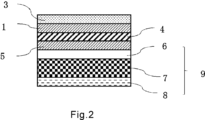
- FIG. 2 is a schematic cross-sectional view partially illustrating an example of a laminate according to the present embodiment.
- FIG. 2 is a schematic cross-sectional view partially illustrating a display, which is an example of the use of the laminate of the present embodiment.
- FIG. 2 is a schematic cross-sectional view of a dielectric constant measurement sample.
- a numerical range specified using “to” is intended to include the numerical values before and after “to” as the lower and upper limit values of the range.
- the upper or lower limit value described in one numerical range may be replaced with the upper or lower limit value of another numerical range described in another stepwise manner.
- the upper or lower limit value of the numerical range may be replaced with a value shown in the examples.
- the terms “film” and “sheet” are not differentiated by thickness. In other words, the term “sheet” in this specification includes thin film-like objects, and the term “film” in this specification includes thick sheet-like objects.
- the adherend refers to an object (counterpart) to which the pressure-sensitive adhesive layer of the pressure-sensitive adhesive sheet is attached.
- the various components appearing in this specification may be used independently as a single type, or as a combination of two or more types.
- the pressure-sensitive adhesive composition according to the present disclosure contains an acrylic polymer (A) and a curing agent (B).
- [Monomer (a1)] (a1) is a (meth)acrylic acid ester monomer having an alicyclic structure.
- a (meth)acrylic acid ester monomer having a carboxy group or a hydroxy group is considered to be monomer (a3) even if it has an alicyclic structure.
- the alicyclic structure include a cycloalkane structure, a cycloalkene structure, and an alicyclic ether structure. From the viewpoint of yellowing resistance, a cycloalkane structure or an alicyclic ether structure having no unsaturated bond in the ring is preferred.
- the (total) content of (a1) is 2.5 to 20 mass% in 100 mass% of the monomer mixture, preferably 5 to 15 mass%, and more preferably 7 to 13 mass%. If the content of (a1) is less than 2.5 mass%, the cohesive strength of the adhesive layer decreases, and the adhesive strength, heat resistance, and light resistance are insufficient. If the content of (a1) is more than 20 mass%, the tack of the adhesive layer decreases, and the adhesive strength, heat resistance, and light resistance are insufficient.
- Examples of monomer (a2) include normal octyl (meth)acrylate, normal nonyl (meth)acrylate, normal decyl (meth)acrylate, normal undecyl (meth)acrylate, normal dodecyl (meth)acrylate, normal tridecyl (meth)acrylate, normal tetradecyl (meth)acrylate, normal pentadecyl (meth)acrylate, normal hexadecyl (meth)acrylate, normal heptadecyl (meth)acrylate, and normal octadecyl (meth)acrylate.
- the (total) content of (a2) is 30-80% by mass, preferably 30-78% by mass, more preferably 40-70% by mass, even more preferably 42-68% by mass, even more preferably 45-68% by mass, and most preferably 50-60% by mass, based on 100% by mass of the monomer mixture. If the content of (a2) is less than 30% by mass, sufficient biological material cannot be used in the adhesive or adhesive layer, and the dielectric constant becomes too high to be used in electronic devices with high-frequency signal transmission functions. If the content of (a2) exceeds 80% by mass, the cohesive strength of the adhesive layer decreases, and the adhesive strength, heat resistance, and light resistance become insufficient.
- the content of (meth)acrylic acid alkyl ester monomers having a linear alkyl group with 8 to 14 carbon atoms is preferably 70% by mass or more. By using such a ratio, it is easy to obtain a higher adhesive strength.
- the ratio of acrylate to methacrylate is preferably 50:50 to 100:0, more preferably 60:40 to 100:0, even more preferably 70:30 to 100:0, even more preferably 80:20 to 100:0, and most preferably 90:10 to 100:0. By using such a ratio, it is easy to obtain a higher adhesive strength.
- the polymerization initiator used in the polymerization is preferably a radical polymerization initiator, and the radical polymerization initiator is generally a peroxide or an azo compound.
- the peroxide include dialkyl peroxides such as di-t-butyl peroxide, dicumyl peroxide, t-butylcumyl peroxide, ⁇ , ⁇ '-bis(t-butylperoxy-m-isopropyl)benzene, and 2,5-di(t-butylperoxy)hexyne-3; Peroxyesters such as t-butyl peroxybenzoate, t-butyl peroxyacetate, and 2,5-dimethyl-2,5-di(benzoylperoxy)hexane; Ketone peroxides such as cyclohexanone peroxide, 3,3,5-trimethylcyclohexanone peroxide, and methylcyclohexanone peroxide; Peroxyketals such as 2,2-
- the polymerization initiator is preferably used in an amount of 0.01 to 10 parts by mass, more preferably 0.1 to 2 parts by mass, per 100 parts by mass of the monomer mixture.
- the weight average molecular weight of the acrylic polymer (A) is preferably 500,000 to 1,500,000, and more preferably 600,000 to 1,200,000. By setting the weight average molecular weight within the above range, peel resistance, outgas resistance, and light resistance in high temperature and high humidity environments are further improved.
- the weight average molecular weight is a polystyrene-equivalent value measured by gel permeation chromatography (GPC).
- aliphatic isocyanates examples include trimethylene diisocyanate, tetramethylene diisocyanate, hexamethylene diisocyanate (also known as HMDI), pentamethylene diisocyanate, 1,2-propylene diisocyanate, 2,3-butylene diisocyanate, 1,3-butylene diisocyanate, dodecamethylene diisocyanate, and 2,4,4-trimethylhexamethylene diisocyanate.
- aromatic isocyanates include 1,3-phenylene diisocyanate, 4,4'-diphenyl diisocyanate, 1,4-phenylene diisocyanate, 4,4'-diphenylmethane diisocyanate, 2,4-tolylene diisocyanate, 2,6-tolylene diisocyanate, 4,4'-toluidine diisocyanate, 2,4,6-triisocyanate toluene, 1,3,5-triisocyanate benzene, dianisidine diisocyanate, 4,4'-diphenyl ether diisocyanate, 4,4',4"-triphenylmethane triisocyanate, etc.
- aromatic aliphatic isocyanates examples include ⁇ , ⁇ '-diisocyanate-1,3-dimethylbenzene, ⁇ , ⁇ '-diisocyanate-1,4-dimethylbenzene, ⁇ , ⁇ '-diisocyanate-1,4-diethylbenzene, 1,4-tetramethylxylylene diisocyanate, and 1,3-tetramethylxylylene diisocyanate.
- the adduct is a bifunctional or higher isocyanate compound formed by reacting an isocyanate monomer with a bifunctional or higher low-molecular-weight active hydrogen-containing compound.
- the adduct include a compound obtained by reacting trimethylolpropane with hexamethylene diisocyanate, a compound obtained by reacting trimethylolpropane with tolylene diisocyanate, a compound obtained by reacting trimethylolpropane with xylylene diisocyanate, a compound obtained by reacting trimethylolpropane with isophorone diisocyanate, and a compound obtained by reacting 1,6-hexanediol with hexamethylene diisocyanate.
- the isocyanate compound is preferably a trimethylolpropane adduct of hexamethylene diisocyanate, a nurate of hexamethylene diisocyanate, a trimethylolpropane adduct of tolylene diisocyanate, a nurate of tolylene diisocyanate, a trimethylolpropane adduct of isophorone diisocyanate, or a nurate of isophorone diisocyanate, and more preferably a trimethylolpropane adduct of hexamethylene diisocyanate, a trimethylolpropane adduct of tolylene diisocyanate, or a trimethylolpropane adduct of isophorone diisocyanate.
- epoxy curing agents examples include glycerin diglycidyl ether, 1,6-hexanediol diglycidyl ether, N,N,N',N'-tetraglycidyl-m-xylylenediamine, 1,3-bis(N,N'-diglycidylaminomethyl)cyclohexane, and N,N,N',N'-tetraglycidylaminophenylmethane.
- aziridine-based curing agents examples include N,N'-diphenylmethane-4,4'-bis(1-aziridinecarboxite), tris-2,4,6-(1-aziridinyl)-1,3,5-triazine, and 4,4'-bis(ethyleneiminocarbonylamino)diphenylmethane.
- the adhesive sheet has either a configuration in which a release film is formed on both sides of an adhesive layer, or a configuration in which a release film is formed on one side of an adhesive layer and a light-transmitting substrate is provided on the other side of the adhesive, and the adhesive layer is an adhesive layer formed from the adhesive composition.
- the weight average molecular weight (Mw) of the resulting acrylic polymer is shown in Table 1.
- the obtained pressure-sensitive adhesive composition was applied using a comma coater onto a 38 ⁇ m-thick release liner (product name SP-PET-O1-BU: manufactured by Mitsui Chemicals Tocello Co., Ltd.) as a release sheet so that the thickness after drying would be 100 ⁇ m, and dried for 3 minutes at 110° C. Thereafter, a 75 ⁇ m-thick release liner (product name SP-PET-O3-B3: manufactured by Mitsui Chemicals Tocello Co., Ltd.) as a release sheet was bonded to the pressure-sensitive adhesive layer, and aging was carried out in this state for 7 days at 23° C. to obtain a pressure-sensitive adhesive sheet.
- a ⁇ m-thick release liner product name SP-PET-O1-BU: manufactured by Mitsui Chemicals Tocello Co., Ltd.
- a 75 ⁇ m-thick release liner product name SP-PET-O3-B3: manufactured by Mitsui Chemicals
- the test piece was prepared by applying a pressure of 0.5 MPa and holding it for 20 minutes in an atmosphere of 50 ° C., and laminated in the order of PC plate/adhesive layer/glass plate, and was left in an environment of 120 ° C. for 1000 hours. After cooling it at 23 ° C.-50% RH for 24 hours, the degree of peeling of the test piece was visually evaluated.
- ⁇ b is less than 0.8. Excellent. A: ⁇ b is 0.8 or more and less than 1.3. Good. B: ⁇ b is 1.3 or more and less than 2.0. Fairly good. C: ⁇ b is 2.0 or more and less than 3.0. Practical use is possible. D: ⁇ b is 3.0 or more. Not practical.
- ⁇ Wet and heat whitening resistance (glass composition)> The 38 ⁇ m release liner of the obtained adhesive sheet was peeled off, and the adhesive layer was laminated to a glass plate using a laminator in an atmosphere of 23 ° C.-50% RH. Next, the other 75 ⁇ m release liner of the adhesive sheet was peeled off, and the adhesive layer was laminated to a glass plate using a laminator as described above.
- the test piece was prepared by laminating the glass plate/adhesive layer/glass plate in this order by applying a pressure of 0.5 MPa and holding it for 20 minutes in an atmosphere of 50 ° C., and was left for 1000 hours in an environment of 85 ° C.-85% RH.
- PC composition ⁇ Wet and heat whitening resistance (PC composition)>
- the 38 ⁇ m release liner of the obtained adhesive sheet was peeled off, and the adhesive layer was attached to a PET film (manufactured by Toyobo Co., Ltd., product name: A-4300, thickness 100 ⁇ m), and cut to a size of 40 mm wide x 60 mm long to prepare a test adhesive sheet.
- the other 75 ⁇ m release liner of the test adhesive sheet was peeled off, and the sheet was attached to a 0.5 mm thick polycarbonate (PC) plate (product name Iupilon NF2000: manufactured by Mitsubishi Gas Chemical Co., Ltd.). This was held for 20 minutes under a pressure of 0.5 MPa in an atmosphere of 50° C.
- PC polycarbonate
- Air bubbles or lifting of the adhesive layer are observed (15 to less than 30 air bubbles, and lifting of the adhesive layer accounts for 5% to less than 10% of the total area).
- D There are many air bubbles or lifted adhesive layers (30 or more air bubbles, or lifted areas of 10% or more of the total surface area). Not suitable for practical use.
- a coating liquid was prepared by mixing 10 parts of D-172N as a curing agent with 100 parts of a surface protective coating agent (manufactured by Toyo Ink Co., Ltd., product name: YL454UR, acrylic varnish), and applying the mixture to a 0.5 mm thick polycarbonate (PC) plate (product name: Iupilon NF2000: manufactured by Mitsubishi Gas Chemical Co., Ltd.) using a bar coater. The mixture was then aged at 40°C for 72 hours to prepare a PC plate having a surface protective layer.
- a surface protective coating agent manufactured by Toyo Ink Co., Ltd., product name: YL454UR, acrylic varnish
- a test piece was prepared in the same manner as in the evaluation of heat resistance (peeling), except that a PC plate having the above-mentioned surface protective layer was used instead of Iupilon NF2000, and then irradiated with light for 500 hours using a xenon weathering tester manufactured by Q-Lab Co., Ltd. under conditions of a black panel temperature of 83°C and an illuminance of 60 W/m2.
- the test piece was cooled for 24 hours at 23°C-50% RH, and the degree of peeling of the test piece was evaluated visually.
- A+ Peeled area is less than 5% of the whole area. Excellent.
- A The peeled area is 5% or more and less than 15% of the entire area. Good.
- B The peeled area is 15% or more and less than 25% of the total area. Fairly good.
- C Peeled area is 25% or more and less than 50% of the total area. Practical use is possible.
- D Peeling area is 50% or more of the whole. Not practical.
- ⁇ Light resistance (yellowing)> After preparing a test piece in the same procedure as the evaluation of heat resistance (yellowing), the test piece was irradiated with light for 1000 hours under the conditions of a black panel temperature of 63°C and an illuminance of 85 W/m2 using a Q-Lab xenon weathering tester. After cooling for 1 hour at 23°C-50% RH, the b value was measured, and the difference ⁇ b from the b value before the light resistance test was calculated. The b value was measured using a spectrophotometer SE6000 (product name) manufactured by Nippon Denshoku Industries Co., Ltd., under the conditions of a D65 light source and a viewing angle of 2°.
- SE6000 product name
- A+ ⁇ b is less than 1.0. Excellent. A: ⁇ b is 1.0 or more and less than 2.0. Good. B: ⁇ b is 2.0 or more and less than 3.5. Fairly good. C: ⁇ b is 3.5 or more and less than 5.0. Practical use is possible. D: ⁇ b is 5.0 or more. Not practical.
- the 38 ⁇ m release liner of the obtained adhesive sheet was peeled off, and the adhesive layer was attached to a PET film (manufactured by Toyobo Co., Ltd., product name: A-4300, thickness 100 ⁇ m), and cut to a size of 40 mm wide x 60 mm long to prepare a test adhesive sheet.
- a PET film manufactured by Toyobo Co., Ltd., product name: A-4300, thickness 100 ⁇ m
- the other 75 ⁇ m release liner of the test adhesive sheet was peeled off, and the exposed adhesive layer was attached using a laminator to a transparent conductive film of a PET film with a width of 40 mm and a length of 160 mm on which a transparent conductive film was formed by ITO in an atmosphere of 23° C.-50% RH to obtain a laminate, and its resistance value was measured using Loresta GP (model number MCP-T600, manufactured by Mitsubishi Chemical Corporation).
- the laminate was left in an environment of 85° C. and 90% RH for 1000 hours, and the resistance was then measured again. The rate of change in resistance before and after the leaving was calculated to evaluate the corrosion resistance of the transparent conductive film.
- the method for measuring the dielectric constant will be described with reference to FIG. 3.
- the obtained adhesive sheet was prepared to a size of 100 mm wide x 100 mm long to prepare a test adhesive sheet.
- the 38 ⁇ m release liner of the test adhesive sheet was peeled off, and the exposed adhesive layer 4 was attached to the aluminum vapor deposition layer 3C formed on the glass plate 6.
- the other 75 ⁇ m release liner of the test adhesive sheet was peeled off, and aluminum vapor deposition layers 3A and 3B were formed on the surface of the exposed adhesive layer 4 that was not in contact with the aluminum vapor deposition layer 3C, thereby obtaining a dielectric constant measurement sample 1.
- Measuring device 1260 impedance measuring instrument manufactured by Solartron, UK Amplifier: 1296 model manufactured by Solartron, UK Dielectric constant measurement interface Electrode configuration: 21 mm ⁇ , 40 nm thick aluminum vapor deposition layer Counter electrode: 21 mm ⁇ , 40 nm thick aluminum vapor deposition layer AC current: 100 mV Terminal: Pin probe Frequency: 100kHz Measurement environment: 23°C - 50% RH Sample thickness: 25 ⁇ m
- Dielectric constant is 3.0 or less. Excellent. A: The dielectric constant is greater than 3.0 and equal to or less than 3.1. Good. B: The dielectric constant is more than 3.1 and 3.3 or less. Fairly good. C: Dielectric constant is more than 3.3 and 3.5 or less. Practical use is possible. D: The dielectric constant exceeds 3.5. Not practical.
- the pressure-sensitive adhesive compositions according to the present disclosure exhibited excellent results in adhesion, heat resistance, wet heat whitening resistance, outgassing resistance, light resistance, low dielectric constant, and metal corrosion resistance.
- the pressure-sensitive adhesive compositions of the comparative examples did not satisfy all of the adhesion, heat resistance, wet heat whitening resistance, outgassing resistance, light resistance, low dielectric constant, and metal corrosion resistance. From these results, it can be said that the pressure-sensitive adhesive composition according to the present disclosure can be suitably used for bonding optical members.
Landscapes
- Chemical & Material Sciences (AREA)
- Organic Chemistry (AREA)
- Adhesives Or Adhesive Processes (AREA)
- Adhesive Tapes (AREA)
- Liquid Crystal (AREA)
- Laminated Bodies (AREA)
Abstract
Priority Applications (2)
| Application Number | Priority Date | Filing Date | Title |
|---|---|---|---|
| KR1020257011353A KR20250127746A (ko) | 2022-12-27 | 2023-12-27 | 점착제 조성물, 점착 시트, 적층체 및 그 적층체를 구비하는 디스플레이 |
| CN202380079735.5A CN120225627A (zh) | 2022-12-27 | 2023-12-27 | 粘着剂组合物、粘着片、层叠体及包括此层叠体的显示器 |
Applications Claiming Priority (2)
| Application Number | Priority Date | Filing Date | Title |
|---|---|---|---|
| JP2022209352A JP7577253B2 (ja) | 2022-12-27 | 2022-12-27 | 粘着剤組成物、粘着シート、積層体および該積層体を備えるディスプレイ |
| JP2022-209352 | 2022-12-27 |
Publications (1)
| Publication Number | Publication Date |
|---|---|
| WO2024143457A1 true WO2024143457A1 (fr) | 2024-07-04 |
Family
ID=91717819
Family Applications (1)
| Application Number | Title | Priority Date | Filing Date |
|---|---|---|---|
| PCT/JP2023/046887 Ceased WO2024143457A1 (fr) | 2022-12-27 | 2023-12-27 | Composition adhésive, feuille adhésive, corps multicouche et affichage pourvu dudit corps multicouche |
Country Status (4)
| Country | Link |
|---|---|
| JP (2) | JP7577253B2 (fr) |
| KR (1) | KR20250127746A (fr) |
| CN (1) | CN120225627A (fr) |
| WO (1) | WO2024143457A1 (fr) |
Citations (10)
| Publication number | Priority date | Publication date | Assignee | Title |
|---|---|---|---|---|
| JP2009256607A (ja) * | 2008-03-17 | 2009-11-05 | Nitto Denko Corp | アクリル系粘着剤、アクリル系粘着剤層、アクリル系粘着テープ又はシート |
| JP2012211262A (ja) * | 2011-03-31 | 2012-11-01 | Nitta Corp | 感温性粘着剤 |
| JP2013133440A (ja) * | 2011-12-27 | 2013-07-08 | Nitto Denko Corp | 粘着剤、粘着剤層、および粘着シート |
| JP2014012808A (ja) * | 2012-04-27 | 2014-01-23 | Nitto Denko Corp | 粘着剤組成物、及び粘着シート |
| JP2018104485A (ja) * | 2016-12-22 | 2018-07-05 | Dic株式会社 | 薄型粘着テープ |
| JP2019156959A (ja) * | 2018-03-13 | 2019-09-19 | アイカ工業株式会社 | 光硬化性粘着樹脂組成物 |
| JP2019210445A (ja) * | 2017-08-08 | 2019-12-12 | 三菱ケミカル株式会社 | 光硬化性粘着シート |
| JP2019218458A (ja) * | 2018-06-19 | 2019-12-26 | 積水化学工業株式会社 | 粘着テープ |
| JP2022181956A (ja) * | 2021-05-27 | 2022-12-08 | 東洋インキScホールディングス株式会社 | 粘着剤、粘着シート、積層体、およびフレキシブルディスプレイ |
| JP7393844B1 (ja) * | 2023-02-21 | 2023-12-07 | 東洋インキScホールディングス株式会社 | 粘着剤組成物、粘着シート、積層体および該積層体を備えるディスプレイ |
Family Cites Families (10)
| Publication number | Priority date | Publication date | Assignee | Title |
|---|---|---|---|---|
| JP4780766B2 (ja) | 2006-03-27 | 2011-09-28 | 日東電工株式会社 | 光学用粘着剤、粘着剤付き光学フィルムおよび画像表示装置 |
| JP6114004B2 (ja) | 2011-11-10 | 2017-04-12 | 日東電工株式会社 | 粘着剤組成物、及び粘着シート |
| JP6206721B2 (ja) | 2014-03-26 | 2017-10-04 | 東洋インキScホールディングス株式会社 | 粘着剤および粘着シート |
| JP6237393B2 (ja) | 2014-03-26 | 2017-11-29 | 東洋インキScホールディングス株式会社 | 粘着剤および粘着シート |
| JP6791736B2 (ja) | 2015-11-30 | 2020-11-25 | 積水化学工業株式会社 | 粘着剤組成物及び粘着シート |
| JP6938974B2 (ja) | 2017-03-09 | 2021-09-22 | 東洋インキScホールディングス株式会社 | 粘着剤および粘着シート |
| JP6562279B2 (ja) | 2017-07-27 | 2019-08-21 | 東洋インキScホールディングス株式会社 | 粘着剤および粘着シート |
| JP6866881B2 (ja) | 2017-08-08 | 2021-04-28 | 三菱ケミカル株式会社 | 光硬化性粘着シート積層体、光硬化性粘着シート積層体の製造方法及び画像表示パネル積層体の製造方法 |
| JP7386609B2 (ja) | 2018-12-27 | 2023-11-27 | 日東電工株式会社 | 粘着剤組成物 |
| JP7331673B2 (ja) | 2019-12-09 | 2023-08-23 | 東洋インキScホールディングス株式会社 | 粘着剤組成物、および粘着シート |
-
2022
- 2022-12-27 JP JP2022209352A patent/JP7577253B2/ja active Active
-
2023
- 2023-12-27 WO PCT/JP2023/046887 patent/WO2024143457A1/fr not_active Ceased
- 2023-12-27 KR KR1020257011353A patent/KR20250127746A/ko active Pending
- 2023-12-27 CN CN202380079735.5A patent/CN120225627A/zh active Pending
-
2024
- 2024-05-31 JP JP2024089251A patent/JP2024113014A/ja active Pending
Patent Citations (10)
| Publication number | Priority date | Publication date | Assignee | Title |
|---|---|---|---|---|
| JP2009256607A (ja) * | 2008-03-17 | 2009-11-05 | Nitto Denko Corp | アクリル系粘着剤、アクリル系粘着剤層、アクリル系粘着テープ又はシート |
| JP2012211262A (ja) * | 2011-03-31 | 2012-11-01 | Nitta Corp | 感温性粘着剤 |
| JP2013133440A (ja) * | 2011-12-27 | 2013-07-08 | Nitto Denko Corp | 粘着剤、粘着剤層、および粘着シート |
| JP2014012808A (ja) * | 2012-04-27 | 2014-01-23 | Nitto Denko Corp | 粘着剤組成物、及び粘着シート |
| JP2018104485A (ja) * | 2016-12-22 | 2018-07-05 | Dic株式会社 | 薄型粘着テープ |
| JP2019210445A (ja) * | 2017-08-08 | 2019-12-12 | 三菱ケミカル株式会社 | 光硬化性粘着シート |
| JP2019156959A (ja) * | 2018-03-13 | 2019-09-19 | アイカ工業株式会社 | 光硬化性粘着樹脂組成物 |
| JP2019218458A (ja) * | 2018-06-19 | 2019-12-26 | 積水化学工業株式会社 | 粘着テープ |
| JP2022181956A (ja) * | 2021-05-27 | 2022-12-08 | 東洋インキScホールディングス株式会社 | 粘着剤、粘着シート、積層体、およびフレキシブルディスプレイ |
| JP7393844B1 (ja) * | 2023-02-21 | 2023-12-07 | 東洋インキScホールディングス株式会社 | 粘着剤組成物、粘着シート、積層体および該積層体を備えるディスプレイ |
Also Published As
| Publication number | Publication date |
|---|---|
| JP2024093158A (ja) | 2024-07-09 |
| JP2024113014A (ja) | 2024-08-21 |
| KR20250127746A (ko) | 2025-08-26 |
| JP7577253B2 (ja) | 2024-11-05 |
| CN120225627A (zh) | 2025-06-27 |
Similar Documents
| Publication | Publication Date | Title |
|---|---|---|
| JP6390661B2 (ja) | 粘着剤および粘着シート | |
| JP7626262B1 (ja) | 粘着剤および粘着剤組成物、粘着シート、積層体および該積層体を備えるディスプレイ | |
| JP7627409B1 (ja) | 粘着剤組成物、粘着シート、積層体および該積層体を備えるディスプレイ | |
| WO2014156200A1 (fr) | Agent adhésif et feuille adhésive produite en l'utilisant | |
| KR102571645B1 (ko) | 점착제 및 이것을 사용한 점착 시트 | |
| JP7331673B2 (ja) | 粘着剤組成物、および粘着シート | |
| JP7393844B1 (ja) | 粘着剤組成物、粘着シート、積層体および該積層体を備えるディスプレイ | |
| JP2010037502A (ja) | 感圧式接着剤組成物及び感圧式接着フィルム | |
| JP7577253B2 (ja) | 粘着剤組成物、粘着シート、積層体および該積層体を備えるディスプレイ | |
| KR101462412B1 (ko) | 점착제, 점착 시트 및 디스플레이 | |
| JP2024163615A (ja) | 粘着剤組成物、粘着シート、積層体および該積層体を備えるディスプレイ | |
| JP7750443B1 (ja) | 粘着剤、該粘着剤から形成されてなる粘着剤層、該粘着剤層を備えた粘着シートおよび積層体並びに該積層体を備えるディスプレイ | |
| JP7385795B1 (ja) | 粘着剤、粘着シート、積層体、およびディスプレイ | |
| JP7552340B2 (ja) | 粘着剤、粘着シートおよび光学粘着シート | |
| JP2026012075A (ja) | 粘着剤、粘着シート、積層体および該積層体を備えるディスプレイ | |
| JP2018135524A (ja) | 粘着剤およびそれを用いた粘着シート | |
| JP2023150143A (ja) | 偏光板レス型フレキシブルディスプレイ用粘着シート、粘着剤、積層体、およびディスプレイ |
Legal Events
| Date | Code | Title | Description |
|---|---|---|---|
| 121 | Ep: the epo has been informed by wipo that ep was designated in this application |
Ref document number: 23912235 Country of ref document: EP Kind code of ref document: A1 |
|
| WWE | Wipo information: entry into national phase |
Ref document number: 202380079735.5 Country of ref document: CN |
|
| WWP | Wipo information: published in national office |
Ref document number: 202380079735.5 Country of ref document: CN |
|
| NENP | Non-entry into the national phase |
Ref country code: DE |
|
| WWP | Wipo information: published in national office |
Ref document number: 1020257011353 Country of ref document: KR |
|
| 122 | Ep: pct application non-entry in european phase |
Ref document number: 23912235 Country of ref document: EP Kind code of ref document: A1 |