WO2024161929A1 - 水酸基含有オルガノポリシロキサン、その製造方法、該オルガノポリシロキサンを含有する硬化性組成物、コーティング剤および被覆物品 - Google Patents
水酸基含有オルガノポリシロキサン、その製造方法、該オルガノポリシロキサンを含有する硬化性組成物、コーティング剤および被覆物品 Download PDFInfo
- Publication number
- WO2024161929A1 WO2024161929A1 PCT/JP2024/000367 JP2024000367W WO2024161929A1 WO 2024161929 A1 WO2024161929 A1 WO 2024161929A1 JP 2024000367 W JP2024000367 W JP 2024000367W WO 2024161929 A1 WO2024161929 A1 WO 2024161929A1
- Authority
- WO
- WIPO (PCT)
- Prior art keywords
- group
- formula
- hydroxyl
- carbon atoms
- organopolysiloxane
- Prior art date
- Legal status (The legal status is an assumption and is not a legal conclusion. Google has not performed a legal analysis and makes no representation as to the accuracy of the status listed.)
- Ceased
Links
Classifications
-
- C—CHEMISTRY; METALLURGY
- C08—ORGANIC MACROMOLECULAR COMPOUNDS; THEIR PREPARATION OR CHEMICAL WORKING-UP; COMPOSITIONS BASED THEREON
- C08G—MACROMOLECULAR COMPOUNDS OBTAINED OTHERWISE THAN BY REACTIONS ONLY INVOLVING UNSATURATED CARBON-TO-CARBON BONDS
- C08G77/00—Macromolecular compounds obtained by reactions forming a linkage containing silicon with or without sulfur, nitrogen, oxygen or carbon in the main chain of the macromolecule
- C08G77/42—Block-or graft-polymers containing polysiloxane sequences
- C08G77/46—Block-or graft-polymers containing polysiloxane sequences containing polyether sequences
-
- C—CHEMISTRY; METALLURGY
- C08—ORGANIC MACROMOLECULAR COMPOUNDS; THEIR PREPARATION OR CHEMICAL WORKING-UP; COMPOSITIONS BASED THEREON
- C08G—MACROMOLECULAR COMPOUNDS OBTAINED OTHERWISE THAN BY REACTIONS ONLY INVOLVING UNSATURATED CARBON-TO-CARBON BONDS
- C08G77/00—Macromolecular compounds obtained by reactions forming a linkage containing silicon with or without sulfur, nitrogen, oxygen or carbon in the main chain of the macromolecule
- C08G77/04—Polysiloxanes
- C08G77/14—Polysiloxanes containing silicon bound to oxygen-containing groups
-
- C—CHEMISTRY; METALLURGY
- C08—ORGANIC MACROMOLECULAR COMPOUNDS; THEIR PREPARATION OR CHEMICAL WORKING-UP; COMPOSITIONS BASED THEREON
- C08L—COMPOSITIONS OF MACROMOLECULAR COMPOUNDS
- C08L83/00—Compositions of macromolecular compounds obtained by reactions forming in the main chain of the macromolecule a linkage containing silicon with or without sulfur, nitrogen, oxygen or carbon only; Compositions of derivatives of such polymers
- C08L83/04—Polysiloxanes
-
- C—CHEMISTRY; METALLURGY
- C09—DYES; PAINTS; POLISHES; NATURAL RESINS; ADHESIVES; COMPOSITIONS NOT OTHERWISE PROVIDED FOR; APPLICATIONS OF MATERIALS NOT OTHERWISE PROVIDED FOR
- C09D—COATING COMPOSITIONS, e.g. PAINTS, VARNISHES OR LACQUERS; FILLING PASTES; CHEMICAL PAINT OR INK REMOVERS; INKS; CORRECTING FLUIDS; WOODSTAINS; PASTES OR SOLIDS FOR COLOURING OR PRINTING; USE OF MATERIALS THEREFOR
- C09D183/00—Coating compositions based on macromolecular compounds obtained by reactions forming in the main chain of the macromolecule a linkage containing silicon, with or without sulfur, nitrogen, oxygen, or carbon only; Coating compositions based on derivatives of such polymers
- C09D183/10—Block or graft copolymers containing polysiloxane sequences
- C09D183/12—Block or graft copolymers containing polysiloxane sequences containing polyether sequences
-
- C—CHEMISTRY; METALLURGY
- C08—ORGANIC MACROMOLECULAR COMPOUNDS; THEIR PREPARATION OR CHEMICAL WORKING-UP; COMPOSITIONS BASED THEREON
- C08G—MACROMOLECULAR COMPOUNDS OBTAINED OTHERWISE THAN BY REACTIONS ONLY INVOLVING UNSATURATED CARBON-TO-CARBON BONDS
- C08G77/00—Macromolecular compounds obtained by reactions forming a linkage containing silicon with or without sulfur, nitrogen, oxygen or carbon in the main chain of the macromolecule
- C08G77/04—Polysiloxanes
- C08G77/12—Polysiloxanes containing silicon bound to hydrogen
Definitions
- the present invention relates to a hydroxyl-containing organopolysiloxane, a method for producing the same, and a curable composition, coating agent, and coated article that contain the organopolysiloxane.
- Organopolysiloxanes containing alkoxysilyl groups are widely used in paints and coatings.
- organopolysiloxanes with alkoxy groups at the terminals are mixed with a curing catalyst, and when external energy such as heat energy is applied, the alkoxy groups at the terminals react with each other to form a strong siloxane network.
- the resulting coating has excellent heat and weather resistance, so it can be applied to a wide range of surfaces, from outdoor structures to automobile parts and electronic components.
- organopolysiloxane-based paints have the above advantages, they also have the disadvantages of a slow curing speed and the resulting coating film having poor crack resistance and bending resistance.
- Patent Documents 1 to 4 a method has been known in the past to use a composition made by combining an organopolysiloxane with an organic resin such as an alkyd resin, polyester resin, or acrylic resin as a paint.
- the most common functional group in organic resins is the hydroxyl group.
- the hydroxyl group is a common functional group in the alkyd resins, polyester resins, and acrylic resins mentioned above, and there are many polyol resins on the market that contain hydroxyl groups.
- organopolysiloxanes there are currently very few branched organopolysiloxanes on the market that contain hydroxyl groups and can form strong siloxane networks.
- the alkoxysilanes contained in typical organopolysiloxanes undergo hydrolysis when exposed to water, but a similar reaction also occurs when exposed to hydroxyl groups.
- organopolysiloxanes that contain hydroxyl groups have the disadvantage that they are difficult to sell due to concerns about their stability over time.
- Non-Patent Documents 1 and 2 propose a method for synthesizing hydroxyl-containing organopolysiloxanes by forming organopolysiloxanes into cage-like structures to eliminate alkoxysilanes in the molecules.
- this method requires the reaction to be carried out under sufficiently dilute conditions in order to form the organopolysiloxanes into cage-like structures, resulting in low yields and making industrialization difficult.
- the present invention was made in consideration of the above circumstances, and aims to provide a hydroxyl-containing organopolysiloxane that has excellent storage stability, curability when used in a curable composition, and gives a coating that has excellent chemical resistance and flex resistance.
- a hydroxyl-containing organopolysiloxane represented by the following formula (I) has high storage stability, and when used in a curable composition, it has excellent curing properties and gives a coating that is excellent in chemical resistance and flex resistance. They have also discovered that the above hydroxyl-containing organopolysiloxane can be obtained under specified conditions, and have thus completed the present invention.
- R 1 's are each independently a hydrogen atom, or a monovalent saturated hydrocarbon group having 1 to 12 carbon atoms, an aralkyl group having 7 to 20 carbon atoms, or an aryl group having 6 to 18 carbon atoms, each of which may be substituted with a halogen atom
- R 2 is a hydrogen atom, a methyl group, an ethyl group, an n-propyl group, or an isopropyl group
- R 3 is a group represented by the following formula (II);
- e and f are each numbers that satisfy 0 ⁇ e ⁇ 1, 0 ⁇ f ⁇ 4, and 0 ⁇ e+
- R 4 is a methyl group
- R 5 is a hydrogen atom
- X is an alkylene group having 3 carbon atoms
- n is 1.
- Step ⁇ A step of obtaining an organopolysiloxane having a SiH group by a hydrolysis condensation reaction between an organopolysiloxane represented by the following formula (I′) and a silane compound represented by the following formula (III) or by an equilibration reaction between an organopolysiloxane represented by the following formula (I′) and a disiloxane compound represented by the following formula (IV) using an acid catalyst;
- R 1 , R 2 , a, b, c and d are the same as above, and g is a number satisfying 0 ⁇ g ⁇ 4.
- R 4 is the same as above, and R 6 is a halogen atom, a hydroxyl group, or an alkoxy group having 1 to 4 carbon atoms.
- Step ⁇ A step of subjecting the organopolysiloxane having a SiH group obtained in the above (Step ⁇ ) to a hydrolysis condensation reaction between an organopolysiloxan
- a curable composition comprising the hydroxyl-containing organopolysiloxane according to any one of 1 to 8 and a curing agent capable of reacting with a hydroxyl group.
- a coating agent comprising the curable composition according to 10.
- a cured film of the curable composition according to 10. 13 Provide a coated article having a substrate and the cured film according to 12 formed on at least one surface of the substrate directly or via one or more other layers.
- the hydroxyl-containing organopolysiloxane of the present invention has excellent storage stability and cures quickly when mixed with a curing agent and applied.
- the resulting cured film has excellent chemical resistance and bending resistance, making it suitable for the manufacture of various coated articles.
- R 1 's each independently represent a hydrogen atom, or a monovalent saturated hydrocarbon group having 1 to 12 carbon atoms, an aralkyl group having 7 to 20 carbon atoms, or an aryl group having 6 to 18 carbon atoms, each of which may be substituted with a halogen atom.
- the monovalent saturated hydrocarbon group having 1 to 12 carbon atoms for R 1 may be linear, branched, or cyclic. Specific examples thereof include linear or branched alkyl groups such as methyl, ethyl, n-propyl, isopropyl, n-butyl, isobutyl, tert-butyl, neopentyl, n-hexyl, n-heptyl, and n-octyl groups; and cycloalkyl groups such as cyclopentyl and cyclohexyl groups.
- the alkyl groups have 1 to 6 carbon atoms, more preferably 1 to 3 carbon atoms, and more preferably, methyl and ethyl groups.
- the aralkyl group having 7 to 20 carbon atoms those having 7 to 10 carbon atoms are preferable, and specific examples thereof include a benzyl group and a phenylethyl group.
- aryl group having 6 to 18 carbon atoms those having 6 to 10 carbon atoms are preferable, and specific examples thereof include unsubstituted aryl groups such as phenyl and naphthyl groups; and alkylaryl groups such as tolyl, xylyl, ethylphenyl, propylphenyl, butylphenyl, pentylphenyl, hexylphenyl, heptylphenyl, octylphenyl, nonylphenyl, decylphenyl, undecylphenyl, and dodecylphenyl groups, with phenyl groups being preferable.
- R 1 is preferably a methyl group or a phenyl group.
- the above monovalent saturated hydrocarbon group, aralkyl group and aryl group may have some or all of their hydrogen atoms substituted with halogen atoms (fluorine, chlorine, bromine, iodine atoms), specific examples of which include chloromethyl, chloropropyl, bromoethyl, trifluoropropyl, chlorophenyl, bromophenyl groups, etc.
- halogen atoms fluorine, chlorine, bromine, iodine atoms
- R2 is a hydrogen atom, a methyl group, an ethyl group, an n-propyl group, or an isopropyl group, preferably a methyl group, an ethyl group, an n-propyl group, or an isopropyl group, more preferably a methyl group or an ethyl group, and even more preferably a methyl group.
- R3 is a group represented by the following formula (II).
- R 4 is independently a hydrogen atom, or a monovalent saturated hydrocarbon group having 1 to 12 carbon atoms, an aralkyl group having 7 to 20 carbon atoms, or an aryl group having 6 to 18 carbon atoms, each of which may be substituted with a halogen atom.
- Specific examples of the monovalent saturated hydrocarbon group, aralkyl group, and aryl group include the same groups as those exemplified for R 1 above.
- R 4 is preferably a methyl group, an ethyl group, or a phenyl group, and more preferably a methyl group.
- the monovalent saturated hydrocarbon group, aralkyl group, and aryl group for R4 may have some or all of their hydrogen atoms substituted with halogen atoms, and specific examples thereof include the same groups as those exemplified for R1 .
- Each R5 is independently a hydrogen atom or a monovalent saturated hydrocarbon group having 1 to 8 carbon atoms, and the monovalent saturated hydrocarbon group of R5 may be linear, branched, or cyclic, and specific examples thereof include the same groups having 1 to 8 carbon atoms as those exemplified for R1 .
- R5 is preferably a hydrogen atom or an alkyl group having 1 to 3 carbon atoms, more preferably a hydrogen atom, a methyl group, or an ethyl group, and even more preferably a hydrogen atom.
- X is a divalent hydrocarbon group having 2 to 8 carbon atoms, preferably a linear or branched divalent aliphatic hydrocarbon group, specific examples of which include alkylene groups such as ethylene, trimethylene, propylene, tetramethylene, hexamethylene, and octamethylene groups, of which alkylene groups having 2 or 3 carbon atoms are preferred, alkylene groups having 3 carbon atoms are more preferred, and trimethylene groups are even more preferred.
- alkylene groups such as ethylene, trimethylene, propylene, tetramethylene, hexamethylene, and octamethylene groups, of which alkylene groups having 2 or 3 carbon atoms are preferred, alkylene groups having 3 carbon atoms are more preferred, and trimethylene groups are even more preferred.
- n is a number from 0 to 400, but from the viewpoint of solubility, a number from 0 to 100 is preferred, 0 or 1 is more preferred, and 1 is even more preferred.
- R 4 is a methyl group
- R 5 is a hydrogen atom
- X is an alkylene group having 3 carbon atoms
- n is 1, is preferable.
- b is a number that satisfies 0 ⁇ b ⁇ 1, it is preferable that b is a number that satisfies 0.5 ⁇ b ⁇ 1 from the viewpoint of the scratch resistance of the resulting cured product.
- c is a number that satisfies 0 ⁇ c ⁇ 0.5, from the viewpoint of the curability of the composition and the hardness of the obtained cured product, it is preferably a number that satisfies 0 ⁇ c ⁇ 0.4, and more preferably a number that satisfies 0 ⁇ c ⁇ 0.3.
- e is a number that satisfies 0 ⁇ e ⁇ 1, from the viewpoint of suppressing the condensation reaction caused by the condensable functional group, it is preferably a number that satisfies 0 ⁇ e ⁇ 0.8.
- f is a number that satisfies 0 ⁇ f ⁇ 4, from the viewpoint of the crosslink density of the cured product, it is preferably a number that satisfies 0.2 ⁇ f ⁇ 2, and more preferably a number that satisfies 0.4 ⁇ f ⁇ 1.1.
- e and f are numbers that satisfy 0 ⁇ e+f ⁇ 4, and preferably satisfy 0.2 ⁇ e+f ⁇ 2.8.
- the weight average molecular weight (Mw) of the hydroxyl-containing organopolysiloxane of the present invention, calculated as polystyrene, as determined by gel permeation chromatography (GPC) is preferably from 1,000 to 500,000, and more preferably from 1,500 to 10,000. If the weight average molecular weight is 1,000 or more, the storage stability and flex resistance are excellent, and if it is 500,000 or less, there is no risk of unevenness or coating irregularities occurring during coating. As the measurement conditions for GPC, for example, the method used in the examples below can be adopted.
- the kinetic viscosity of the hydroxyl-containing organopolysiloxane of the present invention at 25° C. is preferably 5 to 2,000 mm 2 /s, and more preferably 20 to 1,000 mm 2 /s. If it is 5 mm 2 /s or more, storage stability and flex resistance are excellent, and if it is 2,000 mm 2 /s or less, there is no risk of unevenness or coating irregularities occurring during coating.
- the kinetic viscosity can be measured, for example, using a Canon-Fenske viscometer.
- the amount of alkoxy groups in the hydroxyl-containing organopolysiloxane of the present invention is preferably 0.5 to 10% by mass relative to the organopolysiloxane from the viewpoints of storage stability and adhesion to the substrate.
- the hydroxyl-containing organopolysiloxane of the present invention may be of a single composition or a mixture of multiple compounds with different compositions.
- Step ⁇ A step of obtaining an organopolysiloxane having a SiH group by a hydrolysis condensation reaction between an organopolysiloxane represented by the following formula (I′) and a silane compound represented by the following formula (III) or by an equilibration reaction between an organopolysiloxane represented by the following formula (I′) and a disiloxane compound represented by the following formula (IV) using an acid catalyst.
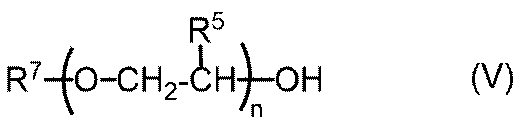
- Step ⁇ A step of subjecting the organopolysiloxane having a SiH group obtained in the above (Step ⁇ ) to a hydrosilylation reaction with a compound represented by the following formula (V): (In the formula, R5 and n are the same as above, and R7 is a monovalent aliphatic unsaturated hydrocarbon group having 2 to 8 carbon atoms.)
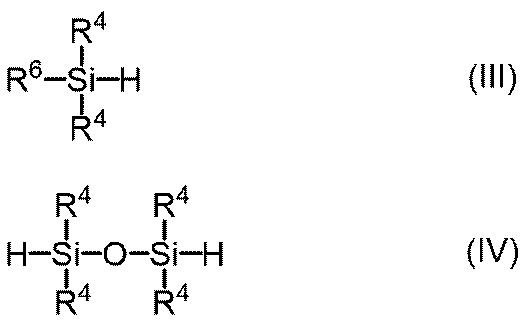
- Step ⁇ is a step of obtaining an organopolysiloxane having SiH groups by a hydrolysis condensation reaction between an organopolysiloxane represented by formula (I') above and a silane compound represented by formula (III) above, or by an equilibration reaction between an organopolysiloxane represented by formula (I') above and a disiloxane compound represented by formula (IV) above using an acid catalyst.
- g is a number that satisfies 0 ⁇ g ⁇ 4, but preferably satisfies 0.2 ⁇ g ⁇ 2.8.
- the organopolysiloxane represented by formula (I') can be produced according to a general method for producing organopolysiloxane. For example, it can be obtained by hydrolyzing and condensing a silane compound having a hydrolyzable group.
- the silane compound having a hydrolyzable group is not particularly limited as long as it contains 1 to 4 hydrolyzable groups, chloro groups or alkoxy groups, on the silicon atom and has an organic substituent that satisfies the above conditions.
- Specific examples thereof include tetrachlorosilane, tetramethoxysilane, tetraethoxysilane, tetraisopropoxysilane, tetrabutoxysilane, methyltrichlorosilane, methyltrimethoxysilane, methyltriethoxysilane, methyltriisopropoxysilane, methyltributoxysilane, dimethyldimethoxysilane, dimethyldiethoxysilane, dimethyldiisopropoxysilane, trimethylchlorosilane, trimethylmethoxysilane, trimethylethoxysilane, trimethylisopropoxysilane, ethyltrichlorosilane, e
- a hydrolysis catalyst may be used when carrying out the hydrolysis.
- a conventionally known catalyst may be used as the hydrolysis catalyst, and a catalyst whose aqueous solution exhibits an acidic pH of 2 to 7 (acid catalyst) is preferred, and particularly preferred are acidic hydrogen halides, sulfonic acids, carboxylic acids, acidic or weakly acidic inorganic salts, solid acids such as ion exchange resins, and the like.
- the amount of hydrolysis catalyst used is not particularly limited, but in order to ensure that the reaction proceeds quickly and to make it easier to remove the catalyst after the reaction, it is preferable to use 0.0002 to 0.5 moles per mole of hydrolyzable silane.
- the mass ratio of the silane compound having a hydrolyzable group to the water required for the hydrolysis condensation reaction is not particularly limited, but in order to prevent the deactivation of the catalyst and to allow the reaction to proceed sufficiently, and in consideration of the ease of removing water after the reaction, a ratio of 0.1 to 10 moles of water per mole of hydrolyzable silane is preferred.
- the reaction temperature during the hydrolysis condensation is not particularly limited, but in consideration of improving the reaction rate and preventing decomposition of the organic functional group, it is preferably ⁇ 10 to 150° C.
- the reaction time is not particularly limited, but it is preferably 0.5 to 6 hours.
- organic solvent may be used during the hydrolysis condensation.
- organic solvents include methanol, ethanol, propanol, acetone, methyl ethyl ketone, methyl isobutyl ketone, tetrahydrofuran, toluene, xylene, etc.
- examples of the halogen atom of R6 include a fluorine atom, a chlorine atom, a bromine atom, and an iodine atom, and examples of the alkoxy group having 1 to 4 carbon atoms include a methoxy group, an ethoxy group, an n-propoxy group, an n-butoxy group, etc.
- R6 is preferably a chlorine atom, a hydroxyl group, a methoxy group, or an ethoxy group.
- silane compounds represented by the above formula (III) include, for example, methoxysilane, dimethylmethoxysilane, ethoxysilane, dimethylethoxysilane, chlorosilane, dimethylchlorosilane, dimethylhydroxysilane, etc.
- disiloxane compounds represented by the above formula (IV) include 1,1,3,3-tetramethyldisiloxane, etc.
- the conditions for the hydrolysis and condensation reaction are not particularly limited, but can be carried out under the same conditions as those for producing the organopolysiloxane represented by the above formula (I').
- the ratio of the organopolysiloxane represented by formula (I') above to the silane compound represented by formula (III) above is not particularly limited, but the amount of the silane compound represented by formula (III) above is preferably 5 to 80 parts by mass, and more preferably 10 to 70 parts by mass, per 100 parts by mass of the organopolysiloxane represented by formula (I') above.
- the amount of the hydrolysis catalyst used is not particularly limited, but is preferably 0.0002 to 0.5 moles per mole of the silane compound represented by formula (III).
- the mass ratio of the hydrolyzable groups contained in the organopolysiloxane represented by the above formula (I') to the water required for the hydrolysis condensation reaction is not particularly limited, but since the reaction rate can be changed by the amount of water added, a mass ratio according to the desired reaction rate is preferred. From the viewpoint of ensuring storage stability by reducing the number of highly active alkoxy groups at the organopolysiloxane terminals, the reaction rate of the alkoxy groups is preferably 50 to 100%, and more preferably 60 to 100%.
- the equilibration reaction conditions are not particularly limited, but can be carried out, for example, at 20 to 150°C for about 0.5 to 6 hours, preferably at 20 to 100°C for about 1 to 4 hours.
- a solvent may be added as necessary.
- the solvent include alcohol solvents such as methanol, ethanol, and isopropyl alcohol; and aromatic non-polar solvents such as benzene, toluene, and xylene.
- the ratio of the organopolysiloxane represented by formula (I') above to the disiloxane compound represented by formula (IV) above is not particularly limited, but the amount of the disiloxane compound represented by formula (IV) above is preferably 10 to 70 parts by mass, more preferably 20 to 60 parts by mass, per 100 parts by mass of the organopolysiloxane represented by formula (I') above.
- the acidic catalyst for promoting the equilibration reaction a strong acid is preferred, and although there is no particular restriction on the type, sulfuric acid, methanesulfonic acid, trifluoromethanesulfonic acid, etc. can be suitably used, and in view of ease of post-treatment, a cation exchange resin having these exchange groups is particularly preferred.
- the amount of the acid catalyst added is preferably 100 to 10,000 ppm, and more preferably 500 to 3,000 ppm, based on the total mass of the organopolysiloxane represented by formula (I') and the disiloxane compound represented by formula (IV).
- water may be added to promote the hydrolysis condensation reaction between the organopolysiloxane represented by formula (I') above and the disiloxane compound represented by formula (IV) above.
- the amount of water used is not particularly limited, but since the reaction rate can be changed by the amount of water added, a mass ratio according to the desired reaction rate is preferred. From the viewpoint of ensuring storage stability by reducing the number of highly active alkoxy groups at the organopolysiloxane terminals, the reaction rate of the alkoxy groups is preferably 50 to 100%, more preferably 60 to 100%.
- Step ⁇ is a step in which the organopolysiloxane having SiH groups obtained in (Step ⁇ ) above is subjected to a hydrosilylation reaction with the compound represented by formula (V) above to obtain a hydroxyl-containing organopolysiloxane.
- the monovalent aliphatic unsaturated hydrocarbon group having 2 to 8 carbon atoms for R7 is preferably one having 2 to 6 carbon atoms, and specific examples thereof include alkenyl groups such as vinyl, allyl, 3-butenyl, 5-hexenyl, and 7-octenyl groups, with vinyl and allyl groups being preferred, and allyl groups being more preferred.
- vinyl alcohol, allyl alcohol, and ethylene glycol monoallyl ether are preferred, and ethylene glycol monoallyl ether is more preferred, taking into consideration compatibility with organopolysiloxane.
- the amount of the compound represented by formula (V) used in the hydrosilylation reaction is preferably 1 mole or more per mole of SiH groups in the organopolysiloxane having SiH groups obtained in (step ⁇ ).
- the hydrosilylation reaction is preferably carried out in the presence of a catalyst.
- a catalyst a compound containing a platinum group metal such as platinum, rhodium, or palladium can be used.
- a compound containing platinum is preferable, and examples thereof include platinum black, chloroplatinic acid, alcohol-modified chloroplatinic acid, complexes of chloroplatinic acid with olefins, vinylsiloxanes, acetylene alcohols, etc., platinum carbonylvinylmethyl complexes, platinum-divinyltetramethyldisiloxane complexes, platinum-cyclovinylmethylsiloxane complexes, platinum-octylaldehyde/octanol complexes, etc.
- the amount added may be a so-called catalytic amount capable of promoting the addition reaction, and is usually 0.1 to 500 ppm, preferably 1 to 200 ppm, calculated as the mass of the platinum group metal relative to the mass of the compound represented by formula (V).
- the conditions for the hydrosilylation reaction are not particularly limited, but for example, a reaction temperature of 20 to 120° C. and a reaction time of 1 to 8 hours are preferred, and a reaction temperature of 20 to 100° C. and a reaction time of 1 to 6 hours are more preferred.
- a SiH group is introduced at the end of the organopolysiloxane having a hydrolyzable group represented by formula (I') above, and then the resulting product is subjected to a hydrosilylation reaction with a hydroxyl-containing compound represented by formula (V), thereby obtaining the hydroxyl-containing organopolysiloxane of the present invention.
- the hydroxyl-containing organopolysiloxane of the present invention can be used as a curable composition by adding a curing agent having a substituent capable of reacting with a hydroxyl group.
- the curing agent is not particularly limited as long as it is one that is generally used in polyol-based paints.
- the curing agent include metal driers, polyisocyanates, amino resins such as melamine resins, benzoguanamine resins, urea resins, and thiourea resins, epoxy resins, and polycarboxylic acid anhydrides, with polyisocyanates being preferred.
- polyisocyanate known polyisocyanates such as aromatic, aliphatic, araliphatic, and alicyclic polyisocyanates can be used. From the viewpoint of long-term outdoor use, however, aliphatic polyisocyanates using aliphatic diisocyanates as the main raw material are preferred.
- aliphatic diisocyanate examples include tetramethylene diisocyanate, 1,5-pentamethylene diisocyanate, 1,6-hexamethylene diisocyanate (hereinafter abbreviated as "HDI"), 2,2,4-(or 2,4,4)-trimethyl-1,6-hexamethylene diisocyanate, lysine isocyanate, isophorone diisocyanate, hydrogenated xylene diisocyanate, hydrogenated diphenylmethane diisocyanate, 1,4-diisocyanate cyclohexane, 1,3-bis(diisocyanate methyl)cyclohexane, and 4,4'-dicyclohexylmethane diisocyanate.
- HDI is particularly suitable from the viewpoints of the crack resistance of the resulting coating film and cost.
- Aliphatic polyisocyanates obtained from aliphatic diisocyanates include allophanate-type polyisocyanates, biuret-type polyisocyanates, adduct-type polyisocyanates, and isocyanurate-type polyisocyanates, and any of these can be suitably used.
- blocked polyisocyanates blocked with various blocking agents can also be used.
- the blocking agent that can be used include alcohols such as methanol, ethanol, and lactate esters; phenolic hydroxyl group-containing compounds such as phenol and salicylate esters; amides such as ⁇ -caprolactam and 2-pyrrolidone; oximes such as acetone oxime and methyl ethyl ketoxime; and active methylene compounds such as methyl acetoacetate, ethyl acetoacetate, and acetylacetone.
- the amount of the curing agent to be blended is not particularly limited, but an amount such that the ratio (NCO/OH) of the number of isocyanate groups in the curing agent to the number of hydroxyl groups in the hydroxyl group-containing polysiloxane is 0.5 to 1.1 is preferable, and an amount such that the ratio is 0.7 to 1.0 is more preferable.
- the curing agent may be used alone or in combination of two or more kinds.
- the curable composition of the present invention may further contain a curing catalyst.
- the curing catalyst is not particularly limited as long as it is one that is generally used in organosiloxane-based paints, but organometallic compounds are preferred, such as metal alkoxide compounds of Ti, Al, Zr, Sn, etc., metal chelate compounds, metal ester compounds, etc.
- metal alkoxide compounds include aluminum alkoxides such as aluminum trimethoxide, aluminum triethoxide, aluminum tri-n-propoxide, aluminum triisopropoxide, aluminum tri-n-butoxide, aluminum triisobutoxide, aluminum tri-s-butoxide, and aluminum tri-t-butoxide; tetramethyl titanate, tetraethyl titanate, tetra-n-propyl titanate, tetraisopropyl titanate, tetra-n-butyl titanate, tetraisobutyl titanate, tetra-t-butyl titanate, and tetra-n-hexyl titanate.
- aluminum alkoxides such as aluminum trimethoxide, aluminum triethoxide, aluminum tri-n-propoxide, aluminum triisopropoxide, aluminum tri-n-butoxide, aluminum triisobutoxide, aluminum tri-s-butoxide, and aluminum tri-t-butoxid
- Titanium alkoxides such as tetraisooctyl titanate, tetra-n-lauryl titanate, etc.; zirconium alkoxides such as tetraethyl zirconate, tetra-n-propyl zirconate, tetraisopropyl zirconate, tetra-n-butyl zirconate, tetra-s-butyl zirconate, tetra-t-butyl zirconate, tetra-n-pentyl zirconate, tetra-t-pentyl zirconate, tetra-t-hexyl zirconate, tetra-n-heptyl zirconate, tetra-n-octyl zirconate, tetra-n-stearyl zirconate, etc.; dibutyltin dibutoxide, etc.
- metal chelate compounds include aluminum tris(ethylacetoacetate), aluminum tris(n-propylacetoacetate), aluminum tris(isopropylacetoacetate), aluminum tris(n-butylacetoacetate), aluminum isopropoxybis(ethylacetoacetate), aluminum tris(acetylacetonato), aluminum tris(propionylacetonato), aluminum diisopropoxypropionylacetonato, aluminum acetylacetonato-bis(propionylacetonato), aluminum monoethylacetoacetate-bis(acetylacetonato), aluminum acetylacetonato-di-s-butylate, aluminum methylacetoacetate-di-s-butylate, aluminum di(methylacetoacetate)-mono-tert-butylate, and aluminum diisopropoxyethylacetonato.
- the chelate compounds include aluminum chelate compounds such as aluminum acetacetate and monoacetylacetonato bis(ethylacetoacetate)aluminum; titanium chelate compounds such as diisopropoxy bis(ethylacetoacetate)titanate, diisopropoxy bis(acetylacetonato)titanate, and di-n-butoxy bis(acetylacetonato)titanate; zirconium chelate compounds such as tetrakis(acetylacetonato)zirconium, tetrakis(n-propylacetoacetate)zirconium, and tetrakis(ethylacetoacetate)zirconium; and tin chelate compounds such as tin ester compounds such as dibutyltin diacetate, dibutyltin di(2-ethylhexyl)ate, dibenzyltin di(2-ethylhexyl
- the amount added should be an amount sufficient to cure the composition, but the amount is preferably 0.01 to 20 parts by mass, and more preferably 0.1 to 10 parts by mass, per 100 parts by mass of the nonvolatile content of the hydroxyl group-containing organopolysiloxane.
- the curing catalyst may be used alone or in combination of two or more kinds.
- the curable composition of the present invention may contain a hydroxyl-containing compound other than the hydroxyl-containing organopolysiloxane.
- curable compositions include, but are not limited to, a polyester-based or alkyd-based curable composition containing the hydroxyl-containing organopolysiloxane of the present invention, a polyol, and a polybasic acid; a polyurethane-based curable composition containing the hydroxyl-containing organopolysiloxane of the present invention, a polyol, and a polyisocyanate; an epoxy-based curable composition containing the hydroxyl-containing organopolysiloxane of the present invention, a polyol, and an epoxy resin; and a curable composition containing the hydroxyl-containing organopolysiloxane of the present invention, a polyol, an etherified melamine resin, and/or a benzoguanamine resin.
- the reaction product of the hydroxyl-containing organopolysiloxane of the present invention with a compound having a substituent reactive with a hydroxyl group and a radically polymerizable group can be used as a photocurable composition or a thermocurable composition by adding a photoradical polymerization initiator or a thermoradical polymerization initiator.
- curable compositions include a photocurable composition containing a reaction product of the hydroxyl-containing organopolysiloxane of the present invention with an isocyanate-containing (poly)acrylate and a photoradical polymerization initiator.
- the curable composition of the present invention can be suitably used as a coating agent, particularly as an exterior wall paint, but its application is not particularly limited.
- a coating agent for example, the curable composition of the present invention is applied to at least one surface of a substrate directly or through one or more other layers, and then cured to form a coating, thereby obtaining a coated article having a cured film of the curable composition formed directly or through one or more other layers on at least one surface of the substrate.
- the substrate is not particularly limited, but examples thereof include glass, silicon wafers, metals, plastic molded bodies, ceramics, and composites thereof.
- the surface of these substrates may be treated with a chemical conversion treatment, a corona discharge treatment, a plasma treatment, or an acid or alkaline solution, or a decorative plywood in which the substrate body and the surface layer are coated with different types of paint, etc.
- other layers include those obtained by polyester resin coating, polyurethane resin coating, amino alkyd resin coating, lacquer coating, spray coating, and water-based wax coating.
- the method for applying the curable composition of the present invention to a substrate may be appropriately selected from known techniques, and various application methods such as roll coating, bar coating, wire bar coating, spray coating, flow coating, spin coating, curtain coating, knife coating, dip coating, and brush coating can be used.
- amount of application it is usually preferable to apply an amount that results in a coating thickness of 0.1 to 1,000 ⁇ m after drying, and more preferably an amount that results in a coating thickness of 1 to 100 ⁇ m.
- Methods for curing the composition include room temperature curing and heat curing. There are no particular restrictions on the heating temperature, but a temperature of 50 to 200°C is preferred, and 80 to 150°C is more preferred.
- the kinetic viscosity is a value measured at 25° C. using a Canon-Fenske viscometer
- the average composition of the organopolysiloxane is a value calculated from the integrated values of 1 H-NMR and 29 Si-NMR spectra using an NMR measurement device manufactured by JEOL Ltd.
- the weight average molecular weight (Mw) is a polystyrene-equivalent value determined by GPC (gel permeation chromatography) measurement under the following conditions: [GPC conditions]
- Apparatus HLC-8220 (manufactured by Tosoh Corporation)
- Flow rate 1mL/min Detector: RI
- Example 1-1 In a 500 mL separable flask equipped with a stirrer, reflux condenser, dropping funnel and thermometer, 100 parts by mass of organopolysiloxane A, 55 parts by mass of tetramethyldisiloxane, 35 parts by mass of methanol and 2 parts by mass of a strongly acidic cation exchange resin (Lewatit K2629 manufactured by LANXESS) were added, and 11 parts by mass of water was added dropwise while stirring. After stirring for 3 hours at 25°C, the reaction liquid obtained was filtered. Next, the fraction was removed by distillation under reduced pressure (90°C, 1.3 kPa).
- the reaction rate of Si- OCH3 groups calculated from the integral values of the detection spectra in 1H -NMR and 29Si -NMR was 80%. Further, 0.1 parts by mass of a 1,3-divinyltetramethyldisiloxane complex of Pt(0) and 64 parts by mass of ethylene glycol monoallyl ether were added thereto, and the mixture was heated at 80° C. for 4 hours. After that, unreacted ethylene glycol monoallyl ether was removed by distillation under reduced pressure (90° C., 1.3 kPa), thereby obtaining a hydroxyl group-containing organopolysiloxane (yield: 150 parts by mass).
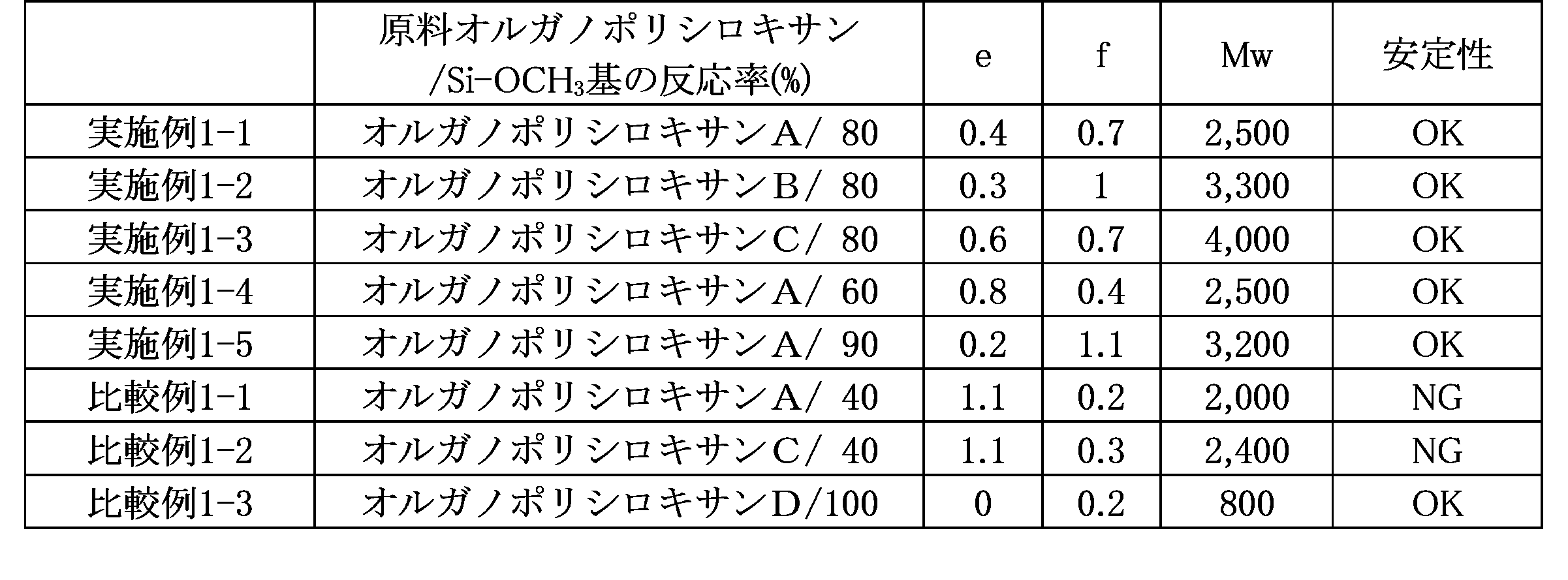
- Examples 1-2 to 1-5, Comparative Examples 1-1 to 1-3 The hydroxyl-containing organopolysiloxanes of Examples 1-2 to 1-5 and Comparative Examples 1-1 to 1-3 were produced according to the same recipe as in Example 1-1, except that the organopolysiloxane raw material was changed to that shown in Table 1 and the reaction rate of the Si - OCH3 group was changed by the amount of water added dropwise.
- the values of e and f in formula (I), the weight average molecular weight (Mw), and the stability of the obtained organopolysiloxane are shown in Table 1.
- the stability was evaluated as OK if no significant increase in viscosity or gelation was observed when the organopolysiloxane was heated in a dryer at 50°C for 10 days, and NG if any increase in viscosity or gelation was observed.
- Curing agent A Duranate TPA100 (polyisocyanate-based curing agent, isocyanate content 23.2% by mass, manufactured by Asahi Kasei Corporation)
- Curing agent B Burnock DN-901S (polyisocyanate-based curing agent, isocyanate content 23.1% by mass, manufactured by DIC Corporation)
- Curing catalyst A Neostan U-810 (dioctyl tin, manufactured by Nitto Kasei Co., Ltd.)
- Curing catalyst B Orgatics TC-750 (titanium catalyst, manufactured by Matsumoto Fine Chemical Co., Ltd.)
- the cured films of the curable compositions of Examples 2-1 to 2-5 have excellent solvent resistance and exhibit high flex resistance.
- the cured films obtained from the compositions of Comparative Examples 2-1 and 2-2 using organopolysiloxanes that do not have enough hydroxyl groups are poor in solvent resistance, and it is found that they do not cure sufficiently even when a polyisocyanate-based curing agent is used.
- Comparative Examples 2-3 and 2-4 in which an organopolysiloxane that does not have enough hydroxyl groups is cured by increasing the amount of a condensation curing catalyst, the cured films have sufficient solvent resistance but poor flex resistance.
Landscapes
- Chemical & Material Sciences (AREA)
- Chemical Kinetics & Catalysis (AREA)
- Organic Chemistry (AREA)
- Health & Medical Sciences (AREA)
- Medicinal Chemistry (AREA)
- Polymers & Plastics (AREA)
- Life Sciences & Earth Sciences (AREA)
- Engineering & Computer Science (AREA)
- Materials Engineering (AREA)
- Wood Science & Technology (AREA)
- Silicon Polymers (AREA)
- Compositions Of Macromolecular Compounds (AREA)
Abstract
下記式(I)で表される水酸基含有オルガノポリシロキサンを提供する。(式中、R1は、1価飽和炭化水素基等であり、R2は、メチル基等であり、R3は、下記式(II)で表される基であり、a、b、cおよびdは、0≦a<1、0<b≦1、0≦c≦0.5、0≦d<1、かつa+b+c+d=1を満たす数であり、eは、0≦e≦1を満たす数であり、fは、0<f<4を満たす数である。)(式中、R4は、1価飽和炭化水素基等であり、R5は、水素原子または1価飽和炭化水素基であり、Xは、2価炭化水素基であり、nは、0~400の数であり、*は、酸素原子との結合を表す。)
Description
本発明は、水酸基含有オルガノポリシロキサン、その製造方法、該オルガノポリシロキサンを含有する硬化性組成物、コーティング剤および被覆物品に関する。
アルコキシシリル基を含有するオルガノポリシロキサンは、塗料やコーティング剤に広く使用されている。一般に、末端にアルコキシ基を有するオルガノポリシロキサンは、硬化触媒を配合し、熱エネルギー等の外部エネルギーを加えることで末端のアルコキシ基が相互に反応し、強固なシロキサンネットワークを形成する。その結果、得られる被膜は、耐熱性や耐候性に優れるため、その施工対象は、屋外建造物から、自動車部品、電子部品まで多岐に亘っている。
一方、オルガノポリシロキサン系塗料は、上記利点を有している反面、硬化速度が遅く、また、得られた塗膜が耐クラック性および耐屈曲性に劣るという欠点も有している。
これらの欠点を改善すべく、従来、オルガノポリシロキサンと、アルキド樹脂、ポリエステル樹脂、アクリル樹脂等の有機樹脂とを複合化した組成物を塗料として用いる手法が知られている(特許文献1~4)。
有機樹脂において最も一般的な官能基として、水酸基が挙げられる。水酸基は、前記アルキド樹脂、ポリエステル樹脂、アクリル樹脂において一般的な官能基であり、水酸基を有するポリオール樹脂は、市場に数多く存在する。
一方で、水酸基を含有し、強固なシロキサンネットワークを形成しうる分岐型のオルガノポリシロキサンは、現在、市場にはほとんど存在しない。一般的なオルガノポリシロキサンに含まれるアルコキシシランは、水により加水分解を受けるが、水酸基によっても同様の反応が進行する。そのため、水酸基を含有するオルガノポリシロキサンは、経時での安定性に不安があり、販売が難しいという欠点がある。
このような背景のもと、非特許文献1,2では、オルガノポリシロキサンを籠状にすることで分子中のアルコキシシランをなくし、水酸基含有オルガノポリシロキサンを合成する方法が提案されている。しかし、この方法では、オルガノポリシロキサンを籠状にするために十分に希釈した条件下で反応を行う必要があるため、収量が少なく、工業化が難しい。
H. Mori, et al., Langmuir, 2007, 23, 17, 9014-9023
H. Takeuchi, et al., Reactive and Functional Polymers, 2017, 115, 43-52
本発明は、上記事情に鑑みてなされたものであり、保存安定性および硬化性組成物に用いた際の硬化性に優れ、耐薬品性、耐屈曲性に優れた被膜を与える水酸基含有オルガノポリシロキサンを提供することを目的とする。
本発明者らは、上記目的を達成するために鋭意検討を重ねた結果、下記式(I)で表される水酸基含有オルガノポリシロキサンが、高い保存安定性を有し、しかも硬化性組成物に用いた際の硬化性に優れ、耐薬品性、耐屈曲性に優れた被膜を与えることを見出すとともに、所定の条件下で、上記水酸基含有オルガノポリシロキサンを得ることができることを見出し、本発明を完成させた。
すなわち、本発明は、
1. 下記式(I)で表される水酸基含有オルガノポリシロキサン、

(式中、R1は、それぞれ独立に、水素原子、または、ハロゲン原子で置換されていてもよい、炭素原子数1~12の1価飽和炭化水素基、炭素原子数7~20のアラルキル基もしくは炭素原子数6~18のアリール基であり、R2は、水素原子、メチル基、エチル基、n-プロピル基、またはイソプロピル基であり、R3は、下記式(II)で表される基であり、a、b、cおよびdは、それぞれ0≦a<1、0<b≦1、0≦c≦0.5、0≦d<1、かつa+b+c+d=1を満たす数であり、eおよびfは、それぞれ0≦e≦1、0<f<4、かつ0<e+f<4を満たす数である。)

(式中、R4は、それぞれ独立に、水素原子、または、ハロゲン原子で置換されていてもよい、炭素原子数1~12の1価飽和炭化水素基、炭素原子数7~20のアラルキル基もしくは炭素原子数6~18のアリール基であり、R5は、それぞれ独立に、水素原子または炭素原子数1~8の1価飽和炭化水素基であり、Xは、炭素原子数2~8の2価炭化水素基であり、nは、0~400の数であり、*は、酸素原子との結合を表す。)
2. 前記式(I)において、R1のうち少なくとも1つは炭素原子数6~18のアリール基である1記載の水酸基含有オルガノポリシロキサン、
3. 前記式(I)において、R1が、それぞれ独立に、メチル基またはフェニル基である1または2記載の水酸基含有オルガノポリシロキサン、
4. 前記式(I)において、R2が、メチル基である1~3のいずれかに記載の水酸基含有オルガノポリシロキサン、
5. 前記式(I)において、bが、0.5≦b≦1を満たす数である1~4のいずれかに記載の水酸基含有オルガノポリシロキサン、
6. 前記式(I)において、aおよびdが、0である1~5のいずれかに記載の水酸基含有オルガノポリシロキサン、
7. 前記式(II)において、R4が、メチル基であり、R5が、水素原子であり、Xが、炭素原子数3のアルキレン基であり、nが、1である1~6のいずれかに記載の水酸基含有オルガノポリシロキサン、
8. ゲル浸透クロマトグラフィーにおけるポリスチレン換算の重量平均分子量(Mw)が、1,000~500,000である1~7のいずれかに記載の水酸基含有オルガノポリシロキサン、
9. (工程α):下記式(I’)で表されるオルガノポリシロキサンと下記式(III)で表されるシラン化合物との加水分解縮合反応によりまたは下記式(I’)で表されるオルガノポリシロキサンと下記式(IV)で表されるジシロキサン化合物との酸触媒を用いた平衡化反応により、SiH基を有するオルガノポリシロキサンを得る工程、および

(式中、R1、R2、a、b、cおよびdは、上記と同じであり、gは、0<g<4を満たす数である。)

(式中、R4は、上記と同じであり、R6は、ハロゲン原子、水酸基、または、炭素原子数1~4のアルコキシ基である。)
(工程β):上記(工程α)で得られたSiH基を有するオルガノポリシロキサンと、下記式(V)で表される化合物とをヒドロシリル化反応させる工程

(式中、R5およびnは、上記と同じであり、R7は、炭素原子数2~8の1価脂肪族不飽和炭化水素基である。)
を含む、1~8のいずれかに記載の水酸基含有オルガノポリシロキサンの製造方法、
10. 1~8のいずれかに記載の水酸基含有オルガノポリシロキサンおよび水酸基と反応しうる硬化剤を含む硬化性組成物、
11. 10記載の硬化性組成物からなるコーティング剤、
12. 10記載の硬化性組成物の硬化膜、
13. 基材と、この基材の少なくとも一方の面に、直接または1つ以上の他の層を介して形成された12記載の硬化膜とを有する被覆物品
を提供する。
1. 下記式(I)で表される水酸基含有オルガノポリシロキサン、
2. 前記式(I)において、R1のうち少なくとも1つは炭素原子数6~18のアリール基である1記載の水酸基含有オルガノポリシロキサン、
3. 前記式(I)において、R1が、それぞれ独立に、メチル基またはフェニル基である1または2記載の水酸基含有オルガノポリシロキサン、
4. 前記式(I)において、R2が、メチル基である1~3のいずれかに記載の水酸基含有オルガノポリシロキサン、
5. 前記式(I)において、bが、0.5≦b≦1を満たす数である1~4のいずれかに記載の水酸基含有オルガノポリシロキサン、
6. 前記式(I)において、aおよびdが、0である1~5のいずれかに記載の水酸基含有オルガノポリシロキサン、
7. 前記式(II)において、R4が、メチル基であり、R5が、水素原子であり、Xが、炭素原子数3のアルキレン基であり、nが、1である1~6のいずれかに記載の水酸基含有オルガノポリシロキサン、
8. ゲル浸透クロマトグラフィーにおけるポリスチレン換算の重量平均分子量(Mw)が、1,000~500,000である1~7のいずれかに記載の水酸基含有オルガノポリシロキサン、
9. (工程α):下記式(I’)で表されるオルガノポリシロキサンと下記式(III)で表されるシラン化合物との加水分解縮合反応によりまたは下記式(I’)で表されるオルガノポリシロキサンと下記式(IV)で表されるジシロキサン化合物との酸触媒を用いた平衡化反応により、SiH基を有するオルガノポリシロキサンを得る工程、および
(工程β):上記(工程α)で得られたSiH基を有するオルガノポリシロキサンと、下記式(V)で表される化合物とをヒドロシリル化反応させる工程
を含む、1~8のいずれかに記載の水酸基含有オルガノポリシロキサンの製造方法、
10. 1~8のいずれかに記載の水酸基含有オルガノポリシロキサンおよび水酸基と反応しうる硬化剤を含む硬化性組成物、
11. 10記載の硬化性組成物からなるコーティング剤、
12. 10記載の硬化性組成物の硬化膜、
13. 基材と、この基材の少なくとも一方の面に、直接または1つ以上の他の層を介して形成された12記載の硬化膜とを有する被覆物品
を提供する。
本発明の水酸基含有オルガノポリシロキサンは、保存安定性に優れ、硬化剤と配合して塗布することで速やかに硬化し、得られる硬化膜は、耐薬品性、耐屈曲性に優れることから、種々の被膜物品の製造に好適である。
以下、本発明について具体的に説明する。
(1)水酸基含有オルガノポリシロキサン
本発明の水酸基含有オルガノポリシロキサンは、下記式(I)で表されるものである。

(1)水酸基含有オルガノポリシロキサン
本発明の水酸基含有オルガノポリシロキサンは、下記式(I)で表されるものである。
式(I)において、R1は、それぞれ独立に、水素原子、または、ハロゲン原子で置換されていてもよい、炭素原子数1~12の1価飽和炭化水素基、炭素原子数7~20のアラルキル基もしくは炭素原子数6~18のアリール基である。
R1の炭素原子数1~12の1価飽和炭化水素基としては、直鎖、分岐、環状のいずれでもよく、その具体例としては、メチル、エチル、n-プロピル、イソプロピル、n-ブチル、イソブチル、tert-ブチル、ネオペンチル、n-ヘキシル、n-ヘプチル、n-オクチル基等の直鎖または分岐のアルキル基;シクロペンチル、シクロヘキシル基等のシクロアルキル基などが挙げられるが、好ましくは炭素原子数1~6、より好ましくは炭素原子数1~3のアルキル基であり、メチル基、エチル基がさらに好ましい。
炭素原子数7~20のアラルキル基としては、炭素原子数7~10のものが好ましく、その具体例としては、ベンジル基、フェニルエチル基等が挙げられる。
炭素原子数6~18のアリール基としては、炭素原子数6~10のものが好ましく、その具体例としては、フェニル、ナフチル基等の非置換アリール基;トリル、キシリル、エチルフェニル、プロピルフェニル、ブチルフェニル、ペンチルフェニル、ヘキシルフェニル、ヘプチルフェニル、オクチルフェニル、ノニルフェニル、デシルフェニル、ウンデシルフェニル、ドデシルフェニル基等のアルキルアリール基などが挙げられ、フェニル基が好ましい。
これらの中でも、R1は、メチル基、フェニル基が好ましい。
なお、上記1価飽和炭化水素基、アラルキル基およびアリール基は、その水素原子の一部または全部が、ハロゲン原子(フッ素、塩素、臭素、ヨウ素原子)で置換されていてもよく、その具体例としては、クロロメチル、クロロプロピル、ブロモエチル、トリフルオロプロピル、クロロフェニル、ブロモフェニル基等が挙げられる。さらに、R1のうち少なくとも1つは、ハロゲン置換または非置換の炭素原子数6~18のアリール基が好ましい。
炭素原子数7~20のアラルキル基としては、炭素原子数7~10のものが好ましく、その具体例としては、ベンジル基、フェニルエチル基等が挙げられる。
炭素原子数6~18のアリール基としては、炭素原子数6~10のものが好ましく、その具体例としては、フェニル、ナフチル基等の非置換アリール基;トリル、キシリル、エチルフェニル、プロピルフェニル、ブチルフェニル、ペンチルフェニル、ヘキシルフェニル、ヘプチルフェニル、オクチルフェニル、ノニルフェニル、デシルフェニル、ウンデシルフェニル、ドデシルフェニル基等のアルキルアリール基などが挙げられ、フェニル基が好ましい。
これらの中でも、R1は、メチル基、フェニル基が好ましい。
なお、上記1価飽和炭化水素基、アラルキル基およびアリール基は、その水素原子の一部または全部が、ハロゲン原子(フッ素、塩素、臭素、ヨウ素原子)で置換されていてもよく、その具体例としては、クロロメチル、クロロプロピル、ブロモエチル、トリフルオロプロピル、クロロフェニル、ブロモフェニル基等が挙げられる。さらに、R1のうち少なくとも1つは、ハロゲン置換または非置換の炭素原子数6~18のアリール基が好ましい。
R2は、水素原子、メチル基、エチル基、n-プロピル基、またはイソプロピル基であり、メチル基、エチル基、n-プロピル基、またはイソプロピル基が好ましく、メチル基、エチル基がより好ましく、メチル基がさらに好ましい。
R3は、下記式(II)で表される基である。

式(II)において、R4は、それぞれ独立に、水素原子、または、ハロゲン原子で置換されていてもよい、炭素原子数1~12の1価飽和炭化水素基、炭素原子数7~20のアラルキル基もしくは炭素原子数6~18のアリール基であり、これら1価飽和炭化水素基、アラルキル基、アリール基の具体例としては、それぞれ上記R1で例示した基と同様のものが挙げられ、中でも、R4は、メチル基、エチル基、フェニル基が好ましく、メチル基がより好ましい。
なお、R4の1価飽和炭化水素基、アラルキル基およびアリール基は、その水素原子の一部または全部がハロゲン原子で置換されていてもよく、その具体例としては、R1で例示した基と同様のものが挙げられる。
なお、R4の1価飽和炭化水素基、アラルキル基およびアリール基は、その水素原子の一部または全部がハロゲン原子で置換されていてもよく、その具体例としては、R1で例示した基と同様のものが挙げられる。
R5は、それぞれ独立に、水素原子または炭素原子数1~8の1価飽和炭化水素基であり、R5の1価飽和炭化水素基としては、直鎖、分岐、環状のいずれでもよく、その具体例としては、R1で例示した基のうち炭素原子数1~8のものと同様のものが挙げられる。中でも、R5は、水素原子または炭素原子数1~3のアルキル基が好ましく、水素原子、メチル基またはエチル基がより好ましく、水素原子がさらに好ましい。
Xは、炭素原子数2~8の2価炭化水素基であり、直鎖または分岐の2価脂肪族炭化水素基が好ましく、その具体例としては、エチレン、トリメチレン、プロピレン、テトラメチレン、ヘキサメチレン、オクタメチレン基等のアルキレン基などが挙げられ、中でも、炭素原子数2または3のアルキレン基が好ましく、炭素原子数3のアルキレン基がより好ましく、トリメチレン基がさらに好ましい。
nは、0~400の数であるが、溶解性の観点から、0~100の数が好ましく、0または1がより好ましく、1がさらに好ましい。
上記式(II)で表される基としては、R4がメチル基であり、R5が水素原子であり、Xが炭素原子数3のアルキレン基であり、nが1であるものが好ましい。
式(I)において、aは、0≦a<1を満たす数であるが、クラック抑制効果の観点から、0≦a≦0.3を満たす数が好ましく、a=0がより好ましい。
bは、0<b≦1を満たす数であるが、得られる硬化物の耐擦傷性の観点から、0.5≦b≦1を満たす数が好ましい。
cは、0≦c≦0.5を満たす数であるが、組成物の硬化性および得られる硬化物の硬度の観点から、0≦c≦0.4を満たす数が好ましく、0≦c≦0.3を満たす数がより好ましい。
dは、0≦d<1を満たす数であるが、組成物の硬化性および得られる硬化物の硬度の観点から、0≦d≦0.2を満たす数が好ましく、d=0がより好ましい。
なお、a、b、cおよびdは、a+b+c+d=1を満たす数である。
bは、0<b≦1を満たす数であるが、得られる硬化物の耐擦傷性の観点から、0.5≦b≦1を満たす数が好ましい。
cは、0≦c≦0.5を満たす数であるが、組成物の硬化性および得られる硬化物の硬度の観点から、0≦c≦0.4を満たす数が好ましく、0≦c≦0.3を満たす数がより好ましい。
dは、0≦d<1を満たす数であるが、組成物の硬化性および得られる硬化物の硬度の観点から、0≦d≦0.2を満たす数が好ましく、d=0がより好ましい。
なお、a、b、cおよびdは、a+b+c+d=1を満たす数である。
eは、0≦e≦1を満たす数であるが、縮合性官能基による縮合反応の抑制の観点から、0≦e≦0.8を満たす数が好ましい。
fは、0<f<4を満たす数であるが、硬化物の架橋密度の観点から、0.2<f≦2を満たす数が好ましく、0.4<f≦1.1を満たす数がより好ましい。
なお、eおよびfは、0<e+f<4を満たす数であり、0.2<e+f≦2.8を満たす数が好ましい。
fは、0<f<4を満たす数であるが、硬化物の架橋密度の観点から、0.2<f≦2を満たす数が好ましく、0.4<f≦1.1を満たす数がより好ましい。
なお、eおよびfは、0<e+f<4を満たす数であり、0.2<e+f≦2.8を満たす数が好ましい。
本発明の水酸基含有オルガノポリシロキサンとしては、上記式(I)において、R1がメチル基またはフェニル基、R2がメチル基、aが0、bが0.5≦b≦1を満たす数、cが0≦c≦0.5を満たす数、dが0、かつa+b+c+d=1を満たす数であり、eが0≦e≦0.8を満たす数、fが0.2<f≦2を満たす数であり、上記式(II)において、R4がメチル基、R5が水素原子、Xが炭素原子数3のアルキレン基、nが1であるものが好ましい。
本発明の水酸基含有オルガノポリシロキサンのゲル浸透クロマトグラフィー(GPC)におけるポリスチレン換算の重量平均分子量(Mw)は、1,000~500,000が好ましく、1,500~10,000がより好ましい。重量平均分子量が1,000以上であれば、より保存安定性および耐屈曲性に優れ、500,000以下であれば、塗装時の凹凸や塗りムラ等が発生するおそれがない。
なお、GPCの測定条件としては、例えば、後の実施例で用いる方法を採用できる。
なお、GPCの測定条件としては、例えば、後の実施例で用いる方法を採用できる。
本発明の水酸基含有オルガノポリシロキサンの25℃における動粘度は、5~2,000mm2/sが好ましく、20~1,000mm2/sがより好ましい。5mm2/s以上であれば、より保存安定性および耐屈曲性に優れ、2,000mm2/s以下であれば、塗装時の凹凸や塗りムラ等が発生するおそれがない。なお、動粘度は、例えばキャノン・フェンスケ型粘度計を用いて測定することができる。
本発明の水酸基含有オルガノポリシロキサンのアルコキシ基量は、保存安定性および基材との密着性の観点から、オルガノポリシロキサンに対して0.5~10質量%が好ましい。
本発明の水酸基含有オルガノポリシロキサンは、単一の組成でも、組成の異なる複数の化合物の混合物であってもよい。
(2)水酸基含有オルガノポリシロキサンの製造方法
本発明の水酸基含有オルガノポリシロキサンの製造方法は特に制限されず、例えば、下記工程(α)および工程(β)を含む製造方法により得ることができる。
(工程α):下記式(I’)で表されるオルガノポリシロキサンと下記式(III)で表されるシラン化合物との加水分解縮合反応によりまたは下記式(I’)で表されるオルガノポリシロキサンと下記式(IV)で表されるジシロキサン化合物との酸触媒を用いた平衡化反応により、SiH基を有するオルガノポリシロキサンを得る工程

(式中、R1、R2、a、b、cおよびdは、上記と同じであり、gは、0<g<4を満たす数である。)

(式中、R4は、上記と同じであり、R6は、ハロゲン原子、水酸基、または、炭素原子数1~4のアルコキシ基である。)
(工程β):上記(工程α)で得られたSiH基を有するオルガノポリシロキサンと、下記式(V)で表される化合物とをヒドロシリル化反応させる工程

(式中、R5およびnは、上記と同じであり、R7は、炭素原子数2~8の1価脂肪族不飽和炭化水素基である。)
本発明の水酸基含有オルガノポリシロキサンの製造方法は特に制限されず、例えば、下記工程(α)および工程(β)を含む製造方法により得ることができる。
(工程α):下記式(I’)で表されるオルガノポリシロキサンと下記式(III)で表されるシラン化合物との加水分解縮合反応によりまたは下記式(I’)で表されるオルガノポリシロキサンと下記式(IV)で表されるジシロキサン化合物との酸触媒を用いた平衡化反応により、SiH基を有するオルガノポリシロキサンを得る工程
(工程β):上記(工程α)で得られたSiH基を有するオルガノポリシロキサンと、下記式(V)で表される化合物とをヒドロシリル化反応させる工程
<(工程α)>
(工程α)は、上記式(I’)で表されるオルガノポリシロキサンと上記式(III)で表されるシラン化合物との加水分解縮合反応によりまたは上記式(I’)で表されるオルガノポリシロキサンと上記式(IV)で表されるジシロキサン化合物との酸触媒を用いた平衡化反応により、SiH基を有するオルガノポリシロキサンを得る工程である。
(工程α)は、上記式(I’)で表されるオルガノポリシロキサンと上記式(III)で表されるシラン化合物との加水分解縮合反応によりまたは上記式(I’)で表されるオルガノポリシロキサンと上記式(IV)で表されるジシロキサン化合物との酸触媒を用いた平衡化反応により、SiH基を有するオルガノポリシロキサンを得る工程である。
式(I’)において、gは、0<g<4を満たす数であるが、0.2<g≦2.8を満たす数が好ましい。
式(I’)で表されるオルガノポリシロキサンとしては、R1がメチル基またはフェニル基、R2がメチル基、aが0、bが0.5≦b≦1を満たす数、cが0≦c≦0.5を満たす数、dが0、かつa+b+c+d=1を満たす数であり、gが0.2<g≦2.8を満たす数であるものが好ましい。
式(I’)で表されるオルガノポリシロキサンは、一般的なオルガノポリシロキサンの製造方法に従って製造することができる。例えば、加水分解性基を有するシラン化合物を加水分解縮合させて得ることができる。
加水分解性基を有するシラン化合物としては、加水分解性基であるクロロ基またはアルコキシ基をケイ素原子上に1~4個含有し、上記条件を満たす有機置換基を有するシラン化合物であれば特に限定されるものではない。
その具体例としては、テトラクロロシラン、テトラメトキシシラン、テトラエトキシシラン、テトライソプロポキシシラン、テトラブトキシシラン、メチルトリクロロシラン、メチルトリメトキシシラン、メチルトリエトキシシラン、メチルトリイソプロポキシシラン、メチルトリブトキシシラン、ジメチルジメトキシシラン、ジメチルジエトキシシラン、ジメチルジイソプロポキシシラン、トリメチルクロロシラン、トリメチルメトキシシラン、トリメチルエトキシシラン、トリメチルイソプロポキシシラン、エチルトリクロロシラン、エチルトリメトキシシラン、エチルトリエトキシシラン、プロピルトリクロロシラン、プロピルトリメトキシシラン、プロピルトリエトキシシラン、ブチルトリクロロシラン、ブチルトリメトキシシラン、ブチルトリエトキシシラン、ヘキシルトリクロロシラン、ヘキシルトリメトキシシラン、ヘキシルトリエトキシシラン、フェニルトリクロロシラン、フェニルトリメトキシシラン、フェニルトリエトキシシラン、シクロヘキシルトリクロロシラン、シクロヘキシルトリメトキシシラン、シクロヘキシルトリエトキシシラン、プロピルメチルジクロロシラン、プロピルメチルジメトキシシラン、プロピルメチルジエトキシシラン、ヘキシルメチルジクロロシラン、ヘキシルメチルジメトキシシラン、ヘキシルメチルジエトキシシラン、フェニルメチルジクロロシラン、フェニルメチルジメトキシシラン、フェニルメチルジエトキシシラン、ジフェニルジクロロシラン、ジフェニルジメトキシシラン、ジフェニルジエトキシシラン、ジメチルフェニルクロロシラン、ジメチルフェニルメトキシシラン、ジメチルフェニルエトキシシラン、およびこれらの部分加水分解物等が挙げられるが、操作性、副生物の留去のしやすさ、および原料の入手の容易さから、メトキシシラン、エトキシシランが好適である。
なお、上記シラン化合物は、1種単独で用いても、2種以上を組み合わせて使用してもよい。
その具体例としては、テトラクロロシラン、テトラメトキシシラン、テトラエトキシシラン、テトライソプロポキシシラン、テトラブトキシシラン、メチルトリクロロシラン、メチルトリメトキシシラン、メチルトリエトキシシラン、メチルトリイソプロポキシシラン、メチルトリブトキシシラン、ジメチルジメトキシシラン、ジメチルジエトキシシラン、ジメチルジイソプロポキシシラン、トリメチルクロロシラン、トリメチルメトキシシラン、トリメチルエトキシシラン、トリメチルイソプロポキシシラン、エチルトリクロロシラン、エチルトリメトキシシラン、エチルトリエトキシシラン、プロピルトリクロロシラン、プロピルトリメトキシシラン、プロピルトリエトキシシラン、ブチルトリクロロシラン、ブチルトリメトキシシラン、ブチルトリエトキシシラン、ヘキシルトリクロロシラン、ヘキシルトリメトキシシラン、ヘキシルトリエトキシシラン、フェニルトリクロロシラン、フェニルトリメトキシシラン、フェニルトリエトキシシラン、シクロヘキシルトリクロロシラン、シクロヘキシルトリメトキシシラン、シクロヘキシルトリエトキシシラン、プロピルメチルジクロロシラン、プロピルメチルジメトキシシラン、プロピルメチルジエトキシシラン、ヘキシルメチルジクロロシラン、ヘキシルメチルジメトキシシラン、ヘキシルメチルジエトキシシラン、フェニルメチルジクロロシラン、フェニルメチルジメトキシシラン、フェニルメチルジエトキシシラン、ジフェニルジクロロシラン、ジフェニルジメトキシシラン、ジフェニルジエトキシシラン、ジメチルフェニルクロロシラン、ジメチルフェニルメトキシシラン、ジメチルフェニルエトキシシラン、およびこれらの部分加水分解物等が挙げられるが、操作性、副生物の留去のしやすさ、および原料の入手の容易さから、メトキシシラン、エトキシシランが好適である。
なお、上記シラン化合物は、1種単独で用いても、2種以上を組み合わせて使用してもよい。
加水分解を実施するに際し、加水分解触媒を使用してもよい。加水分解触媒としては、従来公知の触媒を使用することができ、その水溶液がpH2~7の酸性を示すもの(酸性触媒)が好ましく、特に酸性のハロゲン化水素、スルホン酸、カルボン酸、酸性または弱酸性の無機塩、イオン交換樹脂等の固体酸などが好ましい。
酸性触媒の具体例としては、フッ化水素、塩酸、硝酸、硫酸、メタンスルホン酸、p-トルエンスルホン酸、ギ酸、酢酸、マレイン酸、安息香酸、乳酸、燐酸、表面にスルホン酸またはカルボン酸基を有するカチオン交換樹脂等が挙げられる。
酸性触媒の具体例としては、フッ化水素、塩酸、硝酸、硫酸、メタンスルホン酸、p-トルエンスルホン酸、ギ酸、酢酸、マレイン酸、安息香酸、乳酸、燐酸、表面にスルホン酸またはカルボン酸基を有するカチオン交換樹脂等が挙げられる。
加水分解触媒の使用量は特に限定されるものではないが、反応を速やかに進行させるとともに、反応後の触媒の除去の容易性を考慮すると、加水分解性シラン1モルに対して0.0002~0.5モルが好ましい。
加水分解性基を有するシラン化合物と、加水分解縮合反応に要する水との質量比は、特に限定されるものではないが、触媒の失活を防いで反応を十分に進行させるとともに、反応後の水の除去の容易性を考慮すると、加水分解性シラン1モルに対し、水0.1~10モルの割合が好ましい。
加水分解縮合時の反応温度は、特に限定されるものではないが、反応率を向上させるとともに、有機官能基の分解を防止することを考慮すると、-10~150℃が好ましい。反応時間は特に限定されないが、0.5~6時間が好ましい。
加水分解縮合時の反応温度は、特に限定されるものではないが、反応率を向上させるとともに、有機官能基の分解を防止することを考慮すると、-10~150℃が好ましい。反応時間は特に限定されないが、0.5~6時間が好ましい。
なお、加水分解縮合の際には、有機溶剤を使用してもよい。使用できる有機溶剤の具体例としては、メタノール、エタノール、プロパノール、アセトン、メチルエチルケトン、メチルイソブチルケトン、テトラヒドロフラン、トルエン、キシレン等が挙げられる。
上記式(III)において、R6のハロゲン原子としては、フッ素、塩素、臭素、ヨウ素原子が挙げられ、炭素原子数1~4のアルコキシ基としては、メトキシ、エトキシ、n-プロポキシ、n-ブトキシ基等が挙げられる。中でも、R6は、塩素原子、水酸基、メトキシ基またはエトキシ基が好ましい。
上記式(III)で表されるシラン化合物の具体例としては、例えば、メトキシシラン、ジメチルメトキシシラン、エトキシシラン、ジメチルエトキシシラン、クロロシラン、ジメチルクロロシラン、ジメチルヒドロキシシラン等が挙げられる。
上記式(IV)で表されるジシロキサン化合物の具体例としては、例えば、1,1,3,3-テトラメチルジシロキサン等が挙げられる。
上記式(I’)で表されるオルガノポリシロキサンと上記式(III)で表されるシラン化合物との加水分解縮合反応によりSiH基を有するオルガノポリシロキサンを得る工程において、加水分解縮合反応の条件は特に限定されるものではないが、上記式(I’)で表されるオルガノポリシロキサンの製造と同様の条件にて行うことができる。
この場合、上記式(I’)で表されるオルガノポリシロキサンと上記式(III)で表されるシラン化合物の使用割合は特に限定されないが、上記式(I’)で表されるオルガノポリシロキサン100質量部に対して、上記式(III)で表されるシラン化合物が、5~80質量部が好ましく、10~70質量部がより好ましい。
加水分解触媒を使用する際の使用量は特に限定されるものではないが、式(III)で表されるシラン化合物1モルに対して、0.0002~0.5モルが好ましい。
この場合、上記式(I’)で表されるオルガノポリシロキサンと上記式(III)で表されるシラン化合物の使用割合は特に限定されないが、上記式(I’)で表されるオルガノポリシロキサン100質量部に対して、上記式(III)で表されるシラン化合物が、5~80質量部が好ましく、10~70質量部がより好ましい。
加水分解触媒を使用する際の使用量は特に限定されるものではないが、式(III)で表されるシラン化合物1モルに対して、0.0002~0.5モルが好ましい。
上記式(I’)で表されるオルガノポリシロキサンに含まれる加水分解性基と加水分解縮合反応に要する水との質量比は、特に限定されるものではないが、加える水の量によって反応率を変更することができるため、所望の反応率に応じた質量比が好ましい。オルガノポリシロキサン末端の活性の高いアルコキシ基を少なくして保存安定性を確保する観点から、アルコキシ基の反応率としては、好ましくは50~100%であり、より好ましくは60~100%である。
一方、上記式(I’)で表されるオルガノポリシロキサンと上記式(IV)で表されるジシロキサン化合物との酸触媒を用いた平衡化反応(シロキサン結合の開裂/再結合化反応)によりSiH基を有するオルガノポリシロキサンを得る工程において、平衡化反応の条件は特に制限されないが、例えば、20~150℃で0.5~6時間程度、好ましくは20~100℃で1~4時間程度の条件で行うことができる。
この際、必要に応じて溶媒を添加することは任意である。溶媒としては、例えば、メタノール、エタノール、イソプロピルアルコール等のアルコール溶媒;ベンゼン、トルエン、キシレン等の芳香族系非極性溶媒などが挙げられる。
この際、必要に応じて溶媒を添加することは任意である。溶媒としては、例えば、メタノール、エタノール、イソプロピルアルコール等のアルコール溶媒;ベンゼン、トルエン、キシレン等の芳香族系非極性溶媒などが挙げられる。
上記式(I’)で表されるオルガノポリシロキサンと上記式(IV)で表されるジシロキサン化合物の使用割合は特に限定されないが、上記式(I’)で表されるオルガノポリシロキサン100質量部に対して、上記式(IV)で表されるジシロキサン化合物が、10~70質量部が好ましく、20~60質量部がより好ましい。
平衡化反応を促進するための酸性触媒としては、強酸が好ましく、特に種類は問わないが、硫酸、メタンスルホン酸、トリフルオロメタンスルホン酸などが好適に使用でき、後処理の容易さから、特にこれらの交換基を有する陽イオン交換樹脂が好ましい。
また、酸性触媒の添加量は、上記式(I’)で表されるオルガノポリシロキサンと上記式(IV)で表されるジシロキサン化合物との合計質量に対して100~10,000ppmが好ましく、500~3,000ppmがより好ましい。
また、酸性触媒の添加量は、上記式(I’)で表されるオルガノポリシロキサンと上記式(IV)で表されるジシロキサン化合物との合計質量に対して100~10,000ppmが好ましく、500~3,000ppmがより好ましい。
なお、平衡化反応の際には、上記式(I’)で表されるオルガノポリシロキサンと上記式(IV)で表されるジシロキサン化合物との加水分解縮合反応を促進するために水を添加してもよい。使用する水の量は、特に限定されるものではないが、加える水の量によって反応率を変更することができるため、所望の反応率に応じた質量比が好ましい。オルガノポリシロキサン末端の活性の高いアルコキシ基を少なくして保存安定性を確保する観点から、アルコキシ基の反応率としては、好ましくは50~100%であり、より好ましくは60~100%である。
<(工程β)>
(工程β)は、上記(工程α)で得られたSiH基を有するオルガノポリシロキサンと、上記式(V)で表される化合物とをヒドロシリル化反応させ、水酸基含有オルガノポリシロキサンを得る工程である。
(工程β)は、上記(工程α)で得られたSiH基を有するオルガノポリシロキサンと、上記式(V)で表される化合物とをヒドロシリル化反応させ、水酸基含有オルガノポリシロキサンを得る工程である。
上記式(V)において、R7の炭素原子数2~8の1価脂肪族不飽和炭化水素基としては、炭素原子数2~6のものが好ましく、その具体例としては、ビニル、アリル、3-ブテニル、5-ヘキセニル、7-オクテニル基等のアルケニル基などが挙げられ、ビニル基、アリル基が好ましく、アリル基がより好ましい。
上記式(V)で表される化合物としては、オルガノポリシロキサンとの相溶性を考慮すると、ビニルアルコール、アリルアルコール、エチレングリコールモノアリルエーテルが好ましく、エチレングリコールモノアリルエーテルがより好ましい。
ヒドロシリル化反応に供する上記式(V)で表される化合物の使用量は、(工程α)で得られたSiH基を有するオルガノポリシロキサン中のSiH基1モルに対して1モル以上が好ましい。
上記ヒドロシリル化反応は、触媒の存在下で行うことが好ましい。ヒドロシリル化反応触媒としては、白金、ロジウム、パラジウム等の白金族金属を含む化合物を使用することができる。これらの中でも白金を含む化合物が好ましく、例えば、白金ブラック、塩化白金酸、塩化白金酸のアルコール変性物、塩化白金酸とオレフィン、ビニルシロキサン、アセチレンアルコール等との錯体、白金カルボニルビニルメチル錯体、白金-ジビニルテトラメチルジシロキサン錯体、白金-シクロビニルメチルシロキサン錯体、白金-オクチルアルデヒド/オクタノール錯体などが挙げられる。
添加量は、付加反応を促進できる、いわゆる触媒量であればよく、通常は上記式(V)で表される化合物の質量に対して白金族金属の質量換算で0.1~500ppmであり、好ましくは1~200ppmである。
添加量は、付加反応を促進できる、いわゆる触媒量であればよく、通常は上記式(V)で表される化合物の質量に対して白金族金属の質量換算で0.1~500ppmであり、好ましくは1~200ppmである。
ヒドロシリル化反応の条件は、特に制限はないが、例えば、反応温度20~120℃、反応時間1~8時間が好ましく、反応温度20~100℃、反応時間1~6時間がより好ましい。
このようにして、上記式(I’)で表される加水分解性基を有するオルガノポリシロキサンの末端にSiH基を導入し、次いで、式(V)で表される水酸基含有化合物とヒドロシリル化反応させることで、本発明の水酸基含有オルガノポリシロキサンを得ることができる。
このようにして、上記式(I’)で表される加水分解性基を有するオルガノポリシロキサンの末端にSiH基を導入し、次いで、式(V)で表される水酸基含有化合物とヒドロシリル化反応させることで、本発明の水酸基含有オルガノポリシロキサンを得ることができる。
(3)硬化性組成物
本発明の水酸基含有オルガノポリシロキサンは、水酸基と反応しうる置換基を有する硬化剤を添加することにより硬化性組成物として利用することができる。
硬化剤としては、ポリオール系塗料において一般的に用いられるものであれば、特に限定されるものではないが、例えば、金属ドライヤー、ポリイソシアネート、メラミン樹脂、ベンゾグアナミン樹脂、尿素樹脂、チオ尿素樹脂等のアミノ樹脂、エポキシ樹脂、多価カルボン酸無水物等が挙げられ、ポリイソシアネートが好ましい。
ポリイソシアネートとしては、芳香族、脂肪族、芳香脂肪族、脂環族ポリイソシアネート等の公知のものを使用することができるが、屋外での長期使用という観点から、脂肪族ジイソシアネートを主原料とする脂肪族ポリイソシアネートが好適である。
本発明の水酸基含有オルガノポリシロキサンは、水酸基と反応しうる置換基を有する硬化剤を添加することにより硬化性組成物として利用することができる。
硬化剤としては、ポリオール系塗料において一般的に用いられるものであれば、特に限定されるものではないが、例えば、金属ドライヤー、ポリイソシアネート、メラミン樹脂、ベンゾグアナミン樹脂、尿素樹脂、チオ尿素樹脂等のアミノ樹脂、エポキシ樹脂、多価カルボン酸無水物等が挙げられ、ポリイソシアネートが好ましい。
ポリイソシアネートとしては、芳香族、脂肪族、芳香脂肪族、脂環族ポリイソシアネート等の公知のものを使用することができるが、屋外での長期使用という観点から、脂肪族ジイソシアネートを主原料とする脂肪族ポリイソシアネートが好適である。
脂肪族ジイソシアネートとしては、例えば、テトラメチレンジイソシアネート、1,5-ペンタメチレンジイソシアネート、1,6-ヘキサメチレンジイソシアネート(以下「HDI」と略す)、2,2,4-(または、2,4,4)-トリメチル-1,6-ヘキサメチレンジイソイシアネート、リジンイソシアネート、イソホロンジイソシアネート、水添キシレンジイソシアネート、水添ジフェニルメタンジイソシアネート、1,4-ジイソシアネートシクロヘキサン、1,3-ビス(ジイソシアネートメチル)シクロヘキサン、4,4’-ジシクロヘキシルメタンジイソシアネート等が挙げられる。
これらの中でも、得られる塗膜の耐クラック性とコストの観点から、HDIが特に好適である。
これらの中でも、得られる塗膜の耐クラック性とコストの観点から、HDIが特に好適である。
脂肪族ジイソシアネートから得られる脂肪族ポリイソシアネートとしては、アロファネート型ポリイソシアネート、ビウレット型ポリイソシアネート、アダクト型ポリイソシアネートおよびイソシアヌレート型ポリイソシアネート等が挙げられるが、いずれも好適に使用することができる。
なお、前記したポリイソシアネートとしては、種々のブロック剤でブロック化された、いわゆるブロックポリイソシアネートを使用することもできる。
ブロック剤としては、例えば、メタノール、エタノール、乳酸エステル等のアルコール類;フェノール、サリチル酸エステル等のフェノール性水酸基含有化合物類;ε-カプロラクタム、2-ピロリドン等のアマイド類;アセトンオキシム、メチルエチルケトオキシム等のオキシム類;アセト酢酸メチル、アセト酢酸エチル、アセチルアセトン等の活性メチレン化合物類などを使用することができる。
ブロック剤としては、例えば、メタノール、エタノール、乳酸エステル等のアルコール類;フェノール、サリチル酸エステル等のフェノール性水酸基含有化合物類;ε-カプロラクタム、2-ピロリドン等のアマイド類;アセトンオキシム、メチルエチルケトオキシム等のオキシム類;アセト酢酸メチル、アセト酢酸エチル、アセチルアセトン等の活性メチレン化合物類などを使用することができる。
硬化剤の配合量は特に限定されないが、水酸基含有ポリシロキサン中の水酸基の個数に対する硬化剤中のイソシアネート基の個数の比(NCO/OH)が、0.5~1.1となる量が好ましく、0.7~1.0となる量がより好ましい。
なお、硬化剤は、1種単独で用いても、2種以上組み合わせて用いてもよい。
なお、硬化剤は、1種単独で用いても、2種以上組み合わせて用いてもよい。
本発明の硬化性組成物は、さらに、硬化触媒を含有していてもよい。硬化触媒としては、オルガノシロキサン系塗料において一般的に用いられるものであれば、特に限定されるものではないが、有機金属化合物が好ましく、例えば、Ti、Al、Zr、Sn等の金属アルコキシド化合物、金属キレート化合物、金属エステル化合物等が挙げられる。
金属アルコキシド化合物の具体例としては、アルミニウムトリメトキシド、アルミニウムトリエトキシド、アルミニウムトリ-n-プロポキシド、アルミニウムトリイソプロポキシド、アルミニウムトリ-n-ブトキシド、アルミニウムトリイソブトキシド、アルミニウムトリ-s-ブトキシド、アルミニウムトリ-t-ブトキシド等のアルミニウムアルコキシド;テトラメチルチタネート、テトラエチルチタネート、テトラ-n-プロピルチタネート、テトライソプロピルチタネート、テトラ-n-ブチルチタネート、テトライソブチルチタネート、テトラ-t-ブチルチタネート、テトラ-n-ヘキシルチタネート、テトライソオクチルチタネート、テトラ-n-ラウリルチタネート等のチタニウムアルコキシド;テトラエチルジルコネート、テトラ-n-プロピルジルコネート、テトライソプロピルジルコネート、テトラ-n-ブチルジルコネート、テトラ-s-ブチルジルコネート、テトラ-t-ブチルジルコネート、テトラ-n-ペンチルジルコネート、テトラ-t-ペンチルジルコネート、テトラ-t-ヘキシルジルコネート、テトラ-n-ヘプチルジルコネート、テトラ-n-オクチルジルコネート、テトラ-n-ステアリルジルコネート等のジルコニウムアルコキシド;ジブチルスズジブトキシドなどが挙げられる。
金属キレート化合物の具体例としては、トリス(エチルアセトアセテート)アルミニウム、トリス(n-プロピルアセトアセテート)アルミニウム、トリス(イソプロピルアセトアセテート)アルミニウム、トリス(n-ブチルアセトアセテート)アルミニウム、イソプロポキシビス(エチルアセトアセテート)アルミニウム、トリス(アセチルアセトナト)アルミニウム、トリス(プロピオニルアセトナト)アルミニウム、ジイソプロポキシプロピオニルアセトナトアルミニウム、アセチルアセトナト・ビス(プロピオニルアセトナト)アルミニウム、モノエチルアセトアセテート・ビス(アセチルアセトナト)アルミニウム、アセチルアセトナトアルミニウム・ジ-s-ブチレート、メチルアセトアセテートアルミニウム・ジ-s-ブチレート、ジ(メチルアセトアセテート)アルミニウム・モノ-tert-ブチレート、ジイソプロポキシエチルアセトアセテートアルミニウム、モノアセチルアセトナト・ビス(エチルアセトアセテート)アルミニウム等のアルミニウムキレート化合物;ジイソプロポキシ・ビス(エチルアセトアセテート)チタネート、ジイソプロポキシ・ビス(アセチルアセトナト)チタネート、ジ-n-ブトキシ・ビス(アセチルアセトナト)チタネート等のチタニウムキレート化合物;テトラキス(アセチルアセトナト)ジルコニウム、テトラキス(n-プロピルアセトアセテート)ジルコニウム、テトラキス(エチルアセトアセテート)ジルコニウム等のジルコニウムキレート化合物;ジブチル錫ジアセテート、ジブチル錫ジ(2-エチルヘキシレート)、ジベンジル錫ジ(2-エチルヘキシレート)、ジブチル錫ジラウレート、ジブチル錫ジイソオクチルマレエート、ジブチル錫ビス(アセチルアセトネート)等の錫エステル化合物等の錫キレート化合物などが挙げられる。
硬化触媒を配合する場合、その配合量は、組成物を硬化させるのに十分な量であればよいが、水酸基含有オルガノポリシロキサンの不揮発分100質量部に対して0.01~20質量部が好ましく、0.1~10質量部がより好ましい。
なお、硬化触媒は、1種単独で用いても、2種以上を組み合わせて用いてもよい。
なお、硬化触媒は、1種単独で用いても、2種以上を組み合わせて用いてもよい。
本発明の硬化性組成物は、水酸基含有オルガノポリシロキサン以外の水酸基含有化合物を含んでいてもよく、このような硬化性組成物の具体例としては、例えば、本発明の水酸基含有オルガノポリシロキサン、ポリオールおよび多塩基酸を含むポリエステル系またはアルキド系硬化性組成物;本発明の水酸基含有オルガノポリシロキサン、ポリオールおよびポリイソシアネートを含むポリウレタン系硬化性組成物;本発明の水酸基含有オルガノポリシロキサン、ポリオールおよびエポキシ樹脂を含むエポキシ系硬化性組成物;本発明の水酸基含有オルガノポリシロキサン、ポリオール、エーテル化メラミン樹脂および/またはベンゾグアナミン樹脂を含む硬化性組成物などが挙げられるが、これらに限定されない。
また、本発明の水酸基含有オルガノポリシロキサンと、水酸基と反応しうる置換基およびラジカル重合性基を有する化合物との反応物は、光ラジカル重合開始剤または熱ラジカル重合開始剤を添加することにより、光硬化性組成物または熱硬化性組成物として利用することができる。このような硬化性組成物の具体例としては、例えば、本発明の水酸基含有オルガノポリシロキサンとイソシアネート基含有(ポリ)アクリレートとの反応物および光ラジカル重合開始剤を含む光硬化性組成物が挙げられる。
(4)硬化性組成物の硬化膜および被覆物品
本発明の硬化性組成物は、コーティング剤として好適に利用でき、特に外壁塗料用途として好適に使用できるが、その適用用途は、特に限定されるものではない。コーティング剤として使用する場合、例えば、基材の少なくとも一方の面に、直接または1種以上の他の層を介して、本発明の硬化性組成物を塗布し、それを硬化させることにより被膜を形成することで、基材の少なくとも一方の面に、直接または1種以上の他の層を介して形成された硬化性組成物の硬化膜を有する被覆物品を得ることができる。
本発明の硬化性組成物は、コーティング剤として好適に利用でき、特に外壁塗料用途として好適に使用できるが、その適用用途は、特に限定されるものではない。コーティング剤として使用する場合、例えば、基材の少なくとも一方の面に、直接または1種以上の他の層を介して、本発明の硬化性組成物を塗布し、それを硬化させることにより被膜を形成することで、基材の少なくとも一方の面に、直接または1種以上の他の層を介して形成された硬化性組成物の硬化膜を有する被覆物品を得ることができる。
上記基材としては、特に限定されるものではないが、ガラス、シリコンウェハー、金属、プラスチック成形体、セラミックス、それらの複合物等が挙げられる。
また、これらの基材の表面が、化成処理、コロナ放電処理、プラズマ処理、酸やアルカリ液で処理されている基材や、基材本体と表層が異なる種類の塗料で被覆された化粧合板等も用いることもできる。他の層としては、ポリエステル樹脂塗装、ポリウレタン樹脂塗装、アミノアルキド樹脂塗装、ラッカー塗装、吹付塗装、水性ワックス塗装により得られたものなどが挙げられる。
また、これらの基材の表面が、化成処理、コロナ放電処理、プラズマ処理、酸やアルカリ液で処理されている基材や、基材本体と表層が異なる種類の塗料で被覆された化粧合板等も用いることもできる。他の層としては、ポリエステル樹脂塗装、ポリウレタン樹脂塗装、アミノアルキド樹脂塗装、ラッカー塗装、吹付塗装、水性ワックス塗装により得られたものなどが挙げられる。
本発明の硬化性組成物の基材への塗布方法としては、公知の手法から適宜選択すればよく、例えば、ロールコート、バーコート、ワイヤーバーコート、スプレーコート、フローコート、スピンコート、カーテンコート、ナイフコート、浸漬コート、刷毛塗り等の各種塗布方法を用いることができる。塗布量は特に制限されないが、通常は乾燥後の被膜の厚さが0.1~1,000μmとなる量が好ましく、1~100μmとなる量がより好ましい。
組成物を硬化させるための方法としては、常温硬化、加熱硬化等が挙げられる。加熱温度は特に制限されないが、50~200℃が好ましく、80~150℃がより好ましい。
以下、実施例および比較例を示し、本発明をより具体的に説明するが、本発明は下記の実施例に制限されるものではない。なお、動粘度は、キャノン・フェンスケ型粘度計を用いて25℃で測定した値であり、オルガノポリシロキサンの平均組成は、日本電子(株)製NMR測定装置を用いた1H-NMRおよび29Si-NMRスペクトルの積分値から算出した値であり、重量平均分子量(Mw)は、下記条件のGPC(ゲルパーミエーションクロマトグラフィー)測定により求めたポリスチレン換算値である。
〔GPC条件〕
装置:HLC-8220(東ソー(株)製)
カラム:TSKgel GMHXL-L、TSKgel G4000HXL、TSKgel G2000HXL ×2
展開溶媒:テトラヒドロフラン(THF)
流速:1mL/min
検出器:RI
カラム恒温槽温度:40℃
標準物質:ポリスチレン
〔GPC条件〕
装置:HLC-8220(東ソー(株)製)
カラム:TSKgel GMHXL-L、TSKgel G4000HXL、TSKgel G2000HXL ×2
展開溶媒:テトラヒドロフラン(THF)
流速:1mL/min
検出器:RI
カラム恒温槽温度:40℃
標準物質:ポリスチレン
[1]水酸基含有オルガノポリシロキサンの合成
下記オルガノポリシロキサンA~Dを原料とし、実施例1-1~1-5、比較例1-1~1-3のオルガノポリシロキサンを製造した。
<原料オルガノポリシロキサン>
オルガノポリシロキサンA:上記式(I’)においてa=0、b=0.6、c=0.4、d=0、g=1.1、R1:メチル基、フェニル基、R2:メチル基で表されるオルガノポリシロキサン(重量平均分子量1,500、動粘度100mm2/s)
オルガノポリシロキサンB:上記式(I’)においてa=0、b=0.9、c=0.1、d=0、g=1.3、R1:メチル基、フェニル基、R2:メチル基で表されるオルガノポリシロキサン(重量平均分子量1,800、動粘度70mm2/s)
オルガノポリシロキサンC:上記式(I’)においてa=0、b=1、c=0、d=0、g=1.3、R1:メチル基、フェニル基、R2:メチル基で表されるオルガノポリシロキサン(重量平均分子量1,000、動粘度30mm2/s)
オルガノポリシロキサンD:上記式(I’)においてa=0、b=0、c=1、d=0、g=0.2、R1:メチル基、R2:メチル基で表されるオルガノポリシロキサン(重量平均分子量350、動粘度2.5mm2/s)
下記オルガノポリシロキサンA~Dを原料とし、実施例1-1~1-5、比較例1-1~1-3のオルガノポリシロキサンを製造した。
<原料オルガノポリシロキサン>
オルガノポリシロキサンA:上記式(I’)においてa=0、b=0.6、c=0.4、d=0、g=1.1、R1:メチル基、フェニル基、R2:メチル基で表されるオルガノポリシロキサン(重量平均分子量1,500、動粘度100mm2/s)
オルガノポリシロキサンB:上記式(I’)においてa=0、b=0.9、c=0.1、d=0、g=1.3、R1:メチル基、フェニル基、R2:メチル基で表されるオルガノポリシロキサン(重量平均分子量1,800、動粘度70mm2/s)
オルガノポリシロキサンC:上記式(I’)においてa=0、b=1、c=0、d=0、g=1.3、R1:メチル基、フェニル基、R2:メチル基で表されるオルガノポリシロキサン(重量平均分子量1,000、動粘度30mm2/s)
オルガノポリシロキサンD:上記式(I’)においてa=0、b=0、c=1、d=0、g=0.2、R1:メチル基、R2:メチル基で表されるオルガノポリシロキサン(重量平均分子量350、動粘度2.5mm2/s)
[実施例1-1]
撹拌機、還流冷却器、滴下ロートおよび温度計を備えた500mLのセパラブルフラスコに、オルガノポリシロキサンAを100質量部、テトラメチルジシロキサン55質量部、メタノール35質量部、および強酸性陽イオン交換樹脂(ランクセス製レバチットK2629)2質量部を加え、撹拌しながら水を11質量部滴下した。25℃で3時間撹拌した後、得られた反応液の濾過を行った。次に、減圧留去(90℃、1.3kPa)で留分を除去した。1H-NMRおよび29Si-NMRにおける検出スペクトルの積分値から算出したSi-OCH3基の反応率は80%であった。
さらに、そこへPt(0)の1,3-ジビニルテトラメチルジシロキサン錯体を0.1質量部およびエチレングリコールモノアリルエーテル64質量部を加え、80℃で4時間加熱を行った後に、減圧留去(90℃、1.3kPa)により未反応のエチレングリコールモノアリルエーテルを除くことで水酸基含有オルガノポリシロキサンを得た(収量150質量部)。
撹拌機、還流冷却器、滴下ロートおよび温度計を備えた500mLのセパラブルフラスコに、オルガノポリシロキサンAを100質量部、テトラメチルジシロキサン55質量部、メタノール35質量部、および強酸性陽イオン交換樹脂(ランクセス製レバチットK2629)2質量部を加え、撹拌しながら水を11質量部滴下した。25℃で3時間撹拌した後、得られた反応液の濾過を行った。次に、減圧留去(90℃、1.3kPa)で留分を除去した。1H-NMRおよび29Si-NMRにおける検出スペクトルの積分値から算出したSi-OCH3基の反応率は80%であった。
さらに、そこへPt(0)の1,3-ジビニルテトラメチルジシロキサン錯体を0.1質量部およびエチレングリコールモノアリルエーテル64質量部を加え、80℃で4時間加熱を行った後に、減圧留去(90℃、1.3kPa)により未反応のエチレングリコールモノアリルエーテルを除くことで水酸基含有オルガノポリシロキサンを得た(収量150質量部)。
[実施例1-2~1-5、比較例1-1~1-3]
原料のオルガノポリシロキサンを表1に示すものに変更し、滴下する水の量によってSi-OCH3基の反応率を変更した以外は、実施例1-1と同様の処方によって実施例1-2~1-5、比較例1-1~1-3の水酸基含有オルガノポリシロキサンを製造した。
原料のオルガノポリシロキサンを表1に示すものに変更し、滴下する水の量によってSi-OCH3基の反応率を変更した以外は、実施例1-1と同様の処方によって実施例1-2~1-5、比較例1-1~1-3の水酸基含有オルガノポリシロキサンを製造した。
得られたオルガノポリシロキサンの式(I)におけるeおよびfの値、重量平均分子量(Mw)、および安定性を表1に記載した。なお、安定性は、オルガノポリシロキサンを50℃の乾燥機で10日間加熱した際に著しい増粘やゲル化が見られなかったものをOK、増粘やゲル化が見られたものをNGとして評価した。
[2]硬化性組成物の調製
[実施例2-1~2-5、比較例2-1~2-4]
実施例1-1~1-5、比較例1-3で得られたオルガノポリシロキサン、上記オルガノポリシロキサンA、上記オルガノポリシロキサンB、下記硬化剤および硬化触媒を表2に示す組成比(質量比)で25℃で混合し、硬化性組成物を調製した。
[実施例2-1~2-5、比較例2-1~2-4]
実施例1-1~1-5、比較例1-3で得られたオルガノポリシロキサン、上記オルガノポリシロキサンA、上記オルガノポリシロキサンB、下記硬化剤および硬化触媒を表2に示す組成比(質量比)で25℃で混合し、硬化性組成物を調製した。
<硬化剤>
硬化剤A:デュラネートTPA100、(ポリイソシアネート系硬化剤、イソシアネート含有率23.2質量%、旭化成(株)製)
硬化剤B:バーノックDN-901S(ポリイソシアネート系硬化剤、イソシアネート含有率23.1質量%、DIC(株)製)
<硬化触媒>
硬化触媒A:ネオスタンU-810(ジオクチル錫、日東化成(株)製)
硬化触媒B:オルガチックスTC-750(チタン系触媒、マツモトファインケミカル(株)製)
硬化剤A:デュラネートTPA100、(ポリイソシアネート系硬化剤、イソシアネート含有率23.2質量%、旭化成(株)製)
硬化剤B:バーノックDN-901S(ポリイソシアネート系硬化剤、イソシアネート含有率23.1質量%、DIC(株)製)
<硬化触媒>
硬化触媒A:ネオスタンU-810(ジオクチル錫、日東化成(株)製)
硬化触媒B:オルガチックスTC-750(チタン系触媒、マツモトファインケミカル(株)製)
[3]硬化膜の作製
得られた硬化性組成物を、表面オイルを拭った磨き鋼板に厚さ10μmになるようにバーコーターにて塗布を行い、23℃、50%RHの条件下で7日間静置して硬化膜を得た。得られた硬化膜について、耐溶剤性、耐屈曲性を評価した。結果を表2に示す。
得られた硬化性組成物を、表面オイルを拭った磨き鋼板に厚さ10μmになるようにバーコーターにて塗布を行い、23℃、50%RHの条件下で7日間静置して硬化膜を得た。得られた硬化膜について、耐溶剤性、耐屈曲性を評価した。結果を表2に示す。
(1)耐溶剤性
アセトンをベンコットM-3II(旭化成(株)製、面積4cm2)に浸し、荷重500gfで表面を往復回数30回塗擦し、目視での塗膜外観を評価した。ラビング試験後に、試験前の塗膜外観と比べて変化が見られないものを〇、塗膜の剥がれや白色化が見られたものを×とした。
(2)耐屈曲性
耐屈曲性は、円筒形マンドレル法(JIS K5600-5-1:1999)に準拠して試験を行い、直径6mmの円筒マンドレルを用いて行う耐屈曲性試験において、外観にクラックや剥がれが発生しないものを○、クラックや剥がれが発生したものを×とした。
アセトンをベンコットM-3II(旭化成(株)製、面積4cm2)に浸し、荷重500gfで表面を往復回数30回塗擦し、目視での塗膜外観を評価した。ラビング試験後に、試験前の塗膜外観と比べて変化が見られないものを〇、塗膜の剥がれや白色化が見られたものを×とした。
(2)耐屈曲性
耐屈曲性は、円筒形マンドレル法(JIS K5600-5-1:1999)に準拠して試験を行い、直径6mmの円筒マンドレルを用いて行う耐屈曲性試験において、外観にクラックや剥がれが発生しないものを○、クラックや剥がれが発生したものを×とした。

表2に示されるように、実施例2-1~2-5の硬化性組成物の硬化膜は、耐溶剤性に優れており、高い耐屈曲性を示すことがわかる。
一方で、水酸基を十分に有していないオルガノポリシロキサンを用いた比較例2-1および比較例2-2の組成物から得られた硬化膜は、耐溶剤性に劣り、ポリイソシアネート系硬化剤を用いても十分に硬化しないことがわかる。また、水酸基を十分に有していないオルガノポリシロキサンに対し、縮合用硬化触媒を増量することにより硬化させた比較例2-3および比較例2-4では、硬化膜の耐溶剤性については十分であるものの耐屈曲性に劣る結果となった。
一方で、水酸基を十分に有していないオルガノポリシロキサンを用いた比較例2-1および比較例2-2の組成物から得られた硬化膜は、耐溶剤性に劣り、ポリイソシアネート系硬化剤を用いても十分に硬化しないことがわかる。また、水酸基を十分に有していないオルガノポリシロキサンに対し、縮合用硬化触媒を増量することにより硬化させた比較例2-3および比較例2-4では、硬化膜の耐溶剤性については十分であるものの耐屈曲性に劣る結果となった。
Claims (13)
- 下記式(I)で表される水酸基含有オルガノポリシロキサン。


- 前記式(I)において、R1のうち少なくとも1つは炭素原子数6~18のアリール基である請求項1記載の水酸基含有オルガノポリシロキサン。
- 前記式(I)において、R1が、それぞれ独立に、メチル基またはフェニル基である請求項1または2記載の水酸基含有オルガノポリシロキサン。
- 前記式(I)において、R2が、メチル基である請求項1~3のいずれか1項記載の水酸基含有オルガノポリシロキサン。
- 前記式(I)において、bが、0.5≦b≦1を満たす数である請求項1~4のいずれか1項記載の水酸基含有オルガノポリシロキサン。
- 前記式(I)において、aおよびdが、0である請求項1~5のいずれか1項記載の水酸基含有オルガノポリシロキサン。
- 前記式(II)において、R4が、メチル基であり、R5が、水素原子であり、Xが、炭素原子数3のアルキレン基であり、nが、1である請求項1~6のいずれか1項記載の水酸基含有オルガノポリシロキサン。
- ゲル浸透クロマトグラフィーにおけるポリスチレン換算の重量平均分子量(Mw)が、1,000~500,000である請求項1~7のいずれか1項記載の水酸基含有オルガノポリシロキサン。
- (工程α):下記式(I’)で表されるオルガノポリシロキサンと下記式(III)で表されるシラン化合物との加水分解縮合反応によりまたは下記式(I’)で表されるオルガノポリシロキサンと下記式(IV)で表されるジシロキサン化合物との酸触媒を用いた平衡化反応により、SiH基を有するオルガノポリシロキサンを得る工程、および

(工程β):上記(工程α)で得られたSiH基を有するオルガノポリシロキサンと、下記式(V)で表される化合物とをヒドロシリル化反応させる工程
を含む、請求項1~8のいずれか1項記載の水酸基含有オルガノポリシロキサンの製造方法。 - 請求項1~8のいずれか1項記載の水酸基含有オルガノポリシロキサンおよび水酸基と反応しうる硬化剤を含む硬化性組成物。
- 請求項10記載の硬化性組成物からなるコーティング剤。
- 請求項10記載の硬化性組成物の硬化膜。
- 基材と、この基材の少なくとも一方の面に、直接または1つ以上の他の層を介して形成された請求項12記載の硬化膜とを有する被覆物品。
Priority Applications (2)
| Application Number | Priority Date | Filing Date | Title |
|---|---|---|---|
| CN202480009664.6A CN120603875A (zh) | 2023-01-30 | 2024-01-11 | 含有羟基的有机聚硅氧烷、其制造方法、含有该有机聚硅氧烷的固化性组合物、涂布剂和被覆物品 |
| EP24749885.0A EP4660218A1 (en) | 2023-01-30 | 2024-01-11 | Hydroxyl group-containing organopolysiloxane, method for producing same, curable composition containing said organopolysiloxane, coating agent, and coated article |
Applications Claiming Priority (2)
| Application Number | Priority Date | Filing Date | Title |
|---|---|---|---|
| JP2023-011466 | 2023-01-30 | ||
| JP2023011466A JP2024107512A (ja) | 2023-01-30 | 2023-01-30 | 水酸基含有オルガノポリシロキサン、その製造方法、該オルガノポリシロキサンを含有する硬化性組成物、コーティング剤および被覆物品 |
Publications (1)
| Publication Number | Publication Date |
|---|---|
| WO2024161929A1 true WO2024161929A1 (ja) | 2024-08-08 |
Family
ID=92146523
Family Applications (1)
| Application Number | Title | Priority Date | Filing Date |
|---|---|---|---|
| PCT/JP2024/000367 Ceased WO2024161929A1 (ja) | 2023-01-30 | 2024-01-11 | 水酸基含有オルガノポリシロキサン、その製造方法、該オルガノポリシロキサンを含有する硬化性組成物、コーティング剤および被覆物品 |
Country Status (4)
| Country | Link |
|---|---|
| EP (1) | EP4660218A1 (ja) |
| JP (1) | JP2024107512A (ja) |
| CN (1) | CN120603875A (ja) |
| WO (1) | WO2024161929A1 (ja) |
Families Citing this family (1)
| Publication number | Priority date | Publication date | Assignee | Title |
|---|---|---|---|---|
| WO2025169729A1 (ja) * | 2024-02-09 | 2025-08-14 | 信越化学工業株式会社 | 水酸基含有オルガノポリシロキサン、その製造方法、該オルガノポリシロキサンを含有する硬化性組成物、コーティング剤および被覆物品 |
Citations (10)
| Publication number | Priority date | Publication date | Assignee | Title |
|---|---|---|---|---|
| JPH05345877A (ja) | 1992-02-13 | 1993-12-27 | Japan Synthetic Rubber Co Ltd | コーティング用組成物 |
| JPH11116683A (ja) | 1997-10-21 | 1999-04-27 | Dainippon Ink & Chem Inc | ポリシロキサンが複合化された水性樹脂、その製造法およびそれを含む水性樹脂組成物 |
| JP2010077127A (ja) * | 2008-09-26 | 2010-04-08 | Evonik Goldschmidt Gmbh | 化粧用および医薬品水中油型エマルジョン用乳化剤系 |
| JP2012524039A (ja) * | 2009-04-16 | 2012-10-11 | エヴォニク ゴールドシュミット ゲーエムベーハー | 化粧品組成物または医薬組成物を製造するためのシリコーン部分が分枝状の有機変性シロキサンの使用 |
| JP5384939B2 (ja) | 2005-10-27 | 2014-01-08 | モーメンティブ・パフォーマンス・マテリアルズ・インク | 水分硬化性シリル化樹脂組成物の製造方法、それにより得られる組成物及び当該組成物を含有する水分硬化性製品 |
| JP6113456B2 (ja) | 2012-10-17 | 2017-04-12 | 三菱日立パワーシステムズ株式会社 | 析出硬化型マルテンサイト系ステンレス鋼とそれを用いた蒸気タービン長翼 |
| JP2021080334A (ja) * | 2019-11-15 | 2021-05-27 | 信越化学工業株式会社 | 水系塗料添加剤、水系塗料組成物およびコーティング剤 |
| JP2021080333A (ja) * | 2019-11-15 | 2021-05-27 | 信越化学工業株式会社 | ポリエーテル変性シロキサン、塗料添加剤、塗料組成物、コーティング剤、コーティング層、及びポリエーテル変性シロキサンの製造方法 |
| JP2022104865A (ja) * | 2020-12-30 | 2022-07-12 | ベイジン ケーエムティー テクノロジー カンパニー リミテッド | 反応性有機ケイ素揺変剤、有機ケイ素パッケージ接着剤及びled素子 |
| JP2023010336A (ja) * | 2021-07-09 | 2023-01-20 | 信越化学工業株式会社 | 架橋型有機ケイ素樹脂及びその製造方法、ならびに化粧料 |
Family Cites Families (2)
| Publication number | Priority date | Publication date | Assignee | Title |
|---|---|---|---|---|
| JP3127814B2 (ja) * | 1994-12-26 | 2001-01-29 | 信越化学工業株式会社 | シリコーンゴム一体成形用熱可塑性樹脂組成物及びこれとシリコーンゴムとの一体成形体 |
| JP2007009189A (ja) * | 2005-06-03 | 2007-01-18 | Shin Etsu Chem Co Ltd | 付加型シリコーン接着剤組成物 |
-
2023
- 2023-01-30 JP JP2023011466A patent/JP2024107512A/ja active Pending
-
2024
- 2024-01-11 EP EP24749885.0A patent/EP4660218A1/en active Pending
- 2024-01-11 CN CN202480009664.6A patent/CN120603875A/zh active Pending
- 2024-01-11 WO PCT/JP2024/000367 patent/WO2024161929A1/ja not_active Ceased
Patent Citations (10)
| Publication number | Priority date | Publication date | Assignee | Title |
|---|---|---|---|---|
| JPH05345877A (ja) | 1992-02-13 | 1993-12-27 | Japan Synthetic Rubber Co Ltd | コーティング用組成物 |
| JPH11116683A (ja) | 1997-10-21 | 1999-04-27 | Dainippon Ink & Chem Inc | ポリシロキサンが複合化された水性樹脂、その製造法およびそれを含む水性樹脂組成物 |
| JP5384939B2 (ja) | 2005-10-27 | 2014-01-08 | モーメンティブ・パフォーマンス・マテリアルズ・インク | 水分硬化性シリル化樹脂組成物の製造方法、それにより得られる組成物及び当該組成物を含有する水分硬化性製品 |
| JP2010077127A (ja) * | 2008-09-26 | 2010-04-08 | Evonik Goldschmidt Gmbh | 化粧用および医薬品水中油型エマルジョン用乳化剤系 |
| JP2012524039A (ja) * | 2009-04-16 | 2012-10-11 | エヴォニク ゴールドシュミット ゲーエムベーハー | 化粧品組成物または医薬組成物を製造するためのシリコーン部分が分枝状の有機変性シロキサンの使用 |
| JP6113456B2 (ja) | 2012-10-17 | 2017-04-12 | 三菱日立パワーシステムズ株式会社 | 析出硬化型マルテンサイト系ステンレス鋼とそれを用いた蒸気タービン長翼 |
| JP2021080334A (ja) * | 2019-11-15 | 2021-05-27 | 信越化学工業株式会社 | 水系塗料添加剤、水系塗料組成物およびコーティング剤 |
| JP2021080333A (ja) * | 2019-11-15 | 2021-05-27 | 信越化学工業株式会社 | ポリエーテル変性シロキサン、塗料添加剤、塗料組成物、コーティング剤、コーティング層、及びポリエーテル変性シロキサンの製造方法 |
| JP2022104865A (ja) * | 2020-12-30 | 2022-07-12 | ベイジン ケーエムティー テクノロジー カンパニー リミテッド | 反応性有機ケイ素揺変剤、有機ケイ素パッケージ接着剤及びled素子 |
| JP2023010336A (ja) * | 2021-07-09 | 2023-01-20 | 信越化学工業株式会社 | 架橋型有機ケイ素樹脂及びその製造方法、ならびに化粧料 |
Non-Patent Citations (3)
| Title |
|---|
| H. MORI ET AL., LANGMUIR, vol. 23, no. 17, 2007, pages 9014 - 9023 |
| H. TAKEUCHI ET AL., REACTIVE AND FUNCTIONAL POLYMERS, vol. 115, 2017, pages 43 - 52 |
| See also references of EP4660218A1 |
Also Published As
| Publication number | Publication date |
|---|---|
| EP4660218A1 (en) | 2025-12-10 |
| JP2024107512A (ja) | 2024-08-09 |
| CN120603875A (zh) | 2025-09-05 |
Similar Documents
| Publication | Publication Date | Title |
|---|---|---|
| KR101407162B1 (ko) | 실란 코팅 물질 및 실란 코팅 제조 방법 | |
| EP2978795B1 (en) | Organosiloxane compositions and coatings, manufactured articles, methods and uses | |
| US20060281889A1 (en) | Silicone composition for water-repellent coating | |
| KR101877153B1 (ko) | 한정된 반응성의 반응성 작용기를 지닌 알콕시 기 함유 실리콘 | |
| KR102776369B1 (ko) | 오가노폴리실록산 화합물을 함유하는 조성물, 그 제조 방법, 코팅제 및 피복 물품 | |
| JPWO1996035755A1 (ja) | 硬化性樹脂組成物 | |
| JP2018513238A (ja) | 1,5−ジイソシアナトペンタンを基礎とするシラン基含有のポリイソシアネート | |
| KR20140007866A (ko) | 라미네이트 및 그의 대전 방지 또는 감소 방법 | |
| CN115485326B (zh) | 官能化硅石颗粒及其用途 | |
| CN1370194A (zh) | 无机涂料组合物及其生产方法与应用 | |
| JP2013129691A (ja) | 酸無水物基含有オルガノシロキサン及びその製造方法 | |
| KR20140007385A (ko) | 프라이머 조성물 및 라미네이트 | |
| KR20150082449A (ko) | 연마성 실리콘 엘라스토머 조성물 및 이의 용도 | |
| WO2024161929A1 (ja) | 水酸基含有オルガノポリシロキサン、その製造方法、該オルガノポリシロキサンを含有する硬化性組成物、コーティング剤および被覆物品 | |
| JP2023156401A (ja) | 硬化膜の耐溶剤性および硬度の向上方法 | |
| JP7845207B2 (ja) | 塗料組成物、その製造方法および被覆物品 | |
| JP4883269B2 (ja) | 硬化性ポリメチルシロキサン樹脂の製造方法 | |
| JP2021172707A (ja) | オルガノポリシロキサン、該オルガノポリシロキサンを含有する組成物、その製造方法、コーティング剤および被覆物品 | |
| WO2025169729A1 (ja) | 水酸基含有オルガノポリシロキサン、その製造方法、該オルガノポリシロキサンを含有する硬化性組成物、コーティング剤および被覆物品 | |
| JP7548060B2 (ja) | 塗料組成物および被覆物品 | |
| JP7528887B2 (ja) | 塗料組成物、被覆物品および硬化膜の形成方法 | |
| WO2020152976A1 (ja) | オルガノポリシロキサン化合物を含有する組成物 | |
| WO2025169730A1 (ja) | 塗料組成物、その製造方法および被覆物品 | |
| WO2025158957A1 (ja) | オルガノポリシロキサン、それを含む室温硬化性オルガノポリシロキサン組成物、コーティング剤および被覆物品 | |
| TWI917634B (zh) | 用於製備離型塗層之組成物及製備經塗佈基材之方法 |
Legal Events
| Date | Code | Title | Description |
|---|---|---|---|
| 121 | Ep: the epo has been informed by wipo that ep was designated in this application |
Ref document number: 24749885 Country of ref document: EP Kind code of ref document: A1 |
|
| WWE | Wipo information: entry into national phase |
Ref document number: 202480009664.6 Country of ref document: CN |
|
| NENP | Non-entry into the national phase |
Ref country code: DE |
|
| WWP | Wipo information: published in national office |
Ref document number: 202480009664.6 Country of ref document: CN |
|
| WWP | Wipo information: published in national office |
Ref document number: 2024749885 Country of ref document: EP |