WO2024166321A1 - Modulateur optique à semi-conducteur - Google Patents
Modulateur optique à semi-conducteur Download PDFInfo
- Publication number
- WO2024166321A1 WO2024166321A1 PCT/JP2023/004435 JP2023004435W WO2024166321A1 WO 2024166321 A1 WO2024166321 A1 WO 2024166321A1 JP 2023004435 W JP2023004435 W JP 2023004435W WO 2024166321 A1 WO2024166321 A1 WO 2024166321A1
- Authority
- WO
- WIPO (PCT)
- Prior art keywords
- semiconductor
- optical waveguide
- type semiconductor
- layer
- optical modulator
- Prior art date
- Legal status (The legal status is an assumption and is not a legal conclusion. Google has not performed a legal analysis and makes no representation as to the accuracy of the status listed.)
- Ceased
Links
Images
Classifications
-
- G—PHYSICS
- G02—OPTICS
- G02F—OPTICAL DEVICES OR ARRANGEMENTS FOR THE CONTROL OF LIGHT BY MODIFICATION OF THE OPTICAL PROPERTIES OF THE MEDIA OF THE ELEMENTS INVOLVED THEREIN; NON-LINEAR OPTICS; FREQUENCY-CHANGING OF LIGHT; OPTICAL LOGIC ELEMENTS; OPTICAL ANALOGUE/DIGITAL CONVERTERS
- G02F1/00—Devices or arrangements for the control of the intensity, colour, phase, polarisation or direction of light arriving from an independent light source, e.g. switching, gating or modulating; Non-linear optics
- G02F1/01—Devices or arrangements for the control of the intensity, colour, phase, polarisation or direction of light arriving from an independent light source, e.g. switching, gating or modulating; Non-linear optics for the control of the intensity, phase, polarisation or colour
- G02F1/015—Devices or arrangements for the control of the intensity, colour, phase, polarisation or direction of light arriving from an independent light source, e.g. switching, gating or modulating; Non-linear optics for the control of the intensity, phase, polarisation or colour based on semiconductor elements having potential barriers, e.g. having a PN or PIN junction
- G02F1/017—Structures with periodic or quasi periodic potential variation, e.g. superlattices, quantum wells
-
- G—PHYSICS
- G02—OPTICS
- G02F—OPTICAL DEVICES OR ARRANGEMENTS FOR THE CONTROL OF LIGHT BY MODIFICATION OF THE OPTICAL PROPERTIES OF THE MEDIA OF THE ELEMENTS INVOLVED THEREIN; NON-LINEAR OPTICS; FREQUENCY-CHANGING OF LIGHT; OPTICAL LOGIC ELEMENTS; OPTICAL ANALOGUE/DIGITAL CONVERTERS
- G02F1/00—Devices or arrangements for the control of the intensity, colour, phase, polarisation or direction of light arriving from an independent light source, e.g. switching, gating or modulating; Non-linear optics
- G02F1/01—Devices or arrangements for the control of the intensity, colour, phase, polarisation or direction of light arriving from an independent light source, e.g. switching, gating or modulating; Non-linear optics for the control of the intensity, phase, polarisation or colour
- G02F1/015—Devices or arrangements for the control of the intensity, colour, phase, polarisation or direction of light arriving from an independent light source, e.g. switching, gating or modulating; Non-linear optics for the control of the intensity, phase, polarisation or colour based on semiconductor elements having potential barriers, e.g. having a PN or PIN junction
- G02F1/025—Devices or arrangements for the control of the intensity, colour, phase, polarisation or direction of light arriving from an independent light source, e.g. switching, gating or modulating; Non-linear optics for the control of the intensity, phase, polarisation or colour based on semiconductor elements having potential barriers, e.g. having a PN or PIN junction in an optical waveguide structure
Definitions
- This disclosure relates to a semiconductor optical modulator.
- HB-CDM High-Bandwidth Coherent Driver Modulator
- semiconductor-based optical modulators have been attracting attention as an alternative to conventional lithium niobate (LN) optical modulators in optical transmission devices, as they allow for smaller device sizes and lower costs.
- LN lithium niobate
- compound semiconductors such as InP are primarily used for faster modulation operations, and in systems where smaller size and lower costs are important, research and development is focused on silicon (Si)-based optical devices.
- Semiconductor optical modulators also have material-specific advantages and disadvantages.
- InP modulators excel at high-speed modulation, it is considered essential to control the temperature of the optical modulator chip during modulation in order to control the band-edge absorption effect.
- LN modulators and Si modulators have the advantage of not requiring temperature control, and are considered to be advantageous in terms of reducing power consumption.
- the optical modulator chip When modularizing an InP modulator, the optical modulator chip needs to be mounted on a Peltier element for temperature control, which can be a factor in increasing power consumption. In addition, there is also the issue that the package size cannot be reduced due to the placement of the Peltier element. Therefore, if the Peltier element is unnecessary or the area in which the Peltier element is placed can be reduced, it will be possible to realize a high-speed, low-power, and low-profile optical module equipped with an InP modulator that excels in high-speed modulation operation.
- InP modulators use the band-edge absorption effect, it is necessary to change the epitaxial structure for C-band and L-band (to control absorption based on PL wavelength, etc.), which makes it difficult to share chips for both C-band and L-band.
- the present disclosure has been made in consideration of the above-mentioned problems, and its purpose is to provide a semiconductor optical modulator that can also accommodate a wider operating wavelength band (e.g., C+L band) than semiconductor optical modulators based on conventional technology.
- a wider operating wavelength band e.g., C+L band
- the present disclosure provides a semiconductor optical modulator comprising an optical waveguide having a structure in which a lower cladding layer formed of at least one layer of n-type semiconductor or p-type semiconductor, a core layer formed of a non-doped semiconductor including an MQW layer, and an upper cladding layer formed of at least one layer of n-type semiconductor or p-type semiconductor are stacked in this order on a semiconductor substrate, and a phase modulation section that performs phase modulation of light propagating through the optical waveguide, the phase modulation section comprising a heater mechanism that heats the optical waveguide and an RF electrode connected to the optical waveguide, the optical waveguide having a ridge structure, and the heater mechanism being formed on the core layer of the optical waveguide.
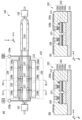
- 1A to 1C are diagrams illustrating the structure of an InP modulator 100 according to a first embodiment of the present disclosure, in which (a) is a top view, (b) is a cross-sectional view along the Ib-Ib cross-sectional line, and (c) is a cross-sectional view along the Ic-Ic cross-sectional line.
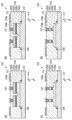
- 1A is a cross-sectional view in the width direction showing a configuration in which the heater mechanism 108 is arranged differently as another configuration of the InP modulator 100 according to the first embodiment of the present disclosure
- (a) is a cross-sectional view taken along the Ib-Ib cross-sectional line in FIG.
- (b) is a cross-sectional view taken along the Ic-Ic cross-sectional line in FIG. 1 when the InP optical waveguide 102 has a ridge structure
- (c) is a cross-sectional view taken along the Ib-Ib cross-sectional line in FIG. 1 when the InP optical waveguide 102 has a high mesa structure
- (d) is a cross-sectional view taken along the Ic-Ic cross-sectional line in FIG. 1 when the InP optical waveguide 102 has a high mesa structure.
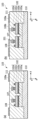
- 1A and 1B are widthwise cross-sectional views showing another form of the InP modulator 100 according to the first embodiment of the present disclosure, where (a) shows a cross-sectional view taken along the Ib-Ib cross-sectional line in FIG. 1 , and (b) shows a cross-sectional view taken along the Ic-Ic cross-sectional line in FIG. 1 .
- 1A and 1B are widthwise cross-sectional views showing another form of the InP modulator 100 according to the first embodiment of the present disclosure, where (a) shows a cross-sectional view taken along the Ib-Ib cross-sectional line in FIG. 1 , and (b) shows a cross-sectional view taken along the Ic-Ic cross-sectional line in FIG. 1 .
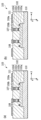
- FIGS. 1A and 1B are cross-sectional views showing another embodiment of the InP modulator 100 according to the first embodiment of the present disclosure, in which (a) shows an embodiment in which the heater mechanism 108 is provided on the n-InP 102a, and (b) shows an embodiment in which one side of the heater mechanism 108 is disposed on the n-InP 102a and the other side is disposed on the substrate 110.
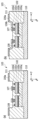
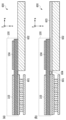
- 6A and 6B are longitudinal cross-sectional views illustrating the structure of an InP modulator 600 according to a second embodiment of the present disclosure, where (a) shows the structure without a carrier 603 and (b) shows the structure with a carrier 603.
- a single Mach-Zehnder modulator will be shown as an example below, but an IQ modulator or Twin-IQ modulator in which a plurality of such modulators are arranged may be used.
- an InP modulator will be described as an example below, but a semiconductor optical modulator made of other materials such as GaAs may be used.
- FIG. 1 illustrates the structure of an InP modulator 100 according to a first embodiment of the present disclosure, with (a) showing a top view, (b) showing a cross-sectional view along the Ib-Ib cross-sectional line, and (c) showing a cross-sectional view along the Ic-Ic cross-sectional line. As shown in FIG.
- the InP modulator 100 includes a 1-input, 2-output (1 ⁇ 2) multimode interference waveguide (MultiMode-Interferometer: hereinafter referred to as MMI) 101, an InP optical waveguide 102 through which light branched by the MMI 101 propagates, a phase modulation section 103 that performs phase modulation of the propagating light, a phase adjustment electrode 104 that is installed on the output side of the phase modulation section 103 and performs phase adjustment of the phase-modulated light, and a 2 ⁇ 1 MMI 105 that is installed on the output side of the phase adjustment electrode 104 and combines the branched light and outputs it to the outside.
- MMI multimode interference waveguide
- the InP modulator 100 is a Mach-Zehnder type optical modulator.
- the phase modulation unit 103 further includes a substrate 110, an optical waveguide 102 formed on the substrate 110, an RF phase modulation electrode 106 functioning as an electrode for the applied RF, an RF electrode 107 for applying the high frequency supplied from the RF phase modulation electrode 106 to the optical waveguide 102, a heater mechanism 108 for heating the optical waveguide 102, and a dielectric layer 111 formed on the substrate 110 and covering the periphery of the optical waveguide 102 and the heater mechanism 108.
- the heater mechanism 108 is connected to a metal wiring 112, which is integrated into one by PADs 109a and 109b and connected to an external power supply and GND. Note that, although FIG.
- the metal wiring 112 may be the same as the heater mechanism 108 or may be a completely different metal wiring. Also, in FIG. 1, the heater mechanism 108 is shown as being thicker and the metal wiring 112 as being thinner, but the heater mechanism 108 may be thinner and the metal wiring 112 may be thicker.
- the optical waveguide 102 has a nipn layer structure in which a first cladding layer 102a formed of at least one n-type semiconductor layer formed on a substrate, a second cladding layer 102b formed of at least one p-type semiconductor layer formed on 102a, a non-doped semiconductor core layer 102c formed on 102b, and a third cladding layer 102d formed of at least one n-type semiconductor layer formed on the semiconductor core layer 102c are stacked.
- the semiconductor core layer 102c includes a multi-quantum well (hereinafter referred to as MQW) layer using a material system such as non-doped InP, InGaAsP, or InGaAlAs.
- MQW multi-quantum well
- the band gap wavelength of the MQW layer is set arbitrarily within a range in which the electro-optic effect is effective and optical absorption is not a problem at the optical wavelength used.
- the semiconductor core layer 102c functions as a core through which light propagates.
- This nipn layer structure can reduce the thickness of the p layer, which has a large effect on high-frequency loss, and can also make the contact surface with the metal RF electrode 107 the n layer, making it possible to significantly reduce high-frequency loss compared to a conventional pin layer structure.
- the optical waveguide 102 may have a pin layer structure.
- the RF phase modulation electrode 106 has a capacitance-loaded structure, and includes a main line portion 106a and T-shaped portions 106b that branch off periodically from the main line portion 106a in order to apply a modulation signal to the InP optical waveguide 102.
- the InP modulator 100 is called a capacitance-loaded type because the T-shaped portions 106b are structured to add capacitance. Note that for simplification, only three T-shaped portions 106b are depicted in FIG. 1, but this is for illustrative purposes only, and three or more T-shaped portions 106b may be arranged, or even fewer. Also, in this embodiment, a capacitance-loaded structure is shown as an example, but this patent structure is also effective for structures other than capacitance-loaded structures.
- the heater mechanism 108 supplies heat (heats) to the MQW that constitutes the non-doped semiconductor core layer 102c of the InP modulator 100 and contributes to phase modulation.
- the mechanism can control the temperature of the MQW without using a Peltier element.
- the heater mechanism 108 By controlling the temperature of the MQW with the heater mechanism 108, it is possible to appropriately adjust the amount of refractive index effect based on the optical absorption and quantum confined Stark effect (QCSE) of the MQW. For example, when the temperature of the MQW increases, the band edge shifts to the long wavelength side, making it suitable for operation on the long wavelength side.
- the heater mechanism 108 can usually be metal.
- the heater mechanism 108 is placed directly under the thickness direction (z direction) of the main line portion 106a, it will affect the high-frequency electromagnetic field distribution of the RF phase modulation electrode 106 and the RF electrode 107, and as a result, the high-frequency characteristics of the InP modulator 100 may be deteriorated. Therefore, it is desirable that the heater mechanism 108 is arranged at a distance from the RF phase modulation electrode 106 and the RF electrode 107 such that it does not interfere with them (does not affect the electromagnetic field distribution of each high frequency) (for example, as shown in FIGS.
- the heater mechanism 108 since the heater mechanism 108 needs to heat all of the MQW layer that contributes to the phase modulation, it is desirable that the length in the x direction is equal to or longer than the length in the x direction of the RF phase modulation electrode 106.
- the resistance value of the heater mechanism 108 may be set arbitrarily depending on the design. For example, the resistance of the heater mechanism 108 may be set higher only in the peripheral region where the RF electrode 107 connected to the T-shaped portion 106b is installed than in other regions. However, since it is necessary for the optical modulator to have the desired amount of heat generation, it is desirable for the resistance value of the heater mechanism 108 to be at least 300 ⁇ or more.
- the heater mechanism 108 is configured so that each branched arm of the optical waveguide 102 can be uniformly heated. For this reason, the heater mechanism 108 is provided for each branched optical waveguide 102. Furthermore, in order to supply equal heat to each branched optical waveguide 102, it is desirable that the heater mechanism 108 is aggregated in one PAD 109a, b and connected to a power source (voltage source or current source) and GND. For example, if the InP modulator 100 is a Twin-IQ modulator or the like, it will have a configuration in which four Mach-Zehnder modulators are integrated, so eight heater mechanisms 108 are required.
- PAD109a, b When such a Twin-IQ modulator is used for HB-CDM, the number of required PADs and pins may increase, and control may become difficult. Therefore, it is desirable that all eight heater mechanisms 108 are aggregated in the same PAD 109a, b. Note that the shape of PAD109a, b is depicted as a circle in FIG. 1, but this is for illustrative purposes only and may be, for example, a square.
- the structure of the optical waveguide 102 is preferably a ridge structure from the viewpoint of directly heating the semiconductor core layer 102c.
- the structure may be a high mesa structure, but in such a case, the width (length in the y direction) of the optical waveguide 102 is processed to be the same width as the third cladding layer 102d, so the heater mechanism 108 cannot be installed on the semiconductor core layer 102c. Therefore, when the optical waveguide 102 has a high mesa structure, the heater mechanism 108 needs to be placed in another position (for example, on the substrate 110) as described later, and this reduces the heating efficiency of the semiconductor core layer P102c.
- the heater mechanism 108 can be placed on the semiconductor core layer 102c, so it is possible to directly heat the semiconductor core layer 102c. From this viewpoint, it can be said that the structure of the optical waveguide 102 is more effective as a ridge structure than a high mesa structure. However, even if the heater mechanism 108 is installed in another position (e.g., on the substrate 110), it is possible to heat the semiconductor core layer 102c, so the heater mechanism 108 does not necessarily have to be installed on the semiconductor core layer 102c.
- FIG. 2 is a cross-sectional view in the width direction showing a different arrangement of the heater mechanism 108 as another embodiment of the InP modulator 100 according to the first embodiment of the present disclosure, where (a) is a cross-sectional view taken along the Ib-Ib cross-section line in FIG. 1 when the optical waveguide 102 has a ridge structure, (b) is a cross-sectional view taken along the Ic-Ic cross-section line in FIG. 1 when the optical waveguide 102 has a ridge structure, (c) is a cross-sectional view taken along the Ib-Ib cross-section line in FIG.
- the heater mechanism 108 may be disposed on the substrate 110.
- the structure of the optical waveguide 102 may be a ridge structure or a high mesa structure.
- the efficiency of heating the semiconductor core layer 102c including the MQW is reduced compared to the configuration shown in FIG. 1.
- this configuration has the advantage that the distance between the heater mechanism 108 and the RF phase modulation electrode 106 and the RF electrode 107 is greater than in the configuration shown in FIG. 1, and therefore degradation of the high frequency characteristics can be suppressed.
- the heater mechanism 108 when the heater mechanism 108 is close to the RF phase modulation electrode 106 and the RF electrode 107, the heater mechanism 108, which is usually made of metal, affects the high-frequency electromagnetic field distribution of the RF phase modulation electrode 106 and the RF electrode 107, and as a result, the high-frequency characteristics of the InP modulator 100 may deteriorate. From this perspective, in the InP modulator 100 according to the present disclosure, it is desirable to arrange the heater mechanism 108 and the RF phase modulation electrode 106 so that the distance between them is as long (separate) as possible. For example, in a form in which the heater mechanism 108 is installed on the substrate 110 as shown in FIG.
- the distance in the thickness direction (z direction) between the RF phase modulation electrode 106 and the RF electrode 107 and the heater mechanism 108 can be increased by making the dielectric layer 111 a thick film, etc.
- a via 301 may be installed between the T-shaped portion 106b and the RF electrode 107 as shown in FIG. 3.
- the RF electrode 107 may be made thick to increase the distance in the thickness direction between the RF phase modulation electrode 106 and the heater mechanism 108. With such a configuration, it is possible to eliminate the need for the via 301.
- FIG. 1 As another example, as shown in FIG.
- a structure may be used in which only the region of the dielectric layer 111 corresponding to the upper part of the optical waveguide 102 is thinned (in other words, the dielectric layer 111 is thickened only in the region where the main line portion 106a is arranged).
- the distance between the T-shaped portion 106b and the heater mechanism 108 may be partially shortened.
- the deterioration of the high frequency characteristics as described above may be suppressed by controlling the arrangement or dimensions of the heater mechanism 108.
- the diameter plane perpendicular to the xy plane
- the influence of the heater mechanism 108 on the high frequency electromagnetic field distribution of the RF phase modulation electrode 106 can be suppressed.
- the width (length in the y direction) of the heater mechanism 108 is 1 ⁇ m or less, and if it can be made 0.1 ⁇ m or less, the influence on the high frequency characteristics can be almost negligible.
- the diameter is extremely narrow, there is a concern that the wire may break when heated, so it is necessary to ensure a diameter dimension that does not cause this break.
- the distance between the main line portion 106a and the heater mechanism 108 in the thickness direction (z direction) and width direction (y direction) is at least 5 ⁇ m or more.
- the diameter of the heater mechanism 108 is, for example, 1 ⁇ m or less in both thickness and width.
- the heater mechanism 108 it is desirable for the heater mechanism 108 to have a heat generation amount of at least about 100°C, from the viewpoint that it is necessary to realize heat generation of at least about 40 to 60°C, the temperature of which is controlled by a Peltier element in a typical InP modulator. Therefore, for example, it is desirable for the heater mechanism 108 to be configured to have a resistance value of at least 300 ⁇ or more.
- the third cladding layer 102b may be set to have a higher thermal resistance than the semiconductor cladding layer 102c in order to suppress the release of heat to the lower part of the semiconductor core layer 102c.
- the heater mechanism 108 may also be disposed on the first cladding layer 102a as shown in FIG. 5. Furthermore, the heater mechanisms 108 may each be disposed at a different location, for example, one on the first cladding layer 102a and the other on the substrate 110.
- the operating wavelength range of the InP modulator can be expanded by controlling the amount of heat generated by the heater mechanism 108 with either current or voltage depending on the operating wavelength.
- InP modulators generally use a refractive index effect caused by changes in band edge absorption called QCSE.
- Optical semiconductors generally have the characteristic that their optical absorption is large on the short wavelength side and small on the long wavelength side.
- the modulation efficiency decreases on the long wavelength side, and it was necessary to change the PL wavelength of the MQW layer separately for modulators operating in the C band and modulators operating in the L band (for example, in InP modulators using conventional technology, the PL wavelength had to be longer in the L band than in the C band).
- the InP modulator 100 for example, at the same temperature, the amount of heat generated by the heater mechanism 108 is increased during operation on the long wavelength side, increasing the temperature of the MQW and shifting the band edge to the long wavelength side, while the amount of heat generated on the short wavelength side is reduced, and the amount of shift of the band edge to the long wavelength side is reduced by lowering the temperature of the MQW.
- the temperature of the semiconductor core layer having the MQW layer can be controlled by the heater mechanism 108.
- it is also possible to use both this structure and a Peltier element (details will be described in the second embodiment below).
- the driver IC has a temperature monitor mechanism
- MQW i-InP 102c
- control is possible such that the heater mechanism 108 heats up to the desired temperature using that temperature as the monitor value. For example, when operating at the same wavelength, control is possible such that when the driver monitor temperature is high, heating of the heater mechanism 108 is suppressed, and when the monitor temperature is low, heating of the heater is promoted.
- the InP modulator 100 When the InP modulator 100 according to the present embodiment described above is used in HB-CDM, it is desirable to set the operating temperature range of the phase modulation section 103 to a range different from that of semiconductor optical modulators according to conventional technology.
- HB-CDM is required to operate at least at an ambient temperature of -5 to 75°C.
- the heater mechanism 108 can only heat, not cool. Therefore, for example, for any one wavelength, the temperature of the semiconductor core layer 102c (MQW) needs to be controlled to a constant temperature by the heater mechanism 108 within the ambient temperature range of -5 to 75°C. Therefore, specifically, the operating temperature of the InP modulator 100 needs to be controlled by the heater mechanism 108 to be equal to or higher than the ambient temperature of 75°C.
- the temperature is controlled by a Peltier element in the range of approximately 40 to 60°C.
- the appropriate operating temperature of the InP modulator 100 according to this embodiment is set to 40 to 60°C as in the conventional technology, when the environmental temperature reaches 75°C, cooling cannot be performed, and the desired temperature cannot be achieved. Therefore, in order to maintain the temperature of the semiconductor core layer 102c (MQW) within the appropriate range at an environmental temperature of -5 to 75°C for operation of any one wavelength, at least the InP modulator 100 according to this embodiment must be designed to operate properly at 75°C or higher. In addition, taking into consideration power consumption and stable operation of the heater mechanism 108, it is desirable to set the appropriate temperature to within about the maximum environmental temperature +10°C.
- This embodiment relates to an InP modulation device including the InP modulator 100 described in the first embodiment and a Peltier element.
- FIG. 6A and 6B are longitudinal cross-sectional views illustrating the structure of an InP modulation device 600 according to a second embodiment of the present disclosure, where (a) shows a structure without a carrier 603 and (b) shows a structure including a carrier 603.
- the InP modulation device 600 according to this embodiment has a structure in which the InP modulator 100 according to the first embodiment is mounted on a Peltier element 601 and a dielectric substrate 602.
- the InP modulation device 600 may further include a carrier 603 above the Peltier element 601 and the dielectric substrate 602 and below the InP modulator 100.
- the Peltier element 601 In order to apply heat most efficiently (to suppress the power consumption of the Peltier element as much as possible), it is desirable to install the Peltier element 601 so that only the phase modulation unit 103 is placed on the Peltier element 601, as shown in FIG. 6. For further optimization, it is optimal to provide the Peltier element only on the lower part of the phase modulation arm. However, this is just one example, and the entire chip may be mounted on the Peltier element 601. In that case, compared to a normal modulator, the provision of an extra heater mechanism results in an increase in power consumption. This is because the power consumption of the Peltier depends on the area of the Peltier. Therefore, considering the increase in power consumption of the Peltier element due to heat generation by the heater mechanism, in an optical modulator with this heater mechanism, the size of the Peltier element needs to be very small in order to achieve the same power consumption as before.
- the dielectric substrate 602 does not necessarily have to be included in the InP modulation device 600, but it is desirable to have one installed from the viewpoint of securing an area for mounting optical mounting members (not shown) such as lenses.
- the dielectric substrate 602 may be made of ceramics such as aluminum nitride (AlN) or metals, which have excellent heat dissipation properties.
- the carrier 603 preferably further includes a thermal isolation groove 604 from the viewpoint of thermal isolation between the RF phase modulation electrode 106 and the phase adjustment electrode 104.
- the phase adjustment electrode 104 is generally configured as a heater, and in that case, heat from the heater of the phase adjustment electrode 104 flows into the Peltier element 601, increasing the power consumption of the Peltier element 601.
- the carrier 603 may be in a form that overhangs the Peltier element 601, or may be configured such that an additional component (e.g., a dielectric substrate 602) is installed below the carrier 603.
- the carrier 603 may have a step (not shown) only in the area where an optical mounting member such as a lens is mounted, as necessary.
- the InP modulation device 600 having such a configuration includes a Peltier element 601, and by controlling the temperature of the Peltier element 601 according to the wavelength, it is possible to widen the operating wavelength range, similar to the effect of the heater mechanism 108 of the InP modulator 100.
- the Peltier element 601 is placed only in the area corresponding to the RF phase modulation electrode 106. Therefore, compared to the case where the entire InP modulation device 600 is placed on the Peltier element, the area occupied by the Peltier element 601 can be reduced, making it possible to suppress power consumption.
- the temperature of the Peltier element is not switched for each wavelength, so it is highly likely that the above-mentioned operation would be difficult.
- the Peltier element is operated with a constant set temperature, in which case the heater mechanism 108, which has a configuration similar to that of the first embodiment, can be used to pinpoint the amount of heat controlled for each operating wavelength and applied only to the relevant part, thereby expanding the operating wavelength and achieving C+L band operation, etc.
- the heater mechanism 108 which has a configuration similar to that of the first embodiment, can be used to pinpoint the amount of heat controlled for each operating wavelength and applied only to the relevant part, thereby expanding the operating wavelength and achieving C+L band operation, etc.
- the Peltier element 601 can switch the temperature for each wavelength, it is also possible to expand the operating wavelength without using the heater mechanism 108.
- the semiconductor optical modulator (InP modulator) according to the present disclosure is capable of expanding the wavelength operating range compared to conventional technologies.
Landscapes
- Physics & Mathematics (AREA)
- Nonlinear Science (AREA)
- General Physics & Mathematics (AREA)
- Optics & Photonics (AREA)
- Optical Modulation, Optical Deflection, Nonlinear Optics, Optical Demodulation, Optical Logic Elements (AREA)
Abstract
Priority Applications (2)
| Application Number | Priority Date | Filing Date | Title |
|---|---|---|---|
| PCT/JP2023/004435 WO2024166321A1 (fr) | 2023-02-09 | 2023-02-09 | Modulateur optique à semi-conducteur |
| JP2024576014A JPWO2024166321A1 (fr) | 2023-02-09 | 2023-02-09 |
Applications Claiming Priority (1)
| Application Number | Priority Date | Filing Date | Title |
|---|---|---|---|
| PCT/JP2023/004435 WO2024166321A1 (fr) | 2023-02-09 | 2023-02-09 | Modulateur optique à semi-conducteur |
Publications (1)
| Publication Number | Publication Date |
|---|---|
| WO2024166321A1 true WO2024166321A1 (fr) | 2024-08-15 |
Family
ID=92262149
Family Applications (1)
| Application Number | Title | Priority Date | Filing Date |
|---|---|---|---|
| PCT/JP2023/004435 Ceased WO2024166321A1 (fr) | 2023-02-09 | 2023-02-09 | Modulateur optique à semi-conducteur |
Country Status (2)
| Country | Link |
|---|---|
| JP (1) | JPWO2024166321A1 (fr) |
| WO (1) | WO2024166321A1 (fr) |
Citations (6)
| Publication number | Priority date | Publication date | Assignee | Title |
|---|---|---|---|---|
| WO2011132283A1 (fr) * | 2010-04-22 | 2011-10-27 | 富士通株式会社 | Dispositif de modulation optique, procédé d'actionnement de dispositif de modulation optique, et procédé de production de dispositif de modulation optique |
| JP2017161830A (ja) * | 2016-03-11 | 2017-09-14 | 古河電気工業株式会社 | 半導体光素子 |
| WO2021106158A1 (fr) * | 2019-11-28 | 2021-06-03 | 日本電信電話株式会社 | Modulateur de phase optique |
| US20210203126A1 (en) * | 2019-12-27 | 2021-07-01 | John Parker | Electro-absorption modulator with improved photocurrent uniformity |
| WO2022024276A1 (fr) * | 2020-07-29 | 2022-02-03 | 日本電信電話株式会社 | Modulateur optique à semi-conducteur |
| WO2022029855A1 (fr) * | 2020-08-03 | 2022-02-10 | 日本電信電話株式会社 | Modulateur iq à semi-conducteur |
-
2023
- 2023-02-09 WO PCT/JP2023/004435 patent/WO2024166321A1/fr not_active Ceased
- 2023-02-09 JP JP2024576014A patent/JPWO2024166321A1/ja active Pending
Patent Citations (6)
| Publication number | Priority date | Publication date | Assignee | Title |
|---|---|---|---|---|
| WO2011132283A1 (fr) * | 2010-04-22 | 2011-10-27 | 富士通株式会社 | Dispositif de modulation optique, procédé d'actionnement de dispositif de modulation optique, et procédé de production de dispositif de modulation optique |
| JP2017161830A (ja) * | 2016-03-11 | 2017-09-14 | 古河電気工業株式会社 | 半導体光素子 |
| WO2021106158A1 (fr) * | 2019-11-28 | 2021-06-03 | 日本電信電話株式会社 | Modulateur de phase optique |
| US20210203126A1 (en) * | 2019-12-27 | 2021-07-01 | John Parker | Electro-absorption modulator with improved photocurrent uniformity |
| WO2022024276A1 (fr) * | 2020-07-29 | 2022-02-03 | 日本電信電話株式会社 | Modulateur optique à semi-conducteur |
| WO2022029855A1 (fr) * | 2020-08-03 | 2022-02-10 | 日本電信電話株式会社 | Modulateur iq à semi-conducteur |
Non-Patent Citations (2)
| Title |
|---|
| OZAKI JOSUKE, OGISO YOSHIHIRO, HASHIZUME YASUAKI, YAMAZAKI HIROSHI, NAGASHIMA KAZUYA, ISHIKAWA MITSUTERU: "Coherent Driver Modulator With Flexible Printed Circuit RF Interface for 128-Gbaud Operations", IEEE PHOTONICS TECHNOLOGY LETTERS, IEEE, USA, vol. 34, no. 23, 1 December 2022 (2022-12-01), USA, pages 1289 - 1292, XP093198487, ISSN: 1041-1135, DOI: 10.1109/LPT.2022.3212678 * |
| VANHOECKE MICHAEL, AIMONE ALESSANDRO, ARGYRIS NIKOS, DRIS STEFANOS, VAERNEWYCK RENATO, VERHEYEN KOEN, GRUNER MARKO, FIOL GERRIT, A: "Segmented Optical Transmitter Comprising a CMOS Driver Array and an InP IQ-MZM for Advanced Modulation Formats", JOURNAL OF LIGHTWAVE TECHNOLOGY, IEEE, USA, vol. 35, no. 4, 15 February 2017 (2017-02-15), USA, pages 862 - 867, XP093198491, ISSN: 0733-8724, DOI: 10.1109/JLT.2016.2626792 * |
Also Published As
| Publication number | Publication date |
|---|---|
| JPWO2024166321A1 (fr) | 2024-08-15 |
Similar Documents
| Publication | Publication Date | Title |
|---|---|---|
| US10571723B2 (en) | Opto-electronic modulator utilizing one or more heating elements | |
| US10714895B2 (en) | Rapidly tunable silicon modulated laser | |
| US8131119B2 (en) | Optical device with large thermal impedance | |
| US20100247029A1 (en) | Thermal tuning of an optical device | |
| US9229251B2 (en) | Optical modulator and optical transmitter | |
| JP5437289B2 (ja) | 半導体光変調器 | |
| US12066736B2 (en) | Optical module | |
| US8300990B2 (en) | Slotted optical waveguide with electro-optic material | |
| US9711938B2 (en) | Integrated semiconductor optical element and manufacturing method for same | |
| US20170163001A1 (en) | Photonic Integrated Circuit Including Compact Lasers With Extended Tunability | |
| WO2019211991A1 (fr) | Modulateur optique de mach-zehnder à semi-conducteur et modulateur optique iq l'utilisant | |
| JP2001142037A (ja) | 電界効果型光変調器および半導体光素子の製造方法 | |
| US20170207603A1 (en) | Laser arrays comprising compact lasers with extended tunability | |
| US10031395B2 (en) | Optical modulator | |
| JP2003177368A (ja) | 半導体光変調器、マッハツェンダ型光変調器、及び光変調器一体型半導体レーザ | |
| US20230361532A1 (en) | Silicon photonic hybrid distributed feedback laser with built-in grating | |
| US20120213467A1 (en) | Optical device with enhanced mechanical strength | |
| US20140050436A1 (en) | Photonic modulator with forward-and reverse-biased diodes for separate tuning and modulating elements | |
| US6665457B2 (en) | Tunable electro-absorption modulator and tunable laser | |
| US12306436B2 (en) | Thermally tunable waveguide and photonic integrated circuit component having the same | |
| US20050129077A1 (en) | Tunable electro-absorption modulator and tunable laser | |
| US20230010874A1 (en) | Optical Phase Modulator | |
| EP4033618A1 (fr) | Lasers modulés mach-zehnder | |
| KR20230058902A (ko) | 레이저 다이오드 소자 | |
| JP2004280018A (ja) | 半導体光素子 |
Legal Events
| Date | Code | Title | Description |
|---|---|---|---|
| 121 | Ep: the epo has been informed by wipo that ep was designated in this application |
Ref document number: 23921152 Country of ref document: EP Kind code of ref document: A1 |
|
| ENP | Entry into the national phase |
Ref document number: 2024576014 Country of ref document: JP Kind code of ref document: A |
|
| WWE | Wipo information: entry into national phase |
Ref document number: 2024576014 Country of ref document: JP |
|
| NENP | Non-entry into the national phase |
Ref country code: DE |
|
| 122 | Ep: pct application non-entry in european phase |
Ref document number: 23921152 Country of ref document: EP Kind code of ref document: A1 |