WO2024190823A1 - Appareil de gestion, procédé de gestion et programme de gestion - Google Patents
Appareil de gestion, procédé de gestion et programme de gestion Download PDFInfo
- Publication number
- WO2024190823A1 WO2024190823A1 PCT/JP2024/009770 JP2024009770W WO2024190823A1 WO 2024190823 A1 WO2024190823 A1 WO 2024190823A1 JP 2024009770 W JP2024009770 W JP 2024009770W WO 2024190823 A1 WO2024190823 A1 WO 2024190823A1
- Authority
- WO
- WIPO (PCT)
- Prior art keywords
- attribute
- alarm
- message
- storage unit
- attribute value
- Prior art date
- Legal status (The legal status is an assumption and is not a legal conclusion. Google has not performed a legal analysis and makes no representation as to the accuracy of the status listed.)
- Ceased
Links
Images



Classifications
-
- G—PHYSICS
- G05—CONTROLLING; REGULATING
- G05B—CONTROL OR REGULATING SYSTEMS IN GENERAL; FUNCTIONAL ELEMENTS OF SUCH SYSTEMS; MONITORING OR TESTING ARRANGEMENTS FOR SUCH SYSTEMS OR ELEMENTS
- G05B23/00—Testing or monitoring of control systems or parts thereof
- G05B23/02—Electric testing or monitoring
- G05B23/0205—Electric testing or monitoring by means of a monitoring system capable of detecting and responding to faults
- G05B23/0259—Electric testing or monitoring by means of a monitoring system capable of detecting and responding to faults characterized by the response to fault detection
- G05B23/0267—Fault communication, e.g. human machine interface [HMI]
- G05B23/027—Alarm generation, e.g. communication protocol; Forms of alarm
Definitions
- the embodiment discussed herein is related to a management apparatus, a management method, and a management program.
- OPC UA Open Platform Communications Unified Architecture
- vender defined attributes such as "importance”, “AlarmPriority”, and “Priority” are defined using unique names with respect to alarm attributes of the same meaning, so that if all of the alarm attributes are to be displayed, alarm data increases and it becomes difficult to compare attribute values among alarms.
- the present invention has been conceived in view of the foregoing situation, and an object of the present invention is to efficiently output a message that is generated in a mixed environment in which a plurality of venders are present.
- a management apparatus includes a storage unit that stores therein, for each type of an apparatus that outputs a message, each of attributes of messages that indicate same or similar contents and an inner attribute that indicates the same or similar contents in an associated manner, and a generating unit that, when receiving a message from the apparatus, acquires the inner attribute that is associated with an attribute included in the received message from the storage unit, generates an inner message in which the attribute of the message is converted to the inner attribute, and outputs the inner message.
- a management method implemented by a computer includes storing, for each type of an apparatus that outputs a message, each of attributes of messages that indicate same or similar contents and an inner attribute that indicates the same or similar contents in an associated manner, acquiring, when receiving a message from the apparatus, the inner attribute that is associated with an attribute included in the received message, generating an inner message in which the attribute of the message is converted to the inner attribute, and outputting the inner message.
- a management program that causes a computer to execute a process includes storing, for each type of an apparatus that outputs a message, each of attributes of messages that indicate same or similar contents and an inner attribute that indicates the same or similar contents in an associated manner, acquiring, when receiving a message from the apparatus, the inner attribute that is associated with an attribute included in the received message, generating an inner message in which the attribute of the message is converted to the inner attribute, and outputting the inner message.
- Fig. 1 is a diagram illustrating a configuration example and a processing example of an alarm management system according to one embodiment.
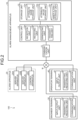
- Fig. 2 is a block diagram illustrating a configuration example of each of apparatuses in the alarm management system according to one embodiment.
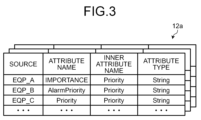
- Fig. 3 is a diagram illustrating an attribute name storage unit of the alarm management apparatus according to one embodiment.
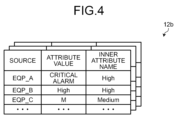
- Fig. 4 is a diagram illustrating an attribute value storage unit of the alarm management apparatus according to one embodiment.
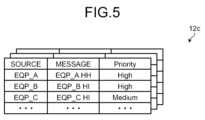
- Fig. 5 is a diagram illustrating an inner alarm storage unit of the alarm management apparatus according to one embodiment.
- Fig. 6 is a diagram illustrating a specific example of an alarm attribute unifying process according to one embodiment.
- Fig. 7 is a flowchart illustrating an example of the entire flow of the alarm management system according to one embodiment.
- Fig. 1 is a diagram illustrating a configuration example and a processing example of an alarm management system according to one embodiment.
- Fig. 2 is a block diagram illustrating a configuration example of each of apparatuse
- Fig. 8 is a flowchart illustrating an example of the flow of an engineering details reception process performed by the alarm management system according to one embodiment.
- Fig. 9 is a flowchart illustrating an example of the entire flow of an alarm attribute unifying process performed by the alarm management system according to one embodiment.
- Fig. 10 is a flowchart illustrating an example of the entire flow of an alarm notifying process performed by the alarm management system according to one embodiment.
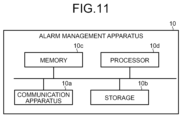
- Fig. 11 is a diagram illustrating a hardware configuration example according to one embodiment.
- a configuration and a process of an alarm management system 100 according to one embodiment, a configuration and a process of each of apparatuses of the alarm management system 100, and the flow of a process performed by the alarm management system 100 will be described in sequence, and effects of the embodiment will be lastly described.
- FIG. 1 is a diagram illustrating a configuration example and a processing example of the alarm management system 100 according to one embodiment.
- a configuration example of the entire alarm management system 100, a processing example of the alarm management system 100, and problems with an alarm management system 100P according to a reference technology will be described in sequence, and effects of the alarm management system 100 will be lastly described.
- factory production remote monitoring using a plant apparatus that is a device installed in a plant will be described as one example; however, devices and fields of use are not specifically limited, and the technology is applicable to environmental measurement remote monitoring, such as a power monitor, wind-power generation, a water and sewage monitor, or river monitoring.
- the alarm management system 100 includes an alarm management apparatus 10, alarm apparatus 20 (a server apparatus 20A, a server apparatus 20B, and a control apparatus 20C), an engineer terminal 30, and an operator terminal 40.
- the alarm management apparatus 10, the alarm apparatus 20, the engineer terminal 30, and the operator terminal 40 are communicably connected to one another via a predetermined communication network (network) (not illustrated) in a wired or wireless manner.
- a predetermined communication network network
- various kinds of communication networks such as the Internet or a dedicated line, may be adopted as the predetermined communication network.
- the alarm apparatus 20 will be described below.
- the alarm apparatus 20 are apparatuses that have alarm detection functions and detect an alarm that indicates an abnormality of a plant or a plant apparatus based on a sensor value, a process value, or the like in the plant.
- the server apparatus 20A among the alarm apparatus 20 is an OPC US server.
- the server apparatus 20B among the alarm apparatus 20 is an OPC A&E server.
- the control apparatus 20C among the alarm apparatus 20 is a controller that constitutes a distributed control system (DCS).
- DCS distributed control system
- the engineer terminal 30 is a terminal that is used by an engineer E who manages the alarm management apparatus 10.
- the operator terminal 40 is a terminal that is used by an operator O who manages the plant.
- the alarm management system 100 illustrated in FIG. 1 may include the plurality of alarm management apparatuses 10, the plurality of engineer terminals 30, or the plurality of operator terminals 40.
- the alarm management apparatus 10 receives engineering details (S1). For example, the alarm management apparatus 10 receives a definition of an apparatus in the plant (hereinafter, appropriately referred to as an "apparatus definition") from the engineer terminal 30, and stores therein the definition. Further, the alarm management apparatus 10 receives a definition of an attribute name (hereinafter, appropriately referred to as an "attribute name definition” or an “attribute name mapping definition”) of an alarm that corresponds to an apparatus in the plant, and stores therein the definition.
- an attribute name definition hereinafter, appropriately referred to as an "attribute name definition” or an “attribute name mapping definition
- the alarm management apparatus 10 receives a definition of an attribute value (hereinafter, appropriately referred to as an "attribute value definition” or an “attribute value mapping definition”) of an alarm that corresponds to an apparatus in the plant, and stores therein the definition.
- an attribute value definition hereinafter, appropriately referred to as an “attribute value definition” or an “attribute value mapping definition”
- the apparatus definition is information that indicates a type of the alarm apparatus 20 included in a plant control system of the plant, and is, for example, information that includes a vender name and an apparatus type of each of the alarm apparatus 20, such as ⁇ server apparatus 20A: vender A (OPC UA server), server apparatus 20B: vender B (OPC A&E server), control apparatus 20C: vender C (CENTUM FCS) ⁇ .
- the attribute name mapping definition is information in which an alarm attribute name that is defined for each of the alarm apparatus 20 and an inner attribute name for displaying the attribute name in a unified manner are associated with each other, and is, for example, information that includes an inner attribute name for each of the alarm attribute names of the alarm apparatus 20, such as ⁇ attribute name of server apparatus 20A: "importance”, inner attribute name: “Priority” ⁇ , ⁇ attribute name of server apparatus 20B: “AlarmPriority”, inner attribute name: "Priority” ⁇ , or ⁇ attribute name of control apparatus 20C: “Priority”, inner attribute name: "Priority” ⁇ .
- the attribute value mapping definition is information in which an alarm attribute value that is defined for each of the alarm apparatus 20 and an inner attribute value for displaying the attribute value in a unified manner are associated with each other, and is, for example, information that includes an inner attribute value for each of the alarm attribute values of the alarm apparatus 20, such as ⁇ attribute value of server apparatus 20A: "critical alarm”, inner attribute value: “High” ⁇ , ⁇ attribute value of server apparatus 20B: “High”, inner attribute value: “High” ⁇ , or ⁇ attribute value of control apparatus 20C: "M”, inner attribute value: "Medium” ⁇ .
- the alarm management apparatus 10 may receive, from the engineer terminal 30, a definition of an alarm attribute type (hereinafter, appropriately referred to as an "attribute type definition" or an “attribute type mapping definition”) that corresponds to an apparatus in the plant.
- the attribute type mapping definition is information in which an alarm attribute type (for example, "String") that is defined for the alarm apparatus 20 and an inner attribute type for displaying the attribute name in a unified manner are associated with each other, and is information that includes an inner attribute type for each of the alarm attribute types of the alarm apparatus 20.
- the alarm management apparatus 10 receives an alarm (S2).
- the alarm management apparatus 10 receives, from the server apparatus 20A, an alarm A of ⁇ source: "EQP_A”, message: “EQP_A HH", importance: "critical alarm” ⁇ .
- the alarm management apparatus 10 receives, from the server apparatus 20B, an alarm B of ⁇ source: “EQP_B”, message: “EQP_B HI”, AlarmPriority: "High” ⁇ .
- the alarm management apparatus 10 receives, from the control apparatus 20C, an alarm C of ⁇ source: "EQP_C”, message: “EQP_C HI", Priority: "M” ⁇ .
- the alarm management apparatus 10 acquires an inner attribute name (S3).
- the alarm management apparatus 10 acquires an inner attribute name of "Priority” that corresponds to the attribute name of "importance” of the alarm A received from the server apparatus 20A, by referring to the stored attribute name mapping definition.
- the alarm management apparatus 10 acquires the inner attribute name of "Priority” that corresponds to the attribute name of "AlarmPriority” of the alarm B received from the server apparatus 20B, by referring to the stored attribute name mapping definition.
- the alarm management apparatus 10 acquires an inner attribute name of "Priority” that corresponds to the attribute name of "Priority” of the alarm C received from the control apparatus 20C, by referring to the stored attribute name mapping definition.
- the alarm management apparatus 10 may acquire an inner attribute type that corresponds to the alarm attribute type (for example, "String") received from the alarm apparatus 20, by referring to the stored attribute type mapping definition.
- the alarm management apparatus 10 acquires an inner attribute value (S4).
- the alarm management apparatus 10 acquires an inner attribute value of "High” that corresponds to the attribute value of "critical alarm” of the alarm A received from the server apparatus 20A, by referring to the stored attribute value mapping definition.
- the alarm management apparatus 10 acquires an inner attribute value of "High” that corresponds to the attribute value of "High” of the alarm B received from the server apparatus 20B, by referring to the stored attribute value mapping definition.
- the alarm management apparatus 10 acquires an inner attribute value of "Medium” that corresponds to the attribute value of "M” of the alarm C received from the control apparatus 20C, by referring to the stored attribute value mapping definition.
- the alarm management apparatus 10 generates an inner alarm (S5).
- the alarm management apparatus 10 generates an inner alarm A' in which the attribute name and the attribute value are unified by converting the attribute name of "importance" of the alarm A received from the server apparatus 20A to an inner attribute name of "Priority” and converting the attribute value of "critical alarm” of the alarm A received from the server apparatus 20A to the inner attribute value of "High”, and stores the inner alarm A'.
- the alarm management apparatus 10 generates an inner alarm B' in which the attribute name and the attribute value are unified by converting the attribute name of "AlarmPriority" of the alarm B received from the server apparatus 20B to the inner attribute name of "Priority” and converting the attribute value of "High” of the alarm B received from the server apparatus 20B to the inner attribute value of "High”, and stores the inner alarm B'.
- the alarm management apparatus 10 generates an inner alarm C' in which the attribute name and the attribute value are unified by converting the attribute name of "Priority" of the alarm C received from the control apparatus 20C to the inner attribute name of "Priority” and converting the attribute value of "M” of the alarm C received from the control apparatus 20C to the inner attribute value of "Medium”, and stores the inner alarm C'.
- the alarm management apparatus 10 transmits the inner alarm (S6).
- the alarm management apparatus 10 transmits the generated inner alarm A', the generated inner alarm B', and the generated inner alarm C' to the operator terminal 40.
- the operator terminal 40 controls display of the inner alarm A', the inner alarm B', and the inner alarm C', which are received from the alarm management apparatus 10, on a monitor.
- the alarm management system 100P there is a need to unify display of alarm attributes with respect to facilities based on OPC UA and OPC Classic of a plurality of venders. Further, in the alarm management system 100P, there is a need to unify display of the alarm attributes because vender defined attributes are defined using unique names with respect to alarm attributes of the same meaning for each of third parties.
- the alarm management apparatus 10 receives engineering details (the apparatus definition, the attribute name mapping definition, the attribute value mapping definition, and the like) from the engineer terminal 30. Secondly, the alarm management apparatus 10 receives alarms from the alarm apparatus 20. Thirdly, the alarm management apparatus 10 acquires an inner attribute name that is stored at the time of engineering. Fourthly, the alarm management apparatus 10 acquires an inner attribute value that is stored at the time of engineering. Fifthly, the alarm management apparatus 10 generates an inner alarm by converting the alarm attribute name to the inner attribute name and converting the alarm attribute value to the inner attribute value. Sixthly, the alarm management apparatus 10 transmits the generated inner alarm to the operator terminal 40. Seventhly, the operator terminal 40 controls display of the inner alarm that is received from the alarm management apparatus 10.
- engineering details the apparatus definition, the attribute name mapping definition, the attribute value mapping definition, and the like
- the alarm management system 100 has a mapping rule setting function to receive engineering details (the apparatus definition, the attribute name mapping definition, the attribute value mapping definition, and the like) at the time of engineering, and has an inner attribute function to generate an inner alarm based on the above-described engineering details at runtime, so that it is possible to commonly handle alarms independent of types of interfaces and servers. Therefore, with use of the inner attribute, the alarm management system 100 is able to reduce alarm data and easily compare attribute values among alarms.
- host-host binding or a Collaborative Information (CI) server serves as an OPC UA server, and when information is to be provided to a higher-level apparatus, it is satisfactory to transmit only a value of the inner attribute value. Therefore, the alarm management system 100 is able to reduce an amount of information transmitted from a lower-level apparatus to a higher-level apparatus, so that it is possible to improve performance.
- CI Collaborative Information
- FIG. 2 is a block diagram illustrating a configuration example of each of the apparatuses included in the alarm management system 100 according to one embodiment.
- a configuration example of the entire alarm management system 100 according to one embodiment will be described first, and thereafter, a configuration example and a processing example of the alarm management apparatus 10, a configuration example and a processing example of the alarm apparatus 20, a configuration example and a processing example of the engineer terminal 30, and a configuration example and a processing example of the operator terminal 40 will be described in detail below.
- the alarm management system 100 includes the alarm management apparatus 10, the alarm apparatus 20, the engineer terminal 30, and the operator terminal 40.
- the alarm management apparatus 10 is communicably connected to the alarm apparatus 20, the engineer terminal 30, and the operator terminal 40 by a communication network N that is realized by the Internet, a dedicated line, or the like.
- the alarm management apparatus 10 includes a communication unit 11, a storage unit 12, and a control unit 13. Meanwhile, the alarm management apparatus 10 may include an input unit (for example, a keyboard, a mouse, or the like) that receives various kinds of operation from the engineer E or the like who is an administrator of the alarm management apparatus 10, or a display unit (for example, a liquid crystal display or the like) for displaying various kinds of information.
- an input unit for example, a keyboard, a mouse, or the like
- a display unit for example, a liquid crystal display or the like
- the communication unit 11 controls data communication with a different apparatus. For example, the communication unit 11 performs data communication with each of communication apparatuses via a router or the like. Further, the communication unit 11 is able to perform data communication with an operator terminal (not illustrated).
- the storage unit 12 stores therein various kinds of information that are referred to by the control unit 13 at the time of operation, and various kinds of information that are acquired by the control unit 13 at the time of operation.
- the storage unit 12 includes an attribute name storage unit 12a, an attribute value storage unit 12b, and an inner alarm storage unit 12c.
- the storage unit 12 may be implemented by, for example, a semiconductor memory device, such as a Random Access Memory (RAM) or a flash memory, or a storage apparatus, such as a hard disk or an optical disk.
- RAM Random Access Memory
- FIG. 2 the storage unit 12 is installed inside the alarm management apparatus 10, but the storage unit 12 may be installed outside the alarm management apparatus 10 or a plurality of storage units may be installed.
- the storage unit 12 stores therein, for each type of an apparatus that outputs a message, each of attributes of messages that indicate the same or similar contents and an inner attribute that indicates the same or similar content, in an associated manner.
- the storage unit 12 stores therein each of alarm attributes, which are set by each of venders for each of vender apparatuses that collect alarms that are output from each of devices included in the system, and an inner attribute, which unifies the alarm attributes that are set by the respective venders, in an associated manner.
- the storage unit 12 stores therein, for each type of the apparatus, each of attribute names as each of the attributes and an inner attribute name as the inner attribute in an associated manner.
- the storage unit 12 stores therein, for each type of the apparatus, each of attribute values as each of the attributes and an inner attribute value as the inner attribute in an associated manner. Moreover, the storage unit 12 may store therein, for each type of the apparatus, each of attribute types as each of the attributes and an inner attribute type as the inner attribute in an associated manner.
- the message as described above is an alarm that indicates an abnormality of one of the system and a device that is included in the system.
- the message as described above is an alarm that indicates an abnormality of one of a plant control system that controls a plant and a plant apparatus that is included in the plant control system.
- the apparatuses as described above are compliant with OPC UA or OPC Classic.
- Attribute name storage unit 12a stores therein the attribute name definition (attribute name mapping definition) that is received by a reception unit 13a of the control unit 13 to be described later. An example of data that is stored in the attribute name storage unit 12a will be described below with reference to FIG. 3.
- FIG. 3 is a diagram illustrating an example of the attribute name storage unit 12a of the alarm management apparatus 10 according to one embodiment.
- the attribute name storage unit 12a stores therein items of a "source”, an "attribute name", an "inner attribute name", and an "attribute type".
- the "source” indicates identification information for identifying the alarm apparatus 20, e.g., an identification number or an identification symbol of the alarm apparatus 20.
- the "attribute name” indicates a name of an attribute that is included in an alarm of the alarm apparatus 20.
- the “inner attribute name” indicates a name of a converted alarm that is associated with the alarm apparatus 20.
- the “attribute type” indicates how to manage alarm data of the alarm apparatus 20.
- FIG. 3 illustrates an example in which the attribute name storage unit 12a stores therein data of ⁇ attribute name: "importance”, inner attribute name: “Priority”, attribute type: “String” ⁇ for the alarm apparatus 20 (the server apparatus 20A) that is identified by "EQP_A”, data of ⁇ attribute name: “AlarmPriority”, inner attribute name: “Priority”, attribute type: “String” ⁇ for the alarm apparatus 20 (the server apparatus 20B) that is identified by "EQP_B”, and data of ⁇ attribute name: “Priority”, inner attribute name: “Priority”, attribute type: “String” ⁇ for the alarm apparatus 20 (the control apparatus 20C) that is identified by "EQP_C”.
- FIG. 4 is a diagram illustrating an example of the attribute value storage unit 12b of the alarm management apparatus 10 according to one embodiment.
- the attribute value storage unit 12b stores therein items of a "source”, an "attribute value”, and an "inner attribute value”.
- the "source” indicates identification information for identifying the alarm apparatus 20, and is, for example, an identification number or an identification symbol of the alarm apparatus 20.
- the "attribute value” indicates a state value that corresponds to an attribute of an alarm of the alarm apparatus 20 that are apparatuses.
- the “inner attribute value” indicates a state value that corresponds to a converted attribute that is associated with each of the alarm apparatus 20 that are apparatuses.
- FIG. 4 illustrates an example in which the attribute value storage unit 12b stores therein data of ⁇ attribute value: "critical alarm”, inner attribute value: “High” ⁇ for the alarm apparatus 20 (the server apparatus 20A) that is identified by “EQP_A”, data of ⁇ attribute value: “High”, inner attribute value: “High” ⁇ for the alarm apparatus 20 (the server apparatus 20B) that is identified by “EQP_B”, and data of ⁇ attribute value: "M”, inner attribute value: “Medium” ⁇ for the alarm apparatus 20 (the control apparatus 20C) that is identified by "EQP_C”.
- FIG. 5 is a diagram illustrating an example of the inner alarm storage unit 12c of the alarm management apparatus 10 according to one embodiment.
- the inner alarm storage unit 12c stores therein items of a "source”, a "message”, and "Priority".
- the "source” indicates identification information for identifying the alarm apparatus 20 that are apparatuses, and is, for example, an identification number or an identification symbol of each of the alarm apparatus 20.
- the "message” indicates an alarm message that is included in an alarm of the alarm apparatus 20 that are apparatuses and that is received by a receiving unit 13b.
- the "Priority” indicates a state value that corresponds to a name of a converted attribute that is associated with each of the alarm apparatus 20 that are apparatuses.
- FIG. 5 illustrates an example in which the inner alarm storage unit 12c stores therein data of ⁇ message: "EQP_A HH", Priority: “High” ⁇ for the server apparatus 20A as the alarm apparatus 20 that is identified by “EQP_A”, data of ⁇ message: “EQP_B HI”, Priority: “High” ⁇ for the server apparatus 20B as the alarm apparatus 20 that is identified by “EQP_B”, and data of ⁇ message: "EQP_C HI”, Priority: “Medium” ⁇ for the control apparatus 20C as the alarm apparatus 20 that is identified by "EQP_C”.
- Control unit 13 The control unit 13 controls the entire alarm management apparatus 10.
- the control unit 13 includes the reception unit 13a, the receiving unit 13b, the generating unit 13c, and a transmitting unit 13d.
- the control unit 13 is implemented by, for example, an electronic circuit, such as a Central Processing Unit (CPU) or a Micro Processing Unit (MPU), or an integrated circuit, such as an Application Specific Integrated Circuit (ASIC) or a Field Programmable Gate Array (FPGA).
- CPU Central Processing Unit
- MPU Micro Processing Unit
- ASIC Application Specific Integrated Circuit
- FPGA Field Programmable Gate Array
- the reception unit 13a receives various kinds of information. Meanwhile, the reception unit 13a may store various kinds of the received information in the storage unit 12. For example, the reception unit 13a receives the engineering details from the engineer terminal 30. In the following, an apparatus definition reception process, an attribute name definition reception process, and an attribute value definition reception process will be described in this order.
- the reception unit 13a receives the apparatus definition as the engineering details.
- the reception unit 13a receives the apparatus definition that is information indicating a type of the alarm apparatus 20 included in the plant control system of the plant and that includes a vender name and an apparatus type of the alarm apparatus 20 set by the engineer E.
- the reception unit 13a receives an apparatus definition of, for example, ⁇ server apparatus 20A: vender A (OPC UA server), server apparatus 20B: vender B (OPC A&E server), control apparatus 20C: vender C (CENTUM FCS) ⁇ , or the like that is input in an engineering details setting screen of the engineer terminal 30.
- ⁇ server apparatus 20A vender A (OPC UA server)
- server apparatus 20B vender B (OPC A&E server)
- control apparatus 20C vender C (CENTUM FCS) ⁇ , or the like that is input in an engineering details setting screen of the engineer terminal 30.
- the reception unit 13a receives the attribute name definition (attribute name mapping definition) as the engineering details.
- the reception unit 13a receives the attribute name definition that is information in which the alarm attribute name that is defined for each of the alarm apparatus 20 and an inner attribute name for displaying the attribute names in a unified manner are associated with each other, and that includes an inner attribute name for each of the alarm attribute names of the alarm apparatus 20 set by the engineer E, and stores the attribute name definition in the attribute name storage unit 12a.
- the reception unit 13a receives an attribute name definition of, for example, ⁇ attribute name of server apparatus 20A: "importance”, inner attribute name: “Priority” ⁇ , ⁇ attribute name of server apparatus 20B: “AlarmPriority”, inner attribute name: “Priority” ⁇ , ⁇ attribute name of control apparatus 20C: “Priority”, inner attribute name: “Priority” ⁇ , or the like that is input in the engineering details setting screen of the engineer terminal 30.
- the reception unit 13a may receive the attribute type definition (attribute type mapping definition) as the engineering details.
- the reception unit 13a may receive the attribute type definition that is information in which the alarm attribute type (for example "String") that is defined for the alarm apparatus 20 and an inner attribute type for displaying the attribute names in a unified manner are associated with each other, and that includes an inner attribute type for each of alarm attribute types of the alarm apparatus 20 set by the engineer E.
- the reception unit 13a receives an attribute value definition (attribute value mapping definition) as the engineering details.
- the reception unit 13a receives an attribute value definition that is information in which an alarm attribute value that is defined for the alarm apparatus 20 and an inner attribute value for displaying the attribute values in a unified manner are associated with each other, and that includes an inner attribute value for each of the alarm attribute values of the alarm apparatus 20 set by the engineer E, and stores the attribute value definition in the attribute value storage unit 12b.
- the reception unit 13a receives an attribute value definition of, for example, ⁇ attribute value of server apparatus 20A: "critical alarm”, inner attribute value: “High” ⁇ , ⁇ attribute value of server apparatus 20B: “High”, inner attribute value: “High” ⁇ , ⁇ attribute value of control apparatus 20C: “M”, inner attribute value: "Medium” ⁇ , or the like that is input in the engineering details setting screen of the engineer terminal 30.
- Receiving unit 13b receives various kinds of information. Meanwhile, the receiving unit 13b may store various kinds of the received information in the storage unit 12. For example, the receiving unit 13b receives alarms from the alarm apparatus 20 that have alarm detection functions.
- the receiving unit 13b receives an alarm A of ⁇ source: "EQP_A”, message: “EQP_A HH", importance: "critical alarm” ⁇ that is transmitted by the server apparatus 20A as the OPC UA server among the alarm apparatus 20. Further, the receiving unit 13b receives an alarm B of ⁇ source: “EQP_B”, message: “EQP_B HI”, AlarmPriority: "High” ⁇ that is transmitted by the server apparatus 20B as the OPC A&E server among the alarm apparatus 20.
- the receiving unit 13b receives an alarm C of ⁇ source: "EQP_C", message: “EQP_C HI”, Priority: "M” ⁇ that is transmitted by the control apparatus 20C as a controller included in the DCS among the alarm apparatus 20.
- Generating unit 13c The generating unit 13c generates various kinds of information. Meanwhile, the generating unit 13c acquires various kinds of information that are received by the receiving unit 13b. Further, the generating unit 13c acquires various kinds of information that are stored in the storage unit 12. Furthermore, the generating unit 13c stores various kinds of the generated information in the storage unit 12. For example, when receiving a message from the apparatus, the generating unit 13c acquires an inner attribute that is associated with an attribute included in the received message from the storage unit 12, generates an inner message by converting the attribute of the message to the inner attribute, and outputs the inner message.
- the generating unit 13c when receiving an alarm from any of vender apparatuses among the vender apparatuses, the generating unit 13c generates an inner message by converting an attribute of the received alarm to the inner attribute and outputs the inner message.
- an inner attribute name acquisition process, an inner attribute type acquisition process, an inner attribute value acquisition process, and an inner alarm generation process will be described in this order.
- the generating unit 13c acquires an inner attribute name. For example, when receiving an alarm message from the alarm apparatus 20 that is an apparatus, the generating unit 13c acquires, from the attribute name storage unit 12a, an inner attribute name associated with an attribute name included in the received alarm message.
- the generating unit 13c acquires an inner attribute name of "Priority” that is associated with the attribute name of "importance” of the alarm A received from the server apparatus 20A, by referring to the attribute name definition that is stored in the attribute name storage unit 12a. Further, the generating unit 13c acquires the inner attribute name of "Priority” that is associated with the attribute name of "AlarmPriority" of the alarm B received from the server apparatus 20B, by referring to the attribute name definition that is stored in the attribute name storage unit 12a.
- the generating unit 13c acquires the inner attribute name of "Priority” that is associated with the attribute name of "Priority” of the alarm C received from the control apparatus 20C, by referring to the attribute name definition that is stored in the attribute name storage unit 12a.
- the generating unit 13c acquires an inner attribute type. For example, when receiving an alarm message from the alarm apparatus 20 that is an apparatus, the generating unit 13c acquires, from the storage unit 12, an inner attribute type that is associated with an attribute type included in the received alarm message.
- the generating unit 13c acquires an inner attribute value. For example, when receiving an alarm message from the alarm apparatus 20 that is an apparatus, the generating unit 13c acquire, from the attribute value storage unit 12b, an inner attribute value that is associated with the attribute value included in the received alarm message.
- the generating unit 13c acquires the inner attribute value of "High” that is associated with the attribute value of "critical alarm” of the alarm A received from the server apparatus 20A, by referring to the attribute value definition that is stored in the attribute value storage unit 12b. Further, the generating unit 13c acquires the inner attribute value of "High” that is associated with the attribute value of "High” of the alarm B received from the server apparatus 20B, by referring to the attribute value definition that is stored in the attribute value storage unit 12b. Furthermore, the generating unit 13c acquires the inner attribute value of "Medium” that is associated with the attribute value of "M” of the alarm C received from the control apparatus 20C, by referring to the attribute value definition that is stored in the attribute value storage unit 12b.
- the generating unit 13c generates an inner alarm. For example, the generating unit 13c generates an inner alarm that is an inner message in which the attribute name of the alarm message is converted to the inner attribute name, and outputs the inner alarm. Further, the generating unit 13c generates an inner alarm that is an inner message in which the attribute type of the alarm message is converted to the inner attribute type, and outputs the inner alarm. Furthermore, the generating unit 13c generates an inner alarm that is an inner message in which the attribute value of the alarm message is converted to the inner attribute value, and outputs the inner alarm.
- the generating unit 13c generates the inner alarm A' in which the attribute name and the attribute value are unified by converting the attribute name of "importance" of the alarm A received from the server apparatus 20A to the inner attribute name of "Priority” and converting the attribute value of "critical alarm” of the alarm A received from the server apparatus 20A to the inner attribute value of "High”, and stores the inner alarm A' in the inner alarm storage unit 12c.
- the generating unit 13c generates the inner alarm B' in which the attribute name and the attribute value are unified by converting the attribute name of "AlarmPriority" of the alarm B received from the server apparatus 20B to the inner attribute name of "Priority” and converting the attribute value of "High” of the alarm B received from the server apparatus 20B to the inner attribute value of "High”, and stores the inner alarm B' in the inner alarm storage unit 12c.
- the generating unit 13c generates the inner alarm C' in which the attribute name and the attribute value are unified by converting the attribute name of "Priority" of the alarm C received from the control apparatus 20C to the inner attribute name of "Priority” and converting the attribute value of "M” of the alarm C received from the control apparatus 20C to the inner attribute value of "Medium”, and stores the inner alarm C' in the inner alarm storage unit 12c.
- the transmitting unit 13d transmits various kinds of information.
- the alarm management apparatus 10 acquires the inner alarm from the inner alarm storage unit 12c and transmits the acquired inner alarm to the operator terminal 40.
- the transmitting unit 13d transmits, to the operator terminal 40, the inner alarm A' of ⁇ source: "EQP_A”, message: “EQP_A HH", Priority: "High” ⁇ , the inner alarm B' of ⁇ source: “EQP_B”, message: “EQP_B HI”, Priority: "High” ⁇ , and the inner alarm C' of ⁇ source: “EQP_C”, message: “EQP_C HI”, Priority: "Medium” ⁇ that are generated by the generating unit 13c.
- alarm attribute unifying process performed by alarm management system 100 A specific example of data related to an alarm attribute unifying process performed by the alarm management system 100 according to one embodiment will be described below with reference to FIG. 6.
- a non-unified alarm, the attribute name definition, an attribute name unified alarm, the attribute value definition, an attribute name and attribute value unified alarm will be described in this order.
- FIG. 6(1) illustrates an example of non-unified alarms that the alarm management apparatus 10 has received from the alarm apparatus 20.
- a non-unified alarm of ⁇ source: "EQP_C” message: "EQP_C HI
- Priority: "M” ⁇ of the control apparatus 20C are illustrated as examples.
- FIG. 6(2) illustrates the attribute name definition that is stored in the alarm management apparatus 10.
- the attribute name definition of ⁇ attribute name: "importance”, inner attribute name: “Priority”, attribute type: “String" ⁇ of the server apparatus 20A the attribute name definition of ⁇ attribute name: "AlarmPriority”, inner attribute name: “Priority”, attribute type: “String” ⁇ of the server apparatus 20B
- attribute type “String” ⁇ of the control apparatus 20C
- FIG. 6(3) illustrates an example of the attribute name unified alarms in which the attribute names are unified and which are generated by the alarm management apparatus 10.
- an attribute name unified alarm of ⁇ source: "EQP_C” message: “EQP_C HI"
- Priority: "M” ⁇ of the control apparatus 20C are illustrated as examples.
- FIG. 6(4) illustrates the attribute value definition that is stored in the alarm management apparatus 10.
- the attribute value definition of ⁇ attribute value: "critical alarm”, inner attribute value: "High” ⁇ of the server apparatus 20A, the attribute value definition of ⁇ attribute value: “High”, inner attribute value: “High” ⁇ of the server apparatus 20B, and the attribute value definition of ⁇ attribute value: "M”, inner attribute value: "Medium” ⁇ of the control apparatus 20C are illustrated as examples.
- FIG. 6(5) illustrates an example of the attribute name and attribute value unified alarms in which the attribute names and the attribute values are unified and which are generated by the alarm management apparatus 10.
- Priority: "High” ⁇ of the server apparatus 20B
- an attribute name and attribute value unified alarm of ⁇ source: "EQP_C” message: “EQP_C HI"
- Priority: “Medium” ⁇ of the control apparatus 20C are illustrated as examples.
- the alarm management apparatus 10 may generate an attribute value unified alarm in which only the attribute value is unified. Further, the alarm management apparatus 10 may generate an attribute type unified alarm in which only the attribute type is unified, an attribute type and attribute name unified alarm in which the attribute type and the attribute name are unified, an attribute type and attribute value unified alarm in which the attribute type and the attribute value are unified, or an attribute type/attribute name/attribute value unified alarm in which the attribute type, the attribute name, and the attribute value are unified.
- the alarm apparatus 20 are, for example, the server apparatus 20A, the server apparatus 20B, the control apparatus 20C, and the like.
- the alarm apparatus 20 are apparatuses that have the alarm detection functions, and detect a sensor value, a process value, and the like of the plant and an alarm that indicates abnormality of the plant or the plant apparatus.
- the server apparatus 20A among the alarm apparatus 20 is, for example, an OPC UA server, collects a process value, such as temperature data, pressure data, or flow data, in the plant from a sensor apparatus, such as a temperature sensor, a pressure sensor, or a flow sensor, in the plant, generates the alarm A when the process value exceeds a threshold, and transmits the generated alarm A to the alarm management apparatus 10.
- a process value such as temperature data, pressure data, or flow data
- a sensor apparatus such as a temperature sensor, a pressure sensor, or a flow sensor
- the server apparatus 20B is, for example, an OPC A&E server, collects a process value, such as temperature data, pressure data, or flow data, in the plant from the sensor apparatus, such as a temperature sensor, a pressure sensor, or a flow sensor, in the plant, generates the alarm B when the process value exceeds a threshold, and transmits the generated alarm B to the alarm management apparatus 10.
- a process value such as temperature data, pressure data, or flow data
- the sensor apparatus such as a temperature sensor, a pressure sensor, or a flow sensor
- Control apparatus 20C is, for example, a controller that is included in the DCS, collects a process value, such as temperature data, pressure data, or flow data, in the plant from the sensor apparatus, such as a temperature sensor, a pressure sensor, or a flow sensor, in the plant, generates the alarm C when the process value exceeds a threshold, and transmits the generated alarm C to the alarm management apparatus 10.
- a process value such as temperature data, pressure data, or flow data
- the sensor apparatus such as a temperature sensor, a pressure sensor, or a flow sensor
- the engineer terminal 30 is a terminal that is used by the engineer E who manages the alarm management apparatus 10, and includes an input-output unit 31, a transmitting-receiving unit 32, and a communication unit 33.
- the input-output unit 31 controls input of various kinds of information to the engineer terminal 30.
- the input-output unit 31 is implemented by a mouse, a keyboard, a touch panel, or the like, and receives input of setting information or the like to the engineer terminal 30.
- the input-output unit 31 controls display of various kinds of information from the engineer terminal 30.
- the input-output unit 31 is implemented by a display or the like and controls display of the setting information or the like that is stored in the engineer terminal 30.
- the input-output unit 31 controls display of the engineering details setting screen for setting the engineering details on the alarm management apparatus 10.
- the transmitting-receiving unit 32 transmits various kinds of information.
- the transmitting-receiving unit 32 transmits the engineering details, such as the apparatus definition, the attribute name definition, or the attribute type definition, which are input by the engineer E to the engineering details setting screen, to the alarm management apparatus 10. Further, the transmitting-receiving unit 32 receives various kinds of information.
- Communication unit 33 The communication unit 33 controls data communication with a different apparatus. For example, the communication unit 33 performs data communication with each of communication apparatuses via a router or the like. Further, the communication unit 33 is able to perform data communication with an operator terminal (not illustrated).
- the operator terminal 40 is a terminal that is used by the operator O who manages the plant, and includes an input-output unit 41, a transmitting-receiving unit 42, and a communication unit 43.
- the input-output unit 41 controls input of various kinds of information to the operator terminal 40.
- the input-output unit 41 is implemented by a mouse, a keyboard, a touch panel, or the like, and receives input of setting information or the like to the operator terminal 40.
- the input-output unit 41 controls display of various kinds of information from the operator terminal 40.
- the input-output unit 41 is implemented by a display or the like and controls display of the setting information or the like that is stored in the operator terminal 40.
- the input-output unit 41 controls display of the inner alarm that is transmitted from the alarm management apparatus 10.
- the input-output unit 41 controls display of the inner alarm A', the inner alarm B', and the inner alarm C' that are transmitted from the alarm management apparatus 10.
- the transmitting-receiving unit 42 transmits various kinds of information. Further, the transmitting-receiving unit 42 receives various kinds of information. For example, the transmitting-receiving unit 42 receives the inner alarm A', the inner alarm B', and the inner alarm C' that are transmitted from the alarm management apparatus 10.
- the communication unit 43 controls data communication with a different apparatus. For example, the communication unit 43 performs data communication with each of communication apparatuses via a router or the like. Further, the communication unit 43 is able to perform data communication with an operator terminal (not illustrated).
- FIG. 7 is a flowchart illustrating an example of the flow of the entire process performed by the alarm management system 100 according to one embodiment. Meanwhile, the processes at S101 to S103 described below may be performed in different order. Further, some of the processes from S101 to S103 described below may be omitted.
- the alarm management apparatus 10 performs the engineering details reception process (S101). Secondly, the alarm management apparatus 10 performs the alarm attribute unifying process (S102). Thirdly, the alarm management apparatus 10 performs the alarm notifying process (S103).
- FIG. 8 is a flowchart illustrating an example of the flow of the engineering details reception process performed by the alarm management system 100 according to one embodiment. Meanwhile, the processes at S201 to S203 described below may be performed in different order. Further, some of the processes from S201 to S203 described below may be omitted.
- the alarm management apparatus 10 performs the apparatus definition reception process (S201). Secondly, the alarm management apparatus 10 performs the attribute name definition reception process (S202). Thirdly, the alarm management apparatus 10 performs the attribute value definition reception process (S203).
- FIG. 9 is a flowchart illustrating an example of the flow of the alarm attribute unifying process performed by the alarm management system 100 according to one embodiment. Meanwhile, the processes from S301 to S305 described below may be performed in different order. Further, some of the processes from S301 to S305 described below may be omitted.
- the alarm management apparatus 10 performs the attribute name acquisition process (S301). Secondly, the alarm management apparatus 10 performs the inner attribute name acquisition process (S302). Thirdly, the alarm management apparatus 10 performs the attribute value acquisition process (S303). Fourthly, the alarm management apparatus 10 performs the inner attribute value acquisition process (S304). Fifthly, the alarm management apparatus 10 performs the inner alarm generation process (S305).
- FIG. 10 is a flowchart illustrating an example of the flow of the alarm notifying process performed by the alarm management system 100 according to one embodiment. Meanwhile, the processes from S401 to S403 described below may be performed in different order. Further, some of the processes from S401 to S403 described below may be omitted.
- the alarm management apparatus 10 performs the inner alarm acquisition process (S401). Secondly, the alarm management apparatus 10 performs the inner alarm transmission process (S402). Thirdly, the operator terminal 40 performs the inner alarm display process (S403).
- the alarm management apparatus 10 stores therein, for each type of an apparatus that outputs a message, each of attributes of messages that indicate the same or similar contents and an inner attribute that indicates the same or similar content, in an associated manner, and when receiving a message from the apparatus, acquires the inner attribute that is associated with an attribute included in the received message, generates an inner message in which the attribute of the message is converted to the inner attribute, and outputs the inner message. Therefore, in this process, it is possible to efficiently output a message that is generated in a mixed environment in which a plurality of venders are present.
- the message is an alarm that indicates an abnormality of one of a system and a device that is included in the system
- the alarm management apparatus 10 stores therein each of alarm attributes, which are set by each of venders for each of vender apparatuses that collect alarms that are output from each of devices included in the system, and an inner attribute, which unifies the alarm attributes that are set by the respective venders, in an associated manner, and when receiving the alarm from any of the vender apparatuses, generates the inner message in which the attribute of the received alarm is converted to the inner attribute and outputs the inner message. Therefore, in this process, it is possible to efficiently output a message that is generated in the mixed environment in which a plurality of venders are present, with respect to the generated alarm.
- the alarm management apparatus 10 stores therein, for each type of the apparatus, each of attribute names as each of the attributes and an inner attribute name as the inner attribute in an associated manner, and when receiving the message from the apparatus, acquires the inner attribute name that is associated with the attribute name included in the received message, generates the inner message in which the attribute name of the message is converted to the inner attribute name, and outputs the inner message. Therefore, in this process, by integrating the attribute names, it is possible to efficiently output a message that is generated in the mixed environment in which a plurality of venders are present.
- the alarm management apparatus 10 stores therein, for each type of the apparatus, each of attribute types as each of the attributes and an inner attribute value as the inner attribute in an associated manner, and when receiving the message from the apparatus, the inner attribute type that is associated with the attribute type included in the received message, generates the inner message in which the attribute type of the message is converted to the inner attribute type, and outputs the inner message. Therefore, in this process, by integrating the attribute types, it is possible to efficiently output a message that is generated in the mixed environment in which a plurality of venders are present.
- the alarm management apparatus 10 stores therein, for each type of the apparatus, each of attribute values as each of the attributes and an inner attribute value as the inner attribute in an associated manner, and when receiving the message from the apparatus, acquires the inner attribute value that is associated with the attribute value included in the received message, generates the inner message in which the attribute value of the message is converted to the inner attribute value, and outputs the inner message. Therefore, in this process, by integrating the attribute values, it is possible to efficiently output a message that is generated in the mixed environment in which a plurality of venders are present.
- the message is an alarm that indicates an abnormality of one of a plant control system that controls a plant and a plant apparatus that is included in the plant control system. Therefore, in this process, in the plant control system, it is possible to efficiently output a message that is generated in the mixed environment in which a plurality of venders are present.
- all or any part of the processing functions may be implemented by a CPU and a program that is analyzed and executed by the CPU or may be implemented as hardware by wired logic.
- FIG. 11 is a diagram for explaining a hardware configuration example according to one embodiment.
- the alarm management apparatus 10 includes a communication apparatus 10a, a storage 10b, a memory 10c, and a processor 10d. Further, all of the units illustrated in FIG. 11 are connected to one another via a bus or the like.
- the communication apparatus 10a is a network interface card or the like and performs communication with a different server.
- the storage 10b stores therein a program and a database for implementing the functions illustrated in FIG. 2.
- the processor 10d reads programs that execute the same processes as those of each of the processing units illustrated in FIG. 2 from the storage 10b or the like, loads the read programs onto the memory 10c, and implements each of the functions described above with reference to FIG. 2 or the like.
- the processes implement the same functions as those of each of the processing units included in the alarm management apparatus 10.
- the processor 10d reads a program that has the same function as the reception unit 13a, the receiving unit 13b, the generating unit 13c, the transmitting unit 13d, or the like from the storage 10b or the like.
- the processor 10d performs a process that executes the same process as the reception unit 13a, the receiving unit 13b, the generating unit 13c, the transmitting unit 13d, or the like.
- the alarm management apparatus 10 operates as an apparatus that reads a program, executes the program, and implements various kinds of processing methods. Further, the alarm management apparatus 10 may cause a medium reading apparatus to read the above-described program from a recording medium, executes the read program, and implement the same functions as those of the embodiment described above. Meanwhile, the program described in the different embodiment need not always be executed by the alarm management apparatus 10. For example, the present invention is similarly applicable in the case where a different computer or a different server executes a program or in the case where a different computer and a different server execute a program in a cooperative manner.
- the programs may be distributed via a network, such as the Internet. Further, the programs may be recorded in a computer-readable recording medium, such as a hard disk, a flexible disk (FD), a compact disc (CD)-ROM, a Magneto-Optical disk (MO), or a Digital Versatile Disc (DVD), and may be implemented by causing a computer to read and execute the programs from the recording medium.
- a computer-readable recording medium such as a hard disk, a flexible disk (FD), a compact disc (CD)-ROM, a Magneto-Optical disk (MO), or a Digital Versatile Disc (DVD)
- alarm management apparatus 11 communication unit 12 storage unit 12a attribute name storage unit 12b attribute value storage unit 12c inner alarm storage unit 13 control unit 13a reception unit 13b receiving unit 13c generating unit 13d transmitting unit 20 alarm apparatus 30 engineer terminal 31 input-output unit 32 transmitting-receiving unit 33 communication unit 40 operator terminal 41 input-output unit 42 transmitting-receiving unit 43 communication unit 100 alarm management system
Landscapes
- Engineering & Computer Science (AREA)
- Human Computer Interaction (AREA)
- Physics & Mathematics (AREA)
- General Physics & Mathematics (AREA)
- Automation & Control Theory (AREA)
- Alarm Systems (AREA)
- Testing And Monitoring For Control Systems (AREA)
Abstract
Priority Applications (2)
| Application Number | Priority Date | Filing Date | Title |
|---|---|---|---|
| EP24770928.0A EP4681038A1 (fr) | 2023-03-16 | 2024-03-13 | Appareil de gestion, procédé de gestion et programme de gestion |
| CN202480019017.3A CN120883161A (zh) | 2023-03-16 | 2024-03-13 | 管理装置、管理方法和管理程序 |
Applications Claiming Priority (2)
| Application Number | Priority Date | Filing Date | Title |
|---|---|---|---|
| JP2023042094A JP2024131679A (ja) | 2023-03-16 | 2023-03-16 | 管理装置、管理方法および管理プログラム |
| JP2023-042094 | 2023-03-16 |
Publications (1)
| Publication Number | Publication Date |
|---|---|
| WO2024190823A1 true WO2024190823A1 (fr) | 2024-09-19 |
Family
ID=92755284
Family Applications (1)
| Application Number | Title | Priority Date | Filing Date |
|---|---|---|---|
| PCT/JP2024/009770 Ceased WO2024190823A1 (fr) | 2023-03-16 | 2024-03-13 | Appareil de gestion, procédé de gestion et programme de gestion |
Country Status (4)
| Country | Link |
|---|---|
| EP (1) | EP4681038A1 (fr) |
| JP (1) | JP2024131679A (fr) |
| CN (1) | CN120883161A (fr) |
| WO (1) | WO2024190823A1 (fr) |
Citations (3)
| Publication number | Priority date | Publication date | Assignee | Title |
|---|---|---|---|---|
| US20060255926A1 (en) * | 2005-05-12 | 2006-11-16 | Yokogawa Electric Corporation | Alarm control apparatus |
| JP2011186517A (ja) * | 2010-03-04 | 2011-09-22 | Yokogawa Electric Corp | 外部指示計 |
| US20170176968A1 (en) * | 2015-12-21 | 2017-06-22 | Fanuc Corporation | State change management system for manufacturing cell in cell control system |
-
2023
- 2023-03-16 JP JP2023042094A patent/JP2024131679A/ja active Pending
-
2024
- 2024-03-13 CN CN202480019017.3A patent/CN120883161A/zh active Pending
- 2024-03-13 WO PCT/JP2024/009770 patent/WO2024190823A1/fr not_active Ceased
- 2024-03-13 EP EP24770928.0A patent/EP4681038A1/fr active Pending
Patent Citations (3)
| Publication number | Priority date | Publication date | Assignee | Title |
|---|---|---|---|---|
| US20060255926A1 (en) * | 2005-05-12 | 2006-11-16 | Yokogawa Electric Corporation | Alarm control apparatus |
| JP2011186517A (ja) * | 2010-03-04 | 2011-09-22 | Yokogawa Electric Corp | 外部指示計 |
| US20170176968A1 (en) * | 2015-12-21 | 2017-06-22 | Fanuc Corporation | State change management system for manufacturing cell in cell control system |
Also Published As
| Publication number | Publication date |
|---|---|
| EP4681038A1 (fr) | 2026-01-21 |
| JP2024131679A (ja) | 2024-09-30 |
| CN120883161A (zh) | 2025-10-31 |
Similar Documents
| Publication | Publication Date | Title |
|---|---|---|
| CN108153670A (zh) | 一种接口测试方法、装置及电子设备 | |
| Cauffriez et al. | Design of intelligent distributed control systems: a dependability point of view | |
| US20190342396A1 (en) | Data server unit and communication system | |
| DE102018212097A1 (de) | Feldgerät mit mehreren Rechenwerken | |
| Zhihong et al. | A robust fault-tolerant control strategy for networked control systems | |
| Ou et al. | Design and implementation of anomaly condition detection in agricultural IoT platform system | |
| WO2019046749A1 (fr) | Mise en correspondance et génération d'étiquettes automatiques à partir d'une chaîne de données | |
| Koziolek et al. | Automated industrial IoT‐device integration using the OpenPnP reference architecture | |
| CN116319865A (zh) | 一种基于云边协同的设备故障智能检测方法及系统 | |
| US20240077866A1 (en) | Information management apparatus, information management method, and computer-readable recording medium | |
| WO2024190823A1 (fr) | Appareil de gestion, procédé de gestion et programme de gestion | |
| Wu et al. | Dissipative fault detection for time‐delay nonlinear Markov jump systems with measurement outliers under stochastic communication protocol | |
| Budko et al. | Approach to the intellectual monitoring of the technical condition of difficult dynamic objects on the basis of the systems of a polling | |
| CN115277421B (zh) | 配置信息推送方法、装置、电子设备和计算机可读介质 | |
| US20240036906A1 (en) | Information management apparatus, calculation apparatus, computer-readable recording medium, information processing system, and information processing method | |
| JP2022527841A (ja) | アドレス空間の選択的集約 | |
| CN113608951B (zh) | 芯片状态检测方法和系统、电子设备及可读存储介质 | |
| CN116880346A (zh) | 一种系统故障检测方法、装置、设备和存储介质 | |
| US20240085222A1 (en) | Information processing apparatus, information processing method, and computer-readable recording medium | |
| EP4671886A1 (fr) | Appareil, procédé et programme de traitement d'informations | |
| CN110209142A (zh) | Plc模块的连接、检测方法、装置及检测设备 | |
| Reddy et al. | Reliability prediction of smart pressure transmitter for use in NPPs | |
| EP4329270A1 (fr) | Appareil de fourniture d'informations, programme de fourniture d'informations, système d'enregistrement d'équipement et procédé d'enregistrement d'équipement | |
| US20240078102A1 (en) | Information providing device, information providing method, information management device, and computer-readable recording medium | |
| US20250299560A1 (en) | Alarm management apparatus, alarm management method, and computer-readable recording medium |
Legal Events
| Date | Code | Title | Description |
|---|---|---|---|
| 121 | Ep: the epo has been informed by wipo that ep was designated in this application |
Ref document number: 24770928 Country of ref document: EP Kind code of ref document: A1 |
|
| WWE | Wipo information: entry into national phase |
Ref document number: 202480019017.3 Country of ref document: CN |
|
| WWE | Wipo information: entry into national phase |
Ref document number: 2024770928 Country of ref document: EP |
|
| NENP | Non-entry into the national phase |
Ref country code: DE |
|
| WWP | Wipo information: published in national office |
Ref document number: 202480019017.3 Country of ref document: CN |
|
| ENP | Entry into the national phase |
Ref document number: 2024770928 Country of ref document: EP Effective date: 20251016 |
|
| ENP | Entry into the national phase |
Ref document number: 2024770928 Country of ref document: EP Effective date: 20251016 |
|
| ENP | Entry into the national phase |
Ref document number: 2024770928 Country of ref document: EP Effective date: 20251016 |
|
| ENP | Entry into the national phase |
Ref document number: 2024770928 Country of ref document: EP Effective date: 20251016 |
|
| ENP | Entry into the national phase |
Ref document number: 2024770928 Country of ref document: EP Effective date: 20251016 |