WO2024190846A1 - Système de séparation de gaz et procédé de séparation de gaz mixte - Google Patents
Système de séparation de gaz et procédé de séparation de gaz mixte Download PDFInfo
- Publication number
- WO2024190846A1 WO2024190846A1 PCT/JP2024/009898 JP2024009898W WO2024190846A1 WO 2024190846 A1 WO2024190846 A1 WO 2024190846A1 JP 2024009898 W JP2024009898 W JP 2024009898W WO 2024190846 A1 WO2024190846 A1 WO 2024190846A1
- Authority
- WO
- WIPO (PCT)
- Prior art keywords
- gas
- separation
- separation membrane
- membrane unit
- pressure
- Prior art date
- Legal status (The legal status is an assumption and is not a legal conclusion. Google has not performed a legal analysis and makes no representation as to the accuracy of the status listed.)
- Ceased
Links
Images




Classifications
-
- B—PERFORMING OPERATIONS; TRANSPORTING
- B01—PHYSICAL OR CHEMICAL PROCESSES OR APPARATUS IN GENERAL
- B01D—SEPARATION
- B01D61/00—Processes of separation using semi-permeable membranes, e.g. dialysis, osmosis or ultrafiltration; Apparatus, accessories or auxiliary operations specially adapted therefor
-
- B—PERFORMING OPERATIONS; TRANSPORTING
- B01—PHYSICAL OR CHEMICAL PROCESSES OR APPARATUS IN GENERAL
- B01D—SEPARATION
- B01D53/00—Separation of gases or vapours; Recovering vapours of volatile solvents from gases; Chemical or biological purification of waste gases, e.g. engine exhaust gases, smoke, fumes, flue gases, aerosols
- B01D53/22—Separation of gases or vapours; Recovering vapours of volatile solvents from gases; Chemical or biological purification of waste gases, e.g. engine exhaust gases, smoke, fumes, flue gases, aerosols by diffusion
- B01D53/225—Multiple stage diffusion
- B01D53/226—Multiple stage diffusion in serial connexion
-
- B—PERFORMING OPERATIONS; TRANSPORTING
- B01—PHYSICAL OR CHEMICAL PROCESSES OR APPARATUS IN GENERAL
- B01D—SEPARATION
- B01D2256/00—Main component in the product gas stream after treatment
- B01D2256/10—Nitrogen
-
- B—PERFORMING OPERATIONS; TRANSPORTING
- B01—PHYSICAL OR CHEMICAL PROCESSES OR APPARATUS IN GENERAL
- B01D—SEPARATION
- B01D2256/00—Main component in the product gas stream after treatment
- B01D2256/22—Carbon dioxide
-
- B—PERFORMING OPERATIONS; TRANSPORTING
- B01—PHYSICAL OR CHEMICAL PROCESSES OR APPARATUS IN GENERAL
- B01D—SEPARATION
- B01D2257/00—Components to be removed
- B01D2257/10—Single element gases other than halogens
- B01D2257/102—Nitrogen
-
- B—PERFORMING OPERATIONS; TRANSPORTING
- B01—PHYSICAL OR CHEMICAL PROCESSES OR APPARATUS IN GENERAL
- B01D—SEPARATION
- B01D2257/00—Components to be removed
- B01D2257/50—Carbon oxides
- B01D2257/504—Carbon dioxide
-
- B—PERFORMING OPERATIONS; TRANSPORTING
- B01—PHYSICAL OR CHEMICAL PROCESSES OR APPARATUS IN GENERAL
- B01D—SEPARATION
- B01D2258/00—Sources of waste gases
- B01D2258/02—Other waste gases
- B01D2258/0283—Flue gases
-
- B—PERFORMING OPERATIONS; TRANSPORTING
- B01—PHYSICAL OR CHEMICAL PROCESSES OR APPARATUS IN GENERAL
- B01D—SEPARATION
- B01D2317/00—Membrane module arrangements within a plant or an apparatus
- B01D2317/02—Elements in series
- B01D2317/025—Permeate series
-
- B—PERFORMING OPERATIONS; TRANSPORTING
- B01—PHYSICAL OR CHEMICAL PROCESSES OR APPARATUS IN GENERAL
- B01D—SEPARATION
- B01D2325/00—Details relating to properties of membranes
- B01D2325/20—Specific permeability or cut-off range
-
- Y—GENERAL TAGGING OF NEW TECHNOLOGICAL DEVELOPMENTS; GENERAL TAGGING OF CROSS-SECTIONAL TECHNOLOGIES SPANNING OVER SEVERAL SECTIONS OF THE IPC; TECHNICAL SUBJECTS COVERED BY FORMER USPC CROSS-REFERENCE ART COLLECTIONS [XRACs] AND DIGESTS
- Y02—TECHNOLOGIES OR APPLICATIONS FOR MITIGATION OR ADAPTATION AGAINST CLIMATE CHANGE
- Y02C—CAPTURE, STORAGE, SEQUESTRATION OR DISPOSAL OF GREENHOUSE GASES [GHG]
- Y02C20/00—Capture or disposal of greenhouse gases
- Y02C20/40—Capture or disposal of greenhouse gases of CO2
Definitions
- the present invention relates to a gas separation system and a method for separating mixed gases.
- a mixed gas containing carbon dioxide and nitrogen is discharged from a combustion device. From the standpoint of environmental regulations, it is desirable to separate and recover each component from the mixed gas.
- Membrane separation has been developed as a method for separating individual components from mixed gases. Compared to the absorption method, which separates specific components contained in mixed gases by absorbing them into an absorbent, membrane separation can efficiently separate individual components while keeping operating costs down.
- Patent Document 1 discloses a two-stage separation membrane system using pressure-reducing separation membrane units arranged in two stages (FIG. 7 of Patent Document 1). In the first stage separation membrane unit, CO2 , SO2 , and NOx are removed from the boiler exhaust gas, and then in the second stage separation membrane unit, CO2 / SO2 are separated.
- Patent Document 1 employs pressure-reducing separation membrane units arranged in two stages to separate the boiler exhaust gas.
- the system configuration of Patent Document 1 can reduce the recovery power required to separate the exhaust gas.
- the total membrane area required increases, making it difficult to achieve a compact overall system.
- the present invention aims to provide a new gas separation system and method for separating mixed gases that is suitable for achieving both reduced recovery power and reduced membrane area.
- the inventors have investigated whether it is possible to reduce the required membrane area while reducing the recovery power by adopting a pressurized method in the second-stage separation membrane unit of a two-stage gas separation system combining two separation membrane units. As a result, they have newly discovered that it is possible to achieve both a reduction in recovery power and a reduction in membrane area by adjusting the separation coefficient ⁇ of the separation membranes in the two separation membrane units. Based on this finding, the inventors have further investigated the matter and have completed the present invention.
- a first separation membrane unit containing a first separation membrane that separates the mixed gas into a first permeate gas and a first non-permeate gas; a second separation membrane unit containing a second separation membrane that separates the first permeable gas into a second permeable gas and a second non-permeable gas; a pressure reducing device for reducing the pressure in the permeate side space of the first separation membrane unit; a pressurizing device for increasing the pressure in a supply side space of the second separation membrane unit; Equipped with the mixed gas includes a first gas and a second gas different from the first gas,
- the first separation membrane and the second separation membrane are capable of preferentially permeating the second gas, a separation factor ⁇ 1 of the first separation membrane for the second gas relative to the first gas, which is determined by the following test, and a separation factor ⁇ 2 of the second separation membrane for the second gas relative to the first gas, which is determined by the following test, satisfying ⁇ 1 ⁇ ⁇ 2 ; to provide.
- a test piece is prepared from the first separation membrane or the second separation membrane.
- a test gas consisting of the first gas and the second gas is supplied to a space adjacent to one side of the test piece, and the space adjacent to the other side of the test piece is depressurized.
- the separation factor ⁇ 1 or the separation factor ⁇ 2 is determined.
- the content of the second gas in the test gas is 50 vol% under standard conditions
- the test gas supplied to the space adjacent to the one side has a temperature of 30° C. and a pressure of 0.1 MPa
- the space adjacent to the other side is depressurized so that the pressure in the space is 0.1 MPa lower than the atmospheric pressure in the measurement environment.
- the present invention provides a first separation step of supplying a mixed gas to a first separation membrane unit containing a first separation membrane and separating the mixed gas into a first permeate gas and a first non-permeate gas by reducing the pressure of a permeate side space of the first separation membrane unit; a second separation step of supplying the first permeable gas to a second separation membrane unit containing a second separation membrane and increasing the pressure of a supply side space of the second separation membrane unit, thereby separating the first permeable gas into a second permeable gas and a second non-permeable gas;
- the mixed gas includes a first gas and a second gas different from the first gas
- the first separation membrane and the second separation membrane are capable of preferentially permeating the second gas, a separation factor ⁇ 1 of the first separation membrane for the second gas relative to the first gas, which is determined by the following test, and a separation factor ⁇ 2 of the second separation membrane for the second gas relative to the first gas, which is determined by the following
- a test piece is prepared from the first separation membrane or the second separation membrane.
- a test gas consisting of the first gas and the second gas is supplied to a space adjacent to one side of the test piece, and the space adjacent to the other side of the test piece is depressurized.
- the separation factor ⁇ 1 or the separation factor ⁇ 2 is determined.
- the content of the second gas in the test gas is 50 vol% under standard conditions
- the test gas supplied to the space adjacent to the one side has a temperature of 30° C. and a pressure of 0.1 MPa
- the space adjacent to the other side is depressurized so that the pressure in the space is 0.1 MPa lower than the atmospheric pressure in the measurement environment.
- the present invention provides a new gas separation system and method for separating mixed gases that are suitable for achieving both reduced recovery power and reduced membrane area.
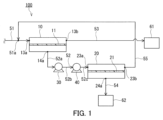
- FIG. 1 is a schematic configuration diagram of a gas separation system according to one embodiment of the present invention.
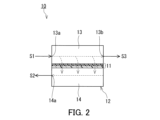
- FIG. 2 is a schematic cross-sectional view showing an example of a first separation membrane unit.
- FIG. 2 is a cross-sectional view illustrating an example of a first separation membrane.
- FIG. 4 is a schematic cross-sectional view showing an example of a second separation membrane unit.
- FIG. 4 is a cross-sectional view illustrating an example of a second separation membrane.
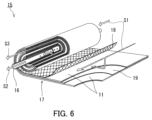
- FIG. 4 is a perspective view illustrating typically another example of a first separation membrane unit.
- FIG. 11 is a schematic diagram showing a modified example of the gas separation system.
- FIG. 1 is a schematic diagram for explaining a gas separation system used in calculation examples 5 to 8.
- FIG. 1 is a schematic diagram for explaining a gas separation system used in Calculation Examples 9 to 12 and Calculation Example 23.
- the gas separation system comprises: a first separation membrane unit containing a first separation membrane that separates the mixed gas into a first permeate gas and a first non-permeate gas; a second separation membrane unit containing a second separation membrane that separates the first permeable gas into a second permeable gas and a second non-permeable gas; a pressure reducing device for reducing the pressure in the permeate side space of the first separation membrane unit; A pressurizing device that pressurizes the supply side space of the second separation membrane unit; Equipped with the mixed gas includes a first gas and a second gas different from the first gas,
- the first separation membrane and the second separation membrane are capable of preferentially permeating the second gas, A separation factor ⁇ 1 of the first separation membrane for the second gas with respect to the first gas, which is determined by the test described below, and a separation factor ⁇ 2 of the second separation membrane for the second gas with respect to the first gas, which is determined by the test described below, satisfy ⁇ 1 ⁇
- a test piece is prepared from the first separation membrane or the second separation membrane.
- a test gas consisting of the first gas and the second gas is supplied to a space adjacent to one side of the test piece, and the space adjacent to the other side of the test piece is depressurized.
- the separation factor ⁇ 1 or the separation factor ⁇ 2 is determined.
- the content of the second gas in the test gas is 50 vol% under standard conditions
- the test gas supplied to the space adjacent to the one side has a temperature of 30° C. and a pressure of 0.1 MPa
- the space adjacent to the other side is depressurized so that the pressure in the space is 0.1 MPa lower than the atmospheric pressure in the measurement environment.
- the content of the second gas in the mixed gas is 30 vol% or less.
- the mixed gas contains nitrogen as the first gas and carbon dioxide as the second gas.
- the membrane area of the first separation membrane is larger than the membrane area of the second separation membrane.
- the gas separation system according to any one of the first to fourth aspects satisfies 10 ⁇ 2 ⁇ 1 ⁇ 30.
- the gas separation system according to any one of the first to fifth aspects satisfies 10 ⁇ 1 ⁇ 30.
- the gas separation system according to any one of the first to sixth aspects is a continuous system.
- the gas separation system according to any one of the first to seventh aspects further includes a permeate gas supply path connected to the first separation membrane unit and the second separation membrane unit for supplying the first permeate gas to the second separation membrane unit, and the pressure reducing device and the pressure increasing device are disposed in the permeate gas supply path.
- the gas separation system according to any one of the first to eighth aspects further comprises a mixed gas supply path connected to the first separation membrane unit for supplying the mixed gas to the first separation membrane unit, and a discharge path connected to the second separation membrane unit for discharging the second non-permeate gas from the second separation membrane unit, and the discharge path merges with the mixed gas supply path at a junction position.
- a method for separating a mixed gas according to a tenth aspect of the present invention includes the steps of: a first separation step of supplying a mixed gas to a first separation membrane unit containing a first separation membrane and separating the mixed gas into a first permeate gas and a first non-permeate gas by reducing the pressure of a permeate side space of the first separation membrane unit; a second separation step of supplying the first permeable gas to a second separation membrane unit containing a second separation membrane and increasing the pressure of a supply side space of the second separation membrane unit, thereby separating the first permeable gas into a second permeable gas and a second non-permeable gas; Including, the mixed gas includes a first gas and a second gas different from the first gas, The first separation membrane and the second separation membrane are capable of preferentially permeating the second gas, A separation factor ⁇ 1 of the first separation membrane for the second gas with respect to the first gas, which is determined by the test described below, and a separation factor ⁇ 2 of
- a test piece is prepared from the first separation membrane or the second separation membrane.
- a test gas consisting of the first gas and the second gas is supplied to a space adjacent to one side of the test piece, and the space adjacent to the other side of the test piece is depressurized.
- the separation factor ⁇ 1 or the separation factor ⁇ 2 is determined.
- the content of the second gas in the test gas is 50 vol% under standard conditions
- the test gas supplied to the space adjacent to the one side has a temperature of 30° C. and a pressure of 0.1 MPa
- the space adjacent to the other side is depressurized so that the pressure in the space is 0.1 MPa lower than the atmospheric pressure in the measurement environment.
- the content of the second gas in the mixed gas is 30 vol% or less.
- the mixed gas contains nitrogen as the first gas and carbon dioxide as the second gas.
- FIG. 1 is a schematic diagram of a gas separation system 100 according to one embodiment of the present invention.
- the gas separation system 100 of this embodiment includes a first separation membrane unit 10, a second separation membrane unit 20, a pressure reducing device 30, and a pressurizing device 40.
- the first separation membrane unit 10 contains a first separation membrane 11, and the second separation membrane unit 20 contains a second separation membrane 21.
- the first separation membrane unit 10 is a membrane separation device that performs membrane separation on a mixed gas using the first separation membrane 11.
- the first separation membrane 11 can separate the mixed gas into a first permeable gas and a first non-permeable gas.
- the second separation membrane unit 20 is a membrane separation device that performs membrane separation on the first permeable gas discharged from the first separation membrane unit 10 using the second separation membrane 21.
- the second separation membrane 21 can separate the first permeable gas into a second permeable gas and a second non-permeable gas.
- the mixed gas treated by the first separation membrane unit 10 contains a first gas and a second gas different from the first gas.
- first gas and the second gas include nitrogen and carbon dioxide.
- the mixed gas may contain nitrogen as the first gas and carbon dioxide as the second gas.
- the mixed gas treated in the first separation membrane unit 10 may contain moisture (H 2 O).
- the mixed gas may be a gas saturated with moisture.
- both the first separation membrane 11 and the second separation membrane 21 are capable of preferentially allowing the second gas to permeate. Therefore, the first permeable gas separated by the first separation membrane 11 has a higher content of the second gas than the mixed gas and a lower content of the first gas than the mixed gas.
- the first non-permeable gas has a lower content of the second gas than the mixed gas and a higher content of the first gas than the mixed gas.
- the second permeable gas separated by the second separation membrane 21 has a higher content of the second gas than the first non-permeable gas and a lower content of the first gas than the first non-permeable gas.
- the second non-permeable gas has a higher content of the second gas than the first non-permeable gas and a lower content of the first gas than the first non-permeable gas.
- the separation factor ⁇ 1 of the first separation membrane 11 for the second gas relative to the first gas, as determined by the following test, and the separation factor ⁇ 2 of the second separation membrane 21 for the second gas relative to the first gas, as determined by the following test satisfy ⁇ 1 ⁇ ⁇ 2 .
- the content of the second gas in the test gas is 50 vol% under standard conditions
- the test gas supplied to the space adjacent to one side has a temperature of 30°C and a pressure of 0.1 MPa
- the space adjacent to the other side is depressurized so that the pressure in the space is 0.1 MPa lower than the atmospheric pressure in the measurement environment.
- the test piece can be prepared, for example, by cutting the first separation membrane 11 or the second separation membrane 21 into a disk shape with a diameter of 20 mm.
- the size of the disk-shaped test piece may be 20 mm or more in diameter.
- the separation operation of the above test can be performed, for example, by the following method.
- the test gas is injected into the space (supply space) in the metal cell so that the test gas comes into contact with one of the main surfaces of the test piece (for example, main surface 11a or 21a described below).
- the content of the second gas in the test gas injected into the supply space is 50 vol% under standard conditions (0°C, 101 kPa).
- the test gas has a temperature of 30°C and a pressure of 0.1 MPa. In this specification, unless otherwise specified, "pressure" means absolute pressure.
- the space (permeation space) in the metal cell adjacent to the other main surface of the test piece (for example, the main surface 11b or 21b described later) is depressurized by a vacuum pump.
- the permeation space is depressurized so that the pressure in the space is 0.1 MPa lower than the atmospheric pressure in the measurement environment.
- the separation factor ⁇ of the test piece can be calculated based on the weight of the permeation fluid, the volume ratio of the second gas and the volume ratio of the first gas in the permeation fluid, and the like.
- the separation factor ⁇ 1 (second gas/first gas) of the first separation membrane 11 can be calculated by performing the above separation operation using a test piece made from the first separation membrane 11
- the separation factor ⁇ 2 (second gas/first gas) of the second separation membrane 21 can be calculated by performing the above separation operation using a test piece made from the second separation membrane 21.
- the separation factor ⁇ can be calculated from the following formula.
- X 2 and X 1 are the volume ratio of the second gas and the volume ratio of the first gas in the test gas, respectively
- the pressure reducing device 30 can reduce the pressure of the permeate side space of the first separation membrane unit 10. In other words, the pressure reducing device 30 can generate a pressure difference or increase the pressure difference between the supply side space and the permeate side space of the first separation membrane unit 10.
- a specific example of the pressure reducing device 30 is a pump.
- the pressure reducing device 30 is preferably a vacuum device such as a vacuum pump.
- the vacuum pump is typically a gas transport type vacuum pump, and examples of the vacuum pump include a reciprocating vacuum pump and a rotary vacuum pump. Examples of the reciprocating vacuum pump include a diaphragm type or a rocking piston type vacuum pump.
- the rotary vacuum pump examples include a liquid ring pump; an oil rotary pump (rotary pump); a mechanical booster pump; and various dry pumps such as a roots type, a claw type, a screw type, a turbo type, and a scroll type.
- the pump as the pressure reducing device 30 may be equipped with a variable speed mechanism for changing the rotation speed, etc.
- An example of the variable speed mechanism is an inverter that drives the motor of the pump. By controlling the pump speed and other parameters with the variable speed mechanism, the pressure in the permeate side space of the first separation membrane unit 10 can be appropriately adjusted.
- the pressure reducing device 30 may be an assembly of multiple pumps.
- the pressure reducing device 30 may be configured so that the permeate side space of the first separation membrane unit 10 can be depressurized by each of the multiple pumps. With this configuration, the pressure in the permeate side space of the first separation membrane unit 10 can be appropriately adjusted by adjusting the number of pumps in operation.
- the pressurizing device 40 can increase the pressure of the supply side space of the second separation membrane unit 20. In other words, the pressurizing device 40 can generate or increase a pressure difference between the supply side space and the permeate side space of the second separation membrane unit 20.
- a specific example of the pressurizing device 40 is a pump.
- the pressurizing device 40 may be a pump that pressurizes the first permeate gas toward the supply side space of the second separation membrane unit 20.
- the pump is typically a gas transport type pressurizing pump, and examples thereof include a reciprocating pressurizing pump or a rotary pressurizing pump. Examples of the reciprocating pressurizing pump include a diaphragm type pump and a rocking piston type pump.
- the rotary pump examples include a liquid ring pump; an oil rotary pump (rotary pump); a mechanical booster pump; and various dry pumps such as a roots type, a claw type, a screw type, a turbo type, and a scroll type.
- the pump as the pressurizing device 40 may be equipped with a variable speed mechanism for changing the rotation speed, etc.
- An example of the variable speed mechanism is an inverter that drives the pump motor. By controlling the pump speed and other parameters with the variable speed mechanism, the pressure in the supply space of the second separation membrane unit 20 can be appropriately adjusted.
- the pressurizing device 40 may be an assembly of multiple pumps. That is, the pressurizing device 40 may be configured so that each of the multiple pumps can increase the pressure in the supply space of the second separation membrane unit 20. With this configuration, the pressure in the supply space of the second separation membrane unit 20 can be appropriately adjusted by adjusting the number of pumps in operation.
- the separation power of the separation membrane unit tends to increase as the carbon dioxide content in the mixed gas decreases.
- the inventors have found that when comparing an operating method in which a pressure difference is generated by reducing the pressure from the permeation side space of the separation membrane unit (pressurization method) with an operating method in which a pressure difference is generated by increasing the pressure from the supply side space of the separation membrane unit (pressurization method), the lower the carbon dioxide content in the supplied mixed gas, the greater the difference in the required separation power.
- the depressurization method is adopted for a separation membrane unit for processing a mixed gas with a low carbon dioxide content (for example, 10 vol% or less), the recovery power can be reduced.
- the depressurization method tends to require a larger membrane area than the pressurization method, and this tendency is more pronounced the lower the carbon dioxide content in the mixed gas.
- the present inventors have investigated whether it is possible to reduce the required membrane area while reducing the recovery power by adopting a decompression method for the first-stage separation membrane unit of a two-stage gas separation system combining two separation membrane units and a pressurization method for the second-stage separation membrane unit.
- a decompression method for the first-stage separation membrane unit of a two-stage gas separation system combining two separation membrane units and a pressurization method for the second-stage separation membrane unit.
- the gas separation system 100 is a gas separation system combining two separation membrane units (a first separation membrane unit 10 and a second separation membrane unit 20), in which a depressurization method is adopted for the first separation membrane unit 10 in the first stage and a pressurization method is adopted for the second separation membrane unit 20 in the second stage, and the separation factor ⁇ 1 of the first separation membrane 11 and the separation factor ⁇ 2 of the second separation membrane 21 satisfy ⁇ 1 ⁇ ⁇ 2 . According to the gas separation system 100 having such a configuration, it is possible to achieve both a reduction in recovery power and a reduction in membrane area.
- the difference between the separation factor ⁇ 2 and the separation factor ⁇ 1 ( ⁇ 2 - ⁇ 1 ) may be 2 or more, 5 or more, 8 or more, or even 10 or more.
- the difference between the separation factor ⁇ 2 and the separation factor ⁇ 1 ( ⁇ 2 - ⁇ 1 ) may be 30 or less, 25 or less, or even 20 or less.
- the difference between the separation factor ⁇ 2 and the separation factor ⁇ 1 ( ⁇ 2 - ⁇ 1 ) may satisfy 10 ⁇ 2 - ⁇ 1 ⁇ 30.
- the separation factor ⁇ 1 of the first separation membrane 11 is not particularly limited as long as ⁇ 1 ⁇ ⁇ 2 is satisfied.
- the separation factor ⁇ 1 is, for example, 40 or less, and may be 30 or less, 25 or less, 20 or less, 15 or less, or even 10 or less.
- the lower limit of the separation factor ⁇ 1 may be, for example, greater than 1, 2 or more, 3 or more, 4 or more, or even 5 or more.
- the separation factor ⁇ 1 of the first separation membrane 11 may satisfy 10 ⁇ 1 ⁇ 30.
- the separation factor ⁇ 2 of the second separation membrane 21 is not particularly limited as long as ⁇ 1 ⁇ ⁇ 2 is satisfied.
- the separation factor ⁇ 2 is, for example, 5 or more, and may be 10 or more, 15 or more, 20 or more, 25 or more, 30 or more, 40 or more, 50 or more, 60 or more, 70 or more, or even 80 or more.
- the upper limit of the separation factor ⁇ 2 is, for example, 200 or less, and may be 150 or less, or 100 or less.
- the separation factor ⁇ 2 of the second separation membrane 21 may satisfy 30 ⁇ 2 ⁇ 50, or may satisfy 40 ⁇ 2 ⁇ 50.
- the permeation rate T 1 of the second gas permeating through the first separation membrane 11 is not particularly limited.
- the permeation rate T 1 of the second gas is, for example, 1 GPU or more, and may be 5 GPU or more, 10 GPU or more, 50 GPU or more, or even 100 GPU or more.
- the upper limit of the permeation rate T 1 is not particularly limited, and is, for example, 1000 GPU or less.
- GPU means 10 ⁇ 6 ⁇ cm 3 (STP) / (sec ⁇ cm 2 ⁇ cmHg).
- cm 3 (STP) means the volume of gas at 1 atmosphere and 0 ° C.
- the permeation rate T 1 can be calculated based on the results of the above separation operation using a test piece made from the first separation membrane 11.
- the permeation rate T2 of the second gas permeating through the second separation membrane 21 is not particularly limited.
- the permeation rate T2 of the second gas is, for example, 1 GPU or more, and may be 5 GPU or more, 10 GPU or more, 50 GPU or more, or even 80 GPU or more.
- the upper limit of the permeation rate T2 is not particularly limited, and is, for example, 1000 GPU or less.
- the permeation rate T2 can be calculated based on the results of the above separation operation using a test piece made from the second separation membrane 21.
- the content of the second gas in the mixed gas may be 30 vol% or less.
- the lower the carbon dioxide content in the supplied mixed gas the more the required separation power tends to increase, but the required membrane area tends to decrease, compared to the reduced pressure method.
- the content of the second gas in the mixed gas 30 vol% or less, the required membrane area for the entire gas separation system 100 can be reduced.
- “content” refers to the value at standard conditions (0°C, 101 kPa).
- the content of the second gas in the mixed gas may be less than 30 vol%.
- the content of the second gas in the mixed gas may be 25 vol% or less, 20 vol% or less, 15 vol% or less, or even 10 vol% or less.
- the gas separation system 100 of this embodiment further includes a permeable gas supply path 52.
- the permeable gas supply path 52 connects the first separation membrane unit 10 and the second separation membrane unit 20, and is a path for supplying the first permeable gas to the second separation membrane unit 20.
- a pressure reducing device 30 and a pressure increasing device 40 are arranged in the permeable gas supply path 52.
- the permeate gas supply path 52 has a first portion 52a extending from the first separation membrane unit 10 to the pressure reducing device 30, a second portion 52b extending from the pressure reducing device 30 to the pressure reducing device 40, and a third portion 52c extending from the pressure reducing device 40 to the second separation membrane unit 20.
- the pressure reducing device 30 can reduce the pressure in the permeate side space of the first separation membrane unit 10 through the first part 52a.
- the pressure reducing device 30, for example, sucks the first permeate gas that has passed through the first part 52a and discharges the first permeate gas to the second part 52b.
- the pressure reducing device 30 is configured, for example, not to discharge the first permeate gas that has passed through the first part 52a to the outside of the gas separation system 100.
- the pressure reducing device 30 is connected, for example, only to the first part 52a and the second part 52b.
- the first part 52a of the permeate gas supply path 52 may be branched and connected to each of the inlets of the multiple pumps.
- the second part 52b of the permeate gas supply path 52 may be branched and connected to each of the outlets of the multiple pumps.
- the pressurizing device 40 can increase the pressure of the supply side space of the second separation membrane unit 20 through the third portion 52c.
- the pressurizing device 40 for example, pressurizes the first permeable gas that has passed through the second portion 52b and discharges the first permeable gas to the third portion 52c.
- the pressurizing device 40 is configured, for example, not to discharge the gas that has passed through the second portion 52b to the outside of the gas separation system 100.
- the pressurizing device 40 is connected, for example, only to the second portion 52b and the third portion 52c.
- the second portion 52b of the permeable gas supply path 52 may branch and be connected to each of the inlets of the multiple pumps.
- the third portion 52c of the permeable gas supply path 52 may branch and be connected to each of the outlets of the multiple pumps.
- a heat exchanger (not shown) may be disposed between the pressurizing device 40 and the second separation membrane unit 20.
- the heat exchanger cools the first permeable gas pressurized by the pressurizing device 40.
- the heat exchanger is, for example, a gas-liquid heat exchanger that causes heat exchange between a cooling medium such as an antifreeze liquid and the first permeable gas, and is typically a fin-tube heat exchanger.
- a drain flow path (not shown) may be connected to the third portion 52c of the permeate gas supply path 52.
- the first permeate gas containing moisture is supplied to the pressurizing device 40 and is condensed by compression by the pressurizing device 40.
- the drain flow path discharges the condensed moisture to the outside.
- the gas separation system 100 of this embodiment further includes a mixed gas supply path 51.
- the mixed gas supply path 51 is connected to the inlet 13a of the first separation membrane unit 10, and is a path for supplying the mixed gas to the first separation membrane unit 10 from a container (not shown) that stores the mixed gas.
- the mixed gas supply path 51 may be directly connected to a source of the mixed gas, or may be configured to continuously supply the mixed gas from the source to the first separation membrane unit 10.
- the gas separation system 100 further includes a first discharge path 53.
- the first discharge path 53 is connected to the outlet 13b of the first separation membrane unit 10, and is a path for discharging the first non-permeable gas from the first separation membrane unit 10.
- the first discharge path 53 has an opening (not shown) for discharging the first non-permeable gas from the first discharge path 53.
- the gas separation system 100 may further include a recovery section 61 that recovers the first non-permeable gas.
- the first discharge path 53 may be connected to the recovery section 61.
- the recovery section 61 is, for example, a container that stores the first non-permeable gas.
- the gas separation system 100 of this embodiment further includes a second discharge path 54 and a recovery section 62.
- the second discharge path 54 is connected to the outlet 24a of the second separation membrane unit 20 and the inlet of the recovery section 62, and is a path for sending the second permeable gas from the second separation membrane unit 20 to the recovery section 62.
- the recovery section 62 can recover the second permeable gas sent from the second separation membrane unit 20.
- the recovery section 62 is, for example, a container for storing the second permeable gas.
- the gas separation system 100 of this embodiment further includes a third exhaust path 55.
- the third exhaust path 55 is connected to the outlet 23b of the second separation membrane unit 20, and is a path for exhausting the second non-permeable gas from the second separation membrane unit 20.
- the third exhaust path 55 may merge with the mixed gas supply path 51 at a merging position 51a.
- the third exhaust path 55 does not have to merge with the mixed gas supply path 51.
- the exhaust path 55 may be directly connected to a recovery section (not shown) that recovers the second non-permeable gas.
- each of the paths in the gas separation system 100 is constructed of, for example, metal or plastic piping.
- the gas separation system 100 may further include a controller (not shown) that controls each component of the gas separation system 100.
- the controller is, for example, a DSP (Digital Signal Processor) including an A/D conversion circuit, an input/output circuit, an arithmetic circuit, a memory device, etc.
- the controller stores a program for properly operating the gas separation system 100.
- the controller may, for example, control the operation of each of the pressure reducing device 30 and the pressure increasing device 40.
- the controller may receive information from the gas sensor and determine the operating conditions of each of the pressure reducing device 30 and the pressure increasing device 40 based on the information.
- the gas separation system 100 of this embodiment is, for example, a continuous system.
- a continuous system means a system capable of continuously processing a mixed gas without closing the paths constituting the gas separation system 100 by an on-off valve or the like.
- the gas separation system 100 processes a mixed gas in the first separation membrane unit 10, and can immediately process the first permeable gas obtained in the first separation membrane unit 10 in the second separation membrane unit 20 without collecting it in a recovery section or the like.
- the gas separation system 100 of this embodiment is capable of continuous operation.
- the gas separation system 100 functioning as a continuous system is suitable for applications in which a mixed gas is continuously supplied, particularly for processing exhaust gas from a factory or power plant.
- the gas separation system 100 for example, at least one of the following is satisfied: (I) the mixed gas is separated into a first permeable gas and a first non-permeable gas while the pressure in the permeate side space of the first separation membrane unit 10 is reduced by the pressure reduction device 30, and (II) the first permeable gas is separated into a second permeable gas and a second non-permeable gas while the pressure in the supply side space of the second separation membrane unit 20 is increased by the pressure reduction device 40.
- First separation membrane unit 2 is a schematic cross-sectional view showing an example of the first separation membrane unit 10.
- the first separation membrane unit 10 includes a first separation membrane 11 and a container 12.
- the container 12 has a first chamber 13 and a second chamber 14.
- the space in the first chamber 13 corresponds to the supply side space
- the space in the second chamber 14 corresponds to the permeation side space.
- the first separation membrane 11 is disposed inside the container 12. Inside the container 12, the first separation membrane 11 separates the first chamber 13 and the second chamber 14.
- the first separation membrane 11 extends from one to the other of a pair of walls of the container 12.
- the first chamber 13 has an inlet 13a and an outlet 13b.
- the second chamber 14 has an outlet 14a.
- the inlet 13a of the first chamber 13 is an opening for supplying the mixed gas S1 to the first separation membrane unit 10.
- the outlet 14a of the second chamber 14 is an opening for discharging the first permeable gas S2 obtained by the permeation of the mixed gas S1 through the first separation membrane 11 from the first separation membrane unit 10.
- the outlet 13b of the first chamber 13 is an opening for discharging the mixed gas S1 (first non-permeable gas S3) that did not permeate the first separation membrane 11 from the first separation membrane unit 10.
- Each of the inlet 13a, the outlet 13b, and the outlet 14a is formed, for example, on the wall surface of the container 12.
- the membrane area M1 of the first separation membrane 11 is larger than the membrane area M2 of the second separation membrane 21.
- the ratio M1 / M2 of the membrane area M1 of the first separation membrane 11 to the membrane area M2 of the second separation membrane 21 may be, for example, 1.0 or more, 1.5 or more, or even 2.0 or more.
- the upper limit of the ratio M1 / M2 may be, for example, 150 or less, 100 or less, 50 or less, 20 or less, or even 15 or less.
- the first separation membrane 11 is capable of preferentially transmitting the second gas contained in the mixed gas S1.
- the second gas is carbon dioxide
- a separation membrane that preferentially transmits carbon dioxide may be referred to as a "carbon dioxide permeable membrane.”
- FIG. 3 is a cross-sectional view showing a schematic example of a first separation membrane 11.
- the first separation membrane 11 as a carbon dioxide permeable membrane includes, for example, a separation functional layer 1.
- the first separation membrane 11 may further include a porous support 3 supporting the separation functional layer 1, and an intermediate layer 2 disposed between the separation functional layer 1 and the porous support 3.
- the intermediate layer 2 is, for example, in direct contact with both the separation functional layer 1 and the porous support 3.
- the separation functional layer 1 is a layer that allows preferential permeation of carbon dioxide contained in the mixed gas S1.
- the separation functional layer 1 contains a resin.
- the resin contained in the separation functional layer 1 include polyether block amide resin, polyamide resin, polyether resin, polyimide resin, cellulose acetate resin, silicone resin, and fluororesin.
- the separation functional layer 1 preferably contains a polyether block amide resin.
- the separation functional layer 1 preferably consists essentially of a resin. In this specification, "consists essentially of” means excluding other components that change the essential characteristics of the mentioned material, and means that, for example, 95 wt % or more, or even 99 wt % or more is composed of the material.
- the separation functional layer 1 contains an ionic liquid.
- the ionic liquid is a salt (ionic compound) that is liquid at 25°C.
- the separation functional layer 1 has, for example, a double network gel containing an ionic liquid.
- the double network gel is a gel that has two types of mesh structures that are independent of each other.
- the double network gel contains, for example, a first network structure that is mainly composed of an organic material, a second network structure that is mainly composed of an inorganic material, and an ionic liquid.
- the second network structure may be mainly composed of an organic material different from the first network structure.
- "mainly composed” means that 50 wt% or more, and even 70 wt% or more of the material is composed of the material.
- the organic material for forming the first network structure includes, for example, a polymer such as polyacrylamide (particularly, polydialkylacrylamide such as polydimethylacrylamide).
- the polymer contained in the organic material has a structural unit derived from an acrylamide derivative, and may further include a crosslinked structure.
- the polymer including the crosslinked structure can be produced by a known method. For example, first, a prepolymer having a structural unit having an N-hydroxysuccinimide ester group is prepared. The structural unit having an N-hydroxysuccinimide ester group is derived from, for example, N-acryloxysuccinimide. Next, a polymer including a crosslinked structure can be obtained by reacting the prepolymer with an amine-based crosslinking agent.
- the amine-based crosslinking agent is a compound having two or more primary amino groups, for example, ethylene glycol bis(3-aminopropyl) ether.
- the second mesh structure may include a network of multiple particles.
- the network of multiple particles is formed, for example, by multiple particles bonding to each other through hydrogen bonds.
- the particles included in the second mesh structure may be particles exemplified as nanoparticles described below. As an example, the particles included in the second mesh structure are silica particles.
- ionic liquids include ionic liquids having imidazolium, pyridinium, ammonium, or phosphonium and a substituent having one or more carbon atoms.
- examples of the substituent having one or more carbon atoms include an alkyl group having from 1 to 20 carbon atoms, a cycloalkyl group having from 3 to 14 carbon atoms, and an aryl group having from 6 to 20 carbon atoms, which may be further substituted with a hydroxy group, a cyano group, an amino group, a monovalent ether group, etc. (for example, a hydroxyalkyl group having from 1 to 20 carbon atoms, etc.).
- Alkyl groups having 1 to 20 carbon atoms include methyl, ethyl, n-propyl, n-butyl, n-pentyl, n-hexyl, n-heptyl, n-octyl, n-nonyl, n-decyl, n-undecyl, n-dodecyl, n-tridecyl, n-tetradecyl, n-pentadecyl, n-hexadecyl, n-heptadecyl, n-octadecyl, n-nonadecyl, and n-eicosadecy.
- Examples of such groups include silyl, i-propyl, sec-butyl, i-butyl, 1-methylbutyl, 1-ethylpropyl, 2-methylbutyl, i-pentyl, neopentyl, 1,2-dimethylpropyl, 1,1-dimethylpropyl, t-pentyl, 2-ethylhexyl, and 1,5-dimethylhexyl groups, which may be further substituted with a hydroxyl group, a cyano group, an amino group, a monovalent ether group, or the like.
- the above-mentioned alkyl group may be substituted with a cycloalkyl group.
- the number of carbon atoms of the alkyl group substituted with a cycloalkyl group is, for example, 1 or more and 20 or less.
- Examples of the alkyl group substituted with a cycloalkyl group include a cyclopropylmethyl group, a cyclobutylmethyl group, a cyclohexylmethyl group, and a cyclohexylpropyl group, which may be further substituted with a hydroxy group, a cyano group, an amino group, a monovalent ether group, etc.
- Cycloalkyl groups having 3 to 14 carbon atoms include cyclopropyl, cyclobutyl, cyclopentyl, cyclohexyl, cycloheptyl, cyclooctyl, cyclododecyl, norbornyl, bornyl, and adamantyl groups, which may be further substituted with hydroxy, cyano, amino, monovalent ether groups, etc.
- Aryl groups having 6 to 20 carbon atoms include phenyl, toluyl, xylyl, mesityl, anisyl, naphthyl, and benzyl groups, which may be further substituted with hydroxy, cyano, amino, and monovalent ether groups.
- the imidazolium and the compound having a substituent with one or more carbon atoms may further have a substituent such as an alkyl group, and may form a salt with a counter anion.
- the counter anion include alkyl sulfate, tosylate, methanesulfonate, acetate, bis(fluorosulfonyl)imide, bis(trifluoromethanesulfonyl)imide, thiocyanate, dicyanamide, tricyanomethanide, tetracyanoborate, hexafluorophosphate, tetrafluoroborate, and halides. From the viewpoint of gas separation performance, bis(fluorosulfonyl)imide, bis(trifluoromethanesulfonyl)imide, dicyanamide, tricyanomethanide, and tetracyanoborate are preferred.
- ionic liquids having imidazolium and a substituent with one or more carbon atoms include 1-ethyl-3-methylimidazolium bis(fluorosulfonyl)imide, 1-ethyl-3-methylimidazolium dicyanamide, 1-butyl-3-methylimidazolium bromide, 1-butyl-3-methylimidazolium chloride, 1-butyl-3-methylimidazolium tetrafluoroborate, 1-butyl-3-methylimidazolium hexafluorophosphate, 1-butyl-3-methylimidazolium trifluoromethanesulfonate, 1-butyl-3-methylimidazolium tetrachlorofer ...hexafluorophosphate Methylimidazolium iodide, 1-butyl-2,3-dimethylimidazolium chloride, 1-butyl-2,3-dimethylimidazolium hexafluoro
- 1-ethyl-3-methylimidazolium bis(fluorosulfonyl)imide [EMI][FSI]), 1-ethyl-3-methylimidazolium dicyanamide ([EMI][DCA]), 1-ethyl-3-methylimidazolium tricyanomethanide ([EMI][TCM]), 1-ethyl-3-methylimidazolium tetracyanoborate ([EMI][TCB]), 1-butyl-3-methylimidazolium bis(trifluoromethanesulfonyl)imide ([ C4mim ][ TF2N ]), and 1-(2-hydroxyethyl)-3-methylimidazolium bis(trifluoromethanesulfonyl)imide ([ C2OHim ][ TF2N ]) are particularly preferred.
- the method for producing the double network gel is not particularly limited, and for example, the method disclosed in E. Kamio et al., Adv. Mater, 29, 1704118 (2017) can be used.
- the ionic liquid content in the double network gel is, for example, 50 wt% or more, preferably 60 wt% or more, more preferably 70 wt% or more, and even more preferably 80 wt% or more.
- the upper limit of the ionic liquid content is not particularly limited, and is, for example, 95 wt%.
- the content of the first mesh structure mainly made of organic material in the double network gel is, for example, 1 wt% or more, preferably 5 wt% or more, and more preferably 10 wt% or more.
- the upper limit of the content of the first mesh structure is, for example, 15 wt%.
- the content of the second mesh structure mainly made of inorganic material in the double network gel is, for example, 1 wt% or more from the viewpoint of improving the strength of the double network gel.
- the upper limit of the content of the second mesh structure is, for example, 5 wt%.
- the ratio of the total weight of the first mesh structure and the second mesh structure to the weight of the double network gel is, for example, 2 wt% or more, preferably 5 wt% or more, and more preferably 10 wt% or more. This ratio is preferably 20 wt% or less.
- the separation functional layer 1 preferably consists essentially of the double network gel.
- the thickness of the separation functional layer 1 is, for example, 50 ⁇ m or less, preferably 25 ⁇ m or less, and more preferably 15 ⁇ m or less. In some cases, the thickness of the separation functional layer 1 may be 10 ⁇ m or less, 5.0 ⁇ m or less, or 2.0 ⁇ m or less. The thickness of the separation functional layer 1 may be 0.05 ⁇ m or more, or 0.1 ⁇ m or more.
- the intermediate layer 2 may, for example, contain a resin and further contain nanoparticles dispersed in the resin (matrix).
- the nanoparticles may be separated from each other in the matrix, or may be partially aggregated.
- the material of the matrix is not particularly limited, and examples thereof include silicone resins such as polydimethylsiloxane; fluororesins such as polytetrafluoroethylene; epoxy resins such as polyethylene oxide; polyimide resins; polysulfone resins; polyacetylene resins such as polytrimethylsilylpropyne and polydiphenylacetylene; and polyolefin resins such as polymethylpentene.
- the matrix preferably contains a silicone resin.
- the nanoparticles may contain an inorganic material or an organic material.
- inorganic materials contained in the nanoparticles include silica, titania, and alumina. It is preferable that the nanoparticles contain silica.
- the thickness of the intermediate layer 2 is not particularly limited, and is, for example, less than 50 ⁇ m, preferably 40 ⁇ m or less, and more preferably 30 ⁇ m or less.
- the lower limit of the thickness of the intermediate layer 2 is not particularly limited, and is, for example, 0.1 ⁇ m.
- the intermediate layer 2 is, for example, a layer having a thickness of less than 50 ⁇ m.
- the porous support 3 supports the separation function layer 1 via the intermediate layer 2.
- the porous support 3 include nonwoven fabric, porous polytetrafluoroethylene, aromatic polyamide fiber, porous metal, sintered metal, porous ceramic, porous polyester, porous nylon, activated carbon fiber, latex, silicone, silicone rubber, permeable (porous) polymers including at least one selected from the group consisting of polyvinyl fluoride, polyvinylidene fluoride, polyurethane, polypropylene, polyethylene, polystyrene, polycarbonate, polysulfone, polyether ether ketone, polyacrylonitrile, polyimide and polyphenylene oxide, metal foam having open or closed cells, polymer foam having open or closed cells, silica, porous glass, mesh screen, etc.
- the porous support 3 may be a combination of two or more of these.
- the first separation membrane 11 is typically a flat membrane. However, the first separation membrane 11 may have a shape other than a flat membrane, for example, a hollow fiber membrane.
- a coating liquid containing the material of the separation functional layer 1 is prepared.
- the coating liquid containing the material of the separation functional layer 1 is applied onto the intermediate layer 2 to obtain a coating film.
- This coating film is dried to form the separation functional layer 1.
- the coating method and drying conditions for the coating liquid can be the same as those described above for the intermediate layer 2.
- the coating liquid containing the material of the separation functional layer 1 may be applied by spin coating. This results in a first separation film 11.
- [Second separation membrane unit] 4 is a schematic cross-sectional view showing an example of the second separation membrane unit 20.
- the second separation membrane unit 20 includes a second separation membrane 21 and a container 22.
- the container 22 has a third chamber 23 and a fourth chamber 24.
- the space in the third chamber 23 corresponds to the supply side space, and the space in the fourth chamber 24 corresponds to the permeation side space.
- the second separation membrane 21 is disposed inside the container 22. Inside the container 22, the second separation membrane 21 separates the third chamber 23 and the fourth chamber 24.
- the second separation membrane 21 extends from one to the other of a pair of walls of the container 22.
- the third chamber 23 has an inlet 23a and an outlet 23b.
- the fourth chamber 24 has an outlet 24a.
- the inlet 23a of the third chamber 23 is an opening for supplying the first permeable gas S2 to the second separation membrane unit 20.
- the outlet 24a of the fourth chamber 24 is an opening for discharging the second permeable gas S4 obtained by the first permeable gas S2 permeating the second separation membrane 21 from the second separation membrane unit 20.
- the outlet 23b of the third chamber 23 is an opening for discharging the first permeable gas S2 (second non-permeable gas S5) that did not permeate the second separation membrane 21 from the second separation membrane unit 20.
- Each of the inlet 23a, the outlet 23b, and the outlet 24a is formed, for example, on the wall surface of the container 22.
- the second separation membrane 21 is a carbon dioxide permeable membrane that allows the second gas contained in the first permeable gas S2 to preferentially permeate therethrough.
- FIG. 5 is a cross-sectional view showing a schematic example of a second separation membrane 21.
- the second separation membrane 21 as a carbon dioxide permeable membrane includes, for example, a separation functional layer 5.
- the second separation membrane 21 may further include a porous support 7 supporting the separation functional layer 5, and an intermediate layer 6 disposed between the separation functional layer 5 and the porous support 7.
- the intermediate layer 6 is in direct contact with, for example, both the separation functional layer 5 and the porous support 7.
- the second separation membrane 21 has a main surface 21a on the separation functional layer 5 side and a main surface 21b on the porous support 7 side.
- the separation functional layer 5 has the same structure and effect as the separation functional layer 2 of the first separation membrane 11, so a description thereof will be omitted.
- the intermediate layer 6 has the same structure and effect as the intermediate layer 2 of the first separation membrane 11, so a description thereof will be omitted.
- the porous support 7 has the same structure and effect as the porous support 3 of the first separation membrane 11, so a description thereof will be omitted.
- the second separation membrane 21 may be the same as or different from the first separation membrane 11, except for the membrane area.
- at least one selected from the group consisting of the first separation membrane 11 and the second separation membrane 21 may contain polyether block amide resin or ionic liquid as a material for the separation functional layer, and it is preferable that both the first separation membrane 11 and the second separation membrane 21 contain polyether block amide resin or ionic liquid as a material for the separation functional layer.
- the second separation membrane 21 can be manufactured using a method similar to that used for manufacturing the first separation membrane 11.
- the first separation membrane unit 10 and the second separation membrane unit 20 provided in the gas separation system 100 are suitable for a flow-through (continuous) membrane separation method. However, these separation membrane units may also be used in a batch-type membrane separation method.
- the first separation membrane unit 10 is not limited to the form shown in Fig. 2 and may be, for example, a spiral-type membrane element, a hollow fiber membrane element, or the like.
- Fig. 6 is a perspective view showing a schematic diagram of another example of the first separation membrane unit 10.
- Fig. 6 shows a spiral-type membrane element.
- the first separation membrane unit 15 in Fig. 6 includes a central tube 16 and a laminate 17.
- the laminate 17 includes a first separation membrane 11.
- the central tube 16 has a cylindrical shape. A plurality of openings are formed on the surface of the central tube 16 for allowing the first permeable gas 80 to flow into the interior of the central tube 16.
- materials for the central tube 16 include resins such as acrylonitrile butadiene styrene copolymer resin (ABS resin), polyphenylene ether resin (PPE resin), and polysulfone resin (PSF resin); and metals such as stainless steel and titanium.
- the inner diameter of the central tube 16 is, for example, in the range of 20 to 100 mm.
- the laminate 17 further includes a feed-side flow path material 18 and a permeate-side flow path material 19.
- the laminate 17 is wound around the central tube 16.
- the first separation membrane unit 15 may further include an exterior material (not shown).
- the supply-side flow passage material 18 and the permeate-side flow passage material 19 can be, for example, a resin net, woven fabric, or knitted fabric made of polyethylene, polypropylene, polyethylene terephthalate (PET), polyphenylene sulfide (PPS), or ethylene-chlorotrifluoroethylene copolymer (ECTFE).
- PET polyethylene terephthalate
- PPS polyphenylene sulfide
- ECTFE ethylene-chlorotrifluoroethylene copolymer
- Membrane separation using the first separation membrane unit 15 is performed, for example, by the following method.
- mixed gas S1 is supplied to one end of the rolled stack 17. This causes the first permeable gas S2 that has permeated the first separation membrane 11 of the stack 17 to move inside the central tube 16.
- the first permeable gas S2 is discharged to the outside through the central tube 16.
- the mixed gas S1 (first non-permeable gas S3) that has been treated by the first separation membrane unit 15 is discharged to the outside from the other end of the rolled stack 17.
- the second separation membrane unit 20 is not limited to the form shown in FIG. 4, and may be, for example, a spiral-type membrane element, a hollow fiber membrane element, etc.
- the second separation membrane unit 20 may be a spiral-type membrane element having a configuration similar to that of the first separation membrane unit 15.
- the method for separating a mixed gas includes a first separation step of supplying a mixed gas S1 to a first separation membrane unit 10 containing a first separation membrane 11 and separating the mixed gas S1 into a first permeable gas S2 and a first non-permeable gas S3 by reducing the pressure of the permeate side space of the first separation membrane unit 10, and a second separation step of supplying the first permeable gas S2 to a second separation membrane unit 20 containing a second separation membrane 21 and separating the first permeable gas S2 into a second permeable gas S4 and a second non-permeable gas S5 by increasing the pressure of the supply side space of the second separation membrane unit 20.
- the separation factor ⁇ 1 of the first gas for the first gas of the first separation membrane 11 and the separation factor ⁇ 2 of the second gas for the first gas of the second separation membrane 21 obtained by the above test satisfy ⁇ 1 ⁇ ⁇ 2 .
- the mixed gas separation method of this embodiment is a separation method that combines two separation steps (a first separation step and a second separation step), in which a depressurization method is adopted for the first separation step at the front stage and a pressurization method is adopted for the second separation step at the rear stage, and the separation factor ⁇ 1 of the first separation membrane 11 and the separation factor ⁇ 2 of the second separation membrane 21 satisfy ⁇ 1 ⁇ ⁇ 2 .
- a depressurization method is adopted for the first separation step at the front stage
- a pressurization method is adopted for the second separation step at the rear stage
- the separation factor ⁇ 1 of the first separation membrane 11 and the separation factor ⁇ 2 of the second separation membrane 21 satisfy ⁇ 1 ⁇ ⁇ 2 .
- the first separation step is performed, for example, as follows: First, the mixed gas S1 is supplied to the first chamber 13 (supply side space) of the first separation membrane unit 10 through the mixed gas supply path 51. The mixed gas S1 is supplied to the first chamber 13 at atmospheric pressure in the measurement environment (e.g., 101.33 kPa) without being pressurized, for example.
- the measurement environment e.g., 101.33 kPa
- the second chamber 14 (permeation side space) is depressurized.
- the pressure in the second chamber 14 is reduced through the outlet 14a using the pressure reducing device 30.
- the pressure in the permeation side space is, for example, 70 kPa or less, preferably 50 kPa or less, more preferably 30 kPa or less, even more preferably 10 kPa or less, and particularly preferably 5 kPa or less.
- the pressure in the permeation side space may be 1 kPa or more, 2 kPa or more, 3 kPa or more, or 5 kPa or more.
- the pressure difference between the supply side space and the permeate side space of the first separation membrane unit 10 is adjusted to, for example, 500 kPa or less, preferably 400 kPa or less, more preferably 300 kPa or less, even more preferably 200 kPa or less, and particularly preferably 100 kPa or less.
- the lower limit of the pressure difference between the supply side space and the permeate side space of the first separation membrane unit 10 is not particularly limited, and is, for example, 10 kPa.
- the first permeable gas S2 supplied to the second chamber 14 passes through the first portion 52a of the permeable gas supply path 52 and is sucked into the pressure reducing device 30.
- the pressure reducing device 30 discharges the sucked first permeable gas S2 to the second portion 52b of the permeable gas supply path 52. Since the first permeable gas S2 is supplied to the second portion 52b, the pressure in the second portion 52b is usually maintained at approximately atmospheric pressure in the measurement environment.
- the first permeable gas S2 is supplied to the pressure reducing device 40 through the second portion 52b.
- the first separation membrane 11 of the first separation membrane unit 10 preferentially allows the second gas contained in the mixed gas S1 to permeate. Therefore, the first permeable gas S2 obtained by the first separation process has a higher content of the second gas than the mixed gas S1.
- the content of the second gas (e.g., carbon dioxide) in the first permeable gas S2 obtained by the first separation process is not particularly limited, and is, for example, 40 vol% to 70 vol%.
- the ratio of the content (vol%) of the second gas in the first permeable gas S2 to the content (vol%) of the second gas in the mixed gas S1 is not particularly limited, and is, for example, 2 to 6.
- the concentration of the first gas in the mixed gas S1 gradually increases from the inlet 13a to the outlet 13b of the first chamber 13.
- the content of the first gas (e.g., nitrogen) in the mixed gas S1 (first non-permeable gas S3) processed in the first chamber 13 is, for example, 95 vol% to 99 vol%.
- the first non-permeable gas S3 is discharged to the outside of the first separation membrane unit 10 through the outlet 13b.
- the first non-permeable gas S3 is discharged, for example, through the first exhaust path 53.
- the second separation step is performed, for example, as follows: First, the first permeable gas S2 is supplied to the third chamber 23 (supply side space) of the second separation membrane unit 20 through the second portion 52b and the third portion 52c of the permeable gas supply path 52.
- the pressure in the third chamber 23 (supply side space) is increased.
- the pressure in the third chamber 23 is increased through the inlet 23a using the pressurizing device 40 arranged in the third portion 52c.
- the pressure in the supply side space is, for example, 101 kPa or more, preferably 150 kPa or more, more preferably 200 kPa or more, even more preferably 300 kPa or more, and particularly preferably 400 kPa or more.
- the upper pressure limit in the supply side space may be 1500 kPa, 1300 kPa, 1100 kPa, 1000 kPa, or 900 kPa.
- the pressure in the third chamber 23 By increasing the pressure in the third chamber 23, a pressure difference occurs between the supply side space and the permeate side space, or the pressure difference increases. As a result, the first permeate gas S2 is separated by the second separation membrane 21, and the second permeate gas S4 is supplied to the fourth chamber 24. While the first permeate gas S2 is being separated, the pressure in the third chamber 23 may continue to be increased by the pressurizing device 40.
- the pressure difference between the supply side space and the permeate side space of the second separation membrane unit 20 is adjusted to, for example, 1000 kPa or less, preferably 800 kPa or less, more preferably 600 kPa or less, even more preferably 500 kPa or less, and particularly preferably 400 kPa or less.
- the lower limit of the pressure difference between the supply side space and the permeate side space of the second separation membrane unit 20 is not particularly limited, and is, for example, 100 kPa.
- the second permeable gas S4 supplied to the fourth chamber 24 is sent, for example, to the recovery section 62 through the second exhaust path 54.
- the second separation membrane 21 of the second separation membrane unit 20 preferentially allows the second gas contained in the first permeable gas S2 to permeate. Therefore, the second permeable gas S4 obtained by the second separation process has a higher content of the second gas than the first permeable gas S2.
- the content of the second gas (e.g., carbon dioxide) in the second permeable gas S4 obtained by the second separation process is not particularly limited, and is, for example, 95 vol.%.
- the ratio of the content of the second gas (vol.%) in the second permeable gas S4 to the content of the second gas (vol.%) in the first permeable gas S2 is not particularly limited, and is, for example, 1.3 to 2.5.
- the concentration of the first gas in the first permeable gas S2 gradually increases from the inlet 23a to the outlet 23b of the third chamber 23.
- the content of the first gas (e.g., nitrogen) in the first permeable gas S2 (second non-permeable gas S5) treated in the third chamber 23 is not particularly limited, and is, for example, 70 vol% to 97 vol%.
- the second non-permeable gas S5 is discharged to the outside of the second separation membrane unit 20 through the outlet 23b.
- the mixed gas S1 includes the first gas and the second gas.
- the mixed gas S1 includes nitrogen as the first gas and carbon dioxide as the second gas.
- the mixed gas S1 is typically an exhaust gas from a factory or a power plant.
- the gas separation system 100 of the present embodiment can also be used to separate a mixed gas S1 having a composition other than the above.
- the first gas and the second gas may be one type of gas selected from non-polar gases such as nitrogen, methane, oxygen, and hydrogen, inert gases such as helium, and acidic gases other than carbon dioxide.
- acidic gases other than carbon dioxide include hydrogen sulfide, carbonyl sulfide, sulfur oxides (SO x ), hydrogen cyanide, and nitrogen oxides (NO x ).
- the content of the second gas in the mixed gas S1 may be 30 vol% or less. As described above, compared to the decompression method, the pressurization method tends to require more separation power but requires less membrane area the lower the carbon dioxide content of the supplied mixed gas. By having the content of the second gas in the mixed gas S1 be 30 vol% or less, the membrane area required for the entire gas separation system 100 can be reduced.
- the content of the second gas in the mixed gas S1 may be less than 30 vol%.
- the content of the second gas in the mixed gas S1 may be 25 vol% or less, 20 vol% or less, 15 vol% or less, or even 10 vol% or less.
- the mixed gas separation method of this embodiment it is preferable to perform the first separation step and the second separation step consecutively.
- the first permeable gas S2 separated in the first separation step is not collected in a tank or the like, but is immediately subjected to the second separation step.
- the mixed gas separation method of this embodiment may further include a recovery step of recovering the first non-permeable gas S3 obtained by the first separation step, and a recovery step of recovering the second permeable gas S4 obtained by the second separation step.
- the separation method of the present embodiment further includes, for example, a mixing step of mixing the second non-permeable gas S5 with the mixed gas S1.
- the mixing step can be performed by sending the second non-permeable gas S5 to the joining position 51a of the mixed gas supply path 51 through the third exhaust path 55.
- the second non-permeable gas S5 can be reused, and the recovery rates of the first gas and the second gas tend to be improved.
- a second permeable gas S4 in which the second gas is concentrated and a first non-permeable gas S3 in which the first gas is concentrated can be recovered.
- the recovery rate of the second gas (e.g., carbon dioxide) by this separation method is not particularly limited and is, for example, 80 wt% or more, and preferably 90 wt% or more.
- the recovery rate of the first gas is not particularly limited and is, for example, 90 wt% or more, and preferably 95 wt% or more.
- the second permeable gas S4 in which carbon dioxide is concentrated can be used, for example, to manufacture dry ice.
- the first non-permeable gas S3 in which nitrogen is concentrated can be used, for example, for industrial purposes.
- the gas separation system 100 of this embodiment and the method for separating mixed gases using the gas separation system 100 it is possible to achieve both a reduction in recovery power and a reduction in membrane area.
- the gas separation system 100 of this embodiment and the method for separating mixed gases using the gas separation system 100 are suitable for achieving both a reduction in recovery power and a reduction in membrane area.
- ⁇ Modifications of the Gas Separation System> 7 is a schematic diagram showing a modified example of the gas separation system 100 described above.
- the modified gas separation system 110 includes a decompression unit 31 in which the decompression device 30 and the pressurization device 40 are housed in a single container. Except for the above, the configuration of the modified gas separation system 110 is the same as that of the gas separation system 100. Therefore, elements common to the gas separation system 100 and the modified gas separation system 110 are denoted by the same reference symbols, and descriptions thereof will be omitted.
- the pressure reduction unit 31 includes, for example, a pressure reduction device 30, a pressure reduction device 40, and a second part 52b.
- the permeate side space of the first separation membrane unit 10 was depressurized to 3 kPa by the depressurization device 30, and that the supply side space of the second separation membrane unit 20 was pressurized to 900 kPa by the pressurization device 40.
- the operating efficiency of the depressurization device 30 was set to 40%, and the operating efficiency of the pressurization device 40 was set to 70%.
- the carbon dioxide recovery power (MWh/t- CO2 ) and the required total membrane area ( m2 ) were calculated when the following assumed conditions were met.
- the calculations were performed using Symmetry, a process modeling software manufactured by Schlumberger.
- the carbon dioxide recovery power is the energy required to operate the gas separation system per ton of carbon dioxide contained in the second permeable gas S4.
- the carbon dioxide content in the second permeable gas S4 discharged from the second separation membrane unit 20 is 95 vol %.
- the recovery rate of carbon dioxide by the gas separation system 100 is 90 wt %.
- the permeation rate T 1 (GPU) of the second gas permeating the first separation membrane 211, the separation factor ⁇ 1 of the first separation membrane 211, the permeation rate T 2 (GPU) of the second gas permeating the second separation membrane 221, and the separation factor ⁇ 2 of the second separation membrane 221 were set as shown in Table 1.
- the mixed gas supply conditions were the same as in Calculation Example 1.
- the permeation rate T 1 (GPU) of the second gas permeating through the first separation membrane 311, the separation factor ⁇ 1 of the first separation membrane 311, the permeation rate T 2 (GPU) of the second gas permeating through the second separation membrane 321, and the separation factor ⁇ 2 of the second separation membrane 321 were set as shown in Table 1.
- the mixed gas supply conditions were the same as in Calculation Example 1.
- the supply side space of the first separation membrane unit 310 was pressurized to 900 kPa by the first pressurizing device 341, and that the supply side space of the second separation membrane unit 320 was pressurized to 900 kPa by the second pressurizing device 342.
- the operating efficiency of the first pressurizing device 341 and the second pressurizing device 342 was set to 70%.
- calculation examples 1 to 4 As shown in Table 1, among calculation examples 1 to 4 in which the gas separation system 100 shown in FIG. 1 was assumed, calculation example 2 satisfied ⁇ 1 ⁇ 2. On the other hand, calculation examples 1 and 3 to 4 did not satisfy ⁇ 1 ⁇ 2.
- the gas separation system 200 shown in FIG. 8 was assumed, rather than the gas separation system 100 shown in FIG. 1.
- the gas separation system 300 shown in FIG. 9 was assumed, rather than the gas separation system 100 shown in FIG. 1. That is, calculation example 2 corresponds to the embodiment, and calculation examples 1 and 3 to 12 correspond to comparative examples.
- both the reduction in recovery power and the reduction in membrane area were achieved.
- the permeate side space of the first separation membrane unit 10 was depressurized to 3 kPa by the depressurization device 30, and the supply side space of the second separation membrane unit 20 was pressurized to 900 kPa by the pressurization device 40.
- the operating efficiency of the depressurization device 30 was set to 40%, and the operating efficiency of the pressurization device 40 was set to 70%.
- the calculation examples 14 to 15 satisfied ⁇ 1 ⁇ 2.
- the calculation example 13 did not satisfy ⁇ 1 ⁇ 2. That is, the calculation examples 14 to 15 correspond to the working examples, and the calculation example 13 corresponds to the comparative example.
- the recovery power was 0.81 MWh/t-CO 2 or less, and the recovery power could be reduced compared to the calculation example 13. Specifically, when the gas separation system 100 shown in FIG.
- the permeation rate T 2 of the second separation membrane 21 could be reduced by increasing the selectivity of the second separation membrane relative to the first separation membrane, that is, by increasing the separation coefficient ⁇ 2 of the second separation membrane 21, and thus the recovery power could be reduced.
- the calculation examples 16 to 19 satisfied ⁇ 1 ⁇ 2.
- the calculation examples 16 to 17 did not satisfy ⁇ 1 ⁇ 2. That is, the calculation examples 18 to 19 correspond to the working examples, and the calculation examples 16 to 17 correspond to the comparative examples.
- the recovery power was 0.81 MWh/t-CO 2 or less, and the total membrane area was 10108 m 2 or less, and both the recovery power and the total membrane area were reduced compared to the calculation examples 16 to 17.
- the permeate side space of the first separation membrane unit 10 was depressurized to 3 kPa by the depressurization device 30, and that the supply side space of the second separation membrane unit 20 was pressurized to 900 kPa by the pressurization device 40.
- the operating efficiency of the depressurization device 30 was set to 40%, and the operating efficiency of the pressurization device 40 was set to 70%.
- the carbon dioxide content (vol%) in the mixed gas, the permeation rate T 1 (GPU), The separation factor ⁇ 1 , permeation rate T 2 (GPU), and separation factor ⁇ 2 were set as shown in Table 3.
- the mixed gas supply conditions other than the mixed gas composition were the same as those in Calculation Examples 1 to 4.
- the supply side space of the first separation membrane unit 310 was pressurized to 900 kPa by the first pressurizing device 341, and that the supply side space of the second separation membrane unit 320 was pressurized to 900 kPa by the second pressurizing device 342.
- the operating efficiency of the first pressurizing device 341 and the second pressurizing device 342 was set to 70%.
- the permeability of the first separation membrane 11 and the second separation membrane 21 for H 2 O was set to three times that for CO 2 .
- the mixed gas contains nitrogen as the first gas and carbon dioxide as the second gas.
- the mixed gas is not limited to that used in the above embodiment.
- the gas separation system of the present embodiment is suitable for separating a mixed gas, for example, a mixed gas containing carbon dioxide and nitrogen.
- the gas separation system of the present embodiment is suitable for efficiently recovering carbon dioxide from exhaust gas discharged from a combustion device such as a factory or a power plant.
Landscapes
- Chemical & Material Sciences (AREA)
- Engineering & Computer Science (AREA)
- Chemical Kinetics & Catalysis (AREA)
- Analytical Chemistry (AREA)
- General Chemical & Material Sciences (AREA)
- Oil, Petroleum & Natural Gas (AREA)
- Water Supply & Treatment (AREA)
- Separation Using Semi-Permeable Membranes (AREA)
Abstract
Priority Applications (3)
| Application Number | Priority Date | Filing Date | Title |
|---|---|---|---|
| EP24770949.6A EP4681801A1 (fr) | 2023-03-16 | 2024-03-13 | Système de séparation de gaz et procédé de séparation de gaz mixte |
| CN202480013548.1A CN120731122A (zh) | 2023-03-16 | 2024-03-13 | 气体分离系统及混合气体的分离方法 |
| JP2025506915A JPWO2024190846A1 (fr) | 2023-03-16 | 2024-03-13 |
Applications Claiming Priority (2)
| Application Number | Priority Date | Filing Date | Title |
|---|---|---|---|
| JP2023-041659 | 2023-03-16 | ||
| JP2023041659 | 2023-03-16 |
Publications (1)
| Publication Number | Publication Date |
|---|---|
| WO2024190846A1 true WO2024190846A1 (fr) | 2024-09-19 |
Family
ID=92755257
Family Applications (1)
| Application Number | Title | Priority Date | Filing Date |
|---|---|---|---|
| PCT/JP2024/009898 Ceased WO2024190846A1 (fr) | 2023-03-16 | 2024-03-13 | Système de séparation de gaz et procédé de séparation de gaz mixte |
Country Status (4)
| Country | Link |
|---|---|
| EP (1) | EP4681801A1 (fr) |
| JP (1) | JPWO2024190846A1 (fr) |
| CN (1) | CN120731122A (fr) |
| WO (1) | WO2024190846A1 (fr) |
Cited By (1)
| Publication number | Priority date | Publication date | Assignee | Title |
|---|---|---|---|---|
| JP7807717B1 (ja) * | 2024-09-30 | 2026-01-28 | ダイキン工業株式会社 | ガス分離方法 |
Citations (4)
| Publication number | Priority date | Publication date | Assignee | Title |
|---|---|---|---|---|
| JPH05508104A (ja) * | 1991-05-07 | 1993-11-18 | メンブレイン・テクノロジー・アンド・リサーチ・インコーポレイテッド | 膜による分別方法 |
| JP2008137847A (ja) * | 2006-12-01 | 2008-06-19 | Air Liquide Japan Ltd | キセノンの回収システムおよび回収装置 |
| JP2020501884A (ja) | 2016-12-14 | 2020-01-23 | メンブレイン テクノロジー アンド リサーチ, インコーポレイテッド | 燃焼プロセス燃焼排ガスからのco2およびso2の分離および同時捕獲 |
| WO2022030267A1 (fr) * | 2020-08-07 | 2022-02-10 | 日東電工株式会社 | Système de séparation de gaz et procédé pour séparer du gaz mixte |
-
2024
- 2024-03-13 WO PCT/JP2024/009898 patent/WO2024190846A1/fr not_active Ceased
- 2024-03-13 CN CN202480013548.1A patent/CN120731122A/zh active Pending
- 2024-03-13 EP EP24770949.6A patent/EP4681801A1/fr active Pending
- 2024-03-13 JP JP2025506915A patent/JPWO2024190846A1/ja active Pending
Patent Citations (4)
| Publication number | Priority date | Publication date | Assignee | Title |
|---|---|---|---|---|
| JPH05508104A (ja) * | 1991-05-07 | 1993-11-18 | メンブレイン・テクノロジー・アンド・リサーチ・インコーポレイテッド | 膜による分別方法 |
| JP2008137847A (ja) * | 2006-12-01 | 2008-06-19 | Air Liquide Japan Ltd | キセノンの回収システムおよび回収装置 |
| JP2020501884A (ja) | 2016-12-14 | 2020-01-23 | メンブレイン テクノロジー アンド リサーチ, インコーポレイテッド | 燃焼プロセス燃焼排ガスからのco2およびso2の分離および同時捕獲 |
| WO2022030267A1 (fr) * | 2020-08-07 | 2022-02-10 | 日東電工株式会社 | Système de séparation de gaz et procédé pour séparer du gaz mixte |
Non-Patent Citations (2)
| Title |
|---|
| E. KAMIO ET AL., ADV. MATER, vol. 29, 2017, pages 1704118 |
| See also references of EP4681801A1 |
Cited By (2)
| Publication number | Priority date | Publication date | Assignee | Title |
|---|---|---|---|---|
| JP7807717B1 (ja) * | 2024-09-30 | 2026-01-28 | ダイキン工業株式会社 | ガス分離方法 |
| WO2026070452A1 (fr) * | 2024-09-30 | 2026-04-02 | ダイキン工業株式会社 | Procédé de séparation de gaz |
Also Published As
| Publication number | Publication date |
|---|---|
| CN120731122A (zh) | 2025-09-30 |
| JPWO2024190846A1 (fr) | 2024-09-19 |
| EP4681801A1 (fr) | 2026-01-21 |
Similar Documents
| Publication | Publication Date | Title |
|---|---|---|
| JP7794744B2 (ja) | ガス分離システム及び混合ガスの分離方法 | |
| JP7421379B2 (ja) | 分離膜 | |
| CN104941394B (zh) | 气体分离系统及富化气体的制造方法 | |
| JP7642336B2 (ja) | 精製システム、精製方法、膜分離装置、及び溶剤の製造方法 | |
| JP6267451B2 (ja) | ガス分離装置及びガス分離方法 | |
| JP6164682B2 (ja) | ガス分離装置及びそれを用いた酸性ガスの分離方法 | |
| KR102219117B1 (ko) | 분리막 시트, 분리막 요소, 분리막 모듈 및 분리막 시트의 제조 방법 | |
| WO2024190846A1 (fr) | Système de séparation de gaz et procédé de séparation de gaz mixte | |
| Wakimoto et al. | Ammonia permeation of fluorinated sulfonic acid polymer/ceramic composite membranes | |
| JP2024152738A (ja) | 海洋およびオフショアの膜用途のためのエネルギー消費の削減 | |
| US7294174B2 (en) | Air dehydration membrane | |
| WO2022190938A1 (fr) | Élément de membrane en spirale et système de séparation à membrane | |
| WO2023026783A1 (fr) | Système de séparation de gaz et procédé de séparation de gaz mixte | |
| WO2023176436A1 (fr) | Procédé de production de bicarbonate, procédé de production de dioxyde de carbone, procédé de production de composé organique et dispositif de production de bicarbonate | |
| CN115151334A (zh) | 二氧化碳分离膜用离子液体组合物及保持有该组合物的二氧化碳分离膜、以及具备该二氧化碳分离膜的二氧化碳的浓缩装置 | |
| WO2024057885A1 (fr) | Système de séparation par membrane et procédé de fonctionnement d'un système de séparation par membrane | |
| JP7690780B2 (ja) | ガス分離装置 | |
| WO2024177026A1 (fr) | Système de séparation de gaz et procédé de séparation de gaz mixte | |
| WO2025063216A1 (fr) | Système de séparation de gaz et procédé de séparation de gaz mixte | |
| JP7031214B2 (ja) | ヘリウム富化ガスの製造方法及びガス分離システム | |
| KR101338270B1 (ko) | Cbm으로부터 멤브레인에 의한 메탄 분리방법 | |
| CN112739449A (zh) | 对于制造酸性气体分离膜有用的组合物 | |
| Okada et al. | Novel CO2 Selective Membranes for CO2 Control in Space Station and Space Suit | |
| WO2024057886A1 (fr) | Système de séparation membranaire et procédé de mise en fonctionnement d'un dispositif de séparation membranaire | |
| WO2024070990A1 (fr) | Système de séparation de gaz |
Legal Events
| Date | Code | Title | Description |
|---|---|---|---|
| 121 | Ep: the epo has been informed by wipo that ep was designated in this application |
Ref document number: 24770949 Country of ref document: EP Kind code of ref document: A1 |
|
| WWE | Wipo information: entry into national phase |
Ref document number: 202480013548.1 Country of ref document: CN |
|
| ENP | Entry into the national phase |
Ref document number: 2025506915 Country of ref document: JP Kind code of ref document: A |
|
| WWE | Wipo information: entry into national phase |
Ref document number: 2025506915 Country of ref document: JP |
|
| WWP | Wipo information: published in national office |
Ref document number: 202480013548.1 Country of ref document: CN |
|
| WWE | Wipo information: entry into national phase |
Ref document number: 2024770949 Country of ref document: EP |
|
| NENP | Non-entry into the national phase |
Ref country code: DE |
|
| ENP | Entry into the national phase |
Ref document number: 2024770949 Country of ref document: EP Effective date: 20251016 |
|
| ENP | Entry into the national phase |
Ref document number: 2024770949 Country of ref document: EP Effective date: 20251016 |
|
| ENP | Entry into the national phase |
Ref document number: 2024770949 Country of ref document: EP Effective date: 20251016 |
|
| ENP | Entry into the national phase |
Ref document number: 2024770949 Country of ref document: EP Effective date: 20251016 |
|
| ENP | Entry into the national phase |
Ref document number: 2024770949 Country of ref document: EP Effective date: 20251016 |