WO2024190884A1 - Adhésif en film, film intégré de découpage en dés/fixation de puce, et dispositif à semi-conducteur et son procédé de production - Google Patents
Adhésif en film, film intégré de découpage en dés/fixation de puce, et dispositif à semi-conducteur et son procédé de production Download PDFInfo
- Publication number
- WO2024190884A1 WO2024190884A1 PCT/JP2024/010087 JP2024010087W WO2024190884A1 WO 2024190884 A1 WO2024190884 A1 WO 2024190884A1 JP 2024010087 W JP2024010087 W JP 2024010087W WO 2024190884 A1 WO2024190884 A1 WO 2024190884A1
- Authority
- WO
- WIPO (PCT)
- Prior art keywords
- adhesive
- film
- semiconductor chip
- mass
- component
- Prior art date
- Legal status (The legal status is an assumption and is not a legal conclusion. Google has not performed a legal analysis and makes no representation as to the accuracy of the status listed.)
- Ceased
Links
Images



Classifications
-
- H—ELECTRICITY
- H10—SEMICONDUCTOR DEVICES; ELECTRIC SOLID-STATE DEVICES NOT OTHERWISE PROVIDED FOR
- H10W—GENERIC PACKAGES, INTERCONNECTIONS, CONNECTORS OR OTHER CONSTRUCTIONAL DETAILS OF DEVICES COVERED BY CLASS H10
- H10W70/00—Package substrates; Interposers; Redistribution layers [RDL]
- H10W70/60—Insulating or insulated package substrates; Interposers; Redistribution layers
-
- C—CHEMISTRY; METALLURGY
- C09—DYES; PAINTS; POLISHES; NATURAL RESINS; ADHESIVES; COMPOSITIONS NOT OTHERWISE PROVIDED FOR; APPLICATIONS OF MATERIALS NOT OTHERWISE PROVIDED FOR
- C09J—ADHESIVES; NON-MECHANICAL ASPECTS OF ADHESIVE PROCESSES IN GENERAL; ADHESIVE PROCESSES NOT PROVIDED FOR ELSEWHERE; USE OF MATERIALS AS ADHESIVES
- C09J7/00—Adhesives in the form of films or foils
- C09J7/10—Adhesives in the form of films or foils without carriers
-
- C—CHEMISTRY; METALLURGY
- C09—DYES; PAINTS; POLISHES; NATURAL RESINS; ADHESIVES; COMPOSITIONS NOT OTHERWISE PROVIDED FOR; APPLICATIONS OF MATERIALS NOT OTHERWISE PROVIDED FOR
- C09J—ADHESIVES; NON-MECHANICAL ASPECTS OF ADHESIVE PROCESSES IN GENERAL; ADHESIVE PROCESSES NOT PROVIDED FOR ELSEWHERE; USE OF MATERIALS AS ADHESIVES
- C09J161/00—Adhesives based on condensation polymers of aldehydes or ketones; Adhesives based on derivatives of such polymers
- C09J161/04—Condensation polymers of aldehydes or ketones with phenols only
-
- C—CHEMISTRY; METALLURGY
- C08—ORGANIC MACROMOLECULAR COMPOUNDS; THEIR PREPARATION OR CHEMICAL WORKING-UP; COMPOSITIONS BASED THEREON
- C08L—COMPOSITIONS OF MACROMOLECULAR COMPOUNDS
- C08L33/00—Compositions of homopolymers or copolymers of compounds having one or more unsaturated aliphatic radicals, each having only one carbon-to-carbon double bond, and only one being terminated by only one carboxyl radical, or of salts, anhydrides, esters, amides, imides or nitriles thereof; Compositions of derivatives of such polymers
-
- C—CHEMISTRY; METALLURGY
- C08—ORGANIC MACROMOLECULAR COMPOUNDS; THEIR PREPARATION OR CHEMICAL WORKING-UP; COMPOSITIONS BASED THEREON
- C08L—COMPOSITIONS OF MACROMOLECULAR COMPOUNDS
- C08L61/00—Compositions of condensation polymers of aldehydes or ketones; Compositions of derivatives of such polymers
- C08L61/04—Condensation polymers of aldehydes or ketones with phenols only
-
- C—CHEMISTRY; METALLURGY
- C08—ORGANIC MACROMOLECULAR COMPOUNDS; THEIR PREPARATION OR CHEMICAL WORKING-UP; COMPOSITIONS BASED THEREON
- C08L—COMPOSITIONS OF MACROMOLECULAR COMPOUNDS
- C08L63/00—Compositions of epoxy resins; Compositions of derivatives of epoxy resins
-
- C—CHEMISTRY; METALLURGY
- C09—DYES; PAINTS; POLISHES; NATURAL RESINS; ADHESIVES; COMPOSITIONS NOT OTHERWISE PROVIDED FOR; APPLICATIONS OF MATERIALS NOT OTHERWISE PROVIDED FOR
- C09J—ADHESIVES; NON-MECHANICAL ASPECTS OF ADHESIVE PROCESSES IN GENERAL; ADHESIVE PROCESSES NOT PROVIDED FOR ELSEWHERE; USE OF MATERIALS AS ADHESIVES
- C09J11/00—Features of adhesives not provided for in group C09J9/00, e.g. additives
- C09J11/02—Non-macromolecular additives
- C09J11/04—Non-macromolecular additives inorganic
-
- C—CHEMISTRY; METALLURGY
- C09—DYES; PAINTS; POLISHES; NATURAL RESINS; ADHESIVES; COMPOSITIONS NOT OTHERWISE PROVIDED FOR; APPLICATIONS OF MATERIALS NOT OTHERWISE PROVIDED FOR
- C09J—ADHESIVES; NON-MECHANICAL ASPECTS OF ADHESIVE PROCESSES IN GENERAL; ADHESIVE PROCESSES NOT PROVIDED FOR ELSEWHERE; USE OF MATERIALS AS ADHESIVES
- C09J11/00—Features of adhesives not provided for in group C09J9/00, e.g. additives
- C09J11/08—Macromolecular additives
-
- C—CHEMISTRY; METALLURGY
- C09—DYES; PAINTS; POLISHES; NATURAL RESINS; ADHESIVES; COMPOSITIONS NOT OTHERWISE PROVIDED FOR; APPLICATIONS OF MATERIALS NOT OTHERWISE PROVIDED FOR
- C09J—ADHESIVES; NON-MECHANICAL ASPECTS OF ADHESIVE PROCESSES IN GENERAL; ADHESIVE PROCESSES NOT PROVIDED FOR ELSEWHERE; USE OF MATERIALS AS ADHESIVES
- C09J133/00—Adhesives based on homopolymers or copolymers of compounds having one or more unsaturated aliphatic radicals, each having only one carbon-to-carbon double bond, and at least one being terminated by only one carboxyl radical, or of salts, anhydrides, esters, amides, imides, or nitriles thereof; Adhesives based on derivatives of such polymers
-
- C—CHEMISTRY; METALLURGY
- C09—DYES; PAINTS; POLISHES; NATURAL RESINS; ADHESIVES; COMPOSITIONS NOT OTHERWISE PROVIDED FOR; APPLICATIONS OF MATERIALS NOT OTHERWISE PROVIDED FOR
- C09J—ADHESIVES; NON-MECHANICAL ASPECTS OF ADHESIVE PROCESSES IN GENERAL; ADHESIVE PROCESSES NOT PROVIDED FOR ELSEWHERE; USE OF MATERIALS AS ADHESIVES
- C09J163/00—Adhesives based on epoxy resins; Adhesives based on derivatives of epoxy resins
-
- C—CHEMISTRY; METALLURGY
- C09—DYES; PAINTS; POLISHES; NATURAL RESINS; ADHESIVES; COMPOSITIONS NOT OTHERWISE PROVIDED FOR; APPLICATIONS OF MATERIALS NOT OTHERWISE PROVIDED FOR
- C09J—ADHESIVES; NON-MECHANICAL ASPECTS OF ADHESIVE PROCESSES IN GENERAL; ADHESIVE PROCESSES NOT PROVIDED FOR ELSEWHERE; USE OF MATERIALS AS ADHESIVES
- C09J201/00—Adhesives based on unspecified macromolecular compounds
-
- C—CHEMISTRY; METALLURGY
- C09—DYES; PAINTS; POLISHES; NATURAL RESINS; ADHESIVES; COMPOSITIONS NOT OTHERWISE PROVIDED FOR; APPLICATIONS OF MATERIALS NOT OTHERWISE PROVIDED FOR
- C09J—ADHESIVES; NON-MECHANICAL ASPECTS OF ADHESIVE PROCESSES IN GENERAL; ADHESIVE PROCESSES NOT PROVIDED FOR ELSEWHERE; USE OF MATERIALS AS ADHESIVES
- C09J7/00—Adhesives in the form of films or foils
- C09J7/30—Adhesives in the form of films or foils characterised by the adhesive composition
-
- H—ELECTRICITY
- H10—SEMICONDUCTOR DEVICES; ELECTRIC SOLID-STATE DEVICES NOT OTHERWISE PROVIDED FOR
- H10B—ELECTRONIC MEMORY DEVICES
- H10B80/00—Assemblies of multiple devices comprising at least one memory device covered by this subclass
-
- H—ELECTRICITY
- H10—SEMICONDUCTOR DEVICES; ELECTRIC SOLID-STATE DEVICES NOT OTHERWISE PROVIDED FOR
- H10P—GENERIC PROCESSES OR APPARATUS FOR THE MANUFACTURE OR TREATMENT OF DEVICES COVERED BY CLASS H10
- H10P72/00—Handling or holding of wafers, substrates or devices during manufacture or treatment thereof
- H10P72/70—Handling or holding of wafers, substrates or devices during manufacture or treatment thereof for supporting or gripping
- H10P72/74—Handling or holding of wafers, substrates or devices during manufacture or treatment thereof for supporting or gripping using temporarily an auxiliary support
- H10P72/7402—Wafer tapes, e.g. grinding or dicing support tapes
-
- H—ELECTRICITY
- H10—SEMICONDUCTOR DEVICES; ELECTRIC SOLID-STATE DEVICES NOT OTHERWISE PROVIDED FOR
- H10P—GENERIC PROCESSES OR APPARATUS FOR THE MANUFACTURE OR TREATMENT OF DEVICES COVERED BY CLASS H10
- H10P95/00—Generic processes or apparatus for manufacture or treatments not covered by the other groups of this subclass
-
- H—ELECTRICITY
- H10—SEMICONDUCTOR DEVICES; ELECTRIC SOLID-STATE DEVICES NOT OTHERWISE PROVIDED FOR
- H10W—GENERIC PACKAGES, INTERCONNECTIONS, CONNECTORS OR OTHER CONSTRUCTIONAL DETAILS OF DEVICES COVERED BY CLASS H10
- H10W70/00—Package substrates; Interposers; Redistribution layers [RDL]
- H10W70/60—Insulating or insulated package substrates; Interposers; Redistribution layers
- H10W70/611—Insulating or insulated package substrates; Interposers; Redistribution layers for connecting multiple chips together
-
- H—ELECTRICITY
- H10—SEMICONDUCTOR DEVICES; ELECTRIC SOLID-STATE DEVICES NOT OTHERWISE PROVIDED FOR
- H10W—GENERIC PACKAGES, INTERCONNECTIONS, CONNECTORS OR OTHER CONSTRUCTIONAL DETAILS OF DEVICES COVERED BY CLASS H10
- H10W72/00—Interconnections or connectors in packages
- H10W72/01—Manufacture or treatment
- H10W72/013—Manufacture or treatment of die-attach connectors
-
- H—ELECTRICITY
- H10—SEMICONDUCTOR DEVICES; ELECTRIC SOLID-STATE DEVICES NOT OTHERWISE PROVIDED FOR
- H10W—GENERIC PACKAGES, INTERCONNECTIONS, CONNECTORS OR OTHER CONSTRUCTIONAL DETAILS OF DEVICES COVERED BY CLASS H10
- H10W72/00—Interconnections or connectors in packages
- H10W72/071—Connecting or disconnecting
-
- H—ELECTRICITY
- H10—SEMICONDUCTOR DEVICES; ELECTRIC SOLID-STATE DEVICES NOT OTHERWISE PROVIDED FOR
- H10W—GENERIC PACKAGES, INTERCONNECTIONS, CONNECTORS OR OTHER CONSTRUCTIONAL DETAILS OF DEVICES COVERED BY CLASS H10
- H10W72/00—Interconnections or connectors in packages
- H10W72/30—Die-attach connectors
-
- H—ELECTRICITY
- H10—SEMICONDUCTOR DEVICES; ELECTRIC SOLID-STATE DEVICES NOT OTHERWISE PROVIDED FOR
- H10W—GENERIC PACKAGES, INTERCONNECTIONS, CONNECTORS OR OTHER CONSTRUCTIONAL DETAILS OF DEVICES COVERED BY CLASS H10
- H10W90/00—Package configurations
-
- H—ELECTRICITY
- H10—SEMICONDUCTOR DEVICES; ELECTRIC SOLID-STATE DEVICES NOT OTHERWISE PROVIDED FOR
- H10W—GENERIC PACKAGES, INTERCONNECTIONS, CONNECTORS OR OTHER CONSTRUCTIONAL DETAILS OF DEVICES COVERED BY CLASS H10
- H10W99/00—Subject matter not provided for in other groups of this subclass
-
- C—CHEMISTRY; METALLURGY
- C09—DYES; PAINTS; POLISHES; NATURAL RESINS; ADHESIVES; COMPOSITIONS NOT OTHERWISE PROVIDED FOR; APPLICATIONS OF MATERIALS NOT OTHERWISE PROVIDED FOR
- C09J—ADHESIVES; NON-MECHANICAL ASPECTS OF ADHESIVE PROCESSES IN GENERAL; ADHESIVE PROCESSES NOT PROVIDED FOR ELSEWHERE; USE OF MATERIALS AS ADHESIVES
- C09J2203/00—Applications of adhesives in processes or use of adhesives in the form of films or foils
- C09J2203/326—Applications of adhesives in processes or use of adhesives in the form of films or foils for bonding electronic components such as wafers, chips or semiconductors
-
- C—CHEMISTRY; METALLURGY
- C09—DYES; PAINTS; POLISHES; NATURAL RESINS; ADHESIVES; COMPOSITIONS NOT OTHERWISE PROVIDED FOR; APPLICATIONS OF MATERIALS NOT OTHERWISE PROVIDED FOR
- C09J—ADHESIVES; NON-MECHANICAL ASPECTS OF ADHESIVE PROCESSES IN GENERAL; ADHESIVE PROCESSES NOT PROVIDED FOR ELSEWHERE; USE OF MATERIALS AS ADHESIVES
- C09J2301/00—Additional features of adhesives in the form of films or foils
- C09J2301/20—Additional features of adhesives in the form of films or foils characterized by the structural features of the adhesive itself
- C09J2301/208—Additional features of adhesives in the form of films or foils characterized by the structural features of the adhesive itself the adhesive layer being constituted by at least two or more adjacent or superposed adhesive layers, e.g. multilayer adhesive
-
- C—CHEMISTRY; METALLURGY
- C09—DYES; PAINTS; POLISHES; NATURAL RESINS; ADHESIVES; COMPOSITIONS NOT OTHERWISE PROVIDED FOR; APPLICATIONS OF MATERIALS NOT OTHERWISE PROVIDED FOR
- C09J—ADHESIVES; NON-MECHANICAL ASPECTS OF ADHESIVE PROCESSES IN GENERAL; ADHESIVE PROCESSES NOT PROVIDED FOR ELSEWHERE; USE OF MATERIALS AS ADHESIVES
- C09J2301/00—Additional features of adhesives in the form of films or foils
- C09J2301/30—Additional features of adhesives in the form of films or foils characterized by the chemical, physicochemical or physical properties of the adhesive or the carrier
- C09J2301/302—Additional features of adhesives in the form of films or foils characterized by the chemical, physicochemical or physical properties of the adhesive or the carrier the adhesive being pressure-sensitive, i.e. tacky at temperatures inferior to 30°C
-
- C—CHEMISTRY; METALLURGY
- C09—DYES; PAINTS; POLISHES; NATURAL RESINS; ADHESIVES; COMPOSITIONS NOT OTHERWISE PROVIDED FOR; APPLICATIONS OF MATERIALS NOT OTHERWISE PROVIDED FOR
- C09J—ADHESIVES; NON-MECHANICAL ASPECTS OF ADHESIVE PROCESSES IN GENERAL; ADHESIVE PROCESSES NOT PROVIDED FOR ELSEWHERE; USE OF MATERIALS AS ADHESIVES
- C09J2301/00—Additional features of adhesives in the form of films or foils
- C09J2301/30—Additional features of adhesives in the form of films or foils characterized by the chemical, physicochemical or physical properties of the adhesive or the carrier
- C09J2301/304—Additional features of adhesives in the form of films or foils characterized by the chemical, physicochemical or physical properties of the adhesive or the carrier the adhesive being heat-activatable, i.e. not tacky at temperatures inferior to 30°C
-
- C—CHEMISTRY; METALLURGY
- C09—DYES; PAINTS; POLISHES; NATURAL RESINS; ADHESIVES; COMPOSITIONS NOT OTHERWISE PROVIDED FOR; APPLICATIONS OF MATERIALS NOT OTHERWISE PROVIDED FOR
- C09J—ADHESIVES; NON-MECHANICAL ASPECTS OF ADHESIVE PROCESSES IN GENERAL; ADHESIVE PROCESSES NOT PROVIDED FOR ELSEWHERE; USE OF MATERIALS AS ADHESIVES
- C09J2301/00—Additional features of adhesives in the form of films or foils
- C09J2301/40—Additional features of adhesives in the form of films or foils characterized by the presence of essential components
- C09J2301/408—Additional features of adhesives in the form of films or foils characterized by the presence of essential components additives as essential feature of the adhesive layer
-
- C—CHEMISTRY; METALLURGY
- C09—DYES; PAINTS; POLISHES; NATURAL RESINS; ADHESIVES; COMPOSITIONS NOT OTHERWISE PROVIDED FOR; APPLICATIONS OF MATERIALS NOT OTHERWISE PROVIDED FOR
- C09J—ADHESIVES; NON-MECHANICAL ASPECTS OF ADHESIVE PROCESSES IN GENERAL; ADHESIVE PROCESSES NOT PROVIDED FOR ELSEWHERE; USE OF MATERIALS AS ADHESIVES
- C09J2463/00—Presence of epoxy resin
-
- H—ELECTRICITY
- H10—SEMICONDUCTOR DEVICES; ELECTRIC SOLID-STATE DEVICES NOT OTHERWISE PROVIDED FOR
- H10W—GENERIC PACKAGES, INTERCONNECTIONS, CONNECTORS OR OTHER CONSTRUCTIONAL DETAILS OF DEVICES COVERED BY CLASS H10
- H10W72/00—Interconnections or connectors in packages
- H10W72/071—Connecting or disconnecting
- H10W72/073—Connecting or disconnecting of die-attach connectors
-
- H—ELECTRICITY
- H10—SEMICONDUCTOR DEVICES; ELECTRIC SOLID-STATE DEVICES NOT OTHERWISE PROVIDED FOR
- H10W—GENERIC PACKAGES, INTERCONNECTIONS, CONNECTORS OR OTHER CONSTRUCTIONAL DETAILS OF DEVICES COVERED BY CLASS H10
- H10W72/00—Interconnections or connectors in packages
- H10W72/071—Connecting or disconnecting
- H10W72/073—Connecting or disconnecting of die-attach connectors
- H10W72/07331—Connecting techniques
- H10W72/07337—Connecting techniques using a polymer adhesive, e.g. an adhesive based on silicone or epoxy
- H10W72/07338—Connecting techniques using a polymer adhesive, e.g. an adhesive based on silicone or epoxy hardening the adhesive by curing, e.g. thermosetting
-
- H—ELECTRICITY
- H10—SEMICONDUCTOR DEVICES; ELECTRIC SOLID-STATE DEVICES NOT OTHERWISE PROVIDED FOR
- H10W—GENERIC PACKAGES, INTERCONNECTIONS, CONNECTORS OR OTHER CONSTRUCTIONAL DETAILS OF DEVICES COVERED BY CLASS H10
- H10W72/00—Interconnections or connectors in packages
- H10W72/30—Die-attach connectors
- H10W72/351—Materials of die-attach connectors
- H10W72/353—Materials of die-attach connectors not comprising solid metals or solid metalloids, e.g. ceramics
- H10W72/354—Materials of die-attach connectors not comprising solid metals or solid metalloids, e.g. ceramics comprising polymers
-
- H—ELECTRICITY
- H10—SEMICONDUCTOR DEVICES; ELECTRIC SOLID-STATE DEVICES NOT OTHERWISE PROVIDED FOR
- H10W—GENERIC PACKAGES, INTERCONNECTIONS, CONNECTORS OR OTHER CONSTRUCTIONAL DETAILS OF DEVICES COVERED BY CLASS H10
- H10W72/00—Interconnections or connectors in packages
- H10W72/851—Dispositions of multiple connectors or interconnections
- H10W72/874—On different surfaces
- H10W72/884—Die-attach connectors and bond wires
-
- H—ELECTRICITY
- H10—SEMICONDUCTOR DEVICES; ELECTRIC SOLID-STATE DEVICES NOT OTHERWISE PROVIDED FOR
- H10W—GENERIC PACKAGES, INTERCONNECTIONS, CONNECTORS OR OTHER CONSTRUCTIONAL DETAILS OF DEVICES COVERED BY CLASS H10
- H10W90/00—Package configurations
- H10W90/20—Configurations of stacked chips
- H10W90/24—Configurations of stacked chips at least one of the stacked chips being laterally offset from a neighbouring stacked chip, e.g. chip stacks having a staircase shape
-
- H—ELECTRICITY
- H10—SEMICONDUCTOR DEVICES; ELECTRIC SOLID-STATE DEVICES NOT OTHERWISE PROVIDED FOR
- H10W—GENERIC PACKAGES, INTERCONNECTIONS, CONNECTORS OR OTHER CONSTRUCTIONAL DETAILS OF DEVICES COVERED BY CLASS H10
- H10W90/00—Package configurations
- H10W90/701—Package configurations characterised by the relative positions of pads or connectors relative to package parts
- H10W90/731—Package configurations characterised by the relative positions of pads or connectors relative to package parts of die-attach connectors
- H10W90/732—Package configurations characterised by the relative positions of pads or connectors relative to package parts of die-attach connectors between stacked chips
-
- H—ELECTRICITY
- H10—SEMICONDUCTOR DEVICES; ELECTRIC SOLID-STATE DEVICES NOT OTHERWISE PROVIDED FOR
- H10W—GENERIC PACKAGES, INTERCONNECTIONS, CONNECTORS OR OTHER CONSTRUCTIONAL DETAILS OF DEVICES COVERED BY CLASS H10
- H10W90/00—Package configurations
- H10W90/701—Package configurations characterised by the relative positions of pads or connectors relative to package parts
- H10W90/731—Package configurations characterised by the relative positions of pads or connectors relative to package parts of die-attach connectors
- H10W90/734—Package configurations characterised by the relative positions of pads or connectors relative to package parts of die-attach connectors between a chip and a stacked insulating package substrate, interposer or RDL
-
- H—ELECTRICITY
- H10—SEMICONDUCTOR DEVICES; ELECTRIC SOLID-STATE DEVICES NOT OTHERWISE PROVIDED FOR
- H10W—GENERIC PACKAGES, INTERCONNECTIONS, CONNECTORS OR OTHER CONSTRUCTIONAL DETAILS OF DEVICES COVERED BY CLASS H10
- H10W90/00—Package configurations
- H10W90/701—Package configurations characterised by the relative positions of pads or connectors relative to package parts
- H10W90/751—Package configurations characterised by the relative positions of pads or connectors relative to package parts of bond wires
- H10W90/754—Package configurations characterised by the relative positions of pads or connectors relative to package parts of bond wires between a chip and a stacked insulating package substrate, interposer or RDL
Definitions
- This disclosure relates to a film-like adhesive, a dicing/die bonding integrated film, and a semiconductor device and a method for manufacturing the same.
- stacked MCPs Multi Chip Packages
- MCPs Multi Chip Packages
- mobile phones and other devices become more multifunctional, efforts are being made to make semiconductor packages faster, more dense, and more highly integrated.
- a commonly used method for manufacturing semiconductor devices is to attach an integrated dicing/die bonding film with an adhesive layer and a pressure-sensitive adhesive layer to the back surface of a semiconductor wafer, and then cut and separate the semiconductor wafer, adhesive layer, and part of the pressure-sensitive adhesive layer (semiconductor wafer back surface attachment method).
- Patent Documents 1 and 2 disclose film-like adhesives that can be used for the adhesive layer in this type of method.
- the film adhesive used in the dicing/die bonding integrated film is required to have sufficient breaking strength even when a thin film (e.g., 15 ⁇ m or less in thickness) is formed. If the film adhesive has sufficient breaking strength, it tends to have excellent processability when a thin film is formed (e.g., film cuttability for cutting into a specified shape).
- chip cracks may occur, for example, during wire bonding, which connects the circuit layer of the semiconductor chip to an electrode on the substrate with a bonding wire. It is presumed that such chip cracks occur when the semiconductor layer becomes thin and brittle, and are caused by vibrations during wire bonding. For this reason, there is a demand for film-like adhesives used in dicing and die bonding integrated films to be able to suppress the occurrence of chip cracks.
- the primary objective of this disclosure is to provide a film-like adhesive that has excellent processability when formed into a thin film and can suppress the occurrence of chip cracks.
- the inventors conducted extensive research to solve the above problems and discovered that by setting the elastomer content in the film-like adhesive to a predetermined range or more, setting the inorganic filler content in the film-like adhesive to a predetermined range or less, and setting the storage modulus of the film-like adhesive after curing to a predetermined range or more, it is possible to improve the processability when a thin film is formed and further suppress the occurrence of chip cracks, which led to the completion of the disclosed invention.
- a film-like adhesive comprising a thermosetting resin component and an elastomer, and optionally further comprising an inorganic filler, wherein the content of the elastomer is 18 mass% or more, based on the total amount of the film-like adhesive, and the content of the inorganic filler is 0 to 25 mass%, based on the total amount of the film-like adhesive, and when the film-like adhesive is cured under conditions of 140°C and 30 minutes, the cured product has a storage modulus at 150°C of 80 MPa or more, and the thickness of the film-like adhesive is 15 ⁇ m or less.
- [2] The film-like adhesive described in [1], wherein the content of the elastomer is 18 to 35 mass % based on the total amount of the film-like adhesive.
- [3] The film-like adhesive according to [1] or [2], wherein the content of the inorganic filler is 0 to 3 mass % based on the total amount of the film-like adhesive.
- [4] The film-like adhesive according to any one of [1] to [3], wherein when the film-like adhesive is cured under conditions of 140°C and 30 minutes, the cured product has a storage modulus at 30°C of 2000 MPa or less.
- thermosetting resin component comprises an epoxy resin and a phenolic resin.
- thermosetting resin component comprises an epoxy resin and a phenolic resin.
- elastomer has a glass transition temperature of 0 to 30° C.
- a film-like adhesive according to any one of [1] to [6] which is used in a manufacturing process for a semiconductor device in which a plurality of semiconductor chips are stacked.
- a dicing and die bonding integrated film comprising, in this order, a base layer, a pressure-sensitive adhesive layer, and an adhesive layer made of the film-like adhesive according to any one of [1] to [6].
- a semiconductor device comprising: a first semiconductor chip; a support member on which the first semiconductor chip is mounted; and a cured film-like adhesive according to any one of [1] to [6], which is provided between the first semiconductor chip and the support member and bonds the first semiconductor chip to the support member.
- the semiconductor device according to [10] further comprising a second semiconductor chip different from the first semiconductor chip, stacked on a surface of the first semiconductor chip.
- a method for manufacturing a semiconductor device comprising the steps of: attaching the adhesive layer of the dicing/die bonding integrated film described in [9] to a semiconductor wafer; cutting the semiconductor wafer to which the adhesive layer has been attached to produce a plurality of individual adhesive piece-attached semiconductor chips; and adhering a first adhesive piece-attached semiconductor chip having a first semiconductor chip and a first adhesive piece to a support member via the adhesive piece as the adhesive piece-attached semiconductor chip.
- a film-like adhesive that has excellent processability when formed into a thin film and is capable of suppressing the occurrence of chip cracks. Some embodiments of the film-like adhesive can also suppress warping of a semiconductor device (semiconductor package).
- a dicing/die bonding integrated film using such a film-like adhesive, as well as a semiconductor device and a method for manufacturing the same are provided. Furthermore, according to the present disclosure, a method for manufacturing a semiconductor device using such a dicing/die bonding integrated film is provided.
- FIG. 1 is a schematic cross-sectional view showing one embodiment of a film-like adhesive.
- FIG. 2 is a schematic cross-sectional view showing one embodiment of a dicing/die bonding integrated film.
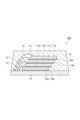
- FIG. 3 is a schematic cross-sectional view showing one embodiment of a semiconductor device.
- FIG. 4 is a schematic cross-sectional view showing another embodiment of a semiconductor device.
- FIG. 5 is a schematic cross-sectional view showing another embodiment of a semiconductor device.
- FIG. 6 is a diagram showing the shape of a test piece used for measuring breaking strength.
- a numerical range indicated using “ ⁇ ” indicates a range that includes the numerical values described before and after " ⁇ " as the minimum and maximum values, respectively.
- the upper limit or lower limit described in one numerical range may be replaced with the upper limit or lower limit of another numerical range described in stages.
- the upper limit or lower limit of that numerical range may be replaced with a value shown in an example.
- the upper limit and lower limit values described individually can be arbitrarily combined.
- “A or B" may include either A or B, or may include both.
- the materials exemplified below may be used alone or in combination of two or more types, unless otherwise specified.
- the content of each component in the composition means the total amount of the multiple substances present in the composition, unless otherwise specified.
- (meth)acrylate means acrylate or the corresponding methacrylate.
- Fig. 1 is a schematic cross-sectional view showing one embodiment of a film-like adhesive.
- the film-like adhesive 1 shown in Fig. 1 may be thermosetting, and may be capable of going through a semi-cured (B stage) state and then becoming fully cured (C stage) after a curing process.
- the film adhesive 1 satisfies the following conditions. - Storage modulus at 150°C after curing at 140°C for 30 minutes is 80 MPa or more. - Thickness is 15 ⁇ m or less.
- the storage modulus of the film-like adhesive 1 at 150°C after curing under conditions of 140°C and 30 minutes is 80 MPa or more, and may be 85 MPa or more, 90 MPa or more, 95 MPa or more, 100 MPa or more, 105 MPa or more, 110 MPa or more, 115 MPa or more, 120 MPa or more, 125 MPa or more, or 130 MPa or more. If the storage modulus is 80 MPa or more, it is possible to compensate for the brittleness of the semiconductor chip due to thinning, and as a result, it is possible to suppress the occurrence of chip cracks.
- the upper limit of the storage modulus is not particularly limited, but may be, for example, 500 MPa or less, 300 MPa or less, 250 MPa or less, or 200 MPa or less.
- the storage modulus of the film-like adhesive 1 at 30°C after curing under conditions of 140°C and 30 minutes may be 2000 MPa or less, or may be 1800 MPa or less, 1600 MPa or less, 1400 MPa or less, or 1200 MPa or less. If the storage modulus is 2000 MPa or less, the film-like adhesive can be more easily thinned, and the cured film-like adhesive tends to be more sufficiently prevented from becoming too hard.
- the lower limit of the storage modulus is not particularly limited, but may be, for example, 600 MPa or more, 700 MPa or more, 800 MPa or more, 900 MPa or more, or 1000 MPa or more.
- the storage modulus at 150°C after the film-like adhesive has been cured can be measured, for example, by the following method.
- a sample for measurement is prepared by laminating multiple 5 ⁇ m-thick film-like adhesives to a thickness of 100 ⁇ m or more, and cutting this into a size of 4 mm wide x 20 mm long or more.
- the prepared sample is cured under conditions of 140°C and 30 minutes, and then the cured sample is set in a dynamic viscoelasticity measuring device (e.g., Rheogel E-4000, manufactured by UBM Co., Ltd.) and dynamic viscoelasticity is measured in a temperature dependence measurement mode in which a tensile load is applied and measurements are made from room temperature (25°C) to 300°C under conditions of a chuck distance of 20 mm, a frequency of 10 Hz, and a heating rate of 3°C/min.
- a dynamic viscoelasticity measuring device e.g., Rheogel E-4000, manufactured by UBM Co., Ltd.
- dynamic viscoelasticity measuring device e.g., Rheogel E-4000, manufactured by UBM Co., Ltd.
- the thickness of the film-like adhesive 1 is 15 ⁇ m or less, and may be 12 ⁇ m or less, 10 ⁇ m or less, 8 ⁇ m or less, 7 ⁇ m or less, 6 ⁇ m or less, or 5 ⁇ m or less.
- the lower limit of the thickness of the film-like adhesive is not particularly limited, but may be, for example, 1 ⁇ m or more.
- the film-like adhesive 1 contains a thermosetting resin component (hereinafter sometimes referred to as “component (A)”) and an elastomer (hereinafter sometimes referred to as “component (B)”), and may further contain an inorganic filler (hereinafter sometimes referred to as “component (C)”).
- component (A) component may contain, for example, an epoxy resin (hereinafter sometimes referred to as “component (A1)”) and a phenolic resin (hereinafter sometimes referred to as “component (A2)”).
- component (B) component is 18 mass% or more based on the total amount of the film-like adhesive.
- the content of the (C) component is 0 to 25 mass% based on the total amount of the film-like adhesive.
- the film-like adhesive 1 may further contain a coupling agent (hereinafter sometimes referred to as “component (D)”), a curing accelerator (hereinafter sometimes referred to as “component (E)”), other components, and the like.
- component (D) a coupling agent
- component (E) a curing accelerator
- other components and the like.
- (A) component thermosetting resin component
- (A1) component epoxy resin
- the (A1) component can be used without any particular limitation as long as it has an epoxy group in the molecule.
- (A1) component includes, for example, bisphenol A type epoxy resin; bisphenol F type epoxy resin; bisphenol S type epoxy resin; phenol novolac type epoxy resin; cresol novolac type epoxy resin; bisphenol A novolac type epoxy resin; bisphenol F novolac type epoxy resin; stilbene type epoxy resin; triazine skeleton-containing epoxy resin; fluorene skeleton-containing epoxy resin; triphenol methane type epoxy resin; biphenyl type epoxy resin; xylylene type epoxy resin; biphenyl aralkyl type epoxy resin; naphthalene type epoxy resin; polyfunctional phenols, diglycidyl ether compounds of polycyclic aromatics such as anthracene, etc.
- the (A1) component may contain cresol novolac type epoxy resin, bisphenol F type epoxy resin, bisphenol A type epoxy resin, or naphthalene type epoxy resin from the viewpoint of film tackiness, flexibility, etc.
- Bisphenol F type epoxy resins have a relatively low softening point, and many of them have a softening point of 40° C. or lower.
- the (A1) component may contain an epoxy resin having a softening point of 40°C or less (or an epoxy resin that is liquid at 30°C, hereinafter sometimes referred to as "(A1a) component").
- the (A1) component may be a combination of the (A1a) component and an epoxy resin having a softening point of more than 40°C (or an epoxy resin that is solid at 30°C, hereinafter sometimes referred to as "(A1b) component").
- the (A1) component contains the (A1a) component, it tends to be easier to improve the storage modulus after curing.
- the (A1) component is a combination of the (A1a) component and the (A1b) component, it tends to be easier to achieve a thin film.
- the (A1a) component may contain, for example, a bisphenol F type epoxy resin.
- the softening point refers to the value measured by the ring and ball method in accordance with JIS K7234:1986.
- component (A1a) Commercially available products of component (A1a) include, for example, EXA-830CRP (product name, manufactured by DIC Corporation, liquid at 30°C), YDF-8170C (product name, manufactured by Nippon Steel Chemical & Material Co., Ltd., liquid at 30°C), and EP-4088S (product name, manufactured by ADEKA Corporation, liquid at 30°C).
- EXA-830CRP product name, manufactured by DIC Corporation, liquid at 30°C
- YDF-8170C product name, manufactured by Nippon Steel Chemical & Material Co., Ltd., liquid at 30°C
- EP-4088S product name, manufactured by ADEKA Corporation, liquid at 30°C
- the content of the (A1a) component may be 5 mass% or more, 10 mass% or more, or 15 mass% or more, and 70 mass% or less, 60 mass% or less, or 50 mass% or less, based on the total amount of the (A1) component.
- the content of the (A1a) component in the (A1) component in the adhesive composition when forming the film-like adhesive may be in the same range as above.
- the content of the (A1b) component may be 30 mass% or more, 40 mass% or more, or 50 mass% or more, and 95 mass% or less, 90 mass% or less, or 85 mass% or less, based on the total amount of the (A1) component.
- the content of the (A1b) component in the (A1) component in the adhesive composition when forming the film-like adhesive may be in the same range as above.
- the epoxy equivalent of component (A1) is not particularly limited, but may be 90 to 300 g/eq or 110 to 290 g/eq. When the epoxy equivalent of component (A1) is in such a range, it tends to be easier to ensure the fluidity of the adhesive composition when forming the film-like adhesive while maintaining the bulk strength of the film-like adhesive.
- Component (A2) Phenol resin Component (A2) is a component that acts as a curing agent for component (A1), i.e., it can be a curing agent for epoxy resin. By including component (A2) in the film-like adhesive, the film-like adhesive can be highly crosslinked, improving the storage modulus after curing.
- the (A2) component can be used without any particular restriction as long as it has a phenolic hydroxyl group in the molecule.
- the (A2) component is not particularly limited as long as it has a phenolic hydroxyl group in the molecule.
- Examples of the (A2) component include novolac-type phenolic resins obtained by condensing or co-condensing phenols such as phenol, cresol, resorcin, catechol, bisphenol A, bisphenol F, phenylphenol, aminophenol, etc. and/or naphthols such as ⁇ -naphthol, ⁇ -naphthol, dihydroxynaphthalene, etc.
- the phenolic resin may include a novolac type phenolic resin or a phenylaralkyl type phenolic resin.
- the hydroxyl equivalent of component (A2) may be 70 g/eq or more, or 70 to 300 g/eq. If the hydroxyl equivalent of component (A2) is 70 g/eq or more, the storage modulus tends to be improved, and if it is 300 g/eq or less, it becomes possible to prevent defects due to the generation of foaming, outgassing, etc.
- the softening point of the (A2) component is not particularly limited, but may be, for example, 90°C or higher, 100°C or higher, or 110°C or higher.
- the upper limit of the softening point of the (A2) component may be, for example, 200°C or lower.
- component (A2) Commercially available products of component (A2) include, for example, PSM-4326 (trade name, manufactured by Gun-ei Chemical Industry Co., Ltd., softening point: 120°C), J-DPP-140 (trade name, manufactured by JFE Chemical Corporation, softening point: 140°C), and GPH-103 (trade name, manufactured by Nippon Kayaku Co., Ltd., softening point: 99-106°C).
- the ratio of the epoxy equivalent of component (A1) to the hydroxyl equivalent of component (A2) may be 0.30/0.70 to 0.70/0.30, 0.35/0.65 to 0.65/0.35, 0.40/0.60 to 0.60/0.40, or 0.45/0.55 to 0.55/0.45, from the viewpoint of curability. If the equivalent ratio is 0.30/0.70 or more, more sufficient curability tends to be obtained. If the equivalent ratio is 0.70/0.30 or less, it is possible to prevent the viscosity from becoming too high, and more sufficient fluidity can be obtained.
- the content of the (A1) component (the sum of the (A1a) component and the (A1b) component) may be 20% by mass or more, 25% by mass or more, 30% by mass or more, 35% by mass or more, 40% by mass or more, or 45% by mass or more, based on the total amount of the film-like adhesive.
- the content of the (A1) component may be 70% by mass or less, 65% by mass or less, 60% by mass or less, or 55% by mass or less, based on the total amount of the film-like adhesive.
- the content of the (A1) component (the sum of the (A1a) component and the (A1b) component) in the adhesive composition when forming the film-like adhesive may be the same as the above range.
- the content of the (A2) component may be 10% by mass or more, or may be 12% by mass or more, 15% by mass or more, 18% by mass or more, 20% by mass or more, or 22% by mass or more, based on the total amount of the film-like adhesive.
- the content of the (A2) component may be 35% by mass or less, 32% by mass or less, or 30% by mass or less, based on the total amount of the film-like adhesive.
- the content of the (A2) component in the adhesive composition when forming the film-like adhesive may be the same as the above range.
- the content of the (A) component (the sum of the (A1) component and the (A2) component) may be 40% by mass or more, 45% by mass or more, 50% by mass or more, 55% by mass or more, 60% by mass or more, 65% by mass or more, or 70% by mass or more, based on the total amount of the film-like adhesive.
- the content of the (A) component may be 90% by mass or less, 85% by mass or less, or 80% by mass or less, based on the total amount of the film-like adhesive.
- the content of the (A) component (the sum of the (A1) component and the (A2) component) in the adhesive composition when forming the film-like adhesive may be the same as the above range.
- (B) component elastomer
- the (B) component include acrylic resin, polyester resin, polyamide resin, polyimide resin, silicone resin, butadiene resin, and modified products of these resins.
- the (B) component include polymers having organopolysiloxane in the side chain.
- the (B) component may be an acrylic resin (acrylic rubber) having a structural unit derived from a (meth)acrylic acid ester as a main component, since it has less ionic impurities and is more excellent in heat resistance, it is easier to ensure the connection reliability of the semiconductor device, and it is more excellent in fluidity.
- the content of the structural unit derived from a (meth)acrylic acid ester in the (B) component may be, for example, 70% by mass or more, 80% by mass or more, or 90% by mass or more based on the total amount of the structural units.
- the acrylic resin (acrylic rubber) may include a structural unit derived from a (meth)acrylic acid ester having a crosslinkable functional group such as an epoxy group, an alcoholic or phenolic hydroxyl group, or a carboxyl group.
- the glass transition temperature (Tg) of the (B) component may be 0 to 30°C. If the Tg of the (B) component is 0°C or higher, the adhesive strength of the film-like adhesive can be improved, and the flexibility of the film-like adhesive tends to be prevented from becoming too high. If the Tg of the (B) component is 30°C or lower, the film-like adhesive tends to be prevented from decreasing in flexibility, and the adhesive tends to have excellent breaking strength and excellent processability when a thin film is formed.
- the glass transition temperature (Tg) of the (B) component may be 5°C or higher or 10°C or higher, and may be 25°C or lower or 20°C or lower.
- Tg means a value measured using a DSC (differential scanning calorimeter) (for example, Thermo Plus 2, manufactured by Rigaku Corporation).
- the Tg of the (B) component can be adjusted to a desired range by adjusting the type and content of the constituent units constituting the (B) component (when the (B) component is an acrylic resin (acrylic rubber), the constituent units derived from (meth)acrylic acid esters).
- the weight average molecular weight (Mw) of component (B) may be 100,000 or more, 300,000 or more, or 500,000 or more, and may be 3,000,000 or less, 2,000,000 or less, or 1,000,000 or less.
- Mw means a value measured by gel permeation chromatography (GPC) and converted using a calibration curve of standard polystyrene. Note that, when multiple peaks are observed in GPC, the weight average molecular weight resulting from the peak with the highest peak intensity is defined as the weight average molecular weight in this specification.
- component (B) Commercially available products of component (B) include SG-P3 and SG-80H (both manufactured by Nagase ChemteX Corporation) and KH-CT-865 (manufactured by Resonac Corporation).
- the content of the (B) component is 18% by mass or more, and may be 18 to 35% by mass, based on the total amount of the film-like adhesive.
- the content of the (B) component may be 20% by mass or more, 22% by mass or more, or 24% by mass or more, based on the total amount of the film-like adhesive.
- the thin film has excellent breaking strength and excellent processability, and tends to be able to suppress warping of the semiconductor device (semiconductor package).
- the content of the (B) component when the content of the (B) component is 18% by mass or more, based on the total amount of the film-like adhesive, the storage modulus at 30°C after curing tends to be suppressed from becoming too high.
- the content of the (B) component may be 35% by mass or less, 33% by mass or less, 30% by mass or less, or 28% by mass or less, based on the total amount of the film-like adhesive.
- the content of component (B) is 35% by mass or less based on the total amount of the film-like adhesive, the storage modulus after curing tends to be improved.
- the content of component (B) in the adhesive composition when forming the film-like adhesive may be in the same range as above.
- Component (C) Inorganic Filler
- the film-like adhesive 1 may further contain component (C). That is, the film-like adhesive 1 may exist in an embodiment that contains component (C) and an embodiment that substantially does not contain component (C).
- component (C) examples include fillers such as aluminum hydroxide, magnesium hydroxide, calcium carbonate, magnesium carbonate, calcium silicate, magnesium silicate, calcium oxide, magnesium oxide, aluminum oxide, aluminum nitride, aluminum borate whiskers, boron nitride, and silica.
- component (C) may be a silica filler from the viewpoint of adjusting the melt viscosity.
- the shape of component (C) is not particularly limited, but may be spherical.
- the average particle size of the (C) component may be 0.7 ⁇ m or less, 0.6 ⁇ m or less, 0.5 ⁇ m or less, 0.4 ⁇ m or less, or 0.3 ⁇ m or less.
- the average particle size of the (C) component may be, for example, 0.01 ⁇ m or more.
- the average particle size means the particle size with an accumulated frequency of 50% in the particle size distribution determined by the laser diffraction/scattering method.
- the average particle size of the (C) component can also be determined by using a film-like adhesive containing the (C) component.
- the film-like adhesive is heated to decompose the resin component, and the residue obtained is dispersed in a solvent to prepare a dispersion, and the average particle size of the (C) component can be determined from the particle size distribution obtained by applying the laser diffraction/scattering method to the dispersion.
- the content of the (C) component is 0 to 25% by mass based on the total amount of the film-like adhesive, and may be 0 to 22% by mass, 0 to 20% by mass, 0 to 17% by mass, 0 to 15% by mass, 0 to 12% by mass, 0 to 10% by mass, 0 to 7% by mass, 0 to 5% by mass, 0 to 4% by mass, 0 to 3% by mass, 0 to 2% by mass, 0 to 1% by mass, 0 to 0.5% by mass, or 0 to 0.1% by mass.
- the content of the (C) component is in such a range, it tends to be possible to further reduce the thickness.
- the content of the (C) component when the content of the (C) component is 25% by mass or less based on the total amount of the film-like adhesive, the thin film has excellent breaking strength and excellent processability when formed, and warping of the semiconductor device (semiconductor package) tends to be suppressed.
- the content of the (C) component may be 22% by mass or less, 20% by mass or less, 17% by mass or less, 15% by mass or less, 12% by mass or less, 10% by mass or less, 7% by mass or less, 5% by mass or less, 4% by mass or less, 3% by mass or less, 2% by mass or less, 1% by mass or less, 0.5% by mass or less, or 0.1% by mass or less, based on the total amount of the film-like adhesive.
- the content of the (C) component may be 0% by mass, based on the total amount of the film-like adhesive. That is, in one embodiment, the film-like adhesive does not need to contain the (C) component.
- the lower limit of the content of the (C) component may be 0% by mass or more, more than 0% by mass, 1% by mass or more, 3% by mass or more, or 5% by mass or more, based on the total amount of the film-like adhesive.
- the content of the (C) component in the adhesive composition when forming the film-like adhesive may be the same as the above range.
- the (A) component and the (B) component, or the (A), (B), and (C) components may be the main components of the film-like adhesive of this embodiment.
- the total content of the (A) component and the (B) component, or the total content of the (A), (B), and (C) components may be, for example, 70% by mass or more, 80% by mass or more, 90% by mass or more, 95% by mass or more, 96% by mass or more, 97% by mass or more, 98% by mass or more, 99% by mass or more, 99.5% by mass or more, 99.7% by mass or more, or 99.9% by mass or more.
- the total content of the (A) component and the (B) component, or the total content of the (A), (B), and (C) components may be, for example, 100% by mass or less, 99.9% by mass or less, 99.7% by mass or less, or 99.5% by mass or less.
- Component (D) Coupling Agent
- Component (D) may be a silane coupling agent.
- the silane coupling agent include ⁇ -ureidopropyltriethoxysilane, ⁇ -mercaptopropyltrimethoxysilane, 3-phenylaminopropyltrimethoxysilane, and 3-(2-aminoethyl)aminopropyltrimethoxysilane.
- Component (E) Curing Accelerator
- the component (E) include imidazoles and derivatives thereof, organic phosphorus compounds, secondary amines, tertiary amines, quaternary ammonium salts, etc.
- the component (E) may be imidazoles and derivatives thereof.
- imidazoles examples include 2-methylimidazole, 1-benzyl-2-methylimidazole, 1-cyanoethyl-2-phenylimidazole, and 1-cyanoethyl-2-methylimidazole.
- Component (E) may contain 2-phenylimidazole, which helps promote curing at low temperatures.
- the film adhesive may further contain other components.
- other components include pigments, ion scavengers, antioxidants, etc.
- the total content of the (D) component, the (E) component, and other components may be 0 mass% or more, 0.1 mass% or more, 0.3 mass% or more, or 0.5 mass% or more based on the total amount of the film-like adhesive, and may be 30 mass% or less, 20 mass% or less, 10 mass% or less, 5 mass% or less, 4 mass% or less, 3 mass% or less, 2 mass% or less, or 1 mass% or less.
- the total content of the (D) component, the (E) component, and other components in the adhesive composition when forming the film-like adhesive may be in the same range as above.
- the film-like adhesive 1 shown in FIG. 1 is formed by forming an adhesive composition containing components (A) and (B), and, if necessary, component (C) and added components, into a film.
- a film-like adhesive 1 can be formed by applying the adhesive composition to a support film.
- a varnish containing the adhesive composition and a solvent may be used in forming the film-like adhesive 1.
- the adhesive varnish is prepared by mixing or kneading components (A) and (B), and, if necessary, component (C) and added components in a solvent, and the obtained adhesive varnish is applied to a support film, and the solvent is removed by heating and drying to obtain the film-like adhesive 1.
- the support film is not particularly limited as long as it can withstand the above-mentioned heat drying, but may be, for example, a polyester film, a polypropylene film, a polyethylene terephthalate film, a polyimide film, a polyetherimide film, a polyethylene naphthalate film, a polymethylpentene film, or the like.
- the support film may be a multi-layer film combining two or more types, and may have a surface treated with a silicone-based, silica-based, or other release agent.
- the thickness of the support film may be, for example, 10 to 200 ⁇ m or 20 to 170 ⁇ m.
- Mixing or kneading can be carried out using a conventional mixer, a mixing machine, a triple roll mill, a ball mill, or other dispersing machine, in any suitable combination.
- the solvent used in preparing the adhesive varnish is not limited as long as it can dissolve, knead, or disperse each component uniformly, and any conventionally known solvent can be used.
- solvents include ketone solvents such as acetone, methyl ethyl ketone, methyl isobutyl ketone, and cyclohexanone, as well as dimethylformamide, dimethylacetamide, N-methylpyrrolidone, toluene, and xylene. From the standpoint of drying speed and cost, the solvent may be methyl ethyl ketone or cyclohexanone.
- any known method can be used to apply the adhesive varnish to the support film, such as knife coating, roll coating, spray coating, gravure coating, bar coating, curtain coating, etc.
- the heat drying conditions there are no particular restrictions on the heat drying conditions as long as the solvent used is sufficiently evaporated, but the conditions may be 50 to 150°C and 1 to 30 minutes.
- the film-like adhesive 1 can be thinned, it can be suitably used in the manufacturing process of a semiconductor device in which multiple semiconductor chips are stacked.
- the semiconductor device may be a stacked MCP or a three-dimensional NAND memory.
- FIG. 2 is a schematic cross-sectional view showing one embodiment of a dicing/die bonding integrated film.
- the dicing/die bonding integrated film 10 shown in Fig. 2 includes a base layer 2, a pressure-sensitive adhesive layer 3, and an adhesive layer 1A made of the above-mentioned film-like adhesive 1, in this order.
- a laminate made of the base layer 2 and the pressure-sensitive adhesive layer 3 is sometimes called a dicing film 4 (dicing tape).
- dicing film 4 dicing tape
- the dicing/die bonding integrated film may be in the form of a film, a sheet, a tape, or the like.
- the dicing film 4 comprises a base layer 2 and an adhesive layer 3 provided on the base layer 2.
- the substrate layer 2 examples include plastic films such as polytetrafluoroethylene film, polyethylene terephthalate film, polyethylene film, polypropylene film, polymethylpentene film, and polyimide film. These substrate layers 2 may be subjected to surface treatments such as primer coating, UV treatment, corona discharge treatment, polishing treatment, and etching treatment, as necessary.
- the adhesive layer 3 is a layer made of an adhesive.
- the adhesive may be either a radiation-curable or non-radiation-curable adhesive.
- the radiation may be, for example, ultraviolet light.
- a non-radiation-curable adhesive is an adhesive that exhibits a certain level of adhesiveness when pressure is applied for a short period of time.
- a radiation-curable adhesive is an adhesive that has the property of decreasing adhesiveness when exposed to radiation (for example, ultraviolet light).
- the thickness of the dicing film 4 may be 60 to 150 ⁇ m or 70 to 130 ⁇ m from the standpoint of economy and ease of handling of the film.
- the dicing/die bonding integrated film 10 can be obtained, for example, by preparing a film-like adhesive 1 and a dicing film 4, and bonding the film-like adhesive 1 to the pressure-sensitive adhesive layer 3 of the dicing film 4.
- the dicing/die bonding integrated film 10 can also be obtained, for example, by preparing a dicing film 4, and applying an adhesive composition (adhesive varnish) onto the pressure-sensitive adhesive layer 3 of the dicing film 4 in the same manner as in the method of forming the film-like adhesive 1 described above.
- the dicing/die-bonding integrated film 10 can be formed by laminating the film-like adhesive 1 onto the dicing film 4 under specified conditions (e.g., room temperature (25°C) or in a heated state) using a roll laminator, vacuum laminator, or the like.
- the dicing/die-bonding integrated film 10 can be produced continuously and is highly efficient, so it may be formed in a heated state using a roll laminator.
- the film-like adhesive and the integrated dicing and die bonding film may be used in a manufacturing process for a semiconductor device, or may be used in a manufacturing process for a semiconductor device in which multiple semiconductor chips are stacked.
- the film-like adhesive and the integrated dicing and die bonding film may be used in a manufacturing process for a semiconductor device that includes a process of bonding an adhesive layer of the film-like adhesive or the integrated dicing and die bonding film to a semiconductor wafer or an already-singulated semiconductor chip, and obtaining a semiconductor chip with an adhesive piece by cutting with a rotary blade, laser, or stretching, and a process of adhering the semiconductor chip with the adhesive piece onto a support member or a semiconductor chip via an adhesive piece.
- the film-like adhesive is also suitable for use as an adhesive for bonding semiconductor chips together in stacked MCPs (e.g., three-dimensional NAND memory), which are semiconductor devices made by stacking multiple semiconductor chips.
- stacked MCPs e.g., three-dimensional NAND memory
- the film adhesive can also be used, for example, as a protective sheet to protect the back surface of the semiconductor chip of a flip-chip type semiconductor device, or as a sealing sheet to seal the gap between the front surface of the semiconductor chip of a flip-chip type semiconductor device and an adherend.
- the semiconductor device manufactured using the film-like adhesive and the integrated dicing and die bonding film is specifically described below with reference to the drawings. Note that in recent years, semiconductor devices with various structures have been proposed, and the applications of the film-like adhesive and integrated dicing and die bonding film of this embodiment are not limited to semiconductor devices with the structures described below.
- FIG. 3 is a schematic cross-sectional view showing one embodiment of a semiconductor device.
- the semiconductor device 100 shown in Fig. 3 includes a semiconductor chip 11 (first semiconductor chip), a support member 12 on which the semiconductor chip 11 is mounted, and an adhesive member 15.
- the adhesive member 15 is provided between the semiconductor chip 11 and the support member 12, and bonds the semiconductor chip 11 and the support member 12.
- the adhesive member 15 is a cured product of an adhesive composition (cured product of a film-like adhesive).
- the connection terminals (not shown) of the semiconductor chip 11 are electrically connected to external connection terminals (not shown) via bonding wires 13, and are sealed with a sealing material 14.
- FIG. 4 is a schematic cross-sectional view showing another embodiment of a semiconductor device.
- the first-stage semiconductor chip 11a first semiconductor chip
- the second-stage semiconductor chip 11b second semiconductor chip
- the connection terminals (not shown) of the first-stage semiconductor chip 11a and the second-stage semiconductor chip 11b are electrically connected to external connection terminals via bonding wires 13 and sealed by a sealing material 14.
- the semiconductor device 110 shown in FIG. 4 can be said to further include another semiconductor chip (11b) stacked on the surface of the semiconductor chip (11a) in the semiconductor device 100 shown in FIG. 3.
- FIG. 5 is a schematic cross-sectional view showing another embodiment of a semiconductor device.
- the semiconductor device 120 shown in FIG. 5 includes a support member 12 and semiconductor chips 11a (first semiconductor chip), 11b (second semiconductor chip), 11c (third semiconductor chip), and 11d (fourth semiconductor chip) stacked on the support member 12.
- the four semiconductor chips 11a, 11b, 11c, and 11d are stacked at positions shifted from each other in the horizontal direction (direction perpendicular to the stacking direction) for connection with a connection terminal (not shown) formed on the surface of the support member 12 (see FIG. 5).
- the semiconductor chip 11a is adhered to the support member 12 by an adhesive member 15a (cured product of an adhesive composition (cured product of a film-like adhesive)), and adhesive members 15b, 15c, and 15d (cured product of an adhesive composition (cured product of a film-like adhesive)) are also interposed between the three semiconductor chips 11b, 11c, and 11d.
- the semiconductor device 120 shown in FIG. 5 can be said to be the semiconductor device 100 shown in FIG. 3, further including other semiconductor chips (11b, 11c, 11d) stacked on the surface of the semiconductor chip (11a).
- FIG. 5 illustrates a semiconductor device in which four semiconductor chips are stacked, but the number of stacked semiconductor chips is not limited to this.
- FIG. 5 illustrates a semiconductor device in which the semiconductor chips are stacked in positions shifted from each other in the horizontal direction (direction perpendicular to the stacking direction), but the semiconductor device may be one in which the semiconductor chips are stacked in positions that are not shifted from each other in the horizontal direction (direction perpendicular to the stacking direction).
- the semiconductor device (semiconductor package) shown in Figures 3, 4, and 5 can be obtained by a method including a step of interposing the above-mentioned film-like adhesive between a semiconductor chip (first semiconductor chip) and a support member, or between a semiconductor chip (first semiconductor chip) and a semiconductor chip (second semiconductor chip), and bonding the semiconductor chip (first semiconductor chip) and the support member, or between a semiconductor chip (first semiconductor chip) and a semiconductor chip (second semiconductor chip).
- the above-mentioned film-like adhesive is interposed between a semiconductor chip and a support member, or between a semiconductor chip (first semiconductor chip) and a semiconductor chip (second semiconductor chip), and these are heated and pressed to bond the two together, and then, as necessary, a heat curing step, a wire bonding step, a sealing step using a sealing material, a heating and melting step including reflow using solder, and the like can be obtained.
- a method for interposing a film-like adhesive between a semiconductor chip (first semiconductor chip) and a support member, or between a semiconductor chip (first semiconductor chip) and a semiconductor chip (second semiconductor chip) a method may be used in which a semiconductor chip with an adhesive piece is first produced and then attached to a support member or another semiconductor chip, as described below.
- the semiconductor device can be obtained, for example, by a method comprising a step of attaching a semiconductor wafer to the adhesive layer of the above-mentioned dicing/die bonding integrated film (lamination step), a step of cutting the semiconductor wafer with the adhesive layer attached to produce a plurality of individual adhesive piece-attached semiconductor chips (dicing step), and a step of adhering a first adhesive piece-attached semiconductor chip having a first semiconductor chip and a first adhesive piece to a support member via the first adhesive piece as the adhesive piece-attached semiconductor chip (step of adhering the adhesive piece-attached semiconductor chip to a support member via an adhesive piece) (first adhering step).
- the method for manufacturing a semiconductor device may further include a step of adhering a second semiconductor chip with adhesive piece, which has a second semiconductor chip and a second adhesive piece, to the surface of the first semiconductor chip in the first semiconductor chip with adhesive piece adhered to the support member via the second adhesive piece (a step of adhering another semiconductor chip with adhesive piece to the surface of the semiconductor chip adhered to the support member via an adhesive piece possessed by the other semiconductor chip with adhesive piece) (second adhering step).
- the lamination process is a process in which a semiconductor wafer is pressed against the adhesive layer 1A of the dicing/die bonding integrated film 10, and the semiconductor wafer is adhered and held in place. This process may be performed while pressing with a pressing means such as a pressing roll.
- Semiconductor wafers include, for example, single crystal silicon, polycrystalline silicon, various ceramics, and compound semiconductors such as gallium arsenide.
- the dicing process is a process in which a semiconductor wafer is diced. This allows the semiconductor wafer to be cut to a predetermined size, producing a number of individual semiconductor chips with adhesive pieces attached. Dicing can be performed, for example, from the circuit side of the semiconductor wafer in a conventional manner.
- This process can employ, for example, a method known as full cut, in which a cut is made all the way to the dicing film, a method in which a half cut is made in the semiconductor wafer and the wafer is divided by cooling and pulling, or a method in which the wafer is divided by a laser.
- a method known as full cut in which a cut is made all the way to the dicing film
- a method in which a half cut is made in the semiconductor wafer and the wafer is divided by cooling and pulling
- a method in which the wafer is divided by a laser There are no particular limitations on the dicing device used in this process, and any conventionally known device can be used.
- Semiconductor chips are composed of, for example, a circuit layer and a semiconductor layer (for example, single crystal silicon, polycrystalline silicon, various ceramics, compound semiconductors such as gallium arsenide, etc.).
- semiconductor chips include ICs (integrated circuits).
- support members include lead frames such as 42 alloy lead frames and copper lead frames; plastic films such as polyimide resin and epoxy resin; modified plastic films in which a substrate such as glass nonwoven fabric is impregnated and hardened with plastics such as polyimide resin and epoxy resin; and ceramics such as alumina.
- the method for manufacturing a semiconductor device may include a pick-up step as necessary.
- the pick-up step is a step of picking up the semiconductor chips with adhesive pieces attached in order to peel off the semiconductor chips with adhesive pieces attached that have been adhesively fixed to the dicing/die bonding integrated film.
- the pick-up method is not particularly limited, and various conventionally known methods can be used.
- such a method includes a method in which each semiconductor chip with adhesive pieces is pushed up from the dicing/die bonding integrated film side by a needle, and the pushed-up semiconductor chips with adhesive pieces are picked up by a pick-up device.
- the adhesive layer is of a radiation (e.g., ultraviolet) curing type
- pick-up can be performed after irradiating the adhesive layer with radiation. This reduces the adhesive strength of the adhesive layer to the adhesive piece, making it easier to peel off the semiconductor chip with the adhesive piece attached. As a result, pick-up is possible without damaging the semiconductor chip with the adhesive piece attached.
- a radiation e.g., ultraviolet
- the first bonding step is a step of bonding a semiconductor chip with a first adhesive piece formed by dicing to a support member for mounting the semiconductor chip via the first adhesive piece.
- the manufacturing method of a semiconductor device may include a step (second bonding step) of bonding a semiconductor chip with a second adhesive piece to the surface of the semiconductor chip bonded to the support member via the second adhesive piece, as necessary. Both bonding steps can be performed by pressure bonding. There are no particular limitations on the pressure bonding conditions, and they can be set appropriately as necessary.
- the pressure bonding conditions may be, for example, a temperature of 80 to 160°C, a load of 5 to 15 N, and a time of 1 to 10 seconds.
- the support member can be, for example, the same support member as above.
- the method for manufacturing a semiconductor device may include a step of further thermally curing the adhesive pieces (the first adhesive piece in the semiconductor chip with the first adhesive piece, and the second adhesive piece in the semiconductor chip with the second adhesive piece) or the film-like adhesive (thermal curing step) as necessary.
- the adhesive pieces the first adhesive piece in the semiconductor chip with the first adhesive piece, and the second adhesive piece in the semiconductor chip with the second adhesive piece
- pressure may be applied at the same time to harden them.
- the heating temperature in this step can be appropriately changed depending on the constituent components of the adhesive pieces.
- the heating temperature may be, for example, 60 to 200°C or 100 to 180°C.
- the temperature or pressure may be changed stepwise.
- the heating time may be, for example, 1 to 120 minutes or 15 to 60 minutes.
- the method for manufacturing a semiconductor device may include, as necessary, a step of electrically connecting the first and second semiconductor chips to the support member with bonding wires, more specifically, a step of electrically connecting the electrode pads on the semiconductor chips to the tips of the terminal portions (inner leads) of the support member with bonding wires (wire bonding step).
- wire bonding step For example, gold wire, aluminum wire, copper wire, etc., are used as the bonding wire.
- the temperature during wire bonding may be within a range of 80 to 250°C or 80 to 220°C. The heating time may be several seconds to several minutes.
- Wire bonding may be performed by combining ultrasonic vibration energy and compression energy by applied pressure while heated within the above temperature range.
- the manufacturing method of a semiconductor device may include a step of sealing the semiconductor chip with a sealing material (sealing step) as necessary. This step is performed to protect the semiconductor chip or bonding wires mounted on the support member. This step can be performed by molding the sealing resin (sealing resin) in a mold.
- the sealing resin may be, for example, an epoxy-based resin. The support member and residue are embedded by the heat and pressure during sealing, and peeling due to air bubbles at the adhesive interface can be prevented.
- the method for manufacturing a semiconductor device may, if necessary, include a process (post-curing process) for completely curing any encapsulating resin that is not fully cured in the encapsulating process. Even if the adhesive pieces are not thermally cured in the encapsulating process, in this process, the adhesive pieces are thermally cured together with the encapsulating resin, making it possible to bond and fix the pieces.
- the heating temperature in this process can be set appropriately depending on the type of encapsulating resin, and may be within the range of 165 to 185°C, for example, and the heating time may be approximately 0.5 to 8 hours.
- the method for manufacturing a semiconductor device may, as necessary, include a step of heating the semiconductor chip attached to the support member or the semiconductor chip using a reflow furnace (heating and melting step).
- the resin-encapsulated semiconductor device may be surface-mounted on the support member.
- surface mounting methods include reflow soldering, in which solder is first supplied onto a printed wiring board, then heated and melted by hot air or the like, and soldered.
- heating methods include hot air reflow and infrared reflow.
- the heating method may be one that heats the entire surface or one that heats localized areas.
- the heating temperature may be, for example, within the range of 240 to 280°C.
- Component (A2) Phenolic resin (A2-1) PSM-4326 (trade name, manufactured by Gun-ei Chemical Industry Co., Ltd., novolac type phenolic resin, hydroxyl equivalent: 105 g/eq, softening point: 120° C.)
- Component (D) Coupling agent (D-1) Z-6119 (trade name, manufactured by Dow Toray Co., Ltd., ⁇ -ureidopropyltriethoxysilane) (D-2) A-189 (trade name, manufactured by Nippon Unicar Co., Ltd., ⁇ -mercaptopropyltrimethoxysilane)
- the prepared adhesive varnish was filtered through a 100 mesh filter and vacuum degassed.
- a 38 ⁇ m thick polyethylene terephthalate (PET) film that had been subjected to a release treatment was prepared as a support film, and the adhesive varnish after vacuum degassing was applied onto the PET film.
- the applied adhesive varnish was heated and dried at 90° C. for 5 minutes and then at 140° C. for 5 minutes to obtain film-like adhesives in a B-stage state in Examples 1 to 5 and Comparative Examples 1 to 4.
- the thickness of the film-like adhesive was adjusted to 5 ⁇ m by the amount of adhesive varnish applied.
- the storage modulus after curing was measured using the film-like adhesives of Examples 1 to 5 and Comparative Examples 1 to 4.
- the storage modulus after curing was measured by the following method. That is, a thickness of 100 ⁇ m or more was made by laminating a plurality of film-like adhesives having a thickness of 5 ⁇ m, and a size of 4 mm wide x 20 mm long or more was prepared as a sample for measurement. The prepared sample was cured under conditions of 140° C.
- the storage modulus at 30° C. e.g., 2000 MPa or less
- the storage modulus at 30° C. e.g., 2000 MPa or less
- the film-like adhesives of Examples 1 to 5 and Comparative Examples 1 to 4 were measured for breaking strength at 25°C using a tensile tester (RTF-1250-HS-PL, A&D Co., Ltd.). More specifically, a test piece having the shape shown in FIG. 6 was prepared using a film-like adhesive in a B-stage state. A tensile test was performed by gripping both ends of the prepared test piece with the tester. The tensile test was performed in an environment of 25°C, and the tensile speed was 100 mm/min.
- the breaking strength was calculated from the average thickness (0.005 mm (5 ⁇ m)) and width (10 mm) of the test piece before the test, and the maximum load (N) until the test piece broke, using the following formula.
- the results are shown in Table 1.
- the values shown in Table 1 are values converted to loads when the average thickness of the test piece before the test was 5 ⁇ m (unit: N/10 mm).
- a larger breaking strength value eg, 0.7 N/10 mm or more
- Breaking strength (MPa) maximum load (N) until the test piece breaks / (average thickness (mm) x width (mm) of the test piece)
- Evaluation samples were prepared using the dicing and die bonding integrated films of Examples 1 to 5 and Comparative Examples 1 to 4. Evaluation samples for evaluating warpage were prepared as follows. A semiconductor wafer with a thickness of 40 ⁇ m was prepared, and the film-like adhesive side of the dicing and die bonding integrated film was laminated to the semiconductor wafer at a stage temperature of 70° C. to prepare a dicing sample. The obtained dicing sample was cut using a fully automatic dicer DFD-6362 (manufactured by Disco Corporation). Cutting was performed using a single cut method using one blade, and ZH05-SD4000-N1-70-EE (manufactured by Disco Corporation) was used.
- the cutting conditions were a blade rotation speed of 40,000 rpm, a cutting speed of 50 mm/sec, and a chip size of 10 mm ⁇ 6 mm. Cutting was performed so that a cut of about 20 ⁇ m was made in the dicing film. Next, the adhesive layer made of the ultraviolet curing adhesive was irradiated with ultraviolet light to cure the adhesive layer, and the semiconductor chip with the adhesive piece was picked up.
- the adhesive piece of the semiconductor chip with the adhesive piece was pressed onto an organic substrate with a solder resist of thickness 90 ⁇ m ⁇ width 240 mm ⁇ length 74 mm under conditions of a temperature of 130 ° C., a load of 10 N, and a time of 1 second, to prepare evaluation samples of Examples 1 to 5 and Comparative Examples 1 to 4.
- 60 semiconductor chips in the first row were arranged side-by-side in 15 rows and 4 columns, and then 60 semiconductor chips in the second row were arranged on each surface of the semiconductor chips in the first row.
- the warpage of the semiconductor device was evaluated using the evaluation samples of Examples 1 to 5 and Comparative Examples 1 to 4. Each evaluation sample was placed in an oven, heated from 35°C to 140°C at a heating rate of 3°C/min, and heated at 140°C for 30 minutes. The evaluation sample after the heat treatment was removed from the pressure oven, and the amount of warpage of the semiconductor device (semiconductor package) was measured.
- the evaluation sample after the heat treatment was placed on a flat surface with the semiconductor chip side facing down, and a Digimatic Indicator ID-H0530 (manufactured by Mitutoyo Corporation) was used to measure five points on the upper left, upper right, center, lower left, and lower right of the evaluation sample after the heat treatment placed on the flat surface, and the difference between the maximum and minimum values of the measurement results was obtained, which was taken as the amount of warpage.
- the amount of warpage was 3.0 mm or less, the amount of warpage was evaluated as being sufficiently suppressed as "A”, and when the amount of warpage was more than 3.0 mm, it was evaluated as "B".
- Table 1 The results are shown in Table 1.
- the film-like adhesives of Examples 1 to 5 were excellent in both storage modulus and breaking strength at 150°C, whereas the film-like adhesives of Comparative Examples 1 to 4 were insufficient in at least one of storage modulus and breaking strength at 150°C. These results confirmed that the film-like adhesives disclosed herein have excellent processability when formed into thin films, and are capable of suppressing the occurrence of chip cracks.
- 1...film-like adhesive 1A...adhesive layer, 2...base material layer, 3...adhesive layer, 4...dicing film, 10...dicing and die bonding integrated film, 11, 11a, 11b, 11c, 11d...semiconductor chip, 12...support member, 13...bonding wire, 14...sealing material, 15, 15a, 15b, 15c, 15d...adhesive member, 16...terminal, 100, 110, 120...semiconductor device.
Landscapes
- Chemical & Material Sciences (AREA)
- Organic Chemistry (AREA)
- Health & Medical Sciences (AREA)
- Chemical Kinetics & Catalysis (AREA)
- Medicinal Chemistry (AREA)
- Polymers & Plastics (AREA)
- Inorganic Chemistry (AREA)
- Adhesive Tapes (AREA)
- Adhesives Or Adhesive Processes (AREA)
- Die Bonding (AREA)
Abstract
Priority Applications (4)
| Application Number | Priority Date | Filing Date | Title |
|---|---|---|---|
| US18/859,546 US20250266385A1 (en) | 2023-03-15 | 2024-03-14 | Film adhesive, dicing/die bonding integrated film, and semiconductor device and method for producing same |
| JP2025507159A JPWO2024190884A1 (fr) | 2023-03-15 | 2024-03-14 | |
| KR1020257032322A KR20250162579A (ko) | 2023-03-15 | 2024-03-14 | 필름상 접착제, 다이싱·다이본딩 일체형 필름, 및 반도체 장치 및 그 제조 방법 |
| CN202480002343.3A CN119137229A (zh) | 2023-03-15 | 2024-03-14 | 膜状黏合剂、切割晶粒接合一体型膜、以及半导体装置及其制造方法 |
Applications Claiming Priority (2)
| Application Number | Priority Date | Filing Date | Title |
|---|---|---|---|
| JPPCT/JP2023/010166 | 2023-03-15 | ||
| PCT/JP2023/010166 WO2024189855A1 (fr) | 2023-03-15 | 2023-03-15 | Adhésif en forme de film, film intégral de découpage en dés/liaison de puce, et dispositif à semi-conducteur et son procédé de fabrication |
Publications (1)
| Publication Number | Publication Date |
|---|---|
| WO2024190884A1 true WO2024190884A1 (fr) | 2024-09-19 |
Family
ID=92754888
Family Applications (2)
| Application Number | Title | Priority Date | Filing Date |
|---|---|---|---|
| PCT/JP2023/010166 Ceased WO2024189855A1 (fr) | 2023-03-15 | 2023-03-15 | Adhésif en forme de film, film intégral de découpage en dés/liaison de puce, et dispositif à semi-conducteur et son procédé de fabrication |
| PCT/JP2024/010087 Ceased WO2024190884A1 (fr) | 2023-03-15 | 2024-03-14 | Adhésif en film, film intégré de découpage en dés/fixation de puce, et dispositif à semi-conducteur et son procédé de production |
Family Applications Before (1)
| Application Number | Title | Priority Date | Filing Date |
|---|---|---|---|
| PCT/JP2023/010166 Ceased WO2024189855A1 (fr) | 2023-03-15 | 2023-03-15 | Adhésif en forme de film, film intégral de découpage en dés/liaison de puce, et dispositif à semi-conducteur et son procédé de fabrication |
Country Status (6)
| Country | Link |
|---|---|
| US (1) | US20250266385A1 (fr) |
| JP (1) | JPWO2024190884A1 (fr) |
| KR (1) | KR20250162579A (fr) |
| CN (1) | CN119137229A (fr) |
| TW (1) | TW202502995A (fr) |
| WO (2) | WO2024189855A1 (fr) |
Cited By (1)
| Publication number | Priority date | Publication date | Assignee | Title |
|---|---|---|---|---|
| WO2025084363A1 (fr) * | 2023-10-20 | 2025-04-24 | 株式会社レゾナック | Agent adhésif de type film, film intégré de découpage en dés/liaison de puce, et dispositif à semi-conducteur et procédé de fabrication associé |
Citations (5)
| Publication number | Priority date | Publication date | Assignee | Title |
|---|---|---|---|---|
| KR20090111262A (ko) * | 2008-04-21 | 2009-10-26 | 주식회사 엘지화학 | 다이어태치 필름 및 반도체 웨이퍼 |
| JP2013010849A (ja) * | 2011-06-29 | 2013-01-17 | Hitachi Chemical Co Ltd | 半導体用接着部材、それを用いたダイシング・ダイボンディング一体型接着部材及び半導体装置の製造方法 |
| JP2021143299A (ja) * | 2020-03-12 | 2021-09-24 | 株式会社コバヤシ | 繊維強化複合材料製造用硬化性樹脂組成物 |
| WO2022149582A1 (fr) * | 2021-01-08 | 2022-07-14 | 昭和電工マテリアルズ株式会社 | Adhésif de type film, film de découpage en dés/fixation de puce intégré, dispositif à semi-conducteur et son procédé de production |
| JP7178529B1 (ja) * | 2021-07-13 | 2022-11-25 | 古河電気工業株式会社 | 熱伝導性フィルム状接着剤、半導体パッケージ及びその製造方法 |
Family Cites Families (4)
| Publication number | Priority date | Publication date | Assignee | Title |
|---|---|---|---|---|
| WO2013133275A1 (fr) | 2012-03-08 | 2013-09-12 | 日立化成株式会社 | Feuille adhésive et procédé de fabrication de dispositif à semi-conducteurs |
| JP2016190964A (ja) * | 2015-03-31 | 2016-11-10 | 日立化成株式会社 | 接着フィルム |
| CN112385016A (zh) | 2018-07-11 | 2021-02-19 | 昭和电工材料株式会社 | 半导体装置的制造方法、热固性树脂组合物及切晶粘晶一体型膜 |
| JP2021097091A (ja) * | 2019-12-13 | 2021-06-24 | デクセリアルズ株式会社 | アンダーフィル材、及びこれを用いた半導体装置の製造方法 |
-
2023
- 2023-03-15 WO PCT/JP2023/010166 patent/WO2024189855A1/fr not_active Ceased
-
2024
- 2024-03-14 WO PCT/JP2024/010087 patent/WO2024190884A1/fr not_active Ceased
- 2024-03-14 US US18/859,546 patent/US20250266385A1/en active Pending
- 2024-03-14 CN CN202480002343.3A patent/CN119137229A/zh active Pending
- 2024-03-14 KR KR1020257032322A patent/KR20250162579A/ko active Pending
- 2024-03-14 JP JP2025507159A patent/JPWO2024190884A1/ja active Pending
- 2024-03-14 TW TW113109467A patent/TW202502995A/zh unknown
Patent Citations (5)
| Publication number | Priority date | Publication date | Assignee | Title |
|---|---|---|---|---|
| KR20090111262A (ko) * | 2008-04-21 | 2009-10-26 | 주식회사 엘지화학 | 다이어태치 필름 및 반도체 웨이퍼 |
| JP2013010849A (ja) * | 2011-06-29 | 2013-01-17 | Hitachi Chemical Co Ltd | 半導体用接着部材、それを用いたダイシング・ダイボンディング一体型接着部材及び半導体装置の製造方法 |
| JP2021143299A (ja) * | 2020-03-12 | 2021-09-24 | 株式会社コバヤシ | 繊維強化複合材料製造用硬化性樹脂組成物 |
| WO2022149582A1 (fr) * | 2021-01-08 | 2022-07-14 | 昭和電工マテリアルズ株式会社 | Adhésif de type film, film de découpage en dés/fixation de puce intégré, dispositif à semi-conducteur et son procédé de production |
| JP7178529B1 (ja) * | 2021-07-13 | 2022-11-25 | 古河電気工業株式会社 | 熱伝導性フィルム状接着剤、半導体パッケージ及びその製造方法 |
Cited By (1)
| Publication number | Priority date | Publication date | Assignee | Title |
|---|---|---|---|---|
| WO2025084363A1 (fr) * | 2023-10-20 | 2025-04-24 | 株式会社レゾナック | Agent adhésif de type film, film intégré de découpage en dés/liaison de puce, et dispositif à semi-conducteur et procédé de fabrication associé |
Also Published As
| Publication number | Publication date |
|---|---|
| KR20250162579A (ko) | 2025-11-18 |
| CN119137229A (zh) | 2024-12-13 |
| JPWO2024190884A1 (fr) | 2024-09-19 |
| WO2024189855A1 (fr) | 2024-09-19 |
| US20250266385A1 (en) | 2025-08-21 |
| TW202502995A (zh) | 2025-01-16 |
Similar Documents
| Publication | Publication Date | Title |
|---|---|---|
| TW202414550A (zh) | 半導體裝置的製造方法、接著層及切晶黏晶一體型膜 | |
| WO2019220540A1 (fr) | Dispositif à semi-conducteur, composition de résine thermodurcissable utilisée pour sa production, et bande intégrée de liaison de puces et de découpage en dés | |
| WO2019151260A1 (fr) | Procédé de fabrication de dispositif à semi-conducteur et film adhésif | |
| TW202242057A (zh) | 膜狀接著劑、切割晶粒接合一體型膜、以及半導體裝置及其製造方法 | |
| WO2020136904A1 (fr) | Film adhésif, film intégré de fixation de puces/microplaquettes au substrat et procédé de production de boîtier de semi-conducteur | |
| JP7848546B2 (ja) | 半導体用接着フィルム、ダイシング・ダイボンディング一体型フィルム、及び半導体装置の製造方法 | |
| JP2025107273A (ja) | フィルム状接着剤、接着シート、並びに半導体装置及びその製造方法 | |
| WO2024190884A1 (fr) | Adhésif en film, film intégré de découpage en dés/fixation de puce, et dispositif à semi-conducteur et son procédé de production | |
| WO2023152837A1 (fr) | Adhésif sous forme de film, film deux-en-un de découpage en dés et de fixage de puce, dispositif semiconducteur et procédé de fabrication associé | |
| WO2025084363A1 (fr) | Agent adhésif de type film, film intégré de découpage en dés/liaison de puce, et dispositif à semi-conducteur et procédé de fabrication associé | |
| US20250293077A1 (en) | Film adhesive, dicing and die-bonding integral film, semiconductor device, and manufacturing method for same | |
| TWI898109B (zh) | 半導體裝置及其製造方法、以及熱固性樹脂組成物、接著膜及切割晶粒接合一體型膜 | |
| WO2025032779A1 (fr) | Adhésif de type film, film intégré de découpage en dés et de collage de puce, dispositif à semi-conducteur et son procédé de fabrication | |
| US20250157976A1 (en) | Film-like adhesive and method for producing same, integrated dicing/die bonding film, and semiconductor device and method for producing same | |
| JP7848545B2 (ja) | 半導体用接着フィルム、ダイシングダイボンディングフィルム、及び、半導体装置を製造する方法 | |
| WO2025083909A1 (fr) | Film adhésif, film deux-en-un pour la découpe et le fixage de puces, dispositif à semi-conducteur et son procédé de fabrication | |
| TW202237786A (zh) | 接著劑組成物、膜狀接著劑、切割晶粒接合一體型膜、以及半導體裝置及其製造方法 | |
| WO2023048188A1 (fr) | Film adhésif, film deux-en-un pour la découpe et le fixage de puces, dispositif à semi-conducteur et son procédé de fabrication | |
| WO2025211117A1 (fr) | Film adhésif pour semi-conducteur, son procédé de fabrication, film intégré de fixation de puce pour découpage en dés et procédé de fabrication de dispositif à semi-conducteur | |
| TW202244230A (zh) | 膜狀接著劑、切割晶粒接合一體型膜、以及半導體裝置及其製造方法 | |
| TW202600766A (zh) | 熱固化性樹脂膜、切割晶粒接合一體型膜及半導體裝置之製造方法 |
Legal Events
| Date | Code | Title | Description |
|---|---|---|---|
| WWE | Wipo information: entry into national phase |
Ref document number: 2025507159 Country of ref document: JP Ref document number: 18859546 Country of ref document: US |
|
| WWE | Wipo information: entry into national phase |
Ref document number: 202480002343.3 Country of ref document: CN |
|
| 121 | Ep: the epo has been informed by wipo that ep was designated in this application |
Ref document number: 24770987 Country of ref document: EP Kind code of ref document: A1 |
|
| WWP | Wipo information: published in national office |
Ref document number: 18859546 Country of ref document: US |
|
| ENP | Entry into the national phase |
Ref document number: 1020257032322 Country of ref document: KR Free format text: ST27 STATUS EVENT CODE: A-0-1-A10-A15-NAP-PA0105 (AS PROVIDED BY THE NATIONAL OFFICE) |
|
| WWE | Wipo information: entry into national phase |
Ref document number: KR1020257032322 Country of ref document: KR |
|
| NENP | Non-entry into the national phase |
Ref country code: DE |
|
| WWE | Wipo information: entry into national phase |
Ref document number: 11202505906V Country of ref document: SG |
|
| WWP | Wipo information: published in national office |
Ref document number: 11202505906V Country of ref document: SG |
|
| 122 | Ep: pct application non-entry in european phase |
Ref document number: 24770987 Country of ref document: EP Kind code of ref document: A1 |