WO2024200922A1 - Methode de polymerisation par ouverture de cycle - Google Patents
Methode de polymerisation par ouverture de cycle Download PDFInfo
- Publication number
- WO2024200922A1 WO2024200922A1 PCT/FR2024/000037 FR2024000037W WO2024200922A1 WO 2024200922 A1 WO2024200922 A1 WO 2024200922A1 FR 2024000037 W FR2024000037 W FR 2024000037W WO 2024200922 A1 WO2024200922 A1 WO 2024200922A1
- Authority
- WO
- WIPO (PCT)
- Prior art keywords
- carbon atoms
- different
- group
- preferentially
- represent
- Prior art date
- Legal status (The legal status is an assumption and is not a legal conclusion. Google has not performed a legal analysis and makes no representation as to the accuracy of the status listed.)
- Ceased
Links
Classifications
-
- C—CHEMISTRY; METALLURGY
- C08—ORGANIC MACROMOLECULAR COMPOUNDS; THEIR PREPARATION OR CHEMICAL WORKING-UP; COMPOSITIONS BASED THEREON
- C08G—MACROMOLECULAR COMPOUNDS OBTAINED OTHERWISE THAN BY REACTIONS ONLY INVOLVING UNSATURATED CARBON-TO-CARBON BONDS
- C08G77/00—Macromolecular compounds obtained by reactions forming a linkage containing silicon with or without sulfur, nitrogen, oxygen or carbon in the main chain of the macromolecule
- C08G77/04—Polysiloxanes
- C08G77/06—Preparatory processes
- C08G77/08—Preparatory processes characterised by the catalysts used
-
- C—CHEMISTRY; METALLURGY
- C07—ORGANIC CHEMISTRY
- C07F—ACYCLIC, CARBOCYCLIC OR HETEROCYCLIC COMPOUNDS CONTAINING ELEMENTS OTHER THAN CARBON, HYDROGEN, HALOGEN, OXYGEN, NITROGEN, SULFUR, SELENIUM OR TELLURIUM
- C07F9/00—Compounds containing elements of Groups 5 or 15 of the Periodic Table
- C07F9/02—Phosphorus compounds
- C07F9/547—Heterocyclic compounds, e.g. containing phosphorus as a ring hetero atom
- C07F9/553—Heterocyclic compounds, e.g. containing phosphorus as a ring hetero atom having one nitrogen atom as the only ring hetero atom
- C07F9/572—Five-membered rings
-
- C—CHEMISTRY; METALLURGY
- C07—ORGANIC CHEMISTRY
- C07F—ACYCLIC, CARBOCYCLIC OR HETEROCYCLIC COMPOUNDS CONTAINING ELEMENTS OTHER THAN CARBON, HYDROGEN, HALOGEN, OXYGEN, NITROGEN, SULFUR, SELENIUM OR TELLURIUM
- C07F9/00—Compounds containing elements of Groups 5 or 15 of the Periodic Table
- C07F9/02—Phosphorus compounds
- C07F9/547—Heterocyclic compounds, e.g. containing phosphorus as a ring hetero atom
- C07F9/553—Heterocyclic compounds, e.g. containing phosphorus as a ring hetero atom having one nitrogen atom as the only ring hetero atom
- C07F9/576—Six-membered rings
- C07F9/59—Hydrogenated pyridine rings
-
- C—CHEMISTRY; METALLURGY
- C08—ORGANIC MACROMOLECULAR COMPOUNDS; THEIR PREPARATION OR CHEMICAL WORKING-UP; COMPOSITIONS BASED THEREON
- C08G—MACROMOLECULAR COMPOUNDS OBTAINED OTHERWISE THAN BY REACTIONS ONLY INVOLVING UNSATURATED CARBON-TO-CARBON BONDS
- C08G77/00—Macromolecular compounds obtained by reactions forming a linkage containing silicon with or without sulfur, nitrogen, oxygen or carbon in the main chain of the macromolecule
- C08G77/04—Polysiloxanes
-
- C—CHEMISTRY; METALLURGY
- C08—ORGANIC MACROMOLECULAR COMPOUNDS; THEIR PREPARATION OR CHEMICAL WORKING-UP; COMPOSITIONS BASED THEREON
- C08G—MACROMOLECULAR COMPOUNDS OBTAINED OTHERWISE THAN BY REACTIONS ONLY INVOLVING UNSATURATED CARBON-TO-CARBON BONDS
- C08G77/00—Macromolecular compounds obtained by reactions forming a linkage containing silicon with or without sulfur, nitrogen, oxygen or carbon in the main chain of the macromolecule
- C08G77/04—Polysiloxanes
- C08G77/14—Polysiloxanes containing silicon bound to oxygen-containing groups
- C08G77/16—Polysiloxanes containing silicon bound to oxygen-containing groups to hydroxy groups
-
- C—CHEMISTRY; METALLURGY
- C08—ORGANIC MACROMOLECULAR COMPOUNDS; THEIR PREPARATION OR CHEMICAL WORKING-UP; COMPOSITIONS BASED THEREON
- C08K—Use of inorganic or non-macromolecular organic substances as compounding ingredients
- C08K5/00—Use of organic ingredients
- C08K5/49—Phosphorus-containing compounds
- C08K5/5399—Phosphorus bound to nitrogen
-
- C—CHEMISTRY; METALLURGY
- C08—ORGANIC MACROMOLECULAR COMPOUNDS; THEIR PREPARATION OR CHEMICAL WORKING-UP; COMPOSITIONS BASED THEREON
- C08K—Use of inorganic or non-macromolecular organic substances as compounding ingredients
- C08K5/00—Use of organic ingredients
- C08K5/54—Silicon-containing compounds
- C08K5/541—Silicon-containing compounds containing oxygen
- C08K5/5415—Silicon-containing compounds containing oxygen containing at least one Si—O bond
-
- C—CHEMISTRY; METALLURGY
- C08—ORGANIC MACROMOLECULAR COMPOUNDS; THEIR PREPARATION OR CHEMICAL WORKING-UP; COMPOSITIONS BASED THEREON
- C08L—COMPOSITIONS OF MACROMOLECULAR COMPOUNDS
- C08L83/00—Compositions of macromolecular compounds obtained by reactions forming in the main chain of the macromolecule a linkage containing silicon with or without sulfur, nitrogen, oxygen or carbon only; Compositions of derivatives of such polymers
- C08L83/04—Polysiloxanes
-
- C—CHEMISTRY; METALLURGY
- C07—ORGANIC CHEMISTRY
- C07F—ACYCLIC, CARBOCYCLIC OR HETEROCYCLIC COMPOUNDS CONTAINING ELEMENTS OTHER THAN CARBON, HYDROGEN, HALOGEN, OXYGEN, NITROGEN, SULFUR, SELENIUM OR TELLURIUM
- C07F9/00—Compounds containing elements of Groups 5 or 15 of the Periodic Table
- C07F9/02—Phosphorus compounds
- C07F9/28—Phosphorus compounds with one or more P—C bonds
- C07F9/54—Quaternary phosphonium compounds
- C07F9/5463—Compounds of the type "quasi-phosphonium", e.g. (C)a-P-(Y)b wherein a+b=4, b>=1 and Y=heteroatom, generally N or O
Definitions
- the invention relates to a method for preparing linear organopolysiloxanes OL by a ring-opening polymerization reaction from cyclic organopolysiloxanes OC, and using a catalytic system AI. More precisely, the method of the present invention makes it possible to obtain linear organopolysiloxanes OL of controlled molecular mass with a very low residual level of cyclic organopolysiloxanes.
- organopolysiloxanes such as octamethyltetrasiloxane (D4) and decamethylcyclopentasiloxane (D5) or other unwanted cyclic organopolysiloxanes.
- this content of unwanted products can amount to a content of between 10 and 15% relative to the total mass of linear organopolysiloxane obtained during the synthesis, which corresponds to thermodynamic equilibrium.
- this high content of cyclic products requires energy-intensive process steps such as a high-temperature and/or high-pressure devolatilization step to separate these by-products from the linear organopolysiloxane obtained.
- cyclic silicones or organopolysiloxanes such as octamethylcyclotetrasiloxane (D4) and decamethylcyclopentasiloxane (D5) are and will be subject to restrictions for their use.
- cyclic compounds present environmental risks due to their non-biodegradability, they are also suspected of being endocrine disruptors and potentially carcinogenic.
- This catalyst leads to obtaining satisfactory results with a yield of 85 to 90%.
- this system fails to shift the thermodynamic equilibrium and leads to a residual cyclic organopolysiloxane content of the order of 10 to 15%.
- There is therefore a real need to develop a catalytic system making it possible to obtain higher yields of linear organopolysiloxane while limiting the formation of cyclic organopolysiloxanes by retroscission reaction.
- the Applicant has developed a catalytic system that meets these expectations.
- the present invention relates to a process for preparing linear organopolysiloxanes OL by a ring-opening polymerization reaction of at least one cyclic organopolysiloxane OC, in the presence of a catalytic system AI comprising:
- -R identical or different, represent a hydrogen atom or an alkyl chain of 1 to 12 carbon atoms, preferably 1 to 8 carbon atoms, which can be linked together to form a cycle.
- -Ri identical or different, represent an alkyl chain of 1 to 12 carbon atoms, preferably 1 to 8 carbon atoms, or the two Ri groups form together with the nitrogen atom to which they are linked a heterocyclic amine of 5 to 10 atoms
- -R2 identical or different, represent an alkyl chain of 1 to 12 carbon atoms, preferably 1 to 8 carbon atoms, or the two R2 groups form together with the nitrogen atom to which they are linked a heterocyclic amine of 5 to 10 atoms
- R3 identical or different, represent an alkyl chain of 1 to 12 carbon atoms, preferably 1 to 8 carbon atoms, or the two R3 groups form together with the nitrogen atom to which they are linked a heterocyclic amine of 5 to 10 atoms, and with the condition that the phosphorus atom has at least one heterocyclic amine as a substituent, and at least one initiator I chosen from alcohols and their derivatives, silanols and their derivatives, or their mixtures.
- An objective of the present application is therefore to propose a process for the preparation of linear organopolysiloxanes OL by a ring-opening polymerization reaction of cyclic organopolysiloxanes OC making it possible to control the molecular mass of the final product with a yield of linear organopolysiloxanes greater than 90%, preferably greater than 95%.
- Another objective of the present application is to provide an AI catalytic system for implementing this process.
- Another objective of the present application is to propose a simple and non-hazardous catalytic system compatible with the implementation of the process.
- Silicones otherwise known as organopolysiloxanes, are polymeric materials comprising alternating silicon and oxygen atoms with various organic radicals bonded to the silicon.
- silicone, silicone product, silicone polymer or organopolysiloxane means polymers comprising a siloxane skeleton (Si-O-Si) having alternating silicon and oxygen atoms with various organic radicals bonded to the silicon.
- These silicone polymers can be liquid or solid, depending on the molecular weight and the degree of crosslinking.
- reaction mixture means all of the reactive chemical species present.
- the catalyst(s) A the initiator(s) I, the cyclic organopolysiloxane(s) OC, and/or the chain blocker(s) C.
- the term “catalytic system AI” means the combination of catalyst A and initiator I which forms an active species capable of catalyzing the process of the present invention.
- heterocyclic amine means a chemical compound containing at least one heterocyclic ring, which by definition has atoms of at least two different elements, as well as at least one amine group.
- the following compounds may be mentioned by way of illustration: piperidine, piperazine, pyrrole, pyrrolidine, 4-methylpiperidine.
- cyclic organopolysiloxane OC is represented by the following formula (II): in which, R, identical or different, is a radical representing a hydrogen, an alkyl group of 1 to 6 carbon atoms, an alkenyl group of 1 to 6 carbon atoms, or a C6-C7 aryl group; and n represents a natural integer between 1 and 2.
- Examples include commercially available cyclic organopolysiloxanes OC such as hexamethylcyclotrisiloxane (CAS 541-05-9), 2-ethenyl-2',4,4',6,6'-pentamethylcyclotrisiloxane (CAS 18395-32-9), 2,4,6-triethenyl-2,4,6- trimethylcyclotrisiloxane (CAS 3901-77-7) ,5,2,4,6-trioxatrisilinane, 1,3,5-Trimethyl-1,3,5-triphenylcyclotrisiloxane (CAS 546-45-2); 2 4 6-trimethylcyclotrisiloxane (CAS 13269-39- 1), 3,5-trivinyl-l,3,5-trimethylcyclotrisiloxane (CAS 3901-77-7), 2-Ethenyl-2,4,4,6,6- pentamethylcyclotrisiloxane (CAS 18395-32-9), 2,4,6,8-T etra
- the cyclic organopolysiloxane OC is hexamethylcyclotrisiloxane (CAS 541-05-9) or octamethylcyclotetrasiloxane (CAS 556-67-2)
- the method of the present invention uses at least two organopolysiloxanes chosen from the following compounds: octamethylcyclotetrasiloxane (CAS 556-67-2); hexamethylcyclotrisiloxane (CAS 541-05-9) and 2,4,6-triethenyl-2,4,6-trimethylcyclotrisiloxane (CAS 3901-77-7).
- organopolysiloxanes chosen from the following compounds: octamethylcyclotetrasiloxane (CAS 556-67-2); hexamethylcyclotrisiloxane (CAS 541-05-9) and 2,4,6-triethenyl-2,4,6-trimethylcyclotrisiloxane (CAS 3901-77-7).
- catalyst A is represented by the formula in which:
- -R identical or different, represent a hydrogen atom or an alkyl chain of 1 to 12 carbon atoms, preferably 1 to 8 carbon atoms, which can be linked together to form a cycle.
- -Ri identical or different, represent an alkyl chain of 1 to 12 carbon atoms, preferably 1 to 8 carbon atoms, or the two Ri groups together form with the nitrogen atom to which they are linked a heterocyclic amine of 5 to 10 atoms,
- R2 identical or different, represent an alkyl chain of 1 to 12 carbon atoms, preferably 1 to 8 carbon atoms, or the two R2 groups together form with the nitrogen atom to which they are linked a heterocyclic amine of 5 to 10 atoms,
- R3 identical or different, represent an alkyl chain of 1 to 12 carbon atoms, preferably 1 to 8 carbon atoms, or the two R3 groups together form with the nitrogen atom to which they are linked a heterocyclic amine of 5 to 10 atoms, and with the condition that the phosphorus atom has at least one heterocyclic amine as a substituent.
- catalyst A is represented by the following formula (IV): in which:
- -R identical or different, represent a hydrogen atom or an alkyl chain of 1 to 12 carbon atoms, preferably 1 to 8 carbon atoms, which can be linked together to form a cycle.
- -Ri identical or different, represent an alkyl chain of 1 to 12 carbon atoms, preferably 1 to 8 carbon atoms, or the two Ri groups together form with the nitrogen atom to which they are linked a heterocyclic amine of 5 to 10 atoms,
- R2 identical or different, represent an alkyl chain of 1 to 12 carbon atoms, preferably 1 to 8 carbon atoms, or the two R2 groups together form with the nitrogen atom to which they are linked a heterocyclic amine of 5 to 10 atoms,
- -R3 identical or different, represent a hydrogen atom or an alkyl chain of 1 to 12 carbon atoms, preferably 1 to 8 carbon atoms, and n is a natural integer equal to 1, 2 or 3.
- catalyst A is represented by the following formula (V): in which:
- -R identical or different, represent a hydrogen atom or an alkyl chain of 1 to 12 carbon atoms, preferably 1 to 8 carbon atoms, which can be linked together to form a cycle
- -Ri identical or different, represent a hydrogen atom or an alkyl chain of 1 to 12 carbon atoms, preferably 1 to 8 carbon atoms and n, identical or different, is a natural integer equal to 1, 2 or 3.
- catalyst A is represented by the following formula (VI): in which:
- -R represents a hydrogen atom or an alkyl chain of 1 to 12 carbon atoms, preferably 1 to 8 carbon atoms, which can be linked together to form a cycle
- n identical or different, is a natural integer equal to 1 or 2.
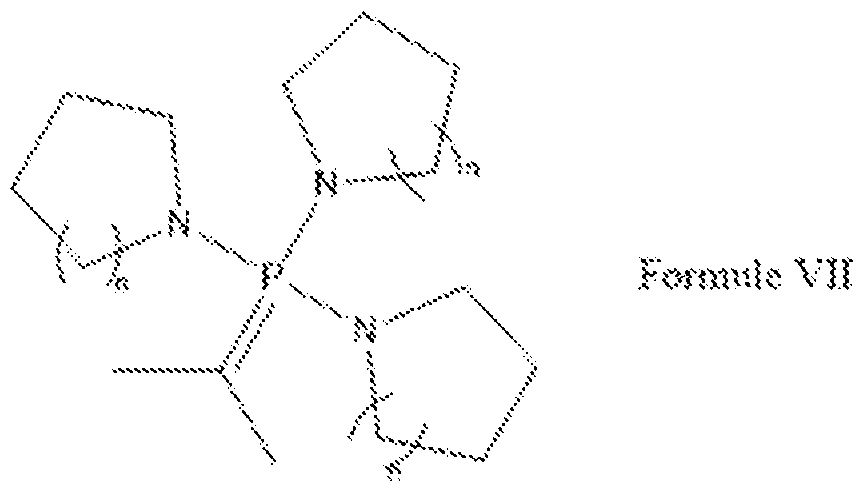
- catalyst A is represented by the following formula (VII): in which n is a natural integer equal to 1 or 2.
- the process of the invention is characterized in that the molar ratio of catalyst A relative to the cyclic organopolysiloxane OC is from 0.005% to 2%, preferably from 0.01 to 2%, preferentially from 0.05 to 1%, and even more preferentially from 0.1 to 1%.
- the initiator I is chosen from alcohols and their derivatives, silanols and their derivatives, or their mixtures.
- the initiator I is chosen from the compounds of formula (VIII): in which:
- Y represents a carbon atom or a silicon atom
- R is the same or different and represents:
- the initiator I is chosen from the compounds of formula (IX): in which:
- Y represents a carbon atom or a silicon atom
- R is the same or different and represents:
- the initiator I is selected from alcohols or silanols having a pKa of 10 to 16, preferably a pKa of 12 to 16, preferentially a pKa of 14 to 16.
- the initiator I is chosen from the compounds of formula (X): in which:
- Y represents a carbon atom
- R is the same or different and represents:
- radical R when said radical R is other than a hydrogen atom, the radical R may be substituted or not by an alkyl, alkenyl chain of 1 to 6 carbon atoms, a cycloalkyl group, an aryl group or a heteroatom such as oxygen, sulfur or nitrogen.
- the initiator I is an alcohol selected from primary alcohols or secondary alcohols.
- the initiator I is an alcohol selected from primary alcohols.
- the initiator I is an alcohol chosen from saturated or unsaturated polyols having 2 to 6 hydroxyl groups.
- the following polyols may be mentioned such as glycerol, pentaerythritol, sorbitol or 1,4 butanediol.
- the initiator I is an alcohol having a pKa of 10 to 16, preferably a pKa of 12 to 16, preferentially a pKa of 14 to 16.
- the initiator I is an alcohol selected from: methanol (CAS 67-56-1), ethanol (CAS 64-17-5), propanol (CAS 71-23-8), isopropanol (CAS 67-63-0), butanol (CAS 71-36-3), 2-methylpropan-2-ol (CAS 75-65-0), allyl alcohol (CAS 107-18-6), benzyl alcohol (CAS 100-51-6), 3-buten-1-ol (627-27-0), long-chain alkyl alcohols such as undecanol (CAS 112-42-5) or dodecanol (CAS 27342-88-7).
- the initiator I is benzyl alcohol (CAS 100-51-6).
- the initiator I has at least one terminal silanol function.
- the initiator I having a terminal silanol function has at least one siloxyl unit.
- the initiator I having a terminal silanol chemical function has at least two siloxyl units. Even more preferably, the initiator I having a terminal silanol function has at least three siloxyl units.
- a silanol terminal function is a chemical function at the end of the chain formed by the chemical bond between a silicon atom and a hydroxyl group.
- the initiator I is represented by the formula (XI): in which,
- R 1 identical or different, represents: - a linear or branched alkyl group comprising from 1 to 12 carbon atoms, preferably from 1 to 8 carbon atoms, optionally substituted by a heteroatom O, N, S or a halide,
- R 2 identical or different, represents:
- -a linear or branched alkyl group comprising from 1 to 12 carbon atoms, preferably from 1 to 5 carbon atoms, optionally substituted by at least one heteroatom O, N, S or a halide such as a fluorine atom, for example 1 to 10 fluorine atoms, for example (Ci-Cs)alkyl-CF3, the alkyl being linear or branched; or -a hydrogen;
- q is an integer between 0 and 20, preferably between 0 and 10, more preferably between 0 and 5, and with the condition that at least one radical R 2 is a hydroxyl group (OH).
- the initiator I is represented by the formula (XI): in which,
- R 1 identical or different, represents:
- - a linear or branched alkyl group comprising from 1 to 12 carbon atoms, preferably from 1 to 8 carbon atoms, optionally substituted by a heteroatom O, N, S or a halide,
- R 2 identical represent:
- q is an integer between 0 and 20, preferably between 0 and 10, more preferably between 0 and 5.
- initiator I is represented by formula (XI) in which:
- R 1 identical, represents CH3,
- R 2 identical or different, represents:
- q is an integer between 0 and 20, preferably between 0 and 10, more preferably between 0 and 5, and with the condition that at least one radical R 2 is a hydroxyl group (OH).
- initiator I is represented by formula (XI) in which:
- R 1 identical, represents CH3,
- R 2 identical, represent:
- q is an integer between 0 and 20, preferably between 0 and 10, more preferably between 0 and 5.
- the initiator I may be in a solvent. This is particularly advantageous in order to solubilize it in the reaction mixture.
- the solvent may in particular be an apolar solvent such as an organic solvent of the alkane or aromatic hydrocarbon type.
- the solvent is chosen from n-hexane, n-heptane, n-decane, n-dodecane, isododecane, EXXSOL D60, xylene, toluene and mixtures thereof.
- the process of the invention is characterized in that the molar ratio of initiator I relative to catalyst A is from 1 to 20, preferably from 3 to 20, and preferentially from 5 to 10.
- the method of the invention is characterized in that the molar ratio of initiator I relative to the cyclic organopolysiloxane OC introduced is from 0.02% to 20%, preferably from 0.25% to 15%, preferentially from 0.5% to 5%, and even more preferentially from 0.25% to 2.5%.
- the ring-opening polymerization reaction of at least one cyclic organopolysiloxane OC takes place in the presence of a catalytic system AI and at least one chain blocker C.
- the chain blocker C is represented by the formula (XII): Formula XH in which,
- R 1 identical or different, represents CH3 or phenyl, preferably CH3;
- R 2 identical or different, represents:
- a linear or branched alkyl group comprising from 1 to 12 carbon atoms, preferably from 1 to 5 carbon atoms, optionally substituted by at least one heteroatom O, N, S or a halide such as a fluorine atom, for example 1 to 10 fluorine atoms, for example (Ci-C5)alkyl-CF3, the alkyl being linear or branched,
- q is an integer between 1 and 50, preferably between 1 and 20, more preferably between 1 and 10.
- the C chain blocker of the invention is represented by formula (XII), in which:
- R 1 identical, represents CH3,
- R 2 identical or different, represents:
- - a linear or branched alkyl group comprising from 1 to 10 carbon atoms, preferably from 1 to 5 carbon atoms, - a Ce-Cis aryl group, optionally substituted, or
- q is an integer between 1 and 20, preferably between 1 and 10, more preferably between 1 and 5.
- the chain blocker C can be in a solvent. This is particularly advantageous in order to solubilize it in the reaction mixture.
- the solvent can in particular be an apolar solvent such as an organic solvent of the alkane or aromatic hydrocarbon type.
- the solvent is chosen from n-hexane, n-heptane, n-decane, n-dodecane, isododecane, EXXSOL D60, xylene, toluene and mixtures thereof.
- the process of the invention is characterized in that the molar ratio of chain blocker C relative to catalyst A is from 0 to 30, preferably from 0 to 20, and preferentially from 0 to 10.
- linear organopolysiloxane OL may be a compound of formula (XIII):
- R identical or different, represents:
- -an alkyl group comprising from 1 to 15 carbon atoms, preferably from 1 to 12 carbon atoms, preferably from 1 to 10 carbon atoms, preferably from 1 to 5 carbon atoms, preferably methyl,
- an aryl group comprising from 6 to 10 carbon atoms, preferably phenyl
- R 1 identical or different, represents:
- -a linear or branched alkyl group comprising from 1 to 12 carbon atoms, preferably from 1 to 5 carbon atoms, optionally substituted by at least one heteroatom O, N, S or a halide such as a fluorine atom, for example 1 to 10 fluorine atoms, for example (Ci-Cs)alkyl-CF3, the alkyl being linear or branched, -a C5-C10 cycloalkyl group, optionally substituted,
- the linear organopolysiloxane OL is a compound of formula (XIII): in which,
- R identical or different, represents CH3 or phenyl, preferably CH3;
- R 1 identical or different, represents:
- R 2 identical or different, represents:
- R 3 represents: an alkyl group comprising from 1 to 10 carbon atoms, an alkenyl group comprising from
- the linear organopolysiloxane OL of the invention is a compound of formula (XIII) in which,
- R identical or different, represents CH3 or phenyl, preferably CH3,
- R 1 identical or different, represents CH3, phenyl or vinyl
- R 2 identical or different, represents:
- R 3 represents: an alkyl group comprising from 1 to 10 carbon atoms, an alkenyl group comprising from
- the linear organopolysiloxane OL of the invention is a compound of formula (XIII) in which, R, identical or different, represents CH3 or phenyl, preferably CH3,
- R 1 identical or different, represents CH3, phenyl or vinyl
- R 2 identical, represent:
- R 3 represents: an alkyl group comprising from 1 to 10 carbon atoms, an alkenyl group comprising from
- 2 to 10 carbon atoms, or a benzyl group q is equal to 0; represents an integer between 10 and 1,500, preferably between 10 and 1,000, preferably between 50 and 1,000, more preferably between 100 and 500; mi represents an integer between 0 and 500, preferably between 0 and 100, more preferably between 0 and 50.
- the mass-average molecular mass and the number-average molecular mass, denoted respectively Mw and Mn, of the various linear organopolysiloxanes OL can be determined by size exclusion chromatography (SEC) in the presence of polystyrene standards in a solvent such as toluene at 35°C.
- SEC size exclusion chromatography
- the linear organopolysiloxane OL of the invention is characterized in that its degree of polymerization is from 2 to 2000, preferably from 4 to 1000, preferentially from 4 to 500 and even more preferentially from 10 to 100.
- the linear organopolysiloxane OL of the invention is characterized in that its mass-average molecular mass Mw can be between 500 and 150,000 g/mol, preferably between 1,000 and 150,000 g/mol, preferentially between 1,000 and 100,000 g/mol, even more preferentially between 5,000 and 30,000 g/mol.
- the linear organopolysiloxane OL of the invention is characterized in that its number-average molecular mass M n is between 500 and 150,000 g/mol, preferably between 1,000 and 100,000 g/mol, preferentially between 1,000 and 70,000 g/mol and even more preferentially between 2,500 and 30,000 g/mol.
- the linear organopolysiloxane OL of the invention is characterized in that its dynamic viscosity is between 100 and 100,000 mPa.s at 25°C, preferably between 1,000 and 80,000 mPa.s at 25°C, even more preferably between 10,000 and 70,000 mPa.s at 25°C.
- the mass percentage or the weight percentage of cyclic organopolysiloxanes (such as D4) of the products obtained according to the process of the present invention can be measured via the quantitative spectra of NMR- 29 Si.
- the mass percentage or the weight percentage of D4 of the products obtained according to the process of the present invention could be measured via the chromatograms resulting from a size exclusion chromatography (SEC) analysis.
- the product resulting from the reaction is the sum of the linear organopolysiloxane OL and the cyclic organopolysiloxane OC resulting from the process of the present invention.
- the method according to the invention is characterized in that the content of cyclic organopolysiloxanes OC is less than 2%, preferably less than or equal to 1%, preferably less than or equal to 0.5% relative to the total mass of product resulting from the reaction.
- the process according to the invention is characterized in that the octamethylcyclotetrasiloxane (D4) content is less than 2%, preferably less than or equal to 1%, preferably less than or equal to 0.5% relative to the total mass of product resulting from the reaction.
- D4 octamethylcyclotetrasiloxane
- the method according to the invention is implemented in a non-polar solvent.
- the solvent may in particular be an organic solvent of the alkane or aromatic hydrocarbon type.
- the solvent is chosen from n-hexane, n-heptane, n-decane, n-dodecane, isododecane, EXXSOL D60, xylene, toluene and mixtures thereof.
- the method of the invention is characterized in that the mass ratio, mass of cyclic organopolysiloxane OC relative to the mass of solvent used is from 1 to 500, preferably from 1 to 100 and preferentially from 5 to 50.
- the reaction is carried out at a temperature between 50°C and 150°C, preferably between 50 and 100°C, more preferably between 60 and 80°C, for example at 80°C.
- the reaction time is between 2h and 48h, preferably between 8h and 36h, more preferably between 8h and 18h.
- the present application also relates to the linear organopolysiloxane OL obtained according to the different embodiments of the process of the present invention described above.
- composition for implementing the method of the present invention comprising:
- an AI catalytic system as defined above an AI catalytic system as defined above, and optionally a C chain blocker.
- the present application also relates to the use of the organopolysiloxanes OL obtained according to the process of the present invention as an ingredient which can be directly used in various silicone formulations useful in fields such as cosmetics, household cleaning products, automobiles, energy.
- -R represents an alkyl chain of 1 to 12 carbon atoms, preferably 1 to 8 carbon atoms, which can be linked by a radical to form a cycle
- -Ri identical or different, represent a hydrogen atom or an alkyl chain of 1 to 12 carbon atoms, preferably 1 to 8 carbon atoms and n, identical or different, is a natural number equal to 1, 2 or 3.
- the present invention relates to catalysts A represented by the following formula (XV): in which n is a natural integer equal to 1 or 2.
- the present application also concerns the use of the catalysts defined according to the formulas (XIV and XV) as catalysts for ring-opening polymerization or polycondensation.
- Cyclic organopolysiloxane OCi hexamethylcyclotri siloxane (CAS 541-05-9)
- Cyclic organopolysiloxane OC2 octamethylcyclotetrasiloxane (CAS 556-67-2)
- Catalyst Ai Catalyst A2:
- Initiator Ii Benzyl alcohol (CAS 100-51-6)
- Ci chain blockers divinyltetramethyldisiloxane (CAS 2627-95-4).
- the residual mass percentages of cyclic organopolysiloxanes OC and the mass percentages of linear organopolysiloxane OL obtained according to the method of the present invention are measured by size exclusion chromatography (SEC) in the presence of polystyrene standards in a solvent such as toluene at 35°C.
- SEC size exclusion chromatography
- M n of the different linear organopolysiloxanes according to the present invention OL is determined by the same size exclusion chromatography (SEC) method.
- the mass percentage of residual cyclic organopolysiloxanes is called the mass percentage of cyclic organopolysiloxane at the end of the process implemented according to the present invention.
- KHMDS powder 0.52g, 2.63 mmol was added at room temperature. The solution was stirred at room temperature for 1h. The solution was then filtered and evaporated using a rotary evaporator.
- Example 2 General protocol for implementing the method of the present invention:
- the AI catalytic system is formed by the association of catalyst A (e.g., Ai and A2) (leq, 0.061 mmol) and n equivalents of initiator I, (e.g., Ii or I2).
- catalyst A e.g., Ai and A2
- n equivalents of initiator I e.g., Ii or I2
- the tables below indicate the different molar ratios I/A.
- This freshly formed AI catalytic system comprising an amount of 0.025 mmol (0.5 mol%) of catalyst A is mixed in a solution containing a cyclic organopolysiloxane OCi or OC2 (5.07 mmol), and toluene as solvent.
- a chain blocker such as Ci is added to the reaction mixture.
- reaction mixture is then heated to 80°C for a period of 18 hours.
- example 2 the general protocol of example 2 was implemented.
- octamethylcyclotetrasiloxane OC2 (CAS 556-67-2) was used.
- the table below describes the different catalysts used as well as the characteristics of the product obtained OL according to the process of the invention.
- example 2 the general protocol of example 2 was implemented.
- hexamethylcyclotrisiloxane OCi (CAS 541-05-9) was used.
- the table below describes the different catalysts used as well as the characteristics of the product obtained OL according to the process of the invention.
- example 2 the general protocol of example 2 was implemented.
- octamethylcyclotetrasiloxane OC2 (CAS 556-67-2) was used.
- the table below describes the different molar ratios used as well as the characteristics of the product obtained OL according to the process of the invention.
- the molar ratio I/A has an influence on the number-average molecular mass of the OL product obtained by the process of the present invention.
- the person skilled in the art will be able to adapt these parameters to obtain, using the process of the present invention, an organopolysiloxane OL with the desired number-average molecular mass M n while controlling the cyclic content.
- Example 5a Tests with D4, C/A ratio influence
- example 2 the general protocol of example 2 was implemented.
- octamethylcyclotetrasiloxane OC2 (CAS 556-67-2) was used.
- the table below mentions the molar ratio of the chain blocker used relative to the molar amount of catalyst A used as well as the characteristics of the product obtained OL according to the process of the invention.
- the molar ratio I/A is 5.
- example 2 the general protocol of example 2 was implemented.
- octamethylcyclotetrasiloxane OC2 (CAS 556-67-2) was used.
- the table below mentions the molar ratio of the chain blocker used relative to the molar quantity of catalyst A used as well as the characteristics of the product obtained OL according to the process of the invention.
- the quantity of catalyst A used is 1.00 mol% relative to the quantity of OC2 used, unlike the other examples.
- the molar ratio I/A is 5.
Landscapes
- Chemical & Material Sciences (AREA)
- Organic Chemistry (AREA)
- Health & Medical Sciences (AREA)
- Chemical Kinetics & Catalysis (AREA)
- Medicinal Chemistry (AREA)
- Polymers & Plastics (AREA)
- Life Sciences & Earth Sciences (AREA)
- Biochemistry (AREA)
- General Health & Medical Sciences (AREA)
- Molecular Biology (AREA)
- Silicon Polymers (AREA)
Abstract
Description




Claims


Priority Applications (4)
| Application Number | Priority Date | Filing Date | Title |
|---|---|---|---|
| KR1020257031791A KR20250152653A (ko) | 2023-03-24 | 2024-03-22 | 개환 중합 방법 |
| JP2025555632A JP2026508706A (ja) | 2023-03-24 | 2024-03-22 | 開環重合法 |
| CN202480021434.1A CN120936659A (zh) | 2023-03-24 | 2024-03-22 | 开环聚合方法 |
| EP24721174.1A EP4688918A1 (fr) | 2023-03-24 | 2024-03-22 | Methode de polymerisation par ouverture de cycle |
Applications Claiming Priority (2)
| Application Number | Priority Date | Filing Date | Title |
|---|---|---|---|
| FRFR2302798 | 2023-03-24 | ||
| FR2302798 | 2023-03-24 |
Publications (1)
| Publication Number | Publication Date |
|---|---|
| WO2024200922A1 true WO2024200922A1 (fr) | 2024-10-03 |
Family
ID=87801230
Family Applications (1)
| Application Number | Title | Priority Date | Filing Date |
|---|---|---|---|
| PCT/FR2024/000037 Ceased WO2024200922A1 (fr) | 2023-03-24 | 2024-03-22 | Methode de polymerisation par ouverture de cycle |
Country Status (5)
| Country | Link |
|---|---|
| EP (1) | EP4688918A1 (fr) |
| JP (1) | JP2026508706A (fr) |
| KR (1) | KR20250152653A (fr) |
| CN (1) | CN120936659A (fr) |
| WO (1) | WO2024200922A1 (fr) |
Citations (3)
| Publication number | Priority date | Publication date | Assignee | Title |
|---|---|---|---|---|
| WO1998054229A1 (fr) | 1997-05-26 | 1998-12-03 | Societe De Conseils De Recherches Et D'applications Scientifiques (S.C.R.A.S.) | Utilisation d'ylures de phosphore en tant que bases fortes faiblement nucleophiles |
| EP1008610A2 (fr) * | 1998-12-09 | 2000-06-14 | Dow Corning Corporation | Polymérisation des siloxanes |
| WO2003054058A1 (fr) | 2001-12-14 | 2003-07-03 | Rhodia Chimie | Procede de preparation de polyorganosiloxanes (pos) par polycondensation/redistribution d'oligosiloxanes, en presence d'une superbase et superbases employees |
-
2024
- 2024-03-22 KR KR1020257031791A patent/KR20250152653A/ko active Pending
- 2024-03-22 EP EP24721174.1A patent/EP4688918A1/fr active Pending
- 2024-03-22 CN CN202480021434.1A patent/CN120936659A/zh active Pending
- 2024-03-22 JP JP2025555632A patent/JP2026508706A/ja active Pending
- 2024-03-22 WO PCT/FR2024/000037 patent/WO2024200922A1/fr not_active Ceased
Patent Citations (4)
| Publication number | Priority date | Publication date | Assignee | Title |
|---|---|---|---|---|
| WO1998054229A1 (fr) | 1997-05-26 | 1998-12-03 | Societe De Conseils De Recherches Et D'applications Scientifiques (S.C.R.A.S.) | Utilisation d'ylures de phosphore en tant que bases fortes faiblement nucleophiles |
| EP1008610A2 (fr) * | 1998-12-09 | 2000-06-14 | Dow Corning Corporation | Polymérisation des siloxanes |
| WO2003054058A1 (fr) | 2001-12-14 | 2003-07-03 | Rhodia Chimie | Procede de preparation de polyorganosiloxanes (pos) par polycondensation/redistribution d'oligosiloxanes, en presence d'une superbase et superbases employees |
| US20050080215A1 (en) * | 2001-12-14 | 2005-04-14 | Antoire Baceiredo | Method for preparing polyorganosiloxanes (pos) by polycondensation/redistribution of oligosiloxanes in the presence of a strong base and strong bases used |
Non-Patent Citations (1)
| Title |
|---|
| "Chemistry and Technology of Silicones", 1968, ACADÉMIE PRESS |
Also Published As
| Publication number | Publication date |
|---|---|
| EP4688918A1 (fr) | 2026-02-11 |
| KR20250152653A (ko) | 2025-10-23 |
| CN120936659A (zh) | 2025-11-11 |
| JP2026508706A (ja) | 2026-03-11 |
Similar Documents
| Publication | Publication Date | Title |
|---|---|---|
| EP1701992B1 (fr) | Procede de preparation de polyorganosiloxanes (pos) par polymerisation par ouverture de cycle(s) et/ou redistribution de pos, en presence de carbene(s) et compositions de pos mises en oeuvre dans ce procede | |
| EP0792323A1 (fr) | Polyorganosiloxanes fonctionnalises et l'un de leurs procedes de preparation | |
| CA1334604C (fr) | Diorganopolysiloxane a fonction benzotriazole | |
| EP0421895B1 (fr) | Composés d'étain (IV) éventuellement chélatés utilisables notamment comme catalyseurs latents | |
| EP1309647B1 (fr) | Procede de preparation d'huiles silicones par hydrosilylation de synthons contenant au moins un cycle hydrocarbone dans lequel est inclus un atome d'oxygene en presence d'un complexe metallique catalytique | |
| WO2001044349A1 (fr) | Procede de preparation de polyorganosiloxanes par polymerisation catalysee par un systeme catalytique a base d'acide triflique ou de derives de l'acide triflique | |
| EP0221824B1 (fr) | Procédé de polymérisation d'oligomères de polydiorganosiloxanes dans un fluide à pression supraatmosphérique qui est un gaz dans les conditions normales | |
| EP4688918A1 (fr) | Methode de polymerisation par ouverture de cycle | |
| EP4739730A1 (fr) | Procede de polymerisation par ouverture de cycle ou par polycondensation | |
| EP4724428A1 (fr) | Procédé de polymérisation par ouverture de cycle ou par polycondensation | |
| EP0336854A1 (fr) | Diorganopolysiloxane porteur à la fois de radicaux vinyle et de radicaux organiques époxy-fonctionnel | |
| EP0354143A1 (fr) | Diorganopolysiloxane à fonction thioalkylacrylate | |
| EP4724518A1 (fr) | Procede de polymerisation par ouverture de cycle | |
| WO2026078321A1 (fr) | Dépolymérisation de polymères silicones en organopolysiloxanes | |
| FR2833602A1 (fr) | Procede de preparation de polyorganosiloxanes (pos) par polycondensation/redistribution d'oligosiloxanes, en presence d'une superbase et superbases employees | |
| FR2611960A1 (fr) | Procede de preparation de diamines aromatiques a groupement diorganopolysiloxane | |
| EP4605453A2 (fr) | Dépolymérisation de polymères silicones en organopolysiloxanes | |
| EP0944668B1 (fr) | PROCEDE DE PREPARATION D'HUILE SILICONE STABLE CONTENANT DES GROUPES SiH ET DES FONCTIONS HYDROSILYLABLES | |
| FR3153615A1 (fr) | Dépolymérisation d’organopolysiloxane | |
| WO2003037962A1 (fr) | Utilisation d'un systeme catalytique a base d'un metal du groupe du platine et d'un compose organique heterocyclique pour l'hydrosilylation de reactifs insatures | |
| FR2631343A1 (fr) | Diorganopolysiloxane a fonction itaconate | |
| WO2004092251A1 (fr) | Procede de preparation de polyorganosiloxanes lineaires |
Legal Events
| Date | Code | Title | Description |
|---|---|---|---|
| 121 | Ep: the epo has been informed by wipo that ep was designated in this application |
Ref document number: 24721174 Country of ref document: EP Kind code of ref document: A1 |
|
| ENP | Entry into the national phase |
Ref document number: 2025555632 Country of ref document: JP Kind code of ref document: A |
|
| WWE | Wipo information: entry into national phase |
Ref document number: 202547090396 Country of ref document: IN Ref document number: 2025555632 Country of ref document: JP |
|
| ENP | Entry into the national phase |
Ref document number: 1020257031791 Country of ref document: KR Free format text: ST27 STATUS EVENT CODE: A-0-1-A10-A15-NAP-PA0105 (AS PROVIDED BY THE NATIONAL OFFICE) |
|
| WWP | Wipo information: published in national office |
Ref document number: 1020257031791 Country of ref document: KR |
|
| WWE | Wipo information: entry into national phase |
Ref document number: 2024721174 Country of ref document: EP |
|
| WWP | Wipo information: published in national office |
Ref document number: 202547090396 Country of ref document: IN |
|
| NENP | Non-entry into the national phase |
Ref country code: DE |
|
| ENP | Entry into the national phase |
Ref document number: 2024721174 Country of ref document: EP Effective date: 20251024 |
|
| ENP | Entry into the national phase |
Ref document number: 2024721174 Country of ref document: EP Effective date: 20251024 |
|
| ENP | Entry into the national phase |
Ref document number: 2024721174 Country of ref document: EP Effective date: 20251024 |
|
| ENP | Entry into the national phase |
Ref document number: 2024721174 Country of ref document: EP Effective date: 20251024 |
|
| ENP | Entry into the national phase |
Ref document number: 2024721174 Country of ref document: EP Effective date: 20251024 |
|
| ENP | Entry into the national phase |
Ref document number: 2024721174 Country of ref document: EP Effective date: 20251024 |
|
| ENP | Entry into the national phase |
Ref document number: 2024721174 Country of ref document: EP Effective date: 20251024 |
|
| ENP | Entry into the national phase |
Ref document number: 2024721174 Country of ref document: EP Effective date: 20251024 |
|
| WWP | Wipo information: published in national office |
Ref document number: 2024721174 Country of ref document: EP |