WO2024203767A1 - 重合体組成物およびゴム製品 - Google Patents
重合体組成物およびゴム製品 Download PDFInfo
- Publication number
- WO2024203767A1 WO2024203767A1 PCT/JP2024/011139 JP2024011139W WO2024203767A1 WO 2024203767 A1 WO2024203767 A1 WO 2024203767A1 JP 2024011139 W JP2024011139 W JP 2024011139W WO 2024203767 A1 WO2024203767 A1 WO 2024203767A1
- Authority
- WO
- WIPO (PCT)
- Prior art keywords
- mass
- polymer
- conjugated diene
- polymer composition
- aromatic vinyl
- Prior art date
- Legal status (The legal status is an assumption and is not a legal conclusion. Google has not performed a legal analysis and makes no representation as to the accuracy of the status listed.)
- Ceased
Links
Classifications
-
- C—CHEMISTRY; METALLURGY
- C08—ORGANIC MACROMOLECULAR COMPOUNDS; THEIR PREPARATION OR CHEMICAL WORKING-UP; COMPOSITIONS BASED THEREON
- C08C—TREATMENT OR CHEMICAL MODIFICATION OF RUBBERS
- C08C19/00—Chemical modification of rubber
- C08C19/22—Incorporating nitrogen atoms into the molecule
-
- C—CHEMISTRY; METALLURGY
- C08—ORGANIC MACROMOLECULAR COMPOUNDS; THEIR PREPARATION OR CHEMICAL WORKING-UP; COMPOSITIONS BASED THEREON
- C08L—COMPOSITIONS OF MACROMOLECULAR COMPOUNDS
- C08L15/00—Compositions of rubber derivatives
-
- B—PERFORMING OPERATIONS; TRANSPORTING
- B60—VEHICLES IN GENERAL
- B60C—VEHICLE TYRES; TYRE INFLATION; TYRE CHANGING; CONNECTING VALVES TO INFLATABLE ELASTIC BODIES IN GENERAL; DEVICES OR ARRANGEMENTS RELATED TO TYRES
- B60C1/00—Tyres characterised by the chemical composition or the physical arrangement or mixture of the composition
-
- B—PERFORMING OPERATIONS; TRANSPORTING
- B60—VEHICLES IN GENERAL
- B60C—VEHICLE TYRES; TYRE INFLATION; TYRE CHANGING; CONNECTING VALVES TO INFLATABLE ELASTIC BODIES IN GENERAL; DEVICES OR ARRANGEMENTS RELATED TO TYRES
- B60C1/00—Tyres characterised by the chemical composition or the physical arrangement or mixture of the composition
- B60C1/0016—Compositions of the tread
-
- B—PERFORMING OPERATIONS; TRANSPORTING
- B60—VEHICLES IN GENERAL
- B60C—VEHICLE TYRES; TYRE INFLATION; TYRE CHANGING; CONNECTING VALVES TO INFLATABLE ELASTIC BODIES IN GENERAL; DEVICES OR ARRANGEMENTS RELATED TO TYRES
- B60C1/00—Tyres characterised by the chemical composition or the physical arrangement or mixture of the composition
- B60C1/0025—Compositions of the sidewalls
-
- C—CHEMISTRY; METALLURGY
- C08—ORGANIC MACROMOLECULAR COMPOUNDS; THEIR PREPARATION OR CHEMICAL WORKING-UP; COMPOSITIONS BASED THEREON
- C08C—TREATMENT OR CHEMICAL MODIFICATION OF RUBBERS
- C08C19/00—Chemical modification of rubber
- C08C19/25—Incorporating silicon atoms into the molecule
-
- C—CHEMISTRY; METALLURGY
- C08—ORGANIC MACROMOLECULAR COMPOUNDS; THEIR PREPARATION OR CHEMICAL WORKING-UP; COMPOSITIONS BASED THEREON
- C08C—TREATMENT OR CHEMICAL MODIFICATION OF RUBBERS
- C08C19/00—Chemical modification of rubber
- C08C19/30—Addition of a reagent which reacts with a hetero atom or a group containing hetero atoms of the macromolecule
- C08C19/42—Addition of a reagent which reacts with a hetero atom or a group containing hetero atoms of the macromolecule reacting with metals or metal-containing groups
- C08C19/44—Addition of a reagent which reacts with a hetero atom or a group containing hetero atoms of the macromolecule reacting with metals or metal-containing groups of polymers containing metal atoms exclusively at one or both ends of the skeleton
-
- C—CHEMISTRY; METALLURGY
- C08—ORGANIC MACROMOLECULAR COMPOUNDS; THEIR PREPARATION OR CHEMICAL WORKING-UP; COMPOSITIONS BASED THEREON
- C08K—Use of inorganic or non-macromolecular organic substances as compounding ingredients
- C08K3/00—Use of inorganic substances as compounding ingredients
- C08K3/01—Use of inorganic substances as compounding ingredients characterized by their specific function
- C08K3/013—Fillers, pigments or reinforcing additives
-
- C—CHEMISTRY; METALLURGY
- C08—ORGANIC MACROMOLECULAR COMPOUNDS; THEIR PREPARATION OR CHEMICAL WORKING-UP; COMPOSITIONS BASED THEREON
- C08L—COMPOSITIONS OF MACROMOLECULAR COMPOUNDS
- C08L57/00—Compositions of unspecified polymers obtained by reactions only involving carbon-to-carbon unsaturated bonds
-
- C—CHEMISTRY; METALLURGY
- C08—ORGANIC MACROMOLECULAR COMPOUNDS; THEIR PREPARATION OR CHEMICAL WORKING-UP; COMPOSITIONS BASED THEREON
- C08L—COMPOSITIONS OF MACROMOLECULAR COMPOUNDS
- C08L57/00—Compositions of unspecified polymers obtained by reactions only involving carbon-to-carbon unsaturated bonds
- C08L57/02—Copolymers of mineral oil hydrocarbons
-
- C—CHEMISTRY; METALLURGY
- C08—ORGANIC MACROMOLECULAR COMPOUNDS; THEIR PREPARATION OR CHEMICAL WORKING-UP; COMPOSITIONS BASED THEREON
- C08L—COMPOSITIONS OF MACROMOLECULAR COMPOUNDS
- C08L9/00—Compositions of homopolymers or copolymers of conjugated diene hydrocarbons
- C08L9/06—Copolymers with styrene
-
- C—CHEMISTRY; METALLURGY
- C08—ORGANIC MACROMOLECULAR COMPOUNDS; THEIR PREPARATION OR CHEMICAL WORKING-UP; COMPOSITIONS BASED THEREON
- C08L—COMPOSITIONS OF MACROMOLECULAR COMPOUNDS
- C08L2205/00—Polymer mixtures characterised by other features
- C08L2205/02—Polymer mixtures characterised by other features containing two or more polymers of the same C08L -group
- C08L2205/025—Polymer mixtures characterised by other features containing two or more polymers of the same C08L -group containing two or more polymers of the same hierarchy C08L, and differing only in parameters such as density, comonomer content, molecular weight, structure
-
- C—CHEMISTRY; METALLURGY
- C08—ORGANIC MACROMOLECULAR COMPOUNDS; THEIR PREPARATION OR CHEMICAL WORKING-UP; COMPOSITIONS BASED THEREON
- C08L—COMPOSITIONS OF MACROMOLECULAR COMPOUNDS
- C08L2205/00—Polymer mixtures characterised by other features
- C08L2205/03—Polymer mixtures characterised by other features containing three or more polymers in a blend
-
- Y—GENERAL TAGGING OF NEW TECHNOLOGICAL DEVELOPMENTS; GENERAL TAGGING OF CROSS-SECTIONAL TECHNOLOGIES SPANNING OVER SEVERAL SECTIONS OF THE IPC; TECHNICAL SUBJECTS COVERED BY FORMER USPC CROSS-REFERENCE ART COLLECTIONS [XRACs] AND DIGESTS
- Y02—TECHNOLOGIES OR APPLICATIONS FOR MITIGATION OR ADAPTATION AGAINST CLIMATE CHANGE
- Y02T—CLIMATE CHANGE MITIGATION TECHNOLOGIES RELATED TO TRANSPORTATION
- Y02T10/00—Road transport of goods or passengers
- Y02T10/80—Technologies aiming to reduce greenhouse gasses emissions common to all road transportation technologies
- Y02T10/86—Optimisation of rolling resistance, e.g. weight reduction
Definitions
- the present invention relates to a polymer composition.
- the present invention also relates to a rubber product formed using the polymer composition.
- tires have been manufactured from rubber compositions that contain vulcanizing agents, fillers such as carbon black and silica, antioxidants and waxes that prevent deterioration, and each component has been improved.
- Patent Document 1 describes a rubber composition containing a hydrogenated dicyclopentadiene (DCPD) petroleum resin.
- DCPD dicyclopentadiene
- Patent Document 2 describes a rubber composition for tire innerliners containing C5, C9 or hydrogenated DCPD hydrocarbon resin.
- compositions consisting of at least one of DCPD-based polymers, cyclopentadiene (CPD)-based polymers, DCPD-styrene copolymers, C5 homopolymer and copolymer resins, C5-styrene copolymer resins, terpene homopolymer or copolymer resins, pinene homopolymer or copolymer resins, C9 homopolymer and copolymer resins, C5/C9 copolymer resins, alpha-methylstyrene homopolymer or copolymer resins, and combinations thereof have a low air permeability coefficient.
- CPD cyclopentadiene
- Patent Documents 1 and 2 leave room for improvement in terms of the balance between grip performance and breaking strength.
- the inventors therefore conducted intensive research to solve the above problems and surprisingly discovered that tires manufactured using a polymer composition containing a specific rubber component and a specific raw material component polymer have high grip properties and high breaking strength. Based on this discovery, the inventors have completed the present invention.
- a polymer composition comprising: the conjugated diene polymer (A-1) contains a structural unit derived from a conjugated diene compound and a structural unit derived from an aromatic vinyl compound, the content of the structural units derived from the aromatic vinyl compound is 5% by mass or more and 60% by mass or less based on the total amount of the structural units derived from the conjugated diene compound and the structural units derived from the aromatic vinyl compound,
- a polymer composition, in which, relative to the content of structural units derived from aromatic vinyl compounds, aromatic vinyl compound single chains in which aromatic vinyl compounds are not continuous are less than 40 mass % and aromatic vinyl compound long chains in which 8 or more aromatic vinyl compound units are connected are 10 mass % or less.
- the present invention it is possible to provide a polymer composition that can be used to manufacture a tire product having high grip properties and high breaking strength. Furthermore, according to the present invention, it is possible to manufacture a tire having high grip properties and high breaking strength.
- the polymer composition of the present invention includes a rubber component and a raw material polymer, and may further include a filler and a silane coupling agent.
- a tire manufactured using the polymer composition of the present invention has high grip properties and high breaking strength.
- Each component included in the polymer composition will be described in detail below.
- the "rubber component” included in the polymer composition refers to a polymer that can obtain a cured product exhibiting rubber elasticity by thermal curing. The cured product exhibits a property of undergoing large deformation with a small force at room temperature (for example, deformation that extends to more than twice its original size when stretched at room temperature) and rapidly returning to almost its original shape when the force is removed.
- the rubber component used in the polymer composition contains at least the conjugated diene polymer (A-1) and may further contain other rubber components other than A-1 (hereinafter, simply referred to as "other rubber components").
- the conjugated diene polymer (A-1) contains a structural unit derived from a conjugated diene compound and a structural unit derived from an aromatic vinyl compound, and satisfies the following conditions (1) and (2): When the conjugated diene polymer (A-1) satisfies the following conditions (1) and (2), a tire having high grip performance and high breaking strength can be produced.
- the content of the structural unit derived from the aromatic vinyl compound is 5% by mass or more and 60% by mass or less, based on the total amount of the structural unit derived from the conjugated diene compound and the structural unit derived from the aromatic vinyl compound.
- the content of the structural unit derived from the aromatic vinyl compound is preferably 55% by mass or less, more preferably 50% by mass or less, and also preferably 10% by mass or more, more preferably 15% by mass or more, based on the total amount of the structural unit derived from the conjugated diene compound and the structural unit derived from the aromatic vinyl compound.
- the content ratio of the structural unit derived from the aromatic vinyl compound in the polymer is a value measured by 1 H-NMR.
- the content of aromatic vinyl compound single chains in which aromatic vinyl compounds are not continuous is less than 40% by mass, preferably 38% by mass or less, and may be 1% by mass or more, 5% by mass or more, 10% by mass or more, 15% by mass or more, or 20% by mass or more, and the content of aromatic vinyl compound long chains in which 8 or more aromatic vinyl compound units are connected is 10% by mass or less, preferably 5% by mass or less, and may be 0.1% by mass or more, 0.2% by mass or more, or 0.5% by mass or more.
- the aromatic vinyl compound chains were calculated by decomposing a conjugated diene polymer with ozone and analyzing it by gel permeation chromatography [Tanaka et al., Polymer, 22, 1721 (1981)].
- the conjugated diene polymer (A-1) preferably has a nitrogen-containing group and a hydrocarbyloxysilyl group.
- hydrocarbyloxysilyl group refers to a group in which at least one hydrocarbyloxy group is bonded to a silicon atom, and is represented by the following formula (1): (In formula (1), R 1 and R 2 are each independently a hydrocarbyl group. i is an integer of 1 to 3. When i is 1, multiple R 2's in the formula are the same or different. When i is 2 or 3, multiple R 1's in the formula are the same or different. "*" represents a bond.)
- nitrogen-containing group examples include a primary amino group, a secondary amino group, a tertiary amino group, a protected primary amino group, a protected secondary amino group, an imino group, an imidazolyl group, an azasilolizyl group, and a silazane structure, among which a primary amino group, a protected primary amino group, and an imino group are preferred, and a primary amino group is more preferred.
- hydrocarbyloxysilyl group examples include a group represented by the above formula (1) in which i is 3 and R 1 is a linear or branched alkyl group having 1 to 6 carbon atoms, a group represented by the above formula (1) in which i is 2 and R 1 and R 2 are each independently a linear or branched alkyl group having 1 to 6 carbon atoms, and the like, and a triethoxysilyl group or a diethoxymethylsilyl group is preferred, and a triethoxysilyl group is more preferred.
- the conjugated diene polymer (A-1) has a nitrogen-containing group and a hydrocarbyloxysilyl group, and thus has good grip properties and high breaking strength.
- the nitrogen-containing group and the hydrocarbyloxysilyl group may be introduced separately or simultaneously. Specific methods for introducing the nitrogen-containing group and the hydrocarbyloxysilyl group are described in detail in the sections ⁇ Polymerization step> and ⁇ Modification step>.
- the nitrogen-containing group and the hydrocarbyloxysilyl group may be introduced into the main chain terminal of the polymer, or into both the side chain and the main chain terminal of the polymer. Of these, it is preferable that the specific structure is introduced into at least the main chain terminal, in order to produce a tire with high grip and high breaking strength.
- the "main chain” of a polymer refers to the longest “trunk” part of the atomic chain of the polymer.
- the “side chain” of a polymer refers to the part branched off from the "trunk” of the polymer.
- the conjugated diene polymer (A-1) can be obtained by copolymerizing a conjugated diene compound and an aromatic vinyl compound. Furthermore, a nitrogen-containing group and a hydrocarbyloxysilyl group can be introduced into the conjugated diene polymer (A-1) by reacting the conjugated diene polymer (A-1) with a compound having a nitrogen-containing group and a compound having a hydrocarbyloxysilyl group, or by reacting the conjugated diene polymer (A-1) with a compound having a nitrogen-containing group and a hydrocarbyloxysilyl group. Although these reactions are not particularly limited, for example, the conjugated diene polymer (A-1) is preferably produced by a method including the following polymerization steps.
- matters related to the aspects of the present disclosure will be described in detail.
- the content of structural units derived from the conjugated diene compound can be adjusted appropriately according to the above condition (1) (content of structural units derived from the aromatic vinyl compound).
- the amount of the conjugated diene compound used is preferably 40% by mass or more and 95% by mass or less, more preferably 45% by mass or more and 95% by mass or less, and more preferably 50% by mass or more and 95% by mass or less, based on the total amount of the conjugated diene compound and the aromatic vinyl compound used in the polymerization.
- Aromatic vinyl compounds used in the polymerization include, for example, styrene, 2-methylstyrene, 3-methylstyrene, 4-methylstyrene, ⁇ -methylstyrene, 2,4-dimethylstyrene, 2,4-diisopropylstyrene, 4-tert-butylstyrene, divinylbenzene, tert-butoxystyrene, vinylbenzyldimethylamine, (4-vinylbenzyl)dimethylaminoethyl ether, N,N-dimethylaminoethylstyrene, and vinylpyridine. These aromatic vinyl compounds can be used alone or in combination of two or more.
- the amount of the third monomer used is preferably 25% by mass or less, more preferably 15% by mass or less, and may be 0% by mass or more, based on the total amount of monomers used in the polymerization.
- the polymerization method used may be any of solution polymerization, gas phase polymerization, and bulk polymerization, with solution polymerization being particularly preferred.
- the polymerization format may be either batch or continuous, with batch being preferred.
- a specific example of the polymerization method is a method in which a monomer containing a conjugated diene compound and an aromatic vinyl compound is polymerized in an organic solvent in the presence of a polymerization initiator and, if necessary, a randomizer.
- an alkali metal compound is used as the polymerization initiator.
- alkali metal compounds include alkyl lithium such as methyl lithium, ethyl lithium, n-propyl lithium, n-butyl lithium, sec-butyl lithium, and t-butyl lithium; 1,4-dilithiobutane, phenyl lithium, stilbene lithium, naphthyl lithium, 1,3-bis(1-lithio-1,3-dimethylpentyl)benzene, 1,3-phenylenebis(3-methyl-1-phenylpentylidene)dilithium, naphthyl sodium, naphthyl potassium, and ethoxy potassium.
- lithium compounds are preferred.
- a compound having a functional group that interacts with silica (hereinafter also referred to as an "initiating modifier”) may be used as the alkali metal compound.
- an initiating modifier By carrying out the polymerization in the presence of the initiating modifier, a functional group that interacts with silica can be introduced into the polymerization initiation terminal of the conjugated diene polymer (A-1).
- “functional group that interacts with silica” means a group having an element that interacts with silica, such as nitrogen, sulfur, phosphorus, or oxygen.
- Interaction means forming a covalent bond between molecules, or forming an intermolecular force that is weaker than a covalent bond (for example, an electromagnetic force that acts between molecules, such as an ion-dipole interaction, a dipole-dipole interaction, a hydrogen bond, or a van der Waals force).
- the initiating modifier is preferably a nitrogen-containing alkali metal compound.
- a mixture of a non-nitrogen-containing alkali metal compound and a secondary amine compound can be mentioned.
- the secondary amine compound include chain or cyclic secondary amine compounds such as dimethylamine, diethylamine, dipropylamine, dibutylamine, dodecamethyleneimine, N,N'-dimethyl-N'-trimethylsilyl-1,6-diaminohexane, piperidine, pyrrolidine, hexamethyleneimine, heptamethyleneimine, dicyclohexylamine, N-methylbenzylamine, di-(2-ethylhexyl)amine, diallylamine, morpholine, N-(trimethylsilyl)piperazine, N-(tert-butyldimethylsilyl)piperazine, 1,3-ditrimethylsilyl-1,3,5-triazinane, N-
- the nitrogen-free alkali metal compound and the secondary amine compound may be mixed in advance, and the mixture may be added to the polymerization system to carry out polymerization.
- the nitrogen-free alkali metal compound and the secondary amine compound may be added to the polymerization system, and the two may be mixed in the polymerization system to carry out polymerization.
- a nitrogen-containing group can be introduced into the main chain terminal of the conjugated diene polymer (A-1).
- the amount of polymerization initiator used (the total amount when two or more types are used) is preferably 0.01 to 20 mmol, and more preferably 0.05 to 15 mmol, per 100 g of monomer used in the synthesis of the conjugated diene polymer (A-1).
- the proportion of initiator modifier used may be 10 mol % to 100 mol % based on the total amount of polymerization initiator (preferably an alkali metal compound) used in the polymerization of the monomer.
- the randomizer can be used for the purpose of adjusting the vinyl bond content, which indicates the content of vinyl bonds in a polymer, and adjusting the content ratio of aromatic vinyl compound single chains and aromatic vinyl compound long chains.
- randomizers include dimethoxybenzene, tetrahydrofuran, dimethoxyethane, diethylene glycol dibutyl ether, diethylene glycol dimethyl ether, 2,2-di(tetrahydrofuryl)propane, 2-(2-ethoxyethoxy)-2-methylpropane, triethylamine, pyridine, N-methylmorpholine, tetramethylethylenediamine, etc.; potassium alkoxide, potassium phenoxide, potassium salts of organic carboxylic acids, potassium salts of organic sulfonic acids, and potassium salts of organic phosphorous acid partial esters.
- the randomizers exemplified above can be used alone or in combination of two or more. Among them, it is preferable to use potassium salts, and it is
- the organic solvent used in the polymerization may be any organic solvent that is inert to the reaction, such as aliphatic hydrocarbons, alicyclic hydrocarbons, and aromatic hydrocarbons.
- hydrocarbons having 3 to 8 carbon atoms are preferred, and specific examples thereof include propane, n-butane, isobutane, n-pentane, isopentane, n-hexane, cyclohexane, propene, 1-butene, isobutene, trans-2-butene, cis-2-butene, 1-pentyne, 2-pentyne, 1-hexene, 2-hexene, benzene, toluene, xylene, ethylbenzene, heptane, cyclopentane, methylcyclopentane, methylcyclohexane, 1-pentene, 2-pentene, and cyclohexene.
- the organic solvent may be used alone or
- the monomer concentration in the reaction solvent is preferably 5 to 50% by mass, and more preferably 10 to 30% by mass, from the viewpoint of maintaining a balance between productivity and ease of polymerization control.
- the temperature of the polymerization reaction is preferably -20°C to 150°C, and more preferably 0 to 120°C.
- the polymerization reaction is preferably carried out under a pressure sufficient to keep the monomer substantially in a liquid phase. Such a pressure can be obtained by a method such as pressurizing the inside of the reactor with a gas inert to the polymerization reaction.
- the weight average molecular weight (Mw) of the obtained conjugated diene polymer in terms of polystyrene by gel permeation chromatography (GPC) is preferably 5.0 ⁇ 10 4 to 1.0 ⁇ 10 6. If Mw is less than 5.0 ⁇ 10 4 , the tensile strength, low heat build-up property and abrasion resistance of the crosslinked polymer tend to be easily reduced, and if it is more than 1.0 ⁇ 10 6 , the processability of the polymer composition obtained by using the conjugated diene polymer tends to be easily reduced. More preferably, it is 8.0 ⁇ 10 4 to 9.0 ⁇ 10 6 , and even more preferably, it is 1.0 ⁇ 10 5 to 8.0 ⁇ 10 5 .
- the vinyl bond content in the butadiene unit (hereinafter also referred to as "vinyl content”) is preferably 10% by mass or more, more preferably 20% by mass or more, and even more preferably 30% by mass or more.
- the vinyl content is preferably 70% by mass or less, more preferably 68% by mass or less, and even more preferably 65% by mass or less.
- the "vinyl content” is a value indicating the content ratio of structural units having 1,2-bonds to all structural units of butadiene in the conjugated diene polymer, and is a value measured by 1 H-NMR.
- the method for producing the conjugated diene polymer (A-1) may include a modification step in addition to the polymerization step.
- a modification step in addition to the polymerization step.
- an active terminal of the conjugated diene polymer obtained in the polymerization step is reacted with a compound having a hydrocarbyloxysilyl group.
- a conjugated diene polymer having a hydrocarbyloxysilyl group can be obtained.
- the term "active terminal” refers to a portion (more specifically, a carbon anion) that constitutes a carbon-metal bond and is present at the end of a molecular chain.
- the compound having a hydrocarbyloxysilyl group is preferably a compound having both a nitrogen-containing group and a hydrocarbyloxysilyl group in one molecule (hereinafter also referred to as a "terminal modifier").
- terminal modifiers include amino group-containing alkoxysilane compounds, imino group-containing alkoxysilane compounds, imidazolyl group-containing alkoxysilane compounds, and alkoxysilane compounds having an azasilolidine structure.
- amino group-containing alkoxysilane compounds include N,N-bis(trimethylsilyl)aminopropylmethyldimethoxysilane, N,N-bis(trimethylsilyl)aminopropyltrimethoxysilane, N,N-bis(trimethylsilyl)aminopropyltriethoxysilane, N,N-bis(trimethylsilyl)aminopropylmethyldiethoxysilane, N,N-bis(trimethylsilyl)aminoethyltrimethoxysilane, N,N-bis(trimethylsilyl)aminoethyltriethoxysilane, N,N-bis(trimethylsilyl)aminoethylmethyldimethoxysilane, and N,N-bis(trimethylsilyl)aminoethylmethyldiethoxysilane.
- amino group-containing alkoxysilane compounds include tris(2-triethoxysilylethyl)amine, tris(3-triethoxysilylpropyl)amine, tris(5-triethoxysilylpentyl)amine, N,N,N',N'-tetra(2-triethoxysilylethyl)-1,2-diaminoethane, N,N,N',N'-tetra(3-triethoxysilylpropyl)-1,3-diaminopropane, and N,N,N-tris(triethoxysilyl)propylamine, as well as compounds in which the alkyl groups and alkanediyl groups in these compounds are replaced with alkyl groups having 1 to 6 carbon atoms and alkanediyl groups having 1 to 6 carbon atoms, respectively.
- imino group-containing alkoxysilanes include N-(1,3-dimethylbutylidene)-3-(triethoxysilyl)-1-propanamine, N-(1-methylpropylidene)-3-(triethoxysilyl)-1-propanamine, N-(4-N,N-dimethylaminobenzylidene)-3-(triethoxysilyl)-1-propanamine, N-(cyclohexylidene)-3-(triethoxysilyl)-1-propanamine, and trimethoxysilyl compounds, methyldiethoxysilyl compounds, ethyldimethoxysilyl compounds, 3-hexamethyleneiminopropyltrimethoxysilane, and 3-hexamethyleneiminopropylmethyldimethoxysilane, as well as compounds in which the alkyl groups and alkylene groups in the above compounds are replaced with alkyl groups and alkylene groups having 1 to 6
- alkoxysilanes containing imidazolyl groups include N-(3-trimethoxysilylpropyl)-4,5-dihydroimidazole, N-(3-triethoxysilylpropyl)-4,5-dihydroimidazole, N-(3-trimethoxysilylpropyl)-4,5-imidazole, N-(3-triethoxysilylpropyl)-4,5-imidazole, and N,N-bis(triethoxysilylpropyl)aminopropyl-1-imidazole, as well as compounds in which the alkyl groups and alkanediyl groups in the above compounds are replaced with alkyl groups and alkanediyl groups having 1 to 6 carbon atoms.
- alkoxysilane compounds having an azacilloridine structure examples include 1-trimethylsilyl-2,2-dimethoxy-1-aza-2-silacyclopentane, 1-triethylsilyl-2,2-diethoxy-1-aza-2-silacyclopentane, 2,2-dimethoxy-1-(3-trimethoxysilylpropyl)-1,2-azacilloridine, 2,2-dimethoxy-1-phenyl-1,2-azacilloridine, and 2-(2,2-dimethoxy-1,2-azacilloridine-1-yl)-N,N-diethylethane-1-amine.
- terminal modification agent one of these may be used alone, or two or more may be used in combination.
- the reaction between the polymerization active terminal and the terminal-terminating modifier is preferably carried out as a solution reaction.
- This solution reaction may be carried out using a solution containing unreacted monomers after the polymerization reaction is completed, or may be carried out after isolating the conjugated diene polymer contained in the solution and dissolving it in a suitable solvent such as cyclohexane.
- the reaction may be carried out either batchwise or continuously.
- the method of adding the terminal modifier is not particularly limited, and examples include a method of adding it all at once, a method of adding it in portions, and a method of adding it continuously.
- the amount of the terminal modification agent used in the above reaction may be appropriately set depending on the type of compound used in the reaction, but is preferably 0.1 molar equivalents or more, more preferably 0.3 molar equivalents or more, relative to the metal atoms of the polymerization initiator involved in the polymerization reaction.
- the amount of terminal modification agent used is preferably 1.5 molar equivalents or less, more preferably 1.2 moles or less, relative to the metal atoms of the polymerization initiator involved in the polymerization reaction, in order to avoid the addition of an excessive amount of terminal modification agent.
- the temperature of the above reaction is usually the same as that of the polymerization reaction, and is preferably -20°C to 150°C, and more preferably 0 to 120°C. If the reaction temperature is too low, the viscosity of the modified conjugated diene polymer tends to increase. On the other hand, if the reaction temperature is too high, the polymerization active terminals are easily deactivated.
- the reaction time is preferably 1 minute to 5 hours, and more preferably 2 minutes to 1 hour.
- a treatment may be carried out in which the polymerization active terminal reacts with a coupling agent in order to increase the Mooney viscosity and cold flow properties of the polymer.
- the reaction between the polymerization active terminal and the coupling agent is hereinafter also referred to as a "coupling reaction".
- the reaction using a coupling agent may be carried out before or after the reaction between the polymerization active terminal and the terminal end modifier, or may be carried out simultaneously with the reaction between the polymerization active terminal and the terminal end modifier. Also, only the coupling agent may be used without using the terminal end modifier.
- coupling agents include 2,4-tolylene diisocyanate, diphenylmethane diisocyanate, N,N,N',N'-tetramethylphthalamide, tetrachlorosilicon, N,N,N',N'-tetramethyl-4,4'-diaminobenzophenone, tin tetrachloride, etc.
- a conjugated diene polymer having a protecting group derived from the terminal modifier may be partially or entirely substituted with hydrogen to obtain a polymer, which may be used as the conjugated diene polymer in the subsequent steps.
- the conjugated diene polymer modified by the terminal modifier may be further reacted with an onium salt generator.
- a polymer having an onium salt structure at the polymer terminal can be obtained as the conjugated diene polymer. Having an onium salt structure in the conjugated diene polymer is preferable in that it can improve the shape retention of the crosslinked body obtained using the polymer composition.
- the conjugated diene polymer contained in the reaction solution can be isolated by a known desolvation method such as steam stripping and drying such as heat treatment.
- the weight average molecular weight (Mw) of the conjugated diene polymer in terms of polystyrene by gel permeation chromatography (GPC) is preferably 1.0 ⁇ 10 5 or more. If the Mw is less than 1.0 ⁇ 10 5 , the shape stability, tensile strength and abrasion resistance of the crosslinked body tend to be easily reduced.
- the Mw of the conjugated diene polymer is more preferably 1.2 ⁇ 10 5 or more, and even more preferably 1.5 ⁇ 10 5 or more.
- the Mw of the conjugated diene polymer is preferably 1.5 ⁇ 10 6 or less.
- the Mw of the conjugated diene polymer is more preferably 1.3 ⁇ 10 6 or less, and even more preferably 1.0 ⁇ 10 6 or less.
- the conjugated diene polymer A-1 can be obtained by a method including the polymerization step.
- the conjugated diene polymer A-1 having a nitrogen-containing group can be obtained.
- the conjugated diene polymer A-1 having a nitrogen-containing group and a hydrocarbyloxysilyl group can be obtained.
- the other rubber component is not particularly limited as long as it does not satisfy the conditions of the conjugated diene polymer (A-1).
- the other rubber component include butadiene rubber (BR, for example, high cis BR having 90% or more of cis-1,4 bond), emulsion-polymerized or solution-polymerized styrene-butadiene rubber (SBR), styrene-isoprene-butadiene rubber, styrene-isoprene rubber, partially hydrogenated styrene-butadiene rubber, styrene- ⁇ -methylstyrene-butadiene rubber, ethylene-propylene-diene rubber, natural rubber (NR), isoprene rubber (IR), isoprene-butadiene rubber, halogenated isoprene rubber, liquid rubber, ethylene-propylene rubber (EPM), ethylene-propylene-diene rubber (EPDM), silicone rubber
- Liquid rubbers include liquid polyisoprene (liquid IR), liquid polybutadiene (liquid BR), liquid styrene-butadiene copolymer (liquid SBR), and liquid ethylene-propylene copolymer (liquid EP).
- liquid SBR with a weight average molecular weight of 1,000 to 100,000, preferably 2,000 to 80,000, can be used.
- the weight average molecular weight here refers to the weight average molecular weight in terms of polystyrene analyzed by gel permeation chromatography (GPC).
- GPC gel permeation chromatography
- the liquid rubber used in this disclosure refers to one that has fluidity at 23°C.
- the content of the other rubber components can be adjusted appropriately depending on the content of the conjugated diene polymer (A-1).
- the content of the other rubber components is preferably 95% by mass or less, more preferably 90% by mass or less, and even more preferably 85% by mass or less, based on the total amount of the rubber components. It may also be 0% by mass, 5% by mass or more, or 10% by mass or more.
- the content of the rubber component is preferably 20% by mass or more and 70% by mass or less, more preferably 25% by mass or more and 65% by mass or less, and even more preferably 30% by mass or more and 60% by mass or less, based on the total amount of the polymer composition. If the content of the rubber component is within the above numerical range, a tire with high grip properties and high breaking strength can be manufactured.
- the raw material component polymer used in the polymer composition is a raw material component polymer of a C9 fraction containing an aromatic olefin.
- the "raw material component polymer” is a polymer obtained by polymerizing a raw material component (a C9 fraction containing an aromatic olefin). By using such a raw material component polymer, a tire having high grip properties and high breaking strength can be manufactured.
- C9 fractions containing aromatic olefins are generally fractions obtained by thermal cracking of petroleum (naphtha, etc.), with a boiling point range of about 100 to 280°C, and mainly contain compounds with 8 to 10 carbon atoms.
- aromatic olefins in C9 fractions include vinyltoluene, ⁇ -methylstyrene, styrene, indene, methylindene, etc., and two or more types may be included.
- the raw material components may further contain other components in addition to the C9 fraction containing aromatic olefins.
- the other components include non-polymerizable hydrocarbons that do not have polymerizable groups and are not involved in polymerization.
- non-polymerizable hydrocarbons include saturated hydrocarbons (alkanes, cycloalkanes, etc.) and aromatic hydrocarbons (benzene, methylethylbenzene, toluene, etc.).
- the method for polymerizing the raw material components is not particularly limited, and may be a conventionally known method.
- Examples of the polymerization method include thermal polymerization and cationic polymerization, and thermal polymerization is preferred.
- the reaction temperature of the thermal polymerization is not particularly limited, and is, for example, preferably 250° C. or more and 300° C. or less, and more preferably 260° C. or more and 290° C. or less.
- the reaction time of the thermal polymerization is not particularly limited, and is, for example, preferably from 1 hour to 10 hours, more preferably from 2 hours to 7 hours, and further preferably from 3 hours to 5 hours.
- the number average molecular weight (Mn) of the raw material component polymer is not particularly limited, and is, for example, preferably 300 g/mol or more and less than 3000 g/mol, more preferably 400 g/mol or more, even more preferably 450 g/mol or more, even more preferably 500 g/mol or more, even more preferably 550 g/mol or more, more preferably 2500 g/mol or less, even more preferably 2000 g/mol or less, even more preferably 1500 g/mol or less, particularly preferably 1300 g/mol or less, and most preferably 1100 g/mol or less.
- the number average molecular weight (Mn) of the raw material component polymer is within the above numerical range, the compatibility with the rubber component is improved, and the viscoelastic properties, which are an index of high gripping performance, are excellent.
- the number average molecular weight (Mn) of the raw material component polymer can be measured by a conventionally known method of GPC (gel permeation chromatography) analysis. In the present invention, it is a value measured by the method described in the examples below.
- the amount of protons per molecule of the raw material polymer is as follows: 0 ⁇ aromatic proton amount ⁇ 100 0 ⁇ Olefin proton amount ⁇ 45 It is preferable that 0 ⁇ aromatic proton amount ⁇ 80 0 ⁇ Olefin proton amount ⁇ 20 It is more preferable that 0 ⁇ aromatic proton amount ⁇ 60 0 ⁇ Olefin proton amount ⁇ 10 It is more preferable that 0 ⁇ aromatic proton amount ⁇ 40 0 ⁇ Olefin proton amount ⁇ 5 It is particularly preferable that If the amount of protons per molecule of the raw material component polymer satisfies the above condition, the compatibility with the rubber component will be good, and the viscoelastic properties, which are an index of high gripping performance, will be good.
- the amount of protons per molecule of the raw material component polymer can be measured by conventionally known 1 H NMR. In the present invention, the amount of protons per molecule is a value measured by the method described in the Examples below.
- the raw material component polymer may be hydrogenated.
- the method for hydrogenating the raw material component polymer is not particularly limited, and may be a conventionally known method.
- the hydrogenation may be carried out by contacting the raw material component polymer with a hydrogenation catalyst in the presence of molecular hydrogen.
- the hydrogenation catalyst is not particularly limited, and examples thereof include nickel-based catalysts, molybdenum-based catalysts, cobalt-based catalysts, palladium-based catalysts, platinum-based catalysts, and the like.
- the reaction temperature for hydrogenation is not particularly limited, and is, for example, preferably 150°C or higher and 320°C or lower, and more preferably 160°C or higher and 300°C or lower.
- the reaction pressure for hydrogenation is not particularly limited, and is, for example, preferably from 2 MPa to 30 MPa, more preferably from 3 MPa to 25 MPa.
- the reaction time for hydrogenation is not particularly limited, and is, for example, preferably from 1 hour to 10 hours, more preferably from 2 hours to 7 hours, and further preferably from 3 hours to 5 hours.
- the polymer composition may further contain other resins in addition to the raw material polymer component.
- the other resins include rosin-based resins, terpene-based resins, coumarone-based resins, and phenol-based resins.
- filler examples include silica, carbon black, an inorganic compound represented by the following formula (2) (hereinafter also referred to as “inorganic compound (M)"), reinforcing fibers (for example, inorganic fibers such as glass fibers and carbon fibers, and organic fibers such as nylon and polyester), and barium sulfate.
- inorganic compound (M) an inorganic compound represented by the following formula (2)
- reinforcing fibers for example, inorganic fibers such as glass fibers and carbon fibers, and organic fibers such as nylon and polyester
- barium sulfate barium sulfate.
- M1 is at least one selected from the group consisting of a specific metal which is any one of aluminum, magnesium, titanium, and calcium, an oxide of the specific metal, a hydroxide of the specific metal, a hydrate of an oxide of the specific metal, and a hydrate of a hydroxide of the specific metal.
- n is an integer of 1 to 5
- m is an integer of 0 to 10
- k is an integer of 2 to 5
- i is an integer of 0 to 10.
- the silica is not particularly limited, and examples thereof include dry process silica, wet process silica, colloidal silica, and precipitated silica. Among these, wet process silica mainly composed of hydrated silicic acid is preferred. These silicas can be used alone or in combination of two or more.
- the BET specific surface area of the silica is preferably in the range of 40 to 350 m 2 /g, more preferably in the range of 80 to 300 m 2 /g, and particularly preferably in the range of 120 to 250 m 2 /g.
- Silica having a BET specific surface area in this range has the advantage of being able to achieve both rubber reinforcing properties and dispersibility in the conjugated diene polymer (A-1).
- the polymer composition may contain two or more kinds of silica having different specific surface areas. Specifically, a first silica having a CTAB (cetyltrimethylammonium bromide) specific surface area of 180 m 2 /g or more, a BET specific surface area of 185 m 2 /g or more, and an aggregate size of 45 nm or more may be used in combination with a second silica having a CTAB specific surface area of 95 m 2 /g or less and a BET specific surface area of 100 m 2 /g or less.
- CTAB specific surface area of the silica is measured in accordance with ASTM D3765-92.
- the polymer composition may contain a first silica having a CTAB specific surface area of 180 m 2 /g or more, a BET specific surface area of 185 m 2 /g or more, and an aggregate size of 45 nm or more, and a second silica having a CTAB specific surface area of 95 m 2 /g or less and a BET specific surface area of 100 m 2 /g or less.
- a first silica and a second silica in combination it becomes possible to disperse the first silica, which has a small average primary particle size but a relatively large aggregate size, well in the rubber component. This improves the dispersibility of the silica, and provides excellent rubber breaking strength, abrasion resistance, fuel economy, and processability.
- the CTAB specific surface area of the first silica is preferably 190 m 2 /g or more, more preferably 195 m 2 /g or more, and even more preferably 197 m 2 /g or more.
- the CTAB specific surface area of the first silica is preferably 350 m 2 /g or less, more preferably 300 m 2 /g or less, and even more preferably 250 m 2 /g or less.
- the CTAB specific surface area is 350 m 2 /g or less, it has excellent dispersibility and is less likely to aggregate, so that it tends to be easy to maintain physical properties.
- the BET specific surface area of the first silica is preferably 190 m 2 /g or more, more preferably 195 m 2 /g or more, and even more preferably 210 m 2 /g or more.
- the BET specific surface area of the first silica is preferably 350 m 2 /g or less, more preferably 300 m 2 /g or less, and even more preferably 260 m 2 /g or less.
- the silica When the BET specific surface area is 350 m 2 /g or less, the silica has excellent dispersibility and is less likely to aggregate, so that the physical properties tend to be easily maintained.
- the BET specific surface area of the silica is measured in accordance with ASTM D3037-81.
- the aggregate size of the first silica is 45 nm or more, preferably 50 nm or more, more preferably 55 nm or more, and even more preferably 60 nm or more.
- the aggregate size of the first silica is preferably 100 nm or less, more preferably 80 nm or less, even more preferably 70 nm or less, and particularly preferably 67 nm or less. By having such an aggregate size, it is possible to provide excellent fuel efficiency and wear resistance while having good dispersibility (processability).
- the aggregate size of silica can be measured by the method described in JP 2011-140613 A.
- the average primary particle diameter of the first silica is preferably 25 nm or less, more preferably 22 nm or less, even more preferably 17 nm or less, and particularly preferably 14 nm or less.
- the lower limit of the average primary particle diameter of the first silica is not particularly limited, but is preferably 3 nm or more, more preferably 5 nm or more, and even more preferably 7 nm or more. Although it has such a small average primary particle diameter, the dispersibility (processability) of the silica can be further improved by a carbon black-like structure having the above aggregate size, and the fuel efficiency and wear resistance can be further improved.
- the average primary particle diameter of the silica can be determined by observing the silica with a transmission or scanning electron microscope, measuring the particle diameters of 400 or more primary particles of silica observed within the field of view, and averaging the measured particle diameters.
- the CTAB specific surface area of the second silica is preferably 10 m 2 /g or more, more preferably 20 m 2 /g or more, and even more preferably 30 m 2 /g or more.
- the CTAB specific surface area of the second silica is preferably 80 m 2 /g or less, more preferably 60 m 2 /g or less, and even more preferably 50 m 2 /g or less.
- the CTAB specific surface area is 80 m 2 /g or less, the dispersibility of the silica is improved, and it is easy to improve the rubber fracture strength and abrasion resistance.
- the BET specific surface area of the second silica is preferably 10 m 2 /g or more, more preferably 20 m 2 /g or more, and even more preferably 30 m 2 /g or more.
- the BET specific surface area of the second silica is preferably 85 m 2 /g or less, more preferably 60 m 2 /g or less, and even more preferably 50 m 2 /g or less.
- the BET specific surface area is 85 m 2 /g or less, the dispersibility of the silica is good, and it is easy to improve the rubber breaking strength and abrasion resistance.
- the average primary particle diameter of the second silica is preferably 20 nm or more, more preferably 25 nm or more, even more preferably 30 nm or more, particularly preferably 35 nm or more, and most preferably 55 nm or more.
- There is no particular upper limit to the average primary particle diameter of the second silica but it is preferably 500 nm or less, more preferably 200 nm or less, even more preferably 100 nm or less, and particularly preferably 70 nm or less. By having such an average primary particle diameter, it is possible to improve the rubber's breaking strength and abrasion resistance.
- the carbon black is not particularly limited, and examples thereof include GPF, FEF, HAF, ISAF, and SAF grade carbon black.
- the nitrogen adsorption specific surface area (N 2 SA) of the carbon black is not particularly limited, but is preferably 50 to 200 m 2 /g, and more preferably 70 to 150 m 2 /g, because the effects of the present disclosure are more excellent.
- the nitrogen adsorption specific surface area (N 2 SA) is a value obtained by measuring the amount of nitrogen adsorbed on the carbon black surface according to JIS K6217-2:2001 "Part 2: Determination of specific surface area - Nitrogen adsorption method - Single point method".
- Carbon black may be used alone or in combination of two or more types.
- the amount of carbon black is preferably 1 to 150 parts by mass, and more preferably 5 to 120 parts by mass, per 100 parts by mass of the rubber component.
- the inorganic compound (M) include compounds in which the specific metal is aluminum, such as aluminum oxide, alumina monohydrate, aluminum hydroxide, aluminum carbonate, aluminum silicate, and calcium aluminum oxide ( Al2O3.CaO.2SiO4 , etc. ); compounds in which the specific metal is magnesium, such as magnesium oxide, magnesium hydroxide, magnesium carbonate, magnesium silicate, calcium magnesium silicate ( CaMgSiO4 ), and talc; compounds in which the specific metal is titanium, such as titanium oxide; and compounds in which the specific metal is calcium, such as calcium oxide, calcium hydroxide, calcium carbonate, and calcium silicate.
- the specific metal is aluminum, such as aluminum oxide, alumina monohydrate, aluminum hydroxide, aluminum carbonate, aluminum silicate, and calcium aluminum oxide ( Al2O3.CaO.2SiO4 , etc.
- compounds in which the specific metal is magnesium, such as magnesium oxide, magnesium hydroxide, magnesium carbonate, magnesium silicate, calcium magnesium silicate ( CaMgSiO4 ), and
- the total amount of filler contained is preferably 10 parts by mass or more and 200 parts by mass or less, more preferably 30 parts by mass or more and 150 parts by mass or less, and even more preferably 50 parts by mass or more and 120 parts by mass or less, per 100 parts by mass of the rubber component.
- silane coupling agent When silica is blended, it is preferable to blend a silane coupling agent.
- a known silane coupling agent can be used. For example, bis[3-(triethoxysilyl)propyl]tetrasulfide, bis[3-(triethoxysilyl)propyl]disulfide, 3-[ethoxybis(3,6,9,12,15-pentaoxaoctacosan-1-yloxy)silyl]-1-propanethiol, 3-mercaptopropyltrimethoxysilane, 3-octanoylthio-1-propyltriethoxysilane), and its homocondensates or cocondensates with 3-mercaptopropyltriethoxysilane can be mentioned.
- bis[3-(triethoxysilyl)propyl]tetrasulfide commercially available ones can be used, for example, Si-69 manufactured by Evonik.
- commercially available bis[3-(triethoxysilyl)propyl]disulfide may be used, for example, Si-75 manufactured by Evonik.
- commercially available 3-[ethoxybis(3,6,9,12,15-pentaoxaoctacosan-1-yloxy)silyl]-1-propanethiol may be used, for example, Si-363 manufactured by Evonik.
- silane coupling agents can be used alone or in combination of two or more.
- the content of the silane coupling agent is preferably 1 part by mass or more and 30 parts by mass or less, more preferably 2 parts by mass or more and 20 parts by mass or less, based on 100 parts by mass of silica.
- the polymer composition of the present invention may contain other additives such as a vulcanizing agent, a vulcanization accelerator, a vulcanization acceleration assistant, an antiaging agent, a softening agent, an antioxidant, and a colorant, within the range not impairing the functions of the polymer composition.
- vulcanizing agents include sulfur-based vulcanizing agents such as powdered sulfur, precipitated sulfur, highly dispersible sulfur, surface-treated sulfur, insoluble sulfur, dimorpholine disulfide, and alkylphenol disulfide, as well as zinc oxide, magnesium oxide, litharge, p-quinone dioxime, p-dibenzoylquinone dioxime, tetrachloro-p-benzoquinone, poly-p-dinitrobenzene, methylene dianiline, phenolic resin, brominated alkylphenol resin, and chlorinated alkylphenol resin.
- the content of the vulcanizing agent is preferably 0.1 to 10 parts by mass, and more preferably 1 to 5 parts by mass, per 100 parts by mass of the rubber component.
- vulcanization accelerators include thiuram-based accelerators such as tetramethylthiuram disulfide (TMTD), tetraethylthiuram disulfide (TETD), and tetramethylthiuram monosulfide (TMTM); aldehyde/ammonia-based accelerators such as hexamethylenetetramine; guanidine-based accelerators such as diphenylguanidine (DPG); thiazole-based accelerators such as 2-mercaptobenzothiazole (MBT) and dibenzothiazyl disulfide (DM); sulfenamide-based accelerators such as N-cyclohexyl-2-benzothiazylsulfenamide (CBS) and N-t-butyl-2-benzothiazylsulfenamide (BBS); and dithiocarbamate-based accelerators such as zinc dimethyldithiocarbamate (ZnPDC).
- TMTD tetra
- Examples of the vulcanization accelerator include fatty acids, fatty acid zinc, fatty acid zinc salts, and zinc oxide.
- fatty acids acetic acid, propionic acid, butanoic acid, stearic acid, acrylic acid, maleic acid, etc. can be used.
- fatty acid zinc zinc acetate, zinc propionate, zinc butyrate, zinc stearate, zinc acrylate, zinc maleate, etc. can be used.
- fatty acid zinc salts salts of the above fatty acid zinc can be used.
- the content of the vulcanization accelerator is preferably 0.1 parts by mass or more and 10 parts by mass or less, and more preferably 1 part by mass or more and 5 parts by mass or less, per 100 parts by mass of the rubber component.
- anti-aging agent examples include aliphatic and aromatic hindered amine and hindered phenol compounds.
- the content of the anti-aging agent is preferably 0.1 parts by mass or more and 10 parts by mass or less, and more preferably 1 part by mass or more and 5 parts by mass or less, per 100 parts by mass of the rubber component.
- antioxidants examples include butyl hydroxytoluene (BHT) and butyl hydroxyanisole (BHA).
- BHT butyl hydroxytoluene
- BHA butyl hydroxyanisole
- the content of the antioxidant is preferably 0.1 parts by mass or more and 10 parts by mass or less, and more preferably 1 part by mass or more and 5 parts by mass or less, per 100 parts by mass of the rubber component.
- the softener may be any of those known in the art, and may include, but is not limited to, petroleum-based softeners such as aroma oil, paraffin oil, naphthenic oil, and plant-based softeners such as palm oil, castor oil, cottonseed oil, and soybean oil. When used, one or more of these may be selected and used as appropriate.
- a softener is contained, from the viewpoint of ease of handling, it is preferable to contain a petroleum-based softener that is liquid at room temperature such as 25°C, such as aroma oil, paraffin oil, naphthenic oil, and aromatic oil, among the softeners mentioned above, and aromatic oil is particularly preferable.
- the content of the softener is preferably 10 parts by mass or more and 200 parts by mass or less, and more preferably 20 parts by mass or more and 100 parts by mass or less, per 100 parts by mass of the rubber component.
- Coloring agents include inorganic pigments such as titanium dioxide, zinc oxide, ultramarine, red iron oxide, lithopone, lead, cadmium, iron, cobalt, aluminum, hydrochloride, and sulfate, azo pigments, and copper phthalocyanine pigments.
- the content of the coloring agent is preferably 0.1 parts by mass or more and 10 parts by mass or less, and more preferably 1 part by mass or more and 5 parts by mass or less, per 100 parts by mass of the rubber component.
- additives can be kneaded with the rubber components using a known rubber kneading machine, such as a roll, Banbury mixer, or kneader, and vulcanized under any conditions to be used as a polymer composition.
- the amount of other additives added can be the conventional amount, as long as it does not contradict the object of the present invention.
- the method for producing the polymer composition of the present invention comprises at least a step of kneading the rubber component and the raw material polymer.
- the method for producing the polymer composition may preferably further comprise a step of kneading the vulcanizing agent. More preferably, the method may further comprise a step of kneading the vulcanizing agent and the vulcanization accelerator.
- the method for producing the polymer composition can include appropriately blending and kneading the other additives described above to the extent that the functionality of the polymer composition is not impaired.
- a conventional kneading device can be used to produce the polymer composition, and the kneading temperature, time, mixing order, etc. can be appropriately selected.
- rubber products can be produced by conventionally known methods and technical common knowledge widely known to those skilled in the art.
- examples of rubber products include tires, automotive rubber parts other than tires (exterior, interior, weather strips, boots, mounts, seals, sealers, gaskets), hoses, belts, sheets, vibration-proof rubber, rollers, linings, rubber-coated cloth, sealing materials, gloves, fenders, medical rubber (syringe gaskets, tubes, catheters), gaskets (for home appliances and construction), asphalt modifiers, grips, toys, shoes, sandals, keypads, gears, and PET bottle cap liners.
- tires are preferred.
- a tire can be manufactured by extruding the polymer composition, molding it using a tire building machine, and then heating and pressurizing it using a vulcanizer to form crosslinks.
- the shape, structure, size, and material of the tire are not particularly limited and can be appropriately selected depending on the purpose.
- the use of the tire is also not particularly limited, and examples thereof include passenger car tires, heavy load tires, motorcycle tires, and studless tires.
- the tire manufactured using the polymer composition of the present invention has high grip properties and high breaking strength.
- the polymer composition of the present invention can be applied to various parts of a tire.
- the parts of the tire to which it can be applied can be appropriately selected according to the purpose, such as the tire tread, sidewall, carcass, inner liner, undertread, belt part, etc.
- the tire tread and sidewall are particularly suitable.
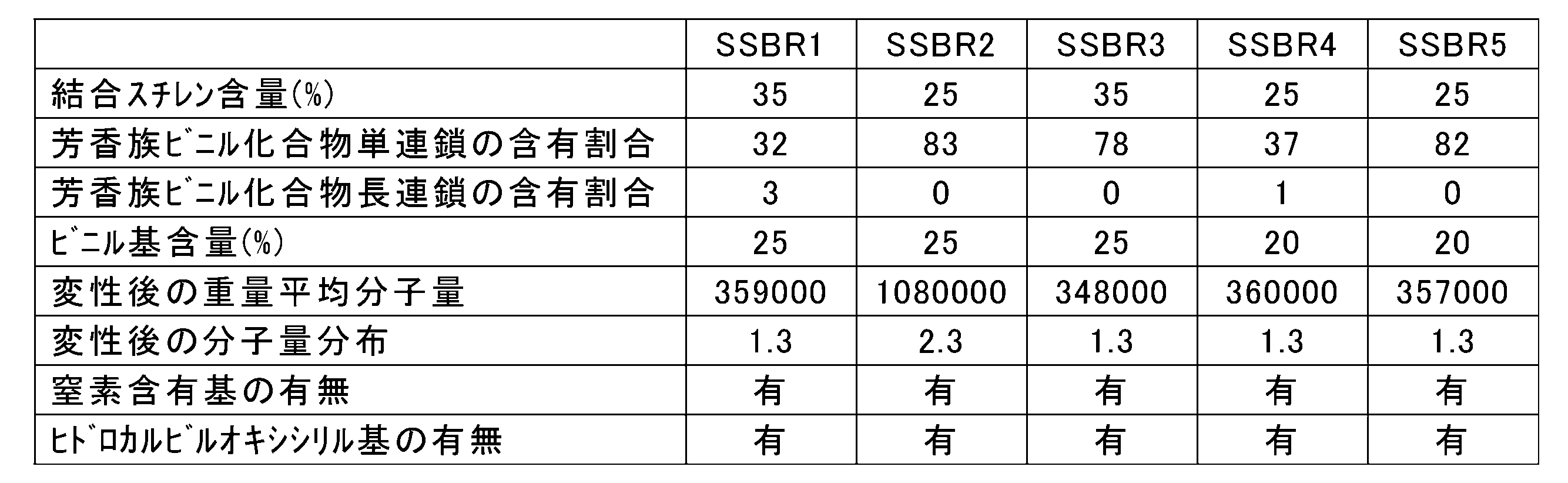
- Bound styrene content (%, equivalent to the content of structural units derived from aromatic vinyl compounds): Calculated by 500 MHz 1 H-NMR measurement using deuterated chloroform as a solvent.
- Content of short aromatic vinyl compound chains and (3) Content of long aromatic vinyl compound chains: According to the method of Tanaka et al. [Polymer, 22, 1721 (1981)], styrene-butadiene copolymer rubber was decomposed with ozone, and then measured under the following conditions using a gel permeation chromatography (GPC) device "Alliance HPLC" (manufactured by Waters Corporation).
- GPC gel permeation chromatography
- the molecular weight in terms of polystyrene was calculated from the retention time corresponding to the peak apex of the obtained GPC curve (for each peak when multiple peaks exist), and the number of styrene sequences corresponding to the peak was calculated.
- the content of short aromatic vinyl compound chains and the content of long aromatic vinyl compound chains were calculated from the area ratio of each peak.
- GPC conditions Column: 2 pieces of "GPC KF-801" (manufactured by Resonac) Column temperature: 40°C Mobile phase: Tetrahydrofuran Flow rate: 0.6 ml/min Sample concentration: 0.2 wt% (4) Vinyl group content (%): Calculated by 500 MHz 1 H-NMR measurement.
- Weight average molecular weight of polymer Measurement was carried out under the following conditions using a gel permeation chromatography (GPC) apparatus "HLC-8120GPC” (manufactured by Tosoh Corporation), and the weight average molecular weight (Mw) in terms of polystyrene was calculated from the retention time corresponding to the maximum peak apex of the obtained GPC curve.
- GPC conditions Column: Product name "GMHXL” (manufactured by Tosoh Corporation) x 2 Column temperature: 40°C Mobile phase: Tetrahydrofuran Flow rate: 1.0 ml/min Sample concentration: 10 mg/20 ml
- SSBR Styrene butadiene rubber
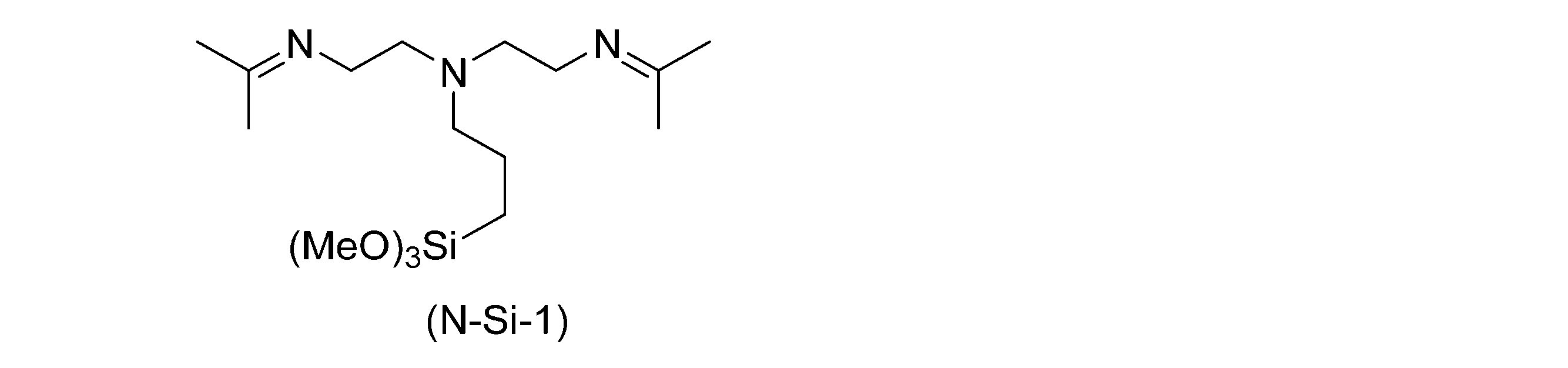
- the polymer solution was continuously discharged from the first reactor at a rate of 860 g/min, and the compound represented by the following formula (N-Si-1) was added to the discharged polymer solution at a rate of 115 mg/min, and the solution was continuously introduced into the second reactor to carry out a reaction.
- di-tert-butyl-p-cresol was added in an amount of 0.88 parts by mass relative to 100 parts by mass of the polymer.
- SSBR styrene butadiene rubber
- SSBR Styrene butadiene rubber
- SSBR styrene butadiene rubber
- SSBR Styrene butadiene rubber
- SSBR styrene butadiene rubber
- SSBR Styrene butadiene rubber
- Resin 1 (manufactured by ENEOS Corporation, product name: Neopolymer 150, unhydrogenated aromatic hydrocarbon resin, raw material: aromatic olefin-containing C9 fraction)
- Resin 2 (manufactured by ENEOS Corporation, product name: Neopolymer 140, unhydrogenated aromatic hydrocarbon resin, raw material: aromatic olefin-containing C9 fraction)
- Resin 3 (manufactured by ENEOS Corporation, product name: Neopolymer 130, unhydrogenated aromatic hydrocarbon resin, raw material: aromatic olefin-containing C9 fraction)
- Resin 4 (manufactured by ENEOS Corporation, product name: Neopolymer 120, unhydrogenated aromatic hydrocarbon resin, raw material: aromatic olefin-containing C9 fraction)
- Resin 5 (manufactured by ENEOS Corporation, product name: Neopolymer L90, unhydrogenated aromatic hydrocarbon resin, raw material: aromatic olefin
- the proton amount of each of the above resins was measured by the following measurement procedures 1 to 3. The measurement results are shown in Table 2. 1. 10 mg of resin and 5.5 mg of standard substance (dimethyl terephthalate) were dissolved in 1 g of deuterated chloroform to measure 1 H NMR. The standard substance was selected so that its peak did not overlap with the aromatic region of the resin. 2. The number of aromatic protons in the sample was quantified by the internal standard method. The sample contained about 2.5 ⁇ 10 ⁇ 5 mol of dimethyl terephthalate based on the amount of the sample.
- the amount of protons was calculated from the integral values of the olefin region of the resin at 4.5-6.0 ppm and the aromatic region at 6.0-7.5 ppm, assuming the integral value of the aromatic ring proton (4H) of the internal standard as 1.00.
- the influence of protons derived from the deuterated chloroform residue that overlaps with the aromatic region can be ignored by subtracting the value obtained by a blank measurement using a sample without resin in advance. 3.
- the number of aromatic protons contained in one molecule was calculated from the Mn of each resin calculated above.
- Example 1 The following components were kneaded using a 250 mL kneader (Labo Plastomill B250 manufactured by Toyo Seiki Seisakusho Co., Ltd.) to obtain a polymer composition.
- the kneading conditions were temperature control at 70° C., rotation speed at 50 rpm, and kneading time: mastication of rubber component for 0.5 minutes, kneading after addition of silica and additives for 1.5 minutes, and kneading for 2 minutes (rubber temperature during kneading was maintained at 150° C.).
- Example 2 A polymer composition was obtained in the same manner as in Example 1 except that 15.0 parts by mass of Resin 2 was added instead of Resin 1.
- Example 3 A polymer composition was obtained in the same manner as in Example 1 except that 15.0 parts by mass of Resin 3 was added instead of Resin 1.
- Example 4 A polymer composition was obtained in the same manner as in Example 1 except that 15.0 parts by mass of Resin 4 was added instead of Resin 1.
- Example 5 A polymer composition was obtained in the same manner as in Example 1 except that 15.0 parts by mass of Resin 5 was added instead of Resin 1.
- Example 6 A polymer composition was obtained in the same manner as in Example 1 except that 15.0 parts by mass of Resin 6 was added instead of Resin 1.
- Example 2 A polymer composition was obtained in the same manner as in Example 1, except that 15.0 parts by mass of Resin 8 (unhydrogenated petroleum resin, raw material: containing C5 fraction and C9 fraction, manufactured by Tosoh Corporation, product name: Petrotac 100V, number average molecular weight (Mn) 955) was added instead of Resin 1.
- Resin 8 unhydrogenated petroleum resin, raw material: containing C5 fraction and C9 fraction, manufactured by Tosoh Corporation, product name: Petrotac 100V, number average molecular weight (Mn) 955) was added instead of Resin 1.
- Example 3 A polymer composition was obtained in the same manner as in Example 1, except that 15.0 parts by mass of Resin 9 (a homo-oligomer of ⁇ -methylstyrene, manufactured by Cray Valley, product name: W-140, number average molecular weight (Mn) 1701) was added instead of Resin 1.
- Resin 9 a homo-oligomer of ⁇ -methylstyrene, manufactured by Cray Valley, product name: W-140, number average molecular weight (Mn) 1701
- Example 7 A polymer composition was obtained in the same manner as in Example 1 except that 15.0 parts by mass of Resin 7 was added instead of Resin 1.
- Example 8 A polymer composition was obtained in the same manner as in Example 7, except that 7 parts by mass of SSBR1, 40 parts by mass of SSBR2, and 53 parts by mass of SSBR3 were added as the styrene-butadiene rubber.
- Example 4 A polymer composition was obtained in the same manner as in Example 7, except that 40 parts by mass of SSBR2 and 60 parts by mass of SSBR3 were added as the styrene-butadiene rubber.
- Example 9 A polymer composition was obtained in the same manner as in Example 7, except that 40 parts by mass of SSBR2 and 60 parts by mass of SSBR4 were added as the styrene-butadiene rubber.
- Example 5 A polymer composition was obtained in the same manner as in Example 9, except that 40 parts by mass of SSBR2 and 60 parts by mass of SSBR5 were added as the styrene-butadiene rubber.
- Example 10 A polymer composition was obtained in the same manner as in Example 3, except that the amount of silica added was changed to 100 parts by mass, the amount of silane coupling agent added was changed to 8.0 parts by mass, and the amount of resin 3 added was changed to 40.0 parts by mass.
Landscapes
- Chemical & Material Sciences (AREA)
- Health & Medical Sciences (AREA)
- Chemical Kinetics & Catalysis (AREA)
- Medicinal Chemistry (AREA)
- Polymers & Plastics (AREA)
- Organic Chemistry (AREA)
- General Chemical & Material Sciences (AREA)
- Engineering & Computer Science (AREA)
- Mechanical Engineering (AREA)
- Oil, Petroleum & Natural Gas (AREA)
- Compositions Of Macromolecular Compounds (AREA)
- Addition Polymer Or Copolymer, Post-Treatments, Or Chemical Modifications (AREA)
Abstract
Description
[1] 共役ジエン系重合体(A-1)を含むゴム成分と、
芳香族オレフィンを含有するC9留分の原料成分重合体と、
を含む重合体組成物であって、
前記共役ジエン系重合体(A-1)が、共役ジエン化合物に由来する構造単位と芳香族ビニル化合物に由来する構造単位とを含み、
芳香族ビニル化合物に由来する構造単位の含有量が、共役ジエン化合物に由来する構造単位と芳香族ビニル化合物に由来する構造単位との合計量に対して、5質量%以上60質量%以下であり、
芳香族ビニル化合物に由来する構造単位の含有量に対して、芳香族ビニル化合物が連続していない芳香族ビニル化合物単連鎖が40質量%未満であり、かつ芳香族ビニル化合物単位が8個以上連なった芳香族ビニル化合物長連鎖が10質量%以下である、重合体組成物。
[2] 前記芳香族オレフィンを含有するC9留分が、ビニルトルエン、α-メチルスチレン、スチレン、インデン、およびメチルインデンからなる群から選択される少なくとも1種を含む、[1]に記載の重合体組成物。
[3] 前記原料成分重合体の1分子あたりのプロトン量が以下の条件:
0<芳香族プロトン量≦100
0≦オレフィンプロトン量≦45
を満たす、[1]または[2]に記載の重合体組成物。
[4] 前記原料成分重合体の数平均分子量(Mn)が300g/mol以上3000g/mol未満である、[1]~[3]のいずれかに記載の重合体組成物。
[5] 前記共役ジエン系重合体(A-1)の含有量が、前記ゴム成分全量の5質量%以上である、[1]~[4]のいずれかに記載の重合体組成物。
[6] 前記共役ジエン系重合体(A-1)が、窒素含有基とヒドロカルビルオキシシリル基とを有する、[1]~[5]のいずれかに記載の重合体組成物。
[7] 充填剤をさらに含む、[1]~[6]のいずれかに記載の重合体組成物。
[8] [1]~[7]のいずれかに記載の重合体組成物を用いて形成されたゴム製品。
[9] 前記ゴム製品が、タイヤ、タイヤトレッド、およびサイドウォールからなる群から選択される、[8]に記載のゴム製品。
本発明の重合体組成物は、ゴム成分と、原料成分重合体とを含み、充填剤、シランカップリング剤をさらに含んでもよい。本発明の重合体組成物を用いて製造したタイヤは、高グリップ性および高破壊強度を有するものである。以下、重合体組成物に含まれる各成分について詳述する。なお、本明細書において、重合体組成物に含まれる「ゴム成分」とは、熱硬化によりゴム弾性を示す硬化物を得ることが可能な重合体をいう。当該硬化物は、室温において小さな力で大きな変形(例えば、室温で伸ばすと2倍以上に伸びる変形)を起こし、力を取り除くと急速にほぼ元の形状に戻る性質を示す。
重合体組成物に用いるゴム成分は、少なくとも、共役ジエン系重合体(A-1)を含み、A-1以外の他のゴム成分(以下、単に「他のゴム成分」ともいう)をさらに含んでもよい。
共役ジエン系重合体(A-1)は、共役ジエン化合物に由来する構造単位と芳香族ビニル化合物に由来する構造単位とを含むものであり、かつ、下記の条件(1)、(2)を満たすものである。共役ジエン系重合体(A-1)が下記の条件(1)、(2)を満たすことで、高グリップ性および高破壊強度を有するタイヤを製造することができる。

(式(1)中、R1及びR2は、それぞれ独立してヒドロカルビル基である。iは1~3の整数である。iが1の場合、式中の複数のR2は同一又は異なる。iが2又は3の場合、式中の複数のR1は同一又は異なる。「*」は結合手であることを表す。)
共役ジエン系重合体(A-1)は、共役ジエン化合物と芳香族ビニル化合物とを共重合して得ることができる。さらに、共役ジエン系重合体(A-1)に、窒素含有基を有する化合物及びヒドロカルビルオキシシリル基を有する化合物を反応させるか、もしくは窒素含有基及びヒドロカルビルオキシシリル基を有する化合物を反応させることで、共役ジエン系重合体(A-1)に窒素含有基とヒドロカルビルオキシシリル基を導入することができる。これらの反応は特に限定されるものではないが、例えば、共役ジエン系重合体(A-1)は、以下の重合工程を含む方法により製造されることが好ましい。以下、本開示の態様に関連する事項について詳細に説明する。
本工程は、共役ジエン化合物及び芳香族ビニル化合物を含むモノマーを重合して、活性末端を有する共役ジエン系重合体を得る工程である。重合に使用する共役ジエン化合物としては、例えば1,3-ブタジエン、イソプレン、2,3-ジメチル-1,3-ブタジエン、2-クロロ-1,3-ブタジエン、および1,3-ペンタジエン等が挙げられる。これらの共役ジエン化合物は、1種単独でまたは2種以上を組み合わせて用いることができる。
共役ジエン系重合体(A-1)の製造方法は、前記重合工程に加えて、変性工程を含んでいてもよい。本工程では、上記重合工程で得られた共役ジエン系重合体が有する活性末端と、ヒドロカルビルオキシシリル基を有する化合物とを反応させる。こうした反応により、ヒドロカルビルオキシシリル基を有する共役ジエン系重合体を得ることができる。なお、本明細書において「活性末端」とは、分子鎖の端に存在する、炭素-金属結合を構成する部分(より具体的には炭素アニオン)を意味する。
他のゴム成分としては、上記の共役ジエン系重合体(A-1)の条件を満たさないものであれば、特に限定されない。他のゴム成分としては、例えば、ブタジエンゴム(BR、例えばシス-1,4結合が90%以上のハイシスBRなど)、乳化重合もしくは溶液重合スチレン-ブタジエンゴム(SBR)、スチレン-イソプレン-ブタジエンゴム、スチレン-イソプレンゴム、部分水添スチレン-ブタジエンゴム、スチレン-α-メチルスチレン-ブタジエンゴム、エチレン-プロピレン-ジエンゴム、天然ゴム(NR)、イソプレンゴム(IR)、イソプレン-ブタジエンゴム、およびハロゲン化イソプレンゴム、液状ゴム、エチレン-プロピレンゴム(EPM)、エチレン-プロピレン-ジエンゴム(EPDM)、シリコーンゴム等が挙げられる。
重合体組成物に用いる原料成分重合体は、芳香族オレフィンを含有するC9留分の原料成分重合体である。なお、本発明において、「原料成分重合体」とは、原料成分(芳香族オレフィンを含有するC9留分)を重合して得られる重合体である。このような原料成分重合体を用いることで、高グリップ性および高破壊強度を有するタイヤを製造することができる。
熱重合の反応温度は特に限定されず、例えば、好ましくは250℃以上300℃以下であり、より好ましくは260℃以上290℃以下である。
熱重合の反応時間は特に限定されず、例えば、好ましくは1時間以上10時間以下であり、より好ましくは2時間以上7時間以下であり、さらに好ましくは3時間以上5時間以下である。
原料成分重合体の数平均分子量(Mn)が上記数値範囲内であれば、ゴム成分との相溶性が良くなり、高グリップ性の指標となる粘弾性特性が良好となる。
なお、原料成分重合体の数平均分子量(Mn)は、従来公知のGPC(ゲルパーミエーションクロマトグラフィー)解析の方法によって測定することができる。本発明においては、後述の実施例に記載の方法により測定した値である。
0<芳香族プロトン量≦100
0≦オレフィンプロトン量≦45
を満たすことが好ましく、
0<芳香族プロトン量≦80
0≦オレフィンプロトン量≦20
を満たすことがより好ましく、
0<芳香族プロトン量≦60
0≦オレフィンプロトン量≦10
を満たすことがさらに好ましく、
0<芳香族プロトン量≦40
0≦オレフィンプロトン量≦5
を満たすことが特に好ましい。
原料成分重合体の1分子あたりのプロトン量が上記条件を満たせば、ゴム成分との相溶性が良くなり、高グリップ性の指標となる粘弾性特性が良好となる。
なお、原料成分重合体の1分子あたりのプロトン量は、従来公知の1H NMRによって測定することができる。本発明においては、後述の実施例に記載の方法により測定した値である。
水素化触媒は特に限定されず、例えば、ニッケル系触媒、モリブデン系触媒、コバルト系触媒、パラジウム系触媒、白金系触媒等が挙げられる。
水素添加の反応温度は特に限定されず、例えば、好ましくは150℃以上320℃であり、より好ましくは160℃以上300℃以下である。
水素添加の反応圧力は特に限定されず、例えば、好ましくは2MPa以上30MPa以下であり、より好ましくは3MPa以上25MPa以下である。
水素添加の反応時間は特に限定されず、例えば、好ましくは1時間以上10時間以下であり、より好ましくは2時間以上7時間以下であり、さらに好ましくは3時間以上5時間以下である。
重合体組成物には、原料成分重合体以外の他の樹脂がさらに含まれてもよい。他の樹脂としては、例えば、ロジン系樹脂、テルペン系樹脂、クマロン系樹脂、およびフェノール系樹脂等が挙げられる。
充填剤としては、シリカ、カーボンブラック、および下記式(2)で表される無機化合物(以下、「無機化合物(M)ともいう。」)、強化用繊維(例えば、ガラス繊維や炭素繊維等の無機系繊維、ナイロンやポリエステル等の有機系繊維)、及び硫酸バリウム等を挙げることができる。これらの中でもシリカ、カーボンブラック及び無機化合物(M)よりなる群から選択される少なくとも1種を用いることが好ましい。
nM1・mSiOk・iH2O …(2)
(式(2)中、M1は、アルミニウム、マグネシウム、チタン及びカルシウムのいずれかである特定金属、特定金属の酸化物、特定金属の水酸化物、特定金属の酸化物の水和物、及び特定金属の水酸化物の水和物よりなる群から選ばれる少なくとも1種である。nは1~5の整数であり、mは0~10の整数であり、kは2~5の整数であり、iは0~10の整数である。)
シリカとしては、特に限定されないが、例えば、乾式法シリカ、湿式法シリカ、コロイダルシリカ、および沈降シリカ等が挙げられる。これらの中でも、含水ケイ酸を主成分とする湿式法シリカが好ましい。これらのシリカは、1種単独でまたは2種以上を組み合わせて用いることができる。また、シリカのBET比表面積(ISO 5794/1に準拠して測定する)は、40~350m2/gの範囲が好ましく、80~300m2/gの範囲が更に好ましく、120~250m2/gの範囲が特に好ましい。BET比表面積がこの範囲であるシリカは、ゴム補強性と共役ジエン系重合体(A-1)中への分散性とを両立できる利点がある。このようなシリカとしては、東ソー・シリカ社製、商品名「ニプシルAQ」(BET比表面積=205m2/g)、「ニプシルKQ」、デグッサ社製、商品名「ウルトラジルVN3」(BET比表面積=175m2/g)等の市販品を用いることができる。
カーボンブラックとしては、特に限定されるものではなく、例えば、GPF、FEF、HAF、ISAF、SAFグレードのカーボンブラックが挙げられる。上記カーボンブラックの窒素吸着比表面積(N2SA)は、特に限定されないが、本開示の効果等がより優れることから、50~200m2/gが好ましく、70~150m2/gがより好ましい。窒素吸着比表面積(N2SA)は、カーボンブラック表面への窒素吸着量をJIS K6217-2:2001「第2部:比表面積の求め方-窒素吸着法-単点法」にしたがって測定した値である。カーボンブラックは、1種単独で使用してもよいし、2種以上を併用してもよい。カーボンブラックの配合量は、ゴム成分100質量部に対して1~150質量部の範囲が好ましく、5~120質量部の範囲が更に好ましい。
無機化合物(M)の具体例としては、特定金属がアルミニウムである化合物として、例えば酸化アルミニウム、アルミナ一水和物、水酸化アルミニウム、炭酸アルミニウム、ケイ酸アルミニウム、酸化アルミニウムカルシウム(Al2O3・CaO・2SiO4等)等を;特定金属がマグネシウムである化合物として、例えば酸化マグネシウム、水酸化マグネシウム、炭酸マグネシウム、ケイ酸マグネシウム、ケイ酸マグネシウムカルシウム(CaMgSiO4)、タルク等を;特定金属がチタンである化合物として、例えば酸化チタン等を;特定金属がカルシウムである化合物として、例えば酸化カルシウム、水酸化カルシウム、炭酸カルシウム、ケイ酸カルシウム等を、それぞれ挙げることができる。
シリカを配合する場合には、シランカップリング剤を配合することが好ましい。シランカップリング剤としては、公知のシランカップリング剤を用いることができる。例えば、ビス[3-(トリエトキシシリル)プロピル]テトラスルフィド、ビス[3-(トリエトキシシリル)プロピル]ジスルフィド、3-[エトキシビス(3,6,9,12,15-ペンタオキサオクタコサン-1-イルオキシ)シリル]-1-プロパンチオール、3-メルカプトプロピルトリメトキシシラン、3-オクタノイルチオ-1-プロピルトリエトキシシラン)およびその単独縮合物もしくは3-メルカプトプロピルトリエトキシシランとの共縮合物が挙げられる。ビス[3-(トリエトキシシリル)プロピル]テトラスルフィドは、市販されているものを使用してもよく、例えば、エボニック社製のSi-69が挙げられる。また、ビス[3-(トリエトキシシリル)プロピル]ジスルフィドについても、市販されているものを使用してもよく、例えば、エボニック社製のSi-75が挙げられる。また、3-[エトキシビス(3,6,9,12,15-ペンタオキサオクタコサン-1-イルオキシ)シリル]-1-プロパンチオールについても、市販されているものを使用してもよく、例えば、エボニック社製のSi-363が挙げられる。また、3-メルカプトプロピルトリメトキシシランは、市販されているものを使用してもよく、例えば、信越化学工業社製のKBM803が挙げられる。また、3-オクタノイルチオ-1-プロピルトリエトキシシランは、市販されているものを使用してもよく、例えば、モメンティブ社製のNXT-シランが挙げられる。また、3-オクタノイルチオ-1-プロピルトリエトキシシランの縮合物は、市販されているものを使用してもよく、例えば、モメンティブ社製のNXT-Z45シランが挙げられる。これらのシランカップリング剤は、1種単独でまたは2種以上を組み合わせて用いることができる。シランカップリング剤の含有量は、シリカ100質量部に対して、好ましくは1質量部以上30質量部以下が好ましく、2質量部以上20質量部以下がより好ましい。
本発明の重合体組成物は、その機能を損なわない範囲で、加硫剤、加硫促進剤、加硫促進助剤、老化防止剤、軟化剤、酸化防止剤、及び着色剤等のその他の添加剤を含んでいてもよい。
本発明の重合体組成物の製造方法は、少なくとも上記のゴム成分と上記の原料成分重合体とを混練する工程を含んでなる。重合体組成物の製造方法は、好ましくは、さらに上記の加硫剤を混練する工程を含んでなるものであってもよい。より好ましくは、さらに該加硫剤と上記の加硫促進剤を混練する工程を含んでなるものであってもよい。
本発明の重合体組成物を用いて、従来公知の方法および当業者に広く知られた技術常識によりゴム製品を製造することができる。ゴム製品としては、タイヤ、タイヤ以外の自動車用ゴム部品(外装、内装、ウェザーストリップ類、ブーツ類、マウント類、シール類、シーラー類、ガスケット類)、ホース、ベルト、シート、防振ゴム、ローラー、ライニング、ゴム引布、シール材、手袋、防舷材、医療用ゴム(シリンジガスケット、チューブ、カテーテル)、ガスケット(家電用、建築用)、アスファルト改質剤、グリップ類、玩具、靴、サンダル、キーパッド、ギア、ペットボトルキャプライナー等が挙げられる。これらの中でも、タイヤが好ましい。
例えば、重合体組成物を押し出し、次いで、タイヤ成型機を用いて成形した後、加硫機を用いて加熱、加圧することにより架橋が形成され、タイヤを製造することができる。タイヤの形状、構造、大きさ及び材質としては、特に制限はなく、目的に応じて適宜選択することができる。また、タイヤの用途としては、特に制限はなく、例えば、乗用車用タイヤ、重荷重用タイヤ、モーターサイクル(自動二輪車)用タイヤ、およびスタッドレスタイヤ等が挙げられる。本発明の重合体組成物を用いて製造したタイヤは高グリップ性および高破壊強度を有する。
(2)芳香族ビニル化合物短連鎖の含有割合:及び(3)芳香族ビニル化合物長連鎖の含有割合:田中らの方法〔Polymer,22,1721(1981)〕にしたがって、スチレンブタジエン共重合ゴムをオゾンによって分解した後、下記の条件にて、ゲルパーミエーションクロマトグラフィー(GPC)装置「Alliance HPLC」(ウォータース社製)によって測定を行い、得られたGPC曲線のピーク頂点(ピークが複数存在する場合は、各々のピークに対して)に相当する保持時間からポリスチレン換算の分子量を求め、ピークに対応するスチレン連鎖数を求めた。また各ピークの面積比から、芳香族ビニル化合物短連鎖の含有割合及び芳香族ビニル化合物長連鎖の含有割合を算出した。
(GPC条件)
・カラム:商品名「GPC KF―801」(レゾナック社製)2本
・カラム温度:40℃
・移動相:テトラヒドロフラン
・流速:0.6ml/分
・サンプル濃度:0.2wt%
(4)ビニル基含量(%):500MHzの1H-NMR測定によって算出した。
(5)重合体の重量平均分子量:下記の条件にて、ゲルパーミエーションクロマトグラフィー(GPC)装置「HLC-8120GPC」(東ソー株式会社製)によって測定を行い、得られたGPC曲線の最大ピーク頂点に相当する保持時間から、ポリスチレン換算の重量平均分子量(Mw)を求めた。
(GPC条件)
・カラム:商品名「GMHXL」(東ソー社製)2本
・カラム温度:40℃
・移動相:テトラヒドロフラン
・流速:1.0ml/分
・サンプル濃度:10mg/20ml
(スチレンブタジエンゴム(SSBR)1)
窒素置換された内容積5リットルのオートクレーブ反応器に、シクロヘキサン2000g、ビニル含量調整剤としてテトラヒドロフラン2.5mL、カリウム化合物として4-ドデシルベンゼンスルホン酸カリウム0.08mmol、並びに、重合モノマーとしてスチレン175g及び1,3-ブタジエン150gを仕込んだ。反応器の内容物の温度を35℃に調整した後、重合開始剤としてn-ブチルリチウム3.7mmolを添加して重合を開始した。重合転化率が20%に達した時点で(内容物の温度が45℃に達した時点に相当)、1,3-ブタジエン(追加分)175gを25分間かけて一定の供給速度で反応器内に添加した。重合は断熱条件で実施し、最高温度は85℃に達した。
重合転化率が99%に達した時点で(重合開始から35分経過後に)、末端変性剤として3-(N,N-ビストリメチルシリル)アミノプロピルメチルジエトキシシラン3.7mmolを添加し、10分間撹拌した。撹拌後の重合体溶液に、老化防止剤として2,6-ジ-tert-ブチル-p-クレゾールを4.40g添加した後、スチームストリッピングにより脱溶媒を行い、130℃に調温された熱ロールにより乾燥を行うことにより変性共役ジエン系重合体(以下、単に「スチレンブタジエンゴム(SSBR)1」ともいう)を得た。
窒素置換された内容積50リットルのオートクレーブ反応器(1基目の反応器)に、モノマーとして1,3-ブタジエンを83g/分、スチレンを28g/分、溶媒としてシクロヘキサンを745g/分、ビニル基含量調整剤(ランダマイザー)としてテトラヒドロフランを1.2g/分、重合開始剤としてn-ブチルリチウムを55mg/分の速度で連続的にチャージし、反応器内の温度を75℃でコントロールした。
1基目の反応器から重合体溶液を860g/分の速度で連続的にデスチャージし、デスチャージした重合体溶液に、下記式(N-Si-1)で示す化合物を115mg/分の速度で添加し、2基目の反応器に連続的に導入し反応を行った。2基目の反応器の出口にて、ジ-tert-ブチル-p-クレゾールを、ポリマー100質量部に対して0.88質量部になるよう添加した。このようにして製造した重合体溶液をスチームストリッピングにより脱溶媒を行い、130℃に調温された熱ロールにより乾燥を行うことにより変性共役ジエン系重合体(以下、単に「スチレンブタジエンゴム(SSBR)2」ともいう)を得た。
窒素置換された内容積5リットルのオートクレーブ反応器に、シクロヘキサン2000g、ビニル含量調整剤としてテトラヒドロフラン5.6mL、並びに、重合モノマーとしてスチレン175g及び1,3-ブタジエン150gを仕込んだ。反応器の内容物の温度を45℃に調整した後、重合開始剤としてn-ブチルリチウム3.7mmolを添加して重合を開始した。重合転化率が20%に達した時点で(内容物の温度が60℃に達した時点に相当)、1,3-ブタジエン(追加分)175gを25分間かけて一定の供給速度で反応器内に添加した。重合は断熱条件で実施し、最高温度は85℃に達した。
重合転化率が99%に達した時点で(重合開始から35分経過後に)、末端変性剤として3-(N,N-ビストリメチルシリル)アミノプロピルメチルジエトキシシラン3.7mmolを添加し、10分間撹拌した。撹拌後の重合体溶液に、老化防止剤として2,6-ジ-tert-ブチル-p-クレゾールを4.40g添加した後、スチームストリッピングにより脱溶媒を行い、130℃に調温された熱ロールにより乾燥を行うことにより変性共役ジエン系重合体(以下、単に「スチレンブタジエンゴム(SSBR)3」ともいう)を得た。
窒素置換された内容積5リットルのオートクレーブ反応器に、シクロヘキサン2000g、ビニル含量調整剤として2,2―ジ(2-テトラヒドロフリル)プロパン0.23mmol、カリウム化合物として4-ドデシルベンゼンスルホン酸カリウム0.15mmol、並びに、重合モノマーとしてスチレン125g及び1,3-ブタジエン200gを仕込んだ。反応器の内容物の温度を40℃に調整した後、重合開始剤としてn-ブチルリチウム3.7mmolを添加して重合を開始した。重合転化率が20%に達した時点で(内容物の温度が50℃に達した時点に相当)、1,3-ブタジエン(追加分)175gを25分間かけて一定の供給速度で反応器内に添加した。重合は断熱条件で実施し、最高温度は85℃に達した。重合転化率が99%に達した時点で(重合開始から35分経過後に)、末端変性剤として3-(N,N-ビストリメチルシリル)アミノプロピルメチルジエトキシシラン3.7mmolを添加し、10分間撹拌した。撹拌後の重合体溶液に、老化防止剤として2,6-ジ-tert-ブチル-p-クレゾールを4.40g添加した後、スチームストリッピングにより脱溶媒を行い、130℃に調温された熱ロールにより乾燥を行うことにより変性共役ジエン系重合体(以下、単に「スチレンブタジエンゴム(SSBR)4」ともいう)を得た。
窒素置換された内容積5リットルのオートクレーブ反応器に、シクロヘキサン2000g、ビニル含量調整剤としてテトラヒドロフラン1.5mL、並びに、重合モノマーとしてスチレン100g及び1,3-ブタジエン180gを仕込んだ。反応器の内容物の温度を75℃に調整した後、重合開始剤としてn-ブチルリチウム3.0mmolを添加して重合を開始した。重合転化率が20%に達した時点で(反応開始後5分に達した時点に相当)、1,3-ブタジエン(追加分)120gを30分間かけて一定の供給速度で反応器内に添加した。重合は等温条件で実施し、最高温度は85℃に達した。
重合転化率が99%に達した時点で(重合開始から35分経過後に)、末端変性剤として3-(N,N-ビストリメチルシリル)アミノプロピルメチルジエトキシシラン3.0mmolを添加し、10分間撹拌した。撹拌後の重合体溶液に、老化防止剤として2,6-ジ-tert-ブチル-p-クレゾールを3.52g添加した後、スチームストリッピングにより脱溶媒を行い、130℃に調温された熱ロールにより乾燥を行うことにより変性共役ジエン系重合体(以下、単に「スチレンブタジエンゴム(SSBR)5」ともいう)を得た。
以下の樹脂1~7を準備した。
・樹脂1(ENEOS社製、商品名:ネオポリマー150、未水添芳香族炭化水素樹脂、原料:芳香族オレフィン含有C9留分)
・樹脂2(ENEOS社製、商品名:ネオポリマー140、未水添芳香族炭化水素樹脂、原料:芳香族オレフィン含有C9留分)
・樹脂3(ENEOS社製、商品名:ネオポリマー130、未水添芳香族炭化水素樹脂、原料:芳香族オレフィン含有C9留分)
・樹脂4(ENEOS社製、商品名:ネオポリマー120、未水添芳香族炭化水素樹脂、原料:芳香族オレフィン含有C9留分)
・樹脂5(ENEOS社製、商品名:ネオポリマーL90、未水添芳香族炭化水素樹脂、原料:芳香族オレフィン含有C9留分)
・樹脂6(ENEOS社製、商品名:ネオポリマーPremium130S、未水添芳香族炭化水素樹脂、原料:芳香族オレフィン含有C9留分)
・樹脂7(ENEOS社製、商品名:ネオポリマーPremiumS100、未水添芳香族炭化水素樹脂、原料:芳香族オレフィン含有C9留分)
(数平均分子量(Mn)の測定)
上記の各樹脂を10g/Lの濃度となるようテトロヒドロフランに溶解させてサンプルとし、測定には東ソー社製HLC-8320GPC(使用カラム:TSKgel SuperHZカラムシリーズ)を用いた。得られたRI曲線からAgilent社製ポリスチレンキット(EasiVial PS-MおよびPS-L)によって予め作成した検量線にて数平均分子量Mnを算出した。算出結果を表2に示した。
上記の各樹脂について、以下の測定手順1~3によりプロトン量を測定した。測定結果を表2に示した。
1.樹脂10mg、標準物質(テレフタル酸ジメチル)5.5mgを1gの重クロロホルムに溶かしたサンプルの1H NMRを測定した。なお、標準物質は樹脂の芳香族領域とピークが被らないものを選定した。
2.内部標準法によりサンプル中の芳香族プロトン個数を定量した。仕込み量よりサンプル中には2.5×10⁻⁵mol程度のテレフタル酸ジメチルが含まれており、内部標準の芳香環プロトン(4H)の積分値を1.00とした時の、樹脂のオレフィン領域4.5-6.0ppm、芳香族領域6.0-7.5ppmの積分値から対応するプロトン量を算出した。また、芳香族領域と重なる重クロロホルム残留分由来のプロトンについては、あらかじめ樹脂無しサンプルでブランク測定した値を差し引くことで影響を無視することができる。
3.上記で算出された各樹脂のMnから、1分子に含まれる芳香族プロトン数を算出した。

[実施例1]
以下の各成分を、250mLニーダー(東洋精機社製ラボプラストミルB250)を用いて混練し、重合体組成物を得た。混練条件は、温調70℃、回転数50rpm、混練時間:ゴム成分の素練り0.5分→シリカおよび添加剤の添加後の混練1.5分→混練2分(混練時のゴム温度は150℃で保持)であった。
・SSBR1 60質量部
・SSBR2 40質量部
・シリカ(Solvay製、商品名:1165MP) 70質量部
・カーボンブラック(東海カーボン社製、商品名:シーストKH)
5.60質量部
・酸化亜鉛3号(東邦亜鉛社製、商品名:銀嶺R) 3質量部
・ステアリン酸(新日本理化製、 商品名:ステアリン酸300)2質量部
・老化防止剤(大内新興化学社製、商品名:ノクラック6C) 1質量部
・シランカップリング剤(Evonik社製、商品名:Si75)
5.60質量部
・樹脂1 15.0質量部
・硫黄(細井化学社製、商品名:オイル硫黄325メッシュ(5%))
1.20質量部
・加硫促進剤1(大内新興化学社製、商品名:ノクセラーCZ)
1.44質量部
・加硫促進剤2(大内新興化学社製、商品名:ノクセラーD)
1.20質量部
樹脂1の代わりに樹脂2を15.0質量部添加した以外は実施例1と同様にして、重合体組成物を得た。
樹脂1の代わりに樹脂3を15.0質量部添加した以外は実施例1と同様にして、重合体組成物を得た。
樹脂1の代わりに樹脂4を15.0質量部添加した以外は実施例1と同様にして、重合体組成物を得た。
樹脂1の代わりに樹脂5を15.0質量部添加した以外は実施例1と同様にして、重合体組成物を得た。
樹脂1の代わりに樹脂6を15.0質量部添加した以外は実施例1と同様にして、重合体組成物を得た。
樹脂1の代わりにアロマオイル(T-DAE、ENEOS社製)を15.0質量部添加した以外は実施例1と同様にして、重合体組成物を得た。
樹脂1の代わりに樹脂8(未水添石油樹脂、原料:C5留分・C9留分含有、東ソー社製、商品名:ペトロタック100V、数平均分子量(Mn)955)を15.0質量部添加した以外は、実施例1と同様にして、重合体組成物を得た。
樹脂1の代わりに樹脂9(α-メチルスチレンのホモオリゴマー、Cray Valley社製、商品名:W-140、数平均分子量(Mn)1701)を15.0質量部添加した以外は実施例1と同様にして、重合体組成物を得た。
(粘弾性)
上記で得られた各重合体組成物を用いて、金型(ダンベル社製、型番:MP-124NJ)を用いて、160℃および20MPaの条件で30分間加熱加圧して、ゴムシート(厚さ2mm、縦150mm、横150mm)を得た。
続いて、得られたゴムシートについて、粘弾性測定装置(UBM社製Rheogel E-4000)を用いて、JIS K6394に準拠して、歪み20μm(約0.1%)、周波数10Hzの条件下で、測定温度0℃におけるtanδを求めた。測定結果を表3に示した。tanδ(0℃)の値は数値が大きい程、グリップ性に優れることを示す。なお、tanδの各結果について、実施例1~6および比較例1、3は、比較例2の値を100とした場合の相対値として記載した。
上記の粘弾性の試験と同様にしてゴムシートを得た。得られたゴムシートから3号ダンベル状の試験片を打ち抜き、JIS K6251(2010年発行)に準拠して、温度25℃、引張速度500mm/分の条件で破断強度(MPa)および破断伸び(%)を測定した。これらの測定結果から、抗張積(=破断強度×破断伸び)を算出した。算出結果を表3に示した。抗張積が高い方が、破壊強度に優れることを示す。なお、抗張積の各結果について、実施例1~6および比較例1、3は、比較例2の値を100とした場合の相対値として記載した。
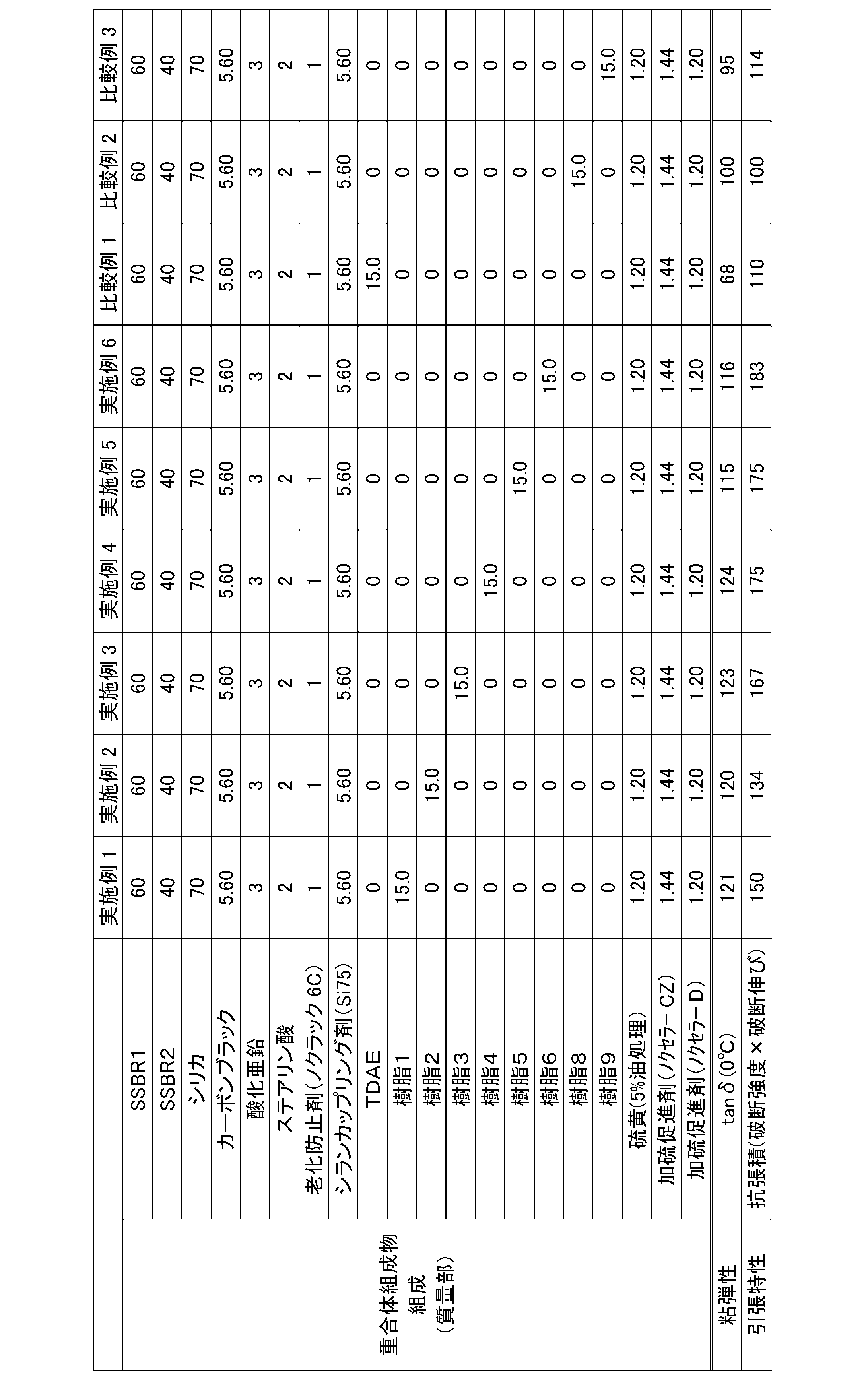
[実施例7]
樹脂1の代わりに樹脂7を15.0質量部添加した以外は実施例1と同様にして、重合体組成物を得た。
スチレンブタジエンゴムとしてSSBR1を7質量部、SSBR2を40質量部、SSBR3を53質量部添加した以外は実施例7と同様にして、重合体組成物を得た。
スチレンブタジエンゴムとしてSSBR2を40質量部、SSBR3を60質量部添加した以外は実施例7と同様にして、重合体組成物を得た。
(粘弾性)
試験例1と同様にして、各重合体組成物を用いてゴムシートを得た。続いて、得られたゴムシートについて、測定温度0℃におけるtanδを求めた。測定結果を表4に示した。なお、tanδの各結果について、実施例7および8は、比較例4の値を100とした場合の相対値として記載した。
上記の粘弾性の試験と同様にしてゴムシートを得た。続いて、得られたゴムシートを用いて、試験例1と同様にして、破断強度(MPa)および破断伸び(%)を測定した。これらの測定結果から、抗張積(=破断強度×破断伸び)を算出した。算出結果を表4に示した。なお、抗張積の各結果について、実施例7および8は、比較例4の値を100とした場合の相対値として記載した。

[実施例9]
スチレンブタジエンゴムとしてSSBR2を40質量部、SSBR4を60質量部添加した以外は実施例7と同様にして、重合体組成物を得た。
スチレンブタジエンゴムとしてSSBR2を40質量部、SSBR5を60質量部添加した以外は実施例9と同様にして、重合体組成物を得た。
(粘弾性)
試験例1と同様にして、各重合体組成物を用いてゴムシートを得た。続いて、得られたゴムシートについて、測定温度0℃におけるtanδを求めた。測定結果を表5に示した。なお、tanδの各結果について、実施例9は、比較例5の値を100とした場合の相対値として記載した。
上記の粘弾性の試験と同様にしてゴムシートを得た。続いて、得られたゴムシートを用いて、試験例1と同様にして、破断強度(MPa)および破断伸び(%)を測定した。これらの測定結果から、抗張積(=破断強度×破断伸び)を算出した。算出結果を表5に示した。なお、抗張積の各結果について、実施例9は、比較例5の値を100とした場合の相対値として記載した。
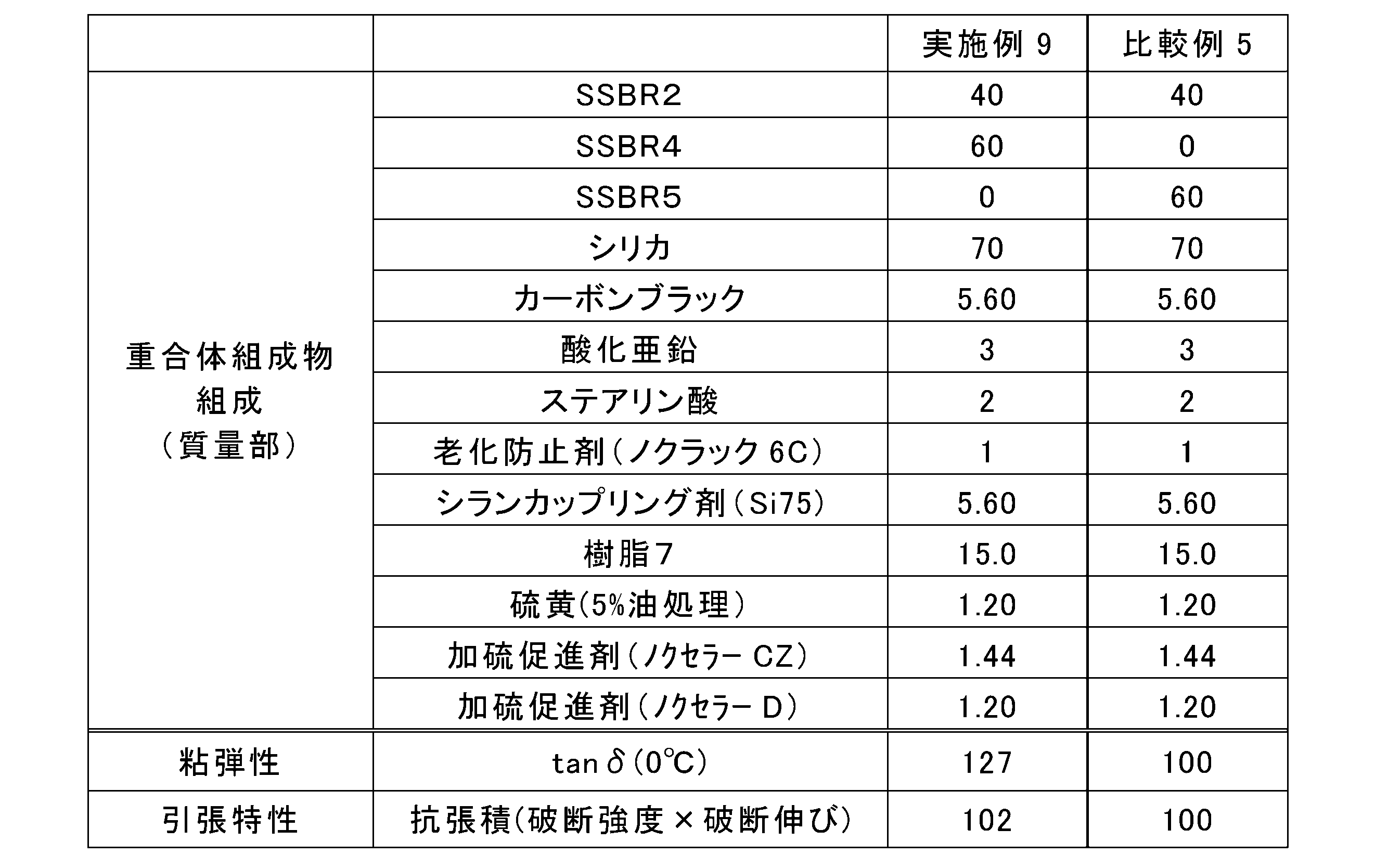
[実施例10]
シリカの添加量を100質量部に変更し、シランカップリング剤の添加量を8.0質量部に変更し、樹脂3の添加量を40.0質量部に変更した以外は実施例3と同様にして、重合体組成物を得た。
樹脂3の代わりに樹脂10を40.0質量部添加した以外は実施例10と同様にして、重合体組成物を得た。
(粘弾性)
試験例1と同様にして、各重合体組成物を用いてゴムシートを得た。続いて、得られたゴムシートについて、測定温度0℃におけるtanδを求めた。測定結果を表6に示した。なお、tanδの各結果について、実施例10は、比較例6の値を100とした場合の相対値として記載した。
上記の粘弾性の試験と同様にしてゴムシートを得た。続いて、得られたゴムシートを用いて、試験例1と同様にして、破断強度(MPa)および破断伸び(%)を測定した。これらの測定結果から、抗張積(=破断強度×破断伸び)を算出した。算出結果を表6に示した。なお、抗張積の各結果について、実施例10は、比較例6の値を100とした場合の相対値として記載した。
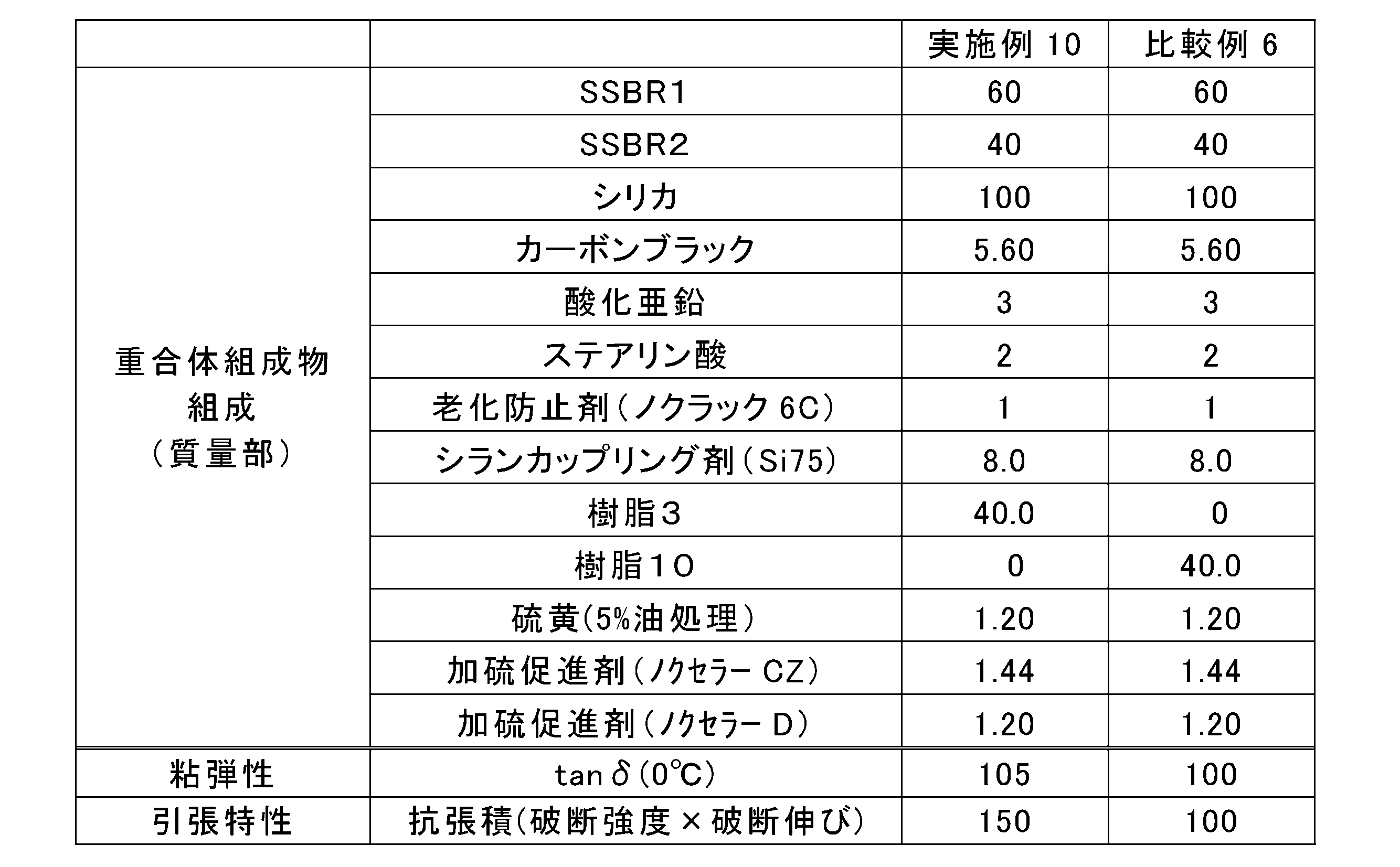
Claims (9)
- 共役ジエン系重合体(A-1)を含むゴム成分と、
芳香族オレフィンを含有するC9留分の原料成分重合体と、
を含む重合体組成物であって、
前記共役ジエン系重合体(A-1)が、共役ジエン化合物に由来する構造単位と芳香族ビニル化合物に由来する構造単位とを含み、
芳香族ビニル化合物に由来する構造単位の含有量が、共役ジエン化合物に由来する構造単位と芳香族ビニル化合物に由来する構造単位との合計量に対して、5質量%以上60質量%以下であり、
芳香族ビニル化合物に由来する構造単位の含有量に対して、芳香族ビニル化合物が連続していない芳香族ビニル化合物単連鎖が40質量%未満であり、かつ芳香族ビニル化合物単位が8個以上連なった芳香族ビニル化合物長連鎖が10質量%以下である、重合体組成物。 - 前記芳香族オレフィンを含有するC9留分が、ビニルトルエン、α-メチルスチレン、スチレン、インデン、およびメチルインデンからなる群から選択される少なくとも1種を含む、請求項1に記載の重合体組成物。
- 前記原料成分重合体の1分子あたりのプロトン量が以下の条件:
0<芳香族プロトン量≦100
0≦オレフィンプロトン量≦45
を満たす、請求項1に記載の重合体組成物。 - 前記原料成分重合体の数平均分子量(Mn)が300g/mol以上3000g/mol未満である、請求項1に記載の重合体組成物。
- 前記共役ジエン系重合体(A-1)の含有量が、前記ゴム成分全量の5質量%以上である、請求項1に記載の重合体組成物。
- 前記共役ジエン系重合体(A-1)が、窒素含有基とヒドロカルビルオキシシリル基とを有する、請求項1に記載の重合体組成物。
- 充填剤をさらに含む、請求項1に記載の重合体組成物。
- 請求項1~7のいずれか一項に記載の重合体組成物を用いて形成されたゴム製品。
- 前記ゴム製品が、タイヤ、タイヤトレッド、およびサイドウォールからなる群から選択される、請求項8に記載のゴム製品。
Priority Applications (4)
| Application Number | Priority Date | Filing Date | Title |
|---|---|---|---|
| CN202480021959.5A CN120917091A (zh) | 2023-03-28 | 2024-03-21 | 聚合物组合物和橡胶制品 |
| KR1020257035766A KR20250162898A (ko) | 2023-03-28 | 2024-03-21 | 중합체 조성물 및 고무 제품 |
| EP24779886.1A EP4692202A1 (en) | 2023-03-28 | 2024-03-21 | Polymer composition and rubber product |
| JP2025510673A JPWO2024203767A1 (ja) | 2023-03-28 | 2024-03-21 |
Applications Claiming Priority (2)
| Application Number | Priority Date | Filing Date | Title |
|---|---|---|---|
| JP2023-052398 | 2023-03-28 | ||
| JP2023052398 | 2023-03-28 |
Publications (1)
| Publication Number | Publication Date |
|---|---|
| WO2024203767A1 true WO2024203767A1 (ja) | 2024-10-03 |
Family
ID=92906195
Family Applications (1)
| Application Number | Title | Priority Date | Filing Date |
|---|---|---|---|
| PCT/JP2024/011139 Ceased WO2024203767A1 (ja) | 2023-03-28 | 2024-03-21 | 重合体組成物およびゴム製品 |
Country Status (5)
| Country | Link |
|---|---|
| EP (1) | EP4692202A1 (ja) |
| JP (1) | JPWO2024203767A1 (ja) |
| KR (1) | KR20250162898A (ja) |
| CN (1) | CN120917091A (ja) |
| WO (1) | WO2024203767A1 (ja) |
Citations (8)
| Publication number | Priority date | Publication date | Assignee | Title |
|---|---|---|---|---|
| JP2009108193A (ja) * | 2007-10-30 | 2009-05-21 | Tosoh Corp | ゴム組成物 |
| JP2011140613A (ja) | 2009-12-09 | 2011-07-21 | Sumitomo Rubber Ind Ltd | タイヤ用ゴム組成物及び空気入りタイヤ |
| JP2018536044A (ja) | 2015-10-16 | 2018-12-06 | コンパニー ゼネラール デ エタブリッスマン ミシュラン | 炭化水素樹脂を含むゴム組成物 |
| JP2018193567A (ja) | 2014-09-17 | 2018-12-06 | エクソンモービル ケミカル パテンツ インコーポレイテッド | 高ガラス転移温度の炭化水素樹脂を含むタイヤ用のエラストマーブレンド |
| WO2019207925A1 (ja) * | 2018-04-24 | 2019-10-31 | Jxtgエネルギー株式会社 | ゴム用添加剤、未架橋ゴム組成物、架橋ゴム及びタイヤ |
| JP2020033549A (ja) * | 2018-08-28 | 2020-03-05 | 旭化成株式会社 | 変性共役ジエン系重合体組成物、ゴム組成物、及びゴム組成物の製造方法 |
| JP2022066144A (ja) * | 2020-10-16 | 2022-04-28 | 旭化成株式会社 | 架橋用ゴム組成物、架橋ゴムの製造方法、及びタイヤ用トレッド |
| WO2022255314A1 (ja) * | 2021-06-01 | 2022-12-08 | Eneos株式会社 | 石油樹脂、ゴム用添加剤、未架橋ゴム組成物及び架橋ゴム |
-
2024
- 2024-03-21 KR KR1020257035766A patent/KR20250162898A/ko active Pending
- 2024-03-21 CN CN202480021959.5A patent/CN120917091A/zh active Pending
- 2024-03-21 JP JP2025510673A patent/JPWO2024203767A1/ja active Pending
- 2024-03-21 WO PCT/JP2024/011139 patent/WO2024203767A1/ja not_active Ceased
- 2024-03-21 EP EP24779886.1A patent/EP4692202A1/en active Pending
Patent Citations (8)
| Publication number | Priority date | Publication date | Assignee | Title |
|---|---|---|---|---|
| JP2009108193A (ja) * | 2007-10-30 | 2009-05-21 | Tosoh Corp | ゴム組成物 |
| JP2011140613A (ja) | 2009-12-09 | 2011-07-21 | Sumitomo Rubber Ind Ltd | タイヤ用ゴム組成物及び空気入りタイヤ |
| JP2018193567A (ja) | 2014-09-17 | 2018-12-06 | エクソンモービル ケミカル パテンツ インコーポレイテッド | 高ガラス転移温度の炭化水素樹脂を含むタイヤ用のエラストマーブレンド |
| JP2018536044A (ja) | 2015-10-16 | 2018-12-06 | コンパニー ゼネラール デ エタブリッスマン ミシュラン | 炭化水素樹脂を含むゴム組成物 |
| WO2019207925A1 (ja) * | 2018-04-24 | 2019-10-31 | Jxtgエネルギー株式会社 | ゴム用添加剤、未架橋ゴム組成物、架橋ゴム及びタイヤ |
| JP2020033549A (ja) * | 2018-08-28 | 2020-03-05 | 旭化成株式会社 | 変性共役ジエン系重合体組成物、ゴム組成物、及びゴム組成物の製造方法 |
| JP2022066144A (ja) * | 2020-10-16 | 2022-04-28 | 旭化成株式会社 | 架橋用ゴム組成物、架橋ゴムの製造方法、及びタイヤ用トレッド |
| WO2022255314A1 (ja) * | 2021-06-01 | 2022-12-08 | Eneos株式会社 | 石油樹脂、ゴム用添加剤、未架橋ゴム組成物及び架橋ゴム |
Non-Patent Citations (2)
| Title |
|---|
| See also references of EP4692202A1 |
| TANAKA ET AL., POLYMER, vol. 22, 1981, pages 1721 |
Also Published As
| Publication number | Publication date |
|---|---|
| KR20250162898A (ko) | 2025-11-19 |
| CN120917091A (zh) | 2025-11-07 |
| EP4692202A1 (en) | 2026-02-11 |
| JPWO2024203767A1 (ja) | 2024-10-03 |
Similar Documents
| Publication | Publication Date | Title |
|---|---|---|
| JP6631254B2 (ja) | 空気入りタイヤ | |
| JP6627513B2 (ja) | 空気入りタイヤ | |
| JP6627294B2 (ja) | 空気入りタイヤ | |
| US12187894B2 (en) | Rubber composition and pneumatic tire | |
| JP5265202B2 (ja) | ゴム組成物及びそれを用いた空気入りタイヤ | |
| JP7224150B2 (ja) | ゴム組成物及び空気入りタイヤ | |
| JP4092557B2 (ja) | 共役ジオレフィン共重合ゴム、該共重合ゴムの製造方法、ゴム組成物およびタイヤ | |
| JP6627293B2 (ja) | 空気入りタイヤ | |
| JP2017145342A (ja) | 空気入りタイヤ | |
| JP6627295B2 (ja) | 空気入りタイヤ | |
| JP7253897B2 (ja) | ゴム組成物及び空気入りタイヤ | |
| JP2000178378A (ja) | 油展ゴム及びゴム組成物 | |
| CN113195250B (zh) | 橡胶组合物、交联体和轮胎 | |
| JP7802783B2 (ja) | タイヤ用ゴム組成物、トレッドゴム及びタイヤ | |
| JP2019026685A (ja) | タイヤ用ゴム組成物 | |
| JP4881562B2 (ja) | ゴム組成物及びそれを用いた空気入りタイヤ | |
| TW202248250A (zh) | 共軛二烯系聚合物及其製造方法、聚合物組成物、交聯體和輪胎 | |
| JP7796735B2 (ja) | タイヤ用ゴム組成物、トレッドゴム及びタイヤ | |
| TW202022035A (zh) | 聚合物組成物、交聯聚合物及輪胎 | |
| JP7088325B2 (ja) | ゴム組成物及び空気入りタイヤ | |
| JP6927363B2 (ja) | ゴム組成物及び空気入りタイヤ | |
| WO2024203764A1 (ja) | 重合体組成物およびゴム製品 | |
| WO2024203771A1 (ja) | 重合体組成物およびゴム製品 | |
| WO2022249765A1 (ja) | タイヤ用ゴム組成物、トレッドゴム及びタイヤ | |
| EP4692202A1 (en) | Polymer composition and rubber product |
Legal Events
| Date | Code | Title | Description |
|---|---|---|---|
| 121 | Ep: the epo has been informed by wipo that ep was designated in this application |
Ref document number: 24779886 Country of ref document: EP Kind code of ref document: A1 |
|
| ENP | Entry into the national phase |
Ref document number: 2025510673 Country of ref document: JP Kind code of ref document: A |
|
| WWE | Wipo information: entry into national phase |
Ref document number: 2025510673 Country of ref document: JP |
|
| WWE | Wipo information: entry into national phase |
Ref document number: CN2024800219595 Country of ref document: CN Ref document number: 202480021959.5 Country of ref document: CN |
|
| ENP | Entry into the national phase |
Ref document number: 1020257035766 Country of ref document: KR Free format text: ST27 STATUS EVENT CODE: A-0-1-A10-A15-NAP-PA0105 (AS PROVIDED BY THE NATIONAL OFFICE) |
|
| WWE | Wipo information: entry into national phase |
Ref document number: KR1020257035766 Country of ref document: KR Ref document number: 1020257035766 Country of ref document: KR |
|
| WWE | Wipo information: entry into national phase |
Ref document number: 2024779886 Country of ref document: EP |
|
| NENP | Non-entry into the national phase |
Ref country code: DE |
|
| WWP | Wipo information: published in national office |
Ref document number: 202480021959.5 Country of ref document: CN |
|
| ENP | Entry into the national phase |
Ref document number: 2024779886 Country of ref document: EP Effective date: 20251028 |
|
| ENP | Entry into the national phase |
Ref document number: 2024779886 Country of ref document: EP Effective date: 20251028 |
|
| ENP | Entry into the national phase |
Ref document number: 2024779886 Country of ref document: EP Effective date: 20251028 |
|
| ENP | Entry into the national phase |
Ref document number: 2024779886 Country of ref document: EP Effective date: 20251028 |
|
| ENP | Entry into the national phase |
Ref document number: 2024779886 Country of ref document: EP Effective date: 20251028 |
|
| ENP | Entry into the national phase |
Ref document number: 2024779886 Country of ref document: EP Effective date: 20251028 |
|
| ENP | Entry into the national phase |
Ref document number: 2024779886 Country of ref document: EP Effective date: 20251028 |
|
| ENP | Entry into the national phase |
Ref document number: 2024779886 Country of ref document: EP Effective date: 20251028 |
|
| WWP | Wipo information: published in national office |
Ref document number: 2024779886 Country of ref document: EP |