WO2024203777A1 - 鋼板、部材およびそれらの製造方法 - Google Patents
鋼板、部材およびそれらの製造方法 Download PDFInfo
- Publication number
- WO2024203777A1 WO2024203777A1 PCT/JP2024/011161 JP2024011161W WO2024203777A1 WO 2024203777 A1 WO2024203777 A1 WO 2024203777A1 JP 2024011161 W JP2024011161 W JP 2024011161W WO 2024203777 A1 WO2024203777 A1 WO 2024203777A1
- Authority
- WO
- WIPO (PCT)
- Prior art keywords
- less
- steel sheet
- temperature
- cooling
- content
- Prior art date
- Legal status (The legal status is an assumption and is not a legal conclusion. Google has not performed a legal analysis and makes no representation as to the accuracy of the status listed.)
- Ceased
Links
Images

Classifications
-
- C—CHEMISTRY; METALLURGY
- C23—COATING METALLIC MATERIAL; COATING MATERIAL WITH METALLIC MATERIAL; CHEMICAL SURFACE TREATMENT; DIFFUSION TREATMENT OF METALLIC MATERIAL; COATING BY VACUUM EVAPORATION, BY SPUTTERING, BY ION IMPLANTATION OR BY CHEMICAL VAPOUR DEPOSITION, IN GENERAL; INHIBITING CORROSION OF METALLIC MATERIAL OR INCRUSTATION IN GENERAL
- C23G—CLEANING OR DE-GREASING OF METALLIC MATERIAL BY CHEMICAL METHODS OTHER THAN ELECTROLYSIS
- C23G1/00—Cleaning or pickling metallic material with solutions or molten salts
- C23G1/02—Cleaning or pickling metallic material with solutions or molten salts with acid solutions
- C23G1/08—Iron or steel
-
- C—CHEMISTRY; METALLURGY
- C21—METALLURGY OF IRON
- C21D—MODIFYING THE PHYSICAL STRUCTURE OF FERROUS METALS; GENERAL DEVICES FOR HEAT TREATMENT OF FERROUS OR NON-FERROUS METALS OR ALLOYS; MAKING METAL MALLEABLE, e.g. BY DECARBURISATION OR TEMPERING
- C21D1/00—General methods or devices for heat treatment, e.g. annealing, hardening, quenching or tempering
- C21D1/18—Hardening; Quenching with or without subsequent tempering
- C21D1/25—Hardening, combined with annealing between 300 degrees Celsius and 600 degrees Celsius, i.e. heat refining ("Vergüten")
-
- C—CHEMISTRY; METALLURGY
- C21—METALLURGY OF IRON
- C21D—MODIFYING THE PHYSICAL STRUCTURE OF FERROUS METALS; GENERAL DEVICES FOR HEAT TREATMENT OF FERROUS OR NON-FERROUS METALS OR ALLOYS; MAKING METAL MALLEABLE, e.g. BY DECARBURISATION OR TEMPERING
- C21D6/00—Heat treatment of ferrous alloys
- C21D6/005—Heat treatment of ferrous alloys containing Mn
-
- C—CHEMISTRY; METALLURGY
- C21—METALLURGY OF IRON
- C21D—MODIFYING THE PHYSICAL STRUCTURE OF FERROUS METALS; GENERAL DEVICES FOR HEAT TREATMENT OF FERROUS OR NON-FERROUS METALS OR ALLOYS; MAKING METAL MALLEABLE, e.g. BY DECARBURISATION OR TEMPERING
- C21D6/00—Heat treatment of ferrous alloys
- C21D6/008—Heat treatment of ferrous alloys containing Si
-
- C—CHEMISTRY; METALLURGY
- C21—METALLURGY OF IRON
- C21D—MODIFYING THE PHYSICAL STRUCTURE OF FERROUS METALS; GENERAL DEVICES FOR HEAT TREATMENT OF FERROUS OR NON-FERROUS METALS OR ALLOYS; MAKING METAL MALLEABLE, e.g. BY DECARBURISATION OR TEMPERING
- C21D8/00—Modifying the physical properties of ferrous metals or ferrous alloys by deformation combined with, or followed by, heat treatment
- C21D8/02—Modifying the physical properties of ferrous metals or ferrous alloys by deformation combined with, or followed by, heat treatment during manufacturing of plates or strips
-
- C—CHEMISTRY; METALLURGY
- C21—METALLURGY OF IRON
- C21D—MODIFYING THE PHYSICAL STRUCTURE OF FERROUS METALS; GENERAL DEVICES FOR HEAT TREATMENT OF FERROUS OR NON-FERROUS METALS OR ALLOYS; MAKING METAL MALLEABLE, e.g. BY DECARBURISATION OR TEMPERING
- C21D8/00—Modifying the physical properties of ferrous metals or ferrous alloys by deformation combined with, or followed by, heat treatment
- C21D8/02—Modifying the physical properties of ferrous metals or ferrous alloys by deformation combined with, or followed by, heat treatment during manufacturing of plates or strips
- C21D8/0221—Modifying the physical properties of ferrous metals or ferrous alloys by deformation combined with, or followed by, heat treatment during manufacturing of plates or strips characterised by the working steps
- C21D8/0226—Hot rolling
-
- C—CHEMISTRY; METALLURGY
- C21—METALLURGY OF IRON
- C21D—MODIFYING THE PHYSICAL STRUCTURE OF FERROUS METALS; GENERAL DEVICES FOR HEAT TREATMENT OF FERROUS OR NON-FERROUS METALS OR ALLOYS; MAKING METAL MALLEABLE, e.g. BY DECARBURISATION OR TEMPERING
- C21D8/00—Modifying the physical properties of ferrous metals or ferrous alloys by deformation combined with, or followed by, heat treatment
- C21D8/02—Modifying the physical properties of ferrous metals or ferrous alloys by deformation combined with, or followed by, heat treatment during manufacturing of plates or strips
- C21D8/0221—Modifying the physical properties of ferrous metals or ferrous alloys by deformation combined with, or followed by, heat treatment during manufacturing of plates or strips characterised by the working steps
- C21D8/0236—Cold rolling
-
- C—CHEMISTRY; METALLURGY
- C21—METALLURGY OF IRON
- C21D—MODIFYING THE PHYSICAL STRUCTURE OF FERROUS METALS; GENERAL DEVICES FOR HEAT TREATMENT OF FERROUS OR NON-FERROUS METALS OR ALLOYS; MAKING METAL MALLEABLE, e.g. BY DECARBURISATION OR TEMPERING
- C21D8/00—Modifying the physical properties of ferrous metals or ferrous alloys by deformation combined with, or followed by, heat treatment
- C21D8/02—Modifying the physical properties of ferrous metals or ferrous alloys by deformation combined with, or followed by, heat treatment during manufacturing of plates or strips
- C21D8/0247—Modifying the physical properties of ferrous metals or ferrous alloys by deformation combined with, or followed by, heat treatment during manufacturing of plates or strips characterised by the heat treatment
-
- C—CHEMISTRY; METALLURGY
- C21—METALLURGY OF IRON
- C21D—MODIFYING THE PHYSICAL STRUCTURE OF FERROUS METALS; GENERAL DEVICES FOR HEAT TREATMENT OF FERROUS OR NON-FERROUS METALS OR ALLOYS; MAKING METAL MALLEABLE, e.g. BY DECARBURISATION OR TEMPERING
- C21D8/00—Modifying the physical properties of ferrous metals or ferrous alloys by deformation combined with, or followed by, heat treatment
- C21D8/02—Modifying the physical properties of ferrous metals or ferrous alloys by deformation combined with, or followed by, heat treatment during manufacturing of plates or strips
- C21D8/0247—Modifying the physical properties of ferrous metals or ferrous alloys by deformation combined with, or followed by, heat treatment during manufacturing of plates or strips characterised by the heat treatment
- C21D8/0263—Modifying the physical properties of ferrous metals or ferrous alloys by deformation combined with, or followed by, heat treatment during manufacturing of plates or strips characterised by the heat treatment following hot rolling
-
- C—CHEMISTRY; METALLURGY
- C21—METALLURGY OF IRON
- C21D—MODIFYING THE PHYSICAL STRUCTURE OF FERROUS METALS; GENERAL DEVICES FOR HEAT TREATMENT OF FERROUS OR NON-FERROUS METALS OR ALLOYS; MAKING METAL MALLEABLE, e.g. BY DECARBURISATION OR TEMPERING
- C21D8/00—Modifying the physical properties of ferrous metals or ferrous alloys by deformation combined with, or followed by, heat treatment
- C21D8/02—Modifying the physical properties of ferrous metals or ferrous alloys by deformation combined with, or followed by, heat treatment during manufacturing of plates or strips
- C21D8/0247—Modifying the physical properties of ferrous metals or ferrous alloys by deformation combined with, or followed by, heat treatment during manufacturing of plates or strips characterised by the heat treatment
- C21D8/0273—Final recrystallisation annealing
-
- C—CHEMISTRY; METALLURGY
- C21—METALLURGY OF IRON
- C21D—MODIFYING THE PHYSICAL STRUCTURE OF FERROUS METALS; GENERAL DEVICES FOR HEAT TREATMENT OF FERROUS OR NON-FERROUS METALS OR ALLOYS; MAKING METAL MALLEABLE, e.g. BY DECARBURISATION OR TEMPERING
- C21D9/00—Heat treatment, e.g. annealing, hardening, quenching or tempering, adapted for particular articles; Furnaces therefor
- C21D9/46—Heat treatment, e.g. annealing, hardening, quenching or tempering, adapted for particular articles; Furnaces therefor for sheet metals
-
- C—CHEMISTRY; METALLURGY
- C22—METALLURGY; FERROUS OR NON-FERROUS ALLOYS; TREATMENT OF ALLOYS OR NON-FERROUS METALS
- C22C—ALLOYS
- C22C38/00—Ferrous alloys, e.g. steel alloys
- C22C38/002—Ferrous alloys, e.g. steel alloys containing In, Mg, or other elements not provided for in one single group C22C38/001 - C22C38/60
-
- C—CHEMISTRY; METALLURGY
- C22—METALLURGY; FERROUS OR NON-FERROUS ALLOYS; TREATMENT OF ALLOYS OR NON-FERROUS METALS
- C22C—ALLOYS
- C22C38/00—Ferrous alloys, e.g. steel alloys
- C22C38/02—Ferrous alloys, e.g. steel alloys containing silicon
-
- C—CHEMISTRY; METALLURGY
- C22—METALLURGY; FERROUS OR NON-FERROUS ALLOYS; TREATMENT OF ALLOYS OR NON-FERROUS METALS
- C22C—ALLOYS
- C22C38/00—Ferrous alloys, e.g. steel alloys
- C22C38/04—Ferrous alloys, e.g. steel alloys containing manganese
-
- C—CHEMISTRY; METALLURGY
- C22—METALLURGY; FERROUS OR NON-FERROUS ALLOYS; TREATMENT OF ALLOYS OR NON-FERROUS METALS
- C22C—ALLOYS
- C22C38/00—Ferrous alloys, e.g. steel alloys
- C22C38/06—Ferrous alloys, e.g. steel alloys containing aluminium
-
- C—CHEMISTRY; METALLURGY
- C22—METALLURGY; FERROUS OR NON-FERROUS ALLOYS; TREATMENT OF ALLOYS OR NON-FERROUS METALS
- C22C—ALLOYS
- C22C38/00—Ferrous alloys, e.g. steel alloys
- C22C38/12—Ferrous alloys, e.g. steel alloys containing tungsten, tantalum, molybdenum, vanadium, or niobium
-
- C—CHEMISTRY; METALLURGY
- C22—METALLURGY; FERROUS OR NON-FERROUS ALLOYS; TREATMENT OF ALLOYS OR NON-FERROUS METALS
- C22C—ALLOYS
- C22C38/00—Ferrous alloys, e.g. steel alloys
- C22C38/14—Ferrous alloys, e.g. steel alloys containing titanium or zirconium
-
- C—CHEMISTRY; METALLURGY
- C22—METALLURGY; FERROUS OR NON-FERROUS ALLOYS; TREATMENT OF ALLOYS OR NON-FERROUS METALS
- C22C—ALLOYS
- C22C38/00—Ferrous alloys, e.g. steel alloys
- C22C38/16—Ferrous alloys, e.g. steel alloys containing copper
-
- C—CHEMISTRY; METALLURGY
- C22—METALLURGY; FERROUS OR NON-FERROUS ALLOYS; TREATMENT OF ALLOYS OR NON-FERROUS METALS
- C22C—ALLOYS
- C22C38/00—Ferrous alloys, e.g. steel alloys
- C22C38/18—Ferrous alloys, e.g. steel alloys containing chromium
- C22C38/40—Ferrous alloys, e.g. steel alloys containing chromium with nickel
- C22C38/50—Ferrous alloys, e.g. steel alloys containing chromium with nickel with titanium or zirconium
-
- C—CHEMISTRY; METALLURGY
- C22—METALLURGY; FERROUS OR NON-FERROUS ALLOYS; TREATMENT OF ALLOYS OR NON-FERROUS METALS
- C22C—ALLOYS
- C22C38/00—Ferrous alloys, e.g. steel alloys
- C22C38/18—Ferrous alloys, e.g. steel alloys containing chromium
- C22C38/40—Ferrous alloys, e.g. steel alloys containing chromium with nickel
- C22C38/58—Ferrous alloys, e.g. steel alloys containing chromium with nickel with more than 1.5% by weight of manganese
-
- C—CHEMISTRY; METALLURGY
- C22—METALLURGY; FERROUS OR NON-FERROUS ALLOYS; TREATMENT OF ALLOYS OR NON-FERROUS METALS
- C22C—ALLOYS
- C22C38/00—Ferrous alloys, e.g. steel alloys
- C22C38/60—Ferrous alloys, e.g. steel alloys containing lead, selenium, tellurium, or antimony, or more than 0.04% by weight of sulfur
-
- C—CHEMISTRY; METALLURGY
- C21—METALLURGY OF IRON
- C21D—MODIFYING THE PHYSICAL STRUCTURE OF FERROUS METALS; GENERAL DEVICES FOR HEAT TREATMENT OF FERROUS OR NON-FERROUS METALS OR ALLOYS; MAKING METAL MALLEABLE, e.g. BY DECARBURISATION OR TEMPERING
- C21D2211/00—Microstructure comprising significant phases
- C21D2211/001—Austenite
-
- C—CHEMISTRY; METALLURGY
- C21—METALLURGY OF IRON
- C21D—MODIFYING THE PHYSICAL STRUCTURE OF FERROUS METALS; GENERAL DEVICES FOR HEAT TREATMENT OF FERROUS OR NON-FERROUS METALS OR ALLOYS; MAKING METAL MALLEABLE, e.g. BY DECARBURISATION OR TEMPERING
- C21D2211/00—Microstructure comprising significant phases
- C21D2211/002—Bainite
-
- C—CHEMISTRY; METALLURGY
- C21—METALLURGY OF IRON
- C21D—MODIFYING THE PHYSICAL STRUCTURE OF FERROUS METALS; GENERAL DEVICES FOR HEAT TREATMENT OF FERROUS OR NON-FERROUS METALS OR ALLOYS; MAKING METAL MALLEABLE, e.g. BY DECARBURISATION OR TEMPERING
- C21D2211/00—Microstructure comprising significant phases
- C21D2211/005—Ferrite
-
- C—CHEMISTRY; METALLURGY
- C21—METALLURGY OF IRON
- C21D—MODIFYING THE PHYSICAL STRUCTURE OF FERROUS METALS; GENERAL DEVICES FOR HEAT TREATMENT OF FERROUS OR NON-FERROUS METALS OR ALLOYS; MAKING METAL MALLEABLE, e.g. BY DECARBURISATION OR TEMPERING
- C21D2211/00—Microstructure comprising significant phases
- C21D2211/008—Martensite
Definitions
- the present invention relates to steel sheets, components, and their manufacturing methods that are suitable for use in press-molded products with complex shapes that are used in automobiles, home appliances, etc. through press molding processes and that have excellent chemical conversion treatability.
- TRIP steel in which residual austenite (residual ⁇ ) is dispersed in the microstructure of the steel sheet, has been developed as a technology to improve the ductility of steel sheet.
- a large amount of Si is added to TRIP steel in order to form residual ⁇ in the microstructure.
- Patent Document 1 discloses that austempering (carbon distribution associated with bainite transformation) is performed by holding steel containing 0.04-0.12% C, 0.8-2.5% Si, and 0.5-2.0% Mn at 300-500°C for 10-900 seconds after annealing, thereby generating 2-10% residual ⁇ , resulting in a steel sheet with high ductility of TS ⁇ El ⁇ 21000MPa ⁇ % and high stretch flange formability of 70% or more.
- Patent Document 2 discloses a method of improving the chemical conversion treatability by adding Ni to prevent Si from concentrating on the steel sheet surface.
- Patent Document 3 discloses a method for improving chemical conversion treatability by appropriately controlling the content of Mn, which concentrates on the surface together with Si, so that the Si/Mn ratio is 0.40 or less, thereby forming a Mn-Si composite oxide on the surface.
- Patent Document 4 discloses a method for improving chemical conversion treatability by directly removing Si-based oxides by pickling or brushing after annealing.
- Patent Documents 2 and 4 are effective as methods for improving the chemical conversion treatability of steels with a high Si content, but there has been a demand for the establishment of other techniques that adjust the alloy elements to be contained, annealing conditions, etc. Furthermore, the inventors' investigations revealed that even in the method disclosed in Patent Document 3, good chemical conversion treatability is not necessarily ensured. Thus, there has been a demand for the establishment of a new technology for producing high-strength steel sheet that has excellent ductility and chemical conversion treatability, as well as hole expandability.
- the present invention was made in consideration of the above circumstances, and its purpose is to provide steel plates, components, and manufacturing methods thereof that have excellent ductility, hole expansion properties, and chemical conversion treatability, and have a tensile strength of 780 MPa or more.
- tensile strength refers to the tensile strength (TS) obtained in accordance with JIS Z2241 (2011).
- excellent ductility means that the total elongation EL obtained in accordance with JIS Z2241 (2011) satisfies any one of the following (A) to (C).
- the hole expansion ratio ⁇ (%) may be less than 45%.
- Excellent chemical conversion treatability means that after degreasing (treatment temperature: 40°C, treatment time: 120 seconds, spray degreasing, degreaser: FC-E2011 manufactured by Nippon Parkerizing Co., Ltd.), surface conditioning (pH 9.5, treatment temperature: room temperature, treatment time: 20 seconds, surface conditioner: PL-X manufactured by Nippon Parkerizing Co., Ltd.), and then chemical conversion treatment using a zinc phosphate chemical conversion treatment solution (chemical conversion treatment solution temperature: 35°C, treatment time: 120 seconds, chemical conversion treatment solution: Palbond PB-L3065 manufactured by Nippon Parkerizing Co., Ltd.), the area where the base steel is exposed is less than 10% of the total area.
- the present inventors have conducted extensive research into the steel components, heat treatment conditions, and microstructures that affect the ductility and chemical conversion treatability of various thin steel sheets having a tensile strength of 780 MPa or more.
- the following components, in mass % were found to be C: 0.05-0.25%, Si: 0.30-1.50%, Mn: 1.5-4.5%, P: 0.005-0.050%, S: 0.01% or less, sol.
- the composition contains Al: less than 1.0% and N: less than 0.015%, satisfies the following formula (1), with the balance consisting of iron and unavoidable impurities, the area ratio of polygonal ferrite is 10% to 80%, the total area ratio of upper bainite, tempered martensite, and lower bainite is 10% to 70%, the volume ratio of retained austenite (residual ⁇ ) is 3% to 15%, the area ratio of quenched martensite is 15% or less (including 0%), and the steel structure consists of the remaining structure.
- the area ratio of polygonal ferrite is 10% to 80%
- the total area ratio of upper bainite, tempered martensite, and lower bainite is 10% to 70%
- the volume ratio of retained austenite (residual ⁇ ) is 3% to 15%
- the area ratio of quenched martensite is 15% or less (including 0%)
- the steel structure consists of the remaining structure.
- the present invention has been made based on the above findings, and the gist of the present invention is as follows. [1] In mass%, C: 0.05-0.25%, Si: 0.30-1.50%, Mn: 1.5-4.5%, P: 0.005-0.050%, S: 0.01% or less, sol.
- the component composition further includes, in mass%, Ti: 0.1% or less, B: 0.001% or less, Cu: 1% or less, Ni: 1% or less, Cr: 1% or less, Mo: 0.5% or less, V: 0.5% or less, Nb: 0.1% or less, Mg: 0.0050% or less, Ca: 0.0050% or less, Sn: 0.1% or less, Sb: 0.1% or less, REM: 0.0050% or less,
- a method for producing a steel sheet comprising the steps of: subjecting a steel slab having the composition according to [1] or [2] to hot rolling, pickling and cold rolling; and then annealing the resulting cold-rolled steel sheet;
- the annealing is A soaking temperature holding step of heating the cold-rolled steel sheet to a soaking temperature of A c1 point +20 ° C. or more and A c3 point or less and Tc or more calculated by formula (3) in a furnace atmosphere having a dew point of ⁇ 40 ° C. or less, and holding the soaking temperature for 30 to 500 s;
- a first cooling step of cooling the temperature range from the soaking temperature to a first cooling stop temperature of 350 to 550 ° C.
- t is the holding time (s) at the soaking temperature
- Tdp is the dew point (° C.).
- a method for producing a steel sheet comprising: subjecting a steel slab having the composition according to [1] or [2] to hot rolling, pickling and cold rolling; and then annealing the resulting cold-rolled steel sheet;
- the annealing is A soaking temperature holding step of heating the cold-rolled steel sheet to a soaking temperature of A c1 point +20 ° C. or more and A c3 point or less and Tc or more calculated by formula (3) in a furnace atmosphere having a dew point of ⁇ 40 ° C. or less, and holding the soaking temperature for 30 to 500 s;
- t is the holding time (s) at the soaking temperature
- Tdp is the dew point (° C.).
- the present invention it is possible to obtain a steel plate and a member which have a high strength, tensile strength TS of 780 MPa or more, and which also have excellent ductility, hole expandability and chemical conversion treatability.
- the steel sheet of the present invention When the steel sheet of the present invention is applied to the frame members of an automobile body, it can be used to manufacture difficult-to-form parts of complex shapes by cold pressing, which can greatly contribute to reducing the weight of the automobile body. It is possible to reduce material costs because there is no need to use expensive alloying elements or to improve chemical conversion treatability through post-treatment after annealing.
- FIG. 1 is a graph for explaining the maximum P concentration [Pm] of the present invention.
- the steel plate of the present invention contains, by mass%, C: 0.05 to 0.25%, Si: 0.30 to 1.50%, Mn: 1.5 to 4.5%, P: 0.005 to 0.050%, S: 0.01% or less, sol. Al: less than 1.0%, and N: less than 0.015%, and satisfies the following formula (1), with the balance being iron and unavoidable impurities.
- the steel plate has a composition in which the area ratio of polygonal ferrite is 10% or more and 80% or less, and the total area ratio of upper bainite, tempered martensite, and lower bainite is 10% or more and 70% or less.
- the steel sheet has a high strength of tensile strength TS of 780 MPa or more, and is excellent in ductility, hole expandability, and chemical conversion treatability.
- the steel sheet of the present invention will be explained below in the order of chemical composition and steel structure. First, the reasons for limiting the chemical composition of the present invention will be explained. In the following explanation, all percentages indicating the steel composition are mass percentages unless otherwise specified.
- C is contained from the viewpoint of securing a predetermined strength by transformation strengthening and improving ductility by securing a predetermined amount of retained austenite (hereinafter also referred to as retained ⁇ ). If the amount is less than this, these effects cannot be sufficiently ensured.
- the upper limit of the C content is set at 0.25% due to concerns about hole expandability, which is important in press formability, and weldability, which is important in spot welding or laser welding when assembling the material into a car body after forming into an automobile component. Let us assume that. For this reason, the C content is set to 0.05 to 0.25%.
- the C content is preferably 0.08% or more, and more preferably 0.10% or more. , preferably 0.22% or less, and more preferably 0.20% or less.
- Si is contained from the viewpoint of strengthening ferrite to increase strength, and from the viewpoint of suppressing the formation of carbides in martensite and bainite, securing a predetermined amount of retained ⁇ , and improving ductility. If it is less than 30%, these effects cannot be sufficiently ensured. On the other hand, if the Si content exceeds 1.50%, good chemical conversion treatability cannot be ensured even with the production method specified in the present invention. For this reason, the Si content is set to 0.30 to 1.50%.
- the Si content is preferably 0.35% or more, and more preferably 0.40% or more. is 1.20% or less, more preferably 1.00% or less.
- Mn improves the hardenability of steel sheets and promotes high strength through transformation strengthening, and like Si, it suppresses the formation of carbides in bainite and promotes the formation of retained austenite that contributes to ductility, thereby improving ductility.
- the Mn content must be 1.5% or more.
- the bainite transformation is significantly delayed, and it may not be possible to secure a predetermined amount of retained austenite, resulting in a decrease in ductility.
- the Mn content is set to 1.5 to 4.5%.
- the Mn content is preferably 1.8% or more, and more preferably 2.0% or more. It is preferably 3.5% or less, and more preferably 3.0% or less.
- P is an element that strengthens steel.
- a P-enriched surface portion is formed on the surface of the steel sheet after annealing, thereby improving the chemical conversion treatability.
- the P content is set to 0.005% or more.
- a high P content deteriorates spot weldability, and from this viewpoint, the P content is set to 0.050% or less. Therefore, the P content is set to 0.005 to 0.050%.
- the P content is preferably 0.007% or more, and more preferably 0.009% or more.
- the content is preferably 0.035% or less, and more preferably 0.020% or less.
- S has the effect of improving the scale peeling property during hot rolling and the effect of suppressing nitriding during annealing, but it is an element that has a negative effect on spot weldability, bendability, and hole expandability.
- the S content is at least 0.01% or less, and preferably 0.0050% or less.
- it is not necessary to include S it is very costly to reduce the S content to less than 0.0001%, so it is preferable to set the S content to 0.0001% or more from the viewpoint of manufacturing costs.
- the amount is more preferably 0.0005% or more, and further preferably 0.0010% or more.
- ⁇ Sol. Al Less than 1.0%> Al is contained for the purpose of deoxidation or obtaining residual ⁇ .
- the sol. Al content is preferably 0.005% or more.
- the sol. Al content is 1.0% or more, the amount of coarse Al-based inclusions increases, and the stretch flange formability (hole expandability) decreases.
- Al is an element that deteriorates the chemical conversion treatability of the steel sheet, and when the sol. Al content is 1.0% or more, good chemical conversion treatability cannot be ensured even in the present invention. For this reason, the sol. Al content is less than 1.0%.
- the sol. Al content is preferably 0.80% or less, more preferably 0.06% or less.
- N is an element that forms nitrides such as BN, AlN, and TiN in steel, and reduces stretch flange formability (hole expandability), so its content must be limited. Therefore, the N content is less than 0.015%.
- the N content is preferably 0.010% or less, and more preferably 0.006% or less.
- the N content is preferably 0.0001% or more from the viewpoint of manufacturing costs.
- the N content is more preferably 0.0005% or more, and further preferably 0.001% or more.
- [Si] is the Si content (% by mass)
- [Mn] is the Mn content (% by mass).
- [Si]/[Mn] (Si/Mn ratio) determines the component ratio of Si and Mn in the surface oxide formed during annealing. If [Si]/[Mn] exceeds 0.35, good chemical conversion treatability cannot be ensured. Therefore, [Si]/[Mn] is set to 0.35 or less.
- [Si]/[Mn] is preferably 0.
- the ratio [Si]/[Mn] is preferably 0.10 or more, more preferably 0.15 or more, although there is no particular lower limit. be.
- composition of the steel plate in the present invention contains the above-mentioned elemental elements as the basic components, with the remainder being iron (Fe) and unavoidable impurities. It is preferable that the composition of the steel plate in the present invention has a composition in which the remainder is Fe and unavoidable impurities.
- composition of the steel sheet of the present invention may contain, in addition to the above-mentioned components, one or more elements selected from the following as optional elements (optional elements).
- optional elements optional elements.
- Ti has the effect of fixing N in steel as TiN, improving hot ductility, and of improving the hardenability of B. It also has the effect of refining the structure by precipitating TiC.
- the Ti content is preferably 0.002% or more. From the viewpoint of sufficiently fixing N, the Ti content is more preferably 0.008% or more. The Ti content is More preferably, it is 0.010% or more. On the other hand, if the Ti content exceeds 0.1%, it leads to an increase in the rolling load and a decrease in ductility due to an increase in the amount of precipitation strengthening, so when Ti is contained, the Ti content is set to 0.1% or less.
- the Ti content is preferably 0.05% or less, and more preferably 0.03% or less.
- B is an element that improves the hardenability of steel and has the advantage of easily forming tempered martensite and/or bainite with a specified area ratio. Therefore, the B content is preferably 0.0005% or more. . On the other hand, if the B content exceeds 0.001%, the oxides are concentrated during annealing, which promotes the coarsening of the oxides and deteriorates the chemical conversion treatability.
- the B content is set to 0.001% or less, and the B content is preferably set to less than 0.0010%.
- Cu improves corrosion resistance in the environment in which the automobile is used.
- the corrosion product of Cu covers the surface of the steel sheet, and has the effect of suppressing hydrogen penetration into the steel sheet.
- Cu is an element that is mixed in when scrap is used as a raw material, and by allowing the inclusion of Cu, recycled materials can be used as raw materials, and manufacturing costs can be reduced. From this viewpoint, it is preferable to contain Cu at 0.005% or more, and furthermore, from the viewpoint of improving delayed fracture resistance, it is more preferable to contain Cu at 0.05% or more.
- the Cu content is more preferably 0.10% or more. More preferably, the Cu content is 0.25% or more, and even more preferably, 0.50% or more. However, if the Cu content is too high, it will cause surface defects, so if Cu is contained, the Cu content is set to 1% or less.
- Ni like Cu, is an element that improves corrosion resistance. Ni also has the effect of suppressing the occurrence of surface defects that tend to occur when Cu is contained. For this reason, it is desirable to contain Ni at 0.01% or more.
- the Ni content is more preferably 0.04% or more, and even more preferably 0.06% or more.
- the Ni content is set to 1% or less.
- the Ni content is 0.5% or less, and more preferably, 0.3% or less.
- ⁇ Cr 1% or less> Cr can be added to improve the hardenability of the steel and to suppress the formation of carbides in martensite and upper/lower bainite.
- the Cr content is preferably 0.01% or more.
- the Cr content is more preferably 0.03% or more, and further preferably 0.06% or more.
- an excessive Cr content deteriorates the pitting corrosion resistance, so when Cr is contained, the Cr content is set to 1% or less, preferably 0.3% or less, and more preferably 0.1% or less.
- Mo can be added because of its effect of improving the hardenability of steel and its effect of suppressing the formation of carbides in martensite and upper/lower bainite.
- the Mo content should be 0.01
- the Mo content is preferably 0.03% or more, and more preferably 0.06% or more.
- the Mo content is more preferably 0.1% or more. and even more preferably, equal to or greater than 0.2%.
- Mo significantly deteriorates the chemical conversion treatability of the cold-rolled steel sheet, so if Mo is contained, the Mo content is set to 0.5% or less.
- V 0.5% or less> V is added because of its effects of improving the hardenability of steel, suppressing the formation of carbides in martensite and upper/lower bainite, refining the structure, and precipitating carbides to improve delayed fracture resistance.
- the V content is preferably 0.003% or more, more preferably 0.005% or more, and even more preferably 0.010% or more. % or more. Even more preferably, the V content is 0.020% or more, and even more preferably, 0.050% or more. However, if a large amount of V is contained, castability is significantly deteriorated, so if V is contained, the V content is set to 0.5% or less. Preferably, the V content is set to 0.3% or less.
- the V content is preferably 0.2% or less, more preferably 0.1% or less.
- Nb can be added because of its effects of refining the steel structure to increase strength, promoting bainite transformation through grain refinement, improving bendability, and enhancing delayed fracture resistance.
- the Nb content is preferably 0.010% or more.
- the Nb content is preferably 0.015% or more, and more preferably 0.020% or more.
- the Nb content is set to 0.1%.
- the Nb content is 0.08% or less, and more preferably 0.05% or less.
- Mg fixes O as MgO and contributes to improving formability such as bendability. Therefore, the Mg content is preferably 0.0002% or more.
- the Mg content is preferably 0.0010 % or more, and more preferably 0.0015% or more.
- the Mg content is set to 0.0050% or less.
- the Mg content is set to 0.0040% or less. .
- Sn suppresses oxidation and nitridation in the surface layer of the steel sheet, and suppresses the resulting reduction in the content of C and B in the surface layer. This effect suppresses the formation of ferrite in the surface layer of the steel sheet, increasing the strength, and From this viewpoint, the Sn content is preferably 0.003% or more, more preferably 0.010% or more, and further preferably 0.015% or more.
- the Sn content is preferably 0.020% or more, and more preferably 0.030% or more.
- Sn content if the Sn content exceeds 0.1%, castability is deteriorated.
- Sn segregates at the prior ⁇ grain boundaries, and the delayed fracture resistance is deteriorated. Therefore, when Sn is contained, Sn The content shall be 0.1% or less.
- Sb suppresses oxidation and nitridation in the surface layer of the steel sheet, and suppresses the resulting reduction in the content of C and B in the surface layer. This effect suppresses the formation of ferrite in the surface layer of the steel sheet, increasing the strength, and From this viewpoint, the Sb content is preferably 0.002% or more, more preferably 0.004% or more, and further preferably 0.006% or more. % or more. More preferably, the Sb content is 0.008% or more, and even more preferably, 0.010% or more. The Sb content is preferably 0.015% or more, More preferably, it is 0.030% or more. On the other hand, if the Sb content exceeds 0.1%, castability is deteriorated, and the Sb segregates at the prior ⁇ grain boundaries, deteriorating the delayed fracture resistance. shall be 0.1% or less.
- REM is an element that suppresses the adverse effect of sulfides on stretch flangeability by making the shape of sulfides spheroidal, thereby improving stretch flangeability.
- the REM content is preferably 0.0005% or more.
- the REM content is more preferably 0.0010% or more, and further preferably 0.0020% or more.
- the REM content exceeds 0.0050%, the effect of improving the stretch flangeability is saturated, so when REM is contained, the REM content is set to 0.0050% or less.
- REM refers to scandium (Sc) with atomic number 21, yttrium (Y) with atomic number 39, and lanthanum (La) with atomic number 57 to lutetium (Lu) with atomic number 71.
- the REM concentration in the present invention refers to the total content of one or more elements selected from the above-mentioned REMs.
- the optional elements contained in amounts less than the lower limit do not impair the effects of the present invention. Therefore, when the optional elements are contained in amounts less than the lower limit, the optional elements are considered to be contained as unavoidable impurities.
- the steel plate of the present invention has a tensile strength (TS) of 780 MPa or more.
- TS tensile strength
- ductility is ensured by ensuring a total elongation EL of 16.0% or more when TS is 780 MPa or more and less than 980 MPa, EL of 14.0% or more when TS is 980 MPa or more and less than 1180 MPa, and EL of 12.0% or more when TS is 1180 MPa or more.
- hole expansion is ensured by ensuring a hole expansion ratio ⁇ of 30% or more. This significantly improves the stability of press forming.
- a steel sheet having a tensile strength of 780 MPa or more is considered to be a high-strength steel sheet.
- a steel sheet having a total elongation EL of 16.0% or more when TS is 780 MPa or more and less than 980 MPa, 14.0% or more when TS is 980 MPa or more and less than 1180 MPa, and 12.0% or more when TS is 1180 MPa or more is considered to be a steel sheet having excellent ductility.
- the hole expansion ratio ⁇ (%) may be less than 45%.
- the area ratio of polygonal ferrite is set to 10% or more, and in order to obtain even higher ductility, it is preferably set to 20% or more.
- the area ratio of polygonal ferrite is set to 80% or less, preferably 75% or less, and more preferably 70% or less.
- the total area ratio of upper bainite, tempered martensite and lower bainite is set to 10% or more, and in order to obtain even higher strength, it is preferably set to 15% or more.
- the area ratio is set to 70% or less, more preferably 65% or less, and further preferably 60% or less.
- volume fraction of retained austenite (retained ⁇ ): 3% or more and 15% or less> If the volume fraction of the retained austenite is less than 3%, it may not be possible to ensure the desired ductility. From the viewpoint of ductility, the volume fraction of the retained austenite is set to 3% or more, and preferably 5% or more. On the other hand, if the volume fraction of the retained austenite exceeds 15%, the stretch flangeability (hole expandability) decreases, so the volume fraction of the retained austenite is set to 15% or less, and preferably 13% or less.
- ⁇ Area ratio of quenched martensite 15% or less (including 0%)> Since the hard quenched martensite structure reduces ⁇ , its area ratio needs to be suppressed. In order to obtain a practically necessary ⁇ , the area ratio of the quenched martensite is set to 15% or less. In order to obtain ⁇ more stably, the area ratio of the quenched martensite is preferably 12% or less, more preferably 10% or less. The area ratio of the quenched martensite may be 0% or 3% or more.
- the steel structure is preferably made up of a remaining structure other than the above.
- the area ratio of the remaining structure is preferably 5% or less.
- the remaining structure may be unrecrystallized ferrite, carbide, or pearlite. These structures may be determined by SEM observation as described later.
- [Pm] is preferably 0.030 mass% or more, more preferably 0.035 mass% or more. Although there is no particular upper limit, [Pm] is preferably 0.100 mass% or less, more preferably 0.090 mass% or less. [Pm]/[P] is preferably 1.7 or more, more preferably 1.9 or more. Although there is no particular upper limit, [Pm]/[P] is preferably 10.0 or less, more preferably 9.0 or less.
- the area ratios of polygonal ferrite, upper bainite, tempered martensite, lower bainite, and quenched martensite were measured by cutting out a cross section of the sheet thickness parallel to the rolling direction, mirror-polishing it, and then etching it with 1 vol% nital. At the 1/4 thickness position, an area of 25 ⁇ m ⁇ 20 ⁇ m was observed in 10 fields of view at 5,000 times magnification using an SEM, and the photographed structure was quantified by image analysis.
- Polygonal ferrite is a relatively equiaxed ferrite with almost no carbides inside. It is the area that appears the blackest under SEM.
- Upper bainite is a ferrite structure with the formation of carbides or retained austenite inside that appear white under SEM.
- the region of ferrite with an aspect ratio of ⁇ 2.0 is classified as polygonal ferrite, and the region with an aspect ratio of >2.0 is classified as upper bainite, and the area ratio is calculated.
- the aspect ratio is calculated by determining the major axis length a at which the particle length is the longest, and the minor axis length b at the particle length when it crosses the particle the longest in the direction perpendicular to the major axis length a, and a/b is the aspect ratio.
- Tempered martensite and lower bainite are regions that are accompanied by a lath-shaped substructure and carbide precipitation inside when viewed under an SEM.
- Hardened martensite fresh martensite
- the remaining structure is a structure containing at least one of non-recrystallized ferrite, carbide, and pearlite, and can be confirmed by SEM as black contrast ferrite containing deformed structure introduced by rolling, and white contrast carbide and pearlite.
- Carbide is a structure with a particle size of 1 ⁇ m or less, and pearlite is a lamellar (layer) structure, so it can be distinguished.
- the volume fraction of retained austenite is determined by chemically polishing the surface layer at 1/4 thickness and then performing X-ray diffraction.
- a Co-K ⁇ source is used for the incident X-rays, and the volume fraction of retained austenite is calculated from the intensity ratio of the (200), (211), and (220) planes of ferrite to the (200), (220), and (311) planes of austenite.
- the volume fraction of retained austenite determined by X-ray diffraction can be taken as the area fraction of retained austenite.
- the surface enrichment amount of the P surface enriched part on the steel sheet surface is analyzed by sputtering in the depth direction (sheet thickness direction) using a GDS (manufactured by Shimadzu Corporation) under the conditions of Ar gas pressure: 600 Pa, high frequency output: 35 W, measurement time interval: 0.1 s, and measurement time: 150 s.
- the surface enrichment amount of P is then measured, and the maximum P concentration [Pm] within 1 ⁇ m in the sheet thickness direction from the steel sheet surface is obtained using a calibration curve obtained in advance.
- the highest P intensity value during the measurement time of 150 seconds is converted into mass % using a calibration curve and is defined as the maximum concentration ([Pm]).
- the method of converting to mass% involves using a standard material having a known amount of P, measuring the data under the same conditions, determining the correlation between the intensity of the P element obtained by GDS and the amount of P, and converting the measured P intensity of the example into a concentration.
- Pi is the P content (mass%) in the steel sheet.
- the manufacturing method of the steel sheet according to the first embodiment of the present invention is a manufacturing method of a steel sheet in which a steel slab having the above-mentioned composition is subjected to hot rolling, pickling and cold rolling, and then the obtained cold-rolled steel sheet is annealed.
- the annealing is performed in a furnace atmosphere having a dew point of ⁇ 40° C. or less, at a temperature of A c1 point +20° C. or more.
- Tc (°C) 663-1.2 x exp (20/t) x Tdp...Formula (3)
- t represents the holding time at the above-mentioned soaking temperature (soaking holding time) (s)
- Tdp represents the dew point (° C.).
- the method of hot rolling a steel slab includes a method of rolling the slab after heating, a method of directly rolling the slab after continuous casting without heating it, and a method of rolling the slab after continuous casting by applying a short-term heat treatment.
- Hot rolling may be performed according to a conventional method, for example, the slab heating temperature may be 1100°C or higher.
- the slab heating temperature may be 1300°C or lower.
- the soaking temperature may be 20 min or higher.
- the soaking temperature may be 300 min or lower.
- the finish rolling temperature may be A r3 transformation point or higher.
- the finish rolling temperature may be A r3 transformation point + 200°C or lower.
- the coiling temperature may be 400°C or higher.
- the coiling temperature may be 720°C or lower.
- the coiling temperature is preferably controlled from the viewpoint of suppressing thickness fluctuation and stably ensuring high strength. Specifically, the coiling temperature is preferably 430°C or higher. The winding temperature is preferably 530° C. or less.
- the Ar3 transformation point can be calculated from the components of the steel sheet and the following empirical formula (A).
- a r3 point (°C) 910-310 ⁇ [C]-80 ⁇ [Mn]-20 ⁇ [Cu]-15 ⁇ [Cr]-55 ⁇ [Ni]-80 ⁇ [Mo]...Formula (A) (In the above formula, [M] is the content (mass%) of element M in the steel slab, and the value of an element that is not contained is zero (0).)
- the pickling may be carried out in a conventional manner.
- Cold rolling may be performed according to a conventional method, and the rolling ratio (cumulative rolling ratio) may be 30% or more.
- the rolling ratio (cumulative rolling ratio) may be 85% or less.
- the rolling ratio is preferably controlled from the viewpoint of stably securing high strength and reducing anisotropy. Specifically, the rolling ratio is preferably 35% or more.
- softening annealing treatment can be performed at 450 to 730°C in a CAL (continuous annealing line) or BAF (box annealing furnace).
- a cold-rolled steel sheet manufactured according to a conventional method is annealed under the following conditions.
- the annealing equipment is not particularly limited, but it is preferable to perform the annealing in a continuous annealing line (CAL) from the viewpoints of productivity and ensuring the desired heating rate and cooling rate.
- CAL continuous annealing line
- the dew point affects the formation of oxides on the steel sheet surface during annealing, and if the dew point exceeds -40°C, the amount of oxides formed on the steel sheet surface increases excessively, deteriorating the chemical conversion treatability, and the technology of the present disclosure cannot satisfy the chemical conversion treatability. For this reason, the dew point is set to -40°C or lower. Although there is no particular lower limit, the dew point is preferably ⁇ 70° C. or higher, and more preferably ⁇ 60° C. or higher.
- the steel sheet obtained in the present invention contains a soft ferrite structure, which improves ductility, and therefore the soaking temperature is set to be in the range of A c1 point +20° C. or more and A c3 point or less, at which ferrite is formed.
- Tc is calculated from the dew point and the soaking holding time in formula (3).
- Tc (°C) 663-1.2 x exp (20/t) x Tdp...Formula (3)
- t is the holding time (s) at the soaking temperature
- Tdp is the dew point (° C.). If the soaking temperature is less than Tc (°C), the specified amount of P concentration on the surface cannot be ensured, and the chemical conversion treatability deteriorates. Therefore, in a furnace atmosphere with a dew point of -40°C or less, the soaking temperature is set to be A c1 point +20°C or more and A c3 point or less, and to be Tc (°C) or more.
- the time for holding at the soaking temperature (soaking holding time) is less than 30 seconds, formation of austenite at the soaking temperature may not be sufficient, resulting in an increase in polygonal ferrite, and thus making it impossible to obtain the desired total area ratio of upper bainite, tempered martensite, and lower bainite, making it impossible to obtain the desired strength, or making it impossible to obtain a sufficient amount of retained austenite, making it impossible to ensure the desired ductility.
- the time for holding at the above-mentioned soaking temperature exceeds 500 seconds, the structure will become significantly coarse, and the desired strength may not be ensured.
- the time for which the steel sheet is held at the annealing temperature is set to 30 to 500 seconds.
- the time for which the material is held at the soaking temperature is preferably 60 seconds or more, more preferably 100 seconds or more.
- the time for which the material is held at the soaking temperature (soaking time) is preferably 400 seconds or less, more preferably 300 seconds or less.
- a c1 and A c3 obtained from the empirical formulas (4) and (5) below may be used.
- a c1 723+22 ⁇ [C]-18 ⁇ [Si]+17 ⁇ [Cr]+4.5 ⁇ [Mo]+16 ⁇ [V] ...Formula (4)
- a c3 910-203 ⁇ ([C]) 1/2 +44.7 ⁇ [Si]-30 ⁇ [Mn]+700 ⁇ [P]+400 ⁇ [sol.
- [M] is the mass % of each element.
- First cooling step cooling to the first cooling stop temperature at a first average cooling rate of 2 to 50 ° C./s in the temperature range from the soaking temperature to the first cooling stop temperature of 350 to 550 ° C.
- the material After being held at a soaking temperature that is equal to or higher than A c1 point + 20° C. and equal to or lower than A c3 point and is equal to or higher than Tc (after the soaking temperature holding step), the material is cooled in a temperature range from the soaking temperature to a first cooling stop temperature of 350 to 550° C. at a first average cooling rate: 2 to 50° C./s.
- the first average cooling rate is set to 2° C./s or more, and preferably 5° C./s or more.
- the first average cooling rate is set to 50° C./s or less.
- the first average cooling rate is preferably 40° C./s or less, and more preferably less than 30° C./s.
- the first average cooling rate is "(soaking temperature (°C)-first cooling stop temperature (°C))/cooling time (seconds) from the soaking temperature to the first cooling stop temperature.”
- the holding time exceeds 60 seconds, the concentration of C from bainite to the blocky untransformed ⁇ progresses, leading to an increase in the amount of remaining blocky quenched martensite structure, and there is a concern of a decrease in ⁇ . Therefore, the holding time is set to 10 seconds or more and 60 seconds or less. This holding time is preferably 20 seconds or more. Moreover, this holding time is preferably 50 seconds or less.
- the second cooling step (1) can be omitted, in which case the material is heated to a soaking temperature of A c1 +20° C. or more and A c3 or less and Tc or more, and is held at the soaking temperature for 30 to 500 s, followed by the treatment in the second cooling step (2).
- a manufacturing method in which the second cooling step (1) is omitted will be described in the second embodiment described later.
- the second average cooling rate in the temperature range from the residence end temperature to the second cooling stop temperature of 200° C. or more and 420° C. or less is set to 2° C./s or more.
- the second average cooling rate is preferably 5° C./s or more, and more preferably 8° C./s or more. If the cooling rate in this temperature range is too high, the plate shape deteriorates, so the cooling rate in this temperature range (second average cooling rate) is set to 50° C./s or less, preferably 40° C./s or less.
- the second cooling stop temperature is set to 420°C or less.
- the second cooling stop temperature is preferably 400°C or less.
- the second cooling stop temperature is set to 200°C or higher.
- the second cooling stop temperature is preferably 220°C or higher.
- the second average cooling rate is "retention end temperature (°C)-second cooling stop temperature (°C)/cooling time (seconds) from the retention end temperature to the second cooling stop temperature".
- the holding at the second cooling stop temperature is performed from the viewpoint of adjusting the strength by tempering the formed martensite and promoting the concentration of C in the residual ⁇ . If the holding time is less than 60s, the tempering is insufficient and high-strength martensite is not formed. In addition, since the concentration of C in the residual ⁇ is suppressed, the desired strength and ductility may not be ensured. On the other hand, if the holding time at the second cooling stop temperature exceeds 3000 s, the martensite is excessively tempered, and the desired strength may not be ensured.
- the holding time at the second cooling stop temperature is set to 60 seconds or more and 3000 seconds or less.
- the holding time at the second cooling stop temperature is preferably 100 seconds or more, and more preferably 150 seconds or more.
- the holding time at the stop temperature is preferably 2500 seconds or less, more preferably 2000 seconds or less.
- the manufacturing method of the steel sheet according to the second embodiment of the present invention is a manufacturing method of a steel sheet in which a steel slab having the above-mentioned composition is subjected to hot rolling, pickling and cold rolling, and then the obtained cold-rolled steel sheet is annealed.
- the annealing is a manufacturing method of a steel sheet in which the cold-rolled steel sheet is heated to a soaking temperature that is A c1 point +20 ° C. or more and A c3 point or less, and is equal to or higher than Tc calculated by formula (3) in a furnace atmosphere having a dew point of -40 ° C.
- Tc (°C) 663-1.2 x exp (20/t) x Tdp...Formula (3)
- t is the holding time (s) at the above-mentioned soaking temperature
- Tdp is the dew point (° C.).
- the treatments in the soaking steps of hot rolling, pickling, cold rolling, and annealing can be performed under the same conditions as in the first embodiment.
- the first cooling step in the annealing of the first embodiment can be omitted.
- the cooling step in the annealing corresponds to the second cooling step in the annealing in the first embodiment.
- the retention treatment in the second cooling step in the first embodiment (retention for 10 to 60 s in a temperature range of 350 to 550° C.) can be omitted.
- the isothermal holding step in the annealing of the second embodiment can be substantially the same as the isothermal holding step in the annealing of the first embodiment, except that the second cooling stop temperature is the cooling stop temperature.
- the cooling step in the annealing will be mainly described below.
- the average cooling rate in the temperature range from the soaking temperature to the cooling stop temperature of 200° C. or more and 420° C. or less is set to 2° C./s or more.
- the average cooling rate is preferably 5° C./s or more, and more preferably 8° C./s or more. If the cooling rate in this temperature range is too high, the plate shape will deteriorate, so the cooling rate (average cooling rate) in this temperature range is set to 50° C./s or less, preferably 40° C./s or less. If the cooling stop temperature exceeds 420°C, the formation of carbides occurs significantly, the retained ⁇ cannot be secured, and the ductility deteriorates. For this reason, the cooling stop temperature is set to 420°C or lower.
- the cooling stop temperature is set to 200°C or higher.
- the average cooling rate is "soaking temperature (° C.) ⁇ cooling stop temperature (° C.)/cooling time (seconds) from the soaking temperature to the cooling stop temperature.”
- the steel sheet of the present invention obtained as described above preferably has a thickness of 0.5 mm or more, and more preferably has a thickness of 3.0 mm or less.
- the member of the present invention is obtained by subjecting the steel plate of the present invention to at least one of forming and joining processes.
- the manufacturing method of the member of the present invention also includes a step of subjecting the steel plate of the present invention to at least one of forming and joining processes to form the member.
- the steel plate of the present invention has a tensile strength of 780 MPa or more, and has excellent ductility, hole expandability, and chemical conversion treatability. Therefore, the member obtained using the steel plate of the present invention also has a tensile strength of 780 MPa or more, and has excellent ductility, hole expandability, and chemical conversion treatability. Furthermore, the use of the member of the present invention makes it possible to reduce the weight. Therefore, the member of the present invention can be suitably used, for example, in vehicle body frame parts.
- general processing methods such as pressing can be used without restrictions.
- general welding methods such as spot welding and arc welding, riveting, crimping, etc. can be used without restrictions.
- Example 1 A slab having the chemical composition shown in Table 1 produced by continuous casting was heated to 1200°C, with a soaking time of 200 min, a finish rolling temperature of 860°C or higher, and a coiling temperature of 550°C. After the hot rolling process, the slab was cold rolled at a rolling ratio of 50% to produce a cold-rolled steel sheet having a thickness of 1.4 mm. The cold-rolled steel sheet was treated under the annealing conditions shown in Table 2 to produce the steel sheet of the present invention and the steel sheet of the comparative example.
- the steel structure was measured by the following method. The measurement results are shown in Table 3.
- the area ratios of polygonal ferrite, upper bainite, tempered martensite, lower bainite, and quenched martensite (fresh martensite) were measured by cutting out a cross section of the plate thickness parallel to the rolling direction, mirror-polishing it, and then etching it with 1 vol% nital. At the 1/4 thickness position, an area of 25 ⁇ m ⁇ 20 ⁇ m was observed in 10 fields of view at 5,000 times magnification using an SEM, and the photographed structure was quantified by image analysis.
- Polygonal ferrite is a relatively equiaxed ferrite with almost no carbides inside. It is the area that appears the blackest under SEM.
- Upper bainite is a ferrite structure with the formation of carbides or retained austenite inside that appear white under SEM.
- the area of ferrite with an aspect ratio of ⁇ 2.0 was classified as polygonal ferrite, and the area of ferrite with an aspect ratio of >2.0 was classified as upper bainite, and the area ratio was calculated.
- the aspect ratio was calculated by determining the major axis length a at which the particle length is the longest, and the minor axis length b at the particle length when it crosses the particle the longest in the direction perpendicular to the major axis length a, and a/b was defined as the aspect ratio.
- Tempered martensite and lower bainite are regions that are accompanied by a lath-shaped substructure and carbide precipitation inside when viewed under an SEM.
- Hardened martensite fresh martensite
- the remaining structure is a structure containing at least one of non-recrystallized ferrite, carbide, and pearlite, and non-recrystallized ferrite can be confirmed by SEM as ferrite with black contrast containing deformed structure introduced by rolling.
- Carbide and pearlite are structures that can be confirmed by white contrast.
- Carbide is a structure with a particle size of 1 ⁇ m or less
- pearlite is a lamellar (layer) structure, so it can be distinguished.
- the volume fraction of retained austenite was determined by chemically polishing the surface layer at 1/4 thickness and then performing X-ray diffraction. A Co-K ⁇ source was used for the incident X-rays, and the volume fraction of retained austenite was calculated from the intensity ratio of the (200), (211), and (220) planes of ferrite to the (200), (220), and (311) planes of austenite.
- a sputtering analysis was performed in the depth direction to measure the amount of P in the surface-enriched areas of the steel sheet surface using a GDS (manufactured by Shimadzu Corporation) under conditions of Ar gas pressure: 600 Pa, high frequency output: 35 W, measurement time interval: 0.1 s, and measurement time: 150 s, and the maximum P concentration near the surface layer (within 1 ⁇ m in the sheet thickness direction from the steel sheet surface) was measured.
- a calibration curve for P was obtained using standard materials with various P contents from 0.005 to 0.020 mass%.
- the annealed steel sheet was degreased and surface-conditioned, and then chemically treated using a zinc phosphate chemical conversion treatment solution.
- the chemical conversion treatment was performed as follows: degreasing step: treatment temperature; 40°C, treatment time; 120 seconds, spray degreasing, surface conditioning step: pH 9.5, treatment temperature; room temperature, treatment time; 20 seconds, chemical conversion treatment step: temperature of chemical conversion treatment solution; 35°C, treatment time; 120 seconds.
- degreaser FC-E2011
- surface conditioning agent PL-X
- chemical conversion treatment solution Palbond PB-L3065, manufactured by Nihon Parkerizing Co., Ltd.
- the surface chemical conversion structure was observed by SEM observation at a magnification of 1000 times in five fields (areas of 50,000 ⁇ m2 or more ), and the area where the base steel was exposed was evaluated as ⁇ when it was less than 10% of the total area, and x when it was 10% or more. The results are shown in Table 3.
- Example 2 A slab produced by continuous casting having the composition shown in Table 1 was heated to 1200°C, and subjected to a hot rolling process in which the soaking time was 200 min, the finish rolling temperature was 860°C or higher, and the coiling temperature was 550°C.
- the cold-rolled steel sheet having a thickness of 1.4 mm was produced by cold rolling at a rolling ratio of 50%, and was treated under the annealing conditions shown in Table 4 to produce the steel sheet of the present invention and the steel sheet of the comparative example. The same evaluation as in Example 1 was carried out. The results are shown in Table 5.
- the components obtained by forming and joining the steel plate of the present invention have excellent strength, ductility, hole expandability and chemical treatability, just like the steel plate of the present invention, because the steel plate of the present invention has excellent strength, ductility, hole expandability and chemical treatability.
Landscapes
- Chemical & Material Sciences (AREA)
- Engineering & Computer Science (AREA)
- Materials Engineering (AREA)
- Mechanical Engineering (AREA)
- Metallurgy (AREA)
- Organic Chemistry (AREA)
- Physics & Mathematics (AREA)
- Thermal Sciences (AREA)
- Crystallography & Structural Chemistry (AREA)
- Chemical Kinetics & Catalysis (AREA)
- General Chemical & Material Sciences (AREA)
- Heat Treatment Of Sheet Steel (AREA)
Abstract
Description
また、特許文献3ではSiとともに表面に濃化するMnの含有量について、Si/Mnが0.40以下となるように適切に制御することで、表面にMn-Si複合酸化物を形成させて化成処理性を改善させる方法が開示されている。
また、特許文献4では、焼鈍後の酸洗またはブラシ処理によりSi系酸化物を直接除去することで化成処理性を改善する方法が開示されている。
また、特許文献3で開示されている方法においても、必ずしも良好な化成処理性が確保されないことが発明者らの検討で明らかとなった。
このように、優れた延性および化成処理性を有しつつ、さらには穴広げ性を有する高強度の鋼板の技術としては、新たな技術の確立が求められていた。
(A)TS:780MPa以上980MPa未満の場合、EL:16.0%以上、
(B)TS:980MPa以上1180MPa未満の場合、EL:14.0%以上、
(C)TS:1180MPa以上の場合、EL:12.0%以上
[Si]/[Mn]≦0.35 ・・・式(1)
[Pm]/[P]≧1.5 ・・・式(2)
ここで、式(1)において、[Si]はSi含有量(質量%)であり、[Mn]はMn含有量(質量%)であり、
式(2)において、[P]はP含有量(質量%)である。
[1]質量%で、
C:0.05~0.25%、
Si:0.30~1.50%、
Mn:1.5~4.5%、
P:0.005~0.050%、
S:0.01%以下、
sol.Al:1.0%未満、
N:0.015%未満を含有し、
以下の式(1)を満たし、
残部が鉄および不可避的不純物からなる成分組成と、
ポリゴナルフェライトの面積率:10%以上80%以下であり、
上部ベイナイトと焼戻しマルテンサイトと下部ベイナイトの合計面積率:10%以上70%以下であり、
残留オーステナイトの体積率:3%以上15%以下であり、
焼入れマルテンサイトの面積率:15%以下(0%を含む)である鋼組織と、
を有し、
鋼板表面から板厚方向1μm以内のPの最大濃度[Pm]が0.025mass%以上であり、かつ、以下の式(2)を満足する、鋼板。
[Si]/[Mn]≦0.35 ・・・式(1)
[Pm]/[P]≧1.5 ・・・式(2)
ここで、式(1)において、[Si]はSi含有量(質量%)であり、[Mn]はMn含有量(質量%)であり、
式(2)において、[P]はP含有量(質量%)である。
[2]前記成分組成として、さらに、質量%で、
Ti:0.1%以下、
B:0.001%以下、
Cu:1%以下、
Ni:1%以下、
Cr:1%以下、
Mo:0.5%以下、
V:0.5%以下、
Nb:0.1%以下、
Mg:0.0050%以下、
Ca:0.0050%以下、
Sn:0.1%以下、
Sb:0.1%以下、
REM:0.0050%以下、
のうちから選んだ1種または2種以上を含有する、前記[1]に記載の鋼板。
[3]前記[1]または[2]に記載の鋼板を用いてなる部材。
[4]前記[1]または[2]に記載の成分組成を有する鋼スラブに対して熱間圧延、酸洗および冷間圧延を施した後、得られた冷延鋼板に対して、焼鈍を行う鋼板の製造方法であり、
前記焼鈍は、
前記冷延鋼板に対して、露点が-40℃以下の炉内雰囲気において、Ac1点+20℃以上Ac3点以下であり、かつ、式(3)で算出されるTc以上の均熱温度に加熱し、前記均熱温度において30~500s保持する均熱保持工程と、
前記均熱温度から350~550℃の第一冷却停止温度までの温度範囲を第一平均冷却速度:2~50℃/sとして前記第一冷却停止温度まで冷却する第一冷却工程と、
前記第一冷却停止温度で冷却を停止した後に、350~550℃の温度範囲で10~60s滞留させた後、
200~420℃の第二冷却停止温度まで第二平均冷却速度:2~50℃/sで冷却を行う第二冷却工程と、
前記第二冷却停止温度で60~3000s保持を行う等温保持工程と、
を含む、鋼板の製造方法。
Tc(℃)=663-1.2×exp(20/t)×Tdp ・・・(3)
ここで、tは前記均熱温度における保持時間(s)、Tdpは前記露点(℃)を示す。
[5]前記[1]または[2]に記載の成分組成を有する鋼スラブに対して熱間圧延、酸洗および冷間圧延を施した後、得られた冷延鋼板に対して、焼鈍を行う鋼板の製造方法であり、
前記焼鈍は、
前記冷延鋼板に対して、露点が-40℃以下の炉内雰囲気において、Ac1点+20℃以上Ac3点以下であり、かつ、式(3)で算出されるTc以上の均熱温度に加熱し、前記均熱温度において30~500s保持する均熱保持工程と、
前記均熱温度から200~420℃の冷却停止温度まで平均冷却速度:2~50℃/sで冷却を行う冷却工程と、
前記冷却停止温度で60~3000s保持を行う等温保持工程と、
を含む、鋼板の製造方法。
Tc(℃)=663-1.2×exp(20/t)×Tdp ・・・(3)
ここで、tは前記均熱温度における保持時間(s)、Tdpは前記露点(℃)を示す。
[6]前記[1]または[2]に記載の鋼板に、成形加工、接合加工の少なくとも一方を施して部材とする工程を含む、部材の製造方法。
本発明の鋼板を自動車車体の骨格部材に適用する場合、複雑形状の難成形性部材を冷間プレス加工により製造できるため、自動車の車体軽量化に大きく貢献できる。高価な合金元素や焼鈍後の後処理による化成処理性の改善が不要で、材料コストを低減することが可能である。
本発明の鋼板は、質量%で、C:0.05~0.25%、Si:0.30~1.50%、Mn:1.5~4.5%、P:0.005~0.050%、S:0.01%以下、sol.Al:1.0%未満、N:0.015%未満を含有し、以下の式(1)を満たし、残部が鉄および不可避的不純物からなる成分組成と、ポリゴナルフェライトの面積率:10%以上80%以下であり、上部ベイナイトと焼戻しマルテンサイトと下部ベイナイトとの合計面積率:10%以上70%以下であり、残留オーステナイトの体積率:3%以上15%以下であり、焼入れマルテンサイトの面積率:15%以下(0%を含む)である鋼組織と、を有し、表面から板厚方向にグロー放電分析法で測定したPの発光強度を分析した時、鋼板表面から板厚方向1μm以内のPの最大濃度[Pm]が0.025mass%以上であり、かつ、以下の式(2)を満足する、引張強度TSが780MPa以上の高強度であり、延性、穴広げ性および化成処理性に優れる鋼板である。
[Si]/[Mn]≦0.35 ・・・式(1)
[Pm]/[P]≧1.5 ・・・式(2)
ここで、式(1)において、[Si]はSi含有量(質量%)であり、[Mn]はMn含有量(質量%)であり、
式(2)において、[P]はP含有量(質量%)である。
Cは、変態強化により所定の強度を確保した上で、所定量の残留オーステナイト(以下、残留γとも記す。)を確保して延性を向上させる観点から含有する。C含有量が0.05%未満では、これらの効果を十分に確保できない。
一方、C含有量の上限は、プレス成形性において重要な穴広げ性や、自動車部材に成形後、車体に組み込む際のスポット溶接あるいはレーザー溶接時に重要な溶接性等の懸念から、0.25%とする。
このため、C含有量は0.05~0.25%とする。C含有量は、好ましくは0.08%以上であり、より好ましくは0.10%以上である。また、C含有量は、好ましくは0.22%以下であり、より好ましくは0.20%以下である。
Siは、フェライトを強化して強度を上昇させる観点、およびマルテンサイトやベイナイト中の炭化物生成を抑制し、所定量の残留γを確保して延性を向上させる観点から含有する。Si含有量が0.30%未満ではこれらの効果が十分に確保できない。
一方、Si含有量が1.50%を超えると、本発明で規定する製造方法であっても良好な化成処理性を確保することができない。
このため、Si含有量は0.30~1.50%とする。Si含有量は、好ましくは0.35%以上、より好ましくは0.40%以上である。また、Si含有量は、好ましくは1.20%以下、より好ましくは1.00%以下である。
Mnは、鋼板の焼入れ性を向上させ、変態強化による高強度化を促進する観点、およびSiと同様にベイナイト中の炭化物の生成を抑制し、延性に寄与する残留オーステナイトの形成を促進させて延性を向上させる観点から含有する。これらの効果を得るために、Mn含有量は1.5%以上必要となる。
一方、Mn含有量が4.5%を超えると、ベイナイト変態が著しく遅延し、所定量の残留オーステナイトを確保できない場合もあり、延性が低下する。また、Mn含有量が4.5%を超えると、マルテンサイト変態開始温度の低温化により、粗大な焼入れマルテンサイトの生成を抑制することは難しくなり、伸びフランジ成形性(穴広げ性)が劣化する。
このため、Mn含有量は1.5~4.5%とする。Mn含有量は、好ましくは1.8%以上であり、より好ましく2.0%以上である。また、Mn含有量は、好ましくは3.5%以下であり、より好ましくは3.0%以下である。
Pは、鋼を強化する元素である。また、P含有量を適切に制御することで、焼鈍後の鋼板表面にPの表面濃化部を生じさせ、もって化成処理性を改善することができる元素であり、この観点から、P含有量は0.005%以上とする。
一方、Pは、その含有量が多いとスポット溶接性を劣化させる。この観点から、P含有量は0.050%以下とする。
従って、P含有量は0.005~0.050%とする。P含有量は、好ましくは0.007%以上であり、より好ましくは0.009%以上である。また、P含有量は、好ましくは0.035%以下であり、より好ましくは0.020%以下である。
Sは、熱間圧延でのスケール剥離性を改善する効果、焼鈍時の窒化を抑制する効果があるが、スポット溶接性、曲げ性、穴広げ性に対して悪影響をもたらす元素である。これらの悪影響を低減するために、少なくともS含有量は0.01%以下とし、0.0050%以下とすることが好ましい。
なお、Sを含まなくてもよいが、0.0001%未満に低減するには多大なコストがかかるため、S含有量は製造コストの観点から0.0001%以上とすることが好ましい。S含有量は、より好ましくは0.0005%以上であり、さらに好ましくは0.0010%以上である。
Alは、脱酸のため、あるいは残留γを得る目的で含有する。sol.Alの下限は特に規定しないが、安定して脱酸を行うために、sol.Al含有量は0.005%以上とすることが好ましい。
一方、sol.Al含有量が1.0%以上となると、Al系の粗大介在物が多量に増加し、伸びフランジ成形性(穴広げ性)が低下する。また、Alは鋼板の化成処理性を劣化させる元素であり、sol.Al含有量が1.0%以上となると、本発明においても良好な化成処理性を確保できない。このため、sol.Al含有量は1.0%未満とする。sol.Al含有量は、好ましくは0.80%以下であり、より好ましくは0.06%以下である。
Nは、鋼中でBN、AlN、TiN等の窒化物を形成する元素であり、伸びフランジ成形性(穴広げ性)を低下させるので、その含有量を制限する必要がある。したがって、N含有量は、0.015%未満とする。N含有量は、好ましくは0.010%以下であり、より好ましくは0.006%以下である。
なお、Nを含まなくてもよいが、0.0001%未満に低減するには多大なコストがかかるため、N含有量は製造コストの点から0.0001%以上であることが好ましい。N含有量は、より好ましくは0.0005%以上であり、さらに好ましくは0.001%以上である。
式(1)において、[Si]はSi含有量(質量%)であり、[Mn]はMn含有量(質量%)である。
[Si]/[Mn](Si/Mn比)は、焼鈍時に形成する表面酸化物のSiとMnの成分比を決定するものである。本発明で規定する製造条件の範囲においては、[Si]/[Mn]が0.35超となると良好な化成処理性が確保されない。このため、[Si]/[Mn]は0.35以下とする。[Si]/[Mn]は好ましくは0.32以下であり、より好ましくは0.30以下である。また、下限は特に限定されないが、[Si]/[Mn]は好ましくは0.10以上であり、より好ましくは0.15以上である。
Ti:0.1%以下、B:0.001%以下、Cu:1%以下、Ni:1%以下、Cr:1%以下、Mo:0.5%以下、V:0.5%以下、Nb:0.1%以下、Mg:0.0050%以下、Ca:0.0050%以下、Sn:0.1%以下、Sb:0.1%以下、REM:0.0050%以下
Tiは鋼中のNをTiNとして固定し、熱間延性を向上させる効果やBの焼入れ性向上効果を生じさせる作用がある。また、TiCの析出により組織を微細化する効果がある。これらの効果を得るために、Ti含有量は0.002%以上にすることが望ましい。Nを十分固定する観点からはTi含有量は0.008%以上とすることがさらに好ましい。Ti含有量は、より好ましくは0.010%以上である。
一方、Ti含有量が0.1%を超えると圧延負荷の増大、析出強化量の増加による延性の低下を招くので、Tiを含有する場合、Ti含有量は0.1%以下とする。好ましくは、Ti含有量は、0.05%以下であり、より好ましくは0.03%以下である。
Bは、鋼の焼入れ性を向上させる元素であり、所定の面積率の焼戻しマルテンサイトおよび/またはベイナイトを生成させやすい利点を有する。従って、B含有量を0.0005%以上にすることが好ましい。
一方、B含有量が0.001%を超えると、焼鈍時に酸化物への濃化が生じ、酸化物の粗大化を助長し、化成処理性が劣化する。したがって、Bを含有する場合、B含有量は0.001%以下とする。B含有量は0.0010%未満とすることが好ましい。
Cuは、自動車の使用環境での耐食性を向上させる。また、Cuの腐食生成物が鋼板表面を被覆して鋼板への水素侵入を抑制する効果がある。Cuは、スクラップを原料として活用するときに混入する元素であり、Cuの混入を許容することでリサイクル資材を原料資材として活用でき、製造コストを低減することができる。このような観点から、Cuは0.005%以上含有させることが好ましく、さらに耐遅れ破壊特性向上の観点からは、Cuは0.05%以上含有させることがより好ましい。Cu含有量は、さらに好ましくは0.10%以上である。より好ましくは、Cu含有量は、0.25%以上であり、さらにより好ましくは、0.50%以上である。
しかしながら、Cu含有量が多くなりすぎると表面欠陥の発生を招来するので、Cuを含有する場合、Cu含有量は1%以下とする。
Niも、Cuと同様、耐食性を向上させる作用のある元素である。また、Niは、Cuを含有させる場合に生じやすい、表面欠陥の発生を抑制する作用がある。このため、Niは0.01%以上含有させることが望ましい。Ni含有量は、より好ましくは0.04%以上であり、さらに好ましくは0.06%以上である。
しかしながら、Ni含有量が多くなりすぎると、加熱炉内でのスケール生成が不均一になり、却って表面欠陥を発生させる原因になる。また、コスト増も招く。このため、Niを含有する場合、Ni含有量は1%以下とする。好ましくは、Ni含有量は、0.5%以下であり、より好ましくは0.3%以下である。
Crは、鋼の焼入れ性を向上させる効果、マルテンサイトや上部/下部ベイナイト中の炭化物生成を抑制する効果から含有することができる。このような効果を得るには、Cr含有量は0.01%以上とすることが好ましい。Cr含有量は、より好ましくは0.03%以上であり、さらに好ましくは0.06%以上である。
しかしながら、Crを過剰に含有すると耐孔食性が劣化するため、Crを含有する場合、Cr含有量は1%以下とする。Cr含有量は、好ましくは0.3%以下であり、より好ましくは0.1%以下である。
Moは、鋼の焼入れ性を向上させる効果、マルテンサイトや上部/下部ベイナイト中の炭化物生成を抑制する効果から含有することができる。このような効果を得るには、Mo含有量は0.01%以上とすることが好ましい。Mo含有量は、より好ましくは0.03%以上であり、さらに好ましくは0.06%以上である。より好ましくは、Mo含有量は、0.1%以上であり、さらにより好ましくは、0.2%以上である。
しかしながら、Moは冷延鋼板の化成処理性を著しく劣化させるため、Moを含有する場合、Mo含有量は0.5%以下とする。
Vは、鋼の焼入れ性を向上させる効果、マルテンサイトや上部/下部ベイナイト中の炭化物生成を抑制する効果、組織を微細化する効果、炭化物を析出させ耐遅れ破壊特性を改善する効果から含有することができる。これらの効果を得るためには、V含有量は0.003%以上とすることが好ましい。V含有量は、より好ましくは0.005%以上であり、さらに好ましくは0.010%以上である。さらにより好ましくは、V含有量は、0.020%以上であり、0.050%以上であることがより一層好ましい。
しかしながら、Vを多量に含有すると鋳造性が著しく劣化するため、Vを含有する場合、V含有量は0.5%以下とする。好ましくは、V含有量は、0.3%以下であり、より好ましくは0.2%以下である。V含有量は、好ましくは0.2%以下であり、より好ましくは0.1%以下である。
Nbは、鋼組織を微細化し高強度化する効果、細粒化を通じてベイナイト変態を促進する効果、曲げ性を改善する効果、耐遅れ破壊特性を向上させる効果から含有することができる。これらの効果を得るためには、Nb含有量は0.010%以上とすることが好ましい。Nb含有量は、好ましくは0.015%以上であり、より好ましくは0.020%以上である。
しかしながら、Nbを多量に含有すると析出強化が強くなりすぎ延性が低下する。また、圧延荷重の増大、鋳造性の劣化を招く。このため、Nbを含有する場合、Nb含有量は0.1%以下とする。好ましくは、Nb含有量は、0.08%以下であり、より好ましくは0.05%以下である。
Mgは、MgOとしてOを固定し、曲げ性などの成形性の改善に寄与する。このため、Mg含有量は0.0002%以上とすることが好ましい。Mg含有量は、好ましくは0.0010%以上であり、より好ましくは0.0015%以上である。
一方、Mgを多量に添加すると表面品質や曲げ性が劣化するので、Mgを含有する場合、Mg含有量は0.0050%以下とする。好ましくは、Mg含有量は0.0040%以下である。
Caは、SをCaSとして固定し、曲げ性の改善や耐遅れ破壊特性の改善に寄与する。このため、Ca含有量は0.0002%以上とすることが好ましい。Ca含有量は、より好ましくは0.0005%以上であり、さらに好ましくは0.0010%以上である。
一方、Caは多量に添加すると表面品質や曲げ性を劣化させるので、Caを含有する場合、Ca含有量は0.0050%以下とする。好ましくは、Ca含有量は0.0040%以下である。
Snは、鋼板表層部の酸化や窒化を抑制し、それによるCやBの表層における含有量の低減を抑制する。この効果で、鋼板表層部のフェライト生成を抑制し、高強度化するとともに、耐疲労特性が改善する。このような観点から、Sn含有量は0.003%以上とすることが好ましい。Sn含有量は、より好ましくは0.010%以上であり、さらに好ましくは0.015%以上である。Sn含有量は、好ましくは0.020%以上であり、より好ましくは0.030%以上である。
一方、Sn含有量が0.1%を超えると、鋳造性が劣化する。また、旧γ粒界にSnが偏析して、耐遅れ破壊特性が劣化する。そのため、Snを含有する場合、Sn含有量は0.1%以下とする。
Sbは、鋼板表層部の酸化や窒化を抑制し、それによるCやBの表層における含有量の低減を抑制する。この効果で、鋼板表層部のフェライト生成を抑制し、高強度化するとともに、耐疲労特性が改善する。このような観点から、Sb含有量は0.002%以上とすることが好ましい。Sb含有量は、より好ましくは0.004%以上であり、さらに好ましくは0.006%以上である。より好ましくは、Sb含有量は、0.008%以上であり、さらにより好ましくは、0.010%以上である。Sb含有量は、好ましくは0.015%以上であり、より好ましくは0.030%以上である。
一方、Sb含有量が0.1%を超えると、鋳造性が劣化し、また、旧γ粒界に偏析して、耐遅れ破壊特性が劣化する。そのため、Sbを含有する場合、Sb含有量は0.1%以下とする。
REMは、硫化物の形状を球状化することで、伸びフランジ成形性に及ぼす硫化物の悪影響を抑制し、伸びフランジ成形性を改善する元素である。これらの効果を得るために、REM含有量を0.0005%以上にすることが好ましい。REM含有量は、より好ましくは0.0010%以上であり、さらに好ましくは0.0020%以上である。
一方、REM含有量が0.0050%を超えると、伸びフランジ成形性の改善効果が飽和するため、REMを含有する場合、REM含有量は0.0050%以下とする。
なお、本発明でいうREMとは、原子番号21番のスカンジウム(Sc)と原子番号39番のイットリウム(Y)、および原子番号57番のランタン(La)から71番のルテチウム(Lu)までのランタノイドの元素のことを指す。本発明におけるREM濃度とは、上述のREMから選択された1種または2種以上の元素の総含有量である。
高い延性を確保する観点から、ポリゴナルフェライトは面積率で10%以上とし、より高い延性を得るためには好ましくは20%以上とする。
一方、ポリゴナルフェライトが80%を超えると所望の強度が得られなくなるため、ポリゴナルフェライトは面積率で80%以下とし、好ましくは75%以下とし、より好ましくは70%以下とする。
所望の強度を得るために、上部ベイナイトと焼戻しマルテンサイトと下部ベイナイトとの合計の面積率は10%以上とし、より高強度を得るため、好ましくは15%以上とする。
一方、上部ベイナイトと焼戻しマルテンサイトと下部ベイナイトの合計の面積率が70%を超えると、過度な高強度化により延性が低下するため、その面積率は70%以下とする。より好ましくは65%以下、さらに好ましくは60%以下とする。
残留オーステナイトの体積率が3%を下回ると所望の延性を確保できなくなる場合がある。延性の観点から残留オーステナイトの体積率は3%以上とし、好ましくは5%以上である。
一方、残留オーステナイトの体積率が15%を超えると、伸びフランジ成形性(穴広げ性)が低下するため、残留オーステナイトの体積率は15%以下とする。残留オーステナイトの体積率は、好ましくは13%以下である。
硬質な焼入れマルテンサイト組織はλを低下させるため、その面積率を抑制する必要がある。実用上必要なλを得るために、焼入れマルテンサイトの面積率を15%以下とする。より安定的にλを得るために、焼入れマルテンサイトの面積率は、好ましくは12%以下、より好ましくは10%以下である。焼入れマルテンサイトの面積率は、0%であってもよく、3%以上であってもよい。
鋼組織については、上記以外については、残部組織からなることが好ましい。残部組織の面積率は5%以下とすることが好ましい。残部組織は、未再結晶フェライト、炭化物、パーライトとしてよい。これらの組織は、後述のようにSEM観察で判定すればよい。
[Pm]/[P]≧1.5 ・・・式(2)
式(2)において、[P]([Pi]と表記することもできる。)はP含有量(質量%)である。
化成処理性に及ぼす種々の元素、その表面濃化量、および焼鈍時に形成する酸化物種を鋭意検討した結果、酸化物の形成が認められない製造条件においても化成処理性が十分に確保できないことが明らかとなった。化成処理性が確保された鋼板について、表層近傍のPの最大濃度を後述の方法で定量評価した結果、表面から板厚方向にGDS(グロー放電分析法)で測定したPの発光強度を分析した時、鋼板表面から板厚方向1μm以内のPの最大濃度[Pm]が0.025mass%以上であり、かつ、式(2)を満足する鋼組織とすることで良好な化成処理性が確保されることを知見した。
詳細なメカニズムは不明であるが、表層のPの最大濃度が鋼成分に対して局所的に高くなることが重要であり、また、このPの最大濃度が十分でないと、化成処理後の化成結晶の形状が鱗片状であったことから、Pの局所的な表面濃化は化成処理性に悪影響を及ぼす表面のSi系酸化物、Si-Mn系酸化物の形成を抑制する効果を有すると考えられる。
[Pm]は、好ましくは0.030mass%以上であり、より好ましくは0.035mass%以上である。また、上限は特に限定されないが、[Pm]は、好ましくは0.100mass%以下であり、より好ましくは0.090mass%以下である。
[Pm]/[P]は、好ましくは1.7以上であり、より好ましくは1.9以上である。また、上限は特に限定されないが、[Pm]/[P]は、好ましくは10.0以下であり、より好ましくは9.0以下である。
ポリゴナルフェライト、上部ベイナイト、焼戻しマルテンサイト、下部ベイナイト、焼入れマルテンサイト(フレッシュマルテンサイト)の面積率の測定は、圧延方向と平行な板厚断面を切り出し、鏡面研磨した後、1vol%ナイタールにて腐食し、1/4厚み位置で、SEMで5000倍にて25μm×20μmの範囲を10視野観察し、撮影した組織写真を画像解析で定量化する。
ポリゴナルフェライトは内部に殆ど炭化物を伴わず、比較的等軸なフェライトを対象とする。SEMでは最も黒色に見える領域である。
上部ベイナイトは、内部にSEMでは白色に見える炭化物または残留オーステナイトの生成を伴うフェライト組織である。なお上部ベイナイトとポリゴナルフェライトの識別が難しい場合は、アスペクト比≦2.0の形態のフェライトの領域をポリゴナルフェライトとし、アスペクト比>2.0の領域を上部ベイナイトに分類し面積率を算出する。ここで、アスペクト比は、粒子長さが最も長くなる長軸長さaを求め、それに垂直な方向で最も粒子を長く横切るときの粒子長さを短軸長さbとし、a/bをアスペクト比とする。
焼戻しマルテンサイトおよび下部ベイナイトは、SEMでは内部にラス状の下部組織と炭化物の析出を伴う領域である。
焼入れマルテンサイト(フレッシュマルテンサイト)は、SEMでは内部に下部組織が見えずに白く見える塊状の領域である。
残部組織は、未再結晶フェライト、炭化物およびパーライトのうちの少なくとも1つを含む組織のことであり、それぞれSEMにより、未再結晶フェライトは圧延加工により導入された変形組織を含む黒色のコントラストのフェライトとして、炭化物、パーライトは白いコントラストで確認することができる組織である。炭化物は粒子径が1μm以下の組織であり、また、パーライトはラメラー(層)状の組織であることから区別することが可能である。
本発明では、図1に示すように、上記の150sの測定時間の中で、最も高いPの強度値を検量線によりmass%に換算した値を最大濃度([Pm])とする。
このmass%への換算方法としては、既知のP量を有する標準材を用い、同条件で測定して得られるデータにおいて、GDSで得られるP元素の強度(Intensity)とP量の相関を決定し、これにより測定した実施例のPの強度を濃度に換算する。
図1中、Piは、鋼板中のP含有量(質量%)である。
次に、本発明の鋼板の製造方法について説明する。
<第一実施形態>
本発明の第一実施形態の鋼板の製造方法は、前述した成分組成を有する鋼スラブに対して熱間圧延、酸洗および冷間圧延を施した後、得られた冷延鋼板に対して、焼鈍を行う鋼板の製造方法であり、上記焼鈍は、上記冷延鋼板に対して、露点が-40℃以下の炉内雰囲気において、Ac1点+20℃以上Ac3点以下であり、かつ、式(3)で算出されるTc以上の均熱温度に加熱し、上記均熱温度において30~500s保持する均熱保持工程と、上記均熱温度から350~550℃の第一冷却停止温度までの温度範囲を第一平均冷却速度:2~50℃/sとして上記第一冷却停止温度まで冷却する第一冷却工程と、第一冷却停止温度で冷却を停止した後に、350~550℃の温度範囲で10~60s滞留させた後、200~420℃の第二冷却停止温度まで第二平均冷却速度:2~50℃/sで冷却を行う第二冷却工程と、上記第二冷却停止温度で60~3000s保持を行う等温保持工程と、を含む、鋼板の製造方法である。
Tc(℃)=663-1.2×exp(20/t)×Tdp ・・・式(3)
ここで、tは上記均熱温度における保持時間(均熱保持時間)(s)、Tdpは露点(℃)を示す。
鋼スラブを熱間圧延する方法には、スラブを加熱後圧延する方法、連続鋳造後のスラブを加熱することなく直接圧延する方法、連続鋳造後のスラブに短時間加熱処理を施して圧延する方法などがある。熱間圧延は、常法にしたがって実施すればよく、例えば、スラブ加熱温度は1100℃以上とすればよい。また、スラブ加熱温度は1300℃以下とすればよい。また、均熱温度は20min以上とすればよい。また、均熱温度は300min以下とすればよい。また、仕上圧延温度はAr3変態点以上とすればよい。また、仕上圧延温度はAr3変態点+200℃以下とすればよい。また、巻取温度は400℃以上とすればよい。また、巻取温度は720℃以下とすればよい。巻取温度は、板厚変動を抑制し高い強度を安定して確保する観点から制御することが好ましい。具体的には、巻取温度は、430℃以上することが好ましい。また、巻取温度は530℃以下とすることが好ましい。
なお、Ar3変態点は鋼板の成分と下記の経験式(A)から算出することができる。
Ar3点(℃)=910-310×[C]-80×[Mn]-20×[Cu]-15×[Cr]-55×[Ni]-80×[Mo] ・・・式(A)
(上記式中、[M]は、鋼スラブ中の元素Mの含有量(質量%)であり、含有しない元素の値は零(0)とする。)
酸洗は常法に従って行えばよい。
冷間圧延は常法に従って行えばよく、圧延率(累積圧延率)を30%以上とすればよい。また、圧延率(累積圧延率)は85%以下とすればよい。圧延率は、高い強度を安定して確保し、異方性を小さくする観点から制御することが好ましい。具体的には圧延率は35%以上とすることが好ましい。なお、圧延荷重が高い場合は、450~730℃でCAL(連続焼鈍ライン)またはBAF(箱焼鈍炉)にて軟質化の焼鈍処理をすることが可能である。
常法に従って製造した冷延鋼板(冷間圧延鋼板)について、以下の条件で焼鈍を行う。焼鈍設備は特に限定されないが、生産性、および所望の加熱速度および冷却速度を確保するという観点から、連続焼鈍ライン(CAL)で実施することが好ましい。
露点は、焼鈍中の鋼板表面における酸化物形成に影響し、露点が-40℃超となると、鋼板表面に形成する酸化物量が過度に増加するため、化成処理性を劣化させ、本開示の技術では化成処理性を満足することができない。このため、露点は-40℃以下とする。
下限は特に限定されないが、露点は、-70℃以上とすることが好ましく、-60℃以上とすることがより好ましい。
Tc(℃)=663-1.2×exp(20/t)×Tdp ・・・式(3)
ここで、tは均熱温度における保持時間(s)、Tdpは露点(℃)を示す。
均熱温度がTc(℃)未満では所定のPの表面濃化量を確保できず、化成処理性が劣化する。このため、露点が-40℃以下の炉内雰囲気において、均熱温度は、Ac1点+20℃以上Ac3点以下で、かつTc(℃)以上とする。
一方、上記均熱温度で保持する時間(均熱保持時間)が500秒超えであると、組織の粗大化が顕著に生じるため、所望の強度を確保できない場合がある。
よって、上記焼鈍温度で保持する時間(均熱時間)は、30~500秒とする。
均熱温度で保持する時間(均熱時間)は、好ましくは、60秒以上であり、より好ましくは100秒以上である。また、均熱温度で保持する時間(均熱時間)は、好ましくは、400秒以下であり、より好ましくは300秒以下である。
Ac1=723+22×[C]-18×[Si]+17×[Cr]+4.5×[Mo]+16×[V] ・・・式(4)
Ac3=910-203×([C])1/2+44.7×[Si]-30×[Mn]+700×[P]+400×[sol.Al]-20×[Cu]+31.5×[Mo]+104×[V]+400×[Ti] ・・・式(5)
ここで、[M]は各元素の質量%である。
Ac1点+20℃以上Ac3点以下で、かつ、Tc以上である均熱温度での保持後(上記均熱保持工程後)、上記均熱温度から350~550℃の第一冷却停止温度までの温度範囲を第一平均冷却速度:2~50℃/sで冷却する。
2℃/sを下回ると冷却中のフェライト変態が過度に進み、所望のポリゴナルフェライト量が得られないため、第一平均冷却速度は2℃/s以上とする。第一平均冷却速度は、好ましくは5℃/s以上である。
一方、第一平均冷却速度が大きくなりすぎると、板形状が悪化するので、50℃/s以下とする。第一平均冷却速度は、好ましくは40℃/s以下であり、より好ましくは30℃/s未満である。
ここで、第一平均冷却速度とは、「(均熱温度(℃)-第一冷却停止温度(℃))/均熱温度から第一冷却停止温度までの冷却時間(秒)」である。
上記の第一冷却停止温度以下、かつ350℃から550℃までの温度範囲(滞留温度)において、上部ベイナイトを形成させ、所定の残留オーステナイトを得ることができ、所望の延性が得られる。ベイナイト変態は潜伏期間があり、所望の量のベイナイトを得るためには、当該温度に一定時間滞留させなければならない。滞留開始温度(=第一冷却停止温度)と滞留終了温度を含む滞留温度域が350~550℃の範囲から外れる場合、および/または滞留させる時間(以下、滞留時間とも記す)が10s未満であると所望の量のベイナイトが得られず、残留オーステナイトの形成が抑制され、所望の延性が得られない。
一方、滞留時間が60sを超えると、ベイナイトから塊状の未変態γへのCの濃化が進行し、塊状の焼き入れマルテンサイト組織の残存量の増加を招き、λの低下が懸念される。したがって、滞留時間は10s以上60s以下とする。この滞留時間は、好ましくは20s以上である。また、この滞留時間は、好ましくは50s以下である。
上記滞留後、過度にベイナイト変態が進行しないように速やかに冷却する必要がある。上記滞留終了温度から200℃以上420℃以下の第二冷却停止温度までの温度範囲の平均冷却速度(第二平均冷却速度)が2℃/s未満の場合、ベイナイト変態が過度に進行することで、残留オーステナイトが過度に増加し、また、所望するマルテンサイトの量が確保されず、強度低下を招く場合がある。第二平均冷却速度が2℃/s未満の場合、所望の延性や穴広げ性が得られない場合もある。
よって、滞留終了温度から200℃以上420℃以下の第二冷却停止温度までの温度範囲の第二平均冷却速度を2℃/s以上とする。第二平均冷却速度は、好ましくは5℃/s以上であり、より好ましくは8℃/s以上とする。
この温度範囲の冷却速度が大きくなりすぎると、板形状が劣化するので、この温度範囲の冷却速度(第二平均冷却速度)は50℃/s以下とする。好ましくは40℃/s以下である。
第二冷却停止温度が420℃を超えると焼戻しマルテンサイトあるいは下部ベイナイトが所定の面積率にならず、焼鈍後の焼入れマルテンサイトの面積率が増加することで、穴広げ性が劣化する。このため、第二冷却停止温度は420℃以下とする。第二冷却停止温度は、好ましくは400℃以下である。
一方、第二冷却停止温度が200℃未満となると、マルテンサイトの焼戻し効果が十分に得られず、焼入れマルテンサイトが増加するのみならず、残留γへのC濃化が抑制され、延性を劣化させる。このため、第二冷却停止温度は200℃以上とする。第二冷却停止温度は、好ましくは220℃以上である。
ここで、第二平均冷却速度とは、「滞留終了温度(℃)-第二冷却停止温度(℃)/滞留終了温度から第二冷却停止温度までの冷却時間(秒)」である。
第二冷却停止温度での保持では形成したマルテンサイトの焼戻し処理による強度調整と残留γへのC濃化を促進する観点から実施する。60s未満では焼戻しが不十分で強度の高いマルテンサイトが形成され、また、残留γへのC濃化が抑制されるため、所望の強度と延性が確保されない場合がある。
一方、第二冷却停止温度での保持時間が3000s超となると、マルテンサイトの焼戻しが過度に生じ、所望の強度を確保することができない場合がある。また、第二冷却停止温度での保持時間が3000s超となると、残留オーステナイトの分解反応が促進されるため、所望の残留オーステナイトの体積率を得られず、所望の延性が得られない。
従って、第二冷却停止温度での保持時間は60s以上3000s以下とする。第二冷却停止温度での保持時間は、好ましくは100s以上であり、より好ましくは150s以上である。また、第二冷却停止温度での保持時間は、好ましくは2500s以下であり、より好ましくは2000s以下である。
本発明の第二実施形態の鋼板の製造方法は、前述した成分組成を有する鋼スラブに対して熱間圧延、酸洗および冷間圧延を施した後、得られた冷延鋼板に対して、焼鈍を行う鋼板の製造方法であり、上記焼鈍は、上記冷延鋼板に対して、露点が-40℃以下の炉内雰囲気において、Ac1点+20℃以上Ac3点以下であり、かつ、式(3)で算出されるTc以上の均熱温度に加熱し、上記均熱温度において30~500s保持する均熱保持工程と、上記均熱温度から200~420℃の冷却停止温度まで平均冷却速度:2~50℃/sで冷却を行う冷却工程と、上記冷却停止温度で60~3000s保持を行う等温保持工程と、を含む、鋼板の製造方法である。
Tc(℃)=663-1.2×exp(20/t)×Tdp ・・・式(3)
ここで、tは上記均熱温度における保持時間(s)、Tdpは露点(℃)を示す。
また、第二実施形態では、第一実施形態の焼鈍における第一冷却工程における処理を省略することができる。
また、第二実施形態では、焼鈍における冷却工程が、第一実施形態の焼鈍における第二冷却工程に対応するが、本実施形態の冷却工程では、第一実施形態の第二冷却工程における滞留処理(350~550℃の温度範囲で10~60sの滞留)を省略することができる。
また、第二実施形態の焼鈍における等温保持工程は、第一実施形態の焼鈍における等温保持工程と比し、第二冷却停止温度を冷却停止温度としている点以外は、実質的に同様の条件とすることができる。
以下、本実施形態では、焼鈍における冷却工程について主に説明する。
上記均熱保持工程における処理後、過度にベイナイト変態が進行しないように速やかに冷却する必要がある。上記均熱温度から200℃以上420℃以下の冷却停止温度までの温度範囲の平均冷却速度が2℃/s未満の場合、ベイナイト変態が過度に進行して、所望する焼入れマルテンサイトの量が確保されず、強度低下を招く場合がある。また、平均冷却速度が2℃/s未満の場合、ベイナイト変態に伴うC濃化が過度に進行することで、硬質なフレッシュマルテンサイトが増加し、所望の穴広げ性が得られない場合がある。
よって、均熱温度から200℃以上420℃以下の冷却停止温度までの温度範囲の平均冷却速度を2℃/s以上とする。平均冷却速度は、好ましくは5℃/s以上であり、より好ましくは8℃/s以上とする。
この温度範囲の冷却速度が大きくなりすぎると、板形状が劣化するので、この温度範囲の冷却速度(平均冷却速度)は50℃/s以下とする。好ましくは40℃/s以下である。
冷却停止温度が420℃を超えると、炭化物の形成が顕著に生じ、残留γを確保できず、延性が劣化する。このため、冷却停止温度は420℃以下とする。
一方、冷却停止温度が200℃未満となると、マルテンサイトの焼戻し効果が十分に得られず、焼入れマルテンサイトが増加するのみならず、残留γへのC濃化が抑制され、延性を劣化させる。このため、冷却停止温度は200℃以上とする。
ここで、平均冷却速度とは、「均熱温度(℃)-冷却停止温度(℃)/均熱温度から冷却停止温度までの冷却時間(秒)」である。
以上のようにして得られる本発明の鋼板は、板厚は0.5mm以上とすることが好ましい。また、板厚は3.0mm以下とすることが好ましい。
次に、本発明の部材およびその製造方法について説明する。
表1に示す成分組成を有する連続鋳造により製造したスラブを1200℃に加熱し、均熱時間は200minとし、仕上げ圧延温度は860℃以上とし、巻取り温度を550℃とする熱間圧延工程後、50%の圧延率で冷間圧延して製造した板厚1.4mmの冷延鋼板を、表2に示す焼鈍条件で処理し、本発明の鋼板と比較例の鋼板とを製造した。

ポリゴナルフェライト、上部ベイナイト、焼戻しマルテンサイト、下部ベイナイト、焼入れマルテンサイト(フレッシュマルテンサイト)の面積率の測定は、圧延方向と平行な板厚断面を切り出し、鏡面研磨した後、1vol%ナイタールにて腐食し、1/4厚み位置で、SEMで5000倍にて25μm×20μmの範囲を10視野観察し、撮影した組織写真を画像解析で定量化した。
ポリゴナルフェライトは内部に殆ど炭化物を伴わず、比較的等軸なフェライトを対象とする。SEMでは最も黒色に見える領域である。
上部ベイナイトは、内部にSEMでは白色に見える炭化物または残留オーステナイトの生成を伴うフェライト組織である。なお上部ベイナイトとポリゴナルフェライトの識別が難しい場合は、アスペクト比≦2.0の形態のフェライトの領域をポリゴナルフェライトとし、アスペクト比>2.0の領域を上部ベイナイトに分類し面積率を算出した。ここで、アスペクト比は、粒子長さが最も長くなる長軸長さaを求め、それに垂直な方向で最も粒子を長く横切るときの粒子長さを短軸長さbとし、a/bをアスペクト比とした。
焼戻しマルテンサイトおよび下部ベイナイトは、SEMでは内部にラス状の下部組織と炭化物の析出を伴う領域である。
焼入れマルテンサイト(フレッシュマルテンサイト)は、SEMでは内部に下部組織が見えずに白く見える塊状の領域である。
残部組織は、未再結晶フェライト、炭化物およびパーライトのうちの少なくとも1つを含む組織のことであり、SEMでは未再結晶フェライトは圧延加工により導入された変形組織を含む黒色のコントラストのフェライトとして確認することができる。また、炭化物およびパーライトは、白いコントラストで確認することができる組織である。炭化物は粒子径が1μm以下の組織であり、また、パーライトはラメラー(層)状の組織であることから区別することが可能である。
全伸びELはTS:780MPa以上では16.0%以上、TS:980MPa以上では14.0%以上、TS:1180MPa以上では12.0%以上を延性に優れると判断した。
また、JFST1001の規定に準拠した穴広げ試験をN=3で実施し、穴広げ率λ(%)(={(d-d0)/d0}×100)の平均を算出し、30%以上を穴広げ性に優れると判断した。
測定結果を表3に示す。
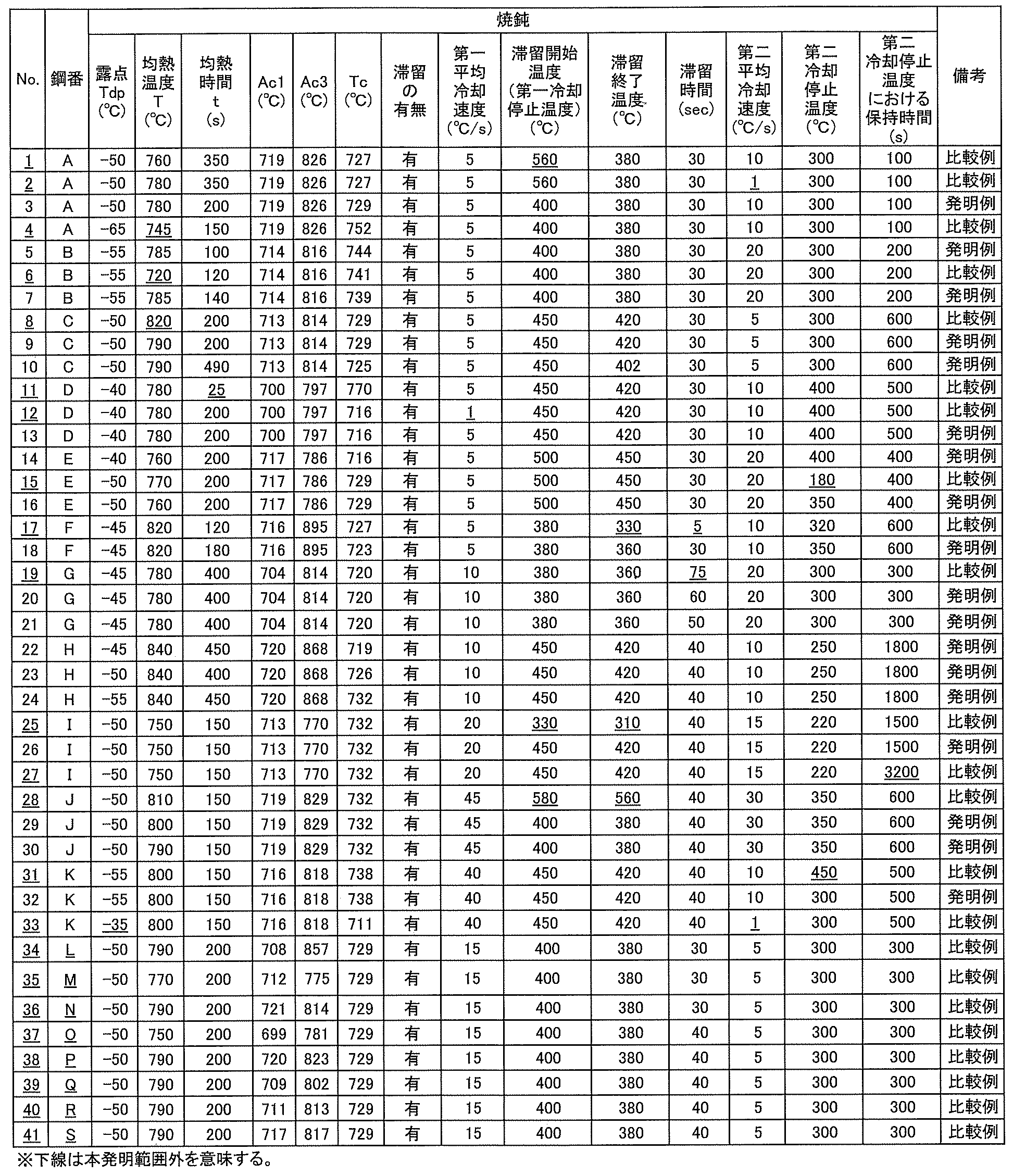
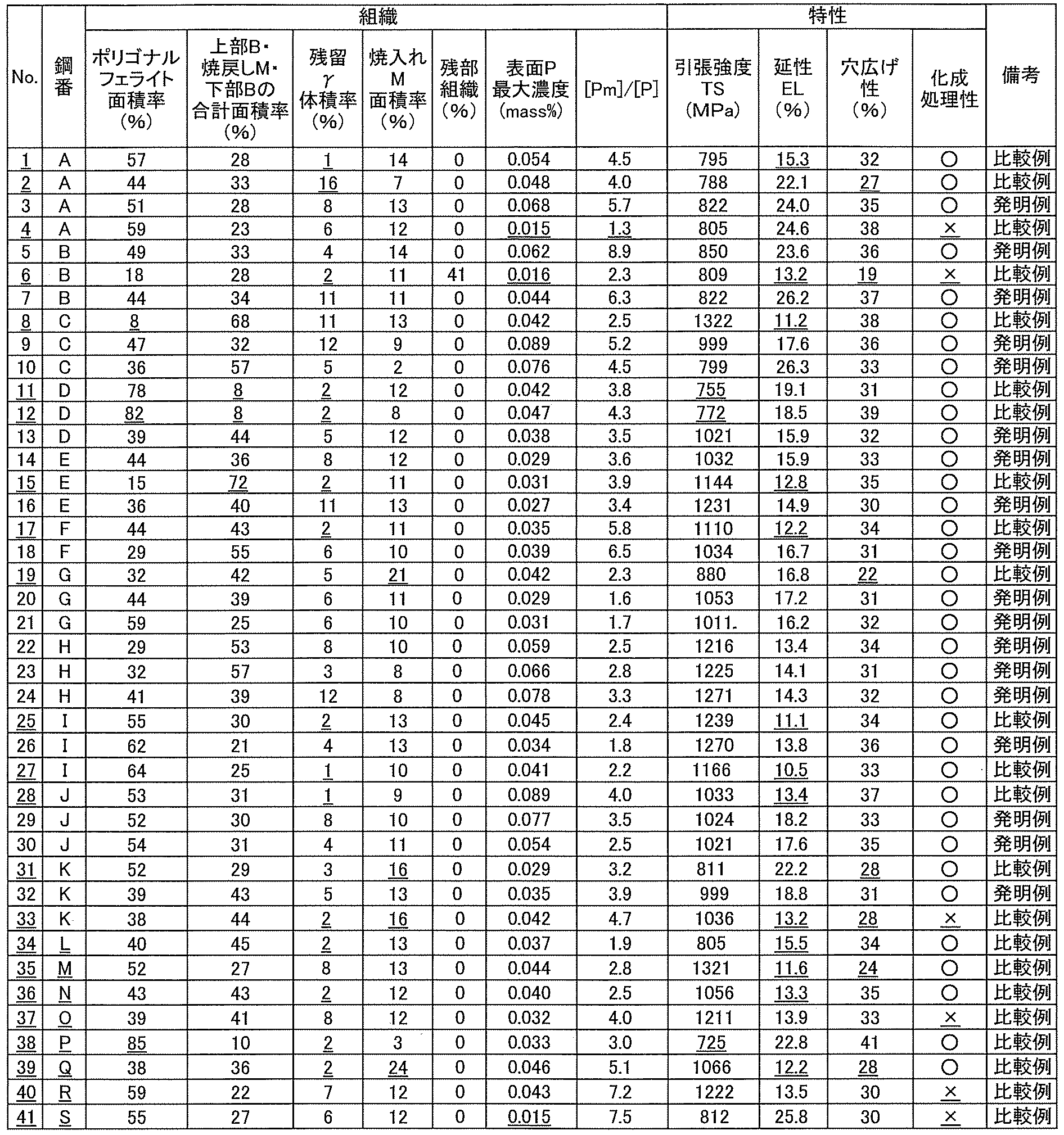
表1に示す成分組成を有する連続鋳造により製造したスラブを1200℃に加熱し、均熱時間は200minとし、仕上げ圧延温度は860℃以上とし、巻取り温度を550℃とする熱間圧延工程後、50%の圧延率で冷間圧延して製造した板厚1.4mmの冷延鋼板を、表4に示す焼鈍条件で処理し、本発明の鋼板と比較例の鋼板とを製造した。実施例1と同様の評価を実施した。その結果を表5に示す。
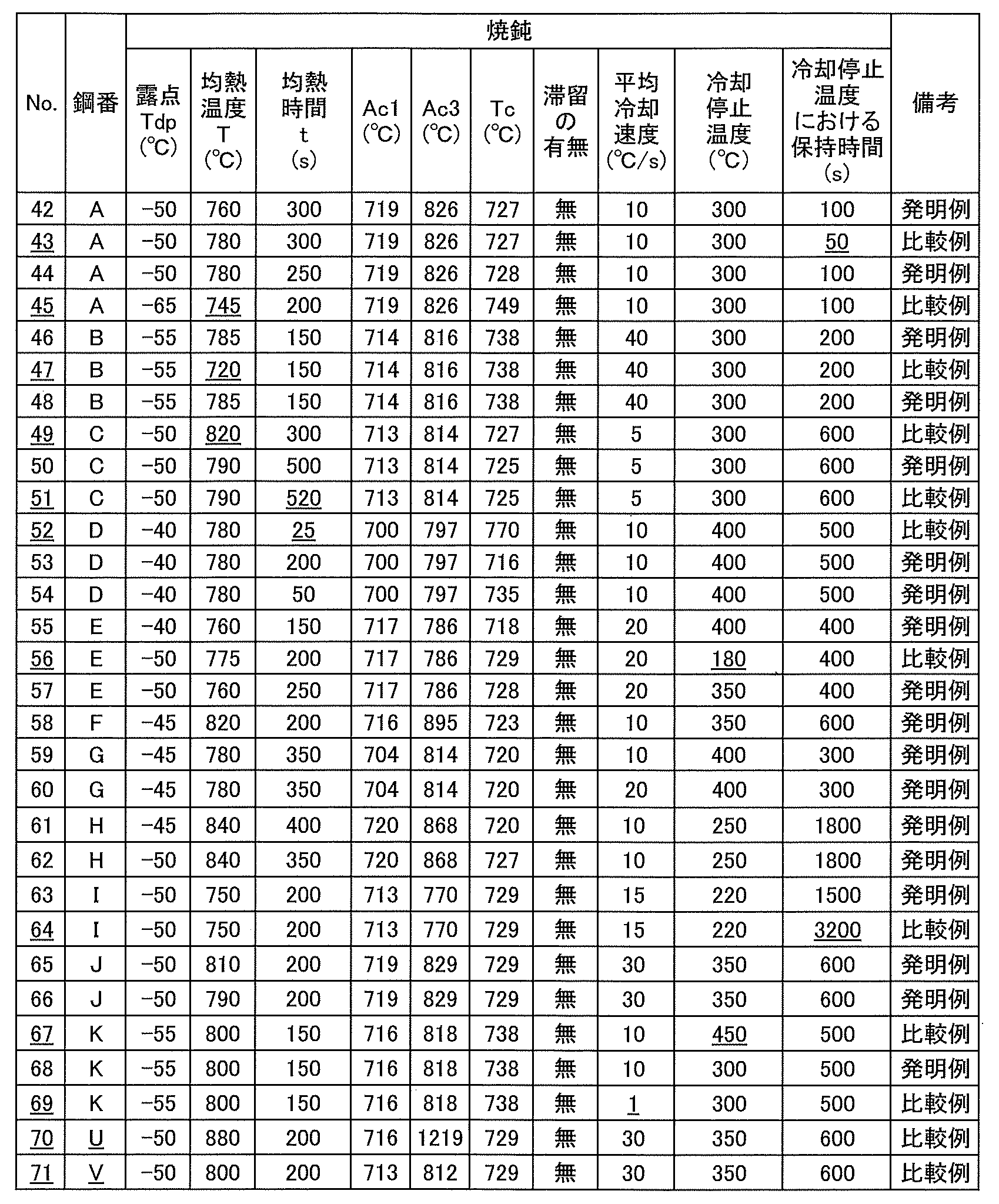
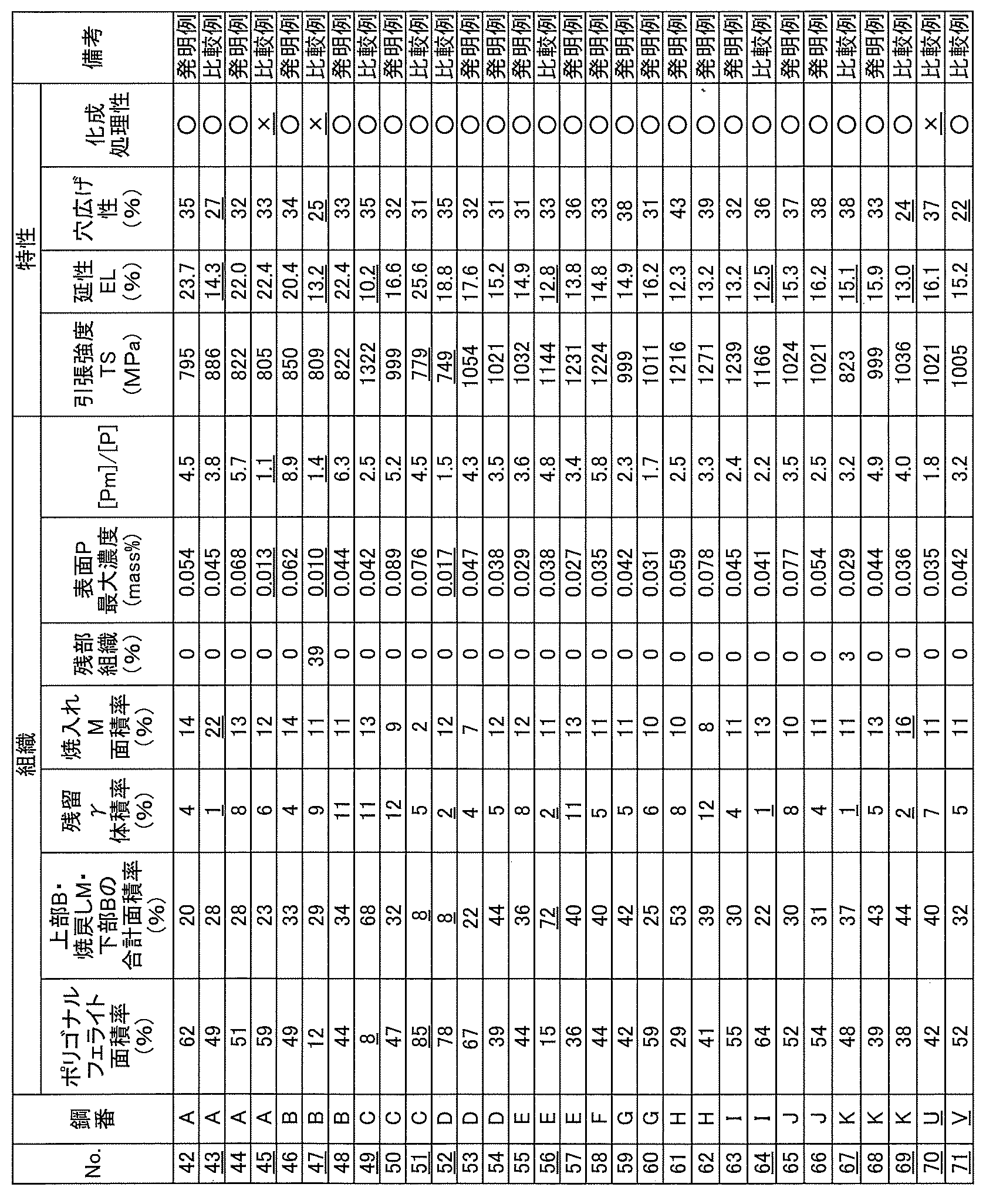
Claims (6)
- 質量%で、
C:0.05~0.25%、
Si:0.30~1.50%、
Mn:1.5~4.5%、
P:0.005~0.050%、
S:0.01%以下、
sol.Al:1.0%未満、
N:0.015%未満を含有し、
以下の式(1)を満たし、
残部が鉄および不可避的不純物からなる成分組成と、
ポリゴナルフェライトの面積率:10%以上80%以下であり、
上部ベイナイトと焼戻しマルテンサイトと下部ベイナイトとの合計面積率:10%以上70%以下であり、
残留オーステナイトの体積率:3%以上15%以下であり、
焼入れマルテンサイトの面積率:15%以下(0%を含む)である鋼組織と、
を有し、
鋼板表面から板厚方向1μm以内のPの最大濃度[Pm]が0.025mass%以上であり、かつ、式(2)を満足する、鋼板。
[Si]/[Mn]≦0.35 ・・・式(1)
[Pm]/[P]≧1.5 ・・・式(2)
ここで、式(1)において、[Si]はSi含有量(質量%)であり、[Mn]はMn含有量(質量%)であり、
式(2)において、[P]はP含有量(質量%)である。 - 前記成分組成として、さらに、質量%で、
Ti:0.1%以下、
B:0.001%以下、
Cu:1%以下、
Ni:1%以下、
Cr:1%以下、
Mo:0.5%以下、
V:0.5%以下、
Nb:0.1%以下、
Mg:0.0050%以下、
Ca:0.0050%以下、
Sn:0.1%以下、
Sb:0.1%以下、
REM:0.0050%以下
のうちから選んだ1種または2種以上を含有する、請求項1に記載の鋼板。 - 請求項1または2に記載の鋼板を用いてなる部材。
- 請求項1または2に記載の成分組成を有する鋼スラブに対して熱間圧延、酸洗および冷間圧延を施した後、得られた冷延鋼板に対して、焼鈍を行う鋼板の製造方法であり、
前記焼鈍は、
前記冷延鋼板に対して、露点が-40℃以下の炉内雰囲気において、Ac1点+20℃以上Ac3点以下であり、かつ、式(3)で算出されるTc以上の均熱温度に加熱し、前記均熱温度において30~500s保持する均熱保持工程と、
前記均熱温度から350~550℃の第一冷却停止温度までの温度範囲を第一平均冷却速度:2~50℃/sとして前記第一冷却停止温度まで冷却する第一冷却工程と、
前記第一冷却停止温度で冷却を停止した後に、350~550℃の温度範囲で10~60s滞留させた後、
200~420℃の第二冷却停止温度まで第二平均冷却速度:2~50℃/sで冷却を行う第二冷却工程と、
前記第二冷却停止温度で60~3000s保持を行う等温保持工程と、
を含む、鋼板の製造方法。
Tc(℃)=663-1.2×exp(20/t)×Tdp ・・・式(3)
ここで、tは前記均熱温度における保持時間(s)、Tdpは前記露点(℃)を示す。 - 請求項1または2に記載の成分組成を有する鋼スラブに対して熱間圧延、酸洗および冷間圧延を施した後、得られた冷延鋼板に対して、焼鈍を行う鋼板の製造方法であり、
前記焼鈍は、
前記冷延鋼板に対して、露点が-40℃以下の炉内雰囲気において、Ac1点+20℃以上Ac3点以下であり、かつ、式(3)で算出されるTc以上の均熱温度に加熱し、前記均熱温度において30~500s保持する均熱保持工程と、
前記均熱温度から200~420℃の冷却停止温度まで平均冷却速度:2~50℃/sで冷却を行う冷却工程と、
前記冷却停止温度で60~3000s保持を行う等温保持工程と、
を含む、鋼板の製造方法。
Tc(℃)=663-1.2×exp(20/t)×Tdp ・・・式(3)
ここで、tは前記均熱温度における保持時間(s)、Tdpは前記露点(℃)を示す。 - 請求項1または2に記載の鋼板に、成形加工、接合加工の少なくとも一方を施して部材とする工程を含む、部材の製造方法。
Priority Applications (5)
| Application Number | Priority Date | Filing Date | Title |
|---|---|---|---|
| JP2024547724A JP7704308B2 (ja) | 2023-03-31 | 2024-03-21 | 鋼板、部材およびそれらの製造方法 |
| CN202480021126.9A CN120958159A (zh) | 2023-03-31 | 2024-03-21 | 钢板、构件和它们的制造方法 |
| EP24779896.0A EP4667608A1 (en) | 2023-03-31 | 2024-03-21 | Steel sheet, member, and method for producing same |
| KR1020257031748A KR20250150145A (ko) | 2023-03-31 | 2024-03-21 | 강판, 부재 및 그들의 제조 방법 |
| MX2025011404A MX2025011404A (es) | 2023-03-31 | 2025-09-25 | Lamina de acero, miembro, y metodos para fabricar los mismos |
Applications Claiming Priority (2)
| Application Number | Priority Date | Filing Date | Title |
|---|---|---|---|
| JP2023058448 | 2023-03-31 | ||
| JP2023-058448 | 2023-03-31 |
Publications (1)
| Publication Number | Publication Date |
|---|---|
| WO2024203777A1 true WO2024203777A1 (ja) | 2024-10-03 |
Family
ID=92906243
Family Applications (1)
| Application Number | Title | Priority Date | Filing Date |
|---|---|---|---|
| PCT/JP2024/011161 Ceased WO2024203777A1 (ja) | 2023-03-31 | 2024-03-21 | 鋼板、部材およびそれらの製造方法 |
Country Status (6)
| Country | Link |
|---|---|
| EP (1) | EP4667608A1 (ja) |
| JP (1) | JP7704308B2 (ja) |
| KR (1) | KR20250150145A (ja) |
| CN (1) | CN120958159A (ja) |
| MX (1) | MX2025011404A (ja) |
| WO (1) | WO2024203777A1 (ja) |
Citations (11)
| Publication number | Priority date | Publication date | Assignee | Title |
|---|---|---|---|---|
| JP2951480B2 (ja) | 1992-06-24 | 1999-09-20 | 川崎製鉄株式会社 | 化成処理性ならびに成形性に優れる高張力冷延鋼板及びその製造方法 |
| JP2003201538A (ja) | 2001-10-30 | 2003-07-18 | Jfe Steel Kk | 耐塩温水2次密着性に優れた高強度高延性冷延鋼板およびその製造方法 |
| JP2006083403A (ja) * | 2004-09-14 | 2006-03-30 | Jfe Steel Kk | 延性および化成処理性に優れる高強度冷延鋼板およびその製造方法 |
| JP3889768B2 (ja) | 2005-03-31 | 2007-03-07 | 株式会社神戸製鋼所 | 塗膜密着性と延性に優れた高強度冷延鋼板および自動車用鋼部品 |
| JP5515623B2 (ja) | 2009-10-28 | 2014-06-11 | Jfeスチール株式会社 | 高強度冷延鋼板およびその製造方法 |
| JP2015113505A (ja) * | 2013-12-12 | 2015-06-22 | Jfeスチール株式会社 | 化成処理性に優れた高加工性高強度冷延鋼板およびその製造方法 |
| JP2019502819A (ja) * | 2015-12-15 | 2019-01-31 | ポスコPosco | 化成処理性及び穴拡げ性に優れた超高強度鋼板及びその製造方法 |
| JP2019531408A (ja) * | 2016-08-30 | 2019-10-31 | 宝山鋼鉄股▲分▼有限公司 | リン酸塩処理性と成形性が優れた冷間圧延高強度鋼板及びその製造方法 |
| WO2022138396A1 (ja) * | 2020-12-24 | 2022-06-30 | Jfeスチール株式会社 | 鋼板およびその製造方法 |
| WO2023053908A1 (ja) * | 2021-09-30 | 2023-04-06 | Jfeスチール株式会社 | 鋼板、部材およびそれらの製造方法 |
| WO2023053909A1 (ja) * | 2021-09-30 | 2023-04-06 | Jfeスチール株式会社 | 鋼板、部材およびそれらの製造方法 |
-
2024
- 2024-03-21 EP EP24779896.0A patent/EP4667608A1/en active Pending
- 2024-03-21 JP JP2024547724A patent/JP7704308B2/ja active Active
- 2024-03-21 CN CN202480021126.9A patent/CN120958159A/zh active Pending
- 2024-03-21 WO PCT/JP2024/011161 patent/WO2024203777A1/ja not_active Ceased
- 2024-03-21 KR KR1020257031748A patent/KR20250150145A/ko active Pending
-
2025
- 2025-09-25 MX MX2025011404A patent/MX2025011404A/es unknown
Patent Citations (11)
| Publication number | Priority date | Publication date | Assignee | Title |
|---|---|---|---|---|
| JP2951480B2 (ja) | 1992-06-24 | 1999-09-20 | 川崎製鉄株式会社 | 化成処理性ならびに成形性に優れる高張力冷延鋼板及びその製造方法 |
| JP2003201538A (ja) | 2001-10-30 | 2003-07-18 | Jfe Steel Kk | 耐塩温水2次密着性に優れた高強度高延性冷延鋼板およびその製造方法 |
| JP2006083403A (ja) * | 2004-09-14 | 2006-03-30 | Jfe Steel Kk | 延性および化成処理性に優れる高強度冷延鋼板およびその製造方法 |
| JP3889768B2 (ja) | 2005-03-31 | 2007-03-07 | 株式会社神戸製鋼所 | 塗膜密着性と延性に優れた高強度冷延鋼板および自動車用鋼部品 |
| JP5515623B2 (ja) | 2009-10-28 | 2014-06-11 | Jfeスチール株式会社 | 高強度冷延鋼板およびその製造方法 |
| JP2015113505A (ja) * | 2013-12-12 | 2015-06-22 | Jfeスチール株式会社 | 化成処理性に優れた高加工性高強度冷延鋼板およびその製造方法 |
| JP2019502819A (ja) * | 2015-12-15 | 2019-01-31 | ポスコPosco | 化成処理性及び穴拡げ性に優れた超高強度鋼板及びその製造方法 |
| JP2019531408A (ja) * | 2016-08-30 | 2019-10-31 | 宝山鋼鉄股▲分▼有限公司 | リン酸塩処理性と成形性が優れた冷間圧延高強度鋼板及びその製造方法 |
| WO2022138396A1 (ja) * | 2020-12-24 | 2022-06-30 | Jfeスチール株式会社 | 鋼板およびその製造方法 |
| WO2023053908A1 (ja) * | 2021-09-30 | 2023-04-06 | Jfeスチール株式会社 | 鋼板、部材およびそれらの製造方法 |
| WO2023053909A1 (ja) * | 2021-09-30 | 2023-04-06 | Jfeスチール株式会社 | 鋼板、部材およびそれらの製造方法 |
Non-Patent Citations (1)
| Title |
|---|
| See also references of EP4667608A1 |
Also Published As
| Publication number | Publication date |
|---|---|
| MX2025011404A (es) | 2025-11-03 |
| EP4667608A1 (en) | 2025-12-24 |
| JPWO2024203777A1 (ja) | 2024-10-03 |
| JP7704308B2 (ja) | 2025-07-08 |
| KR20250150145A (ko) | 2025-10-17 |
| CN120958159A (zh) | 2025-11-14 |
Similar Documents
| Publication | Publication Date | Title |
|---|---|---|
| EP2757169B1 (en) | High-strength steel sheet having excellent workability and method for producing same | |
| JP7332062B1 (ja) | 鋼板、部材およびそれらの製造方法 | |
| JP5126844B2 (ja) | 熱間プレス用鋼板およびその製造方法ならびに熱間プレス鋼板部材の製造方法 | |
| WO2012105126A1 (ja) | 加工性に優れた高降伏比を有する高強度冷延鋼板およびその製造方法 | |
| JP7294548B1 (ja) | 鋼板、部材およびそれらの製造方法 | |
| WO2020039697A1 (ja) | 高強度鋼板及びその製造方法 | |
| JP2014019928A (ja) | 高強度冷延鋼板および高強度冷延鋼板の製造方法 | |
| JP4211520B2 (ja) | 耐時効性に優れた高強度高延性亜鉛めっき鋼板およびその製造方法 | |
| JPWO2021079754A1 (ja) | 高強度鋼板およびその製造方法 | |
| WO2023190867A1 (ja) | 鋼部材及び鋼板 | |
| CN116529410A (zh) | 冷轧热处理钢板及其制造方法 | |
| JP7078202B1 (ja) | 高強度鋼板およびその製造方法 | |
| JP7485240B1 (ja) | 鋼板、部材およびそれらの製造方法 | |
| JP7704308B2 (ja) | 鋼板、部材およびそれらの製造方法 | |
| JP7704309B2 (ja) | 鋼板、部材およびそれらの製造方法 | |
| JP7619534B1 (ja) | 鋼板、部材およびそれらの製造方法 | |
| EP4043593B1 (en) | High strength steel sheet, impact absorbing member, and method for manufacturing high strength steel sheet | |
| JP2007077510A (ja) | 耐時効性に優れた高強度高延性亜鉛めっき鋼板およびその製造方法 | |
| JP7559978B2 (ja) | 鋼板、部材およびそれらの製造方法 | |
| EP4640883A1 (en) | Cold-rolled steel sheet and manufacturing method therefor | |
| WO2026042396A1 (ja) | 鋼板、部材およびそれらの製造方法 | |
| WO2026042395A1 (ja) | 鋼板、部材およびそれらの製造方法 | |
| WO2026042394A1 (ja) | 鋼板、部材およびそれらの製造方法 |
Legal Events
| Date | Code | Title | Description |
|---|---|---|---|
| WWE | Wipo information: entry into national phase |
Ref document number: 2024547724 Country of ref document: JP |
|
| 121 | Ep: the epo has been informed by wipo that ep was designated in this application |
Ref document number: 24779896 Country of ref document: EP Kind code of ref document: A1 |
|
| WWE | Wipo information: entry into national phase |
Ref document number: 2024779896 Country of ref document: EP |
|
| ENP | Entry into the national phase |
Ref document number: 1020257031748 Country of ref document: KR Free format text: ST27 STATUS EVENT CODE: A-0-1-A10-A15-NAP-PA0105 (AS PROVIDED BY THE NATIONAL OFFICE) |
|
| WWE | Wipo information: entry into national phase |
Ref document number: 2501006349 Country of ref document: TH Ref document number: 202517090845 Country of ref document: IN |
|
| WWE | Wipo information: entry into national phase |
Ref document number: MX/A/2025/011404 Country of ref document: MX |
|
| WWP | Wipo information: published in national office |
Ref document number: 202517090845 Country of ref document: IN |
|
| WWP | Wipo information: published in national office |
Ref document number: 1020257031748 Country of ref document: KR |
|
| WWP | Wipo information: published in national office |
Ref document number: MX/A/2025/011404 Country of ref document: MX |
|
| NENP | Non-entry into the national phase |
Ref country code: DE |
|
| ENP | Entry into the national phase |
Ref document number: 2024779896 Country of ref document: EP Effective date: 20250916 |
|
| WWP | Wipo information: published in national office |
Ref document number: 2024779896 Country of ref document: EP |