WO2024225366A1 - 被覆粒状肥料 - Google Patents
被覆粒状肥料 Download PDFInfo
- Publication number
- WO2024225366A1 WO2024225366A1 PCT/JP2024/016199 JP2024016199W WO2024225366A1 WO 2024225366 A1 WO2024225366 A1 WO 2024225366A1 JP 2024016199 W JP2024016199 W JP 2024016199W WO 2024225366 A1 WO2024225366 A1 WO 2024225366A1
- Authority
- WO
- WIPO (PCT)
- Prior art keywords
- wax
- mass
- coating
- granular fertilizer
- coated granular
- Prior art date
- Legal status (The legal status is an assumption and is not a legal conclusion. Google has not performed a legal analysis and makes no representation as to the accuracy of the status listed.)
- Ceased
Links
Images
Classifications
-
- C—CHEMISTRY; METALLURGY
- C05—FERTILISERS; MANUFACTURE THEREOF
- C05G—MIXTURES OF FERTILISERS COVERED INDIVIDUALLY BY DIFFERENT SUBCLASSES OF CLASS C05; MIXTURES OF ONE OR MORE FERTILISERS WITH MATERIALS NOT HAVING A SPECIFIC FERTILISING ACTIVITY, e.g. PESTICIDES, SOIL-CONDITIONERS, WETTING AGENTS; FERTILISERS CHARACTERISED BY THEIR FORM
- C05G5/00—Fertilisers characterised by their form
- C05G5/30—Layered or coated, e.g. dust-preventing coatings
- C05G5/38—Layered or coated, e.g. dust-preventing coatings layered or coated with wax or resins
-
- C—CHEMISTRY; METALLURGY
- C05—FERTILISERS; MANUFACTURE THEREOF
- C05G—MIXTURES OF FERTILISERS COVERED INDIVIDUALLY BY DIFFERENT SUBCLASSES OF CLASS C05; MIXTURES OF ONE OR MORE FERTILISERS WITH MATERIALS NOT HAVING A SPECIFIC FERTILISING ACTIVITY, e.g. PESTICIDES, SOIL-CONDITIONERS, WETTING AGENTS; FERTILISERS CHARACTERISED BY THEIR FORM
- C05G5/00—Fertilisers characterised by their form
- C05G5/30—Layered or coated, e.g. dust-preventing coatings
- C05G5/37—Layered or coated, e.g. dust-preventing coatings layered or coated with a polymer
-
- B—PERFORMING OPERATIONS; TRANSPORTING
- B01—PHYSICAL OR CHEMICAL PROCESSES OR APPARATUS IN GENERAL
- B01J—CHEMICAL OR PHYSICAL PROCESSES, e.g. CATALYSIS OR COLLOID CHEMISTRY; THEIR RELEVANT APPARATUS
- B01J2/00—Processes or devices for granulating materials, e.g. fertilisers in general; Rendering particulate materials free flowing in general, e.g. making them hydrophobic
-
- C—CHEMISTRY; METALLURGY
- C05—FERTILISERS; MANUFACTURE THEREOF
- C05G—MIXTURES OF FERTILISERS COVERED INDIVIDUALLY BY DIFFERENT SUBCLASSES OF CLASS C05; MIXTURES OF ONE OR MORE FERTILISERS WITH MATERIALS NOT HAVING A SPECIFIC FERTILISING ACTIVITY, e.g. PESTICIDES, SOIL-CONDITIONERS, WETTING AGENTS; FERTILISERS CHARACTERISED BY THEIR FORM
- C05G5/00—Fertilisers characterised by their form
- C05G5/10—Solid or semi-solid fertilisers, e.g. powders
-
- B—PERFORMING OPERATIONS; TRANSPORTING
- B01—PHYSICAL OR CHEMICAL PROCESSES OR APPARATUS IN GENERAL
- B01J—CHEMICAL OR PHYSICAL PROCESSES, e.g. CATALYSIS OR COLLOID CHEMISTRY; THEIR RELEVANT APPARATUS
- B01J2/00—Processes or devices for granulating materials, e.g. fertilisers in general; Rendering particulate materials free flowing in general, e.g. making them hydrophobic
- B01J2/16—Processes or devices for granulating materials, e.g. fertilisers in general; Rendering particulate materials free flowing in general, e.g. making them hydrophobic by suspending the powder material in a gas, e.g. in fluidised beds or as a falling curtain
Definitions
- One embodiment of the present invention relates to a coated granular fertilizer.
- Coated granular fertilizers are known in which the surface of the granular fertilizer is coated with a coating material such as synthetic resin. Coated granular fertilizers are known to be effective in reducing the labor required for agricultural work and reducing the environmental burden caused by fertilizer components, as it is easy to control the leaching of the fertilizer components. Cultivation techniques using such coated granular fertilizers have become increasingly popular in recent years.
- Patent Document 1 discloses a coated granular fertilizer having a coating layer containing 5% by weight or more and 80% by weight or less of aliphatic polyester and 20% by weight or more and 95% by weight or less of polyolefin wax, as a coated fertilizer in which the coating material decomposes in the environment after the fertilizer components have finished dissolving out.
- Patent Document 2 discloses a coated fertilizer including a fertilizer granule and a coating disposed on a surface of the fertilizer granule, the coating including: a second polymer including poly(lactic acid); poly(butylene succinate), cellulose triacetate, or a combination including at least one of the foregoing; and a sealant.
- Patent Documents 3 and 4 disclose coated fertilizers coated with a biodegradable resin, polyhydroxyalkanoic acid or polybutylene succinate.
- Patent Document 2 did not provide a satisfactory level of biodegradability for the coating. Furthermore, polyolefin waxes such as polyethylene wax were used as an essential sealant component. These components take a long time to decompose in nature, and there was the problem that they remained in fields.
- Patent Document 3 has the disintegration property to easily decompose in nature, but the permeability of water into the fertilizer is too high, so the fertilizer components dissolve over a long period of time, and the elution controllability is not satisfactory.
- one embodiment of the present invention provides a coated granular fertilizer that is excellent in biodegradability and also excellent in controlling the elution of fertilizer components.
- the inventors conducted intensive research to solve the above problems, and as a result, they have completed the present invention.
- Examples of the configuration of the present invention include the following [1] to [7].
- [1] A granular fertilizer and a coating film covering a surface of the granular fertilizer, the coating film containing a biodegradable resin (A) and at least one wax (B) selected from the group consisting of natural waxes (b1) having an ester group and modified waxes (b2) thereof, The coated granular fertilizer, wherein the wax (B) accounts for less than 80 mass% of 100 mass% of the coating.
- the wax (B) satisfies the following requirement (I):
- the acid value is 0.5 to 130, as measured by the acid value measurement method specified in JIS K0070.
- the biodegradable resin (A) satisfies the following requirement (II):
- the melt flow rate (MFR) measured in accordance with ISO 1133 at 190° C. under a load of 2.16 kg is in the range of 0.1 to 30 g/10 min.
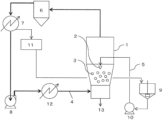
- FIG. 1 shows an example of an apparatus for producing coated granular fertilizer.
- a coated granular fertilizer according to one embodiment of the present invention comprises a granular fertilizer and a coating that coats the surface of the granular fertilizer, the coating comprising a biodegradable resin (A) and at least one wax (B) selected from the group consisting of natural waxes (b1) having ester groups and modified waxes (b2) thereof, and the wax (B) accounts for less than 80 mass% of 100 mass% of the coating.
- the coated granular fertilizer according to one embodiment of the present invention contains a biodegradable resin (A).
- the biodegradable resin (A) may also be referred to simply as "component (A)".
- a biodegradable resin generally refers to a resin that is completely consumed by microorganisms and produces only natural by-products.
- component (A) may be any resin that has been confirmed to have a degree of biodegradability measured in accordance with a test method such as JIS or ISO, or any resin that has been certified by other public organizations. Examples of methods for measuring biodegradability according to JIS or ISO test methods include JIS K 6950 (ISO 14851), JIS K 6953-1 (ISO 14855-1), JIS K 6955 (ISO 17556), JIS K 6951 (ISO 14852), and JIS K6953-2 (ISO 14855).
- JBPA Japan Bioplastics Association
- TUV AUSTRIA also referred to as TUV
- TUV TUV
- component (A) it is preferable that component (A) has been certified as biodegradable by JBPA or TUV.
- the biodegradable resin (A) preferably has a melt flow rate (MFR) measured in accordance with ISO 1133 at 190° C. under a load of 2.16 kg in the range of 0.1 to 30 g/10 min, more preferably in the range of 0.1 to 20 g/10 min, and even more preferably in the range of 2 to 10 g/10 min.
- MFR melt flow rate
- biodegradable resin (A) examples include aromatic polyester resins, aliphatic polyester resins, aliphatic aromatic polyester resins, polysaccharides, and starch-containing polymers.
- aromatic polyester resins include polyethylene terephthalate, polyethylene-2,6-naphthalate, polypropylene terephthalate, and polybutylene terephthalate.
- aliphatic polyester resins include polylactic acid (also referred to as PLA), polylactic acid-based resins such as polylactic acid/polyether copolymers, polyglycolic acid, polyhydroxyalkanoates such as poly(3-hydroxybutyrate), poly(3-hydroxybutyrate-3-hydroxyhexanoate), and poly(3-hydroxybutyrate-3-hydroxyvalerate), polycaprolactone, polybutylene succinate (also referred to as PBS), and polybutylene succinate adipate (also referred to as PBAT).
- PLA polylactic acid
- polylactic acid-based resins such as polylactic acid/polyether copolymers
- polyglycolic acid polyhydroxyalkanoates such as poly(3-hydroxybutyrate), poly(3-hydroxybutyrate-3-hydroxyhexanoate), and poly(3-hydroxybutyrate-3-hydroxyvalerate)
- polycaprolactone polybutylene succinate
- PBS polybutylene succinate
- PBAT poly
- aliphatic aromatic polyester resin examples include polyethylene succinate terephthalate and polybutylene adipate terephthalate.
- the aliphatic polyester resin and aromatic polyester resin may be used alone or in the form of a copolymer of two or more kinds.
- polysaccharides and polymers containing starch include cellulose-based resins such as cellulose acetate, glucosamine-based resins such as chitosan, and starch polyesters.
- the biodegradable resin (A) is preferably at least one selected from the group consisting of polybutylene succinate, polylactic acid, polybutylene adipate terephthalate, polyhydroxyalkanoic acid, cellulose acetate, and polycaprolactone, and is more preferably at least one selected from the group consisting of polybutylene succinate, polylactic acid, polybutylene adipate terephthalate, and polycaprolactone, because it has a small initial elution amount of fertilizer components and excellent elution controllability, and is even more preferably polybutylene succinate, because it has moderate water penetration into the inside of the coating, is particularly excellent in elution control of fertilizer components, is particularly excellent in biodegradability in the coating environment, and can also impart
- the biodegradable resin (A) may be used alone or in combination of two or more kinds.
- biodegradable resins (A) it is preferable to combine polybutylene succinate and polybutylene adipate terephthalate, polybutylene succinate and polylactic acid, polybutylene succinate and polycaprolactone, polybutylene adipate terephthalate and polylactic acid, or polybutylene adipate terephthalate and polycaprolactone.
- a combination of polybutylene succinate and polybutylene adipate terephthalate, or a combination of polybutylene succinate and polylactic acid is more preferable because of its excellent film-forming property.
- the mass ratio (a1/a2) of the biodegradable resin (a1) to the biodegradable resin (a2) is 100/1 to 1/100 when the biodegradable resin (A) is 100% by mass.
- the mass ratio (a1/a2) of polybutylene succinate (a1) to polybutylene adipate terephthalate (a2) when the biodegradable resin (A) is 100% by mass is 100/1 to 50/50.
- the mass ratio (a1/a2) of polybutylene succinate (a1) to polylactic acid (a2) is 100/1 to 50/50 when the biodegradable resin (A) is taken as 100% by mass.
- biodegradable resin (A) commercially available products can also be used.
- An example of polybutylene succinate is BioPBS manufactured by Mitsubishi Chemical Corporation.
- An example of polybutylene adipate terephthalate is ECOFLEX, ECOVIO, etc. manufactured by BASF Corporation.
- An example of polylactic acid is 4060D, etc. manufactured by Nature Works Corporation.
- the coated granular fertilizer of one embodiment of the present invention contains at least one wax (B) selected from the group consisting of natural waxes (b1) and modified waxes (b2) having an ester group, and the wax (B) accounts for less than 80 mass% of 100 mass% of the coating.
- at least one wax (B) selected from the group consisting of natural waxes (b1) and modified waxes thereof (b2) having an ester group will also be referred to simply as "component (B)".
- the coated granular fertilizer of one embodiment of the present invention preferably contains 1% by mass or more of component (B) in 100% by mass of the coating, more preferably 10% by mass or more, even more preferably 20% by mass or more, and most preferably 30% by mass or more.
- component (B) is contained at 1% by mass or more, there is a tendency for the fertilizer component dissolution controllability to be excellent.
- the coated granular fertilizer of one embodiment of the present invention contains less than 80 mass % of component (B) in 100 mass % of the coating, preferably 50 mass % or less, and more preferably 40 mass % or less.
- component (B) By containing less than 80 mass % of component (B), the fertilizer component dissolution controllability is excellent. If the wax content is too high, the film formation state becomes poor, and it becomes impossible to obtain a long-term dissolution controllability of the fertilizer components in the coated granular fertilizer.
- component (B) having an ester group means that at least one wax selected from the group consisting of natural wax (b1) and modified waxes thereof (b2) has one or more ester groups.
- Natural waxes (b1) refer to vegetable waxes, mineral waxes, and animal waxes.
- Examples of vegetable waxes include rice wax, sunflower oil wax, jojoba wax, soybean oil wax, corn oil wax, carnauba wax, candelilla wax, palm wax, coconut wax, candelilla wax, and carnauba wax.
- the mineral wax is montan wax.
- animal waxes include beeswax and whale wax.
- the natural wax (b1) is preferably a vegetable wax or an animal wax, and more preferably at least one selected from the group consisting of rice wax, beeswax, carnauba wax, candelilla wax, palm wax, soybean oil wax, sunflower oil wax, and spermaceti wax.
- the modified product (b2) refers to a modified product of the natural wax (b1).
- Examples of the modified product (b2) include hydrogenated products (also called cured products) of all or part of the natural wax, oxides, saponification products, esterification products, amidation products, etc., with hydrogenated products being preferred.
- modified substances (b2) include castor wax (also called hydrogenated castor oil), semi-hydrogenated castor oil wax, hydrogenated rice wax, hydrogenated palm oil wax, hydrogenated soybean oil wax, and partially saponified montanic acid ester wax.
- Hydrogenated waxes are generally preferred because they have a higher melting point and improve film-forming properties during coating. Castor wax is also preferred because it is widely used in cosmetics and is therefore inexpensive and easily available.
- Component (B) is preferably at least one selected from the group consisting of rice wax, castor wax, montan wax, beeswax, carnauba wax, candelilla wax, palm wax, soybean oil wax, and sunflower oil wax, as it produces few coating defects, provides a good coating, and has excellent control over the leaching of fertilizer components; more preferably at least one selected from the group consisting of montan wax, rice wax, and castor wax, as it is widely used and has stable quality; even more preferably at least one selected from the group consisting of rice wax and castor wax, as it produces a high leaching inhibition effect; and most preferably rice wax, as it has a good balance of hydrophilic and hydrophobic components that make up rice wax, and has moderate moisture permeability.
- the acid value indicates the amount of free fatty acids in a fat or oil, and is expressed as the number of milligrams of potassium hydroxide required to neutralize the free fatty acids contained in 1 g of fat or oil.
- component (B) preferably has an acid value of 0.5 to 130, more preferably 3 to 55, and even more preferably 5 to 25, as measured by the acid value measurement method specified in JIS K0070.
- the inventors have found that when the acid value of component (B) is lower than 0.5, the hydrophilicity of the coating decreases and there is a tendency for the control of the dissolution of the fertilizer components to increase, while the biodegradability of the coating in the environment, although present, tends to be low. Also, when the acid value is higher than 130, there is a tendency for the hydrophilicity of the coating to increase and for the fertilizer components to dissolve completely in a short period of time.
- the inventors then conducted research into achieving both excellent biodegradability in the environment and controllability of elution of fertilizer components, and found that biodegradability and controllability of elution are particularly favorable for component (B) when the acid value is within a specific range.
- Component (B) is preferably at least one selected from the group consisting of rice wax, castor wax, carnauba wax, candelilla wax, and montan wax, from the viewpoint of low acid value and improved control of the elution of fertilizer components, and is more preferably rice wax.
- the saponification value indicates the amount of free fatty acids and esters in fats and oils, and is expressed as the number of milligrams of potassium hydroxide required to saponify the esters and neutralize the free fatty acids contained in 1 g of fats and oils.
- component (B) preferably has a saponification value of 1 to 190, more preferably 1 to 170, even more preferably 50 to 160, and most preferably 50 to 120, as measured by the saponification value measurement method specified in JIS K0070.
- Rice waxes with different acid values are available due to differences in the methods for separating and refining the wax component from rice bran.
- the acid value of rice wax include 7 to 9, 15 to 25, 45 to 55, and 125 to 135.
- the acid value of rice wax is preferably 7 to 9, 15 to 25, or 45 to 55, and from the viewpoint of further excellent controllability for dissolution with fewer highly hydrophilic components that are thought to affect water vapor permeability, 7 to 9 and 15 to 25 are more preferable.
- the rice wax preferably has an acid value in the range of 0.5 to 130, more preferably in the range of 0.5 to 55, and even more preferably in the range of 5 to 25 from the viewpoint of particularly excellent controllability of the elution of fertilizer components.
- Component (B) like the biodegradable resin (A) described above, may be any component that has been confirmed to have a degree of biodegradability measured in accordance with JIS or ISO standards, and is preferably one that has been certified, and the type is not particularly limited.
- the component (B) may be used alone or in combination of two or more.
- the granular fertilizer used in one embodiment of the present invention may be one that contains one or more fertilizer components such as nitrogen, phosphoric acid, and potassium.
- fertilizer components such as nitrogen, phosphoric acid, and potassium.
- Specific examples include nitrogenous fertilizers, phosphate fertilizers, and potassium fertilizers, as well as fertilizers that contain trace elements such as calcium, magnesium, sulfur, iron, manganese, and boron, which are essential elements for plants, and silicon, as necessary.
- Fertilizers that contain nitrification inhibitors, pesticide components, and the like may also be used.
- nitrogenous fertilizers that contain ammonium sulfate, urea, and ammonium nitrate, which have high water solubility and are prone to runoff into the environment
- potassium fertilizers that contain potassium sulfate and potassium chloride, and chemical fertilizers that contain urea, ammoniacal nitrogen, and nitrate nitrogen are preferred, and urea, which has a low unit price per fertilizer component, is more preferred.
- the fertilizer components may be used alone or in combination of two or more.
- the granular fertilizer may contain other components within the scope of the present invention, such as carriers, binders, surfactants, blackstrap molasses, animal oils, vegetable oils, hydrogenated oils, fatty acids, fatty acid metal salts, paraffin, wax, and glycerin, and these may be used alone or in combination of two or more.
- the method for producing the granular fertilizer used in one embodiment of the present invention is not particularly limited, and it can be produced using a known granulation method.
- the granular fertilizer can be produced using a fluidized bed granulation method, a rolling granulation method, a coating granulation method, an adsorption granulation method, etc.
- the shape of the granular fertilizer used in one embodiment of the present invention is not particularly limited, but a spherical shape is preferable from the viewpoint of facilitating uniform coating of the surface with the coating material.
- the shape of the granular fertilizer has a circularity coefficient calculated by the following formula (2) of preferably 0.7 to 1, more preferably 0.75 to 1, and most preferably 0.8 to 1.
- the maximum value of the circularity coefficient is 1, and the closer the circularity coefficient is to 1, the closer the particles of the granular fertilizer are to a perfect circle, and the more the shape of the particles deviates from a perfect circle, the smaller the circularity coefficient becomes.
- Circularity coefficient ⁇ (4 ⁇ projected area of particle)/(length of contour of particle projection) 2 ⁇ ...Equation (2)
- the granular fertilizer preferably has an average particle size of 1 to 10 mm, more preferably 2 to 5 mm.
- the average particle size of the granular fertilizer is within the above range, it is preferable because it is easy to prepare a coated granular fertilizer by coating the surface of the granular fertilizer.
- the granular fertilizer a commercially available granular fertilizer or a manufactured granular fertilizer can be used, and the average particle size can be adjusted to a desired value by appropriately using a sieve or the like.
- the average particle size refers to an average particle size calculated by a particle size distribution analyzer such as dynamic image analysis.
- commercially available granular fertilizers that can be used include, for example, urea (manufactured by PETRONAS Fertilizer (Kedah) Sdn. Bhd) as granular urea, ammonium phosphate (manufactured by Central Green Co., Ltd.) as granular ammonium phosphate, and potassium sulfate (manufactured by Asahi Agria Co., Ltd.) as granular potash.
- urea manufactured by PETRONAS Fertilizer (Kedah) Sdn. Bhd
- ammonium phosphate manufactured by Central Green Co., Ltd.
- potassium sulfate manufactured by Asahi Agria Co., Ltd.
- a coated granular fertilizer comprises a granular fertilizer and a coating that coats the surface of the granular fertilizer.
- the coating contains a biodegradable resin (A) and at least one wax (B) selected from the group consisting of natural waxes (b1) having an ester group and modified waxes (b2) thereof, and the wax (B) accounts for less than 80 mass% of 100 mass% of the coating.
- the coating preferably contains polybutylene succinate as the biodegradable resin (A) and rice wax as component (B).
- polybutylene succinate as the biodegradable resin (A) and rice wax as component (B) because the balance of the alkyl chain length and ester of rice wax gives it a very high affinity for polybutylene succinate, which results in an improved state of the film when it is formed, increased film strength, and improved elution controllability.
- the mass ratio (A/B) of the biodegradable resin (A) to at least one wax (B) selected from the group consisting of natural waxes (b1) and modified waxes (b2) having ester groups in 100 mass % of the coating is preferably 8/2 to 5/5, more preferably 7.5/2.5 to 5/5, and even more preferably 7/3 to 5/5, as this provides an excellent balance between coating strength and elution controllability.
- the coated granular fertilizer according to one embodiment of the present invention preferably contains 15 to 85 mass% of component (A) in 100 mass% of the coating, and more preferably contains 50 to 80 mass% because of good film-forming properties.
- component (A) is within the above range, good film formation tends to occur.
- component (A) exceeds 85 mass%, the initial amount of fertilizer components eluted tends to be small, but elution controllability, which means that the fertilizer components are eluted for a long period of time, tends to deteriorate.
- the mass of component (B) in the coating is less than 15 mass %, it is considered that the effect of component (B) in inhibiting fertilizer dissolution is reduced, and the dissolution rate of the fertilizer components tends to increase.
- component (A) is 100% by mass and component (B) is not included at all, the initial amount of fertilizer components dissolving is reduced, but there is a tendency for the fertilizer components to dissolve over a long period of time, resulting in poor controllability of dissolution.
- the coating contains less than 80% by mass of component (B) in 100% by mass of the coating.
- the coating preferably contains 15 to 75% by mass of component (B), and more preferably contains 20 to 50% by mass because this provides good control over the dissolution of the fertilizer components. If the content of component (B) in 100% by mass of the coating is less than 15% by mass, the initial dissolution of the fertilizer components tends to be high. If the content exceeds 85% by mass, the coating strength is insufficient and the initial dissolution of the fertilizer components tends to be high.
- the coating may contain a filler as an additional component, provided that the effect of the present invention is not impaired.
- a filler include plate-like fillers such as talc, mica, and hydrotalcite; inorganic substances such as calcium carbonate, silica, clay, bentonite, smectite, montmorillonite, various crushed ores, and sulfur; organic fillers such as starch, cellulose nanofiber, and carbon; and organic substances such as surfactants.
- the fillers may be used alone or in combination of two or more.
- the filler is preferably an inorganic filler, as it is relatively inexpensive. Plate-like fillers are more preferable, and talc is even more preferable, as they improve the strength of the coating and tend to cause less deterioration in elution controllability when added.
- the median diameter of the filler is preferably 100 ⁇ m or less, and more preferably 1 to 50 ⁇ m. When the median diameter is within the above range, problems such as peeling of the coating during film formation due to the median diameter being too large, or clogging of spray nozzles with the resin composition for coating, tend not to occur. Even if the median diameter of the filler is larger than the thickness of the coating and a portion of it protrudes from the surface of the coating, the purpose is achieved as long as a portion of it is incorporated into the coating and adheres thereto.
- the median diameter can be measured using, for example, the laser diffraction particle size distribution measuring device described above or other known methods.
- the filler content be 0-80% by mass, and more preferably 0-30% by mass, of 100% by mass of the coating, although this depends on the type of filler. If the filler content exceeds 80% by mass in 100% by mass of the material that forms the coating, there is a tendency for the elution controllability to deteriorate significantly.
- the coating may contain a compatibilizer as an additional component within a range that does not impair the effects of the present invention.
- a compatibilizer include unsaturated carboxylic acid modified polyolefins such as maleic anhydride modified polypropylene and maleic anhydride modified polyethylene, copolymers of styrene or ⁇ -olefins with maleic anhydride or maleic acid esters, aliphatic carboxylic acid modified polyolefin waxes, styrene-based thermoplastic elastomers such as SBS (styrene-butadiene-styrene) and SEBS (styrene-ethylene-butylene-styrene), and rubbers such as EPR (ethylene-propylene).
- the compatibilizer may be used alone or in combination of two or more kinds.
- the coating does not substantially contain any wax other than component (B).
- the coating does not substantially contain any aliphatic hydrocarbon waxes such as polyolefin waxes such as polyethylene wax, paraffin, microcrystalline wax, etc.
- the coating is substantially free of waxes other than component (B) means that waxes present as impurities in each component, or waxes mixed in from raw materials, etc. when producing the coated granular fertilizer of one embodiment of the present invention may be contained in the coating, but waxes other than component (B) are not intentionally added to the coating.
- Substantially free of waxes other than component (B) specifically means that the content of waxes other than component (B) in the coated granular fertilizer of the present invention is usually 0 to 1 mass %, preferably 0 to 0.5 mass %, and more preferably 0 to 0.1 mass %, based on 100 mass % of the coating.
- the ratio of the coating film to 100% by mass of the coated granular fertilizer is defined as a coating rate, and the coating rate can be expressed by the following formula (3).
- Coverage rate (%) (mass of coating) / (mass of coated granular fertilizer) x 100 ...Equation (3)
- the mass of the coating is calculated by subtracting the mass of the granular fertilizer before coating from the mass of the coated granular fertilizer.
- the mass of each can be an average value of 350 pieces of the coated granular fertilizer or 350 pieces of the granular fertilizer before coating.
- the ratio of the coating to 100% by mass of the coated granular fertilizer is preferably 3 to 20% by mass, more preferably 4 to 15% by mass, and even more preferably 5 to 12% by mass. If the ratio of the coating is within the above range, it is preferable because it provides excellent control over the elution of fertilizer components.
- Control of fertilizer component elution The ability to control the release of fertilizer components in a coated granular fertilizer can be evaluated, for example, by the release rate (%) of the fertilizer components when the coated granular fertilizer is immersed in water.
- the elution rate of the fertilizer components can be measured, for example, by leaving the coated granular fertilizer stationary in water at 25° C. and quantitatively analyzing the fertilizer components eluted in the water over time.
- Examples of the quantitative analysis method for fertilizer components include the method proposed by the Environmental Technology Research Institute of the Ministry of Agriculture, Forestry and Fisheries ("Detailed Explanation of Fertilizer Analysis Methods", edited by Koshino Masayoshi, 1988, published by Yokendo). Fertilizer components are generally water-soluble, and if the coating is defective, many of the fertilizer components will dissolve out immediately after application, making the dissolution control insufficient.
- the dissolution controllability is such that, in accordance with the above-mentioned "Detailed Fertilizer Analysis Method," the dissolution rate on the 7th day in water at 25°C is preferably less than 100%, more preferably less than 98%, even more preferably less than 80%, even more preferably less than 45%, and even more preferably less than 30%.
- the method for producing the coated granular fertilizer according to one embodiment of the present invention is not particularly limited.
- the coated granular fertilizer can be produced by coating the surface of a core material with a coating material containing the components (A) and (B) and other components within a range that does not impair the effects of the present invention.
- Coated granular fertilizers can be produced using known techniques, such as a method of spraying a molten and dispersed coating material onto the surface of a core material, a method of spraying a coating material in which the coating material is dissolved or dispersed in a solvent onto the surface of the core material (a solution spraying method), a method of spraying a monomer onto the surface of the core material and allowing it to react on the surface to form a resin (coating), and a dip method in which the core material is immersed in a coating material.
- a solution spraying method is preferred.
- halogen-based solvents or water are preferred, and examples of halogen-based solvents include dichloromethane, chloroform, dichloroethane, trichloroethane, trichloroethylene, and perchloroethylene. Solvents can also be used in combination.
- non-halogen-based solvents are preferred, and examples of such solvents include toluene, xylene, acetone, methyl ethyl ketone, methyl isobutyl ketone, ethyl acetate, isopropyl acetate, butyl acetate, tetrahydrofuran, dimethoxyethane, and diethoxyethane.
- the apparatus used for coating is not particularly limited, and examples of the coating method include apparatuses that employ pan coating, spouted bed coating, fluidized bed coating, rolling coating, dry coating, or a combination of these methods. In the present invention, it is preferable to use the spouted bed coating method or fluidized bed coating method.
- coated granular fertilizers were prepared using commercially available products.
- the physical properties are as follows:
- Component (A) Polybutylene succinate (also referred to as PBS-1) BioPBS TM FZ91 manufactured by Mitsubishi Chemical Corporation, density 1.26g/cm 3 (ISO1183), melting point 115°C (ISO3146), melt flow rate (MFR: 190°C, 2.16kg) 0.1 to 30. It is listed on the JBPA Biodegradable Plastics Positive List, classification number A-1 (biodegradable synthetic polymer compounds), and is a product that has been certified as biodegradable.
- Polybutylene adipate terephthalate also referred to as PBAT-1) ECOFLEX TM manufactured by BASF Corporation, density 1.26g/cm 3 (ISO1183), melting point 110-120°C (ISO3146), melt flow rate (MFR: 190°C, 2.16kg) 2.7-4.9. It is listed on the JBPA Biodegradable Plastics Positive List under classification number A-1 (biodegradable synthetic polymer compounds), and is a certified biodegradable product.
- PBAT-1 biodegradable synthetic polymer compounds
- ⁇ Polylactic acid also referred to as PLA-1 Made by Nature Works Co., Ltd., 4060D, density 1.24 g/cm 3 (ISO 1183), melting point 160°C (ISO 3146), melt flow rate (MFR: 190°C, 2.16 kg) 10. It is listed on the JBPA Biodegradable Plastic Positive List, classification number A-1 (biodegradable synthetic polymer compounds), and is a certified biodegradable product.
- ⁇ Montan wax also written as MoW-2 Acid value (mgKOH/g) 121.5, saponification value (mgKOH/g) 155, melting point (°C) 79-85. It was confirmed that the biodegradability was 60% or more within 180 days according to JIS K6955 (ISO 17556).
- ⁇ Montan wax also written as MoW-3) Acid value (mgKOH/g) 143.5, saponification value (mgKOH/g) 170, melting point (°C) 79-85. It was confirmed that the biodegradability was 60% or more within 180 days according to JIS K6955 (ISO 17556).
- ⁇ Candelilla wax also written as CanW-1) Acid value (mgKOH/g) 17.9, melting point (°C) 71.5. It was confirmed that the biodegradability was 60% or more within 180 days in accordance with JIS K6955 (ISO 17556).
- ⁇ Carnauba wax also written as CarW-1) Acid value (mgKOH/g) 7.5, melting point (°C) 83.5. It was confirmed that the biodegradability was 60% or more within 180 days in accordance with JIS K6955 (ISO 17556).
- Example 1 [Production of coated granular fertilizer] Using the production apparatus shown in FIG. 1, the surface of granular fertilizer (granular urea) was coated in the following manner. 1, hot air flows from the bottom to the top of the fluidized bed 1, passes through a dust collector 6, and is cooled in a condenser 7 to condense and recover the solvent. The gas that passed through the condenser 7 is heated by passing through a heater 12 from a blower 8, and is circulated so as to be guided again to the fluidized bed 1 as hot air.
- a heater 12 from a blower 8
- urea manufactured by PETRONAS Fertilizer (Kedah) Sdn. Bhd., sieved to have a particle diameter of 3.0 to 4.0 mm, average particle diameter 3.3 mm, circularity coefficient 0.9
- the particle size and average particle size were measured by dynamic image analysis (Millitrac JPA: manufactured by Nikkiso Co., Ltd.).
- dissolution tank 9 in Figure 1 60% by mass of polybutylene succinate (PBS-1) and 40% by mass of rice wax (RBW-1) were added as the coating material, and 3,200% by mass of trichloroethylene was added as the coating liquid solvent. The materials were mixed and stirred at 80 ⁇ 2°C for 90 minutes to dissolve uniformly, and a uniform spray liquid 5 was prepared. The dissolution tank 9 was constantly stirred until the coating was completed.
- PBS-1 polybutylene succinate
- RBW-1 rice wax
- the spray liquid 5 was transported to the spray nozzle 2 installed above the fluidized bed 1 at a flow rate of approximately 35.5 ml/min and sprayed onto the fluidized granular urea.
- the trichloroethylene contained in the spray liquid was condensed and collected by the condenser 7, stored in the tank 11, and introduced into the dissolution tank 9.
- the above-mentioned coating operation was started when the temperature of the urea granules in the flow reached 60° C. and was continued until the coating rate reached 8.4% by mass. Thereafter, drying was carried out by blowing only hot air for 10 minutes while adjusting the hot air temperature, taking care to maintain the particle temperature at 60 ⁇ 2° C. After the drying was completed, the coated granular urea was discharged from the outlet 13 at the bottom of the fluidized bed 1, and then subjected to aeration treatment for 0.5 to 1 hour to remove trichloroethylene, thereby obtaining a coated granular fertilizer. The coating of the obtained coated granular fertilizer was confirmed to be biodegradable in accordance with JIS K6955 (ISO 17556).
- Granular urea 400g Particle temperature during coating: 60°C Dissolution temperature: 79 ⁇ 2°C Spray liquid temperature: 79 ⁇ 2°C Hot air temperature: 70-80°C Spray flow rate: 35.5 ml/min Coverage: 8.4%
- the mass of the coating material was calculated by subtracting the mass of the granular fertilizer before coating from the mass of the coated granular fertilizer. The average mass of 350 pieces of the coated granular fertilizer or 350 pieces of the granular fertilizer before coating was used.
- Example 2 A coated granular fertilizer was obtained in the same manner as in Example 1, except that 60 mass % of PBS-1 and 40 mass % of C Wax were charged as the coating material into the dissolution tank 9.
- Example 3 A coated granular fertilizer was obtained in the same manner as in Example 1, except that 80 mass % of PBS-1 and 20 mass % of RBW-1 were charged as coating materials into the dissolution tank 9.
- Example 4 A coated granular fertilizer was obtained in the same manner as in Example 1, except that 60 mass % of PBS-1 and 40 mass % of RBW-2 were charged as the coating materials into the dissolution tank 9.
- Example 5 A coated granular fertilizer was obtained in the same manner as in Example 1, except that 90 mass % of PBS-1 and 10 mass % of RBW-1 were charged as coating materials into the dissolution tank 9.
- Comparative Example 1 A coated granular fertilizer was obtained in the same manner as in Example 1, except that 20 mass % of PBS-1 and 80 mass % of RBW-1 were charged as the coating materials into the dissolution tank 9.
- Comparative Example 2 A coated granular fertilizer was obtained in the same manner as in Example 1, except that 60 mass % of PBS-1 and 40 mass % of PE (1000) were charged as the coating material into the dissolution tank 9.
- Example 6 A coated granular fertilizer was obtained in the same manner as in Example 1, except that 60 mass % of PBS-1 and 40 mass % of RBW-3 were charged as the coating materials into the dissolution tank 9. (Example 7) A coated granular fertilizer was obtained in the same manner as in Example 1, except that 60 mass % of PBS-1 and 40 mass % of RBW-4 were charged as the coating materials into the dissolution tank 9. (Example 8) A coated granular fertilizer was obtained in the same manner as in Example 1, except that 60 mass % of PBS-1 and 40 mass % of MoW-1 were charged as coating materials into the dissolution tank 9.
- Example 9 A coated granular fertilizer was obtained in the same manner as in Example 1, except that 60 mass % of PBS-1 and 40 mass % of MoW-2 were charged as the coating materials into the dissolution tank 9.
- Example 10 A coated granular fertilizer was obtained in the same manner as in Example 1, except that 60 mass % of PBS-1 and 40 mass % of CanW-1 were charged as the coating materials into the dissolution tank 9.
- Example 11 A coated granular fertilizer was obtained in the same manner as in Example 1, except that 60 mass % of PBS-1 and 40 mass % of CarW-1 were charged as coating materials into the dissolution tank 9.
- Example 12 A coated granular fertilizer was obtained in the same manner as in Example 1, except that 60 mass % of PBAT-1 and 40 mass % of RBW-1 were charged as the coating materials into the dissolution tank 9.
- Example 13 A coated granular fertilizer was obtained in the same manner as in Example 1, except that 60 mass % of PLA-1 and 40 mass % of RBW-1 were charged as the coating materials into the dissolution tank 9.
- Example 14 A coated granular fertilizer was obtained in the same manner as in Example 1, except that 60 mass % of PBS-1 and 40 mass % of MoW-3 were charged as the coating materials into the dissolution tank 9.
- urea elution amount (amount of dissolved urea) / (amount of urea contained in coated granular fertilizer) x 100 ...Equation (6)
- Dissolution rates after 7 days in water at 25° C. are shown in Table 1.
- Dissolution controllability ⁇ Dissolution rate is less than 80%, and dissolution controllability is excellent ⁇ : Dissolution rate is less than 98% to 80% or more, and dissolution controllability is provided ⁇ : Dissolution rate is 98% or more, and dissolution controllability is not provided Biodegradability ⁇ : Biodegradability measured in accordance with JIS or ISO standards was confirmed to be present ⁇ : Biodegradability measured in accordance with JIS or ISO standards could not be confirmed to be present Overall evaluation ⁇ : Both dissolution controllability and biodegradability were rated as ⁇ ⁇ : Dissolution controllability was rated as ⁇ , and biodegradability was rated as ⁇ ⁇ : Either dissolution controllability or biodegradability was rated as ⁇
- Example 2 even when component (B) is changed to castor wax (C Wax), it is clear that the release controllability and biodegradability are excellent.
- Example 3 it can be seen that when the mass ratio (A/B) of component (A) to component (B) is 8/2, the release controllability and biodegradability are excellent.
- Comparing Example 1 and Example 4 it can be seen that even when component (B) is rice wax with a high acid value (RBW-2), both release controllability and biodegradability can be ensured, but rice wax with a low acid value (RBW-1) tends to have better release controllability.
- Example 3 and Example 5 it can be seen that while both release controllability and biodegradability can be ensured by using 10% by mass of rice wax (RBW-1), a coating containing a larger amount of rice wax tends to provide better release controllability.
- Comparative Example 1 it is understood that when the mass ratio of rice wax (RBW-1) exceeds 80 mass %, the dissolution controllability cannot be ensured. Comparative Example 2 shows that when polyethylene wax (PE(1000)) is used instead of component (B), biodegradability is significantly impaired.
- PE(1000) polyethylene wax
Landscapes
- Chemical & Material Sciences (AREA)
- Organic Chemistry (AREA)
- Life Sciences & Earth Sciences (AREA)
- Pest Control & Pesticides (AREA)
- Chemical Kinetics & Catalysis (AREA)
- Fertilizers (AREA)
Abstract
Description
このような問題に対処するため、例えば、特許文献1では、肥料成分の溶出終了後に環境中で被覆材料の分解を生じる被覆肥料として、脂肪族ポリエステル5重量%以上80重量%以下、及びポリオレフィンワックス20重量%以上95重量%以下含有する被覆層を有する被覆粒状肥料が開示されている。
特許文献3および特許文献4では、生分解性樹脂であるポリヒドロキシアルカン酸またはポリブチレンサクシネートで被覆した被覆肥料が開示されている。
つまり、従来技術の被覆粒状肥料は、環境中における優れた生分解性と、肥料成分の溶出コントロール性とを両立できなかった。
このようなことから、本発明の一実施形態は、生分解性に優れ、かつ、肥料成分の溶出コントロール性にも優れる被覆粒状肥料を提供する。
〔1〕粒状肥料と、該粒状肥料表面を被覆する被膜とを有し、前記被膜が、生分解性樹脂(A)と、エステル基を有する天然ワックス(b1)およびその変性物(b2)からなる群より選択される少なくとも1種のワックス(B)とを含み、
前記被膜100質量%中、前記ワックス(B)が80質量%未満である、被覆粒状肥料。
〔2〕前記ワックス(B)が、ライスワックス、カスターワックス、モンタンワックス、ミツロウ、カルナバワックス、キャンデリラワックス、パームワックス、大豆油ワックス、およびひまわり油ワックスからなる群より選択される少なくとも1種である、〔1〕に記載の被覆粒状肥料。
〔3〕前記ワックス(B)が、下記要件(I)を満たす、〔1〕又は〔2〕に記載の被覆粒状肥料;
(I)JISK0070に規定する酸価の測定方法において、酸価が0.5~130である。
〔4〕前記生分解性樹脂(A)が、ポリブチレンサクシネート、ポリ乳酸 、ポリブチレンアジペートテレフタレート、ポリヒドロキシアルカン酸、酢酸セルロース、およびポリカプロラクトンからなる群より選択される少なくとも1種である、〔1〕~〔3〕のいずれかに記載の被覆粒状肥料。
〔5〕前記生分解性樹脂(A)が、下記要件(II)を満たす、〔1〕~〔4〕のいずれかに記載の被覆粒状肥料;
(II)ISO1133に準拠して、190℃、2.16kg荷重で測定したメルトフローレート(MFR)が0.1~30g/10分の範囲にある。
〔6〕被膜100質量%中、前記生分解性樹脂(A)と、前記ワックス(B)との質量比(A/B)が、8/2~5/5である、〔1〕~〔5〕のいずれかに記載の被覆粒状肥料。
〔7〕前記被覆粒状肥料100質量%に対する、前記被膜の割合が3~20質量%である、〔1〕~〔6〕のいずれかに記載の被覆粒状肥料。
本願は、2023年4月28日に、日本に出願された特願2023-075207号に基づき優先権を主張し、その内容をここに援用する。
次に本発明について具体的に説明する。
<被覆粒状肥料>
本発明の一実施形態の被覆粒状肥料は、粒状肥料と、該粒状肥料表面を被覆する被膜とを有し、前記被膜が、生分解性樹脂(A)と、エステル基を有する天然ワックス(b1)およびその変性物(b2)からなる群より選択される少なくとも1種のワックス(B)とを含み、前記被膜100質量%中、前記ワックス(B)が80質量%未満である。
本発明の一実施形態の被覆粒状肥料は、生分解性樹脂(A)を含む。以下、生分解性樹脂(A)を、単に「成分(A)」とも記す。
生分解性樹脂とは、通常、微生物によって完全に消費され自然的副産物のみを生じる樹脂のことを指す。本発明において、成分(A)は、JISまたはISOなどの試験方法に準拠して測定した生分解度を有することが確認された樹脂、その他公的機関の認証を受けた樹脂であればよい。
JISまたはISOの試験方法による生分解性の測定法としては、例えば、JIS K 6950(ISO 14851)、JIS K 6953-1(ISO 14855-1)、JIS K 6955(ISO 17556)、JIS K 6951(ISO14852)、JIS K6953-2(ISO14855)等が挙げられる。
日本国内では、日本バイオプラスチック協会(JBPAとも称す。)が生分解性プラ識別表示制度を定めており、上記のような試験において生分解性が認められたものは、生分解性プラスチックのポジティブリストに登録される。
日本国外では、ベルギーのTUV AUSTRIA(TUVとも称す。)が生分解性の認証制度を定めており、上記のような試験において生分解性が認められたものは、認証を取得できる。
本発明において、成分(A)は、JBPAまたはTUVの生分解性の認証を取得していることが好ましい。
生分解性樹脂(A)は、ISO1133に準拠して、190℃、2.16kg荷重で測定したメルトフローレート(MFR)が0.1~30g/10分の範囲にあることが好ましく、0.1~20g/10分の範囲にあることがより好ましく、2~10g/10分の範囲にあることがさらに好ましい。
生分解性樹脂(A)のMFRが上記範囲内にあると、成膜が良好であり、被膜の欠陥が少なく、肥料成分の溶出コントロール性に優れる傾向があるため、好ましい。
芳香族ポリエステル系樹脂として、具体的には、ポリエチレンテレフタレート、ポリエチレン-2,6-ナフタレート、ポリプロピレンテレフタレート、およびポリブチレンテレフタレート等が挙げられる。
脂肪族ポリエステル樹脂および芳香族ポリエステル系樹脂は、1種単独で、または2種以上が共重合されているものでもよい。
これらの中でも、生分解性樹脂(A)は、ポリブチレンサクシネート、ポリ乳酸、ポリブチレンアジペートテレフタレート、ポリヒドロキシアルカン酸、酢酸セルロース、およびポリカプロラクトンからなる群より選択される少なくとも1種であることが好ましく、肥料成分の初期溶出量が少なく、溶出コントロール性に優れることから、ポリブチレンサクシネート、ポリ乳酸、ポリブチレンアジペートテレフタレート、およびポリカプロラクトンからなる群より選択される少なくとも1種であることがより好ましく、被膜内部への浸水性が適度であり、肥料成分の溶出コントロール性に特に優れ、被膜の環境中における生分解性にも特に優れ、かつ保存に耐えうる被膜の強度も付与できることから、ポリブチレンサクシネートがさらに好ましい。
生分解性樹脂(A)を組み合わせて用いる場合には、ポリブチレンサクシネートおよびポリブチレンアジペートテレフタレート、ポリブチレンサクシネートおよびポリ乳酸、ポリブチレンサクシネートおよびポリカプロラクトン、ポリブチレンアジペートテレフタレートおよびポリ乳酸、または、ポリブチレンアジペートテレフタレートおよびポリカプロラクトンを組み合わせることが好ましい。
これらの中でも、成膜性に優れることから、ポリブチレンサクシネートおよびポリブチレンアジペートテレフタレート、または、ポリブチレンサクシネートおよびポリ乳酸を組み合わせることがより好ましい。
ポリブチレンサクシネートとしては、例えば、三菱ケミカル株式会社製のBioPBSが挙げられる。ポリブチレンアジペートテレフタレートとしては、例えば、BASF株式会社のECOFLEX、ECOVIO等が挙げられる。ポリ乳酸としては、例えば、Nature Works株式会社の4060D等が挙げられる。
これらの市販品は1種単独で使用してもよく、2種以上を組み合せて用いてもよい。
本発明の一実施形態の被覆粒状肥料は、エステル基を有する天然ワックス(b1)およびその変性物(b2)からなる群より選択される少なくとも1種のワックス(B)を含み、前記被膜100質量%中、前記ワックス(B)が80質量%未満である。
以下、エステル基を有する天然ワックス(b1)およびその変性物(b2)からなる群より選択される少なくとも1種のワックス(B)を、単に「成分(B)」とも記す。
成分(B)を80質量%未満含むことにより、肥料成分の溶出コントロール性に優れる。ワックスの含有量が多すぎると成膜状態が悪くなるため、被覆粒状肥料内の肥料成分のより長期間の溶出コントロール性を得ることができなくなる。
動物系ワックスとしては、例えば、ミツロウ、鯨ロウが挙げられる。
天然ワックス(b1)は、カーボンニュートラルの観点では、植物系ワックスおよび動物系ワックスが好ましく、ライスワックス、ミツロウ、カルナバワックス、キャンデリラワックス、パームワックス、大豆油ワックス、ひまわり油ワックス、および鯨ロウからなる群より選択される少なくとも1種であることがさらに好ましい。
変性物(b2)としては、例えば、天然ワックスの全部または一部の水素添加物(硬化物とも称す)、酸化物、けん化物、エステル化物、アミド化物等が挙げられるが、水素添加物が好ましい。
酸価とは、油脂中の遊離脂肪酸の量を示し、酸価は、油脂1g中に含まれる遊離脂肪酸を中和するのに要する水酸化カリウムのmg数で表す。
本発明において、成分(B)は、JISK0070に規定する酸価の測定方法において、酸価が0.5~130であることが好ましく、3~55であることがより好ましく、5~25がさらに好ましい。
ケン化価とは、油脂中の遊離脂肪酸及びエステルの量を示し、ケン化価は、油脂1g中に含まれるエステルのけん化及び遊離脂肪酸を中和するのに要する水酸化カリウムのmg数で表す。
本発明の一実施形態において、成分(B)は、JISK0070に規定するケン化価の測定方法において、ケン化価が1~190であることが好ましく、1~170であることがより好ましく、50~160がさらに好ましく、溶出コントロール性に特に優れる観点から、50~120が最も好ましい。
成分(B)において、ライスワックスは、酸価が0.5~130の範囲内であることが好ましく、0.5~55の範囲内であることがより好ましく、肥料成分の溶出コントロール性に特に優れる観点から、5~25の範囲内であることがさらに好ましい。
成分(B)は、上述した生分解性樹脂(A)と同様に、JISまたはISO規格に準拠して測定した生分解度を有することが確認された成分であればよく、認証を取得しているものが好ましく、その種類は特に限定されない。
成分(B)は、1種単独で使用してもよく、2種以上を組み合せて用いてもよい。
本発明の一実施形態で用いる粒状肥料は、窒素、りん酸、加里等の肥料成分を1種以上含むものであればよい。具体的には窒素質肥料、リン酸質肥料、加里質肥料のほか、必要によって植物必須要素のカルシウム、マグネシウム、硫黄、鉄、マンガン、ほう素等の微量要素、ケイ素等を含有する肥料を挙げることができる。また、硝酸化成抑制材、農薬成分等を含む肥料でもよい。これらの中でも、水溶解度が大きく環境流出しやすい硫酸アンモニア、尿素、硝酸アンモニア等を含む窒素質肥料、硫酸加里、塩化加里等を含む加里質肥料、尿素、アンモニア性窒素、硝酸性窒素を含む化成肥料等が好ましく、肥料成分当たりの単価が安い尿素がより好ましい。
粒状肥料は、本発明の効果を損なわない範囲で、その他の成分を含んでいてもよい。粒状肥料に含まれるその他の成分としては、例えば、担体、結合剤、界面活性剤、廃糖蜜、動物油、植物油、水素添加油、脂肪酸、脂肪酸金属塩、パラフィン、ワックス、グリセリンが挙げられ、1種単独で用いても、2種以上を組み合わせて用いてもよい。
粒状肥料の形状は、具体的には、下記式(2)で求められる円形度係数が、0.7以上1以下が好ましく、0.75以上1以下がより好ましく、0.8以上1以下が最も好ましい。円形度係数の最大値は1であり、1に近づくほど粒状肥料の粒子は真円に近づき、粒子の形状が真円から崩れるに従って円形度係数は小さくなる。
円形度係数={(4π×粒子の投影面積)/(粒子投影図の輪郭の長さ)2}
・・・式(2)
粒状肥料としては、市販の粒状肥料、又は製造した粒状肥料を用いることができ、適宜篩い等を用いることにより、平均粒径を所望の値に調製することができる。
本発明の一実施形態において、平均粒径は、動的画像解析法等の粒度分布計により算出された平均粒径のことを指す。
本発明の一実施形態の被覆粒状肥料は、粒状肥料と、該粒状肥料表面を被覆する被膜とを有する。
被膜は、生分解性樹脂(A)と、エステル基を有する天然ワックス(b1)およびその変性物(b2)からなる群より選択される少なくとも1種のワックス(B)とを含み、前記被膜100質量%中、前記ワックス(B)が80質量%未満である。
被膜中の成分(B)の質量が15質量%より少ないと、成分(B)による肥料溶出抑制効果が小さくなり、肥料成分の溶出速度が速くなる傾向があると考えられる。
相溶化剤は、1種単独で使用してもよいし、2種以上を組み合わせて使用してもよい。
被覆率(%)=(被膜の質量)/(被覆粒状肥料の質量)×100
・・・式(3)
本発明の一実施形態の被覆粒状肥料は、被覆粒状肥料100質量%に対する被膜の割合が、3~20質量%であることが好ましく、4~15質量%であることがより好ましく、5~12質量%であることがさらに好ましい。被膜の割合が前記範囲内にあると、肥料成分の溶出コントロール性に優れるため好ましい。
被覆粒状肥料における肥料成分の溶出コントロール性は、例えば、被覆粒状肥料を水中に浸漬した場合の肥料成分の溶出率(%)で評価することができる。肥料成分の溶出率(%)は、下記式(4)で表すことができる。
溶出率(%)=(溶出した肥料成分の質量)/(被覆粒状肥料に含まれる肥料成分の質量)×100
・・・式(4)
肥料成分は一般的に水溶性であり、被膜に欠陥があれば施肥と同時に多くの肥料成分が溶出してしまい、溶出コントロール性としては不充分である。
本発明の一実施形態の被覆粒状肥料の製造方法は特に制限されない。被覆粒状肥料は、芯材表面に成分(A)、成分(B)、および本発明の効果を損なわない範囲でその他成分を含む被膜材料を被覆させることにより製造することができる。
実施例および比較例では、市販品を用いて被覆粒状肥料を作成した。物性は以下のとおりである。
粒状尿素(PETRONAS Fertilizer(Kedah)Sdn. Bhd社製)、円形度係数0.9
・ポリブチレンサクシネート(PBS-1とも記す)
三菱ケミカル株式会社製BioPBSTM FZ91、密度1.26g/cm3(ISO1183)、融点115℃(ISO3146)、メルトフローレート(MFR:190℃、2.16kg)0.1~30。JBPAの生分解性プラポジティブリスト 分類番号A-1(生分解性合成高分子化合物)に記載されており、生分解の認証を受けた商品である。
・ポリブチレンアジペートテレフタレート(PBAT-1とも記す)
BASF株式会社製ECOFLEXTM、密度1.26g/cm3(ISO1183)、融点110-120℃(ISO3146)、メルトフローレート(MFR:190℃、2.16kg)2.7~4.9。JBPAの生分解性プラポジティブリスト 分類番号A-1(生分解性合成高分子化合物)に記載されており、生分解の認証を受けた商品である。
・ポリ乳酸(PLA-1とも記す)
Nature Works株式会社製4060D、密度1.24g/cm3(ISO1183)、融点160℃(ISO3146)、メルトフローレート(MFR:190℃、2.16kg)10。JBPAの生分解性プラポジティブリスト 分類番号A-1(生分解性合成高分子化合物)に記載されており、生分解の認証を受けた商品である。
・ライスワックス(RBW-1とも記す)
酸価(mgKOH/g)15-25、ケン化価(mgKOH/g)92.5、融点(℃)約79。TUVの生分解性の認証を取得している材料を使用した。
・ライスワックス(RBW-2とも記す)
酸価(mgKOH/g)130、ケン化価(mgKOH/g)170、融点(℃)78。TUVの生分解性の認証を取得している材料を使用した。
・カスターワックス(C Waxとも記す)
酸価(mgKOH/g)3、ケン化価(mgKOH/g)175-186、融点(℃)86。JIS K6955(ISO 17556)に準拠して、180日以内に60%以上の生分解度を有することを確認した。
・ライスワックス(RBW-3とも記す)
酸価(mgKOH/g)45-55、ケン化価(mgKOH/g)115、融点(℃)約78。TUVの生分解性の認証を取得している材料を使用した。
酸価(mgKOH/g)8.8、ケン化価(mgKOH/g)80、融点(℃)約80.2。JIS K6955(ISO 17556)に準拠して、180日以内に60%以上の生分解度を有することを確認した。
・モンタンワックス(MoW-1とも記す)
酸価(mgKOH/g)13-25、ケン化価(mgKOH/g)180、融点(℃)73-79。JIS K6955(ISO 17556)に準拠して、180日以内に60%以上の生分解度を有することを確認した。
・モンタンワックス(MoW-2とも記す)
酸価(mgKOH/g)121.5、ケン化価(mgKOH/g)155、融点(℃)79-85。JIS K6955(ISO 17556)に準拠して、180日以内に60%以上の生分解度を有することを確認した。
・モンタンワックス(MoW-3とも記す)
酸価(mgKOH/g)143.5、ケン化価(mgKOH/g)170、融点(℃)79-85。JIS K6955(ISO 17556)に準拠して、180日以内に60%以上の生分解度を有することを確認した。
・キャンデリラワックス(CanW-1とも記す)
酸価(mgKOH/g)17.9、融点(℃)71.5。JIS K6955(ISO 17556)に準拠して、180日以内に60%以上の生分解度を有することを確認した。
・カルナバワックス(CarW-1とも記す)
酸価(mgKOH/g)7.5、融点(℃)83.5。JIS K6955(ISO 17556)に準拠して、180日以内に60%以上の生分解度を有することを確認した。
・ポリエチレンワックス(PE(1000)とも記す)
重量平均分子量(Mw)約1000、酸価(mgKOH/g)0、融点(℃)110。JIS K6955(ISO 17556)に準拠して、180日以内にほとんど生分解しないことを確認した。
(実施例1)
〔被覆粒状肥料の製造〕
図1に示す製造装置を用いて、次の方法により粒状肥料(粒状尿素)の表面を被覆した。
図1の製造装置内では、熱風が流動層1の下部から上部に向けて流れ、集塵機6を通過し、コンデンサー7でガスを冷却し、溶媒を凝縮回収した。コンデンサー7を通過したガスはブロワー8からヒーター12を通過して加熱され、熱風として再度流動層1へ導かれるように循環していた。
粒子径、及び平均粒径は、動的画像解析法(Millitrac JPA:日機装株式会社製)にて測定した。
乾燥が終了した時点で被覆された粒状尿素を流動層1の最下部にある抜き出し口13より排出した後、0.5~1時間の通風処理を行なうことで脱気してトリクロロエチレンを除去し、被覆粒状肥料を得た。
得られた被覆粒状肥料の被膜は、JIS K6955(ISO 17556)に準拠して、生分解性があることを確認した。
粒状尿素:400g
被覆中の粒子温度:60℃
溶解温度:79±2℃
噴霧液温度:79±2℃
熱風温度:70~80℃
スプレー流速:35.5ml/分
被覆率:8.4%
被覆率は下記式(5)により算出した。
被覆率(%)=(被膜の質量)/(被覆粒状肥料の質量)×100
・・・式(5)
なお、被膜材料の質量は、被覆粒状肥料の質量から、被覆前の粒状肥料の質量を差し引いて算出した。また、各質量は被覆粒状肥料、または被覆前の粒状肥料350個の平均値を用いた。
溶解槽9に、被膜材料としてPBS-1を60質量%、C Waxを40質量%投入した以外は、実施例1と同様にして、被覆粒状肥料を得た。
(実施例3)
溶解槽9に、被膜材料としてPBS-1を80質量%、RBW-1を20質量%投入した以外は、実施例1と同様にして、被覆粒状肥料を得た。
(実施例4)
溶解槽9に、被膜材料としてPBS-1を60質量%、RBW-2を40質量%投入した以外は、実施例1と同様にして、被覆粒状肥料を得た。
(実施例5)
溶解槽9に、被膜材料としてPBS-1を90質量%、RBW-1を10質量%投入した以外は、実施例1と同様にして、被覆粒状肥料を得た。
(比較例1)
溶解槽9に、被膜材料として、PBS-1を20質量%、RBW-1を80質量%投入した以外は、実施例1と同様にして、被覆粒状肥料を得た。
(比較例2)
溶解槽9に、被膜材料として、PBS-1を60質量%、PE(1000)を40質量%投入した以外は、実施例1と同様にして、被覆粒状肥料を得た。
溶解槽9に、被膜材料としてPBS-1を60質量%、RBW-3を40質量%投入した以外は、実施例1と同様にして、被覆粒状肥料を得た。
(実施例7)
溶解槽9に、被膜材料としてPBS-1を60質量%、RBW-4を40質量%投入した以外は、実施例1と同様にして、被覆粒状肥料を得た。
(実施例8)
溶解槽9に、被膜材料としてPBS-1を60質量%、MoW-1を40質量%投入した以外は、実施例1と同様にして、被覆粒状肥料を得た。
(実施例9)
溶解槽9に、被膜材料としてPBS-1を60質量%、MoW-2を40質量%投入した以外は、実施例1と同様にして、被覆粒状肥料を得た。
(実施例10)
溶解槽9に、被膜材料としてPBS-1を60質量%、CanW-1を40質量%投入した以外は、実施例1と同様にして、被覆粒状肥料を得た。
溶解槽9に、被膜材料としてPBS-1を60質量%、CarW-1を40質量%投入した以外は、実施例1と同様にして、被覆粒状肥料を得た。
(実施例12)
溶解槽9に、被膜材料としてPBAT-1を60質量%、RBW-1を40質量%投入した以外は、実施例1と同様にして、被覆粒状肥料を得た。
(実施例13)
溶解槽9に、被膜材料としてPLA-1を60質量%、RBW-1を40質量%投入した以外は、実施例1と同様にして、被覆粒状肥料を得た。
(実施例14)
溶解槽9に、被膜材料としてPBS-1を60質量%、MoW-3を40質量%投入した以外は、実施例1と同様にして、被覆粒状肥料を得た。
実施例及び比較例で得られた被覆粒状肥料について、肥料成分の水中への溶出率を測定した。
実施例及び比較例の被覆粒状肥料を10gと、あらかじめ25℃に調整をしておいた蒸留水200mlとを250mlの蓋付きポリ容器に加え、25℃設定のインキュベーター内に静置した。7日後、該容器から水を全て抜き取り、抜き取った水に含まれる尿素量(尿素溶出量)を定量分析(ジメチルアミノベンズアルデヒド法「詳解肥料 分析法 第二改訂版」越野正義編著 1988年 養賢堂)により求め、溶出した尿素量とした。
別途、予め同一ロットの被覆粒状肥料に含まれる尿素含有量もジメチルベンズアルデヒド法で測定した。下記式(6)により、溶出率を算出した。
溶出率(%)=(溶出した尿素量)/(被覆粒状肥料に含まれる尿素量)×100
・・・式(6)
25℃の水中における7日目の溶出率を表1に示す。
肥料成分の溶出コントロール性について、上記の溶出率の測定結果に基づき、以下の基準で評価した。また、生分解性について、成分(B)の生分解度に基づき評価した。
・溶出コントロール性
○:溶出率が80%未満であり、溶出コントロール性に優れる
△:溶出率が98%未満~80%以上であり、溶出コントロール性がある
×:溶出率が98%以上であり、溶出コントロール性が無い
・生分解性
○:JISまたはISO規格に準拠して測定した生分解度を有することが確認された
×:JISまたはISO規格に準拠して測定した生分解度を有することが確認できなかった
・総合評価
◎=溶出コントロール性および生分解性のどちらも評価が○であった
○=溶出コントロール性の評価が△であり、生分解性の評価が○であった
×=溶出コントロール性または生分解性のどちらかに×があった

表1より、実施例1によると、ポリブチレンサクシネート(PBS-1)とライスワックス(RBW-1)を組み合わせると、溶出コントロール性と生分解性が優れることがわかる。
実施例3によると、成分(A)と成分(B)の質量比(A/B)が8/2の場合に、溶出コントロール性と生分解性が優れることが分かる。
実施例1と実施例4を比較すると、成分(B)を酸価の高いライスワックス(RBW-2)にしても、溶出コントロール性と生分解性はどちらも確保できるが、酸価の低いライスワックス(RBW-1)のほうが、溶出コントロール性に優れる傾向にあることが分かる。
実施例3と実施例5を比較すると、ライスワックス(RBW-1)が10質量%であることで、溶出コントロール性と生分解性はどちらも確保できるが、被膜におけるライスワックスの質量が多いほうが溶出コントロール性に優れる傾向にあることが分かる。
比較例2によると、成分(B)の代わりにポリエチレンワックス(PE(1000))を使用すると、生分解性が著しく損なわれることが分かる。
Claims (7)
- 粒状肥料と、該粒状肥料表面を被覆する被膜とを有し、前記被膜が、生分解性樹脂(A)と、エステル基を有する天然ワックス(b1)およびその変性物(b2)からなる群より選択される少なくとも1種のワックス(B)とを含み、
前記被膜100質量%中、前記ワックス(B)が80質量%未満である、被覆粒状肥料。 - 前記ワックス(B)が、ライスワックス、カスターワックス、モンタンワックス、ミツロウ、カルナバワックス、キャンデリラワックス、パームワックス、大豆油ワックス、およびひまわり油ワックスからなる群より選択される少なくとも1種である、請求項1に記載の被覆粒状肥料。
- 前記ワックス(B)が、下記要件(I)を満たす、請求項1又は2に記載の被覆粒状肥料;
(I)JISK0070に規定する酸価の測定方法において、酸価が0.5~130である。 - 前記生分解性樹脂(A)が、ポリブチレンサクシネート、ポリ乳酸、ポリブチレンアジペートテレフタレート、ポリヒドロキシアルカン酸、酢酸セルロース、およびポリカプロラクトンからなる群より選択される少なくとも1種である、請求項1に記載の被覆粒状肥料。
- 前記生分解性樹脂(A)が、下記要件(II)を満たす、請求項1に記載の被覆粒状肥料;
(II)ISO1133に準拠して、190℃、2.16kg荷重で測定したメルトフローレート(MFR)が0.1~30g/10分の範囲にある。 - 被膜100質量%中、前記生分解性樹脂(A)と、前記ワックス(B)との質量比(A/B)が、8/2~5/5である、請求項1又は2に記載の被覆粒状肥料。
- 前記被覆粒状肥料100質量%に対する、前記被膜の割合が3~20質量%である、請求項1又は2に記載の被覆粒状肥料。
Priority Applications (4)
| Application Number | Priority Date | Filing Date | Title |
|---|---|---|---|
| KR1020257031761A KR20260002625A (ko) | 2023-04-28 | 2024-04-25 | 피복 입상 비료 |
| CN202480027401.8A CN121127446A (zh) | 2023-04-28 | 2024-04-25 | 包覆粒状肥料 |
| EP24797111.2A EP4703340A1 (en) | 2023-04-28 | 2024-04-25 | Coated granular fertilizer |
| JP2025516875A JPWO2024225366A1 (ja) | 2023-04-28 | 2024-04-25 |
Applications Claiming Priority (2)
| Application Number | Priority Date | Filing Date | Title |
|---|---|---|---|
| JP2023-075207 | 2023-04-28 | ||
| JP2023075207 | 2023-04-28 |
Publications (1)
| Publication Number | Publication Date |
|---|---|
| WO2024225366A1 true WO2024225366A1 (ja) | 2024-10-31 |
Family
ID=93256629
Family Applications (1)
| Application Number | Title | Priority Date | Filing Date |
|---|---|---|---|
| PCT/JP2024/016199 Ceased WO2024225366A1 (ja) | 2023-04-28 | 2024-04-25 | 被覆粒状肥料 |
Country Status (5)
| Country | Link |
|---|---|
| EP (1) | EP4703340A1 (ja) |
| JP (1) | JPWO2024225366A1 (ja) |
| KR (1) | KR20260002625A (ja) |
| CN (1) | CN121127446A (ja) |
| WO (1) | WO2024225366A1 (ja) |
Citations (10)
| Publication number | Priority date | Publication date | Assignee | Title |
|---|---|---|---|---|
| JPH07315976A (ja) | 1994-05-26 | 1995-12-05 | Chisso Corp | 分解性被膜被覆粒状肥料 |
| JPH09263476A (ja) | 1996-01-26 | 1997-10-07 | Asahi Chem Ind Co Ltd | 分解性被覆粒状肥料およびその製造方法 |
| JP2000143379A (ja) * | 1998-11-05 | 2000-05-23 | Daicel Chem Ind Ltd | 分解性被膜を有する粒状品 |
| JP2002145691A (ja) * | 2000-06-23 | 2002-05-22 | Ube Ind Ltd | 生分解性被膜で被覆された粒状肥料 |
| JP2003192482A (ja) * | 2001-12-25 | 2003-07-09 | Ube Ind Ltd | 生分解性被膜で被覆された粒状肥料 |
| JP2017517471A (ja) | 2014-05-05 | 2017-06-29 | サビック グローバル テクノロジーズ ベスローテン フエンノートシャップ | 被覆粒状肥料、その製造方法、及び使用 |
| JP2019084522A (ja) * | 2017-11-10 | 2019-06-06 | ジェイカムアグリ株式会社 | 被覆粒状物の製造方法、粒状混合物、および植物の栽培方法 |
| US20210387925A1 (en) | 2019-02-14 | 2021-12-16 | Bio-On S.P.A. | Slow release fertilizing composition, and process for producing the same |
| JP2023009027A (ja) * | 2021-07-06 | 2023-01-19 | ジェイカムアグリ株式会社 | 被覆粒状肥料 |
| JP2023075207A (ja) | 2018-03-30 | 2023-05-30 | ニデック株式会社 | 冷却装置 |
-
2024
- 2024-04-25 CN CN202480027401.8A patent/CN121127446A/zh active Pending
- 2024-04-25 EP EP24797111.2A patent/EP4703340A1/en active Pending
- 2024-04-25 WO PCT/JP2024/016199 patent/WO2024225366A1/ja not_active Ceased
- 2024-04-25 KR KR1020257031761A patent/KR20260002625A/ko active Pending
- 2024-04-25 JP JP2025516875A patent/JPWO2024225366A1/ja active Pending
Patent Citations (10)
| Publication number | Priority date | Publication date | Assignee | Title |
|---|---|---|---|---|
| JPH07315976A (ja) | 1994-05-26 | 1995-12-05 | Chisso Corp | 分解性被膜被覆粒状肥料 |
| JPH09263476A (ja) | 1996-01-26 | 1997-10-07 | Asahi Chem Ind Co Ltd | 分解性被覆粒状肥料およびその製造方法 |
| JP2000143379A (ja) * | 1998-11-05 | 2000-05-23 | Daicel Chem Ind Ltd | 分解性被膜を有する粒状品 |
| JP2002145691A (ja) * | 2000-06-23 | 2002-05-22 | Ube Ind Ltd | 生分解性被膜で被覆された粒状肥料 |
| JP2003192482A (ja) * | 2001-12-25 | 2003-07-09 | Ube Ind Ltd | 生分解性被膜で被覆された粒状肥料 |
| JP2017517471A (ja) | 2014-05-05 | 2017-06-29 | サビック グローバル テクノロジーズ ベスローテン フエンノートシャップ | 被覆粒状肥料、その製造方法、及び使用 |
| JP2019084522A (ja) * | 2017-11-10 | 2019-06-06 | ジェイカムアグリ株式会社 | 被覆粒状物の製造方法、粒状混合物、および植物の栽培方法 |
| JP2023075207A (ja) | 2018-03-30 | 2023-05-30 | ニデック株式会社 | 冷却装置 |
| US20210387925A1 (en) | 2019-02-14 | 2021-12-16 | Bio-On S.P.A. | Slow release fertilizing composition, and process for producing the same |
| JP2023009027A (ja) * | 2021-07-06 | 2023-01-19 | ジェイカムアグリ株式会社 | 被覆粒状肥料 |
Non-Patent Citations (2)
| Title |
|---|
| EL, MOUAT, A. ET AL.: "Exploiting poly(epsilon-caprolactone) grafted from hydrohydroxymethylated sunflower oil as biodegradable coating material of water-soluble fertilizers", PROGRESS IN ORGANIC COATINGS, vol. 179, 2023, XP087292529, DOI: 10.1016/j.porgcoat.2023.107513 * |
| See also references of EP4703340A1 |
Also Published As
| Publication number | Publication date |
|---|---|
| KR20260002625A (ko) | 2026-01-06 |
| JPWO2024225366A1 (ja) | 2024-10-31 |
| EP4703340A1 (en) | 2026-03-04 |
| CN121127446A (zh) | 2025-12-12 |
Similar Documents
| Publication | Publication Date | Title |
|---|---|---|
| EP3377461B1 (en) | Coated granular fertilizers, methods of manufacture thereof, and uses thereof | |
| JP2023009027A (ja) | 被覆粒状肥料 | |
| TW201730137A (zh) | 製造有塗層之顆粒肥料的方法 | |
| JP6706899B2 (ja) | 被覆粒状肥料 | |
| JPH11263689A (ja) | 被覆肥料 | |
| JP2024079634A (ja) | 徐溶性農業用薬剤用被覆材組成物及び徐溶性農業用薬剤 | |
| JP4146911B2 (ja) | 分解性被覆粒状肥料およびその製造方法 | |
| JP4050052B2 (ja) | 被覆粒状肥料 | |
| JP6980569B2 (ja) | 被覆粒状肥料、被覆粒状肥料の製造方法、配合肥料および栽培方法 | |
| JPH1025179A (ja) | 崩壊型被覆粒状肥料 | |
| WO1999005078A1 (en) | Degradable coat bearing granular compositions for agricultural and horticultural use, biodegradable resin composition, moldings and films of the same, process for the production of films, and degradable trash bags | |
| KR20260002625A (ko) | 피복 입상 비료 | |
| JP2001163691A (ja) | 被覆粒状肥料及びその製造方法 | |
| JP2003192483A (ja) | 被覆生物活性粒状物の製造方法 | |
| JPH1143391A (ja) | 分解性被覆粒状肥料およびその製造方法 | |
| CN112341774A (zh) | 一种易降解增氧抗菌地膜及其制备方法 | |
| JPH08151286A (ja) | 多層被覆粒状肥料 | |
| JP2025003372A (ja) | 樹脂組成物 | |
| JP2000302585A (ja) | 分解性被膜を有する被覆粒状肥料 | |
| JP2000143379A (ja) | 分解性被膜を有する粒状品 | |
| JP4084564B2 (ja) | 生分解性被膜で被覆された粒状肥料 | |
| JPH1067591A (ja) | 被覆肥料の製造方法 | |
| JP2002234789A (ja) | 被覆生物活性物質用粒子、被覆生物活性物質とその製造方法、および被覆生物活性物質を含有する組成物 | |
| JPH11130576A (ja) | 分解性を有する被覆粒状肥料 | |
| JP2004292319A (ja) | 被覆粒状物 |
Legal Events
| Date | Code | Title | Description |
|---|---|---|---|
| 121 | Ep: the epo has been informed by wipo that ep was designated in this application |
Ref document number: 24797111 Country of ref document: EP Kind code of ref document: A1 |
|
| ENP | Entry into the national phase |
Ref document number: 2025516875 Country of ref document: JP Kind code of ref document: A |
|
| WWE | Wipo information: entry into national phase |
Ref document number: 2025516875 Country of ref document: JP |
|
| WWE | Wipo information: entry into national phase |
Ref document number: CN2024800274018 Country of ref document: CN |
|
| WWE | Wipo information: entry into national phase |
Ref document number: 2024797111 Country of ref document: EP |
|
| NENP | Non-entry into the national phase |
Ref country code: DE |
|
| ENP | Entry into the national phase |
Ref document number: 2024797111 Country of ref document: EP Effective date: 20251128 |
|
| ENP | Entry into the national phase |
Ref document number: 2024797111 Country of ref document: EP Effective date: 20251128 |
|
| ENP | Entry into the national phase |
Ref document number: 2024797111 Country of ref document: EP Effective date: 20251128 |
|
| ENP | Entry into the national phase |
Ref document number: 2024797111 Country of ref document: EP Effective date: 20251128 |
|
| ENP | Entry into the national phase |
Ref document number: 2024797111 Country of ref document: EP Effective date: 20251128 |
|
| ENP | Entry into the national phase |
Ref document number: 2024797111 Country of ref document: EP Effective date: 20251128 |
|
| ENP | Entry into the national phase |
Ref document number: 2024797111 Country of ref document: EP Effective date: 20251128 |
|
| ENP | Entry into the national phase |
Ref document number: 2024797111 Country of ref document: EP Effective date: 20251128 |
|
| ENP | Entry into the national phase |
Ref document number: 2024797111 Country of ref document: EP Effective date: 20251128 |
|
| WWP | Wipo information: published in national office |
Ref document number: 2024797111 Country of ref document: EP |