WO2024250111A1 - Hydrogenated genipin derivatives attachable to keratinous tissues - Google Patents

Hydrogenated genipin derivatives attachable to keratinous tissues Download PDF

Info

Publication number
WO2024250111A1
WO2024250111A1 PCT/CA2024/050763 CA2024050763W WO2024250111A1 WO 2024250111 A1 WO2024250111 A1 WO 2024250111A1 CA 2024050763 W CA2024050763 W CA 2024050763W WO 2024250111 A1 WO2024250111 A1 WO 2024250111A1
Authority
WO
WIPO (PCT)
Prior art keywords
moiety
skin
group
compound
alkyl
Prior art date
Legal status (The legal status is an assumption and is not a legal conclusion. Google has not performed a legal analysis and makes no representation as to the accuracy of the status listed.)
Ceased
Application number
PCT/CA2024/050763
Other languages
French (fr)
Inventor
Christopher Caputo
Sanjay MANHAS
Current Assignee (The listed assignees may be inaccurate. Google has not performed a legal analysis and makes no representation or warranty as to the accuracy of the list.)
BIC Inc
Original Assignee
BIC Inc
Priority date (The priority date is an assumption and is not a legal conclusion. Google has not performed a legal analysis and makes no representation as to the accuracy of the date listed.)
Filing date
Publication date
Application filed by BIC Inc filed Critical BIC Inc
Priority to IL324869A priority Critical patent/IL324869A/en
Priority to EP24818187.7A priority patent/EP4724432A1/en
Priority to CN202480037001.5A priority patent/CN121646583A/en
Priority to AU2024285582A priority patent/AU2024285582A1/en
Priority to KR1020257043002A priority patent/KR20260020125A/en
Publication of WO2024250111A1 publication Critical patent/WO2024250111A1/en
Priority to MX2025014469A priority patent/MX2025014469A/en
Anticipated expiration legal-status Critical
Ceased legal-status Critical Current

Links

Classifications

    • AHUMAN NECESSITIES
    • A61MEDICAL OR VETERINARY SCIENCE; HYGIENE
    • A61PSPECIFIC THERAPEUTIC ACTIVITY OF CHEMICAL COMPOUNDS OR MEDICINAL PREPARATIONS
    • A61P17/00Drugs for dermatological disorders
    • AHUMAN NECESSITIES
    • A61MEDICAL OR VETERINARY SCIENCE; HYGIENE
    • A61KPREPARATIONS FOR MEDICAL, DENTAL OR TOILETRY PURPOSES
    • A61K31/00Medicinal preparations containing organic active ingredients
    • A61K31/33Heterocyclic compounds
    • A61K31/335Heterocyclic compounds having oxygen as the only ring hetero atom, e.g. fungichromin
    • A61K31/35Heterocyclic compounds having oxygen as the only ring hetero atom, e.g. fungichromin having six-membered rings with one oxygen as the only ring hetero atom
    • A61K31/352Heterocyclic compounds having oxygen as the only ring hetero atom, e.g. fungichromin having six-membered rings with one oxygen as the only ring hetero atom condensed with carbocyclic rings, e.g. methantheline 
    • AHUMAN NECESSITIES
    • A61MEDICAL OR VETERINARY SCIENCE; HYGIENE
    • A61KPREPARATIONS FOR MEDICAL, DENTAL OR TOILETRY PURPOSES
    • A61K31/00Medicinal preparations containing organic active ingredients
    • A61K31/33Heterocyclic compounds
    • A61K31/395Heterocyclic compounds having nitrogen as a ring hetero atom, e.g. guanethidine or rifamycins
    • A61K31/435Heterocyclic compounds having nitrogen as a ring hetero atom, e.g. guanethidine or rifamycins having six-membered rings with one nitrogen as the only ring hetero atom
    • A61K31/44Non condensed pyridines; Hydrogenated derivatives thereof
    • A61K31/445Non condensed piperidines, e.g. piperocaine
    • A61K31/4523Non condensed piperidines, e.g. piperocaine containing further heterocyclic ring systems
    • A61K31/4545Non condensed piperidines, e.g. piperocaine containing further heterocyclic ring systems containing a six-membered ring with nitrogen as a ring hetero atom, e.g. pipamperone, anabasine
    • AHUMAN NECESSITIES
    • A61MEDICAL OR VETERINARY SCIENCE; HYGIENE
    • A61KPREPARATIONS FOR MEDICAL, DENTAL OR TOILETRY PURPOSES
    • A61K8/00Cosmetics or similar toiletry preparations
    • A61K8/18Cosmetics or similar toiletry preparations characterised by the composition
    • A61K8/30Cosmetics or similar toiletry preparations characterised by the composition containing organic compounds
    • A61K8/33Cosmetics or similar toiletry preparations characterised by the composition containing organic compounds containing oxygen
    • A61K8/34Alcohols
    • A61K8/345Alcohols containing more than one hydroxy group
    • AHUMAN NECESSITIES
    • A61MEDICAL OR VETERINARY SCIENCE; HYGIENE
    • A61KPREPARATIONS FOR MEDICAL, DENTAL OR TOILETRY PURPOSES
    • A61K8/00Cosmetics or similar toiletry preparations
    • A61K8/18Cosmetics or similar toiletry preparations characterised by the composition
    • A61K8/30Cosmetics or similar toiletry preparations characterised by the composition containing organic compounds
    • A61K8/49Cosmetics or similar toiletry preparations characterised by the composition containing organic compounds containing heterocyclic compounds
    • AHUMAN NECESSITIES
    • A61MEDICAL OR VETERINARY SCIENCE; HYGIENE
    • A61KPREPARATIONS FOR MEDICAL, DENTAL OR TOILETRY PURPOSES
    • A61K8/00Cosmetics or similar toiletry preparations
    • A61K8/18Cosmetics or similar toiletry preparations characterised by the composition
    • A61K8/30Cosmetics or similar toiletry preparations characterised by the composition containing organic compounds
    • A61K8/49Cosmetics or similar toiletry preparations characterised by the composition containing organic compounds containing heterocyclic compounds
    • A61K8/4973Cosmetics or similar toiletry preparations characterised by the composition containing organic compounds containing heterocyclic compounds with oxygen as the only hetero atom
    • A61K8/498Cosmetics or similar toiletry preparations characterised by the composition containing organic compounds containing heterocyclic compounds with oxygen as the only hetero atom having 6-membered rings or their condensed derivatives, e.g. coumarin
    • AHUMAN NECESSITIES
    • A61MEDICAL OR VETERINARY SCIENCE; HYGIENE
    • A61PSPECIFIC THERAPEUTIC ACTIVITY OF CHEMICAL COMPOUNDS OR MEDICINAL PREPARATIONS
    • A61P17/00Drugs for dermatological disorders
    • A61P17/14Drugs for dermatological disorders for baldness or alopecia
    • AHUMAN NECESSITIES
    • A61MEDICAL OR VETERINARY SCIENCE; HYGIENE
    • A61PSPECIFIC THERAPEUTIC ACTIVITY OF CHEMICAL COMPOUNDS OR MEDICINAL PREPARATIONS
    • A61P37/00Drugs for immunological or allergic disorders
    • A61P37/08Antiallergic agents
    • AHUMAN NECESSITIES
    • A61MEDICAL OR VETERINARY SCIENCE; HYGIENE
    • A61QSPECIFIC USE OF COSMETICS OR SIMILAR TOILETRY PREPARATIONS
    • A61Q13/00Formulations or additives for perfume preparations
    • AHUMAN NECESSITIES
    • A61MEDICAL OR VETERINARY SCIENCE; HYGIENE
    • A61QSPECIFIC USE OF COSMETICS OR SIMILAR TOILETRY PREPARATIONS
    • A61Q17/00Barrier preparations; Preparations brought into direct contact with the skin for affording protection against external influences, e.g. sunlight, X-rays or other harmful rays, corrosive materials, bacteria or insect stings
    • A61Q17/02Barrier preparations; Preparations brought into direct contact with the skin for affording protection against external influences, e.g. sunlight, X-rays or other harmful rays, corrosive materials, bacteria or insect stings containing insect repellants
    • AHUMAN NECESSITIES
    • A61MEDICAL OR VETERINARY SCIENCE; HYGIENE
    • A61QSPECIFIC USE OF COSMETICS OR SIMILAR TOILETRY PREPARATIONS
    • A61Q19/00Preparations for care of the skin
    • A61Q19/02Preparations for care of the skin for chemically bleaching or whitening the skin
    • AHUMAN NECESSITIES
    • A61MEDICAL OR VETERINARY SCIENCE; HYGIENE
    • A61QSPECIFIC USE OF COSMETICS OR SIMILAR TOILETRY PREPARATIONS
    • A61Q5/00Preparations for care of the hair
    • AHUMAN NECESSITIES
    • A61MEDICAL OR VETERINARY SCIENCE; HYGIENE
    • A61QSPECIFIC USE OF COSMETICS OR SIMILAR TOILETRY PREPARATIONS
    • A61Q5/00Preparations for care of the hair
    • A61Q5/006Antidandruff preparations
    • AHUMAN NECESSITIES
    • A61MEDICAL OR VETERINARY SCIENCE; HYGIENE
    • A61QSPECIFIC USE OF COSMETICS OR SIMILAR TOILETRY PREPARATIONS
    • A61Q5/00Preparations for care of the hair
    • A61Q5/10Preparations for permanently dyeing the hair
    • AHUMAN NECESSITIES
    • A61MEDICAL OR VETERINARY SCIENCE; HYGIENE
    • A61QSPECIFIC USE OF COSMETICS OR SIMILAR TOILETRY PREPARATIONS
    • A61Q5/00Preparations for care of the hair
    • A61Q5/12Preparations containing hair conditioners
    • CCHEMISTRY; METALLURGY
    • C07ORGANIC CHEMISTRY
    • C07DHETEROCYCLIC COMPOUNDS
    • C07D311/00Heterocyclic compounds containing six-membered rings having one oxygen atom as the only hetero atom, condensed with other rings
    • C07D311/02Heterocyclic compounds containing six-membered rings having one oxygen atom as the only hetero atom, condensed with other rings ortho- or peri-condensed with carbocyclic rings or ring systems
    • C07D311/94Heterocyclic compounds containing six-membered rings having one oxygen atom as the only hetero atom, condensed with other rings ortho- or peri-condensed with carbocyclic rings or ring systems condensed with rings other than six-membered or with ring systems containing such rings
    • CCHEMISTRY; METALLURGY
    • C07ORGANIC CHEMISTRY
    • C07DHETEROCYCLIC COMPOUNDS
    • C07D405/00Heterocyclic compounds containing both one or more hetero rings having oxygen atoms as the only ring hetero atoms, and one or more rings having nitrogen as the only ring hetero atom
    • C07D405/02Heterocyclic compounds containing both one or more hetero rings having oxygen atoms as the only ring hetero atoms, and one or more rings having nitrogen as the only ring hetero atom containing two hetero rings
    • C07D405/12Heterocyclic compounds containing both one or more hetero rings having oxygen atoms as the only ring hetero atoms, and one or more rings having nitrogen as the only ring hetero atom containing two hetero rings linked by a chain containing hetero atoms as chain links
    • CCHEMISTRY; METALLURGY
    • C07ORGANIC CHEMISTRY
    • C07DHETEROCYCLIC COMPOUNDS
    • C07D405/00Heterocyclic compounds containing both one or more hetero rings having oxygen atoms as the only ring hetero atoms, and one or more rings having nitrogen as the only ring hetero atom
    • C07D405/14Heterocyclic compounds containing both one or more hetero rings having oxygen atoms as the only ring hetero atoms, and one or more rings having nitrogen as the only ring hetero atom containing three or more hetero rings
    • AHUMAN NECESSITIES
    • A61MEDICAL OR VETERINARY SCIENCE; HYGIENE
    • A61KPREPARATIONS FOR MEDICAL, DENTAL OR TOILETRY PURPOSES
    • A61K2800/00Properties of cosmetic compositions or active ingredients thereof or formulation aids used therein and process related aspects
    • A61K2800/80Process related aspects concerning the preparation of the cosmetic composition or the storage or application thereof
    • A61K2800/94Involves covalent bonding to the substrate

Definitions

  • This disclosure relates to compounds which can be reliably and efficiently grafted onto keratinous tissues such as skin. More specifically, the present disclosure relates to conjugated molecules comprising an active component and specifically selected anchoring moieties which cannot form extensive conjugated 7t-systems once attached to the keratinous tissue. Therefore, the coupled anchoring moiety does not impart color and allows the compounds of the present disclosure to remain visually unobtrusive after being coupled onto the tissue. The disclosure also relates to topical compositions comprising these compounds and various methods and applications for these compounds.
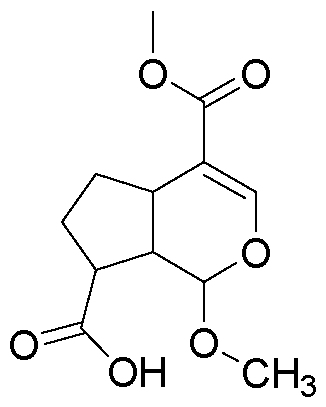
  • Genipin is the naturally occurring compound methyl (lR,4aS,7aS)-l-hydroxy-7- (hydroxymethyl)-l,4a,5,7a-tetrahydrocyclopenta[c]pyran-4-carboxylate (CAS RN. 6902- 77-8) and has the following structure: Genipin can be irreversibly coupled to keratinous tissues. For instance, keratin in skin comprises lysines having aliphatic amino side chains. These amino side chains react with the cyclic hemiacetal structure of genipin according to the below representative reaction scheme:
  • the finally resulting coupled genipin derivative is colored intensely blue. Due to the dark blue color, genipin is commercially used a tattooing dye in semi-permanent tattoos.
  • This skin-coupling property makes genipin an interesting candidate to couple various active components such as moisturizers, pesticides, in particular insect repellants, skin whitening agents, fragrance precursors and pharmaceuticals to skin.
  • active components such as moisturizers, pesticides, in particular insect repellants, skin whitening agents, fragrance precursors and pharmaceuticals
  • the dark blue color is aesthetically not pleasing to many, in particular if it is applied to facial or larger areas of skin. Therefore, while genipin carries a number of functional groups which can be readily utilized to attach active components, it was heretofore not seriously contemplated as a means for attaching an active component to skin.
  • the colorless (or nearly colorless and, thus, not visually perceivable on the skin) state of skin-coupled hydrogenated genipin derivative can be explained by the fact that the 1,4- dihydropyridine moiety formed with lysine is not endowed with a conjugated 7t-electron system with the double bond that is present in the cyclopentene-moiety of genipin (and absent in hydrogenated genipin).
  • 3,4-dihydro- 2H-pyran derivatives will unobtrusively bind to e.g. skin as long as the 3,4-dihydro-2H- pyran derivatives are selected such that formation of a conjugated 7t-electron system to the skin-bound 1,4-dihydropyridine moiety is avoided.
  • 3,4-Dihydro-2H-pyran derivatives meeting this requirement are, thus, particularly useful as a visually non-perceivable anchoring moieties to efficiently, irreversibly and unobtrusively couple active ingredients to keratinous tissues such as skin.
  • the active ingredient may be stably bound to the 3,4-dihydro-2H-pyran derivative or it may be bound to the 3,4-dihydro-2H-pyran derivative such that it is released over time, e.g. by hydrolysis or enzymatic cleavage of a functional group linking the active ingredient to the 3,4-dihydro-2H-pyran derivative.
  • Suitable functional groups providing sustained release properties are well-known in the art and readily available to the skilled person, see for instance V. Redasani, and S. Bariwidely, Prodrug Design - Perspectives, Approaches and Applications in Medicinal Chemistry, 1 st ed., 2015, ISBN: 9780128035191, which is incorporated herein in its entirety by reference thereto.
  • the present disclosure relates to a topical composition
  • a topical composition comprising a compound capable of covalently binding to skin and an excipient suitable for topical administration, wherein the compound capable of covalently binding to skin is a compound of formula (I),
  • R 1 represents hydrogen or a protective group hydrolysable under physiological conditions after application of the topical composition onto skin.
  • Li, L2 and L3 independently from each other represent a linker group or are absent.
  • Ai, A2 and A3 independently from each other represent a moiety of: group a): a C1-C30 moiety, H, hydroxyl, amino, or a halogen; or group b): a Ci-Ceo moiety or a polymeric moiety.
  • the Ci-Ceo moiety or polymeric moiety of group b) is carrying the active ingredient/component. Accordingly, at least one of Ai, A2 and A3 is a Ci-Ceo moiety or polymeric moiety of group b).
  • Ci-Ceo moiety or polymeric moiety of group b) is subdivided into two sub-groups bl) and b2).
  • the Ci-Ceo moiety or polymeric moiety of group bl) is configured to act as a skin moisturizer, a pesticide, a skin whitening agent, or a pharmaceutical.
  • Ci-Ceo moiety or polymeric moiety of group bl is a skin moisturizing moiety, a moiety providing pesticidal activity, a skin-whitening moiety or a pharmaceutically active moiety while being attached to the remainder of the 3,4-dihydro-2H-pyran moiety.
  • Ci-Ceo moiety or polymeric moiety of group bl is a skin moisturizer, a pesticide, a skin-whitening agent or a pharmaceutical.
  • the Ci-Ceo moiety or polymeric moiety of group bl is a skin moisturizer, a pesticide, a skin whitening agent, or a pharmaceutical which is attached to the remainder of the 3,4-dihydro-2H-pyran moiety.
  • the Ci-Ceo moiety or polymeric moiety of group b2) is configured to act as a skin moisturizer, a pesticide, a skin whitening agent, a fragrance or a pharmaceutical after being cleaved off of the 3,4-dihydro-2H-pyran moiety.
  • the Ci-Ceo moiety or polymeric moiety of group b2) is a skin moisturizer, a pesticide, a skin whitening agent, a fragrance or a pharmaceutical after being cleaved off or released from the remainder of the 3,4-dihydro-2H-pyran moiety.
  • the Ci-Ceo moiety or polymeric moiety of group b2) is a skin moisturizer, a pesticide, a skin whitening agent, a fragrance or a pharmaceutical which can be cleaved off or released from the remainder of the 3,4-dihydro-2H-pyran moiety after the compound has covalently bound to the skin.
  • a polyol humectant may provide its activity while being attached to the 3,4-dihydro-2H-pyran moiety but also when it is released from the 3,4-dihydro-2H- pyran moiety.
  • the 3,4-dihydro-2H-pyran derivatives of the present disclosure are selected such that formation of a conjugated 7t-electron system to the skin-bound 1,4- dihydropyridine moiety is essentially avoided. Accordingly, the compounds of the present disclosure are restricted such that L1-A1 and L2-A2 do not represent a moiety comprising an unsaturated C-C or C-N bond in alpha-position to the carbon atom marked “a” and “b”, respectively.
  • the compound of the above formula may also be present as its tautomer and/or as a pharmaceutically acceptable salt.
  • the present disclosure relates to a compound of formula (I), or a tautomer and/or a pharmaceutically acceptable salt thereof,
  • R 1 represents hydrogen or a protective group hydrolysable under physiological conditions after application of the topical composition onto skin;
  • Li, L2 and L3 independently from each other represent a linker group or is absent
  • Ai, A2 and A3 independently from each other represent a) a C1-C30 moiety, H, hydroxyl, amino, or a halogen, or b) a Ci-Ceo moiety or a polymeric moiety; at least one of Ai, A2 and A3 is a Ci-Ceo moiety or a polymeric moiety of group b); the Ci-Ceo moiety or polymeric moiety of group b) is bl) configured to act as a pharmaceutical; and/or b2) configured to act as a pharmaceutical after being cleaved off of the 3,4-dihydro-
  • L1-A1 and L2-A2 do not represent a moiety comprising an unsaturated C-C or C-N bond in alpha-position to the carbon atom marked “a” and “b”, respectively; for use in medicine.
  • the present disclosure relates to a compound of formula (I), or a tautomer and/or a pharmaceutically acceptable salt thereof,
  • R 1 represents hydrogen or a protective group hydrolysable under physiological conditions after application of the topical composition onto skin;
  • Li, L2 and L3 independently from each other represent a linker group or is absent
  • Ai, A2 and A3 independently from each other represent a) a C1-C30 moiety, H, hydroxyl, amino, or a halogen, or b) a Ci-Ceo moiety or polymeric moiety; at least one of Ai, A2 and A3 is a Ci-Ceo moiety or polymeric moiety of group b); the Ci-Ceo moiety or polymeric moiety of group b) is bl) configured to act as a pharmaceutical; and/or b2) configured to act as a pharmaceutical after being cleaved off of the 3,4-dihydro-
  • L1-A1 and L2-A2 do not represent a moiety comprising an unsaturated C-C or C-N bond in alpha-position to the carbon atom marked “a” and “b”, respectively; for use in treating a skin-associated disease, an allergic condition, pain, or inflammation.
  • the present disclosure relates to a compound of formula (I), or a tautomer and/or a pharmaceutically acceptable salt thereof,
  • R 1 represents hydrogen or a protective group hydrolysable under physiological conditions after application of the topical composition onto skin;
  • Li, L2 and L3 independently from each other represent a linker group or is absent
  • Ai, A2 and A3 independently from each other represent a) a C1-C30 moiety, H, hydroxyl, amino, or a halogen, or b) a Ci-Ceo moiety or a polymeric moiety; at least one of Ai, A2 and A3 is a Ci-Ceo moiety or polymeric moiety configured to act as a pharmaceutical after being cleaved off of the 3,4-dihydro-2H-pyran moiety; and
  • L1-A1 and L2-A2 do not represent a moiety comprising an unsaturated C-C or C-N bond in alpha-position to the carbon atom marked “a” and “b”, respectively; for use in medicine, in particular a skin-associated disease, an allergic condition, pain, or inflammation, wherein the pharmaceutical is released over a plurality of hours or days.
  • the present disclosure relates to a use of a topical composition according to the first aspect as a skin moisturizer, pesticide, in particular an insect repellant, a skin whitening agent or a fragrance.
  • the present disclosure relates to a method of using a topical composition
  • a topical composition comprising a compound capable of covalently binding to skin and an excipient suitable for topical administration, wherein the compound capable of covalently binding to skin may be a compound of formula (I), or a tautomer and/or a pharmaceutically acceptable salt thereof,
  • R 1 represents hydrogen or a protective group hydrolysable under physiological conditions after application of the topical composition onto skin;
  • Li, L2 and L3 independently from each other represent a linker group or is absent
  • Ai, A2 and A3 independently from each other represent a) a C1-C30 moiety, H, hydroxyl, amino, or a halogen, or b) a Ci-Ceo moiety or a polymeric moiety; at least one of Ai, A2 and A3 is a Ci-Ceo moiety or polymeric moiety of group b); the Ci-Ceo moiety or polymeric moiety of group b) is bl) configured to act as a skin moisturizer, a pesticide or a skin whitening agent; and/or b2) configured to act as a skin moisturizer, a pesticide, a skin whitening agent or a fragrance after being cleaved off of the 3,4-dihydro-2H-pyran moiety; and
  • L1-A1 and L2-A2 do not represent a moiety comprising an unsaturated C-C or C-N bond in alpha-position to the carbon atom marked “a” and “b”, respectively; the method comprising applying the topical composition to skin.
  • the present disclosure relates to a method of treating domestic or farm animals, the method comprising applying a topical composition to the skin and/or fur of domestic or farm animals, wherein the topical composition comprising a compound capable of covalently binding to skin and an excipient suitable for topical administration, wherein the compound capable of covalently binding to skin may be a compound of formula (I), or a tautomer and/or a pharmaceutically acceptable salt thereof,
  • R 1 represents hydrogen or a protective group hydrolysable under physiological conditions after application of the topical composition onto skin;
  • Li, L2 and L3 independently from each other represent a linker group or is absent
  • Ai, A2 and A3 independently from each other represent a) a C1-C30 moiety, H, hydroxyl, amino, or a halogen, or b) a Ci-Ceo moiety or a polymeric moiety; at least one of Ai, A2 and A3 is a Ci-Ceo moiety or polymeric moiety of group b); the Ci-Ceo moiety or polymeric moiety of group b) is bl) configured to act as a pesticide; and/or b2) configured to act as a pesticide after being cleaved off of the 3,4-dihydro-2H-pyran moiety; and
  • L1-A1 and L2-A2 do not represent a moiety comprising an unsaturated C-C or C-N bond in alpha-position to the carbon atom marked “a” and “b”, respectively.
  • the present disclosure specifically relates to the compounds of the present disclosure per se, i.e. independent from the topical composition.
  • Fig. 1 shows a reaction scheme for the synthesis of a compound of the present disclosure comprising erythritol as active component.
  • Fig. 2 shows a reaction scheme for the synthesis of a compound of the present disclosure comprising p-methane-3,8-diol as active component.
  • Fig. 3 shows a reaction scheme for the synthesis of a compound of the present disclosure comprising minoxidil as active component.
  • Fig. 4 shows a reaction scheme for the synthesis of a compound of the present disclosure comprising desloratadine as active component.
  • Figs 5 to 9 and 11 show UV spectra of compounds comprising a 3,4-dihydro-2H-pyran moiety (some of which being compounds according to the present disclosure) and the UV spectra of their corresponding lysine conjugates.
  • Fig.s 10 and 12 show the attachment of compounds of the present disclosure to pig skin.
  • the present disclosure relates to a compound capable of covalently binding to skin, in particular to said compound being comprised in a topical composition further comprising an excipient suitable for topical administration, wherein the compound capable of covalently binding to skin is a compound of formula (I), or a tautomer and/or a pharmaceutically acceptable salt thereof,
  • a compound capable of covalently binding to skin is applied its common meaning in the art and in particular refers to a compound which can undergo a chemical reaction which covalently binds it to amino sidechains of amino acids such as lysine. Additionally or alternatively, a compound is “capable of covalently binding to skin” if the compound (or a topical composition containing the compound) cannot be comprehensively washed off from (explanted) porcine skin by water, soap, and/or isopropanol after incubating the compound (or the topical composition comprising the compound) on the porcine skin at 37°C for 24 hours.
  • a compound is “capable of covalently binding to skin” if, when placing 0.1 mol/L of the compound in an aqueous solution having a pH of about 5 and further containing 0.1 mol/L lysine at 37°C for 24 hours, the compound is converted by more than 10 mol% to its corresponding 1,4-dihydropyridine derivative.
  • skin appendages are epidermal and dermal-derived components of the skin and include hair, nails, sweat glands, and sebaceous glands.
  • R 1 represents hydrogen or a protective group hydrolysable under physiological conditions after application of the topical composition onto skin.
  • physiological conditions it should be understood that this in particular refers to the pH conditions encountered at the locus where the compound of formula (I) is supposed to bind to in the subject to be treated (skin or skin appendages).
  • the term “protective groups hydrolysable under physiological conditions after application of the topical composition” refers to a group which is hydrolysed when placing 0.1 mol/L of the compound of formula (I) in an aqueous solution having a pH of about 5 for 24 hours, wherein the group in question qualifies as “protective group hydrolysable under physiological conditions after application of the topical composition” if more than 10 mol% is converted to its corresponding hemiacetal.
  • Ai, A2 and A3 independently from each other represent a moiety of: group a): a C1-C30 moiety, H, hydroxyl, amino, or a halogen, or group b): a Ci-Ceo moiety or a polymeric moiety.
  • the Ci-Ceo moiety or polymeric moiety of group b) is carrying the active ingredient/component. Accordingly, at least one of Ai, A2 and A3 is a Ci-Ceo moiety or a polymeric moiety of group b).
  • the Ci-Ceo moiety or polymeric moiety of group b) is subdivided into two sub-groups bl) and b2).
  • the Ci-Ceo moiety or polymeric moiety of group bl) is configured to act as a skin moisturizer, a pesticide, a skin whitening agent, or a pharmaceutical.
  • the active ingredient/component is capable of providing its activity while being attached to the remainder of the 3,4-dihydro-2H-pyran moiety.
  • the Ci-Ceo moiety or polymeric moiety of group b2) is configured to act as a skin moisturizer, a pesticide, a skin whitening agent, a fragrance or a pharmaceutical after being cleaved off of the 3,4-dihydro-2H-pyran moiety.
  • the active ingredient/component is capable of providing its activity after being released from the remainder of the 3,4-dihydro-2H-pyran moiety.
  • the two subgroups bl) and b2) are not necessarily mutually exclusive.
  • a polyol humectant may provide its moisturizing activity while being attached to the 3,4-dihydro-2H-pyran moiety but also when it is released from the 3,4-dihydro-2H- pyran moiety.
  • Ci-Ceo moiety or polymeric moiety of group b2) being cleaved off of (or released from) the 3,4-dihydro-2H-pyran moiety
  • this refers to the 3,4-dihydro-2H-pyran moiety which includes (or at least partially includes) Li, L2 and/or L3 (if present) as well as any remaining Ai to A3 moieties.
  • this refers to a cleavage (or release) under physiological conditions encountered by the compound after application of the topical composition onto skin (or skin appendages).
  • physiological conditions it should be understood that this in particular refers to the ambient conditions, in particular pH, enzymatic, and temperature conditions, encountered at the locus where the compound of formula (I) is supposed to bind to keratinous tissues in e.g. the stratum corneum and/or the epidermis of the (mammalian, in particular human) subject to be treated. Additionally or alternatively, the ability of a Ci-Ceo moiety or polymeric moiety of group b2) to be cleaved off of the 3,4-dihydro-2H-pyran moiety may be assessed on an ex-vivo porcine skin model at 37°C.
  • the 3,4-dihydro-2H-pyran derivatives of the present disclosure are selected such that the formation of a conjugated 7t-electron system to the skin-bound 1,4- dihydropyridine moiety is essentially avoided. Accordingly, the compounds of the present disclosure are restricted such that L1-A1 and L2-A2 do not represent a moiety comprising an unsaturated C-C or C-N bond in alpha-position to the carbon atom marked “a” and “b”, respectively.
  • Ai, A2 and A3 may independently from each other represent a C1-C30 moiety, i.e. be a moiety according to group a).
  • the term is not particularly limited beyond its common understanding in the art and refers to any moiety comprising between 1 and 30 carbon atoms.
  • the presence of further heteroatoms, i.e. atoms not being C, is not excluded, i.e. atoms such a H, O, and N may be contained in the moiety.
  • Ci-Ceo moiety may independently from each other represent a Ci-Ceo moiety or polymeric moiety of group bl) and/or b2).
  • Ci-Ceo moiety is not particularly limited beyond its common understanding in the art and refers to any moiety comprising between 1 and 60 carbon atoms.
  • polymeric moiety is not particularly limited beyond its common understanding in the art and refers to any oligomeric (herein defined as more than 3 and up to 8 repeat units) or polymeric moiety (herein defined as having more than 8 repeat units).
  • the polymeric moiety, i.e. polymer will typically comprise carbon and/or silicon, but the presence of further heteroatoms, i.e. atoms not being C or Si, is not excluded, i.e. atoms such a H, O, N and others may be contained in the polymeric moiety.
  • Ai, A2 and A3 may independently from each other represent a Ci-Ceo moiety or a polymeric moiety of group bl) which is configured to act as a skin moisturizer, a pesticide, a skin whitening agent, or a pharmaceutical.
  • Said functional language is meant to imply that the Ci-Ceo moiety or the polymeric moiety (or more specifically the compound in its entirety after being covalently bound to keratinous material such as skin) is capable of providing the referenced effect (a skin moisturizing effect, a pesticidal effect, a skin whitening effect, or a pharmacological effect).
  • Ai, A2 and A3 may independently from each other also represent a Ci-Ceo moiety or a polymeric moiety of group b2) which is configured to act as a skin moisturizer, a pesticide, a skin whitening agent, a fragrance or a pharmaceutical after being cleaved off of the 3,4- dihydro-2H-pyran moiety.
  • the compound released from the Ci-Ceo moiety or from the polymeric moiety is capable of providing the referenced effect (a skin moisturizing effect, a pesticidal effect, a skin whitening effect, an olfactory effect, or a pharmacological effect).
  • Ai, A2 and A3 may independently from each other represent a polymeric moiety of group bl) or b2) which is configured to act as a skin moisturizer.
  • Said functional language is meant to imply that the polymeric moiety (or more specifically the compound in its entirety after being covalently bound to keratinous material such as skin) is capable of providing the skin moisturizing effect.
  • skin moisturizer refers to a compound/moiety which is capable of directly binding water (via hydrogen bonding) in the skin or of reducing evaporation of water from the skin. Accordingly, the term encompasses moisturizes, emollients and occlusives as these terms are used and understood in the art.
  • a pesticide refers to its common meaning in the art and in particular refers compounds capable of killing, incapacitating, repelling or in any other way ameliorating a risk to mammalian (human) health, comfort or well-being posed by invertebrates, in particular insects.
  • a skin whitening agent refers to the common meaning in the art and in particular refers to a compound which is chemically and/or metabolically able to lighten the color tone of skin.
  • a skin whitening agent does not refer to pigments or dyes or optical brighteners.
  • fragment refers to the common meaning in the art and in particular refers to a volatile compound which is capable of providing an olfactory impression, in particular an olfactory impression comprising one or more of the seven fundamental odors (floral, fruity, minty, nutty, pungent, sweet, and woody).
  • pharmaceutical refers to the common meaning in the art and in particular refers to a compound capable/intended for use in the diagnosis, cure, mitigation, treatment, therapy, or prevention of disease in mammals, in particular humans and domestic and farm animals.
  • Li, L2 and L3 independently from each other represent a linker group or are absent.
  • linker group is not particularly limited and refers to any chemical group which covalently connects the 3,4-dihydro-2H-pyran moiety to the corresponding moiety Ai, A2 and A3 moiety, respectively.
  • Li and L2 connect to the 3,4-dihydro-2H-pyran moiety by a single bond, i.e. ring positions marked with “a” and “b” represent methines (“CHR3”).
  • Li, L2 and L3 may, if present and independently from each other, represent optionally substituted hydrocarbon moieties each comprising, in combination with their optional substituents, 1 to 14 carbon atoms. In some embodiments, Li and L2 may, if present and independently from each other, represent optionally substituted hydrocarbon moieties each comprising, in combination with their optional substituents, 1 to 14 carbon atoms. In some embodiments, Li, L2 and L3 may also form optionally substituted cyclic structures.
  • Li and L2 are present and form a 5-, 6-, 7- or 8-membered ring, in particular a cyclopentyl, a cyclohexyl, a pyrrolidinyl, a piperidinyl, a tetrahydrofuranyl or a tetrahydropyranyl.
  • Li and L2 form an optionally substituted 5- or 6-membered ring and comprise, together with their substituents, 2 to 14 carbon atoms, more specifically 3 to 12, and in particular 4 to 8 carbon atoms.
  • substituents 2 to 14 carbon atoms, more specifically 3 to 12, and in particular 4 to 8 carbon atoms.
  • two of the ring carbons stem from the 3,4- dihydro-2H-pyran moiety and are therefore not counted toward the total carbon number of Li and L2.
  • the number of carbon atoms is 2.
  • Li and L2 form a cyclopentyl which is monosubstituted with a -CH2- OH group, the number of carbon atoms is 4.
  • Li and L2 are present and form an optionally substituted 5-or 6-membered ring, in particular cyclopentyl or cyclohexyl, to which Ai and A2 are attached, optionally via a group selected from: -O-, - S-, -C(O)-, -CO2-, -O-C(O)-, -NH-C(O)-, -C(O)-NH-, -(CH 2 )I- 4 -, -(CH 2 )I- 4 -O- and -O- (CH 2 )I- 4 -, or combinations thereof.
  • Li and L2 are present and form a cyclopentyl, a cyclopentenyl, a cyclohexyl, or a cyclohexenyl ring to which Ai and A2 are attached, optionally via a group selected from: - O-, -S-, -C(O)-, -CO2-, -O-C(O)-, -NH-C(O)-, -C(O)-NH-, -(CH 2 )I- 4 -, -(CH 2 )I- 4 -O- and - O-(CH2)I- 4 - or combinations thereof.
  • the compound capable for covalently binding to skin is a compound of formula (II), or a tautomer and/or a pharmaceutically acceptable salt thereof,
  • R 1 , L3, Ai and A3 are as defined for the compound of formula (I); wherein (R 2 ) n represents, independently from each other, n moieties selected from H, Ci- C4 alkyl, C1-C4 alkoxyl, hydroxyl, amino, or halogen; wherein n is an integer selected from 1 and 2; and wherein L4 is either absent or a group selected from: -O-, -S-, -C(O)-, -CO2-, -O-C(O)-, - NR 4 -, -NR 4 -C(O)-, -C(O)-NR 4 -, -(CH 2 )I- 4 -, -(CH 2 )I- 4 -O-, -O-(CH 2 )I- 4 - or combinations thereof; and wherein R 4 is selected from H or Ci-C4-alkyl.
  • the compound capable for covalently binding to skin is a compound of formula (III), or a tautomer and/or a pharmaceutically acceptable salt thereof,
  • R 1 , L3, Ai and A3 are as defined for the compound of formula (I); and wherein L4 is either absent or a group selected from: -O-, -S-, -C(O)-, -CO2-, -O-C(O)-, - NR 4 -, -NR 4 -C(O)-, -C(O)-NR 4 -, -(CH 2 )I- 4 -, -(CH 2 )I- 4 -O-, -O-(CH 2 )I- 4 - or combinations thereof; and wherein R 4 is selected from H or Ci-C 4 -alkyl.
  • the compound capable for covalently binding to skin is a compound of formula (IV), or a tautomer and/or a pharmaceutically acceptable salt thereof,
  • R 1 and Ai are as for the compound of formula (I); wherein (R 2 ) n represents, independently from each other, n moieties selected from H, Ci- C 4 alkyl, Ci-C 4 alkoxyl, hydroxyl, amino, or halogen; wherein n is an integer selected from 1 and 2; wherein L 4 is either absent or a group selected from: -O-, -S-, -C(O)-, -CO 2 -, -O-C(O)-, - NR 4 -, -NR 4 -C(O)-, -C(O)-NR 4 -, -(CH 2 )I.
  • R 3 represents hydrogen or an optionally substituted hydrocarbon moiety comprising, in combination with their optional substituents, 1 to 14 carbon atoms; and wherein R 4 is selected from H or Ci-C 4 -alkyl.
  • the compound capable for covalently binding to skin is a compound of formula (V), or a tautomer and/or a pharmaceutically acceptable salt thereof,
  • R 1 and Ai are as defined for the compound of formula (I); wherein L4 is either absent or a group selected from: -O-, -S-, -C(O)-, -CO2-, -O-C(O)-, - NR 4 -, -NR 4 -C(O)-, -C(O)-NR 4 -, -(CH 2 )I- 4 -, -(CH 2 )I- 4 -O-, -O-(CH 2 )I- 4 - or combinations thereof; wherein R 3 represents hydrogen or an optionally substituted hydrocarbon moiety comprising, in combination with their optional substituents, 1 to 14 carbon atoms; and wherein R 4 is selected from H or Ci-C4-alkyl.
  • the first example concerns a compound intended to provide a moisturizing effect.
  • Skin moisturizers are well-established in cosmetics and include a large variety of compounds capable of binding water in the stratum corneum. Examples include polyols such as glycerol, pentaerythritol and sorbitol but also other hydrogen-bonding compounds such as urea.
  • a compound according to the present disclosure carrying a pentaerythritol as the Ci- Ceo moiety of group b) is shown below:
  • Genipin derivatives are well-known to bind to the stratum corneum. Due to the large number of hydroxyl groups, the above compound according to the present disclosure can be expected to provide a long-lasting moisturizing effect to the skin. The moisturizing effect will be given even if the pentaerythritol moiety is still attached to the skin via the 3,4-dihydro-2H-pyran moiety. As such, the moiety is an example of group bl).
  • the ester group linking the pentaerythritol moiety to the remainder of the compound is cleavable by esterases which are abundantly found on the skin. Therefore, it is also an example of a moiety which at the same time belongs to group b2). If it is desirable that the pentaerythritol moiety belongs to only group bl) another functional group may be selected. For instance, replacing the ester linkage by an ether linkage may be contemplated.
  • Fig. 1 An outline of the chemical synthesis of the above compound is shown in Fig. 1.
  • the synthesis of compounds (1) and (2) is disclosed in the co-pending international application WO 2023/102652 Al. (2) can be converted to the corresponding acylchloride by thionyl chloride which then can be coupled with pentaerythritol to yield ester (3). Ester (3) can be hydrolysed in an acidic aqueous solution with mild heating to yield the target compound (4).
  • the humectant glycerol and the emollient decanol can be linked to hydrogenated genipin derivatives and that the resulting conjugates can be conjugated to skin.
  • the following compounds were synthesized and conjugated to skin.
  • the second example concerns a compound intended to provide a pesticidal effect, more specifically an insect repellant effect.
  • para-Menthane-3,8-diol is an insect repellent which can be used directly on skin or clothing. It has broad efficacy against various arthropods such as mosquitos, ticks, gnats, flies and fleas, and is colorless.
  • the chemical structure of PMD is reproduced below:
  • PMD insect repelling potency rivals that of N,N-diethyl-m-methylbenzamide (DEET). However, like DEET, it provides only a briefly lasting effect of up to 6-8 hours. This is mostly due to the relatively high volatility of PMD.
  • DEET N,N-diethyl-m-methylbenzamide
  • Fig. 2 An outline of the chemical synthesis of the above compound is shown in Fig. 2.
  • the synthesis of compounds (1) and (2) is disclosed in the co-pending international application WO 2023/102652 Al. (2) can be converted to the corresponding acylchloride by e.g. thionyl chloride which then can be coupled with PMD to yield ester (3). Ester (3) can be hydrolysed in an acidic aqueous solution with mild heating to yield the target compound (4).
  • the ester group linking PMD to the remainder of the compound can be expected to be cleaved by esterases of the skin and PMD is released over time to the stratum corneum to provide its insect repellent effect.
  • insect repellant picaridin can be linked to a hydrogenated genipin derivative and that the resulting conjugate can be conjugated to skin.
  • the following compound was synthesized and conjugated to skin.
  • the third example concerns a compound intended to provide a pharmaceutical effect, more specifically the treatment/prevention of alopecia.
  • Minoxidil and its derivatives are topically applied to treat alopecia.
  • Minoxidil is typically applied twice per day to the scalp in an alcoholic solution (ethanol and propylene glycol).
  • alcoholic solution ethanol and propylene glycol
  • the compound is generally well tolerated, but common side effects include dandruff and contact dermatitis which are caused by the frequent exposure to ethanol and propylene glycol which dry the scalp.
  • a topical delivery system which requires less frequent application of minoxidil would be desirable.
  • Minoxidil has the following chemical structure:
  • Fig. 3 An outline of the chemical synthesis of the above compound is shown in Fig. 3.
  • the synthesis of compound (3) is disclosed in the co-pending international application WO 2023/102652 Al.
  • Minoxidil (1) is activated by CDI to compound (2) which is then reacted with (3) to yield the carbamate (4).
  • (4) is hydrolysed in an acidic aqueous solution with mild heating to yield the target compound (5) which couples minoxidil to the remainder of the compound via a monosubstituted carbamate group.
  • Monosubstituted carbamate groups are frequently used in prodrugs and can be cleaved by esterases (see review by Gosh et al., J. Med. Chem., 2015, 58, 7, 2895-2940).
  • esterases see review by Gosh et al., J. Med. Chem., 2015, 58, 7, 2895-2940.
  • the above compound is a promising candidate to provide sustained release of minoxidil to the skin.
  • the fourth example also concerns a compound intended to provide a pharmaceutical effect, more specifically the treatment of an allergic condition.
  • Desloratadine the metabolically active form of loratadine, is a very potent antihistamine that is administered orally once per day at a dosage of 5 mg.
  • Topical formulations of desloratadine are currently investigated.
  • Mohamed et al., Pharmaceuticals 2023, 16(4), 578 describe desloratadine as having good permeation through the skin when applied as a transdermal gel formulation. They found that the gel formulation had higher bioavailability, and eliminated slowly compared to the tablet formulation. The bioavailability of the gel formulation was 2.4-3.2 fold of the tablet formulation.
  • Desloratadine has the following chemical structure:
  • Fig. 4 An outline of the chemical synthesis of the above compound is shown in Fig. 4.
  • the synthesis of compound (2) is disclosed in the co-pending international application WO 2023/102652 Al.
  • Desloratadine (1) is coupled with CDI to compound (2) to yield the carbamate (3).
  • Compound (3) is hydrolysed in an acidic aqueous solution with mild heating to yield the target compound (4) which couples desloratadine to the remainder of the compound via a N,N-disubstituted carbamate group.
  • This synthetical pathway allows easy access to the following compound of the present disclosure:
  • N,N-disubstituted carbamate groups as utilized in the above compound are frequently used in prodrugs (e.g. in bambuterol) and can be cleaved by esterases with a relatively long sustained release (see review by Gosh et al., J. Med. Chem., 2015, 58, 7, 2895-2940).
  • the above compound is a promising candidate to provide a long-term release of desloratadine to the skin.
  • a long-lasting depot effect can be expected, possibly allowing less frequent administration, in particular such as a once weekly administration. In practice, this may be done by applying a transdermal patch overnight which transfers and anchors the desloratadine-containing compound to the skin. From there it is released by the skin’s enzymatic activity over the period of e.g. one week.
  • the compounds of the present disclosure provide broad utility and versatility in topically applying active ingredients to keratinous tissue.
  • the Ci-Ceo moiety or polymeric moiety of group b) may comprise a functional group which couples the Ci-Ceo moiety or the polymeric moiety to the corresponding Li, L2 or L3 moiety or, if the corresponding Li, L2 or L3 moiety is absent, to the 3,4-dihydro-2H-pyran moiety.
  • the functional group may comprise a carbon atom, an oxygen atom, a nitrogen atom, a sulfur atom, a phosphorus atom, or a combination thereof; more specifically a carbon atom, an oxygen atom, a nitrogen atom, or a combination thereof; and in particular a carbon atom and/or an oxygen atom.
  • the functional group may comprise one or more of, two or more of, three or more of, four or more of, or all of between 1 and 12 carbon atoms, more specifically between 1 and 6 carbon atoms, and in particular between 1 and 3 carbon atoms; between 1 and 12 oxygen atoms, more specifically between 1 and 6 oxygen atoms, and in particular between 1 and 3 oxygen atoms; between 1 and 4 nitrogen atoms, more specifically between 1 and 3 nitrogen atoms, and in particular between 1 and 2 nitrogen atoms; between 1 and 3 sulfur atoms, more specifically between 1 and 2 sulfur atoms, and in particular 1 sulfur atom; between 1 and 3 phosphorus atoms, more specifically between 1 and 2 phosphorus atoms, and in particular 1 phosphorus atom.
  • the functional group may be cleavable under physiological conditions after application of the topical composition onto skin.
  • physiological conditions it should be understood that this in particular refers to the pH conditions encountered at the locus where the compound of formula (I) is supposed to bind to keratinous tissues in e.g. the stratum corneum and/or the epidermis of the (mammalian, in particular human) subject to be treated.
  • the functional group may be hydrolysable at the physiological pH of mammal skin, more specifically of human skin, and in particular at a pH of between about 5 to about 6.
  • a suitable in-vitro test is placing 0.1 mol/L of the compound of formula (I) in aqueous solution having a pH of about 5 at 37°C for 24 hours, wherein the group in question qualifies as hydrolysable if a notable amount of the group is hydrolysed (e.g. more than 5 mol%, or more than 10 mol%).
  • the functional group may be enzymatically cleavable under physiological conditions after application of the topical composition onto skin, in particular enzymatically cleavable by enzymes present in the human skin.
  • physiological conditions it should be understood that this in particular refers to the conditions encountered at the locus where the compound of formula (I) is supposed to bind to keratinous tissues in e.g. the stratum corneum and/or the epidermis of the (mammalian, in particular human) subject to be treated.
  • a suitable in-vitro test is placing 0.1 mol/L of the compound of formula (I) in aqueous solution having a pH of about 5 at 37°C for 24 hours and further containing 50 U of esterase activity, wherein the group in question qualifies as enzymatically cleavable if a notable amount of the group is cleaved (e.g. more than 5 mol-%, or more than 10 mol-%).
  • the functional group may be configured to be cleaved to a hydroxyl group, a primary or secondary amine group, a carboxylic acid, a thiol, an aldehyde, a ketone, a thiocarbonic acid, a sulfonic acid, a sulfinic acid, a phosphoric acid, a phosphonic acid, an olefin or an oxime; or salts thereof.
  • the functional group may be configured to provide a hydroxyl group, a primary or secondary amine group, a carboxylic acid, a thiol, an aldehyde, a ketone, a thiocarbonic acid, a sulfonic acid, a sulfinic acid, a phosphoric acid, a phosphonic acid, an olefin, or an oxime; or salts thereof; on the corresponding Li, L2 or L3 moiety which is attached to the Ci-Ceo moiety or polymeric moiety of group b) or, if the corresponding Li, L2 or L3 moiety is absent, on the 3,4-dihydro-2H-pyran moiety after cleaving.
  • the functional group may be configured to provide a hydroxyl group, a primary or secondary amine group, a carboxylic acid, a thiol, an aldehyde, a ketone, a thiocarbonic acid, a sulfonic acid, a sulfinic acid, a phosphoric acid, a phosphonic acid, an olefin, or an oxime; or salts thereof; on the Ci-Ceo moiety or polymeric moiety of group b) after cleaving.
  • the functional group may comprise a carbon ester, in particular a monoester, 1,1 -diester, a carbonate, or a carbamate; an ether or thioether, in particular an acetal, a hemi-acetal, a glycosidic group or a thioacetal; an carbon amide, in particular a peptide or a N-Mannich base; an enol; an enamine; an imine; an oxime; a sulfate ester; a sulfonic acid ester; a sulfonic acid amid; a phosphoric acid ester; a phosphonic acid ester; a phosphoric acid amide; or a phosphonic acid amide.
  • a carbon ester in particular a monoester, 1,1 -diester, a carbonate, or a carbamate
  • an ether or thioether in particular an acetal, a hemi-acetal, a glycosidic
  • the functional group may be a functional group mentioned in chapter 6 of the textbook Prodrug Design Perspectives, Approaches and Applications in Medicinal Chemistry, 1 st ed., 2015, ISBN: 9780128035191, which is incorporated herein (for the aforementioned purpose and in its entirety) by reference thereto.
  • Ai may represent the Ci-Ceo moiety or polymeric moiety of group b). Additionally or alternatively, A2 may represent a Ci-Ceo moiety or polymeric moiety of group b). Additionally or alternatively, A3 may represent a Ci-Ceo moiety or polymeric moiety of group b). Additionally or alternatively, the remainder of Ai, A2 and A3 may represent a substituent of group a), more specifically a C1-C30 moiety, H, hydroxyl, amino, or a halogen.
  • Li are present and represent an optionally substituted hydrocarbon moiety comprising, in combination with its optional substituents, 1 to 8 carbon atoms.
  • L2 may be present and represents an optionally substituted hydrocarbon moiety comprising, in combination with its optional substituents, 1 to 8 carbon atoms.
  • L3 may be present and represent an optionally substituted hydrocarbon moiety comprising, in combination with its optional substituents, 1 to 8 carbon atoms.
  • Li may be present and represent an optionally substituted hydrocarbon moiety comprising, in combination with its optional substituents, 1 to 8 carbon atoms and the functional group may be attached to Li.
  • L2 may be present and represent an optionally substituted hydrocarbon moiety comprising, in combination with its optional substituents, 1 to 8 carbon atoms and the functional group may be attached to L2.
  • L3 may be present and represent an optionally substituted hydrocarbon moiety comprising, in combination with its optional substituents, 1 to 8 carbon atoms and the functional group may be attached to L3.
  • the respective linker group may comprise 1 to 8, more specifically 1 to 6, and in particular 1 to 4 oxygen atoms; 1 to 8, more specifically 1 to 6, and in particular 1 to 4 nitrogen atoms; 1 to 6, more specifically 1 to 4, and in particular 1 to 3 sulfur atoms; 1 to 6, more specifically 1 to 4, and in particular 1 to 3 phosphor atoms, and 1 to 10, more specifically 1 to 8, and in particular 1 to 6 halogen atoms.
  • said respective linker group does not contain any further atom species besides carbon, the (optional) aforementioned atom species and hydrogen.
  • Li and L2 may be present and form an optionally substituted 5-or 6-membered ring, in particular cyclopentyl or cyclohexyl, to which Ai and A2 may be attached, optionally via a group selected from: -O-, -S-, -C(O)-, -CO2-, -O-C(O)-, -NH- C(O)-, -C(O)-NH-, -(CH2)i-4-, -(CH2)I-4-O- and -O-(CH2)i-4-, or combinations thereof.
  • the aforementioned specific groups may be part of a larger functional group, hence the reference to “combinations thereof’.
  • a carbamate may be considered as both -O- and -C(O)-NH- or a combination thereof.
  • Li and L2 may be present and form a cyclopentyl, a cyclopentenyl, a cyclohexyl, or a cyclohexenyl ring to which Ai and A2 may be attached, optionally via a group selected from: -O-, -S-, -C(O)-, -CO2-, -O-C(O)-, -NH-C(O)-, -C(O)-NH-, -(CH 2 )I- 4-, -(CH2)I-4-O- and -O-(CH2)I-4-, or combinations thereof.
  • a carbamate may be considered as both -O- and -C(O)-NH- or a combination thereof.
  • Ai may be a Ci-Ceo moiety or polymeric moiety of group b).
  • A3 may be a Ci-Ceo moiety or polymeric moiety of group b).
  • A2 may represent the substituent of group a), more specifically a C1-C30 moiety, H, hydroxyl, amino, or a halogen, in particular hydrogen.
  • Ai may be a Ci-Ceo moiety or polymeric moiety of group b).
  • A2 and A3 may represent substituents of group a), more specifically independently from each other a C1-C30 moiety, H, hydroxyl, amino, or a halogen, and in particular hydrogen.
  • Ai may be a Ci-Ceo moiety or polymeric moiety of group b) and A2 and A3 may represent substituents of group a), more specifically independently from each other a C1-C30 moiety, H, hydroxyl, amino, or a halogen, and in particular hydrogen.
  • the C1-C30 moiety of group a) may comprise 1 to 30, more specifically 1 to 16, and in particular 1 to 12 carbon atoms; 0 to 12, more specifically 0 to 8, and in particular 0 to 6 oxygen atoms; 0 to 8, more specifically 0 to 6, and in particular 0 to 4 nitrogen atoms; 0 to 6, more specifically 0 to 4, and in particular 0 to 3 sulfur atoms; 0 to 6, more specifically 0 to 4, and in particular 0 to 3 phosphor atoms, and 0 to 10, more specifically 0 to 8, and in particular 0 to 6 halogen atoms.
  • the C1-C30 moiety may be selected from a saturated or unsaturated, cyclic or acylic (hetero)alkyl comprising 1 to 30, more specifically 1 to 16, and in particular 1 to 12, carbon atoms; 0 to 12, more specifically 0 to 8, and in particular 0 to 6 oxygen atoms; 0 to 8, more specifically 0 to 6, and in particular 0 to 4 nitrogen atoms; 0 to 6, more specifically 0 to 4, and in particular 0 to 3 sulfur atoms; and 0 to 10, more specifically 0 to 8, and in particular 0 to 6 halogen atoms; and/or the C1-C30 moiety may be bound to Li, L2 and L3, respectively, via a carbon atom, an oxygen atom, a nitrogen atom or a sulfur atom.
  • a saturated or unsaturated, cyclic or acylic (hetero)alkyl comprising 1 to 30, more specifically 1 to 16, and in particular 1 to 12, carbon atoms; 0 to 12, more specifically 0 to 8, and in particular
  • A3 may represent a C1-C30 moiety of group a), more specifically a C1-C16 moiety selected from a saturated or unsaturated, cyclic or acylic (hetero)alkyl comprising 1 to 16, more specifically 1 to 12, and in particular 1 to 8, carbon atoms; 0 to 6, more specifically 0 to 4, and in particular 0 to 3 oxygen atoms; 0 to 6, more specifically 0 to 4, and in particular 0 to 3 nitrogen atoms; 0 to 6, more specifically 0 to 4, and in particular 0 to 3 sulfur atoms; and 0 to 6, more specifically 0 to 4, and in particular 0 to 3 halogen atoms.
  • group a more specifically a C1-C16 moiety selected from a saturated or unsaturated, cyclic or acylic (hetero)alkyl comprising 1 to 16, more specifically 1 to 12, and in particular 1 to 8, carbon atoms; 0 to 6, more specifically 0 to 4, and in particular 0 to 3 oxygen atoms; 0 to 6,
  • A3 may represent a C1-C16 moiety selected from a carboxylic acid or a salt thereof; a carboxylic ester; or a ketone.
  • A3 may represent a C1-C16 moiety selected from a carboxylic acid or a salt thereof; a (Ci-C4-alkyl)carboxylic ester; or a Ci-C4-alkylcarbonyl.
  • Li and OR 1 together with the carbon atoms to which they are attached, may form a 5- or 6-membered lactone.
  • Ri may represent hydrogen, C1-6 acyl, or C1-6 alkyl. In some embodiments, it may be particularly advantageous that Ri represents H. In some embodiments, it may be particularly advantageous that Ri does not represent a glucoside.
  • At least one of Ai, A2 and A3 may represent a Ci-Ceo moiety of group bl). In some embodiments, at least one of Ai and A2 may represent a Ci-Ceo moiety of group bl).
  • At least one of Ai, A2 and A3 may represent a Ci-Ceo moiety or a polymeric moiety of group b2). In some embodiments, at least one of Ai and A2 may represent a Ci-Ceo moiety or polymeric moiety of group b2).
  • the compound capable of covalently binding to skin is a compound of formula (II), or a tautomer and/or a pharmaceutically acceptable salt thereof,
  • R 1 , L3, Ai and A3 are as defined as in any preceding embodiment
  • (R 2 ) n represents, independently from each other, n moieties selected from H, C1-C4 alkyl, C1-C4 alkoxyl, hydroxyl, amino, or halogen; n is an integer selected from 1 and 2; and
  • L4 is either absent or a group selected from: -O-, -S-, -C(O)-, -CO2-, -O-C(O)-, -NR 4 -, - NR 4 -C(O)-, -C(O)-NR 4 -, -(CH2)I-4-, -(CH2)I-4-O-, -O-(CH2)I-4-, or combinations thereof;
  • R 4 is selected from H or Ci-C4-alkyl.
  • At least one of Ai and A3 may represent a Ci-Ceo moiety or a polymeric moiety of group b). In some embodiments of formula (II), at least Ai may represent a Ci-Ceo moiety or a polymeric moiety of group b).
  • A3 may represent a C1-C30 moiety of group a), more specifically a C1-C16 moiety selected from a saturated or unsaturated, cyclic or acylic (hetero)alkyl comprising 1 to 16, more specifically 1 to 12, and in particular 1 to 8, carbon atoms; 0 to 6, more specifically 0 to 4, and in particular 0 to 3 oxygen atoms; 0 to 6, more specifically 0 to 4, and in particular 0 to 3 nitrogen atoms; 0 to 6, more specifically 0 to 4, and in particular 0 to 3 sulfur atoms; and 0 to 6, more specifically 0 to 4, and in particular 0 to 3 halogen atoms.
  • the compound capable of covalently binding to skin is a compound of formula (III), or a tautomer and/or a pharmaceutically acceptable salt thereof,
  • R 1 , L3, Ai and A3 are as defined in any preceding embodiment.
  • L4 is either absent or a group selected from: -O-, -S-, -C(O)-, -CO2-, -O-C(O)-, -NR 4 -, - NR 4 -C(O)-, -C(O)-NR 4 -, -(CH2)I-4-, -(CH2)I-4-O-, -O-(CH )I-4-, or combinations thereof; and
  • R 4 is selected from H or Ci-C4-alkyl.
  • At least one of Ai and A3 may represent a Ci-Ceo moiety or a polymeric moiety of group b). In some embodiments of formula (III), at least Ai may represent a Ci-Ceo moiety or a polymeric moiety of group b).
  • A3 may represent a C1-C30 moiety of group a), more specifically a C1-C16 moiety selected from a saturated or unsaturated, cyclic or acylic (hetero)alkyl comprising 1 to 16, more specifically 1 to 12, and in particular 1 to 8, carbon atoms; 0 to 6, more specifically 0 to 4, and in particular 0 to 3 oxygen atoms; 0 to 6, more specifically 0 to 4, and in particular 0 to 3 nitrogen atoms; 0 to 6, more specifically 0 to 4, and in particular 0 to 3 sulfur atoms; and 0 to 6, more specifically 0 to 4, and in particular 0 to 3 halogen atoms.
  • group a more specifically a C1-C16 moiety selected from a saturated or unsaturated, cyclic or acylic (hetero)alkyl comprising 1 to 16, more specifically 1 to 12, and in particular 1 to 8, carbon atoms; 0 to 6, more specifically 0 to 4, and in particular 0 to 3 oxygen atoms; 0 to 6,
  • L3 represents -C(O)-, -C(O)-O-, -C(O)-NH-, or - C(O)-N(Ci-C 4 -alkyl)-.
  • A3 represents an R 3 group with R 3 representing a C1-C14 moiety comprising 1 to 14, more specifically 1 to 12, and in particular 1 to 8, carbon atoms; 0 to 12, more specifically 0 to 8, and in particular 0 to 6 oxygen atoms; 0 to 8, more specifically 0 to 6, and in particular 0 to 4 nitrogen atoms; 0 to 6, more specifically 0 to 4, and in particular 0 to 3 sulfur atoms; and 0 to 10, more specifically 0 to 8, and in particular 0 to 6 halogen atoms.
  • R 3 represents C1-14 alkyl, C2-14 alkenylene, C2-14 alkynylene, Ce-i4 aryl, C4-14 heteroaryl comprising 1 to 4 nitrogen atoms, 1 to 3 oxygen atoms and/or 1 to 2 sulfur atoms, wherein any of the aforementioned groups is optionally further substituted with the proviso that the aforementioned total sum of the elements recited for R 3 is not exceeded. It may also be advantageous that R 3 represents an optionally substituted phenyl.
  • R 3 represents optionally substituted phenyl, in particular wherein the optionally substituted phenyl comprises 6 to 14, more specifically 6 to 12, and in particular 6 to 10, carbon atoms; 0 to 12, more specifically 0 to 8, and in particular 0 to 6 oxygen atoms; 0 to 8, more specifically 0 to 6, and in particular 0 to 4 nitrogen atoms; 0 to 6, more specifically 0 to 4, and in particular 0 to 3 sulfur atoms; and 0 to 10, more specifically 0 to 8, and in particular 0 to 6 halogen atoms.
  • the optionally substituted phenyl comprises 6 to 14, more specifically 6 to 12, and in particular 6 to 10, carbon atoms; 0 to 12, more specifically 0 to 8, and in particular 0 to 6 oxygen atoms; 0 to 8, more specifically 0 to 6, and in particular 0 to 4 nitrogen atoms; 0 to 6, more specifically 0 to 4, and in particular 0 to 3 sulfur atoms; and 0 to 10, more specifically 0 to 8, and in particular 0 to 6 halogen
  • R 3 is substituted with one or more moieties selected from the group consisting of: -C1-4 alkyl, -O-C1-4 alkyl, -S-C1-4 alkyl, - NH-C1-4 alkyl, -N(CI- 4 alkyl) 2 , -C(O)Ci- 4 alkyl, -CO2C1-4 alkyl, -O2C-C1-4 alkyl, -C(O)NH- C1-4 alkyl, -C(O)N(CI- 4 alkyl) 2 , -NH-C(O)CI- 4 alkyl, -N(CI- 4 alkyl)-C(O)Ci- 4 alkyl, -SO3H, -NO2, -NH2, -OH, -SH, -COOH, -C(O)H, halogen, in particular Cl, Br or F; and -CF3.
  • moieties selected from the group consisting of: -C1-4 alkyl,
  • the compound capable of covalently binding to skin is a compound of formula (IV), or a tautomer and/or a pharmaceutically acceptable salt thereof,
  • R 1 and Ai are as defined in any preceding embodiment
  • (R 2 ) n represents, independently from each other, n moieties selected from H, C1-C4 alkyl, C1-C4 alkoxyl, hydroxyl, amino, or halogen; n is an integer selected from 1 and 2;
  • R 3 represents hydrogen or an optionally substituted hydrocarbon moiety comprising, in combination with their optional substituents, 1 to 14 carbon atoms;
  • R 3 represents a C1-C14 moiety comprising 1 to 14, more specifically 1 to 12, and in particular 1 to 8, carbon atoms; 0 to 12, more specifically 0 to 8, and in particular 0 to 6 oxygen atoms; 0 to 8, more specifically 0 to 6, and in particular 0 to 4 nitrogen atoms; 0 to 6, more specifically 0 to 4, and in particular 0 to 3 sulfur atoms; and 0 to 10, more specifically 0 to 8, and in particular 0 to 6 halogen atoms.
  • R 3 represents C1-14 alkyl, C2-14 alkenylene, C2-14 alkynylene, Ce-i4 aryl, C4-14 heteroaryl comprising 1 to 4 nitrogen atoms, 1 to 3 oxygen atoms and/or 1 to 2 sulfur atoms, wherein any of the aforementioned groups is optionally further substituted with the proviso that the aforementioned total sum of the elements recited for R 3 is not exceeded. It may also be advantageous that R 3 represents an optionally substituted phenyl.
  • R 3 represents optionally substituted phenyl, in particular wherein the optionally substituted phenyl comprises 6 to 14, more specifically 6 to 12, and in particular 6 to 10, carbon atoms; 0 to 12, more specifically 0 to 8, and in particular 0 to 6 oxygen atoms; 0 to 8, more specifically 0 to 6, and in particular 0 to 4 nitrogen atoms; 0 to 6, more specifically 0 to 4, and in particular 0 to 3 sulfur atoms; and 0 to 10, more specifically 0 to 8, and in particular 0 to 6 halogen atoms.
  • the optionally substituted phenyl comprises 6 to 14, more specifically 6 to 12, and in particular 6 to 10, carbon atoms; 0 to 12, more specifically 0 to 8, and in particular 0 to 6 oxygen atoms; 0 to 8, more specifically 0 to 6, and in particular 0 to 4 nitrogen atoms; 0 to 6, more specifically 0 to 4, and in particular 0 to 3 sulfur atoms; and 0 to 10, more specifically 0 to 8, and in particular 0 to 6 halogen
  • the compound capable of covalently binding to skin is a compound of formula (V), or a tautomer and/or a pharmaceutically acceptable salt thereof,
  • R 1 and Ai are as defined in any preceding embodiment
  • R 4 is selected from H or Ci-C4-alkyl.
  • Ai may represent a Ci-Ceo moiety or a polymeric moiety of group b). In some embodiments of formula (V), Ai may represent a Ci-Ceo moiety of group b). In some embodiments of formula (V), R 3 represents a C1-C14 moiety comprising 1 to 14, more specifically 1 to 12, and in particular 1 to 8, carbon atoms; 0 to 12, more specifically 0 to 8, and in particular 0 to 6 oxygen atoms; 0 to 8, more specifically 0 to 6, and in particular 0 to 4 nitrogen atoms; 0 to 6, more specifically 0 to 4, and in particular 0 to 3 sulfur atoms; and 0 to 10, more specifically 0 to 8, and in particular 0 to 6 halogen atoms.
  • R 3 represents C1-14 alkyl, C2-14 alkenylene, C2-14 alkynylene, Ce-i4 aryl, C4-14 heteroaryl comprising 1-4 nitrogen atoms, 1-3 oxygen atoms and/or 1-2 sulfur atoms, wherein any of the aforementioned groups is optionally further substituted with the proviso that the aforementioned total sum of the elements recited for R 3 is not exceeded. It may also be advantageous that R 3 represents an optionally substituted phenyl.
  • R 3 represents optionally substituted phenyl, in particular wherein the optionally substituted phenyl comprises 6 to 14, more specifically 6 to 12, and in particular 6 to 10, carbon atoms; 0 to 12, more specifically 0 to 8, and in particular 0 to 6 oxygen atoms; 0 to 8, more specifically 0 to 6, and in particular 0 to 4 nitrogen atoms; 0 to 6, more specifically 0 to 4, and in particular 0 to 3 sulfur atoms; and 0 to 10, more specifically 0 to 8, and in particular 0 to 6 halogen atoms.
  • the optionally substituted phenyl comprises 6 to 14, more specifically 6 to 12, and in particular 6 to 10, carbon atoms; 0 to 12, more specifically 0 to 8, and in particular 0 to 6 oxygen atoms; 0 to 8, more specifically 0 to 6, and in particular 0 to 4 nitrogen atoms; 0 to 6, more specifically 0 to 4, and in particular 0 to 3 sulfur atoms; and 0 to 10, more specifically 0 to 8, and in particular 0 to 6 halogen
  • R 3 is substituted with one or more moieties selected from the group consisting of: -C1-4 alkyl, -O-C1-4 alkyl, -S-C1-4 alkyl, -NH-C1-4 alkyl, -N(CI-4 alkyl)2, - C(O)Ci- 4 alkyl, -CO2C1-4 alkyl, -O2C-C1-4 alkyl, -C(O)NH-CI- 4 alkyl, -C(O)N(CI- 4 alkyl) 2 , -NH-C(O)CI- 4 alkyl, -N(CI- 4 alkyl)-C(O)Ci- 4 alkyl, -SO3H, -NO 2 , -NH 2 , -OH, -SH, - COOH, -C(O)H, halogen, in particular Cl, Br or F; and -CF3.
  • moieties selected from the group consisting of: -C1-4 alkyl,
  • the active components linked to the remainder of the compounds according to the invention will be discussed.
  • reference to the active ingredient will be made as if the active ingredient is an individual compound instead of a moiety attached to the remainder of the compound. It should be understood that this is to be interpretated as a reference to a moiety that is attached to the remainder of the compound, by e.g. elimination of a hydrogen atom from the active ingredient.
  • the below mentioned disclosure regarding the active components is freely combinable with the above disclosure relating to the compounds according to formulae (I) to (V). Indeed, these combinations represent preferred embodiments of the present disclosure, although it should be understood that the present disclosure is not limited thereto.
  • At least one of Ai, A2 and A3 may be a Ci-Ceo moiety or polymeric moiety of group b) which is configured to act as a skin moisturizer, and/or which is configured to act as a skin moisturizer, after being cleaved off of the 3,4-dihydro-2H-pyran moiety.
  • the plurality of hydrogen bonding groups may comprise three or more, more specifically 4 or more, and in particular 6 or more hydrogen bonding groups.
  • the ratio of C-atoms to the sum of hydrogen bonding groups comprised in the Ci-Ceo moiety may be between about 4: 1 to 1 : 1, more specifically between about 3 : 1 to about 1 : 1 and in particular between about 2: 1 to about 1 : 1.
  • the Ci-Ceo moiety may have a molecular weight of at least 60 g/mol, more specifically at least 90 g/mol, and in particular at least 120 g/mol.
  • the polymeric moiety may have a molecular weight ranging from 200 to 50000 g/mol.
  • the ratio of C-atoms to the sum of heteroatoms comprised in the Ci- Ceo moiety may be between about 4: 1 to 1 :2, more specifically between about 3 : 1 to about 1 : 1.5, and in particular between about 2: 1 to about 1 : 1, wherein the heteroatoms are selected from nitrogen and oxygen.
  • the Ci-Ceo moiety or polymeric moiety may comprise: a polyol, more specifically a polyol having n hydroxyl groups with n being 2 or more, 3 or more, 4 or more, 5 or more, 6 or more, 8 or more, 10 or more, 12 or more, or 16 or more; a mono- or polyvalent carboxylic acid comprising one or more hydroxyl groups, more specifically glycolic acid, lactic acid, malic acid, tartaric acid or citric acid; a sugar, more specifically a triose, a tetrose, a pentose a hexose, a monosaccharide, a disaccharide, a tri saccharide, an oligosaccharide, or a polysaccharide, in particular glucose, mannose, galactose, glucosamine, N-acetyl-D-glucosamine, myo-Inositol, rhamnose, lyxose,
  • the Ci-Ceo moiety may comprise a urea derivative; panthenol; or a diuride, in particular allantoin.
  • the Ci-Ceo moiety or polymeric moiety may comprise an amino acid or amino acid derivative, more specifically serine, glycine, alanine, histidine, ornithine, arginine, or pyroglutamic acid.
  • the amino acid may be present in its L-enantiomer.
  • the Ci-Ceo moiety or the polymeric moiety may comprise a plurality of amino acids or amino acid derivatives.
  • the Ci-Ceo moiety may have a molecular weight of 60 g/mol to 2000 g/mol, more specifically 90 g/mol to 1600 g/mol, and in particular 120 g/mol to 1200 g/mol.
  • the Ci-Ceo moiety or polymeric moiety of group b) may comprise an aliphatic Cio-Ceo moiety, more specifically a Cis-Ceo aliphatic moiety and in particular C20-C60 aliphatic moiety; or an oligo- or polysiloxane, in particular a poly(di-Ci-C4- alkyl)siloxane.
  • the polymeric moiety is an oligo- or polysiloxane, in particular a poly(di-Ci-C4-alkyl)siloxane.
  • the poly(di-Ci-C4-alkyl)siloxane may have between 20 and 200 repeat units.
  • the poly(di-Ci-C4- alkyl)siloxane is a polydimethysiloxane (dimethicone).
  • the polymeric moiety is a polyether, in particular a polyether comprising ethylene oxide repeat units, propylene oxide repeat unity or mixtures thereof.
  • examples include polyethylene glycol (PEG) and polypropylene glycol (PPG).
  • the polymeric moiety is a polyamine or polymers comprising a polyamine such as PEG- 15 tallow amine.
  • the polymeric moiety is a polyquaternium, in particular polyquaternium-16, polyquaternium-46, polyquaternium-11, polyquaternium-28, polyquaternium-6, polyquaternium-7, polyquaternium-22, polyquaternium-39, polyquaternium-2, polyquaternium- 17, or polyquaternium- 18.
  • the Ci-Ceo moiety may have a molecular weight of 140 g/mol to 2000 g/mol, more specifically 160 g/mol to 1600 g/mol, and in particular 180 g/mol to 1200 g/mol.
  • the Ci-Ceo moiety may have more than 30 carbon atoms. In some embodiments, the Ci-Ceo moiety may comprise a saturated or unsaturated Cio-Ceo aliphatic moiety, more specifically a Cis-Ceo aliphatic moiety and in particular a C20-C60 aliphatic moiety.
  • the ratio of C-atoms to the sum of heteroatoms comprised in the Ci- Ceo moiety may be between about 60: 1 to 5: 1, more specifically between about 50: 1 to about 10: 1 and in particular between about 40: 1 to about 20: 1, wherein the heteroatoms are selected from nitrogen and oxygen.
  • the Ci-Ceo may be a fatty acid, fatty alcohol or derivatives thereof, more specifically saturated or unsaturated fatty acids, fatty alcohols or derivatives thereof and in particular caprylic acid, capric acid, lauric acid, myristic acid, palmitic acid, stearic acid, isostearic acid, linoleic acid, decyl alcohol, dodecyl alcohol, cetyl alcohol, stearyl alcohol, isostearyl alcohol or a fatty acid mono-, di- or triglyceride, in particular caprylic glyceride, capric glyceride or glyceryl stearate.
  • the Ci-Ceo moiety or polymeric moiety of group b) may be configured to act as a skin moisturizer.
  • the Ci-Ceo moiety or polymeric moiety of group b) may be configured to act as a skin moisturizer after being cleaved off of the 3,4-dihydro-2H-pyran moiety.
  • the Ci-Ceo moiety or polymeric moiety of group b) is configured to act as a skin moisturizer, and/or is configured to act as a skin moisturizer, after being cleaved off of the 3,4-dihydro-2H-pyran moiety, it may be particularly advantageous that the compound of formula (I) is a compound of any one of formulae (II), (Ill), (IV) or (V) as defined above. It may also be particularly advantageous that R 1 represents H.
  • At least one of Ai, A2 and A3 may be a Ci-Ceo moiety which is configured to act as a pesticide, and/or which is configured to act as a pesticide after being cleaved off of the 3,4-dihydro-2H-pyran moiety.
  • the insect repellant or insecticide may act against an ectoparasite and/or a hematophagous insect, in particular a hematophagous insect selected from the group consisting of mosquitoes, ticks, mites, gnats, fleas, chiggers, leeches and bugs.
  • Ectoparasites are organisms that live on the skin of a host, from which they derive their sustenance.
  • the pesticide may be an insect repellant which may be selected from isoprenoids, tertiary amides, and phenylpropanoids.
  • the insect repellant may be an isoprenoid, more specifically a monoterpenoid, a diterpenoid or a triterpenoid, and in particular a terpineol or derivative thereof, a monoterpenoid aldehyde or a derivative thereof, a limonoid or a derivative thereof; or a pyrethrin or a derivative thereof.
  • the isoprenoid may be selected from citronellal, hydroxy citronellal, citronellol, citral A, citral B, or a derivative thereof; a necrodane, in particular a-necrodol, or a derivative thereof; a limonoid, in particular azadirachtine, or a derivative thereof; or a pyrethrin, in particular a jasmolin, a cinerin, or a derivative thereof.
  • the insect repellant may comprise a tertiary amide.
  • the tertiary amide may be selected from picaridine, an N,N-di(Ci-Ce-alkyl)- toluamide, in particular N,N-diethyl-meta-toluamide, ethyl 3-(N- butylacetamido)propanoate; and derivatives thereof.
  • the insect repellant may be a phenylpropanoid, in particular eugenol or a derivative thereof.
  • At least one of Ai, A2 or A3 may be selected from a moiety of formula (Via) or formula (VIb), (VIb).
  • the compound capable of covalently binding to skin may be a compound of formula (VII), or a tautomer and/or a pharmaceutically acceptable salt thereof,
  • R 1 represents hydrogen or a protective group hydrolysable under physiological conditions after application of the topical composition onto skin;
  • L5 may be either absent or a group selected from -C(O)-, -C(O)-O-, -C(O)-O-(CH2)I-4-, -C(O)-NR 4 C(O)-, -C(O)-NR 4 C(O)-(CH 2 )I- 4 -, -S(O) 2 -, -S(O) 2 -O-, -S(O) 2 -O-(CH 2 )I. 4 - or combinations thereof; and
  • R 4 may be selected from H or Ci-C4-alkyl.
  • R 3 represents a C1-C14 moiety comprising 1 to 14, more specifically 1 to 12, and in particular 1 to 8, carbon atoms; 0 to 12, more specifically 0 to 8, and in particular 0 to 6 oxygen atoms; 0 to 8, more specifically 0 to 6, and in particular 0 to 4 nitrogen atoms; 0 to 6, more specifically 0 to 4, and in particular 0 to 3 sulfur atoms; and 0 to 10, more specifically 0 to 8, and in particular 0 to 6 halogen atoms.
  • R 3 represents C1-14 alkyl, C2-14 alkenylene, C2-14 alkynylene, Ce-i4 aryl, C4-14 heteroaryl comprising 1-4 nitrogen atoms, 1-3 oxygen atoms and/or 1-2 sulfur atoms, wherein any of the aforementioned groups is optionally further substituted with the proviso that the aforementioned total sum of the elements recited for R 3 is not exceeded. It may also be advantageous that R 3 represents an optionally substituted phenyl.
  • R 3 represents optionally substituted phenyl, in particular wherein the optionally substituted phenyl comprises 6 to 14, more specifically 6 to 12, and in particular 6 to 10, carbon atoms; 0 to 12, more specifically 0 to 8, and in particular 0 to 6 oxygen atoms; 0 to 8, more specifically 0 to 6, and in particular 0 to 4 nitrogen atoms; 0 to 6, more specifically 0 to 4, and in particular 0 to 3 sulfur atoms; and 0 to 10, more specifically 0 to 8, and in particular 0 to 6 halogen atoms.
  • the optionally substituted phenyl comprises 6 to 14, more specifically 6 to 12, and in particular 6 to 10, carbon atoms; 0 to 12, more specifically 0 to 8, and in particular 0 to 6 oxygen atoms; 0 to 8, more specifically 0 to 6, and in particular 0 to 4 nitrogen atoms; 0 to 6, more specifically 0 to 4, and in particular 0 to 3 sulfur atoms; and 0 to 10, more specifically 0 to 8, and in particular 0 to 6 halogen
  • R 3 is substituted with one or more moieties selected from the group consisting of: -C1-4 alkyl, -O-C1-4 alkyl, -S-C1-4 alkyl, -NH-C1-4 alkyl, -N(CI- 4 alkyl) 2 , -C(O)Ci- 4 alkyl, -CO2C1- 4 alkyl, -O2C-C1-4 alkyl, -C(O)NH-CI- 4 alkyl, -C(O)N(CI- 4 alkyl) 2 , -NH-C(O)CI- 4 alkyl, - N(CI- 4 alkyl)-C(O)Ci- 4 alkyl, -SO3H, -NO 2 , -NH 2 , -OH, -SH, -COOH, -C(O)H, halogen, in particular Cl, Br or F; and -CF3.
  • moieties selected from the group consisting of: -C
  • R 1 represents H.
  • L5 is present and selected from -C(O)-, -C(O)-O-, -C(O)-NHC(O)- or -C(O)-NHC(O)-O-.
  • the compound capable of covalently binding to skin may be a compound of formula (VIII), or a tautomer and/or a pharmaceutically acceptable salt thereof,
  • R 1 represents hydrogen or a protective group hydrolysable under physiological conditions after application of the topical composition onto skin
  • R 3 represents hydrogen, or an optionally substituted hydrocarbon moiety comprising, in combination with their optional substituents, 1 to 14 carbon atoms.
  • R 3 represents a C1-C14 moiety comprising 1 to 14, more specifically 1 to 12, and in particular 1 to 8, carbon atoms; 0 to 12, more specifically 0 to 8, and in particular 0 to 6 oxygen atoms; 0 to 8, more specifically 0 to 6, and in particular 0 to 4 nitrogen atoms; 0 to 6, more specifically 0 to 4, and in particular 0 to 3 sulfur atoms; and 0 to 10, more specifically 0 to 8, and in particular 0 to 6 halogen atoms.
  • R 3 represents C1-14 alkyl, C2-14 alkenylene, C2-14 alkynylene, Ce-i4 aryl, C4-14 heteroaryl comprising 1-4 nitrogen atoms, 1-3 oxygen atoms and/or 1-2 sulfur atoms, wherein any of the aforementioned groups is optionally further substituted with the proviso that the aforementioned total sum of the elements recited for R 3 is not exceeded. It may also be advantageous that R 3 represents an optionally substituted phenyl.
  • R 3 represents optionally substituted phenyl, in particular wherein the optionally substituted phenyl comprises 6 to 14, more specifically 6 to 12, and in particular 6 to 10, carbon atoms; 0 to 12, more specifically 0 to 8, and in particular 0 to 6 oxygen atoms; 0 to 8, more specifically 0 to 6, and in particular 0 to 4 nitrogen atoms; 0 to 6, more specifically 0 to 4, and in particular 0 to 3 sulfur atoms; and 0 to 10, more specifically 0 to 8, and in particular 0 to 6 halogen atoms.
  • the optionally substituted phenyl comprises 6 to 14, more specifically 6 to 12, and in particular 6 to 10, carbon atoms; 0 to 12, more specifically 0 to 8, and in particular 0 to 6 oxygen atoms; 0 to 8, more specifically 0 to 6, and in particular 0 to 4 nitrogen atoms; 0 to 6, more specifically 0 to 4, and in particular 0 to 3 sulfur atoms; and 0 to 10, more specifically 0 to 8, and in particular 0 to 6 halogen
  • R 3 is substituted with one or more moieties selected from the group consisting of: -C1-4 alkyl, -O-C1-4 alkyl, -S-C1-4 alkyl, -NH-C1-4 alkyl, -N(CI- 4 alkyl) 2 , -C(O)Ci- 4 alkyl, -CO2C1- 4 alkyl, -O2C-C1-4 alkyl, -C(O)NH-CI- 4 alkyl, -C(O)N(CI- 4 alkyl) 2 , -NH-C(O)CI- 4 alkyl, - N(CI-4 alkyl)-C(O)Ci-4 alkyl, -SO3H, -NO 2 , -NH 2 , -OH, -SH, -COOH, -C(O)H, halogen, in particular Cl, Br or F; and -CF3.
  • moieties selected from the group consisting of: -C1-4 al
  • R 3 may represent H or methyl and R 1 may represent H.
  • the compound of the present disclosure is derived from picaridine, in particular:
  • one of Ai, A2 or A3 may be the moiety of formula (IX),
  • one of Ai, A 2 or A3 may be the moiety of formula (X),
  • the compound capable of covalently binding to skin may be a compound of formula (XI), or a tautomer and/or a pharmaceutically acceptable salt thereof,
  • R 1 represents hydrogen or a protective group hydrolysable under physiological conditions after application of the topical composition onto skin;
  • R 3 represents hydrogen or an optionally substituted hydrocarbon moiety comprising, in combination with their optional substituents, 1 to 14 carbon atoms;
  • Le may be either absent or a group selected from -(CH2)I-4-, -C(O)-, -C(O)-O-, -C(O)-O- (CH 2 )I- 4 -, -C(O)-NR 4 C(O)-, -C(O)-NR 4 C(O)-(CH 2 )I- 4 -, -S(O) 2 -, -S(O) 2 -O-, -S(O) 2 -O- (CH 2 )I-4-, or combinations thereof; and
  • R 4 may be selected from H or Ci-C4-alkyl.
  • R 3 represents a C1-C14 moiety comprising 1 to 14, more specifically 1 to 12, and in particular 1 to 8, carbon atoms; 0 to 12, more specifically 0 to 8, and in particular 0 to 6 oxygen atoms; 0 to 8, more specifically 0 to 6, and in particular 0 to 4 nitrogen atoms; 0 to 6, more specifically 0 to 4, and in particular 0 to 3 sulfur atoms; and 0 to 10, more specifically 0 to 8, and in particular 0 to 6 halogen atoms.
  • R 3 represents C1-14 alkyl, C2-14 alkenylene, C2-14 alkynylene, Ce-i4 aryl, C4-14 heteroaryl comprising 1-4 nitrogen atoms, 1-3 oxygen atoms and/or 1-2 sulfur atoms, wherein any of the aforementioned groups is optionally further substituted with the proviso that the aforementioned total sum of the elements recited for R 3 is not exceeded. It may also be advantageous that R 3 represents an optionally substituted phenyl.
  • R 3 represents optionally substituted phenyl, in particular wherein the optionally substituted phenyl comprises 6 to 14, more specifically 6 to 12, and in particular 6 to 10, carbon atoms; 0 to 12, more specifically 0 to 8, and in particular 0 to 6 oxygen atoms; 0 to 8, more specifically 0 to 6, and in particular 0 to 4 nitrogen atoms; 0 to 6, more specifically 0 to 4, and in particular 0 to 3 sulfur atoms; and 0 to 10, more specifically 0 to 8, and in particular 0 to 6 halogen atoms.
  • the optionally substituted phenyl comprises 6 to 14, more specifically 6 to 12, and in particular 6 to 10, carbon atoms; 0 to 12, more specifically 0 to 8, and in particular 0 to 6 oxygen atoms; 0 to 8, more specifically 0 to 6, and in particular 0 to 4 nitrogen atoms; 0 to 6, more specifically 0 to 4, and in particular 0 to 3 sulfur atoms; and 0 to 10, more specifically 0 to 8, and in particular 0 to 6 halogen
  • R 3 is substituted with one or more moieties selected from the group consisting of -Ci-4 alkyl, -O-Ci-4 alkyl, -S-C1-4 alkyl, -NH-CI-4 alkyl, -N(CI- 4 alkyl) 2 , -C(O)Ci- 4 alkyl, -CO2C1- 4 alkyl, -O2C-C1-4 alkyl, -C(O)NH-CI- 4 alkyl, -C(O)N(CI- 4 alkyl) 2 , -NH-C(O)CI- 4 alkyl, - N(CI-4 alkyl)-C(O)Ci-4 alkyl, -SO3H, -NO 2 , -NH 2 , -OH, -SH, -COOH, -C(O)H, halogen, in particular Cl, Br or F; and -CF3.
  • moieties selected from the group consisting of -Ci-4
  • the compound capable of covalently binding to skin may be a compound of formula (XII), or a tautomer and/or a pharmaceutically acceptable salt thereof, wherein
  • R 1 represents hydrogen or a protective group hydrolysable under physiological conditions after application of the topical composition onto skin
  • R 3 represents hydrogen, or an optionally substituted hydrocarbon moiety comprising, in combination with their optional substituents, 1 to 14 carbon atoms.
  • R 3 represents a C1-C14 moiety comprising 1 to 14, more specifically 1 to 12, and in particular 1 to 8, carbon atoms; 0 to 12, more specifically 0 to 8, and in particular 0 to 6 oxygen atoms; 0 to 8, more specifically 0 to 6, and in particular 0 to 4 nitrogen atoms; 0 to 6, more specifically 0 to 4, and in particular 0 to 3 sulfur atoms; and 0 to 10, more specifically 0 to 8, and in particular 0 to 6 halogen atoms.
  • R 3 represents C1-14 alkyl, C2-14 alkenylene, C2-14 alkynylene, Ce-i4 aryl, C4-14 heteroaryl comprising 1-4 nitrogen atoms, 1-3 oxygen atoms and/or 1-2 sulfur atoms, wherein any of the aforementioned groups is optionally further substituted with the proviso that the aforementioned total sum of the elements recited for R 3 is not exceeded. It may also be advantageous that R 3 represents an optionally substituted phenyl.
  • R 3 represents optionally substituted phenyl, in particular wherein the optionally substituted phenyl comprises 6 to 14, more specifically 6 to 12, and in particular 6 to 10, carbon atoms; 0 to 12, more specifically 0 to 8, and in particular 0 to 6 oxygen atoms; 0 to 8, more specifically 0 to 6, and in particular 0 to 4 nitrogen atoms; 0 to 6, more specifically 0 to 4, and in particular 0 to 3 sulfur atoms; and 0 to 10, more specifically 0 to 8, and in particular 0 to 6 halogen atoms.
  • the optionally substituted phenyl comprises 6 to 14, more specifically 6 to 12, and in particular 6 to 10, carbon atoms; 0 to 12, more specifically 0 to 8, and in particular 0 to 6 oxygen atoms; 0 to 8, more specifically 0 to 6, and in particular 0 to 4 nitrogen atoms; 0 to 6, more specifically 0 to 4, and in particular 0 to 3 sulfur atoms; and 0 to 10, more specifically 0 to 8, and in particular 0 to 6 halogen
  • the pesticide may be an insecticide, in particular an insecticide selected or derived from permethrine; cypermethrin; deltamethrin; ivermectin; amidines, in particular amitraz; bendiocarb; malathion; carbaryl; diazinon; dichlorodiphenyltrichloroethane (DDT); fenthion; fipronil; imidacloprid; nitenpyram; and propoxur.
  • the Ci-Ceo moiety may be configured to act as a pesticide, in particular an insect repellant.
  • the Ci-Ceo moiety may be configured as a pesticide, in particular an insect repellant, after being cleaved off of the 3,4-dihydro-2H-pyran moiety.
  • At least one of Ai, A2 and A3 may be a Ci-Ceo moiety or polymeric moiety of group b) which is configured to act as a skin whitening agent, and/or which is configured to act as a skin whitening agent after being cleaved off of the 3,4-dihydro-2H- pyran moiety.
  • the skin whitening agent may act by chemically or metabolically whitening the skin, in particular by providing a bleaching effect or decreasing melanin production.
  • the skin whitening agent may be selected from corticosteroids, in particular clobetasol derivatives, fluocinolone derivative, or betamethasone; a vitamin A derivative, in particular tretinoin, isotretinoin, alitretinoin, retinol or retinal; a hydroxyphenol derivative, in particular hydroquinone; an aliphatic dicarboxylic acid, in particularvestic acid; alpha-hydroxy-acids, in particular lactic and glycolic acid; and vitamin C and its derivatives.
  • corticosteroids in particular clobetasol derivatives, fluocinolone derivative, or betamethasone
  • a vitamin A derivative in particular tretinoin, isotretinoin, alitretinoin, retinol or retinal
  • a hydroxyphenol derivative in particular hydroquinone
  • an aliphatic dicarboxylic acid in particularvestic acid
  • alpha-hydroxy-acids in particular lactic and glycolic acid
  • the Ci-Ceo moiety or polymeric moiety of group b) may be configured to act as a skin whitening agent.
  • the Ci-Ceo moiety or polymeric moiety of group b) may be configured as a skin whitening agent, after being cleaved off of the 3,4-dihydro-2H-pyran moiety.
  • the Ci-Ceo moiety or polymeric moiety of group b) is configured to act as a skin whitening agent, and/or is configured to act as a skin whitening agent after being cleaved off of the 3,4-dihydro-2H-pyran moiety
  • the compound of formula (I) is a compound of any one of formulae (II), (III), (IV) or (V) as defined above. It may also be particularly advantageous that R 1 represents H.
  • At least one of Ai, A2 and A3 may be a Ci-Ceo moiety of group b) which is configured to act as a fragrance after being cleaved off of the 3,4-dihydro-2H- pyran moiety.
  • the Ci-Ceo moiety may comprise a functional group which couples the Ci-Ceo moiety to the corresponding Li, L2 or L3 moiety or, if the corresponding Li, L2 or L3 moiety is absent, to the 3,4-dihydro-2H-pyran moiety.
  • said functional group is configured to be cleaved to an aldehyde, a ketone, a thiol, a hydroxyl or an amine.
  • the functional group may be an imine, an acetal, a 1,1-diester, an enol ether, an ester, an amide, a thioester, or a thioacetal.
  • the Ci-Ceo moiety may have a molecular mass after being cleaved off of less than 400 g/mol, more specifically less than 300 g/mol, and in particular less than 200 g/mol.
  • the pharmaceutical may be suitable for treating a skin-associated disease.
  • the skin-associated disease may be selected from acneiform eruptions, autoinflammatory syndromes, chronic blistering, conditions of the mucus membranes, conditions of the skin appendages, conditions of the subcutaneous fat, congenital anomalies, connective tissue diseases, abnormalities of dermal fibrous and elastic tissue, dermal and subcutaneous growths, dermatitis, eczema, seborrheic dermatitis, disturbances of pigmentation, endocrine-related skin conditions, eosinophilic cutaneous conditions, skin lesions, skin cancer, erythemas, genodermatoses, infection-related cutaneous conditions, lichenoid eruptions, lymphoid-related cutaneous condition, melanocytic nevi and neoplasms, monocyte- and macrophage-related cutaneous conditions, mucinoses, neurocutaneous conditions, noninfectious immunodeficiency- related cutaneous conditions, nutrition-related cutaneous conditions, papul
  • the pharmaceutical (moiety) may not be a compound (moiety) for the prevention of sunburn, skin cancer and/or other skin diseases associated with UV- A/UV-B exposure.
  • At least one of Ai and A2 may be a Ci-Ceo moiety or polymeric moiety of group b) which is configured to act as a pharmaceutical, and/or which is configured to act as a pharmaceutical after being cleaved off of the 3,4-dihydro-2H-pyran moiety.
  • the compound capable of covalently binding to skin may be a compound of formula (XIII), or a tautomer and/or a pharmaceutically acceptable salt thereof,
  • R 1 represents hydrogen or a protective group hydrolysable under physiological conditions after application of the topical composition onto skin;
  • R 3 represents hydrogen or an optionally substituted hydrocarbon moiety comprising, in combination with their optional substituents, 1 to 14 carbon atoms; and L 7 is a group selected from -C(O)-, -C(O)-(CH 2 )I- 4 -, -C(O)-O-, -C(O)-O-(CH 2 )I- 4 -, -C(O)- NR 4 C(O)-, -C(O)-NR 4 C(O)-(CH 2 )I. 4 -, or -S(O) 2 -O-, -S(O) 2 -O-(CH 2 )I- 4 -; and
  • R 3 represents a Ci-Ci 4 moiety comprising 1 to 14, more specifically 1 to 12, and in particular 1 to 8, carbon atoms; 0 to 12, more specifically 0 to 8, and in particular 0 to 6 oxygen atoms; 0 to 8, more specifically 0 to 6, and in particular 0 to 4 nitrogen atoms; 0 to 6, more specifically 0 to 4, and in particular 0 to 3 sulfur atoms; and 0 to 10, more specifically 0 to 8, and in particular 0 to 6 halogen atoms.
  • R 3 represents Ci-i 4 alkyl, C 2 -i 4 alkenylene, C 2 -i 4 alkynylene, Ce-i 4 aryl, C 4 -i 4 heteroaryl comprising 1-4 nitrogen atoms, 1-3 oxygen atoms and/or 1-2 sulfur atoms, wherein any of the aforementioned groups is optionally further substituted with the proviso that the aforementioned total sum of the elements recited for R 3 is not exceeded. It may also be advantageous that R 3 represents an optionally substituted phenyl.
  • R 3 represents optionally substituted phenyl, in particular wherein the optionally substituted phenyl comprises 6 to 14, more specifically 6 to 12, and in particular 6 to 10, carbon atoms; 0 to 12, more specifically 0 to 8, and in particular 0 to 6 oxygen atoms; 0 to 8, more specifically 0 to 6, and in particular 0 to 4 nitrogen atoms; 0 to 6, more specifically 0 to 4, and in particular 0 to 3 sulfur atoms; and 0 to 10, more specifically 0 to 8, and in particular 0 to 6 halogen atoms.
  • the optionally substituted phenyl comprises 6 to 14, more specifically 6 to 12, and in particular 6 to 10, carbon atoms; 0 to 12, more specifically 0 to 8, and in particular 0 to 6 oxygen atoms; 0 to 8, more specifically 0 to 6, and in particular 0 to 4 nitrogen atoms; 0 to 6, more specifically 0 to 4, and in particular 0 to 3 sulfur atoms; and 0 to 10, more specifically 0 to 8, and in particular 0 to 6 halogen
  • R 3 is substituted with one or more moieties selected from the group consisting of: -Ci- 4 alkyl, -O-Ci- 4 alkyl, -S-Ci- 4 alkyl, -NH-CI- 4 alkyl, -N(CI- 4 alkyl) 2 , -C(O)Ci- 4 alkyl, -CO 2 Ci- 4 alkyl, -O 2 C-Ci- 4 alkyl, -C(O)NH-CI- 4 alkyl, -C(O)N(CI- 4 alkyl) 2 , -NH-C(O)CI- 4 alkyl, - N(CI- 4 alkyl)-C(O)Ci- 4 alkyl, -SO 3 H, -NO 2 , -NH 2 , -OH, -SH, -COOH, -C(O)H, halogen, in particular Cl, Br or F; and -CF3.
  • moieties selected from the
  • R 3 may represent H or methyl and R 1 may represent H.
  • L7 is selected from -C(O)-, -C(O)-O-(CH 2 )I. 4 -, or -C(O)-NHC(O)-C(O)-O-(CH 2 )I- 4 -.
  • the compound capable of covalently binding to skin may be a compound of formula (XIV), or a tautomer and/or a pharmaceutically acceptable salt thereof,
  • R 1 represents hydrogen or a protective group hydrolysable under physiological conditions after application of the topical composition onto skin
  • R 3 represents hydrogen, or an optionally substituted hydrocarbon moiety comprising, in combination with their optional substituents, 1 to 14 carbon atoms.
  • R 3 represents a C1-C14 moiety comprising 1 to 14, more specifically 1 to 12, and in particular 1 to 8, carbon atoms; 0 to 12, more specifically 0 to 8, and in particular 0 to 6 oxygen atoms; 0 to 8, more specifically 0 to 6, and in particular 0 to 4 nitrogen atoms; 0 to 6, more specifically 0 to 4, and in particular 0 to 3 sulfur atoms; and 0 to 10, more specifically 0 to 8, and in particular 0 to 6 halogen atoms.
  • R 3 represents C1-14 alkyl, C2-14 alkenylene, C2-14 alkynylene, Ce-i4 aryl, C4-14 heteroaryl comprising 1-4 nitrogen atoms, 1-3 oxygen atoms and/or 1-2 sulfur atoms, wherein any of the aforementioned groups is optionally further substituted with the proviso that the aforementioned total sum of the elements recited for R 3 is not exceeded. It may also be advantageous that R 3 represents an optionally substituted phenyl.
  • R 3 represents optionally substituted phenyl, in particular wherein the optionally substituted phenyl comprises 6 to 14, more specifically 6 to 12, and in particular 6 to 10, carbon atoms; 0 to 12, more specifically 0 to 8, and in particular 0 to 6 oxygen atoms; 0 to 8, more specifically 0 to 6, and in particular 0 to 4 nitrogen atoms; 0 to 6, more specifically 0 to 4, and in particular 0 to 3 sulfur atoms; and 0 to 10, more specifically 0 to 8, and in particular 0 to 6 halogen atoms.
  • the optionally substituted phenyl comprises 6 to 14, more specifically 6 to 12, and in particular 6 to 10, carbon atoms; 0 to 12, more specifically 0 to 8, and in particular 0 to 6 oxygen atoms; 0 to 8, more specifically 0 to 6, and in particular 0 to 4 nitrogen atoms; 0 to 6, more specifically 0 to 4, and in particular 0 to 3 sulfur atoms; and 0 to 10, more specifically 0 to 8, and in particular 0 to 6 halogen
  • the compound capable of covalently binding to skin may be a compound of formula (XV), or a tautomer and/or a pharmaceutically acceptable salt thereof,
  • R 5 represents H, OH, Ci-C4-alkyl, NH2, N(Ci-C4-alkyl)2, N-morpholino-l-yl, or piperidin- i-yi;
  • L 8 is a group selected from -C(O)-, -C(O)-(CH 2 )I- 4 -, -C(O)-O-, -C(O)-O-(CH 2 )I- 4 -, -C(O)- NR 4 C(O)-, -C(O)-NR 4 C(O)-(CH 2 )I- 4 -, or -S(O) 2 -O-, -S(O) 2 -O-(CH 2 )I-4-; and
  • R 4 is selected from H or Ci-C4-alkyl.
  • R 3 may represent H or methyl and R 1 may represent H.
  • R 3 represents a C1-C14 moiety comprising 1 to 14, more specifically 1 to 12, and in particular 1 to 8, carbon atoms; 0 to 12, more specifically 0 to 8, and in particular 0 to 6 oxygen atoms; 0 to 8, more specifically 0 to 6, and in particular 0 to 4 nitrogen atoms; 0 to 6, more specifically 0 to 4, and in particular 0 to 3 sulfur atoms; and 0 to 10, more specifically 0 to 8, and in particular 0 to 6 halogen atoms.
  • R 3 represents C1-14 alkyl, C2-14 alkenylene, C2-14 alkynylene, Ce-i4 aryl, C4-14 heteroaryl comprising 1-4 nitrogen atoms, 1-3 oxygen atoms and/or 1-2 sulfur atoms, wherein any of the aforementioned groups is optionally further substituted with the proviso that the aforementioned total sum of the elements recited for R 3 is not exceeded. It may also be advantageous that R 3 represents an optionally substituted phenyl.
  • R 3 represents optionally substituted phenyl, in particular wherein the optionally substituted phenyl comprises 6 to 14, more specifically 6 to 12, and in particular 6 to 10, carbon atoms; 0 to 12, more specifically 0 to 8, and in particular 0 to 6 oxygen atoms; 0 to 8, more specifically 0 to 6, and in particular 0 to 4 nitrogen atoms; 0 to 6, more specifically 0 to 4, and in particular 0 to 3 sulfur atoms; and 0 to 10, more specifically 0 to 8, and in particular 0 to 6 halogen atoms.
  • the optionally substituted phenyl comprises 6 to 14, more specifically 6 to 12, and in particular 6 to 10, carbon atoms; 0 to 12, more specifically 0 to 8, and in particular 0 to 6 oxygen atoms; 0 to 8, more specifically 0 to 6, and in particular 0 to 4 nitrogen atoms; 0 to 6, more specifically 0 to 4, and in particular 0 to 3 sulfur atoms; and 0 to 10, more specifically 0 to 8, and in particular 0 to 6 halogen
  • R 3 is substituted with one or more moieties selected from the group consisting of: -C1-4 alkyl, -O-C1-4 alkyl, -S-C1-4 alkyl, -NH-C1-4 alkyl, -N(CI- 4 alkyl) 2 , -C(O)Ci- 4 alkyl, -CO2C1- 4 alkyl, -O2C-C1-4 alkyl, -C(O)NH-CI- 4 alkyl, -C(O)N(CI- 4 alkyl) 2 , -NH-C(O)CI- 4 alkyl, - N(CI-4 alkyl)-C(O)Ci-4 alkyl, -SO3H, -NO 2 , -NH 2 , -OH, -SH, -COOH, -C(O)H, halogen, in particular Cl, Br or F; and -CF3.
  • moieties selected from the group consisting of: -C1-4 al
  • Ls is selected from -C(O)-, -C(O)-O-(CH 2 )I- 4 -, or -C(O)-NHC(O)-C(O)-O-(CH 2 )I- 4 -.
  • R 5 may represent H (i.e. kopexil) or piperidin-l-yl (i.e. minoxidil).
  • the compound capable of covalently binding to skin may be a compound of formula (XVI), or a tautomer and/or a pharmaceutically acceptable salt thereof,
  • R 1 represents hydrogen or a protective group hydrolysable under physiological conditions after application of the topical composition onto skin;
  • R 3 represents hydrogen, or an optionally substituted hydrocarbon moiety comprising, in combination with their optional substituents, 1 to 14 carbon atoms;
  • R 3 represents a C1-C14 moiety comprising 1 to 14, more specifically 1 to 12, and in particular 1 to 8, carbon atoms; 0 to 12, more specifically 0 to 8, and in particular 0 to 6 oxygen atoms; 0 to 8, more specifically 0 to 6, and in particular 0 to 4 nitrogen atoms; 0 to 6, more specifically 0 to 4, and in particular 0 to 3 sulfur atoms; and 0 to 10, more specifically 0 to 8, and in particular 0 to 6 halogen atoms.
  • R 3 represents C1-14 alkyl, C2-14 alkenylene, C2-14 alkynylene, Ce-i4 aryl, C4-14 heteroaryl comprising 1-4 nitrogen atoms, 1-3 oxygen atoms and/or 1-2 sulfur atoms, wherein any of the aforementioned groups is optionally further substituted with the proviso that the aforementioned total sum of the elements recited for R 3 is not exceeded. It may also be advantageous that R 3 represents an optionally substituted phenyl.
  • R 3 represents optionally substituted phenyl, in particular wherein the optionally substituted phenyl comprises 6 to 14, more specifically 6 to 12, and in particular 6 to 10, carbon atoms; 0 to 12, more specifically 0 to 8, and in particular 0 to 6 oxygen atoms; 0 to 8, more specifically 0 to 6, and in particular 0 to 4 nitrogen atoms; 0 to 6, more specifically 0 to 4, and in particular 0 to 3 sulfur atoms; and 0 to 10, more specifically 0 to 8, and in particular 0 to 6 halogen atoms.
  • the optionally substituted phenyl comprises 6 to 14, more specifically 6 to 12, and in particular 6 to 10, carbon atoms; 0 to 12, more specifically 0 to 8, and in particular 0 to 6 oxygen atoms; 0 to 8, more specifically 0 to 6, and in particular 0 to 4 nitrogen atoms; 0 to 6, more specifically 0 to 4, and in particular 0 to 3 sulfur atoms; and 0 to 10, more specifically 0 to 8, and in particular 0 to 6 halogen
  • R 3 is substituted with one or more moieties selected from the group consisting of -C1-4 alkyl, -O-C1-4 alkyl, -S-C1-4 alkyl, -NH-C1-4 alkyl, -N(CI- 4 alkyl) 2 , -C(O)Ci- 4 alkyl, -CO2C1- 4 alkyl, -O2C-C1-4 alkyl, -C(O)NH-CI- 4 alkyl, -C(O)N(CI- 4 alkyl) 2 , -NH-C(O)CI- 4 alkyl, - N(CI- 4 alkyl)-C(O)Ci- 4 alkyl, -SO3H, -NO 2 , -NH 2 , -OH, -SH, -COOH, -C(O)H, halogen, in particular Cl, Br or F; and -CF3.
  • moieties selected from the group consisting of -C1-4 al
  • R 3 may represent H or methyl and R 1 may represent H.
  • R 5 may represent H (i.e. kopexil) or piperidin-l-yl (i.e. minoxidil).
  • the pharmaceutical may be suitable for treating pain or inflammation.
  • the pharmaceutical may be an analgesic or a corticosteroid.
  • the analgesic is acetaminophen (INN paracetamol).
  • the analgesic is acetaminophen which is coupled via its hydroxyl group to the remainder of the compound.
  • the pharmaceutical may be suitable to induce a hot or cold skin sensation.
  • the pharmaceutical agent may be menthol, camphor; or a derivative thereof.
  • the pharmaceutical agent may be an alkaloid, more specifically a capsaicinoid, in particular capsaicin, or a derivative thereof.
  • the pharmaceutical agent may be selected from nicotinamide and its derivatives or undecylenic acid and its derivatives.
  • the Ci-Ceo moiety may be an agonist of a retinoid receptor, more specifically a retinoic acid receptor, a retinoid X receptor and/or a RAR-related orphan receptor.
  • the Ci-Ceo moiety may comprise a vitamin A vitamer, more specifically a vitamer selected from the group of retinol, tretinoin, isotretinoin, alitretinoin, etretinate, acitretin, adapalene and/or bexarotene, in particular retinol, retinal and/or adapalene.
  • a vitamin A vitamer more specifically a vitamer selected from the group of retinol, tretinoin, isotretinoin, alitretinoin, etretinate, acitretin, adapalene and/or bexarotene, in particular retinol, retinal and/or adapalene.
  • the Ci-Ceo moiety or polymeric moiety of group b) may be configured to act as a skin pharmaceutical.
  • the Ci-Ceo moiety or polymeric moiety of group b) may be configured to act as a pharmaceutical after being cleaved off of the 3,4-dihydro-2H-pyran moiety.
  • the Ci-Ceo moiety of group b) may not comprise or be derived from salicylic acid and its derivatives.
  • the compound and/or topical composition according to formula (I) does not comprise an ester of salicylic acid. This includes both esters formed with the hydroxy group of salicylic acid and esters formed by the carboxylic acid of salicylic acid.
  • At least one of Ai, A2 and A3 may be a Ci-Ceo moiety or polymeric moiety of group b) which is configured to act as a pharmaceutical, and/or which is configured to act as a pharmaceutical after being cleaved off of the 3,4-dihydro-2H-pyran moiety.
  • At least one of Ai and A2 may be a Ci-Ceo moiety or polymeric moiety of group b) which is configured to act as a pharmaceutical, and/or which is configured to act as a pharmaceutical after being cleaved off of the 3,4-dihydro-2H-pyran moiety.
  • at least one of Ai and A2 may be a Ci-Ceo moiety or polymeric moiety of group b) which is configured to act as a pharmaceutical, and/or which is configured to act as a pharmaceutical after being cleaved off of the 3,4-dihydro-2H-pyran moiety and A3 may be a moiety of group a).
  • Ai may be a Ci-Ceo moiety or polymeric moiety of group b) which is configured to act as a pharmaceutical, and/or which is configured to act as a pharmaceutical after being cleaved off of the 3,4- dihydro-2H-pyran moiety
  • A2 and A3 may be a moiety of group a).
  • the Ci-Ceo moiety and/or the polymeric moiety of group b) is not a color-imparting moiety, in particular not a color-imparting moiety having at least one absorption peak within the wavelength range of 380 to 790 nm.
  • the Ci-Ceo moiety and/or the polymeric moiety of group b) is not a UV-absorbing moiety, in particular not a UVA- and/or UVB-absorbing moiety, in particular not a UVA- and/or UVB-absorbing moiety having at least one absorption peak within the wavelength range of 280 to 379 nm.
  • the compound of any of formulae (I) to (V) is not a compound disclosed in the international application WO 2023/102652 Al, the contents of which are incorporated herein for this purpose by the reference thereto. Specifically, in some embodiments, the compound of any of formulae (I) to (V) is not a compound comprising a moiety Ai, A2 and/or A3 which is R 3 in formula (IX) of WO 2023/102652 Al.
  • the compound of any of formulae (I) to (V) is not a compound disclosed in the international application WO 2014/155016 Al, and in particular not a compound disclosed in formulae (II) with R”i, R”2 and R”4 being as defined in the table beneath said formula and R”s representing C12H25S-.
  • the contents of WO 2014/155016 Al are incorporated herein for this purpose by the reference thereto.
  • A3 in case of A3 representing a Ci-Ceo moiety or polymeric moiety according to group b2) which is configured to act as a fragrance after being cleaved off of the 3,4-dihydro-2H-pyran moiety, A3 does not represent a benzyloxy moiety or an alkoxy moiety, in particular hexyloxy.
  • the compound of formulae (I) and (II) is not a compound in which L1-A1 represents a moiety comprising a hydroxyl group attached to a carbon atom in alphaposition to the carbon atom marked “a” in formula (I).
  • the compound of any of formulae (I) to (V) is not a compound disclosed in the US patent US 6,022,888, the contents of which are incorporated herein for this purpose by the reference thereto.
  • the compounds of the present disclosure do not comprise an epoxy group.
  • the compound of formula (I) capable of covalently binding to skin is a compound of formula (XVII), or a tautomer and/or a pharmaceutically acceptable salt thereof,
  • R 1 , Li, L3, Ai , A2 and A3 are as defined in any preceding embodiment, and wherein Li is in particular selected from the group consisting of -CH2-, -C(O)-, C(O)-O-, -C(O)-NH-, - C(O)-N(Ci-C4-alkyl)-, and combinations thereof.
  • Topical administration in the sense of the present disclosure refers to any local (i.e. not systemic) administration, whether through ointments, gels, creams, lotions, or other similar formulations, of the compounds or compositions of the present disclosure, including administration directly to the external epidermis or dermis a subject, including administration to skin appendages such as hair but excluding oral, rectal, intrapulmonary and intranasal administration.
  • the present disclosure further pertains in some embodiments to the compounds or compositions of the present disclosure for use as a cosmetic.
  • a cosmetic or a cosmetic use means that the composition is suitable for external use (i.e. extracorporal use, e.g. not ingested) and is in particular suitable for application to the skin or hair.
  • the aforementioned compositions can be formulated in any form known in the art for cosmetic (topical) administration.
  • the composition can be applied in any topical form, such as in the form of aerosol spray, cream, emulsion, solid, liquid, dispersion, foam, oil, gel, hydrogel, lotion, mousse, ointment, powder, patch, pomade, solution, pump spray, stick, towelette, soap, or other forms commonly employed in the art of topical administration and/or cosmetic/sunscreen and skin care formulation.
  • the composition can also be water-resistant (e.g., waterproof).
  • the topical composition may also be present in the form of patch or carrier comprising the topical composition.
  • a patch include an adhesive label or thin foil on which the composition is coated or printed.
  • a carrier includes a non-woven material or a hydrogel in which the composition is impregnated.
  • the topical composition according to the present disclosure further comprises an excipient suitable for topical administration.
  • the excipient is not particularly limited.
  • the excipient suitable for topical administration comprises one or more excipients selected from water, ethanol, isopropanol, n-propanol, ethylene glycol, diethylene glycol, a propylene glycol, diethylene glycol monoethyl ether, DMSO, and glycerol.
  • the topical composition can also be a pre-dispersed composition comprising the compound of this disclosure and a liquid carrier.
  • a pre-dispersed composition comprising the compound of this disclosure and a liquid carrier.
  • These compositions can be a solution (e.g., free of any undissolved solid particles), a dispersion (e.g., containing a liquid phase and a solid precipitant phase), or an emulsion.
  • the topical composition may contain water and/or organic solvents as suitable carriers and excipients.
  • the liquid composition can be sterile and/or prepared from a sterile aqueous solution for infusion.
  • the composition may also include a surface-active agents, such as an alkylbenzene sulfonate, an alkyl sulfate, an alkyl ether sulfate, a soap, an ethoxylate, an alkyl alcohol, a lignosulfonate, or a triglyceride.
  • the composition may also include a solid matrix. Suitable examples of a matrix component include a sugar, a sugar alcohol (e.g., sorbitol, mannitol, xylitol, isomalt, hydrogenated starch hydrolysates), a polymer, or a combination of two or more thereof.
  • the composition may also include a skin penetration enhancer.
  • skin penetration enhancer refers to a substance that penetrates into skin (penetrant) to reversibly decrease its barrier resistance.
  • a skin penetration enhancer can also enhance the solubility of the penetrant to increase loading, which may, for example, enhance the flux of the penetrant across the skin.
  • Non-limiting examples of a skin penetration enhancer include an alcohol, an amide, an ester, an ether alcohol, a fatty acid, a glycol, a pyrrolidone, a sulphoxide, a surfactant, and a terpene.
  • the composition may also include a preservative, a thickening agent, a film-forming agent and/or a humectant.
  • thickening agents include starches, gums (e.g., natural and synthetic gums), cellulosics, and arabinogalactan.
  • humectants include polyhydric alcohols, for example, polyalkylene glycols (e.g., alkylene polyols and their derivatives), alpha hydroxy acids, sugars, Aloe vera gel, vegetable oil, lithium chloride, allantoin, urea, and dicyanamide.
  • Non-limiting examples of film-forming agents include volatile silicone resins, polyvinylpyrrolidone, acrylates, acrylamides, copolymers, and isododecane resins.
  • the compositions can be applied to the skin of the subject using inkjet printing directly onto a skin transfer substrate such as a patch.
  • the composition in this case is applied to the transfer substrate using printer nozzles.
  • the composition may also be contained in a pen-like applicator since this may allow more selective localized delivery.
  • the topical formulation comprising the compound of formula (I) is storage stable (i.e., the compound of formula (I) retains its original chemical structure at greater than 95 mol.-%) for a period of time from greater than 1 month, more specifically greater than 3 months, and in particular greater than 6 months, when stored at 21 °C and 25% RH.
  • aqueous solubility of the compound of formula (I) is from about 1 g/L to about 100 g/L, from about 5 g/L to about 50 g/L, or from about 10 g/L to about 100 g/L.
  • the topical composition is not too “runny” in order to facilitate that the topical formulation is retained locally on the skin at the site of administration. Accordingly, it may be particularly advantageous that the topical composition is having a dynamic viscosity, measured at 37°C, of more than 2 mPa s, more specifically more than 10 mPa s, and in particular more than 50 mPa s, for instance, in the range of 2 mPa s to 50,000 mPa s, more specifically in the range of 10 mPa- s to 20,000 mPa- s, and in particular in the range of 50 mPa- s to 10,000 mPa- s.
  • a dynamic viscosity measured at 37°C
  • the hair care formulation is enclosed in a container.
  • the container is sealed and/or releasable after opening.
  • the container comprises a label and/or is provided with a packaging.
  • the present disclosure relates to a compound of formula (I), or a tautomer and/or a pharmaceutically acceptable salt thereof,
  • R 1 represents hydrogen or a protective group hydrolysable under physiological conditions after application of the topical composition onto skin;
  • Li, L2 and L3 independently from each other represent a linker group or is absent
  • Ai, A2 and A3 independently from each other represent a) a C1-C30 moiety, H, hydroxyl, amino, or a halogen, or b) a Ci-Ceo moiety or a polymeric moiety; at least one of Ai, A2 and A3 is a Ci-Ceo moiety or a polymeric moiety of group b); the Ci-Ceo moiety or polymeric moiety of group b) is bl) configured to act as a pharmaceutical; and/or b2) configured to act as a pharmaceutical after being cleaved off of the 3,4-dihydro- 2H-pyran moiety; and
  • L1-A1 and L2-A2 do not represent a moiety comprising an unsaturated C-C or C-N bond in alpha-position to the carbon atom marked “a” and “b”, respectively; for use in medicine.
  • the present disclosure relates to a compound of formula (I), or a tautomer and/or a pharmaceutically acceptable salt thereof,
  • R 1 represents hydrogen or a protective group hydrolysable under physiological conditions after application of the topical composition onto skin;
  • Li, L2 and L3 independently from each other represent a linker group or is absent
  • the skin-associated disease is selected from alopecia, psoriasis, desquamation disorders, and seborrheic dermatitis.
  • R 1 represents hydrogen or a protective group hydrolysable under physiological conditions after application of the topical composition onto skin;
  • Li, L2 and L3 independently from each other represent a linker group or is absent
  • Ai, A2 and A3 independently from each other represent a) a C1-C30 moiety, H, hydroxyl, amino, or a halogen, or b) a Ci-Ceo moiety or a polymeric moiety; at least one of Ai, A2 and A3 is a Ci-Ceo moiety or a polymeric moiety configured to act as a pharmaceutical after being cleaved off of the 3,4-dihydro-2H-pyran moiety; and
  • L1-A1 and L2-A2 do not represent a moiety comprising an unsaturated C-C or C-N bond in alpha-position to the carbon atom marked “a” and “b”, respectively; for use in medicine, in particular a skin-associated disease, an allergic condition, pain, or inflammation, wherein the pharmaceutical is released over a plurality of hours or days.
  • the plurality of days is 2 days or more, more specifically 3 days or more, and in particular 7 days or more.
  • the present disclosure relates to the use of a topical composition according to the first aspect as a skin moisturizer, pesticide, in particular an insect repellant, a skin whitening agent or a fragrance.
  • any of the specific compounds which are disclosed for the first aspect of the present disclosure and which are directed to a moiety (or moieties) to be used as skin moisturizer, pesticide, in particular an insect repellant, skin whitening agent or fragrance also represent specific embodiments according to this aspect of the present disclosure.
  • the present disclosure relates to a method of using a topical composition
  • a topical composition comprising a compound capable of covalently binding to skin and an excipient suitable for topical administration, wherein the compound capable of covalently binding to skin may be a compound of formula (I), or a tautomer and/or a pharmaceutically acceptable salt thereof,
  • R 1 represents hydrogen or a protective group hydrolysable under physiological conditions after application of the topical composition onto skin;
  • Li, L2 and L3 independently from each other represent a linker group or is absent
  • Ai, A2 and A3 independently from each other represent a) a C1-C30 moiety, H, hydroxyl, amino, or a halogen, or b) a Ci-Ceo moiety or a polymeric moiety; at least one of Ai, A2 and A3 is a Ci-Ceo moiety or a polymeric moiety of group b); the Ci-Ceo moiety or polymeric moiety of group b) is bl) configured to act as a skin moisturizer, a pesticide or a skin whitening agent; and/or b2) configured to act as a skin moisturizer, a pesticide, a skin whitening agent or a fragrance after being cleaved off of the 3,4-dihydro-2H-pyran moiety; and
  • L1-A1 and L2-A2 do not represent a moiety comprising an unsaturated C-C or C-N bond in alpha-position to the carbon atom marked “a” and “b”, respectively; the method comprising applying the topical composition to skin.
  • the method may include leaving the topical composition on the skin for at least 30 minutes.
  • the method may include chemically peeling the skin prior to applying the topical composition onto the skin.
  • any of the specific compounds which are disclosed for the first aspect of the present disclosure and which are directed to a moieties to be used as skin moisturizer, pesticide, skin whitening agent or fragrance also represent specific embodiments according to this aspect of the present disclosure.
  • the present disclosure relates to a method of treating domestic or farm animals, the method comprising applying a topical composition to the skin and/or fur of domestic or farm animals, wherein the topical composition comprising a compound capable of covalently binding to skin and an excipient suitable for topical administration, wherein the compound capable of covalently binding to skin may be a compound of formula (I), or a tautomer and/or a pharmaceutically acceptable salt thereof,
  • R 1 represents hydrogen or a protective group hydrolysable under physiological conditions after application of the topical composition onto skin;
  • Li, L2 and L3 independently from each other represent a linker group or is absent
  • Ai, A2 and A3 independently from each other represent a) a C1-C30 moiety, H, hydroxyl, amino, or a halogen, or b) a Ci-Ceo moiety or a polymeric moiety; at least one of Ai, A2 and A3 is a Ci-Ceo moiety or a polymeric moiety of group b); the Ci-Ceo moiety or polymeric moiety of group b) is bl) configured to act as a pesticide; and/or b2) configured to act as a pesticide after being cleaved off of the 3,4-dihydro-2H-pyran moiety; and
  • L1-A1 and L2-A2 do not represent a moiety comprising an unsaturated C-C or C-N bond in alpha-position to the carbon atom marked “a” and “b”, respectively.
  • Any of the specific compounds which are disclosed for the first aspect of the present disclosure and which are directed to a moiety (or moieties) to be used as pesticide also represent specific embodiments according to this aspect of the present disclosure.
  • the present disclosure specifically relates to the compounds of the present disclosure per se, i.e. independent from the topical composition.
  • hair refers to hair and other fibrous keratinous materials such as eyebrows and eye lashes.
  • the term “about” means “approximately” (e.g., plus or minus approximately 10% of the indicated value).
  • “about 20” means or includes amounts from 18 to and including 22.
  • carboxy refers to a -C(O)OH group.
  • C n -m indicates a range which includes the endpoints, wherein n and m are integers and indicate the number of carbons. Examples include C1-4, C1-6, and the like.
  • C n -m alkyl employed alone or in combination with other terms, refers to a saturated hydrocarbon group that may be straight-chained or branched, having n to m carbons.
  • alkyl moieties include, but are not limited to, chemical groups such as methyl, ethyl, w-propyl, isopropyl, //-butyl, Zc/7-butyl, isobutyl, ec-butyl; higher homologs such as 2-methyl-l -butyl, //-pentyl, 3-pentyl, //-hexyl, 1,2,2-trimethylpropyl, and the like.
  • the alkyl group contains from 1 to 6 carbon atoms, more specifically from 1 to 4 carbon atoms, even more specifically from 1 to 3 carbon atoms, and in particular 1 to 2 carbon atoms.
  • C n -m acyl employed alone or in combination with other terms, refers to a saturated hydrocarbon group that may be straight-chained or branched, having n to m carbons.
  • C n -m alkynyl refers to an alkyl group having one or more triple carboncarbon bonds and having n to m carbons.
  • Example alkynyl groups include, but are not limited to, ethynyl, propyn-l-yl, propyn-2-yl, and the like.
  • the alkynyl moiety contains 2 to 6, 2 to 4, or 2 to 3 carbon atoms.
  • C n -m alkylene employed alone or in combination with other terms, refers to a divalent alkyl linking group having n to m carbons.
  • fatty in e.g. fatty acids or fatty alcohols, refers to linear-chain or branched-chain saturated, monounsaturated or polyunsaturated hydrocarbon moieties having between 8 and 34 carbon atoms.
  • fatty acids include caprylic acid, capric acid, lauric acid, myristic acid, palmitic acid, stearic acid, arachidic acid, behenic acid, lignoceric acid, cerotic acid; linolenic acid, arachidonic acid, oleic acid and mead acid.
  • fatty alcohols include decanol, undecanol, cetylalcohol, stearyl alcohol, oleyl alcohol, myricyl alcohol, and geddyl alcohol.
  • halogen refers in particular to F, Cl, Br and I.
  • the compounds described herein can be asymmetric (e.g., having one or more stereocenters). All stereoisomers, such as enantiomers and diastereomers, are intended unless otherwise indicated.
  • Cis and trans geometric isomers of the compounds of the present invention are described and may be isolated as a mixture of isomers or as separated isomeric forms.
  • the compound has the ⁇ -configuration. In some embodiments, the compound has the ( ⁇ -configuration.
  • Tautomeric forms result from the swapping of a single bond with an adjacent double bond together with the concomitant migration of a proton.
  • Tautomeric forms include prototropic tautomers which are isomeric protonation states having the same empirical formula and total charge.
  • Example prototropic tautomers include ketone - enol pairs, amide - imidic acid pairs, lactam - lactim pairs, enamine - imine pairs, and annular forms where a proton can occupy two or more positions of a heterocyclic system, for example, 1H- and 3H-imidazole, 1H-, 2H- and 4H- 1,2,4- triazole, 1H- and 2H- isoindole, and 1H- and 2H-pyrazole.
  • Tautomeric forms can be in equilibrium or sterically locked into one form by appropriate substitution.
  • a “salt” or “pharmaceutically acceptable salt” of a compound of any one of the formulae disclosed herein is formed between an acid and a basic group of the compound, such as an amino functional group, or a base and an acidic group of the compound, such as a carboxyl functional group.
  • the compound is a pharmaceutically acceptable acid addition salt.
  • acids commonly employed to form pharmaceutically acceptable salts of the compounds of any one of the formulae include inorganic acids such as hydrogen bisulfide, hydrochloric acid, hydrobromic acid, hydroiodic acid, sulfuric acid and phosphoric acid, as well as organic acids such as para-toluenesulfonic acid, salicylic acid, tartaric acid, bitartaric acid, ascorbic acid, maleic acid, besylic acid, fumaric acid, gluconic acid, glucuronic acid, formic acid, glutamic acid, methanesulfonic acid, ethanesulfonic acid, benzenesulfonic acid, lactic acid, oxalic acid, para-bromophenylsulfonic acid, carbonic acid, succinic acid, citric acid, benzoic acid and acetic acid, as well as related inorganic and organic acids.
  • inorganic acids such as hydrogen bisulfide, hydrochloric acid, hydrobromic acid, hydroiodic acid
  • Such pharmaceutically acceptable salts thus include sulfate, pyrosulfate, bisulfate, sulfite, bisulfite, phosphate, monohydrogenphosphate, dihydrogenphosphate, metaphosphate, pyrophosphate, chloride, bromide, iodide, acetate, propionate, decanoate, caprylate, acrylate, formate, isobutyrate, caprate, heptanoate, propiolate, oxalate, malonate, succinate, suberate, sebacate, fumarate, maleate, butyne- 1,4-dioate, hexyne-l,6-dioate, benzoate, chlorobenzoate, methylbenzoate, dinitrobenzoate, hydroxybenzoate, methoxybenzoate, phthalate, terephthalate, sulfonate, xylene sulfonate, phenyl acetate, phenyl
  • pharmaceutically acceptable acid addition salts include those formed with mineral acids such as hydrochloric acid and hydrobromic acid, and especially those formed with organic acids such as maleic acid.
  • bases commonly employed to form pharmaceutically acceptable salts of the compounds of any one of the formulae disclosed herein include hydroxides of alkali metals, including sodium, potassium, and lithium; hydroxides of alkaline earth metals such as calcium and magnesium; hydroxides of other metals, such as aluminum and zinc; ammonia, organic amines such as unsubstituted or hydroxyl-substituted mono-, di-, or trialkylamines, dicyclohexylamine; tributyl amine; pyridine; N-methyl, N-ethylamine; diethylamine; triethylamine; mono-, bis-, or tris-(2-OH-(Ci-C6)-alkylamine), such as N,N- dimethyl-N-(2-hydroxyethyl)amine or tri-(
  • the terms “individual” or “subject” are used interchangeably, and refer to any animal, including mammals, preferably mice, rats, other rodents, rabbits, dogs, cats, swine, cattle, sheep, horses, or primates, and most preferably humans.
  • protecting group and “protective group” refer to a moiety that reversibly chemically modifies a functional group in order to obtain chemoselectivity or in order to reduce degradation in one or more subsequent chemical reactions.
  • Suitable protecting groups are well known in the art (see, e.g., Greene and Wuts, Protective Groups in Organic Synthesis, 3rd ed., John Wiley & Sons, New York, N.Y., 1999, which is incorporated herein by reference in its entirety).
  • color refers to wavelengths of electromagnetic radiation visible to the human eye and “colorless” refers to the absence of wavelengths of electromagnetic radiation visible to the human eye.
  • the following examples describe the synthesis of hydrogenated genipin derivatives and show the versatility and robustness of the 3,4-dihydro-2H-pyran moiety in coupling to keratinous tissues in in-vitro tests utilizing lysine.
  • the examples also demonstrate that the lysine conjugates are colorless. Some of the examples are not according to the present disclosure since they do not carry a moiety of group b). These examples serve to demonstrate that the 3,4-dihydro-2H-pyran moiety can be broadly substituted while retaining the described effects (capability to bind to skin and colorless in the bound state).
  • Genipin (methyl l-hydroxy-7-(hydroxymethyl)-l,4a,5,7a-tetrahydrocyclopenta[c]pyran- 4-carboxylate) (1 equivalent) was added to a Schlenk flask along with 10% Pd/C (10 wt. %). The flask was cycled between vacuum and nitrogen gas three times. In a separate flask, nitrogen was bubbled into methanol for 15 minutes. Once complete, methanol was added slowly (0.05 M) to the Schlenk flask under flow of nitrogen. The Schlenk flask was put under vacuum and backfilled with H2 via a balloon. The reaction was warmed to 50 °C and monitored by TLC until complete conversion of starting material. The crude reaction mixture was filtered through a pad of celite and flushed with dichloromethane. The filtered solution was concentrated and isolated by flash column chromatography as a mixture of diastereomers.
  • Step 1 synthesis of methyl l-((tert-butyldimethylsilyl)oxy)-7-(((tert-)
  • Genipin (1 equivalent) was added to an oven-dried round bottom flask along with tertbutyldimethylsilyl chloride (2.4 equivalents) and imidazole (5 equivalents). The reagents were then dissolved in dimethylformamide (0.3 M) and stirred at room temperature for 4 days. After completion, the crude reaction mixture was added to a separatory funnel with ethyl acetate and brine. Organic phase was washed with brine three times. The combined aqueous layer was extracted with ethyl acetate two times. The combined organic phase was dried with magnesium sulfate and concentrated using a rotary evaporator. The title compound was isolated via flash column chromatography using a gradient of ethyl acetate and hexane.
  • Step 2 synthesis of methyl l-((tert-butyldimethylsilyl)oxy)-7-(((tert- butyldimethylsilyl)oxy)methyl)-l, 4a, 5, 6, 7, 7a-hexahydrocyclopenta[c]pyran-4- carboxylate
  • step 1 The product of step 1 (1 equivalent) was added to a Schlenk flask along with 10% Pd/C (10 wt. %). The flask was cycled between vacuum and nitrogen gas three times. In a separate flask, nitrogen was bubbled into methanol for 15 minutes. Once complete, methanol was added slowly (0.05 M) to the Schlenk flask under flow of nitrogen. The Schlenk flask was put under vacuum and backfilled with H2 via balloon. The reaction was warmed to 50 °C and monitored by TLC until complete conversion of starting material. The crude reaction mixture was filtered through a pad of celite and flushed with dichloromethane. The filtered solution was concentrated and isolated by flash column chromatography as a mixture of diastereomers.
  • step 2 The product of step 2 (1 equivalent) was added to an oven-dried flask and dissolved in THF (0.04 M). To this was added TBAF (1 equivalent from a 1 M solution in THF), and the reaction was stirred for 1 hour. The crude reaction mixture was concentrated, and the desired compound (3) was isolated via flash column chromatography.
  • 'H NMR 400 MHz, MeOD 6 7.48 (s, 1H), 3.70 (s, 3H), 3.64-3.56 (m, 1H), 3.51 (m, 1H), 2.80-2.70 (m, 1H), 2.27-2.07 (m, 2H), 2.00-1.64 (m, 3H), 1.50-1.19 (m, 3H).
  • Example 3 preparation of genipin derivative compound methyl 7-formyl-l- hydroxy-l,4a,5,6,7,7a-hexahydrocyclopenta[c]pyran-4-carboxylate (compound 6) and genipin derivative compound methyl 3-hydroxy-l,2a,2al,3,4a,7a-hexahydro-2H- 4,5-dioxacyclopenta[cd]indene-7-carboxylate (compound 7)
  • Step 1 methyl 7 -(hydroxymethyl) -1 -methoxy- 1, 4a, 5, 7a-tetrahydrocyclo- penta [ c ]pyran-4-carboxylate
  • Genipin (1 equivalent) was added to a round bottom flask and dissolved with methanol (0.05 M). Para-toluenesulfonic acid (0.3 equivalent) was added to the stirring solution of genipin and allowed to react at room temperature until complete conversion of starting material. Once complete, the crude material was concentrated using rotary evaporation and filtered through a plug of silica. The crude material was flushed with dichloromethane and concentrated. The title compound was isolated via flash column chromatography.
  • Step 2 methyl 7 -formyl- 1 -methoxy- 1,4a, 5, 7 a-tetr ahydrocyclopenta [c]pyran-4- carboxylate
  • step 2 Product of step 2 (1 equivalent) was added to a Schlenk flask along with 10% Pd/C (10 wt. %). The flask was cycled between vacuum and nitrogen gas three times. In a separate flask, nitrogen was bubbled into methanol for 15 minutes. Once complete, methanol was added slowly (0.05 M) to the Schlenk flask under flow of nitrogen. The Schlenk flask was put under vacuum and backfilled with H2 via balloon. The reaction was warmed to 50 °C and monitored by TLC until complete conversion of starting material. The crude reaction mixture was filtered through a pad of celite and flushed with dichloromethane. The filtered solution was concentrated and isolated by flash column chromatography as a mixture of diastereomers (the title compound).
  • step 3 Product of step 3 was dissolved in acetic acid/1 M HC1/THF in a 3:2:5 ratio at an overall concentration of 0.07 M. The solution was stirred overnight at 60 °C. Once complete, the solution was poured into a separatory funnel with water and ethyl acetate. The combined ethyl acetate extract was dried with sodium sulfate and concentrated under reduced pressure. The desired compound (as a 15:85 mixture of aldehyde compound 6/acetal compound 7) was isolated via flash column chromatography (hexane:ethyl acetate).
  • step 3 of example 3 was dissolved in dimethylformamide (0.2 M) and stirred with 4 equivalents of potassium peroxymonosulfate for 48 hours.
  • the crude material was added to a separatory funnel with ethyl acetate and brine.
  • the combined ethyl acetate was dried with sodium sulfate and concentrated before isolation via flash column chromatography to give the title compound.
  • step 1 The product of step 1 was dissolved in acetic acid/1 M HC1/THF in a 3:2:5 ratio at an overall concentration of 0.07 M. The solution was stirred overnight at 60 °C. Once complete, the solution was poured into a separatory funnel with water and ethyl acetate. The combined ethyl acetate extract was dried with sodium sulfate and concentrated. The title compound was isolated via flash column chromatography (hexane : ethyl acetate) to give the desired compound below.
  • Step 1 synthesis of methyl 7-(hydroxymethyl)-l-methoxy-l,4a,5,6, 7, 7a-
  • step 3 of example 3 The compound obtained in step 3 of example 3 (1 equivalent) was dissolved in methanol (0.27 M) and stirred at 0 °C. To this, was added sodium borohydride (1.5 equivalents). The reaction was stirred for 30 minutes as it warmed to room temperature. Once complete, the crude reaction mixture was diluted with saturated NH4CI and extracted with ethyl acetate (3X) in a separatory funnel. The combined organic phase was dried with sodium sulfate and concentrated under reduced pressure. Title compound was isolated via flash column chromatography.
  • step 1 The compound obtained in step 1 (1 equivalent) was dissolved in dichloromethane/pyridine (1 : 1 v/v) (0.2 M) and cooled to 0 °C. 4-(phenylazo)benzoyl chloride (1.2 equivalents) was added dropwise at 0 °C and allowed to react overnight while warming to room temperature. The crude reaction mixture was quenched with saturated sodium bicarbonate and extracted in a separatory funnel with dichloromethane and water. The combined DCM layer was dried with sodium sulfate, concentrated under reduced pressure and isolated via flash column chromatography to give the title compound.
  • step 2 The product of step 2 was dissolved in acetic acid/lM HC1/THF in a 3 :2:5 ratio at an overall concentration of 0.07 M. The solution was stirred overnight at 60 °C. Once complete, the solution was poured into a separatory funnel with water and ethyl acetate. The combined ethyl acetate extract was dried with sodium sulfate and concentrated under reduced pressure. The title compound was isolated via flash column chromatography (hexane:ethyl acetate) to give the desired compound (10).
  • a hydrogenated genipin derivative (compound 1) was conjugated with lysine to obtain compound 1 -lysine conjugate:
  • Figure 6A shows that reacting the anchor compound 2 with lysine to mimic skin binding results in strong UV-light absorption and no visible color.
  • Figure 6B shows that reacting the anchor compound 6/7 with lysine to mimic skin binding results in UV-light absorption and no visible color.
  • Figure 6C shows that reacting the anchor compound 8/9 with lysine to mimic skin binding results in UV-light absorption and no visible color.
  • Example 7 methyl l-hydroxy-7-(((2-hydroxybenzoyl)oxy)methyl)-l, 4a, 5,6,7,7a- hexahydrocyclopenta [c] pyran-4-carboxylate
  • Step 1 synthesis of methyl 7-(hydroxymethyl)-l-methoxy-l,4a,5,6, 7, 7a-
  • methanol 0.27 M
  • sodium borohydride 1.5 equivalents
  • step 1 The product of step 1 (1 equivalent) was dissolved in dichloromethane/pyridine (1 : 1 v/v) (0.2 M) and cooled to 0 °C. O-acetylsalicyloyl chloride (1.2 equivalents) was added dropwise at 0 °C and allowed to react overnight while warming to room temperature. The crude reaction mixture was quenched with saturated sodium bicarbonate and extracted in a separatory funnel with dichloromethane and water. The combined DCM layer was dried with sodium sulfate, concentrated under reduced pressure and isolated via flash column chromatography to give the title compound.
  • step 2 The product of step 2 was dissolved in acetic acid/1 M HC1/THF in a 3:2:5 ratio at an overall concentration of 0.07 M. The solution was stirred overnight at 60 °C. Once complete, the solution was poured into a separatory funnel with water and ethyl acetate. The combined ethyl acetate extract was dried with sodium sulfate and concentrated under reduced pressure. The title compound was isolated via flash column chromatography (hexane:ethyl acetate) to give the desired compound.
  • Example 7 The compound of Example 7 was conjugated with lysine to obtain the lysine conjugate:
  • Example 7 As shown in Figure 7, reacting the compound of Example 7 (i.e. a hydrogenated genipin salicylate, called “genipin salicylate” in Fig. 7) with the amino acid lysine (called “amine” in Fig. 7) to mimic skin binding results in small shift in UV absorbance peak (no visible color is produced).
  • genipin salicylate a hydrogenated genipin salicylate
  • amine amino acid lysine
  • the aldehyde obtainable as described in WO 2022/036113 Al, was weighed and transferred to a round bottom flask. To this, was added MeOH (0.2 M) and stirred until fully solubilized. DOWEX® 50WX8 was first washed with methanol and dried under vacuum. Once dry, the DOWEX® 50WX8 (H+ form) was added to the stirred solution of aldehyde. The reaction mixture was heated at 40 °C for 65 hours. Once complete, the methanol was removed via rotary evaporation and the product was precipitated using ether/hexane to obtain a white powder.
  • the obtained aldehyde was added to a suspension of Oxone® (potassium peroxymonosulfate; 4 equivalents) in DMF (0.2 M), and the reaction mixture was stirred at room temperature for four days.
  • the crude mixture was added to a separatory funnel with ethyl acetate and brine.
  • the aqueous layer was washed thoroughly with ethyl acetate.
  • the combined ethyl acetate layers were subsequently extracted (3x) with saturated NHCO3.
  • the combined aqueous basic layer was re-acidified with concentrated HC1 until the pH was below 7.
  • the acidified solution was then extracted with ethyl acetate (3x).
  • the combined ethyl acetate layer was dried with Na2SO4 and concentrated.
  • a rubber septum was placed on the Schlenk flask and evacuated under vacuum, then left under static vacuum.
  • a balloon was filled with H2 and equipped with an 18 G needle. The balloon was added to the reaction flask, warmed to 50 °C, and allowed to react for 24 hours. The crude reaction was carried forward to the next step without further purification.
  • the reduced ester starting material was deprotected using a mixture of HCl/acetic acid in tetrahydrofuran while heating for prolonged periods.
  • the crude reaction mixture was added to a separatory funnel and carefully quenched with a saturated solution of sodium bicarbonate and extracted with ethyl acetate.
  • the combined organic phases were dried with sodium sulfate and concentrated in vacuo.
  • the crude material was isolated via flash column chromatography using a gradient of ethyl acetate and hexanes.
  • glycerol boronic esters are a mixture of isomers and carried to the next step.
  • Step J O -benzyl protection of genipin'. benzyl 7 -(hydroxymethyl) -1-methoxy- 1, 4a, 5, 7a-tetrahydrocyclo-penta[ c ]pyran-4-carboxylate
  • Genipin (1 equivalent) was added to a round bottom flask and dissolved with benzyl alcohol/dichloromethane (1/1 v/v) (0.5 M).
  • Dowex® 50WX8 (20 wt %) was added to the stirring solution of genipin and allowed to react at 40 °C until complete conversion of starting material. Once complete, the crude material was filtered to remove the Dowex® resin and then concentrated via rotary evaporation. The title compound was isolated via flash column chromatography.
  • Step 2 Oxidation of o-benzyl protected genipin: benzyl 7 -formyl- 1-methoxy- 1, 4a, 5, 7a-tetrahydrocyclopenta[ c ]pyran-4-carboxylate
  • step 2 The product of step 2 was dissolved in dimethylformamide (0.2 M) and stirred with 4 equivalents of potassium peroxymonosulfate for 48 hours.
  • the crude material was added to a separatory funnel with ethyl acetate and washed with brine (3x). The aqueous phase was then back-extracted with ethyl acetate (3x). The combined ethyl acetate was dried with sodium sulfate and concentrated before isolation via flash column chromatography to give the title compound.
  • Step 1 Acylation of genipin carboxylate derivative
  • reaction was diluted with DCM and transferred to a separatory funnel. Wash with 1 M HC1 (2X) to remove pyridine.
  • the DCM was concentrated and resuspended in ethyl acetate before being washed with 1 M D-sorbitol/lM Na2CO3 (3X) to cleave the boronic ester and remove phenylboronic acid.
  • the combined aqueous phases were back- extracted with ethyl acetate, dried with sodium sulfate and concentrated to dryness.
  • the resultant crude material was purified via flash column chromatography using a gradient of ethyl acetate and pentane.
  • Step 2 Reduction and deprotection of acylated genipin derivative 10 % Palladium on carbon (10 wt %) was weighed into an oven dried Schlenk flask. The flask was cycled between argon and vacuum 3 times. In a separate Erlenmeyer flask was added methanol equipped with a stir bar. A needle connected to a hose on the argon line was submerged into the methanol and bubbled through the solvent for 15 minutes. Meanwhile, the ester material was weighed into a vial. Once the methanol sparge was complete, the ester starting material was dissolved in degassed methanol. This solution is carefully added to the Schlenk flask under a flow of argon.
  • Example 11 Conjugation of the Compound of Example 10 to skin
  • the pig skin was visually unchanged in normal daylight, but exposure to UV light revealed that the hydrogenated genipin derivatives had coupled to the skin.
  • a balloon was filled with H2 and equipped with an 18 G needle. The balloon was added to the reaction flask, warmed to 50 °C, and allowed to react for 24 hours. The crude reaction was purified via flash column chromatography using a gradient of ethyl acetate and pentane.
  • the obtained lysine conjugate was nearly colorless (very pale yellow).
  • Example 13 Conjugation of the Compound of Example 12 to skin
  • a 50 mM methanolic solution of the hydrogenated genipin derivative of Example 11 was prepared and 100 pl of the solution (containing 2.2 mg of the genipin derivative) was drop- casted onto explanted pig skin.
  • the hydrogenated genipin derivative was allowed to bind to the skin for 2 hours at ambient conditions.
  • the piece of pig skin was then cleaned with a wet paper towel by wiping and scrubbing to remove any residual unreacted genipin derivative. Binding of the compound to the pig skin was confirmed by UV light. After 24 hrs, the pig skin was submerged in water and then removed, dried and scrubbed again. Exposure to UV light reconfirmed that the hydrogenated genipin derivative of Example 11 was stably bound to the skin.
  • the pig skin was visually unchanged in normal daylight, but exposure to UV light revealed that the hydrogenated genipin derivatives had coupled to the skin at the aforementioned 2 hrs- and 24 hrs-intervalls.
  • Example 14 Preparation of a hydrogenated genipin derivative linked to D-glucose with an ethylene glycol linker and its conjugation to lysine
  • Steps 1 and 2 Acylation of genipin carboxylate derivative:
  • Step 3 Selective deprotection of acetyl protecting groups
  • the acetyl -protected product from Step 2 was selectively deprotected by dissolving in methanol (0.2 M), and then adding 4.1 equivalents of n-hexylamine stirring for 2 h at 50 °C.
  • the resulting deprotected product was isolated via flash column chromatography using a gradient of methanol and dichloromethane.
  • Step 4 Reduction and deprotection of acylated genipin derivative
  • a balloon was filled with H2 and equipped with an 18 G needle. The balloon was added to the reaction flask, warmed to 50 °C, and allowed to react for 24 hours. The crude reaction was purified via flash column chromatography using a gradient of methanol and di chi or om ethane .
  • the obtained lysine conjugate was nearly colorless (very pale yellow).
  • a topical composition comprising a compound capable of covalently binding to skin and an excipient suitable for topical administration, wherein the compound suitable for covalently binding to skin is a compound of formula (I), or a tautomer and/or a pharmaceutically acceptable salt thereof, wherein R 1 represents hydrogen or a protective group hydrolysable under physiological conditions after application of the topical composition onto skin; wherein Li, L2 and L3 independently from each other represent a linker group or are absent, wherein Ai, A2 and A3 independently from each other represent a) a C1-C30 moiety, H, hydroxyl, amino, or a halogen, or b) a Ci-Ceo moiety or a polymeric moiety; wherein at least one of Ai, A2 and A3 is a Ci-Ceo moiety or a polymeric moiety of group b); wherein the Ci-Ceo moiety or polymeric moiety of group b) is bl) configured to act as a skin moisturizer,
  • composition according to embodiment 2, wherein the functional group comprises a carbon atom, an oxygen atom, a nitrogen atom, a sulfur atom, a phosphorous atom, or a combination thereof; more specifically a carbon atom, an oxygen atom, a nitrogen atom, or a combination thereof; and in particular a carbon atom and/or an oxygen atom.
  • composition according to embodiment 3, wherein the functional group comprises one or more of, two or more of, three or more of, four or more of, or all of:
  • 1 and 12 carbon atoms more specifically between 1 and 6 carbon atoms, and in particular between 1 and 3 carbon atoms;
  • oxygen atoms more specifically between 1 and 6 oxygen atoms, and in particular between 1 and 3 oxygen atoms;
  • 1 and 3 phosphorous atoms more specifically between 1 and 2 phosphorous atoms, and in particular 1 phosphorous atom.
  • composition according to any one of embodiments 2 to 5, wherein the functional group is hydrolysable at the physiological pH of mammal skin, more specifically of human skin, and in particular at a pH of between about 5 to about 6.
  • composition according to any one of embodiments 2 to 8, wherein the functional group is configured to provide a hydroxyl group, a primary or secondary amine group, a carboxylic acid, a thiol, an aldehyde, a ketone, a thiocarbonic acid, a sulfonic acid, a sulfinic acid, a phosphoric acid, a phosphonic acid, an olefin, an olefine, or an oxime; or salts thereof; on the corresponding Li, L2 or L3 moiety which is attached to the Ci-Ceo moiety or polymeric moiety of group b) or, if the corresponding Li, L2 or L3 moiety is absent, on the 3,4-dihydro-2H-pyran moiety after cleaving.
  • the functional group is configured to provide a hydroxyl group, a primary or secondary amine group, a carboxylic acid, a thiol, an aldehyde, a ket
  • composition according to any one of embodiments 2 to 8, wherein the functional group is configured to provide a hydroxyl group, a primary or secondary amine group, a carboxylic acid, a thiol, an aldehyde, a ketone, a thiocarbonic acid, a sulfonic acid, a sulfinic acid, a phosphoric acid, a phosphonic acid, an olefine, or an oxime; or salts thereof; on the Ci-Ceo moiety or polymeric moiety of group b) after cleaving.
  • the functional group is configured to provide a hydroxyl group, a primary or secondary amine group, a carboxylic acid, a thiol, an aldehyde, a ketone, a thiocarbonic acid, a sulfonic acid, a sulfinic acid, a phosphoric acid, a phosphonic acid, an olefine, or an oxime; or salts
  • the functional group comprises a carbon ester, in particular a monoester, 1,1-diester, a carbonate, or a carbamate; an ether or thioether, in particular an acetal, a hemi-acetal, a glycosidic group or a thioacetal; an carbon amide, in particular a peptide or a N- Mannich base; an enol; an enamine; an imine; an oxime; a sulfate ester; a sulfonic acid ester; a sulfonic acid amid; a phosphoric acid ester; a phosphonic acid ester; a phosphoric acid amide; or a phosphonic acid amide.
  • the functional group comprises a carbon ester, in particular a monoester, 1,1-diester, a carbonate, or a carbamate; an ether or thioether, in particular an acetal, a hemi-acetal, a glycosi
  • composition according to any one of embodiments 1 to 11, wherein Ai represents a Ci-Ceo moiety or a polymeric moiety of group b).
  • composition according to any one of embodiments 1 to 12, wherein A2 represents a Ci-Ceo moiety or a polymeric moiety of group b).
  • composition according to any one of embodiments 1 to 13, wherein A3 represents a Ci-Ceo moiety or a polymeric moiety of group b).
  • composition according to any one of embodiments 12 to 14, wherein the remainder of Ai, A2 and A3 represents a C1-C30 moiety, H, hydroxyl, amino, or a halogen.
  • Li is present and represents an optionally substituted hydrocarbon moiety comprising, in combination with its optional substituents, 1 to 8 carbon atoms; and/or L2 is present and represents an optionally substituted hydrocarbon moiety comprising, in combination with its optional substituents, 1 to 8 carbon atoms; and/or
  • L3 is present and represents an optionally substituted hydrocarbon moiety comprising, in combination with its optional substituents, 1 to 8 carbon atoms.
  • Li is present and represents an optionally substituted hydrocarbon moiety comprising, in combination with its optional substituents, 1 to 8 carbon atoms and wherein the functional group is attached to Li;
  • L2 is present and represents an optionally substituted hydrocarbon moiety comprising, in combination with its optional substituents, 1 to 8 carbon atoms and wherein the functional group is attached to L2;
  • L3 is present and represents an optionally substituted hydrocarbon moiety comprising, in combination with its optional substituents, 1 to 8 carbon atoms and wherein the functional group is attached to L3.
  • composition according to any one of embodiments 1 to 17, wherein Li and L2 are present and form a 5-, 6-, 7- or 8-membered ring, in particular a cyclopentyl, a cyclohexyl, a pyrrolidinyl, a piperidinyl, a tetrahydrofuranyl or a tetrahydropyranyl.
  • a saturated or unsaturated, cyclic or acylic (hetero)alkyl comprising 1 to 30, more specifically 1 to 16, and in particular 1 to 12, carbon atoms; 0 to 12,
  • A3 represents a C1-C30 moiety of group a), more specifically a C1-C16 moiety selected from a saturated or unsaturated, cyclic or acylic (hetero)alkyl comprising 1 to 16, more specifically 1 to 12, and in particular 1 to 8, carbon atoms; 0 to 6, more specifically 0 to 4, and in particular 0 to 3 oxygen atoms; 0 to 6, more specifically 0 to 4, and in particular 0 to 3 nitrogen atoms; 0 to 6, more specifically 0 to 4, and in particular 0 to 3 sulfur atoms; and 0 to 6, more specifically 0 to 4, and in particular 0 to 3 halogen atoms.
  • A3 represents a C1-C30 moiety of group a), more specifically a C1-C16 moiety selected from a saturated or unsaturated, cyclic or acylic (hetero)alkyl comprising 1 to 16, more specifically 1 to 12, and in particular 1 to 8, carbon atoms; 0 to 6, more specifically 0 to 4, and in particular
  • R 1 represents hydrogen, C1-6 acyl, or C1-6 alkyl; and in particular hydrogen.
  • composition according to any one of embodiments 1 to 30, wherein at least one of Ai, A2 and A3 represents a Ci-Ceo moiety or a polymeric moiety of group bl).
  • composition according to any one of embodiments 1 to 31, wherein at least one of Ai, A2 and A3 represents a Ci-Ceo moiety or a polymeric moiety of group b2).
  • composition according to any one of embodiments 1 to 32, wherein the compound capable for covalently binding to skin is a compound of formula (II), or a tautomer and/or a pharmaceutically acceptable salt thereof,
  • R 1 , L3, Ai and A3 are as defined in any of embodiments 1 to 32; wherein (R 2 ) n represents, independently from each other, n moieties selected from H, Ci- C4 alkyl, C1-C4 alkoxyl, hydroxyl, amino, or halogen; wherein n is an integer selected from 1 and 2; and wherein L4 is either absent or a group selected from: -O-, -S-, -C(O)-, -CO2-, -O-C(O)-, - NR 4 -, -NR 4 -C(O)-, -C(O)-NR 4 -, -(CH 2 )I- 4 -, -(CH 2 )I- 4 -O- and -O-(CH 2 )I- 4 -; and wherein R 4 is selected from H or Ci-C4-alkyl.
  • composition according to any one of embodiments 1 to 33, wherein the compound capable for covalently binding to skin is a compound of formula (III), or a tautomer and/or a pharmaceutically acceptable salt thereof, wherein R 1 , L3, Ai and A3 are as defined in any of embodiments 1 to 32; and wherein L4 is either absent or a group selected from: -O-, -S-, -C(O)-, -CO2-, -O-C(O)-, - NR 4 -, -NR 4 -C(O)-, -C(O)-NR 4 -, -(CH 2 )I- 4 -, -(CH 2 )I- 4 -O- and -O-(CH 2 )I- 4 -; and wherein R 4 is selected from H or Ci-C4-alkyl.
  • composition according to any one of embodiments 1 to 33, wherein the compound capable for covalently binding to skin is a compound of formula (IV), or a tautomer and/or a pharmaceutically acceptable salt thereof,
  • R 1 and Ai are as defined in any of embodiments 1 to 32; wherein (R 2 ) n represents, independently from each other, n moieties selected from H, Ci- C4 alkyl, C1-C4 alkoxyl, hydroxyl, amino, or halogen; wherein n is an integer selected from 1 and 2; wherein L4 is either absent or a group selected from: -O-, -S-, -C(O)-, -CO2-, -O-C(O)-, - NR 4 -, -NR 4 -C(O)-, -C(O)-NR 4 -, -(CH 2 )I- 4 -, -(CH 2 )I- 4 -O- and -O-(CH 2 )I- 4 -; wherein R 3 represents hydrogen or an optionally substituted hydrocarbon moiety comprising, in combination with their optional substituents, 1 to 14 carbon atoms; and wherein R 4 is selected from
  • R 1 and Ai are as defined in any of embodiments 1 to 32; wherein L4 is either absent or a group selected from: -O-, -S-, -C(O)-, -CO2-, -O-C(O)-, - NR 4 -, -NR 4 -C(O)-, -C(O)-NR 4 -, -(CH 2 )I- 4 -, -(CH 2 )I- 4 -O- and -O-(CH 2 )I- 4 -; wherein R 3 is as defined in embodiment 35 or embodiment 36; and wherein R 4 is selected from H or Ci-C4-alkyl.
  • composition according to any of embodiments 1 to 37, wherein at least one of Ai, A 2 and A3 is a Ci-Ceo moiety or polymeric moiety of group b) which is configured to act as a skin moisturizer, and/or which is configured to act as a skin moisturizer, after being cleaved off of the 3,4-dihydro-2H-pyran moiety.
  • Ci-Ceo moiety or polymeric moiety comprises a plurality of hydrogen bonding groups selected from the group consisting of hydroxyl groups, ether groups, carboxylic acids, amines and amides; and their salts.
  • the topical composition according to embodiment 39, wherein the plurality of hydrogen bonding groups comprises three or more, more specifically 4 or more, and in particular 6 or more hydrogen bonding groups.
  • the topical composition according to embodiment 39 or embodiment 40, wherein the ratio of C-atoms to the sum of hydrogen bonding groups comprised in the Ci-Ceo moiety is between about 4: 1 to 1 : 1, more specifically between about 3: 1 to about 1 : 1 and in particular between about 2: 1 to about 1 : 1.
  • composition according to any one of embodiments 38 to 41, wherein the Ci-Ceo moiety has a molecular weight of at least 60 g/mol, more specifically at least 90 g/mol, and in particular at least 120 g/mol.
  • the topical composition according to any one of embodiments 38 to 42, wherein the ratio of C-atoms to the sum of heteroatoms comprised in the Ci-Ceo moiety is between about 4: 1 to 1 :2, more specifically between about 3: 1 to about 1 : 1.5, and in particular between about 2: 1 to about 1 : 1, wherein the heteroatoms are selected from nitrogen and oxygen.
  • Ci-Ceo moiety comprises: a polyol, more specifically a polyol having n hydroxyl groups with n being 2 or more, 3 or more, 4 or more, 5 or more, 6 or more, 8 or more, 10 or more, 12 or more, or 16 or more; a mono- or polyvalent carboxylic acid comprising one or more hydroxyl groups, more specifically glycolic acid, lactic acid, malic acid, tartaric acid or citric acid; a sugar, more specifically a triose, a tetrose, a pentose a hexose, a monosaccharide, a di saccharide, a tri saccharide, or an oligosaccharide; a sugar alcohol, more specifically a sugar alcohol comprising between 2 and 24 carbon atoms, in particular ethylene glycol, glycerol, erythritol, threitol, arabitol
  • the topical composition according to embodiment 44, wherein the Ci-Ceo moiety has a molecular weight of 60 g/mol to 2000 g/mol, more specifically 90 g/mol to 1600 g/mol, and in particular 120 g/mol to 1200 g/mol.
  • composition according to any one of embodiments 38 to 45, wherein the Ci-Ceo moiety or polymeric moiety of group b) is configured to act as a skin moisturizer.
  • the topical composition according to any one of embodiments 48 to 51, wherein the ratio of C-atoms to the sum of heteroatoms comprised in the Ci-Ceo moiety is between about 60: 1 to 5: 1, more specifically between about 50: 1 to about 10: 1 and in particular between about 40: 1 to about 20: 1, wherein the heteroatoms are selected from nitrogen and oxygen.
  • composition according to any one of embodiments 48 to 52, wherein the Ci-Ceo moiety is a sphingosine or a derivative thereof, in particular a ceramide or a sphingomyelin.
  • composition according to any one of embodiments 48 to 53, wherein the Ci-Ceo moiety is configured to act as a skin moisturizer, more specifically as an emollient or an occlusive.
  • composition according to any of embodiments 1 to 37, wherein at least one of Ai, A2 and A3 is a Ci-Ceo moiety which is configured to act as a pesticide, and/or which is configured to act as a pesticide after being cleaved off of the 3,4-dihydro-2H-pyran moiety.
  • composition according to embodiment 56 or embodiment 57 wherein the insect repellant or insecticide acts against an ectoparasite and/or a hematophagous insect, in particular a hematophagous insect selected from the group consisting of mosquitoes, ticks, mites, gnats, fleas, chiggers, leeches and bugs.
  • insect repellant or insecticide acts against an ectoparasite and/or a hematophagous insect, in particular a hematophagous insect selected from the group consisting of mosquitoes, ticks, mites, gnats, fleas, chiggers, leeches and bugs.
  • the insect repellant is an isoprenoid, more specifically a monoterpenoid, a diterpenoid or a triperpenoid, and in particular a terpineol or derivative thereof, a monoterpenoid aldehyde or a derivative thereof, a limonoid or a derivative thereof; or a pyrethrin or a derivative thereof.
  • the isoprenoid is selected from citronellal, hydroxy citronellal, citronellol, citral A, citral B, or a derivative thereof; a necrodane, in particular a-necrodol, or a derivative thereof; a limonoid, in particular azadirachtine, or a derivative thereof; or a pyrethrin, in particular a jasmolin, a cinerin, or a derivative thereof.
  • composition according to embodiment 60 wherein the compound capable for covalently binding to skin is a compound of formula (VII), or a tautomer and/or a pharmaceutically acceptable salt thereof,
  • R 1 represents hydrogen or a protective group hydrolysable under physiological conditions after application of the topical composition onto skin; wherein R 3 represents hydrogen or an optionally substituted hydrocarbon moiety comprising, in combination with their optional substituents, 1 to 14 carbon atoms; and wherein Ls is either absent or a group selected from -C(O)-, -C(O)-O-, -C(O)-O-(CH2)I-4-, -C(O)-NR 4 C(O)-, -C(O)-NR 4 C(O)-(CH 2 )I- 4 -, -S(O) 2 -, -S(O) 2 -O-, -S(O) 2 -O-(CH 2 )I. 4 -; and wherein R 4 is selected from H or Ci-C4-alkyl.
  • composition according to embodiment 63, wherein the compound capable for covalently binding to skin is a compound of formula (VIII), or a tautomer and/or a pharmaceutically acceptable salt thereof,
  • R 1 represents hydrogen or a protective group hydrolysable under physiological conditions after application of the topical composition onto skin; and wherein R 3 represents hydrogen, or an optionally substituted hydrocarbon moiety comprising, in combination with their optional substituents, 1 to 14 carbon atoms.
  • tertiary amide is selected from picaridine, an N,N-di(Ci-C6-alkyl)-toluamide, in particular N,N-diethyl- meta-toluamide, p-menthane-3,8-diol, ethyl 3-(7V-butylacetamido)propanoate; and derivatives thereof.
  • insect repellant is selected from one of the following compounds and moieties/derivatives thereof: N,N- diethyl-meta-toluamide, diethyl phenyl acetamide, N-butylacetanilide, ethyl butylacetylaminopropionate, picaridine, N-(2-methylpiperidin- 1 -yl)cyclohex-3 -ene- 1 - carboxamide, and l-[3-cyclo-hexen-l-ylcarbonyl]-2-methylpiperi dine or l-[3-cyclohexen- 1-ylcarbonyl] piperidine.
  • composition according to embodiment 67 wherein the compound capable for covalently binding to skin is a compound of formula (XI), or a tautomer and/or a pharmaceutically acceptable salt thereof,
  • R 1 represents hydrogen or a protective group hydrolysable under physiological conditions after application of the topical composition onto skin; wherein R 3 represents hydrogen or an optionally substituted hydrocarbon moiety comprising, in combination with their optional substituents, 1 to 14 carbon atoms; and wherein Le is either absent or a group selected from -(CH2)I-4-, -C(O)-, -C(O)-O-, -C(O)- O-(CH 2 )I-4-, -C(O)-NR 4 C(O)-, -C(O)-NR 4 C(O)-(CH 2 )I-4-, -S(O) 2 -, -S(O) 2 -O-, -S(O) 2 -O- (CH 2 )I-4-; and wherein R 4 is selected from H or Ci-C4-alkyl.
  • the topical composition according to embodiment 67 wherein the compound capable for covalently binding to skin is a compound of formula (XII), or a tautomer and/or a pharmaceutically acceptable salt thereof, wherein R 1 represents hydrogen or a protective group hydrolysable under physiological conditions after application of the topical composition onto skin; and wherein R 3 represents hydrogen, or an optionally substituted hydrocarbon moiety comprising, in combination with their optional substituents, 1 to 14 carbon atoms.
  • composition according to any one of embodiments 55 to 75, wherein the Ci-Ceo moiety is configured to act as a pesticide, in particular an insect repellant.
  • composition according to any of embodiments 1 to 37, wherein at least one of Ai, A2 and A3 is a Ci-Ceo moiety or polymeric moiety of group b) which is configured to act as a skin whitening agent, and/or which is configured to act as a skin whitening agent after being cleaved off of the 3,4-dihydro-2H-pyran moiety.
  • composition according to embodiment 78 wherein the skin whitening agent acts by chemically or metabolically whitening the skin, in particular by providing a bleaching effect or decreasing melanin production.
  • composition according to any one of embodiments 78 to 80, wherein the Ci-Ceo moiety or polymeric moiety of group b) is configured as a skin whitening agent, after being cleaved off of the 3,4-dihydro-2H-pyran moiety.
  • composition according to any of embodiments 1 to 37, wherein at least one of Ai, A2 and A3 is a Ci-Ceo moiety of group b) which is configured to act as a fragrance after being cleaved off of the 3,4-dihydro-2H-pyran moiety.
  • composition according to embodiment 83 wherein the Ci-Ceo moiety comprises a functional group which couples the Ci-Ceo moiety to the corresponding Li, L2 or L3 moiety or, if the corresponding Li, L2 or L3 moiety is absent, to the 3,4-dihydro-2H- pyran moiety, and which is configured to be cleaved to an aldehyde, a ketone, a thiol, a hydroxy or an amine.
  • composition according to embodiment 84 wherein the functional group is an imine, an acetal, a 1 , 1 -diester, an enol ether, an ester, an amide, a thioester, or a thioacetal .
  • composition according to embodiment 84, wherein the Ci-Ceo moiety has a molecular mass after being cleaved off of less than 400 g/mol, more specifically less than 300 g/mol, and in particular less than 200 g/mol.
  • composition according to any of embodiments 87 to 89, wherein the Ci-Ceo moiety is an agonist of a retinoid receptor, more specifically a retinoic acid receptor, a retinoid X receptor and/or a RAR-related orphan receptor.
  • Ci-Ceo moiety comprises a vitamin A vitamer, more specifically a vitamer selected from the group of retinol, tretinoin, isotretinoin, alitretinoin, etretinate, acitretin, adapalene and/or bexarotene, in particular retinol, retinal and/or adapalene.
  • R 1 represents hydrogen or a protective group hydrolysable under physiological conditions after application of the topical composition onto skin; wherein Li, L2 and L3 independently from each other represent a linker group or are absent, wherein Ai, A2 and A3 independently from each other represent a) a C1-C30 moiety, H, hydroxyl, amino, or a halogen, or b) a Ci-Ceo moiety or polymeric moiety; wherein at least one of Ai, A2 and A3 is a Ci-Ceo moiety or polymeric moiety of group b); wherein the Ci-Ceo moiety or polymeric moiety of group b) is bl) configured to act as a pharmaceutical; and/or b2) configured to act as a pharmaceutical after being cleaved off of the 3,4-dihydro-2H- pyran moiety; and wherein L1-A1 and L2-A2 do not represent a moiety comprising an unsaturated C-C or C- N
  • R 1 represents hydrogen or a protective group hydrolysable under physiological conditions after application of the topical composition onto skin; wherein Li, L2 and L3 independently from each other represent a linker group or are absent, wherein Ai, A2 and A3 independently from each other represent a) a C1-C30 moiety, H, hydroxyl, amino, or a halogen, or b) a Ci-Ceo moiety or polymeric moiety; wherein at least one of Ai, A2 and A3 is a Ci-Ceo moiety or polymeric moiety of group b); wherein the Ci-Ceo moiety or polymeric moiety of group b) is bl) configured to act as a pharmaceutical; and/or b2) configured to act as a pharmaceutical after being cleaved off of the 3,4-dihydro-2H- pyran moiety; and wherein L1-A1 and L2-A2 do not represent a moiety comprising an unsaturated C-C or C- N
  • R 1 represents hydrogen or a protective group hydrolysable under physiological conditions after application of the topical composition onto skin; wherein Li, L2 and L3 independently from each other represent a linker group or are absent, wherein Ai, A2 and A3 independently from each other represent a) a C1-C30 moiety, H, hydroxyl, amino, or a halogen, or b) a Ci-Ceo moiety; wherein at least one of Ai, A2 and A3 is a Ci-Ceo moiety configured to act as a pharmaceutical after being cleaved off of the 3,4-dihydro-2H-pyran moiety; and wherein L1-A1 and L2-A2 do not represent a moiety comprising an unsaturated C-C or C- N bond in alpha-position to the carbon atom marked “a” and “b”, respectively; for use in medicine, wherein the pharmaceutical is released over a plurality of hours or days.
  • R 1 represents hydrogen or a protective group hydrolysable under physiological conditions after application of the topical composition onto skin; wherein Li, L2 and L3 independently from each other represent a linker group or are absent, wherein Ai, A2 and A3 independently from each other represent a) a C1-C30 moiety, H, hydroxyl, amino, or a halogen, or b) a Ci-Ceo moiety or polymeric moiety; wherein at least one of Ai, A2 and A3 is a Ci-Ceo moiety or polymeric moiety of group b); wherein the Ci-Ceo moiety or polymeric moiety of group b) is bl) configured to act as a pharmaceutical; and/or b2) configured to act as a pharmaceutical after being cleaved off of the 3,4-dihydro-2H- pyran moiety; and wherein L1-A1 and L2-A2 do not represent a moiety comprising an unsaturated C-C or C- N
  • a topical composition according to any one of embodiments 1 to 93 as a skin moisturizer, a pesticide, in particular as an insect repellant, a skin whitening agent or a fragrance.
  • Method of using a topical composition comprising a compound capable of covalently binding to skin and an excipient suitable for topical administration, wherein the compound capable of covalently binding to skin is a compound of formula (I), or a tautomer and/or a pharmaceutically acceptable salt thereof,
  • R 1 represents hydrogen or a protective group hydrolysable under physiological conditions after application of the topical composition onto skin; wherein Li, L2 and L3 independently from each other represent a linker group or are absent, wherein Ai, A2 and A3 independently from each other represent a) a C1-C30 moiety, H, hydroxyl, amino, or a halogen, or b) a Ci-Ceo moiety or polymeric moiety; wherein at least one of Ai, A2 and A3 is a Ci-Ceo moiety or polymeric moiety of group b); wherein the Ci-Ceo moiety or polymeric moiety of group b) is bl) configured to act as a skin moisturizer, a pesticide or a skin whitening agent; and/or b2) configured to act as a skin moisturizer, a pesticide, a skin whitening agent or a fragrance after being cleaved off of the 3,4-dihydro-2H-pyran moiety; and wherein
  • Method of treating domestic or farm animals comprising applying a topical composition to the skin and/or fur of domestic or farm animals, wherein the topical composition comprising a compound capable of covalently binding to skin and an excipient suitable for topical administration, wherein the compound capable of covalently binding to skin is a compound of formula (I), or a tautomer and/or a pharmaceutically acceptable salt thereof, wherein R 1 represents hydrogen or a protective group hydrolysable under physiological conditions after application of the topical composition onto skin; wherein Li, L2 and L3 independently from each other represent a linker group or are absent, wherein Ai, A2 and A3 independently from each other represent a) a C1-C30 moiety, H, hydroxyl, amino, or a halogen, or b) a Ci-Ceo moiety or polymeric moiety; wherein at least one of Ai, A2 and A3 is a Ci-Ceo moiety or polymeric moiety of group b); wherein the Ci-
  • R 1 represents hydrogen or a protective group hydrolysable under physiological conditions after application of the topical composition onto skin;
  • R 3 represents hydrogen or an optionally substituted hydrocarbon moiety comprising, in combination with their optional substituents, 1 to 14 carbon atoms;
  • L 7 is a group selected from -C(O)-, -C(O)-(CH 2 )I- 4 -, -C(O)-O-, -C(O)-O-(CH 2 )I- 4 -, -C(O)-
  • R 4 is selected from H or Ci-C 4 -alkyl.
  • R 1 represents hydrogen or a protective group hydrolysable under physiological conditions after application of the topical composition onto skin
  • R 3 represents hydrogen, or an optionally substituted hydrocarbon moiety comprising, in combination with their optional substituents, 1 to 14 carbon atoms.
  • R 1 represents hydrogen or a protective group hydrolysable under physiological conditions after application of the topical composition onto skin;
  • R 3 represents hydrogen, or an optionally substituted hydrocarbon moiety comprising, in combination with their optional substituents, 1 to 14 carbon atoms;
  • R 5 represents H, OH, Ci-C4-alkyl, NH2, N(Ci-C4-alkyl)2, N-morpholino-l-yl, or piperidin- i-yi;
  • L 8 is a group selected from -C(O)-, -C(O)-(CH 2 )I- 4 -, -C(O)-O-, -C(O)-O-(CH 2 )I- 4 -, -C(O)- NR 4 C(O)-, -C(O)-NR 4 C(O)-(CH 2 )I- 4 -, or -S(O) 2 -O-, -S(O) 2 -O-(CH 2 )I-4-; and
  • R 1 represents hydrogen or a protective group hydrolysable under physiological conditions after application of the topical composition onto skin;
  • R 3 represents hydrogen, or an optionally substituted hydrocarbon moiety comprising, in combination with their optional substituents, 1 to 14 carbon atoms;
  • R 5 represents H, OH, Ci-C4-alkyl, NH2, N(Ci-C4-alkyl)2, N-morpholino-l-yl, or piperidin- 1-yl.
  • R 3 represents a C1-C14 moiety comprising 1 to 14, more specifically 1 to 12, and in particular 1 to 8, carbon atoms; 0 to 12, more specifically 0 to 8, and in particular 0 to 6 oxygen atoms; 0 to 8, more specifically 0 to 6, and in particular 0 to 4 nitrogen atoms; 0 to 6, more specifically 0 to 4, and in particular 0 to 3 sulfur atoms; and 0 to 10, more specifically 0 to 8, and in particular 0 to 6 halogen atoms.
  • R 3 represents a C1-C14 moiety comprising 1 to 14, more specifically 1 to 12, and in particular 1 to 8, carbon atoms; 0 to 12, more specifically 0 to 8, and in particular 0 to 6 oxygen atoms; 0 to 8, more specifically 0 to 6, and in particular 0 to 4 nitrogen atoms; 0 to 6, more specifically 0 to 4, and in particular 0 to 3 sulfur atoms; and 0 to 10, more specifically 0 to 8, and in particular 0 to 6 halogen atoms.
  • R 3 represents C1-14 alkyl, C2-14 alkenylene, C2-14 alkynylene, Ce-i4 aryl, C4-14 heteroaryl comprising 1 to 4 nitrogen atoms, 1 to 3 oxygen atoms and/or 1 to 2 sulfur atoms, wherein any of the aforementioned groups is optionally further substituted with the proviso that the aforementioned total sum of the elements recited for R 3 is not exceeded.
  • R 3 represents an optionally substituted phenyl, in particular an optionally substituted phenyl, in particular an optionally substituted phenyl comprising 6 to 14, more specifically 6 to 12, and in particular 6 to 10, carbon atoms; 0 to 12, more specifically 0 to 8, and in particular 0 to 6 oxygen atoms; 0 to 8, more specifically 0 to 6, and in particular 0 to 4 nitrogen atoms; 0 to 6, more specifically 0 to 4, and in particular 0 to 3 sulfur atoms; and 0 to 10, more specifically 0 to 8, and in particular 0 to 6 halogen atoms.

Landscapes

  • Health & Medical Sciences (AREA)
  • Life Sciences & Earth Sciences (AREA)
  • Animal Behavior & Ethology (AREA)
  • General Health & Medical Sciences (AREA)
  • Public Health (AREA)
  • Veterinary Medicine (AREA)
  • Chemical & Material Sciences (AREA)
  • Organic Chemistry (AREA)
  • Pharmacology & Pharmacy (AREA)
  • Dermatology (AREA)
  • Epidemiology (AREA)
  • Medicinal Chemistry (AREA)
  • Nuclear Medicine, Radiotherapy & Molecular Imaging (AREA)
  • Bioinformatics & Cheminformatics (AREA)
  • Chemical Kinetics & Catalysis (AREA)
  • General Chemical & Material Sciences (AREA)
  • Engineering & Computer Science (AREA)
  • Birds (AREA)
  • Emergency Medicine (AREA)
  • Pest Control & Pesticides (AREA)
  • Plant Pathology (AREA)
  • Pulmonology (AREA)
  • Immunology (AREA)
  • Cosmetics (AREA)
  • Pharmaceuticals Containing Other Organic And Inorganic Compounds (AREA)

Abstract

The present application relates to a topical composition comprising a compound capable of covalently binding to skin and an excipient suitable for topical administration, wherein the compound capable of covalently binding to skin is a compound of formula (I), or a tautomer and/or a pharmaceutically acceptable salt thereof, wherein R1 represents hydrogen or a protective group hydrolysable under physiological conditions after application of the topical composition onto skin; wherein L1, L2 and L3 independently from each other represent a linker group or are absent, wherein A1, A2 and A3 independently from each other represent a) a C1-C30 moiety, H, hydroxyl, amino, or a halogen, or b) a C1-C60 moiety or polymeric moiety; wherein at least one of A1, A2 and A3 is a C1-C60 moiety or polymeric moiety of group b); wherein the C1-C60 moiety or polymeric moiety of group b) is b1) configured to act as a skin moisturizer, a pesticide, a skin whitening agent, or a pharmaceutical; and/or b2) configured to act as a skin moisturizer, a pesticide, a skin whitening agent, a fragrance or a pharmaceutical after being cleaved off of the 3,4-dihydro- 2H-pyran moiety; and wherein L1-A1 and L2-A2 do not represent a moiety comprising an unsaturated C-C or C-N bond in alpha-position to the carbon atom marked "a" and "b", respectively.

Description

HYDROGENATED GENIPIN DERIVATIVES ATTACHABLE TO KERATINOUS TISSUES
CROSS REFERENCE TO RELATED APPLICATIONS
This application claims benefit from the European Patent Applications No. EP23178139.4 and No. 23178138.6, both titled: “Compounds attachable to keratinous tissues” and both filed on June 7, 2023, their content being incorporated herein by reference.
TECHNICAL FIELD
This disclosure relates to compounds which can be reliably and efficiently grafted onto keratinous tissues such as skin. More specifically, the present disclosure relates to conjugated molecules comprising an active component and specifically selected anchoring moieties which cannot form extensive conjugated 7t-systems once attached to the keratinous tissue. Therefore, the coupled anchoring moiety does not impart color and allows the compounds of the present disclosure to remain visually unobtrusive after being coupled onto the tissue. The disclosure also relates to topical compositions comprising these compounds and various methods and applications for these compounds.
BACKGROUND
Genipin is the naturally occurring compound methyl (lR,4aS,7aS)-l-hydroxy-7- (hydroxymethyl)-l,4a,5,7a-tetrahydrocyclopenta[c]pyran-4-carboxylate (CAS RN. 6902- 77-8) and has the following structure:
Figure imgf000002_0001
Genipin can be irreversibly coupled to keratinous tissues. For instance, keratin in skin comprises lysines having aliphatic amino side chains. These amino side chains react with the cyclic hemiacetal structure of genipin according to the below representative reaction scheme:
Figure imgf000003_0001
The finally resulting coupled genipin derivative is colored intensely blue. Due to the dark blue color, genipin is commercially used a tattooing dye in semi-permanent tattoos.
This skin-coupling property makes genipin an interesting candidate to couple various active components such as moisturizers, pesticides, in particular insect repellants, skin whitening agents, fragrance precursors and pharmaceuticals to skin. However, the dark blue color is aesthetically not pleasing to many, in particular if it is applied to facial or larger areas of skin. Therefore, while genipin carries a number of functional groups which can be readily utilized to attach active components, it was heretofore not seriously contemplated as a means for attaching an active component to skin.
However, having compounds for unobtrusively attaching active components to skin is highly desirable.
SUMMARY
In their extensive research regarding genipin chemistry, the present inventors have come to the conclusion that a broad range of genipin derivatives can be reliably and efficiently coupled to keratinous tissues such as skin. This robust coupling chemistry can be attributed to the 3,4-dihydro-2H-pyran moiety and is largely unaffected by the further substitution of the 3,4-dihydro-2H-pyran moiety. This finding is further supported in the literature which describes that e.g. oleuropein and aucubin activated by P-glucosidase have very strong protein-denaturing, protein-crosslinking, and lysine-alkylating activities that are very
similar to, but stronger than, those of glutaraldehyde, see Konno et al., PNAS, 1999, 96 (16) 9159-9164. Deglycosylated oleuropein and aucubin have the following structures:
Figure imgf000005_0001
Thus, the present inventors have come to the realization that a wide variety of 3,4-dihydro- 2H-pyran derivatives can effectively and irreversible couple to skin.
Moreover, in their research, the present inventors have surprisingly found that hydrogenated genipin derivatives remain substantially colorless after being reacted with lysine. A representative example is shown in the below reaction scheme:
Figure imgf000005_0002
hydrogenated genipin colorless
The colorless (or nearly colorless and, thus, not visually perceivable on the skin) state of skin-coupled hydrogenated genipin derivative can be explained by the fact that the 1,4- dihydropyridine moiety formed with lysine is not endowed with a conjugated 7t-electron system with the double bond that is present in the cyclopentene-moiety of genipin (and absent in hydrogenated genipin).
The present inventors have thus come to the conclusion that a large variety of 3,4-dihydro- 2H-pyran derivatives will unobtrusively bind to e.g. skin as long as the 3,4-dihydro-2H- pyran derivatives are selected such that formation of a conjugated 7t-electron system to the skin-bound 1,4-dihydropyridine moiety is avoided. 3,4-Dihydro-2H-pyran derivatives meeting this requirement are, thus, particularly useful as a visually non-perceivable anchoring moieties to efficiently, irreversibly and unobtrusively couple active ingredients to keratinous tissues such as skin.
Finally, the active ingredient may be stably bound to the 3,4-dihydro-2H-pyran derivative or it may be bound to the 3,4-dihydro-2H-pyran derivative such that it is released over time, e.g. by hydrolysis or enzymatic cleavage of a functional group linking the active ingredient to the 3,4-dihydro-2H-pyran derivative. Suitable functional groups providing sustained release properties are well-known in the art and readily available to the skilled person, see for instance V. Redasani, and S. Bariwidely, Prodrug Design - Perspectives, Approaches and Applications in Medicinal Chemistry, 1st ed., 2015, ISBN: 9780128035191, which is incorporated herein in its entirety by reference thereto.
Accordingly, in a first aspect, the present disclosure relates to a topical composition comprising a compound capable of covalently binding to skin and an excipient suitable for topical administration, wherein the compound capable of covalently binding to skin is a compound of formula (I),
Figure imgf000006_0001
In the compound of formula (I), R1 represents hydrogen or a protective group hydrolysable under physiological conditions after application of the topical composition onto skin. Li, L2 and L3 independently from each other represent a linker group or are absent. Ai, A2 and A3 independently from each other represent a moiety of: group a): a C1-C30 moiety, H, hydroxyl, amino, or a halogen; or group b): a Ci-Ceo moiety or a polymeric moiety.
The Ci-Ceo moiety or polymeric moiety of group b) is carrying the active ingredient/component. Accordingly, at least one of Ai, A2 and A3 is a Ci-Ceo moiety or polymeric moiety of group b).
The Ci-Ceo moiety or polymeric moiety of group b) is subdivided into two sub-groups bl) and b2).
The Ci-Ceo moiety or polymeric moiety of group bl) is configured to act as a skin moisturizer, a pesticide, a skin whitening agent, or a pharmaceutical.
In other words, this means - here and for all other aspects of the present disclosure - that the Ci-Ceo moiety or polymeric moiety of group bl) is a skin moisturizing moiety, a moiety providing pesticidal activity, a skin-whitening moiety or a pharmaceutically active moiety while being attached to the remainder of the 3,4-dihydro-2H-pyran moiety.
Additionally or alternatively, this means - here and for all other aspects of the present disclosure - that the Ci-Ceo moiety or polymeric moiety of group bl) is a skin moisturizer, a pesticide, a skin-whitening agent or a pharmaceutical.
Additionally or alternatively, this means - here and for all other aspects of the present disclosure - that the Ci-Ceo moiety or polymeric moiety of group bl) is a skin moisturizer, a pesticide, a skin whitening agent, or a pharmaceutical which is attached to the remainder of the 3,4-dihydro-2H-pyran moiety. The Ci-Ceo moiety or polymeric moiety of group b2) is configured to act as a skin moisturizer, a pesticide, a skin whitening agent, a fragrance or a pharmaceutical after being cleaved off of the 3,4-dihydro-2H-pyran moiety.
In other words, this means - here and for all other aspects of the present disclosure - that the Ci-Ceo moiety or polymeric moiety of group b2) is providing its skin moisturizing activity, its pesticidal activity, its skin whitening activity, its olfactory effect or its pharmaceutical activity after being cleaved off or released from the remainder of the 3,4- dihydro-2H-pyran moiety.
Additionally or alternatively, this means - here and for all other aspects of the present disclosure - that the Ci-Ceo moiety or polymeric moiety of group b2) is a skin moisturizer, a pesticide, a skin whitening agent, a fragrance or a pharmaceutical after being cleaved off or released from the remainder of the 3,4-dihydro-2H-pyran moiety.
Additionally or alternatively, this means - here and for all other aspects of the present disclosure - that the Ci-Ceo moiety or polymeric moiety of group b2) is a skin moisturizer, a pesticide, a skin whitening agent, a fragrance or a pharmaceutical which can be cleaved off or released from the remainder of the 3,4-dihydro-2H-pyran moiety after the compound has covalently bound to the skin.
While in some cases, for instance in case of a fragrance, the attached active ingredient is only active after being released, the two subgroups bl) and b2) are not necessarily mutually exclusive. For instance, a polyol humectant may provide its activity while being attached to the 3,4-dihydro-2H-pyran moiety but also when it is released from the 3,4-dihydro-2H- pyran moiety.
As indicated above, the 3,4-dihydro-2H-pyran derivatives of the present disclosure are selected such that formation of a conjugated 7t-electron system to the skin-bound 1,4- dihydropyridine moiety is essentially avoided. Accordingly, the compounds of the present disclosure are restricted such that L1-A1 and L2-A2 do not represent a moiety comprising an unsaturated C-C or C-N bond in alpha-position to the carbon atom marked “a” and “b”, respectively.
The compound of the above formula may also be present as its tautomer and/or as a pharmaceutically acceptable salt.
In a second aspect, the present disclosure relates to a compound of formula (I), or a tautomer and/or a pharmaceutically acceptable salt thereof,
Figure imgf000009_0001
(i); wherein
R1 represents hydrogen or a protective group hydrolysable under physiological conditions after application of the topical composition onto skin;
Li, L2 and L3 independently from each other represent a linker group or is absent,
Ai, A2 and A3 independently from each other represent a) a C1-C30 moiety, H, hydroxyl, amino, or a halogen, or b) a Ci-Ceo moiety or a polymeric moiety; at least one of Ai, A2 and A3 is a Ci-Ceo moiety or a polymeric moiety of group b); the Ci-Ceo moiety or polymeric moiety of group b) is bl) configured to act as a pharmaceutical; and/or b2) configured to act as a pharmaceutical after being cleaved off of the 3,4-dihydro-
2H-pyran moiety; and
L1-A1 and L2-A2 do not represent a moiety comprising an unsaturated C-C or C-N bond in alpha-position to the carbon atom marked “a” and “b”, respectively; for use in medicine. In a third aspect, the present disclosure relates to a compound of formula (I), or a tautomer and/or a pharmaceutically acceptable salt thereof,
Figure imgf000010_0001
(i); wherein
R1 represents hydrogen or a protective group hydrolysable under physiological conditions after application of the topical composition onto skin;
Li, L2 and L3 independently from each other represent a linker group or is absent,
Ai, A2 and A3 independently from each other represent a) a C1-C30 moiety, H, hydroxyl, amino, or a halogen, or b) a Ci-Ceo moiety or polymeric moiety; at least one of Ai, A2 and A3 is a Ci-Ceo moiety or polymeric moiety of group b); the Ci-Ceo moiety or polymeric moiety of group b) is bl) configured to act as a pharmaceutical; and/or b2) configured to act as a pharmaceutical after being cleaved off of the 3,4-dihydro-
2H-pyran moiety; and
L1-A1 and L2-A2 do not represent a moiety comprising an unsaturated C-C or C-N bond in alpha-position to the carbon atom marked “a” and “b”, respectively; for use in treating a skin-associated disease, an allergic condition, pain, or inflammation.
In a fourth aspect, the present disclosure relates to a compound of formula (I), or a tautomer and/or a pharmaceutically acceptable salt thereof,
Figure imgf000011_0001
(i); wherein
R1 represents hydrogen or a protective group hydrolysable under physiological conditions after application of the topical composition onto skin;
Li, L2 and L3 independently from each other represent a linker group or is absent,
Ai, A2 and A3 independently from each other represent a) a C1-C30 moiety, H, hydroxyl, amino, or a halogen, or b) a Ci-Ceo moiety or a polymeric moiety; at least one of Ai, A2 and A3 is a Ci-Ceo moiety or polymeric moiety configured to act as a pharmaceutical after being cleaved off of the 3,4-dihydro-2H-pyran moiety; and
L1-A1 and L2-A2 do not represent a moiety comprising an unsaturated C-C or C-N bond in alpha-position to the carbon atom marked “a” and “b”, respectively; for use in medicine, in particular a skin-associated disease, an allergic condition, pain, or inflammation, wherein the pharmaceutical is released over a plurality of hours or days.
In a fifth aspect, the present disclosure relates to a use of a topical composition according to the first aspect as a skin moisturizer, pesticide, in particular an insect repellant, a skin whitening agent or a fragrance.
In a sixth aspect, the present disclosure relates to a method of using a topical composition comprising a compound capable of covalently binding to skin and an excipient suitable for topical administration, wherein the compound capable of covalently binding to skin may be a compound of formula (I), or a tautomer and/or a pharmaceutically acceptable salt thereof,
Figure imgf000012_0001
(i); wherein
R1 represents hydrogen or a protective group hydrolysable under physiological conditions after application of the topical composition onto skin;
Li, L2 and L3 independently from each other represent a linker group or is absent,
Ai, A2 and A3 independently from each other represent a) a C1-C30 moiety, H, hydroxyl, amino, or a halogen, or b) a Ci-Ceo moiety or a polymeric moiety; at least one of Ai, A2 and A3 is a Ci-Ceo moiety or polymeric moiety of group b); the Ci-Ceo moiety or polymeric moiety of group b) is bl) configured to act as a skin moisturizer, a pesticide or a skin whitening agent; and/or b2) configured to act as a skin moisturizer, a pesticide, a skin whitening agent or a fragrance after being cleaved off of the 3,4-dihydro-2H-pyran moiety; and
L1-A1 and L2-A2 do not represent a moiety comprising an unsaturated C-C or C-N bond in alpha-position to the carbon atom marked “a” and “b”, respectively; the method comprising applying the topical composition to skin.
In an seventh aspect, the present disclosure relates to a method of treating domestic or farm animals, the method comprising applying a topical composition to the skin and/or fur of domestic or farm animals, wherein the topical composition comprising a compound capable of covalently binding to skin and an excipient suitable for topical administration, wherein the compound capable of covalently binding to skin may be a compound of formula (I), or a tautomer and/or a pharmaceutically acceptable salt thereof,
Figure imgf000013_0001
(i); wherein
R1 represents hydrogen or a protective group hydrolysable under physiological conditions after application of the topical composition onto skin;
Li, L2 and L3 independently from each other represent a linker group or is absent,
Ai, A2 and A3 independently from each other represent a) a C1-C30 moiety, H, hydroxyl, amino, or a halogen, or b) a Ci-Ceo moiety or a polymeric moiety; at least one of Ai, A2 and A3 is a Ci-Ceo moiety or polymeric moiety of group b); the Ci-Ceo moiety or polymeric moiety of group b) is bl) configured to act as a pesticide; and/or b2) configured to act as a pesticide after being cleaved off of the 3,4-dihydro-2H-pyran moiety; and
L1-A1 and L2-A2 do not represent a moiety comprising an unsaturated C-C or C-N bond in alpha-position to the carbon atom marked “a” and “b”, respectively.
In an eighth aspect, the present disclosure specifically relates to the compounds of the present disclosure per se, i.e. independent from the topical composition.
DESCRIPTION OF DRAWINGS
Fig. 1 shows a reaction scheme for the synthesis of a compound of the present disclosure comprising erythritol as active component. Fig. 2 shows a reaction scheme for the synthesis of a compound of the present disclosure comprising p-methane-3,8-diol as active component.
Fig. 3 shows a reaction scheme for the synthesis of a compound of the present disclosure comprising minoxidil as active component.
Fig. 4 shows a reaction scheme for the synthesis of a compound of the present disclosure comprising desloratadine as active component.
Figs 5 to 9 and 11 show UV spectra of compounds comprising a 3,4-dihydro-2H-pyran moiety (some of which being compounds according to the present disclosure) and the UV spectra of their corresponding lysine conjugates.
Fig.s 10 and 12 show the attachment of compounds of the present disclosure to pig skin.
DETAILED DESCRIPTION
In a first aspect, the present disclosure relates to a compound capable of covalently binding to skin, in particular to said compound being comprised in a topical composition further comprising an excipient suitable for topical administration, wherein the compound capable of covalently binding to skin is a compound of formula (I), or a tautomer and/or a pharmaceutically acceptable salt thereof,
Figure imgf000014_0001
(I).
The term “compound capable of covalently binding to skin” is applied its common meaning in the art and in particular refers to a compound which can undergo a chemical reaction which covalently binds it to amino sidechains of amino acids such as lysine. Additionally or alternatively, a compound is “capable of covalently binding to skin” if the compound (or a topical composition containing the compound) cannot be comprehensively washed off from (explanted) porcine skin by water, soap, and/or isopropanol after incubating the compound (or the topical composition comprising the compound) on the porcine skin at 37°C for 24 hours. Additionally or alternatively, a compound is “capable of covalently binding to skin” if, when placing 0.1 mol/L of the compound in an aqueous solution having a pH of about 5 and further containing 0.1 mol/L lysine at 37°C for 24 hours, the compound is converted by more than 10 mol% to its corresponding 1,4-dihydropyridine derivative.
Although the feature in aforementioned paragraph explicitly refers to “skin”, the term “topical composition” is not to be construed as excluding compositions also (or primarily or even exclusively) formulated/intended for skin appendages. Skin appendages are epidermal and dermal-derived components of the skin and include hair, nails, sweat glands, and sebaceous glands.
In the compound of formula (I), R1 represents hydrogen or a protective group hydrolysable under physiological conditions after application of the topical composition onto skin. When referring in this context to “physiological conditions” it should be understood that this in particular refers to the pH conditions encountered at the locus where the compound of formula (I) is supposed to bind to in the subject to be treated (skin or skin appendages). Additionally or alternatively, the term “protective groups hydrolysable under physiological conditions after application of the topical composition” refers to a group which is hydrolysed when placing 0.1 mol/L of the compound of formula (I) in an aqueous solution having a pH of about 5 for 24 hours, wherein the group in question qualifies as “protective group hydrolysable under physiological conditions after application of the topical composition” if more than 10 mol% is converted to its corresponding hemiacetal.
Ai, A2 and A3 independently from each other represent a moiety of: group a): a C1-C30 moiety, H, hydroxyl, amino, or a halogen, or group b): a Ci-Ceo moiety or a polymeric moiety.
The Ci-Ceo moiety or polymeric moiety of group b) is carrying the active ingredient/component. Accordingly, at least one of Ai, A2 and A3 is a Ci-Ceo moiety or a polymeric moiety of group b).
The Ci-Ceo moiety or polymeric moiety of group b) is subdivided into two sub-groups bl) and b2). The Ci-Ceo moiety or polymeric moiety of group bl) is configured to act as a skin moisturizer, a pesticide, a skin whitening agent, or a pharmaceutical. In other words, the active ingredient/component is capable of providing its activity while being attached to the remainder of the 3,4-dihydro-2H-pyran moiety. The Ci-Ceo moiety or polymeric moiety of group b2) is configured to act as a skin moisturizer, a pesticide, a skin whitening agent, a fragrance or a pharmaceutical after being cleaved off of the 3,4-dihydro-2H-pyran moiety. In other words, the active ingredient/component is capable of providing its activity after being released from the remainder of the 3,4-dihydro-2H-pyran moiety. While in some cases, for instance in case of a fragrance, the attached active ingredient is only active after being released, the two subgroups bl) and b2) are not necessarily mutually exclusive. For instance, a polyol humectant may provide its moisturizing activity while being attached to the 3,4-dihydro-2H-pyran moiety but also when it is released from the 3,4-dihydro-2H- pyran moiety.
When referring to the Ci-Ceo moiety or polymeric moiety of group b2) being cleaved off of (or released from) the 3,4-dihydro-2H-pyran moiety, it should be understood that this refers to the 3,4-dihydro-2H-pyran moiety which includes (or at least partially includes) Li, L2 and/or L3 (if present) as well as any remaining Ai to A3 moieties. Furthermore, it should be understood that this refers to a cleavage (or release) under physiological conditions encountered by the compound after application of the topical composition onto skin (or skin appendages). When referring in this context to “physiological conditions” it should be understood that this in particular refers to the ambient conditions, in particular pH, enzymatic, and temperature conditions, encountered at the locus where the compound of formula (I) is supposed to bind to keratinous tissues in e.g. the stratum corneum and/or the epidermis of the (mammalian, in particular human) subject to be treated. Additionally or alternatively, the ability of a Ci-Ceo moiety or polymeric moiety of group b2) to be cleaved off of the 3,4-dihydro-2H-pyran moiety may be assessed on an ex-vivo porcine skin model at 37°C.
As indicated above, the 3,4-dihydro-2H-pyran derivatives of the present disclosure are selected such that the formation of a conjugated 7t-electron system to the skin-bound 1,4- dihydropyridine moiety is essentially avoided. Accordingly, the compounds of the present disclosure are restricted such that L1-A1 and L2-A2 do not represent a moiety comprising an unsaturated C-C or C-N bond in alpha-position to the carbon atom marked “a” and “b”, respectively.
Ai, A2 and A3 may independently from each other represent a C1-C30 moiety, i.e. be a moiety according to group a). The term is not particularly limited beyond its common understanding in the art and refers to any moiety comprising between 1 and 30 carbon atoms. The presence of further heteroatoms, i.e. atoms not being C, is not excluded, i.e. atoms such a H, O, and N may be contained in the moiety.
Ai, A2 and A3 may independently from each other represent a Ci-Ceo moiety or polymeric moiety of group bl) and/or b2). Again, the term Ci-Ceo moiety is not particularly limited beyond its common understanding in the art and refers to any moiety comprising between 1 and 60 carbon atoms. The presence of further heteroatoms, i.e. atoms not being C, is not excluded, i.e. atoms such a H, O, and N may be contained in the Ci-Ceo moiety. Also, the term “polymeric moiety” is not particularly limited beyond its common understanding in the art and refers to any oligomeric (herein defined as more than 3 and up to 8 repeat units) or polymeric moiety (herein defined as having more than 8 repeat units). The polymeric moiety, i.e. polymer will typically comprise carbon and/or silicon, but the presence of further heteroatoms, i.e. atoms not being C or Si, is not excluded, i.e. atoms such a H, O, N and others may be contained in the polymeric moiety. Ai, A2 and A3 may independently from each other represent a Ci-Ceo moiety or a polymeric moiety of group bl) which is configured to act as a skin moisturizer, a pesticide, a skin whitening agent, or a pharmaceutical. Said functional language is meant to imply that the Ci-Ceo moiety or the polymeric moiety (or more specifically the compound in its entirety after being covalently bound to keratinous material such as skin) is capable of providing the referenced effect (a skin moisturizing effect, a pesticidal effect, a skin whitening effect, or a pharmacological effect).
Ai, A2 and A3 may independently from each other also represent a Ci-Ceo moiety or a polymeric moiety of group b2) which is configured to act as a skin moisturizer, a pesticide, a skin whitening agent, a fragrance or a pharmaceutical after being cleaved off of the 3,4- dihydro-2H-pyran moiety. Said functional language is meant to imply that the compound released from the Ci-Ceo moiety or from the polymeric moiety (or more specifically from the compound in its entirety after being covalently bound to keratinous material such as skin) is capable of providing the referenced effect (a skin moisturizing effect, a pesticidal effect, a skin whitening effect, an olfactory effect, or a pharmacological effect).
In some embodiments, Ai, A2 and A3 may independently from each other represent a polymeric moiety of group bl) or b2) which is configured to act as a skin moisturizer. Said functional language is meant to imply that the polymeric moiety (or more specifically the compound in its entirety after being covalently bound to keratinous material such as skin) is capable of providing the skin moisturizing effect.
The term “skin moisturizer” refers to a compound/moiety which is capable of directly binding water (via hydrogen bonding) in the skin or of reducing evaporation of water from the skin. Accordingly, the term encompasses moisturizes, emollients and occlusives as these terms are used and understood in the art.
The term “a pesticide” refers to its common meaning in the art and in particular refers compounds capable of killing, incapacitating, repelling or in any other way ameliorating a risk to mammalian (human) health, comfort or well-being posed by invertebrates, in particular insects.
The term “a skin whitening agent” refers to the common meaning in the art and in particular refers to a compound which is chemically and/or metabolically able to lighten the color tone of skin. The term “a skin whitening agent” does not refer to pigments or dyes or optical brighteners.
The term “fragrance” refers to the common meaning in the art and in particular refers to a volatile compound which is capable of providing an olfactory impression, in particular an olfactory impression comprising one or more of the seven fundamental odors (floral, fruity, minty, nutty, pungent, sweet, and woody).
The term “pharmaceutical” refers to the common meaning in the art and in particular refers to a compound capable/intended for use in the diagnosis, cure, mitigation, treatment, therapy, or prevention of disease in mammals, in particular humans and domestic and farm animals.
Li, L2 and L3 independently from each other represent a linker group or are absent. The term “linker group” is not particularly limited and refers to any chemical group which covalently connects the 3,4-dihydro-2H-pyran moiety to the corresponding moiety Ai, A2 and A3 moiety, respectively. For the sake of clarity, it should be understood that Li and L2 connect to the 3,4-dihydro-2H-pyran moiety by a single bond, i.e. ring positions marked with “a” and “b” represent methines (“CHR3”).
In some embodiments, Li, L2 and L3 may, if present and independently from each other, represent optionally substituted hydrocarbon moieties each comprising, in combination with their optional substituents, 1 to 14 carbon atoms. In some embodiments, Li and L2 may, if present and independently from each other, represent optionally substituted hydrocarbon moieties each comprising, in combination with their optional substituents, 1 to 14 carbon atoms. In some embodiments, Li, L2 and L3 may also form optionally substituted cyclic structures. In some embodiments, Li and L2 are present and form a 5-, 6-, 7- or 8-membered ring, in particular a cyclopentyl, a cyclohexyl, a pyrrolidinyl, a piperidinyl, a tetrahydrofuranyl or a tetrahydropyranyl.
In some embodiments, Li and L2 form an optionally substituted 5- or 6-membered ring and comprise, together with their substituents, 2 to 14 carbon atoms, more specifically 3 to 12, and in particular 4 to 8 carbon atoms. For the sake of clarity, it should be understood that when Li and L2 form a 5- or 6-membered, two of the ring carbons stem from the 3,4- dihydro-2H-pyran moiety and are therefore not counted toward the total carbon number of Li and L2. To give two examples: If Li and L2 form a tetrahydrofuranyl, the number of carbon atoms is 2. If Li and L2 form a cyclopentyl which is monosubstituted with a -CH2- OH group, the number of carbon atoms is 4.
In some embodiments, it may be particularly advantageous that Li and L2 are present and form an optionally substituted 5-or 6-membered ring, in particular cyclopentyl or cyclohexyl, to which Ai and A2 are attached, optionally via a group selected from: -O-, - S-, -C(O)-, -CO2-, -O-C(O)-, -NH-C(O)-, -C(O)-NH-, -(CH2)I-4-, -(CH2)I-4-O- and -O- (CH2)I-4-, or combinations thereof. In some embodiments, it may be most advantageous that Li and L2 are present and form a cyclopentyl, a cyclopentenyl, a cyclohexyl, or a cyclohexenyl ring to which Ai and A2 are attached, optionally via a group selected from: - O-, -S-, -C(O)-, -CO2-, -O-C(O)-, -NH-C(O)-, -C(O)-NH-, -(CH2)I-4-, -(CH2)I-4-O- and - O-(CH2)I-4- or combinations thereof.
In some embodiments, the compound capable for covalently binding to skin is a compound of formula (II), or a tautomer and/or a pharmaceutically acceptable salt thereof,
Figure imgf000021_0001
(II); wherein R1, L3, Ai and A3 are as defined for the compound of formula (I); wherein (R2)n represents, independently from each other, n moieties selected from H, Ci- C4 alkyl, C1-C4 alkoxyl, hydroxyl, amino, or halogen; wherein n is an integer selected from 1 and 2; and wherein L4 is either absent or a group selected from: -O-, -S-, -C(O)-, -CO2-, -O-C(O)-, - NR4-, -NR4-C(O)-, -C(O)-NR4-, -(CH2)I-4-, -(CH2)I-4-O-, -O-(CH2)I-4- or combinations thereof; and wherein R4 is selected from H or Ci-C4-alkyl.
In some embodiments, the compound capable for covalently binding to skin is a compound of formula (III), or a tautomer and/or a pharmaceutically acceptable salt thereof,
Figure imgf000021_0002
(in); wherein R1, L3, Ai and A3 are as defined for the compound of formula (I); and wherein L4 is either absent or a group selected from: -O-, -S-, -C(O)-, -CO2-, -O-C(O)-, - NR4-, -NR4-C(O)-, -C(O)-NR4-, -(CH2)I-4-, -(CH2)I-4-O-, -O-(CH2)I-4- or combinations thereof; and wherein R4 is selected from H or Ci-C4-alkyl.
In some embodiments, the compound capable for covalently binding to skin is a compound of formula (IV), or a tautomer and/or a pharmaceutically acceptable salt thereof,
Figure imgf000022_0001
(IV); wherein R1 and Ai are as for the compound of formula (I); wherein (R2)n represents, independently from each other, n moieties selected from H, Ci- C4 alkyl, Ci-C4 alkoxyl, hydroxyl, amino, or halogen; wherein n is an integer selected from 1 and 2; wherein L4 is either absent or a group selected from: -O-, -S-, -C(O)-, -CO2-, -O-C(O)-, - NR4-, -NR4-C(O)-, -C(O)-NR4-, -(CH2)I.4-, -(CH2)I-4-O-, -O-(CH2)I-4- or combinations thereof; wherein R3 represents hydrogen or an optionally substituted hydrocarbon moiety comprising, in combination with their optional substituents, 1 to 14 carbon atoms; and wherein R4 is selected from H or Ci-C4-alkyl.
In some embodiments, the compound capable for covalently binding to skin is a compound of formula (V), or a tautomer and/or a pharmaceutically acceptable salt thereof,
Figure imgf000023_0001
(V); wherein R1 and Ai are as defined for the compound of formula (I); wherein L4 is either absent or a group selected from: -O-, -S-, -C(O)-, -CO2-, -O-C(O)-, - NR4-, -NR4-C(O)-, -C(O)-NR4-, -(CH2)I-4-, -(CH2)I-4-O-, -O-(CH2)I-4- or combinations thereof; wherein R3 represents hydrogen or an optionally substituted hydrocarbon moiety comprising, in combination with their optional substituents, 1 to 14 carbon atoms; and wherein R4 is selected from H or Ci-C4-alkyl.
The usefulness of the compounds of the present disclosure will be exemplarily illustrated by the following examples. Of course, other applications will be readily apparent and routinely available to the skilled person on the basis of the guidance given in the present disclosure.
The first example concerns a compound intended to provide a moisturizing effect. Skin moisturizers are well-established in cosmetics and include a large variety of compounds capable of binding water in the stratum corneum. Examples include polyols such as glycerol, pentaerythritol and sorbitol but also other hydrogen-bonding compounds such as urea. A compound according to the present disclosure carrying a pentaerythritol as the Ci- Ceo moiety of group b) is shown below:
Figure imgf000024_0001
Genipin derivatives are well-known to bind to the stratum corneum. Due to the large number of hydroxyl groups, the above compound according to the present disclosure can be expected to provide a long-lasting moisturizing effect to the skin. The moisturizing effect will be given even if the pentaerythritol moiety is still attached to the skin via the 3,4-dihydro-2H-pyran moiety. As such, the moiety is an example of group bl). In addition, the ester group linking the pentaerythritol moiety to the remainder of the compound is cleavable by esterases which are abundantly found on the skin. Therefore, it is also an example of a moiety which at the same time belongs to group b2). If it is desirable that the pentaerythritol moiety belongs to only group bl) another functional group may be selected. For instance, replacing the ester linkage by an ether linkage may be contemplated.
An outline of the chemical synthesis of the above compound is shown in Fig. 1. The synthesis of compounds (1) and (2) is disclosed in the co-pending international application WO 2023/102652 Al. (2) can be converted to the corresponding acylchloride by thionyl chloride which then can be coupled with pentaerythritol to yield ester (3). Ester (3) can be hydrolysed in an acidic aqueous solution with mild heating to yield the target compound (4).
In the experimental section, it is demonstrated that the humectant glycerol and the emollient decanol can be linked to hydrogenated genipin derivatives and that the resulting conjugates can be conjugated to skin. Specifically, the following compounds were synthesized and conjugated to skin.
Figure imgf000025_0001
The second example concerns a compound intended to provide a pesticidal effect, more specifically an insect repellant effect. para-Menthane-3,8-diol (PMD) is an insect repellent which can be used directly on skin or clothing. It has broad efficacy against various arthropods such as mosquitos, ticks, gnats, flies and fleas, and is colorless. The chemical structure of PMD is reproduced below:
Figure imgf000025_0002
PMD’s insect repelling potency rivals that of N,N-diethyl-m-methylbenzamide (DEET). However, like DEET, it provides only a briefly lasting effect of up to 6-8 hours. This is mostly due to the relatively high volatility of PMD.
Efforts have been ongoing to increase the residence time of PMD on skin. Of particular interest, a recent study has revealed that PMD can be retained in the stratum corneum for up to 5 days by chemically binding PMD to an acrylic copolymer which is topically applied to the skin (Shah, S.I. et al., Pharmaceutics 2021, 13, 403). More specifically, the authors demonstrated that acryloyl chloride could be conjugated with the secondary alcohol of PMD via an ester bond, and that the resulting conjugated monomer could be crosslinked to a copolymer carrying PMD conjugates. The authors further demonstrated that esterases could release PMD from the copolymer in in-vitro tests and also when the copolymer was applied to porcine skin in ex-vivo tests.
Therefore, compounds of the present disclosure comprising PMD which is bound to the remainder of the molecule via an ester group are suitable candidates for releasing PMD to skin in a sustained release. A concrete exemplary compound is shown below:
Figure imgf000026_0001
An outline of the chemical synthesis of the above compound is shown in Fig. 2. The synthesis of compounds (1) and (2) is disclosed in the co-pending international application WO 2023/102652 Al. (2) can be converted to the corresponding acylchloride by e.g. thionyl chloride which then can be coupled with PMD to yield ester (3). Ester (3) can be hydrolysed in an acidic aqueous solution with mild heating to yield the target compound (4).
As supported by the article of Shah, S.I. et al., Pharmaceutics 2021, 13, 403, the ester group linking PMD to the remainder of the compound can be expected to be cleaved by esterases of the skin and PMD is released over time to the stratum corneum to provide its insect repellent effect.
In the experimental section, it is demonstrated that the insect repellant picaridin can be linked to a hydrogenated genipin derivative and that the resulting conjugate can be conjugated to skin. Specifically, the following compound was synthesized and conjugated to skin.
Figure imgf000027_0001
The third example concerns a compound intended to provide a pharmaceutical effect, more specifically the treatment/prevention of alopecia.
Minoxidil and its derivatives, such as kopexil, are topically applied to treat alopecia. Minoxidil is typically applied twice per day to the scalp in an alcoholic solution (ethanol and propylene glycol). The compound is generally well tolerated, but common side effects include dandruff and contact dermatitis which are caused by the frequent exposure to ethanol and propylene glycol which dry the scalp. Hence, to minimize the side effects and to improve the patient compliance, a topical delivery system which requires less frequent application of minoxidil would be desirable.
Minoxidil has the following chemical structure:
Figure imgf000027_0002
The article by Stoica et al. in Bioorganic & Medicinal Chemistry Letters, 2016, 26(4), 1145-1150, provides a convenient method of coupling minoxidil to alcohols via activation of the compound with N,N-carbonyldiimidazol (CDI). This synthetical pathway allows easy access to the following compound of the present disclosure:
Figure imgf000028_0001
An outline of the chemical synthesis of the above compound is shown in Fig. 3. The synthesis of compound (3) is disclosed in the co-pending international application WO 2023/102652 Al. Minoxidil (1) is activated by CDI to compound (2) which is then reacted with (3) to yield the carbamate (4). (4) is hydrolysed in an acidic aqueous solution with mild heating to yield the target compound (5) which couples minoxidil to the remainder of the compound via a monosubstituted carbamate group.
Monosubstituted carbamate groups are frequently used in prodrugs and can be cleaved by esterases (see review by Gosh et al., J. Med. Chem., 2015, 58, 7, 2895-2940). Thus, the above compound is a promising candidate to provide sustained release of minoxidil to the skin.
The fourth example also concerns a compound intended to provide a pharmaceutical effect, more specifically the treatment of an allergic condition.
Desloratadine, the metabolically active form of loratadine, is a very potent antihistamine that is administered orally once per day at a dosage of 5 mg. Topical formulations of desloratadine are currently investigated. Mohamed et al., Pharmaceuticals 2023, 16(4), 578, describe desloratadine as having good permeation through the skin when applied as a transdermal gel formulation. They found that the gel formulation had higher bioavailability, and eliminated slowly compared to the tablet formulation. The bioavailability of the gel formulation was 2.4-3.2 fold of the tablet formulation. This implies that a very low daily dosage of about 2 mg of desloratadine may be sufficient to provide adequate anti-allergic effect which makes desloratadine even more attractive as a pharmaceutical moiety for the compounds of the present disclosure since systemic side-effects associated with oral administration of desloratadine can be mitigated. Desloratadine has the following chemical structure:
Figure imgf000029_0001
An outline of the chemical synthesis of the above compound is shown in Fig. 4. The synthesis of compound (2) is disclosed in the co-pending international application WO 2023/102652 Al. Desloratadine (1) is coupled with CDI to compound (2) to yield the carbamate (3). Compound (3) is hydrolysed in an acidic aqueous solution with mild heating to yield the target compound (4) which couples desloratadine to the remainder of the compound via a N,N-disubstituted carbamate group. This synthetical pathway allows easy access to the following compound of the present disclosure:
Figure imgf000030_0001
N,N-disubstituted carbamate groups as utilized in the above compound are frequently used in prodrugs (e.g. in bambuterol) and can be cleaved by esterases with a relatively long sustained release (see review by Gosh et al., J. Med. Chem., 2015, 58, 7, 2895-2940). Thus, the above compound is a promising candidate to provide a long-term release of desloratadine to the skin. Thus, a long-lasting depot effect can be expected, possibly allowing less frequent administration, in particular such as a once weekly administration. In practice, this may be done by applying a transdermal patch overnight which transfers and anchors the desloratadine-containing compound to the skin. From there it is released by the skin’s enzymatic activity over the period of e.g. one week.
As can be seen from the above examples, the compounds of the present disclosure provide broad utility and versatility in topically applying active ingredients to keratinous tissue.
Further aspects, features and embodiments of the present disclosure will be discussed below.
In some embodiments, the Ci-Ceo moiety or polymeric moiety of group b) may comprise a functional group which couples the Ci-Ceo moiety or the polymeric moiety to the corresponding Li, L2 or L3 moiety or, if the corresponding Li, L2 or L3 moiety is absent, to the 3,4-dihydro-2H-pyran moiety.
In some embodiments, the functional group may comprise a carbon atom, an oxygen atom, a nitrogen atom, a sulfur atom, a phosphorus atom, or a combination thereof; more specifically a carbon atom, an oxygen atom, a nitrogen atom, or a combination thereof; and in particular a carbon atom and/or an oxygen atom.
In some embodiments, the functional group may comprise one or more of, two or more of, three or more of, four or more of, or all of between 1 and 12 carbon atoms, more specifically between 1 and 6 carbon atoms, and in particular between 1 and 3 carbon atoms; between 1 and 12 oxygen atoms, more specifically between 1 and 6 oxygen atoms, and in particular between 1 and 3 oxygen atoms; between 1 and 4 nitrogen atoms, more specifically between 1 and 3 nitrogen atoms, and in particular between 1 and 2 nitrogen atoms; between 1 and 3 sulfur atoms, more specifically between 1 and 2 sulfur atoms, and in particular 1 sulfur atom; between 1 and 3 phosphorus atoms, more specifically between 1 and 2 phosphorus atoms, and in particular 1 phosphorus atom.
In some embodiments, the functional group may be cleavable under physiological conditions after application of the topical composition onto skin. When referring in this context to “physiological conditions” it should be understood that this in particular refers to the pH conditions encountered at the locus where the compound of formula (I) is supposed to bind to keratinous tissues in e.g. the stratum corneum and/or the epidermis of the (mammalian, in particular human) subject to be treated. In some embodiments, the functional group may be hydrolysable at the physiological pH of mammal skin, more specifically of human skin, and in particular at a pH of between about 5 to about 6. A suitable in-vitro test is placing 0.1 mol/L of the compound of formula (I) in aqueous solution having a pH of about 5 at 37°C for 24 hours, wherein the group in question qualifies as hydrolysable if a notable amount of the group is hydrolysed (e.g. more than 5 mol%, or more than 10 mol%).
In some embodiments, the functional group may be enzymatically cleavable under physiological conditions after application of the topical composition onto skin, in particular enzymatically cleavable by enzymes present in the human skin. When referring in this context to “physiological conditions” it should be understood that this in particular refers to the conditions encountered at the locus where the compound of formula (I) is supposed to bind to keratinous tissues in e.g. the stratum corneum and/or the epidermis of the (mammalian, in particular human) subject to be treated. A suitable in-vitro test is placing 0.1 mol/L of the compound of formula (I) in aqueous solution having a pH of about 5 at 37°C for 24 hours and further containing 50 U of esterase activity, wherein the group in question qualifies as enzymatically cleavable if a notable amount of the group is cleaved (e.g. more than 5 mol-%, or more than 10 mol-%).
In some embodiments, the functional group may be configured to be cleaved to a hydroxyl group, a primary or secondary amine group, a carboxylic acid, a thiol, an aldehyde, a ketone, a thiocarbonic acid, a sulfonic acid, a sulfinic acid, a phosphoric acid, a phosphonic acid, an olefin or an oxime; or salts thereof.
In some embodiments, the functional group may be configured to provide a hydroxyl group, a primary or secondary amine group, a carboxylic acid, a thiol, an aldehyde, a ketone, a thiocarbonic acid, a sulfonic acid, a sulfinic acid, a phosphoric acid, a phosphonic acid, an olefin, or an oxime; or salts thereof; on the corresponding Li, L2 or L3 moiety which is attached to the Ci-Ceo moiety or polymeric moiety of group b) or, if the corresponding Li, L2 or L3 moiety is absent, on the 3,4-dihydro-2H-pyran moiety after cleaving.
In some embodiments, the functional group may be configured to provide a hydroxyl group, a primary or secondary amine group, a carboxylic acid, a thiol, an aldehyde, a ketone, a thiocarbonic acid, a sulfonic acid, a sulfinic acid, a phosphoric acid, a phosphonic acid, an olefin, or an oxime; or salts thereof; on the Ci-Ceo moiety or polymeric moiety of group b) after cleaving.
In some embodiments, the functional group may comprise a carbon ester, in particular a monoester, 1,1 -diester, a carbonate, or a carbamate; an ether or thioether, in particular an acetal, a hemi-acetal, a glycosidic group or a thioacetal; an carbon amide, in particular a peptide or a N-Mannich base; an enol; an enamine; an imine; an oxime; a sulfate ester; a sulfonic acid ester; a sulfonic acid amid; a phosphoric acid ester; a phosphonic acid ester; a phosphoric acid amide; or a phosphonic acid amide.
In some embodiments, the functional group may be a functional group mentioned in chapter 6 of the textbook Prodrug Design Perspectives, Approaches and Applications in Medicinal Chemistry, 1st ed., 2015, ISBN: 9780128035191, which is incorporated herein (for the aforementioned purpose and in its entirety) by reference thereto.
In some embodiments, Ai may represent the Ci-Ceo moiety or polymeric moiety of group b). Additionally or alternatively, A2 may represent a Ci-Ceo moiety or polymeric moiety of group b). Additionally or alternatively, A3 may represent a Ci-Ceo moiety or polymeric moiety of group b). Additionally or alternatively, the remainder of Ai, A2 and A3 may represent a substituent of group a), more specifically a C1-C30 moiety, H, hydroxyl, amino, or a halogen.
In some embodiments, Li are present and represent an optionally substituted hydrocarbon moiety comprising, in combination with its optional substituents, 1 to 8 carbon atoms. Alternatively or additionally, in some embodiments, L2 may be present and represents an optionally substituted hydrocarbon moiety comprising, in combination with its optional substituents, 1 to 8 carbon atoms. Alternatively or additionally, in some embodiments, L3 may be present and represent an optionally substituted hydrocarbon moiety comprising, in combination with its optional substituents, 1 to 8 carbon atoms.
In some embodiments, Li may be present and represent an optionally substituted hydrocarbon moiety comprising, in combination with its optional substituents, 1 to 8 carbon atoms and the functional group may be attached to Li. Alternatively or additionally, in some embodiments, L2 may be present and represent an optionally substituted hydrocarbon moiety comprising, in combination with its optional substituents, 1 to 8 carbon atoms and the functional group may be attached to L2. Alternatively or additionally, in some embodiments, L3 may be present and represent an optionally substituted hydrocarbon moiety comprising, in combination with its optional substituents, 1 to 8 carbon atoms and the functional group may be attached to L3. In some embodiments, when any of Li to L3 are (also) optionally substituted with heteroatoms, the respective linker group may comprise 1 to 8, more specifically 1 to 6, and in particular 1 to 4 oxygen atoms; 1 to 8, more specifically 1 to 6, and in particular 1 to 4 nitrogen atoms; 1 to 6, more specifically 1 to 4, and in particular 1 to 3 sulfur atoms; 1 to 6, more specifically 1 to 4, and in particular 1 to 3 phosphor atoms, and 1 to 10, more specifically 1 to 8, and in particular 1 to 6 halogen atoms. In some embodiments, said respective linker group does not contain any further atom species besides carbon, the (optional) aforementioned atom species and hydrogen.
In some embodiments, Li and L2 may be present and form an optionally substituted 5-or 6-membered ring, in particular cyclopentyl or cyclohexyl, to which Ai and A2 may be attached, optionally via a group selected from: -O-, -S-, -C(O)-, -CO2-, -O-C(O)-, -NH- C(O)-, -C(O)-NH-, -(CH2)i-4-, -(CH2)I-4-O- and -O-(CH2)i-4-, or combinations thereof. It should be understood that the aforementioned specific groups may be part of a larger functional group, hence the reference to “combinations thereof’. As an example, a carbamate may be considered as both -O- and -C(O)-NH- or a combination thereof.
In some embodiments, Li and L2 may be present and form a cyclopentyl, a cyclopentenyl, a cyclohexyl, or a cyclohexenyl ring to which Ai and A2 may be attached, optionally via a group selected from: -O-, -S-, -C(O)-, -CO2-, -O-C(O)-, -NH-C(O)-, -C(O)-NH-, -(CH2)I- 4-, -(CH2)I-4-O- and -O-(CH2)I-4-, or combinations thereof. It should be understood that the aforementioned specific groups may be part of a larger functional group, hence the reference to “combinations thereof’. As an example, a carbamate may be considered as both -O- and -C(O)-NH- or a combination thereof.
In some embodiments, Ai may be a Ci-Ceo moiety or polymeric moiety of group b). In some embodiments, A3 may be a Ci-Ceo moiety or polymeric moiety of group b). In some embodiments, in particular in the two aforementioned ones, A2 may represent the substituent of group a), more specifically a C1-C30 moiety, H, hydroxyl, amino, or a halogen, in particular hydrogen. In some embodiments, Ai may be a Ci-Ceo moiety or polymeric moiety of group b). In some embodiments, A2 and A3 may represent substituents of group a), more specifically independently from each other a C1-C30 moiety, H, hydroxyl, amino, or a halogen, and in particular hydrogen.
In some embodiments, Ai may be a Ci-Ceo moiety or polymeric moiety of group b) and A2 and A3 may represent substituents of group a), more specifically independently from each other a C1-C30 moiety, H, hydroxyl, amino, or a halogen, and in particular hydrogen.
In some embodiments, the C1-C30 moiety of group a) may comprise 1 to 30, more specifically 1 to 16, and in particular 1 to 12 carbon atoms; 0 to 12, more specifically 0 to 8, and in particular 0 to 6 oxygen atoms; 0 to 8, more specifically 0 to 6, and in particular 0 to 4 nitrogen atoms; 0 to 6, more specifically 0 to 4, and in particular 0 to 3 sulfur atoms; 0 to 6, more specifically 0 to 4, and in particular 0 to 3 phosphor atoms, and 0 to 10, more specifically 0 to 8, and in particular 0 to 6 halogen atoms.
In some embodiments, the C1-C30 moiety may be selected from a saturated or unsaturated, cyclic or acylic (hetero)alkyl comprising 1 to 30, more specifically 1 to 16, and in particular 1 to 12, carbon atoms; 0 to 12, more specifically 0 to 8, and in particular 0 to 6 oxygen atoms; 0 to 8, more specifically 0 to 6, and in particular 0 to 4 nitrogen atoms; 0 to 6, more specifically 0 to 4, and in particular 0 to 3 sulfur atoms; and 0 to 10, more specifically 0 to 8, and in particular 0 to 6 halogen atoms; and/or the C1-C30 moiety may be bound to Li, L2 and L3, respectively, via a carbon atom, an oxygen atom, a nitrogen atom or a sulfur atom.
In some embodiments, A3 may represent a C1-C30 moiety of group a), more specifically a C1-C16 moiety selected from a saturated or unsaturated, cyclic or acylic (hetero)alkyl comprising 1 to 16, more specifically 1 to 12, and in particular 1 to 8, carbon atoms; 0 to 6, more specifically 0 to 4, and in particular 0 to 3 oxygen atoms; 0 to 6, more specifically 0 to 4, and in particular 0 to 3 nitrogen atoms; 0 to 6, more specifically 0 to 4, and in particular 0 to 3 sulfur atoms; and 0 to 6, more specifically 0 to 4, and in particular 0 to 3 halogen atoms.
In some embodiments, A3 may represent a C1-C16 moiety selected from a carboxylic acid or a salt thereof; a carboxylic ester; or a ketone.
In some embodiments, A3 may represent a C1-C16 moiety selected from a carboxylic acid or a salt thereof; a (Ci-C4-alkyl)carboxylic ester; or a Ci-C4-alkylcarbonyl.
In some embodiments, Li and OR1, together with the carbon atoms to which they are attached, may form a 5- or 6-membered lactone.
In some embodiments, Ri may represent hydrogen, C1-6 acyl, or C1-6 alkyl. In some embodiments, it may be particularly advantageous that Ri represents H. In some embodiments, it may be particularly advantageous that Ri does not represent a glucoside.
In some embodiments, at least one of Ai, A2 and A3 may represent a Ci-Ceo moiety of group bl). In some embodiments, at least one of Ai and A2 may represent a Ci-Ceo moiety of group bl).
In some embodiments, at least one of Ai, A2 and A3 may represent a Ci-Ceo moiety or a polymeric moiety of group b2). In some embodiments, at least one of Ai and A2 may represent a Ci-Ceo moiety or polymeric moiety of group b2).
In some embodiments, the compound capable of covalently binding to skin is a compound of formula (II), or a tautomer and/or a pharmaceutically acceptable salt thereof,
Figure imgf000037_0001
(II); wherein
R1, L3, Ai and A3 are as defined as in any preceding embodiment;
(R2)n represents, independently from each other, n moieties selected from H, C1-C4 alkyl, C1-C4 alkoxyl, hydroxyl, amino, or halogen; n is an integer selected from 1 and 2; and
L4 is either absent or a group selected from: -O-, -S-, -C(O)-, -CO2-, -O-C(O)-, -NR4-, - NR4-C(O)-, -C(O)-NR4-, -(CH2)I-4-, -(CH2)I-4-O-, -O-(CH2)I-4-, or combinations thereof; and
R4 is selected from H or Ci-C4-alkyl.
In some embodiments of formula (II), at least one of Ai and A3 may represent a Ci-Ceo moiety or a polymeric moiety of group b). In some embodiments of formula (II), at least Ai may represent a Ci-Ceo moiety or a polymeric moiety of group b). In some embodiments of formula (II), A3 may represent a C1-C30 moiety of group a), more specifically a C1-C16 moiety selected from a saturated or unsaturated, cyclic or acylic (hetero)alkyl comprising 1 to 16, more specifically 1 to 12, and in particular 1 to 8, carbon atoms; 0 to 6, more specifically 0 to 4, and in particular 0 to 3 oxygen atoms; 0 to 6, more specifically 0 to 4, and in particular 0 to 3 nitrogen atoms; 0 to 6, more specifically 0 to 4, and in particular 0 to 3 sulfur atoms; and 0 to 6, more specifically 0 to 4, and in particular 0 to 3 halogen atoms. In some embodiments, the compound capable of covalently binding to skin is a compound of formula (III), or a tautomer and/or a pharmaceutically acceptable salt thereof,
Figure imgf000038_0001
(ill); wherein
R1, L3, Ai and A3 are as defined in any preceding embodiment; and
L4 is either absent or a group selected from: -O-, -S-, -C(O)-, -CO2-, -O-C(O)-, -NR4-, - NR4-C(O)-, -C(O)-NR4-, -(CH2)I-4-, -(CH2)I-4-O-, -O-(CH )I-4-, or combinations thereof; and
R4 is selected from H or Ci-C4-alkyl.
In some embodiments of formula (III), at least one of Ai and A3 may represent a Ci-Ceo moiety or a polymeric moiety of group b). In some embodiments of formula (III), at least Ai may represent a Ci-Ceo moiety or a polymeric moiety of group b). In some embodiments of formula (III), A3 may represent a C1-C30 moiety of group a), more specifically a C1-C16 moiety selected from a saturated or unsaturated, cyclic or acylic (hetero)alkyl comprising 1 to 16, more specifically 1 to 12, and in particular 1 to 8, carbon atoms; 0 to 6, more specifically 0 to 4, and in particular 0 to 3 oxygen atoms; 0 to 6, more specifically 0 to 4, and in particular 0 to 3 nitrogen atoms; 0 to 6, more specifically 0 to 4, and in particular 0 to 3 sulfur atoms; and 0 to 6, more specifically 0 to 4, and in particular 0 to 3 halogen atoms.
In some embodiments of formula (III), L3 represents -C(O)-, -C(O)-O-, -C(O)-NH-, or - C(O)-N(Ci-C4-alkyl)-. In some embodiments of formula (III), A3 represents an R3 group with R3 representing a C1-C14 moiety comprising 1 to 14, more specifically 1 to 12, and in particular 1 to 8, carbon atoms; 0 to 12, more specifically 0 to 8, and in particular 0 to 6 oxygen atoms; 0 to 8, more specifically 0 to 6, and in particular 0 to 4 nitrogen atoms; 0 to 6, more specifically 0 to 4, and in particular 0 to 3 sulfur atoms; and 0 to 10, more specifically 0 to 8, and in particular 0 to 6 halogen atoms. It may be particularly advantageous that R3 represents C1-14 alkyl, C2-14 alkenylene, C2-14 alkynylene, Ce-i4 aryl, C4-14 heteroaryl comprising 1 to 4 nitrogen atoms, 1 to 3 oxygen atoms and/or 1 to 2 sulfur atoms, wherein any of the aforementioned groups is optionally further substituted with the proviso that the aforementioned total sum of the elements recited for R3 is not exceeded. It may also be advantageous that R3 represents an optionally substituted phenyl. It may be especially advantageous that R3 represents optionally substituted phenyl, in particular wherein the optionally substituted phenyl comprises 6 to 14, more specifically 6 to 12, and in particular 6 to 10, carbon atoms; 0 to 12, more specifically 0 to 8, and in particular 0 to 6 oxygen atoms; 0 to 8, more specifically 0 to 6, and in particular 0 to 4 nitrogen atoms; 0 to 6, more specifically 0 to 4, and in particular 0 to 3 sulfur atoms; and 0 to 10, more specifically 0 to 8, and in particular 0 to 6 halogen atoms. In some of these embodiments, R3 is substituted with one or more moieties selected from the group consisting of: -C1-4 alkyl, -O-C1-4 alkyl, -S-C1-4 alkyl, - NH-C1-4 alkyl, -N(CI-4 alkyl)2, -C(O)Ci-4 alkyl, -CO2C1-4 alkyl, -O2C-C1-4 alkyl, -C(O)NH- C1-4 alkyl, -C(O)N(CI-4 alkyl)2, -NH-C(O)CI-4 alkyl, -N(CI-4 alkyl)-C(O)Ci-4 alkyl, -SO3H, -NO2, -NH2, -OH, -SH, -COOH, -C(O)H, halogen, in particular Cl, Br or F; and -CF3.
In some embodiments, the compound capable of covalently binding to skin is a compound of formula (IV), or a tautomer and/or a pharmaceutically acceptable salt thereof,
Figure imgf000039_0001
(IV); wherein
R1 and Ai are as defined in any preceding embodiment;
(R2)n represents, independently from each other, n moieties selected from H, C1-C4 alkyl, C1-C4 alkoxyl, hydroxyl, amino, or halogen; n is an integer selected from 1 and 2;
L4 is either absent or a group selected from: -O-, -S-, -C(O)-, -CO2-, -O-C(O)-, -NR4-, - NR4-C(O)-, -C(O)-NR4-, -(CH2)I-4-, -(CH2)I-4-O-, -O-(CH2)I-4-, or combinations thereof;
R3 represents hydrogen or an optionally substituted hydrocarbon moiety comprising, in combination with their optional substituents, 1 to 14 carbon atoms; and
R4 may be selected from H or Ci-C4-alkyl.
In some embodiments of formula (IV), Ai may represent a Ci-Ceo moiety or a polymeric moiety of group b). In some embodiments of formula (IV), Ai may represent a Ci-Ceo moiety of group b).
In some embodiments of formula (IV), R3 represents a C1-C14 moiety comprising 1 to 14, more specifically 1 to 12, and in particular 1 to 8, carbon atoms; 0 to 12, more specifically 0 to 8, and in particular 0 to 6 oxygen atoms; 0 to 8, more specifically 0 to 6, and in particular 0 to 4 nitrogen atoms; 0 to 6, more specifically 0 to 4, and in particular 0 to 3 sulfur atoms; and 0 to 10, more specifically 0 to 8, and in particular 0 to 6 halogen atoms. It may be particularly advantageous that R3 represents C1-14 alkyl, C2-14 alkenylene, C2-14 alkynylene, Ce-i4 aryl, C4-14 heteroaryl comprising 1 to 4 nitrogen atoms, 1 to 3 oxygen atoms and/or 1 to 2 sulfur atoms, wherein any of the aforementioned groups is optionally further substituted with the proviso that the aforementioned total sum of the elements recited for R3 is not exceeded. It may also be advantageous that R3 represents an optionally substituted phenyl. It may be especially advantageous that R3 represents optionally substituted phenyl, in particular wherein the optionally substituted phenyl comprises 6 to 14, more specifically 6 to 12, and in particular 6 to 10, carbon atoms; 0 to 12, more specifically 0 to 8, and in particular 0 to 6 oxygen atoms; 0 to 8, more specifically 0 to 6, and in particular 0 to 4 nitrogen atoms; 0 to 6, more specifically 0 to 4, and in particular 0 to 3 sulfur atoms; and 0 to 10, more specifically 0 to 8, and in particular 0 to 6 halogen atoms. In some of these embodiments, R3 is substituted with one or more moieties selected from the group consisting of: -Ci-4 alkyl, -O-Ci-4 alkyl, -S-Ci-4 alkyl, -NH-CI-4 alkyl, - N(CI-4 alkyl)2, -C(O)Ci-4 alkyl, -CO2C1-4 alkyl, -O2C-C1-4 alkyl, -C(O)NH-CI-4 alkyl, - C(O)N(CI-4 alkyl)2, -NH-C(O)CI-4 alkyl, -N(CI-4 alkyl)-C(O)Ci-4 alkyl, -SO3H, -NO2, - NH2, -OH, -SH, -COOH, -C(O)H, halogen, in particular Cl, Br or F; and -CF3.
In some embodiments of formula (IV), R3 may represent a C1-C4 alkyl moiety or phenyl.
In some embodiments, the compound capable of covalently binding to skin is a compound of formula (V), or a tautomer and/or a pharmaceutically acceptable salt thereof,
Figure imgf000041_0001
(V); wherein
R1 and Ai are as defined in any preceding embodiment;
L4 is either absent or a group selected from: -O-, -S-, -C(O)-, -CO2-, -O-C(O)-, -NR4, -NR4- C(O)-, -C(O)-NR4-, -(CH2)i-4-, -(CH2)I-4-O- and -O-(CH2)i-4-, or combinations thereof;
R3 represents a C1-C4 alkyl moiety or phenyl, or R3 represents hydrogen or an optionally substituted hydrocarbon moiety comprising, in combination with their optional substituents, 1 to 14 carbon atoms; and
R4 is selected from H or Ci-C4-alkyl.
In some embodiments of formula (V), Ai may represent a Ci-Ceo moiety or a polymeric moiety of group b). In some embodiments of formula (V), Ai may represent a Ci-Ceo moiety of group b). In some embodiments of formula (V), R3 represents a C1-C14 moiety comprising 1 to 14, more specifically 1 to 12, and in particular 1 to 8, carbon atoms; 0 to 12, more specifically 0 to 8, and in particular 0 to 6 oxygen atoms; 0 to 8, more specifically 0 to 6, and in particular 0 to 4 nitrogen atoms; 0 to 6, more specifically 0 to 4, and in particular 0 to 3 sulfur atoms; and 0 to 10, more specifically 0 to 8, and in particular 0 to 6 halogen atoms. It may be particularly advantageous that R3 represents C1-14 alkyl, C2-14 alkenylene, C2-14 alkynylene, Ce-i4 aryl, C4-14 heteroaryl comprising 1-4 nitrogen atoms, 1-3 oxygen atoms and/or 1-2 sulfur atoms, wherein any of the aforementioned groups is optionally further substituted with the proviso that the aforementioned total sum of the elements recited for R3 is not exceeded. It may also be advantageous that R3 represents an optionally substituted phenyl. It may be especially advantageous that R3 represents optionally substituted phenyl, in particular wherein the optionally substituted phenyl comprises 6 to 14, more specifically 6 to 12, and in particular 6 to 10, carbon atoms; 0 to 12, more specifically 0 to 8, and in particular 0 to 6 oxygen atoms; 0 to 8, more specifically 0 to 6, and in particular 0 to 4 nitrogen atoms; 0 to 6, more specifically 0 to 4, and in particular 0 to 3 sulfur atoms; and 0 to 10, more specifically 0 to 8, and in particular 0 to 6 halogen atoms. In some of these embodiments, R3 is substituted with one or more moieties selected from the group consisting of: -C1-4 alkyl, -O-C1-4 alkyl, -S-C1-4 alkyl, -NH-C1-4 alkyl, -N(CI-4 alkyl)2, - C(O)Ci-4 alkyl, -CO2C1-4 alkyl, -O2C-C1-4 alkyl, -C(O)NH-CI-4 alkyl, -C(O)N(CI-4 alkyl)2, -NH-C(O)CI-4 alkyl, -N(CI-4 alkyl)-C(O)Ci-4 alkyl, -SO3H, -NO2, -NH2, -OH, -SH, - COOH, -C(O)H, halogen, in particular Cl, Br or F; and -CF3.
In the following, the active components linked to the remainder of the compounds according to the invention will be discussed. For reasons of simplicity of language, reference to the active ingredient will be made as if the active ingredient is an individual compound instead of a moiety attached to the remainder of the compound. It should be understood that this is to be interpretated as a reference to a moiety that is attached to the remainder of the compound, by e.g. elimination of a hydrogen atom from the active ingredient. If should further be understood that the below mentioned disclosure regarding the active components is freely combinable with the above disclosure relating to the compounds according to formulae (I) to (V). Indeed, these combinations represent preferred embodiments of the present disclosure, although it should be understood that the present disclosure is not limited thereto.
Compound acting as skin moisturizer
In some embodiments, at least one of Ai, A2 and A3 may be a Ci-Ceo moiety or polymeric moiety of group b) which is configured to act as a skin moisturizer, and/or which is configured to act as a skin moisturizer, after being cleaved off of the 3,4-dihydro-2H-pyran moiety.
In some embodiments, the Ci-Ceo moiety or the polymeric moiety may comprise a plurality of hydrogen bonding groups selected from the group consisting of hydroxyl groups, ether groups, carboxylic acids, amines and amides; and their salts.
In some embodiments, the plurality of hydrogen bonding groups may comprise three or more, more specifically 4 or more, and in particular 6 or more hydrogen bonding groups.
In some embodiments, the ratio of C-atoms to the sum of hydrogen bonding groups comprised in the Ci-Ceo moiety may be between about 4: 1 to 1 : 1, more specifically between about 3 : 1 to about 1 : 1 and in particular between about 2: 1 to about 1 : 1.
In some embodiments, the Ci-Ceo moiety may have a molecular weight of at least 60 g/mol, more specifically at least 90 g/mol, and in particular at least 120 g/mol.
In some embodiments, the polymeric moiety may have a molecular weight ranging from 200 to 50000 g/mol. In some embodiments, the ratio of C-atoms to the sum of heteroatoms comprised in the Ci- Ceo moiety may be between about 4: 1 to 1 :2, more specifically between about 3 : 1 to about 1 : 1.5, and in particular between about 2: 1 to about 1 : 1, wherein the heteroatoms are selected from nitrogen and oxygen.
In some embodiments, the Ci-Ceo moiety or polymeric moiety may comprise: a polyol, more specifically a polyol having n hydroxyl groups with n being 2 or more, 3 or more, 4 or more, 5 or more, 6 or more, 8 or more, 10 or more, 12 or more, or 16 or more; a mono- or polyvalent carboxylic acid comprising one or more hydroxyl groups, more specifically glycolic acid, lactic acid, malic acid, tartaric acid or citric acid; a sugar, more specifically a triose, a tetrose, a pentose a hexose, a monosaccharide, a disaccharide, a tri saccharide, an oligosaccharide, or a polysaccharide, in particular glucose, mannose, galactose, glucosamine, N-acetyl-D-glucosamine, myo-Inositol, rhamnose, lyxose, fucose, allose, ribose, arabinose, hyaluronic acid, in particular a hyaluronic acid having a molecular weight of less than 50,000 Dalton; a sugar alcohol, more specifically a sugar alcohol comprising between 2 and 24 carbon atoms, in particular ethylene glycol, propylene glycol, glycerol, erythritol, threitol, arabitol, xylitol, ribitol, mannitol, sorbitol, galactitol, fucitol, iditol, inositol, volemitol, isomalt, maltitol, lactitol, maltotriitol, or maltotetraitol; or a sugar acid, more specifically an aldonic acid, an ulosonic acid, a uronic acid or an aldaric acid; or a salt thereof; or an ester thereof, in particular a Ci-C4-alkylester thereof; or an amide thereof.
In some embodiments, the Ci-Ceo moiety may comprise a urea derivative; panthenol; or a diuride, in particular allantoin.
In some embodiments, the Ci-Ceo moiety or polymeric moiety may comprise an amino acid or amino acid derivative, more specifically serine, glycine, alanine, histidine, ornithine, arginine, or pyroglutamic acid. In some embodiments, the amino acid may be present in its L-enantiomer. In some embodiments, the Ci-Ceo moiety or the polymeric moiety may comprise a plurality of amino acids or amino acid derivatives. In some embodiments, the Ci-Ceo moiety may have a molecular weight of 60 g/mol to 2000 g/mol, more specifically 90 g/mol to 1600 g/mol, and in particular 120 g/mol to 1200 g/mol.
In some embodiments, the Ci-Ceo moiety or polymeric moiety of group b) may comprise an aliphatic Cio-Ceo moiety, more specifically a Cis-Ceo aliphatic moiety and in particular C20-C60 aliphatic moiety; or an oligo- or polysiloxane, in particular a poly(di-Ci-C4- alkyl)siloxane.
In some embodiments, the polymeric moiety is an oligo- or polysiloxane, in particular a poly(di-Ci-C4-alkyl)siloxane. In some embodiments, the poly(di-Ci-C4-alkyl)siloxane may have between 20 and 200 repeat units. In some embodiments, the poly(di-Ci-C4- alkyl)siloxane is a polydimethysiloxane (dimethicone).
In some embodiments, the polymeric moiety is a polyether, in particular a polyether comprising ethylene oxide repeat units, propylene oxide repeat unity or mixtures thereof. Examples include polyethylene glycol (PEG) and polypropylene glycol (PPG).
In some embodiments, the polymeric moiety is a polyamine or polymers comprising a polyamine such as PEG- 15 tallow amine.
In some embodiments, the polymeric moiety is a polyquaternium, in particular polyquaternium-16, polyquaternium-46, polyquaternium-11, polyquaternium-28, polyquaternium-6, polyquaternium-7, polyquaternium-22, polyquaternium-39, polyquaternium-2, polyquaternium- 17, or polyquaternium- 18.
In some embodiments, the Ci-Ceo moiety may have a molecular weight of 140 g/mol to 2000 g/mol, more specifically 160 g/mol to 1600 g/mol, and in particular 180 g/mol to 1200 g/mol.
In some embodiments, the Ci-Ceo moiety may have more than 30 carbon atoms. In some embodiments, the Ci-Ceo moiety may comprise a saturated or unsaturated Cio-Ceo aliphatic moiety, more specifically a Cis-Ceo aliphatic moiety and in particular a C20-C60 aliphatic moiety.
In some embodiments, the ratio of C-atoms to the sum of heteroatoms comprised in the Ci- Ceo moiety may be between about 60: 1 to 5: 1, more specifically between about 50: 1 to about 10: 1 and in particular between about 40: 1 to about 20: 1, wherein the heteroatoms are selected from nitrogen and oxygen.
In some embodiments, the Ci-Ceo may be a fatty acid, fatty alcohol or derivatives thereof, more specifically saturated or unsaturated fatty acids, fatty alcohols or derivatives thereof and in particular caprylic acid, capric acid, lauric acid, myristic acid, palmitic acid, stearic acid, isostearic acid, linoleic acid, decyl alcohol, dodecyl alcohol, cetyl alcohol, stearyl alcohol, isostearyl alcohol or a fatty acid mono-, di- or triglyceride, in particular caprylic glyceride, capric glyceride or glyceryl stearate.
In some embodiments, the Ci-Ceo moiety may be a sphingosine or a derivative thereof, in particular a ceramide or a sphingomyelin.
In some embodiments, the Ci-Ceo moiety or polymeric moiety of group b) may be configured to act as a skin moisturizer.
In some embodiments, the Ci-Ceo moiety or polymeric moiety of group b) may be configured to act as a skin moisturizer after being cleaved off of the 3,4-dihydro-2H-pyran moiety.
In some embodiments in which the Ci-Ceo moiety or polymeric moiety of group b) is configured to act as a skin moisturizer, and/or is configured to act as a skin moisturizer, after being cleaved off of the 3,4-dihydro-2H-pyran moiety, it may be particularly advantageous that the compound of formula (I) is a compound of any one of formulae (II), (Ill), (IV) or (V) as defined above. It may also be particularly advantageous that R1 represents H.
Compound acting as a pesticide
In some embodiments, at least one of Ai, A2 and A3 may be a Ci-Ceo moiety which is configured to act as a pesticide, and/or which is configured to act as a pesticide after being cleaved off of the 3,4-dihydro-2H-pyran moiety.
In some embodiments, the pesticide may be an insect repellant. For the purposes of the present disclosure, an insect repellent is a chemical used to control insects without killing or incapacitating them, in particular by making the host (i.e. the subject to which the insect repellant is applied) less attractive to the insect.
In some embodiments, the pesticide may be an insecticide. For the purposes of the present disclosure, an insecticide is a chemical used to control insects by killing or incapacitating them.
In some embodiments, the insect repellant or insecticide may act against an ectoparasite and/or a hematophagous insect, in particular a hematophagous insect selected from the group consisting of mosquitoes, ticks, mites, gnats, fleas, chiggers, leeches and bugs. Ectoparasites are organisms that live on the skin of a host, from which they derive their sustenance.
In some embodiments, the pesticide may be an insect repellant which may be selected from isoprenoids, tertiary amides, and phenylpropanoids.
In some embodiments, the insect repellant may be an isoprenoid, more specifically a monoterpenoid, a diterpenoid or a triterpenoid, and in particular a terpineol or derivative thereof, a monoterpenoid aldehyde or a derivative thereof, a limonoid or a derivative thereof; or a pyrethrin or a derivative thereof. In some embodiments, the isoprenoid may be selected from citronellal, hydroxy citronellal, citronellol, citral A, citral B, or a derivative thereof; a necrodane, in particular a-necrodol, or a derivative thereof; a limonoid, in particular azadirachtine, or a derivative thereof; or a pyrethrin, in particular a jasmolin, a cinerin, or a derivative thereof.
In some embodiments, the insect repellant may comprise a tertiary amide. In some embodiments, the tertiary amide may be selected from picaridine, an N,N-di(Ci-Ce-alkyl)- toluamide, in particular N,N-diethyl-meta-toluamide, ethyl 3-(N- butylacetamido)propanoate; and derivatives thereof.
In some embodiments, the insect repellant may be selected from one of the following compounds and moieties/derivatives thereof: N,N-diethyl-meta-toluamide, diethyl phenyl acetamide, N-butylacetanilide, ethyl butylacetylaminopropionate, picaridine, N-(2- methylpiperidin- 1 -yl)cyclohex-3 -ene- 1 -carboxamide, and 1- [3 -cyclo-hexen- 1 -ylcarbonyl]- 2-methylpiperidine or l-[3-cyclohexen-l-ylcarbonyl] piperidine.
In some embodiments, the insect repellant may be a phenylpropanoid, in particular eugenol or a derivative thereof.
In some embodiments, at least one of Ai, A2 or A3 may be selected from a moiety of formula (Via) or formula (VIb),
Figure imgf000048_0001
(VIb).
In some embodiments in which the Ci-Ceo moiety or polymeric moiety of group b) is configured to act as a pesticide, and/or is configured to act as a pesticide, after being cleaved off of the 3,4-dihydro-2H-pyran moiety, it may be particularly advantageous that the compound of formula (I) is a compound of any one of formulae (II), (III), (IV) or (V) as defined above. It may also be particularly advantageous that R1 represents H.
In some embodiments, the compound capable of covalently binding to skin may be a compound of formula (VII), or a tautomer and/or a pharmaceutically acceptable salt thereof,
Figure imgf000049_0001
(VII), wherein
R1 represents hydrogen or a protective group hydrolysable under physiological conditions after application of the topical composition onto skin;
R3 represents hydrogen or an optionally substituted hydrocarbon moiety comprising, in combination with their optional substituents, 1 to 14 carbon atoms; and
L5 may be either absent or a group selected from -C(O)-, -C(O)-O-, -C(O)-O-(CH2)I-4-, -C(O)-NR4C(O)-, -C(O)-NR4C(O)-(CH2)I-4-, -S(O)2-, -S(O)2-O-, -S(O)2-O-(CH2)I.4- or combinations thereof; and
R4 may be selected from H or Ci-C4-alkyl.
In some embodiments, R3 represents a C1-C14 moiety comprising 1 to 14, more specifically 1 to 12, and in particular 1 to 8, carbon atoms; 0 to 12, more specifically 0 to 8, and in particular 0 to 6 oxygen atoms; 0 to 8, more specifically 0 to 6, and in particular 0 to 4 nitrogen atoms; 0 to 6, more specifically 0 to 4, and in particular 0 to 3 sulfur atoms; and 0 to 10, more specifically 0 to 8, and in particular 0 to 6 halogen atoms. It may be particularly advantageous that R3 represents C1-14 alkyl, C2-14 alkenylene, C2-14 alkynylene, Ce-i4 aryl, C4-14 heteroaryl comprising 1-4 nitrogen atoms, 1-3 oxygen atoms and/or 1-2 sulfur atoms, wherein any of the aforementioned groups is optionally further substituted with the proviso that the aforementioned total sum of the elements recited for R3 is not exceeded. It may also be advantageous that R3 represents an optionally substituted phenyl. It may be especially advantageous that R3 represents optionally substituted phenyl, in particular wherein the optionally substituted phenyl comprises 6 to 14, more specifically 6 to 12, and in particular 6 to 10, carbon atoms; 0 to 12, more specifically 0 to 8, and in particular 0 to 6 oxygen atoms; 0 to 8, more specifically 0 to 6, and in particular 0 to 4 nitrogen atoms; 0 to 6, more specifically 0 to 4, and in particular 0 to 3 sulfur atoms; and 0 to 10, more specifically 0 to 8, and in particular 0 to 6 halogen atoms. In some of these embodiments, R3 is substituted with one or more moieties selected from the group consisting of: -C1-4 alkyl, -O-C1-4 alkyl, -S-C1-4 alkyl, -NH-C1-4 alkyl, -N(CI-4 alkyl)2, -C(O)Ci-4 alkyl, -CO2C1- 4 alkyl, -O2C-C1-4 alkyl, -C(O)NH-CI-4 alkyl, -C(O)N(CI-4 alkyl)2, -NH-C(O)CI-4 alkyl, - N(CI-4 alkyl)-C(O)Ci-4 alkyl, -SO3H, -NO2, -NH2, -OH, -SH, -COOH, -C(O)H, halogen, in particular Cl, Br or F; and -CF3.
In some embodiments, it may be particularly advantageous that R1 represents H. In some embodiments, it may further be particularly advantageous that L5 is present and selected from -C(O)-, -C(O)-O-, -C(O)-NHC(O)- or -C(O)-NHC(O)-O-.
In some embodiments, the compound capable of covalently binding to skin may be a compound of formula (VIII), or a tautomer and/or a pharmaceutically acceptable salt thereof,
Figure imgf000051_0001
(VIII), wherein
R1 represents hydrogen or a protective group hydrolysable under physiological conditions after application of the topical composition onto skin; and
R3 represents hydrogen, or an optionally substituted hydrocarbon moiety comprising, in combination with their optional substituents, 1 to 14 carbon atoms.
In some embodiments, R3 represents a C1-C14 moiety comprising 1 to 14, more specifically 1 to 12, and in particular 1 to 8, carbon atoms; 0 to 12, more specifically 0 to 8, and in particular 0 to 6 oxygen atoms; 0 to 8, more specifically 0 to 6, and in particular 0 to 4 nitrogen atoms; 0 to 6, more specifically 0 to 4, and in particular 0 to 3 sulfur atoms; and 0 to 10, more specifically 0 to 8, and in particular 0 to 6 halogen atoms. It may be particularly advantageous that R3 represents C1-14 alkyl, C2-14 alkenylene, C2-14 alkynylene, Ce-i4 aryl, C4-14 heteroaryl comprising 1-4 nitrogen atoms, 1-3 oxygen atoms and/or 1-2 sulfur atoms, wherein any of the aforementioned groups is optionally further substituted with the proviso that the aforementioned total sum of the elements recited for R3 is not exceeded. It may also be advantageous that R3 represents an optionally substituted phenyl. It may be especially advantageous that R3 represents optionally substituted phenyl, in particular wherein the optionally substituted phenyl comprises 6 to 14, more specifically 6 to 12, and in particular 6 to 10, carbon atoms; 0 to 12, more specifically 0 to 8, and in particular 0 to 6 oxygen atoms; 0 to 8, more specifically 0 to 6, and in particular 0 to 4 nitrogen atoms; 0 to 6, more specifically 0 to 4, and in particular 0 to 3 sulfur atoms; and 0 to 10, more specifically 0 to 8, and in particular 0 to 6 halogen atoms. In some of these embodiments, R3 is substituted with one or more moieties selected from the group consisting of: -C1-4 alkyl, -O-C1-4 alkyl, -S-C1-4 alkyl, -NH-C1-4 alkyl, -N(CI-4 alkyl)2, -C(O)Ci-4 alkyl, -CO2C1- 4 alkyl, -O2C-C1-4 alkyl, -C(O)NH-CI-4 alkyl, -C(O)N(CI-4 alkyl)2, -NH-C(O)CI-4 alkyl, - N(CI-4 alkyl)-C(O)Ci-4 alkyl, -SO3H, -NO2, -NH2, -OH, -SH, -COOH, -C(O)H, halogen, in particular Cl, Br or F; and -CF3.
In some embodiments, R3 may represent H or methyl and R1 may represent H.
In some embodiments, the compound of the present disclosure is derived from picaridine, in particular:
In some embodiments, one of Ai, A2 or A3 may be the moiety of formula (IX),
Figure imgf000052_0001
(IX).
In some embodiments, one of Ai, A2 or A3 may be the moiety of formula (X),
Figure imgf000052_0002
In some embodiments, the compound capable of covalently binding to skin may be a compound of formula (XI), or a tautomer and/or a pharmaceutically acceptable salt thereof,
Figure imgf000053_0001
(XI), wherein
R1 represents hydrogen or a protective group hydrolysable under physiological conditions after application of the topical composition onto skin;
R3 represents hydrogen or an optionally substituted hydrocarbon moiety comprising, in combination with their optional substituents, 1 to 14 carbon atoms; and
Le may be either absent or a group selected from -(CH2)I-4-, -C(O)-, -C(O)-O-, -C(O)-O- (CH2)I-4-, -C(O)-NR4C(O)-, -C(O)-NR4C(O)-(CH2)I-4-, -S(O)2-, -S(O)2-O-, -S(O)2-O- (CH2)I-4-, or combinations thereof; and
R4 may be selected from H or Ci-C4-alkyl.
In some embodiments, R3 represents a C1-C14 moiety comprising 1 to 14, more specifically 1 to 12, and in particular 1 to 8, carbon atoms; 0 to 12, more specifically 0 to 8, and in particular 0 to 6 oxygen atoms; 0 to 8, more specifically 0 to 6, and in particular 0 to 4 nitrogen atoms; 0 to 6, more specifically 0 to 4, and in particular 0 to 3 sulfur atoms; and 0 to 10, more specifically 0 to 8, and in particular 0 to 6 halogen atoms. It may be particularly advantageous that R3 represents C1-14 alkyl, C2-14 alkenylene, C2-14 alkynylene, Ce-i4 aryl, C4-14 heteroaryl comprising 1-4 nitrogen atoms, 1-3 oxygen atoms and/or 1-2 sulfur atoms, wherein any of the aforementioned groups is optionally further substituted with the proviso that the aforementioned total sum of the elements recited for R3 is not exceeded. It may also be advantageous that R3 represents an optionally substituted phenyl. It may be especially advantageous that R3 represents optionally substituted phenyl, in particular wherein the optionally substituted phenyl comprises 6 to 14, more specifically 6 to 12, and in particular 6 to 10, carbon atoms; 0 to 12, more specifically 0 to 8, and in particular 0 to 6 oxygen atoms; 0 to 8, more specifically 0 to 6, and in particular 0 to 4 nitrogen atoms; 0 to 6, more specifically 0 to 4, and in particular 0 to 3 sulfur atoms; and 0 to 10, more specifically 0 to 8, and in particular 0 to 6 halogen atoms. In some of these embodiments, R3 is substituted with one or more moieties selected from the group consisting of -Ci-4 alkyl, -O-Ci-4 alkyl, -S-C1-4 alkyl, -NH-CI-4 alkyl, -N(CI-4 alkyl)2, -C(O)Ci-4 alkyl, -CO2C1- 4 alkyl, -O2C-C1-4 alkyl, -C(O)NH-CI-4 alkyl, -C(O)N(CI-4 alkyl)2, -NH-C(O)CI-4 alkyl, - N(CI-4 alkyl)-C(O)Ci-4 alkyl, -SO3H, -NO2, -NH2, -OH, -SH, -COOH, -C(O)H, halogen, in particular Cl, Br or F; and -CF3.
In some embodiments, the compound capable of covalently binding to skin may be a compound of formula (XII), or a tautomer and/or a pharmaceutically acceptable salt thereof,
Figure imgf000054_0001
wherein
R1 represents hydrogen or a protective group hydrolysable under physiological conditions after application of the topical composition onto skin; and
R3 represents hydrogen, or an optionally substituted hydrocarbon moiety comprising, in combination with their optional substituents, 1 to 14 carbon atoms. In some embodiments, R3 represents a C1-C14 moiety comprising 1 to 14, more specifically 1 to 12, and in particular 1 to 8, carbon atoms; 0 to 12, more specifically 0 to 8, and in particular 0 to 6 oxygen atoms; 0 to 8, more specifically 0 to 6, and in particular 0 to 4 nitrogen atoms; 0 to 6, more specifically 0 to 4, and in particular 0 to 3 sulfur atoms; and 0 to 10, more specifically 0 to 8, and in particular 0 to 6 halogen atoms. It may be particularly advantageous that R3 represents C1-14 alkyl, C2-14 alkenylene, C2-14 alkynylene, Ce-i4 aryl, C4-14 heteroaryl comprising 1-4 nitrogen atoms, 1-3 oxygen atoms and/or 1-2 sulfur atoms, wherein any of the aforementioned groups is optionally further substituted with the proviso that the aforementioned total sum of the elements recited for R3 is not exceeded. It may also be advantageous that R3 represents an optionally substituted phenyl. It may be especially advantageous that R3 represents optionally substituted phenyl, in particular wherein the optionally substituted phenyl comprises 6 to 14, more specifically 6 to 12, and in particular 6 to 10, carbon atoms; 0 to 12, more specifically 0 to 8, and in particular 0 to 6 oxygen atoms; 0 to 8, more specifically 0 to 6, and in particular 0 to 4 nitrogen atoms; 0 to 6, more specifically 0 to 4, and in particular 0 to 3 sulfur atoms; and 0 to 10, more specifically 0 to 8, and in particular 0 to 6 halogen atoms. In some of these embodiments, R3 is substituted with one or more moieties selected from the group consisting of -C1-4 alkyl, -O-C1-4 alkyl, -S-C1-4 alkyl, -NH-C1-4 alkyl, -N(CI-4 alkyl)2, -C(O)Ci-4 alkyl, -CO2C1- 4 alkyl, -O2C-C1-4 alkyl, -C(O)NH-CI-4 alkyl, -C(O)N(CI-4 alkyl)2, -NH-C(O)CI-4 alkyl, - N(CI-4 alkyl)-C(O)Ci-4 alkyl, -SO3H, -NO2, -NH2, -OH, -SH, -COOH, -C(O)H, halogen, in particular Cl, Br or F; and -CF3.
In some embodiments, R3 may represent H or methyl and R1 may represent H.
In some embodiments, the pesticide may be an insecticide, in particular an insecticide selected or derived from permethrine; cypermethrin; deltamethrin; ivermectin; amidines, in particular amitraz; bendiocarb; malathion; carbaryl; diazinon; dichlorodiphenyltrichloroethane (DDT); fenthion; fipronil; imidacloprid; nitenpyram; and propoxur. In some embodiments, the Ci-Ceo moiety may be configured to act as a pesticide, in particular an insect repellant.
In some embodiments, the Ci-Ceo moiety may be configured as a pesticide, in particular an insect repellant, after being cleaved off of the 3,4-dihydro-2H-pyran moiety.
Compound acting as a skin whitening agent
In some embodiments, at least one of Ai, A2 and A3 may be a Ci-Ceo moiety or polymeric moiety of group b) which is configured to act as a skin whitening agent, and/or which is configured to act as a skin whitening agent after being cleaved off of the 3,4-dihydro-2H- pyran moiety.
In some embodiments, the skin whitening agent may act by chemically or metabolically whitening the skin, in particular by providing a bleaching effect or decreasing melanin production.
In some embodiments, the skin whitening agent may be selected from corticosteroids, in particular clobetasol derivatives, fluocinolone derivative, or betamethasone; a vitamin A derivative, in particular tretinoin, isotretinoin, alitretinoin, retinol or retinal; a hydroxyphenol derivative, in particular hydroquinone; an aliphatic dicarboxylic acid, in particular acelaic acid; alpha-hydroxy-acids, in particular lactic and glycolic acid; and vitamin C and its derivatives.
In some embodiments, the Ci-Ceo moiety or polymeric moiety of group b) may be configured to act as a skin whitening agent.
In some embodiments, the Ci-Ceo moiety or polymeric moiety of group b) may be configured as a skin whitening agent, after being cleaved off of the 3,4-dihydro-2H-pyran moiety. In some embodiments in which the Ci-Ceo moiety or polymeric moiety of group b) is configured to act as a skin whitening agent, and/or is configured to act as a skin whitening agent after being cleaved off of the 3,4-dihydro-2H-pyran moiety, it may be particularly advantageous that the compound of formula (I) is a compound of any one of formulae (II), (III), (IV) or (V) as defined above. It may also be particularly advantageous that R1 represents H.
Compound acting as a fragrance
In some embodiments, at least one of Ai, A2 and A3 may be a Ci-Ceo moiety of group b) which is configured to act as a fragrance after being cleaved off of the 3,4-dihydro-2H- pyran moiety.
In some embodiments, the Ci-Ceo moiety may comprise a functional group which couples the Ci-Ceo moiety to the corresponding Li, L2 or L3 moiety or, if the corresponding Li, L2 or L3 moiety is absent, to the 3,4-dihydro-2H-pyran moiety. In some embodiments, said functional group is configured to be cleaved to an aldehyde, a ketone, a thiol, a hydroxyl or an amine.
In some embodiments, the functional group may be an imine, an acetal, a 1,1-diester, an enol ether, an ester, an amide, a thioester, or a thioacetal.
In some embodiments, the Ci-Ceo moiety may have a molecular mass after being cleaved off of less than 400 g/mol, more specifically less than 300 g/mol, and in particular less than 200 g/mol.
In some embodiments, the fragrance is selected from the group consisting of esters, aldehydes, ketones, thiols, lactones, alcohols, linear terpenes, cyclic terpenes, aromatics, and amines.
In some embodiments, the fragrance is not benzyl alcohol or hexanol. In some embodiments in which the Ci-Ceo moiety of group b) is configured to act as a fragrance after being cleaved off of the 3,4-dihydro-2H-pyran moiety, it may be particularly advantageous that the compound of formula (I) is a compound of any one of formulae (II), (III), (IV) or (V) as defined above. It may also be particularly advantageous that R1 represents H.
Compound acting as a pharmaceutical
In some embodiments, at least one of Ai, A2 and A3 may be a Ci-Ceo moiety or polymeric moiety of group b) which is configured to act as a pharmaceutical, and/or which is configured to act as a pharmaceutical after being cleaved off of the 3,4-dihydro-2H-pyran moiety.
In some embodiments, the pharmaceutical may be suitable for treating a skin-associated disease. In some embodiments, the skin-associated disease may be selected from acneiform eruptions, autoinflammatory syndromes, chronic blistering, conditions of the mucus membranes, conditions of the skin appendages, conditions of the subcutaneous fat, congenital anomalies, connective tissue diseases, abnormalities of dermal fibrous and elastic tissue, dermal and subcutaneous growths, dermatitis, eczema, seborrheic dermatitis, disturbances of pigmentation, endocrine-related skin conditions, eosinophilic cutaneous conditions, skin lesions, skin cancer, erythemas, genodermatoses, infection-related cutaneous conditions, lichenoid eruptions, lymphoid-related cutaneous condition, melanocytic nevi and neoplasms, monocyte- and macrophage-related cutaneous conditions, mucinoses, neurocutaneous conditions, noninfectious immunodeficiency- related cutaneous conditions, nutrition-related cutaneous conditions, papulosquamous hyperkeratotic cutaneous conditions, palmoplantar keratodermas, pruritus, psoriasis, reactive neutrophilic cutaneous conditions, skin conditions resulting from errors in metabolism, skin conditions resulting from physical factors, urticaria, dandruff, desquamation disorders, and vascular-related cutaneous conditions. In some embodiments, the pharmaceutical may be suitable for treating an allergic condition. In some embodiments, the pharmaceutical may be an antihistamine.
In some embodiments, the pharmaceutical (moiety) may not be a compound (moiety) for the prevention of sunburn, skin cancer and/or other skin diseases associated with UV- A/UV-B exposure.
In some embodiments, at least one of Ai and A2 may be a Ci-Ceo moiety or polymeric moiety of group b) which is configured to act as a pharmaceutical, and/or which is configured to act as a pharmaceutical after being cleaved off of the 3,4-dihydro-2H-pyran moiety.
In some embodiments, the compound capable of covalently binding to skin may be a compound of formula (XIII), or a tautomer and/or a pharmaceutically acceptable salt thereof,
Figure imgf000059_0001
(XIII), wherein
R1 represents hydrogen or a protective group hydrolysable under physiological conditions after application of the topical composition onto skin;
R3 represents hydrogen or an optionally substituted hydrocarbon moiety comprising, in combination with their optional substituents, 1 to 14 carbon atoms; and L7 is a group selected from -C(O)-, -C(O)-(CH2)I-4-, -C(O)-O-, -C(O)-O-(CH2)I-4-, -C(O)- NR4C(O)-, -C(O)-NR4C(O)-(CH2)I.4-, or -S(O)2-O-, -S(O)2-O-(CH2)I-4-; and
R4 is selected from H or Ci-C4-alkyl.
In some embodiments, R3 represents a Ci-Ci4 moiety comprising 1 to 14, more specifically 1 to 12, and in particular 1 to 8, carbon atoms; 0 to 12, more specifically 0 to 8, and in particular 0 to 6 oxygen atoms; 0 to 8, more specifically 0 to 6, and in particular 0 to 4 nitrogen atoms; 0 to 6, more specifically 0 to 4, and in particular 0 to 3 sulfur atoms; and 0 to 10, more specifically 0 to 8, and in particular 0 to 6 halogen atoms. It may be particularly advantageous that R3 represents Ci-i4 alkyl, C2-i4 alkenylene, C2-i4 alkynylene, Ce-i4 aryl, C4-i4 heteroaryl comprising 1-4 nitrogen atoms, 1-3 oxygen atoms and/or 1-2 sulfur atoms, wherein any of the aforementioned groups is optionally further substituted with the proviso that the aforementioned total sum of the elements recited for R3 is not exceeded. It may also be advantageous that R3 represents an optionally substituted phenyl. It may be especially advantageous that R3 represents optionally substituted phenyl, in particular wherein the optionally substituted phenyl comprises 6 to 14, more specifically 6 to 12, and in particular 6 to 10, carbon atoms; 0 to 12, more specifically 0 to 8, and in particular 0 to 6 oxygen atoms; 0 to 8, more specifically 0 to 6, and in particular 0 to 4 nitrogen atoms; 0 to 6, more specifically 0 to 4, and in particular 0 to 3 sulfur atoms; and 0 to 10, more specifically 0 to 8, and in particular 0 to 6 halogen atoms. In some of these embodiments, R3 is substituted with one or more moieties selected from the group consisting of: -Ci-4 alkyl, -O-Ci-4 alkyl, -S-Ci-4 alkyl, -NH-CI-4 alkyl, -N(CI-4 alkyl)2, -C(O)Ci-4 alkyl, -CO2Ci- 4 alkyl, -O2C-Ci-4 alkyl, -C(O)NH-CI-4 alkyl, -C(O)N(CI-4 alkyl)2, -NH-C(O)CI-4 alkyl, - N(CI-4 alkyl)-C(O)Ci-4 alkyl, -SO3H, -NO2, -NH2, -OH, -SH, -COOH, -C(O)H, halogen, in particular Cl, Br or F; and -CF3.
In some embodiments, R3 may represent H or methyl and R1 may represent H.
In some embodiments, it may further be particularly advantageous that L7 is selected from -C(O)-, -C(O)-O-(CH2)I.4-, or -C(O)-NHC(O)-C(O)-O-(CH2)I-4-. In some embodiments, the compound capable of covalently binding to skin may be a compound of formula (XIV), or a tautomer and/or a pharmaceutically acceptable salt thereof,
Figure imgf000061_0001
(XIV), wherein
R1 represents hydrogen or a protective group hydrolysable under physiological conditions after application of the topical composition onto skin; and
R3 represents hydrogen, or an optionally substituted hydrocarbon moiety comprising, in combination with their optional substituents, 1 to 14 carbon atoms.
In some embodiments, R3 represents a C1-C14 moiety comprising 1 to 14, more specifically 1 to 12, and in particular 1 to 8, carbon atoms; 0 to 12, more specifically 0 to 8, and in particular 0 to 6 oxygen atoms; 0 to 8, more specifically 0 to 6, and in particular 0 to 4 nitrogen atoms; 0 to 6, more specifically 0 to 4, and in particular 0 to 3 sulfur atoms; and 0 to 10, more specifically 0 to 8, and in particular 0 to 6 halogen atoms. It may be particularly advantageous that R3 represents C1-14 alkyl, C2-14 alkenylene, C2-14 alkynylene, Ce-i4 aryl, C4-14 heteroaryl comprising 1-4 nitrogen atoms, 1-3 oxygen atoms and/or 1-2 sulfur atoms, wherein any of the aforementioned groups is optionally further substituted with the proviso that the aforementioned total sum of the elements recited for R3 is not exceeded. It may also be advantageous that R3 represents an optionally substituted phenyl. It may be especially advantageous that R3 represents optionally substituted phenyl, in particular wherein the optionally substituted phenyl comprises 6 to 14, more specifically 6 to 12, and in particular 6 to 10, carbon atoms; 0 to 12, more specifically 0 to 8, and in particular 0 to 6 oxygen atoms; 0 to 8, more specifically 0 to 6, and in particular 0 to 4 nitrogen atoms; 0 to 6, more specifically 0 to 4, and in particular 0 to 3 sulfur atoms; and 0 to 10, more specifically 0 to 8, and in particular 0 to 6 halogen atoms. In some of these embodiments, R3 is substituted with one or more moieties selected from the group consisting of -Ci-4 alkyl, -O-Ci-4 alkyl, -S-C1-4 alkyl, -NH-CI-4 alkyl, -N(CI-4 alkyl)2, -C(O)Ci-4 alkyl, -CO2C1- 4 alkyl, -O2C-C1-4 alkyl, -C(O)NH-CI-4 alkyl, -C(O)N(CI-4 alkyl)2, -NH-C(O)CI-4 alkyl, - N(CI-4 alkyl)-C(O)Ci-4 alkyl, -SO3H, -NO2, -NH2, -OH, -SH, -COOH, -C(O)H, halogen, in particular Cl, Br or F; and -CF3.
In some embodiments, R3 may represent H or methyl and R1 may represent H.
In some embodiments, the pharmaceutical may be suitable for treating an alopecia.
In some embodiments, the compound capable of covalently binding to skin may be a compound of formula (XV), or a tautomer and/or a pharmaceutically acceptable salt thereof,
Figure imgf000062_0001
(XV), wherein
R1 represents hydrogen or a protective group hydrolysable under physiological conditions after application of the topical composition onto skin; R3 represents hydrogen, or an optionally substituted hydrocarbon moiety comprising, in combination with their optional substituents, 1 to 14 carbon atoms;
R5 represents H, OH, Ci-C4-alkyl, NH2, N(Ci-C4-alkyl)2, N-morpholino-l-yl, or piperidin- i-yi;
L8 is a group selected from -C(O)-, -C(O)-(CH2)I-4-, -C(O)-O-, -C(O)-O-(CH2)I-4-, -C(O)- NR4C(O)-, -C(O)-NR4C(O)-(CH2)I-4-, or -S(O)2-O-, -S(O)2-O-(CH2)I-4-; and
R4 is selected from H or Ci-C4-alkyl.
In some embodiments, R3 may represent H or methyl and R1 may represent H.
In some embodiments, R3 represents a C1-C14 moiety comprising 1 to 14, more specifically 1 to 12, and in particular 1 to 8, carbon atoms; 0 to 12, more specifically 0 to 8, and in particular 0 to 6 oxygen atoms; 0 to 8, more specifically 0 to 6, and in particular 0 to 4 nitrogen atoms; 0 to 6, more specifically 0 to 4, and in particular 0 to 3 sulfur atoms; and 0 to 10, more specifically 0 to 8, and in particular 0 to 6 halogen atoms. It may be particularly advantageous that R3 represents C1-14 alkyl, C2-14 alkenylene, C2-14 alkynylene, Ce-i4 aryl, C4-14 heteroaryl comprising 1-4 nitrogen atoms, 1-3 oxygen atoms and/or 1-2 sulfur atoms, wherein any of the aforementioned groups is optionally further substituted with the proviso that the aforementioned total sum of the elements recited for R3 is not exceeded. It may also be advantageous that R3 represents an optionally substituted phenyl. It may be especially advantageous that R3 represents optionally substituted phenyl, in particular wherein the optionally substituted phenyl comprises 6 to 14, more specifically 6 to 12, and in particular 6 to 10, carbon atoms; 0 to 12, more specifically 0 to 8, and in particular 0 to 6 oxygen atoms; 0 to 8, more specifically 0 to 6, and in particular 0 to 4 nitrogen atoms; 0 to 6, more specifically 0 to 4, and in particular 0 to 3 sulfur atoms; and 0 to 10, more specifically 0 to 8, and in particular 0 to 6 halogen atoms. In some of these embodiments, R3 is substituted with one or more moieties selected from the group consisting of: -C1-4 alkyl, -O-C1-4 alkyl, -S-C1-4 alkyl, -NH-C1-4 alkyl, -N(CI-4 alkyl)2, -C(O)Ci-4 alkyl, -CO2C1- 4 alkyl, -O2C-C1-4 alkyl, -C(O)NH-CI-4 alkyl, -C(O)N(CI-4 alkyl)2, -NH-C(O)CI-4 alkyl, - N(CI-4 alkyl)-C(O)Ci-4 alkyl, -SO3H, -NO2, -NH2, -OH, -SH, -COOH, -C(O)H, halogen, in particular Cl, Br or F; and -CF3. In some embodiments, it may further be particularly advantageous that Ls is selected from -C(O)-, -C(O)-O-(CH2)I-4-, or -C(O)-NHC(O)-C(O)-O-(CH2)I-4-.
In some embodiments, R5 may represent H (i.e. kopexil) or piperidin-l-yl (i.e. minoxidil).
In some embodiments, the compound capable of covalently binding to skin may be a compound of formula (XVI), or a tautomer and/or a pharmaceutically acceptable salt thereof,
Figure imgf000064_0001
(XVI), wherein
R1 represents hydrogen or a protective group hydrolysable under physiological conditions after application of the topical composition onto skin;
R3 represents hydrogen, or an optionally substituted hydrocarbon moiety comprising, in combination with their optional substituents, 1 to 14 carbon atoms; and
R5 represents H, OH, Ci-C4-alkyl, NH2, N(Ci-C4-alkyl)2, N-morpholino-l-yl, or piperidin- l-yl.
In some embodiments, R3 represents a C1-C14 moiety comprising 1 to 14, more specifically 1 to 12, and in particular 1 to 8, carbon atoms; 0 to 12, more specifically 0 to 8, and in particular 0 to 6 oxygen atoms; 0 to 8, more specifically 0 to 6, and in particular 0 to 4 nitrogen atoms; 0 to 6, more specifically 0 to 4, and in particular 0 to 3 sulfur atoms; and 0 to 10, more specifically 0 to 8, and in particular 0 to 6 halogen atoms. It may be particularly advantageous that R3 represents C1-14 alkyl, C2-14 alkenylene, C2-14 alkynylene, Ce-i4 aryl, C4-14 heteroaryl comprising 1-4 nitrogen atoms, 1-3 oxygen atoms and/or 1-2 sulfur atoms, wherein any of the aforementioned groups is optionally further substituted with the proviso that the aforementioned total sum of the elements recited for R3 is not exceeded. It may also be advantageous that R3 represents an optionally substituted phenyl. It may be especially advantageous that R3 represents optionally substituted phenyl, in particular wherein the optionally substituted phenyl comprises 6 to 14, more specifically 6 to 12, and in particular 6 to 10, carbon atoms; 0 to 12, more specifically 0 to 8, and in particular 0 to 6 oxygen atoms; 0 to 8, more specifically 0 to 6, and in particular 0 to 4 nitrogen atoms; 0 to 6, more specifically 0 to 4, and in particular 0 to 3 sulfur atoms; and 0 to 10, more specifically 0 to 8, and in particular 0 to 6 halogen atoms. In some of these embodiments, R3 is substituted with one or more moieties selected from the group consisting of -C1-4 alkyl, -O-C1-4 alkyl, -S-C1-4 alkyl, -NH-C1-4 alkyl, -N(CI-4 alkyl)2, -C(O)Ci-4 alkyl, -CO2C1- 4 alkyl, -O2C-C1-4 alkyl, -C(O)NH-CI-4 alkyl, -C(O)N(CI-4 alkyl)2, -NH-C(O)CI-4 alkyl, - N(CI-4 alkyl)-C(O)Ci-4 alkyl, -SO3H, -NO2, -NH2, -OH, -SH, -COOH, -C(O)H, halogen, in particular Cl, Br or F; and -CF3.
In some embodiments, R3 may represent H or methyl and R1 may represent H.
In some embodiments, R5 may represent H (i.e. kopexil) or piperidin-l-yl (i.e. minoxidil).
In some embodiments, the pharmaceutical may be suitable for treating pain or inflammation. In some embodiments, the pharmaceutical may be an analgesic or a corticosteroid. In some embodiments, the analgesic is acetaminophen (INN paracetamol). In some embodiments, the analgesic is acetaminophen which is coupled via its hydroxyl group to the remainder of the compound.
In some embodiments, the pharmaceutical may be suitable to induce a hot or cold skin sensation. In some embodiments, the pharmaceutical agent may be menthol, camphor; or a derivative thereof. In some embodiments, the pharmaceutical agent may be an alkaloid, more specifically a capsaicinoid, in particular capsaicin, or a derivative thereof.
In some embodiments, the pharmaceutical agent may be selected from nicotinamide and its derivatives or undecylenic acid and its derivatives.
In some embodiments, the Ci-Ceo moiety may be an agonist of a retinoid receptor, more specifically a retinoic acid receptor, a retinoid X receptor and/or a RAR-related orphan receptor.
In some embodiments, the Ci-Ceo moiety may comprise a vitamin A vitamer, more specifically a vitamer selected from the group of retinol, tretinoin, isotretinoin, alitretinoin, etretinate, acitretin, adapalene and/or bexarotene, in particular retinol, retinal and/or adapalene.
In some embodiments, the Ci-Ceo moiety or polymeric moiety of group b) may be configured to act as a skin pharmaceutical.
In some embodiments, the Ci-Ceo moiety or polymeric moiety of group b) may be configured to act as a pharmaceutical after being cleaved off of the 3,4-dihydro-2H-pyran moiety.
In some embodiments, the Ci-Ceo moiety of group b) may not comprise or be derived from salicylic acid and its derivatives. In some embodiments, the compound and/or topical composition according to formula (I) does not comprise an ester of salicylic acid. This includes both esters formed with the hydroxy group of salicylic acid and esters formed by the carboxylic acid of salicylic acid.
In some embodiments, at least one of Ai, A2 and A3 may be a Ci-Ceo moiety or polymeric moiety of group b) which is configured to act as a pharmaceutical, and/or which is configured to act as a pharmaceutical after being cleaved off of the 3,4-dihydro-2H-pyran moiety.
In some embodiments, at least one of Ai and A2 may be a Ci-Ceo moiety or polymeric moiety of group b) which is configured to act as a pharmaceutical, and/or which is configured to act as a pharmaceutical after being cleaved off of the 3,4-dihydro-2H-pyran moiety. In some embodiments, at least one of Ai and A2 may be a Ci-Ceo moiety or polymeric moiety of group b) which is configured to act as a pharmaceutical, and/or which is configured to act as a pharmaceutical after being cleaved off of the 3,4-dihydro-2H-pyran moiety and A3 may be a moiety of group a). In some embodiments, Ai may be a Ci-Ceo moiety or polymeric moiety of group b) which is configured to act as a pharmaceutical, and/or which is configured to act as a pharmaceutical after being cleaved off of the 3,4- dihydro-2H-pyran moiety A2 and A3 may be a moiety of group a).
In some embodiments, the Ci-Ceo moiety and/or the polymeric moiety of group b) is not a color-imparting moiety, in particular not a color-imparting moiety having at least one absorption peak within the wavelength range of 380 to 790 nm.
In some embodiments, the Ci-Ceo moiety and/or the polymeric moiety of group b) is not a UV-absorbing moiety, in particular not a UVA- and/or UVB-absorbing moiety, in particular not a UVA- and/or UVB-absorbing moiety having at least one absorption peak within the wavelength range of 280 to 379 nm.
In some embodiments, the compound of any of formulae (I) to (V) is not a compound disclosed in the international application WO 2023/102652 Al, the contents of which are incorporated herein for this purpose by the reference thereto. Specifically, in some embodiments, the compound of any of formulae (I) to (V) is not a compound comprising a moiety Ai, A2 and/or A3 which is R3 in formula (IX) of WO 2023/102652 Al.
In some embodiments, the compound of any of formulae (I) to (V) is not a compound disclosed in the international application WO 2014/155016 Al, and in particular not a compound disclosed in formulae (II) with R”i, R”2 and R”4 being as defined in the table beneath said formula and R”s representing C12H25S-. The contents of WO 2014/155016 Al are incorporated herein for this purpose by the reference thereto.
In some embodiments, in case of A3 representing a Ci-Ceo moiety or polymeric moiety according to group b2) which is configured to act as a fragrance after being cleaved off of the 3,4-dihydro-2H-pyran moiety, A3 does not represent a benzyloxy moiety or an alkoxy moiety, in particular hexyloxy.
In some embodiments, the compound of formulae (I) and (II) is not a compound in which L1-A1 represents a moiety comprising a hydroxyl group attached to a carbon atom in alphaposition to the carbon atom marked “a” in formula (I).
In some embodiments, the compound of any of formulae (I) to (V) is not a compound disclosed in the US patent US 6,022,888, the contents of which are incorporated herein for this purpose by the reference thereto.
In some embodiments, the compounds of the present disclosure do not comprise an epoxy group.
Although the specific embodiments of the present disclosure have often been discussed with respect to hydrogenated genipin derivatives, it should be understood that the present disclosure is not limited to these derivatives. Rather, many alternative 3,4-dihydro-2H- pyran derivatives are available to the skilled person and equally suitable for and encompassed by the present disclosure. An alternative example, being based on a hydrogenated version of deglycosylated oleuropein, is described below.
Accordingly, in some embodiments, the compound of formula (I) capable of covalently binding to skin is a compound of formula (XVII), or a tautomer and/or a pharmaceutically acceptable salt thereof,
Figure imgf000069_0001
(XVII); wherein
R1, Li, L3, Ai , A2 and A3 are as defined in any preceding embodiment, and wherein Li is in particular selected from the group consisting of -CH2-, -C(O)-, C(O)-O-, -C(O)-NH-, - C(O)-N(Ci-C4-alkyl)-, and combinations thereof.
Formulation
The topical composition is not particularly limited and includes any such composition for topical administration. Topical administration in the sense of the present disclosure refers to any local (i.e. not systemic) administration, whether through ointments, gels, creams, lotions, or other similar formulations, of the compounds or compositions of the present disclosure, including administration directly to the external epidermis or dermis a subject, including administration to skin appendages such as hair but excluding oral, rectal, intrapulmonary and intranasal administration.
As one form of topical composition, the present disclosure further pertains in some embodiments to the compounds or compositions of the present disclosure for use as a cosmetic. In the present application, a cosmetic or a cosmetic use means that the composition is suitable for external use (i.e. extracorporal use, e.g. not ingested) and is in particular suitable for application to the skin or hair. Generally, the aforementioned compositions can be formulated in any form known in the art for cosmetic (topical) administration. Hence, the composition can be applied in any topical form, such as in the form of aerosol spray, cream, emulsion, solid, liquid, dispersion, foam, oil, gel, hydrogel, lotion, mousse, ointment, powder, patch, pomade, solution, pump spray, stick, towelette, soap, or other forms commonly employed in the art of topical administration and/or cosmetic/sunscreen and skin care formulation. The composition can also be water-resistant (e.g., waterproof).
The topical composition may also be present in the form of patch or carrier comprising the topical composition. Examples of a patch include an adhesive label or thin foil on which the composition is coated or printed. Examples of a carrier includes a non-woven material or a hydrogel in which the composition is impregnated.
The compositions of this disclosure may contain any one of the compounds of the present disclosure described herein in the range of 0.005wt.-% to 99wt.-% with the balance made up from the suitable excipients. The contemplated compositions may contain 0.01 wt.-%- 99 wt.-% of any one of the compounds provided herein, in one embodiment 0.1-95 wt.-%, in another embodiment 75-85 wt.-%, in a further embodiment 20-80 wt.-%, wherein the balance may be made up of any excipient described herein, or any combination of these excipients.
The topical composition according to the present disclosure further comprises an excipient suitable for topical administration. The excipient is not particularly limited. In some embodiments, the excipient suitable for topical administration comprises one or more excipients selected from water, ethanol, isopropanol, n-propanol, ethylene glycol, diethylene glycol, a propylene glycol, diethylene glycol monoethyl ether, DMSO, and glycerol.
In some embodiments, the topical composition can also be a pre-dispersed composition comprising the compound of this disclosure and a liquid carrier. These compositions can be a solution (e.g., free of any undissolved solid particles), a dispersion (e.g., containing a liquid phase and a solid precipitant phase), or an emulsion.
In some embodiments, the topical composition may contain water and/or organic solvents as suitable carriers and excipients. In one example, the liquid composition can be sterile and/or prepared from a sterile aqueous solution for infusion.
In some embodiments, the composition may also include a surface-active agents, such as an alkylbenzene sulfonate, an alkyl sulfate, an alkyl ether sulfate, a soap, an ethoxylate, an alkyl alcohol, a lignosulfonate, or a triglyceride. The composition may also include a solid matrix. Suitable examples of a matrix component include a sugar, a sugar alcohol (e.g., sorbitol, mannitol, xylitol, isomalt, hydrogenated starch hydrolysates), a polymer, or a combination of two or more thereof.
In some embodiments, the composition may also include a skin penetration enhancer. “Skin penetration enhancer” as used herein refers to a substance that penetrates into skin (penetrant) to reversibly decrease its barrier resistance. In some embodiments, a skin penetration enhancer can also enhance the solubility of the penetrant to increase loading, which may, for example, enhance the flux of the penetrant across the skin. Non-limiting examples of a skin penetration enhancer include an alcohol, an amide, an ester, an ether alcohol, a fatty acid, a glycol, a pyrrolidone, a sulphoxide, a surfactant, and a terpene.
In some embodiments, the composition may also include a preservative, a thickening agent, a film-forming agent and/or a humectant. Non-limiting examples of thickening agents include starches, gums (e.g., natural and synthetic gums), cellulosics, and arabinogalactan. Non-limiting examples of humectants include polyhydric alcohols, for example, polyalkylene glycols (e.g., alkylene polyols and their derivatives), alpha hydroxy acids, sugars, Aloe vera gel, vegetable oil, lithium chloride, allantoin, urea, and dicyanamide. Non-limiting examples of film-forming agents include volatile silicone resins, polyvinylpyrrolidone, acrylates, acrylamides, copolymers, and isododecane resins. The compositions can be applied to the skin of the subject using inkjet printing directly onto a skin transfer substrate such as a patch. The composition in this case is applied to the transfer substrate using printer nozzles. In some embodiments, the composition may also be contained in a pen-like applicator since this may allow more selective localized delivery.
In some embodiments, the topical formulation comprising the compound of formula (I) is storage stable (i.e., the compound of formula (I) retains its original chemical structure at greater than 95 mol.-%) for a period of time from greater than 1 month, more specifically greater than 3 months, and in particular greater than 6 months, when stored at 21 °C and 25% RH. In some embodiments, aqueous solubility of the compound of formula (I) is from about 1 g/L to about 100 g/L, from about 5 g/L to about 50 g/L, or from about 10 g/L to about 100 g/L.
In some embodiments, it may be particularly advantageous that the topical composition is not too “runny” in order to facilitate that the topical formulation is retained locally on the skin at the site of administration. Accordingly, it may be particularly advantageous that the topical composition is having a dynamic viscosity, measured at 37°C, of more than 2 mPa s, more specifically more than 10 mPa s, and in particular more than 50 mPa s, for instance, in the range of 2 mPa s to 50,000 mPa s, more specifically in the range of 10 mPa- s to 20,000 mPa- s, and in particular in the range of 50 mPa- s to 10,000 mPa- s. Suitable measuring methods are well-known in the art and include ASTM D-2196-20, using test method A at 30 rpm, or DINEN ISO 2555:2018-09, at 30 rpm, on a rotational viscosimeter, for instance ViscoQC 100, optionally equipped with a PTD 100 Cone-Plate for smaller sample sizes, obtainable from Anton Paar GmbH, Germany.
In some embodiments, the hair care formulation is enclosed in a container. In some embodiments, the container is sealed and/or releasable after opening. In some embodiments, the container comprises a label and/or is provided with a packaging.
Further Uses and Methods In a second aspect, the present disclosure relates to a compound of formula (I), or a tautomer and/or a pharmaceutically acceptable salt thereof,
Figure imgf000073_0001
(i); wherein
R1 represents hydrogen or a protective group hydrolysable under physiological conditions after application of the topical composition onto skin;
Li, L2 and L3 independently from each other represent a linker group or is absent,
Ai, A2 and A3 independently from each other represent a) a C1-C30 moiety, H, hydroxyl, amino, or a halogen, or b) a Ci-Ceo moiety or a polymeric moiety; at least one of Ai, A2 and A3 is a Ci-Ceo moiety or a polymeric moiety of group b); the Ci-Ceo moiety or polymeric moiety of group b) is bl) configured to act as a pharmaceutical; and/or b2) configured to act as a pharmaceutical after being cleaved off of the 3,4-dihydro- 2H-pyran moiety; and
L1-A1 and L2-A2 do not represent a moiety comprising an unsaturated C-C or C-N bond in alpha-position to the carbon atom marked “a” and “b”, respectively; for use in medicine.
Any of the specific compounds which are disclosed for the first aspect of the present disclosure and which are directed to pharmaceutical moieties also represent specific embodiments according to this aspect of the present disclosure.
In a third aspect, the present disclosure relates to a compound of formula (I), or a tautomer and/or a pharmaceutically acceptable salt thereof,
Figure imgf000074_0001
wherein
R1 represents hydrogen or a protective group hydrolysable under physiological conditions after application of the topical composition onto skin;
Li, L2 and L3 independently from each other represent a linker group or is absent,
Ai, A2 and A3 independently from each other represent a) a C1-C30 moiety, H, hydroxyl, amino, or a halogen, or b) a Ci-Ceo moiety or a polymeric moiety; at least one of Ai, A2 and A3 is a Ci-Ceo moiety or a polymeric moiety of group b); the Ci-Ceo moiety or polymeric moiety of group b) is bl) configured to act as a pharmaceutical; and/or b2) configured to act as a pharmaceutical after being cleaved off of the 3,4-dihydro- 2H-pyran moiety; and
L1-A1 and L2-A2 do not represent a moiety comprising an unsaturated C-C or C-N bond in alpha-position to the carbon atom marked “a” and “b”, respectively; for use in treating a skin-associated disease, an allergic condition, pain, or inflammation.
In some embodiments, the skin-associated disease may be selected from acneiform eruptions, autoinflammatory syndromes, chronic blistering, conditions of the mucus membranes, conditions of the skin appendages, conditions of the subcutaneous fat, congenital anomalies, connective tissue diseases, abnormalities of dermal fibrous and elastic tissue, dermal and subcutaneous growths, dermatitis, eczema, seborrheic dermatitis, disturbances of pigmentation, endocrine-related skin conditions, eosinophilic cutaneous conditions, skin lesions, skin cancer, erythemas, genodermatoses, infection-related cutaneous conditions, lichenoid eruptions, lymphoid-related cutaneous condition, melanocytic nevi and neoplasms, monocyte- and macrophage-related cutaneous conditions, mucinoses, neurocutaneous conditions, noninfectious immunodeficiency- related cutaneous conditions, nutrition-related cutaneous conditions, papulosquamous hyperkeratotic cutaneous conditions, palmoplantar keratodermas, pruritus, psoriasis, reactive neutrophilic cutaneous conditions, skin conditions resulting from errors in metabolism, skin conditions resulting from physical factors, urticaria, dandruff, desquamation disorders, and vascular-related cutaneous conditions.
In some embodiments, the skin-associated disease is selected from alopecia, psoriasis, desquamation disorders, and seborrheic dermatitis.
Any of the specific compounds which are disclosed for the first aspect of the present disclosure and which are directed to pharmaceutical moieties also represent specific embodiments according to this aspect of the present disclosure.
In a fourth aspect, the present disclosure relates to a compound of formula (I), or a tautomer and/or a pharmaceutically acceptable salt thereof,
Figure imgf000075_0001
(i); wherein:
R1 represents hydrogen or a protective group hydrolysable under physiological conditions after application of the topical composition onto skin;
Li, L2 and L3 independently from each other represent a linker group or is absent,
Ai, A2 and A3 independently from each other represent a) a C1-C30 moiety, H, hydroxyl, amino, or a halogen, or b) a Ci-Ceo moiety or a polymeric moiety; at least one of Ai, A2 and A3 is a Ci-Ceo moiety or a polymeric moiety configured to act as a pharmaceutical after being cleaved off of the 3,4-dihydro-2H-pyran moiety; and
L1-A1 and L2-A2 do not represent a moiety comprising an unsaturated C-C or C-N bond in alpha-position to the carbon atom marked “a” and “b”, respectively; for use in medicine, in particular a skin-associated disease, an allergic condition, pain, or inflammation, wherein the pharmaceutical is released over a plurality of hours or days.
In some embodiments, the plurality of hours is 8 hours or more, more specifically 12 hours or more, and in particular 24 hours or more.
In some embodiments, the plurality of days is 2 days or more, more specifically 3 days or more, and in particular 7 days or more.
Any of the specific compounds which are disclosed for the first aspect of the present disclosure and which are directed to pharmaceutical moieties also represent specific embodiments according to this aspect of the present disclosure.
In a fifth aspect, the present disclosure relates to the use of a topical composition according to the first aspect as a skin moisturizer, pesticide, in particular an insect repellant, a skin whitening agent or a fragrance.
Any of the specific compounds which are disclosed for the first aspect of the present disclosure and which are directed to a moiety (or moieties) to be used as skin moisturizer, pesticide, in particular an insect repellant, skin whitening agent or fragrance also represent specific embodiments according to this aspect of the present disclosure.
In a sixth aspect, the present disclosure relates to a method of using a topical composition comprising a compound capable of covalently binding to skin and an excipient suitable for topical administration, wherein the compound capable of covalently binding to skin may be a compound of formula (I), or a tautomer and/or a pharmaceutically acceptable salt thereof,
Figure imgf000077_0001
(i); wherein:
R1 represents hydrogen or a protective group hydrolysable under physiological conditions after application of the topical composition onto skin;
Li, L2 and L3 independently from each other represent a linker group or is absent,
Ai, A2 and A3 independently from each other represent a) a C1-C30 moiety, H, hydroxyl, amino, or a halogen, or b) a Ci-Ceo moiety or a polymeric moiety; at least one of Ai, A2 and A3 is a Ci-Ceo moiety or a polymeric moiety of group b); the Ci-Ceo moiety or polymeric moiety of group b) is bl) configured to act as a skin moisturizer, a pesticide or a skin whitening agent; and/or b2) configured to act as a skin moisturizer, a pesticide, a skin whitening agent or a fragrance after being cleaved off of the 3,4-dihydro-2H-pyran moiety; and
L1-A1 and L2-A2 do not represent a moiety comprising an unsaturated C-C or C-N bond in alpha-position to the carbon atom marked “a” and “b”, respectively; the method comprising applying the topical composition to skin.
In some embodiments the method may include leaving the topical composition on the skin for at least 30 minutes.
In some embodiments, the method may include chemically peeling the skin prior to applying the topical composition onto the skin.
Any of the specific compounds which are disclosed for the first aspect of the present disclosure and which are directed to a moieties to be used as skin moisturizer, pesticide, skin whitening agent or fragrance also represent specific embodiments according to this aspect of the present disclosure.
In an seventh aspect, the present disclosure relates to a method of treating domestic or farm animals, the method comprising applying a topical composition to the skin and/or fur of domestic or farm animals, wherein the topical composition comprising a compound capable of covalently binding to skin and an excipient suitable for topical administration, wherein the compound capable of covalently binding to skin may be a compound of formula (I), or a tautomer and/or a pharmaceutically acceptable salt thereof,
Figure imgf000078_0001
(i); wherein:
R1 represents hydrogen or a protective group hydrolysable under physiological conditions after application of the topical composition onto skin;
Li, L2 and L3 independently from each other represent a linker group or is absent,
Ai, A2 and A3 independently from each other represent a) a C1-C30 moiety, H, hydroxyl, amino, or a halogen, or b) a Ci-Ceo moiety or a polymeric moiety; at least one of Ai, A2 and A3 is a Ci-Ceo moiety or a polymeric moiety of group b); the Ci-Ceo moiety or polymeric moiety of group b) is bl) configured to act as a pesticide; and/or b2) configured to act as a pesticide after being cleaved off of the 3,4-dihydro-2H-pyran moiety; and
L1-A1 and L2-A2 do not represent a moiety comprising an unsaturated C-C or C-N bond in alpha-position to the carbon atom marked “a” and “b”, respectively. Any of the specific compounds which are disclosed for the first aspect of the present disclosure and which are directed to a moiety (or moieties) to be used as pesticide also represent specific embodiments according to this aspect of the present disclosure.
In an eighth aspect, the present disclosure specifically relates to the compounds of the present disclosure per se, i.e. independent from the topical composition.
Any of the compounds which are disclosed for the first aspect of the present disclosure also represent specific embodiments according to this aspect of the present disclosure.
Definitions
As used herein, the term “hair” refers to hair and other fibrous keratinous materials such as eyebrows and eye lashes.
As used herein, the term "about" means "approximately" (e.g., plus or minus approximately 10% of the indicated value). For example, "about 20" means or includes amounts from 18 to and including 22.
At various places in the present specification, substituents of compounds of the invention are disclosed in groups or in ranges. It is specifically intended that the invention include each and every individual subcombination of the members of such groups and ranges. For example, the term “Ci-6 alkyl” is specifically intended to individually disclose methyl, ethyl, C3 alkyl, C4 alkyl, C5 alkyl, and Ce alkyl.
As used herein, the term “carboxy” refers to a -C(O)OH group.
Throughout the definitions, the term “Cn-m” indicates a range which includes the endpoints, wherein n and m are integers and indicate the number of carbons. Examples include C1-4, C1-6, and the like. As used herein, the term “Cn-m alkyl”, employed alone or in combination with other terms, refers to a saturated hydrocarbon group that may be straight-chained or branched, having n to m carbons. Examples of alkyl moieties include, but are not limited to, chemical groups such as methyl, ethyl, w-propyl, isopropyl, //-butyl, Zc/7-butyl, isobutyl, ec-butyl; higher homologs such as 2-methyl-l -butyl, //-pentyl, 3-pentyl, //-hexyl, 1,2,2-trimethylpropyl, and the like. In some embodiments, the alkyl group contains from 1 to 6 carbon atoms, more specifically from 1 to 4 carbon atoms, even more specifically from 1 to 3 carbon atoms, and in particular 1 to 2 carbon atoms.
As used herein, the term “Cn-m acyl”, employed alone or in combination with other terms, refers to a saturated hydrocarbon group that may be straight-chained or branched, having n to m carbons.
As used herein, the term “Cn-m haloalkyl”, employed alone or in combination with other terms, refers to an alkyl group having from one halogen atom to 2s+l halogen atoms which may be the same or different, where “s” is the number of carbon atoms in the alkyl group, wherein the alkyl group has n to m carbon atoms. In some embodiments, the haloalkyl group is fluorinated only. In some embodiments, the alkyl group has 1 to 6, 1 to 4, or 1 to 3 carbon atoms.
As used herein, “Cn-m alkenyl” refers to an alkyl group having one or more double carboncarbon bonds and having n to m carbons. Example alkenyl groups include, but are not limited to, ethenyl, w-propenyl, isopropenyl, //-butenyl, .scc-butenyl, and the like. In some embodiments, the alkenyl moiety contains 2 to 6, 2 to 4, or 2 to 3 carbon atoms.
As used herein, “Cn-m alkynyl” refers to an alkyl group having one or more triple carboncarbon bonds and having n to m carbons. Example alkynyl groups include, but are not limited to, ethynyl, propyn-l-yl, propyn-2-yl, and the like. In some embodiments, the alkynyl moiety contains 2 to 6, 2 to 4, or 2 to 3 carbon atoms. As used herein, the term “Cn-m alkylene”, employed alone or in combination with other terms, refers to a divalent alkyl linking group having n to m carbons. Examples of alkylene groups include, but are not limited to, ethan- 1,1 -diyl, ethan-l,2-diyl, propan-1,1, -diyl, propan-1, 3-diyl, propan- 1,2-diyl, butan-l,4-diyl, butan- 1,3 -diyl, butan-l,2-diyl, 2-methyl- propan-l,3-diyl, and the like. In some embodiments, the alkylene moiety contains 2 to 6, 2 to 4, 2 to 3, 1 to 6, 1 to 4, or 1 to 2 carbon atoms.
As used herein, the term “amino” refers to a group of formula -NEh.
As used herein, the term “fatty” in e.g. fatty acids or fatty alcohols, refers to linear-chain or branched-chain saturated, monounsaturated or polyunsaturated hydrocarbon moieties having between 8 and 34 carbon atoms. Examples of fatty acids include caprylic acid, capric acid, lauric acid, myristic acid, palmitic acid, stearic acid, arachidic acid, behenic acid, lignoceric acid, cerotic acid; linolenic acid, arachidonic acid, oleic acid and mead acid. Examples of fatty alcohols include decanol, undecanol, cetylalcohol, stearyl alcohol, oleyl alcohol, myricyl alcohol, and geddyl alcohol.
As used herein, the term “halogen” refers in particular to F, Cl, Br and I.
The term “compound” as used herein is meant to include all stereoisomers, geometric isomers, tautomers, and isotopes of the structures depicted. Compounds herein identified by name or structure as one particular tautomeric form are intended to include other tautomeric forms unless otherwise specified.
The compounds described herein can be asymmetric (e.g., having one or more stereocenters). All stereoisomers, such as enantiomers and diastereomers, are intended unless otherwise indicated. Compounds of the present invention that contain asymmetrically substituted carbon atoms can be isolated in optically active or racemic forms. Methods on how to prepare optically active forms from optically inactive starting materials are known in the art, such as by resolution of racemic mixtures or by stereoselective synthesis. Many geometric isomers of olefins, C=N double bonds, N=N double bonds, and the like can also be present in the compounds described herein, and all such stable isomers are contemplated in the present invention. Cis and trans geometric isomers of the compounds of the present invention are described and may be isolated as a mixture of isomers or as separated isomeric forms. In some embodiments, the compound has the ^-configuration. In some embodiments, the compound has the (^-configuration.
Compounds provided herein also include tautomeric forms. Tautomeric forms result from the swapping of a single bond with an adjacent double bond together with the concomitant migration of a proton. Tautomeric forms include prototropic tautomers which are isomeric protonation states having the same empirical formula and total charge. Example prototropic tautomers include ketone - enol pairs, amide - imidic acid pairs, lactam - lactim pairs, enamine - imine pairs, and annular forms where a proton can occupy two or more positions of a heterocyclic system, for example, 1H- and 3H-imidazole, 1H-, 2H- and 4H- 1,2,4- triazole, 1H- and 2H- isoindole, and 1H- and 2H-pyrazole. Tautomeric forms can be in equilibrium or sterically locked into one form by appropriate substitution.
As used herein, a “salt” or “pharmaceutically acceptable salt” of a compound of any one of the formulae disclosed herein is formed between an acid and a basic group of the compound, such as an amino functional group, or a base and an acidic group of the compound, such as a carboxyl functional group. According to another embodiment, the compound is a pharmaceutically acceptable acid addition salt. In some embodiments, acids commonly employed to form pharmaceutically acceptable salts of the compounds of any one of the formulae include inorganic acids such as hydrogen bisulfide, hydrochloric acid, hydrobromic acid, hydroiodic acid, sulfuric acid and phosphoric acid, as well as organic acids such as para-toluenesulfonic acid, salicylic acid, tartaric acid, bitartaric acid, ascorbic acid, maleic acid, besylic acid, fumaric acid, gluconic acid, glucuronic acid, formic acid, glutamic acid, methanesulfonic acid, ethanesulfonic acid, benzenesulfonic acid, lactic acid, oxalic acid, para-bromophenylsulfonic acid, carbonic acid, succinic acid, citric acid, benzoic acid and acetic acid, as well as related inorganic and organic acids. Such pharmaceutically acceptable salts thus include sulfate, pyrosulfate, bisulfate, sulfite, bisulfite, phosphate, monohydrogenphosphate, dihydrogenphosphate, metaphosphate, pyrophosphate, chloride, bromide, iodide, acetate, propionate, decanoate, caprylate, acrylate, formate, isobutyrate, caprate, heptanoate, propiolate, oxalate, malonate, succinate, suberate, sebacate, fumarate, maleate, butyne- 1,4-dioate, hexyne-l,6-dioate, benzoate, chlorobenzoate, methylbenzoate, dinitrobenzoate, hydroxybenzoate, methoxybenzoate, phthalate, terephthalate, sulfonate, xylene sulfonate, phenyl acetate, phenylpropionate, phenylbutyrate, citrate, lactate, P-hydroxybutyrate, glycolate, maleate, tartrate, methanesulfonate, propanesulfonate, naphthalene- 1 -sulfonate, naphthal ene-2- sulfonate, mandelate and other salts. In one embodiment, pharmaceutically acceptable acid addition salts include those formed with mineral acids such as hydrochloric acid and hydrobromic acid, and especially those formed with organic acids such as maleic acid. In some embodiments, bases commonly employed to form pharmaceutically acceptable salts of the compounds of any one of the formulae disclosed herein include hydroxides of alkali metals, including sodium, potassium, and lithium; hydroxides of alkaline earth metals such as calcium and magnesium; hydroxides of other metals, such as aluminum and zinc; ammonia, organic amines such as unsubstituted or hydroxyl-substituted mono-, di-, or trialkylamines, dicyclohexylamine; tributyl amine; pyridine; N-methyl, N-ethylamine; diethylamine; triethylamine; mono-, bis-, or tris-(2-OH-(Ci-C6)-alkylamine), such as N,N- dimethyl-N-(2-hydroxyethyl)amine or tri-(2-hydroxyethyl)amine; N-methyl-D- glucamine; morpholine; thiomorpholine; piperidine; pyrrolidine; and amino acids such as arginine, lysine, and the like. In some embodiments, the compounds of any one of the formulae disclosed herein, or salts thereof, are substantially isolated.
As used herein, the terms “individual” or “subject” are used interchangeably, and refer to any animal, including mammals, preferably mice, rats, other rodents, rabbits, dogs, cats, swine, cattle, sheep, horses, or primates, and most preferably humans.
The terms “protecting group” and “protective group” refer to a moiety that reversibly chemically modifies a functional group in order to obtain chemoselectivity or in order to reduce degradation in one or more subsequent chemical reactions. Suitable protecting groups are well known in the art (see, e.g., Greene and Wuts, Protective Groups in Organic Synthesis, 3rd ed., John Wiley & Sons, New York, N.Y., 1999, which is incorporated herein by reference in its entirety).
As used herein, “color” refers to wavelengths of electromagnetic radiation visible to the human eye and “colorless” refers to the absence of wavelengths of electromagnetic radiation visible to the human eye.
EXAMPLES
All starting materials/reagents/solvents were obtained from Sigma Aldrich, Thermo Fisher, VWR, TCI Chemicals, or Oakwood chemicals and used without purification. Genipin was supplied by Herb-Sun Biotechnology.
The following examples describe the synthesis of hydrogenated genipin derivatives and show the versatility and robustness of the 3,4-dihydro-2H-pyran moiety in coupling to keratinous tissues in in-vitro tests utilizing lysine. The examples also demonstrate that the lysine conjugates are colorless. Some of the examples are not according to the present disclosure since they do not carry a moiety of group b). These examples serve to demonstrate that the 3,4-dihydro-2H-pyran moiety can be broadly substituted while retaining the described effects (capability to bind to skin and colorless in the bound state).
Example 1 - preparation of genipin derivative compound methyl l-hydroxy-7- methyl-l,4a,5,6,7,7a-hexahydrocyclopenta[c]pyran-4-carboxylate (compound 1)
Figure imgf000084_0001
Genipin (methyl l-hydroxy-7-(hydroxymethyl)-l,4a,5,7a-tetrahydrocyclopenta[c]pyran- 4-carboxylate) (1 equivalent) was added to a Schlenk flask along with 10% Pd/C (10 wt. %). The flask was cycled between vacuum and nitrogen gas three times. In a separate flask, nitrogen was bubbled into methanol for 15 minutes. Once complete, methanol was added slowly (0.05 M) to the Schlenk flask under flow of nitrogen. The Schlenk flask was put under vacuum and backfilled with H2 via a balloon. The reaction was warmed to 50 °C and monitored by TLC until complete conversion of starting material. The crude reaction mixture was filtered through a pad of celite and flushed with dichloromethane. The filtered solution was concentrated and isolated by flash column chromatography as a mixture of diastereomers.
'H NMR (300 MHz, CDCI3) 8 7.42 (d, J= 1.3 Hz, 1H), 4.91 (t, J= 6.3 Hz, 1H), 3.71 (s, 3H), 2.89 (m, 1H), 2.35-2.14 (m, 1H), 2.11-1.94 (m, 1H), 1.94 - 1.78 (m, 1H), 1.64 (m, 1H), 1.35-1.15 (m, 2H), 1.11 (d, J = 6.7 Hz, 3H). HRMS (DART+): calculated for C11H17O4 [M+H+]: 213.1121 m/z, found: 213.1124 m/z.
Example 2 - preparation of a hydrogenated genipin derivative compound methyl 1- hydroxy-7-(hydroxymethyl)- 1 ,4a,5,6,7,7a-hexahydrocyclopenta [c] pyranecarboxylate (compound 2)
Figure imgf000085_0001
Step 1 - synthesis of methyl l-((tert-butyldimethylsilyl)oxy)-7-(((tert-
Figure imgf000085_0002
Genipin (1 equivalent) was added to an oven-dried round bottom flask along with tertbutyldimethylsilyl chloride (2.4 equivalents) and imidazole (5 equivalents). The reagents were then dissolved in dimethylformamide (0.3 M) and stirred at room temperature for 4 days. After completion, the crude reaction mixture was added to a separatory funnel with ethyl acetate and brine. Organic phase was washed with brine three times. The combined aqueous layer was extracted with ethyl acetate two times. The combined organic phase was dried with magnesium sulfate and concentrated using a rotary evaporator. The title compound was isolated via flash column chromatography using a gradient of ethyl acetate and hexane.
Step 2 - synthesis of methyl l-((tert-butyldimethylsilyl)oxy)-7-(((tert- butyldimethylsilyl)oxy)methyl)-l, 4a, 5, 6, 7, 7a-hexahydrocyclopenta[c]pyran-4- carboxylate
Figure imgf000086_0001
The product of step 1 (1 equivalent) was added to a Schlenk flask along with 10% Pd/C (10 wt. %). The flask was cycled between vacuum and nitrogen gas three times. In a separate flask, nitrogen was bubbled into methanol for 15 minutes. Once complete, methanol was added slowly (0.05 M) to the Schlenk flask under flow of nitrogen. The Schlenk flask was put under vacuum and backfilled with H2 via balloon. The reaction was warmed to 50 °C and monitored by TLC until complete conversion of starting material. The crude reaction mixture was filtered through a pad of celite and flushed with dichloromethane. The filtered solution was concentrated and isolated by flash column chromatography as a mixture of diastereomers.
Step 3 - synthesis of methyl l-hydroxy-7 -(hydroxymethyl) -1,4a, 5, 6, 7, 7a- hexahydrocyclopenta[ c ]pyran-4-carboxylate
The product of step 2 (1 equivalent) was added to an oven-dried flask and dissolved in THF (0.04 M). To this was added TBAF (1 equivalent from a 1 M solution in THF), and the reaction was stirred for 1 hour. The crude reaction mixture was concentrated, and the desired compound (3) was isolated via flash column chromatography. 'H NMR (400 MHz, MeOD) 6 7.48 (s, 1H), 3.70 (s, 3H), 3.64-3.56 (m, 1H), 3.51 (m, 1H), 2.80-2.70 (m, 1H), 2.27-2.07 (m, 2H), 2.00-1.64 (m, 3H), 1.50-1.19 (m, 3H). HRMS (DART+): calculated for C11H17O5 [M+H+]: 229.1070 m/z, found: 229.1066 m/z.
Example 3 - preparation of genipin derivative compound methyl 7-formyl-l- hydroxy-l,4a,5,6,7,7a-hexahydrocyclopenta[c]pyran-4-carboxylate (compound 6) and genipin derivative compound methyl 3-hydroxy-l,2a,2al,3,4a,7a-hexahydro-2H- 4,5-dioxacyclopenta[cd]indene-7-carboxylate (compound 7)
Figure imgf000087_0001
Step 1 - methyl 7 -(hydroxymethyl) -1 -methoxy- 1, 4a, 5, 7a-tetrahydrocyclo- penta [ c ]pyran-4-carboxylate
Figure imgf000087_0002
Genipin (1 equivalent) was added to a round bottom flask and dissolved with methanol (0.05 M). Para-toluenesulfonic acid (0.3 equivalent) was added to the stirring solution of genipin and allowed to react at room temperature until complete conversion of starting material. Once complete, the crude material was concentrated using rotary evaporation and filtered through a plug of silica. The crude material was flushed with dichloromethane and concentrated. The title compound was isolated via flash column chromatography.
Step 2 - methyl 7 -formyl- 1 -methoxy- 1,4a, 5, 7 a-tetr ahydrocyclopenta [c]pyran-4- carboxylate
Figure imgf000088_0001
To a stirring solution of the product of step 1 (1 equivalent) in di chloromethane, was added Dess-Martin periodinane (DMP) (1.2 equivalent). The reaction was allowed to stir for 24 hours. Once complete, a saturated solution of NaHCOs and Na2S20s were added sequentially to the reaction mixture and stirred for 30 minutes. The biphasic mixture was added to a separatory funnel and extracted with dichloromethane/water (3X) followed by brine. The combined organic layer was dried with MgSO4 and concentrated under reduced pressure. The crude material was dry loaded onto silica and purified by flash chromatography (hexane: ethyl acetate) to give the title compound.
Step 3 - methyl 7 -formyl- 1 -methoxy- 1,4a, 5, 6, 7, 7a-hexahydrocyclopenta [c]pyran- 4-carboxylate
Figure imgf000088_0002
Product of step 2 (1 equivalent) was added to a Schlenk flask along with 10% Pd/C (10 wt. %). The flask was cycled between vacuum and nitrogen gas three times. In a separate flask, nitrogen was bubbled into methanol for 15 minutes. Once complete, methanol was added slowly (0.05 M) to the Schlenk flask under flow of nitrogen. The Schlenk flask was put under vacuum and backfilled with H2 via balloon. The reaction was warmed to 50 °C and monitored by TLC until complete conversion of starting material. The crude reaction mixture was filtered through a pad of celite and flushed with dichloromethane. The filtered solution was concentrated and isolated by flash column chromatography as a mixture of diastereomers (the title compound).
Step 4 - synthesis of compound 6 and 7
Product of step 3 was dissolved in acetic acid/1 M HC1/THF in a 3:2:5 ratio at an overall concentration of 0.07 M. The solution was stirred overnight at 60 °C. Once complete, the solution was poured into a separatory funnel with water and ethyl acetate. The combined ethyl acetate extract was dried with sodium sulfate and concentrated under reduced pressure. The desired compound (as a 15:85 mixture of aldehyde compound 6/acetal compound 7) was isolated via flash column chromatography (hexane:ethyl acetate).
'H NMR (400 MHz, CDC13) 8 9.79 (s, 0.05 H), 9.97 (s, 0.11 H) 7.56-7.44 (m, 1H), 6.07 (d, J= 5.9 Hz, 0.05 H), 5.90-5.82 (m, 0.55 H), 5.74 (d, J = 5.0 Hz, 0.11 H), 5.36 (d, J = 4.9 Hz, 0.05 H), 5.11 (d, J= 1.6 Hz, 0.55 H), 5.03 (d, J= 1.5 Hz, 0.11 H), 4.91 (d, J= 7.5 Hz, 0.15 H), 3.74 (m, 3H), 3.61-3.55 (m, 0.05 H), 3.38 (t, J= 7.4 Hz, 0.05 H), 3.02 (m, 0.75 H), 2.94-2.78 (m, 1H), 2.76-2.58 (m, 1.4 H), 2.56-2.43 (m, 0.20 H), 2.39-2.22 (m, 1H), 2.06 (m, 0.25 H), 1.93-1.80 (m, 1H), 1.72 (m, 1H), 1.44 (m, 0.11 H), 1.15 (m, 0.8 H). HRMS (DART+): calculated for C11H15O5 [M+H+]: 227.0914 m/z, found: 227.0913 m/z.
Example 4 - synthesis of l-hydroxy-4-(methoxycarbonyl)-l,4a,5,6,7,7a- hexahydrocyclopenta[c]pyran-7-carboxylic acid (compound 8) and methyl 3-oxo- l,2a,2al,3,4a,7a-hexahydro-2H-4,5-dioxacyclopenta[cd]indene-7-carboxylate
(compound 9)
Figure imgf000089_0001
oxycarbonyl)~ 1,4a, 5,6, 7, 7a- hexahydrocyclopenta [ c ] pyran- 7 -carboxylic acid
Figure imgf000090_0001
The product of step 3 of example 3 was dissolved in dimethylformamide (0.2 M) and stirred with 4 equivalents of potassium peroxymonosulfate for 48 hours. The crude material was added to a separatory funnel with ethyl acetate and brine. The combined ethyl acetate was dried with sodium sulfate and concentrated before isolation via flash column chromatography to give the title compound.
Step 2 - synthesis of compound 8 and compound 9
The product of step 1 was dissolved in acetic acid/1 M HC1/THF in a 3:2:5 ratio at an overall concentration of 0.07 M. The solution was stirred overnight at 60 °C. Once complete, the solution was poured into a separatory funnel with water and ethyl acetate. The combined ethyl acetate extract was dried with sodium sulfate and concentrated. The title compound was isolated via flash column chromatography (hexane : ethyl acetate) to give the desired compound below.
'H NMR (400 MHz, CDC13) 8 7.47 (d, J= 1.2 Hz, 1H), 6.05 (d, J= 5.9 Hz, 1H), 3.75 (s, 3H), 3.41 - 3.32 (m, 1H), 2.97 (ddd, J= 10.6, 7.7, 5.9 Hz, 1H), 2.93 - 2.81 (m, 1H), 2.54 - 2.43 (m, 1H), 2.26 (dd, J= 12.9, 6.0 Hz, 1H), 1.76 (tdd, J= 13.2, 7.1, 6.2 Hz, 1H), 1.10 (tdd, J= 13.2, 11.4, 6.0 Hz, 1H).
13C NMR (101 MHz, CDCI3) 6 175.9, 167.1, 148.5, 110.0, 96.9, 51.7, 48.8, 37.5, 33.4, 31.7, 29.0.
HRMS (DART+): calculated for C11H13O5 [M+H+]: 225.0758 m/z, found: 225.0751 m/z. Example 5 - synthesis of methyl (E)-l-hydroxy-7-(((4-
(phenyldiazenyl)benzoyl)oxy)methyl)- 1 ,4a, 5, 6, 7, 7 a-hexahydrocyclopenta [c] pyranecarboxylate (compound 10)
Figure imgf000091_0001
Step 1 - synthesis of methyl 7-(hydroxymethyl)-l-methoxy-l,4a,5,6, 7, 7a-
Figure imgf000091_0002
The compound obtained in step 3 of example 3 (1 equivalent) was dissolved in methanol (0.27 M) and stirred at 0 °C. To this, was added sodium borohydride (1.5 equivalents). The reaction was stirred for 30 minutes as it warmed to room temperature. Once complete, the crude reaction mixture was diluted with saturated NH4CI and extracted with ethyl acetate (3X) in a separatory funnel. The combined organic phase was dried with sodium sulfate and concentrated under reduced pressure. Title compound was isolated via flash column chromatography.
Step 2 - synthesis of methyl (E)-l-methoxy-7-(((4-
(phenyldiazenyl)benzoyl)oxy)methyl)-l, 4a, 5, 6, 7, 7a-hexahydrocyclopenta[c]pyran-4- carboxylate
Figure imgf000092_0001
The compound obtained in step 1 (1 equivalent) was dissolved in dichloromethane/pyridine (1 : 1 v/v) (0.2 M) and cooled to 0 °C. 4-(phenylazo)benzoyl chloride (1.2 equivalents) was added dropwise at 0 °C and allowed to react overnight while warming to room temperature. The crude reaction mixture was quenched with saturated sodium bicarbonate and extracted in a separatory funnel with dichloromethane and water. The combined DCM layer was dried with sodium sulfate, concentrated under reduced pressure and isolated via flash column chromatography to give the title compound.
Step 3 - synthesis of the title compound of this example
The product of step 2 was dissolved in acetic acid/lM HC1/THF in a 3 :2:5 ratio at an overall concentration of 0.07 M. The solution was stirred overnight at 60 °C. Once complete, the solution was poured into a separatory funnel with water and ethyl acetate. The combined ethyl acetate extract was dried with sodium sulfate and concentrated under reduced pressure. The title compound was isolated via flash column chromatography (hexane:ethyl acetate) to give the desired compound (10).
'H NMR (300 MHz, CDC13) 8 8.22-8.15 (m, 2H), 7.99-7.91 (m, 4H), 7.59-7.50 (m, 3H), 7.45 (m, 1H), 5.66 (t, J= 3.7 Hz, 0.3 H), 5.19-5.09 (m, 0.65 H), 4.69 (dd, J= 11.2, 7.3 Hz, 0.65 H), 4.56 (d, J= 8.0 Hz, 0.6 H), 4.46 (dd, J= 11.3, 7.4 Hz, 0.6 H), 3.74 (s, 3H), 3.69 (m, 1H), 3.63-3.55 (m, 2H), 3.08 (m, 0.3 H), 2.98 (m, 0.7 H), 2.79 (m, 1H), 2.45-2.18 (m, 2H), 2.12-2.03 (m, 0.6 H), 1.95-1.81 (m, 2H), 1.79-1.59 (m, 3H), 1.55-1.41 (m, 0.6 H). HRMS (DART+): calculated for C24H25N2O6 [M+H+]: 437.1707 m/z, found: 437.1714 m/z. Example 6 - Conjugation to lysine and color properties of hydrogenated genipin
A hydrogenated genipin derivative (compound 1) was conjugated with lysine to obtain compound 1 -lysine conjugate:
Figure imgf000093_0001
As shown in Figure 5, reacting the anchor compound 1 with the amino acid to mimic skin binding results in a small shift in the compound’s strong UV-absorption (absorbance at wavelengths below 410 nm), but no visible color (no absorbance at wavelengths above 410 nm).
Figure 6A shows that reacting the anchor compound 2 with lysine to mimic skin binding results in strong UV-light absorption and no visible color.
Figure 6B shows that reacting the anchor compound 6/7 with lysine to mimic skin binding results in UV-light absorption and no visible color.
Figure 6C shows that reacting the anchor compound 8/9 with lysine to mimic skin binding results in UV-light absorption and no visible color.
The azo-dye compound of example 5 (compound 10) was conjugated with lysine to obtain a conjugate:
Figure imgf000094_0001
As shown in Figure 6D reacting the dye conjugate of the anchor compound with the amino acid to mimic skin binding results in a color due to the presence of the azo dye moiety. However, the conjugation process does not alter absorbance properties of the compound from prior to conjugation with lysine.
All of the above examples are not according to the present disclosure due to the lack of Ci- Ceo moiety of group b)
Example 7 - methyl l-hydroxy-7-(((2-hydroxybenzoyl)oxy)methyl)-l, 4a, 5,6,7,7a- hexahydrocyclopenta [c] pyran-4-carboxylate
Figure imgf000094_0002
Step 1 - synthesis of methyl 7-(hydroxymethyl)-l-methoxy-l,4a,5,6, 7, 7a-
Figure imgf000094_0003
The compound obtained in step 3 of example 3 (1 equivalent) was dissolved in methanol (0.27 M) and stirred at 0 °C. To this, was added sodium borohydride (1.5 equivalents). The reaction was stirred for 30 minutes as it warmed to room temperature. Once complete, the crude reaction mixture was diluted with saturated NH4CI and extracted with ethyl acetate (3X) in a separatory funnel. The combined organic phase was dried with sodium sulfate and concentrated under reduced pressure. Title compound was isolated via flash column chromatography.
Step 2 - synthesis of methyl 7-(((2-acetoxybenzoyl)oxy)methyl)-l-methoxy-
Figure imgf000095_0001
The product of step 1 (1 equivalent) was dissolved in dichloromethane/pyridine (1 : 1 v/v) (0.2 M) and cooled to 0 °C. O-acetylsalicyloyl chloride (1.2 equivalents) was added dropwise at 0 °C and allowed to react overnight while warming to room temperature. The crude reaction mixture was quenched with saturated sodium bicarbonate and extracted in a separatory funnel with dichloromethane and water. The combined DCM layer was dried with sodium sulfate, concentrated under reduced pressure and isolated via flash column chromatography to give the title compound.
Step 3 - synthesis of the title compound of this example
The product of step 2 was dissolved in acetic acid/1 M HC1/THF in a 3:2:5 ratio at an overall concentration of 0.07 M. The solution was stirred overnight at 60 °C. Once complete, the solution was poured into a separatory funnel with water and ethyl acetate. The combined ethyl acetate extract was dried with sodium sulfate and concentrated under reduced pressure. The title compound was isolated via flash column chromatography (hexane:ethyl acetate) to give the desired compound.
'H NMR (400 MHz, CDC13) 6 10.79 (s, 0.25 H), 10.77 (s, 0.6 H), 7.84 (m, 1H), 7.49-7.45 (m, 2H), 7.01 (m, 1H), 6.91 (m, 1H), 5.65 (t, J= 3.6 Hz, 0.25 H), 5.15 (dd, J= 8.5, 6.5 Hz, 0.7 H), 4.67 (dd, J = 11.1, 7.2 Hz, 0.7 H), 4.58 (d, J = 8.2 Hz, 0.5 H), 4.48 (dd, J = 11.2, 7.6 Hz, 0.7 H), 3.76 (m, 3H), 3.34 (m, 0.7 H), 3.00 (m, 1H), 2.95-2.68 (m, 1H), 2.46-2.30 (m, 1H), 2.26 (m, 0.7 H), 2.18-1.89 (m, 1H), 1.83-1.43 (m, 2H).
HRMS (DART+): calculated for C18H24NO7 [M+NH+]: 366.1547 m/z, found: 366.1550 m/z.
Example 8 - Conjugation with lysine
The compound of Example 7 was conjugated with lysine to obtain the lysine conjugate:
Figure imgf000096_0001
As shown in Figure 7, reacting the compound of Example 7 (i.e. a hydrogenated genipin salicylate, called “genipin salicylate” in Fig. 7) with the amino acid lysine (called “amine” in Fig. 7) to mimic skin binding results in small shift in UV absorbance peak (no visible color is produced).
Example 9 - Preparation and conjugation with lysine
Figure imgf000097_0001
The aldehyde, obtainable as described in WO 2022/036113 Al, was weighed and transferred to a round bottom flask. To this, was added MeOH (0.2 M) and stirred until fully solubilized. DOWEX® 50WX8 was first washed with methanol and dried under vacuum. Once dry, the DOWEX® 50WX8 (H+ form) was added to the stirred solution of aldehyde. The reaction mixture was heated at 40 °C for 65 hours. Once complete, the methanol was removed via rotary evaporation and the product was precipitated using ether/hexane to obtain a white powder.
Figure imgf000097_0002
The obtained aldehyde was added to a suspension of Oxone® (potassium peroxymonosulfate; 4 equivalents) in DMF (0.2 M), and the reaction mixture was stirred at room temperature for four days. The crude mixture was added to a separatory funnel with ethyl acetate and brine. The aqueous layer was washed thoroughly with ethyl acetate. The combined ethyl acetate layers were subsequently extracted (3x) with saturated NHCO3. The combined aqueous basic layer was re-acidified with concentrated HC1 until the pH was below 7. The acidified solution was then extracted with ethyl acetate (3x). The combined ethyl acetate layer was dried with Na2SO4 and concentrated.
Figure imgf000098_0001
To a solution of the carboxylic acid in MeCN (0.25 M) was added l-chloro-N,N-2- trimethyl-1 -propenylamine at 0 °C for 1 h. Once the starting material was consumed (verified by TLC), the mixture was concentrated to an oil under vacuum. Once concentrated, dichloromethane (0.2 M) was added to the reaction mixture and stirred at 0 °C. To this, was added 1-decanol, and then pyridine (equal volume to dichloromethane). The ice bath was removed, and the mixture was allowed to warm to room temperature for 1 hour. Once complete the reaction was diluted with DCM and transferred to a separatory funnel. Wash with 1 M HC1 (2X) to remove pyridine. Wash with saturated NaHCOs (IX) to remove unreacted acyl chloride. Dry with sodium sulfate and concentrate to dryness. The resultant material was purified via flash column chromatography using a gradient of ethyl acetate and hexanes.
Figure imgf000098_0002
10 % Palladium on carbon (10 wt%) was weighed into an oven dried Schlenk flask. The flask was cycled between argon and vacuum 3 times. In a separate Erlenmeyer flask was added toluene equipped with a stir bar. A needle connected to a hose on the argon line was submerged into the toluene and bubbled through the solvent for 15 minutes. Meanwhile, the ester material was weighed into a vial. Once the toluene sparge was complete, the ester starting material was dissolved in degassed toluene. This solution is carefully added to the Schlenk flask under a flow of argon. Once complete, a rubber septum was placed on the Schlenk flask and evacuated under vacuum, then left under static vacuum. A balloon was filled with H2 and equipped with an 18 G needle. The balloon was added to the reaction flask, warmed to 50 °C, and allowed to react for 24 hours. The crude reaction was carried forward to the next step without further purification.
Figure imgf000099_0001
The reduced ester starting material was deprotected using a mixture of HCl/acetic acid in tetrahydrofuran while heating for prolonged periods. The crude reaction mixture was added to a separatory funnel and carefully quenched with a saturated solution of sodium bicarbonate and extracted with ethyl acetate. The combined organic phases were dried with sodium sulfate and concentrated in vacuo. The crude material was isolated via flash column chromatography using a gradient of ethyl acetate and hexanes.
HRMS (DART+): calculated for C21H35O6 [M+H+]: 383.2428 m/z, found: 383.2420 m/z
1H NMR (400 MHz, CDC13) mixture of diastereomers 5 7.45 (m, 1H - mixture integrate as 1), 5.51 (d, J = 8.0 Hz, 0.33H), 5.34-4.72 (m, 1H), 4.18-4.00 (m, 2H), 3.71 (s, 3H), 3.12 (m 0.36 H), 3.07-2.87 (m, 1H), 2.80 (m, 1H), 2.69-2.39 (m, 1H), 2.32 (m, 1H), 2.10-1.92 (m, 2H), 1.92-1.76 (m, 1H), 1.63 (m 2H), 1.48-1.18 (m, 15H), 0.94-0.82 (m, 3H).
Figure imgf000100_0001
The deprotected species from the previous step was reacted with L-lysine (2 molar equivalents) in MeOH (0.05 M) with a few drops of water and stirred for 18 hours at 35
HRMS (DART+): calculated for C27H45N2O6 [M+H+]: 493.3272 m/z, found: 493.3267 m/z
As shown in Fig. 8., the obtained lysine conjugate (B) was nearly colorless (very pale yellow).
Example 10 - Preparation of a hydrogenated genipin derivative linked to glycerol and its conjugation to lysine
Starting material synthesis:
Figure imgf000100_0002
To a stirring solution of glycerol in toluene (0.5 M) was added an equimolar amount of phenylboronic acid. The mixture was warmed to reflux for 5 hours before concentrating the reaction mixture via rotary evaporation. Fresh toluene was added 3 times and evaporated to remove excess water. The resultant glycerol boronic esters are a mixture of isomers and carried to the next step.
Figure imgf000101_0001
Step J: O -benzyl protection of genipin'. benzyl 7 -(hydroxymethyl) -1-methoxy- 1, 4a, 5, 7a-tetrahydrocyclo-penta[ c ]pyran-4-carboxylate
Genipin (1 equivalent) was added to a round bottom flask and dissolved with benzyl alcohol/dichloromethane (1/1 v/v) (0.5 M). Dowex® 50WX8 (20 wt %) was added to the stirring solution of genipin and allowed to react at 40 °C until complete conversion of starting material. Once complete, the crude material was filtered to remove the Dowex® resin and then concentrated via rotary evaporation. The title compound was isolated via flash column chromatography.
Step 2: Oxidation of o-benzyl protected genipin: benzyl 7 -formyl- 1-methoxy- 1, 4a, 5, 7a-tetrahydrocyclopenta[ c ]pyran-4-carboxylate
To a stirring solution of benzyl -protected genipin in acetonitrile (0.5 M) was added 20 mol % of CuBr, 2,2’ -bipyridyl, and TEMPO catalyst species. The contents were stirred vigorously in an open-to-air flask until complete conversion of starting material. The title compound was isolated via flash column chromatography.
Step 3: Oxidation to carboxylic acid
The product of step 2 was dissolved in dimethylformamide (0.2 M) and stirred with 4 equivalents of potassium peroxymonosulfate for 48 hours. The crude material was added to a separatory funnel with ethyl acetate and washed with brine (3x). The aqueous phase was then back-extracted with ethyl acetate (3x). The combined ethyl acetate was dried with sodium sulfate and concentrated before isolation via flash column chromatography to give the title compound.
Figure imgf000102_0001
Step 1: Acylation of genipin carboxylate derivative
To a solution of the carboxylic acid in dry MeCN (0.25 M) was added l-chloro-N,N-2- trimethyl-1 -propenylamine (1.2 eq) at 0 °C and stirred for 1 h while warming to room temperature. Once the starting material was consumed (verified by TLC), the mixture was concentrated to an oil under vacuum. Once concentrated, dry dichloromethane (0.2 M) was added to the reaction mixture and stirred at 0 °C. To this was added the glycerol- phenylboronic ester, and then pyridine (equal volume to dichloromethane). The ice bath was removed, and the mixture was allowed to warm to room temperature for 1 hour. Once complete the reaction was diluted with DCM and transferred to a separatory funnel. Wash with 1 M HC1 (2X) to remove pyridine. The DCM was concentrated and resuspended in ethyl acetate before being washed with 1 M D-sorbitol/lM Na2CO3 (3X) to cleave the boronic ester and remove phenylboronic acid. The combined aqueous phases were back- extracted with ethyl acetate, dried with sodium sulfate and concentrated to dryness. The resultant crude material was purified via flash column chromatography using a gradient of ethyl acetate and pentane.
Step 2: Reduction and deprotection of acylated genipin derivative 10 % Palladium on carbon (10 wt %) was weighed into an oven dried Schlenk flask. The flask was cycled between argon and vacuum 3 times. In a separate Erlenmeyer flask was added methanol equipped with a stir bar. A needle connected to a hose on the argon line was submerged into the methanol and bubbled through the solvent for 15 minutes. Meanwhile, the ester material was weighed into a vial. Once the methanol sparge was complete, the ester starting material was dissolved in degassed methanol. This solution is carefully added to the Schlenk flask under a flow of argon. Once complete, a rubber septum was placed on the Schlenk flask and evacuated under vacuum, then left under static vacuum. A balloon was filled with H2 and equipped with an 18 G needle. The balloon was added to the reaction flask, warmed to 50 °C, and allowed to react for 24 hours. The crude reaction was purified via flash column chromatography using a gradient of di chloromethane and methanol.
Figure imgf000103_0001
1H NMR (400 MHz, MeOD) major diastereomer 8 7.48 (s, 1H), 4.89 (d, J = 7.8 Hz, 1H), 4.23-4.06 (m, 2H), 3.84 (m, 1H), 3.70 (s, 3H), 3.69-3.62 (m, 1H), 3.56 (dd, J = 5.5, 2.1 Hz, 2H), 2.89 (m, 2H), 2.38 (m, 1H), 2.32-2.18 (m, 1H), 2.05 (m, 1H), 1.84 (m, 1H), 1.41 (m, 1H).
13C NMR (101 MHz, MeOD) major diastereomer 8 177.0, 169.6, 154.2, 110.9, 96.2, 71.1, 66.8, 64.0, 51.7, 46.8, 46.6, 36.9, 33.9, 29.4.
HRMS (DART+): calculated for C14H24NO8 [M+NH4+]: 334.1496 m/z, found: 334.1503 m/z
Figure imgf000104_0001
The deprotected species from the previous step was reacted with L-lysine (2 molar equivalents) in MeOH (0.05 M) with a few drops of water and stirred for 18 hours at 35
HRMS (ESI+): C20H31N2O8 [M+H+]: 427.2075 m/z
As shown in Fig. 9, the obtained lysine conjugate was nearly colorless (very pale yellow).
Example 11 - Conjugation of the Compound of Example 10 to skin
100 mM methanolic solutions of the hydrogenated genipin derivatives obtained in Examples 9 and 10 were prepared and 200 pl of each solution was drop-casted onto explanted pig skin. Methanol was applied on a third spot as control. The hydrogenated genipin derivatives were allowed to bind to the skin for 2 hours in a hydrated chamber. The piece of pig skin was then removed from the chamber and thoroughly washed with water to remove any residual unreacted genipin derivative.
As shown in Fig. 10, the pig skin was visually unchanged in normal daylight, but exposure to UV light revealed that the hydrogenated genipin derivatives had coupled to the skin.
Example 12 - Preparation of a hydrogenated genipin derivative linked to picaridin and its conjugation to lysine
Figure imgf000105_0001
Step 1 : Acylation of genipin carboxylate derivative
To a solution of the carboxylic acid in dry MeCN (0.25 M) was added l-chloro-N,N-2- trimethyl- 1 -propenylamine (1.2 eq) at 0 °C for 1 h. Once the starting material was consumed (verified by TLC), the mixture was concentrated to an oil under vacuum. Once concentrated, dry dichloromethane (0.2 M) was added to the reaction mixture and stirred at 0 °C. To this, was added icaridin, and then pyridine (equal volume to dichloromethane). The ice bath was removed, and the mixture was allowed to warm to room temperature for 1 hour. Once complete the reaction was diluted with DCM and transferred to a separatory funnel. Wash with 1 M HC1 (2X) to remove pyridine. Wash with saturated NaHCOs (IX) to remove unreacted acyl chloride. Dry with sodium sulfate and concentrate to dryness. The resultant material was purified via flash column chromatography using a gradient of ethyl acetate and pentane.
Step 2: Reduction and deprotection of acylated genipin derivative
10 % Palladium on carbon (10 wt %) was weighed into an oven dried Schlenk flask. The flask was cycled between argon and vacuum 3 times. In a separate Erlenmeyer flask was added methanol equipped with a stir bar. A needle connected to a hose on the argon line was submerged into the methanol and bubbled through the solvent for 15 minutes. Meanwhile, the ester material was weighed into a vial. Once the methanol sparge was complete, the ester starting material was dissolved in degassed methanol. This solution is carefully added to the Schlenk flask under a flow of argon. Once complete, a rubber septum was placed on the Schlenk flask and evacuated under vacuum, then left under static vacuum. A balloon was filled with H2 and equipped with an 18 G needle. The balloon was added to the reaction flask, warmed to 50 °C, and allowed to react for 24 hours. The crude reaction was purified via flash column chromatography using a gradient of ethyl acetate and pentane.
Figure imgf000106_0001
1H NMR (400 MHz, DMSO) mixture of diastereomers 6 7.50-7.30 (m, 2H), 5.39-4.79 (m, 1H), 4.59 (m, 1H), 4.28 (br s, 1H), 3.98 (m, 2H), 3.86 (d, J = 13.8 Hz, 1H), 3.62 (s, 3H), 2.87-2.65 (m, 3H), 2.25 (m, 1H), 2.16-1.83 (m, 3H), 1.80-1.65 (m, 2H), 1.63-1.42 (m, 7H), 1.42-1.18 (m, 2H), 1.17-1.04 (m, 3H), 0.83 (m, 3H).
13C NMR (101 MHz, DMSO) major diastereomer shown 6 174.6, 166.9, 154.5, 152.6, 108.9, 94.6, 72.1, 61.9, 50.9, 44.9, 44.7, 38.4, 35.1, 32.2, 28.5, 28.4, 28.1, 27.9, 25.1, 19.5, 19.5, 18.5, 9.5.
HRMS (DART+): calculated for C23H36NO8 [M+H+]: 454.2435 m/z, found: 454.2445 m/z The deprotected species from the previous step was reacted with L-lysine (2 molar equivalents) in MeOH (0.05 M) with a few drops of water and stirred for 18 hours at 35
Figure imgf000107_0001
HRMS (ESI+): calculated for C29H46N3O8 [M+H+]: 564.3279 m/z, found: 564.3290 m/z
As shown in Fig. 11, the obtained lysine conjugate was nearly colorless (very pale yellow).
Example 13 - Conjugation of the Compound of Example 12 to skin
A 50 mM methanolic solution of the hydrogenated genipin derivative of Example 11 was prepared and 100 pl of the solution (containing 2.2 mg of the genipin derivative) was drop- casted onto explanted pig skin. The hydrogenated genipin derivative was allowed to bind to the skin for 2 hours at ambient conditions. The piece of pig skin was then cleaned with a wet paper towel by wiping and scrubbing to remove any residual unreacted genipin derivative. Binding of the compound to the pig skin was confirmed by UV light. After 24 hrs, the pig skin was submerged in water and then removed, dried and scrubbed again. Exposure to UV light reconfirmed that the hydrogenated genipin derivative of Example 11 was stably bound to the skin.
As shown in Fig. 12, the pig skin was visually unchanged in normal daylight, but exposure to UV light revealed that the hydrogenated genipin derivatives had coupled to the skin at the aforementioned 2 hrs- and 24 hrs-intervalls.
Example 14 - Preparation of a hydrogenated genipin derivative linked to D-glucose with an ethylene glycol linker and its conjugation to lysine
Figure imgf000108_0001
Steps 1 and 2: Acylation of genipin carboxylate derivative:
To a solution of the carboxylic acid in dry MeCN (0.25 M) was added l-chloro-N,N-2- trimethyl- 1 -propenylamine (1.2 eq) at 0 °C for 1 h. Once the starting material was consumed (verified by TLC), the mixture was concentrated to an oil under vacuum. Once concentrated, dry dichloromethane (0.2 M) was added to the reaction mixture and stirred at 0 °C. To this, was added the glucose derivative (shown above), and then pyridine (equal volume to dichloromethane) (0.2M). The ice bath was removed, and the mixture was allowed to warm to room temperature for 1 hour. Once complete the reaction was diluted with DCM and transferred to a separatory funnel. Wash with 1 M HC1 (2X) to remove pyridine. Wash with saturated NaHCOs (IX) to remove unreacted acyl chloride. Dry with sodium sulfate and concentrate to dryness. The resultant material was purified via flash column chromatography using a gradient of ethyl acetate and pentane.
Step 3: Selective deprotection of acetyl protecting groups
The acetyl -protected product from Step 2 was selectively deprotected by dissolving in methanol (0.2 M), and then adding 4.1 equivalents of n-hexylamine stirring for 2 h at 50 °C. The resulting deprotected product was isolated via flash column chromatography using a gradient of methanol and dichloromethane.
Step 4: Reduction and deprotection of acylated genipin derivative
10 % Palladium on carbon (10 wt %) was weighed into an oven dried Schlenk flask. The flask was cycled between argon and vacuum 3 times. In a separate Erlenmeyer flask was added methanol equipped with a stir bar. A needle connected to a hose on the argon line was submerged into the methanol and bubbled through the solvent for 15 minutes. Meanwhile, the ester material was weighed into a vial. Once the methanol sparge was complete, the ester starting material was dissolved in degassed methanol. This solution is carefully added to the Schlenk flask under a flow of argon. Once complete, a rubber septum was placed on the Schlenk flask and evacuated under vacuum, then left under static vacuum. A balloon was filled with H2 and equipped with an 18 G needle. The balloon was added to the reaction flask, warmed to 50 °C, and allowed to react for 24 hours. The crude reaction was purified via flash column chromatography using a gradient of methanol and di chi or om ethane .
Figure imgf000109_0001
HRMS (ESI+): calculated for Ci^sOnNa [M+Na+]: 471.1473 m/z, found: 471.1470 m/z
Figure imgf000109_0002
The deprotected species from the previous step was reacted with L-lysine (2 molar equivalents) in MeOH (0.05 M) with a few drops of water and stirred for 18 hours at 35 HRMS (DART+): calculated for C25H38N2O12 [M+H+]: 559.2498 m/z, found: 559.2508 m/z
The obtained lysine conjugate was nearly colorless (very pale yellow).
OTHER EMBODIMENTS
It is to be understood that while the present application has been described in conjunction with the detailed description thereof, the description is intended to illustrate and not limit the scope of the present application, which is defined by the scope of the appended claims. Other aspects, advantages, and modifications are within the scope of the following claims.
The present disclosure also relates to the following embodiments which are supplementary to and freely combinable with the above specification:
1. A topical composition comprising a compound capable of covalently binding to skin and an excipient suitable for topical administration, wherein the compound suitable for covalently binding to skin is a compound of formula (I), or a tautomer and/or a pharmaceutically acceptable salt thereof,
Figure imgf000110_0001
wherein R1 represents hydrogen or a protective group hydrolysable under physiological conditions after application of the topical composition onto skin; wherein Li, L2 and L3 independently from each other represent a linker group or are absent, wherein Ai, A2 and A3 independently from each other represent a) a C1-C30 moiety, H, hydroxyl, amino, or a halogen, or b) a Ci-Ceo moiety or a polymeric moiety; wherein at least one of Ai, A2 and A3 is a Ci-Ceo moiety or a polymeric moiety of group b); wherein the Ci-Ceo moiety or polymeric moiety of group b) is bl) configured to act as a skin moisturizer, a pesticide, a skin whitening agent, or a pharmaceutical; and/or b2) configured to act as a skin moisturizer, a pesticide, a skin whitening agent, a fragrance or a pharmaceutical after being cleaved off of the 3,4-dihydro-2H-pyran moiety; and wherein L1-A1 and L2-A2 do not represent a moiety comprising an unsaturated C-C or C- N bond in alpha-position to the carbon atom marked “a” and “b”, respectively.
2. The topical composition according to embodiment 1, wherein the Ci-Ceo moiety or polymeric moiety of group b) comprises a functional group which couples the Ci-Ceo moiety to the corresponding Li, L2 or L3 moiety or, if the corresponding Li, L2 or L3 moiety is absent, to the 3,4-dihydro-2H-pyran moiety.
3. The topical composition according to embodiment 2, wherein the functional group comprises a carbon atom, an oxygen atom, a nitrogen atom, a sulfur atom, a phosphorous atom, or a combination thereof; more specifically a carbon atom, an oxygen atom, a nitrogen atom, or a combination thereof; and in particular a carbon atom and/or an oxygen atom.
4. The topical composition according to embodiment 3, wherein the functional group comprises one or more of, two or more of, three or more of, four or more of, or all of:
1 and 12 carbon atoms, more specifically between 1 and 6 carbon atoms, and in particular between 1 and 3 carbon atoms;
1 and 12 oxygen atoms, more specifically between 1 and 6 oxygen atoms, and in particular between 1 and 3 oxygen atoms;
1 and 4 nitrogen atoms, more specifically between 1 and 3 nitrogen atoms, and in particular between 1 and 2 nitrogen atoms; 1 and 3 sulfur atoms, more specifically between 1 and 2 sulfur atoms, and in particular 1 sulfur atom;
1 and 3 phosphorous atoms, more specifically between 1 and 2 phosphorous atoms, and in particular 1 phosphorous atom.
5. The topical composition according to any one of embodiments 2 to 4, wherein the functional group is cleavable under physiological conditions after application of the topical composition onto skin.
6. The topical composition according to any one of embodiments 2 to 5, wherein the functional group is hydrolysable at the physiological pH of mammal skin, more specifically of human skin, and in particular at a pH of between about 5 to about 6.
7. The topical composition according to any one of embodiments 2 to 6, wherein the functional group is enzymatically cleavable under physiological conditions after application of the topical composition onto skin, in particular enzymatically cleavable by enzymes present in the human skin.
8. The topical composition according to any one of embodiments 2 to 7, wherein the functional group is configured to be cleaved to a hydroxyl group, a primary or secondary amine group, a carboxylic acid, a thiol, an aldehyde, a ketone, a thiocarbonic acid, a sulfonic acid, a sulfinic acid, a phosphoric acid, a phosphonic acid, an olefin, an olefine, or an oxime; or salts thereof.
9. The topical composition according to any one of embodiments 2 to 8, wherein the functional group is configured to provide a hydroxyl group, a primary or secondary amine group, a carboxylic acid, a thiol, an aldehyde, a ketone, a thiocarbonic acid, a sulfonic acid, a sulfinic acid, a phosphoric acid, a phosphonic acid, an olefin, an olefine, or an oxime; or salts thereof; on the corresponding Li, L2 or L3 moiety which is attached to the Ci-Ceo moiety or polymeric moiety of group b) or, if the corresponding Li, L2 or L3 moiety is absent, on the 3,4-dihydro-2H-pyran moiety after cleaving. 10. The topical composition according to any one of embodiments 2 to 8, wherein the functional group is configured to provide a hydroxyl group, a primary or secondary amine group, a carboxylic acid, a thiol, an aldehyde, a ketone, a thiocarbonic acid, a sulfonic acid, a sulfinic acid, a phosphoric acid, a phosphonic acid, an olefine, or an oxime; or salts thereof; on the Ci-Ceo moiety or polymeric moiety of group b) after cleaving.
11. The topical composition according to any one of embodiments 2 to 10, wherein the functional group comprises a carbon ester, in particular a monoester, 1,1-diester, a carbonate, or a carbamate; an ether or thioether, in particular an acetal, a hemi-acetal, a glycosidic group or a thioacetal; an carbon amide, in particular a peptide or a N- Mannich base; an enol; an enamine; an imine; an oxime; a sulfate ester; a sulfonic acid ester; a sulfonic acid amid; a phosphoric acid ester; a phosphonic acid ester; a phosphoric acid amide; or a phosphonic acid amide.
12. The topical composition according to any one of embodiments 1 to 11, wherein Ai represents a Ci-Ceo moiety or a polymeric moiety of group b).
13. The topical composition according to any one of embodiments 1 to 12, wherein A2 represents a Ci-Ceo moiety or a polymeric moiety of group b).
14. The topical composition according to any one of embodiments 1 to 13, wherein A3 represents a Ci-Ceo moiety or a polymeric moiety of group b).
15. The topical composition according to any one of embodiments 12 to 14, wherein the remainder of Ai, A2 and A3 represents a C1-C30 moiety, H, hydroxyl, amino, or a halogen.
16. The topical composition according to any one of embodiments 1 to 15, wherein:
Li is present and represents an optionally substituted hydrocarbon moiety comprising, in combination with its optional substituents, 1 to 8 carbon atoms; and/or L2 is present and represents an optionally substituted hydrocarbon moiety comprising, in combination with its optional substituents, 1 to 8 carbon atoms; and/or
L3 is present and represents an optionally substituted hydrocarbon moiety comprising, in combination with its optional substituents, 1 to 8 carbon atoms.
17. The topical composition according to any one of embodiments 2 to 15, wherein:
Li is present and represents an optionally substituted hydrocarbon moiety comprising, in combination with its optional substituents, 1 to 8 carbon atoms and wherein the functional group is attached to Li; and/or
L2 is present and represents an optionally substituted hydrocarbon moiety comprising, in combination with its optional substituents, 1 to 8 carbon atoms and wherein the functional group is attached to L2; and/or
L3 is present and represents an optionally substituted hydrocarbon moiety comprising, in combination with its optional substituents, 1 to 8 carbon atoms and wherein the functional group is attached to L3.
18. The topical composition according to any one of embodiments 1 to 17, wherein Li and L2 are present and form a 5-, 6-, 7- or 8-membered ring, in particular a cyclopentyl, a cyclohexyl, a pyrrolidinyl, a piperidinyl, a tetrahydrofuranyl or a tetrahydropyranyl.
19. The topical composition according to embodiment 18, wherein Li and L2 are present and form an optionally substituted 5-or 6-membered ring, in particular cyclopentyl or cyclohexyl, to which Ai and A2 are attached, optionally via a group selected from: -O-, -S- , -C(O)-, -CO2-, -O-C(O)-, -NH-C(O)-, -C(O)-NH-, -(CH2)I-4-, -(CH2)I-4-O- and -O- (CH2)I-4-, or combinations thereof.
20. The topical composition according to embodiment 18, wherein Li and L2 are present and form a cyclopentyl, a cyclopentenyl, a cyclohexyl, or a cyclohexenyl ring to which Ai and A2 are attached, optionally via a group selected from: -O-, -S-, -C(O)-, -CO2-, -O-C(O)- , -NH-C(O)-, -C(O)-NH-, -(CH2)I-4-, -(CH2)I-4-O- and -O-(CH2)I-4-, or combinations thereof. 21. The topical composition according to embodiment 20, wherein Ai is a Ci-Ceo moiety or a polymeric moiety of group b) .
22. The topical composition according to embodiment 20 or embodiment 21, wherein A3 is a Ci-Ceo moiety of group b).
23. The topical composition according to embodiment 21 or embodiment 22, wherein A2 represents a C1-C30 moiety, H, hydroxyl, amino, or a halogen, in particular hydrogen.
24. The topical composition according to any one of embodiments 1 to 23, wherein the Ci- C30 moiety of group a) comprises 1 to 30, more specifically 1 to 16, and in particular 1 to 12 carbon atoms; 0 to 12, more specifically 0 to 8, and in particular 0 to 6 oxygen atoms; 0 to 8, more specifically 0 to 6, and in particular 0 to 4 nitrogen atoms; 0 to 6, more specifically 0 to 4, and in particular 0 to 3 sulfur atoms; 0 to 6, more specifically 0 to 4, and in particular 0 to 3 phosphor atoms, and 0 to 10, more specifically 0 to 8, and in particular 0 to 6 halogen atoms.
25. The topical composition according to embodiment 24, wherein the C1-C30 moiety is selected from a saturated or unsaturated, cyclic or acylic (hetero)alkyl comprising 1 to 30, more specifically 1 to 16, and in particular 1 to 12, carbon atoms; 0 to 12, more specifically 0 to 8, and in particular 0 to 6 oxygen atoms; 0 to 8, more specifically 0 to 6, and in particular 0 to 4 nitrogen atoms; 0 to 6, more specifically 0 to 4, and in particular 0 to 3 sulfur atoms; and 0 to 10, more specifically 0 to 8, and in particular 0 to 6 halogen atoms; and/or wherein the C1-C30 moiety is bound to Li, L2 and L3, respectively, via a carbon atom, an oxygen atom, a nitrogen atom or a sulfur atom.
26. The topical composition according to any preceding embodiment, wherein A3 represents a C1-C30 moiety of group a), more specifically a C1-C16 moiety selected from a saturated or unsaturated, cyclic or acylic (hetero)alkyl comprising 1 to 16, more specifically 1 to 12, and in particular 1 to 8, carbon atoms; 0 to 6, more specifically 0 to 4, and in particular 0 to 3 oxygen atoms; 0 to 6, more specifically 0 to 4, and in particular 0 to 3 nitrogen atoms; 0 to 6, more specifically 0 to 4, and in particular 0 to 3 sulfur atoms; and 0 to 6, more specifically 0 to 4, and in particular 0 to 3 halogen atoms.
27. The topical composition according to embodiment 26, wherein A3 represents a C1-C16 moiety selected from a carboxylic acid or a salt thereof; a carboxylic ester; or a ketone.
28. The topical composition according to embodiment 26, wherein A3 represents a C1-C16 moiety selected from a carboxylic acid or a salt thereof; a (Ci-C4-alkyl)carboxylic ester; or a Ci-C4-alkylcarbonyl.
29. The topical composition according to any preceding embodiment, wherein Li and OR1, together with the carbon atoms to which they are attached, form a 5- or 6-membered lactone.
30. The topical composition according to any preceding embodiment, wherein R1 represents hydrogen, C1-6 acyl, or C1-6 alkyl; and in particular hydrogen.
31. The topical composition according to any one of embodiments 1 to 30, wherein at least one of Ai, A2 and A3 represents a Ci-Ceo moiety or a polymeric moiety of group bl).
32. The topical composition according to any one of embodiments 1 to 31, wherein at least one of Ai, A2 and A3 represents a Ci-Ceo moiety or a polymeric moiety of group b2).
33. The topical composition according to any one of embodiments 1 to 32, wherein the compound capable for covalently binding to skin is a compound of formula (II), or a tautomer and/or a pharmaceutically acceptable salt thereof,
Figure imgf000117_0001
(II); wherein R1, L3, Ai and A3 are as defined in any of embodiments 1 to 32; wherein (R2)n represents, independently from each other, n moieties selected from H, Ci- C4 alkyl, C1-C4 alkoxyl, hydroxyl, amino, or halogen; wherein n is an integer selected from 1 and 2; and wherein L4 is either absent or a group selected from: -O-, -S-, -C(O)-, -CO2-, -O-C(O)-, - NR4-, -NR4-C(O)-, -C(O)-NR4-, -(CH2)I-4-, -(CH2)I-4-O- and -O-(CH2)I-4-; and wherein R4 is selected from H or Ci-C4-alkyl.
34. The topical composition according to any one of embodiments 1 to 33, wherein the compound capable for covalently binding to skin is a compound of formula (III), or a tautomer and/or a pharmaceutically acceptable salt thereof,
Figure imgf000117_0002
wherein R1, L3, Ai and A3 are as defined in any of embodiments 1 to 32; and wherein L4 is either absent or a group selected from: -O-, -S-, -C(O)-, -CO2-, -O-C(O)-, - NR4-, -NR4-C(O)-, -C(O)-NR4-, -(CH2)I-4-, -(CH2)I-4-O- and -O-(CH2)I-4-; and wherein R4 is selected from H or Ci-C4-alkyl.
35. The topical composition according to any one of embodiments 1 to 33, wherein the compound capable for covalently binding to skin is a compound of formula (IV), or a tautomer and/or a pharmaceutically acceptable salt thereof,
Figure imgf000118_0001
(IV); wherein R1 and Ai are as defined in any of embodiments 1 to 32; wherein (R2)n represents, independently from each other, n moieties selected from H, Ci- C4 alkyl, C1-C4 alkoxyl, hydroxyl, amino, or halogen; wherein n is an integer selected from 1 and 2; wherein L4 is either absent or a group selected from: -O-, -S-, -C(O)-, -CO2-, -O-C(O)-, - NR4-, -NR4-C(O)-, -C(O)-NR4-, -(CH2)I-4-, -(CH2)I-4-O- and -O-(CH2)I-4-; wherein R3 represents hydrogen or an optionally substituted hydrocarbon moiety comprising, in combination with their optional substituents, 1 to 14 carbon atoms; and wherein R4 is selected from H or Ci-C4-alkyl.
36. The topical composition according to embodiment 35, wherein R3 represents a C1-C4 alkyl moiety or phenyl. 37. The topical composition according to any one of embodiments 1 to 34, wherein the compound capable for covalently binding to skin is a compound of formula (V), or a tautomer and/or a pharmaceutically acceptable salt thereof,
Figure imgf000119_0001
(V); wherein R1 and Ai are as defined in any of embodiments 1 to 32; wherein L4 is either absent or a group selected from: -O-, -S-, -C(O)-, -CO2-, -O-C(O)-, - NR4-, -NR4-C(O)-, -C(O)-NR4-, -(CH2)I-4-, -(CH2)I-4-O- and -O-(CH2)I-4-; wherein R3 is as defined in embodiment 35 or embodiment 36; and wherein R4 is selected from H or Ci-C4-alkyl.
38. The topical composition according to any of embodiments 1 to 37, wherein at least one of Ai, A2 and A3 is a Ci-Ceo moiety or polymeric moiety of group b) which is configured to act as a skin moisturizer, and/or which is configured to act as a skin moisturizer, after being cleaved off of the 3,4-dihydro-2H-pyran moiety.
39. The topical composition according to embodiment 38, wherein the Ci-Ceo moiety or polymeric moiety comprises a plurality of hydrogen bonding groups selected from the group consisting of hydroxyl groups, ether groups, carboxylic acids, amines and amides; and their salts.
40. The topical composition according to embodiment 39, wherein the plurality of hydrogen bonding groups comprises three or more, more specifically 4 or more, and in particular 6 or more hydrogen bonding groups. 41. The topical composition according to embodiment 39 or embodiment 40, wherein the ratio of C-atoms to the sum of hydrogen bonding groups comprised in the Ci-Ceo moiety is between about 4: 1 to 1 : 1, more specifically between about 3: 1 to about 1 : 1 and in particular between about 2: 1 to about 1 : 1.
42. The topical composition according to any one of embodiments 38 to 41, wherein the Ci-Ceo moiety has a molecular weight of at least 60 g/mol, more specifically at least 90 g/mol, and in particular at least 120 g/mol.
43. The topical composition according to any one of embodiments 38 to 42, wherein the ratio of C-atoms to the sum of heteroatoms comprised in the Ci-Ceo moiety is between about 4: 1 to 1 :2, more specifically between about 3: 1 to about 1 : 1.5, and in particular between about 2: 1 to about 1 : 1, wherein the heteroatoms are selected from nitrogen and oxygen.
44. The topical composition according to any one of embodiments 38 to 43, wherein the Ci-Ceo moiety comprises: a polyol, more specifically a polyol having n hydroxyl groups with n being 2 or more, 3 or more, 4 or more, 5 or more, 6 or more, 8 or more, 10 or more, 12 or more, or 16 or more; a mono- or polyvalent carboxylic acid comprising one or more hydroxyl groups, more specifically glycolic acid, lactic acid, malic acid, tartaric acid or citric acid; a sugar, more specifically a triose, a tetrose, a pentose a hexose, a monosaccharide, a di saccharide, a tri saccharide, or an oligosaccharide; a sugar alcohol, more specifically a sugar alcohol comprising between 2 and 24 carbon atoms, in particular ethylene glycol, glycerol, erythritol, threitol, arabitol, xylitol, ribitol, mannitol, sorbitol, galactitol, fucitol, iditol, inositol, volemitol, isomalt, maltitol, lactitol, maltotriitol, or maltotetraitol; or a sugar acid, more specifically an aldonic acid, an ulosonic acid, an uronic acid or an aldaric acid; or a salt thereof; or an ester thereof, in particular a Ci-C4-alkylester thereof; or an amide thereof. 45. The topical composition according to embodiment 44, wherein the Ci-Ceo moiety has a molecular weight of 60 g/mol to 2000 g/mol, more specifically 90 g/mol to 1600 g/mol, and in particular 120 g/mol to 1200 g/mol.
46. The topical composition according to any one of embodiments 38 to 45, wherein the Ci-Ceo moiety or polymeric moiety of group b) is configured to act as a skin moisturizer.
47. The topical composition according to any one of embodiments 38 to 45, wherein the Ci-Ceo moiety or polymeric moiety of group b) is configured to act as a skin moisturizer after being cleaved off of the 3,4-dihydro-2H-pyran moiety.
48. The topical composition according to embodiment 38, wherein the Ci-Ceo moiety or polymeric moiety of group b) comprises: an aliphatic Cio-Ceo moiety, more specifically a Cis-Ceo aliphatic moiety and in particular C20-C60 aliphatic moiety; or an oligo- or polysiloxane, in particular a poly(di-Ci-C4-alkyl)siloxane.
49. The topical composition according to embodiment 48, wherein the Ci-Ceo moiety has a molecular weight of 140 g/mol to 2000 g/mol, more specifically 160 g/mol to 1600 g/mol, and in particular 180 g/mol to 1200 g/mol.
50. The topical composition according to embodiment 48 or embodiment 49, wherein the Ci-Ceo moiety has more than 30 carbon atoms.
51. The topical composition according to any one of embodiments 48 to 50, wherein the Ci-Ceo moiety comprises a saturated or unsaturated Cio-Ceo aliphatic moiety, more specifically a Cis-Ceo aliphatic moiety and in particular a C20-C60 aliphatic moiety.
52. The topical composition according to any one of embodiments 48 to 51, wherein the ratio of C-atoms to the sum of heteroatoms comprised in the Ci-Ceo moiety is between about 60: 1 to 5: 1, more specifically between about 50: 1 to about 10: 1 and in particular between about 40: 1 to about 20: 1, wherein the heteroatoms are selected from nitrogen and oxygen.
53. The topical composition according to any one of embodiments 48 to 52, wherein the Ci-Ceo moiety is a sphingosine or a derivative thereof, in particular a ceramide or a sphingomyelin.
54. The topical composition according to any one of embodiments 48 to 53, wherein the Ci-Ceo moiety is configured to act as a skin moisturizer, more specifically as an emollient or an occlusive.
55. The topical composition according to any of embodiments 1 to 37, wherein at least one of Ai, A2 and A3 is a Ci-Ceo moiety which is configured to act as a pesticide, and/or which is configured to act as a pesticide after being cleaved off of the 3,4-dihydro-2H-pyran moiety.
56. The topical composition according to embodiment 55, wherein the pesticide is an insect repellant.
57. The topical composition according to embodiment 55, wherein the pesticide is an insecticide.
58. The topical composition according to embodiment 56 or embodiment 57, wherein the insect repellant or insecticide acts against an ectoparasite and/or a hematophagous insect, in particular a hematophagous insect selected from the group consisting of mosquitoes, ticks, mites, gnats, fleas, chiggers, leeches and bugs.
59. The topical composition according to embodiment 56 or embodiment 58, wherein the pesticide is an insect repellant which is selected from isoprenoids, tertiary amides, and phenylpropanoids. 60. The topical composition according to embodiment 59, wherein the insect repellant is an isoprenoid, more specifically a monoterpenoid, a diterpenoid or a triperpenoid, and in particular a terpineol or derivative thereof, a monoterpenoid aldehyde or a derivative thereof, a limonoid or a derivative thereof; or a pyrethrin or a derivative thereof.
61. The topical composition according to embodiment 60, wherein the isoprenoid is selected from citronellal, hydroxy citronellal, citronellol, citral A, citral B, or a derivative thereof; a necrodane, in particular a-necrodol, or a derivative thereof; a limonoid, in particular azadirachtine, or a derivative thereof; or a pyrethrin, in particular a jasmolin, a cinerin, or a derivative thereof.
62. The topical composition according to embodiment 60, wherein one of Ai, A2 or A3 is selected from a moiety of formula (Via) or formula (VIb),
Figure imgf000123_0001
(Via) (VIb).
63. The topical composition according to embodiment 60, wherein the compound capable for covalently binding to skin is a compound of formula (VII), or a tautomer and/or a pharmaceutically acceptable salt thereof,
Figure imgf000124_0001
(VII), wherein R1 represents hydrogen or a protective group hydrolysable under physiological conditions after application of the topical composition onto skin; wherein R3 represents hydrogen or an optionally substituted hydrocarbon moiety comprising, in combination with their optional substituents, 1 to 14 carbon atoms; and wherein Ls is either absent or a group selected from -C(O)-, -C(O)-O-, -C(O)-O-(CH2)I-4-, -C(O)-NR4C(O)-, -C(O)-NR4C(O)-(CH2)I-4-, -S(O)2-, -S(O)2-O-, -S(O)2-O-(CH2)I.4-; and wherein R4 is selected from H or Ci-C4-alkyl.
64. The topical composition according to embodiment 63, wherein the compound capable for covalently binding to skin is a compound of formula (VIII), or a tautomer and/or a pharmaceutically acceptable salt thereof,
Figure imgf000124_0002
(VIII), wherein R1 represents hydrogen or a protective group hydrolysable under physiological conditions after application of the topical composition onto skin; and wherein R3 represents hydrogen, or an optionally substituted hydrocarbon moiety comprising, in combination with their optional substituents, 1 to 14 carbon atoms.
65. The topical composition according to embodiment 63 or embodiment 64, wherein R3 represents H or methyl and wherein R1 represents H.
66. The topical composition according to embodiment 59, wherein the insect repellant is a phenylpropanoid, in particular eugenol or a derivative thereof.
67. The topical composition according to embodiment 59, wherein the insect repellant is comprising a tertiary amide.
68. The topical composition according to embodiment 67, wherein the tertiary amide is selected from picaridine, an N,N-di(Ci-C6-alkyl)-toluamide, in particular N,N-diethyl- meta-toluamide, p-menthane-3,8-diol, ethyl 3-(7V-butylacetamido)propanoate; and derivatives thereof.
69. The topical composition according to embodiment 67, wherein the insect repellant is selected from one of the following compounds and moieties/derivatives thereof: N,N- diethyl-meta-toluamide, diethyl phenyl acetamide, N-butylacetanilide, ethyl butylacetylaminopropionate, picaridine, N-(2-methylpiperidin- 1 -yl)cyclohex-3 -ene- 1 - carboxamide, and l-[3-cyclo-hexen-l-ylcarbonyl]-2-methylpiperi dine or l-[3-cyclohexen- 1-ylcarbonyl] piperidine.
70. The topical composition according to embodiment 67, wherein one of Ai, A2 or A3 is the moiety of formula (IX),
Figure imgf000126_0001
(IX).
71. The topical composition according to embodiment 67, wherein one of Ai, A2 or A3 is the moiety of formula (X),
Figure imgf000126_0002
72. The topical composition according to embodiment 67, wherein the compound capable for covalently binding to skin is a compound of formula (XI), or a tautomer and/or a pharmaceutically acceptable salt thereof,
Figure imgf000126_0003
(XI), wherein R1 represents hydrogen or a protective group hydrolysable under physiological conditions after application of the topical composition onto skin; wherein R3 represents hydrogen or an optionally substituted hydrocarbon moiety comprising, in combination with their optional substituents, 1 to 14 carbon atoms; and wherein Le is either absent or a group selected from -(CH2)I-4-, -C(O)-, -C(O)-O-, -C(O)- O-(CH2)I-4-, -C(O)-NR4C(O)-, -C(O)-NR4C(O)-(CH2)I-4-, -S(O)2-, -S(O)2-O-, -S(O)2-O- (CH2)I-4-; and wherein R4 is selected from H or Ci-C4-alkyl.
73. The topical composition according to embodiment 67, wherein the compound capable for covalently binding to skin is a compound of formula (XII), or a tautomer and/or a pharmaceutically acceptable salt thereof,
Figure imgf000127_0001
wherein R1 represents hydrogen or a protective group hydrolysable under physiological conditions after application of the topical composition onto skin; and wherein R3 represents hydrogen, or an optionally substituted hydrocarbon moiety comprising, in combination with their optional substituents, 1 to 14 carbon atoms.
74. The topical composition according to embodiment 72 or embodiment 73, wherein R3 represents H or methyl and wherein R1 represents H. 75. The topical composition according to embodiment 57, wherein the pesticide is a topical insecticide, in particular a topical insecticide which is selected from permethrine; cypermethrin; deltamethrin; ivermectin; amidines, in particular amitraz; bendiocarb; malathion; carbaryl; diazinon; DDT; fenthion; fipronil; imidacloprid; nitenpyram; and propoxur.
76. The topical composition according to any one of embodiments 55 to 75, wherein the Ci-Ceo moiety is configured to act as a pesticide, in particular an insect repellant.
77. The topical composition according to any one of embodiments 55 to 75, wherein the Ci-Ceo moiety is configured as a pesticide, in particular an insect repellant, after being cleaved off of the 3,4-dihydro-2H-pyran moiety.
78. The topical composition according to any of embodiments 1 to 37, wherein at least one of Ai, A2 and A3 is a Ci-Ceo moiety or polymeric moiety of group b) which is configured to act as a skin whitening agent, and/or which is configured to act as a skin whitening agent after being cleaved off of the 3,4-dihydro-2H-pyran moiety.
79. The topical composition according to embodiment 78, wherein the skin whitening agent acts by chemically or metabolically whitening the skin, in particular by providing a bleaching effect or decreasing melanin production.
80. The topical composition according to embodiment 78 or embodiment 79, wherein the skin whitening agent is selected from corticosteroids, in particular clobetasol derivatives, fluocinolone derivative, or betamethasone; a vitamin A derivative, in particular tretinoin, isotretinoin, alitretinoin, retinol or retinal; a hydroxyphenol derivative, in particular hydroquinone; an aliphatic dicarboxylic acid, in particular azelaine; alpha-hydroxy-acids, in particular lactic and glycolic acid; and vitamin C. 81. The topical composition according to any one of embodiments 78 to 80, wherein the Ci-Ceo moiety or polymeric moiety of group b) is configured to act as a skin whitening agent.
82. The topical composition according to any one of embodiments 78 to 80, wherein the Ci-Ceo moiety or polymeric moiety of group b) is configured as a skin whitening agent, after being cleaved off of the 3,4-dihydro-2H-pyran moiety.
83. The topical composition according to any of embodiments 1 to 37, wherein at least one of Ai, A2 and A3 is a Ci-Ceo moiety of group b) which is configured to act as a fragrance after being cleaved off of the 3,4-dihydro-2H-pyran moiety.
84. The topical composition according to embodiment 83, wherein the Ci-Ceo moiety comprises a functional group which couples the Ci-Ceo moiety to the corresponding Li, L2 or L3 moiety or, if the corresponding Li, L2 or L3 moiety is absent, to the 3,4-dihydro-2H- pyran moiety, and which is configured to be cleaved to an aldehyde, a ketone, a thiol, a hydroxy or an amine.
85. The topical composition according to embodiment 84, wherein the functional group is an imine, an acetal, a 1 , 1 -diester, an enol ether, an ester, an amide, a thioester, or a thioacetal .
86. The topical composition according to embodiment 84, wherein the Ci-Ceo moiety has a molecular mass after being cleaved off of less than 400 g/mol, more specifically less than 300 g/mol, and in particular less than 200 g/mol.
87. The topical composition according to any of embodiments 1 to 37, wherein at least one of Ai, A2 and A3 is a Ci-Ceo moiety or polymeric moiety of group b) which is configured to act as a pharmaceutical, and/or which is configured to act as a pharmaceutical after being cleaved off of the 3,4-dihydro-2H-pyran moiety. 88. The topical composition according to embodiment 87, wherein the pharmaceutical is suitable for treating a skin-associated disease.
89. The topical composition according to embodiment 88, wherein the skin-associated disease is selected from acneiform eruptions, autoinflammatory syndromes, chronic blistering, conditions of the mucus membranes, conditions of the skin appendages, conditions of the subcutaneous fat, congenital anomalies, connective tissue diseases, abnormalities of dermal fibrous and elastic tissue, dermal and subcutaneous growths, dermatitis, eczema, seborrheic dermatitis, disturbances of pigmentation, endocrine-related skin conditions, eosinophilic cutaneous conditions, skin lesions, skin cancer, erythemas, genodermatoses, infection-related cutaneous conditions, lichenoid eruptions, lymphoid- related cutaneous condition, melanocytic nevi and neoplasms, monocyte- and macrophage- related cutaneous conditions, mucinoses, neurocutaneous conditions, Noninfectious immunodeficiency-related cutaneous conditions, Nutrition-related cutaneous conditions, Papulosquamous hyperkeratotic cutaneous conditions, Palmoplantar keratodermas, pruritus, psoriasis, reactive neutrophilic cutaneous conditions, skin conditions resulting from errors in metabolism, skin conditions resulting from physical factors, urticaria, dandruff, desquamation disorders, and vascular-related cutaneous conditions.
90. The topical composition according to any of embodiments 87 to 89, wherein the Ci-Ceo moiety is an agonist of a retinoid receptor, more specifically a retinoic acid receptor, a retinoid X receptor and/or a RAR-related orphan receptor.
91. The topical composition according to any of embodiments 87 to 89, wherein the Ci-Ceo moiety comprises a vitamin A vitamer, more specifically a vitamer selected from the group of retinol, tretinoin, isotretinoin, alitretinoin, etretinate, acitretin, adapalene and/or bexarotene, in particular retinol, retinal and/or adapalene.
92. The topical composition according to any one of embodiments 87 to 92, wherein the Ci-Ceo moiety or polymeric moiety of group b) is configured to act as a skin pharmaceutical. 93. The topical composition according to any one of embodiments 87 to 92, wherein the Ci-Ceo moiety or polymeric moiety of group b) is configured as a pharmaceutical after being cleaved off of the 3,4-dihydro-2H-pyran moiety.
94. A compound of formula (I), or a tautomer and/or a pharmaceutically acceptable salt thereof,
Figure imgf000131_0001
(i); wherein R1 represents hydrogen or a protective group hydrolysable under physiological conditions after application of the topical composition onto skin; wherein Li, L2 and L3 independently from each other represent a linker group or are absent, wherein Ai, A2 and A3 independently from each other represent a) a C1-C30 moiety, H, hydroxyl, amino, or a halogen, or b) a Ci-Ceo moiety or polymeric moiety; wherein at least one of Ai, A2 and A3 is a Ci-Ceo moiety or polymeric moiety of group b); wherein the Ci-Ceo moiety or polymeric moiety of group b) is bl) configured to act as a pharmaceutical; and/or b2) configured to act as a pharmaceutical after being cleaved off of the 3,4-dihydro-2H- pyran moiety; and wherein L1-A1 and L2-A2 do not represent a moiety comprising an unsaturated C-C or C- N bond in alpha-position to the carbon atom marked “a” and “b”, respectively; for use in medicine.
95. A compound of formula (I), or a tautomer and/or a pharmaceutically acceptable salt thereof,
Figure imgf000132_0001
(i); wherein R1 represents hydrogen or a protective group hydrolysable under physiological conditions after application of the topical composition onto skin; wherein Li, L2 and L3 independently from each other represent a linker group or are absent, wherein Ai, A2 and A3 independently from each other represent a) a C1-C30 moiety, H, hydroxyl, amino, or a halogen, or b) a Ci-Ceo moiety or polymeric moiety; wherein at least one of Ai, A2 and A3 is a Ci-Ceo moiety or polymeric moiety of group b); wherein the Ci-Ceo moiety or polymeric moiety of group b) is bl) configured to act as a pharmaceutical; and/or b2) configured to act as a pharmaceutical after being cleaved off of the 3,4-dihydro-2H- pyran moiety; and wherein L1-A1 and L2-A2 do not represent a moiety comprising an unsaturated C-C or C- N bond in alpha-position to the carbon atom marked “a” and “b”, respectively; for use in treating a skin-associated disease, an allergic condition, pain, or inflammation.
96. A compound of formula (I), or a tautomer and/or a pharmaceutically acceptable salt thereof,
Figure imgf000132_0002
(i); wherein R1 represents hydrogen or a protective group hydrolysable under physiological conditions after application of the topical composition onto skin; wherein Li, L2 and L3 independently from each other represent a linker group or are absent, wherein Ai, A2 and A3 independently from each other represent a) a C1-C30 moiety, H, hydroxyl, amino, or a halogen, or b) a Ci-Ceo moiety; wherein at least one of Ai, A2 and A3 is a Ci-Ceo moiety configured to act as a pharmaceutical after being cleaved off of the 3,4-dihydro-2H-pyran moiety; and wherein L1-A1 and L2-A2 do not represent a moiety comprising an unsaturated C-C or C- N bond in alpha-position to the carbon atom marked “a” and “b”, respectively; for use in medicine, wherein the pharmaceutical is released over a plurality of hours or days.
97. A compound of formula (I), or a tautomer and/or a pharmaceutically acceptable salt thereof,
Figure imgf000133_0001
(i); wherein R1 represents hydrogen or a protective group hydrolysable under physiological conditions after application of the topical composition onto skin; wherein Li, L2 and L3 independently from each other represent a linker group or are absent, wherein Ai, A2 and A3 independently from each other represent a) a C1-C30 moiety, H, hydroxyl, amino, or a halogen, or b) a Ci-Ceo moiety or polymeric moiety; wherein at least one of Ai, A2 and A3 is a Ci-Ceo moiety or polymeric moiety of group b); wherein the Ci-Ceo moiety or polymeric moiety of group b) is bl) configured to act as a pharmaceutical; and/or b2) configured to act as a pharmaceutical after being cleaved off of the 3,4-dihydro-2H- pyran moiety; and wherein L1-A1 and L2-A2 do not represent a moiety comprising an unsaturated C-C or C- N bond in alpha-position to the carbon atom marked “a” and “b”, respectively; for use in treating acneiform eruptions, autoinflammatory syndromes, chronic blistering, conditions of the mucus membranes, conditions of the skin appendages, conditions of the subcutaneous fat, congenital anomalies, connective tissue diseases, abnormalities of dermal fibrous and elastic tissue, dermal and subcutaneous growths, dermatitis, eczema, seborrheic dermatitis, disturbances of pigmentation, endocrine-related skin conditions, eosinophilic cutaneous conditions, skin lesions, skin cancer, erythemas, genodermatoses, infection-related cutaneous conditions, lichenoid eruptions, lymphoid-related cutaneous condition, melanocytic nevi and neoplasms, monocyte- and macrophage-related cutaneous conditions, mucinoses, neurocutaneous conditions, Noninfectious immunodeficiency- related cutaneous conditions, nutrition-related cutaneous conditions, papulosquamous hyperkeratotic cutaneous conditions, palmoplantar keratodermas, pruritus, psoriasis, reactive neutrophilic cutaneous conditions, skin conditions resulting from errors in metabolism, skin conditions resulting from physical factors, urticaria, dandruff, desquamation disorders, or vascular-related cutaneous conditions.
98. Use of a topical composition according to any one of embodiments 1 to 93 as a skin moisturizer, a pesticide, in particular as an insect repellant, a skin whitening agent or a fragrance.
99. Method of using a topical composition comprising a compound capable of covalently binding to skin and an excipient suitable for topical administration, wherein the compound capable of covalently binding to skin is a compound of formula (I), or a tautomer and/or a pharmaceutically acceptable salt thereof,
Figure imgf000135_0001
(i); wherein R1 represents hydrogen or a protective group hydrolysable under physiological conditions after application of the topical composition onto skin; wherein Li, L2 and L3 independently from each other represent a linker group or are absent, wherein Ai, A2 and A3 independently from each other represent a) a C1-C30 moiety, H, hydroxyl, amino, or a halogen, or b) a Ci-Ceo moiety or polymeric moiety; wherein at least one of Ai, A2 and A3 is a Ci-Ceo moiety or polymeric moiety of group b); wherein the Ci-Ceo moiety or polymeric moiety of group b) is bl) configured to act as a skin moisturizer, a pesticide or a skin whitening agent; and/or b2) configured to act as a skin moisturizer, a pesticide, a skin whitening agent or a fragrance after being cleaved off of the 3,4-dihydro-2H-pyran moiety; and wherein L1-A1 and L2-A2 do not represent a moiety comprising an unsaturated C-C or C- N bond in alpha-position to the carbon atom marked “a” and “b”, respectively; the method comprising applying the topical composition to skin.
100. The method of embodiment 99, wherein the method includes leaving the topical composition on the skin for at least 30 minutes.
101. The method of embodiment 100, wherein the method includes peeling the skin prior to applying the topical composition onto the skin.
102. Method of treating domestic or farm animals, the method comprising applying a topical composition to the skin and/or fur of domestic or farm animals, wherein the topical composition comprising a compound capable of covalently binding to skin and an excipient suitable for topical administration, wherein the compound capable of covalently binding to skin is a compound of formula (I), or a tautomer and/or a pharmaceutically acceptable salt thereof,
Figure imgf000136_0001
wherein R1 represents hydrogen or a protective group hydrolysable under physiological conditions after application of the topical composition onto skin; wherein Li, L2 and L3 independently from each other represent a linker group or are absent, wherein Ai, A2 and A3 independently from each other represent a) a C1-C30 moiety, H, hydroxyl, amino, or a halogen, or b) a Ci-Ceo moiety or polymeric moiety; wherein at least one of Ai, A2 and A3 is a Ci-Ceo moiety or polymeric moiety of group b); wherein the Ci-Ceo moiety or polymeric moiety of group b) is bl) configured to act as a pesticide; and/or b2) configured to act as a pesticide after being cleaved off of the 3,4-dihydro-2H-pyran moiety; and wherein L1-A1 and L2-A2 do not represent a moiety comprising an unsaturated C-C or C- N bond in alpha-position to the carbon atom marked “a” and “b”, respectively.
103. A compound as disclosed in any one of embodiments 1 to 102.
104. A compound of formula (XIII), or a tautomer and/or a pharmaceutically acceptable salt thereof,
Figure imgf000137_0001
(XIII), wherein:
R1 represents hydrogen or a protective group hydrolysable under physiological conditions after application of the topical composition onto skin;
R3 represents hydrogen or an optionally substituted hydrocarbon moiety comprising, in combination with their optional substituents, 1 to 14 carbon atoms; and
L7 is a group selected from -C(O)-, -C(O)-(CH2)I-4-, -C(O)-O-, -C(O)-O-(CH2)I-4-, -C(O)-
NR4C(O)-, -C(O)-NR4C(O)-(CH2)I.4-, or -S(O)2-O-, -S(O)2-O-(CH2)I-4-; and R4 is selected from H or Ci-C4-alkyl.
105. The compound according to embodiment 104, wherein R3 represents H or methyl and R1 represents H. 106. The compound according to embodiment 104 or embodiment 105, wherein L7 is selected from -C(O)-, -C(O)-O-(CH2)I-4-, or -C(O)-NHC(O)-C(O)-O-(CH2)I-4-.
107. A compound of formula (XIV), or a tautomer and/or a pharmaceutically acceptable salt thereof,
Figure imgf000138_0001
(XIV), wherein:
R1 represents hydrogen or a protective group hydrolysable under physiological conditions after application of the topical composition onto skin; and
R3 represents hydrogen, or an optionally substituted hydrocarbon moiety comprising, in combination with their optional substituents, 1 to 14 carbon atoms.
108. The compound according to embodiment 107, wherein R3 represents H or methyl and R1 represents H.
109. A compound of formula (XV), or a tautomer and/or a pharmaceutically acceptable salt thereof,
Figure imgf000138_0002
(XV), wherein:
R1 represents hydrogen or a protective group hydrolysable under physiological conditions after application of the topical composition onto skin;
R3 represents hydrogen, or an optionally substituted hydrocarbon moiety comprising, in combination with their optional substituents, 1 to 14 carbon atoms;
R5 represents H, OH, Ci-C4-alkyl, NH2, N(Ci-C4-alkyl)2, N-morpholino-l-yl, or piperidin- i-yi;
L8 is a group selected from -C(O)-, -C(O)-(CH2)I-4-, -C(O)-O-, -C(O)-O-(CH2)I-4-, -C(O)- NR4C(O)-, -C(O)-NR4C(O)-(CH2)I-4-, or -S(O)2-O-, -S(O)2-O-(CH2)I-4-; and
R4 is selected from H or Ci-C4-alkyl.
110. The compound according to embodiment 109, wherein R3 represents H or methyl and R1 represents H.
111. The compound according to embodiment 109 or embodiment 110, wherein L8 is selected from -C(O)-, -C(O)-O-(CH2)I-4-, or -C(O)-NHC(O)-C(O)-O-(CH2)I-4-.
112. The compound according to any one of embodiment 109 to 111, wherein R5 represents H or piperidin-l-yl.
113. A compound of formula (XVI), or a tautomer and/or a pharmaceutically acceptable salt thereof,
Figure imgf000140_0001
(XVI), wherein:
R1 represents hydrogen or a protective group hydrolysable under physiological conditions after application of the topical composition onto skin;
R3 represents hydrogen, or an optionally substituted hydrocarbon moiety comprising, in combination with their optional substituents, 1 to 14 carbon atoms; and
R5 represents H, OH, Ci-C4-alkyl, NH2, N(Ci-C4-alkyl)2, N-morpholino-l-yl, or piperidin- 1-yl.
114. The compound according to embodiment 113, wherein R3 represents H or methyl and R1 represents H.
115. The compound according to embodiment 113 or embodiment 114, wherein R5 represents H or piperidin-l-yl.
116. The composition or compound according to any preceding embodiment, wherein R3 represents a C1-C14 moiety comprising 1 to 14, more specifically 1 to 12, and in particular 1 to 8, carbon atoms; 0 to 12, more specifically 0 to 8, and in particular 0 to 6 oxygen atoms; 0 to 8, more specifically 0 to 6, and in particular 0 to 4 nitrogen atoms; 0 to 6, more specifically 0 to 4, and in particular 0 to 3 sulfur atoms; and 0 to 10, more specifically 0 to 8, and in particular 0 to 6 halogen atoms. 117. The composition or compound according to any preceding embodiment, wherein R3 represents C1-14 alkyl, C2-14 alkenylene, C2-14 alkynylene, Ce-i4 aryl, C4-14 heteroaryl comprising 1 to 4 nitrogen atoms, 1 to 3 oxygen atoms and/or 1 to 2 sulfur atoms, wherein any of the aforementioned groups is optionally further substituted with the proviso that the aforementioned total sum of the elements recited for R3 is not exceeded.
118. The composition or compound according to any preceding embodiment, wherein R3 represents an optionally substituted phenyl, in particular an optionally substituted phenyl, in particular an optionally substituted phenyl comprising 6 to 14, more specifically 6 to 12, and in particular 6 to 10, carbon atoms; 0 to 12, more specifically 0 to 8, and in particular 0 to 6 oxygen atoms; 0 to 8, more specifically 0 to 6, and in particular 0 to 4 nitrogen atoms; 0 to 6, more specifically 0 to 4, and in particular 0 to 3 sulfur atoms; and 0 to 10, more specifically 0 to 8, and in particular 0 to 6 halogen atoms.
119. The composition or compound according to any one of embodiments 116 to 118, wherein R3 is substituted with one or more moieties selected from the group consisting of: -C1-4 alkyl, -O-C1-4 alkyl, -S-C1-4 alkyl, -NH-C1-4 alkyl, -N(CI-4 alkyl)2, -C(O)Ci-4 alkyl, - CO2C1-4 alkyl, -O2C-C1-4 alkyl, -C(O)NH-CI-4 alkyl, -C(O)N(CI-4 alkyl)2, -NH-C(O)CI-4 alkyl, -N(CI-4 alkyl)-C(O)Ci-4 alkyl, -SO3H, -NO2, -NH2, -OH, -SH, -COOH, -C(O)H, halogen, in particular Cl, Br or F; and -CF3.

Claims

WHAT IS CLAIMED IS:
1. A topical composition comprising a compound capable of covalently binding to skin and an excipient suitable for topical administration, wherein the compound capable of covalently binding to skin is a compound of formula (I), or a tautomer and/or a pharmaceutically acceptable salt thereof,
Figure imgf000142_0001
(i); wherein R1 represents hydrogen or a protective group hydrolysable under physiological conditions after application of the topical composition onto skin; wherein Li, L2 and L3 independently from each other represent a linker group or are absent, wherein Ai, A2 and A3 independently from each other represent a) a C1-C30 moiety, H, hydroxyl, amino, or a halogen, or b) a Ci-Ceo moiety or polymeric moiety; wherein at least one of Ai, A2 and A3 is a Ci-Ceo or polymeric moiety of group b); wherein the Ci-Ceo moiety or polymeric moiety of group b) is bl) configured to act as a skin moisturizer, a pesticide, a skin whitening agent, or a pharmaceutical; and/or b2) configured to act as a skin moisturizer, a pesticide, a skin whitening agent, a fragrance or a pharmaceutical after being cleaved off of the 3,4-dihydro- 2H-pyran moiety; and wherein L1-A1 and L2-A2 do not represent a moiety comprising an unsaturated C-C or C-N bond in alpha-position to the carbon atom marked “a” and “b”, respectively.
2. The topical composition according to claim 1, wherein the Ci-Ceo moiety or polymeric moiety of group b) comprises a functional group which couples the Ci-Ceo moiety to the corresponding Li, L2 or L3 moiety or, if the corresponding Li, L2 or L3 moiety is absent, to the 3,4-dihydro-2H-pyran moiety.
3. The topical composition according to claim 2, wherein the functional group is cleavable under physiological conditions after application of the topical composition onto skin.
4. The topical composition according to claim 2 or claim 3, wherein the functional group is hydrolysable at the physiological pH of mammal skin, more specifically of human skin, and in particular at a pH of between about 5 to about 6; and/or wherein the functional group is enzymatically cleavable under physiological conditions after application of the topical composition onto skin, in particular enzymatically cleavable by enzymes present in the human skin.
5. The topical composition according to any one of claims 2 to 4, wherein the functional group comprises a carbon ester, in particular a monoester, a 1,1-diester, a carbonate, or a carbamate; an ether or thioether, in particular an acetal, a hemi-acetal, a glycosidic group or a thioacetal; an carbon amide, in particular a peptide or a N-mannich base; an enol; an enamine; an imine; an oxime; a sulfate ester; a sulfonic acid ester; a sulfonic acid amid; a phosphoric acid ester; a phosphonic acid ester; a phosphoric acid amide; or a phosphonic acid amide.
6. The topical composition according to any one of claims 1 to 5, wherein Ai represents the Ci-Ceo moiety or polymeric moiety of group b) and wherein A2 and A3 independently from each other represent a C1-C30 moiety, H, hydroxyl, amino, or a halogen.
7. The topical composition according to any one of claims 1 to 6, wherein Li and L2 are present and form an optionally substituted 5-or 6-membered ring, in particular cyclopentyl or cyclohexyl, to which Ai and A2 are attached, optionally via a group selected from: -O-, -S-, -C(O)-, -CO2-, -O-C(O)-, -NH-C(O)-, -C(O)-NH-, -(CH2)I-4-, -(CH2)I-4-O- and -O-(CH2)I-4-, or combinations thereof.
8. The topical composition according to any one of claims 1 to 7, wherein the compound capable for covalently binding to skin is a compound of formula (II), or a tautomer and/or a pharmaceutically acceptable salt thereof,
Figure imgf000144_0001
(II); wherein R1, L3, Ai and A3 are as defined in any of claims 1 to 7; wherein (R2)n represents, independently from each other, n moieties selected from H, C1-C4 alkyl, C1-C4 alkoxyl, hydroxyl, amino, or halogen; wherein n is an integer selected from 1 and 2; and wherein L4 is either absent or a group selected from: -O-, -S-, -C(O)-, -CO2-, -O-C(O)- , -NR4-, -NR4-C(O)-, -C(O)-NR4-, -(CH2)I-4-, -(CH2)I-4-O-, -O-(CH2)I-4-, or combinations thereof; and wherein R4 is selected from H or Ci-C4-alkyl.
9. The topical composition according to any one of claims 1 to 8, wherein the compound capable for covalently binding to skin is a compound of formula (III), or a tautomer and/or a pharmaceutically acceptable salt thereof,
Figure imgf000145_0001
(ill); wherein R1, L3, Ai and A3 are as defined in any of claims 1 to 7; and wherein L4 is either absent or a group selected from: -O-, -S-, -C(O)-, -CO2-, -O-C(O)- , -NR4-, -NR4-C(O)-, -C(O)-NR4-, -(CH2)I-4-, -(CH2)I-4-O-, -O-(CH2)I-4-, or combinations thereof; and wherein R4 is selected from H or Ci-C4-alkyl.
10. The topical composition according to any one of claims 1 to 9, wherein the compound capable for covalently binding to skin is a compound of formula (IV), or a tautomer and/or a pharmaceutically acceptable salt thereof,
Figure imgf000145_0002
(IV); wherein R1 and Ai are as defined in any of claims 1 to 7; wherein (R2)n represents, independently from each other, n moieties selected from H, C1-C4 alkyl, C1-C4 alkoxyl, hydroxyl, amino, or halogen; wherein n is an integer selected from 1 and 2; wherein L4 is either absent or a group selected from: -O-, -S-, -C(O)-, -CO2-, -O-C(O)- , -NR4-, -NR4-C(O)-, -C(O)-NR4-, -(CH2)I-4-, -(CH2)I-4-O- and -O-(CH2)I-4-; wherein R3 represents hydrogen or an optionally substituted hydrocarbon moiety comprising, in combination with their optional substituents, 1 to 14 carbon atoms; and wherein R4 is selected from H or Ci-C4-alkyl.
11. The topical composition according to any one of claims 1 to 10, wherein the compound capable for covalently binding to skin is a compound of formula (V), or a tautomer and/or a pharmaceutically acceptable salt thereof,
Figure imgf000146_0001
(V); wherein R1 and Ai are as defined in any of claims 1 to 7; wherein L4 is either absent or a group selected from: -O-, -S-, -C(O)-, -CO2-, -O-C(O)- , -NR4-, -NR4-C(O)-, -C(O)-NR4-, -(CH2)I-4-, -(CH2)I-4-O- and -O-(CH2)I-4-; wherein R3 is as defined in claim 10; and wherein R4 is selected from H or Ci-C4-alkyl.
12. The topical composition according to any one of the preceding claims, wherein the Ci- Ceo moiety is a Ci-Ceo moiety configured to act as a skin moisturizer and comprises: a polyol, more specifically a polyol having n hydroxyl groups with n being 2 or more, 3 or more, 4 or more, 5 or more, 6 or more, 8 or more, 10 or more, 12 or more, or 16 or more; a mono- or polyvalent carboxylic acid comprising one or more hydroxyl groups, more specifically glycolic acid, lactic acid, malic acid, tartaric acid or citric acid; a sugar, more specifically a triose, a tetrose, a pentose a hexose, a monosaccharide, a di saccharide, a tri saccharide, or an oligosaccharide; a sugar alcohol, more specifically a sugar alcohol comprising between 2 and 24 carbon atoms, in particular ethylene glycol, glycerol, erythritol, threitol, arabitol, xylitol, ribitol, mannitol, sorbitol, galactitol, fucitol, iditol, inositol, volemitol, isomalt, maltitol, lactitol, maltotriitol, or maltotetraitol; or a sugar acid, more specifically an aldonic acid, an ulosonic acid, an uronic acid or an aldaric acid; or a salt thereof; or an ester thereof, in particular a Ci-C4-alkylester thereof; or an amide thereof.
13. A compound of formula (VII), or a tautomer and/or a pharmaceutically acceptable salt thereof,
Figure imgf000147_0001
(VII), wherein R1 represents hydrogen or a protective group hydrolysable under physiological conditions after application of the topical composition onto skin; wherein R3 represents hydrogen or an optionally substituted hydrocarbon moiety comprising, in combination with their optional substituents, 1 to 14 carbon atoms; and wherein Ls is either absent or a group selected from -C(O)-, -C(O)-O-, -C(0)-0-(CH2)I- 4-, -C(O)-NR4C(O)-, -C(O)-NR4C(O)-(CH2)I-4-, -S(O)2-, -S(O)2-O-, -S(O)2-O-(CH2)I- 4-; and wherein R4 is selected from H or Ci-C4-alkyl; or a compound of formula (XI), or a tautomer and/or a pharmaceutically acceptable salt thereof,
Figure imgf000148_0001
(XI), wherein R1 represents hydrogen or a protective group hydrolysable under physiological conditions after application of the topical composition onto skin; wherein R3 represents hydrogen or an optionally substituted hydrocarbon moiety comprising, in combination with their optional substituents, 1 to 14 carbon atoms; and wherein Le is either absent or a group selected from -(CH2)I-4-, -C(O)-, -C(O)-O-, - C(O)-O-(CH2)I-4-, -C(O)-NR4C(O)-, -C(O)-NR4C(O)-(CH2)I-4-, -S(O)2-, -S(O)2-O-, -
S(O)2-O-(CH2)I.4-; and wherein R4 is selected from H or Ci-C4-alkyl; or a compound of formula (XIII), or a tautomer and/or a pharmaceutically acceptable salt thereof,
Figure imgf000148_0002
(XIII), wherein:
R1 represents hydrogen or a protective group hydrolysable under physiological conditions after application of the topical composition onto skin;
R3 represents hydrogen or an optionally substituted hydrocarbon moiety comprising, in combination with their optional substituents, 1 to 14 carbon atoms; and
L? is a group selected from -C(O)-, -C(O)-(CH2)I-4-, -C(O)-O-, -C(O)-O-(CH2)I-4-, - C(O)-NR4C(O)-, -C(O)-NR4C(O)-(CH2)I-4-, or -S(O)2-O-, -S(O)2-O-(CH2)I-4-; and
R4 is selected from H or Ci-C4-alkyl; or a compound of formula (XV), or a tautomer and/or a pharmaceutically acceptable salt thereof,
Figure imgf000149_0001
(XV), wherein:
R1 represents hydrogen or a protective group hydrolysable under physiological conditions after application of the topical composition onto skin;
R3 represents hydrogen, or an optionally substituted hydrocarbon moiety comprising, in combination with their optional substituents, 1 to 14 carbon atoms;
R5 represents H, OH, Ci-C4-alkyl, NH2, N(Ci-C4-alkyl)2, N-morpholino-l-yl, or piperidin-l-yl;
Ls is a group selected from -C(O)-, -C(O)-(CH2)I-4-, -C(O)-O-, -C(O)-O-(CH2)I-4-, - C(O)-NR4C(O)-, -C(O)-NR4C(O)-(CH2)I-4-, or -S(O)2-O-, -S(O)2-O-(CH2)I-4-; and R4 is selected from H or Ci-C4-alkyl.
14. Method of using a topical composition comprising a compound capable of covalently binding to skin and an excipient suitable for topical administration, wherein the compound capable of covalently binding to skin is a compound of formula (I), or a tautomer and/or a pharmaceutically acceptable salt thereof,
Figure imgf000150_0001
wherein R1 represents hydrogen or a protective group hydrolysable under physiological conditions after application of the topical composition onto skin; wherein Li, L2 and L3 independently from each other represent a linker group or are absent, wherein Ai, A2 and A3 independently from each other represent a) a C1-C30 moiety, H, hydroxyl, amino, or a halogen, or b) a Ci-Ceo moiety or polymeric moiety; wherein at least one of Ai, A2 and A3 is a Ci-Ceo moiety or polymeric moiety of group b); wherein the Ci-Ceo moiety or polymeric moiety of group b) is bl) configured to act as a skin moisturizer, a pesticide or a skin whitening agent; and/or b2) configured to act as a skin moisturizer, a pesticide, a skin whitening agent or a fragrance after being cleaved off of the 3,4-dihydro-2H-pyran moiety; and wherein L1-A1 and L2-A2 do not represent a moiety comprising an unsaturated C-C or C-N bond in alpha-position to the carbon atom marked “a” and “b”, respectively; the method comprising applying the topical composition to skin.
15. A compound of formula (I), or a tautomer and/or a pharmaceutically acceptable salt thereof,
Figure imgf000151_0001
(i); wherein R1 represents hydrogen or a protective group hydrolysable under physiological conditions after application of the topical composition onto skin; wherein Li, L2 and L3 independently from each other represent a linker group or are absent, wherein Ai, A2 and A3 independently from each other represent a) a C1-C30 moiety, H, hydroxyl, amino, or a halogen, or b) a Ci-Ceo moiety; wherein at least one of Ai, A2 and A3 is a Ci-Ceo moiety of group b); wherein the Ci-Ceo moiety or polymeric moiety of group b) is bl) configured to act as a pharmaceutical; and/or b2) configured to act as a pharmaceutical after being cleaved off of the 3,4-dihydro- 2H-pyran moiety; and wherein L1-A1 and L2-A2 do not represent a moiety comprising an unsaturated C-C or C-N bond in alpha-position to the carbon atom marked “a” and “b”, respectively; for use in medicine.
PCT/CA2024/050763 2023-06-07 2024-06-07 Hydrogenated genipin derivatives attachable to keratinous tissues Ceased WO2024250111A1 (en)

Priority Applications (6)

Application Number Priority Date Filing Date Title
IL324869A IL324869A (en) 2023-06-07 2024-06-07 Hydrogenated genipin derivatives attachable to keratinous tissues
EP24818187.7A EP4724432A1 (en) 2023-06-07 2024-06-07 Hydrogenated genipin derivatives attachable to keratinous tissues
CN202480037001.5A CN121646583A (en) 2023-06-07 2024-06-07 Hydrogenated genipin derivatives that can adhere to keratinocytes
AU2024285582A AU2024285582A1 (en) 2023-06-07 2024-06-07 Hydrogenated genipin derivatives attachable to keratinous tissues
KR1020257043002A KR20260020125A (en) 2023-06-07 2024-06-07 Hydrogenated genipin derivatives capable of attaching to keratinous tissue
MX2025014469A MX2025014469A (en) 2023-06-07 2025-12-02 Hydrogenated genipin derivatives attachable to keratinous tissues

Applications Claiming Priority (4)

Application Number Priority Date Filing Date Title
EP23178138 2023-06-07
EP23178138.6 2023-06-07
EP23178139.4 2023-06-07
EP23178139 2023-06-07

Publications (1)

Publication Number Publication Date
WO2024250111A1 true WO2024250111A1 (en) 2024-12-12

Family

ID=93794787

Family Applications (2)

Application Number Title Priority Date Filing Date
PCT/CA2024/050763 Ceased WO2024250111A1 (en) 2023-06-07 2024-06-07 Hydrogenated genipin derivatives attachable to keratinous tissues
PCT/CA2024/050764 Ceased WO2024250112A1 (en) 2023-06-07 2024-06-07 Compounds attachable to keratinous tissues

Family Applications After (1)

Application Number Title Priority Date Filing Date
PCT/CA2024/050764 Ceased WO2024250112A1 (en) 2023-06-07 2024-06-07 Compounds attachable to keratinous tissues

Country Status (7)

Country Link
EP (2) EP4724035A1 (en)
KR (2) KR20260020125A (en)
CN (2) CN121646583A (en)
AU (2) AU2024285582A1 (en)
IL (2) IL324870A (en)
MX (2) MX2025014470A (en)
WO (2) WO2024250111A1 (en)

Citations (4)

* Cited by examiner, † Cited by third party
Publication number Priority date Publication date Assignee Title
KR960016192A (en) * 1994-10-31 1996-05-22 Dustproof structure for electronic device with display part
WO2014155016A1 (en) * 2013-03-29 2014-10-02 L'oreal Optionally protected iridoid-derived compounds, composition including same, use as a dye for keratin fibres and devices
US20190161465A1 (en) * 2016-06-17 2019-05-30 Keiko Izumida Red colorant composition derived from iridoid compounds and method for producing same
WO2023102652A1 (en) * 2021-12-07 2023-06-15 Inkbox Ink Incorporated Compounds attachable to skin

Family Cites Families (2)

* Cited by examiner, † Cited by third party
Publication number Priority date Publication date Assignee Title
US10500145B2 (en) * 2015-06-19 2019-12-10 inkbox ink Inc. Body ink compositions and applicators
WO2022045385A1 (en) * 2020-08-25 2022-03-03 주식회사 엘지생활건강 Composition for preventing hair loss or promoting hair regrowth

Patent Citations (4)

* Cited by examiner, † Cited by third party
Publication number Priority date Publication date Assignee Title
KR960016192A (en) * 1994-10-31 1996-05-22 Dustproof structure for electronic device with display part
WO2014155016A1 (en) * 2013-03-29 2014-10-02 L'oreal Optionally protected iridoid-derived compounds, composition including same, use as a dye for keratin fibres and devices
US20190161465A1 (en) * 2016-06-17 2019-05-30 Keiko Izumida Red colorant composition derived from iridoid compounds and method for producing same
WO2023102652A1 (en) * 2021-12-07 2023-06-15 Inkbox Ink Incorporated Compounds attachable to skin

Also Published As

Publication number Publication date
MX2025014469A (en) 2026-01-07
EP4724432A1 (en) 2026-04-15
MX2025014470A (en) 2026-01-07
CN121646583A (en) 2026-03-10
IL324870A (en) 2026-01-01
WO2024250112A1 (en) 2024-12-12
KR20260020125A (en) 2026-02-10
EP4724035A1 (en) 2026-04-15
KR20260020958A (en) 2026-02-12
IL324869A (en) 2026-01-01
CN121712483A (en) 2026-03-20
AU2024283922A1 (en) 2025-12-18
AU2024285582A1 (en) 2025-12-18

Similar Documents

Publication Publication Date Title
CA1299572C (en) Lipophilic quaternary ammonium salicylates and their use in cosmetology and skin pharmacy
EP0736522B1 (en) Ceramide compounds, process for their preparation and their use in cosmetics or dermatology
TW522019B (en) Skin care compounds and their uses thereof
CA2231553A1 (en) Use of carbohydrates for promoting skin exfoliation
ES2357571T3 (en) COSMETIC OR DERMATOLOGICAL PREPARATIONS THAT INCLUDE N-ACETYLCISTEINE.
FR2862540A1 (en) Vitamin D derivative formulation showing good skin penetration useful for treatment of skin disorders, especially psoriasis comprising active agent, volatile silicone and non-polar, non-volatile phase in vehicle
EP0915081B1 (en) Ceramide compounds, process for their preparation and use
WO2024250111A1 (en) Hydrogenated genipin derivatives attachable to keratinous tissues
CA2184402C (en) Cysteic or homocysteic acid used for facilitating skin desquamation or stimulating epidermic renewal
KR20150062443A (en) Ionone derivatives compounds
US20250049678A1 (en) Compounds attachable to skin
FR3067027B1 (en) RESORCINOL DERIVATIVES FOR THEIR COSMETIC USE
KR102503769B1 (en) Novel sphingolipid which contains branched fatty acid and uses thereof
AU2015345943B2 (en) Substituted aromatic compounds and pharmaceutical compositions for tissue self-repair and regeneration
FR2886297A1 (en) C-GLYCOSIDE COMPOUNDS AND THEIR USE PUR DEPIGMENTATE SKIN
KR20240112336A (en) Sustained-release formulation
WO1991011996A1 (en) Hydroquinone amino-acid esters, method of preparation, and pharmaceutical or cosmetic compositions containing them
EP3621950B1 (en) Trpv1 modulator compounds
CA2321216A1 (en) Lipid compounds derived from sphingoid bases, preparation method and uses in cosmetics and dermopharmacy
KR101832415B1 (en) Cosmetic composition for skin whitening comprising retinoids derivative as active ingredient
KR100899335B1 (en) Adamantane Derivative Compounds Showing Elastase Inhibitory Effect and a Method for Preparing the Same
FR3157151A1 (en) Aqueous composition based on a sennoside and weak base
JP3437494B2 (en) Novel α-hydroxy fatty acid derivative and composition for external use
FR2964864A1 (en) COSMETIC TREATMENT PROCESS EMPLOYING ORTHO-DIPHENOL DERIVATIVES, NOVEL COMPOUNDS AND COSMETIC COMPOSITION COMPRISING SAME
JP2000336022A (en) Skin cosmetic

Legal Events

Date Code Title Description
121 Ep: the epo has been informed by wipo that ep was designated in this application

Ref document number: 24818187

Country of ref document: EP

Kind code of ref document: A1

ENP Entry into the national phase

Ref document number: 2025570065

Country of ref document: JP

Kind code of ref document: A

WWE Wipo information: entry into national phase

Ref document number: 2025570065

Country of ref document: JP

WWE Wipo information: entry into national phase

Ref document number: MX/A/2025/014469

Country of ref document: MX

WWE Wipo information: entry into national phase

Ref document number: 202517121329

Country of ref document: IN

WWE Wipo information: entry into national phase

Ref document number: AU2024285582

Country of ref document: AU

REG Reference to national code

Ref country code: BR

Ref legal event code: B01A

Ref document number: 112025026803

Country of ref document: BR

ENP Entry into the national phase

Ref document number: 2024285582

Country of ref document: AU

Date of ref document: 20240607

Kind code of ref document: A

WWE Wipo information: entry into national phase

Ref document number: 2024818187

Country of ref document: EP

WWP Wipo information: published in national office

Ref document number: MX/A/2025/014469

Country of ref document: MX

NENP Non-entry into the national phase

Ref country code: DE

ENP Entry into the national phase

Ref document number: 2024818187

Country of ref document: EP

Effective date: 20260107

ENP Entry into the national phase

Ref document number: 2024818187

Country of ref document: EP

Effective date: 20260107

ENP Entry into the national phase

Ref document number: 2024818187

Country of ref document: EP

Effective date: 20260107

ENP Entry into the national phase

Ref document number: 2024818187

Country of ref document: EP

Effective date: 20260107

ENP Entry into the national phase

Ref document number: 2024818187

Country of ref document: EP

Effective date: 20260107

WWP Wipo information: published in national office

Ref document number: 2024818187

Country of ref document: EP