WO2024251446A1 - Verfahren zur herstellung eines flüssigen waschmittels - Google Patents

Verfahren zur herstellung eines flüssigen waschmittels Download PDF

Info

Publication number
WO2024251446A1
WO2024251446A1 PCT/EP2024/062492 EP2024062492W WO2024251446A1 WO 2024251446 A1 WO2024251446 A1 WO 2024251446A1 EP 2024062492 W EP2024062492 W EP 2024062492W WO 2024251446 A1 WO2024251446 A1 WO 2024251446A1
Authority
WO
WIPO (PCT)
Prior art keywords
salt
divalent cation
process according
surfactant
product stage
Prior art date
Legal status (The legal status is an assumption and is not a legal conclusion. Google has not performed a legal analysis and makes no representation as to the accuracy of the status listed.)
Ceased
Application number
PCT/EP2024/062492
Other languages
English (en)
French (fr)
Inventor
Nuria Sanchez Bastardo
Matthias Sunder
Volker Blank
Frank Meier
Josef Markiefka
Peter Schmiedel
Niklas Matzeit
Current Assignee (The listed assignees may be inaccurate. Google has not performed a legal analysis and makes no representation or warranty as to the accuracy of the list.)
Henkel AG and Co KGaA
Original Assignee
Henkel AG and Co KGaA
Priority date (The priority date is an assumption and is not a legal conclusion. Google has not performed a legal analysis and makes no representation as to the accuracy of the date listed.)
Filing date
Publication date
Application filed by Henkel AG and Co KGaA filed Critical Henkel AG and Co KGaA
Publication of WO2024251446A1 publication Critical patent/WO2024251446A1/de
Anticipated expiration legal-status Critical
Ceased legal-status Critical Current

Links

Classifications

    • CCHEMISTRY; METALLURGY
    • C11ANIMAL OR VEGETABLE OILS, FATS, FATTY SUBSTANCES OR WAXES; FATTY ACIDS THEREFROM; DETERGENTS; CANDLES
    • C11DDETERGENT COMPOSITIONS; USE OF SINGLE SUBSTANCES AS DETERGENTS; SOAP OR SOAP-MAKING; RESIN SOAPS; RECOVERY OF GLYCEROL
    • C11D11/00Special methods for preparing compositions containing mixtures of detergents
    • C11D11/0094Process for making liquid detergent compositions, e.g. slurries, pastes or gels
    • CCHEMISTRY; METALLURGY
    • C11ANIMAL OR VEGETABLE OILS, FATS, FATTY SUBSTANCES OR WAXES; FATTY ACIDS THEREFROM; DETERGENTS; CANDLES
    • C11DDETERGENT COMPOSITIONS; USE OF SINGLE SUBSTANCES AS DETERGENTS; SOAP OR SOAP-MAKING; RESIN SOAPS; RECOVERY OF GLYCEROL
    • C11D10/00Compositions of detergents, not provided for by one single preceding group
    • C11D10/04Compositions of detergents, not provided for by one single preceding group based on mixtures of surface-active non-soap compounds and soap
    • CCHEMISTRY; METALLURGY
    • C11ANIMAL OR VEGETABLE OILS, FATS, FATTY SUBSTANCES OR WAXES; FATTY ACIDS THEREFROM; DETERGENTS; CANDLES
    • C11DDETERGENT COMPOSITIONS; USE OF SINGLE SUBSTANCES AS DETERGENTS; SOAP OR SOAP-MAKING; RESIN SOAPS; RECOVERY OF GLYCEROL
    • C11D3/00Other compounding ingredients of detergent compositions covered in group C11D1/00
    • C11D3/02Inorganic compounds ; Elemental compounds
    • C11D3/04Water-soluble compounds
    • C11D3/046Salts
    • CCHEMISTRY; METALLURGY
    • C11ANIMAL OR VEGETABLE OILS, FATS, FATTY SUBSTANCES OR WAXES; FATTY ACIDS THEREFROM; DETERGENTS; CANDLES
    • C11DDETERGENT COMPOSITIONS; USE OF SINGLE SUBSTANCES AS DETERGENTS; SOAP OR SOAP-MAKING; RESIN SOAPS; RECOVERY OF GLYCEROL
    • C11D3/00Other compounding ingredients of detergent compositions covered in group C11D1/00
    • C11D3/16Organic compounds
    • C11D3/20Organic compounds containing oxygen
    • C11D3/2075Carboxylic acids-salts thereof
    • C11D3/2079Monocarboxylic acids-salts thereof
    • CCHEMISTRY; METALLURGY
    • C11ANIMAL OR VEGETABLE OILS, FATS, FATTY SUBSTANCES OR WAXES; FATTY ACIDS THEREFROM; DETERGENTS; CANDLES
    • C11DDETERGENT COMPOSITIONS; USE OF SINGLE SUBSTANCES AS DETERGENTS; SOAP OR SOAP-MAKING; RESIN SOAPS; RECOVERY OF GLYCEROL
    • C11D3/00Other compounding ingredients of detergent compositions covered in group C11D1/00
    • C11D3/43Solvents

Definitions

  • the present invention relates to a process for producing a liquid surfactant-containing detergent.
  • the invention relates to a sequential process for producing a liquid surfactant-containing detergent with improved optical and rheological properties.
  • Liquid detergents are usually manufactured using a sequential process in which the ingredients of the detergent are mixed together in chronological order.
  • the respective intermediate products and the end product are mixed with energy input.
  • the intermediate and end products are not only characterized by the most homogeneous distribution of active ingredients possible, but also by rheological properties suitable for further processing.
  • the type and timing of the adjustment of these rheological properties during the manufacturing process influences the efficiency of the process. For example, the transport of liquid detergents through pipes or tanks by pumps is trouble-free if the rheological properties of the detergent remain constant over the production period.
  • the application is based on the object of providing an efficient process for producing visually appealing, concentrated liquid detergents.
  • the resulting detergents should be characterized by high chemical and physical stability, in particular by high temporal stability of their optical and rheological properties.
  • a first subject matter of the present invention is a process for producing a liquid, surfactant-containing detergent, containing i) 20 to 80% by weight of surfactant; ii) 2 to 15% by weight of fatty acid; iii) 0.3 to 8% by weight of salt of a divalent cation; iv) 8 to 35% by weight of solvent; comprising the steps: a) providing a first liquid composition containing surfactant, fatty acid and solvent and introducing the first liquid composition into a main line; b) introducing the salt of a divalent cation into the liquid composition to form a salt-containing composition; c) mixing the salt-containing composition by means of a first dynamic mixer to form a first product stage; d) intermediate storage of the first product stage in an intermediate storage container; e) mixing the intermediately stored first product stage in a second dynamic mixer to form a second product stage.
  • the starting point of the process according to the invention is the provision of a first liquid composition containing surfactant, fatty acid and solvent in step a).
  • the preparation of this preparation can be carried out in advance in a continuous or discontinuous manner.
  • a line system preferably provided with mixing devices, in which the components of the preparation are brought into contact with one another and mixed is suitable for continuous production. Due to the reduced equipment and operational expenditure, however, it is preferred if the provision of the first liquid composition is carried out discontinuously.
  • the provision of the preparation as a storable mixture (master batch) in a stirred tank or another container is suitable for this.
  • Such containers not only enable the storage of intermediate products but also allow any fluctuations in the throughput rates of the subsequent, preferably continuously carried out process steps b) to e) to be buffered. It is therefore also preferred if the first liquid composition is continuously introduced from a buffer container into a main line.
  • step b) of the process a salt of a divalent cation is introduced into the first liquid composition.
  • Inorganic salts as well as organic salts are suitable as salts of a divalent cation.
  • the salt of a divalent cation in step b) is selected from the group of inorganic salts.
  • the use of salts of divalent cations in the form of their aqueous solutions is particularly preferred, wherein the salt is selected from the group of inorganic salts of divalent metallic cations, in particular magnesium and calcium salts, preferably from the group of magnesium chloride, magnesium sulfate, calcium chloride and calcium sulfate, in particular from the group of magnesium chloride and calcium chloride, very particularly preferably calcium chloride.
  • the inorganic salt of a divalent cation in step b) is introduced into the liquid composition in the form of an aqueous solution, preferably an alkaline aqueous solution.
  • the solution of the inorganic salt of a divalent cation preferably has a salt concentration of 200 to 800 g/l, preferably 250 to 600 g/l.
  • a corresponding salt content reduces the amount of water introduced into the liquid composition on the one hand and enables sufficiently precise dosing with sufficiently large volumes of the salt solution on the other.
  • the salt of a divalent cation in step b) is selected from the group of organic salts.
  • the organic salt of a divalent cation in step b) is preferably introduced into the liquid composition in the form of a dispersion, particularly preferably in the form of an alkaline aqueous dispersion.
  • the organic salt of a divalent cation is preferably introduced into the liquid composition in step b) in the form of a dispersion, wherein the salt is preferably selected from the group of organic salts of divalent metallic cations, in particular magnesium and calcium salts, preferably from the group of fatty acid salts of magnesium and calcium, in particular fatty acid salts of calcium.
  • the calcium salts of caprylic acid, capric acid, lauric acid, myristic acid, palmitic acid, stearic acid, oleic acid, linoleic acid and their mixtures, in particular calcium salts from the group of calcium stearates, have proven to be particularly advantageous in terms of the formation of a cloudy white appearance.
  • the dispersion of the organic salt of a divalent cation also has a salt concentration of 200 to 800 g/l, preferably 250 to 600 g/l.
  • the salt of a divalent cation in step b) comprises inorganic salt and organic salt, preferably calcium chloride and calcium stearate.
  • the addition of the salt of a divalent cation results in the formation of a cloudy white appearance and a sufficiently high and stable viscosity that is advantageous for the further process and later use.
  • the formation of both physical properties of the liquid composition is promoted by mixing all the ingredients. It is therefore also preferred that the outlet opening of the secondary line, through which the salt of a divalent cation is continuously introduced into the main line in step b) via a secondary line, lies in the effective range of the first dynamic mixer.
  • step b) of the process both inorganic and organic salt of a divalent cation are introduced into the liquid composition, it is preferred to continuously introduce the inorganic salt of a divalent cation and the organic salt of a divalent cation into the main line via separate secondary lines, wherein the outlet openings of the secondary lines are preferably located in the effective range of the first dynamic mixer.
  • the salt of a divalent cation comprises both inorganic salt of a divalent cation and organic salt of a divalent cation and the inorganic salt of a divalent cation and the organic salt of a divalent cation are introduced into the main line simultaneously in step b) via separate secondary lines, wherein the outlet opening of the secondary lines is particularly preferably located in the effective range of the first dynamic mixer.
  • both inorganic salt of a divalent cation and organic salt of a divalent cation are used as the salt of a divalent cation and the inorganic salt of a divalent cation and the organic
  • salts of a divalent cation are continuously introduced into the main line as a mixture via a secondary line, wherein the outlet opening of the secondary line is preferably located in the effective range of the first dynamic mixer.
  • the molar ratio of the salt introduced in step b) in the form of an inorganic salt of a divalent cation to the salt introduced in step b) in the form of an organic salt of a divalent cation is 1:10 to 10:1, preferably 1:6 to 6:1 and in particular 1:3 to 3:1.
  • Step c) is preferably carried out for a period of 0.5 to 20 seconds, preferably 2 to 12 seconds.
  • the mixing process is also preferably carried out continuously.
  • the mixing of the salt-containing composition in step c) is carried out with an energy input of 600 to 2000 kW/m 3 , preferably 900 to 1400 kW/m 3 .
  • the mixing of the salt-containing composition in step c) is carried out with a shear rate of 2000 to 12000 s -1 , preferably 6000 to 9000 s -1 .
  • the first product stage obtained in step c) is temporarily stored in step d).
  • This temporary storage preferably takes place for a period of 0.1 to 50 hours, preferably from 3 to 25 hours.
  • this is preferably at a temperature of 15 to 30 °C, preferably from 18 to 25 °C, in step d).
  • the intermediately stored first product stage is mixed in step e) in a second dynamic mixer to form the second product stage.
  • the mixing in step e) is preferably carried out continuously.
  • a preferred period for mixing the intermediate first product stage in step e) is 0.5 to 20 seconds, particularly preferably 2 to 12 seconds.
  • the mixing of the intermediately stored first product stage in step e) is preferably carried out with an energy input of 600 to 2000 kW/m 3 , particularly preferably from 900 to 1400 kW/m 3 .
  • the shear rate during the mixing process e) is preferably 2000 to 12000 s -1 , particularly preferably 6000 to 9000 s -1 .
  • the second product stage obtained in process step e) is characterized by a high physical stability, in particular by a high temporal stability of its viscosity.
  • the second product stage obtained in process step e) is not subjected to further differentiation. In other words, no further ingredient is added to the second product stage following process step e).
  • the composition of the second product stage is therefore identical to the composition of the liquid detergent containing surfactants.
  • the second product stage obtained in process step e) is preferably packaged and prepared without further differentiation. Due to the high temporal stability of its viscosity, the second product stage can also be stored for a longer period of time before it is packaged. In a preferred embodiment of the process, the second product stage is stored in a further step f) following step e).
  • the period of storage in step f) can be, for example, more than 0.5 hours, in particular more than 6 hours, but also more than 24 hours.
  • the second product stage is stored following step e) in a further step f) for a period of less than 120 hours, preferably less than 24 hours and in particular less than 2 hours.
  • the second product stage When stored in the further step f), the second product stage preferably has a temperature of 18 to 29°C and in particular of 20 to 24°C. Maintaining this temperature range increases the temporal stability of the viscosity of the second product stage brought about by the use of the second dynamic mixer.
  • a first essential component of the liquid, surfactant-containing detergent and the first liquid composition is the surfactant, which is contained in the liquid, surfactant-containing detergent at 20 to 80 wt.%, preferably at 30 to 75 wt.% and in particular at 40 to 70 wt.%.
  • the group of surfactants includes nonionic, anionic, cationic and amphoteric surfactants.
  • the compositions according to the invention can comprise one or more of the surfactants mentioned. Particularly preferred compositions contain at least one anionic surfactant as surfactant.
  • the anionic surfactant is preferably selected from the group comprising C9-C13 alkylbenzenesulfonates, olefinsulfonates, C12-C18 alkanesulfonates, estersulfonates, alk(en)yl sulfates, fatty alcohol ether sulfates and mixtures thereof.
  • Compositions which comprise C8-C13 alkylbenzenesulfonates and fatty alcohol ether sulfates as anionic surfactant have particularly good dispersing properties.
  • Suitable surfactants of the sulfonate type are preferably C8-C18 alkylbenzenesulfonates, olefinsulfonates, i.e.
  • alkene and hydroxyalkanesulfonates and disulfonates such as those obtained, for example, from C12-C18 monoolefins with a terminal or internal double bond by sulfonation with gaseous sulfur trioxide and subsequent alkaline or acidic hydrolysis of the sulfonation products.
  • Preferred alk(en)yl sulfates are the alkali metal salts and, in particular, the sodium salts of the sulfuric acid half-esters of the C12-C18 fatty alcohols, for example from coconut fatty alcohol, tallow fatty alcohol, lauryl, myristyl, cetyl or stearyl alcohol or the C18-C20 oxo alcohols and those half-esters of secondary alcohols of these chain lengths.
  • the C12-C16 alkyl sulfates and C12-C15 alkyl sulfates as well as the C14-C15 alkyl sulfates are preferred.
  • 2,3-Alkyl sulfates are also suitable anionic surfactants.
  • Preferred alk(en)yl sulfates are the salts of the sulfuric acid half esters of fatty alcohols with 12 to 18 C atoms, for example from coconut fatty alcohol, tallow fatty alcohol, lauryl, myristyl, cetyl or stearyl alcohol or the oxo alcohols with 10 to 20 C atoms and those half esters of secondary alcohols with these chain lengths.
  • the alkyl sulfates with 12 to 16 C atoms and alkyl sulfates with 12 to 15 C atoms as well as alkyl sulfates with 14 and 15 C atoms are preferred.
  • 2,3-alkyl sulfates are also suitable anionic surfactants.
  • Fatty alcohol ether sulfates such as the sulfuric acid monoesters of straight-chain or branched C7-C2i alcohols ethoxylated with 1 to 6 moles of ethylene oxide, such as 2-methyl-branched C9-11 alcohols with an average of 3.5 moles of ethylene oxide (EO) or C12-18 fatty alcohols with 1 to 4 EO, are also suitable.
  • Alkyl ether sulfates with the formula (A-1) are preferred.
  • R 1 is a linear or branched, substituted or unsubstituted alkyl radical, preferably a linear, unsubstituted alkyl radical, particularly preferably a fatty alcohol radical.
  • Preferred radicals R 1 of the formula (A-1) are selected from Decyl, undecyl, dodecyl, tridecyl, tetradecyl, pentadecyl, hexadecyl, heptadecyl, octadecyl, nonadecyl, eicosyl radicals and mixtures thereof, with the representatives with an even number of C atoms being preferred.
  • radicals R 1 of the formula (A-1) are derived from fatty alcohols having 12 to 18 C atoms, for example from coconut fatty alcohol, tallow fatty alcohol, lauryl, myristyl, cetyl or stearyl alcohol or from oxo alcohols having 10 to 20 C atoms.
  • AO in formula (A-1) is an ethylene oxide (EO) or propylene oxide (PO) group, preferably an ethylene oxide group.
  • the index n in formula (A-1) is an integer from 1 to 50, preferably from 1 to 20 and in particular from 2 to 10. Most preferably, n is 2, 3, 4, 5, 6, 7 or 8.
  • X is a monovalent cation or the nth part of an n-valent cation, preference being given to the alkali metal ions and among these Na + or K + , with Na + being extremely preferred. Further cations X+ can be selected from NHT, % Zn 2+ , % Mg 2+ , % Ca 2+ , % Mn 2+ , and mixtures thereof.
  • compositions contain an alkyl ether sulfate selected from fatty alcohol ether sulfates of the formula A-2
  • alkoxylates/ethoxylates have a narrow homolog distribution (narrow range ethoxylates, NRE).
  • the composition contains C9-13 alkylbenzenesulfonates and optionally additionally fatty alcohol ether sulfates as anionic surfactant.
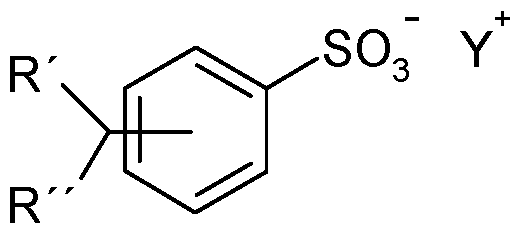
  • composition contains at least one anionic surfactant of the formula (A-3), (A-3), in the
  • R' and R" are independently H or alkyl and together contain 9 to 19, preferably 9 to 15 and in particular 9 to 13 C atoms, and Y + is a monovalent cation or the n-th part of an n-valent cation (in particular Na + ).
  • liquid surfactant-containing detergents preferably produced by means of the process according to the invention contain as surfactant at least one anionic surfactant, preferably at least one anionic surfactant from the group consisting of Cs-is-alkylbenzenesulfonates, Cs-18-olefinsulfonates, Cs-alkanesulfonates, Cs-is-estersulfonates, Cs-is-alkyl sulfates, Cs-18-alkenyl sulfates, fatty alcohol ether sulfates, in particular at least one anionic surfactant from the group of Cs-is-alkylbenzenesulfonates.
  • anionic surfactant preferably at least one anionic surfactant from the group consisting of Cs-is-alkylbenzenesulfonates, Cs-18-olefinsulfonates, Cs-alkanesulfonates, Cs-is-estersulfonates, Cs-is-
  • the weight proportion of the anionic surfactant in the total weight of the liquid surfactant-containing detergents is preferably 20 to 60 wt.% and in particular 22 to 50 wt.%.
  • the liquid detergent containing surfactants and the first liquid composition contain fatty acid.
  • the liquid detergent containing surfactants contains 4 to 12% by weight, preferably 6 to 10% by weight, of fatty acid based on its total weight.
  • This weight proportion refers to the weight proportion of the liquid detergent containing surfactants produced by the process and includes both the fatty acids provided in step a), i.e. also the fatty acid-containing organic salts of a divalent cation optionally introduced in step as well as any fatty acids added at a different time.
  • the fatty acids can be in acid form or in the form of their salts.
  • Preferred fatty acids are selected from the group caprylic acid, capric acid, lauric acid, myristic acid, palmitic acid, stearic acid, oleic acid, linoleic acid and mixtures thereof.
  • the liquid detergent containing surfactants contains the salt of a divalent cation.
  • the weight proportion of this salt in the total weight of the liquid detergent containing surfactants is preferably 0.4 to 6% by weight and in particular 0.5 to 4% by weight. These weight proportions have proven to be advantageous both in terms of the appearance and the viscosity of the preparation.
  • the detergent produced according to the invention contains a solvent as the fourth essential component.
  • the proportion by weight of the solvent in the total weight of the detergent preparation is preferably 12 to 32% by weight and in particular 15 to 30% by weight.
  • the liquid, surfactant-containing detergent contains, based on its total weight, 7 to 20% by weight, preferably 10 to 18% by weight, of organic solvent.
  • Preferred organic solvents are selected from the group ethanol, n-propanol, i-propanol, butanols, glycol, propanediol, butanediol, methylpropanediol, glycerin, diglycol, propyl diglycol, butyl diglycol, hexylene glycol, ethylene glycol methyl ether, ethylene glycol ethyl ether, ethylene glycol propyl ether, ethylene glycol mono-n-butyl ether, diethylene glycol methyl ether, diethylene glycol ethyl ether, propylene glycol methyl ether, propylene glycol ethyl ether,
  • Propylene glycol propyl ether dipropylene glycol monomethyl ether, dipropylene glycol monoethyl ether, methoxytriglycol, ethoxytriglycol, butoxytriglycol, 1-butoxyethoxy-2-propanol, 3-methyl-3-methoxybutanol, propylene glycol t-butyl ether, di-n-octyl ether and mixtures thereof, preferably from the group propanediol, glycerin and mixtures thereof.
  • the liquid detergent containing surfactants is preferably a low-water substance mixture. Preference is given to detergents which, based on their total weight, contain less than 18% by weight, preferably less than 15% by weight, of water.
  • the process according to the invention is advantageous for liquid detergents containing surfactants which, based on their total weight, contain i) 20 to 80% by weight of surfactant including 20 to 50% by weight of anionic surfactant; ii) 4 to 12% by weight of fatty acid; iii) 0.5 to 4% by weight of salt of a divalent metallic cation; iv) 8 to 35% by weight of solvent.
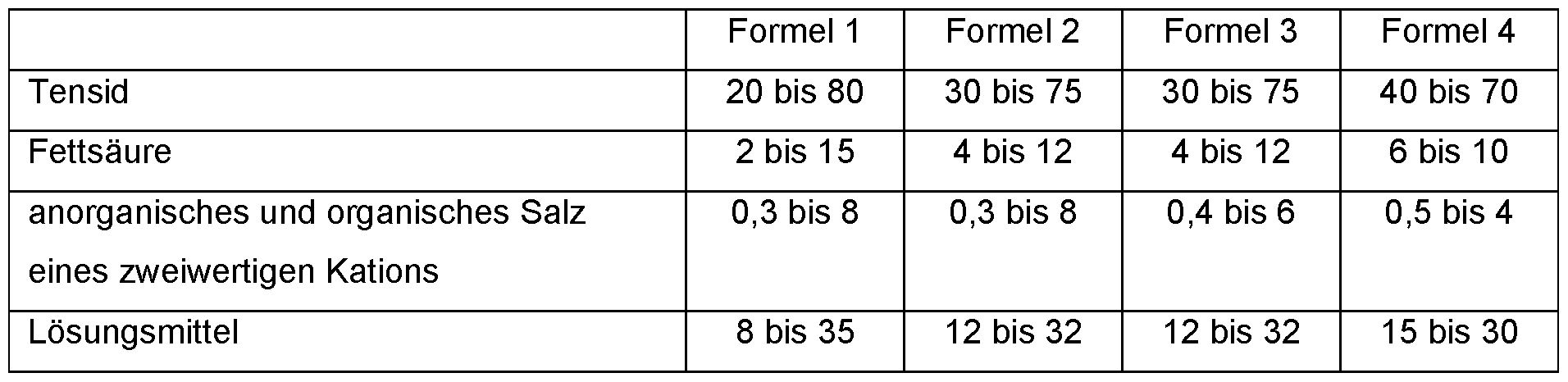
  • composition of some of the most commonly produced liquid detergents containing surfactants can be found in the following tables (data in % by weight based on the total weight of the detergent unless otherwise stated).
  • the liquid, surfactant-containing detergent contains, based on its total weight, preferably 12 to 30 wt.%, preferably 15 to 25 wt.% nonionic surfactant.
  • Preferred nonionic surfactants are selected from the group of ethoxylated primary Cs-18 alcohols, preferably ethoxylated primary Cs-is alcohols with a degree of alkoxylation > 4, particularly preferably Ci2-14 alcohols with 4 EO or 7 EO, Cg-n alcohols with 7 EO, Ci3-15 alcohols with 5 EO, 7 EO or 8 EO, Ci3-15 oxo alcohols with 7 EO, Ci2-is alcohols with 5 EO or 7 EO, in particular the Ci2-18 fatty alcohols with 7 EO or the Ci3-15 oxo alcohols with 7 EO.
  • anionic surfactant and nonionic surfactant in a weight ratio of 3:1 to 1:2, preferably 2:1 to 1:1.5 and in particular 1.4:1 to 1:1.
  • the weight proportion of the co-surfactant in the total weight of the flowable detergent preparation is preferably 0.5 to 5% by weight.
  • the co-surfactants are not included in the surfactants described above.
  • Preferred co-surfactants are selected from the group consisting of alkoxylated Cs-Cis fatty alcohols with a degree of alkoxylation ⁇ 3, aliphatic Cs-Cw alcohols, aromatic Cs-Ci4 alcohols, aliphatic Cs-Ci2 dialcohols, monoglycerides of Ci2-Ci8 fatty acids, monoglycerol ethers of Cs-Cis fatty alcohols and mixtures thereof, preferably from the group consisting of alkoxylated Cs-Cis fatty alcohols with a degree of alkoxylation ⁇ 3.
  • a non-ionic co-surfactant from the group consisting of alkoxylated Cs-Cis fatty alcohols with a degree of alkoxylation ⁇ 3, aliphatic Ce-Ci4 alcohols, aromatic Cs-Cw alcohols, aliphatic Ce-Ci2 dialcohols, monoglycerides of Ci2-Ci8 fatty acids, monoglycerol ethers of Cs-Cis fatty alcohols and mixtures thereof, preferably from the group consisting of alkoxylated Cs-Cis fatty alcohols with a degree of alkoxylation ⁇ 3, is continuously introduced into the main line via a secondary line and the outlet opening of the secondary line is preferably located in the effective range of the first dynamic mixer.
  • the co-surfactant is introduced into the liquid composition before the addition of an organic salt of a divalent cation.
  • a second particularly preferred embodiment of the process is characterized in that the liquid surfactant-containing detergent contains, based on its total weight, i) 20 to 50 wt.% anionic surfactant and 12 to 30 wt.% nonionic surfactant; ii) 4 to 12 wt.% fatty acid; iii) 0.5 to 4 wt.% salt of a divalent metallic cation; iv) 8 to 35 wt.% solvent vi) 0.5 to 5 wt.% of a co-surfactant different from the nonionic surfactant selected from the group consisting of alkoxylated Cs-Cis fatty alcohols with a degree of alkoxylation ⁇ 3, aliphatic Ce-Ci4 alcohols, aromatic Ce-Ci4 alcohols, aliphatic Ce-Ci2 dialcohols, monoglycerides of Ci2-Cis fatty acids, monoglycerol ethers of Cs-Cis fatty alcohols and mixtures thereof, preferably
  • composition of some other particularly preferred liquid detergents can be found in the following tables (data in % by weight based on the total weight of the detergent unless otherwise stated).
  • a co-surfactant other than the nonionic surfactant selected from the group consisting of alkoxylated Cs-Cis fatty alcohols with an alkoxylation degree ⁇ 3, aliphatic Ce-Ci4 alcohols, aromatic Ce-Ci4 alcohols, aliphatic C6-C12 dialcohols, monoglycerides of Ci2-Ci8 fatty acids, monoglycerol ethers of Cs-Cis fatty alcohols and mixtures thereof, preferably from the group consisting of alkoxylated Cs-Cis fatty alcohols with an alkoxylation degree ⁇ 3
  • the second product stage preferably has a viscosity (20°C, Brookfield viscometer model DV2T, spindle no. 31, 12 rpm) of 400 to 2000 mPas, preferably 1000 to 1700 mPas.
  • the liquid surfactant-containing detergent is preferably in the form of a structured system.
  • the main types of structured system used in practice are based on dispersed lamellar, spherulitic and weakly lamellar phases.
  • the liquid surfactant-containing detergent preferably contains a spherulitic phase.
  • Spherulitic phases comprise spherical bodies, commonly referred to in the art as spherulites, in which surfactant double layers are arranged as concentric shells.
  • the spherulites are dispersed in an aqueous phase in the manner of a classic emulsion and interact to form a structured system.
  • Preferred second product stages following step e) have lamellar spherulites, preferably with a maximum diameter of 10 to 100 pm, particularly preferably with a maximum diameter of 25 to 50 pm.
  • the second product stage preferably further has a yield point (TA Instruments rotational rheometer AR 2000, 20°C, 40 mm parallel plate, Peltier plate steel) above 0.1 Pa, preferably above 0.3 Pa.
  • a yield point TA Instruments rotational rheometer AR 2000, 20°C, 40 mm parallel plate, Peltier plate steel
  • the rheological properties of the liquid detergent justify its efficient processability in the process according to the invention and also form the basis of its advantageous optical properties, including its cloudy white appearance.
  • NTU Nephelometry Turbidity Unit
  • the HACH Turbidimeter 2100Q from Hach Company, Loveland, Colorado (USA) is used in conjunction with the calibration substances StabICal Solution HACH (20 NTU), StabICal Solution HACH (100 NTU) and StabICal Solution HACH (800 NTU), all of which can also be ordered from Hach Company.
  • the measurement is carried out in a 10 ml measuring cuvette with a cap filled with the composition to be examined and the measurement is carried out at 20 °C.
  • molded bodies With an NTU value (at 20°C) of 60 or more, molded bodies have a perceptible turbidity within the meaning of the invention that is visible to the naked eye.
  • the turbidity (HACH Turbidimeter 2100Q, 20°C, 10 ml cuvette) of the second product stage following step e) is preferably above 60 NTU, preferably above 100 NTU and in particular above 400 NTU.
  • the liquid detergent is preferably free of organic opacifiers. "Free of”, as used in this context, means that the corresponding component is present in the preparation in an amount of ⁇ 1% by weight, preferably ⁇ 0.1% by weight, even more preferably ⁇ 0.01% by weight. In particular, such a component is then not intentionally added.
  • the liquid detergent containing surfactants preferably contains in particular no styrene-acrylate copolymers (INCI: styrene/acrylates copolymer).
  • the liquid detergent containing surfactants produced according to the invention can be free of enzymes and/or fragrances. These components are not included in particular because because they can adversely affect the turbidity and thus the appearance of the formulation.
  • liquid detergents which, based on their total weight, contain less than 2% by weight, less than 1% by weight, preferably less than 0.1% by weight and in particular no enzyme preparation are preferred.
  • liquid detergents which, based on their total weight, contain less than 2% by weight, preferably less than 1% by weight, particularly preferably less than 0.1% by weight and in particular no fragrance.
  • the liquid detergent contains at least one optical brightener, preferably an optical brightener of the stilbene type. This is contained in the liquid detergent, based on its total weight, in an amount above 0% by weight, but preferably in an amount below 1% by weight, particularly preferably in an amount below 0.6% by weight.
  • Stilbene-type brighteners for use in the liquid detergent are preferably selected from the group of triazinyl derivatives of 4,4'-diamino-2,2'-stilbenesulfonic acid.
  • DAS1 diphenyl-4-bis[(4-anilino-6-morpholino-1,3,5-triazin-2-yl)amino]stilbene-2,2-disulfonate
  • DSBP diphenyl-4-bis(2-sulfostyryl)biphenyl
  • the liquid detergent containing surfactants can comprise at least one red, blue or violet dye. This is contained in the liquid detergent, based on its total weight, in an amount above 0% by weight, but preferably in an amount below 0.1% by weight, particularly preferably below 0.02% by weight, for example between 0.001 and 0.01% by weight.
  • a dye serves, for example, the purpose of covering up a possible yellowish tint of the preparation.
  • Suitable dyes includes dyes, dye-clay conjugates, pigments and photobleaching agents. Suitable dyes in turn include low molecular weight dyes and polymer dyes.
  • the dye is selected from the group of low molecular weight dyes.
  • Suitable low molecular weight dyes include dyes that fall into the color index (CI) classifications Direct Blue, Direct Red, Direct Violet, Acid Blue, Acid Red, Acid Violet, Basic Blue, Basic Red and Basic Violet.
  • Exemplary low molecular weight dyes are Direct Violet 9, Direct Violet 35, Direct Violet 48, Direct Violet 51, Direct Violet 66, Direct Violet 99, Direct Blue 1, Direct Blue 71, Direct Blue 80, Direct Blue 279, Acid Red 17, Acid Red 73, Acid Red 88, Acid Red 150, Acid Violet 15, Acid Violet 17, Acid Violet 24, Acid Violet 43, Acid Red 52, Acid Violet 49, Acid Blue 15, Acid Blue 17, Acid Blue 25, Acid Blue 29, Acid Blue 40, Acid Blue 45, Acid Blue 75, Acid Blue 80, Acid Blue 83, Acid Blue 90 and Acid Blue 113, Acid Black 1, Basic Violet 1, Basic Violet 3, Basic Violet 4, Basic Violet 10, Violet 35, Basic Blue 3, Basic Blue 16, Basic Blue 22, Basic Blue 47, Basic Blue 66, Basic Blue 75, Basic Blue 159 and mixtures thereof.
  • the dye is selected from the group of polymeric dyes.
  • Suitable polymeric dyes include conjugated chromogens (dye-polymer conjugates) and polymers in whose basic structure chromogens are polymerized.
  • the group of these polymeric dyes includes, for example, dyes commercially available under the name Liquitint® such as Liquitint® Violet CT, Cl Reactive Blue 19 conjugated with CMC with the product name AZO-CM-Cellulose, alkoxylated polymeric triphenylmethane dyes or alkoxylated polymeric thiphene dyes.
  • a dye-clay conjugate is used as the dye.
  • the group of these dyes includes, among others, conjugates of smectite clay or montmorillonite clay or hectorite clay or saponite clay with a cationic/basic dye from the group C.l. Basic Yellow 1 to 108, C.l. Basic Orange 1 to 69, C.l. Basic Red 1 to 118, C.l. Basic Violet 1 to 51, C.l. Basic Blue 1 to 164, C.l. Basic Green 1 to 14, C.l. Basic Brown 1 to 23, CI Basic Black 1 to 11.
  • this group of dyes includes montmorillonite Basic Blue B7 C.l.
  • pigments selected from the group flavanthrone, indanthrone, chlorinated indanthrone with 1 to 4 chlorine atoms, pyranthrone, dichlorpyranthrone, monobromodichloropyranthrone, dibromodichloropyranthrone, tetrabromopyranthrone, ultramarine blue (C.l. Pigment Blue 29) and ultramarine violet (C.l. Pigment Violet 15).
  • Suitable photobleaching agents are, for example, aluminum phthalocyanine sulfonate or Zinc phthalocyanine sulfonate or mixtures thereof, as commercially available under the name Tinolux®.
  • liquid surfactant-containing detergent is enclosed in a water-soluble film following step e) or step f) to form a detergent portion unit.
  • water-soluble film in a deep-drawing apparatus and to combine it with the liquid detergent to form a detergent portion unit.
  • the water-soluble film in which the liquid detergent is packaged can comprise one or more structurally different water-soluble polymer(s).
  • Polymers from the group of (optionally acetalized) polyvinyl alcohols (PVAL) and their copolymers are particularly suitable as water-soluble polymer(s).
  • Water-soluble films for producing the water-soluble coating are preferably based on a polyvinyl alcohol or a polyvinyl alcohol copolymer whose molecular weight is in the range from 10,000 to 1,000,000 gmol -1 , preferably from 20,000 to 500,000 gmol -1 , particularly preferably from 30,000 to 100,000 gmol -1 and in particular from 40,000 to 80,000 gmol -1 .
  • the preparation of polyvinyl alcohol and polyvinyl alcohol copolymers generally includes the hydrolysis of intermediate polyvinyl acetate.
  • Preferred polyvinyl alcohols and polyvinyl alcohol copolymers have a degree of hydrolysis of 70 to 100 mol%, preferably 80 to 90 mol%, particularly preferably 81 to 89 mol% and in particular 82 to 88 mol%.
  • preferred polyvinyl alcohol copolymers comprise an ethylenically unsaturated carboxylic acid, its salt or its ester.
  • such polyvinyl alcohol copolymers particularly preferably contain sulfonic acids such as 2-acrylamido-2-methyl-1-propanesulfonic acid (AMPS), acrylic acid, methacrylic acid, acrylic acid esters, methacrylic acid esters or mixtures thereof; among the esters, C 1-4 alkyl esters or hydroxyalkyl esters are preferred.
  • AMPS 2-acrylamido-2-methyl-1-propanesulfonic acid
  • Other suitable monomers are ethylenically unsaturated dicarboxylic acids, for example itaconic acid, maleic acid, fumaric acid and mixtures thereof.
  • Suitable water-soluble films are sold, for example, by MonoSol LLC under the designation M8630, M8720, M8310, C8400 or M8900.
  • Other suitable films include films called Solublon® PT, Solublon® GA, Solublon® KC or Solublon® KL from Aicello Chemical Europe GmbH or the VF-HP films from Kuraray.
  • the water-soluble films may contain additional active ingredients or fillers as well as plasticizers and/or solvents, in particular water.
  • the group of other active ingredients includes, for example, materials that protect the ingredients of preparation (A) enclosed in the film material from decomposition or deactivation by light irradiation.
  • Antioxidants, UV absorbers and fluorescent dyes have proven to be particularly suitable here.
  • plasticizers examples include glycerin, ethylene glycol, diethylene glycol, propanediol, 2-methyl-1,3-propanediol, sorbitol or mixtures thereof.
  • the surface of the water-soluble film can optionally be dusted with fine powder.
  • Sodium aluminosilicate, silicon dioxide, talc and amylose are examples of suitable powdering agents.
  • liquid surfactant-containing detergent in a water-soluble film following step c) to form a detergent portion unit with a plurality of receiving chambers.
  • the multiple receiving chambers of the detergent portion unit can be arranged next to one another or one above the other (stacked). While the method according to the invention can basically be used to produce both types of configuration, the technical advantages of the method according to the invention are particularly noticeable in the production of detergent portion units with receiving chambers arranged next to one another. On the one hand, the specific rheological properties of the liquid detergent allow rapid and drip-free dosing even into the smallest cavities, and on the other hand, the horizontal arrangement of the receiving chambers increases the perceptibility of the liquid detergent.
  • the detergent portion unit has at least two receiving chambers that at least partially enclose one another. It is also particularly preferred if the detergent portion unit has at least one further receiving chamber that is filled with a colored detergent preparation.
  • An exemplary preferred detergent portion unit that can be produced by means of the method according to the invention has at least two receiving chambers, which are surrounded by a water-soluble film, wherein one receiving chamber is filled with the liquid surfactant-containing detergent and the other receiving chamber is filled with a second colored detergent that is different from the liquid surfactant-containing detergent.
  • Another exemplary preferred detergent portion unit comprises at least three receiving chambers which are surrounded by a water-soluble film, wherein one receiving chamber is filled with the liquid surfactant-containing detergent and at least two further receiving chambers are filled separately from one another with a second and a third detergent which is different from one another and from the liquid surfactant-containing detergent.
  • the detergent portion unit has at least four receiving chambers which are surrounded by a water-soluble film, wherein one receiving chamber is filled with the liquid surfactant-containing detergent and the other three receiving chambers are filled separately from one another with a second and a third and a fourth colored detergent which are different from one another and from the first liquid surfactant-containing detergent.
  • This registration provides, among others, the following items:
  • % solvent comprising the steps: a) providing a first liquid composition containing surfactant, fatty acid and solvent and introducing the first liquid composition into a main line; b) introducing the salt of a divalent cation into the liquid composition to form a salt-containing composition; c) mixing the salt-containing composition by means of a first dynamic mixer to form a first product stage; d) intermediate storage of the first product stage in an intermediate storage container; e) mixing the intermediately stored first product stage in a second dynamic mixer to form a second product stage.
  • the salt of a divalent cation in step b) is introduced into the liquid composition in the form of an aqueous solution and the salt is selected from the group of inorganic salts of divalent metallic cations, in particular magnesium and calcium salts, preferably from the group magnesium chloride, magnesium sulfate, calcium chloride and calcium sulfate, in particular from the group magnesium chloride and calcium chloride, very particularly preferably calcium chloride.
  • step b) The process according to item 5, wherein the inorganic salt of a divalent cation in step b) is introduced into the liquid composition in the form of an alkaline aqueous solution.
  • step b) wherein the salt of a divalent cation in step b) is introduced into the liquid composition in the form of a dispersion and the salt is selected from the group of organic salts of divalent metallic cations, in particular magnesium and calcium salts, preferably from the group of fatty acid salts of magnesium and calcium, in particular fatty acid salts of calcium.
  • the salt of the divalent cation is selected from the group of calcium salts of caprylic acid, capric acid, lauric acid, myristic acid, palmitic acid, stearic acid, oleic acid, linoleic acid and mixtures thereof, in particular from the group of calcium stearates.
  • step b) comprises inorganic salt and organic salt, preferably calcium chloride and calcium stearate.
  • the salt of a divalent cation comprises inorganic salt of a divalent cation and organic salt of a divalent cation and the inorganic salt of a divalent cation and the organic salt of a divalent cation in step b) are continuously introduced into the main line via separate secondary lines and the outlet opening of the secondary lines are preferably located in the effective range of the first dynamic mixer.
  • the salt of a divalent cation comprises inorganic salt of a divalent cation and organic salt of a divalent cation and the inorganic salt of a divalent cation and the organic salt of a divalent cation in step b) are simultaneously introduced into the main line via separate secondary lines and the outlet opening of the secondary lines are preferably located in the effective range of the first dynamic mixer.
  • the salt of a divalent cation comprises inorganic salt of a divalent cation and organic salt of a divalent cation and the inorganic salt of a divalent cation and the organic salt of a divalent cation in step b) are continuously introduced into the main line as a mixture via a secondary line and the outlet opening of the secondary line is preferably located in the effective range of the first dynamic mixer.
  • Composition in step c) takes place continuously.
  • Composition in step c) is carried out for a period of time of 0.5 to 20 seconds, preferably 2 to 12 seconds.
  • step c) Process according to one of the preceding points, wherein the mixing of the salt-containing composition in step c) is carried out with an energy input of 600 to 2000 kW/m 3 , preferably of 900 to 1400 kW/m 3 .
  • step c) Process according to one of the preceding points, wherein the mixing of the salt-containing composition in step c) is carried out at a shear rate of 2000 to 12000 s -1 , preferably of 6000 to 9000 s -1 .
  • liquid, surfactant-containing detergent contains, based on its total weight, 30 to 75 wt.%, preferably 40 to 70 wt.% surfactant.
  • liquid, surfactant-containing detergent contains, based on its total weight, 20 to 60 wt.%, preferably 25 to 50 wt.% of anionic surfactant.
  • At least one anionic surfactant preferably at least one anionic surfactant from the group consisting of Cs-18-alkylbenzenesulfonates, Cs-is-olefinsulfonates, Cs-alkanesulfonates, Cs-is-estersulfonates, Cs-18-alkyl sulfates, Cs-is-alkenyl sulfates, fatty alcohol ether sulfates, in particular at least one anionic surfactant from the group of Cs-is-alkylbenzenesulfonates, is contained as surfactant.
  • at least one anionic surfactant preferably at least one anionic surfactant from the group consisting of Cs-18-alkylbenzenesulfonates, Cs-is-olefinsulfonates, Cs-alkanesulfonates, Cs-is-estersulfonates, Cs-18-alkyl sulfates, Cs-is-alkeny
  • liquid, surfactant-containing detergent contains, based on its total weight, 4 to 12 wt.%, preferably 6 to 10 wt.% fatty acid.
  • fatty acid is selected from the group caprylic acid, capric acid, lauric acid, myristic acid, palmitic acid, stearic acid, oleic acid, linoleic acid and mixtures thereof.
  • liquid, surfactant-containing detergent contains, based on its total weight, 0.4 to 6 wt.%, preferably 0.5 to 4 wt.% of salt of a divalent cation.
  • liquid surfactant-containing detergent contains, based on its total weight, i) 20 to 80% by weight of surfactant including 20 to 50% by weight of anionic surfactant; ii) 4 to 12% by weight of fatty acid; iii) 0.5 to 4% by weight of salt of a divalent metallic cation; iv) 8 to 35% by weight of solvent.
  • liquid, surfactant-containing detergent contains, based on its total weight, 12 to 32 wt.%, preferably 15 to 30 wt.% solvent.
  • the liquid, surfactant-containing detergent contains, based on its total weight, 7 to 20 wt.%, preferably 10 to 18 wt.% of organic solvent.
  • the organic solvent is selected from the group ethanol, n-propanol, i-propanol, butanols, glycol, propanediol, butanediol, methylpropanediol, glycerin, diglycol, propyl diglycol, butyl diglycol, hexylene glycol, ethylene glycol methyl ether, ethylene glycol ethyl ether, ethylene glycol propyl ether, ethylene glycol mono-n-butyl ether, diethylene glycol methyl ether, diethylene glycol ethyl ether, propylene glycol methyl ether, propylene glycol ethyl ether, propylene glycol methyl ether, propylene glycol ethyl ether, propylene glycol methyl
  • liquid, surfactant-containing detergent contains, based on its total weight, less than 18 wt.%, preferably less than 15 wt.% water.
  • liquid, surfactant-containing detergent comprises, based on its total weight, 12 to 30 wt.%, preferably 15 to 25 wt.% nonionic surfactant.
  • the surfactant present is at least one nonionic surfactant from the group of ethoxylated primary Cs-is alcohols, preferably ethoxylated primary Cs-is alcohols with a degree of alkoxylation > 4, particularly preferably the Ci2-14 alcohols with 4 EO or 7 EO, the Cg-n alcohols with 7 EO, the Cs alcohols with 5 EO, 7 EO or 8 EO, the Ci3-15 oxo alcohols with 7 EO, the Ci2-is alcohols with 5 EO or 7 EO, in particular the C12-18 fatty alcohols with 7 EO or the C -is oxo alcohols with 7 EO.
  • the surfactant present is at least one nonionic surfactant from the group of ethoxylated primary Cs-is alcohols, preferably ethoxylated primary Cs-is alcohols with a degree of alkoxylation > 4, particularly preferably the Ci2-14 alcohols with 4 EO or 7 EO, the Cg-n alcohols
  • step b) a nonionic co-surfactant from the group consisting of alkoxylated Cs-Cis fatty alcohols with a degree of alkoxylation ⁇ 3, aliphatic Cs-Ci4 alcohols, aromatic Cs-Cw alcohols, aliphatic C6-Ci2 dialcohols, monoglycerides of Ci2-Cis fatty acids, monoglycerol ethers of Cs-Cis fatty alcohols and mixtures thereof, preferably from the group consisting of alkoxylated Cs-Cis fatty alcohols with a degree of alkoxylation ⁇ 3 is introduced.
  • a nonionic co-surfactant from the group consisting of alkoxylated Cs-Cis fatty alcohols with a degree of alkoxylation ⁇ 3, aliphatic Cs-Ci4 alcohols, aromatic Cs-Cw alcohols, aliphatic C6-Ci2 dialcohols, monoglycerides of Ci2-Cis fatty acids, monog
  • step b) a non-ionic co-surfactant from the group consisting of alkoxylated Cs-Cis fatty alcohols with a degree of alkoxylation ⁇ 3, aliphatic Cs-Ci4 alcohols, aromatic Cs-Cw alcohols, aliphatic Cs-Ci2 dialcohols, monoglycerides of Ci2-Cis fatty acids, monoglycerol ethers of Cs-Cis fatty alcohols and mixtures thereof, preferably from the group consisting of alkoxylated Cs-Cis fatty alcohols with a degree of alkoxylation ⁇ 3, is continuously introduced into the main line and the outlet opening of the secondary line is preferably located in the effective range of the first dynamic mixer.
  • a non-ionic co-surfactant from the group consisting of alkoxylated Cs-Cis fatty alcohols with a degree of alkoxylation ⁇ 3, is continuously introduced into the main line and the outlet opening of the secondary line is preferably located in the effective range of the
  • liquid, surfactant-containing detergent contains anionic surfactant and nonionic surfactant in a weight ratio of 3:1 to 1:2, preferably from 2:1 to 1:1.5 and in particular from 1.4:1 to 1:1.
  • liquid, surfactant-containing detergent based on its total weight, further contains vi) 0.5 to 5 wt. % of a co-surfactant selected from the group consisting of alkoxylated Cs-Cis fatty alcohols with an alkoxylation degree ⁇ 3, aliphatic Ce-Cw alcohols, aromatic Cs-Cw alcohols, aliphatic Cs-Ci2 dialcohols, monoglycerides of Ci2-Ci8 fatty acids, monoglycerol ethers of Cs-Cis fatty alcohols and mixtures thereof, preferably from the group consisting of alkoxylated Cs-Cis fatty alcohols with an alkoxylation degree ⁇ 3.
  • a co-surfactant selected from the group consisting of alkoxylated Cs-Cis fatty alcohols with an alkoxylation degree ⁇ 3.
  • liquid, surfactant-containing detergent contains, based on its total weight, i) 20 to 50 wt.% anionic surfactant and 12 to 30 wt.% nonionic surfactant; ii) 4 to 12 wt.% fatty acid; iii) 0.5 to 4 wt.% salt of a divalent metallic cation; iv) 8 to 35 wt.% solvent vi) 0.5 to 5 wt.% of a co-surfactant different from the nonionic surfactant selected from the group consisting of alkoxylated Cs-Cis fatty alcohols with a degree of alkoxylation ⁇ 3, aliphatic Cs-Ci4 alcohols, aromatic Cs-Ci4 alcohols, aliphatic Cs-Ci2 dialcohols, monoglycerides of C12-Cis fatty acids, monoglycerol ethers of Cs-Cis fatty alcohols and mixtures thereof,
  • liquid surfactant-containing detergents do not contain any organic opacifiers, in particular no styrene-acrylate copolymer.
  • liquid, surfactant-containing detergent contains, based on its total weight, a red, blue or violet dye in amounts below 0.1% by weight, preferably below 0.02% by weight.
  • step 59 Process according to one of the preceding points, wherein the liquid surfactant-containing detergent is enclosed in a water-soluble film following step e) or step f) to form a detergent portion unit.
  • the detergent portion unit has at least two receiving chambers which are surrounded by a water-soluble film, wherein one receiving chamber is filled with the liquid surfactant-containing detergent and the other receiving chamber is filled with a second colored detergent different from the liquid surfactant-containing detergent.
  • the detergent portion unit has at least three receiving chambers which are surrounded by a water-soluble film, wherein one receiving chamber is filled with the liquid surfactant-containing detergent and the other two receiving chambers are filled separately from one another with a second and a third detergent which is different from one another and from the liquid surfactant-containing detergent.
  • the detergent portion unit has at least four receiving chambers which are surrounded by a water-soluble film, wherein one receiving chamber is filled with the liquid surfactant-containing detergent and the other three receiving chambers are filled separately from one another with a second and a third and a fourth colored detergent which are different from one another and from the first liquid surfactant-containing detergent.
  • a liquid, surfactant-containing detergent of the following composition was prepared by the process according to the invention.
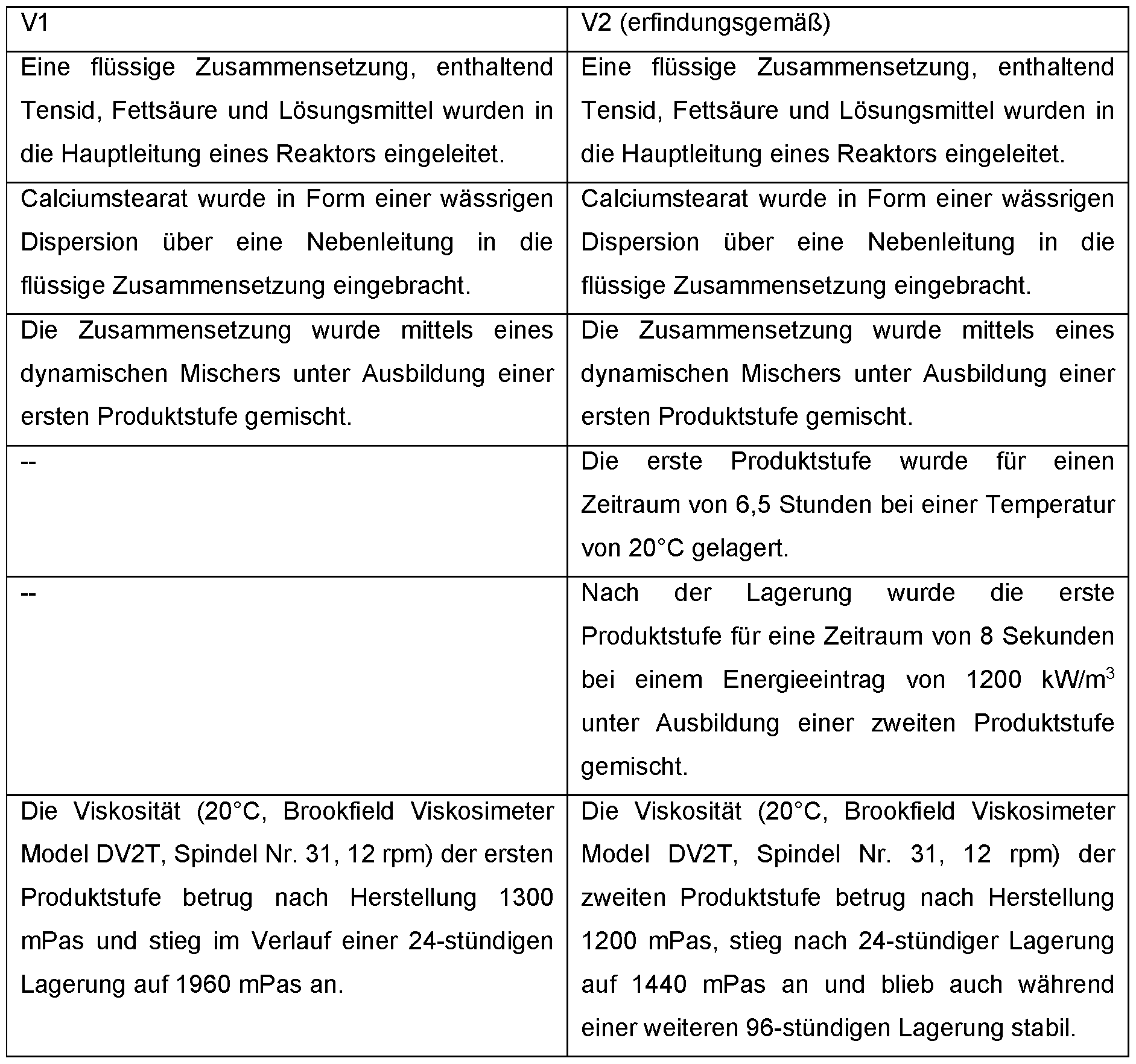
  • the liquid detergent containing surfactants is characterized by a stable viscosity (20°C, Brookfield Viscometer Model DV2T, spindle no. 31, 12 rpm) in the range from 1200 to 1440 mPas even after storage at 22°C for a period of 120 hours.
  • This temporally stable viscosity is achieved in comparison to a conventional process by using a second dynamic mixer in step e) of the process. Without the use of this second mixing process in process step e), the viscosity (20°C, Brookfield Viscometer Model DV2T, spindle no. 31, 12 rpm) of the liquid detergent containing surfactants increases from the original 1300 to 1960 mPas over the course of 24 hours.
  • the detergent composition described in Table 1 was prepared by the two processes V1 and V2 (according to the invention) described below:

Landscapes

  • Chemical & Material Sciences (AREA)
  • Life Sciences & Earth Sciences (AREA)
  • Engineering & Computer Science (AREA)
  • Chemical Kinetics & Catalysis (AREA)
  • Oil, Petroleum & Natural Gas (AREA)
  • Wood Science & Technology (AREA)
  • Organic Chemistry (AREA)
  • Health & Medical Sciences (AREA)
  • Emergency Medicine (AREA)
  • Inorganic Chemistry (AREA)
  • Detergent Compositions (AREA)

Abstract

Verfahren zur Herstellung eines flüssigen, Tensid-haltigen Waschmittels, enthaltend i) 20 bis 80 Gew.-% Tensid; ii) 2 bis 15 Gew.-% Fettsäure; iii) 0,3 bis 8 Gew.-% Salz eines zweiwertigen Kations; iv) 8 bis 35 Gew.-% Lösungsmittel; umfassend die Schritte: a) Bereitstellen einer ersten flüssigen Zusammensetzung, enthaltend Tensid, Fettsäure und Lösungsmittel und Einleiten der ersten flüssigen Zusammensetzung in eine Hauptleitung; b) Einbringen des Salzes eines zweiwertigen Kations in die flüssige Zusammensetzung, unter Ausbildung einer Salz-haltigen Zusammensetzung; c) Mischen der Salz-haltigen Zusammensetzung mittels eines ersten dynamischen Mischers unter Ausbildung einer ersten Produktstufe; d) Zwischenlagerung der ersten Produktstufe in einem Zwischenlagerbehälter; e) Mischen der zwischengelagerten ersten Produktstufe in einem zweiten dynamischen Mischer unter Ausbildung einer zweiten Produktstufe.

Description

Verfahren zur Herstellung eines flüssigen Waschmittels
Die vorliegende Erfindung betrifft ein Verfahren zur Herstellung eines flüssigen Tensid-haltigen Waschmittels. Insbesondere betrifft die Erfindung ein sequentielles Verfahren zur Herstellung eines flüssigen Tensid-haltigen Waschmittels mit verbesserten optischen und rheologischen Eigenschaften.
An die Konfektions- und Angebotsformen von Wasch- und Waschmittel werden sich kontinuierlich ändernde Anforderungen gestellt. Ein Hauptaugenmerk liegt dabei seit geraumer Zeit auf der bequemen Dosierung von Wasch- und Waschmitteln durch den Verbraucher und der Vereinfachung der zur Durchführung eines Wasch- oder Reinigungsverfahren notwendigen Arbeitsschritte. Eine Lösung bieten vorportionierte Wasch- oder Waschmittel, beispielsweise Folienbeutel mit einer oder mehreren Aufnahmekammern für feste oder flüssige Wasch- oder Waschmittel, wobei aus technischer Sicht ein wesentliches Augenmerk auf der Entwicklung und Herstellung für die Konfektionierung in wasserlöslichen Folienbeuteln geeigneter flüssiger Waschmittel liegt.
Der kommerzielle Erfolg einer Waschmittelportionseinheit wird neben prozesstechnischen Aspekten selbstverständlich auch durch Fähigkeit bestimmt, ein dem Verbraucherinteresse entsprechenden Produkt bereitzustellen. Ein wesentliches Mittel zur Kommunikation von Produktqualität und Produktversprechen ist dessen Optik einschließlich von Form und Farbe der Portionseinheit. Die gilt insbesondere auf für wasserlösliche Folienbeutel, deren lösliche Folien in der Regel transparent sind und den Blick auf die enthaltenen festen oder flüssigen Waschmittel freigeben. Während farbige, das heißt nicht-weiße Flüssigwaschmittel in einfacher Weise durch Zusatz entsprechender Farbstoffe erhalten werden können, ist die Bereitstellung weißer Flüssigwaschmittel deshalb herausfordernder, weil die bisher zu deren Herstellung eingesetzten Trübungsmittel aus ökologischer Sicht in zunehmendem Maße kritisch beurteilt werden. Vor diesem Hintergrund ist die Bereitstellung eines ökologisch akzeptablen Trübungsmittel ein relevantes Entwicklungsziel im Bereich der flüssigen Wasch- und Waschmittel.
Die Herstellung flüssiger Waschmittel erfolgt in der Regel mittels eines sequentiellen Verfahrens, in dessen Verlauf die Inhaltsstoffe des Waschmittels in zeitlicher Abfolge miteinander vermischt werden. Zur Erzielung eines homogenen Endprodukts werden die jeweiligen Zwischenprodukte und das Endprodukt unter Energieeintrag gemischt. Die Zwischen- und Endprodukte zeichnet sich nicht allein durch eine möglichst homogene Wirkstoffverteilung, sondern zusätzlich durch für die weitere Verarbeitung geeignete rheologische Eigenschaften aus. Art und Zeitpunkt der Einstellung dieser rheologischen Eigenschaften im Verlauf des Herstellverfahrens beeinflusst die Effizienz des Verfahrens. Beispielsweise verläuft der durch Pumpen bewirkte Transport flüssiger Waschmittel durch Leitungen oder Kessel dann störungsarm, wenn die rheologischen Eigenschaften des Waschmittels über die Produktionsdauer konstant bleiben. Gleiches gilt für die Abfüllung der Zwischen- und Endprodukte in Lagertanks oder Verkaufsgebinde wie Portionsbeutel oder Flaschen. Aufgrund der vergleichsweise geringen abgefüllten Volumina sind stabile rheologische Eigenschaften der Endprodukte bei deren Konfektionierung in wasserlöslichen Ein- oder Mehrkammerbeuteln von größter Relevanz.
Ein beispielhaftes mehrstufiges Verfahren zur Herstellung flüssiger Waschmittel wird in der europäischen Patentanmeldung EP 4 155 374 A1 beschrieben.
Der Anmeldung die Aufgabe zugrunde, ein effizientes Verfahren zur Herstellung optisch ansprechender, konzentrierter Flüssigwaschmittel bereitzustellen. Die resultierenden Waschmittel sollten sich durch eine hohe chemische und physikalische Stabilität, insbesondere durch eine hohe zeitliche Stabilität ihrer optischen und rheologischen Eigenschaften auszeichnen.
Ein erster Gegenstand der vorliegenden Erfindung ist ein Verfahren zur Herstellung eines flüssigen, Tensid-haltigen Waschmittels, enthaltend i) 20 bis 80 Gew. -% Tensid; ii) 2 bis 15 Gew.-% Fettsäure; iii) 0,3 bis 8 Gew.-% Salz eines zweiwertigen Kations; iv) 8 bis 35 Gew.-% Lösungsmittel; umfassend die Schritte: a) Bereitstellen einer ersten flüssigen Zusammensetzung, enthaltend Tensid, Fettsäure und Lösungsmittel und Einleiten der ersten flüssigen Zusammensetzung in eine Hauptleitung; b) Einbringen des Salzes eines zweiwertigen Kations in die flüssige Zusammensetzung, unter Ausbildung einer Salz-haltigen Zusammensetzung; c) Mischen der Salz-haltigen Zusammensetzung mittels eines ersten dynamischen Mischers unter Ausbildung einer ersten Produktstufe; d) Zwischenlagerung der ersten Produktstufe in einem Zwischenlagerbehälter; e) Mischen der zwischengelagerten ersten Produktstufe in einem zweiten dynamischen Mischer unter Ausbildung einer zweiten Produktstufe.
Ausgangspunkt des erfindungsgemäßen Verfahrens ist die Bereitstellung einer ersten flüssigen Zusammensetzung, enthaltend Tensid, Fettsäure und Lösungsmittel in Schritt a). Die Herstellung dieser Zubereitung kann im Vorfeld in kontinuierlicher oder diskontinuierlicher Weise erfolgen. Zur kontinuierlichen Herstellung eignet sich beispielsweise ein, vorzugsweise mit Mischvorrichtungen versehenes, Leitungssystem, in welchem die Bestandteile der Zubereitung miteinander in Kontakt gebracht und vermischt werden. Aufgrund des verringerten apparativen und operativen Aufwands bevorzugt ist es jedoch, wenn die Bereitstellung der ersten flüssigen Zusammensetzung diskontinuierlich erfolgt. Hierfür eignet sich beispielsweise die Bereitstellung der Zubereitung als lagerfähige Mischung (Master-Batch) in einem Rührkessel oder einem anderweitigen Behälter. Ein solcher Behälter ermöglicht nicht allein die Lagerung von Zwischenprodukten sondern erlaubt es zudem, etwaige Schwankungen in den Durchsatzraten der nachfolgenden, vorzugsweise kontinuierlich durchgeführten Verfahrensschritte b) bis e) abzupuffern. Bevorzugt ist es daher weiterhin, wenn die erste flüssigen Zusammensetzung aus einem Pufferbehälter kontinuierlich in eine Hauptleitung eingeleitet wird.
In Schritt b) des Verfahrens wird Salz eines zweiwertigen Kations in die erste flüssige Zusammensetzung eingebracht. Als Salze eines zweiwertigen Kations eignen sich anorganische Salze ebenso wie organische Salze.
In einer Ausführungsform des Verfahrens ist das Salz eines zweiwertigen Kations in Schritt b) ausgewählt ist aus der Gruppe der anorganischen Salze. Besonders bevorzugt ist der Einsatz von Salzen zweiwertiger Kationen in Form ihrer wässrigen Lösungen, wobei das Salz ausgewählt ist aus der Gruppe der anorganischen Salze der zweiwertigen metallischen Kationen, insbesondere der Magnesium- und Calciumsalze, vorzugsweise aus der Gruppe Magnesiumchlorid, Magnesiumsulfat, Calciumchlorid und Calciumsulfat, insbesondere aus der Gruppe Magnesiumchlorid und Calciumchlorid, ganz besonders bevorzugt Calciumchlorid.
Zur Vereinfachung der Verfahrensführung ist es bevorzugt, wenn das anorganische Salz eines zweiwertigen Kations in Schritt b) in Form einer wässrigen Lösung, vorzugsweise einer alkalischen wässrigen Lösung, in die flüssige Zusammensetzung eingebracht wird.
Die Lösung des anorganischen Salzes eines zweiwertigen Kations weist vorzugsweise eine Salzkonzentration von 200 bis 800 g/l, bevorzugt von 250 bis 600 g/l auf. Ein entsprechender Salzgehalt vermindert einerseits die Menge des in die flüssige Zusammensetzung eingetragenen Wassers und ermöglicht andererseits eine hinreichend genaue Dosierung mit ausreichend großer Volumina der Salzlösung.
In einer alternativen Verfahrensführung ist das Salz eines zweiwertigen Kations in Schritt b) ausgewählt ist aus der Gruppe der organischen Salze. Anders als das anorganische Salz eines zweiwertigen Kations wird das organische Salz eines zweiwertigen Kations in Schritt b) vorzugsweise in Form einer Dispersion, besonders bevorzugt in Form einer alkalischen wässrigen Dispersion in die flüssige Zusammensetzung eingebracht.
Das organische Salz eines zweiwertigen Kations wird in Schritt b) vorzugsweise in Form einer Dispersion in die flüssige Zusammensetzung eingebracht, wobei das Salz vorzugsweise ausgewählt ist aus der Gruppe der organischen Salze der zweiwertigen metallischen Kationen, insbesondere der Magnesium- und Calciumsalze, vorzugsweise aus der Gruppe Fettsäuresalze von Magnesium- und Calcium, insbesondere der Fettsäuresalze von Calcium. Als besonders vorteilhaft in Bezug auf die Ausbildung einer trüb-weißen Optik haben sich die Calciumsalze der Caprylsäure, Caprinsäure, Laurinsäure, Myristinsäure, Palmitinsäure, Stearinsäure, Ölsäure, Linolsäure und deren Mischungen, insbesondere Calciumsalze aus der Gruppe der Calciumstearate erwiesen.
Aus den für das anorganische Salz eines zweiwertigen Kations weiter oben angeführten Gründen weist auch die Dispersion des organischen Salzes eines zweiwertigen Kations eine Salzkonzentration von 200 bis 800 g/l, vorzugsweise von 250 bis 600 g/l auf.
In einer besonders bevorzugten Verfahrensvariante umfasst das Salz eines zweiwertigen Kations in Schritt b) anorganisches Salz und organisches Salz, vorzugsweise Calciumchlorid und Calciumstearat umfasst.
Der Zusatz des Salzes eines zweiwertigen Kations bewirkt die Ausbildung einer trüb-weißen Optik und einer für die weitere Verfahrensführung und den späteren Gebrauch vorteilhaften hinreichend hohen und stabilen Viskosität. Die Ausbildung beider physikalischer Eigenschaften der flüssigen Zusammensetzung wird durch eine Durchmischung aller Inhaltsstoffe befördert. Bevorzugt ist es daher weiterhin, die Austrittsöffnung der Nebenleitung, durch welche das Salz eines zweiwertigen Kations in Schritt b) über eine Nebenleitung kontinuierlich in die Hauptleitung eingebracht wird im Wirkbereich des ersten dynamischen Mischers liegt.
Werden in Schritt b) des Verfahrens sowohl anorganisches als auch organisches Salz eines zweiwertigen Kations in die flüssige Zusammensetzung eingebracht, so ist es bevorzugt, das anorganische Salz eines zweiwertigen Kations und das organische Salze eines zweiwertigen Kations über getrennte Nebenleitungen kontinuierlich in die Hauptleitung einzubringen, wobei die Austrittsöffnungen der Nebenleitungen vorzugweise im Wirkbereich des ersten dynamischen Mischers liegen.
Es ist weiterhin bevorzugt, dass das Salz eines zweiwertigen Kations sowohl anorganisches Salz eines zweiwertigen Kations als auch organisches Salz eines zweiwertigen Kations umfasst und das anorganische Salz eines zweiwertigen Kations und das organische Salze eines zweiwertigen Kations in Schritt b) über getrennte Nebenleitungen zeitgleich in die Hauptleitung eingebracht werden wobei die Austrittsöffnung der Nebenleitungen mit besonderem Vorzug im Wirkbereich des ersten dynamischen Mischers liegen.
In einer alternativen Verfahrensführung werden als Salz eines zweiwertigen Kations sowohl anorganisches Salz eines zweiwertigen Kations als auch organisches Salze eines zweiwertigen Kations eingesetzt und das anorganische Salz eines zweiwertigen Kations und das organische Salze eines zweiwertigen Kations werden in Schritt b) als Mischung über eine Nebenleitung kontinuierlich in die Hauptleitung eingebracht, wobei die Austrittsöffnung der Nebenleitung vorzugweise im Wirkbereich des ersten dynamischen Mischers liegt.
Für die Verfahrensführung und die resultierend trüb-weiße Optik des flüssigen, Tensid-haltigen Waschmittels hat es sich als vorteilhaft erwiesen, wenn das Stoffmengenverhältnis des in Schritt b) in Form eines anorganischen Salzes eines zweiwertigen Kations eingebrachten Salzes zu dem in Schritt b) in Form eines organischen Salzes eines zweiwertigen Kations eingebrachten Salzes 1 :10 bis 10:1 , bevorzugt 1 :6 bis 6:1 und insbesondere 1 :3 bis 3:1 beträgt.
Im Anschluss an das Einbringen des anorganischen und/oder organischen Salzes eines zweiwertigen Kations in die flüssige Zusammensetzung wird die resultierende Salz-haltige Zusammensetzung in Schritt c) gemischt. Überraschenderweise hat sich gezeigt, dass die zur Ausbildung eines stabilen Tensid-haltigen Waschmittels mit trüb-weißer Optik notwendige Mischzeit durch den Zusatz des organischen Salzes eines zweiwertigen Kations im Vergleich zu Verfahren, bei denen lediglich ein anorganisches Salz eines zweiwertigen Kations eingesetzt wird, deutlich verkürzt werden kann. Der Schritt c) erfolgt vorzugsweise für eine Zeitdauer von 0,5 bis 20 Sekunden, vorzugsweise von 2 bis 12 Sekunden. Der Mischvorgang erfolgt zudem vorzugsweise kontinuierlich.
Für die physikalischen Eigenschaften der ersten und der zweiten Produktstufe hat es sich als vorteilhaft erwiesen, wenn das Mischen der Salz-haltigen Zusammensetzung in Schritt c) mit einem Energieeintrag von 600 bis 2000 kW/m3, vorzugsweise von 900 bis 1400 kW/m3 erfolgt. Aus den genannten Gründen ist es weiterhin bevorzugt, wenn das Mischen der Salz-haltigen Zusammensetzung in Schritt c) mit einer Scherrate von 2000 bis 12000 s-1, vorzugsweise von 6000 bis 9000 s-1 erfolgt.
Die in Schritt c) erhaltene erste Produktstufe wird in Schritt d) zwischengelagert. Diese Zwischenlagerung erfolgt vorzugsweise für einen Zeitraum von 0,1 bis 50 Stunden, bevorzugt von 3 bis 25 Stunden. Zur Stabilisierung der Viskosität der ersten Produktstufe weist diese in Schritt d) vorzugsweise bei einer Temperatur von 15 bis 30 °C, bevorzugt von 18 bis 25 °C auf. Zur Verringerung der Zwischenlagerungsdauer und Verbesserung der rheologischen Eigenschaften der ersten Produktstufe ist es bevorzugt, die erste Produktstufe bei der Zwischenlagerung in Schritt d) zu rühren.
Die zwischengelagerte ersten Produktstufe wird in Schritt e) in einem zweiten dynamischen Mischer unter Ausbildung der zweiten Produktstufe gemischt. Wie bereits in Schritt c) erfolgt das Mischen in Schritt e) vorzugsweise kontinuierlich. Ein bevorzugter Zeitraum für das Mischen der zwischengelagerten ersten Produktstufe in Schritt e) beträgt 0,5 bis 20 Sekunden, besonders bevorzugt 2 bis 12 Sekunden.
Da Mischen der zwischengelagerten ersten Produktstufe in Schritt e) erfolgt vorzugsweise mit einem Energieeintrag von 600 bis 2000 kW/m3, besonders bevorzugt von 900 bis 1400 kW/m3.
Die Scherrate bei dem Mischvorgang e) beträgt vorzugsweise 2000 bis 12000 s-1, besonders bevorzugt 6000 bis 9000 s-1.
Die in Verfahrensschritt e) erhaltene zweite Produktstufe zeichnet sich durch eine hohe physikalische Stabilität, insbesondere durch eine hohe zeitliche Stabilität ihrer Viskosität aus. In einer bevorzugten Ausführungsform des Verfahrens wird die in Verfahrensschritt e) erhaltene zweite Produktstufe keiner erneuten Differenzierung unterzogen. Mit anderen Worten wird der zweiten Produktstufe im Anschluss an den Verfahrensschritt e) kein weiterer Inhaltsstoff zugefügt. Die Zusammensetzung der zweiten Produktstufe ist damit mit der Zusammensetzung des flüssigen, Tensid-haltigen Waschmittels identisch.
Die in Verfahrensschritt e) erhaltene zweite Produktstufe wird vorzugsweise ohne weitere Differenzierung verpackt und konfektioniert. Aufgrund der hohen zeitlichen Stabilität ihrer Viskosität kann die zweite Produktstufe vor ihrer Verpackung auch für längere Zeit gelagert werden. In einer bevorzugten Ausführungsform des Verfahrens wird die zweite Produktstufe im Anschluss an Schritt e) in einem weiteren Schritt f) gelagert wird. Der Zeitraum für die Lagerung in Schritt f) kann beispielsweise mehr als 0,5 Stunden, insbesondere mehr als 6 Stunden aber auch mehr als 24 Stunden betragen.
Zur Erhöhung der Verfahrenseffizienz ist es bevorzugt, wenn die zweite Produktstufe im Anschluss an Schritt e) in einem weiteren Schritt f) für einen Zeitraum von weniger als 120 Stunden, vorzugsweise von weniger als 24 Stunden und insbesondere von weniger als 2 Stunden gelagert wird.
Bei ihrer Lagerung in dem weiteren Schritt f) weist die zweite Produktstufe vorzugsweise eine Temperatur von 18 bis 29°C und insbesondere von 20 bis 24°C auf. Die Einhaltung dieses Temperaturbereichs verstärkt die, durch den Einsatz des zweiten dynamischen Mischers bewirkte zeitliche Stabilität der Viskosität der zweiten Produktstufe.
Ein erster wesentlicher Bestandteil des flüssigen, Tensid-haltigen Waschmittels und der ersten flüssigen Zusammensetzung ist das Tensid, welches zu 20 bis 80 Gew.-%, vorzugsweise zu 30 bis 75 Gew.-% und insbesondere zu 40 bis 70 Gew.-% in dem flüssigen, Tensid-haltigen Waschmittel enthalten ist. Zur Gruppe der Tenside werden die nichtionischen, die anionischen, die kationischen und die amphoteren Tenside gezählt. Die erfindungsgemäßen Zusammensetzungen können eines oder mehrere der genannten Tenside umfassen. Besonders bevorzugte Zusammensetzungen enthalten als Tensid mindestens ein anionisches Tensid.
Das anionische Tensid ist bevorzugt ausgewählt aus der Gruppe umfassend C9-C13- Alkylbenzolsulfonaten, Olefinsulfonaten, Ci2-Cis-Alkansulfonaten, Estersulfonaten, Alk(en)ylsulfaten, Fettalkohohlethersulfaten und Mischungen daraus. Zusammensetzungen, die als anionisches Tensid Cg-Cn-Alkylbenzolsulfonate und Fettalkoholethersulfate umfassen, weisen besonders gute, dispergierende Eigenschaften auf. Als Tenside vom Sulfonat-Typ kommen dabei vorzugsweise Cg-Cis-Alkylbenzolsulfonate, Olefinsulfonate, das heißt Gemische aus Alken- und Hydroxyalkansulfonaten sowie Disulfonaten, wie man sie beispielsweise aus Ci2-Ci8-Monoolefinen mit end- oder innenständiger Doppelbindung durch Sulfonieren mit gasförmigem Schwefeltrioxid und anschließende alkalische oder saure Hydrolyse der Sulfonierungsprodukte erhält, in Betracht. Geeignet sind auch Ci2-Ci8-Alkansulfonate und die Ester von a-Sulfofettsäuren (Estersulfonate), zum Beispiel die a-sulfonierten Methylester der hydrierten Kokos-, Palmkern- oder Talgfettsäuren.
Als Alk(en)ylsulfate werden die Alkali- und insbesondere die Natriumsalze der Schwefelsäurehalbester der Ci2-Ci8-Fettalkohole, beispielsweise aus Kokosfettalkohol, Talgfettalkohol, Lauryl-, Myristyl-, Cetyl- oder Stearylalkohol oder der Cig-C20-Oxoalkohole und diejenigen Halbester sekundärer Alkohole dieser Kettenlängen bevorzugt. Aus waschtechnischem Interesse sind die Ci2-Ci6-Alkylsulfate und Ci2-Ci5-Alkylsulfate sowie Ci4-Ci5-Alkylsulfate bevorzugt. Auch 2,3-Alkylsulfate sind geeignete anionische Tenside.
Als Alk(en)ylsulfate werden bevorzugt die Salze der Schwefelsäurehalbester der Fettalkohole mit 12 bis 18 C-Atomen, beispielsweise aus Kokosfettalkohol, Talgfettalkohol, Lauryl-, Myristyl-, Cetyl- oder Stearylalkohol oder der Oxo-Alkohole mit 10 bis 20 C-Atomen und diejenigen Halbester sekundärer Alkohole dieser Kettenlängen bevorzugt. Aus waschtechnischem Interesse sind die Alkylsulfate mit 12 bis 16 C-Atomen und Alkylsulfate mit 12 bis 15 C-Atomen sowie Alkylsulfate mit 14 und 15 C-Atomen bevorzugt. Auch 2,3-Alkylsulfate sind geeignete anionische Tenside.
Auch Fettalkoholethersulfate, wie die Schwefelsäuremonoester der mit 1 bis 6 Mol Ethylenoxid ethoxylierten geradkettigen oder verzweigten C7-C2i-Alkohole, wie 2-Methyl-verzweigte C9-11- Alkohole mit im Durchschnitt 3,5 Mol Ethylenoxid (EO) oder C12-18-Fettalkohole mit 1 bis 4 EO, sind geeignet. Bevorzugt sind Alkylethersulfate mit der Formel (A-1)
R1-O-(AO)n-SO3- X+ (A-1) In dieser Formel (A-1) steht R1 für einen linearen oder verzweigten, substituierten oder unsubstituierten Alkylrest, vorzugsweise für einen linearen, unsubstituierten Alkylrest, besonders bevorzugt für einen Fettalkoholrest. Bevorzugte Reste R1 der Formel (A-1) sind ausgewählt aus Decyl-, Undecyl-, Dodecyl-, Tridecyl-, Tetradecyl, Pentadecyl-, Hexadecyl-, Heptadecyl-, Octadecyl-, Nonadecyl-, Eicosylresten und deren Mischungen, wobei die Vertreter mit gerader Anzahl an C-Atomen bevorzugt sind. Besonders bevorzugte Reste R1 der Formel (A-1) sind abgeleitet von Fettalkoholen mit 12 bis 18 C-Atomen, beispielsweise von Kokosfettalkohol, Talgfettalkohol, Lauryl-, Myristyl-, Cetyl- oder Stearylalkohol oder von Oxoalkoholen mit 10 bis 20 C-Atomen.
AO steht in Formel (A-1) für eine Ethylenoxid- (EO) oder Propylenoxid- (PO) Gruppierung, vorzugsweise für eine Ethylenoxidgruppierung. Der Index n der Formel (A-1) ist eine ganze Zahl von 1 bis 50, vorzugsweise von 1 bis 20 und insbesondere von 2 bis 10. Ganz besonders bevorzugt ist n 2, 3, 4, 5, 6, 7 oder 8. X ist ein einwertiges Kation oder den n-ten Teil eines n- wertigen Kations, bevorzugt sind dabei die Alkalimetallionen und darunter Na+ oder K+, wobei Na+ äußerst bevorzugt ist. Weitere Kationen X+ können ausgewählt sein aus NHT, % Zn2+,% Mg2+,% Ca2+,% Mn2+, und deren Mischungen.
Besonders bevorzugte Zusammensetzungen enthalten ein Alkylethersulfat ausgewählt aus Fettalkoholethersulfaten der Formel A-2
Figure imgf000009_0001
(A-2) mit k = 11 bis 19, n = 2, 3, 4, 5, 6, 7 oder 8. Ganz besonders bevorzugte Vertreter sind Na Fettalkoholethersulfate mit 12 bis 18 C-Atomen und 2 EO (k = 11 bis 13, n = 2 in Formel A-1). Der angegebenen Ethoxylierungsgrad stellt einen statistischen Mittelwert dar, der für ein spezielles Produkt eine ganze oder eine gebrochene Zahl sein kann. Die angegebenen Alkoxylierungsgrade stellen statistische Mittelwerte dar, die für ein spezielles Produkt eine ganze oder eine gebrochene Zahl sein können. Bevorzugte Alkoxylate/Ethoxylate weisen eine eingeengte Homologenverteilung auf (narrow range ethoxylates, NRE).
In einer besonders bevorzugten Ausführungsform enthält die Zusammensetzung C9-13- Alkylbenzolsulfonate und gegebenenfalls zusätzlich Fettalkoholethersulfate als anionisches Tensid.
Es ist ganz besonders bevorzugt, wenn in der Zusammensetzung mindestens ein anionisches Tensid der Formel (A-3) enthalten ist,
Figure imgf000010_0001
(A-3), in der
R' und R" unabhängig H oder Alkyl sind und zusammen 9 bis 19, vorzugsweise 9 bis 15 und insbesondere 9 bis 13 C-Atome enthalten, und Y+ ein einwertiges Kation oder den n-ten Teil eines n-wertigen Kations (insbesondere Na+) bedeuten.
Zusammenfassend enthalten mittels des erfindungsgemäßen Verfahrens bevorzugt hergestellte flüssige Tensid-haltige Waschmittel als Tensid mindestens ein anionisches Tensid, vorzugsweise mindestens ein anionisches Tensid aus der Gruppe bestehend aus Cs-is-Alkylbenzolsulfonaten, Cs- 18-Olefinsulfonaten, C s-Alkansulfonaten, Cs-is-Estersulfonaten, Cs-is-Alkylsulfaten, Cs-18- Alkenylsulfaten, Fettalkoholethersulfaten, insbesondere mindestens ein anionisches Tensid aus der Gruppe der Cs-is-Alkylbenzolsulfonate.
Der Gewichtsanteil des anionischen Tensids am Gesamtgewicht der flüssigen Tensid-haltigen Waschmittel beträgt vorzugsweise 20 bis 60 Gew.-% und insbesondere 22 bis 50 Gew.-%.
Als zweiten wesentlichen Bestandteil enthält das flüssige, Tensid-haltige Waschmittel und die erste flüssigen Zusammensetzung Fettsäure. Für die optischen Eigenschaften, das Viskositätsprofil und die Reinigungsleistung der Zubereitung hat es sich als vorteilhaft erwiesen, wenn das flüssige, Tensid-haltige Waschmittel, bezogen auf sein Gesamtgewicht 4 bis 12 Gew.-%, vorzugsweise 6 bis 10 Gew.-% Fettsäure enthält. Dieser Gewichtsanteil bezeichnet des Gewichtsanteil des mittels des Verfahrens hergestellten flüssigen, Tensid-haltigen Waschmittels und schließt sowohl die in der in Schritt a) bereitgestellten Fettsäuren, also auch die in Schritt gegebenenfalls eingebrachten Fettsäure-haltigen organischen Salze eines zweiwertigen Kations als auch solche gegebenenfalls zu einem anderen Zeitpunkt zugefügten Fettsäuren mit ein. Die Fettsäuren können in Säureform oder in Form ihrer Salze vorliegen.
Bevorzugte Fettsäuren sind ausgewählt aus der Gruppe Caprylsäure, Caprinsäure, Laurinsäure, Myristinsäure, Palmitinsäure, Stearinsäure, Ölsäure, Linolsäure und deren Mischungen.
Als dritten wesentlichen Bestandteil enthält das flüssige, Tensid-haltige Waschmittel das Salz eines zweiwertigen Kations. Der Gewichtsanteil dieses Salzes am Gesamtgewicht des flüssigen, Tensidhaltigen Waschmittels beträgt vorzugsweise 0,4 bis 6 Gew.-% und insbesondere 0,5 bis 4 Gew.-%. Diese Gewichtsanteile haben sich sowohl in Bezug auf die Optik als auch die Viskosität der Zubereitung als vorteilhaft erwiesen. Als vierten wesentlichen Bestandteil enthält das erfindungsgemäß hergestellte Waschmittel ein Lösungsmittel. Der Gewichtsanteil des Lösungsmittels am Gesamtgewicht der Waschmittelzubereitung beträgt vorzugsweise 12 bis 32 Gew.-% und insbesondere 15 bis 30 Gew.-%. In Bezug auf die Verarbeitbarkeit, insbesondere die Dosierbarkeit der Waschmittelzubereitung in dem erfindungsgemäßen Verfahren, hat es sich als vorteilhaft erwiesen, wenn das flüssige, Tensid-haltige Waschmittel, bezogen auf sein Gesamtgewicht, 7 bis 20 Gew.- %, vorzugsweise 10 bis 18 Gew.-% organisches Lösungsmittel enthält.
Bevorzugte organische Lösungsmittel sind ausgewählt aus der Gruppe Ethanol, n-Propanol, i- Propanol, Butanolen, Glykol, Propandiol, Butandiol, Methylpropandiol, Glycerin, Diglykol, Propyldiglycol, Butyldiglykol, Hexylenglycol, Ethylenglykolmethylether, Ethylenglykolethylether, Ethylenglykolpropylether, Ethylenglykolmono-n-butylether, Diethylenglykolmethylether, Diethylenglykolethylether, Propylenglykolmethylether, Propylenglykolethylether,
Propylenglykolpropylether, Dipropylenglykolmonomethylether, Dipropy-Ienglykolmonoethylether, Methoxytriglykol, Ethoxytriglykol, Butoxytriglykol, 1-Butoxyethoxy-2-propanol, 3-Methyl-3- methoxybutanol, Propylen-glykol-t-butylether, Di-n-octylether sowie deren Mischungen, vorzugsweise aus der Gruppe Propandiol, Glycerin und deren Mischungen.
Bei dem flüssigen, Tensid-haltigen Waschmittel handelt es sich vorzugsweise um ein wasserarmes Substanzgemisch. Bevorzugt werden solche Waschmittel, welche, bezogen auf ihr Gesamtgewicht, weniger als 18 Gew.-%, vorzugsweise weniger als 15 Gew.-% Wasser enthalten.
Zusammenfassend ist das erfindungsgemäße Verfahren für flüssige, Tensid-haltige Waschmittel vorteilhaft, welche, bezogen auf ihr Gesamtgewicht, i) 20 bis 80 Gew.-% Tensid einschließlich 20 bis 50 Gew.-% anionisches Tensid; ii) 4 bis 12 Gew. -% Fettsäure; iii) 0,5 bis 4 Gew.-% Salz eines zweiwertigen metallischen Kations; iv) 8 bis 35 Gew.-% Lösungsmittel enthalten.
Die Zusammensetzung einiger bevorzugt hergestellter flüssiger, Tensid-haltiger Waschmittel kann den folgenden Tabellen entnommen werden (Angaben in Gew.-% bezogen auf das Gesamtgewicht des Waschmittels sofern nicht anders angegeben).
Figure imgf000011_0001
Figure imgf000012_0001
Figure imgf000012_0002
Figure imgf000012_0003
Figure imgf000012_0004
Figure imgf000012_0005
Figure imgf000012_0006
Figure imgf000013_0001
Figure imgf000013_0002
Figure imgf000013_0003
vorzugsweise Cs-is-Alkylbenzolsulfonate
In einer weiteren technisch vorteilhaften Variante des erfindungsgemäßen Verfahrens enthält das flüssige, Tensid-haltige Waschmittel, bezogen auf sein Gesamtgewicht, vorzugsweise 12 bis 30 Gew.-%, vorzugsweise 15 bis 25 Gew.-% nichtionisches Tensid.
Bevorzugte nichtionische Tenside werden aus der Gruppe der ethoxylierten primären Cs-18- Alkohole, vorzugsweise der ethoxylierten primären Cs-is-Alkohole mit einem Alkoxylierungsgrad > 4, besonders bevorzugt der Ci2-14-Alkohole mit 4 EO oder 7 EO, der Cg-n-Alkohole mit 7 EO, der Ci3-15-Alkohole mit 5 EO, 7 EO oder 8 EO, der Ci3-15-Oxoalkohole mit 7 EO, der Ci2-is-Alkohole mit 5 EO oder 7 EO, insbesondere der Ci2-18-Fettalkohole mit 7 EO oder der Ci3-15-Oxoalkohole mit 7 EO ausgewählt.
In Bezug auf die rheologischen Eigenschaften des Waschmittels und dessen Verarbeitbarkeit hat es sich als vorteilhaft erwiesen, anionisches Tensid und nichtionisches Tensid in einem Gewichtsverhältnis von 3:1 bis 1 :2, vorzugsweise von 2:1 bis 1 :1 ,5 und insbesondere von 1 ,4:1 bis 1 :1 einzusetzen.
Als technisch ganz besonders vorteilhaft hat es sich erwiesen, das zuvor beschriebene Tensidsystem aus anionischem und nichtionischem Tensid um ein weiteres Co-Tensid zu ergänzen. Der Gewichtsanteil des Co-Tensids am Gesamtgewicht der fließfähigen Waschmittelzubereitung beträgt vorzugsweise 0,5 bis 5 Gew.-%. Im Rahmen dieser Anmeldung werden die Co-Tenside nicht den weiter oben beschriebenen Tensiden zugerechnet. Bevorzugte Co-Tenside sind ausgewählt aus der Gruppe bestehend aus alkoxylierten Cs-Cis-Fettalkoholen mit einem Alkoxylierungsgrad < 3, aliphatischen Cs-Cw-Alkoholen, aromatischen Cs-Ci4-Alkoholen, aliphatischen Cs-Ci2-Dialkoholen, Monoglyceride von Ci2-Ci8-Fettsäuren, Monoglycerinether von Cs-Cis-Fettalkoholen und Mischungen daraus enthält, vorzugsweise aus der Gruppe bestehend aus alkoxylierten Cs-Cis-Fettalkoholen mit einem Alkoxylierungsgrad < 3.
Die Zugabe des Co-Tensids erfolgt vorzugsweise zeitlich gemeinsam mit der Zugabe des anorganischen Salzes eines zweiwertigen Kations in die flüssige Zusammensetzung. Es ist verfahrenstechnisch bevorzugt, wenn in Schritt b) ein nichtionisches Co-Tensid der Gruppe bestehend aus alkoxylierten Cs-Cis-Fettalkoholen mit einem Alkoxylierungsgrad < 3, aliphatischen Ce-Ci4-Alkoholen, aromatischen Cs-Cw-Alkoholen, aliphatischen Ce-Ci2-Dialkoholen, Monoglyceride von Ci2-Ci8-Fettsäuren, Monoglycerinether von Cs-Cis-Fettalkoholen und Mischungen daraus enthält, vorzugsweise aus der Gruppe bestehend aus alkoxylierten Cs-Cis- Fettalkoholen mit einem Alkoxylierungsgrad < 3 über eine Nebenleitung kontinuierlich in die Hauptleitung eingebracht wird und die Austrittsöffnung der Nebenleitung vorzugweise im Wirkbereich des ersten dynamischen Mischers liegt.
In einer alternativen Verfahrensführung wird das Co-Tensid vor dem Salz eines organischen Salzes eines zweiwertigen Kations in die flüssige Zusammensetzung eingebracht.
Zusammenfassend ist eine zweite besonders bevorzugte Ausführungsform des Verfahrens dadurch gekennzeichnet, dass das flüssige Tensid-haltige Waschmittel, bezogen auf sein Gesamtgewicht, i) 20 bis 50 Gew.-% anionisches Tensid sowie 12 bis 30 Gew.-% nichtionisches Tensid; ii) 4 bis 12 Gew.-% Fettsäure; iii) 0,5 bis 4 Gew.-% Salz eines zweiwertigen metallischen Kations; iv) 8 bis 35 Gew.-% Lösungsmittel vi) 0,5 bis 5 Gew.-% eines von dem nichtionischen Tensid verschiedenen Co-Tensids ausgewählt aus der Gruppe bestehend aus alkoxylierten Cs-Cis-Fettalkoholen mit einem Alkoxylierungsgrad < 3, aliphatischen Ce-Ci4-Alkoholen, aromatischen Ce-Ci4-Alkoholen, aliphatischen Ce-Ci2-Dialkoholen, Monoglyceride von Ci2-Cis-Fettsäuren, Monoglycerinether von Cs-Cis-Fettalkoholen und Mischungen daraus, vorzugsweise aus der Gruppe bestehend aus alkoxylierten Cs-Cis-Fettalkoholen mit einem Alkoxylierungsgrad < 3 enthält.
Die Zusammensetzung einiger weiterer besonders bevorzugt hergestellter flüssiger Waschmittel kann den folgenden Tabellen entnommen werden (Angaben in Gew.-% bezogen auf das Gesamtgewicht des Waschmittels sofern nicht anders angegeben).
Figure imgf000015_0001
Figure imgf000015_0002
Figure imgf000015_0003
Figure imgf000016_0001
Figure imgf000016_0002
vorzugsweise Cs-is-Alkylbenzolsulfonate von dem nichtionischen Tensid verschiedenes Co-Tensid ausgewählt aus der Gruppe bestehend aus alkoxylierten Cs-Cis-Fettalkoholen mit einem Alkoxylierungsgrad < 3, aliphatischen Ce-Ci4-Alkoholen, aromatischen Ce-Ci4-Alkoholen, aliphatischen C6-C12- Dialkoholen, Monoglyceride von Ci2-Ci8-Fettsäuren, Monoglycerinether von Cs-Cis- Fettalkoholen und Mischungen daraus, vorzugsweise aus der Gruppe bestehend aus alkoxylierten Cs-Cis-Fettalkoholen mit einem Alkoxylierungsgrad < 3
Die zweite Produktstufe weist im Anschluss an Schritt e) vorzugsweise eine Viskosität (20°C, Brookfield Viskosimeter Model DV2T, Spindel Nr. 31 , 12 rpm) von 400 bis 2000 mPas, vorzugsweise von 1000 bis 1700 mPas auf.
Das flüssige, Tensid-haltige Waschmittel ist vorzugsweise in Form eines strukturierten Systems ausgebildet. Die Haupttypen an strukturiertem System, die in der Praxis verwendet werden, basieren auf dispergierten lamellaren, sphärolitischen und abgeschwächt lamellaren Phasen. Das flüssige, Tensid-haltige Waschmittel enthält vorzugsweise eine sphärolitische Phase. Sphärolitische Phasen umfassen kugelförmige Körper, die in der Technik gewöhnlich als Sphärolite bezeichnet werden, in denen Tensid-Doppelschichten als konzentrische Schalen angeordnet sind. Die Sphärolite sind in einer wässrigen Phase nach der Art einer klassischen Emulsion dispergiert und interagieren und Ausbildung eines strukturierten Systems. Bevorzugte zweite Produktstufen weisen im Anschluss an Schritt e) lamellare Sphärulite, vorzugsweise mit einem maximalen Durchmesser von 10 bis 100 pm, besonders bevorzugt mit einem maximalen Durchmesser von 25 bis 50 pm auf.
Die zweite Produktstufe weist im Anschluss an Schritt e) weiterhin vorzugsweise eine Fließgrenze (TA Instruments Rotationsrheometer AR 2000, 20°C, 40 mm parallel plate, Peltier plate Steel) oberhalb 0,1 Pa, vorzugsweise oberhalb 0,3 Pa auf.
Die rheologischen Eigenschaften des flüssigen Waschmittels begründen deren effiziente Verarbeitbarkeit in dem erfindungsgemäßen Verfahren, und bilden darüber hinaus die Grundlage ihrer vorteilhaften optischen Eigenschaften, einschließlich ihres trüb-weißen Aussehens.
Die Nephelometrie Turbidity Unit (Nephelometrischer Trübungswert; NTU) wird häufig als Messwert für Transparenz herangezogen. Sie ist eine z.B. in der Wasseraufbereitung verwendete Einheit für Trübungsmessungen z.B. in Flüssigkeiten. Sie ist die Einheit einer mit einem kalibrierten Nephelometer gemessenen Trübung. Hohe NTU-Werte werden für getrübte Zusammensetzungen gemessen, wogegen niedrige Werte für klare Zusammensetzungen bestimmt werden.
Der Einsatz des Turbidimeters vom Typ HACH Turbidimeter 2100Q der Fa. Hach Company, Loveland, Colorado (USA) erfolgt dabei unter Verwendung der Kalibriersubstanzen StabICal Solution HACH (20 NTU), StabICal Solution HACH (100 NTU) und StabICal Solution HACH (800 NTU), alle können ebenfalls von der Firma Hach Company bestellt werden. Die Messung wird in einer 10 ml Messküvette mit Kappe mit der zu untersuchenden Zusammensetzung befüllt und die Messung bei 20 °C durchgeführt.
Bei einem NTU-Wert (bei 20°C) von 60 oder mehr weisen Formkörper mit dem bloßen Auge erkennbar im Sinne der Erfindung eine wahrnehmbare Trübung auf. Die Trübung (HACH Turbidimeter 2100Q, 20°C, 10 ml Küvette) der zweiten Produktstufe liegt im Anschluss an Schritt e) vorzugsweise oberhalb 60 NTU, bevorzugt oberhalb 100 NTU und insbesondere oberhalb 400 NTU.
Das flüssige Waschmittel ist vorzugsweise frei von organischen Trübungsmitteln. „Frei von“, wie in diesem Zusammenhang verwendet, bedeutet, dass der entsprechende Bestandteil in einer Menge <1 Gew.-%, vorzugsweise <0.1 Gew.-%, noch bevorzugter <0.01 Gew.-% in der Zubereitung vorhanden ist. Insbesondere ist ein solcher Bestandteil dann nicht absichtlich zugesetzt. Das flüssige Tensid-haltige Waschmittel enthält vorzugsweise insbesondere keine Styrol-Acrylat Copolymere (INCI: Styrol/Acrylates-Copolymer).
Das erfindungsgemäß hergestellte flüssige, Tensid-haltige Waschmittel kann von Enzymen und/oder Duftstoffen frei sein. Diese Bestandteile sind insbesondere deswegen nicht enthalten, weil sie die Trübung und damit das Erscheinungsbild der Formulierung nachteilig beeinflussen können.
Beispielsweise sind flüssige Waschmittel, welche, bezogen auf ihr Gesamtgewicht, weniger als 2 Gew.-%, weniger als 1 Gew.-%, bevorzugt weniger als 0,1 Gew.-% und insbesondere keine Enzymzubereitung enthalten, bevorzugt.
Weiterhin bevorzugt sind flüssige Waschmittel, welche, bezogen auf ihr Gesamtgewicht, weniger als 2 Gew.-%, vorzugsweise weniger als 1 Gew.-%, besonders bevorzugt weniger als 0,1 Gew.-% und insbesondere keinen Duftstoff enthalten.
In einer alternativen Ausführungsform enthält das flüssige Waschmittel mindestens einen optischen Aufheller, vorzugsweise einen optischen Aufheller von Stilben-Typ. Dieser ist dem flüssigen Waschmittel, bezogen auf dessen Gesamtgewicht, in einer Menge oberhalb 0 Gew.-%, vorzugsweise aber in einer Menge unterhalb 1 Gew.-% besonders bevorzugt in einer Menge unterhalb 0,6 Gew.-% enthalten. Aufheller vom Stilben-Typ für den Einsatz in dem flüssigen Waschmittel sind vorzugsweise ausgewählt aus der Gruppe Triazinyl-Derivate von 4,4‘-Diamino- 2,2‘-stilbensulfonsäure. Die wirtschaftlich bedeutendsten Sti Ibenderivate sind DAS1 (Dinatrium-4,4- bis[(4-anilino-6-morpholino-1 ,3,5-triazin-2-yl)amino]-stilben-2,2-disulfonat) und DSBP (Dinatrium- 4,4-bis(2-sulfostyryl)-biphenyl).
Alternativ oder zusätzlich kann das flüssige, Tensid-haltige Waschmittel mindestens einen roten, blauen oder violetten Farbstoff umfassen. Dieser ist in dem flüssigen Waschmittel, bezogen auf dessen Gesamtgewicht, in einer Menge oberhalb 0 Gew.-%, vorzugsweise aber in einer Menge unterhalb 0,1 Gew.-%, besonders bevorzugt unterhalb 0,02 Gew.-%, beispielsweise zwischen 0,001 und 0,01 Gew.-%, enthalten. Ein solcher Farbstoff dient beispielsweise dem Zweck eine mögliche gelbliche Tönung der Zubereitung zu überdecken.
Zur Gruppe der geeigneten Farbstoffe zählen die Farbstoffe, die Farbstoff-Ton-Konjugate, die Pigmente und die Photobleichmittel. Geeignete Farbstoffe umfassen wiederum niedermolekulare Farbstoffe und Polymerfarbstoffe.
In einer bevorzugten Ausführungsform ist der Farbstoff ausgewählt aus der Gruppe der niedermolekularen Farbstoffe. Zu den geeigneten niedermolekularen Farbstoffen zählen Farbstoffe, welche in die Farbindex-(CI)-Klassifikationen Direct Blue, Direct Red, Direct Violet, Acid Blue, Acid Red, Acid Violet, Basic Blue, Basic Red and Basic Violet fallen. Beispielhafte niedermolekulare Farbstoffe sind Direct Violet 9, Direct Violet 35, Direct Violet 48, Direct Violet 51 , Direct Violet 66, Direct Violet 99, Direct Blue 1 , Direct Blue 71 , Direct Blue 80, Direct Blue 279, Acid Red 17, Acid Red 73, Acid Red 88, Acid Red 150, Acid Violet 15, Acid Violet 17, Acid Violet 24, Acid Violet 43, Acid Red 52, Acid Violet 49, Acid Blue 15, Acid Blue 17, Acid Blue 25, Acid Blue 29, Acid Blue 40, Acid Blue 45, Acid Blue 75, Acid Blue 80, Acid Blue 83, Acid Blue 90 und Acid Blue 113, Acid Black 1 , Basic Violet 1 , Basic Violet 3, Basic Violet 4, Basic Violet 10, Violet 35, Basic Blue 3, Basic Blue 16, Basic Blue 22, Basic Blue 47, Basic Blue 66, Basic Blue 75, Basic Blue 159 und Mischungen davon.
In einer alternativen Ausführungsform ist der Farbstoff ausgewählt aus der Gruppe der polymeren Farbstoffe. Geeignete Polymerfarbstoffe umfassen konjugierte Chromogene (Farbstoff-Polymer- Konjugate) und Polymere, in deren Grundgerüst Chromogene einpolymerisiert sind. Zur Gruppe dieser polymeren Farbstoffe zählen beispielsweise unter der Bezeichnung Liquitint® kommerziell erhältlichen Farbstoffe wie Liquitint® Violet CT, mit CMC konjugiertes Cl Reactive Blue 19 mit dem Produktnamen AZO-CM-Cellulose, alkoxylierte polymere Triphenylmethan-Farbstoffe oder alkoxylierte polymere Thiphenfarbstoffe.
In einer weiteren alternativen Ausführungsform wird als Farbstoff ein Farbstoff-Ton-Konjugat eingesetzt. Die Gruppe dieser Farbstoffe umfasst u.a. Konjugate aus Smektit-Ton oder Montmorillonit-ton oder Hectorit-Ton oder Saponit-Ton mit einem kationischen/basischen Farbstoff aus der Gruppe C.l. Basic Yellow 1 bis 108, C.l. Basic Orange 1 bis 69, C.l. Basic Red 1 bis 118, C.l. Basic Violet 1 bis 51 , C.l. Basic Blue 1 bis 164, C.l. Basic Green 1 bis 14, C.l. Basic Brown 1 bis 23, CI Basic Black 1 bis 11. Insbesondere umfasst diese Gruppe der Farbstoffe Montmorillonit Basic Blue B7 C.l. 42595-Konjugat, Montmorillonit Basic Blue B9 C.l. 52015 Konjugat, Montmorillonit Basic Violet V3 C.l. 42555-Konjugat, Montmorillonit Basic Green G1 C.l. 42040- Konjugat, Montmorillonit Basic Red R1 C.l. 45160-Konjugat, Montmorillonit C.l. Basic Black 2- Konjugat, Hectorit Basic Blue B7 C.l. 42595-Konjugat, Hectorit Basic Blue B9 C.l. 52015-Konjugat, Hectorit Basic Violet V3 C.l. 42555-Konjugat, Hectorit Basic Green G1 C.l. 42040-Konjugat, Hectorit Basic Red R1 C.l. 45160-Konjugat, Hectorit C.l. Basic Black 2-Konjugat, Saponit Basic Blue B7 C.l. 42595-Konjugat, Saponit Basic Blue B9 C.l. 52015 Konjugat, Saponit Basic Violet V3 C.l. 42555-Konjugat, Saponit Basic Green G1 C.l. 42040-Konjugat, Saponit Basic Red R1 C.l. 45160-Konjugat, Saponit C.l. Basic Black 2-Konjugat und Mischungen davon.
Eine weitere Gruppe alternativer Farbstoffe bilden die Pigmente, insbesondere Pigmente ausgewählt aus der Gruppe Flavanthron, Indanthron, chloriertem Indanthron mit 1 bis 4 Chloratomen, Pyranthron, Dichlorpyranthron, Monobromdichlorpyranthron, Dibromdichlorpyranthron, Tetrabrompyranthron, Ultramarinblau (C.l. Pigment Blue 29) und Ultramarinviolett (C.l. Pigmentviolett 15).
Als technisch besonders vorteilhaft hat sich der Einsatz von Farbstoffen aus der Gruppe der Photobleichmittel, insbesondere von Photobleichmittel aus der Gruppe der Phtalocyaninsulfonate erwiesen. Geeignete Photobleichmittel sind beispielsweise Aluminiumphthalocyaninsulfonat oder Zinkphthalocyaninsulfonat oder deren Mischungen, wie sie unter der Bezeichnung Tinolux® kommerziell erhältlich sind.
In einer bevorzugten Verfahrensvariante wird das flüssige Tensid-haltige Waschmittel im Anschluss an Schritt e) oder Schritt f) unter Ausbildung einer Waschmittelportionseinheit in einem wasserlöslichen Film eingeschlossen wird.
Bevorzugt ist es, den wasserlöslichen Film in einer Tiefziehapparatur umzuformen und mit dem flüssigen Waschmittel zu einer Waschmittelportionseinheit zu kombinieren.
Der wasserlösliche Film, in welche das flüssige Waschmittel verpackt ist, kann ein oder mehrere strukturell verschiedene wasserlösliche(s) Polymer(e) umfassen. Als wasserlösliche(s) Polymer(e) eignen sich insbesondere Polymere aus der Gruppe (gegebenenfalls acetalisierter) Polyvinylalkohole (PVAL) sowie deren Copolymere.
Wasserlösliche Folien zur Herstellung der wasserlöslichen Umhüllung basieren bevorzugt auf einem Polyvinylalkohol oder einem Polyvinylalkoholcopolymer, dessen Molekulargewicht im Bereich von 10.000 bis 1.000.000 gmol-1, vorzugsweise von 20.000 bis 500.000 gmol-1, besonders bevorzugt von 30.000 bis 100.000 gmol-1 und insbesondere von 40.000 bis 80.000 gmol-1 liegt.
Die Herstellung der Polyvinylalkohol und Polyvinylalkoholcopolymere schließt in der Regel die Hydrolyse intermediären Polyvinylacetats ein. Bevorzugte Polyvinylalkohole und Polyvinylalkoholcopolymere weisen einen Hydrolysegrad 70 bis 100 Mol-%, vorzugsweise 80 bis 90 Mol-%, besonders bevorzugt 81 bis 89 Mol-% und insbesondere 82 bis 88 Mol-% auf.
Bevorzugte Polyvinylalkoholcopolymere umfassen neben Vinylalkohol eine ethylenisch ungesättigte Carbonsäure, deren Salz oder deren Ester. Besonders bevorzugt enthalten solche Polyvinylalkoholcopolymere neben Vinylalkohol Sulfonsäuren wie die 2-Acrylamido-2- methyl-1-propansulfonsäure (AMPS), Acrylsäure, Methacrylsäure, Acrylsäureester, Methacrylsäureester oder Mischungen daraus; unter den Estern sind Ci-4-Alkylester oder - Hydroxyalkylester bevorzugt. Als weitere Monomere kommen ethylenisch ungesättigte Dicarbonsäuren, beispielsweise Itaconsäure, Maleinsäure, Fumarsäure und Mischungen daraus in Betracht.
Geeignete wasserlösliche Folien werden beispielsweise von der Firma MonoSol LLC unter der Bezeichnung M8630, M8720, M8310, C8400 oder M8900 vertrieben. Andere geeignete Folien umfassen Folien mit der Bezeichnung Solublon® PT, Solublon® GA, Solublon® KC oder Solublon® KL von der Aicello Chemical Europe GmbH oder die Folien VF-HP von Kuraray. Die wasserlöslichen Filme können als weitere Inhaltsstoffe zusätzliche Wirk- oder Füllstoffe aber auch Weichmacher und/oder Lösungsmittel, insbesondere Wasser, enthalten.
Zur Gruppe der weiteren Wirkstoffe zählen dabei beispielsweise Materialien, welche die von dem Folienmaterial umschlossenen Inhaltsstoffe der Zubereitung (A) vor Zersetzung oder Desaktivierung durch Lichteinstrahlung schützen. Als besonders geeignet haben sich hier Antioxidantien, UV-Absorber und Fluoreszensfarbstoffe erwiesen.
Als Weichmacher können beispielsweise Glycerin, Ethylenglycol, Diethylenglycol, Propandiol, 2- Methyl-1 ,3-propandiol, Sorbit oder deren Gemische eingesetzt werden.
Zur Verminderung ihrer Reibungskoeffizienten kann die Oberfläche des wasserlöslichen Films optional mit feinem Pulver abgepudert werden. Natriumaluminosilicat, Siliciumdioxid, Talk und Amylose sind Beispiele für geeignete Pudermittel.
Bevorzugt ist es insbesondere, das flüssige Tensid-haltige Waschmittel im Anschluss an Schritt c) unter Ausbildung einer Waschmittelportionseinheit mit mehreren Aufnahmekammern in einem wasserlöslichen Film einzuschließen.
Die mehreren Aufnahmekammern der Waschmittelportionseinheit können räumlich nebeneinander oder übereinander (gestapelt) angeordnet sein. Während das erfindungsgemäße Verfahren grundsätzlich zur Herstellung von beiderlei Ausgestaltung einsetzbar ist, machen sich die technischen Vorteile des erfindungsgemäßen Verfahrens bei der Herstellung von Waschmittelportionseinheiten mit nebeneinander angeordneten Aufnahmekammern besonders bemerkbar. Einerseits erlauben die spezifischen rheologischen Eigenschaften des flüssigen Waschmittels die schnelle und vertropfungsfreie Dosierung auch in kleinste Kavitäten, andererseits steigert die horizontale Anordnung der Aufnahmekammern die Wahrnehmbarkeit des flüssigen Waschmittels.
Diese technischen Vorteile werden insbesondere bei solchen Verfahren augenfällig, bei denen Waschmittelportionseinheiten mit einander wenigstens anteilsweise umschließenden Aufnahmekammern hergestellt werden. In bevorzugten Ausführungsformen des Verfahrens weist die Waschmittelportionseinheit mindestens zwei Aufnahmekammern auf, welche einander wenigstens anteilsweise umschließen. Ganz besonders bevorzugt ist es weiterhin, wenn die Waschmittelportionseinheit mindestens eine weitere Aufnahmekammern aufweist, welche mit einer farbigen Waschmittelzubereitung befüllt ist.
Eine mittels des erfindungsgemäßen Verfahrens herstellbare, beispielhafte bevorzugte Waschmittelportionseinheit weist mindestens zwei Aufnahmekammern auf, welche von einem wasserlöslichen Film umgeben sind, wobei eine Aufnahmekammer mit dem flüssigen Tensidhaltigen Waschmittel befüllt ist und die weitere Aufnahmekammer mit einem zweiten, von dem flüssigen Tensid-haltigen Waschmittel verschiedenen farbigen Waschmittel befüllt ist.
Eine weitere beispielhafte bevorzugte Waschmittelportionseinheit umfasst mindestens drei Aufnahmekammern, welche von einem wasserlöslichen Film umgeben sind, wobei eine Aufnahmekammer mit dem flüssigen Tensid-haltigen Waschmittel befüllt ist und mindestens zwei weitere Aufnahmekammern voneinander getrennt mit einem zweiten und einem dritten voneinander und von dem flüssigen Tensid-haltigen Waschmittel verschiedenen Waschmittel befüllt sind.
In einer alternativen Ausführungsform weist Waschmittelportionseinheit mindestens vier Aufnahmekammern auf, welche von einem wasserlöslichen Film umgeben sind, wobei eine Aufnahmekammer mit dem flüssigen Tensid-haltigen Waschmittel befüllt ist und die weiteren drei Aufnahmekammern voneinander getrennt mit einem zweiten und einem dritten und einem vierten voneinander und von dem ersten flüssigen Tensid-haltigen Waschmittel verschiedenen farbigen Waschmittel befüllt sind.
Durch diese Anmeldung werden u.a. die folgenden Gegenstände bereitgestellt:
1 . Verfahren zur Herstellung eines flüssigen, Tensid-haltigen Waschmittels, enthaltend i) 20 bis 80 Gew. -% Tensid; ii) 2 bis 15 Gew.-% Fettsäure; iii) 0,3 bis 8 Gew.-% Salz eines zweiwertigen Kations; iv) 8 bis 35 Gew.-% Lösungsmittel; umfassend die Schritte: a) Bereitstellen einer ersten flüssigen Zusammensetzung, enthaltend Tensid, Fettsäure und Lösungsmittel und Einleiten der ersten flüssigen Zusammensetzung in eine Hauptleitung; b) Einbringen des Salzes eines zweiwertigen Kations in die flüssige Zusammensetzung, unter Ausbildung einer Salz-haltigen Zusammensetzung; c) Mischen der Salz-haltigen Zusammensetzung mittels eines ersten dynamischen Mischers unter Ausbildung einer ersten Produktstufe; d) Zwischenlagerung der ersten Produktstufe in einem Zwischenlagerbehälter; e) Mischen der zwischengelagerten ersten Produktstufe in einem zweiten dynamischen Mischer unter Ausbildung einer zweiten Produktstufe.
2. Verfahren nach Punkt 1 , wobei die Bereitstellung der ersten flüssigen Zusammensetzung diskontinuierlich erfolgt. 3. Verfahren nach einem der vorherigen Punkte, wobei die erste flüssigen Zusammensetzung aus einem Pufferbehälter kontinuierlich in eine Hauptleitung eingeleitet wird.
4. Verfahren nach einem der vorherigen Punkte, wobei das Salz eines zweiwertigen Kations in Schritt b) ausgewählt ist aus der Gruppe der anorganischen Salze.
5. Verfahren nach einem der vorherigen Punkte, wobei das Salz eines zweiwertigen Kations in Schritt b) in Form einer wässrigen Lösung in die flüssige Zusammensetzung eingebracht wird und das Salz ausgewählt ist aus der Gruppe der anorganischen Salze der zweiwertigen metallischen Kationen, insbesondere der Magnesium- und Calciumsalze, vorzugsweise aus der Gruppe Magnesiumchlorid, Magnesiumsulfat, Calciumchlorid und Calciumsulfat, insbesondere aus der Gruppe Magnesiumchlorid und Calciumchlorid, ganz besonders bevorzugt Calciumchlorid.
6. Verfahren nach Punkt 5, wobei das anorganische Salz eines zweiwertigen Kations in Schritt b) in Form einer alkalischen wässrigen Lösung, in die flüssige Zusammensetzung eingebracht wird.
7. Verfahren nach einem der Punkte 5 oder 6, wobei die wässrige Lösung des anorganischen Salzes eines zweiwertigen Kations eine Salzkonzentration von 200 bis 800 g/l, vorzugsweise von 250 bis 600 g/l aufweist.
8. Verfahren nach einem der vorherigen Punkte, wobei das Salz eines zweiwertigen Kations in Schritt b) ausgewählt ist aus der Gruppe der organischen Salze.
9. Verfahren nach einem der vorherigen Punkte, wobei das Salz eines zweiwertigen Kations in Schritt b) in Form einer Dispersion in die flüssige Zusammensetzung eingebracht wird und das Salz ausgewählt ist aus der Gruppe der organischen Salze der zweiwertigen metallischen Kationen, insbesondere der Magnesium- und Calciumsalze, vorzugsweise aus der Gruppe Fettsäuresalze von Magnesium- und Calcium, insbesondere der Fettsäuresalze von Calcium.
10. Verfahren nach Punkt 9, wobei das Salz des zweiwertigen Kations ausgewählt ist aus der Gruppe der Calciumsalze der Caprylsäure, Caprinsäure, Laurinsäure, Myristinsäure, Palmitinsäure, Stearinsäure, Ölsäure, Linolsäure und deren Mischungen, insbesondere aus der Gruppe der Calciumstearate.
11. Verfahren nach einem der Punkte 9 oder 10, wobei das organische Salz eines zweiwertigen Kations in Schritt b) in Form einer alkalischen wässrigen Dispersion in die flüssige Zusammensetzung eingebracht wird. 12. Verfahren nach einem der Punkte 9 bis 11 , wobei die Dispersion des organischen Salzes eines zweiwertigen Kations eine Salzkonzentration von 200 bis 800 g/l, vorzugsweise von 250 bis 600 g/l aufweist.
13. Verfahren nach einem der vorherigen Punkte, wobei das Salz eines zweiwertigen Kations in Schritt b) anorganisches Salz und organisches Salz, vorzugsweise Calciumchlorid und Calciumstearat umfasst.
14. Verfahren nach einem der vorherigen Punkte, wobei das Salz eines zweiwertigen Kations in Schritt b) über eine Nebenleitung kontinuierlich in die Hauptleitung eingebracht wird und die Austrittsöffnung der Nebenleitung vorzugweise im Wirkbereich des ersten dynamischen Mischers liegt.
15. Verfahren nach einem der vorherigen Punkte, wobei das Salz eines zweiwertigen Kations anorganisches Salz eines zweiwertigen Kations und organisches Salze eines zweiwertigen Kations umfasst und das anorganische Salz eines zweiwertigen Kations und das organische Salze eines zweiwertigen Kations in Schritt b) über getrennte Nebenleitungen kontinuierlich in die Hauptleitung eingebracht werden und die Austrittsöffnung der Nebenleitungen vorzugweise im Wirkbereich des ersten dynamischen Mischers liegen.
16. Verfahren nach einem der vorherigen Punkte, wobei das Salz eines zweiwertigen Kations anorganisches Salz eines zweiwertigen Kations und organisches Salz eines zweiwertigen Kations umfasst und das anorganische Salz eines zweiwertigen Kations und das organische Salze eines zweiwertigen Kations in Schritt b) über getrennte Nebenleitungen zeitgleich in die Hauptleitung eingebracht werden und die Austrittsöffnung der Nebenleitungen vorzugweise im Wirkbereich des ersten dynamischen Mischers liegen.
17. Verfahren nach einem der vorherigen Punkte, wobei das Salz eines zweiwertigen Kations anorganisches Salz eines zweiwertigen Kations und organisches Salze eines zweiwertigen Kations umfasst und das anorganische Salz eines zweiwertigen Kations und das organische Salze eines zweiwertigen Kations in Schritt b) als Mischung über eine Nebenleitung kontinuierlich in die Hauptleitung eingebracht werden und die Austrittsöffnung der Nebenleitung vorzugweise im Wirkbereich des ersten dynamischen Mischers liegt.
18. Verfahren nach einem der Punkte 13 bis 17, wobei das Stoffmengenverhältnis des in Schritt b) in Form eines anorganischen Salzes eines zweiwertigen Kations eingebrachten Salzes zu dem in Schritt b) in Form eines organischen Salzes eines zweiwertigen Kations eingebrachten Salzes 1 :10 bis 10:1 , bevorzugt 1 :6 bis 6:1 und insbesondere 1 :3 bis 3:1 beträgt. 19. Verfahren nach einem der vorherigen Punkte, wobei das Mischen der Salz-haltigen
Zusammensetzung in Schritt c) kontinuierlich erfolgt.
20. Verfahren nach einem der vorherigen Punkte, wobei das Mischen der Salz-haltigen
Zusammensetzung in Schritt c) für eine Zeitdauer von 0,5 bis 20 Sekunden, vorzugsweise von 2 bis 12 Sekunden erfolgt.
21. Verfahren nach einem der vorherigen Punkte, wobei das Mischen der Salz-haltigen Zusammensetzung in Schritt c) mit einem Energieeintrag von 600 bis 2000 kW/m3, vorzugsweise von 900 bis 1400 kW/m3 erfolgt.
22. Verfahren nach einem der vorherigen Punkte, wobei das Mischen der Salz-haltigen Zusammensetzung in Schritt c) mit einer Scherrate von 2000 bis 12000 s-1, vorzugsweise von 6000 bis 9000 s-1 erfolgt.
23. Verfahren nach einem der vorherigen Punkte, wobei die Zwischenlagerung in Schritt d) für einen Zeitraum von 0,1 bis 50 Stunden, vorzugsweise von 3 bis 25 Stunden erfolgt.
24. Verfahren nach einem der vorherigen Punkte, wobei die erste Produktstufe bei der Zwischenlagerung in Schritt d) eine Temperatur von 15 bis 30 °C, vorzugsweise von 18 bis 25 °C aufweist.
25. Verfahren nach einem der vorherigen Punkte, wobei die erste Produktstufe bei der Zwischenlagerung in Schritt d) gerührt wird.
26. Verfahren nach einem der vorherigen Punkte, wobei das Mischen der zwischengelagerten ersten Produktstufe in Schritt e) kontinuierlich erfolgt.
27. Verfahren nach einem der vorherigen Punkte, wobei das Mischen der zwischengelagerten ersten Produktstufe in Schritt e) für eine Zeitdauer von 0,5 bis 20 Sekunden, vorzugsweise von 2 bis 12 Sekunden erfolgt.
28. Verfahren nach einem der vorherigen Punkte, wobei das Mischen der zwischengelagerten ersten Produktstufe in Schritt e) mit einem Energieeintrag von 600 bis 2000 kW/m3, vorzugsweise von 900 bis 1400 kW/m3 erfolgt.
29. Verfahren nach einem der vorherigen Punkte, wobei das Mischen der zwischengelagerten ersten Produktstufe in Schritt e) mit einer Scherrate von 2000 bis 12000 s-1, vorzugsweise von 6000 bis 9000 s-1 erfolgt. 30. Verfahren nach einem der vorherigen Punkte, wobei der in Verfahrensschritt e) erhaltenen zweiten Produktstufe nachfolgend kein weiterer Inhaltsstoff zugefügt wird.
31. Verfahren nach einem der vorherigen Punkte, wobei die zweite Produktstufe im Anschluss an Schritt e) in einem weiteren Schritt f) gelagert wird.
32. Verfahren nach einem der vorherigen Punkte, wobei die zweite Produktstufe im Anschluss an Schritt e) in einem weiteren Schritt f) für einen Zeitraum von mehr als 0,5 Stunden, vorzugsweise von mehr als 6 Stunden und insbesondere von mehr als 24 Stunden gelagert wird.
33. Verfahren nach einem der vorherigen Punkte, wobei die zweite Produktstufe im Anschluss an Schritt e) in einem weiteren Schritt f) für einen Zeitraum von weniger als 120 Stunden, vorzugsweise von weniger als 24 Stunden und insbesondere von weniger als 2 Stunden gelagert wird.
34. Verfahren nach einem der vorherigen Punkte, wobei die zweite Produktstufe im Anschluss an Schritt e) in einem weiteren Schritt f) gelagert wird und die zweite Produktstufe bei der Lagerung eine Temperatur von 18 bis 29°C und insbesondere von 20 bis 24°C aufweist.
35. Verfahren nach einem der vorherigen Punkte, wobei die zweite Produktstufe im Anschluss an Schritt e) eine Viskosität (20°C, Brookfield Viskosimeter Model DV2T, Spindel Nr. 31 , 12 rpm) von 400 bis 2000 mPas, vorzugsweise von 1000 bis 1700 mPas aufweist.
36. Verfahren nach einem der vorherigen Punkte, wobei die zweite Produktstufe im Anschluss an Schritt e) eine Fließgrenze (TA Instruments Rotationsrheometer AR 2000, 20°C, 40 mm parallel plate, Peltier plate Steel) oberhalb 0,1 Pa, vorzugsweise oberhalb 0,3 Pa aufweist.
37. Verfahren nach einem der vorherigen Punkte, wobei die zweite Produktstufe im Anschluss an Schritt e) eine Trübung (HACH Turbidimeter 2100Q, 20°C, 10 ml Küvette) oberhalb 60 NTU, vorzugsweise oberhalb 100 NTU und insbesondere oberhalb 400 NTU aufweist.
38. Verfahren nach einem der vorherigen Punkte, wobei die zweite Produktstufe im Anschluss an Schritt e) lamellare Sphärulite, vorzugsweise mit einem maximalen Durchmesser von 10 bis 100 pm, besonders bevorzugt mit einem maximalen Durchmesser von 25 bis 50 pm enthält.
39. Verfahren nach einem der vorherigen Punkte, wobei das flüssige, Tensid-haltige Waschmittel, bezogen auf sein Gesamtgewicht, 30 bis 75 Gew.-%, vorzugsweise 40 bis 70 Gew.-% Tensid enthält. 40. Verfahren nach einem der vorherigen Punkte, wobei das flüssige, Tensid-haltige Waschmittel, bezogen auf sein Gesamtgewicht 20 bis 60 Gew.-%, vorzugsweise 25 bis 50 Gew.-% anionisches Tensid enthält.
41. Verfahren nach einem der vorherigen Punkte, wobei als Tensid mindestens ein anionisches Tensid, bevorzugt mindestens ein anionisches Tensid aus der Gruppe bestehend aus Cs-18- Alkylbenzolsulfonaten, Cs-is-Olefinsulfonaten, C s-Alkansulfonaten, Cs-is-Estersulfonaten, Cs-18- Alkylsulfaten, Cs-is-Alkenylsulfaten, Fettalkoholethersulfaten, insbesondere mindestens ein anionisches Tensid aus der Gruppe der Cs-is-Alkylbenzolsulfonate enthalten ist.
42. Verfahren nach einem der vorherigen Punkte, wobei das flüssige, Tensid-haltige Waschmittel, bezogen auf sein Gesamtgewicht 4 bis 12 Gew.-%, vorzugsweise 6 bis 10 Gew.-% Fettsäure enthält.
43. Verfahren nach einem der vorherigen Punkte, wobei die Fettsäure ausgewählt ist aus der Gruppe Caprylsäure, Caprinsäure, Laurinsäure, Myristinsäure, Palmitinsäure, Stearinsäure, Ölsäure, Linolsäure und deren Mischungen.
44. Verfahren nach einem der vorherigen Punkte, wobei das flüssige, Tensid-haltige Waschmittel, bezogen auf sein Gesamtgewicht, 0,4 bis 6 Gew.-%, vorzugsweise 0,5 bis 4 Gew.-% Salz eines zweiwertigen Kations enthält.
45. Verfahren nach einem der vorherigen Punkte, wobei das flüssige, Tensid-haltige Waschmittel, bezogen auf sein Gesamtgewicht, i) 20 bis 80 Gew.-% Tensid einschließlich 20 bis 50 Gew.-% anionisches Tensid; ii) 4 bis 12 Gew. -% Fettsäure; iii) 0,5 bis 4 Gew.-% Salz eines zweiwertigen metallischen Kations; iv) 8 bis 35 Gew.-% Lösungsmittel enthält.
46. Verfahren nach einem der vorherigen Punkte, wobei das flüssige, Tensid-haltige Waschmittel, bezogen auf sein Gesamtgewicht 12 bis 32 Gew.-%, vorzugsweise 15 bis 30 Gew.-% Lösungsmittel enthält.
47. Verfahren nach einem der vorherigen Punkte, wobei das flüssige, Tensid-haltige Waschmittel, bezogen auf sein Gesamtgewicht, 7 bis 20 Gew.-%, vorzugsweise 10 bis 18 Gew.-% organisches Lösungsmittel enthält. 48. Verfahren nach einem der vorherigen Punkte, wobei das organisches Lösungsmittel ausgewählt ist aus der Gruppe Ethanol, n-Propanol, i-Propanol, Butanolen, Glykol, Propandiol, Butandiol, Methylpropandiol, Glycerin, Diglykol, Propyldiglycol, Butyldiglykol, Hexylenglycol, Ethylenglykolmethylether, Ethylenglykolethylether, Ethylenglykolpropylether, Ethylenglykolmono-n- butylether, Diethylenglykolmethylether, Diethylenglykolethylether, Propylenglykolmethylether, Propylenglykolethylether, Propylenglykolpropylether, Dipropylenglykolmonomethylether, Dipropy- lenglykolmonoethylether, Methoxytriglykol, Ethoxytriglykol, Butoxytriglykol, 1-Butoxyethoxy-2- propanol, 3-Methyl-3-methoxybutanol, Propylen-glykol-t-butylether, Di-n-octylether sowie deren Mischungen, vorzugsweise aus der Gruppe Propandiol, Glycerin und deren Mischungen.
49. Verfahren nach einem der vorherigen Punkte, wobei das flüssige, Tensid-haltige Waschmittel, bezogen auf sein Gesamtgewicht, weniger als 18 Gew.-%, vorzugsweise weniger als 15 Gew.-% Wasser enthält.
50. Verfahren nach einem der vorherigen Punkte, wobei das flüssige, Tensid-haltige Waschmittel, bezogen auf sein Gesamtgewicht 12 bis 30 Gew.-%, vorzugsweise 15 bis 25 Gew.-% nichtionisches Tensid umfasst.
51 . Verfahren nach einem der vorherigen Punkte, wobei als Tensid mindestens ein nichtionisches Tensid aus der Gruppe der ethoxylierten primären Cs-is-Alkohole, vorzugsweise der ethoxylierten primären Cs-is-Alkohole mit einem Alkoxylierungsgrad > 4, besonders bevorzugt der Ci2-14-Alkohole mit 4 EO oder 7 EO, der Cg-n-Alkohole mit 7 EO, der C s-Alkohole mit 5 EO, 7 EO oder 8 EO, der Ci3-15-Oxoalkohole mit 7 EO, der Ci2-is-Alkohole mit 5 EO oder 7 EO, insbesondere der C12-18- Fettalkohole mit 7 EO oder der C -is-Oxoalkohole mit 7 EO enthalten ist.
52. Verfahren nach einem der vorherigen Punkte, wobei in Schritt b) ein nichtionisches Co-Tensid der Gruppe bestehend aus alkoxylierten Cs-Cis-Fettalkoholen mit einem Alkoxylierungsgrad < 3, aliphatischen Cs-Ci4-Alkoholen, aromatischen Cs-Cw-Alkoholen, aliphatischen C6-Ci2-Dialkoholen, Monoglyceride von Ci2-Cis-Fettsäuren, Monoglycerinether von Cs-Cis-Fettalkoholen und Mischungen daraus enthält, vorzugsweise aus der Gruppe bestehend aus alkoxylierten Cs-Cis- Fettalkoholen mit einem Alkoxylierungsgrad < 3 eingebracht wird.
53. Verfahren nach einem der vorherigen Punkte, wobei in Schritt b) ein nichtionisches Co-Tensid der Gruppe bestehend aus alkoxylierten Cs-Cis-Fettalkoholen mit einem Alkoxylierungsgrad < 3, aliphatischen Cs-Ci4-Alkoholen, aromatischen Cs-Cw-Alkoholen, aliphatischen Cs-Ci2-Dialkoholen, Monoglyceride von Ci2-Cis-Fettsäuren, Monoglycerinether von Cs-Cis-Fettalkoholen und Mischungen daraus enthält, vorzugsweise aus der Gruppe bestehend aus alkoxylierten Cs-Cis- Fettalkoholen mit einem Alkoxylierungsgrad < 3 über eine Nebenleitung kontinuierlich in die Hauptleitung eingebracht wird und die Austrittsöffnung der Nebenleitung vorzugweise im Wirkbereich des ersten dynamischen Mischers liegt.
54. Verfahren nach einem der vorherigen Punkte, wobei das flüssige, Tensid-haltige Waschmittel anionisches Tensid und nichtionisches Tensid in einem Gewichtsverhältnis von 3:1 bis 1 :2, vorzugsweise von 2:1 bis 1 :1 ,5 und insbesondere von 1 ,4:1 bis 1 :1 enthält.
55. Verfahren nach einem der vorherigen Punkte, wobei das flüssige, Tensid-haltige Waschmittel, bezogen auf sein Gesamtgewicht, weiterhin vi) 0,5 bis 5 Gew.-% eines Co-Tensids ausgewählt aus der Gruppe bestehend aus alkoxylierten Cs-Cis-Fettalkoholen mit einem Alkoxylierungsgrad < 3, aliphatischen Ce-Cw- Alkoholen, aromatischen Cs-Cw-Alkoholen, aliphatischen Cs-Ci2-Dialkoholen, Monoglyceride von Ci2-Ci8-Fettsäuren, Monoglycerinether von Cs-Cis-Fettalkoholen und Mischungen daraus enthält, vorzugsweise aus der Gruppe bestehend aus alkoxylierten Cs- Cis-Fettalkoholen mit einem Alkoxylierungsgrad < 3.
56. Verfahren nach einem der vorherigen Punkte, wobei das flüssige, Tensid-haltige Waschmittel, bezogen auf sein Gesamtgewicht, i) 20 bis 50 Gew.-% anionisches Tensid sowie 12 bis 30 Gew.-% nichtionisches Tensid; ii) 4 bis 12 Gew.-% Fettsäure; iii) 0,5 bis 4 Gew.-% Salz eines zweiwertigen metallischen Kations; iv) 8 bis 35 Gew.-% Lösungsmittel vi) 0,5 bis 5 Gew.-% eines von dem nichtionischen Tensid verschiedenen Co-Tensids ausgewählt aus der Gruppe bestehend aus alkoxylierten Cs-Cis-Fettalkoholen mit einem Alkoxylierungsgrad < 3, aliphatischen Cs-Ci4-Alkoholen, aromatischen Cs-Ci4-Alkoholen, aliphatischen Cs-Ci2-Dialkoholen, Monoglyceride von Ci2-Cis-Fettsäuren, Monoglycerinether von Cs-Cis-Fettalkoholen und Mischungen daraus, vorzugsweise aus der Gruppe bestehend aus alkoxylierten Cs-Cis-Fettalkoholen mit einem Alkoxylierungsgrad < 3 enthält.
57. Verfahren nach einem der vorherigen Punkte, wobei flüssige, Tensid-haltige Waschmittel keine organischen Trübungsmittel, insbesondere kein Styrol-Acrylat Copolymer enthält.
58. Verfahren nach einem der vorherigen Punkte, wobei das flüssige, Tensid-haltige Waschmittel, bezogen auf sein Gesamtgewicht, einen roten, blauen oder violetten Farbstoff in Mengen unterhalb 0,1 Gew.-%, vorzugsweise unterhalb 0,02 Gew.-% enthält.
59. Verfahren nach einem der vorherigen Punkte, wobei das flüssige Tensid-haltige Waschmittel im Anschluss an Schritt e) oder Schritt f) unter Ausbildung einer Waschmittelportionseinheit in einem wasserlöslichen Film eingeschlossen wird. 60. Verfahren nach Punkt 59, wobei die Waschmittelportionseinheit mindestens zwei Aufnahmekammern aufweist, welche von einem wasserlöslichen Film umgeben sind, wobei eine Aufnahmekammer mit dem flüssigen Tensid-haltigen Waschmittel befüllt ist und die weitere Aufnahmekammer mit einem zweiten, von dem flüssigen Tensid-haltigen Waschmittel verschiedenen farbigen Waschmittel befüllt ist.
61. Verfahren nach Punkt 59, wobei die Waschmittelportionseinheit mindestens drei Aufnahmekammern aufweist, welche von einem wasserlöslichen Film umgeben sind, wobei eine Aufnahmekammer mit dem flüssigen Tensid-haltigen Waschmittel befüllt ist und mit die weiteren zwei Aufnahmekammern voneinander getrennt mit einem zweiten und einem dritten voneinander und von dem flüssigen Tensid-haltigen Waschmittel verschiedenen Waschmittel befüllt sind.
62. Verfahren nach Punkt 59, wobei die Waschmittelportionseinheit mindestens vier Aufnahmekammern aufweist, welche von einem wasserlöslichen Film umgeben sind, wobei eine Aufnahmekammer mit dem flüssigen Tensid-haltigen Waschmittel befüllt ist und die weiteren drei Aufnahmekammern voneinander getrennt mit einem zweiten und einem dritten und einem vierten voneinander und von dem ersten flüssigen Tensid-haltigen Waschmittel verschiedenen farbigen Waschmittel befüllt sind.
Beispiele
Ein flüssiges, Tensid-haltiges Waschmittel der nachfolgenden Zusammensetzung wurde mittels des erfindungsgemäßen Verfahrens hergestellt.
Tabelle 1
Figure imgf000031_0001
Das flüssige, Tensid-haltige Waschmittel zeichnet sich auch nach Lagerung bei 22°C über einen Zeitraum von 120 Stunden durch eine stabile Viskosität (20°C, Brookfield Viskosimeter Model DV2T, Spindel Nr. 31 , 12 rpm) im Bereich von 1200 bis 1440 mPas aus. Diese zeitlich stabile Viskosität wird im Vergleich zu einem herkömmlichen Verfahren durch den Einsatz eines zweiten dynamischen Mischers in Schritt e) des Verfahrens erreicht. Ohne den Einsatz dieses zweiten Mischvorgangs in Verfahrensschritt e) steigt die Viskosität (20°C, Brookfield Viskosimeter Model DV2T, Spindel Nr. 31 , 12 rpm) des flüssigen, Tensid-haltigen Waschmittels im Laufe von 24 Stunden von ursprünglich 1300 auf 1960 mPas.
Detaillierte Verfahrensbeschreibunq
Die in der Tabelle 1 beschriebene Waschmittelzusammensetzung wurde mittels der beiden nachfolgend beschriebenen Verfahren V1 und V2 (erfindungsgemäß) hergestellt:
Figure imgf000032_0001

Claims

Patentansprüche:
1 . Verfahren zur Herstellung eines flüssigen, Tensid-haltigen Waschmittels, enthaltend i) 20 bis 80 Gew. -% Tensid; ii) 2 bis 15 Gew.-% Fettsäure; iii) 0,3 bis 8 Gew.-% Salz eines zweiwertigen Kations; iv) 8 bis 35 Gew.-% Lösungsmittel; umfassend die Schritte: a) Bereitstellen einer ersten flüssigen Zusammensetzung, enthaltend Tensid, Fettsäure und Lösungsmittel und Einleiten der ersten flüssigen Zusammensetzung in eine Hauptleitung; b) Einbringen des Salzes eines zweiwertigen Kations in die flüssige Zusammensetzung, unter Ausbildung einer Salz-haltigen Zusammensetzung; c) Mischen der Salz-haltigen Zusammensetzung mittels eines ersten dynamischen Mischers unter Ausbildung einer ersten Produktstufe; d) Zwischenlagerung der ersten Produktstufe in einem Zwischenlagerbehälter; e) Mischen der zwischengelagerten ersten Produktstufe in einem zweiten dynamischen Mischer unter Ausbildung einer zweiten Produktstufe.
2. Verfahren nach Anspruch 1 , wobei die erste flüssigen Zusammensetzung aus einem Pufferbehälter kontinuierlich in eine Hauptleitung eingeleitet wird.
3. Verfahren nach einem der vorherigen Ansprüche, wobei das Salz eines zweiwertigen Kations in Schritt b) über eine Nebenleitung kontinuierlich in die Hauptleitung eingebracht wird und die Austrittsöffnung der Nebenleitung vorzugweise im Wirkbereich des ersten dynamischen Mischers liegt.
4. Verfahren nach einem der vorherigen Ansprüche, wobei das Salz eines zweiwertigen Kations anorganisches Salz eines zweiwertigen Kations und organisches Salze eines zweiwertigen Kations umfasst und das anorganische Salz eines zweiwertigen Kations und das organische Salze eines zweiwertigen Kations in Schritt b) über getrennte Nebenleitungen kontinuierlich in die Hauptleitung eingebracht werden und die Austrittsöffnung der Nebenleitungen vorzugweise im Wirkbereich des ersten dynamischen Mischers liegen.
5. Verfahren nach einem der vorherigen Ansprüche, wobei das Salz eines zweiwertigen Kations anorganisches Salz eines zweiwertigen Kations und organisches Salz eines zweiwertigen Kations umfasst und das anorganische Salz eines zweiwertigen Kations und das organische Salze eines zweiwertigen Kations in Schritt b) über getrennte Nebenleitungen zeitgleich in die Hauptleitung eingebracht werden und die Austrittsöffnung der Nebenleitungen vorzugweise im Wirkbereich des ersten dynamischen Mischers liegen.
6. Verfahren nach einem der vorherigen Ansprüche, wobei das Mischen der Salz-haltigen Zusammensetzung in Schritt c) kontinuierlich erfolgt.
7. Verfahren nach einem der vorherigen Ansprüche, wobei das Mischen der Salz-haltigen Zusammensetzung in Schritt c) für eine Zeitdauer von 0,5 bis 20 Sekunden, vorzugsweise von 2 bis 12 Sekunden erfolgt.
8. Verfahren nach einem der vorherigen Ansprüche, wobei das Mischen der Salz-haltigen Zusammensetzung in Schritt c) mit einem Energieeintrag von 600 bis 2000 kW/m3, vorzugsweise von 900 bis 1400 kW/m3 erfolgt.
9. Verfahren nach einem der vorherigen Ansprüche, wobei die erste Produktstufe bei der Zwischenlagerung in Schritt d) eine Temperatur von 15 bis 30 °C, vorzugsweise von 18 bis 25 °C aufweist.
10. Verfahren nach einem der vorherigen Ansprüche, wobei die erste Produktstufe bei der Zwischenlagerung in Schritt d) gerührt wird.
11. Verfahren nach einem der vorherigen Ansprüche, wobei das Mischen der zwischengelagerten ersten Produktstufe in Schritt e) kontinuierlich erfolgt.
12. Verfahren nach einem der vorherigen Ansprüche, wobei das Mischen der zwischengelagerten ersten Produktstufe in Schritt e) für eine Zeitdauer von 0,5 bis 20 Sekunden, vorzugsweise von 2 bis 12 Sekunden erfolgt.
13. Verfahren nach einem der vorherigen Ansprüche, wobei das Mischen der zwischengelagerten ersten Produktstufe in Schritt e) mit einem Energieeintrag von 600 bis 2000 kW/m3, vorzugsweise von 900 bis 1400 kW/m3 erfolgt.
14. Verfahren nach einem der vorherigen Ansprüche, wobei die zweite Produktstufe im Anschluss an Schritt e) in einem weiteren Schritt f) gelagert wird, wobei die zweite Produktstufe bei der Lagerung vorzugsweise eine Temperatur von 18 bis 29°C und insbesondere von 20 bis 24°C aufweist
15. Verfahren nach einem der vorherigen Ansprüche, wobei das flüssige Tensid-haltige Waschmittel im Anschluss an Schritt e) oder Schritt f) unter Ausbildung einer Waschmittelportionseinheit in einem wasserlöslichen Film eingeschlossen wird.
PCT/EP2024/062492 2023-06-07 2024-05-07 Verfahren zur herstellung eines flüssigen waschmittels Ceased WO2024251446A1 (de)

Applications Claiming Priority (2)

Application Number Priority Date Filing Date Title
EP23177990.1A EP4474454A1 (de) 2023-06-07 2023-06-07 Verfahren zur herstellung eines flüssigen waschmittels
EP23177990.1 2023-06-07

Publications (1)

Publication Number Publication Date
WO2024251446A1 true WO2024251446A1 (de) 2024-12-12

Family

ID=86732819

Family Applications (1)

Application Number Title Priority Date Filing Date
PCT/EP2024/062492 Ceased WO2024251446A1 (de) 2023-06-07 2024-05-07 Verfahren zur herstellung eines flüssigen waschmittels

Country Status (2)

Country Link
EP (1) EP4474454A1 (de)
WO (1) WO2024251446A1 (de)

Citations (3)

* Cited by examiner, † Cited by third party
Publication number Priority date Publication date Assignee Title
WO2022017726A1 (en) * 2020-07-23 2022-01-27 Henkel Ag & Co. Kgaa Method for producing a washing agent with improved optical and rheological properties
DE102020007520A1 (de) * 2020-12-09 2022-06-09 Ovidiu Dicoi Modifizierte strukturierte, fließfähige Wasch- und Reinigungsmittel
EP4155374A1 (de) 2021-09-22 2023-03-29 Henkel AG & Co. KGaA Verfahren zur herstellung eines waschmittels mit verbesserten optischen und rheologischen eigenschaften

Patent Citations (3)

* Cited by examiner, † Cited by third party
Publication number Priority date Publication date Assignee Title
WO2022017726A1 (en) * 2020-07-23 2022-01-27 Henkel Ag & Co. Kgaa Method for producing a washing agent with improved optical and rheological properties
DE102020007520A1 (de) * 2020-12-09 2022-06-09 Ovidiu Dicoi Modifizierte strukturierte, fließfähige Wasch- und Reinigungsmittel
EP4155374A1 (de) 2021-09-22 2023-03-29 Henkel AG & Co. KGaA Verfahren zur herstellung eines waschmittels mit verbesserten optischen und rheologischen eigenschaften

Also Published As

Publication number Publication date
EP4474454A1 (de) 2024-12-11

Similar Documents

Publication Publication Date Title
EP4185684B1 (de) Verfahren zur herstellung eines waschmittels mit verbesserten optischen und rheologischen eigenschaften
EP1131394A1 (de) Gelförmiges reinigungsmittel für spültoiletten
EP4155374B1 (de) Verfahren zur herstellung eines waschmittels mit verbesserten optischen und rheologischen eigenschaften
EP0721496A1 (de) Bleich- und desinfektionsmittel
EP4185679B1 (de) Waschmittelzubereitung mit verbesserten optischen und rheologischen eigenschaften
WO2024251446A1 (de) Verfahren zur herstellung eines flüssigen waschmittels
WO2022063487A1 (de) Konzentrierte fliessfähige waschmittelzubereitung mit verbesserten eigenschaften
EP3974505B1 (de) Konzentrierte fliessfähige waschmittelzubereitung mit verbesserten eigenschaften
EP4185683B1 (de) Waschmittel mit verbesserten optischen und rheologischen eigenschaften
EP4185682B1 (de) Waschmittel mit verbesserten optischen und rheologischen eigenschaften
EP3943584A1 (de) Waschmittelportionseinheit mit verbesserten optischen und rheologischen eigenschaften
EP3974507B1 (de) Konzentrierte fliessfähige waschmittelzubereitung mit verbesserten eigenschaften
WO2025113911A1 (de) Waschmittelzubereitung mit verbesserten eigenschaften
EP3974506A1 (de) Konzentrierte fliessfähige waschmittelzubereitung mit verbesserten eigenschaften
EP1051471A2 (de) Bleich- und desinfektionsmittel
EP3974502B1 (de) Konzentrierte fliessfähige waschmittelzubereitung mit verbesserten eigenschaften
EP3974501A1 (de) Konzentrierte fliessfähige waschmittelzubereitung mit verbesserten eigenschaften
DE102013226625A1 (de) HPMC-haltige Flüssigwaschmittel

Legal Events

Date Code Title Description
121 Ep: the epo has been informed by wipo that ep was designated in this application

Ref document number: 24725105

Country of ref document: EP

Kind code of ref document: A1

WWE Wipo information: entry into national phase

Ref document number: 2024725105

Country of ref document: EP

NENP Non-entry into the national phase

Ref country code: DE

ENP Entry into the national phase

Ref document number: 2024725105

Country of ref document: EP

Effective date: 20260107

ENP Entry into the national phase

Ref document number: 2024725105

Country of ref document: EP

Effective date: 20260107

ENP Entry into the national phase

Ref document number: 2024725105

Country of ref document: EP

Effective date: 20260107

ENP Entry into the national phase

Ref document number: 2024725105

Country of ref document: EP

Effective date: 20260107

ENP Entry into the national phase

Ref document number: 2024725105

Country of ref document: EP

Effective date: 20260107