WO2024251576A1 - Hydrogel patch made from a collagen-like protein (clp) - Google Patents

Hydrogel patch made from a collagen-like protein (clp) Download PDF

Info

Publication number
WO2024251576A1
WO2024251576A1 PCT/EP2024/064702 EP2024064702W WO2024251576A1 WO 2024251576 A1 WO2024251576 A1 WO 2024251576A1 EP 2024064702 W EP2024064702 W EP 2024064702W WO 2024251576 A1 WO2024251576 A1 WO 2024251576A1
Authority
WO
WIPO (PCT)
Prior art keywords
protein
collagen
patch
hydrogel
base layer
Prior art date
Legal status (The legal status is an assumption and is not a legal conclusion. Google has not performed a legal analysis and makes no representation as to the accuracy of the status listed.)
Ceased
Application number
PCT/EP2024/064702
Other languages
French (fr)
Inventor
Sven Weber
Thomas Endres
Maria MONTERO MIRABET
Maria Camilla OPERTI
Kathrin Nollenberger
Norbert Windhab
Andrea ENGEL
Current Assignee (The listed assignees may be inaccurate. Google has not performed a legal analysis and makes no representation or warranty as to the accuracy of the list.)
Evonik Operations GmbH
Original Assignee
Evonik Operations GmbH
Priority date (The priority date is an assumption and is not a legal conclusion. Google has not performed a legal analysis and makes no representation as to the accuracy of the date listed.)
Filing date
Publication date
Application filed by Evonik Operations GmbH filed Critical Evonik Operations GmbH
Priority to EP24729299.8A priority Critical patent/EP4724115A1/en
Priority to CN202480037401.6A priority patent/CN121263216A/en
Publication of WO2024251576A1 publication Critical patent/WO2024251576A1/en
Anticipated expiration legal-status Critical
Ceased legal-status Critical Current

Links

Classifications

    • AHUMAN NECESSITIES
    • A61MEDICAL OR VETERINARY SCIENCE; HYGIENE
    • A61KPREPARATIONS FOR MEDICAL, DENTAL OR TOILETRY PURPOSES
    • A61K9/00Medicinal preparations characterised by special physical form
    • A61K9/70Web, sheet or filament bases ; Films; Fibres of the matrix type containing drug
    • A61K9/7023Transdermal patches and similar drug-containing composite devices, e.g. cataplasms
    • A61K9/703Transdermal patches and similar drug-containing composite devices, e.g. cataplasms characterised by shape or structure; Details concerning release liner or backing; Refillable patches; User-activated patches
    • A61K9/7038Transdermal patches of the drug-in-adhesive type, i.e. comprising drug in the skin-adhesive layer
    • A61K9/7046Transdermal patches of the drug-in-adhesive type, i.e. comprising drug in the skin-adhesive layer the adhesive comprising macromolecular compounds
    • A61K9/7069Transdermal patches of the drug-in-adhesive type, i.e. comprising drug in the skin-adhesive layer the adhesive comprising macromolecular compounds obtained otherwise than by reactions only involving carbon to carbon unsaturated bonds, e.g. polysiloxane, polyesters, polyurethane, polyethylene oxide
    • AHUMAN NECESSITIES
    • A61MEDICAL OR VETERINARY SCIENCE; HYGIENE
    • A61KPREPARATIONS FOR MEDICAL, DENTAL OR TOILETRY PURPOSES
    • A61K31/00Medicinal preparations containing organic active ingredients
    • A61K31/33Heterocyclic compounds
    • A61K31/395Heterocyclic compounds having nitrogen as a ring hetero atom, e.g. guanethidine or rifamycins
    • A61K31/54Heterocyclic compounds having nitrogen as a ring hetero atom, e.g. guanethidine or rifamycins having six-membered rings with at least one nitrogen and one sulfur as the ring hetero atoms, e.g. sulthiame
    • A61K31/5415Heterocyclic compounds having nitrogen as a ring hetero atom, e.g. guanethidine or rifamycins having six-membered rings with at least one nitrogen and one sulfur as the ring hetero atoms, e.g. sulthiame ortho- or peri-condensed with carbocyclic ring systems, e.g. phenothiazine, chlorpromazine, piroxicam
    • AHUMAN NECESSITIES
    • A61MEDICAL OR VETERINARY SCIENCE; HYGIENE
    • A61LMETHODS OR APPARATUS FOR STERILISING MATERIALS OR OBJECTS IN GENERAL; DISINFECTION, STERILISATION OR DEODORISATION OF AIR; CHEMICAL ASPECTS OF BANDAGES, DRESSINGS, ABSORBENT PADS OR SURGICAL ARTICLES; MATERIALS FOR BANDAGES, DRESSINGS, ABSORBENT PADS OR SURGICAL ARTICLES
    • A61L27/00Materials for grafts or prostheses or for coating grafts or prostheses
    • A61L27/14Macromolecular materials
    • A61L27/22Polypeptides or derivatives thereof, e.g. degradation products
    • A61L27/227Other specific proteins or polypeptides not covered by A61L27/222, A61L27/225 or A61L27/24
    • AHUMAN NECESSITIES
    • A61MEDICAL OR VETERINARY SCIENCE; HYGIENE
    • A61LMETHODS OR APPARATUS FOR STERILISING MATERIALS OR OBJECTS IN GENERAL; DISINFECTION, STERILISATION OR DEODORISATION OF AIR; CHEMICAL ASPECTS OF BANDAGES, DRESSINGS, ABSORBENT PADS OR SURGICAL ARTICLES; MATERIALS FOR BANDAGES, DRESSINGS, ABSORBENT PADS OR SURGICAL ARTICLES
    • A61L27/00Materials for grafts or prostheses or for coating grafts or prostheses
    • A61L27/36Materials for grafts or prostheses or for coating grafts or prostheses containing ingredients of undetermined constitution or reaction products thereof, e.g. transplant tissue, natural bone, extracellular matrix
    • A61L27/3637Materials for grafts or prostheses or for coating grafts or prostheses containing ingredients of undetermined constitution or reaction products thereof, e.g. transplant tissue, natural bone, extracellular matrix characterised by the origin of the biological material other than human or animal, e.g. plant extracts, algae
    • AHUMAN NECESSITIES
    • A61MEDICAL OR VETERINARY SCIENCE; HYGIENE
    • A61LMETHODS OR APPARATUS FOR STERILISING MATERIALS OR OBJECTS IN GENERAL; DISINFECTION, STERILISATION OR DEODORISATION OF AIR; CHEMICAL ASPECTS OF BANDAGES, DRESSINGS, ABSORBENT PADS OR SURGICAL ARTICLES; MATERIALS FOR BANDAGES, DRESSINGS, ABSORBENT PADS OR SURGICAL ARTICLES
    • A61L27/00Materials for grafts or prostheses or for coating grafts or prostheses
    • A61L27/50Materials characterised by their function or physical properties, e.g. injectable or lubricating compositions, shape-memory materials, surface modified materials
    • A61L27/52Hydrogels or hydrocolloids
    • AHUMAN NECESSITIES
    • A61MEDICAL OR VETERINARY SCIENCE; HYGIENE
    • A61KPREPARATIONS FOR MEDICAL, DENTAL OR TOILETRY PURPOSES
    • A61K9/00Medicinal preparations characterised by special physical form
    • A61K9/48Preparations in capsules, e.g. of gelatin, of chocolate
    • A61K9/50Microcapsules having a gas, liquid or semi-solid filling; Solid microparticles or pellets surrounded by a distinct coating layer, e.g. coated microspheres, coated drug crystals
    • A61K9/5005Wall or coating material
    • A61K9/5021Organic macromolecular compounds
    • A61K9/5031Organic macromolecular compounds obtained otherwise than by reactions only involving carbon-to-carbon unsaturated bonds, e.g. polyethylene glycol, poly(lactide-co-glycolide)

Definitions

  • the present invention refers to a patch, comprising a hydrogel base layer obtained by reacting at least one collagen-like protein and at least one cross-linker selected from 4-(4,6-dimethoxy-1 ,3,5- triazin-2-yl)-4-methyl-morpholinium chloride (DMTMM), glutaraldehyde, transglutaminase, diisocyanate, or a combination of 1-ethyl-3-(3-dimethylaminopropyl) carbodiimide (EDC) and N- hydroxysuccinimide (NHS); optionally a further hydrogel layer obtained by reacting at least one collagen-like protein and at least one cross-linker comprising at least two groups each comprising a polyalkylene glycol moiety and a succinimidyl group; wherein the hydrogel base layer has a thickness of at most 8 mm and the patch has a thickness of at most 16 mm as well as a manufacturing method thereof. Furthermore, the present invention refers to the use of the patch
  • the inventors of the present invention have surprisingly found that one or more of these objects can be solved by using a specific patch made of a specific hydrogel base layer obtained by reacting at least one collagen-like protein and at least one cross-linker selected from 4-(4,6-dimethoxy-1 ,3,5- triazin-2-yl)-4-methyl-morpholinium chloride (DMTMM), glutaraldehyde, transglutaminase, diisocyanate, or a combination of 1-ethyl-3-(3-dimethylaminopropyl) carbodiimide (EDC) and N- hydroxysuccinimide (NHS).
  • the patch can contain one or more further hydrogel layer.
  • the hydrogel base layer has a thickness of at most 8 mm and the patch has a thickness of at most 16 mm in order to ensure suitable flexibility and stretchability.
  • the patch can be additionally loaded with at least one polymeric active agent delivery particle, at least one liposome or at least one polyplex.
  • the hydrogel patch can be used as is (non-dried). Optional heat-drying or lyophilization enables further control of morphology and properties. Dried patches can be re-hydrated prior to use.
  • the present invention refers to a patch, comprising or consisting of i) a hydrogel base layer obtained by reacting at least one collagen-like protein and at least one cross-linker selected from 4-(4,6- dimethoxy-1 ,3,5-triazin-2-yl)-4-methyl-morpholinium chloride (DMTMM), glutaraldehyde, transglutaminase, diisocyanate, or a combination of 1-ethyl-3-(3-dimethylaminopropyl) carbodiimide (EDC) and N-hydroxysuccinimide (NHS); ii) optionally a further hydrogel layer obtained by reacting at least one collagen-like protein and at least one cross-linker comprising at least two groups each comprising a polyalkylene glycol moiety and a succinimidyl group; wherein the hydrogel base layer has a thickness of at most 8 mm and the patch has a thickness of at most 16 mm.
  • a hydrogel base layer obtained by react
  • the present invention refers to a method of preparing a patch according to the present invention comprising or consisting of the steps i) providing water, the at least one collagen-like protein and the at least one cross-linker and homogenizing the mixture, then transferring the mixture into a mold and allowing the mixture to gel in order to form the hydrogel base layer; ii) optionally providing water, the at least one collagen-like protein and the at least one crosslinker and homogenizing the mixture, then transferring the mixture into the mold containing the hydrogel base layer and allowing the mixture to gel in order to form the at least one further hydrogel layer; iii) thereafter optionally freeze or heat drying the hydrogel base layer and optionally the at least one further hydrogel layer to form the patch.
  • the present invention refers to a use of the patch according to the present invention for wound sealing, drug delivery, occlusive application, tissue regeneration, or forming a barrier membrane.
  • Figure 1 Freeze-dried single layer patches (left) and heat-dried double patch (right).
  • FIG. 2 Meloxicam-Resomer microparticles (A) incorporated in a heat dried CLP soft tissue patch crosslinked with 4-Arm-PEG-SG (B). Macroscopic observation of the undried (C) and heat dried CLP patches with Resomer particles when submerged in ddFW after heat drying (D). (E) shows the applied heat-dried soft tissue patch on a glove.
  • FIG. 3 Measured release kinetics of Meloxicam (M) which was encapsulated in Resomer microparticles (MPs) and subsequently immobilized in a single and a double layered CLP patch with identical formulation regarding the DMTMM layer.
  • M Meloxicam
  • MPs Resomer microparticles
  • Figure 4 HFF cells exposed to the hydrogel surface of different formulations after washing. The cells were cultured for 24 h under culture conditions. Brightfield pictures were taken afterwards.
  • Figure 5 (A) Prepared collagen soft tissue patches with different thicknesses after freeze-drying. (B) The material was bended by 180° in the dry state and after soaking for 10 min in ddFW.
  • Figure 6 Example formulation of soft tissue patch which can be rolled without breaking in dry and wet state (10 min soaking in ddFW).
  • “One or more”, as used herein, relates to at least one and comprises 1 , 2, 3, 4, 5, 6, 7, 8, 9 or more of the referenced species. Similarly, “at least one” means one or more, i.e. 1 , 2, 3, 4, 5, 6, 7, 8, 9 or more. "At least one”, as used herein in relation to any component, refers to the number of chemically different molecules, i.e. to the number of different types of the referenced species, but not to the total number of molecules.
  • At least one surfactant means that at least one type of molecule falling within the definition for a surfactant is used but that also two or more different types of surfactants falling within this definition can be present but does not mean that only one or more molecules of one type of surfactant are present.
  • “Essentially free of’ according to the present invention with regard to compounds means that the compound can only be present in an amount, which does not influence the characteristics of the composition, in particular the respective compound is present in less than 3 wt.-%, preferably 1 wt.- %, more preferably 0.01 wt.-%, based on the total weight of the composition or is not present at all.
  • the weight average molecular weight Mw and the number average molecular weight Mn can be determined by GPC employing polystyrene standards.
  • a hydrogel is according to the present invention considered to be non-adhesive, if after 2D cell cultivation for 24 h on the hydrogel and subsequent washing (3x 1x PBS) not more than 10%, preferably 5% more preferably 0% of cells remain on the surface.
  • the percentage is calculated by comparing the number of cells after washing on the hydrogel with the number of cells on an optimized cell culture surface (plasma treated PS) also after washing.
  • the hydrogel area and the optimized plate surface were identical as well as the cell number during cell seeding.
  • At least one collagen-like protein is reacted with at least one specific crosslinker.
  • the patch has a thickness of at most 16 mm, preferably 2 to 8 mm.
  • the patch can be a sponge, a dried patch, e.g. heat dried or freeze dried, or a re-hydrated patch.
  • the patch according to the present invention is obtained by a method comprising or consisting of the steps i) providing water, the at least one collagen-like protein and the at least one cross-linker and homogenizing the mixture, then transferring the mixture into a mold and allowing the mixture to gel in order to form the hydrogel base layer; ii) optionally providing water, the at least one collagen-like protein and the at least one crosslinker and homogenizing the mixture, then transferring the mixture into the mold containing the hydrogel base layer and allowing the mixture to gel in order to form the at least one further hydrogel layer; iii) thereafter optionally freeze or heat drying the hydrogel base layer and optionally the at least one further hydrogel layer to form the final patch.
  • Freeze and heat drying is known to the person skilled in the art. For example, freeze drying can be performed at -40 to -60 °C and heat drying can be performed at 30 to 45 °C.
  • the hydrogel base layer is obtained by reacting at least one collagen-like protein and at least one cross-linker selected from 4-(4,6-dimethoxy-1 ,3,5-triazin-2-yl)-4-methyl-morpholinium chloride (DMTMM), glutaraldehyde, transglutaminase, diisocyanate, or a combination of 1 -ethyl-3-(3- dimethylaminopropyl) carbodiimide (EDC) and N-hydroxysuccinimide (NHS).
  • the hydrogel base layer has a thickness of at most 8 mm, preferably 0.1 to 8, more preferably 0.5 to 6, most preferably 1 to 2 mm.
  • collagen-like proteins are suitable.
  • the collagen-like protein is a collagen-like protein from Streptococcus pyogenes, which is preferably the Scl2 protein from Streptococcus pyogenes.
  • the at least one collagen-like protein is a bacterial collagen-like protein, preferably produced by fermentation in Pichia, Brevibacillus, Bacillus, Escherichia or Corynebacterium, preferably Pichia pastoris, Brevibacillus choshinensis or Corynebacterium glutamicum.
  • the collagen-like proteins may be expressed in Corynebacterium, preferably in Corynebacterium glutamicum.
  • One particularly suitable collagen-like protein is derivable from following polynucleotide.
  • amino acid sequence that is at least > 60%, identical to the amino acid sequence of SEQ ID NO:1 , SEQ ID NO:2, SEQ ID NO:3 or SEQ ID NO:4.
  • amino acid sequence that is at least > 65%, or > 70%, or > 75%, or > 80%, or > 85% identical to the amino acid sequence of SEQ ID NO:2, SEQ ID NO:3 or SEQ ID NO:4.
  • the polynucleotide encodes an amino acid sequence that is at least > 90%, > 92%, > 94%, > 96%, > 97%, > 98%, > 99% or 100%, preferably > 97%, particularly preferably > 98%, very particularly preferably > 99%, and extremely preferably 100%, identical to the amino acid sequence of SEQ ID NO:2, SEQ ID NO:3 or SEQ ID NO:4.
  • the polynucleotide is a replicable nucleotide sequence encoding the collagen-like protein from Streptococcus pyogenes.
  • polypeptide variants of SEQ ID NO:1 to 4 which contain one or more insertion(s) or deletion(s) are suitable as well.
  • the polypeptide contains a maximum of 5, a maximum of 4, a maximum of 3, or a maximum of 2, insertions or deletions of amino acids.
  • Polypeptides comprising one of the polypeptide variants of SEQ ID NO:1 to 4 and on or more of the truncated variants of the collagen-like protein of SEQ ID NO:5 to 12 can be used as well.
  • the vector comprising the nucleotide sequences according to the present invention is suitable for replication in yeast of the genus Pichia pastoris.
  • Microorganisms of the genera Pichia, Corynebacterium, Pseudomonas or Escherichia that comprise the polynucleotides, vectors and polypeptides according to the invention are suitable as well.
  • Preferred microorganisms are Pichia pastoris, Brevibacillus choshinensis or Corynebacterium glutamicum.
  • Microorganism of the species P. pastoris, E. coli, P. putida or C. glutamicum comprising any of the nucleotide sequences according to the present invention any of the polypeptides or any of the vectors according to the present invention are suitable.
  • the microorganism may be a microorganism in which the nucleotide sequence is present in overexpressed form.
  • Overexpression means, generally, an increase in the intracellular concentration or activity of a ribonucleic acid, a protein (polypeptide) or an enzyme, compared with the starting strain (parent strain) or wild-type strain, if this is the starting strain.
  • a starting strain (parent strain) is taken to mean the strain on which the measure leading to the overexpression was carried out.
  • the methods of recombinant overexpression are preferred. These include all methods in which a microorganism is produced using a DNA molecule provided in vitro.
  • DNA molecules comprise, for example, promoters, expression cassettes, genes, alleles, encoding regions etc. These are converted into the desired microorganism by methods of transformation, conjugation, transduction or like methods.
  • the extent of the expression or overexpression can be established by measuring the amount of the mRNA transcribed by the gene, by determining the amount of the polypeptide, and by determining the enzyme activity.
  • the bacterial collagen-like protein can be obtained in a fermentative process comprising the following steps: a) fermentation of a microorganism according to the present invention in a medium, b) accumulation of the bacterial collagen-like protein in the medium, wherein a fermentation broth is obtained.
  • the culture medium or fermentation medium that is to be used must appropriately satisfy the demands of the respective strains. Descriptions of culture media of various microorganisms are contained in the handbook "Manual of Methods for General Bacteriology” of the American Society for Bacteriology (Washington D.C., USA, 1981). The terms culture medium and fermentation medium or medium are mutually exchangeable.
  • sugars and carbohydrates can be used, such as, e.g., glucose, sucrose, lactose, fructose, maltose, molasses, sucrose-containing solutions from beet sugar or sugar cane processing, starch, starch hydrolysate and cellulose, oils and fats, such as, for example, soybean oil, sunflower oil, groundnut oil and coconut fat, fatty acids, such as, for example, palmitic acid, stearic acid and linoleic acid, alcohols such as, for example, glycerol, methanol and ethanol, and organic acids, such as, for example, acetic acid or lactic acid.
  • oils and fats such as, for example, soybean oil, sunflower oil, groundnut oil and coconut fat
  • fatty acids such as, for example, palmitic acid, stearic acid and linoleic acid
  • alcohols such as, for example, glycerol, methanol and ethanol
  • organic acids such as, for example, acetic acid or
  • nitrogen source organic nitrogen compounds such as peptones, yeast extract, meat extract, malt extract, corn-steep liquor, soybean meal and urea or inorganic compounds such as ammonium sulphate, ammonium chloride, ammonium phosphate, ammonium carbonate and ammonium nitrate can be used.
  • the nitrogen sources can be used individually or as a mixture.
  • phosphoric acid potassium dihydrogenphosphate or dipotassium hydrogenphosphate or the corresponding sodium-containing salts
  • the culture medium must, in addition, contain salts, for example in the form of chlorides or sulphates of metals such as, for example, sodium, potassium, magnesium, calcium and iron, such as, for example, magnesium sulphate or iron sulphate, which are necessary for growth.
  • salts for example in the form of chlorides or sulphates of metals such as, for example, sodium, potassium, magnesium, calcium and iron, such as, for example, magnesium sulphate or iron sulphate, which are necessary for growth.
  • essential growth substances such as amino acids, for example homoserine and vitamins, for example thiamine, biotin or pantothenic acid, can be used in addition to the above-mentioned substances.
  • Said starting materials can be added to the culture in the form of a single batch or supplied in a suitable manner during the culturing.
  • Basic compounds such as sodium hydroxide, potassium hydroxide, ammonia or ammonia water, or acid compounds such as phosphoric acid or sulphuric acid, are used in a suitable manner for pH control of the culture.
  • the pH is generally adjusted to 6.0 to 8.5, preferably 6.5 to 8.
  • antifoams can be used, such as, for example, polyglycol esters of fatty acids.
  • suitable selectively acting substances such as, for example, antibiotics, can be added to the medium.
  • the fermentation is preferably carried out under aerobic conditions. In order to maintain said aerobic conditions, oxygen or oxygen-containing gas mixtures such as, for example, air, are introduced into the culture.
  • liquids that are enriched with hydrogen peroxide are likewise possible.
  • the fermentation is carried out at superatmospheric pressure, for example at a superatmospheric pressure of 0.03 to 0.2 MPa.
  • the temperature of the culture is usually 20°C to 45°C, and preferably 25°C to 40°C, particularly preferably 30°C to 37°C.
  • the culturing is preferably continued until an amount sufficient for the measure of obtaining the desired organic chemical compound has formed. This goal is usually reached within 10 hours to 160 hours. In continuous processes, longer culture times are possible. Due to the activity of the microorganisms, enrichment (accumulation) of the fine chemicals in the fermentation medium and/or in the cells of the microorganisms occurs.
  • the process may be characterized by a process which is selected from the group consisting of batch process, fed-batch process, repetitive fed-batch process, and continuous process.
  • the performance of the processes or fermentation processes according to the invention with respect to one or more of the parameters selected from the group of concentration (compound formed per volume), yield (compound formed per carbon source consumed), volumetric productivity (compound formed per volume and time) and biomass-specific productivity (compound formed per cell dry mass or bio dry mass and time or compound formed per cell protein and time) or other process parameters and combinations thereof, is increased by at least 0.5%, at least 1 %, at least 1.5% or at least 2%, based on processes or fermentation processes with microorganisms in which the promoter variant according to the invention is present.
  • a fermentation broth which contains the desired collagen-like protein, and preferably amino acid or organic acid.
  • a fermentation broth means, in a preferred embodiment, a fermentation medium or nutrient medium in which a microorganism was cultured for a certain time and at a certain temperature.
  • the fermentation medium, or the media used during the fermentation contains/contain all substances or components that ensure production of the desired collagen-like protein and typically ensure growth and/or viability.
  • the resultant fermentation broth accordingly contains a) the biomass (cell mass) of the microorganism resulting from growth of the cells of the microorganism, b) the desired collagen-like protein formed in the course of the fermentation, c) the organic by-products possibly formed in the course of the fermentation, and d) the components of the fermentation medium used, or of the starting materials, that are not consumed by the fermentation, such as, for example, vitamins such as biotin, or salts such as magnesium sulphate.
  • the organic by-products include substances which are generated in addition to the respective desired compound by the microorganisms used in the fermentation and are possibly secreted.
  • the fermentation broth is withdrawn from the culture vessel or the fermentation container, optionally collected, and used for providing a product in liquid or solid form containing the collagen-like protein.
  • the expression "obtaining the collagen-like protein-containing product” is also used therefor.
  • the collagen-like protein-containing fermentation broth withdrawn from the fermentation container is itself the product obtained.
  • the collagen like protein can preferably be present in the aqueous solution with a concentration range from 2.5 to 100 mg/ml.
  • the collagen-like protein concentration in the hydrogel base layer is 10 to 40 mg/cm 3 .
  • the at least one cross-linker is provided in an aqueous solution having a pH value of 6 to 8, preferably 6.8 to 7.4.
  • At least one additive can be optionally present.
  • the at least one additive is a growth factor, for example a fibroblast growth factor, epidermal growth factor, nerve growth factor or connective tissue growth factor or a recombinant human bone morphogenesis protein.
  • the at least one additive is selected from thrombin, fibrinogen, chitosan, silicic acid precursors, heparin, heparin derived oligosaccharides, hyaluronic acid, and glycosaminoglycans.
  • the hydrogel base layer is a sponge.
  • the sponge can be obtained for example as disclosed in the method of the WO application PCT/EP2023/053300, which is incorporated by reference.
  • the sponge has a water uptake capacity of 800 to 3000%, based on the total dry weight of the sponge.
  • the sponge has a pore size of 15 to 300 pm.
  • the sponge has a total porosity of 75 to 99%, and an open porosity of 20 to 85%.
  • the sponge has a Young’s modulus of 45 to 250 kPa in dry form.
  • the sponge has a Young’s modulus of 4 to 35 kPa in wet form.
  • the hydrogel base layer can comprise at least one polymeric active agent delivery particle, at least one liposome or at least one polyplex.
  • the at least one polymeric active agent delivery particle, at least one liposome or at least one polyplex can be evenly distributed throughout the layer or at the surface of one layer or at the surface of all layers.
  • polymeric active agent delivery particles are suitable and a skilled person in the field of delivery particles knows how to obtain such particles.
  • Exemplarily polymeric active agent delivery particles and their production method are described in WO 2021063813 A1 and WO 2015181138 A1 which are incorporated by reference.
  • the at least one polymeric active agent delivery particle has a particle size of 1 to 250 pm, preferably measured by dynamic light scattering, more preferably according to DIN ISO 22412:2018-09 for example by using a Mastersizer 3000 (Malvern Panalytical Ltd., Malvern, UK).
  • polyplexes are suitable.
  • suitable polyplexes and their method of manufacturing are disclosed in WO 2016161345 A1 which is incorporated by reference.
  • liposomes are suitable.
  • suitable liposomes and their method of manufacturing are disclosed in WO 2012031043 A1 which is incorporated by reference.
  • Protein sequences are disclosed in WO 2012031043 A1 which is incorporated by reference.
  • SEQ ID NO:1 Streptomyces pyogenes Collagen-like protein (CLP), full length protein
  • the at least one further hydrogel layer is obtained by reacting at least one collagen-like protein and at least one cross-linker comprising at least two groups each comprising a polyalkylene glycol moiety and a succinimidyl group.
  • collagen-like proteins are suitable.
  • Preferred embodiments of the at least one collagen-like protein are the same as the abovedescribed embodiments for the at least one collagen-like protein of the hydrogel base layer.
  • cross-linker has one of following formulae (I) or (II): wherein
  • R 1 is a linear or branched alkyl group having up to 12 carbon atoms, preferably up to 8 carbon atoms, more preferably having five carbon atoms;
  • Aik is -CH 2 -, -CH2-CH2- or -CH 2 -CH 2 -CH 2 -, preferably -CH2-CH2-;
  • n is an integer from 1 to 1350, preferably, 50 to 1000, more preferably 125 to 660;
  • Aik is -CH2-, -CH2-CH2- or -CH 2 -CH 2 -CH 2 -, preferably -CH2-CH2-; and n is an integer from 1 to 1350, preferably 50 to 1000, more preferably 125 to 660.
  • cross-linker has following formula (III) wherein
  • R 1 is a linear or branched alkyl group having up to 12 carbon atoms, preferably up to 8 carbon atoms, more preferably having five carbon atoms, most preferably is
  • Aik is -CH 2 -, -CH2-CH2- or -CH 2 -CH 2 -CH 2 -, preferably -CH2-CH2-; n is an integer from 1 to 1350, preferably, 50 to 1000, more preferably 125 to 660; m is an integer from 2 to 8, preferably 4 to 8, most preferably 4.
  • the cross-linker has a molecular weight of 2.000 to 40.000 g/mol.
  • the reaction takes place in an aqueous medium, preferably a buffer, more preferably 4-(2-hydroxyethyl)-1 -piperazineethanesulfonic acid (HEPES), having a pH value of 6 to 8, preferably 7 to 8, more preferably 8.
  • HEPES 4-(2-hydroxyethyl)-1 -piperazineethanesulfonic acid
  • the collagen-like protein concentration in the hydrogel is 10 to 100 mg/ml, preferably 2.5 - 40 mg/ml.
  • the collagen-like protein concentration in the further hydrogel layer is 10 to 40 mg/cm 3 .
  • the molar ratio of lysine groups in the collagen-like protein to the succinimidyl groups in the cross-linker is 1 :0.01 to 1 :1 .6.
  • the hydrogel is non-adhesive.
  • At least one additive can be optionally present.
  • the at least one additive is selected from thrombin, fibrinogen, chitosan, silicic acid precursors, heparin, heparin derived oligosaccharides, hyaluronic acid, and glycosaminoglycans.
  • the at least one polymeric active agent delivery particle, at least one liposome or at least one polyplex can be evenly distributed throughout the layer or at the surface of the layer.
  • the at least one polymeric active agent delivery particle has a particle size of 1 to 250 pm, preferably measured by dynamic light scattering, more preferably according to DIN ISO 22412:2018-09.
  • Preferred embodiments of the at least one polymeric active agent delivery particle, at least one liposome or at least one polyplex are the same as the above-described embodiments for the at least one polymeric active agent delivery particle, at least one liposome or at least one polyplex of the hydrogel base layer.
  • the bacterial collagen-like protein was produced in different host cells by fermentation.
  • the protein could be produced under similar conditions using either E. coll or C. glutamicum.
  • the CL single strand is secreted by the cell. No cell lysis is needed as an initial purification step in this approach.
  • a cell lysis is mandatory to remove the product from the cell.
  • the B. choshinensis strains were analyzed for their ability to produce the different collagen proteins in batch cultivations at 33°C and pH 7 using the DASGIP® parallel bioreactor system from Eppendorf (Hamburg, Germany). The fermentation was performed using 1 L reactors.
  • the production medium (TM medium, Biomed Res Int 2017, 2017: 5479762) contained 10 g/L glucose. Upon fermentation, supernatant has been separated from biomass by centrifugation and was used for SDS PAGE analysis. For all three variants, collagen-like protein was produced.
  • the full-length collagen-like protein and the no-V-domain variant were also expressed in Corynebacterium glutamicum. Therefore, the corresponding DNA sequences were cloned together with an upstream located signal peptide for protein secretion into a shuttle vector for C. glutamicum (Biotechnology Techniques 1999, 13: 437- 441 .).
  • the C. glutamicum strain ATCC 13032 was transformed with the new constructed plasmids by means of electroporation as described by Ruan et al. (Biotechnology Letters 2015, 37: 2445- 2452).
  • the C. glutamicum strains were analysed for their ability to produce the different collagen proteins in fed-batch cultivations at 30°C and pH 7 using the DASGIP® parallel bioreactor system from Eppendorf (Hamburg, Germany).
  • the fermentation was performed using 1 L reactors.
  • the production medium contained 20 g/L glucose in the batch phase and the fed-batch phase was run with a glucose feed of 4 g/L*h.
  • supernatant has been separated from biomass by centrifugation and was used for HPLC analysis.
  • collagen protein was produced.
  • product titer was higher as for the full-length variant.
  • the bacterial collagen-like protein was purified using precipitation with 2-Propanol at 15 v%. After precipitation of the Scl2 protein a centrifugation was performed. The pellet was dissolved in water, the triple helical Scl2 protein was unfolded at 40°C and filtered through a 100 kD membrane. This step serves to remove large sized impurities. The collected permeate was then concentrated in the consecutive 10 kD filtration. The retentate was washed to remove small sized impurities.
  • the collagen-like protein is referred to as Vecollan® in the following experiments as well.
  • Example 1 CLP hydrogel base layer preparation
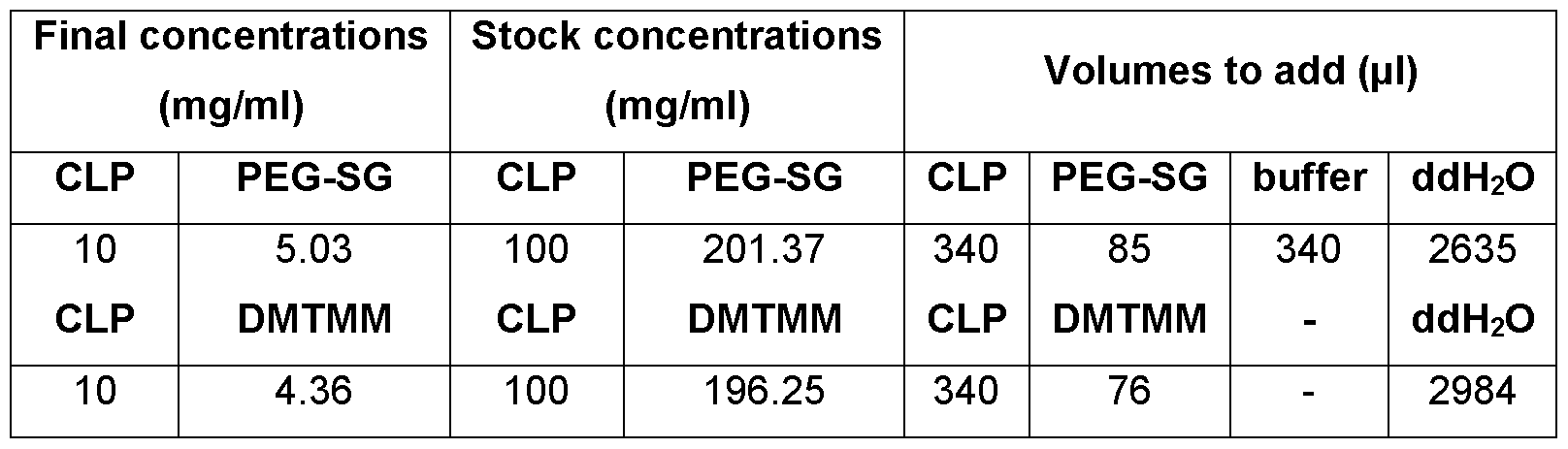
  • Table 1 Pipetting scheme for the preparation of the hydrogel base patch using the previously described DMTMM technology.
  • the molar ratio (MR) described the ratio of functional side chains in CLP compared to the functional side chains in the crosslinker.
  • a MR of 1 :1 was applied.
  • Vecollan® CLP from Evonik Operations GmbH
  • 4-(4,6-Dimethoxy-1 ,3,5-triazin-2-yl)-4- methylmorpholinium chloride (short: DMTMM, TCI Chemicals, order number: D2919, Mw: 276.72 g/mol)
  • 4-arm PEG Succinimidyl Glutaramide (short: 4-Arm-PEG-SG, 10 kDa, JenKem Technology USA, order number: A7110-1* / 4ARM-SGA-10K,1g)
  • HEPES buffer pH 8.0 (1 M) sterile PanReac AppliChem; order number: A6906
  • a 10% (w/v) CLP stock solution was prepared. The mixture was incubated at room temperature (20 °C to 25 °C) on an orbital shaker (450 rpm) until a homogenous solution formed.
  • the DMTMM stock solution (196.25 mg/ml) as well as the 4-Arm-PEG-SG stock solution (201 .37 mg/ml) was prepared fresh (max. 1 h prior to the experiment).
  • Double layer preparation Components were mixed in a vessel with sufficient volume capacity by added them in the following order: ddH2O; CLP stock solution; HEPES buffer (final concentration: 0.1 M) and 4-Arm-PEG-SG stock solution. Before and after adding the crosslinker, the mixture was homogenized. 3.2 ml formulation was transferred into a silicon mold with 4x4x0.4 cm 3 and incubated under humid conditions for 1 h at RT (20 °C - 25 °C).
  • the second layer was molded on top of the first layer by mixing the following ingredients in the following order in a vessel with sufficient volume capacity: ddH2O; CLP stock solution and DMTMM stock solution. Before and after adding the crosslinker, the mixture was homogenized. 3.2 ml formulation was transferred into the silicon mold on top of the already prepared CLP hydrogel base layer. The hydrogel bilayer was incubated under humid conditions for 24 h at RT (20 °C - 25 °C).
  • Table 2 Pipetting scheme for the preparation CLP-based layer crosslinked with DMTMM or 4-Arm-PEG- SG (short: PEG-SG).
  • the molar ratio (MR) describes the ratio of functional side chains in CLP compared to the functional side chains in the crosslinker.
  • a MR of 1 :0.2 was applied for the CLP/PEG composite and a MR of 1 :1 was applied for the DMTMM crosslinked CLP base layer.
  • the applied 1 M HEPES buffer pH 8.0 was abbreviated with “buffer”.
  • the patches described in examples 1 and 2 were placed in a heat cabinet and exposed to 40 °C hot air for 16 h.
  • the resulting film-like patches have a transparent shape and increase in flexibility by swelling in aqueous solution.
  • the incubation time strongly depends on the patch thickness as well as its formulation. Also, the loading density is crucial for the drying process duration.
  • the patches described in examples 1 and 2 were placed in a freeze dryer and processed via the following program resulting in white sponge-like patches. Resulting patches are depicted in figure 1 .
  • Table 3 Freeze drying protocol to prepare sponge-like CLP patches.
  • hydrogels were prepared with 2 mm layer height in silicon molds by using the described formulations in table 4. Only the hydrogel base layer was used for this experiment. Resulting patches were analyzed regarding their breaking behavior when bended by 180° in dry and wet state (5 min soaking in 1 xPBS). When bending by 180° was possible, patches were enrolled to demonstrate increased flexibility. Results were documented in table 5. One example with pictures was given in figure 6.
  • Table 4 Different formulations for the preparation of hydrogel base layer crosslinked by DMTMM.
  • Example 6 CLP patch crosslinked with DMTMM and loaded with PLGA-based microparticles
  • Microparticles were added from a particle suspension in ddFW spiked into the water fraction of the formulation shown in example 1 .
  • An example formulation with particles is given in table 6.
  • Interface Applying the DMTMM crosslinked hydrogel base layer on top of the crosslinked PEG/CLP layer. Particles will sediment into the interphase. This protects the user from direct particle contact. This is especially important for enclosed high potent drugs to avoid direct contact when used by e.g., health-care personnel when applied.
  • Rotation Alternatively, the patch was prepared in a special mold under constant rotation until gelation occurred.
  • Viscous molding Third, the formulation was incubated at RT before molding until a significant viscosity increase was observed. After a final homogenization the viscous formulation was molded.
  • Table 6 Pipetting scheme for CLP crosslinked with DMTMM or 4-Arm-PEG-SG (short: PEG-SG) by incorporating microparticles w/ or w/o drug load.
  • the molar ratio (MR) described the ratio of functional side chains in CLP compared to the functional side chains in the crosslinker.
  • a MR of 1 :0.2 was applied forthe CLP/PEG composite and a MR of 1 :1 was applied forthe DMTMM crosslinked CLP layer.
  • the applied 1 M HEPES buffer pH 8.0 was abbreviated with “buffer”. If the double layer patch was produced, microparticles were incorporated in one layer only but incorporated in both layers worked comparably well.
  • Example 7 Meloxicam release from incorporated microparticles
  • the patches were submersed in 1x PBS buffer and incubated in a 37 °C warm water bath on an orbital shaker (85 rpm) in 50 ml Greiner tubes.
  • the volume of extraction medium was chosen in alignment with the solubility limit of the encapsulated Meloxicam in water. The chosen volume ensures that all of the encapsulated Meloxicam can be dissolved during the trial to avoid drawback effects due to solubility limitations.
  • 1 ml samples was taken from the supernatant. The reduced volume was replenished by 1 ml fresh 1 xPBS and the sample was analyzed using a Tecan multiplate reader with an absorbance wavelength of 365 nm.
  • HFF human fibroblasts
  • Hydrogels were washed (3x 440 pl 1xPBS, 1x 440 pl full culture medium w/ FBS; 1 h each on an orbital shaker (300 rpm)). After washing, detached and washed cells were added (300 pl of a 1 x10 5 cells/ml suspension). The plate was incubated under culture conditions (37 °C, 5% CO2, humid atmosphere) for 24 h. Then, the cell morphology was visualized using a transmission light microscope and pictures were taken (see figure 4).

Landscapes

  • Health & Medical Sciences (AREA)
  • Chemical & Material Sciences (AREA)
  • Life Sciences & Earth Sciences (AREA)
  • General Health & Medical Sciences (AREA)
  • Epidemiology (AREA)
  • Veterinary Medicine (AREA)
  • Public Health (AREA)
  • Engineering & Computer Science (AREA)
  • Animal Behavior & Ethology (AREA)
  • Dermatology (AREA)
  • Medicinal Chemistry (AREA)
  • Transplantation (AREA)
  • Oral & Maxillofacial Surgery (AREA)
  • Bioinformatics & Cheminformatics (AREA)
  • Biomedical Technology (AREA)
  • Botany (AREA)
  • Pharmacology & Pharmacy (AREA)
  • Biotechnology (AREA)
  • Chemical Kinetics & Catalysis (AREA)
  • Molecular Biology (AREA)
  • Dispersion Chemistry (AREA)
  • Preparation Of Compounds By Using Micro-Organisms (AREA)
  • Peptides Or Proteins (AREA)

Abstract

The present invention refers to a patch, comprising a hydrogel base layer obtained by reacting at least one collagen-like protein and at least one cross-linker selected from 4-(4,6-dimethoxy-1,3,5- triazin-2-yl)-4-methyl-morpholinium chloride (DMTMM), glutaraldehyde, transglutaminase, diisocyanate, or a combination of 1-ethyl-3-(3-dimethylaminopropyl) carbodiimide (EDC) and N- hydroxysuccinimide (NHS); optionally a further hydrogel layer obtained by reacting at least one collagen-like protein and at least one cross-linker comprising at least two groups each comprising a polyalkylene glycol moiety and a succinimidyl group; wherein the hydrogel base layer has a thickness of at most 8 mm and the patch has a thickness of at most 16 mm as well as a manufacturing method thereof. Furthermore, the present invention refers to the use of the patch according to the present invention for wound sealing, drug delivery, occlusive application, tissue regeneration, or forming a barrier membrane.

Description

Hydrogel patch made from a collagen-like protein (CLP)
Field of the invention
The present invention refers to a patch, comprising a hydrogel base layer obtained by reacting at least one collagen-like protein and at least one cross-linker selected from 4-(4,6-dimethoxy-1 ,3,5- triazin-2-yl)-4-methyl-morpholinium chloride (DMTMM), glutaraldehyde, transglutaminase, diisocyanate, or a combination of 1-ethyl-3-(3-dimethylaminopropyl) carbodiimide (EDC) and N- hydroxysuccinimide (NHS); optionally a further hydrogel layer obtained by reacting at least one collagen-like protein and at least one cross-linker comprising at least two groups each comprising a polyalkylene glycol moiety and a succinimidyl group; wherein the hydrogel base layer has a thickness of at most 8 mm and the patch has a thickness of at most 16 mm as well as a manufacturing method thereof. Furthermore, the present invention refers to the use of the patch according to the present invention for wound sealing, drug delivery, occlusive application, tissue regeneration, or forming a barrier membrane.
Background of the invention
Patches, in particular surgical patches, to repair and reinforce damaged soft tissue are important for the success of standard surgical treatments in internal medicine. Current products on the market like TachoSil® from Takeda Pharma Vertrieb GmbH & Co. KG or Collatamp® G from Shering-Plough, contain animal-derived materials. Animal-derived materials introduce risk into medical products, because of potential transmission of infectious diseases or batch-to-batch variability of the naturally sourced materials. A technical problem of current surgical patches on the market is scar-tissue formation. That is caused by ingrowth of the patch into the surrounding tissue at surgery site. This can lead to side-effects like impaired wound healing and difficulties in repeated surgery. Furthermore, such patches need to stay intact even if shear forces through bending are applied.
Therefore, there is a need for patches which are not based on animal-derived material, show low scar-tissue formation, and do not break when shear forces through bending are applied.
The inventors of the present invention have surprisingly found that one or more of these objects can be solved by using a specific patch made of a specific hydrogel base layer obtained by reacting at least one collagen-like protein and at least one cross-linker selected from 4-(4,6-dimethoxy-1 ,3,5- triazin-2-yl)-4-methyl-morpholinium chloride (DMTMM), glutaraldehyde, transglutaminase, diisocyanate, or a combination of 1-ethyl-3-(3-dimethylaminopropyl) carbodiimide (EDC) and N- hydroxysuccinimide (NHS). The patch can contain one or more further hydrogel layer. It is essential that the hydrogel base layer has a thickness of at most 8 mm and the patch has a thickness of at most 16 mm in order to ensure suitable flexibility and stretchability. The patch can be additionally loaded with at least one polymeric active agent delivery particle, at least one liposome or at least one polyplex. The hydrogel patch can be used as is (non-dried). Optional heat-drying or lyophilization enables further control of morphology and properties. Dried patches can be re-hydrated prior to use.
Summary of the invention
In a first aspect the present invention refers to a patch, comprising or consisting of i) a hydrogel base layer obtained by reacting at least one collagen-like protein and at least one cross-linker selected from 4-(4,6- dimethoxy-1 ,3,5-triazin-2-yl)-4-methyl-morpholinium chloride (DMTMM), glutaraldehyde, transglutaminase, diisocyanate, or a combination of 1-ethyl-3-(3-dimethylaminopropyl) carbodiimide (EDC) and N-hydroxysuccinimide (NHS); ii) optionally a further hydrogel layer obtained by reacting at least one collagen-like protein and at least one cross-linker comprising at least two groups each comprising a polyalkylene glycol moiety and a succinimidyl group; wherein the hydrogel base layer has a thickness of at most 8 mm and the patch has a thickness of at most 16 mm.
In a second aspect the present invention refers to a method of preparing a patch according to the present invention comprising or consisting of the steps i) providing water, the at least one collagen-like protein and the at least one cross-linker and homogenizing the mixture, then transferring the mixture into a mold and allowing the mixture to gel in order to form the hydrogel base layer; ii) optionally providing water, the at least one collagen-like protein and the at least one crosslinker and homogenizing the mixture, then transferring the mixture into the mold containing the hydrogel base layer and allowing the mixture to gel in order to form the at least one further hydrogel layer; iii) thereafter optionally freeze or heat drying the hydrogel base layer and optionally the at least one further hydrogel layer to form the patch.
In a third aspect the present invention refers to a use of the patch according to the present invention for wound sealing, drug delivery, occlusive application, tissue regeneration, or forming a barrier membrane.
These and other aspects, embodiments, features, and advantages of the invention will become apparent to a person skilled in the art through the study of the following detailed description and claims. Any feature from one aspect of the invention can be used in any other aspect of the invention. Furthermore, it will readily be understood that the examples contained herein are intended to describe and illustrate the invention but not to limit the invention and that, in particular, the invention is not limited to these examples.
Description of the Figures
Figure 1 : Freeze-dried single layer patches (left) and heat-dried double patch (right).
Figure 2: Meloxicam-Resomer microparticles (A) incorporated in a heat dried CLP soft tissue patch crosslinked with 4-Arm-PEG-SG (B). Macroscopic observation of the undried (C) and heat dried CLP patches with Resomer particles when submerged in ddFW after heat drying (D). (E) shows the applied heat-dried soft tissue patch on a glove.
Figure 3: Measured release kinetics of Meloxicam (M) which was encapsulated in Resomer microparticles (MPs) and subsequently immobilized in a single and a double layered CLP patch with identical formulation regarding the DMTMM layer. As control pure Meloxicam and the Meloxicam loaded Resomer particles were used. Meloxicam-loaded Resomer Microparticles were abbreviated with M-MPs.
Figure 4: HFF cells exposed to the hydrogel surface of different formulations after washing. The cells were cultured for 24 h under culture conditions. Brightfield pictures were taken afterwards.
Figure 5: (A) Prepared collagen soft tissue patches with different thicknesses after freeze-drying. (B) The material was bended by 180° in the dry state and after soaking for 10 min in ddFW.
Figure 6: Example formulation of soft tissue patch which can be rolled without breaking in dry and wet state (10 min soaking in ddFW).
Detailed description of the invention
Numerical ranges that are indicated in the format “from x to y” also include the stated values. If several preferred numerical ranges are indicated in this format, it is self-evident that all ranges that result from the combination of the various endpoints are also included.
"One or more", as used herein, relates to at least one and comprises 1 , 2, 3, 4, 5, 6, 7, 8, 9 or more of the referenced species. Similarly, "at least one" means one or more, i.e. 1 , 2, 3, 4, 5, 6, 7, 8, 9 or more. "At least one", as used herein in relation to any component, refers to the number of chemically different molecules, i.e. to the number of different types of the referenced species, but not to the total number of molecules. For example, "at least one surfactant" means that at least one type of molecule falling within the definition for a surfactant is used but that also two or more different types of surfactants falling within this definition can be present but does not mean that only one or more molecules of one type of surfactant are present.
All percentages given herein in relation to the compositions or formulations relate to wt.-% relative to the total weight of the respective composition, if not explicitly stated otherwise.
“Essentially free of’ according to the present invention with regard to compounds means that the compound can only be present in an amount, which does not influence the characteristics of the composition, in particular the respective compound is present in less than 3 wt.-%, preferably 1 wt.- %, more preferably 0.01 wt.-%, based on the total weight of the composition or is not present at all.
The weight average molecular weight Mw and the number average molecular weight Mn can be determined by GPC employing polystyrene standards.
A hydrogel is according to the present invention considered to be non-adhesive, if after 2D cell cultivation for 24 h on the hydrogel and subsequent washing (3x 1x PBS) not more than 10%, preferably 5% more preferably 0% of cells remain on the surface. The percentage is calculated by comparing the number of cells after washing on the hydrogel with the number of cells on an optimized cell culture surface (plasma treated PS) also after washing. The hydrogel area and the optimized plate surface were identical as well as the cell number during cell seeding.
To obtain the hydrogel at least one collagen-like protein is reacted with at least one specific crosslinker.
Patch
The patch has a thickness of at most 16 mm, preferably 2 to 8 mm.
The patch can be a sponge, a dried patch, e.g. heat dried or freeze dried, or a re-hydrated patch.
The patch according to the present invention is obtained by a method comprising or consisting of the steps i) providing water, the at least one collagen-like protein and the at least one cross-linker and homogenizing the mixture, then transferring the mixture into a mold and allowing the mixture to gel in order to form the hydrogel base layer; ii) optionally providing water, the at least one collagen-like protein and the at least one crosslinker and homogenizing the mixture, then transferring the mixture into the mold containing the hydrogel base layer and allowing the mixture to gel in order to form the at least one further hydrogel layer; iii) thereafter optionally freeze or heat drying the hydrogel base layer and optionally the at least one further hydrogel layer to form the final patch.
Freeze and heat drying is known to the person skilled in the art. For example, freeze drying can be performed at -40 to -60 °C and heat drying can be performed at 30 to 45 °C.
Hydrogel base layer
The hydrogel base layer is obtained by reacting at least one collagen-like protein and at least one cross-linker selected from 4-(4,6-dimethoxy-1 ,3,5-triazin-2-yl)-4-methyl-morpholinium chloride (DMTMM), glutaraldehyde, transglutaminase, diisocyanate, or a combination of 1 -ethyl-3-(3- dimethylaminopropyl) carbodiimide (EDC) and N-hydroxysuccinimide (NHS).
The hydrogel base layer has a thickness of at most 8 mm, preferably 0.1 to 8, more preferably 0.5 to 6, most preferably 1 to 2 mm.
In general, all collagen-like proteins are suitable.
In a preferred embodiment of the present invention the collagen-like protein is a collagen-like protein from Streptococcus pyogenes, which is preferably the Scl2 protein from Streptococcus pyogenes.
Expression of collagen-like proteins have been attempted in several systems, including Escherichia coli and Saccharomyces cerevisiae.
In one embodiment the at least one collagen-like protein is a bacterial collagen-like protein, preferably produced by fermentation in Pichia, Brevibacillus, Bacillus, Escherichia or Corynebacterium, preferably Pichia pastoris, Brevibacillus choshinensis or Corynebacterium glutamicum.
In a preferred embodiment the collagen-like proteins may be expressed in Corynebacterium, preferably in Corynebacterium glutamicum.
One particularly suitable collagen-like protein is derivable from following polynucleotide.
A polynucleotide encoding an amino acid sequence that is at least > 60%, identical to the amino acid sequence of SEQ ID NO:1 , wherein the polynucleotide is a replicable polynucleotide encoding a collagen-like protein and wherein the amino acid sequence comprises a deletion of at least 38 amino acids at the N-terminus of the amino acid sequence of SEQ ID NO:1 . It is preferred, when the amino acid sequence comprises a deletion of between 38 and 74 amino acids at the N-terminus of the amino acid sequence of SEQ ID NO:1. This includes a complete deletion of the N-terminal V-domain (comprising 74 amino acids) and different truncations of the V- domain of at least 38 amino acids.
In a preferred embodiment, the amino acid sequence that is at least > 60%, identical to the amino acid sequence of SEQ ID NO:1 , SEQ ID NO:2, SEQ ID NO:3 or SEQ ID NO:4.
In a further configuration, the amino acid sequence that is at least > 65%, or > 70%, or > 75%, or > 80%, or > 85% identical to the amino acid sequence of SEQ ID NO:2, SEQ ID NO:3 or SEQ ID NO:4.
In a preferred configuration, the polynucleotide encodes an amino acid sequence that is at least > 90%, > 92%, > 94%, > 96%, > 97%, > 98%, > 99% or 100%, preferably > 97%, particularly preferably > 98%, very particularly preferably > 99%, and extremely preferably 100%, identical to the amino acid sequence of SEQ ID NO:2, SEQ ID NO:3 or SEQ ID NO:4.
In a preferred embodiment of the present invention the polynucleotide is a replicable nucleotide sequence encoding the collagen-like protein from Streptococcus pyogenes.
Polynucleotide and nucleic acid molecules comprising such sequences and encoding polypeptide variants of SEQ ID NO:1 to 4, which contain one or more insertion(s) or deletion(s) are suitable as well. Preferably, the polypeptide contains a maximum of 5, a maximum of 4, a maximum of 3, or a maximum of 2, insertions or deletions of amino acids.
Mixture of polypeptides comprising one of the polypeptide variants of SEQ ID NO:1 to 4 and on or more of the truncated variants of the collagen-like protein of SEQ ID NO:5 to 12 can be used as well.
Plasmids and vectors that comprise the nucleotide sequences according to the invention and optionally replicate in microorganisms of the genera Pichia, Corynebacterium, Pseudomonas or Escherichia or are suitable. In a preferred configuration, the vector comprising the nucleotide sequences according to the present invention is suitable for replication in yeast of the genus Pichia pastoris.
Microorganisms of the genera Pichia, Corynebacterium, Pseudomonas or Escherichia that comprise the polynucleotides, vectors and polypeptides according to the invention are suitable as well. Preferred microorganisms are Pichia pastoris, Brevibacillus choshinensis or Corynebacterium glutamicum.
Microorganism of the species P. pastoris, E. coli, P. putida or C. glutamicum comprising any of the nucleotide sequences according to the present invention any of the polypeptides or any of the vectors according to the present invention are suitable. The microorganism may be a microorganism in which the nucleotide sequence is present in overexpressed form.
Overexpression according to the invention means, generally, an increase in the intracellular concentration or activity of a ribonucleic acid, a protein (polypeptide) or an enzyme, compared with the starting strain (parent strain) or wild-type strain, if this is the starting strain. A starting strain (parent strain) is taken to mean the strain on which the measure leading to the overexpression was carried out.
In the overexpression, the methods of recombinant overexpression are preferred. These include all methods in which a microorganism is produced using a DNA molecule provided in vitro. Such DNA molecules comprise, for example, promoters, expression cassettes, genes, alleles, encoding regions etc. These are converted into the desired microorganism by methods of transformation, conjugation, transduction or like methods.
The extent of the expression or overexpression can be established by measuring the amount of the mRNA transcribed by the gene, by determining the amount of the polypeptide, and by determining the enzyme activity.
The bacterial collagen-like protein can be obtained in a fermentative process comprising the following steps: a) fermentation of a microorganism according to the present invention in a medium, b) accumulation of the bacterial collagen-like protein in the medium, wherein a fermentation broth is obtained.
The culture medium or fermentation medium that is to be used must appropriately satisfy the demands of the respective strains. Descriptions of culture media of various microorganisms are contained in the handbook "Manual of Methods for General Bacteriology" of the American Society for Bacteriology (Washington D.C., USA, 1981). The terms culture medium and fermentation medium or medium are mutually exchangeable.
As carbon source, sugars and carbohydrates can be used, such as, e.g., glucose, sucrose, lactose, fructose, maltose, molasses, sucrose-containing solutions from beet sugar or sugar cane processing, starch, starch hydrolysate and cellulose, oils and fats, such as, for example, soybean oil, sunflower oil, groundnut oil and coconut fat, fatty acids, such as, for example, palmitic acid, stearic acid and linoleic acid, alcohols such as, for example, glycerol, methanol and ethanol, and organic acids, such as, for example, acetic acid or lactic acid.
As nitrogen source, organic nitrogen compounds such as peptones, yeast extract, meat extract, malt extract, corn-steep liquor, soybean meal and urea or inorganic compounds such as ammonium sulphate, ammonium chloride, ammonium phosphate, ammonium carbonate and ammonium nitrate can be used. The nitrogen sources can be used individually or as a mixture.
As phosphorus source, phosphoric acid, potassium dihydrogenphosphate or dipotassium hydrogenphosphate or the corresponding sodium-containing salts can be used. The culture medium must, in addition, contain salts, for example in the form of chlorides or sulphates of metals such as, for example, sodium, potassium, magnesium, calcium and iron, such as, for example, magnesium sulphate or iron sulphate, which are necessary for growth. Finally, essential growth substances such as amino acids, for example homoserine and vitamins, for example thiamine, biotin or pantothenic acid, can be used in addition to the above-mentioned substances.
Said starting materials can be added to the culture in the form of a single batch or supplied in a suitable manner during the culturing.
Basic compounds such as sodium hydroxide, potassium hydroxide, ammonia or ammonia water, or acid compounds such as phosphoric acid or sulphuric acid, are used in a suitable manner for pH control of the culture. The pH is generally adjusted to 6.0 to 8.5, preferably 6.5 to 8. For control of foam development, antifoams can be used, such as, for example, polyglycol esters of fatty acids. For maintaining the stability of plasmids, suitable selectively acting substances such as, for example, antibiotics, can be added to the medium. The fermentation is preferably carried out under aerobic conditions. In order to maintain said aerobic conditions, oxygen or oxygen-containing gas mixtures such as, for example, air, are introduced into the culture. The use of liquids that are enriched with hydrogen peroxide is likewise possible. Optionally, the fermentation is carried out at superatmospheric pressure, for example at a superatmospheric pressure of 0.03 to 0.2 MPa. The temperature of the culture is usually 20°C to 45°C, and preferably 25°C to 40°C, particularly preferably 30°C to 37°C. In the case of batch or fed-batch processes, the culturing is preferably continued until an amount sufficient for the measure of obtaining the desired organic chemical compound has formed. This goal is usually reached within 10 hours to 160 hours. In continuous processes, longer culture times are possible. Due to the activity of the microorganisms, enrichment (accumulation) of the fine chemicals in the fermentation medium and/or in the cells of the microorganisms occurs.
Examples of suitable fermentation media may be found, inter alia, in patent documents US 5,770,409, US 5,990,350, US 5,275,940, WO 2007/012078, US 5,827,698, WO 2009/043803, US 5,756,345 or US 7,138,266; appropriate modifications may optionally be carried out to the requirements of the strains used.
The process may be characterized by a process which is selected from the group consisting of batch process, fed-batch process, repetitive fed-batch process, and continuous process.
The process may be further characterized by a fine chemical, or a liquid, or a solid fine chemicalcontaining product is obtained from the fine chemical-containing fermentation broth.
The performance of the processes or fermentation processes according to the invention with respect to one or more of the parameters selected from the group of concentration (compound formed per volume), yield (compound formed per carbon source consumed), volumetric productivity (compound formed per volume and time) and biomass-specific productivity (compound formed per cell dry mass or bio dry mass and time or compound formed per cell protein and time) or other process parameters and combinations thereof, is increased by at least 0.5%, at least 1 %, at least 1.5% or at least 2%, based on processes or fermentation processes with microorganisms in which the promoter variant according to the invention is present.
Owing to the measures of the fermentation, a fermentation broth is obtained which contains the desired collagen-like protein, and preferably amino acid or organic acid.
Then, a product in liquid or solid form that contains the collagen-like protein is provided or produced or obtained.
A fermentation broth means, in a preferred embodiment, a fermentation medium or nutrient medium in which a microorganism was cultured for a certain time and at a certain temperature. The fermentation medium, or the media used during the fermentation, contains/contain all substances or components that ensure production of the desired collagen-like protein and typically ensure growth and/or viability.
On completion of the fermentation, the resultant fermentation broth accordingly contains a) the biomass (cell mass) of the microorganism resulting from growth of the cells of the microorganism, b) the desired collagen-like protein formed in the course of the fermentation, c) the organic by-products possibly formed in the course of the fermentation, and d) the components of the fermentation medium used, or of the starting materials, that are not consumed by the fermentation, such as, for example, vitamins such as biotin, or salts such as magnesium sulphate.
The organic by-products include substances which are generated in addition to the respective desired compound by the microorganisms used in the fermentation and are possibly secreted.
The fermentation broth is withdrawn from the culture vessel or the fermentation container, optionally collected, and used for providing a product in liquid or solid form containing the collagen-like protein. The expression "obtaining the collagen-like protein-containing product" is also used therefor. In the simplest case, the collagen-like protein-containing fermentation broth withdrawn from the fermentation container is itself the product obtained.
By way of one or more of the measures selected from the group a) partial (> 0% to < 80%) to complete (100%) or virtually complete (> 80%, > 90%, > 95%, > 96%, > 97%, > 98%, > 99%) removal of the water, b) partial (> 0% to < 80%) to complete (100%) or virtually complete (> 80%, > 90%, > 95%, > 96%, > 97%, > 98%, > 99%) removal of the biomass, wherein this is optionally inactivated before the removal, c) partial (> 0% to < 80%) to complete (100%) or virtually complete (> 80%, > 90%, > 95%, > 96%, > 97%, > 98%, > 99%, > 99.3%, > 99.7%) removal of the organic by-products formed in the course of the fermentation, and d) partial (>0%) to complete (100%) or virtually complete (>80%, >90%, >95%, >96%, >97%, >98%, >99%, >99.3%, >99.7%) removal of the components of the fermentation medium used or the starting materials that are not consumed by the fermentation, a concentration or purification of the desired collagen-like protein is achieved from the fermentation broth. In this manner, products are isolated that have a desired content of the compound.
The partial (>0% to <80%) to complete (100%) or virtually complete (>80% to <100%) removal of the water (measure a)) is also termed drying.
In a variant of the process, by complete or virtually complete removal of the water, the biomass, the organic by-products and the non-consumed components of the fermentation medium used, pure (> 80% by weight, >90% by weight) or high-purity (>95% by weight, >97% by weight, >99% by weight) product forms of the desired collagen-like protein, preferably bacterial collagen-like protein, are successfully arrived at. For the measures according to a), b), c) or d), a great variety of technical instructions are available in the prior art.
In the case of processes for producing bacterial collagen-like protein processes are preferred in which products are obtained that do not contain any components of the fermentation broth. These products are used, in particular, in human medicine, in the pharmaceuticals industry, and in the food industry.
In the method the collagen like protein can preferably be present in the aqueous solution with a concentration range from 2.5 to 100 mg/ml.
In one embodiment the collagen-like protein concentration in the hydrogel base layer is 10 to 40 mg/cm3.
In one embodiment the at least one cross-linker is provided in an aqueous solution having a pH value of 6 to 8, preferably 6.8 to 7.4.
In one embodiment the molar ratio of collagen-like protein to the at least one cross-linker selected from 4-(4,6-dimethoxy-1 ,3,5-triazin-2-yl)-4-methyl-morpholinium chloride (DMTMM), glutaraldehyde, transglutaminase, diisocyanate, or a combination of 1-ethyl-3-(3-dimethylaminopropyl) carbodiimide (EDC) and N-hydroxy succinimide (NHS), preferably 4-(4,6-dimethoxy-1 ,3,5-triazin-2-yl)-4-methyl- morpholinium chloride is in the range of 1 :1 to 1 :0.25
In one embodiment at least one additive can be optionally present.
In one embodiment the at least one additive is a growth factor, for example a fibroblast growth factor, epidermal growth factor, nerve growth factor or connective tissue growth factor or a recombinant human bone morphogenesis protein. In one embodiment the at least one additive is selected from thrombin, fibrinogen, chitosan, silicic acid precursors, heparin, heparin derived oligosaccharides, hyaluronic acid, and glycosaminoglycans.
In one embodiment the hydrogel base layer is a sponge. The sponge can be obtained for example as disclosed in the method of the WO application PCT/EP2023/053300, which is incorporated by reference.
In one embodiment the sponge has a water uptake capacity of 800 to 3000%, based on the total dry weight of the sponge.
In one embodiment the sponge has a pore size of 15 to 300 pm.
In one embodiment the sponge has a total porosity of 75 to 99%, and an open porosity of 20 to 85%.
In one embodiment the sponge has a Young’s modulus of 45 to 250 kPa in dry form.
In one embodiment the sponge has a Young’s modulus of 4 to 35 kPa in wet form.
The hydrogel base layer can comprise at least one polymeric active agent delivery particle, at least one liposome or at least one polyplex.
The at least one polymeric active agent delivery particle, at least one liposome or at least one polyplex can be evenly distributed throughout the layer or at the surface of one layer or at the surface of all layers.
In general, all polymeric active agent delivery particles are suitable and a skilled person in the field of delivery particles knows how to obtain such particles. Exemplarily polymeric active agent delivery particles and their production method are described in WO 2021063813 A1 and WO 2015181138 A1 which are incorporated by reference.
In one embodiment the at least one polymeric active agent delivery particle has a particle size of 1 to 250 pm, preferably measured by dynamic light scattering, more preferably according to DIN ISO 22412:2018-09 for example by using a Mastersizer 3000 (Malvern Panalytical Ltd., Malvern, UK).
In general, all polyplexes are suitable. For example, suitable polyplexes and their method of manufacturing are disclosed in WO 2016161345 A1 which is incorporated by reference.
In general, all liposomes are suitable. For example, suitable liposomes and their method of manufacturing are disclosed in WO 2012031043 A1 which is incorporated by reference. Protein sequences
SEQ ID NO:1 Streptomyces pyogenes Collagen-like protein (CLP), full length protein
SEQ ID NO:2 Streptomyces pyogenes CLP, truncation 3
SEQ ID NO:3 Streptomyces pyogenes CLP, truncation 5
SEQ ID NO:4 Streptomyces pyogenes CLP, no V-domain
Further hydrogel layer
The at least one further hydrogel layer is obtained by reacting at least one collagen-like protein and at least one cross-linker comprising at least two groups each comprising a polyalkylene glycol moiety and a succinimidyl group.
In general, all collagen-like proteins are suitable.
Preferred embodiments of the at least one collagen-like protein are the same as the abovedescribed embodiments for the at least one collagen-like protein of the hydrogel base layer.
In a preferred embodiment the cross-linker has one of following formulae (I) or (II):
Figure imgf000013_0001
wherein
R1 is a linear or branched alkyl group having up to 12 carbon atoms, preferably up to 8 carbon atoms, more preferably having five carbon atoms;
Aik is -CH2-, -CH2-CH2- or -CH2-CH2-CH2-, preferably -CH2-CH2-; n is an integer from 1 to 1350, preferably, 50 to 1000, more preferably 125 to 660;
R2 is -CH2-, -C2H4-NH-(C=O)-C3H6-, -C2H4-O-, -C2H4-O-(C=O)-C3H6-, -C2H4-NH-(C=O)-C2H4- or -C2H4-O-(C=O)-C2H4-; m is an integer from 2 to 8, preferably 4 to 8, more preferably 4; or
Figure imgf000014_0001
wherein
Aik is -CH2-, -CH2-CH2- or -CH2-CH2-CH2-, preferably -CH2-CH2-; and n is an integer from 1 to 1350, preferably 50 to 1000, more preferably 125 to 660.
In one embodiment the cross-linker has following formula (III)
Figure imgf000014_0002
wherein
R1 is a linear or branched alkyl group having up to 12 carbon atoms, preferably up to 8 carbon atoms, more preferably having five carbon atoms, most preferably is
Figure imgf000014_0003
Aik is -CH2-, -CH2-CH2- or -CH2-CH2-CH2-, preferably -CH2-CH2-; n is an integer from 1 to 1350, preferably, 50 to 1000, more preferably 125 to 660; m is an integer from 2 to 8, preferably 4 to 8, most preferably 4.
In one embodiment the cross-linker has a molecular weight of 2.000 to 40.000 g/mol. In one embodiment the reaction takes place in an aqueous medium, preferably a buffer, more preferably 4-(2-hydroxyethyl)-1 -piperazineethanesulfonic acid (HEPES), having a pH value of 6 to 8, preferably 7 to 8, more preferably 8.
In one embodiment the collagen-like protein concentration in the hydrogel is 10 to 100 mg/ml, preferably 2.5 - 40 mg/ml.
In one embodiment the collagen-like protein concentration in the further hydrogel layer is 10 to 40 mg/cm3.
In one embodiment the molar ratio of lysine groups in the collagen-like protein to the succinimidyl groups in the cross-linker is 1 :0.01 to 1 :1 .6.
In one embodiment the hydrogel is non-adhesive.
In one embodiment at least one additive can be optionally present.
In one embodiment the at least one additive is a growth factor, for example a fibroblast growth factor, epidermal growth factor, nerve growth factor or connective tissue growth factor or a recombinant human bone morphogenesis protein.
In one embodiment the at least one additive is selected from thrombin, fibrinogen, chitosan, silicic acid precursors, heparin, heparin derived oligosaccharides, hyaluronic acid, and glycosaminoglycans.
The further hydrogel layer can comprise at least one polymeric active agent delivery particle, at least one liposome or at least one polyplex.
The at least one polymeric active agent delivery particle, at least one liposome or at least one polyplex can be evenly distributed throughout the layer or at the surface of the layer.
In one embodiment the at least one polymeric active agent delivery particle has a particle size of 1 to 250 pm, preferably measured by dynamic light scattering, more preferably according to DIN ISO 22412:2018-09.
Preferred embodiments of the at least one polymeric active agent delivery particle, at least one liposome or at least one polyplex are the same as the above-described embodiments for the at least one polymeric active agent delivery particle, at least one liposome or at least one polyplex of the hydrogel base layer. Experiments
Production of collagen-like protein
The bacterial collagen-like protein was produced in different host cells by fermentation.
To produce Scl2 from Streptomyces pyogenes in Pichia pastoris, the sequence of the collagen domain of the gene scl2, encoding for a collagen-like protein, has been codon optimized using different algorithms, and cloned in a secretion vector for Pichia pastoris and transformed in Pichia pastoris following standard protocol and subsequent application of a standard expression protocol in fed-batch mode, protein corresponding to Scl2p was detected in the supernatant of cell culture. (Damascene, L.M., Huang, CJ. & Batt, C.A. Protein secretion in Pichia pastoris and advances in protein production. Appl Microbiol Biotechnol 93, 31-39 (2012)).
Upon fermentation, supernatant has been separated from biomass via centrifugation (12000g, 5 mins at room temperature).
The protein could be produced under similar conditions using either E. coll or C. glutamicum. In case of a production in yeast or C. glutamicum, the CL single strand is secreted by the cell. No cell lysis is needed as an initial purification step in this approach. In case of a production in E. coll a cell lysis is mandatory to remove the product from the cell.
The full-length collagen-like protein, a truncated variant (truncation 3) and the no-V-domain variant (based on the gene sc!2 from Streptomyces pyogenes) were also expressed in Brevibacillus choshinensis. Therefore, the corresponding DNA sequences were cloned into a suitable secretion vector for B. choshinensis. Transformation of B. choshinensis with the new constructed plasmids was done according to Mizukami et al. 2010 (Curr Pharm Biotechnol 2010, 13:151-258).
The B. choshinensis strains were analyzed for their ability to produce the different collagen proteins in batch cultivations at 33°C and pH 7 using the DASGIP® parallel bioreactor system from Eppendorf (Hamburg, Germany). The fermentation was performed using 1 L reactors. The production medium (TM medium, Biomed Res Int 2017, 2017: 5479762) contained 10 g/L glucose. Upon fermentation, supernatant has been separated from biomass by centrifugation and was used for SDS PAGE analysis. For all three variants, collagen-like protein was produced.
The full-length collagen-like protein and the no-V-domain variant (based on the gene sc!2 from Streptomyces pyogenes) were also expressed in Corynebacterium glutamicum. Therefore, the corresponding DNA sequences were cloned together with an upstream located signal peptide for protein secretion into a shuttle vector for C. glutamicum (Biotechnology Techniques 1999, 13: 437- 441 .). The C. glutamicum strain ATCC 13032 was transformed with the new constructed plasmids by means of electroporation as described by Ruan et al. (Biotechnology Letters 2015, 37: 2445- 2452).
The C. glutamicum strains were analysed for their ability to produce the different collagen proteins in fed-batch cultivations at 30°C and pH 7 using the DASGIP® parallel bioreactor system from Eppendorf (Hamburg, Germany). The fermentation was performed using 1 L reactors. The production medium contained 20 g/L glucose in the batch phase and the fed-batch phase was run with a glucose feed of 4 g/L*h. Upon fermentation, supernatant has been separated from biomass by centrifugation and was used for HPLC analysis. For both variants, collagen protein was produced. For the truncated variant of the collagen-like protein, product titer was higher as for the full-length variant.
After cell separation (via centrifugation) and folding of the bacterial collagen-like protein (via cooling of the concentrate) the bacterial collagen-like protein was purified using precipitation with 2-Propanol at 15 v%. After precipitation of the Scl2 protein a centrifugation was performed. The pellet was dissolved in water, the triple helical Scl2 protein was unfolded at 40°C and filtered through a 100 kD membrane. This step serves to remove large sized impurities. The collected permeate was then concentrated in the consecutive 10 kD filtration. The retentate was washed to remove small sized impurities.
By that means a triple helical Scl2 protein purity >75 w% was achieved.
The collagen-like protein is referred to as Vecollan® in the following experiments as well.
Example 1 : CLP hydrogel base layer preparation
Materials: Vecollan® (CLP from Evonik Operations GmbH); 4-(4,6-Dimethoxy-1 ,3,5-triazin-2-yl)-4- methylmorpholinium chloride (short: DMTMM, TCI Chemicals, order number: D2919, Mw: 276.72 g/mol); ddH2O
Stock solutions: In a first step, a 10% (w/v) CLP stock solution was prepared. The mixture was incubated at room temperature (20 °C to 25 °C) on an orbital shaker (450 rpm) until a homogenous solution formed. The DMTMM stock solution (196.25 mg/ml) was prepared fresh (max. 1 h prior to the experiment).
Synthesis: Components were mixed in a vessel with sufficient volume capacity by added them in the following order:
• ddH2O,
• CLP stock solution and
• DMTMM stock solution.
An example formulation is given in table 1. Before and after adding the crosslinker, the mixture was homogenized. 3.2 ml formulation was transferred into a silicon mold with 4x4x0.2 cm3 and incubated under humid conditions for 24 h at RT (20 °C - 25 °C).
Table 1 : Pipetting scheme for the preparation of the hydrogel base patch using the previously described DMTMM technology. The molar ratio (MR) described the ratio of functional side chains in CLP compared to the functional side chains in the crosslinker. Here, a MR of 1 :1 was applied.
Figure imgf000018_0001
Example 2: CLP hydrogel double layer preparation
Materials: Vecollan® (CLP from Evonik Operations GmbH); 4-(4,6-Dimethoxy-1 ,3,5-triazin-2-yl)-4- methylmorpholinium chloride (short: DMTMM, TCI Chemicals, order number: D2919, Mw: 276.72 g/mol); 4-arm PEG Succinimidyl Glutaramide (short: 4-Arm-PEG-SG, 10 kDa, JenKem Technology USA, order number: A7110-1* / 4ARM-SGA-10K,1g); HEPES buffer pH 8.0 (1 M) sterile (PanReac AppliChem; order number: A6906); ddH2O
Stock solutions: In a first step, a 10% (w/v) CLP stock solution was prepared. The mixture was incubated at room temperature (20 °C to 25 °C) on an orbital shaker (450 rpm) until a homogenous solution formed. The DMTMM stock solution (196.25 mg/ml) as well as the 4-Arm-PEG-SG stock solution (201 .37 mg/ml) was prepared fresh (max. 1 h prior to the experiment).
Double layer preparation: Components were mixed in a vessel with sufficient volume capacity by added them in the following order: ddH2O; CLP stock solution; HEPES buffer (final concentration: 0.1 M) and 4-Arm-PEG-SG stock solution. Before and after adding the crosslinker, the mixture was homogenized. 3.2 ml formulation was transferred into a silicon mold with 4x4x0.4 cm3 and incubated under humid conditions for 1 h at RT (20 °C - 25 °C).
After 1 h gelation time, the second layer was molded on top of the first layer by mixing the following ingredients in the following order in a vessel with sufficient volume capacity: ddH2O; CLP stock solution and DMTMM stock solution. Before and after adding the crosslinker, the mixture was homogenized. 3.2 ml formulation was transferred into the silicon mold on top of the already prepared CLP hydrogel base layer. The hydrogel bilayer was incubated under humid conditions for 24 h at RT (20 °C - 25 °C).
Table 2: Pipetting scheme for the preparation CLP-based layer crosslinked with DMTMM or 4-Arm-PEG- SG (short: PEG-SG). The molar ratio (MR) describes the ratio of functional side chains in CLP compared to the functional side chains in the crosslinker. Here, a MR of 1 :0.2 was applied for the CLP/PEG composite and a MR of 1 :1 was applied for the DMTMM crosslinked CLP base layer. The applied 1 M HEPES buffer pH 8.0 was abbreviated with “buffer”.
Figure imgf000019_0001
Example 3: Hydrogel patch drying
The patches described in examples 1 and 2 were placed in a heat cabinet and exposed to 40 °C hot air for 16 h. The resulting film-like patches have a transparent shape and increase in flexibility by swelling in aqueous solution. The incubation time strongly depends on the patch thickness as well as its formulation. Also, the loading density is crucial for the drying process duration.
Alternatively, the patches described in examples 1 and 2 were placed in a freeze dryer and processed via the following program resulting in white sponge-like patches. Resulting patches are depicted in figure 1 .
Table 3: Freeze drying protocol to prepare sponge-like CLP patches.
Time (h) Pressure (mbar) Temperature (°C)
0 1013 15
0.5 1013 15
3.5 1013 -45
4.5 0.07 -45
5.5 0.07 -30
10.5 0.07 -30
15.5 0.07 -25
20.5 0.07 -20
25.5 0.07 -15
30.5 0.07 -10
35.5 0.07 -5
37.5 0.07 0
39.5 0.07 5
40.5 0.001 20
41.5 0.001 20
42.5 0.001 10 Example 4: Patch formulation tests
According to experiment 1 , hydrogels were prepared with 2 mm layer height in silicon molds by using the described formulations in table 4. Only the hydrogel base layer was used for this experiment. Resulting patches were analyzed regarding their breaking behavior when bended by 180° in dry and wet state (5 min soaking in 1 xPBS). When bending by 180° was possible, patches were enrolled to demonstrate increased flexibility. Results were documented in table 5. One example with pictures was given in figure 6.
Gained data indicated that a molar ratio of CLP to DMTMM of < 1 :1 was preferred. With increased CLP concentrations, a 1 :1 ratio of DMTMM caused stiff sponges. Furthermore, formulations with 40 mg/ml CLP demonstrated strong stiffness in comparison but a strong, flexible and rollable patch after soaking. Depending on the tensile strength needed for individual applications, higherCLP concentrations are preferred for the final application.
Table 4: Different formulations for the preparation of hydrogel base layer crosslinked by DMTMM.
Final cone. Stock cone. Volume (Stock solution)
CLP MR DMTMM CLP DMTMM CLP DMTMM ddH2O Sum mg/mL mg/mL mg/mL mg/mL pl pl pl pl
10 0.5 2.18 100 196.25 340 38 3022 3400
10 1 4.36 100 196.25 340 76 2984 3400
20 0.25 2.18 100 196.25 680 38 2682 3400
20 0.5 4.36 100 196.25 680 76 2644 3400
20 1 8.72 100 196.25 680 151 2569 3400
40 0.25 4.36 100 196.25 1360 76 1964 3400
40 0.5 8.72 100 196.25 1360 151 1889 3400
40 1 17.44 100 196.25 1360 302u 1738 3400
Table 5: Analyzed patch formulations regarding their breaking properties in dry and wet state.
Formulation Breaks (tilted by 180° (dry)) Breaks (tilted by 180° (wet))
10 mg/ml 1 :0.5 No, rolling possible No, rolling is possible
10 mg/ml 1 :1 No No, rolling is possible
20 mg/ml 1 :0.25 Breaks < 90° No, rolling is possible
20 mg/ml 1 :0.5 Breaks <45° No, rolling is possible
20 mg/ml 1 :1 Breaks <30° Breaks
40 mg/ml 1 :0.25 Breaks <90° No, rolling is possible
40 mg/ml 1 :0.5 Breaks <30° No, rolling is possible
40 mg/ml 1 :1 Breaks <30° breaks Example 5: Laver thickness
To identify suitable patch thicknesses for maintaining flexibility, different patch thicknesses (in mm) were prepared with the same formulation (10 mg/ml CLP crosslinked with a MR of DMTMM of 1 :1) according to experiment 1 . The height was measured before and after freeze drying and loss in height was indicated in %:
• 2 mm height before drying
Figure imgf000021_0001
1 .5 mm patch thickness after drying height loss: 25%
• 4 mm height before drying
Figure imgf000021_0002
2.5 mm patch thickness after drying height loss: 37.5%
• 8 mm height before drying
Figure imgf000021_0003
5.2 mm patch thickness after drying height loss: 35%
All formulations resulted in solid patches. Selected pictures are shown in figure 5. The bendability decreased significantly with increased patch thickness. The highest flexibility was obtained with 2 mm initial hydrogel thickness. Using lower MR of DMTMM increased the flexibility of CLP patches made from higher hydrogel layers. These results align with experiment 4.
Example 6: CLP patch crosslinked with DMTMM and loaded with PLGA-based microparticles
Microparticles were added from a particle suspension in ddFW spiked into the water fraction of the formulation shown in example 1 . An example formulation with particles is given in table 6. To incorporate microparticles homogenously, one of the following technologies was applied: a) Interface: Applying the DMTMM crosslinked hydrogel base layer on top of the crosslinked PEG/CLP layer. Particles will sediment into the interphase. This protects the user from direct particle contact. This is especially important for enclosed high potent drugs to avoid direct contact when used by e.g., health-care personnel when applied. b) Rotation: Alternatively, the patch was prepared in a special mold under constant rotation until gelation occurred. c) Viscous molding: Third, the formulation was incubated at RT before molding until a significant viscosity increase was observed. After a final homogenization the viscous formulation was molded.
After gelation for 24 h at RT under humid conditions, the patches were dried.
Table 6: Pipetting scheme for CLP crosslinked with DMTMM or 4-Arm-PEG-SG (short: PEG-SG) by incorporating microparticles w/ or w/o drug load. The molar ratio (MR) described the ratio of functional side chains in CLP compared to the functional side chains in the crosslinker. Here, a MR of 1 :0.2 was applied forthe CLP/PEG composite and a MR of 1 :1 was applied forthe DMTMM crosslinked CLP layer. The applied 1 M HEPES buffer pH 8.0 was abbreviated with “buffer”. If the double layer patch was produced, microparticles were incorporated in one layer only but incorporated in both layers worked comparably well.
Figure imgf000022_0001
Example 7: Meloxicam release from incorporated microparticles
Meloxicam loaded and placebo microparticles (~80 pm diameter; PDI <0.2) were embedded inside of CLP hydrogels followed by warm air drying after gelation to form transparent patches according to example 5. Heat drying was chosen for this example, due to better microscopic imaging due to transparent patch appearances. The microparticle fraction was incorporated into the DMTMM crosslinked CLP layer for the base layer approach. For the double layer approach, particles were incorporated into the 4-Arm-PEG-SG crosslinked hydrogel layer. Independently of single or double layer approach, 2 mm hydrogel thickness per hydrogel layer was applied (single layer: 2 mm; double layer: 4 mm).
After drying, the patches were submersed in 1x PBS buffer and incubated in a 37 °C warm water bath on an orbital shaker (85 rpm) in 50 ml Greiner tubes. The volume of extraction medium was chosen in alignment with the solubility limit of the encapsulated Meloxicam in water. The chosen volume ensures that all of the encapsulated Meloxicam can be dissolved during the trial to avoid drawback effects due to solubility limitations. After different time points, 1 ml samples was taken from the supernatant. The reduced volume was replenished by 1 ml fresh 1 xPBS and the sample was analyzed using a Tecan multiplate reader with an absorbance wavelength of 365 nm. Meloxicam was quantified using a calibration curve in 1x PBS buffer. Once no further signal increase was reported, 1 xPBS buffer was removed completely and 5 ml DMSO was used to dissolve remaining particles as well as remaining Meloxicam from the patch. After 3 h and 24 h incubation time at RT, the absorbance was measured and quantified by a Meloxicam calibration curve done in DMSO. No signal increase demonstrated that 3 h extraction time with DMSO was sufficient. Collected data is summarized in figure 3.
Example 8: Cell adhesion
To compare the cell adhesion properties of both formulations, human fibroblasts (HFF) were seeded on different CLP hydrogels crosslinked with DMTMM or 4-Arm-PEG-SG. All steps for the hydrogel preparation were performed under proper aseptic techniques within a laminar flow hood according to experiment 1 & 2 by applying 220 pl hydrogel formulation was added into a sterile 48 well plate per well using reverse pipetting to avoid bubble formation. Marginal wells were filled with 400 pl sterile ddFW to ensure a moist environment inside of the well plate avoiding hydrogel drying. The plate was covered with its lid and incubated at 25 °C for 24 h. Hydrogels were washed (3x 440 pl 1xPBS, 1x 440 pl full culture medium w/ FBS; 1 h each on an orbital shaker (300 rpm)). After washing, detached and washed cells were added (300 pl of a 1 x10⁵ cells/ml suspension). The plate was incubated under culture conditions (37 °C, 5% CO2, humid atmosphere) for 24 h. Then, the cell morphology was visualized using a transmission light microscope and pictures were taken (see figure 4).

Claims

Claims
1 . A patch, comprising or consisting of i) a hydrogel base layer obtained by reacting at least one collagen-like protein and at least one cross-linker selected from 4-(4,6- dimethoxy-1 ,3,5-triazin-2-yl)-4-methyl-morpholinium chloride (DMTMM), glutaraldehyde, transglutaminase, diisocyanate, or a combination of 1-ethyl-3-(3-dimethylaminopropyl) carbodiimide (EDC) and N-hydroxysuccinimide (NHS); ii) optionally a further hydrogel layer obtained by reacting at least one collagen-like protein and at least one cross-linker comprising at least two groups each comprising a polyalkylene glycol moiety and a succinimidyl group; wherein the hydrogel base layer has a thickness of at most 8 mm and the patch has a thickness of at most 16 mm.
2. Patch according to claim 1 , wherein the at least one collagen-like protein in the hydrogel base layer and/or the further hydrogel layer is a bacterial collagen-like protein.
3. Patch according to claim 2, wherein the bacterial collagen-like protein is a collagen-like protein from Streptococcus pyogenes, preferably Scl2.
4. Patch according to claim 2 or 3, wherein the bacterial collagen-like protein is a polypeptide that is at least > 60% identical to the amino acid sequence of SEQ ID NO:1 , SEQ ID NO:2, SEQ ID NO:3 or SEQ ID NO:4.
5. Patch according to any of claims 2 to 4, wherein the bacterial collagen-like protein is produced by fermentation in a host cell, wherein the host cell is a yeast cell, preferably Pichia pastoris or a bacterial cell, preferably E. coli, Corynebacterium or Brevibacterium.
6. Patch according to any of the preceding claims, wherein the cross-linker in the hydrogen base layer is 4-(4,6-dimethoxy-1 ,3,5-triazin-2-yl)-4-methyl-morpholinium chloride.
7. Patch according to any of the preceding claims, wherein the cross-linker in the further hydrogel layer has a structure of following formula (I) or (II):
Figure imgf000025_0001
wherein
R1 is a linear or branched alkyl group having up to 12 carbon atoms;
Aik is -CH2-, -CH2-CH2- or -CH2-CH2-CH2-; n is an integer from 1 to 1350;
R2 is -CH2-, -C2H4-NH-(C=O)-C3H6-, -C2H4-O-, -C2H4-O-(C=O)-C3H6-,
-C2H4-NH-(C=O)-C2H4- or -C2H4-O-(C=O)-C2H4-; m is an integer from 2 to 8; or
Figure imgf000025_0002
wherein
Aik is -CH2-, -CH2-CH2- or -CH2-CH2-CH2-; and n is an integer from 1 to 1350.
8. Patch according to any of the preceding claims, wherein
(i) the collagen-like protein concentration in the hydrogel base layer is 10 to 40 mg/cm3 and/or
(ii) the collagen-like protein concentration in the further hydrogel layer is 10 to 40 mg/cm3.
9. Patch according to any of the preceding claims, wherein in the further hydrogel layer the molar ratio of lysine groups in the collagen-like protein to the succinimidyl groups in the cross-linker is 1 :0.01 to 1 :1.6.
10. Patch according to any of the preceding claims, wherein in the hydrogel base layer the molar ratio of collagen-like protein to the at least one cross-linker selected from 4-(4,6-dimethoxy- 1 ,3,5-triazin-2-yl)-4-methyl-morpholinium chloride (DMTMM), glutaraldehyde, transglutaminase, diisocyanate, or a combination of 1-ethyl-3-(3-dimethylaminopropyl) carbodiimide (EDC) and N-hydroxysuccinimide (NHS), preferably 4-(4,6-dimethoxy-1 ,3,5- triazin-2-yl)-4-methyl-morpholinium chloride is in the range of 1 :0.25 to 1 :1 .
11 . Patch according to any of the preceding claims, wherein the patch is a sponge, a dried patch, e.g. heat dried or freeze dried, or a re-hydrated patch.
12. Patch according to any of the preceding claims, wherein the hydrogel base layer and/or the further hydrogel layer comprises at least one polymeric active agent delivery particle, at least one liposome or at least one polyplex.
13. Patch according to claim 13, wherein the at least one polymeric active agent delivery particle has a particle size of 1 to 250 pm, preferably measured by dynamic light scattering, more preferably according to DIN ISO 22412:2018-09.
14. Method of preparing a patch according to any of claims 1 to 13 comprising or consisting of the steps i) providing water, the at least one collagen-like protein and the at least one cross-linker and homogenizing the mixture, then transferring the mixture into a mold and allowing the mixture to gel in order to form the hydrogel base layer; ii) optionally providing water, the at least one collagen-like protein and the at least one crosslinker and homogenizing the mixture, then transferring the mixture into the mold containing the hydrogel base layer and allowing the mixture to gel in order to form the at least one further hydrogel layer; iii) thereafter optionally freeze or heat drying the hydrogel base layer and optionally the at least one further hydrogel layer to form the patch.
15. Use of the patch according to any of claims 1 to 13 for wound sealing, drug delivery, occlusive application, tissue regeneration, or forming a barrier membrane.
PCT/EP2024/064702 2023-06-06 2024-05-29 Hydrogel patch made from a collagen-like protein (clp) Ceased WO2024251576A1 (en)

Priority Applications (2)

Application Number Priority Date Filing Date Title
EP24729299.8A EP4724115A1 (en) 2023-06-06 2024-05-29 Hydrogel patch made from a collagen-like protein (clp)
CN202480037401.6A CN121263216A (en) 2023-06-06 2024-05-29 Hydrogel patch prepared from collagen-like protein (CLP)

Applications Claiming Priority (2)

Application Number Priority Date Filing Date Title
EP23177572 2023-06-06
EP23177572.7 2023-06-06

Publications (1)

Publication Number Publication Date
WO2024251576A1 true WO2024251576A1 (en) 2024-12-12

Family

ID=86693165

Family Applications (1)

Application Number Title Priority Date Filing Date
PCT/EP2024/064702 Ceased WO2024251576A1 (en) 2023-06-06 2024-05-29 Hydrogel patch made from a collagen-like protein (clp)

Country Status (3)

Country Link
EP (1) EP4724115A1 (en)
CN (1) CN121263216A (en)
WO (1) WO2024251576A1 (en)

Citations (15)

* Cited by examiner, † Cited by third party
Publication number Priority date Publication date Assignee Title
US5275940A (en) 1990-08-30 1994-01-04 Kyowa Hakko Kogyo Co., Ltd. Process for producing L-tryptophan by culturing a Corynebacterium glutamicum mutant
US5756345A (en) 1995-09-05 1998-05-26 Degussa Aktiengesellschaft Production of tryptophan by the bacterium Escherichia coli
US5770409A (en) 1991-09-17 1998-06-23 Degussa Aktiengsellschaft Fermentative preparation of lysine with a strain of C. glutamicum
US5827698A (en) 1994-12-09 1998-10-27 Ajinomoto Co., Inc. Lysine decarboxylase gene and method of producing l-lysine
US5990350A (en) 1997-12-16 1999-11-23 Archer Midland Company Process for making granular L-lysine
US7138266B2 (en) 1988-10-25 2006-11-21 Ajinomoto Co., Inc. Bacterial strain of Escherichia coli BKIIM B-3996 as the producer of L-threonine
WO2007012078A1 (en) 2005-07-18 2007-01-25 Basf Ag Methionine producing recombinant microorganisms
WO2009043803A2 (en) 2007-10-02 2009-04-09 Metabolic Explorer Increasing methionine yield
WO2012031043A1 (en) 2010-08-31 2012-03-08 Novartis Ag Pegylated liposomes for delivery of immunogen-encoding rna
WO2015181138A1 (en) 2014-05-28 2015-12-03 Evonik Röhm Gmbh Nanoparticle
WO2016161345A1 (en) 2015-04-02 2016-10-06 The Regents Of The University Of Michigan Hyperbranched polymers and polyplexes and dna or rna delivery systems including the same
US20160376326A1 (en) * 2013-09-09 2016-12-29 Commonwealth Scientific And Industrial Research Organisation Modified bacterial collagen-like proteins
US20200046884A1 (en) * 2016-10-13 2020-02-13 North Grove Investments, Inc. Collagen and collagen like peptide based hyrdogels, corneal implants, filler glue and uses thereof
WO2021063813A1 (en) 2019-10-01 2021-04-08 Evonik Operations Gmbh Process for preparing nanoparticles in the form of a powder comprising a bio-resorbable polyester
WO2023041689A1 (en) * 2021-09-20 2023-03-23 Evonik Operations Gmbh Non-adhesive collagen-like hydrogels

Patent Citations (15)

* Cited by examiner, † Cited by third party
Publication number Priority date Publication date Assignee Title
US7138266B2 (en) 1988-10-25 2006-11-21 Ajinomoto Co., Inc. Bacterial strain of Escherichia coli BKIIM B-3996 as the producer of L-threonine
US5275940A (en) 1990-08-30 1994-01-04 Kyowa Hakko Kogyo Co., Ltd. Process for producing L-tryptophan by culturing a Corynebacterium glutamicum mutant
US5770409A (en) 1991-09-17 1998-06-23 Degussa Aktiengsellschaft Fermentative preparation of lysine with a strain of C. glutamicum
US5827698A (en) 1994-12-09 1998-10-27 Ajinomoto Co., Inc. Lysine decarboxylase gene and method of producing l-lysine
US5756345A (en) 1995-09-05 1998-05-26 Degussa Aktiengesellschaft Production of tryptophan by the bacterium Escherichia coli
US5990350A (en) 1997-12-16 1999-11-23 Archer Midland Company Process for making granular L-lysine
WO2007012078A1 (en) 2005-07-18 2007-01-25 Basf Ag Methionine producing recombinant microorganisms
WO2009043803A2 (en) 2007-10-02 2009-04-09 Metabolic Explorer Increasing methionine yield
WO2012031043A1 (en) 2010-08-31 2012-03-08 Novartis Ag Pegylated liposomes for delivery of immunogen-encoding rna
US20160376326A1 (en) * 2013-09-09 2016-12-29 Commonwealth Scientific And Industrial Research Organisation Modified bacterial collagen-like proteins
WO2015181138A1 (en) 2014-05-28 2015-12-03 Evonik Röhm Gmbh Nanoparticle
WO2016161345A1 (en) 2015-04-02 2016-10-06 The Regents Of The University Of Michigan Hyperbranched polymers and polyplexes and dna or rna delivery systems including the same
US20200046884A1 (en) * 2016-10-13 2020-02-13 North Grove Investments, Inc. Collagen and collagen like peptide based hyrdogels, corneal implants, filler glue and uses thereof
WO2021063813A1 (en) 2019-10-01 2021-04-08 Evonik Operations Gmbh Process for preparing nanoparticles in the form of a powder comprising a bio-resorbable polyester
WO2023041689A1 (en) * 2021-09-20 2023-03-23 Evonik Operations Gmbh Non-adhesive collagen-like hydrogels

Non-Patent Citations (6)

* Cited by examiner, † Cited by third party
Title
"Manual of Methods for General Bacteriology", 1981, AMERICAN SOCIETY FOR BACTERIOLOGY
"TM medium", BIOMED RES INT, vol. 2017, no. 2017, pages 5479762
BIOTECHNOLOGY TECHNIQUES, vol. 1999, no. 13, pages 437 - 441
DAMASCENO, L.M.HUANG, CJ.BATT, C.A.: "Protein secretion in Pichia pastoris and advances in protein production", APPL MICROBIOL BIOTECHNOL, vol. 93, 2012, pages 31 - 39
MIZUKAMI ET AL., CURR PHARM BIOTECHNOL, vol. 2010, no. 13, 2010, pages 151 - 258
RUAN ET AL., BIOTECHNOLOGY LETTERS, vol. 2015, no. 37, pages 2445 - 2452

Also Published As

Publication number Publication date
EP4724115A1 (en) 2026-04-15
CN121263216A (en) 2026-01-02

Similar Documents

Publication Publication Date Title
ES2211883T3 (en) MEANS OF CULTURE AND PROCEDURE FOR THE PREPARATION OF Hyaluronic ACID OF HIGH MOLECULAR WEIGHT.
Schiraldi et al. Biotechnological production and application of hyaluronan
EP4404988B1 (en) Non-adhesive collagen-like hydrogels
WO2015085633A1 (en) Hydrogel based on γ-polyglutamic acid and ε-polylysine crosslinked polymer, and preparation method therefor
EP3902870B1 (en) Bacterial cellulose formulations, methods and uses thereof
CN112316214B (en) Injectable hydrogel of recombinant collagen and preparation method thereof
CA2657162A1 (en) Efficient process for purification of high molecular weight hyaluronic acid
US20100190704A1 (en) Structure comprising chitosan and collagen
Shukla et al. Tapping on the potential of hyaluronic acid: from production to application
RU2381238C2 (en) Method of preparing glucose-sensitive polymer hydrogels
EP1592715A1 (en) Water soluble and biocompatible gels of hyaluronic acid cross-linked with bi-functional l-aminoacids or l-aminoesters
CN111172222A (en) Method for producing hyaluronic acid by fermentation and application thereof
Rigo et al. Hyaluronic acid–from production to application: A
KR20110138917A (en) Molecular Weight Control Method of Biodegradable Polymer Using Ultrasonic Decomposition
US20250195715A1 (en) Sponges based on collagen-like proteins
Hasturk et al. Synthesis and characterization of silk-poly (guluronate) hybrid polymers for the fabrication of dual crosslinked, mechanically dynamic hydrogels
EP4724115A1 (en) Hydrogel patch made from a collagen-like protein (clp)
KR20090004838A (en) Low Settlement Acid Protein Drink
CN119790062A (en) Photo-crosslinkable recombinant bacterial collagen-like protein
CN116687868A (en) Recombinant III type humanized collagen freeze-dried powder and preparation of redissolved solution
CN117286601A (en) Self-assembly preparation method and application of edible bone collagen fibers
CN121548436A (en) Sponges containing recombinant collagen-like peptides (CLP) and bioactive glass
WO2026052373A1 (en) Non-woven article comprising collagen-like protein fibers and a production process thereof
WO2026052478A1 (en) Hybrid scaffolds comprising collagen-like protein and resorbable polymers for medical applications
WO2025186007A1 (en) Collagen-like protein coated medical devices and coating method thereof

Legal Events

Date Code Title Description
121 Ep: the epo has been informed by wipo that ep was designated in this application

Ref document number: 24729299

Country of ref document: EP

Kind code of ref document: A1

WWE Wipo information: entry into national phase

Ref document number: 2024729299

Country of ref document: EP

NENP Non-entry into the national phase

Ref country code: DE

ENP Entry into the national phase

Ref document number: 2024729299

Country of ref document: EP

Effective date: 20260107

ENP Entry into the national phase

Ref document number: 2024729299

Country of ref document: EP

Effective date: 20260107

ENP Entry into the national phase

Ref document number: 2024729299

Country of ref document: EP

Effective date: 20260107

ENP Entry into the national phase

Ref document number: 2024729299

Country of ref document: EP

Effective date: 20260107

ENP Entry into the national phase

Ref document number: 2024729299

Country of ref document: EP

Effective date: 20260107

WWP Wipo information: published in national office

Ref document number: 2024729299

Country of ref document: EP