WO2024251656A1 - Liquid crystalline medium - Google Patents

Liquid crystalline medium Download PDF

Info

Publication number
WO2024251656A1
WO2024251656A1 PCT/EP2024/065186 EP2024065186W WO2024251656A1 WO 2024251656 A1 WO2024251656 A1 WO 2024251656A1 EP 2024065186 W EP2024065186 W EP 2024065186W WO 2024251656 A1 WO2024251656 A1 WO 2024251656A1
Authority
WO
WIPO (PCT)
Prior art keywords
atoms
compounds
denotes
compound
alkyl
Prior art date
Legal status (The legal status is an assumption and is not a legal conclusion. Google has not performed a legal analysis and makes no representation as to the accuracy of the status listed.)
Ceased
Application number
PCT/EP2024/065186
Other languages
French (fr)
Inventor
Kerstin ALTENBURG
Christoph WETZEL
Andrea Ritter
Michael Junge
Current Assignee (The listed assignees may be inaccurate. Google has not performed a legal analysis and makes no representation or warranty as to the accuracy of the list.)
Merck Patent GmbH
Original Assignee
Merck Patent GmbH
Priority date (The priority date is an assumption and is not a legal conclusion. Google has not performed a legal analysis and makes no representation as to the accuracy of the date listed.)
Filing date
Publication date
Application filed by Merck Patent GmbH filed Critical Merck Patent GmbH
Priority to CN202480036854.7A priority Critical patent/CN121311566A/en
Priority to KR1020267000124A priority patent/KR20260020461A/en
Priority to EP24729026.5A priority patent/EP4720220A1/en
Publication of WO2024251656A1 publication Critical patent/WO2024251656A1/en
Anticipated expiration legal-status Critical
Ceased legal-status Critical Current

Links

Classifications

    • CCHEMISTRY; METALLURGY
    • C09DYES; PAINTS; POLISHES; NATURAL RESINS; ADHESIVES; COMPOSITIONS NOT OTHERWISE PROVIDED FOR; APPLICATIONS OF MATERIALS NOT OTHERWISE PROVIDED FOR
    • C09KMATERIALS FOR MISCELLANEOUS APPLICATIONS, NOT PROVIDED FOR ELSEWHERE
    • C09K19/00Liquid crystal materials
    • C09K19/04Liquid crystal materials characterised by the chemical structure of the liquid crystal components, e.g. by a specific unit
    • C09K19/06Non-steroidal liquid crystal compounds
    • C09K19/34Non-steroidal liquid crystal compounds containing at least one heterocyclic ring
    • C09K19/3491Non-steroidal liquid crystal compounds containing at least one heterocyclic ring having sulfur as hetero atom
    • CCHEMISTRY; METALLURGY
    • C09DYES; PAINTS; POLISHES; NATURAL RESINS; ADHESIVES; COMPOSITIONS NOT OTHERWISE PROVIDED FOR; APPLICATIONS OF MATERIALS NOT OTHERWISE PROVIDED FOR
    • C09KMATERIALS FOR MISCELLANEOUS APPLICATIONS, NOT PROVIDED FOR ELSEWHERE
    • C09K19/00Liquid crystal materials
    • C09K19/04Liquid crystal materials characterised by the chemical structure of the liquid crystal components, e.g. by a specific unit
    • C09K19/06Non-steroidal liquid crystal compounds
    • C09K19/34Non-steroidal liquid crystal compounds containing at least one heterocyclic ring
    • C09K19/3491Non-steroidal liquid crystal compounds containing at least one heterocyclic ring having sulfur as hetero atom
    • C09K19/3497Non-steroidal liquid crystal compounds containing at least one heterocyclic ring having sulfur as hetero atom the heterocyclic ring containing sulfur and nitrogen atoms
    • CCHEMISTRY; METALLURGY
    • C09DYES; PAINTS; POLISHES; NATURAL RESINS; ADHESIVES; COMPOSITIONS NOT OTHERWISE PROVIDED FOR; APPLICATIONS OF MATERIALS NOT OTHERWISE PROVIDED FOR
    • C09KMATERIALS FOR MISCELLANEOUS APPLICATIONS, NOT PROVIDED FOR ELSEWHERE
    • C09K19/00Liquid crystal materials
    • C09K19/52Liquid crystal materials characterised by components which are not liquid crystals, e.g. additives with special physical aspect: solvents, solid particles
    • C09K19/60Pleochroic dyes
    • CCHEMISTRY; METALLURGY
    • C09DYES; PAINTS; POLISHES; NATURAL RESINS; ADHESIVES; COMPOSITIONS NOT OTHERWISE PROVIDED FOR; APPLICATIONS OF MATERIALS NOT OTHERWISE PROVIDED FOR
    • C09KMATERIALS FOR MISCELLANEOUS APPLICATIONS, NOT PROVIDED FOR ELSEWHERE
    • C09K19/00Liquid crystal materials
    • C09K19/52Liquid crystal materials characterised by components which are not liquid crystals, e.g. additives with special physical aspect: solvents, solid particles
    • C09K19/60Pleochroic dyes
    • C09K19/601Azoic
    • CCHEMISTRY; METALLURGY
    • C09DYES; PAINTS; POLISHES; NATURAL RESINS; ADHESIVES; COMPOSITIONS NOT OTHERWISE PROVIDED FOR; APPLICATIONS OF MATERIALS NOT OTHERWISE PROVIDED FOR
    • C09KMATERIALS FOR MISCELLANEOUS APPLICATIONS, NOT PROVIDED FOR ELSEWHERE
    • C09K19/00Liquid crystal materials
    • C09K19/04Liquid crystal materials characterised by the chemical structure of the liquid crystal components, e.g. by a specific unit
    • C09K19/06Non-steroidal liquid crystal compounds
    • C09K19/08Non-steroidal liquid crystal compounds containing at least two non-condensed rings
    • C09K19/30Non-steroidal liquid crystal compounds containing at least two non-condensed rings containing saturated or unsaturated non-aromatic rings, e.g. cyclohexane rings
    • C09K19/3001Cyclohexane rings
    • C09K19/3003Compounds containing at least two rings in which the different rings are directly linked (covalent bond)
    • C09K2019/3004Cy-Cy
    • CCHEMISTRY; METALLURGY
    • C09DYES; PAINTS; POLISHES; NATURAL RESINS; ADHESIVES; COMPOSITIONS NOT OTHERWISE PROVIDED FOR; APPLICATIONS OF MATERIALS NOT OTHERWISE PROVIDED FOR
    • C09KMATERIALS FOR MISCELLANEOUS APPLICATIONS, NOT PROVIDED FOR ELSEWHERE
    • C09K19/00Liquid crystal materials
    • C09K19/04Liquid crystal materials characterised by the chemical structure of the liquid crystal components, e.g. by a specific unit
    • C09K19/06Non-steroidal liquid crystal compounds
    • C09K19/08Non-steroidal liquid crystal compounds containing at least two non-condensed rings
    • C09K19/30Non-steroidal liquid crystal compounds containing at least two non-condensed rings containing saturated or unsaturated non-aromatic rings, e.g. cyclohexane rings
    • C09K19/3001Cyclohexane rings
    • C09K19/3003Compounds containing at least two rings in which the different rings are directly linked (covalent bond)
    • C09K2019/3006Cy-Cy-Cy
    • CCHEMISTRY; METALLURGY
    • C09DYES; PAINTS; POLISHES; NATURAL RESINS; ADHESIVES; COMPOSITIONS NOT OTHERWISE PROVIDED FOR; APPLICATIONS OF MATERIALS NOT OTHERWISE PROVIDED FOR
    • C09KMATERIALS FOR MISCELLANEOUS APPLICATIONS, NOT PROVIDED FOR ELSEWHERE
    • C09K19/00Liquid crystal materials
    • C09K19/04Liquid crystal materials characterised by the chemical structure of the liquid crystal components, e.g. by a specific unit
    • C09K19/06Non-steroidal liquid crystal compounds
    • C09K19/08Non-steroidal liquid crystal compounds containing at least two non-condensed rings
    • C09K19/30Non-steroidal liquid crystal compounds containing at least two non-condensed rings containing saturated or unsaturated non-aromatic rings, e.g. cyclohexane rings
    • C09K19/3001Cyclohexane rings
    • C09K19/3003Compounds containing at least two rings in which the different rings are directly linked (covalent bond)
    • C09K2019/3009Cy-Ph
    • CCHEMISTRY; METALLURGY
    • C09DYES; PAINTS; POLISHES; NATURAL RESINS; ADHESIVES; COMPOSITIONS NOT OTHERWISE PROVIDED FOR; APPLICATIONS OF MATERIALS NOT OTHERWISE PROVIDED FOR
    • C09KMATERIALS FOR MISCELLANEOUS APPLICATIONS, NOT PROVIDED FOR ELSEWHERE
    • C09K19/00Liquid crystal materials
    • C09K19/04Liquid crystal materials characterised by the chemical structure of the liquid crystal components, e.g. by a specific unit
    • C09K19/06Non-steroidal liquid crystal compounds
    • C09K19/08Non-steroidal liquid crystal compounds containing at least two non-condensed rings
    • C09K19/30Non-steroidal liquid crystal compounds containing at least two non-condensed rings containing saturated or unsaturated non-aromatic rings, e.g. cyclohexane rings
    • C09K19/3001Cyclohexane rings
    • C09K19/3003Compounds containing at least two rings in which the different rings are directly linked (covalent bond)
    • C09K2019/3016Cy-Ph-Ph
    • CCHEMISTRY; METALLURGY
    • C09DYES; PAINTS; POLISHES; NATURAL RESINS; ADHESIVES; COMPOSITIONS NOT OTHERWISE PROVIDED FOR; APPLICATIONS OF MATERIALS NOT OTHERWISE PROVIDED FOR
    • C09KMATERIALS FOR MISCELLANEOUS APPLICATIONS, NOT PROVIDED FOR ELSEWHERE
    • C09K19/00Liquid crystal materials
    • C09K19/04Liquid crystal materials characterised by the chemical structure of the liquid crystal components, e.g. by a specific unit
    • C09K19/06Non-steroidal liquid crystal compounds
    • C09K19/08Non-steroidal liquid crystal compounds containing at least two non-condensed rings
    • C09K19/30Non-steroidal liquid crystal compounds containing at least two non-condensed rings containing saturated or unsaturated non-aromatic rings, e.g. cyclohexane rings
    • C09K19/3001Cyclohexane rings
    • C09K19/3003Compounds containing at least two rings in which the different rings are directly linked (covalent bond)
    • C09K2019/3019Cy-Cy-Ph-Ph
    • CCHEMISTRY; METALLURGY
    • C09DYES; PAINTS; POLISHES; NATURAL RESINS; ADHESIVES; COMPOSITIONS NOT OTHERWISE PROVIDED FOR; APPLICATIONS OF MATERIALS NOT OTHERWISE PROVIDED FOR
    • C09KMATERIALS FOR MISCELLANEOUS APPLICATIONS, NOT PROVIDED FOR ELSEWHERE
    • C09K19/00Liquid crystal materials
    • C09K19/04Liquid crystal materials characterised by the chemical structure of the liquid crystal components, e.g. by a specific unit
    • C09K19/06Non-steroidal liquid crystal compounds
    • C09K19/08Non-steroidal liquid crystal compounds containing at least two non-condensed rings
    • C09K19/30Non-steroidal liquid crystal compounds containing at least two non-condensed rings containing saturated or unsaturated non-aromatic rings, e.g. cyclohexane rings
    • C09K19/3001Cyclohexane rings
    • C09K19/3003Compounds containing at least two rings in which the different rings are directly linked (covalent bond)
    • C09K2019/3021Cy-Ph-Ph-Cy
    • CCHEMISTRY; METALLURGY
    • C09DYES; PAINTS; POLISHES; NATURAL RESINS; ADHESIVES; COMPOSITIONS NOT OTHERWISE PROVIDED FOR; APPLICATIONS OF MATERIALS NOT OTHERWISE PROVIDED FOR
    • C09KMATERIALS FOR MISCELLANEOUS APPLICATIONS, NOT PROVIDED FOR ELSEWHERE
    • C09K19/00Liquid crystal materials
    • C09K19/04Liquid crystal materials characterised by the chemical structure of the liquid crystal components, e.g. by a specific unit
    • C09K19/06Non-steroidal liquid crystal compounds
    • C09K19/08Non-steroidal liquid crystal compounds containing at least two non-condensed rings
    • C09K19/30Non-steroidal liquid crystal compounds containing at least two non-condensed rings containing saturated or unsaturated non-aromatic rings, e.g. cyclohexane rings
    • C09K19/3001Cyclohexane rings
    • C09K19/3066Cyclohexane rings in which the rings are linked by a chain containing carbon and oxygen atoms, e.g. esters or ethers
    • C09K19/3068Cyclohexane rings in which the rings are linked by a chain containing carbon and oxygen atoms, e.g. esters or ethers chain containing -COO- or -OCO- groups
    • C09K2019/3071Cy-Cy-COO-Cy
    • CCHEMISTRY; METALLURGY
    • C09DYES; PAINTS; POLISHES; NATURAL RESINS; ADHESIVES; COMPOSITIONS NOT OTHERWISE PROVIDED FOR; APPLICATIONS OF MATERIALS NOT OTHERWISE PROVIDED FOR
    • C09KMATERIALS FOR MISCELLANEOUS APPLICATIONS, NOT PROVIDED FOR ELSEWHERE
    • C09K19/00Liquid crystal materials
    • C09K19/04Liquid crystal materials characterised by the chemical structure of the liquid crystal components, e.g. by a specific unit
    • C09K19/06Non-steroidal liquid crystal compounds
    • C09K19/08Non-steroidal liquid crystal compounds containing at least two non-condensed rings
    • C09K19/30Non-steroidal liquid crystal compounds containing at least two non-condensed rings containing saturated or unsaturated non-aromatic rings, e.g. cyclohexane rings
    • C09K19/3001Cyclohexane rings
    • C09K19/3066Cyclohexane rings in which the rings are linked by a chain containing carbon and oxygen atoms, e.g. esters or ethers
    • C09K19/3068Cyclohexane rings in which the rings are linked by a chain containing carbon and oxygen atoms, e.g. esters or ethers chain containing -COO- or -OCO- groups
    • C09K2019/3078Cy-Cy-COO-Ph-Cy
    • CCHEMISTRY; METALLURGY
    • C09DYES; PAINTS; POLISHES; NATURAL RESINS; ADHESIVES; COMPOSITIONS NOT OTHERWISE PROVIDED FOR; APPLICATIONS OF MATERIALS NOT OTHERWISE PROVIDED FOR
    • C09KMATERIALS FOR MISCELLANEOUS APPLICATIONS, NOT PROVIDED FOR ELSEWHERE
    • C09K2219/00Aspects relating to the form of the liquid crystal [LC] material, or by the technical area in which LC material are used
    • C09K2219/13Aspects relating to the form of the liquid crystal [LC] material, or by the technical area in which LC material are used used in the technical field of thermotropic switches

Definitions

  • the present invention relates to dichroic dye compounds of formula I as defined below which are based on a donor-acceptor structure wherein the donor moiety comprises a polycyclic heteroaromatic group made up of at least four fused rings, to mesogenic media comprising one or more compounds of formula I, and to the use of these compounds and mesogenic media in optical, electronic and electro-optical applications, in particular in devices for regulating the passage of energy from an outside space into an inside space, for example in switchable windows for solar energy control in smart buildings and vehicles with energy savings and improved comfort.
  • Smart windows can make use of several technologies for modulating the transmittance of light such as devices based on electrochromism, liquid crystal devices and electrophoretic or suspended-particle devices.
  • Liquid crystal-based devices employ a change in the orientation of liquid crystal molecules between two conductive electrodes by applying an electric field which results in a change of their transmittance.
  • Liquid crystal materials are used in particular as dielectrics in display devices, wherein the optical properties of such materials can be influenced by an applied voltage.
  • Electro-optical devices based on liquid crystals are well known in the art and can be based on various effects. Devices of this type are, for example, cells having dynamic scattering, DAP (deformation of aligned phases) cells, TN cells having a twisted nematic structure, STN (“supertwisted nematic”) cells, SBE (“superbirefringence effect”) cells, OMI (“optical mode interference”) cells and guest-host cells.
  • the LC medium comprises one or more dichroic dyes in addition to the liquid crystal.
  • the transmissivity of the dye-doped liquid crystal to light can be modulated when the dyes change their alignment together with the liquid crystal.
  • devices of this type are also used as switching elements for regulating the passage of light or energy, as described for example in WO 2009/141295 and WO 2010/118422.
  • the transmission of light can be reversibly changed, wherein the intensity of incident light can be attenuated, dimmed or tinted.
  • Such devices may thus be operated in and switched between a bright state and a dark state, i.e. a state of relatively higher light transmission and a state of relatively lower light transmission.
  • a liquid-crystalline medium in combination with one or more dichroic dyes as described above can be used in the switching layer(s).
  • a voltage By application of a voltage, a change in the orientational alignment of the dichroic dye molecules can be achieved in these switching layers. Owing to the direction-dependent absorption, a change in the transmissivity of the switching layer can thus be obtained.
  • a corresponding device is described, for example, in WO 2009/141295.
  • such a change in the transmission behaviour can also be achieved without electrical voltage by a temperature-induced transition from an isotropic state of the liquid-crystalline medium to a liquid-crystalline state, as described, for example, in US 2010/0259698.
  • WO 2009/141295 and WO 2010/118422 describe liquid-crystalline media for optical devices of the guest-host type which comprise cyanobiphenyl derivatives and one or more dichroic dyes.
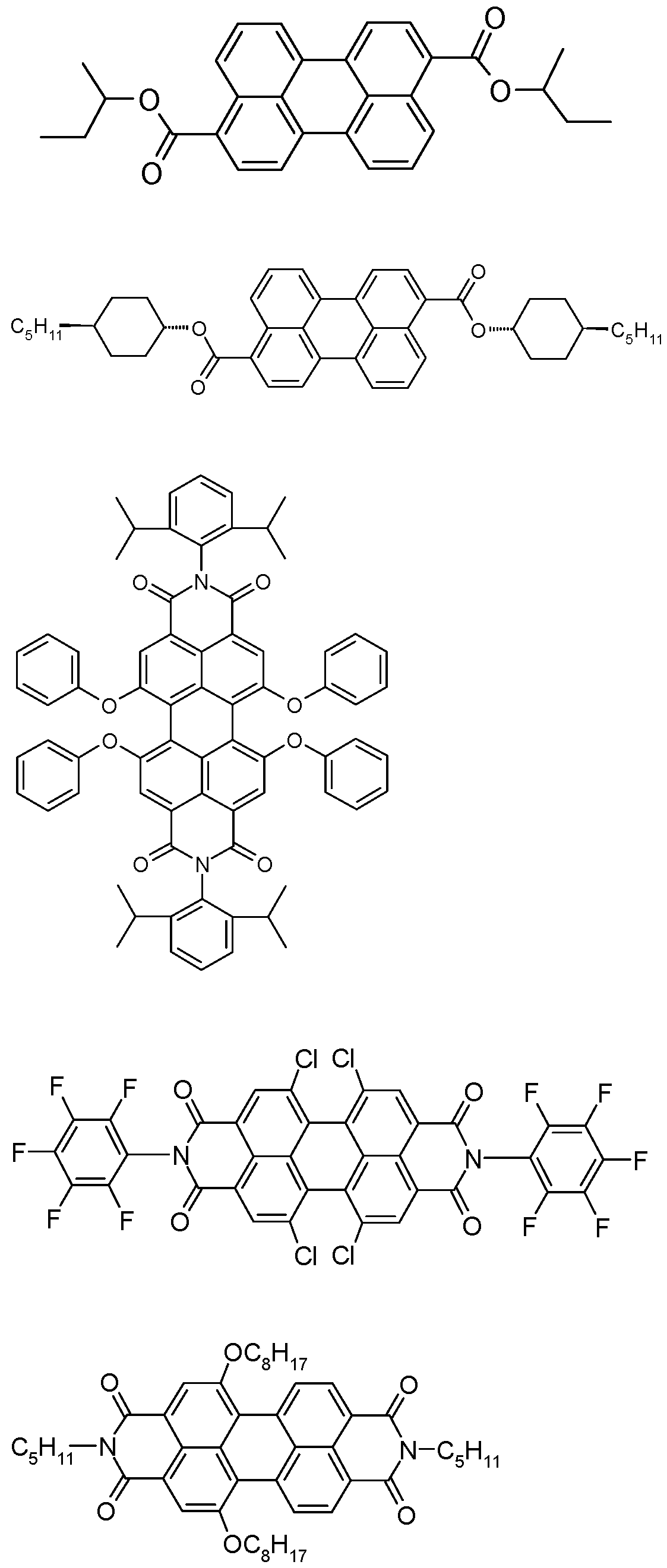
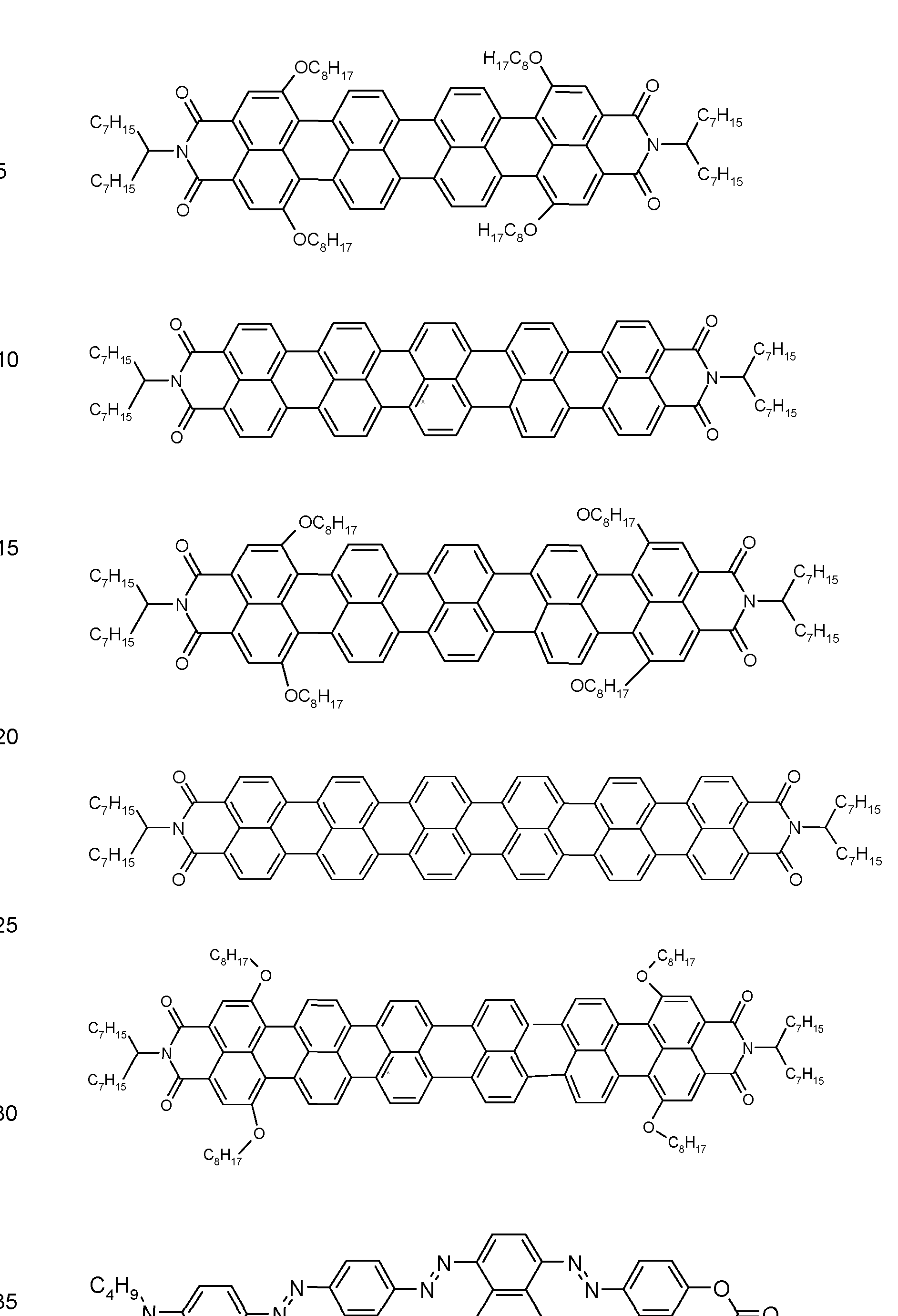
  • Rylene dyes have been described for use in the above-mentioned devices, for example in WO 2009/141295, WO 2013/004677 and WO2014/090373.
  • the use of benzothiadiazoles in the above-mentioned devices is described in WO 2014/187529 and in WO 2020/104563, and the use of thiadiazoloquinoxalines in the above-mentioned devices is described in WO 2016/177449 and in WO 2020/104563.
  • An object of the present invention is therefore to provide improved dye compounds which are particularly suitable for guest-host type applications and which can favourably contribute to an effective and efficient performance of switchable devices.
  • the present invention in particular provides the following items including main aspects, preferred embodiments and particular features, which respectively alone and in combination contribute to solving the above object and eventually provide additional advantages.
  • a first aspect of the present invention provides compounds of formula I wherein
  • R 1 and R 2 identically or differently, denote H, F, CN, N(R Z )2, straight-chain alkyl having 1 to 20 C atoms, or branched or cyclic alkyl having 3 to 20 C atoms, in which, in addition, one or more non-adjacent CH2 groups may each be replaced, independently of one another,
  • R z on each occurrence denotes H, halogen, straight-chain alkyl having 1 to 12 C atoms, or branched or cyclic alkyl having 3 to 12 C atoms, in which, in addition, one or more non-adjacent CH2 groups may be replaced by -O-, -S-, -CO-, -CO-O-, -O-CO- or -O-CO-O- in such a way that O and/or S atoms are not linked directly to one another, and in which, in addition, one or more H atoms may be replaced by F or Cl,
  • R x1 , R x2 independently of one another, denote H, F, Cl, CN or alkyl having 1 to 12 C atoms,
  • R y2 denotes alkyl having 1 to 12 C atoms
  • n1 denotes 1 , 2, 3 or 4
  • a 1 and A 2 identically or differently, denote an aromatic, heteroaromatic, alicyclic or heterocyclic group, preferably having 4 to 25 ring atoms, which may also contain fused rings, and which is unsubstituted, or mono- or polysubstituted by L
  • L denotes F, Cl, -CN, or straight-chain alkyl having 1 to 25 C atoms, or branched or cyclic alkyl having 3 to 25 C atoms, wherein one or more non-adjacent CH 2 -groups are optionally replaced by -O-, -S- , -CO-, -CO-O-, -O-CO- or -O-CO-O- in such a manner that O atoms and/or S atoms are not directly connected with each other, and wherein one or more H atoms are each
  • ring refers to a cyclic group having a closed ring structure, i.e. a closed ring of atoms.
  • rings also include annulated, condensed or fused rings, in particular edge-to-edge fused rings, wherein rings are fused if they share two or more atoms.
  • a compound, in particular a polycyclic compound is regarded as containing a number of rings which is equal to the number of scissions required to convert it into an open-chain compound.
  • the grouping of the donor group D adjacent to the acceptor group A herein preferably forms a ⁇ -conjugated system.
  • the donor group D comprises or preferably consists of an unsubstituted or substituted heteroaromatic group, in particular a polycyclic heteroaromatic group including fused rings, preferably an unsubstituted or substituted heteroacene, more preferably an unsubstituted or substituted S,N-heteroacene with an extended TT-conjugation.
  • the groups Z 1 and Z 2 directly adjacent to the groups D and A are preferably single bonds or TT-conjugated groups.
  • the compounds of formula I as described herein exhibit excellent combined properties and characteristics, e.g. in terms of the extinction coefficient, stability and solubility, which can give a beneficial performance in optical, electro-optical and electronic applications, and in particular in the use of guest-host applications such as in dimmable smart windows.
  • the compounds according to the invention have excellent solubility and stability in liquid crystalline media.
  • the compounds of formula I have favourable solubility in liquid-crystalline media, while at the same time giving suitable light and temperature stability.
  • the compounds can exhibit favourable compatibility and stability as mixtures, having high colour purity and thus offering the possibility to provide media with a colour-neutral or grey appearance if desired.
  • the compounds may give only weak or even no discernible fluorescence.
  • the compounds of formula I can advantageously exhibit a large extinction coefficient in the VIS and/or NIR region of light, while furthermore having a suitably high dichroic ratio. It has presently been recognized that these combined characteristics can favourably contribute to an effective and efficient device performance.
  • the high extinction coefficient, in particular together with the high dichroic ratio can be beneficial in that a lower dye concentration may be used and/or in that a single switching layer may be sufficient and/or that a smaller switching layer thickness or cell gap may be sufficient to obtain the desired contrast and an effective dark state.
  • a smaller dye concentration may also have benefits in terms of solubility and viscosity considerations.
  • the compounds of formula I are thus particularly useful for guest-host type applications, wherein the dye-doped mesogenic media can exhibit suitably broad and stable LC phase ranges and in particular favourable low- temperature stability.
  • the mesogenic media according to the invention can thus give benefits in terms of device performance and reliability, in particular in smart switchable windows.
  • the compounds not only show favourable solubility in the LC media on their own, but that they can be mixed well together with other dichroic dye compounds in the media. This favourably contributes to improving the capabilities for the provision of tailor-made dye-doped liquid crystal media, especially in terms of giving specific colours or even covering the whole VIS range to achieve a black appearance.
  • the compounds of formulae I can be chosen and adjusted such to give the desired colour, while exhibiting only a very weak or even no fluorescence at all.
  • composition in particular a mixture, comprising two or more compounds, preferably three or more compounds, more preferably four or more compounds according to the invention is provided.
  • the compound(s) according to the invention can favourably be used in liquid-crystalline media.
  • liquid-crystalline medium which, in addition to at least one mesogenic compound, further comprises one or more compounds according to the invention.
  • the liquid-crystalline medium contains two or more compounds of formula I or respectively the preferred sub-formulae, more preferably three or more compounds of formula I or respectively the preferred sub-formulae.
  • the liquid-crystalline media according to the invention can give a stable, reliable and highly effective switching medium for electro-optical applications which allow a particularly beneficial performance in devices for regulating the passage of energy from an outside space into an inside space, in particular in smart switchable windows.
  • the high extinction coefficient and the favourable dichroic ratio of the compounds of formula I in the medium can contribute to a beneficial performance in guest-host applications such as in dimmable smart windows.
  • a device for regulating the passage of energy from an outside space into an inside space wherein the device contains a switching layer comprising the liquid crystalline medium according to the invention as described herein.
  • the device can be comprised in a window.
  • the compounds and the mesogenic media according to the invention are used in an electro-optical display, a device for regulating the passage of energy from an outside space into an inside space, an electrical semicon- ductor, an organic field-effect transistor, a printed circuit, a radio frequency identification element, a diode, an organic light-emitting diode, a lighting element, a photovoltaic device, in particular as a sensitizer or semiconductor therein, an optical sensor, an effect pigment, a decorative element or as a dye for colouring polymers, e.g. in the automotive field.
  • a window which comprises the device for regulating the passage of energy from an outside space into an inside space, wherein the device contains a switching layer comprising the liquid-crystalline medium according to the invention.
  • liquid crystal windows according to the invention can be used in sustainable glazing applications in buildings and vehicles, in particular by giving energy savings with respect to lighting, cooling and/or heating and by positively impacting the lifecycle e.g. in terms of maintenance, while in addition providing improved thermal and visual comfort.
  • a dichroic dye is taken to mean a light-absorbing compound in which the absorption properties are dependent on the orientation of the compound relative to the direction of polarisation of the light.
  • a dichroic dye compound in accordance with the present invention typically has an elongated shape, i.e. the compound is significantly longer in one spatial direction, i.e. along the longitudinal axis, than in the other two spatial directions.
  • organic group denotes a carbon or hydrocarbon group.
  • hydrocarbon group denotes a carbon group which additionally contains one or more H atoms and optionally one or more heteroatoms, such as, for example, N, O, S, P, Si, Se, As, Te or Ge.
  • alkyl also encompass polyvalent groups, for example alkylene, arylene, heteroarylene, etc.
  • aryl denotes an aromatic carbon group or a group derived therefrom.
  • heteroaryl denotes “aryl” as defined above, containing one or more heteroatoms.
  • Preferred carbon and hydrocarbon groups are optionally substituted alkyl, alkenyl, alkynyl, alkoxy, alkylcarbonyl, alkoxycarbonyl, alkylcarbonyloxy and alkoxycarbonyloxy having 1 to 40, preferably 1 to 25, particularly preferably 1 to 18, C atoms, optionally substituted aryl or aryloxy having 6 to 40, preferably 6 to 25, C atoms, or optionally substituted alkylaryl, arylalkyl, alkylaryloxy, arylalkyloxy, arylcarbonyl, aryloxycarbonyl, arylcarbonyloxy and aryloxycarbonyloxy having 6 to 40, preferably 6 to 25, C atoms.
  • carbon and hydrocarbon groups are C1-C40 alkyl, C2-C40 alkenyl, C2- C40 alkynyl, C3-C40 allyl, C4-C40 alkyldienyl, C4-C40 polyenyl, C6-C40 aryl, C6-C40 alkylaryl, C6-C40 arylalkyl, C6-C40 alkylaryloxy, C6-C40 arylalkyloxy, C2-C40 heteroaryl, C4-C40 cycloalkyl, C4-C40 cycloalkenyl, etc.
  • C1-C22 alkyl Particular preference is given to C1-C22 alkyl, C2-C22 alkenyl, C2-C22 alkynyl, C3-C22 allyl, C4-C22 alkyldienyl, C6-C12 aryl, C6-C20 arylalkyl and C2-C20 heteroaryl.
  • R z preferably denotes H, halogen, a straight-chain, branched or cyclic alkyl chain having 1 to 25 C atoms, in which, in addition, one or more non-adjacent C atoms may be replaced by -O-, -S-, -CO-, -CO-O-, -O-CO- or -O-CO-O- and in which one or more H atoms may be replaced by fluorine, an optionally substituted aryl or aryloxy group having 6 to 40 C atoms, or an optionally substituted heteroaryl or heteroaryloxy group having 2 to 40 C atoms.
  • Preferred alkyl groups are, for example, methyl, ethyl, n-propyl, isopropyl, n-butyl, isobutyl, s-butyl, t-butyl, 2-methylbutyl, n-pentyl, s-pentyl, cyclopentyl, n-hexyl, cyclohexyl, 2-ethylhexyl, n-heptyl, cycloheptyl, n-octyl, cyclooctyl, n-nonyl, n-decyl, n-undecyl, n-dodecyl, trifluoromethyl, perfluoro-n-butyl, 2,2,2-trifluoroethyl, perfluorooctyl and perfluorohexyl.
  • Preferred alkenyl groups are, for example, ethenyl, propenyl, butenyl, pentenyl, cyclopentenyl, hexenyl, cyclohexenyl, heptenyl, cycloheptenyl, octenyl and cyclooctenyl.
  • Preferred alkynyl groups are, for example, ethynyl, propynyl, butynyl, pentynyl, hexynyl and octynyl.
  • Preferred alkoxy groups are, for example, methoxy, ethoxy, 2-methoxyethoxy, n-propoxy, i-propoxy, n-butoxy, i-butoxy, s-butoxy, t-butoxy, 2-methylbutoxy, n-pentoxy, n-hexoxy, n-heptoxy, n-octoxy, n-nonoxy, n-decoxy, n-undecoxy and n-dodecoxy.
  • Aryl and heteroaryl groups can be monocyclic or polycyclic, i.e. they can contain one ring, such as, for example, phenyl, or two or more rings, which may also be fused, such as, for example, naphthyl, or covalently bonded, such as, for example, biphenyl, or contain a combination of fused and linked rings.
  • Heteroaryl groups contain one or more heteroatoms, preferably selected from O, N, S and Se.
  • a ring system of this type may also contain individual non-conjugated units, as is the case, for example, in the fluorene basic structure.
  • Preferred aryl groups are derived, for example, from the parent structures benzene, biphenyl, terphenyl, [1,1':3',1"]terphenyl, naphthalene, anthracene, binaphthyl, phenanthrene, pyrene, dihydropyrene, chrysene, perylene, tetracene, pentacene, benzopyrene, fluorene, indene, indenofluorene, spirobifluorene, etc.
  • Preferred heteroaryl groups are, for example, 5-membered rings, such as pyrrole, pyrazole, imidazole, 1 ,2,3-triazole, 1 ,2,4-triazole, tetrazole, furan, thiophene, selenophene, oxazole, isoxazole, 1 ,2-thiazole, 1 ,3-thiazole, 1 ,2,3-oxadiazole, 1 ,2,4-oxadiazole, 1 ,2,5-oxadiazole, 1 ,3,4-oxadiazole, 1 ,2,3-thiadiazole, 1 ,2,4- thiadiazole, 1 ,2,5-thiadiazole, 1 ,3,4-thiadiazole, 6-membered rings, such as pyridine, pyridazine, pyrimidine, pyrazine, 1 ,3,5-triazine, 1 ,2,4-triazine, 1
  • the (non-aromatic) alicyclic and heterocyclic groups can be monocyclic, i.e. contain only one ring, such as, for example, cyclohexane, or polycyclic, i.e. contain a plurality of rings, such as, for example, decahydronaphthalene or bicyclooctane. Particular preference is given to saturated groups. Preference is furthermore given to mono-, bi- or tricyclic groups having 3 to 25 C atoms, which optionally contain fused rings and are optionally substituted.
  • the aryl, heteroaryl, carbon and hydrocarbon radicals optionally have one or more substituents, which are preferably selected from the group comprising silyl, sulfo, sulfonyl, formyl, amine, imine, nitrile, mercapto, nitro, halogen, C1-12 alkyl, C6-12 aryl, Ci- 12 alkoxy, hydroxyl, or combinations of these groups.
  • Preferred substituents are, for example, solubility-promoting groups, such as alkyl or alkoxy, electron-withdrawing groups, such as fluorine, nitro or nitrile, or substituents for increasing the glass transition temperature (T g ) in the polymer, in particular bulky groups, such as, for example, t-butyl or optionally substituted aryl groups.
  • substituents for example, F, Cl, CN, NO2, CH3, C2H5, OCH3, OC2H5, COCH3, COC2H5, COOCH3, COOC2H5, CF 3 , OCF 3 , OCHF2, OC2F5, furthermore phenyl.
  • the substituent denoted L on each occurrence preferably is F, Cl, CN, SCN, SF5 or straight-chain or branched, in each case optionally fluorinated, alkyl, alkoxy, alkylcarbonyl, alkoxycarbonyl, alkylcarbonyloxy or alkoxycarbonyloxy having 1 to 12 C atoms.
  • L on each occurrence denotes F or straight- chain or branched, in each case optionally fluorinated, alkyl or alkoxy having 1 to 7 C atoms,
  • Substituted silyl or aryl preferably means substituted by halogen, -CN, R y1 , -OR y1 , -CO-R y1 , -CO-O-R y1 , -O-CO-R y1 or -O-CO-O-R y1 , in which R y1 has the meaning indicated above.
  • the compound of formula I has a donor-acceptor grouping in its molecular structure giving a very high extinction coefficient, in particular in the visible light region, while also exhibiting favourable compatibility for use in guest-host applications, especially suitable solubility and stability in liquid-crystalline media.
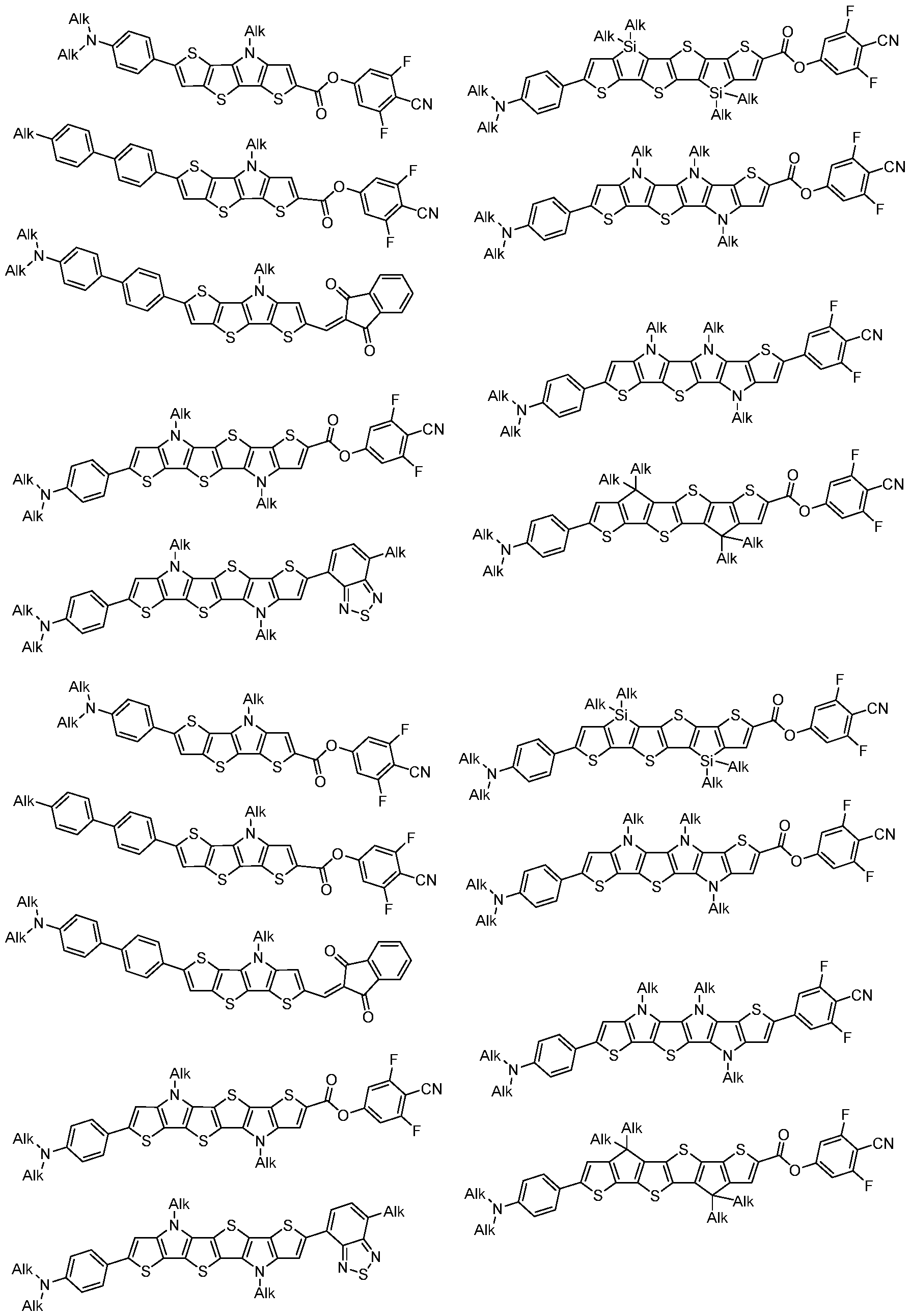
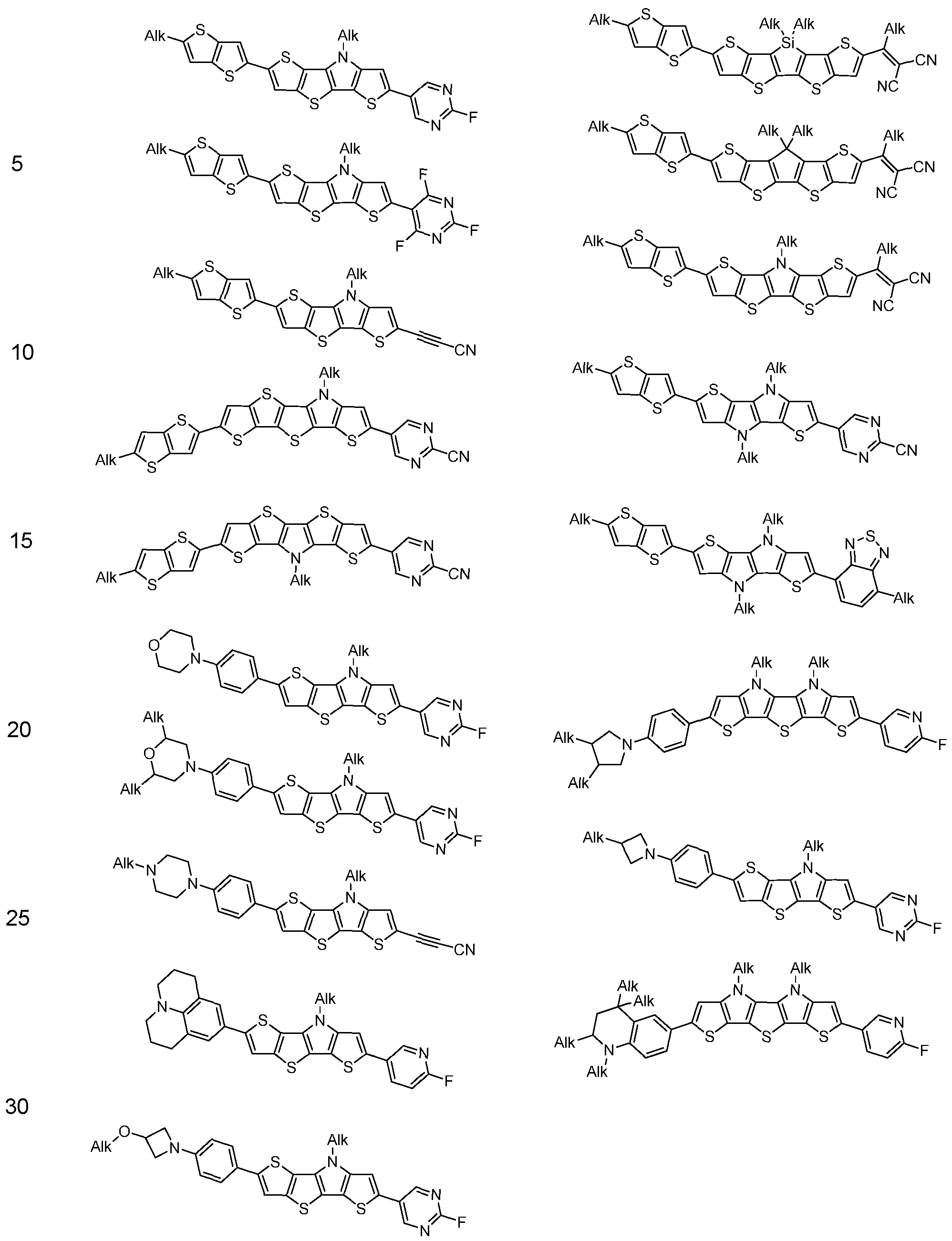
  • the group D in formula I denotes a donor group which is selected from an unsubstituted or substituted heteroaromatic group comprising at least 4 fused rings, preferably at least 4 linearly fused rings which provides an electron-rich conjugated moiety.
  • the donor group D preferably is a polycyclic group, in particular a tetracyclic, pentacyclic, hexacyclic or heptacyclic group, which is a heterocyclic aromatic group, i.e. an aromatic group containing at least one non-carbon atom in at least one of the rings, preferably containing sulfur, nitrogen and/or oxygen.
  • this polycyclic heteroaromatic group includes at least four fused rings, each of which may be unsubstituted or substituted, containing for example thienopyrrole-fused groups.
  • the group D is selected from groups containing, preferably consisting of, linearly fused rings, preferably unsubstituted or substituted heteroacenes. It is particularly preferred that the group D contains heterocyclic thiophene and pyrrole rings, wherein preferably the group D contains and in particular consists of fused heterocyclic thiophene and pyrrole rings, preferably substituted pyrrole rings, especially so-called S,N-heteroacenes.
  • a heteroacene herein is an acene compound containing or preferably composed of heteroatom-substituted aromatic groups.
  • an acene herein is a polycyclic aromatic hydrocarbon consisting of fused benzene rings in a linear arrangement.
  • the donor group D is a heteroacene having linearly fused rings, in which each ring may be unsubstituted, or mono- or polysubstituted by L, wherein L is defined as set forth above and below.
  • the groups R 1 and R 1 in formula I preferably, independently of one another, denote an alkyl group, preferably methyl, ethyl, n-propyl, n-butyl, n-pentyl, n-hexyl, n-heptyl or a branched alkyl group having 3 to 12 C atoms, preferably with a methyl, ethyl, n-propyl, n-butyl, or n-pentyl group bonded to an ethyl, n-propyl, n-hexyl, n-heptyl, n-octyl, n- nonyl or n-decyl group, for example 2-ethylhexyl, 2-ethylheptyl, 2-ethyloctyl, 2- ethylnonyl, 2-ethyldecyl, 3-ethylhexyl, 3-ethy
  • the groups R 1 and R 2 independently of one another, denote a straight chain or branched alkyl or dialkylamino group having 1 to 12 C atoms per alkyl group.
  • the compound of formula I is selected from the group of compounds of formulae 1-1 and I-2 wherein R 1 , R 2 , A 1 , Z 1 , Z 2 , D, A, n and o have the meanings as given for formula I above, and wherein the number of rings in the compound is at least 5, and wherein preferably
  • R 1 and R 2 identically or differently, denote H, N(R Z )2, straight-chain alkyl having 1 to 12 C atoms, or branched or cyclic alkyl having 3 to 18 C atoms, in which, in addition, one or more non-adjacent CH2 groups may each be replaced, independently of one another, by -N(R Z )-, -O-, -S-, -CO-, -CO-O-, -O-CO- or -O-CO-O- in such a way that O and/or S atoms are not linked directly to one another, and in which, in addition, one or more H atoms may be replaced by F,
  • R z on each occurrence denotes H, straight-chain alkyl having 1 to 12 C atoms, or branched or cyclic alkyl having 3 to 12 C atoms, in which, in addition, one or more non-adjacent CH2 groups may be replaced by -O-, -S-, -CO-, -CO-O-, -O-CO- or -O-CO-O- in such a way that O and/or S atoms are not linked directly to one another, and in which, in addition, one or more H atoms may be replaced by F,
  • a 1 on each occurrence denotes an aromatic, heteroaromatic, alicyclic or heterocyclic group having 4 to 25 ring atoms, which may also contain fused rings, and which is unsubstituted, or mono- or polysubstituted by L,
  • L denotes F, Cl, -CN, or straight-chain alkyl having 1 to 25 C atoms, or branched or cyclic alkyl having 3 to 25 C atoms, wherein one or more non-adjacent CFh-groups are optionally replaced by -O-, -S- , -CO-, -CO-O-, -O-CO- or -O-CO-O- in such a manner that O atoms and/or S atoms are not directly connected with each other, and wherein one or more H atoms are each optionally replaced by F,
  • D denotes a heteroacene group comprising, preferably consisting of, at least 4 fused rings, in which each ring may be unsubstituted, or mono- or polysubstituted by L, wherein for formula I-2 the group D comprises at least 5 fused rings if the group A does not contain any rings,
  • A denotes an acceptor group, preferably an electron deficient moiety
  • n denotes 1 , 2 or 3, preferably 1 or 2, more preferably 1
  • o denotes 0 or 1 , preferably 0.
  • the group D is selected from the groups Da, Db and De wherein Ar 1 , Ar 2 , Ar 3 , Ar 4 , Ar 5 and Ar 6 denote fused rings, and
  • Ar 1 is independently selected from the following formulae
  • Ar 4 is independently selected from the following formulae
  • Ar 2 , Ar 3 , Ar 5 , Ar 6 are independently selected from the following formulae
  • R II 1 is CR a R b , SiR a R b , GeR a R b or NR a , wherein R a and R b are independently defined as R 4 ,
  • R 4 on each occurrence denotes halogen, or straight- chain alkyl or alkoxy having 1 to 20 C atoms or branched alkyl or alkoxy having 3 to 20 C atoms, in which one or more H atoms may be replaced by F.
  • the chromophoric system in the molecular structure consists of a grouping in which the donor group D is directly adjacent to an acceptor group.
  • the acceptor group A herein is an electron deficient moiety and can exhibit electron withdrawing characteristics.
  • the acceptor group A preferably is group that has a TT- electron deficient character.
  • the group A 1 in formula I and the preferred sub-formulae thereof is on each occurrence identically or differently selected from an alicyclic group, a heterocyclic group, an aryl group and a heteroaryl group, which may be substituted by one or more radicals L as defined herein, preferably from 1 ,4-cyclohexylene, in which one or two non-adjacent CH2 groups may be replaced by O, 1 ,4-cyclohexenylene, 1 ,4- phenylene, 1 ,4-naphthylene, 2,6-naphthylene, thiazole-2, 5-diyl, thiophene-2, 5-diyl, thienothiophene-2,5-diyl, selenophene-2, 5-diyl, thienopyrrole-2, 5-diyl, dithienopyrrolediyl, dithienosiloldiyl, cyclopenta
  • the compound of formula I is selected from the compounds of formula l-A wherein the number of rings in the compound is at least 5, and
  • R 1 denotes H, N(R Z )2, straight-chain alkyl having 1 to 12 C atoms, or branched or cyclic alkyl having 3 to 18 C atoms, in which, in addition, one or more non-adjacent CH2 groups may each be replaced, independently of one another, by -N(R Z )-, -O-, -S-, -CO-, -CO-O-, -O- CO- or -O-CO-O- in such a way that O and/or S atoms are not linked directly to one another, and in which, in addition, one or more H atoms may be replaced by F, preferably denotes H, N(R Z )2, straight-chain alkyl having 1 to 12 C atoms, or branched or cyclic alkyl having 3 to 18 C atoms, in which, in addition, one or more non-adjacent CH2 groups may each be replaced, independently of one another, by -O-, wherein preferably
  • R z on each occurrence denotes H, straight-chain alkyl having 1 to 12 C atoms, or branched or cyclic alkyl having 3 to 12 C atoms, in which, in addition, one or more non-adjacent CH2 groups may be replaced by -O-, -S-, -CO-, -CO-O-, -O-CO- or -O-CO-O- in such a way that O and/or S atoms are not linked directly to one another, and in which, in addition, one or more H atoms may be replaced by F,
  • a 1 on each occurrence denotes 1,4-cyclohexylene, in which one or two non-adjacent CH2 groups may be replaced by O, 1 ,4-cyclohexenylene, 1,4-phenylene, 1,4-naphthylene, 2,6-naphthylene, thiazole-2, 5-diyl, thiophene-2, 5-diyl, thienothiophene-2,5-diyl, selenophene-2, 5-diyl, thienopyrrole-2, 5-diyl, dithienopyrrolediyl, dithienosiloldiyl, cyclopentadithiophenediyl, pyridine-2, 5-diyl, pyrimidinediyl or pyridazinediyl, wherein one or more H atoms may be replaced by the radical L,
  • L denotes F, Cl, -CN, or straight-chain alkyl having 1 to 25 C atoms, or branched or cyclic alkyl having 3 to 25 C atoms, wherein one or more non-adjacent CFh-groups are optionally replaced by -O-, -S- , -CO-, -CO-O-, -O-CO- or -O-CO-O- in such a manner that O atoms and/or S atoms are not directly connected with each other, and wherein one or more H atoms are each optionally replaced by F,
  • D denotes a heteroaromatic group comprising, preferably consisting of, at least 4 fused rings, in which each ring may be unsubstituted, or mono- or polysubstituted by L, wherein preferably the group D comprises at least 5 fused rings if n is 0,
  • A denotes an acceptor group, preferably an electron deficient moiety, and n denotes 0, 1 or 2, preferably 0 or 1.
  • Aik denotes unsubstituted or substituted alkyl or alternatively has the meaning of R 1 as given for formula I, preferably straight-chain alkyl having 1 to 20 C atoms or branched or cyclic alkyl having 3 to 20 C atoms, more preferably straight-chain alkyl having 1 to 12 C atoms or branched alkyl having 3 to 18 C atoms.
  • the compound of formula I contains precisely one donor group and precisely one acceptor group, in particular respectively selected from the group D and the group A as defined herein.
  • Methods for preparing compounds of formula I can be based on or be analogous to known processes, e.g. as described in standard works of organic chemistry, such as, for example, Houben-Weyl, Methoden der organischen Chemie [Methods of Organic Chemistry], Thieme Verlag, Stuttgart.
  • Houben-Weyl Methoden der organischen Chemie [Methods of Organic Chemistry], Thieme Verlag, Stuttgart.
  • a method for preparing the compound of formula I wherein in the method a bromo compound of formula l-Br is prepared or provided wherein D, A, Z 2 , A 2 , Q 2 , R 2 and o have the meanings as set forth herein for the compound of formula I, and wherein subsequently the compound of formula l-Br is subjected to a chemical reaction, preferably a cross-coupling reaction.
  • the compounds of formula I exhibit a favourably large extinction coefficient, preferably within the visible light spectrum and/or within the NIR spectrum, in particular within the visible light spectrum.
  • the isotropic extinction coefficient is preferably determined according to the method as described herein further below.
  • the high extinction coefficient especially in combination with the high dichroic ratio can give several benefits.
  • a lower dye concentration may be used to obtain the desired contrast between the bright state and the dark state, i.e. between a state of relatively higher light transmission and a state of relatively lower light transmission, and to obtain an effective dark state.
  • a smaller dye concentration may also have benefits in terms of solubility or viscosity considerations.
  • a single switching layer may be sufficient and/or a smaller switching layer thickness or cell gap may be sufficient to obtain the desired switching contrast and the desired dark state performance.
  • the degree of anisotropy R is determined for the LC mixture comprising the dye from the values of the extinction coefficients for parallel and perpendicular alignment of the molecules relative to the direction of the polarisation of the light.
  • the degree of anisotropy R preferably is greater than 0.4, more preferably greater than 0.6, even more preferably greater than 0.7, still more preferably greater than 0.75, and in particular greater than 0.8.
  • the absorption preferably reaches a maximum when the polarisation direction of the light is parallel to the direction of the longest molecular elongation of the compounds of formula I, and it preferably reaches a minimum when the polarisation direction of the light is perpendicular to the direction of the longest molecular elongation of the compounds of formula I.
  • the compounds of formula I can favourably be used as guest compounds, in particular as dichroic dyes, in liquid crystalline host mixtures. Therefore, in a preferred embodiment the compound(s) of formula I is (are) dissolved in the LC medium.
  • the mesogenic medium comprises one or more compounds of formula I as set forth above and below, preferably two or more compounds of formula I as set forth above and below, more preferably three or more compounds of formula I as set forth above and below.
  • the mesogenic medium comprises at least one compound selected from the group of compounds of formulae 1-1 and I-2 as set forth herein.
  • the mesogenic medium comprises at least one compound of formula l-A as set forth herein, more preferably at least two compounds of formula l-A as set forth herein.
  • a suitable host mixture is any dielectrically negative or positive LC mixture which is suitable for use in conventional VA, TN, STN, IPS or FFS displays.
  • Suitable LC mixtures are known in the art and are described in the literature.
  • LC media for VA displays having negative dielectric anisotropy are described in for example EP 1 378 557 A1.
  • Suitable LC mixtures having positive dielectric anisotropy which are suitable for LCDs and especially for IPS displays are known, for example, from JP 07-181 439 (A), EP 0667 555, EP 0 673986, DE 195 09410, DE 19528 106, DE 19528 107, WO 96/23 851 , WO 96/28 521 and WO2012/079676.
  • the LC host mixture preferably is a nematic LC mixture. In an embodiment the LC mixture does not have a chiral LC phase.
  • the LC medium contains an LC host mixture with negative dielectric anisotropy.
  • the mesogenic media according to the invention comprise components selected from the following items a) to x): a) Mesogenic medium which comprises one or more compounds selected from the group of compounds of the formulae CY, PY and AC: wherein a denotes 0, 1 or 2, preferably 1 or 2, b denotes 0 or 1, c is 0, 1 or 2, d isOorl.
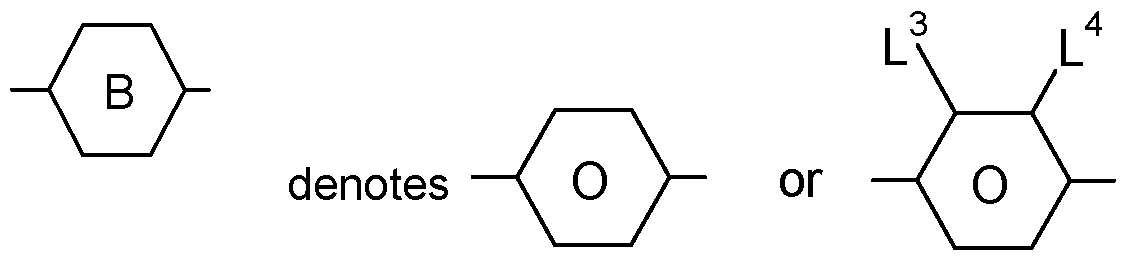
  • L 1 ' 4 each, independently of one another, denote F, Cl, CN, OCF3, CF3, CH 3 , CH 2 F, CHF 2 .
  • both L 1 and L 2 denote F or one of L 1 and L 2 denotes F and the other denotes Cl
  • both L 3 and L 4 denote F or one of L 3 and L 4 denotes F and the other denotes Cl.
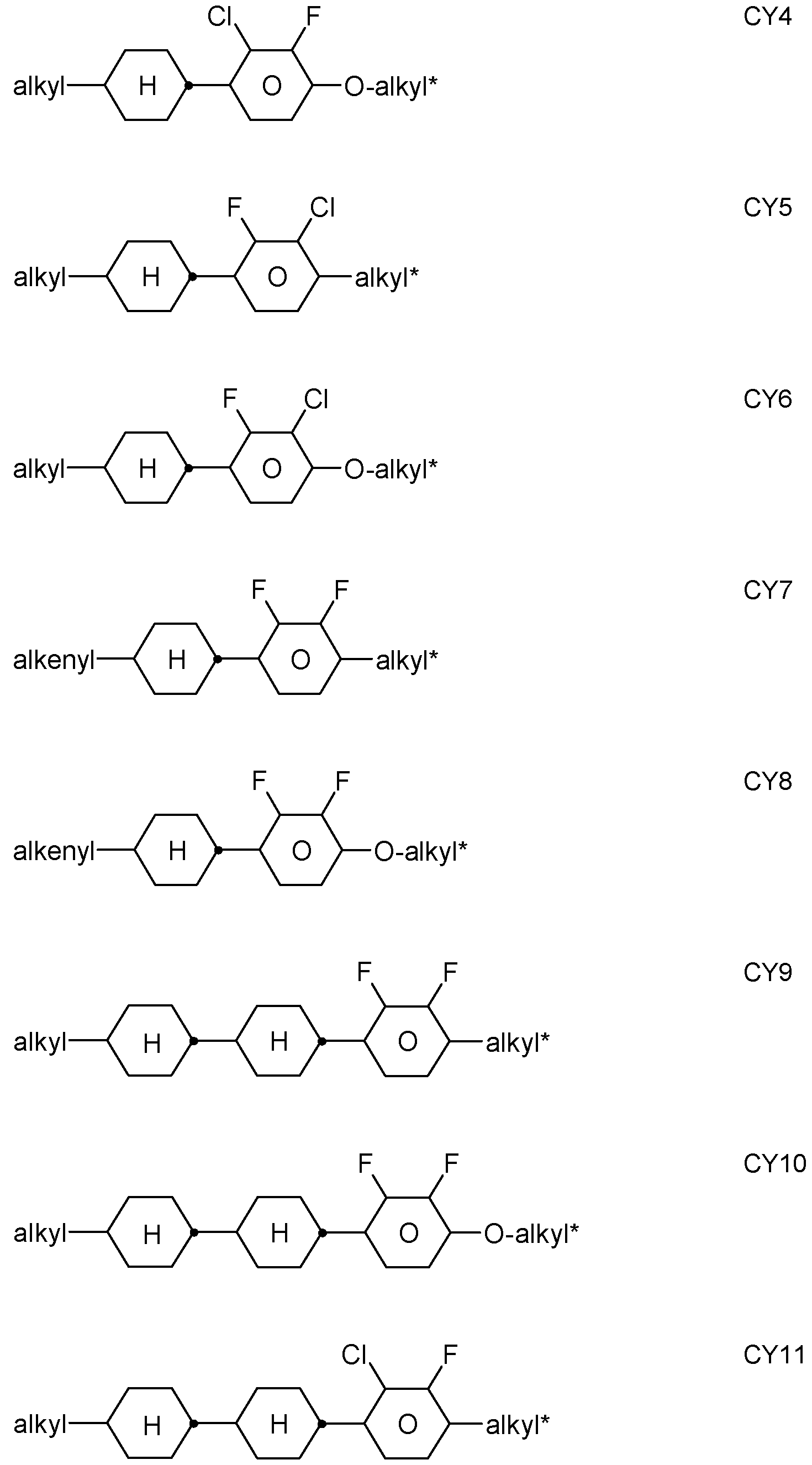
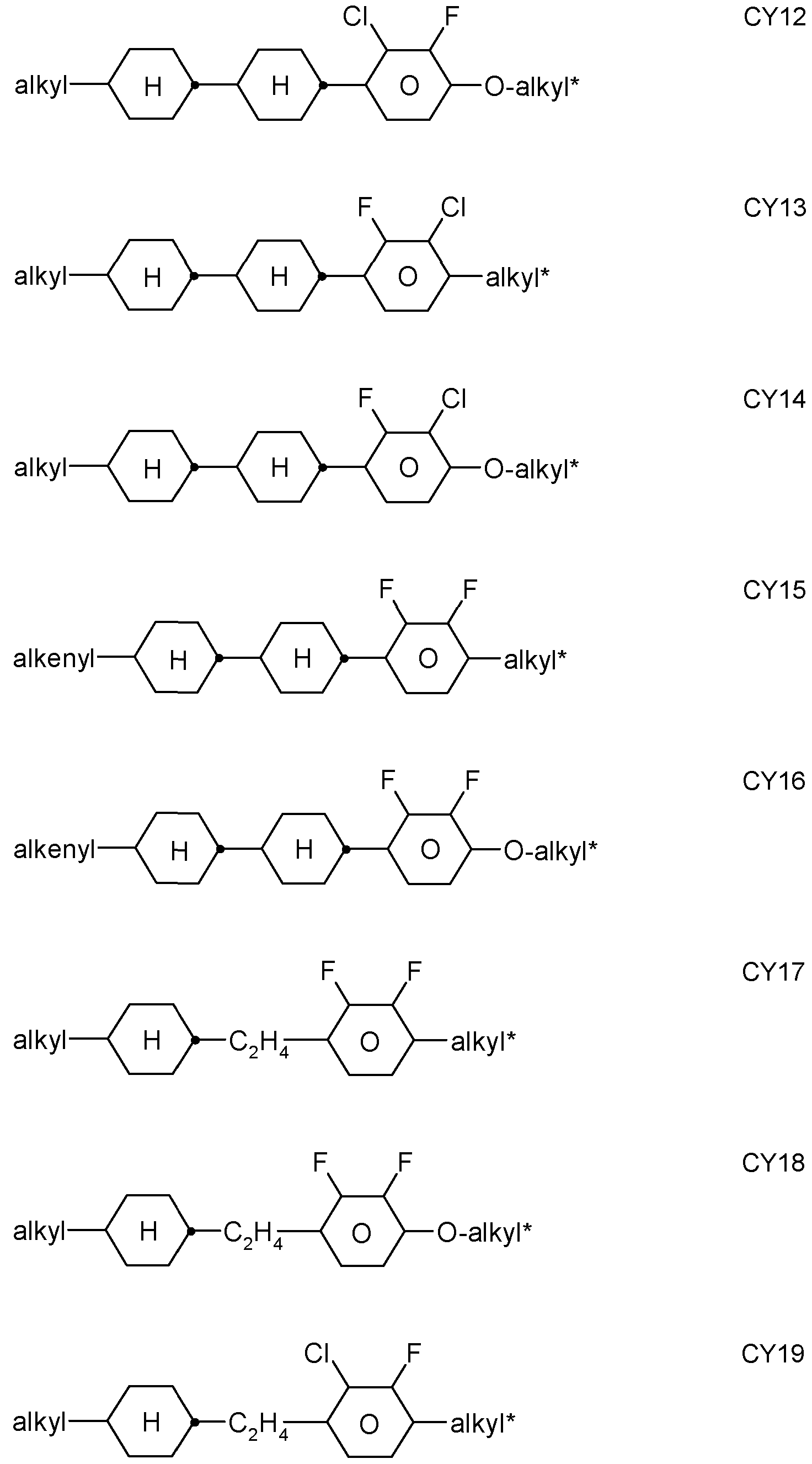
  • the compounds of the formula CY are preferably selected from the group consisting of the following sub-formulae:
  • alkyl and alkyl* each, independently of one another, denote a straight-chain alkyl radical having 1-6 C atoms
  • alkenyl denotes a straight- chain alkenyl radical having 2-6 C atoms
  • (O) denotes an oxygen atom or a single bond.
  • the compounds of the formula PY are preferably selected from the group consisting of the following sub-formulae: wherein alkyl and alkyl* each, independently of one another, denote a straight-chain alkyl radical having 1-6 C atoms, and alkenyl denotes a straight-chain alkenyl radical having 2-6 C atoms, and (O) denotes an oxygen atom or a single bond.
  • the compounds of the formula AC are preferably selected from the group of compounds of the following sub-formulae: AC3 b) Mesogenic medium which additionally comprises one or more compounds of the following formula:
  • the compounds of the formula ZK are preferably selected from the group consisting of the following sub-formulae: in which alkyl and alkyl* each, independently of one another, denote a straight-chain alkyl radical having 1-6 C atoms, and alkenyl denotes a straight-chain alkenyl radical having 2-6 C atoms.
  • Particularly preferred compounds of formula ZK are selected from the following sub- formulae: wherein the propyl, butyl and pentyl groups are straight-chain groups. Most preferred are compounds of formula ZK1a and ZK3a.
  • Mesogenic medium which additionally comprises one or more compounds of the following formula: in which the individual radicals on each occurrence, identically or differently, have the following meanings:
  • the compounds of the formula DK are preferably selected from the group consisting of the following sub-formulae:
  • alkyl and alkyl* each, independently of one another, denote a straight- chain alkyl radical having 1-6 C atoms
  • alkenyl denotes a straight-chain alkenyl radical having 2-6 C atoms.
  • L 1 and L 2 each, independently of one another, denote F, Cl, OCF3, CF3, CH3, CH 2 F, CHF 2 .
  • both radicals L 1 and L 2 denote F or one of the radicals L 1 and L 2 denotes F and the other denotes Cl.
  • the compounds of the formula LY are preferably selected from the group consisting of the following sub-formulae:
  • R 1 has the meaning indicated above, alkyl denotes a straight-chain alkyl radical having 1-6 C atoms, (O) denotes an oxygen atom or a single bond, and v denotes an integer from 1 to 6.
  • R 5 has one of the meanings indicated above for R 1 , alkyl denotes Ci-6-alkyl, d denotes 0 or 1 , and z and m each, independently of one another, denote an integer from 1 to 6.
  • R 5 in these compounds is particularly preferably Ci-6-alkyl or -alkoxy or C2-6-alkenyl, d is preferably 1.
  • the LC medium according to the invention preferably comprises one or more compounds of the above-mentioned formulae in amounts of > 5% by weight.
  • Mesogenic medium which additionally comprises one or more biphenyl com- pounds selected from the group consisting of the following formulae: in which alkyl and alkyl* each, independently of one another, denote a straight- chain alkyl radical having 1-6 C atoms, and alkenyl and alkenyl* each, independently of one another, denote a straight-chain alkenyl radical having 2-6 C atoms.
  • the proportion of the biphenyls of the formulae B1 to B3 in the LC mixture is preferably at least 3% by weight, in particular > 5% by weight.
  • the compounds of the formula B2 are particularly preferred.
  • the compounds of the formulae B1 to B3 are preferably selected from the group consisting of the following sub-formulae: in which alkyl* denotes an alkyl radical having 1-6 C atoms.
  • the medium according to the invention particularly preferably comprises one or more compounds of the formulae B1a and/or B2c. h) Mesogenic medium which additionally comprises one or more terphenyl com- pounds of the following formula:
  • the compounds of the formula T are preferably selected from the group consisting of the following sub-formulae: in which R denotes a straight-chain alkyl or alkoxy radical having 1-7 C atoms, R* denotes a straight-chain alkenyl radical having 2-7 C atoms, (O) denotes an oxygen atom or a single bond, and m denotes an integer from 1 to 6.
  • R preferably denotes methyl, ethyl, propyl, butyl, pentyl, hexyl, methoxy, ethoxy, propoxy, butoxy or pentoxy.
  • Z° 2 denotes CH 2 O, -C(O)O-, -CH2CH2-, -CF2CF2-, or a single bond, o is 1 or 2.
  • the compounds of the formula O are preferably selected from the group consisting of the following sub-formulae: in which R° 1 and R° 2 have the meanings indicated above and preferably each, independently of one another, denote straight-chain alkyl having 1 to 6 C atoms or straight-chain alkenyl having 2 to 6 C atoms.
  • Preferred media comprise one or more compounds selected from the formulae 03, 04 and 05.
  • Mesogenic medium which additionally comprises one or more compounds of the following formula: in which
  • R 9 denotes H, CH3, C2H5 or n-CsH?
  • (F) denotes an optional fluorine substituent
  • q denotes 1 , 2 or 3
  • R 7 has one of the meanings indicated for R 1 , preferably in amounts of > 3% by weight, in particular > 5% by weight and very particularly preferably 5-30% by weight.
  • Particularly preferred compounds of the formula Fl are selected from the group consisting of the following sub-formulae: in which R 7 preferably denotes straight-chain alkyl, and R 9 denotes CH3, C2H5 or n-CsH?. Particular preference is given to the compounds of the formulae Fl 1 , FI2 and FI3.
  • Mesogenic medium which additionally comprises one or more compounds selected from the group consisting of the following formulae: in which R 8 has the meaning indicated for R 1 , and alkyl denotes a straight-chain alkyl radical having 1-6 C atoms.
  • Mesogenic medium which additionally comprises one or more compounds which contain a tetrahydronaphthyl or naphthyl unit, such as, for example, the compounds selected from the group consisting of the following formulae: in which
  • Mesogenic medium which additionally comprises one or more difluorodibenzo- chromanes and/or chromanes of the following formulae: in which
  • R 11 and R 12 each, independently of one another, have one of the meanings indicated above for R 11 , ring M is trans-1 ,4-cyclohexylene or 1 ,4-phenylene,
  • Z m -C 2 H 4 -, -CH 2 O-, -OCH 2 -, -CO-O- or -O-CO-, c is 0, 1 or 2, preferably in amounts of 3 to 20% by weight, in particular in amounts of 3 to 15% by weight.
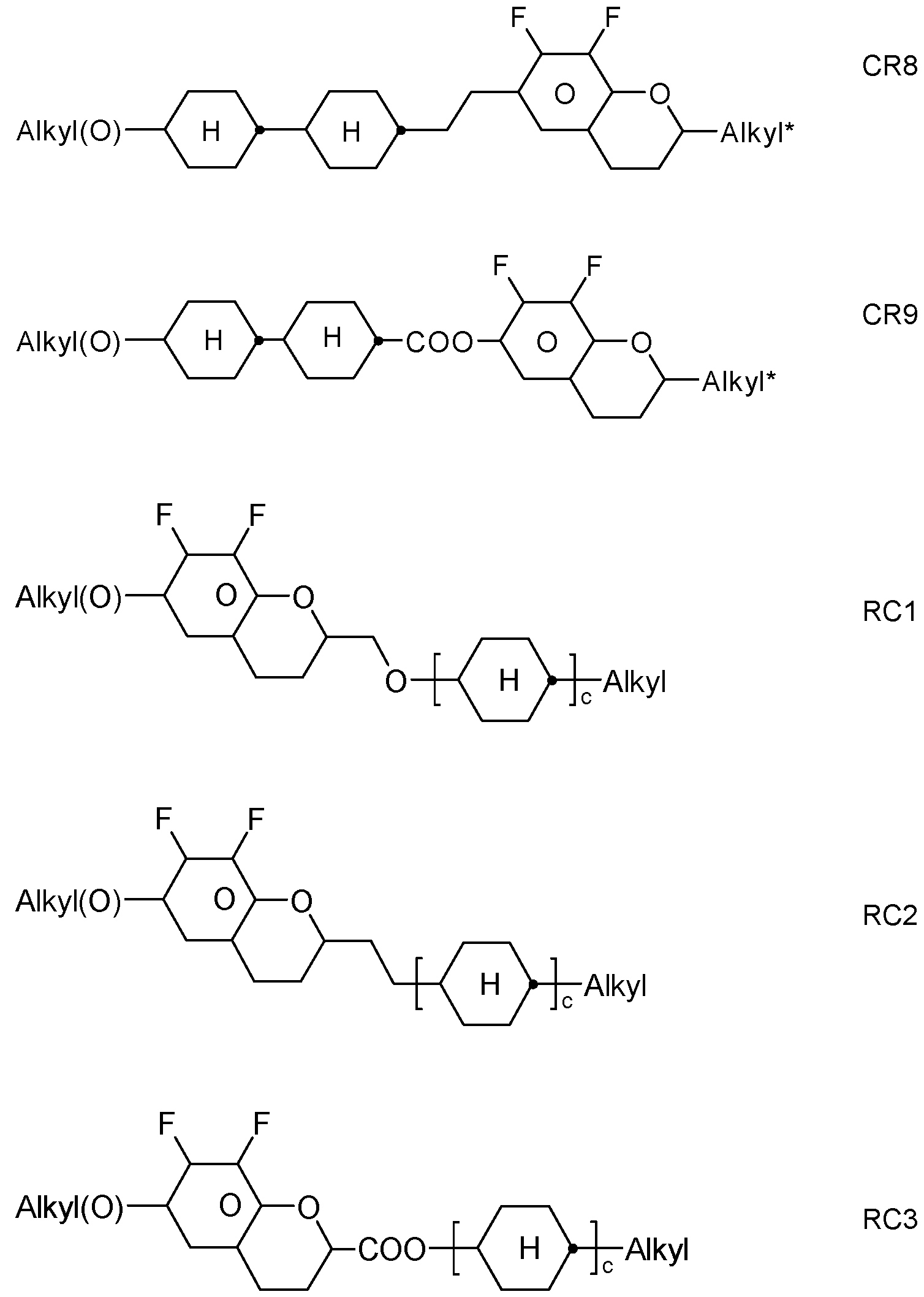
  • Particularly preferred compounds of the formulae BC, CR and RC are selected from the group consisting of the following sub-formulae:
  • alkyl and alkyl* each, independently of one another, denote a straight- chain alkyl radical having 1-6 C atoms
  • (O) denotes an oxygen atom or a single bond
  • c is 1 or 2
  • alkenyl and alkenyl* each, independently of one another, denote a straight-chain alkenyl radical having 2-6 C atoms.
  • Particularly preferred compounds of the formulae PH and BF are selected from the group consisting of the following sub-formulae:
  • R and R' each, independently of one another, denote a straight-chain alkyl or alkoxy radical having 1-7 C atoms.
  • the liquid-crystal medium comprises one or more compounds selected from the group of compounds of formulae B-1 , B-2 and B-3 in which R 11 and R 12 identically or differently, denote H or a straight-chain alkyl or alkoxy radical having 1 to 15 C atoms, in which one or more CH2 groups in these radicals are optionally replaced, independently of one or -O-CO- in such a way that O atoms are not linked directly to one another, and in which one or more H atoms may be replaced by halogen, preferably a straight-chain alkoxy radical having 1 to 7 C atoms.
  • the compounds of formula B-1 are preferably selected from the group of compounds of the formulae B-1-a to B-1-e in which R 11 and R 12 , identically or differently, denote alkyl having 1 to 7 C atoms, preferably ethyl, n-propyl, n-butyl or n-pentyl.
  • the compounds of formula B-2 are preferably selected from the group of compounds of the formulae B-2-a to B-2-e in which R 11 and R 12 , identically or differently, denote alkyl having 1 to 12 C atoms, preferably alkyl having 1 to 7 C atoms.
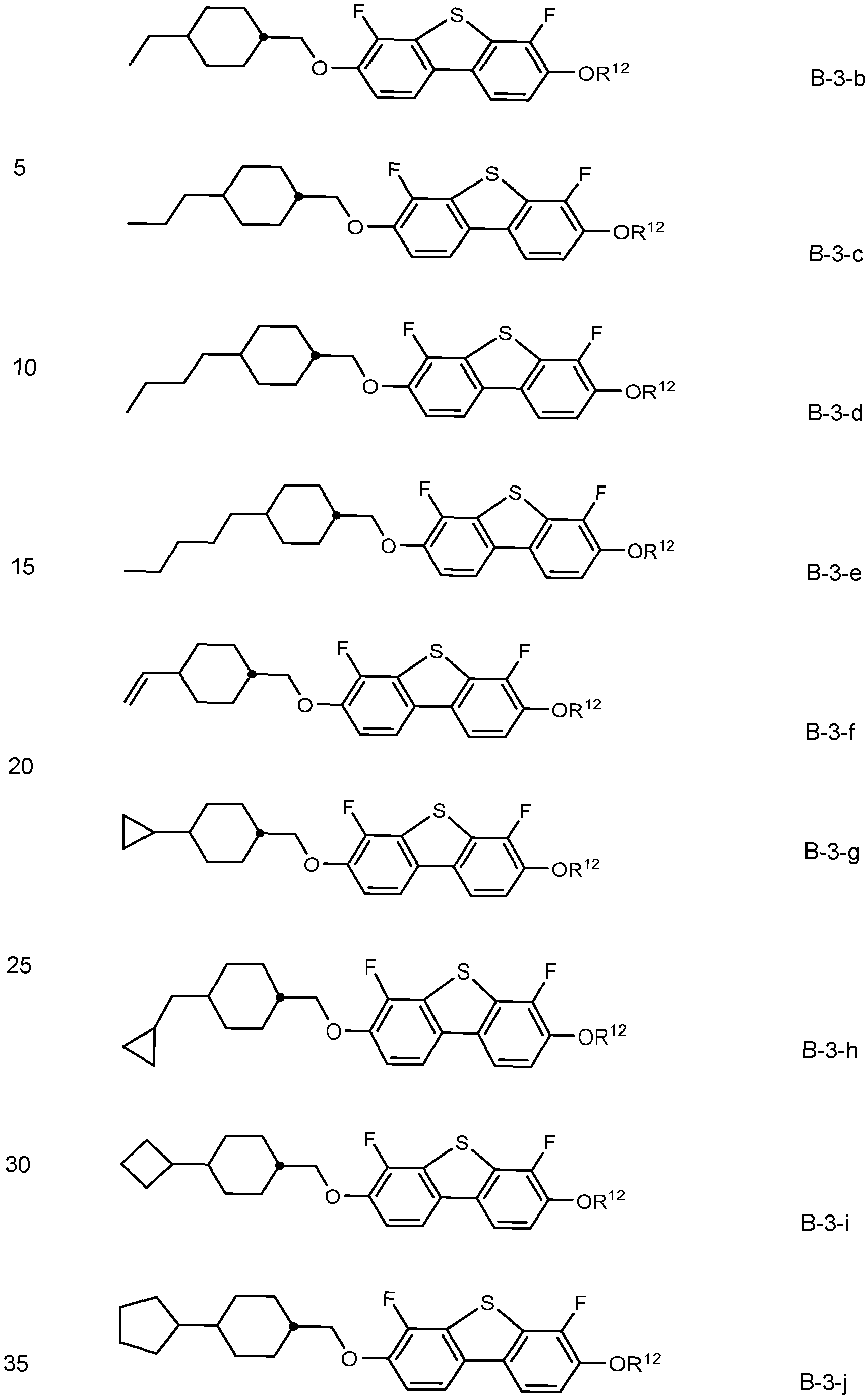
  • the compounds of formula B-3 are preferably selected from the group of compounds of the formulae B-3-a to B-3-j
  • R 12 denotes alkyl having 1 to 7 C atoms, preferably ethyl, n-propyl or n-butyl.
  • the one or more compounds selected from the group of compounds of formulae B-1 , B-2 and B-3 are selected from the group of compounds B- A to B-J
  • the one or more compounds selected from the group of compounds of formulae B-1, B-2 and B-3 are preferably comprised in the liquid-crystal medium in a total amount of from 0 to 15% by weight, more preferably 10% by weight or less and even more preferably 5% by weight or less.
  • Mesogenic medium which additionally comprises one or more monocyclic compounds of the following formula wherein
  • L 1 and L 2 each, independently of one another, denote F, Cl, OCF3, CF3, CH3, CH 2 F, CHF 2 .
  • both L 1 and L 2 denote F or one of L 1 and L 2 denotes F and the other denotes Cl,
  • the compounds of the formula Y are preferably selected from the group consisting of the following sub-formulae: in which, Alkyl and Alkyl* each, independently of one another, denote a straight- chain alkyl radical having 1-6 C atoms, Alkoxy denotes a straight-chain alkoxy radical having 1-6 C atoms, Alkenyl and Alkenyl* each, independently of one another, denote a straight-chain alkenyl radical having 2-6 C atoms, and O denotes an oxygen atom or a single bond.
  • Particularly preferred compounds of the formula Y are selected from the group consisting of the following sub-formulae:
  • Alkoxy wherein Alkoxy preferably denotes straight-chain alkoxy with 3, 4, or 5 C atoms.
  • Mesogenic medium which comprises 1 to 15, preferably 3 to 12, compounds of the formulae CY1 , CY2, PY1, PY2, AC1, AC2 and/or AC3. The proportion of these compounds in the mixture as a whole is preferably 20 to 99%, more preferably 30 to 95%, particularly preferably 40 to 90%. The content of these individual compounds is preferably in each case 2 to 20%.
  • Mesogenic medium which comprises 1 to 10, preferably 1 to 8, compounds of the formula ZK, in particular compounds of the formulae ZK1 , ZK2 and/or ZK6.
  • the proportion of these compounds in the mixture as a whole is preferably 3 to 25%, particularly preferably 5 to 45%.
  • the content of these individual compounds is preferably in each case 2 to 20%.
  • s) Mesogenic medium in which the proportion of compounds of the formulae CY, PY and ZK in the mixture as a whole is greater than 70%, preferably greater than 80%.
  • the proportion of these compounds in the mixture as a whole is preferably 1 to 30%, particularly preferably 2 to 20%.
  • the content of these individual compounds is preferably in each case 1 to 20%.
  • the content of these compounds in the mixture as a whole is preferably 1 to 20%.
  • the LC medium according to the invention preferably comprises the terphenyls of the formula T and the preferred sub-formulae thereof in an amount of 0.5-30% by weight, in particular 1-20% by weight.
  • R preferably denotes alkyl, furthermore alkoxy, each having 1-5 C atoms.
  • the terphenyls are preferably employed in mixtures according to the invention if the An value of the mixture is to be > 0.1.
  • Preferred mixtures comprise 2-20% by weight of one or more terphenyl compounds of the formula T, preferably selected from the group of compounds T1 to T22.
  • Mesogenic medium which contains one or more, preferably 1 , 2 or 3, compounds of formula BF1 and/or BSF1. The total content of these compounds in the mixture as a whole is preferably 1 to 15%, preferably 2 to 10% particularly preferably 4 to 8%.
  • Preferred media comprise one or more compounds of formula O, preferably selected from the formulae 03, 04 and 05 in a total concentration of 2 to 25%, preferably 3 to 20%, particularly preferably 5 to 15%.
  • Preferred media comprise one or more compounds of formula DK, preferably selected from the formulae DK1, DK4, DK7, DK 9, DK10 and DK11.
  • the total concentration of compounds of formulae DK9, DK10 and DK11 is preferably 2 to 25%, more preferably 3 to 20%, particularly preferably 5 to 15%.
  • the LC medium contains an LC host mixture with positive dielectric anisotropy.
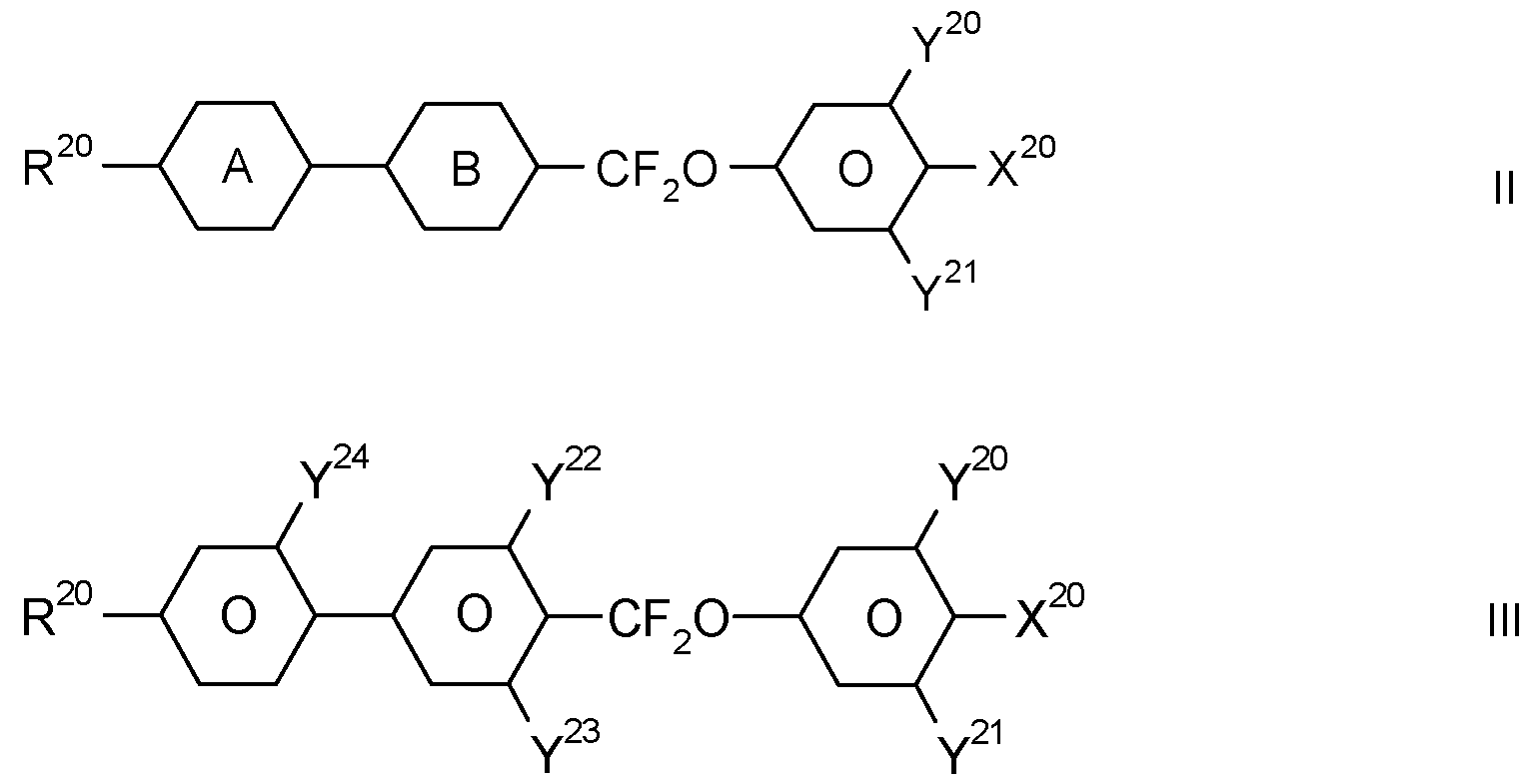
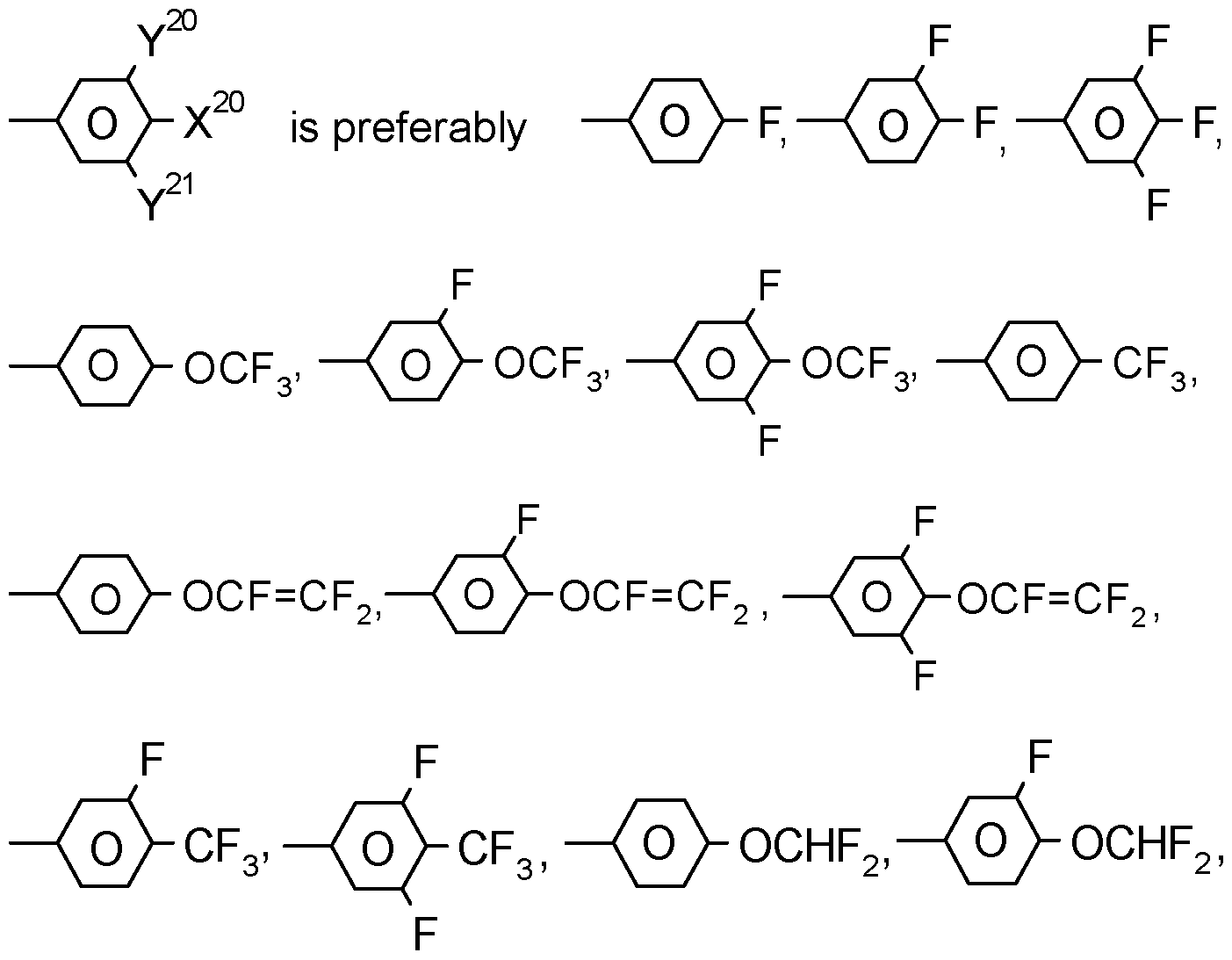
  • X 20 each, identically or differently, denote F, Cl, CN, SF5, SCN, NCS, a halogenated alkyl radical, a halogenated alkenyl radical, a halogenated alkoxy radical or a halogenated alkenyloxy radical, each having up to 6 C atoms, and
  • Y 20 ' 24 each, identically or differently, denote H or F; each, independently of one another, denote
  • the compounds of the formula II are preferably selected from the following formulae:
  • R 20 and X 20 have the meanings indicated above.
  • R 20 preferably denotes alkyl having 1 to 6 C atoms.
  • X 20 preferably denotes F.
  • Particular preference is given to compounds of the formulae Ila and lib, in particular compounds of the formulae Ila and lib wherein X denotes F.
  • liquid-crystal medium comprises one or more compounds selected from the group of compounds of formulae 11-1 and 11-2 in which
  • R 2 denotes alkyl, alkoxy, fluorinated alkyl or fluorinated alkoxy with 1 to 7 C atoms, or alkenyl, alkenyloxy, alkoxyalkyl or fluorinated alkenyl with 2 to 7 C atoms, in which optionally one or more CH2 groups, independently of one another, may be replaced by dependently of each other
  • L 25 denotes H or CH3
  • X 2 denotes halogen, halogenated alkyl or alkoxy with 1 to 3 C atoms or halogenated alkenyl or alkenyloxy with 2 or 3 C atoms.
  • liquid-crystal medium comprises one or more compounds selected from the group of compounds of formulae ll-1-a to ll-1-h wherein R 2 has the meaning as given in formula 11-1.
  • liquid-crystal medium comprises one or more compounds selected from the compounds of formulae ll-2-a to II-2-I wherein R 2 has the meaning given for formula 11-2 above.
  • the compounds of the formula III are preferably selected from the following formulae: Illa wherein R 20 and X 20 have the meanings indicated above.
  • R 20 preferably denotes alkyl having 1 to 6 C atoms.
  • X 20 preferably denotes F.
  • Particular preference is given to compounds of the formulae Illa and Hie, in particular compounds of the formula Illa; bb) Mesogenic medium alternatively or additionally comprising one or more compounds selected from the following formulae:
  • R 20 , X 20 and Y 20-23 have the meanings indicated above, and
  • the compounds of the formula IV are preferably selected from the following formulae: wherein R 20 and X 20 have the meanings indicated above.
  • R 20 preferably denotes alkyl having 1 to 6 C atoms.
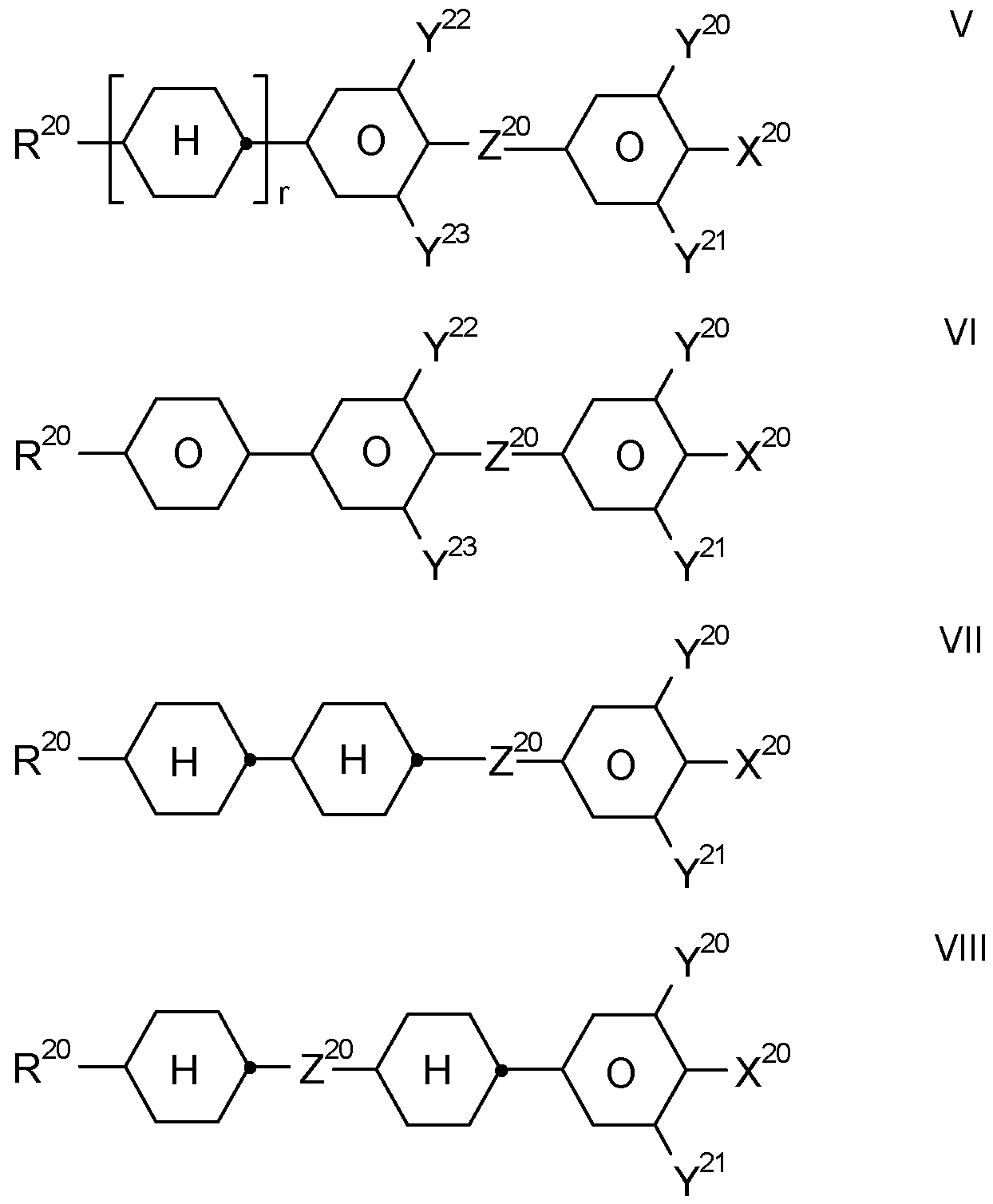
  • the compounds of the formula V are preferably selected from the following formulae:
  • R 20 and X 20 have the meanings indicated above.
  • R 20 preferably denotes alkyl having 1 to 6 C atoms.
  • the compounds of the formula VI are preferably selected from the following formulae: wherein R 20 and X 20 have the meanings indicated above.
  • R 20 preferably denotes alkyl having 1 to 6 C atoms.
  • the compounds of the formula VII are preferably selected from the following formulae:
  • R 20 preferably denotes alkyl having 1 to 6 C atoms.
  • Mesogenic medium which additionally comprises one or more compounds selected from the formulae ZK1 to ZK10 given above. Especially preferred are compounds of formula ZK1 and ZK3. Particularly preferred compounds of formula ZK are selected from the sub-formulae ZK1a, ZK1 b, ZK1c, ZK3a, ZK3b, ZK3c and ZK3d.
  • the mesogenic medium additionally comprises one or more compounds selected from the formulae DK1 to DK12 given above. Especially preferred compounds are DK1 , DK4, DK7, DK 9, DK10 and DK11 .
  • the mesogenic medium additionally comprises one or more compounds selected from the following formula:
  • L denotes H or F
  • alkenyl denotes C2-6-alkenyl.
  • the compounds of the formulae DK-3a and IX are preferably selected from the following formulae: 3a wherein "alkyl” denotes Ci-6-alkyl, preferably n-CsH?, n-C ⁇ g or n-CsHn, in particular n-C 3 H 7 .
  • the medium additionally comprises one or more compounds selected from the formulae B1 , B2 and B3 given above, preferably from the formula B2.
  • the compounds of the formulae B1 to B3 are particularly preferably selected from the formulae B1a, B2a, B2b and B2c.
  • the medium additionally comprises one or more compounds selected from the following formula: wherein L 20 , L 21 denote H or F, and R 21 and R 22 each, identically or differently, denote n-alkyl, alkoxy, oxaalkyl, fluoroalkyl or alkenyl, each having up to 6 C atoms, and preferably each, identically or differently, denote alkyl having 1 to 6 C atoms.
  • the medium comprises one or more compounds of the following formulae:
  • R 20 , X 20 and Y 20-23 have the meanings indicated in formula III, and each, independently of one another, denote
  • the compounds of the formulae XI and XII are preferably selected from the following formulae:
  • R 20 and X 20 have the meaning indicated above and preferably R 20 denotes alkyl having 1 to 6 C atoms and X 20 denotes F.
  • the mixture according to the invention particularly preferably comprises at least one compound of the formula XI la and/or Xlle.
  • the medium comprises one or more compounds of formula T given above, preferably selected from the group of compounds of the formulae T21 toT23 and T25 to T27. Particular preference is given to compounds of the formulae T21 to T23. Very particular preference is given to the compounds of the formulae kk)
  • the medium comprises one or more compounds selected from the group of for- mulae DK9, DK10 and DK11 given above.
  • the medium additionally comprises one or more compounds selected from the following formulae: XVIII wherein R 20 and X 20 each, independently of one another, have one of the meanings indicated above, and Y 20-23 each, independently of one another, denote H or F.
  • X 20 is preferably F, Cl, CF3, OCF3 or OCHF2.
  • R 20 preferably denotes alkyl, alkoxy, oxaalkyl, fluoroalkyl or alkenyl, each having up to 6 C atoms.
  • the mixture according to the invention particularly preferably comprises one or more compounds of the formula XVIII-a,
  • R 20 has the meanings indicated above.
  • R 20 preferably denotes straight- chain alkyl, in particular ethyl, n-propyl, n-butyl and n-pentyl and very particularly preferably n-propyl.
  • the compound(s) of the formula XVIII, in particular of the formula XVIII-a, is (are) preferably employed in the mixtures according to the invention in amounts of 0.5-20% by weight, particularly preferably 1-15% by weight.
  • the medium additionally comprises one or more compounds of the formula XIX,
  • R 20 , X 20 and y 20 - 25 have the meanings indicated in formula III, s denotes 0 or 1 , and
  • X 20 may also denote an alkyl radical having 1-6 C atoms or an alkoxy radical having 1-6 C atoms.
  • the alkyl or alkoxy radical is preferably straight-chain.
  • R 20 preferably denotes alkyl having 1 to 6 C atoms.
  • X 20 preferably denotes F;
  • the compounds of the formula XIX are preferably selected from the following formulae: wherein R 20 , X 20 and Y 20 have the meanings indicated above.
  • R 20 preferably denotes alkyl having 1 to 6 C atoms.
  • X 20 preferably denotes F, and Y 20 is preferably F;
  • - R 20 is straight-chain alkyl or alkenyl having 2 to 6 C atoms.
  • the medium comprises one or more compounds of the formulae G1 to G4 given above, preferably selected from G1 and G2 wherein alkyl denotes C 1-6 -alkyl, L x denotes H and X denotes F or Cl. In G2, X particularly preferably denotes Cl.
  • the medium comprises one or more compounds of the following formulae: wherein R 20 and X 20 have the meanings indicated above.
  • R 20 preferably denotes alkyl having 1 to 6 C atoms.
  • X 20 preferably denotes F.
  • the medium according to the invention particularly preferably comprises one or more compounds of the formula XXII wherein X 20 preferably denotes F.
  • the compound(s) of the formulae XX - XXII is (are) preferably employed in the mixtures according to the invention in amounts of 1-20% by weight, particularly preferably 1-15% by weight. Particularly preferred mixtures comprise at least one compound of the formula XXII.
  • the medium comprises one or more compounds of the following pyrimidine or pyridine compounds of the formulae wherein R 20 and X 20 have the meanings indicated above.
  • R 20 preferably denotes alkyl having 1 to 6 C atoms.
  • X 20 preferably denotes F.
  • the medium according to the invention particularly preferably comprises one or more compounds of the formula M-1 , wherein X 20 preferably denotes F.
  • the compound(s) of the formulae M-1 - M-3 is (are) preferably employed in the mixtures according to the invention in amounts of 1-20% by weight, particularly preferably 1-15% by weight.
  • the medium comprises two or more compounds of the formula XII, in particular of the formula XI la and/or Xlle.
  • the medium comprises 2-30% by weight, preferably 3-20% by weight, particularly preferably 3-15% by weight, of compounds of the formula XII. ss) Besides the compounds of the formulae XII, the medium comprises further compounds selected from the group of the compounds of the formulae I l-XVI 11. tt) The proportion of compounds of the formulae I l-XVI 11 in the mixture as a whole is
  • the medium preferably comprises 10-40%, more preferably 12-30%, particularly preferably 15 to 25% by weight of compounds of the formulae II and/or III.
  • the medium comprises 1-10% by weight, particularly preferably 2-7% by weight, of compounds of the formula XV and/or XVI.
  • the medium comprises at least one compound of the formula XI la and/or at least one compound of the formula XI le and at least one compound of the formula Illa and/or Ila.
  • Preferred media comprise one or more compounds of formula O, preferably selected from the formulae 03, 04 and 05 in a total concentration of 2 to 25%, preferably 3 to 20%, particularly preferably 5 to 15%.
  • Preferred media comprise one or more compounds of formula DK, preferably selected from the formulae DK1, DK4, DK7, DK 9, DK10 and DK11.
  • the total concentration of compounds of formulae DK9, DK10 and DK11 is preferably 2 to 25%, more preferably 3 to 20%, particularly preferably 5 to 15%.
  • Preferred media comprise one or more compounds of formulae IV to VI, preferably selected from the group of compounds of formulae IVa, IVb, IVc, IVd, Va, Vc and VI b in a concentration of 10 to 80%, preferably 12 to 75% particularly preferably 15 to 70% by weight.
  • the value for the dielectric anisotropy (As) is preferably in the range from -2.0 to -8.0, more preferably in the range from -3.0 to -6.0, and particularly preferably from -3.5 to -5.0.
  • the value for As is preferably in the range from 2.5 to 50.0, more preferably in the range from 5.0 to 25.0, and particularly preferably from 8.0 to 15.0.
  • the liquid-crystal media in accordance with the present invention preferably have a clearing point of 70°C or more, more preferably 80°C or more, even more preferably 90°C or more, still more preferably 105°C or more, and particularly preferably 110°C or more.
  • the liquid-crystalline medium according to the invention has a clearing point in the range from 70°C to 170°C.
  • the high clearing point as defined can be beneficial in terms of the performance and the reliability of the devices which use the liquid crystalline medium.
  • the medium can maintain its functional properties over a suitably broad temperature range and also at elevated temperatures. This can be particularly advantageous for the use in window elements for regulating the passage of sunlight, especially when the window elements are exposed to direct or prolonged irradiation by sunlight.
  • the high clearing point can also contribute to a favourably high degree of order of the liquid-crystalline host molecules, and hence the dichroic dye guest molecules at typical working temperatures, which can increase the obtainable contrast between the switching states.
  • the clearing point in particular the phase transition temperature between the nematic phase and the isotropic phase, can be measured and determined by commonly known methods, e.g. using a Mettler oven, a hot-stage under a polarizing microscope, or differential scanning calorimetry (DSC) analysis. According to the invention the clearing point is preferably determined using a Mettler oven.
  • the nematic phase of the media according to the invention preferably extends at least from -10°C or less to 80°C or more.
  • An even broader nematic phase range is more preferred, in particular extending up to 90°C or more, more preferably extending at least from -20°C or less to 100°C or more and particularly preferably extending from -30°C or less to 110°C or more.
  • the birefringence (An) of the liquid crystal media is in the range of 0.010 or more to 0.350 or less, more preferably in the range of 0.035 or more to 0.300 or less, even more preferably in the range of 0.050 or more to 0.250 or less, still more preferably in the range of 0.075 or more to 0.200 or less, and in particular in the range of 0.010 or more to 0.150 or less.
  • the compound selected from the group of compounds of formula I as set forth above and below is preferably present in the mesogenic medium in a proportion of 0.01% by weight to 15% by weight, more preferably 0.025% by weight to 10% by weight, even more preferably 0.05% by weight to 7.5% by weight, yet more preferably 0.1% by weight to 5% by weight, and in particular 0.2% by weight to 2% by weight.
  • the dye compound according to the invention is present in the medium in a concentration in the range of 0.05% by weight to 1% by weight.
  • the total concentration of these compounds in the medium is particularly preferably in the range of 0.05% by weight to 15% by weight and even more preferably 0.1% by weight to 10% by weight, and in particular 0.2% by weight to 5% by weight.
  • an individual dye compound is present in the medium in a concentration in the range of 0.025% by weight to 5% by weight and even more preferably 0.05% by weight to 2.5% by weight and in particular 0.1% by weight to 1 % by weight.
  • the media preferably comprise one, two, three, four, five, six, seven, eight or nine compounds of formula I according to the invention.
  • the medium comprises at least three compounds selected from the group of compounds of formulae 1-1 and I-2.
  • the LC medium according to the invention preferably is a nematic liquid crystal.
  • the media according to the invention are prepared in a manner conventional per se.
  • the components are dissolved in one another, preferably at elevated temperature.
  • the mixing is preferably carried out under inert gas, for example under nitrogen or argon.
  • One or more dyes of formula I and optionally further dichroic dyes are subsequently added, preferably at elevated temperature, more preferably at above 40°C and particularly preferably at above 50°C.
  • the desired amount of the components used in smaller amount is dissolved in the components making up the principal constituent. It is also possible to mix solutions of the components in an organic solvent, for example in acetone, toluene, chloroform or methanol, and to remove the solvent again, for example by distillation, after mixing.
  • the invention furthermore relates to a process for the preparation of the mesogenic media according to the invention.
  • the invention furthermore relates to a liquid-crystal display of the guest-host type containing an LC medium which comprises at least one compound of formula I.
  • the invention furthermore relates to the use of a mixture comprising a liquid-crystalline medium and at least one compound of a formula I in a device for regulating the passage of energy from an outside space into an inside space.
  • the device according to the invention in addition to one or more compounds selected from the compounds of formula I, and preferably a liquid- crystalline medium, preferably also comprises further dichroic dyes having a different structure to formula I in the switching layer. It particularly preferably comprises one, two, three, four, five, six, seven or eight further dyes, most preferably two or three further dyes having a different structure to formula I.
  • the absorption spectra of the dichroic dyes of the switching layer(s) preferably complement one another in such a way that the impression of a black colour, or respectively grey colour or colour-neutral appearance, arises for the eye.
  • the preferably two or more dichroic dyes of the liquid-crystalline medium according to the invention preferably cover a large part of the visible spectrum, more preferably cover the whole visible spectrum.
  • the precise way in which a mixture of dyes which appears black or grey to the eye can be prepared is known in the art and is described, for example, in M. Richter, Einbowung in die Farbmetrik [Introduction to Colorimetry], 2nd Edition, 1981 , ISBN 3-11-008209-8, Walter de Gruyter & Co.
  • the setting of the colour location of a mixture of dyes is described in the area of colorimetry.
  • the spectra of the individual dyes are calculated taking into account the Lambert-Beer law to give an overall spectrum and converted into the corresponding colour locations and luminance values under the associated illumination, for example illuminant D65 for daylight, in accordance with the rules of colorimetry.
  • the position of the white point is fixed by the respective illuminant, for example D65, and is quoted in tables, for example in the reference above.
  • Different colour locations can be set by changing the proportions of the various dyes.
  • the switching layer comprises one or more dichroic dyes which absorb light in the red and NIR region, i.e. at a wavelength of 600 nm to 2000 nm, preferably in the range from 600 nm to 1800 nm, particularly preferably in the range from 650 nm to 1300 nm.
  • the mesogenic medium further contains at least one dichroic dye in addition to the compound(s) of formula I.
  • these further one or more dichroic dyes are selected from azo dyes, anthraquinones, methine compounds, azomethine compounds, merocyanine compounds, naphthoquinones, tetrazines, perylenes, terrylenes, quaterrylenes, higher rylenes, pyrromethenes, thiadiazoles, benzothiadiazoles, nickel dithiolenes, (metal) phthalocyanines, (metal) naphthalocyanines and (metal) porphyrins.
  • azo dyes thiadiazoles and benzothiadiazoles.
  • the further dichroic dyes which are preferably provided in the switching layer having a different structure to the formula I are preferably selected from the dye classes indicated in B. Bahadur, Liquid Crystals - Applications and Uses, Vol.
  • Said dyes belong to the classes of dichroic dyes which are known in the art and have been described in the literature.
  • anthraquinone dyes are described in EP 34832, EP 44893, EP 48583, EP 54217, EP 56492, EP 59036, GB 2065158, GB 2065695, GB 2081736, GB 2082196, GB 2094822, GB 2094825, JP-A 55-123673, DE 3017877, DE 3040102, DE 3115147, DE 3115762, DE 3150803 and DE 3201120, naphthoquinone dyes are described in DE 3126108 and DE 3202761, azo dyes in EP 43904, DE 3123519, WO 82/2054, GB 2079770, JP-A 56-57850, JP-A 56-104984, US 4308161, US 4308162, US 4340973, T.
  • the medium according to the invention comprises one or more quencher compounds. This is preferred if the device according to the invention comprises one or more fluorescent dyes in the switching layer.
  • the quencher compound may have various functions in the medium and the switching layer of the device according to the invention. Firstly, the quencher compound may contribute to extending the lifetime of a dye system by deactivation of electronic excitation energy. Secondly, the quencher compound can eliminate additional colour effects which may be aesthetically undesirable, for example coloured emission in the inside space emanating from the fluorescent dyes in the switching layer.
  • the quencher compound should be adapted to the respective dye system, in particular the dye absorbing at the longest wavelength in a dye combination.
  • Preferred quencher compounds are described, for example, in Table 8.1 on page 279 in J. R. Lakowicz, Principles of Fluorescence Spectroscopy, 3 rd Edition, 2010, ISBN 10: 0-387-31278-1 , Springer Science+Business Media LLC.
  • Further classes of compounds e.g. so-called dark quenchers or black hole quenchers, are known in the art. Examples include azo dyes and aminoanthraquinones.
  • the quencher compounds used in the switching layer of the device according to the invention may also be non- fluorescent dyes or dyes which only fluoresce in the NIR.
  • any quencher compounds present are selected so that fluorescence in the visible part of the spectrum is suppressed.
  • the device according to the invention is preferably suitable for regulating the passage of energy in the form of sunlight from the environment into an inside space.
  • the passage of energy to be regulated here takes place from the environment, i.e. an outside space, into an inside space.
  • the inside space here can be any desired space that is substantially sealed off from the environment, for example a building, a vehicle or a container.
  • the invention therefore furthermore relates to the use of the device for regulating the passage of energy from an outside space into an inside space.
  • the device can also be employed for aesthetic room design, for example for light and colour effects.
  • door and wall elements containing the device according to the invention in grey or in colour can be switched to transparent.
  • the device may also comprise white or coloured flat backlighting which is modulated in brightness or yellow flat backlighting which is modulated in colour by means of a blue guest-host display.
  • white or coloured flat backlighting which is modulated in brightness or yellow flat backlighting which is modulated in colour by means of a blue guest-host display.
  • one or both glass sides of the device according to the invention may be provided with roughened or structured glass for the coupling-out of light and/or for the generation of light effects.
  • the liquid crystalline medium according to the invention therefore is preferably used in an architectural window or an automobile, for example a car sunroof.
  • the switchable optical device can be comprised in a window of a building or a facade.
  • the device according to the invention may also be applied to a commercial vehicle, a boat, a train or an airplane.
  • the device is employed for regulating the incidence of light on the eyes, for example in protective goggles, visors or sunglasses, where the device keeps the incidence of light on the eyes low in one switching state and reduces the incidence of light to a lesser extent in another switching state.
  • the device according to the invention is preferably arranged in an opening in a relatively large two-dimensional structure, where the two-dimensional structure itself only allows slight passage of energy or none at all, and where the opening has relatively high energy transmissivity.
  • the two-dimensional structure is preferably a wall or another boundary of an inside space to the outside.
  • the two- dimensional structure preferably covers an area of at least equal size, particularly preferably an area at least twice as large as the opening in it in which the device according to the invention is disposed.
  • the device is preferably characterised in that it has an area of at least 0.05 m 2 , preferably at least 0.1 m 2 , particularly preferably at least 0.5 m 2 and very particularly preferably at least 1.0 m 2 .
  • the device area preferably is in range from 0.1 m 2 to 10 m 2 , more preferably from 0.5 m 2 to 5 m 2 , and in particular from 1 m 2 to 3 m 2 .
  • the device is preferably accommodated in an opening having relatively high energy transmissivity, as described above, in a building, a container, a vehicle or another substantially closed space.
  • the device can generally be used for any desired inside spaces, particularly if they have only limited exchange of air with the environment and have light-transmitting boundary surfaces through which input of energy from the outside in the form of light energy can take place.
  • the use of the device for inside spaces which are subjected to strong insolation through light-transmitting areas, for example through window areas, is particularly preferred.
  • the device according to the invention is switchable. Switching here is taken to mean a change in the passage of energy through the device.
  • the device according to the invention is preferably electrically switchable, as described, for example, in WO 2009/141295 and in WO 2014/090373.
  • the device may also be thermally switchable, as described, for example, in WO 2010/118422.
  • the switching preferably takes place by a transition from a nematic state to an isotropic state through a change in the temperature of the switching layer comprising the compound(s) of formula I and a liquid-crystalline medium.
  • the molecules of the liquid-crystalline medium are in ordered form, and thus also the compound(s) of formula I, for example aligned parallel to the surface of the device through the action of an alignment layer.
  • the molecules are in disordered form, and thus also the compound(s) of formula I.
  • the difference between ordered and disordered presence of the dichroic compound(s) causes a difference in the light transmissivity of the switching layer of the device according to the invention, in accordance with the principle that dichroic compounds have a higher or lower absorption coefficient depending on the alignment in relation to the polarization plane of the light.
  • the device in the case where the device is electrically switchable, it preferably comprises two or more electrodes, which are preferably installed on both sides of the switching layer.
  • the electrodes preferably consist of ITO or a thin, preferably transparent metal and/or metal-oxide layer, for example silver or FTO (fluorine-doped tin oxide) or an alternative material known in the art for this use.
  • the electrodes are preferably provided with electrical connections.
  • the voltage is preferably provided by a battery, a rechargeable battery or an external power supply, in particular an external power supply.
  • the switching operation in the case of electrical switching takes place by a (re)alignment of the molecules of the liquid-crystalline medium by the application of voltage.
  • the device is converted from a state having high absorption, i.e. low light transmissivity, which is present without voltage, into a state having lower absorption, i.e. higher light transmissivity.
  • the liquid-crystalline medium of the switching layer is preferably nematic in both states.
  • the voltage-free state is preferably characterised in that the molecules of the liquid-crystalline medium, and thus the molecules of the compound(s) of formula I, are aligned parallel to the plane of the switching layer. This is preferably achieved by a correspondingly selected alignment layer.
  • the state where voltage is applied is preferably characterised in that the mole- cules of the liquid-crystalline medium, and thus the molecules of the compound(s) of formula I, are perpendicular to the plane of the switching layer.
  • the device is switchable from a state having low absorption, i.e. high light transmissivity, which is present without voltage, into a state having higher absorption, i.e. lower light transmissivity.
  • the liquid-crystalline medium of the switching layer is preferably nematic in both states.
  • the voltage-free state is preferably characterised in that the molecules of the liquid-crystalline medium of the switching layer, and thus the molecules of the compound(s) of formula I, are aligned perpendicular to the plane of the switching layer. This is preferably achieved by a correspondingly selected alignment layer.
  • the state where voltage is applied is preferably characterised in that the molecules of the liquid-crystalline medium of the switching layer, and thus the molecules of the compound(s) of formula I, are parallel to the plane of the switching layer.
  • the device according to the invention preferably has the following layer sequence, where further layers may additionally be present.
  • the layers indicated below are preferably directly adjacent to one another in the device:
  • - substrate layer preferably comprising glass or polymer
  • - substrate layer preferably comprising glass or polymer.
  • the device contains two switching layers, which may be arranged in a so-called double cell.
  • the device according to the invention preferably comprises one or more, particularly preferably two, alignment layers.
  • the alignment layers are preferably directly adjacent to the two sides of the switching layer comprising the compound(s) of formula I.
  • the alignment layers used in the device according to the invention can be any desired layers known to the person skilled in the art for this purpose. Preference is given to polyimide layers, particularly preferably layers comprising rubbed polyimide. In an embodiment planar alignment is provided, where more preferably a slight pretilt angle may be set. In an alternative embodiment homeotropic alignment is provided, where more preferably high pretilt angles are set. Furthermore, polymers obtained by an exposure process to polarised light can be used as alignment layer in order to achieve alignment of the compounds of the liquid- crystalline medium in accordance with an alignment axis, i.e. photoalignment.
  • the switching layer in the device according to the invention is furthermore preferably arranged between two substrate layers or enclosed thereby.
  • the substrates are preferably optically transparent.
  • the substrate layers can consist, for example, of glass or a polymer, preferably a light-transmitting polymer.
  • Suitable glass substrates include, for example, float glass, downdraw glass, chemically or heat-treated toughened glass, borosilicate glass and aluminosilicate glass.
  • Suitable polymer substrates include, for example, polyethylene terephthalate (PET), polyethylene naphthalate (PEN), polyvinylbutyral (PVB), polymethyl methacrylate (PMMA), polycarbonate (PC), polyimide (PI), COP (cyclic olefin polymers) and cellulose triacetate (TAC).
  • PET polyethylene terephthalate
  • PEN polyethylene naphthalate
  • PVB polyvinylbutyral
  • PMMA polymethyl methacrylate
  • PC polycarbonate
  • PI polyimide
  • COP cyclic olefin polymers
  • TAC cellulose triacetate
  • the two substrates are arranged as a cell wherein a gap is formed by the two substrates.
  • the size of the gap, or respectively the thickness of the switching layer is preferably from 1 pm to 100 pm, preferably from 2 pm to 50 pm and more preferably from 3 pm to 25 pm, and most preferably from 5 pm to 10 pm.
  • the cell is usually sealed by means of glue lines located at or near the edges. In a preferred embodiment the cell gap is 25 pm or less, preferably 10 pm or less, and more preferably 6 pm or less.
  • the device is preferably characterised in that it does not comprise a polymer-based polariser, particularly preferably does not comprise a polariser in the solid material phase and very particularly preferably does not comprise a polariser at all.
  • the device may also comprise one or more polarisers.
  • the polarisers in this case are preferably linear polarisers.
  • polariser If precisely one polariser is present, its absorption direction is preferably perpendicular to the orientation axis of the compounds of the liquid-crystalline medium of the device according to the invention on the side of the switching layer on which the polariser is located.
  • absorptive and also reflective polarisers can optionally be employed. Preference is given to the use of polarisers which are in the form of thin optical films.
  • Examples of reflective polarisers which can be used in the device according to the invention are DRPF (diffusive reflective polariser film, 3M), DBEF (dual brightness enhanced film, 3M), DBR (layered-polymer distributed Bragg reflectors, as described in US 7,038,745 and US 6,099,758) and APF films (advanced polariser film, 3M, cf. Technical Digest SID 2006, 45.1, US 2011/0043732 and US 7,023,602). It is furthermore possible to employ polarisers based on wire grids (WGPs, wire-grid polarisers) which reflect infrared light.
  • WGPs wire-grid polarisers
  • absorptive polarisers which optionally can be employed in the device according to the invention are the Itos XP38 polariser film and the Nitto Denko GU-1220DUN polariser film.
  • An example of a circular polariser which can be used in accordance with the invention is the APNCP37-035-STD polariser (American Polarizers).
  • a further example is the CP42 polariser (ITOS).
  • the device according to the invention is a constituent of a window, more preferably a window component comprising at least one glass surface, particularly preferably a component of an insulated glazing unit.
  • Window here is preferably taken to mean in particular a structure in a building which comprises a frame and at least one glass pane surrounded by this frame. It preferably comprises a heat-insulating frame and two or more glass panes, i.e. multipane insulating glass.
  • the device according to the invention is applied directly to a glass surface of a window, particularly preferably in the interspace between two glass panes of multipane insulating glass.
  • the invention furthermore relates to a window comprising a device according to the invention, preferably having the preferred features indicated above.
  • these compounds are also suitable, besides the use as dye, as organic semiconductors.
  • the invention therefore furthermore relates to the use of compounds of the formula in organic electronic components, such as, for example, organic light-emitting diodes (OLEDs), organic field-effect transistors (OFETs), printed circuits, radio frequency identification elements (RFIDs), lighting elements, photovoltaic devices and optical sensors.
  • organic electronic components such as, for example, organic light-emitting diodes (OLEDs), organic field-effect transistors (OFETs), printed circuits, radio frequency identification elements (RFIDs), lighting elements, photovoltaic devices and optical sensors.
  • the compounds according to the invention are eminently suitable as dyes.
  • the acronyms are composed of the codes for the ring elements with optional linking groups, followed by a first hyphen and the codes for the left-hand end group, and a second hyphen and the codes for the right-hand end group.
  • Table D shows illustrative structures of compounds together with their respective abbreviations.
  • V -CH CH- Zl -o-co-
  • Table E shows illustrative compounds which can optionally be used as stabilisers in the mesogenic media according to the present invention.
  • n denotes an integer from 1 to 12, preferably 1, 2, 3, 4, 5, 6, 7 or 8.
  • the LC media preferably comprise 0 to 10% by weight, in particular 1 ppm to 5% by weight, particularly preferably 1 ppm to 1% by weight, of stabilisers.
  • Table F below shows illustrative compounds which can preferably be used as chiral dopants in the mesogenic media according to the present invention.
  • the mesogenic media comprise one or more compounds selected from the group of compounds from Table F.
  • the mesogenic media according to the present invention preferably comprise two or more, preferably four or more, compounds selected from the group of compounds from the above Tables D, E and F.
  • the liquid-crystal media according to the present invention preferably comprise seven or more, preferably eight or more, individual compounds selected from the group of compounds from Table D, preferably three or more, particularly preferably four or more having different formulae selected from the formulae shown in Table D.
  • the LC media according to the invention may also comprise compounds in which, for example, H, C, N, O, Cl or F have been replaced by the corresponding isotopes.
  • the degree of anisotropy R is determined from the value for the extinction coefficient E(p) (extinction coefficient of the mixture in the case of parallel alignment of the molecules to the polarisation direction of the light) and the value for the extinction coefficient of the mixture E(s) (extinction coefficient of the mixture in the case of perpendicular alignment of the molecules to the polarisation direction of the light), in each case at the wavelength of the maximum of the absorption band of the dye in question. If the dye has a plurality of absorption bands, typically the strongest absorption band is selected.
  • the alignment of the molecules of the mixture is achieved by an alignment layer, as known in the art. In order to eliminate influences by liquid- crystalline medium, other absorptions or reflections, each measurement is carried out against an identical mixture comprising no dye, and the value obtained is subtracted.
  • the measurement is carried out using linear-polarised light whose vibration direction is either parallel to the alignment direction (determination of E(p)) or perpendicular to the alignment direction (determination of E(s)).
  • This can be achieved by a linear polariser, where the polariser is rotated with respect to the device in order to achieve the two different polarisation directions.
  • the measurement of E(p) and E(s) is thus carried out via the rotation of the polarisation direction of the incident polarised light.
  • the degree of anisotropy R is calculated from the resultant values for E(s) and E(p) in accordance with the formula
  • Vo denotes threshold voltage, capacitive [V] at 20°C, ne denotes extraordinary refractive index at 20°C and 589 nm, no denotes ordinary refractive index at 20°C and 589 nm, ⁇ n denotes optical anisotropy at 20°C and 589 nm, ⁇ ⁇ ⁇ denotes dielectric permittivity parallel to the director at 20°C and 1 kHz, ⁇ ⁇ denotes dielectric permittivity perpendicular to the director at 20°C and 1 kHz, ⁇ ⁇ denotes dielectric anisotropy at 20°C and 1 kHz, cl.p., T(N,I) denotes clearing point [°C], yi denotes rotational viscosity measured at 20°C [mPa-s], determined by the rotation method in a magnetic field,
  • Ki denotes elastic constant, "splay" deformation at 20°C [pN],
  • K2 denotes elastic constant, "twist" deformation at 20°C [pN],
  • K3 denotes elastic constant, "bend” deformation at 20°C [pN],
  • threshold voltage for the present invention relates to the capacitive threshold (Vo), unless explicitly indicated otherwise.
  • the optical threshold can also be indicated for 10% relative contrast (V10).
  • Aluminium chloride (0.48 g, 3.60 mmol) is added to a stirred solution of 4,5-bis(2-ethylhexyl)- dithieno[2,3-d:2',3'-d']thieno[3,2-b:4,5-b']dipyrrole (0.60 g, 1.20 mmol) and heptanoyl chloride (0.36 g, 2.40 mmol) in dichloromethane (6 mL) at room temperature. After stirring 18 h at this temperature, the resulting red solution is carefully added to a cooled HCI solution (2N) and extracted with dichloromethane. The combined organic phases are dried over sodium sulphate. Final purification by column chromatography (silica gel; heptane/DCM: 9/1) gives the ketone product as a red oil. EI-MS: m/z: 610.3.
  • N-bromo-succinimide (0.19 g, 1.12 mmol) in THF (3 mL) is added dropwise to a stirred solution of the ketone product obtained in Step 1 (0.70 g, 0.64 mmol) in THF (3 mL) at 0 °C in the abscence of light.
  • the resulting solution is allowed to warm up to room temperature and is stirred for additional 2 h at this temperature.
  • APCI-MS m/z: 918.5.
  • Step 4 A solution of N,N,-dihexyl-4-(4,4,5,5-tetramethyl-1,3,2-dioxoborlan-2-yl)aniline (0.68 g, 1.65 mmol) in toluene (6 mL) is added slowly to a mixture of Pd 2 dba 3 (5.1 mg, 0.01 mmol), P(o-tol) 3 (6.8 mg, 0.02 mmol), and the bromo-carboxylate product obtained in Step 3 (0.53 g, 0.56 mmol, HPLC: 80%) in toluene (11 ml) and aqueous Na 2 CO 3 solution (2.2 mL, 2M).
  • APCI-MS m/z: 939.5.
  • the degree of anisotropy R as determined in Host Mixture H-1 as given below is 0.70.
  • the degree of anisotropy R as determined in Host Mixture H-1 as given below is 0.71.
  • Compound 8 Compound 9
  • Liquid-crystal Host Mixture H-1 is prepared and characterized with respect to its general physical properties, having the composition and properties as indicated in the following table.
  • a comparative mixture CM-1 is prepared by mixing 96.621% of mixture H-1 with
  • D-A2 1.330% of the compound of formula the following will be referred to as D-A3.
  • a liquid-crystal host mixture H-2 is prepared and characterized with respect to its general physical properties, having the composition and properties as indicated in the following table.
  • a comparative mixture CM-2 is prepared by mixing 90.68% of mixture H-2 with 0.10% of compound ST-1 , 1.05% of the compound of formula
  • D-B4 0.60% of the compound of formula , which in the following will be referred to as D-B5, and 2.20% of the compound of formula
  • a comparative mixture CM-2.1 is prepared by mixing 99.847% of mixture CM-2 with 0.153% of the compound of formula R-5011 as described in Table F above.
  • a comparative mixture CM-2.2 is prepared by mixing 99.673% of mixture CM-2 with 0.327% of the compound of formula R-5011 as described in Table F above.
  • a comparative mixture CM-3 is prepared by mixing 94.22% of mixture H-2 with 0.10% of the compound ST-1 , 0.10% of the compound ST-2, 0.83% of the compound D-A1, 1.00% of the compound D-A2, 1.57% of the compound D-A3 and 2.18% of the compound of formula S-811 as described in Table F above.
  • a liquid-crystal host mixture H-3 is prepared and characterized with respect to its general physical properties, having the composition and properties as indicated in the following table.
  • CCZC-3-3 3.00% As [1 kHz, 20°CJ: -5.2 CCZC-3-5 3.00% si [1 kHz, 20°CJ: 8.5
  • a liquid-crystal reference mixture H-3.1 is prepared by mixing 99.97% of mixture H-3 with 0.03% of the compound ST-1 .
  • a comparative mixture CM-4 is prepared by mixing 90.128% of mixture H-3.1 with 1.160% of the compound D-B1 , 1.919% of the compound D-B2, 1.800% of the compound D-B3, 1.300% of the compound DB-4, 0.730% of the compound DB-5, 2.110% of the compound DB-6 and 0.853% of the compound of formula
  • a comparative mixture CM-4.1 is prepared by mixing 99.236% of mixture CM-4 with 0.764% of the compound of formula S-811 as described in Table F above.
  • a comparative mixture CM-4.2 is prepared by mixing 98.980% of mixture CM-4 with 1.020% of the compound of formula S-811 as described in Table F above.
  • the dyes prepared in Synthesis Examples 1 to 7 are investigated with respect to their suitability for use in LC media and in devices for regulating energy transmission.
  • a mixture M-1 is prepared by adding to Host Mixture H-1 as shown above 0.030% of the compound ST-1 , 0.050% of the compound of formula S-811 as described in Table F above, 0.213% of Compound 1, 0.233% of Compound 3 and 0.120% of Compound 4.
  • the mixture M-1 is filled into a TN double cell, wherein the cells have a cell thickness of 25 pm each and polyimide alignment layers with a pretilt angle of 1°. Although only a comparatively small amount of dichroic dyes is used, the electro-optical cell exhibits a favourable contrast between the dark state and the bright state.
  • a mixture M-2 is prepared by adding to host mixture H-2 as shown above 0.030% of the compound ST-1 , 0.050% of the compound of formula S-811 as described in Table F above, 1.122% of Compound 2, 0.600% of Compound 4 and 1.500% of the Compound 7.
  • the mixture M-2 is filled into a TN double cell, wherein the cells have a cell thickness of 5 pm each and polyimide alignment layers with a pretilt angle of 1°. Although the cells only have a comparatively small thickness, the device exhibits a favourable contrast between the dark state and the bright state.
  • a mixture M-3 is prepared by adding to host mixture H-3 as shown above 0.030% of the compound ST-1 , 0.420% of Compound 3, 0.097% of Compound 4, 0.081% of Compound 5 and 0.432% of Compound 6.
  • the mixture M-3 is filled into a VA double cell, wherein the cells have a crossed geometry and a cell thickness of 15 pm each and polyimide alignment layers with a pretilt angle of 89°.
  • the electro-optical device exhibits a favourable contrast between the dark state and the bright state.
  • Mixture Example 4 A mixture M-4 is prepared by adding to host mixture H-3 as shown above 0.030% of the compound ST-1 , 1.010% of the compound of formula S-811 as described in Table F above, 1.070% of Compound 1, 1.165% of Compound 3, 0.299% of Compound 4 and 0.250% of Compound 5.
  • the mixture M-4 is filled into a VA singe cell, wherein the cell has a twist of 240° and a thickness of 8 pm and polyimide alignment layers with a pretilt angle of 85°.
  • the cell is only a single cell with a comparatively small thickness of the switching layer, the device exhibits a favourable contrast between the dark state and the bright state.
  • a mixture M-5 is prepared by adding to host mixture H-3 as shown above 0.03% of the compound ST-1, 2.50% of Compound 1, 2.10% of Compound 3, 0.57% of Compound 4 and 0.48% of Compound 5.
  • the mixture M-5 is filled into a VA singe cell, wherein the cell has no twist and a thickness of 6 pm and polyimide alignment layers with a pretilt angle of 89°.
  • the cell is only a single cell with a comparatively small thickness of the switching layer, the device exhibits a suitable contrast between the dark state and the bright state.
  • a mixture M-6 is prepared by adding to host mixture H-3 as shown above 0.03% of the compound ST-1, 1.34% of the compound of formula S-811 as described in Table F above, 2.50% of Compound 1, 2.10% of Compound 3, 0.57% of Compound 4 and 0.48% of Compound 5.
  • the mixture M-6 is filled into a VA singe cell, wherein the cell has a twist of 240° and a thickness of 6 pm and polyimide alignment layers with a pretilt angle of 85°.
  • the cell is only a single cell with a comparatively small thickness of the switching layer, the device exhibits a favourable contrast between the dark state and the bright state.
  • Mixture Example 7 A mixture M-7 is prepared by adding to host mixture H-1 as shown above 0.76% of the compound of formula S-811 as described in Table F above, 2.05% of Compound 1, 1.80% of Compound 3 and 1.02% of Compound 4.
  • the mixture M-7 is filled into an STN cell, wherein the cell has a twist of 240° and a thickness of 6 pm and polyimide alignment layers with a pretilt angle of 5°.
  • the cell is only a single cell with a comparatively small thickness of the switching layer, the device exhibits a favourable contrast between the dark state and the bright state.
  • a mixture M-8 is prepared by adding to host mixture H-1 as shown above 0.38% of the compound of formula R-5011 as described in Table F above, 2.05% of Compound 1, 1.80% of Compound 3 and 1.02% of Compound 4.
  • the mixture M-8 is filled into a planar highly twisted HTN cell, wherein the cell has a twist of 1080° and a thickness of 6 pm and polyimide alignment layers with a pretilt angle of 1°.
  • the cell is only a single cell with a comparatively small thickness of the switching layer, the device exhibits a favourable contrast between the dark state and the bright state.
  • a mixture M-9 is prepared by adding to host mixture H-1 as shown above 0.10% of the compound ST-1, 0.10% of the compound ST-2, 0.23% of the compound of formula R-5011 as described in Table F above, 0.90% of Compound 2, 0.31% of Compound 4, 0.27% of Compound 5, 0.95% of Compound 6 and 2.50% of Compound 7.
  • the mixture M-9 is filled into a planar highly twisted HTN cell, wherein the cell has a twist of 1080° and a thickness of 10 pm and polyimide alignment layers with a pretilt angle of 1°.
  • the device exhibits a favourable contrast between the dark state and the bright state.
  • a mixture M-10 is prepared by adding to host mixture H-2 as shown above 0.10% of the compound ST-1 , 0.90% of Compound 1, 1.35% of Compound 3 and 1.04% of Compound 4.
  • the mixture M-10 is filled into a Heilmeier cell equipped with a linear polarizer, wherein the cell has a thickness of 5 pm and polyimide alignment layers with a pretilt angle of 1°.
  • the device exhibits a suitable contrast between the dark state and the bright state.
  • the Compounds 1 to 9 and the mixtures M-1 to M-10 are well suited for the use in devices for regulating the passage of energy from an outside space into an inside space, for example in windows.

Landscapes

  • Chemical & Material Sciences (AREA)
  • Crystallography & Structural Chemistry (AREA)
  • Engineering & Computer Science (AREA)
  • Materials Engineering (AREA)
  • Organic Chemistry (AREA)
  • Plural Heterocyclic Compounds (AREA)
  • Nitrogen And Oxygen Or Sulfur-Condensed Heterocyclic Ring Systems (AREA)
  • Heterocyclic Carbon Compounds Containing A Hetero Ring Having Oxygen Or Sulfur (AREA)

Abstract

The present invention relates to dichroic dye compounds of formula I as defined in claim 1 which are based on a donor-acceptor structure wherein the donor moiety comprises a polycyclic heteroaromatic group made up of at least four fused rings, to mesogenic media comprising one or more compounds of formula I, and to the use of these compounds, mesogenic media and liquid crystal materials in optical, electronic and electro-optical applications, in particular in devices for regulating the passage of energy from an outside space into an inside space, for example in switchable windows for solar energy control in smart buildings and vehicles with energy savings and improved comfort.

Description

Liquid Crystalline Medium
The present invention relates to dichroic dye compounds of formula I as defined below which are based on a donor-acceptor structure wherein the donor moiety comprises a polycyclic heteroaromatic group made up of at least four fused rings, to mesogenic media comprising one or more compounds of formula I, and to the use of these compounds and mesogenic media in optical, electronic and electro-optical applications, in particular in devices for regulating the passage of energy from an outside space into an inside space, for example in switchable windows for solar energy control in smart buildings and vehicles with energy savings and improved comfort.
The review article by R. Baetens et al. “Properties, requirements and possibilities of smart windows for dynamic daylight and solar energy control in buildings: A state-of- the-art review”, Solar Energy Materials & Solar Cells 94 (2010) pages 87-105 describes tintable smart windows. Smart windows can make use of several technologies for modulating the transmittance of light such as devices based on electrochromism, liquid crystal devices and electrophoretic or suspended-particle devices. Liquid crystal-based devices employ a change in the orientation of liquid crystal molecules between two conductive electrodes by applying an electric field which results in a change of their transmittance.
Liquid crystal materials are used in particular as dielectrics in display devices, wherein the optical properties of such materials can be influenced by an applied voltage. Electro-optical devices based on liquid crystals are well known in the art and can be based on various effects. Devices of this type are, for example, cells having dynamic scattering, DAP (deformation of aligned phases) cells, TN cells having a twisted nematic structure, STN ("supertwisted nematic") cells, SBE ("superbirefringence effect") cells, OMI ("optical mode interference") cells and guest-host cells.
Devices based on the guest-host effect were first described by Heilmeier and Zanoni (G. H. Heilmeier et al., Appl. Phys. Lett., 1968, 13, 91f.) and have since then found widespread use, principally in liquid crystal (LC) display elements. In a guest-host system, the LC medium comprises one or more dichroic dyes in addition to the liquid crystal. Owing to the directional dependence of the absorption by the dye molecules, the transmissivity of the dye-doped liquid crystal to light can be modulated when the dyes change their alignment together with the liquid crystal. Besides the use in LC displays, devices of this type are also used as switching elements for regulating the passage of light or energy, as described for example in WO 2009/141295 and WO 2010/118422.
For the devices for regulating the passage of energy from an outside space into an inside space, a number of different technical solutions have been proposed.
In some devices the transmission of light can be reversibly changed, wherein the intensity of incident light can be attenuated, dimmed or tinted. Such devices may thus be operated in and switched between a bright state and a dark state, i.e. a state of relatively higher light transmission and a state of relatively lower light transmission.
In one of the possible modes for the devices, a liquid-crystalline medium in combination with one or more dichroic dyes as described above can be used in the switching layer(s). By application of a voltage, a change in the orientational alignment of the dichroic dye molecules can be achieved in these switching layers. Owing to the direction-dependent absorption, a change in the transmissivity of the switching layer can thus be obtained. A corresponding device is described, for example, in WO 2009/141295.
Alternatively, such a change in the transmission behaviour can also be achieved without electrical voltage by a temperature-induced transition from an isotropic state of the liquid-crystalline medium to a liquid-crystalline state, as described, for example, in US 2010/0259698.
WO 2009/141295 and WO 2010/118422 describe liquid-crystalline media for optical devices of the guest-host type which comprise cyanobiphenyl derivatives and one or more dichroic dyes. Rylene dyes have been described for use in the above-mentioned devices, for example in WO 2009/141295, WO 2013/004677 and WO2014/090373. The use of benzothiadiazoles in the above-mentioned devices is described in WO 2014/187529 and in WO 2020/104563, and the use of thiadiazoloquinoxalines in the above-mentioned devices is described in WO 2016/177449 and in WO 2020/104563.
There is still a need in the art for dichroic dye compounds and media comprising these compounds which give benefits in terms of device performance and reliability. An object of the present invention is therefore to provide improved dye compounds which are particularly suitable for guest-host type applications and which can favourably contribute to an effective and efficient performance of switchable devices.
It is furthermore an object to provide improved mesogenic media which comprise these compounds and which exhibit broad and stable LC phase ranges and in particular favourable low-temperature stability and which furthermore can give a suitable high degree of order.
It is a further object to provide a stable and reliable switching medium for electro-optical applications which allow a particular beneficial performance in devices for regulating the passage of energy from an outside space into an inside space, in particular in smart switchable windows, e.g. in terms of the contrast and the stability with respect to direct and prolonged irradiation of sunlight or the aesthetic impression. Further objects of the present invention are immediately evident to the person skilled in the art from the following detailed description.
The objects are solved by the subject-matter defined in the independent claims, while preferred embodiments are set forth in the respective dependent claims and are further described below.
The present invention in particular provides the following items including main aspects, preferred embodiments and particular features, which respectively alone and in combination contribute to solving the above object and eventually provide additional advantages.
A first aspect of the present invention provides compounds of formula I
Figure imgf000004_0001
wherein
R1 and R2 identically or differently, denote H, F, CN, N(RZ)2, straight-chain alkyl having 1 to 20 C atoms, or branched or cyclic alkyl having 3 to 20 C atoms, in which, in addition, one or more non-adjacent CH2 groups may each be replaced, independently of one another,
Figure imgf000005_0001
-O-CO-O- in such a way that O and/or S atoms are not linked directly to one another, and in which, in addition, one or more H atoms may be replaced by F, Cl, Br, I or CN,
Rz on each occurrence, identically or differently, denotes H, halogen, straight-chain alkyl having 1 to 12 C atoms, or branched or cyclic alkyl having 3 to 12 C atoms, in which, in addition, one or more non-adjacent CH2 groups may be replaced by -O-, -S-, -CO-, -CO-O-, -O-CO- or -O-CO-O- in such a way that O and/or S atoms are not linked directly to one another, and in which, in addition, one or more H atoms may be replaced by F or Cl,
Q1 and Q2 identically or differently, denote a single bond, -O-, -S-, -CF2O- , -OCF2-, -CF2-, -CF2CF2-, -CO- -CRx1=CRx2-, -C=C-, -NRx1-, -N=N-, or an alicyclic or heterocyclic group, preferably having 4 to 25 ring atoms, which may also contain fused rings, and which is unsubstituted, or mono- or polysubstituted by L,
Z1 and Z2 identically or differently, denote a single bond, -O-, -S-, -C(O)- , -CRy1Ry2-, -CF2O-, -0CF2-, -c(O)-o-, -o-C(O)-, -o-C(O)-o-, -OCH2- , -CH2O-, -SCH2-, -CH2S-, -CF2S-, -SCF2-, -(CH2)ni-, -CF2CH2-, -CH2CF2- , -(CF2)ni-, -CRx1=CRx2-, -C=C-, -CRx1=CRx2-CO-, -CO-CRx1=CRx2- , -CRx1=CRx2-COO-, -OCO-CRx1=CRx2- or -N=N-,
Rx1, Rx2 independently of one another, denote H, F, Cl, CN or alkyl having 1 to 12 C atoms,
Ry1 denotes H or alkyl having 1 to 12 C atoms,
Ry2 denotes alkyl having 1 to 12 C atoms, n1 denotes 1 , 2, 3 or 4, A1 and A2 identically or differently, denote an aromatic, heteroaromatic, alicyclic or heterocyclic group, preferably having 4 to 25 ring atoms, which may also contain fused rings, and which is unsubstituted, or mono- or polysubstituted by L, L denotes F, Cl, -CN, or straight-chain alkyl having 1 to 25 C atoms, or branched or cyclic alkyl having 3 to 25 C atoms, wherein one or more non-adjacent CH2-groups are optionally replaced by -O-, -S- , -CO-, -CO-O-, -O-CO- or -O-CO-O- in such a manner that O atoms and/or S atoms are not directly connected with each other, and wherein one or more H atoms are each optionally replaced by F or Cl, D denotes a donor group, preferably an electron-rich conjugated moiety, selected from a heteroaromatic group comprising at least 4 fused rings, preferably at least 4 linearly fused rings, in which each ring may be unsubstituted, or mono- or polysubstituted by L, A denotes an acceptor group, preferably an electron deficient moiety, n denotes 0, 1, 2 or 3, preferably 0, 1 or 2, and o denotes 0 or 1, wherein the number of rings, including fused rings, in the compound is at least 5. The term ring herein refers to a cyclic group having a closed ring structure, i.e. a closed ring of atoms. Herein rings also include annulated, condensed or fused rings, in particular edge-to-edge fused rings, wherein rings are fused if they share two or more atoms. In this respect, a compound, in particular a polycyclic compound, is regarded as containing a number of rings which is equal to the number of scissions required to convert it into an open-chain compound. The grouping of the donor group D adjacent to the acceptor group A herein preferably forms a π-conjugated system. The donor group D comprises or preferably consists of an unsubstituted or substituted heteroaromatic group, in particular a polycyclic heteroaromatic group including fused rings, preferably an unsubstituted or substituted heteroacene, more preferably an unsubstituted or substituted S,N-heteroacene with an extended TT-conjugation.
The acceptor group A preferably is an electron-withdrawing group, preferably an electron deficient moiety which is TT-electron deficient.
If present, the groups Z1 and Z2 directly adjacent to the groups D and A are preferably single bonds or TT-conjugated groups.
It has surprisingly been found that the compounds of formula I as described herein exhibit excellent combined properties and characteristics, e.g. in terms of the extinction coefficient, stability and solubility, which can give a beneficial performance in optical, electro-optical and electronic applications, and in particular in the use of guest-host applications such as in dimmable smart windows. In particular, the compounds according to the invention have excellent solubility and stability in liquid crystalline media.
In particular, it has surprisingly been found that the compounds of formula I have favourable solubility in liquid-crystalline media, while at the same time giving suitable light and temperature stability. In addition, the compounds can exhibit favourable compatibility and stability as mixtures, having high colour purity and thus offering the possibility to provide media with a colour-neutral or grey appearance if desired. At the same time the compounds may give only weak or even no discernible fluorescence.
It has presently been found that the compounds of formula I can advantageously exhibit a large extinction coefficient in the VIS and/or NIR region of light, while furthermore having a suitably high dichroic ratio. It has presently been recognized that these combined characteristics can favourably contribute to an effective and efficient device performance. The high extinction coefficient, in particular together with the high dichroic ratio, can be beneficial in that a lower dye concentration may be used and/or in that a single switching layer may be sufficient and/or that a smaller switching layer thickness or cell gap may be sufficient to obtain the desired contrast and an effective dark state. A smaller dye concentration may also have benefits in terms of solubility and viscosity considerations.
The compounds of formula I are thus particularly useful for guest-host type applications, wherein the dye-doped mesogenic media can exhibit suitably broad and stable LC phase ranges and in particular favourable low- temperature stability. The mesogenic media according to the invention can thus give benefits in terms of device performance and reliability, in particular in smart switchable windows.
It was also found that the compounds not only show favourable solubility in the LC media on their own, but that they can be mixed well together with other dichroic dye compounds in the media. This favourably contributes to improving the capabilities for the provision of tailor-made dye-doped liquid crystal media, especially in terms of giving specific colours or even covering the whole VIS range to achieve a black appearance. In this respect, the compounds of formulae I can be chosen and adjusted such to give the desired colour, while exhibiting only a very weak or even no fluorescence at all.
Therefore, in a further aspect a composition, in particular a mixture, comprising two or more compounds, preferably three or more compounds, more preferably four or more compounds according to the invention is provided.
As described herein, the compound(s) according to the invention can favourably be used in liquid-crystalline media.
Another aspect thus relates to a liquid-crystalline medium which, in addition to at least one mesogenic compound, further comprises one or more compounds according to the invention. Preferably, the liquid-crystalline medium contains two or more compounds of formula I or respectively the preferred sub-formulae, more preferably three or more compounds of formula I or respectively the preferred sub-formulae.
It has been found that the liquid-crystalline media according to the invention can give a stable, reliable and highly effective switching medium for electro-optical applications which allow a particularly beneficial performance in devices for regulating the passage of energy from an outside space into an inside space, in particular in smart switchable windows. In this respect, the high extinction coefficient and the favourable dichroic ratio of the compounds of formula I in the medium can contribute to a beneficial performance in guest-host applications such as in dimmable smart windows.
Therefore, in a further aspect according to the invention there is provided a device for regulating the passage of energy from an outside space into an inside space, wherein the device contains a switching layer comprising the liquid crystalline medium according to the invention as described herein. In particular, the device can be comprised in a window.
In another aspect of the invention the compounds and the mesogenic media according to the invention are used in an electro-optical display, a device for regulating the passage of energy from an outside space into an inside space, an electrical semicon- ductor, an organic field-effect transistor, a printed circuit, a radio frequency identification element, a diode, an organic light-emitting diode, a lighting element, a photovoltaic device, in particular as a sensitizer or semiconductor therein, an optical sensor, an effect pigment, a decorative element or as a dye for colouring polymers, e.g. in the automotive field.
In a further aspect a window is provided which comprises the device for regulating the passage of energy from an outside space into an inside space, wherein the device contains a switching layer comprising the liquid-crystalline medium according to the invention.
The liquid crystal windows according to the invention can be used in sustainable glazing applications in buildings and vehicles, in particular by giving energy savings with respect to lighting, cooling and/or heating and by positively impacting the lifecycle e.g. in terms of maintenance, while in addition providing improved thermal and visual comfort.
In a further aspect according to the invention there is provided a method for preparing the compounds of formula I. In particular, the method gives a facile process with ease of production to obtain the compounds according to the invention.
Without limiting the present invention thereby, in the following the invention is illustrated by the detailed description of the aspects, embodiments and particular features, and particular embodiments are described in more detail.
In the present invention a device for regulating the passage of energy from an outside space into an inside space is preferably taken to mean a device which regulates the passage of energy, in particular light and especially sunlight, through an area which is arranged within a structure of relatively lower energy transmissivity. The structure of lower energy transmissivity can be a wall. The energy can thus for example pass through an open area or in particular a glass area in the wall. The device is thus preferably arranged to be a constituent of a window, for example an insulated glazing unit.
The regulated passage of energy takes place from an outside space, preferably the environment exposed to direct or indirect sunlight radiation, into an inside space, for example a building or a vehicle, or another unit which is substantially sealed off from the environment.
For the purposes of the present invention, the term energy is taken to mean in particular energy by electromagnetic radiation in the IIV-A, VIS and NIR region. In particular, it is taken to mean energy by radiation which is not absorbed or is only absorbed to a negligible extent by the materials usually used in windows, for example glass. Herein, the IIV-A region is taken to mean the wavelength range from 320 to 380 nm, the VIS region is taken to mean the wavelength range from 380 nm to 780 nm and the NIR region is taken to mean the wavelength range from 780 nm to 2000 nm. Correspondingly, the term light is generally taken to mean electromagnetic radiation having wavelengths between 320 and 2000 nm, and in particular from 380 nm to 780 nm.
Herein, a dichroic dye is taken to mean a light-absorbing compound in which the absorption properties are dependent on the orientation of the compound relative to the direction of polarisation of the light. A dichroic dye compound in accordance with the present invention typically has an elongated shape, i.e. the compound is significantly longer in one spatial direction, i.e. along the longitudinal axis, than in the other two spatial directions.
The term "organic group" denotes a carbon or hydrocarbon group.
The term "carbon group" denotes a mono- or polyvalent organic group containing at least one carbon atom, where this group either contains no further atoms, such as, for example, -C=C-, or optionally contains one or more further atoms, such as, for example, N, O, S, P, Si, Se, As, Te or Ge, for example carbonyl, etc.. The term "hydrocarbon group" denotes a carbon group which additionally contains one or more H atoms and optionally one or more heteroatoms, such as, for example, N, O, S, P, Si, Se, As, Te or Ge.
Halogen" denotes F, Cl, Br or I, preferably F or Cl. A carbon or hydrocarbon group can be a saturated group or an unsaturated group. Unsaturated groups are, for example, aryl, alkenyl or alkynyl groups. A carbon or hydrocarbon radical having 3 or more atoms can be straight-chain, branched and/or cyclic and may also contain spiro links or condensed rings.
The terms "alkyl", "aryl", "heteroaryl", etc., also encompass polyvalent groups, for example alkylene, arylene, heteroarylene, etc.
The term "aryl" denotes an aromatic carbon group or a group derived therefrom. The term "heteroaryl" denotes "aryl" as defined above, containing one or more heteroatoms.
Preferred carbon and hydrocarbon groups are optionally substituted alkyl, alkenyl, alkynyl, alkoxy, alkylcarbonyl, alkoxycarbonyl, alkylcarbonyloxy and alkoxycarbonyloxy having 1 to 40, preferably 1 to 25, particularly preferably 1 to 18, C atoms, optionally substituted aryl or aryloxy having 6 to 40, preferably 6 to 25, C atoms, or optionally substituted alkylaryl, arylalkyl, alkylaryloxy, arylalkyloxy, arylcarbonyl, aryloxycarbonyl, arylcarbonyloxy and aryloxycarbonyloxy having 6 to 40, preferably 6 to 25, C atoms.
Further preferred carbon and hydrocarbon groups are C1-C40 alkyl, C2-C40 alkenyl, C2- C40 alkynyl, C3-C40 allyl, C4-C40 alkyldienyl, C4-C40 polyenyl, C6-C40 aryl, C6-C40 alkylaryl, C6-C40 arylalkyl, C6-C40 alkylaryloxy, C6-C40 arylalkyloxy, C2-C40 heteroaryl, C4-C40 cycloalkyl, C4-C40 cycloalkenyl, etc. Particular preference is given to C1-C22 alkyl, C2-C22 alkenyl, C2-C22 alkynyl, C3-C22 allyl, C4-C22 alkyldienyl, C6-C12 aryl, C6-C20 arylalkyl and C2-C20 heteroaryl.
Further preferred carbon and hydrocarbon groups are straight-chain, branched or cyclic alkyl radicals having 1 to 40, preferably 1 to 25, C atoms, which are unsubstituted or mono- or polysubstituted by F, Cl, Br, I or CN and in which one more non-adjacent CH2 groups may each be replaced, independently of one another, by -C(RZ)=C(RZ)-, -C=C- , -N(RZ)-, -O-, -S-, -CO-, -CO-O-, -O-CO-, -O-CO-O- in such a way that O and/or S atoms are not linked directly to one another.
Rz preferably denotes H, halogen, a straight-chain, branched or cyclic alkyl chain having 1 to 25 C atoms, in which, in addition, one or more non-adjacent C atoms may be replaced by -O-, -S-, -CO-, -CO-O-, -O-CO- or -O-CO-O- and in which one or more H atoms may be replaced by fluorine, an optionally substituted aryl or aryloxy group having 6 to 40 C atoms, or an optionally substituted heteroaryl or heteroaryloxy group having 2 to 40 C atoms.
Preferred alkyl groups are, for example, methyl, ethyl, n-propyl, isopropyl, n-butyl, isobutyl, s-butyl, t-butyl, 2-methylbutyl, n-pentyl, s-pentyl, cyclopentyl, n-hexyl, cyclohexyl, 2-ethylhexyl, n-heptyl, cycloheptyl, n-octyl, cyclooctyl, n-nonyl, n-decyl, n-undecyl, n-dodecyl, trifluoromethyl, perfluoro-n-butyl, 2,2,2-trifluoroethyl, perfluorooctyl and perfluorohexyl.
Preferred alkenyl groups are, for example, ethenyl, propenyl, butenyl, pentenyl, cyclopentenyl, hexenyl, cyclohexenyl, heptenyl, cycloheptenyl, octenyl and cyclooctenyl.
Preferred alkynyl groups are, for example, ethynyl, propynyl, butynyl, pentynyl, hexynyl and octynyl.
Preferred alkoxy groups are, for example, methoxy, ethoxy, 2-methoxyethoxy, n-propoxy, i-propoxy, n-butoxy, i-butoxy, s-butoxy, t-butoxy, 2-methylbutoxy, n-pentoxy, n-hexoxy, n-heptoxy, n-octoxy, n-nonoxy, n-decoxy, n-undecoxy and n-dodecoxy.
Preferred amino groups are, for example, dimethylamino, methylamino, methylphenylamino and phenylamino.
Aryl and heteroaryl groups can be monocyclic or polycyclic, i.e. they can contain one ring, such as, for example, phenyl, or two or more rings, which may also be fused, such as, for example, naphthyl, or covalently bonded, such as, for example, biphenyl, or contain a combination of fused and linked rings. Heteroaryl groups contain one or more heteroatoms, preferably selected from O, N, S and Se. A ring system of this type may also contain individual non-conjugated units, as is the case, for example, in the fluorene basic structure.
Particular preference is given to mono-, bi- or polycyclic aryl groups having 6 to 50 C atoms and mono-, bi- or polycyclic heteroaryl groups having 2 to 50 C atoms, which optionally contain fused rings and are optionally substituted. Preference is furthermore given to 5-, 6- or 7-membered aryl and heteroaryl groups, in which, in addition, one or more CH groups may be replaced by N, S or O in such a way that O atoms and/or S atoms are not linked directly to one another.
Preferred aryl groups are derived, for example, from the parent structures benzene, biphenyl, terphenyl, [1,1':3',1"]terphenyl, naphthalene, anthracene, binaphthyl, phenanthrene, pyrene, dihydropyrene, chrysene, perylene, tetracene, pentacene, benzopyrene, fluorene, indene, indenofluorene, spirobifluorene, etc.
Preferred heteroaryl groups are, for example, 5-membered rings, such as pyrrole, pyrazole, imidazole, 1 ,2,3-triazole, 1 ,2,4-triazole, tetrazole, furan, thiophene, selenophene, oxazole, isoxazole, 1 ,2-thiazole, 1 ,3-thiazole, 1 ,2,3-oxadiazole, 1 ,2,4-oxadiazole, 1 ,2,5-oxadiazole, 1 ,3,4-oxadiazole, 1 ,2,3-thiadiazole, 1 ,2,4- thiadiazole, 1 ,2,5-thiadiazole, 1 ,3,4-thiadiazole, 6-membered rings, such as pyridine, pyridazine, pyrimidine, pyrazine, 1 ,3,5-triazine, 1 ,2,4-triazine, 1 ,2,3-triazine, 1 , 2,4,5- tetrazine, 1 ,2,3,4-tetrazine, 1 ,2,3,5-tetrazine, or condensed groups, such as indole, isoindole, indolizine, indazole, benzimidazole, benzotriazole, purine, naphthimidazole, phenanthrimidazole, pyridimidazole, pyrazinimidazole, quinoxalinimidazole, benzoxazole, naphthoxazole, anthroxazole, phenanthroxazole, isoxazole, benzothiazole, benzofuran, isobenzofuran, dibenzofuran, quinoline, isoquinoline, pteridine, benzo-5,6-quinoline, benzo-6,7-quinoline, benzo-7,8-quinoline, benzoisoquin- oline, acridine, phenothiazine, phenoxazine, benzopyridazine, benzopyrimidine, quinoxaline, phenazine, naphthyridine, azacarbazole, benzocarboline, phenanthridine, phenanthroline, thieno[2,3b]thiophene, thieno[3,2b]thiophene, dithienothiophene, dihydrothieno [3,4-b]-1 ,4-dioxin, isobenzothiophene, dibenzothiophene, benzothia- diazothiophene, or combinations of these groups. The heteroaryl groups may also be substituted by alkyl, alkoxy, thioalkyl, fluorine, fluoroalkyl or further aryl or heteroaryl groups.
The (non-aromatic) alicyclic and heterocyclic groups encompass both saturated rings, i.e. those containing exclusively single bonds, and also partially unsaturated rings, i.e. those which may also contain multiple bonds. Heterocyclic rings contain one or more heteroatoms, preferably selected from Si, O, N, S and Se.
The (non-aromatic) alicyclic and heterocyclic groups can be monocyclic, i.e. contain only one ring, such as, for example, cyclohexane, or polycyclic, i.e. contain a plurality of rings, such as, for example, decahydronaphthalene or bicyclooctane. Particular preference is given to saturated groups. Preference is furthermore given to mono-, bi- or tricyclic groups having 3 to 25 C atoms, which optionally contain fused rings and are optionally substituted. Preference is furthermore given to 5-, 6-, 7- or 8-membered carbocyclic groups, in which, in addition, one or more C atoms may be replaced by Si and/or one or more CH groups may be replaced by N and/or one or more non-adjacent CH2 groups may be replaced by -O- and/or -S-.
Preferred alicyclic and heterocyclic groups are, for example, 5-membered groups, such as cyclopentane, tetrahydrofuran, tetrahydrothiofuran, pyrrolidine, 6-membered groups, such as cyclohexane, silinane, cyclohexene, tetrahydropyran, tetrahydrothiopyran, 1 ,3- dioxane, 1 ,3-dithiane, piperidine, 7-membered groups, such as cycloheptane, and fused groups, such as tetrahydronaphthalene, decahydronaphthalene, indane, bicyclo[1.1.1]pentane-1 ,3-diyl, bicyclo[2.2.2]octane-1 ,4-diyl, spiro[3.3]heptane-2,6-diyl, octahydro-4, 7-methanoindane-2,5-diyl.
The aryl, heteroaryl, carbon and hydrocarbon radicals optionally have one or more substituents, which are preferably selected from the group comprising silyl, sulfo, sulfonyl, formyl, amine, imine, nitrile, mercapto, nitro, halogen, C1-12 alkyl, C6-12 aryl, Ci- 12 alkoxy, hydroxyl, or combinations of these groups.
Preferred substituents are, for example, solubility-promoting groups, such as alkyl or alkoxy, electron-withdrawing groups, such as fluorine, nitro or nitrile, or substituents for increasing the glass transition temperature (Tg) in the polymer, in particular bulky groups, such as, for example, t-butyl or optionally substituted aryl groups.
Preferred substituents are F, Cl, Br, I, -CN, -NO2 , -NCO, -NCS, -OCN, -SCN, - C(=O)N(RZ)2, -C(=O)Y1, -C(=O)RZ, -N(RZ)2, in which Rz has the meaning indicated above, and Y1 denotes halogen, optionally substituted silyl or aryl having 6 to 40, preferably 6 to 20, C atoms, and straight-chain or branched alkyl, alkoxy, alkylcarbonyl, alkoxycarbonyl, alkylcarbonyloxy or alkoxycarbonyloxy having 1 to 25 C atoms, in which one or more H atoms may optionally be replaced by F or Cl.
More preferred substituents, for example, F, Cl, CN, NO2, CH3, C2H5, OCH3, OC2H5, COCH3, COC2H5, COOCH3, COOC2H5, CF3, OCF3, OCHF2, OC2F5, furthermore phenyl.
Herein, the substituent denoted L on each occurrence, identically or differently, preferably is F, Cl, CN, SCN, SF5 or straight-chain or branched, in each case optionally fluorinated, alkyl, alkoxy, alkylcarbonyl, alkoxycarbonyl, alkylcarbonyloxy or alkoxycarbonyloxy having 1 to 12 C atoms.
It is preferred that L on each occurrence, identically or differently, denotes F or straight- chain or branched, in each case optionally fluorinated, alkyl or alkoxy having 1 to 7 C atoms,
"Substituted silyl or aryl" preferably means substituted by halogen, -CN, Ry1, -ORy1, -CO-Ry1, -CO-O-Ry1, -O-CO-Ry1 or -O-CO-O-Ry1, in which Ry1 has the meaning indicated above.
As described herein, the compound of formula I has a donor-acceptor grouping in its molecular structure giving a very high extinction coefficient, in particular in the visible light region, while also exhibiting favourable compatibility for use in guest-host applications, especially suitable solubility and stability in liquid-crystalline media.
According to the invention the group D in formula I denotes a donor group which is selected from an unsubstituted or substituted heteroaromatic group comprising at least 4 fused rings, preferably at least 4 linearly fused rings which provides an electron-rich conjugated moiety.
The donor group D preferably is a polycyclic group, in particular a tetracyclic, pentacyclic, hexacyclic or heptacyclic group, which is a heterocyclic aromatic group, i.e. an aromatic group containing at least one non-carbon atom in at least one of the rings, preferably containing sulfur, nitrogen and/or oxygen. In particular, this polycyclic heteroaromatic group includes at least four fused rings, each of which may be unsubstituted or substituted, containing for example thienopyrrole-fused groups.
In a preferred embodiment the group D is selected from groups containing, preferably consisting of, linearly fused rings, preferably unsubstituted or substituted heteroacenes. It is particularly preferred that the group D contains heterocyclic thiophene and pyrrole rings, wherein preferably the group D contains and in particular consists of fused heterocyclic thiophene and pyrrole rings, preferably substituted pyrrole rings, especially so-called S,N-heteroacenes. Preference is given to tetra-, penta- and hexacyclic systems, especially S,N-heterotetracenes, S,N-heteropentacenes and S,N- heterohexacenes, wherein these systems may be symmetric or asymmetric. A heteroacene herein is an acene compound containing or preferably composed of heteroatom-substituted aromatic groups. In this respect, an acene herein is a polycyclic aromatic hydrocarbon consisting of fused benzene rings in a linear arrangement.
Preferably the donor group D is a heteroacene having linearly fused rings, in which each ring may be unsubstituted, or mono- or polysubstituted by L, wherein L is defined as set forth above and below.
In an embodiment Z1 and Z2 denote, independently of one another, a single bond, -CH=CH-, -CF=CF- or -C=C-. It is particularly preferred that Z1 and Z2 denote a single bond.
The groups R1 and R1 in formula I preferably, independently of one another, denote an alkyl group, preferably methyl, ethyl, n-propyl, n-butyl, n-pentyl, n-hexyl, n-heptyl or a branched alkyl group having 3 to 12 C atoms, preferably with a methyl, ethyl, n-propyl, n-butyl, or n-pentyl group bonded to an ethyl, n-propyl, n-hexyl, n-heptyl, n-octyl, n- nonyl or n-decyl group, for example 2-ethylhexyl, 2-ethylheptyl, 2-ethyloctyl, 2- ethylnonyl, 2-ethyldecyl, 3-ethylhexyl, 3-ethylheptyl, 3-ethyloctyl, 3-ethylnonyl, 3-ethyldecyl, and the like.
In another embodiment, the groups R1 and R2, independently of one another, denote a straight chain or branched alkyl or dialkylamino group having 1 to 12 C atoms per alkyl group.
In an embodiment the compound of formula I is selected from the group of compounds of formulae 1-1 and I-2
Figure imgf000016_0001
wherein R1, R2, A1, Z1, Z2, D, A, n and o have the meanings as given for formula I above, and wherein the number of rings in the compound is at least 5, and wherein preferably
R1 and R2 identically or differently, denote H, N(RZ)2, straight-chain alkyl having 1 to 12 C atoms, or branched or cyclic alkyl having 3 to 18 C atoms, in which, in addition, one or more non-adjacent CH2 groups may each be replaced, independently of one another, by -N(RZ)-, -O-, -S-, -CO-, -CO-O-, -O-CO- or -O-CO-O- in such a way that O and/or S atoms are not linked directly to one another, and in which, in addition, one or more H atoms may be replaced by F,
Rz on each occurrence, identically or differently, denotes H, straight-chain alkyl having 1 to 12 C atoms, or branched or cyclic alkyl having 3 to 12 C atoms, in which, in addition, one or more non-adjacent CH2 groups may be replaced by -O-, -S-, -CO-, -CO-O-, -O-CO- or -O-CO-O- in such a way that O and/or S atoms are not linked directly to one another, and in which, in addition, one or more H atoms may be replaced by F,
Z1 and
Z2 identically or differently, denote a single bond, -O-, -S-, -C(O)-, -CF2O- , -OCF2-, -C(O)-O-, -O-C(O)-, -OCH2-, -CH2O-, -C=C- or -N=N-,
A1 on each occurrence, identically or differently, denotes an aromatic, heteroaromatic, alicyclic or heterocyclic group having 4 to 25 ring atoms, which may also contain fused rings, and which is unsubstituted, or mono- or polysubstituted by L,
L denotes F, Cl, -CN, or straight-chain alkyl having 1 to 25 C atoms, or branched or cyclic alkyl having 3 to 25 C atoms, wherein one or more non-adjacent CFh-groups are optionally replaced by -O-, -S- , -CO-, -CO-O-, -O-CO- or -O-CO-O- in such a manner that O atoms and/or S atoms are not directly connected with each other, and wherein one or more H atoms are each optionally replaced by F,
D denotes a heteroacene group comprising, preferably consisting of, at least 4 fused rings, in which each ring may be unsubstituted, or mono- or polysubstituted by L, wherein for formula I-2 the group D comprises at least 5 fused rings if the group A does not contain any rings, A denotes an acceptor group, preferably an electron deficient moiety, n denotes 1 , 2 or 3, preferably 1 or 2, more preferably 1 , and o denotes 0 or 1 , preferably 0.
In a preferred embodiment, in formulae I, 1-1 and I-2 and for the preferred sub-formulae thereof described herein the group D is selected from the groups Da, Db and De
Figure imgf000018_0002
wherein Ar1, Ar2, Ar3, Ar4, Ar5 and Ar6 denote fused rings, and
Ar1 is independently selected from the following formulae
Figure imgf000018_0001
Ar4 is independently selected from the following formulae
Figure imgf000019_0001
Ar2, Ar3, Ar5, Ar6 are independently selected from the following formulae
Figure imgf000019_0002
W1 is S, O or Se,
II1 is CRaRb, SiRaRb, GeRaRb or NRa, wherein Ra and Rb are independently defined as R4,
Figure imgf000019_0003
R4, R5, R6 and R7 on each occurrence, identically or differently, denote halogen, or straight-chain alkyl or alkoxy having 1 to 20 C atoms or branched alkyl or alkoxy having 3 to 20 C atoms, in which one or more H atoms may be replaced by F,
* in rings denotes C atoms which are shared by adjacent fused rings, and
* on single bonds in groups Ar1 and Ar4 denotes bonding of the groups Da, Db and De to other groups of the compound. In the present invention, in particular for the compound of formula I, all atoms also include their isotopes. In particular, one or more hydrogen atoms (H) may be replaced by deuterium (D), which is particularly preferred in some embodiments; a high degree of deuteration enables or simplifies analytical determination of compounds, in particular in the case of low concentrations.
It is particularly preferred for the compounds of formulae I, 1-1 and I-2 and for the preferred sub-formulae thereof described herein that the group D is selected from the following formulae
Figure imgf000021_0001
wherein R4 on each occurrence, identically or differently, denotes halogen, or straight- chain alkyl or alkoxy having 1 to 20 C atoms or branched alkyl or alkoxy having 3 to 20 C atoms, in which one or more H atoms may be replaced by F.
According to the invention in the compounds of formula I the chromophoric system in the molecular structure consists of a grouping in which the donor group D is directly adjacent to an acceptor group.
The acceptor group A herein is an electron deficient moiety and can exhibit electron withdrawing characteristics. The acceptor group A preferably is group that has a TT- electron deficient character.
It has surprisingly been found that the specific grouping consisting of the donor D as described herein with an acceptor can give benefits in terms of the dye performance, in particular in terms of the extinction coefficient and the reliability.
In an embodiment the acceptor group A, in particular the electron-withdrawing group A, is preferably selected from carbonyl and carbonyl-containing groups, sulfonyl and sulfonyl-containing groups, cyano and cyano-containing groups, nitro and nitro- containing groups, haloalkyl and haloalkyl-containing groups, electron-deficient aryl and electron-deficient aryl-containing groups, electron-deficient heteroaryl and electron-deficient heteroaryl-containing groups, benzothiadiazole groups, quinoxaline groups, in particular nitrile-containing quinoxaline groups, thiadiazoloquinoxaline groups, rylene groups, perylene groups, benzotriazole groups, anthraquinone groups, thiazolothiazole groups, bis(thiadiazolo)phenylene groups, pyridine groups and diketopyrrolopyrrole groups.
In a preferred embodiment the group A in formulae I, 1-1 and I-2 and for the preferred sub-formulae thereof described herein is selected from the following formulae
Figure imgf000023_0001
Figure imgf000024_0001
wherein
R8, R9, R10, R11, R12, R13 and R14 on each occurrence, identically or differently, denote H, halogen, CN, or straight-chain alkyl having 1 to 20 C atoms or branched alkyl having 3 to 20 C atoms, in which one or more H atoms may be replaced by F,
R15 denotes halogen, CN, or straight-chain alkyl having 1 to 20 C atoms or branched alkyl having 3 to 20 C atoms, and the dashed lines indicate bonding to the rest of the compound.
In an embodiment the group A1 in formula I and the preferred sub-formulae thereof is on each occurrence identically or differently selected from an alicyclic group, a heterocyclic group, an aryl group and a heteroaryl group, which may be substituted by one or more radicals L as defined herein, preferably from 1 ,4-cyclohexylene, in which one or two non-adjacent CH2 groups may be replaced by O, 1 ,4-cyclohexenylene, 1 ,4- phenylene, 1 ,4-naphthylene, 2,6-naphthylene, thiazole-2, 5-diyl, thiophene-2, 5-diyl, thienothiophene-2,5-diyl, selenophene-2, 5-diyl, thienopyrrole-2, 5-diyl, dithienopyrrolediyl, dithienosiloldiyl, cyclopentadithiophenediyl, pyridine-2, 5-diyl, pyrimidinediyl and pyridazinediyl, wherein one or more H atoms may be replaced by the radical L as defined herein, more preferably from 1,4-phenylene, 1,4-naphthylene, 2,6-naphthylene, thiazole-2, 5-diyl, thiophene-2, 5-diyl, thienothiophene-2,5-diyl, selenophene-2, 5-diyl, thienopyrrole-2, 5-diyl, dithienopyrrolediyl, dithienosiloldiyl, cyclopentadithiophenediyl, pyridine-2, 5-diyl, pyrimidinediyl and pyridazinediyl, wherein one or more H atoms may be replaced by the radical L as defined herein, and in particular 1 ,4-phenylene wherein one or more H atoms may be replaced by the radical L as defined herein, wherein L preferably is F.
In a preferred embodiment the compound of formula I is selected from the compounds of formula l-A
Figure imgf000025_0001
wherein the number of rings in the compound is at least 5, and
R1 denotes H, N(RZ)2, straight-chain alkyl having 1 to 12 C atoms, or branched or cyclic alkyl having 3 to 18 C atoms, in which, in addition, one or more non-adjacent CH2 groups may each be replaced, independently of one another, by -N(RZ)-, -O-, -S-, -CO-, -CO-O-, -O- CO- or -O-CO-O- in such a way that O and/or S atoms are not linked directly to one another, and in which, in addition, one or more H atoms may be replaced by F, preferably denotes H, N(RZ)2, straight-chain alkyl having 1 to 12 C atoms, or branched or cyclic alkyl having 3 to 18 C atoms, in which, in addition, one or more non-adjacent CH2 groups may each be replaced, independently of one another, by -O-, wherein preferably Rz on each occurrence, identically or differently, denotes H, straight-chain alkyl having 1 to 12 C atoms, or branched or cyclic alkyl having 3 to 12 C atoms,
Rz on each occurrence, identically or differently, denotes H, straight-chain alkyl having 1 to 12 C atoms, or branched or cyclic alkyl having 3 to 12 C atoms, in which, in addition, one or more non-adjacent CH2 groups may be replaced by -O-, -S-, -CO-, -CO-O-, -O-CO- or -O-CO-O- in such a way that O and/or S atoms are not linked directly to one another, and in which, in addition, one or more H atoms may be replaced by F,
Z1 denotes a single bond, -CF2O-, -OCF2-, -C(O)-O-, -O-C(O)-, -OCH2- , -CH2O-, -C=C- or -N=N-, preferably denotes a single bond,
A1 on each occurrence, identically or differently, denotes 1,4-cyclohexylene, in which one or two non-adjacent CH2 groups may be replaced by O, 1 ,4-cyclohexenylene, 1,4-phenylene, 1,4-naphthylene, 2,6-naphthylene, thiazole-2, 5-diyl, thiophene-2, 5-diyl, thienothiophene-2,5-diyl, selenophene-2, 5-diyl, thienopyrrole-2, 5-diyl, dithienopyrrolediyl, dithienosiloldiyl, cyclopentadithiophenediyl, pyridine-2, 5-diyl, pyrimidinediyl or pyridazinediyl, wherein one or more H atoms may be replaced by the radical L,
L denotes F, Cl, -CN, or straight-chain alkyl having 1 to 25 C atoms, or branched or cyclic alkyl having 3 to 25 C atoms, wherein one or more non-adjacent CFh-groups are optionally replaced by -O-, -S- , -CO-, -CO-O-, -O-CO- or -O-CO-O- in such a manner that O atoms and/or S atoms are not directly connected with each other, and wherein one or more H atoms are each optionally replaced by F,
D denotes a heteroaromatic group comprising, preferably consisting of, at least 4 fused rings, in which each ring may be unsubstituted, or mono- or polysubstituted by L, wherein preferably the group D comprises at least 5 fused rings if n is 0,
A denotes an acceptor group, preferably an electron deficient moiety, and n denotes 0, 1 or 2, preferably 0 or 1.
It is particularly preferred that the compound of formula I is selected from the group of compounds of the following formulae
Figure imgf000027_0001
Figure imgf000028_0001
Figure imgf000029_0001
Figure imgf000030_0001
Figure imgf000031_0001
Figure imgf000032_0001
35 wherein Aik denotes unsubstituted or substituted alkyl or alternatively has the meaning of R1 as given for formula I, preferably straight-chain alkyl having 1 to 20 C atoms or branched or cyclic alkyl having 3 to 20 C atoms, more preferably straight-chain alkyl having 1 to 12 C atoms or branched alkyl having 3 to 18 C atoms.
In an embodiment the compound of formula I contains precisely one donor group and precisely one acceptor group, in particular respectively selected from the group D and the group A as defined herein.
Methods for preparing compounds of formula I can be based on or be analogous to known processes, e.g. as described in standard works of organic chemistry, such as, for example, Houben-Weyl, Methoden der organischen Chemie [Methods of Organic Chemistry], Thieme Verlag, Stuttgart. For specific processes for the preparation of compounds of formula I, reference is furthermore made to the Examples and also to the known literature.
In an aspect of the invention a method for preparing the compound of formula I is provided, wherein in the method a bromo compound of formula l-Br is prepared or provided
Figure imgf000033_0001
wherein D, A, Z2, A2, Q2, R2 and o have the meanings as set forth herein for the compound of formula I, and wherein subsequently the compound of formula l-Br is subjected to a chemical reaction, preferably a cross-coupling reaction.
As described herein, the compounds of formula I exhibit a favourably large extinction coefficient, preferably within the visible light spectrum and/or within the NIR spectrum, in particular within the visible light spectrum.
In an embodiment the compound of formula I has an isotropic extinction coefficient of at least 500 (wt% * cm)-1, preferably of at least 650 (wt% * cm)-1, more preferably of at least 800 (wt% * cm)-1 and even more preferably of at least 875 (wt% * cm)'1.
The isotropic extinction coefficient is preferably determined according to the method as described herein further below. The high extinction coefficient, especially in combination with the high dichroic ratio can give several benefits. For example, a lower dye concentration may be used to obtain the desired contrast between the bright state and the dark state, i.e. between a state of relatively higher light transmission and a state of relatively lower light transmission, and to obtain an effective dark state. A smaller dye concentration may also have benefits in terms of solubility or viscosity considerations. Likewise and also in combination, for the present dye compounds having a high extinction coefficient a single switching layer may be sufficient and/or a smaller switching layer thickness or cell gap may be sufficient to obtain the desired switching contrast and the desired dark state performance.
The compounds of formula I preferably are positively dichroic dyes, i.e. dyes which have a positive degree of anisotropy R.
The degree of anisotropy R is determined for the LC mixture comprising the dye from the values of the extinction coefficients for parallel and perpendicular alignment of the molecules relative to the direction of the polarisation of the light.
According to the invention the degree of anisotropy R preferably is greater than 0.4, more preferably greater than 0.6, even more preferably greater than 0.7, still more preferably greater than 0.75, and in particular greater than 0.8.
The absorption preferably reaches a maximum when the polarisation direction of the light is parallel to the direction of the longest molecular elongation of the compounds of formula I, and it preferably reaches a minimum when the polarisation direction of the light is perpendicular to the direction of the longest molecular elongation of the compounds of formula I.
The compounds according to the invention preferably exhibit an absorption maximum at a wavelength in the visible or NIR spectrum, more preferably at a wavelength in the visible light spectrum.
The compounds of formula I can favourably be used as guest compounds, in particular as dichroic dyes, in liquid crystalline host mixtures. Therefore, in a preferred embodiment the compound(s) of formula I is (are) dissolved in the LC medium. In an aspect of the invention the mesogenic medium comprises one or more compounds of formula I as set forth above and below, preferably two or more compounds of formula I as set forth above and below, more preferably three or more compounds of formula I as set forth above and below.
In a preferred embodiment the mesogenic medium comprises at least one compound selected from the group of compounds of formulae 1-1 and I-2 as set forth herein.
In a particularly preferred embodiment the mesogenic medium comprises at least one compound of formula l-A as set forth herein, more preferably at least two compounds of formula l-A as set forth herein.
In principle, a suitable host mixture is any dielectrically negative or positive LC mixture which is suitable for use in conventional VA, TN, STN, IPS or FFS displays.
Suitable LC mixtures are known in the art and are described in the literature. LC media for VA displays having negative dielectric anisotropy are described in for example EP 1 378 557 A1.
Suitable LC mixtures having positive dielectric anisotropy which are suitable for LCDs and especially for IPS displays are known, for example, from JP 07-181 439 (A), EP 0667 555, EP 0 673986, DE 195 09410, DE 19528 106, DE 19528 107, WO 96/23 851 , WO 96/28 521 and WO2012/079676.
Preferred embodiments of the liquid crystalline media having negative or positive dielectric anisotropy according to the invention are indicated below.
The LC host mixture preferably is a nematic LC mixture. In an embodiment the LC mixture does not have a chiral LC phase.
In an embodiment of the present invention the LC medium contains an LC host mixture with negative dielectric anisotropy. Accordingly, in preferred embodiments the mesogenic media according to the invention comprise components selected from the following items a) to x): a) Mesogenic medium which comprises one or more compounds selected from the group of compounds of the formulae CY, PY and AC:
Figure imgf000036_0001
wherein a denotes 0, 1 or 2, preferably 1 or 2, b denotes 0 or 1, c is 0, 1 or 2, d isOorl.
Figure imgf000036_0002
Figure imgf000037_0001
R1 and R2
RAC1 and RAC2 each, independently of one another, denote alkyl having 1 to 12 C atoms, where, in addition, one or two non-adjacent CH2 groups may be replaced by -O-, -CH=CH-, -CO-, -OCO- or -COO- in such a way that O atoms are not linked directly to one another, preferably alkyl or alkoxy having 1 to 6 C atoms,
Zx and Zy each, independently of one another, denote -CH2CH2-, -CH=CH-, -CF2O-, -OCF2-, -CH2O-, -OCH2-, -CO- O-, -O-CO-, -C2F4-, -CF=CF-, -CH=CH-CH2O- or a single bond, preferably a single bond,
L1'4 each, independently of one another, denote F, Cl, CN, OCF3, CF3, CH3, CH2F, CHF2. in which the individual radicals have the following meanings: each, independently of one another, denote alkyl having 1 to 12 C atoms, in which, in addition, one or two non-adjacent CH2 groups may be replaced by -O-, -CH=CH-, -CO-, -O-CO- or -CO-O- in such a way that O atoms are not linked directly to one another,
ZAC denotes -CH2CH2-, -CH=CH-, -CF2O-, -OCF2-, -CH2O-, -OCH2-, -CO- O-, -O-CO-, -C2F4-, -CF=CF-, -CH=CH-CH2O- or a single bond, preferably a single bond, and
Preferably, both L1 and L2 denote F or one of L1 and L2 denotes F and the other denotes Cl, or both L3 and L4 denote F or one of L3 and L4 denotes F and the other denotes Cl.
The compounds of the formula CY are preferably selected from the group consisting of the following sub-formulae:
Figure imgf000038_0001
Figure imgf000039_0001
Figure imgf000040_0001
Figure imgf000041_0001
Figure imgf000042_0001
wherein a denotes 1 or 2, alkyl and alkyl* each, independently of one another, denote a straight-chain alkyl radical having 1-6 C atoms, and alkenyl denotes a straight- chain alkenyl radical having 2-6 C atoms, and (O) denotes an oxygen atom or a single bond. Alkenyl preferably denotes CH2=CH-, CH2=CHCH2CH2-, CH3- CH=CH-, CH3-CH2-CH=CH-, CH3-(CH2)2-CH=CH-, CH3-(CH2)3-CH=CH- or CH3- CH=CH-(CH2)2-.
The compounds of the formula PY are preferably selected from the group consisting of the following sub-formulae:
Figure imgf000043_0001
Figure imgf000044_0001
Figure imgf000045_0001
wherein alkyl and alkyl* each, independently of one another, denote a straight-chain alkyl radical having 1-6 C atoms, and alkenyl denotes a straight-chain alkenyl radical having 2-6 C atoms, and (O) denotes an oxygen atom or a single bond. Alkenyl preferably denotes CH2=CH-, CH2=CHCH2CH2-, CH3-CH=CH-, CH3-CH2- CH=CH-, CH3-(CH2)2-CH=CH-, CH3-(CH2)3-CH=CH- or CH3-CH=CH-(CH2)2-.
The compounds of the formula AC are preferably selected from the group of compounds of the following sub-formulae:
Figure imgf000045_0002
AC3
Figure imgf000046_0001
b) Mesogenic medium which additionally comprises one or more compounds of the following formula:
ZK
Figure imgf000046_0002
in which the individual radicals have the following meanings:
Figure imgf000046_0003
R3 and R4 each, independently of one another, denote alkyl having 1 to 12 C atoms, in which, in addition, one or two non-adjacent CH2 groups may be replaced by -O-, -CH=CH-, -CO-, -O-CO- or -CO-O- in such a way that O atoms are not linked directly to one another,
Z* denotes -CH2CH2-, -CH=CH-, -CF2O-, -OCF2-, -CH2O-, -OCH2-, -CO- O-, -O-CO-, -C2F4-, -CF=CF-, -CH=CH-CH2O- or a single bond, preferably a single bond.
The compounds of the formula ZK are preferably selected from the group consisting of the following sub-formulae:
Figure imgf000047_0001
in which alkyl and alkyl* each, independently of one another, denote a straight-chain alkyl radical having 1-6 C atoms, and alkenyl denotes a straight-chain alkenyl radical having 2-6 C atoms. Alkenyl preferably denotes CH2=CH-, CH2=CHCH2CH2-, CH3-CH=CH-, CH3-CH2-CH=CH-, CH3-(CH2)2-CH=CH-, CH3- (CH2)3-CH=CH- or CH3-CH=CH-(CH2)2-.
Especially preferred are compounds of formula ZK1 and ZK3.
Particularly preferred compounds of formula ZK are selected from the following sub- formulae:
Figure imgf000048_0001
wherein the propyl, butyl and pentyl groups are straight-chain groups. Most preferred are compounds of formula ZK1a and ZK3a. c) Mesogenic medium which additionally comprises one or more compounds of the following formula:
Figure imgf000049_0001
in which the individual radicals on each occurrence, identically or differently, have the following meanings:
R5 and R6 each, independently of one another, denote alkyl having 1 to 12 C atoms, where, in addition, one or two non-adjacent CH2 groups may be replaced by -O-, -CH=CH-, -CO-, -OCO- or -COO- in such a way that O atoms are not linked directly to one another, preferably alkyl or alkoxy having 1 to 6 C atoms,
Figure imgf000049_0002
and e denotes 1 or 2.
The compounds of the formula DK are preferably selected from the group consisting of the following sub-formulae:
DK1
Figure imgf000049_0003
Figure imgf000050_0001
Figure imgf000051_0001
in which alkyl and alkyl* each, independently of one another, denote a straight- chain alkyl radical having 1-6 C atoms, and alkenyl denotes a straight-chain alkenyl radical having 2-6 C atoms. Alkenyl preferably denotes CH2=CH-, CH2=CHCH2CH2-, CH3-CH=CH-, CH3-CH2-CH=CH-, CH3-(CH2)2-CH=CH-, CH3- (CH2)3-CH=CH- or CH3-CH=CH-(CH2)2-.
Preference is given to compounds of the formulae DK1, DK4, DK7, DK 9, DK10 and DK11. d) Mesogenic medium which additionally comprises one or more compounds of the following formula:
Figure imgf000051_0002
in which the individual radicals have the following meanings:
Figure imgf000051_0003
with at least one ring F being different from cyclohexylene, f denotes 1 or 2, R1 and R2 each, independently of one another, denote alkyl having 1 to 12 C atoms, where, in addition, one or two non-adjacent CH2 groups may be replaced by -O-, -CH=CH-, -CO-, -OCO- or -COO- in such a way that O atoms are not linked directly to one another,
Figure imgf000052_0001
denotes -CH2CH2-, -CH=CH-, -CF2O-, -OCF2-, -CH2O-, -OCH2-,
-CO-O-, -O-CO-, -C2F4-, -CF=CF-, -CH=CH-CH2O- or a single bond, preferably a single bond,
L1 and L2 each, independently of one another, denote F, Cl, OCF3, CF3, CH3, CH2F, CHF2.
Preferably, both radicals L1 and L2 denote F or one of the radicals L1 and L2 denotes F and the other denotes Cl.
The compounds of the formula LY are preferably selected from the group consisting of the following sub-formulae:
Figure imgf000052_0002
Figure imgf000053_0001
Figure imgf000054_0001
Figure imgf000055_0001
in which R1 has the meaning indicated above, alkyl denotes a straight-chain alkyl radical having 1-6 C atoms, (O) denotes an oxygen atom or a single bond, and v denotes an integer from 1 to 6. R1 preferably denotes straight-chain alkyl having 1 to 6 C atoms or straight-chain alkenyl having 2 to 6 C atoms, in particular CH3, C2H5, n-C3H7, n-C4H9, n-C5Hn, CH2=CH-, CH2=CHCH2CH2-, CH3-CH=CH-, CH3-CH2-CH=CH-, CH3-(CH2)2-CH=CH-, CH3-(CH2)3-CH=CH- or CH3-CH=CH- (CH2)2-. e) Mesogenic medium which additionally comprises one or more compounds selected from the group consisting of the following formulae:
Figure imgf000055_0002
Figure imgf000056_0001
in which alkyl denotes Ci-6-alkyl, Lx denotes H or F, and X denotes F, Cl, OCF3, OCHF2 or OCH=CF2. Particular preference is given to compounds of the formula G1 in which X denotes F. f) Mesogenic medium which additionally comprises one or more compounds selected from the group consisting of the following formulae:
Figure imgf000056_0002
Figure imgf000057_0001
Figure imgf000058_0001
in which R5 has one of the meanings indicated above for R1, alkyl denotes Ci-6-alkyl, d denotes 0 or 1 , and z and m each, independently of one another, denote an integer from 1 to 6. R5 in these compounds is particularly preferably Ci-6-alkyl or -alkoxy or C2-6-alkenyl, d is preferably 1. The LC medium according to the invention preferably comprises one or more compounds of the above-mentioned formulae in amounts of > 5% by weight. g) Mesogenic medium which additionally comprises one or more biphenyl com- pounds selected from the group consisting of the following formulae:
Figure imgf000058_0002
in which alkyl and alkyl* each, independently of one another, denote a straight- chain alkyl radical having 1-6 C atoms, and alkenyl and alkenyl* each, independently of one another, denote a straight-chain alkenyl radical having 2-6 C atoms. Alkenyl and alkenyl* preferably denote CH2=CH-, CH2=CHCH2CH2-, CH3-CH=CH-, CH3-CH2-CH=CH-, CH3-(CH2)2-CH=CH-, CH3-(CH2)3-CH=CH- or CH3-CH=CH-(CH2)2-.
The proportion of the biphenyls of the formulae B1 to B3 in the LC mixture is preferably at least 3% by weight, in particular > 5% by weight.
The compounds of the formula B2 are particularly preferred.
The compounds of the formulae B1 to B3 are preferably selected from the group consisting of the following sub-formulae:
Figure imgf000059_0002
in which alkyl* denotes an alkyl radical having 1-6 C atoms. The medium according to the invention particularly preferably comprises one or more compounds of the formulae B1a and/or B2c. h) Mesogenic medium which additionally comprises one or more terphenyl com- pounds of the following formula:
T
Figure imgf000059_0001
in which R5 and R6 each, independently of one another, have one of the meanings indicated above, and
Figure imgf000060_0001
each, independently of one another, denote
Figure imgf000060_0002
in which L5 denotes F or Cl, preferably F, and L6 denotes F, Cl, OCF3, CF3, CH3, CH2F or CHF2, preferably F.
The compounds of the formula T are preferably selected from the group consisting of the following sub-formulae:
Figure imgf000060_0003
Figure imgf000061_0001
Figure imgf000062_0001
Figure imgf000063_0002
in which R denotes a straight-chain alkyl or alkoxy radical having 1-7 C atoms, R* denotes a straight-chain alkenyl radical having 2-7 C atoms, (O) denotes an oxygen atom or a single bond, and m denotes an integer from 1 to 6. R* preferably denotes CH2=CH-, CH2=CHCH2CH2-, CH3-CH=CH-, CH3-CH2- CH=CH-, CH3-(CH2)2-CH=CH-, CH3-(CH2)3-CH=CH- or CH3-CH=CH-(CH2)2-.
R preferably denotes methyl, ethyl, propyl, butyl, pentyl, hexyl, methoxy, ethoxy, propoxy, butoxy or pentoxy. i) Mesogenic medium which additionally comprises one or more compounds of the
Figure imgf000063_0001
1, R°2 each, independently of one another, denote alkyl having 1 to 12 C atoms, where, in addition, one or two non-adjacent CH2 groups may be replaced by -O-, -CH=CH-, -CO-, -OCO- or -COO- in such a way that O atoms are not linked directly to one another,
1 denotes -CH2CH2-, -CF2CF2-, -C=C- or a single bond,
2 denotes CH2O, -C(O)O-, -CH2CH2-, -CF2CF2-, or a single bond, o is 1 or 2.
The compounds of the formula O are preferably selected from the group consisting of the following sub-formulae:
Figure imgf000064_0001
Figure imgf000065_0003
in which R°1 and R°2 have the meanings indicated above and preferably each, independently of one another, denote straight-chain alkyl having 1 to 6 C atoms or straight-chain alkenyl having 2 to 6 C atoms.
Preferred media comprise one or more compounds selected from the formulae 03, 04 and 05. k) Mesogenic medium which additionally comprises one or more compounds of the following formula:
Figure imgf000065_0001
in which
Figure imgf000065_0002
Figure imgf000066_0001
R9 denotes H, CH3, C2H5 or n-CsH?, (F) denotes an optional fluorine substituent, and q denotes 1 , 2 or 3, and R7 has one of the meanings indicated for R1, preferably in amounts of > 3% by weight, in particular > 5% by weight and very particularly preferably 5-30% by weight.
Particularly preferred compounds of the formula Fl are selected from the group consisting of the following sub-formulae:
Figure imgf000066_0002
Figure imgf000067_0001
in which R7 preferably denotes straight-chain alkyl, and R9 denotes CH3, C2H5 or n-CsH?. Particular preference is given to the compounds of the formulae Fl 1 , FI2 and FI3.
I) Mesogenic medium which additionally comprises one or more compounds selected from the group consisting of the following formulae:
Figure imgf000067_0002
Figure imgf000068_0001
in which R8 has the meaning indicated for R1, and alkyl denotes a straight-chain alkyl radical having 1-6 C atoms. m) Mesogenic medium which additionally comprises one or more compounds which contain a tetrahydronaphthyl or naphthyl unit, such as, for example, the compounds selected from the group consisting of the following formulae:
Figure imgf000068_0002
Figure imgf000069_0001
in which
R10 and R11 each, independently of one another, denote alkyl having 1 to 12 C atoms, where, in addition, one or two non-adjacent CH2 groups may be replaced by -O-, -CH=CH-, -CO-, -OCO- or -COO- in such a way that O atoms are not linked directly to one another, preferably alkyl or alkoxy having 1 to 6 C atoms, and R10 and R11 preferably denote straight-chain alkyl or alkoxy having 1 to 6 C atoms or straight-chain alkenyl having 2 to 6 C atoms, and
Z1 and Z2 each, independently of one another, denote -C2H4-, -CH=CH-, -(CH2)4-, -(CH2)3O-, -O(CH2)3-, -CH=CH- CH2CH2-, -CH2CH2CH=CH-, -CH2O-, -OCH2-, -CO-O-, -O-
CO-, -C2F4-, -CF=CF-, -CF=CH-, -CH=CF-, -CH2- or a single bond. n) Mesogenic medium which additionally comprises one or more difluorodibenzo- chromanes and/or chromanes of the following formulae:
Figure imgf000070_0001
in which
R11 and R12 each, independently of one another, have one of the meanings indicated above for R11, ring M is trans-1 ,4-cyclohexylene or 1 ,4-phenylene,
Zm -C2H4-, -CH2O-, -OCH2-, -CO-O- or -O-CO-, c is 0, 1 or 2, preferably in amounts of 3 to 20% by weight, in particular in amounts of 3 to 15% by weight. Particularly preferred compounds of the formulae BC, CR and RC are selected from the group consisting of the following sub-formulae:
Figure imgf000071_0001
Figure imgf000072_0001
Figure imgf000073_0001
in which alkyl and alkyl* each, independently of one another, denote a straight- chain alkyl radical having 1-6 C atoms, (O) denotes an oxygen atom or a single bond, c is 1 or 2, and alkenyl and alkenyl* each, independently of one another, denote a straight-chain alkenyl radical having 2-6 C atoms. Alkenyl and alkenyl* preferably denote CH2=CH-, CH2=CHCH2CH2-, CH3-CH=CH-, CH3-CH2-CH=CH-, CH3-(CH2)2-CH=CH-, CH3-(CH2)3-CH=CH- or CH3-CH=CH-(CH2)2-.
Very particular preference is given to mixtures comprising one, two or three compounds of the formula BC-2. o) Mesogenic medium which additionally comprises one or more fluorinated phenanthrenes and/or dibenzofurans of the following formulae:
Figure imgf000074_0001
in which R11 and R12 each, independently of one another, have one of the meanings indicated above for R11, b denotes 0 or 1 , L denotes F, and r denotes 1 , 2 or 3.
Particularly preferred compounds of the formulae PH and BF are selected from the group consisting of the following sub-formulae:
Figure imgf000074_0002
Figure imgf000075_0001
in which R and R' each, independently of one another, denote a straight-chain alkyl or alkoxy radical having 1-7 C atoms.
In another embodiment the liquid-crystal medium comprises one or more compounds selected from the group of compounds of formulae B-1 , B-2 and B-3
Figure imgf000075_0002
in which R11 and R12 identically or differently, denote H or a straight-chain alkyl or alkoxy radical having 1 to 15 C atoms, in which one or more CH2 groups in these radicals are optionally replaced, independently of one
Figure imgf000076_0001
or -O-CO- in such a way that O atoms are not linked directly to one another, and in which one or more H atoms may be replaced by halogen, preferably a straight-chain alkoxy radical having 1 to 7 C atoms.
The compounds of formula B-1 are preferably selected from the group of compounds of the formulae B-1-a to B-1-e
Figure imgf000076_0002
in which R11 and R12, identically or differently, denote alkyl having 1 to 7 C atoms, preferably ethyl, n-propyl, n-butyl or n-pentyl. The compounds of formula B-2 are preferably selected from the group of compounds of the formulae B-2-a to B-2-e
Figure imgf000077_0002
in which R11 and R12, identically or differently, denote alkyl having 1 to 12 C atoms, preferably alkyl having 1 to 7 C atoms.
The compounds of formula B-3 are preferably selected from the group of compounds of the formulae B-3-a to B-3-j
B-3-a
Figure imgf000077_0001
Figure imgf000078_0001
in which R12 denotes alkyl having 1 to 7 C atoms, preferably ethyl, n-propyl or n-butyl.
In a preferred embodiment the one or more compounds selected from the group of compounds of formulae B-1 , B-2 and B-3 are selected from the group of compounds B- A to B-J
Figure imgf000079_0001
Figure imgf000080_0002
The one or more compounds selected from the group of compounds of formulae B-1, B-2 and B-3 are preferably comprised in the liquid-crystal medium in a total amount of from 0 to 15% by weight, more preferably 10% by weight or less and even more preferably 5% by weight or less. p) Mesogenic medium which additionally comprises one or more monocyclic compounds of the following formula
Figure imgf000080_0001
wherein
R1 and R2 each, independently of one another, denote alkyl having 1 to 12 C atoms, where, in addition, one or two non-adjacent CH2 groups may be replaced by -O-, -CH=CH-, -CO-, -OCO- or -COO- in such a way that O atoms are not linked directly to one another, preferably alkyl or alkoxy having 1 to 6 C atoms,
L1 and L2 each, independently of one another, denote F, Cl, OCF3, CF3, CH3, CH2F, CHF2. Preferably, both L1 and L2 denote F or one of L1 and L2 denotes F and the other denotes Cl,
The compounds of the formula Y are preferably selected from the group consisting of the following sub-formulae:
Figure imgf000081_0001
Figure imgf000082_0002
in which, Alkyl and Alkyl* each, independently of one another, denote a straight- chain alkyl radical having 1-6 C atoms, Alkoxy denotes a straight-chain alkoxy radical having 1-6 C atoms, Alkenyl and Alkenyl* each, independently of one another, denote a straight-chain alkenyl radical having 2-6 C atoms, and O denotes an oxygen atom or a single bond. Alkenyl and Alkenyl* preferably denote CH2=CH-, CH2=CHCH2CH2-, CH3-CH=CH-, CH3-CH2-CH=CH-, CH3-(CH2)2- CH=CH-, CH3-(CH2)3-CH=CH- or CH3-CH=CH-(CH2)2-.
Particularly preferred compounds of the formula Y are selected from the group consisting of the following sub-formulae:
Y6A
Alkoxy
Y6B
Alkoxy
Figure imgf000082_0001
wherein Alkoxy preferably denotes straight-chain alkoxy with 3, 4, or 5 C atoms. q) Mesogenic medium which comprises 1 to 15, preferably 3 to 12, compounds of the formulae CY1 , CY2, PY1, PY2, AC1, AC2 and/or AC3. The proportion of these compounds in the mixture as a whole is preferably 20 to 99%, more preferably 30 to 95%, particularly preferably 40 to 90%. The content of these individual compounds is preferably in each case 2 to 20%. r) Mesogenic medium which comprises 1 to 10, preferably 1 to 8, compounds of the formula ZK, in particular compounds of the formulae ZK1 , ZK2 and/or ZK6. The proportion of these compounds in the mixture as a whole is preferably 3 to 25%, particularly preferably 5 to 45%. The content of these individual compounds is preferably in each case 2 to 20%. s) Mesogenic medium in which the proportion of compounds of the formulae CY, PY and ZK in the mixture as a whole is greater than 70%, preferably greater than 80%. t) Mesogenic medium which contains one or more, preferably 1 to 5, compounds selected of formula PY1-PY8, very preferably of formula PY2. The proportion of these compounds in the mixture as a whole is preferably 1 to 30%, particularly preferably 2 to 20%. The content of these individual compounds is preferably in each case 1 to 20%. u) Mesogenic medium which contains one or more, preferably 1 , 2 or 3, compounds of formula T2. The content of these compounds in the mixture as a whole is preferably 1 to 20%.
The LC medium according to the invention preferably comprises the terphenyls of the formula T and the preferred sub-formulae thereof in an amount of 0.5-30% by weight, in particular 1-20% by weight.
Particular preference is given to compounds of the formulae T1 , T2, T3 and T21. In these compounds, R preferably denotes alkyl, furthermore alkoxy, each having 1-5 C atoms.
The terphenyls are preferably employed in mixtures according to the invention if the An value of the mixture is to be > 0.1. Preferred mixtures comprise 2-20% by weight of one or more terphenyl compounds of the formula T, preferably selected from the group of compounds T1 to T22. v) Mesogenic medium which contains one or more, preferably 1 , 2 or 3, compounds of formula BF1 and/or BSF1. The total content of these compounds in the mixture as a whole is preferably 1 to 15%, preferably 2 to 10% particularly preferably 4 to 8%. w) Preferred media comprise one or more compounds of formula O, preferably selected from the formulae 03, 04 and 05 in a total concentration of 2 to 25%, preferably 3 to 20%, particularly preferably 5 to 15%. x) Preferred media comprise one or more compounds of formula DK, preferably selected from the formulae DK1, DK4, DK7, DK 9, DK10 and DK11. The total concentration of compounds of formulae DK9, DK10 and DK11 is preferably 2 to 25%, more preferably 3 to 20%, particularly preferably 5 to 15%.
In another embodiment of the present invention the LC medium contains an LC host mixture with positive dielectric anisotropy. Accordingly, in further preferred embodiments the mesogenic media according to the invention comprise components selected from the following items aa) to zz): aa) Mesogenic medium which comprises one or more compounds selected from the group of compounds of the formulae II to VIII as set forth below, in particular of the formulae II and III
Figure imgf000084_0001
wherein R20 each, identically or differently, denote a halogenated or unsubstituted alkyl or alkoxy radical having 1 to 15 C atoms, where, in addition, one or more CH2 groups in these radicals may each be replaced, independently of one another, by -C=C-, -CF2O-, -CH=CH-,
Figure imgf000085_0001
, -CO-O- or -O-CO- in such a way that O atoms are not linked directly to one another,
X20 each, identically or differently, denote F, Cl, CN, SF5, SCN, NCS, a halogenated alkyl radical, a halogenated alkenyl radical, a halogenated alkoxy radical or a halogenated alkenyloxy radical, each having up to 6 C atoms, and
Y20'24 each, identically or differently, denote H or F; each, independently of one another, denote
Figure imgf000085_0002
Figure imgf000085_0003
The compounds of the formula II are preferably selected from the following formulae:
Figure imgf000085_0004
Figure imgf000086_0001
wherein R20 and X20 have the meanings indicated above.
R20 preferably denotes alkyl having 1 to 6 C atoms. X20 preferably denotes F. Particular preference is given to compounds of the formulae Ila and lib, in particular compounds of the formulae Ila and lib wherein X denotes F.
In an embodiment the liquid-crystal medium comprises one or more compounds selected from the group of compounds of formulae 11-1 and 11-2
Figure imgf000086_0002
in which
R2 denotes alkyl, alkoxy, fluorinated alkyl or fluorinated alkoxy with 1 to 7 C atoms, or alkenyl, alkenyloxy, alkoxyalkyl or fluorinated alkenyl with 2 to 7 C atoms, in which optionally one or more CH2 groups, independently of one another, may be replaced by
Figure imgf000087_0001
Figure imgf000087_0002
dependently of each other
Figure imgf000087_0003
L21, L22,
L23 and L24 independently of each other, denote H or F,
L25 denotes H or CH3, and
X2 denotes halogen, halogenated alkyl or alkoxy with 1 to 3 C atoms or halogenated alkenyl or alkenyloxy with 2 or 3 C atoms.
In a further embodiment the liquid-crystal medium comprises one or more compounds selected from the group of compounds of formulae ll-1-a to ll-1-h
Figure imgf000088_0001
Figure imgf000089_0001
wherein R2 has the meaning as given in formula 11-1.
In a further embodiment the liquid-crystal medium comprises one or more compounds selected from the compounds of formulae ll-2-a to II-2-I
Figure imgf000089_0002
Figure imgf000090_0002
wherein R2 has the meaning given for formula 11-2 above.
The compounds of the formula III are preferably selected from the following formulae: Illa
Figure imgf000090_0001
Figure imgf000091_0001
wherein R20 and X20 have the meanings indicated above.
R20 preferably denotes alkyl having 1 to 6 C atoms. X20 preferably denotes F. Particular preference is given to compounds of the formulae Illa and Hie, in particular compounds of the formula Illa; bb) Mesogenic medium alternatively or additionally comprising one or more compounds selected from the following formulae:
Figure imgf000091_0002
Figure imgf000092_0001
wherein
R20, X20 and Y20-23 have the meanings indicated above, and
Z20 denotes -C2H4-, -(CH2)4-, -CH=CH-, -CF=CF-
, -C2F4-, -CH2CF2-, -CF2CH2-, -CH2O-, -OCH2-, -COO- or -OCF2-, in formulae V and VI also a single bond, in formulae V and VIII also -CF2O-, r denotes 0 or 1 , and s denotes 0 or 1 ;
The compounds of the formula IV are preferably selected from the following formulae:
Figure imgf000093_0001
wherein R20 and X20 have the meanings indicated above.
R20 preferably denotes alkyl having 1 to 6 C atoms. X20 preferably denotes F, CN or OCF3, furthermore OCF=CF2 or Cl;
The compounds of the formula V are preferably selected from the following formulae:
Figure imgf000093_0002
Figure imgf000094_0001
wherein R20 and X20 have the meanings indicated above.
R20 preferably denotes alkyl having 1 to 6 C atoms. X20 preferably denotes F and OCF3, furthermore OCHF2, CF3, OCF=CF2 and OCH=CF2;
The compounds of the formula VI are preferably selected from the following formulae:
Figure imgf000095_0002
wherein R20 and X20 have the meanings indicated above.
R20 preferably denotes alkyl having 1 to 6 C atoms. X20 preferably denotes F, furthermore OCF3, CF3, CF=CF2, OCHF2 and OCH=CF2;
The compounds of the formula VII are preferably selected from the following formulae:
Vila
Figure imgf000095_0001
Vllb
Figure imgf000096_0002
wherein R20 and X20 have the meanings indicated above.
R20 preferably denotes alkyl having 1 to 6 C atoms. X20 preferably denotes F, furthermore OCF3, OCHF2 and OCH=CF2. cc) Mesogenic medium which additionally comprises one or more compounds selected from the formulae ZK1 to ZK10 given above. Especially preferred are compounds of formula ZK1 and ZK3. Particularly preferred compounds of formula ZK are selected from the sub-formulae ZK1a, ZK1 b, ZK1c, ZK3a, ZK3b, ZK3c and ZK3d. dd) The mesogenic medium additionally comprises one or more compounds selected from the formulae DK1 to DK12 given above. Especially preferred compounds are DK1 , DK4, DK7, DK 9, DK10 and DK11 . ee) The mesogenic medium additionally comprises one or more compounds selected from the following formula:
IX
Figure imgf000096_0001
wherein X20 has the meanings indicated above,
L denotes H or F, and
"alkenyl" denotes C2-6-alkenyl. ff) The compounds of the formulae DK-3a and IX are preferably selected from the following formulae: 3a
Figure imgf000097_0003
wherein "alkyl" denotes Ci-6-alkyl, preferably n-CsH?, n-C^g or n-CsHn, in particular n-C3H7. gg) The medium additionally comprises one or more compounds selected from the formulae B1 , B2 and B3 given above, preferably from the formula B2. The compounds of the formulae B1 to B3 are particularly preferably selected from the formulae B1a, B2a, B2b and B2c. hh) The medium additionally comprises one or more compounds selected from the following formula:
Figure imgf000097_0001
wherein L20, L21 denote H or F, and R21 and R22 each, identically or differently, denote n-alkyl, alkoxy, oxaalkyl, fluoroalkyl or alkenyl, each having up to 6 C atoms, and preferably each, identically or differently, denote alkyl having 1 to 6 C atoms. ii) The medium comprises one or more compounds of the following formulae:
Figure imgf000097_0002
Figure imgf000098_0001
wherein R20, X20 and Y20-23 have the meanings indicated in formula III, and each, independently of one another, denote
Figure imgf000098_0002
Figure imgf000098_0004
The compounds of the formulae XI and XII are preferably selected from the following formulae:
Xia
Figure imgf000098_0003
Figure imgf000099_0001
Figure imgf000100_0001
wherein R20 and X20 have the meaning indicated above and preferably R20 denotes alkyl having 1 to 6 C atoms and X20 denotes F.
The mixture according to the invention particularly preferably comprises at least one compound of the formula XI la and/or Xlle. jj) The medium comprises one or more compounds of formula T given above, preferably selected from the group of compounds of the formulae T21 toT23 and T25 to T27. Particular preference is given to compounds of the formulae T21 to T23. Very particular preference is given to the compounds of the formulae
Figure imgf000101_0001
kk) The medium comprises one or more compounds selected from the group of for- mulae DK9, DK10 and DK11 given above. The medium additionally comprises one or more compounds selected from the following formulae:
Figure imgf000102_0001
XVIII
Figure imgf000103_0001
wherein R20 and X20 each, independently of one another, have one of the meanings indicated above, and Y20-23 each, independently of one another, denote H or F. X20 is preferably F, Cl, CF3, OCF3 or OCHF2. R20 preferably denotes alkyl, alkoxy, oxaalkyl, fluoroalkyl or alkenyl, each having up to 6 C atoms.
The mixture according to the invention particularly preferably comprises one or more compounds of the formula XVIII-a,
XVIII-a
Figure imgf000103_0002
wherein R20 has the meanings indicated above. R20 preferably denotes straight- chain alkyl, in particular ethyl, n-propyl, n-butyl and n-pentyl and very particularly preferably n-propyl. The compound(s) of the formula XVIII, in particular of the formula XVIII-a, is (are) preferably employed in the mixtures according to the invention in amounts of 0.5-20% by weight, particularly preferably 1-15% by weight. mm) The medium additionally comprises one or more compounds of the formula XIX,
XIX
Figure imgf000103_0003
wherein R20, X20 and y20-25 have the meanings indicated in formula III, s denotes 0 or 1 , and
Figure imgf000104_0001
In the formula XIX, X20 may also denote an alkyl radical having 1-6 C atoms or an alkoxy radical having 1-6 C atoms. The alkyl or alkoxy radical is preferably straight-chain.
R20 preferably denotes alkyl having 1 to 6 C atoms. X20 preferably denotes F;
The compounds of the formula XIX are preferably selected from the following formulae:
Figure imgf000104_0002
Figure imgf000105_0001
wherein R20, X20 and Y20 have the meanings indicated above. R20 preferably denotes alkyl having 1 to 6 C atoms. X20 preferably denotes F, and Y20 is preferably F;
Figure imgf000105_0002
Figure imgf000106_0001
- R20 is straight-chain alkyl or alkenyl having 2 to 6 C atoms. nn) The medium comprises one or more compounds of the formulae G1 to G4 given above, preferably selected from G1 and G2 wherein alkyl denotes C1-6-alkyl, Lx denotes H and X denotes F or Cl. In G2, X particularly preferably denotes Cl. oo) The medium comprises one or more compounds of the following formulae:
Figure imgf000106_0002
wherein R20 and X20 have the meanings indicated above. R20 preferably denotes alkyl having 1 to 6 C atoms. X20 preferably denotes F. The medium according to the invention particularly preferably comprises one or more compounds of the formula XXII wherein X20 preferably denotes F. The compound(s) of the formulae XX - XXII is (are) preferably employed in the mixtures according to the invention in amounts of 1-20% by weight, particularly preferably 1-15% by weight. Particularly preferred mixtures comprise at least one compound of the formula XXII. pp) The medium comprises one or more compounds of the following pyrimidine or pyridine compounds of the formulae
Figure imgf000107_0001
wherein R20 and X20 have the meanings indicated above. R20 preferably denotes alkyl having 1 to 6 C atoms. X20 preferably denotes F. The medium according to the invention particularly preferably comprises one or more compounds of the formula M-1 , wherein X20 preferably denotes F. The compound(s) of the formulae M-1 - M-3 is (are) preferably employed in the mixtures according to the invention in amounts of 1-20% by weight, particularly preferably 1-15% by weight. qq) The medium comprises two or more compounds of the formula XII, in particular of the formula XI la and/or Xlle. rr) The medium comprises 2-30% by weight, preferably 3-20% by weight, particularly preferably 3-15% by weight, of compounds of the formula XII. ss) Besides the compounds of the formulae XII, the medium comprises further compounds selected from the group of the compounds of the formulae I l-XVI 11. tt) The proportion of compounds of the formulae I l-XVI 11 in the mixture as a whole is
40 to 95%, preferably 50 to 90%, particularly preferably 55 to 88% by weight. uu) The medium preferably comprises 10-40%, more preferably 12-30%, particularly preferably 15 to 25% by weight of compounds of the formulae II and/or III. vv) The medium comprises 1-10% by weight, particularly preferably 2-7% by weight, of compounds of the formula XV and/or XVI. ww) The medium comprises at least one compound of the formula XI la and/or at least one compound of the formula XI le and at least one compound of the formula Illa and/or Ila. xx) Preferred media comprise one or more compounds of formula O, preferably selected from the formulae 03, 04 and 05 in a total concentration of 2 to 25%, preferably 3 to 20%, particularly preferably 5 to 15%. yy) Preferred media comprise one or more compounds of formula DK, preferably selected from the formulae DK1, DK4, DK7, DK 9, DK10 and DK11. The total concentration of compounds of formulae DK9, DK10 and DK11 is preferably 2 to 25%, more preferably 3 to 20%, particularly preferably 5 to 15%. zz) Preferred media comprise one or more compounds of formulae IV to VI, preferably selected from the group of compounds of formulae IVa, IVb, IVc, IVd, Va, Vc and VI b in a concentration of 10 to 80%, preferably 12 to 75% particularly preferably 15 to 70% by weight.
In case the medium has negative dielectric anisotropy, the value for the dielectric anisotropy (As) is preferably in the range from -2.0 to -8.0, more preferably in the range from -3.0 to -6.0, and particularly preferably from -3.5 to -5.0.
In case the medium has positive dielectric anisotropy, the value for As is preferably in the range from 2.5 to 50.0, more preferably in the range from 5.0 to 25.0, and particularly preferably from 8.0 to 15.0.
The liquid-crystal media in accordance with the present invention preferably have a clearing point of 70°C or more, more preferably 80°C or more, even more preferably 90°C or more, still more preferably 105°C or more, and particularly preferably 110°C or more. In an embodiment the liquid-crystalline medium according to the invention has a clearing point in the range from 70°C to 170°C. The high clearing point as defined can be beneficial in terms of the performance and the reliability of the devices which use the liquid crystalline medium. In particular, the medium can maintain its functional properties over a suitably broad temperature range and also at elevated temperatures. This can be particularly advantageous for the use in window elements for regulating the passage of sunlight, especially when the window elements are exposed to direct or prolonged irradiation by sunlight. The high clearing point can also contribute to a favourably high degree of order of the liquid-crystalline host molecules, and hence the dichroic dye guest molecules at typical working temperatures, which can increase the obtainable contrast between the switching states.
The clearing point, in particular the phase transition temperature between the nematic phase and the isotropic phase, can be measured and determined by commonly known methods, e.g. using a Mettler oven, a hot-stage under a polarizing microscope, or differential scanning calorimetry (DSC) analysis. According to the invention the clearing point is preferably determined using a Mettler oven.
The nematic phase of the media according to the invention preferably extends at least from -10°C or less to 80°C or more. An even broader nematic phase range is more preferred, in particular extending up to 90°C or more, more preferably extending at least from -20°C or less to 100°C or more and particularly preferably extending from -30°C or less to 110°C or more.
In a preferred embodiment of the present invention the birefringence (An) of the liquid crystal media is in the range of 0.010 or more to 0.350 or less, more preferably in the range of 0.035 or more to 0.300 or less, even more preferably in the range of 0.050 or more to 0.250 or less, still more preferably in the range of 0.075 or more to 0.200 or less, and in particular in the range of 0.010 or more to 0.150 or less.
The compound selected from the group of compounds of formula I as set forth above and below is preferably present in the mesogenic medium in a proportion of 0.01% by weight to 15% by weight, more preferably 0.025% by weight to 10% by weight, even more preferably 0.05% by weight to 7.5% by weight, yet more preferably 0.1% by weight to 5% by weight, and in particular 0.2% by weight to 2% by weight. In a particular embodiment the dye compound according to the invention is present in the medium in a concentration in the range of 0.05% by weight to 1% by weight. In an embodiment where two or more compounds selected from the group of compounds of formula I as set forth above and below are present in the mesogenic medium, the total concentration of these compounds in the medium is particularly preferably in the range of 0.05% by weight to 15% by weight and even more preferably 0.1% by weight to 10% by weight, and in particular 0.2% by weight to 5% by weight. In this case it is particularly preferred that an individual dye compound is present in the medium in a concentration in the range of 0.025% by weight to 5% by weight and even more preferably 0.05% by weight to 2.5% by weight and in particular 0.1% by weight to 1 % by weight.
The media preferably comprise one, two, three, four, five, six, seven, eight or nine compounds of formula I according to the invention. In a particular embodiment the medium comprises at least three compounds selected from the group of compounds of formulae 1-1 and I-2.
The LC medium according to the invention preferably is a nematic liquid crystal.
The media according to the invention are prepared in a manner conventional per se. In general, the components are dissolved in one another, preferably at elevated temperature. The mixing is preferably carried out under inert gas, for example under nitrogen or argon. One or more dyes of formula I and optionally further dichroic dyes are subsequently added, preferably at elevated temperature, more preferably at above 40°C and particularly preferably at above 50°C. In general, the desired amount of the components used in smaller amount is dissolved in the components making up the principal constituent. It is also possible to mix solutions of the components in an organic solvent, for example in acetone, toluene, chloroform or methanol, and to remove the solvent again, for example by distillation, after mixing.
The invention furthermore relates to a process for the preparation of the mesogenic media according to the invention.
The invention furthermore relates to the use of an LC medium comprising the at least one compound of formula I in a liquid-crystal device of the guest-host type, wherein the device in particular is a window component or a display. In the device the compound(s) and medium according to the invention are preferably provided in one or more switching layers. In a preferred embodiment the device, in particular the window, contains only a single switching layer.
The invention furthermore relates to a liquid-crystal display of the guest-host type containing an LC medium which comprises at least one compound of formula I.
The invention furthermore relates to the use of a mixture comprising a liquid-crystalline medium and at least one compound of a formula I in a device for regulating the passage of energy from an outside space into an inside space.
In a particular embodiment the device according to the invention, in addition to one or more compounds selected from the compounds of formula I, and preferably a liquid- crystalline medium, preferably also comprises further dichroic dyes having a different structure to formula I in the switching layer. It particularly preferably comprises one, two, three, four, five, six, seven or eight further dyes, most preferably two or three further dyes having a different structure to formula I.
With respect to the property of dichroism, the preferred properties described for the compounds of formula I are also preferred for the optional further dichroic dyes.
The absorption spectra of the dichroic dyes of the switching layer(s) preferably complement one another in such a way that the impression of a black colour, or respectively grey colour or colour-neutral appearance, arises for the eye. The preferably two or more dichroic dyes of the liquid-crystalline medium according to the invention preferably cover a large part of the visible spectrum, more preferably cover the whole visible spectrum. The precise way in which a mixture of dyes which appears black or grey to the eye can be prepared is known in the art and is described, for example, in M. Richter, Einfuhrung in die Farbmetrik [Introduction to Colorimetry], 2nd Edition, 1981 , ISBN 3-11-008209-8, Walter de Gruyter & Co.
The setting of the colour location of a mixture of dyes is described in the area of colorimetry. To this end, the spectra of the individual dyes are calculated taking into account the Lambert-Beer law to give an overall spectrum and converted into the corresponding colour locations and luminance values under the associated illumination, for example illuminant D65 for daylight, in accordance with the rules of colorimetry. The position of the white point is fixed by the respective illuminant, for example D65, and is quoted in tables, for example in the reference above. Different colour locations can be set by changing the proportions of the various dyes.
According to a preferred embodiment, the switching layer comprises one or more dichroic dyes which absorb light in the red and NIR region, i.e. at a wavelength of 600 nm to 2000 nm, preferably in the range from 600 nm to 1800 nm, particularly preferably in the range from 650 nm to 1300 nm.
In a preferred embodiment, the mesogenic medium further contains at least one dichroic dye in addition to the compound(s) of formula I. Preferably these further one or more dichroic dyes are selected from azo dyes, anthraquinones, methine compounds, azomethine compounds, merocyanine compounds, naphthoquinones, tetrazines, perylenes, terrylenes, quaterrylenes, higher rylenes, pyrromethenes, thiadiazoles, benzothiadiazoles, nickel dithiolenes, (metal) phthalocyanines, (metal) naphthalocyanines and (metal) porphyrins. Of these, particular preference is given to azo dyes, thiadiazoles and benzothiadiazoles.
In an embodiment the further dichroic dyes which are preferably provided in the switching layer having a different structure to the formula I are preferably selected from the dye classes indicated in B. Bahadur, Liquid Crystals - Applications and Uses, Vol.
3, 1992, World Scientific Publishing, Section 11.2.1, and particularly preferably from the explicit compounds given in the table present therein.
Said dyes belong to the classes of dichroic dyes which are known in the art and have been described in the literature. Thus, for example, anthraquinone dyes are described in EP 34832, EP 44893, EP 48583, EP 54217, EP 56492, EP 59036, GB 2065158, GB 2065695, GB 2081736, GB 2082196, GB 2094822, GB 2094825, JP-A 55-123673, DE 3017877, DE 3040102, DE 3115147, DE 3115762, DE 3150803 and DE 3201120, naphthoquinone dyes are described in DE 3126108 and DE 3202761, azo dyes in EP 43904, DE 3123519, WO 82/2054, GB 2079770, JP-A 56-57850, JP-A 56-104984, US 4308161, US 4308162, US 4340973, T. Uchida, C. Shishido, H. Seki and M. Wada: Mol. Cryst. Lig. Cryst. 39, 39-52 (1977), and H. Seki, C. Shishido, S. Yasui and T. Uchida: Jpn. J. Appl. Phys. 21, 191-192 (1982), and perylenes are described in EP 60895, EP 68427 and WO 82/1191. Rylene dyes as described, for example, in EP 2166040, US 2011/0042651, EP 68427, EP 47027, EP 60895, DE 3110960 and EP 698649. Examples of preferred further dichroic dyes which may be present in the switching layer of the device are shown below
Figure imgf000113_0001
Figure imgf000114_0001
-en. -
Figure imgf000115_0001
Figure imgf000116_0001
-9H. -
Figure imgf000117_0001
In a particularly preferred embodiment the mesogenic medium further comprises at least one compound selected from the group of compounds of the following formulae
Figure imgf000117_0002
Figure imgf000118_0001
Figure imgf000119_0001
Figure imgf000120_0001
In a particular embodiment, the medium according to the invention comprises one or more quencher compounds. This is preferred if the device according to the invention comprises one or more fluorescent dyes in the switching layer.
Quencher compounds are compounds which quench fluorescence. The quencher compounds can take on the electronic excitation energy of adjacent molecules, such as, for example, fluorescent dyes, in the switching layer and undergo a transition into an electronically excited state in the process. The fluorescent dye to be quenched is thus converted into the electronic ground state and is thus prevented from emitting fluorescence or undergoing a subsequent reaction. The quencher compound itself returns to the ground state through radiation-free deactivation or by emission of light and is again available for further quenching.
The quencher compound may have various functions in the medium and the switching layer of the device according to the invention. Firstly, the quencher compound may contribute to extending the lifetime of a dye system by deactivation of electronic excitation energy. Secondly, the quencher compound can eliminate additional colour effects which may be aesthetically undesirable, for example coloured emission in the inside space emanating from the fluorescent dyes in the switching layer.
In order to achieve effective quenching, the quencher compound should be adapted to the respective dye system, in particular the dye absorbing at the longest wavelength in a dye combination. The way to do this is known in the art. Preferred quencher compounds are described, for example, in Table 8.1 on page 279 in J. R. Lakowicz, Principles of Fluorescence Spectroscopy, 3rd Edition, 2010, ISBN 10: 0-387-31278-1 , Springer Science+Business Media LLC. Further classes of compounds, e.g. so-called dark quenchers or black hole quenchers, are known in the art. Examples include azo dyes and aminoanthraquinones. The quencher compounds used in the switching layer of the device according to the invention may also be non- fluorescent dyes or dyes which only fluoresce in the NIR.
In a preferred embodiment of the switching layer according to the invention, any quencher compounds present are selected so that fluorescence in the visible part of the spectrum is suppressed.
The device according to the invention is preferably suitable for regulating the passage of energy in the form of sunlight from the environment into an inside space. The passage of energy to be regulated here takes place from the environment, i.e. an outside space, into an inside space.
The inside space here can be any desired space that is substantially sealed off from the environment, for example a building, a vehicle or a container.
The invention therefore furthermore relates to the use of the device for regulating the passage of energy from an outside space into an inside space.
However, the device can also be employed for aesthetic room design, for example for light and colour effects. For example, door and wall elements containing the device according to the invention in grey or in colour can be switched to transparent.
Furthermore, the device may also comprise white or coloured flat backlighting which is modulated in brightness or yellow flat backlighting which is modulated in colour by means of a blue guest-host display. In case glass substrates are used in the device, one or both glass sides of the device according to the invention may be provided with roughened or structured glass for the coupling-out of light and/or for the generation of light effects.
The liquid crystalline medium according to the invention therefore is preferably used in an architectural window or an automobile, for example a car sunroof. In particular, the switchable optical device can be comprised in a window of a building or a facade. The device according to the invention may also be applied to a commercial vehicle, a boat, a train or an airplane.
In a further alternative use, the device is employed for regulating the incidence of light on the eyes, for example in protective goggles, visors or sunglasses, where the device keeps the incidence of light on the eyes low in one switching state and reduces the incidence of light to a lesser extent in another switching state.
The device according to the invention is preferably arranged in an opening in a relatively large two-dimensional structure, where the two-dimensional structure itself only allows slight passage of energy or none at all, and where the opening has relatively high energy transmissivity. The two-dimensional structure is preferably a wall or another boundary of an inside space to the outside. Furthermore, the two- dimensional structure preferably covers an area of at least equal size, particularly preferably an area at least twice as large as the opening in it in which the device according to the invention is disposed.
The device is preferably characterised in that it has an area of at least 0.05 m2, preferably at least 0.1 m2, particularly preferably at least 0.5 m2 and very particularly preferably at least 1.0 m2. For windows comprising the device, the device area preferably is in range from 0.1 m2 to 10 m2, more preferably from 0.5 m2 to 5 m2, and in particular from 1 m2 to 3 m2.
The device is preferably accommodated in an opening having relatively high energy transmissivity, as described above, in a building, a container, a vehicle or another substantially closed space. The device can generally be used for any desired inside spaces, particularly if they have only limited exchange of air with the environment and have light-transmitting boundary surfaces through which input of energy from the outside in the form of light energy can take place. The use of the device for inside spaces which are subjected to strong insolation through light-transmitting areas, for example through window areas, is particularly preferred.
The device according to the invention is switchable. Switching here is taken to mean a change in the passage of energy through the device. The device according to the invention is preferably electrically switchable, as described, for example, in WO 2009/141295 and in WO 2014/090373. However, the device may also be thermally switchable, as described, for example, in WO 2010/118422. In this case, the switching preferably takes place by a transition from a nematic state to an isotropic state through a change in the temperature of the switching layer comprising the compound(s) of formula I and a liquid-crystalline medium. In the nematic state, the molecules of the liquid-crystalline medium are in ordered form, and thus also the compound(s) of formula I, for example aligned parallel to the surface of the device through the action of an alignment layer. In the isotropic state, the molecules are in disordered form, and thus also the compound(s) of formula I. The difference between ordered and disordered presence of the dichroic compound(s) causes a difference in the light transmissivity of the switching layer of the device according to the invention, in accordance with the principle that dichroic compounds have a higher or lower absorption coefficient depending on the alignment in relation to the polarization plane of the light.
In the case where the device is electrically switchable, it preferably comprises two or more electrodes, which are preferably installed on both sides of the switching layer. The electrodes preferably consist of ITO or a thin, preferably transparent metal and/or metal-oxide layer, for example silver or FTO (fluorine-doped tin oxide) or an alternative material known in the art for this use. The electrodes are preferably provided with electrical connections. The voltage is preferably provided by a battery, a rechargeable battery or an external power supply, in particular an external power supply.
The switching operation in the case of electrical switching takes place by a (re)alignment of the molecules of the liquid-crystalline medium by the application of voltage.
In an embodiment, the device is converted from a state having high absorption, i.e. low light transmissivity, which is present without voltage, into a state having lower absorption, i.e. higher light transmissivity. The liquid-crystalline medium of the switching layer is preferably nematic in both states. The voltage-free state is preferably characterised in that the molecules of the liquid-crystalline medium, and thus the molecules of the compound(s) of formula I, are aligned parallel to the plane of the switching layer. This is preferably achieved by a correspondingly selected alignment layer. The state where voltage is applied is preferably characterised in that the mole- cules of the liquid-crystalline medium, and thus the molecules of the compound(s) of formula I, are perpendicular to the plane of the switching layer. In an alternative embodiment, the device is switchable from a state having low absorption, i.e. high light transmissivity, which is present without voltage, into a state having higher absorption, i.e. lower light transmissivity. The liquid-crystalline medium of the switching layer is preferably nematic in both states. The voltage-free state is preferably characterised in that the molecules of the liquid-crystalline medium of the switching layer, and thus the molecules of the compound(s) of formula I, are aligned perpendicular to the plane of the switching layer. This is preferably achieved by a correspondingly selected alignment layer. The state where voltage is applied is preferably characterised in that the molecules of the liquid-crystalline medium of the switching layer, and thus the molecules of the compound(s) of formula I, are parallel to the plane of the switching layer.
The device according to the invention preferably has the following layer sequence, where further layers may additionally be present. The layers indicated below are preferably directly adjacent to one another in the device:
- substrate layer, preferably comprising glass or polymer
- electrically conductive transparent layer, preferably comprising ITO
- alignment layer
- switching layer comprising one or more compounds of formula I
- alignment layer
- electrically conductive transparent layer, preferably comprising ITO
- substrate layer, preferably comprising glass or polymer.
In another embodiment the device contains two switching layers, which may be arranged in a so-called double cell.
The device according to the invention preferably comprises one or more, particularly preferably two, alignment layers. The alignment layers are preferably directly adjacent to the two sides of the switching layer comprising the compound(s) of formula I.
The alignment layers used in the device according to the invention can be any desired layers known to the person skilled in the art for this purpose. Preference is given to polyimide layers, particularly preferably layers comprising rubbed polyimide. In an embodiment planar alignment is provided, where more preferably a slight pretilt angle may be set. In an alternative embodiment homeotropic alignment is provided, where more preferably high pretilt angles are set. Furthermore, polymers obtained by an exposure process to polarised light can be used as alignment layer in order to achieve alignment of the compounds of the liquid- crystalline medium in accordance with an alignment axis, i.e. photoalignment.
The switching layer in the device according to the invention is furthermore preferably arranged between two substrate layers or enclosed thereby. The substrates are preferably optically transparent. The substrate layers can consist, for example, of glass or a polymer, preferably a light-transmitting polymer.
Suitable glass substrates include, for example, float glass, downdraw glass, chemically or heat-treated toughened glass, borosilicate glass and aluminosilicate glass.
Suitable polymer substrates include, for example, polyethylene terephthalate (PET), polyethylene naphthalate (PEN), polyvinylbutyral (PVB), polymethyl methacrylate (PMMA), polycarbonate (PC), polyimide (PI), COP (cyclic olefin polymers) and cellulose triacetate (TAC).
The two substrates are arranged as a cell wherein a gap is formed by the two substrates. The size of the gap, or respectively the thickness of the switching layer, is preferably from 1 pm to 100 pm, preferably from 2 pm to 50 pm and more preferably from 3 pm to 25 pm, and most preferably from 5 pm to 10 pm. The cell is usually sealed by means of glue lines located at or near the edges. In a preferred embodiment the cell gap is 25 pm or less, preferably 10 pm or less, and more preferably 6 pm or less.
The device is preferably characterised in that it does not comprise a polymer-based polariser, particularly preferably does not comprise a polariser in the solid material phase and very particularly preferably does not comprise a polariser at all.
However, in accordance with an alternative embodiment, the device may also comprise one or more polarisers. The polarisers in this case are preferably linear polarisers.
If precisely one polariser is present, its absorption direction is preferably perpendicular to the orientation axis of the compounds of the liquid-crystalline medium of the device according to the invention on the side of the switching layer on which the polariser is located. In the device according to the invention, both absorptive and also reflective polarisers can optionally be employed. Preference is given to the use of polarisers which are in the form of thin optical films. Examples of reflective polarisers which can be used in the device according to the invention are DRPF (diffusive reflective polariser film, 3M), DBEF (dual brightness enhanced film, 3M), DBR (layered-polymer distributed Bragg reflectors, as described in US 7,038,745 and US 6,099,758) and APF films (advanced polariser film, 3M, cf. Technical Digest SID 2006, 45.1, US 2011/0043732 and US 7,023,602). It is furthermore possible to employ polarisers based on wire grids (WGPs, wire-grid polarisers) which reflect infrared light. Examples of absorptive polarisers which optionally can be employed in the device according to the invention are the Itos XP38 polariser film and the Nitto Denko GU-1220DUN polariser film. An example of a circular polariser which can be used in accordance with the invention is the APNCP37-035-STD polariser (American Polarizers). A further example is the CP42 polariser (ITOS).
In a preferred embodiment, the device according to the invention is a constituent of a window, more preferably a window component comprising at least one glass surface, particularly preferably a component of an insulated glazing unit.
Window here is preferably taken to mean in particular a structure in a building which comprises a frame and at least one glass pane surrounded by this frame. It preferably comprises a heat-insulating frame and two or more glass panes, i.e. multipane insulating glass.
According to a preferred embodiment, the device according to the invention is applied directly to a glass surface of a window, particularly preferably in the interspace between two glass panes of multipane insulating glass.
The invention furthermore relates to a window comprising a device according to the invention, preferably having the preferred features indicated above.
Owing to the electronic properties of the compounds according to the invention, these compounds are also suitable, besides the use as dye, as organic semiconductors.
The invention therefore furthermore relates to the use of compounds of the formula in organic electronic components, such as, for example, organic light-emitting diodes (OLEDs), organic field-effect transistors (OFETs), printed circuits, radio frequency identification elements (RFIDs), lighting elements, photovoltaic devices and optical sensors.
Owing to their coloured nature and good solubility in organic materials, the compounds according to the invention are eminently suitable as dyes.
The invention therefore likewise relates to the use of dyes of the formula I for colouring a polymer.
In the present invention and especially in the following examples, the structures of the mesogenic compounds are indicated by means of abbreviations, also called acronyms. In these acronyms, the chemical formulae are abbreviated as follows using Tables A to C below. All groups CnH2n+1. CmH2m+1 and C1H21+1 or CnH2n-1. CmH2m-1 and C1H21-1 denote straight-chain alkyl or alkenyl, preferably 1 E-alkenyl, each having n, m and I C atoms respectively. Table A lists the codes used for the ring elements of the core structures of the compounds, while Table B shows the linking groups. Table C gives the meanings of the codes for the left-hand or right-hand end groups. The acronyms are composed of the codes for the ring elements with optional linking groups, followed by a first hyphen and the codes for the left-hand end group, and a second hyphen and the codes for the right-hand end group. Table D shows illustrative structures of compounds together with their respective abbreviations.
Figure imgf000127_0001
Figure imgf000128_0001
Figure imgf000129_0001
E -CH2CH2- Z -co-o-
V -CH=CH- Zl -o-co-
X -CF=CH- O -CH2-0-
XI -CH=CF- Ol -0-CH2-
B -CF=CF- Q -CF2-0-
T -C=C- QI -0-CF2-
W -CF2CF2-
Table C: End groups
Left-hand side Right-hand side
Use alone
-n- CnH2n+1" -n -CnH2n+1
-nO- CnH2n+i-O- -On -O-CnH2n+i -V- CH2=CH- -V -CH=CH2 -nV- CnH2n+1-CH=CH- -nV -CnH2n-CH=CH2 -Vn- CH2=CH- CnH2n+1- -Vn -CH=CH-CnH2n+1 -nVm- CnH2n+1-CH=CH-CmH2m- -nVm -CnH2n-CH=CH-CmH2m+1 -N- N≡C- -N -C≡N -S- S=C=N- -S -N=C=S -F- F- -F -F -Cl- Cl- -Cl -Cl -M- CFH2- -M -CFH2 -D- CF2H- -D -CF2H -T- CF3- -T -CF3 -MO- CFH2O- -OM -OCFH2 -DO- CF2HO- -OD -OCF2H -TO- CF3O- -OT -OCF3 -OXF- CF2=CH-O- -OXF -O-CH=CF2 -A- H-C≡C- -A -C≡C-H -nA- CnH2n+1-C≡C- -An -C≡C-CnH2n+1 -NA- N≡C-C≡C- -AN -C≡C-C≡N Use together with one another and with others -…A…- -C ^C- -…A… -C ^C- -…V…- CH=CH- -…V… -CH=CH- -…Z…- -CO-O- -…Z… -CO-O- -…ZI…- -O-CO- -…ZI… -O-CO- -…K…- -CO- -…K… -CO- -…W…- -CF=CF- -…W… -CF=CF- in which n and m each denote integers, and the three dots “...” are placeholders for other abbreviations from this table. The following table shows illustrative structures together with their respective abbreviations. These are shown in order to illustrate the meaning of the rules for the abbreviations. They furthermore represent compounds which are preferably used. Table D: Illustrative structures
Figure imgf000131_0001
CC-n-Vm CnH2n+1 (CH 2 ) m CH=CH2 CC-n-mV
Figure imgf000131_0002
CC-V-Vm
Figure imgf000132_0001
CP-Vn-m
Figure imgf000133_0001
CP-Vn-mV
CnH2n+1 -CH=CH O O (CH2)m-CH=CH2
CP-nV-mV
Figure imgf000133_0002
PP-n-m
Figure imgf000134_0001
Figure imgf000135_0001
Figure imgf000136_0001
CPP-Vn-m
Figure imgf000137_0001
CCEC-n-Om
Figure imgf000138_0001
CCPC-n-m
Figure imgf000139_0001
CP-n-F
Figure imgf000140_0001
CCG-n-OT
Figure imgf000141_0001
CPG-n-F
Figure imgf000142_0001
GIGIP-n-CI
Figure imgf000143_0001
PPGU-n-F
Figure imgf000144_0001
PGQU-n-F
Figure imgf000145_0001
CPUQU-n-F
Figure imgf000146_0001
DGUQU-n-F
Figure imgf000147_0001
CCY-n-zOm CCOC-n-m
Figure imgf000148_0001
BCH-nm BCH-nmF
Figure imgf000149_0001
DFDBC-n(O)-(O)m C-DFDBF-n-(O)m
Figure imgf000150_0001
PPC(CN)-n-m CPP(F,CN)-n-Om in which n, m and I preferably, independently of one another, denote 1 to 7.
The following table, Table E, shows illustrative compounds which can optionally be used as stabilisers in the mesogenic media according to the present invention.
Table E
Table E shows possible stabilisers which can be added to the LC media according to the invention, wherein n denotes an integer from 1 to 12, preferably 1, 2, 3, 4, 5, 6, 7 or 8.
Figure imgf000150_0002
Figure imgf000151_0001
Figure imgf000152_0001
Figure imgf000153_0001
Figure imgf000154_0001
Figure imgf000155_0001
Figure imgf000156_0001
The LC media preferably comprise 0 to 10% by weight, in particular 1 ppm to 5% by weight, particularly preferably 1 ppm to 1% by weight, of stabilisers.
Table F below shows illustrative compounds which can preferably be used as chiral dopants in the mesogenic media according to the present invention.
Table F
Figure imgf000156_0002
CM 44
Figure imgf000157_0001
R/S-1011
Figure imgf000158_0001
R/S-5011
In a preferred embodiment of the present invention, the mesogenic media comprise one or more compounds selected from the group of compounds from Table F.
The mesogenic media according to the present invention preferably comprise two or more, preferably four or more, compounds selected from the group of compounds from the above Tables D, E and F.
The liquid-crystal media according to the present invention preferably comprise seven or more, preferably eight or more, individual compounds selected from the group of compounds from Table D, preferably three or more, particularly preferably four or more having different formulae selected from the formulae shown in Table D. The LC media according to the invention may also comprise compounds in which, for example, H, C, N, O, Cl or F have been replaced by the corresponding isotopes.
All per cent data and amount ratios given herein are per cent by weight unless explicitly indicated otherwise.
All physical properties are determined in accordance with "Merck Liquid Crystals, Physical Properties of Liquid Crystals", Status Nov. 1997, Merck KGaA, Germany, and apply for a temperature of 20°C, unless explicitly indicated otherwise. The value of An is determined at 589 nm, and the value of As is determined at 1 kHz, unless explicitly indicated otherwise in each case. ne and n0 are in each case the refractive indices of the extraordinary and ordinary light beam under the conditions indicated above.
The degree of anisotropy R is determined from the value for the extinction coefficient E(p) (extinction coefficient of the mixture in the case of parallel alignment of the molecules to the polarisation direction of the light) and the value for the extinction coefficient of the mixture E(s) (extinction coefficient of the mixture in the case of perpendicular alignment of the molecules to the polarisation direction of the light), in each case at the wavelength of the maximum of the absorption band of the dye in question. If the dye has a plurality of absorption bands, typically the strongest absorption band is selected. The alignment of the molecules of the mixture is achieved by an alignment layer, as known in the art. In order to eliminate influences by liquid- crystalline medium, other absorptions or reflections, each measurement is carried out against an identical mixture comprising no dye, and the value obtained is subtracted.
The measurement is carried out using linear-polarised light whose vibration direction is either parallel to the alignment direction (determination of E(p)) or perpendicular to the alignment direction (determination of E(s)). This can be achieved by a linear polariser, where the polariser is rotated with respect to the device in order to achieve the two different polarisation directions. The measurement of E(p) and E(s) is thus carried out via the rotation of the polarisation direction of the incident polarised light.
The degree of anisotropy R is calculated from the resultant values for E(s) and E(p) in accordance with the formula
R=[E(p)-E(s)] / [E(p) + 2*E(s)], as indicated, inter alia, in "Polarized Light in Optics and Spectroscopy", D. S. Kliger et al., Academic Press, 1990. A detailed description of the method for the determination of the degree of anisotropy of liquid-crystalline media comprising a dichroic dye is also given in B. Bahadur, Liquid Crystals - Applications and Uses, Vol.3, 1992, World Scientific Publishing, Section 11.4.2. The isotropic extinction Eiso is calculated from the resultant values for E(s) and E(p) in accordance with the formula Eiso= 1/3 * [E(p) + 2*E(s)]. The isotropic extinction coefficient, herein denoted as εiso, is calculated in accordance with the formula εiso = Eiso / (c*d), wherein c is the dye concentration, in particular given as wt%, and d is the layer thickness of the measured guest-host medium, in particular given as cm. The following examples are merely illustrative of the present invention and they should not be considered as limiting the scope of the invention in any way. The examples and modifications or other equivalents thereof will become apparent to those skilled in the art in the light of the present disclosure. Examples In the Examples, Vo denotes threshold voltage, capacitive [V] at 20°C, ne denotes extraordinary refractive index at 20°C and 589 nm, no denotes ordinary refractive index at 20°C and 589 nm, ^n denotes optical anisotropy at 20°C and 589 nm, ^ ^ ^ denotes dielectric permittivity parallel to the director at 20°C and 1 kHz, ^ ^ denotes dielectric permittivity perpendicular to the director at 20°C and 1 kHz, ^ ^ denotes dielectric anisotropy at 20°C and 1 kHz, cl.p., T(N,I) denotes clearing point [°C], yi denotes rotational viscosity measured at 20°C [mPa-s], determined by the rotation method in a magnetic field,
Ki denotes elastic constant, "splay" deformation at 20°C [pN],
K2 denotes elastic constant, "twist" deformation at 20°C [pN],
K3 denotes elastic constant, "bend" deformation at 20°C [pN],
The term "threshold voltage" for the present invention relates to the capacitive threshold (Vo), unless explicitly indicated otherwise. In the Examples, as is generally usual, the optical threshold can also be indicated for 10% relative contrast (V10).
Synthesis Examples
Synthesis Example 1
Preparation of Compound 1
Figure imgf000161_0001
4,5-Bis(2-ethylhexyl)-dithieno[2,3-d:2',3'-d']thieno[3,2-b:4,5-b']dipyrrole is available according to Chung, Chin-Lung et al., Organic Electronics 2018, 18, 6-16. Aluminium chloride (0.48 g, 3.60 mmol) is added to a stirred solution of 4,5-bis(2-ethylhexyl)- dithieno[2,3-d:2',3'-d']thieno[3,2-b:4,5-b']dipyrrole (0.60 g, 1.20 mmol) and heptanoyl chloride (0.36 g, 2.40 mmol) in dichloromethane (6 mL) at room temperature. After stirring 18 h at this temperature, the resulting red solution is carefully added to a cooled HCI solution (2N) and extracted with dichloromethane. The combined organic phases are dried over sodium sulphate. Final purification by column chromatography (silica gel; heptane/DCM: 9/1) gives the ketone product as a red oil. EI-MS: m/z: 610.3.
Figure imgf000162_0001
A solution of N-bromo-succinimide (0.28 g, 1.57 mmol) in THF (10 mL) is added dropwise to a stirred solution of the ketone obtained in Step 1 (1.00 g, 1.64 mmol) in THF (10 mL) at 0 °C in the absence of light. The resulting solution is allowed to warm up to room temperature and is stirred for additional 2 h at this temperature. Purification via column chromatography (silica gel; heptane/DCM: 9/1) gives the bromo-ketone product as a red solid. The compound is directly used in the next step without further purification.
Step 3:
Figure imgf000162_0002
/V,/V,-dihexyl-4-(4,4,5,5-tetramethyl-1 ,3,2-dioxoborlan-2-yl)aniline is available according to Chung, Bures et al., Sci. Pap. Univ. Pardubice, Ser. A 2014, 20, 247-259. Pd(OAc)2 (18.4 mg, 0.08 mmol), Sphos (69,4 mg, 0.16 mmol), the bromo-ketone product obtained in Step 2 (1.13 g, 1.64 mmol), K3PO4 (1.05 g, 4.94 mmol), and A/,A/,-dihexyl-4- (4,4,5,5-tetramethyl-1 ,3,2-dioxoborlan-2-yl)aniline (1.03 g, 2.46 mmol) are dissolved in THF (10 mL) and water (2 mL). The resulting mixture is heated up to 65 °C and stirred for 18 h at this temperature. The reaction mixture is extracted with dichloromethane. The combined organic phases are dried over MgSC>4 and filtered off. Final purification by column chromatography (reverse phase; acetonitrile/THF) gives Compound 1 as a red oil.
1H-NMR (Pyridine-d5, 700 MHz): 5 = 8.35 (s, 1H), 7.82 (d, J = 8.0 Hz, 2H), 7.71 (s, 1H), 6.85 (d, J = 8.0 Hz, 2H), 4.59 - 4.46 (m, 4H), 3.32 - 3.29 (m, 4H), 3.03 - 3.01 (m, 2H), 2.25-2.20 (m, 2H), 1.84- 1.80 (m, 2H), 1.60-1.57 (m, 4H), 1.34-1.25 (m, 24H), 1.19-1.10 (m, 10H), 0.87-0.75 (m, 21H).
APCI-MS: m/z: 870.5.
Compound 1 exhibits an absorption maximum at Amax = 470 nm with an isotropic extinction coefficient £iS0 of 750 (wt% * cm)-1 as determined in Host Mixture H-1 as given below.
Synthesis Example 2
Preparation of Compound 2
Figure imgf000163_0001
Aluminium chloride (1.60 g, 12.03 mmol) is added to a stirred solution of 4,5-bis(2- ethylhexyl)-dithieno[2,3-d:2',3'-d']thieno[3,2-b:4,5-b']dipyrrole (1.00 g, 2.00 mmol) and 2-ethylhexyanoyl chloride (1.30 g, 7.99 mmol) in dichloromethane (10 mL) at room temperature. After stirring 18 h at this temperature, the resulting red solution is carefully added to a cooled HCI solution (6N) and extracted with dichloromethane. The combined organic phases are dried over sodium sulphate. Final purification by column chromatography (silica gel; DCM) and recrystallization from DCM/MeOH: 2/5 gives the ketone product as a red oil. APCI-MS: m/z: 625.3.
Figure imgf000164_0001
A solution of N-bromo-succinimide (0.19 g, 1.12 mmol) in THF (3 mL) is added dropwise to a stirred solution of the ketone product obtained in Step 1 (0.70 g, 0.64 mmol) in THF (3 mL) at 0 °C in the abscence of light. The resulting solution is allowed to warm up to room temperature and is stirred for additional 2 h at this temperature.
Purification via column chromatography (silica gel; DCM) gives the bromo-ketone product as a red solid. The compound is directly used in the next step without further purification. Step 3:
Figure imgf000164_0002
Pd(OAc)2 (11.5 mg, 0.05 mmol), SPhos (43.4 mg, 0.10 mmol), the bromo-ketone product obtained in Step 2 (0.85 g, 1.21 mmol, HPLC: 85%), K3PO4 (0.65 g, 3.09 mmol), and /V,/V,-dihexyl-4-(4,4,5,5-tetramethyl-1 ,3,2-dioxoborlan-2-yl)aniline (0.60 g, 1.55 mmol) are dissolved in THF (7 mL) and water (2 mL). The resulting mixture is heated up to 65 °C and is stirred for 3 d at this temperature. The reaction mixture is extracted with dichloromethane. The combined organic phases are dried over MgSC>4 and filtered off. Final purification by column chromatography (reverse phase; acetonitrile/THF) gives Compound 2 as a red oil. 1H-NMR (CDCl3, 700 MHz): δ = 7.64 (s, 1H), 7.48 (d, J = 8.4 Hz, 2H), 7.02 (s, 1H), 6.65 (d, J = 8.5 Hz, 2H), 4.33 – 4.21 (m, 4H), 3.31 – 3.27 (m, 4H), 3.11 – 3.09 (m, 1H), 2.04 – 1.97 (m, 2H), 1.86 – 1.80 (m, 2H), 1.63 – 1.52 (m, 7H), 1.36 – 1.29 (m, 13H), 1.28 – 1.12 ( m, 18 H), 0.94 – 0.78 (m, 24H). APCI-MS: m/z: 884.5. Compound 2 exhibits an absorption maximum at λmax = 470 nm with an isotropic extinction coefficient εiso of 715 (wt% * cm)-1 as determined in Host Mixture H-1 as given below. Synthesis Example 3 Preparation of Compound 3
Figure imgf000165_0001
Compound 1 as prepared in Synthesis Example 1 (100 mg, 0.11 mmol), malononitrile (2.28 g, 34.45 mmol) and lithium-bis(trimethyl)azanide (0.96 g, 5.58 mmol) are dissolved in 1,2-dichloroethane (3 mL) and stirred for 18 h at 80 °C. Water (100 mL) and DCM (100 mL) are added to the cooled reaction mixture. The phases are separated and the organic phase is washed several times with water. The solvent is removed and the resulting solid is dissolved in DCM and precipitated by the addition of MeOH. Final purification by column chromatography (silica gel; heptane/toluene: 1/1) gives Compound 3 as a blue solid. 1H-NMR (CDCl3, 700 MHz): δ = 8.16 (s, 1H), 7.49 (d, J = 8.7 Hz, 2H), 7.01 (s, 1H), 6.65 (d, J = 8.7 Hz, 2H), 4.33 – 4.21 (m, 4H), 3.32 – 3.29 (m, 4H), 2.94 -2.90 (m, 2H), 2.02 – 1.97 (m, 2H), 1.81 – 1.75 (m, 2H), 1.64 – 1.61 (m, 4H), 1.51 – 1.48 (m, 2H), 1.37 – 1.32 (m, 16H), 1.28 – 1.15 ( m, 16H), 0.93 – 0.89 (m, 9H), 0.87 – 0.78 (m, 12H). APCI-MS: m/z: 918.5. Compound 3 exhibits an absorption maximum at λmax = 602 nm with an isotropic extinction coefficient εiso of 880 (wt% * cm)-1 as determined in Host Mixture H-1 as given below. Synthesis Example 4 Preparation of Compound 4
Figure imgf000166_0001
N-BuLi (1.38 mL, 2.21 mmol, 1.6M in hexane) is added dropwise to a stirred solution of 4,5-bis(2-ethylhexyl)-dithieno[2,3-d:2',3'-d']thieno[3,2-b:4,5-b']dipyrrole (1.09 g, 2.18 mmol) in THF (15 mL) at -78 °C. After stirring 1 h at this temperature, the resulting red solution is allowed to warm up to room temperature and CO2 gas is bubbled through the solution for 1 h. HCl (2M) and ethyl acetate are added. The organic phase is seperated and dried over sodium sulphate. Final purification by recrystallization from n- heptane gives the carboxylic acid product as a red solid. 1H-NMR (CDCl3, 400 MHz): δ = 7.80 (s, 2H), 7.16 (d, J = 5.2 Hz, 1H), 7.00 (d, J = 5.2 Hz, 1H), 4.47 – 4.10 (m, 4H), 2.00 (m, 2H), 1.28 – 1.19 (m, 16H), 0.84 – 0.77 (m, 12H). EI-MS: m/z: 542.4.
Figure imgf000167_0001
A solution of ({[3-(dimethylamino)propyl]imino}methylidene)(ethyl)amine (0.38 g, 2.45 mmol) in toluene (1 mL) is added dropwise to the carboxylic acid product obtained in Step 1 (1.10 g, 2.02 mmol) in toluene (5.5 mL) at 0 °C. The resulting solution is allowed to warm up to room temperature and is stirred for additional 16 h at this temperature. Oxalic acid (53 mg, 0.40 mmol) is added and stirred for 1 h. Purification via column chromatography (silica gel; toluene) gives the carboxylate product as a red oil. The compound is directly used in the next step without further purification.
Figure imgf000167_0002
A solution of N-bromosuccinimide (275 mg, 1.54 mmol) THF (21 mL) is added to the carboxylate product obtained in Step 2 (1.00 g, 1.47 mmol) in THF (72 mL) at 0 °C in the absence of light. The solution is stirred for additional 30 min at this temperature before the mixture is allowed to warm up to room temperature over night. Purification via column chromatography (silica gel; THF) gives the bromo-carboxylate product as a red solid (APCI-MS: m/z: 758.1). The compound is directly used in the next step without further purification. Step 4:
Figure imgf000168_0001
A solution of N,N,-dihexyl-4-(4,4,5,5-tetramethyl-1,3,2-dioxoborlan-2-yl)aniline (0.68 g, 1.65 mmol) in toluene (6 mL) is added slowly to a mixture of Pd2dba3 (5.1 mg, 0.01 mmol), P(o-tol)3 (6.8 mg, 0.02 mmol), and the bromo-carboxylate product obtained in Step 3 (0.53 g, 0.56 mmol, HPLC: 80%) in toluene (11 ml) and aqueous Na2CO3 solution (2.2 mL, 2M). The resulting mixture is stirred for 18 h at 100 °C before a mixture of Pd2dba3 (3.6 mg, 0.01 mmol), P(o-tol)3 (6.6 mg, 0.02 mmol), toluene (3 ml) and aqueous Na2CO3 solution (1.2 mL, 2M) is added, and the resulting mixture is stirred for additional 18 h at 100 °C. Water (30 mL) and MTBE (30 mL) are added to the cooled reaction mixture. The phases are separated and the aqueous phase is extracted several times with MTBE. The combined organic phases are dried over sodium sulphate and filtered off. Final purification by column chromatography (reverse phase; acetonitrile/THF) and recrystallization from heptane/toluene: 2/1 gives Compound 4 as an orange solid. 1H-NMR (CDCl3, 500 MHz): δ = 7.84 (s, 1H), 7.48 - 4.46 (m, 2H), 7.13 - 7.11 (m, 2H), 7.02 (s, 1H), 6.67 - 6.65 (m, 2H), 4.36 – 4.21 (m, 4H), 3.31 – 3.27 (m, 4H), 2.02 – 2.00 (m, 2H), 2.04 – 1.97 (m, 2H), 1.62 – 1.60 (m, 4H), 1.34 – 1.18 (m, 28H), 0.93 - 0.90 ( m, 6H), 0.84 – 0.80 (m, 12H). APCI-MS: m/z: 939.5. Compound 4 exhibits an absorption maximum at λmax = 485 nm with an isotropic extinction coefficient εiso of 695 (wt% * cm)-1 as determined in Host Mixture H-1 as given below. The degree of anisotropy R as determined in Host Mixture H-1 as given below is 0.70. Synthesis Examples 5, 6, 7, 8 and 9 Analogous to Synthesis Examples 1 to 4 above, the following Compounds 5, 6, 7, 8 and 9 are prepared and characterized with respect to their physical properties. Compound 5
Figure imgf000169_0001
Compound 5 exhibits an absorption maximum at λmax = 721 nm with an isotropic extinction coefficient εiso of 840 (wt% * cm)-1 as determined in Host Mixture H-1 as given below. Compound 6
Figure imgf000169_0002
Compound 6 exhibits an absorption maximum at λmax = 473 nm with an isotropic extinction coefficient εiso of 675 (wt% * cm)-1 as determined in Host Mixture H-1 as given below. The degree of anisotropy R as determined in Host Mixture H-1 as given below is 0.71. Compound 7
Figure imgf000170_0001
Compound 7 exhibits an absorption maximum at λmax = 598 nm with an isotropic extinction coefficient εiso of 685 (wt% * cm)-1 as determined in Host Mixture H-1 as given below. Compound 8
Figure imgf000170_0002
Compound 9
Figure imgf000171_0001
Mixture Examples and Comparative Mixture Examples
Comparative Mixture Example 1
Liquid-crystal Host Mixture H-1 is prepared and characterized with respect to its general physical properties, having the composition and properties as indicated in the following table.
CPG-3-F 8.00% clearing point [°C]: 114
CPG-5-F 8.00% An [589 nm, 20°CJ: 0.130
CPU-5-F 14.00% ne [589 nm, 20°CJ: 1.62
CPU-7-F 11.00% As [1 kHz, 20°C]: 10.0
CP-5-N 18.00% si [1 kHz, 20°CJ: 4.0
CP-7-N 13.00%
CCGU-3-F 7.00%
CC-3-03 2.00%
CBC-33F 4.00%
CBC-53F 4.00%
CBC-55F 3.00%
CCZPC-3-3 3.00%
CCZPC-3-4 3.00%
CCZPC-3-5 2.00%
E 100.00% A comparative mixture CM-1 is prepared by mixing 96.621% of mixture H-1 with
0.100% of the compound of formula
Figure imgf000172_0001
, which in the following will be referred to as
ST-1, 0.100% of the compound of formula
Figure imgf000172_0002
described in Table F above, 0.476% of the compound of formula
Figure imgf000172_0003
, which in the following will be referred to as D-A1 , 1.246% of the compound of formula
Figure imgf000173_0001
the following will be referred to as D-A2, and 1.330% of the compound of formula
Figure imgf000173_0002
the following will be referred to as D-A3.
Comparative Mixture Example 2
A liquid-crystal host mixture H-2 is prepared and characterized with respect to its general physical properties, having the composition and properties as indicated in the following table.
CPG-3-F 7.00% clearing point [°C]: 113.8
CPG-5-F 7.00% An [589 nm, 20°C]: 0.120
CPU-5-F 12.00% ne [589 nm, 20°C]: 1.61
CPU-7-F 12.00%
CP-7-N 11.00%
CP-8-N 6.00%
CP-9-N 6.00%
CCGU-3-F 7.00%
CC-3-03 6.00% CC-5-01 6.00%
CBC-33F 4.00%
CBC-53F 4.00%
CBC-55F 4.00%
CCZPC-3-3 3.00%
CCZPC-3-4 3.00%
CCZPC-3-5 2.00%
E 100.00%
A comparative mixture CM-2 is prepared by mixing 90.68% of mixture H-2 with 0.10% of compound ST-1 , 1.05% of the compound of formula
Figure imgf000174_0001
, which in the following will be referred to as D-B3, 1.64% of the compound of formula
Figure imgf000175_0001
the following will be referred to as D-B4, 0.60% of the compound of formula
Figure imgf000175_0002
, which in the following will be referred to as D-B5, and 2.20% of the compound of formula
Figure imgf000176_0001
A comparative mixture CM-2.1 is prepared by mixing 99.847% of mixture CM-2 with 0.153% of the compound of formula R-5011 as described in Table F above.
A comparative mixture CM-2.2 is prepared by mixing 99.673% of mixture CM-2 with 0.327% of the compound of formula R-5011 as described in Table F above.
Comparative Mixture Example 3
A comparative mixture CM-3 is prepared by mixing 94.22% of mixture H-2 with 0.10% of the compound ST-1 , 0.10% of the compound ST-2, 0.83% of the compound D-A1, 1.00% of the compound D-A2, 1.57% of the compound D-A3 and 2.18% of the compound of formula S-811 as described in Table F above.
Comparative Mixture Example 4
A liquid-crystal host mixture H-3 is prepared and characterized with respect to its general physical properties, having the composition and properties as indicated in the following table.
CC(CN)-4-7 14.00% clearing point [°C]: 114.6
CC(CN)-5-5 14.00% An [589 nm, 20°CJ: 0.046
CC(CN)-3-3 6.00% ne [589 nm, 20°CJ: 1.52
CCZC-3-3 3.00% As [1 kHz, 20°CJ: -5.2 CCZC-3-5 3.00% si [1 kHz, 20°CJ: 8.5
CCZC-4-3 3.00%
CCZC-4-5 3.00%
CC-3-01 11.00%
CC-5-01 4.00%
CC-5-02 4.00%
CC(CN)C-3-5 10.00%
CC(CN)C-5-5 12.00%
CC(CN)C-5-3 10.00%
CCZPC-3-3 3.00%
E 100.00%
A liquid-crystal reference mixture H-3.1 is prepared by mixing 99.97% of mixture H-3 with 0.03% of the compound ST-1 .
A comparative mixture CM-4 is prepared by mixing 90.128% of mixture H-3.1 with 1.160% of the compound D-B1 , 1.919% of the compound D-B2, 1.800% of the compound D-B3, 1.300% of the compound DB-4, 0.730% of the compound DB-5, 2.110% of the compound DB-6 and 0.853% of the compound of formula
Figure imgf000177_0001
A comparative mixture CM-4.1 is prepared by mixing 99.236% of mixture CM-4 with 0.764% of the compound of formula S-811 as described in Table F above.
A comparative mixture CM-4.2 is prepared by mixing 98.980% of mixture CM-4 with 1.020% of the compound of formula S-811 as described in Table F above.
Mixture Examples
The dyes prepared in Synthesis Examples 1 to 7 are investigated with respect to their suitability for use in LC media and in devices for regulating energy transmission.
Mixture Example 1 A mixture M-1 is prepared by adding to Host Mixture H-1 as shown above 0.030% of the compound ST-1 , 0.050% of the compound of formula S-811 as described in Table F above, 0.213% of Compound 1, 0.233% of Compound 3 and 0.120% of Compound 4.
The mixture M-1 is filled into a TN double cell, wherein the cells have a cell thickness of 25 pm each and polyimide alignment layers with a pretilt angle of 1°. Although only a comparatively small amount of dichroic dyes is used, the electro-optical cell exhibits a favourable contrast between the dark state and the bright state.
Mixture Example 2
A mixture M-2 is prepared by adding to host mixture H-2 as shown above 0.030% of the compound ST-1 , 0.050% of the compound of formula S-811 as described in Table F above, 1.122% of Compound 2, 0.600% of Compound 4 and 1.500% of the Compound 7.
The mixture M-2 is filled into a TN double cell, wherein the cells have a cell thickness of 5 pm each and polyimide alignment layers with a pretilt angle of 1°. Although the cells only have a comparatively small thickness, the device exhibits a favourable contrast between the dark state and the bright state.
Mixture Example 3
A mixture M-3 is prepared by adding to host mixture H-3 as shown above 0.030% of the compound ST-1 , 0.420% of Compound 3, 0.097% of Compound 4, 0.081% of Compound 5 and 0.432% of Compound 6.
The mixture M-3 is filled into a VA double cell, wherein the cells have a crossed geometry and a cell thickness of 15 pm each and polyimide alignment layers with a pretilt angle of 89°. The electro-optical device exhibits a favourable contrast between the dark state and the bright state.
Mixture Example 4 A mixture M-4 is prepared by adding to host mixture H-3 as shown above 0.030% of the compound ST-1 , 1.010% of the compound of formula S-811 as described in Table F above, 1.070% of Compound 1, 1.165% of Compound 3, 0.299% of Compound 4 and 0.250% of Compound 5.
The mixture M-4 is filled into a VA singe cell, wherein the cell has a twist of 240° and a thickness of 8 pm and polyimide alignment layers with a pretilt angle of 85°. Although the cell is only a single cell with a comparatively small thickness of the switching layer, the device exhibits a favourable contrast between the dark state and the bright state.
Mixture Example 5
A mixture M-5 is prepared by adding to host mixture H-3 as shown above 0.03% of the compound ST-1, 2.50% of Compound 1, 2.10% of Compound 3, 0.57% of Compound 4 and 0.48% of Compound 5.
The mixture M-5 is filled into a VA singe cell, wherein the cell has no twist and a thickness of 6 pm and polyimide alignment layers with a pretilt angle of 89°. Although the cell is only a single cell with a comparatively small thickness of the switching layer, the device exhibits a suitable contrast between the dark state and the bright state.
Mixture Example 6
A mixture M-6 is prepared by adding to host mixture H-3 as shown above 0.03% of the compound ST-1, 1.34% of the compound of formula S-811 as described in Table F above, 2.50% of Compound 1, 2.10% of Compound 3, 0.57% of Compound 4 and 0.48% of Compound 5.
The mixture M-6 is filled into a VA singe cell, wherein the cell has a twist of 240° and a thickness of 6 pm and polyimide alignment layers with a pretilt angle of 85°. Although the cell is only a single cell with a comparatively small thickness of the switching layer, the device exhibits a favourable contrast between the dark state and the bright state.
Mixture Example 7 A mixture M-7 is prepared by adding to host mixture H-1 as shown above 0.76% of the compound of formula S-811 as described in Table F above, 2.05% of Compound 1, 1.80% of Compound 3 and 1.02% of Compound 4.
The mixture M-7 is filled into an STN cell, wherein the cell has a twist of 240° and a thickness of 6 pm and polyimide alignment layers with a pretilt angle of 5°. Although the cell is only a single cell with a comparatively small thickness of the switching layer, the device exhibits a favourable contrast between the dark state and the bright state.
Mixture Example 8
A mixture M-8 is prepared by adding to host mixture H-1 as shown above 0.38% of the compound of formula R-5011 as described in Table F above, 2.05% of Compound 1, 1.80% of Compound 3 and 1.02% of Compound 4.
The mixture M-8 is filled into a planar highly twisted HTN cell, wherein the cell has a twist of 1080° and a thickness of 6 pm and polyimide alignment layers with a pretilt angle of 1°. Although the cell is only a single cell with a comparatively small thickness of the switching layer, the device exhibits a favourable contrast between the dark state and the bright state.
Mixture Example 9
A mixture M-9 is prepared by adding to host mixture H-1 as shown above 0.10% of the compound ST-1, 0.10% of the compound ST-2, 0.23% of the compound of formula R-5011 as described in Table F above, 0.90% of Compound 2, 0.31% of Compound 4, 0.27% of Compound 5, 0.95% of Compound 6 and 2.50% of Compound 7.
The mixture M-9 is filled into a planar highly twisted HTN cell, wherein the cell has a twist of 1080° and a thickness of 10 pm and polyimide alignment layers with a pretilt angle of 1°. The device exhibits a favourable contrast between the dark state and the bright state.
Mixture Example 10 A mixture M-10 is prepared by adding to host mixture H-2 as shown above 0.10% of the compound ST-1 , 0.90% of Compound 1, 1.35% of Compound 3 and 1.04% of Compound 4.
The mixture M-10 is filled into a Heilmeier cell equipped with a linear polarizer, wherein the cell has a thickness of 5 pm and polyimide alignment layers with a pretilt angle of 1°. The device exhibits a suitable contrast between the dark state and the bright state.
The Compounds 1 to 9 and the mixtures M-1 to M-10 are well suited for the use in devices for regulating the passage of energy from an outside space into an inside space, for example in windows.

Claims

Claims 1. A compound of formula I I
Figure imgf000182_0001
wherein R1 and R2 identically or differently, denote H, F, CN, N(Rz)2, straight-chain alkyl having 1 to 20 C atoms, or branched or cyclic alkyl having 3 to 20 C atoms, in which, in addition, one or more non-adjacent CH2 groups may each be replaced, independently of one another,
Figure imgf000182_0002
-O-CO-O- in such a way that O and/or S atoms are not linked directly to one another, and in which, in addition, one or more H atoms may be replaced by F, Cl, Br, I or CN, Rz on each occurrence, identically or differently, denotes H, halogen, straight-chain alkyl having 1 to 12 C atoms, or branched or cyclic alkyl having 3 to 12 C atoms, in which, in addition, one or more non-adjacent CH2 groups may be replaced by -O-, -S-, -CO-, -CO-O-, -O-CO- or -O-CO-O- in such a way that O and/or S atoms are not linked directly to one another, and in which, in addition, one or more H atoms may be replaced by F or Cl, Q1 and Q2 identically or differently, denote a single bond, -O-, -S-, -CF2O- , -OCF2-, -CF2-, -CF2CF2-, -CO- -CRx1=CRx2-, -C≡C-, -NRx1-, -N=N-, or an alicyclic or heterocyclic group, preferably having 4 to 25 ring atoms, which may also contain fused rings, and which is unsubstituted, or mono- or polysubstituted by L, Z1 and Z2 identically or differently, denote a single bond, -O-, -S-, -C(O)- , -CRy1Ry2-, -CF2O-, -OCF2-, -C(O)-O-, -O-C(O)-, -O-C(O)-O-, -OCH2- , -CH2O-, -SCH2-, -CH2S-, -CF2S-, -SCF2-, -(CH2)n1-, -CF2CH2-, -CH2CF2- , -(CF2)ni-, -CRx1=CRx2-, -C=C-, -CRx1=CRx2-CO-, -CO-CRx1=CRx2-
, -CRx1=CRx2-COO-, -OCO-CRx1=CRx2- or -N=N-,
Rx1, Rx2 independently of one another, denote H, F, Cl, CN or alkyl having 1 to 12 C atoms,
Ry1 denotes H or alkyl having 1 to 12 C atoms,
Ry2 denotes alkyl having 1 to 12 C atoms, n1 denotes 1 , 2, 3 or 4,
A1 and A2 identically or differently, denote an aromatic, heteroaromatic, alicyclic or heterocyclic group, preferably having 4 to 25 ring atoms, which may also contain fused rings, and which is unsubstituted, or mono- or polysubstituted by L,
L denotes F, Cl, -CN, or straight-chain alkyl having 1 to 25 C atoms, or branched or cyclic alkyl having 3 to 25 C atoms, wherein one or more non-adjacent CFh-groups are optionally replaced by -O-, -S- , -CO-, -CO-O-, -O-CO- or -O-CO-O- in such a manner that O atoms and/or S atoms are not directly connected with each other, and wherein one or more H atoms are each optionally replaced by F or Cl,
D denotes a donor group selected from a heteroaromatic group comprising at least 4 fused rings, in which each ring may be unsubstituted, or mono- or polysubstituted by L,
A denotes an acceptor group, n denotes 0, 1 , 2 or 3, and o denotes 0 or 1 , wherein the number of rings in the compound is at least 5.
2. The compound according to claim 1, wherein the acceptor group A is an electron- withdrawing group, preferably an electron deficient moiety which is TT-electron deficient.
3. The compound according to claim 1 or 2, wherein the donor group D is a heteroacene having linearly fused rings, in which each ring may be unsubstituted, or mono- or polysubstituted by L, wherein L is defined as set forth in claim 1.
4. The compound according to one or more of claims 1 to 3, wherein
A1 on each occurrence identically or differently, denotes an aryl or heteroaryl group, which may be substituted by one or more radicals L as defined in claim 1 , preferably 1,4-phenylene, 1,4-naphthylene, 2,6- naphthylene, thiazole-2, 5-diyl, thiophene-2, 5-diyl, thienothiophene-2,5- diyl, selenophene-2, 5-diyl, thienopyrrole-2, 5-diyl, dithienopyrrolediyl, dithienosiloldiyl, cyclopentadithiophenediyl, pyridine-2, 5-diyl, pyrimidinediyl or pyridazinediyl, wherein one or more H atoms may be replaced by the radical L as defined in claim 1, and/or
Q1 and Z1 denote a single bond, and/or n denotes 1 or 2, preferably 1 , and/or o denotes 0.
5. The compound according to one or more of claims 1 to 4, wherein the compound has an isotropic extinction coefficient of at least 500 (wt% * cm)-1.
6. A mixture comprising two or more compounds according to one or more of claims 1 to 5.
7. Use of the compound according to one or more of claims 1 to 5 in a liquid- crystalline medium.
8. A liquid-crystalline medium, comprising one or more compounds according to one or more of claims 1 to 5 and in addition at least one mesogenic compound.
9. The liquid-crystalline medium according to claim 8, wherein the medium comprises one or more compounds selected from the group of compounds of formulae 11-1 and 11-2
Figure imgf000185_0001
in which
R2 denotes alkyl, alkoxy, fluorinated alkyl or fluorinated alkoxy with 1 to 7 C atoms, or alkenyl, alkenyloxy, alkoxyalkyl or fluorinated alkenyl with 2 to 7 C atoms, in which optionally one or more CH2 groups, independently of one another, may be replaced by
Figure imgf000185_0002
Figure imgf000185_0003
dependently of each other
Figure imgf000185_0004
Figure imgf000186_0001
L21, L22,
L23 and L24 independently of each other, denote H or F,
L25 denotes H or CH3, and
X2 denotes halogen, halogenated alkyl or alkoxy with 1 to 3 C atoms or halogenated alkenyl or alkenyloxy with 2 or 3 C atoms.
10. The liquid-crystalline medium according to claim 8 or 9, wherein the medium comprises one or more compounds selected from the group of compounds of formulae III and IV
Figure imgf000186_0002
wherein
R3, R4, R5 and R6 denote, independently of one another, a group selected from F, CF3, OCF3, CN, and straight-chain or branched alkyl or alkoxy having 1 to 15 carbon atoms or straight-chain or branched alkenyl having 2 to 15 carbon atoms which is unsubstituted, monosubstituted by CN or CF3 or mono- or polysubstituted by halogen and wherein one or more CH2 groups may be, in each case independently of one another, replaced by -O-, -S-, -CO-, -COO-, -OCO-, -OCOO- or -C=C- in such a manner that oxygen atoms are not linked directly to one another, and
L1, L2, L3, L4 and L5 denote, independently of one another, H or F.
11. The liquid-crystalline medium according to one or more of claims 8 to 10, wherein the medium comprises one or more compounds selected from the group of compounds of the formulae CY, PY and AC
Figure imgf000187_0001
wherein a denotes 0, 1 or 2, preferably 1 or 2, b denotes 0 or 1 , c denotes 0, 1 or 2, d denotes 0 or 1 ,
Figure imgf000187_0002
Figure imgf000188_0001
R1, R2, RAC1 and RAC2 each, independently of one another, denote alkyl having 1 to 12 C atoms, where, in addition, one or two non-adjacent CH2 groups may be replaced by
Figure imgf000188_0002
-O-, -CH=CH-, -CO-, -OCO- or -COO- in such a way that O atoms are not linked directly to one another, preferably alkyl or alkoxy having 1 to 6 C atoms,
Zx, Zy and ZAC each, independently of one another, denote -CH2CH2-, -CH=CH-, -CF2O-, -OCF2-, -CH2O-, -OCH2-, -CO- O-, -O-CO-, -C2F4-, -CF=CF-,
-CH=CH-CH2O- or a single bond, preferably a single bond, and |_1-4 each, independently of one another, denote F, Cl, CN, OCF3, CF3, CH3, CH2F or CHF2, preferably F.
12. The liquid-crystalline medium according to one or more of claims 8 to
11 , wherein the medium further comprises one or more dichroic dyes which are different from the compounds of formula I as forth in claims 1 to 5.
13. The liquid-crystalline medium according to one or more of claims 8 to
12, wherein the medium further comprises
- one or more chiral compounds, preferably a chiral compound of the following formula
Figure imgf000189_0001
more preferably the R-stereoisomer of the chiral compound, and/or
- one or more stabilizers, and/or
- one or more polymerisable compounds, preferably one or more polmyerisable mesogenic compounds.
14. Use of the compound according to one or more of claims 1 to 5 or the liquid- crystalline medium according to one or more of claims 8 to 13 in an electro- optical display, a device for regulating the passage of energy from an outside space into an inside space, an electrical semiconductor, an organic field-effect transistor, a printed circuit, a radio frequency identification element, an organic light-emitting diode, a lighting element, a photovoltaic device, an optical sensor, an effect pigment, a decorative element or as a dye for colouring polymers.
15. A device for regulating the passage of energy from an outside space into an inside space, wherein the device contains a switching layer comprising the liquid- crystalline medium according to one or more of claims 8 to 13.
16. A window comprising the device according to claim 15.
17. A method for preparing a compound of formula I according to claim 1, wherein the method comprises
- providing a compound of formula l-Br l-Br
Figure imgf000190_0001
wherein D, A, Z2, A2, Q2, R2 and o have the meanings as set forth in claim 1, and
- subjecting the compound of formula l-Br to a chemical reaction, preferably a cross-coupling reaction.
PCT/EP2024/065186 2023-06-05 2024-06-03 Liquid crystalline medium Ceased WO2024251656A1 (en)

Priority Applications (3)

Application Number Priority Date Filing Date Title
CN202480036854.7A CN121311566A (en) 2023-06-05 2024-06-03 Liquid crystal media
KR1020267000124A KR20260020461A (en) 2023-06-05 2024-06-03 liquid crystal medium
EP24729026.5A EP4720220A1 (en) 2023-06-05 2024-06-03 Liquid crystalline medium

Applications Claiming Priority (2)

Application Number Priority Date Filing Date Title
EP23177222.9 2023-06-05
EP23177222 2023-06-05

Publications (1)

Publication Number Publication Date
WO2024251656A1 true WO2024251656A1 (en) 2024-12-12

Family

ID=86692819

Family Applications (1)

Application Number Title Priority Date Filing Date
PCT/EP2024/065186 Ceased WO2024251656A1 (en) 2023-06-05 2024-06-03 Liquid crystalline medium

Country Status (5)

Country Link
EP (1) EP4720220A1 (en)
KR (1) KR20260020461A (en)
CN (1) CN121311566A (en)
TW (1) TW202503025A (en)
WO (1) WO2024251656A1 (en)

Citations (52)

* Cited by examiner, † Cited by third party
Publication number Priority date Publication date Assignee Title
JPS55123673A (en) 1979-03-16 1980-09-24 Mitsui Toatsu Chem Inc Liquid crystal color display device
DE3017877A1 (en) 1979-05-14 1980-11-27 Mitsubishi Chem Ind ANTHRACHINONE COMPOUNDS, THEIR PRODUCTION AND USE
JPS5657850A (en) 1979-10-18 1981-05-20 Nippon Kanko Shikiso Kenkyusho:Kk Azo compound and dichromatic dye for liquid crystal consisting of the same
GB2065158A (en) 1979-12-13 1981-06-24 Standard Telephones Cables Ltd Anthraquinone Dichroic Dyes
GB2065695A (en) 1979-10-12 1981-07-01 Hitachi Ltd Guest-host type liquid crystal composition and liquid crystal display device using the same
JPS56104984A (en) 1980-01-24 1981-08-21 Nippon Kanko Shikiso Kenkyusho:Kk Bichromic pigment for yellow liquid crystal
EP0034832A1 (en) 1980-02-26 1981-09-02 Siemens Aktiengesellschaft Liquid crystal with an incorporated pleochroic anthraquinone dyestuff and its use
US4308161A (en) 1980-08-04 1981-12-29 General Electric Company Novel yellow azo dyes and dichroic liquid crystal compositions made therewith
US4308162A (en) 1980-12-08 1981-12-29 General Electric Company Novel yellow azo dyes and dichroic liquid crystal compositions made therewith
EP0043904A2 (en) 1980-07-10 1982-01-20 F. HOFFMANN-LA ROCHE & CO. Aktiengesellschaft Mixtures containing a dyestuff, dyestuffs and their use in liquid crystal mixtures
GB2079770A (en) 1980-06-30 1982-01-27 Gen Electric Novel tris-azo dyes and liquid crystal compositions made therewith
EP0044893A1 (en) 1980-07-29 1982-02-03 Imperial Chemical Industries Plc Anthraquinone compounds and process for their preparation
GB2081736A (en) 1980-07-29 1982-02-24 Secr Defence Liquid Crystal Materials Containing Diamino-Dihydroxy Anthraquinone Pleochroic Dyes
GB2082196A (en) 1980-07-29 1982-03-03 Secr Defence Liquid Crystal Materials Containing Anthraquinone Pleochroic Dyes
EP0047027A1 (en) 1980-08-22 1982-03-10 BBC Aktiengesellschaft Brown, Boveri & Cie. Liquid crystals mixture
EP0048583A1 (en) 1980-09-22 1982-03-31 Hitachi, Ltd. Liquid crystal compositions containing pleochroic anthraquinone dyes, liquid crystal devices containing the compositions, and the dyes
WO1982001191A1 (en) 1980-10-03 1982-04-15 Yamada Y Composition for liquid crystal color display
DE3040102A1 (en) 1980-10-24 1982-06-03 Merck Patent Gmbh, 6100 Darmstadt DICHROITIC ANTHRACHINONE DYES, THIS CONTAINING LIQUID CRYSTALINE DIELECTRICS AND ELECTRO-OPTICAL DISPLAY ELEMENT
EP0054217A1 (en) 1980-12-12 1982-06-23 Bayer Ag Anthraquinone dyes, process for their preparation, their use, as well as liquid-crystal material containing anthraquinone dyes
US4340973A (en) 1979-09-29 1982-07-20 Nippon Electric Co., Ltd. Selective calling receiver including a voltage converter with low power consumption
EP0056492A1 (en) 1981-01-10 1982-07-28 BASF Aktiengesellschaft Dyes for liquid crystal mixtures
EP0059036A1 (en) 1981-02-25 1982-09-01 Imperial Chemical Industries Plc Pleochroic anthraquinone dyes
DE3150803A1 (en) 1981-01-12 1982-09-09 Nippon Electric Co., Ltd., Tokyo ANTRACHINONE DYES AND LIQUID CRYSTAL DISPLAYING CONTAINERS THEREOF
GB2094822A (en) 1981-02-25 1982-09-22 Ici Plc Anthraquinone dyes
GB2094825A (en) 1981-01-17 1982-09-22 Mitsubishi Chem Ind Liquid crystal compositions containing pleochroic anthraquinone dyes
DE3110960A1 (en) 1981-03-20 1982-09-30 Basf Ag, 6700 Ludwigshafen ELECTROPHOTOGRAPHIC RECORDING MATERIAL
DE3115147A1 (en) 1981-04-15 1982-11-04 Basf Ag, 6700 Ludwigshafen Dyes for liquid-crystal mixtures
DE3115762A1 (en) 1981-04-18 1982-11-11 Merck Patent Gmbh, 6100 Darmstadt "DICHROITIC ANTHRACHINONE DYES, THIS CONTAINING LIQUID CRYSTAL DIELECTRICS AND ELECTROOPRIC DISPLAY ELEMENT"
DE3123519A1 (en) 1981-06-13 1982-12-30 Bayer Ag, 5090 Leverkusen LIQUID CRYSTAL MATERIAL CONTAINING AZO COLORS
EP0068427A1 (en) 1981-06-26 1983-01-05 Mitsubishi Kasei Corporation Liquid crystal composition
DE3126108A1 (en) 1981-07-02 1983-01-20 Merck Patent Gmbh, 6100 Darmstadt "LIQUID CRYSTAL DIELECTRIC, NEW DICHROITIC NAPHTHOQUINONE DYES AND ELECTRO-OPTICAL DISPLAY ELEMENT"
DE3202761A1 (en) 1982-01-28 1983-08-04 Merck Patent Gmbh, 6100 Darmstadt LIQUID CRYSTAL DIELECTRIC, NEW COLORS, METHOD FOR THEIR PRODUCTION AND ELECTRO-OPTICAL DISPLAY ELEMENT
JPH07181439A (en) 1993-12-24 1995-07-21 Hitachi Ltd Active matrix liquid crystal display device
EP0698649A1 (en) 1994-08-26 1996-02-28 Basf Aktiengesellschaft Use of thermoplastically processible long time stable electroluminescent materials
WO1996023851A1 (en) 1995-02-03 1996-08-08 Merck Patent Gmbh Electro-optic liquid crystal display
WO1996028521A1 (en) 1995-03-15 1996-09-19 Merck Patent Gmbh Electro-optical liquid crystal display
US6099758A (en) 1997-09-17 2000-08-08 Merck Patent Gesellschaft Mit Beschrankter Haftung Broadband reflective polarizer
EP1378557A1 (en) 2002-07-06 2004-01-07 MERCK PATENT GmbH Liquid crystalline medium
US7023602B2 (en) 1999-05-17 2006-04-04 3M Innovative Properties Company Reflective LCD projection system using wide-angle Cartesian polarizing beam splitter and color separation and recombination prisms
US7038745B2 (en) 1993-12-21 2006-05-02 3M Innovative Properties Company Brightness enhancing reflective polarizer
WO2009141295A1 (en) 2008-05-21 2009-11-26 Technische Universiteit Eindhoven Optical device with anisotropic luminescent material
EP2166040A1 (en) 2008-09-22 2010-03-24 Radiant Color N.V. Novel lipophilic fluorescent dyes and a process for their production
WO2010118422A2 (en) 2009-04-10 2010-10-14 Ravenbrick, Llc Thermally switched optical filter incorporating a guest-host architecture
US20110043732A1 (en) 2006-12-21 2011-02-24 3M Innovative Properties Company Hybrid polarizer
US20110042651A1 (en) 2006-04-07 2011-02-24 Basf Se Liquid crystalline rylene tetracarboxylic acid derivatives and use thereof
WO2012079676A1 (en) 2010-12-17 2012-06-21 Merck Patent Gmbh Liquid-crystalline medium
WO2013004677A1 (en) 2011-07-05 2013-01-10 Peer+ B.V. Liquid crystal dye mixture
WO2014090373A1 (en) 2012-12-13 2014-06-19 Merck Patent Gmbh Liquid-crystalline medium
WO2014187529A1 (en) 2013-05-24 2014-11-27 Merck Patent Gmbh Device for controlling the passage of energy, containing a dichroic dye compound
WO2016177449A1 (en) 2015-05-06 2016-11-10 Merck Patent Gmbh Thiadiazoloquinoxaline derivatives
WO2019243216A1 (en) * 2018-06-20 2019-12-26 Merck Patent Gmbh Liquid crystalline medium
WO2020104563A1 (en) 2018-11-23 2020-05-28 Merck Patent Gmbh Dichroic dye composition

Patent Citations (56)

* Cited by examiner, † Cited by third party
Publication number Priority date Publication date Assignee Title
JPS55123673A (en) 1979-03-16 1980-09-24 Mitsui Toatsu Chem Inc Liquid crystal color display device
DE3017877A1 (en) 1979-05-14 1980-11-27 Mitsubishi Chem Ind ANTHRACHINONE COMPOUNDS, THEIR PRODUCTION AND USE
US4340973A (en) 1979-09-29 1982-07-20 Nippon Electric Co., Ltd. Selective calling receiver including a voltage converter with low power consumption
GB2065695A (en) 1979-10-12 1981-07-01 Hitachi Ltd Guest-host type liquid crystal composition and liquid crystal display device using the same
JPS5657850A (en) 1979-10-18 1981-05-20 Nippon Kanko Shikiso Kenkyusho:Kk Azo compound and dichromatic dye for liquid crystal consisting of the same
GB2065158A (en) 1979-12-13 1981-06-24 Standard Telephones Cables Ltd Anthraquinone Dichroic Dyes
JPS56104984A (en) 1980-01-24 1981-08-21 Nippon Kanko Shikiso Kenkyusho:Kk Bichromic pigment for yellow liquid crystal
EP0034832A1 (en) 1980-02-26 1981-09-02 Siemens Aktiengesellschaft Liquid crystal with an incorporated pleochroic anthraquinone dyestuff and its use
GB2079770A (en) 1980-06-30 1982-01-27 Gen Electric Novel tris-azo dyes and liquid crystal compositions made therewith
EP0043904A2 (en) 1980-07-10 1982-01-20 F. HOFFMANN-LA ROCHE & CO. Aktiengesellschaft Mixtures containing a dyestuff, dyestuffs and their use in liquid crystal mixtures
EP0044893A1 (en) 1980-07-29 1982-02-03 Imperial Chemical Industries Plc Anthraquinone compounds and process for their preparation
GB2081736A (en) 1980-07-29 1982-02-24 Secr Defence Liquid Crystal Materials Containing Diamino-Dihydroxy Anthraquinone Pleochroic Dyes
GB2082196A (en) 1980-07-29 1982-03-03 Secr Defence Liquid Crystal Materials Containing Anthraquinone Pleochroic Dyes
US4308161A (en) 1980-08-04 1981-12-29 General Electric Company Novel yellow azo dyes and dichroic liquid crystal compositions made therewith
EP0047027A1 (en) 1980-08-22 1982-03-10 BBC Aktiengesellschaft Brown, Boveri & Cie. Liquid crystals mixture
EP0048583A1 (en) 1980-09-22 1982-03-31 Hitachi, Ltd. Liquid crystal compositions containing pleochroic anthraquinone dyes, liquid crystal devices containing the compositions, and the dyes
EP0060895A1 (en) 1980-10-03 1982-09-29 MITSUI TOATSU CHEMICALS, Inc. Composition for liquid crystal color display
WO1982001191A1 (en) 1980-10-03 1982-04-15 Yamada Y Composition for liquid crystal color display
DE3040102A1 (en) 1980-10-24 1982-06-03 Merck Patent Gmbh, 6100 Darmstadt DICHROITIC ANTHRACHINONE DYES, THIS CONTAINING LIQUID CRYSTALINE DIELECTRICS AND ELECTRO-OPTICAL DISPLAY ELEMENT
WO1982002054A1 (en) 1980-12-08 1982-06-24 Gen Electric Novel yellow azo dyes and dichroic liquid crystal compositions made therefrom
US4308162A (en) 1980-12-08 1981-12-29 General Electric Company Novel yellow azo dyes and dichroic liquid crystal compositions made therewith
EP0054217A1 (en) 1980-12-12 1982-06-23 Bayer Ag Anthraquinone dyes, process for their preparation, their use, as well as liquid-crystal material containing anthraquinone dyes
EP0056492A1 (en) 1981-01-10 1982-07-28 BASF Aktiengesellschaft Dyes for liquid crystal mixtures
DE3150803A1 (en) 1981-01-12 1982-09-09 Nippon Electric Co., Ltd., Tokyo ANTRACHINONE DYES AND LIQUID CRYSTAL DISPLAYING CONTAINERS THEREOF
GB2094825A (en) 1981-01-17 1982-09-22 Mitsubishi Chem Ind Liquid crystal compositions containing pleochroic anthraquinone dyes
DE3201120A1 (en) 1981-01-17 1982-10-21 Hitachi, Ltd., Tokyo LIQUID CRYSTAL COMPOSITION
GB2094822A (en) 1981-02-25 1982-09-22 Ici Plc Anthraquinone dyes
EP0059036A1 (en) 1981-02-25 1982-09-01 Imperial Chemical Industries Plc Pleochroic anthraquinone dyes
DE3110960A1 (en) 1981-03-20 1982-09-30 Basf Ag, 6700 Ludwigshafen ELECTROPHOTOGRAPHIC RECORDING MATERIAL
DE3115147A1 (en) 1981-04-15 1982-11-04 Basf Ag, 6700 Ludwigshafen Dyes for liquid-crystal mixtures
DE3115762A1 (en) 1981-04-18 1982-11-11 Merck Patent Gmbh, 6100 Darmstadt "DICHROITIC ANTHRACHINONE DYES, THIS CONTAINING LIQUID CRYSTAL DIELECTRICS AND ELECTROOPRIC DISPLAY ELEMENT"
DE3123519A1 (en) 1981-06-13 1982-12-30 Bayer Ag, 5090 Leverkusen LIQUID CRYSTAL MATERIAL CONTAINING AZO COLORS
EP0068427A1 (en) 1981-06-26 1983-01-05 Mitsubishi Kasei Corporation Liquid crystal composition
DE3126108A1 (en) 1981-07-02 1983-01-20 Merck Patent Gmbh, 6100 Darmstadt "LIQUID CRYSTAL DIELECTRIC, NEW DICHROITIC NAPHTHOQUINONE DYES AND ELECTRO-OPTICAL DISPLAY ELEMENT"
DE3202761A1 (en) 1982-01-28 1983-08-04 Merck Patent Gmbh, 6100 Darmstadt LIQUID CRYSTAL DIELECTRIC, NEW COLORS, METHOD FOR THEIR PRODUCTION AND ELECTRO-OPTICAL DISPLAY ELEMENT
US7038745B2 (en) 1993-12-21 2006-05-02 3M Innovative Properties Company Brightness enhancing reflective polarizer
JPH07181439A (en) 1993-12-24 1995-07-21 Hitachi Ltd Active matrix liquid crystal display device
EP0698649A1 (en) 1994-08-26 1996-02-28 Basf Aktiengesellschaft Use of thermoplastically processible long time stable electroluminescent materials
WO1996023851A1 (en) 1995-02-03 1996-08-08 Merck Patent Gmbh Electro-optic liquid crystal display
WO1996028521A1 (en) 1995-03-15 1996-09-19 Merck Patent Gmbh Electro-optical liquid crystal display
US6099758A (en) 1997-09-17 2000-08-08 Merck Patent Gesellschaft Mit Beschrankter Haftung Broadband reflective polarizer
US7023602B2 (en) 1999-05-17 2006-04-04 3M Innovative Properties Company Reflective LCD projection system using wide-angle Cartesian polarizing beam splitter and color separation and recombination prisms
EP1378557A1 (en) 2002-07-06 2004-01-07 MERCK PATENT GmbH Liquid crystalline medium
US20110042651A1 (en) 2006-04-07 2011-02-24 Basf Se Liquid crystalline rylene tetracarboxylic acid derivatives and use thereof
US20110043732A1 (en) 2006-12-21 2011-02-24 3M Innovative Properties Company Hybrid polarizer
WO2009141295A1 (en) 2008-05-21 2009-11-26 Technische Universiteit Eindhoven Optical device with anisotropic luminescent material
EP2166040A1 (en) 2008-09-22 2010-03-24 Radiant Color N.V. Novel lipophilic fluorescent dyes and a process for their production
WO2010118422A2 (en) 2009-04-10 2010-10-14 Ravenbrick, Llc Thermally switched optical filter incorporating a guest-host architecture
US20100259698A1 (en) 2009-04-10 2010-10-14 Ravenbrick Llc Thermally Switched Optical Filter Incorporating a Guest-Host Architecture
WO2012079676A1 (en) 2010-12-17 2012-06-21 Merck Patent Gmbh Liquid-crystalline medium
WO2013004677A1 (en) 2011-07-05 2013-01-10 Peer+ B.V. Liquid crystal dye mixture
WO2014090373A1 (en) 2012-12-13 2014-06-19 Merck Patent Gmbh Liquid-crystalline medium
WO2014187529A1 (en) 2013-05-24 2014-11-27 Merck Patent Gmbh Device for controlling the passage of energy, containing a dichroic dye compound
WO2016177449A1 (en) 2015-05-06 2016-11-10 Merck Patent Gmbh Thiadiazoloquinoxaline derivatives
WO2019243216A1 (en) * 2018-06-20 2019-12-26 Merck Patent Gmbh Liquid crystalline medium
WO2020104563A1 (en) 2018-11-23 2020-05-28 Merck Patent Gmbh Dichroic dye composition

Non-Patent Citations (12)

* Cited by examiner, † Cited by third party
Title
"Merck Liquid Crystals, Physical Properties of Liquid Crystals", November 1997, MERCK KGAA
B. BAHADUR: "Liquid Crystals - Applications and Uses", vol. 3, 1992, WORLD SCIENTIFIC PUBLISHING
CHUNGBURES ET AL., SCI. PAP. UNIV. PARDUBICE, SER. A, vol. 20, 2014, pages 247 - 259
CHUNGCHIN-LUNG ET AL., ORGANIC ELECTRONICS, vol. 18, 2018, pages 6 - 16
D. S. KLIGER ET AL.: "Polarized Light in Optics and Spectroscopy", 1990, ACADEMIC PRESS
G. H. HEILMEIER ET AL., APPL. PHYS. LETT., vol. 13, 1968, pages 91
H. SEKIC. SHISHIDOS. YASUIT. UCHIDA, JPN. J. APPL. PHYS., vol. 21, 1982, pages 191 - 192
HOUBEN-WEYL: "Methods of Organic Chemistry", VERLAG, article "Methoden der organischen Chemie"
J. R. LAKOWICZ: "Principles of Fluorescence Spectroscopy", 2010, SPRINGER SCIENCE+BUSINESS MEDIA LLC
M. RICHTER: "Einführung in die Farbmetrik [Introduction to Colorimetry", 1981, WALTER DE GRUYTER & CO
R. BAETENS: "Properties, requirements and possibilities of smart windows for dynamic daylight and solar energy control in buildings: A state-of-the-art review", SOLAR ENERGY MATERIALS & SOLAR CELLS, vol. 94, 2010, pages 87 - 105, XP055537368, DOI: 10.1016/j.solmat.2009.08.021
T. UCHIDAC. SHISHIDOH. SEKIM. WADA, MOL. CRYST. LIG. CRYST, vol. 39, 1977, pages 39 - 52

Also Published As

Publication number Publication date
EP4720220A1 (en) 2026-04-08
TW202503025A (en) 2025-01-16
KR20260020461A (en) 2026-02-11
CN121311566A (en) 2026-01-09

Similar Documents

Publication Publication Date Title
KR102824189B1 (en) Dichromatic dye composition
TWI752056B (en) Liquid crystalline medium
KR102788760B1 (en) Liquid crystal medium
EP3475389B1 (en) Liquid crystalline medium
KR102910078B1 (en) azo dyes
WO2024251656A1 (en) Liquid crystalline medium
EP4588991A1 (en) Liquid-crystalline medium

Legal Events

Date Code Title Description
121 Ep: the epo has been informed by wipo that ep was designated in this application

Ref document number: 24729026

Country of ref document: EP

Kind code of ref document: A1

ENP Entry into the national phase

Ref document number: 2025570869

Country of ref document: JP

Kind code of ref document: A

WWE Wipo information: entry into national phase

Ref document number: 2025570869

Country of ref document: JP

ENP Entry into the national phase

Ref document number: 1020267000124

Country of ref document: KR

Free format text: ST27 STATUS EVENT CODE: A-0-1-A10-A15-NAP-PA0105 (AS PROVIDED BY THE NATIONAL OFFICE)

WWE Wipo information: entry into national phase

Ref document number: 1020267000124

Country of ref document: KR

ENP Entry into the national phase

Ref document number: 2024729026

Country of ref document: EP

Effective date: 20260105

WWE Wipo information: entry into national phase

Ref document number: 2024729026

Country of ref document: EP

NENP Non-entry into the national phase

Ref country code: DE

ENP Entry into the national phase

Ref document number: 2024729026

Country of ref document: EP

Effective date: 20260105

ENP Entry into the national phase

Ref document number: 2024729026

Country of ref document: EP

Effective date: 20260105

ENP Entry into the national phase

Ref document number: 2024729026

Country of ref document: EP

Effective date: 20260105

ENP Entry into the national phase

Ref document number: 2024729026

Country of ref document: EP

Effective date: 20260105

ENP Entry into the national phase

Ref document number: 2024729026

Country of ref document: EP

Effective date: 20260105

WWP Wipo information: published in national office

Ref document number: 1020267000124

Country of ref document: KR

WWP Wipo information: published in national office

Ref document number: 2024729026

Country of ref document: EP